EP0091069A2 - Arrangement for presenting tables, e.g. calenders - Google Patents
Arrangement for presenting tables, e.g. calenders Download PDFInfo
- Publication number
- EP0091069A2 EP0091069A2 EP83103101A EP83103101A EP0091069A2 EP 0091069 A2 EP0091069 A2 EP 0091069A2 EP 83103101 A EP83103101 A EP 83103101A EP 83103101 A EP83103101 A EP 83103101A EP 0091069 A2 EP0091069 A2 EP 0091069A2
- Authority
- EP
- European Patent Office
- Prior art keywords
- symbols
- slide
- window
- sliding direction
- block
- Prior art date
- Legal status (The legal status is an assumption and is not a legal conclusion. Google has not performed a legal analysis and makes no representation as to the accuracy of the status listed.)
- Withdrawn
Links
Images




Classifications
-
- G—PHYSICS
- G06—COMPUTING OR CALCULATING; COUNTING
- G06C—DIGITAL COMPUTERS IN WHICH ALL THE COMPUTATION IS EFFECTED MECHANICALLY
- G06C3/00—Arrangements for table look-up, e.g. menstruation table
-
- G—PHYSICS
- G09—EDUCATION; CRYPTOGRAPHY; DISPLAY; ADVERTISING; SEALS
- G09D—RAILWAY OR LIKE TIME OR FARE TABLES; PERPETUAL CALENDARS
- G09D3/00—Perpetual calendars
- G09D3/04—Perpetual calendars wherein members bearing the indicia are movably mounted in the calendar
Definitions
- a permanent calendar is known from US Pat. No. 1,266,610, in which a rectangular, flat slide is guided in an equally rectangular envelope provided with windows.
- the days of the week are printed next to the windows in the sliding direction of the slide.
- the slider carries columns of successive numbers to represent the data, adjacent columns being offset by seven steps from each other.
- years are printed in rows in the lower half of the cover on the front. In addition to these rows, a slot running in the sliding direction is provided, through the marks that are attached to the slider are visible.
- One of the brands is placed in the row in which the desired year is written. Then you get a calendar assigned to the year in question in the windows. Leap years are taken into account by covering one of two pairs of windows for January and February with a hinged flap.
- a permanent calendar is known from US Pat. No. 3,201,884, which likewise consists of a rectangular, flat slide and a rectangular envelope, the sliding direction being horizontal with respect to the arrangement of the numbers and letters.
- the casing has windows at the front and in a horizontal arrange- n ung weekdays designations along a horizontal side of the window.
- the slider carries rows of numbers corresponding to the data. Numbers appear in slots running transversely to the direction of slide, which, with the numbers provided along these slots, give the years. The desired year can be set by moving the slider.
- the corresponding calendar then appears in the windows. Leap years are taken into account in that the slide is formed in two parts from two parts, which can be shifted against each other by one step, with each part taking the other part with it after this step. In common years the slide is set from one side in one direction and in leap years from the other side in the other direction. This causes the two parts to slide together under the cover of February 29, while in the other case they are pulled apart by one step.
- the invention has for its object to provide a device of the type defined at the outset for displaying tables, e.g. Calendars so that certain, related data, e.g. the dates of moving parties can be marked.
- tables e.g. Calendars
- the other slider can carry stamps for Good Friday, Easter, Pentecost etc. in the corresponding mutual positions. If a reference date e.g. is known from a table, all these moving holidays can be displayed with the further slider.
- Embodiments of the invention are the subject of the dependent claims.
- FIGS. 1 to 5 The embodiment of the invention shown in FIGS. 1 to 5 is a device for displaying calendars for any years between 1582 and 2199.
- the device consists of a flat rectangular envelope 10, which is open on the two narrow sides 12 and 14 and which is shown in FIGS. 1 and 2, and a slide 16, which is guided in this envelope 10 slidably.
- the casing 10 On its front plate shown in FIG. 1, the casing 10 has two rectangular windows 18 and 20 at a distance from one another. Instead, a single, correspondingly wide window could also be provided. Under certain circumstances, however, this can make the installation bulky and make handling more difficult.
- the "second symbols" namely, the days of the week “Monday” to "S onntag” in the sliding direction of the slider 16 in equally spaced on top of each other.
- These prints of the days of the week extend along the narrow sides of windows 18 and 20.
- the "first" symbols are at the same intervals as the "second symbols", i.e. the days of the week, corresponding intervals in columns printed on the slider 16 so that they appear behind the window.
- the first symbols obey the given order in each column. they represent consecutive numbers.
- the sequences of symbols in adjacent columns overlap, i.e. e.g. that the numbers "12" to "17” in the third column (Fig. 3) also appear in the fourth column.
- the numbers "19” to "24” also appear in the fifth column.
- Identical symbols in adjacent columns are each offset by a number of steps corresponding to the number of second symbols in the given order, i.e.
- a window 22 which is elongated in the sliding direction of the slide 16 is formed.
- the slider 16 bears a mark 24 behind the window 22.
- the assignment of the first symbols (daily data) to the second symbols (days of the week) depends on an additional state, namely whether it is a general year or a leap year.
- two blocks 26 and 28 are to be found on the slide in the slide direction printed from columns of first symbols.
- the order of the symbols (data) is assigned to a first state (common year) in the first block 26, and the order of the symbols in the second block is assigned to a second state (leap year). This means that the "February" count in blocks 28 through “29” is followed by the "1" of March.
- two openings 30 and 32 are provided next to one another, viewed in the direction of sliding, which are designated as "common year” and "leap year”.
- On the slide 16 are two elongated, elongated, in the sliding direction offset contrasting strips 34 and 36 are attached, of which the strip 34 behind the opening 30 and the strip 36 behind the other opening 32 is displaceable.
- First and second marks are provided on the slide in the sliding direction, of which a first mark 24 is aligned when the one strip 34 is aligned with the associated opening 30 and when the other strip 36 is aligned with the associated one Breakthrough a second mark 38 appears behind the elongated window 22 next to the second symbols (days of the week).
- the distance measured in the sliding direction from one end 40 of one strip 34 to the corresponding end 42 of the other strip 36 is equal to the distance measured in the sliding direction of the edge 44 of the one block 26 of first symbols from the corresponding edge 46 of the other block 28 plus the distance measured in the sliding direction from center to center of the openings 30, 32.
- a second slide 48 made of transparent material is slidably guided transversely to the first slide 16 in front of the window 18.
- This second slider 48 contains marks 50 in the form of printed rectangles.
- a table is attached to the back of the slide 16 facing away from the window.
- the back of the casing 10 (FIG. 2) facing away from the window has an elongated window 52 transversely to the sliding direction of the slide 16 for reading this table.
- the rear side of the casing 10 facing away from the window 18 has a first and at least a second opening 54 and 56, respectively.
- a plurality of second openings 56 and 56A and 56B are provided.
- On the rear side of the slide 16 facing away from the window 18 there are a sequence 58 of third symbols arranged at predetermined intervals and a sequence 60 of in the same predetermined one above the other in the sliding direction.
- the cover is then turned over so that the front panel is visible.
- the slider 16 is displaced so that the strip 34 appears behind the opening 30 (common year) and the mark 24A is set to "Friday".
- the complete calendar for 1982 appears in windows 18 and 20.
- the remainder is 6.
- the slider 16 can be moved so that the number "6" appears behind the opening 54 on the back of the casing 10.
- breakthrough 56 it can then be seen from the sequence of numbers 60 that the full spring of spring falls on April 8th.
- Easter is the 1st Sunday after the spring full moon.
- the slider with a mark 50 which lies in the "Sunday" line can be moved to the next Sunday after April 8th, i.e. April 11th.
- Other stamps 50 on the second slide 48 can then indicate Good Friday, Easter Monday, Ascension Day, Pentecost and Corpus Christi, all of which depend on the date of the Easter festival.
- a first, rectangular slide 60 is displaceably guided in a rectangular envelope 62.
- the sleeve 62 has on the Front of a first rectangular window 64 and a second rectangular window 66.
- the windows 64 and 66 extend with their narrow sides 68 and 70 parallel to the sliding direction of the slide 60 and with their long sides 72 and 74 transversely thereto.
- the names of the days of the week ("second symbols") are printed one above the other along the narrow sides 68, 70.
- Monthly names "January” to "June” or “July” to “December” and the numbering of the weeks are printed side by side along the long sides 72 and 74 of windows 64 and 66, respectively.
- a further rectangular window 76 is provided below the window 64.
- slots or elongated windows 78 are provided in the casing 62, which extend transversely to the sliding direction, namely three slots 78 in an upper row and two slots 78 in two middle slots which are spaced apart from one another and from the first row or lower rows.
- the slits 78 are labeled "15 !, "16 !, “17 ! to "21 ..” after centuries.
- a second slide 80 made of transparent material is slidably guided in front of the window 64 transversely to the first slide 60. This second slide 80 bears markings 82, 84, 86, 88, 90, 92, 94 and 96, the meaning of which will be explained below.
- the second slide 80 also extends behind the window 76.
- the lower part of the slide 80 which lies in the region of the window 76, is opaque or provided with a cover. Inscriptions can be applied to this lower part, which indicate the meaning of the individual markings 82 to 96. As can be seen from FIG. 7, scale lines 98 can also be attached to the rear of the second slide 80 for easier adjustment of the slide 80.
- the first slide 60 contains two blocks 100, 102 and 104, 106 of columns of numbers with consecutive numbers up to 28, 29, 30 or 31 on the front (FIG. 8), each column of columns being offset by seven steps from the adjacent column of columns.
- Blocks 100 and 102 are for the months of January to June and blocks 104 and 106 are for the months of July to December.
- Blocks 100 and 104 can be used for general years and blocks 102 and 106 for leap years.
- the slide 60 bears three groups 108, 110, 112 of two-digit numbers which, in conjunction with a century indication, result in a year over the slots 78.
- Each group again consists of three or two sub-groups, which are each arranged laterally in the area of one of the slots.
- Each subset in turn contains a block 114 of relatively densely packed numbers corresponding to the common years and a field 116 of spaced apart numbers corresponding to the leap years.
- the slide 60 in the sleeve 62 is moved so that behind the slot 78, which is assigned to the century in question, for example 18 ..., the number corresponding to the last two digits of the year appears. In the case of a common year, this is a number from block 114. Then appear on the front behind the windows 64 and 66 parts of the blocks 100 and 104 movable to adjust the Fixed next to the last two digits of the year is used on the R ück- page printed small number, for example "7" 1899, indicating to which of the week Ash Wednesday falls. Marking 82 is assigned to Ash Wednesday on second slide 80.
- This marking is set by moving the second slide 80 to the 8th week, ie below the "8" on the upper long side of the window 64. Then there is the marking 84 Good Friday, marking 86 Easter Sunday, marking 88 Easter Monday, marking 90 Ascension Day, marking 92 Pentecost Sunday, marking 94 Whit Monday and marking 96 Corpus Christi.
- the setting of the second slide 80 can also be e.g. according to the 98 scale.
Landscapes
- Engineering & Computer Science (AREA)
- Physics & Mathematics (AREA)
- General Physics & Mathematics (AREA)
- Theoretical Computer Science (AREA)
- Computer Hardware Design (AREA)
- Computing Systems (AREA)
- Displays For Variable Information Using Movable Means (AREA)
- Sheet Holders (AREA)
Abstract
In einer flachen rechteckigen Hülle 10 mit zwei rechteckigen Fenstern 18, 20 ist ein rechteckiger Schieber 16 geführt. Der Schieber 16 trägt Blöcke 26, 28 von Zahlenkolonnen für Tagesdaten. Am Rand des Fensters 18 sind die Wochentage aufgedruckt. Der Schieber 16 kann anhand einer Tabelle eingestellt werden, die auf der Rückseite des Schiebers angebracht ist. Durchbrüche auf der Rückseite der Hülle erleichtern die Ablesung der Tabelle. Es ist ein zweiter Schieber 48 aus durchsichtigem Material vorgesehen, der Markierungen trägt und quer zu dem ersten Schieber 16 vor dem Fenster 18 verschiebbar geführt ist.
Description
Die Erfindung betrifft eine Einrichtung zur Darstellung von Tabellenwerken, z.B. Kalendern, bei denen in Abhängigkeit von einer veränderlichen Größe (z.B. der Jahreszahl) in Zeilen und Spalten angeordnete, einer vorgegebenen Reihenfolge gehorchende erste Symbole (z.B. Daten) zyklisch einer vorgegebenen Anzahl von ebenfalls einer vorgegebenen Reihenfolge gehorchenden zweiten Symbolen (z.B. Wochentagen) zugeordnet sind, bei welcher
- (a) ein Schieber in einer Hülle verschiebbar geführt ist,
- (b) die Hülle ein Fenster aufweist,
- (c) die zweiten Symbole (Mo....So) in Schieberichtung des Schiebers in gleichen Abständen übereinander neben dem Fenster auf die Frontplatte aufgedruckt sind und
- (d) die ersten Symbole ("1", "2", "3"...) in gleichen, den Abständen der zweiten Symbole (Mo....So) entsprechenden Abständen in Spalten auf den Schieber aufgedruckt sind, so daß sie hinter dem Fenster erscheinen, wobei
- (d1) die ersten Symbole in jeder Spalte der vorgegebenen Reihenfolge gehorchen, und
- (d2) die Folgen von Symbolen in benachbarten Spalten sich überlappen und gleiche Symbole in benachbarten Spalten um eine der Anzahl der zweiten Symbole entsprechende Anzahl von Schritten in der vorgegebenen Reihenfolge gegeneinander versetzt sind.
- (a) a slide is displaceably guided in a casing,
- (b) the envelope has a window,
- (c) the second symbols (Mon .... Sun) in the sliding direction of the slider are printed on the front panel at the same distance one above the other and
- (d) the first symbols ("1", "2", "3" ...) are printed on the slider at the same intervals corresponding to the intervals of the second symbols (Mon .... Sun), so that they appear behind the window, whereby
- (d 1 ) the first symbols in each column obey the given order, and
- (d 2 ) the sequences of symbols in adjacent columns overlap and the same symbols in adjacent columns are offset from one another by a number of steps corresponding to the number of second symbols in the predetermined order.
Durch die US-PS 1 266 610 ist ein Dauerkalender bekannt, bei welchem ein rechteckiger, ebener Schieber in einer ebenso rechteckigen, mit Fenstern versehenen Hülle geführt ist. In Schieberichtung des Schiebers übereinander sind neben den Fenstern die Wochentage aufgedruckt. Der Schieber trägt Kolonnen von aufeinanderfolgenden Zahlen zur Darstellung der Daten, wobei benachbarte Kolonnen jeweils um sieben Schritte gegeneinander versetzt sind. Weiterhin sind in der unteren Hälfte der Hülle auf der Vorderseite Jahreszahlen in Reihen aufgedruckt. Neben diesen Reihen ist ein in Schieberichtung verlaufender Schlitz vorgesehen, durch den Marken sichtbar sind, die auf dem Schieber angebracht sind. Jeweils eine der Marken wird auf die Reihe gestellt, in der die gewünschte Jahreszahl steht. Dann erhält man in den Fenstern einen dem betreffenden Jahr zugeordneten Kalender. Schaltjahre werden dadurch berücksichtigt, daß durch eine verschwenkbare Klappe jeweils eines von zwei Fensterpaaren für Januar und Februar abgedeckt wird.A permanent calendar is known from US Pat. No. 1,266,610, in which a rectangular, flat slide is guided in an equally rectangular envelope provided with windows. The days of the week are printed next to the windows in the sliding direction of the slide. The slider carries columns of successive numbers to represent the data, adjacent columns being offset by seven steps from each other. Furthermore, years are printed in rows in the lower half of the cover on the front. In addition to these rows, a slot running in the sliding direction is provided, through the marks that are attached to the slider are visible. One of the brands is placed in the row in which the desired year is written. Then you get a calendar assigned to the year in question in the windows. Leap years are taken into account by covering one of two pairs of windows for January and February with a hinged flap.
Durch die US-PS 3 201 884 ist ein Dauerkalender bekannt, der ebenfalls aus einem rechteckigen, ebenen Schieber und einer rechteckigen Hülle besteht, wobei die Schieberichtung bezogen auf die Anordnung der Zahlen und Buchstaben waagerecht verläuft. Die Hülle hat Fenster an der Vorderseite und in waagerechter Anord- nung Wochentagebezeichnungen längs einer horizontalen Seite der Fenster. Der Schieber trägt den Daten entsprechende Zahlenreihen. In quer zur Schieberichtung verlaufenden Schlitzen erscheinen Ziffern, die mit längs dieser Schlitze vorgesehenen Zahlen die Jahreszahlen ergeben. Durch Verschieben des Schiebers kann die gewünschte Jahreszahl eingestellt werden. In den Fenstern erscheint dann der zugehörige Kalender. Schaltjahre werden dadurch berücksichtigt, daß der Schieber zweiteilig aus zwei Teilen ausgebildet ist, die sich um einen Schritt gegeneinander verschieben lassen wobei jeder Teil nach diesem Schritt den anderen Teil mitnimmt. Bei Gemeinjahren wird der Schieber von der einen Seite her in der einen Richtung eingestellt und bei Schaltjahren von der anderen Seite her in der anderen Richtung. Dadurch schieben sich die beiden Teile einmal unter Abdeckung des 29. Februar zusammen, während sie im anderen Fall um einen Schritt auseinandergezogen werden.A permanent calendar is known from US Pat. No. 3,201,884, which likewise consists of a rectangular, flat slide and a rectangular envelope, the sliding direction being horizontal with respect to the arrangement of the numbers and letters. The casing has windows at the front and in a horizontal arrange- n ung weekdays designations along a horizontal side of the window. The slider carries rows of numbers corresponding to the data. Numbers appear in slots running transversely to the direction of slide, which, with the numbers provided along these slots, give the years. The desired year can be set by moving the slider. The corresponding calendar then appears in the windows. Leap years are taken into account in that the slide is formed in two parts from two parts, which can be shifted against each other by one step, with each part taking the other part with it after this step. In common years the slide is set from one side in one direction and in leap years from the other side in the other direction. This causes the two parts to slide together under the cover of February 29, while in the other case they are pulled apart by one step.
Keiner der erwähnten Dauerkalender gestattet die Anzeige.beweglicher Feste.None of the above-mentioned permanent calendars permits the display of movable festivals.
Der Erfindung liegt die Aufgabe zugrunde, eine Einrichtung der eingangs definierten Art zur Darstellung von Tabellenwerken, z.B. Kalendern, so auszubilden, daß bestimmte, in vorgegebener Beziehung zueinander stehende Daten, z.B. die Daten beweglicher Feste, markiert werden können.The invention has for its object to provide a device of the type defined at the outset for displaying tables, e.g. Calendars so that certain, related data, e.g. the dates of moving parties can be marked.
Erfindungsgemäß wird diese Aufgabe dadurch gelöst, daß
- (e) die Spalten von Symbolen sich quer zur Schieberichtung lückenlos aneinander anschließen und
- (f) ein zweiter Schieber (48) aus durchsichtigem Material, der Markierungen trägt, quer zu dem ersten Schieber (16) vor dem Fenster (18) verschiebbar geführt ist.
- (e) the columns of symbols connect to each other without gaps across the direction of the slide and
- (f) a second slide (48) made of transparent material, which carries markings, is guided transversely to the first slide (16) in front of the window (18).
Angewandt auf einen Kalender kann der weitere Schieber in den entsprechenden gegenseitigen Lagen Marken für Karfreitag, Ostern, Pfingsten etc. tragen. Wenn ein Referenzdatum z.B. aus einer Tabelle bekannt ist, können alle diese beweglichen Feiertage mit dem weiteren Schieber angezeigt werden.Applied to a calendar, the other slider can carry stamps for Good Friday, Easter, Pentecost etc. in the corresponding mutual positions. If a reference date e.g. is known from a table, all these moving holidays can be displayed with the further slider.
Ausgestaltungen der Erfindung sind Gegenstand der Unteransprüche.Embodiments of the invention are the subject of the dependent claims.
Zwei Ausführungsbeispiele der Erfindung sind nachstehend unter Bezugnahme auf die zugehörigen Zeichnungen näher erläutert:
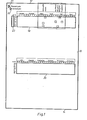
- Fig. 1 zeigt eine Vorderansicht der Hülle.
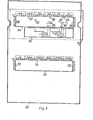
- Fig. 2 zeigt eine Ansicht der Hülle von hinten.
- Fig. 3 zeigt eine Vorderansicht des Schiebers.
- Fig. 4 zeigt die Rückseite des Schiebers.
- Fig. 5 zeigt schematisch den Aufbau der gesamten Einrichtung.
- Fig. 6 zeigt die Vorderansicht der Hülle bei einer weiteren Ausführungsform.
- Fig. 7 zeigt die Rückseite der Hülle bei der Ausführungsform von Fig. 6.
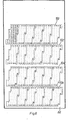
- Fig. 8 zeigt die Vorderseite des Schiebers bei der Ausführungsform von Fig. 6.
- Fig. 9 zeigt die Rückseite des Schiebers.
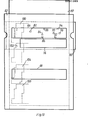
- Fig. 10 zeigt die gegenseitige Lage der verschiedenen Teile und Aufdrucke im Betriebszustand.
- Fig. 1 shows a front view of the shell.
- Fig. 2 shows a view of the shell from behind.
- Fig. 3 shows a front view of the slide.
- Fig. 4 shows the back of the slide.
- Fig. 5 shows schematically the structure of the entire device.
- Fig. 6 shows the front view of the shell in a further embodiment.
- FIG. 7 shows the back of the cover in the embodiment of FIG. 6.
- 8 shows the front of the slide in the embodiment of FIG. 6.
- Fig. 9 shows the back of the slider.
- Fig. 10 shows the mutual position of the different parts and prints in the operating state.
Die in Fig. 1 bis 5 dargestellte Ausführungsform der Erfindung ist eine Einrichtung zur Darstellung von Kalendern für beliebige Jahre zwischen 1582 und 2199.The embodiment of the invention shown in FIGS. 1 to 5 is a device for displaying calendars for any years between 1582 and 2199.
Die Einrichtung besteht aus einer flachen rechteckigen Hülle 10, die an den beiden Schmalseiten 12 und 14 offen ist und die in Fig. 1 und 2 dargestellt ist, und einem Schieber 16, der in dieser Hülle 10 verschiebbar geführt ist. Die Hülle 10 weist auf ihrer in Fig. 1 dargestellten Frontplatte im Abstand übereinander zwei rechteckige Fenster 18 und 20 auf. Stattdessen könnte auch ein einziges entsprechend breites Fenster vorgesehen sein. Das kann aber unter Umständen die Einrichtung sperrig machen und die Handhabung erschweren. Neben dem Fenster sind auf die Frontplatte die "zweiten Symbole", nämlich die Wochentage "Montag" bis "Sonntag" in Schieberichtung des Schiebers 16 in gleichen Abständen übereinander aufgedruckt. Diese Aufdrucke der Wochentage erstrecken sich längs der Schmalseiten der Fenster 18 und 20. Entlang der Längsseiten der Fenster 18 und 20 sind die Monatsnamen "Januar" bis "Juni" und "Juli" bis "Dezember" sowie die Numerierung der Wochen von 1 bis 53 aufgedruckt.The device consists of a flat
Die "ersten" Symbole, nämlich die Tagesdaten, sind in gleichen, den Abständen der "zweiten Symbole" d.h. der Wochentage, entsprechenden Abständen in Spalten auf den Schieber 16 aufgedruckt, so daß sie hinter dem Fenster erscheinen. Die ersten Symbole gehorchen in jeder Spalte der vorgegebenen.Reihenfolge, d.h. sie stellen fortlaufende Zahlen dar. Die Folgen von Symbolen in benachbarten Spalten überlappen sich, d.h. z.B. daß die Zahlen "12" bis "17" in der dritten Spalte (Fig. 3) auch in der vierten Spalte erscheinen. Ebenso erscheinen die Zahlen "19" bis "24" auch in der fünften Spalte. Gleiche Symbole in benachbarten Spalten sind jeweils um eine der Anzahl der zweiten Symbole entsprechende Anzahl von Schritten in der vorgegebenen Reihenfolge gegeneinander versetzt, d.h. daß beispielsweise die Zahl "17" in der vierten Spalte neben der Zahl "10" .in der dritten Spalte und der Zahl "24" in der fünften Spalte steht. Sie ist also um sieben Schritte gegen die Zahl "17" in der dritten Spalte versetzt. Neben den zweiten Symbolen (Wochentagen) ist ein in Schieberichtung des Schiebers 16 langgestrecktes Fenster 22 gebildet. Der Schieber 16 trägt hinter dem Fenster 22 eine Marke 24.The "first" symbols, namely the daily data, are at the same intervals as the "second symbols", i.e. the days of the week, corresponding intervals in columns printed on the
Bei einem Kalender ist die Zuordnung der ersten Symbole (Tagesdaten) zu den zweiten Symbolen (Wochentagen) von einem zusätzlichen Zustand abhängig, nämlich davon, ob. es sich um ein Gemeinjahr oder ein Schaltjahr handelt. Um das zu berücksichtigen sind auf dem Schieber in Schieberichtung untereinander zwei Blöcke 26 und 28 von Spalten erster Symbole aufgedruckt. Die Reihenfolge der Symbole (Daten) ist in dem ersten Block 26 einem ersten Zustand (Gemeinjahr) zugeordnet, und die Reihenfolge der Symbole in dem zweiten Block ist einem zweiten Zustand (Schaltjahr) zugeordnet. Das bedeutet, daß die Zählung für "Februar" in dem Block 28 bis "29" geht, woran sich dann die "1" des März anschließt.In the case of a calendar, the assignment of the first symbols (daily data) to the second symbols (days of the week) depends on an additional state, namely whether it is a general year or a leap year. To take this into account, two
In der Frontplatte der Hülle 10 (Fig. 1) sind in Schieberichtung gesehen nebeneinander zwei Durchbrüche 30 und 32 vorgesehen, die mit "Gemeinjahr" und "Schaltjahr" bezeichnet sind. Auf dem Schieber 16 sind zwei in Schieberichtung verlaufende, langgestreckte, in Schieberichtung gegeneinander versetzte kontrastbildende Streifen 34 und 36 angebracht, von denen der Streifen 34 hinter den Durchbruch 30 und der Streifen 36 hinter den anderen Durchbruch 32 verschiebbar ist. Auf dem Schieber sind erste und zweite in Schieberichtung gegeneinander versetzte Marken, nämlich die Marke 24 und eine Marke 38 vorgesehen, von denen bei Fluchten des einen Streifens 34 mit dem zugehörigen Durchbruch 30 eine erste Marke 24 und bei Fluchten des anderen Streifens 36 mit dem zugehörigen Durchbruch eine zweite Marke 38 hinter dem langgestreckten Fenster 22 neben den zweiten Symbolen (Wochentagen) erscheint. Der in Schieberichtung gemessene Abstand von einem Ende 40 des einen Streifens 34 zu dem entsprechenden Ende 42 des anderen Streifens 36 ist gleich dem in Schieberichtung gemessenen Abstand der Kante 44 des einen Blocks 26 von ersten Symbolen von der entsprechenden Kante 46 des anderen Blocks 28 plus des in Schieberichtung gemessenen Abstandes von Mitte zu Mitte der Durchbrüche 30,32. Es sind zwei erste Marken 24 und 24A und zwei zweite Marken 38 und 38A neben den vordersten Symbolen "1" der Reihenfolge in der ersten und der zweiten Spalte des ersten bzw. des zweiten Blocks 26 bzw. 28 angeordnet.In the front plate of the casing 10 (FIG. 1), two
Wie aus Fig. 5 ersichtlich ist ist ein zweiter Schieber 48 aus durchsichtigem Material quer zu dem ersten Schieber 16 vor dem Fenster 18 verschiebbar geführt. Dieser zweite Schieber 48 enthält Marken 50 in Form von aufgedruckten Rechtecken.As can be seen from FIG. 5, a
Auf der dem Fenster abgewandten Rückseite des Schiebers 16 ist eine Tabelle aufgebracht. Die dem Fenster abgewandte Rückseite der Hülle 10 (Fig. 2) weist quer zur Schieberichtung des Schiebers 16 ein langestrecktes Fenster 52 zum Ablesen dieser Tabelle auf.A table is attached to the back of the
Weiterhin weist die dem Fenster 18 abgewandte Rückseite der Hülle 10 einen ersten und wenigstens einen zweiten Durchbruch 54 bzw. 56 auf. Bei dem dargestellten bevorzugten Ausführungsbeispiel sind mehrere zweite Durchbrüche 56 sowie 56A und 56B vorgesehen. Auf der dem Fenster 18 abgewandten Rückseite des Schiebers 16 sind in Schieberichtung übereinander eine Folge 58 von in vorgegebenen Abständen angeordneten dritten Symbolen und eine Folge 60 von in den gleichen vorgegebenen. Abständen angeordneten vierten Symbolen angebracht, derart, daß, wenn bei Verschieben des Schiebers 16 ein drittes Symbol hinter dem ersten Durchbruch 54 erscheint, ein zugeordnetes viertes Symbol hinter dem zweiten Durchbruch 56 oder 56A bzw. 56B sichtbar wird.Furthermore, the rear side of the
Die beschriebene Einrichtung wird wie folgt benutzt:
- Neben
dem langgestreckten Fenster 52 sind Jahrhunderte von "15" bis "21" angegeben.Der Schieber 16 wird relativ zudem Fenster 52 verschoben, bis die gewünschte Jahreszahl z.B. "1982" erscheint, also hinter der auf der Hülle 10angebrachten Zahl 19 in dem Fenster die Zahl "82" erscheint. Darunter enthält dann die Tabelle auf der Rückseite des Schiebers 16 (Fig. 4) die Angabe, daß es sich um ein Gemeinjahr handelt, welches mit einem Freitag beginnt.
- In addition to the
elongated window 52, centuries from "15" to "21" are specified. Theslider 16 is moved relative to thewindow 52, the number "82" appears until the desired J ahreszahl for example, "1982", that is behind the mounted on theshell 10number 19 appears in the window. The table below then contains on the back of the slide 16 (Fig. 4) the indication that it is a common year, which begins on a Friday.
Es wird dann die Hülle umgedreht, so daß die Frontplatte sichtbar wird. Der Schieber 16 wird so verschoben, daß der Streifen 34 hinter dem Durchbruch 30 erscheint (Gemeinjahr) und die Marke 24A auf "Freitag" steht. In den Fenstern 18 und 20 erscheint dann der vollständige Kalender für das Jahr 1982.The cover is then turned over so that the front panel is visible. The
Dividiert man die Jahreszahl durch 19, so ergibt sich ein Rest, im Falle von 1982 der Rest 6. Der Schieber 16 kann so verschoben werden, daß hinter dem Durchbruch 54 auf der Rückseite der Hülle 10 die Zahl "6" erscheint. In dem Durchbruch 56 kann dann aus der Zahlenfolge 60 abgelesen werden, daß der Frühlingsvollmond auf den 8. April fällt. Ostern ist der 1. Sonntag nach dem Frühlingsvollmond. Es kann der Schieber mit einer Marke 50, die in der "Sonntags"-Zeile liegt, auf den nächsten Sonntag nach dem 8. April, d.h. den 11. April geschoben werden. Andere Marken 50 auf dem zweiten Schieber 48 können dann Karfreitag, Ostermontag, Himmelfahrt, Pfingsten und Fronleichnam andeuten, die alle vom Datum des Osterfests abhängig sind.If the year is divided by 19, there is a remainder, in the case of 1982 the remainder is 6. The
Die beschriebene Anordnung gestattet es also mit mechanischen Mitteln durch geeignetes Verschieben der Schieber 16 und 48 einen vollständigen Kalender jedes beliebigen Jahres einschließlich der beweglichen Festtage herzustellen.The arrangement described thus makes it possible to produce a complete calendar of any year including the movable holidays by mechanical means by suitably moving the
Bei der Einrichtung nach Fig. 6 bis 10 ist ein erster, rechteckiger Schieber 60 in einer rechteckigen Hülle 62 verschiebbar geführt. Die Hülle 62 hat auf der Vorderseite ein erstes rechteckiges Fenster 64 und ein zweites rechteckiges Fenster 66. Die Fenster 64 und 66 erstrecken sich mit ihren Schmalseiten 68 bzw. 70 parallel zur Schieberichtung des Schiebers 60 und mit ihren Längsseiten 72 bzw. 74 quer zu dieser. Längs der Schmalseiten 68,70 sind die Bezeichnungen der Wochentage ("zweite Symbole") übereinander aufgedruckt. Längs der Längsseiten 72 und 74 der Fenster 64 bzw. 66 sind nebeneinander Monatsnamen "Januar" bis "Juni" bzw. "Juli" bis "Dezember" und die Numerierung der Wochen aufgedruckt. Unterhalb des Fensters 64 ist ein weiteres rechteckiges Fenster 76 vorgesehen.In the device according to FIGS. 6 to 10, a first,
Auf der Rückseite (Fig. 7) sind in der Hülle 62 quer zur Schieberichtung verlaufende Schlitze oder langgestreckte Fenster 78 vorgesehen, und zwar drei Schlitze 78 in einer oberen Reihe und je zwei Schlitze 78 in zwei im Abstand voneinander und von der ersten Reihe verlaufenden mittleren bzw. unteren Reihen. Die Schlitze 78 sind nach Jahrhunderten "15...", "16...", "17..." bis "21.." bezeichnet. Ein zweiter Schieber 80 aus durchsichtigem Material ist quer zu dem ersten Schieber 60 vor dem Fenster 64 verschiebbar geführt. Dieser zweite Schieber 80 trägt Markierungen 82,84,86,88,90,92,94 und 96, deren Bedeutung unten noch erläutert wird. Der zweite Schieber 80 erstreckt sich auch bis hinter das Fenster 76. Der untere Teil des Schiebers 80, der im Bereich des Fensters 76 liegt, ist undurchsichtig oder mit einer Abdeckung versehen. Auf diesen unteren Teil können Beschriftungen aufgebracht werden, welche auf die Bedeutung der einzelnen Markierungen 82 bis 96 hinweisen. Wie aus Fig. 7 ersichtlich ist, können auf der Rückseite des zweiten Schiebers 80 noch Skalenstriche 98 zur leichteren Einstellung des Schiebers 80 angebracht sein.On the rear side (FIG. 7), slots or
Der erste Schieber 60 enthält auf der Vorderseite (Fig.8) zweimal zwei Blöcke 100,102 und 104,106 von Zahlenkolonnen mit fortlaufenden Zahlen bis 28,29,30 oder 31, wobei jede Zahlenkolonne um sieben Schritte gegenüber der benachbarten Zahlenkolonne versetzt ist. Die Blöcke 100 und 102 sind für die Monate Januar bis Juni und die Blöcke 104 und 106 für die Monate Juli bis Dezember vorgesehen. Dabei sind die Blöcke 100 und 104 für Gemeinjahre und die Blöcke 102 und 106 für Schaltjahre anwendbar.The
Auf der Rückseite (Fig. 9) trägt der Schieber 60 drei Gruppen 108,110, 112 von zweistelligen Zahlen, die in Verbindung mit jeweils einer Jahrhundertangabe über den Schlitzen 78 eine Jahreszahl ergeben. Jede Gruppe besteht wieder aus drei bzw. zwei Untergruppen , die jeweils seitlich im Bereich eines der Schlitze angeordnet sind. Jede Untergruppe wiederum enthält einen Block 114 von relativ dicht gedrängten Zahlen, die den Gemeinjahren entsprechen, und ein Feld 116, von im Abstand voneinander verteilt angeordneten Zahlen, die den Schaltjahren entsprechen.On the back (FIG. 9), the
Neben jeder zweistelligen Jahreszahl steht noch eine kleine, im allgemeinen.:einstellige Zahl (oder 10).Next to each two-digit year there is a small, generally one-digit number (or 10).
Fig. 10 zeigt die Einrichtung im Betriebszustand, wenn der erste Schieber 60 in die Hülle 62 eingesteckt ist.10 shows the device in the operating state when the
Zur Einstellung des Kalenders für ein bestimmtes Jahr wird der Schieber 60 in der Hülle 62 so verschoben, daß hinter dem Schlitz 78, der dem betreffenden Jahrhundert, z.B. 18..., zugeordnet ist, die den letzten beiden Stellen der Jahreszahl entsprechende Zahl erscheint. Bei einem Gemeinjahr ist das eine Zahl aus dem Block 114. Auf der Vorderseite erscheinen dann hinter den Fenstern 64 und 66 Teile der Blöcke 100 bzw. 104. Zur Einstellung beweglicher Feste dient die neben den letzten beiden Stellen der Jahreszahl auf der Rück- seite aufgedruckte kleine Zahl, z.B. "7" für 1899, die angibt in welche Woche der Aschermittwoch fällt. Dem Aschermittwoch ist auf dem zweiten Schieber 80 die Markierung 82 zugeordnet. Diese Markierung wird durch Verschieben des zweiten Schiebers 80 auf die 8. Woche, d.h. unter die "8" an der oberen Längsseite des Fensters 64 gestellt. Es gibt dann die Markierung 84 den Karfreitag, die Markierung 86 den Ostersonntag, die Markierunq 88 den Ostermontag, die Markierung 90 Christi Himmelfahrt, die Markierung 92 den Pfingstsonntag, die Markierung 94 Pfingstmontag und die Markierung 96 Fronleichnam an.To set the calendar for a particular year, the
Bei einem Schaltjahr, z.B. 1896, muß der Schieber 60 so weit in der Hülle verschoben werden, daß eine Zahl aus dem Feld 116 hinter dem Schlitz 78 erscheint. Auf der Vorderseite erscheinen dann hinter den Fenstern 64 und 66 Teile der Blöcke 102 bzw. 106. Die Berücksichtigung der Schaltjahre erfolgt daher bei der vorliegenden Einrichtung dadurch, daß auf der Vorderseite des Schiebers 60 jeweils zwei getrennte Zahlenblöcke 100,104 bzw. 102,106 für Gemeinjahre und Schaltjahre vorgesehen sind und hinter den Schlitzen 78 die Jahreszahlen in entsprechend getrennten Blöcken bzw. Feldern 114,116 angeordnet sind. Das ist möglich, ohne daß der Kalender zu sperrig wird, weil die Schlitze 78 und die Jahreszahlen auf der Rückseite vorgesehen sind.With a leap year, e.g. In 1896, the
Statt nach der Marke 82 kann die Einstellung des zweiten Schiebers 80 auch z.B. nach der Skala 98 erfolgen.Instead of the
Claims (10)
dadurch gekennzeichnet, daß
characterized in that
angebracht sind, derart, daß, wenn bei Verschieben des Schiebers (16) ein drittes Symbol hinter dem ersten Durchbruch (54) erscheint, ein zugeordnetes viertes Symbol hinter dem zweiten Durchbruch (56) sichtbar wird.
are attached in such a way that if a third symbol appears behind the first opening (54) when the slide (16) is moved, an assigned fourth symbol behind the second opening (56) becomes visible.
Applications Claiming Priority (4)
| Application Number | Priority Date | Filing Date | Title |
|---|---|---|---|
| DE3212565 | 1982-04-03 | ||
| DE3212565 | 1982-04-03 | ||
| DE3308950 | 1983-03-12 | ||
| DE19833308950 DE3308950C2 (en) | 1982-04-03 | 1983-03-12 | Long term calendar |
Publications (2)
| Publication Number | Publication Date |
|---|---|
| EP0091069A2 true EP0091069A2 (en) | 1983-10-12 |
| EP0091069A3 EP0091069A3 (en) | 1984-07-25 |
Family
ID=25800925
Family Applications (1)
| Application Number | Title | Priority Date | Filing Date |
|---|---|---|---|
| EP83103101A Withdrawn EP0091069A3 (en) | 1982-04-03 | 1983-03-29 | Arrangement for presenting tables, e.g. calenders |
Country Status (2)
| Country | Link |
|---|---|
| EP (1) | EP0091069A3 (en) |
| DE (1) | DE3308950C2 (en) |
Families Citing this family (1)
| Publication number | Priority date | Publication date | Assignee | Title |
|---|---|---|---|---|
| DE19611299A1 (en) * | 1996-03-22 | 1997-09-25 | Idea Productservice Gmbh | Permanent calendar with casing for sliding component |
Family Cites Families (6)
| Publication number | Priority date | Publication date | Assignee | Title |
|---|---|---|---|---|
| US1266610A (en) * | 1917-04-13 | 1918-05-21 | Frank X Moerk | Perpetual calendar. |
| FR1002662A (en) * | 1949-11-04 | 1952-03-10 | Perpetual calendar | |
| US3201884A (en) * | 1962-11-13 | 1965-08-24 | John L Aughey | Perpetual calendar |
| US3815269A (en) * | 1971-12-01 | 1974-06-11 | S Roselli | Slide calculator for determining selected periods of time |
| FR2166818A5 (en) * | 1972-03-28 | 1973-08-17 | Barrue Louis | |
| IT8035659V0 (en) * | 1980-03-24 | 1980-03-24 | Masillo Guido | REGOLO CALENDAR |
-
1983
- 1983-03-12 DE DE19833308950 patent/DE3308950C2/en not_active Expired
- 1983-03-29 EP EP83103101A patent/EP0091069A3/en not_active Withdrawn
Also Published As
| Publication number | Publication date |
|---|---|
| EP0091069A3 (en) | 1984-07-25 |
| DE3308950C2 (en) | 1986-03-27 |
| DE3308950A1 (en) | 1983-10-13 |
Similar Documents
| Publication | Publication Date | Title |
|---|---|---|
| DE2840013A1 (en) | CONTINUOUS CALENDARS FOR MULTIPLE YEARS | |
| DE1436144C3 (en) | Calendar device | |
| CH646539A5 (en) | UNIVERSAL DEVICE FOR EVALUATING CALENDAR DATA. | |
| DE3308950C2 (en) | Long term calendar | |
| DE449081C (en) | Adjustable calendar | |
| DE2613296A1 (en) | Calendar clock for public buildings or schools - has automatic display of respective week in year using moving ring element | |
| DE827261C (en) | Everlasting appointment calendar | |
| DE1298047B (en) | World clock | |
| DE417107C (en) | Calendar with a sliding band that carries the day's data | |
| DE540560C (en) | calendar | |
| DE395961C (en) | Card index, the cards of which, in order to be able to be offset laterally against each other, engage with protrusions in grooves in the floor | |
| DE802106C (en) | Perpetual calendar | |
| AT160769B (en) | Device for performing multiplications. | |
| DE2336862C3 (en) | Daily tear-off calendar | |
| DE376219C (en) | Permanent and reminder calendar in card index form | |
| DE407318C (en) | Adjustable permanent calendar | |
| DE8031031U1 (en) | calendar | |
| DE889369C (en) | Device for determining the pregnancy-free days of women | |
| DE553271C (en) | Weekly tear-off calendar with window slider | |
| DE414282C (en) | Position calendar | |
| DE8209674U1 (en) | DEVICE FOR DISPLAYING TABLES, e.g. CALENDARS | |
| DE2217510B1 (en) | Tear-off desk calendar | |
| DE845721C (en) | Adjustable calendar with monthly and daily division | |
| DE378079C (en) | Calendar with rotating discs | |
| DE1233183B (en) | Perpetual calendars necessarily display correctly one year each |
Legal Events
| Date | Code | Title | Description |
|---|---|---|---|
| PUAI | Public reference made under article 153(3) epc to a published international application that has entered the european phase |
Free format text: ORIGINAL CODE: 0009012 |
|
| AK | Designated contracting states |
Designated state(s): AT BE CH DE FR GB IT LI NL |
|
| PUAL | Search report despatched |
Free format text: ORIGINAL CODE: 0009013 |
|
| AK | Designated contracting states |
Designated state(s): AT BE CH DE FR GB IT LI NL |
|
| RAP1 | Party data changed (applicant data changed or rights of an application transferred) |
Owner name: ECHTERHOFF, DIETER |
|
| STAA | Information on the status of an ep patent application or granted ep patent |
Free format text: STATUS: THE APPLICATION IS DEEMED TO BE WITHDRAWN |
|
| 18D | Application deemed to be withdrawn |
Effective date: 19860326 |