EP0089028B1 - Neue Theophyllin-Derivate und Verfahren zu ihrer Herstellung - Google Patents
Neue Theophyllin-Derivate und Verfahren zu ihrer Herstellung Download PDFInfo
- Publication number
- EP0089028B1 EP0089028B1 EP83102422A EP83102422A EP0089028B1 EP 0089028 B1 EP0089028 B1 EP 0089028B1 EP 83102422 A EP83102422 A EP 83102422A EP 83102422 A EP83102422 A EP 83102422A EP 0089028 B1 EP0089028 B1 EP 0089028B1
- Authority
- EP
- European Patent Office
- Prior art keywords
- theophylline
- oxadiazol
- methyl
- general formula
- ethyl
- Prior art date
- Legal status (The legal status is an assumption and is not a legal conclusion. Google has not performed a legal analysis and makes no representation as to the accuracy of the status listed.)
- Expired
Links
- ZFXYFBGIUFBOJW-UHFFFAOYSA-N theophylline Chemical class O=C1N(C)C(=O)N(C)C2=C1NC=N2 ZFXYFBGIUFBOJW-UHFFFAOYSA-N 0.000 title claims description 93
- 238000000034 method Methods 0.000 title claims description 16
- 238000002360 preparation method Methods 0.000 title claims description 3
- -1 2-ethoxyethyl Chemical group 0.000 claims abstract description 91
- 150000001875 compounds Chemical class 0.000 claims abstract description 67
- 125000002496 methyl group Chemical group [H]C([H])([H])* 0.000 claims abstract description 32
- 239000002253 acid Substances 0.000 claims abstract description 19
- 150000003839 salts Chemical class 0.000 claims abstract description 15
- 125000000391 vinyl group Chemical group [H]C([*])=C([H])[H] 0.000 claims abstract description 10
- 229920002554 vinyl polymer Polymers 0.000 claims abstract description 10
- 125000001188 haloalkyl group Chemical group 0.000 claims abstract description 9
- 125000004103 aminoalkyl group Chemical group 0.000 claims abstract description 8
- 239000001257 hydrogen Substances 0.000 claims abstract description 7
- 229910052739 hydrogen Inorganic materials 0.000 claims abstract description 7
- 125000004433 nitrogen atom Chemical group N* 0.000 claims abstract description 7
- 125000002887 hydroxy group Chemical group [H]O* 0.000 claims abstract description 5
- 229910052757 nitrogen Inorganic materials 0.000 claims abstract description 5
- 125000002924 primary amino group Chemical group [H]N([H])* 0.000 claims abstract description 5
- 125000000579 2,2-diphenylethyl group Chemical group [H]C1=C([H])C([H])=C(C([H])=C1[H])C([H])(C1=C([H])C([H])=C([H])C([H])=C1[H])C([H])([H])* 0.000 claims abstract description 4
- 125000002947 alkylene group Chemical group 0.000 claims abstract description 4
- 125000001797 benzyl group Chemical group [H]C1=C([H])C([H])=C(C([H])=C1[H])C([H])([H])* 0.000 claims abstract description 4
- 125000002768 hydroxyalkyl group Chemical group 0.000 claims abstract description 4
- 125000000008 (C1-C10) alkyl group Chemical group 0.000 claims abstract description 3
- ZAMOUSCENKQFHK-UHFFFAOYSA-N Chlorine atom Chemical compound [Cl] ZAMOUSCENKQFHK-UHFFFAOYSA-N 0.000 claims abstract description 3
- 125000005243 carbonyl alkyl group Chemical group 0.000 claims abstract description 3
- 239000000460 chlorine Substances 0.000 claims abstract description 3
- 229910052801 chlorine Inorganic materials 0.000 claims abstract description 3
- 125000001997 phenyl group Chemical group [H]C1=C([H])C([H])=C(*)C([H])=C1[H] 0.000 claims abstract description 3
- UFHFLCQGNIYNRP-UHFFFAOYSA-N Hydrogen Chemical compound [H][H] UFHFLCQGNIYNRP-UHFFFAOYSA-N 0.000 claims abstract 5
- 125000006704 (C5-C6) cycloalkyl group Chemical group 0.000 claims abstract 2
- 229960000278 theophylline Drugs 0.000 claims description 134
- XLYOFNOQVPJJNP-UHFFFAOYSA-N water Substances O XLYOFNOQVPJJNP-UHFFFAOYSA-N 0.000 claims description 31
- SFZULDYEOVSIKM-UHFFFAOYSA-N chembl321317 Chemical compound C1=CC(C(=N)NO)=CC=C1C1=CC=C(C=2C=CC(=CC=2)C(=N)NO)O1 SFZULDYEOVSIKM-UHFFFAOYSA-N 0.000 claims description 18
- 230000002829 reductive effect Effects 0.000 claims description 12
- JBXSBZBZASARMY-UHFFFAOYSA-N 1,3-dimethyl-7-[(5-methyl-1,2,4-oxadiazol-3-yl)methyl]purine-2,6-dione Chemical compound O1C(C)=NC(CN2C=3C(=O)N(C)C(=O)N(C)C=3N=C2)=N1 JBXSBZBZASARMY-UHFFFAOYSA-N 0.000 claims description 8
- 238000005917 acylation reaction Methods 0.000 claims description 7
- 239000003054 catalyst Substances 0.000 claims description 7
- 230000010933 acylation Effects 0.000 claims description 6
- 150000001412 amines Chemical class 0.000 claims description 5
- 125000005188 oxoalkyl group Chemical group 0.000 claims description 4
- 125000004178 (C1-C4) alkyl group Chemical group 0.000 claims description 3
- 239000013543 active substance Substances 0.000 claims description 3
- 150000001336 alkenes Chemical class 0.000 claims description 3
- 238000009833 condensation Methods 0.000 claims description 3
- 230000005494 condensation Effects 0.000 claims description 3
- 229910052736 halogen Inorganic materials 0.000 claims description 3
- 150000002367 halogens Chemical group 0.000 claims description 3
- 239000000969 carrier Substances 0.000 claims description 2
- 125000004430 oxygen atom Chemical group O* 0.000 claims description 2
- 125000002130 sulfonic acid ester group Chemical group 0.000 claims description 2
- IJGRMHOSHXDMSA-UHFFFAOYSA-N Atomic nitrogen Chemical compound N#N IJGRMHOSHXDMSA-UHFFFAOYSA-N 0.000 claims 2
- 239000008194 pharmaceutical composition Substances 0.000 claims 2
- 125000004765 (C1-C4) haloalkyl group Chemical group 0.000 claims 1
- 230000002152 alkylating effect Effects 0.000 claims 1
- 125000004965 chloroalkyl group Chemical group 0.000 claims 1
- 150000002118 epoxides Chemical class 0.000 claims 1
- JRZJOMJEPLMPRA-UHFFFAOYSA-N olefin Natural products CCCCCCCC=C JRZJOMJEPLMPRA-UHFFFAOYSA-N 0.000 claims 1
- 239000000546 pharmaceutical excipient Substances 0.000 claims 1
- 125000000217 alkyl group Chemical group 0.000 abstract description 7
- PCHPORCSPXIHLZ-UHFFFAOYSA-N diphenhydramine hydrochloride Chemical class [Cl-].C=1C=CC=CC=1C(OCC[NH+](C)C)C1=CC=CC=C1 PCHPORCSPXIHLZ-UHFFFAOYSA-N 0.000 abstract description 5
- QVGXLLKOCUKJST-UHFFFAOYSA-N atomic oxygen Chemical compound [O] QVGXLLKOCUKJST-UHFFFAOYSA-N 0.000 abstract 1
- 150000002431 hydrogen Chemical class 0.000 abstract 1
- 239000001301 oxygen Substances 0.000 abstract 1
- 229910052760 oxygen Inorganic materials 0.000 abstract 1
- LFQSCWFLJHTTHZ-UHFFFAOYSA-N Ethanol Chemical compound CCO LFQSCWFLJHTTHZ-UHFFFAOYSA-N 0.000 description 79
- YXFVVABEGXRONW-UHFFFAOYSA-N Toluene Chemical compound CC1=CC=CC=C1 YXFVVABEGXRONW-UHFFFAOYSA-N 0.000 description 54
- 239000000203 mixture Substances 0.000 description 49
- ZMXDDKWLCZADIW-UHFFFAOYSA-N N,N-Dimethylformamide Chemical compound CN(C)C=O ZMXDDKWLCZADIW-UHFFFAOYSA-N 0.000 description 48
- OKKJLVBELUTLKV-UHFFFAOYSA-N Methanol Chemical compound OC OKKJLVBELUTLKV-UHFFFAOYSA-N 0.000 description 39
- XEKOWRVHYACXOJ-UHFFFAOYSA-N Ethyl acetate Chemical compound CCOC(C)=O XEKOWRVHYACXOJ-UHFFFAOYSA-N 0.000 description 30
- WQDUMFSSJAZKTM-UHFFFAOYSA-N Sodium methoxide Chemical compound [Na+].[O-]C WQDUMFSSJAZKTM-UHFFFAOYSA-N 0.000 description 30
- CSCPPACGZOOCGX-UHFFFAOYSA-N Acetone Chemical compound CC(C)=O CSCPPACGZOOCGX-UHFFFAOYSA-N 0.000 description 27
- 239000000243 solution Substances 0.000 description 22
- 239000002904 solvent Substances 0.000 description 22
- UHOVQNZJYSORNB-UHFFFAOYSA-N Benzene Chemical compound C1=CC=CC=C1 UHOVQNZJYSORNB-UHFFFAOYSA-N 0.000 description 21
- JUJWROOIHBZHMG-UHFFFAOYSA-N Pyridine Chemical compound C1=CC=NC=C1 JUJWROOIHBZHMG-UHFFFAOYSA-N 0.000 description 20
- JSGKUNQWGYLLLG-UHFFFAOYSA-N 2-(1,3-dimethyl-2,6-dioxopurin-7-yl)-n'-hydroxyethanimidamide Chemical compound O=C1N(C)C(=O)N(C)C2=C1N(C\C(N)=N\O)C=N2 JSGKUNQWGYLLLG-UHFFFAOYSA-N 0.000 description 19
- WFDIJRYMOXRFFG-UHFFFAOYSA-N Acetic anhydride Chemical compound CC(=O)OC(C)=O WFDIJRYMOXRFFG-UHFFFAOYSA-N 0.000 description 18
- 238000003756 stirring Methods 0.000 description 17
- 230000000954 anitussive effect Effects 0.000 description 14
- OROGSEYTTFOCAN-DNJOTXNNSA-N codeine Chemical compound C([C@H]1[C@H](N(CC[C@@]112)C)C3)=C[C@H](O)[C@@H]1OC1=C2C3=CC=C1OC OROGSEYTTFOCAN-DNJOTXNNSA-N 0.000 description 14
- VZCYOOQTPOCHFL-UPHRSURJSA-N maleic acid Chemical compound OC(=O)\C=C/C(O)=O VZCYOOQTPOCHFL-UPHRSURJSA-N 0.000 description 14
- VZCYOOQTPOCHFL-UHFFFAOYSA-N trans-butenedioic acid Natural products OC(=O)C=CC(O)=O VZCYOOQTPOCHFL-UHFFFAOYSA-N 0.000 description 14
- QTBSBXVTEAMEQO-UHFFFAOYSA-N Acetic acid Chemical compound CC(O)=O QTBSBXVTEAMEQO-UHFFFAOYSA-N 0.000 description 12
- ZMANZCXQSJIPKH-UHFFFAOYSA-N Triethylamine Chemical compound CCN(CC)CC ZMANZCXQSJIPKH-UHFFFAOYSA-N 0.000 description 12
- FVAUCKIRQBBSSJ-UHFFFAOYSA-M sodium iodide Chemical compound [Na+].[I-] FVAUCKIRQBBSSJ-UHFFFAOYSA-M 0.000 description 12
- RTZKZFJDLAIYFH-UHFFFAOYSA-N ether Substances CCOCC RTZKZFJDLAIYFH-UHFFFAOYSA-N 0.000 description 11
- KFZMGEQAYNKOFK-UHFFFAOYSA-N Isopropanol Chemical compound CC(C)O KFZMGEQAYNKOFK-UHFFFAOYSA-N 0.000 description 10
- UIIMBOGNXHQVGW-UHFFFAOYSA-M Sodium bicarbonate Chemical compound [Na+].OC([O-])=O UIIMBOGNXHQVGW-UHFFFAOYSA-M 0.000 description 10
- BWHMMNNQKKPAPP-UHFFFAOYSA-L potassium carbonate Chemical compound [K+].[K+].[O-]C([O-])=O BWHMMNNQKKPAPP-UHFFFAOYSA-L 0.000 description 10
- UMJSCPRVCHMLSP-UHFFFAOYSA-N pyridine Natural products COC1=CC=CN=C1 UMJSCPRVCHMLSP-UHFFFAOYSA-N 0.000 description 10
- KWYUFKZDYYNOTN-UHFFFAOYSA-M Potassium hydroxide Chemical compound [OH-].[K+] KWYUFKZDYYNOTN-UHFFFAOYSA-M 0.000 description 9
- HEMHJVSKTPXQMS-UHFFFAOYSA-M Sodium hydroxide Chemical compound [OH-].[Na+] HEMHJVSKTPXQMS-UHFFFAOYSA-M 0.000 description 9
- OQFMNXMRKPNXOY-UHFFFAOYSA-N 1,3-dimethyl-7h-purine-2,6-dione;hydrochloride Chemical compound Cl.O=C1N(C)C(=O)N(C)C2=C1NC=N2 OQFMNXMRKPNXOY-UHFFFAOYSA-N 0.000 description 8
- HEDRZPFGACZZDS-UHFFFAOYSA-N Chloroform Chemical compound ClC(Cl)Cl HEDRZPFGACZZDS-UHFFFAOYSA-N 0.000 description 8
- CDBYLPFSWZWCQE-UHFFFAOYSA-L Sodium Carbonate Chemical compound [Na+].[Na+].[O-]C([O-])=O CDBYLPFSWZWCQE-UHFFFAOYSA-L 0.000 description 8
- 229940124584 antitussives Drugs 0.000 description 8
- 238000009835 boiling Methods 0.000 description 8
- 238000006243 chemical reaction Methods 0.000 description 8
- 238000010438 heat treatment Methods 0.000 description 8
- 238000006798 ring closing metathesis reaction Methods 0.000 description 8
- QDRKDTQENPPHOJ-UHFFFAOYSA-N sodium ethoxide Chemical compound [Na+].CC[O-] QDRKDTQENPPHOJ-UHFFFAOYSA-N 0.000 description 8
- FYSNRJHAOHDILO-UHFFFAOYSA-N thionyl chloride Chemical compound ClS(Cl)=O FYSNRJHAOHDILO-UHFFFAOYSA-N 0.000 description 8
- HUIROZYYQWTITH-UHFFFAOYSA-N 7-[[5-[2-(diethylamino)ethyl]-1,2,4-oxadiazol-3-yl]methyl]-1,3-dimethylpurine-2,6-dione Chemical compound O1C(CCN(CC)CC)=NC(CN2C=3C(=O)N(C)C(=O)N(C)C=3N=C2)=N1 HUIROZYYQWTITH-UHFFFAOYSA-N 0.000 description 7
- 206010011224 Cough Diseases 0.000 description 7
- VEXZGXHMUGYJMC-UHFFFAOYSA-N Hydrochloric acid Chemical compound Cl VEXZGXHMUGYJMC-UHFFFAOYSA-N 0.000 description 7
- 239000004480 active ingredient Substances 0.000 description 7
- 229960004126 codeine Drugs 0.000 description 7
- 230000000694 effects Effects 0.000 description 7
- OROGSEYTTFOCAN-UHFFFAOYSA-N hydrocodone Natural products C1C(N(CCC234)C)C2C=CC(O)C3OC2=C4C1=CC=C2OC OROGSEYTTFOCAN-UHFFFAOYSA-N 0.000 description 7
- 239000003960 organic solvent Substances 0.000 description 7
- OFOBLEOULBTSOW-UHFFFAOYSA-N Propanedioic acid Natural products OC(=O)CC(O)=O OFOBLEOULBTSOW-UHFFFAOYSA-N 0.000 description 6
- 239000003513 alkali Substances 0.000 description 6
- 125000004432 carbon atom Chemical group C* 0.000 description 6
- KRKNYBCHXYNGOX-UHFFFAOYSA-N citric acid Chemical compound OC(=O)CC(O)(C(O)=O)CC(O)=O KRKNYBCHXYNGOX-UHFFFAOYSA-N 0.000 description 6
- HPNMFZURTQLUMO-UHFFFAOYSA-N diethylamine Chemical compound CCNCC HPNMFZURTQLUMO-UHFFFAOYSA-N 0.000 description 6
- 239000003814 drug Substances 0.000 description 6
- 238000001704 evaporation Methods 0.000 description 6
- 230000008020 evaporation Effects 0.000 description 6
- 239000011976 maleic acid Substances 0.000 description 6
- PXZDWASDNFWKSD-UHFFFAOYSA-N prenoxdiazine Chemical compound C1CCCCN1CCC(ON=1)=NC=1CC(C=1C=CC=CC=1)C1=CC=CC=C1 PXZDWASDNFWKSD-UHFFFAOYSA-N 0.000 description 6
- 229960004202 prenoxdiazine Drugs 0.000 description 6
- 239000007858 starting material Substances 0.000 description 6
- 230000001988 toxicity Effects 0.000 description 6
- 231100000419 toxicity Toxicity 0.000 description 6
- XDTMQSROBMDMFD-UHFFFAOYSA-N Cyclohexane Chemical compound C1CCCCC1 XDTMQSROBMDMFD-UHFFFAOYSA-N 0.000 description 5
- 239000000370 acceptor Substances 0.000 description 5
- 150000008065 acid anhydrides Chemical class 0.000 description 5
- 239000002585 base Substances 0.000 description 5
- 229910000027 potassium carbonate Inorganic materials 0.000 description 5
- 230000000241 respiratory effect Effects 0.000 description 5
- 229910000030 sodium bicarbonate Inorganic materials 0.000 description 5
- 235000017557 sodium bicarbonate Nutrition 0.000 description 5
- QVGLHVDBDYLFON-UHFFFAOYSA-M sodium;1,3-dimethylpurin-7-ide-2,6-dione Chemical compound [Na+].O=C1N(C)C(=O)N(C)C2=C1[N-]C=N2 QVGLHVDBDYLFON-UHFFFAOYSA-M 0.000 description 5
- FERIUCNNQQJTOY-UHFFFAOYSA-N Butyric acid Chemical compound CCCC(O)=O FERIUCNNQQJTOY-UHFFFAOYSA-N 0.000 description 4
- OKTJSMMVPCPJKN-UHFFFAOYSA-N Carbon Chemical compound [C] OKTJSMMVPCPJKN-UHFFFAOYSA-N 0.000 description 4
- WSFSSNUMVMOOMR-UHFFFAOYSA-N Formaldehyde Chemical compound O=C WSFSSNUMVMOOMR-UHFFFAOYSA-N 0.000 description 4
- WTDHULULXKLSOZ-UHFFFAOYSA-N Hydroxylamine hydrochloride Chemical compound Cl.ON WTDHULULXKLSOZ-UHFFFAOYSA-N 0.000 description 4
- 150000007513 acids Chemical class 0.000 description 4
- 230000003110 anti-inflammatory effect Effects 0.000 description 4
- 239000003434 antitussive agent Substances 0.000 description 4
- 208000006673 asthma Diseases 0.000 description 4
- 230000003182 bronchodilatating effect Effects 0.000 description 4
- 150000001732 carboxylic acid derivatives Chemical class 0.000 description 4
- 238000001816 cooling Methods 0.000 description 4
- XBDQKXXYIPTUBI-UHFFFAOYSA-N dimethylselenoniopropionate Natural products CCC(O)=O XBDQKXXYIPTUBI-UHFFFAOYSA-N 0.000 description 4
- 230000002349 favourable effect Effects 0.000 description 4
- 239000000706 filtrate Substances 0.000 description 4
- BDAGIHXWWSANSR-UHFFFAOYSA-N methanoic acid Natural products OC=O BDAGIHXWWSANSR-UHFFFAOYSA-N 0.000 description 4
- 150000002825 nitriles Chemical class 0.000 description 4
- 229910000029 sodium carbonate Inorganic materials 0.000 description 4
- 235000009518 sodium iodide Nutrition 0.000 description 4
- 239000003826 tablet Substances 0.000 description 4
- 238000012360 testing method Methods 0.000 description 4
- NQPDZGIKBAWPEJ-UHFFFAOYSA-N valeric acid Chemical compound CCCCC(O)=O NQPDZGIKBAWPEJ-UHFFFAOYSA-N 0.000 description 4
- 0 **c1n[o]c(*)n1 Chemical compound **c1n[o]c(*)n1 0.000 description 3
- SCYULBFZEHDVBN-UHFFFAOYSA-N 1,1-Dichloroethane Chemical compound CC(Cl)Cl SCYULBFZEHDVBN-UHFFFAOYSA-N 0.000 description 3
- YMWUJEATGCHHMB-UHFFFAOYSA-N Dichloromethane Chemical compound ClCCl YMWUJEATGCHHMB-UHFFFAOYSA-N 0.000 description 3
- JIGUQPWFLRLWPJ-UHFFFAOYSA-N Ethyl acrylate Chemical compound CCOC(=O)C=C JIGUQPWFLRLWPJ-UHFFFAOYSA-N 0.000 description 3
- PEDCQBHIVMGVHV-UHFFFAOYSA-N Glycerine Chemical compound OCC(O)CO PEDCQBHIVMGVHV-UHFFFAOYSA-N 0.000 description 3
- AVXURJPOCDRRFD-UHFFFAOYSA-N Hydroxylamine Chemical compound ON AVXURJPOCDRRFD-UHFFFAOYSA-N 0.000 description 3
- DGAQECJNVWCQMB-PUAWFVPOSA-M Ilexoside XXIX Chemical compound C[C@@H]1CC[C@@]2(CC[C@@]3(C(=CC[C@H]4[C@]3(CC[C@@H]5[C@@]4(CC[C@@H](C5(C)C)OS(=O)(=O)[O-])C)C)[C@@H]2[C@]1(C)O)C)C(=O)O[C@H]6[C@@H]([C@H]([C@@H]([C@H](O6)CO)O)O)O.[Na+] DGAQECJNVWCQMB-PUAWFVPOSA-M 0.000 description 3
- AMQJEAYHLZJPGS-UHFFFAOYSA-N N-Pentanol Chemical compound CCCCCO AMQJEAYHLZJPGS-UHFFFAOYSA-N 0.000 description 3
- 241000700159 Rattus Species 0.000 description 3
- DZGCGKFAPXFTNM-UHFFFAOYSA-N ethanol;hydron;chloride Chemical compound Cl.CCO DZGCGKFAPXFTNM-UHFFFAOYSA-N 0.000 description 3
- 238000009472 formulation Methods 0.000 description 3
- 238000002347 injection Methods 0.000 description 3
- 239000007924 injection Substances 0.000 description 3
- 238000002844 melting Methods 0.000 description 3
- 230000008018 melting Effects 0.000 description 3
- AEXITZJSLGALNH-UHFFFAOYSA-N n'-hydroxyethanimidamide Chemical compound CC(N)=NO AEXITZJSLGALNH-UHFFFAOYSA-N 0.000 description 3
- 210000000056 organ Anatomy 0.000 description 3
- 150000007524 organic acids Chemical class 0.000 description 3
- 150000002923 oximes Chemical class 0.000 description 3
- PNJWIWWMYCMZRO-UHFFFAOYSA-N pent‐4‐en‐2‐one Natural products CC(=O)CC=C PNJWIWWMYCMZRO-UHFFFAOYSA-N 0.000 description 3
- 239000000825 pharmaceutical preparation Substances 0.000 description 3
- 239000000047 product Substances 0.000 description 3
- 125000001436 propyl group Chemical group [H]C([*])([H])C([H])([H])C([H])([H])[H] 0.000 description 3
- 238000011160 research Methods 0.000 description 3
- 239000011734 sodium Substances 0.000 description 3
- 229910052708 sodium Inorganic materials 0.000 description 3
- 239000000725 suspension Substances 0.000 description 3
- 229940005605 valeric acid Drugs 0.000 description 3
- RYHBNJHYFVUHQT-UHFFFAOYSA-N 1,4-Dioxane Chemical compound C1COCCO1 RYHBNJHYFVUHQT-UHFFFAOYSA-N 0.000 description 2
- OSWFIVFLDKOXQC-UHFFFAOYSA-N 4-(3-methoxyphenyl)aniline Chemical compound COC1=CC=CC(C=2C=CC(N)=CC=2)=C1 OSWFIVFLDKOXQC-UHFFFAOYSA-N 0.000 description 2
- YYROPELSRYBVMQ-UHFFFAOYSA-N 4-toluenesulfonyl chloride Chemical compound CC1=CC=C(S(Cl)(=O)=O)C=C1 YYROPELSRYBVMQ-UHFFFAOYSA-N 0.000 description 2
- GZFLHIQBEDOWHS-UHFFFAOYSA-N 7-(5-chloropentyl)-1,3-dimethylpurine-2,6-dione Chemical compound O=C1N(C)C(=O)N(C)C2=C1N(CCCCCCl)C=N2 GZFLHIQBEDOWHS-UHFFFAOYSA-N 0.000 description 2
- IKHGUXGNUITLKF-UHFFFAOYSA-N Acetaldehyde Chemical compound CC=O IKHGUXGNUITLKF-UHFFFAOYSA-N 0.000 description 2
- CIWBSHSKHKDKBQ-JLAZNSOCSA-N Ascorbic acid Chemical compound OC[C@H](O)[C@H]1OC(=O)C(O)=C1O CIWBSHSKHKDKBQ-JLAZNSOCSA-N 0.000 description 2
- VTYYLEPIZMXCLO-UHFFFAOYSA-L Calcium carbonate Chemical compound [Ca+2].[O-]C([O-])=O VTYYLEPIZMXCLO-UHFFFAOYSA-L 0.000 description 2
- BVKZGUZCCUSVTD-UHFFFAOYSA-L Carbonate Chemical compound [O-]C([O-])=O BVKZGUZCCUSVTD-UHFFFAOYSA-L 0.000 description 2
- 239000004606 Fillers/Extenders Substances 0.000 description 2
- AEMRFAOFKBGASW-UHFFFAOYSA-N Glycolic acid Chemical compound OCC(O)=O AEMRFAOFKBGASW-UHFFFAOYSA-N 0.000 description 2
- NTYJJOPFIAHURM-UHFFFAOYSA-N Histamine Chemical compound NCCC1=CN=CN1 NTYJJOPFIAHURM-UHFFFAOYSA-N 0.000 description 2
- CPELXLSAUQHCOX-UHFFFAOYSA-N Hydrogen bromide Chemical compound Br CPELXLSAUQHCOX-UHFFFAOYSA-N 0.000 description 2
- LRHPLDYGYMQRHN-UHFFFAOYSA-N N-Butanol Chemical compound CCCCO LRHPLDYGYMQRHN-UHFFFAOYSA-N 0.000 description 2
- PVNIIMVLHYAWGP-UHFFFAOYSA-N Niacin Chemical compound OC(=O)C1=CC=CN=C1 PVNIIMVLHYAWGP-UHFFFAOYSA-N 0.000 description 2
- 229910019142 PO4 Inorganic materials 0.000 description 2
- NBIIXXVUZAFLBC-UHFFFAOYSA-N Phosphoric acid Chemical compound OP(O)(O)=O NBIIXXVUZAFLBC-UHFFFAOYSA-N 0.000 description 2
- NQRYJNQNLNOLGT-UHFFFAOYSA-N Piperidine Chemical compound C1CCNCC1 NQRYJNQNLNOLGT-UHFFFAOYSA-N 0.000 description 2
- VYPSYNLAJGMNEJ-UHFFFAOYSA-N Silicium dioxide Chemical compound O=[Si]=O VYPSYNLAJGMNEJ-UHFFFAOYSA-N 0.000 description 2
- 235000021355 Stearic acid Nutrition 0.000 description 2
- QAOWNCQODCNURD-UHFFFAOYSA-N Sulfuric acid Chemical compound OS(O)(=O)=O QAOWNCQODCNURD-UHFFFAOYSA-N 0.000 description 2
- HFBMWMNUJJDEQZ-UHFFFAOYSA-N acryloyl chloride Chemical compound ClC(=O)C=C HFBMWMNUJJDEQZ-UHFFFAOYSA-N 0.000 description 2
- 150000001298 alcohols Chemical class 0.000 description 2
- 229910001854 alkali hydroxide Inorganic materials 0.000 description 2
- 150000001350 alkyl halides Chemical class 0.000 description 2
- 150000008051 alkyl sulfates Chemical class 0.000 description 2
- 238000005576 amination reaction Methods 0.000 description 2
- 230000001088 anti-asthma Effects 0.000 description 2
- 150000004945 aromatic hydrocarbons Chemical class 0.000 description 2
- 230000009286 beneficial effect Effects 0.000 description 2
- WPYMKLBDIGXBTP-UHFFFAOYSA-N benzoic acid Chemical compound OC(=O)C1=CC=CC=C1 WPYMKLBDIGXBTP-UHFFFAOYSA-N 0.000 description 2
- NDKBVBUGCNGSJJ-UHFFFAOYSA-M benzyltrimethylammonium hydroxide Chemical compound [OH-].C[N+](C)(C)CC1=CC=CC=C1 NDKBVBUGCNGSJJ-UHFFFAOYSA-M 0.000 description 2
- 230000015572 biosynthetic process Effects 0.000 description 2
- GZUXJHMPEANEGY-UHFFFAOYSA-N bromomethane Chemical compound BrC GZUXJHMPEANEGY-UHFFFAOYSA-N 0.000 description 2
- 229940124630 bronchodilator Drugs 0.000 description 2
- KXZJHVJKXJLBKO-UHFFFAOYSA-N chembl1408157 Chemical compound N=1C2=CC=CC=C2C(C(=O)O)=CC=1C1=CC=C(O)C=C1 KXZJHVJKXJLBKO-UHFFFAOYSA-N 0.000 description 2
- 239000003795 chemical substances by application Substances 0.000 description 2
- 150000001805 chlorine compounds Chemical class 0.000 description 2
- MVPPADPHJFYWMZ-UHFFFAOYSA-N chlorobenzene Chemical compound ClC1=CC=CC=C1 MVPPADPHJFYWMZ-UHFFFAOYSA-N 0.000 description 2
- 239000013078 crystal Substances 0.000 description 2
- 238000002425 crystallisation Methods 0.000 description 2
- 230000008025 crystallization Effects 0.000 description 2
- 239000003085 diluting agent Substances 0.000 description 2
- 201000010099 disease Diseases 0.000 description 2
- 208000037265 diseases, disorders, signs and symptoms Diseases 0.000 description 2
- 229940079593 drug Drugs 0.000 description 2
- ORRQJZMYQQDYDX-UHFFFAOYSA-N ethyl 2-(diethylamino)acetate Chemical compound CCOC(=O)CN(CC)CC ORRQJZMYQQDYDX-UHFFFAOYSA-N 0.000 description 2
- QDISKADULUYVBM-UHFFFAOYSA-N ethyl 3-(diethylamino)propanoate Chemical compound CCOC(=O)CCN(CC)CC QDISKADULUYVBM-UHFFFAOYSA-N 0.000 description 2
- MPAWVDTVWPPKJQ-UHFFFAOYSA-N ethyl 3-piperidin-1-ylpropanoate Chemical compound CCOC(=O)CCN1CCCCC1 MPAWVDTVWPPKJQ-UHFFFAOYSA-N 0.000 description 2
- 125000001495 ethyl group Chemical group [H]C([H])([H])C([H])([H])* 0.000 description 2
- 238000001914 filtration Methods 0.000 description 2
- 235000019253 formic acid Nutrition 0.000 description 2
- 229940093915 gynecological organic acid Drugs 0.000 description 2
- 150000004820 halides Chemical class 0.000 description 2
- CGIGDMFJXJATDK-UHFFFAOYSA-N indomethacin Chemical compound CC1=C(CC(O)=O)C2=CC(OC)=CC=C2N1C(=O)C1=CC=C(Cl)C=C1 CGIGDMFJXJATDK-UHFFFAOYSA-N 0.000 description 2
- JVTAAEKCZFNVCJ-UHFFFAOYSA-N lactic acid Chemical compound CC(O)C(O)=O JVTAAEKCZFNVCJ-UHFFFAOYSA-N 0.000 description 2
- 239000000155 melt Substances 0.000 description 2
- QPJVMBTYPHYUOC-UHFFFAOYSA-N methyl benzoate Chemical compound COC(=O)C1=CC=CC=C1 QPJVMBTYPHYUOC-UHFFFAOYSA-N 0.000 description 2
- 150000007522 mineralic acids Chemical class 0.000 description 2
- 238000002156 mixing Methods 0.000 description 2
- 125000004108 n-butyl group Chemical group [H]C([H])([H])C([H])([H])C([H])([H])C([H])([H])* 0.000 description 2
- 239000012454 non-polar solvent Substances 0.000 description 2
- QIQXTHQIDYTFRH-UHFFFAOYSA-N octadecanoic acid Chemical compound CCCCCCCCCCCCCCCCCC(O)=O QIQXTHQIDYTFRH-UHFFFAOYSA-N 0.000 description 2
- OQCDKBAXFALNLD-UHFFFAOYSA-N octadecanoic acid Natural products CCCCCCCC(C)CCCCCCCCC(O)=O OQCDKBAXFALNLD-UHFFFAOYSA-N 0.000 description 2
- 235000005985 organic acids Nutrition 0.000 description 2
- 150000002924 oxiranes Chemical class 0.000 description 2
- 238000007911 parenteral administration Methods 0.000 description 2
- 235000021317 phosphate Nutrition 0.000 description 2
- 239000002798 polar solvent Substances 0.000 description 2
- 235000019260 propionic acid Nutrition 0.000 description 2
- IUVKMZGDUIUOCP-BTNSXGMBSA-N quinbolone Chemical compound O([C@H]1CC[C@H]2[C@H]3[C@@H]([C@]4(C=CC(=O)C=C4CC3)C)CC[C@@]21C)C1=CCCC1 IUVKMZGDUIUOCP-BTNSXGMBSA-N 0.000 description 2
- QZAYGJVTTNCVMB-UHFFFAOYSA-N serotonin Chemical compound C1=C(O)C=C2C(CCN)=CNC2=C1 QZAYGJVTTNCVMB-UHFFFAOYSA-N 0.000 description 2
- 239000012279 sodium borohydride Substances 0.000 description 2
- 229910000033 sodium borohydride Inorganic materials 0.000 description 2
- 239000008117 stearic acid Substances 0.000 description 2
- 239000000126 substance Substances 0.000 description 2
- 125000001424 substituent group Chemical group 0.000 description 2
- 150000003512 tertiary amines Chemical class 0.000 description 2
- 230000001225 therapeutic effect Effects 0.000 description 2
- 231100001274 therapeutic index Toxicity 0.000 description 2
- NWZSZGALRFJKBT-KNIFDHDWSA-N (2s)-2,6-diaminohexanoic acid;(2s)-2-hydroxybutanedioic acid Chemical compound OC(=O)[C@@H](O)CC(O)=O.NCCCC[C@H](N)C(O)=O NWZSZGALRFJKBT-KNIFDHDWSA-N 0.000 description 1
- BBVIDBNAYOIXOE-UHFFFAOYSA-N 1,2,4-oxadiazole Chemical group C=1N=CON=1 BBVIDBNAYOIXOE-UHFFFAOYSA-N 0.000 description 1
- 150000005071 1,2,4-oxadiazoles Chemical class 0.000 description 1
- WNXJIVFYUVYPPR-UHFFFAOYSA-N 1,3-dioxolane Chemical group C1COCO1 WNXJIVFYUVYPPR-UHFFFAOYSA-N 0.000 description 1
- JKVAWOOMPGXBKF-UHFFFAOYSA-N 2-(1,3-dimethyl-2,6-dioxopurin-7-yl)acetonitrile Chemical compound O=C1N(C)C(=O)N(C)C2=C1N(CC#N)C=N2 JKVAWOOMPGXBKF-UHFFFAOYSA-N 0.000 description 1
- HBTFYZONVQJJNR-UHFFFAOYSA-N 2-(1,3-dimethyl-2,6-dioxopurin-7-yl)acetyl chloride Chemical compound O=C1N(C)C(=O)N(C)C2=C1N(CC(Cl)=O)C=N2 HBTFYZONVQJJNR-UHFFFAOYSA-N 0.000 description 1
- YAOCQHRRRWSOBG-UHFFFAOYSA-N 2-(4-chlorobutoxy)-2h-pyran Chemical compound ClCCCCOC1OC=CC=C1 YAOCQHRRRWSOBG-UHFFFAOYSA-N 0.000 description 1
- JEFBOVZEDJCDRC-UHFFFAOYSA-N 2-(5-chloropentoxy)-2h-pyran Chemical compound ClCCCCCOC1OC=CC=C1 JEFBOVZEDJCDRC-UHFFFAOYSA-N 0.000 description 1
- LBLYYCQCTBFVLH-UHFFFAOYSA-N 2-Methylbenzenesulfonic acid Chemical compound CC1=CC=CC=C1S(O)(=O)=O LBLYYCQCTBFVLH-UHFFFAOYSA-N 0.000 description 1
- UABJYYVWVXCIMX-UHFFFAOYSA-N 2-amino-2-ethylbutanoyl chloride Chemical compound CCC(N)(CC)C(Cl)=O UABJYYVWVXCIMX-UHFFFAOYSA-N 0.000 description 1
- LBORPQYMABOVPW-UHFFFAOYSA-N 2-benzoyl-3-hydroxybenzoic acid Chemical compound OC(=O)C1=CC=CC(O)=C1C(=O)C1=CC=CC=C1 LBORPQYMABOVPW-UHFFFAOYSA-N 0.000 description 1
- 125000000954 2-hydroxyethyl group Chemical group [H]C([*])([H])C([H])([H])O[H] 0.000 description 1
- YZNZCGDKGUEMEG-UHFFFAOYSA-N 3-(2-chloroethyl)-5-methyl-1,2,4-oxadiazole Chemical compound CC1=NC(CCCl)=NO1 YZNZCGDKGUEMEG-UHFFFAOYSA-N 0.000 description 1
- ZFYVXZGJPJTIPQ-UHFFFAOYSA-N 3-(chloromethyl)-5-methyl-1,2,4-oxadiazole Chemical compound CC1=NC(CCl)=NO1 ZFYVXZGJPJTIPQ-UHFFFAOYSA-N 0.000 description 1
- MJMVHBJEFDWMRJ-UHFFFAOYSA-N 3-ethenyl-5-methyl-1,2,4-oxadiazole Chemical compound CC1=NC(C=C)=NO1 MJMVHBJEFDWMRJ-UHFFFAOYSA-N 0.000 description 1
- 125000002373 5 membered heterocyclic group Chemical group 0.000 description 1
- FOZBRFZFJCRLQP-UHFFFAOYSA-N 5-(chloromethyl)-1,2,4-oxadiazole Chemical compound ClCC1=NC=NO1 FOZBRFZFJCRLQP-UHFFFAOYSA-N 0.000 description 1
- JBDABLGMUHPFOL-UHFFFAOYSA-N 5-methyl-3-(oxiran-2-ylmethyl)-1,2,4-oxadiazole Chemical compound O1C(C)=NC(CC2OC2)=N1 JBDABLGMUHPFOL-UHFFFAOYSA-N 0.000 description 1
- 125000004070 6 membered heterocyclic group Chemical group 0.000 description 1
- MTNBUBFQDTUTOF-UHFFFAOYSA-N 6-(1,3-dimethyl-2,6-dioxopurin-7-yl)hexanenitrile Chemical compound O=C1N(C)C(=O)N(C)C2=C1N(CCCCCC#N)C=N2 MTNBUBFQDTUTOF-UHFFFAOYSA-N 0.000 description 1
- MORVOYPJRATMRS-UHFFFAOYSA-N 7-(3-chloropropyl)-1,3-dimethylpurine-2,6-dione Chemical compound O=C1N(C)C(=O)N(C)C2=C1N(CCCCl)C=N2 MORVOYPJRATMRS-UHFFFAOYSA-N 0.000 description 1
- PZASAAIJIFDWSB-CKPDSHCKSA-N 8-[(1S)-1-[8-(trifluoromethyl)-7-[4-(trifluoromethyl)cyclohexyl]oxynaphthalen-2-yl]ethyl]-8-azabicyclo[3.2.1]octane-3-carboxylic acid Chemical compound FC(F)(F)C=1C2=CC([C@@H](N3C4CCC3CC(C4)C(O)=O)C)=CC=C2C=CC=1OC1CCC(C(F)(F)F)CC1 PZASAAIJIFDWSB-CKPDSHCKSA-N 0.000 description 1
- GUBGYTABKSRVRQ-XLOQQCSPSA-N Alpha-Lactose Chemical compound O[C@@H]1[C@@H](O)[C@@H](O)[C@@H](CO)O[C@H]1O[C@@H]1[C@@H](CO)O[C@H](O)[C@H](O)[C@H]1O GUBGYTABKSRVRQ-XLOQQCSPSA-N 0.000 description 1
- 206010002091 Anaesthesia Diseases 0.000 description 1
- 239000005711 Benzoic acid Substances 0.000 description 1
- 208000009079 Bronchial Spasm Diseases 0.000 description 1
- 206010006482 Bronchospasm Diseases 0.000 description 1
- WWZKQHOCKIZLMA-UHFFFAOYSA-N Caprylic acid Natural products CCCCCCCC(O)=O WWZKQHOCKIZLMA-UHFFFAOYSA-N 0.000 description 1
- 229920002134 Carboxymethyl cellulose Polymers 0.000 description 1
- 241000700198 Cavia Species 0.000 description 1
- 241000700199 Cavia porcellus Species 0.000 description 1
- 229920000623 Cellulose acetate phthalate Polymers 0.000 description 1
- VGCXGMAHQTYDJK-UHFFFAOYSA-N Chloroacetyl chloride Chemical compound ClCC(Cl)=O VGCXGMAHQTYDJK-UHFFFAOYSA-N 0.000 description 1
- FBPFZTCFMRRESA-FSIIMWSLSA-N D-Glucitol Natural products OC[C@H](O)[C@H](O)[C@@H](O)[C@H](O)CO FBPFZTCFMRRESA-FSIIMWSLSA-N 0.000 description 1
- FBPFZTCFMRRESA-KVTDHHQDSA-N D-Mannitol Chemical compound OC[C@@H](O)[C@@H](O)[C@H](O)[C@H](O)CO FBPFZTCFMRRESA-KVTDHHQDSA-N 0.000 description 1
- FBPFZTCFMRRESA-JGWLITMVSA-N D-glucitol Chemical compound OC[C@H](O)[C@@H](O)[C@H](O)[C@H](O)CO FBPFZTCFMRRESA-JGWLITMVSA-N 0.000 description 1
- FEWJPZIEWOKRBE-JCYAYHJZSA-N Dextrotartaric acid Chemical compound OC(=O)[C@H](O)[C@@H](O)C(O)=O FEWJPZIEWOKRBE-JCYAYHJZSA-N 0.000 description 1
- OIFBSDVPJOWBCH-UHFFFAOYSA-N Diethyl carbonate Chemical compound CCOC(=O)OCC OIFBSDVPJOWBCH-UHFFFAOYSA-N 0.000 description 1
- GMEONFUTDYJSNV-UHFFFAOYSA-N Ethyl levulinate Chemical compound CCOC(=O)CCC(C)=O GMEONFUTDYJSNV-UHFFFAOYSA-N 0.000 description 1
- 241000282326 Felis catus Species 0.000 description 1
- 108010010803 Gelatin Proteins 0.000 description 1
- WQZGKKKJIJFFOK-GASJEMHNSA-N Glucose Natural products OC[C@H]1OC(O)[C@H](O)[C@@H](O)[C@@H]1O WQZGKKKJIJFFOK-GASJEMHNSA-N 0.000 description 1
- 206010061218 Inflammation Diseases 0.000 description 1
- GUBGYTABKSRVRQ-QKKXKWKRSA-N Lactose Natural products OC[C@H]1O[C@@H](O[C@H]2[C@H](O)[C@@H](O)C(O)O[C@@H]2CO)[C@H](O)[C@@H](O)[C@H]1O GUBGYTABKSRVRQ-QKKXKWKRSA-N 0.000 description 1
- 229930195725 Mannitol Natural products 0.000 description 1
- 239000012359 Methanesulfonyl chloride Substances 0.000 description 1
- 241000699670 Mus sp. Species 0.000 description 1
- IBSWSKDLPQOUMV-UHFFFAOYSA-N N-ethyl-N-(1,2,4-oxadiazol-5-ylmethyl)ethanamine Chemical compound C(C)N(CC)CC1=NC=NO1 IBSWSKDLPQOUMV-UHFFFAOYSA-N 0.000 description 1
- 241000208125 Nicotiana Species 0.000 description 1
- 235000002637 Nicotiana tabacum Nutrition 0.000 description 1
- CTQNGGLPUBDAKN-UHFFFAOYSA-N O-Xylene Chemical compound CC1=CC=CC=C1C CTQNGGLPUBDAKN-UHFFFAOYSA-N 0.000 description 1
- KSNCWFLRKQRFOT-UHFFFAOYSA-N OC(CC1=NOC=N1)CO Chemical group OC(CC1=NOC=N1)CO KSNCWFLRKQRFOT-UHFFFAOYSA-N 0.000 description 1
- 206010030113 Oedema Diseases 0.000 description 1
- 241000283973 Oryctolagus cuniculus Species 0.000 description 1
- RFFFKMOABOFIDF-UHFFFAOYSA-N Pentanenitrile Chemical compound CCCCC#N RFFFKMOABOFIDF-UHFFFAOYSA-N 0.000 description 1
- ZLMJMSJWJFRBEC-UHFFFAOYSA-N Potassium Chemical compound [K] ZLMJMSJWJFRBEC-UHFFFAOYSA-N 0.000 description 1
- 239000004280 Sodium formate Substances 0.000 description 1
- 208000005392 Spasm Diseases 0.000 description 1
- 229920002472 Starch Polymers 0.000 description 1
- KDYFGRWQOYBRFD-UHFFFAOYSA-N Succinic acid Natural products OC(=O)CCC(O)=O KDYFGRWQOYBRFD-UHFFFAOYSA-N 0.000 description 1
- CZMRCDWAGMRECN-UGDNZRGBSA-N Sucrose Chemical compound O[C@H]1[C@H](O)[C@@H](CO)O[C@@]1(CO)O[C@@H]1[C@H](O)[C@@H](O)[C@H](O)[C@@H](CO)O1 CZMRCDWAGMRECN-UGDNZRGBSA-N 0.000 description 1
- 229930006000 Sucrose Natural products 0.000 description 1
- FEWJPZIEWOKRBE-UHFFFAOYSA-N Tartaric acid Natural products [H+].[H+].[O-]C(=O)C(O)C(O)C([O-])=O FEWJPZIEWOKRBE-UHFFFAOYSA-N 0.000 description 1
- WETWJCDKMRHUPV-UHFFFAOYSA-N acetyl chloride Chemical compound CC(Cl)=O WETWJCDKMRHUPV-UHFFFAOYSA-N 0.000 description 1
- 239000012346 acetyl chloride Substances 0.000 description 1
- OIPILFWXSMYKGL-UHFFFAOYSA-N acetylcholine Chemical compound CC(=O)OCC[N+](C)(C)C OIPILFWXSMYKGL-UHFFFAOYSA-N 0.000 description 1
- 229960004373 acetylcholine Drugs 0.000 description 1
- 150000001252 acrylic acid derivatives Chemical class 0.000 description 1
- 150000008044 alkali metal hydroxides Chemical class 0.000 description 1
- 229910001860 alkaline earth metal hydroxide Inorganic materials 0.000 description 1
- 150000004703 alkoxides Chemical class 0.000 description 1
- 239000002168 alkylating agent Substances 0.000 description 1
- 229940100198 alkylating agent Drugs 0.000 description 1
- 229910000147 aluminium phosphate Inorganic materials 0.000 description 1
- FQPFAHBPWDRTLU-UHFFFAOYSA-N aminophylline Chemical compound NCCN.O=C1N(C)C(=O)N(C)C2=C1NC=N2.O=C1N(C)C(=O)N(C)C2=C1NC=N2 FQPFAHBPWDRTLU-UHFFFAOYSA-N 0.000 description 1
- 239000000908 ammonium hydroxide Substances 0.000 description 1
- 239000003708 ampul Substances 0.000 description 1
- 230000037005 anaesthesia Effects 0.000 description 1
- 150000001450 anions Chemical class 0.000 description 1
- 229940121363 anti-inflammatory agent Drugs 0.000 description 1
- 239000002260 anti-inflammatory agent Substances 0.000 description 1
- 230000003097 anti-respiratory effect Effects 0.000 description 1
- 239000003849 aromatic solvent Substances 0.000 description 1
- 125000003710 aryl alkyl group Chemical group 0.000 description 1
- 125000003118 aryl group Chemical group 0.000 description 1
- 235000010323 ascorbic acid Nutrition 0.000 description 1
- 239000011668 ascorbic acid Substances 0.000 description 1
- 229960005070 ascorbic acid Drugs 0.000 description 1
- 229940125717 barbiturate Drugs 0.000 description 1
- HNYOPLTXPVRDBG-UHFFFAOYSA-N barbituric acid Chemical compound O=C1CC(=O)NC(=O)N1 HNYOPLTXPVRDBG-UHFFFAOYSA-N 0.000 description 1
- 235000010233 benzoic acid Nutrition 0.000 description 1
- GONOPSZTUGRENK-UHFFFAOYSA-N benzyl(trichloro)silane Chemical compound Cl[Si](Cl)(Cl)CC1=CC=CC=C1 GONOPSZTUGRENK-UHFFFAOYSA-N 0.000 description 1
- WQZGKKKJIJFFOK-VFUOTHLCSA-N beta-D-glucose Chemical compound OC[C@H]1O[C@@H](O)[C@H](O)[C@@H](O)[C@@H]1O WQZGKKKJIJFFOK-VFUOTHLCSA-N 0.000 description 1
- 239000011230 binding agent Substances 0.000 description 1
- 230000037396 body weight Effects 0.000 description 1
- RDHPKYGYEGBMSE-UHFFFAOYSA-N bromoethane Chemical compound CCBr RDHPKYGYEGBMSE-UHFFFAOYSA-N 0.000 description 1
- 210000000621 bronchi Anatomy 0.000 description 1
- 230000000572 bronchospasmolytic effect Effects 0.000 description 1
- 239000001273 butane Substances 0.000 description 1
- KDYFGRWQOYBRFD-NUQCWPJISA-N butanedioic acid Chemical compound O[14C](=O)CC[14C](O)=O KDYFGRWQOYBRFD-NUQCWPJISA-N 0.000 description 1
- KVNRLNFWIYMESJ-UHFFFAOYSA-N butyronitrile Chemical compound CCCC#N KVNRLNFWIYMESJ-UHFFFAOYSA-N 0.000 description 1
- 229910000019 calcium carbonate Inorganic materials 0.000 description 1
- 239000002775 capsule Substances 0.000 description 1
- BVKZGUZCCUSVTD-UHFFFAOYSA-N carbonic acid Chemical class OC(O)=O BVKZGUZCCUSVTD-UHFFFAOYSA-N 0.000 description 1
- 150000004649 carbonic acid derivatives Chemical class 0.000 description 1
- 239000001768 carboxy methyl cellulose Substances 0.000 description 1
- 235000010948 carboxy methyl cellulose Nutrition 0.000 description 1
- 239000008112 carboxymethyl-cellulose Substances 0.000 description 1
- 235000010418 carrageenan Nutrition 0.000 description 1
- 229920001525 carrageenan Polymers 0.000 description 1
- 230000003197 catalytic effect Effects 0.000 description 1
- 238000009903 catalytic hydrogenation reaction Methods 0.000 description 1
- 239000001913 cellulose Substances 0.000 description 1
- 229920002678 cellulose Polymers 0.000 description 1
- 229940081734 cellulose acetate phthalate Drugs 0.000 description 1
- 210000003169 central nervous system Anatomy 0.000 description 1
- 239000003874 central nervous system depressant Substances 0.000 description 1
- 150000008280 chlorinated hydrocarbons Chemical class 0.000 description 1
- 125000002603 chloroethyl group Chemical group [H]C([*])([H])C([H])([H])Cl 0.000 description 1
- 125000004218 chloromethyl group Chemical group [H]C([H])(Cl)* 0.000 description 1
- 208000023819 chronic asthma Diseases 0.000 description 1
- 235000015165 citric acid Nutrition 0.000 description 1
- 239000011248 coating agent Substances 0.000 description 1
- 238000000576 coating method Methods 0.000 description 1
- 238000004040 coloring Methods 0.000 description 1
- 230000009918 complex formation Effects 0.000 description 1
- 125000000753 cycloalkyl group Chemical group 0.000 description 1
- 230000018044 dehydration Effects 0.000 description 1
- 238000006297 dehydration reaction Methods 0.000 description 1
- 239000008121 dextrose Substances 0.000 description 1
- 150000001983 dialkylethers Chemical class 0.000 description 1
- 210000002249 digestive system Anatomy 0.000 description 1
- 239000012153 distilled water Substances 0.000 description 1
- 231100000673 dose–response relationship Toxicity 0.000 description 1
- 230000008030 elimination Effects 0.000 description 1
- 238000003379 elimination reaction Methods 0.000 description 1
- 150000002148 esters Chemical class 0.000 description 1
- LLPAFEBSSXDCES-UHFFFAOYSA-N ethyl 2-(diethylamino)propanoate Chemical compound CCOC(=O)C(C)N(CC)CC LLPAFEBSSXDCES-UHFFFAOYSA-N 0.000 description 1
- UKDLORMZNPQILV-UHFFFAOYSA-N ethyl 3-hydroxypropanoate Chemical compound CCOC(=O)CCO UKDLORMZNPQILV-UHFFFAOYSA-N 0.000 description 1
- 238000002474 experimental method Methods 0.000 description 1
- 238000000605 extraction Methods 0.000 description 1
- 239000000945 filler Substances 0.000 description 1
- 239000000796 flavoring agent Substances 0.000 description 1
- 239000004088 foaming agent Substances 0.000 description 1
- 235000013355 food flavoring agent Nutrition 0.000 description 1
- 239000008098 formaldehyde solution Substances 0.000 description 1
- 239000008273 gelatin Substances 0.000 description 1
- 229920000159 gelatin Polymers 0.000 description 1
- 235000019322 gelatine Nutrition 0.000 description 1
- 235000011852 gelatine desserts Nutrition 0.000 description 1
- 239000008187 granular material Substances 0.000 description 1
- 125000005843 halogen group Chemical group 0.000 description 1
- 125000000623 heterocyclic group Chemical group 0.000 description 1
- 229960001340 histamine Drugs 0.000 description 1
- IKDUDTNKRLTJSI-UHFFFAOYSA-N hydrazine monohydrate Substances O.NN IKDUDTNKRLTJSI-UHFFFAOYSA-N 0.000 description 1
- 125000004435 hydrogen atom Chemical class [H]* 0.000 description 1
- 229910000042 hydrogen bromide Inorganic materials 0.000 description 1
- IXCSERBJSXMMFS-UHFFFAOYSA-N hydrogen chloride Substances Cl.Cl IXCSERBJSXMMFS-UHFFFAOYSA-N 0.000 description 1
- 229910000041 hydrogen chloride Inorganic materials 0.000 description 1
- 238000000338 in vitro Methods 0.000 description 1
- 238000001727 in vivo Methods 0.000 description 1
- 229960000905 indomethacin Drugs 0.000 description 1
- 230000004054 inflammatory process Effects 0.000 description 1
- 239000003978 infusion fluid Substances 0.000 description 1
- 239000004615 ingredient Substances 0.000 description 1
- 150000007529 inorganic bases Chemical class 0.000 description 1
- 239000000543 intermediate Substances 0.000 description 1
- INQOMBQAUSQDDS-UHFFFAOYSA-N iodomethane Chemical compound IC INQOMBQAUSQDDS-UHFFFAOYSA-N 0.000 description 1
- BYXYCUABYHCYLY-UHFFFAOYSA-N isoindole-1,3-dione;potassium Chemical compound [K].C1=CC=C2C(=O)NC(=O)C2=C1 BYXYCUABYHCYLY-UHFFFAOYSA-N 0.000 description 1
- 238000002955 isolation Methods 0.000 description 1
- JJWLVOIRVHMVIS-UHFFFAOYSA-N isopropylamine Chemical compound CC(C)N JJWLVOIRVHMVIS-UHFFFAOYSA-N 0.000 description 1
- 239000004310 lactic acid Substances 0.000 description 1
- 235000014655 lactic acid Nutrition 0.000 description 1
- 239000008101 lactose Substances 0.000 description 1
- 230000005923 long-lasting effect Effects 0.000 description 1
- 230000007774 longterm Effects 0.000 description 1
- 239000000314 lubricant Substances 0.000 description 1
- 239000000594 mannitol Substances 0.000 description 1
- 235000010355 mannitol Nutrition 0.000 description 1
- QARBMVPHQWIHKH-UHFFFAOYSA-N methanesulfonyl chloride Chemical compound CS(Cl)(=O)=O QARBMVPHQWIHKH-UHFFFAOYSA-N 0.000 description 1
- 229940095102 methyl benzoate Drugs 0.000 description 1
- 229940102396 methyl bromide Drugs 0.000 description 1
- 229920000609 methyl cellulose Polymers 0.000 description 1
- JZMJDSHXVKJFKW-UHFFFAOYSA-M methyl sulfate(1-) Chemical compound COS([O-])(=O)=O JZMJDSHXVKJFKW-UHFFFAOYSA-M 0.000 description 1
- 230000011987 methylation Effects 0.000 description 1
- 238000007069 methylation reaction Methods 0.000 description 1
- 239000001923 methylcellulose Substances 0.000 description 1
- 235000010981 methylcellulose Nutrition 0.000 description 1
- IJDNQMDRQITEOD-UHFFFAOYSA-N n-butane Chemical compound CCCC IJDNQMDRQITEOD-UHFFFAOYSA-N 0.000 description 1
- FUZZWVXGSFPDMH-UHFFFAOYSA-N n-hexanoic acid Natural products CCCCCC(O)=O FUZZWVXGSFPDMH-UHFFFAOYSA-N 0.000 description 1
- OFBQJSOFQDEBGM-UHFFFAOYSA-N n-pentane Natural products CCCCC OFBQJSOFQDEBGM-UHFFFAOYSA-N 0.000 description 1
- 125000000740 n-pentyl group Chemical group [H]C([H])([H])C([H])([H])C([H])([H])C([H])([H])C([H])([H])* 0.000 description 1
- 239000011664 nicotinic acid Substances 0.000 description 1
- 235000001968 nicotinic acid Nutrition 0.000 description 1
- 229960003512 nicotinic acid Drugs 0.000 description 1
- 230000008518 non respiratory effect Effects 0.000 description 1
- 150000007530 organic bases Chemical class 0.000 description 1
- WCPAKWJPBJAGKN-UHFFFAOYSA-N oxadiazole Chemical group C1=CON=N1 WCPAKWJPBJAGKN-UHFFFAOYSA-N 0.000 description 1
- 238000010979 pH adjustment Methods 0.000 description 1
- 230000004526 pharmaceutical effect Effects 0.000 description 1
- 229920001467 poly(styrenesulfonates) Polymers 0.000 description 1
- 229920001223 polyethylene glycol Polymers 0.000 description 1
- 229920000036 polyvinylpyrrolidone Polymers 0.000 description 1
- 239000001267 polyvinylpyrrolidone Substances 0.000 description 1
- 235000013855 polyvinylpyrrolidone Nutrition 0.000 description 1
- 239000011591 potassium Substances 0.000 description 1
- 229910052700 potassium Inorganic materials 0.000 description 1
- XAEFZNCEHLXOMS-UHFFFAOYSA-M potassium benzoate Chemical compound [K+].[O-]C(=O)C1=CC=CC=C1 XAEFZNCEHLXOMS-UHFFFAOYSA-M 0.000 description 1
- NNFCIKHAZHQZJG-UHFFFAOYSA-N potassium cyanide Chemical compound [K+].N#[C-] NNFCIKHAZHQZJG-UHFFFAOYSA-N 0.000 description 1
- 230000003389 potentiating effect Effects 0.000 description 1
- 230000002265 prevention Effects 0.000 description 1
- 238000000197 pyrolysis Methods 0.000 description 1
- 125000001453 quaternary ammonium group Chemical group 0.000 description 1
- 150000003242 quaternary ammonium salts Chemical class 0.000 description 1
- 239000011541 reaction mixture Substances 0.000 description 1
- 230000035484 reaction time Effects 0.000 description 1
- 238000001953 recrystallisation Methods 0.000 description 1
- 239000013558 reference substance Substances 0.000 description 1
- 230000011514 reflex Effects 0.000 description 1
- 230000029058 respiratory gaseous exchange Effects 0.000 description 1
- 230000036387 respiratory rate Effects 0.000 description 1
- 238000007363 ring formation reaction Methods 0.000 description 1
- 229940076279 serotonin Drugs 0.000 description 1
- 150000004760 silicates Chemical class 0.000 description 1
- 239000000377 silicon dioxide Substances 0.000 description 1
- 239000000779 smoke Substances 0.000 description 1
- HLBBKKJFGFRGMU-UHFFFAOYSA-M sodium formate Chemical compound [Na+].[O-]C=O HLBBKKJFGFRGMU-UHFFFAOYSA-M 0.000 description 1
- 235000019254 sodium formate Nutrition 0.000 description 1
- 239000000600 sorbitol Substances 0.000 description 1
- 239000007921 spray Substances 0.000 description 1
- 239000008107 starch Substances 0.000 description 1
- 235000019698 starch Nutrition 0.000 description 1
- 239000005720 sucrose Substances 0.000 description 1
- 239000000829 suppository Substances 0.000 description 1
- 230000001629 suppression Effects 0.000 description 1
- 239000006188 syrup Substances 0.000 description 1
- 235000020357 syrup Nutrition 0.000 description 1
- 239000000454 talc Substances 0.000 description 1
- 229910052623 talc Inorganic materials 0.000 description 1
- 239000011975 tartaric acid Substances 0.000 description 1
- 235000002906 tartaric acid Nutrition 0.000 description 1
- 238000002560 therapeutic procedure Methods 0.000 description 1
- 230000001960 triggered effect Effects 0.000 description 1
- 238000001665 trituration Methods 0.000 description 1
- 239000008096 xylene Substances 0.000 description 1
Classifications
-
- C—CHEMISTRY; METALLURGY
- C07—ORGANIC CHEMISTRY
- C07D—HETEROCYCLIC COMPOUNDS
- C07D473/00—Heterocyclic compounds containing purine ring systems
- C07D473/02—Heterocyclic compounds containing purine ring systems with oxygen, sulphur, or nitrogen atoms directly attached in positions 2 and 6
- C07D473/04—Heterocyclic compounds containing purine ring systems with oxygen, sulphur, or nitrogen atoms directly attached in positions 2 and 6 two oxygen atoms
- C07D473/06—Heterocyclic compounds containing purine ring systems with oxygen, sulphur, or nitrogen atoms directly attached in positions 2 and 6 two oxygen atoms with radicals containing only hydrogen and carbon atoms, attached in position 1 or 3
- C07D473/08—Heterocyclic compounds containing purine ring systems with oxygen, sulphur, or nitrogen atoms directly attached in positions 2 and 6 two oxygen atoms with radicals containing only hydrogen and carbon atoms, attached in position 1 or 3 with methyl radicals in positions 1 and 3, e.g. theophylline
-
- A—HUMAN NECESSITIES
- A61—MEDICAL OR VETERINARY SCIENCE; HYGIENE
- A61P—SPECIFIC THERAPEUTIC ACTIVITY OF CHEMICAL COMPOUNDS OR MEDICINAL PREPARATIONS
- A61P11/00—Drugs for disorders of the respiratory system
-
- A—HUMAN NECESSITIES
- A61—MEDICAL OR VETERINARY SCIENCE; HYGIENE
- A61P—SPECIFIC THERAPEUTIC ACTIVITY OF CHEMICAL COMPOUNDS OR MEDICINAL PREPARATIONS
- A61P11/00—Drugs for disorders of the respiratory system
- A61P11/08—Bronchodilators
-
- A—HUMAN NECESSITIES
- A61—MEDICAL OR VETERINARY SCIENCE; HYGIENE
- A61P—SPECIFIC THERAPEUTIC ACTIVITY OF CHEMICAL COMPOUNDS OR MEDICINAL PREPARATIONS
- A61P11/00—Drugs for disorders of the respiratory system
- A61P11/14—Antitussive agents
-
- A—HUMAN NECESSITIES
- A61—MEDICAL OR VETERINARY SCIENCE; HYGIENE
- A61P—SPECIFIC THERAPEUTIC ACTIVITY OF CHEMICAL COMPOUNDS OR MEDICINAL PREPARATIONS
- A61P29/00—Non-central analgesic, antipyretic or antiinflammatory agents, e.g. antirheumatic agents; Non-steroidal antiinflammatory drugs [NSAID]
-
- A—HUMAN NECESSITIES
- A61—MEDICAL OR VETERINARY SCIENCE; HYGIENE
- A61P—SPECIFIC THERAPEUTIC ACTIVITY OF CHEMICAL COMPOUNDS OR MEDICINAL PREPARATIONS
- A61P31/00—Antiinfectives, i.e. antibiotics, antiseptics, chemotherapeutics
- A61P31/12—Antivirals
- A61P31/14—Antivirals for RNA viruses
Definitions
- the invention relates to new, pharmacologically active theophyllin derivatives substituted in the 7-position, processes for their preparation and medicaments containing the new compounds.
- R 1 is a hydroxyl group
- the compounds of the general formula I are, depending on the conditions, in one of the tautomeric forms Ia or Ib in front.
- the invention furthermore relates to the salts of the compounds of the general formula I.
- These are preferably the acid addition salts which, if desired, are formed from the compounds.
- inorganic acids such as hydrogen chloride, hydrogen bromide, sulfuric acid and phosphoric acid
- organic acids such as acetic acid, succinic acid, glycolic acid, lactic acid, tartaric acid, citric acid, ascorbic acid, maleic acid, benzoic acid, hydroxybenzoyl benzoic acid, nicotinic acid or toluenesulfonic acid can be used.
- the salts of the compounds of the general formula I also include the quaternary ammonium salts formed with lower alkyl halides, alkyl sulfates, alkyl phosphates, preferably with methyl iodide, methyl bromide or methyl sulfate.
- the haloalkyl groups and hydroxyalkyl groups have 1 to 10 C atoms and preferably 1 to 5 C atoms; the haloalkyl groups are preferably chloromethyl, chloroethyl, chloropropyl or chlorobutyl groups.
- R 2 and R 3 together with the nitrogen atom form a 5- or 6-membered heterocyclic ring, it is preferably piperidino, piperazino, pyrrolidino, morpholino and N-methylpiperazino groups.
- Some of the compounds according to the invention have a chirality center. These compounds can be used both as racemates and in optically active form for pharmaceutical purposes. The terms used here are to be understood to mean racemates and optically active compounds alike.
- codeine and codeine-like compounds have long been used pharmaceutically as a remedy for cough. These connections act centrally by suppressing the cough reflex. Since the central effect is not specific, codeine and the compounds related to it have numerous undesirable side effects, including an anti-respiratory effect, which is why their use in some cases is primarily contraindicated in asthmatics.
- FR-A-2 480 286 also discloses 7-substituted theophylline derivatives which have a dioxolane ring, that is to say cyclic acetals which are derived from theophyllin-7-yl acetaldehyde.
- theophylline derivatives according to the invention of the general formula I have an excellent antitussive, anti-inflammatory and bronchodilative effect.
- the antitussive activity of numerous representatives of this group of compounds is surprisingly stronger than that of prenoxdiazine and codeine, this activity being associated with a considerable bronchospasmolytic and anti-asthmatic activity which, in terms of duration, exceeds that of theophylline. It is both surprising and from a therapeutic point of view that the toxicity of the compounds of the general formula I is only a fraction of the toxicity of prenoxdiazine or codeine.
- the compounds of general formula I can be used advantageously in human medicine, primarily for the treatment of diseases of the respiratory organs, for the expansion of the bronchi, for the prevention and treatment of asthma, as a cough medicine and also as an anti-inflammatory agent.
- the antitussive effect and the toxicity of some characteristic representatives of the compounds according to the invention and for comparison for the known agents prenoxdiazine and codeine are summarized in Table 1.
- the Q value corresponds to the antitussive effect on guinea pigs in the case of cough caused by 15% citric acid spray, one hour after administration of the test compound (50 mg / kg im), expressed as a percentage of the control.
- the bronchial spasm triggered by histamine is significant and for a long time as theophylline ethylenediamine and also has a significant activity in the suppression of the spasm provoked by acetylcholine or serotonin, which is against the application asthmatic cough is important. Due to the antitussive effect or the toxicity iv measured in mice and rats, the therapeutic index of the compound mentioned is about five times as favorable as that of the reference substance codeine and more than ten times as favorable as that of prenoxdiazine.
- the compound increases the respiratory volume and at the same time reduces the respiratory rate, which is particularly advantageous for the treatment of diseases of the respiratory organs.
- the significant therapeutic effect of the group of compounds mentioned is that the compounds also the Inhibit the onset of chronic asthma provoked by polluted air, primarily air containing tobacco smoke, as long-term experiments on rats have shown.
- R 1 represents an aminoalkyl group
- R 1 represents an aminoalkyl group
- anti-inflammatory activity of the compound 7 - [(5- (2-diethylaminoethan-1-yl] -1,2,4-oxadiazol-3-yl) methyl] theophylline, which is present in addition to the antitussive activity shown in Table 1, is in the carrageenin edema test on the rat paw about as strong as that of indomethacin, which is primarily important for the treatment of inflammation of the respiratory organs that occurs together with cough.
- a base preferably an alkali or alkaline earth metal hydroxide, especially potassium hydroxide or Sodium hydroxide, or an alkali alkoxide, preferably sodium methylate or sodium ethylate
- a polar or apolar organic solvent and / or diluent with heating preferably at 50 to 150 ° C and particularly preferably at the boiling point of the solvent used.
- Preferred polar solvents are alcohols having 1 to 4 carbon atoms, carboxylic acid N-alkylamides, e.g. Dimethylformamide, and as non-polar solvents aromatic hydrocarbons, e.g. Benzene, chlorobenzene, toluene or xylene are used.
- aromatic hydrocarbons e.g. Benzene, chlorobenzene, toluene or xylene are used.
- the water formed in the reaction can be distilled off azeotropically with these solvents.
- amidoxime of the general formula II with a carboxylic acid of the general formula III and / or its acid anhydride with heating in the presence of an organic solvent.
- Aromatic hydrocarbons are suitable as solvents. It is particularly advantageous to use an excess of the acylating agent as solvent.
- the acylation and the ring closure are carried out at temperatures from 50 to 150 ° C., preferably at 90 to 110 ° C.
- the reaction time depends on the starting materials and the solvent used and can vary between 0.5 and 24 h.
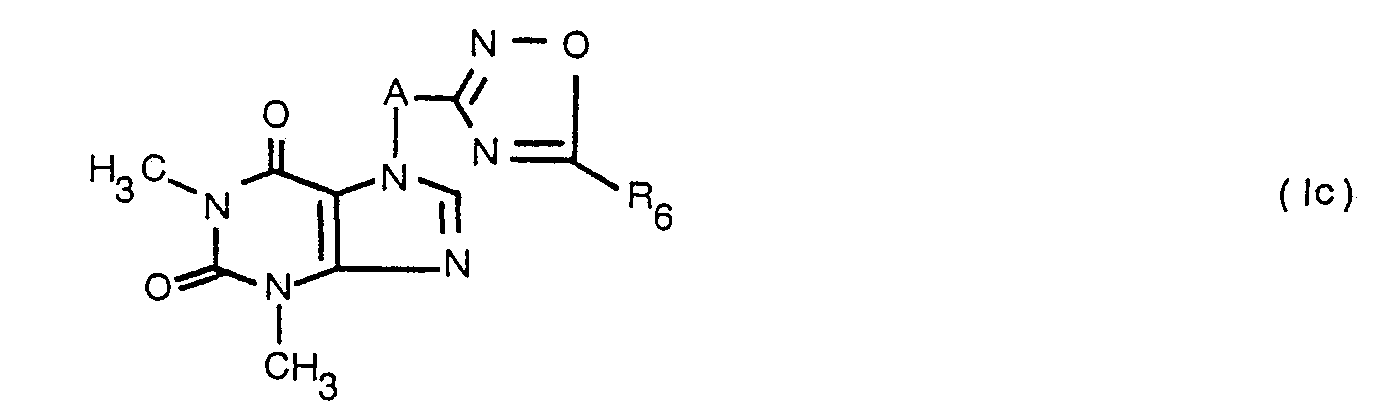
- the acylation reaction is advantageously carried out with an acid anhydride of the general formula (R 6 CO) 2 O or an acid halide of the general formula R 6 COX, in which X is a halogen atom, advantageously with acid chlorides in the presence of an organic solvent.
- Preferred solvents are acetone, pyridine, benzene, toluene, dimethylformamide and, in the case of acid anhydrides, excess acid anhydride, furthermore dialkyl ethers with 2 to 4 carbon atoms in the alkyl part, phenylalkyl ether, dioxane, chlorinated hydrocarbons with 1 to 4 carbon atoms, preferably dichloromethane, dichloroethane and chloroform.
- an acid acceptor it is advisable to add an acid acceptor.
- inorganic acid acceptors have alkali and alkaline earth carbonates, such as sodium carbonate, potassium carbonate and calcium carbonate, furthermore alkali hydrogen carbonates, for example sodium hydrogen carbonate, and as organic acid acceptors tertiary amines, e.g. B. pyridine and triethylamine, proved to be very advantageous, but the amidoxime itself and, if a basic group R 6 is present, the resulting acylated derivative of the general formula IV can also serve as acid acceptors.
- alkali and alkaline earth carbonates such as sodium carbonate, potassium carbonate and calcium carbonate
- alkali hydrogen carbonates for example sodium hydrogen carbonate
- organic acid acceptors tertiary amines e.g. B. pyridine and triethylamine
- the ring closure in process variant B) with formation of the oxadiazole ring is carried out either in the presence of a polar solvent, preferably of organic acids, acid anhydrides, pyridine or dimethylformamide, or in the presence of a non-polar solvent and / or diluent, such as an aromatic solvent, particularly preferably from Toluene, carried out pyrolytically with heating or without solvent.
- a polar solvent preferably of organic acids, acid anhydrides, pyridine or dimethylformamide
- a non-polar solvent and / or diluent such as an aromatic solvent, particularly preferably from Toluene
- the ring closure of the compound of general formula IV can also be carried out in a water-containing organic solvent at a pH between 6 and 8, if appropriate with heating.
- organic solvents come with water-miscible solvents, e.g. B. acetone or dioxane, or alcohols with 1 to 3 carbon atoms in question.
- the ring closure is carried out, depending on the solubility of the compound of general formula IV and group R 6 , at temperatures between 20 and 100 ° C.
- Water-soluble compounds of the general formula IV are preferably condensed in a water-containing organic solvent at pH 6.6 to 7.4 and a temperature of 80 to 100 ° C.
- the presence of a weak base in a catalytic amount can be advantageous; as such the salt of the carboxylic acid corresponding to group R 6 , preferably the sodium or potassium salt, or else sodium carbonate, potassium carbonate, sodium hydrogen carbonate or tertiary amines, particularly advantageously triethylamine, is advantageously used.
- the theophyllinyl-alkylcarboxylic acid amidoximes required for process variants A) and B) can be obtained in a manner known per se, expediently by reacting the corresponding theophyllinylalkyl nitriles with hydroxylamine by boiling in methanol or ethanol for several hours.
- process variant C preferably dimethylformamide or an alcohol, preferably ethanol or isopropanol, as acid acceptors inorganic bases, expediently an alkali hydroxide, preferably potassium hydroxide or sodium hydroxide, or an alkali carbonate, e.g. Sodium carbonate or potassium carbonate, or an organic base, preferably pyridine or piperidine, is used.
- the starting compound of general formula V is preferably reacted with a theophylline alkali salt, advantageously theophylline sodium or potassium, in solution or suspension, particularly advantageously in isopropanol, with heating.
- the starting compounds of the general formula V are prepared in a manner known per se from the corresponding 5-substituted 3- (w-hydroxyalkyl) -1,2,4-oxadiazoles with thionyl halides, preferably with thionyl chloride, or with tosyl chloride or mesyl chloride (J. Chem Research (M), 1979, 801).
- Process variant D uses a basic catalyst, preferably a quaternary ammonium hydroxide, in particular Triton B.
- a basic catalyst preferably a quaternary ammonium hydroxide, in particular Triton B.
- the olefins of the general formula VI which serve as starting materials for process variant D are prepared in a manner known from the literature (J. Chem. Research (M) 1979, 801).
- a basic catalyst in particular pyridine, is likewise preferably used; ethanol is preferably used as the solvent.
- the epoxides of the general formula VII used as starting materials are prepared in a manner known per se from the corresponding 3- (2,3-dihydroxypropyl) -1,2,4-oxadiazoles substituted in the 5-position by dehydration.
- the compounds of the general formula III according to the invention and those O-acylamide oximes of the general formula IV in which R 6 denotes vinyl can be obtained from the amidoximes and the corresponding acrylic acid derivatives, preferably acrylic acid chloride, according to process variants A and B, preferably in acetone and in the presence of sodium carbonate , getting produced.
- the compounds of the general formula Ic in which R 6 is 2-ethoxyethyl can be prepared from the amidoximes of the general formula II by reaction with ethyl acrylate in an ethanolic medium and in the presence of sodium ethylate at elevated temperature.
- the compounds of the general formulas Ic and IV, in which R 6 represents haloalkyl, can be prepared by reacting the corresponding haloalkanecarboxylic acid chlorides with the amidoximes of the general formula 11.
- the acylation is advantageously carried out with cooling in acetone in the presence of an alkali carbonate.
- the ring closure of the acylated compound to the compound Ic is advantageously carried out in toluene or by pyrolysis.
- the amination is advantageously carried out with an amine excess of 5 to 100% in an organic solvent, advantageously in toluene, with heating to 50 to 150 ° C. It is very expedient to carry out the acylation, the amination and the ring closure without isolating the intermediates.
- the theophylline derivatives of the general formula Ic in which R 6 represents an oxoalkyl group, are obtained by acylation of the amidoximes of the general formula II with the corresponding oxoalkane carboxylic acid derivatives and ring closure obtained.
- the oxoalkyl group can also be reacted in a very advantageous manner by reductive condensation with amines of the general formula R e NH 2 , in which R 8 can have all the meanings of R 2 with the exception of hydrogen, to give the corresponding secondary aminoalkyl group. Since the 1,2,4-oxadiazole ring would open upon catalytic hydrogenation, the reductive condensation is expediently carried out by reducing the azomethine bond with sodium tetrahydroborate in a solvent medium.
- the compounds of general formula I according to the invention are expediently used in the form of pharmaceutical preparations, which preferably contain a single dose.
- the inorganic and organic carriers, extenders and auxiliaries customary in pharmacy are used for the formulation.
- the drugs are suitable for enteral or parenteral administration.
- Preferred formulations are syrups, tablets, capsules and suppositories;
- the formulations contain extenders, e.g. B. lactose, dextrose, sucrose, mannitol, sorbitol, cellulose and its derivatives, glycerol, lubricants, e.g. B.
- the compounds according to the invention can also be formulated in a manner suitable for parenteral administration as injection or infusion solutions.
- the pharmaceutical preparations which if necessary contain further pharmaceutically active substances, are produced in a manner known per se with the aid of the usual mixing, granulating, coating, dissolving and lyophilizing processes. They contain about 0.2 to 100% and preferably about 1 to 50% of active ingredient.
- the dosage depends on various factors, e.g. B. the type of application and age and condition of the patient. When administered orally, the daily dose is about 0.1 to 2.0 g with a body weight of about 70 kg.
- the ingredients mixed together are granulated in a known manner and pressed into 1000 tablets of 440 mg each. Each tablet contains 100 mg of active ingredient.
- the active ingredient is mixed with the carboxymethyl cellulose and the stearic acid; the mixture is granulated with the solution of the cellulose acetate phthalate in 200 ml of ethyl acetate / ethanol. Cores of 500 mg each are pressed from the granules and are coated in a manner known per se with 5% aqueous polyvinylpyrrolidone solution containing sugar. Each coated tablet contains 150 mg of active ingredient.
Landscapes
- Health & Medical Sciences (AREA)
- Chemical & Material Sciences (AREA)
- Organic Chemistry (AREA)
- Life Sciences & Earth Sciences (AREA)
- General Health & Medical Sciences (AREA)
- Public Health (AREA)
- Veterinary Medicine (AREA)
- Chemical Kinetics & Catalysis (AREA)
- General Chemical & Material Sciences (AREA)
- Medicinal Chemistry (AREA)
- Nuclear Medicine, Radiotherapy & Molecular Imaging (AREA)
- Animal Behavior & Ethology (AREA)
- Pharmacology & Pharmacy (AREA)
- Engineering & Computer Science (AREA)
- Pulmonology (AREA)
- Bioinformatics & Cheminformatics (AREA)
- Virology (AREA)
- Communicable Diseases (AREA)
- Rheumatology (AREA)
- Pain & Pain Management (AREA)
- Oncology (AREA)
- Molecular Biology (AREA)
- Pharmaceuticals Containing Other Organic And Inorganic Compounds (AREA)
- Saccharide Compounds (AREA)
- Heterocyclic Carbon Compounds Containing A Hetero Ring Having Nitrogen And Oxygen As The Only Ring Hetero Atoms (AREA)
- Preparation Of Compounds By Using Micro-Organisms (AREA)
- Organic Low-Molecular-Weight Compounds And Preparation Thereof (AREA)
- Nitrogen And Oxygen Or Sulfur-Condensed Heterocyclic Ring Systems (AREA)
Description
- Die Erfindung betrifft neue, pharmakologisch wirksame, in 7-Stellung substituierte Theophyllinderivate, Verfahren zu ihrer Herstellung sowie die neuen Verbindungen enthaltende Arzneimittel.
- 7-substituierte Theophyllinderivate besitzen die allgemeine Formel I

- A geradkettiges oder verzweigtes C1-5-Alkylen oder

- R1 Hydroxy, geradkettiges oder verzweigtes C1-10-Alkyl, -Halogenalkyl oder -Hydroxyalkyl, Cs-e-Cycloalkyl, Vinyl, 2-Ethoxyethyl, C2-s-Carbonylalkyl, Benzyl, 2,2-Diphenylethyl, Theophyllin-7-ylmethyl, eine Aminoalkylgruppe der allgemeinen Formel 1,


- R H oder Methyl,
- R2 und R3 H oder geradkettiges oder verzweigtes C1-4-Alkyl oder R2 und R3 zusammen mit dem N-Atom einen 5- oder 6-gliedrigen Heterocyclus, der ein gegebenenfalls durch Methyl substituiertes weiteres Stickstoffatom oder ein Sauerstoffatom enthalten kann,
- n 0, 1, 2 oder 3 und
- R4 und R5 unabhängig H, Chlor, Hydroxy, Methoxy, Ethoxy, Methyl oder Amino.
- Wenn R1 eine Hydroxylgruppe bedeutet, liegen die Verbindungen der allgemeinen Formel I je nach den Bedingungen in einer der tautomeren Formen la bzw. Ib
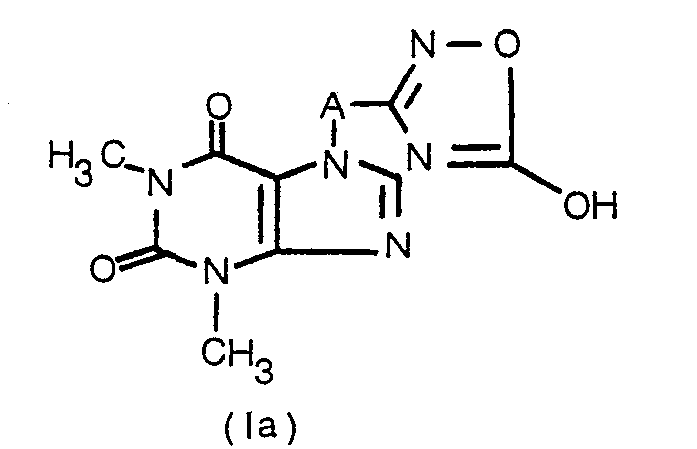

- Zum Gegenstand der Erfindung gehören ferner die Salze der Verbindungen der allgemeinen Formel I. Vorzugsweise handelt es sich um die Säureadditionssalze, die aus den Verbindungen gewünschtenfalls gebildet werden. Zur Salzbildung können anorganische Säuren, wie Chlorwasserstoff, Bromwasserstoff, Schwefelsäure und Phosphorsäure, oder organische Säuren, wie Essigsäure, Bernsteinsäure, Glycolsäure, i Milchsäure, Weinsäure, Citronensäure, Ascorbinsäure, Maleinsäure, Benzoesäure, Hydroxybenzoylbenzoesäure, Nicotinsäure oder Toluolsulfonsäure, verwendet werden. Zu den Salzen der Verbindungen der allgemeinen Formel I gehören ferner die mit niederen Alkylhalogeniden, Alkylsulfaten, Alkylphosphaten, vorzugsweise mit Methyljodid, Methylbromid oder Methylsulfat, gebildeten quaternären Ammoniumsalze.
- Die Halogenalkylgruppen und Hydroxyalkylgruppen weisen 1 bis 10 C-Atome und bevorzugt 1 bis 5 C-Atome auf; die Halogenalkylgruppen sind vorzugsweise Chlormethyl-, Chlorethyl-, Chlorpropyl- oder Chlorbutylgruppen.
- Wenn R2 und R3 mit dem Stickstoffatom gemeinsam einen 5- oder 6-gliedrigen heterocyclischen Ring bilden, handelt es sich bevorzugt um Piperidino-, Piperazino-, Pyrrolidino-, Morpholino- und N-Methylpiperazinogruppen.
- Ein Teil der erfindungsgemäßen Verbindungen weist ein Chiralitätszentrum auf. Diese Verbindungen können sowohl als Racemate wie auch in optisch aktiver Form für pharmazeutische Zwecke eingesetzt werden. Unter den hier gebrauchten Bezeichnungen sind Racemate und optisch aktive Verbindungen gleichermaßen zu verstehen.
- Als Mittel gegen Husten werden bekanntlich seit langem zumeist Codein und codeinartige Verbindungen pharmazeutisch eingesetzt. Diese Verbindungen wirken zentral durch Unterdrückung des Hustenreflexes. Da die zentrale Wirkung nicht spezifisch ist, haben Codein und die mit ihm verwandten Verbindungen zahlreiche unerwünschte Nebenwirkungen, unter anderem respirationshemmende Wirkung, weshalb ihre Anwendung in manchen Fällen, in erster Linie bei Asthmatikern kontraindiziert ist.
- Es wurden daher neue Hustenmittel entwickalt, die nicht über das Zentralnervensystem wirken und deshalb die Atmung nicht behindern. Zu diesen neue'i Hustenmitteln gehören auch bestimmte 1,2,4-Oxadiazole, deren pharmakologisch wichtigster Vertreter Jas Prenoxdiazin ist (vgl. die GB-A-1053825 sowie die DE-B-1063323-Libexin).
- Es ist auch bekannt, daß Theophyllin und viele seiner Derivate eine vorteilhafte bronchienerweiternde, die Atmung erleichternde Wirkung haben. Diese Verbindungen spielen bei der Behandlung von Asthma eine wesentliche Rolle.
- In der Arzneimittelforschung ist man in neuester Zeit bestrebt, durch Anwendung nicht respirationshemmender Hustenmittel die beiden günstigen Wirkungen, die hustenstillende sowie die bronchienerweiternde Wirkung, miteinander zu vereinigen.
- Als Ergebnis dieser Bemühungen gibt es bis jetzt allerdings lediglich Hustenmittel, bei denen die Vereinigung der beiden wirkungen durch mechanisches Vermischen von zwei Verbindungen verschiedenen Typs bzw. durch Komplexbildung erreicht wurde. Derartige Lösungen sind z. B. in der BE-PS 874773 bzw. in der entsprechenden US-PS 4 197 300 beschrieben.
- Aus der FR-A-2 480 286 sind ferner 7-substituierte Theophyllinderivate bekannt, die einen Dioxolanring aufweisen, also cyclische Acetale darstellen, die sich vom Theophyllin-7-yl-acetaldehyd ableiten.
- Diese Verbindungen weisen zwar bronchodilatorische und antitussive Wirksamkeit auf, besitzen jedoch zugleich die Eigenschaft, daß sie, ähnlich wie das zentraldämpfende Hustenmittel Codein, die Barbituratnarkose potenzieren (vgl. J. S. Franzone et al., 11 Farmaco, Ed. Sc. 36, Bd. 3 (1981) 201-219).
- Es wurde nun gefunden, daß die erfindungsgemäßen Theophyllinderivate der allgemeinen Formel I eine ausgezeichnete hustenstillende, entzündungshemmende und bronchienerweiternde Wirkung besitzen. In Abhängigkeit von den Substituenten ist die antitussive Wirkung zahlreicher Vertreter dieser Verbindungsgruppe überraschenderweise stärker als die des Prenoxdiazins und des Codeins, wobei diese Wirkung mit einer beträchtlichen, hinsichtlich der Wirkungsdauer die des Theophyllins übertreffenden bronchospasmolytischen und antiasthmatischen Wirkung verbunden ist. Es ist sowohl überraschend als auch aus therapeutischer Sicht günstig, daß die Toxizität der Verbindungen der allgemeinen Formel I nur einen Bruchteil der Toxizität von Prenoxdiazin bzw. Codein beträgt.
- Aufgrund dieser außerordentlich günstigen pharmazeutischen Wirkungen können die Verbindungen der allgemeinen Formel I in der Humanmedizin, in erster Linie zur Behandlung von Erkrankungen der Atmungsorgane, zur Erweiterung der Bronchien, zur Vorbeugung und Behandlung von Asthma, als Hustenmittel sowie ferner als entzündungshemmende Mittel vorteilhaft eingesetzt werden.
- Die antitussive Wirkung und die Toxizität einiger charakteristischer Vertreter der erfindungsgemäßen Verbindungen sowie zum Vergleich für die bekannten Mittel Prenoxdiazin und Codein sind in der Tabelle 1 zusammengefaßt. In Tabelle 1 entspricht der Wert Q der antitussiven Wirkung an Meerschweinchen bei durch 15 %igen Citronensäurespray ausgelöstem Husten, eine Stunde nach Verabreichung der Testverbindung (50 mg/kg i.m.), ausgedrückt in Prozent der Kontrolle.

- Aus Tabelle 1 ist einesteils ersichtlich, daß die Verbindungen der allgemeinen Formel in den meisten Fällen auch absolut eine bessere Wirkung haben, vor allem jedoch ihr therapeutischer Index viel günstiger ist, zum anderen, daß die Länge der Seitenkette A und die Variation des Substituenten R1 weder bei der hustenstillenden Wirkung noch bei der Toxizität eine grundlegende Veränderung bewirken. Der größte Teil der erfindungsgemäßen Verbindungen kann in der Therapie sehr günstig eingesetzt werden. Das Verhältnis der i.v.- und der p.o.-Toxizität zeigt, daß die Verbindungen der allgemeinen Formel I im Verdauungssystem sehr gut absorbiert werden. Dies beweisen auch die für intraduodenale und für perorale Verabreichung aufgenommenen Dosis-Wirkungs-Kurven der antitussiven Wirkung.
- Es muß auch betont werden, daß sich der größte Teil der Verbindungen der allgemeinen Formel I im Vergleich mit Prenoxdiazin in Wasser gut löst.
- Diejenigen erfindungsgemäßen Verbindungen, bei denen R1 Alkyl, Aralkyl oder Aryl bedeutet, verfügen über eine wertvolle, anhaltende antitussive und antiasthmatische Wirkung bzw. wirken bronchodilatorisch und entzündungshemmend. So verringert z. B. das 7-[(5-Methyl-1,2,4-oxadiazol-3-yl)-methyl]-theophyllin sowohl im Test in vitro am vom Kaninchen isolierten Tracheenstreifen wie auch im Test in vivo nach Konzett und Rössler (Arch. exp. Path. Pharmakol. 195 (1940) 71) am Meerschweinchen den durch Histamin ausgelösten Bronchialkrampf bedeutend und über längere Zeit als Theophyllinethylendiamin und weist auch in der Unterdrückung des durch Acetylcholin oder Serotonin provozierten Krampfes eine bedeutende Aktivität auf, was für die Anwendung gegen asthmatischen Husten von Bedeutung ist. Aufgrund der antitussiven Wirkung bzw. der an Mäusen und Ratten gemessenen Toxizität i.v. ist der therapeutische Index der genannten Verbindung etwa fünfmal so günstig wie der der Referenzsubstanz Codein und mehr als zehnmal so günstig wie der von Prenoxdiazin. Wie Untersuchungen an narkotisierten Katzen ergaben, erhöht die Verbindung das Atemvolumen und verringert gleichzeitig die Atemfrequenz, was für die Behandlung von Erkrankungen der Atmungsorgane besonders vorteilhaft ist. Die bedeutende therapeutische Wirkung der genannten Verbindungsgruppe besteht darin, daß die Verbindungen auch den Ausbruch des durch verschmutzte Luft, in erster Linie durch Tabakrauch enthhaltende Luft provozierten chronischen Asthmas hemmen, wie an Ratten vorgenommene Langzeitversuche ergaben.
- Eine andere Gruppe der Verbindungen der allgemeinen Formel bei denen R1 eine Aminoalkylgruppe bedeutet, verfügen ebenfalls über antitussive und bronchodilatorische Wirkung, und daneben ist ihre entzündungshemmende Wirkung stark ausgeprägt. Die neben der aus Tabelle 1 hervorgehenden antitussiven Wirkung vorliegende entzündungshemmende Wirkung der Verbindung 7-[(5-(2-Diethylamino- ethan-1-yl]-1,2,4-oxadiazol-3-yl)-methyl]-theophyllin ist im Carrageenin-Ödemtest an der Rattenpfote etwa so stark wie die des Indomethacins, was in erster Linie für die Behandlung von zusammen mit Husten auftretenden Entzündungen der Atmungsorgane von Bedeutung ist.
- Die Verbindungen der allgemeinen Formel I werden gemäß der Erfindung hergestellt durch
- (A) Umsetzung von Amidoximen der allgemeinen Formel II


- (B) Umsetzung von Amidoximen der allgemeinen Formel II mit Säuren der allgemeinen Formel III oder acylierend wirkenden Derivaten der Säuren der allgemeinen Formel III zu acylierten Derivaten der allgemeinen Formel IV

- (C) Umsetzung von Verbindungen der allgemeinen Formel V

- (D) Umsetzung von Olefinen der allgemeinen Formel VI


- (E) Umsetzung von Epoxiden der allgemeinen Formel VII


- Gemäß der Verfahrensvariante A setzt man das Amidoxim der allgemeinen Formel 11 zweckmäßig mit einem Ester der Formel ReCOOR7, worin R7 Alkyl, zweckmäßig Methyl oder Ethyl bedeutet, in Gegenwart einer Base, vorzugsweise eines Alkali- oder Erdalkalihydroxids, insbesondere von Kaliumhydroxid oder Natriumhydroxid, oder eines Alkalialkoxids, vorzugsweise von Natriummethylat oder Natriumethylat, und in Gegenwart eines polaren oder apolaren organischen Lösungs- und/oder Verdünnungsmittels unter Erwärmen, vorzugsweise bei 50 bis 150°C und besonders bevorzugt am Siedepunkt des verwendeten Lösungsmittels um. Im Falle von niedrigsiedenden Lösungsmitteln, z. B. Methanol, kann man auch unter Druck arbeiten, was eine den Siedepunkt des Lösungsmittels überschreitende Reaktionstemperatur ermöglicht.
- Als polare Lösungsmittel werden bevorzugt Alkohole mit 1 bis 4 C-Atomen Carbonsäure-N-alkylamide, z.B. Dimethylformamid, und als unpolare Lösungsmittel aromatische Kohlenwasserstoffe, z.B. Benzol, Chlorbenzol, Toluol oder Xylol, verwendet. Das bei der Reaktion gebildete Wasser kann mit diesen Lösungsmitteln azeotrop abdestilliert werden.
- Gemäß der Variante A) ist es ferner bevorzugt, das Amidoxim der allgemeinen Formel II mit einer Carbonsäure der allgemeinen Formel III und/oder deren Säureanhydrid unter Erwärmen in Gegenwart eines organischen Lösungsmittels umzusetzen. Als Lösungsmittel sind aromatische Kohlenwasserstoffe geeignet. Besonders vorteilhaft ist es, als Lösungsmittel einen überschuß des Acylierungsmittels zu verwenden. Die Acylierung und der Ringschluß werden bei Temperaturen von 50 bis 150°C, vorzugsweise bei 90 bis 110°C, vorgenommen.
- Die Reaktionszeit hängt von den verwendeten Ausgangsstoffen und dem Lösungsmittel ab und kann zwischen 0,5 und 24 h variieren.
- Gemäß der Verfahrensvariante B) nimmt man die Acylierungsreaktion zweckmäßig mit einem Säureanhydrid der allgemeinen Formel (R6CO)2O oder einem Säurehalogenid der allgemeinen Formel R6COX, worin X ein Halogenatom bedeutet, zweckmäßig mit Säurechloriden in Gegenwart eines organischen Lösungsmittels vor. Bevorzugte Lösungsmittel sind Aceton, Pyridin, Benzol, Toluol, Dimethylformamid und im Falle von Säureanhydriden überschüssiges Säureanhydrid, ferner Dialkylether mit 2 bis 4 C-Atomen im Alkylteil, Phenylalkylether, Dioxan, chlorierte Kohlenwasserstoffe mit 1 bis 4 C-Atomen, vorzugsweise Dichlormethan, Dichlorethan und Chloroform. Beim Acylieren mit einem Säurehalogenid ist es zweckmäßig, einen Säureakzeptor zuzusetzen. Als anorganische Säureakzeptoren haben sich Alkali- und Erdalkalicarbonate, wie Natriumcarbonat, Kaliumcarbonat und Calciumcarbonat, ferner Alkalihydrogencarbonate, z.B. Natriumhydrogencarbonat, und als organische Säureakzeptoren tertiäre Amine, z. B. Pyridin und Triethylamin, als sehr vorteilhaft erwiesen, jedoch können auch das eingesetzte Amidoxim selbst sowie, falls eine basische Gruppe R6 vorliegt, das entstehende acylierte Derivat der allgemeinen Formel IV als Säureakzeptoren dienen.
- Der Ringschluß bei der Verfahrensvariante B) under Ausbildung des Oxadiazolrings wird entweder in Gegenwart eines polaren Lösungsmittels, vorzugsweise von organischen Säuren, Säureanhydriden, Pyridin oder Dimethylformamid, oder in Gegenwart eines unpolaren Lösungs- und/oder Verdünnungsmittels, wie eines aromatischen Lösungsmittels, besonders bevorzugt von Toluol, unter Erwärmen oder aber ohne Lösungsmittel pyrolytisch vorgenommen. Der Ringschluß der Verbindung der allgemeinen Formel IV kann auch in einem wasserhaltigen organischen Lösungsmittel bei einem pH-Wert zwischen 6 und 8, gegebenenfalls unter Erwärmen, vorgenommen werden. Als organische Lösungsmittel kommen mit Waser mischbare Lösungsmittel, z. B. Aceton oder Dioxan, oder Alkohole mit 1 bis 3 C-Atomen in Frage. Der Ringschluß wird, je nach der Löslichkeit der Verbindung der allgemeinen Formel IV und der Gruppe R6, bei Temperaturen zwischen 20 und 100°C vorgenommen. In Wasser lösliche Verbindungen der allgemeinen Formel IV werden bevorzugt in einem wasserhaltigen organischen Lösungsmittel bei pH 6,6 bis 7,4 und einer Temperatur von 80 bis 100°C kondensiert. Zur optimalen pH-Einstellung kann das Vorliegen einer schwachen Base in katalytischer Menge vorteilhaft sein; als solche wird zweckmäßig das mit einer starken Base gebildete Salz der der Gruppe R6 entsprechenden Carbonsäure, vorzugsweise das Natrium-oder Kaliumsalz, oder aber Natriumcarbonat, Kaliumcarbonat, Natriumhydrogencarbonat oder tertiäre Amine, besonders vorteilhaft Triethylamin, verwendet.
- Die für die Verfahrensvarianten A) und B) erforderlichen Theophyllinyl-Alkylcarbonsäure-amidoxime können in an sich bekannter Weise, zweckmäßig durch Umsetzen der entsprechenden Theophyllinylalkylnitrile mit Hydroxylamin durch mehrstündiges Kochen in Methanol oder Ethanol, erhalten werden.
- Bei der Verfahrensvariante C werden als Lösungs- und/oder Verdünnungsmittel vorzugsweise Dimethylformamid oder ein Alkohol, bevorzugt Ethanol oder Isopropanol, als Säureakzeptoren anorganische Basen, zweckmäßig ein Alkalihydroxid, vorzugsweise Kaliumhydroxid oder Natriumhydroxid, oder ein Alkalicarbonat, z.B. Natriumcarbonat oder Kaliumcarbonat, oder eine organische Base, vorzugsweise Pyridin oder Piperidin, verwendet. Die Ausgangsverbindung der allgemeinen Formel V wird bevorzugt mit einem Theophyllinalkalisalz, zweckmäßig Theophyllinnatrium oder -kalium, in Lösung oder Suspension, besonders zweckmäßig in Isopropanol, unter Erwärmen umgesetzt. Die Ausgangsverbindungen der allgemeinen Formel V werden in an sich bekannter Weise aus den entsprechenden 5-substituierten 3-(w-Hydroxyalkyl)-1,2,4-oxadiazolen mit Thionylhalogeniden, vorzugsweise mit Thionylchlorid, oder mit Tosylchlorid bzw. Mesylchlorid (J. Chem. Research (M), 1979, 801) hergestellt.
- Bei der Verfahrensvariante D setzt man einen basischen Katalysator, vorzugsweise ein quaternäres Ammoniumhydroxid, insbesondere Triton B, ein. Die für die Verfahrensvariante D als Ausgangsstoffe dienenden Olefine der allgemeinen Formel VI werden in literaturbekannter Weise (J. Chem. Research (M) 1979, 801) hergestellt.
- Gemäß der Verfahrensvariante E wird ebenfalls bevorzugt ein basischer Katalysator, insbesondere Pyridin, eingesetzt; als Lösungsmittel wird bevorzugt Ethanol verwendet. Die als Ausgangsstoffe eingesetzten Epoxide der allgemeinen Formel VII werden in an sich bekannter Weise aus den entsprechenden, in 5-Stellung substituierten 3-(2,3-Dihydroxypropyl)-1,2,4-oxadiazolen durch Wasserentzug hergestellt.
- Die erfindungsgemäßen Verbindungen der allgemeinen Formllc und diejenigen O-Acylamidoxime der allgemeinen Formel IV, bei denen R6 Vinyl bedeutet, können aus den Amidoximen und den entsprechenden Acrylsäurederivaten, vorzugsweise Acrylsäurechlorid, gemäß den Verfahrensvarianten A und B, vorzugsweise in Aceton und in Gegenwart von Natriumcarbonat, hergestellt werden.
- Die Verbindungen der allgemeinen Formel Ic, in der R6 für 2-Ethoxyethyl steht, können aus den Amidoximen der allgemeinen Formel II durch Umsetzen mit Ethylacrylat in ethanolischem Medium und Gegenwart von Natriumethylat bei erhöhter Temperatur hergestellt werden.
- Die Verbindungen der allgemeinen Formeln Ic und IV, in denen R6 für Halogenalkyl steht, können durch Umsetzen der entsprechenden halogenalkancarbonsäurechloride mit den Amidoximen der allgemeinen Formel 11 hergestellt werden. Die Acylierung wird zweckmäßig unter Kühlung in Aceton in Gegenwart eines Alkalicarbonats vorgenommen. Der Ringschluß der acylierten Verbindung zu der Verbindung Ic erfolgt zweckmäßig in Toluol oder durch Pyrolyse.
- Die Verbindungen der allgemeinen Formel Ic und O-Acylamidoxime der allgemeinen Formel IV, bei denen R6 für Vinyl, 2-Ethoxyethyl, Ci-4-Halogenalkyl, O-Mesylalkyl oder O-Tosylalkyl steht, können mit Aminen der Formel NHR2R3 zu Verbindungen der allgemeinen Formel I umgesetzt werden, bei denen R1 eine Gruppe -(CH2)2NR2R3 bzw. -(CH2)nNR2R3 bedeutet.
- Die Aminierung wird zweckmäßig mit einem Aminüberschuß von 5 bis 100% in einem organischen Lösungsmittel, zweckmäßig in Toluol, unter Erwärmen auf 50 bis 150°C vorgenommen. Sehr zweckmäßig ist es, die Acylierung, die Aminierung und den Ringschluß ohne Isolierung der Zwischenprodukte vorzunehmen.
- Die Theophyllinderivate der allgemeinen Formel lc, bei denen R6 für eine Oxoalkylgruppe steht, werden durch Acylierung der Amidoxime der allgemeinen Formel II mit den entsprechenden Oxoalkancarbonsäurederivaten und Ringschluß erhalten. Die Oxoalkylgruppe kann auch mit Aminen der allgemeinen Formel ReNH2, worin R8 mit Ausnahme von Wasserstoff alle Bedeutungen von R2 haben kann, durch reduktive Kondensation in sehr vorteilhafter Weise zu der entsprechenden sekundären Aminoalkylgruppe umgesetzt werden. Da sich der 1,2,4-Oxadiazolring bei katalytischer Hydrierung öffnen würde, wird die reduktive Kondensation zweckmäßig durch Reduktion der Azomethinbindung mit Natriumtetrahydroborat in einem Lösungsmittelmedium vorgenommen.
- Diejenigen Verbindungen der allgemeinen Formel lc, bei denen R6 Aminoalkyl -(CH2)"NH2 bedeutet, worin n 1, 2, 3 oder 4 ist, werden mit Alkylhalogeniden, Alkylsulfaten oder Alkylphosphaten zu Verbindungen der allgemeinen Formel 1 alkyliert, bei denen R1 ―(CH2)n(R2)2 oder ―(CH2)n―N(R2)3Q-bedeutet, wobei Q- das dem Alkylierungsmittel entsprechende Anion ist. Die Methylierung der primären Aminogruppe wird zweckmäßig in Ameisensäure mit Formaldehyd vorgenommen.
- Die erfindungsgemäßen Verbindungen der allgemeinen Formel I werden zweckmäßig in Form von Arzneimittelpräparaten eingesetzt, die bevorzugt eine einmalige Dosis enthalten. Zur Formulierung werden die in der Pharmazie üblichen anorganischen und organischen Träger-, Streck- und Hilfsmittel verwendet. Die Arzneimittel sind zur enteralen oder parenteralen Verabreichung geeignet. Bevorzugt sind als Formulierungsformen Sirupe, Tabletten, Kapseln und Suppositorien; neben den Wirkstoffen enthalten die Formulierungen Streckmittel, z. B. Lactose, Dextrose, Saccharose, Mannit, Sorbit, Cellulose und ihre Derivate, Glycerin, Gleitstoffe, z. B. Kieselerde, Talkum, Stearinsäure und deren Salze und Polyethylenglycole, Bindemittel, wie Silicate, Stärke und ihre Derivate, Gelatine, Methylcellulose, Füllstoffe, Schäummittel, färbende Substanzen sowie Geschmacksmittel. Die erfindungsgemäßen Verbindungen können auch in zur parenteralen Verabreichung geeigneter Weise als Injektions- oder Infusionslösungen formuliert sein. Die Arzneimittelpräparate, die erforderlichenfalls weitere pharmazeutisch wirksame Stoffe enthalten, werden in an sich bekannter Weise mit Hilfe der üblichen Misch-, Granulierungs-, Dragierungs-, Lösungs-und Lyophilisierungsverfahren hergestellt. Sie enthalten etwa 0,2 bis 100% und vorzugsweise etwa 1 bis 50% Wirkstoff. Die Dosierung hängt von verschiedenen Faktoren, z. B. der Applikationsart sowie Alter und Zustand der Patienten, ab. Bei oraler Verabreichung beträgt die tägliche Dosis etwa 0,1 bis 2,0 g bei einem Körpergewicht von etwa 70 kg.
- Die Erfindung wird anhand der folgenden Beispiele näher erläutert.
-
- a) 25,2 g 2-(Theophyllin-7-yl)-acetamidoxim werden in 250 ml Essigsäureanhydrid unter Erwärmen aufgelöst. Man läßt die Lösung über Nacht stehen und versetzt am nächsten Tag mit 250 ml Diethylether. Es werden 27,6 g 2-(Theophyllin-7-yl)-O-acetylacetamidoxim erhalten (Ausbeute 94%); F. 201°C (aus Ethanol).
- b) 25,2 g 2-(Theophyllin-7=yl)-acetamidoxim werden in einem Gemisch aus 400 ml wasserfreiem Aceton und 10,2 g Triethylamin unter Rühren mit 78,5 g Acetylchlorid umgesetzt. Es werden 23,1 g 2-(Theophyllin-7-yl)-O-acetylacetamidoxim erhalten (Ausbeute 78%); F. 201°C.
- c) 2,94 g 2-(Theophyllin-7-yl)-O-acetylacetamidoxim werden in 20 ml Pyridin 2 h lang auf dem Wasserbad erwärmt. Dann wird das Lösungsmittel unter vermindertem Druck abdestilliert. Der Rückstand wird aus Wasser kristallisiert. Es werden 2,58 g 7-[(5-Methyl-1,2,4-oxadiazol-3-yl)-methyl]-theophyllin erhalten (Ausbeute 93%); F. 135 bis 136°C.
Der Ringschluß kann statt in Pyridin auch in Essigsäureanhydrid, Essigsäure oder einem Gemisch dieser beiden Verbindungen vorgenommen werden. - d) 15,12 g 2-(Theophyllin-7-yl)-acetamidoxim werden in einem Gemisch aus 120 ml Essigsäure und 8 ml Essigsäureanhydrid 2 h auf dem Wasserbad erwärmt. Nach dem Abdestillieren des Lösungsmittel erhält man 16,06 g 7-[(5-Methyl-1,2,4-oxadiazol-3-yl)-methyl]-theophyllin (Ausbeute 91%); F. 135°C (aus Methanol).
- e) Ein Gemisch aus 5,04 g 2-(Theophyllin-7-yl)-acetamidoxim, 2,16 g Natriummethylat, 10 ml Ethylacetat und 200 ml Toluol wird unter Rühren unter einem Wasserabscheideaufsatz 20 h lang gekocht. Während dieser Zeit werden insgesamt noch 10 ml Ethylacetat in fünf Portionen zu dem Gemisch zugegeben. Nach Abdampfen des Lösungsmittels und Kristallisieren aus Wasser erhält man 4,1 g 7-[(5-Methy(-1,2,4-oxadiazol-3-yl)-methyl]-theophyllin (Ausbeute 74%); F. 135 bis 136°C.
- f) Ein Gemisch aus 5,04 g 2-(Theophyllin-7-yl)-acetamidoxim, 2,16 g Natriummethylat und 10 ml Ethylacetat wird in 150 ml Methanol unter Druck und ständigem Schütteln 8 h lang auf 100°C gehalten. Nach dem Aufarbeiten erhält man 4,8 g 7-[(5-Methyl-1,2,4-oxadiazol-3-yl)-methyl]-theophyllin (Ausbeute 87%), F. 135 bis 136°C.
- g) Ein Gemisch aus 20,2 g Theophyllinnatrium, 300 mllsopropanol und 13,2 g 3-Chlormethyl-5-methyl-1,2,4-oxadiazol wird unter Rühren 10 h lang gekocht. Nach dem Aufarbeiten erhält man 20,5 g 7-[(5-Methyl-1,2,4-oxadiazol-3-yl)-methyl]-theophyllin (Ausbeute 74,2%).
- h) 2,94 g 2-(Theophyllin-7-yl)-O-acetylacetamidoxim werden in 20 ml Essigsäure 2 h lang gekocht. Es werden 2,62 g 7-[(5-Methyl-1,2,4-oxadiazol-3-yl)-methyl]-theophyllin erhalten (Ausbeute 94%); F. 134 bis 135°C.
- i) 29,42 g 2-(Theophyllin-7-yl).O-acetylamidoxim werden in 400 ml Wasser von 97 bis 99°C aufgelöst, worauf der pH-Wert der Lösung mit Triethylamin auf 7 eingestellt wird. Die Lösung wird 5,5 h lang auf der genannten Temperatur gehalten und dann mit Salzsäure auf pH 1 eingestellt. Nach Extraktion mit 4 x 50 ml Dichlorethan, Abdestillieren des Lösungsmittels und Umkristallisieren des Rückstands aus Wasser werden 24,5 g 7-[(5-Methyl-1,2,4-oxadiazol-3-yl)-methyl]-theophyllin erhalten; F. 135 bis 136°C.
- j) Das in den vorhergehenden Beispielen verwendete Amidoxim wird folgendermäßen hergestellt: 10,96 g 7-Cyanomethyltheophyllin, 7,64 g Hydroxylaminhydrochlorid, 5,98 g Natriummethylat und 50 ml Methanol werden auf dem Wasserbad fünf h lang gekocht. Es werden 9,85 g 2-(Theophyllin-7-yl)-acetamidoxim erhalten (Ausbeute 78%; F. 224°C (aus wäßrigem Ethanol).
- k) Das als Ausgangsstoff verwendete O-Acetylamidoxim wird folgendermaßen hergestellt:
- Ein Gemisch aus 25,42 g 2-(Theophyllin-7-yl)-acetamidoxim, 100 ml Dichlorethan und 10,8 g Essigsäureanhydrid wird 3 h lang bei 50 bis 55°C gerührt. Nach der Aufarbeitung werden 28,8 g 2-(Theophyllin-7-yl)-O-acetyl-acetamidoxim erhalten (F. 197 bis 198°C), das sofort weiterverarbeitet werden kann.
- 25,2 g 2-(Theophyllin-7-yl)-acetamidoxim werden in 400 ml wasserfreiem Aceton in Gegenwart von 8,6 g Natriumhydrogencarbonat mit einer Lösung von 11,3 g Chloracetylchlorid in 40 ml Aceton acyliert. Es werden 27 g 2-(Theophyllin-7-yl)-O-chloracetylacetamidoxim erhalten (Ausbeute 83%). Das Produkt wird im Vakuum (133 Pa) bei 105°C bis zur Gewichtskonstanz getrocknet (etwa 20 bis 60 min). Nach Umkristallisieren aus Methanol werden 19,1 g 7-[(5-Chlormethyl-1 ,2,4-oxadiazol-3-yl)-methyl]-theophyllin erhalten (Ausbeute 62%); F. 146 bis 148°C.
-
- a) Ein Gemisch aus 5,04 g 2-(Theophyllin-7-yl)-acetamidoxim, 2,16 g Natriummethylat, 6,37 g Diethylaminoessigsäureethylester und 100 ml Toluol wird gekocht. Das kochende Gemisch wird eingedampft und der Eindampfrückstand aus Cyclohexan umkristallisiert. Es werden 5,4 g 7-[(5-Diethylaminomethyl-1,2,4-oxadiazol)-methyl]-theophyllin erhalten (Ausbeute 82%); F. 68 bis 70°C. Das Hydrochlorid schmilzt bei 206 bis 210°C.
- b) Ein Gemisch aus 9,0 g 7-[(5-Chlormethyl-1,2,4-oxadiazol)-methyl]-theophyllin, 6 ml Diethylamin und 50 ml Toluol wird 8 h auf dem Wasserbad gerührt und dann unter vermindertem Druck eingedampft. Der Rückstand wird mit Wasser ausgewaschen und dann in 50 ml Ethanol heiß gelöst. Die Lösung wird mit Aktivkohle geklärt und mit salzsaurem Ethanol versetzt. Es werden 8,3 g 7-[(5-Diethylaminomethyl-1,2,4-oxadiazol-3-yl)-methyl]-theophyllin-hydrochlorid erhalten; F. 207 bis 210°C.
- c) Zu einer Lösung von 5,04 g 2-(Theophyllin-7-yl)-acetamidoxim in 40 ml wasserfreiem Pyridin werden unter Rühren und Kühlen (max. 20°C) 3,0 g Diethylaminoacetylchlorid zugetropft. Das Reaktionsgemisch wird 1 h lang bei Raumtemperatur und dann 2 h lang auf dem Wasserbad gerührt. Das Gemisch wird danach zur Trockne eingedampft; aus dem Rückstand wird in Ethanol das Hydrochlorid hergestellt. Es werden 6,1 g 7-[(5-Diethylaminomethyl-1,2,4-oxadiazol-3-yl)-methyl]-theophyllin-hydrochlorid erhalten; F. 208 bis 210°C.
- d) Zu einer Suspension von 3,27 g des gemäß Beispiel 2 hergestellten 2-(Theophyllin-7-yl)-0-chlor- acetylacetamidoxims in 20 ml Toluol werden 3 ml Diethylamin getropft. Das Gemischh wird 8 h lang gekocht. Das mit salzsaurem Ethanol gebildete 7-[(5-Diethylaminomethyl-1,2,4-oxadiazol-3-yl)-methyl]-theophyllin-hydrochlorid wird in einer Menge von 2,6 g erhalten (Ausbeute 71%); F. 207 bis 209°C.
- e) Ein Gemisch aus 5,04 g 2-(Theophyllin-7-yl)-acetamidoxim, 2,16 g Natriummethylat, 6,37 g Diethylaminoessigsäureethylester und 80 ml Methanol wird bei 100°C in einem geschlossenen System unter Druck 10 h lang gerührt. Nach dem Aufarbeiten werden 5,2 g 7-[(5-Diethylaminomethyl-1,2,4-oxadiazol-3-yl)-methyl]-theophyllin erhalten (Ausbeute 80%); F. 69 bis 70°C (aus Cyclohexan).
- f) 30,9 g 7-[(5-Chlormethyl-1,2,4-oxadiazol-3-yl)-methyl]-theophyllin und 18,5 g Phthalimidkalium werden in 300 ml Dimethylformamid unter ständigem Rühren 6 h lang gekocht. Das Dimethylformamid wird unter vermindertem Druck abdestilliert, der Rückstand mit 300 ml Ethanol verrieben, mit 5,2 g Hydrazinhydrat versetzt und 2 h auf dem Wasserbad erwärmt. Dann wird das Gemisch mit wäßriger Salzsäure stark angesäuert, aufgekocht und kochend filtriert. Das Filtrat wird eingedampft. Durch Kristallieren aus Methanol erhält man 24,7 g 7-[(5-Aminomethyl-1,2,4-oxadiazol-3-yl)-methyl]-theophyllin-hydrochlorid (Ausbeute 74,2%); F. 204 bis 207°C.
- g) 3,34 g 7-((5-Aminomethyl-1,2,4-oxadiazol-3-yl)-methyl]-theophyllin-hydrochlorid, 0,8 g Natriumformiat und 30 ml 90-%ige Ameisensäure werden auf dem Wasserbad erwärmt, bis alles geschmolzen ist. Nach dem Abkühlen werden 4,5 ml 30-%ige Formaldehydlösung zugegeben.
Das Gemisch wird 8 h auf dem Wasserbad erwärmt und dann zur Trockne eingedampft; der Rückstand wird mit 10 ml 10-%iger Natronlauge verrieben. Die organische Substanz wird mit Chloroform extrahiert. Mit salzsaurem Ethanol werden 1,95 g 7-[{5-Dimethylaminomethyl-1,2,4-oxadiazol-3-yl)-methyl]-theophyllin-hydrochlorid erhalten (Ausbeute 55%); F. 211 bis 213°C. - h) 3,34 g 7-[(5-Aminomethyl-1,2,4-oxadiazol-3-yl)-methyl]-theophyllin-hydrochlorid und 4,54 g Kaliumcarbonat werden in 80 ml Dimethylformamid bei Raumtemperatur mit 2,2 g Ethylbromid versetzt und 7 h lang gerührt. Das Lösungsmittel wird dann unter vermindertem Druck abdestilliert. Mit salzsaurem Ethanol werden 2,2 g 7-[(5-Diethylaminomethyl-1,2,4-oxadiazol-3-yl)-methyl]-theophyllin-hydrochlorid erhalten (Ausbeute 62%); F. 207 bis 208°C (Ethanol).
-
- a) Ein Gemisch aus 25,2 g 2-(Theophyllin-7-yl)-acetamidoxim, 200 ml Toluol, 6.8 g Natriummethylat und 34,6 g β-Diethylaminopropionsäureethylester wird in einem mit einem Wasserabscheider versehenen Kolben unter ständigem Rürhen 4 h lang gekocht. Nach dem Filtrieren wird mit 11,6 g Maleinsäure das Salz gebildet. Es werden 40,5 g 7-[(5-[2-Diethylamino-ethan-1-yl]-1,2,4-oxadiazol-3-yl)-methyl]-theophyllin- maleinat erhalten (Ausbeute 85%); F. 127 bis 128°C.
- b) Ein Gemisch aus 5,04 g 2-(Theophyllin-7-yl)-acetamidoxim, 2,16 g Natriummethylat, 6,4 g Diethylaminopropionsäureethylester und 100 ml Toluol wird gemäß Stufe a) umgesetzt. Es werden 6,3 g 7-[(5-[2-Diethylaminoethan-1-yl]-1,2,4-oxadiazol-3-yl)-methyl]-theophyllin erhalten (Ausbeute 87%); F. 69 bis 70°C (Cyclohexan).
- c) Zu einem Gemisch aus 25,2 g 2-(Theophyllin-7-yl)-acetamidoxim, 400 ml Aceton und 8,6 g Natriumhydrogencarbonat wird eine Lösung von 9,1 g Acrylsäurechlorid in 40 ml Aceton gegeben. Es werden 28,1 g 2-(Theophyllin-7-yl)-O-acroylacetamidoxim erhalten; F. 160 bis 165°C (Methanol).
- d) 6,12 g rohes 2-(Theophyllin-7-yl)-O-acroylacetamidoxim werden mit 25 ml Diethylamin auf einem 110°C warmen Bad 6 h lang erwärmt. Die base wird unter vermindertem Druck abdestilliert, der Rückstand wird aus Cyclohexan kristalliert. Es werden 5,8 g 7-[(5-[2-Diethylaminoethan-1-yl]-1,2,4-oxadiazol-3-yl)-methyl]-theophyllin erhalten (Ausbeute 80%); F. 78 bis 80°C.
- e) Ein Gemisch aus 12,6 g 2-(Theophyllin-7-yl)-acetamidoxim, 10 g Ethylacrylat, 5,2 ml Diethylamin, 3,4 g Natriumethylat und 200 ml Ethanol wird bei 100°C unter Druck und ständigem Rühren 15 h lang gekocht. Dann wird mit 5,8 g Maleinsäure das Salz gebildet. Es werden 14,5 g 7-[(5-(2-Diethylaminoethan-1-yl)-1,2,4-oxadiazol-3-yl)-methyl]-theophyllin-maleinat erhalten (Ausbeute 61%); F. 126 bis 128°C.
- f) Ein Gemisch aus 12,6 g 2-(Theophyllin-7-yl)-acetamidoxim, 10 g Ethylacrylat, 280 ml Ethanol und 3,4 g Natriumethylat wird unter Rühhren 15 h lang gekocht. Es werden 16,0 g rohes 7-[(5-[2-Ethoxymethyl]-1,2,4-oxadiazol-3-yl)-methyl]-theophyllin erhalten (Ausbeute 95%). Das Produkt wird in 20 ml Diethylamin unter Rühren 8 g lang in einem Ölbad auf 110°C gehalten. Dann wird unter vermindertem Druck eingedampft, der Rückstand durch Verreiben mit Wasser ausgewaschen und in siedendem Ethanol mit 5,8 g Maleinsäure das Salz gebildet. Es werden 16,2 g 7-[(5-[2-Diethylaminoethan-1-yl]-1,2,4-oxadiazol-3-yl)-methyl]-theophyllin-maleinat erhalten (Ausbeute 68%) F. 125 bis 128°C.
- g) Ein Gemisch aus 5,04 g 2-(Theophyllin-7-yl)-acetamidoxim, 4,8 g Hydracrylsäureethylester, 2,16 g Natriumethylat und 100 ml Methanol wird unter Rühren und Druck 12 h lang auf 100°C gehalten. Nach dem Abdestillieren des Lösungsmittels wird der Rückstand aus Wasser kirstallisiert. Es werden 5,3 g 7-[(5-[2-Hydroxyethyl]-1,2,4-]oxadiazol-3-yl)-methyl]-theophyllin erhalten (Ausbeute 87%); F. 145°C. Die rohe Verbindung wird in einem Gemisch aus 20 ml Thionylchlorid und 20 ml Benzol 2 h lang gekocht. Nach dem Abdestillieren des Lösungsmittels bleibt 7-[(5-[2-Chlorethyl]-1,2,4-oxadiazol-3-yl)-methyl]-theophyllin zurück, das nach Zusatz von 50 ml Dimethylformamid, 6 ml Diethylamin und 5 g Kaliumcarbonat unter intensivem Rühren 10 h lang auf 100°C gehalten wird. Es werden 4,4 g 7-[(5-[2-Diethylaminoethyl]-1,2,4-oxadiazol-3-yl)-methyl]-theophyllin erhalten (Ausbeute 61%); F. 65 bis 68°C (Cyclohexan).
- Ein Gemisch aus 5,04 g 2-(Theophyllin-7-yl)-acetamidoxim, 5,76 g Laevulinsäureethylester, 1,12 g Kaliumhydroxid und 100 ml Toluol wird in einem mit einem Wasserabscheider versehenen Kolben unter Rühren 1,8 h lang gekocht. Es werden 5,3 g 7-[(5-[Butan-3-on-1-yl]-1,2,4-oxadiazol-3-yl)-methyl]-theophyllin erhalten (Ausbeute 83%); F. 135 bis 140°C (Ethanol).
- 3,32 g des gemäß dem vorhergehenden Beispiel hergestellten 7-[(5-[Butan-3-on-1-yl]-1,2,4-oxadiazol-3-yl)-methyl]-theophyllins werden in 80 ml Benzol mit 6 ml Isopropylamin unter Druck auf 80°C erwärmt und 4 h lang auf dieser Temperatur gehalten. Nach dem Eindampfen wird der Rückstand in 80 ml Methanol gelöst und mit 0,8 g Natriumtetrahydroborat reduziert. Es werden 2,0 g 7-[(5-[3-Isopropylaminobutan-1-yll-1,2,4-oxadiazol-3-yl)-methyl]-theophyllin erhalten (Ausbeute 53%); F. 55 bis 61°C.
- Ein Gemisch aus 25,2 g 2-(Theophyllin-7-yl)-acetamidoxim, 200 ml Toluol, 6,8 g Natriummethylat und 37,4 g y-Diethylaminobuttersäureethylester wird gemäß Beispiel 4a) umgesetzt. Es werden 38 g 7-[(5-[3-Di- ethylaminopropan-1-yl]-1,2,4-oxadiazol-3-yl)-methyl]-theophyllin-maleinat erhalten (Ausbeute 77%, F. 119 bis 121°C.
- Ein Gemisch aus 25,2 g 2-(Theophyllin-7-yl)-acetamidoxim, 200 ml Toluol, 6,8 g Natriummethylat und 40,2 g ö-Diethylaminovaleriansäureethylester wird auf die in Beispiel 4a) beschriebene Weise umgesetzt. Man erhält 40,9 g 7-[(5-[4-Diethylamino-butan-1-yl]-1,2,4-oxadiazol-3-yl]-1,2,4-oxadiazol-3-yl)-methyl]-theophyllin-maleinat (Ausbeute 81%); F. 130 bis 132°C.
-
- a) 13,3 g β-(Theophyllin-7-yl)-propionsäureamidoxim werden in 40 ml Essigsäureanhydrid gelöst und 1 h lang gekocht. Es werden 5,1 g 7-[2-(5-Methyl-1,2,4-oxadiazol-3-yl)-ethan-1-yl]-theophyllin erhalten (Ausbeute 88%); F. 115 bis 116°C (Ethytacetat).
- b) Ein Gemisch aus 2,6 g β-(Theophyllin-7-yl)-propionsäureamidoxim, 0,68 g Natriumethylat, 10 ml Ethylacetat und 30 ml Ethanol wird unter Druck auf 110°C erwärmt und 12 h auf dieser Temperatur gehalten. Es werden 2,2 g 7-[2-(5-Methyl-1,2,4-oxadiazol-3-yl)-ethan-1-yl]-theophyllin erhalten (Ausbeute 76%); F. 113 bis 115°C (Ethanol).
- c) Ein Gemisch aus 2,2 g 3-Vinyl-5-methyl-1,2,4-oxadiazol, 30 ml Dimethylformamid, 0,2 ml Triton B als Katalysator und 3,6 g Theophyllin wird 1 h lang gekocht. Das Lösungsmittel wird abdestilliert und der Rückstand aus Ethanol kristallisiert. Es werden 4,2 g 7-[2-(5-Methyl-1,2,4-oxadiazol-3-yl)-ethan-1-yl]-theophyllin erhalten (Ausbeute 72%); F. 112 bis 114°C.
- d) Ein Gemisch aus 2,92 g 3-(2-Chlorethyl)-5-methyl-1,2,4-oxadiazol, 50 mllsopropanol und 4,0 g Theophyllinnatrium wird 8 h lang gekocht. Es werden 5,3 g 7-[2-(5-Methyl-1,2,4-oxadiazol-3-yl)-ethan-1-yl]-theophyllin erhalten (Ausbeute 91%); F. 113 bis 114°C (Wasser).
-
- a) Eine Lösung von 39,19 g metallischem Natrium in 500 ml Methanol wird zu einer Lösung von 118,4 g Hydroxylaminhydrochlorid in 1 I kochendem Methanol gegeben. Nach dem Filtrieren wird das Filtrat zu 112,6 g 7-(2-Hydroxy-3-cyanopropyl-1-yl)-theophyllin (hergestellt gemäß der DE-B-1 064 066) gegeben. Das Gemisch wird 30 h lang erwärmt. Es werden 125,0 g 3-(Theophyllin-7-yl)-2-hydroxypropionsäureamid- oxim erhalten (Ausbeute 93%); F. 200 bis 202°C.
- b) 6,28 g des gemäß a) hergestellten Amidoxims werden zusammen mit 1,38 g Natriumethylat, 30 ml Ethylacetat und 100 ml Ethanol unter Rühren 12 h lang gekocht. Es werden 5,7 g 7-[2-Hydroxy-3-(5-methyl-1,2,4-oxadiazol-3-yl)-propan-1-yl]-theophyllin erhalten (Ausbeute 89%); F. 148 bis 150°C (Ethanol).
- c) 1,4 g 3-(2,3-Epoxypropyl)-5-methyl-1,2,4-oxadiazol und 1,8 g Theophyllin werden in einem Gemisch aus 20 mllsopropanol und 0,1 ml Pyridin unter Rühren 8 h lang gekocht. Es werden 2,75 g 7-[2-Hydroxy-3-(5-methyl-1,2,4-oxadiazol-3-yl)-propan-1-yll-theophyllin erhalten (Ausbeute 86%).
- Ein Gemisch aus 12,56 g des gemäß Beispiel 10a) hergestellten Amidoxims, 14,80 g β-Piperidinopropionsäureethylester, 2,16 g Natriummethylat und 200 ml Toluol wird 5 h lang gekocht. Nach dem Eindampfen wird der Rückstand mit einem Gemisch aus Benzol und Ether im Verhältnis 1:1 behandelt. 11,7 g 7-[2-Hydroxy-3-(5-[2-piperidinoethan-1-yl]-1,2,4-diazol-3-yl)-propan-1-y)]-theophyllin erhalten (Ausbeute 71%); F. 110 bis 111°C. F. des Maleinats 179 bis 180°C.
-
- a) Ein Gemisch aus 57,9 g 7-(3-Chlorpropan-1-yl)-theophyllin, 12,29 g Natrium cyanid, 2,0 g Natriumjodid und 400 ml Dimethylformamid wird bei 90°C 3 h lang gerührt. 49,1 g (88%) y-(Theophyllin-7-yl)-butyronitril werden erhalten, das bei 146 bis 150°C schmilzt.
- b) Aus dem gemäß Beispiel 12a) hergestellten Nitril wird ähnlich wie in Beispiel 1j) beschrieben mit Hydroxylamin in 94-%igerAusbeutey-(Theophyllin-7-yl)-buttersäureamidoxim erhalten, das sich bei 190°C zu verfärben beginnt.
- c) Ein Gemisch aus 7,29 g y-(Theophyllin-7-yl)-buttersäureamidoxim, 9,01 g β-Diethylaminopropionsäureethylester, 1,4 g Natriummethylat und 80 ml Toluol wird 2 h lang gekocht. Mit Maleinsäure werden 10,45 g 7-[3-(5-[2-Diethylaminoethan-1-yl]-1,2,4-oxadiazol-3-yl)-propan-1-yl]-theophyllin-maleinat erhalten (Ausbeute 80%); F. 134 bis 136°C.
-
- a) Ein Gemisch aus 3,85 g 2-(4-Chlorbutan-1-yl-oxy)-pyran, 4,04 g Theophyllinnatrium, 0,01 g Natriumjodid und 15 ml Dimethylformamid wird unter Rühren 2 h lang auf 110°C gehalten. Das Lösungsmittel wird dann unter vermindertem Druck abdestilliert, der Rückstand mit Wasser verrieben, mit Chloroform extrahiert und aus dem Extrakt das Chloroform abdestilliert. Das zurückbleibende zähe Öl wird in einem Gemisch aus 30 ml 96-%igem Ethanol und 2 g DOWEX 50 W unter Rühren 8 h lang gekocht. Die Lösung wird filtriert und das Filtrat eingedampft. Der Rückstand wird aus Ethylacetat umkristallisiert. Es werden 4,2 g 4-(Theophyllin-7-yl)-butan-1-ol erhalten (Ausbeute 85%).
- b) Ein Gemisch aus 2,52 g des gemäß Stufe a) erhaltenen Theophyllinylbutanols, 30 ml Benzol und 0,9 ml Thionylchlorid wird 1 h lang gekocht., Das nach dem Abdestillieren des Lösungsmittels zurückbleibende Öl kristallisiert beim Stehen. Es werden 2,61 g 1-Chlor-4-(theophyllin-7-yl)-butan erhalten (Ausbeute 96%); F. 91 bis 93°C.
- c) Ein Gemisch aus 2,7 g des gemäß Stufe b) hergestellten Chlortheophyllinylbutans, 0,51 g Natriumcyanid, 0,01 g Natriumjodid und 10 ml Dimethylformamid wird 5 h lang auf 95°C gehalten. Es werden 1,9 g ö-(Theophyllin-7-yl)-valeronitril erhalten (Ausbeute 73%); F. 118 bis 120°C (Ethylacetat).
- d) Auf die in Beispiel 12b) beschriebene Weise wird aus dem Nitril mit Hydroxylamin in 82-%iger Ausbeute ö-(Theophyllin-7-yl)-valeriansäureamidoxim hergestellt; F. 159 bis 162°C.
- e) Ein Gemisch aus 10,0 g ö-(Theophyllin-7-yl)-valeriansäureamidoxim, 2,3 g Natriumethylat, 30 ml Ethylacetat und 30 ml Ethanol wird unter Rühren 8 h lang gekocht. Es werden 8,1 g 7-[4-(5-Methyl-1,2,4-oxadiazol-3-yl)-butan-1-yl]-theophyllin erhalten (Ausbeute 75%; F. 131 bis 132°C (Ethanol).
- f) Ein Gemisch aus 4,0 g δ-/Theophyllin-7-yl)-valeriansäureamidoxim, 5,03 g ß-Piperidinopropionsäureethylester, 0,51 g Natriummethylat und 70 ml Toluol wird gekocht. Mit 1,58 g Maleinsäure wird das Salz gebildet. Es werden 5,15 g 7-[4-(5-[2-Piperidinoethan-1-yl]-1,2,4-oxadiazol-3-yl)-butan-1-yl]-theophyllin-maleinat erhalten (Ausbeute 91%); F. 146 bis 147°C.
-
- a) Durch Umsetzen von 16,8 g Theophyllinnatrium, 17,2 g 2-(5-Chlorpentan-1-yl-oxy)-pyran und 0,5 g Natriumjodid in 30 ml Dimethylformamid auf die in Beispiel 13a) beschriebene Weise werden 13,5 g 5-(Theophyllin-7-yl)-pentanol-1 erhalten (Ausbeute 61%); F. 113 bis 115°C.
- b) Auf die in Beispiel 13b) beschriebene Weise werden 13,1 g 5-(Theophyllin-7-yl)-pentan-1-ol, 3,8 ml Thionylchlorid und 0,2 ml Pyridin in 60 ml Benzol umgesetzt. Es werden 11,5 g 1-Chlor-5-(theophyllin-7-yl)-pentan erhalten (Ausbeute 93%); F. 78 bis 80°C.
- c) Auf die in Beispiel 13c) beschriebene Weise werden 10,0 g 1-Chlor-5-(theophyllin-7-yl)-pentan und 2,44 g Kaliumcyanid in 40 ml Dimethylformamid miteinander umgesetzt. Es werden 7,93 g 7-(5-Cyano- pentan-1-yl)-theophyllin erhalten (Ausbeute 76,5%); F. 86 bis 88°C.
- d) Aus dem gemäß c) hergestellten Nitril (5,5 g) werden auf die in Beispiel 12b) beschriebene Weise 5,2 g s-(Theophyllin-7-yl)-hexansäureamidoxim hergestellt (Ausbeute 85%); F. 171 bis 174°C.
- e) 3,08 g ε-(Theophyllin-7-yl)-hexansäureamidoxim werden unter schwachem Erwärmen in 10 ml Essigsäureanhydrid aufgelöst. Die Lösung wird auf dem Wasserbad 3 h lang erwärmt und dann abgekühlt. Zu der ausgeschiedenen Kristallmasse werden 10 ml Diethylether gegeben. Das Produkt wird abgesaugt und mit Ether gewaschen. Es werden 2,95 g 7-[5-(5-Methyl-1,2,4-oxadiazol-3-yl)-pentan-1-yl]-theophyllin erhalten (Ausbeute 93%); F. 160 bis 162°C.
- 9,42 g 3-(Theophyllin-7-yl)-2-hydroxypropionsäureamidoxim werden in eine Lösung von 1,38 g metallischem Natrium in 150 ml Ethanol eingerührt und das Gemisch nach Zugabe von 8,16 g Methylbenzoat 12 h lang auf dem Wasserbad erwärmt. Nach dem Eindampfen werden 8,5 g 7-[2-Hydroxy-3-(5-phenyl-1,2,4-oxadiazol-3-yl)-propan-1-yl]-theophyllin erhalten (Ausbeute 74%); F. 179 bis 180°C (Ethanol).
- Ein Gemisch aus 5,04 g 2-(Theophyllin-7-yl)-acetamidoxim, 2,16 g Natriummethylat und 4,72 g Diethylcarbonat in 100 ml Toluol wirdc 2 h lang gekocht und dann eingedampft. Der Eindampfrückstand wird aus Wasser kristallisiert. Es werden 4,3 g 7-[(5-Hydroxy-1,2,4-oxadiazol-3-yl)-methyl]-theophyllin erhalten (Ausbeute 82%); F. 206 bis 207°C.
- Auf analoge Weise werden die in der folgenden Tabelle 2 zusammengestellten Verbindungen hergestellt


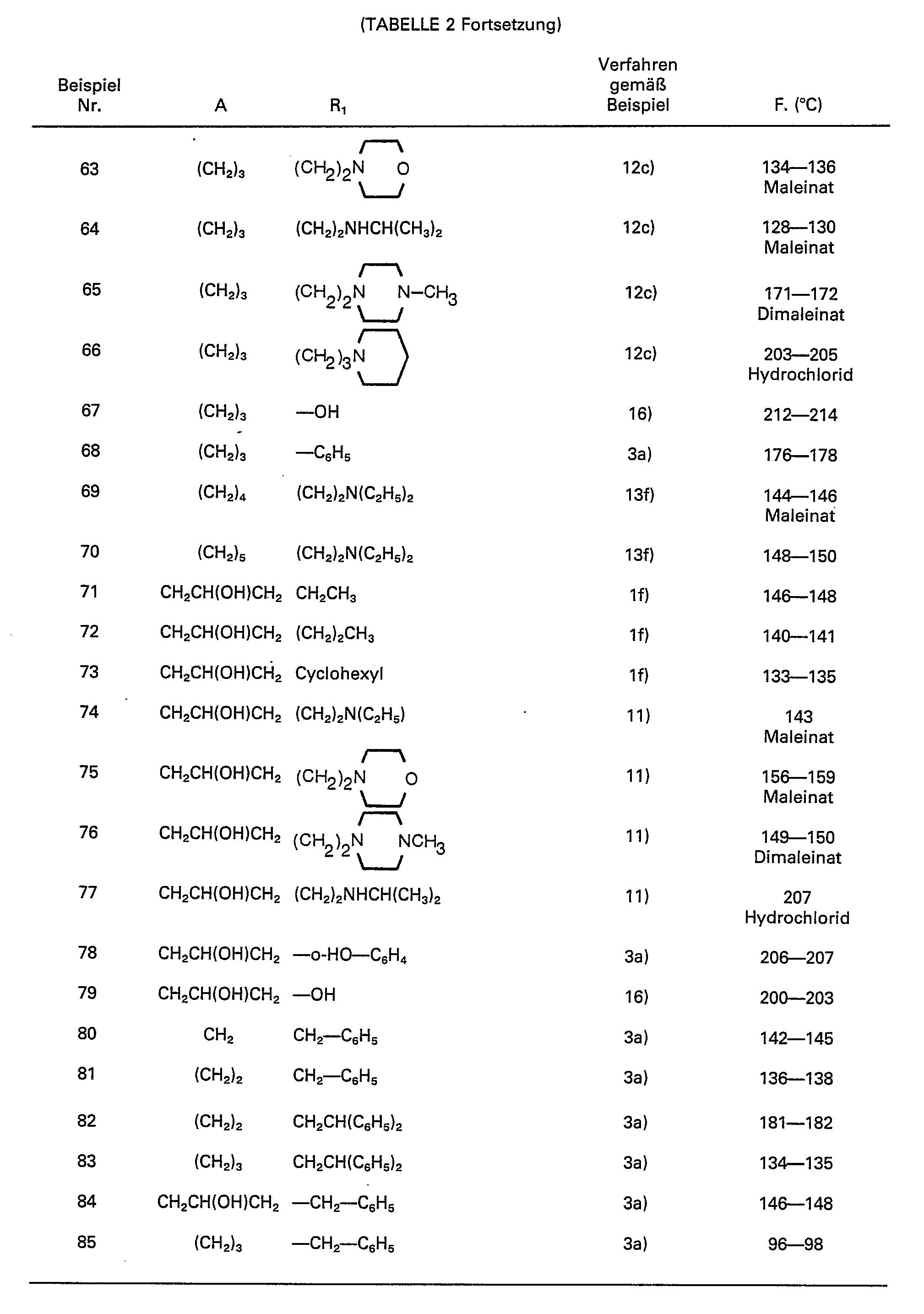
- 5,04 g 2-(Theophyllin-7-yl)-acetamidoxim und 1,08 g Natriummethylat werden in 60 ml Dimethylformamid suspendiert; die Suspension wird unter Rühren innerhalb von 15 min mit einer Lösung von 5,13 g Theophyllin-7-yl-acetylchlorid in 25 ml Dimethylformamid versetzt. Das Gemisch wird 1 h lang gekocht, mit wenig Aktivkohle geklärt und heiß filtriert; das Filtrat wird unter vermindertem Druck eingedampft. Der Rückstand wird in 100 ml 0,1 n Natriumhydrogencarbonatlösung heiß gelöst. Nach dem Abkühlen werden die Kristalle abgetrennt, mit Wasser gewaschen und aus 50-%igem wäßrigen Ethanol umkristallisiert. Es werden 6,6 g 3-(Theophyllin-7-yl-methyl)-5-(theophyllin-7-ylmethyl)-1,2,4-oxadiazol erhalten; F. 271 bis 272°C.
-

- Die miteinander vermischten Bestandteile werden in bekannter Weise granuliert und zu 1000 Stück Tabletten einer Masse von je 440 mg verpreßt. Jede Tablette enthält 100 mg Wirkstoff.
- 200,0 g 7-[(5-[2-Diethylaminoethan-1-yl]-1,2,4-oxadiazol-3-yl)-methyl]-theophyllin-maleinat werden mit destilliertem Wasser auf 1 I aufgefüllt. Die wäßrige Wirkstofflösung wird in bekannter Weise behandelt und in 1000 Ampullen abgefüllt. Jede Ampulle enthält in 1 ml Injektionslösung 200 mg Wirkstoff.

- Der Wirkstoff wird mit der Carboxymethylcellulose und der Stearinsäure vermischt; das Gemisch wird mit der Lösung des Celluloseacetatphthalats in 200 ml Ethylacetat/Ethanol granuliert. Aus dem Granulat werden Kerne von je 500 mg Masse gepreßt, die in an sich bekannter Weise mit zuckerhaltiger 5-%iger wäßriger Polyvinylpyrrolidonlösung überzogen werden. Jedes Dragee enthält 150 mg Wirkstoff.
Claims (12)






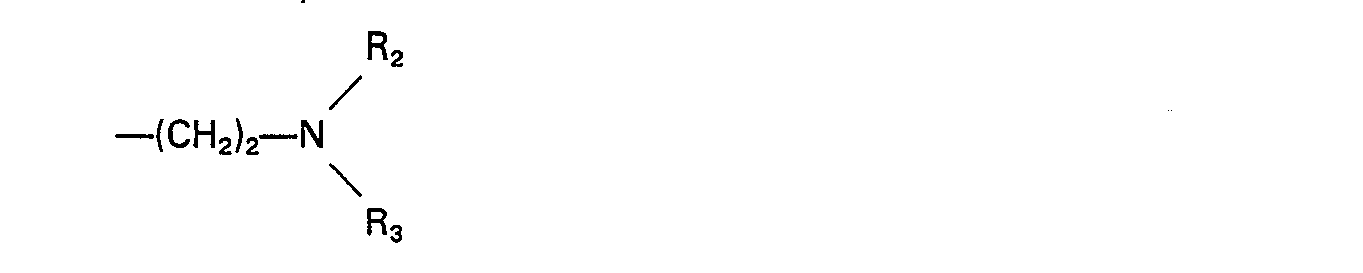
Priority Applications (1)
| Application Number | Priority Date | Filing Date | Title |
|---|---|---|---|
| AT83102422T ATE34575T1 (de) | 1982-03-12 | 1983-03-11 | Neue theophyllin-derivate und verfahren zu ihrer herstellung. |
Applications Claiming Priority (2)
| Application Number | Priority Date | Filing Date | Title |
|---|---|---|---|
| HU82762A HU190377B (en) | 1982-03-12 | 1982-03-12 | Process for preparing theophyllinyl-alkyl-oxadiazoles |
| HU76282 | 1983-01-21 |
Publications (2)
| Publication Number | Publication Date |
|---|---|
| EP0089028A1 EP0089028A1 (de) | 1983-09-21 |
| EP0089028B1 true EP0089028B1 (de) | 1988-05-25 |
Family
ID=10951220
Family Applications (1)
| Application Number | Title | Priority Date | Filing Date |
|---|---|---|---|
| EP83102422A Expired EP0089028B1 (de) | 1982-03-12 | 1983-03-11 | Neue Theophyllin-Derivate und Verfahren zu ihrer Herstellung |
Country Status (17)
| Country | Link |
|---|---|
| US (1) | US4565817A (de) |
| EP (1) | EP0089028B1 (de) |
| JP (1) | JPS5910586A (de) |
| AT (1) | ATE34575T1 (de) |
| BG (1) | BG60434B2 (de) |
| DD (1) | DD207377A5 (de) |
| DE (1) | DE3376749D1 (de) |
| DK (1) | DK161385C (de) |
| ES (2) | ES520860A0 (de) |
| FI (1) | FI72320C (de) |
| GR (1) | GR78450B (de) |
| HU (1) | HU190377B (de) |
| IL (1) | IL68093A0 (de) |
| NO (1) | NO159794C (de) |
| PL (2) | PL138857B1 (de) |
| SK (1) | SK278001B6 (de) |
| SU (3) | SU1322981A3 (de) |
Families Citing this family (14)
| Publication number | Priority date | Publication date | Assignee | Title |
|---|---|---|---|---|
| HU190377B (en) * | 1982-03-12 | 1986-08-28 | Chinoin Gyogyszer Es Vegyeszet | Process for preparing theophyllinyl-alkyl-oxadiazoles |
| HU197574B (en) * | 1986-10-09 | 1989-04-28 | Chinoin Gyogyszer Es Vegyeszet | Process for production of derivatives of 3,7-dihydro-3-methil-7-//1,2,4-oxadiasole/-3-il/alkylenil/-1h-purin-2,6-dion and medical compositions containing these substances |
| LV5262A3 (lv) * | 1986-10-09 | 1993-10-10 | Chinoin Gyogyszer Es Vegyeszet | Oksadiazolilalkilpurina atvasinajumi kam piemit pretklepus aktivitate |
| HU198933B (en) * | 1987-11-02 | 1989-12-28 | Chinoin Gyogyszer Es Vegyeszet | Process for producing new xanthine derivatives and pharmaceutical compositions comprising same as active ingredient |
| HU206884B (en) * | 1990-11-22 | 1993-01-28 | Chinoin Gyogyszer Es Vegyeszet | Process for producing purin derivatives and pharmaceutical compositions containing them |
| US5817662A (en) * | 1992-11-09 | 1998-10-06 | Cell Therapeutics, Inc. | Substituted amino alkyl compounds |
| US5340813A (en) * | 1992-11-09 | 1994-08-23 | Cell Therapeutics, Inc. | Substituted aminoalkyl xanthine compounds |
| AU6087894A (en) * | 1993-01-14 | 1994-08-15 | Cell Therapeutics, Inc. | Acetal or ketal substituted therapeutic compounds |
| US6103730A (en) * | 1994-03-24 | 2000-08-15 | Cell Therapeutics, Inc. | Amine substituted compounds |
| US5807861A (en) * | 1994-03-24 | 1998-09-15 | Cell Therapeutics, Inc. | Amine substituted xanthinyl compounds |
| US5801182A (en) * | 1994-03-24 | 1998-09-01 | Cell Therapeutics, Inc. | Amine substituted compounds |
| US20070215201A1 (en) * | 2006-03-17 | 2007-09-20 | Lawrence Curtin | Photovoltaic cell with integral light transmitting waveguide in a ceramic sleeve |
| WO2009002933A1 (en) * | 2007-06-22 | 2008-12-31 | Hydra Biosciences, Inc. | Methods and compositions for treating disorders |
| WO2009140517A1 (en) | 2008-05-14 | 2009-11-19 | Hydra Biosciences, Inc. | Compounds and compositions for treating chemical warfare agent-induced injuries |
Citations (2)
| Publication number | Priority date | Publication date | Assignee | Title |
|---|---|---|---|---|
| DE1063323B (de) * | 1957-06-29 | 1959-08-13 | Willi Keil | Zentrifugalgeblaese oder -pumpe |
| US4197300A (en) * | 1978-03-13 | 1980-04-08 | Farmaceutici Geymonat Sud S.P.A. | Pharmaceutical fominoben/theophylline complex |
Family Cites Families (6)
| Publication number | Priority date | Publication date | Assignee | Title |
|---|---|---|---|---|
| NL132134C (de) * | 1963-03-22 | |||
| DE1620576A1 (de) * | 1966-11-25 | 1970-02-26 | Troponwerke Dinklage & Co | Verfahren zur Herstellung von Theophyllin- und Theobrominverbindungen |
| DE1670497C3 (de) * | 1967-06-06 | 1973-12-20 | Chinoin Gyogyszer- Es Vegyeszeti Termekek Gyara Rt, Budapest | Isochinohnderivate und Verfahren zu deren Herstellung |
| EP0011399A1 (de) * | 1978-11-11 | 1980-05-28 | FISONS plc | N-Substituierte Theophylline, Verfahren zu ihrer Herstellung und diese enthaltende pharmazeutische Präparate |
| IT1195267B (it) * | 1980-04-15 | 1988-10-12 | Abc Ist Biolog Chem Spa | Derivati teofillinmetildiossolanici,procedimento per la loro preparazione e relative composizioni farmaceutiche |
| HU190377B (en) * | 1982-03-12 | 1986-08-28 | Chinoin Gyogyszer Es Vegyeszet | Process for preparing theophyllinyl-alkyl-oxadiazoles |
-
1982
- 1982-03-12 HU HU82762A patent/HU190377B/hu not_active IP Right Cessation
-
1983
- 1983-03-09 IL IL68093A patent/IL68093A0/xx not_active IP Right Cessation
- 1983-03-10 GR GR70757A patent/GR78450B/el unknown
- 1983-03-10 NO NO830843A patent/NO159794C/no unknown
- 1983-03-11 JP JP58039338A patent/JPS5910586A/ja active Granted
- 1983-03-11 DE DE8383102422T patent/DE3376749D1/de not_active Expired
- 1983-03-11 AT AT83102422T patent/ATE34575T1/de active
- 1983-03-11 PL PL1983249225A patent/PL138857B1/pl unknown
- 1983-03-11 SK SK1701-83A patent/SK278001B6/sk unknown
- 1983-03-11 DK DK118083A patent/DK161385C/da active
- 1983-03-11 DD DD83248727A patent/DD207377A5/de not_active IP Right Cessation
- 1983-03-11 FI FI830831A patent/FI72320C/fi not_active IP Right Cessation
- 1983-03-11 PL PL1983240990A patent/PL138550B1/pl unknown
- 1983-03-11 EP EP83102422A patent/EP0089028B1/de not_active Expired
- 1983-03-11 US US06/474,227 patent/US4565817A/en not_active Expired - Lifetime
- 1983-03-11 SU SU833568848A patent/SU1322981A3/ru active
- 1983-03-12 ES ES520860A patent/ES520860A0/es active Granted
- 1983-10-19 SU SU833654725A patent/SU1344756A1/ru active
-
1984
- 1984-02-23 SU SU843703572A patent/SU1297729A3/ru active
- 1984-06-29 ES ES534146A patent/ES534146A0/es active Granted
-
1993
- 1993-12-02 BG BG098262A patent/BG60434B2/bg unknown
Patent Citations (2)
| Publication number | Priority date | Publication date | Assignee | Title |
|---|---|---|---|---|
| DE1063323B (de) * | 1957-06-29 | 1959-08-13 | Willi Keil | Zentrifugalgeblaese oder -pumpe |
| US4197300A (en) * | 1978-03-13 | 1980-04-08 | Farmaceutici Geymonat Sud S.P.A. | Pharmaceutical fominoben/theophylline complex |
Non-Patent Citations (1)
| Title |
|---|
| IL FARMACO 36, Bd. 3 (1981), 201-219 * |
Also Published As
Similar Documents
| Publication | Publication Date | Title |
|---|---|---|
| DE69721526T2 (de) | Benzofuran carboxamide und ihre therapeutische anwendung | |
| EP1339717B1 (de) | Neue carbamat-substituierte pyrazolopyridinderivate | |
| DE69304883T2 (de) | Xanthin Derivate | |
| EP0726899B1 (de) | Neue pyrazincarboxamidderivate, ihre herstellung und ihre verwendung in arzneimitteln | |
| EP0264081B1 (de) | Oxadiazolylalkylpurin-Derivate, ihre Herstellung und ihre Verwendung in pharmazeutischen Mitteln | |
| EP0089028A1 (de) | Neue Theophyllin-Derivate und Verfahren zu ihrer Herstellung | |
| DE2305092C2 (de) | ||
| DE69126433T2 (de) | 1,4-disubstituierte piperazine | |
| DD263772A5 (de) | Verfahren zur herstellung neuer 1h, 3h-pyrrolo[1,2-c]thiazolderivate | |
| DE68906200T2 (de) | Kondensierte pyrazol-3-oxo-propannitril-derivate und verfahren zu deren herstellung. | |
| DE60107056T2 (de) | Benzoxazolderivate als tnf und pde iv inhibitoren | |
| JPS5980657A (ja) | 3−フエノキシ−1−アゼチジンカルボキサミド、その製造方法及びそれからなる鎮痙剤 | |
| DE3216843C2 (de) | 3-Thiomethyl-pyridin-Derivate, Verfahren zu ihrer Herstellung und diese Verbindungen enthaltende Arzneimittel | |
| EP0018360B1 (de) | N-(5-Methoxybentofuran-2-ylcarbonyl)-N'-benzylpiperazin und Verfahren zu dessen Herstellung | |
| DE69104719T2 (de) | Alkoxy-substituierte dihydrobenzopyran-2-carbonsäure und deren derivate. | |
| SU858570A3 (ru) | Способ получени производных 3-/тетразол-5-ил/-1-азаксантона или их солей | |
| DE3785076T2 (de) | Pyrido(4,3-d)pyrimidin-derivate. | |
| DE68913167T2 (de) | Indol-Derivate, Verfahren zu ihrer Herstellung und sie enthaltende pharmazeutische Präparate. | |
| DD213216A5 (de) | Verfahren zur herstellung eines neuen pynolidin-derivates | |
| DE69310186T2 (de) | 1,2-dihydro-2-oxo-3-aminochinoxalin derivate, ihre verwendung als heilmittel | |
| EP0663395B1 (de) | 3-(Phenylalkylaminoalkyloxy)-5-phenylpyrazol-Derivate, Verfahren und Zwischenprodukte zu ihrer Herstellung und ihre Verwendung als herzfrequenzsenkendes Mittel | |
| US4514395A (en) | Phenothiazine derivatives and anti-psychotic drugs containing the same | |
| DE69018741T2 (de) | Konjugierte gamma-Hydroxybutenolid-Derivate und sie als aktiver Wirkstoff enthaltende Mittel gegen Magengeschwüre. | |
| DD202002A5 (de) | Verfahren zur herstellung von aminoaethanolderivaten | |
| DE4207234A1 (de) | Neue aminocarbonsaeure-derivate mit antiallergischer/antiasthmatischer wirkung und verfahren zu deren herstellung |
Legal Events
| Date | Code | Title | Description |
|---|---|---|---|
| PUAI | Public reference made under article 153(3) epc to a published international application that has entered the european phase |
Free format text: ORIGINAL CODE: 0009012 |
|
| AK | Designated contracting states |
Designated state(s): AT BE CH DE FR GB IT LI NL SE |
|
| 17P | Request for examination filed |
Effective date: 19831103 |
|
| RAP1 | Party data changed (applicant data changed or rights of an application transferred) |
Owner name: CHINOIN GYOGYSZER ES VEGYESZETI TERMEKEK GYARA RT. |
|
| RAP1 | Party data changed (applicant data changed or rights of an application transferred) |
Owner name: CHINOIN GYOGYSZER ES VEGYESZETI TERMEKEK GYARA RT. |
|
| GRAA | (expected) grant |
Free format text: ORIGINAL CODE: 0009210 |
|
| AK | Designated contracting states |
Kind code of ref document: B1 Designated state(s): AT BE CH DE FR GB IT LI NL SE |
|
| REF | Corresponds to: |
Ref document number: 34575 Country of ref document: AT Date of ref document: 19880615 Kind code of ref document: T |
|
| REF | Corresponds to: |
Ref document number: 3376749 Country of ref document: DE Date of ref document: 19880630 |
|
| ET | Fr: translation filed | ||
| ITF | It: translation for a ep patent filed | ||
| GBT | Gb: translation of ep patent filed (gb section 77(6)(a)/1977) | ||
| PLBE | No opposition filed within time limit |
Free format text: ORIGINAL CODE: 0009261 |
|
| STAA | Information on the status of an ep patent application or granted ep patent |
Free format text: STATUS: NO OPPOSITION FILED WITHIN TIME LIMIT |
|
| 26N | No opposition filed | ||
| ITTA | It: last paid annual fee | ||
| EAL | Se: european patent in force in sweden |
Ref document number: 83102422.9 |
|
| PGFP | Annual fee paid to national office [announced via postgrant information from national office to epo] |
Ref country code: SE Payment date: 19990304 Year of fee payment: 17 |
|
| PGFP | Annual fee paid to national office [announced via postgrant information from national office to epo] |
Ref country code: GB Payment date: 19990311 Year of fee payment: 17 |
|
| PGFP | Annual fee paid to national office [announced via postgrant information from national office to epo] |
Ref country code: AT Payment date: 19990315 Year of fee payment: 17 |
|
| PGFP | Annual fee paid to national office [announced via postgrant information from national office to epo] |
Ref country code: BE Payment date: 19990324 Year of fee payment: 17 |
|
| PGFP | Annual fee paid to national office [announced via postgrant information from national office to epo] |
Ref country code: FR Payment date: 19990325 Year of fee payment: 17 |
|
| PGFP | Annual fee paid to national office [announced via postgrant information from national office to epo] |
Ref country code: NL Payment date: 19990331 Year of fee payment: 17 |
|
| PGFP | Annual fee paid to national office [announced via postgrant information from national office to epo] |
Ref country code: DE Payment date: 19990528 Year of fee payment: 17 |
|
| PGFP | Annual fee paid to national office [announced via postgrant information from national office to epo] |
Ref country code: CH Payment date: 19990611 Year of fee payment: 17 |
|
| PG25 | Lapsed in a contracting state [announced via postgrant information from national office to epo] |
Ref country code: GB Free format text: LAPSE BECAUSE OF NON-PAYMENT OF DUE FEES Effective date: 20000311 Ref country code: AT Free format text: LAPSE BECAUSE OF NON-PAYMENT OF DUE FEES Effective date: 20000311 |
|
| PG25 | Lapsed in a contracting state [announced via postgrant information from national office to epo] |
Ref country code: SE Free format text: LAPSE BECAUSE OF NON-PAYMENT OF DUE FEES Effective date: 20000312 |
|
| PG25 | Lapsed in a contracting state [announced via postgrant information from national office to epo] |
Ref country code: LI Free format text: LAPSE BECAUSE OF NON-PAYMENT OF DUE FEES Effective date: 20000331 Ref country code: CH Free format text: LAPSE BECAUSE OF NON-PAYMENT OF DUE FEES Effective date: 20000331 Ref country code: BE Free format text: LAPSE BECAUSE OF NON-PAYMENT OF DUE FEES Effective date: 20000331 |
|
| BERE | Be: lapsed |
Owner name: CHINOIN GYOGYSZER ES VEGYESZETI TERMEKEK GYARA RT Effective date: 20000331 |
|
| PG25 | Lapsed in a contracting state [announced via postgrant information from national office to epo] |
Ref country code: NL Free format text: LAPSE BECAUSE OF NON-PAYMENT OF DUE FEES Effective date: 20001001 |
|
| GBPC | Gb: european patent ceased through non-payment of renewal fee |
Effective date: 20000311 |
|
| EUG | Se: european patent has lapsed |
Ref document number: 83102422.9 |
|
| REG | Reference to a national code |
Ref country code: CH Ref legal event code: PL |
|
| PG25 | Lapsed in a contracting state [announced via postgrant information from national office to epo] |
Ref country code: FR Free format text: LAPSE BECAUSE OF NON-PAYMENT OF DUE FEES Effective date: 20001130 |
|
| NLV4 | Nl: lapsed or anulled due to non-payment of the annual fee |
Effective date: 20001001 |
|
| REG | Reference to a national code |
Ref country code: FR Ref legal event code: ST |
|
| PG25 | Lapsed in a contracting state [announced via postgrant information from national office to epo] |
Ref country code: DE Free format text: LAPSE BECAUSE OF NON-PAYMENT OF DUE FEES Effective date: 20010103 |