EP0085939A1 - Mittel zur Bindung und Sanierung von tierischen Schlackenprodukten sowie Verfahren zur Herstellung des Mittels - Google Patents
Mittel zur Bindung und Sanierung von tierischen Schlackenprodukten sowie Verfahren zur Herstellung des Mittels Download PDFInfo
- Publication number
- EP0085939A1 EP0085939A1 EP83100977A EP83100977A EP0085939A1 EP 0085939 A1 EP0085939 A1 EP 0085939A1 EP 83100977 A EP83100977 A EP 83100977A EP 83100977 A EP83100977 A EP 83100977A EP 0085939 A1 EP0085939 A1 EP 0085939A1
- Authority
- EP
- European Patent Office
- Prior art keywords
- gypsum
- mineral
- mixture
- agent
- water
- Prior art date
- Legal status (The legal status is an assumption and is not a legal conclusion. Google has not performed a legal analysis and makes no representation as to the accuracy of the status listed.)
- Granted
Links
- 238000000034 method Methods 0.000 title claims description 11
- 239000000463 material Substances 0.000 title abstract description 6
- 241001465754 Metazoa Species 0.000 title description 6
- 238000004519 manufacturing process Methods 0.000 title description 4
- 210000003608 fece Anatomy 0.000 title 1
- 229910052500 inorganic mineral Inorganic materials 0.000 claims abstract description 31
- 239000011707 mineral Substances 0.000 claims abstract description 31
- 229910052602 gypsum Inorganic materials 0.000 claims abstract description 26
- 239000010440 gypsum Substances 0.000 claims abstract description 26
- 239000000203 mixture Substances 0.000 claims abstract description 19
- 239000003795 chemical substances by application Substances 0.000 claims abstract description 12
- 239000004088 foaming agent Substances 0.000 claims abstract description 4
- 239000008187 granular material Substances 0.000 claims abstract description 4
- 235000008733 Citrus aurantifolia Nutrition 0.000 claims abstract description 3
- 235000011941 Tilia x europaea Nutrition 0.000 claims abstract description 3
- 239000011230 binding agent Substances 0.000 claims abstract description 3
- 239000004568 cement Substances 0.000 claims abstract description 3
- 239000004571 lime Substances 0.000 claims abstract description 3
- XLYOFNOQVPJJNP-UHFFFAOYSA-N water Substances O XLYOFNOQVPJJNP-UHFFFAOYSA-N 0.000 claims description 14
- 239000004567 concrete Substances 0.000 claims description 5
- 239000007921 spray Substances 0.000 claims description 5
- 238000005453 pelletization Methods 0.000 claims description 4
- 239000011505 plaster Substances 0.000 claims description 4
- 239000004604 Blowing Agent Substances 0.000 claims description 3
- ZOMBKNNSYQHRCA-UHFFFAOYSA-J calcium sulfate hemihydrate Chemical compound O.[Ca+2].[Ca+2].[O-]S([O-])(=O)=O.[O-]S([O-])(=O)=O ZOMBKNNSYQHRCA-UHFFFAOYSA-J 0.000 claims description 3
- 239000003086 colorant Substances 0.000 claims description 3
- 238000001035 drying Methods 0.000 claims description 3
- 239000003112 inhibitor Substances 0.000 claims description 3
- 238000005067 remediation Methods 0.000 claims description 3
- 239000002893 slag Substances 0.000 claims description 3
- 238000007664 blowing Methods 0.000 claims description 2
- 239000011148 porous material Substances 0.000 claims description 2
- 239000000843 powder Substances 0.000 claims description 2
- 229910004298 SiO 2 Inorganic materials 0.000 claims 1
- 238000002360 preparation method Methods 0.000 claims 1
- 239000000126 substance Substances 0.000 abstract description 6
- VYPSYNLAJGMNEJ-UHFFFAOYSA-N Silicium dioxide Chemical compound O=[Si]=O VYPSYNLAJGMNEJ-UHFFFAOYSA-N 0.000 abstract 2
- 239000010828 animal waste Substances 0.000 abstract 1
- 229910052681 coesite Inorganic materials 0.000 abstract 1
- 229910052906 cristobalite Inorganic materials 0.000 abstract 1
- 239000004615 ingredient Substances 0.000 abstract 1
- 239000000377 silicon dioxide Substances 0.000 abstract 1
- 235000012239 silicon dioxide Nutrition 0.000 abstract 1
- 229910052682 stishovite Inorganic materials 0.000 abstract 1
- 229910052905 tridymite Inorganic materials 0.000 abstract 1
- 230000000694 effects Effects 0.000 description 5
- 238000001179 sorption measurement Methods 0.000 description 5
- 229910052918 calcium silicate Inorganic materials 0.000 description 4
- 239000000378 calcium silicate Substances 0.000 description 4
- OYACROKNLOSFPA-UHFFFAOYSA-N calcium;dioxido(oxo)silane Chemical compound [Ca+2].[O-][Si]([O-])=O OYACROKNLOSFPA-UHFFFAOYSA-N 0.000 description 4
- 239000011248 coating agent Substances 0.000 description 4
- 238000000576 coating method Methods 0.000 description 4
- 239000008188 pellet Substances 0.000 description 4
- QGZKDVFQNNGYKY-UHFFFAOYSA-N Ammonia Chemical compound N QGZKDVFQNNGYKY-UHFFFAOYSA-N 0.000 description 2
- 241000894006 Bacteria Species 0.000 description 2
- XEEYBQQBJWHFJM-UHFFFAOYSA-N Iron Chemical compound [Fe] XEEYBQQBJWHFJM-UHFFFAOYSA-N 0.000 description 2
- 239000007788 liquid Substances 0.000 description 2
- BPQQTUXANYXVAA-UHFFFAOYSA-N Orthosilicate Chemical compound [O-][Si]([O-])([O-])[O-] BPQQTUXANYXVAA-UHFFFAOYSA-N 0.000 description 1
- QAOWNCQODCNURD-UHFFFAOYSA-L Sulfate Chemical compound [O-]S([O-])(=O)=O QAOWNCQODCNURD-UHFFFAOYSA-L 0.000 description 1
- 238000005299 abrasion Methods 0.000 description 1
- 238000010521 absorption reaction Methods 0.000 description 1
- 239000002253 acid Substances 0.000 description 1
- 150000007513 acids Chemical class 0.000 description 1
- 230000002730 additional effect Effects 0.000 description 1
- 230000000274 adsorptive effect Effects 0.000 description 1
- 229910021529 ammonia Inorganic materials 0.000 description 1
- 230000004888 barrier function Effects 0.000 description 1
- 230000015572 biosynthetic process Effects 0.000 description 1
- 230000000903 blocking effect Effects 0.000 description 1
- 230000001427 coherent effect Effects 0.000 description 1
- 150000004683 dihydrates Chemical class 0.000 description 1
- 239000010419 fine particle Substances 0.000 description 1
- 229910052742 iron Inorganic materials 0.000 description 1
- 239000007791 liquid phase Substances 0.000 description 1
- 238000006386 neutralization reaction Methods 0.000 description 1
- 230000035515 penetration Effects 0.000 description 1
- 230000000717 retained effect Effects 0.000 description 1
Images
Classifications
-
- A—HUMAN NECESSITIES
- A01—AGRICULTURE; FORESTRY; ANIMAL HUSBANDRY; HUNTING; TRAPPING; FISHING
- A01K—ANIMAL HUSBANDRY; AVICULTURE; APICULTURE; PISCICULTURE; FISHING; REARING OR BREEDING ANIMALS, NOT OTHERWISE PROVIDED FOR; NEW BREEDS OF ANIMALS
- A01K1/00—Housing animals; Equipment therefor
- A01K1/015—Floor coverings, e.g. bedding-down sheets ; Stable floors
- A01K1/0152—Litter
- A01K1/0154—Litter comprising inorganic material
-
- C—CHEMISTRY; METALLURGY
- C04—CEMENTS; CONCRETE; ARTIFICIAL STONE; CERAMICS; REFRACTORIES
- C04B—LIME, MAGNESIA; SLAG; CEMENTS; COMPOSITIONS THEREOF, e.g. MORTARS, CONCRETE OR LIKE BUILDING MATERIALS; ARTIFICIAL STONE; CERAMICS; REFRACTORIES; TREATMENT OF NATURAL STONE
- C04B20/00—Use of materials as fillers for mortars, concrete or artificial stone according to more than one of groups C04B14/00 - C04B18/00 and characterised by shape or grain distribution; Treatment of materials according to more than one of the groups C04B14/00 - C04B18/00 specially adapted to enhance their filling properties in mortars, concrete or artificial stone; Expanding or defibrillating materials
- C04B20/10—Coating or impregnating
- C04B20/1055—Coating or impregnating with inorganic materials
Definitions
- Agent for binding and remediation of animal slag products and method for producing the agent.
- the invention relates to a means for binding and remediation of animal, biologically separated slag products, consisting of a mineral mixture, produced by mixing a binder made of lime and / or cement with a reactive component containing SiOi and optionally a blowing and / or foaming agent, if necessary hydrothermal hardening of the mixture and comminution of the hardened product, the agent being a mixture consisting essentially of gypsum and mineral mixture,
- the mineral mixture also includes products according to DE-OS 29 02 079, 29 02 101, manufactured z. B. according to DE-OS 28 32 194 in question.
- a disadvantage of these known products is that part of the absorbed substances, for. B. released too quickly by exposure to heat is set.
- the effect of the mineral mixture consists essentially in the high adsorption capacity against liquid phases and because of the relatively high pH value in the neutralization of acids, in killing bacteria and in preventing the development of bacteria, furthermore in an at least partial odor reduction.
- the gypsum has the ability to chemically and / or adsorb bind ammonia and other gaseous malodorous substances.
- the object of the invention is to condition a product composed of mineral grains containing gypsum and calcium silicate hydrate in such a way that the effect of the two substances is optimized and the release of the absorbed substances is made more difficult.
- This object is achieved in the agent described above in that it consists of mineral grains surrounded by a gypsum shell.
- the mineral silicate hydrate containing calcium silicate hydrate preferably consisting essentially of calcium silicate hydrate, in particular in the grain range from 0.5 to 8 mm, preferably 1.5 to 6.0 mm, is known to have micropores which cause the high adsorption capacity against liquids. Macrospores caused by blowing agents and / or foaming agents used in the production increase the adsorption capacity. It wasn't at all now close to encasing the mineral grains with a hardened layer of gypsum, because there was fear that this would impair the adsorption capacity against liquids or the absorption capacity. However, it has been found that the adsorptive capacity is not changed, rather that, surprisingly, the absorbed substances are not released as easily as in the known products.
- the gypsum casing apparently forms a barrier zone for the exit of the absorbed material located in the interior of the grain, but not for the penetration, which takes place almost unhindered. What this directional, semi-permeable effect of the gypsum layer results from is not yet known. In addition to the blocking effect, the gypsum casing develops the known properties of the gypsum far better than in known products, because the gypsum is apparently arranged in the form of a coherent, mineral-pure layer on the mineral grain and is not - as usual - in a fine-particle mixture with other products.
- the gypsum shell forms a relatively rounded surface in comparison to the mineral grain, which is sharp-edged due to the manufacturing process.
- the rounded surface makes the grains easier to handle (free-flowing) and less abrasion. It has been observed that the animals prefer places filled with round grains over squares filled with square grains. The angular grains also get caught in the fur of the animals and are scattered in this way. The This disadvantage also does not adhere to round grain according to the invention.
- the agent is produced by moistening the broken granulate from the mineral material, preferably gas concrete, with 20 to 70% by weight of water and then mixing it with a dry, powdered gypsum hemihydrate, preferably cl hemihydrate.
- the mixing is expediently carried out on a pelletizing plate, so that rounded pellets are formed.
- the water content of the mineral grains used in the grain range from 0.5 to 8 mm should be between 50 and 70% by weight. The amount of water added depends on the water content of the starting product. Is a calcium silicate hydrate mineral mixture with z. B.
- autoclave moisture (about 30 wt .-% H 2 0), less water needs to be added than when using a product with a balance moisture of 3 wt .-%.
- Hemihydrate is used in an amount of 50 to 80 wt .-%, based on the dry mineral grain (3 wt .-% balance moisture at room temperature).
- a layer is preferably formed which has an average thickness of 0.1 to 0.5 / mm.
- the coating with set gypsum advantageously opens up further possibilities for imparting additional properties to the animal litter without great effort.
- Colorants, indicators, and other odor inhibitors e.g. iron III sulfate
- iron III sulfate can be added to the gypsum powder and / or the spray water, which are built into the solidified shell and increase or increase the effect of the new agent Give agents an aesthetically superior appearance.
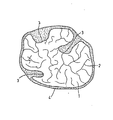
- a gas concrete grain 1 is shown schematically in section, which has macropores 2 and micropores 3.
- the grain 1 is coated with a layer of gypsum 4, the pores 3 being filled with gypsum.
Landscapes
- Chemical & Material Sciences (AREA)
- Life Sciences & Earth Sciences (AREA)
- Inorganic Chemistry (AREA)
- Engineering & Computer Science (AREA)
- Ceramic Engineering (AREA)
- Environmental Sciences (AREA)
- Zoology (AREA)
- Organic Chemistry (AREA)
- Structural Engineering (AREA)
- Animal Husbandry (AREA)
- Biodiversity & Conservation Biology (AREA)
- Materials Engineering (AREA)
- Disinfection, Sterilisation Or Deodorisation Of Air (AREA)
- Soil Conditioners And Soil-Stabilizing Materials (AREA)
- Solid-Sorbent Or Filter-Aiding Compositions (AREA)
- Curing Cements, Concrete, And Artificial Stone (AREA)
- Sheet Holders (AREA)
- Processing Of Solid Wastes (AREA)
Abstract
Description
- Mittel zur Bindung und Sanierung von tierischen Schlackenprodukten sowie Verfahren zur Herstellung des Mittels.
- Die Erfindung betrifft ein Mittel zur Bindung und Sanierung von animalen, biologisch ausgesonderten Schlackenprodukten, bestehend aus einem Mineralstoffgemisch, hergestellt durch Mischung eines Bindemittels aus Kalk und/oder Zement mit einer SiOi enthaltenden reaktionsfähigen Komponente und ggf. einem Treib-und/oder Schäummittel, ggf. hydrothermale Härtung des Gemisches und Zerkleinerung des erhärteten Produktes, wobei das Mittel ein Gemisch ist, das im wesentlichen aus Gips und Mineralstoffgemisch besteht,
- Das bekannte Produkt hat sich bewährt. Als Mineralstoffgemisch kommen außer Gasbeton auch Produkte gemäß DE-OS 29 02 079, 29 02 101, hergestellt z. B. gemäß DE-OS 28 32 194, in Frage. Nachteilig bei diesen bekannten Produkten ist, daß ein Teil der aufgesaugten Stoffe z. B. durch Wärmeeinwirkung zu schnell wieder freigesetzt wird.
- Die Wirkung des Mineralstoffgemisches besteht im wesentlichen in der hohen Adsorptionsfähigkeit gegenüber flüssigen Phasen und wegen des relativ hohen pH-Wertes in der Neutralisierung von Säuren,im Abtöten von Bakterien und in der Behinderung der Entwicklung von Bakterien, ferner in einer zumindest teilweisen Geruchsminderung.
- Die Wirkung des Gipses wird z. B. in der DE-PS 868 912 beschrieben. Demnach besitzt der Gips die Fähigkeit, Ammoniak und andere gasförmige übelriechende Stoffe chemisch und/oder adsorbtiv zu binden.
- Aufgabe der Erfindung ist, ein Produkt aus Gips und Calciumsilikathydrat aufweisenden Mineralstoffkörnern so zu konditionieren, daß die Wirkung der beiden Stoffe optimiert und die Freisetzung der aufgesaugten Stoffe erschwert wird.
- Diese Aufgabe wird bei dem eingangs beschriebenen Mittel dadurch gelöst, daß es aus Mineralstoffkörnern besteht, die von einer Gipshülle umgeben sind.
- Die Calciumsilikathydrat aufweisenden, vorzugsweise im wesentlichen aus Calciumsilikathydraten bestehenden Mineralstoffkörner, insbesondere im Kornbereich von 0,5 bis 8 mm, vorzugsweise 1,5 bis 6,0 mm, weisen bekanntermaßen Mikroporen auf, die das hohe Adsorptionsvermögen gegenüber Flüssigkeiten bedingen. Durch bei der Herstellung verwendete Treib- und/oder Schäummittel bedingte Makroporen wird das Adsorptionsvermögen erhöht. Es lag nun keineswegs nahe, die Mineralstoffkörner mit einer erhärteten Gipsschicht zu umhüllen, weil befürchtet werden mußte, daß dadurch das Adsorptionsvermögen gegenüber Flüssigkeiten bzw. die Adsorptionsfähigkeit beeinträchtigt würde. Es hat sich jedoch herausgestellt, daß das Adsorptionsvermögen nicht geändert wird, daß vielmehr in überraschender Weise die aufgesaugten Stoffe nicht so leicht wieder freigesetzt werden wie bei den bekannten Produkten. Offenbar bildet die Gipshülle eine Sperrzone für den Austritt des im Innern des Korns befindlichen aufgesaugten Stoffes, nicht jedoch für das Eindringen, das nahezu ungehindert erfolgt. Woraus diese richtungsabhängige, semipermeable Wirkung der Gipsschicht resultiert, ist derzeit noch nicht bekannt. Neben der Sperrwirkung entfaltet die Gipshülle die bekannten Fähigkeiten des Gipses weitaus besser als in bekannten Produkten, weil offenbar der Gips in Form einer zusammenhängenden, mineralisch reinen Schicht auf dem Mineralstoffkorn angeordnet ist und nicht - wie üblich - in einem feinteiligen Gemisch mit anderen Produkten vorliegt.
- Vorteilhaft ist, daß die Gipshülle eine relativ gerundete Oberfläche bildet im Vergleich zum Mineralstoffkorn, das herstellungsbedingt nach dem Zerkleinern scharfkantig ist. Die gerundete Oberfläche bedingt eine leichtere Handhabung (Rieselfähigkeit) der Körner und weniger Abrieb. Man hat beobachtet, daß die Tiere mit runden Körnern gefüllte Plätze bevorzugen gegenüber mit eckigen Körnern gefüllte. Die eckigen Körner verhaken sich außerdem im Fell der Tiere und werden auf diese Weise verstreut. Dem runden erfindungsgemäßen Korn haftet dieser Nachteil ebenfalls nicht an.
- Nach einer besonderen Ausführungsform der Erfindung wird das Mittel hergestellt, indem das gebrochene Granulat aus dem Mineralstoff, vorzugsweise aus Gasbeton, mit 20 bis 70 Gew.-% Wasser befeuchtet und anschließend mit einem trockenen, pulverförmigen Gipshalbhydrat, vorzugsweise cl -Halbhydrat, vermengt wird. Zweckmäßigerweise erfolgt das Mischen auf einem Pelletierteller, so daß gerundete Pellets entstehen. Der Wassergehalt der verwendeten Mineralstoffkörner im Kornbereich von 0,5 bis 8 mm sollte zwischen 50 und 70 Gew.-% liegen. Die Zugabemenge des Wassers richtet sich nach dem Wassergehalt des Ausgangsproduktes. Wird ein Calciumsilikathydrat aufweisendes Mineralstoffgemisch mit z. B. Autoklavfeuchte (etwa 30 Gew.-% H20) verwendet, braucht weniger Wasser zugegeben zu werden als bei Verwendung eines Produkts mit einer Ausgleichsfeuchte von 3 Gew.-%. Halbhydrat wird in einer Menge von 50 bis 80 Gew.-%, bezogen auf das trockene Mineralstoffkorn (3 Gew.-% Ausgleichsfeuchte bei Raumtemperatur), verwendet. Es wird beim Pelletieren vorzugsweise eine Schicht gebildet, die im Mittel eine Dicke von 0,1 bis 0,5 / mm aufweist. Beim Umhüllen der Mineralstoffkörner mit trockenem, pulverförmigem Gipshalbhydrat werden die oberflächlich angeordneten Löcher, z. B. Makroporen, ausgefüllt, und es bildet sich dann eine gleichmäßige, feuchte Gipsschicht, die nach der Entnahme der Pellets vom Pelletierteller unter Bildung von Gipsdihydrat aushärtet, wozu ausreichend Wasser zur Verfügung steht. Die gehärtete Hülle aus Gips ummantelt das Mineralstoffkorn vollständig, unterbricht die Kapillaren des Mineralstoffkorns und weist eine eigene Kapillarität auf. Wird z. B. ein Gasbetongranulat als Mineral toffetwa korn verwendet mit einer Schüttdichte von 0,35 g/cm , so erhöht sich die Schüttdichte aufgrund der Ummantelung auf 0,45 bis 0,5 g/cm3, wobei die Adsorptionskapazität erhalten bleibt und sich die beschriebenen Vorteile einstellen.
- Vorteilhaft ist, während des Beschichtens oder nach dem Beschichten auf dem Pelletierteller die Pellets mit Wasser zu besprühen, was die Erhärtung der Hülle fördert. Die Erhärtung wird zweckmäßigerweise zudem beschleunigt, wenn dem Sprühwasser ein an sich bekannter Gipsabbindebeschleuniger zugesetzt wird. Sofern der Feuchtigkeitsgehalt der Pellets nach dem Abbinden des Gipses zu hoch sein sollte, kann sich eine Trocknung anschließen. Eine Trocknung ist jedoch in der Regel nicht erforderlich, weil das Halbhydrat zum Abbinden Feuchtigkeit aus dem Mineralstoffkorn entzieht und die Wärmeentwicklung des Abbindevorganges zudem Feuchtigkeit aus dem Korn verdrängt.
- Die Ummantelung mit abgebundenem Gips eröffnet in vorteilhafter Weise weitere Möglichkeiten, dem Tierstreumittel ohne großen Aufwand zusätzliche Eigenschaften zu verleihen. Es können dem Gipspulver und/ oder dem Sprühwasser Farbmittel, Indikatoren, weitere Geruchsinhibitoren (z. B. Eisen-III-Sulfat) zugesetzt werden, die in die verfestigte Hülle eingebaut werden und die Wirkung des neuen Mittels eihöhen bzw. dem Mittel ein ästhetisch höherwertiges Aussehen verleihen.
- Anhand der Zeichnung wird die Erfindung näher erläutert. Es ist schematisch ein Gasbetonkorn 1 im Schnitt abgebildet, das Makroporen 2 und Mikroporen 3 aufweist. Das Korn 1 ist mit einer Gipsschicht 4 ummantelt, wobei die Poren 3 mit Gips ausgefüllt sind.
Claims (13)
Priority Applications (1)
| Application Number | Priority Date | Filing Date | Title |
|---|---|---|---|
| AT83100977T ATE13737T1 (de) | 1982-02-04 | 1983-02-02 | Mittel zur bindung und sanierung von tierischen schlackenprodukten sowie verfahren zur herstellung des mittels. |
Applications Claiming Priority (2)
| Application Number | Priority Date | Filing Date | Title |
|---|---|---|---|
| DE3203680 | 1982-02-04 | ||
| DE19823203680 DE3203680A1 (de) | 1982-02-04 | 1982-02-04 | Mittel zur bindung und sanierung von tierischen schlackenprodukten sowie verfahren zur herstellung des mittels |
Publications (2)
| Publication Number | Publication Date |
|---|---|
| EP0085939A1 true EP0085939A1 (de) | 1983-08-17 |
| EP0085939B1 EP0085939B1 (de) | 1985-06-12 |
Family
ID=6154716
Family Applications (1)
| Application Number | Title | Priority Date | Filing Date |
|---|---|---|---|
| EP83100977A Expired EP0085939B1 (de) | 1982-02-04 | 1983-02-02 | Mittel zur Bindung und Sanierung von tierischen Schlackenprodukten sowie Verfahren zur Herstellung des Mittels |
Country Status (3)
| Country | Link |
|---|---|
| EP (1) | EP0085939B1 (de) |
| AT (1) | ATE13737T1 (de) |
| DE (2) | DE3203680A1 (de) |
Cited By (6)
| Publication number | Priority date | Publication date | Assignee | Title |
|---|---|---|---|---|
| EP0165820A3 (de) * | 1984-06-20 | 1987-02-04 | Martin Feed Mills Limited | Absorptionsmaterial und dessen Herstellung |
| DE3717848A1 (de) * | 1987-05-27 | 1988-12-08 | Rwk Rhein Westfael Kalkwerke | Anorganisches material und verfahren zu seiner herstellung |
| US5339769A (en) * | 1993-07-13 | 1994-08-23 | The Dow Chemical Company | Process for making an absorbent composition |
| WO2016005558A1 (fr) * | 2014-07-10 | 2016-01-14 | S.A. Lhoist Recherche Et Developpement | Chaux vive a reactivite ralentie, son procede de fabrication et son utilisation |
| FR3023551A1 (fr) * | 2014-07-10 | 2016-01-15 | Lhoist Rech & Dev Sa | Chaux vive a reactivite ralentie, son procede de fabrication et son utilisation |
| BE1021863B1 (fr) * | 2014-07-10 | 2016-01-22 | S.A. Lhoist Recherche Et Developpement | Chaux vive a reactivite ralentie, son procede de fabrication et son utilisation |
Families Citing this family (5)
| Publication number | Priority date | Publication date | Assignee | Title |
|---|---|---|---|---|
| DE3403099A1 (de) * | 1984-01-30 | 1985-08-08 | Strabit-Werke Gmbh, 5450 Neuwied | Geruchs- und fluessigkeitsbindendes streumittel, insbesondere fuer kleintiere sowie verfahren zu dessen herstellung |
| DE4114370A1 (de) * | 1991-05-02 | 1992-11-05 | Rainer Fischer | Mittel zur aufbereitung tierischer ausscheidungen |
| DE4119504A1 (de) * | 1991-06-13 | 1992-12-17 | Horst J Schilkowski | Kombinierter mineralisch-organischer duenger |
| DE4131296A1 (de) * | 1991-09-20 | 1993-03-25 | Georg Dr Halfter | Verfahren und apparatur zur aufbereitung von tierexkrementen, guelle und jauche |
| DE4328285C2 (de) * | 1993-07-20 | 1997-05-07 | Effem Gmbh | Tierstreu und Verfahren zu deren Herstellung |
Citations (4)
| Publication number | Priority date | Publication date | Assignee | Title |
|---|---|---|---|---|
| DE1813881A1 (de) * | 1967-12-13 | 1970-05-27 | Intong Ab | Verfahren zum Herstellen poroeser Leichtballastkoerner |
| DE2338887A1 (de) * | 1973-08-01 | 1975-04-30 | Albert Kregel | Verfahren zum aufbau quantitativ regelbarer oberflaechenumhuellungen leichter zuschlaege, wie blaehton und blaehschiefer mit gips, zur steuerung der wasseraufnahme des leichten zuschlages und der arbeitsvorgaenge bei herstellung von fertigerzeugnissen aus gips und zuschlag |
| DE2640341A1 (de) * | 1976-09-08 | 1978-03-09 | Vaw Flusspat Chemie Gmbh | Streumittel zur aufnahme von abfallstoffen und abwaessern |
| DE2930060A1 (de) * | 1978-10-10 | 1980-05-08 | Ytong Ag | Mittel zur bindung und sanierung von tierischen schlackenprodukten |
-
1982
- 1982-02-04 DE DE19823203680 patent/DE3203680A1/de not_active Withdrawn
-
1983
- 1983-02-02 DE DE8383100977T patent/DE3360247D1/de not_active Expired
- 1983-02-02 AT AT83100977T patent/ATE13737T1/de active
- 1983-02-02 EP EP83100977A patent/EP0085939B1/de not_active Expired
Patent Citations (4)
| Publication number | Priority date | Publication date | Assignee | Title |
|---|---|---|---|---|
| DE1813881A1 (de) * | 1967-12-13 | 1970-05-27 | Intong Ab | Verfahren zum Herstellen poroeser Leichtballastkoerner |
| DE2338887A1 (de) * | 1973-08-01 | 1975-04-30 | Albert Kregel | Verfahren zum aufbau quantitativ regelbarer oberflaechenumhuellungen leichter zuschlaege, wie blaehton und blaehschiefer mit gips, zur steuerung der wasseraufnahme des leichten zuschlages und der arbeitsvorgaenge bei herstellung von fertigerzeugnissen aus gips und zuschlag |
| DE2640341A1 (de) * | 1976-09-08 | 1978-03-09 | Vaw Flusspat Chemie Gmbh | Streumittel zur aufnahme von abfallstoffen und abwaessern |
| DE2930060A1 (de) * | 1978-10-10 | 1980-05-08 | Ytong Ag | Mittel zur bindung und sanierung von tierischen schlackenprodukten |
Cited By (8)
| Publication number | Priority date | Publication date | Assignee | Title |
|---|---|---|---|---|
| EP0165820A3 (de) * | 1984-06-20 | 1987-02-04 | Martin Feed Mills Limited | Absorptionsmaterial und dessen Herstellung |
| US4676196A (en) * | 1984-06-20 | 1987-06-30 | Martin Feed Mills Ltd. | Absorbent material |
| DE3717848A1 (de) * | 1987-05-27 | 1988-12-08 | Rwk Rhein Westfael Kalkwerke | Anorganisches material und verfahren zu seiner herstellung |
| US5339769A (en) * | 1993-07-13 | 1994-08-23 | The Dow Chemical Company | Process for making an absorbent composition |
| WO2016005558A1 (fr) * | 2014-07-10 | 2016-01-14 | S.A. Lhoist Recherche Et Developpement | Chaux vive a reactivite ralentie, son procede de fabrication et son utilisation |
| FR3023551A1 (fr) * | 2014-07-10 | 2016-01-15 | Lhoist Rech & Dev Sa | Chaux vive a reactivite ralentie, son procede de fabrication et son utilisation |
| BE1021863B1 (fr) * | 2014-07-10 | 2016-01-22 | S.A. Lhoist Recherche Et Developpement | Chaux vive a reactivite ralentie, son procede de fabrication et son utilisation |
| EP3166397B1 (de) | 2014-07-10 | 2020-10-07 | S.A. Lhoist Recherche Et Developpement | Ätzkalk mit verzögerter reaktivität, verfahren zur herstellung davon und verwendung davon |
Also Published As
| Publication number | Publication date |
|---|---|
| DE3203680A1 (de) | 1983-08-25 |
| DE3360247D1 (en) | 1985-07-18 |
| ATE13737T1 (de) | 1985-06-15 |
| EP0085939B1 (de) | 1985-06-12 |
Similar Documents
| Publication | Publication Date | Title |
|---|---|---|
| DE3514698C2 (de) | Verfahren zur Herstellung von Porenbeton | |
| EP0019207A1 (de) | Verfahren zum Herstellen von Gipsbauteilen | |
| EP0085939B1 (de) | Mittel zur Bindung und Sanierung von tierischen Schlackenprodukten sowie Verfahren zur Herstellung des Mittels | |
| DE19509747A1 (de) | Hochporöses Granulat zur Verwendung als Tierstreu und Verfahren zur Herstellung des Granulates | |
| DE1471025A1 (de) | Verfahren zur Herstellung von Baukoerpern auf der Basis von Plaster | |
| DE3021377C2 (de) | Adsorptionsmittel auf Perlitgrundlage, Verfahren zu dessen Herstellung und dessen Verwendung | |
| EP0064793B1 (de) | Verfahren zur Herstellung von Gipsformsteinen | |
| DE2749637C3 (de) | Poröses Granulat und Verfahren zu seiner Herstellung | |
| DE2903515A1 (de) | Verfahren zur herstellung von gipsbauteilen | |
| DE2949390C2 (de) | Härtbare Zusammensetzung zur Bildung von Ettringit (TSH), Zement, Gips, sowie bis zu 40 Gew.-% Fasermaterial enthaltenden Produkten | |
| DE3133503C2 (de) | Bindemittel | |
| DE3040344C2 (de) | ||
| DE2840572A1 (de) | Quellzemente | |
| DE4337777A1 (de) | Putzmörtel mit hoher Wärmedämmfähigkeit | |
| DE8204654U1 (de) | Mittel zur bindung und sanierung von tierischen schlackenprodukten | |
| DE947777C (de) | Verfahren zur Behandlung von Holzabfall zwecks Verwendung zusammen mit hydraulischen Bindemitteln zur Herstellung von Baumaterialien | |
| DE3403099C2 (de) | ||
| DE2142879C3 (de) | Putz- und Mauermörtel, sowie Verfahren zu seiner Herstellung | |
| EP0051150B1 (de) | Verfahren zum Hydrophobieren von Formkörpern aus Gips | |
| DE2250303A1 (de) | Verfahren zur herstellung von granulatteilchen mit biocider wirksamkeit | |
| DE68925277T2 (de) | Prozess fuer die herstellung eines baumaterials | |
| DE2818169C2 (de) | Verfahren zum Herstellen von porenarmen Gips-Formerzeugnissen | |
| DE2628718A1 (de) | Aus kunststoff und zement bestehender mischbeton zur herstellung von fertigbauteilen | |
| DE2820452A1 (de) | Aktivator fuer granulierte schlacke | |
| DE3633027A1 (de) | Verfahren und vorrichtung zur kontinuierlichen herstellung von mineralischen granulaten aus gipshaltigen materialien sowie verwendung der erhaltenen granulate |
Legal Events
| Date | Code | Title | Description |
|---|---|---|---|
| PUAI | Public reference made under article 153(3) epc to a published international application that has entered the european phase |
Free format text: ORIGINAL CODE: 0009012 |
|
| AK | Designated contracting states |
Designated state(s): AT BE CH DE FR GB LI LU NL |
|
| 17P | Request for examination filed |
Effective date: 19830623 |
|
| EL | Fr: translation of claims filed | ||
| TCNL | Nl: translation of patent claims filed | ||
| GRAA | (expected) grant |
Free format text: ORIGINAL CODE: 0009210 |
|
| AK | Designated contracting states |
Designated state(s): AT BE CH DE FR GB LI LU NL |
|
| REF | Corresponds to: |
Ref document number: 13737 Country of ref document: AT Date of ref document: 19850615 Kind code of ref document: T |
|
| REF | Corresponds to: |
Ref document number: 3360247 Country of ref document: DE Date of ref document: 19850718 |
|
| ET | Fr: translation filed | ||
| PG25 | Lapsed in a contracting state [announced via postgrant information from national office to epo] |
Ref country code: LU Free format text: LAPSE BECAUSE OF NON-PAYMENT OF DUE FEES Effective date: 19860228 |
|
| PLBI | Opposition filed |
Free format text: ORIGINAL CODE: 0009260 |
|
| PGFP | Annual fee paid to national office [announced via postgrant information from national office to epo] |
Ref country code: LU Payment date: 19860404 Year of fee payment: 4 |
|
| 26 | Opposition filed |
Opponent name: HEBEL ALZENAU GMBH & CO. Effective date: 19860309 Opponent name: YTONG AG Effective date: 19860307 |
|
| NLR1 | Nl: opposition has been filed with the epo |
Opponent name: HEBEL ALZENAU GMBH & CO. |
|
| PGFP | Annual fee paid to national office [announced via postgrant information from national office to epo] |
Ref country code: AT Payment date: 19870226 Year of fee payment: 5 |
|
| PGFP | Annual fee paid to national office [announced via postgrant information from national office to epo] |
Ref country code: NL Payment date: 19870228 Year of fee payment: 5 |
|
| PLAB | Opposition data, opponent's data or that of the opponent's representative modified |
Free format text: ORIGINAL CODE: 0009299OPPO |
|
| R26 | Opposition filed (corrected) |
Opponent name: GEBR. KNAUF WESTDEUTSCHE GIPSWERKE * 860309 HEBEL Effective date: 19860307 |
|
| NLR1 | Nl: opposition has been filed with the epo |
Opponent name: GEBR. KNAUF WESTDEUTSCHE GIPSWERKE |
|
| RDAG | Patent revoked |
Free format text: ORIGINAL CODE: 0009271 |
|
| STAA | Information on the status of an ep patent application or granted ep patent |
Free format text: STATUS: PATENT REVOKED |
|
| 27W | Patent revoked |
Effective date: 19870913 |
|
| REG | Reference to a national code |
Ref country code: CH Ref legal event code: PL |
|
| GBPR | Gb: patent revoked under art. 102 of the ep convention designating the uk as contracting state | ||
| NLR2 | Nl: decision of opposition | ||
| BERE | Be: lapsed |
Owner name: YTONG A.G. Effective date: 19880228 |