EP0085902A2 - Procédé de conversion continue de métakaolin en aluminosilicate de sodium zéolitique extrêmement fin - Google Patents
Procédé de conversion continue de métakaolin en aluminosilicate de sodium zéolitique extrêmement fin Download PDFInfo
- Publication number
- EP0085902A2 EP0085902A2 EP83100740A EP83100740A EP0085902A2 EP 0085902 A2 EP0085902 A2 EP 0085902A2 EP 83100740 A EP83100740 A EP 83100740A EP 83100740 A EP83100740 A EP 83100740A EP 0085902 A2 EP0085902 A2 EP 0085902A2
- Authority
- EP
- European Patent Office
- Prior art keywords
- suspension
- reactor
- metakaolin
- temperature
- aluminum silicate
- Prior art date
- Legal status (The legal status is an assumption and is not a legal conclusion. Google has not performed a legal analysis and makes no representation as to the accuracy of the status listed.)
- Granted
Links
Images

Classifications
-
- C—CHEMISTRY; METALLURGY
- C01—INORGANIC CHEMISTRY
- C01B—NON-METALLIC ELEMENTS; COMPOUNDS THEREOF; METALLOIDS OR COMPOUNDS THEREOF NOT COVERED BY SUBCLASS C01C
- C01B39/00—Compounds having molecular sieve and base-exchange properties, e.g. crystalline zeolites; Their preparation; After-treatment, e.g. ion-exchange or dealumination
- C01B39/02—Crystalline aluminosilicate zeolites; Isomorphous compounds thereof; Direct preparation thereof; Preparation thereof starting from a reaction mixture containing a crystalline zeolite of another type, or from preformed reactants; After-treatment thereof
- C01B39/14—Type A
- C01B39/18—Type A from a reaction mixture containing at least one aluminium silicate or aluminosilicate of a clay type, e.g. kaolin or metakaolin or its exotherm modification or allophane
-
- B—PERFORMING OPERATIONS; TRANSPORTING
- B01—PHYSICAL OR CHEMICAL PROCESSES OR APPARATUS IN GENERAL
- B01J—CHEMICAL OR PHYSICAL PROCESSES, e.g. CATALYSIS OR COLLOID CHEMISTRY; THEIR RELEVANT APPARATUS
- B01J19/00—Chemical, physical or physico-chemical processes in general; Their relevant apparatus
- B01J19/18—Stationary reactors having moving elements inside
- B01J19/1862—Stationary reactors having moving elements inside placed in series
-
- C—CHEMISTRY; METALLURGY
- C01—INORGANIC CHEMISTRY
- C01B—NON-METALLIC ELEMENTS; COMPOUNDS THEREOF; METALLOIDS OR COMPOUNDS THEREOF NOT COVERED BY SUBCLASS C01C
- C01B33/00—Silicon; Compounds thereof
- C01B33/20—Silicates
- C01B33/26—Aluminium-containing silicates, i.e. silico-aluminates
-
- C—CHEMISTRY; METALLURGY
- C01—INORGANIC CHEMISTRY
- C01B—NON-METALLIC ELEMENTS; COMPOUNDS THEREOF; METALLOIDS OR COMPOUNDS THEREOF NOT COVERED BY SUBCLASS C01C
- C01B33/00—Silicon; Compounds thereof
- C01B33/20—Silicates
- C01B33/26—Aluminium-containing silicates, i.e. silico-aluminates
- C01B33/28—Base exchange silicates, e.g. zeolites
- C01B33/2807—Zeolitic silicoaluminates with a tridimensional crystalline structure possessing molecular sieve properties; Isomorphous compounds wherein a part of the aluminium ore of the silicon present may be replaced by other elements such as gallium, germanium, phosphorus; Preparation of zeolitic molecular sieves from molecular sieves of another type or from preformed reacting mixtures
- C01B33/2815—Zeolitic silicoaluminates with a tridimensional crystalline structure possessing molecular sieve properties; Isomorphous compounds wherein a part of the aluminium ore of the silicon present may be replaced by other elements such as gallium, germanium, phosphorus; Preparation of zeolitic molecular sieves from molecular sieves of another type or from preformed reacting mixtures of type A (UNION CARBIDE trade name; corresponds to GRACE's types Z-12 or Z-12L)
- C01B33/283—Zeolitic silicoaluminates with a tridimensional crystalline structure possessing molecular sieve properties; Isomorphous compounds wherein a part of the aluminium ore of the silicon present may be replaced by other elements such as gallium, germanium, phosphorus; Preparation of zeolitic molecular sieves from molecular sieves of another type or from preformed reacting mixtures of type A (UNION CARBIDE trade name; corresponds to GRACE's types Z-12 or Z-12L) from a reaction mixture containing at least one aluminium silicate or aluminosilicate of a clay-type, e.g. kaolin or metakaolin or its exotherm modification or allophane
-
- B—PERFORMING OPERATIONS; TRANSPORTING
- B01—PHYSICAL OR CHEMICAL PROCESSES OR APPARATUS IN GENERAL
- B01J—CHEMICAL OR PHYSICAL PROCESSES, e.g. CATALYSIS OR COLLOID CHEMISTRY; THEIR RELEVANT APPARATUS
- B01J2219/00—Chemical, physical or physico-chemical processes in general; Their relevant apparatus
- B01J2219/00049—Controlling or regulating processes
- B01J2219/00051—Controlling the temperature
- B01J2219/00121—Controlling the temperature by direct heating or cooling
- B01J2219/00123—Controlling the temperature by direct heating or cooling adding a temperature modifying medium to the reactants
-
- B—PERFORMING OPERATIONS; TRANSPORTING
- B01—PHYSICAL OR CHEMICAL PROCESSES OR APPARATUS IN GENERAL
- B01J—CHEMICAL OR PHYSICAL PROCESSES, e.g. CATALYSIS OR COLLOID CHEMISTRY; THEIR RELEVANT APPARATUS
- B01J2219/00—Chemical, physical or physico-chemical processes in general; Their relevant apparatus
- B01J2219/00049—Controlling or regulating processes
- B01J2219/00051—Controlling the temperature
- B01J2219/00132—Controlling the temperature using electric heating or cooling elements
-
- Y—GENERAL TAGGING OF NEW TECHNOLOGICAL DEVELOPMENTS; GENERAL TAGGING OF CROSS-SECTIONAL TECHNOLOGIES SPANNING OVER SEVERAL SECTIONS OF THE IPC; TECHNICAL SUBJECTS COVERED BY FORMER USPC CROSS-REFERENCE ART COLLECTIONS [XRACs] AND DIGESTS
- Y10—TECHNICAL SUBJECTS COVERED BY FORMER USPC
- Y10S—TECHNICAL SUBJECTS COVERED BY FORMER USPC CROSS-REFERENCE ART COLLECTIONS [XRACs] AND DIGESTS
- Y10S423/00—Chemistry of inorganic compounds
- Y10S423/24—LTA, e.g. A, alpha, ZK-4, ZK-21, ZK-22
Definitions
- zeolites form a mineral class of alkali metal aluminum silicates containing water of crystallization with a defined pore and cavity structure of their aluminum silicate lattice.
- Synthetic zeolites have gained increasing technical importance and are used, for example, as cation exchangers, especially for softening water, as catalyst supports in chemical processes, as drying, separating or sorbents for solvents and gases (“molecular sieves”) and as heterogeneous inorganic builders in washing - and cleaning agents used.
- zeolites are usually first prepared in their sodium form and - if desired - then converted into other forms by cation exchange.
- the characteristic X-ray diffraction diagram of the zeolite NaA is described, for example, in German specification DE-AS 10 38 017.
- zeolithization This conversion of solid, preferably mineral aluminum silicates into zeolitic alkali aluminum silicates by treatment with alkali is referred to below as zeolithization.
- Kaolin is a weathering product of feldspar that is widespread in the earth's crust. The composition can vary greatly from deposit to deposit. Depending on the completeness of the feldspar weathering and the geological history, kaolin contains, in addition to the main mineral kaolinite, mineral quartz constituents as well as quartz sand, mica, other clay minerals and in particular non-weathered feldspar.
- Organic additives mainly consist of bitumens and humic substances. All of these contaminations, which are disruptive in many technical uses of kaolin, can largely be removed by sludge. Such slurried kaolins, so-called fine kaolins, are commercially available with over 90% kaolinite.
- Kaolinite has a theoretical gross composition of Al 2 O 3 2 SiO Z. 2 H 2 0.
- the chemical composition of the commercially available kaolin deviates considerably from this in certain circumstances, in particular because of the mineral impurities already mentioned. This is particularly noticeable in the SiO 2 : Al 2 0 3 molar ratio.
- Kaolins with molar ratios of SiO 2 : A1 2 0 3 in the range from 1.8 to 2.3 are particularly suitable for zeolization.
- the layer structure of the kaolinite on the one hand and the framework structure of the zeolites on the other are very different from one another. Only then can kaolinite zeolize if its layer structure is destroyed beforehand. This conversion of the highly crystalline kaolinite into the X-ray amorphous so-called metakaolinite - also called destructuring - is most easily carried out by calcination at 550 to 800 ° C. Calcination temperatures which are too high lead to a "dead" burning of the kaolin; mullite phases are then formed which are no longer capable of being zeolized.
- kaolin can be destructured to metakaolin, however, mechanically - by thorough grinding - or wet-chemically - for example by treatment with strong alkalis.
- the destructuring by calcining has the additional advantage in addition to a high space / time yield, since ß case the organic impurities mentioned above are burned.
- kaolin can be technically both discontinuously and continuously restructured into metakaolin.
- the conversion of this metakaolin into very fine zeolitic alkali aluminum silicates has only been possible on an industrial scale.
- the procedure for such a discontinuous zeolization process is described, for example, in Donald W. Breck, "Zeolite Molecular Sieves", John Wiley & Sons, New York, 1974, pages 725 to 742.
- Further processes for the production of zeolite A from kaolin are described, for example, in German Offenlegungsschriften (DE-OS) 27 15 934, 27 22 564, 27 25 496, 27 43 597, 28 23 927 and 28 52 674; however, these are also batch processes.
- the number of stages of a reactor to be operated continuously can be seen as a measure of the extent to which product fractions lead or flow back with respect to the main product front, and thus as a measure of the mixing in the direction of flow.
- the higher the number of stages in the reactor the lower the extent of mixing between the individual volume elements of the suspension to be zeolized in the direction of flow.
- the suspension crystallizes in the direction of flow; the alkaline suspension of the matakaolin is fed continuously into the inlet part of the reactor, and the suspension of the crystallized sodium aluminum silicate flows out continuously at the outlet part.
- a reduced mixing of the volume elements in the direction of flow therefore requires a reduced interaction of sodium aluminum silicate particles with different degrees of zeolization or different crystallinity.
- an aqueous alkaline metakaolin suspension which has a composition corresponding to molar ratios of 1.5 to 5 Na 2 O: 1 Al 2 O 3 : 1.8 to 2.3 SiO 2 : 40 to 200 H20 is zeolized.
- a metakaolin suspension can be prepared in different ways by mixing metakaolin with aqueous sodium hydroxide solution in a concentration necessary to achieve the above-mentioned molar ratio.
- the hot metakaolin obtained in the continuous calcination of kaolin can be immediately diluted with a continuous stream Mix sodium hydroxide solution.
- previously destructurized metakaolin which has cooled down again after calcination by intermediate storage, can be used according to the invention.
- aqueous sodium hydroxide solution - preferably formed from technical sodium hydroxide solution, deionized water and / or recirculated mother liquor, including concentrated washing water from previous metakaolin reactions - in a continuous stream and also to continuously introduce metakaolin in the same.
- Mixing is advantageously carried out according to the invention in a separate mixing section upstream of the zeolization reactor, which is provided with suitable stirring devices.
- the metakaolin suspension formed is slowly heated to the required zeolization temperature in the range from 70 to 100.degree. "Slow” is to be understood here as meaning that the temperature of the suspension is increased by an average of 20 ° C. within 2 to 10 minutes.
- Slow is to be understood here as meaning that the temperature of the suspension is increased by an average of 20 ° C. within 2 to 10 minutes.
- An increased degree of crystallization results in particular in an increased cation exchange capacity of the zeolite, which is sought according to the invention.
- the suspension can be heated both indirectly and by blowing steam into the suspension.
- the suspension is heated to the desired zeolization temperature takes place within the zeolization reactor.
- the heating is carried out in the inlet part of the reactor, which is followed by the essential part of the reactor, which is essential according to the invention and comprises at least 7 stages.
- the metakaolin suspension is kept in the flow state in the reactor at a zeolization temperature of 70 to 100 ° C. until the degree of crystallization of the zeolitic sodium aluminum silicate formed, which can be determined by X-ray analysis, has reached at least 80% of the theoretically achievable crystallinity.
- the metakaolin suspension should expediently be thoroughly mixed in the entire reactor in order to prevent sedimentation thereof. In the case of staged reactors, this can be achieved, for example, by suitable stirrers which are arranged in the individual stages of the reactor.
- the zeolite reactor may also be wholly or partially surrounded by a heating jacket for steam, hot water or other common heat transfer media.
- the continuous zeolization can be carried out largely isothermally, that is to say with a tolerance of ⁇ 2 ° C.
- the suspension with a throughput in the range from 1 to 3, preferably 1 to 2, m 3 suspension per m 3 reactor volume and hour Can flow through the reactor.
- the composition of the aqueous alkaline metakaolin suspension is also of importance, the water content in particular playing a decisive role.
- higher zeolite temperatures are advantageous, with a lower water content lower zeolization temperatures are advantageous.
- zeolization reactors within the meaning of the invention, use can generally be made of those reactors which enable the metakaolin suspension to be introduced continuously and the crystals suspension to be continuously discharged and which have the required number of stages.
- Such reactors are known per se and described in technical chemistry textbooks, for example in the "Ullmann" volume cited above.
- the total volume of the zeolization reactor to be used and thus also its dimensions are determined by the desired throughput of the metakaolin suspension.
- Stirred tank cascades, stirred columns or tubular reactors are preferably used as zeolization reactors to carry out the process according to the invention.
- the reaction is carried out in a tube lines connected to each other, provided with stirring devices kettles of a stirred kettle cascade which comprises at least 7 kettles.
- a stirred tank cascade is therefore used as a staged reactor in the sense of the invention, the individual tanks of the cascade representing the respective stages of the reactor.
- the stirred tank cascade is a series connection of continuously operated ideal boilers.
- the reactants or their mixture are continuously fed into the first kettle and the end mixture which contains the reaction products is continuously withdrawn from the last kettle.
- the product stream of the preceding stirred tank represents the feed stream for the following tank.
- the characteristic of the ideal tank then applies to each individual stirred tank as a homogeneous and stationary reactor.
- For the entirety of the stirred kettle cascade there is a step-like concentration curve of the reaction participants.
- the most important characteristic of the ideal stirred tank is the mixing.
- the mathematical description of the ideal stirred kettle is primarily based on the assumption that the kettle contents are completely mixed, that is to say that the reaction mixture at the kettle outlet and in the stirred kettle itself has the same composition.
- Good stirring is a prerequisite for the required complete mixing of the reactants in the ideal stirred kettle; otherwise some of the reaction liquid could be direct flow from the boiler inlet to the boiler outlet, and a large part of the boiler contents would only be dead volume.
- the reaction is carried out in a preferably vertically arranged stirred column which is divided into at least 7 chambers by suitable intermediate trays.
- a stirred column is therefore used as a staged reactor in the sense of the invention, the respective stages of the reactor being formed by the built-in intermediate plates.
- Stirred columns consist of a cylindrical reactor which is divided into compartments, preferably of the same size, by partitions. This type of reactor is therefore sometimes referred to in the literature as a "chamber reactor". Analogous to distillation columns, the dividing walls in stirring columns are also called “trays". Similarly, the number of stages is defined as the product of (practical) number of floors and level of efficiency . (see technical chemistry textbooks). The spacing of the trays, that is the height of the chambers, is in the range of 0.35 to O times the reactor diameter in the case of technically customary high-numbered stirring columns.
- the stirrers for the individual chambers are fastened together on a shaft in the tube axis.
- the bearings are usually at the ends; only if the stirrer shafts are particularly long makes intermediate storage technically feasible.
- the design of the stirrer with regard to stirrer type, stirrer size, power requirement, flow breaker and the like can be very different.
- the calculation of the average residence time, residence time distribution and concentration of the reactants in a stirred column is identical to that for a stirred tank cascade with the same number of stages; With a stirring column, however, higher numbers of stages can be achieved with less economic effort.
- the liquid passes from chamber to chamber in stirring columns through cutouts in the trays. Mixing columns can be operated with any orientation in the room, i.e. standing, horizontal or inclined. However, they are preferably driven upright, flooded with liquid rising from the bottom up. Details and special embodiments can be found in technical chemistry textbooks, for example the above-cited reference "Ullmanns Encyklopadie der Technische
- the metakaolin suspension is continuously introduced into the bottom chamber at the bottom of the vertical column with the aid of appropriate metering devices.
- the stirring column used should have at least 6, but preferably a larger number of trays.
- the peripheral speed of the stirrer can be limited to less than 6 meters per second, possibly even to less than 4 meters per second, depending on the type of stirrer.
- the reaction is carried out in a tube reactor which has a ratio of tube length to tube diameter in the range from 3,000 to 7,000, preferably 5,000.
- a stage reactor in the sense of the invention therefore occurs.
- Tube reactor use, the required stage of the reactor being achieved by the above-mentioned ratio of tube length to tube diameter.
- the reaction volume is formed by a tube, the length of which is usually very long compared to its diameter.
- the reactants enter at one end of the tube, the final mixture is discharged at the other end.
- the composition of the reaction mixture is constant over the cross section at every point of the tube.
- the dwell time distribution of a real flow pipe differs from that of an ideal one and depends on the REYNOLDS number, pipe bends, pipe profile, pipe fittings, wall roughness, flow conditions at the entrance and exit of the tube, differences in toughness of the reaction mixture and similar parameters.
- Knowledge of the residence time distribution in a given tubular reactor can be obtained either by measurement or by choosing the operating conditions so that they are largely ideal.
- the zeolization results in an aqueous alkaline suspension of very finely divided, crystalline zeolitic sodium aluminum silicates of the NaA type, which on the one hand is characterized by a titanium content of less than 0.2% by weight and a narrow-band grain spectrum with only a small grain size and on the other hand by high cation exchange capacity award.
- the suspension of the crystalline zeolite produced according to the invention is generally further processed.
- the crystalline solid is filtered off, washed and dried or, depending on the intended use, is made up in a conventional manner.
- an aqueous suspension of crystalline sodium aluminum silicate can also be used for the production of detergents and cleaning agents. Mother liquor and wash water are advantageously returned to the manufacturing process.
- the ieolithic sodium aluminum silicate obtained which has a calcium binding capacity in the range from 150 to 170 mg Ca0 / g zeolite is expressed, this is preferably used as a heterogeneous inorganic builder (phosphate substitute) in detergents, dishwashing detergents and cleaning agents.
- the kaolinic aluminum silicates used for conversion into zeolitic sodium aluminum silicates always contain impurities such as Ca0, Mg0, TiO 2 , Fe 2 0 3 and similar metal oxides.
- impurities such as Ca0, Mg0, TiO 2 , Fe 2 0 3 and similar metal oxides.
- iron oxide in particular, has a negative impact on the later use of the zeolite obtained, for example when the zeolite is used as a catalyst in chemical processes.
- Zeolites with a high iron content can also have a destabilizing effect on per compounds also present, for example when they are used in detergents. If, for technical reasons, particularly low-iron zeolization products are desired, various measures can be taken to reduce the iron content.
- low-iron kaolins are from the start - .
- Iron content below 0.5 percent by weight Fe 2 O 3 based on anhydrous kaolin.
- magnetic separators A reduction in the iron content in the kaolin or a simultaneous increase in the degree of whiteness can also be achieved by the simultaneous action of reducing agents and organic exchange resins in acid suspension.
- Almost iron-free metakaolin is obtained when chlorinating gases, such as hydrogen chloride or phosgene, act on the kaolin during the calcination. The iron is converted into iron (III) chloride and driven off.
- metakaolin qualities with a reduced iron content can be unrestricted use for the inventive method.
- This kaolin was destroyed by continuous calcination using a rotary kiln (pipe length 1.8 m, 1.1 m heated, inner diameter 83 mm) with external electrical heating and temperatures in the range of 850 to 900 ° C. With an angle of inclination of the rotary tube of 4 ° and a speed of 12 revolutions per minute, the average dwell time of the kaolin in the rotary tube was only about 5 minutes. This calcined material was used as metakaolin in the examples.
- the suspension was pumped into the heating stage using a piston metering pump.
- the heating stage was integrated into the zeolization reactor.
- the heating to the indicated zeolization temperature was always carried out by means of saturated, finely divided water vapor.
- the amount of water additionally introduced into the suspension was about 4 moles of H 2 O per mole of A1203 in all examples.
- washed products were dried overnight in a vacuum drying cabinet at 100 ° C. and triturated well.
- the substances were first identified using their X-ray diagram.
- the composition with respect to Na 2 0, SiO 2 and Al 2 O 3 was determined by X-ray fluorescence analysis. As the water content is glow loss after one hour at 800 ° C.
- the crystal habit was determined by scanning electron microscopy, the grain size distribution was measured using a Coulter Counter R , the wet sieve residue according to MOCKER using a 25 ⁇ m sieve according to DIN 53 580 (1 g of active substance slurried in 100 ml of deionized water, homogenized in an ultrasonic bath for 1 minute, 5 minutes wet sieving with water pressure of 4 bar and a flow rate of 400 l of water per hour; reweighing the sieves dried at 110 ° C in the drying cabinet).
- a test sieve with a mesh size of 50 ⁇ m (DIN 4188) was used accordingly for the modified determination of the grit content.
- the product sample slurried with water was whirled up here with the help of water sprayed from rotating nozzles.
- the fine fractions of the sample to be tested were flushed through the test sieve without pressure.
- the wet sieving was stopped after 2 minutes with a sprayed amount of water of 80 l per hour and the sieve residue was determined as indicated.
- AS sodium aluminum silicate
- dilute sodium hydroxide solution adjusted to a pH of 10 and mixed with 1 g AS. The suspension formed was then stirred vigorously for 15 minutes at a temperature of 22 ⁇ 2 ° C.
- the chemical composition of the resulting products was remarkably constant in relation to the main components.
- the products all had a composition corresponding to molar ratios 0.97 to 1.04 Na 2 0. Al 2 O 3 . 2.15 to 2.25 SiO 2 with a water content depending on the degree of drying according to Table 1.
- the iron content with regard to the anhydrous products was within the limits of 0.35 to 0.43 Fe 2 O 3, except for the product from a triethanolamine-containing suspension according to Example 2f with 0.11% Fe 2 0 3 in terms of active substance.
- the scanning electron micrographs always showed well-defined crystallites with edge lengths between 0.5 and 2.0 ⁇ m with a distribution maximum of around 1 ⁇ m.
- a stirred tank cascade with 10 stirred tanks was used to carry out the examples below.
- the stirred tanks 1 to 10 were equipped with jacket heating and the same stirring systems, had the same shape and size (30 cm diameter, height approx. 60 cm) and had a usable reactor volume (up to overflow) of approx. 40 l each for the mixing of the reaction mixture in In the kettles 1 to 10, standardized stirrers 11 with baffles with a constant peripheral speed of 5 meters per second were used.
- the kaolin suspension was gradually heated from the initial temperature of about 25 to 30 ° C. in the mixing stage to the zeolization temperature by blowing steam into boilers 1, 2 and 3 in addition to the jacket heating at 90 ° C.
- the steam supply was regulated in such a way that, regardless of the dosage in boiler 1, a temperature of 51 ° C, in boiler 2 of 69 ° C and in boiler 3 of 88 ° C resulted in the limits ⁇ 2 ° C.
- the crystallizate suspensions always taken off at the outflow of the stirred tank cascade had temperatures of constant 89 to 90 ° C.
- Table 1 originate from such suspensions.
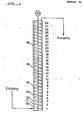
- a stirred column with a usable capacity of approximately 200 l was used.
- the stirring column had a total length of 3.7 m and was operated from the bottom up.
- a total of 28 compartments were formed from 27 shelves (see Figure 2); the chambers 2 to 12 in the entrance part were 11 cm high, the chambers 13 to 27, on the other hand, 14 cm (each interior height).
- the chambers 1 and 28 (reactor inlet and outlet) contained the stirrer bearings and were therefore somewhat larger (approx. 15 cm high).
- the intermediate trays had concentric openings with a diameter of 0.5 ⁇ column inner diameter; the disks above it, spaced about 1 mm apart, each had a diameter of 0.7 x inner column diameter (inner column diameter 27 cm).
- the stirrer speed was infinitely variable on the stirrer motor 29 up to a stirrer speed of 480 revolutions per minute. However, all crystallization examples were carried out at a constant stirrer speed of 312 revolutions per minute.
- the entire column was heated with a steam to 95 ⁇ 1 ° C (in the example 2e only 85 ⁇ 1 ° C) (3 zones).
- the chambers 1, 2, 3, 5 and 7 had nozzles 30 to 34 for blowing water vapor.
- Chambers 14 and 21 contained devices 35 and 36 for withdrawing suspensions from the product stream.
- the starting materials were only metered in to 2/3 of the amounts specified above under constant molar ratios.
- the suspension was gradually heated from the mixing temperature (37 ° C) by blowing water vapor into chamber 1 (increase to 61 ⁇ 2 ° C), chamber 2 (increase to 75 ⁇ 2 ° C) and chamber 3 (increase to 92 ⁇ 2 ° C).
- Suspensions with product 2b were removed from chamber 21 at a temperature of 94 ⁇ 1 ° C.
- Example 2c the procedure was as in Example 2b, but in contrast to Example 2b, the product was only removed at the stirred column outlet.
- the temperature of the suspension was also 94 ⁇ 1 ° C.
- Example 2d the metering was carried out analogously to example 2a.
- 600 l of suspension per hour equal to about 818 kg were also passed into chamber 1 of the stirred column.
- the heating was carried out as in Example 2b.
- Product suspension with a temperature of 93 ⁇ 1 ° C was removed at the column exit.
- Example 2f the zeolization was carried out in the presence of an iron-complexing additive.
- Per hour 68.2 kg were metakaolin addition 136.4 kg of technical sodium hydroxide solution, and deionized water 204.5 kg accordingly resulting Botmolteiln 2.8 Na Z O: 1 Al 2 O 3: 2.03 Si0 2: 53 H 2 0 3.4 kg of triethanolamine per hour are fed to the mixing stage.
- a stream of 412.5 kg per hour was pumped from the suspension accumulated in the mixing container into chamber 1 of the stirred column.
- the heating was carried out as in Example 2a, suspension with product 2f was removed accordingly at the column exit at a temperature of 92 ⁇ 1 ° C.
- This product had a significantly reduced iron content of only 0.11% Fe203, based on the anhydrous substance, compared to the other patent examples.
- a tube reactor with a total volume of approximately 200 l and a tube diameter (inside) of 38 mm was used to carry out Example 3; 44 redirections at intervals of about 4 meters made the reactor compact and required a footprint of only 20 square meters.
- the tubular reactor was completely surrounded by a heating jacket (hot water), which was divided into a total of 10 zones for different heating (in the example, however, the zeolization temperature of 95 ° C.).
Landscapes
- Chemical & Material Sciences (AREA)
- Organic Chemistry (AREA)
- Chemical Kinetics & Catalysis (AREA)
- Inorganic Chemistry (AREA)
- General Life Sciences & Earth Sciences (AREA)
- Geology (AREA)
- Life Sciences & Earth Sciences (AREA)
- Dispersion Chemistry (AREA)
- Engineering & Computer Science (AREA)
- Materials Engineering (AREA)
- Silicates, Zeolites, And Molecular Sieves (AREA)
- Organic Low-Molecular-Weight Compounds And Preparation Thereof (AREA)
- Solid-Sorbent Or Filter-Aiding Compositions (AREA)
Applications Claiming Priority (2)
| Application Number | Priority Date | Filing Date | Title |
|---|---|---|---|
| DE3203777 | 1982-02-04 | ||
| DE19823203777 DE3203777A1 (de) | 1982-02-04 | 1982-02-04 | Verfahren zur kontinuierlichen umwandlung von metakaolin in feinstteiliges zeolithisches natriumaluminiumsilikat |
Publications (3)
| Publication Number | Publication Date |
|---|---|
| EP0085902A2 true EP0085902A2 (fr) | 1983-08-17 |
| EP0085902A3 EP0085902A3 (en) | 1985-11-27 |
| EP0085902B1 EP0085902B1 (fr) | 1989-04-05 |
Family
ID=6154771
Family Applications (1)
| Application Number | Title | Priority Date | Filing Date |
|---|---|---|---|
| EP83100740A Expired EP0085902B1 (fr) | 1982-02-04 | 1983-01-27 | Procédé de conversion continue de métakaolin en aluminosilicate de sodium zéolitique extrêmement fin |
Country Status (11)
| Country | Link |
|---|---|
| US (1) | US4591491A (fr) |
| EP (1) | EP0085902B1 (fr) |
| JP (1) | JPS58140315A (fr) |
| KR (1) | KR910001304B1 (fr) |
| BR (1) | BR8300542A (fr) |
| CA (1) | CA1186294A (fr) |
| DE (2) | DE3203777A1 (fr) |
| ES (1) | ES8401914A1 (fr) |
| GR (1) | GR77927B (fr) |
| MX (1) | MX7447E (fr) |
| ZA (1) | ZA83734B (fr) |
Cited By (1)
| Publication number | Priority date | Publication date | Assignee | Title |
|---|---|---|---|---|
| CN105174357A (zh) * | 2015-10-23 | 2015-12-23 | 刘柏海 | 一种采用氧化石制备的分子筛的曝气滤池 |
Families Citing this family (11)
| Publication number | Priority date | Publication date | Assignee | Title |
|---|---|---|---|---|
| GB2252305A (en) * | 1991-01-31 | 1992-08-05 | Foret Sa | Zeolite manufacture by a continuous gel crystallization process |
| US5549823A (en) * | 1994-06-28 | 1996-08-27 | Hirs; Gene | System for purifying a soluble oil emulsion |
| EP0758626A1 (fr) * | 1995-08-04 | 1997-02-19 | Unilever Plc | Aluminosilicates |
| US6656447B1 (en) | 1998-12-29 | 2003-12-02 | Uop Llc | Process for synthesizing and controlling the particle size and particle size distribution of a molecular sieve |
| US5989518A (en) * | 1998-12-29 | 1999-11-23 | Uop Llc | Process for synthesizing and controlling the particle size and particle size distribution of a molecular sieve |
| US6632415B2 (en) * | 2001-04-09 | 2003-10-14 | Chevron U.S.A. Inc. | Methods for making molecular sieves |
| AU2002367444A1 (en) * | 2001-05-10 | 2003-09-29 | Akzo Nobel N.V. | Continuous process and apparatus for the efficient conversion of inorganic solid particles |
| US20050250642A1 (en) * | 2001-05-10 | 2005-11-10 | Dennis Stamires | Continuous process and apparatus for the efficient conversion of inorganic solid particles |
| AU2002349382A1 (en) * | 2001-11-19 | 2003-06-10 | Japan System Products Co., Ltd. | Method and apparatus for producing zeolite continuously |
| KR100568931B1 (ko) * | 2004-08-23 | 2006-04-07 | 한국건설기술연구원 | 슬러지를 이용한 고기능 경량 인공토 및 그 제조방법 |
| US7528201B2 (en) * | 2004-12-22 | 2009-05-05 | Exxonmobil Chemical Patents Inc. | Synthesis of silicoaluminophosphate molecular sieves |
Family Cites Families (7)
| Publication number | Priority date | Publication date | Assignee | Title |
|---|---|---|---|---|
| DE2635357A1 (de) * | 1976-08-06 | 1978-02-09 | Degussa | Verfahren zur herstellung eisenarmer zeolithischer aluminiumsilikate |
| DD132069A1 (de) * | 1977-07-21 | 1978-08-23 | Robert Bankwitz | Verfahren zur herstellung von kristallinen,teilweise kristallinen oder amorphen alumosilikaten |
| EP0001248B1 (fr) * | 1977-09-19 | 1980-10-01 | Ciba-Geigy Ag | Benzopyranothiazoles, leur préparation et leur application dans un matériau d'enregistrement sensible à la pression ou à la chaleur |
| DE2852674A1 (de) * | 1978-12-06 | 1980-06-19 | Bayer Ag | Verfahren zur herstellung von zeolith a aus kaolin |
| DE2910147A1 (de) * | 1979-03-15 | 1980-10-30 | Degussa | Verfahren zur herstellung von amorphen natriumaluminiumsilikaten |
| DE2910152A1 (de) * | 1979-03-15 | 1980-10-16 | Degussa | Verfahren zur herstellung von amorphen natriumaluminiumsilikaten |
| DE2941636A1 (de) * | 1979-10-13 | 1981-05-07 | Degussa Ag, 6000 Frankfurt | Verfahren zur kontinuierlichen herstellung feinstteiliger zeolithischer natriumaluminiumsilikate |
-
1982
- 1982-02-04 DE DE19823203777 patent/DE3203777A1/de not_active Withdrawn
- 1982-11-16 CA CA000415660A patent/CA1186294A/fr not_active Expired
-
1983
- 1983-01-25 GR GR70325A patent/GR77927B/el unknown
- 1983-01-27 DE DE8383100740T patent/DE3379542D1/de not_active Expired
- 1983-01-27 EP EP83100740A patent/EP0085902B1/fr not_active Expired
- 1983-02-02 MX MX8310473U patent/MX7447E/es unknown
- 1983-02-03 ZA ZA83734A patent/ZA83734B/xx unknown
- 1983-02-03 BR BR8300542A patent/BR8300542A/pt unknown
- 1983-02-03 KR KR1019830000416A patent/KR910001304B1/ko not_active Expired
- 1983-02-03 JP JP58015564A patent/JPS58140315A/ja active Pending
- 1983-02-03 ES ES519505A patent/ES8401914A1/es not_active Expired
-
1984
- 1984-07-11 US US06/628,969 patent/US4591491A/en not_active Expired - Fee Related
Cited By (1)
| Publication number | Priority date | Publication date | Assignee | Title |
|---|---|---|---|---|
| CN105174357A (zh) * | 2015-10-23 | 2015-12-23 | 刘柏海 | 一种采用氧化石制备的分子筛的曝气滤池 |
Also Published As
| Publication number | Publication date |
|---|---|
| DE3203777A1 (de) | 1983-08-11 |
| US4591491A (en) | 1986-05-27 |
| ES519505A0 (es) | 1984-01-01 |
| ZA83734B (en) | 1984-09-26 |
| ES8401914A1 (es) | 1984-01-01 |
| DE3379542D1 (en) | 1989-05-11 |
| BR8300542A (pt) | 1983-11-08 |
| JPS58140315A (ja) | 1983-08-20 |
| KR910001304B1 (ko) | 1991-03-02 |
| EP0085902B1 (fr) | 1989-04-05 |
| GR77927B (fr) | 1984-09-25 |
| MX7447E (es) | 1988-11-25 |
| CA1186294A (fr) | 1985-04-30 |
| EP0085902A3 (en) | 1985-11-27 |
| KR840003579A (ko) | 1984-09-15 |
Similar Documents
| Publication | Publication Date | Title |
|---|---|---|
| EP0205070B1 (fr) | Procédé de fabrication de silicates de métaux alcalins en couches cristallins | |
| DE2633304C2 (de) | Verfahren zur Herstellung von kristallinen Alkalimetall-Aluminosilikaten | |
| DE69801884T2 (de) | Zeolith des Faujasitstyps mit niedrigem Kiedelsäuregehalts und Methode zu dessen Herstellung | |
| EP0151295B1 (fr) | Méthode de préparation de silicates cristallins de métal alcalin, à structure en couches | |
| EP0085902B1 (fr) | Procédé de conversion continue de métakaolin en aluminosilicate de sodium zéolitique extrêmement fin | |
| EP0027228B1 (fr) | Procédé pour la préparation en continu de silicates zéolithiques de sodium et d'aluminium finement divisés | |
| EP0016393B1 (fr) | Procédé de préparation de silicates amorphes d'aluminium et de sodium | |
| EP0016344B1 (fr) | Procédé pour la production de suspensions de silicate d'aluminium pouvant être stockées, pompées et coulées, par broyage humide | |
| EP0690821B1 (fr) | Procede de preparation de silicates d'aluminium de metaux alcalins zeolithiques finement pulverises | |
| DE2824342B2 (de) | Verfahren zur Herstellung von feinkörnigem kristallinem Natriumalumosilicat vom Typ 4A | |
| DE3003361A1 (de) | Katalysator und dessen verwendung | |
| DE112010004511B4 (de) | Verfahren zum herstellen eines zeoliths vom mtw-typ | |
| EP0037018B1 (fr) | Procédé de préparation de silicates d'aluminium et de sodium zéolitiques très fins | |
| DE69006714T2 (de) | Synthese von aluminosilikat-zeolithen mit faujasitstruktur. | |
| DE3002278C2 (de) | Verfahren zur Synthese von Zeolithen 4A | |
| EP0017013B1 (fr) | Procédé pour la préparation de silicates amorphes de sodium-aluminium | |
| DE2325228B2 (de) | Kristalline Beryllo-Alumino-Silikate und Verfahren zu deren Herstellung | |
| AT353708B (de) | Verwendung von pulverfoermigen zeolithischen molekularsieben | |
| DE2334920A1 (de) | Kristalline beryllo-alumino-silikate und verfahren zu deren herstellung | |
| DE4201455A1 (de) | Verfahren zum herstellen von amorphen natriumaluminiumsilikaten | |
| DE1952192C3 (de) | Verfahren zur Herstellung von synthetischen Zeolithen | |
| WO1993014029A1 (fr) | Procede de fabrication de silicates de sodium-aluminium cristallises finement repartis | |
| DE3521227A1 (de) | Verfahren zur herstellung von kristallinen alkalischichtsilikaten | |
| DE4210366A1 (de) | Verfahren zum Herstellen feinteiliger kristalliner Natriumaluminiumsilikate | |
| DE1952192B2 (de) | Verfahren zur herstellung von synthetischen zeolithen |
Legal Events
| Date | Code | Title | Description |
|---|---|---|---|
| PUAI | Public reference made under article 153(3) epc to a published international application that has entered the european phase |
Free format text: ORIGINAL CODE: 0009012 |
|
| AK | Designated contracting states |
Designated state(s): AT BE CH DE FR GB IT LI LU NL SE |
|
| PUAL | Search report despatched |
Free format text: ORIGINAL CODE: 0009013 |
|
| AK | Designated contracting states |
Designated state(s): AT BE CH DE FR GB IT LI LU NL SE |
|
| 17P | Request for examination filed |
Effective date: 19851220 |
|
| 17Q | First examination report despatched |
Effective date: 19861216 |
|
| GRAA | (expected) grant |
Free format text: ORIGINAL CODE: 0009210 |
|
| AK | Designated contracting states |
Kind code of ref document: B1 Designated state(s): DE GB |
|
| REF | Corresponds to: |
Ref document number: 3379542 Country of ref document: DE Date of ref document: 19890511 |
|
| GBT | Gb: translation of ep patent filed (gb section 77(6)(a)/1977) | ||
| PG25 | Lapsed in a contracting state [announced via postgrant information from national office to epo] |
Ref country code: GB Effective date: 19900127 |
|
| PLBE | No opposition filed within time limit |
Free format text: ORIGINAL CODE: 0009261 |
|
| STAA | Information on the status of an ep patent application or granted ep patent |
Free format text: STATUS: NO OPPOSITION FILED WITHIN TIME LIMIT |
|
| 26N | No opposition filed | ||
| GBPC | Gb: european patent ceased through non-payment of renewal fee | ||
| PG25 | Lapsed in a contracting state [announced via postgrant information from national office to epo] |
Ref country code: DE Effective date: 19901002 |