EP0085330B1 - Leimungsmittel und seine Verwendung - Google Patents
Leimungsmittel und seine Verwendung Download PDFInfo
- Publication number
- EP0085330B1 EP0085330B1 EP83100331A EP83100331A EP0085330B1 EP 0085330 B1 EP0085330 B1 EP 0085330B1 EP 83100331 A EP83100331 A EP 83100331A EP 83100331 A EP83100331 A EP 83100331A EP 0085330 B1 EP0085330 B1 EP 0085330B1
- Authority
- EP
- European Patent Office
- Prior art keywords
- sizing
- weight
- parts
- fixing
- hydrophobic
- Prior art date
- Legal status (The legal status is an assumption and is not a legal conclusion. Google has not performed a legal analysis and makes no representation as to the accuracy of the status listed.)
- Expired
Links
- 238000004513 sizing Methods 0.000 title claims abstract description 75
- 230000002209 hydrophobic effect Effects 0.000 claims abstract description 22
- 239000000463 material Substances 0.000 claims abstract description 10
- 125000002924 primary amino group Chemical group [H]N([H])* 0.000 claims abstract description 3
- 239000003795 chemical substances by application Substances 0.000 claims description 46
- 239000000203 mixture Substances 0.000 claims description 23
- 239000000839 emulsion Substances 0.000 claims description 19
- PPBRXRYQALVLMV-UHFFFAOYSA-N Styrene Chemical compound C=CC1=CC=CC=C1 PPBRXRYQALVLMV-UHFFFAOYSA-N 0.000 claims description 10
- 150000002561 ketenes Chemical class 0.000 claims description 10
- 125000004432 carbon atom Chemical group C* 0.000 claims description 8
- 229920001577 copolymer Polymers 0.000 claims description 7
- 239000004215 Carbon black (E152) Substances 0.000 claims description 6
- 229930195733 hydrocarbon Natural products 0.000 claims description 6
- QUSNBJAOOMFDIB-UHFFFAOYSA-N Ethylamine Chemical compound CCN QUSNBJAOOMFDIB-UHFFFAOYSA-N 0.000 claims description 5
- BAVYZALUXZFZLV-UHFFFAOYSA-N Methylamine Chemical compound NC BAVYZALUXZFZLV-UHFFFAOYSA-N 0.000 claims description 5
- HQABUPZFAYXKJW-UHFFFAOYSA-N butan-1-amine Chemical compound CCCCN HQABUPZFAYXKJW-UHFFFAOYSA-N 0.000 claims description 5
- PAFZNILMFXTMIY-UHFFFAOYSA-N cyclohexylamine Chemical compound NC1CCCCC1 PAFZNILMFXTMIY-UHFFFAOYSA-N 0.000 claims description 5
- WGYKZJWCGVVSQN-UHFFFAOYSA-N propylamine Chemical compound CCCN WGYKZJWCGVVSQN-UHFFFAOYSA-N 0.000 claims description 5
- FPYJFEHAWHCUMM-UHFFFAOYSA-N maleic anhydride Chemical compound O=C1OC(=O)C=C1 FPYJFEHAWHCUMM-UHFFFAOYSA-N 0.000 claims description 4
- 229920001897 terpolymer Polymers 0.000 claims description 4
- JKNCOURZONDCGV-UHFFFAOYSA-N 2-(dimethylamino)ethyl 2-methylprop-2-enoate Chemical compound CN(C)CCOC(=O)C(C)=C JKNCOURZONDCGV-UHFFFAOYSA-N 0.000 claims description 3
- DPBJAVGHACCNRL-UHFFFAOYSA-N 2-(dimethylamino)ethyl prop-2-enoate Chemical compound CN(C)CCOC(=O)C=C DPBJAVGHACCNRL-UHFFFAOYSA-N 0.000 claims description 3
- IMUDHTPIFIBORV-UHFFFAOYSA-N aminoethylpiperazine Chemical compound NCCN1CCNCC1 IMUDHTPIFIBORV-UHFFFAOYSA-N 0.000 claims description 3
- 125000000753 cycloalkyl group Chemical group 0.000 claims description 3
- SWVGZFQJXVPIKM-UHFFFAOYSA-N n,n-bis(methylamino)propan-1-amine Chemical compound CCCN(NC)NC SWVGZFQJXVPIKM-UHFFFAOYSA-N 0.000 claims description 3
- FXNDIJDIPNCZQJ-UHFFFAOYSA-N 2,4,4-trimethylpent-1-ene Chemical group CC(=C)CC(C)(C)C FXNDIJDIPNCZQJ-UHFFFAOYSA-N 0.000 claims description 2
- NLHHRLWOUZZQLW-UHFFFAOYSA-N Acrylonitrile Chemical compound C=CC#N NLHHRLWOUZZQLW-UHFFFAOYSA-N 0.000 claims description 2
- 125000002147 dimethylamino group Chemical group [H]C([H])([H])N(*)C([H])([H])[H] 0.000 claims description 2
- 230000000694 effects Effects 0.000 abstract description 12
- 229920000642 polymer Polymers 0.000 abstract description 9
- OKTJSMMVPCPJKN-UHFFFAOYSA-N Carbon Chemical group [C] OKTJSMMVPCPJKN-UHFFFAOYSA-N 0.000 abstract 1
- 125000001453 quaternary ammonium group Chemical group 0.000 abstract 1
- 125000000467 secondary amino group Chemical group [H]N([*:1])[*:2] 0.000 abstract 1
- 125000001302 tertiary amino group Chemical group 0.000 abstract 1
- XLYOFNOQVPJJNP-UHFFFAOYSA-N water Substances O XLYOFNOQVPJJNP-UHFFFAOYSA-N 0.000 description 16
- QTBSBXVTEAMEQO-UHFFFAOYSA-N Acetic acid Chemical compound CC(O)=O QTBSBXVTEAMEQO-UHFFFAOYSA-N 0.000 description 15
- WASQWSOJHCZDFK-UHFFFAOYSA-N diketene Chemical compound C=C1CC(=O)O1 WASQWSOJHCZDFK-UHFFFAOYSA-N 0.000 description 11
- 239000000243 solution Substances 0.000 description 11
- CSCPPACGZOOCGX-UHFFFAOYSA-N Acetone Chemical compound CC(C)=O CSCPPACGZOOCGX-UHFFFAOYSA-N 0.000 description 9
- 238000006116 polymerization reaction Methods 0.000 description 9
- VEXZGXHMUGYJMC-UHFFFAOYSA-N Hydrochloric acid Chemical compound Cl VEXZGXHMUGYJMC-UHFFFAOYSA-N 0.000 description 7
- 239000002253 acid Substances 0.000 description 7
- 239000003995 emulsifying agent Substances 0.000 description 7
- 239000002904 solvent Substances 0.000 description 7
- KFZMGEQAYNKOFK-UHFFFAOYSA-N Isopropanol Chemical compound CC(C)O KFZMGEQAYNKOFK-UHFFFAOYSA-N 0.000 description 6
- YXFVVABEGXRONW-UHFFFAOYSA-N Toluene Chemical compound CC1=CC=CC=C1 YXFVVABEGXRONW-UHFFFAOYSA-N 0.000 description 6
- 150000008064 anhydrides Chemical class 0.000 description 6
- 239000002270 dispersing agent Substances 0.000 description 6
- IPCSVZSSVZVIGE-UHFFFAOYSA-N hexadecanoic acid Chemical compound CCCCCCCCCCCCCCCC(O)=O IPCSVZSSVZVIGE-UHFFFAOYSA-N 0.000 description 6
- BRLQWZUYTZBJKN-UHFFFAOYSA-N Epichlorohydrin Chemical compound ClCC1CO1 BRLQWZUYTZBJKN-UHFFFAOYSA-N 0.000 description 5
- 235000011054 acetic acid Nutrition 0.000 description 5
- 239000007864 aqueous solution Substances 0.000 description 5
- 125000002091 cationic group Chemical group 0.000 description 5
- 235000014113 dietary fatty acids Nutrition 0.000 description 5
- 239000000194 fatty acid Substances 0.000 description 5
- 229930195729 fatty acid Natural products 0.000 description 5
- IJGRMHOSHXDMSA-UHFFFAOYSA-N Atomic nitrogen Chemical compound N#N IJGRMHOSHXDMSA-UHFFFAOYSA-N 0.000 description 4
- LFQSCWFLJHTTHZ-UHFFFAOYSA-N Ethanol Chemical compound CCO LFQSCWFLJHTTHZ-UHFFFAOYSA-N 0.000 description 4
- 235000021355 Stearic acid Nutrition 0.000 description 4
- 150000007513 acids Chemical class 0.000 description 4
- 125000000217 alkyl group Chemical group 0.000 description 4
- 125000003277 amino group Chemical group 0.000 description 4
- 125000000129 anionic group Chemical group 0.000 description 4
- 125000003710 aryl alkyl group Chemical group 0.000 description 4
- 150000002148 esters Chemical class 0.000 description 4
- 150000004665 fatty acids Chemical class 0.000 description 4
- 239000012948 isocyanate Substances 0.000 description 4
- 150000002513 isocyanates Chemical class 0.000 description 4
- 238000004519 manufacturing process Methods 0.000 description 4
- BDAGIHXWWSANSR-UHFFFAOYSA-N methanoic acid Natural products OC=O BDAGIHXWWSANSR-UHFFFAOYSA-N 0.000 description 4
- 239000000178 monomer Substances 0.000 description 4
- QIQXTHQIDYTFRH-UHFFFAOYSA-N octadecanoic acid Chemical compound CCCCCCCCCCCCCCCCCC(O)=O QIQXTHQIDYTFRH-UHFFFAOYSA-N 0.000 description 4
- OQCDKBAXFALNLD-UHFFFAOYSA-N octadecanoic acid Natural products CCCCCCCC(C)CCCCCCCCC(O)=O OQCDKBAXFALNLD-UHFFFAOYSA-N 0.000 description 4
- UHOVQNZJYSORNB-UHFFFAOYSA-N Benzene Chemical compound C1=CC=CC=C1 UHOVQNZJYSORNB-UHFFFAOYSA-N 0.000 description 3
- 229920000881 Modified starch Polymers 0.000 description 3
- 235000021314 Palmitic acid Nutrition 0.000 description 3
- 229920002472 Starch Chemical class 0.000 description 3
- 238000006243 chemical reaction Methods 0.000 description 3
- 239000003292 glue Substances 0.000 description 3
- 239000003999 initiator Substances 0.000 description 3
- WQEPLUUGTLDZJY-UHFFFAOYSA-N n-Pentadecanoic acid Natural products CCCCCCCCCCCCCCC(O)=O WQEPLUUGTLDZJY-UHFFFAOYSA-N 0.000 description 3
- 229910052757 nitrogen Inorganic materials 0.000 description 3
- 239000003960 organic solvent Substances 0.000 description 3
- 238000002360 preparation method Methods 0.000 description 3
- 238000005956 quaternization reaction Methods 0.000 description 3
- 239000007787 solid Substances 0.000 description 3
- 235000019698 starch Nutrition 0.000 description 3
- 239000008117 stearic acid Substances 0.000 description 3
- ZWEHNKRNPOVVGH-UHFFFAOYSA-N 2-Butanone Chemical compound CCC(C)=O ZWEHNKRNPOVVGH-UHFFFAOYSA-N 0.000 description 2
- XLLIQLLCWZCATF-UHFFFAOYSA-N 2-methoxyethyl acetate Chemical compound COCCOC(C)=O XLLIQLLCWZCATF-UHFFFAOYSA-N 0.000 description 2
- OSWFIVFLDKOXQC-UHFFFAOYSA-N 4-(3-methoxyphenyl)aniline Chemical compound COC1=CC=CC(C=2C=CC(N)=CC=2)=C1 OSWFIVFLDKOXQC-UHFFFAOYSA-N 0.000 description 2
- RSWGJHLUYNHPMX-UHFFFAOYSA-N Abietic-Saeure Natural products C12CCC(C(C)C)=CC2=CCC2C1(C)CCCC2(C)C(O)=O RSWGJHLUYNHPMX-UHFFFAOYSA-N 0.000 description 2
- RTZKZFJDLAIYFH-UHFFFAOYSA-N Diethyl ether Chemical compound CCOCC RTZKZFJDLAIYFH-UHFFFAOYSA-N 0.000 description 2
- 239000004368 Modified starch Substances 0.000 description 2
- NBIIXXVUZAFLBC-UHFFFAOYSA-N Phosphoric acid Chemical compound OP(O)(O)=O NBIIXXVUZAFLBC-UHFFFAOYSA-N 0.000 description 2
- KHPCPRHQVVSZAH-HUOMCSJISA-N Rosin Natural products O(C/C=C/c1ccccc1)[C@H]1[C@H](O)[C@@H](O)[C@@H](O)[C@@H](CO)O1 KHPCPRHQVVSZAH-HUOMCSJISA-N 0.000 description 2
- QAOWNCQODCNURD-UHFFFAOYSA-L Sulfate Chemical compound [O-]S([O-])(=O)=O QAOWNCQODCNURD-UHFFFAOYSA-L 0.000 description 2
- QAOWNCQODCNURD-UHFFFAOYSA-N Sulfuric acid Chemical compound OS(O)(=O)=O QAOWNCQODCNURD-UHFFFAOYSA-N 0.000 description 2
- 150000001298 alcohols Chemical class 0.000 description 2
- 125000003342 alkenyl group Chemical group 0.000 description 2
- 125000002877 alkyl aryl group Chemical group 0.000 description 2
- 230000015572 biosynthetic process Effects 0.000 description 2
- GZUXJHMPEANEGY-UHFFFAOYSA-N bromomethane Chemical compound BrC GZUXJHMPEANEGY-UHFFFAOYSA-N 0.000 description 2
- 239000004202 carbamide Substances 0.000 description 2
- 229920003118 cationic copolymer Polymers 0.000 description 2
- 239000001913 cellulose Substances 0.000 description 2
- 229920002678 cellulose Polymers 0.000 description 2
- 239000007795 chemical reaction product Substances 0.000 description 2
- 150000001875 compounds Chemical class 0.000 description 2
- 238000007334 copolymerization reaction Methods 0.000 description 2
- 239000008367 deionised water Substances 0.000 description 2
- 229910021641 deionized water Inorganic materials 0.000 description 2
- XBDQKXXYIPTUBI-UHFFFAOYSA-N dimethylselenoniopropionate Natural products CCC(O)=O XBDQKXXYIPTUBI-UHFFFAOYSA-N 0.000 description 2
- 239000003925 fat Substances 0.000 description 2
- 235000019197 fats Nutrition 0.000 description 2
- -1 fatty acid chlorides Chemical class 0.000 description 2
- 239000000834 fixative Substances 0.000 description 2
- WSFSSNUMVMOOMR-UHFFFAOYSA-N formaldehyde Substances O=C WSFSSNUMVMOOMR-UHFFFAOYSA-N 0.000 description 2
- 235000019253 formic acid Nutrition 0.000 description 2
- 150000002430 hydrocarbons Chemical class 0.000 description 2
- 150000002576 ketones Chemical class 0.000 description 2
- JVTAAEKCZFNVCJ-UHFFFAOYSA-N lactic acid Chemical compound CC(O)C(O)=O JVTAAEKCZFNVCJ-UHFFFAOYSA-N 0.000 description 2
- 238000000034 method Methods 0.000 description 2
- 235000019426 modified starch Nutrition 0.000 description 2
- 229920000768 polyamine Polymers 0.000 description 2
- 239000000047 product Substances 0.000 description 2
- 229920006395 saturated elastomer Polymers 0.000 description 2
- 239000008107 starch Substances 0.000 description 2
- 239000000126 substance Substances 0.000 description 2
- 239000002562 thickening agent Substances 0.000 description 2
- KHPCPRHQVVSZAH-UHFFFAOYSA-N trans-cinnamyl beta-D-glucopyranoside Natural products OC1C(O)C(O)C(CO)OC1OCC=CC1=CC=CC=C1 KHPCPRHQVVSZAH-UHFFFAOYSA-N 0.000 description 2
- HFVMEOPYDLEHBR-UHFFFAOYSA-N (2-fluorophenyl)-phenylmethanol Chemical compound C=1C=CC=C(F)C=1C(O)C1=CC=CC=C1 HFVMEOPYDLEHBR-UHFFFAOYSA-N 0.000 description 1
- RYHBNJHYFVUHQT-UHFFFAOYSA-N 1,4-Dioxane Chemical compound C1COCCO1 RYHBNJHYFVUHQT-UHFFFAOYSA-N 0.000 description 1
- MPPPKRYCTPRNTB-UHFFFAOYSA-N 1-bromobutane Chemical compound CCCCBr MPPPKRYCTPRNTB-UHFFFAOYSA-N 0.000 description 1
- GFLXBRUGMACJLQ-UHFFFAOYSA-N 1-isocyanatohexadecane Chemical compound CCCCCCCCCCCCCCCCN=C=O GFLXBRUGMACJLQ-UHFFFAOYSA-N 0.000 description 1
- QWDQYHPOSSHSAW-UHFFFAOYSA-N 1-isocyanatooctadecane Chemical compound CCCCCCCCCCCCCCCCCCN=C=O QWDQYHPOSSHSAW-UHFFFAOYSA-N 0.000 description 1
- LBLYYCQCTBFVLH-UHFFFAOYSA-M 2-methylbenzenesulfonate Chemical compound CC1=CC=CC=C1S([O-])(=O)=O LBLYYCQCTBFVLH-UHFFFAOYSA-M 0.000 description 1
- FRIBMENBGGCKPD-UHFFFAOYSA-N 3-(2,3-dimethoxyphenyl)prop-2-enal Chemical compound COC1=CC=CC(C=CC=O)=C1OC FRIBMENBGGCKPD-UHFFFAOYSA-N 0.000 description 1
- 229940105325 3-dimethylaminopropylamine Drugs 0.000 description 1
- HRPVXLWXLXDGHG-UHFFFAOYSA-N Acrylamide Chemical compound NC(=O)C=C HRPVXLWXLXDGHG-UHFFFAOYSA-N 0.000 description 1
- OSDWBNJEKMUWAV-UHFFFAOYSA-N Allyl chloride Chemical compound ClCC=C OSDWBNJEKMUWAV-UHFFFAOYSA-N 0.000 description 1
- 239000004342 Benzoyl peroxide Substances 0.000 description 1
- OMPJBNCRMGITSC-UHFFFAOYSA-N Benzoylperoxide Chemical compound C=1C=CC=CC=1C(=O)OOC(=O)C1=CC=CC=C1 OMPJBNCRMGITSC-UHFFFAOYSA-N 0.000 description 1
- 235000018185 Betula X alpestris Nutrition 0.000 description 1
- 235000018212 Betula X uliginosa Nutrition 0.000 description 1
- 241000283153 Cetacea Species 0.000 description 1
- GXGJIOMUZAGVEH-UHFFFAOYSA-N Chamazulene Chemical group CCC1=CC=C(C)C2=CC=C(C)C2=C1 GXGJIOMUZAGVEH-UHFFFAOYSA-N 0.000 description 1
- VEXZGXHMUGYJMC-UHFFFAOYSA-M Chloride anion Chemical compound [Cl-] VEXZGXHMUGYJMC-UHFFFAOYSA-M 0.000 description 1
- XZMCDFZZKTWFGF-UHFFFAOYSA-N Cyanamide Chemical compound NC#N XZMCDFZZKTWFGF-UHFFFAOYSA-N 0.000 description 1
- XDTMQSROBMDMFD-UHFFFAOYSA-N Cyclohexane Chemical compound C1CCCCC1 XDTMQSROBMDMFD-UHFFFAOYSA-N 0.000 description 1
- 239000005977 Ethylene Substances 0.000 description 1
- IAYPIBMASNFSPL-UHFFFAOYSA-N Ethylene oxide Chemical compound C1CO1 IAYPIBMASNFSPL-UHFFFAOYSA-N 0.000 description 1
- VQTUBCCKSQIDNK-UHFFFAOYSA-N Isobutene Chemical group CC(C)=C VQTUBCCKSQIDNK-UHFFFAOYSA-N 0.000 description 1
- OFOBLEOULBTSOW-UHFFFAOYSA-N Malonic acid Chemical compound OC(=O)CC(O)=O OFOBLEOULBTSOW-UHFFFAOYSA-N 0.000 description 1
- NTIZESTWPVYFNL-UHFFFAOYSA-N Methyl isobutyl ketone Chemical compound CC(C)CC(C)=O NTIZESTWPVYFNL-UHFFFAOYSA-N 0.000 description 1
- UIHCLUNTQKBZGK-UHFFFAOYSA-N Methyl isobutyl ketone Natural products CCC(C)C(C)=O UIHCLUNTQKBZGK-UHFFFAOYSA-N 0.000 description 1
- ZMXDDKWLCZADIW-UHFFFAOYSA-N N,N-Dimethylformamide Chemical compound CN(C)C=O ZMXDDKWLCZADIW-UHFFFAOYSA-N 0.000 description 1
- GRYLNZFGIOXLOG-UHFFFAOYSA-N Nitric acid Chemical compound O[N+]([O-])=O GRYLNZFGIOXLOG-UHFFFAOYSA-N 0.000 description 1
- CTQNGGLPUBDAKN-UHFFFAOYSA-N O-Xylene Chemical compound CC1=CC=CC=C1C CTQNGGLPUBDAKN-UHFFFAOYSA-N 0.000 description 1
- 235000019482 Palm oil Nutrition 0.000 description 1
- 235000019483 Peanut oil Nutrition 0.000 description 1
- 235000008331 Pinus X rigitaeda Nutrition 0.000 description 1
- 235000011613 Pinus brutia Nutrition 0.000 description 1
- 241000018646 Pinus brutia Species 0.000 description 1
- 239000004372 Polyvinyl alcohol Substances 0.000 description 1
- 229920001131 Pulp (paper) Polymers 0.000 description 1
- 235000019484 Rapeseed oil Nutrition 0.000 description 1
- KDYFGRWQOYBRFD-UHFFFAOYSA-N Succinic acid Natural products OC(=O)CCC(O)=O KDYFGRWQOYBRFD-UHFFFAOYSA-N 0.000 description 1
- 230000002378 acidificating effect Effects 0.000 description 1
- 239000000654 additive Substances 0.000 description 1
- 150000001336 alkenes Chemical class 0.000 description 1
- 125000005119 alkyl cycloalkyl group Chemical group 0.000 description 1
- 229910000147 aluminium phosphate Inorganic materials 0.000 description 1
- 239000002518 antifoaming agent Substances 0.000 description 1
- 125000003118 aryl group Chemical group 0.000 description 1
- 239000010480 babassu oil Substances 0.000 description 1
- 235000015278 beef Nutrition 0.000 description 1
- 235000019400 benzoyl peroxide Nutrition 0.000 description 1
- KCXMKQUNVWSEMD-UHFFFAOYSA-N benzyl chloride Chemical compound ClCC1=CC=CC=C1 KCXMKQUNVWSEMD-UHFFFAOYSA-N 0.000 description 1
- 229940073608 benzyl chloride Drugs 0.000 description 1
- 239000003139 biocide Substances 0.000 description 1
- 150000001735 carboxylic acids Chemical class 0.000 description 1
- 229920006317 cationic polymer Polymers 0.000 description 1
- 238000012512 characterization method Methods 0.000 description 1
- NEHMKBQYUWJMIP-NJFSPNSNSA-N chloro(114C)methane Chemical compound [14CH3]Cl NEHMKBQYUWJMIP-NJFSPNSNSA-N 0.000 description 1
- 239000011436 cob Substances 0.000 description 1
- 239000003240 coconut oil Substances 0.000 description 1
- 235000019864 coconut oil Nutrition 0.000 description 1
- 238000001816 cooling Methods 0.000 description 1
- 125000004122 cyclic group Chemical group 0.000 description 1
- LSXWFXONGKSEMY-UHFFFAOYSA-N di-tert-butyl peroxide Chemical compound CC(C)(C)OOC(C)(C)C LSXWFXONGKSEMY-UHFFFAOYSA-N 0.000 description 1
- 238000010790 dilution Methods 0.000 description 1
- 239000012895 dilution Substances 0.000 description 1
- VAYGXNSJCAHWJZ-UHFFFAOYSA-N dimethyl sulfate Chemical compound COS(=O)(=O)OC VAYGXNSJCAHWJZ-UHFFFAOYSA-N 0.000 description 1
- IUNMPGNGSSIWFP-UHFFFAOYSA-N dimethylaminopropylamine Chemical compound CN(C)CCCN IUNMPGNGSSIWFP-UHFFFAOYSA-N 0.000 description 1
- 239000006185 dispersion Substances 0.000 description 1
- 238000004821 distillation Methods 0.000 description 1
- 238000001035 drying Methods 0.000 description 1
- 238000000921 elemental analysis Methods 0.000 description 1
- 230000008030 elimination Effects 0.000 description 1
- 238000003379 elimination reaction Methods 0.000 description 1
- GKIPXFAANLTWBM-UHFFFAOYSA-N epibromohydrin Chemical compound BrCC1CO1 GKIPXFAANLTWBM-UHFFFAOYSA-N 0.000 description 1
- VEUUMBGHMNQHGO-UHFFFAOYSA-N ethyl chloroacetate Chemical compound CCOC(=O)CCl VEUUMBGHMNQHGO-UHFFFAOYSA-N 0.000 description 1
- 230000007717 exclusion Effects 0.000 description 1
- 238000005194 fractionation Methods 0.000 description 1
- 239000000417 fungicide Substances 0.000 description 1
- 239000007789 gas Substances 0.000 description 1
- 238000001879 gelation Methods 0.000 description 1
- VANNPISTIUFMLH-UHFFFAOYSA-N glutaric anhydride Chemical class O=C1CCCC(=O)O1 VANNPISTIUFMLH-UHFFFAOYSA-N 0.000 description 1
- 238000000227 grinding Methods 0.000 description 1
- 150000002366 halogen compounds Chemical class 0.000 description 1
- 239000008240 homogeneous mixture Substances 0.000 description 1
- 235000011167 hydrochloric acid Nutrition 0.000 description 1
- IXCSERBJSXMMFS-UHFFFAOYSA-N hydrogen chloride Substances Cl.Cl IXCSERBJSXMMFS-UHFFFAOYSA-N 0.000 description 1
- 229910000041 hydrogen chloride Inorganic materials 0.000 description 1
- 125000002887 hydroxy group Chemical group [H]O* 0.000 description 1
- 229910052500 inorganic mineral Inorganic materials 0.000 description 1
- 239000004310 lactic acid Substances 0.000 description 1
- 235000014655 lactic acid Nutrition 0.000 description 1
- 239000007788 liquid Substances 0.000 description 1
- 229940102396 methyl bromide Drugs 0.000 description 1
- 125000001570 methylene group Chemical group [H]C([H])([*:1])[*:2] 0.000 description 1
- 239000011707 mineral Substances 0.000 description 1
- 150000007522 mineralic acids Chemical class 0.000 description 1
- DYUWTXWIYMHBQS-UHFFFAOYSA-N n-prop-2-enylprop-2-en-1-amine Chemical compound C=CCNCC=C DYUWTXWIYMHBQS-UHFFFAOYSA-N 0.000 description 1
- 229910017604 nitric acid Inorganic materials 0.000 description 1
- TVMXDCGIABBOFY-UHFFFAOYSA-N octane Chemical compound CCCCCCCC TVMXDCGIABBOFY-UHFFFAOYSA-N 0.000 description 1
- 239000004006 olive oil Substances 0.000 description 1
- 235000008390 olive oil Nutrition 0.000 description 1
- 150000007524 organic acids Chemical class 0.000 description 1
- 150000002924 oxiranes Chemical class 0.000 description 1
- 235000019865 palm kernel oil Nutrition 0.000 description 1
- 239000003346 palm kernel oil Substances 0.000 description 1
- 239000002540 palm oil Substances 0.000 description 1
- 239000000312 peanut oil Substances 0.000 description 1
- 150000002978 peroxides Chemical class 0.000 description 1
- 239000003208 petroleum Substances 0.000 description 1
- 150000002989 phenols Chemical class 0.000 description 1
- 229920001281 polyalkylene Polymers 0.000 description 1
- 229920002451 polyvinyl alcohol Polymers 0.000 description 1
- 229920000036 polyvinylpyrrolidone Polymers 0.000 description 1
- 239000001267 polyvinylpyrrolidone Substances 0.000 description 1
- 235000013855 polyvinylpyrrolidone Nutrition 0.000 description 1
- 229920001592 potato starch Polymers 0.000 description 1
- 238000001556 precipitation Methods 0.000 description 1
- LJZPPWWHKPGCHS-UHFFFAOYSA-N propargyl chloride Chemical compound ClCC#C LJZPPWWHKPGCHS-UHFFFAOYSA-N 0.000 description 1
- 235000019260 propionic acid Nutrition 0.000 description 1
- IUVKMZGDUIUOCP-BTNSXGMBSA-N quinbolone Chemical compound O([C@H]1CC[C@H]2[C@H]3[C@@H]([C@]4(C=CC(=O)C=C4CC3)C)CC[C@@]21C)C1=CCCC1 IUVKMZGDUIUOCP-BTNSXGMBSA-N 0.000 description 1
- 239000012429 reaction media Substances 0.000 description 1
- 238000010992 reflux Methods 0.000 description 1
- 239000011347 resin Substances 0.000 description 1
- 229920005989 resin Polymers 0.000 description 1
- 150000003839 salts Chemical class 0.000 description 1
- 238000003860 storage Methods 0.000 description 1
- BDHFUVZGWQCTTF-UHFFFAOYSA-M sulfonate Chemical compound [O-]S(=O)=O BDHFUVZGWQCTTF-UHFFFAOYSA-M 0.000 description 1
- 239000003760 tallow Substances 0.000 description 1
- OPQYOFWUFGEMRZ-UHFFFAOYSA-N tert-butyl 2,2-dimethylpropaneperoxoate Chemical compound CC(C)(C)OOC(=O)C(C)(C)C OPQYOFWUFGEMRZ-UHFFFAOYSA-N 0.000 description 1
- GJBRNHKUVLOCEB-UHFFFAOYSA-N tert-butyl benzenecarboperoxoate Chemical compound CC(C)(C)OOC(=O)C1=CC=CC=C1 GJBRNHKUVLOCEB-UHFFFAOYSA-N 0.000 description 1
- 125000000999 tert-butyl group Chemical group [H]C([H])([H])C(*)(C([H])([H])[H])C([H])([H])[H] 0.000 description 1
- 150000003512 tertiary amines Chemical class 0.000 description 1
- 125000004417 unsaturated alkyl group Chemical group 0.000 description 1
- 239000008096 xylene Substances 0.000 description 1
Classifications
-
- D—TEXTILES; PAPER
- D21—PAPER-MAKING; PRODUCTION OF CELLULOSE
- D21H—PULP COMPOSITIONS; PREPARATION THEREOF NOT COVERED BY SUBCLASSES D21C OR D21D; IMPREGNATING OR COATING OF PAPER; TREATMENT OF FINISHED PAPER NOT COVERED BY CLASS B31 OR SUBCLASS D21G; PAPER NOT OTHERWISE PROVIDED FOR
- D21H17/00—Non-fibrous material added to the pulp, characterised by its constitution; Paper-impregnating material characterised by its constitution
- D21H17/03—Non-macromolecular organic compounds
- D21H17/05—Non-macromolecular organic compounds containing elements other than carbon and hydrogen only
- D21H17/07—Nitrogen-containing compounds
- D21H17/08—Isocyanates
-
- D—TEXTILES; PAPER
- D21—PAPER-MAKING; PRODUCTION OF CELLULOSE
- D21H—PULP COMPOSITIONS; PREPARATION THEREOF NOT COVERED BY SUBCLASSES D21C OR D21D; IMPREGNATING OR COATING OF PAPER; TREATMENT OF FINISHED PAPER NOT COVERED BY CLASS B31 OR SUBCLASS D21G; PAPER NOT OTHERWISE PROVIDED FOR
- D21H17/00—Non-fibrous material added to the pulp, characterised by its constitution; Paper-impregnating material characterised by its constitution
- D21H17/03—Non-macromolecular organic compounds
- D21H17/05—Non-macromolecular organic compounds containing elements other than carbon and hydrogen only
- D21H17/14—Carboxylic acids; Derivatives thereof
- D21H17/15—Polycarboxylic acids, e.g. maleic acid
-
- D—TEXTILES; PAPER
- D21—PAPER-MAKING; PRODUCTION OF CELLULOSE
- D21H—PULP COMPOSITIONS; PREPARATION THEREOF NOT COVERED BY SUBCLASSES D21C OR D21D; IMPREGNATING OR COATING OF PAPER; TREATMENT OF FINISHED PAPER NOT COVERED BY CLASS B31 OR SUBCLASS D21G; PAPER NOT OTHERWISE PROVIDED FOR
- D21H17/00—Non-fibrous material added to the pulp, characterised by its constitution; Paper-impregnating material characterised by its constitution
- D21H17/03—Non-macromolecular organic compounds
- D21H17/05—Non-macromolecular organic compounds containing elements other than carbon and hydrogen only
- D21H17/17—Ketenes, e.g. ketene dimers
-
- D—TEXTILES; PAPER
- D21—PAPER-MAKING; PRODUCTION OF CELLULOSE
- D21H—PULP COMPOSITIONS; PREPARATION THEREOF NOT COVERED BY SUBCLASSES D21C OR D21D; IMPREGNATING OR COATING OF PAPER; TREATMENT OF FINISHED PAPER NOT COVERED BY CLASS B31 OR SUBCLASS D21G; PAPER NOT OTHERWISE PROVIDED FOR
- D21H17/00—Non-fibrous material added to the pulp, characterised by its constitution; Paper-impregnating material characterised by its constitution
- D21H17/20—Macromolecular organic compounds
- D21H17/33—Synthetic macromolecular compounds
- D21H17/34—Synthetic macromolecular compounds obtained by reactions only involving carbon-to-carbon unsaturated bonds
- D21H17/35—Polyalkenes, e.g. polystyrene
-
- D—TEXTILES; PAPER
- D21—PAPER-MAKING; PRODUCTION OF CELLULOSE
- D21H—PULP COMPOSITIONS; PREPARATION THEREOF NOT COVERED BY SUBCLASSES D21C OR D21D; IMPREGNATING OR COATING OF PAPER; TREATMENT OF FINISHED PAPER NOT COVERED BY CLASS B31 OR SUBCLASS D21G; PAPER NOT OTHERWISE PROVIDED FOR
- D21H17/00—Non-fibrous material added to the pulp, characterised by its constitution; Paper-impregnating material characterised by its constitution
- D21H17/20—Macromolecular organic compounds
- D21H17/33—Synthetic macromolecular compounds
- D21H17/34—Synthetic macromolecular compounds obtained by reactions only involving carbon-to-carbon unsaturated bonds
- D21H17/36—Polyalkenyalcohols; Polyalkenylethers; Polyalkenylesters
-
- D—TEXTILES; PAPER
- D21—PAPER-MAKING; PRODUCTION OF CELLULOSE
- D21H—PULP COMPOSITIONS; PREPARATION THEREOF NOT COVERED BY SUBCLASSES D21C OR D21D; IMPREGNATING OR COATING OF PAPER; TREATMENT OF FINISHED PAPER NOT COVERED BY CLASS B31 OR SUBCLASS D21G; PAPER NOT OTHERWISE PROVIDED FOR
- D21H17/00—Non-fibrous material added to the pulp, characterised by its constitution; Paper-impregnating material characterised by its constitution
- D21H17/20—Macromolecular organic compounds
- D21H17/33—Synthetic macromolecular compounds
- D21H17/34—Synthetic macromolecular compounds obtained by reactions only involving carbon-to-carbon unsaturated bonds
- D21H17/37—Polymers of unsaturated acids or derivatives thereof, e.g. polyacrylates
-
- D—TEXTILES; PAPER
- D21—PAPER-MAKING; PRODUCTION OF CELLULOSE
- D21H—PULP COMPOSITIONS; PREPARATION THEREOF NOT COVERED BY SUBCLASSES D21C OR D21D; IMPREGNATING OR COATING OF PAPER; TREATMENT OF FINISHED PAPER NOT COVERED BY CLASS B31 OR SUBCLASS D21G; PAPER NOT OTHERWISE PROVIDED FOR
- D21H17/00—Non-fibrous material added to the pulp, characterised by its constitution; Paper-impregnating material characterised by its constitution
- D21H17/20—Macromolecular organic compounds
- D21H17/33—Synthetic macromolecular compounds
- D21H17/34—Synthetic macromolecular compounds obtained by reactions only involving carbon-to-carbon unsaturated bonds
- D21H17/41—Synthetic macromolecular compounds obtained by reactions only involving carbon-to-carbon unsaturated bonds containing ionic groups
- D21H17/44—Synthetic macromolecular compounds obtained by reactions only involving carbon-to-carbon unsaturated bonds containing ionic groups cationic
- D21H17/45—Nitrogen-containing groups
- D21H17/455—Nitrogen-containing groups comprising tertiary amine or being at least partially quaternised
Definitions
- the invention relates to a sizing agent based on a hydrophobic, cellulose-reactive sizing material in combination with a fixing and sizing accelerating agent and its use for the production of sized papers.
- DE-C 1148130 describes aqueous emulsions which contain ketene dimers together with amine-modified starch.
- DE-A 2 951 507 discloses emulsions consisting of a ketene dimer, an anionic dispersant and a cationic resin, which is obtained as a reaction product of epichlorohydrin and a polyaminopolyamide or condensate of cyanamide or dicyanamide with polyalkylene polyamines, and water.
- DE-A 2710061 describes that the combination of the polycondensates mentioned with ketene dimer emulsions improve the formation of the sizing effect outside the paper machine.
- DE-A 2710060 discloses the sizing-accelerating effect of reaction products made from polymeric diallylamine and epichlorohydrin, which, however, can only be combined with the ketene dimer emulsion in a large dilution.
- DE-A 2514128 describes emulsions which contain the combination of ketene dimers and polyvinylpyrrolidone or polyvinylcaprolactam, but which also require the use of a fixing agent.
- hydrophobic cellulose-reactive sizing agents based on ketene dimers there are also hydrophobic cellulose-reactive sizing agents based on anhydrides, for example in US Pat. Nos. 3582464, DE-A 2710061, 2947174 and 2804202 as well as in US Pat. for example DE-A 2 710 061).
- US-A 3666512 relates to sizing agents which, as sizing accelerators, comprise a water-soluble salt of a water-soluble polyamine, e.g. a copolymer of acrylamide and dialkyldimethylammonium chloride.
- US-A 3046186 deals with sizing agent emulsions which can contain various types of cationic dispersing agents.
- a serious disadvantage of the hydrophobic cellulose-reactive sizing agents is that a fixing agent and a sizing accelerator must also be used in order to achieve a useful sizing effect.
- Another disadvantage, in particular the sizing with ketene dimer emulsion, is that the complete sizing effect does not develop in the drying stage of the paper machine and also only develops very slowly outside the paper machine.
- the object of the invention was therefore the production of sizing agents based on hydrophobic cellulose-reactive sizing agents which, by using new fixing agents, show improved and faster sizing.
- Another object of the invention is the use of the above-mentioned sizing agents for sizing paper, in particular for mass sizing paper.
- Hydrophobic, cellulose-reactive sizing agents are known per se. They are anhydrides, isocyanates and esters, the ketene dimers in particular being common.
- Suitable hydrophobic radicals which carry the reactive groups are alkyl, alkenyl, cycloalkyl, aryl, aralkyl and alkylaryl groups.
- Common anhydrides include rosin anhydride (US-A 3582464), anhydrides of the structure wherein R 1 and R 2 are straight-chain or branched alkyl, aralkyl or alkylaryl radicals having more than about 14 carbon atoms, and anhydrides of the structure in which R 4 is a dimethylene or trimethylene radical and R 3 is a radical from the group alkyl, alkenyl, aralkyl or aralkenyl radical having more than 7 carbon atoms, for example substituted cyclic dicarboxylic acid anhydrides such as succinic and glutaric acid anhydrides (DE-A 2 710 061) and oligomers of maleic anhydride and polymerizable olefins. (DE-A 2 947 174 and 2804202, US-A 3244767).
- Common isocyanates are e.g. those which contain hydrocarbon radicals with at least 12 carbon atoms, preferably 14 to 36 carbon atoms, such as rosin isocyanate, hexadecyl isocyanate, octadecyl isocyanate, b-phenyldecycl isocyanate (DE-A 2710061).
- the esters include the ketene dimers of the formula in which R 5 and R 8 are hydrocarbon radicals with 8-30 carbon atoms, which may also contain unsaturated and / or cyclic hydrocarbon groups, for example saturated or unsaturated alkyl, aralkyl, alkylaryl or alkylcycloalkyl groups.
- Technically interesting ketene dimers are obtained from fatty acids with 12 to 22, in particular 14 to 20, carbon atoms.
- Technical fatty acid mixtures such as technical stearic acid, which contain stearic and palmitic acid as main components, and fatty acid mixtures, which are derived from naturally occurring fats, are particularly suitable, for example coconut oil, babassu oil, palm kernel oil, palm oil, olive oil, peanut oil, rapeseed oil, beef tallow, lard and whale fat.
- the ketene dimers are prepared from the fatty acids via the fatty acid chlorides produced therefrom, from which the ketene dimers can be obtained by elimination of hydrogen chloride with tertiary amines.
- the copolymerization for the preparation of the copolymers on which the fixing and sizing accelerators are based can be carried out in bulk or, preferably, in solution, either batchwise or continuously, or in the monomer feed process. Continuous and monomer feed processes are particularly preferred.
- the solvent is initially introduced, adjusted to the polymerization temperature and the monomer mixture and the initiator are simultaneously dripped into the solvent. After some time, it is reactivated and the reaction is completed to a conversion of approximately 99.0 to 99.9%.
- the polymerization temperatures can be between 50 and 150 ° C, preferably between 60 and 100 ° C. Of course, they depend on the type of initiator used and its half-life.
- Suitable initiators are the compounds which provide free radicals customary in polymerizations, e.g. Azo compounds such as azoisobutyronitrile or peroxides such as t-butyl perpivalate, t-butyl per-2-ethylhexanoate, benzoyl peroxide, t-butyl perbenzoate, di-t-butyl peroxide and cumene hydroperoxide. They are used in amounts of 0.1 to 6% by weight, based on the initial monomer mixture. Amounts of 0.5 to 4% by weight are preferred.
- Azo compounds such as azoisobutyronitrile or peroxides such as t-butyl perpivalate, t-butyl per-2-ethylhexanoate, benzoyl peroxide, t-butyl perbenzoate, di-t-butyl peroxide and cumene hydroperoxide.
- Azo compounds such as azoisobut
- Suitable reaction media for the polymerization in solution are water or water-miscible and immiscible organic solvents.
- Alcohols such as ethanol, isopropanol, ketones such as acetone, ethyl methyl ketone, methyl isobutyl ketone, esters such as methyl glycol acetate and dioxane, N-dimethylformamide and aromatics such as benzene, toluene and xylene are suitable for this purpose.
- N, N-dialkylamino groups can be quaternized, advantageously in the solvent already used for the polymerization.
- Suitable quaternizing agents are, for example, alkyl and aralkyl halides such as methyl chloride, methyl bromide, butyl bromide and benzyl chloride, further halogen compounds such as propargyl chloride, allyl chloride and ethyl chloroacetate, epihalohydrins such as epichlorohydrin, epibromohydrin, suitable esters such as dimethyl sulfate and p-ethylene toluenesulfonate and epoxide methylene sulfonate.
- Epihalohydrins in particular epichlorohydrin, are preferred.
- the quaternizing agents are added to the polymer solutions in amounts such that 0.1 to 2.0 moles of quaternizing agent are used per mole equivalent of amine group. Molar ratios of 1: 0.2 to 1: 1.2 (amino group: quaternizing agent) are preferred.
- the quaternizations take place between 25 and 160 ° C., preferably at 40 to 80 ° C.
- the response times are between 0.5 and 10 hours.
- water-soluble organic or inorganic acids are added which protonate the non-quaternized free amino groups.
- Possible acids are: formic acid, acetic acid, propionic acid, lactic acid, hydrochloric acid, nitric acid, sulfuric acid and phosphoric acid.
- Formic acid, acetic acid and hydrochloric acid are particularly preferred.
- the acids are used in amounts of 50 to 500 mole percent, based on the tertiary bound in the polymer ren amino groups added. 100 to 300 mol-96 acid are preferred.
- epichlorohydrin as the quaternizing agent, this addition of acid simultaneously stops polyadditions and the gelation reactions which result therefrom.
- Water is generally used as the solvent for the polycations. After the polymers have been dissolved therein, about 10 to 30% by weight, preferably 15 to 25% by weight, solutions are present.
- the organic solvents contained therein should be removed by distillation if they react with the reactive sizing agent or if they do not form homogeneous mixtures with water. This includes in particular alcohol, aromatics and longer-chain ketones.
- the heterogeneity of the chemical composition can be determined by taking samples during the polymerization and then determining the composition by elemental analysis, by determining the OH number, etc. Also by precipitation fractionation, e.g. A characterization of the chemical heterogeneity is possible with the solvent / precipitant system acetone / petroleum ether.
- the heterogeneity parameters calculated both by means of the measured copolymerization parameters and those found experimentally are between 0 and 0.06, preferably between 0.01 and 0.05.
- the parameters for each comonomer in the copolymer are defined here; they are a measure of the scatter and are defined in the literature (H.-G. Elias, Makromol. Chem. 104 (1967), p. 142).
- auxiliaries include, for example, emulsifiers, solvents, thickeners, biocides, e.g. Understand fungicides and anti-foaming agents.
- the emulsions are prepared, for example, by dispersing the hydrophobic cellulose-reactive glue, to which about 5-35% by weight of a liquid hydrocarbon, such as toluene, cyclohexane, octane or hydrocarbon mixtures, can be added in water at temperatures from 30 to 90 ° C., using as emulsifiers
- a liquid hydrocarbon such as toluene, cyclohexane, octane or hydrocarbon mixtures
- emulsifiers for example, anionic dispersants from the group of cresol-naphtholsulfonic acid-formaldehyde or phenol-bisulfite-urea condensates, nonionic emulsifiers which are obtained by adding ethylene oxide to hydroxyl groups and compounds containing longer hydrocarbon radicals, such as saturated and unsaturated alcohols having 12 to 18 carbon atoms or alkylated phenols, starches and combinations of two or more of the
- the combination of anionic dispersants with cationically modified starch is preferred.
- the amounts of the emulsifiers are measured in such a way that stable emulsions are obtained over a long period of time and are within the range of experience in the field.
- the stability of the aqueous emulsions can be increased considerably by adjusting to an acidic pH.
- a pH of 2.0 to 5.5, preferably 3.0 to 4.5, is set with mineral acid or C 1 -C Q carboxylic acids.
- one of the emulsions described above is mixed intensively with an amount of the fixing and sizing accelerating agent which is sufficient to increase the sizing effect of the sizing agent. It has been found that 0.1 to 6 parts by weight per part by weight of the hydrophobic cellulose-reactive glue in the emulsion gives good results; 0.25 to 4 parts by weight are preferred.
- the emulsions can contain thickeners such as Starch derivative, cellulose derivative, polycarboxylic acids and polysulfonic acids contain.
- the sizing agents according to the invention contain 2 to 10% by weight of hydrophobic reactive sizing material (based on total sizing agent).
- the mixture is cooled to the temperatures given in Table 1 and the amounts of quaternizing agents (IV) given there are metered in.
- the mixture is stirred for 3 hours and then added with the amounts of acetic acid also given in Table 1.
- so much deionized water becomes added to the approach that an approx. 20% by weight solution results.
- the mixture is stirred until a homogeneous aqueous solution has formed.
- 100 to 150 g of organic solvent and water are distilled off in a water jet vacuum. The residual levels of acetone and isopropanol are then well below 0.5% by weight. The distilled amount is then replaced by deionized water.
- aqueous solutions have the properties also listed in Table 1.
- copolymer of equal molar proportions of isobutylene and maleic anhydride are heated in an autoclave with 1 g of polyvinyl alcohol and 90 g of 3-dimethylaminopropylamine under nitrogen at 90 ° C. for 1 hour and then at 100 ° C. for 3 hours. After cooling, the solid is centrifuged off, washed and dried. A 10% aqueous solution of the polymer with pH 3 (hydrochloric acid) is prepared for the emulsion preparation.
- the mixture was cooled to 60 ° C., 600 g of ketene dimer, prepared from a mixture of palmitic and stearic acid, and 25 g of anionic dispersant (A) phenol-bisulfite-urea condensate or B) cresol-naphtholsulfonic acid-formaldehyde condensate) stirred with a high-speed stirrer and the mixture was passed twice through a Knollenberg homogenizer at 200 bar pressure.
- A phenol-bisulfite-urea condensate
- B cresol-naphtholsulfonic acid-formaldehyde condensate
- the homogenized product was diluted with water to a ketene dimer content of 7.7% by weight and cooled to 30 ° C. At this temperature the solution of the fixing and size accelerating agent was added and diluted with water to a ketene dimer content of 6% by weight.
- a 6% by weight aqueous solution of cationic starch was prepared.
- a part of the starch solution b parts of dispersant A, c parts of acetic acid, d parts of the polymer solution D and e parts of water were mixed.
- This mixture is stirred at 60 to 65 ° C. with a high-speed stirrer for parts of a molten ketene dimer, prepared from a mixture of palmitic and stearic acid, and the mixture is passed twice through a Knollenberg homogenizer at 200 bar pressure.
- the homogenized sample was diluted with water to a ketene dimer content of 6% by weight and cooled to 30 ° C.
- Paper sheets are produced on a laboratory sheet former using the sizing agent emulsions from Examples 2 and 3.
- a pulp with a solids content of 0.5% was made from 100 parts of cellulose (50% birch sulfate, 50% pine sulfate) with a grinding wheel of 30 ° SR and 25 parts of chalk in water at approx. 20 ° dH. Based on the pulp dry weight, 1.4% emulsion was added.
- the sheets formed were wet-pressed to a solids content of 30-35% and then dried at 90-93 ° C on a steam-heated drum dryer for 4 minutes.
- the paper sheets had a basis weight of 80 g / m 2 . A fixative was not used.
- the Cobb 60 value (DIN 53 132) was determined to determine the sizing effect. Some paper was additionally reheated at 120 ° C for 5 minutes or stored at 22 ° C for days.
Landscapes
- Chemical & Material Sciences (AREA)
- Chemical Kinetics & Catalysis (AREA)
- Paper (AREA)
- Detergent Compositions (AREA)
Description
- Die Erfindung betrifft ein Leimungsmittel auf der Basis eines hydrophoben, cellulosereaktiven Leimstoffes in Kombination mit einem Fixier- und Leimungsbeschleunigungsmittel und seine Verwendung zur Herstellung geleimter Papiere.
- Die Leimung von Papier mit hydrophoben, cellulosereaktiven Leimungsmitteln ist bekannt. Die DE-C 1148130 beschreibt wässrige Emulsionen, die Ketendimere zusammen mit aminmodifizierter Stärke enthalten. Die DE-A 2 951 507 offenbart Emulsionen, die aus einem Ketendimeren, einem anionischen Dispergiermittel und einem kationischen Harz, das als Reaktionsprodukt aus Epichlorhydrin und einem Polyaminopolyamid oder Kondensat von Cyanamid oder Dicyanamid mit Polyalkylenpolyaminen erhalten wird, und Wasser bestehen. In der DE-A 2710061 wird beschrieben, dass die Kombination der genannten Polykondensate mit Ketendimeremulsionen die Ausbildung der Leimungswirkung ausserhalb der Papiermaschine verbessern. Die DE-A 2710060 offenbart die leimungsbeschleunigende Wirkung von Umsetzungsprodukten aus polymeren Diallylamin und Epichlorhydrin, die sich jedoch nur in grosser Verdünnung mit der Ketendimeremulsion kombinieren lassen. In der DE-A 2514128 werden Emulsionen beschrieben, die die Kombination von Ketendimeren und Polyvinylpyrrolidon oder Polyvinylcaprolactam enthalten, jedoch auch die Mitverwendung eines Fixiermittels erfordern.
- Neben den hydrophoben cellulosereaktiven Leimungsmitteln auf Basis von Ketendimeren sind auch hydrophobe cellulosereaktive Leimungsmittel auf der Basis von Anhydriden, beispielsweise in US-A 3582464, DE-A 2710061, 2947174 und 2804202 sowie in US-A 3 244 767 und auf der Basis von Isocyanaten (beispielsweise DE-A 2 710 061) beschrieben.
- Die US-A 3666512 betrifft Leimungsmittel, welche als Leimungsbeschleunigungsmittel ein wasserlösliches Salz eines wasserlöslichen Polyamins, z.B. ein Copolymer aus Acrylamid und dialkyldimethylammoniumchlorid, enthalten. Die US-A 3046186 behandelt Leimungsmittelemulsionen, welche verschiedenartige kationische Dispergiermittel enthalten können.
- Ein gravierender Nachteil der hydrophoben cellulosereaktiven Leimungsmittel besteht darin, dass zusätzlich ein Fixier- und ein Leimungsbeschleunigungsmittel eingesetzt werden müssen, um eine brauchbare Leimungswirkung zu erzielen. Ein weiterer Nachteil, insbesondere der Leimung mit Ketendimeremulsion, besteht darin, dass die vollständige Leimungswirkung sich nicht in der Trockenstufe der Papiermaschine entwikkelt und sich ausserhalb der Papiermaschine auch nur sehr langsam entfaltet.
- Die bisher vorgeschlagenen Zusätze- zu hydrophoben cellulosereaktiven Leimungsmitteln haben diese Nachteile nicht in ausreichendem Masse beseitigen können.
- Aufgabe der Erfindung war daher die Herstellung von Leimungsmitteln auf der Basis von hydrophoben cellulosereaktiven Leimungsstoffen, die durch Einsatz neuer Fixiermittel eine verbesserte und schnellere Leimung zeigen.
- Die Aufgabe wird dadurch gelöst, dass als Fixier- und Leimungsbeschleunigungsmittel Polymere verwendetwerden, wie sie in den Patentansprüchen 1 und 2 gekennzeichnet sind.
- Gegenstand der Erfindung ist daher ein Leimungsmittel auf Basis hydrophober, cellulosereaktiver Leimungsstoffe, Fixiermittel und gegebenenfalls weiteren Hilfsmitteln, bei dem auf 10 Gew.-Teile hydrophober, cellulosereaktiver Leimungsstoffe 1 bis 60 Gew.-Teile eines Fixier- und Leimungsbeschleunigungsmittels sowie 0 bis 80 Gew.-Teile üblicher Hilfsmittel eingesetzt werden, dadurch gekennzeichnet, dass das Fixier-und Leimungsbeschleunigungsmittel ein chemisch einheitlich aufgebautes, statistisches Terpolymerisat aus
- a) 8-20 Gew:% N,N-Dimethylaminoethylacrylat und/oder N,N-Dimethylaminoethylmethacrylat,
- b) 45-80 Gew.% Styrol und
- c) 8-35 Gew.96Acrylnitril ist,
- Ein weiterer Gegenstand der Erfindung ist die Verwendung der vorstehend genannten Leimungsmittel zum Leimen von Papier, insbesondere zur Masseleimung von Papier.
- Hydrophobe, cellulosereaktive Leimungsmittel sind an sich bekannt. Es handelt sich um Anhydride, Isocyanate und Ester, wobei insbesondere die Ketendimeren gebräuchlich sind.
- Als hydrophobe Reste, die die reaktiven Gruppen tragen, kommen Alkyl-, Alkenyl-, Cycloalkyl-, Aryl-, Aralkyl- und Alkylarylgruppen in Frage.
- Gebräuchliche Anhydride umfassen Kolophoniumanhydrid (US-A 3582464), Anhydride der Struktur


- Übliche Isocyanate (DE-A 2710061) sind z.B. solche, die Kohlenwasserstoffreste mit wenigstens 12 Kohlenstoffatomen, vorzugsweise 14 bis 36 Kohlenstoffatomen enthalten, wie Kolophoniumisocyanat, Hexadecylisocyanat, Oktadecylisocyanat, b-Phenyldecyclisocyanat (DE-A 2710061).
- Zu den Estern zählen die Ketendimeren der Formel

- Die Copolymerisation zur Herstellung der den Fixier- und Leimungsbeschleunigungsmitteln zugrundeliegenden Copolymerisate kann in Substanz oder bevorzugt in Lösung erfolgen sowohl diskontinuierlich als auch kontinuierlich oder im Monomerzulaufverfahren durchgeführt werden. Besonders bevorzugt sind kontinuierliche und Monomerzulaufverfahren.
- Bei letzteren wird das Lösungsmittel vorgelegt, auf die Polymerisationstemperatur eingestellt und das Monomergemisch gleichzeitig mit dem Initiator in das Lösungsmittel eingetropft. Nach einiger Zeit wird nachaktiviert und die Reaktion bis zu einem Umsatz von ca. 99,0 bis 99,9% vervollständigt.
- Die Polymerisationstemperaturen können zwischen 50 und 150°C liegen, bevorzugt zwischen 60 und 100°C. Sie richten sich selbstverständlich nach der Art des verwendeten Initiators und dessen Halbwertzeit.
- Als Initiatoren kommen die bei polymerisationen üblichen Radikale liefernden Verbindungen in Frage, z.B. Azoverbindungen wie Azoisobutyronitril oder Peroxide wie t-Butylperpivalat, t-Bu- tylper-2-ethylhexanoat, Benzoylperoxid, t-Butylperbenzoat, Di-t-butylperoxid und Cumolhydroperoxid. Sie werden in Mengen von 0,1 bis 6 Gew.%, bezogen auf das anfängliche Monomergemisch, eingesetzt. Bevorzugt sind Mengen von 0,5 bis 4 Gew.%.
- Als Reaktionsmedium für die Polymerisation in Lösung kommen Wasser oder mit Wasser mischbare und nicht mischbare organische Lösungsmittel in Betracht. Hierzu sind Alkohole wie Ethanol, Isopropanol, Ketone wie Aceton, Ethylme- 'thylketon, Methylisobutylketon, Ester wie Methylglykolacetat sowie Dioxan, N-Dimethylformamid und Aromate wie Benzol, Toluol und Xylol geeignet.
- Um möglichst wenig Lösungsmittel in die endgültige wässrige Lösung einzubringen, empfiehlt sich eine Polymerisation in hoher Lösungskonzentration von ca. 50 bis 90 Gew.% des Endpolymeren. Im Anschluss an die Polymerisation kann eine Quaternierung der N,N-Dialkylaminogrup- pen, vorteilhaft in dem schon zur Polymerisation verwendeten Lösungsmittel, durchgeführt werden.
- Geeignete Quaternierungsmitte) sind beispielsweise Alkyl- und Aralkylhalogenide wie Methylchlorid, Methylbromid, Butylbromid und Benzylchlorid, weitere Halogenverbindungen wie Propargylchlorid, Allylchlorid und Chloressigsäureethylester, Epihalogenhydrine wie Epichlorhydrin, Epibromhydrin, geeignete Ester wie Dimethylsulfat und p-Toluolsulfonsäuremethylester und Epoxide wie Ethylenoxid und Propylenoxid.
- Es ist auch möglich, Mischungen dieser Quaternierungsmittel einzusetzen. Bevorzugt sind Epihalogenhydrine, insbesondere Epichlorhydrin.
- Die Quaternierungsmittel werden den Polymerisatlösungen in solchen Mengen zugesetzt, dass auf ein Moläquivalent Amingruppe 0,1 bis 2,0 Mol Quaternierungsmittel entfallen. Bevorzugt sind Molverhältnisse von 1:0,2 bis 1:1,2 (Aminogruppe : Quaternierungsmittel). Die Quaternierungen erfolgen zwischen 25 und 160°C, bevorzugt bei 40 bis 80°C. Die Reaktionszeiten liegen zwischen 0,5 und 10 Stunden.
- Um wasserlösliche kationische Polymerisate zu erhalten, werden noch wasserlösliche organische oder anorganische Säuren zugesetzt, die die nicht quaternierten freien Aminogruppen protonieren. Als Säuren kommen in Betracht: Ameisensäure, Essigsäure, Propionsäure, Milchsäure, Salzsäure, Salpetersäure, Schwefelsäure und Phosphorsäure. Besonders bevorzugt sind Ameisensäure, Essigsäure und Salzsäure. Die Säuren werden in Mengen von 50 bis 500 Molprozent, bezogen auf die im Polymerisat gebundenen tertiären Aminogruppen, zugegeben. Bevorzugt sind 100 bis 300 Mol-96 Säure. Im Falle des Epichlorhydrins als Quaternierungsmittel unterbricht man durch diese Säurezugabe gleichzeitig Polyadditionen und daraus folgende Gelierungsreaktionen.
- Als Lösungsmittel für die Polykationen dient im allgemeinen Wasser. Nach Auflösen der Polymeren hierin liegen etwa 10 bis 30 Gew.%ige, bevorzugt 15 bis 25 Gew.%ige Lösungen vor. Die darin noch enthaltenen organischen Lösungsmittel sollten destillativ entfernt werden, wenn sie mit dem Reaktivleimungsmittel reagieren bzw. wenn sie mit Wasser keine homogenen Mischungen bilden. Hierunter fallen insbesondere Alkohol sowie Aromaten und längerkettige Ketone.
- Die Bestimmung der Heterogenität der chemischen Zusammensetzung kann durch Probenentnahme während der Polymerisation und anschliessender Bestimmung der Zusammensetzung durch Elementaranalyse, durch OH-Zahl-Bestimmung etc. erfolgen. Auch durch Fällungsfraktionierung, z.B. mit dem Lösungsmittel/Fällungsmittel-System Aceton/Petrolether ist eine Charakterisierung der chemischen Heterogenität möglich. Die sowohl mittels der gemessenen Copolymerisationsparameter berechneten als auch die experimentell gefundenen Heterogenitätsparameter liegen hierbei zwischen 0 und 0,06, vorzugsweise bei 0,01 bis 0,05. Hierbei sind die Parameter für jedes Comonomere im Copolymerisat definiert; sie sind ein Mass für die Streuung und in der Literatur definiert (H.-G. Elias, Makromol. Chem. 104 (1967), S. 142).
- Der Vorteil solcher Copolymeren ist eine sehr gute Wasserlöslichkeit auch bei sehr geringem Gehalt an basischen Comonomeren sowie eine ausgezeichnete Emulgatorwirkung.
- Unter Hilfsmittel werden im Sinne der vorliegenden Erfindung beispielsweise Emulgatoren, Lösungsmittel, Verdicker, Biocide, z.B. Fungizide und Antischaummittel verstanden.
- Die Emulsionen werden z.B. durch Dispergieren des hydrophoben cellulosereaktiven Leimstoffs, dem etwa 5-35 Gew.% eines flüssigen Kohlenwasserstoffs, wie Toluol, Cyclohexan, Octan oder Kohlenwasserstoffgemische zugesetzt werden können, in Wasser bei Temperaturen von 30 bis 90°C hergestellt, wobei als Emulgatoren z.B. anionische Dispergiermittel aus der Gruppe der Kresol-Naphtholsulfonsäure-Formaldehyd-oder Phenol-Bisulfit-Harnstoff-Kondensate, nichtionische Emulgatoren, die man durch Anlagerung von Ethylenoxid an Hydroxylgruppen und längere Kohlenwasserstoffreste enthaltende Verbindungen, wie gesättigte und ungesättigte Alkohole mit 12 bis 18 Kohlenstoffatomen oder alkylierte Phenole, Stärken und Kombinationen von zwei oder mehr der genannten Emulgatoren verwendet werden können. Bevorzugt ist die Kombination von anionischen Dispergiermitteln mit kationisch modifizierter Stärke. Die Mengen der Emulgatoren werden so bemessen, dass über lange Zeit stabile Emulsionen erhalten werden, und liegen im Erfahrungsbereich auf dem Fachgebiet. Die Stabilität der wässrigen Emulsionen kann durch Einstellen auf einen sauren pH-Wert erheblich gesteigert werden. In der Regel wird mit Mineralsäure oder C1-CQ-Carbonsäuren ein pH-Wert von 2,0 bis 5,5 vorzugsweise 3,0 bis 4,5 eingestellt.
- Zur Herstellung des neuen Leimungsmittels wird eine der vorstehend beschriebenen Emulsionen mit einer solchen Menge des Fixier- und Leimungsbeschleunigungsmittels intensiv vermischt, die ausreicht, um die Leimungswirkung des Leimstoffs zu steigern. Es wurde festgestellt, dass 0,1 bis 6 Gewichtsteile pro Gewichtsteil des hydrophoben cellulosereaktiven Leimstoffs in der Emulsion zu guten Ergebnissen führen; bevorzugt sind 0,25 bis 4 Gew.-Teile.
- Es kann vorteilhaft sein, den Leimstoff direkt in einer wässrigen Dispersion oder Lösung des Polymeren zu dispergieren und auf den Zusatz von Emulgatoren zu verzichten.
- Die Emulsionen können zur Steigerung der Lagerstabilität Verdicker wie z.B. Stärkederivat, Cellulosederivat, Polycarbonsäuren und Polysulfonsäuren enthalten.
- Die erfindungsgemässen Leimungsmittel enthalten 2 bis 10 Gew.% an hydrophobem Reaktivleimstoff (bezogen auf Gesamtleimungsmittel).
- Völlig überraschend gegenüber dem Stand der Technik (Polykondensate) war die Erkenntnis, dass die Leimungswirkung des hydrophoben cellulosereaktiven Leimstoffs insbesondere von Ketendimeren, schon durch eine solche Zusatzmenge von wasserlöslichem kationischem Copolymerisat, die für sich genommen praktisch keinen Leimungseffekt beim Einsatz in der Papiermasse zeigt, erheblich gesteigert werden kann.
- Es war auch nicht vorhersehbar, dass sich durch das zugesetzte wasserlösliche kationische Copolymer schon bei Trockentemperaturen von 90°C eine fast vollständige Ausbildung der Leimungswirkung erzielen lässt. Die Ausbildung der Leimungswirkung ist gegenüber Vergleichsprodukten gemäss DE-A 2951 507 deutlich verbessert.
- Herstellung der kationischen Fixier- und Leimungsbeschleunigungsmittel (A-D)
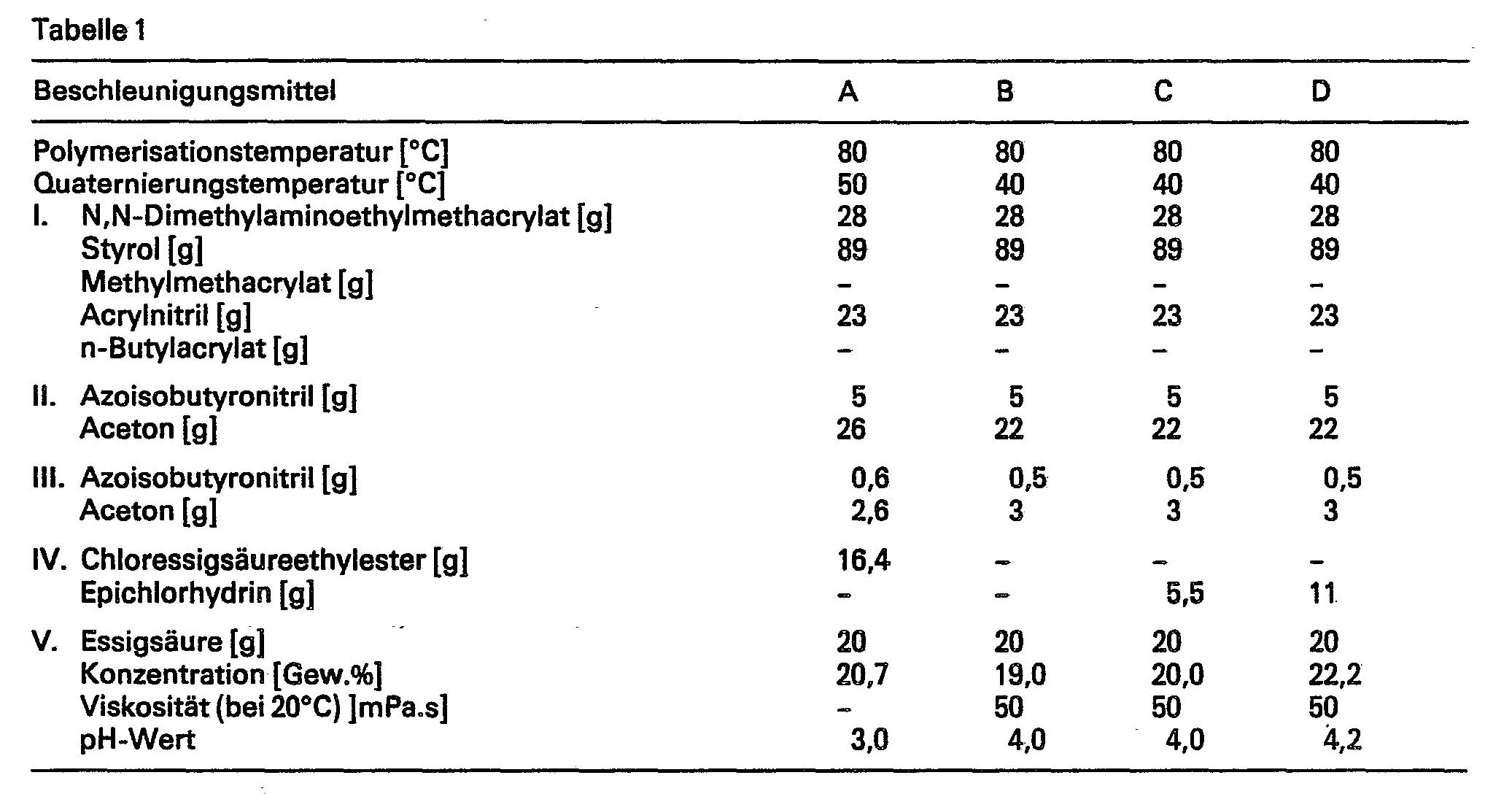
- In einem 2-I-Kolben mit Rührer, Rückflusskühler, Gasein- und -auslass werden 50 g Isopropanol vorgelegt. Danach wird kräftig mit Stickstoff gespült und auf 80°C erwärmt. Bei dieser Temperatur werden die Mischungen I und die Lösungen II der Tabelle 1 innerhalb von 2 Stunden unter Luftausschluss zudosiert. Dann wird 2 Stunden nachgerührt und mit 111 nachaktiviert. Daraufhin wird 12 Stunden bei 80°C gerührt.
- Nach der Polymerisation wird auf die in Tabelle 1 angegebenen Temperaturen abgekühlt und die dort angegebenen Mengen an Quaternierungsmitteln (IV) zudosiert. Es wird 3 Stunden nachgerührt und danach mit den ebenfalls in Tabelle 1 angegebenen Mengen an Essigsäure versetzt. Gleichzeitig wird soviel entionisiertes Wasser zu dem Ansatz zugegeben, dass eine ca. 20 Gew.%ige Lösung resultiert. Dann wird so lange gerührt, bis eine homogene wässrige Lösung entstanden ist. Im Wasserstrahlvakuum werden 100 bis 150 g organisches Lösungsmittel und Wasser abdestilliert. Die Restgehalte an Aceton und Isopropanol liegen dann deutlich unter 0,5 Gew.%. Danach wird die destillierte Menge durch entionisiertes Wasser ersetzt.
- Die wässrigen Lösungen besitzen die ebenfalls in Tabelle 1 verzeichneten Eigenschaften.
- Herstellung des Fixier- und Leimungsbeschleunigungsmittels (E)
- 123 g Copolymer aus gleichen molaren Anteilen Isobutylen und Maleinsäurenanhydrid werden in einem Autoklaven mit 1 g Polyvinylalkohol und 90 g 3-Dimethylaminopropylamin unter Stickstoff Stunde auf 90°C und dann 3 Stunden auf 100°C erhitzt. Nach dem Abkühlen wird der Feststoff abzentrifugiert, gewaschen und getrocknet. Für die Emulsionsherstellung wird eine 10%ige wässrige Lösung des Polymeren mit pH 3 (Salzsäure) angefertigt.
-
- Herstellung von Ketendimeremulsionen (Variante A)
- Ein Gemisch aus 300 g kationischer Kartoffelstärke, 25 g Essigsäure und 4675 g Wasser wurde 1 Stunde bei 90 bis 95°C gerührt. Das Gemisch wurde auf 60°C abgekühlt, 600 g Ketendimer, aus einem Gemisch von Palmitin- und Stearinsäure hergestellt, und 25 g anionisches Dispergiermittel (A) Phenol-Bisulfit-Harnstoff-Kondensat oder B) Kresol-Naphtholsulfonsäure-Formaldehyd-Kondensat) mit einem Schnellrührer eingerührt und das Gemisch zweimal bei 200 bar Druck durch einen Knollenberg-Homogenisator geführt. Das homogenisierte Produkt wurde mit Wasser auf einen Ketendimergehalt von 7,7 Gew.% verdünnt und auf 30°C abgekühlt. Bei dieser Temperatur wurde die Lösung des Fixier- und Leimbeschleunigungsmittels zugesetzt und mit Wasser auf einen Ketendimergehalt von 6 Gew.% verdünnt.
-

- Ketendimeremulsion (Variante B)
- Wie in Beispiel 2 beschrieben, wurde eine 6 Gew.%ige wässrige Lösung kationischer Stärke hergestellt. Jeweils a Teile der Stärkelösung, b Teile Dispergiermittel A, c Teile Essigsäure, d Teile der Polymerlösung D und e Teile Wasser wurden vermischt. In diese Mischung werden bei 60 bis 65°C mit einem Schnell-Rührer f Teile eines geschmolzenen Ketendimeren, aus einem Gemisch von Palmitin- und Stearinsäure hergestellt, eingerührt und das Gemisch zweimal bei 200 bar Druck durch einen Knollenberg-Homogenisator geführt. Die homogenisierte Probe wurde mit Wasser auf einen Ketendimergehalt von 6 Gew.% verdünnt und auf 30°C abgekühlt.

- Auf einem Laborblattbildner werden Papierblätter unter Verwendung der Leimungsmittelemulsionen aus Beispielen 2 und 3 hergestellt. Aus 100 Teilen Zellstoff (50% Birkensulfat, 50% Kiefersulfat) mit einem Mahlrad von 30° SR und 25 Teilen Kreide wurde in Wasser mit ca. 20° dH eine Pulpe mit einem Festgehalt von 0,5% hergestellt. Bezogen auf das Pulpentrockengewicht wurden 1,4% Emulsion zugesetzt. Die gebildeten Bögen wurden bis zu einem Festgehalt von 30-35% nassgepresst und anschliessend bei 90-93°C auf einem dampfbeheizten Trommeltrockner 4 Minuten getrocknet.
- Die Papierblätter hatten ein Flächengewicht von 80 g/m2. Ein Fixiermittel wurde nicht verwendet.
- Zur Bestimmung des Leimungseffektes wurde der Cobb60-Wert (DIN 53 132) ermittelt. Einiges Papier wurde zusätzlich 5 Minuten bei 120°C nacherhitzt oder Tage bei 22°C gelagert.


wobei die Summe von a) bis c) stets 100 Gew.% beträgt und die Dimethylaminogruppen des Terpolymerisats protoniert, gegebenenfalls auch ganz oder teilweise quaterniert sind, oder dadurch gekennzeichnet, dass das Fixier- und Leimungsbeschleunigungsmittel durch Umsetzung von Copolymeren aus Maleinsäureanhydrid und Styrol und/oder Diisobutylen mit einem Gemisch von 0-50 Mol-% Methylamin, Ethylamin, Propylamin, Butylamin und/oder Cyclohexylamin und 100-50 Mol-%, bezogen auf die primäre Aminogruppe, N,N-Dimethylaminopropylamin und/ oder N-(Aminoethyl)-piperazin und anschliessende Quaternierung bis zu einem Quaternierungsgrad von 0 bis 100% erhältlich ist.
Claims (7)
wobei die Summe von a) bis c) stets 100 Gew.% beträgt und die Dimethylaminogruppen des Terpolymerisats protoniert, gegebenenfalls auch ganz oder teilweise quaterniert sind.

Priority Applications (1)
| Application Number | Priority Date | Filing Date | Title |
|---|---|---|---|
| AT83100331T ATE20545T1 (de) | 1982-01-30 | 1983-01-15 | Leimungsmittel und seine verwendung. |
Applications Claiming Priority (2)
| Application Number | Priority Date | Filing Date | Title |
|---|---|---|---|
| DE3203189 | 1982-01-30 | ||
| DE19823203189 DE3203189A1 (de) | 1982-01-30 | 1982-01-30 | Leimungsmittel und seine verwendung |
Publications (2)
| Publication Number | Publication Date |
|---|---|
| EP0085330A1 EP0085330A1 (de) | 1983-08-10 |
| EP0085330B1 true EP0085330B1 (de) | 1986-06-25 |
Family
ID=6154425
Family Applications (1)
| Application Number | Title | Priority Date | Filing Date |
|---|---|---|---|
| EP83100331A Expired EP0085330B1 (de) | 1982-01-30 | 1983-01-15 | Leimungsmittel und seine Verwendung |
Country Status (5)
| Country | Link |
|---|---|
| US (1) | US4784727A (de) |
| EP (1) | EP0085330B1 (de) |
| AT (1) | ATE20545T1 (de) |
| CA (1) | CA1208856A (de) |
| DE (2) | DE3203189A1 (de) |
Families Citing this family (19)
| Publication number | Priority date | Publication date | Assignee | Title |
|---|---|---|---|---|
| FI81860C (fi) * | 1984-01-27 | 1990-12-10 | Nalco Chemical Co | Nytt foerfarande foer limning av papper. |
| JPS61234927A (ja) * | 1984-09-25 | 1986-10-20 | Seiko Kagaku Kogyo Co Ltd | 置換コハク酸無水物の水性分散液及びその製造方法 |
| DE3626160A1 (de) * | 1986-08-01 | 1988-02-04 | Basf Ag | Leimungsmittel fuer papier auf basis von fettalkyldiketenen und kationischen polyacrylamiden und terpolymerisate aus acrylamid, n-vinylimidazol und n-vinylimidazolin |
| JP2913756B2 (ja) * | 1990-04-25 | 1999-06-28 | 三菱化学株式会社 | 紙のサイジング方法 |
| CA2100117C (en) * | 1992-07-15 | 1997-10-07 | Lloyd M. Robeson | Paper wet-strength improvement with cellulose reactive size and amine functional poly(vinyl alcohol) |
| US5595631A (en) * | 1995-05-17 | 1997-01-21 | National Starch And Chemical Investment Holding Corporation | Method of paper sizing using modified cationic starch |
| US5853542A (en) * | 1995-09-11 | 1998-12-29 | Hercules Incorporated | Method of sizing paper using a sizing agent and a polymeric enhancer and paper produced thereof |
| DE19537088A1 (de) * | 1995-10-05 | 1997-04-10 | Basf Ag | Verfahren zur Herstellung von trockenfest und naßfest ausgerüstetem Papier |
| US6165259A (en) * | 1997-02-05 | 2000-12-26 | Akzo Nobel N.V. | Aqueous dispersions of hydrophobic material |
| BR0112906B1 (pt) † | 2000-08-07 | 2012-03-20 | "processo para produção de papel". | |
| DE10237911A1 (de) * | 2002-08-14 | 2004-02-26 | Basf Ag | Verwendung von Vinylamineinheiten enthaltenden Polymeren als Promoter für die Alkyldiketenleimung |
| TW200504265A (en) | 2002-12-17 | 2005-02-01 | Bayer Chemicals Corp | Alkenylsuccinic anhydride surface-applied system and uses thereof |
| US7943789B2 (en) * | 2002-12-17 | 2011-05-17 | Kemira Oyj | Alkenylsuccinic anhydride composition and method of using the same |
| US20060060814A1 (en) * | 2002-12-17 | 2006-03-23 | Lucyna Pawlowska | Alkenylsuccinic anhydride surface-applied system and method for using the same |
| JP4254346B2 (ja) * | 2003-05-27 | 2009-04-15 | 富士ゼロックス株式会社 | 記録用紙及びそれを用いた記録方法 |
| WO2005082974A1 (en) * | 2004-02-26 | 2005-09-09 | Pulp And Paper Research Institute Of Canada | Epichlorohydrin based polymers containing primary amino groups as additives in papermaking |
| WO2006003832A1 (ja) * | 2004-06-30 | 2006-01-12 | Nippon Paper Industries Co., Ltd. | 印刷適性向上剤およびこれを塗布した紙 |
| US20090281212A1 (en) * | 2005-04-28 | 2009-11-12 | Lucyna Pawlowska | Alkenylsuccinic anhydride surface-applied system and uses thereof |
| US7998311B2 (en) * | 2008-07-24 | 2011-08-16 | Hercules Incorporated | Enhanced surface sizing of paper |
Family Cites Families (12)
| Publication number | Priority date | Publication date | Assignee | Title |
|---|---|---|---|---|
| CA602107A (en) * | 1960-07-19 | American Cyanamid Company | Cationic sizing emulsions and paper sized therewith | |
| GB154853A (en) * | 1919-06-30 | 1920-11-30 | Thomas Vicars | Improvements in or connected with biscuit or like embossing and cutting machines |
| US2961366A (en) * | 1957-02-27 | 1960-11-22 | Hercules Powder Co Ltd | Sized paper and method of making same |
| US3046186A (en) * | 1957-06-12 | 1962-07-24 | American Cyanamid Co | Cationic sizing emulsions and paper sized therewith |
| US3666512A (en) * | 1970-03-25 | 1972-05-30 | American Cyanamid Co | Compositions of fatty acid anhydrides containing catalyst |
| GB1373788A (en) * | 1971-10-20 | 1974-11-13 | Hercules Powder Co Ltd | Sizing method and composition for use therein |
| GB1504853A (en) * | 1975-05-20 | 1978-03-22 | Allied Colloids Ltd | Sizing |
| NZ183271A (en) * | 1976-03-08 | 1979-01-11 | Hercules Inc | Sized paper and paper board;sizing composition |
| CA1144691A (en) * | 1977-08-19 | 1983-04-12 | David H. Dumas | Sizing accelerator |
| US4296012A (en) * | 1978-12-28 | 1981-10-20 | Arakawa Kagaku Kogyo Kabushiki Kaisha | Sizing compositions incorporating ketene dimer |
| DE3047688A1 (de) * | 1980-12-18 | 1982-07-22 | Basf Ag, 6700 Ludwigshafen | Verfahren zur herstellung amphoterer copolymerisate und deren verwendung als emulsator |
| DE3105903A1 (de) * | 1981-02-18 | 1982-09-09 | Basf Ag, 6700 Ludwigshafen | Verfahren zur masseleimung von papier |
-
1982
- 1982-01-30 DE DE19823203189 patent/DE3203189A1/de not_active Withdrawn
-
1983
- 1983-01-15 AT AT83100331T patent/ATE20545T1/de not_active IP Right Cessation
- 1983-01-15 DE DE8383100331T patent/DE3364220D1/de not_active Expired
- 1983-01-15 EP EP83100331A patent/EP0085330B1/de not_active Expired
- 1983-01-20 US US06/459,314 patent/US4784727A/en not_active Expired - Fee Related
- 1983-01-28 CA CA000420466A patent/CA1208856A/en not_active Expired
Also Published As
| Publication number | Publication date |
|---|---|
| US4784727A (en) | 1988-11-15 |
| ATE20545T1 (de) | 1986-07-15 |
| CA1208856A (en) | 1986-08-05 |
| EP0085330A1 (de) | 1983-08-10 |
| DE3364220D1 (en) | 1986-07-31 |
| DE3203189A1 (de) | 1983-08-04 |
Similar Documents
| Publication | Publication Date | Title |
|---|---|---|
| EP0216387B1 (de) | Verfahren zur Herstellung von Vinylamin-Einheiten enthaltenden wasserlöslichen Copolymerisaten und deren Verwendung als Nass- und Trockenverfestigungsmittel für Papier | |
| EP0085330A1 (de) | Leimungsmittel und seine Verwendung | |
| DE68929209T2 (de) | Mikroemulgierte funktionalisierte Polymere | |
| EP0150003B1 (de) | Kationisches Leimungsmittel für Papier und Verfahren zu seiner Herstellung | |
| DE3128478A1 (de) | Verfahren zur herstellung von linearen, basischen polymerisaten | |
| EP0418343B1 (de) | Verfahren zur herstellung von papier, pappe und karton in gegenwart von n-vinylformamid-einheiten enthaltenden copolymerisaten | |
| DE2519581C2 (de) | Papierleimungsmittel | |
| EP0238968B1 (de) | Oberflächenleimungsmittel für Papier | |
| EP1452552A2 (de) | Kationische Stärke-Pfropfcopolymere | |
| EP0033064B1 (de) | Kationische Leimungsmittel für Papier | |
| EP0054231A1 (de) | Leimungsmittel für Papier und Verfahren zu ihrer Herstellung | |
| DE2544948C3 (de) | Verfahren zur Herstellung von kationischen Leimungsmitteln für Papier | |
| EP0009185B1 (de) | Schaumarme Oberflächenleimungsmittel für Papier | |
| DE3047688A1 (de) | Verfahren zur herstellung amphoterer copolymerisate und deren verwendung als emulsator | |
| EP0245674A1 (de) | Papierleimungsmittel, deren Herstellung sowie deren Verwendung | |
| DE2710060C2 (de) | Verfahren zur Herstellung geleimten Papiers und Mittel zu seiner Durchführung | |
| EP0029530B1 (de) | Verfahren zur Masseleimung von Papier | |
| DE2502172C3 (de) | Anionische Papierleimungsmittel | |
| EP0307778B1 (de) | Oberflächenleimungsmittel für Papier und papierähnliche Materialien | |
| DE3105903A1 (de) | Verfahren zur masseleimung von papier | |
| EP0966498B1 (de) | Wässrige dispersionen von reaktivleimungsmitteln, verfahren zu ihrer herstellung und ihre verwendung | |
| EP0171727B1 (de) | Oberflächenleimungsmittel für Papier | |
| DE2840650A1 (de) | Schaumarme oberflaechenleimungsmittel fuer papier | |
| EP0081139A1 (de) | Leimungsmittel für Papier | |
| AT375424B (de) | Leimzusammensetzung und ihre verwendung |
Legal Events
| Date | Code | Title | Description |
|---|---|---|---|
| PUAI | Public reference made under article 153(3) epc to a published international application that has entered the european phase |
Free format text: ORIGINAL CODE: 0009012 |
|
| 17P | Request for examination filed |
Effective date: 19830115 |
|
| AK | Designated contracting states |
Designated state(s): AT DE FR GB IT |
|
| GRAA | (expected) grant |
Free format text: ORIGINAL CODE: 0009210 |
|
| 17Q | First examination report despatched |
Effective date: 19860320 |
|
| AK | Designated contracting states |
Kind code of ref document: B1 Designated state(s): AT DE FR GB IT |
|
| REF | Corresponds to: |
Ref document number: 20545 Country of ref document: AT Date of ref document: 19860715 Kind code of ref document: T |
|
| ITF | It: translation for a ep patent filed | ||
| REF | Corresponds to: |
Ref document number: 3364220 Country of ref document: DE Date of ref document: 19860731 |
|
| ET | Fr: translation filed | ||
| PLBE | No opposition filed within time limit |
Free format text: ORIGINAL CODE: 0009261 |
|
| STAA | Information on the status of an ep patent application or granted ep patent |
Free format text: STATUS: NO OPPOSITION FILED WITHIN TIME LIMIT |
|
| 26N | No opposition filed | ||
| PGFP | Annual fee paid to national office [announced via postgrant information from national office to epo] |
Ref country code: DE Payment date: 19881217 Year of fee payment: 7 |
|
| PGFP | Annual fee paid to national office [announced via postgrant information from national office to epo] |
Ref country code: AT Payment date: 19881221 Year of fee payment: 7 |
|
| PGFP | Annual fee paid to national office [announced via postgrant information from national office to epo] |
Ref country code: FR Payment date: 19881230 Year of fee payment: 7 |
|
| ITTA | It: last paid annual fee | ||
| PGFP | Annual fee paid to national office [announced via postgrant information from national office to epo] |
Ref country code: GB Payment date: 19890131 Year of fee payment: 7 |
|
| PG25 | Lapsed in a contracting state [announced via postgrant information from national office to epo] |
Ref country code: GB Effective date: 19900115 Ref country code: AT Effective date: 19900115 |
|
| GBPC | Gb: european patent ceased through non-payment of renewal fee | ||
| PG25 | Lapsed in a contracting state [announced via postgrant information from national office to epo] |
Ref country code: FR Effective date: 19900928 |
|
| PG25 | Lapsed in a contracting state [announced via postgrant information from national office to epo] |
Ref country code: DE Effective date: 19901002 |
|
| REG | Reference to a national code |
Ref country code: FR Ref legal event code: ST |