EP0082011B1 - Empfindlicher Artikel für die Elektrophotographie - Google Patents
Empfindlicher Artikel für die Elektrophotographie Download PDFInfo
- Publication number
- EP0082011B1 EP0082011B1 EP82306669A EP82306669A EP0082011B1 EP 0082011 B1 EP0082011 B1 EP 0082011B1 EP 82306669 A EP82306669 A EP 82306669A EP 82306669 A EP82306669 A EP 82306669A EP 0082011 B1 EP0082011 B1 EP 0082011B1
- Authority
- EP
- European Patent Office
- Prior art keywords
- electric charge
- layer
- sensitive article
- substance
- article according
- Prior art date
- Legal status (The legal status is an assumption and is not a legal conclusion. Google has not performed a legal analysis and makes no representation as to the accuracy of the status listed.)
- Expired
Links
Images
Classifications
-
- G—PHYSICS
- G03—PHOTOGRAPHY; CINEMATOGRAPHY; ANALOGOUS TECHNIQUES USING WAVES OTHER THAN OPTICAL WAVES; ELECTROGRAPHY; HOLOGRAPHY
- G03G—ELECTROGRAPHY; ELECTROPHOTOGRAPHY; MAGNETOGRAPHY
- G03G5/00—Recording-members for original recording by exposure, e.g. to light, to heat or to electrons; Manufacture thereof; Selection of materials therefor
- G03G5/14—Inert intermediate or cover layers for charge-receiving layers
- G03G5/142—Inert intermediate layers
-
- G—PHYSICS
- G03—PHOTOGRAPHY; CINEMATOGRAPHY; ANALOGOUS TECHNIQUES USING WAVES OTHER THAN OPTICAL WAVES; ELECTROGRAPHY; HOLOGRAPHY
- G03G—ELECTROGRAPHY; ELECTROPHOTOGRAPHY; MAGNETOGRAPHY
- G03G5/00—Recording-members for original recording by exposure, e.g. to light, to heat or to electrons; Manufacture thereof; Selection of materials therefor
- G03G5/02—Charge-receiving layers
- G03G5/04—Photoconductive layers; Charge-generation layers or charge-transporting layers; Additives therefor; Binders therefor
- G03G5/06—Photoconductive layers; Charge-generation layers or charge-transporting layers; Additives therefor; Binders therefor characterised by the photoconductive material being organic
- G03G5/0664—Dyes
- G03G5/0696—Phthalocyanines
-
- G—PHYSICS
- G03—PHOTOGRAPHY; CINEMATOGRAPHY; ANALOGOUS TECHNIQUES USING WAVES OTHER THAN OPTICAL WAVES; ELECTROGRAPHY; HOLOGRAPHY
- G03G—ELECTROGRAPHY; ELECTROPHOTOGRAPHY; MAGNETOGRAPHY
- G03G5/00—Recording-members for original recording by exposure, e.g. to light, to heat or to electrons; Manufacture thereof; Selection of materials therefor
- G03G5/02—Charge-receiving layers
- G03G5/04—Photoconductive layers; Charge-generation layers or charge-transporting layers; Additives therefor; Binders therefor
- G03G5/06—Photoconductive layers; Charge-generation layers or charge-transporting layers; Additives therefor; Binders therefor characterised by the photoconductive material being organic
- G03G5/07—Polymeric photoconductive materials
- G03G5/075—Polymeric photoconductive materials obtained otherwise than by reactions only involving carbon-to-carbon unsaturated bonds
- G03G5/076—Polymeric photoconductive materials obtained otherwise than by reactions only involving carbon-to-carbon unsaturated bonds having a photoconductive moiety in the polymer backbone
-
- G—PHYSICS
- G03—PHOTOGRAPHY; CINEMATOGRAPHY; ANALOGOUS TECHNIQUES USING WAVES OTHER THAN OPTICAL WAVES; ELECTROGRAPHY; HOLOGRAPHY
- G03G—ELECTROGRAPHY; ELECTROPHOTOGRAPHY; MAGNETOGRAPHY
- G03G5/00—Recording-members for original recording by exposure, e.g. to light, to heat or to electrons; Manufacture thereof; Selection of materials therefor
- G03G5/10—Bases for charge-receiving or other layers
- G03G5/102—Bases for charge-receiving or other layers consisting of or comprising metals
-
- G—PHYSICS
- G03—PHOTOGRAPHY; CINEMATOGRAPHY; ANALOGOUS TECHNIQUES USING WAVES OTHER THAN OPTICAL WAVES; ELECTROGRAPHY; HOLOGRAPHY
- G03G—ELECTROGRAPHY; ELECTROPHOTOGRAPHY; MAGNETOGRAPHY
- G03G5/00—Recording-members for original recording by exposure, e.g. to light, to heat or to electrons; Manufacture thereof; Selection of materials therefor
- G03G5/14—Inert intermediate or cover layers for charge-receiving layers
- G03G5/142—Inert intermediate layers
- G03G5/144—Inert intermediate layers comprising inorganic material
-
- Y—GENERAL TAGGING OF NEW TECHNOLOGICAL DEVELOPMENTS; GENERAL TAGGING OF CROSS-SECTIONAL TECHNOLOGIES SPANNING OVER SEVERAL SECTIONS OF THE IPC; TECHNICAL SUBJECTS COVERED BY FORMER USPC CROSS-REFERENCE ART COLLECTIONS [XRACs] AND DIGESTS
- Y10—TECHNICAL SUBJECTS COVERED BY FORMER USPC
- Y10S—TECHNICAL SUBJECTS COVERED BY FORMER USPC CROSS-REFERENCE ART COLLECTIONS [XRACs] AND DIGESTS
- Y10S430/00—Radiation imagery chemistry: process, composition, or product thereof
- Y10S430/001—Electric or magnetic imagery, e.g., xerography, electrography, magnetography, etc. Process, composition, or product
- Y10S430/10—Donor-acceptor complex photoconductor
Definitions
- This invention relates to a novel sensitive article for electrophotography which comprises an electric charge generating substance and an electric charge transfer substance. More particularly, this invention relates to a novel sensitive article for electrophotography which uses a novel polyester as an active component for the electron charge transfer substance.
- selenium, cadmium sulfide, zinc sulfide, a-silicon, and selenium-tellurium have been proposed as photoconductive materials for sensitizing articles for electrophotography.
- the electrophotography is a process for forming a visible image of given graphic matter by electrifying a sensitive article in a dark place, then exposing the sensitive article to light through the graphic matter thereby selectively discharging electricity from the sensitive article and forming a latent image, and subsequently developing the latent image portion of the sensitive article with a toner.
- the sensitive article to be used in the electrophotography is required to possess high capacity for electrification in the dark place, admit of only sparing discharge or dark current, and provide quick release of electric charge upon irradiation with light or, in other words, enjoy high sensitivity.
- photoconductive materials capable of satisfying all these requirements numerous inorganic photoconductive materials such as are enumerated above have been accepted for actual use.
- electrophotographic sensitive articles using various organic substances have been proposed.
- electrophotographic sensitive articles using a combination of poly-N-vinylcarbazole with 2,4,7-trinitro-9-fluorenone U.S. Patent 3,484,237
- a combination of a pyrazoline compound with chlorodianeblue or squanylium Japanese Patent Application Laid-Open No. 55643/77 and No. 105536/74
- thiapyrylium salt and triphenylmethane dispersed in polycarbonate resin Japanese Patent Application Laid-Open No. 55643/77 and No. 105536/74
- the compatibility of the electric charge transfer substance in the polymeric substance being used as the binding agent, the transparency of the film consequently formed of the electric charge transfer substance dispersed in the binding agent, and the properties of the produced film may pose themselves as problems.
- a low molecular-weight electric charge transfer substance which by nature lacks compatibiiityin a polymeric binding agent, the selection of a polymeric substance and the formulation of the electric charge transfer substance with the selected polymeric substance are required to be carried out most attentively lest the transparency and other physical properties of the produced film should be degraded.
- the film or coat consequently produced from the resultant combination no longer retains the outstanding flexibility, thermal resistance, and strength possessed inherently by the polymeric substance.
- high molecular-weight electric charge transfer substance is desired to be capable of being converted in its unmodified form into a film or coat.
- the inventors of the present invention carried out a devoted study in search for a high molecular-weight substance effectively functioning as an electric charge transfer substance for electrophotographic sensitive article and possessing an ample film-forming property. They have consequently found that a polyester obtained from 2,6 - dimethoxy - 9,10 - anthracene diol and an a,w-dicarboxylic acid constitutes itself an excellent high molecular-weight electric charge transfer substance and effectively functions as an electric charge transfer substance for an electrophotographic sensitive article.
- the present invention has issued from this discovery.
- 9,10-anthracene diol derivatives various substitution products such as, for example, 2-methoxy-9,10-anthracene diol, 2,3 - dimethoxy - 9,10 - anthracene diol, and 2,7 - isopropoxy - 9,10 - anthracene diol have also been conceived.
- a comparative study conducted on all these substitution products has revealed that the 2-, 2,3-, and 2,7-substitution products are invariably inferior in properties to the 2,6-dimethoxy substitution product, irrespectively of the kind of substituents involved therein. The reason for their inferiority is still unknown at present.
- the present invention provides an electrophotographic sensitive article, comprising an electroconductive substrate and a photoconductive layer formed on that substrate and composed of an electric charge generating substance and an electric charge transfer substance, which sensitive article is characterized by said electric charge transfer substance having as an active component thereof a crystalline polyester having a melting point in the range of 100°C to 250°C and an inherent viscosity in the range of 0.2 to 1.5, said polyester obtained from a diol component comprising at least 80 mol % of 2,6 - dimethoxy - 9,10 - anthracene diol and a dicarboxylic acid component comprising at least 70 mol % of an a,w-dicarboxylic acid.
- the polyester of the present invention obtained from 2,6 - dimethoxy - 9,10 - anthracene diol and an a,w-dicarboxylic acid can be easily produced by the condensation reaction of 2,6 - dimethoxy - 9,10 - anthracene diol or a functional derivative thereof with an a,w-dicarboxylic acid or a functional derivative thereof.
- the ⁇ , ⁇ -dicarboxylic acid which is used for producing the polyester is preferable to be any of the a,w-dicarboxylic acids having 8 to 14 carbon atoms.
- acids are 1,6-hexanedicarboxylic acid, 1,7-heptanedicarboxylic acid, 1,9-nonanedicarboxylic acid, 1,10- decanedicarboxylic acid, 1,11-undecanedicarboxylic acid, and 1,12-undecanedicarboxylic acid.
- these a,w-dicarboxylic acids may be used either singly or in the form of a mixture of two or more members.
- not more than 30 mol% of the a,w-dicarboxylic acid may be substituted with an aromatic dicarboxylic acid such as, for example, isophthalic acid, terephthalic acid, or phthalic acid.
- aromatic dicarboxylic acid such as, for example, isophthalic acid, terephthalic acid, or phthalic acid.
- Examples of such a,w-dicarboxylic acids are 1,5-pentanedicarboxylic acid, 1,4-butanedicarboxylic acid, 1,15-pentanedecanedicarboxylic acid, 1,16-hexadecanedicarboxylic acid, and 1,17-heptadecanedicarboxylic acid.
- Examples of such other diols are 9,10-anthracene diol, 2 - dimethylamino - 9,10 - anthracene diol, 2 - alkoxy - 9,10 - anthracene diols represented by 2 - methoxy - 9,10 - anthracene diol, and 2 - ethoxy - 9,10 - anthracene diol, diols having a phenolic hydroxyl group represented by hydroquinone and bisphenol A, and 2 - halogeno - 9,10 - anthracene diols represented by 2 - chloro - 9,10 - anthracene diol and 2 - bromo - 9,10 - anthracene diol.
- the amount of the diol so added is desired to be limited to below 20 mol% of the 2,6 - dimethoxy - 9,10 - anthracene diol.
- the polyester which is produced as described above is a crystalline polyester having a melting point between 100°C and 250°C. It is soluble in such solvents as tetrachloroethane, nitrobenzene, and chloral hydrate. From the solution of the polyester in such a solvent, a light yellow transparent (slightly cloudy at times) film can be produced by subjecting the solution to the solution casting process or by hot-melt press process.
- the polyester is desired to have a high degree of polymerization.
- the inherent viscosity (r linh ) of the polymer is desired to fall in the range of 0.2 to 1.5.
- the inherent viscosity is the value to be obtained by measurement in tetrachloroethane (0.5 g/100 ml) at 25°C.
- the polyester of the present invention possesses in itself a good film-forming property and constitutes itself a good electric charge transfer substance and, therefore, calls for no additional incorporation of some other polymeric substance or plasticizer.
- the polyester may additionally incorporate therein such additives.
- the polymeric substances which are used for these purposes include linear saturated polyester resins, polycarbonate resin, polyamide resin, polyurethane resin, epoxy resin, butyral resin, silicone resin, and acrylic resin.
- plasticizers similarly usable are dioctyl phthalate, dibutyl phthalate, and terphenyls.
- the total amount in which these compounds are incorporated is desired to be limited to below 40% by weight based on the weight of the electric charge transfer substance.
- the electric charge transfer substance additionally incorporates therein an acceptor such as, for example, an aromatic carboxylic ester, ketone resin, a diallyl phthalate prepolymer, a phthalic ester, a benzoic ester, a trimellitic ester, or a salicylic ester
- an acceptor such as, for example, an aromatic carboxylic ester, ketone resin, a diallyl phthalate prepolymer, a phthalic ester, a benzoic ester, a trimellitic ester, or a salicylic ester
- aromatic carboxylic esters or ketone compounds which are usable as advantageous acceptors include not only those of low molecular weights but also those of medium to high molecular weights which contain, partly in the molecules thereof, aromatic carboxylic ester structures or ketone structures.
- aromatic carboxylic 'esters are methyl benzoate, dimethyl isophthalate, diethyl terephthalate, dioctyl phthalate, methyl para-hydroxybenzoate, trimellitic acid trimethyl ester, salicylic acid methyl ester, diallyl phthalate, diallyl isophthalate, poly(ethylene terephthalate), poly(propylene isophthalate), diallyl phthalate prepolymer, and diallyl isophthalate prepolymer.
- ketone compounds include acetophenone, benzophenone, cyclohexanone, and ketone resin. Such an additive is incorporated in the electric charge transfer substance in an amount of 5 to 30% by weight based on the weight of the electric charge transfer substance.
- the polyester of the present invention is an active component forthe polymeric electric charge transfer substance.
- this polyester is combined with an electric charge generating substance to form a photoconductive component.
- the electrophotographic sensitive article of the present invention can be formed by any of the three methods (I) through (III) indicated below.
- the sensitive article is produced by uniformly dispersing an electric charge generating substance in a molecular form within the aforementioned polyester and depositing the resultant dispersion product in the form of a layer on an electroconductive substrate.
- the sensitive, article is obtained by dispersing the electric charge generating substance in the form of particles in the aforementioned polymer and depositing the resultant dispersion product in the form of a layer on the electroconductive substrate.
- the sensitive article is obtained by depositing either the electric charge generating substance or electric charge transfer substance in the form of a layer on the electroconductive substrate and depositing on the formed layer the remainder of the two substances mentioned above again in the form of a layer.
- a protective layer can be formed on the uppermost layer according to demand.
- the electric charge generating substance to be used in the sensitive article of Method (I) is an electric charge transfer complex of the aforementioned polyester with a varying Lewis acid.
- Such complexes are those of said polyester with p-chloranyl, 1,3,5-trinitrobenzene, p-nitrophenol, 1-nitroanthraquinone, 1,5-dinitroanthraquinone, 1,8-dinitroanthraquinone, and 2,4,7-trinitro-9-fluorenone.
- Various dyes are usable as the electric charge generating substance in the sensitive article of Method (I).
- dyes examples include triaryl methane dyes such as crystal violet and malachite green, xanthene dyes such as rhodamine B, erythrosine, and rose bengal, thiazine dyes such as methylene blue, cyanine dyes, and pyrylium dyes such as pyrylium salts, thiapyrylium salts, and benzopyrylium salts.
- triaryl methane dyes such as crystal violet and malachite green
- xanthene dyes such as rhodamine B, erythrosine, and rose bengal
- thiazine dyes such as methylene blue
- cyanine dyes cyanine dyes
- pyrylium dyes such as pyrylium salts, thiapyrylium salts, and benzopyrylium salts.
- organic pigments include azo pigments of mono-azo type, bis-azo type, and tris-azo type, metals and metal oxides such as copper, magnesium, palladium, aluminum, zinc, and vanadium oxide, phthalocyanine type pigments such as phthalocyanine, metal-free phthalocyanine, and halogenated phthalocyanine, perylene type pigments, lake type pigments, azo-lake pigments, thio-indigo type pigments, indigo type pigments, anthraquinone type pigments, quinone type pigments, quinacridone type pigments, oxazine type pigments, dioxazine type pigments, and triphenyl methane type pigments.
- organic pigments include azo pigments of mono-azo type, bis-azo type, and tris-azo type, metals and metal oxides such as copper, magnesium, palladium, aluminum, zinc, and vanadium oxide, phthalocyanine type pigments such as phthalocyanine, metal-
- any of the inorganic electric charge generating substances such as, for example, amorphous silicon, amorphous selenium, tellurium, antimony sulfide, selenium-tellurium alloy, cadmium sulfide, zinc oxide, and zinc sulfide can be similarly used.
- phthalocyanine type pigments prove to be particularly advantageous.
- Typical examples of phthalocyanine type pigments are crystalline chloroaluminum phthalocyanine chloride and crystalline oxytitanium phthalocyanine.
- a multi-layer electrophotographic sensitive article is produced by using such a phthalocyanine type pigment as an electric charge generating substance, it enjoys outstanding sensitivity to exposure and exhibits high photosensitivity in a wide range of wavelengths.
- oxytitanium phthalocyanine has been demonstrated to possess high stablity to withstand prolonged repetition of the cycle of electrification and light exposure.
- the electric charge generating substance is used in the sensitive article by Method (I) in an amount of 0.1 to 10%, preferably 0.2 to 5%, based on the weight of the whole photoconductive layer.
- the thickness of the photoconductive layer is suitably selected in the range of 3 to 100 pm.
- the electric charge generating substance is used in the sensitive article by Method (II) in an amount of 1 to 50%, preferably 2 to 30%, based on the weight of the whole photoconductive layer.
- the thickness of the photoconductive layer is suitably selected in the range of 3 to 100 pm.
- the thickness of the layer of the electric charge generating substance is in the range of 0.01 to 20 pm, preferably 0.05 to 5 pm and that of the electric charge transfer substance is in the range of 3 to 50 pm.
- electroconductive substrate examples include plates of such metals as aluminum, copper, and gold, and sheets of plastic film or paper having gold, aluminum, indium oxide, and tin oxide vacuum deposited thereon.
- the electroconductive substrate may be provided with a barrier layer formed of aluminum oxide, tin oxide, or plastic material for the purpose of precluding the otherwise possible degradation of the substrate by the impacts exerted during the repeating cycles of electrification and light exposure.
- a layer formed by dispersing 3 to 10 parts by weight of zinc oxide in 100 parts by weight of polyvinyl alcohol and depositing the resultant dispersion product in a thickness of not more than 1 ⁇ m on the surface of the electroconductive substrate or a layer formed by depositing an alcohol-soluble polyamide in a thickness of not more than 1 ⁇ m similarly on the substrate can be used particularly advantageously.
- the procedure involved in the preparation of the electrophotographic sensitive article varies from one to another of the methods described above.
- the procedure comprises dissolving the aforementioned polyester as an electric charge transfer substance in conjunction with the aforementioned electric charge generating substance in a suitable solvent, applying the resultant solution to the surface of the electroconductive substrate, and drying the applied layer of the solution on the substrate.
- the procedure comprises adding the electric charge generating substance to a solution of the polyester, thoroughly pulverizing and dispersing the resultant mixture as in a ball mill or planetary mill, for example, applying the resultant dispersion product on the electroconductive substrate, and drying the applied layer on the substrate.
- the sensitive article by Method (III) is prepared by the procedure which comprises first vacuum depositing the electric charge generating substance on the electroconductive substrate or finely pulverizing the substance in a suitable organic solvent, applying the resultant dispersion product, optionally through the medium of a small amount of binding agent, to the surface of the substrate, drying the appljed layer thereby giving rise to an electric charge generating layer, and superposing a layer of the solution of polyester on the electric charge generating layer, and drying the superposed layer.
- the preparation of the sensitive article may be accomplished by reversing the procedure just mentioned. Otherwise, a film of the polyester is formed first and a layer of a metal and a layer of an electric charge generating substance are deposited respectively on the front and rear sides of the polyester-film.
- the sensitive article produced as described above can have its photosensitive property rated on a testing machine, Model SP428, made by Kawaguchi Electric Co., Ltd. as follows.
- a sample sensitive article is first electrified by exposure to corona discharge at 5 kV, then allowed to stand in a dark place until the voltage falls to a stated level, and subsequently irradiated with the light from a tungsten lamp adjusted to give an illumination of 20 luxes on the surface thereof. Then, the time (in seconds) which elapses before the surface potential of the sample decreases to one half of the original level is clocked. The product of the intensity of illumination multiplied by the time, in lux-seconds (Ix . sec), is reported as the measure of the sensitivity of the sample.
- the spectral sensitivity of the sample is determined by measuring the intensity of energy, in pW/cm 2 , of the light separated spectrally into constituent colors, calculating the product ( Il Jule/cm 2 ) of the intensity of energy multiplied by the time (seconds) required for the surface potential to decrease to one half of the original level.
- the repeating property of the sample is determined by electrifying the sample under the conditions of -5.5 kV of potential and 20 m/min of corona linear velocity, irradiating the electrified sample with a light of 500 luxes for 0.5 second, repeating this procedure at a rate of 2.5 seconds/cycle, and after the last cycle of the procedure, measuring charged potential, residual voltage, and sensitivity.
- the electrophotographic sensitive article of the present invention possesses high sensitivity and good processability as compared with the conventional sensitive article.
- polyesters consisting preponderantly of 2,6 - dimethoxy - 9,10 - anthracene diol and a,w-dicarboxylic acids having preponderantly 8 through 14 carbon atoms.
- polyesters were invariably obtained by subjecting a 2,6 - dimethoxy - 9,10 - anthracene diol component and an a,w-dicarboxylic acid chloride component to interfacial polycondensation.
- the general procedure and conditions used for the synthesis of these polyesters were shown below and the polyester consequently obtained were as described below.
- the solution viscosity of the polymer was determined by dissolving a 50-mg sample of the polymer in 25 ml of tetrachloroethane and testing the solution for inherent viscosity at 25°C.
- the inherent viscosity calculated in accordance with the following formula was reported as the solution viscosity of the polymer. wherein, t denotes the time for drop of the solution, to the time for drop of tetrachloroethane, and C the concentration of the polymer in g/dl.
- the melting point of the polymer was measured with the Differential Scanning Calorimeter (DSC). The results were as shown in the following table.
- Example 2 On the same aluminum sheet as used in Example 1, the procedure of Example 1 was repeated, except that the polymer, No. 6 of Referential Experiment, was used instead. The film consequently produced was found to possess 700 V of initial charged voltage and 19.5 lx ⁇ see of sensitivity.
- Chlorodianeblue represented by the formula given above was added in a concentration of 1 wt% to tetrachloroethane and kneaded in a ball mill.
- the resultant solution was applied to the surface of an aluminum sheet 100 ⁇ m in thickness and dried to produce an electric charge generating film 2.5 ⁇ m in thickness.
- a 10 wt% solution of a varying polymer (No. 2, 10, and 11 of Referential Experiment) in tetrachloroethane was applied and dried to produce a film 30 pm in thickness.
- Sensitivities of the sensitive articles thus produced were found to be 9.0, 12, and 20 Ix ⁇ sec respectively.
- Selenium was vacuum deposited in a thickness of about 0.1 ⁇ m on the surface of an aluminum sheet 100 ⁇ m in thickness. On the coat of selenium, the polymer (No. 3, 5) was superposed in a thickness of 20 pm.
- the sensitive articles consequently produced were found to possess 700 volts and 650 volts of initial charged voltage and 8.0 lx ⁇ sec and 7.5 Ix - sec of sensitivity respectively.
- a dispersion obtained by crushing 1 part by weight of s-type copper phthalocyanine (produced by Toyo Ink Co., Ltd. and marketed under trademark designation of Rionolblue ER) in 100 parts by weight of dichloroethane for 48 hours in a ball mill was applied.
- the applied layer of the dispersion was dried to afford a thin film 0.3 ⁇ m in thickness.
- a homogeneous solution obtained by dissolving 8 parts by weight of the polymer, No. 4 of Referential Experiment, and 2 parts by weight of ketone resin produced by Hitachi Chemical Co., Ltd.
- Example 9 The procedure of Example 9 was repeated, except that a varying compound indicated in Table 3 below was used in the place of the ketone resin in the preparation of the solution. The sensitive articles consequently produced were tested for properties. The results were as shown in Table 3.
- the crystalline chloroaluminum phthalocyanine chloride obtained as described above could be vacuum deposited film and used as an electric charge generating layer. Otherwise, when the mixture of chloroaluminum phthalocyanine chloride was finely pulverized in a ball mill, the powdered mixture was dissolved, either all by itself or in combination with a binding agent such as acrylic resin, styrene resin, polyester resin, polyamide resin, polycarbonate resin, or polyvinyl alcohol, in a solvent to produce a dispersion which could be converted into an electric charge generating layer by application to a substrate.
- a binding agent such as acrylic resin, styrene resin, polyester resin, polyamide resin, polycarbonate resin, or polyvinyl alcohol
- the amount of the binding agent to be used in the preparation of the dispersion was in the range of 20 to 200 parts by weight per 100 parts by weight of chloroaluminum phthalocyanine chloride, although the amount is not specifically defined by this invention.
- the thickness of the electric charge generating layer was in the range of 200 to 1000 Angstrom (A) (20 to 100 nm) when the layer was produced by vacuum deposition or in the range of 0.02 to 5 pm (dry film) when the layer was produced by application to a substrate.
- chloroaluminum phthalocyanine chloride of the formula, AICIC 32 N 8 H 15.4 Cl 0.6 was vacuum deposited under pressure of 10- 5 Torr (1,33x10- 3 Pa), to produce a vacuum deposited film 400 A (40 nm) in thickness.
- the vacuum deposited film was kept immersed in toluene for five minutes to complete crystallization.
- Example 11 The procedure of Example 11 was repeated, except that copolyamide (produced by Toray, Ltd. and marketed under trademark designation of CM 8000) was used in the place of the dispersion of zinc oxide in polyvinyl alcohol to produce a dry barrier layer 0.8 ⁇ m in thickness and complete a sensitive article.
- copolyamide produced by Toray, Ltd. and marketed under trademark designation of CM 8000
- CM 8000 copolyamide
- CM 8000 a similar sensitive article was prepared, except for omission of the copolyamide layer.
- the sensitive articles were tested for properties. The results were as shown in Table 5 below.
- Example 12 The procedure of Example 12 was repeated, except that in the place of the vacuum deposited film of chloroaluminum phthalocyanine chloride, a dispersion obtained by pulverizing and dispersing 6 parts by weight of chloroaluminum phthalocyanine chloride, AICIC 32 N 8 H 14.4 Cl 1.6 in 1000 parts by weight of chloroform a whole day and night in a ball mill was applied to produce an electric charge generating layer 700 A (70 nm) in thickness and complete a sensitive article. The sensitive article was tested for properties. The results were as follows.
- the sensitive article After 30,000 repeated cycles, the sensitive article showed the following properties.
- Example 13 The procedure of Example 13 was repeated, except that a dispersion obtained by dissolving 10 parts by weight of chloroaluminum phthalocyanine chloride, AICIC 32 N 8 H 15 Cl, and 5 parts by weight of polycarbonate (produced by Mitsubishi Gas Chemical Co., Ltd. and marketed under trademark designation of lupilon E 2000) in 100 parts by weight of dichloroethane and dispersing the solution a whole day and night in a ball mill was applied to a substrate to produce an electric charge generating layer 0.5 pm in thickness and complete a sensitive article.
- the sensitive article showed the following properties.
- the sensitive article After 30000 repeated cycles, the sensitive article showed the following properties.
- Example 12 The procedure of Example 12 was repeated, except that in the place of the polyester obtained from 2,6 - dimethoxy - 9,10 - anthracene diol and 1,10-decanedicarboxylic acid and used in Example 11, there was used a polyester which was obtained from a mixture consisting of 2,6 -dimethoxy -9,10 anthracene diol having 20 mol% thereof substituted with 9,10-anthracene diol and, 1,10-decanedicarboxylic acid having 50 mol% thereof substituted with 1,8-octandicarboxylic acid.
- the sensitive article consequently produced showed the following properties.
- the sensitive article After 20,000 repeated cycles, the sensitive article showed the following properties.
- Example 11 The procedure of Example 11 was repeated, except that the thickness of the layer of chloroaluminum phthalocyanine chloride obtained in Example 11 was changed to 800 A (80 nm) and a part of the polymer, No. 4 of Referential Experiment, was substituted by polycarbonate (produced by Mitsubishi Gas Chemical Co., Ltd. and marketed under trademark designation of lupilon S 2000).
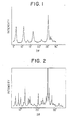
- oxytitanium phthalocyanine was vacuum deposited under 10 -5 Torr (1.33 ⁇ 10 -3 Pa) in a thickness of 0.1 pm.
- the same crystalline membrane was similarly obtained by treating the vacuum deposited membrane with other solvents such as, for example, toluene, xylene, chloroform, dichloroethane, and trichloropropane.
- solvents such as, for example, toluene, xylene, chloroform, dichloroethane, and trichloropropane.
- Powdered oxytitanium phthalocyanine could be advantageously crystallized when it was pulverized under the aforementioned solvent in a ball mill.
- Example 17 The procedure of Example 17 was repeated, except that in the place of the vacuum deposited membrane, there was formed an electric charge generating layer 0.1 ⁇ m in thickness by pulverizing 1 part by weight of oxytitanium phthalocyanine in 200 parts by weight of chloroform a whole day and night in a ball mill, to complete a sensitive article.
- This sensitive article showed the following properties in Table 8.
Landscapes
- Physics & Mathematics (AREA)
- General Physics & Mathematics (AREA)
- Chemical & Material Sciences (AREA)
- Inorganic Chemistry (AREA)
- Chemical Kinetics & Catalysis (AREA)
- Photoreceptors In Electrophotography (AREA)
Claims (15)

Applications Claiming Priority (12)
| Application Number | Priority Date | Filing Date | Title |
|---|---|---|---|
| JP201943/81 | 1981-12-15 | ||
| JP56201944A JPS58102948A (ja) | 1981-12-15 | 1981-12-15 | 電子写真のための感光体 |
| JP56201943A JPS58102946A (ja) | 1981-12-15 | 1981-12-15 | 電子写真用の感光体 |
| JP56201942A JPS58102947A (ja) | 1981-12-15 | 1981-12-15 | 電子写真用感光体 |
| JP201944/81 | 1981-12-15 | ||
| JP201942/81 | 1981-12-15 | ||
| JP57092124A JPS58209748A (ja) | 1982-06-01 | 1982-06-01 | 有機系電子写真用感光体 |
| JP57092122A JPS58209751A (ja) | 1982-06-01 | 1982-06-01 | 感光体 |
| JP92122/82 | 1982-06-01 | ||
| JP57092123A JPS58209747A (ja) | 1982-06-01 | 1982-06-01 | 多層系感光体 |
| JP92123/82 | 1982-06-01 | ||
| JP92124/82 | 1982-06-01 |
Publications (2)
| Publication Number | Publication Date |
|---|---|
| EP0082011A1 EP0082011A1 (de) | 1983-06-22 |
| EP0082011B1 true EP0082011B1 (de) | 1986-01-22 |
Family
ID=27551862
Family Applications (1)
| Application Number | Title | Priority Date | Filing Date |
|---|---|---|---|
| EP82306669A Expired EP0082011B1 (de) | 1981-12-15 | 1982-12-14 | Empfindlicher Artikel für die Elektrophotographie |
Country Status (5)
| Country | Link |
|---|---|
| US (1) | US4444861A (de) |
| EP (1) | EP0082011B1 (de) |
| AU (1) | AU541942B2 (de) |
| CA (1) | CA1176906A (de) |
| DE (1) | DE3268719D1 (de) |
Cited By (1)
| Publication number | Priority date | Publication date | Assignee | Title |
|---|---|---|---|---|
| RU2573488C2 (ru) * | 2011-07-29 | 2016-01-20 | Кэнон Кабусики Кайся | Способ изготовления электрофотографического светочувствительного элемента |
Families Citing this family (23)
| Publication number | Priority date | Publication date | Assignee | Title |
|---|---|---|---|---|
| DE3576744D1 (de) * | 1984-11-01 | 1990-04-26 | Mitsubishi Chem Ind | Kristallinisches phthalocyanin-oxytitanium und photorezeptor fuer die elektrophotographie. |
| CA1279787C (en) * | 1985-12-06 | 1991-02-05 | Tatsuro Iwabuchi | Electrophotographic photoconductor using phthalocyanine compound |
| US4816386A (en) * | 1986-01-13 | 1989-03-28 | Toray Industries, Inc. | Near-infrared sensitive phthalocyanine-polymer compositions |
| US4898799A (en) * | 1987-07-10 | 1990-02-06 | Konica Corporation | Photoreceptor |
| US4847175A (en) * | 1987-12-02 | 1989-07-11 | Eastman Kodak Company | Electrophotographic element having low surface adhesion |
| JPH0715067B2 (ja) * | 1989-07-21 | 1995-02-22 | キヤノン株式会社 | オキシチタニウムフタロシアニン、その製造方法およびそれを用いた電子写真感光体 |
| JP2502404B2 (ja) * | 1989-07-21 | 1996-05-29 | キヤノン株式会社 | オキシチタニウムフタロシアニン,その製造方法,それを用いた電子写真感光体,該電子写真感光体を有する装置ユニットおよび電子写真装置 |
| US5080989A (en) * | 1989-11-29 | 1992-01-14 | Eastman Kodak Company | Photoconductive block copolymers |
| US5530115A (en) * | 1989-12-08 | 1996-06-25 | Canon Kabushiki Kaisha | Process for producing crystalline I-type oxytitanium phthalocyanine |
| DE69025727T2 (de) * | 1989-12-13 | 1996-07-25 | Canon Kk | Elektrofotografisches lichtempfindliches Element |
| EP0482884B1 (de) * | 1990-10-23 | 1996-01-03 | Canon Kabushiki Kaisha | Lichtempfindliches elektrophotographisches Element |
| EP0482922B1 (de) * | 1990-10-24 | 1997-01-08 | Canon Kabushiki Kaisha | Verfahren zur Herstellung von kristallinem Oxytitanphthalocyanin |
| JP2801426B2 (ja) * | 1991-04-24 | 1998-09-21 | キヤノン株式会社 | オキシチタニウムフタロシアニン、その製造方法およびそれを用いた電子写真感光体 |
| US5384625A (en) * | 1992-12-28 | 1995-01-24 | Canon Kabushiki Kaisha | Image forming method |
| JP3020371B2 (ja) * | 1993-01-28 | 2000-03-15 | 三田工業株式会社 | ブラッシングが防止された有機感光体の製造方法 |
| JPH0990647A (ja) * | 1995-09-26 | 1997-04-04 | Fuji Electric Co Ltd | 電子写真感光体 |
| BRPI0907755A2 (pt) * | 2008-02-05 | 2015-07-21 | Saint Gobain Performance Plast | Artigo multimarcas |
| WO2010056377A1 (en) * | 2008-11-12 | 2010-05-20 | Saint-Gobain Performance Plastics Corporation | Barrier structure and method for making |
| US8859102B2 (en) * | 2008-11-12 | 2014-10-14 | Saint-Gobain Performance Plastics Corporation | Barrier structure and method for making |
| JP5575182B2 (ja) | 2011-07-29 | 2014-08-20 | キヤノン株式会社 | 電子写真感光体、プロセスカートリッジおよび電子写真装置 |
| JP5755262B2 (ja) * | 2013-01-24 | 2015-07-29 | キヤノン株式会社 | プロセスカートリッジおよび電子写真装置 |
| WO2014118832A1 (ja) * | 2013-01-29 | 2014-08-07 | キヤノン株式会社 | 電子写真プロセスカートリッジ及び電子写真装置 |
| JP7016226B2 (ja) * | 2017-05-17 | 2022-02-04 | 川崎化成工業株式会社 | 高分子光重合増感剤 |
Family Cites Families (3)
| Publication number | Priority date | Publication date | Assignee | Title |
|---|---|---|---|---|
| US3884690A (en) * | 1973-09-27 | 1975-05-20 | Xerox Corp | Polyester photoconductors and matrix materials |
| US4281106A (en) * | 1979-07-12 | 1981-07-28 | E. I. Du Pont De Nemours And Company | Heat-resistant, rigid polymers from difunctional 9,10-dihydro-9,10-ethanoanthracenes |
| US4371690A (en) * | 1979-07-12 | 1983-02-01 | E. I. Du Pont De Nemours And Company | Heat-resistant rigid polymers from difunctional 9,10-dihydro-9,10-ethanoanthracenes |
-
1982
- 1982-12-10 US US06/448,605 patent/US4444861A/en not_active Expired - Lifetime
- 1982-12-14 DE DE8282306669T patent/DE3268719D1/de not_active Expired
- 1982-12-14 AU AU91524/82A patent/AU541942B2/en not_active Ceased
- 1982-12-14 EP EP82306669A patent/EP0082011B1/de not_active Expired
- 1982-12-14 CA CA000417706A patent/CA1176906A/en not_active Expired
Non-Patent Citations (1)
| Title |
|---|
| NONE * |
Cited By (1)
| Publication number | Priority date | Publication date | Assignee | Title |
|---|---|---|---|---|
| RU2573488C2 (ru) * | 2011-07-29 | 2016-01-20 | Кэнон Кабусики Кайся | Способ изготовления электрофотографического светочувствительного элемента |
Also Published As
| Publication number | Publication date |
|---|---|
| AU541942B2 (en) | 1985-01-31 |
| AU9152482A (en) | 1983-06-23 |
| EP0082011A1 (de) | 1983-06-22 |
| US4444861A (en) | 1984-04-24 |
| DE3268719D1 (en) | 1986-03-06 |
| CA1176906A (en) | 1984-10-30 |
Similar Documents
| Publication | Publication Date | Title |
|---|---|---|
| EP0082011B1 (de) | Empfindlicher Artikel für die Elektrophotographie | |
| EP0534514B1 (de) | Elektrophotographisches Aufzeichnungsmaterial | |
| US4025341A (en) | Photoconductive polymer and photoconductive compositions and elements containing same | |
| US4127412A (en) | Photoconductive compositions and elements | |
| CN101370769B (zh) | 对三联苯化合物混合物和由其制备的电子照相用感光体 | |
| US4092162A (en) | Nitrogen containing polymers aelements | |
| JP3569422B2 (ja) | 結晶型オキソチタニルフタロシアニン及びそれを用いた電子写真感光体並びに画像形成方法 | |
| JP2004177703A (ja) | 電子写真感光体 | |
| JPS5857739B2 (ja) | ヒカリデンドウセイソセイブツ | |
| JPH0516020B2 (de) | ||
| EP0219862B1 (de) | Lichtempfindliches Element für Elektrophotographie | |
| US3740218A (en) | Photoconductive elements containing complexes of lewis acids and formaldehyde resins | |
| JPH0260174B2 (de) | ||
| JP3273976B2 (ja) | 感光性電子写真記録材料 | |
| JP4523393B2 (ja) | 電子写真感光体 | |
| JPH026484A (ja) | 感光体 | |
| US4396694A (en) | Organic electrophotographic sensitive materials | |
| CN109690420A (zh) | 电子照相感光体 | |
| US6022656A (en) | Bipolar electrophotographic elements | |
| US3706554A (en) | Photoconductive composition | |
| JPS6248822B2 (de) | ||
| JPS58166354A (ja) | 電子写真感光体 | |
| JPS6248823B2 (de) | ||
| US5340675A (en) | Electrophotographic recording material | |
| JPS6248824B2 (de) |
Legal Events
| Date | Code | Title | Description |
|---|---|---|---|
| PUAI | Public reference made under article 153(3) epc to a published international application that has entered the european phase |
Free format text: ORIGINAL CODE: 0009012 |
|
| AK | Designated contracting states |
Designated state(s): DE FR GB NL |
|
| 17P | Request for examination filed |
Effective date: 19830606 |
|
| GRAA | (expected) grant |
Free format text: ORIGINAL CODE: 0009210 |
|
| AK | Designated contracting states |
Designated state(s): DE FR GB NL |
|
| REF | Corresponds to: |
Ref document number: 3268719 Country of ref document: DE Date of ref document: 19860306 |
|
| ET | Fr: translation filed | ||
| PLBE | No opposition filed within time limit |
Free format text: ORIGINAL CODE: 0009261 |
|
| STAA | Information on the status of an ep patent application or granted ep patent |
Free format text: STATUS: NO OPPOSITION FILED WITHIN TIME LIMIT |
|
| 26N | No opposition filed | ||
| PGFP | Annual fee paid to national office [announced via postgrant information from national office to epo] |
Ref country code: GB Payment date: 19961205 Year of fee payment: 15 |
|
| PGFP | Annual fee paid to national office [announced via postgrant information from national office to epo] |
Ref country code: FR Payment date: 19961211 Year of fee payment: 15 |
|
| PGFP | Annual fee paid to national office [announced via postgrant information from national office to epo] |
Ref country code: DE Payment date: 19961223 Year of fee payment: 15 |
|
| PGFP | Annual fee paid to national office [announced via postgrant information from national office to epo] |
Ref country code: NL Payment date: 19961231 Year of fee payment: 15 |
|
| PG25 | Lapsed in a contracting state [announced via postgrant information from national office to epo] |
Ref country code: GB Free format text: LAPSE BECAUSE OF NON-PAYMENT OF DUE FEES Effective date: 19971214 |
|
| PG25 | Lapsed in a contracting state [announced via postgrant information from national office to epo] |
Ref country code: FR Free format text: THE PATENT HAS BEEN ANNULLED BY A DECISION OF A NATIONAL AUTHORITY Effective date: 19971231 |
|
| PG25 | Lapsed in a contracting state [announced via postgrant information from national office to epo] |
Ref country code: NL Free format text: LAPSE BECAUSE OF NON-PAYMENT OF DUE FEES Effective date: 19980701 |
|
| GBPC | Gb: european patent ceased through non-payment of renewal fee |
Effective date: 19971214 |
|
| NLV4 | Nl: lapsed or anulled due to non-payment of the annual fee |
Effective date: 19980701 |
|
| PG25 | Lapsed in a contracting state [announced via postgrant information from national office to epo] |
Ref country code: DE Free format text: LAPSE BECAUSE OF NON-PAYMENT OF DUE FEES Effective date: 19980901 |
|
| REG | Reference to a national code |
Ref country code: FR Ref legal event code: ST |