EP0081408B1 - Nouveaux copolymères acryliques à fonctionnalisation aminée et leur préparation - Google Patents
Nouveaux copolymères acryliques à fonctionnalisation aminée et leur préparation Download PDFInfo
- Publication number
- EP0081408B1 EP0081408B1 EP82402109A EP82402109A EP0081408B1 EP 0081408 B1 EP0081408 B1 EP 0081408B1 EP 82402109 A EP82402109 A EP 82402109A EP 82402109 A EP82402109 A EP 82402109A EP 0081408 B1 EP0081408 B1 EP 0081408B1
- Authority
- EP
- European Patent Office
- Prior art keywords
- formula
- ethylene diamine
- ester
- peptide
- resin
- Prior art date
- Legal status (The legal status is an assumption and is not a legal conclusion. Google has not performed a legal analysis and makes no representation as to the accuracy of the status listed.)
- Expired
Links
- 238000002360 preparation method Methods 0.000 title claims abstract description 5
- PIICEJLVQHRZGT-UHFFFAOYSA-N Ethylenediamine Chemical compound NCCN PIICEJLVQHRZGT-UHFFFAOYSA-N 0.000 title claims description 10
- 229920000178 Acrylic resin Polymers 0.000 title description 2
- 239000004925 Acrylic resin Substances 0.000 title description 2
- 229920005989 resin Polymers 0.000 claims description 29
- 239000011347 resin Substances 0.000 claims description 29
- 238000000034 method Methods 0.000 claims description 15
- 150000002148 esters Chemical group 0.000 claims description 11
- 238000006243 chemical reaction Methods 0.000 claims description 10
- 239000000178 monomer Substances 0.000 claims description 9
- 239000003795 chemical substances by application Substances 0.000 claims description 6
- QOSSAOTZNIDXMA-UHFFFAOYSA-N Dicylcohexylcarbodiimide Chemical compound C1CCCCC1N=C=NC1CCCCC1 QOSSAOTZNIDXMA-UHFFFAOYSA-N 0.000 claims description 5
- 229910052757 nitrogen Inorganic materials 0.000 claims description 5
- 230000008569 process Effects 0.000 claims description 4
- 150000004702 methyl esters Chemical class 0.000 claims description 3
- 230000002441 reversible effect Effects 0.000 claims description 3
- ONIBWKKTOPOVIA-BYPYZUCNSA-N L-Proline Chemical compound OC(=O)[C@@H]1CCCN1 ONIBWKKTOPOVIA-BYPYZUCNSA-N 0.000 claims description 2
- 239000003431 cross linking reagent Substances 0.000 claims description 2
- 239000011159 matrix material Substances 0.000 claims description 2
- YMWUJEATGCHHMB-UHFFFAOYSA-N Dichloromethane Chemical compound ClCCl YMWUJEATGCHHMB-UHFFFAOYSA-N 0.000 abstract description 8
- LFQSCWFLJHTTHZ-UHFFFAOYSA-N Ethanol Chemical compound CCO LFQSCWFLJHTTHZ-UHFFFAOYSA-N 0.000 abstract description 8
- ZMXDDKWLCZADIW-UHFFFAOYSA-N N,N-Dimethylformamide Chemical compound CN(C)C=O ZMXDDKWLCZADIW-UHFFFAOYSA-N 0.000 abstract description 6
- 239000002904 solvent Substances 0.000 abstract description 6
- XLYOFNOQVPJJNP-UHFFFAOYSA-N water Substances O XLYOFNOQVPJJNP-UHFFFAOYSA-N 0.000 abstract description 3
- 229920006243 acrylic copolymer Polymers 0.000 abstract description 2
- OKKJLVBELUTLKV-UHFFFAOYSA-N Methanol Chemical compound OC OKKJLVBELUTLKV-UHFFFAOYSA-N 0.000 abstract 3
- HEDRZPFGACZZDS-UHFFFAOYSA-N Chloroform Chemical compound ClC(Cl)Cl HEDRZPFGACZZDS-UHFFFAOYSA-N 0.000 abstract 2
- JUJWROOIHBZHMG-UHFFFAOYSA-N Pyridine Chemical compound C1=CC=NC=C1 JUJWROOIHBZHMG-UHFFFAOYSA-N 0.000 abstract 2
- 238000004255 ion exchange chromatography Methods 0.000 abstract 1
- UMJSCPRVCHMLSP-UHFFFAOYSA-N pyridine Natural products COC1=CC=CN=C1 UMJSCPRVCHMLSP-UHFFFAOYSA-N 0.000 abstract 1
- 108090000765 processed proteins & peptides Proteins 0.000 description 28
- RTZKZFJDLAIYFH-UHFFFAOYSA-N Diethyl ether Chemical compound CCOCC RTZKZFJDLAIYFH-UHFFFAOYSA-N 0.000 description 20
- 238000005859 coupling reaction Methods 0.000 description 18
- 230000008878 coupling Effects 0.000 description 17
- 238000010168 coupling process Methods 0.000 description 17
- 239000000243 solution Substances 0.000 description 15
- 235000001014 amino acid Nutrition 0.000 description 11
- VHYFNPMBLIVWCW-UHFFFAOYSA-N 4-Dimethylaminopyridine Chemical compound CN(C)C1=CC=NC=C1 VHYFNPMBLIVWCW-UHFFFAOYSA-N 0.000 description 10
- -1 N-acrylylamino Chemical group 0.000 description 10
- 102000004196 processed proteins & peptides Human genes 0.000 description 10
- 230000015572 biosynthetic process Effects 0.000 description 9
- 238000003786 synthesis reaction Methods 0.000 description 9
- DTQVDTLACAAQTR-UHFFFAOYSA-N Trifluoroacetic acid Chemical compound OC(=O)C(F)(F)F DTQVDTLACAAQTR-UHFFFAOYSA-N 0.000 description 8
- 0 *c1ccc(*C(O)=O)cc1 Chemical compound *c1ccc(*C(O)=O)cc1 0.000 description 7
- 238000010647 peptide synthesis reaction Methods 0.000 description 7
- WYURNTSHIVDZCO-UHFFFAOYSA-N Tetrahydrofuran Chemical compound C1CCOC1 WYURNTSHIVDZCO-UHFFFAOYSA-N 0.000 description 6
- 150000008064 anhydrides Chemical class 0.000 description 6
- 239000003153 chemical reaction reagent Substances 0.000 description 6
- 238000001914 filtration Methods 0.000 description 6
- 150000001413 amino acids Chemical class 0.000 description 5
- 238000007306 functionalization reaction Methods 0.000 description 5
- 238000003776 cleavage reaction Methods 0.000 description 4
- 229920000642 polymer Polymers 0.000 description 4
- 238000001556 precipitation Methods 0.000 description 4
- 230000007017 scission Effects 0.000 description 4
- 239000007790 solid phase Substances 0.000 description 4
- RYHBNJHYFVUHQT-UHFFFAOYSA-N 1,4-Dioxane Chemical compound C1COCCO1 RYHBNJHYFVUHQT-UHFFFAOYSA-N 0.000 description 3
- IJGRMHOSHXDMSA-UHFFFAOYSA-N Atomic nitrogen Chemical compound N#N IJGRMHOSHXDMSA-UHFFFAOYSA-N 0.000 description 3
- 125000001433 C-terminal amino-acid group Chemical group 0.000 description 3
- JGFZNNIVVJXRND-UHFFFAOYSA-N N,N-Diisopropylethylamine (DIPEA) Chemical compound CCN(C(C)C)C(C)C JGFZNNIVVJXRND-UHFFFAOYSA-N 0.000 description 3
- 239000002253 acid Substances 0.000 description 3
- 230000009471 action Effects 0.000 description 3
- 238000004458 analytical method Methods 0.000 description 3
- 238000004873 anchoring Methods 0.000 description 3
- 230000008901 benefit Effects 0.000 description 3
- 210000004899 c-terminal region Anatomy 0.000 description 3
- 239000003054 catalyst Substances 0.000 description 3
- 229920001577 copolymer Polymers 0.000 description 3
- 238000010511 deprotection reaction Methods 0.000 description 3
- 239000012071 phase Substances 0.000 description 3
- 229920001184 polypeptide Polymers 0.000 description 3
- 238000007614 solvation Methods 0.000 description 3
- 238000003756 stirring Methods 0.000 description 3
- QGHDLJAZIIFENW-UHFFFAOYSA-N 4-[1,1,1,3,3,3-hexafluoro-2-(4-hydroxy-3-prop-2-enylphenyl)propan-2-yl]-2-prop-2-enylphenol Chemical group C1=C(CC=C)C(O)=CC=C1C(C(F)(F)F)(C(F)(F)F)C1=CC=C(O)C(CC=C)=C1 QGHDLJAZIIFENW-UHFFFAOYSA-N 0.000 description 2
- 229910019142 PO4 Inorganic materials 0.000 description 2
- 230000004913 activation Effects 0.000 description 2
- 238000013019 agitation Methods 0.000 description 2
- RROBIDXNTUAHFW-UHFFFAOYSA-N benzotriazol-1-yloxy-tris(dimethylamino)phosphanium Chemical compound C1=CC=C2N(O[P+](N(C)C)(N(C)C)N(C)C)N=NC2=C1 RROBIDXNTUAHFW-UHFFFAOYSA-N 0.000 description 2
- QRUDEWIWKLJBPS-UHFFFAOYSA-N benzotriazole Chemical compound C1=CC=C2N[N][N]C2=C1 QRUDEWIWKLJBPS-UHFFFAOYSA-N 0.000 description 2
- 239000012964 benzotriazole Substances 0.000 description 2
- WTEOIRVLGSZEPR-UHFFFAOYSA-N boron trifluoride Chemical compound FB(F)F WTEOIRVLGSZEPR-UHFFFAOYSA-N 0.000 description 2
- XBDQKXXYIPTUBI-UHFFFAOYSA-N dimethylselenoniopropionate Natural products CCC(O)=O XBDQKXXYIPTUBI-UHFFFAOYSA-N 0.000 description 2
- 230000002349 favourable effect Effects 0.000 description 2
- 239000012442 inert solvent Substances 0.000 description 2
- 238000006386 neutralization reaction Methods 0.000 description 2
- FEMOMIGRRWSMCU-UHFFFAOYSA-N ninhydrin Chemical compound C1=CC=C2C(=O)C(O)(O)C(=O)C2=C1 FEMOMIGRRWSMCU-UHFFFAOYSA-N 0.000 description 2
- IZUPBVBPLAPZRR-UHFFFAOYSA-N pentachlorophenol Chemical compound OC1=C(Cl)C(Cl)=C(Cl)C(Cl)=C1Cl IZUPBVBPLAPZRR-UHFFFAOYSA-N 0.000 description 2
- 239000010452 phosphate Substances 0.000 description 2
- NBIIXXVUZAFLBC-UHFFFAOYSA-K phosphate Chemical compound [O-]P([O-])([O-])=O NBIIXXVUZAFLBC-UHFFFAOYSA-K 0.000 description 2
- 229920002401 polyacrylamide Polymers 0.000 description 2
- 239000002244 precipitate Substances 0.000 description 2
- 230000008961 swelling Effects 0.000 description 2
- 238000000108 ultra-filtration Methods 0.000 description 2
- 238000005406 washing Methods 0.000 description 2
- 125000003088 (fluoren-9-ylmethoxy)carbonyl group Chemical group 0.000 description 1
- ADFXKUOMJKEIND-UHFFFAOYSA-N 1,3-dicyclohexylurea Chemical compound C1CCCCC1NC(=O)NC1CCCCC1 ADFXKUOMJKEIND-UHFFFAOYSA-N 0.000 description 1
- WLPAQAXAZQUXBG-UHFFFAOYSA-N 1-pyrrolidin-1-ylprop-2-en-1-one Chemical compound C=CC(=O)N1CCCC1 WLPAQAXAZQUXBG-UHFFFAOYSA-N 0.000 description 1
- HBAHZZVIEFRTEY-UHFFFAOYSA-N 2-heptylcyclohex-2-en-1-one Chemical compound CCCCCCCC1=CCCCC1=O HBAHZZVIEFRTEY-UHFFFAOYSA-N 0.000 description 1
- YEDUAINPPJYDJZ-UHFFFAOYSA-N 2-hydroxybenzothiazole Chemical compound C1=CC=C2SC(O)=NC2=C1 YEDUAINPPJYDJZ-UHFFFAOYSA-N 0.000 description 1
- 239000004475 Arginine Substances 0.000 description 1
- 229910015900 BF3 Inorganic materials 0.000 description 1
- RWZFZCGEBJOKTQ-UHFFFAOYSA-N CC(CC1)CC(C2CCCCC2)C1O Chemical compound CC(CC1)CC(C2CCCCC2)C1O RWZFZCGEBJOKTQ-UHFFFAOYSA-N 0.000 description 1
- ZAFNJMIOTHYJRJ-UHFFFAOYSA-N Diisopropyl ether Chemical compound CC(C)OC(C)C ZAFNJMIOTHYJRJ-UHFFFAOYSA-N 0.000 description 1
- 229920001367 Merrifield resin Polymers 0.000 description 1
- MDXGYYOJGPFFJL-QMMMGPOBSA-N N(alpha)-t-butoxycarbonyl-L-leucine Chemical compound CC(C)C[C@@H](C(O)=O)NC(=O)OC(C)(C)C MDXGYYOJGPFFJL-QMMMGPOBSA-N 0.000 description 1
- OKJIRPAQVSHGFK-UHFFFAOYSA-N N-acetylglycine Chemical compound CC(=O)NCC(O)=O OKJIRPAQVSHGFK-UHFFFAOYSA-N 0.000 description 1
- 239000002202 Polyethylene glycol Substances 0.000 description 1
- 239000004793 Polystyrene Substances 0.000 description 1
- HCHKCACWOHOZIP-UHFFFAOYSA-N Zinc Chemical compound [Zn] HCHKCACWOHOZIP-UHFFFAOYSA-N 0.000 description 1
- 230000001594 aberrant effect Effects 0.000 description 1
- 238000009825 accumulation Methods 0.000 description 1
- 150000001412 amines Chemical group 0.000 description 1
- 229960002684 aminocaproic acid Drugs 0.000 description 1
- 239000000010 aprotic solvent Substances 0.000 description 1
- 239000012062 aqueous buffer Substances 0.000 description 1
- ODKSFYDXXFIFQN-UHFFFAOYSA-N arginine Natural products OC(=O)C(N)CCCNC(N)=N ODKSFYDXXFIFQN-UHFFFAOYSA-N 0.000 description 1
- 244000309464 bull Species 0.000 description 1
- TVFDJXOCXUVLDH-UHFFFAOYSA-N caesium atom Chemical class [Cs] TVFDJXOCXUVLDH-UHFFFAOYSA-N 0.000 description 1
- 238000007334 copolymerization reaction Methods 0.000 description 1
- 239000007822 coupling agent Substances 0.000 description 1
- 238000002425 crystallisation Methods 0.000 description 1
- 230000008025 crystallization Effects 0.000 description 1
- ATDGTVJJHBUTRL-UHFFFAOYSA-N cyanogen bromide Chemical compound BrC#N ATDGTVJJHBUTRL-UHFFFAOYSA-N 0.000 description 1
- 150000004292 cyclic ethers Chemical class 0.000 description 1
- 238000011161 development Methods 0.000 description 1
- 230000018109 developmental process Effects 0.000 description 1
- MGHPNCMVUAKAIE-UHFFFAOYSA-N diphenylmethanamine Chemical compound C=1C=CC=CC=1C(N)C1=CC=CC=C1 MGHPNCMVUAKAIE-UHFFFAOYSA-N 0.000 description 1
- 230000008034 disappearance Effects 0.000 description 1
- 238000001035 drying Methods 0.000 description 1
- 230000000694 effects Effects 0.000 description 1
- 230000008030 elimination Effects 0.000 description 1
- 238000003379 elimination reaction Methods 0.000 description 1
- 229940082150 encore Drugs 0.000 description 1
- IQIJRJNHZYUQSD-UHFFFAOYSA-N ethenyl(phenyl)diazene Chemical compound C=CN=NC1=CC=CC=C1 IQIJRJNHZYUQSD-UHFFFAOYSA-N 0.000 description 1
- 230000001747 exhibiting effect Effects 0.000 description 1
- 239000012467 final product Substances 0.000 description 1
- 125000005519 fluorenylmethyloxycarbonyl group Chemical group 0.000 description 1
- 125000000524 functional group Chemical group 0.000 description 1
- 230000005021 gait Effects 0.000 description 1
- 238000002523 gelfiltration Methods 0.000 description 1
- 125000002795 guanidino group Chemical group C(N)(=N)N* 0.000 description 1
- 238000007327 hydrogenolysis reaction Methods 0.000 description 1
- NPZTUJOABDZTLV-UHFFFAOYSA-N hydroxybenzotriazole Substances O=C1C=CC=C2NNN=C12 NPZTUJOABDZTLV-UHFFFAOYSA-N 0.000 description 1
- 230000006872 improvement Effects 0.000 description 1
- 239000012535 impurity Substances 0.000 description 1
- 229910052500 inorganic mineral Inorganic materials 0.000 description 1
- 238000002955 isolation Methods 0.000 description 1
- 210000001503 joint Anatomy 0.000 description 1
- 235000018977 lysine Nutrition 0.000 description 1
- 150000002669 lysines Chemical class 0.000 description 1
- 125000001570 methylene group Chemical group [H]C([H])([*:1])[*:2] 0.000 description 1
- 239000011707 mineral Substances 0.000 description 1
- 239000000203 mixture Substances 0.000 description 1
- 230000004048 modification Effects 0.000 description 1
- 238000012986 modification Methods 0.000 description 1
- 230000007935 neutral effect Effects 0.000 description 1
- 125000000449 nitro group Chemical group [O-][N+](*)=O 0.000 description 1
- 150000007524 organic acids Chemical class 0.000 description 1
- 230000035699 permeability Effects 0.000 description 1
- 229920001223 polyethylene glycol Polymers 0.000 description 1
- 229920002223 polystyrene Polymers 0.000 description 1
- 229920005990 polystyrene resin Polymers 0.000 description 1
- 239000000843 powder Substances 0.000 description 1
- 239000000047 product Substances 0.000 description 1
- 235000019260 propionic acid Nutrition 0.000 description 1
- 235000018102 proteins Nutrition 0.000 description 1
- 102000004169 proteins and genes Human genes 0.000 description 1
- 108090000623 proteins and genes Proteins 0.000 description 1
- 239000003586 protic polar solvent Substances 0.000 description 1
- IUVKMZGDUIUOCP-BTNSXGMBSA-N quinbolone Chemical compound O([C@H]1CC[C@H]2[C@H]3[C@@H]([C@]4(C=CC(=O)C=C4CC3)C)CC[C@@]21C)C1=CCCC1 IUVKMZGDUIUOCP-BTNSXGMBSA-N 0.000 description 1
- 230000006340 racemization Effects 0.000 description 1
- 230000009467 reduction Effects 0.000 description 1
- 230000009897 systematic effect Effects 0.000 description 1
- 238000012360 testing method Methods 0.000 description 1
- 238000012795 verification Methods 0.000 description 1
Classifications
-
- C—CHEMISTRY; METALLURGY
- C08—ORGANIC MACROMOLECULAR COMPOUNDS; THEIR PREPARATION OR CHEMICAL WORKING-UP; COMPOSITIONS BASED THEREON
- C08F—MACROMOLECULAR COMPOUNDS OBTAINED BY REACTIONS ONLY INVOLVING CARBON-TO-CARBON UNSATURATED BONDS
- C08F220/00—Copolymers of compounds having one or more unsaturated aliphatic radicals, each having only one carbon-to-carbon double bond, and only one being terminated by only one carboxyl radical or a salt, anhydride ester, amide, imide or nitrile thereof
- C08F220/02—Monocarboxylic acids having less than ten carbon atoms; Derivatives thereof
- C08F220/52—Amides or imides
- C08F220/54—Amides, e.g. N,N-dimethylacrylamide or N-isopropylacrylamide
- C08F220/56—Acrylamide; Methacrylamide
-
- C—CHEMISTRY; METALLURGY
- C08—ORGANIC MACROMOLECULAR COMPOUNDS; THEIR PREPARATION OR CHEMICAL WORKING-UP; COMPOSITIONS BASED THEREON
- C08F—MACROMOLECULAR COMPOUNDS OBTAINED BY REACTIONS ONLY INVOLVING CARBON-TO-CARBON UNSATURATED BONDS
- C08F220/00—Copolymers of compounds having one or more unsaturated aliphatic radicals, each having only one carbon-to-carbon double bond, and only one being terminated by only one carboxyl radical or a salt, anhydride ester, amide, imide or nitrile thereof
- C08F220/02—Monocarboxylic acids having less than ten carbon atoms; Derivatives thereof
- C08F220/52—Amides or imides
- C08F220/54—Amides, e.g. N,N-dimethylacrylamide or N-isopropylacrylamide
-
- B—PERFORMING OPERATIONS; TRANSPORTING
- B01—PHYSICAL OR CHEMICAL PROCESSES OR APPARATUS IN GENERAL
- B01J—CHEMICAL OR PHYSICAL PROCESSES, e.g. CATALYSIS OR COLLOID CHEMISTRY; THEIR RELEVANT APPARATUS
- B01J39/00—Cation exchange; Use of material as cation exchangers; Treatment of material for improving the cation exchange properties
- B01J39/08—Use of material as cation exchangers; Treatment of material for improving the cation exchange properties
- B01J39/16—Organic material
- B01J39/18—Macromolecular compounds
- B01J39/20—Macromolecular compounds obtained by reactions only involving unsaturated carbon-to-carbon bonds
-
- B—PERFORMING OPERATIONS; TRANSPORTING
- B01—PHYSICAL OR CHEMICAL PROCESSES OR APPARATUS IN GENERAL
- B01J—CHEMICAL OR PHYSICAL PROCESSES, e.g. CATALYSIS OR COLLOID CHEMISTRY; THEIR RELEVANT APPARATUS
- B01J39/00—Cation exchange; Use of material as cation exchangers; Treatment of material for improving the cation exchange properties
- B01J39/26—Cation exchangers for chromatographic processes
-
- C—CHEMISTRY; METALLURGY
- C07—ORGANIC CHEMISTRY
- C07K—PEPTIDES
- C07K1/00—General methods for the preparation of peptides, i.e. processes for the organic chemical preparation of peptides or proteins of any length
- C07K1/04—General methods for the preparation of peptides, i.e. processes for the organic chemical preparation of peptides or proteins of any length on carriers
- C07K1/042—General methods for the preparation of peptides, i.e. processes for the organic chemical preparation of peptides or proteins of any length on carriers characterised by the nature of the carrier
-
- C—CHEMISTRY; METALLURGY
- C08—ORGANIC MACROMOLECULAR COMPOUNDS; THEIR PREPARATION OR CHEMICAL WORKING-UP; COMPOSITIONS BASED THEREON
- C08F—MACROMOLECULAR COMPOUNDS OBTAINED BY REACTIONS ONLY INVOLVING CARBON-TO-CARBON UNSATURATED BONDS
- C08F8/00—Chemical modification by after-treatment
- C08F8/30—Introducing nitrogen atoms or nitrogen-containing groups
- C08F8/32—Introducing nitrogen atoms or nitrogen-containing groups by reaction with amines
Definitions
- the present invention relates to new acrylic copolymers, their preparation and their use in solid phase peptide synthesis.
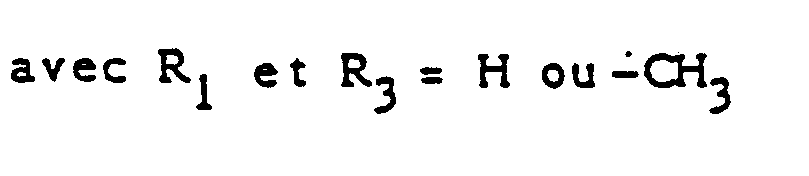
- N-acrylyl (L) proline or its methyl ester, of formula: with R, and R 3 having the previous meaning.
- the functionalization for obtaining the copolymers according to the invention is carried out by creating an arm by amidification with ethylenediamine, to give B:
- the solid phase peptide synthesis method which has been developed since 1962 using mainly polystyrenic supports (MERRIFIELD resin, benzhydrylamine resin, alkoxybenzylic resin, PAM resin, ...) is well known and has made the subject of numerous developments (for example ERICKSON & MERRIFIELD, in NEURATH and HILL, The Proteins, Vol. 2, Academic Press, 1976, p. 255; BIRR, Aspects of the Merrifield peptide synthesis, Springer 1978; BARANY and MERRIFIELD, in GROSS and MEIENHOFER, The peptides: analysis, synthesis, biology, Vol. 2, Part A, Academic Press, 1980, p.1).
- the resin is esterified or amidified by the N-protected amino acid occupying in the peptide to be synthesized the C-terminal position.
- the coupling is carried out, using one of the many methods described in the literature, with the N-protected amino acid occupying the penultimate position in the sequence to be synthesized. These operations are repeated until the desired peptide sequence is obtained on the resin. In the last step, the peptide is cleaved from its support.
- reaction between B and C to give D can be carried out practically quantitatively by means of one of the coupling agents or catalyst mentioned above, or by the action of B on an activated ester (prepared with 2,4,5,5-trichlorophenol, pentachlorophenol, etc.) of C , in the presence or not of a catalyst (HOBT, BOP).
- a catalyst HOBT, BOP
- the binding of the C-terminal amino acid in the first step, and the final cleavage of the peptide from its support are carried out under the same conditions as above.
- the resins thus functionalized and used in peptide synthesis have a functionalization rate of between 0.2 and 5 meq per gram and, preferably. between 1.0 and 1.2 meq per gram of dry support.
- the supports which are the subject of the invention have the property of exhibiting good permeability and of swelling notably in a wide range of protic and aprotic solvents, as well as in aqueous buffers of varied pH.
- the resin carrying the N-Boc or the N-Fmoc amino acid C-terminal behaves as a "pseudo-solution" and the gel thus formed is infiltrable. This creates particularly favorable conditions, approaching those of the homogeneous phase, for the formation of the peptide bond.
- a third solvent ether, THF, dioxane
- the peptide is synthesized on an acrylic resin obtained by copolymerizing N-acrylylpyrrolidine, ethylenebisacrylamide and the N-acrylic derivative of the methyl ester of s -aminocaproic acid.
- the support is then functionalized as follows: to 1 g of resin (bearing functional groups C0 2 CH 3 ), 32 ml of redistilled ethylenediamine are added and the mixture is stirred overnight at room temperature. Filtered, washed with demineralized water until neutral, then with ethanol and ether. The resin is finally dried for 24 h in a vacuum oven; it then contains 1 meq of NH 2 per gram of dry polymer.
- symmetrical anhydrides could be prepared from Boc Gly OH, N ⁇ ZN a Boc Lys OH Boc Val OH, Boc Leu OH, Boc Met OH, and Ac Gly OH.
- N G N0 2 N a Boc Arg OH the product is dissolved in the minimum of DMF and the volume made up to 20 ml with dry methylene chloride; then the reaction is carried out as described above.
- the resin After coupling of the last amino acid, the resin is dried under high vacuum in the presence of P 2 0 5 for 24 hours then suspended in 50 ml of trifluoroacetic acid. A slow current of dry HBr is then bubbled for 2 hours. It is filtered and rinsed abundantly with CH 2 CI 2 and Et 2 0. This acidolysis deprotects the side chains of the lysines.
- the orange-red powder obtained is then suspended in 100 ml of 2 M trifluoroacetic acid and we aloute 5 g of zinc powder. After 12 hours of stirring at room temperature, abundantly washed with 2N HCl, with water, with ethanol and finally with anhydrous ethyl ether. This hydrogenolysis cleaves the nitro carried by the guanidino from arginine.
Landscapes
- Chemical & Material Sciences (AREA)
- Organic Chemistry (AREA)
- Chemical Kinetics & Catalysis (AREA)
- Health & Medical Sciences (AREA)
- Medicinal Chemistry (AREA)
- Polymers & Plastics (AREA)
- Analytical Chemistry (AREA)
- Genetics & Genomics (AREA)
- Life Sciences & Earth Sciences (AREA)
- Biochemistry (AREA)
- Biophysics (AREA)
- General Health & Medical Sciences (AREA)
- General Chemical & Material Sciences (AREA)
- Molecular Biology (AREA)
- Proteomics, Peptides & Aminoacids (AREA)
- Addition Polymer Or Copolymer, Post-Treatments, Or Chemical Modifications (AREA)
- Organic Low-Molecular-Weight Compounds And Preparation Thereof (AREA)
- Peptides Or Proteins (AREA)
- Dental Preparations (AREA)
- Compositions Of Macromolecular Compounds (AREA)
- Polymerisation Methods In General (AREA)
- Separation Of Suspended Particles By Flocculating Agents (AREA)
- Graft Or Block Polymers (AREA)
- Cosmetics (AREA)
- Manufacture Of Macromolecular Shaped Articles (AREA)
Description
- La présente invention concerne de nouveaux copolymères acryliques, leur préparation ainsi que leur emploi dans la synthèse peptidique en phase solide.
- Les nouveaux copolymères selon l'invention dérivent de ceux décrits par la demanderesse dans sa demande de brevet publiée EP-A-0 079 842 par une fonctionnalisation à l'aide de l'éthylènediamine. Les copolymères de la demande précédente - que l'on désigne par A ou

- 1 - Un monomère défini comme étant la maille du support et qui consiste en une N-acrylylpolyméthylèneimine de formule:


- II - Un monomère défini comme étant l'agent de réticulation et qui consiste en un N,N'- bisacrylyldiaminoalcane de formule:

- III - Par gramme de support sec, 0,2 à 5 mmol d'un monomère défini comme étant l'agent de fonctionnalisation et qui consiste en un N-acrylylaminoacide ou ester, de formule:

ou un N-acrylylaminoacide (ou ester) asymétrique de série L, de formule:


- Ou encore la N-acrylyl (L) proline, ou son ester méthylique, de formule:

- La fonctionnalisation pour obtenir les copolymères selon l'invention s'effectue en créant un bras par amidification avec l'éthylènediamine, pour donner B:

- Cette amidification peut être réalisée par l'une des voies suivantes:
- a) à partir de la fonction acide (A, R3 = H), par couplage avec l'éthylène diamine au moyen de l'un des réactifs couramment utilisé dans la littérature: dicyctohexytcarbodiimide (DCC) en présence d'un agent d'activation comme l'hydroxy-1 benzotriazole (HOBt), ou le benzotriazol-1-yl-oxy-tris (diméthylamino) phosphonium hexafluoro phosphate (BOP);
- b) à partir de la fonction ester (A, R3 = CH3), par agitation de la résine à température ambiante avec un excès d'éthylènediamine anhydre.
- Avec cette dernière méthode, une étude systématique des conditions expérimentales a permis de limiter les réactions secondaires de pontage et de conserver 90 % du taux de fonctionnalisation initial.
- La méthode de synthèse peptidique en phase solide, qui s'est développée depuis 1962 en utilisant principalement des supports polystyréniques (résine de MERRIFIELD, résine à la benzhydrylamine, résine alcoxybenzylique, résine PAM,...) est bien connue et a fait l'objet de nombreuses mises au point (par exemple ERICKSON & MERRIFIELD, in NEURATH et HILL, The Proteins, Vol. 2, Academic Press, 1976, p. 255; BIRR, Aspects of the Merrifield peptide synthesis, Springer 1978; BARANY et MERRIFIELD, in GROSS et MEIENHOFER, The peptides: analysis, synthesis, biology, Vol. 2, Part A, Academic Press, 1980, p.1). La résine, convenablement fonctionnalisée, est estérifiée ou amidifiée par l'aminoacide N-protégé occupant dans le peptide à synthétiser la position C-terminale. Après déprotection de la fonction amine, le couplage est effectué, en utilisant l'une des nombreuses méthodes décrites dans la littérature, avec l'aminoacide N-protégé occupant l'avant-dernière position dans la séquence à synthétiser. Ces opérations sont répétées jusqu'à obtention sur la résine de l'enchaînement peptidique désiré. Dans la dernière étape, le peptide est clivé de son support.
- Cette méthode présente des avantages certains par rapport à la synthèse en solution: en particulier, simplicité et rapidité du processus (il n'est plus nécessaire d'isoler et de purifier le peptide après chaque couplage), élimination aisée des réactifs en excès et des impuretés par filtration et lavage du support, absence ou forte diminution de la racémisation. Une contrainte concerne toutefois l'obligation de parvenir, pour chaque couplage, à un rendement pratiquement quantitatif; chaque réaction incomplète conduirait en effet à une accumulation de chaînes peptidiques tronquées qui contamineraient le produit final. D'où la nécessité d'utiliser des excès importants en réactifs et de répéter chaque opération de couplage jusqu'à ce qu'un test analytique approprié (à la ninhydrine par exemple) indique la disparition sur la résine de toute fonction NH2 libre. De telles conditions expérimentales deviennent cependant dissuasives lorsque la synthèse implique l'emploi d'aminoacides non naturels, éventuellement rares et coûteux.
- De façon à tirer profit des avantages associés aux réactions intervenant en phase homogène, il a été proposé d'utiliser des polymères solubles (cf. MUTTER et BAYER, in GROSS et MEINHOFER, The peptides: analysis, synthesis, biology, Vol. 2, Part A, Academic Press, 1980, p.285), et en particulier le polyéthylèneglycol. Cette technique est cependant restée d'une utilisation limitée, vrai semblablement en raison des problèmes expérimentaux posés par.:
- - la diminution de solubilité pouvant accompagner l'allongement de la chaîne peptidique,
- - l'isolement du support après chaque couplage, qui nécessite une ultrafiltration (MUTTER, HAGENMAIER et BAYER, Angew. Chem. Int. Ed., 1971, 10, 811; BAYER, GATFIELD, MUTTER et MUTTER, Tetrahedron, 1978, 34, 1829), ou une cristallisation par addition d'éther, après éventuelle élimination du solvant (BAYER et MUTTER, Chem. Ber., 1974, 107, 1344; MUTTER, UHMANN et BAYER, Ann. Chem., 1975, p. 901
- CORRING et JUNG, Ann. Chem., 1975, p. 1765 et 1776)
- - le clivage du peptide de son support (TJOENG, TONG et HODGES, J. Org. Chem., 1978,43,4190; TJOENG et HODGES, Tetrahedron Letters, 1979, p. 1273 ; MUTTER, BAYER et GATFIELD, J. Org. Chem., 1980,45,5364).
- Les mêmes difficultés interviennent dans le cas des supports solubles à base de polystyrène faiblement ou non réticulé, qui impliquent une filtration de gel (BIRR, in Peptides "1972", North Holland Publ., 1973, p. 72; ANDRETTA et RINK, Helv. Chim. Acta, 1973, 56, 1205) ou une précipitation par l'alcool (NARITA, Bull. Chem. Soc. Japan, 1978, 51, 1477).
- Enfin la technique alternée phase liquide-phase solide (FRANK, MEYER e t HAGENMAIER, Chem. Zeit., 1977, 101,188) s'est également peu développée.
- Plus récemment, la supériorité des supports polyacryliques comme le PAP de WALTER (J. Amer. Chem. Soc., 1979, 101, 5383) et la résine de SHEPPARD (JCS Perkin 1, 1981, p. 529 et 538), qui possèdent la propriété de gonfler dans une bien plus large gamme de solvants que les polymères styréniques, a été mise en évidence (ATHERTON, GAIT, SHEPPARD et WILLIAMS, Bioorg. Chem. 1979, 8, 774). Il y a, en particulier: un clivage plus facile en fin de synthèse, entre le polypeptide et son support; une meilleure compatibilité entre les propriétés de solvatation du support et de la partie peptidique en train de croître, ce qui est de nature à limiter les troncatures et les couplages aberrants. L'influence favorable de la solvatation du système résine-peptide sur le rendement des couplages a particulièrement été mise en évidence (ATHERTON, WOOLNEY et SHEPPARD, Chem. Corrm., 1980, p. 970). Toutefois, les corrmentaires que nous avons déjà formulés dans le cas des résines polystyréniques, en ce qui concerne l'emploi d'un large excès de réactifs (de l'ordre de 2,5 fois) et la nécessité de répéter généralement à plusieurs reprises chaque opération de couplage, restent toujours valables. A cet égard, il est significatif que des synthèses récentes de polypeptides à longue chaîne utilisent encore la méthode en solution (par exemple KENNER, RAKAGE et SHEPPARD, Tetrahedron, 1979,35,2767; NAGARAJ et BALARAN, Tetrahedron, 1981, 37, 1263; FUJII et YAJIMA, JCS Perkin 11981, p.789, 787 et 804.
- Afin de pallier les différences de solvatation déjà évoquées plus haut, entre la matrice et la chaîne polypeptidique en train de croître, un nouveau gel polyacrylamide a été récemment proposé (R. EPTON et A. WILLIAMS Inst. J. Biol. Macromol. 1981, 3, 334). Sur ce support, l'encombrement stérique est tel que ce type de résine n'a été utilisé que pour la synthèse de peptides courts. Enfin la déprotection finale nécessite un temps très long de traitement au trifluorure de bore, (plusieurs jours).
- Comme on le verra ci-après, les supports faisant l'objet de la présente invention permettent une simplification et une amélioration notables des conditions de la synthèse peptidique; ils peuvent être utilisés tels quels si les peptides synthétisés n'ont pas besoin d'être séparés de leur support. Si les peptides doivent être séparés, il est, par contre, nécessaire d'apporter une modification de la résine selon l'invention en introduisant un système d'ancrage réversible. A titre d'exemple non limitatif, il est possible d'utiliser un réactif du type C (MITCHELL, ERICKSON, RYABTSEV, HODGES et MERRIFIELD, J. Amer. Chem. Soc., 1976; STAHL, WALTER et SMITH, J. Amer. Chem. Soc., 1979, 101, 5383; ATHERTON, LOGAN et SHEPPARD, JCS Perkin I, 1981, p. 538; ATHERTON, HUBSCHER, SHEPPARD et WOOLEY, 2. Physiol. Chem. 1981, 362, 833).

- Y est un groupe -CH2-0- ou un groupe -CH2
- La réaction entre B et C pour donner D:

- Un autre système d'ancrage reversible a été réalisé en utilisant un réactif du type E (R5 - H ou CH3) qui est condensé avec B pour donner F:

- Ce type d'ancrage, déjà employé sur des résines polystyréniques (MIZOGUCHI, SHIGEZAN et TAKAMURA, Chem. Pharm-Bull., 1970, 18, 1465; WANG, J. Org. Chem, 1976, 41, 3258), est original dans le cas d'un support polyacrylique.
- La fixation de l'aminoacide C-terminal dans la première étape, et le clivage final du peptide de son support sont réalisés dans les mêmes conditions que ci-dessus.
- Les résines ainsi fonctionnalisées et utilisées en synthèse peptidique ont un taux de fonctionnalisation compris eentre 0,2 et 5 mèq par gramme et, de préférence. entre 1,0 et 1,2 mèq par gramme de support sec.
- La fixation sur la résine de l'aminoacide C-terminal, dont le NH2 est protégé par exemple par le groupe acido-labile t-butyloxycarbonyle (Boc) ou par le groupe baso-labile fluorénylméthyloxycarbonyle (Fmoc) peut être réalisée par plusieurs voies:
- - par l'intermédiaire du sel de césium pour X = CI ou Br,
- - par action du dicyclohexylcarbodiimide (DCC) en présence de diméthylamino-4 pyridine (DMAP) comme catalyseur, pour X = OH,
- - ou encore, dans le cas où X = OH, en préparant extemporanément l'anhydride symétrique de l'aminoacide N-protégé, et en le faisant réagir sur D en présence de DMAP. Le clivage final du peptide de son support est réalisé:
- - par une base minérale en solution diluée lorsque Y est un groupe méthylène ou lorsqu'on utilise F; avec NH3/CH30H il est poss ible d'obtenir un amide-C terminal;
- - par un acide organique tel que l'acide trifluoracétique en solution diluée, lorsque Y représente un groupe -CH2-0
- Les supports faisant l'objet de l'invention ont la propriété de présenter une bonne perméabilité et de gonfler notablement dans une large gamme de solvants protiques et aprotiques, ainsi que dans des tampons aqueux de pH variés.
- Dans ces conditions, lors d'un couplage, la résine porteur du N-Boc ou du N-Fmoc aminoacide C-terminal (ou du peptide en cours d'élaboration et convenablement protégé) se comporte corrme une "pseudo-solution" et le gel ainsi constitué est infiltrable. Ceci crée des conditions particulièrement favorables, se rapprochant de celles de la phase homogène, pour la formation de la liaison peptidique. La réaction terminée, l'addition d'un tiers solvant (éther, THF, dioxanne) provoque l'expulsion du solvant perméant la résine et la précipitation de celle-ci sous une forme aisément et rapidement filtrable, contrairement à ce qui se passe dans l'état de la technique.
- Ces propriétés particulières et spécifiques des résines de l'invention conduisent à une augmentation significative de la vitesse (multipliée au moins par trois, par rapport à ce qui est connu) et du rendement des couplages. Il en résulte, pour chaque couplage individuel, la possibilité de diminuer notablement la valeur du rapport: nombre de moles d'aminoacide N-protégé/taux de fonctionnalisation du support: 1,1 à 1,2 alors que les valeurs usuelles sont de l'ordre de 2,5. En outre, il n'y a jamais de colmatage des colonnes lors des filtrations intermédiaires.
- L'alternance du couplage en phase quasi-homogène et de la précipitation du support constitue ainsi une méthodologie nouvelle, simplifiée et améliorée de synthèse peptidique en phase solide.
- Le protocole d'une opération de couplage peut, à titre d'exemple, être le suivant:
- 1. Addition d'un solvant inerte tel que CHCI3, CH2CI2 ou DMF pour gonfler la résine supportant le N-Boc aminoacide C-terminal (ou le peptide convenablement protégé);
- 2. Un lavage à l'aide d'un éther linéaire ou cyclique tel que l'éther éthylique, l'éther isopropylique, le THF ou le dioxane;
- 3. Addition d'acide trifluoracétique dans le solvant pour effectuer la déprotection du NH2;
- 4. Précipitation de la résine par addition d'éther comme en 2;
- 5. Filtration suivie de quatre lavages à l'éther comme en 2;
- 6. Neutralisation par addition de diisopropyléthylamine dans un solvant inerte;
- 7. Quatre lavages à l'éther comme en 2, puis séchage dans un courant d'azote;
- 8. Couplage par agitation avec une solution, dans le solvant chloré, de l'anhydride symétrique (préparé extemporanément) d'un N-Boc aminoacide;
- 9. Précipitation par addition d'éther comme en 2 et filtration, et
- 10. Quatre lavages à l'éther comme en 2.
- Cette nouvelle méthodologie a été testée avec succès dans la synthèse de peptides présentant un intérêt biologique par exemple un undécapeptide Ac-Gly-Gly-Lys-Gly-Gly-Ala-Arg-Lys-Val-Leu-Homoser.
- Le peptide est synthétisé sur une résine acrylique obtenue en copolymérisant la N-acrylylpyrrolidine, l'éthylènebisacrylamide et le dérivé N-acrylique de l'ester méthylique de l'acide s -aminocaproique. Le support est ensuite fonctionnalisé de la façon suivante: à 1 g de résine (portant des groupes fonctionnels C02CH3), on ajoute 32 ml d'éthylènediamine redistillée et agite pendant une nuit à température ambiante. On filtre, lave à l'eau déminéralisée jusqu'à neutralité, puis à l'éthanol et à l'éther. La résine est finalement séchée pendant 24 h à l'étuve sous vide; elle contient alors 1 meq de NH2 par gramme de polymère sec.
- Il a été utilisé 2 g de résine, soit 2 meq en NHZ. Le cycle d'opération nécessaire pour accrocher un aminoacide sur la résine est le suivant:
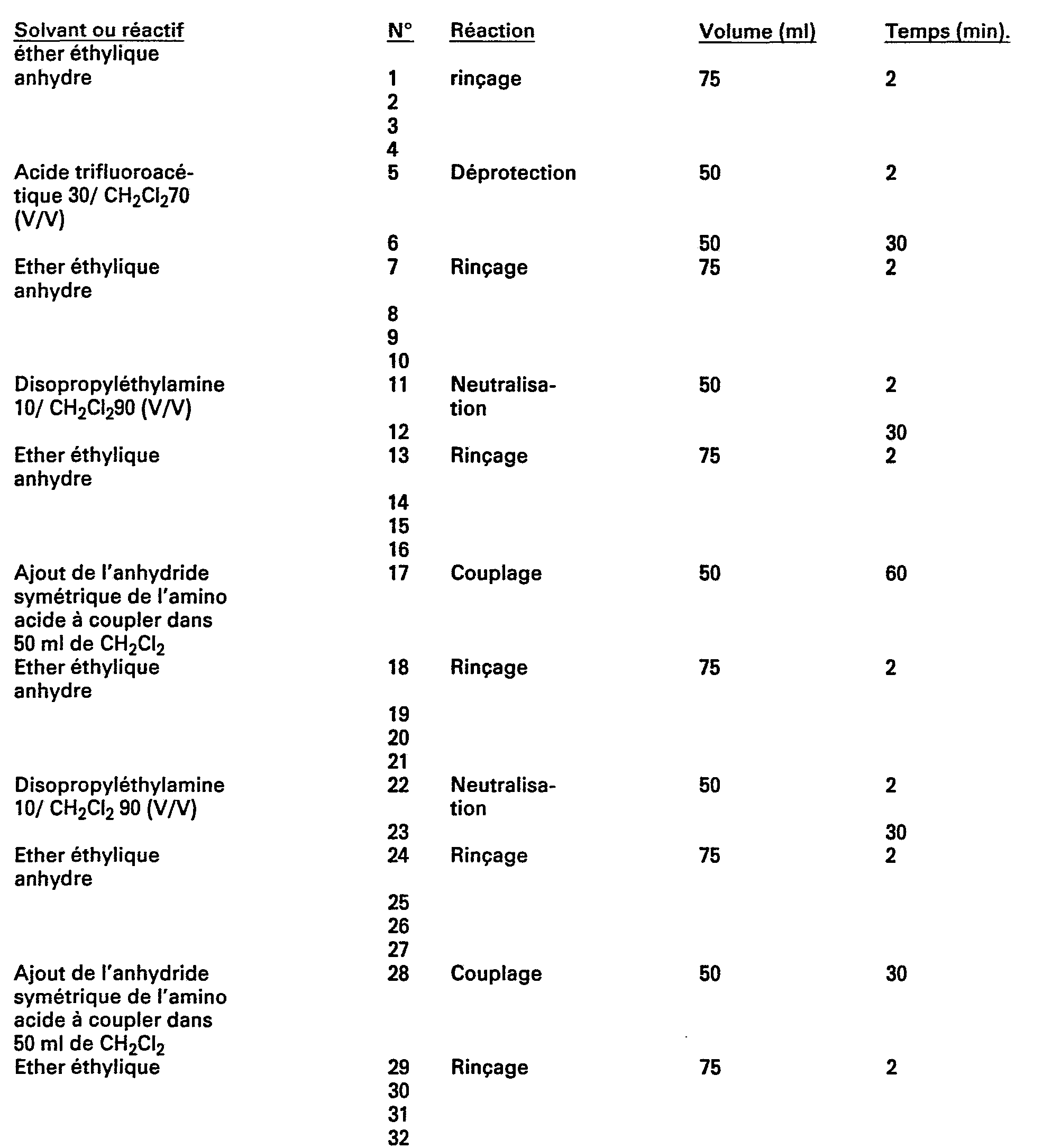
- Vérification du déroulement du couplage à l'aide du test de Kaiser à la ninhydrine.
- Comme le décrit le processus expérimental, il a été systématiquement effectué deux couplages pour chaque acide aminé introduit. La réaction de couplage est effectuée à l'aide des anhydrides symétriques qui sont préparés de la manière suivante:
- 1 mmol de l'acide aminé protégé est dissoute dans 20 ml de CH2CI2 anhydre, la solution est refroidie à 0° et on ajoute alors 0,5 mmole de dicyclohexylcarbodiimide en solution dans 10 ml de CH2CI2. Après 20 minutes de réaction à 0°C, on filtre le précipité de dicyclohexylurée qui est rincé avec 20 ml de CH2CI2, les solutions sont jointes et mises en contact avec la résine dans le réacteur.
- Par cette méthode, ont pu être préparés les anhydrides symétriques à partir de Boc Gly OH, Nε Z Na Boc Lys OH Boc Val OH, Boc Leu OH, Boc Met OH, et Ac Gly OH. Dans le cas de NG N02 Na Boc Arg OH, le produit est dissous dans le minimum de DMF et le volume complété à 20 ml avec du chlorure de méthylène sec; ensuite la réaction est effectuée comme il est décrit plus haut.
- Après couplage du dernier aminoacide la résine est séchée sous vide poussé en présence de P205 durant 24 heures puis mise en suspension dans 50 ml d'acide trifluoroacétique. On fait alors barboter durant 2 heures un lent courant de HBr sec. On filtre et on rince abondarrment avec CH2CI2 et Et20. Cette acidolyse déprotège les chaînes latérales des lysines.
- La poudre rouge orangée obtenue est alors mise en suspension dans 100 ml d'acide trifluoroacétique 2 M et on aloute 5 g de zinc en poudre. Après 12 heures d'agitation à température ambiante, on lave abondamment avec HCI 2N, à l'eau, à l'éthanol et finalement à l'éther éthylique anhydre. Cette hydrogénolyse clive le nitro porté par le guanidino de l'arginine.
- Après séchage de la résine sous vide poussé et sur P205 durant 12 heures, on prélève un grarrme de polymère qui est traité, par 2,5 g de bromure de cyanogène dans 70 ml d' acide propionique. Après 24 heures de réaction à température ambiante, on lyophylise et on obtient le peptide désiré avec un rendement de 45 %.
Claims (5)




Priority Applications (1)
| Application Number | Priority Date | Filing Date | Title |
|---|---|---|---|
| AT82402109T ATE28468T1 (de) | 1981-11-19 | 1982-11-19 | Aethylendiamin funktionelle acrylharze und verfahren zur herstellung. |
Applications Claiming Priority (2)
| Application Number | Priority Date | Filing Date | Title |
|---|---|---|---|
| GB8134861 | 1981-11-19 | ||
| GB8134861 | 1981-11-19 |
Publications (2)
| Publication Number | Publication Date |
|---|---|
| EP0081408A1 EP0081408A1 (fr) | 1983-06-15 |
| EP0081408B1 true EP0081408B1 (fr) | 1987-07-22 |
Family
ID=10525991
Family Applications (2)
| Application Number | Title | Priority Date | Filing Date |
|---|---|---|---|
| EP82402109A Expired EP0081408B1 (fr) | 1981-11-19 | 1982-11-19 | Nouveaux copolymères acryliques à fonctionnalisation aminée et leur préparation |
| EP82402110A Expired EP0079842B1 (fr) | 1981-11-19 | 1982-11-19 | Nouveaux copolymères acryliques à base de N-acrylylpolyméthylèneimines ou de N-acrylyldialcoylamides, de N,N'-acrylyldiaminoalcanes et de N-acrylylaminoacides (ou esters), leur préparation et leur emploi comme échangeurs cationiques |
Family Applications After (1)
| Application Number | Title | Priority Date | Filing Date |
|---|---|---|---|
| EP82402110A Expired EP0079842B1 (fr) | 1981-11-19 | 1982-11-19 | Nouveaux copolymères acryliques à base de N-acrylylpolyméthylèneimines ou de N-acrylyldialcoylamides, de N,N'-acrylyldiaminoalcanes et de N-acrylylaminoacides (ou esters), leur préparation et leur emploi comme échangeurs cationiques |
Country Status (15)
| Country | Link |
|---|---|
| US (2) | US4436874A (fr) |
| EP (2) | EP0081408B1 (fr) |
| JP (2) | JPS5896615A (fr) |
| KR (2) | KR860000526B1 (fr) |
| AT (2) | ATE14890T1 (fr) |
| AU (2) | AU556992B2 (fr) |
| CA (2) | CA1199448A (fr) |
| DE (2) | DE3265458D1 (fr) |
| DK (2) | DK162532C (fr) |
| FI (2) | FI70234C (fr) |
| MX (2) | MX169477B (fr) |
| NO (2) | NO161978C (fr) |
| NZ (2) | NZ202539A (fr) |
| PL (2) | PL137653B1 (fr) |
| ZA (2) | ZA828369B (fr) |
Families Citing this family (27)
| Publication number | Priority date | Publication date | Assignee | Title |
|---|---|---|---|---|
| US4631327A (en) * | 1982-12-29 | 1986-12-23 | Polaroid Corporation | β-Elimination polymers useful for providing diffusion control layers in diffusion transfer photographic products |
| US4683292A (en) * | 1983-08-12 | 1987-07-28 | Immunetech, Inc. | Immunotherapeutic polypeptide agents which bind to lymphocyte immunoglobulin FC receptors |
| JPS60235638A (ja) * | 1984-05-07 | 1985-11-22 | Mitsui Toatsu Chem Inc | 吸着・分離方法 |
| EP0163404B1 (fr) * | 1984-05-28 | 1990-06-27 | MITSUI TOATSU CHEMICALS, Inc. | Agent d'absorption et de relâchement de vapeur d'eau |
| US4691026A (en) * | 1985-07-30 | 1987-09-01 | Air Products And Chemicals, Inc. | Self- and hydroxyl reactive formaldehyde-free cyclic hemiamidal and hemiamide ketal crosslinking monomers |
| US4788288A (en) * | 1985-07-30 | 1988-11-29 | Air Products And Chemicals, Inc. | Self-and Hydroxyl reactive formaldehyde-free cyclic hemiamidal and hemiamide ketal crosslinking monomers |
| US4663410A (en) * | 1985-08-06 | 1987-05-05 | Air Products And Chemicals, Inc. | Polymers of self- and hydroxyl reactive formaldehyde-free cyclic hemiamidal and hemiamide ketal crosslinking monomers |
| GB8822502D0 (en) * | 1988-09-24 | 1988-10-26 | Expansia Sa | New peptide synthesis method |
| US5175254A (en) * | 1988-09-24 | 1992-12-29 | Societe D'expansion Scientifque Expansia | Solid phase peptide synthesis using a polyacrylic support in aqueous solution |
| US5280093A (en) * | 1989-06-29 | 1994-01-18 | Rhone-Poulenc Chimie | Chiral polymers for the synthesis of pure enantiomers of amino acids |
| US6031074A (en) * | 1989-08-25 | 2000-02-29 | National Institutes Of Health | Automated Peptide design and synthesis |
| FR2652581B1 (fr) * | 1989-10-02 | 1991-12-13 | Rhone Poulenc Chimie | Procede de solubilisation de peptides et procede de synthese de peptides. |
| US7056935B2 (en) * | 1995-06-07 | 2006-06-06 | Gpi Nil Holdings, Inc. | Rotamase enzyme activity inhibitors |
| US20020042377A1 (en) * | 1995-06-07 | 2002-04-11 | Steiner Joseph P. | Rotamase enzyme activity inhibitors |
| US20040221844A1 (en) * | 1997-06-17 | 2004-11-11 | Hunt Peter John | Humidity controller |
| FR2791582B1 (fr) * | 1999-04-02 | 2001-06-08 | Expansia Sa | Utilisation d'un support polymerique acrylique en catalyse supportee |
| AR021155A1 (es) | 1999-07-08 | 2002-06-12 | Lundbeck & Co As H | Tratamiento de desordenes neuroticos |
| FR2802121A1 (fr) * | 1999-12-14 | 2001-06-15 | Expansia Sa | Supports polymeriques organiques possedant des ligands mono- ou bi-dentates et leur utilisation en catalyse supportee |
| US6620939B2 (en) * | 2001-09-18 | 2003-09-16 | General Electric Company | Method for producing bisphenol catalysts and bisphenols |
| US7112702B2 (en) * | 2002-12-12 | 2006-09-26 | General Electric Company | Process for the synthesis of bisphenol |
| US7098253B2 (en) * | 2004-05-20 | 2006-08-29 | 3M Innovative Properties Company | Macroporous ion exchange resins |
| US7674835B2 (en) * | 2005-12-21 | 2010-03-09 | 3M Innovative Properties Company | Method of making macroporous anion exchange resins |
| US7683100B2 (en) * | 2005-12-21 | 2010-03-23 | 3M Innovative Properties Company | Method of making macroporous cation exchange resins |
| US7674836B2 (en) * | 2006-07-28 | 2010-03-09 | 3M Innovative Properties Company | Method of making macroporous cation exchange resins |
| JP2015214592A (ja) * | 2012-09-11 | 2015-12-03 | 味の素株式会社 | 温度応答性ポリマー及びその製造方法 |
| JP7135284B2 (ja) * | 2017-09-29 | 2022-09-13 | 株式会社リコー | 組成物、硬化物、収容容器、像形性装置、及び像形成方法 |
| CN110128589B (zh) * | 2019-05-31 | 2021-12-03 | 上海纳米技术及应用国家工程研究中心有限公司 | 一种氨基酸改性微球的制备方法及其产品 |
Family Cites Families (10)
| Publication number | Priority date | Publication date | Assignee | Title |
|---|---|---|---|---|
| US2845408A (en) * | 1954-08-04 | 1958-07-29 | Rohm & Haas | Linear polymeric amides and methods of making them |
| US3069390A (en) * | 1959-07-17 | 1962-12-18 | Borden Co | Polymeric amides from polymeric acrylic acid esters and n-aminoalkyl alkanol amines and reaction products therefrom |
| BE627745A (fr) * | 1962-01-31 | |||
| GB1108383A (en) * | 1965-12-23 | 1968-04-03 | Kodak Ltd | Acrylic polymers and light sensitive materials containing them |
| JPS4948668B1 (fr) * | 1971-06-26 | 1974-12-23 | ||
| US3814732A (en) * | 1971-10-21 | 1974-06-04 | Hoffmann La Roche | Modified solid supports for solid phase synthesis |
| NL7311320A (fr) * | 1972-09-01 | 1974-03-05 | ||
| FR2205538A1 (en) * | 1972-11-06 | 1974-05-31 | Ceskoslovenska Akademie Ved | Acrylate or methacrylate copolymer - useful as support for solid phase peptide synthesis |
| DE2430128C3 (de) * | 1974-06-22 | 1981-11-05 | Röhm GmbH, 6100 Darmstadt | Verfahren zur Herstellung trägergebundener Polypeptide |
| US3965070A (en) * | 1974-10-07 | 1976-06-22 | Rohm And Haas Company | Crosslinked vinylcarbonyl resins having α-amino acid functionality |
-
1982
- 1982-11-10 US US06/440,440 patent/US4436874A/en not_active Expired - Lifetime
- 1982-11-10 US US06/440,441 patent/US4439545A/en not_active Expired - Lifetime
- 1982-11-15 ZA ZA828369A patent/ZA828369B/xx unknown
- 1982-11-15 FI FI823906A patent/FI70234C/fi not_active IP Right Cessation
- 1982-11-15 ZA ZA828370A patent/ZA828370B/xx unknown
- 1982-11-15 FI FI823905A patent/FI70233C/fi not_active IP Right Cessation
- 1982-11-16 CA CA000415705A patent/CA1199448A/fr not_active Expired
- 1982-11-16 CA CA000415706A patent/CA1199449A/fr not_active Expired
- 1982-11-17 NZ NZ202539A patent/NZ202539A/en unknown
- 1982-11-17 NZ NZ202538A patent/NZ202538A/en unknown
- 1982-11-18 DK DK513382A patent/DK162532C/da not_active IP Right Cessation
- 1982-11-18 AU AU90678/82A patent/AU556992B2/en not_active Ceased
- 1982-11-18 MX MX007920A patent/MX169477B/es unknown
- 1982-11-18 NO NO823864A patent/NO161978C/no not_active IP Right Cessation
- 1982-11-18 PL PL1982239100A patent/PL137653B1/pl unknown
- 1982-11-18 DK DK513282A patent/DK162651C/da not_active IP Right Cessation
- 1982-11-18 NO NO823865A patent/NO161977C/no not_active IP Right Cessation
- 1982-11-18 AU AU90677/82A patent/AU553982B2/en not_active Ceased
- 1982-11-18 MX MX007921A patent/MX166906B/es unknown
- 1982-11-18 PL PL1982239101A patent/PL138979B1/pl unknown
- 1982-11-19 JP JP57203540A patent/JPS5896615A/ja active Granted
- 1982-11-19 DE DE8282402110T patent/DE3265458D1/de not_active Expired
- 1982-11-19 AT AT82402110T patent/ATE14890T1/de active
- 1982-11-19 KR KR8205234A patent/KR860000526B1/ko not_active Expired
- 1982-11-19 AT AT82402109T patent/ATE28468T1/de not_active IP Right Cessation
- 1982-11-19 DE DE8282402109T patent/DE3276811D1/de not_active Expired
- 1982-11-19 KR KR8205233A patent/KR860000559B1/ko not_active Expired
- 1982-11-19 JP JP57203541A patent/JPS5891703A/ja active Pending
- 1982-11-19 EP EP82402109A patent/EP0081408B1/fr not_active Expired
- 1982-11-19 EP EP82402110A patent/EP0079842B1/fr not_active Expired
Also Published As
Similar Documents
| Publication | Publication Date | Title |
|---|---|---|
| CA1199448A (fr) | Copolymeres acryliques a fonctionnalisation aminee et leur preparation | |
| EP3778621B1 (fr) | Procédé de synthèse peptidique | |
| JP2513775B2 (ja) | 固相ペプチド合成用支持体 | |
| JP2001500134A (ja) | 改良型固相ペプチド合成及びかかる合成において利用するための試薬 | |
| FR2521553A1 (fr) | Glycine 8-calcitonine | |
| KR20210102362A (ko) | 플레카나타이드의 개선된 제조 방법 | |
| EP1246837B1 (fr) | Oligomeres de mimes contraints non peptidiques de dipeptides ou de tripeptides, et leur utilisation pour la synthese de proteines et polypeptides artificiels | |
| JP2549704B2 (ja) | ペプチド合成用担体 | |
| EP0583338B1 (fr) | Procede de synthese de peptides, nouveaux derives d'acides amines mis en oeuvre dans ce procede et leurs procedes de preparation | |
| FR2557114A1 (fr) | Nouveaux derives de la gonadoliberine, procede pour leur preparation et compositions pharmaceutiques les contenant | |
| FR2522655A1 (fr) | Analogues de la somatostatine possedant une liaison du type hydrazide et medicaments en contenant | |
| FR2607703A1 (fr) | Polypeptides a action immunologique, leur procede de preparation, et leur utilisation pour la preparation de vaccins antipaludeens et de trousses de diagnostic pour la detection d'anticorps antisporozoaires | |
| EP0295540B1 (fr) | Système en phase solide contenant des chaînes allyliques, son procédé de préparation et son utilisation dans les réactions en phase solide | |
| JPH072744A (ja) | カルボカルシトニンの獲得方法 | |
| CN110551178B (zh) | 一种含脯氨酸的首尾环肽合成方法 | |
| CN109810169B (zh) | 一种Reltecimod的液相制备方法 | |
| KR100418962B1 (ko) | 2-(4-나이트로페닐설포닐)에톡시카르보닐-아미노산류를사용하여 펩티드를 고수율 및 고순도로 제조하는 방법 | |
| CA2031484C (fr) | Milieu reactionnel et solubilisant de peptides et procede de synthese utilisant ce milieu | |
| LU87592A1 (fr) | Synthese peptidique en phase solide | |
| FR2521554A1 (fr) | Des-asparagine-3-calcitonine | |
| RU2777327C1 (ru) | Способ синтеза пептидов | |
| CN102241762B (zh) | 固相合成人工e选择素的方法 | |
| FR2608925A1 (fr) | Composition de polypeptides a action immunologique, son procede de preparation, et son utilisation pour la preparation de vaccins antipaludeens et de trousses de diagnostic pour la detection d'anticorps antimerozoaires | |
| EP1171405A1 (fr) | Support solide fonctionnalise pour la synthese d'alpha-oxoaldehydes | |
| FR2629459A1 (fr) | Peptides pf11 a pf19 d'un retrovirus hiv - procede de synthese de ces peptides - leur utilisation notamment pour le diagnostic |
Legal Events
| Date | Code | Title | Description |
|---|---|---|---|
| PUAI | Public reference made under article 153(3) epc to a published international application that has entered the european phase |
Free format text: ORIGINAL CODE: 0009012 |
|
| AK | Designated contracting states |
Designated state(s): AT BE CH DE FR GB IT LI LU NL SE |
|
| 17P | Request for examination filed |
Effective date: 19830930 |
|
| RAP1 | Party data changed (applicant data changed or rights of an application transferred) |
Owner name: SOCIETE D'EXPANSION SCIENTIFIQUE EXPANSIA SOCIETE |
|
| GRAA | (expected) grant |
Free format text: ORIGINAL CODE: 0009210 |
|
| AK | Designated contracting states |
Kind code of ref document: B1 Designated state(s): AT BE CH DE FR GB IT LI LU NL SE |
|
| REF | Corresponds to: |
Ref document number: 28468 Country of ref document: AT Date of ref document: 19870815 Kind code of ref document: T |
|
| REF | Corresponds to: |
Ref document number: 3276811 Country of ref document: DE Date of ref document: 19870827 |
|
| ITF | It: translation for a ep patent filed | ||
| PLBE | No opposition filed within time limit |
Free format text: ORIGINAL CODE: 0009261 |
|
| STAA | Information on the status of an ep patent application or granted ep patent |
Free format text: STATUS: NO OPPOSITION FILED WITHIN TIME LIMIT |
|
| 26N | No opposition filed | ||
| ITTA | It: last paid annual fee | ||
| EPTA | Lu: last paid annual fee | ||
| EAL | Se: european patent in force in sweden |
Ref document number: 82402109.1 |
|
| PGFP | Annual fee paid to national office [announced via postgrant information from national office to epo] |
Ref country code: SE Payment date: 19991005 Year of fee payment: 18 |
|
| PGFP | Annual fee paid to national office [announced via postgrant information from national office to epo] |
Ref country code: FR Payment date: 19991013 Year of fee payment: 18 |
|
| PGFP | Annual fee paid to national office [announced via postgrant information from national office to epo] |
Ref country code: AT Payment date: 19991019 Year of fee payment: 18 |
|
| PGFP | Annual fee paid to national office [announced via postgrant information from national office to epo] |
Ref country code: BE Payment date: 19991026 Year of fee payment: 18 |
|
| PGFP | Annual fee paid to national office [announced via postgrant information from national office to epo] |
Ref country code: LU Payment date: 19991028 Year of fee payment: 18 |
|
| PGFP | Annual fee paid to national office [announced via postgrant information from national office to epo] |
Ref country code: DE Payment date: 19991123 Year of fee payment: 18 |
|
| PGFP | Annual fee paid to national office [announced via postgrant information from national office to epo] |
Ref country code: GB Payment date: 19991129 Year of fee payment: 18 |
|
| PGFP | Annual fee paid to national office [announced via postgrant information from national office to epo] |
Ref country code: NL Payment date: 19991130 Year of fee payment: 18 |
|
| PGFP | Annual fee paid to national office [announced via postgrant information from national office to epo] |
Ref country code: CH Payment date: 20000209 Year of fee payment: 18 |
|
| PG25 | Lapsed in a contracting state [announced via postgrant information from national office to epo] |
Ref country code: LU Free format text: LAPSE BECAUSE OF NON-PAYMENT OF DUE FEES Effective date: 20001119 Ref country code: GB Free format text: LAPSE BECAUSE OF NON-PAYMENT OF DUE FEES Effective date: 20001119 Ref country code: AT Free format text: LAPSE BECAUSE OF NON-PAYMENT OF DUE FEES Effective date: 20001119 |
|
| PG25 | Lapsed in a contracting state [announced via postgrant information from national office to epo] |
Ref country code: SE Free format text: THE PATENT HAS BEEN ANNULLED BY A DECISION OF A NATIONAL AUTHORITY Effective date: 20001129 |
|
| PG25 | Lapsed in a contracting state [announced via postgrant information from national office to epo] |
Ref country code: LI Free format text: LAPSE BECAUSE OF NON-PAYMENT OF DUE FEES Effective date: 20001130 Ref country code: CH Free format text: LAPSE BECAUSE OF NON-PAYMENT OF DUE FEES Effective date: 20001130 Ref country code: BE Free format text: LAPSE BECAUSE OF NON-PAYMENT OF DUE FEES Effective date: 20001130 |
|
| BERE | Be: lapsed |
Owner name: SOC. D'EXPANSION SCIENTIFIQUE EXPANSIA S.A. Effective date: 20001130 |
|
| PG25 | Lapsed in a contracting state [announced via postgrant information from national office to epo] |
Ref country code: NL Free format text: LAPSE BECAUSE OF NON-PAYMENT OF DUE FEES Effective date: 20010601 |
|
| GBPC | Gb: european patent ceased through non-payment of renewal fee |
Effective date: 20001119 |
|
| REG | Reference to a national code |
Ref country code: CH Ref legal event code: PL |
|
| EUG | Se: european patent has lapsed |
Ref document number: 82402109.1 |
|
| PG25 | Lapsed in a contracting state [announced via postgrant information from national office to epo] |
Ref country code: FR Free format text: LAPSE BECAUSE OF NON-PAYMENT OF DUE FEES Effective date: 20010731 |
|
| NLV4 | Nl: lapsed or anulled due to non-payment of the annual fee |
Effective date: 20010601 |
|
| PG25 | Lapsed in a contracting state [announced via postgrant information from national office to epo] |
Ref country code: DE Free format text: LAPSE BECAUSE OF NON-PAYMENT OF DUE FEES Effective date: 20010801 |
|
| REG | Reference to a national code |
Ref country code: FR Ref legal event code: ST |