EP0063349B1 - 5-Acyloxy-4 (5H)-oxazolonium-Salze, Verfahren zu ihrer Herstellung und ihre Verwendung als Zwischenprodukte zur Synthese von herbizid wirksamen Triazinonen - Google Patents
5-Acyloxy-4 (5H)-oxazolonium-Salze, Verfahren zu ihrer Herstellung und ihre Verwendung als Zwischenprodukte zur Synthese von herbizid wirksamen Triazinonen Download PDFInfo
- Publication number
- EP0063349B1 EP0063349B1 EP82103111A EP82103111A EP0063349B1 EP 0063349 B1 EP0063349 B1 EP 0063349B1 EP 82103111 A EP82103111 A EP 82103111A EP 82103111 A EP82103111 A EP 82103111A EP 0063349 B1 EP0063349 B1 EP 0063349B1
- Authority
- EP
- European Patent Office
- Prior art keywords
- atoms
- process according
- carbon atoms
- molar ratio
- acid
- Prior art date
- Legal status (The legal status is an assumption and is not a legal conclusion. Google has not performed a legal analysis and makes no representation as to the accuracy of the status listed.)
- Expired
Links
- 238000000034 method Methods 0.000 title claims description 27
- 150000003839 salts Chemical class 0.000 title claims description 21
- 238000002360 preparation method Methods 0.000 title claims description 7
- 239000000543 intermediate Substances 0.000 title description 5
- 230000015572 biosynthetic process Effects 0.000 title description 4
- 238000003786 synthesis reaction Methods 0.000 title description 3
- 230000002363 herbicidal effect Effects 0.000 title 1
- 125000004432 carbon atom Chemical group C* 0.000 claims description 39
- 239000002253 acid Substances 0.000 claims description 23
- WFDIJRYMOXRFFG-UHFFFAOYSA-N Acetic anhydride Chemical compound CC(=O)OC(C)=O WFDIJRYMOXRFFG-UHFFFAOYSA-N 0.000 claims description 21
- 150000001264 acyl cyanides Chemical class 0.000 claims description 19
- 125000000217 alkyl group Chemical group 0.000 claims description 19
- 125000003545 alkoxy group Chemical group 0.000 claims description 17
- QAOWNCQODCNURD-UHFFFAOYSA-N Sulfuric acid Chemical compound OS(O)(=O)=O QAOWNCQODCNURD-UHFFFAOYSA-N 0.000 claims description 15
- 150000001244 carboxylic acid anhydrides Chemical class 0.000 claims description 14
- 229910052736 halogen Inorganic materials 0.000 claims description 12
- 150000002367 halogens Chemical class 0.000 claims description 12
- 238000006243 chemical reaction Methods 0.000 claims description 11
- 125000004093 cyano group Chemical group *C#N 0.000 claims description 9
- 125000000449 nitro group Chemical group [O-][N+](*)=O 0.000 claims description 8
- 239000002904 solvent Substances 0.000 claims description 8
- NPBLQPWAISGYEU-UHFFFAOYSA-N 2,2-dimethylpropanoyl cyanide Chemical compound CC(C)(C)C(=O)C#N NPBLQPWAISGYEU-UHFFFAOYSA-N 0.000 claims description 7
- 239000001257 hydrogen Substances 0.000 claims description 7
- 229910052739 hydrogen Inorganic materials 0.000 claims description 7
- IJGRMHOSHXDMSA-UHFFFAOYSA-N Atomic nitrogen Chemical compound N#N IJGRMHOSHXDMSA-UHFFFAOYSA-N 0.000 claims description 6
- 125000003118 aryl group Chemical group 0.000 claims description 6
- 125000002924 primary amino group Chemical group [H]N([H])* 0.000 claims description 6
- 150000002429 hydrazines Chemical class 0.000 claims description 5
- 150000007522 mineralic acids Chemical class 0.000 claims description 5
- 125000003277 amino group Chemical group 0.000 claims description 4
- 150000007524 organic acids Chemical class 0.000 claims description 4
- 125000001997 phenyl group Chemical group [H]C1=C([H])C([H])=C(*)C([H])=C1[H] 0.000 claims description 4
- BFNNILAMSKQDRN-UHFFFAOYSA-N 2h-1,2,4-triazin-5-one Chemical class O=C1C=NNC=N1 BFNNILAMSKQDRN-UHFFFAOYSA-N 0.000 claims description 3
- NINIDFKCEFEMDL-UHFFFAOYSA-N Sulfur Chemical compound [S] NINIDFKCEFEMDL-UHFFFAOYSA-N 0.000 claims description 3
- 125000004414 alkyl thio group Chemical group 0.000 claims description 3
- 150000001450 anions Chemical class 0.000 claims description 3
- 125000004104 aryloxy group Chemical group 0.000 claims description 3
- 125000004122 cyclic group Chemical group 0.000 claims description 3
- QAOWNCQODCNURD-UHFFFAOYSA-M hydrogensulfate Chemical compound OS([O-])(=O)=O QAOWNCQODCNURD-UHFFFAOYSA-M 0.000 claims description 3
- 229910052757 nitrogen Inorganic materials 0.000 claims description 3
- 229910052760 oxygen Inorganic materials 0.000 claims description 3
- 239000001301 oxygen Substances 0.000 claims description 3
- 125000002373 5 membered heterocyclic group Chemical group 0.000 claims description 2
- CIUQDSCDWFSTQR-UHFFFAOYSA-N [C]1=CC=CC=C1 Chemical compound [C]1=CC=CC=C1 CIUQDSCDWFSTQR-UHFFFAOYSA-N 0.000 claims description 2
- QVGXLLKOCUKJST-UHFFFAOYSA-N atomic oxygen Chemical compound [O] QVGXLLKOCUKJST-UHFFFAOYSA-N 0.000 claims description 2
- 125000005842 heteroatom Chemical group 0.000 claims description 2
- 239000001117 sulphuric acid Substances 0.000 claims description 2
- 125000004435 hydrogen atom Chemical group [H]* 0.000 claims 2
- 239000005864 Sulphur Substances 0.000 claims 1
- 125000002887 hydroxy group Chemical group [H]O* 0.000 claims 1
- 235000011149 sulphuric acid Nutrition 0.000 claims 1
- 125000003396 thiol group Chemical class [H]S* 0.000 claims 1
- -1 acyloxy radical Chemical class 0.000 description 13
- 239000000243 solution Substances 0.000 description 12
- PXGOKWXKJXAPGV-UHFFFAOYSA-N Fluorine Chemical compound FF PXGOKWXKJXAPGV-UHFFFAOYSA-N 0.000 description 8
- WKBOTKDWSSQWDR-UHFFFAOYSA-N Bromine atom Chemical compound [Br] WKBOTKDWSSQWDR-UHFFFAOYSA-N 0.000 description 7
- ZAMOUSCENKQFHK-UHFFFAOYSA-N Chlorine atom Chemical compound [Cl] ZAMOUSCENKQFHK-UHFFFAOYSA-N 0.000 description 7
- UFHFLCQGNIYNRP-UHFFFAOYSA-N Hydrogen Chemical group [H][H] UFHFLCQGNIYNRP-UHFFFAOYSA-N 0.000 description 6
- 229910052794 bromium Inorganic materials 0.000 description 6
- 229910052801 chlorine Inorganic materials 0.000 description 6
- 239000000460 chlorine Substances 0.000 description 6
- 239000011541 reaction mixture Substances 0.000 description 6
- QTBSBXVTEAMEQO-UHFFFAOYSA-N Acetic acid Chemical compound CC(O)=O QTBSBXVTEAMEQO-UHFFFAOYSA-N 0.000 description 5
- 150000007513 acids Chemical class 0.000 description 5
- 150000008064 anhydrides Chemical class 0.000 description 5
- VLTRZXGMWDSKGL-UHFFFAOYSA-N perchloric acid Chemical compound OCl(=O)(=O)=O VLTRZXGMWDSKGL-UHFFFAOYSA-N 0.000 description 5
- JCXJVPUVTGWSNB-UHFFFAOYSA-N Nitrogen dioxide Chemical class O=[N]=O JCXJVPUVTGWSNB-UHFFFAOYSA-N 0.000 description 4
- LJTFFORYSFGNCT-UHFFFAOYSA-N Thiocarbohydrazide Chemical compound NNC(=S)NN LJTFFORYSFGNCT-UHFFFAOYSA-N 0.000 description 4
- DTQVDTLACAAQTR-UHFFFAOYSA-N Trifluoroacetic acid Chemical compound OC(=O)C(F)(F)F DTQVDTLACAAQTR-UHFFFAOYSA-N 0.000 description 4
- GDTBXPJZTBHREO-UHFFFAOYSA-N bromine Substances BrBr GDTBXPJZTBHREO-UHFFFAOYSA-N 0.000 description 4
- 239000011737 fluorine Substances 0.000 description 4
- 229910052731 fluorine Inorganic materials 0.000 description 4
- XLYOFNOQVPJJNP-UHFFFAOYSA-N water Substances O XLYOFNOQVPJJNP-UHFFFAOYSA-N 0.000 description 4
- YMWUJEATGCHHMB-UHFFFAOYSA-N Dichloromethane Chemical compound ClCCl YMWUJEATGCHHMB-UHFFFAOYSA-N 0.000 description 3
- 229910052799 carbon Inorganic materials 0.000 description 3
- 238000002329 infrared spectrum Methods 0.000 description 3
- 150000002500 ions Chemical class 0.000 description 3
- 125000002496 methyl group Chemical group [H]C([H])([H])* 0.000 description 3
- 238000001228 spectrum Methods 0.000 description 3
- 239000007858 starting material Substances 0.000 description 3
- 238000005160 1H NMR spectroscopy Methods 0.000 description 2
- 150000001199 N-acyl amides Chemical class 0.000 description 2
- NBIIXXVUZAFLBC-UHFFFAOYSA-N Phosphoric acid Chemical compound OP(O)(O)=O NBIIXXVUZAFLBC-UHFFFAOYSA-N 0.000 description 2
- 229960000583 acetic acid Drugs 0.000 description 2
- 125000003668 acetyloxy group Chemical group [H]C([H])([H])C(=O)O[*] 0.000 description 2
- 238000001460 carbon-13 nuclear magnetic resonance spectrum Methods 0.000 description 2
- 150000001732 carboxylic acid derivatives Chemical class 0.000 description 2
- 239000003153 chemical reaction reagent Substances 0.000 description 2
- 239000012634 fragment Substances 0.000 description 2
- 150000002431 hydrogen Chemical class 0.000 description 2
- 230000007062 hydrolysis Effects 0.000 description 2
- 238000006460 hydrolysis reaction Methods 0.000 description 2
- 125000004356 hydroxy functional group Chemical group O* 0.000 description 2
- 229910052740 iodine Inorganic materials 0.000 description 2
- 238000004519 manufacturing process Methods 0.000 description 2
- 238000002844 melting Methods 0.000 description 2
- 230000008018 melting Effects 0.000 description 2
- 239000000203 mixture Substances 0.000 description 2
- 238000003756 stirring Methods 0.000 description 2
- 239000000126 substance Substances 0.000 description 2
- PXQLVRUNWNTZOS-UHFFFAOYSA-N sulfanyl Chemical class [SH] PXQLVRUNWNTZOS-UHFFFAOYSA-N 0.000 description 2
- 239000000725 suspension Substances 0.000 description 2
- 125000000999 tert-butyl group Chemical group [H]C([H])([H])C(*)(C([H])([H])[H])C([H])([H])[H] 0.000 description 2
- 125000001399 1,2,3-triazolyl group Chemical group N1N=NC(=C1)* 0.000 description 1
- 125000003626 1,2,4-triazol-1-yl group Chemical group [*]N1N=C([H])N=C1[H] 0.000 description 1
- 125000001401 1,2,4-triazol-4-yl group Chemical group N=1N=C([H])N([*])C=1[H] 0.000 description 1
- KCOPAESEGCGTKM-UHFFFAOYSA-N 1,3-oxazol-4-one Chemical compound O=C1COC=N1 KCOPAESEGCGTKM-UHFFFAOYSA-N 0.000 description 1
- 238000001644 13C nuclear magnetic resonance spectroscopy Methods 0.000 description 1
- JJUMRPCLXYQXJO-UHFFFAOYSA-N 4-butyl-3-sulfanylidene-2H-1,2,4-triazin-5-one Chemical compound C(CCC)N1C(=NN=CC1=O)S JJUMRPCLXYQXJO-UHFFFAOYSA-N 0.000 description 1
- ZCYVEMRRCGMTRW-UHFFFAOYSA-N 7553-56-2 Chemical compound [I] ZCYVEMRRCGMTRW-UHFFFAOYSA-N 0.000 description 1
- MVAZZWYHBVOXJM-UHFFFAOYSA-N CC(CC(CN)[IH]CC(NC)=S)=N Chemical compound CC(CC(CN)[IH]CC(NC)=S)=N MVAZZWYHBVOXJM-UHFFFAOYSA-N 0.000 description 1
- NUWLTBQOVAZUSQ-UHFFFAOYSA-N C[S+]=C(NN)NN Chemical compound C[S+]=C(NN)NN NUWLTBQOVAZUSQ-UHFFFAOYSA-N 0.000 description 1
- CGBGULHWHYSJKC-UHFFFAOYSA-N C[S+]=C(NN)NN.I Chemical compound C[S+]=C(NN)NN.I CGBGULHWHYSJKC-UHFFFAOYSA-N 0.000 description 1
- 101100116570 Caenorhabditis elegans cup-2 gene Proteins 0.000 description 1
- ZAFNJMIOTHYJRJ-UHFFFAOYSA-N Diisopropyl ether Chemical compound CC(C)OC(C)C ZAFNJMIOTHYJRJ-UHFFFAOYSA-N 0.000 description 1
- MYMOFIZGZYHOMD-UHFFFAOYSA-N Dioxygen Chemical compound O=O MYMOFIZGZYHOMD-UHFFFAOYSA-N 0.000 description 1
- 101100116572 Drosophila melanogaster Der-1 gene Proteins 0.000 description 1
- VEXZGXHMUGYJMC-UHFFFAOYSA-N Hydrochloric acid Chemical compound Cl VEXZGXHMUGYJMC-UHFFFAOYSA-N 0.000 description 1
- 238000010521 absorption reaction Methods 0.000 description 1
- 125000002777 acetyl group Chemical group [H]C([H])([H])C(*)=O 0.000 description 1
- 125000001931 aliphatic group Chemical group 0.000 description 1
- 229910000147 aluminium phosphate Inorganic materials 0.000 description 1
- 150000001408 amides Chemical class 0.000 description 1
- 125000003785 benzimidazolyl group Chemical group N1=C(NC2=C1C=CC=C2)* 0.000 description 1
- GJQBHOAJJGIPRH-UHFFFAOYSA-N benzoyl cyanide Chemical compound N#CC(=O)C1=CC=CC=C1 GJQBHOAJJGIPRH-UHFFFAOYSA-N 0.000 description 1
- CODNYICXDISAEA-UHFFFAOYSA-N bromine monochloride Chemical compound BrCl CODNYICXDISAEA-UHFFFAOYSA-N 0.000 description 1
- 150000001649 bromium compounds Chemical class 0.000 description 1
- 125000002915 carbonyl group Chemical group [*:2]C([*:1])=O 0.000 description 1
- 150000001735 carboxylic acids Chemical class 0.000 description 1
- 230000003197 catalytic effect Effects 0.000 description 1
- 239000007795 chemical reaction product Substances 0.000 description 1
- 150000001805 chlorine compounds Chemical class 0.000 description 1
- VXIVSQZSERGHQP-UHFFFAOYSA-N chloroacetamide Chemical class NC(=O)CCl VXIVSQZSERGHQP-UHFFFAOYSA-N 0.000 description 1
- FOCAUTSVDIKZOP-UHFFFAOYSA-N chloroacetic acid Chemical class OC(=O)CCl FOCAUTSVDIKZOP-UHFFFAOYSA-N 0.000 description 1
- 150000001875 compounds Chemical class 0.000 description 1
- 150000001983 dialkylethers Chemical class 0.000 description 1
- VILAVOFMIJHSJA-UHFFFAOYSA-N dicarbon monoxide Chemical group [C]=C=O VILAVOFMIJHSJA-UHFFFAOYSA-N 0.000 description 1
- 125000004177 diethyl group Chemical group [H]C([H])([H])C([H])([H])* 0.000 description 1
- 238000001035 drying Methods 0.000 description 1
- 230000000694 effects Effects 0.000 description 1
- TWAOQVMPIYQPKG-UHFFFAOYSA-N ethanone Chemical compound C[C+]=O TWAOQVMPIYQPKG-UHFFFAOYSA-N 0.000 description 1
- 230000002349 favourable effect Effects 0.000 description 1
- 125000002541 furyl group Chemical group 0.000 description 1
- 239000007789 gas Substances 0.000 description 1
- 239000012362 glacial acetic acid Substances 0.000 description 1
- 229910000042 hydrogen bromide Inorganic materials 0.000 description 1
- CPELXLSAUQHCOX-UHFFFAOYSA-N hydrogen bromide Substances Br CPELXLSAUQHCOX-UHFFFAOYSA-N 0.000 description 1
- 239000005457 ice water Substances 0.000 description 1
- 125000002883 imidazolyl group Chemical group 0.000 description 1
- 239000011630 iodine Substances 0.000 description 1
- PNDPGZBMCMUPRI-UHFFFAOYSA-N iodine Chemical compound II PNDPGZBMCMUPRI-UHFFFAOYSA-N 0.000 description 1
- 238000002955 isolation Methods 0.000 description 1
- 125000000842 isoxazolyl group Chemical group 0.000 description 1
- 239000000155 melt Substances 0.000 description 1
- 230000011987 methylation Effects 0.000 description 1
- 238000007069 methylation reaction Methods 0.000 description 1
- FOXFZRUHNHCZPX-UHFFFAOYSA-N metribuzin Chemical compound CSC1=NN=C(C(C)(C)C)C(=O)N1N FOXFZRUHNHCZPX-UHFFFAOYSA-N 0.000 description 1
- 238000002156 mixing Methods 0.000 description 1
- 125000002757 morpholinyl group Chemical group 0.000 description 1
- UUZOPMILQWLFJR-UHFFFAOYSA-N n-acetyl-3,3-dimethyl-2-oxobutanamide Chemical compound CC(=O)NC(=O)C(=O)C(C)(C)C UUZOPMILQWLFJR-UHFFFAOYSA-N 0.000 description 1
- 230000007935 neutral effect Effects 0.000 description 1
- 239000003960 organic solvent Substances 0.000 description 1
- 125000002971 oxazolyl group Chemical group 0.000 description 1
- 125000004430 oxygen atom Chemical group O* 0.000 description 1
- 150000003009 phosphonic acids Chemical class 0.000 description 1
- 125000003386 piperidinyl group Chemical group 0.000 description 1
- 239000002244 precipitate Substances 0.000 description 1
- WYVAMUWZEOHJOQ-UHFFFAOYSA-N propionic anhydride Chemical compound CCC(=O)OC(=O)CC WYVAMUWZEOHJOQ-UHFFFAOYSA-N 0.000 description 1
- 238000000425 proton nuclear magnetic resonance spectrum Methods 0.000 description 1
- 230000005588 protonation Effects 0.000 description 1
- 125000003226 pyrazolyl group Chemical group 0.000 description 1
- 125000000168 pyrrolyl group Chemical group 0.000 description 1
- 239000012429 reaction media Substances 0.000 description 1
- 230000035484 reaction time Effects 0.000 description 1
- 239000013558 reference substance Substances 0.000 description 1
- 238000007127 saponification reaction Methods 0.000 description 1
- 229910052717 sulfur Inorganic materials 0.000 description 1
- 239000011593 sulfur Substances 0.000 description 1
- YBRBMKDOPFTVDT-UHFFFAOYSA-N tert-butylamine Chemical class CC(C)(C)N YBRBMKDOPFTVDT-UHFFFAOYSA-N 0.000 description 1
Classifications
-
- C—CHEMISTRY; METALLURGY
- C07—ORGANIC CHEMISTRY
- C07D—HETEROCYCLIC COMPOUNDS
- C07D253/00—Heterocyclic compounds containing six-membered rings having three nitrogen atoms as the only ring hetero atoms, not provided for by group C07D251/00
- C07D253/02—Heterocyclic compounds containing six-membered rings having three nitrogen atoms as the only ring hetero atoms, not provided for by group C07D251/00 not condensed with other rings
- C07D253/06—1,2,4-Triazines
- C07D253/065—1,2,4-Triazines having three double bonds between ring members or between ring members and non-ring members
- C07D253/07—1,2,4-Triazines having three double bonds between ring members or between ring members and non-ring members with hetero atoms, or with carbon atoms having three bonds to hetero atoms with at the most one bond to halogen, e.g. ester or nitrile radicals, directly attached to ring carbon atoms
- C07D253/075—Two hetero atoms, in positions 3 and 5
-
- C—CHEMISTRY; METALLURGY
- C07—ORGANIC CHEMISTRY
- C07D—HETEROCYCLIC COMPOUNDS
- C07D263/00—Heterocyclic compounds containing 1,3-oxazole or hydrogenated 1,3-oxazole rings
- C07D263/02—Heterocyclic compounds containing 1,3-oxazole or hydrogenated 1,3-oxazole rings not condensed with other rings
- C07D263/30—Heterocyclic compounds containing 1,3-oxazole or hydrogenated 1,3-oxazole rings not condensed with other rings having two or three double bonds between ring members or between ring members and non-ring members
- C07D263/34—Heterocyclic compounds containing 1,3-oxazole or hydrogenated 1,3-oxazole rings not condensed with other rings having two or three double bonds between ring members or between ring members and non-ring members with hetero atoms or with carbon atoms having three bonds to hetero atoms with at the most one bond to halogen, e.g. ester or nitrile radicals, directly attached to ring carbon atoms
- C07D263/44—Two oxygen atoms
Definitions
- the invention relates to novel 4 (5H) -oxazolonium salts obtainable in the form of a solution with an acyloxy radical in the 5-position, a process for their preparation and their use as intermediates for the synthesis of known, herbicidally active 3,4,6-trisubstituted 1, 2,4-triazine-5 (4H) -ones.
- acyl cyanides to be used as starting materials are generally defined by the formula.
- heterocyclic radicals R ' which are particularly suitable are: morpholinyl, imidazolyl, pyrazolyl, pyrrolyl, isoxazolyl, piperidinyl, oxazolyl, 1,2,4-triazol-1-yl, 1,2,4-tri azol-4-yl, 1,2,3-triazolyl, 1,2,4-thiadiazol-2-yl, benzimidazolyl and furanyl.
- acyl cyanides of formula 11 are known; Not yet known acyl cyanides can be prepared by known processes (cf. " Angew. Chem.”, 68, pp. 425-435 [1965]; furthermore DE-A No. 2614240, 2614241, 2614242, 2708182, 2708183).
- Pivaloyl cyanide and benzoyl cyanide may be mentioned as particularly preferred acyl cyanides in the context of this invention.
- carboxylic anhydrides of the formula III to be used as starting materials are available on an industrial scale or by generally known methods, e.g. can be produced from the corresponding carboxylic acids.
- the formation of the carboxylic anhydrides of the formula III can, if appropriate, also in the reaction medium using known anhydride reagents, such as e.g. concentrated sulfuric acid.
- carboxylic anhydrides are acetic anhydride, propionic anhydride and the anhydrides of chloroacetic acids.
- the inventive reaction is carried out with a pK a value smaller than 2 in the presence of an acid.
- acids are inorganic acids, such as concentrated sulfuric acid, hydrohalic acids, for example anhydrous hydrogen chloride and hydrogen bromide, and perchloric acid and phosphoric acid.
- inorganic acids such as concentrated sulfuric acid, hydrohalic acids, for example anhydrous hydrogen chloride and hydrogen bromide, and perchloric acid and phosphoric acid.
- aliphatic and aromatic sulfonic and phosphonic acids and haloalkane carboxylic acids such as trifluoroacetic acid. Concentrated sulfuric acid is preferably used.
- reaction temperatures can be varied within a substantial range and are between 0 and 120, preferably between 10 and 60 ° C.
- the reaction is generally carried out at normal pressure.
- the reaction can be carried out in the absence or in the presence of a solvent or solubilizer.
- a solvent or solubilizer Certain organic solvents can be used as solubilizers; glacial acetic acid and dichloromethane, and also dialkyl ethers, such as diethyl or diisopropyl ether, are particularly suitable.
- 0.5 to 10, preferably 0.8 to 4 mol of carboxylic anhydride of the formula III are generally employed per 1 mol of acyl cyanide of the formula II; a molar ratio of acyl cyanide II to carboxylic anhydride III of 1: 1 to 1: 2 is particularly preferred.
- the acids required for carrying out the process according to the invention are used in catalytic to overstoichiometric amounts.
- 0.5 to 10, preferably 0.8 to 8 mol, particularly preferably 1 to 4 mol of acid are used per 1 mol of acyl cyanide II.
- a molar ratio of carboxylic anhydride III to acid of 1: 2 is particularly advantageous.
- the acid and the anhydride or the mixture of carboxylic acid and anhydride reagent, if appropriate with the addition of a solvent are initially introduced and the acyl cyanide, if appropriate in a solvent, is added.
- the reaction times are generally 1 to 10 hours.
- the reaction mixture prepared by the process described above is a solution of the 5-acyloxy-4 (5H) -oxazolonium salts I.
- the structure of the oxazolonium salts is clearly evident from the IR, 1 H-NMR and 13 C-NMR spectra of the reaction mixture. This is illustrated using the example of 5-acetoxy-5-tert-butyl-2-methyl-4 (5H) -oxazolonium ion la.
- the ion is obtained by mixing pivaloyl cyanide, acetic anhydride and anhydrous sulfuric acid in a molar ratio of 1: 1: 3, according to the procedure described above.
- the signal at 193 ppm comes from a strongly positive carbon atom, similar to the acetyl cation. It is the 2-C atom of the oxazolinone system.
- the signals at 171 and 167 ppm can be easily assigned to the carbonyl carbon atom of the 5-acetoxy group and the 4-C atom of the oxazolonium system.
- the signal at 109 ppm in the shift position corresponds to a C atom between two oxygen atoms, as with ketals, and is assigned to the 5 C atom of the oxazolonium system.
- the signal at 39.1 ppm corresponds to the tertiary C atom and that at 22.7 ppm to the primary C atoms of the tert-butyl group.
- the signals at 20.6 and 17.0 ppm originate from the C atoms of the methyl groups at C-2 of the oxazolonium system and in the acetyl group. (Table on the next page)
- the 5-acyloxy-4 (5H) -oxazolonium salts which can be prepared by the process according to the invention are new and can be used as intermediates for the preparation of known herbicidally active triazinones (cf. for example DE-A Nos. 1542873,1695596 and 1795784, also US Pat. A nos. 3671523 and 3905801) can be used.
- the 5-acyloxy-4 (5H) -oxazolonium salts I according to the invention thus represent a new, valuable class of intermediates, for example for the synthesis of a-ketocarboxylic acid-N-acylamides (and - by further hydrolysis - of the corresponding, widely usable a-ketocarboxylic acids of Formula R 1 -CO-COOH) and herbicidally active 1,2,4-triazin-5-one derivatives.
- a-ketocarboxylic acid-N-acylamides V as such are the subject of an older request for protection (cf. EP-A No. 0035707).
- the direct reaction of the new 5-acyloxy-4 (5H) -oxazolonium salts I with the hydrazine derivatives VI to give the desired 1,2,4-triazine-5 (4H) derivatives IV is preferred over the Process variant, which proceeds via the previous hydrolysis of the salts I and intermediate isolation of the a-ketocarboxylic acid N-acylamide V.
- the process given here for the preparation of herbicidally active asymmetric triazions IV using the novel 5-acyloxy-4 (5H) -oxazolonium salts according to the invention is comparable to the previously known process using a-ketocarboxylic acid N-tert-butylamides ( see DE-A Nos. 2733180 and 2733181) technically superior.
- the 5-acyloxy-4 (5H) -oxazolonium salts I according to the invention can be treated with hydrazine derivatives VI, e.g.
- Thiocarbohydrazide or S-methylthiocarbohydrazide under very mild conditions, are almost quantitatively cyclized to asymmetric triazinones, which are immediately obtained in high purity, while the known a-ketocarboxylic acid N-tert.-butylamides are heated to 100 ° C. for several hours with thiocarbohydrazide must and only yield about 70% yield.
- reaction temperatures are generally between 0 and 100, preferably between 15 and 60 ° C.
- the herbicidally particularly active compound 4-amino-6-tert-butyl-3-methylthio-1,2,4 is obtained from the 5-acetoxy-5-tert-butyl-2-methyloxazolonium salt la according to the following reaction scheme -triazin-5 (4H) -one IVb (see DE-C No. 1795784 and US-A No. 3671523; furthermore US-A No. 3905801 and DE-A No. 1695596).
- the methylation IVa ⁇ IVb is previously known (see, for example, " Chem. Ber.”, 97, pp. 2173-8 [1964]; DE-A No. 2733180, also US-A No. 3890317, 3897429 and 4035364).
- the solution of oxazolonium hydrogen sulfate la is prepared analogously to Example 1. This solution is added dropwise to the suspension of 74.4 g (0.3 mol) of S-methylthiocarbohydrazide hydroiodide in 300 ml of water and then stirred at 50 ° C. for 0.5 h. An oil separates, which is separated off and stirred twice with 100 ml of water. 39.9 g (74.6% of theory) of crude 4-amino-6-t-butyl-3-methylmercapto-1,2,4-triazin-5 (4H) -one are obtained. A recrystallized sample melts at 121-123 ° C.
Landscapes
- Chemical & Material Sciences (AREA)
- Organic Chemistry (AREA)
- Agricultural Chemicals And Associated Chemicals (AREA)
- Heterocyclic Carbon Compounds Containing A Hetero Ring Having Nitrogen And Oxygen As The Only Ring Hetero Atoms (AREA)
- Plural Heterocyclic Compounds (AREA)
Description
- Die Erfindung betrifft neuartige, in Form einer Lösung erhältliche 4(5H)-Oxazoloniumsalze mit einem Acyloxyrest in 5-Stellung, ein Verfahren zu ihrer Herstellung und ihre Verwendung als Zwischenprodukte zur Synthese von bekannten, herbizid wirksamen 3,4,6-trisubstituierten 1,2,4-Triazin-5(4H)-onen.
- Es sind bereits 4(5H)-Oxazoloniumsalze bekannt, die in 5-Stellung Wasserstoff oder niedere Alkylgruppen tragen:

- R=Niederalkyl;
- R'=Wasserstoff oder Niederalkyl;
- A=CI04, Cl, Br.
- Diese Substanzen wurden hergestellt durch Umsetzung von a-Hydroxycarbonsäureamiden mit Anhydriden in Gegenwart von 70%iger Perchlorsäure ("Khim. Geterosikl. Soedin", 1977, 702;"Zh. Org. Khim.", 12 [1976] 1134 und SU-A Nr. 159825 [25.1.1979]) oder durch Umsetzung von a-Halogenessigsäurebromiden mit Amiden ("Ukr. chim. Z.", 30 [1964] 3, 265) oder durch Umsetzung von Chloracetamiden mit Säurechloriden ("Ukr. chim. Z.", 30 [1964] 6, 618 und ibid. 32 [1966] 2, 202).
- Nach allen oben beschriebenen Verfahren können nur 4(5H)-Oxazoloniumsalze erhalten werden, die in 5-Stellung Wasserstoff oder Alkylgruppen tragen. 5-Acyloxy-4(5H)-oxazolonium- salze sind auf diesen Wegen nicht zugänglich.
- Es wurde nun überraschend gefunden, dass man die neuen 5-Acyloxy-4(5H)-oxazolonium- salze der allgemeinen Formel I:
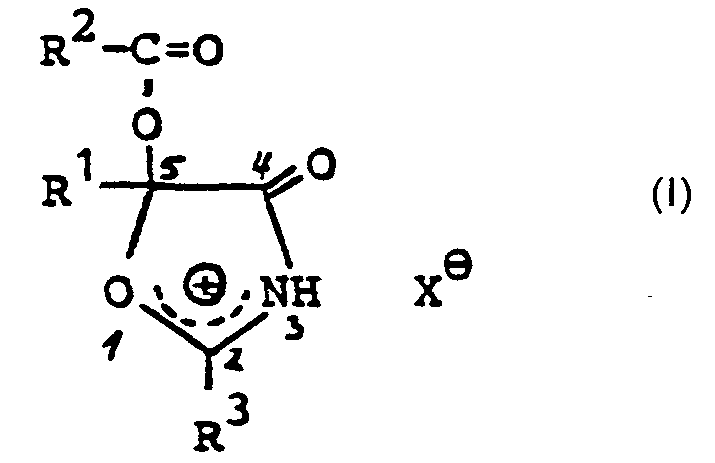
- R' für einen gegebenenfalls durch Alkoxy mit 1 bis 4 Kohlenstoffatomen, Carbalkoxy mit 1 bis 4 Kohlenstoffatomen in der Alkoxygruppe, Nitro, Cyano und/oder Halogen (wie z.B. Fluor, Chlor, Brom oder Jod) substituierten, geradkettigen oder verzweigten Alkylrest mit 1 bis 4 Kohlenstoffatomen; Carbonsäure für einen gegebenenfalls durch Alkyl, Alkoxy oder Carbalkoxy mit jeweils bis zu 4 Kohlenstoffatomen, Nitro, Cyano und/ oder Halogen (wie z.B. Fluor, Chlor und Brom) substituierten Cycloalkylrest mit 3 bis 6 Kohlenstoffatomen im Ringsystem; für einen gegebenenfalls durch Alkyl, Alkoxy oder Carbalkoxy mit jeweils bis zu 4 Kohlenstoffatomen, Nitro und/oder Halogen (wie z.B. Fluor, Chlor und Brom) substituierten Phenyl- oder Naphthylrest; oder für einen gegebenenfalls durch Alkyl, Alkoxy oder Carbalkoxy mit jeweils bis zu 4 Kohlenstoffatomen, Nitro, Cyano und/oder Halogen (wie z.B. Fluor, Chlor und Brom) substituierten 5- oder 6gliedrigen heterocyclischen Rest steht, der 1 bis 3 Heteroatome wie Sauerstoff, Schwefel und/oder Stickstoff im Ring enthalten und ausserdem mit einem Benzolring annelliert sein kann,
- R2 und R3 gleich oder verschieden sind und für einen gegebenenfalls chlorsubstituierten Alkylrest mit 1 bis 4 Kohlenstoffatomen oder für einen Phenylrest stehen, und
- X⊖für das Anion einer anorganischen oderorganischen Säure mit einem pKs-Wert kleiner als 2 steht, in Form einer Lösung erhält, wenn man Acylcyanide der allgemeinen Formel II:

- R' die oben angegebene Bedeutung hat,
- R2 und R3 gleich oder verschieden sind und die oben angegebene Bedeutung haben,
- Verwendet man Pivaloylcyanid und Essigsäureanhydrid als Ausgangsstoffe und führt die Umsetzung in Gegenwart von konzentrierter Schwefelsäure durch, so kann der Reaktionsablauf durch das folgende Formelschema wiedergegeben werden:

- Die als Ausgangsstoffe einzusetzenden Acylcyanide sind durch Formel allgemein definiert. Als Beispiele für insbesondere in Frage kommende heterocyclische Reste R' seien genannt: Morpholinyl, Imidazolyl, Pyrazolyl, Pyrrolyl, Isoxazolyl, Piperidinyl, Oxazolyl, 1,2,4-Triazol-1-yl, 1,2,4-Triazol-4-yl, 1,2,3-Triazolyl, 1,2,4-Thiadiazol-2-yl, Benzimidazolyl und Furanyl.
- Die Acylcyanide der Formel 11 sind zum Teil bekannt; noch nicht bekannte Acylcyanide können nach bekannten Verfahren hergestellt werden (vgl. "Angew. Chem.", 68, S. 425-435 [1965]; ferner DE-A Nrn. 2614240, 2614241, 2614242, 2708182, 2708183).
- Als im Rahmen dieser Erfindung besonders bevorzugte Acylcyanide seien Pivaloylcyanid und Benzoylcyanid genannt.
- Die weiterhin als Ausgangsstoffe einzusetzenden Carbonsäureanhydride der Formel III sind zum Teil grosstechnisch verfügbar bzw. nach allgemein bekannten Methoden, z.B. aus den entsprechenden Carbonsäuren herstellbar. Dabei kann die Bildung der Carbonsäureanhydride der Formel III gegebenenfalls auch im Reaktionsmedium unter Verwendung an sich bekannter anhydridisierender Reagenzien, wie z.B. konzentrierter Schwefelsäure, erfolgen.
- Im Rahmen dieser Erfindung sind besonders bevorzugte Carbonsäureanhydride Essigsäureanhydrid, Propionsäureanhydrid und die Anhydride der Chloressigsäuren.
- Die erfindungsgemässe Umsetzung wird in Gegenwart einer Säure mit einem pKs-Wert kleiner als 2 durchgeführt. Als solche Säuren kommen anorganische Säuren, wie konzentrierte Schwefelsäure, Halogenwasserstoffsäuren, z.B. wasserfreier Chlorwasserstoff und Bromwasserstoff, sowie Perchlorsäure und Phosphorsäure in Frage. Weiterhin geeignet sind aliphatische und aromatische Sulfon- und Phosphonsäuren sowie Halogenalkancarbonsäuren wie z.B. Trifluoressigsäure. Bevorzugt wird konzentrierte Schwefelsäure verwendet.
- Es ist möglich, die erfindungsgemässe Umsetzung in Gegenwart einer oder mehrerer solcher Säuren durchzuführen.
- Die Reaktionstemperaturen können in einem grösseren Bereich variiert werden und liegen zwischen 0 und 120, vorzugsweise zwischen 10 und 60° C.
- Die Reaktion wird im allgemeinen bei Normaldruck durchgeführt.
- Die Umsetzung kann in Abwesenheit oder in Gegenwart eines Lösungsmittels bzw. Lösungsvermittlers durchgeführt werden. Als Lösungsvermittler kommen bestimmte organische Lösungsmittel in Frage; besonders geeignet sind Eisessig und Dichlormethan, ferner Dialkylether, wie Diethyl- oder Diisopropylether.
- Bei der Durchführung des erfindungsgemässen Verfahrens setzt man im allgemeinen auf 1 mol Acylcyanid der Formel II 0,5 bis 10, vorzugsweise 0,8 bis 4 mol Carbonsäureanhydrid der Formel III ein; besonders bevorzugt ist ein Molverhältnis Acylcyanid II zu Carbonsäureanhydrid III von 1:1 bis 1:2.
- Diefürdie Durchführung des erfindungsgemässen Verfahrens erforderlichen Säuren werden in katalytischen bis überstöchiometrischen Mengen eingesetzt. Im allgemeinen setzt man auf 1 mol Acylcyanid II 0,5 bis 10, vorzugsweise 0,8 bis 8 mol, besonders bevorzugt 1 bis 4 mol Säure ein.
- Besonders vorteilhaft ist ein Molverhältnis Carbonsäureanhydrid III zu Säure von 1:2.
- Damit ergibt sich, dass ein Molverhältnis Acylcyanid II zu Oxazoloniumsalzeanhydrid III zu Säure von 1:1:2 bis 1:2:4 ganz besonders günstig ist.
- Zweckmässigerweise geht man bei der Durchführung des Verfahrens so vor, dass man die Säure und das Anhydrid bzw. die Mischung aus Carbonsäure und anhydridisierendem Reagens, gegebenenfalls unter Zusatz eines Lösungsmittels, vorlegt und das Acylcyanid, gegebenenfalls in einem Lösungsmittel, zugibt.
- Die Reaktionszeiten betragen im allgemeinen 1 bis 10 h.
- Die nach dem oben beschriebenen Verfahren hergestellte Reaktionsmischung stellt eine Lösung der 5-Acyloxy-4(5H)-oxazoloniumsalze I dar.
- Die Struktur der Oxazoloniumsalzegehteindeutig aus den IR-, 1H-NMR- und 13C-NMR-Spektren der Reaktionsmischung hervor. Dies sei am Beispiel des 5-Acetoxy-5-tert.-butyl-2-methyl-4(5H)-oxazoloniumions la dargestellt. Das Ion wird erhalten durch Vermischen von Pivaloylcyanid, Acetanhydrid und wasserfreier Schwefelsäure im molaren Verhältnis 1:1:3, entsprechend der oben beschriebenen Verfahrensweise.
- Das IR-Spektrum dieser Lösung zeigt ausser den Banden der Schwefelsäure drei starke Signale.
- Diese Signale werden im Einklang mit den vergleichbaren Daten der bekannten 4(5H)-Oxa- zoloniumperchlorate folgendermassen zugeordnet (Tabelle 1):
- Das Signal bei 1830 cm-1 entstammt der Valenzschwingung der Carbonylgruppe im Oxazoloniumsystem. Sie ist durch die Nachbarschaft des positiven Fragments zu höheren Frequenzen verschoben. Das Signal bei 1785 cm-1 fällt in den Absorptionsbereich von Estercarbonylgruppen, die neben elektronegativen Gruppen stehen, wie z.B. in Enolestern. Sie kann hier der 5-Acetoxygruppe zugeordnet werden. Die Signale zwischen 1590 und 1530 cm-1 können im Einklang mit den Vergleichssubstanzen den Gerüstschwingungen des Oxazoloniumkerns zugeordnet werden.
- Das Signal bei 1,30 ppm mit einem Integral entsprechend 9 Protonen kann zweifelsfrei den drei Methylgruppen der tert.-Butylgruppe zugeordnet werden. Das Signal bei 3,17 ppm entspricht einer Methylgruppe neben einem stark positivierten Kohlenstoffatom. Durch Vergleich mit den Literaturangaben kann dieses Signal der 2-Methylgruppe zugeordnet werden. Das Signal bei 2,85 ppm muss der 5-Acetoxygruppe zugeordnet werden. Es ist gegenüber der Acetoxygruppe der Vergleichssubstanz um 0,55 ppm zu tieferem Feld verschoben. Dies beruht auf zwei Effekten:
- Die Acetoxygruppe in la ist an ein stark positiviertes Kohlenstoffatom gebunden, wodurch das Signal der CH3-Gruppe einen Shift nach tieferem Feld erhält. Zum anderen verursacht die Schwefelsäure gegenüber der Trifluoressigsäure als Lösungsmittel durch partielle Protonierung der

- Das H-NMR-Spektrum der Lösung von la zeigt drei Signale (Tabelle 2), die mit der Struktur des 4(5H)-Oxazoloniumsystems im Einklang stehen.

- Ein unabhängiger Strukturbeweis für die in der Reaktionsmischung vorliegenden 5-Acyloxy-4(5H)-oxazoloniumionen ergibt sich aus den 13C-NMR-Spektren. Es wurde ein Reaktionsgemisch aus Pivaloylcyanid, Acetanhydrid und Schwefelsäure im stöchiometrischen Verhältnis von 1:2:4 vermessen.
- Ausser den beiden Signalen bei 189 und 19,5 ppm, die der protonierten Form der Essigsäure zugeordnet werden können, treten 8 weitere Signale auf Tabelle 3, die den 8 unterschiedlichen C-Atomen des 5-Acetoxy-5-tert.-butyl-4(5H)-oxazoloniumions la zugeordnet werden können.
- Das Signal bei 193 ppm entstammt einem stark positivierten C-Atom, ähnlich dem Acetylkation. Es ist das 2-C-Atom des Oxazolinonsystems. Die Signale bei 171 und 167 ppm lassen sich zwanglos dem Carbonylkohlenstoffatom der 5-Acetoxygruppe und dem 4-C-Atom des Oxazoloniumsystems zuordnen. Das Signal bei 109 ppm entspricht in der Shiftlage einem C-Atom zwischen zwei Sauerstoffatomen, wie bei Ketalen, und wird hier dem 5-C-Atom des Oxazoloniumsystems zugeordnet. Das Signal bei 39,1 ppm entspricht dem tertiären C-Atom und das bei 22,7 ppm den primären C-Atomen der tert.-Butylgruppe. Die Signale bei 20,6 und 17,0 ppm entstammen den C-Atomen der Methylgruppen an C-2 des Oxazoloniumsystems und in der Acetylgruppe.
(Tabelle auf der nächsten Seite) - Die nach dem erfindungsgemässen Verfahren herstellbaren 5-Acyloxy-4(5H)-oxazolonium- salze sind neu und können als Zwischenprodukte zur Herstellung von bekannten, herbizid wirksamen Triazinonen (vgl. z.B. DE-A Nrn. 1542873,1695596 und 1795784, ferner US-A Nrn. 3671523 und 3905801) verwendet werden.
- Es wurde gefunden, dass man 1,2,4-Triazin-5(4H)-one der Formel IV:

- R' die oben angegebene Bedeutung hat,

- R4 für Wasserstoff, Alkyl mit 1 bis 4 C-Atomen, Aryl mit 6 bis 10 C-Atomen, Amino, mono- oder disubstituierte Aminogruppen steht, und
- R5 für Wasserstoff, Alkyl mit 1 bis 4 C-Atomen, Aryl mit 6 bis 10 C-Atomen, Hydroxy, Alkoxy mit 1 bis 4 C-Atomen, Aryloxy mit 6 bis 10 C-Atomen, Mercapto, Alkylmercapto mit 1 bis 4 C-Atomen, Amino, mono- oder disubstituierte Aminogruppen steht,
- R1 und R3 die oben angegebene Bedeutung haben,
- R" und R5 die oben angegebene Bedeutung haben,
- Die erfindungsgemässen 5-Acyloxy-4(5H)-oxazoloniumsalze I stellen somit eine neue, wertvolle Klasse von Zwischenprodukten z.B. zur Synthese von a-Ketocarbonsäure-N-acylamiden (sowie - durch weitere Hydrolyse - von den entsprechenden, vielfältig verwendbaren a-Ketocarbonsäuren der Formel R1-CO-COOH) und von herbizid wirksamen 1,2,4-Triazin-5-onderiva- ten dar.
- Die a-Ketocarbonsäure-N-acylamide V als solche sind Gegenstand eines älteren Schutzbegehrens (vgl. EP-A Nr. 0035707).
- Die Umsetzung dieser a-Ketocarbonsäure-N-acylamide V mit Thiocarbohydrazid (VI, R4=NH2, R5=SH) zu Triazinonen (IV, R5=SH) ist ebenfalls Gegenstand eines älteren Schutzbegehrens (vgl. EP-A Nr. 0035708).
- Im Rahmen dieser Erfindung ist die direkte Umsetzung der neuen 5-Acyloxy-4(5H)-oxa- zoloniumsalze I mit den Hydrazinderivaten VI zu den gewünschten 1,2,4-Triazin-5(4H)-onderiva- ten IV bevorzugt gegenüber der Verfahrensvariante, die über die vorherige Hydrolyse der Salze I und Zwischenisolierung der a-Ketocarbonsäure-N-acylamide V verläuft.
- Das hier angegebene, über die erfindungsgemässen, neuen 5-Acyloxy-4(5H)-oxazolonium- salze verlaufende Verfahren zur Herstellung von herbizid wirksamen asymmetrischen Triazionen IV ist dem vergleichbaren vorbekannten, über a-Ketocarbonsäure-N-tert.-butylamide verlaufenden Verfahren (vgl. DE-A Nrn. 2733180 und 2733181) technisch überlegen. Insbesondere können die erfindungsgemässen 5-Acyloxy-4(5H)-oxazoloniumsalze I mit Hydrazinderivaten VI, z.B. Thiocarbohydrazid oder S-Methylthiocarbohydrazid, unter sehr milden Bedingungen nahezu quantitativ zu asymmetrischen Triazinonen, die unmittelbar in hoher Reinheit anfallen, cyclisiert werden, während die vorbekannten a-Ketocarbonsäure-N-tert.-butylamide hierzu mit Thiocarbohydrazid mehrere Stunden auf 100°C erhitzt werden müssen und lediglich Ausbeuten von ca. 70% ergeben.
- Bei der Durchführung des Verfahrens zur Herstellung von Triazinonen aus den erfindungsgemässen Salzen 1 setzt man im allgemeinen auf 1 mol eines Salzes der Formel I 1 bis 1,5 mol eines Hydrazinderivats der Formel VI ein. Die Reaktionstemperaturen liegen im allgemeinen zwischen 0 und 100, vorzugsweise zwischen 15 und 60°C.
- Beispielsweise erhält man aus dem 5-Acet- oxy-5-tert.-butyl-2-methyloxazoloniumsalz la nach folgendem Reaktionsschema die herbizid besonders wirksame Verbindung 4-Amino-6-tert.-butyl-3-methylthio-1,2,4-triazin-5(4H)-on IVb (vgl. DE-C Nr. 1795784 und US-A Nr. 3671523; ferner US-A Nr. 3905801 und DE-A Nr. 1695596).

- Die Methylierung IVa → IVb ist vorbekannt (vgl. z.B. "Chem. Ber.", 97, S. 2173-8 [1964]; DE-A Nr. 2733180, ferner US-A Nrn. 3890317, 3897429 und 4035364).
- Die nachfolgenden Herstellungsbeispiele sollen zur weiteren Erläuterung der Erfindung dienen.
-

-

-


-

mit Carbonsäureanhydriden der allgemeinen Formel III

in Gegenwart einer anorganischen oder organischen Säure mit einem pKs-Wert kleiner als 2 und gegebenenfalls in Gegenwart eines Lösungsmittels bei Temperaturen zwischen 0 und 120°C umsetzt.
(Tabelle auf der nächsten Seite)
in guten Ausbeuten erhält, wenn man 5-Acyloxy-4(5H) -oxazoloniumsalze I in Lösung entweder direkt oder nach vorheriger Verseifung zu den a-Ketocarbonsäure-N-acylamiden der Formel V:

mit Hydrazinderivaten der Formel VI:

umsetzt.
Claims (14)

in Form einer Lösung.

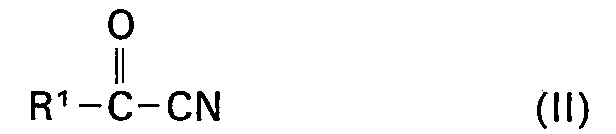
mit Carbonsäureanhydriden der allgemeinen Formel (III):

in Gegenwart einer anorganischen oder organischen Säure mit einem pKs-Wert kleiner als 2 und gegebenenfalls in Gegenwart eines Lösungsmittels bei Temperaturen zwischen 0 und 120°C umsetzt.

dadurch gekennzeichnet, dass man 5-Acyloxy-4(5H)-oxazoloniumsalze der Formel (I) gemäss Anspruch 1 mit Hydrazinderivaten der Formel (VI):

umsetzt.
Applications Claiming Priority (2)
| Application Number | Priority Date | Filing Date | Title |
|---|---|---|---|
| DE19813115970 DE3115970A1 (de) | 1981-04-22 | 1981-04-22 | "5-acyloxy-4(5h)-oxazolonium-salze, verfahren zu ihrer herstellung und ihre verwendung als zwischenprodukte zur synthese von herbizid wirksamen triazinonen" |
| DE3115970 | 1981-04-22 |
Publications (2)
| Publication Number | Publication Date |
|---|---|
| EP0063349A1 EP0063349A1 (de) | 1982-10-27 |
| EP0063349B1 true EP0063349B1 (de) | 1984-10-03 |
Family
ID=6130582
Family Applications (1)
| Application Number | Title | Priority Date | Filing Date |
|---|---|---|---|
| EP82103111A Expired EP0063349B1 (de) | 1981-04-22 | 1982-04-13 | 5-Acyloxy-4 (5H)-oxazolonium-Salze, Verfahren zu ihrer Herstellung und ihre Verwendung als Zwischenprodukte zur Synthese von herbizid wirksamen Triazinonen |
Country Status (6)
| Country | Link |
|---|---|
| US (2) | US4594427A (de) |
| EP (1) | EP0063349B1 (de) |
| JP (1) | JPS57181071A (de) |
| CA (1) | CA1185973A (de) |
| DE (2) | DE3115970A1 (de) |
| IL (1) | IL65528A0 (de) |
Families Citing this family (4)
| Publication number | Priority date | Publication date | Assignee | Title |
|---|---|---|---|---|
| JPS574166A (en) * | 1980-06-10 | 1982-01-09 | Matsushita Electronics Corp | High pressure resisting insulating gate type semiconductor device |
| US4886794A (en) * | 1987-05-07 | 1989-12-12 | A. H. Robins Company, Incorporated | 4-[(α,α-diaryl)-hydroxymethyl]-1-piperidinylalkyl-cyclic carbamate derivatives as allergic response inhibitors |
| JPH0843976A (ja) * | 1994-07-28 | 1996-02-16 | Fuji Photo Film Co Ltd | ハロゲン化銀写真感光材料 |
| CN111909104A (zh) * | 2020-08-19 | 2020-11-10 | 宁夏亚东化工有限公司 | 三嗪酮生产线及其制备方法 |
Family Cites Families (5)
| Publication number | Priority date | Publication date | Assignee | Title |
|---|---|---|---|---|
| DE1542873C3 (de) * | 1966-04-16 | 1978-07-13 | Bayer Ag, 5090 Leverkusen | Herbizides Mittel auf Basis von 4-Amino-1,2,4-triazin-5-onen |
| DE2733181B2 (de) * | 1977-07-22 | 1979-08-30 | Deutsche Gold- Und Silber-Scheideanstalt Vormals Roessler, 6000 Frankfurt | Verfahren zur Herstellung von N-substituierten a -Ketocarbonsäureamiden |
| DE2733180C3 (de) * | 1977-07-22 | 1983-04-14 | Degussa Ag, 6000 Frankfurt | Verfahren zur Herstellung von 4-Amino-3-methylmercapto-1,2,4-triazin- 5-on-Derivaten |
| DE3009044A1 (de) * | 1980-03-08 | 1981-09-24 | Bayer Ag, 5090 Leverkusen | Verfahren zur herstellung von (alpha)-ketocarbon-n-acylamiden |
| DE3008921A1 (de) * | 1980-03-08 | 1981-09-24 | Bayer Ag, 5090 Leverkusen | Verfahren zur herstellung von 4-amino-6-tert.-butyl-3-methylthio-1,2,4,-triazin-5(4h)-on |
-
1981
- 1981-04-22 DE DE19813115970 patent/DE3115970A1/de not_active Withdrawn
-
1982
- 1982-03-22 US US06/360,495 patent/US4594427A/en not_active Expired - Lifetime
- 1982-04-13 EP EP82103111A patent/EP0063349B1/de not_active Expired
- 1982-04-13 DE DE8282103111T patent/DE3260871D1/de not_active Expired
- 1982-04-16 JP JP57062606A patent/JPS57181071A/ja active Granted
- 1982-04-19 IL IL65528A patent/IL65528A0/xx not_active IP Right Cessation
- 1982-04-21 CA CA000401380A patent/CA1185973A/en not_active Expired
-
1989
- 1989-10-25 US US07/427,162 patent/US4980479A/en not_active Expired - Fee Related
Non-Patent Citations (1)
| Title |
|---|
| CHEMICAL ABSTRACTS, Band 93, Nr. 1, 7. Juli 1980, Seite 740, Nr. 8064q, Columbus, Ohio, USA, V.G. KUL'NEVICH et al.: "Substituted 4(5H)oxazolones and their salts. 2. Synthesis of 2-(beta(alkyl-,aryl-,furyl)vinyl)-5-(1,1-dimethyl-2-acetoxyethyl)-4(5H)-oxazolium perchlorates" * |
Also Published As
| Publication number | Publication date |
|---|---|
| EP0063349A1 (de) | 1982-10-27 |
| DE3260871D1 (en) | 1984-11-08 |
| JPH0345067B2 (de) | 1991-07-09 |
| US4594427A (en) | 1986-06-10 |
| IL65528A0 (en) | 1982-07-30 |
| CA1185973A (en) | 1985-04-23 |
| DE3115970A1 (de) | 1982-11-11 |
| JPS57181071A (en) | 1982-11-08 |
| US4980479A (en) | 1990-12-25 |
Similar Documents
| Publication | Publication Date | Title |
|---|---|---|
| EP0039482B1 (de) | Perylen-3,4,9,10-tetracarbonsäuremonoanhydridmonoimide, Verfahren zur Herstellung solcher Verbindungen und ihre Verwendung | |
| EP0063349B1 (de) | 5-Acyloxy-4 (5H)-oxazolonium-Salze, Verfahren zu ihrer Herstellung und ihre Verwendung als Zwischenprodukte zur Synthese von herbizid wirksamen Triazinonen | |
| EP0035708B1 (de) | Verfahren zur Herstellung von 4-Amino-6-tert.-butyl-3-methylthio-1,2,4-triazin-5(4H)-on | |
| DE69808771T2 (de) | Ein verfahren zur herstellung von tetraaza makrocyclen | |
| DE2925175A1 (de) | Verfahren zur herstellung von isatosaeureanhydriden | |
| DE69707860T2 (de) | Verfahren zur herstellung von tetrahydroindolizinen | |
| EP0035706B1 (de) | Verfahren zur Herstellung von 4-Amino-6-tert.-butyl-3-methylthio-1,2,4,-triazin-5(4H)-on | |
| DE68922289T2 (de) | Herstellung von 5-Amino-1,2,4-triazol-3-sulfonamiden und Zwischenverbindungen. | |
| EP0073970B1 (de) | Verfahren zur Herstellung von 4-Methyl-5-oxo-3-thioxotetrahydro-1,2,4-(2H, 4H)-triazinen | |
| EP0035707B1 (de) | Verfahren zur Herstellung von alpha-Ketocarbonsäure-N-acylamiden | |
| EP0034240B1 (de) | Verfahren zur Herstellung von alpha-Ketocarbonsäure-N-tert.-butylamiden | |
| EP0041177B1 (de) | Verfahren zur Herstellung von 4-Amino-6-tert.butyl-3-mercapto-1,2,4-triazin-5-on | |
| DE2340409C2 (de) | ||
| EP0033476B1 (de) | Verfahren zur Herstellung von 4-Amino-6-tert.-butyl-3-methylthio-1,2,4-triazin-5(4H)-on | |
| EP0043490B1 (de) | Verfahren zur Herstellung von Acylcyaniden | |
| EP0034703B1 (de) | Verfahren zur Herstellung von Trimethylbrenztraubensäureamid | |
| AT315169B (de) | Verfahren zur Herstellung von neuen Triazolylbenzophenonderivaten | |
| DE2633211C3 (de) | Verfahren zur Herstellung von 4-Carboxamido-5-cyano-2-imidazolon | |
| DE2364474A1 (de) | Verfahren zur herstellung von 4-amino- 1,2,4-triazin-5-onen | |
| DE1695067B1 (de) | Verfahren zur Herstellung von 5-Cyanuracilen | |
| DE69013332T2 (de) | N-(3',4'-dimethoxyzimtsäure)anthranilsäure. | |
| AT206897B (de) | Verfahren zur Herstellung von neuen 4-Oxo-2-(halogenalkyl)-2,3-dihydro-[benzo-1,3-oxazinen] | |
| DE2366215C2 (de) | Glyoxylsäurehydrazid-2-acylhydrazone | |
| DE2351555C3 (de) | 2)3'-O-Sulfinyl-8-halogenadenosine, Verfahren zu deren Herstellung sowie deren Verwendung zur Herstellung von 8^-Thiohydroadenosin | |
| AT258916B (de) | Verfahren zur Herstellung von neuen Alkyl-3-amino-5-chlor-6-X-pyrazinoaten |
Legal Events
| Date | Code | Title | Description |
|---|---|---|---|
| PUAI | Public reference made under article 153(3) epc to a published international application that has entered the european phase |
Free format text: ORIGINAL CODE: 0009012 |
|
| 17P | Request for examination filed |
Effective date: 19820413 |
|
| AK | Designated contracting states |
Designated state(s): BE CH DE FR GB IT NL |
|
| ITF | It: translation for a ep patent filed | ||
| GRAA | (expected) grant |
Free format text: ORIGINAL CODE: 0009210 |
|
| AK | Designated contracting states |
Designated state(s): BE CH DE FR GB IT LI NL |
|
| REF | Corresponds to: |
Ref document number: 3260871 Country of ref document: DE Date of ref document: 19841108 |
|
| ET | Fr: translation filed | ||
| PLBE | No opposition filed within time limit |
Free format text: ORIGINAL CODE: 0009261 |
|
| STAA | Information on the status of an ep patent application or granted ep patent |
Free format text: STATUS: NO OPPOSITION FILED WITHIN TIME LIMIT |
|
| 26N | No opposition filed | ||
| ITTA | It: last paid annual fee | ||
| PGFP | Annual fee paid to national office [announced via postgrant information from national office to epo] |
Ref country code: DE Payment date: 19970213 Year of fee payment: 16 |
|
| PGFP | Annual fee paid to national office [announced via postgrant information from national office to epo] |
Ref country code: FR Payment date: 19970327 Year of fee payment: 16 |
|
| PGFP | Annual fee paid to national office [announced via postgrant information from national office to epo] |
Ref country code: GB Payment date: 19970404 Year of fee payment: 16 |
|
| PGFP | Annual fee paid to national office [announced via postgrant information from national office to epo] |
Ref country code: BE Payment date: 19970423 Year of fee payment: 16 |
|
| PGFP | Annual fee paid to national office [announced via postgrant information from national office to epo] |
Ref country code: CH Payment date: 19970425 Year of fee payment: 16 |
|
| PGFP | Annual fee paid to national office [announced via postgrant information from national office to epo] |
Ref country code: NL Payment date: 19970430 Year of fee payment: 16 |
|
| PG25 | Lapsed in a contracting state [announced via postgrant information from national office to epo] |
Ref country code: GB Free format text: LAPSE BECAUSE OF NON-PAYMENT OF DUE FEES Effective date: 19980413 |
|
| PG25 | Lapsed in a contracting state [announced via postgrant information from national office to epo] |
Ref country code: LI Free format text: LAPSE BECAUSE OF NON-PAYMENT OF DUE FEES Effective date: 19980430 Ref country code: FR Free format text: THE PATENT HAS BEEN ANNULLED BY A DECISION OF A NATIONAL AUTHORITY Effective date: 19980430 Ref country code: CH Free format text: LAPSE BECAUSE OF NON-PAYMENT OF DUE FEES Effective date: 19980430 Ref country code: BE Free format text: LAPSE BECAUSE OF NON-PAYMENT OF DUE FEES Effective date: 19980430 |
|
| BERE | Be: lapsed |
Owner name: BAYER A.G. Effective date: 19980430 |
|
| PG25 | Lapsed in a contracting state [announced via postgrant information from national office to epo] |
Ref country code: NL Free format text: LAPSE BECAUSE OF NON-PAYMENT OF DUE FEES Effective date: 19981101 |
|
| GBPC | Gb: european patent ceased through non-payment of renewal fee |
Effective date: 19980413 |
|
| REG | Reference to a national code |
Ref country code: CH Ref legal event code: PL |
|
| NLV4 | Nl: lapsed or anulled due to non-payment of the annual fee |
Effective date: 19981101 |
|
| PG25 | Lapsed in a contracting state [announced via postgrant information from national office to epo] |
Ref country code: DE Free format text: LAPSE BECAUSE OF NON-PAYMENT OF DUE FEES Effective date: 19990202 |
|
| REG | Reference to a national code |
Ref country code: FR Ref legal event code: ST |