EP0043815B1 - Verfahren und vorrichtung zur regulierung von bandgewichtsschwankungen an karden, krempeln und dergleichen - Google Patents
Verfahren und vorrichtung zur regulierung von bandgewichtsschwankungen an karden, krempeln und dergleichen Download PDFInfo
- Publication number
- EP0043815B1 EP0043815B1 EP80901792A EP80901792A EP0043815B1 EP 0043815 B1 EP0043815 B1 EP 0043815B1 EP 80901792 A EP80901792 A EP 80901792A EP 80901792 A EP80901792 A EP 80901792A EP 0043815 B1 EP0043815 B1 EP 0043815B1
- Authority
- EP
- European Patent Office
- Prior art keywords
- torque
- power
- desired value
- card
- measuring device
- Prior art date
- Legal status (The legal status is an assumption and is not a legal conclusion. Google has not performed a legal analysis and makes no representation as to the accuracy of the status listed.)
- Expired
Links
Images

Classifications
-
- D—TEXTILES; PAPER
- D01—NATURAL OR MAN-MADE THREADS OR FIBRES; SPINNING
- D01G—PRELIMINARY TREATMENT OF FIBRES, e.g. FOR SPINNING
- D01G23/00—Feeding fibres to machines; Conveying fibres between machines
- D01G23/06—Arrangements in which a machine or apparatus is regulated in response to changes in the volume or weight of fibres fed, e.g. piano motions
Definitions
- a known method measures the cross-section of the outgoing belts and regulates the speed of the feed roller of the card on the basis of the measured values obtained in such a way that - even with a different density of the fiber feed - the card is always fed with just as much material per unit of time as to maintain a constant cross-section is required on the fume cupboard (DE-A-1 921 248). Because of the long fiber transport path between the location (feed roller) and the measuring location on the take-off rollers, this method is relatively slow. Fluctuations that are shorter than this transport route cannot be compensated for, since they have already passed the location at the time of their measurement. This method can only be accelerated if the measuring location is brought closer to the location. In the current state of the art, however, no absolute measuring device is known that can be placed in the optimum proximity of the feed roller and at the same time has the accuracy required for the intended use.
- Another known method solves this problem in that in addition to the absolute measuring element on the take-off rollers, a further measuring element is attached to the licker-in or to the reel or to the take-off or to the take-off rollers or to the fleece, which only has to recognize variations in the fiber throughput, but not their absolute amount .
- such measuring elements can also be produced using the current state of the art. In the aforementioned combination with an accurate absolute measuring device, they enable the desired acceleration of the control process even with relatively low accuracy.
- a known measuring device in this category measures variations in the fiber throughput by optically determining the fiber covering density, for example on the reel.
- the method is based on the fact that a light fiber covering, for example, reflects more light with increasing density than the z. B. dark background formed by the drum set.
- This measuring device is an essential technical advance.
- the required difference in the reflective properties of the fiber covering and the background means that the applicability is restricted.
- Another limitation is the decreasing accuracy with poor fiber resolution. This hinders, for example, the optimal use of this measuring element on the licker-in, although from a control point of view this would represent the optimal measuring location for the closed loop control card draw-in regulation.
- the present invention relates to a method and a device with the same intended use as this optical measuring element, but without the restrictions described above, according to the features defined in the claims.
- the card draw-in regulation with a closed control loop described above can be made faster, more precise and more universal than was possible with the previously known techniques.
- the method according to the invention is based on the fact that the torque of a rotating part of the card, for example the licker-in drive, is measured and a signal which corresponds to this torque is used as a control variable for regulating the pulling-in speed of the card. Since a substantial part of the licker-in torque depends on the amount of material supplied to the licker-in per revolution, variations in this torque can be used as a measure of the cross-sectional fluctuations of the fiber template to be compensated. In order to compensate for such fluctuations, in the simplest case only the speed of the feed roller needs to be regulated so that the torque of the licker-in remains constant, i. H. the licker-in works at constant speed with constant tear performance.
- the tear performance of the licker-in generally depends not only on the material throughput, but also different pre-dissolution of the fibers, different finishings, differences in moisture etc. can have a significant influence on the specific tear performance. Also needed the pioneer also has a considerable idling torque that is independent of the tearing power in order to overcome the bearing friction and the air resistance.
- the torque measurement on the licker-in is advantageously combined with an absolute measuring element on the gimbal trigger, which is suitable for correcting long-term inaccuracies in the torque measurement.
- the torque measurement method can also be used in the same way on the reel, in which case it is not the tearing power but the carding power of the cover that is recorded. Since the carding capacity also increases with increasing fiber covering on the reel, the cross-section of the fiber covering on the reel and thus ultimately the tape number can be regulated. Long-term differences are also advantageously corrected here by combination with an absolute measuring element on the card draw-off.
- control signal is obtained from the torque behavior of the feed roller. Pulling the cotton into the card requires a torque that increases with increasing cotton thickness. The desired constant fiber throughput can then be achieved by regulating the feed roller speed in opposite directions. This method can also be combined with the direct band measurement already described.
- the device according to the invention for carrying out the method essentially consists of a device for measuring the torque on the licker-in or on the reel or on the common drive of these two elements and a known draw-in regulation of the card with a closed control loop.
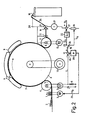
- the card shown schematically in FIGS. 1-3 consists, in a known arrangement, of the feed roller 1, to which the fiber material is placed, the licker-in 4, the reel 8 with fiber covering 7 and lids 9, the customer 11 with the take-off rollers 12, the calender section 13 and the can 16.
- the individual rotary bodies with individual drives are shown, namely the feed roller 1 with a motor 3, the licker-in 4 with a motor 5, the reel 8 with a motor 10 and the customer 11 with a motor 15.
- Calender part 13 and can 16 are driven by a mechanical connection 28 from the customer 11.
- the torque of the licker-in 4 is measured by means of the current consumption of the motor 5.
- the current is proportional to the torque; in an AC motor, the current I x cos g J is proportional to the torque.
- the motor current is converted into a proportional voltage U by means of a measuring resistor 6 and compared with a setpoint voltage in a first summation point 17.
- the difference LtU resulting from this comparison is converted in a control element 20 into a control signal U R for the speed of the motor 3 or the feed roller 1.
- Too high torque means too thick fiber covering, so the speed of the feed roller 1 must be slowed down, while too low torque requires an increase in the speed of the feed roller 1, both until the difference .DELTA.U disappears from the measurement voltage and the desired value.
- the setpoint value supplied to the controller 20 can be, for example, a voltage Ud set at a setpoint value resistor 18; this reaches the first summing point 17 via a terminal 24 of a changeover switch 19.
- the card equipped with the device delivers a strip with a constant cross-section only as long as the proportionality factors between the torque of the licker-in 4 and the number of the strip 26 do not change .
- a variable proportionality factor is, for example, the material-dependent relationship between the material supply and the tear performance of the licker-in 4, or the adjustable ratio of licker-in speed and delivery speed.
- the switch 19 is connected to terminal 23.
- a setpoint value U s derived from the number of band 26 is applied to this terminal.
- a signal U ⁇ corresponding to the tape number is generated and sent to a second summing point 21, where it is compared with a setpoint U s for the tape number.
- the resulting difference signal passes through an integrator 22, the output signal Us of which forms the setpoint for the licker-in torque in the summing point 17.
- the two configurations described here describe the basic principles of the setpoint specification for the controller 20. It can make sense to combine several fixed and / or variable setpoint specifications, for example by means of additive superimposition, For example, to compensate for the idling torque of the licker-in 4 or to optimize the behavior of the regulation under different operating conditions (e.g. when the card is starting up).
- the card which is equipped with the device in the configuration described, is preferably driven by the four individual drives 3, 5, 10, 15.
- the drives 5 and 10 must be synchronized with one another for the card to work properly.
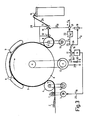
- the take-off side of the card (motor 15) is usually also synchronized with motors 5 and 10; however, it can also usually be shut down separately or operated at slow speed. In order to protect the card from overfeeding in such an operating state, additional apparatus precautions must be taken. For example, it is conceivable that the customer speed is measured continuously and in such an extraordinary operating state (e.g. also carding and stopping of the card) either the target torque for the controller 20 is reduced in accordance with the customer speed, or the speed of motor 3 with Motor 15 is synchronized. This is shown in FIG. 2, where a tachometer generator 27 is coupled to a rotating part that defines the strip take-off speed, for example the calender roll 13. In these cases, the signal UT corresponding to the tachometer speed is specified as the setpoint.
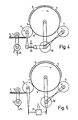
- FIG 3 shows, as a further variant, the evaluation of the torque or the power of the drum drive, in that the current consumption of the motor 10 is determined by means of the measuring resistor 6 and used for comparison with the target value.
- the lids 9 exert a torque on the rotating drum 8, which increases with increasing thickness of the fiber covering 7 on the drum.
- the device used in this way therefore acts primarily as a density regulator for the fiber covering on the reel 8. In the end, however, this also regulates the band number.
- the torque measurement of a rotating part of the card, the card or the like can also be carried out in another way than by measuring the power consumption.
- the drive shaft for the licker-in 4, or for the reel 8, as a torsion bar 29 by measuring its rotation and converting it into a corresponding signal.
- the drives for licker-in 4, drum 8 and pickup 11 can be carried out from a common motor 30, as is indicated in FIG. 4.
- a further possibility for measuring the torques for the driven drums of the card is to arrange a variable coupling 31 between the motor 30 and the shaft in question.
- the size of the slip between the drive and the driven axle, or the excitation of the variable clutch 31 necessary for a slip-free transmission is to be measured as a control signal and the difference is to be formed therefrom with a corresponding target value, as has already been described previously.
Landscapes
- Engineering & Computer Science (AREA)
- Textile Engineering (AREA)
- Preliminary Treatment Of Fibers (AREA)
- Oscillators With Electromechanical Resonators (AREA)
- Diaphragms For Electromechanical Transducers (AREA)
- Golf Clubs (AREA)
- Tires In General (AREA)
- Moulding By Coating Moulds (AREA)
Applications Claiming Priority (2)
| Application Number | Priority Date | Filing Date | Title |
|---|---|---|---|
| CH39280A CH640890A5 (de) | 1980-01-17 | 1980-01-17 | Verfahren und vorrichtung zur regulierung von bandgewichtsschwankungen an karden und krempeln. |
| CH392/80 | 1980-01-17 |
Publications (2)
| Publication Number | Publication Date |
|---|---|
| EP0043815A1 EP0043815A1 (de) | 1982-01-20 |
| EP0043815B1 true EP0043815B1 (de) | 1984-01-11 |
Family
ID=4185968
Family Applications (1)
| Application Number | Title | Priority Date | Filing Date |
|---|---|---|---|
| EP80901792A Expired EP0043815B1 (de) | 1980-01-17 | 1980-09-30 | Verfahren und vorrichtung zur regulierung von bandgewichtsschwankungen an karden, krempeln und dergleichen |
Country Status (10)
| Country | Link |
|---|---|
| US (1) | US4438548A (cg-RX-API-DMAC7.html) |
| EP (1) | EP0043815B1 (cg-RX-API-DMAC7.html) |
| JP (2) | JPS56501887A (cg-RX-API-DMAC7.html) |
| AT (1) | ATE5826T1 (cg-RX-API-DMAC7.html) |
| CH (1) | CH640890A5 (cg-RX-API-DMAC7.html) |
| DE (1) | DE3066099D1 (cg-RX-API-DMAC7.html) |
| ES (1) | ES8203996A1 (cg-RX-API-DMAC7.html) |
| IT (1) | IT1128628B (cg-RX-API-DMAC7.html) |
| SU (1) | SU1165240A3 (cg-RX-API-DMAC7.html) |
| WO (1) | WO1981002029A1 (cg-RX-API-DMAC7.html) |
Cited By (1)
| Publication number | Priority date | Publication date | Assignee | Title |
|---|---|---|---|---|
| DE102006024892A1 (de) * | 2006-05-24 | 2007-11-29 | TRüTZSCHLER GMBH & CO. KG | Vorrichtung an einer Spinnereimaschine, insbesondere Spinnereivorbereitungsmaschine, z.B. Karde, Krempel o. dgl., zur Überwachung eines elektrischen Antriebsmotors |
Families Citing this family (25)
| Publication number | Priority date | Publication date | Assignee | Title |
|---|---|---|---|---|
| DE2944428C2 (de) * | 1979-11-03 | 1984-08-30 | Trützschler GmbH & Co KG, 4050 Mönchengladbach | Vorrichtung zur Produktionssteuerung und Bandregulierung einer Karde |
| CH640890A5 (de) * | 1980-01-17 | 1984-01-31 | Zellweger Uster Ag | Verfahren und vorrichtung zur regulierung von bandgewichtsschwankungen an karden und krempeln. |
| DE3205776C3 (de) * | 1982-02-18 | 1996-06-13 | Truetzschler Gmbh & Co Kg | Verfahren und Vorrichtung zur Regulierung der einer Krempel zuzuführenden Fasermenge |
| DE3425345A1 (de) * | 1984-07-10 | 1986-01-30 | Trützschler GmbH & Co KG, 4050 Mönchengladbach | Verfahren und vorrichtung zum erzeugen einer gleichmaessigen, kontinuierlichen fasermenge |
| DE3535684C2 (de) * | 1985-10-05 | 1996-06-05 | Truetzschler Gmbh & Co Kg | Vorrichtung zur Speisung eines Öffners oder Reinigers für Textilfaserflocken |
| DE3703450A1 (de) * | 1986-05-24 | 1987-11-26 | Truetzschler & Co | Verfahren und vorrichtung zur vergleichmaessigung des faserbandes bei einer karde |
| DE3617525A1 (de) * | 1986-05-24 | 1987-11-26 | Truetzschler & Co | Vorrichtung zur vergleichmaessigung eines kardenbandes oder krempelvlieses |
| US4689857A (en) * | 1986-07-18 | 1987-09-01 | John D. Hollingsworth On Wheels, Inc. | WEB weight control system |
| IN170275B (cg-RX-API-DMAC7.html) * | 1986-12-12 | 1992-03-07 | Rieter Ag Maschf | |
| IN170276B (cg-RX-API-DMAC7.html) * | 1986-12-12 | 1992-03-07 | Rieter Ag Maschf | |
| DE3708211C2 (de) * | 1987-03-13 | 1998-05-07 | Truetzschler Gmbh & Co Kg | Vorrichtung und Verfahren zur Verbesserung des Kardierprozesses einer Karde oder Krempel |
| US4947520A (en) * | 1987-10-13 | 1990-08-14 | John D. Hollingsworth On Wheels, Inc. | Feed roll sensor for a textile carding machine |
| US4839944A (en) * | 1987-10-13 | 1989-06-20 | John D. Hollingsworth On Wheels, Inc. | Feed roll sensor for a textile carding machine |
| JP2848405B2 (ja) * | 1989-09-14 | 1999-01-20 | 豊和工業株式会社 | カードにおけるスライバ斑制御装置 |
| DE4018803A1 (de) * | 1990-06-12 | 1991-12-19 | Rieter Ag Maschf | Verfahren und vorrichtung zur regelung eines oeffnungsvorganges, beispielsweise an einer karde |
| GB9120128D0 (en) * | 1991-09-20 | 1991-11-06 | Carding Spec Canada | Method of carding |
| DE4332329B4 (de) * | 1992-11-07 | 2005-10-20 | Truetzschler Gmbh & Co Kg | Vorrichtung an einer Karde für Textilfasern, z. B. Baumwolle, Chemiefasern u. dgl., zur Produktionssteuerung |
| EP0816539A1 (de) * | 1996-07-05 | 1998-01-07 | Maschinenfabrik Rieter Ag | Verfahren und Vorrichtung zur Produktionssteuerung an einer Karde |
| EP1167590A3 (de) * | 2000-06-23 | 2002-09-11 | Maschinenfabrik Rieter Ag | Faserlängenmessung |
| DE10221407A1 (de) * | 2002-05-14 | 2003-12-04 | Hollingsworth Gmbh | Karde |
| DE102004004517A1 (de) * | 2004-01-23 | 2005-08-11 | Wilhelm Stahlecker Gmbh | Verfahren zum Vermeiden von Fehlverzügen an einem zu verstreckenden Stapelfaserverband |
| CN108796673B (zh) * | 2018-04-24 | 2021-01-01 | 浙江省常山纺织有限责任公司 | 基于开松强度的梳棉自调匀整方法及其装置 |
| CN108823695A (zh) * | 2018-08-20 | 2018-11-16 | 盐城金大纺织机械制造有限公司 | 一种自动梳棉机的刺辊微电流匀整装置 |
| DE102020104475A1 (de) * | 2020-02-20 | 2021-08-26 | Trützschler GmbH & Co Kommanditgesellschaft | Verfahren zum Erzeugen eines Faserbandes und Karde |
| CN112195539A (zh) * | 2020-10-22 | 2021-01-08 | 中原工学院 | 一种棉纺精梳机锡林梳理力测试装置 |
Family Cites Families (9)
| Publication number | Priority date | Publication date | Assignee | Title |
|---|---|---|---|---|
| DE1266189B (de) * | 1963-09-03 | 1968-04-11 | Atlas Mak Maschb Ges Mit Besch | Steuerung des Antriebs eines Krempel- oder Kardensatzes |
| DE1510431A1 (de) * | 1965-01-27 | 1970-09-17 | Walter Steudenmaier | Verfahren und Vorrichtung zum selbsttaetigen Steuern des Materialflusses bei einer Karde |
| CH436779A (de) * | 1966-05-06 | 1967-05-31 | Zellweger Uster Ag | Verfahren und Vorrichtung zur Gewinnung von Messwerten, die dem Substanzquerschnitt von Textilmaterial, insbesondere von Faserbändern, entsprechen |
| CH466105A (de) * | 1968-06-28 | 1968-11-30 | Zellweger Uster Ag | Verfahren und Vorrichtung zur Vergleichmässigung von Kardenbändern |
| DE2113140A1 (de) * | 1971-03-18 | 1972-09-21 | Bechlenberg Heinz Dr Ing | Reguliervorrichtung zum Konstanthalten der Fasermenge im Faserbandquerschnitt beim Kardieren,Krempeln,Kaemmen und Verstrecken |
| DE2658044C3 (de) * | 1976-12-22 | 1980-02-21 | Truetzschler Gmbh & Co Kg, 4050 Moenchengladbach | Verfahren und Vorrichtung zum Erzeugen eines gleichmäßigen Faserbandes |
| CH627498A5 (de) * | 1978-04-26 | 1982-01-15 | Zellweger Uster Ag | Verfahren und vorrichtung zur ausregulierung von bandgewichtsschwankungen an karden, krempeln und strecken. |
| US4257147A (en) * | 1979-04-17 | 1981-03-24 | White Consolidated Industries, Inc. | Overload clutch for the feed roll of a carding machine |
| CH640890A5 (de) * | 1980-01-17 | 1984-01-31 | Zellweger Uster Ag | Verfahren und vorrichtung zur regulierung von bandgewichtsschwankungen an karden und krempeln. |
-
1980
- 1980-01-17 CH CH39280A patent/CH640890A5/de not_active IP Right Cessation
- 1980-09-30 US US06/293,221 patent/US4438548A/en not_active Expired - Lifetime
- 1980-09-30 WO PCT/CH1980/000117 patent/WO1981002029A1/de not_active Ceased
- 1980-09-30 DE DE8080901792T patent/DE3066099D1/de not_active Expired
- 1980-09-30 EP EP80901792A patent/EP0043815B1/de not_active Expired
- 1980-09-30 JP JP50216680A patent/JPS56501887A/ja active Pending
- 1980-09-30 AT AT80901792T patent/ATE5826T1/de not_active IP Right Cessation
- 1980-11-19 IT IT50197/80A patent/IT1128628B/it active
-
1981
- 1981-01-16 ES ES498579A patent/ES8203996A1/es not_active Expired
- 1981-09-16 SU SU813338398A patent/SU1165240A3/ru active
-
1984
- 1984-06-01 JP JP1984080522U patent/JPS6016769U/ja active Pending
Cited By (1)
| Publication number | Priority date | Publication date | Assignee | Title |
|---|---|---|---|---|
| DE102006024892A1 (de) * | 2006-05-24 | 2007-11-29 | TRüTZSCHLER GMBH & CO. KG | Vorrichtung an einer Spinnereimaschine, insbesondere Spinnereivorbereitungsmaschine, z.B. Karde, Krempel o. dgl., zur Überwachung eines elektrischen Antriebsmotors |
Also Published As
| Publication number | Publication date |
|---|---|
| ES498579A0 (es) | 1982-04-01 |
| IT8050197A0 (it) | 1980-11-19 |
| ES8203996A1 (es) | 1982-04-01 |
| US4438548A (en) | 1984-03-27 |
| JPS6016769U (ja) | 1985-02-04 |
| EP0043815A1 (de) | 1982-01-20 |
| CH640890A5 (de) | 1984-01-31 |
| DE3066099D1 (en) | 1984-02-16 |
| WO1981002029A1 (fr) | 1981-07-23 |
| JPS56501887A (cg-RX-API-DMAC7.html) | 1981-12-24 |
| SU1165240A3 (ru) | 1985-06-30 |
| IT1128628B (it) | 1986-05-28 |
| ATE5826T1 (de) | 1984-01-15 |
Similar Documents
| Publication | Publication Date | Title |
|---|---|---|
| EP0043815B1 (de) | Verfahren und vorrichtung zur regulierung von bandgewichtsschwankungen an karden, krempeln und dergleichen | |
| DE2912576C2 (de) | Verfahren und Vorrichtung zur Ausregulierung von Bandgewichtsschwankungen an Karden, Krempeln, Strecken u.dgl. | |
| EP0384297B1 (de) | Karde | |
| EP0271115B1 (de) | Verfahren und Vorrichtung zum automatischen Ausgleichen von Banddichte-Schwankungen in Textilmaschinen, wie Karden, Strecken und dergleichen | |
| EP0275471B1 (de) | Verfahren und Vorrichtung zum Ausgleichen der Dichte einer Fasermatte am Eingang einer Textilmaschine | |
| DE2543839B1 (de) | Vorrichtung zum erzeugen eines gleichmaessigen textilen faserbandes | |
| DE19822886A1 (de) | Regulierstreckwerk für einen Faserverband, z. B. Baumwolle, Chemiefasern o. dgl. mit mindestens einem Verzugsfeld | |
| DE2944428C2 (de) | Vorrichtung zur Produktionssteuerung und Bandregulierung einer Karde | |
| DE1952829C3 (de) | Dichtesteuerung für das Fasegut in einem Füllschacht zur Speisung einer Karde | |
| DE4428474A1 (de) | Verfahren und Vorrichtung zum Ablegen eines Textilfaserbandes in einem Faserbandbehälter, insbesondere an einer Strecke | |
| DE3617526A1 (de) | Verfahren und vorrichtung zum speisen einer anzahl von karden, krempeln o. dgl. | |
| CH673289A5 (cg-RX-API-DMAC7.html) | ||
| DE2819272A1 (de) | Steuerschaltung fuer eine regelvorrichtung fuer die faserbanddicke in vorspinnmaschinen | |
| CH672323A5 (cg-RX-API-DMAC7.html) | ||
| CH688153A5 (de) | Vorrichtung zur Produktionssteuerung an einer Karde fuer Textilfasern. | |
| DE10004604B4 (de) | Vorrichtung zum Zuführen von Faserbändern an einer Spinnereimaschine, insbesondere Strecke, z.B. Regulierstrecke | |
| DE2220748C3 (de) | Verfahren und Vorrichtung zur Vergleichmäßigung des Querschnitts oder des Gewichtes pro Längeneinheit eines mittels Karde oder Krempel produzierten Faserbandes | |
| CH694333A5 (de) | Streckwerk für eine Spinnereimaschine, insbesondere eine Regulierstrecke für Baumwolle oder Chemiefasern. | |
| EP0347715A2 (de) | Verfahren und Vorrichtung zur Herstellung eines gleichmässigen Faserbandes | |
| DE2331217A1 (de) | Einrichtung zur vergleichmaessigung der dicke von band- oder strangfoermigem material in der textilvorbereitung | |
| DE2535457C3 (de) | Aufspulmaschine | |
| DE2230069A1 (de) | Vorrichtung fuer die titerregulierung der faserbaender auf kleinen, mittleren und grossen laengen in der spinnereivorbereitung | |
| DE3035196A1 (de) | Verfahren und vorrichtung zur beseitugung eines fehlers bei der regelung der faserbanddichte auf textilmaschinen | |
| DE831378C (de) | Vorrichtung zur Vergleichmaessigung fertiger Wickelwatten | |
| CH522051A (de) | Verfahren und Vorrichtung zur Überwachung und/oder Regelung der Speisung von Karden |
Legal Events
| Date | Code | Title | Description |
|---|---|---|---|
| PUAI | Public reference made under article 153(3) epc to a published international application that has entered the european phase |
Free format text: ORIGINAL CODE: 0009012 |
|
| 17P | Request for examination filed |
Effective date: 19811030 |
|
| AK | Designated contracting states |
Designated state(s): AT DE FR GB |
|
| GRAA | (expected) grant |
Free format text: ORIGINAL CODE: 0009210 |
|
| AK | Designated contracting states |
Designated state(s): AT DE FR GB |
|
| REF | Corresponds to: |
Ref document number: 5826 Country of ref document: AT Date of ref document: 19840115 Kind code of ref document: T |
|
| REF | Corresponds to: |
Ref document number: 3066099 Country of ref document: DE Date of ref document: 19840216 |
|
| ET | Fr: translation filed | ||
| PLBE | No opposition filed within time limit |
Free format text: ORIGINAL CODE: 0009261 |
|
| STAA | Information on the status of an ep patent application or granted ep patent |
Free format text: STATUS: NO OPPOSITION FILED WITHIN TIME LIMIT |
|
| 26N | No opposition filed | ||
| PGFP | Annual fee paid to national office [announced via postgrant information from national office to epo] |
Ref country code: FR Payment date: 19930909 Year of fee payment: 14 Ref country code: AT Payment date: 19930909 Year of fee payment: 14 |
|
| PGFP | Annual fee paid to national office [announced via postgrant information from national office to epo] |
Ref country code: GB Payment date: 19930921 Year of fee payment: 14 |
|
| PGFP | Annual fee paid to national office [announced via postgrant information from national office to epo] |
Ref country code: DE Payment date: 19930922 Year of fee payment: 14 |
|
| PG25 | Lapsed in a contracting state [announced via postgrant information from national office to epo] |
Ref country code: GB Effective date: 19940930 Ref country code: AT Effective date: 19940930 |
|
| GBPC | Gb: european patent ceased through non-payment of renewal fee |
Effective date: 19940930 |
|
| PG25 | Lapsed in a contracting state [announced via postgrant information from national office to epo] |
Ref country code: FR Effective date: 19950531 |
|
| PG25 | Lapsed in a contracting state [announced via postgrant information from national office to epo] |
Ref country code: DE Effective date: 19950601 |
|
| REG | Reference to a national code |
Ref country code: FR Ref legal event code: ST |