EP0036628A1 - Anordnungen zur isolierung des Inneren von Käfigen für kleine Versuchstiere von der Umwelt - Google Patents
Anordnungen zur isolierung des Inneren von Käfigen für kleine Versuchstiere von der Umwelt Download PDFInfo
- Publication number
- EP0036628A1 EP0036628A1 EP81102014A EP81102014A EP0036628A1 EP 0036628 A1 EP0036628 A1 EP 0036628A1 EP 81102014 A EP81102014 A EP 81102014A EP 81102014 A EP81102014 A EP 81102014A EP 0036628 A1 EP0036628 A1 EP 0036628A1
- Authority
- EP
- European Patent Office
- Prior art keywords
- collar
- hood
- arrangements according
- cage
- box
- Prior art date
- Legal status (The legal status is an assumption and is not a legal conclusion. Google has not performed a legal analysis and makes no representation as to the accuracy of the status listed.)
- Withdrawn
Links
Images


Classifications
-
- A—HUMAN NECESSITIES
- A01—AGRICULTURE; FORESTRY; ANIMAL HUSBANDRY; HUNTING; TRAPPING; FISHING
- A01K—ANIMAL HUSBANDRY; AVICULTURE; APICULTURE; PISCICULTURE; FISHING; REARING OR BREEDING ANIMALS, NOT OTHERWISE PROVIDED FOR; NEW BREEDS OF ANIMALS
- A01K1/00—Housing animals; Equipment therefor
- A01K1/02—Pigsties; Dog-kennels; Rabbit-hutches or the like
- A01K1/03—Housing for domestic or laboratory animals
- A01K1/031—Cages for laboratory animals; Cages for measuring metabolism of animals
Definitions
- the invention relates to arrangements for isolating the interior of cages for small experimental animals such as mice, rats and guinea pigs from the environment, the cages each having an open box, e.g. Made of clear plastic and include a lid.
- the invention has for its object to provide simple insulation arrangements of the type mentioned above, which is suitable for different makes of cages of the same size with different lid constructions, and designed a sufficient air exchange for the test animals.
- insulation arrangements which are characterized in that they consist of a lower collar-like part which is designed in such a way that it rises upwards around a cage box for full contact with the
- the outside of the cage box can be guided in an area near the upper box edge and has an upward-facing ring flange, and consist of an upper hood-shaped part which has at least one opening covered by a plate made of air-filtering material and a downward-pointing flange which leads to the Can be brought into engagement with the upward-facing ring flange of the collar-like part if it is arranged snugly against a cage box.
- an adhesive strip can be provided which, along the entire circumference of the cage, has a part of the upward flange of the collar and a part of the downward flange of the hood overlaps.
- the collar-like part can, for example, consist of a thin, flexible plastic material such as polystyrene. Such a collar-like part is preferably used as a disposable item.
- a relatively stiff collar-like part e.g. made of polypropylene, polycarbonate or metal can be used, in which case a sealing ring arranged on the inside of the collar is preferably provided.
- Such a relatively stiff collar-like part is preferred if it is to be used repeatedly, and the sealing ring should then be autoclavable like the collar-like part.
- an adhesive can be applied to the inside of the collar-like part, so that an adhesive connection is created between the collar-like part and the cage box.
- the collar-like part is preferably of such dimensions that it comes to lie close to the support rails.
- the cages are preferably arranged so that they come to rest on the shelf flanges with the collar-like part.
- the hood-shaped part can also be made of a relatively thin material, e.g. Polyvinyl chloride or polystyrene, if it is intended for single use.
- a hood can be manufactured using the vacuum molding process or the injection molding process.
- the hood can also be made of a relatively thick and rigid material, e.g. polycarbonate or polypropylene, and can be made as an injection molded part.
- the hood is preferably transparent.
- the hood-shaped part preferably has a substantially flat surface, which facilitates the stacking of unused cages, and the opening is preferably arranged in this flat area.
- the opening is, as already mentioned, through a plate made of air-filtering material, e.g. B. a polyester filter plate covered. With a suitable choice of the density and the thickness of this plate, an almost complete separation of microorganisms can be achieved, at the same time that a sufficiently large air exchange is achieved.
- a plurality of openings in the dome-shaped part are preferably formed, and each of these openings is covered by a plate of luftfiltrierendem material.
- the opening extends over a large part of the surface of the hood, it is expedient to provide supporting webs in the opening in order to avoid that the air-filtering plate is damaged or released by pressure.
- the cover usually consists of a number parallel to one another of the arranged stainless steel wires, which are connected to some transverse, also made of stainless steel wires of greater thickness.
- the lid has a recess with space for a water container and solid feed.
- the known covers are designed such that a locking between the upper edge of the cage box and the cover can be achieved by parts bent downward at the ends of the cover.
- a plate-shaped web is preferably provided between the collar-like part intended for snug abutment against the cage box and the lower edge of the upwardly directed ring flange. This gives the upward-facing flange a certain distance from the upper edge of the cage box when the collar-like part is arranged on the cage box.
- circular depressions can be formed with a bottom that is relatively easy to break through. These recesses can be used in the event that it is desired for experiments of shorter duration to arrange water bottles on the hood-shaped part or to pass pipes for the supply of sterile air through the cover in order to achieve a particularly effective air exchange. If a relatively thin flexible material is used, the material will nestle tightly against the outside of the tube when breaking through the bottom of the wells with a tube of appropriate dimensions, thereby maintaining the protective effect of the hood.
- the collar-like part forms an integrating part of the cage box.
- a cage box with an associated collar-like part can, for. B. be made by injection molding, and suitably consists of polycarbonate.
- Such a cage box need not be formed with support rails for hanging the cages on shelves, since in this case the underside of the integrating collar-like part serves as a support rail.
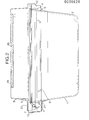
- 1 denotes a cage box with a flat bottom 2 and side and end walls inclined towards the outside. Support rails 3 are provided on the outside of the side walls at a relatively short distance from the upper edge of the cage box (see FIG. 2).
- the cage box 1 has on the outside of the two end walls near the upper edge a few vertical ribs 4, which serve to lock a cover 5 made of welded metal wires 6.
- the cover 5 has a locking member 7 at one end, which is designed such that it can be guided under the lower end of the ribs 4 in order to lock the cover 5 with the cage box 1.
- the cage consists of a cage box 1 and a cover 5 and is provided with insulation arrangements which consist of a lower collar 8 and a hood 9.
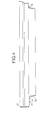
- the collar 8 shown in longitudinal section in FIG. 4 consists of a lower part 10 which has the shape of a hollow truncated pyramid in that the inclination of the side walls essentially corresponds to the inclination of the side walls of the cage box 1.
- the hood 9 has an annular flange 13 at the lower end, which is designed in such a way that it can be brought into engagement with the annular flange 12 with the annular flange 12 of the collar 8 in such a way that the flange 13 seals the flange 12 encloses.
- the top of the hood 9 is substantially flat and has a recess 14, in the area of which the hood 9 is broken. In this perforated area, however, support webs 22 are provided to support a plate 15 made of filter material. The plate 15 is glued to this lower part of the hood 9. In addition, two circular depressions 16 with a further central depression 17 are formed in the top of the hood 9. These depressions serve to arrange water bottles on the hood, the water discharge tubes of the water bottles being able to be passed through the hood 9 by breaking through the bottom of the central depression 17.
- Another recess 23 in the top can be used to introduce a special air supply tube, if one is required.
- hood 9 On the top of the hood 9 there is also a marking zone 18 for sticking on a label. A corresponding zone 19 is provided on one end face of the hood 9.
- the hood 9 has a series of parallel reinforcing ribs 20 at this end. Corresponding ribs 21 are formed on the collar 8.
Landscapes
- Life Sciences & Earth Sciences (AREA)
- Zoology (AREA)
- Environmental Sciences (AREA)
- Health & Medical Sciences (AREA)
- Animal Behavior & Ethology (AREA)
- Clinical Laboratory Science (AREA)
- General Health & Medical Sciences (AREA)
- Animal Husbandry (AREA)
- Biodiversity & Conservation Biology (AREA)
- Housing For Livestock And Birds (AREA)
- Sampling And Sample Adjustment (AREA)
- Magnetic Heads (AREA)
Applications Claiming Priority (2)
| Application Number | Priority Date | Filing Date | Title |
|---|---|---|---|
| DK121880A DK145151C (da) | 1980-03-20 | 1980-03-20 | Organer til mikrobiologisk isolering af bure for smaa forsoegsdyr i forhold til omgivelserne |
| DK1218/80 | 1980-03-20 |
Publications (1)
| Publication Number | Publication Date |
|---|---|
| EP0036628A1 true EP0036628A1 (de) | 1981-09-30 |
Family
ID=8102311
Family Applications (1)
| Application Number | Title | Priority Date | Filing Date |
|---|---|---|---|
| EP81102014A Withdrawn EP0036628A1 (de) | 1980-03-20 | 1981-03-18 | Anordnungen zur isolierung des Inneren von Käfigen für kleine Versuchstiere von der Umwelt |
Country Status (4)
| Country | Link |
|---|---|
| EP (1) | EP0036628A1 (da) |
| DK (1) | DK145151C (da) |
| FI (1) | FI810852A7 (da) |
| NO (1) | NO149528C (da) |
Cited By (5)
| Publication number | Priority date | Publication date | Assignee | Title |
|---|---|---|---|---|
| US4480587A (en) * | 1982-09-23 | 1984-11-06 | Lab Products, Inc. | Animal cage assembly with reusable filter cap |
| FR2580463A1 (fr) * | 1985-04-22 | 1986-10-24 | Dauvergne Bernard | Cage a usage unique pour le logement de petits animaux en ambiance protegee |
| US4699088A (en) * | 1986-09-23 | 1987-10-13 | Allentown Caging Equipment Co., Inc. | Caging assembly for animals with a watering mainfold |
| US6295950B1 (en) * | 1995-10-12 | 2001-10-02 | Lab Products, Inc. | Filter cap for an animal cage |
| CN111264403A (zh) * | 2020-01-18 | 2020-06-12 | 苏州建发塑料制品有限公司 | 一种实验室用封闭式全膜大鼠用鼠笼 |
Citations (1)
| Publication number | Priority date | Publication date | Assignee | Title |
|---|---|---|---|---|
| DE1607073A1 (de) * | 1965-06-03 | 1970-07-09 | Becton Dickinson Co | Tierkaefig,insbesondere fuer Labor- und Forschungszwecke |
-
1980
- 1980-03-20 DK DK121880A patent/DK145151C/da not_active IP Right Cessation
-
1981
- 1981-03-18 EP EP81102014A patent/EP0036628A1/de not_active Withdrawn
- 1981-03-19 FI FI810852A patent/FI810852A7/fi not_active Application Discontinuation
- 1981-03-19 NO NO810946A patent/NO149528C/no unknown
Patent Citations (1)
| Publication number | Priority date | Publication date | Assignee | Title |
|---|---|---|---|---|
| DE1607073A1 (de) * | 1965-06-03 | 1970-07-09 | Becton Dickinson Co | Tierkaefig,insbesondere fuer Labor- und Forschungszwecke |
Cited By (6)
| Publication number | Priority date | Publication date | Assignee | Title |
|---|---|---|---|---|
| US4480587A (en) * | 1982-09-23 | 1984-11-06 | Lab Products, Inc. | Animal cage assembly with reusable filter cap |
| FR2580463A1 (fr) * | 1985-04-22 | 1986-10-24 | Dauvergne Bernard | Cage a usage unique pour le logement de petits animaux en ambiance protegee |
| EP0201436A1 (fr) * | 1985-04-22 | 1986-12-17 | Bernard Dauvergne | Cage à usage unique pour le logement de petits animaux en ambiance protégée |
| US4699088A (en) * | 1986-09-23 | 1987-10-13 | Allentown Caging Equipment Co., Inc. | Caging assembly for animals with a watering mainfold |
| US6295950B1 (en) * | 1995-10-12 | 2001-10-02 | Lab Products, Inc. | Filter cap for an animal cage |
| CN111264403A (zh) * | 2020-01-18 | 2020-06-12 | 苏州建发塑料制品有限公司 | 一种实验室用封闭式全膜大鼠用鼠笼 |
Also Published As
| Publication number | Publication date |
|---|---|
| DK121880A (da) | 1981-09-21 |
| NO149528B (no) | 1984-01-30 |
| FI810852L (fi) | 1981-09-21 |
| NO149528C (no) | 1984-05-09 |
| NO810946L (no) | 1981-09-21 |
| DK145151B (da) | 1982-09-20 |
| FI810852A7 (fi) | 1981-09-21 |
| DK145151C (da) | 1983-03-21 |
Similar Documents
| Publication | Publication Date | Title |
|---|---|---|
| DE60012817T2 (de) | Verbesserte Titrationsplatten | |
| DE2628344C3 (de) | Schale für Gewebekulturgruppen | |
| DE3049742C2 (de) | Anlage zur Massenproduktion von Eiern eines Insekts | |
| CH670232A5 (da) | ||
| CH694312A5 (de) | Käfig für verschiedene Nagerarten. | |
| DE7006464U (de) | Einheit zur umgebungsregelung von tieren | |
| DE2330405A1 (de) | Oelabscheidevorrichtung zum abscheiden von oel, das leichter ist als die gereinigte fluessigkeit, die eine grosse reinheit aufweist | |
| DE2503495A1 (de) | Filtervorrichtung zum einsetzen in ein aquarium o.dgl. | |
| DE8033860U1 (de) | Kaefig fuer tiere, insbesondere maeuse | |
| EP0347407B1 (de) | Einrichtung zum Abscheiden von Schad- oder Geruchsstoffen aus gasförmigen Medien durch biologische Filterung | |
| DE3511552C2 (de) | Vorrichtung zum Auffangen und Ableiten von flüssigen Schadstoffen an Umschlagplätzen im Schienenbereich von Schienenfahrzeugen | |
| DE4013239A1 (de) | Abdeckung fuer fluessigkeitsbecken | |
| DE3874237T2 (de) | Sack fuer scheibenfiltersektor. | |
| EP0266583B1 (de) | Schalen- oder topfförmiger Behälter und Vorrichtung zum Tiefziehen eines solchen Behälters | |
| DE2252199A1 (de) | Tragvorrichtung fuer behaelter | |
| DE60033067T2 (de) | Fütterungsanlage für Tierkäfig | |
| AT392423B (de) | Vorrichtung zum einbringen von gasen in festbettfilter | |
| EP0014226B1 (de) | Vorrichtung zum Füllen von Form- und Kernkästen | |
| WO1994015730A1 (de) | Reaktor zur reinigung kontaminierter feststoffe | |
| DE3924103A1 (de) | Nachfuelleinheit mit in einer loesbaren halterung sitzenden pipettenspitzen fuer einen autoklavierbaren behaelter | |
| EP0598172B1 (de) | Behälter und Deckel,insbesondere aus einer Kunststoffolie tiefgezogener Deckel | |
| CH681221A5 (en) | Organic waste bin with sealing lid - has odour-neutralising filter covering liq-air slots on one side | |
| DE8215902U1 (de) | Verpackungseinheit | |
| DE2123310A1 (de) | Vorrichtung bei trockenen Filtern nach Kassettenart | |
| EP0606073B2 (de) | Flaschenkasten |
Legal Events
| Date | Code | Title | Description |
|---|---|---|---|
| PUAI | Public reference made under article 153(3) epc to a published international application that has entered the european phase |
Free format text: ORIGINAL CODE: 0009012 |
|
| AK | Designated contracting states |
Designated state(s): AT BE CH DE FR GB IT LU NL SE |
|
| 17P | Request for examination filed |
Effective date: 19811209 |
|
| STAA | Information on the status of an ep patent application or granted ep patent |
Free format text: STATUS: THE APPLICATION HAS BEEN WITHDRAWN |
|
| 18W | Application withdrawn |
Withdrawal date: 19840418 |
|
| RIN1 | Information on inventor provided before grant (corrected) |
Inventor name: HANSEN, JET THURMANN Inventor name: PEDERSEN, NIELS ERLING |