EP0034760A1 - Cephalosporinderivate, sie enthaltende pharmazeutische Präparate und Verfahren zu ihrer Herstellung - Google Patents
Cephalosporinderivate, sie enthaltende pharmazeutische Präparate und Verfahren zu ihrer Herstellung Download PDFInfo
- Publication number
- EP0034760A1 EP0034760A1 EP81100960A EP81100960A EP0034760A1 EP 0034760 A1 EP0034760 A1 EP 0034760A1 EP 81100960 A EP81100960 A EP 81100960A EP 81100960 A EP81100960 A EP 81100960A EP 0034760 A1 EP0034760 A1 EP 0034760A1
- Authority
- EP
- European Patent Office
- Prior art keywords
- ppm
- optionally substituted
- compounds
- syn
- amino
- Prior art date
- Legal status (The legal status is an assumption and is not a legal conclusion. Google has not performed a legal analysis and makes no representation as to the accuracy of the status listed.)
- Granted
Links
Classifications
-
- C—CHEMISTRY; METALLURGY
- C07—ORGANIC CHEMISTRY
- C07D—HETEROCYCLIC COMPOUNDS
- C07D501/00—Heterocyclic compounds containing 5-thia-1-azabicyclo [4.2.0] octane ring systems, i.e. compounds containing a ring system of the formula:, e.g. cephalosporins; Such ring systems being further condensed, e.g. 2,3-condensed with an oxygen-, nitrogen- or sulfur-containing hetero ring
- C07D501/14—Compounds having a nitrogen atom directly attached in position 7
- C07D501/16—Compounds having a nitrogen atom directly attached in position 7 with a double bond between positions 2 and 3
- C07D501/20—7-Acylaminocephalosporanic or substituted 7-acylaminocephalosporanic acids in which the acyl radicals are derived from carboxylic acids
- C07D501/24—7-Acylaminocephalosporanic or substituted 7-acylaminocephalosporanic acids in which the acyl radicals are derived from carboxylic acids with hydrocarbon radicals, substituted by hetero atoms or hetero rings, attached in position 3
-
- A—HUMAN NECESSITIES
- A61—MEDICAL OR VETERINARY SCIENCE; HYGIENE
- A61P—SPECIFIC THERAPEUTIC ACTIVITY OF CHEMICAL COMPOUNDS OR MEDICINAL PREPARATIONS
- A61P31/00—Antiinfectives, i.e. antibiotics, antiseptics, chemotherapeutics
- A61P31/04—Antibacterial agents
Definitions
- X represents alkyl having 1 to 4 carbon atoms
- the radicals methyl, ethyl, propyl, isopropyl, butyl and isobutyl, which can also be substituted may be mentioned in particular, for example by halogen, in particular bromine or chlorine Hydroxy or by amino, which can also be mono- or disubstituted, for example, by alkyl having 1 to 4 carbon atoms, preferably methyl.
- X stands for alkoxycarbonylmethyl with 1 to 4 carbon atoms in the alkyl part, methoxycarbonylmethyl and ethoxycarbonylmethyl are particularly suitable.
- X in the above meaning of carboxymethyl which can also be in the form of its physiologically acceptable salts, alkoxycarbonylmethyl, aminocarbonylmethyl and cyanomethyl can be substituted once or twice in the methylene group, for example by alkyl having 1 to 4 carbon atoms, preferably methyl, where in particular two alkyl substituents can also be closed to form a 3- to 6-membered carbocyclic ring.
- preferred radicals X are hydrogen, ethyl, n-propyl, isopropyl, n-butyl, isobutyl, carboxymethyl, methoxycarbonylmethyl, ethoxycarbonylmethyl, aminocarbonylmethyl and cyanomethyl. Methyl is particularly preferred.
- Y preferred meanings are bromine, chlorine, but chlorine is particularly preferred.
- Z can stand for azide, pyridinium, optionally substituted pyridinium, preferably 4-aminocarbonylpyridinium and S-het, where het stands for an optionally also wholly or partly hydrogenated 5-membered heterocycle which, in addition to a nitrogen atom, also contains further heteroatoms, such as nitrogen, sulfur or oxygen may be, such as thiazole, thiadiazole, triazole, oxadiazole or tetrazole, or an optionally also partially or completely hydrogenated 6-membered heterocycle having 1 to 3 nitrogen atoms, such as pyridine, pyrimidine or triazine, in particular 1,2,4 -Triazin-3-yl, which may optionally be mono- or disubstituted by alkyl groups with 1 to 4 carbon atoms, preferably methyl and ethyl, trifluoromethyl, carboxy, carboxymethyl, alkoxycarbonylmethyl with 1 to 4 carbon atoms in the alkyl part,
- Het are 1,3,4-thiadiazol-2-yl, 2-methyl-1,3,4-thiadiazol-5-yl, 2-ethyl-1,3,4-thiadiazol-5- yl, 2-trifluoromethyl-1,3,4-thiadiazol-5-yl, 2-hydroxymethyl-1,3,4-thiadj.azol-5-yl, 2-amino-1,3,4-thiadiazol- 5-yl, 2-methyl-1,3,4-oxadiazol-5-yl, 2-hydroxymethyl-1,3,4-oxadiazol-5-yl, 1,3,4-triazol-2-yl, 1- Methyl-1,3,4-triazol-2-yl, 1,2-dimethyl-1,3,4-triazol-5-yl, 1,2,3-triazol-4-yl, 2-thien-2- yl-1,3,4-triazol-5-yl, 3-methyl-1,2,4-thiadiazol-5-yl, 5-carboxymethyl-4-methylthiazol-2-yl, 5-carboxy
- esters in the meaning of A which have the character of a chemical protecting group, the tert.-butyl ester and trimethylsilyl ester, and also the benzyl, benzhydryl, trichloroethyl, p-methoxybenzyl or p-nitrobenzyl esters may be mentioned as preferred .
- physiologically acceptable cations A which may be mentioned are an alkali ion, in particular the sodium and potassium ion, an alkaline earth metal, in particular the calcium and magnesium ion and ammonium ion, but preferably a sodium ion, and an optionally substituted alkylated ammonium ion, an alkyl radical 1-4
- an alkali ion in particular the sodium and potassium ion
- an alkaline earth metal in particular the calcium and magnesium ion and ammonium ion, but preferably a sodium ion
- an optionally substituted alkylated ammonium ion an alkyl radical 1-4
- Corresponding physiologically acceptable cations are also suitable for the case where X is in the form of
- the XO group in the compounds of the general formula I, III, IV and V can be present in the syn as well as in the anti form. According to the invention, the syn form is particularly preferred.
- 2-aminothiazoles of the general formulas I, III, IV and V can each occur in two tautomeric forms which are present side by side in the equilibrium state and can be represented by the following equilibrium equations.
- the invention further relates to a process for the preparation of cephem compounds of the general formula I, which is characterized in that lactams of the general formula II in which A has the meaning given above, and Z 'represents Z, acyloxy having 1-4 C atoms in the acyl part or halogen, with a carboxylic acid of the general formula III or an activated derivative thereof, in which Y has the meaning given above, R for hydrogen or for an amino protective group known from peptide chemistry and X 'for X, an easily removable group or for a group stands in which R 3 has the meaning of a radical which can be split off under mild conditions, to a compound of the general formula IV in which R 1 , X ', Y, Z' and A have the abovementioned meanings, converts the radical R 1 in the meaning of a protective group, converts the radical X ', insofar as it does not have the meaning of X, into X and the remainder Z ', insofar as it
- Suitable activated derivatives of the carboxylic acids of the general formula III are in particular the halides, preferably chlorides and bromides, furthermore the anhydrides and mixed anhydrides, the azides and activated esters, preferably those with p-nitrophenol, 2,4-dinitrophenol, Methylene cyanohydrin, N-hydroxysuccinimide and N-hydroxyphthalimide, particularly preferably with 1-hydroxybenzotriazole and 6-chloro-1-H-hydroxybenzotriazole.
- Particularly suitable mixed anhydrides are those with lower alkanoic acids, for example with acetic acid and particularly preferably with substituted acetic acids, such as, for example, trichloroacetic acid, pivalic acid or cyanoacetic acid.
- the mixed anhydrides with carbonic acid half-esters which are obtained, for example, by reacting the carboxylic acids III, in which R 1 is not hydrogen, with benzyl chloroformate, p-nitrobenzyl ester, isobutyl ester, ethyl ester or allyl ester, are also particularly suitable.
- the activation can also be carried out by reacting the carboxylic acid of the formula III with a reaction product of, for example, phosgene, thionyl chloride, thionyl bromide, oxalyl chloride, phosphorus pentachloride or phosphorus oxychloride with an N-dialkyl-substituted carboxamide, e.g. Dimethylformamide, dimethylacetamide or N-methylpyrrolidone take place.
- a reaction product of dimethylformamide and one of the halides mentioned above is also referred to in the literature as the Vilsmeier reagent.
- the activated derivatives can be implemented as isolated substances, but also in situ.
- the cephem derivatives II are reacted with the carboxylic acid III or an activated derivative thereof in the presence of an inert solvent.
- Chlorinated hydrocarbons are particularly suitable, such as preferably methylene chloride and chloroform; Ethers such as diethyl ether, diisopropyl ether and preferably tetrahydrofuran and dioxane; Ketones, such as preferably acetone and butanone; Amides, such as preferably dimethylformamide, dimethylacetamide, N-methyl-pyrrolidone or water. It can also prove advantageous to use mixtures of the solvents mentioned. This is often the case when the Cephem informative II with an in situ generated activated derivative of carboxylic acid III is implemented.
- the reaction of cephem compounds II with carboxylic acids III or their activated derivatives can be carried out in a temperature range from about -50 to about + 80 ° C, preferably between -20 and + 50 ° C, but particularly preferably between -20 ° C and room temperature.
- the reaction time depends on the reactants, the temperature and the solvent or solvent mixture and is normally between about 1/4 and about 72 hours.
- the reaction of activated derivatives of the carboxylic acids of the formula III with cephem compounds of the formula II is preferably carried out in an alkaline medium above pH 7.
- a base is added to the reaction mixture, such as preferably potassium or sodium carbonate, potassium or sodium bicarbonate, potassium or sodium hydroxide, pyridine or a trialkylamine, such as e.g. Triethylamine, N-methylmorpholine, ethyldiisopropylamine or potassium tert-butoxide.
- the reaction can preferably also be carried out in such a way that a 1-hydroxybenzotriazole or a 6-chlorohydroxybenzo triazole esters of the carboxylic acids of the general formula II I can be reacted directly with cephem compounds of the formula II in a solvent without the addition of an acid-binding agent.
- Open-chain and cyclic tertiary amides have proven particularly suitable as solvents, particularly preferably dimethylformamide, dimethylacetamide and N-methylpyrrolidone.
- cephem compounds of the formula IV also contain a radical R 1 , X 'and / or Z'
- the compounds of the formula I can be obtained by removing the radical R 1 - if it is not hydrogen - and X 'if it is not Meaning of X has - converted into X and Z '- if it does not stand for Z - is converted into Z.
- the order in which R 1 is split off and the conversions of X 'and Z' into X and Z can be interchanged as desired, although as a rule R 1 is first converted into hydrogen and X 'into X and only then Z' is converted into Z. .
- the conversion of the radical Z ', provided it does not have the meaning of Z, in compounds of the formula IV in Z can be carried out by reaction with a compound containing the nucleophilic radical Z.
- Z ' can stand for acyloxy with 1 to 4 carbon atoms, but especially for formyloxy and acetoxy, and for halogen, preferably chlorine or bromine.
- Examples of compounds which contain a nucleophilic radical Z are hydrochloric acid, optionally substituted pyridine derivatives, such as in particular pyridine and 4-aminocarbonylpyridine, and compounds of the formula HS-Het, where Het has the abovementioned meanings.
- the reaction is preferably carried out in such a way that one equivalent of a compound of the general formula IV with at least one equivalent of a compound containing a nucleophilic radical Z, in particular that as above preferably mentioned compounds, in a solvent which does not hinder the reaction.
- An up to 10-fold excess of the nucleophilic compound has an advantageous effect on the yield.
- the excess is preferably 0-200%.
- solvents which do not hinder the reaction are water, acetone, butanone, chloroform, nitrobenzene, methylene chloride, ethylene chloride, dimethylformamide, dimethylacetamide, N-methylpyrrolidone, methanol, ethanol, ethyl acetate, butyl acetate, diethyl ether, diisopropyl ether, tetrahitriluran.
- the hydrophilic solvents preferably acetone, methanol, ethanol, dimethylformamide and acetonitrile, can also be used in a mixture with water.
- the reaction is carried out in a pH range from 5 to 8, preferably at neutral pH.
- the reaction is preferably carried out in the presence of a base.
- An inorganic base such as an alkali metal hydroxide, alkali metal carbonate or alkali metal bicarbonate is suitable as the base, for example.
- An organic base such as a trialkylamine or a quaternary ammonium base can also be used.
- the compounds containing the nucleophilic radical can also be used in the form of their salts, preferably their sodium or potassium salts.
- the reaction temperature can be varied within a wide range. As a rule, the reaction is carried out at room temperature or with heating to the reflux temperature of the solvents or solvent mixtures used. However, it is expedient not to exceed 80 °.
- the cleavage of R 1 can be carried out using gentle methods generally used in ⁇ -lactam and peptide chemistry, such as hydrolysis in acids, preferably formic acid or trifluoroacetic acid, or else hydrogenolysis in the presence of noble metal catalysts.
- special cleavage reagents can also be used, such as optionally substituted thioureas to remove ⁇ -haloacyl groups.
- the conversion of the group X ', provided that it does not have the meaning of X, into X can be brought about using gentle hydrolytic or hydrogenolytic methods customary in ⁇ -lactam and peptide chemistry, in particular hydrolysis in inorganic and organic acids, such as should preferably be called trifluoroacetic acid or dilute formic acid.
- esters of the formula I and IV in which A has the meaning of an easily removable radical can, if desired, be converted into compounds of the formula I or IV in a known, gentle manner, for example hydrolytically or hydrogenolytically, into where A has the meaning of hydrogen or a physiologically acceptable cation, as described above.
- the group R 3 can also be split off from the radical X 'in the meaning of -CH 2 CO 2 R 3 .
- the carboxylic acids III used for the acylation can be prepared by various methods.
- compounds of the formula III with Y in the meaning of halogen are obtained by compounds of the formula V in which R 1 and X 'have the abovementioned meanings and R 2 is an alkyl radical having 1-4 C atoms or an aralkyl radical, such as preferably benzyl or phen y läthyl means, are reacted with a halogenating reagent, and optionally, the radical R and / or the radical X 'is converted into the most favorable form for the following reactions, for example by introducing or splitting off a protective group and / or the ester V thus obtained is converted into the carboxylic acid of the general formula III in a manner known per se.
- Suitable halogenating agents are the elemental halogens, such as preferably bromine and chlorine, trihalo-isocyanuric acids, such as preferably trichloroisocyanuric acid, N-haloamides, such as preferably chloramine-T, N-chloroacetamide, N-bromoacetamide, N-haloimides, such as preferably N- Chlorosuccinimide, ⁇ -bromosuccinimide, N-chloro- and N-bromophthalimide or alkyl hypochlorites such as tert-butyl hypochlorite can be used.
- the reaction is usually carried out in a solvent which does not adversely affect the reaction or even allows it to proceed in the desired direction.
- a polar, hydroxyl-containing solvent is recommended, which prevents the formation of promotes positive halogen ions, preferably formic acid, glacial acetic acid, water, alkanols such as methanol, ethanol or isopropanol.
- solvents such as chloroform, methylene chloride, tetrahydrofuran, dioxane or dimethylformamide or mixtures thereof with one another or with the abovementioned hydroxyl-containing solvents can also be recommended.
- the reaction temperature is not critical, but is preferably in the range between about -20 ° C and room temperature.
- the reaction is expediently carried out with a stoichiometric amount of thiourea in a water-containing solvent, e.g. Ethanol or acetone.
- a water-containing solvent e.g. Ethanol or acetone.
- the reaction should be carried out at room temperature and last a maximum of about 2 to 3 hours.
- the starting compounds of the formula V are known from the literature or can be prepared by processes known from the literature.
- radical R 1 in the general formulas III and V represents an easily removable group which is known from peptide chemistry as an amino protective group, it can be introduced into the amino group in the manner known from peptide chemistry for amino protective groups.
- R 1 represents the trityl group, for example, it can be introduced with triphenylchloromethane, the reaction advantageously being carried out in an organic solvent, such as, for example, halogenated hydrocarbons, in the presence of bases, such as preferably triethylamine.
- the compounds of formula I obtained according to the invention show remarkably good antibacterial activities against both gram-positive and gram-negative bacterial germs.
- the new compounds are also unexpectedly effective against bacteria which form penicillinase and cephalosporinase. Since they also have favorable toxicological and pharmacological properties, they are valuable chemotherapeutic agents.
- the invention thus also relates to pharmaceutical preparations for the treatment of microbial infections, which are characterized by a content of one or more of the compounds according to the invention.
- the products according to the invention can also be used in combination with other active ingredients, for example from the series of penicillins, cephalosporins or aminoglycosides.
- the compounds of the formula I can be administered orally, intramuscularly. or administered intravenously.
- Medicinal products which contain one or more compounds of the general formula I as active ingredient can be prepared by combining the compounds of the general formula I with one or more pharmacologically acceptable carriers or diluents, such as e.g. Fillers, emulsifiers, lubricants, flavoring agents, colorants; substances or buffer substances mixed and brought into a suitable galenical preparation form, such as tablets, coated tablets, capsules, or one for parenteral use.
- suitable solution or suspension As a carrier or diluent, tragacanth, milk sugar, agar agar, polyglycols, talc, ethanol and water may be mentioned. Suspensions or solutions in water are preferred for parenteral administration. It is also possible to apply the active substances as such without a carrier or diluent in a suitable form, for example in capsules.
- Suitable doses of the compounds of general formula I are about 0.4 to 20 g / day, preferably 0.5 to 4 g / day for an adult of about 60 kg body weight.
- Single or generally multiple doses can be administered, the single dose containing the active ingredient in an amount of about 50 to 1000 mg, preferably 100 to 500 mg.
- the mother liquor becomes a solution of 7.4 g of 7-amino-3- (6-hydroxy-4-methyl-4,5-dihydro-1,2,4-triazin-5-one-3-yl-thiomethyl) -3-cephem-4-carboxylic acid and 2 g of triethylamine in 100 ml of tetrahydrofuran, 16 ml of dimethylformamide and 52 ml of H 2 O. After stirring for 4 1/2 hours at room temperature, the mixture was concentrated to about 50 ml on a rotary evaporator, cooled to 0 ° C. and adjusted to pH 4 with 2 N HCl.
Landscapes
- Chemical & Material Sciences (AREA)
- Organic Chemistry (AREA)
- Health & Medical Sciences (AREA)
- Life Sciences & Earth Sciences (AREA)
- General Health & Medical Sciences (AREA)
- General Chemical & Material Sciences (AREA)
- Medicinal Chemistry (AREA)
- Nuclear Medicine, Radiotherapy & Molecular Imaging (AREA)
- Oncology (AREA)
- Pharmacology & Pharmacy (AREA)
- Communicable Diseases (AREA)
- Animal Behavior & Ethology (AREA)
- Chemical Kinetics & Catalysis (AREA)
- Public Health (AREA)
- Veterinary Medicine (AREA)
- Cephalosporin Compounds (AREA)
- Pharmaceuticals Containing Other Organic And Inorganic Compounds (AREA)
- Bakery Products And Manufacturing Methods Therefor (AREA)
- Automatic Disk Changers (AREA)
- Solid-Sorbent Or Filter-Aiding Compositions (AREA)
Abstract
Description
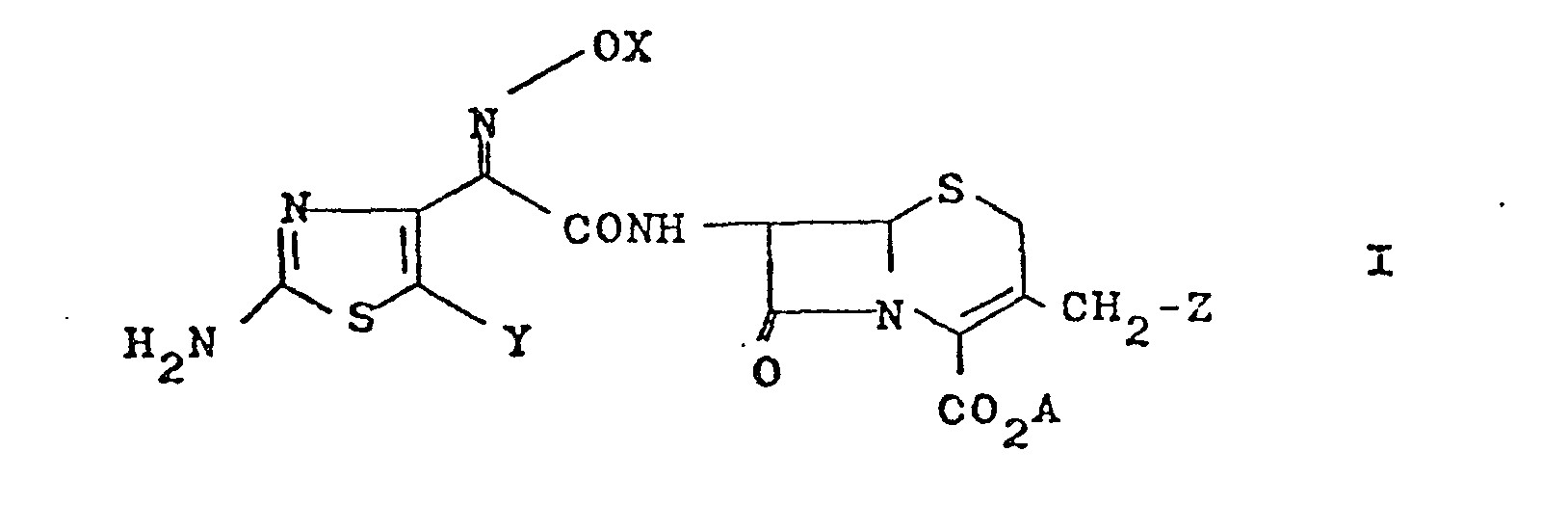
- Gegenstand der Erfindung sind Cephalosporinderivate der allgemeinen Formel I

- X für Wasserstoff, gegebenenfalls substituiertes Alkyl mit 1 bis 4 C-Atomen, gegebenenfalls substituiertes Carboxymethyl, das auch in Form seiner physiologisch unbedenklichen Salze vorliegen kann, gegebenenfalls substituiertes Alkoxycarbonyl-methyl mit 1 bis 4-C-Atomen im Alkylteil, gegebenenfalls substituiertes Aminocarbonylmethyl oder gegebenenfalls substituiertes Cyanomethyl,
- Y für Halogen
- Z für Azid, gegebenenfalls substituiertes Pyridinium oder S-Het, wobei Het einen fünf- oder sechsgliedrigen, mindestens ein Stickstoffatom enthaltenden, gegebenenfalls substituierten Heterocyclus bedeutet, und
- A für Wasserstoff,einen leicht abspaltbaren Esterrest, oder ein physiologisch unbedenkliches Kation steht.
- Steht X für Alkyl mit 1 bis 4 C-Atomen, so seien insbesondere die Reste Methyl, Äthyl, Propyl, iso-Propyl, Butyl und iso-Butyl genannt, die auch substituiert sein können, beispielsweise durch Halogen, insbesondere Brom oder Chlor, durch Hydroxy oder durch Amino, das auch beispielsweise durch Alkyl mit 1 bis 4 C-Atomen, vorzugsweise Methyl, ein- oder zweifach substituiert sein kann.
- Steht X für Alkoxycarbonylmethyl mit 1 bis 4 C-Atomen im Alkylteil, so kommen insbesondere Methoxycarbonylmethyl und Äthoxycarbonylmcthyl in Betracht.
- X in der vorstehenden Bedeutung von Carboxymethyl, das auch in Form seiner physiologisch unbedenklichen Salze vorliegen kann, Alkoxycarbonylmethyl, Aminocarbonylmethyl und Cyanomethyl kann in der Methylengruppe ein- oder zweimal substituiert sein, beispielsweise durch Alkyl mit 1 bis 4 C-Atomen, vorzugsweise Methyl, wobei insbesondere zwei Alkylsubstituenten auch zu einem 3- bis 6-gliedrigen carbocyclischen Ring geschlossen sein können.
- Im einzelnen seien als bevorzugte Reste X genannt Wasserstoff, Äthyl, n-Propyl, iso-Propyl, n-Butyl, iso-Butyl, Carboxymethyl, Methoxycarbonylmethyl, Äthoxycarbonylmethyl, Aminocarbonylmethyl und Cyanomethyl. Besonders bevorzugt ist Methyl.
- Für Y sind bevorzugte Bedeutungen Brom, Chlor, besonders bevorzugt jedoch Chlor.
- Z kann stehen für Azid, Pyridinium, gegebenenfalls substituiertes Pyridinium, vorzugsweise 4-Aminocarbonylpyridinium sowie S-Het, wobei Het für einen gegebenenfalls auch ganz oder teilweise hydrierten 5-gliedrigen Heterocyclus, der neben einem Stickstoffatom noch weitere Heteroatome, wie Stickstoff, Schwefel oder Sauerstoff enthalten kann, steht, wie z.B. Thiazol, Thiadiazol, Triazol, Oxadiazol oder Tetrazol, oder für einen gegebenenfalls auch ganz oder teilweise hydrierten 6-gliedrigen Heterocyclus mit 1 - 3 Stickstoffatomen, wie z.B. Pyridin, Pyrimidin oder Triazin, insbesondere 1,2,4-Triazin-3-yl, der gegebenenfalls ein- oder zweifach substituiert sein kann durch Alkylgruppen mit 1 - 4 C-Atomen, vorzugsweise Methyl und Äthyl, Trifluormethyl, Carboxy, Carboxymethyl, Alkoxycarbonylmethyl mit 1 - 4 C-Atomen im Alkylteil, vorzugsweise Methoxy- oder Äthoxycarbonylmethyl, Hydroxy, Hydroxymethyl, Oxo, Amino, Alkyl- und Dialkylamino mit 1 - 4 C-Atomen im Alkylteil, vorzugsweise Methyl oder Äthyl, Acylamino mit 1 - 4 C-Atomen im Acylteil, vorzugsweise Formyl oder Acetyl oder durch 5- oder 6-gliedriges Heteroaryl, insbesondere Thienyl und Pyridyl.
- Als besonders bevorzugte Bedeutungen von Het seien genannt 1,3,4-Thiadiazol-2-yl, 2-Methyl-1,3,4-thiadiazol-5-yl, 2-Äthyl-1,3,4-thiadiazol-5-yl, 2-Trifluormethyl-1,3,4-thiadiazol-5-yl, 2-Hydroxy-methyl-1,3,4-thiadj.azol-5-yl, 2-Amino-1,3,4-thiadiazol-5-yl, 2-Methyl-1,3,4-oxadiazol-5-yl, 2-Hydroxymethyl-1,3,4-oxadiazol-5-yl, 1,3,4-Triazol-2-yl, 1-Methyl-1,3,4-triazol-2-yl, 1,2-Dimethyl-1,3,4-triazol-5-yl, 1,2,3-Triazol-4-yl, 2-Thien-2-yl-1,3,4-triazol-5-yl, 3-Methyl-1,2,4-thiadiazol-5-yl, 5-Carboxymethyl-4-methyl-thiazol-2-yl, Tetrazol-5-yl, 1-Methyl- tetrazol-5-yl, 1-Oxido-pyridin-2-yl, 3,6-Diamino-pyrimidin-2-yl, 6-Hydroxy-4-methyl-4,5-dihydro-5-oxo-1,2,4-triazin-3-yl, 6-Hydroxy-2-methyl-2,5-dihydro-5-oxo-1,2,4-triazin-3-yl.
- Als leicht spaltbare Ester in der Bedeutung von A, die den Charakter einer chemischen Schutzgruppe tragen, seien als bevorzugt erwähnt der tert.-Butylester und Trimethylsilylester, sowie auch der Benzyl-, Benzhydryl-, Trichloräthyl-, p-Methoxybenzyl- oder p-Nitrobenzylester.
- Als physiologisch unbedenkliche Kationen A seien beispielsweise genannt ein Alkali-, insbesondere das Natrium- und Kaliumion, ein Erdalkali-, insbesondere das Calcium- und Magnesiumion und Ammoniumion, vorzugsweise jedoch ein Natriumion, sowie ein gegebenenfalls substituiertes alkyliertes Ammoniumion, wobei ein Alkylrest 1 - 4 C-Atome haben kann, wie vbrzugsweise Triäthylammonium, Diäthylammonium, Dimethylammonium oder Morpholinium, Benzylammonium, Procainium, L-Argininium und L-Lysinium. Entsprechende physiologisch unbedenkliche Kationen kommen auch für den Fall in Betracht, daß X in Form eines Salzes der Carboxymethylgruppe vorliegt.
- Die XO-Gruppe in den Verbindungen der allgemeinen Formel I, III, IV und V kann in der syn- wie auch in der anti-Form vorliegen. Besonders bevorzugt ist erfindungsgemäß die syn-Form. Die Bezeichnung syn bzw. anti drückt die räumliche Lage relativ zur Carboxyamidgruppe in den Verbindungen 1 und IV, zur Carboxylgruppe in den Verbindungen III und zur Alkoxycarbonylgruppe in den Verbindungen V aus, wobei die syn-Position diejenige ist, bei der die XO-Gruppe auf der gleichen Seite der C=N-Doppelbindung steht, wie die Carboxyamid-, Carboxyl- oder Alkoxycarbonylgruppe.
- 2-Aminothiazole der allgemeinen Formel I, III, IV und V können in jeweils zwei tautomeren Formen auftreten, die im Gleichgewichtszustand nebeneinander vorliegen und durch die folgenden Gleichgewichtsgleichungen dargestellt werden können.


- In den vorliegenden Unterlagen wird davon abgesehen, bei formelmäßigen Darstellungen jeweils beide Tautomeren wiederzugeben. Sie beschränken sich aus Zweckmäßigkeitsgründen auf die Wiedergabe des Amino-thiazol-tautomeren

- Gegenstand der Erfindung ist weiterhin ein Verfahren zur Herstellung von Cephemverbindungen der allgemeinen Formel I, das dadurch gekennzeichnet ist, daß man Lactame der allgemeinen Formel II


- In den Formeln II, III und IV steht
- R 1 für Wasserstoff oder für eine aus der Peptidchemie bekannte Amino-Schutzgruppe, wie z.B. gegebenenfalls substituiertes Alkyl, wie vorzugsweise tert.-Butyl, tert.-Amyl, Benzyl, p-Methoxybenzyl, Benzhydryl, Trityl und Phenyläthyl, gegebenenfalls substituiertes aliphatisches Acyl, wie z.B. Formyl, Chloracetyl, Bromacetyl, Trichloracetyl und Trifluoracetyl oder gegebenenfalls substituiertes Alkoxycarbonyl, wie beispielsweise Trichloräthoxycarbonyl oder Benzyloxycarbonyl,
- X' für X, für eine leicht abspaltbare Gruppe wie z.B. Formyl, Trifluoracetyl, Chloracetyl, Bromacetyl, Trityl, tert.-Amyl, tert.-Butyl, Benzhydryl, Tetrahydropyranyl, vorzugsweise jedoch für tert.-Butyl, Trityl und Tetrahydropyranyl, sowie für eine Gruppe der Formol -CH2C02R3, in der R3 die Bedeutung eines unter milden Bedingungen abspaltbaren Restes hat, wie vorzugsweise Trichloräthyl, tert.-Butyl, Benzyl, p-Methoxyphenyl, Benzhydryl oder Trityl,
- Z' für Z, für Acyloxy mit 1 - 4 C-Atomen im Acylteil, vorzugsweise für Formyloxy und Acetoxy, für Halogen wie vorzugsweise Chlor und Brom.
- Als aktivierte Derivate der Carbonsäuren der allgemeinen Formel III eignen sich insbesondere die Halogenide, vorzugsweise Chloride und Bromide, ferner die Anhydride und gemischten Anhydride, die Azide und aktivierten Ester, vorzugsweise die mit p-Nitrophenol, 2,4-Dinitrophenol, Methylencyanhydrin, N-Hydroxysuccinimid und N-Hydroxyphthalimid, besonders bevorzugt mit 1-Hydroxybenzotriazol und 6-Chlor-1-H-hydroxybenzotriazol. Als gemischte Anhydride eignen sich besonders solche mit niederen Alkansäuren, z.B. mit Essigsäure und besonders bevorzugt mit substituierten Essigsäuren, wie z.B. Trichloressigsäure, Pivalinsäure oder Cyanessigsäure. Besonders geeignet sind aber auch die gemischten Anhydride mit Kohlensäurehalbestern, die man beispielsweise durch Umsetzung der Carbonsäuren III, in denen R1 nicht Wasserstoff bedeutet, mit Chlorameisensäurebenzylester, -p-nitrobenzylester, isobutylester, -äthylester oder -allylester gewinnt.
- Die Aktivierung kann auch durch Reaktion der Carbonsäure der Formel III mit einem Reaktionsprodukt aus beispielsweise Phosgen, Thionylchlorid, Thionylbromid, Oxalylchlorid, Phosphorpentachlorid oder Phosphoroxychlorid mit einem N-dialkyl-substituierten Carbonsäureamid, wie z.B. Dimethylformamid, Dimethylacetamid oder N-Methylpyrrolidon erfolgen. Das Reaktionsprodukt aus Dimethylformamid und einem der obengenannten Halogenide wird in der Literatur auch als Vilsmeier-Reagens bezeichnet.
- Die aktivierten Derivate können als isolierte Substanzen, aber,auch in situ umgesetzt werden. Allgemein erfolgt die Umsetzung der Cephemderivate II mit der Carbonsäure III oder einem aktivierten Derivat derselben in Gegenwart eines inerten Lösungsmittels. Insbesondere eignen sich chlorierte Kohlenwasserstoffe, wie vorzugsweise Methylenchlorid und Chloroform; Äther, wie z.B. Diäthyläther, Diisopropyläther und vorzugsweise Tetrahydrofuran und Dioxan; Ketone, wie vorzugsweise Aceton und Butanon; Amide, wie vorzugsweise Dimethylformamid, Dimethylacetamid, N-Methyl-pyrrolidon oder Wasser. Es kann sich auch als vorteilhaft erweisen, Gemische der genannten Lösungsmittel zu verwenden. Dies ist oftmals der Fall, wenn die Cephemverbindung II mit einem in situ erzeugten aktivierten Derivat der Carbonsäure III umgesetzt wird.
- Die Umsetzung von Cephemverbindungen II mit Carbonsäuren III bzw. deren aktivierten Derivaten kann in einem Temperaturbereich von etwa -50 bis etwa +80°C, vorzugsweise zwischen -20 und +50°C, besonders bevorzugt jedoch zwischen -20°C und Raumtemperatur erfolgen.
- Die Reaktionsdauer hängt von den Reaktanten, der Temperatur und dem Lösungsmittel bzw. dem Lösungsmittelgemisch ab und liegt normalerweise zwischen etwa 1/4 und etwa 72 Stunden.
- In einzelnen Fällen kann es sich auch als vorteilhaft erweisen, die freie Carbonsäure der Formel III mit einer Cephemverbindung der Formel II, in der A die Bedeutung eines leicht abspaltbaren Esterrestes, wie vorzugsweise tert.-Butyl oder Trimethylsilyl hat, direkt umzusetzen, wobei man vorteilhaft ein wasserbindendes Mittel in annähernd äquimolarer Menge zusetzt. Als solches kommen zum Beispiel Carbodiimide in Frage, insbesondere Dicyclohexylcarbodiimide. Diese Reaktion wird in inerten Lösungsmitteln, wie vorzugsweise Methylenchlorid, Dimethylformamid, Tetrahydrofuran, Dioxan oder auch Gemischen durchgeführt.
- Die Umsetzung von aktivierten Derivaten der Carbonsäuren der Formel III mit Cephemverbindungen der Formel II wird vorzugsweise in alkalischem Milieu oberhalb pH 7 vorgenommen. Man setzt hierfür dem Reaktionsgemisch eine Base zu, wie vorzugsweise Kalium- oder Natriumcarbonat, Kalium- oder Natriumbicarbonat, Kalium- oder Natriumhydroxid, Pyridin oder ein Trialkylamin, wie z.B. Triäthylamin, N-Methylmorpholin, Äthyldiisopropylamin oder Kalium-tert.-butylat.
- Die Umsetzung kann vorzugsweise auch so durchgeführt werden, daß ein 1-Hydroxybenzotriazol- oder ein 6-Chlorhydroxybenzotriazolester der Carbonsäuren der allgemeinen Formel III ohne Zusatz eines säurebindenden Mittels in einem Lösungsmittel direkt mit Cephemverbindungen der Formel II umgesetzt werden. Als Lösungsmittel haben sich insbesondere offenkettige und cyclische tertiäre Amide bewährt, besonders bevorzugt Dimethylformamid, Dimethylacetamid und N-Methyl- pyrrolidon.
- Enthalten Cephemverbindungen der Formel IV noch einen Rest R 1, X' und/oder Z', so können daraus die Verbindungen der Formel I erhalten werden, indem der Rest R1 - sofern er nicht Wasserstoff bedeutet - abgespalten, X' sofern er nicht die Bedeutung von X hat - in X überführt und Z' - sofern er nicht für Z steht - in Z umgewandelt wird. Die Reihenfolge der Abspaltung von R1 und der Umwandlungen von X' und Z' in X und Z kann beliebig vertauscht werden, wobei jedoch in der Regel zunächst R1 in Wasserstoff und X' in X umgewandelt und dann erst Z' in Z überführt wird.
- Die Überführung des Restes Z' sofern er nicht die Bedeutung von Z hat, in Verbindungen der Formel IV in Z kann durch Umsetzen mit einer den nucleophilen Rest Z enthaltenden Verbindung geschehen. Z' kann dabei stehen für Acyloxy mit 1 bis 4 C-Atomen, insbesondere aber für Formyloxy und Acetoxy, und für Halogen, vorzugsweise Chlor oder Brom. Als Verbindungen, die einen nucleophilen Rest Z enthalten seien insbesondere genannt Stickstoffwasserstoffsäure, gegebenenfalls substituierte Pyridinderivate wie insbesondere Pyridin und 4-Aminocarbonylpyridin und Verbindungen der Formel HS-Het, wobei Het die obengenannten Bedeutungen besitzt.
- Die Umsetzung wird vorzugsweise so ausgeführt, daß man ein Äquivalent einer Verbindung der allgemeinen Formel IV mit mindestens einem Äquivalent einer einen nucleophilen Rest Z enthaltenden Verbindung insbesondere den vorstehend als vorzugsweise genannten Verbindungen, in einem, die Reaktion nicht behindernden Lösungsmittel umsetzt.
- Ein bis zu 10-facher Überschuß der nucleophilen Verbindung wirkt sich vorteilhaft auf die Ausbeute aus. Der Überschuß beträgt vorzugsweise 0 - 200 %.
- Beispiele für die Reaktion nicht behindernde Lösungsmittel sind Wasser, Aceton, Butanon, Chloroform, Nitrobenzol, Methylenchlorid, Äthylenchlorid, Dimethylformamid, Dimethylacetamid, N-Methylpyrrolidon, Methanol, Äthanol, Essigsäureäthylester, Essigsäurebutylester, Diäthyläther, Diisopropyläther, Tetrahydrofuran, Acetonitril.
- Von den Lösungsmitteln können die hydrophilen Lösungsmittel, vorzugsweise Aceton, Methanol, Äthanol, Dimethylformamid und Acetonitril auch im Gemisch mit Wasser verwendet werden.
- Die Reaktion wird in einem pH-Bereich von 5 bis 8, vorzugsweise bei neutralem pH ausgeführt.
- Wenn die den nucleophilen Rest Z enthaltenden Verbindungen, insbesondere Stickstoffwasserstoffsäure und die Verbindungen der Formel HS-Het, in freier Form verwendet werden, wird die Reaktion vorzugsweise in Anwesenheit einer Base durchgeführt. Als Base eignet sich beispielsweise eine anorganische Base wie ein Alkalihydroxid, Alkalicarbonat oder Alkalihydrogencarbonat.
- Es kann auch eine organische Base wie beispielsweise ein Trialkylamin oder eine quartäre Ammoniumbase zum Einsatz kommen.
- Die den nucleophilen Rest enthaltenden Verbindungen können aber auch in Form ihrer Salze, vorzugsweise ihrer Natrium oder Kalium-Salze eingesetzt werden.
- Die Reaktionstemperatur kann in einem weiten Bereich variiert werden. In der Regel wird die Reaktion bei Raumtemperatur oder unter Erwärmen zur Rückflußtemperatur der verwendeten Lösungsmittel oder Lösungsmittelgemische durchgeführt. Zweckmäßigerweise werden jedoch 80° nicht überschritten.
- Die Abspaltung von R1 kann mit in der ß-Lactam- und Peptid- Chemie allgemein üblichen schonenden Methoden, wie Hydrolyse in Säuren, vorzugsweise Ameisensäure oder Trifluoressigsäure, oder auch Hydrogenolyse in Gegenwart von Edelmetallkatalysatoren erfolgen. Je nach Schutzgruppe können aber auch spezielle Abspaltungsreagenzien zum Einsatz kommen, wie beispielsweise gegebenenfalls substituierte Thioharnstoffe zum Entfernen von α-Halogenacylgruppen.
- Auch die Umwandlung der Gruppe X', sofern sie nicht die Bedeutung von X hat, in X kann mit in der ß-Lactam- und Peptid- Chemie üblichen schonenden hydrolytischen oder hydrogenolytischen Methoden herbeigeführt werden, wobei insbesondere Hydrolysen in anorganischen und organischen Säuren, wie vorzugsweise Trifluoressigsäure oder verdünnter Ameisensäure genannt sein sollen.
- Bei der erfindungsgemäßen Umsetzung anfallende Ester der Formel I und IV, in denen A die Bedeutung eines leicht abspaltbaren Restes hat, können - falls gewünscht - in literaturbekannter, schonender Weise, z.B. hydrolytisch oder hydrogenolytisch, in Verbindungen der Formel I oder IV umgewandelt werden, in denen A die Bedeutung von Wasserstoff oder einem physiologisch unbedenklichen Kation hat, wie es vorstehend beschrieben worden ist. In analoger Weise kann auch aus dem Rest X' in der Bedeutung von -CH2CO2R3 die Gruppe R3 abgespalten werden.
- Die zur Acylierung verwendeten CarbonsäurenIII lassen sich nach verschiedenen Verfahren herstellen.
- So erhält man beispielsweise Verbindungen der Formel III mit Y in der Bedeutung von Halogen, indem Verbindungen der Formel V

- Als geeignete Halogenierungsmittel können die elementaren Halogene, wie bevorzugt Brom und Chlor, Trihalogen-iso- cyanursäuren,wie vorzugsweise Trichlorisocyanursäure, N-Halogenamide, wie vorzugsweise Chloramin-T, N-Chloracetamid, N-Bromacetamid, N-Halogenimide, wie vorzugsweise N-Chlorsuccinimid, α-Bromsuccinimid, N-Chlor- und N-Bromphthalimid oder Alkylhypochlorite, wie beispielsweise tert.-Butylhypochlorit eingesetzt werden. Die Reaktion wird in der Regel in einem Lösungsmittel durchgeführt, das die Reaktion nicht nachteilig beeinflußt oder sie sogar in die gewünschte Richtung ablaufen läßt. So empfiehlt sich bei Alkylhypochloriten, N-Halogenamiden und N-Halogenimiden ein polares, hydroxylgruppenhaltiges Lösungsmittel, welches die Bildung von positiven Halogenionen fördert, so vorzugsweise Ameisensäure, Eisessig, Wasser, Alkanole wie z.B. Methanol, Äthanol oder Isopropanol. Daneben, vor allem aber bei der Verwendung von elementarem Halogen, können sich auch Lösungsmittel wie Chloroform, Methylenchlorid, Tetrahydrofuran, Dioxan oder Dimethylformamid oder Mischungen derselben untereinander oder mit den oben genannten hydroxylgruppenhaltigen Lösungsmittel empfehlen.
- Die Reaktionstemperatur ist nicht kritisch, sie liegt jedoch bevorzugt im Bereich zwischen etwa -20°C und Raumtemperatur.
- Verbindungen der Formel III mit Y in der Bedeutung von Halogen lassen sich weiterhin durch Umsetzung von Thioharnstoff mit Oximen der Formel

- Zweckmäßigerweise erfolgt die Umsetzung mit einer stöchiometrischen Menge Thioharnstoff in einem wasserhaltigen Lösungsmittel, wie z.B. Äthanol oder Aceton. Die Reaktion sollte bei Raumtemperatur durchgeführt werden und maximal etwa 2 bis 3 Stunden dauern.
- Die Ausgangsverbindungen der Formel V sind literaturbekannt oder nach literaturbekannten Verfahren herstellbar.
- Steht in den allgemeinen Formeln III und V der Rest R1 für eine leicht entfernbare, aus der Peptid-Chemie als Amino- schutzgruppe bekannte Gruppe, so kann ihre Einführung in die Aminogruppe auf die aus der Peptid-Chemie für Aminoschutzgruppen bekannte Weise erfolgen. Stellt R1 beispielsweise die Tritylgruppe dar, so kann ihre Einführung mit Triphenylchlormethan erfolgen, wobei die Reaktion zweckmäßigerweise in einem organischen Lösungsmittel, wie beispielsweise halogenierten Kohlenwasserstoffen,in Gegenwart von Basen, wie vorzugsweise Triäthylamin, durchgeführt wird.
- Steht in den Formeln III und V X' für eine leicht abspaltbare Gruppe so kann ihre Einführung auf literaturbekannte Weise geschehen, die dem Fachmann für den Schutz von Hydroxylgruppen geläufig ist.
- Nicht nur bei der Darstellung der Ausgangsmaterialien III bzw. V, die eine Gruppe

- Die erfindungsgemäß erhaltenen Verbindungen der Formel I zeigen bemerkenswert gute antibakterielle Wirksamkeiten sowohl gegen grampositive als auch gramnegative bakterielle Keime.
- Auch gegen penicillinase- und cephalosporinasebildende Bakterien sind die neuen Verbindungen unerwartet gut wirksam. Da sie zudem günstige toxikologische und pharmakologische Eigenschaften zeigen, stellen sie wertvolle Chemotherapeutika dar.
- Die Erfindung betrifft somit auch Arzneipräparate zur Behandlung von mikrobiellen Infektionen, die durch einen Gehalt an einer oder mehreren der erfindungemäßen Verbindungen charakterisiert sind.
- Die erfindungsgemäßen Produkte können auch in Kombination mit anderen Wirkstoffen, beispielsweise aus der Reihe der Penicilline, Cephalosporine oder Aminoglykoside zur Anwendung kommen.
- Die Verbindungen der Formel I können oral, intramuskulär . oder intravenös verabfolgt werden.
- Arzneipräparate, die eine oder mehrere Verbindungen der allgemeinen Formel I als Wirkstoff enthalten, können hergestellt werden, indem man die Verbindungen der allgemeinen Formel I mit einem oder mehreren pharmakologisch verträglichen Trägerstoffen oder Verdünnungsmitteln, wie z.B. Füllstoffen, Emulgatoren, Gleitstoffen, Geschmacks-korrigentien, Farb-; stoffen oder Puffersubstanzen vermischt und in eine geeignete galenische Zubereitungsform bringt, wie beispielsweise Tabletten, Dragees, Kapseln, oder eine zur parenteralen . Applikation geeignete Lösung oder Suspension. Als Träger-oder Verdünnungsmittel seien beispielsweise erwähnt Traganth, Milchzucker, Agar-Agar, Polyglykole, Talkum,.Äthanol und Wasser. Für die parenterale Applikation kommen vorzugsweise Suspensionen oder Lösungen in Wasser in Betracht. Es ist auch möglich, die Wirkstoffe als solche ohne Träger- oder Verdünnungsmittel in geeigneter Form beispielsweise in Kapseln zu applizieren.
- Geeignete Dosen der Verbindungen der allgemeinen Formel I liegen bei etwa 0,4 bis 20 g/Tag, vorzugsweise bei 0,5 bis 4 g/Tag für einen Erwachsenen von etwa 60 kg Körpergewicht. Es können Einzel- oder im allgemeinen Mehrfachdosen verabfolgt werden, wobei die Einzeldosis den Wirkstoff in einer Menge von etwa 50 bis 1000 mg, vorzugsweise 100 bis 500 mg enthalten kann.
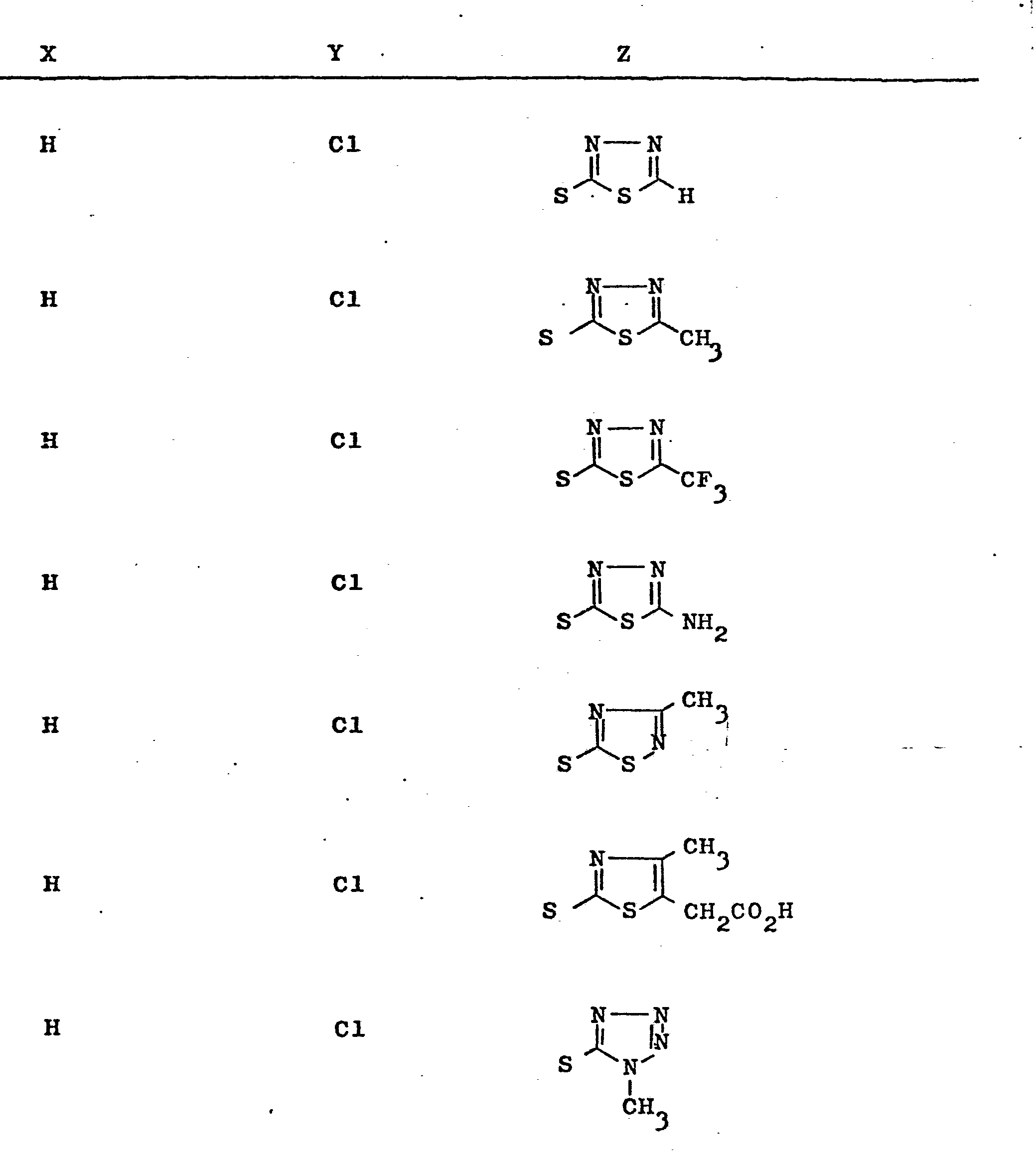
- Erfindungsgemäß lassen sich außer den in den Ausführungsbeispielen genannten Verbindungen beispielsweise die in der folgenden Tabelle genannten Verbindungen I darstellen:

-


- Die Beispiele erläutern die Erfindung, ohne sie jedoch einzuschränken.
- Die in den Beispielen angegebenen Rf-Werte wurden durch Dünnschichtchromatographie auf Kieselgel-Fertigplatten 60 F 254 der Firma Merck, Darmstadt, ermittelt.
- 940 mg α-syn-Methoximino-α-(2-amino-5-chlorthiazol-4-yl)-essigsäure und 540 mg 1-Hydroxybenzotriazol wurden in 30 ml Tetrahydrofuran gelöst und mit 824 mg Dicyclohexylcarbodiimid versetzt. Nach zweistündigem Rühren bei Raumtemperatur wurde abfiltriert. Zu der Mutterlauge wurde 1,35 g 7-Amino-3-(1-methyltetrazol-5-yl-thiomethyl)-3-cephem-4-carbonsäure, die mit 1,2 g Triäthylamin in 30 ml Methylenchlorid in Lösung gebracht und anschließend durch Kieselgur filtriert worden war, gegeben und 4 Stunden bei Raumtemperatur gerührt. Die Reaktionslösung wurde durch Kieselgur filtriert und am Rotationsverdampfer eingeengt. Der Rückstand wurde in H20 bei pH 6,0 aufgenommen, dreimal mit Essigester extrahiert, im Vakuum von Essigesterresten befreit, auf +5° gekühlt und mit 2N HCl auf pH 1,6 angesäuert. Durch Filtration konnten 1,2 g der Titelverbindung isoliert werden.
- NMR (DMSO-d6): δ = 9,5 ppm (d, 1H, CONH) δ = 7,3 ppm (s, 2H, NH2) δ = 5,75 ppm (q, 1H, C-7-H) δ = 5,05 ppm (d, 1H, C-6-H) δ = 4,3 ppm (breit, CH2-S) δ = 3,95 ppm [236 Hz] (s, 3H, Tetr-CH3) δ = 3,85 ppm [231 Hz] (s, 3H, OCH3, syn) δ = 3,6 ppm (s, breit, C-2-CH2)
- 4,9 g 7-[α-syn-Methoximino-α-(2-amino-5-chlor-thiazol-4-yl)-acetamido]-cephalosporansäure und 1,5 g Natrium-1-methyl-tetrazol-5-yl-thiolat wurden in 100 ml H20 bei pH 6,5 bis 7,0 und 60° 3 Stunden gerührt. Nach dem Abkühlen wurde mit 2N HC1 auf pH 4,5 gestellt, zweimal mit Essigester extrahiert und die wässrige Phase nach Entfernen von Essigester-Resten im Vakuum bei 50 mit 2N HCl auf pH 2,0 gestellt. Nach 1/4 stündigem Rühren wurde abfiltriert und getrocknet. Man erhielt so 3,7 g der Titelverbindung in ihren physikalischen Konstanten identisch mit der in Beispiel 1 dargestellten Verbindung.
- 2,32 g α-syn-Methoximino-α-(2-amino-5-chlor-thiazol-4-yl)-essigsäure wurden in 25 ml Tetrahydrofuran gelöst, mit 1,36 g 1-Hydroxy-benzotriazol versetzt und auf 45° erwärmt. Nach Zugabe von 2,16 g Dicyclohexylcarbodiimid wurde 2 Stunden bei Raumtemperatur gerührt,vom ausgefallenen Harnstoff (2,18 g) abgesaugt und der Harnstoff mit 15 ml Tetrahydrofuran gewaschen.
- Die vereinigten Filtrate wurden mit einer Lösung aus 2,55 g 7-Amino-3-azido-methyl-3-cephem-4-carbonsäure und 3,0 g Triäthylamin in 40 ml CH2Cl2 vereinigt und 6 Stunden bei Raumtemperatur gerührt. Die gebildeten Kristalle wurden abfiltriert, mit wenig CH2Cl2 gewaschen. Man erhält so 2,3 g des Triäthylammoniumsalzes der Titelverbindung.
- NMR (DMSO-d6):
- = 9,5 ppm (d, 1H, CONH) δ = 7,4 ppm (breit, 2H, NH2) δ = 5,6 ppm (q, 1H, C-7-H) δ = 5,1 ppm (d, 1H, C-6-H) δ = 3,8 ppm [231 Hz] (s, 3H, OCH3,syn) δ = 4,3 ppm (breit, CH2-S) δ = 3,4 ppm (breit, C-2-CH2) δ = 3,0 ppm (q, 6H, N-CH2) δ = 1,2 ppm (t, 9H, NCH2CH3)
- 2,0 g des Triäthylammoniumsalzes der Titelverbindung wurden bei 0° in 50 ml H2O gelöst und mit 2N HCl auf pH 2,1 gestellt. Durch Filtration konnten 1,36 g der Titelverbindung isoliert werden.
- NMR (DMSO-d6):
- δ = 9,5 ppm (d, 1H, CONH) δ= 7,3 ppm (breit, 2H, NH2) δ = 5,6 ppm (q, 1H, C-7-H) δ = 5,05 ppm (d, 1H, C-6-H) δ = 4,4 ppm (AB, CH2-N3) δ = 3,8 ppm [232 Hz] (s, 3H, OCH3, syn) δ = 3,4 ppm (breit, C-2-CH2)
- 1,18 g α-syn-Methoximino-α-(2-amino-5-chlor-thiazol-4-yl)-essigsäure und 680 mg 1-Hydroxy-benzotriazol wurden in 50 ml Tetrahydrofuran gelöst und mit 1,03 g Dicyclohexylcarbodiimid versetzt. Nach zweistündigem Rühren wurde abfiltriert. Die Mutterlauge wurde mit einer Suspension aus 1,72 g 7-Amino-3-(2-methyl-1,3,4-thiadiazol-2-yl- thiomethyl)-3-cephem-4-carbonsäure und 2,0 g Triäthylamin in 50 ml CH2Cl2 versetzt.
- Es wurde über Nacht bei Raumtemperatur gerührt, das Lösungsmittel im Vakuum abdestilliert,in 60 ml H20 aufgenommen und bei pH 4,5 viermal mit Essigester extrahiert. Nach Abkühlen auf 5° wurde mit 2N HCl auf pH 2,3 angesäuert und vom Niederschlag abfiltriert. Es konnten so 1,13 g der Titelverbindung isoliert werden.
- NMR (DMSO-d6):
- δ = 9,5 ppm (d, 1H, CONH) = 7,3 ppm (s, 2H, NH2) δ = 5,75 ppm (q, 1H, C-7-H) δ = 5,05 ppm (d, 1H, C-6-H) δ = 4,3 ppm (AB, 2H, CH2-S) δ = 3,8 ppm [230 Hz] (s, 3H, OCH3, syn) δ = 3,3 ppm (breit, C-2-CH2) δ = 2,65 ppm (s, 3H, CH 3)
- 4,9 g 7-[2-syn-Methoximino-α-(2-amino-5-chlor-thiazol-4-yl)-acetamido]-cephalosporansäure und 1,5 g 2-Methyl-1,3,4-thiadiazol-5-thiol wurden in 70 ml H20 durch Zusatz von festem NaHCO3 bei pH 6,5 - 7,0 in Lösung gebracht. Nach Zugabe von 30 ml Aceton wurde die Lösung bei pH 6,5 - 7,0 und Rückfluß 2 1/2 Stunden gerührt. Anschließend wurde das-Aceton am Rotationsverdampfer abgezogen und die Lösung bei 5°C unter Rühren mit 2 N HCl auf pH 2,3 angesäuert. Durch Filtration konnten 2,7 g der Titelverbindung isoliert werden, in ihren physikalischen Konstanten identisch mit der in 4 dargestellten Verbindung.
- Setzt man analog Beispiel 5 2,5 g 7-[α-syn-Methoximino- a-(2-amino-5-chlor-thiazol-4-yl)-acetamido]-cephalosporan- säure mit 0,7 g 2-Amino-1,3,4-thiadiazol-5-thiol um, so erhält man 1,8 g der Titelverbindung.
- NMR (DMSO-d6):
- δ = 9,5 ppm (d, 1H, CONH)
- δ = 7,0-7,5 ppm (breites Signal, 4H, Thiazol-NH2 und Thiadiazol-NH2)
- δ = 5,65 ppm (q, 1H, C-7-H)
- δ = 5,0 ppm (d, 1H, C-6-H)
- δ = 4,1 ppm (AB, CH2S)
- δ = 3,9 ppm [231 Hz] (s, 3H, OCH3, syn!)
- δ = 3,2 ppm (breit, C-2-CH2)
- Setzt man analog Beispiel 5 2,5 g 7-[α-syn-Methoximino-α-(2-amino-5-chlor-thiazol-4-yl)-acetamido]-cephalosporan- säure mit 0,75 g 3-Methyl-1,2,4-thiadiazol-5-thiol um, so erhält man 1,3 g der Titelverbindung.
- NMR (DMSO-d 6):
- δ = 9,5 ppm (d, 1H, CONH)
- δ = 7,45 ppm (s, breit, 2H, NH2)
- δ = 5,70 ppm (q, 1H, C-7-H)
- δ = 5,05 ppm (d, 1H, C-6-H)
- δ = 4,15 ppm (AB, CH2S)
- δ = 3,95 ppm [232 Hz] (s, 3H, OCH3, syn!)
- δ = 3,1 ppm (breit, C-2-CH2)
- 2,35 g α-syn-Methoximino-α-(2-amino-5-chlor-thiazol-4-yl)-essigsäure wurden in 25 ml Tetrahydrofuran gelöst, mit 1,35 g 1-Hydroxy-benzotriazol versetzt und auf 450 erwärmt. Nach Zugabe von 2,16 g Dicyclohexylcarbodiimid wurde 2 Stunden bei Raumtemperatur gerührt und anschließend vom ausgefallenen Harnstoff (1,9 g) abfiltriert. Das Filtrat wurde mit einer Lösung aus 4,0 g 7-Amino-3-(2-thien-2-yl-1-H-1,3,4-triazol-2-yl-thiomethyl)-3-cephem-4-carbonsäure und 3,0 g Triäthylamin in 30 ml CH2Cl2 vereinigt, 8 Stunden bei Raumtemperatur gerührt und anschließend 1 Woche im Kühlschrank belassen. Das Lösungsmittel wurde im Vakuum entfernt, der Rückstand in 100 ml H20 aufgenommen und bei pH 4,5 dreimal mit Essigester extrahiert. Die wässrige Phase wurde sodann bei 0-5° mit 2 N HCl auf pH 2,0 angesäuert. Es konnten so 400 mg der Titelverbindung isoliert werden
- NMR (DMSO-d6):
- δ = 9,5 ppm (d, 1H, CONH)
- δ = 7,4 ppm (breit, NH2)
- δ = 7,7-7,5 ppm (m, 2H, thienyl)
- δ = 7,5 -7,0 ppm (m, 2H, thienyl)
- δ = 5,7 ppm(q, 1H, C-7-H)
- 5,1 ppm (d, 1H, C-6-H)
- δ = 4,3 ppm (breit, 2H, CH2-S)
- δ = 3,9 ppm [232 Hz] (s, 3H, OCH3, syn)
- = 3,7 ppm (breit, C-2-CH2) .
- 940 mg α-syn-Methoximino-α-(2-amino-5-chlor-thiazol-4-yl)-essigsäure und 540 mg 1-Hydroxybenzotriazol wurden in 40 ml Tetrahydrofuran gelöst und mit 824 mg Dicyclohexylcarbodiimid versetzt. Nach einstündigem Rühren wurde abfiltriert. Zu der Mutterlauge wurde eine Lösung von 2,0 g 7-Amino-3-(5-carboxy-methyl-4-methyl-thiazol-2-yl-thiomethyl)-3-cephem-4-carbonsäure,gelöst in 30 ml Methylenchlorid, 2,0 g Triäthylamin, 2,0 ml Dimethylformamid und 0,3 ml H20 gegeben. Es wurde über Nacht bei Raumtemperatur gerührt, das Lösungsmittel im Vakuum abdestilliert, mit 50 ml H20 versetzt und bei pH 4,5 viermal mit Essigester extrahiert. Nach Abkühlen auf +5° wurde mit 2N HCl auf pH 2,0 angesäuert und der Niederschlag durch Filtration gesammelt: 1,26 g
- NMR (DMSO-d6):
- δ = 9,5 ppm (d, 1H, CONH)
- δ = 7,4 ppm (s, breit, 2H, NH2)
- δ = 5,75 ppm (q, 1H, C-7-H)
- δ = 5,05 ppm (d, 1H, C-6-H)
- δ = 4,2 ppm (AB, CH2-S)
- δ = 3,9 ppm [230 Hz] (s, 3H, OCH3, syn)
- δ = 3,8 ppm [224 Hz] (s, 2H, CH2-CO2H)
- δ = 3,3 ppm (breit, C-2-CH3)
- δ = 2,2 ppm (s, 3H, CH3)
- -Setzt man analog Beispiel 4 2 g 7-Amino-3-(2-trifluormethyl-1,3,4-thiadiazol-5-yl-thiomethyl)-3-cephem-4-carbonsäure mit dem Reaktionsprodukt aus 1,18 g a-syn-Methoximino-a-(2-amino-5-chlor-thiazol-4-yl)-essigsäure, 680 mg 1-Hydroxy-benzotriazol und 1,03 g Dicyclohexylcarbodiimid um, so erhält man 1,7 g der Titelverbindung.
- NMR (DMSO-d6):
- δ = 9,5 ppm (d, 1H, CONH)
- δ = 7,2 ppm (breit, 2H, NH2)
- δ = 5,65 ppm (q, 1H, C-7-H)
- δ = 5,0 ppm (d, 1H, C-6-H)
- δ = 4,3 ppm (breites s, CH2-S)
- δ = 3,85 ppm [231 Hz] (s, 3H, OCH3, syn)
- 3,25 ppm (breit, C-2-CH2)
- 5,0 g 7-[α-syn-Methoximino-α-(2-amino-5-chlorthiazol-4-yl)-acetamido]-cephalosporansäure und 2,2 g 2-Trifluormethyl-1,3,4-thiadiazol-5-thiol wurden in 70 ml H20 durch Zusatz von festem NaHCO3 bei pH 6,5 in Lösung gebracht. Nach Zusatz von 40 ml Essigester wurde 2 Stunden zum Rückfluß erhitzt, abgekühlt und die wässrige Phase abgetrennt. Reste von Essigester wurden aus der wässrigen Phase am Rotationsverdampfer entfernt. Bei 5° wurde unter Rühren mit 2N HC1 auf pH 2,0 angesäuert. Durch Filtration konnten 4,3 g der Titelverbindung isoliert werden, in ihren physikalischen Konstanten identisch mit der in Beispiel 10 dargestellten Verbindung.
- Setzt man analog Beispiel 11 2,5 g 7-[α-syn-Methoximino- a-(2-amino-5-chlor-thiazol-4-yl)-acetanido]-cephalosporan- säure mit 0,7 g 1,2-Dimethyl-1,3,4-triazol-5-thiol um so erhält man 2,25 g der Titelverbindung.
- NMR (DMSO-d6):
- δ = 9,5 ppm (d, 1H, CONH)
- δ = 7,15 ppm (s, breit, 2H, NH2)
- δ = 5,70 ppm (q, 1H, C-7-H)
- δ = 5,05 ppm (d, 1H, C-6-H)
- δ = 4,1 ppm (s, breit, CH2-S)
- δ = 3,85 ppm [231 Hz] (s, 3H, OCH3, syn)
- δ = 3,6 ppm (s, verbreitert, 3H, N-CH3 + C-2-CH2)
- δ = 2,3 ppm (s, 3H, CH3)
- Setzt man analog Beispiel 11 2,5 g 7-[α-syn-Methoximino-α-(2-amino-5-chlor-thiazol-4-yl)-acetamido]-cephalosporan- säure mit 0,85 g 6-Hydroxy-4-methyl-3-mercapto-4,5-di- hydro-1,2,4-triazin-5-on um, so erhält man 1,97 g Titelverbindung.
- NMR (DMSO-d6)
- 9,5 ppm (d, 1H, CONH)
- δ = 7,2 ppm (s, breit, NH2)
- 5,75 ppm (q, 1H, C-7-H)
- δ = 5,1 ppm (d, 1H, C-6-H)
- δ = 4,05 ppm (s, breit, CH2-S)
- δ = 3,8 ppm [230 Hz] (s, 3H, OCH3, syn)
- δ = 3,5 ppm (s, breit, C-2-CH2)
- δ = 3,3 ppm (s, 3H, N-CH3)
- Setzt man analog Beispiel 11 2,5 g 7-[α-syn-Methoximino-α-(2-amino-5-chlor-thiazol-4-yl)-acetamido]-cephalo- sporansäure mit 0,8 g 4,6-Diamino-pyrimidin-2-thiol um, so erhält man 1,5 g der Titelverbindung.
- NMR (DMSO-d6):
- = 9,5 ppm (d, 1H, CONH)
- = 7,15 ppm (s, breit, NH2)
- = 5,75 ppm (q, 1H, C-7-H)
- = 5,0-5,1 ppm (m, 2H, C-6-H + Pyrimidin-H)
- δ = 4,2 ppm (breit, CH2-S)
- δ = 3,85 ppm [231 Hz] (s, 3H, OCH3, syn)
- δ = 3,5 ppm (breit, C-2-CH2)
- Setzt man analog Beispiel 1 990 mg α-syn-Äthoximino-α-(2-amino-5-chlor-thiazol-4-yl)-essigsäure, 540 mg 1-Hydroxy-benzotriazol und 830 mg Dicyclohexylcarbodiimid mit 1,35 g 7-Amino-3-(1-methyl-tetrazol-5-yl- thiomethyl)-3-cephem-4-carbonsäure um, so erhält man 0,95 g der Titelverbindung.
- NMR (DMSO-d6):
- 9,5 ppm (d, 1H, CONH)
- δ = 7,2 ppm (breit, 2H, NH2)
- δ = 5,7 ppm (q, 1H, C-7-H)
- δ = 5,0 ppm (d, 1H, C-6-H)
- δ = 4,15 ppm (q, 2H, OCH2CH3)
- δ = 4,3 ppm (breit, CH2-S)
- δ = 4,0 ppm (s, 3H, Tetr.-CH3)
- δ = 3,6 ppm (s, breit, C-2-CH2)
- δ = 1,25 ppm (t, 3H, OCH2CH3)
- Setzt man analog Beispiel 4 1,23 g a-syn-Äthoximino-a-(2-amino-5-chlor-thiazol-4-yl)-essigsäure, 680 mg 1-Hydroxybenzotriazol und 1,03 g Dicyclohexylcarbodiimid mit 1,72 g 7-Amino-3-(2-methyl-1,3,4-thiadiazol-2-yl- thiomethyl)-3-cephem-4-carbonsäure um, so erhält man 2,15 g der Titelverbindung.
- NMR (DMSO-d6):
- δ = 9,5 ppm (d, 1H, CONH)
- δ = 7,3 ppm (s, breit, NH2)
- δ = 5,75 ppm (q, 1H, C-7-H)
- δ = 5,0 ppm (d, 1H, C-6-H)
- δ = 4,1 ppm (q, 2H, OCH 2CH 3)
- δ = 4,3 ppm (AB, 2H, CH2-S)
- δ = 3,2 ppm (breit, C-2-CH2)
- δ = 2,65' ppm (s, 3H, CH3)
- 1,2 ppm (t, 3H, OCH2CH3)
- Setzt man analog Beispiel 3 1,23 g α-syn-Äthoximino-α-(2-amino-5-chlor-thiazol-4-yl)-essigsäure, 680 mg 1-Hydroxybenzotriazol und 1,03 g Dicyclohexylcarbodiimid mit 1,25 g 7-Amino-3-azidomethyl-3-cephem-4-carbonsäure um so erhält man 1,9 g der Titelverbindung.
- NMR (DMSO-d6):
- δ = 9,5 ppm (d, 1H, CONH)
- δ = 7,3 ppm (s, breit, NH2)
- δ = 5,65 ppm (q, 1H, C-7-H)
- δ = 5,05 ppm (d, 1H, c-6-H)
- δ = 4,15 ppm (q, 2H, OCH2CH3)
- δ = 4,4 ppm (AB, CH2-N3)
- δ = 3,4 ppm (breit, C-2-CH2)
- δ = 1,25 ppm (t, 3H, OCH2CH3)
- 4,7 g α-syn-Methoximino-α-(2-amino-5-chlorthiazol-4-yl)-essigsäure wird in 60 ml Tetrahydrofuran unter Zusatz von 2,7 g 1-Hydroxybenzotriazol in Lösung gebracht und mit 4,12 g Dicyclohexylcarbodiimid versetzt. Nach einstündigem Rühren bei Raumtemperatur wird abfiltriert. Die Mutterlauge wird zu einer Lösung aus 7,4 g 7-Amino-3-(6-hydroxy-4-methyl-4,5-dihydro-1,2,4-triazin-5-on-3-yl-thiomethyl)-3-cephem-4-carbonsäure und 2 g Triäthylamin in 100 ml Tetrahydrofuran, 16 ml Dimethylformamid und 52 ml H20 gegeben. Nach 4 1/2-stündigem Rühren bei Raumtemperatur wurde am Rotationsverdampfer auf ca. 50 ml eingeengt, auf 0°C gekühlt und mit 2 N HC1 auf pH 4 eingestellt. Es wurde dreimal mit je 50 ml Essigester extrahiert, die wässrige Phase im Vakuum von Resten Essigester befreit und mit 2 N HCl auf pH 2,0 angesäuert. Der entstandene Niederschlag wurde abgesaugt und getrocknet. Man erhielt 3,7 g der Titelverbindung in ihren physikalischen Konstanten identisch mit der in Beispiel 13 hergestellten Verbindung.
- Verfährt man analog Beispiel 18 und setzt 7,7 g 7-Amino-3-(6-hydroxy-4-äthyl-4,5-dihydro-1,2,4-triazin-5-on-3-yl- thiomethyl)-3-cephem-4-carbonsäure ein, so erhält man 3,2 g der Titelverbindung.
- NMR (DMSO-d6): = 12.4 ppm (s, OH)
= 9.5 ppm (d, 1H, CONH4)
= 7.1 ppm (s, breit, NH2)
= 5.75 ppm (q, 1H, C-7-H)
= 5.1 ppm (d, 1H, C-6-H)
= 4.05 ppm (breit, CH2S)
= 3.8 ppm [230 Hz] (s, 3H, OCH3, syn)
= 1.2 ppm (t, 3H, CH2CH3) - Verfährt man analog Beispiel 18 und setzt 7,4 g 7-Amino-3-(6-hydroxy-2-methyl-2,5-dihydro-1,2,4-triazin-5-on-3-yl- thiomethyl)-3-cephem-4-carbonsäure ein, so erhält man 2,53 g der Titelverbindung.
- NMR (DMSO-d6): = 9.5 ppm (d, 1H, CONH)
= 7.1 ppm (s, breit, NH2)
= 5.75 ppm (dd, 1H, C-7-H)
= 5.1 ppm (d, 1H, C-6-H)
= 4.2 ppm (AB, CH2S)
= 3.8 ppm [231 Hz] (s, 3H, OCH3, syn)
= 3.55 ppm (s, 3H, N-CH3)
Claims (5)


Priority Applications (1)
| Application Number | Priority Date | Filing Date | Title |
|---|---|---|---|
| AT81100960T ATE7699T1 (de) | 1980-02-23 | 1981-02-11 | Cephalosporinderivate, sie enthaltende pharmazeutische praeparate und verfahren zu ihrer herstellung. |
Applications Claiming Priority (2)
| Application Number | Priority Date | Filing Date | Title |
|---|---|---|---|
| DE3006888 | 1980-02-23 | ||
| DE19803006888 DE3006888A1 (de) | 1980-02-23 | 1980-02-23 | Cephalosporinderivate und verfahren zu ihrer herstellung |
Publications (2)
| Publication Number | Publication Date |
|---|---|
| EP0034760A1 true EP0034760A1 (de) | 1981-09-02 |
| EP0034760B1 EP0034760B1 (de) | 1984-05-30 |
Family
ID=6095429
Family Applications (1)
| Application Number | Title | Priority Date | Filing Date |
|---|---|---|---|
| EP81100960A Expired EP0034760B1 (de) | 1980-02-23 | 1981-02-11 | Cephalosporinderivate, sie enthaltende pharmazeutische Präparate und Verfahren zu ihrer Herstellung |
Country Status (17)
| Country | Link |
|---|---|
| US (2) | US4470983A (de) |
| EP (1) | EP0034760B1 (de) |
| JP (1) | JPS56142289A (de) |
| AT (1) | ATE7699T1 (de) |
| AU (1) | AU555444B2 (de) |
| CA (1) | CA1178271A (de) |
| DE (2) | DE3006888A1 (de) |
| DK (1) | DK77981A (de) |
| EG (1) | EG15121A (de) |
| ES (1) | ES499485A0 (de) |
| FI (1) | FI810511L (de) |
| HU (1) | HU185243B (de) |
| IE (1) | IE50930B1 (de) |
| IL (1) | IL62196A0 (de) |
| NZ (1) | NZ196315A (de) |
| PH (1) | PH17455A (de) |
| ZA (1) | ZA811145B (de) |
Cited By (12)
| Publication number | Priority date | Publication date | Assignee | Title |
|---|---|---|---|---|
| FR2511682A1 (fr) * | 1981-05-12 | 1983-02-25 | Hoechst Ag | Derives de cephalosporine, leur procede de preparation et leur application therapeutique |
| EP0055466A3 (en) * | 1980-12-31 | 1983-11-16 | Fujisawa Pharmaceutical Co., Ltd. | Cephem compounds, processes for their preparation, pharmaceutical compositions containing them and their starting compounds |
| EP0055465A3 (en) * | 1980-12-31 | 1983-11-30 | Fujisawa Pharmaceutical Co., Ltd. | 7-acylaminocephalosporanic acid derivatives and processes for the preparation thereof |
| US4470983A (en) * | 1980-02-23 | 1984-09-11 | Hoechst Aktiengesellschaft | Cephalosporin derivatives |
| EP0088320A3 (en) * | 1982-03-04 | 1986-03-19 | Hoechst Aktiengesellschaft | Cephalosporin derivatives and process for their preparation |
| EP0142274A3 (de) * | 1983-10-11 | 1986-08-27 | Yamanouchi Pharmaceutical Co. Ltd. | Cephalosporinverbindungen und Salze, ihre Herstellung und sie enthaltende Medikamente |
| EP0074645B1 (de) * | 1981-09-14 | 1987-04-08 | Fujisawa Pharmaceutical Co., Ltd. | Cephalosporinverbindungen, Verfahren zu ihrer Herstellung und sie enthaltende pharmazeutische Zusammensetzungen |
| EP0376724A3 (de) * | 1988-12-29 | 1991-09-25 | Tanabe Seiyaku Co., Ltd. | Caphalosporinverbindungen |
| WO1992008721A1 (en) * | 1990-11-09 | 1992-05-29 | Lucky, Ltd. | Novel cephalosporin compounds and processes for preparation thereof |
| EP0604920A1 (de) * | 1992-12-26 | 1994-07-06 | Lucky Ltd. | Cephalosporin-Verbindungen |
| US5502200A (en) * | 1993-04-10 | 1996-03-26 | Lucky, Ltd. | Reactive thiophosphate derivatives of thia(dia)zole acetic acid and process for preparing the same |
| WO2010030810A1 (en) * | 2008-09-10 | 2010-03-18 | Achaogen, Inc. | Carbacephem beta-lactam antibiotics |
Families Citing this family (13)
| Publication number | Priority date | Publication date | Assignee | Title |
|---|---|---|---|---|
| US4703046A (en) * | 1978-09-08 | 1987-10-27 | Fujisawa Pharmaceutical Co., Ltd. | Cephem compounds and processes for preparation thereof |
| JPS57131795A (en) * | 1980-12-31 | 1982-08-14 | Fujisawa Pharmaceut Co Ltd | Novel cephem compound and salt thereof, preparation of the same and preventing agent and remedy for microbism |
| JPS57131794A (en) * | 1980-12-31 | 1982-08-14 | Fujisawa Pharmaceut Co Ltd | Novel cephem compound or salt thereof, preparation of the same and preventing agent and remedy for microbism containing the same as active constituent |
| US4616081A (en) * | 1982-07-07 | 1986-10-07 | Asahi Kasei Kogyo Kabushiki Kaisha | Cephalosporin compounds |
| FR2531711A1 (fr) * | 1982-08-13 | 1984-02-17 | Rhone Poulenc Sante | Nouveaux derives de la cephalosporine, leur preparation et les medicaments qui les contiennent |
| JPS6197288A (ja) * | 1984-10-19 | 1986-05-15 | Kaken Pharmaceut Co Ltd | セフアロスポリン化合物 |
| DK500285A (da) * | 1984-11-02 | 1986-05-03 | Glaxo Group Ltd | Cephalosporinantibiotika |
| US5202315A (en) * | 1989-05-11 | 1993-04-13 | Lucky, Ltd. | Cephalosporin compounds |
| ATE123034T1 (de) * | 1990-03-24 | 1995-06-15 | Lucky Ltd | Cephalosporinzwischenverbindungen, verfahren zu ihrer herstellung sowie zur herstellung ihrer endprodukte. |
| TWI335332B (en) | 2001-10-12 | 2011-01-01 | Theravance Inc | Cross-linked vancomycin-cephalosporin antibiotics |
| WO2009055696A1 (en) | 2007-10-25 | 2009-04-30 | Achaogen, Inc. | CARBACEPHEM β-LACTAM ANTIBIOTICS |
| KR101719556B1 (ko) * | 2011-03-30 | 2017-03-24 | 주식회사 레고켐 바이오사이언스 | 신규한 세파로스포린 유도체 및 이를 함유하는 의약 조성물 |
| KR20180093307A (ko) * | 2017-02-13 | 2018-08-22 | 주식회사 레고켐 바이오사이언스 | 4, 5-디아미노 치환 피리미딘 유도체의 제조방법 및 이를 제조하기 위한 신규한 화합물 |
Citations (3)
| Publication number | Priority date | Publication date | Assignee | Title |
|---|---|---|---|---|
| FR2294690A1 (fr) * | 1974-12-19 | 1976-07-16 | Takeda Chemical Industries Ltd | Composes thiazo-lylacetamido |
| EP0002765A1 (de) * | 1977-12-24 | 1979-07-11 | Hoechst Aktiengesellschaft | Cephalosporinderivate, Verfahren zu ihrer Herstellung und pharmazeutische Präparate sowie deren Herstellung |
| GB2034692A (en) * | 1978-09-08 | 1980-06-11 | Fujisawa Pharmaceutical Co | New cephem compounds and processes for preparation thereof |
Family Cites Families (18)
| Publication number | Priority date | Publication date | Assignee | Title |
|---|---|---|---|---|
| US4226866A (en) * | 1972-11-06 | 1980-10-07 | Merck & Co., Inc. | Novel antibiotic analogues of cephalosporins |
| US4200746A (en) * | 1974-12-20 | 1980-04-29 | Glaxo Laboratories, Ltd. | Cephalosporins |
| GB1522140A (en) * | 1974-12-20 | 1978-08-23 | Glaxo Lab Ltd | Syn-7-(2-hydroxyiminoacetamido)-3-pyridiniummethyl cephalosporins methods for their preparation and compositions containing them |
| GB1575803A (en) * | 1976-03-09 | 1980-10-01 | Fujisawa Pharmaceutical Co | 3,7 disubstituted 3 cephem 4 carboxylic acid compounds andprocesses for the preparation thereof |
| FR2345153A1 (fr) * | 1976-03-25 | 1977-10-21 | Roussel Uclaf | Nouvelles alcoyloximes derivees de l'acide 7-amino thiazolyl acetamido cephalosporanique, leur procede de preparation et leur application comme medicaments |
| GR63088B (en) * | 1976-04-14 | 1979-08-09 | Takeda Chemical Industries Ltd | Preparation process of novel cephalosporins |
| DE2716677C2 (de) * | 1977-04-15 | 1985-10-10 | Hoechst Ag, 6230 Frankfurt | Cephemderivate und Verfahren zu ihrer Herstellung |
| DE2714880A1 (de) * | 1977-04-02 | 1978-10-26 | Hoechst Ag | Cephemderivate und verfahren zu ihrer herstellung |
| FR2422668A1 (fr) * | 1978-04-14 | 1979-11-09 | Roussel Uclaf | Nouvelles oximes derivees de l'acide 3-azidomethyl 7-amino thiazolyl acetamido cephalosporanique, leur procede de preparation et leur application comme medicaments |
| ZA807323B (en) * | 1978-05-26 | 1981-02-25 | Glaxo Group Ltd | Cephalosporin antibiotics |
| AR229883A1 (es) * | 1978-05-26 | 1983-12-30 | Glaxo Group Ltd | Procedimiento para la preparacion de antibiotico(6r,7r)-7-((z)-2-(2-aminotiazol-4-il)-2-(2-carboxiprop-2-oxiimino)-acetamido)-3-(1-piridinometil)-cef-3-em-4-carboxilato |
| US4217348A (en) * | 1978-09-28 | 1980-08-12 | E. R. Squibb & Sons, Inc. | Cephalosporins having an oxazolidonyloxamido substituted acyl sidechain |
| US4283397A (en) * | 1979-08-01 | 1981-08-11 | Merck & Co., Inc. | 7-N-Heterocyclyl cephalosporins and antibiotic pharmaceutical compositions containing them |
| CA1215969A (en) * | 1979-10-12 | 1986-12-30 | Tsutomu Teraji | Cephem compounds and processes for preparation thereof |
| DE3006888A1 (de) * | 1980-02-23 | 1981-09-10 | Hoechst Ag, 6000 Frankfurt | Cephalosporinderivate und verfahren zu ihrer herstellung |
| US4252802A (en) * | 1980-03-13 | 1981-02-24 | E. R. Squibb & Sons, Inc. | Hydroxamic acid derivatives of 7-[(2-amino-4-thiazolyl)-oximino] cephalosporins |
| US4367228A (en) * | 1980-10-29 | 1983-01-04 | Fujisawa Pharmaceutical Co., Ltd. | Cephem compound and composition |
| US4427677A (en) * | 1980-12-31 | 1984-01-24 | Fujisawa Pharmaceutical Co., Ltd. | Cephem compounds |
-
1980
- 1980-02-23 DE DE19803006888 patent/DE3006888A1/de not_active Withdrawn
-
1981
- 1981-02-11 EP EP81100960A patent/EP0034760B1/de not_active Expired
- 1981-02-11 AT AT81100960T patent/ATE7699T1/de not_active IP Right Cessation
- 1981-02-11 DE DE8181100960T patent/DE3163802D1/de not_active Expired
- 1981-02-17 ES ES499485A patent/ES499485A0/es active Granted
- 1981-02-19 FI FI810511A patent/FI810511L/fi not_active Application Discontinuation
- 1981-02-20 US US06/236,554 patent/US4470983A/en not_active Expired - Fee Related
- 1981-02-20 ZA ZA00811145A patent/ZA811145B/xx unknown
- 1981-02-20 CA CA000371373A patent/CA1178271A/en not_active Expired
- 1981-02-20 IE IE348/81A patent/IE50930B1/en unknown
- 1981-02-20 NZ NZ196315A patent/NZ196315A/xx unknown
- 1981-02-20 DK DK77981A patent/DK77981A/da not_active Application Discontinuation
- 1981-02-20 AU AU67508/81A patent/AU555444B2/en not_active Ceased
- 1981-02-20 HU HU81416A patent/HU185243B/hu unknown
- 1981-02-21 EG EG81/81A patent/EG15121A/xx active
- 1981-02-23 JP JP2603381A patent/JPS56142289A/ja active Pending
- 1981-02-23 IL IL62196A patent/IL62196A0/xx unknown
- 1981-02-23 PH PH25250A patent/PH17455A/en unknown
-
1983
- 1983-12-19 US US06/563,121 patent/US4603129A/en not_active Expired - Fee Related
Patent Citations (3)
| Publication number | Priority date | Publication date | Assignee | Title |
|---|---|---|---|---|
| FR2294690A1 (fr) * | 1974-12-19 | 1976-07-16 | Takeda Chemical Industries Ltd | Composes thiazo-lylacetamido |
| EP0002765A1 (de) * | 1977-12-24 | 1979-07-11 | Hoechst Aktiengesellschaft | Cephalosporinderivate, Verfahren zu ihrer Herstellung und pharmazeutische Präparate sowie deren Herstellung |
| GB2034692A (en) * | 1978-09-08 | 1980-06-11 | Fujisawa Pharmaceutical Co | New cephem compounds and processes for preparation thereof |
Cited By (14)
| Publication number | Priority date | Publication date | Assignee | Title |
|---|---|---|---|---|
| US4470983A (en) * | 1980-02-23 | 1984-09-11 | Hoechst Aktiengesellschaft | Cephalosporin derivatives |
| EP0055465A3 (en) * | 1980-12-31 | 1983-11-30 | Fujisawa Pharmaceutical Co., Ltd. | 7-acylaminocephalosporanic acid derivatives and processes for the preparation thereof |
| EP0055466A3 (en) * | 1980-12-31 | 1983-11-16 | Fujisawa Pharmaceutical Co., Ltd. | Cephem compounds, processes for their preparation, pharmaceutical compositions containing them and their starting compounds |
| US5071979A (en) * | 1981-05-12 | 1991-12-10 | Hoechst Aktiengesellschaft | Cephalosporin derivatives |
| EP0064740A3 (en) * | 1981-05-12 | 1983-11-23 | Hoechst Aktiengesellschaft | Cephalosporin derivatives, and process for their preparation |
| FR2511682A1 (fr) * | 1981-05-12 | 1983-02-25 | Hoechst Ag | Derives de cephalosporine, leur procede de preparation et leur application therapeutique |
| EP0074645B1 (de) * | 1981-09-14 | 1987-04-08 | Fujisawa Pharmaceutical Co., Ltd. | Cephalosporinverbindungen, Verfahren zu ihrer Herstellung und sie enthaltende pharmazeutische Zusammensetzungen |
| EP0088320A3 (en) * | 1982-03-04 | 1986-03-19 | Hoechst Aktiengesellschaft | Cephalosporin derivatives and process for their preparation |
| EP0142274A3 (de) * | 1983-10-11 | 1986-08-27 | Yamanouchi Pharmaceutical Co. Ltd. | Cephalosporinverbindungen und Salze, ihre Herstellung und sie enthaltende Medikamente |
| EP0376724A3 (de) * | 1988-12-29 | 1991-09-25 | Tanabe Seiyaku Co., Ltd. | Caphalosporinverbindungen |
| WO1992008721A1 (en) * | 1990-11-09 | 1992-05-29 | Lucky, Ltd. | Novel cephalosporin compounds and processes for preparation thereof |
| EP0604920A1 (de) * | 1992-12-26 | 1994-07-06 | Lucky Ltd. | Cephalosporin-Verbindungen |
| US5502200A (en) * | 1993-04-10 | 1996-03-26 | Lucky, Ltd. | Reactive thiophosphate derivatives of thia(dia)zole acetic acid and process for preparing the same |
| WO2010030810A1 (en) * | 2008-09-10 | 2010-03-18 | Achaogen, Inc. | Carbacephem beta-lactam antibiotics |
Also Published As
| Publication number | Publication date |
|---|---|
| NZ196315A (en) | 1982-12-07 |
| DK77981A (da) | 1981-08-24 |
| ES8201168A1 (es) | 1981-12-01 |
| FI810511A7 (fi) | 1981-08-24 |
| ZA811145B (en) | 1982-03-31 |
| HU185243B (en) | 1984-12-28 |
| EP0034760B1 (de) | 1984-05-30 |
| US4603129A (en) | 1986-07-29 |
| EG15121A (en) | 1986-09-30 |
| CA1178271A (en) | 1984-11-20 |
| US4470983A (en) | 1984-09-11 |
| DE3006888A1 (de) | 1981-09-10 |
| AU6750881A (en) | 1981-09-03 |
| ES499485A0 (es) | 1981-12-01 |
| PH17455A (en) | 1984-08-29 |
| FI810511L (fi) | 1981-08-24 |
| JPS56142289A (en) | 1981-11-06 |
| DE3163802D1 (en) | 1984-07-05 |
| ATE7699T1 (de) | 1984-06-15 |
| IL62196A0 (en) | 1981-03-31 |
| IE810348L (en) | 1981-08-23 |
| AU555444B2 (en) | 1986-09-25 |
| IE50930B1 (en) | 1986-08-20 |
Similar Documents
| Publication | Publication Date | Title |
|---|---|---|
| EP0034760B1 (de) | Cephalosporinderivate, sie enthaltende pharmazeutische Präparate und Verfahren zu ihrer Herstellung | |
| DE2461478C2 (de) | Cephalosporinderivate und Verfahren zu deren Herstellung | |
| EP0064740B1 (de) | Cephalosporinderivate und Verfahren zu ihrer Herstellung | |
| CH629499A5 (de) | Verfahren zur herstellung neuer cephalosporinderivate. | |
| CH629813A5 (de) | Verfahren zur herstellung von neuen cephalosporinderivaten. | |
| EP0002765B1 (de) | Cephalosporinderivate, Verfahren zu ihrer Herstellung und pharmazeutische Präparate sowie deren Herstellung | |
| EP0137440A2 (de) | Cephalosporinderivate und Verfahren zu ihrer Herstellung | |
| EP0137441A2 (de) | Cephalosporinderivate und Verfahren zu ihrer Herstellung | |
| DD143911A5 (de) | Verfahren zur herstellung neuer acylderivate | |
| CH650786A5 (de) | Cephemverbindungen und verfahren zu ihrer herstellung. | |
| EP0111934A2 (de) | Cephalosporinderivate und Verfahren zu ihrer Herstellung | |
| US4971962A (en) | Cephalosporin compounds | |
| DE3686749T2 (de) | Cephalosporinverbindungen und sie enthaltende bakterizide. | |
| EP0049855B1 (de) | Neue Cephalosporinderivate, Verfahren zu ihrer Herstellung und Zwischenprodukte dafür sowie entsprechende pharmazeutische Präparate | |
| EP0111935A2 (de) | Cephalosporinderivate und Verfahren zu ihrer Herstellung | |
| HU185644B (en) | Process for producing 7-beta-square bracket-alpha-syn-methoxy-imino-alpha-bracket-2-amino-thiazol-4-yl-bracket closed-acetamido-square bracket closed-3-bracket-1,2,3-thiazol-5-yl-thio-nethyl-aracket closed-3-cepheme-4-carboxylic acid derivatives | |
| DE3851906T2 (de) | Cephalosporinverbindungen und antibakterielle Mittel. | |
| DD151942A5 (de) | Verfahren zur herstellung von amino-thiadiazolylverbindungen | |
| DE2620094A1 (de) | Cephalosporinverbindungen und verfahren zu ihrer herstellung | |
| CH634327A5 (de) | 7-(aminothiazolyl-acetamido)-cephemcarbonsaeuren, ihre herstellung und arzneimittelzubereitungen. | |
| CH643266A5 (en) | 3,7-Disubstituted 3-cephem-4-carboxylic acids and esters thereof, processes for their preparation and pharmaceuticals containing them | |
| DE3043865A1 (de) | N-substituierte thiazolylderivate von oxy-imino-substituierten cephalosporinen, verfahren zu ihrer herstellung und sie enthaltende pharmazeutische und veterinaermedizinische mittel | |
| US4107440A (en) | Intermediates for preparing substituted phenylglycylcephalosporins | |
| CH640241A5 (de) | Cephalosporinverbindungen, verfahren zur herstellung derselben und solche wirksubstanzen enthaltende therapeutische praeparate. | |
| DD201142A5 (de) | Verfahren zur herstellung von bistetrazolyl-methylsubstituierten cephalosporiantibiotika |
Legal Events
| Date | Code | Title | Description |
|---|---|---|---|
| PUAI | Public reference made under article 153(3) epc to a published international application that has entered the european phase |
Free format text: ORIGINAL CODE: 0009012 |
|
| AK | Designated contracting states |
Designated state(s): AT BE CH DE FR GB IT NL SE |
|
| 17P | Request for examination filed |
Effective date: 19811007 |
|
| ITF | It: translation for a ep patent filed | ||
| GRAA | (expected) grant |
Free format text: ORIGINAL CODE: 0009210 |
|
| AK | Designated contracting states |
Designated state(s): AT BE CH DE FR GB IT LI NL SE |
|
| REF | Corresponds to: |
Ref document number: 7699 Country of ref document: AT Date of ref document: 19840615 Kind code of ref document: T |
|
| REF | Corresponds to: |
Ref document number: 3163802 Country of ref document: DE Date of ref document: 19840705 |
|
| ET | Fr: translation filed | ||
| PLBE | No opposition filed within time limit |
Free format text: ORIGINAL CODE: 0009261 |
|
| STAA | Information on the status of an ep patent application or granted ep patent |
Free format text: STATUS: NO OPPOSITION FILED WITHIN TIME LIMIT |
|
| 26N | No opposition filed | ||
| ITTA | It: last paid annual fee | ||
| PGFP | Annual fee paid to national office [announced via postgrant information from national office to epo] |
Ref country code: FR Payment date: 19930118 Year of fee payment: 13 |
|
| PGFP | Annual fee paid to national office [announced via postgrant information from national office to epo] |
Ref country code: CH Payment date: 19930120 Year of fee payment: 13 |
|
| PGFP | Annual fee paid to national office [announced via postgrant information from national office to epo] |
Ref country code: SE Payment date: 19930121 Year of fee payment: 13 Ref country code: GB Payment date: 19930121 Year of fee payment: 13 |
|
| PGFP | Annual fee paid to national office [announced via postgrant information from national office to epo] |
Ref country code: AT Payment date: 19930127 Year of fee payment: 13 |
|
| PGFP | Annual fee paid to national office [announced via postgrant information from national office to epo] |
Ref country code: BE Payment date: 19930205 Year of fee payment: 13 |
|
| PGFP | Annual fee paid to national office [announced via postgrant information from national office to epo] |
Ref country code: NL Payment date: 19930228 Year of fee payment: 13 |
|
| PGFP | Annual fee paid to national office [announced via postgrant information from national office to epo] |
Ref country code: DE Payment date: 19930416 Year of fee payment: 13 |
|
| PG25 | Lapsed in a contracting state [announced via postgrant information from national office to epo] |
Ref country code: GB Effective date: 19940211 Ref country code: AT Effective date: 19940211 |
|
| PG25 | Lapsed in a contracting state [announced via postgrant information from national office to epo] |
Ref country code: SE Effective date: 19940212 |
|
| PG25 | Lapsed in a contracting state [announced via postgrant information from national office to epo] |
Ref country code: LI Effective date: 19940228 Ref country code: CH Effective date: 19940228 Ref country code: BE Effective date: 19940228 |
|
| BERE | Be: lapsed |
Owner name: HOECHST A.G. Effective date: 19940228 |
|
| PG25 | Lapsed in a contracting state [announced via postgrant information from national office to epo] |
Ref country code: NL Effective date: 19940901 |
|
| GBPC | Gb: european patent ceased through non-payment of renewal fee |
Effective date: 19940211 |
|
| NLV4 | Nl: lapsed or anulled due to non-payment of the annual fee | ||
| PG25 | Lapsed in a contracting state [announced via postgrant information from national office to epo] |
Ref country code: FR Effective date: 19941031 |
|
| REG | Reference to a national code |
Ref country code: CH Ref legal event code: PL |
|
| PG25 | Lapsed in a contracting state [announced via postgrant information from national office to epo] |
Ref country code: DE Effective date: 19941101 |
|
| REG | Reference to a national code |
Ref country code: FR Ref legal event code: ST |
|
| EUG | Se: european patent has lapsed |
Ref document number: 81100960.4 Effective date: 19940910 |