EP0025489A1 - Neue vinyloge Carboxamide, diese enthaltende Arzneimittel und Verfahren zur Herstellung - Google Patents
Neue vinyloge Carboxamide, diese enthaltende Arzneimittel und Verfahren zur Herstellung Download PDFInfo
- Publication number
- EP0025489A1 EP0025489A1 EP80104136A EP80104136A EP0025489A1 EP 0025489 A1 EP0025489 A1 EP 0025489A1 EP 80104136 A EP80104136 A EP 80104136A EP 80104136 A EP80104136 A EP 80104136A EP 0025489 A1 EP0025489 A1 EP 0025489A1
- Authority
- EP
- European Patent Office
- Prior art keywords
- benzo
- general formula
- thiophen
- amino
- radical
- Prior art date
- Legal status (The legal status is an assumption and is not a legal conclusion. Google has not performed a legal analysis and makes no representation as to the accuracy of the status listed.)
- Granted
Links
- 238000002360 preparation method Methods 0.000 title claims abstract description 26
- 238000000034 method Methods 0.000 title claims abstract description 19
- 239000003814 drug Substances 0.000 title claims abstract description 4
- 150000003857 carboxamides Chemical class 0.000 title abstract description 5
- 150000001875 compounds Chemical class 0.000 claims abstract description 48
- 125000004435 hydrogen atom Chemical group [H]* 0.000 claims abstract description 30
- 125000002496 methyl group Chemical group [H]C([H])([H])* 0.000 claims abstract description 23
- 125000000217 alkyl group Chemical group 0.000 claims abstract description 17
- 239000001257 hydrogen Substances 0.000 claims abstract description 12
- 229910052739 hydrogen Inorganic materials 0.000 claims abstract description 12
- 125000002887 hydroxy group Chemical group [H]O* 0.000 claims abstract description 9
- 125000003342 alkenyl group Chemical group 0.000 claims abstract description 7
- 229910052801 chlorine Chemical group 0.000 claims abstract description 7
- CIUQDSCDWFSTQR-UHFFFAOYSA-N [C]1=CC=CC=C1 Chemical compound [C]1=CC=CC=C1 CIUQDSCDWFSTQR-UHFFFAOYSA-N 0.000 claims abstract description 6
- 229910052757 nitrogen Inorganic materials 0.000 claims abstract description 6
- 125000001309 chloro group Chemical group Cl* 0.000 claims abstract description 4
- 125000004433 nitrogen atom Chemical group N* 0.000 claims abstract description 4
- RTZKZFJDLAIYFH-UHFFFAOYSA-N ether Substances CCOCC RTZKZFJDLAIYFH-UHFFFAOYSA-N 0.000 claims description 131
- 239000003208 petroleum Substances 0.000 claims description 62
- -1 pyridinyl radical Chemical class 0.000 claims description 42
- UHZYTMXLRWXGPK-UHFFFAOYSA-N phosphorus pentachloride Chemical compound ClP(Cl)(Cl)(Cl)Cl UHZYTMXLRWXGPK-UHFFFAOYSA-N 0.000 claims description 35
- 239000000460 chlorine Substances 0.000 claims description 33
- 125000002924 primary amino group Chemical group [H]N([H])* 0.000 claims description 33
- YXFVVABEGXRONW-UHFFFAOYSA-N Toluene Chemical compound CC1=CC=CC=C1 YXFVVABEGXRONW-UHFFFAOYSA-N 0.000 claims description 30
- 125000004432 carbon atom Chemical group C* 0.000 claims description 28
- 239000000047 product Substances 0.000 claims description 22
- 150000001412 amines Chemical class 0.000 claims description 19
- VEXZGXHMUGYJMC-UHFFFAOYSA-N Hydrochloric acid Chemical compound Cl VEXZGXHMUGYJMC-UHFFFAOYSA-N 0.000 claims description 17
- 238000006243 chemical reaction Methods 0.000 claims description 16
- 239000002904 solvent Substances 0.000 claims description 16
- UHOVQNZJYSORNB-UHFFFAOYSA-N Benzene Chemical compound C1=CC=CC=C1 UHOVQNZJYSORNB-UHFFFAOYSA-N 0.000 claims description 12
- ZHNUHDYFZUAESO-UHFFFAOYSA-N Formamide Chemical compound NC=O ZHNUHDYFZUAESO-UHFFFAOYSA-N 0.000 claims description 11
- 239000002253 acid Substances 0.000 claims description 11
- 229910052500 inorganic mineral Inorganic materials 0.000 claims description 10
- 239000011707 mineral Substances 0.000 claims description 10
- 150000007513 acids Chemical class 0.000 claims description 9
- 239000007864 aqueous solution Substances 0.000 claims description 9
- 125000000449 nitro group Chemical group [O-][N+](*)=O 0.000 claims description 8
- 150000003839 salts Chemical class 0.000 claims description 8
- VPRSNYUHGGSGEP-JQIJEIRASA-N (2e)-2-[methylamino(phenyl)methylidene]-1-benzothiophen-3-one Chemical compound S/1C2=CC=CC=C2C(=O)C\1=C(/NC)C1=CC=CC=C1 VPRSNYUHGGSGEP-JQIJEIRASA-N 0.000 claims description 7
- UFHFLCQGNIYNRP-UHFFFAOYSA-N Hydrogen Chemical compound [H][H] UFHFLCQGNIYNRP-UHFFFAOYSA-N 0.000 claims description 7
- XSQUKJJJFZCRTK-UHFFFAOYSA-N Urea Chemical compound NC(N)=O XSQUKJJJFZCRTK-UHFFFAOYSA-N 0.000 claims description 7
- 239000007795 chemical reaction product Substances 0.000 claims description 7
- 125000005843 halogen group Chemical group 0.000 claims description 7
- 125000001997 phenyl group Chemical group [H]C1=C([H])C([H])=C(*)C([H])=C1[H] 0.000 claims description 7
- RFFLAFLAYFXFSW-UHFFFAOYSA-N 1,2-dichlorobenzene Chemical compound ClC1=CC=CC=C1Cl RFFLAFLAYFXFSW-UHFFFAOYSA-N 0.000 claims description 6
- KDLHZDBZIXYQEI-UHFFFAOYSA-N Palladium Chemical compound [Pd] KDLHZDBZIXYQEI-UHFFFAOYSA-N 0.000 claims description 6
- 150000003863 ammonium salts Chemical class 0.000 claims description 6
- 239000002585 base Substances 0.000 claims description 6
- 235000013877 carbamide Nutrition 0.000 claims description 6
- 125000001495 ethyl group Chemical group [H]C([H])([H])C([H])([H])* 0.000 claims description 6
- BASFCYQUMIYNBI-UHFFFAOYSA-N platinum Chemical compound [Pt] BASFCYQUMIYNBI-UHFFFAOYSA-N 0.000 claims description 6
- XIJTZTNNGQLXAT-FYWRMAATSA-N (2e)-2-[amino(phenyl)methylidene]-1-benzothiophen-3-one Chemical compound S/1C2=CC=CC=C2C(=O)C\1=C(/N)C1=CC=CC=C1 XIJTZTNNGQLXAT-FYWRMAATSA-N 0.000 claims description 5
- AUOZZCPDJUVSKZ-BMRADRMJSA-N (2e)-2-[ethylamino(phenyl)methylidene]-1-benzothiophen-3-one Chemical compound S/1C2=CC=CC=C2C(=O)C\1=C(/NCC)C1=CC=CC=C1 AUOZZCPDJUVSKZ-BMRADRMJSA-N 0.000 claims description 5
- XEEYBQQBJWHFJM-UHFFFAOYSA-N Iron Chemical compound [Fe] XEEYBQQBJWHFJM-UHFFFAOYSA-N 0.000 claims description 5
- 229910021626 Tin(II) chloride Inorganic materials 0.000 claims description 5
- 229910021506 iron(II) hydroxide Inorganic materials 0.000 claims description 5
- NCNCGGDMXMBVIA-UHFFFAOYSA-L iron(ii) hydroxide Chemical compound [OH-].[OH-].[Fe+2] NCNCGGDMXMBVIA-UHFFFAOYSA-L 0.000 claims description 5
- IJGRMHOSHXDMSA-UHFFFAOYSA-N nitrogen Substances N#N IJGRMHOSHXDMSA-UHFFFAOYSA-N 0.000 claims description 5
- 235000011150 stannous chloride Nutrition 0.000 claims description 5
- GDZOBENHZFWXEC-FYWRMAATSA-N (2e)-2-[amino-(2-chlorophenyl)methylidene]-1-benzothiophen-3-one Chemical compound S/1C2=CC=CC=C2C(=O)C\1=C(/N)C1=CC=CC=C1Cl GDZOBENHZFWXEC-FYWRMAATSA-N 0.000 claims description 4
- YIUVRYFJXQSOMU-FYWRMAATSA-N (2e)-2-[amino-(2-fluorophenyl)methylidene]-1-benzothiophen-3-one Chemical compound S/1C2=CC=CC=C2C(=O)C\1=C(/N)C1=CC=CC=C1F YIUVRYFJXQSOMU-FYWRMAATSA-N 0.000 claims description 4
- ORRIVOFQEYRZJF-JQIJEIRASA-N (2e)-2-[amino-(2-methylphenyl)methylidene]-1-benzothiophen-3-one Chemical compound CC1=CC=CC=C1\C(N)=C/1C(=O)C2=CC=CC=C2S\1 ORRIVOFQEYRZJF-JQIJEIRASA-N 0.000 claims description 4
- AKGNUCMHPSRQHL-BMRADRMJSA-N (2e)-2-[dimethylamino(phenyl)methylidene]-1-benzothiophen-3-one Chemical compound S/1C2=CC=CC=C2C(=O)C\1=C(N(C)C)\C1=CC=CC=C1 AKGNUCMHPSRQHL-BMRADRMJSA-N 0.000 claims description 4
- 125000000954 2-hydroxyethyl group Chemical group [H]C([*])([H])C([H])([H])O[H] 0.000 claims description 4
- BMYNFMYTOJXKLE-UHFFFAOYSA-N 3-azaniumyl-2-hydroxypropanoate Chemical compound NCC(O)C(O)=O BMYNFMYTOJXKLE-UHFFFAOYSA-N 0.000 claims description 4
- NINIDFKCEFEMDL-UHFFFAOYSA-N Sulfur Chemical group [S] NINIDFKCEFEMDL-UHFFFAOYSA-N 0.000 claims description 4
- 125000002947 alkylene group Chemical group 0.000 claims description 4
- 150000001450 anions Chemical class 0.000 claims description 4
- 239000000010 aprotic solvent Substances 0.000 claims description 4
- 239000007900 aqueous suspension Substances 0.000 claims description 4
- 239000004202 carbamide Substances 0.000 claims description 4
- 239000003054 catalyst Substances 0.000 claims description 4
- MVPPADPHJFYWMZ-UHFFFAOYSA-N chlorobenzene Chemical compound ClC1=CC=CC=C1 MVPPADPHJFYWMZ-UHFFFAOYSA-N 0.000 claims description 4
- 150000002084 enol ethers Chemical class 0.000 claims description 4
- 150000007522 mineralic acids Chemical class 0.000 claims description 4
- 150000007524 organic acids Chemical class 0.000 claims description 4
- 239000001301 oxygen Chemical group 0.000 claims description 4
- 229910052760 oxygen Inorganic materials 0.000 claims description 4
- 239000002798 polar solvent Substances 0.000 claims description 4
- 229920006395 saturated elastomer Polymers 0.000 claims description 4
- AXZWODMDQAVCJE-UHFFFAOYSA-L tin(II) chloride (anhydrous) Chemical compound [Cl-].[Cl-].[Sn+2] AXZWODMDQAVCJE-UHFFFAOYSA-L 0.000 claims description 4
- BXUJLDCZHRIZDH-HTXNQAPBSA-N (2e)-2-[[2-(dimethylamino)ethylamino]-phenylmethylidene]-1-benzothiophen-3-one Chemical compound S/1C2=CC=CC=C2C(=O)C\1=C(/NCCN(C)C)C1=CC=CC=C1 BXUJLDCZHRIZDH-HTXNQAPBSA-N 0.000 claims description 3
- 125000003341 7 membered heterocyclic group Chemical group 0.000 claims description 3
- ZAMOUSCENKQFHK-UHFFFAOYSA-N Chlorine atom Chemical compound [Cl] ZAMOUSCENKQFHK-UHFFFAOYSA-N 0.000 claims description 3
- PXGOKWXKJXAPGV-UHFFFAOYSA-N Fluorine Chemical compound FF PXGOKWXKJXAPGV-UHFFFAOYSA-N 0.000 claims description 3
- YZCKVEUIGOORGS-UHFFFAOYSA-N Hydrogen atom Chemical compound [H] YZCKVEUIGOORGS-UHFFFAOYSA-N 0.000 claims description 3
- QVGXLLKOCUKJST-UHFFFAOYSA-N atomic oxygen Chemical group [O] QVGXLLKOCUKJST-UHFFFAOYSA-N 0.000 claims description 3
- 150000001555 benzenes Chemical class 0.000 claims description 3
- 125000004093 cyano group Chemical group *C#N 0.000 claims description 3
- 125000005842 heteroatom Chemical group 0.000 claims description 3
- 238000011065 in-situ storage Methods 0.000 claims description 3
- 125000004573 morpholin-4-yl group Chemical group N1(CCOCC1)* 0.000 claims description 3
- QJGQUHMNIGDVPM-UHFFFAOYSA-N nitrogen group Chemical group [N] QJGQUHMNIGDVPM-UHFFFAOYSA-N 0.000 claims description 3
- 229910052763 palladium Inorganic materials 0.000 claims description 3
- 229910052697 platinum Inorganic materials 0.000 claims description 3
- JVBXVOWTABLYPX-UHFFFAOYSA-L sodium dithionite Chemical compound [Na+].[Na+].[O-]S(=O)S([O-])=O JVBXVOWTABLYPX-UHFFFAOYSA-L 0.000 claims description 3
- 125000000475 sulfinyl group Chemical group [*:2]S([*:1])=O 0.000 claims description 3
- 125000000472 sulfonyl group Chemical group *S(*)(=O)=O 0.000 claims description 3
- 239000011593 sulfur Chemical group 0.000 claims description 3
- 229910052717 sulfur Inorganic materials 0.000 claims description 3
- ODAXGHLSTIDEQP-BMRADRMJSA-N (2e)-2-[(2-hydroxyethylamino)-phenylmethylidene]-1-benzothiophen-3-one Chemical compound S/1C2=CC=CC=C2C(=O)C\1=C(/NCCO)C1=CC=CC=C1 ODAXGHLSTIDEQP-BMRADRMJSA-N 0.000 claims description 2
- WKBOTKDWSSQWDR-UHFFFAOYSA-N Bromine atom Chemical compound [Br] WKBOTKDWSSQWDR-UHFFFAOYSA-N 0.000 claims description 2
- CWYNVVGOOAEACU-UHFFFAOYSA-N Fe2+ Chemical class [Fe+2] CWYNVVGOOAEACU-UHFFFAOYSA-N 0.000 claims description 2
- CTQNGGLPUBDAKN-UHFFFAOYSA-N O-Xylene Chemical compound CC1=CC=CC=C1C CTQNGGLPUBDAKN-UHFFFAOYSA-N 0.000 claims description 2
- 229910001854 alkali hydroxide Inorganic materials 0.000 claims description 2
- 229910052783 alkali metal Inorganic materials 0.000 claims description 2
- 150000008044 alkali metal hydroxides Chemical class 0.000 claims description 2
- 125000003545 alkoxy group Chemical group 0.000 claims description 2
- 125000005741 alkyl alkenyl group Chemical group 0.000 claims description 2
- GDTBXPJZTBHREO-UHFFFAOYSA-N bromine Substances BrBr GDTBXPJZTBHREO-UHFFFAOYSA-N 0.000 claims description 2
- 229910052794 bromium Inorganic materials 0.000 claims description 2
- 150000002170 ethers Chemical class 0.000 claims description 2
- 239000011737 fluorine Substances 0.000 claims description 2
- 229910052731 fluorine Inorganic materials 0.000 claims description 2
- 229910052751 metal Inorganic materials 0.000 claims description 2
- 239000002184 metal Substances 0.000 claims description 2
- 150000002739 metals Chemical class 0.000 claims description 2
- 230000000737 periodic effect Effects 0.000 claims description 2
- 125000002023 trifluoromethyl group Chemical group FC(F)(F)* 0.000 claims description 2
- 150000003672 ureas Chemical class 0.000 claims description 2
- 239000008096 xylene Substances 0.000 claims description 2
- 150000003254 radicals Chemical class 0.000 claims 5
- 125000003917 carbamoyl group Chemical class [H]N([H])C(*)=O 0.000 claims 4
- HIXDQWDOVZUNNA-UHFFFAOYSA-N 2-(3,4-dimethoxyphenyl)-5-hydroxy-7-methoxychromen-4-one Chemical compound C=1C(OC)=CC(O)=C(C(C=2)=O)C=1OC=2C1=CC=C(OC)C(OC)=C1 HIXDQWDOVZUNNA-UHFFFAOYSA-N 0.000 claims 1
- WZKSXHQDXQKIQJ-UHFFFAOYSA-N F[C](F)F Chemical compound F[C](F)F WZKSXHQDXQKIQJ-UHFFFAOYSA-N 0.000 claims 1
- 230000001476 alcoholic effect Effects 0.000 claims 1
- 239000000969 carrier Substances 0.000 claims 1
- 239000003085 diluting agent Substances 0.000 claims 1
- 239000012467 final product Substances 0.000 claims 1
- 239000003502 gasoline Substances 0.000 claims 1
- 150000002431 hydrogen Chemical class 0.000 claims 1
- 239000012442 inert solvent Substances 0.000 claims 1
- 125000006501 nitrophenyl group Chemical group 0.000 claims 1
- 239000008194 pharmaceutical composition Substances 0.000 claims 1
- 125000003884 phenylalkyl group Chemical group 0.000 claims 1
- 230000001773 anti-convulsant effect Effects 0.000 abstract description 6
- 125000003277 amino group Chemical group 0.000 abstract description 5
- 125000000956 methoxy group Chemical group [H]C([H])([H])O* 0.000 abstract description 4
- 210000003169 central nervous system Anatomy 0.000 abstract description 2
- 230000000694 effects Effects 0.000 abstract description 2
- 125000000623 heterocyclic group Chemical group 0.000 abstract 1
- XEKOWRVHYACXOJ-UHFFFAOYSA-N Ethyl acetate Chemical compound CCOC(C)=O XEKOWRVHYACXOJ-UHFFFAOYSA-N 0.000 description 228
- OKKJLVBELUTLKV-UHFFFAOYSA-N Methanol Chemical compound OC OKKJLVBELUTLKV-UHFFFAOYSA-N 0.000 description 132
- LFQSCWFLJHTTHZ-UHFFFAOYSA-N Ethanol Chemical compound CCO LFQSCWFLJHTTHZ-UHFFFAOYSA-N 0.000 description 115
- QGZKDVFQNNGYKY-UHFFFAOYSA-N Ammonia Chemical compound N QGZKDVFQNNGYKY-UHFFFAOYSA-N 0.000 description 41
- QTBSBXVTEAMEQO-UHFFFAOYSA-N Acetic acid Chemical compound CC(O)=O QTBSBXVTEAMEQO-UHFFFAOYSA-N 0.000 description 32
- WYURNTSHIVDZCO-UHFFFAOYSA-N Tetrahydrofuran Chemical compound C1CCOC1 WYURNTSHIVDZCO-UHFFFAOYSA-N 0.000 description 24
- 239000013078 crystal Substances 0.000 description 24
- 239000000203 mixture Substances 0.000 description 24
- XLYOFNOQVPJJNP-UHFFFAOYSA-N water Substances O XLYOFNOQVPJJNP-UHFFFAOYSA-N 0.000 description 24
- ALJWLHQGTSSBHL-UHFFFAOYSA-N (3-hydroxy-1-benzothiophen-2-yl)-phenylmethanone Chemical compound S1C2=CC=CC=C2C(O)=C1C(=O)C1=CC=CC=C1 ALJWLHQGTSSBHL-UHFFFAOYSA-N 0.000 description 23
- 239000000243 solution Substances 0.000 description 23
- 230000007935 neutral effect Effects 0.000 description 22
- 238000002329 infrared spectrum Methods 0.000 description 18
- OHUOHBAWAAPIDL-UHFFFAOYSA-N 2-(benzenecarboximidoyl)-1-benzothiophen-3-ol Chemical compound Oc1c(sc2ccccc12)C(=N)c1ccccc1 OHUOHBAWAAPIDL-UHFFFAOYSA-N 0.000 description 17
- 229910021529 ammonia Inorganic materials 0.000 description 16
- 238000000921 elemental analysis Methods 0.000 description 16
- 238000002844 melting Methods 0.000 description 16
- 230000008018 melting Effects 0.000 description 16
- 238000005160 1H NMR spectroscopy Methods 0.000 description 15
- USFZMSVCRYTOJT-UHFFFAOYSA-N Ammonium acetate Chemical compound N.CC(O)=O USFZMSVCRYTOJT-UHFFFAOYSA-N 0.000 description 15
- 239000005695 Ammonium acetate Substances 0.000 description 15
- 235000019257 ammonium acetate Nutrition 0.000 description 15
- 229940043376 ammonium acetate Drugs 0.000 description 15
- 229960000583 acetic acid Drugs 0.000 description 14
- HERSKCAGZCXYMC-UHFFFAOYSA-N thiophen-3-ol Chemical class OC=1C=CSC=1 HERSKCAGZCXYMC-UHFFFAOYSA-N 0.000 description 14
- OKTJSMMVPCPJKN-UHFFFAOYSA-N Carbon Chemical compound [C] OKTJSMMVPCPJKN-UHFFFAOYSA-N 0.000 description 13
- YLQBMQCUIZJEEH-UHFFFAOYSA-N tetrahydrofuran Natural products C=1C=COC=1 YLQBMQCUIZJEEH-UHFFFAOYSA-N 0.000 description 12
- WSLDOOZREJYCGB-UHFFFAOYSA-N 1,2-Dichloroethane Chemical compound ClCCCl WSLDOOZREJYCGB-UHFFFAOYSA-N 0.000 description 11
- 125000001639 phenylmethylene group Chemical group [H]C(=*)C1=C([H])C([H])=C([H])C([H])=C1[H] 0.000 description 11
- 239000002244 precipitate Substances 0.000 description 11
- 239000007858 starting material Substances 0.000 description 11
- IAZDPXIOMUYVGZ-UHFFFAOYSA-N Dimethylsulphoxide Chemical compound CS(C)=O IAZDPXIOMUYVGZ-UHFFFAOYSA-N 0.000 description 10
- XBDQKXXYIPTUBI-UHFFFAOYSA-N dimethylselenoniopropionate Natural products CCC(O)=O XBDQKXXYIPTUBI-UHFFFAOYSA-N 0.000 description 10
- 239000012362 glacial acetic acid Substances 0.000 description 10
- VOBWLFNYOWWARN-UHFFFAOYSA-N thiophen-3-one Chemical compound O=C1CSC=C1 VOBWLFNYOWWARN-UHFFFAOYSA-N 0.000 description 10
- CSCPPACGZOOCGX-UHFFFAOYSA-N Acetone Chemical compound CC(C)=O CSCPPACGZOOCGX-UHFFFAOYSA-N 0.000 description 9
- VHUUQVKOLVNVRT-UHFFFAOYSA-N Ammonium hydroxide Chemical compound [NH4+].[OH-] VHUUQVKOLVNVRT-UHFFFAOYSA-N 0.000 description 9
- KFZMGEQAYNKOFK-UHFFFAOYSA-N Isopropanol Chemical compound CC(C)O KFZMGEQAYNKOFK-UHFFFAOYSA-N 0.000 description 9
- ZMXDDKWLCZADIW-UHFFFAOYSA-N N,N-Dimethylformamide Chemical compound CN(C)C=O ZMXDDKWLCZADIW-UHFFFAOYSA-N 0.000 description 9
- HEMHJVSKTPXQMS-UHFFFAOYSA-M Sodium hydroxide Chemical compound [OH-].[Na+] HEMHJVSKTPXQMS-UHFFFAOYSA-M 0.000 description 9
- ZMANZCXQSJIPKH-UHFFFAOYSA-N Triethylamine Chemical compound CCN(CC)CC ZMANZCXQSJIPKH-UHFFFAOYSA-N 0.000 description 9
- 239000003513 alkali Substances 0.000 description 9
- 235000011114 ammonium hydroxide Nutrition 0.000 description 9
- 238000001816 cooling Methods 0.000 description 9
- 210000002969 egg yolk Anatomy 0.000 description 9
- RYHBNJHYFVUHQT-UHFFFAOYSA-N 1,4-Dioxane Chemical compound C1COCCO1 RYHBNJHYFVUHQT-UHFFFAOYSA-N 0.000 description 8
- NBIIXXVUZAFLBC-UHFFFAOYSA-N Phosphoric acid Chemical compound OP(O)(O)=O NBIIXXVUZAFLBC-UHFFFAOYSA-N 0.000 description 8
- JUJWROOIHBZHMG-UHFFFAOYSA-N Pyridine Chemical compound C1=CC=NC=C1 JUJWROOIHBZHMG-UHFFFAOYSA-N 0.000 description 8
- BDAGIHXWWSANSR-UHFFFAOYSA-N methanoic acid Natural products OC=O BDAGIHXWWSANSR-UHFFFAOYSA-N 0.000 description 8
- 241001465754 Metazoa Species 0.000 description 7
- XTHFKEDIFFGKHM-UHFFFAOYSA-N Dimethoxyethane Chemical compound COCCOC XTHFKEDIFFGKHM-UHFFFAOYSA-N 0.000 description 6
- QUSNBJAOOMFDIB-UHFFFAOYSA-N Ethylamine Chemical compound CCN QUSNBJAOOMFDIB-UHFFFAOYSA-N 0.000 description 6
- BAVYZALUXZFZLV-UHFFFAOYSA-N Methylamine Chemical compound NC BAVYZALUXZFZLV-UHFFFAOYSA-N 0.000 description 6
- VYPSYNLAJGMNEJ-UHFFFAOYSA-N Silicium dioxide Chemical compound O=[Si]=O VYPSYNLAJGMNEJ-UHFFFAOYSA-N 0.000 description 6
- QAOWNCQODCNURD-UHFFFAOYSA-N Sulfuric acid Chemical compound OS(O)(=O)=O QAOWNCQODCNURD-UHFFFAOYSA-N 0.000 description 6
- 125000000325 methylidene group Chemical group [H]C([H])=* 0.000 description 6
- 235000010755 mineral Nutrition 0.000 description 6
- 238000001953 recrystallisation Methods 0.000 description 6
- 239000000741 silica gel Substances 0.000 description 6
- 229910002027 silica gel Inorganic materials 0.000 description 6
- BKGKRTZLULFYCE-UHFFFAOYSA-N (2-ethylphenyl)-(3-hydroxy-1-benzothiophen-2-yl)methanone Chemical compound CCC1=CC=CC=C1C(=O)C1=C(O)C2=CC=CC=C2S1 BKGKRTZLULFYCE-UHFFFAOYSA-N 0.000 description 5
- UHPOTAURWLLXHW-XUTLUUPISA-N (2e)-2-[phenyl-(2-phenylhydrazinyl)methylidene]-1-benzothiophen-3-one Chemical compound S1C2=CC=CC=C2C(=O)\C1=C(C=1C=CC=CC=1)/NNC1=CC=CC=C1 UHPOTAURWLLXHW-XUTLUUPISA-N 0.000 description 5
- 0 *C(CCC12)(CCC1S[C@@](C(N(*)*)[Al])C2=O)C1CCCCC1 Chemical compound *C(CCC12)(CCC1S[C@@](C(N(*)*)[Al])C2=O)C1CCCCC1 0.000 description 5
- ADHAJDDBRUOZHJ-UHFFFAOYSA-N 1-benzothiophen-3-one Chemical compound C1=CC=C2C(=O)CSC2=C1 ADHAJDDBRUOZHJ-UHFFFAOYSA-N 0.000 description 5
- 241000699670 Mus sp. Species 0.000 description 5
- CDBYLPFSWZWCQE-UHFFFAOYSA-L Sodium Carbonate Chemical compound [Na+].[Na+].[O-]C([O-])=O CDBYLPFSWZWCQE-UHFFFAOYSA-L 0.000 description 5
- 125000005605 benzo group Chemical group 0.000 description 5
- 238000004440 column chromatography Methods 0.000 description 5
- 239000008298 dragée Substances 0.000 description 5
- 239000000706 filtrate Substances 0.000 description 5
- 239000005457 ice water Substances 0.000 description 5
- 125000001570 methylene group Chemical group [H]C([H])([*:1])[*:2] 0.000 description 5
- 235000019260 propionic acid Nutrition 0.000 description 5
- IUVKMZGDUIUOCP-BTNSXGMBSA-N quinbolone Chemical compound O([C@H]1CC[C@H]2[C@H]3[C@@H]([C@]4(C=CC(=O)C=C4CC3)C)CC[C@@]21C)C1=CCCC1 IUVKMZGDUIUOCP-BTNSXGMBSA-N 0.000 description 5
- 238000010992 reflux Methods 0.000 description 5
- 239000003826 tablet Substances 0.000 description 5
- 238000004809 thin layer chromatography Methods 0.000 description 5
- 238000002211 ultraviolet spectrum Methods 0.000 description 5
- KAIJJEDETYMCDH-UHFFFAOYSA-N (2-bromophenyl)-(3-hydroxy-1-benzothiophen-2-yl)methanone Chemical compound S1C2=CC=CC=C2C(O)=C1C(=O)C1=CC=CC=C1Br KAIJJEDETYMCDH-UHFFFAOYSA-N 0.000 description 4
- OSWFIVFLDKOXQC-UHFFFAOYSA-N 4-(3-methoxyphenyl)aniline Chemical compound COC1=CC=CC(C=2C=CC(N)=CC=2)=C1 OSWFIVFLDKOXQC-UHFFFAOYSA-N 0.000 description 4
- FERIUCNNQQJTOY-UHFFFAOYSA-N Butyric acid Chemical compound CCCC(O)=O FERIUCNNQQJTOY-UHFFFAOYSA-N 0.000 description 4
- PMZURENOXWZQFD-UHFFFAOYSA-L Sodium Sulfate Chemical compound [Na+].[Na+].[O-]S([O-])(=O)=O PMZURENOXWZQFD-UHFFFAOYSA-L 0.000 description 4
- HEDRZPFGACZZDS-MICDWDOJSA-N Trichloro(2H)methane Chemical compound [2H]C(Cl)(Cl)Cl HEDRZPFGACZZDS-MICDWDOJSA-N 0.000 description 4
- 235000011054 acetic acid Nutrition 0.000 description 4
- 235000019253 formic acid Nutrition 0.000 description 4
- KQNPFQTWMSNSAP-UHFFFAOYSA-N isobutyric acid Chemical compound CC(C)C(O)=O KQNPFQTWMSNSAP-UHFFFAOYSA-N 0.000 description 4
- 235000011007 phosphoric acid Nutrition 0.000 description 4
- BWHMMNNQKKPAPP-UHFFFAOYSA-L potassium carbonate Chemical compound [K+].[K+].[O-]C([O-])=O BWHMMNNQKKPAPP-UHFFFAOYSA-L 0.000 description 4
- UMJSCPRVCHMLSP-UHFFFAOYSA-N pyridine Natural products COC1=CC=CN=C1 UMJSCPRVCHMLSP-UHFFFAOYSA-N 0.000 description 4
- 239000000126 substance Substances 0.000 description 4
- 239000000725 suspension Substances 0.000 description 4
- 230000001256 tonic effect Effects 0.000 description 4
- LJDRWNZFCLNWTF-UHFFFAOYSA-N (2-fluorophenyl)-(3-hydroxy-1-benzothiophen-2-yl)methanone Chemical compound S1C2=CC=CC=C2C(O)=C1C(=O)C1=CC=CC=C1F LJDRWNZFCLNWTF-UHFFFAOYSA-N 0.000 description 3
- BHAQCGZKENMDHK-WYMLVPIESA-N (2e)-2-[amino(pyridin-2-yl)methylidene]-1-benzothiophen-3-one Chemical compound S/1C2=CC=CC=C2C(=O)C\1=C(/N)C1=CC=CC=N1 BHAQCGZKENMDHK-WYMLVPIESA-N 0.000 description 3
- UJXHEJHZTBSTRQ-WYMLVPIESA-N (2e)-2-[amino(pyridin-4-yl)methylidene]-1-benzothiophen-3-one Chemical compound S/1C2=CC=CC=C2C(=O)C\1=C(/N)C1=CC=NC=C1 UJXHEJHZTBSTRQ-WYMLVPIESA-N 0.000 description 3
- OVJJFFCTUDQSQW-FYWRMAATSA-N (2e)-2-[amino-(2-bromophenyl)methylidene]-1-benzothiophen-3-one Chemical compound S/1C2=CC=CC=C2C(=O)C\1=C(/N)C1=CC=CC=C1Br OVJJFFCTUDQSQW-FYWRMAATSA-N 0.000 description 3
- SQAGJEATLHOHRV-FYWRMAATSA-N (2e)-2-[amino-(2-nitrophenyl)methylidene]-1-benzothiophen-3-one Chemical compound S/1C2=CC=CC=C2C(=O)C\1=C(/N)C1=CC=CC=C1[N+]([O-])=O SQAGJEATLHOHRV-FYWRMAATSA-N 0.000 description 3
- CSCNSMJAXPCINH-FYWRMAATSA-N (2e)-2-[amino-(3,4-dichlorophenyl)methylidene]-1-benzothiophen-3-one Chemical compound S/1C2=CC=CC=C2C(=O)C\1=C(/N)C1=CC=C(Cl)C(Cl)=C1 CSCNSMJAXPCINH-FYWRMAATSA-N 0.000 description 3
- YCSIOQUKGXAHDU-FYWRMAATSA-N (2e)-2-[amino-(4-chlorophenyl)methylidene]-1-benzothiophen-3-one Chemical compound S/1C2=CC=CC=C2C(=O)C\1=C(/N)C1=CC=C(Cl)C=C1 YCSIOQUKGXAHDU-FYWRMAATSA-N 0.000 description 3
- SYIUEIVCDZJUHK-JQIJEIRASA-N (2e)-2-[amino-(4-methylphenyl)methylidene]-1-benzothiophen-3-one Chemical compound C1=CC(C)=CC=C1C(\N)=C/1C(=O)C2=CC=CC=C2S\1 SYIUEIVCDZJUHK-JQIJEIRASA-N 0.000 description 3
- JWEIDXOCOLFGDC-HTXNQAPBSA-N (2e)-2-[ethylamino-(2-ethylphenyl)methylidene]-1-benzothiophen-3-one Chemical compound S/1C2=CC=CC=C2C(=O)C\1=C(/NCC)C1=CC=CC=C1CC JWEIDXOCOLFGDC-HTXNQAPBSA-N 0.000 description 3
- KPSJDTYTGBFJBT-UHFFFAOYSA-N (3,4-dichlorophenyl)-(3-hydroxy-1-benzothiophen-2-yl)methanone Chemical compound S1C2=CC=CC=C2C(O)=C1C(=O)C1=CC=C(Cl)C(Cl)=C1 KPSJDTYTGBFJBT-UHFFFAOYSA-N 0.000 description 3
- NLKSGZRGVQNFAW-UHFFFAOYSA-N (3-hydroxy-1-benzothiophen-2-yl)-(2-methylphenyl)methanone Chemical compound CC1=CC=CC=C1C(=O)C1=C(O)C2=CC=CC=C2S1 NLKSGZRGVQNFAW-UHFFFAOYSA-N 0.000 description 3
- YNHYWOUZAFQDLT-UHFFFAOYSA-N (3-hydroxy-1-benzothiophen-2-yl)-(2-nitrophenyl)methanone Chemical compound S1C2=CC=CC=C2C(O)=C1C(=O)C1=CC=CC=C1[N+]([O-])=O YNHYWOUZAFQDLT-UHFFFAOYSA-N 0.000 description 3
- GIKYZNXXXXCCLI-UHFFFAOYSA-N (3-hydroxy-1-benzothiophen-2-yl)-(3-methylphenyl)methanone Chemical compound CC1=CC=CC(C(=O)C2=C(C3=CC=CC=C3S2)O)=C1 GIKYZNXXXXCCLI-UHFFFAOYSA-N 0.000 description 3
- RYCFCQUGIFRLTD-UHFFFAOYSA-N (3-hydroxy-1-benzothiophen-2-yl)-(4-methylphenyl)methanone Chemical compound C1=CC(C)=CC=C1C(=O)C1=C(O)C2=CC=CC=C2S1 RYCFCQUGIFRLTD-UHFFFAOYSA-N 0.000 description 3
- PLGUZYNHADWBIK-UHFFFAOYSA-N (3-hydroxy-1-benzothiophen-2-yl)-[2-(trifluoromethyl)phenyl]methanone Chemical compound S1C2=CC=CC=C2C(O)=C1C(=O)C1=CC=CC=C1C(F)(F)F PLGUZYNHADWBIK-UHFFFAOYSA-N 0.000 description 3
- ZNGAUGMITPSITL-UHFFFAOYSA-N (3-hydroxy-5-methyl-1-benzothiophen-2-yl)-phenylmethanone Chemical compound OC=1C2=CC(C)=CC=C2SC=1C(=O)C1=CC=CC=C1 ZNGAUGMITPSITL-UHFFFAOYSA-N 0.000 description 3
- RJFXKANIIJIFDQ-UHFFFAOYSA-N (3-hydroxy-6-methoxy-1-benzothiophen-2-yl)-phenylmethanone Chemical compound S1C2=CC(OC)=CC=C2C(O)=C1C(=O)C1=CC=CC=C1 RJFXKANIIJIFDQ-UHFFFAOYSA-N 0.000 description 3
- MTCGBVGDPGZQDV-UHFFFAOYSA-N (3-hydroxy-6-methyl-1-benzothiophen-2-yl)-phenylmethanone Chemical compound S1C2=CC(C)=CC=C2C(O)=C1C(=O)C1=CC=CC=C1 MTCGBVGDPGZQDV-UHFFFAOYSA-N 0.000 description 3
- XPBCZTSLIDXEQU-UHFFFAOYSA-N (4-chlorophenyl)-(3-hydroxy-1-benzothiophen-2-yl)methanone Chemical compound S1C2=CC=CC=C2C(O)=C1C(=O)C1=CC=C(Cl)C=C1 XPBCZTSLIDXEQU-UHFFFAOYSA-N 0.000 description 3
- GZIOMAIHGKUXRM-UHFFFAOYSA-N (5-chloro-3-hydroxy-1-benzothiophen-2-yl)-(2-chlorophenyl)methanone Chemical compound S1C2=CC=C(Cl)C=C2C(O)=C1C(=O)C1=CC=CC=C1Cl GZIOMAIHGKUXRM-UHFFFAOYSA-N 0.000 description 3
- QLSIGQKRBSDVIM-UHFFFAOYSA-N (6-chloro-3-hydroxy-1-benzothiophen-2-yl)-phenylmethanone Chemical compound S1C2=CC(Cl)=CC=C2C(O)=C1C(=O)C1=CC=CC=C1 QLSIGQKRBSDVIM-UHFFFAOYSA-N 0.000 description 3
- 125000000175 2-thienyl group Chemical group S1C([*])=C([H])C([H])=C1[H] 0.000 description 3
- NLXLAEXVIDQMFP-UHFFFAOYSA-N Ammonium chloride Substances [NH4+].[Cl-] NLXLAEXVIDQMFP-UHFFFAOYSA-N 0.000 description 3
- ZAFNJMIOTHYJRJ-UHFFFAOYSA-N Diisopropyl ether Chemical compound CC(C)OC(C)C ZAFNJMIOTHYJRJ-UHFFFAOYSA-N 0.000 description 3
- LYCAIKOWRPUZTN-UHFFFAOYSA-N Ethylene glycol Chemical compound OCCO LYCAIKOWRPUZTN-UHFFFAOYSA-N 0.000 description 3
- FXHOOIRPVKKKFG-UHFFFAOYSA-N N,N-Dimethylacetamide Chemical compound CN(C)C(C)=O FXHOOIRPVKKKFG-UHFFFAOYSA-N 0.000 description 3
- MUBZPKHOEPUJKR-UHFFFAOYSA-N Oxalic acid Chemical compound OC(=O)C(O)=O MUBZPKHOEPUJKR-UHFFFAOYSA-N 0.000 description 3
- KWYUFKZDYYNOTN-UHFFFAOYSA-M Potassium hydroxide Chemical compound [OH-].[K+] KWYUFKZDYYNOTN-UHFFFAOYSA-M 0.000 description 3
- RWRDLPDLKQPQOW-UHFFFAOYSA-N Pyrrolidine Chemical compound C1CCNC1 RWRDLPDLKQPQOW-UHFFFAOYSA-N 0.000 description 3
- 208000005392 Spasm Diseases 0.000 description 3
- 229910000147 aluminium phosphate Inorganic materials 0.000 description 3
- 239000001961 anticonvulsive agent Substances 0.000 description 3
- KRKNYBCHXYNGOX-UHFFFAOYSA-N citric acid Chemical compound OC(=O)CC(O)(C(O)=O)CC(O)=O KRKNYBCHXYNGOX-UHFFFAOYSA-N 0.000 description 3
- 238000010828 elution Methods 0.000 description 3
- 239000008187 granular material Substances 0.000 description 3
- 238000010438 heat treatment Methods 0.000 description 3
- 125000000250 methylamino group Chemical group [H]N(*)C([H])([H])[H] 0.000 description 3
- 238000000746 purification Methods 0.000 description 3
- 239000000376 reactant Substances 0.000 description 3
- 229910052938 sodium sulfate Inorganic materials 0.000 description 3
- 235000011152 sodium sulphate Nutrition 0.000 description 3
- 239000007787 solid Substances 0.000 description 3
- HAYCFWVNEKSJJO-UHFFFAOYSA-N (2-aminophenyl)-(3-hydroxy-1-benzothiophen-2-yl)methanone Chemical compound NC1=CC=CC=C1C(=O)C1=C(O)C2=CC=CC=C2S1 HAYCFWVNEKSJJO-UHFFFAOYSA-N 0.000 description 2
- HECIUUWZLCDOCS-UHFFFAOYSA-N (2-chlorophenyl)-(3-hydroxy-1-benzothiophen-2-yl)methanone Chemical compound S1C2=CC=CC=C2C(O)=C1C(=O)C1=CC=CC=C1Cl HECIUUWZLCDOCS-UHFFFAOYSA-N 0.000 description 2
- YRVFXBHJYDZXJN-FBMGVBCBSA-N (2e)-2-[(2-ethylphenyl)-(methylamino)methylidene]-1-benzothiophen-3-one Chemical compound CCC1=CC=CC=C1\C(NC)=C/1C(=O)C2=CC=CC=C2S\1 YRVFXBHJYDZXJN-FBMGVBCBSA-N 0.000 description 2
- FWRCBQGFESWZDE-XUTLUUPISA-N (2e)-2-[(2-morpholin-4-ylethylamino)-phenylmethylidene]-1-benzothiophen-3-one Chemical compound S1C2=CC=CC=C2C(=O)\C1=C(C=1C=CC=CC=1)/NCCN1CCOCC1 FWRCBQGFESWZDE-XUTLUUPISA-N 0.000 description 2
- PGITVZNVLPYSLH-FYWRMAATSA-N (2e)-2-[(hydroxyamino)-phenylmethylidene]-1-benzothiophen-3-one Chemical compound S/1C2=CC=CC=C2C(=O)C\1=C(/NO)C1=CC=CC=C1 PGITVZNVLPYSLH-FYWRMAATSA-N 0.000 description 2
- ZPHTWKQNDNWFKP-XUTLUUPISA-N (2e)-2-[[2-(diethylamino)ethylamino]-phenylmethylidene]-1-benzothiophen-3-one Chemical compound S/1C2=CC=CC=C2C(=O)C\1=C(/NCCN(CC)CC)C1=CC=CC=C1 ZPHTWKQNDNWFKP-XUTLUUPISA-N 0.000 description 2
- SUPASDUNUISZLN-CZIZESTLSA-N (2e)-2-[[2-(dimethylamino)propylamino]-phenylmethylidene]-1-benzothiophen-3-one Chemical compound S/1C2=CC=CC=C2C(=O)C\1=C(/NCC(C)N(C)C)C1=CC=CC=C1 SUPASDUNUISZLN-CZIZESTLSA-N 0.000 description 2
- JVXMQJPQCYIOBV-CZIZESTLSA-N (2e)-2-[[3-(dimethylamino)propylamino]-phenylmethylidene]-1-benzothiophen-3-one Chemical compound S/1C2=CC=CC=C2C(=O)C\1=C(/NCCCN(C)C)C1=CC=CC=C1 JVXMQJPQCYIOBV-CZIZESTLSA-N 0.000 description 2
- QOMYBZVEYGVZQR-FYWRMAATSA-N (2e)-2-[amino(phenyl)methylidene]-5-chloro-1-benzothiophen-3-one Chemical compound S/1C2=CC=C(Cl)C=C2C(=O)C\1=C(/N)C1=CC=CC=C1 QOMYBZVEYGVZQR-FYWRMAATSA-N 0.000 description 2
- YJWPYMNJYJCWPV-FYWRMAATSA-N (2e)-2-[amino-(2-aminophenyl)methylidene]-1-benzothiophen-3-one Chemical compound S/1C2=CC=CC=C2C(=O)C\1=C(/N)C1=CC=CC=C1N YJWPYMNJYJCWPV-FYWRMAATSA-N 0.000 description 2
- NAJZENYOHVGWJK-FYWRMAATSA-N (2e)-2-[amino-(2-chlorophenyl)methylidene]-5-chloro-1-benzothiophen-3-one Chemical compound S/1C2=CC=C(Cl)C=C2C(=O)C\1=C(/N)C1=CC=CC=C1Cl NAJZENYOHVGWJK-FYWRMAATSA-N 0.000 description 2
- PTBOZGQLONGLOO-BMRADRMJSA-N (2e)-2-[amino-(2-ethylphenyl)methylidene]-1-benzothiophen-3-one Chemical compound CCC1=CC=CC=C1\C(N)=C/1C(=O)C2=CC=CC=C2S\1 PTBOZGQLONGLOO-BMRADRMJSA-N 0.000 description 2
- GNPPSCMQPXUUCZ-FYWRMAATSA-N (2e)-2-[amino-(2-fluorophenyl)methylidene]-5-chloro-1-benzothiophen-3-one Chemical compound S/1C2=CC=C(Cl)C=C2C(=O)C\1=C(/N)C1=CC=CC=C1F GNPPSCMQPXUUCZ-FYWRMAATSA-N 0.000 description 2
- WJECSBXPYOSGRW-FBMGVBCBSA-N (2e)-2-[amino-(2-propylphenyl)methylidene]-1-benzothiophen-3-one Chemical compound CCCC1=CC=CC=C1\C(N)=C/1C(=O)C2=CC=CC=C2S\1 WJECSBXPYOSGRW-FBMGVBCBSA-N 0.000 description 2
- GMMIJOYUOHLNIK-JQIJEIRASA-N (2e)-2-[amino-(3-methylphenyl)methylidene]-1-benzothiophen-3-one Chemical compound CC1=CC=CC(C(\N)=C/2C(C3=CC=CC=C3S\2)=O)=C1 GMMIJOYUOHLNIK-JQIJEIRASA-N 0.000 description 2
- HJRFBSUUEULKGZ-HTXNQAPBSA-N (2e)-2-[butylamino(phenyl)methylidene]-1-benzothiophen-3-one Chemical compound S/1C2=CC=CC=C2C(=O)C\1=C(/NCCCC)C1=CC=CC=C1 HJRFBSUUEULKGZ-HTXNQAPBSA-N 0.000 description 2
- KLZAMXTWMSKTBS-FBMGVBCBSA-N (2e)-2-[phenyl(propylamino)methylidene]-1-benzothiophen-3-one Chemical compound S/1C2=CC=CC=C2C(=O)C\1=C(/NCCC)C1=CC=CC=C1 KLZAMXTWMSKTBS-FBMGVBCBSA-N 0.000 description 2
- KHRQXTHEVPEZEX-LSDHQDQOSA-N (2e)-2-[phenyl-(2-piperidin-1-ylethylamino)methylidene]-1-benzothiophen-3-one Chemical compound S1C2=CC=CC=C2C(=O)\C1=C(C=1C=CC=CC=1)/NCCN1CCCCC1 KHRQXTHEVPEZEX-LSDHQDQOSA-N 0.000 description 2
- XYJRRQXQUAAZAW-XUTLUUPISA-N (2e)-2-[phenyl-(2-pyrrolidin-1-ylethylamino)methylidene]-1-benzothiophen-3-one Chemical compound S1C2=CC=CC=C2C(=O)\C1=C(C=1C=CC=CC=1)/NCCN1CCCC1 XYJRRQXQUAAZAW-XUTLUUPISA-N 0.000 description 2
- ATOKOVGMLALELU-UHFFFAOYSA-N (3-chloro-1-benzothiophen-2-yl)-phenylmethanone Chemical compound S1C2=CC=CC=C2C(Cl)=C1C(=O)C1=CC=CC=C1 ATOKOVGMLALELU-UHFFFAOYSA-N 0.000 description 2
- OLZPWVARGNOKBI-UHFFFAOYSA-N (3-hydroxy-1-benzothiophen-2-yl)-pyridin-2-ylmethanone Chemical compound S1C2=CC=CC=C2C(O)=C1C(=O)C1=CC=CC=N1 OLZPWVARGNOKBI-UHFFFAOYSA-N 0.000 description 2
- XTGKVKBLHQPFIP-UHFFFAOYSA-N (3-hydroxy-4-methyl-1-benzothiophen-2-yl)-phenylmethanone Chemical compound OC=1C=2C(C)=CC=CC=2SC=1C(=O)C1=CC=CC=C1 XTGKVKBLHQPFIP-UHFFFAOYSA-N 0.000 description 2
- XZONUUBQGNPZAE-UHFFFAOYSA-N (5-chloro-3-hydroxy-1-benzothiophen-2-yl)-phenylmethanone Chemical compound S1C2=CC=C(Cl)C=C2C(O)=C1C(=O)C1=CC=CC=C1 XZONUUBQGNPZAE-UHFFFAOYSA-N 0.000 description 2
- HZAXFHJVJLSVMW-UHFFFAOYSA-N 2-Aminoethan-1-ol Chemical compound NCCO HZAXFHJVJLSVMW-UHFFFAOYSA-N 0.000 description 2
- BNRKWACFRUFVEL-JQIJEIRASA-N 2-[(e)-amino-(3-oxo-1-benzothiophen-2-ylidene)methyl]benzonitrile Chemical compound S/1C2=CC=CC=C2C(=O)C\1=C(/N)C1=CC=CC=C1C#N BNRKWACFRUFVEL-JQIJEIRASA-N 0.000 description 2
- ZNQVEEAIQZEUHB-UHFFFAOYSA-N 2-ethoxyethanol Chemical compound CCOCCO ZNQVEEAIQZEUHB-UHFFFAOYSA-N 0.000 description 2
- 229940093475 2-ethoxyethanol Drugs 0.000 description 2
- 125000003903 2-propenyl group Chemical group [H]C([*])([H])C([H])=C([H])[H] 0.000 description 2
- VVJKKWFAADXIJK-UHFFFAOYSA-N Allylamine Chemical compound NCC=C VVJKKWFAADXIJK-UHFFFAOYSA-N 0.000 description 2
- ROSDSFDQCJNGOL-UHFFFAOYSA-N Dimethylamine Chemical compound CNC ROSDSFDQCJNGOL-UHFFFAOYSA-N 0.000 description 2
- WTDHULULXKLSOZ-UHFFFAOYSA-N Hydroxylamine hydrochloride Chemical compound Cl.ON WTDHULULXKLSOZ-UHFFFAOYSA-N 0.000 description 2
- PVNIIMVLHYAWGP-UHFFFAOYSA-N Niacin Chemical compound OC(=O)C1=CC=CN=C1 PVNIIMVLHYAWGP-UHFFFAOYSA-N 0.000 description 2
- UIIMBOGNXHQVGW-UHFFFAOYSA-M Sodium bicarbonate Chemical compound [Na+].OC([O-])=O UIIMBOGNXHQVGW-UHFFFAOYSA-M 0.000 description 2
- UIIMBOGNXHQVGW-DEQYMQKBSA-M Sodium bicarbonate-14C Chemical compound [Na+].O[14C]([O-])=O UIIMBOGNXHQVGW-DEQYMQKBSA-M 0.000 description 2
- DDQAGDLHARKUFX-UHFFFAOYSA-N acetic acid;methanamine Chemical compound [NH3+]C.CC([O-])=O DDQAGDLHARKUFX-UHFFFAOYSA-N 0.000 description 2
- 239000013543 active substance Substances 0.000 description 2
- 230000007059 acute toxicity Effects 0.000 description 2
- 231100000403 acute toxicity Toxicity 0.000 description 2
- YKIOKAURTKXMSB-UHFFFAOYSA-N adams's catalyst Chemical compound O=[Pt]=O YKIOKAURTKXMSB-UHFFFAOYSA-N 0.000 description 2
- 238000007098 aminolysis reaction Methods 0.000 description 2
- 229960003965 antiepileptics Drugs 0.000 description 2
- WPYMKLBDIGXBTP-UHFFFAOYSA-N benzoic acid Chemical compound OC(=O)C1=CC=CC=C1 WPYMKLBDIGXBTP-UHFFFAOYSA-N 0.000 description 2
- 238000009835 boiling Methods 0.000 description 2
- 229910052799 carbon Inorganic materials 0.000 description 2
- 239000003153 chemical reaction reagent Substances 0.000 description 2
- 239000012043 crude product Substances 0.000 description 2
- PAFZNILMFXTMIY-UHFFFAOYSA-N cyclohexylamine Chemical compound NC1CCCCC1 PAFZNILMFXTMIY-UHFFFAOYSA-N 0.000 description 2
- 238000001035 drying Methods 0.000 description 2
- 239000012259 ether extract Substances 0.000 description 2
- 238000005984 hydrogenation reaction Methods 0.000 description 2
- 238000006460 hydrolysis reaction Methods 0.000 description 2
- 229910052740 iodine Inorganic materials 0.000 description 2
- NMCUIPGRVMDVDB-UHFFFAOYSA-L iron dichloride Chemical compound Cl[Fe]Cl NMCUIPGRVMDVDB-UHFFFAOYSA-L 0.000 description 2
- SURQXAFEQWPFPV-UHFFFAOYSA-L iron(2+) sulfate heptahydrate Chemical compound O.O.O.O.O.O.O.[Fe+2].[O-]S([O-])(=O)=O SURQXAFEQWPFPV-UHFFFAOYSA-L 0.000 description 2
- HQKMJHAJHXVSDF-UHFFFAOYSA-L magnesium stearate Chemical compound [Mg+2].CCCCCCCCCCCCCCCCCC([O-])=O.CCCCCCCCCCCCCCCCCC([O-])=O HQKMJHAJHXVSDF-UHFFFAOYSA-L 0.000 description 2
- 239000003960 organic solvent Substances 0.000 description 2
- VLTRZXGMWDSKGL-UHFFFAOYSA-N perchloric acid Chemical compound OCl(=O)(=O)=O VLTRZXGMWDSKGL-UHFFFAOYSA-N 0.000 description 2
- 239000000825 pharmaceutical preparation Substances 0.000 description 2
- 230000000144 pharmacologic effect Effects 0.000 description 2
- 229910000027 potassium carbonate Inorganic materials 0.000 description 2
- 235000011181 potassium carbonates Nutrition 0.000 description 2
- 230000002035 prolonged effect Effects 0.000 description 2
- 239000002994 raw material Substances 0.000 description 2
- 239000011541 reaction mixture Substances 0.000 description 2
- 229910000029 sodium carbonate Inorganic materials 0.000 description 2
- 235000017550 sodium carbonate Nutrition 0.000 description 2
- 238000003756 stirring Methods 0.000 description 2
- 239000000758 substrate Substances 0.000 description 2
- GETQZCLCWQTVFV-UHFFFAOYSA-N trimethylamine Chemical compound CN(C)C GETQZCLCWQTVFV-UHFFFAOYSA-N 0.000 description 2
- TXUICONDJPYNPY-UHFFFAOYSA-N (1,10,13-trimethyl-3-oxo-4,5,6,7,8,9,11,12,14,15,16,17-dodecahydrocyclopenta[a]phenanthren-17-yl) heptanoate Chemical compound C1CC2CC(=O)C=C(C)C2(C)C2C1C1CCC(OC(=O)CCCCCC)C1(C)CC2 TXUICONDJPYNPY-UHFFFAOYSA-N 0.000 description 1
- OTJDAZOJAJXHOO-HTXNQAPBSA-N (2e)-2-[(2-methylpropylamino)-phenylmethylidene]-1-benzothiophen-3-one Chemical compound S/1C2=CC=CC=C2C(=O)C\1=C(/NCC(C)C)C1=CC=CC=C1 OTJDAZOJAJXHOO-HTXNQAPBSA-N 0.000 description 1
- ONGFMJYRZRJYRV-FBMGVBCBSA-N (2e)-2-[(cyclopropylamino)-phenylmethylidene]-1-benzothiophen-3-one Chemical compound S1C2=CC=CC=C2C(=O)\C1=C(C=1C=CC=CC=1)/NC1CC1 ONGFMJYRZRJYRV-FBMGVBCBSA-N 0.000 description 1
- UWRVWSNHPKTTGY-FBMGVBCBSA-N (2e)-2-[(tert-butylamino)-phenylmethylidene]-1-benzothiophen-3-one Chemical compound S/1C2=CC=CC=C2C(=O)C\1=C(/NC(C)(C)C)C1=CC=CC=C1 UWRVWSNHPKTTGY-FBMGVBCBSA-N 0.000 description 1
- VWEHIHLCCKVMAC-CZIZESTLSA-N (2e)-2-[[1-(dimethylamino)propan-2-ylamino]-phenylmethylidene]-1-benzothiophen-3-one Chemical compound S/1C2=CC=CC=C2C(=O)C\1=C(/NC(CN(C)C)C)C1=CC=CC=C1 VWEHIHLCCKVMAC-CZIZESTLSA-N 0.000 description 1
- SLVLUBWXSVNUSB-XTQSDGFTSA-N (2e)-2-[[2-(azepan-1-yl)ethylamino]-phenylmethylidene]-1-benzothiophen-3-one Chemical compound S1C2=CC=CC=C2C(=O)\C1=C(C=1C=CC=CC=1)/NCCN1CCCCCC1 SLVLUBWXSVNUSB-XTQSDGFTSA-N 0.000 description 1
- CHVTUWHDLVJMQV-CZIZESTLSA-N (2e)-2-[[2-[ethyl(methyl)amino]ethylamino]-phenylmethylidene]-1-benzothiophen-3-one Chemical compound S/1C2=CC=CC=C2C(=O)C\1=C(/NCCN(C)CC)C1=CC=CC=C1 CHVTUWHDLVJMQV-CZIZESTLSA-N 0.000 description 1
- FHYLVYWGYGZKFH-GVYCEHEKSA-N (2e)-2-[amino(phenyl)methylidene]-1-benzothiophen-3-one;hydrochloride Chemical compound Cl.S/1C2=CC=CC=C2C(=O)C\1=C(/N)C1=CC=CC=C1 FHYLVYWGYGZKFH-GVYCEHEKSA-N 0.000 description 1
- RXQVODAROJZMFL-JQIJEIRASA-N (2e)-2-[amino(phenyl)methylidene]-4-methyl-1-benzothiophen-3-one Chemical compound O=C1C=2C(C)=CC=CC=2S\C1=C(\N)C1=CC=CC=C1 RXQVODAROJZMFL-JQIJEIRASA-N 0.000 description 1
- MDSOGLPJNQJVPY-FYWRMAATSA-N (2e)-2-[amino(phenyl)methylidene]-6-chloro-1-benzothiophen-3-one Chemical compound S/1C2=CC(Cl)=CC=C2C(=O)C\1=C(/N)C1=CC=CC=C1 MDSOGLPJNQJVPY-FYWRMAATSA-N 0.000 description 1
- WNJDNOWBBMKKDY-JQIJEIRASA-N (2e)-2-[amino(phenyl)methylidene]-6-methoxy-1-benzothiophen-3-one Chemical compound S1C2=CC(OC)=CC=C2C(=O)\C1=C(/N)C1=CC=CC=C1 WNJDNOWBBMKKDY-JQIJEIRASA-N 0.000 description 1
- NSELJHHEQDLMPV-JQIJEIRASA-N (2e)-2-[amino(phenyl)methylidene]-6-methyl-1-benzothiophen-3-one Chemical compound S1C2=CC(C)=CC=C2C(=O)\C1=C(/N)C1=CC=CC=C1 NSELJHHEQDLMPV-JQIJEIRASA-N 0.000 description 1
- LOMBWJMQAWXIBJ-FYWRMAATSA-N (2e)-2-[amino-(4-fluorophenyl)methylidene]-1-benzothiophen-3-one Chemical compound S/1C2=CC=CC=C2C(=O)C\1=C(/N)C1=CC=C(F)C=C1 LOMBWJMQAWXIBJ-FYWRMAATSA-N 0.000 description 1
- LLCUADMBKKSDST-FYWRMAATSA-N (2e)-2-[amino-[2-(trifluoromethyl)phenyl]methylidene]-1-benzothiophen-3-one Chemical compound S/1C2=CC=CC=C2C(=O)C\1=C(/N)C1=CC=CC=C1C(F)(F)F LLCUADMBKKSDST-FYWRMAATSA-N 0.000 description 1
- IQABVXKBYDGVFJ-FOCLMDBBSA-N (2e)-2-[methoxy(phenyl)methylidene]-1-benzothiophen-3-one Chemical compound S/1C2=CC=CC=C2C(=O)C\1=C(/OC)C1=CC=CC=C1 IQABVXKBYDGVFJ-FOCLMDBBSA-N 0.000 description 1
- YIOTVRYOYOKQCD-HTXNQAPBSA-N (2e)-2-[phenyl(pyrrolidin-1-yl)methylidene]-1-benzothiophen-3-one Chemical compound S1C2=CC=CC=C2C(=O)\C1=C(C=1C=CC=CC=1)/N1CCCC1 YIOTVRYOYOKQCD-HTXNQAPBSA-N 0.000 description 1
- GEAPSUYHAKXGAS-FBMGVBCBSA-N (2e)-2-[phenyl-(propan-2-ylamino)methylidene]-1-benzothiophen-3-one Chemical compound S/1C2=CC=CC=C2C(=O)C\1=C(/NC(C)C)C1=CC=CC=C1 GEAPSUYHAKXGAS-FBMGVBCBSA-N 0.000 description 1
- QMIMGGQQKKCRHK-UHFFFAOYSA-N (3-hydroxy-1-benzothiophen-2-yl)-pyridin-4-ylmethanone Chemical compound S1C2=CC=CC=C2C(O)=C1C(=O)C1=CC=NC=C1 QMIMGGQQKKCRHK-UHFFFAOYSA-N 0.000 description 1
- JOBVYQBAZDROPP-UHFFFAOYSA-N (4-fluorophenyl)-(3-hydroxy-1-benzothiophen-2-yl)methanone Chemical compound S1C2=CC=CC=C2C(O)=C1C(=O)C1=CC=C(F)C=C1 JOBVYQBAZDROPP-UHFFFAOYSA-N 0.000 description 1
- SGUVLZREKBPKCE-UHFFFAOYSA-N 1,5-diazabicyclo[4.3.0]-non-5-ene Chemical compound C1CCN=C2CCCN21 SGUVLZREKBPKCE-UHFFFAOYSA-N 0.000 description 1
- 238000001644 13C nuclear magnetic resonance spectroscopy Methods 0.000 description 1
- GQHTUMJGOHRCHB-UHFFFAOYSA-N 2,3,4,6,7,8,9,10-octahydropyrimido[1,2-a]azepine Chemical compound C1CCCCN2CCCN=C21 GQHTUMJGOHRCHB-UHFFFAOYSA-N 0.000 description 1
- ZYHQGITXIJDDKC-UHFFFAOYSA-N 2-[2-(2-aminophenyl)ethyl]aniline Chemical group NC1=CC=CC=C1CCC1=CC=CC=C1N ZYHQGITXIJDDKC-UHFFFAOYSA-N 0.000 description 1
- 125000006276 2-bromophenyl group Chemical group [H]C1=C([H])C(Br)=C(*)C([H])=C1[H] 0.000 description 1
- 125000003541 2-chlorobenzoyl group Chemical group ClC1=C(C(=O)*)C=CC=C1 0.000 description 1
- 125000004182 2-chlorophenyl group Chemical group [H]C1=C([H])C(Cl)=C(*)C([H])=C1[H] 0.000 description 1
- 125000006304 2-iodophenyl group Chemical group [H]C1=C([H])C(I)=C(*)C([H])=C1[H] 0.000 description 1
- NXYZFJSEESJRDW-UHFFFAOYSA-N 2-methylpropylazanium;acetate Chemical compound CC([O-])=O.CC(C)C[NH3+] NXYZFJSEESJRDW-UHFFFAOYSA-N 0.000 description 1
- 125000001255 4-fluorophenyl group Chemical group [H]C1=C([H])C(*)=C([H])C([H])=C1F 0.000 description 1
- 239000005711 Benzoic acid Substances 0.000 description 1
- 235000005979 Citrus limon Nutrition 0.000 description 1
- 244000131522 Citrus pyriformis Species 0.000 description 1
- XDTMQSROBMDMFD-UHFFFAOYSA-N Cyclohexane Chemical compound C1CCCCC1 XDTMQSROBMDMFD-UHFFFAOYSA-N 0.000 description 1
- HTJDQJBWANPRPF-UHFFFAOYSA-N Cyclopropylamine Chemical compound NC1CC1 HTJDQJBWANPRPF-UHFFFAOYSA-N 0.000 description 1
- MYMOFIZGZYHOMD-UHFFFAOYSA-N Dioxygen Chemical compound O=O MYMOFIZGZYHOMD-UHFFFAOYSA-N 0.000 description 1
- VGGSQFUCUMXWEO-UHFFFAOYSA-N Ethene Chemical compound C=C VGGSQFUCUMXWEO-UHFFFAOYSA-N 0.000 description 1
- 239000005977 Ethylene Substances 0.000 description 1
- 230000005526 G1 to G0 transition Effects 0.000 description 1
- NVXLIZQNSVLKPO-UHFFFAOYSA-N Glucosereductone Chemical compound O=CC(O)C=O NVXLIZQNSVLKPO-UHFFFAOYSA-N 0.000 description 1
- DGAQECJNVWCQMB-PUAWFVPOSA-M Ilexoside XXIX Chemical compound C[C@@H]1CC[C@@]2(CC[C@@]3(C(=CC[C@H]4[C@]3(CC[C@@H]5[C@@]4(CC[C@@H](C5(C)C)OS(=O)(=O)[O-])C)C)[C@@H]2[C@]1(C)O)C)C(=O)O[C@H]6[C@@H]([C@H]([C@@H]([C@H](O6)CO)O)O)O.[Na+] DGAQECJNVWCQMB-PUAWFVPOSA-M 0.000 description 1
- 229910021577 Iron(II) chloride Inorganic materials 0.000 description 1
- GUBGYTABKSRVRQ-QKKXKWKRSA-N Lactose Natural products OC[C@H]1O[C@@H](O[C@H]2[C@H](O)[C@@H](O)C(O)O[C@@H]2CO)[C@H](O)[C@@H](O)[C@H]1O GUBGYTABKSRVRQ-QKKXKWKRSA-N 0.000 description 1
- WHXSMMKQMYFTQS-UHFFFAOYSA-N Lithium Chemical compound [Li] WHXSMMKQMYFTQS-UHFFFAOYSA-N 0.000 description 1
- 241000699666 Mus <mouse, genus> Species 0.000 description 1
- MGJKQDOBUOMPEZ-UHFFFAOYSA-N N,N'-dimethylurea Chemical compound CNC(=O)NC MGJKQDOBUOMPEZ-UHFFFAOYSA-N 0.000 description 1
- USUAMGMVUMWJOU-UHFFFAOYSA-N NC1=C(CO)SC2=CCCCC12 Chemical compound NC1=C(CO)SC2=CCCCC12 USUAMGMVUMWJOU-UHFFFAOYSA-N 0.000 description 1
- 238000005481 NMR spectroscopy Methods 0.000 description 1
- OAICVXFJPJFONN-UHFFFAOYSA-N Phosphorus Chemical compound [P] OAICVXFJPJFONN-UHFFFAOYSA-N 0.000 description 1
- 239000007868 Raney catalyst Substances 0.000 description 1
- NPXOKRUENSOPAO-UHFFFAOYSA-N Raney nickel Chemical compound [Al].[Ni] NPXOKRUENSOPAO-UHFFFAOYSA-N 0.000 description 1
- 229910000564 Raney nickel Inorganic materials 0.000 description 1
- FAPWRFPIFSIZLT-UHFFFAOYSA-M Sodium chloride Chemical compound [Na+].[Cl-] FAPWRFPIFSIZLT-UHFFFAOYSA-M 0.000 description 1
- 229910000831 Steel Inorganic materials 0.000 description 1
- KDYFGRWQOYBRFD-UHFFFAOYSA-N Succinic acid Natural products OC(=O)CCC(O)=O KDYFGRWQOYBRFD-UHFFFAOYSA-N 0.000 description 1
- 206010044565 Tremor Diseases 0.000 description 1
- RNSXYRQCNALSEZ-UHFFFAOYSA-N [C].C1CCOC1 Chemical compound [C].C1CCOC1 RNSXYRQCNALSEZ-UHFFFAOYSA-N 0.000 description 1
- KPCZJLGGXRGYIE-UHFFFAOYSA-N [C]1=CC=CN=C1 Chemical group [C]1=CC=CN=C1 KPCZJLGGXRGYIE-UHFFFAOYSA-N 0.000 description 1
- YUWBVKYVJWNVLE-UHFFFAOYSA-N [N].[P] Chemical compound [N].[P] YUWBVKYVJWNVLE-UHFFFAOYSA-N 0.000 description 1
- SVBXPEXMMWJPIE-UHFFFAOYSA-N acetic acid;propan-1-amine Chemical compound CCC[NH3+].CC([O-])=O SVBXPEXMMWJPIE-UHFFFAOYSA-N 0.000 description 1
- 150000007933 aliphatic carboxylic acids Chemical class 0.000 description 1
- 125000001931 aliphatic group Chemical group 0.000 description 1
- 150000001336 alkenes Chemical class 0.000 description 1
- 229940125681 anticonvulsant agent Drugs 0.000 description 1
- 235000013871 bee wax Nutrition 0.000 description 1
- 239000012166 beeswax Substances 0.000 description 1
- 235000010233 benzoic acid Nutrition 0.000 description 1
- 125000001797 benzyl group Chemical group [H]C1=C([H])C([H])=C(C([H])=C1[H])C([H])([H])* 0.000 description 1
- 230000037396 body weight Effects 0.000 description 1
- KGBXLFKZBHKPEV-UHFFFAOYSA-N boric acid Chemical compound OB(O)O KGBXLFKZBHKPEV-UHFFFAOYSA-N 0.000 description 1
- 239000004327 boric acid Substances 0.000 description 1
- 235000010338 boric acid Nutrition 0.000 description 1
- KDYFGRWQOYBRFD-NUQCWPJISA-N butanedioic acid Chemical compound O[14C](=O)CC[14C](O)=O KDYFGRWQOYBRFD-NUQCWPJISA-N 0.000 description 1
- LXTKCTMGEWVPTB-UHFFFAOYSA-N butylazanium;acetate Chemical compound CC(O)=O.CCCCN LXTKCTMGEWVPTB-UHFFFAOYSA-N 0.000 description 1
- AXCZMVOFGPJBDE-UHFFFAOYSA-L calcium dihydroxide Chemical compound [OH-].[OH-].[Ca+2] AXCZMVOFGPJBDE-UHFFFAOYSA-L 0.000 description 1
- 239000000920 calcium hydroxide Substances 0.000 description 1
- 229910001861 calcium hydroxide Inorganic materials 0.000 description 1
- BVKZGUZCCUSVTD-UHFFFAOYSA-N carbonic acid Chemical compound OC(O)=O BVKZGUZCCUSVTD-UHFFFAOYSA-N 0.000 description 1
- KXDHJXZQYSOELW-UHFFFAOYSA-N carbonic acid monoamide Natural products NC(O)=O KXDHJXZQYSOELW-UHFFFAOYSA-N 0.000 description 1
- 239000003610 charcoal Substances 0.000 description 1
- 230000002566 clonic effect Effects 0.000 description 1
- 230000000052 comparative effect Effects 0.000 description 1
- 125000000113 cyclohexyl group Chemical group [H]C1([H])C([H])([H])C([H])([H])C([H])(*)C([H])([H])C1([H])[H] 0.000 description 1
- 150000004985 diamines Chemical class 0.000 description 1
- SBZXBUIDTXKZTM-UHFFFAOYSA-N diglyme Chemical compound COCCOCCOC SBZXBUIDTXKZTM-UHFFFAOYSA-N 0.000 description 1
- 125000002147 dimethylamino group Chemical group [H]C([H])([H])N(*)C([H])([H])[H] 0.000 description 1
- IUNMPGNGSSIWFP-UHFFFAOYSA-N dimethylaminopropylamine Chemical compound CN(C)CCCN IUNMPGNGSSIWFP-UHFFFAOYSA-N 0.000 description 1
- QHNXEVRKFKHMRL-UHFFFAOYSA-N dimethylazanium;acetate Chemical compound CNC.CC(O)=O QHNXEVRKFKHMRL-UHFFFAOYSA-N 0.000 description 1
- 239000003651 drinking water Substances 0.000 description 1
- 235000020188 drinking water Nutrition 0.000 description 1
- 239000003480 eluent Substances 0.000 description 1
- 206010015037 epilepsy Diseases 0.000 description 1
- 238000001704 evaporation Methods 0.000 description 1
- 230000008020 evaporation Effects 0.000 description 1
- 238000002474 experimental method Methods 0.000 description 1
- 239000000284 extract Substances 0.000 description 1
- 210000003414 extremity Anatomy 0.000 description 1
- 230000004927 fusion Effects 0.000 description 1
- 239000003292 glue Substances 0.000 description 1
- GNOIPBMMFNIUFM-UHFFFAOYSA-N hexamethylphosphoric triamide Chemical compound CN(C)P(=O)(N(C)C)N(C)C GNOIPBMMFNIUFM-UHFFFAOYSA-N 0.000 description 1
- BHEPBYXIRTUNPN-UHFFFAOYSA-N hydridophosphorus(.) (triplet) Chemical compound [PH] BHEPBYXIRTUNPN-UHFFFAOYSA-N 0.000 description 1
- IXCSERBJSXMMFS-UHFFFAOYSA-N hydrogen chloride Substances Cl.Cl IXCSERBJSXMMFS-UHFFFAOYSA-N 0.000 description 1
- 229910000041 hydrogen chloride Inorganic materials 0.000 description 1
- XMBWDFGMSWQBCA-UHFFFAOYSA-N hydrogen iodide Chemical compound I XMBWDFGMSWQBCA-UHFFFAOYSA-N 0.000 description 1
- 230000007062 hydrolysis Effects 0.000 description 1
- IKXNIQJDNKPPCH-UHFFFAOYSA-N hydron;prop-2-yn-1-amine;chloride Chemical compound [Cl-].[NH3+]CC#C IKXNIQJDNKPPCH-UHFFFAOYSA-N 0.000 description 1
- BLNWTAHYTCHDJH-UHFFFAOYSA-O hydroxy(oxo)azanium Chemical compound O[NH+]=O BLNWTAHYTCHDJH-UHFFFAOYSA-O 0.000 description 1
- 125000002349 hydroxyamino group Chemical group [H]ON([H])[*] 0.000 description 1
- 230000005764 inhibitory process Effects 0.000 description 1
- 229910052742 iron Inorganic materials 0.000 description 1
- SUOTZEJYYPISIE-UHFFFAOYSA-N iron(2+);dinitrate;hexahydrate Chemical compound O.O.O.O.O.O.[Fe+2].[O-][N+]([O-])=O.[O-][N+]([O-])=O SUOTZEJYYPISIE-UHFFFAOYSA-N 0.000 description 1
- 239000008101 lactose Substances 0.000 description 1
- 229910052744 lithium Inorganic materials 0.000 description 1
- 239000012280 lithium aluminium hydride Substances 0.000 description 1
- 210000003141 lower extremity Anatomy 0.000 description 1
- 235000019359 magnesium stearate Nutrition 0.000 description 1
- DILRJUIACXKSQE-UHFFFAOYSA-N n',n'-dimethylethane-1,2-diamine Chemical compound CN(C)CCN DILRJUIACXKSQE-UHFFFAOYSA-N 0.000 description 1
- RWIVICVCHVMHMU-UHFFFAOYSA-N n-aminoethylmorpholine Chemical compound NCCN1CCOCC1 RWIVICVCHVMHMU-UHFFFAOYSA-N 0.000 description 1
- 239000011664 nicotinic acid Substances 0.000 description 1
- 235000001968 nicotinic acid Nutrition 0.000 description 1
- 229960003512 nicotinic acid Drugs 0.000 description 1
- 125000003261 o-tolyl group Chemical group [H]C1=C([H])C(*)=C(C([H])=C1[H])C([H])([H])[H] 0.000 description 1
- JRZJOMJEPLMPRA-UHFFFAOYSA-N olefin Natural products CCCCCCCC=C JRZJOMJEPLMPRA-UHFFFAOYSA-N 0.000 description 1
- 235000006408 oxalic acid Nutrition 0.000 description 1
- 229910052698 phosphorus Inorganic materials 0.000 description 1
- 239000011574 phosphorus Substances 0.000 description 1
- 239000011736 potassium bicarbonate Substances 0.000 description 1
- 235000015497 potassium bicarbonate Nutrition 0.000 description 1
- 229910000028 potassium bicarbonate Inorganic materials 0.000 description 1
- TYJJADVDDVDEDZ-UHFFFAOYSA-M potassium hydrogencarbonate Chemical compound [K+].OC([O-])=O TYJJADVDDVDEDZ-UHFFFAOYSA-M 0.000 description 1
- 229920001592 potato starch Polymers 0.000 description 1
- 239000000843 powder Substances 0.000 description 1
- 238000003825 pressing Methods 0.000 description 1
- 239000003586 protic polar solvent Substances 0.000 description 1
- 230000035484 reaction time Effects 0.000 description 1
- 230000001105 regulatory effect Effects 0.000 description 1
- 238000004904 shortening Methods 0.000 description 1
- 239000011734 sodium Substances 0.000 description 1
- 229910052708 sodium Inorganic materials 0.000 description 1
- 229910000030 sodium bicarbonate Inorganic materials 0.000 description 1
- 235000017557 sodium bicarbonate Nutrition 0.000 description 1
- UXWLBSIELRUMEM-UHFFFAOYSA-L sodium hydrosulfite dihydrate Chemical compound O.O.[Na+].[Na+].[O-]S(=O)S([O-])=O UXWLBSIELRUMEM-UHFFFAOYSA-L 0.000 description 1
- 230000001148 spastic effect Effects 0.000 description 1
- 235000000891 standard diet Nutrition 0.000 description 1
- 239000001119 stannous chloride Substances 0.000 description 1
- 239000010959 steel Substances 0.000 description 1
- 238000003860 storage Methods 0.000 description 1
- 239000000829 suppository Substances 0.000 description 1
- 239000000454 talc Substances 0.000 description 1
- 229910052623 talc Inorganic materials 0.000 description 1
- 150000003512 tertiary amines Chemical class 0.000 description 1
- 125000005505 thiomorpholino group Chemical group 0.000 description 1
- 229930192474 thiophene Natural products 0.000 description 1
- 150000003577 thiophenes Chemical class 0.000 description 1
- 229940103494 thiosalicylic acid Drugs 0.000 description 1
- GZNAASVAJNXPPW-UHFFFAOYSA-M tin(4+) chloride dihydrate Chemical compound O.O.[Cl-].[Sn+4] GZNAASVAJNXPPW-UHFFFAOYSA-M 0.000 description 1
- FWPIDFUJEMBDLS-UHFFFAOYSA-L tin(II) chloride dihydrate Substances O.O.Cl[Sn]Cl FWPIDFUJEMBDLS-UHFFFAOYSA-L 0.000 description 1
- KJAMZCVTJDTESW-UHFFFAOYSA-N tiracizine Chemical compound C1CC2=CC=CC=C2N(C(=O)CN(C)C)C2=CC(NC(=O)OCC)=CC=C21 KJAMZCVTJDTESW-UHFFFAOYSA-N 0.000 description 1
- YFNKIDBQEZZDLK-UHFFFAOYSA-N triglyme Chemical compound COCCOCCOCCOC YFNKIDBQEZZDLK-UHFFFAOYSA-N 0.000 description 1
- 229910052720 vanadium Inorganic materials 0.000 description 1
- 238000005303 weighing Methods 0.000 description 1
- 238000010626 work up procedure Methods 0.000 description 1
Classifications
-
- C—CHEMISTRY; METALLURGY
- C07—ORGANIC CHEMISTRY
- C07D—HETEROCYCLIC COMPOUNDS
- C07D333/00—Heterocyclic compounds containing five-membered rings having one sulfur atom as the only ring hetero atom
- C07D333/50—Heterocyclic compounds containing five-membered rings having one sulfur atom as the only ring hetero atom condensed with carbocyclic rings or ring systems
- C07D333/52—Benzo[b]thiophenes; Hydrogenated benzo[b]thiophenes
- C07D333/62—Benzo[b]thiophenes; Hydrogenated benzo[b]thiophenes with hetero atoms or with carbon atoms having three bonds to hetero atoms with at the most one bond to halogen, e.g. ester or nitrile radicals, directly attached to carbon atoms of the hetero ring
-
- A—HUMAN NECESSITIES
- A61—MEDICAL OR VETERINARY SCIENCE; HYGIENE
- A61P—SPECIFIC THERAPEUTIC ACTIVITY OF CHEMICAL COMPOUNDS OR MEDICINAL PREPARATIONS
- A61P25/00—Drugs for disorders of the nervous system
- A61P25/08—Antiepileptics; Anticonvulsants
-
- C—CHEMISTRY; METALLURGY
- C07—ORGANIC CHEMISTRY
- C07D—HETEROCYCLIC COMPOUNDS
- C07D333/00—Heterocyclic compounds containing five-membered rings having one sulfur atom as the only ring hetero atom
- C07D333/50—Heterocyclic compounds containing five-membered rings having one sulfur atom as the only ring hetero atom condensed with carbocyclic rings or ring systems
- C07D333/52—Benzo[b]thiophenes; Hydrogenated benzo[b]thiophenes
- C07D333/62—Benzo[b]thiophenes; Hydrogenated benzo[b]thiophenes with hetero atoms or with carbon atoms having three bonds to hetero atoms with at the most one bond to halogen, e.g. ester or nitrile radicals, directly attached to carbon atoms of the hetero ring
- C07D333/64—Oxygen atoms
Definitions
- the present invention relates to novel vinylogous carboxamides of the general formula I which have valuable pharmacological properties, in particular strongly anticonvulsant, medicaments containing these compounds and processes for their preparation.
- R 3 is an alkyl-alkenyl or phenylalkyl radical optionally substituted in the benzene nucleus by halogen atoms, nitro or methyl groups with a maximum of 20 carbon atoms
- B - is the anion of a mono- or polybasic weak to medium inorganic or organic acid, eg. B.
- boric acid formic acid, acetic acid, propionic acid, n-butanoic acid, benzoic acid, nicotinic acid, carbonic acid, carbamic acid, oxalic acid, succinic acid, citric acid, Rhodanwasserstoff Textre, phosphoric acid.
- the reaction is carried out in an excess of the relevant amine of general formula IV or in a polar protic or aprotic solvent, for.
- a polar protic or aprotic solvent for.
- Example in methanol, ethanol, 2-propanol, tetrahydrofuran, dioxane, dimethylformamide, dimethylacetamide, dimethyl sulfoxide, Hexamethylphospor Textretriamid, pyridine, formic acid, acetic acid, propionic acid, isobutyric acid, at temperatures between -20 and 160 ° C, preferably between +110 and 130 ° C, and optionally carried out at elevated pressure in an autoclave.
- the compounds of the general formulas IV, IVa or V are generally used in an excess of from 3 to 10 moles, based on the substrate of the general formulas II or III to be reacted; however, it is also possible to use equimolar amounts of the reactants.
- the reaction is carried out in polar, protic or aprotic solvents, e.g. In methanol, ethanol, 2-propanol, tetrahydrofuran, dioxane, dimethylformamide, dimethylacetamide, Pyridine, dimethyl sulfoxide, hexamethylphosphoric triamide, but preferably in lower aliphatic carboxylic acids, such as formic acid, acetic acid, propionic acid, n-butanoic acid, at temperatures between 20 and 160 ° C , preferably 110 to 130 ° C, and optionally carried out at elevated pressure in an autoclave.
- polar, protic or aprotic solvents e.g. In methanol, ethanol, 2-propanol, tetrahydrofuran, dioxane, dimethylformamide, dimethylacetamide, Pyridine, dimethyl sulfoxide, hexamethylphosphoric triamide, but preferably in lower aliphatic carboxylic acids,
- Ar, R, R 1 and R 2 have the meanings given at the outset, X denotes chlorine, hydroxyl or the radical -NR 1 R 2 or any desired mixture of these radicals.
- the reaction of the 2-acyl-benzo [b] thiophen-3-ols of the general formula II with phosphorus (V) chloride is carried out in inert, hydrocarbon-like solvents, such as petroleum ether, benzene, benzene, toluene, xylene, chlorobenzene, 1,2 Dichlorobenzene and at temperatures between 0 and 40 ° C, preferably between 15 and 25 0 C.
- the amines of formula IV are preferably used in the form of aqueous solutions, but can also be used as such.
- amines such as triethylamine, trimethylamine, 1,5-diazabicyclo [4,3,0] non-5-ene, 1,8-diazabicyclo [5,4,0] undec-7-ene also satisfy equimolar amounts of Amines of the general formula IV.
- the aminolysis usually carried out as a two-phase reaction, takes place at temperatures between 0 and 100 ° C., preferably 40 and 60 ° C.
- the nitrogen- and phosphorus-containing compounds of the formula VIII can be converted by treatment with dilute, aqueous mineral acids into the corresponding salts of the desired vinylogous carboxamides of the general formula I.
- Suitable aqueous mineral acids are, for example, 1 to 20% strength aqueous hydrochloric acid, hydrobromic acid or hydriodic acid, 1 to 50% strength aqueous sulfuric acid or phosphoric acid.
- temperatures between 30 and 100 ° C, preferably 50 and 70 ° C are suitable.
- the resulting salts can be in the usual Way by treating with bases, eg. B.
- Suitable reduction methods are:
- the hydrogenation is preferably carried out in polar solvents, such as glacial acetic acid, Propionic acid, methanol, ethanol, dioxane, tetrahydrofuran and optionally in the presence of strong mineral acids, such as perchloric acid, sulfuric acid or orthophosphoric acid, at temperatures between 0 and 50 ° C, but preferably at room temperature and at a hydrogen pressure of 0.5 to 5 bar; however, higher hydrogen pressure can also be used.
- polar solvents such as glacial acetic acid, Propionic acid, methanol, ethanol, dioxane, tetrahydrofuran
- strong mineral acids such as perchloric acid, sulfuric acid or orthophosphoric acid
- tin (II) chloride method temperatures between 0 and 40 ° C, preferably room temperature are considered and as additional solvents, those just mentioned are used. If in a compound of general formula IX Ar a nitrophenyl radical, the nitro group is mitredu ensue.
- 1,2-dimethoxy-ethane diethylene glycol dimethyl ether, triethylene glycol dimethyl ether, as solvent at temperatures between -20 and + 100 ° C, preferably +20 to + 50 ° C. If a nitrophenyl radical is involved in a compound of general formula (IX) Ar, then the nitrozur amino group is also reduced.
- the reaction can take place with or without additional solvents, such as.
- methanol, ethanol, dioxane, tetrahydrofuran, 1,2-ethanediol, 1,2-dimethoxy-ethane or 2-ethoxy-ethanol take place.
- the ferrous hydroxide is preferably prepared in situ from suitable ferrous salts, e.g. B.
- iron (II) sulfate heptahydrate iron (II) chloride, iron (II) chloride tetrahydrate, iron (II) nitrate hexahydrate by addition of bases, preferably of aqueous ammonia solution generated.
- R 1 is a hydrogen atom and R 2 is a hydrogen atom, a straight-chain or branched alkyl, alkenyl or alkynyl radical having at most 6 carbon atoms, an optionally methyl-substituted cycloalkyl radical having 3 to at most 8 carbon atoms or the radical is -AR 4 , where A and R 4 are as defined above:
- the reaction is carried out in an excess of the relevant amine of general formula IV or in a polar protic or aprotic solvent, for.
- a polar protic or aprotic solvent for.
- Example in methanol, ethanol, 2-propanol, tetrahydrofuran, dioxane, dimethylformamide, dimethylacetamide, dimethyl sulfoxide, Hexamethylphospor Textretriamid, pyridine, formic acid, acetic acid, propionic acid, isobutyric acid, at temperatures between -20 and 160 ° C, preferably between +110 and 130 ° C, and optionally carried out at elevated pressure in an autoclave.
- the compounds of the general formulas IV, IVa or V are generally used in an excess of from 3 to 10 moles, based on the substrate of the general formula X to be reacted; however, it is also possible to use equimolar amounts of the reactants.
- the starting materials of the general formula VI are known from the literature (T. Higa and AJ Krubsack, J. Org. Chemistry 41, 3399 [1976]) or arise from the unstable salts of the general formula VII after prolonged storage at room temperature or gentle heating to temperatures between 30 and 80 ° C. This is how you get, for example
- the starting materials of the general formula IX are known in some cases (SB Arwad and NF Abdul-Malik, Austr. J. Chem. 28, 601-5 [1975]) or can be prepared from the compounds of the general formula II by the above process 3, by replacing the amines of general formula IV by compounds of general formula H 2 NR 4 , or - if R 4 assumes the meaning of a hydroxy group - from compounds of general formula II by boiling with hydroxylamine hydrochloride in a mixture of pyridine and ethanol readily available.
- the starting materials of the general formula X can be prepared.
- the novel compounds of the general formula I have valuable pharmacological properties, they act in particular on the central nervous system, and in particular have an anticonvulsant effect.
- the anticonvulsant effect was tested as inhibition of the tonic extensor tremor of the hind legs of male mice with maximal electroshock.
- Test animals were male SPF mice (Chbb: N M RI) weighing 20-26 g, which had access to standard diet and drinking water for up to 1 h before oral administration.
- the experiment was carried out in accordance with SWINYARD, BROWN and GOODMAN (J. Pharmacol Exp. Ther., 106, 319, [1952]).
- the electroshock apparatus was prepared according to the data of WOODBURY and DAVENPORT (Arch. Int Pharmacodyn., 92, 97, [1952]).
- the electrical stimuli were applied via suede-covered steel ball electrodes moistened with 0.9% NaCl solution to the head sides of the animals over the eyes. It was stimulated with alternating current of 50 Hz and 50 mA at 0.2 sec duration. All control animals showed a clonic and then a tonic spasm of the extremities; in animals protected by anticonvulsants, the tonic spasm did not occur.
- the substances to be tested were suspended in 1% tyloseal glue and administered in a volume of 0.1 ml / 10 g of mouse perorally to 10 mice / dose.
- the animals were shocked 30, 150 and 300 min after substance administration and the ED 50 values as 50% of the animals protected against the tonic spasm of the hind limbs by the method of LITCHFIELD and WILCOXON (J. Pharmacol. Exp. Ther. 96, 99, [1949]) or graphically determined.
- the orienting acute toxicity of the substances after administration of a dose was determined in each case to a group of 6 or 10 mice with body weights between 20 and 26 g (observation time: 7 days): i
- the new compounds of the general formula I prepared according to the invention are therefore particularly suitable for the treatment of spastic states and epilepsy and can be incorporated for pharmaceutical use, optionally in combination with other active substances in the usual pharmaceutical preparations such as tablets, dragees, powders, suppositories or suspensions ,
- the single dose in this case is expediently 50 to 300 mg, but preferably 50 to 200 mg.
- the mixture is heated for a further 1 hour at 50 ° C., allowed to cool, hydrochloric acid is added until pH 1 is reached, and the mixture is refluxed until the yellow starting spot is characterized by thin-layer chromatography (silica gel plates F 254 Merck, 1,2-dichloroethane / ethyl acetate / Glacial acetic acid 100: 30: 3) can no longer be detected. It is then cooled to + 10 ° C, suction filtered after 1 hour standing at this temperature, the precipitate is washed with a little toluene, then to remove inorganic salts with water thoroughly through.
- the resulting methanol solutions are combined with the solution of the crystalline precipitate obtained above in 25 cm 3 of methanol, admixed with 25 cm 3 of ammonia, after which the desired product precipitates in the form of yellow crystals.
- the precipitate is dried in a vacuum oven, the product is dissolved in 70 cm 3 of ethyl acetate, so much petroleum ether is added that just no precipitate forms (about 40 cm 3 ), 4 g of activated charcoal is added, the mixture is boiled and filtered hot. From the cooled filtrate, the pure end product is obtained by adding 10 0 cm 3 of petroleum ether and cooling to + 10 ° C. After standing for 2 hours, it is filtered off with suction and the precipitate is washed with c. Thoroughly pass 40 cm 3 of petroleum ether through. By concentrating the combined mother liquors to about 50 cm 3 total volume, another product of the same quality can be obtained. After drying in vacuo, the yellow crystals melt at 121.6-122.5 ° C.
- Example 2 analogously to Example 1 from (3-hydroxybenzo [b] thien-2-yl) -4-pyridinyl-methanone, phosphorus (V) chloride and 25% aqueous ammonia solution in a yield of 6% of theory.
- the yield is 5% of theory; If it is kept at 80 ° C. for 15 hours, the yield drops to 22% of theory; after 15 hours heating to 40 ° C and then heating for 10 hours at 60 ° C, the yield is 31% of theory.
- the pure end product is obtained by cooling to + 10 ° C and adding 60 cm 3 of petroleum ether. After standing for 2 hours, one sucks off. By concentrating the mother liquors to a volume of 30 cm 3 and prolonged cooling to + 10 ° C can be obtained in the same Culois another 2.0 g of the desired product. The combined crystals are washed thoroughly with a total of 20 cm 3 of petroleum ether and freed in a convection oven at + 70 ° C from the solvent. This gives 23.0 g (66% of theory) of Yolk yellow crystals of mp. 121.6-122.5 ° C, which are identical to the product obtained according to Example 1 by elemental analysis, IR and UV spectrum.
- UV (ethanol); ⁇ max (neutral) 270 (shoulder), 288, 323, 432 nm; on alkali addition no shift.
- the solid is filtered off, dried in air and purified by column chromatography on silica gel to remove small amounts of starting material using initially 1,2-dichloroethane, then 1,2-dichloroethane / acetone (95: 5 by volume) as eluents.
- the remaining after evaporation of the eluates yolk-yellow residue is recrystallized twice from methanol. It gives 2.05 g (77% of theory) of yellow crystals, mp. 155-156 ° C, which are identical to a preparation obtained according to Example 2 by elemental analysis, IR and UV spectrum and Mischschmelzrios.
- Example 67 The procedure is as in Example 67, but using instead of ammonium acetate 0.32 mol of urea. After appropriate work-up, 1.92 g (76% of theory) of yellow crystals, mp. 121-122 ° C (petroleum ether / ethyl acetate 2: 1), which after elemental analysis, mixed melting point and thin-layer chromatographic examination with a Example 1 received match.
- the compounds of the general formula I can be incorporated into the customary pharmaceutical preparation forms, such as tablets, dragees.
- the single dose for adults is 20 to 200 mg, preferably 40 to 100 mg, the daily dose; generally 40 to 400 mg, preferably 80 to 200 mg.
- the daily dose generally 40 to 400 mg, preferably 80 to 200 mg.
- the active substance and the lactose are stirred into a 10% strength potato starch solution, and the mixture is granulated through a sieve of mesh size 1.5 mm, the granules are dried and rubbed through the same sieve again, the magnesium stearate is added and the granules are compressed into tablets. Weight of the tablet: 260 mg.
- Example I Analogously to Example I, granules are produced which are pressed into dragee cores.
- the cores are provided with a shell consisting essentially of sugar and talc.
- the sheath is then polished with beeswax.
- Weight of dragee 300 mg.
Landscapes
- Chemical & Material Sciences (AREA)
- Organic Chemistry (AREA)
- Health & Medical Sciences (AREA)
- Life Sciences & Earth Sciences (AREA)
- General Health & Medical Sciences (AREA)
- Neurology (AREA)
- Neurosurgery (AREA)
- Bioinformatics & Cheminformatics (AREA)
- Chemical Kinetics & Catalysis (AREA)
- General Chemical & Material Sciences (AREA)
- Medicinal Chemistry (AREA)
- Nuclear Medicine, Radiotherapy & Molecular Imaging (AREA)
- Engineering & Computer Science (AREA)
- Pharmacology & Pharmacy (AREA)
- Pain & Pain Management (AREA)
- Animal Behavior & Ethology (AREA)
- Biomedical Technology (AREA)
- Public Health (AREA)
- Veterinary Medicine (AREA)
- Pharmaceuticals Containing Other Organic And Inorganic Compounds (AREA)
- Plural Heterocyclic Compounds (AREA)
- Hydrogenated Pyridines (AREA)
- Acyclic And Carbocyclic Compounds In Medicinal Compositions (AREA)
- Transition And Organic Metals Composition Catalysts For Addition Polymerization (AREA)
- Pens And Brushes (AREA)
- Polymers With Sulfur, Phosphorus Or Metals In The Main Chain (AREA)
- Materials For Medical Uses (AREA)
- Furan Compounds (AREA)
Abstract
Description
- Gegenstand der vorliegenden Erfindung sind neue vinyloge Carboxamide der allgemeinen Formel I,

- In der obigen allgemeinen Formel I bedeuten:
- Ar einen Phenylrest, der durch 1 oder 2 Halogenatome, Alkylgruppen mit 1 bis 3 Kohlenstoffatomen, die Amino-, Nitro-, Cyan- oder eine Trifluormethylgruppe substituiert sein kann, oder einen Pyridinylrest,
- R ein Wasserstoff- oder Chloratom oder die Methyl- oder Methoxygruppe,
- R1 ein Wasserstoffatom oder die Methylgruppe,
- R2 ein Wasserstoffatom, einen geradkettigen oder verzweigten Alkyl-, Alkenyl- oder Alkinylrest mit höchstens 6 Kohlenstoffatomen, einen gegebenenfalls methylsubstituierten Cycloalkylrest mit 3 bis höchstens 8 Kohlenstoffatomen oder den Rest -A-R4,
wobei - A eine niedere Alkylengruppe mit maximal 3 Kohlenstoffatomen,
- R4 die Hydroxygruppe, der Methylamino-, Dimethylamino-, N-Methyl-ethylamino-, Diethylamino-, Pyrrolidino-, Piperidino-, Hexamethylenimino-, Morpholino- oder 4-Methyl-1-piperazinyl-Rest ist,
oder - R1 und R2 zusammen mit dem Stickstoffatom einen 4- bis 7-gliedrigen heterocyclischen gesättigten oder einfach ungesättigten Ring, der durch niedere Alkylreste mit maximal 3 Kohlenstoffatomen substituiert und/oder durch weitere Heteroatome wie Stickstoff, Sauerstoff, Schwefel, die Sulfinyl- oder Sulfonylgruppe unterbrochen sein kann, beispielsweise die Pyrrolidino-, Piperidino-, Morpholino-, N-Methylpiperazino-, Thiomorpholino-, Thiomorpholino-S-oxid- oder Hexamethyleniminogruppe.
- Zur Erläuterung des Erfindungsgegenstandes seien an dieser Stelle folgende Verbindungen beispielhaft genannt:
- (E)-2-[(Amino)phenylmethylen]-benzo[b]thiophen-3(2H)-on,
- (E)-2-[(Methylamino)phenylmethylen]-benzo[b]thiophen-3(2H)-on,
- (E)-2-[(Dimethylamino)phenylmethylen]-benzo[b]thiophen-3(2H)-on,
- (E)-2-[(Amino)-(2-fluorphenyl)methylen]-benzo[b]thiophen-3(2H)-on,
- (E-2-[(Amino)-(2-chlorphenyl)methylen]-benzo[b]thiophen-3(2H)-on
- (E)-2-[[[2-(Dimethylamino)ethyl]amino]phenylmethylen]-benzo[b] thiophen-3(2H)-on,
- (E)-2-[[(2-Hydroxyethyl)amino]phenylmethylen]-benzo[b]thiophen-3(2H)-on,
- (E)-2-[(Amino)-(2-methylphenyl)-methylen]-benzo[b]thiophen-3(2H)-on,
- (E)-2-[(Ethylamino)phenylmethylen]-benzo[b]thiophen-3(2H)-on,
- (E)-2-[(Amino)-(2-bromphenyl)methylen]-benzo[b]thiophen-3(2H)-on,
- (E)-2-[(Amino)-(2-iodphenyl)methyle]-benzo[b]thiophen-3(2H)-on,
- (E)-2-[(Amino)-(2-ethylphenyl)methylen]-benzo[b]thiophen-3(2H)-on,
- (E)-2-[-(Amino)-(2-propylphenyl)methylen]-benzo[b]thiophen-3(2H)-on,
- (E)-2-[(Amino)-(4-chlorphenyl)methylen]-benzo[b]thiophen-3(2H)-on,
- (E)-2-[(Amino)-(4-methylphenyl)methylen]-benzo[b]thiophen-3(2H)-on,
- (E)-2-[(Amino)-(3,4-dichlorphenyl)methylen]-benzo[b]thiophen-3(2H)-on,
- (E)-2-[(Amino-(4-fluorphenyl)methylen]-benzo[b]thiophen-3(2H)-on,
- (E)-2-[(Amino)-(4-pyridinyl)methylen]-benzo[b]thiophen-3(2H)-on,
- (E)-2[(Amino)-(3-pyridinyl)methylen]-benzo[b]hiophen-3(2H)-on,
- (E)-2-[(Amino)phenylmethylen]-5-chlorbenzo[b]thiophen-3(2H)-on,,
- (E)-2-[Amino)phenylmethylen]-6-chlorbenzo[b]thiophen-3(2H)-on,
- (E)-2-[(Amino)-(2-chlorphenyl)methylen]-5-chlorbenzo[b]thiophen-3(2H)-on,
- (E)-2-[(Amino)-(2-pyridinyl)methylen]benzo[b]thiophen-3(2H)-on,
- (E)-2-[(Amino) (2-fluorphenyl)methylen]-5-chlorbenzo[b]thiophen-3(2H)-on,
- (E)-2-[[(2-Propenyl)amino]phenylmethylen]-benzo[b]thiophen-3(2H) on,
- (E)-2-[[[3-(Dimethylamino)propyl]amino]phenylmethylen]-benzo[b] thiophen-3(2H)-on,
- (E)-2-[[[2-(Dimethylamino)propyl]amino]phenylmethylen]-benzo[b] thiophen-3(2H)-on,
- (E)-2-[[[3-(Dimethylamino)-2-propyl]amino]phenylmethylen]-benzo [b]thiophen-3(2H)-on,
- (E)-2-[[[2-(N-Methyl-ethylamino)ethyl]amino]phenylmethylen]-benzo[b]thiophen-3(2H)-on,
- (E)-2-[[[2-(Diethylamino)ethyl]amino]phenylmethylen]-benzo[b] thiophen-3(2H)-on,
- (E)-2-[[[2-(1-Pyrrolidinyl)ethyl]amino]phenylmethylen]-benzo [b]thiophen-3(2H)-on,
- (E)-2-[[[2-(1-Piperidinyl)ethyl]amino]phenylmethylen]-benzo[b] thiophen-3(2H)-on,
- (E)-2-[[[2-(Hexahydro-1-azepinyl)ethyl]amino]phenylmethylen]-benzo[b]thiophen-3(2H)-on,
- (E)-2-[[[2-(4-Morpholinyl)ethyl]amino]phenylmethylen]-benzo[b] thiophen-3(2H)-on,
- (E)-2-[(Propylamino)phenylmethylen]-benzo[b]thiophen-3(2H)-on,
- (E)-2[(Butylamino)phenylmethylen]-benzo[b]thiophen-3(2H)-on,
- (E)-2-[[(2-Propyl)amino]phenylmethylen]-benzo[b]thiophen-3(2H)-on
- (E)-2-[[(2-Methylpropyl)amino]phenylmethylen]-benzo[b]thiophen-3(2H)-on,
- (E)-2-[[(1,1-Dimethylethyl)amino]phenylmethylen]-benzo[b]thiophen-3(2H)-on,
- (E)-2-[[(3-,Hydroxypropyl)amino]phenylmethylen]-benzo[b]thiophen-3(2H)-on,
- (E)2-[(Amino)-(3-methylphenyl)methylen]-benzo[b]thiophen-3-(2H)-on,
- (E)-2-[(Methylamino)-(2-ethylphenyl)methylen]-benzo[b]thiophen-3(2H)-on,
- (E)-2-[(Ethylamino)-(2-ethylphenyl)methylen]-benzo[b]thiophen-3(2H)-on,
- (E)-2-[(Amino)-(2-nitrophenyl)methylen]-benzo[b]thiophen-3 (2H)-on,
- (E)-2-[(Amino)-(2-aminophenyl)methylen]-benzo[b]thiophen-3(2H)-on,
- (E)-2-[(Amino)-(2-cyanphenyl)methylen]-benzo[b]thiophen-3(2H)-on,
- (E)-2-[Amino)phenylmethylen]-6-methylbenzo[b]thiophen-3(2H)-on
- (E)-2-[Amino)phenylmethyle)-5-methylbenzo[b]thiophen-3(2H)-on und
- (E)-2-[Amino)phenylmethylen]-6-methoxybenzo[b]thiophen-3(2H)-on.
- Besonders bevorzugte Verbindungen der obigen allgemeinen Formel I sind jedoch diejenigen, in denen
- Ar einen Phenylrest, der gegebenenfalls in o-Stellung durch Fluor, Chlor, Brom, Methyl oder Ethyl substituiert sein kann,
- R ein Wasserstoffatom,
- R1 ein Wasserstoffatom oder die Methylgruppe und
- R2 ein Wasserstoffatom, die Methyl- oder Ethylgruppe, die 2-Hydroxy-ethyl- oder 2-(Dimethylamino)ethylgruppe bedeuten.
- Die Verbindungen der obigen allgemeinen Formel I werden erfindungsgemäß nach folgenden Verfahren hergestellt:
- 1. Durch Umsetzung von 2-Acyl-benzo[b]thiophen-3-olen der allgemeinen Formel II


-

- Die Umsetzung wird in einem Überschuß des betreffenden Amins der allgemeinen Formel IV oder in einem polaren protischen oder aprotischen Lösungsmittel, z. B. in Methanol, Ethanol, 2-Propanol, Tetrahydrofuran, Dioxan, Dimethylformamid, Dimethylacetamid, Dimethylsulfoxid, Hexamethylphosporsäuretriamid, Pyridin, Ameisensäure, Essigsäure, Propionsäure, Isobuttersäure, bei Temperaturen zwischen -20 und 160°C, bevorzugt zwischen +110 und 130°C, und gegebenenfalls bei erhöhtem Druck im Autoklaven durchgeführt. Die Verbindungen der allgemeinen Formeln IV, IVa bzw. V werden in der Regel in einem Überschuß von 3 bis 10 Mol - bezogen auf das umzusetzende Substrat der allgemeinen Formeln II bzw III verwendet; es können aber auch äquimolare Mengen der Reaktanden eingesetzt werden.
- 2. Zur Herstellung von Verbindungen der allgemeinen Formel I, in der R1 und R2 Wasserstoffatome bedeuten:
- 2.1. Durch Umsetzung von 2-Acyl-benzo[b]thiophen-3-olen der allgemeinen Formeln II


- 2.2. durch Umsetzung von 2-Acyl-3-chlor-benzo[b]thiophenen der allgemeinen Formel VI


- Die Umsetzung wird in polaren, protischen oder aprotischen Lösungsmitteln, z. B. in Methanol, Ethanol, 2-Propanol, Tetrahydrofuran, Dioxan, Dimethylformamid, Dimethylacetamid, Pyridin, Dimethylsulfoxid, Hexamethylphosphorsäuretriamid, bevorzugt jedoch in niederen aliphatischen Carbonsäuren, wie Ameisensäure, Essigsäure, Propionsäure, n-Butansäure, bei Temperaturen zwischen 20 und 160°C, bevorzugt 110 bis 130°C, und gegebenenfalls bei erhöhtem Druck im Autoklaven durchgeführt. Ein Überschuß an Formamid bzw. an Ammoniumsalz der allgemeinen Formel IVb bis zu 10 Mol ist für die Ausbeute an einer Verbindung der allgemeinen Formel I vorteilhaft, es können aber auch äquimolare Mengen der Reaktanden VI und IVb bzw. des Formamids eingesetzt werden.
- 3. Durch Umsetzung von 2-Acyl-benzo[b]thiophen-3-olen der allgemeinen Formel II mit Phosphor(V)-chlorid, nachfolgende Aminolyse der anfallenden instabilen salzartigen Verbindungen der vermuteten, aber unbewiesenen Formel VII

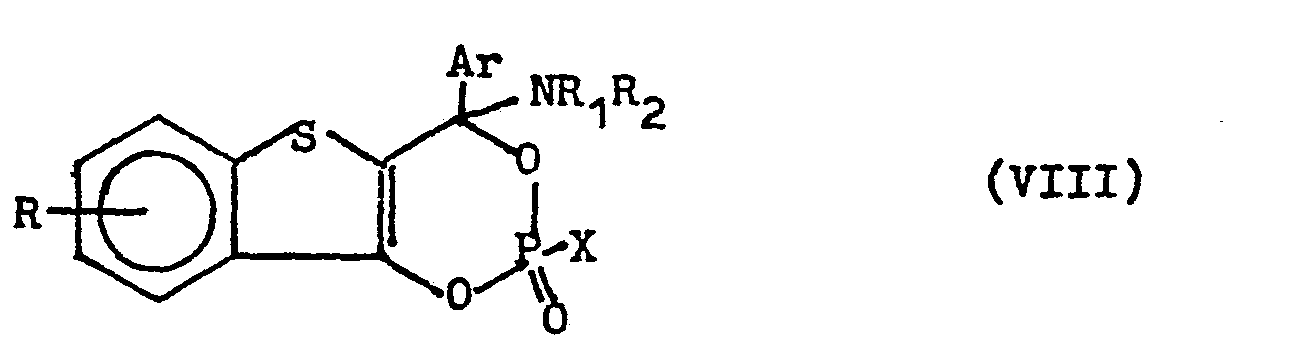
- In den hypothetischen allgemeinen Formeln VII und VIII haben Ar, R, R1 und R2 die eingangs angegebenen Bedeutungen, X bedeutet Chlor, Hydroxy oder den Rest -NR1R2 oder ein beliebiges Gemisch dieser Reste.
- Die Umsetzung der 2-Acyl-benzo[b]thiophen-3-ole der allgemeinen Formel II mit Phosphor(V)-chlorid erfolgt in inerten, kohlenwasserstoffähnlichen Lösungsmitteln, wie Petrolether, Benzin, Benzol, Toluol, Xylol, Chlorbenzol, 1,2-Dichlorbenzol und bei Temperaturen zwischen O und 40°C, bevorzugt zwischen 15 und 250 C. In Anbetracht ihrer Instabilität erweist sich die baldige weitere Umsetzung der Salze der vermuteten Struktur VII mit Aminen der allgemeinen Formel IV als zweckmäßig. Die Amine der Formel IV werden bevorzugt in Form wäßriger Lösungen verwendet, können jedoch auch als solche eingesetzt werden. Pro Mol des salzartigen Komplexes der allgemeinen Formel VII verwendet man einen Überschuß von 2 bis 20 Mol des Amins der allgemeinen Formel IV; bei Zusatz von Hilfsbasen wie Natriumcarbonat, Kaliumcarbonat, Natriumhydrogencarbonat, Kaliumhydrogencarbonat oder tert. Aminen, wie Triethylamin, Trimethylamin, 1,5-Diazabicyclo[4,3,0]non-5-en, 1,8-Diaza- bicyclo[5,4,0]undec-7-en genügen jedoch auch äquimolare Mengen des Amins der allgemeinen Formel IV. Die Aminolyse , in der Regel als Zweiphasenreaktion durchgeführt, erfolgt bei Temperaturen zwischen O und 100°C, bevorzugt 40 und 60°C.
- Die stickstoff- und phosphorhaltigen Verbindungen der angenommenen Formel VIII lassen sich durch Behandlung mit verdünnten, wässerigen Mineralsäuren in die entsprechenden Salze der gesuchten vinylogen Carboxamide der allgemeinen Formel I überführen. Als wässerige Mineralsäuren kommen beispielsweise 1 bis 20%ige wässerige Salzsäure, Bormwasserstoffsäure oder Jodwasserstoffsäure, 1- bis 50%ige wässerige Schwefelsäure oder Phosphorsäure in Betracht. Für die Hydrolysereaktion eignen sich Temperaturen zwischen 30 und 100°C, bevorzugt 50 und 70°C. Die anfallenden Salze lassen sich in üblicher Weise durch Behandeln mit Basen, z. B. mit wässerigen Lösungen von Natriumhydroxid, Kaliumhydroxid, Calciumhydroxyid, Kaliumcarbonat, Natriumcarbonat, Natriumhydrogencarbonat, Ammoniak oder Aminen, wie Methylamin, Triethylamin, in die gewünschten Endprodukte der allgemeinen Formel I überführen.
- 4. Zur Herstellung von Verbindungen der allgemeinen Formel I, in der R und R2 Wasserstoffatome bedeuten:
- Durch Reduktion von Verbindungen der allgemeinen Formel IX,

- Als Reduktionsmethoden eignen sich:
- 4.1. Die Hydrierung in Gegenwart von katalytisch wirkenden Metallen der 8. Nebengruppe des Periodensystems der Elemente: Besonders geeignet sind Palladium- und Platinkatalysatoren, beispielsweise Palladium auf Tierkohle oder fein verteiltes Platin, das in situ aus Platin (IV)-oxid entsteht. Die Hydrierung erfolgt vorzugsweise in polaren Lösungsmitteln wie Eisessig, Propionsäure, Methanol, Ethanol, Dioxan, Tetrahydrofuran und gegebenenfalls in Gegenwart starker Mineralsäuren, z.B. von Perchlorsäure, Schwefelsäure oder Orthophosphorsäure, bei Temperaturen zwischen O und 50°C, vorzugsweise jedoch bei Raumtemperatur und bei einem Wasserstoffdruck von O,5 bis 5 bar; es kann jedoch auch höherer Wasserstoffdruck angewendet werden. Bedeutet in einer Verbindung der allgemeinen Formel IX Ar einen Nitrophenyl-Rest, wo wird die Nitrogruppe zur Aminogruppe mitreduziert.
- 4.2. Die Reduktion mittels nasierendem Wasserstoff und/oder Zinn(II)-chlorid. Hierbei haben sich insbesondere die Reduktion mittels Eisenpulver in Gegenwart von verdünnten oder halbkonzentrierten Mineralsäuren, wie von Salzsäure, Bromwasserstoffsäure, Schwefelsäure, Phosphorsäure, und die Redukton mittels Zinn(II)-Chlorid in Gegenwart von konzentrierter Salzsäure oder Bromwasserstoffsäure bewährt. Bei der Reduktion mittels Eisen werden als Solventien polare, mit Wasser mischbare organische Lösungsmittel wie Methanol, Ethanol, Dioxan, Tetrahydrofuran oder Eisessig bevorzugt und man arbeitet bei Temperaturen zwischen 10 und 100°C, bevorzugt bei Raumtemperatur. Für die Zinn(II)-chlorid-Methode kommen Temperaturen zwischen O und 40°C, bevorzugt Raumtemperatur in Betracht und als zusätzliche Lösungsmittel werden die eben genannten verwendet. Bedeutet in einer Verbindung der allgemeinen Formel IX Ar einen Nitrophenyl-Rest, so wird die Nitrogruppe mitreduziert.
- 4.3. Reduktion mit komplexen Alkalimetallaluminiumhydriden, bevorzugt Lithiumaluminiumhydrid oder Natrium-bis-(2-(methoxyethoxy)aluminiumhydrid, unter Verwendung von wasserfreien Ethern, z. B. von Diethylether, Dioxan, Tetrahydrofuran,
- 1,2-Dimethoxy-ethan, Diethylenglykoldimethylether, Triethylenglykoldimethylether, als Lösungsmittel bei Temperaturen zwischen -20 und + 100°C, bevorzugt +20 bis +50°C. Bedeutet in einer Verbindung der allgemeinen Formel IX Ar einen Nitrophenyl-Rest, so wird die Nitrozur Aminogruppe mitreduziert.
- 4.4. Reduktion mit Natriumdithionit in wässeriger Lösung oder Suspension und in Gegenwart von überschüssigem Alkalihydroxid. Die Reaktion kann mit oder ohne zusätzliche Lösungsmittel, wie z. B. Methanol, Ethanol, Dioxan, Tetrahydrofuran, 1,2-Ethandiol, 1,2-Dimethoxy-ethan oder 2-Ethoxy-ethanol, erfolgen. Die Reaktionstemperatur kann bei 60 bis 120°C liegen, die Siedetemperatur des Wassers wird jedoch bevorzugt. Bedeutet in einer Vkrbindung der allgemeinen Formel IX Ar einen Nitrophenylrest, so wird die Nitro- zur Aminogruppe mitreduziert.
- 4.5. Die Reduktion mit Eisen(II)-hydroxid in wässeriger Lösung oder Suspension und bei Temperaturen zwischen 0 und 100 C, bevorzugt zwischen 15 und 50°C. Die Reaktion kann mit oder ohne zusätzliche Lösungsmittel, wie z. B. Methanol, Ethanol, Dioxan, Tetrahydrofuran, 1,2-Ethandiol, 1,2-Dimethoxy-ethan oder 2-Ethoxy-ethanol, erfolgen. Das Eisen(II)-hydroxid wird bevorzugt in situ aus geeigneten Eisen(II)-salzen, z. B. aus Eisen(II)-sulfat-heptahydrat, Eisen(II)-chlorid, Eisen(II)-chlorid-tetrahydrat, Eisen(II)-nitrat- hexahydrat durch Zugabe von Basen, bevorzugt von wässeriger Ammoniak-Lösung, erzeugt.
- Bedeutet in einer Verbindung der allgemeinen Formel IX Ar einen Nitrophenylrest, so wird die Nitro- zur Aminogruppe mitreduziert.
- 5. Zur Herstellung von Verbindungen der allgemeinen Formel I, in der R1 ein Wasserstoffatom und R2 ein Wasserstoffatom, einen geradkettigen oder verzweigten Alkyl-, Alkenyl- oder Alkinylrest mit höchstens 6 Kohlenstoffatomen, einen gegebenenfalls methylsubstituierten Cycloalkylrest mit 3 bis höchstens 8 Kohlenstoffatomen oder den Rest -A-R4 bedeutet, wobei A und R4 wie oben definiert sind:
- Durch Umsetzung von vinylogen Carboxamiden der allgemeinen Formel X,

- R7 ein Wasserstoffatom oder die Methylgruppe und
- R8 ein Wasserstoffatom, einen geradkettigen oder verzweigten Alkyl-, Alkenyl- oder Alkinylrest mit bis zu 6 Kohlenstoffatomen, einen gegebenenfalls methylsubstituierten Cycloalkylrest mit 3 bis 8 Kohlenstoffatomen oder den Rest -A-R4 bedeuten und
- Ar, R, A und R4 wie eingangs definiert sind,
- Die Umsetzung wird in einem Überschuß des betreffenden Amins der allgemeinen Formel IV oder in einem polaren protischen oder aprotischen Lösungsmittel, z. B. in Methanol, Ethanol, 2-Propanol, Tetrahydrofuran, Dioxan, Dimethylformamid, Dimethylacetamid, Dimethylsulfoxid, Hexamethylphosporsäuretriamid, Pyridin, Ameisensäure, Essigsäure, Propionsäure, Isobuttersäure, bei Temperaturen zwischen -20 und 160°C, bevorzugt zwischen +110 und 130°C, und gegebenenfalls bei erhöhtem Druck im Autoklaven durchgeführt. Die Verbindungen der allgemeinen Formeln IV, IVa bzw. V werden in der Regel in einem Überschuß von 3 bis 10 Mol - bezogen auf das umzusetzende Substrat der allgemeinen Formel X verwendet; es können aber auch äquimolare Mengen der Reaktanden eingesetzt werden.
- Die als Ausgangsstoffe verwendeten Verbindungen der allgemeinen Formel II sind teilweise literaturbekannt oder in Analogie zu literaturbekannten Verfahren (K. Görlitzer, Arch. Pharm. 307, 523 [1974]) herstellbar. Beispielsweise wurden aus den entsprechenden, gegebenenfalls im Benzolkern substituierten Thiosalicylsäuremethylestern und geeigneten 2-Chlor- bzw. 2-Brom-1-aryl-ethanonen die nachfolgenden 2-Acyl-benzo[b]thiophen-3-ole erhalten:
- 2-(4-Chlorbenzoyl)-benzo[b]thiophen-3-ol, Fp. 124-125°C (Petrolether/Essigsäureethylester 1:1)
- 2-(4-Methylbenzoyl)-benzo[b]thiophen-3-ol, Fp. 100 - 101°C, (Petrolether/Essigsäureethylester 1:1)
- 2-(3,4-Dichlorbenzoyl)-benzo[b]thiophen-3-ol, Fp. 176-178°C (Essigsäureethylester)
- 2-(4-Fluorbenzoyl)-beno[b]thiophen-3-ol, Fp. 118-120°C, (Essigsäureethylester)
- (3-Hydroxy-benzo[b]thien-2-yl)-4-pyridinyl-methanon, Fp. 139-140°C (Methanol)
- 2-Benzoyl-5-chlorbenzo[b]thiophen-3-ol, Fp. 129-132°C, (Methanol)
- 2-Benzoyl-6-chlorbenzo[b]thiophen-3-ol, Fp. 160-162°C,
- (Methanol/Essigsäureethylester 1:1)
- 2-(2-Fluorbenzoyl)-benzo[b]thiophen-3-ol, Fp. 99-100°C, (Petrolether/Essigsäureethylester 1:1)
- 2-(2-Chlorbenzoyl)-benzo[b]thiophen-3-ol, Fp. 86-88°C, (Methanol)
- (3-Hydroxy-benzo[b]thien-2-yl)-2-pyridinyl-methanon,
- Fp. 167-168°C (Essigsäureethylester)
- 2-(2-Chlorbenzoyl)-5-chlorbenzo[b]thiophen-3-ol, Fp. 136-138°C (Essigsäureethylester/Methanol 1:1)
- 2-(2-Methylbenzoyl)-benzo[b]thiophen-3-ol, Fp. 126-127°C, (Essigsäureethylester/Methanol 1:1)
- 2-(3-Methylbenzoyl)-benzo[b]thiophen-3-ol, Fp. 89-92°C, (Petrolether/Essigsäureethylester 1:1)
- 2-(2-Ethylbenzoyl)-benzo[b]thiophen-3-ol, Fp. 39-40°C, (Methanol)
- 2-(2-Nitrobenzoyl)-benzo[b]thiophen-3-ol, Fp. 151-153°C, (Essigsäureethylester)
- 2-(2-Brombenzoyl)-benzo[b]thiophen-3-ol, Fp. 108-110°C, (Methanol)
- 2-(2-Trifluormethyl-benzoyl)-benzo[b]thiophen-3-ol, Fp. 91-92°C,
(Methanol), - 2-Benzoyl-5-methylbenzo[b]thiophen-3-ol, Fp. 109-111°C, (Methanol/Essigsäureethylester 1:1),
- 2-(2-Aminobenzoyl)-benzo[b]thiophen-3-ol, Fp. 129-131°C, (Essigsäureethylester),
- 2-Benzoyl-6-methylbenzo[b]thiophen-3-ol, Fp. 100-102oC, (Methanol/Essigsäureethylester 1:1),
- 2-Benzoyl-6-methoxybenzo[b]thiophen-3-ol, Fp. 138-139°C, (Methanol),
- 2-Benzoyl-4-methylbenzo[b]thiophen-3-ol, Fp. 122-123°C, (Methanol/Essigsäureethylester 1:1).
- Die Ausgangsstoffe der allgemeinen Formel III, die neu sind, erhält man nach dem vorstehend beschriebenen Verfahren 3, wenn man an Stelle von Aminen der allgemeinen Formel IV ein Gemisch eines Alkohols der allgemeinen Formel R3-OH mit einem tertiären Amin, bevorzugt Triethylamin, verwendet. So wurde beispielsweise hergestellt
(E)-2-[(Methoxy)phenylmethyle]-benzo[b]thiophen-3(2H)-on, Fp. 136-138°C (Diisopropylether/Petrolether 1:1) c16H12O2S (268.33) Ber: C 71.62 H 4,51 S 11,95 Gef: 71,46 4,83 11,98 - IR(CH2Cl2): 2845 (OCH3), C = O 1670/cm
- UV(Ethanol):λmax (neutral) 255(E=0,74), 299(E=0,68), 414 (E=0,25)nm λmax (alkalisch) 257(E=0,69) , 300(E=0,42), 413(E=0,15)nm (Konzentration: 50 µg/ml; Schichtdicke: 0,2 cm)
- 1H-NMR (CDC13; 80MHz):δ 8,2-7,0 (9H-m; ar.H); 3,69 (3H-s ; -0-CH3)
- MS: e 268(s), 254, 239, 237, 197, 176 (s), 165, 126.5, 121, 105, 77(s), 51, 28(s).
- Die Ausgangsstoffe der allgemeinen Formeln IV und V sind ! literaturbekannt und in der Regel käuflich erhältlich, die der allgemeinen Formeln IVa und IVb durch Reaktion entsprechender Amine.der allgemeinen Formel IV mit geeigneten Säuren leicht herstellbar.
- Die Ausgangsstoffe der allgemeinen Formel VI sind literaturbekannt (T. Higa und A. J. Krubsack, J. org. Chemistry 41, 3399 [1976]) oder entstehen aus den instabilen Salzen der allgemeinen Formel VII nach längerem Aufbewahren bei Raumtemperatur oder gelindem Erwärmen auf Temperaturen zwischen 30 und 80°C. So erhält man beispielsweise
- 2-Benzoyl-3-chlorbenzo[b]thiophen, Fp. 71-73 C (Cyclohexan).
- Die Ausgangsstoffe der allgemeinen Formel IX sind teilweise bekannt (S. B. Arwad und N.F. Abdul-Malik, Austr. J. Chem. 28, 601-5 [1975]) oder können aus den Verbindungen der allgemeinen Formel II nach dem obigen Verfahren 3 hergestellt werden, indem man die Amine der allgemeinen Formel IV durch Verbindungen der allgemeinen Formel H2NR4 ersetzt, oder sind - sofern R4 die Bedeutung einer Hydroxy-Gruppe annimmt - aus Verbindungen der allgemeinen Formel II durch Kochen mit Hydroxylamin-hydrochlorid in einem Gemisch von Pyridin und Ethanol leicht erhältlich. So wurden beispielsweise hergestellt: (E)-2-[(2-Phenylhydrazino)phenylmethylen]-benzo[b]thiophen-3(2H)-on,
Fp. 168°C (Methanol/Aceton 1:1);
(E)-2-[(Hydroxyamino)phenylmethylen]-benzo[b]thiophen-3 (2H)-on,
Fp. 128-130°C (Petrolether/Essigsäureethylester 1:1) C15H11NO2S (269,32) - Ber: C 66,90 H 4,12 N 5,20 S 11,90
- Gef: 66,90 4,06 5,14 12,06
- IR (CH2Cl2): OH 3550; assoziiertes N-H, O-H 3400 bis 2500; C = O 1595; C = C 1610, 1570/cm
- UV(Ethanol):λmax (neutral) 257 (E=0,70); 304-316 (E=0,34); 330 (E=0,32) nm; λmax (alkalisch) 220 (E=0,86); 275 (E=0,47); 405 (E=0,33) nm; (Konzentration: 50 µg/ml; Schichtdicke: 0,2 cm).
- In analoger Weise lassen sich auch die Ausgangsstoffe der allgemeinen Formel X herstellen. wie bereits eingangs erwähnt, weisen die neuen Verbindungen der allgemeinen Formel I wertvolle pharmakologische Eigenschaften auf, sie wirken insbesondere auf das Zentralnervensystem, und zeigen vor allem eine antikonvulsive Wirkung.
- Beispielsweise wurden die Verbindungen
- A = (E)-2[(A-mino)phenylmethylen]-benzo[b]thiophen-3(2H)-on
- = (E)-2[(Methylamino)phenylmethyle]-benzo[b]thiophen-3 (2H)-on
- c = (E)-2[(Amino)-(2-chlorphenyl)methylen[b]enzo[b]thiophen-3(2H)-on
- D = (E)-2-[[(2-Hydroxyethyl)amino]phenylmethylen7-benzo[b] thiophen-3(2H)-on
- E = (E)-2-[Amino)-(2-methylphenyl)methylen]-benzo[b]thiophen-3(2H)-on
- F = (E)-2-[(Ethylamino)phenylmethylen]-benzo[b]thiophen-3 (2H)-on auf ihre antikonvulsive Wirkung untersucht:
- Die antikonvulsive Wirkung wurde als Hemmung des tonischen Extensorkrampfes der Hinterbeine männlicher Mäuse bei maximalem Elektroschock geprüft.
- Versuchstiere waren männliche SPF-Mäuse (Chbb: NMRI) im Gewicht von 20-26 g, die bis zu 1 h vor oraler Substanzverabreichung Zugang zu Standardnahrung und Trinkwasser hatten.
- Die Versuchsdurchführung erfolgte in Anlehnung an SWINYARD, BROWN and GOODMAN (J. Pharmacol. exp. Ther. 106, 319, [1952]). Die Elektroschock-Apparatur war nach den Angaben von WOODBURY and DAVENPORT (Arch. int. Pharmacodyn. 92, 97, [1952]) hergestellt worden. Die elektrischen Reize wurden über mit Wildleder bezogene und mit 0,9 %iger NaCl-Lösung befeuchtete Stahlkugelelektroden auf die Kopfseiten der Tiere über die Augen gegeben. Es wurde mit Wechselstrom von 50 Hz und 50 mA bei 0,2 sec Dauer gereizt. Bei allen Kontrolltieren trat dabei ein klonischer und danach ein tonischer Streckkrampf der Extremitäten auf; bei durch Antikonvulsiva geschützten Tieren trat der tonische Streckkrampf nicht auf.
- Die zu prüfenden Substanzen wurden in 1%igem Tyloseschleim suspendiert und in einem Volumen von 0,1 ml/10 g Maus peroral an 10 Mäuse/Dosis verabreicht. Die Tiere wurden 30, 150 und 300 min nach Substanzverabreichung geschockt und die ED50 -Werte als 50 % der gegen den tonischen Streckkrampf der Hinterextremitäten geschützen Tiere nach dem Verfahren von LITCHFIELD and WILCOXON (J. Pharmacol. exp. Ther. 96, 99, [1949]) oder graphisch ermittelt.
-

- Es wurde die orientierende akute Toxizität der Substanzen nach Gabe einer Dosis an jeweils eine Gruppe von 6 oder 10 Mäusen mit Körpergewichten zwischen 20 und 26 g bestimmt (Beobachtungszeit: 7 Tage): i

- Die erfindungsgemäß hergestellten neuen Verbindungen der allgemeinen Formel I eignen sich somit insbesondere zur Behandlung von spastischen Zuständen und der Epilepsie und lassen sich hierzu zur pharmazeutischen Anwendung gegebenenfalls in Kombination mit anderen Wirksubstanzen in die üblichen galenischen Zubereitungen wie Tabletten, Dragees, Pulver, Suppositorien oder Suspensionen einarbeiten. Die Einzeldosis beträgt hierbei am Menschen zweckmäßigerweise 50-300 mg, vorzugsweise jedoch 50-200 mg.
- Die nachfolgenden Beispiele sollen die Erfindung näher erläutern:
- In einem 1-1-Scheidetrichter werden 50,86 g (0,2 Mol) 2-Benzoyl-benzo[b]thiophen-3-ol in 600 cm3 Toluol gelöst und nach Zugabe von 42,0 g (0,2 Mol) Phosphor (V)-chlorid 5 Min. bei Zimmertemperatur mechanisch gerührt. Die Suspension des entstandenen rot gefärbten Komplexes wird anschließend unter gutem Rühren in 150 cm3 (ca. 2 Mol) konzentrierten Ammoniak eingebracht, wobei die Reaktionstemperatur durch äußere Kühlung mit Wasser auf 40 bis 50°C einreguliert wird. Man erwärmt noch 1 Stunde auf 50°C, läßt erkalten, gibt Salzsäure zu bis pH 1 erreicht ist, und kocht so lange unter Rückfluß, bis der gelbe Startfleck dünnschichtchromatographisch (Kieselgel-Fertigplatten F254 Merck; 1,2-Dichlorethan/Essigsäureethylester/Eisessig 100:30:3) nicht mehr nachgewiesen werden kann. Dann kühlt man auf +10°C ab, nutscht nach 1-stündigem Stehen bei dieser Temperatur ab, wäscht den Niederschlag mit wenig Toluol, dann zur Entfernung anorganischer Salze mit Wasser gründlich durch.
- Aus den vereinigten Filtraten wird die orangefarbene Toluolphase abgetrennt, einmal mit 500 cm3 Wasser gewaschen und eingedampft. Der anfallende, teilweise kristallisierende Rückstand wird zweimal mit je 20 cm3 Methanol aufgekocht, dann jeweils auf +10°C gekühlt. Dabei geht (E)-2-[(Amino) phenylmethylen]-benzo[b]thiophen-3(2H)-on-hydrochlorid -in Lösung, während das unumgesetzte Ausgangsmaterial ungelöst bleibt.
- Die erhaltenen Methanol-Lösungen werden mit der Lösung des oben erhaltenen kristallinen Niederschlags in 25 cm3 Methanol vereinigt, mit 25 cm3 Ammoniak versetzt, wonach das gesuchte Produkt in Form gelber Kristalle ausfällt.
- Man nutscht ab, trocknet den Niederschlag im Vakuumtrockenschrank, löst das Produkt in 70 cm3 Essigsäureethylester, gibt so viel Petrolether zu, daß sich gerade noch kein Niederschlag bildet (ca. 40 cm3), setzt 4 g Aktivkohle zu, kocht auf und filtriert heiß. Aus dem erkalteten Filtrat erhält man das reine Endprodukt durch Zugabe von 100 cm3 Petrolether und Kühlen auf +10°C. Nach 2-stündigem Stehen nutscht man ab und wäscht den Niederschlag mit c. 40 cm3 petrolether gründlich durch. Durch Einengen der vereinigten Mutterlaugen auf ca. 50 cm3 Gesamtvolumen kann weiteres Produkt der gleichen Qualität erhalten werden. Nach dem Trocknen im Vakuum schmelzen die gelben Kristalle bei 121,6-122,5°C.
- Ausbeute: 35,6 g (70 % der Theorie).
- DC-Nachweis:
- Stationäre Phase: Kieselgel-Fertigplatten F254 Merck
- Mobile Phase: a) 1,2-Dichlorethan : RF Ausgangsmaterial 0,7 RF Produkt 0,15
- b) 1,2-Dichlorethan/Essigsäureethylester/ Eisessig (100:30:3):
- RF Ausgangsmaterial 0,9
- RF Produkt 0,4
- C15H11NOS (253,32):
- Ber: C 71,12 H 4,38 N 5,53 S 12,66
- Gef: 71,20 4,59 5,59 12,52
- IR (KBr): N-H 3475, C=O 1600/cm
- UV (Ethanol):λmax 184, 317, 430 nm, Schulter bei 270 nm 1H-NMR (CDCl3):δ 11,0 (1H, breit, innere H-Brücke); 8,01 (1H-dd, J=7,6 und 2Hz, ar.H); 7,9-7,1(8H-m, ar.H); 5,78 (1H-s,austauschbarer H)
- 13C-NMR (CDCl3; 22,63 MHz): δ 103,66; 185,55 (C = 0); 131,28; 123,48; 131,80; 124,20; 144,80; 136,87; 160,07; 134,53; 127,97; 129,40; 125,82;
- Bei der auf gleiche Weise wie oben erhaltenen 15N mar- kierten Verbindung spaltet das Signal für den dem 15N benachbarten Kohlenstoff auf:
- δ 160,59 (d, J15N-C 14,71 Hz).
- (E)-2-[Methylamino)phenylmethylen]-benzo[b]thiophen-3(2H)-on
- Hergestellt analog Beispiel 1 aus 2-Benzoyl-benzo[b]thiophen-3-ol, Phosphor(V)-chlorid und 40%iger wässeriger Methylamin-Lösung in einer Ausbeute von 43 % der Theorie.
- Fp. 155-156°C (Methanol).
- C16H13NOS (267,34)
- Ber: C 71,88 H 4,90 N 5,24 S 11,99
- Gef: 72,10 4,75 5,21 12,20
- (E)-2-[(Amino)-(4-chlorphenyl)methylen]-benzo[b]thiophen-3(2H)-on
- Hergestellt analog Beispiel 1 aus 2-(4-Chlorbenzoyl)-benzo[b] thiophen-3-ol, Phosphor(V)-chlorid und konzentriertem wässerigem Ammoniak in einer Ausbeute von 55 % der Theorie.
- Fp. 182-183°C (Benzol).
- C15H10ClNOS (287,77)
- Ber: C 62,61 H 3,50 Cl 12,32 N 4,87 S 11,14
- Gef: 62,90 3,62 12,55 4,76 11,18
- (E)-2-[(Dimethylamino)phenylmethylen]-benzo[b]thiophen-3(2H)-on
- Hergestellt analog Beispiel 1 aus 2-Benzoyl-benzo[b]thiophen-3-ol, Phosphor(V)-chlorid und 40%iger wässeriger Dimethylamin-Lösung in einer Ausbeute von 7% der Theorie.
- Fp. 178-180°C (Essigsäureethylester/Petrolether 1:1) C17H15NOS (281,38)
- Ber: C 72,57 H 5,37 N 4,98 S 11,39
- Gef: 72,17 5,33 4,80 11,37 IR(CH2Cl2): C=0 1610/cm
- UV(Ethanol):ηmax 270 bis 290 (E=0,43), 332(E=0,42) und 454(E=0,37) nm (Schichtdicke 0,2 cm; Konzentration 50 µg/ml)
- 1H-NMR (CDC13; 80 MHz):δ 7,99 (1H-dd, J=7 und 2Hz; ar.H); 7,7-7,2(8H-m; ar.H); 3,28(6H-s)
- (E)-2-[(Amino)-(4-methylphenyl)methylen]-benzo[b]thiophen-3(2H)-on
- Hergestellt analog Beispiel 1 aus 2-(4-Methylbenzoyl)-benzo-[b]thiophen-3-ol, Phosphor(V)-chlorid und konzentriertem Ammoniak in einer Ausbeute von 62 % der Theorie.
- Fp. 147°C (Essigsäureethylester/Petrolether 1:1)
- C16H13NOS (267,34) i
- Ber: C 71,88 H 4,90 N 5,24 S 11,99
- Gef: 71,38 4,82 5,14 12,58
- (E)-2-[(Amino)-(3,4-dichlorphenyl)methylen]benzo[b]thiophen-3(2H)-on
- Hergestellt analog Beispil 1 aus 2-(3,4-Dichlorbenzoyl)-benzo [b]thiophen-3-ol, Phosphor (V)-chlorid und konzentriertem Ammoniak in einer Ausbeute von 50 % der Theorie. Fp. 169-170°C (Essigsäureethylester).
- C15H9Cl2NOS (322,21)
- Ber: C 55,92 H 2,82 Cl 22,01 N 4,35 S 9,95
- Gef: 55,81 3,06 22,45 4,47 10,10
- (E)-2-[(Amino)-(4-fluorphenyl)methylen]-benzo[b]thiophen-3(2H)-on
- Hergestellt analog Beispiel 1 aus 2-(4-Fluorbenzoyl)-benzo[b]-thiophen-3-ol, Phosphor(V)-chlorid und konzentriertem Ammoniak in einer Ausbeute von 63 % der Theorie. Gelbe, filzige Kristalle vom Fp. 158°C (Methanol).
- C15H10FNOS (271,31)
- Ber: C 66,41 H 3,72 N 5,16 S 11,82
- Gef: 66,51 4,00 5,23 11,92
- IR(CH2Cl2): N-H 3465, C=O 1610/cm
- UV (Ethaüol):λmax 282, 315, 428 nm; Schulter bei 260 nm
- 1H-NMR (CDCl3):δ 11,07(1H, breit, innere H-Brücke); 8,08(1H-dd, J=7,5 und 2Hz; ar.H); 7,95 - 7,1(7H-m; ar.H); 5,86 (1H, breit, austauschbarer H).
- (E)-2-[(Amino)-(4-pyridinyl)methylen]-benzo[b]thiophen-3(2H)-on
- analog Beispiel 1 aus (3-Hydroxybenzo[b]thien-2-yl)-4-pyridinyl-methanon, Phosphor(V)-chlorid und 25%iger wässeriger Ammoniak-Lösung in einer Ausbeute von 6% der Theorie.
- Fp. 198 - 200°C (Methanol).
- C14H10N2OS (254,30)
- Ber: C 66,12 H 3,96 N 11,02 S 12,61
- Gef: 65,99 3,92 10,80 12,30
- IR(KBr): N-H breit 3470 bis 2800; C=O 1620/cm
- UV(Ethanol):λ max 275-281 (E=0,50), 310 (E=0,45), 431(E=0,43)nm; nach Alkalizusatz:
- λmax 285(E=0,80) , 395(E=0,33)nm
- (Konzentration: 50 ug/ml; Schichtdicke: 0,2 cm)
- 1H-NMR (CDCl3/CD3OD; 80 MHz):δ 8,86 (2H-dd, J=5Hz und 2Hz; α-Pyridyl-H); 8,07(1H-dd, J=7 und 2Hz; ar.H); 7,85-7,2 (5H-m; ar.H); 2 austauschbare Wasserstoffatome.
- (E)-2-[(Aminolphenylmethylen]-5-chlorbenzo[b]thiophen-3(2H)-on
- Hergestellt analog Beispiel 1 aus 2-Benzoyl-5-chlorbenzo/b/thiophen-3-ol, Phosphor(V)-chlorid und konzentriertem Ammoniak in einer Ausbeute von 57 % der Theorie.
- Fp. 172-173°C (Essigsäureethylester).
- C15H10ClNOS (287,77)
- Ber: C 62,61 H 3,50 Cl 12,32 N 4,87 S 11,14
- Gef: 62,39 3,47 12,31 4,77 11,45
- IR(KBr): N-H (bzw. O-H) 3450, 3330, 3140; C=O 1625/cm UV(Ethanol):λmax 258 (E=0,42), 287(E=0,53), 322(E=0,48), λ4,34(E=0,49 nm;
- nach Alkalizusatz:
- λmax 286(E=0,62); 320 Schulter (E=0,23);
- 393 (E=0,30); 434 Schulter.
- (Konzentration: 50 µg/ml; Schichtdicke: 0,2 cm)
- Hergestellt analog Beispiel 1 aus 2-Benzoyl-6-chlorbenzo[b]-thiophen-3-ol, Phosphor(V)-chlorid und konz. Ammoniak in einer Ausbeute von 27 % der Theorie. Fp. 191-192°C (Essigsäureethylester).
- C15H10ClNOS (287,77)
- Ber: C 62,61 H 3,50 Cl 12,32 N 4,87 S 11,14
- Gef: 62,80 3,50 12,40 5,11 11,08
- IR(KBr): N-H 3470 und breite Banden bei 3220 und 3120; C=O 1600/cm
- UV(Ethanol):λmax (neutral) 286(E=0,64),309(E=0,54),425(E=0,55nm;) λmax (alkalisch) 284(E=0,67),308 Schulter (E=0,33), 405(E=0,33),428(Schulter) nm. (Konzentration: 50 µg/ml; Schichtdicke: 0,2 cm)
- (E)-2-[(Amino)-(2-fluorphenyl)methylen]-benzo[b]thiophen-3 (2H)-on
- Hergestellt analog Beispiel 1 aus 2-(2-Fluorbenzoyl)-benzo[b]-thiophen-3-ol, Phosphor(V)-chlorid und konzentriertem Ammoniak, jedoch unter Verwendung eines Gemisches von Toluol und Petrolether im Volumenverhältnis 2:1 an Stelle von reinem Toluol, in einer Ausbeute von 50 % der Theorie. Gelbe Kristalle vom Fp. 156-158°C (Essigsäureethylester/Petrolether 1:1).
- C15H10FNOS (271,31)
- Ber: C 66,41 H 3,72 N 5,16 S 11,82
- Gef: 66,11 3,61 5,25 12,57
- IR(KBr): N-H 3475, daneben N-H assoziiert; C=O 1600/cm
- UV(Ethanol):λmax(nautral) 258(Schulter), 281, 312, 424 nm; λmax(alkalisch) 281, 310(Schulter), 388, 422 (Schulter) nm.
- (E)-2-[(Amino)-(2-chlorphenyl)methylen]-benzo[b]thiophen-3 (2H)-on
- Hergestellt analog Beispiel 1 aus 2-(2-Chlorbenzoyl)-benzo/b/thiophen-3-ol, Phosphor(V)-chlorid und konzentriertem Ammoniak in einer Ausbeute von 33 % der Theorie. Fp. 167-168°C (Essigsäureethylester).
- C15H10ClNOS (287,77)
- Ber.: C 62,61 H 3,50 Cl 12,32 N 4,87 S 11,14
- Gef.: 63,10 3,70 12,95 4,84 11,78
- IR(KBr): N-H 3470 (daneben assoziiertes N-H), C=O 1600/cm UV(Ethanol):λ max(neutral) 260 Schulter (E=0,41); 283(E=0,51); 310(E=0,49); 422(E=0,46)nm; λmax(alkalisch) 283(E=0,60); 308 Schulter(E=0,11); 380-385(E=0,32) nm; ! (Konzentration: 50 µg/ml; Schichtdicke: 0,2 cm)
- (E)-2-[(Amino)-(2-pyridinyl)methylen]-benzo[b]thiophen-3-(2H)-on
- Hergestellt analog Beispiel 1 aus (3-Hydroxybenzo/b/thien-2-yl)-2-pyridinyl-methanon, Phosphor(V)-chlorid und konzentriertem Ammoniak in einer Ausbeute von 27 % der Theorie.
- Fp. 128-130°C (Essigsäureethylester).
- C14H10N2OS (254,30)
- Ber.: C 66,12 H 3,96 N 11,02 S 12,61
- Gef.: 66,34 4,09 11,45 12,70
- IR(KBr): N-H bzw. assoziiertes N-H 3290; C=O ca. 1600/cm UV(Ethanol):λmax (neutral) 250 Schulter(E=0,39); 274(E=0,58) 329 (E=0,49) und>390 nm; λmax (alkalisch) 286(E=0,65); 325 Schulter (E=0,30);>390 nm; (Konzentration: 50 µg/l; Schicktdicke: 0,2 cm))
- (E)-2-[(Amino)-(2-chlorphenyl)methyle]-5-chlorbenzo[b]thiophen-3(2H)-on
- Hergestellt analog Beispiel 1 aus 2-(2-Chlorbenzoyl)-5-chlor- benzo[b]thiophen-3-ol, Phosphor(V)-chlorid und konzentriertem wässerigem Ammoniak in einer Ausbeute von 40 % der Theorie. Fp. 199-201°C (Essigsäureethylester) C15H9Cl2NOS (322,21)
- Ber.: C 55,92 H 2,82 Cl 22,01 N 4,35 S 9,95
- Gef.: 55,67 3,09 21,70 4,22 10,30
- IR (CH2C12): N-H 3475 (daneben N-H assoziiert), C=O 1610/cm
- UV(Ethanol):λmax (neutral) 260(E=0,34); 293(E=0,52); 314(E=0,44); 432(E=0,44) nm; λmax (alkalisch) 293(E=0,64); 320 Schulter (E=0,16) 390 (E=0,32)nm (Konzentration: 50 µg/ml; Schichtdicke: 0,2 cm)
- (E)-2-[[(2-Propenyl)amino]phenylmethylen]-benzo[b]thiophen-3(2H)-on
- Hergestellt analog Beispiel 1 aus 2-Benzoyl-benzo[b]thiophen-3-ol, Phosphor(V)-chlorid und einer Lösung von 1 Volumenteil Allylamin in 2 Volumenteilen Wasser in einer Ausbeute von 43 % der Theorie. Fp. 104-106°C (Essigsäureethylester). C18H15NOS (293,39)
- Ber.: C 73,69 H 5,15 N 4,77 S 10,93
- Gef.: 73,48 5,22 4,78 11,18
- IR(CH2Cl2): C=C 1645, C=O ca. 1600/cm UV(Ethanol):λmax (neutral) 265 Schulter(E=0,42); 286(E=0,52); 320(E=0,56); 431(E=0,60); auf Alkalizusatz keine Änderung (Konzentration: 50 µg/ml; Schichtdicke: 0,2 cm)
- 1H-NMR(CDCl3):δ12,0(1H, breit, innere H-Brücke); 8,05(1H-dd, J=7 und 2Hz, ar.H); 7,7-7,15(8H-m; ar.H); 6,15-5,6(1H-m; olefinischer H); 5,45-5.05(2H-m; olefin. H); 4,0-3,7(2H-m aliph. CH2).
- (E)-2-[[[2-(Dimethylamino)ethyl]amino]phenylmethylen]-benzo-[b]thiophen-3(2H)-on
- Hergestellt analog Beispiel 1 aus 2-Benzoyl-benzo[b]thiophen-3-ol, Phosphor(V)-chlorid und einer Lösung von 2 Volumina N,N-Dimethylethylendiamin in 3 Volumina Wasser in einer Ausbeute von 42 % der Theorie. Orangegelbe Kristalle vom Fp. 123-125°C (Essigsäureethylester).
- C19H20N2OS (324,44)
- Ber.: C 70,34 H 6,21 N 8,63 S 9,88
- Gef.: 70,16 6,11 8,65 10,17
- IR(CH2Cl2): NH assoziiert; C=O 1600/cm
- UV(Ethanol):λmax (neutral) 287(E=0,44), 322(E=0,44, 431 (E=0,49)nm Auf Zusatz von Alkali keine Veränderung. (Konzentration: 50 µg/ml; Schichtdicke: 0,2 cm
- (E)-2-[[[3-(Dimethylamino)propyl]amino]phenylmethylen]-benzo[b]thiophen-3(2H)-on
- Hergestellt analog Beispiel 1 aus 2-Benzoyl-benz[b]-thiophen-3-ol, Phosphor(V)-chlorid und einer wässerigen Lösung von 3-(Dimethylamino)propanamin (hergestellt aus 51 g des Diamins und 70 cm3 Wasser) in einer Ausbeute von 26 % der Theorie. Fp. 90-91°C (Essigsäureethylester/Petrolether 1:1). G20H22N2OS (338,47)
- Ber.: C 70,97 H 6,55 N 8,28 S 9,47
- Gef.: 70,83 6,67 8,31 9,29
- (E)-2-[[(2-Hydroxyethyl)amino]phenylmethylen]-benzo[b]-thiophen-3(2H)-on
- Hergestellt analog Beispiel 1 aus 2-Benzoyl-benzo[b]thiophen-3-ol, Phosphor(V)-chlorid und einer 40%igen wässerigen Ethanolamin-Lösung in einer Ausbeute von 13 % der Theorie.
- Fp. 122-1230C (Essigsäureethylester/Petrolether 1:1) C17H15NO2S (297,38)
- Ber.: C 68,66 H 5,08 N 4,71 S 10,78
- Gef.: 68,65 4,89 4,71 11.00
- IR(CH2Cl2): O-H 3620, N-H oder O-H (assoziiert), 3340 breit, C=O ca. 1600/cm
- UV(Ethanol):λmax (neutral) 226(E=O,58); 2,63 (E--0,68) ;= 336(E=0,86); 4,60(E=0,50)nm; λmax (alkalisch) 257-261(E=0,60), 336(E=0,63); 4,59(E=0,36)nm.
- (E)-2-[(Amino)-(2-methylphenyl)methylen]-benzo[b]thiophen-3(2H)-on
- Hergestellt analog Beispiel 1 aus 2-(2-Methylbenzoyl)-benzo[b]-thiophen-3-ol, Phosphor(V)-chlorid und konzentriertem wässerigem Ammoniak in einer Ausbeute von 50 % derTheorie.
- Fp. 143-1440C (Essigsäureethylester/Petrolether 1:1) C16H13NOS (267,34)
- Ber.: C 71,88 H 4,90 N 5,24 S 11,99
- Gef.: 72.23 5,04 5,27 11,70
- IR(CH2Cl2): 3480 (N-H), O-H assoziiert oder NH assoziiert; ca. 1600/cm (C=O)
- UV(Ethanol):λmax (neutral) 260 Schulter(E=0,48); 285(E=0,59); 311(E=0,57); 4,22(E=0,59)nm; λmax (alkalisch) 285(E=0,64); 310(E=0,45); 421(E=0,42); Schulter bei 404 (E=0,40)nm.
- (Konzentration: 50 µg/ml; Schichtdicke: 0,2 cm)
- (E)-2-[[(Ethyl)amino]phenylmethylen]-benzo[b]thiophen-3-(2H)-on
- Hergestellt analog Beispiel 1 aus 2-Benzoyl-benzo[b]thiophen-3-ol, Phosphor(V)-chlorid und 30%iger wässeriger Ethylamin-Lösung in einer Ausbeute von 56 % der Theorie. Fp. 115-116°C (Essigsäureethylester/Petrolether 1:1).
- C17H15NOS (281,38)
- Ber.: C 72,57 H 5,37 N 4,98 S 11,39
- Gef.: 72,43 5,53 4,89 11,65
- (E)-2-[[Methylethyl)amin]phenylmethylen]-benzo[b]thiophen-3(2H)-on
- Hergestellt analog Beispiel 1 aus 2-Benzoyl-benzo[b]thiophen-3-ol, Phosphor(V)-chlorid und 38,5%iger wässeriger Ethylamin-Lösung in einer Ausbeute von 54 % der Theorie. Fp. 112-113°C (Essigsäureethylester/Petrolether 1:1).
- C18H17NOS (295,40)
- Ber.: C 73,19 H 5,80 N 4,74 S 10,85
- Gef.: 73,15 5,99 4,61 10,80
- IR (CH2C12): C=O ca. 1590/cm UV(Ethanol):λmax (neutral) 286, 321, 429, Schulter bei 260 nm; auf Zusatz von Alkali keine Verschiebung 1H-NMR (CDCl3, 80 MHz):δ11,88(1H, breit, innere H-Brücke); 7,95(1H-dd, J=7Hz und 2Hz; ar.H); 7,7-7,15(8H-m; ar.H); 3,9-3,4(1H-m,CH); 1,24(6H-d; J=6Hz; (CH3)2)

- (E)-2-[(Amino)(3-methylphenyl)methylen]-benzo[b]thiophen- 3(2H)-on
- Hergestellt analog Beispiel 1 aus 2-(3-Methylbenzoyl)-benzo[b]-thiophen-3-ol, Phosphor(V)-chlorid und konzentriertem Ammoniak in einer Ausbeute von 36 % der Theorie, Fp. 114-115°C (Essigsäureethylester/Petrolether 1:1) C16H13NOS (267,34)
- Ber.: C 71,88 H 4,90 N 5,24 S 11,99
- Gef.: 71,95 4,91 5,56 12,17
- (E)-2-[(Amino)-(2-ethylphenyl)methyl]benzo[b]thiophen-3(2H)-on
- Hergestellt analog Beispiel 1 aus 2-(2-Ethylbenzoyl)-benzo[b]-thiophen-3-ol, Phosphor(V)-chlorid und konzentriertem Ammoniak in einer Ausbeute von 46 % der Theorie. Fp. 132-133°C (Essigsäureethylester/Petrolether 1:1).
- C17H15NOS (281,38)
- Ber.: C 72,57 H 5,37 N 4,98 S 11,39
- Gef.: 72,95 5,58 5,05 11,56
- IR(KBr): 3500 - 3000 N-H assoziiert, ca. 1600/cm C=O UV(Ethanol): λmax (neutral) 260-274(E=0,42); 284(E=0,52); 312(E=0,51); 422(E=0,53); Schulter bei 410 nm.
- λ max (alkalisch) 284(E=0,56); 312 (E=0,41); 422(E=0,41); Schultern bei 260(E=0,37) und 404(E=0,38) nm (Konzentration: 50 µg/ml; Schicktdicke: 0,2 cm)
- (E)-2-π(Methyl)amino]-(2-ethylphenyl)methylen]-benzo[b]- thiophen-3(2H)-on
- Hergestellt analog Beispiel 1 aus 2-(2-Ethylbenzoyl)-benzo[b]-thiophen-3-ol, Phosphor(V)-chlorid und 25 proz. wässeriger Methylamin-Lösung in einer Ausbeute von 42 % der Theorie. Fp. 126-1270C (Essigsäureethylester/Petrolether 1:1) C18H17NOS (295,40)
- Ber.: C 73,19 H 5,80 N 4,74 S 10,85
- Gef.: 73,30 5,67 4,85 10,89
- IR(CH2Cl2):C=O ca. 1600/cm
- UV(Ethanol): λmax (neutral) 266-274, 289, 318, 429, Schulter bei 412 nm; auf Alkalizusatz keine Veränderung.
- 1H-NMR(CDCl3; 80 MHz): δ11.73(1H, breit, innere H-Brücke); 7,97(1H-d, verbreitert, J=6,5 Hz, ar. H); 7,7-7,0(7H-m; ar.H); 2,83(3H-d, J=2,5 Hz; N-CH3); 2,64(2H-q, J=7,2 Hz; -CH2-); 1,19(3H-t; J=7,2 Hz; C-CH3).
- (E)-2-[[(Ethyl)amino]-(2-ethylphenyl)methylen]-benzo[b]-thiophen-3(2H)-on
- Hergestellt analog Beispiel 1 aus 2-(2-Ethylbenzoyl)-benzo-[b]thiophen-3-ol, Phosphor(V)-chlorid und 25 proz. wässeriger Ethylamin-Lösung in einer Ausbeute von 2% der Theorie.
- Fp 76-77°C (Diisopropylether/Petrolether 1:2). C19H19NOS (309,43)
- Ber.: C 73,75 H 6,19 N 4,53 S 10,36
- Gef.: 74,05 6,16 4,58 10,35
- (E)-2-[(Amino)-(2-nitrophenyl)methylen]-benzo[b]thiophen-3(2H)-on
- Hergestellt analog Beispiel 1 aus 2-(2-Nitrobenzoyl)-benzo-[b]thiophen-3-ol, Phosphor(V)-chlorid und konz. wässerigem Ammoniak in einer Ausbeute von 21 % der Theorie. Fp. 185-186°C (Essigsäureethylester).
- C15H10N2O3S (298.32)
- Ber.: C 60,39 H 3,38 N 9,39 S 10,75
- Gef.: 60,23 3,42 9,34 10,79
- IR(CH2Cl2): N-H 3480 (außerdem N-H assoziiert), C=O ca. 1600, NO2 1350 und 1515-1535/cm
- UV (Ethanol) : λ max (neutral) 261 (E=0,52) ; 287 (E=0,51); 313 (E=0,47); 423(E=0,40) nm λ max (alkalisch 246(E=0,35); 286(E=0,64); 312(E=0,20); 383(E=0,33)nm; (Konzentration: 50 µg/ml; Schichtdicke: 0,2 cm)
- (E)-2-[[(1,1-Dimethylethyl)amino]phenylmethylen]-benzo[b]-thiophen-3(2H)-on
- Hergestellt analog Beispiel laus 2-Benzoyl-benzo/b/thiophen-3-ol, Phosphor(V)-chlorid und einer 40%igen wässerigen Lösung von 1,1-Dimethylethamin in einer Ausbeute von 57 % der Theorie. Fp. 131-1320C (Essigsäureethylester/Petrolether 1:1)
- C19H19NOS (309,43)
- Ber.: C 73,75 H 6,19 N 4,53 S 10,36
- Gef.: 73,40 6,25 4,48 10,34
- IR(CH2Cl2): N-H assoziiert, C=O ca. 1600, C=C 1610/cm
- UV (Ethanol):λ max (neutral) 264, 288, 324, 416(Schulter), 432 nm auf Alkalizusatz keine Veränderung.
- 1H-NMR(CDCl3, 80MHz): δ 12,35(1H-s, breit, innere H-Brücke); 7,96(1H-dd, J=7Hz und 2Hz; ar.H); 7,65-7,1(8H-m; ar.H); 1,28(9H-s; -C(CH3)3).
- Hergestellt analog Beispiel 1 aus 2-(2-Brombenzoyl)-benzo[b]-thiophen-3-ol, Phosphor(V)-chlorid und konzentriertem wässerigen Ammoniak in einer Ausbeute von 42 % der Theorie. Fp. 143-144°C (Petrolether/Essigsäureethylester 1:1)
- C15H10BrNOS (332,22)
- Ber.: C 54,23 H 3,03 Br 24,05 N 4,22 S 9,65
- Gef.: 54,10 3,04 24,25 4,13 9,56
- (E)-2-[[(2-Propinyl)amino]phenylmethylen]-benzo[b]thiophen-3-(2H)-on
- Hergestellt analog Beispiel 1 aus 2-Benzoyl-benzo[b]thiophen-3-ol, Phosphor(V)-chlorid und einer wässerigen Propargylamin-LÖsun , die durch Umsetzung einer Lösung von 10 g Propargylamin-hydrochlorid in 10 cm3 Wasser mit der Lösung von 10,6 g wasserfreiem Natriumcarbonat in 20 cm3 Wasser erhalten worden war, in einer Ausbeute von 46 % der Theorie. Fp. 126-128°C (Essigsäureethylester/Petrolether 1:1).
- C18H13NOS (291,37)
- Ber.: C 74,20 H 4,50 N 4,81 S 11,00
- Gef.: 74,04 4,47 4,70 11,05
- IR(CH2Cl2): -C=C-H 3300, C=O ca. 1600/cm; außerdem assoziiertes
- UV (Ethanol) : λ max (neutral) 266-276 (E=0,45) ; 286(E=0,48); 319(E=0,56); 434(E=0,54); λ max (alkalisch) 255(E=0,70); 313(E=0,34); 434 (E=0,22) . (Konzentration: 50 µg/ml; Schichtdicke 0,2 cm)
- 1H-NMR(CDCl3, 80 MHz): δ 11,75(1H, breit, innere H-Brücke); 7,95(1H-dd, J=7Hz und 2Hz; ar.H); 7,7-7,1(8H-m; ar.H); 3,94(2H-dd, J=6Hz und 2,5 Hz; -CH2-); 2,32(1H-t; J=2,5Hz).
- Die Mischung von 10,0 g (0,0393 Mol) 2-3enzoyl-benzo[b]thiophen-3-ol, 60 cm3 konzentriertem wässerigem Ammoniak und 250 cm3 Ethanol !wird nach Aufpressen von 5 bar Ammoniak-Gas 20 Stunden auf eine Temperatur von 120°C erhitzt. Nach dem Erkalten rührt man den Ansatz in 1,5 1 Wasser, nutscht das ausgefallene hellgelbe Reaktionsprodukt ab, wäscht es mehrfach mit je 50 cm3 Wasser gründlich durch und trocknet es an der Luft. Man erhält 4,23 g (42 % der Theorie) an gelben Kristallen von Fp. 121-122°C (nach zweimaligem Umkristallisieren aus Petrolether/Essigsäureethylester 1:1 unter Verwendung von Aktivkohle), die nach Elementaranalyse, IR- und UV-Spektrum mit dem nach Beispiel 1 erhaltenen Produkt völlig identisch sind.
- Hält man die obige Reaktionsmischung 15 Stunden bei 150°C, so beträgt die Ausbeute 5% der Theorie; hält man 15 Stunden bei 80°C, so sinkt die Ausbeute auf 22 % der Theorie; nach 15-stündigem Erwärmen auf 40°C und nachfolgendem 10-stündigem Erhitzen auf 60°C beträgt die Ausbeute 31 % der Theorie.
- Man löst 35,1 g (0,138 Mol) 2-Benzoyl-benzo[b]-thiophen-3-ol in 35 cm3 Eisessig, gibt 39,0 (0,506 Mol) Ammoniumacetat zu und kocht 2 1/2 Stunden unter Rückfluß. Die noch warme Mischung wird in 300 cm3 Eiswasser eingerührt. wobei ein rötlich gefärbtes Produkt ausfällt. Der Feststoff wird abfiltriert, an der Luft getrocknet und einmal aus 60 cm3 Toluol umkristallisiert. Zur weiteren Reinigung löst man in 30 cm3 Essigsäureethylester, gibt so viel Petrolether zu, daß sich gerade noch kein Niederschlag bildet (ca. 20 cm3), setzt 20 g Aktivkohle zu, kocht auf und filtriert heiß. Aus dem erkalteten Filtrat erhält man das reine Endprodukt durch Kühlen auf +10°C und Zugabe von 60 cm3 Petrolether. Nach 2-stündigem Stehen nutscht man ab. Durch Einengen der Mutterlaugen auf ein Volumen von 30 cm3 und längeres Kühlen auf +10°C lassen sich weitere 2,0 g des gewünschten Produkts in gleicher Cualität erhalten. Die vereinigten Kristallisate werden mit insgesamt 20 cm3 Petrolether gründlich durchgewaschen und im Umlufttrockenschrank bei +70°C vom Lösungsmittel befreit. Man erhält 23,0 g (66 % der Theorie) an dottergelben Kristallen vom Fp. 121,6-122,5°C, die nach Elementaranalyse, IR- und UV-Spektrum mit dem nach Beispiel 1 erhaltenen Präparat identisch sind.
- (E)-2-[[(Cyclohexyl)amino]phenylmethylen]-benzo[b]thiophen-3(2H)-on
- Hergestellt analog Beispiel 31 in einer Ausbeute von 56 % der Theorie aus 2-Benzoyl-benzo[b]thiophen-3-ol und Cyclohexylamin. Zitronengelbe Kristalle vom Fp. 122-123°C (Petrolether/ Essigsäureethylester 85:15).
- C21H21NOS (335,46)
- Ber.: C 75,19 H 6,31 N 4,18 S 9,56
- Cef.: 74,93 6,27 4,17 9,54
- IR (CH2Cl2) : C=O ca. 1600/cm, C=C 1610/cm
- UV (Ethanol) : λ max (neutral) 288 (E=0,47) ; 323(E=0,46); 432 (E=0,50); auf Alkalizusatz keine Verschiebung.
- 1H-NMR (CDC13; 80 MHz): δ 12,3-11,8(H-m, breit, innere H-Brücke); 7,98(1H-dd, J=7Hz und 2Hz; ar. H); 7,7-7,1(8H-m; ar.H); 3,6-3, 1(1H-m;CH )); 2,1-1,0 (10H-m; Cyclohexyl).
- Hergestellt analog Beispiel 31, jedoch unter Verwendung von (E)-2-[(Methoxy)phenylmethylen]-benzo[b]thioFhen-3(2H)-on anstelle von 2-Benzoyl-benzo[b]thiophen-3-ol und Ver- kürzung der Reaktionsdauer auf 10 Minuten, in einer Ausbeute von 72 % der Theorie. Dottergelbe Kristalle vom Fp. 121-122°C, nach DC, Mischschmelzpunkt, Elementaranalyse und IR-Spektrum völlig identisch mit einem nach Beispiel 1 erhaltenen Präparat.
- Man kocht die Mischung von 10,0 g (0,0373 Mol) (E)-2-/(Meth- oxy)phenylmethylen]-benzo[b]thiophen-3(2H)-on, 75 cm konzentrier tem Ammoniak und 250 cm3 Methanol 10 Minuten unter Rückfluß, rührt den Ansatz nach dem Erkalten in 1,5 1 Eiswasser, nutscht das ausgefallenen Reaktionsprodukt ab, wäscht es gründlich mit Wasser und trocknet es an der Luft. Zur Reinigung löst man das Rohprodukt in 100 cm3 Ethylacetat, gibt so lange etherische Chlorwasserstoff-Lösung zu, bis sich kein Niederschlag mehr bildet, filtriert und wäscht den Filterrückstand mit Ethylacetat aus. Der Feststoff wird in 100 cm3 Wasser suspendiert und ammoniakalisch gestellt, wonach man abermals abnutscht. Nach dem Trocknen und Umkristallisieren aus Petrolether/Essigsäureethylester erhält man 4,7 g (50 % der Theorie) der Titelverbindung vom Fp. 121-122°C, nach DC, Mischschmelzpunkt und Elementaranalyse identisch mit einem nach Beispiel 1 erhaltenen Produkt.
- Eine Mischung aus 35,0 g (0,138 Mol) 2-Benzoyl-benzo[b]thiophen-3-ol, 24,0 g (0,311 Mol) Ammoniumacetat und 25 cm3 Dimethylsulfoxid wird 1 Stunde bei einer Reaktionstemperatur von 125°C gerührt. Die erkaltete Reaktionsmischung rührt man in ein Gemisch von 150 cm3 Petrolether und 300 cm3 Eiswasser ein, nutscht die erhaltene Suspension ab und wäscht den Filterrückstand gründlich mit Wasser. Zur Reinigung nimmt man das getrocknete Rohprodukt in 40 cm3 Essigsäureethylester auf, gibt so viel Petrolether zu, daß sich gerade noch kein Niederschlag bildet (ca. 20 cm3),. setzt 5 g Aktivkohle zu, kocht auf und filtriert heiß. Aus dem erkalteten Filtrat erhält man das reine Produkt durch Zugabe von 60 cm3 Petrol- ether und Kühlen auf +10°C. Durch Einengen der Mutterlaugen auf ca. 30 cm Gesamtvolumen kann weiteres Produkt der gleichen Qualität erhalten werden. Man wäscht die vereinigten Kristallisate mit Petrolether, trocknet im Vakuum und erhält 25,2 g (72 % der Theorie) der gesuchten Verbindung vom Fp. 121,6-122,5°C, nach Dünnschichtchromatogramm, Mischschmelzpunkt und IR-Spektrum identisch mit einem nach Beispiel 1 erhaltenen Präparat.
- (E)-2-[[[2-(4-Morpholinyl)ethyl]amino]phenylmethylen]-benzo-[b]thiophen-3(2H)-on
- Hergestellt analog Beispiel 35 aus 2-Benzoyl-benzo/b/thiophen-3-ol und 2-(4-Morpholinyl)-ethylamin anstelle von Ammoniumacetat in einer Ausbeute von 62 % der Theorie.
- C21H22N2O2S (366,48)
- Ber.: C 68,83 H 6,05 N 7,64 S 8,75
- Gef.: 68,60 6,20 7,70 8,80
- IR(CH2Cl2): N-H assoziiert 3200-3600, C=3 ca. 1600/cm
- UV (Ethanol) : λ max (neutral) 275(Schulter), 288, 322, 433 nm; auf Alkalizusatz keine Verschiebung
- 1H-NMR(CDCl3: 80 MHz): 11,84 (1H, breit, innere H-Brücke); 7,97(1H-dd, J=6,5 und 2Hz; ar.H); 7,7-7,1(8H-m; ar.H); 3,9-3,6(4H-m; -CH2O-CH2-); 3,5-3,2(2H-m;-N-CH2-):

- Hergestellt analog Beispiel 35 aus 2-Eenzoyl-benzo[b]thiophen-3-ol und n-Propylammoniumacetat in einer_Ausbeute von 68 % der Theorie. Fp. 124-125°C (Petrolether/Essigsäureethylester 1:1).
- C18H17NOS (295,40)
- Ber.: C 73,19 H 5,80 N 4,74 S 10,85
- Gef.: 72,80 5,88 4,89 10,95
- Hergestellt analog Beispiel 35 aus 2-Benzoyl-benzo[b]thiophen-3-ol und n-Butylammoniumacetat in einer Ausbeute von 64 % der Theorie. Fp. 106-107°C (Petrolether/Essigsäureethylester 1:1). C19H19NOS (309,43)
- Ber.: C 73,75 H 6,19 N 4,53 S 10,36
- Gef.: 73,40 6,13 4,64 10,44
- (E)-2-[[(2-Nethylpropyl)amino]phenylmethylen[-benzo[b]thio- phen-3(2H)-on
- Hergestellt analog Beispiel 35 aus 2-Benzoyl-benzo[b]thiophen-3-ol und (2-Methylpropyl)ammoniumacetat in einer Ausbeute von 69 % der Theorie. Fp. 125-126°C (Essigsäureethylester/Petrolether 1:2).
- C19H19NOS (309,43)
- Ber.: C 73,75 H 6,19 N 4,53 S 10,36
- Gef.: 76,60 6,21 4,68 10,30
- IR(CH2Cl2): N-H assoziiert 3200-3600; C=O ca. 1600/cm
- UV (Ethanol); λ max (neutral) 270 (Schulter), 288, 323, 432 nm; auf Alkalizusatz keine Verschiebung.
- 1H-NMR (CDCl3/D2O; 80 MHz): 7,94(1H-dd, J=6,5 und 2Hz; ar.H); 7,7-7,1(8H-m; ar.H); ; 3,05(2H-d; J=6,5 Hz; N-CH2-C);

- Hergestellt analog Beispiel 31 aus 2-Benzoyl-benzo/b/thiophen-3-ol und Dimethylammoniumacetat in einer Ausbeute von 18 % der Theorie. Fp. 179-1800C (Essigsäureethylester/Petrolether 1:2). Das Produkt ist dünnschichtchromatographisch, nach Elementaranalyse und IR-Spektrum mit einem fach Beispiel 4 hergestellten Präparat identisch.
- 5,0 g (0,0197 Mol) 2-Benzoyl-benzo[b]thiophen-3-ol, 12,0 g (0,156 Mol) Ammoniumacetat und 5 cm3 1,2-Ethandiol werden 2 Stunden unter Rühren auf 130°C erhitzt. Man rührt die erkaltete Mischung in 50 cm3 Eiswasser ein, nutscht ab und reinigt den Filterrückstand säulenchromatographisch an Kieselgel unter Verwendung von 1,2-Dichlorethan zum Eluieren. Man erhält nach abschließendem Umkristallisieren aus Petrolether/ Essigsäureethylester (2:1) 2,5 g (50 % der Theorie) dottergelbe Kristalle vom Fp, 121-122°C, nach DC, Mischschmelzpunkt und Elementaranalyse identisch mit einem nach Beispiel 1 erhaltenen Präparat.
- Hestellt analog Beispiel 41 aus 2-Benzoyl-benzo[b]thiophen-3-ol, jedoch unter Verwendung von Harnstoff an Stelle von Ammoniumacetat, in einer Ausbeute von 55 % der Theorie. Fp. 121-122°C (Petrolether/Essigsäureethylester 2:1). Nach DC, Mischschmelzpunkt und IR-Spektrum identisch mit einem nach Beispiel 1 hergestellten Präparat.
- 5,0 g (0,0186 Mol) (E)-2-[(Methoxy)phenylmethylen]-benzo[b]-thiophen-3(2H)-on und 10,0 g (0,167 Mol) Harnstoff werden gut verrieben und 10 Minuten auf eine Temperatur zwischen 125 und 130°C erhitzt. Das erkaltete Produkt reinigt man säulenchromatographisch wie in Beispiel 41 beschrieben und erhält 3,84 g (81 % der Theorie) an dottergelben Kristallen vom Fp. 121-122°C (Petrolether/Essigsäureethylester 2:1), nach DC, Mischschmelzpunkt, Elementaranalyse und IR-Spektrum identisch mit einem nach Beispiel 1 hergestellten Präparat.
- Setzt man 2-Benzoyl-benzo[b]thiophen-3-ol mit den nachfolgend angegebenen Reagenzien an Stelle von Ammoniumacetat unter den Bedingungen von Beispiel 35 um, so erhält man die Titelverbindung, charakterisiert jeweils durch Dünnschichtchromatoi gramm, Mischschmelzpunkt, Elementaranalyse und IR-Spektrum, in den rechts angegebenen Ausbeuten:
-

- Setzt man 2-Benxoyl-benzo[b]thiophen-3-ol mit den nachfolgend genannten Reagenzien an Stelle von Ammoniumacetat unter den Bedingungen von Beispiel 31 um, so erhält man die Titelverbindung vom Fp. 121-122°C (Petrolether/Essigsäurethylester 2:1) in den rechts angegebenen Ausbeuten:

- Hergestellt analog Beispiel 31 aus 2-ßenzoyl-benzo[b]thiophen-3-ol, jedoch unter Verwendung von N,N'-Dimethylharnstoff an Stelle von Ammoniumacetat, in einer Ausbeute von 66 % der Theorie. Fp. 156-157°C (Essigsäurethylester). Nach Dünnschichtchromatogramm, Mischschmelzpunkt, Elementaranalyse und IR-Spektrum identisch mit dem nach Beispiel 2 erhaltenen Präparat.,
- (E)-2-[(Amino)-(2-bromphenyl)methylen]-benzo[b]thiophen-3(2H)-on
- Hergestellt analog Beispiel 31 aus 2-(2-Brombenzoyl)-benzo-[b]thiophen-3-ol und Formamid an Stelle von Ammoniumacetat in einer Ausbeute von 10 % der Theorie. Fp. 143-144°C (Petrolether/Essigsäureethylester 1:1). Nach Dünnschichtchromatogramm, Mischschmelzpunkt, Elementaranalyse und IR-Spektrum identisch mit dem nach Beispiel 28 erhaltenen Produkt.
- Hergestellt analog Beispiel 35, jedoch unter Verwendung von 2-Benzoyl-3-chlorbenzo[b]thiophen an Stelle von 2-Benzoyl-benzo[b]thiophen-3-ol, in einer Ausbeute von 9 % der Theorie. Fp. 120-121°C (Essigsäureethylester/Petrolether 1:2). Nach Dünnschichtchromatogramm, IR- und UV-Spektrum identisch mit einem nach Beispiel 1 erhaltenen Produkt.
- 0,5 g (0,00186 Mol) (E)-2-[(Hydroxyamino)phenylmethylen]-benzo[b]thiophen-3(2H)-on, gelöst in 10 cm Eisessig, werden in Gegenwart von 0,4 g Platin(IV)-oxid 2 1/2 Stunden bei einem wasserstoffdruck von 5 bar katalytisch hydriert. Nach Beendigung der Wasserstoffaufnahme rührt man die vom Katalysator befreite Lösung in 100 cm3 Wasser, extrahiert erschöpfend mit Ether, wäscht die vereinigten Etherauszüge nacheinander mit Wasser, gesättigter wässriger Natriumhydrogencarbonatlösung und abermals mit Wasser, trocknet sie über Natriumsulfat und kristallisiert den nach dem Verjagen des Lösungsmittels verbleibenden kristallisierenden Rückstand unter Verwendung von Aktivkohle zweimal aus einem Gemisch von Petrolether und Essigsäureethylester (2:1) um. Man erhält 0,37 g (79 % der Theorie) an dottergelben Kristallen vom Fp. 121-122°C, nach Dünnschichtchromatogramm, Mischschmelzpunkt und IR-Spektrum identisch mit einem nach Beispiel 1 erhaltenen Präparat.
- Hergestellt analog Beispiel 49 aus (E)-2[(2-Phenylhydrazino) phenylmethylen]-benzo[b]thiophen-3(2H)-on in einer Ausbeute von 48 % der Theorie. Fp. 121-122°C (Essigsäureethylester/ Petrolether 1:2). Nach Dünnschichtchromatogramm, Mischschmelzpunkt und IR-Spektrum identisch mit einem nach Beispiel 1 erhaltenen Präparat.
- Man suspendiert 0,5 g (0,00145 Mol) (E)-2-[(2-Phenylhydrazino) phenylmethylen]-benzo[b]thiophen-3(2H)-on (Fp. 168°C nach dem Umkristallisieren aus Methanol/Aceton 1:1) in 5 cm3, 2-prozentiger wässeriger Natronlauge, fügt 1,0 g (0,00476 Mol) Natriumdithionit-dihydrat zu und kocht 2 Stunden unter Rückfluß. Nach dem Erkalten extrahiert man die Mischung mit 1,2-Dichlorethan, vertreibt das organische Lösungsmittel und reinigt den verbleibenden Rückstand säulenchromatographisch an Kieselgel unter Verwendung von 1,2-Dichlorethan zum Eluieren. Nach abschließendem Umkristallisieren aus Petrolether/Essigsäureethylester (2:1) erhält man 0,22 g (54 % der Theorie) an leuchtend gelben Kristallen vom Fp.121-122°C, nach DÜnnschichtchromatogramm, Mischschmelzpunkt und IR-Spektrum identisch mit dem nach Beispiel 1 synthetisierten Produkt.
- Hergestellt analog Beispiel 51, jedoch unter Verwendung von 3-2-[(Hydroxyamino)phenylmethylen]-benzo[b]thiophen-3(2H)-on als Ausgangsmaterial, in einer Ausbeute von 47 %. Fp. 121-122°C (Petrolether/Essigsäureethylester 2:1). Nach Dünnschichtchromatogramm, Mischschmelzpunkt und IR-Spektrum identisch mit einem nach Beispiel 1 erhaltenen Präparat.
- Man löst 0,5 g (0,00145 Mol) (E)-2-[(2-Phenylhydrazino)phenyl- methylen]-benzo[b]thiophen-3(2H)-on in 10 cm3 Eisessig und fügt 5 cm3 20%ige Salzsäure und 1,0 g Eisenpulver zu. Durch äußere Kühlung mit Wasser sorgt man für Einhaltung einer Reaktionstemperatur von +15 bis +20°C. Nach 1 Stunde wird der Ansatz wie in Beispiel 49 aufgearbeitet. Man erhält 0,33 g (90 % der Theorie) der Titelverbindung vom Fp. 121-122°C (Petroleter/ Essigsäureethylester 2:1), nach Dünnschichtchromatogramm, Mischschmelzpunkt und Elementaranalyse identisch mit einem nach Beispiel 1 erhaltenen Produkt. i
- Hergestellt analog Beispiel 31 aus 2-Benzoyl-benzo[b]thiophen- 3-ol und Pyrrolidin in Eisessig in einer Ausbeute von 5% der Theorie. Dottergelbe Kristalle vom Fp. 157°C (Essigsäureethylester/Petrolether 1:3).
- C19H17NOS (307,41)
- Ber.: C 74,24 H 5,57 N 4,56 S 10,43
- Ger.: 74,69 5,66 4,60 10,67
- IR(CH2Cl2): C=O 1600/cm
- UV (Ethanol) :λ max 266-290 (E=O,38) , 325(E=0,45) und 440 (E=O,49)nm
- 1H-NMR(CDCl3, 80 MHz):δ7,93(1H)-dd, J=7 und 2Hz; ar.H); 7,7-7,2(8H-m; ar.H); 4,1-3,3(4H-m, breit, -CH2-N-CH2-); 1,8-2,2(4H-m, -C-CH2 CH 2-C).
- (E)-2-[(Amino)-(2-trifluormethylphenyl)methylen]-benzo[b]thiophen-3(2H)-on
- Hergestellt analog Beispiel 1 aus 2-(2-Trifluormethyl-benzoyl)-benzo[b]thiophen-3-ol, Phosphor(V)-chlorid und konzentriertem Ammoniak in einer Ausbeute von 6% der Theorie. Fp. 148-149°C (Petrolether/Essigsäureethylester 2:1).
- C16H10F3NOS (321,31)
- Ber.: C 59,81 H 3,14 N 4,36
- Gef.: 59,99 3,49 4,27
- 0,5 a (0,00168 Mol) (E)-2-[(Amino)-(2-nitrophenyl)methylen]-benzo[b]thiophen-3(2H)-on werden in einem Gemisch aus 10 cm3 Essigsäureethylester und 10 cm3 Tetrahydrofuran gelöst und nach Zusatz von 0,5 g Raney-Nickel bei Zimmertemperatur und einem Wasserstoffdruck von 5 bar bis zur Beendigung der Wasserstoffaufnahme hydriert. Man filtriert vom Katalysator ab, dampft das Lösungsmittel bei vermindertem Druck ab und kristallisiert den verbleibenden Rückstand zweimal unter Verwendung von Aktivkohle aus Tetrahydrofuran/Petrolether (1:1) um. Man erhält 330 mg (73 % der Theorie) an gelben Kristallen vom Fp. 186- 187°C (Petrolether/Tetrahydrofuran 1:1)
- C15H12N2OS (268,34)
- Ber.: C 67,14 H 4,51 N 10,44 S 11,95
- Gef.: 66,73 4,84 9,82 11,75
- (E)-2-[[(Cyclopropyl)amino]phenylmethylen]-benzo[b]thiophen-3(2H)-on 3 ( 2:3 -on
- Hergestellt analog Beispiel 31 in einer Ausbeute von 25 % der Theorie aus 2-Benzoyl-benzo[b]thiophen-3-ol und Cyclopropylamin. Dottergelbe Kristalle vom Fp. 131-132°C (Petrolether/Essigsäureethylester 1:1)
- C18H15NOS (293,39)
- Ber.: C 73,69 H 5,15 N 4,77 S 10,93
- Gef.: 73,28 5,38 4,75 11,10
- IR(CH2Cl2): Innere H-Brücke, C=0 1595/cm
- UVV (Ethanol):λ max 266-276(E=0,44); 286(E=0,46); 321(E=0,49); 435(E=0,54) nm (Konzentration: 50 µg/ml; Schichtdicke 0,2 cm)
- 1H-NMR (CDCl3/CD3OD; 80 MHz): δ 7,96(1H-dd, J=7 Hz und 2 Hz; ar.H); 7,6-7,1(8H-m; ar.H); 2,8-2,4(1H-m; N-CH) ; 0, 8-0,
-

- 0,5 g (0,00186 Mol) (E)-2-[(Hydroxyamino)phenylmethyln]-benzo[b]thiophen-3(2H)-on werden in 20 cm3 Tetrahydrofuran gelöst, nacheinander mit der Lösung von 1,05 g (0,038 Mol) Eisen(II)-sulfat-heptahydrat in 2 cm3 Wasser und 1 Tropfen konzentrierter Salzsäure und mit 3 cm3 konzentriertem Ammoniak versetzt und 3 Stunden bei Zimmertemperatur gerührt, abschließend noch 5 Minuten auf 90°C erwärmt. Die erkaltete Mischung wird in 100 cm3 Wasser eingerührt und erschöpfend mit Ether extrahiert. Man wäscht die Etherauszüge mit Wasser, trocknet siyüber Natriumsulfat und kristallisiert den nach dem Vertreiben des Lösungsmittels verbleibenen kristallisierenden Rückstand unter Verwendung von Aktivkohle zweimal aus einem Gemisch vom Petrolether und Essigsäureethylester (2:1) um. Man erhält 0,24 g (51 % der Theorie ) an dottergelben Kristallen vom Fp. 121-122°C, nach Dünnschichtchromatogramm, Mischschmelzpunkt, Elementaranalyse und IR-Spektrum identisch mit einem nach Beispiel 1 erhaltenen Präparat.
- 0,5 g (0,00145 Mol) (E)-2-[(2-phenylhydrazino)phenylmethylen]-benzo[b]thiophen-3(2H)-on, 1,0 g (0,00443 Mol) Zinn (II)-chlorid- dihydrat und 5 cm3 konzentrierte Salzsäure werden bei Zimmertemperatur 24 Stunden lang magnetisch gerührt. Die erhaltene klare Lösung wird im Vakuum zu einer viskosen Paste eingedampft, dann mit 10 cm3 Wasser versetzt und durch tropfenweise Zugabe von 10%iger Ammoniak-Lösung auf pH 7 gebracht. Man zieht die erhaltene Suspension erschöpfend mit Essigsäureethylester aus, trocknet die vereinigten organischen Extrakte über Natriumsulfat, engt bei vermindertem Druck ein und reinigt den verbleibenden Rückstand säulenchromatographisch an Kieselgel unter Verwendung von 1,2-Dichlorethan zum Eluieren. Nach abschließendem Umkristallisieren aus Petrolether/Essigsäureethylester (2:1) erhält man 0,21 g (57 % der Theorie) an dottergelben Kristallen vom Fp. 121-122°C, nach Dünnschichtchromatogramm, Mischschmelzpunkt und Elementaranalyse identisch mit einem nach Beispiel 1 synthetisierten Präparat.
- 0,5g (0,00145 Mol) (E)-2-/(2-Phenylhydrazino/phenylmethylen7- benzo[b]thiophen-3(2H)-on werden in 10 cm wasserfreiem Tetrahydrofuran gelöst und nach Zugabe von 0,1 g (0,00264 Mol) Lithiumtetrahydridoaluminat 30 Minuten bei Raumtemperatur gerührt. Zur Zersetzung des überschüssigen Lithiumtetrahydridoaluminats gibt man nacheinander 10 Tropfen Wasser, 10 Tropfen 15%ige wässerige Natriumhydroxid-Lösung und wiederum 50 Tropfen Wasser zu, kocht auf, filtriert, befreit das Filtrat vom Lösungsmittel und reinigt den Rückstand wie in Beispiel 59 beschrieben. Man erhält 0,085 g (23 % der Theorie) an dottergelben Kristallen vom Fp. 120 - 121°C, nach Dünnschichtchromatogramm und Mischschmelzpunkt identisch mit einem nach Beispiel 1 erhaltenen Präparat.
- Hergestellt analog Beispiel 35 aus 2-Benzoyl-5-methylbenzo[b] thiophen-3-ol und Ammoniumacetat in einer Ausbeute von 51 % der Theorie.
- Fp. 153-154°C (Toluol),
- C16H13NOS (267,34)
- Ber.: C 71,88 H 4,90 N 5,24 S 11,99
- Gef.: 72,10 5,08 5,22 12,15 ; IR (CH2Cl2): NH 3470 C = 0 1600/cm
- UV(Ethanol):λmax (neutral) 266-271 (E=0,53), 325 (E=0,58), 435 (E=0,51) nm; λ max (alkalisch) 279 (E=0,52), 325(E=0,47), 433 (E=0,38)nm, (Konzentration: 50µg/ml, Sch ichtdicke: 0,2 cm),
- 1H-NMR(CDCl3, 80 MHz): δ10,94(1H ,breit, innere H-Brücke); 7,9-7,15 (8H-m, ar.H), 5,88 (1H ,breit, austauschbarer H), 2,46(3H-s).
- Hergestellt analog Beispiel 31 aus 2-Benzoyl-6-methylbenzo[b] thiophen-3-ol und Ammoniumacetat in einer Ausbeute von 57 % der Theorie.
- Fp. 166-167°C (Essigsäureethylester/Petrolether 1:1)
- C16H13NOS (267,34)
- Ber.: C 71,88 H 4,90 N 5,24 S 11,99
- Gef.: 71,70 4,94 5,05 11,95
- IR (CH2C12): NH 3470, C=O 1600/cm
- UV (Ethanol):λ max (neutral) 283 (E=0,57);321 (E-0,55); 427 (E=0,51) nm; (Konzentration: 50µg/ml; Schichtdicke: 0,2 cm)
- Hergestellt analog Beispiel 31 aus 2-Benzoyl-6-methoxybenzo[b] thiophen-3-ol und Ammoniumacetat in einer Ausbeute von 64 % der Theorie.
- Fp. 147-1490C (Toluol/Petrolether 1:1)
- C16H13NO2S (283,34) ;
- Ber.: C 67,82 H 4,62 N 4,94 S 11,32
- Gef.: 67,77 4,69 5,26 11,85
- Hergestellt analog Beispiel 31 aus 2-Benzoyl-4-methylbenzp[b] thiophen-3-ol und Ammoniumacetat in einer Ausbeute von 50 % der Theorie.
- Fp. 198-200°C (Diisopropylether/Essigsäureethylester 2:1) C16H13NOS (267,34)
- Ber.: C 71,88 H 4,90 N 5,24
- Gef.: 71,75 5,01 5,23
- IR(CH2Cl2): NH 3460, C=O 1600/cm
- UV(Ethanol): Xmax (neutral) 272-275 (E=0,60); 315 (E=0,46); 433 (E=0,59) nm; λ max (alkalisch) 272-275 (E-0,60); 315(Ea0,44); 433 (E-0,55) nm. (Konzentration: 50 µg/ml; Schichtdicke: 0,2 cm)
- Man löst 2,53 g (0,01 mol) (E)-2-[(Amino)phenylmethylen]-benzo[b]thiophen-3(2H)-on in 10 ml Eisessig, gibt 20,0 g (0,22 mol) Methylammoniumacetat zu und kocht 5 Stunden unter Rückfluß. Die noch warme Mischung wird in 100 ml Eiswasser eingerührt, wobei ein rötlich gefärbtes Produkt ausfällt. Der Feststoff wird abfiltriert, an der Luft getrocknet und zwecks Abtrennung geringer Mengen Ausgangsmaterial unter Verwendung von anfangs 1,2-Dichlorethan, dann von 1,2-Dichlorethan/ Aceton (Volumenverhältnis 95:5) als Eluentien säulenchromatographisch an Kieselgel gereinigt. Der nach Eindampfen der Eluate verbleibende dottergelbe Rückstand wird noch zweimal aus Methanol umkristallisiert. Manerhält 2,05 g (77 % der Theorie) an gelben Kristallen vom Fp. 155-156°C, die nach Elementaranalyse, IR- und UV-Spektrum und Mischschmelzpunkt mit einem nach Beispiel 2 erhaltenen Präparat identisch sind.
- Die Mischung aus 2,53 g (0,01 mol) (E)-2-[(Amino)phenylmethyle]-benzo[b]thiophen-3(2H)-on, 40,0 g (0,44 mol) Methylammoniumacetat und 10 ml Dimethylsulfoxid wird 5 Stunden auf eine Reaktionstemperatur von 130 bis 140°C erwärmt. Man arbeitet wie in Beispiel 65 auf und erhält die gewünschte Verbindung vom Fp. 154-155°C (Methanol) in einer Ausbeute von 58 % der Theorie. Das Präparat ist mit einer nach Beispiel 2 erhaltenen Probe nach Elementaranalyse und dünnschichtchromatographischer vergleichender Untersuchung identisch.
- Man löst 2,67 g (0,01 mol) (E)-2-[(Methylamino)phenylmethylen]-benzo[b]thiophen-3(2H)-on in 10 ml Eisessig, gibt 25,0 g (0,32 mol) Ammoniumacetat zu und kocht 15 Minuten unter Rückfluß. Nach Aufarbeitung wie in Beispiel 65 erhält man 1,85 g (73 % der Theorie) an gelben Kristallen vom Fp. 121-122°C (Petrolether/Essigsäureethylester 2:1), die nach Mischschmelzpunkt, IR- und UV-Spektrum mit einem nach Beispiel 1 erhaltenen Präparat identisch sind.
- Man verfährt wie in Beispiel 67, verwendet jedoch an Stelle von Ammoniumacetat 0,32 mol Harnstoff. Nach entsprechender Aufarbeitung erhält man 1,92 g (76 % der Theorie) an gelben Kristallen vom Fp. 121-122°C (Petrolether/Essigsäureethylester 2:1), die nach Elementaranalyse, Mischschmelzpunkt und dünnschichtgromatographischer Untersuchung mit einem nach Beispiel 1 erhaltenen Präparat übereinstimmen.
- Die Verbindungen der allgemeinen Formel I lassen sich in die üblichen pharmazeutischen Zubereitungsformen, wie Tabletten, Dragees, einarbeiten. Die Einzeldosis beträgt für Erwachsene 20 bis 200 mg, vorzugsweise 40 bis 100 mg, die Tagesdosis ; im allgemeinen 40 bis 400 mg, vorzugsweise 80 bis 200 mg. Im folgenden werden einige Beispiele hierfür genannt:
- Tabletten enthaltend 50 mg (E)-2[(amino)phenylmethylen]-benzo- [b]thiophen-3(2H)-on.
- Zusammensetzung:
-
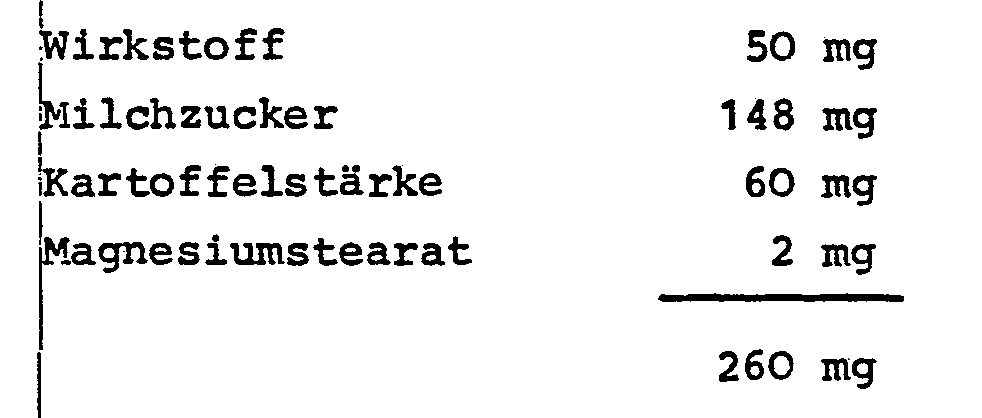
- Man rührt in eine 10%ige Kartoffelstärkelösung die Wirksubstanz und den Milchzucker und granuliert das Gemenge durch ein Sieb der Maschenweite 1,5 mm, trocknet das Granulat und reibt es erneut durch dasselbe Sieb, man fügt das Magnesiumstearat zu und verpresst das Granulat zu Tabletten. Gewicht der Tablette: 260 mg.
- Dragées enthaltend 50 mg (E)-2[(Methylamino)phenylmethylen]-benzo[b]thiophen-3(2H)-on.
- Man stellt analog zu Beispiel I ein Granulat her, welches zu Dragée-Kernen verpreßt wird. Die Kerne werden durch eine Hülle versehen, die im wesentlichen aus Zucker und Talk besteht. DieHülle wird anschließend mit Bienenwachs poliert.
- Gewicht des Kerns: 260 mg
- Gewicht des Dragees: 300 mg.
mit Aminen der allgemeinen Formel IV oder mit Ammoniumsalzen der allgemeinen Formel IVa oder mit Harnstoffen der allgemeinen Formel V
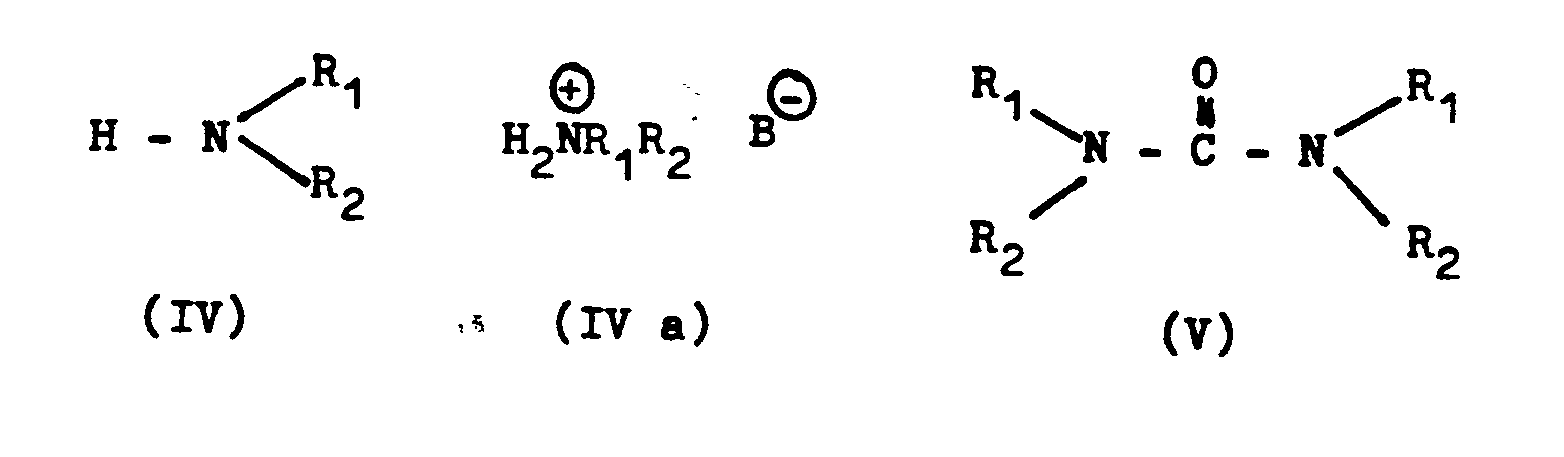
Claims (19)

wobei
oder

oder

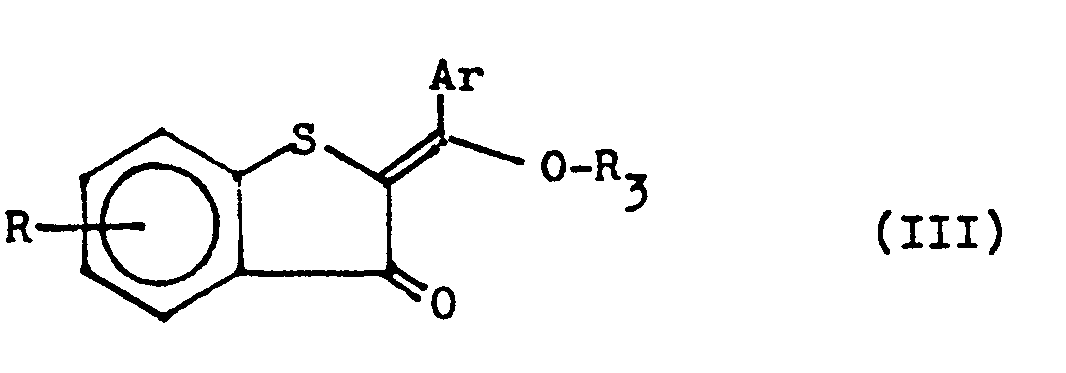


ein 2-Acyl-3-chlor-benzo[b]thiophen der allgemeinen Formel


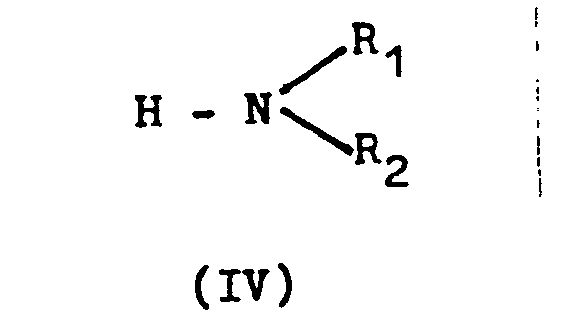


R7 ein Wasserstoffatom oder die Methylgruppe, R8 ein Wasserstoffatom, einen geradkettigen oder verzweigten Alkyl-, Alkenyl- oder Alkinylrest mit bis zu 6 Kohlenstoffatomen, einen gegebenenfalls methylsubstituierten Cycloalkylrest mit 3 bis 8 Kohlenstoffatomen oder den Rest -A-R4 bedeuten und Ar, R, A und R4 wie oben definiert sind, mit einem Amin der allgemeinen Formel IV oder mit einem Ammoniumsalz der allgemeinen Formel IVa oder mit einem Harnstoff der allgemeinen Formel V

chlorid in Gegenwart von konzentrierter Salzsäure oder Bromwasserstoffsäure bei Temperaturen zwischen O und 40°C durchgeführt wird.
Priority Applications (1)
| Application Number | Priority Date | Filing Date | Title |
|---|---|---|---|
| AT80104136T ATE4210T1 (de) | 1979-07-31 | 1980-07-16 | Neue vinyloge carboxamide, diese enthaltende arzneimittel und verfahren zur herstellung. |
Applications Claiming Priority (2)
| Application Number | Priority Date | Filing Date | Title |
|---|---|---|---|
| DE19792931010 DE2931010A1 (de) | 1979-07-31 | 1979-07-31 | Neue vinyloge carboxamide, diese enthaltende arzneimittel und verfahren zur herstellung |
| DE2931010 | 1979-07-31 |
Publications (2)
| Publication Number | Publication Date |
|---|---|
| EP0025489A1 true EP0025489A1 (de) | 1981-03-25 |
| EP0025489B1 EP0025489B1 (de) | 1983-07-20 |
Family
ID=6077239
Family Applications (1)
| Application Number | Title | Priority Date | Filing Date |
|---|---|---|---|
| EP80104136A Expired EP0025489B1 (de) | 1979-07-31 | 1980-07-16 | Neue vinyloge Carboxamide, diese enthaltende Arzneimittel und Verfahren zur Herstellung |
Country Status (15)
| Country | Link |
|---|---|
| US (1) | US4288437A (de) |
| EP (1) | EP0025489B1 (de) |
| JP (1) | JPS5622778A (de) |
| AT (1) | ATE4210T1 (de) |
| AU (1) | AU538685B2 (de) |
| DE (2) | DE2931010A1 (de) |
| DK (1) | DK151962C (de) |
| ES (5) | ES8106901A1 (de) |
| FI (1) | FI71140C (de) |
| HK (1) | HK50685A (de) |
| IE (1) | IE50076B1 (de) |
| IL (1) | IL60708A (de) |
| NO (1) | NO151501C (de) |
| SG (1) | SG385G (de) |
| ZA (1) | ZA804643B (de) |
Cited By (1)
| Publication number | Priority date | Publication date | Assignee | Title |
|---|---|---|---|---|
| EP0091041A3 (en) * | 1982-04-06 | 1984-07-25 | Dr. Karl Thomae Gmbh | Vinylogous carboxamides, process for preparing them and medicines containing these compounds |
Families Citing this family (1)
| Publication number | Priority date | Publication date | Assignee | Title |
|---|---|---|---|---|
| AU751457B2 (en) * | 1998-09-25 | 2002-08-15 | Viropharma Incorporated | Methods for treating or preventing viral infections and associated diseases |
Citations (1)
| Publication number | Priority date | Publication date | Assignee | Title |
|---|---|---|---|---|
| DE2804842A1 (de) * | 1977-02-11 | 1978-08-17 | Ciba Geigy Ag | Halogen-benzothiophencarbonsaeuren |
Family Cites Families (2)
| Publication number | Priority date | Publication date | Assignee | Title |
|---|---|---|---|---|
| US2356824A (en) * | 1941-05-01 | 1944-08-29 | Du Pont | Organic dyestuffs of the thionaphthenone series, and process of making the same |
| DE2258036A1 (de) * | 1972-11-27 | 1974-05-30 | Goedecke Ag | Verfahren zur herstellung von benzo eckige klammer auf b eckige klammer zu thiophen-derivaten |
-
1979
- 1979-07-31 DE DE19792931010 patent/DE2931010A1/de not_active Withdrawn
-
1980
- 1980-07-16 DE DE8080104136T patent/DE3064255D1/de not_active Expired
- 1980-07-16 EP EP80104136A patent/EP0025489B1/de not_active Expired
- 1980-07-16 AT AT80104136T patent/ATE4210T1/de not_active IP Right Cessation
- 1980-07-28 US US06/173,173 patent/US4288437A/en not_active Expired - Lifetime
- 1980-07-29 FI FI802366A patent/FI71140C/fi not_active IP Right Cessation
- 1980-07-29 DK DK326180A patent/DK151962C/da not_active IP Right Cessation
- 1980-07-30 IL IL60708A patent/IL60708A/xx unknown
- 1980-07-30 NO NO802292A patent/NO151501C/no unknown
- 1980-07-30 IE IE1596/80A patent/IE50076B1/en not_active IP Right Cessation
- 1980-07-30 AU AU60930/80A patent/AU538685B2/en not_active Ceased
- 1980-07-30 ES ES493852A patent/ES8106901A1/es not_active Expired
- 1980-07-31 JP JP10583980A patent/JPS5622778A/ja active Granted
- 1980-07-31 ZA ZA00804643A patent/ZA804643B/xx unknown
-
1981
- 1981-05-08 ES ES502014A patent/ES502014A0/es active Granted
- 1981-05-08 ES ES502016A patent/ES8202815A1/es not_active Expired
- 1981-05-08 ES ES502015A patent/ES8202814A1/es not_active Expired
- 1981-05-08 ES ES502013A patent/ES8202812A1/es not_active Expired
-
1985
- 1985-01-03 SG SG3/85A patent/SG385G/en unknown
- 1985-07-04 HK HK506/85A patent/HK50685A/xx unknown
Patent Citations (1)
| Publication number | Priority date | Publication date | Assignee | Title |
|---|---|---|---|---|
| DE2804842A1 (de) * | 1977-02-11 | 1978-08-17 | Ciba Geigy Ag | Halogen-benzothiophencarbonsaeuren |
Non-Patent Citations (1)
| Title |
|---|
| Chemical Abstracts, Band 87, Nr. 13, 26 September 1977 Columbus, Ohio, USA Zh. V. Bren et al. "Basicity and structure of azomethines and their structural analogs. XVIII. Basicity and structure of 2-(N-arylaminomethylene)-3-(2H)-benzo[b]thiophenones, -benzo[b]furanones and -benzo[b]selenophenones" Seite 568, Spalte 2 bis Seite 569, Spalte 1, Abstract Nr. 101741u & Khim. Geterotsikl. Soedin. Nr. 5, 1977, Seiten 619 bis 623 (Russ) * |
Cited By (1)
| Publication number | Priority date | Publication date | Assignee | Title |
|---|---|---|---|---|
| EP0091041A3 (en) * | 1982-04-06 | 1984-07-25 | Dr. Karl Thomae Gmbh | Vinylogous carboxamides, process for preparing them and medicines containing these compounds |
Also Published As
| Publication number | Publication date |
|---|---|
| DK151962B (da) | 1988-01-18 |
| ES493852A0 (es) | 1981-09-01 |
| ZA804643B (en) | 1982-04-28 |
| EP0025489B1 (de) | 1983-07-20 |
| DE3064255D1 (en) | 1983-08-25 |
| FI71140B (fi) | 1986-08-14 |
| JPS5622778A (en) | 1981-03-03 |
| SG385G (en) | 1985-11-15 |
| FI71140C (fi) | 1986-11-24 |
| ES8202813A1 (es) | 1982-03-01 |
| NO151501B (no) | 1985-01-07 |
| FI802366A7 (fi) | 1981-02-01 |
| AU538685B2 (en) | 1984-08-23 |
| DK151962C (da) | 1988-06-20 |
| ES502014A0 (es) | 1982-03-01 |
| ES8106901A1 (es) | 1981-09-01 |
| DK326180A (da) | 1981-02-01 |
| IE801596L (en) | 1981-01-31 |
| IL60708A (en) | 1984-05-31 |
| NO802292L (no) | 1981-02-02 |
| ES502013A0 (es) | 1982-03-01 |
| ATE4210T1 (de) | 1983-08-15 |
| ES502015A0 (es) | 1982-03-01 |
| AU6093080A (en) | 1981-02-05 |
| ES8202812A1 (es) | 1982-03-01 |
| DE2931010A1 (de) | 1981-02-26 |
| NO151501C (no) | 1985-04-24 |
| ES502016A0 (es) | 1982-03-01 |
| ES8202815A1 (es) | 1982-03-01 |
| JPH0120155B2 (de) | 1989-04-14 |
| IE50076B1 (en) | 1986-02-05 |
| US4288437A (en) | 1981-09-08 |
| ES8202814A1 (es) | 1982-03-01 |
| HK50685A (en) | 1985-07-12 |
Similar Documents
| Publication | Publication Date | Title |
|---|---|---|
| EP0554543B1 (de) | Neue 1,2,4-Triaminobenzol-Derivate und Verfahren zu deren Herstellung | |
| DE69829412T2 (de) | Hemmung der raf-kinase unter verwendung von symmetrisch und unsymmetrisch substituierten harnstoffen | |
| DE3586794T2 (de) | Arzneimittel mit psychotroper wirkung. | |
| EP0004279B1 (de) | Verfahren zur Herstellung von 4-Pyridon-3-carbonsäuren, 1-Cyclopropyl-4-Pyridon-3-Carbonsäurederivate und diese enthaltende Arzneimittel | |
| DE69718472T2 (de) | Bicyclische heteroaromatische verbindungen als protein tyrosine kinase inhibitoren | |
| DE69906397T2 (de) | Benzosulfonderivate | |
| DE69418243T2 (de) | N-Heteroaryl-N'-Phenylharnstoffderivate, ihre Herstellung und Verwendung | |
| CH650782A5 (de) | Carbostyrilverbindungen, verfahren zu deren herstellung und arzneimittel, welche diese enthalten. | |
| AT390732B (de) | Pharmazeutika enthaltend pyrazole | |
| CH660484A5 (de) | In 1-stellung durch einen heterocyclischen rest substituierte 4-((2,5-pyrrolidindion-1-yl)alkyl)piperazin-verbindungen. | |
| EP0314154A2 (de) | Tetrahydro-furo- und -thieno[2,3-c]pyridine, ihre Verwendung als Arzneimittel und Verfahren zu ihrer Herstellung | |
| EP0136658A2 (de) | 1-Benzyl-aminoalkyl-pyrrolidinone und ihre Säureadditionssalze, Verfahren zu ihrer Herstellung und Arzneimittel | |
| DE10046029A1 (de) | Indazole | |
| DE69732762T2 (de) | Indanderivate für antipsychotische mittel | |
| DE60006054T2 (de) | Herstellungsverfahren für Pyridinderivate | |
| EP0163260B1 (de) | Neue substituierte Pyrrolidinone, Verfahren zu ihrer Herstellung und Arzneimittel | |
| EP1025100B1 (de) | 3-substituierte tetrahydropyridopyrimidinon-derivate, ihre herstellung und verwendung | |
| DE69920717T2 (de) | Glucocorticoid selektive wirkstoffe | |
| EP0250361B1 (de) | Disubstituierte Piperazine | |
| DE68919154T2 (de) | Benzodiazepinverbindungen und ihre Verwendung als Arzneimittel. | |
| EP0025489B1 (de) | Neue vinyloge Carboxamide, diese enthaltende Arzneimittel und Verfahren zur Herstellung | |
| EP1881968A2 (de) | Dibenzocycloheptanverbindungen und pharmazeutische mittel, welche diese verbindungen enthalten | |
| EP0124630B1 (de) | Pyrimidin-Thioalkylpyridin-Derivate, Verfahren zu ihrer Herstellung und diese Verbindung enthaltende Arzneimittel | |
| DE1937459A1 (de) | Neue Pyrimidinderivate und Verfahren zu ihrer Herstellung | |
| EP0427125B1 (de) | Benzylselenobenzamide von Anilinen und Benzylaminen |
Legal Events
| Date | Code | Title | Description |
|---|---|---|---|
| PUAI | Public reference made under article 153(3) epc to a published international application that has entered the european phase |
Free format text: ORIGINAL CODE: 0009012 |
|
| AK | Designated contracting states |
Designated state(s): AT BE CH DE FR GB IT LU NL SE |
|
| 17P | Request for examination filed |
Effective date: 19810812 |
|
| ITF | It: translation for a ep patent filed | ||
| GRAA | (expected) grant |
Free format text: ORIGINAL CODE: 0009210 |
|
| AK | Designated contracting states |
Designated state(s): AT BE CH DE FR GB IT LI LU NL SE |
|
| REF | Corresponds to: |
Ref document number: 4210 Country of ref document: AT Date of ref document: 19830815 Kind code of ref document: T |
|
| REF | Corresponds to: |
Ref document number: 3064255 Country of ref document: DE Date of ref document: 19830825 |
|
| ET | Fr: translation filed | ||
| PLBE | No opposition filed within time limit |
Free format text: ORIGINAL CODE: 0009261 |
|
| STAA | Information on the status of an ep patent application or granted ep patent |
Free format text: STATUS: NO OPPOSITION FILED WITHIN TIME LIMIT |
|
| 26N | No opposition filed | ||
| PGFP | Annual fee paid to national office [announced via postgrant information from national office to epo] |
Ref country code: SE Payment date: 19910626 Year of fee payment: 12 |
|
| PGFP | Annual fee paid to national office [announced via postgrant information from national office to epo] |
Ref country code: AT Payment date: 19910703 Year of fee payment: 12 |
|
| PGFP | Annual fee paid to national office [announced via postgrant information from national office to epo] |
Ref country code: GB Payment date: 19910711 Year of fee payment: 12 |
|
| PGFP | Annual fee paid to national office [announced via postgrant information from national office to epo] |
Ref country code: FR Payment date: 19910712 Year of fee payment: 12 |
|
| ITTA | It: last paid annual fee | ||
| PGFP | Annual fee paid to national office [announced via postgrant information from national office to epo] |
Ref country code: NL Payment date: 19910731 Year of fee payment: 12 Ref country code: LU Payment date: 19910731 Year of fee payment: 12 Ref country code: DE Payment date: 19910731 Year of fee payment: 12 |
|
| PGFP | Annual fee paid to national office [announced via postgrant information from national office to epo] |
Ref country code: BE Payment date: 19910809 Year of fee payment: 12 |
|
| PGFP | Annual fee paid to national office [announced via postgrant information from national office to epo] |
Ref country code: CH Payment date: 19910822 Year of fee payment: 12 |
|
| EPTA | Lu: last paid annual fee | ||
| PG25 | Lapsed in a contracting state [announced via postgrant information from national office to epo] |
Ref country code: LU Free format text: LAPSE BECAUSE OF NON-PAYMENT OF DUE FEES Effective date: 19920716 Ref country code: GB Effective date: 19920716 Ref country code: AT Effective date: 19920716 |
|
| PG25 | Lapsed in a contracting state [announced via postgrant information from national office to epo] |
Ref country code: SE Effective date: 19920717 |
|
| PG25 | Lapsed in a contracting state [announced via postgrant information from national office to epo] |
Ref country code: LI Effective date: 19920731 Ref country code: CH Effective date: 19920731 Ref country code: BE Effective date: 19920731 |
|
| BERE | Be: lapsed |
Owner name: KARL THOMAE G.M.B.H. Effective date: 19920731 |
|
| PG25 | Lapsed in a contracting state [announced via postgrant information from national office to epo] |
Ref country code: NL Effective date: 19930201 |
|
| NLV4 | Nl: lapsed or anulled due to non-payment of the annual fee | ||
| GBPC | Gb: european patent ceased through non-payment of renewal fee |
Effective date: 19920716 |
|
| PG25 | Lapsed in a contracting state [announced via postgrant information from national office to epo] |
Ref country code: FR Effective date: 19930331 |
|
| REG | Reference to a national code |
Ref country code: CH Ref legal event code: PL |
|
| PG25 | Lapsed in a contracting state [announced via postgrant information from national office to epo] |
Ref country code: DE Effective date: 19930401 |
|
| REG | Reference to a national code |
Ref country code: FR Ref legal event code: ST |
|
| EUG | Se: european patent has lapsed |
Ref document number: 80104136.9 Effective date: 19930204 |