EP0004261A2 - Neue Imidazolderivate, Verfahren zu deren Herstellung und Arzneimittel diese enthaltend - Google Patents
Neue Imidazolderivate, Verfahren zu deren Herstellung und Arzneimittel diese enthaltend Download PDFInfo
- Publication number
- EP0004261A2 EP0004261A2 EP78101547A EP78101547A EP0004261A2 EP 0004261 A2 EP0004261 A2 EP 0004261A2 EP 78101547 A EP78101547 A EP 78101547A EP 78101547 A EP78101547 A EP 78101547A EP 0004261 A2 EP0004261 A2 EP 0004261A2
- Authority
- EP
- European Patent Office
- Prior art keywords
- ribofuranosyl
- general formula
- methyl
- imidazole
- compounds
- Prior art date
- Legal status (The legal status is an assumption and is not a legal conclusion. Google has not performed a legal analysis and makes no representation as to the accuracy of the status listed.)
- Granted
Links
Classifications
-
- C—CHEMISTRY; METALLURGY
- C07—ORGANIC CHEMISTRY
- C07H—SUGARS; DERIVATIVES THEREOF; NUCLEOSIDES; NUCLEOTIDES; NUCLEIC ACIDS
- C07H19/00—Compounds containing a hetero ring sharing one ring hetero atom with a saccharide radical; Nucleosides; Mononucleotides; Anhydro-derivatives thereof
- C07H19/02—Compounds containing a hetero ring sharing one ring hetero atom with a saccharide radical; Nucleosides; Mononucleotides; Anhydro-derivatives thereof sharing nitrogen
- C07H19/04—Heterocyclic radicals containing only nitrogen atoms as ring hetero atom
- C07H19/052—Imidazole radicals
-
- A—HUMAN NECESSITIES
- A61—MEDICAL OR VETERINARY SCIENCE; HYGIENE
- A61P—SPECIFIC THERAPEUTIC ACTIVITY OF CHEMICAL COMPOUNDS OR MEDICINAL PREPARATIONS
- A61P9/00—Drugs for disorders of the cardiovascular system
-
- C—CHEMISTRY; METALLURGY
- C07—ORGANIC CHEMISTRY
- C07D—HETEROCYCLIC COMPOUNDS
- C07D233/00—Heterocyclic compounds containing 1,3-diazole or hydrogenated 1,3-diazole rings, not condensed with other rings
- C07D233/54—Heterocyclic compounds containing 1,3-diazole or hydrogenated 1,3-diazole rings, not condensed with other rings having two double bonds between ring members or between ring members and non-ring members
- C07D233/66—Heterocyclic compounds containing 1,3-diazole or hydrogenated 1,3-diazole rings, not condensed with other rings having two double bonds between ring members or between ring members and non-ring members with hetero atoms or with carbon atoms having three bonds to hetero atoms with at the most one bond to halogen, e.g. ester or nitrile radicals, directly attached to ring carbon atoms
- C07D233/90—Carbon atoms having three bonds to hetero atoms with at the most one bond to halogen, e.g. ester or nitrile radicals
-
- C—CHEMISTRY; METALLURGY
- C07—ORGANIC CHEMISTRY
- C07F—ACYCLIC, CARBOCYCLIC OR HETEROCYCLIC COMPOUNDS CONTAINING ELEMENTS OTHER THAN CARBON, HYDROGEN, HALOGEN, OXYGEN, NITROGEN, SULFUR, SELENIUM OR TELLURIUM
- C07F7/00—Compounds containing elements of Groups 4 or 14 of the Periodic Table
- C07F7/02—Silicon compounds
- C07F7/08—Compounds having one or more C—Si linkages
- C07F7/10—Compounds having one or more C—Si linkages containing nitrogen having a Si-N linkage
Definitions
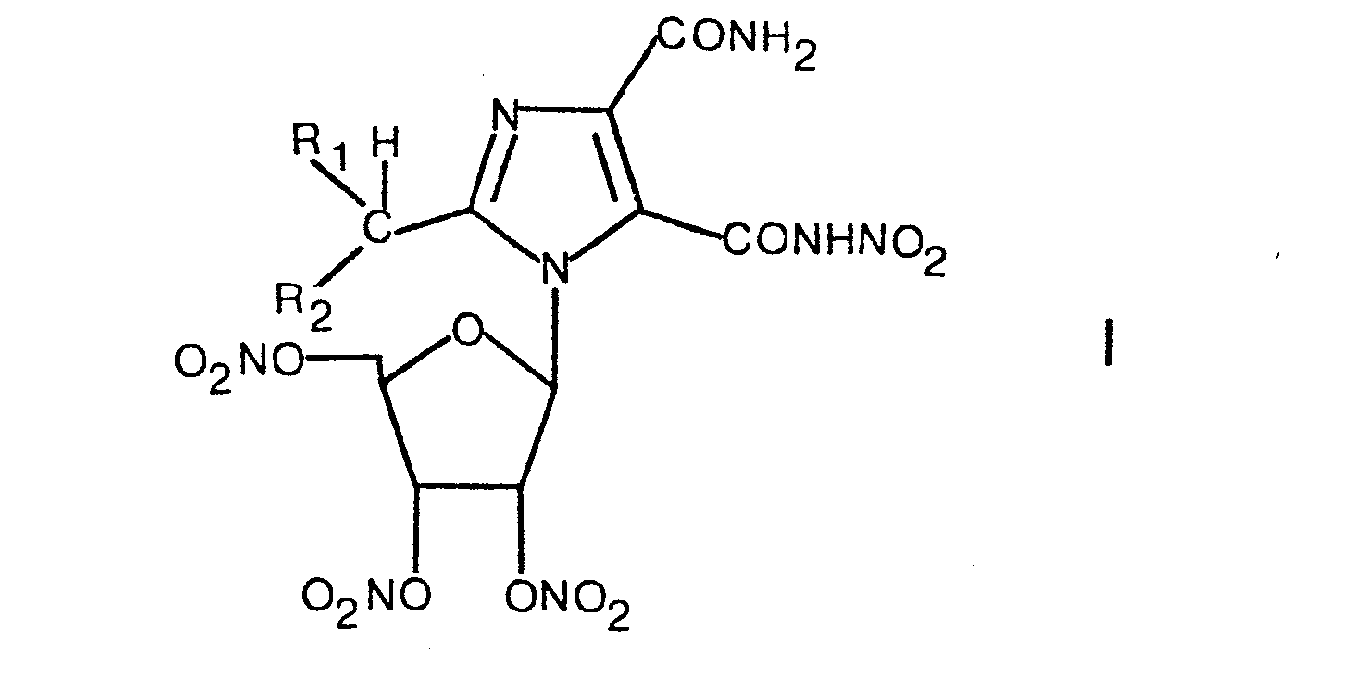
- the present invention relates to new imidazole derivatives, namely ribofuranosyl-imidazole derivatives of the general formula wherein R 1 and R 2 each represent hydrogen or methyl.
- the ribofuranosylimidazole derivatives of the above formula I can be prepared by using a compound of the general formula wherein R 1 and R 2 have the above meaning, nitrided.
- nitration of the compounds of formula II can be carried out according to methods known per se.
- nitration can be accomplished with nitric acid.
- Hydrolysis by water formed in the reaction is expedient by adding a water-binding agent, such as conc. Sulfuric acid or oleum, suppressed.
- the nitration is conveniently carried at low temperatures, preferably about in the range from -40 0 to -10 ° C is performed.
- the starting materials of formula II are also new and the subject of the present invention. They can be prepared analogously to the preparation of known compounds.
- a manufacturing process is outlined in Scheme I below. With regard to the exact reaction conditions, reference is made to the example section.
- the compounds of the formula III are known or can be prepared analogously to the preparation of the known compounds.
- the compound of formula V is known.
- the compounds according to the invention have valuable cardial (such as coronary dilating) and circulatory-dynamic properties and can therefore be used as a remedy, inter alia. used to treat angina pectoris.
- An amount of 0.01-30 mg / kg body weight per day can be used as a dosage guideline and can be administered both as a single dose and - which is preferred - in several partial doses.
- the compounds according to the invention can be used as pharmaceutical preparations with direct or delayed release of the active ingredient in a mixture with an organic or inorganic inert carrier material suitable for enteral, percutaneous or parenteral application, such as water, gelatin, gum arabic, lactose, starch, magnesium stearate, talc, vegetable oils, polyalkylene glycols, petroleum jelly, etc. can be used.
- the pharmaceutical preparations can be in solid form, for example as tablets, dragees, suppositories, capsules; in semi-solid form, for example as ointments; or in liquid form, for example as solutions, suspensions or emulsions.
- the compounds, dissolved in propylene glycol, are administered intravenously.
- the maximum effect of a substance is calculated after each dose in percent of the initial value and the respective duration of action is determined.
- the imidazole-4,5-dicarboxylic acid esters used as starting materials in the above step can be obtained as follows:
- Dry hydrogen chloride gas is refluxed into a suspension of 14.6 g of 2-ethylimidazole-4,5-dicarboxylic acid in 150 ml of methanol until no more starting material is available (TLC control). Then the solution obtained is evaporated to dryness, and the residue was evaporated again twice with 100 ml of methanol each time. The residue is dissolved in 250 ml of ice water, neutralized with a saturated sodium hydrogen carbonate solution, and extracted three times with 250 ml of ethyl acetate. The ethyl acetate extracts are dried over sodium sulfate and evaporated to dryness. The residue is recrystallized from benzene, giving 9.6 g of dimethyl 2-ethylimidazole-4,5-dicarboxylate, mp 111 ° C.
- 2-isopropylimidazole-4,5-dicarboxylic acid dimethyl ester mp. 150 ° C.
- 2-isopropylimidazole-4,5-dicarboxylic acid dimethyl ester mp. 150 ° C.
- the active ingredient is mixed homogeneously with the milk sugar and corn starch, passed through a sieving machine and filled into gelatin capsules after the talc has been mixed in.
- the active ingredient is mixed with the milk sugar and the corn starch and granulated with a solution of the ethyl cellulose in 40 ml of methylene chloride.
- the granules are dried at 40 ° C, mixed with the talc and magnesium stearate and pressed into tablets.
Landscapes
- Chemical & Material Sciences (AREA)
- Organic Chemistry (AREA)
- Health & Medical Sciences (AREA)
- General Health & Medical Sciences (AREA)
- Life Sciences & Earth Sciences (AREA)
- Engineering & Computer Science (AREA)
- Bioinformatics & Cheminformatics (AREA)
- Medicinal Chemistry (AREA)
- Genetics & Genomics (AREA)
- Molecular Biology (AREA)
- Biochemistry (AREA)
- Cardiology (AREA)
- Heart & Thoracic Surgery (AREA)
- Chemical Kinetics & Catalysis (AREA)
- General Chemical & Material Sciences (AREA)
- Biotechnology (AREA)
- Nuclear Medicine, Radiotherapy & Molecular Imaging (AREA)
- Pharmacology & Pharmacy (AREA)
- Animal Behavior & Ethology (AREA)
- Public Health (AREA)
- Veterinary Medicine (AREA)
- Pharmaceuticals Containing Other Organic And Inorganic Compounds (AREA)
- Saccharide Compounds (AREA)
Abstract
Description
- Die vorliegende Erfindung betrifft neue Imidazolderivate, und zwar Ribofuranosyl-imidazolderivate der allgemeinen Formel

- Erfindungsgemäss lassen sich die Ribofuranosyl-imidazolderivate der obigen Formel I dadurch herstellen, dass man eine Verbindung der allgemeinen Formel

- Die Nitrierung der Verbindungen der Formel II kann nach an sich bekannten Methoden durchgeführt werden. So kann die Nitrierung beispielsweise mit Salpetersäure bewerkstelligt werden. Hydrolyse durch bei der Umsetzung gebildetes Wasser wird zweckmässig durch Zusatz eines wasserbindenden Mittels, wie konz. Schwefelsäure oder Oleum, unterdrückt. Die Nitrierung wird zweckmässig bei tiefen Temperaturen, vorzugsweise etwa im Bereich von -400 bis -10°C, durchgeführt.
- Die Ausgangsstoffe der Formel II sind ebenfalls neu und Gegenstand der vorliegenden Erfindung. Sie können in Analogie zur Herstellung bekannter Verbindungen hergestellt werden. Ein Herstellungsverfahren ist im nachfolgenden Schema I skizziert. Bezüglich der genauen Reaktionsbedingungen wird auf den Beispielteil verwiesen.

- Im obigen Schema I bedeuten Bz die Benzoylgruppe und Ac die Acetylgruppe und besitzen R1 und R2 die obige Bedeutung.
- Die Verbindungen der obigen Formeln IV und VI sind ebenfalls neu und als solche Gegenstand der vorliegenden Erfindung.
- Die Verbindungen der Formel III sind bekannt oder können in Analogie zur Herstellung der bekannten Verbindungen hergestellt werden. Die Verbindung der Formel V ist bekannt.
- Die erfindungsgemässen Verbindungen besitzen wertvolle cardiale (wie coronardilatierende) und kreislaufdynamische Eigenschaften und können somit als Heilmittel, u.a. zur Behandlung von Angina pectoris Verwendung finden. Als Dosierungsrichtlinie kann eine Menge von 0,01-30 mg/kg Körpergewicht pro Tag gelten und sowohl als einmalige Dosis als auch - was bevorzugt ist - in mehreren Teildosen verabreicht werden.
- Die erfindungsgemässen Verbindungen können als pharmazeutische Präparate mit direkter oder verzögerter Freigabe des Wirkstoffs in Mischung mit einem für die enterale, perkutane oder parenterale Applikation geeigneten organischen oder anorganischen inerten Trägermaterial, wie z.B. Wasser, Gelatine, Gummi arabicum, Milchzucker, Stärke, Magnesiumstearat, Talk, pflanzlichen Oelen, Polyalkylenglykolen, Vaseline, usw. verwendet werden. Die pharmazeutischen Präparate können in fester Form, z.B. als Tabletten, Dragees, Suppositorien, Kapseln; in halbfester Form, z.B. als Salben; oder in flüssiger Form, z.B. als Lösungen, Suspensionen oder Emulsionen, vorliegen. Gegebenenfalls sind sie sterilisiert und bzw. oder enthalten weitere Hilfsstoffe, wie Konservierungs-, Stabilisierungs-, Netz-oder Emulgiermittel, Mittel zur geschmacklichen Verbesserung, Salze zur Veränderung des osmotischen Druckes oder Puffersubstanzen. Die Herstellung der pharmazeutischen Präparate kann in der dem Fachmann geläufigen Weise erfolgen.
- Die coronardilatierende Wirkung kann nach folgender Methode gemessen werden:
- Für die Untersuchungen werden Bastardhunde im Gewicht zwischen 20 und 35 kg verwendet. Die Versuchstiere werden mit 35 mg/kg i.v. Pentobarbital narkotisiert, tracheal intubiert und mit Raumluft künstlich beatmet. Nach Oeffung des Thorax wird das Herz freigelegt und um den Ramus circumflexus der linken Coronararterie eine vorher geeichte Flowprobe eines elektromagnetischen Flowmeters zur Messung der durchfliessenden Blutmenge gelegt. Der arterielle Blutdruck wird über einen Katheter in der Aorta ascendens mit Drucktransducer gemessen. Die Pulswelle triggert einen Tachographen zur Messung der Herzfrequenz. Der Nachweis einer nitroglycerinähnlichen Wirkungsweise wurde mittels der coronaren Segmentanalyse nach Winbury erbracht (Winbury, M. et al., J. Pharmacol. Exp. Ther. 168 (1), 70-95, 1969).
- Die Verbindungen werden, in Propylenglykol gelöst, intravenös appliziert. Die maximale Wirkung einer Substanz wird nach jeder Dosierung in Prozent des Ausgangswertes berechnet und die jeweilige Wirkungsdauer bestimmt.
- In der folgenden Tabelle sind pharmakologische Daten von einigen erfindungsgemässen Verbindungen zusammengestellt.

- 15,0 g 2-Methyl-1-ß-D-ribofuranosylimidazol-4,5-dicar- boxamid werden bei -40°C in 120 ml rauchender Salpetersäure (D=1,50) gelöst. Dazu wird eine auf -20°C vorgekühlte Mischung aus 50 ml Oleum und 50 ml Nitromethan so zugetropft, dass die Reaktionstemperatur -30°C nicht übersteigt. Das Reaktionsgemisch wird danach 45 Minuten bei -30 bis -25°C gerührt und dann unter starkem Rühren auf 1 1 eines Eis-Wasser-Gemisches getropft. Das ausgefallene Produkt wird abfiltriert, mit kaltem Wasser gewaschen und im Exsikkator über Kaliumhydroxid getrocknet. Nach Umkristallisation aus Aethanol erhält man 12,0 g 2-Methyl-N5-nitro-1-(2,3,5-tri-O-nitro-ß-D-ribofuranosyl)imidazol-4,5-dicarboxamid, Smp. 1640C (Zersetzung). Die Struktur der genannten Verbindung wurde durch eine Röntgenstrukturanalyse bestätigt.
- In analoger Weise wurden die folgenden Verbindungen durch Nitrierung hergestellt:
- 2-Aethyl-N5(oder N 4)-nitro-1-(2,3,5-tri-O-nitro-ß-D-ribofuranosyl)imidazol-4,5-dicarboxamid, Smp. 126-127°C (Zersetzung);
- 2-Isopropyl-N5(oder N4)-nitro-1-(2,3,5-tri-O-nitro-ß-D-ribofuranosyl)imidazol-4,5-dicarboxamid, Smp. 100-102°C.
- Für die beiden obengenannten Verbindungen wurden keine Röntgenstrukturanalysen zur Bestätigung der Struktur durchgeführt. Daher wurde auch die Möglichkeit einer isomeren Struktur berücksichtigt.
- Die als Ausgangsstoffe verwendeten Nukleoside können wie folgt hergestellt werden:
- a) 19,8 g 2-Methylimidazol-4,5-dicarbonsäure-dimethylester werden in 120 ml Benzol gelöst, mit 16,7 ml Triäthylamin und danach mit 18 ml Trifluormethansulfonsäure-trimethylsilylester bei 5°C versetzt und 3 Stunden bei Raumtemperatur gerührt. Dann werden die Phasen getrennt, und der Benzolextrakt zur Trockene eingedampft. Der so erhaltene, rohe 2-Methyl-1-(trimethylsilyl)imidazol-4,5-dicarbonsäure-dimethylester und 50,5 g 1-O-Acetyl-2,3,5-tri-O-benzoyl-ß-D-ribo- furanose werden in 500 ml Aethylenchlorid gelöst. Dazu werden 18 ml Trifluormethansulfonsäure-trimethylsilylester unter Argon getropft, und das Reaktionsgemisch wird 18 Stunden bei Raumtemperatur gerührt. Die Lösung wird unter Rühren auf 500 ml einer gesättigten Natriumhydrogencarbonatlösung gegossen, und das Reaktionsgemisch wird eine Stunde weitergerührt. Danach werden die Phasen getrennt, und die wässrige Phase mit 250 ml Methylenchlorid extrahiert. Die organische Phase wird über Natriumsulfat getrocknet und eingedampft. Der Rückstand wird über Kieselgel mit einem Gemisch von Hexan und Essigester chromatographiert. Nach Umkristallisation aus Aethanol erhält man 30,8 g 2-Methyl-l-(2,3,5-tri-O-benzoyl-ß-D-ribofuranosyl)imidazol-4,5-dicarbonsäure-dimethylester, Smp. 121-122°C.
- In analoger Weise wurden die folgenden Verbindungen durch Umsetzung von 1-O-Acetyl-2,3,5-tri-O-benzoyl-ß-D-ribofuranose mit den silylierten 2-Aethyl- bzw. 2-Isopropyl- imidazol-4,5-dicarbonsäure-dimethylestern hergestellt:
- 2-Aethyl-1-(2,3,5-tri-O-benzoyl-ß-D-ribofuranosyl)-imidazol-4,5-dicarbonsäure-dimethylester, Smp. 147°C;
- 2-Isopropyl-1-(2,3,5-tri-O-benzoyl-ß-D-ribofuranosyl)-imidazol-4,5-dicarbonsäure-dimethylester, Smp. 147-148 C.
- Die in der obigen Stufe als Ausgangsstoffe verwendeten Imidazol-4,5-dicarbonsäureester können wie folgt gewonnen werden:
- Trockenes Chlorwasserstoffgas wird unter Rückfluss solange in eine Suspension von 14,6 g 2-Aethylimidazol-4,5-dicarbonsäure in 150 ml Methanol eingeleitet, bis kein Ausgangsmaterial mehr vorhanden ist (DC-Kontrolle). Danach wird die erhaltene Lösung bis zur Trockene eingedampft, und der Rückstand zweimal mit je 100 ml Methanol wieder eingedampft. Der Rückstand wird in 250 ml Eiswasser gelöst, mit einer gesättigten Natriumhydrogencarbonatlösung neutralisiert, und dreimal mit je 250 ml Essigester extrahiert. Die Essigesterextrakte werden über Natriumsulfat getrocknet und bis zur Trockene eingedampft. Der Rückstand wird aus Benzol umkristallisiert, wobei man 9,6 g 2-Aethylimidazol-4,5-dicarbonsäure-dimethylester erhält, Smp. 111 C.
- In analoger Weise wird 2-Isopropylimidazol-4,5-dicarbonsäure-dimethylester, Smp. 150°C, durch Umsetzung der 2-Isopropylimidazol-4,5-dicarbonsäure mit Methanol hergestellt.
- b) Eine Lösung von 26,0 g 2-Methyl-1-(2,3,5-tri-O-benzoyl-β-D-ribofuranosyl)imidazol-4,5-dicarbonsäure-dimethylester in 500 ml Methanol, das bei O°C mit wasserfreiem Ammoniak gesättigt worden ist, wird 7 Tage in einem verschlossenen Druckkolben bei Raumtemperatur stehengelassen. Dann wird das Reaktionsgemisch bis zur Trockene eingedampft, und der Rückstand aus Methanol umkristallisiert. Man erhält 9,5 g 2-Methyl-1-ß-D-ribofuranosylimidazol-4,5-dicarboxamid, Smp. 167°C.
- In analoger Weise wurden die folgenden Verbindungen durch Ammonolyse hergestellt:
- 2-Aethyl-l-ß-D-ribofuranosylimidazol-4,5-dicarboxamid, [α]D 25 = +59,4° (c = 1,00, Dimethylsulfoxid);
- 2-Isopropyl-l-ß-D-ribofuranosylimidazol-4,5-dicarboxamid, [a]D 25 = +43,3° (c = 1,00, Dimethylsulfoxid).
- Herstellung von Kapseln nachstehender Zusammensetzung:

- Der Wirkstoff wird mit dem Milchzucker und der Maisstärke homogen vermischt, durch eine Siebmaschine passiert und nach Untermischen des Talcums in Gelatinekapseln abgefüllt.

- Herstellung von Tabletten nachstehender Zusammensetzung:

- Der Wirkstoff wird mit dem Milchzucker und der Maisstärke vermischt und mit einer Lösung der Aethylcellulose in 40 ml Methylenchlorid granuliert. Das Granulat wird bei 40°C getrocknet, mit dem Talcum und Magnesiumstearat vermischt und zu Tabletten gepresst.

Claims (12)


Applications Claiming Priority (2)
| Application Number | Priority Date | Filing Date | Title |
|---|---|---|---|
| CH1095/78 | 1978-02-01 | ||
| CH109578 | 1978-02-01 |
Publications (3)
| Publication Number | Publication Date |
|---|---|
| EP0004261A2 true EP0004261A2 (de) | 1979-10-03 |
| EP0004261A3 EP0004261A3 (en) | 1979-11-28 |
| EP0004261B1 EP0004261B1 (de) | 1982-04-28 |
Family
ID=4202349
Family Applications (1)
| Application Number | Title | Priority Date | Filing Date |
|---|---|---|---|
| EP78101547A Expired EP0004261B1 (de) | 1978-02-01 | 1978-12-04 | Neue Imidazolderivate, Verfahren zu deren Herstellung und Arzneimittel diese enthaltend |
Country Status (7)
| Country | Link |
|---|---|
| EP (1) | EP0004261B1 (de) |
| JP (1) | JPS54109976A (de) |
| AU (1) | AU524511B2 (de) |
| CA (1) | CA1096860A (de) |
| DE (1) | DE2861771D1 (de) |
| DK (1) | DK145825C (de) |
| ZA (1) | ZA79317B (de) |
Family Cites Families (3)
| Publication number | Priority date | Publication date | Assignee | Title |
|---|---|---|---|---|
| CH563405A5 (de) * | 1971-09-10 | 1975-06-30 | Duschinsky Robert Dr Schweiz I | |
| DE2529533A1 (de) * | 1975-07-02 | 1977-01-27 | Icn Pharmaceuticals | 3-desazaguanin sowie derivate dieser verbindung |
| AT350735B (de) * | 1976-08-06 | 1979-06-11 | Hoffmann La Roche | Verfahren zur herstellung von neuen ribo- furanosyl-imidazolderivaten |
-
1978
- 1978-12-04 EP EP78101547A patent/EP0004261B1/de not_active Expired
- 1978-12-04 DE DE7878101547T patent/DE2861771D1/de not_active Expired
- 1978-12-08 CA CA317,618A patent/CA1096860A/en not_active Expired
-
1979
- 1979-01-24 AU AU43619/79A patent/AU524511B2/en not_active Ceased
- 1979-01-25 ZA ZA79317A patent/ZA79317B/xx unknown
- 1979-01-31 JP JP929879A patent/JPS54109976A/ja active Pending
- 1979-01-31 DK DK41779A patent/DK145825C/da not_active Application Discontinuation
Also Published As
| Publication number | Publication date |
|---|---|
| DE2861771D1 (en) | 1982-06-09 |
| DK145825C (da) | 1983-09-05 |
| AU524511B2 (en) | 1982-09-23 |
| EP0004261A3 (en) | 1979-11-28 |
| CA1096860A (en) | 1981-03-03 |
| EP0004261B1 (de) | 1982-04-28 |
| DK41779A (da) | 1979-08-02 |
| DK145825B (da) | 1983-03-14 |
| AU4361979A (en) | 1979-08-09 |
| JPS54109976A (en) | 1979-08-29 |
| ZA79317B (en) | 1980-02-27 |
Similar Documents
| Publication | Publication Date | Title |
|---|---|---|
| DE2524277C2 (de) | ||
| DE3444051A1 (de) | Neue retinoide | |
| DE2941288C2 (de) | ||
| DE2737738C2 (de) | 3-Amino-thiophen-4-carbonsäuren und deren Derivate, Verfahren zu deren Herstellung und diese enthaltende pharmazeutische Mittel | |
| DE2630060A1 (de) | 2-brom-6-fluor-n-2-imidazolidinyliden- benzamin, dessen saeureadditionssalze, diese enthaltende arzneimittel und verfahren zu dessen herstellung | |
| EP0255894A2 (de) | Pyrimidinderivate, deren Herstellung und Arzneimittel, die diese Derivate enthalten | |
| DE2711225C2 (de) | ||
| CH643830A5 (de) | Bis-moranolin-derivate. | |
| DE2337067A1 (de) | Indensaeure-glucuronide | |
| DE2511828C2 (de) | ||
| DE2221758A1 (de) | Yohimbinderivate,Verfahren zu ihrer Herstellung und ihre Verwendung | |
| EP0004261B1 (de) | Neue Imidazolderivate, Verfahren zu deren Herstellung und Arzneimittel diese enthaltend | |
| DE2735458A1 (de) | Neue imidazolderivate | |
| CH617681A5 (de) | ||
| CH409996A (de) | Verfahren zur Herstellung von substituierten Hydrazinen | |
| EP0049853B1 (de) | Neue Prostaglandine, ihre Herstellung und pharmazeutische Kompositionen | |
| DE2511829C2 (de) | ||
| DE2614137C2 (de) | Benzo[b]thien(2)-ylaminoäthylketone, Verfahren zu ihrer Herstellung, sowie diese enthaltende Arzneimittel | |
| DE2508251C2 (de) | Derivate des Indols, Verfahren zu deren Herstellung sowie diese enthaltende Arzneimittel | |
| CH677925A5 (de) | ||
| DE3514641C2 (de) | ||
| EP0021244B1 (de) | Digoxin-Derivate, Verfahren zu ihrer Herstellung und ihre Verwendung in Arzneimitteln | |
| DE2610986A1 (de) | Neue 1-deoxyribofuranuronsaeurederivate, verfahren zu ihrer herstellung und sie enthaltende arzneimittel | |
| AT358188B (de) | Verfahren zur herstellung von neuen ribofuranosyl-imidazolderivaten | |
| DE1445417A1 (de) | Verfahren zur Herstellung von neuen Hexitestern der Nikotinsaeure |
Legal Events
| Date | Code | Title | Description |
|---|---|---|---|
| PUAI | Public reference made under article 153(3) epc to a published international application that has entered the european phase |
Free format text: ORIGINAL CODE: 0009012 |
|
| PUAL | Search report despatched |
Free format text: ORIGINAL CODE: 0009013 |
|
| AK | Designated contracting states |
Designated state(s): BE CH DE FR GB NL SE |
|
| AK | Designated contracting states |
Designated state(s): BE CH DE FR GB NL SE |
|
| 17P | Request for examination filed | ||
| GRAA | (expected) grant |
Free format text: ORIGINAL CODE: 0009210 |
|
| AK | Designated contracting states |
Designated state(s): BE CH DE FR GB NL SE |
|
| REF | Corresponds to: |
Ref document number: 2861771 Country of ref document: DE Date of ref document: 19820609 |
|
| PGFP | Annual fee paid to national office [announced via postgrant information from national office to epo] |
Ref country code: DE Payment date: 19820622 Year of fee payment: 5 |
|
| PGFP | Annual fee paid to national office [announced via postgrant information from national office to epo] |
Ref country code: FR Payment date: 19820726 Year of fee payment: 5 |
|
| PGFP | Annual fee paid to national office [announced via postgrant information from national office to epo] |
Ref country code: SE Payment date: 19821231 Year of fee payment: 5 Ref country code: NL Payment date: 19821231 Year of fee payment: 5 Ref country code: CH Payment date: 19821231 Year of fee payment: 5 Ref country code: BE Payment date: 19821231 Year of fee payment: 5 |
|
| PG25 | Lapsed in a contracting state [announced via postgrant information from national office to epo] |
Ref country code: SE Effective date: 19831205 |
|
| PG25 | Lapsed in a contracting state [announced via postgrant information from national office to epo] |
Ref country code: CH Effective date: 19831231 |
|
| PG25 | Lapsed in a contracting state [announced via postgrant information from national office to epo] |
Ref country code: NL Effective date: 19840701 |
|
| GBPC | Gb: european patent ceased through non-payment of renewal fee | ||
| NLV4 | Nl: lapsed or anulled due to non-payment of the annual fee | ||
| PG25 | Lapsed in a contracting state [announced via postgrant information from national office to epo] |
Ref country code: FR Free format text: LAPSE BECAUSE OF NON-PAYMENT OF DUE FEES Effective date: 19840831 |
|
| REG | Reference to a national code |
Ref country code: CH Ref legal event code: PL |
|
| PG25 | Lapsed in a contracting state [announced via postgrant information from national office to epo] |
Ref country code: DE Effective date: 19840901 |
|
| REG | Reference to a national code |
Ref country code: FR Ref legal event code: ST |
|
| PG25 | Lapsed in a contracting state [announced via postgrant information from national office to epo] |
Ref country code: BE Effective date: 19851231 |
|
| PG25 | Lapsed in a contracting state [announced via postgrant information from national office to epo] |
Ref country code: GB Effective date: 19881117 |
|
| EUG | Se: european patent has lapsed |
Ref document number: 78101547.4 Effective date: 19850605 |
|
| PLBE | No opposition filed within time limit |
Free format text: ORIGINAL CODE: 0009261 |
|
| STAA | Information on the status of an ep patent application or granted ep patent |
Free format text: STATUS: NO OPPOSITION FILED WITHIN TIME LIMIT |