EP0001800B1 - Polyätherpolyole, Verfahren zu ihrer Herstellung und Verfahren zur Herstellung von Polyurethanschaumstoffen - Google Patents
Polyätherpolyole, Verfahren zu ihrer Herstellung und Verfahren zur Herstellung von Polyurethanschaumstoffen Download PDFInfo
- Publication number
- EP0001800B1 EP0001800B1 EP78101211A EP78101211A EP0001800B1 EP 0001800 B1 EP0001800 B1 EP 0001800B1 EP 78101211 A EP78101211 A EP 78101211A EP 78101211 A EP78101211 A EP 78101211A EP 0001800 B1 EP0001800 B1 EP 0001800B1
- Authority
- EP
- European Patent Office
- Prior art keywords
- alkylene oxide
- mols
- oxide
- mol
- polyether polyols
- Prior art date
- Legal status (The legal status is an assumption and is not a legal conclusion. Google has not performed a legal analysis and makes no representation as to the accuracy of the status listed.)
- Expired
Links
- 229920005862 polyol Polymers 0.000 title claims description 45
- 150000003077 polyols Chemical class 0.000 title claims description 45
- 229920000570 polyether Polymers 0.000 title claims description 39
- 239000004721 Polyphenylene oxide Substances 0.000 title claims description 29
- 238000000034 method Methods 0.000 title claims description 26
- 229920005830 Polyurethane Foam Polymers 0.000 title claims description 18
- 239000011496 polyurethane foam Substances 0.000 title claims description 18
- 238000002360 preparation method Methods 0.000 title description 3
- 125000002947 alkylene group Chemical group 0.000 claims description 42
- IAYPIBMASNFSPL-UHFFFAOYSA-N Ethylene oxide Chemical compound C1CO1 IAYPIBMASNFSPL-UHFFFAOYSA-N 0.000 claims description 26
- 229920001228 polyisocyanate Polymers 0.000 claims description 26
- 239000005056 polyisocyanate Substances 0.000 claims description 26
- 150000001875 compounds Chemical class 0.000 claims description 24
- 239000003054 catalyst Substances 0.000 claims description 19
- -1 toluylene diamine Chemical class 0.000 claims description 17
- 238000004519 manufacturing process Methods 0.000 claims description 16
- 125000004432 carbon atom Chemical group C* 0.000 claims description 11
- 239000004604 Blowing Agent Substances 0.000 claims description 9
- GOOHAUXETOMSMM-UHFFFAOYSA-N Propylene oxide Chemical group CC1CO1 GOOHAUXETOMSMM-UHFFFAOYSA-N 0.000 claims description 9
- 239000000654 additive Substances 0.000 claims description 3
- VOZKAJLKRJDJLL-UHFFFAOYSA-N 2,4-diaminotoluene Chemical compound CC1=CC=C(N)C=C1N VOZKAJLKRJDJLL-UHFFFAOYSA-N 0.000 description 23
- 239000006260 foam Substances 0.000 description 23
- 238000006243 chemical reaction Methods 0.000 description 20
- 239000000203 mixture Substances 0.000 description 17
- 239000011541 reaction mixture Substances 0.000 description 17
- 239000007795 chemical reaction product Substances 0.000 description 11
- IJGRMHOSHXDMSA-UHFFFAOYSA-N Atomic nitrogen Chemical compound N#N IJGRMHOSHXDMSA-UHFFFAOYSA-N 0.000 description 10
- 125000002887 hydroxy group Chemical group [H]O* 0.000 description 10
- 229910052757 nitrogen Inorganic materials 0.000 description 10
- 229920002635 polyurethane Polymers 0.000 description 10
- 239000004814 polyurethane Substances 0.000 description 10
- 239000000047 product Substances 0.000 description 10
- PEDCQBHIVMGVHV-UHFFFAOYSA-N Glycerine Chemical compound OCC(O)CO PEDCQBHIVMGVHV-UHFFFAOYSA-N 0.000 description 9
- 238000005187 foaming Methods 0.000 description 7
- 125000004435 hydrogen atom Chemical group [H]* 0.000 description 7
- ZMANZCXQSJIPKH-UHFFFAOYSA-N Triethylamine Chemical compound CCN(CC)CC ZMANZCXQSJIPKH-UHFFFAOYSA-N 0.000 description 6
- 239000012948 isocyanate Substances 0.000 description 6
- 238000002156 mixing Methods 0.000 description 6
- DNIAPMSPPWPWGF-UHFFFAOYSA-N Propylene glycol Chemical compound CC(O)CO DNIAPMSPPWPWGF-UHFFFAOYSA-N 0.000 description 5
- 238000004821 distillation Methods 0.000 description 5
- 150000002513 isocyanates Chemical class 0.000 description 5
- 239000004094 surface-active agent Substances 0.000 description 5
- XLYOFNOQVPJJNP-UHFFFAOYSA-N water Substances O XLYOFNOQVPJJNP-UHFFFAOYSA-N 0.000 description 5
- XKRFYHLGVUSROY-UHFFFAOYSA-N Argon Chemical compound [Ar] XKRFYHLGVUSROY-UHFFFAOYSA-N 0.000 description 4
- KWYUFKZDYYNOTN-UHFFFAOYSA-M Potassium hydroxide Chemical compound [OH-].[K+] KWYUFKZDYYNOTN-UHFFFAOYSA-M 0.000 description 4
- 229920000728 polyester Polymers 0.000 description 4
- IMNIMPAHZVJRPE-UHFFFAOYSA-N triethylenediamine Chemical compound C1CN2CCN1CC2 IMNIMPAHZVJRPE-UHFFFAOYSA-N 0.000 description 4
- LYCAIKOWRPUZTN-UHFFFAOYSA-N Ethylene glycol Chemical compound OCCO LYCAIKOWRPUZTN-UHFFFAOYSA-N 0.000 description 3
- ZMXDDKWLCZADIW-UHFFFAOYSA-N N,N-Dimethylformamide Chemical compound CN(C)C=O ZMXDDKWLCZADIW-UHFFFAOYSA-N 0.000 description 3
- SJRJJKPEHAURKC-UHFFFAOYSA-N N-Methylmorpholine Chemical compound CN1CCOCC1 SJRJJKPEHAURKC-UHFFFAOYSA-N 0.000 description 3
- UEEJHVSXFDXPFK-UHFFFAOYSA-N N-dimethylaminoethanol Chemical compound CN(C)CCO UEEJHVSXFDXPFK-UHFFFAOYSA-N 0.000 description 3
- CZMRCDWAGMRECN-UGDNZRGBSA-N Sucrose Chemical compound O[C@H]1[C@H](O)[C@@H](CO)O[C@@]1(CO)O[C@@H]1[C@H](O)[C@@H](O)[C@H](O)[C@@H](CO)O1 CZMRCDWAGMRECN-UGDNZRGBSA-N 0.000 description 3
- 229930006000 Sucrose Natural products 0.000 description 3
- YXFVVABEGXRONW-UHFFFAOYSA-N Toluene Chemical compound CC1=CC=CC=C1 YXFVVABEGXRONW-UHFFFAOYSA-N 0.000 description 3
- ZJCCRDAZUWHFQH-UHFFFAOYSA-N Trimethylolpropane Chemical compound CCC(CO)(CO)CO ZJCCRDAZUWHFQH-UHFFFAOYSA-N 0.000 description 3
- 150000001298 alcohols Chemical class 0.000 description 3
- 150000001412 amines Chemical class 0.000 description 3
- MTHSVFCYNBDYFN-UHFFFAOYSA-N diethylene glycol Chemical compound OCCOCCO MTHSVFCYNBDYFN-UHFFFAOYSA-N 0.000 description 3
- ZZTCPWRAHWXWCH-UHFFFAOYSA-N diphenylmethanediamine Chemical compound C=1C=CC=CC=1C(N)(N)C1=CC=CC=C1 ZZTCPWRAHWXWCH-UHFFFAOYSA-N 0.000 description 3
- 239000003063 flame retardant Substances 0.000 description 3
- IQPQWNKOIGAROB-UHFFFAOYSA-N isocyanate group Chemical group [N-]=C=O IQPQWNKOIGAROB-UHFFFAOYSA-N 0.000 description 3
- WXZMFSXDPGVJKK-UHFFFAOYSA-N pentaerythritol Chemical compound OCC(CO)(CO)CO WXZMFSXDPGVJKK-UHFFFAOYSA-N 0.000 description 3
- 229920003023 plastic Polymers 0.000 description 3
- 239000004033 plastic Substances 0.000 description 3
- 229920005903 polyol mixture Polymers 0.000 description 3
- 239000007858 starting material Substances 0.000 description 3
- 239000005720 sucrose Substances 0.000 description 3
- 150000003512 tertiary amines Chemical class 0.000 description 3
- RNFJDJUURJAICM-UHFFFAOYSA-N 2,2,4,4,6,6-hexaphenoxy-1,3,5-triaza-2$l^{5},4$l^{5},6$l^{5}-triphosphacyclohexa-1,3,5-triene Chemical compound N=1P(OC=2C=CC=CC=2)(OC=2C=CC=CC=2)=NP(OC=2C=CC=CC=2)(OC=2C=CC=CC=2)=NP=1(OC=1C=CC=CC=1)OC1=CC=CC=C1 RNFJDJUURJAICM-UHFFFAOYSA-N 0.000 description 2
- CCJKFLLIJCGHMO-UHFFFAOYSA-N 2-[diethoxyphosphorylmethyl(2-hydroxyethyl)amino]ethanol Chemical compound CCOP(=O)(OCC)CN(CCO)CCO CCJKFLLIJCGHMO-UHFFFAOYSA-N 0.000 description 2
- 125000000954 2-hydroxyethyl group Chemical group [H]C([*])([H])C([H])([H])O[H] 0.000 description 2
- PAYRUJLWNCNPSJ-UHFFFAOYSA-N Aniline Chemical compound NC1=CC=CC=C1 PAYRUJLWNCNPSJ-UHFFFAOYSA-N 0.000 description 2
- FBPFZTCFMRRESA-FSIIMWSLSA-N D-Glucitol Natural products OC[C@H](O)[C@H](O)[C@@H](O)[C@H](O)CO FBPFZTCFMRRESA-FSIIMWSLSA-N 0.000 description 2
- FBPFZTCFMRRESA-JGWLITMVSA-N D-glucitol Chemical compound OC[C@H](O)[C@@H](O)[C@H](O)[C@H](O)CO FBPFZTCFMRRESA-JGWLITMVSA-N 0.000 description 2
- SRBFZHDQGSBBOR-IOVATXLUSA-N D-xylopyranose Chemical compound O[C@@H]1COC(O)[C@H](O)[C@H]1O SRBFZHDQGSBBOR-IOVATXLUSA-N 0.000 description 2
- PIICEJLVQHRZGT-UHFFFAOYSA-N Ethylenediamine Chemical compound NCCN PIICEJLVQHRZGT-UHFFFAOYSA-N 0.000 description 2
- UFHFLCQGNIYNRP-UHFFFAOYSA-N Hydrogen Chemical compound [H][H] UFHFLCQGNIYNRP-UHFFFAOYSA-N 0.000 description 2
- QIGBRXMKCJKVMJ-UHFFFAOYSA-N Hydroquinone Chemical compound OC1=CC=C(O)C=C1 QIGBRXMKCJKVMJ-UHFFFAOYSA-N 0.000 description 2
- DGAQECJNVWCQMB-PUAWFVPOSA-M Ilexoside XXIX Chemical compound C[C@@H]1CC[C@@]2(CC[C@@]3(C(=CC[C@H]4[C@]3(CC[C@@H]5[C@@]4(CC[C@@H](C5(C)C)OS(=O)(=O)[O-])C)C)[C@@H]2[C@]1(C)O)C)C(=O)O[C@H]6[C@@H]([C@H]([C@@H]([C@H](O6)CO)O)O)O.[Na+] DGAQECJNVWCQMB-PUAWFVPOSA-M 0.000 description 2
- XEEYBQQBJWHFJM-UHFFFAOYSA-N Iron Chemical compound [Fe] XEEYBQQBJWHFJM-UHFFFAOYSA-N 0.000 description 2
- PXHVJJICTQNCMI-UHFFFAOYSA-N Nickel Chemical compound [Ni] PXHVJJICTQNCMI-UHFFFAOYSA-N 0.000 description 2
- JUJWROOIHBZHMG-UHFFFAOYSA-N Pyridine Chemical compound C1=CC=NC=C1 JUJWROOIHBZHMG-UHFFFAOYSA-N 0.000 description 2
- QAOWNCQODCNURD-UHFFFAOYSA-N Sulfuric acid Chemical compound OS(O)(=O)=O QAOWNCQODCNURD-UHFFFAOYSA-N 0.000 description 2
- KKEYFWRCBNTPAC-UHFFFAOYSA-N Terephthalic acid Chemical compound OC(=O)C1=CC=C(C(O)=O)C=C1 KKEYFWRCBNTPAC-UHFFFAOYSA-N 0.000 description 2
- 239000007983 Tris buffer Substances 0.000 description 2
- WNLRTRBMVRJNCN-UHFFFAOYSA-N adipic acid Chemical compound OC(=O)CCCCC(O)=O WNLRTRBMVRJNCN-UHFFFAOYSA-N 0.000 description 2
- 150000001335 aliphatic alkanes Chemical class 0.000 description 2
- 125000000217 alkyl group Chemical group 0.000 description 2
- 125000003277 amino group Chemical group 0.000 description 2
- PYMYPHUHKUWMLA-UHFFFAOYSA-N arabinose Natural products OCC(O)C(O)C(O)C=O PYMYPHUHKUWMLA-UHFFFAOYSA-N 0.000 description 2
- 229910052786 argon Inorganic materials 0.000 description 2
- 125000003118 aryl group Chemical group 0.000 description 2
- SRBFZHDQGSBBOR-UHFFFAOYSA-N beta-D-Pyranose-Lyxose Natural products OC1COC(O)C(O)C1O SRBFZHDQGSBBOR-UHFFFAOYSA-N 0.000 description 2
- IISBACLAFKSPIT-UHFFFAOYSA-N bisphenol A Chemical compound C=1C=C(O)C=CC=1C(C)(C)C1=CC=C(O)C=C1 IISBACLAFKSPIT-UHFFFAOYSA-N 0.000 description 2
- PXKLMJQFEQBVLD-UHFFFAOYSA-N bisphenol F Chemical compound C1=CC(O)=CC=C1CC1=CC=C(O)C=C1 PXKLMJQFEQBVLD-UHFFFAOYSA-N 0.000 description 2
- WERYXYBDKMZEQL-UHFFFAOYSA-N butane-1,4-diol Chemical compound OCCCCO WERYXYBDKMZEQL-UHFFFAOYSA-N 0.000 description 2
- 150000001735 carboxylic acids Chemical class 0.000 description 2
- YCIMNLLNPGFGHC-UHFFFAOYSA-N catechol Chemical compound OC1=CC=CC=C1O YCIMNLLNPGFGHC-UHFFFAOYSA-N 0.000 description 2
- 238000004587 chromatography analysis Methods 0.000 description 2
- 230000007423 decrease Effects 0.000 description 2
- 238000009826 distribution Methods 0.000 description 2
- 238000007046 ethoxylation reaction Methods 0.000 description 2
- 229930182470 glycoside Natural products 0.000 description 2
- TZMQHOJDDMFGQX-UHFFFAOYSA-N hexane-1,1,1-triol Chemical compound CCCCCC(O)(O)O TZMQHOJDDMFGQX-UHFFFAOYSA-N 0.000 description 2
- 125000004464 hydroxyphenyl group Chemical group 0.000 description 2
- 239000011261 inert gas Substances 0.000 description 2
- QQVIHTHCMHWDBS-UHFFFAOYSA-N isophthalic acid Chemical compound OC(=O)C1=CC=CC(C(O)=O)=C1 QQVIHTHCMHWDBS-UHFFFAOYSA-N 0.000 description 2
- 239000007788 liquid Substances 0.000 description 2
- WMFOQBRAJBCJND-UHFFFAOYSA-M lithium hydroxide Inorganic materials [Li+].[OH-] WMFOQBRAJBCJND-UHFFFAOYSA-M 0.000 description 2
- RNVCVTLRINQCPJ-UHFFFAOYSA-N o-toluidine Chemical compound CC1=CC=CC=C1N RNVCVTLRINQCPJ-UHFFFAOYSA-N 0.000 description 2
- 239000003960 organic solvent Substances 0.000 description 2
- XNGIFLGASWRNHJ-UHFFFAOYSA-N phthalic acid Chemical compound OC(=O)C1=CC=CC=C1C(O)=O XNGIFLGASWRNHJ-UHFFFAOYSA-N 0.000 description 2
- WLJVNTCWHIRURA-UHFFFAOYSA-N pimelic acid Chemical compound OC(=O)CCCCCC(O)=O WLJVNTCWHIRURA-UHFFFAOYSA-N 0.000 description 2
- 229920001296 polysiloxane Polymers 0.000 description 2
- 239000000843 powder Substances 0.000 description 2
- WQGWDDDVZFFDIG-UHFFFAOYSA-N pyrogallol Chemical compound OC1=CC=CC(O)=C1O WQGWDDDVZFFDIG-UHFFFAOYSA-N 0.000 description 2
- GHMLBKRAJCXXBS-UHFFFAOYSA-N resorcinol Chemical compound OC1=CC=CC(O)=C1 GHMLBKRAJCXXBS-UHFFFAOYSA-N 0.000 description 2
- HEMHJVSKTPXQMS-UHFFFAOYSA-M sodium hydroxide Inorganic materials [OH-].[Na+] HEMHJVSKTPXQMS-UHFFFAOYSA-M 0.000 description 2
- 239000000600 sorbitol Substances 0.000 description 2
- 235000000346 sugar Nutrition 0.000 description 2
- 150000004998 toluenediamines Chemical class 0.000 description 2
- CYRMSUTZVYGINF-UHFFFAOYSA-N trichlorofluoromethane Chemical compound FC(Cl)(Cl)Cl CYRMSUTZVYGINF-UHFFFAOYSA-N 0.000 description 2
- 229910052724 xenon Inorganic materials 0.000 description 2
- FHNFHKCVQCLJFQ-UHFFFAOYSA-N xenon atom Chemical compound [Xe] FHNFHKCVQCLJFQ-UHFFFAOYSA-N 0.000 description 2
- FRCHKSNAZZFGCA-UHFFFAOYSA-N 1,1-dichloro-1-fluoroethane Chemical compound CC(F)(Cl)Cl FRCHKSNAZZFGCA-UHFFFAOYSA-N 0.000 description 1
- FQAMAOOEZDRHHB-UHFFFAOYSA-N 1,2,2-trichloro-1,1-difluoroethane Chemical compound FC(F)(Cl)C(Cl)Cl FQAMAOOEZDRHHB-UHFFFAOYSA-N 0.000 description 1
- ZWVMLYRJXORSEP-UHFFFAOYSA-N 1,2,6-Hexanetriol Chemical compound OCCCCC(O)CO ZWVMLYRJXORSEP-UHFFFAOYSA-N 0.000 description 1
- RBACIKXCRWGCBB-UHFFFAOYSA-N 1,2-Epoxybutane Chemical compound CCC1CO1 RBACIKXCRWGCBB-UHFFFAOYSA-N 0.000 description 1
- ZTNJGMFHJYGMDR-UHFFFAOYSA-N 1,2-diisocyanatoethane Chemical compound O=C=NCCN=C=O ZTNJGMFHJYGMDR-UHFFFAOYSA-N 0.000 description 1
- ALQLPWJFHRMHIU-UHFFFAOYSA-N 1,4-diisocyanatobenzene Chemical compound O=C=NC1=CC=C(N=C=O)C=C1 ALQLPWJFHRMHIU-UHFFFAOYSA-N 0.000 description 1
- 229940008841 1,6-hexamethylene diisocyanate Drugs 0.000 description 1
- RTBFRGCFXZNCOE-UHFFFAOYSA-N 1-methylsulfonylpiperidin-4-one Chemical compound CS(=O)(=O)N1CCC(=O)CC1 RTBFRGCFXZNCOE-UHFFFAOYSA-N 0.000 description 1
- PQXKWPLDPFFDJP-UHFFFAOYSA-N 2,3-dimethyloxirane Chemical compound CC1OC1C PQXKWPLDPFFDJP-UHFFFAOYSA-N 0.000 description 1
- RLYCRLGLCUXUPO-UHFFFAOYSA-N 2,6-diaminotoluene Chemical compound CC1=C(N)C=CC=C1N RLYCRLGLCUXUPO-UHFFFAOYSA-N 0.000 description 1
- BYACHAOCSIPLCM-UHFFFAOYSA-N 2-[2-[bis(2-hydroxyethyl)amino]ethyl-(2-hydroxyethyl)amino]ethanol Chemical compound OCCN(CCO)CCN(CCO)CCO BYACHAOCSIPLCM-UHFFFAOYSA-N 0.000 description 1
- DUYYCWXASJOVQN-UHFFFAOYSA-N 2-[2-hydroxy-1-(2-hydroxyphenyl)ethyl]phenol Chemical compound C=1C=CC=C(O)C=1C(CO)C1=CC=CC=C1O DUYYCWXASJOVQN-UHFFFAOYSA-N 0.000 description 1
- QKHUXWLXTLMABH-UHFFFAOYSA-N 2-butyl-3-ethyloxirane Chemical compound CCCCC1OC1CC QKHUXWLXTLMABH-UHFFFAOYSA-N 0.000 description 1
- RDXBSNPYCOAJQL-UHFFFAOYSA-N 2-chloro-1,1,1,2-tetrafluorobutane Chemical compound CCC(F)(Cl)C(F)(F)F RDXBSNPYCOAJQL-UHFFFAOYSA-N 0.000 description 1
- AKCRQHGQIJBRMN-UHFFFAOYSA-N 2-chloroaniline Chemical compound NC1=CC=CC=C1Cl AKCRQHGQIJBRMN-UHFFFAOYSA-N 0.000 description 1
- IKYJCWFNSKISSG-UHFFFAOYSA-N 2-hexyl-3-methyloxirane Chemical compound CCCCCCC1OC1C IKYJCWFNSKISSG-UHFFFAOYSA-N 0.000 description 1
- NMOFYYYCFRVWBK-UHFFFAOYSA-N 2-pentyloxirane Chemical compound CCCCCC1CO1 NMOFYYYCFRVWBK-UHFFFAOYSA-N 0.000 description 1
- ZSLUVFAKFWKJRC-IGMARMGPSA-N 232Th Chemical compound [232Th] ZSLUVFAKFWKJRC-IGMARMGPSA-N 0.000 description 1
- LCOOMOSZMKFHOC-UHFFFAOYSA-N 3,3,5,5-tetrakis(hydroxymethyl)oxan-4-ol Chemical compound OCC1(CO)COCC(CO)(CO)C1O LCOOMOSZMKFHOC-UHFFFAOYSA-N 0.000 description 1
- UPMLOUAZCHDJJD-UHFFFAOYSA-N 4,4'-Diphenylmethane Diisocyanate Chemical compound C1=CC(N=C=O)=CC=C1CC1=CC=C(N=C=O)C=C1 UPMLOUAZCHDJJD-UHFFFAOYSA-N 0.000 description 1
- HVCNXQOWACZAFN-UHFFFAOYSA-N 4-ethylmorpholine Chemical compound CCN1CCOCC1 HVCNXQOWACZAFN-UHFFFAOYSA-N 0.000 description 1
- CEZWFBJCEWZGHX-UHFFFAOYSA-N 4-isocyanato-n-(oxomethylidene)benzenesulfonamide Chemical class O=C=NC1=CC=C(S(=O)(=O)N=C=O)C=C1 CEZWFBJCEWZGHX-UHFFFAOYSA-N 0.000 description 1
- 229910052684 Cerium Inorganic materials 0.000 description 1
- RYGMFSIKBFXOCR-UHFFFAOYSA-N Copper Chemical compound [Cu] RYGMFSIKBFXOCR-UHFFFAOYSA-N 0.000 description 1
- 239000004971 Cross linker Substances 0.000 description 1
- FBPFZTCFMRRESA-KVTDHHQDSA-N D-Mannitol Chemical compound OC[C@@H](O)[C@@H](O)[C@H](O)[C@H](O)CO FBPFZTCFMRRESA-KVTDHHQDSA-N 0.000 description 1
- RFSUNEUAIZKAJO-ARQDHWQXSA-N Fructose Chemical compound OC[C@H]1O[C@](O)(CO)[C@@H](O)[C@@H]1O RFSUNEUAIZKAJO-ARQDHWQXSA-N 0.000 description 1
- 229930091371 Fructose Natural products 0.000 description 1
- 239000005715 Fructose Substances 0.000 description 1
- WQZGKKKJIJFFOK-GASJEMHNSA-N Glucose Natural products OC[C@H]1OC(O)[C@H](O)[C@@H](O)[C@@H]1O WQZGKKKJIJFFOK-GASJEMHNSA-N 0.000 description 1
- VEXZGXHMUGYJMC-UHFFFAOYSA-N Hydrochloric acid Chemical compound Cl VEXZGXHMUGYJMC-UHFFFAOYSA-N 0.000 description 1
- 238000005684 Liebig rearrangement reaction Methods 0.000 description 1
- WHXSMMKQMYFTQS-UHFFFAOYSA-N Lithium Chemical compound [Li] WHXSMMKQMYFTQS-UHFFFAOYSA-N 0.000 description 1
- PWHULOQIROXLJO-UHFFFAOYSA-N Manganese Chemical compound [Mn] PWHULOQIROXLJO-UHFFFAOYSA-N 0.000 description 1
- 229930195725 Mannitol Natural products 0.000 description 1
- ZOKXTWBITQBERF-UHFFFAOYSA-N Molybdenum Chemical compound [Mo] ZOKXTWBITQBERF-UHFFFAOYSA-N 0.000 description 1
- KWYHDKDOAIKMQN-UHFFFAOYSA-N N,N,N',N'-tetramethylethylenediamine Chemical compound CN(C)CCN(C)C KWYHDKDOAIKMQN-UHFFFAOYSA-N 0.000 description 1
- CTQNGGLPUBDAKN-UHFFFAOYSA-N O-Xylene Chemical compound CC1=CC=CC=C1C CTQNGGLPUBDAKN-UHFFFAOYSA-N 0.000 description 1
- ZLMJMSJWJFRBEC-UHFFFAOYSA-N Potassium Chemical compound [K] ZLMJMSJWJFRBEC-UHFFFAOYSA-N 0.000 description 1
- KDYFGRWQOYBRFD-UHFFFAOYSA-N Succinic acid Natural products OC(=O)CCC(O)=O KDYFGRWQOYBRFD-UHFFFAOYSA-N 0.000 description 1
- 229910052776 Thorium Inorganic materials 0.000 description 1
- ATJFFYVFTNAWJD-UHFFFAOYSA-N Tin Chemical compound [Sn] ATJFFYVFTNAWJD-UHFFFAOYSA-N 0.000 description 1
- 229910052770 Uranium Inorganic materials 0.000 description 1
- HCHKCACWOHOZIP-UHFFFAOYSA-N Zinc Chemical compound [Zn] HCHKCACWOHOZIP-UHFFFAOYSA-N 0.000 description 1
- 150000001241 acetals Chemical class 0.000 description 1
- 239000013543 active substance Substances 0.000 description 1
- 239000001361 adipic acid Substances 0.000 description 1
- 235000011037 adipic acid Nutrition 0.000 description 1
- 125000001931 aliphatic group Chemical group 0.000 description 1
- 150000001338 aliphatic hydrocarbons Chemical class 0.000 description 1
- 229910052783 alkali metal Inorganic materials 0.000 description 1
- 150000008044 alkali metal hydroxides Chemical class 0.000 description 1
- 150000001340 alkali metals Chemical class 0.000 description 1
- 229910052782 aluminium Inorganic materials 0.000 description 1
- XAGFODPZIPBFFR-UHFFFAOYSA-N aluminium Chemical compound [Al] XAGFODPZIPBFFR-UHFFFAOYSA-N 0.000 description 1
- 150000008064 anhydrides Chemical class 0.000 description 1
- JFCQEDHGNNZCLN-UHFFFAOYSA-N anhydrous glutaric acid Natural products OC(=O)CCCC(O)=O JFCQEDHGNNZCLN-UHFFFAOYSA-N 0.000 description 1
- 229910052787 antimony Inorganic materials 0.000 description 1
- WATWJIUSRGPENY-UHFFFAOYSA-N antimony atom Chemical compound [Sb] WATWJIUSRGPENY-UHFFFAOYSA-N 0.000 description 1
- PYMYPHUHKUWMLA-WDCZJNDASA-N arabinose Chemical compound OC[C@@H](O)[C@@H](O)[C@H](O)C=O PYMYPHUHKUWMLA-WDCZJNDASA-N 0.000 description 1
- QVGXLLKOCUKJST-UHFFFAOYSA-N atomic oxygen Chemical compound [O] QVGXLLKOCUKJST-UHFFFAOYSA-N 0.000 description 1
- WQZGKKKJIJFFOK-VFUOTHLCSA-N beta-D-glucose Chemical compound OC[C@H]1O[C@@H](O)[C@H](O)[C@@H](O)[C@@H]1O WQZGKKKJIJFFOK-VFUOTHLCSA-N 0.000 description 1
- 229910052797 bismuth Inorganic materials 0.000 description 1
- JCXGWMGPZLAOME-UHFFFAOYSA-N bismuth atom Chemical compound [Bi] JCXGWMGPZLAOME-UHFFFAOYSA-N 0.000 description 1
- OHJMTUPIZMNBFR-UHFFFAOYSA-N biuret Chemical group NC(=O)NC(N)=O OHJMTUPIZMNBFR-UHFFFAOYSA-N 0.000 description 1
- 229920001400 block copolymer Polymers 0.000 description 1
- 238000009835 boiling Methods 0.000 description 1
- RGTXVXDNHPWPHH-UHFFFAOYSA-N butane-1,3-diamine Chemical class CC(N)CCN RGTXVXDNHPWPHH-UHFFFAOYSA-N 0.000 description 1
- KDYFGRWQOYBRFD-NUQCWPJISA-N butanedioic acid Chemical compound O[14C](=O)CC[14C](O)=O KDYFGRWQOYBRFD-NUQCWPJISA-N 0.000 description 1
- 125000000484 butyl group Chemical group [H]C([*])([H])C([H])([H])C([H])([H])C([H])([H])[H] 0.000 description 1
- 229910052793 cadmium Inorganic materials 0.000 description 1
- BDOSMKKIYDKNTQ-UHFFFAOYSA-N cadmium atom Chemical compound [Cd] BDOSMKKIYDKNTQ-UHFFFAOYSA-N 0.000 description 1
- VPKDCDLSJZCGKE-UHFFFAOYSA-N carbodiimide group Chemical group N=C=N VPKDCDLSJZCGKE-UHFFFAOYSA-N 0.000 description 1
- 229910052799 carbon Inorganic materials 0.000 description 1
- 239000011203 carbon fibre reinforced carbon Substances 0.000 description 1
- 125000003178 carboxy group Chemical group [H]OC(*)=O 0.000 description 1
- ZMIGMASIKSOYAM-UHFFFAOYSA-N cerium Chemical compound [Ce][Ce][Ce][Ce][Ce][Ce][Ce][Ce][Ce][Ce][Ce][Ce][Ce][Ce][Ce][Ce][Ce][Ce][Ce][Ce][Ce][Ce][Ce][Ce][Ce][Ce][Ce][Ce][Ce][Ce][Ce][Ce][Ce][Ce][Ce][Ce][Ce][Ce] ZMIGMASIKSOYAM-UHFFFAOYSA-N 0.000 description 1
- MVPPADPHJFYWMZ-UHFFFAOYSA-N chlorobenzene Chemical compound ClC1=CC=CC=C1 MVPPADPHJFYWMZ-UHFFFAOYSA-N 0.000 description 1
- AFYPFACVUDMOHA-UHFFFAOYSA-N chlorotrifluoromethane Chemical compound FC(F)(F)Cl AFYPFACVUDMOHA-UHFFFAOYSA-N 0.000 description 1
- 229910017052 cobalt Inorganic materials 0.000 description 1
- 239000010941 cobalt Substances 0.000 description 1
- GUTLYIVDDKVIGB-UHFFFAOYSA-N cobalt atom Chemical compound [Co] GUTLYIVDDKVIGB-UHFFFAOYSA-N 0.000 description 1
- 238000009833 condensation Methods 0.000 description 1
- 230000005494 condensation Effects 0.000 description 1
- 238000001816 cooling Methods 0.000 description 1
- 229910052802 copper Inorganic materials 0.000 description 1
- 239000010949 copper Substances 0.000 description 1
- 239000003431 cross linking reagent Substances 0.000 description 1
- PDXRQENMIVHKPI-UHFFFAOYSA-N cyclohexane-1,1-diol Chemical compound OC1(O)CCCCC1 PDXRQENMIVHKPI-UHFFFAOYSA-N 0.000 description 1
- 229960002887 deanol Drugs 0.000 description 1
- 125000004427 diamine group Chemical group 0.000 description 1
- 150000004985 diamines Chemical class 0.000 description 1
- 150000005332 diethylamines Chemical class 0.000 description 1
- 125000005442 diisocyanate group Chemical group 0.000 description 1
- 239000012972 dimethylethanolamine Substances 0.000 description 1
- 150000002009 diols Chemical class 0.000 description 1
- SZXQTJUDPRGNJN-UHFFFAOYSA-N dipropylene glycol Chemical compound OCCCOCCCO SZXQTJUDPRGNJN-UHFFFAOYSA-N 0.000 description 1
- 239000000975 dye Substances 0.000 description 1
- 239000003995 emulsifying agent Substances 0.000 description 1
- 125000004185 ester group Chemical group 0.000 description 1
- 150000002169 ethanolamines Chemical class 0.000 description 1
- 125000001495 ethyl group Chemical group [H]C([H])([H])C([H])([H])* 0.000 description 1
- 150000004665 fatty acids Chemical group 0.000 description 1
- 239000000945 filler Substances 0.000 description 1
- 238000001914 filtration Methods 0.000 description 1
- 210000004905 finger nail Anatomy 0.000 description 1
- 238000011010 flushing procedure Methods 0.000 description 1
- DYDNPESBYVVLBO-UHFFFAOYSA-N formanilide Chemical compound O=CNC1=CC=CC=C1 DYDNPESBYVVLBO-UHFFFAOYSA-N 0.000 description 1
- 238000004508 fractional distillation Methods 0.000 description 1
- 125000000524 functional group Chemical group 0.000 description 1
- 230000014509 gene expression Effects 0.000 description 1
- 239000011521 glass Substances 0.000 description 1
- 239000008103 glucose Substances 0.000 description 1
- 150000002338 glycosides Chemical class 0.000 description 1
- 150000002357 guanidines Chemical class 0.000 description 1
- 150000008282 halocarbons Chemical class 0.000 description 1
- 125000000623 heterocyclic group Chemical group 0.000 description 1
- RRAMGCGOFNQTLD-UHFFFAOYSA-N hexamethylene diisocyanate Chemical compound O=C=NCCCCCCN=C=O RRAMGCGOFNQTLD-UHFFFAOYSA-N 0.000 description 1
- 239000001257 hydrogen Substances 0.000 description 1
- 229910052739 hydrogen Inorganic materials 0.000 description 1
- IXCSERBJSXMMFS-UHFFFAOYSA-N hydrogen chloride Substances Cl.Cl IXCSERBJSXMMFS-UHFFFAOYSA-N 0.000 description 1
- 229910000041 hydrogen chloride Inorganic materials 0.000 description 1
- 125000004029 hydroxymethyl group Chemical group [H]OC([H])([H])* 0.000 description 1
- 238000009776 industrial production Methods 0.000 description 1
- 239000003701 inert diluent Substances 0.000 description 1
- 239000012442 inert solvent Substances 0.000 description 1
- 238000009413 insulation Methods 0.000 description 1
- 229910052742 iron Inorganic materials 0.000 description 1
- ZFSLODLOARCGLH-UHFFFAOYSA-N isocyanuric acid Chemical group OC1=NC(O)=NC(O)=N1 ZFSLODLOARCGLH-UHFFFAOYSA-N 0.000 description 1
- 229910052748 manganese Inorganic materials 0.000 description 1
- 239000011572 manganese Substances 0.000 description 1
- 239000000594 mannitol Substances 0.000 description 1
- 235000010355 mannitol Nutrition 0.000 description 1
- QSHDDOUJBYECFT-UHFFFAOYSA-N mercury Chemical compound [Hg] QSHDDOUJBYECFT-UHFFFAOYSA-N 0.000 description 1
- 229910052753 mercury Inorganic materials 0.000 description 1
- 229910052751 metal Inorganic materials 0.000 description 1
- 239000002184 metal Substances 0.000 description 1
- WSFSSNUMVMOOMR-NJFSPNSNSA-N methanone Chemical compound O=[14CH2] WSFSSNUMVMOOMR-NJFSPNSNSA-N 0.000 description 1
- 125000002496 methyl group Chemical group [H]C([H])([H])* 0.000 description 1
- 229910052750 molybdenum Inorganic materials 0.000 description 1
- 239000011733 molybdenum Substances 0.000 description 1
- DIHKMUNUGQVFES-UHFFFAOYSA-N n,n,n',n'-tetraethylethane-1,2-diamine Chemical compound CCN(CC)CCN(CC)CC DIHKMUNUGQVFES-UHFFFAOYSA-N 0.000 description 1
- 229910052759 nickel Inorganic materials 0.000 description 1
- 238000005457 optimization Methods 0.000 description 1
- 150000002902 organometallic compounds Chemical class 0.000 description 1
- 239000001301 oxygen Substances 0.000 description 1
- 229910052760 oxygen Inorganic materials 0.000 description 1
- NFHFRUOZVGFOOS-UHFFFAOYSA-N palladium;triphenylphosphane Chemical compound [Pd].C1=CC=CC=C1P(C=1C=CC=CC=1)C1=CC=CC=C1.C1=CC=CC=C1P(C=1C=CC=CC=1)C1=CC=CC=C1.C1=CC=CC=C1P(C=1C=CC=CC=1)C1=CC=CC=C1.C1=CC=CC=C1P(C=1C=CC=CC=1)C1=CC=CC=C1 NFHFRUOZVGFOOS-UHFFFAOYSA-N 0.000 description 1
- QCDYQQDYXPDABM-UHFFFAOYSA-N phloroglucinol Chemical compound OC1=CC(O)=CC(O)=C1 QCDYQQDYXPDABM-UHFFFAOYSA-N 0.000 description 1
- 229960001553 phloroglucinol Drugs 0.000 description 1
- 150000003003 phosphines Chemical class 0.000 description 1
- 230000000704 physical effect Effects 0.000 description 1
- 239000000049 pigment Substances 0.000 description 1
- 229920000768 polyamine Polymers 0.000 description 1
- 229920005906 polyester polyol Polymers 0.000 description 1
- 229920000642 polymer Polymers 0.000 description 1
- 229920006389 polyphenyl polymer Polymers 0.000 description 1
- 229920006295 polythiol Polymers 0.000 description 1
- 229910052700 potassium Inorganic materials 0.000 description 1
- 239000011591 potassium Substances 0.000 description 1
- OTYBMLCTZGSZBG-UHFFFAOYSA-L potassium sulfate Chemical compound [K+].[K+].[O-]S([O-])(=O)=O OTYBMLCTZGSZBG-UHFFFAOYSA-L 0.000 description 1
- 229910052939 potassium sulfate Inorganic materials 0.000 description 1
- 235000011151 potassium sulphates Nutrition 0.000 description 1
- 150000003142 primary aromatic amines Chemical class 0.000 description 1
- 125000001436 propyl group Chemical group [H]C([*])([H])C([H])([H])C([H])([H])[H] 0.000 description 1
- UMJSCPRVCHMLSP-UHFFFAOYSA-N pyridine Natural products COC1=CC=CN=C1 UMJSCPRVCHMLSP-UHFFFAOYSA-N 0.000 description 1
- 229940079877 pyrogallol Drugs 0.000 description 1
- 239000002994 raw material Substances 0.000 description 1
- 230000035484 reaction time Effects 0.000 description 1
- 230000009257 reactivity Effects 0.000 description 1
- 150000003839 salts Chemical class 0.000 description 1
- 229920005573 silicon-containing polymer Polymers 0.000 description 1
- 239000000344 soap Substances 0.000 description 1
- 229910052708 sodium Inorganic materials 0.000 description 1
- 239000011734 sodium Substances 0.000 description 1
- 239000002904 solvent Substances 0.000 description 1
- 239000003381 stabilizer Substances 0.000 description 1
- 150000008163 sugars Chemical class 0.000 description 1
- 229910052718 tin Inorganic materials 0.000 description 1
- RUELTTOHQODFPA-UHFFFAOYSA-N toluene 2,6-diisocyanate Chemical compound CC1=C(N=C=O)C=CC=C1N=C=O RUELTTOHQODFPA-UHFFFAOYSA-N 0.000 description 1
- 229940029284 trichlorofluoromethane Drugs 0.000 description 1
- DNYWZCXLKNTFFI-UHFFFAOYSA-N uranium Chemical compound [U][U][U][U][U][U][U][U][U][U][U][U][U][U][U][U][U][U][U][U][U][U][U][U][U][U][U][U][U][U][U][U][U][U][U][U][U][U][U][U][U][U][U][U][U][U][U][U][U][U][U][U][U][U][U][U][U][U][U][U][U][U][U][U][U][U][U][U][U][U][U][U][U][U][U][U][U][U][U][U][U][U][U][U][U][U][U][U][U][U][U][U][U][U][U][U][U][U][U][U][U][U][U][U][U][U][U][U][U][U][U][U][U][U] DNYWZCXLKNTFFI-UHFFFAOYSA-N 0.000 description 1
- XSQUKJJJFZCRTK-UHFFFAOYSA-N urea group Chemical group NC(=O)N XSQUKJJJFZCRTK-UHFFFAOYSA-N 0.000 description 1
- AVWRKZWQTYIKIY-UHFFFAOYSA-N urea-1-carboxylic acid Chemical group NC(=O)NC(O)=O AVWRKZWQTYIKIY-UHFFFAOYSA-N 0.000 description 1
- JOYRKODLDBILNP-UHFFFAOYSA-N urethane group Chemical group NC(=O)OCC JOYRKODLDBILNP-UHFFFAOYSA-N 0.000 description 1
- 229910052720 vanadium Inorganic materials 0.000 description 1
- GPPXJZIENCGNKB-UHFFFAOYSA-N vanadium Chemical compound [V]#[V] GPPXJZIENCGNKB-UHFFFAOYSA-N 0.000 description 1
- 239000012855 volatile organic compound Substances 0.000 description 1
- 239000008096 xylene Substances 0.000 description 1
- 229910052725 zinc Inorganic materials 0.000 description 1
- 239000011701 zinc Substances 0.000 description 1
- 229910052845 zircon Inorganic materials 0.000 description 1
- GFQYVLUOOAAOGM-UHFFFAOYSA-N zirconium(iv) silicate Chemical compound [Zr+4].[O-][Si]([O-])([O-])[O-] GFQYVLUOOAAOGM-UHFFFAOYSA-N 0.000 description 1
Classifications
-
- C—CHEMISTRY; METALLURGY
- C08—ORGANIC MACROMOLECULAR COMPOUNDS; THEIR PREPARATION OR CHEMICAL WORKING-UP; COMPOSITIONS BASED THEREON
- C08G—MACROMOLECULAR COMPOUNDS OBTAINED OTHERWISE THAN BY REACTIONS ONLY INVOLVING UNSATURATED CARBON-TO-CARBON BONDS
- C08G18/00—Polymeric products of isocyanates or isothiocyanates
- C08G18/06—Polymeric products of isocyanates or isothiocyanates with compounds having active hydrogen
- C08G18/28—Polymeric products of isocyanates or isothiocyanates with compounds having active hydrogen characterised by the compounds used containing active hydrogen
- C08G18/40—High-molecular-weight compounds
- C08G18/48—Polyethers
- C08G18/50—Polyethers having heteroatoms other than oxygen
- C08G18/5021—Polyethers having heteroatoms other than oxygen having nitrogen
- C08G18/5033—Polyethers having heteroatoms other than oxygen having nitrogen containing carbocyclic groups
-
- C—CHEMISTRY; METALLURGY
- C08—ORGANIC MACROMOLECULAR COMPOUNDS; THEIR PREPARATION OR CHEMICAL WORKING-UP; COMPOSITIONS BASED THEREON
- C08G—MACROMOLECULAR COMPOUNDS OBTAINED OTHERWISE THAN BY REACTIONS ONLY INVOLVING UNSATURATED CARBON-TO-CARBON BONDS
- C08G2101/00—Manufacture of cellular products
-
- C—CHEMISTRY; METALLURGY
- C08—ORGANIC MACROMOLECULAR COMPOUNDS; THEIR PREPARATION OR CHEMICAL WORKING-UP; COMPOSITIONS BASED THEREON
- C08G—MACROMOLECULAR COMPOUNDS OBTAINED OTHERWISE THAN BY REACTIONS ONLY INVOLVING UNSATURATED CARBON-TO-CARBON BONDS
- C08G2110/00—Foam properties
- C08G2110/0025—Foam properties rigid
-
- C—CHEMISTRY; METALLURGY
- C08—ORGANIC MACROMOLECULAR COMPOUNDS; THEIR PREPARATION OR CHEMICAL WORKING-UP; COMPOSITIONS BASED THEREON
- C08G—MACROMOLECULAR COMPOUNDS OBTAINED OTHERWISE THAN BY REACTIONS ONLY INVOLVING UNSATURATED CARBON-TO-CARBON BONDS
- C08G2110/00—Foam properties
- C08G2110/0041—Foam properties having specified density
- C08G2110/005—< 50kg/m3
Definitions
- the present invention relates to new basic polyether polyols and their use for the production of polyurethane foams.
- the polyols according to the invention are prepared by adding ethylene oxide and a further vicinal alkylene oxide in succession to toluenediamine in a certain quantitative ratio.
- polyether polyols by alkoxylation of amines
- polyols obtained by reacting diaminodiphenylmethane with various alkylene oxides.
- Such polyhydroxy compounds can be used to produce rigid polyurethane foams with properties which are satisfactory in many respects; However, the relatively high brittleness, surface friability and low dimensional stability of such foams remains unsatisfactory.
- Alkoxylated toluenediamines are also known in principle.
- British Patent 972772 describes a polyol obtained by alkoxylating tetra- ( ⁇ -hydroxyethyl) -2,4-diaminotoluene.
- the literature does not give any indication of the ratio in which the various alkylene oxides must be used in order to obtain polyhydroxyl compounds which lead to polyurethane foams with good dimensional stability and low friability.
- polyurethane foams with excellent dimensional stability, low brittleness, low thermal conductivity and low surface friability are obtained when polyethers designed as toluenediamine are used as the starting component, and a very specific mixture of different alkylene oxides was used in their preparation.
- toluenediamine means 2,4-toluenediamine, 2,6-toluenediamine and any mixtures of these two compounds.
- alkylene oxides examples include 1,2-propylene oxide, 1,2-butylene oxide, 2,3-butylene oxide, 1,2-heptylene oxide, 3,4-octylene oxide, 2,3-nonylene oxide etc.; 1,2-propylene oxide is preferred.
- the alkoxylation reaction is preferably carried out at a temperature between 100 and 220 ° C., particularly preferably between 105 and 110 ° C., at atmospheric pressure in an autoclave or a similar closed reaction vessel.
- reaction mixture is advantageously kept within the temperature range indicated above and the ethylene oxide is introduced into the reaction mixture at approximately the same rate at which it is consumed by the alkoxylation reaction. If one works at elevated pressure, the alkylene oxide is added - either continuously or in portions at such a rate that the reaction temperature and pressure remain in the desired range.
- the alkoxylation reaction can be accelerated by any known catalysts.
- catalysts examples of these are tertiary amines such as pyridine, triethylamine etc., alkali metals such as sodium or potassium and alkali metal hydroxides such as lithium, sodium and potassium hydroxide.
- tertiary amines such as pyridine, triethylamine etc.
- alkali metals such as sodium or potassium
- alkali metal hydroxides such as lithium, sodium and potassium hydroxide.
- such catalysts uses in an amount of 0.0001 to 1 weight part based on 100 Ge w. Parts of the amine to be alkoxylated to.
- the first stage product of the alkoxylation process of the invention can be purified if desired; however, it is preferably used without any further pretreatment in the second stage of the process according to the invention.
- this can be done by any known method.
- an excess of ethylene oxide which may still be present can be removed by means of an inert gas stream (e.g. nitrogen, argon or xenon); if an inert organic solvent has been used, it can be removed by distillation under reduced pressure and the distillation residue e.g. be further purified by chromatography, countercurrent distillation, etc.
- a catalyst is used in the first stage of the process according to the invention, the same catalyst is preferably also used for the second alkoxylation step. It is generally sufficient to use the crude ethoxylation product which still contains catalyst; the addition of further catalyst is then generally not necessary. The amount of catalyst to be used is in the same range as that given above for the first process step.
- X represents the rest of the reaction product from the first stage of the process according to the invention.
- the above reaction equation applies to all hydroxyethyl groups of the ethoxylated toluenediamine.
- the vicinal alkylene oxide is used in excess of the amount of hydroxyethyl groups present from the first stage of the process according to the invention, then further reactions of the alkylene oxide with the free hydroxyl groups of the two reaction products shown above also take place.
- R 2 in the above reaction equation represents a hydrogen atom
- one of the possible reaction products carries a secondary hydroxyl group, while the other has a terminal primary hydroxyl group.
- the reaction product with secondary hydroxyl groups is preferably formed according to the invention; however, there are always isomers with primary hydroxyl groups (in the order of about 10%) in the alkoxylation product.
- the polyether polyols obtained according to the invention can be isolated and purified in a manner known per se. For example, an excess of vicinal alkylene oxide which may still be present can be removed by flushing the reaction mixture with an inert gas such as nitrogen, argon or xenon. If appropriate, inert organic solvents which are also used can be removed, for example, by distillation under reduced pressure. If desired, the reaction product can be purified and, if appropriate, also separated into the individual isomers, for example by chromatography, countercurrent distribution, fractional distillation, etc. or by a combination of these process techniques.
- an excess of vicinal alkylene oxide which may still be present can be removed by flushing the reaction mixture with an inert gas such as nitrogen, argon or xenon.
- inert organic solvents which are also used can be removed, for example, by distillation under reduced pressure.
- the reaction product can be purified and, if appropriate, also separated into the individual isomers, for example by chromatography,
- polyether polyols are obtained from which foams with an excellent and balanced property profile can be produced, in particular with regard to their friability, thermal conductivity and dimensional stability.
- Particularly good results are obtained if the toluenediamine is first reacted with about 4 moles of ethylene oxide and then with 2 to 4.1 moles, particularly preferably 2.5 to 3.5 moles, of the vicinal alkylene oxide (particularly preferably 1,2-propylene oxide) becomes.
- the property profile of the polyurethane foams can be optimized in one direction or another: for example, the dimensional stability decreases as the number of moles of vicinal alkylene oxide decreases of the polyurethane foam, while with increasing number of moles of vicinal alkylene oxide (more than 3 moles per mole of toluenediamine) the compatibility of the polyether with the blowing agents used in the foaming increases.
- a further property optimization can be achieved if the polyols according to the invention are used in a mixture with up to 90% by weight, preferably 10 to 80% by weight (based on the total polyol component) of further higher molecular weight polyhydroxyl compounds.
- additional polyols optionally used contain between 2 and 8 hydroxyl groups and are preferably composed of alkylene oxide units, but the total amount of ethylene oxide units in the overall polyol mixture is less than 80% by weight, preferably less than 70% by weight, particularly preferably less than 60% by weight .-%, based on the total amount of alkylene oxide units in the polyol mixture.
- the optimal amount of possibly higher molecular weight polyhydroxyl compound depends on the number of moles of the vicinal alkylene oxide which was used in the alkoxylation of the toluenediamine and, of course, also on the desired property profile.
- this is improved with a relatively high proportion of the vicinal alkylene oxide in the polyether according to the invention if a relatively large amount of additional polyhydroxyl compound is used in the foaming reaction.
- Relatively high molecular weight polyhydroxyl compounds which may be used in the production of polyurethane foams addition to the novel polyether polyols, are all known per se, such compounds having a molecular weight of 350 to 5 0 00, preferably 400-3000, more preferably 500-2000 in question, as they are usually used in polyurethane chemistry.
- any compounds with 2 to 8 hydroxyl groups can be used, such as polyether, polyester and polythioether polyols.
- polyethers are preferred in the present context, that is to say polyhydroxyl compounds which have alkylene oxide units.
- the total amount of ethylene oxide units in the polyol component is less than 80% of the total amount of alkylene oxide units in the polyol mixture.
- Mixtures of the polyether polyols according to the invention with those polyether polyols which have been obtained by addition of propylene oxide and, if appropriate, also ethylene oxide (in a mixture or in succession) to a wide variety of starters are particularly preferred.
- Suitable polyester polyols which according to the invention can optionally be used in the production of polyurethane foams, are, for example, those made from dibasic carboxylic acids and polyhydric, preferably trihydric, alcohols.
- the dibasic carboxylic acids (apart from the carboxyl groups) preferably have no functional groups with active hydrogen atoms and also contain no olefinic carbon-carbon bonds. Examples include phthalic acid, terephthalic acid, isophthalic acid, succinic acid, glutaric acid, adipic acid and pimelic acid and their anhydrides.
- Preferred alcohols are trimethyl oilethane, trimethylolpropane, mannitol, hexanetriol, glycerol and pentaerythritol.
- dihydric alcohols such as ethylene glycol, diethylene glycol, 1,2-propylene glycol, 1,4-butanediol and cyclohexanediol can also be used to build up the polyester.
- ethylene glycol, diethylene glycol, 1,2-propylene glycol, 1,4-butanediol and cyclohexanediol can also be used to build up the polyester.
- Such polyesters have hitherto generally been used primarily in the prepolymer foaming technique.
- the new polyether polyols according to the invention or their mixtures with the above-mentioned additional polyhydroxyl compounds are valuable starting materials for the production of polyurethane foams by process techniques known per se and are the polyhydroxyl compounds used hitherto for this purpose both in terms of their low viscosity and high compatibility with other starting components for foam production also superior in terms of the improved properties of the end products.
- polyurethane foams are carried out according to the invention by methods known per se, the polyether polyols according to the invention or their mixtures with other higher molecular weight polyhydroxyl compounds being used instead of the polyhydroxyl compounds used hitherto.
- the polyols according to the invention can also serve as starting components in the production of homogeneous polyurethane plastics; however, their main use is the manufacture of foamed products.
- polyurethane foams from polyisocyanates, polyether polyols and optionally other polyhydroxy compounds in the presence of blowing agents, catalysts and the skilled worker is familiar with any other additives.
- the usual handbooks of polyurethane chemistry should be mentioned, e.g. Dombrow, "Polyurethanes", Reinhold Publishing Corporation, New York (1957) pages 1 to 105, and Saunders and Frisch, “Polyurethanes", Part I, Interscience Publishers, New York ( 1962).
- the polyhydroxyl compounds can be reacted with the polyisocyanate in the presence of a blowing agent and optionally a catalyst, a surface-active agent and optionally other auxiliaries.
- Aliphatic, cycloaliphatic, araliphatic, aromatic and heterocyclic polyisocyanates such as those e.g. by W. Siefken in Justus Liebigs Annalen der Chemie, 562, pages 75 to 136, for example ethylene diisocyanate, 1,4-tetramethylene diisocyanate, 1,6-hexamethylene diisocyanate, 1,12-dodecane diisocyanate, cyciobutane-1,3- diisocyanate, cyclohexane-1,3- and -1,4-diisocyanate and any mixtures of these isomers, 1-isocyanate, 3,5-trimethyl-5-isocyanatomethyl-cyclohexane (DAS 1 202 785, American patent specification 3401 190) , 2,4- and 2,6-hexahydrotoluenediisocyanate and any mixtures of these isomers, hexahydro-1,3- and /
- German Patent Specification 1,157,601 (US Pat. No. 3,277,138) describes polyisocyanates containing carbodiimide groups, as described in German Patent 1,092,007 (US Pat. No. 3,152,162), and diisocyanates as described in American Patent 3,492,330 , Allophanate group-containing polyisocyanates, such as, for example in the British patent specification 994 890, the Belgian patent specification 761 626 and the published Dutch patent application 7102524, polyisocyanates containing isocyanurate groups, e.g.
- German patent specification 1 101 394 American patent specifications 3124605 and 3201372
- British patent specification 889050 polyisocyanates prepared by telomerization reactions, such as those e.g. in US Pat. No. 3,654,106
- ester group-containing polyisocyanates such as those mentioned, for example, in British Pat. Nos. 965,474 and 1,072,956, in American Pat. No. 3567763 and in German Pat. No. 1,231,688, are reaction products of the above-mentioned isocyanates with acetals according to German Patent 1,072,385 and polyisocyanates containing polymeric fatty acid residues according to American Patent 3,455,883.
- distillation residues obtained in the industrial production of isocyanate and containing isocyanate groups optionally dissolved in one or more of the aforementioned polyisocyanates. It is also possible to use any mixtures of the aforementioned polyisocyanates.
- polyisocyanates which are obtained by phosgenation of mixtures of methylene-bridged polyphenyl-polyamines which in turn are obtained by reacting formaldehyde, hydrogen chloride and primary aromatic amines (for example aniline, o-chloro-aniline, o-toluidine or mixtures thereof) are accessible.
- formaldehyde, hydrogen chloride and primary aromatic amines for example aniline, o-chloro-aniline, o-toluidine or mixtures thereof.
- primary aromatic amines for example aniline, o-chloro-aniline, o-toluidine or mixtures thereof.
- a particularly preferred polyisocyanate of this type is the polymethylene polyphenyl polyisocyanate, which is sold under the name® Mondur MR.
- polystyrene foams it may be advantageous to also use low-molecular, polyvalent polyols as crosslinking agents in addition to the polyhydroxyl compounds mentioned above.
- polyols should have at least 3 hydroxyl groups and can be added to the foamable reaction mixture at any desired time.
- crosslinkers examples include trimethylolpropane, glycerol, 1,2,6-hexanetriol, pentaerythritol, hydroxyalkylated aliphatic diamines such as N, N, N'N'-tetrakis (2-hydroxy-propyl) ethylenediamine, N, N, N ', N'-tetrakis (2-hydroxyethyl) ethylenediamine and adducts of alkylene oxides with sugar.
- hydroxyalkylated aliphatic diamines such as N, N, N'N'-tetrakis (2-hydroxy-propyl) ethylenediamine, N, N, N ', N'-tetrakis (2-hydroxyethyl) ethylenediamine and adducts of alkylene oxides with sugar.
- Such catalysts are organic and inorganic salts and organometallic compounds of bismuth, lead, tin, iron, antimony, uranium, cadmium, cobalt, thorium, aluminum, mercury, zinc, nickel, cerium, molybdenum, vanadium, copper, manganese and zircon ; also phosphines and tertiary amines.
- Preferred catalysts according to the invention are tertiary amines, for example triethylamine, triethylenediamine, tetramethylethylenediamine, tetraethylethylenediamine, N-methylmorpholine, N-ethylmorpholine, permethylated guanidine, permethylated 1,3-butanediamine, N, N-dimethylethanolamine, N, N or diethylamine compounds of these ethanolamines.
- the catalyst is preferably used in an amount of 0.1 to 2.0% by weight. based on the entire reaction mixture used.
- the equivalent ratio between isocyanate groups and active hydrogen atoms in the foamable reaction mixtures is within the usual ranges.
- An NCO / OH ratio between 0.65 and 1.5, particularly preferably between 1 and 1.2, is advantageously used, it being immaterial whether isocyanate and polyol are reacted with one another via a prepolymer or in a one-shot process will.
- the bulk density of the polyurethane foams obtainable according to the invention can be varied in a manner known per se.
- the amount of water which is present in the foamable reaction mixture or the amount of a volatile organic compound which acts as a physical blowing agent is, for example, of influence.
- blowing agents are inert liquids with a boiling point below 110 ° C, preferably below 50 ° C, such as aliphatic hydrocarbons or volatile halogenated hydrocarbons, e.g.
- Trichlorofluoromethane chlorotrifluoromethane, 1,1-dichloro-l-fluoroethane, 1-chloro-1,1-difluoro 2,2-dichloroethane and 1,1,1-trifluoro-2-chloro-2-fluorobutane or mixtures of these compounds.
- surface-active agents can also be used in the production of polyurethane plastics.
- a finer cell structure of the polyurethane foams can be achieved by adding water-soluble silicone polymers as surface-active agents. Examples of these are the commercially available block copolymers which contain polysiloxane and polyether sequences.
- other surface-active agents such as addition products of ethylene oxide with sorbitol monopaimite can also be used. Dyes, pigments, soaps, metal powder and other inert fillers can also be added to the reaction mixture for special purposes.
- polyurethane plastics accessible according to the invention are suitable for a large number of commercial and industrial applications, for example for the production of foam insulation, molded articles such as sports equipment, etc.
- the polyethers from Examples 1 to 4 were used to produce polyurethane foams.
- the recipes used are summarized in Table 2.
- DC 193 is a commercially available silicone-based foam stabilizer from Dow-Corning Corporation.
- R 11 B is Freon®.
- a crude polyphenylpolymethylene polyisocyanate was used as isocyanate, which contains about 50% of diphenylmethane diisocyanate and has an NCO content of 32%.
- the relatively poor friability of the foams from Examples 6 and 11 can be attributed to the use of the flame retardant and / or the polyol C.
- Conventional foams are generally rated III-V.
Landscapes
- Chemical & Material Sciences (AREA)
- Health & Medical Sciences (AREA)
- Chemical Kinetics & Catalysis (AREA)
- Medicinal Chemistry (AREA)
- Polymers & Plastics (AREA)
- Organic Chemistry (AREA)
- Polyurethanes Or Polyureas (AREA)
- Polyethers (AREA)
- Compositions Of Macromolecular Compounds (AREA)
Description
- Die vorliegende Erfindung betrifft neue basische Polyätherpolyole sowie ihre Verwendung zur Herstellung von Polyurethanschaumstoffen. Die erfindungsgemäßen Polyole werden hergestellt, indem man nacheinander an Toluylendiamin Äthylenoxid und ein weiteres vicinales Alkylenoxid in einem bestimmten Mengenverhältnis anlagert.
- Die Herstellung von Polyätherpolyolen durch Alkoxylierung von Aminen ist bekannt. So werden z.B. in den US-Patentschriften 3423344 und 3499009 Polyole beschrieben, welche durch Umsetzung von Diaminodiphenylmethan mit verschiedenen Alkylenoxiden erhalten wurden. Aus solchen Polyhydroxyiverbindungen lassen sich harte Polyurethanschaumstoffe mit in vieler Hinsicht befriedigenden Eigenschaften herstellen ; unbefriedigend bleibt jedoch die relativ große Sprödigkeit, Oberflächenbröckligkeit und geringe Dimensionsstabilität derartiger Schaumstoffe.
- Auch alkoxylierte Toluylendiamine sind im Prinzip bekannt. So wird etwa in der britischen Patentschrift 972772 ein Polyol beschrieben, welches durch Alkoxylierung von Tetra-(β-hydroxyäthyl)-2,4-diaminotoluol erhalten wurde. Die Literaturstelle gibt jedoch keinen Hinweis darauf, in welchem Mengenverhältnis die verschiedenen Alkylenoxide eingesetzt werden müssen, damit Polyhydroxylverbindungen erhalten werden, welche zu Polyurethanschäumen mit guter Dimensionsstabilität und niedriger Bröckligkeit führen.
- Es wurde nun gefunden, daß man Polyurethanschaumstoffe mit hervorragender Dimensionsstabilität, geringer Sprödigkeit, geringer Wärmeleitfähigkeit und geringer Oberflächenbröckligkeit erhält, wenn als Ausgangskomponente auf Toluolendiamin gestaltete Polyäther eingesetzt werden, bei deren Herstellung ein ganz bestimmtes Gemisch verschiedener Alkylenoxide eingesetzt wurde.
- Gegenstand der Erfindung sind Polyätherpolyole auf Basis von Toluylendiamin, welche dadurch gekennzeichnet sind, daß sie durch Anlagerung von
- a) 3 bis 5 Molen, vorzugsweise 4 Molen, Äthylenoxid und anschließend
- b) 1 bis 5 Molen, vorzugsweise 1 bis 4,1 Molen eines vicinalen Alkylenoxids mit 3 bis 9 C-Atomen.
- Gegenstand der Erfindung ist weiterhin ein Verfahren zur Herstellung von Polyätherpolyolen auf Basis von Toluylendiamin, welches dadurch gekennzeichnet ist, daß man an 1 Mol Toluylendiamin nacheinander
- a) 3 bis 5 Mole, vorzugsweise 4 Mole, Äthylenoxid und
- b) 1 bis 5 Mole, vorzugsweise 1 bis 4,1 Mole eines vicinalen Alkylenoxids mit 3 bis 9 C-Atomen
- Gegenstand der Erfindung ist schließlich auch ein Verfahren zur Herstellung von Polyurethanschaumstoffen durch Umsetzung von
- a) Polyisocyanaten,
- b) basischen Polyätherpolyolen und gegebenenfalls
- c) weiteren höhermolekularen und/oder niedermolekularen Polyhydroxylverbindungen
- Unter « Toluylendiamin im Sinne der vorliegenden Erfindung sind 2,4-Toluylendiamin, 2,6-Toluylendiamin und beliebige Gemische dieser beiden Verbindungen zu verstehen.
- Zur Herstellung der erfindungsgemäßen Polyätherpolyole setzt man zunächst Toluylendiamin mit Äthylenoxid um und lagert an das so erhaltene Reaktionsproduckt danach ein vicinales Alkylenoxid mit mindestens 3 Kohlenstoffatomen an. Unter dem Ausdruck « vicinales Alkylenoxid mit mindestens 3 Kohlenstoffatomen ist erfindungsgemäß ein Alkylenoxid der Formel

- R1 eine Alkylgruppe mit 1 bis 9 C-Atomen und
- R2 Wasserstoff oder eine Alkylgruppe mit 1 bis 6 Kohlenstoffatomen bedeuten.
- Beispiele für derartige Alkylenoxide sind 1,2-Propylenoxid, 1,2-Butylenoxid, 2,3-Butylenoxid, 1,2-Heptylenoxid, 3,4-Octylenoxid, 2,3-Nonylenoxid etc. ; bevorzugt ist 1,2-Propylenoxid.
- In der ersten Alkoxylierungsstufe werden, wie schon erwähnt, 3 bis 5 Mol, vorzugsweise 4 Mol, Äthylenoxid an 1 Mol des Toluylendiamins angelagert. Die Alkoxylierungsreaktion wird vorzugsweise bei einer Temperatur zwischen 100 und 220 °C, besonders bevorzugt zwischen 105 und 110°C, bei Atmosphärendruck in einem Autoklaven oder einem ähnlichen geschlossenen Reaktionsgefäß ausgeführt.
- Selbstverständlich kann auch bei niedrigeren Temperaturen gearbeitet werden ; die Reaktionszeit wird dann jedoch erheblich verlängert. Arbeitet man, wie es erfindungsgemäß bevorzugt ist, bei Atmosphärendruck, dann hält man das Reaktionsgemisch vorteilhafterweise innerhalb des oben angegebenen Temperaturbereichs und leitet das Äthylenoxid in das Reaktionsgemisch mit etwa derselben Geschwindigkeit ein, mit der es durch die Alkoxylierungsreaktion verbraucht wird. Arbeitet man bei erhöhtem Druck, dann wird das Alkylenoxid - entweder kontinuierlich oder portionsweise in einer solchen Geschwindigkeit zugesetzt, daß Reaktionstemperatur und Druck in gewünschten Bereich bleiben.
- Wie gefunden wurde, läuft die Reaktion zwischen Äthylenoxid und dem Toluylendiamin auch ohne Katalysator sehr rasch ab, bis insgesamt 4 Mol Äthylenoxid pro Mol Amin verbraucht sind. Zu diesem Zeitpunkt ist jedes Wasserstoffatom an den Aminogruppen des Toluylendiamins durch eine 2-Hydroxyäthyl-Gruppe ersetzt worden. An einer Aminogruppe, welche sowohl ein Wasserstoffatom als auch eine 2-Hydroxyäthyl-Gruppe trägt, könnte Äthylenoxid theoretisch sowohl an der NH-Bindung als auch an der OH-Gruppe angelagert werden ; da jedoch die Reaktivität des Wasserstoffatoms am Stickstoff gegenüber Äthylenoxid wesentlich höher ist als jene des Wasserstoffatoms am Sauerstoff, bildet sich bei der Anlagerung von 4 Molen Äthylenoxid an 1 Mol Diamin praktisch ausschließlich das Tetra-ß-hydroxyl- äthyl-Derivat.
- Gewünschtenfalls kann die Alkoxylierungsreaktion durch beliebige an sich bekannte Katalysatoren beschleunigt werden. Beispiele hierfür sind tertiäre Amine wie Pyridin, Triäthylamin etc., Alkalimetalle wie Natrium ode Kalium un Alkalihydroxide wie Lithium-, Natrium- und Kalium- hydroxid. Im allgemeinen wendet man derartige Katalysatoren in einer Menge von 0,0001 bis 1 Gew-Teil, bezogen auf 100 Gew.-Teile des zu alkoxylierenden Amins, an.
- Im allgemeinen ist es nicht erforderlich, die Alkoxylierungsreaktion in Gegenwart eines Lösungsmittels auszuführen. Gegebenenfalls kann jedoch selbstverständlich auch in Gegenwart eines inerten Verdünnungsmittels gearbeitet werden, um die Verteilung des Alkylenoxids im Reaktionsgemisch zu erleichtern. Beispiele für derartige inerte Lösungsmittel sind Monochlorbenzol, Dimethylformamid, Toluol und Xylol.
- Das Produkt der ersten Stufe des erfindungsgemäßen Alkoxylierungsverfahrens kann gewünschtenfalls gereinigt werden ; vorzugsweise wird es jedoch ohne jede weitere Vorbehandlung in der zweiten Stufe des erfindungsgemäßen Verfahrens eingesetzt. Will man jedoch das Äthoxylierungsprodukt des Toluylendiamins nach der ersten Verfahrensstufe reinigen, so kann dies nach beliebigen bekannten Methoden geschehen. So kann man beispielsweise einen gegebenenfalls noch vorhandenen Überschuß an Äthylenoxid mittels eines Inertgasstroms (z.B. Stickstoff, Argon oder Xenon) entfernen ; wenn ein inertes organisches Lusungsmittel mitverwendet wurde, kann dieses durch Destillation unter vermindertem Druck entfernt und der Destillationsrückstand z.B. durch Chromatographie, Gegenstromdestillation, etc. weiter gereinigt werden.
- In der zweiten Stufe des erfindungsgemäßen Verfahrens wird das äthoxylierte Produkt des ersten Verfährensschritts mit einem vicinalen Alkylenoxid, welches mindestens 3 C-Atome enthält, vorzugsweise bei einer Temperatur zwischen 100 und 250 °C, besonders bevorzugt zwischen 105 und 110°C, bei Atmosphärendruck oder auch bei erhöhtem Druck, vorzugsweise in Gegenwart eines Alkoxylierungskataiysators, umgesetzt. Bei niedrigeren Reaktionstemperaturen muß wieder eine Verlängerung der Reaktionszeit in Kauf genommen werden. Wenn in der ersten Stufe des erfindungsgemäßen Verfahrens ein Katalysator eingesetzt wird, dann wendet man vorzugsweise den selben Katalysator auch für den zweiten Alkoxylierungsschritt an. Es genügt dabei im allgemeinen, direkt das rohe, noch katalysatorhaltige Äthoxylierungsprodukt einzusetzen ; der Zusatz von weiterem Katalysator ist dann im allgemeinen nicht erforderlich. Die anzuwendende Menge an Katalysator liegt im selben Bereich, wie er oben für den ersten Verfahrensschritt angegeben wurde.
- In der zweiten Stufe des erfindungsgemäßen Verfahrens setzt man, wie schon erwähnt, zwischen 1 und 5,1 Mol Alkylenoxid pro Mol des äthoxylierten Diamins ein. Wenn das vicinale Alkylenoxid unsymmetrisch ist, d.h., wenn die beiden Gruppen R1 und R2 nicht identisch sind, kann, wie aus den folgenden Reaktionsschemata hervorgeht, die Addition des vicinalen Alkylenoxids an die OH-Bindung einer Hydroxyäthylgruppe zu zwei verschiedenen Reaktionsprodukten führen, so daß das erhaltene Alkoxylierungsprodukt ein Gemisch verschiedener Verbindungen darstellt :
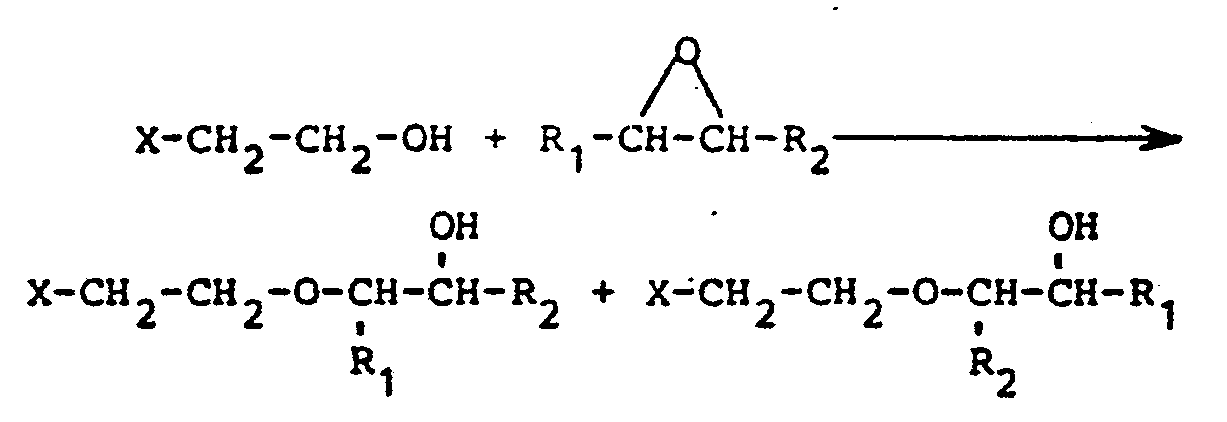
- In der obigen Reaktionsgleichung steht X für den Rest des Reaktionsprodukts aus der ersten Stufe des erfindungsgemäßen Verfahrens. Selbstverständlich gilt die obige Reaktionsgleichung für alle Hydroxyäthylgruppen des äthoxylierten Toluylendiamins. Insbesondere wenn das vicinale Alkylenoxid im Überschuß über die vorhandene Menge an Hydroxyäthylgruppen aus der ersten Stufe des erfindungsgemäBen Verfahrens eingesetzt wird, dann laufen auch weitere Reaktionen des Alkylenoxids mit den freien Hydroxylgruppen der beiden oben dargestellten Reaktionsprodukte ab.
- Wenn R2 in der obigen Reaktionsgleichung für ein Wasserstoffatom steht, dann trägt das eine der möglichen Reaktionsprodukte eine sekundäre Hydroxylgruppe, während das andere eine endständige primäre Hydroxylgruppe aufweist. Wie gefunden wurde, bildet sich erfindungsgemäß bevorzugt das Reaktionsprodukt mit sekundären Hydroxylgruppen ; daneben liegen jedoch immer auch Isomere mit primären Hydroxylgruppen (in der Größenordnung von etwa 10%) im Alkoxylierungsprodukt vor.
- Die erfindungsgemäß erhaltenen Polyätherpolyole können in an sich bekannter Weise isoliert und gereinigt werden. Zum Beispiel läßt sich ein evtl. noch vorhandener Überschuß an vicinalem Alkylenoxid durch Spülen des Reaktionsgemisches mit einem inertgas wir Stickstoff, Argon oder Xenon entfernen. Gegebenenfalls mitverwendete inerte organische Lösungsmittel lassen sich beispielsweise durch Destillation unter vermindertem Druck entfernen. Das Reaktionsprodukt kann gewünschtenfalls gereinigt sowie gegebenenfalls auch in die einzelnen Isomeren aufgetrennt werden, beispielsweise durch Chromatographie, Gegenstromverteilung, fraktionierte Destillation etc. oder auch durch eine Kombination dieser Verfahrenstechniken.
- Die erfindungsgemäß zugänglichen Alkoxylierungsprodukte können durch die folgenden allgemeinen Formeln dargestellt werden:


- R eine Alkylengruppe mit 3 bis 9 C-Atomen darstellt,
- a, b, c, d, w, x, y und z unabhängig voneinander für ganze Zahlen zwischen 0 und 2 stehen.
- Wie gefunden wurde, werden bei Einhaltung der oben angegebenen molaren Mengenverhältnisse von Toluylendiamin und den beiden Alkylenoxiden Polyätherpolyole erhalten, aus denen sich Schaumstoffe mit hervorragendem und ausgewogenem Eigenschaftsbild herstellen lassen, insbesondere hinsichtlich ihrer Bröckeligkeit, Wärmeleitfähigkeit und ihrer Dimensionsstabilität. Besonders gute Ergebnisse werden erhalten, wenn das Toluylendiamin zunächst mit ca. 4 Molen Äthylenoxid und dann mit 2 bis 4,1 Molen, besonders bevorzugt 2,5 bis 3,5 Molen, des vicinalen Alkylenoxids (besonders bevorzugt 1,2-Propylenoxid) umgesetzt wird. Je nach dem exakten Molverhältnis dieser Ausgangskomponenten läßt sich das Eigenschaftsbild der Polyurethanschaumstoffe in der einen oder anderen Richtung optimieren : so nimmt etwa mit abnehmender Molzahl des vicinalen Alkylenoxids die Dimensionsstabilität des Polyurethanschaums zu, während mit zunehmender Molzahl des vicinalen Alkylenoxids (mehr als 3 Mol pro Mol Toluylendiamin) die Verträglichkeit des Polyäthers mit den bei der Verschäumung eingesetzten Treibmitteln wächst.
- Eine weitere Eigenschaftsoptimierung läßt sich erreichen, wenn man die erfindungsgemäßen Polyole in Gemisch mit bis zu 90 Gew.-%, vorzugsweise 10 bis 80 Gew.-%, (bezogen auf gesamte Polyolkomponente) an weiteren höhermolekularen Polyhydroxylverbindungen einsetzt.
- Diese gegebenenfalls mitverwendeten zusätzlichen Polyole enthalten zwischen 2 und 8 Hydroxylgruppen und sind vorzugsweise aus Alkylenoxideinheiten aufgebaut, wobei jedoch die Gesamtmenge an Athylenoxideinheiten im gesamten Polyolgemisch weniger als 80 Gew.-%, vorzugsweise weniger als 70 Gew.-%, besonders bevorzugt weniger als 60 Gew.-%, bezogen auf die Gesamtmenge an Alkylenoxideinheiten im Polyolgemisch, betragen soll. Die optimale Menge an gegebenenfalls mitzuverwendender höhermolekularer Polyhydroxylverbindung hängt ab von der Molzahl des vicinalen Alkylenoxids, welches bei der Alkoxylierung des Toluylendiamins eingesetzt wurde, und selbstverständlich auch von dem angetrebten Eigenschaftsbild. Beispielsweise sind für die Erzielung einer optimalen Verträglichkeit der Polyolkomponente mit der Treibmittelkomponente umso geringere Mengen an zusätzlichem Polyol erforderlich, je höher der Anteil des vicinalen Alkylenoxids im erfindungsgemäßen Polyätherpolyol ist. Was die Dimensionsstabilität des Polyurethanschaumstoffs betrifft, so wird diese bei relativ hohem Anteil des vicinalen Alkylenoxids im erfindungsgemäßen Polyäther verbessert, wenn relativ viel zusätzliche Polyhydroxylverbindung bei der Verschäumungsreaktion eingesetzt wird.
- Als höhermolekulare Polyhydroxylverbindungen, welche bei der Herstellung von Polyurethanschaumstoffen neben den erfindungsgemäßen Polyätherpolyolen eingesetzt werden können, kommen alle an sich bekannten derartigen Verbindungen mit einem Molekulargewicht zwischen 350 und 5 000, vorzugsweise 400 bis 3 000, besonders bevorzugt 500 bis 2 000 in Frage, wie sie in der Polyurethanchemie üblicherweise Verwendung finden. Im Prinzip können beliebige Verbindungen mit 2 bis 8 Hydroxylgruppen eingesetzt werden, wie z.B. Polyäher-, Polyester- und Polythioätherpolyole. Im allgemeinem sind im vorliegenden Zusammenhang jedoch Polyäther bevorzugt, also Polyhydroxylverbindungen, welche Alkylenoxideinheiten aufweisen. Es ist hierbei jedoch zu beachten, daß die Gesamtmenge an Äthylenoxideinheiten in der POlyolkomponente weniger als 80 % der Gesamtmenge an Alkylenoxideinheitem im Polyolgemisch beträgt. Besonders bevorzugt sind Gemische aus den erfindungsgemäßen Polyätherpolyolen mit solchen Polyätherpolyolen, welche durch Anlagerung von Propylenoxid sowie gegebenenfalls auch Äthylenoxid (im Gemisch oder nacheinander) an die verschiedensten Starter erhalten wurden. Solche Starter sind beispielsweise Wasser, Propylenglykol, Dipropylenglykol, Brenzkatechin, Resorcin, Hydrochinon, Bisphenol A, Bis-(p-hydroxyphenyl)-methan, Glycerin, Sorbit, Trimethylolpropan, 1,2,6=Hexantriol; Pentaerythrit, Saccharose, die verschiedensten Glykoside (beispielsweise Methyl-, Äthyl-, Propyl-, Butyl- oder 2-Äthylhexyl-Glykosid) von Zuckern, wie Arabinose, Xylose, Fruktose oder Glukose; Tetramethylolcyclohexanoi, 3,3,5-Tris-(hydroxymethyi)-5-methyt-4-hydroxytetrahydropyran und 3,3,5,5-Tetrakis-(hydroxymethyl)-4-hydroxytetrahydropyran ; 2,2-Bis-(hydroxy-phenyl)äthanol, Pyrogallol, Phloroglucin, Tris-(hydroxy-phenyl)alkane, Tetrakis-(hydroxyphenyl)alkane, etc.
- Geeignete Polyesterpolyole, weiche erfindungsgemäß gegebenenfalls bei der Herstellung von Polyurethanschaumstoffen verwendet werden können, sind beispielsweise solche aus dibasischen Carbonsäuren und mehrwertigen, vorzugsweise dreiwertigen, Alkoholen. Vorzugsweise haben die dibasischen Carbonsäuren (abgesehen von den Carboxylgruppen) keine funktionellen Gruppen mit aktiven Wasserstoffatomen und enthalten auch keine olefinischen Kohlenstoff-Kohlenstoff-Bindungen. Beispielsweise seien Phthalsäure, Terephthalsäure, Isophthalsäure, Bernsteinsäure, Glutarsäure, Adipinsäure und Pimelinsäure sowie deren Anhydride genannt. Bevorzugte Alkohole sind Trimethylöläthan, Trimethylolpropan, Mannit, Hexantriol, Glycerin und Pentaerythrit. Daneben können auch zweiwertige Alkohole wie Äthylenglykol, Diäthylenglykol, 1,2-Propylenglykol, 1,4-Butandiol und Cyclohexandiol zum Aufbau des Polyesters verwendet werden. Für die Herstellung von Hartschaumstoffen ist es jedoch zweckmäßig, daß nicht mehr als 20 % der Hydroxylgruppen der Polyesterkomponente aus einem Diol stammen. Derartige Polyester werden bisher im allgemeinen vor allem bei der Präpolymer-Verschäumungstechnik eingesetzt.
- Die neuen erfindungsgemäßen Polyätherpolyole bzw. ihre Gemische mit den obengenannten zusätzlichen Polyhydroxylverbindungen sind wertvolle Ausgangsprodukte für die Herstellung von Polyurethanschaumstoffen nach an sich bekannten Verfahrenstechniken und sind den bisher für diesen Zweck eingesetzten Polyhydroxylverbindungen sowohl hinsichtlich ihrer geringen Viskosität und hohen Verträglichkeit mit anderen Ausgangskomponenten für die Schaumstoffherstellung als auch hinsichtlich der verbesserten Eigenschaften der Endprodukte überlegen.
- Die Herstellung von Potyurethanschaumstoffen erfolgt erfindungsgemäß, wie bereits erwähnt, nach an sich bekannten Verfahrensweisen, wobei man anstelle der bisher eingesetzten Polyhydroxylverbindungen die erfindungsgemäßen Polyätherpolyole bzw. deren Gemische mit weiteren höhermolekularen Polyhydroxylverbindungen verwendet. Selbstverständlich können die erfindungsgemäßen Polyole auch als Ausgangskomponente bei der Herstellung von homogenen Polyurethankunststoffen dienen ; ihr Hauptverwendungszweck ist jedoch die Herstellung von geschäumten Produkten.
- Die Herstellung von Polyurethanschaumstoffen aus Polyisocyanaten, Polyätherpolyolen und gegebenenfalls weiteren Polyhydroxylverbindungen in Gegenwart von Treibmitteln, Katalysatoren und gegebenenfalls weiteren Zuschlagstoffen ist dem Fachmann geläufig. In diesem Zusammenhang seien die üblichen Handbücher der Polyurethanchemie erwähnt, beispielsweise Dombrow, « Polyurethanes », Reinhold Publishing Corporation, New York (1957) Seite 1 bis 105, sowie Saunders und Frisch, « Polyurethanes », Part I, Interscience Publishers, New York (1962). Beispielsweise kann man die Polyhydroxylverbindungen mit dem Polyisocyanat in Gegenwart eines Treibmittels sowie gegebenenfalls eines Katalysators, eines oberflächenaktiven Mittels sowie gegebenenfalls weiterer Hilfsmittel umsetzen. Dies ist die sogenannte « One-shot »-Methode. Beim « Präpolymer-Verfahren » setzt man zunächst eine Polyhydroxylverbindung mit einem Überschuß an Polyisocyanat um, so daß ein Zwischenprodukt mit freien isocyanatgruppen (ein Präpolymeres) entsteht, welches dann mit Wasser, gegebenenfalls in Gegenwart von Katalysatoren, oberflächenaktiven Substanzen und weiteren Hilfsmitteln, unter Ausbildung des Schaumstoffs umgesetzt wird. Daneben gibt es noch zahlreiche Mischvarianten zwischen diesen beiden grundsätzlichen Verfahrenstypen.
- Als isocyanatkomponente kommen erfindungsgemäß aliphatische, cycloaliphatische, araliphatische, aromatische und heterocyclische Polyisocyanate in Betracht, wie sie z.B. von W. Siefken in Justus Liebigs Annalen der Chemie, 562, Seiten 75 bis 136, beschrieben werden, beispielsweise Äthylen-diisocyanat, 1,4-Tetramethylendiisocyanat, 1,6-Hexamethylendiisocyanat, 1,12-Dodecandiisocyanat, Cyciobutan-1,3-diisocyanat, Cyclohexan-1,3- und -1,4-diisocyanat sowie beliebige Gemische dieser Isomeren, 1-Isocyana- to-,3,5-trimethyl-5-isocyanatomethyl-cyclohexan (DAS 1 202 785, amerikanische Patentschrift 3401 190), 2,4- und 2.6-Hexahydrotoluylendiisocyanat sowie beliebige Gemische dieser lsomeren, Hexahydro-1,3- und/oder -1,4-phenylen-diisocyanat, Perhydro-2,4'- und/oder -4,4'-diphenylmethan-diisocyanat, 1,3- und 1,4-Phenylendiisocyanat, 2,4- und 2,6-Toluylendiisocyanat sowie beliebige Gemische dieser isomeren, Diphenylmethan-2,4'- und/oder -4,4'-diisocyanat, Naphtylen-1,5-diisocyanat, Triphenylmethan-4,4',4"-trüsocyanat, Polyphenyl-polymethylen-polyisocyanate, wie sie durch Anilin-Formaldehyd-Kondensation und anschließende Phosgenierung erhalten und z.B. in den britischen Patentschriften 874 430 und 848 671 beschrieben werden, m- und p-Isocyanatophenyl-sulfonyl-isocyanate gemäß der amerikanischen Patentschrift 3 454 606, perchlorierte Arylpolyisocyanate, wie sie z.B. in der deutschen Auslegeschrift 1 157 601 (amerikanische Patentschrift 3 277138) beschrieben werden, Carbodiimidgruppen aufweisende Polyisocyanate, wie sie in der deutschen Patentschrift 1 092 007 (amerikanische Patentschrift 3152162) beschrieben werden, Diisocyanate, wie sie in der amerikanischen Patentschrift 3 492 330 beschrieben werden, Allophanatgruppen aufweisende Polyisocyanate, wie sie z.B. in der britischen Patentschrift 994 890, der belgischen Patentschrift 761 626 und der veröffentlichten holländischen Patentanmeldung 7102524 beschrieben werden, Isocyanuratgruppen aufweisende Polyisocyanate, wie sie z.B. in der amerikanischen Patentschrift 3001 973, in den deutschen Patentschriften 1 022789, 1 222 067 und 1 027 394 sowie in den deutschen Offenlegungsschriften 1 929 034 und 2 004 048 beschrieben werden, Urethangruppen aufweisende Polyisocyanate, wie sie z.B. in der belgischen Patentschrift 752 261 oder in der amerikanischen Patentschrift 3 394 164 beschrieben werden, acylierte Harnstoffgruppen aufweisende Polyisocyanate gemäß der deutschen Patentschrift 1 230 778, Biuretgruppen aufweisende Polyisocyanate, wie sie z.B. in der deutschen Patentschrift 1 101 394 (amerikanische Patentschriften 3124605 und 3201372) sowie in der britischen Patentschrift 889050 beschrieben werden, durch Telomerisationsreaktionen hergestellte Polyisocyanate, wie sie z.B. in der amerikanischen Patentschrift 3 654106 beschrieben werden, Estergruppen aufweisende Polyisocyanate, wie sie zum Beispiel in den britischen Patentschriften 965 474 und 1 072 956, in der amerikanischen Patentschrift 3567763 und in der deutschen Patentschrift 1 231 688 genannt werden, Umsetzungsprodukte der obengenannten Isocyanate mit Acetalen gemäß der deutschen Patentschrift 1 072 385 und polymere Fettsäurereste enthaltende Polyisocyanate gemäß der amerikanischen Patentschrift 3 455 883.
- Es ist auch möglich, die bei der technischen Isocyanatherstellung anfallenden, Isocyanatgruppen aufweisenden Destillationsrückstände, gegebenenfalls gelöst in einem oder mehreren der vorgenannten Polyisocyanate, einzusetzen. Ferner ist es möglich, beliebige Mischungen der vorgenannten Polyisocyanate zu verwenden.
- Besonders bevorzugt sind im allgemeinen jene Polyisocyanate, welche durch Phosgenierung von Mischungen von Methylenüberbrückten Polyphenyl-polyaminen erhalten werden, welche ihrererseits durch Umsetzung von Formaldehyd, Chlorwasserstoff und primären aromatischen Aminen (z.B. Anilin, o-Chlor-anilin, o-Toluidin oder deren Mischungen) zugänglich sind. Derartige Polyisocyanate werden beispielsweise in den US-Patentschriften 2 683 730, 2 950 263 und 3 012 008, der canadischen Patentschrift 665495 und der deutschen Patentschrift 1 131 877 beschrieben. Ein besonders bevorzugtes Polyisocyanat dieser Art ist das Polymethylen-polyphenylpolyisocyanat, welches unter dem Namen® Mondur MR im Handel ist.
- Will man erfindungsgemäß Hartschaumstoffe herstellen, dann kann es von Vorteil sein, neben den oben erwähnten Polyhydroxylverbindungen auch niedermolekulare, mehrwertige Polyole als Vernetzer mitzuverwenden. Derartige Polyole sollten wenigstens 3 Hydroxylgruppen aufweisen und können dem schäumfähigen Reaktionsgemisch zu jedem gewünschten Zeitpunkt zugefügt werden.
- Beispiele für derartige Vernetzer sind Trimethylolpropan, Glycerin, 1,2,6-Hexantriol, Pentaerythrit, hydroxyalkylierte aliphatische Diamine wie N,N,N'N'-Tetrakis-(2-hydroxy-propyl)äthylendiamin, N,N,N',N'-Tetrakis(2-hydroxyäthyl)-äthylendiamin und Anlagerungsprodukte von Alkylenoxiden an Zucker.
- Bei der Herstellung von Polyurethanen ist es erfindungsgemäß in vielen Fällen zweckmäßig, die Reaktion zwischen Polyisocyanat und Polyhydroxylverbindungen durch Mitverwendung eines Katalysators zu beschleunigen. Für diesen Zweck können alle an sich bekannten katalytisch wirkenden Verbindungen eingesetzt werden, wie sie z.B. in Saunders-Frisch, « Polyurethanes » Part I, Interscience Publishers, New York (1962), Seite 228 bis 232, oder von Britain et al. in Journal of Applied Polymer Science, 1960, Seite 4 207 bis 4211 beschrieben werden. Beispiele für derartige Katalysatoren sind organischen und anorganische Salze sowie organometallische Verbindungen von Wismuth, Blei, Zinn, Eisen, Antimon, Uran, Kadmium, Kobalt, Thorium, Aluminium, Quecksilber, Zink, Nickel, Cer, Molybdän, Vanadium, Kupfer, Mangan und Zirkon; daneben auch Phosphine und tertiäre Amine. Bevorzugte Katalysatoren sind erfindungsgemäß tertiäre Amine, beispielsweise Triäthylamin, Triäthylendiamin, Tetramethyläthylendiamin, Tetraäthyläthylendiamin, N-Methylmorpholin, N-Äthylmorpholin, permethyliertes Guanidin, permethyliertes 1,3-Butandiamin, N,N-Dimethyläthanolamin, N,N-Diäthyläthanolamin oder Mischungen dieser Verbindungen. Vorzugsweise wird der Katalysator in einer Menge von 0,1 bis 2,0 Gew.-%. bezogen auf gesamtes Reaktionsgemisch, eingesetzt.
- Das Äquivalentverhältnis zwischen Isocyanatgruppen und aktiven Wasserstoffatomen in den schäumfähigen Reaktionsgemischen liegt erfindungsgemäß innerhalb der üblichen Bereiche. Vorteilhafterweise wird ein NCO/OH-Verhäitnis zwischen 0,65 und 1,5, besonders bevorzugt zwischen 1 und 1,2, angewandt, wobei es gleichgültig ist, ob Isocyanat und Polyol über ein Präpolymeres oder in einem One-shot-Verfahren miteinander umgesetzt werden.
- Die Rohdichte der erfindungsgemäß erhältlichen Polyurethanschaumstoffe kann in an sich bekannter Weise variiert werden. Vom Einfluß ist beispielsweise die Menge an Wasser, welche im schäumfähigen Reaktionsgemisch vorhanden ist, bzw. die Menge an einer leicht flüchtigen organischen Verbindung, welche als physikalisches Treibmittel wirkt. Solche Treibmittel sind inerte Flüssigkeiten mit einem Siedepunkt unter 110°C, vorzugsweise unter 50 °C, wie beispielsweise aliphatische Kohlenwasserstoffe oder leicht flüchtige halogenierte Kohlenwasserstoffe, z.B. Trichlorfluormethan, Chlortrifluormethan, 1,1-Dichlor-l-fluoräthan, 1-Chlor-1,1-difluor 2,2-dichloräthan und 1,1,1-Trifluor-2-chlor-2-fluorbutan oder Mischungen dieser Verbindungen.
- Gegebenenfalls können erfindungsgemäß bei der Herstellung von Polyurethankunststoffen auch oberflächenaktive Agenzien, Zellregulatoren, Emulgatoren, Flammschutzmittel etc. mitverwendet werden, wie sie aus der Polyurethanchemie an sich bekannt sind. So läßt sich beispielsweise eine feinere Zelistruktur der Polyurethanschaumstoffe dadurch erzielen, daß man wasserlösliche Siliconpolymere als oberflächenaktive Mittel zusetzt. Beispiele hierfür sind die handelsüblichen Blockcopolymeren, welche Polysiloxan- und Polyäthersequenzen enthalten. Um eine bessere Durchmischung der Komponenten in schäumfähigen Reaktionsgemisch zu gewährleisten, können auch weitere oberflächenaktive Mittel wie Aniagerungsprodukte von Äthylenoxid an Sorbit-Monopaimitat mitverwendet werden. Für spezielle Anwendungszwecke können dem Reaktionsgemisch auch Farbstoffe, Pigmente, Seifen, Metallpulver und andere inerte Füllstoffe beigemischt werden.
- Die erfindungsgemäß zugänglichen Polyurethankunststoffe sind für eine Vielzahl von kommerziellen und industriellen Anwendungszwecken geeignet, beispielsweise für die Herstellung von Schaumisolierungen, von geformten Artikeln wie beispielsweise Sportgeräten etc.
- Die folgenden Beispiele erläutern die vorliegende Erfindung. Wenn nicht anders angegeben, sind Mengenangaben als Gew.-Teile bzw. Gew.-% zu verstehen.
- Allgemeine Arbeitsweise :
- Das Toluylendiamin (80 % 2,4- ; 20 % 2,6-lsomeres) wird in einem Druckreaktor vorgelegt und unter 0,4 bis 0,5 bar Stickstoffdruck auf 105 °C erhitzt. Dann wird mit der Einleitung des Äthylenoxids begonnen. Das Äthylenoxid wird so dosiert, daß die Temperatur des Reaktionsgemisches zwischen 105 und 110 °C bleibt. Nach der Zugabe des Äthylenoxids wird das Reaktionsgemisch noch für 2 Stunden bei 105 bis 110°C gehalten.
- Danach werden 0,5 Teile (bezogen auf 1100 Teile äthoxyliertes Produkt) einer 50%igen wäßrigen Kaliumhydroxidlösung in den Reaktor eingebracht und das Wasser bei 110 °C abdestilliert. Anschließend wird mit der Einleitung des Propylenoxids begonnen, wobei das Propylenoxid wieder so dosiert wird, daß die Reaktionstemperatur zwischen 105 und 110°C (bei einem Druck von 0,4 bis 0,5 bar Stickstoff) bleibt. Danach wird das Reaktionsgemiscfi noch 3 Stunden lang auf 105 °C gehalten. Das Endprodukt wird nach dem Abkühlen mit Schwefelsäure neutralisiert und vom ausgefallenen Kaliumsulfat durch Filtrieren befreit.
- Die Gew.-Mengen sowie die molaren Mengenverhältnisse der Ausgangskomponenten in den Beispielen 1 bis 3 und auch die OH-Zahl des jeweiligen Reaktionsprodukts sind in der folgenden Tabelle 1 zusammengefaßt :

- 47,7 Teile Toluylendiamin (80 % 2,4- und 20 % 2,6-lsomeres) und 68,9 Teile Äthylenoxid wurden im einem Druckreaktor 2 Tage lang bei 50 °C umgesetzt. Danach wurde das Reaktionsgemisch auf Raumtemperatur gekühlt, mit 45,4 Teilen Propylenoxid versetzt und 2 Tage bei 80 °C reagieren gelassen. Das entstehende Addukt hatte eine OH-Zahl von 540; das Molverhältnis der Ausgangskomponenten (TDAIÄthylenoxid/Propylenoxid) betrug 1/4/2.
- Die Polyäther aus den Beispielen 1 bis 4 wurden zur Herstellung von Polyurethanschäumen eingesetzt. Die dabei angewandten Rezepturen sind in Tabelle 2 zusammengefaßt.
- Die verschiedenen Ausgangskomponenten (erfindungsgemäßer Polyäther, oberflächenaktives Mittel, Katalysator, gegebenenfalls weiteres Polyol sowie Flammschutzmittel, Treibmittel und Wasser) wurden in einem zylindrischen Kartongefäß intensiv vermischt. Danach wurde die angegebene Menge an Polyisocyanat eingerührt. Das flüssige Reaktionsgemisch wurde danach in eine offene Form mit den Dimensionen 33 x 33 x 15 cm gegossen und frei aufschäumen gelassen. Die Oberflächenbröckligkeit wurde 30 Minuten nach Beginn der Verschäumungsreaktion bestimmt. Die entsprechenden Ergebnisse sind In Tabelle3 zusammengefaßt. Daneben wurden noch die in Tabelle3 angegebenen weiteren physikalischen Eigenschaften bestimmt.
- Die in Tabelle 3 aufscheinenden Ausdrücke sind wie folgt zu verstehen :
- 1. Mischzeit :
- jene Zeitdauer, während der das Reaktionsgemisch nach dem Zusatz des Isocyanats gerührt wird.
- 2. Startzeit :
- jene Zeitdauer (gerechnet vom Beginn der Mischzeit), nach welcher das Reaktionsgemisch beginnt, eine cremige Konsistenz anzunehmen.
- 3. Gelierzeit :
- jene Zeitdauer, nach welcher (gerechnet vom Beginn der Mischzeit) der Schaum so weit verfestigt ist, daß ein Glasstab mit einem Durchmesser von 3,2 mm, welcher 5 cm tief in den Schaum eingedrückt, wird, einen 15 cm langen Faden mit sich zieht, wenn er rasch aus dem Schaum herausgezogen wird.
- 4. Aushärtezeit :
- jene Zeitdauer (gerechnet vom Beginn der Mischzeit), nach welcher eine trockene, saubere Holzspatel, mit welcher die Schaumoberfläche leicht berührt wird, wieder entfernt werden kann, ohne daß der Schaum kleben bleibt.
- 5. Steigzeit :
- jene Zeitdauer (gerechnet vom Beginn der Mischzeit), nach weicher der Schaum seine endgültige Höhe erreicht hat.
- 6. Oberflächenbröckligkeit :
- hierunter ist die Eigenschaft der Schaumoberfläche zu verstehen, zu Pulver zu zerfallen, wenn sie mit einer Holzspatel oder dem Fingernagel leicht zusammengedrückt oder angekratzt wird.
- Diese Eigenschaft wird durch die folgenden Beurteilungen I bis V charakterisiert :
- I : Die Schaumoberfläche zeigt 30 Minuten nach dem Verschäumungsbeginn keinerlei Bröckligkeit.
- II : Die Schaumoberfläche bröckelt nur in einer Tiefe bis zu 0,7 mm, wenn sie angekratzt wird.
- III : Die Schaumoberfläche bröckelt (30 Minuten nach dem Beginn der Verschäumungsreaktion) nicht tiefer als 1,5 mm ab, wenn sie angekratzt wird.
- IV : Die Schaumoberfläche bröckelt (nach einer Zeit von 30 Minuten nach dem Beginn der Verschäumungsreaktion) nur bis zu einer Dicke von höchstens 3 mm ab, wenn sie angekratzt wird.
- V : Die Schaumoberfläche bröckelt in einer Dicke von mehr als 3 mm ab.
- Folgende Ausgangsmaterialien wurden eingesetzt :
- R-8 020 ist ein Gemisch aus 80 % Dimethyläthanolamin und 20 % Triäthylendiamin.
- DC 193 ist ein handelsüblicher Schaumstabilisator auf Siliconbasis der Firma Dow-Corning Corporation.
- R 11 B ist Freon®.
- Fyrol 6 ist O,O-Diäthyl-N,N-bis-(2-hydroxyäthyl)aminomethylphosphonat.
- Polyol A ist ein auf Athylendiamin gestarteter Polyäther mit einer OH-Zahl von 630.
- Polyol B ist ein auf Äthylendiamin gestarteter Polyäther mit einer OH-Zahl von 470.
- Polyol C ist ein Saccharosepolyäther mit einer OH-Zahl von 460.
- Polyol D ist ein Saccharosepolyäther mit einer OH-Zahl von 380.
- Polyol E ist ein auf Diaminodiphenylmethan gestarteter Polyäther mit einer OH-Zahl von 410.
- Als Isocyanat wurde ein rohes Polyphenylpolymethylen-polyisocyanat eingesetzt, welches ca. 50 % an Diphenylmethandiisocyanat enthält und einen NCO-Gehalt von 32 % aufweist.
- Die relativ schlechten Bröckligkeitseigenschaften der Schäume aus Beispiel 6 und 11 sind auf die Mitverwendung des Flammschutzmittels und/oder des Polyols C zurückzuführen. Konventionelle Schaumstoffe erhalten im allgemeinen die Beurteilung III-V.


an 1 Mol Toluyiendiamin hergestellt wurden, wobei die Gesamtmenge an Alkylenoxid zwischen 5,0 und 8,1 Mol pro Mol Toluylendiamin liegt.
anlagert, wobei die Gesamtmenge an Alkylenoxid 5,0 bis 8,1 Mole pro Mol Toluylendiamin beträgt.
In Gegenwart von Treibmitteln und gegebenenfalls Katalysatoren sowie weiteren an sich bekannten Zusatzstoffen, weiches dadurch gekennzeichnet ist, daß als Komponente b) die erfindungsgemäßen Polyäther eingesetzt werden.
Claims (9)
an 1 Mol Toluylendiamin hergestellt wurden, wobei die Gesamtmenge an Alkylenoxid zwischen 5,0 und 8,1 Mol pro Mol Toluylendiamin liegt.
an 1 Mol Toluylendiamin hergestellt wurden.
an 1 Mol Toluylendiamin hergestellt wurden.

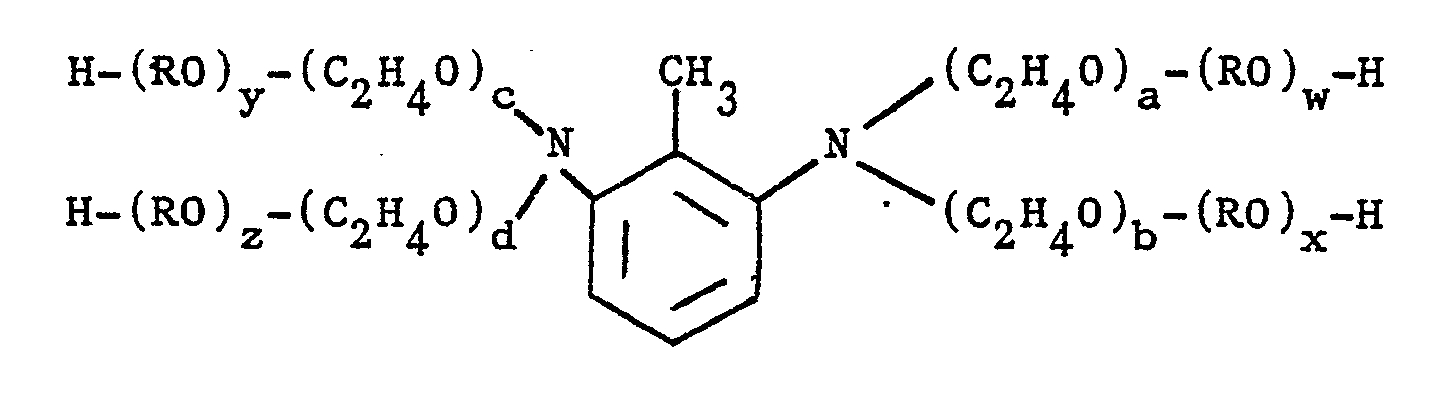
anlagert, wobei die Gesamtmenge an Alkylenoxid 5,0 bis 8,1 Mole pro Mol Toluylendiamin beträgt.
in Gegenwart von Treibmitteln und gegebenenfalls Katalysatoren sowie weiteren an sich bekannten Zusatzstoffen, dadurch gekennzeichnet, daß als Komponente b) Polyäther gemäß Anspruch 1 bis 6 eingesetzt werden.
Applications Claiming Priority (2)
| Application Number | Priority Date | Filing Date | Title |
|---|---|---|---|
| US84919677A | 1977-11-07 | 1977-11-07 | |
| US849196 | 1977-11-07 |
Publications (2)
| Publication Number | Publication Date |
|---|---|
| EP0001800A1 EP0001800A1 (de) | 1979-05-16 |
| EP0001800B1 true EP0001800B1 (de) | 1982-11-24 |
Family
ID=25305284
Family Applications (1)
| Application Number | Title | Priority Date | Filing Date |
|---|---|---|---|
| EP78101211A Expired EP0001800B1 (de) | 1977-11-07 | 1978-10-24 | Polyätherpolyole, Verfahren zu ihrer Herstellung und Verfahren zur Herstellung von Polyurethanschaumstoffen |
Country Status (5)
| Country | Link |
|---|---|
| EP (1) | EP0001800B1 (de) |
| JP (2) | JPS5485300A (de) |
| CA (1) | CA1103700A (de) |
| DE (1) | DE2758614C2 (de) |
| IT (1) | IT1106316B (de) |
Families Citing this family (14)
| Publication number | Priority date | Publication date | Assignee | Title |
|---|---|---|---|---|
| JPS56163117A (en) * | 1980-05-19 | 1981-12-15 | Takeda Chem Ind Ltd | Production of rigid urethane foam |
| JPS57165425A (en) * | 1981-04-07 | 1982-10-12 | Toho Chem Ind Co Ltd | Production of polyetherpolyol |
| JPS57168917A (en) * | 1981-04-10 | 1982-10-18 | Toho Chem Ind Co Ltd | Production of polyether-polyol |
| JPS57168919A (en) * | 1981-04-10 | 1982-10-18 | Toho Chem Ind Co Ltd | Production of polyether-polyol |
| JPS57178504A (en) * | 1981-04-25 | 1982-11-02 | Yamatake Honeywell Co Ltd | Controller for operation rate of refrigerating machine |
| JPS63227614A (ja) * | 1987-03-17 | 1988-09-21 | Human Ind Corp | ポリウレタンフオ−ムの製造方法 |
| DE3740634A1 (de) * | 1987-12-01 | 1989-06-15 | Bayer Ag | Polyetherpolyole auf basis o-toluylendiamin, verfahren zu ihrer herstellung und verwendung fuer polyurethan- und polyisocyanurat-kunststoffe |
| DE3829290A1 (de) * | 1988-08-30 | 1990-03-15 | Bayer Ag | Polyetherpolyole auf basis aromatischer di- und/oder polyamine, verfahren zu ihrer herstellung und verwendung fuer polyurethan- und polyisocyanurat-kunststoffe |
| JPH07108939B2 (ja) * | 1988-10-28 | 1995-11-22 | 武田薬品工業株式会社 | ポリエーテルポリオールの製造法 |
| US4904707A (en) * | 1988-12-21 | 1990-02-27 | Mobay Corporation | Novel polyol composition and the use thereof in the preparation of rigid polyurethane foams |
| JPH0393826A (ja) * | 1989-09-06 | 1991-04-18 | Mitsui Toatsu Chem Inc | 硬質ウレタンフォームの製造法 |
| TW413688B (en) † | 1996-06-20 | 2000-12-01 | Huntsman Ici Chem Llc | Process for rigid polyurethane foams |
| DE19916647B4 (de) | 1999-04-14 | 2006-06-08 | Bayer Materialscience Ag | Polyolgemisch für die Herstellung von Polyurethan-Hartschäumen |
| JP4457305B2 (ja) * | 2005-03-29 | 2010-04-28 | 日本ポリウレタン工業株式会社 | 硬質ポリウレタンスラブフォームの製造方法および配管用断熱材 |
Family Cites Families (9)
| Publication number | Priority date | Publication date | Assignee | Title |
|---|---|---|---|---|
| GB792772A (en) * | 1954-06-03 | 1958-04-02 | Antonio Negromanti | Improvements in electric pressing irons |
| GB1164277A (en) * | 1965-11-02 | 1969-09-17 | Ici Ltd | Process for the Preparation of Polyether Polyols. |
| GB1177636A (en) * | 1966-02-28 | 1970-01-14 | Ici Ltd | Preparation of Polyether Polyols. |
| US3535378A (en) * | 1966-10-03 | 1970-10-20 | Mobay Chemical Corp | Alkylene oxide adducts of methylcyclohexylene diamine |
| GB1311095A (en) * | 1969-04-09 | 1973-03-21 | Ici Ltd | Alkylene oxide orthotolylene diamine compositions |
| JPS53719B2 (de) * | 1971-08-31 | 1978-01-11 | ||
| GB1398185A (en) * | 1972-06-21 | 1975-06-18 | Ici Ltd | Polyurethane foams |
| JPS518676B2 (de) * | 1972-09-15 | 1976-03-18 | ||
| JPS5632327A (en) * | 1979-08-22 | 1981-04-01 | Hiroshi Ishizuka | Removing method for iron from raw material aqueous solution in solvent extraction process |
-
1977
- 1977-12-29 DE DE2758614A patent/DE2758614C2/de not_active Expired
-
1978
- 1978-09-06 CA CA310,685A patent/CA1103700A/en not_active Expired
- 1978-10-24 EP EP78101211A patent/EP0001800B1/de not_active Expired
- 1978-11-03 IT IT51759/78A patent/IT1106316B/it active
- 1978-11-06 JP JP13594278A patent/JPS5485300A/ja active Granted
-
1979
- 1979-10-25 JP JP13708279A patent/JPS5586811A/ja active Granted
Also Published As
| Publication number | Publication date |
|---|---|
| JPS625935B2 (de) | 1987-02-07 |
| IT7851759A0 (it) | 1978-11-03 |
| JPS5632327B2 (de) | 1981-07-27 |
| JPS5586811A (en) | 1980-07-01 |
| DE2758614C2 (de) | 1986-12-11 |
| DE2758614A1 (de) | 1979-05-10 |
| CA1103700A (en) | 1981-06-23 |
| EP0001800A1 (de) | 1979-05-16 |
| IT1106316B (it) | 1985-11-11 |
| JPS5485300A (en) | 1979-07-06 |
Similar Documents
| Publication | Publication Date | Title |
|---|---|---|
| EP0111121B1 (de) | Flüssige Urethangruppen enthaltende Polyisocyanatmischungen auf Diphenylmethan-diisocyanat-basis, Verfahren zu deren Herstellung und deren Verwendung zur Herstellung von Polyurethan-Weichschaum-stoffen | |
| DE69412763T2 (de) | Verfahren zur Herstellung modifizierter Polyisocyanuratschaumstoffen | |
| EP0001800B1 (de) | Polyätherpolyole, Verfahren zu ihrer Herstellung und Verfahren zur Herstellung von Polyurethanschaumstoffen | |
| DE2624527A1 (de) | Verfahren zur herstellung von polyurethanen | |
| DE2639083C2 (de) | Verfahren zur Herstellung von Polyätherpolyolen und ihre Verwendung als Ausgangsmaterialien für Polyurethankunststoffe | |
| DE3740634A1 (de) | Polyetherpolyole auf basis o-toluylendiamin, verfahren zu ihrer herstellung und verwendung fuer polyurethan- und polyisocyanurat-kunststoffe | |
| EP0805831A1 (de) | Neue polyetherpolyole, polyolformulierung enthaltend diese polyetherpolyole und deren verwendung zur herstellung von harten polyurethanschaumstoffen | |
| DE602004002570T2 (de) | Herstellverfahren für amininitiierte polyetherpolyole | |
| DE1745317A1 (de) | Verfahren zum Herstellen von Polyurethanen | |
| DE3045748A1 (de) | Verfahren zur herstellung von polyisocyanuratschaum | |
| EP0368031B1 (de) | Reaktivsysteme und ein Verfahren zur Herstellung von Polyurethankunststoffen | |
| DE1694214A1 (de) | Kunststoffe aus Isocyanatbasis und Verfahren zu ihrer Herstellung | |
| DE1157773B (de) | Verfahren zur Herstellung von Kunststoffen, einschliesslich Schaumstoffen, nach dem Isocyanat-Polyadditionsverfahren | |
| EP0124071B1 (de) | Verfahren zur Herstellung von elastischen, kompakten oder zelligen Polyurethanen | |
| DE3613973A1 (de) | Verfahren zur herstellung von polyharnstoffschaum-formteilen | |
| DE69403824T2 (de) | Polyol-Zusammensetzungen und Polyisocynate sowie ihre Verwendung zur Herstellung von Polyurethanen | |
| EP0075758A1 (de) | Verfahren zur Herstellung von elastischen Polyurethan-Weichschaumstoffen | |
| DE1924302B2 (de) | Verfahren zur Herstellung von Biuretgruppen und Urethangruppen aufweisenden Schaumstoffen | |
| EP0471260A2 (de) | Verfahren zur Herstellung von offenzelligen Polyurethan-Weichschaumstoffen und deren Verwendung als Polstermaterial | |
| DE2543114A1 (de) | Herstellung von isocyanuratschaeumen | |
| DE2032174C3 (de) | Verfahren zur Herstellung von flammfesten und warmverformbaren Biuretgruppen und Urethangruppen aufweisenden Hartschaumstoffen | |
| DE1243865B (de) | Polyisocyanatmischungen zur Herstellung von Kunststoffen | |
| EP0148462B1 (de) | Verfahren zur in situ-Herstellung von Harnstoffgruppen-enthaltenden Diisocyanaten in Polyolen, dem Verfahren entsprechende Dispersionen oder Lösungen sowie ihre Verwendung | |
| DE2029293A1 (de) | Verfahren zur Herstellung von Poly urethanschaumstoffen | |
| DE4029888A1 (de) | Reaktivsysteme und ein verfahren zur herstellung von polyurethankunststoffen |
Legal Events
| Date | Code | Title | Description |
|---|---|---|---|
| PUAI | Public reference made under article 153(3) epc to a published international application that has entered the european phase |
Free format text: ORIGINAL CODE: 0009012 |
|
| 17P | Request for examination filed | ||
| AK | Designated contracting states |
Designated state(s): BE FR GB NL |
|
| GRAA | (expected) grant |
Free format text: ORIGINAL CODE: 0009210 |
|
| AK | Designated contracting states |
Designated state(s): BE FR GB NL |
|
| ET | Fr: translation filed | ||
| PGFP | Annual fee paid to national office [announced via postgrant information from national office to epo] |
Ref country code: FR Payment date: 19931014 Year of fee payment: 16 Ref country code: GB Payment date: 19931014 Year of fee payment: 16 |
|
| PGFP | Annual fee paid to national office [announced via postgrant information from national office to epo] |
Ref country code: BE Payment date: 19931027 Year of fee payment: 16 |
|
| PGFP | Annual fee paid to national office [announced via postgrant information from national office to epo] |
Ref country code: NL Payment date: 19931031 Year of fee payment: 16 |
|
| PG25 | Lapsed in a contracting state [announced via postgrant information from national office to epo] |
Ref country code: GB Effective date: 19941024 |
|
| PG25 | Lapsed in a contracting state [announced via postgrant information from national office to epo] |
Ref country code: BE Effective date: 19941031 |
|
| BERE | Be: lapsed |
Owner name: MOBAY CHEMICAL CORP. Effective date: 19941031 |
|
| PG25 | Lapsed in a contracting state [announced via postgrant information from national office to epo] |
Ref country code: NL Effective date: 19950501 |
|
| NLV4 | Nl: lapsed or anulled due to non-payment of the annual fee | ||
| GBPC | Gb: european patent ceased through non-payment of renewal fee |
Effective date: 19941024 |
|
| PG25 | Lapsed in a contracting state [announced via postgrant information from national office to epo] |
Ref country code: FR Effective date: 19950630 |
|
| REG | Reference to a national code |
Ref country code: FR Ref legal event code: ST |
|
| PLBE | No opposition filed within time limit |
Free format text: ORIGINAL CODE: 0009261 |
|
| STAA | Information on the status of an ep patent application or granted ep patent |
Free format text: STATUS: NO OPPOSITION FILED WITHIN TIME LIMIT |