DE60128912T2 - PYRIDOXIN AND PYRIDOXAL ANALOGUES AS CARDIOVASCULAR THERAPEUTICS - Google Patents
PYRIDOXIN AND PYRIDOXAL ANALOGUES AS CARDIOVASCULAR THERAPEUTICS Download PDFInfo
- Publication number
- DE60128912T2 DE60128912T2 DE60128912T DE60128912T DE60128912T2 DE 60128912 T2 DE60128912 T2 DE 60128912T2 DE 60128912 T DE60128912 T DE 60128912T DE 60128912 T DE60128912 T DE 60128912T DE 60128912 T2 DE60128912 T2 DE 60128912T2
- Authority
- DE
- Germany
- Prior art keywords
- compound
- cardiovascular
- use according
- straight
- saturated
- Prior art date
- Legal status (The legal status is an assumption and is not a legal conclusion. Google has not performed a legal analysis and makes no representation as to the accuracy of the status listed.)
- Expired - Lifetime
Links
- 230000002526 effect on cardiovascular system Effects 0.000 title claims abstract description 42
- 239000003814 drug Substances 0.000 title claims description 30
- LXNHXLLTXMVWPM-UHFFFAOYSA-N pyridoxine Chemical compound CC1=NC=C(CO)C(CO)=C1O LXNHXLLTXMVWPM-UHFFFAOYSA-N 0.000 title abstract description 50
- 229940011671 vitamin b6 Drugs 0.000 title abstract description 25
- RADKZDMFGJYCBB-UHFFFAOYSA-N Pyridoxal Chemical class CC1=NC=C(CO)C(C=O)=C1O RADKZDMFGJYCBB-UHFFFAOYSA-N 0.000 title abstract description 24
- 208000037265 diseases, disorders, signs and symptoms Diseases 0.000 claims abstract description 39
- 238000000034 method Methods 0.000 claims abstract description 34
- 201000010099 disease Diseases 0.000 claims abstract description 33
- 239000008194 pharmaceutical composition Substances 0.000 claims abstract description 17
- 150000001875 compounds Chemical class 0.000 claims description 121
- 239000000203 mixture Substances 0.000 claims description 58
- -1 amino, hydroxyl Chemical group 0.000 claims description 45
- 150000003839 salts Chemical class 0.000 claims description 31
- 239000002253 acid Substances 0.000 claims description 26
- RAXXELZNTBOGNW-UHFFFAOYSA-N imidazole Natural products C1=CNC=N1 RAXXELZNTBOGNW-UHFFFAOYSA-N 0.000 claims description 20
- 230000001225 therapeutic effect Effects 0.000 claims description 20
- 125000000217 alkyl group Chemical group 0.000 claims description 19
- 229920006395 saturated elastomer Polymers 0.000 claims description 19
- 239000005557 antagonist Substances 0.000 claims description 18
- 229940127291 Calcium channel antagonist Drugs 0.000 claims description 15
- 206010019280 Heart failures Diseases 0.000 claims description 15
- 239000000480 calcium channel blocker Substances 0.000 claims description 15
- ZRALSGWEFCBTJO-UHFFFAOYSA-N Guanidine Chemical compound NC(N)=N ZRALSGWEFCBTJO-UHFFFAOYSA-N 0.000 claims description 14
- 239000003112 inhibitor Substances 0.000 claims description 14
- UUUHXMGGBIUAPW-UHFFFAOYSA-N 1-[1-[2-[[5-amino-2-[[1-[5-(diaminomethylideneamino)-2-[[1-[3-(1h-indol-3-yl)-2-[(5-oxopyrrolidine-2-carbonyl)amino]propanoyl]pyrrolidine-2-carbonyl]amino]pentanoyl]pyrrolidine-2-carbonyl]amino]-5-oxopentanoyl]amino]-3-methylpentanoyl]pyrrolidine-2-carbon Chemical compound C1CCC(C(=O)N2C(CCC2)C(O)=O)N1C(=O)C(C(C)CC)NC(=O)C(CCC(N)=O)NC(=O)C1CCCN1C(=O)C(CCCN=C(N)N)NC(=O)C1CCCN1C(=O)C(CC=1C2=CC=CC=C2NC=1)NC(=O)C1CCC(=O)N1 UUUHXMGGBIUAPW-UHFFFAOYSA-N 0.000 claims description 13
- 102000004270 Peptidyl-Dipeptidase A Human genes 0.000 claims description 13
- 108090000882 Peptidyl-Dipeptidase A Proteins 0.000 claims description 13
- 239000002333 angiotensin II receptor antagonist Substances 0.000 claims description 13
- 238000002360 preparation method Methods 0.000 claims description 13
- 239000001257 hydrogen Substances 0.000 claims description 12
- 229910052739 hydrogen Inorganic materials 0.000 claims description 12
- 125000000449 nitro group Chemical group [O-][N+](*)=O 0.000 claims description 12
- 125000004423 acyloxy group Chemical group 0.000 claims description 11
- 125000003118 aryl group Chemical group 0.000 claims description 11
- 239000002934 diuretic Substances 0.000 claims description 11
- 239000002243 precursor Substances 0.000 claims description 11
- 230000008569 process Effects 0.000 claims description 11
- 206010063837 Reperfusion injury Diseases 0.000 claims description 10
- 150000001412 amines Chemical class 0.000 claims description 10
- 229940126317 angiotensin II receptor antagonist Drugs 0.000 claims description 10
- 102000012740 beta Adrenergic Receptors Human genes 0.000 claims description 10
- 108010079452 beta Adrenergic Receptors Proteins 0.000 claims description 10
- 230000001882 diuretic effect Effects 0.000 claims description 10
- 208000031225 myocardial ischemia Diseases 0.000 claims description 10
- 150000003852 triazoles Chemical class 0.000 claims description 10
- 102000004305 alpha Adrenergic Receptors Human genes 0.000 claims description 9
- 108090000861 alpha Adrenergic Receptors Proteins 0.000 claims description 9
- 125000004093 cyano group Chemical group *C#N 0.000 claims description 9
- 208000010125 myocardial infarction Diseases 0.000 claims description 9
- 125000002924 primary amino group Chemical group [H]N([H])* 0.000 claims description 9
- 206010020772 Hypertension Diseases 0.000 claims description 8
- CHJJGSNFBQVOTG-UHFFFAOYSA-N N-methyl-guanidine Natural products CNC(N)=N CHJJGSNFBQVOTG-UHFFFAOYSA-N 0.000 claims description 8
- 239000003146 anticoagulant agent Substances 0.000 claims description 8
- 229960004676 antithrombotic agent Drugs 0.000 claims description 8
- 230000006793 arrhythmia Effects 0.000 claims description 8
- SWSQBOPZIKWTGO-UHFFFAOYSA-N dimethylaminoamidine Natural products CN(C)C(N)=N SWSQBOPZIKWTGO-UHFFFAOYSA-N 0.000 claims description 8
- 239000002552 dosage form Substances 0.000 claims description 8
- 150000002431 hydrogen Chemical class 0.000 claims description 8
- 241000124008 Mammalia Species 0.000 claims description 7
- 206010003119 arrhythmia Diseases 0.000 claims description 7
- 125000000654 isopropylidene group Chemical group C(C)(C)=* 0.000 claims description 7
- PAYRUJLWNCNPSJ-UHFFFAOYSA-N N-phenyl amine Natural products NC1=CC=CC=C1 PAYRUJLWNCNPSJ-UHFFFAOYSA-N 0.000 claims description 6
- 125000002490 anilino group Chemical group [H]N(*)C1=C([H])C([H])=C([H])C([H])=C1[H] 0.000 claims description 6
- 208000035475 disorder Diseases 0.000 claims description 6
- 229940124549 vasodilator Drugs 0.000 claims description 6
- 239000003071 vasodilator agent Substances 0.000 claims description 6
- 208000015294 blood coagulation disease Diseases 0.000 claims description 5
- 230000037396 body weight Effects 0.000 claims description 5
- 229940079593 drug Drugs 0.000 claims description 5
- 150000002357 guanidines Chemical class 0.000 claims description 5
- 208000010110 spontaneous platelet aggregation Diseases 0.000 claims description 5
- 150000003536 tetrazoles Chemical class 0.000 claims description 5
- 206010053567 Coagulopathies Diseases 0.000 claims description 4
- UFHFLCQGNIYNRP-UHFFFAOYSA-N Hydrogen Chemical compound [H][H] UFHFLCQGNIYNRP-UHFFFAOYSA-N 0.000 claims description 4
- 230000015271 coagulation Effects 0.000 claims description 4
- 238000005345 coagulation Methods 0.000 claims description 4
- 125000002496 methyl group Chemical group [H]C([H])([H])* 0.000 claims description 4
- 201000006474 Brain Ischemia Diseases 0.000 claims description 3
- 206010007572 Cardiac hypertrophy Diseases 0.000 claims description 3
- 208000006029 Cardiomegaly Diseases 0.000 claims description 3
- 206010008120 Cerebral ischaemia Diseases 0.000 claims description 3
- 206010051055 Deep vein thrombosis Diseases 0.000 claims description 3
- 208000010378 Pulmonary Embolism Diseases 0.000 claims description 3
- 206010047249 Venous thrombosis Diseases 0.000 claims description 3
- IVRMZWNICZWHMI-UHFFFAOYSA-N azide group Chemical group [N-]=[N+]=[N-] IVRMZWNICZWHMI-UHFFFAOYSA-N 0.000 claims description 3
- 206010008118 cerebral infarction Diseases 0.000 claims description 3
- 239000003937 drug carrier Substances 0.000 claims description 3
- 125000002883 imidazolyl group Chemical group 0.000 claims description 3
- 239000012948 isocyanate Substances 0.000 claims description 3
- NONOKGVFTBWRLD-UHFFFAOYSA-N isocyanatosulfanylimino(oxo)methane Chemical compound O=C=NSN=C=O NONOKGVFTBWRLD-UHFFFAOYSA-N 0.000 claims description 3
- 230000003331 prothrombotic effect Effects 0.000 claims description 3
- 230000001732 thrombotic effect Effects 0.000 claims description 3
- 206010008111 Cerebral haemorrhage Diseases 0.000 claims description 2
- 208000016988 Hemorrhagic Stroke Diseases 0.000 claims description 2
- 208000032382 Ischaemic stroke Diseases 0.000 claims description 2
- 125000001931 aliphatic group Chemical group 0.000 claims description 2
- 229910052736 halogen Inorganic materials 0.000 claims 4
- 150000002367 halogens Chemical class 0.000 claims 4
- 230000003301 hydrolyzing effect Effects 0.000 claims 4
- 125000001424 substituent group Chemical group 0.000 claims 3
- 239000005541 ACE inhibitor Substances 0.000 claims 2
- 101710129690 Angiotensin-converting enzyme inhibitor Proteins 0.000 claims 2
- 101710086378 Bradykinin-potentiating and C-type natriuretic peptides Proteins 0.000 claims 2
- 239000000674 adrenergic antagonist Substances 0.000 claims 2
- 229940044094 angiotensin-converting-enzyme inhibitor Drugs 0.000 claims 2
- OYPRJOBELJOOCE-UHFFFAOYSA-N Calcium Chemical compound [Ca] OYPRJOBELJOOCE-UHFFFAOYSA-N 0.000 claims 1
- 108090000312 Calcium Channels Proteins 0.000 claims 1
- 102000003922 Calcium Channels Human genes 0.000 claims 1
- 229910052791 calcium Inorganic materials 0.000 claims 1
- 239000011575 calcium Substances 0.000 claims 1
- 125000002795 guanidino group Chemical group C(N)(=N)N* 0.000 claims 1
- 208000020658 intracerebral hemorrhage Diseases 0.000 claims 1
- 208000012947 ischemia reperfusion injury Diseases 0.000 claims 1
- HZVOZRGWRWCICA-UHFFFAOYSA-N methanediyl Chemical compound [CH2] HZVOZRGWRWCICA-UHFFFAOYSA-N 0.000 claims 1
- 238000007911 parenteral administration Methods 0.000 claims 1
- HKOOXMFOFWEVGF-UHFFFAOYSA-N phenylhydrazine Chemical group NNC1=CC=CC=C1 HKOOXMFOFWEVGF-UHFFFAOYSA-N 0.000 claims 1
- 239000011677 pyridoxine Substances 0.000 abstract description 24
- 235000008160 pyridoxine Nutrition 0.000 abstract description 24
- 150000003227 pyridoxines Chemical class 0.000 abstract description 16
- 208000024891 symptom Diseases 0.000 abstract description 16
- 150000003223 pyridoxals Chemical class 0.000 abstract description 15
- 229960003581 pyridoxal Drugs 0.000 abstract description 12
- 235000008164 pyridoxal Nutrition 0.000 abstract description 11
- 239000011674 pyridoxal Substances 0.000 abstract description 11
- WEVYAHXRMPXWCK-UHFFFAOYSA-N Acetonitrile Chemical compound CC#N WEVYAHXRMPXWCK-UHFFFAOYSA-N 0.000 description 60
- QTBSBXVTEAMEQO-UHFFFAOYSA-N Acetic acid Chemical compound CC(O)=O QTBSBXVTEAMEQO-UHFFFAOYSA-N 0.000 description 50
- VYPSYNLAJGMNEJ-UHFFFAOYSA-N Silicium dioxide Chemical compound O=[Si]=O VYPSYNLAJGMNEJ-UHFFFAOYSA-N 0.000 description 41
- 239000000741 silica gel Substances 0.000 description 39
- 229910002027 silica gel Inorganic materials 0.000 description 39
- 238000004587 chromatography analysis Methods 0.000 description 37
- 238000000746 purification Methods 0.000 description 28
- 230000015572 biosynthetic process Effects 0.000 description 25
- 239000011541 reaction mixture Substances 0.000 description 22
- 238000003786 synthesis reaction Methods 0.000 description 22
- YXFVVABEGXRONW-UHFFFAOYSA-N Toluene Chemical compound CC1=CC=CC=C1 YXFVVABEGXRONW-UHFFFAOYSA-N 0.000 description 21
- VLKZOEOYAKHREP-UHFFFAOYSA-N n-Hexane Chemical compound CCCCCC VLKZOEOYAKHREP-UHFFFAOYSA-N 0.000 description 21
- RTZKZFJDLAIYFH-UHFFFAOYSA-N Diethyl ether Chemical compound CCOCC RTZKZFJDLAIYFH-UHFFFAOYSA-N 0.000 description 20
- OKKJLVBELUTLKV-UHFFFAOYSA-N Methanol Chemical compound OC OKKJLVBELUTLKV-UHFFFAOYSA-N 0.000 description 20
- BWHMMNNQKKPAPP-UHFFFAOYSA-L potassium carbonate Chemical compound [K+].[K+].[O-]C([O-])=O BWHMMNNQKKPAPP-UHFFFAOYSA-L 0.000 description 20
- 239000000243 solution Substances 0.000 description 20
- 239000012043 crude product Substances 0.000 description 18
- 239000000047 product Substances 0.000 description 17
- 239000007787 solid Substances 0.000 description 17
- YMWUJEATGCHHMB-UHFFFAOYSA-N Dichloromethane Chemical compound ClCCl YMWUJEATGCHHMB-UHFFFAOYSA-N 0.000 description 16
- CPELXLSAUQHCOX-UHFFFAOYSA-M Bromide Chemical compound [Br-] CPELXLSAUQHCOX-UHFFFAOYSA-M 0.000 description 15
- LFQSCWFLJHTTHZ-UHFFFAOYSA-N Ethanol Chemical compound CCO LFQSCWFLJHTTHZ-UHFFFAOYSA-N 0.000 description 15
- IAZDPXIOMUYVGZ-UHFFFAOYSA-N Dimethylsulphoxide Chemical compound CS(C)=O IAZDPXIOMUYVGZ-UHFFFAOYSA-N 0.000 description 14
- 238000010626 work up procedure Methods 0.000 description 14
- NGVDGCNFYWLIFO-UHFFFAOYSA-N pyridoxal 5'-phosphate Chemical compound CC1=NC=C(COP(O)(O)=O)C(C=O)=C1O NGVDGCNFYWLIFO-UHFFFAOYSA-N 0.000 description 13
- 239000002904 solvent Substances 0.000 description 13
- OKKJLVBELUTLKV-VMNATFBRSA-N methanol-d1 Chemical compound [2H]OC OKKJLVBELUTLKV-VMNATFBRSA-N 0.000 description 12
- 235000007682 pyridoxal 5'-phosphate Nutrition 0.000 description 12
- 239000011589 pyridoxal 5'-phosphate Substances 0.000 description 12
- 238000006243 chemical reaction Methods 0.000 description 11
- HEDRZPFGACZZDS-MICDWDOJSA-N Trichloro(2H)methane Chemical compound [2H]C(Cl)(Cl)Cl HEDRZPFGACZZDS-MICDWDOJSA-N 0.000 description 10
- 229910000027 potassium carbonate Inorganic materials 0.000 description 10
- 208000028867 ischemia Diseases 0.000 description 9
- RBCOYOYDYNXAFA-UHFFFAOYSA-L (5-hydroxy-4,6-dimethylpyridin-3-yl)methyl phosphate Chemical compound CC1=NC=C(COP([O-])([O-])=O)C(C)=C1O RBCOYOYDYNXAFA-UHFFFAOYSA-L 0.000 description 8
- FAPWRFPIFSIZLT-UHFFFAOYSA-M Sodium chloride Chemical compound [Na+].[Cl-] FAPWRFPIFSIZLT-UHFFFAOYSA-M 0.000 description 8
- 150000001299 aldehydes Chemical class 0.000 description 8
- 125000003545 alkoxy group Chemical group 0.000 description 8
- 239000003480 eluent Substances 0.000 description 8
- 239000011780 sodium chloride Substances 0.000 description 8
- 0 *CC1=NCCN1 Chemical compound *CC1=NCCN1 0.000 description 7
- XEKOWRVHYACXOJ-UHFFFAOYSA-N Ethyl acetate Chemical compound CCOC(C)=O XEKOWRVHYACXOJ-UHFFFAOYSA-N 0.000 description 6
- 206010020880 Hypertrophy Diseases 0.000 description 6
- HEMHJVSKTPXQMS-UHFFFAOYSA-M Sodium hydroxide Chemical compound [OH-].[Na+] HEMHJVSKTPXQMS-UHFFFAOYSA-M 0.000 description 6
- 150000001540 azides Chemical class 0.000 description 6
- 238000001704 evaporation Methods 0.000 description 6
- 230000008020 evaporation Effects 0.000 description 6
- 210000004165 myocardium Anatomy 0.000 description 6
- 210000000056 organ Anatomy 0.000 description 6
- 229940124597 therapeutic agent Drugs 0.000 description 6
- 150000005347 biaryls Chemical group 0.000 description 5
- 210000004369 blood Anatomy 0.000 description 5
- 239000008280 blood Substances 0.000 description 5
- 239000003054 catalyst Substances 0.000 description 5
- 210000002216 heart Anatomy 0.000 description 5
- DSVGFKBFFICWLZ-UHFFFAOYSA-N 1-fluoro-4-isocyanatobenzene Chemical compound FC1=CC=C(N=C=O)C=C1 DSVGFKBFFICWLZ-UHFFFAOYSA-N 0.000 description 4
- DEPDDPLQZYCHOH-UHFFFAOYSA-N 1h-imidazol-2-amine Chemical compound NC1=NC=CN1 DEPDDPLQZYCHOH-UHFFFAOYSA-N 0.000 description 4
- 102000008186 Collagen Human genes 0.000 description 4
- 108010035532 Collagen Proteins 0.000 description 4
- DTQVDTLACAAQTR-UHFFFAOYSA-N Trifluoroacetic acid Chemical compound OC(=O)C(F)(F)F DTQVDTLACAAQTR-UHFFFAOYSA-N 0.000 description 4
- 230000002776 aggregation Effects 0.000 description 4
- 238000004220 aggregation Methods 0.000 description 4
- 229920001436 collagen Polymers 0.000 description 4
- 239000012458 free base Substances 0.000 description 4
- 125000001475 halogen functional group Chemical group 0.000 description 4
- 230000000302 ischemic effect Effects 0.000 description 4
- NUJOXMJBOLGQSY-UHFFFAOYSA-N manganese dioxide Chemical compound O=[Mn]=O NUJOXMJBOLGQSY-UHFFFAOYSA-N 0.000 description 4
- 239000000546 pharmaceutical excipient Substances 0.000 description 4
- 210000004623 platelet-rich plasma Anatomy 0.000 description 4
- NHZMQXZHNVQTQA-UHFFFAOYSA-N pyridoxamine Chemical compound CC1=NC=C(CO)C(CN)=C1O NHZMQXZHNVQTQA-UHFFFAOYSA-N 0.000 description 4
- 230000010410 reperfusion Effects 0.000 description 4
- FHZSIZRTNHGLSX-FLMSMKGQSA-N (2s)-1-[(2s)-4-amino-2-[[(2s)-2-[[(2s)-2-[[(2s)-2-[[(2s)-2-[[(2s)-2-amino-3-hydroxypropanoyl]amino]-3-phenylpropanoyl]amino]-4-methylpentanoyl]amino]-4-methylpentanoyl]amino]-5-(diaminomethylideneamino)pentanoyl]amino]-4-oxobutanoyl]pyrrolidine-2-carboxyl Chemical compound C([C@@H](C(=O)N[C@@H](CC(C)C)C(=O)N[C@@H](CC(C)C)C(=O)N[C@@H](CCCN=C(N)N)C(=O)N[C@@H](CC(N)=O)C(=O)N1[C@@H](CCC1)C(O)=O)NC(=O)[C@@H](N)CO)C1=CC=CC=C1 FHZSIZRTNHGLSX-FLMSMKGQSA-N 0.000 description 3
- YBAZINRZQSAIAY-UHFFFAOYSA-N 4-aminobenzonitrile Chemical compound NC1=CC=C(C#N)C=C1 YBAZINRZQSAIAY-UHFFFAOYSA-N 0.000 description 3
- PNFZSRRRZNXSMF-UHFFFAOYSA-N 5'-phosphopyridoxal-6-azobenzene-2,4-disulfonic acid Chemical compound O=CC1=C(O)C(C)=NC(N=NC=2C(=CC(=CC=2)S(O)(=O)=O)S(O)(=O)=O)=C1COP(O)(O)=O PNFZSRRRZNXSMF-UHFFFAOYSA-N 0.000 description 3
- CSCPPACGZOOCGX-UHFFFAOYSA-N Acetone Chemical compound CC(C)=O CSCPPACGZOOCGX-UHFFFAOYSA-N 0.000 description 3
- UHOVQNZJYSORNB-UHFFFAOYSA-N Benzene Chemical compound C1=CC=CC=C1 UHOVQNZJYSORNB-UHFFFAOYSA-N 0.000 description 3
- WVDDGKGOMKODPV-UHFFFAOYSA-N Benzyl alcohol Chemical compound OCC1=CC=CC=C1 WVDDGKGOMKODPV-UHFFFAOYSA-N 0.000 description 3
- 208000024172 Cardiovascular disease Diseases 0.000 description 3
- VEXZGXHMUGYJMC-UHFFFAOYSA-N Hydrochloric acid Chemical compound Cl VEXZGXHMUGYJMC-UHFFFAOYSA-N 0.000 description 3
- 239000002262 Schiff base Substances 0.000 description 3
- 150000004753 Schiff bases Chemical class 0.000 description 3
- 102000003790 Thrombin receptors Human genes 0.000 description 3
- ZMANZCXQSJIPKH-UHFFFAOYSA-N Triethylamine Chemical compound CCN(CC)CC ZMANZCXQSJIPKH-UHFFFAOYSA-N 0.000 description 3
- 150000007513 acids Chemical class 0.000 description 3
- 239000000654 additive Substances 0.000 description 3
- 239000003963 antioxidant agent Substances 0.000 description 3
- 235000006708 antioxidants Nutrition 0.000 description 3
- 239000012267 brine Substances 0.000 description 3
- 239000002775 capsule Substances 0.000 description 3
- 239000003085 diluting agent Substances 0.000 description 3
- 230000000694 effects Effects 0.000 description 3
- 239000003623 enhancer Substances 0.000 description 3
- 235000019439 ethyl acetate Nutrition 0.000 description 3
- 238000001914 filtration Methods 0.000 description 3
- 239000007789 gas Substances 0.000 description 3
- 125000005843 halogen group Chemical group 0.000 description 3
- IXCSERBJSXMMFS-UHFFFAOYSA-N hydrogen chloride Substances Cl.Cl IXCSERBJSXMMFS-UHFFFAOYSA-N 0.000 description 3
- 229910000041 hydrogen chloride Inorganic materials 0.000 description 3
- 125000002887 hydroxy group Chemical group [H]O* 0.000 description 3
- 150000002462 imidazolines Chemical class 0.000 description 3
- 238000011534 incubation Methods 0.000 description 3
- 230000007774 longterm Effects 0.000 description 3
- 238000004519 manufacturing process Methods 0.000 description 3
- 230000004060 metabolic process Effects 0.000 description 3
- 238000002156 mixing Methods 0.000 description 3
- 231100000252 nontoxic Toxicity 0.000 description 3
- 230000003000 nontoxic effect Effects 0.000 description 3
- 239000012044 organic layer Substances 0.000 description 3
- 230000003647 oxidation Effects 0.000 description 3
- 238000007254 oxidation reaction Methods 0.000 description 3
- 230000035699 permeability Effects 0.000 description 3
- HPALAKNZSZLMCH-UHFFFAOYSA-M sodium;chloride;hydrate Chemical compound O.[Na+].[Cl-] HPALAKNZSZLMCH-UHFFFAOYSA-M 0.000 description 3
- 239000011550 stock solution Substances 0.000 description 3
- 108010093640 thrombin receptor peptide SFLLRNP Proteins 0.000 description 3
- VZCYOOQTPOCHFL-UHFFFAOYSA-N trans-butenedioic acid Natural products OC(=O)C=CC(O)=O VZCYOOQTPOCHFL-UHFFFAOYSA-N 0.000 description 3
- LYRSYURVUAAPCC-UHFFFAOYSA-N 1-fluoro-4-isocyanatosulfanylbenzene Chemical compound FC1=CC=C(SN=C=O)C=C1 LYRSYURVUAAPCC-UHFFFAOYSA-N 0.000 description 2
- KJUGUADJHNHALS-UHFFFAOYSA-N 1H-tetrazole Chemical compound C=1N=NNN=1 KJUGUADJHNHALS-UHFFFAOYSA-N 0.000 description 2
- LXBGSDVWAMZHDD-UHFFFAOYSA-N 2-methyl-1h-imidazole Chemical compound CC1=NC=CN1 LXBGSDVWAMZHDD-UHFFFAOYSA-N 0.000 description 2
- MXBCQCILOZMQJW-UHFFFAOYSA-N 4,5-bis(hydroxymethyl)-2-methylpyridin-3-ol;triazol-1-amine Chemical compound NN1C=CN=N1.CC1=NC=C(CO)C(CO)=C1O MXBCQCILOZMQJW-UHFFFAOYSA-N 0.000 description 2
- XLSZMDLNRCVEIJ-UHFFFAOYSA-N 4-methylimidazole Chemical compound CC1=CNC=N1 XLSZMDLNRCVEIJ-UHFFFAOYSA-N 0.000 description 2
- 206010001052 Acute respiratory distress syndrome Diseases 0.000 description 2
- KLSJWNVTNUYHDU-UHFFFAOYSA-N Amitrole Chemical compound NC1=NC=NN1 KLSJWNVTNUYHDU-UHFFFAOYSA-N 0.000 description 2
- CIWBSHSKHKDKBQ-JLAZNSOCSA-N Ascorbic acid Chemical compound OC[C@H](O)[C@H]1OC(=O)C(O)=C1O CIWBSHSKHKDKBQ-JLAZNSOCSA-N 0.000 description 2
- 201000001320 Atherosclerosis Diseases 0.000 description 2
- IJGRMHOSHXDMSA-UHFFFAOYSA-N Atomic nitrogen Chemical compound N#N IJGRMHOSHXDMSA-UHFFFAOYSA-N 0.000 description 2
- 229910004373 HOAc Inorganic materials 0.000 description 2
- RPTUSVTUFVMDQK-UHFFFAOYSA-N Hidralazin Chemical compound C1=CC=C2C(NN)=NN=CC2=C1 RPTUSVTUFVMDQK-UHFFFAOYSA-N 0.000 description 2
- 206010021143 Hypoxia Diseases 0.000 description 2
- 229920000168 Microcrystalline cellulose Polymers 0.000 description 2
- PCLIMKBDDGJMGD-UHFFFAOYSA-N N-bromosuccinimide Chemical compound BrN1C(=O)CCC1=O PCLIMKBDDGJMGD-UHFFFAOYSA-N 0.000 description 2
- 206010058156 Reperfusion arrhythmia Diseases 0.000 description 2
- 208000013616 Respiratory Distress Syndrome Diseases 0.000 description 2
- PXIPVTKHYLBLMZ-UHFFFAOYSA-N Sodium azide Chemical compound [Na+].[N-]=[N+]=[N-] PXIPVTKHYLBLMZ-UHFFFAOYSA-N 0.000 description 2
- UIIMBOGNXHQVGW-UHFFFAOYSA-M Sodium bicarbonate Chemical compound [Na+].OC([O-])=O UIIMBOGNXHQVGW-UHFFFAOYSA-M 0.000 description 2
- GOPYZMJAIPBUGX-UHFFFAOYSA-N [O-2].[O-2].[Mn+4] Chemical class [O-2].[O-2].[Mn+4] GOPYZMJAIPBUGX-UHFFFAOYSA-N 0.000 description 2
- 238000010521 absorption reaction Methods 0.000 description 2
- 230000009471 action Effects 0.000 description 2
- 125000004442 acylamino group Chemical group 0.000 description 2
- 208000011341 adult acute respiratory distress syndrome Diseases 0.000 description 2
- 201000000028 adult respiratory distress syndrome Diseases 0.000 description 2
- 239000000556 agonist Substances 0.000 description 2
- 210000001367 artery Anatomy 0.000 description 2
- 239000002585 base Substances 0.000 description 2
- 230000017531 blood circulation Effects 0.000 description 2
- 230000005587 bubbling Effects 0.000 description 2
- 125000004432 carbon atom Chemical group C* 0.000 description 2
- 239000000969 carrier Substances 0.000 description 2
- 210000004027 cell Anatomy 0.000 description 2
- 239000003153 chemical reaction reagent Substances 0.000 description 2
- 238000007796 conventional method Methods 0.000 description 2
- 125000004122 cyclic group Chemical group 0.000 description 2
- 239000002270 dispersing agent Substances 0.000 description 2
- 238000004821 distillation Methods 0.000 description 2
- 230000004116 glycogenolysis Effects 0.000 description 2
- 125000005842 heteroatom Chemical group 0.000 description 2
- XMBWDFGMSWQBCA-UHFFFAOYSA-N hydrogen iodide Chemical compound I XMBWDFGMSWQBCA-UHFFFAOYSA-N 0.000 description 2
- 238000006460 hydrolysis reaction Methods 0.000 description 2
- 230000001146 hypoxic effect Effects 0.000 description 2
- 150000002460 imidazoles Chemical class 0.000 description 2
- MTNDZQHUAFNZQY-UHFFFAOYSA-N imidazoline Chemical compound C1CN=CN1 MTNDZQHUAFNZQY-UHFFFAOYSA-N 0.000 description 2
- 230000005764 inhibitory process Effects 0.000 description 2
- 239000011981 lindlar catalyst Substances 0.000 description 2
- 239000007788 liquid Substances 0.000 description 2
- HQKMJHAJHXVSDF-UHFFFAOYSA-L magnesium stearate Chemical compound [Mg+2].CCCCCCCCCCCCCCCCCC([O-])=O.CCCCCCCCCCCCCCCCCC([O-])=O HQKMJHAJHXVSDF-UHFFFAOYSA-L 0.000 description 2
- VZCYOOQTPOCHFL-UPHRSURJSA-N maleic acid Chemical compound OC(=O)\C=C/C(O)=O VZCYOOQTPOCHFL-UPHRSURJSA-N 0.000 description 2
- QPJVMBTYPHYUOC-UHFFFAOYSA-N methyl benzoate Chemical compound COC(=O)C1=CC=CC=C1 QPJVMBTYPHYUOC-UHFFFAOYSA-N 0.000 description 2
- 229940016286 microcrystalline cellulose Drugs 0.000 description 2
- 235000019813 microcrystalline cellulose Nutrition 0.000 description 2
- 239000008108 microcrystalline cellulose Substances 0.000 description 2
- 210000000440 neutrophil Anatomy 0.000 description 2
- 239000003921 oil Substances 0.000 description 2
- 125000004430 oxygen atom Chemical group O* 0.000 description 2
- 239000003186 pharmaceutical solution Substances 0.000 description 2
- 210000002381 plasma Anatomy 0.000 description 2
- 239000003755 preservative agent Substances 0.000 description 2
- 125000006239 protecting group Chemical group 0.000 description 2
- 235000008151 pyridoxamine Nutrition 0.000 description 2
- 239000011699 pyridoxamine Substances 0.000 description 2
- 239000011734 sodium Substances 0.000 description 2
- 239000012279 sodium borohydride Substances 0.000 description 2
- 229910000033 sodium borohydride Inorganic materials 0.000 description 2
- 238000003756 stirring Methods 0.000 description 2
- 239000000375 suspending agent Substances 0.000 description 2
- 239000000725 suspension Substances 0.000 description 2
- 239000003826 tablet Substances 0.000 description 2
- JOXIMZWYDAKGHI-UHFFFAOYSA-N toluene-4-sulfonic acid Chemical compound CC1=CC=C(S(O)(=O)=O)C=C1 JOXIMZWYDAKGHI-UHFFFAOYSA-N 0.000 description 2
- RIOQSEWOXXDEQQ-UHFFFAOYSA-N triphenylphosphine Chemical compound C1=CC=CC=C1P(C=1C=CC=CC=1)C1=CC=CC=C1 RIOQSEWOXXDEQQ-UHFFFAOYSA-N 0.000 description 2
- 239000003981 vehicle Substances 0.000 description 2
- XLYOFNOQVPJJNP-UHFFFAOYSA-N water Substances O XLYOFNOQVPJJNP-UHFFFAOYSA-N 0.000 description 2
- BIDNLKIUORFRQP-XYGFDPSESA-N (2s,4s)-4-cyclohexyl-1-[2-[[(1s)-2-methyl-1-propanoyloxypropoxy]-(4-phenylbutyl)phosphoryl]acetyl]pyrrolidine-2-carboxylic acid Chemical compound C([P@@](=O)(O[C@H](OC(=O)CC)C(C)C)CC(=O)N1[C@@H](C[C@H](C1)C1CCCCC1)C(O)=O)CCCC1=CC=CC=C1 BIDNLKIUORFRQP-XYGFDPSESA-N 0.000 description 1
- CEBAHYWORUOILU-UHFFFAOYSA-N (4-cyanophenyl)boronic acid Chemical compound OB(O)C1=CC=C(C#N)C=C1 CEBAHYWORUOILU-UHFFFAOYSA-N 0.000 description 1
- WRIDQFICGBMAFQ-UHFFFAOYSA-N (E)-8-Octadecenoic acid Natural products CCCCCCCCCC=CCCCCCCC(O)=O WRIDQFICGBMAFQ-UHFFFAOYSA-N 0.000 description 1
- METKIMKYRPQLGS-GFCCVEGCSA-N (R)-atenolol Chemical compound CC(C)NC[C@@H](O)COC1=CC=C(CC(N)=O)C=C1 METKIMKYRPQLGS-GFCCVEGCSA-N 0.000 description 1
- TWBNMYSKRDRHAT-RCWTXCDDSA-N (S)-timolol hemihydrate Chemical compound O.CC(C)(C)NC[C@H](O)COC1=NSN=C1N1CCOCC1.CC(C)(C)NC[C@H](O)COC1=NSN=C1N1CCOCC1 TWBNMYSKRDRHAT-RCWTXCDDSA-N 0.000 description 1
- IXPNQXFRVYWDDI-UHFFFAOYSA-N 1-methyl-2,4-dioxo-1,3-diazinane-5-carboximidamide Chemical compound CN1CC(C(N)=N)C(=O)NC1=O IXPNQXFRVYWDDI-UHFFFAOYSA-N 0.000 description 1
- YMRIDJQAEZFTSC-UHFFFAOYSA-N 2,3-dihydro-1h-tetrazole Chemical compound N1NC=NN1 YMRIDJQAEZFTSC-UHFFFAOYSA-N 0.000 description 1
- HCSBTDBGTNZOAB-UHFFFAOYSA-N 2,3-dinitrobenzoic acid Chemical compound OC(=O)C1=CC=CC([N+]([O-])=O)=C1[N+]([O-])=O HCSBTDBGTNZOAB-UHFFFAOYSA-N 0.000 description 1
- SGTNSNPWRIOYBX-UHFFFAOYSA-N 2-(3,4-dimethoxyphenyl)-5-{[2-(3,4-dimethoxyphenyl)ethyl](methyl)amino}-2-(propan-2-yl)pentanenitrile Chemical compound C1=C(OC)C(OC)=CC=C1CCN(C)CCCC(C#N)(C(C)C)C1=CC=C(OC)C(OC)=C1 SGTNSNPWRIOYBX-UHFFFAOYSA-N 0.000 description 1
- SGUAFYQXFOLMHL-UHFFFAOYSA-N 2-hydroxy-5-{1-hydroxy-2-[(4-phenylbutan-2-yl)amino]ethyl}benzamide Chemical compound C=1C=C(O)C(C(N)=O)=CC=1C(O)CNC(C)CCC1=CC=CC=C1 SGUAFYQXFOLMHL-UHFFFAOYSA-N 0.000 description 1
- VWSLLSXLURJCDF-UHFFFAOYSA-N 2-methyl-4,5-dihydro-1h-imidazole Chemical compound CC1=NCCN1 VWSLLSXLURJCDF-UHFFFAOYSA-N 0.000 description 1
- LBLYYCQCTBFVLH-UHFFFAOYSA-M 2-methylbenzenesulfonate Chemical compound CC1=CC=CC=C1S([O-])(=O)=O LBLYYCQCTBFVLH-UHFFFAOYSA-M 0.000 description 1
- LQJBNNIYVWPHFW-UHFFFAOYSA-N 20:1omega9c fatty acid Natural products CCCCCCCCCCC=CCCCCCCCC(O)=O LQJBNNIYVWPHFW-UHFFFAOYSA-N 0.000 description 1
- ULRPISSMEBPJLN-UHFFFAOYSA-N 2h-tetrazol-5-amine Chemical compound NC1=NN=NN1 ULRPISSMEBPJLN-UHFFFAOYSA-N 0.000 description 1
- JSIAIROWMJGMQZ-UHFFFAOYSA-N 2h-triazol-4-amine Chemical compound NC1=CNN=N1 JSIAIROWMJGMQZ-UHFFFAOYSA-N 0.000 description 1
- UIAGMCDKSXEBJQ-IBGZPJMESA-N 3-o-(2-methoxyethyl) 5-o-propan-2-yl (4s)-2,6-dimethyl-4-(3-nitrophenyl)-1,4-dihydropyridine-3,5-dicarboxylate Chemical compound COCCOC(=O)C1=C(C)NC(C)=C(C(=O)OC(C)C)[C@H]1C1=CC=CC([N+]([O-])=O)=C1 UIAGMCDKSXEBJQ-IBGZPJMESA-N 0.000 description 1
- ZBGUGUZHFFUFBU-UHFFFAOYSA-N 4,5-bis(hydroxymethyl)-2-methylpyridin-3-ol;1h-imidazol-2-amine Chemical compound NC1=NC=CN1.CC1=NC=C(CO)C(CO)=C1O ZBGUGUZHFFUFBU-UHFFFAOYSA-N 0.000 description 1
- NQRIZAMUVSWWEZ-UHFFFAOYSA-N 4,5-bis(hydroxymethyl)-2-methylpyridin-3-ol;2-methyl-1h-imidazole Chemical compound CC1=NC=CN1.CC1=NC=C(CO)C(CO)=C1O NQRIZAMUVSWWEZ-UHFFFAOYSA-N 0.000 description 1
- LVDJAVCAVVDFBK-UHFFFAOYSA-N 4,5-bis(hydroxymethyl)-2-methylpyridin-3-ol;5-methyl-1h-imidazole Chemical compound CC1=CN=CN1.CC1=NC=C(CO)C(CO)=C1O LVDJAVCAVVDFBK-UHFFFAOYSA-N 0.000 description 1
- FQTDEWBAIPBZJH-UHFFFAOYSA-N 4,5-bis(hydroxymethyl)-2-methylpyridin-3-ol;5-nitro-1h-imidazole Chemical compound [O-][N+](=O)C1=CN=CN1.CC1=NC=C(CO)C(CO)=C1O FQTDEWBAIPBZJH-UHFFFAOYSA-N 0.000 description 1
- QCQCHGYLTSGIGX-GHXANHINSA-N 4-[[(3ar,5ar,5br,7ar,9s,11ar,11br,13as)-5a,5b,8,8,11a-pentamethyl-3a-[(5-methylpyridine-3-carbonyl)amino]-2-oxo-1-propan-2-yl-4,5,6,7,7a,9,10,11,11b,12,13,13a-dodecahydro-3h-cyclopenta[a]chrysen-9-yl]oxy]-2,2-dimethyl-4-oxobutanoic acid Chemical compound N([C@@]12CC[C@@]3(C)[C@]4(C)CC[C@H]5C(C)(C)[C@@H](OC(=O)CC(C)(C)C(O)=O)CC[C@]5(C)[C@H]4CC[C@@H]3C1=C(C(C2)=O)C(C)C)C(=O)C1=CN=CC(C)=C1 QCQCHGYLTSGIGX-GHXANHINSA-N 0.000 description 1
- QTUJZOPWBSOIDL-UHFFFAOYSA-N 5-amino-4,5-bis(hydroxymethyl)-2-methyl-4H-pyridin-3-ol Chemical class NC1(C(C(=C(N=C1)C)O)CO)CO QTUJZOPWBSOIDL-UHFFFAOYSA-N 0.000 description 1
- VYDWQPKRHOGLPA-UHFFFAOYSA-N 5-nitroimidazole Chemical compound [O-][N+](=O)C1=CN=CN1 VYDWQPKRHOGLPA-UHFFFAOYSA-N 0.000 description 1
- RZTAMFZIAATZDJ-HNNXBMFYSA-N 5-o-ethyl 3-o-methyl (4s)-4-(2,3-dichlorophenyl)-2,6-dimethyl-1,4-dihydropyridine-3,5-dicarboxylate Chemical compound CCOC(=O)C1=C(C)NC(C)=C(C(=O)OC)[C@@H]1C1=CC=CC(Cl)=C1Cl RZTAMFZIAATZDJ-HNNXBMFYSA-N 0.000 description 1
- QSBYPNXLFMSGKH-UHFFFAOYSA-N 9-Heptadecensaeure Natural products CCCCCCCC=CCCCCCCCC(O)=O QSBYPNXLFMSGKH-UHFFFAOYSA-N 0.000 description 1
- QTBSBXVTEAMEQO-UHFFFAOYSA-M Acetate Chemical compound CC([O-])=O QTBSBXVTEAMEQO-UHFFFAOYSA-M 0.000 description 1
- JBMKAUGHUNFTOL-UHFFFAOYSA-N Aldoclor Chemical compound C1=C(Cl)C(S(=O)(=O)N)=CC2=C1NC=NS2(=O)=O JBMKAUGHUNFTOL-UHFFFAOYSA-N 0.000 description 1
- GUBGYTABKSRVRQ-XLOQQCSPSA-N Alpha-Lactose Chemical compound O[C@@H]1[C@@H](O)[C@@H](O)[C@@H](CO)O[C@H]1O[C@@H]1[C@@H](CO)O[C@H](O)[C@H](O)[C@H]1O GUBGYTABKSRVRQ-XLOQQCSPSA-N 0.000 description 1
- 101800000734 Angiotensin-1 Proteins 0.000 description 1
- 102400000344 Angiotensin-1 Human genes 0.000 description 1
- 208000031104 Arterial Occlusive disease Diseases 0.000 description 1
- BSYNRYMUTXBXSQ-UHFFFAOYSA-N Aspirin Chemical compound CC(=O)OC1=CC=CC=C1C(O)=O BSYNRYMUTXBXSQ-UHFFFAOYSA-N 0.000 description 1
- XPCFTKFZXHTYIP-PMACEKPBSA-N Benazepril Chemical compound C([C@@H](C(=O)OCC)N[C@@H]1C(N(CC(O)=O)C2=CC=CC=C2CC1)=O)CC1=CC=CC=C1 XPCFTKFZXHTYIP-PMACEKPBSA-N 0.000 description 1
- LSNNMFCWUKXFEE-UHFFFAOYSA-M Bisulfite Chemical compound OS([O-])=O LSNNMFCWUKXFEE-UHFFFAOYSA-M 0.000 description 1
- 239000002083 C09CA01 - Losartan Substances 0.000 description 1
- 239000004072 C09CA03 - Valsartan Substances 0.000 description 1
- SKRMIYFJJDFKPJ-UFFVCSGVSA-N CC(C)(OC1)Oc2c1c(/C=N/c(cc1)ccc1C#N)cnc2C Chemical compound CC(C)(OC1)Oc2c1c(/C=N/c(cc1)ccc1C#N)cnc2C SKRMIYFJJDFKPJ-UFFVCSGVSA-N 0.000 description 1
- PECKJUIKFHWAGE-UHFFFAOYSA-N CC(C)(OC1)Oc2c1c(C=O)cnc2C Chemical compound CC(C)(OC1)Oc2c1c(C=O)cnc2C PECKJUIKFHWAGE-UHFFFAOYSA-N 0.000 description 1
- CFMGOCLHLCMUEM-SNAWJCMRSA-N CC1(C)Oc2c(C)ncc(/C=C/C3=NCCN3)c2CO1 Chemical compound CC1(C)Oc2c(C)ncc(/C=C/C3=NCCN3)c2CO1 CFMGOCLHLCMUEM-SNAWJCMRSA-N 0.000 description 1
- OKTJSMMVPCPJKN-UHFFFAOYSA-N Carbon Chemical group [C] OKTJSMMVPCPJKN-UHFFFAOYSA-N 0.000 description 1
- 206010007559 Cardiac failure congestive Diseases 0.000 description 1
- VYFFWJGOLCNSEY-NSCUHMNNSA-N Cc(ncc(/C=C/C1=NCCN1)c1CO)c1O Chemical compound Cc(ncc(/C=C/C1=NCCN1)c1CO)c1O VYFFWJGOLCNSEY-NSCUHMNNSA-N 0.000 description 1
- DHBITNCTOUJBPN-UHFFFAOYSA-N Cc(ncc(CNc(cc1)ccc1C(N)=N)c1CO)c1O Chemical compound Cc(ncc(CNc(cc1)ccc1C(N)=N)c1CO)c1O DHBITNCTOUJBPN-UHFFFAOYSA-N 0.000 description 1
- VEXZGXHMUGYJMC-UHFFFAOYSA-M Chloride anion Chemical compound [Cl-] VEXZGXHMUGYJMC-UHFFFAOYSA-M 0.000 description 1
- JZUFKLXOESDKRF-UHFFFAOYSA-N Chlorothiazide Chemical compound C1=C(Cl)C(S(=O)(=O)N)=CC2=C1NCNS2(=O)=O JZUFKLXOESDKRF-UHFFFAOYSA-N 0.000 description 1
- KRKNYBCHXYNGOX-UHFFFAOYSA-K Citrate Chemical compound [O-]C(=O)CC(O)(CC([O-])=O)C([O-])=O KRKNYBCHXYNGOX-UHFFFAOYSA-K 0.000 description 1
- 208000001778 Coronary Occlusion Diseases 0.000 description 1
- 206010011086 Coronary artery occlusion Diseases 0.000 description 1
- ZZZCUOFIHGPKAK-UHFFFAOYSA-N D-erythro-ascorbic acid Natural products OCC1OC(=O)C(O)=C1O ZZZCUOFIHGPKAK-UHFFFAOYSA-N 0.000 description 1
- RGHNJXZEOKUKBD-SQOUGZDYSA-M D-gluconate Chemical compound OC[C@@H](O)[C@@H](O)[C@H](O)[C@@H](O)C([O-])=O RGHNJXZEOKUKBD-SQOUGZDYSA-M 0.000 description 1
- FEWJPZIEWOKRBE-JCYAYHJZSA-N Dextrotartaric acid Chemical compound OC(=O)[C@H](O)[C@@H](O)C(O)=O FEWJPZIEWOKRBE-JCYAYHJZSA-N 0.000 description 1
- 108010061435 Enalapril Proteins 0.000 description 1
- 239000004606 Fillers/Extenders Substances 0.000 description 1
- KRHYYFGTRYWZRS-UHFFFAOYSA-N Fluorane Chemical compound F KRHYYFGTRYWZRS-UHFFFAOYSA-N 0.000 description 1
- PXGOKWXKJXAPGV-UHFFFAOYSA-N Fluorine Chemical compound FF PXGOKWXKJXAPGV-UHFFFAOYSA-N 0.000 description 1
- VZCYOOQTPOCHFL-OWOJBTEDSA-N Fumaric acid Chemical compound OC(=O)\C=C\C(O)=O VZCYOOQTPOCHFL-OWOJBTEDSA-N 0.000 description 1
- 102000007390 Glycogen Phosphorylase Human genes 0.000 description 1
- 108010046163 Glycogen Phosphorylase Proteins 0.000 description 1
- 206010058423 Haemangioma-thrombocytopenia syndrome Diseases 0.000 description 1
- HTTJABKRGRZYRN-UHFFFAOYSA-N Heparin Chemical compound OC1C(NC(=O)C)C(O)OC(COS(O)(=O)=O)C1OC1C(OS(O)(=O)=O)C(O)C(OC2C(C(OS(O)(=O)=O)C(OC3C(C(O)C(O)C(O3)C(O)=O)OS(O)(=O)=O)C(CO)O2)NS(O)(=O)=O)C(C(O)=O)O1 HTTJABKRGRZYRN-UHFFFAOYSA-N 0.000 description 1
- 206010061218 Inflammation Diseases 0.000 description 1
- 208000010299 Kasabach-Merritt syndrome Diseases 0.000 description 1
- FFFHZYDWPBMWHY-VKHMYHEASA-N L-homocysteine Chemical compound OC(=O)[C@@H](N)CCS FFFHZYDWPBMWHY-VKHMYHEASA-N 0.000 description 1
- JVTAAEKCZFNVCJ-UHFFFAOYSA-M Lactate Chemical compound CC(O)C([O-])=O JVTAAEKCZFNVCJ-UHFFFAOYSA-M 0.000 description 1
- GUBGYTABKSRVRQ-QKKXKWKRSA-N Lactose Natural products OC[C@H]1O[C@@H](O[C@H]2[C@H](O)[C@@H](O)C(O)O[C@@H]2CO)[C@H](O)[C@@H](O)[C@H]1O GUBGYTABKSRVRQ-QKKXKWKRSA-N 0.000 description 1
- 108010007859 Lisinopril Proteins 0.000 description 1
- OFOBLEOULBTSOW-UHFFFAOYSA-L Malonate Chemical compound [O-]C(=O)CC([O-])=O OFOBLEOULBTSOW-UHFFFAOYSA-L 0.000 description 1
- AFVFQIVMOAPDHO-UHFFFAOYSA-N Methanesulfonic acid Chemical compound CS(O)(=O)=O AFVFQIVMOAPDHO-UHFFFAOYSA-N 0.000 description 1
- UWWDHYUMIORJTA-HSQYWUDLSA-N Moexipril Chemical compound C([C@@H](C(=O)OCC)N[C@@H](C)C(=O)N1[C@@H](CC2=CC(OC)=C(OC)C=C2C1)C(O)=O)CC1=CC=CC=C1 UWWDHYUMIORJTA-HSQYWUDLSA-N 0.000 description 1
- ONXPDKGXOOORHB-BYPYZUCNSA-N N(5)-methyl-L-glutamine Chemical compound CNC(=O)CC[C@H](N)C(O)=O ONXPDKGXOOORHB-BYPYZUCNSA-N 0.000 description 1
- 229910002651 NO3 Inorganic materials 0.000 description 1
- 206010028851 Necrosis Diseases 0.000 description 1
- ZBBHBTPTTSWHBA-UHFFFAOYSA-N Nicardipine Chemical compound COC(=O)C1=C(C)NC(C)=C(C(=O)OCCN(C)CC=2C=CC=CC=2)C1C1=CC=CC([N+]([O-])=O)=C1 ZBBHBTPTTSWHBA-UHFFFAOYSA-N 0.000 description 1
- NHNBFGGVMKEFGY-UHFFFAOYSA-N Nitrate Chemical compound [O-][N+]([O-])=O NHNBFGGVMKEFGY-UHFFFAOYSA-N 0.000 description 1
- SNIOPGDIGTZGOP-UHFFFAOYSA-N Nitroglycerin Chemical compound [O-][N+](=O)OCC(O[N+]([O-])=O)CO[N+]([O-])=O SNIOPGDIGTZGOP-UHFFFAOYSA-N 0.000 description 1
- 239000000006 Nitroglycerin Substances 0.000 description 1
- 206010030113 Oedema Diseases 0.000 description 1
- 206010030124 Oedema peripheral Diseases 0.000 description 1
- 239000005642 Oleic acid Substances 0.000 description 1
- ZQPPMHVWECSIRJ-UHFFFAOYSA-N Oleic acid Natural products CCCCCCCCC=CCCCCCCCC(O)=O ZQPPMHVWECSIRJ-UHFFFAOYSA-N 0.000 description 1
- MUBZPKHOEPUJKR-UHFFFAOYSA-N Oxalic acid Chemical compound OC(=O)C(O)=O MUBZPKHOEPUJKR-UHFFFAOYSA-N 0.000 description 1
- 102100037601 P2X purinoceptor 4 Human genes 0.000 description 1
- 229910019142 PO4 Inorganic materials 0.000 description 1
- NBIIXXVUZAFLBC-UHFFFAOYSA-L Phosphate ion(2-) Chemical compound OP([O-])([O-])=O NBIIXXVUZAFLBC-UHFFFAOYSA-L 0.000 description 1
- 102000004160 Phosphoric Monoester Hydrolases Human genes 0.000 description 1
- 108090000608 Phosphoric Monoester Hydrolases Proteins 0.000 description 1
- ABLZXFCXXLZCGV-UHFFFAOYSA-N Phosphorous acid Chemical compound OP(O)=O ABLZXFCXXLZCGV-UHFFFAOYSA-N 0.000 description 1
- XBDQKXXYIPTUBI-UHFFFAOYSA-M Propionate Chemical compound CCC([O-])=O XBDQKXXYIPTUBI-UHFFFAOYSA-M 0.000 description 1
- 108010080192 Purinergic Receptors Proteins 0.000 description 1
- 108010070648 Pyridoxal Kinase Proteins 0.000 description 1
- 102100038517 Pyridoxal kinase Human genes 0.000 description 1
- 206010040047 Sepsis Diseases 0.000 description 1
- 206010040070 Septic Shock Diseases 0.000 description 1
- DWAQJAXMDSEUJJ-UHFFFAOYSA-M Sodium bisulfite Chemical compound [Na+].OS([O-])=O DWAQJAXMDSEUJJ-UHFFFAOYSA-M 0.000 description 1
- 229920002472 Starch Polymers 0.000 description 1
- 208000006011 Stroke Diseases 0.000 description 1
- 206010042434 Sudden death Diseases 0.000 description 1
- QAOWNCQODCNURD-UHFFFAOYSA-L Sulfate Chemical compound [O-]S([O-])(=O)=O QAOWNCQODCNURD-UHFFFAOYSA-L 0.000 description 1
- NINIDFKCEFEMDL-UHFFFAOYSA-N Sulfur Chemical compound [S] NINIDFKCEFEMDL-UHFFFAOYSA-N 0.000 description 1
- 108090000190 Thrombin Proteins 0.000 description 1
- 208000007536 Thrombosis Diseases 0.000 description 1
- DTQVDTLACAAQTR-UHFFFAOYSA-M Trifluoroacetate Chemical compound [O-]C(=O)C(F)(F)F DTQVDTLACAAQTR-UHFFFAOYSA-M 0.000 description 1
- 206010047295 Ventricular hypertrophy Diseases 0.000 description 1
- 229930003270 Vitamin B Natural products 0.000 description 1
- 229930003268 Vitamin C Natural products 0.000 description 1
- 238000009825 accumulation Methods 0.000 description 1
- IPBVNPXQWQGGJP-UHFFFAOYSA-N acetic acid phenyl ester Natural products CC(=O)OC1=CC=CC=C1 IPBVNPXQWQGGJP-UHFFFAOYSA-N 0.000 description 1
- 229960001138 acetylsalicylic acid Drugs 0.000 description 1
- 239000004480 active ingredient Substances 0.000 description 1
- 230000001154 acute effect Effects 0.000 description 1
- 239000000443 aerosol Substances 0.000 description 1
- 235000010443 alginic acid Nutrition 0.000 description 1
- 239000000783 alginic acid Substances 0.000 description 1
- 229920000615 alginic acid Polymers 0.000 description 1
- 229960001126 alginic acid Drugs 0.000 description 1
- 150000004781 alginic acids Chemical class 0.000 description 1
- 150000001338 aliphatic hydrocarbons Chemical group 0.000 description 1
- 125000004183 alkoxy alkyl group Chemical group 0.000 description 1
- 125000004453 alkoxycarbonyl group Chemical group 0.000 description 1
- 125000000278 alkyl amino alkyl group Chemical group 0.000 description 1
- 125000006350 alkyl thio alkyl group Chemical group 0.000 description 1
- AEMOLEFTQBMNLQ-BKBMJHBISA-N alpha-D-galacturonic acid Chemical compound O[C@H]1O[C@H](C(O)=O)[C@H](O)[C@H](O)[C@H]1O AEMOLEFTQBMNLQ-BKBMJHBISA-N 0.000 description 1
- XSDQTOBWRPYKKA-UHFFFAOYSA-N amiloride Chemical compound NC(=N)NC(=O)C1=NC(Cl)=C(N)N=C1N XSDQTOBWRPYKKA-UHFFFAOYSA-N 0.000 description 1
- 229960002576 amiloride Drugs 0.000 description 1
- 229940024606 amino acid Drugs 0.000 description 1
- 150000001413 amino acids Chemical class 0.000 description 1
- 125000003277 amino group Chemical group 0.000 description 1
- 229960000528 amlodipine Drugs 0.000 description 1
- ZPBWCRDSRKPIDG-UHFFFAOYSA-N amlodipine benzenesulfonate Chemical compound OS(=O)(=O)C1=CC=CC=C1.CCOC(=O)C1=C(COCCN)NC(C)=C(C(=O)OC)C1C1=CC=CC=C1Cl ZPBWCRDSRKPIDG-UHFFFAOYSA-N 0.000 description 1
- ORWYRWWVDCYOMK-HBZPZAIKSA-N angiotensin I Chemical compound C([C@@H](C(=O)N[C@@H]([C@@H](C)CC)C(=O)N[C@@H](CC=1NC=NC=1)C(=O)N1[C@@H](CCC1)C(=O)N[C@@H](CC=1C=CC=CC=1)C(=O)N[C@@H](CC=1NC=NC=1)C(=O)N[C@@H](CC(C)C)C(O)=O)NC(=O)[C@@H](NC(=O)[C@H](CCCN=C(N)N)NC(=O)[C@@H](N)CC(O)=O)C(C)C)C1=CC=C(O)C=C1 ORWYRWWVDCYOMK-HBZPZAIKSA-N 0.000 description 1
- 150000001448 anilines Chemical class 0.000 description 1
- 230000003078 antioxidant effect Effects 0.000 description 1
- 229940127218 antiplatelet drug Drugs 0.000 description 1
- 230000006907 apoptotic process Effects 0.000 description 1
- 159000000032 aromatic acids Chemical class 0.000 description 1
- 238000010420 art technique Methods 0.000 description 1
- 208000021328 arterial occlusion Diseases 0.000 description 1
- 229960002274 atenolol Drugs 0.000 description 1
- 150000007514 bases Chemical class 0.000 description 1
- SRSXLGNVWSONIS-UHFFFAOYSA-M benzenesulfonate Chemical compound [O-]S(=O)(=O)C1=CC=CC=C1 SRSXLGNVWSONIS-UHFFFAOYSA-M 0.000 description 1
- 229940077388 benzenesulfonate Drugs 0.000 description 1
- WPYMKLBDIGXBTP-UHFFFAOYSA-N benzoic acid Chemical compound OC(=O)C1=CC=CC=C1 WPYMKLBDIGXBTP-UHFFFAOYSA-N 0.000 description 1
- 235000019445 benzyl alcohol Nutrition 0.000 description 1
- UIEATEWHFDRYRU-UHFFFAOYSA-N bepridil Chemical compound C1CCCN1C(COCC(C)C)CN(C=1C=CC=CC=1)CC1=CC=CC=C1 UIEATEWHFDRYRU-UHFFFAOYSA-N 0.000 description 1
- 229960003665 bepridil Drugs 0.000 description 1
- 239000011230 binding agent Substances 0.000 description 1
- 230000004071 biological effect Effects 0.000 description 1
- 230000031018 biological processes and functions Effects 0.000 description 1
- QAOWNCQODCNURD-UHFFFAOYSA-M bisulphate group Chemical group S([O-])(O)(=O)=O QAOWNCQODCNURD-UHFFFAOYSA-M 0.000 description 1
- 230000023555 blood coagulation Effects 0.000 description 1
- 230000036770 blood supply Effects 0.000 description 1
- 125000001246 bromo group Chemical group Br* 0.000 description 1
- 239000000872 buffer Substances 0.000 description 1
- 125000000484 butyl group Chemical group [H]C([*])([H])C([H])([H])C([H])([H])C([H])([H])[H] 0.000 description 1
- 229960000830 captopril Drugs 0.000 description 1
- FAKRSMQSSFJEIM-RQJHMYQMSA-N captopril Chemical compound SC[C@@H](C)C(=O)N1CCC[C@H]1C(O)=O FAKRSMQSSFJEIM-RQJHMYQMSA-N 0.000 description 1
- 229910052799 carbon Inorganic materials 0.000 description 1
- 125000003178 carboxy group Chemical group [H]OC(*)=O 0.000 description 1
- 230000036996 cardiovascular health Effects 0.000 description 1
- 230000005779 cell damage Effects 0.000 description 1
- 230000030833 cell death Effects 0.000 description 1
- 208000037887 cell injury Diseases 0.000 description 1
- 238000005119 centrifugation Methods 0.000 description 1
- 239000007795 chemical reaction product Substances 0.000 description 1
- 239000003638 chemical reducing agent Substances 0.000 description 1
- 239000003795 chemical substances by application Substances 0.000 description 1
- KVSASDOGYIBWTA-UHFFFAOYSA-N chloro benzoate Chemical compound ClOC(=O)C1=CC=CC=C1 KVSASDOGYIBWTA-UHFFFAOYSA-N 0.000 description 1
- 125000001309 chloro group Chemical group Cl* 0.000 description 1
- 230000001684 chronic effect Effects 0.000 description 1
- 230000004087 circulation Effects 0.000 description 1
- 229940110456 cocoa butter Drugs 0.000 description 1
- 235000019868 cocoa butter Nutrition 0.000 description 1
- 239000005515 coenzyme Substances 0.000 description 1
- 239000003086 colorant Substances 0.000 description 1
- 230000037020 contractile activity Effects 0.000 description 1
- 230000008602 contraction Effects 0.000 description 1
- 210000004351 coronary vessel Anatomy 0.000 description 1
- 238000011161 development Methods 0.000 description 1
- 230000035487 diastolic blood pressure Effects 0.000 description 1
- 150000001991 dicarboxylic acids Chemical class 0.000 description 1
- 235000014113 dietary fatty acids Nutrition 0.000 description 1
- SBZXBUIDTXKZTM-UHFFFAOYSA-N diglyme Chemical compound COCCOCCOC SBZXBUIDTXKZTM-UHFFFAOYSA-N 0.000 description 1
- NBIIXXVUZAFLBC-UHFFFAOYSA-M dihydrogenphosphate Chemical compound OP(O)([O-])=O NBIIXXVUZAFLBC-UHFFFAOYSA-M 0.000 description 1
- 229960004166 diltiazem Drugs 0.000 description 1
- HSUGRBWQSSZJOP-RTWAWAEBSA-N diltiazem Chemical compound C1=CC(OC)=CC=C1[C@H]1[C@@H](OC(C)=O)C(=O)N(CCN(C)C)C2=CC=CC=C2S1 HSUGRBWQSSZJOP-RTWAWAEBSA-N 0.000 description 1
- XPPKVPWEQAFLFU-UHFFFAOYSA-J diphosphate(4-) Chemical compound [O-]P([O-])(=O)OP([O-])([O-])=O XPPKVPWEQAFLFU-UHFFFAOYSA-J 0.000 description 1
- 235000011180 diphosphates Nutrition 0.000 description 1
- LOKCTEFSRHRXRJ-UHFFFAOYSA-I dipotassium trisodium dihydrogen phosphate hydrogen phosphate dichloride Chemical compound P(=O)(O)(O)[O-].[K+].P(=O)(O)([O-])[O-].[Na+].[Na+].[Cl-].[K+].[Cl-].[Na+] LOKCTEFSRHRXRJ-UHFFFAOYSA-I 0.000 description 1
- 239000007884 disintegrant Substances 0.000 description 1
- 229940030606 diuretics Drugs 0.000 description 1
- 229940074654 diuril Drugs 0.000 description 1
- 239000003995 emulsifying agent Substances 0.000 description 1
- 229960000873 enalapril Drugs 0.000 description 1
- GBXSMTUPTTWBMN-XIRDDKMYSA-N enalapril Chemical compound C([C@@H](C(=O)OCC)N[C@@H](C)C(=O)N1[C@@H](CCC1)C(O)=O)CC1=CC=CC=C1 GBXSMTUPTTWBMN-XIRDDKMYSA-N 0.000 description 1
- 210000002889 endothelial cell Anatomy 0.000 description 1
- 239000002662 enteric coated tablet Substances 0.000 description 1
- 238000006911 enzymatic reaction Methods 0.000 description 1
- 239000012259 ether extract Substances 0.000 description 1
- 125000001495 ethyl group Chemical group [H]C([H])([H])C([H])([H])* 0.000 description 1
- 239000000284 extract Substances 0.000 description 1
- 238000000605 extraction Methods 0.000 description 1
- 239000000194 fatty acid Substances 0.000 description 1
- 229930195729 fatty acid Natural products 0.000 description 1
- 150000004665 fatty acids Chemical class 0.000 description 1
- 229960003580 felodipine Drugs 0.000 description 1
- 210000002950 fibroblast Anatomy 0.000 description 1
- 238000011049 filling Methods 0.000 description 1
- 238000003818 flash chromatography Methods 0.000 description 1
- 239000012530 fluid Substances 0.000 description 1
- 229910052731 fluorine Inorganic materials 0.000 description 1
- 239000011737 fluorine Substances 0.000 description 1
- 125000001153 fluoro group Chemical group F* 0.000 description 1
- 235000013305 food Nutrition 0.000 description 1
- 235000003599 food sweetener Nutrition 0.000 description 1
- 238000009472 formulation Methods 0.000 description 1
- 229960002490 fosinopril Drugs 0.000 description 1
- ZZUFCTLCJUWOSV-UHFFFAOYSA-N furosemide Chemical compound C1=C(Cl)C(S(=O)(=O)N)=CC(C(O)=O)=C1NCC1=CC=CO1 ZZUFCTLCJUWOSV-UHFFFAOYSA-N 0.000 description 1
- 229960003883 furosemide Drugs 0.000 description 1
- 229940050410 gluconate Drugs 0.000 description 1
- 125000005456 glyceride group Chemical group 0.000 description 1
- 229960003711 glyceryl trinitrate Drugs 0.000 description 1
- 230000034659 glycolysis Effects 0.000 description 1
- 239000008187 granular material Substances 0.000 description 1
- 230000036541 health Effects 0.000 description 1
- 229960002897 heparin Drugs 0.000 description 1
- 229920000669 heparin Polymers 0.000 description 1
- 229960002474 hydralazine Drugs 0.000 description 1
- 229910000040 hydrogen fluoride Inorganic materials 0.000 description 1
- 229910000043 hydrogen iodide Inorganic materials 0.000 description 1
- 230000001969 hypertrophic effect Effects 0.000 description 1
- 229960001195 imidapril Drugs 0.000 description 1
- KLZWOWYOHUKJIG-BPUTZDHNSA-N imidapril Chemical compound C([C@@H](C(=O)OCC)N[C@@H](C)C(=O)N1C(N(C)C[C@H]1C(O)=O)=O)CC1=CC=CC=C1 KLZWOWYOHUKJIG-BPUTZDHNSA-N 0.000 description 1
- 239000012729 immediate-release (IR) formulation Substances 0.000 description 1
- 230000006872 improvement Effects 0.000 description 1
- 230000008595 infiltration Effects 0.000 description 1
- 238000001764 infiltration Methods 0.000 description 1
- 230000004054 inflammatory process Effects 0.000 description 1
- 238000007918 intramuscular administration Methods 0.000 description 1
- 238000001990 intravenous administration Methods 0.000 description 1
- 239000002085 irritant Substances 0.000 description 1
- 231100000021 irritant Toxicity 0.000 description 1
- KQNPFQTWMSNSAP-UHFFFAOYSA-N isobutyric acid Chemical compound CC(C)C(O)=O KQNPFQTWMSNSAP-UHFFFAOYSA-N 0.000 description 1
- CJWQYWQDLBZGPD-UHFFFAOYSA-N isoflavone Natural products C1=C(OC)C(OC)=CC(OC)=C1C1=COC2=C(C=CC(C)(C)O3)C3=C(OC)C=C2C1=O CJWQYWQDLBZGPD-UHFFFAOYSA-N 0.000 description 1
- 150000002515 isoflavone derivatives Chemical class 0.000 description 1
- 235000008696 isoflavones Nutrition 0.000 description 1
- QXJSBBXBKPUZAA-UHFFFAOYSA-N isooleic acid Natural products CCCCCCCC=CCCCCCCCCC(O)=O QXJSBBXBKPUZAA-UHFFFAOYSA-N 0.000 description 1
- MOYKHGMNXAOIAT-JGWLITMVSA-N isosorbide dinitrate Chemical compound [O-][N+](=O)O[C@H]1CO[C@@H]2[C@H](O[N+](=O)[O-])CO[C@@H]21 MOYKHGMNXAOIAT-JGWLITMVSA-N 0.000 description 1
- 229960000201 isosorbide dinitrate Drugs 0.000 description 1
- 229960001632 labetalol Drugs 0.000 description 1
- 239000008101 lactose Substances 0.000 description 1
- 239000010410 layer Substances 0.000 description 1
- 229960002394 lisinopril Drugs 0.000 description 1
- RLAWWYSOJDYHDC-BZSNNMDCSA-N lisinopril Chemical compound C([C@H](N[C@@H](CCCCN)C(=O)N1[C@@H](CCC1)C(O)=O)C(O)=O)CC1=CC=CC=C1 RLAWWYSOJDYHDC-BZSNNMDCSA-N 0.000 description 1
- KJJZZJSZUJXYEA-UHFFFAOYSA-N losartan Chemical compound CCCCC1=NC(Cl)=C(CO)N1CC1=CC=C(C=2C(=CC=CC=2)C=2[N]N=NN=2)C=C1 KJJZZJSZUJXYEA-UHFFFAOYSA-N 0.000 description 1
- 229960004773 losartan Drugs 0.000 description 1
- 239000000314 lubricant Substances 0.000 description 1
- 235000019359 magnesium stearate Nutrition 0.000 description 1
- 230000005565 malate-aspartate shuttle Effects 0.000 description 1
- IWYDHOAUDWTVEP-UHFFFAOYSA-M mandelate Chemical compound [O-]C(=O)C(O)C1=CC=CC=C1 IWYDHOAUDWTVEP-UHFFFAOYSA-M 0.000 description 1
- 230000007246 mechanism Effects 0.000 description 1
- 125000005341 metaphosphate group Chemical group 0.000 description 1
- 125000004184 methoxymethyl group Chemical group [H]C([H])([H])OC([H])([H])* 0.000 description 1
- 229940095102 methyl benzoate Drugs 0.000 description 1
- 229920000609 methyl cellulose Polymers 0.000 description 1
- 239000001923 methylcellulose Substances 0.000 description 1
- 235000010981 methylcellulose Nutrition 0.000 description 1
- IUBSYMUCCVWXPE-UHFFFAOYSA-N metoprolol Chemical compound COCCC1=CC=C(OCC(O)CNC(C)C)C=C1 IUBSYMUCCVWXPE-UHFFFAOYSA-N 0.000 description 1
- 229960002237 metoprolol Drugs 0.000 description 1
- 230000003278 mimic effect Effects 0.000 description 1
- 150000007522 mineralic acids Chemical class 0.000 description 1
- 230000004048 modification Effects 0.000 description 1
- 238000012986 modification Methods 0.000 description 1
- 229960005170 moexipril Drugs 0.000 description 1
- 230000017074 necrotic cell death Effects 0.000 description 1
- 229960001783 nicardipine Drugs 0.000 description 1
- 229960001597 nifedipine Drugs 0.000 description 1
- HYIMSNHJOBLJNT-UHFFFAOYSA-N nifedipine Chemical compound COC(=O)C1=C(C)NC(C)=C(C(=O)OC)C1C1=CC=CC=C1[N+]([O-])=O HYIMSNHJOBLJNT-UHFFFAOYSA-N 0.000 description 1
- 229960000715 nimodipine Drugs 0.000 description 1
- 229910052757 nitrogen Inorganic materials 0.000 description 1
- WWZKQHOCKIZLMA-UHFFFAOYSA-M octanoate Chemical compound CCCCCCCC([O-])=O WWZKQHOCKIZLMA-UHFFFAOYSA-M 0.000 description 1
- ZQPPMHVWECSIRJ-KTKRTIGZSA-N oleic acid Chemical compound CCCCCCCC\C=C/CCCCCCCC(O)=O ZQPPMHVWECSIRJ-KTKRTIGZSA-N 0.000 description 1
- 150000007524 organic acids Chemical class 0.000 description 1
- 235000005985 organic acids Nutrition 0.000 description 1
- 239000007800 oxidant agent Substances 0.000 description 1
- 230000001575 pathological effect Effects 0.000 description 1
- 230000004963 pathophysiological condition Effects 0.000 description 1
- 230000002093 peripheral effect Effects 0.000 description 1
- 229940049953 phenylacetate Drugs 0.000 description 1
- WLJVXDMOQOGPHL-UHFFFAOYSA-N phenylacetic acid Chemical compound OC(=O)CC1=CC=CC=C1 WLJVXDMOQOGPHL-UHFFFAOYSA-N 0.000 description 1
- NBIIXXVUZAFLBC-UHFFFAOYSA-K phosphate Chemical compound [O-]P([O-])([O-])=O NBIIXXVUZAFLBC-UHFFFAOYSA-K 0.000 description 1
- 239000010452 phosphate Substances 0.000 description 1
- 239000002953 phosphate buffered saline Substances 0.000 description 1
- 230000026731 phosphorylation Effects 0.000 description 1
- 238000006366 phosphorylation reaction Methods 0.000 description 1
- XNGIFLGASWRNHJ-UHFFFAOYSA-L phthalate(2-) Chemical compound [O-]C(=O)C1=CC=CC=C1C([O-])=O XNGIFLGASWRNHJ-UHFFFAOYSA-L 0.000 description 1
- 230000000704 physical effect Effects 0.000 description 1
- 239000002504 physiological saline solution Substances 0.000 description 1
- 239000006187 pill Substances 0.000 description 1
- 239000000106 platelet aggregation inhibitor Substances 0.000 description 1
- 239000002798 polar solvent Substances 0.000 description 1
- 229920001223 polyethylene glycol Polymers 0.000 description 1
- 230000003389 potentiating effect Effects 0.000 description 1
- 239000000843 powder Substances 0.000 description 1
- IENZQIKPVFGBNW-UHFFFAOYSA-N prazosin Chemical compound N=1C(N)=C2C=C(OC)C(OC)=CC2=NC=1N(CC1)CCN1C(=O)C1=CC=CO1 IENZQIKPVFGBNW-UHFFFAOYSA-N 0.000 description 1
- 229960001289 prazosin Drugs 0.000 description 1
- 238000001556 precipitation Methods 0.000 description 1
- 230000002265 prevention Effects 0.000 description 1
- 230000000069 prophylactic effect Effects 0.000 description 1
- AQHHHDLHHXJYJD-UHFFFAOYSA-N propranolol Chemical compound C1=CC=C2C(OCC(O)CNC(C)C)=CC=CC2=C1 AQHHHDLHHXJYJD-UHFFFAOYSA-N 0.000 description 1
- 125000001436 propyl group Chemical group [H]C([*])([H])C([H])([H])C([H])([H])[H] 0.000 description 1
- 108090000623 proteins and genes Proteins 0.000 description 1
- ZUFQODAHGAHPFQ-UHFFFAOYSA-N pyridoxine hydrochloride Chemical compound Cl.CC1=NC=C(CO)C(CO)=C1O ZUFQODAHGAHPFQ-UHFFFAOYSA-N 0.000 description 1
- 229960004172 pyridoxine hydrochloride Drugs 0.000 description 1
- 235000019171 pyridoxine hydrochloride Nutrition 0.000 description 1
- 239000011764 pyridoxine hydrochloride Substances 0.000 description 1
- 229960001455 quinapril Drugs 0.000 description 1
- JSDRRTOADPPCHY-HSQYWUDLSA-N quinapril Chemical compound C([C@@H](C(=O)OCC)N[C@@H](C)C(=O)N1[C@@H](CC2=CC=CC=C2C1)C(O)=O)CC1=CC=CC=C1 JSDRRTOADPPCHY-HSQYWUDLSA-N 0.000 description 1
- 229960003401 ramipril Drugs 0.000 description 1
- HDACQVRGBOVJII-JBDAPHQKSA-N ramipril Chemical compound C([C@@H](C(=O)OCC)N[C@@H](C)C(=O)N1[C@@H](C[C@@H]2CCC[C@@H]21)C(O)=O)CC1=CC=CC=C1 HDACQVRGBOVJII-JBDAPHQKSA-N 0.000 description 1
- 239000002464 receptor antagonist Substances 0.000 description 1
- 229940044551 receptor antagonist Drugs 0.000 description 1
- 210000000664 rectum Anatomy 0.000 description 1
- 230000004044 response Effects 0.000 description 1
- 229940116351 sebacate Drugs 0.000 description 1
- CXMXRPHRNRROMY-UHFFFAOYSA-L sebacate(2-) Chemical compound [O-]C(=O)CCCCCCCCC([O-])=O CXMXRPHRNRROMY-UHFFFAOYSA-L 0.000 description 1
- 230000036303 septic shock Effects 0.000 description 1
- 208000013223 septicemia Diseases 0.000 description 1
- 210000000329 smooth muscle myocyte Anatomy 0.000 description 1
- 239000000661 sodium alginate Substances 0.000 description 1
- 235000010413 sodium alginate Nutrition 0.000 description 1
- 229940005550 sodium alginate Drugs 0.000 description 1
- 229910000030 sodium bicarbonate Inorganic materials 0.000 description 1
- 235000017557 sodium bicarbonate Nutrition 0.000 description 1
- 239000001509 sodium citrate Substances 0.000 description 1
- NLJMYIDDQXHKNR-UHFFFAOYSA-K sodium citrate Chemical compound O.O.[Na+].[Na+].[Na+].[O-]C(=O)CC(O)(CC([O-])=O)C([O-])=O NLJMYIDDQXHKNR-UHFFFAOYSA-K 0.000 description 1
- 235000010267 sodium hydrogen sulphite Nutrition 0.000 description 1
- 229960002909 spirapril Drugs 0.000 description 1
- HRWCVUIFMSZDJS-SZMVWBNQSA-N spirapril Chemical compound C([C@@H](C(=O)OCC)N[C@@H](C)C(=O)N1[C@@H](CC2(C1)SCCS2)C(O)=O)CC1=CC=CC=C1 HRWCVUIFMSZDJS-SZMVWBNQSA-N 0.000 description 1
- 108700035424 spirapril Proteins 0.000 description 1
- 239000003381 stabilizer Substances 0.000 description 1
- 235000019698 starch Nutrition 0.000 description 1
- 239000008107 starch Substances 0.000 description 1
- 239000007858 starting material Substances 0.000 description 1
- 230000035882 stress Effects 0.000 description 1
- 238000007920 subcutaneous administration Methods 0.000 description 1
- TYFQFVWCELRYAO-UHFFFAOYSA-L suberate(2-) Chemical compound [O-]C(=O)CCCCCCC([O-])=O TYFQFVWCELRYAO-UHFFFAOYSA-L 0.000 description 1
- 239000000126 substance Substances 0.000 description 1
- KDYFGRWQOYBRFD-UHFFFAOYSA-L succinate(2-) Chemical compound [O-]C(=O)CCC([O-])=O KDYFGRWQOYBRFD-UHFFFAOYSA-L 0.000 description 1
- LSNNMFCWUKXFEE-UHFFFAOYSA-L sulfite Chemical compound [O-]S([O-])=O LSNNMFCWUKXFEE-UHFFFAOYSA-L 0.000 description 1
- 229910052717 sulfur Inorganic materials 0.000 description 1
- 239000011593 sulfur Substances 0.000 description 1
- 229910021653 sulphate ion Inorganic materials 0.000 description 1
- 239000000829 suppository Substances 0.000 description 1
- 239000004094 surface-active agent Substances 0.000 description 1
- 238000013268 sustained release Methods 0.000 description 1
- 239000007939 sustained release tablet Substances 0.000 description 1
- 239000012730 sustained-release form Substances 0.000 description 1
- 239000003765 sweetening agent Substances 0.000 description 1
- 208000020408 systemic-onset juvenile idiopathic arthritis Diseases 0.000 description 1
- 230000035488 systolic blood pressure Effects 0.000 description 1
- 229940095064 tartrate Drugs 0.000 description 1
- UMOZLQVSOVNSCA-UHFFFAOYSA-N tert-butyl n-(diaminomethylidene)carbamate Chemical class CC(C)(C)OC(=O)NC(N)=N UMOZLQVSOVNSCA-UHFFFAOYSA-N 0.000 description 1
- BCNZYOJHNLTNEZ-UHFFFAOYSA-N tert-butyldimethylsilyl chloride Chemical compound CC(C)(C)[Si](C)(C)Cl BCNZYOJHNLTNEZ-UHFFFAOYSA-N 0.000 description 1
- 125000001981 tert-butyldimethylsilyl group Chemical group [H]C([H])([H])[Si]([H])(C([H])([H])[H])[*]C(C([H])([H])[H])(C([H])([H])[H])C([H])([H])[H] 0.000 description 1
- 239000002562 thickening agent Substances 0.000 description 1
- 229960004072 thrombin Drugs 0.000 description 1
- 230000009424 thromboembolic effect Effects 0.000 description 1
- 229960004605 timolol Drugs 0.000 description 1
- 210000001519 tissue Anatomy 0.000 description 1
- 238000005891 transamination reaction Methods 0.000 description 1
- 230000035897 transcription Effects 0.000 description 1
- 238000013518 transcription Methods 0.000 description 1
- ITMCEJHCFYSIIV-UHFFFAOYSA-M triflate Chemical compound [O-]S(=O)(=O)C(F)(F)F ITMCEJHCFYSIIV-UHFFFAOYSA-M 0.000 description 1
- ACWBQPMHZXGDFX-QFIPXVFZSA-N valsartan Chemical compound C1=CC(CN(C(=O)CCCC)[C@@H](C(C)C)C(O)=O)=CC=C1C1=CC=CC=C1C1=NN=NN1 ACWBQPMHZXGDFX-QFIPXVFZSA-N 0.000 description 1
- 229960004699 valsartan Drugs 0.000 description 1
- 230000002792 vascular Effects 0.000 description 1
- 230000002861 ventricular Effects 0.000 description 1
- 229960001722 verapamil Drugs 0.000 description 1
- 125000000391 vinyl group Chemical group [H]C([*])=C([H])[H] 0.000 description 1
- 229920002554 vinyl polymer Polymers 0.000 description 1
- 235000019156 vitamin B Nutrition 0.000 description 1
- 239000011720 vitamin B Substances 0.000 description 1
- 239000011718 vitamin C Substances 0.000 description 1
- 235000019154 vitamin C Nutrition 0.000 description 1
- 238000009736 wetting Methods 0.000 description 1
- 239000000080 wetting agent Substances 0.000 description 1
Classifications
-
- C—CHEMISTRY; METALLURGY
- C07—ORGANIC CHEMISTRY
- C07D—HETEROCYCLIC COMPOUNDS
- C07D213/00—Heterocyclic compounds containing six-membered rings, not condensed with other rings, with one nitrogen atom as the only ring hetero atom and three or more double bonds between ring members or between ring members and non-ring members
- C07D213/02—Heterocyclic compounds containing six-membered rings, not condensed with other rings, with one nitrogen atom as the only ring hetero atom and three or more double bonds between ring members or between ring members and non-ring members having three double bonds between ring members or between ring members and non-ring members
- C07D213/04—Heterocyclic compounds containing six-membered rings, not condensed with other rings, with one nitrogen atom as the only ring hetero atom and three or more double bonds between ring members or between ring members and non-ring members having three double bonds between ring members or between ring members and non-ring members having no bond between the ring nitrogen atom and a non-ring member or having only hydrogen or carbon atoms directly attached to the ring nitrogen atom
- C07D213/24—Heterocyclic compounds containing six-membered rings, not condensed with other rings, with one nitrogen atom as the only ring hetero atom and three or more double bonds between ring members or between ring members and non-ring members having three double bonds between ring members or between ring members and non-ring members having no bond between the ring nitrogen atom and a non-ring member or having only hydrogen or carbon atoms directly attached to the ring nitrogen atom with substituted hydrocarbon radicals attached to ring carbon atoms
- C07D213/36—Radicals substituted by singly-bound nitrogen atoms
- C07D213/40—Acylated substituent nitrogen atom
-
- A—HUMAN NECESSITIES
- A61—MEDICAL OR VETERINARY SCIENCE; HYGIENE
- A61P—SPECIFIC THERAPEUTIC ACTIVITY OF CHEMICAL COMPOUNDS OR MEDICINAL PREPARATIONS
- A61P7/00—Drugs for disorders of the blood or the extracellular fluid
- A61P7/02—Antithrombotic agents; Anticoagulants; Platelet aggregation inhibitors
-
- A—HUMAN NECESSITIES
- A61—MEDICAL OR VETERINARY SCIENCE; HYGIENE
- A61P—SPECIFIC THERAPEUTIC ACTIVITY OF CHEMICAL COMPOUNDS OR MEDICINAL PREPARATIONS
- A61P9/00—Drugs for disorders of the cardiovascular system
- A61P9/04—Inotropic agents, i.e. stimulants of cardiac contraction; Drugs for heart failure
-
- A—HUMAN NECESSITIES
- A61—MEDICAL OR VETERINARY SCIENCE; HYGIENE
- A61P—SPECIFIC THERAPEUTIC ACTIVITY OF CHEMICAL COMPOUNDS OR MEDICINAL PREPARATIONS
- A61P9/00—Drugs for disorders of the cardiovascular system
- A61P9/06—Antiarrhythmics
-
- A—HUMAN NECESSITIES
- A61—MEDICAL OR VETERINARY SCIENCE; HYGIENE
- A61P—SPECIFIC THERAPEUTIC ACTIVITY OF CHEMICAL COMPOUNDS OR MEDICINAL PREPARATIONS
- A61P9/00—Drugs for disorders of the cardiovascular system
- A61P9/10—Drugs for disorders of the cardiovascular system for treating ischaemic or atherosclerotic diseases, e.g. antianginal drugs, coronary vasodilators, drugs for myocardial infarction, retinopathy, cerebrovascula insufficiency, renal arteriosclerosis
-
- A—HUMAN NECESSITIES
- A61—MEDICAL OR VETERINARY SCIENCE; HYGIENE
- A61P—SPECIFIC THERAPEUTIC ACTIVITY OF CHEMICAL COMPOUNDS OR MEDICINAL PREPARATIONS
- A61P9/00—Drugs for disorders of the cardiovascular system
- A61P9/12—Antihypertensives
-
- C—CHEMISTRY; METALLURGY
- C07—ORGANIC CHEMISTRY
- C07D—HETEROCYCLIC COMPOUNDS
- C07D213/00—Heterocyclic compounds containing six-membered rings, not condensed with other rings, with one nitrogen atom as the only ring hetero atom and three or more double bonds between ring members or between ring members and non-ring members
- C07D213/02—Heterocyclic compounds containing six-membered rings, not condensed with other rings, with one nitrogen atom as the only ring hetero atom and three or more double bonds between ring members or between ring members and non-ring members having three double bonds between ring members or between ring members and non-ring members
- C07D213/04—Heterocyclic compounds containing six-membered rings, not condensed with other rings, with one nitrogen atom as the only ring hetero atom and three or more double bonds between ring members or between ring members and non-ring members having three double bonds between ring members or between ring members and non-ring members having no bond between the ring nitrogen atom and a non-ring member or having only hydrogen or carbon atoms directly attached to the ring nitrogen atom
- C07D213/24—Heterocyclic compounds containing six-membered rings, not condensed with other rings, with one nitrogen atom as the only ring hetero atom and three or more double bonds between ring members or between ring members and non-ring members having three double bonds between ring members or between ring members and non-ring members having no bond between the ring nitrogen atom and a non-ring member or having only hydrogen or carbon atoms directly attached to the ring nitrogen atom with substituted hydrocarbon radicals attached to ring carbon atoms
- C07D213/44—Radicals substituted by doubly-bound oxygen, sulfur, or nitrogen atoms, or by two such atoms singly-bound to the same carbon atom
- C07D213/46—Oxygen atoms
- C07D213/48—Aldehydo radicals
-
- C—CHEMISTRY; METALLURGY
- C07—ORGANIC CHEMISTRY
- C07D—HETEROCYCLIC COMPOUNDS
- C07D213/00—Heterocyclic compounds containing six-membered rings, not condensed with other rings, with one nitrogen atom as the only ring hetero atom and three or more double bonds between ring members or between ring members and non-ring members
- C07D213/02—Heterocyclic compounds containing six-membered rings, not condensed with other rings, with one nitrogen atom as the only ring hetero atom and three or more double bonds between ring members or between ring members and non-ring members having three double bonds between ring members or between ring members and non-ring members
- C07D213/04—Heterocyclic compounds containing six-membered rings, not condensed with other rings, with one nitrogen atom as the only ring hetero atom and three or more double bonds between ring members or between ring members and non-ring members having three double bonds between ring members or between ring members and non-ring members having no bond between the ring nitrogen atom and a non-ring member or having only hydrogen or carbon atoms directly attached to the ring nitrogen atom
- C07D213/60—Heterocyclic compounds containing six-membered rings, not condensed with other rings, with one nitrogen atom as the only ring hetero atom and three or more double bonds between ring members or between ring members and non-ring members having three double bonds between ring members or between ring members and non-ring members having no bond between the ring nitrogen atom and a non-ring member or having only hydrogen or carbon atoms directly attached to the ring nitrogen atom with hetero atoms or with carbon atoms having three bonds to hetero atoms with at the most one bond to halogen, e.g. ester or nitrile radicals, directly attached to ring carbon atoms
- C07D213/62—Oxygen or sulfur atoms
- C07D213/63—One oxygen atom
- C07D213/65—One oxygen atom attached in position 3 or 5
- C07D213/66—One oxygen atom attached in position 3 or 5 having in position 3 an oxygen atom and in each of the positions 4 and 5 a carbon atom bound to an oxygen, sulphur, or nitrogen atom, e.g. pyridoxal
-
- C—CHEMISTRY; METALLURGY
- C07—ORGANIC CHEMISTRY
- C07D—HETEROCYCLIC COMPOUNDS
- C07D401/00—Heterocyclic compounds containing two or more hetero rings, having nitrogen atoms as the only ring hetero atoms, at least one ring being a six-membered ring with only one nitrogen atom
- C07D401/02—Heterocyclic compounds containing two or more hetero rings, having nitrogen atoms as the only ring hetero atoms, at least one ring being a six-membered ring with only one nitrogen atom containing two hetero rings
- C07D401/06—Heterocyclic compounds containing two or more hetero rings, having nitrogen atoms as the only ring hetero atoms, at least one ring being a six-membered ring with only one nitrogen atom containing two hetero rings linked by a carbon chain containing only aliphatic carbon atoms
-
- C—CHEMISTRY; METALLURGY
- C07—ORGANIC CHEMISTRY
- C07D—HETEROCYCLIC COMPOUNDS
- C07D401/00—Heterocyclic compounds containing two or more hetero rings, having nitrogen atoms as the only ring hetero atoms, at least one ring being a six-membered ring with only one nitrogen atom
- C07D401/02—Heterocyclic compounds containing two or more hetero rings, having nitrogen atoms as the only ring hetero atoms, at least one ring being a six-membered ring with only one nitrogen atom containing two hetero rings
- C07D401/12—Heterocyclic compounds containing two or more hetero rings, having nitrogen atoms as the only ring hetero atoms, at least one ring being a six-membered ring with only one nitrogen atom containing two hetero rings linked by a chain containing hetero atoms as chain links
Landscapes
- Chemical & Material Sciences (AREA)
- Organic Chemistry (AREA)
- Health & Medical Sciences (AREA)
- Engineering & Computer Science (AREA)
- Bioinformatics & Cheminformatics (AREA)
- General Chemical & Material Sciences (AREA)
- Chemical Kinetics & Catalysis (AREA)
- Cardiology (AREA)
- Medicinal Chemistry (AREA)
- Nuclear Medicine, Radiotherapy & Molecular Imaging (AREA)
- Pharmacology & Pharmacy (AREA)
- Life Sciences & Earth Sciences (AREA)
- Animal Behavior & Ethology (AREA)
- General Health & Medical Sciences (AREA)
- Public Health (AREA)
- Veterinary Medicine (AREA)
- Heart & Thoracic Surgery (AREA)
- Hematology (AREA)
- Hospice & Palliative Care (AREA)
- Diabetes (AREA)
- Urology & Nephrology (AREA)
- Vascular Medicine (AREA)
- Pharmaceuticals Containing Other Organic And Inorganic Compounds (AREA)
- Medicines That Contain Protein Lipid Enzymes And Other Medicines (AREA)
- Pyridine Compounds (AREA)
- Plural Heterocyclic Compounds (AREA)
Abstract
Description
Gebiet der ErfindungField of the invention
Die vorliegende Erfindung bezieht sich auf Pyridoxin- und Pyridoxalanalogverbindungen sowie Pyridoxin- und Pyridoxalanalogverbindungen enthaltende pharmazeutische Zusammensetzungen. Die Pyridoxin- und Pyridoxalanaloge können bei der Behandlung kardiovaskulärer oder verwandter Erkrankungen und deren Symptomen eingesetzt werden.The The present invention relates to pyridoxine and pyridoxal analogues and pharmaceutical containing pyridoxine and pyridoxal analogues Compositions. The pyridoxine and pyridoxal analogues can be used in the treatment of cardiovascular or related diseases and their symptoms.
Hintergrund der ErfindungBackground of the invention
Pyridoxal-5'-phosphat (PLP),
ein Endprodukt des Vitamin B6-Metabolismus,
spielt eine lebenswichtige Rolle bei der Gesundheit von Säugern. Vitamin
B6 bezieht sich typischerweise auf Pyridoxin,
das chemisch als 2-Methyl-3-hydroxy-4,5-di(hydroxymethyl)pyridin bekannt ist
und durch Formel I dargestellt wird: 
Zwei
weitere Verbindungen, Pyridoxal der Formel II 

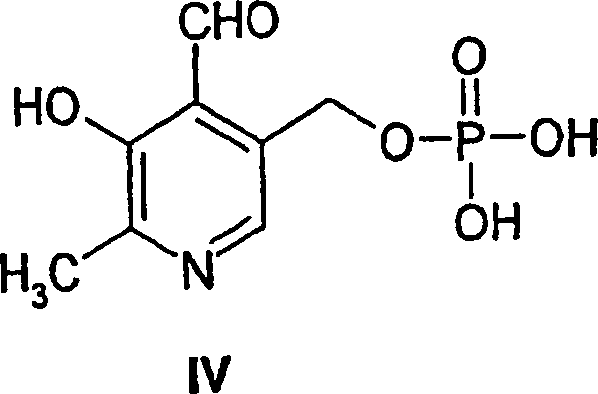
PLP ist die biologisch aktive Form des Vitamin B6 in Zellen und Blutplasma. Säuger können PLP nicht de novo synthetisieren und müssen auf Nahrungsquellen der Vorstufen Pyridoxin, Pyridoxal und Pyridoxamin, die zu PLP verstoffwechselt werden, zurückgreifen. Säuger produzieren PLP z.B. durch Phosphorylierung von Pyridoxin mittels Pyridoxalkinasewirkung und anschließende Oxidation des phosphorylierten Produktes.PLP is the biologically active form of vitamin B 6 in cells and blood plasma. Mammals can not synthesize PLP de novo and must rely on food sources of the precursors pyridoxine, pyridoxal and pyridoxamine, which are metabolized to PLP. Mammals produce PLP eg by phosphorylation of pyridoxine by means of pyridoxalkinase action and subsequent oxidation of the phosphorylated product.
PLP
reguliert biologische Prozesse und ist ein Cofaktor bei mehr als
einhundert Enzymreaktionen. Es hat sich als Antagonist eines purinergen
Rezeptors und damit als die ATP-Bindung beeinträchtigend erwiesen, ist an der
Modulation der Plättchenaggregation
beteiligt, ist ein Inhibitor bestimmter Phosphataseenzyme und ist
an der Steuerung der Gentranskription beteiligt. In früheren Patenten
(
Es besteht Bedarf an der Identifizierung und Verabreichung von Medikamenten, die eine oder mehrere der bekannten biologischen Wirkungen von Vitamin B6-Kongenen imitieren können, in ihrem speziellen Wirkmodus aber wirksamer sind als die Vitamin B6-Kongene.There is a need for the identification and administration of drugs which are able to mimic one or more of the known biological effects of vitamin B 6 , but are more potent in their specific mode of action than the vitamin B 6 clones.
Zusammenfassung der ErfindungSummary of the invention
Die vorliegende Erfindung stellt Pyridoxin- und Pyridoxalanaloge, Pyridoxin- und Pyridoxalanaloge enthaltende pharmazeutische Zusammensetzungen und Behandlungsverfahren auf der Basis der Verabreichung therapeutisch wirksamer Mengen der Pyridoxin- und Pyridoxalanaloge bereit. Die erfindungsgemäßen Verbindungen und Zusammensetzungen können bei der Behandlung kardiovaskulärer oder verwandter Erkrankungen und deren Symptomen eingesetzt werden.The The present invention provides pyridoxine and pyridoxal analogs, pyridoxine and pharmaceutical compositions containing pyridoxal analogues and treatment methods based on administration therapeutically effective levels of the pyridoxine and pyridoxal analogues. The Compounds of the invention and compositions can in the treatment of cardiovascular or related diseases and their symptoms.
Die
Erfindung stellt Pyridoxin- und Pyridoxalanaloge der Formel V: 
In einem anderen Aspekt bezieht sich die Erfindung auf eine pharmazeutische Zusammensetzung, die einen pharmazeutisch annehmbaren Träger in Kombination mit einer therapeutisch wirksamen Menge einer Verbindung der Formel V oder eines pharmazeutisch annehmbaren Säureadditionssalzes einer Verbindung der Formel V enthält.In In another aspect, the invention relates to a pharmaceutical A composition comprising a pharmaceutically acceptable carrier in combination with a therapeutically effective amount of a compound of the formula V or a pharmaceutically acceptable acid addition salt of a compound of Formula V contains.
In einem weiteren Aspekt bezieht sich die Erfindung auf die Verwendung einer Verbindung der Formel V bei der Herstellung eines Medikaments, das in einem Verfahren zur Behandlung kardiovaskulärer oder verwandter Erkrankungen und deren Symptomen nützlich ist. Das Verfahren beinhaltet die Verabreichung einer Verbindung der Formel V oder eines pharmazeutisch annehmbaren Säureadditionssalzes einer Verbindung der Formel V in einer Einheitsdosierungsform an einen Säuger. Das Verfahren kann weiterhin die gleichzeitige Verabreichung eines weiteren Therapeutikums beinhalten.In In another aspect, the invention relates to use a compound of formula V in the manufacture of a medicament, that in a method of treatment of cardiovascular or related diseases and their symptoms is useful. The procedure includes the administration of a compound of formula V or a pharmaceutical Acceptable acid addition salt a compound of formula V in a unit dosage form a mammal. The method may further include the simultaneous administration of a include further therapeutic agent.
Detaillierte Beschreibung der ErfindungDetailed description the invention
Die Erfindung stellt Pyridoxal- und Pyridoxinanaloge sowie diese Pyridoxin- und Pyridoxalanaloge enthaltende pharmazeutische Zusammensetzungen bereit. Die Pyridoxin- und Pyridoxalanaloge können bei der Behandlung kardiovaskulärer oder verwandter Erkrankungen und deren Symptomen eingesetzt werden.The Invention provides pyridoxal and pyridoxine analogues as well as these pyridoxine and pharmaceutical compositions containing pyridoxal analogues ready. The pyridoxine and pyridoxal analogues may be used in the treatment of cardiovascular or related diseases and their symptoms are used.
Kardiovaskuläre oder verwandte Erkrankungen sind z.B. cerebrale Ischämie, Hirnblutung, ischämischer Schlaganfall, hämorrhagischer Schlaganfall, Bluthochdruck, Myokardinfarkt, Ischämie/Reperfusionsverletzung, myokardiale Ischämie, dekompensierte Herzinsuffizienz, Blutgerinnungsstörungen, Herzhypertrophie und Plättchenaggregation. Kardiovaskuläre oder verwandte Erkrankungen sind weiterhin Erkrankungen, die sich aus thrombotischen und prothrombotischen Zuständen ergeben, bei denen die Gerinnungskaskade aktiviert wird, z.B. tiefe Venenthrombose, disseminierte intravaskuläre Koagulopathie und Lungenembolie.Cardiovascular or related diseases are e.g. cerebral ischemia, cerebral hemorrhage, ischemic Stroke, haemorrhagic Stroke, hypertension, myocardial infarction, ischemia / reperfusion injury, myocardial ischemia, decompensated heart failure, blood coagulation disorders, Cardiac hypertrophy and platelet aggregation. cardiovascular or related diseases are still diseases that are from thrombotic and prothrombotic states in which the Coagulation cascade is activated, e.g. deep vein thrombosis, disseminated intravascular Coagulopathy and pulmonary embolism.
Herzinsuffizienz ist ein pathophysiologischer Zustand, bei dem das Herz das Blut nicht mehr in der Geschwindigkeit pumpen kann, wie es für die Metabolisierung der Gewebe notwendig ist, bzw. nur noch bei erhöhtem Fülldruck (erhöhter Last). Daher ist das Herz nur noch in verringertem Maße in der Lage, die Arbeitslast zu bewältigen. Im Laufe der Zeit führt dieser Zustand zur Ansammlung überschüssiger Flüssigkeit, z.B. einem peripheren Ödem, was als dekompensierte Herzinsuffizienz bezeichnet wird.Heart failure is a pathophysiological condition in which the heart can no longer pump the blood at the rate necessary for the metabolism of the tissues, or only with it increased filling pressure (increased load). Therefore, the heart is only able to cope with the workload to a lesser extent. Over time, this condition results in the accumulation of excess fluid, such as peripheral edema, which is referred to as decompensated heart failure.
Wird auf eine Herzkammer ein übermäßiger Druck oder eine übermäßige Volumenlast ausgeübt, entwickelt sich als Kompensationsmechanismus eine myokardiale Hypertrophie (d.h. eine Vergrößerung des Herzmuskels). Die Hypertrophie erlaubt der Herzkammer die Aufrechterhaltung einer erhöhten Last, da sich der Herzmuskel mit stärkerer Kraft zusammenziehen kann. Eine über längere Zeit einer pathologisch erhöhten Last ausgesetzte Herzkammer kann jedoch letztlich trotz des Vorliegens einer ventrikulären Hypertrophie die erhöhte Last nicht mehr aufrecht erhalten, so dass es schlussendlich zum Pumpversagen kommen kann.Becomes on a ventricle an excessive pressure or an excessive volume load applied develops as a compensation mechanism myocardial hypertrophy (i.e., enlargement of the heart muscle). The hypertrophy allows the ventricle to maintain a increased Load, as the heart muscle contract with greater force can. One over longer Time of a pathologically increased load In the end, however, the ventricle that has been exposed can still be present a ventricular Hypertrophy increased Last load is no longer upright, so it finally becomes Pump failure can come.
Herzinsuffizienz kann sich aus jeder Erkrankung des Herzens, die den Kreislauf beeinträchtigt, entwickeln. Beispielsweise schwächt eine Erkrankung, die die Arbeitslast des Herzmuskels erhöht, z.B. Bluthochdruck, letztendlich die Kontraktionskraft des Herzens. Bluthochdruck ist ein Zustand, bei dem der Widerstand gegen den Blutfluss im Gefäßsystem erhöht ist. Dieser Widerstand führt zu einem erhöhten systolischen und/oder diastolischen Blutdruck. Bluthochdruck setzt das linksventrikuläre Myokard unter erhöhten Druck, was dazu führt, dass sich dieses versteift und hypertrophiert, und beschleunigt die Entwicklung einer Atherosklerose in den Koronararterien. Die Kombination aus erhöhter Beanspruchung und verringerter Versorgung erhöht die Wahrscheinlichkeit einer myokardialen Ischämie, die zu Myokardinfarkt, plötzlichem Tod, Arrhythmien und dekompensierter Herzinsuffizienz führen kann.heart failure can result from any disease of the heart that affects the circulation, develop. For example, it weakens a disease that increases the workload of the heart muscle, e.g. Hypertension, ultimately the contraction force of the heart. high blood pressure is a condition in which the resistance to blood flow in the vascular system elevated is. This resistance leads to an increased systolic and / or diastolic blood pressure. Hypertension sets the left ventricular Myocardium under elevated Pressure, which leads to that it stiffens and hypertrophic, and accelerates the development of atherosclerosis in the coronary arteries. The Combination of elevated Stress and reduced supply increases the likelihood of one myocardial ischemia, those to myocardial infarction, sudden Death, arrhythmias, and congestive heart failure.
Ischämie ist ein Zustand, bei dem ein Organ oder ein Teil des Körpers nicht mehr ausreichend mit Blut versorgt wird. Wird ein Organ nicht ausreichend mit Blut versorgt, ist es hypoxisch. Ein Organ wird auch hypoxisch, wenn die Blutversorgung nur vorübergehend zum Erliegen kommt, z.B. während einer Operation oder eines vorübergehenden Arterienverschlusses. Ischämie führt zunächst zu einer Abnahme oder einem Verlust der Kontraktionsaktivität. Ist das betroffene Organ das Herz, ist dieser Zustand als myokardiale Ischämie bekannt. Myokardiale Ischämie führt zunächst zu einer pathologischen elektrischen Aktivität; diese kann eine Arrhythmie erzeugen. Bei ausreichendem Schweregrad und Dauer der myokardialen Ischämie können Zellverletzungen zum Zelltod, d.h. Myokardinfarkt, und anschließend zu einer Herzinsuffizienz, Hypertrophie oder dekompensierten Herzinsuffizienz führen.Ischemia a condition in which an organ or part of the body does not more is supplied with blood. If an organ is not sufficient supplied with blood, it is hypoxic. An organ also becomes hypoxic, if the blood supply is temporary comes to a standstill, e.g. while an operation or a temporary one Artery occlusion. ischemia leads first a decrease or a loss of contractile activity. Is this affected organ's heart, this condition is known as myocardial ischemia. Myocardial ischemia leads first a pathological electrical activity; This can be an arrhythmia produce. With sufficient severity and duration of myocardial ischemia can Cell injury to cell death, i. Myocardial infarction, and then too heart failure, hypertrophy or decompensated heart failure to lead.
Zu einer ischämischen Reperfusion des Organs kommt es, wenn das Blut nach der vorübergehenden Unterbrechung des Blutflusses wieder in das Organ strömt. Die Reperfusion eines ischämischen Myokards kann z.B. die Auswirkungen eines Koronarverschlusses, eines Zustandes, der zu myokardialer Ischämie führt, kompensieren. Eine ischämische Reperfusion in das Myokard kann zu einer Reperfusionsarrhythmie oder einer Reperfusionsverletzung führen. Der Schweregrad der Reperfusionsverletzung wird von zahlreichen Faktoren bestimmt, z.B. von der Dauer und dem Schweregrad der Ischämie der und Geschwindigkeit der Reperfusion. Zu den bei einer ischämischen Reperfusionsverletzung beobachteten Zuständen gehören Neutrophileninfiltration, Nekrose und Apoptose.To an ischemic Reperfusion of the organ occurs when the blood after temporary interruption the blood flow flows back into the organ. The reperfusion of an ischemic Myocardium may e.g. the effects of a coronary occlusion, one Condition that leads to myocardial ischemia compensate. An ischemic reperfusion into the myocardium may lead to a reperfusion arrhythmia or a reperfusion injury to lead. The severity of reperfusion injury is numerous Factors determined, e.g. on the duration and severity of ischemia and speed of reperfusion. To those at an ischemic Reperfusion injury observed conditions include neutrophil infiltration, Necrosis and apoptosis.
Pyridoxal- und PyridoxinanalogverbindungenPyridoxal and pyridoxine analogues
Die
Erfindung stellt Pyridoxal- und Pyridoxinanalogverbindungen der
Formel V: 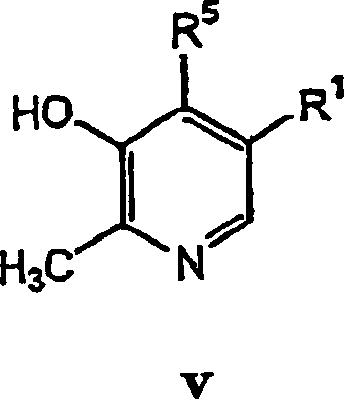
Der Begriff „Alkyl", wie er hierin verwendet wird, bezieht sich auf eine gerade oder verzweigte gesättigte aliphatische Kohlenwasserstoffkette mit 1 bis 8 Kohlenstoffatomen, z.B. Methyl, Ethyl, Propyl, Isopropyl-(1-methylethyl), Butyl, tert-Butyl-(1,1-dimethylethyl) und dergleichen. Die Alkylkette kann durch ein Heteroatom, z.B. ein Stickstoff-, Schwefel- oder Sauerstoffatom, unter-brochen sein, so dass Alkylaminoalkyl, Alkylthioalkyl oder Alkoxyalkyl entsteht. Beispiele für eine durch Heteroatome unterbrochene Alkylkette sind Methylaminoethyl, Ethylthiopropyl, Methoxymethyl und dergleichen. Das Alkyl kann am endständigen Kohlenstoff mit Gruppen wie Hydroxy, Alkoxy, Alkanoyloxy, Alkoxycarbonyl oder Carboxy substituiert sein. Der Begriff „Alkoxy" bezieht sich auf eine mit einem Sauerstoffatom verbundene Alkylgruppe. In einigen Ausführungsformen besitzt das Alkoxy 1 bis 4 Kohlenstoffatome in einer geraden oder verzweigten Kette, z.B. Methoxy, Ethoxy, Propoxy, Isopropoxy-(1-methlethoxy), Butoxy, tert-Butoxy-(1,1-dimethylethoxy) und dergleichen.The term "alkyl" as used herein refers to a straight or branched saturated aliphatic hydrocarbon chain having 1 to 8 carbon atoms, eg, methyl, ethyl, propyl, isopropyl (1-methylethyl), butyl, tert-butyl ( 1,1-dimethylethyl) and the like The alkyl chain may be interrupted by a heteroatom, eg a nitrogen, sulfur or oxygen atom, to give alkylaminoalkyl, alkylthioalkyl or alkoxyalkyl Examples of an alkyl chain interrupted by heteroatoms are methylaminoethyl, Ethylthiopropyl, methoxymethyl and the like The alkyl may be present at the terminal carbon be substituted with groups such as hydroxy, alkoxy, alkanoyloxy, alkoxycarbonyl or carboxy. The term "alkoxy" refers to an alkyl group attached to an oxygen atom In some embodiments, the alkoxy has from 1 to 4 carbon atoms in a straight or branched chain, eg, methoxy, ethoxy, propoxy, isopropoxy- (1-methlethoxy), butoxy, tert Butoxy (1,1-dimethylethoxy) and the like.
Der
Begriff „Alkanoyloxy", wie er hierin verwendet
wird, bezieht sich auf eine Gruppe der Formel 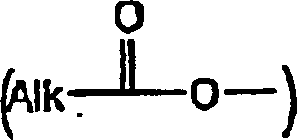
Beispiele für ein Alkanoyloxy sind Methanoyloxy, Ethanoyloxy, Propanoyloxy und dergleichen.Examples for a Alkanoyloxy are methanoyloxy, ethanoyloxy, propanoyloxy and the like.
Der Begriff „Halo" bezieht sich auf eine Brom-, Chlor- oder Fluorgruppe. In einigen Ausführungsformen ist Halo Fluor.Of the Term "halo" refers to a bromo, chloro or fluoro group. In some embodiments Halo fluorine.
Pharmazeutisch annehmbare Säureadditionssalze der Verbindungen der Formel V sind z.B. die von nicht-toxischen anorganischen Säuren wie Salz-, Salpeter-, Phosphor-, Schwefel-, Bromwasser-stoff-, Jodwasserstoff, Fluorwasserstoff-, Phosphonsäure und dergleichen abgeleiteten Salze sowie die von nicht-toxischen organischen Säuren wie aliphatischen Mono- und Dicarbonsäuren, phenyl-substituierten Alkansäuren, Hydroxyalkansäuren, Alkandicarbonsäuren, aromatischen Säuren, aliphatischen und aromatischen Sulfonsäuren, usw. abgeleiteten Salze. Solche Salze sind daher z.B. Sulfat, Pyrosulfat, Bisulfat, Sulfit, Bisulfit, Nitrat, Phosphat, Monohydrogenphosphat, Dihydrogenphosphat, Metaphosphat, Pyrophosphat, Chlorid, Bromid, Jodid, Acetat, Trifluoracetat, Propionat, Caprylat, Isobutyrat, Oxalat, Malonat, Succinat, Suberat, Sebacat, Fumarat, Maleat, Mandelat, Benzoat, Chlorbenzoat, Methylbenzoat, Dinitrobenzoat, Phthalat, Benzolsulfonat, Toluolsulfonat, Phenylacetat, Citrat, Lactat, Maleat, Tartrat, Methansulfonat und dergleichen. Es werden auch Salze von Aminosäuren wie Arginat und dergleichen sowie Gluconat, Galacturonat, N-Methylglutamin, usw. erwogen (siehe z.B. Berge et al., J. Pharmaceutical Science, 66:1-19, 1977). Die Säureadditionssalze der basischen Verbindungen werden auf herkömmliche Weise durch Kontaktieren der freien Basenform mit einer ausreichenden Menge der gewünschten Säure zur Bildung des Salzes hergestellt. Die freie Basenform kann durch Kontaktieren der Salzform mit einer Base und Isolieren der freien Base auf herkömmliche Weise wiederhergestellt werden. Zwar unterscheiden sich die freien Basenformen bezüglich bestimmter physikalischer Eigenschaften wie Löslichkeit in polaren Lösungsmitteln etwas von ihren jeweiligen Salzformen, doch ansonsten entsprechen die Salze ihrer jeweiligen freien Base für die erfindungsgemäßen Zwecke.pharmaceutical acceptable acid addition salts the compounds of formula V are e.g. that of non-toxic inorganic acids such as hydrochloric, nitric, phosphoric, sulfuric, hydrobromic, hydrogen iodide, Hydrogen fluoride, phosphonic acid and the like derived salts as well as those of non-toxic organic acids such as aliphatic mono- and dicarboxylic acids, phenyl-substituted Alkanoic acids, hydroxyalkanoic acids, alkanedicarboxylic acids, aromatic acids, aliphatic and aromatic sulfonic acids, etc. derived salts. Such salts are therefore e.g. Sulphate, pyrosulphate, bisulphate, sulphite, Bisulfite, nitrate, phosphate, monohydrogen phosphate, dihydrogen phosphate, Metaphosphate, pyrophosphate, chloride, bromide, iodide, acetate, trifluoroacetate, Propionate, caprylate, isobutyrate, oxalate, malonate, succinate, suberate, Sebacate, fumarate, maleate, mandelate, benzoate, chlorobenzoate, methyl benzoate, Dinitrobenzoate, phthalate, benzenesulfonate, toluenesulfonate, phenylacetate, Citrate, lactate, maleate, tartrate, methanesulfonate and the like. There are also salts of amino acids such as arginate and the like, as well as gluconate, galacturonate, N-methylglutamine, etc. (see, e.g., Berge et al., J. Pharmaceutical. 66: 1-19, 1977). The acid addition salts the basic compounds are contacted by conventional methods the free base form with a sufficient amount of the desired Acid to Formation of the salt produced. The free base form can be contacted by contact salt form with a base and isolate the free base to conventional Way to be restored. Although the free ones differ Base forms regarding certain physical properties such as solubility in polar solvents something of their respective salt forms, but otherwise match the salts of their respective free base for the purposes of the invention.
In
einer Ausführungsform
der Formel V ist R1 
In
einer anderen Ausführungsform
der Formel V ist R1 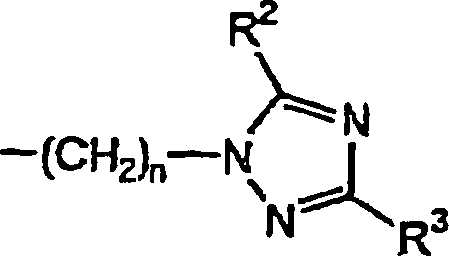
In
einer anderen Ausführungsform
der Formel V ist R1 
In
einer anderen Ausführungsform
der Formel V ist R1 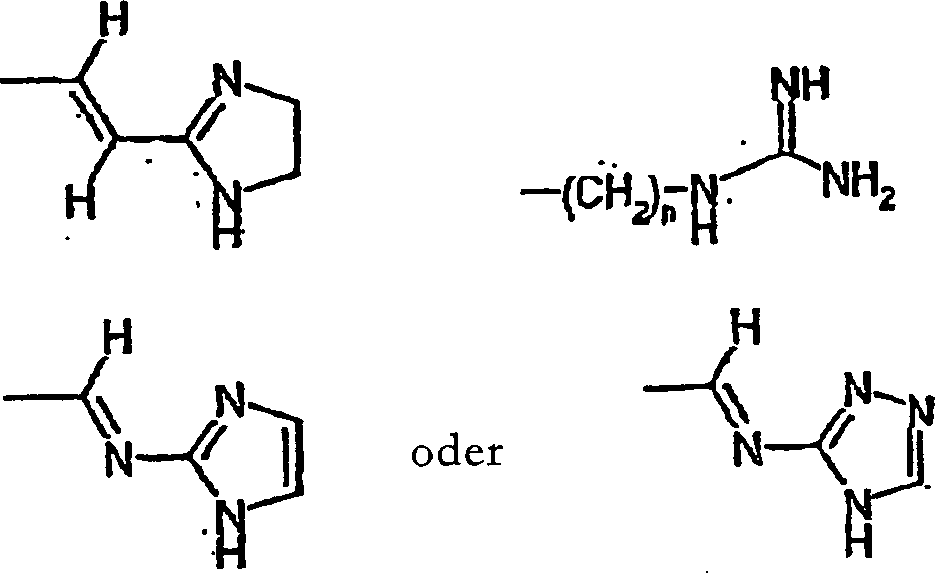
In
wieder einer anderen Ausführungsform
der Formel V ist R1 
In
einer besonders bevorzugten Ausführungsform
ist R1 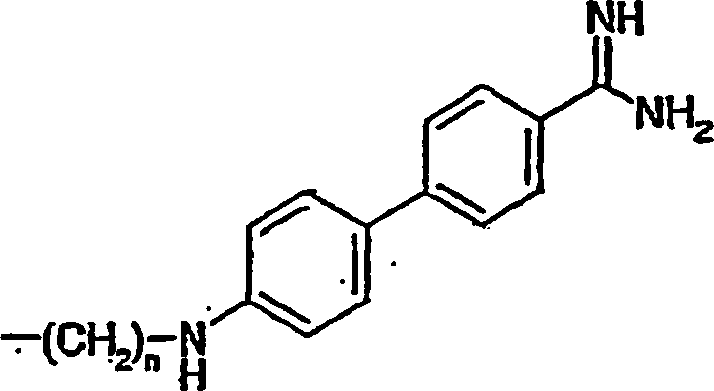
Verfahren zur Herstellung der Pyridoxal- und PyridoxinanalogverbindungenProcess for the preparation of pyridoxal and pyridoxine analogues
Ein
weiterer Aspekt der Erfindung stellt ein Verfahren zur Herstellung
der Pyridoxin- und
Pyridoxalanaloge bereit. Die erfindungsgemäßen Verbindungen lassen sich
aus einer Verbindung der Formel VI, VII, VIII, IX oder X herstellen. 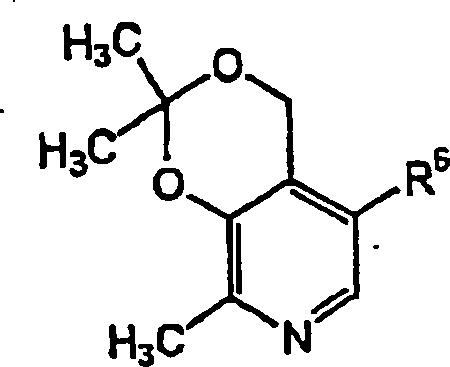
VII R6 = CH2)qBr mit q = 1 bis 5
VIII R6 =
(CH2)rCOH mit r
= 0 bis 4
IX R6 = (CH2)sN3 mit s = 1 bis
5
X R6 = (CH2)tNH2 mit t = 1 bis
5 Another aspect of the invention provides a process for the preparation of pyridoxine and pyridoxala nalogues ready. The compounds according to the invention can be prepared from a compound of the formula VI, VII, VIII, IX or X.
VII R 6 = CH 2 ) q Br with q = 1 to 5
VIII R 6 = (CH 2 ) r COH with r = 0 to 4
IX R 6 = (CH 2 ) s N 3 with s = 1 to 5
XR 6 = (CH 2 ) t NH 2 with t = 1 to 5
Zur Bildung der Verbindungen der Formel V durch eine Reihe chemischer Reaktionen zur Herstellung der Pyridoxinanaloge kann eine Verbindung der Formel VI, VII, VIII, IX oder X verwendet werden. Die Pyridoxinanaloge können anschließend oxidiert werden, so dass die entsprechenden Pyridoxalanaloge entstehen.to Formation of the compounds of formula V by a series of chemical Reactions for the preparation of pyridoxine analogues may be a compound of the formula VI, VII, VIII, IX or X are used. The pyridoxine analogues can subsequently be oxidized, so that the corresponding Pyridoxalanaloge arise.
In
einigen Ausführungsformen
der Erfindung werden die Pyridoxin- und Pyridoxalanaloge durch Umsetzung
einer Bromidverbindung der Formel VII mit einem substituierten oder
nicht-substituierten Tetrazol, einem substituierten oder nicht-substituierten Triazol
oder einem substituierten oder nicht-substituierten Imidazol hergestellt.
Das Tetrazol, Triazol oder Imidazol kann mit einem Aryl, Biaryl,
Amino, Acylamino, Anilino oder Guanidin substituiert sein. Ein Aryl
oder Biaryl kann weiterhin mit einer Cyano-, Alkyl-, Alkoxy-, Amino-,
Hydroxy-, Halo-, Nitro- oder Alkanoyloxygruppe substituiert sein.
Ein Anilin kann weiterhin mit einer Cyano-, Alkyl-, Alkoxy-, Amino-,
Hydroxy-, Halo-, Nitro- oder Alkanoyloxygruppe substituiert sein.
Wie in Schema 1 dargestellt kann zur Herstellung des Derivats XI
z.B. eine Bromidverbindung der Formel VII (q = 1) mit 1H-Tetrazol
umgesetzt werden. Das Derivat XI wird anschließend mit Essigsäure behandelt,
so dass 5-Tetrazolpyridoxin XII entsteht. Zur Herstellung des entsprechendes
Pyridoxals XIII kann 5-Tetrazolpyridoxin XII in Gegenwart eines
Katalysators wie z.B. Mangandioxid oxidiert werden. 
In anderen Ausführungsformen der Erfindung wird durch Umsetzung eines Alkohols der Formel VI mit einem geeigneten Oxidationsmittel wie z.B. Mangandioxid ein Aldehyd der Formel VIII hergestellt. Die Pyridoxin- und Pyridoxalanaloge der Formel V werden durch Umsetzung eines Aldehyds der Formel VIII mit einem substituierten oder nicht-substituierten Triazol, einem substituierten oder nicht-substituierten Imidazol oder einem substituierten oder nicht-substituierten Anilin hergestellt. Das Triazol oder Imidazol kann mit einem Aryl, Biaryl, Amino, Acylamino, Anilino oder Guanidin substituiert sein. Ein Aryl oder Biaryl kann weiterhin mit einer Cyano-, Alkyl-, Alkoxy-, Amino-, Hydroxy-, Halo-, Nitro- oder Alkanoyloxygruppe substituiert sein. Ein Anilin kann weiterhin mit einer Cyano-, Alkyl-, Alkoxy-, Amino-, Hydroxy-, Halo-, Nitro- oder Alkanoyloxygruppe substituiert sein.In other embodiments of the invention, an aldehyde of formula VIII is prepared by reacting an alcohol of formula VI with a suitable oxidizing agent such as manganese dioxide. The pyridoxine and pyridoxal analogues of Formula V are prepared by reacting an aldehyde of Formula VIII with a substituted or unsubstituted triazole, a substituted or unsubstituted imidazole, or a substituted or unsubstituted aniline. The triazole or imidazole may be substituted with an aryl, biaryl, amino, acylamino, anilino or guanidine. An aryl or biaryl may be further substituted with a cyano, alkyl, alkoxy, amino, hydroxy, halo, nitro or alkanoyloxy group. An aniline may be further substituted with a cyano, alkyl, alkoxy, amino, hydroxy, halo, nitro or alkanoyloxy group.
Zur
Bildung des geschützten
Imidazolinderivats XXVIII gemäß Schema
2 kann z.B. ein Aldehyd der Formel VIII (r = 0) mit 2-Methylimidazolin
umgesetzt werden. Das geschützte
Imidazolinderivat XXVII kann zu dem Imidazolin XXIX hydrolysiert
werden. 
In
einem anderen Beispiel kann eine erfindungsgemäße Verbindung wie in Schema
3 dargestellt durch Umsetzung eines Aldehyds der Formel VIII (r
= 0) mit 4-Cyanoanilin zu einer Schiffschen Base hergestellt werden.
Die Schiffsche Base XXXII wird mit einem starken Reduktionsmittel
wie z.B. Natriumborhydrid umgesetzt. Das entstandene Amin XXXIII
kann in Gegenwart von trockenem Wasserstoffchloridgas mit Ethanol
zu einer Verbindung der Formel XXXIV reagieren. Die Verbindung der
Formel XXXIV kann zur Bildung der Verbindung der Formel XXXV mit
2M NH3 in MeOH in einem Druckbehälter behandelt
werden. 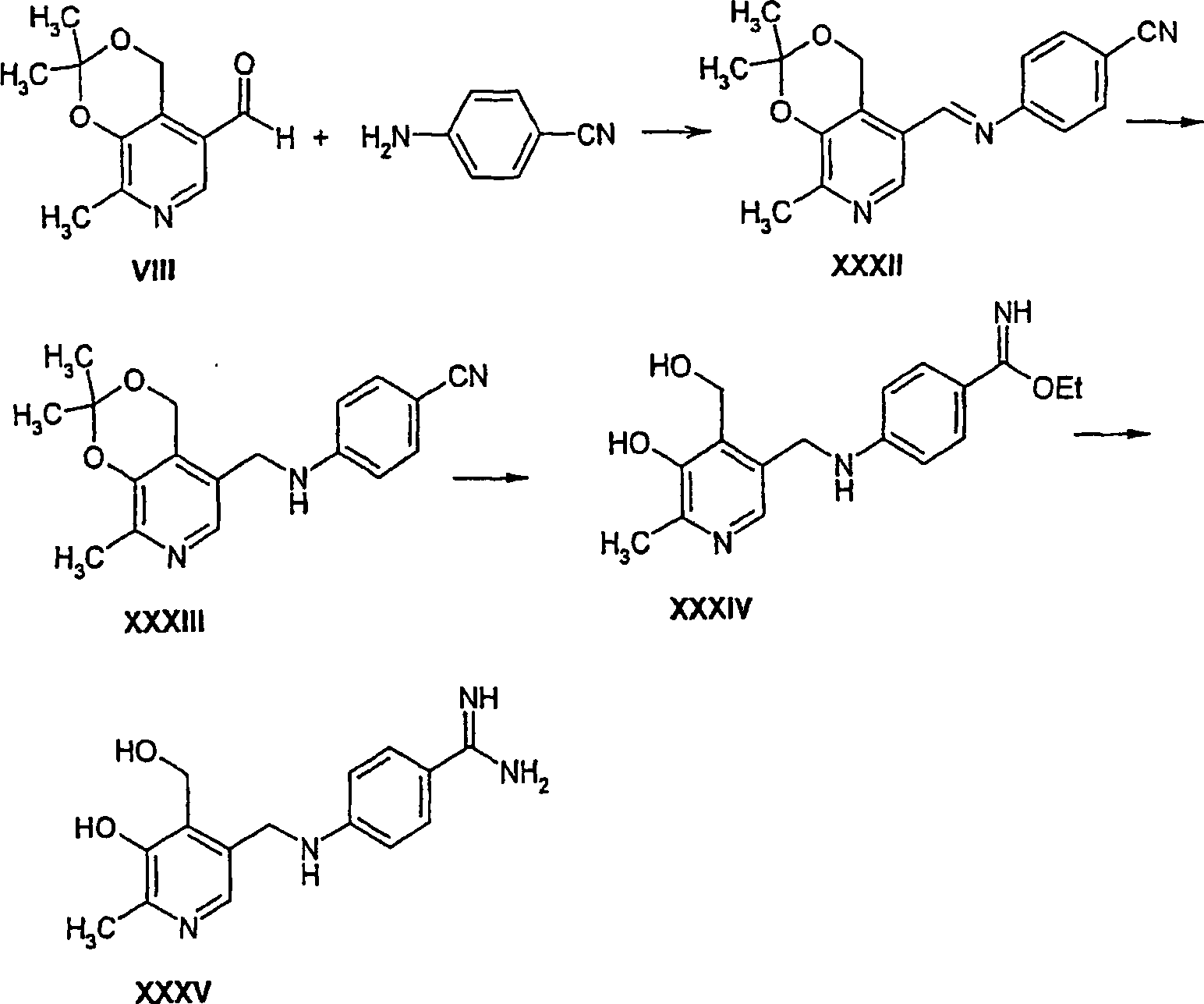
Wie
in Schema 4 dargestellt kann eine Aminverbindung der Formel X (s
= 1) z.B. mit einer geschützten Guanidinverbindung
zu dem Guanidinderivat XXIII reagieren. Die Schutzgruppen können mit
Trifluoressigsäure
entfernt werden, so dass eine Verbindung der Formel XXV entsteht. 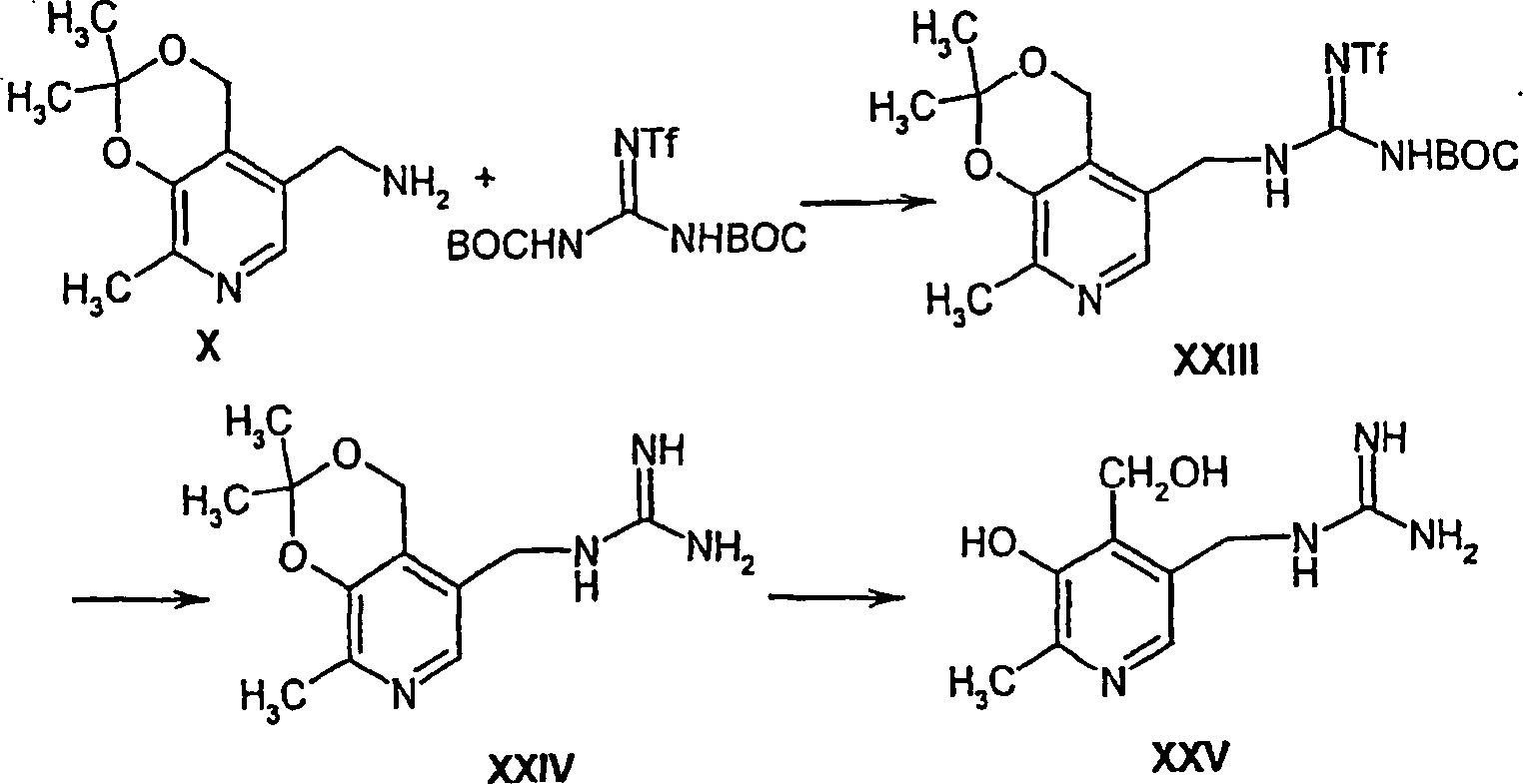
In einer anderen Ausführungsform zur Herstellung der Verbindungen der Formel V ist ein Azid der Formel IX die Vorstufe. Die Isopropylidengruppe wird zunächst hydrolysiert. Die in der Hydrolysereaktion gebildeten Hydroxygruppen werden anschließend durch Umsetzung mit einem Reagens wie z.B. tert-Butyldimethylsilylchlorid geschützt. Die Azidgruppe kann zu einer Amin-guppe hydriert werden. Die entstandene Aminverbindung kann mit einer aromatischen Gruppe reagieren, die ein substituiertes oder nicht-substituiertes Aryl- oder Biarylisocyanat oder ein substituiertes Thioisocyanat enthält. Das Aryl oder Biaryl kann mit einem Cyano, Alkyl, Alkoxy, Amino, Hydroxy, Halo, Nitro oder Alkanoyloxy substituiert sein. Die nach der Hydrolysereaktion zugesetzten Schutzgruppen können entfernt werden, so dass eine Pyridoxinverbindung entsteht.In another embodiment for the preparation of the compounds of the formula V is an azide of the formula IX the precursor. The isopropylidene group is first hydrolyzed. The hydroxy groups formed in the hydrolysis reaction are then passed through Reaction with a reagent, e.g. tert-butyldimethylsilyl protected. The azide group can be hydrogenated to an amine group. The resulting Amine compound can react with an aromatic group which a substituted or unsubstituted aryl or biaryl isocyanate or a substituted thioisocyanate. The aryl or biaryl can with a cyano, alkyl, alkoxy, amino, hydroxy, halo, nitro or Alkanoyloxy be substituted. The added after the hydrolysis reaction Protecting groups can be removed, so that a pyridoxine compound is formed.
Wie
in Schema 5 dargestellt kann z.B. eine mit Arylharnstoff und Arylthioharnstoff
substituierte erfindungsgemäße Verbindung
mittels einer Azidverbindung der Formel IX (s = 1) hergestellt werden.
Die Isopropylidengruppe kann durch Behandlung mit Essigsäure hydrolysiert
werden, so dass eine Verbindung der Formel XLI entsteht. Die ungeschützten Hydroxylgruppen
werden mit tert-Butyldimethylsilylchlorid zu XLII umgesetzt. Die
Azidgruppe kann in Gegenwart eines Katalysators mit Wasserstoff
zu dem Amin XLIII hydriert werden. Das Amin kann mit 4-Fluorphenylisocyanat
zu der Verbindung XLIV reagieren. Die Synthese der Verbindungen
XLVI und XLVII erfolgt nach dem für XLIV und XLV dargelegten
Verfahren unter Verwendung von 4-Fluorphenylthioisocyanat
anstelle von 4-Fluorphenylisocyanat. 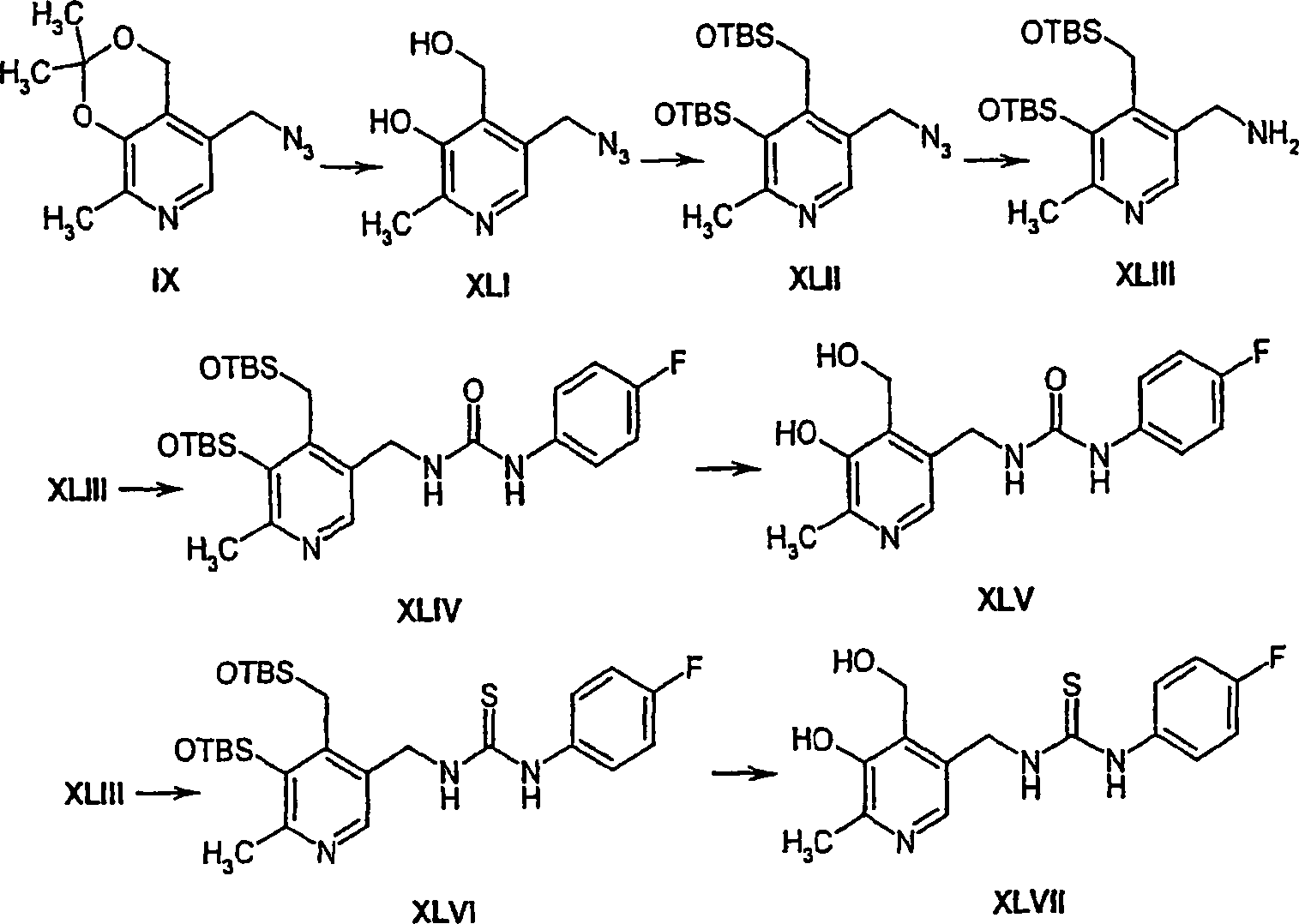
Die Produkte der hierin beschriebenen Reaktionen werden mittels herkömmlicher Verfahren wie Extraktion, Destillation, Chromatographie und dergleichen isoliert.The Products of the reactions described herein are made by conventional Methods such as extraction, distillation, chromatography and the like isolated.
Der Fachmann kann aus den dargestellten oder anderweitig bekannten Analogreaktionen auch andere Variationen der Reaktionsreihenfolge und geeigneten Reaktionsbedingungen erkennen, die in den zuvor beschriebenen Verfahren zur Herstellung der Verbindungen der Formel V hierin geeigneterweise eingesetzt werden können.Of the One skilled in the art can use the illustrated or otherwise known analogue reactions also other variations of the reaction order and suitable Detect reaction conditions in the previously described method for the preparation of the compounds of formula V herein suitably can be used.
Pharmazeutische ZusammensetzungenPharmaceutical compositions
Zwar kann die erfindungsgemäße Pyridoxin- und Pyridoxalanalogverbindung allein in einer Einheitsdosierungsform verabreicht werden, doch die Verbindungen werden typischerweise in Form einer pharmazeutischen Zusammensetzung in Mischung als Einheitsdosierungsform verabreicht. Die Erfindung stellt pharmazeutische Zusammensetzungen bereit, die mindestens eine Pyridoxin- oder Pyridoxalanalogverbindung der Formel V enthält. Eine pharmazeutische Zusammensetzung umfasst einen pharmazeutisch annehmbaren Träger in Kombination mit einer Verbindung der Formel V oder einem pharmazeutisch annehmbaren Säureadditionssalz einer Verbindung der Formel V.Though can the pyridoxine according to the invention and pyridoxal analogue compound alone in a unit dosage form but the compounds typically become in the form of a pharmaceutical composition in admixture as a unit dosage form administered. The invention provides pharmaceutical compositions ready, the at least one pyridoxine or Pyridoxalanalogverbindung of the formula V contains. A pharmaceutical composition comprises a pharmaceutical acceptable vehicle in combination with a compound of formula V or a pharmaceutically Acceptable acid addition salt a compound of the formula V.
Pharmazeutisch annehmbare Träger sind z.B., aber nicht ausschließlich physiologische Kochsalzlösung, Ringer-Lösung, phosphatgepufferte Kochsalzlösung und andere im Stand der Technik bekannte Träger. Pharmazeutische Zusammensetzungen können auch Zusatzstoffe wie z.B. Stabilisatoren, Antioxidationsmittel, Farbmittel, Arzneimittelträger, Bindemittel, Verdickungsmittel, Dispersionsmittel, Resorptionsverstärker, Puffer, Tenside, Konservierungsmittel, Emulgatoren, Isotonisierungsmittel und Verdünnungsmittel einschließen. Pharmazeutisch annehmbare Träger und Zusatzstoffe werden so ausgewählt, dass die Nebenwirkungen der pharmazeutischen Verbindung minimiert werden und das Leistungsvermögen der Verbindung nicht verloren geht oder bis zu einem Grad inhibiert wird, dass die Behandlung unwirksam ist.pharmaceutical acceptable carriers are, for example, but not exclusively physiological saline, Ringer's solution, phosphate buffered saline and other carriers known in the art. Pharmaceutical compositions can also additives such as e.g. Stabilizers, antioxidants, Colorants, excipients, Binders, thickeners, dispersants, absorption enhancers, buffers, Surfactants, preservatives, emulsifiers, isotonizing agents and diluents lock in. Pharmaceutically acceptable carriers and additives are selected so that the side effects of pharmaceutical compound can be minimized and the performance of the Compound is not lost or inhibited to a degree will make the treatment ineffective.
Verfahren zur Herstellung pharmazeutischer Zusammensetzungen aus einem pharmazeutisch annehmbaren Träger in Kombination mit einer therapeutischen Verbindung der Formel V oder einem pharmazeutisch annehmbaren Säureadditionssalz einer Verbindung der Formel V sind dem Fachmann bekannt. Alle Verfahren können den Schritt des Kontaktierens der erfindungsgemäßen Verbindung mit dem Träger und den Zusatzstoffen einschließen. Die Formulierungen werden im Allgemeinen durch gleichmäßiges und intimes Kontaktieren der erfindungsgemäßen Verbindung mit einem flüssigen Träger und/oder einem fein verteilten festen Träger und ggf. anschließendes Formen des Produkts zu den gewünschten Einheitsdosierungsformen hergestellt.method for the preparation of pharmaceutical compositions from a pharmaceutical acceptable vehicle in combination with a therapeutic compound of formula V or a pharmaceutically acceptable acid addition salt of a compound of formula V are known in the art. All procedures can Step of contacting the compound of the invention with the carrier and include the additives. The formulations are generally characterized by uniform and intimately contacting the compound of the invention with a liquid carrier and / or a finely divided solid support and possibly subsequent Shapes of the product to the desired Unit dosage forms prepared.
Zur oralen Verabreichung als Suspension können die Zusammensetzungen nach im Stand der Technik bekannten Techniken zur pharmazeutischen Formulierung hergestellt werden. Die Zusammensetzungen können mikrokristalline Cellulose zur Verleihung von Volumen, Alginsäure oder Natriumalginat als Suspensionsmittel, Methylcellulose als Viskositätsverstärker sowie Süßungsmittel oder Aromastoffe enthalten. Als Tabletten mit sofortiger Freisetzung können die Zusammensetzungen mikrokristalline Cellulose, Stärke, Magnesiumstearat und Lactose oder andere im Stand der Technik bekannte Arzneimittelträger, Bindemittel, Streckmittel, Aufschlussmittel, Verdünnungsmittel und Schmiermittel enthalten.to Oral administration as a suspension may include the compositions according to known in the art techniques for pharmaceutical Formulation to be made. The compositions may be microcrystalline Cellulose for the delivery of volume, alginic acid or sodium alginate as Suspending agent, methyl cellulose as a viscosity enhancer and sweetener or flavorings. As immediate release tablets can the compositions microcrystalline cellulose, starch, magnesium stearate and lactose or other excipients known in the art, excipients, Extender, disintegrants, diluents and lubricants contain.
Zur Verabreichung mittels Inhalation oder als Aerosol können die Zusammensetzungen nach im Stand der Technik bekannten Techniken zur pharmazeutischen Formulierung hergestellt werden. Die Zusammensetzungen können mit Benzylalkohol oder anderen geeigneten Konservierungs-mitteln, Absorptionsverstärkern zur Verbesserung der Bioverfügbarkeit, Fluorkohlenwasserstoffen oder anderen im Stand der Technik bekannten Lösungsvermittlern oder Dispersionsmitteln als Lösungen in Kochsalzlösung hergestellt werden.to Administration by inhalation or aerosol may be Compositions according to techniques known in the art be prepared for pharmaceutical formulation. The compositions can with benzyl alcohol or other suitable preservatives, Absorption enhancers for Improvement of bioavailability, Fluorocarbons or others known in the art solubilizers or dispersants as solutions in saline getting produced.
Zur Verabreichung als injizierbare Lösungen oder Suspensionen können die Zusammensetzungen nach im Stand der Technik bekannten Techniken mit geeigneten Dispersions- oder Benetzungs- und Suspensionsmitteln wie sterilen Ölen, z.B. synthetischen Mono- oder Diglyceriden, und Fettsäuren wie Oleinsäure formuliert werden.to Administration as injectable solutions or suspensions can the compositions according to techniques known in the art with suitable dispersing or wetting and suspending agents like sterile oils, e.g. synthetic mono- or diglycerides, and fatty acids such as oleic acid be formulated.
Zur rektalen Verabreichung als Zäpfchen können die Zusammensetzungen durch Mischen mit einem geeigneten, nicht reizenden Arzneimittelträger wie z.B. Kakaobutter, synthetischen Glycerid-estern oder Polyethylenglycolen, die bei Umgebungstemperaturen fest sind, sich aber im Rektum verflüssigen oder auflösen, so dass das Medikament freigesetzt wird, hergestellt werden.to rectal administration as a suppository can the compositions by mixing with a suitable, not irritant excipient such as. Cocoa butter, synthetic glyceride esters or polyethylene glycols, which are solid at ambient temperatures but liquefy in the rectum or dissolve, so that the drug is released to be produced.
Medizinische Verwendung von Pyridoxal- und PyridoxinanalogverbindungenMedical use of Pyridoxal and pyridoxine analogues
In einem anderen Aspekt der Erfindung wird die Verwendung der Verbindungen der Formel V bei der Herstellung eines Medikaments zur Behandlung kardiovaskulärer oder verwandter Erkrankungen und deren Symptomen bereitgestellt.In Another aspect of the invention is the use of the compounds of formula V in the manufacture of a medicament for treatment cardiovascular or related diseases and their symptoms.
Die Begriffe „Behandlung" und „behandeln", wie sie hierin verwendet werden, schließen die Vorbeugung, Inhibierung, Linderung und Heilung kardiovaskulärer oder verwandter Vitamin B6-Erkrankungen oder deren Symptomen ein. Die Behandlung kann durch Verabreichung einer therapeutisch wirksamen Menge einer erfindungsgemäßen Verbindung erfolgen. Der Begriff „therapeutisch wirksame Menge", wie er hierin verwendet wird, ist eine prophylaktische Menge, z.B. eine Menge, die den zuvor genannten Erkrankungen und deren Symptomen wirksam vorbeugt oder vor diesen schützt, oder eine Menge, die die zuvor genannten Erkrankungen und deren Symptome wirksam lindert oder heilt.As used herein, the terms "treatment" and "treating" include the prevention, inhibition, alleviation and cure of cardiovascular or related vitamin B 6 diseases or their symptoms. The treatment may be by administration of a therapeutically effective amount of a compound of the invention. The term "therapeutically effective amount" as used herein is a prophylactic amount, for example, an amount effective to prevent or protect against the aforementioned disorders and their symptoms, or an amount that includes the aforementioned disorders and their symptoms Effectively relieves or heals.
Ein Arzt oder Veterinär mit normaler Fachkenntnis kann einen Säuger, der Symptome einer oder mehrerer der zuvor beschriebenen Erkrankungen aufweist, leicht feststellen. Ungeachtet des ausgewählten Verabreichungsweges kann eine Verbindung der Formel V oder ein pharmazeutisch annehmbares Säureadditionssalz einer Verbindung der Formel V mittels herkömmlicher, im pharmazeutischen Stand der Technik bekannter Verfahren zu pharmazeutisch annehmbaren Einheitsdosierungsformen formuliert werden. Bei der Behandlung wird eine wirksame aber nicht-toxische Menge der Verbindung eingesetzt. Die Verbindungen können in enteralen Einheitsdosierungsformen wie z.B. als Tabletten, Retard-Tabletten, magensaftresistente Tabletten, Kapseln, Retard-Kapseln, magensaftresistente Kapseln, Pillen, Pulver, Granulate, Lösungen und dergleichen verabreicht werden. Sie können auch parenteral, z.B. subkutan, intramuskulär, intradermal, intramammär, intravenös und nach anderen im Stand der Technik bekannten Verabreichungsverfahren verabreicht werden.One Doctor or veterinary With normal skill, a mammal may have symptoms of or a more of the diseases described above. Regardless of the selected Routes of administration may be a compound of formula V or a pharmaceutically Acceptable acid addition salt a compound of formula V by means of conventional, in the pharmaceutical State of the art known method to pharmaceutically acceptable Unit dosage forms are formulated. In the treatment will be used an effective but non-toxic amount of the compound. The connections can in enteral unit dosage forms such as e.g. as tablets, sustained-release tablets, enteric-coated tablets, capsules, sustained-release capsules, enteric-coated Capsules, pills, powders, granules, solutions and the like become. You can also parenteral, e.g. subcutaneous, intramuscular, intradermal, intramammary, intravenous and after administered other methods of administration known in the art become.
Ein Arzt oder Veterinär mit normaler Fachkenntnis kann die therapeutisch wirksame Menge der Verbindung zur Behandlung der Erkrankung, gegen die die Behandlung verabreicht wird, leicht feststellen und verschreiben. Dabei kann der Arzt oder Veterinär zunächst relativ niedrige Dosierungen anwenden und die Dosis nachfolgend bis zum Erreichen einer maximalen Response steigern. Typischerweise werden die jeweilige Erkrankung, der Schweregrad der Erkrankung, die zu verabreichende Verbindung, der Verabreichungsweg und die Charakteristiken des zu behandelnden Säugers, z.B. Alter, Geschlecht und Gewicht bei der Bestimmung der wirksamen Verabreichungsmenge berücksichtigt. Die Verabreichung einer therapeutischen Menge einer erfindungsgemäßen Verbindung zur Behandlung kardiovaskulärer oder verwandter Erkrankungen und deren Symptomen liegt im Bereich von 0,1 bis 100 mg/kg Körpergewicht des Patienten, noch bevorzugter im Bereich von 0,5 bis 50 mg/kg Körpergewicht des Patienten als Tagesdosis. Die Verbindung kann kurz- oder langfristig verabreicht werden. Auch wenn im Einzelfall das Gegenteil zutreffen kann, wird die kurzfristige Verabreichung, z.B. über 30 Tage oder weniger, einer Dosis von mehr als 25 mg/kg Körpergewicht des Patienten einer langfristigen Verabreichung vorgezogen. Ist eine langfristige Verabreichung, z.B. über Monate oder Jahre, notwendig, überschreitet die vorgeschlagene Dosis für gewöhnlich 25 mg/kg Körpergewicht des Patienten nicht.A physician or veterinarian of ordinary skill in the art can easily determine and prescribe the therapeutically effective amount of the compound to treat the condition against which the treatment is being administered. The doctor or veterinarian may initially apply relatively low dosages and subsequently increase the dose to reach a maximum response. Typically, the particular disease, the severity of the disease, the compound to be administered, the route of administration, and the characteristics of the mammal to be treated, eg, age, sex, and weight, are taken into account in determining the effective amount of administration. The administration of a therapeutic amount of a compound of the invention for the treatment of cardiovascular or related diseases and their symptoms is in the range of 0.1 to 100 mg / kg body weight of the patient, more preferably in the range of 0.5 to 50 mg / kg body weight of the patient daily dose. The compound can be given in the short or long term. Although the opposite may apply in individual cases, short-term administration, eg over 30 days or less, a dose greater than 25 mg / kg body weight of the patient is preferred to long-term administration. If long-term administration, eg over months or years, is necessary, the suggested dose will usually not exceed 25 mg / kg body weight of the patient.
Eine therapeutisch wirksame Menge einer Verbindung der Formel V oder eines pharmazeutisch annehmbaren Säureadditionssalzes einer Verbindung der Formel V zur Behandlung der zuvor genannten Erkrankungen oder deren Symptomen kann vor, gleichzeitig oder nach Einsetzen der Erkrankung oder des Symptoms verabreicht werden. Eine erfindungsgemäße Verbindung kann gleichzeitig verabreicht werden. Die Begriffe „gleichzeitige Verabreichung" und „gleichzeitig verabreicht", wie sie hierin verwendet werden, beinhalten die Verabreichung einer erfindungsgemäßen Verbindung in Mischung mit einem anderen Therapeutikum, z.B. in einer pharmazeutischen Zusammensetzung bzw. Lösung, oder separat, z.B. als separate pharmazeutische Zusammensetzungen oder Lösungen, die nacheinander, gleichzeitig oder zu verschiedenen Zeitpunkten verabreicht werden, jedoch zeitlich nicht so weit auseinander liegend, dass die erfindungsgemäße Verbindung und das andere Therapeutikum nicht miteinander in Wechselwirkung treten können und keine niedrigere Dosierung des Wirkstoffes verabreicht werden kann.A therapeutically effective amount of a compound of formula V or a pharmaceutically acceptable acid addition salt of a compound of the formula V for the treatment of the aforementioned diseases or their symptoms may appear before, at the same time or after onset of the disease or the symptom. A compound of the invention can be given at the same time. The terms "simultaneous Administration "and" simultaneously administered, "like they are used herein, the administration of a compound of the invention in admixture with another therapeutic, e.g. in a pharmaceutical Composition or solution, or separately, e.g. as separate pharmaceutical compositions or solutions, one by one, simultaneously or at different times be administered, but not so far apart in time, that the compound of the invention and the other therapeutic does not interact with each other can and no lower dosage of the active ingredient will be administered can.
Das Verfahren zur Behandlung kardiovaskulärer oder verwandter Erkrankungen umfasst außerdem die Verabreichung einer therapeutisch wirksamen Menge einer Verbindung der Formel V oder eines pharmazeutisch annehmbaren Säureadditionssalzes einer Verbindung der Formel V in einer Einheitsdosierungsform an einen Säuger. Die kardiovaskulären oder verwandten Erkrankungen, die behandelt werden können, sind z.B. Hypertrophie, Bluthochdruck, dekompensierte Herzinsuffizienz, Herzinsuffizienz nach Myokardinfarkt, myokardiale Ischämie, cerebrale Ischämie, Ischämie/Reperfusionsverletzung, Arrhythmie, Blutgerinnungsstörungen oder Plättchenaggregation. Vorzugsweise ist die behandelte kardiovaskuläre Erkrankung Hypertrophie, dekompensierte Herzinsuffizienz, Arrhythmie oder Ischämie/Reperfusionsverletzung.The Method for the treatment of cardiovascular or related diseases also includes the Administration of a therapeutically effective amount of a compound of the formula V or a pharmaceutically acceptable acid addition salt a compound of formula V in a unit dosage form a mammal. Cardiovascular or related disorders that can be treated are e.g. Hypertrophy, hypertension, decompensated heart failure, heart failure after myocardial infarction, myocardial ischemia, cerebral ischemia, ischemia / reperfusion injury, Arrhythmia, blood clotting disorders or platelet aggregation. Preferably, the treated cardiovascular disease is hypertrophy, decompensated Heart failure, arrhythmia or ischemia / reperfusion injury.
Die erfindungsgemäße Verbindung kann auch zur Behandlung kardiovaskulärer Erkrankungen oder anderer Erkrankungen, die sich aus thrombotischen und prothrombotischen Zuständen, bei denen die Gerinnungskaskade aktiviert wird, ergeben, verabreicht werden, z.B. tiefe Venenthrombose, disseminierte intravaskuläre Koagulopathie, Kasabach-Merritt-Syndrom, Lungenembolie, Myokardinfarkt, Schlaganfall, thromboembolische OP-Komplikationen und peripherer Arterienverschluss. Die erfindungsgemäße Verbindung kann auch zur Behandlung von ARDS (Adult Respiratory Distress Syndrome), septischem Schock, Septikämie oder Entzündungsreaktionen wie Ödemen und akuter oder chronischer Atherosklerose nützlich sein, da sich herausgestellt hat, dass Thrombin eine große Anzahl Zellen außerhalb des Gerinnungsprozesses aktiviert, z.B. Neutrophile, Fibroblasten, Endothelzellen und Zellen der glatten Muskulatur.The inventive compound may also be used to treat cardiovascular diseases or others Diseases arising from thrombotic and prothrombotic states in which the coagulation cascade is activated, administered be, e.g. deep vein thrombosis, disseminated intravascular coagulopathy, Kasabach-Merritt syndrome, pulmonary embolism, myocardial infarction, stroke, thromboembolic surgical complications and peripheral arterial occlusion. The compound of the invention can also be used to treat adult respiratory distress syndrome (ARDS), septic shock, septicemia or inflammatory reactions like edema and acute or chronic atherosclerosis, as it turned out has that thrombin a big one Number of cells outside of the coagulation process, e.g. Neutrophils, fibroblasts, Endothelial cells and smooth muscle cells.
Das Verfahren zur Behandlung kardiovaskulärer oder verwandter Erkrankungen kann weiterhin die gleichzeitige Verabreichung anderer Therapeutika, die sich bekanntermaßen für die Behandlung der zuvor genannten Erkrankungen eignen, umfassen.The Method for the treatment of cardiovascular or related diseases may continue the concomitant administration of other therapeutic agents, which are known for the Treatment of the aforementioned disorders are suitable.
Erfindungsgemäße Verfahren sind z.B. die gleichzeitige Verabreichung einer Verbindung der Formel V oder eines pharmazeutisch annehmbaren Säureadditionssalzes einer Verbindung der Formel V in Kombination mit einer therapeutischen kardiovaskulären Verbindung zur Behandlung von Hypertrophie, Bluthochdruck, dekompensierter Herzinsuffizienz, Herzinsuffizienz nach Myokardinfarkt, myokardialer Ischämie, Ischämie/Reperfusionsverletzung, Arrhythmie oder Myokardinfarkt. Vorzugsweise ist die behandelte kardiovaskuläre Erkrankung Hypertrophie, dekompensierte Herzinsuffizienz, Arrhythmie oder Ischämie/Reperfusionsverletzung.Inventive method are e.g. the simultaneous administration of a compound of formula V or a pharmaceutically acceptable acid addition salt of a compound of Formula V in combination with a therapeutic cardiovascular compound for the treatment of hypertrophy, hypertension, decompensated Heart failure, heart failure after myocardial infarction, myocardial ischemia, Ischemia / reperfusion injury, Arrhythmia or myocardial infarction. Preferably, the treated cardiovascular Disease hypertrophy, decompensated heart failure, arrhythmia or ischemia / reperfusion injury.
Andere therapeutische kardiovaskuläre Verbindungen, die gleichzeitig mit einer erfindungsgemäßen Verbindung oder Zusammensetzung verabreicht werden können, sind z.B. ein Inhibitor des Angiotensin-Converting-Enzyme, ein Angiotensin II-Rezeptor-Antagonist, ein Calciumkanalblocker, ein antithrombotisches Mittel, ein Antagonist des β-adrenergen Rezeptors, ein Vasodilatator, ein Diuretikum, ein Antagonist des α-adrenergen Rezeptors, ein Antioxidationsmittel und eine Mischung davon. In einer Ausführungsform wird eine erfindungsgemäße Verbindung gleichzeitig mit PPADS (Pyridoxalphosphat-6-azophenyl-2',4'-disulfonsäure), ebenfalls einer therapeutischen kardiovaskulären Verbindung, oder mit PPADS und einer weiteren bekannten therapeutischen kardiovaskulären Verbindung wie bereits beschrieben verabreicht.Other therapeutic cardiovascular Compounds simultaneously with a compound of the invention or composition can be administered, e.g. an inhibitor angiotensin converting enzyme, an angiotensin II receptor antagonist, a calcium channel blocker, an antithrombotic agent, an antagonist of β-adrenergic Receptor, a vasodilator, a diuretic, an antagonist of the α-adrenergic receptor, an antioxidant and a mixture thereof. In one embodiment becomes a compound of the invention simultaneously with PPADS (pyridoxal phosphate-6-azophenyl-2 ', 4'-disulfonic acid), also a therapeutic cardiovascular compound, or with PPADS and another known therapeutic cardiovascular compound administered as previously described.
Vorzugsweise ist die andere therapeutische kardiovaskuläre Verbindung, die gleichzeitig mit einer Verbindung der Formel V oder einem pharmazeutisch annehmbaren Säureadditionssalz einer Verbindung der Formel V verabreicht wird, ein Inhibitor des Angiotensin-Converting-Enzyme, ein Angiotensin II-Rezeptor-Antagonist, ein Diuretikum, ein Antagonist des α-adrenergen Rezeptors oder ein Calciumkanalblocker.Preferably is the other therapeutic cardiovascular compound that is concomitant with a compound of formula V or a pharmaceutically acceptable Acid addition salt a compound of the formula V is administered, an inhibitor of the Angiotensin converting enzyme, an angiotensin II receptor antagonist, a diuretic, an antagonist of the α-adrenergic receptor or a Calcium channel blocker.
Bekannte Inhibitoren des Angiotensin-Converting-Enzyme sind z.B. Captopril, Enalapril, Lisino-pril, Benazapril, Fosinopril, Quinapril, Ramipril, Spirapril, Imidapril und Moexipril.Known Inhibitors of the angiotensin converting enzyme are e.g. captopril, Enalapril, lisino-pril, benazapril, fosinopril, quinapril, ramipril, Spirapril, imidapril and moexipril.
Beispiele für bekannte Angiotensin II-Rezeptor-Antagonisten sind Angiotensin I-Rezeptor-Antagonisten und Angiotensin II-Rezeptor-Antagonisten. Geeignete Angiotensin II-Rezeptor-Antagonisten sind z.B. Losartan und Valsartan.Examples for known ones Angiotensin II receptor antagonists are angiotensin I receptor antagonists and angiotensin II receptor antagonists. Suitable angiotensin II receptor antagonists are e.g. Losartan and Valsartan.
Geeignete Calciumkanalblocker sind z.B. Verapamil, Diltiazem, Nicardipin, Nifedipin, Amlodipin, Felodipin, Nimodipin und Bepridil.suitable Calcium channel blockers are e.g. Verapamil, diltiazem, nicardipine, Nifedipine, amlodipine, felodipine, nimodipine and bepridil.
Beispiele für bekannte Antagonisten des β-adrenergen Rezeptors sind Atenolol, Propanolol, Timolol und Metoprolol.Examples for known ones Antagonists of β-adrenergic Receptors are atenolol, propanolol, timolol and metoprolol.
Geeignete Vasodilatatoren sind z.B. Hydralazin, Nitroglycerin und Isosorbiddinitrat.suitable Vasodilators are e.g. Hydralazine, nitroglycerin and isosorbide dinitrate.
Geeignete Diuretika sind z.B. Furosemid, Diuril, Amilorid und Hydrodiuril.suitable Diuretics are e.g. Furosemide, Diuril, Amiloride and Hydrodiuril.
Geeignete Antagonisten des α-adrenergen Rezeptors sind z.B. Prazosin, Doxazocin und Labetalol.suitable Antagonists of the α-adrenergic Receptors are e.g. Prazosin, doxazocin and labetalol.
Geeignete Antioxidationsmittel sind z.B. Vitamin B, Vitamin C und Isoflavone.suitable Antioxidants are e.g. Vitamin B, Vitamin C and Isoflavones.
Diese anderen therapeutischen kardiovaskulären Verbindungen werden im Allgemeinen zur Behandlung kardiovaskulärer oder verwandter Erkrankungen und deren Symptomen eingesetzt. Ein Arzt oder Veterinär mit normaler Fachkenntnis kann einen Probanden, der Symptome einer oder mehrerer der zuvor beschriebenen Erkrankungen aufweist, leicht feststellen und bestimmen, welche Verbindung sich im Allgemeinen für die Behandlung spezifischer kardiovaskulärer Zustände und Symptome eignet.These Other therapeutic cardiovascular compounds are used in the Generally for the treatment of cardiovascular or related diseases and their symptoms used. A doctor or veterinarian with normal Expertise may be a subject who has symptoms of one or more of the diseases described above and determine which compound is generally for the treatment specific cardiovascular conditions and symptoms.
Myokardiale Ischämie kann z.B. durch Verabreichung einer Verbindung der Formel V oder eines pharmazeutisch annehmbaren Säureadditionssalzes einer Verbindung der Formel V zusammen mit einem weiteren Therapeutikum behandelt werden. Andere geeignete Therapeutika sind z.B. ein Inhibitor des Angiotensin-Converting-Enzyme, ein Angiotensin II-Rezeptor-Antagonist, ein Calciumkanalblocker, ein antithrombotisches Mittel, ein Antagonist des β-adrenergen Rezeptors, ein Diuretikum, ein Antagonist des α-adrenergen Rezeptors oder eine Mischung davon.myocardial ischemia can e.g. by administration of a compound of formula V or a pharmaceutically acceptable acid addition salt of a compound the formula V together with another therapeutic treatment become. Other suitable therapeutics are e.g. an inhibitor of Angiotensin converting enzyme, an angiotensin II receptor antagonist, a calcium channel blocker, an antithrombotic agent, an antagonist of β-adrenergic Receptor, a diuretic, an antagonist of the α-adrenergic receptor or a mixture from that.
Als weiteres Beispiel kann eine dekompensierte Herzinsuffizienz durch Verabreichung einer Verbindung der Formel V oder eines pharmazeutisch annehmbaren Säureadditionssalzes einer Verbindung der Formel V zusammen mit einem weiteren Therapeutikum behandelt werden. Andere geeignete Therapeutika sind z.B. ein Inhibitor des Angiotensin-Converting-Enzyme, ein Angiotensin II-Rezeptor-Antagonist, ein Calciumkanalblocker, ein Vasodilatator, ein Diuretikum oder eine Mischung davon.When Another example may be a decompensated heart failure due to Administration of a compound of formula V or a pharmaceutically Acceptable acid addition salt a compound of formula V together with another therapeutic agent be treated. Other suitable therapeutics are e.g. an inhibitor angiotensin converting enzyme, an angiotensin II receptor antagonist, a calcium channel blocker, a vasodilator, a diuretic or a mixture of it.
Ein Myokardinfarkt kann durch Verabreichung einer Verbindung der Formel V oder eines pharmazeutisch annehmbaren Säureadditionssalzes einer Verbindung der Formel V zusammen mit einem weiteren Therapeutikum behandelt werden. Andere geeignete Therapeutika sind z.B. ein Inhibitor des Angiotensin-Converting-Enzyme, ein Calciumkanalblocker, ein antithrombotisches Mittel, ein Antagonist des β-adrenergen Rezeptors, ein Diuretikum, ein Antagonist des α-adrenergen Rezeptors oder eine Mischung davon.One Myocardial infarction may be induced by administration of a compound of the formula V or a pharmaceutically acceptable acid addition salt of a compound the formula V together with another therapeutic treatment become. Other suitable therapeutics are e.g. an inhibitor of Angiotensin converting enzyme, a calcium channel blocker, an antithrombotic Agent, an antagonist of β-adrenergic Receptor, a diuretic, an antagonist of the α-adrenergic receptor or a Mix of it.
Bluthochdruck kann durch Verabreichung einer Verbindung der Formel V oder eines pharmazeutisch annehmbaren Säureadditionssalzes einer Verbindung der Formel V zusammen mit einem weiteren Therapeutikum behandelt werden. Andere geeignete Therapeutika sind z.B. ein Inhibitor des Angiotensin-Converting-Enzyme, ein Calciumkanalblocker, ein Antagonist des β-adrenergen Rezeptors, ein Vasodilatator, ein Diuretikum, ein Antagonist des α-adrenergen Rezeptors oder eine Mischung davon.high blood pressure can be achieved by administration of a compound of formula V or a pharmaceutically acceptable acid addition salt a compound of formula V together with another therapeutic agent be treated. Other suitable therapeutics are e.g. an inhibitor of angiotensin converting enzyme, a calcium channel blocker Antagonist of β-adrenergic Receptor, a vasodilator, a diuretic, an antagonist of α-adrenergic Receptor or a mixture thereof.
Eine Arrhythmie kann durch Verabreichung einer Verbindung der Formel V oder eines pharmazeutisch annehmbaren Säureadditionssalzes einer Verbindung der Formel V zusammen mit einem weiteren Therapeutikum behandelt werden. Andere geeignete Therapeutika sind z.B. ein Calciumkanalblocker, ein Antagonist des β-adrenergen Rezeptors oder eine Mischung davon.A Arrhythmia can be achieved by administering a compound of the formula V or a pharmaceutically acceptable acid addition salt of a compound the formula V together with another therapeutic treatment become. Other suitable therapeutics are e.g. a calcium channel blocker, an antagonist of β-adrenergic Receptor or a mixture thereof.
Blutgerinnsel in den Arterien können durch Verabreichung einer Verbindung der Formel V oder eines pharmazeutisch annehmbaren Säureadditionssalzes einer Verbindung der Formel V zusammen mit einem antithrombotischen Mittel reduziert oder entfernt werden. Im Stand der Technik bekannte antithrombotische Mittel sind Plättchenaggregationshemmer, Aspirin und Heparin.Blood clots in the arteries can be reduced or eliminated by administering a compound of formula V or a pharmaceutically acceptable acid addition salt of a compound of formula V together with an antithrombotic agent. Antithrombotic agents known in the art are platelet aggregation inhibitors, aspirin and heparin.
Hypertrophie kann durch Verabreichung einer Verbindung der Formel V oder eines pharmazeutisch annehmbaren Säureadditionssalzes einer Verbindung der Formel V zusammen mit einem weiteren Therapeutikum behandelt werden. Andere geeignete Therapeutika sind z.B. ein Inhibitor des Angiotensin-Converting-Enzyme, ein Angiotensin II-Rezeptor-Antagonist, ein Calciumkanal-blocker oder eine Mischung davon.hypertrophy can be achieved by administration of a compound of formula V or a pharmaceutically acceptable acid addition salt a compound of formula V together with another therapeutic agent be treated. Other suitable therapeutics are e.g. an inhibitor angiotensin converting enzyme, an angiotensin II receptor antagonist, a calcium channel blocker or a mixture thereof.
Eine Ischämie/Reperfusionsverletzung kann durch Verabreichung einer Verbindung der Formel V oder eines pharmazeutisch annehmbaren Säureadditionssalzes einer Verbindung der Formel V zusammen mit einem weiteren Therapeutikum behandelt werden. Andere geeignete Therapeutika sind z.B. ein Inhibitor des Angiotensin-Converting-Enzyme, ein Angiotensin II-Rezeptor-Antagonist, ein Calciumkanalblocker oder eine Mischung davon.A Ischemia / reperfusion injury can be achieved by administration of a compound of formula V or a pharmaceutically acceptable acid addition salt a compound of formula V together with another therapeutic agent be treated. Other suitable therapeutics are e.g. an inhibitor angiotensin converting enzyme, an angiotensin II receptor antagonist, a calcium channel blocker or a mixture thereof.
Die vorliegende Erfindung ist weiterhin durch die nachfolgenden Beispiele gekennzeichnet.The The present invention is further illustrated by the following examples characterized.
BEISPIELEEXAMPLES
Herstellung der AusgangsmaterialienPreparation of the starting materials
Das Bromid VII (q = 1) wurde nach einem Verfahren aus der Literatur hergestellt (Imperalli et al., J. Org. Chem., 60, 1891-1894, 1995). Der Alkohol VI (p = 1) wurde hergestellt, indem man HCl-Gas bei 0 bis 5°C (Eisbad) durch eine Lösung von Pyridoxinhydrochlorid (50 g, 0,24 Mol) in Aceton (500 ml) perlen ließ, bis die Lösung klar wurde. Um die Ausfällung des danach abfiltrierten Hydrochloridsalzes zu induzieren, wurde Diethylether (ca. 1 1) zugesetzt. Das Salz wurde in einer Mischung aus Methylenchlorid (ca. 1 1) und gesättigter wässriger NaHCO3 (ca. 500 ml) gelöst. Die Schichten wurden getrennt und die organische Schicht mit gesättigter wässriger NaHCO3 gewaschen. Die kombinierten organischen Schichten wurden getrocknet (MgSO4) und verdampft, so dass 40,5 g (80%) eines farblosen Feststoffes entstanden.The bromide VII (q = 1) was prepared by a method of literature (Imperalli et al., J. Org. Chem., 60, 1891-1894, 1995). Alcohol VI (p = 1) was prepared by bubbling HCl gas through a solution of pyridoxine hydrochloride (50 g, 0.24 mol) in acetone (500 mL) at 0-5 ° C (ice bath) until the Solution became clear. To induce the precipitation of the subsequently filtered hydrochloride salt, diethyl ether (about 11) was added. The salt was dissolved in a mixture of methylene chloride (about 1 liter) and saturated aqueous NaHCO 3 (about 500 ml). The layers were separated and the organic layer washed with saturated aqueous NaHCO 3 . The combined organic layers were dried (MgSO 4 ) and evaporated to give 40.5 g (80%) of a colorless solid.
Der Alkohol VI (p = 1) wurde in Dichlormethan gelöst und auf 0°C abgekühlt. Über einen Zeitraum von etwa fünf Minuten wurden kleine Mengen Triphenylphosphin bzw. N-Bromsuccinimid zugesetzt. Das Reaktionsgemisch wurde etwa 20 Minuten lang gerührt und anschließend in vacuo konzentriert. Das Rohprodukt, das Bromid VII (q = 1), wurde mittels Flash-Chromatographie unter Verwendung einer 2:1-Mischung aus Ether und Hexan als Eluierungsmittel gereinigt. Das Produkt wurde unverzüglich verwendet.Of the Alcohol VI (p = 1) was dissolved in dichloromethane and cooled to 0 ° C. About one Period of about five Minutes were small amounts of triphenylphosphine or N-bromosuccinimide added. The reaction mixture was stirred for about 20 minutes and subsequently concentrated in vacuo. The crude product, which became bromide VII (q = 1), became by flash chromatography using a 2: 1 mixture purified from ether and hexane as eluent. The product was promptly used.
Das Aldehyd VIII (r = 0) wurde durch Vergleich mit Literaturdaten identifiziert (Kortynk et al., J. Org. Chem., 29, 574-579, 1964). Eine Lösung des Alkohols VI (p = 1) (25 g, 119,6 mmol) in Toluol (900 ml) wurde mit MnO2 (Aldrich 21, 764-6) (49,9 g, 85%, 487 mmol) versetzt. Das entstandene Gemisch wurde bei 40°C 24 Stunden lang gerührt und anschließend durch Celite filtriert. Die Stammlösung wurde verdampft, so dass ein hellgelber Feststoff entstand. Der Feststoff wurde aus Hexan:Ethylether (1:1) umkristallisiert, so dass ein hellgelber Feststoff entstand. Der Feststoff wurde filtriert und mit Hexan:Ethylether (1:1) gewaschen, so dass das reine Aldehyd VIII (17,51 g, 71%) entstand.Aldehyde VIII (r = 0) was identified by comparison with literature data (Kortynk et al., J. Org. Chem., 29, 574-579, 1964). A solution of the alcohol VI (p = 1) (25 g, 119.6 mmol) in toluene (900 ml) was added with MnO 2 (Aldrich 21, 764-6) (49.9 g, 85%, 487 mmol) , The resulting mixture was stirred at 40 ° C for 24 hours and then filtered through Celite. The stock solution was evaporated to give a light yellow solid. The solid was recrystallized from hexane: ethyl ether (1: 1) to give a light yellow solid. The solid was filtered and washed with hexane: ethyl ether (1: 1) to give the pure aldehyde VIII (17.51 g, 71%).
Das
Azid IX (s = 1) und das Amin X (t = 1) wurden aus dem Bromid VII
(q = 1) hergestellt. Das Bromid VII (q = 1) (1,08 g, 4,0 mmol) in
wasserfreiem DMF (20 ml) wurde bei Raumtemperatur mit Natriumazid
(260 mg, 4,0 mmol) behandelt. Nach 1- stündigem
Rühren
bei Raumtemperatur wurde die Lösung
mit Diethylether (5 × 20
ml) extrahiert. Die kombinierten Extrakte wurden mit Wasser (10
ml) und Salzsole (10 ml) gewaschen und anschließend getrocknet (MgSO4). Das Lösungsmittel
wurde verdampft und das Rohprodukt mittels Chromatographie auf Silicagel
unter Verwendung von Ether:Hexan (2:1) als Eluierungsmittel gereinigt,
so dass das Azid IX (s = 1) als farblose Flüssigkeit (552 mg, 60%) entstand.
1H NMR (CDCl3, TMS) δ 1,57 (s,
6H), 2,42 (s, 3H), 4,23 (s, 2H), 4,86 (s, 2H), 7,96 (s, 1H).The azide IX (s = 1) and the amine X (t = 1) were prepared from the bromide VII (q = 1). The bromide VII (q = 1) (1.08 g, 4.0 mmol) in anhydrous DMF (20 mL) was treated with sodium azide (260 mg, 4.0 mmol) at room temperature. After stirring for 1 h at room temperature, the solution was extracted with diethyl ether (5 x 20 ml). The combined extracts were washed with water (10 ml) and brine (10 ml) and then dried (MgSO 4 ). The solvent was evaporated and the crude product purified by chromatography on silica gel using ether: hexane (2: 1) as eluent to give azide IX (s = 1) as a colorless liquid (552 mg, 60%).
1 H NMR (CDCl 3, TMS) δ 1.57 (s, 6H), 2.42 (s, 3H), 4.23 (s, 2H), 4.86 (s, 2H), 7.96 ( s, 1H).
Das
gereinigte Azid IX (s = 1) (100 mg, 0,4 mmol) wurde in 95% Ethanol
gelöst
und in Gegenwart eines Lindlar-Katalysators (50 mg) eine Stunden
lang bei 1 atm hydriert. Der Katalysator wurde mittels Filtration
(Celite) entfernt und das Lösungsmittel
entfernt, so dass das Rohamin X (t = 1) entstand. Die Reinigung
erfolgte mittels Chromatographie auf Silicagel unter Verwendung
von CH2Cl2:MeOH
(5:1) als Eluierungsmittel, so dass das Produkt (80 mg, 82%) entstand.
1H NMR (CD2Cl2) 1,53 (s, 6H), 2,34 (s, 3H), 3,72 (s, 2H),
4,91 (s, 2H), 5,31 (s, 2H), 7,93 (s, 1H).The purified azide IX (s = 1) (100 mg, 0.4 mmol) was dissolved in 95% ethanol and hydrogenated in the presence of a Lindlar catalyst (50 mg) for 1 h at 1 atm. The catalyst was removed by filtration (Celite) and the solvent removed to give the crude amine X (t = 1). Purification was by chromatography on silica gel using CH 2 Cl 2 : MeOH (5: 1) as eluent to give the product (80 mg, 82%).
1 H NMR (CD 2 Cl 2 ) 1.53 (s, 6H), 2.34 (s, 3H), 3.72 (s, 2H), 4.91 (s, 2H), 5.31 (s , 2H), 7.93 (s, 1H).
Alle anderen, in den nachfolgenden Beispielen verwendeten Reagenzien können von Aldrich Chemical Company (Milwaukee, WI oder Allentown, PA) bezogen werden.All other reagents used in the examples below can from Aldrich Chemical Company (Milwaukee, WI or Allentown, PA) be obtained.
Beispiel 1example 1
Synthese
des tetrazol-substituierten Pyridoxinanalogs der Formel XII 
Ein
Gemisch aus Tetrazol (94,2 mg, 1,29 mmol) und pulverisiertem wasserfreiem
Kaliumcarbonat (1,5 g) in wasserfreiem Acetonitril (10 ml) wurde
bei 0°C
15 Minuten lang gerührt.
Dann wurde dem Reaktionsgemisch das Bromid VII (q = 1) (350 mg,
1,29 mmol) in wasserfreiem Acetonitril (3 ml) zugesetzt und die
Reaktionstemperatur die nächsten
30 Minuten lang gehalten. Nach Abschluss der Reaktion lieferte die
Routineaufarbeitung das Rohprodukt. Die Reinigung des Rohgemisches
auf einer Silicagelsäule
ergab das gewünschte Produkt
XI in beträchtlicher
Ausbeute.
1H NMR (CDCl3,
TMS): δ 1,52
(6H, s), 2,44 (3H, s), 4,77 (2H, s), 5,47 (2H, s), 8,07 (1H, s),
8,55 (1H, s, Tetrazol-H).A mixture of tetrazole (94.2 mg, 1.29 mmol) and powdered anhydrous potassium carbonate (1.5 g) in anhydrous acetonitrile (10 ml) was stirred at 0 ° C for 15 minutes. Then bromide VII (q = 1) (350 mg, 1.29 mmol) in anhydrous acetonitrile (3 mL) was added to the reaction mixture and the reaction temperature was maintained for the next 30 minutes. After completion of the reaction, the routine workup provided the crude product. Purification of the crude mixture on a silica gel column gave the desired product XI in substantial yield.
1 H NMR (CDCl 3 , TMS): δ 1.52 (6H, s), 2.44 (3H, s), 4.77 (2H, s), 5.47 (2H, s), 8.07 (1H, s), 8.55 (1H, s, tetrazole-H).
Das
gereinigte Derivat XI (100 mg, 0,4 mmol) wurde in 80% wässriger
Essigsäure
(10 ml) aufgenommen und bei 60°C
1 Stunde lang erwärmt.
Die Reinigung mittels Chromatographie auf Silicagel lieferte 5-Tetrazolpyridoxin
XII in guter Ausbeute.
1H NMR (CD3OD, TMS): δ 2,42 (3H, s), 4,96 (2H, s),
5,97 (2H, s), 7,92 (1H, s), 8,69 (1H, s, Tetrazol-H).The purified derivative XI (100 mg, 0.4 mmol) was taken up in 80% aqueous acetic acid (10 mL) and heated at 60 ° C for 1 h. Purification by chromatography on silica gel gave 5-tetrazole pyridoxine XII in good yield.
1 H NMR (CD 3 OD, TMS): δ 2.42 (3H, s), 4.96 (2H, s), 5.97 (2H, s), 7.92 (1H, s), 8, 69 (1H, s, tetrazole-H).
Beispiel 2Example 2
Synthese des tetrazol-substituierten Pyridoxalanalogs der Formel XIIISynthesis of the tetrazole-substituted pyridoxal analog of formula XIII
5-Tetrazolpyridoxin
XII (100 mg, 0,42 mmol) wurde in wasserfreiem Toluol (10 ml) gelöst. Der
Lösung wurde
aktiviertes Mangandioxid (243 mg, 2,76 mmol) zugesetzt und das Reaktionsgemisch
bei 40°C
2 Stunden lang erwärmt,
um eine vollständige
Oxidation zu gewährleisten.
Die Filtration des Katalysators und die anschließende Verdampfung des Lösungsmittels
lieferten den Rohrückstand,
der mittels Chromatographie auf Silicagel leicht gereinigt wurde,
so dass das gewünschte
Aldehyd XIII in einer Ausbeute von 70% entstand.
1H
NMR (CD2Cl2, TMS): δ 2,82 (3H,
s), 6,00 (1H, s), 6,15 (1H, s), 8,11 (1H, s), 8,57 (1H, s, Tetrazol-H),
10,77 (1H, s, Aldehyd-H).5-Tetrazolopyridoxine XII (100 mg, 0.42 mmol) was dissolved in anhydrous toluene (10 mL). To the solution was added activated manganese dioxide (243 mg, 2.76 mmol) and the reaction mixture was heated at 40 ° C for 2 hours to ensure complete oxidation. Filtration of the catalyst and subsequent evaporation of the solvent yielded the crude residue, which was readily purified by chromatography on silica gel to give the desired aldehyde XIII in 70% yield.
1 H NMR (CD 2 Cl 2 , TMS): δ 2.82 (3H, s), 6.00 (1H, s), 6.15 (1H, s), 8.11 (1H, s), 8 , 57 (1H, s, tetrazole-H), 10.77 (1H, s, aldehyde-H).
Beispiel 3Example 3
Synthese
des tetrazol-substituierten Pyridoxinanalogs der Formel XV 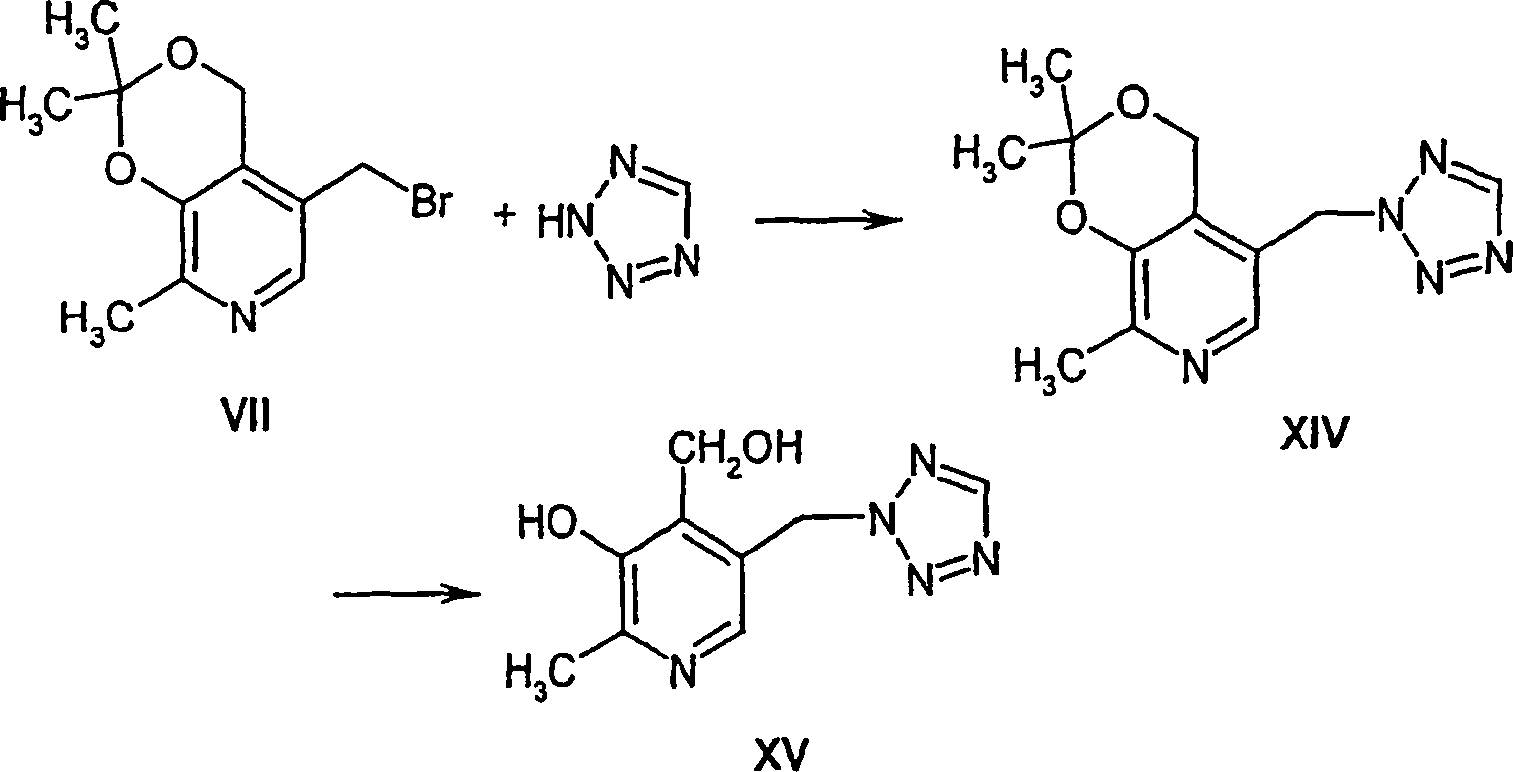
Eine
Mischung aus Tetrazol (94,2 mg, 1,29 mmol) und pulverisiertem wasserfreiem
Kaliumcarbonat (1,5 g) in wasserfreiem Acetonitril (10 ml) wurde
bei 0°C
15 Minuten lang gerührt.
Dann wurde das Reaktionsgemisch mit dem Bromid VII (q = 1) (350
mg, 1,29 mmol) in wasserfreiem Acetonitril (3 ml) versetzt und die nächsten 30
Minuten lang bei 0°C
gehalten. Die Routineaufarbeitung lieferte das Rohprodukt. Die Reinigung des
Rohgemisches mittels Chromatographie auf Silicagel ergab das gewünschte Produkt
XIV in beträchtlicher Ausbeute.
1H NMR (CDCl3, TMS): δ 1,53 (6H,
s), 2,42 (3H, s), 4,91 (2H, s), 5,66 (2H, s), 8,14 (1H, s), 8,50
(1H, s, Tetrazol-H).A mixture of tetrazole (94.2 mg, 1.29 mmol) and powdered anhydrous potassium carbonate (1.5 g) in anhydrous acetonitrile (10 ml) was stirred at 0 ° C for 15 minutes. Then the reaction mixture was added with bromide VII (q = 1) (350 mg, 1.29 mmol) in anhydrous acetonitrile (3 mL) and kept at 0 ° C for the next 30 minutes. The routine workup provided the crude product. Purification of the crude mixture by chromatography on silica gel gave the desired product XIV in substantial yield.
1 H NMR (CDCl 3, TMS): δ 1.53 (6H, s), 2.42 (3H, s), 4.91 (2H, s), 5.66 (2H, s), 8.14 (1H, s), 8.50 (1H, s, tetrazole-H).
Das
gereinigte Derivat XIV (100 mg, 0,4 mmol) wurde in 80% wässriger
Essigsäure
(10 ml) gelöst
und bei 60°C
1 Stunde lang erwärmt.
Die Reinigung mittels Chromatographie auf einer Silicagelsäule lieferte
5-Tetrazolpyridoxin XV in guter Ausbeute.
1H
NMR (CD3OD, TMS): δ 2,43 (3H, s), 4,89 (2H, s),
5,77 (2H, s), 7,91 (1H, s), 9,17 (1H, s, Tetrazol-H).The purified derivative XIV (100 mg, 0.4 mmol) was dissolved in 80% aqueous acetic acid (10 ml) and heated at 60 ° C for 1 hour. Purification by chromatography on a silica gel column gave 5-tetrazolopyridoxine XV in good yield.
1 H NMR (CD 3 OD, TMS): δ 2.43 (3H, s), 4.89 (2H, s), 5.77 (2H, s), 7.91 (1H, s), 9, 17 (1H, s, tetrazole-H).
Beispiel 4Example 4
Synthese
des tetrazol-substituierten Pyridoxinanalogs der Formel XVII 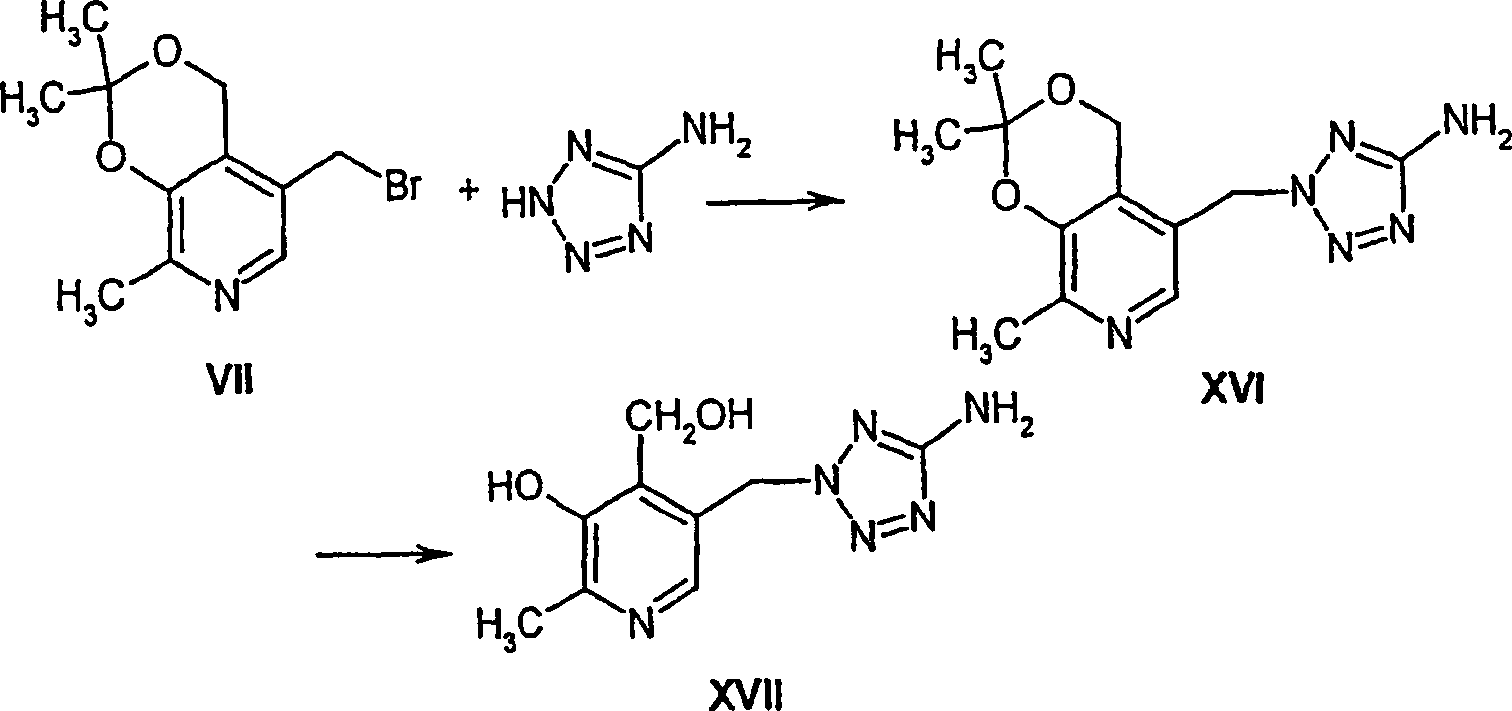
Eine
Mischung aus Aminotetrazol (110,2 mg, 1,30 mmol) und pulverisiertem
wasserfreiem Kaliumcarbonat (1,5 g) in wasserfreiem Acetonitril
(10 ml) wurde bei 0°C
15 Minuten lang gerührt.
Dann wurde das Reaktionsgemisch mit dem Bromid VII (q = 1) (360
mg, 1,30 mmol) in wasserfreiem Acetonitril (3 ml) versetzt und die
nächsten
30 Minuten lang bei 0°C
gehalten. Die Routineaufarbeitung lieferte das Rohprodukt. Die Reinigung
des Rohgemisches mittels Chromatographie auf einer Silicagelsäule ergab
das gewünschte
Produkt XVI in beträchtlicher
Ausbeute.
1H NMR (CD3OD,
TMS): δ 1,52
(6H, s), 2,36 (3H, s), 4,96 (2H, s), 5,56 (2H, s), 7,96 (1H, s).A mixture of aminotetrazole (110.2 mg, 1.30 mmol) and powdered anhydrous potassium carbonate (1.5 g) in anhydrous acetonitrile (10 ml) was stirred at 0 ° C for 15 minutes. Then the reaction mixture was treated with bromide VII (q = 1) (360 mg, 1.30 mmol) in anhydrous acetonitrile (3 ml) and kept at 0 ° C for the next 30 minutes. The routine workup provided the crude product. Purification of the crude mixture by chromatography on a silica gel column gave the desired product XVI in substantial yield.
1 H NMR (CD 3 OD, TMS): δ 1.52 (6H, s), 2.36 (3H, s), 4.96 (2H, s), 5.56 (2H, s), 7, 96 (1H, s).
Das
gereinigte Derivat XVI (100 mg, 0,37 mmol) wurde in 80% wässriger
Essigsäure
(10 ml) gelöst und
bei 60°C
1 Stunde lang erwärmt.
Die Reinigung mittels Chromatographie auf Silicagel lieferte 5-Tetrazolpyridoxin
XVII in guter Ausbeute.
1H NMR (CD3OD, TMS): δ 2,42 (3H, s), 4,94 (2H, s),
5,66 (2H, s), 7,91 (1H, s), 7,87 (1H, s).The purified derivative XVI (100 mg, 0.37 mmol) was dissolved in 80% aqueous acetic acid (10 ml) and heated at 60 ° C for 1 h. Purification by chromatography on silica gel gave 5-tetrazolopyridoxine XVII in good yield.
1 H NMR (CD 3 OD, TMS): δ 2.42 (3H, s), 4.94 (2H, s), 5.66 (2H, s), 7.91 (1H, s), 7, 87 (1H, s).
Beispiel 5example 5
Synthese
des triazol-substituierten Pyridoxinanalogs der Formel XIXa 
Eine
Mischung aus Triazol (136 mg, 2,00 mmol) und pulverisiertem wasserfreiem
Kaliumcarbonat (2,5 g) in wasserfreiem Acetonitril (20 ml) wurde
bei 0°C
15 Minuten lang gerührt.
Dann wurde das Reaktionsgemisch mit dem Bromid VII (q = 1) (720
mg, 2,00 mmol) in wasserfreiem Acetoni-tril (5 ml) versetzt und
die nächsten
30 Minuten lang bei 0°C
gehalten. Die Routineaufarbeitung lieferte das Rohprodukt. Die Reinigung des
Rohgemisches mittels Chromatographie auf einer Silicagelsäule ergab
das gewünschte
Produkt XVIIIa in beträchtlicher
Ausbeute.
1H NMR (CDCl3,
TMS): δ 1,53
(6H, s), 2,42 (3H, s), 4,80 (2H, s), 5,24 (2H, s), 7,94 (1H, s,
Triazol-H), 7,99 (1H, s, Triazol-H), 8,15 (1H, s).A mixture of triazole (136 mg, 2.00 mmol) and powdered anhydrous potassium carbonate (2.5 g) in anhydrous acetonitrile (20 ml) was stirred at 0 ° C for 15 minutes. Then the reaction mixture was added with bromide VII (q = 1) (720 mg, 2.00 mmol) in anhydrous acetonitrile (5 mL) and kept at 0 ° C for the next 30 minutes. The routine workup provided the crude product. Purification of the crude mixture by chromatography on a silica gel column gave the desired product XVIIIa in considerable yield.
1 H NMR (CDCl 3, TMS): δ 1.53 (6H, s), 2.42 (3H, s), 4.80 (2H, s), 5.24 (2H, s), 7.94 (1H, s, triazole-H), 7.99 (1H, s, triazole-H), 8.15 (1H, s).
Das
gereinigte Derivat XVIIIa (100 mg, 0,35 mmol) wurde in 80% wässriger
Essigsäure
(10 ml) gelöst und
bei 60°C
erwärmt.
Die Reinigung mittels Chromatographie auf einer Silicagelsäule lieferte
5-Triazolpyridoxin XIXa in guter Ausbeute.
1H
NMR (CD3OD, TMS): δ 2,42 (3H, s), 4,91 (2H, s),
5,50 (2H, s), 7,82 (1H, s, Triazol-H), 7,97 (1H, s, Triazol-H), 8,52 (1H,
s).The purified derivative XVIIIa (100 mg, 0.35 mmol) was dissolved in 80% aqueous acetic acid (10 ml) and heated at 60 ° C. Purification by chromatography on a silica gel column gave 5-triazole pyridoxine XIXa in good yield.
1 H NMR (CD 3 OD, TMS): δ 2.42 (3H, s), 4.91 (2H, s), 5.50 (2H, s), 7.82 (1H, s, triazole-H ), 7.97 (1H, s, triazole-H), 8.52 (1H, s).
Beispiel 6Example 6
Synthese des triazol-substituierten Pyridoxalanalogs der Formel XXaSynthesis of the triazole-substituted pyridoxal analog the formula XXa
Entsprechend
Schema 8 wurde 5-Triazolpyridoxin XIXa (100 mg, 0,42 mmol) in wasserfreiem
Toluol (10 ml) gelöst.
Der Lösung
wurde aktiviertes Mangandioxid (243 mg, 2,76 mmol) zugesetzt und
das Reaktionsgemisch bei 40°C
2 Stunden lang erwärmt,
um eine vollständige
Oxidation zu gewährleisten.
Die Filtration des Katalysators und die anschließende Verdampfung des Lösungsmittels
lieferten den Rohrückstand,
der mittels Chromatographie auf Silicagel leicht gereinigt wurde,
so dass das gewünschte
Aldehyd XXa in einer Ausbeute von 70% entstand.
1H
NMR (CD3OD, TMS): δ 2,70 (3H, s), 6,00 (2H, s),
6,28 (2H, s), 8,41 (1H, s, Triazol-H), 8,85 (1H, s, Triazol-H), 9,85 (1H,
s).According to Scheme 8, 5-triazole pyridoxine XIXa (100 mg, 0.42 mmol) was dissolved in anhydrous toluene (10 mL). To the solution was added activated manganese dioxide (243 mg, 2.76 mmol) and the reaction mixture was heated at 40 ° C for 2 hours to ensure complete oxidation. Filtration of the catalyst and subsequent evaporation of the solvent yielded the crude residue, which was readily purified by chromatography on silica gel to give the desired aldehyde XXa in 70% yield.
1 H NMR (CD 3 OD, TMS): δ 2.70 (3H, s), 6.00 (2H, s), 6.28 (2H, s), 8.41 (1H, s, triazole-H ), 8.85 (1H, s, triazole-H), 9.85 (1H, s).
Beispiel 7Example 7
Synthese des triazol-substituierten Pyridoxinanalogs der Formel XIXbSynthesis of the triazole-substituted pyridoxine analog of the formula XIXb
Entsprechend
Schema 8 wurde eine Mischung aus 3-Aminotriazol (142 mg, 2,00 mmol)
und pulverisiertem wasserfreiem Kaliumcarbonat (2,5 g) in wasserfreiem
Acetonitril (20 ml) 15 Minuten lang bei 0°C gerührt. Dann wurde das Reaktionsgemisch
mit dem Bromid VII (q = 1) (720 mg, 2,00 mmol) in wasserfreiem Acetonitril
(5 ml) versetzt und die nächsten
30 Minuten lang bei 0°C
gehalten. Die Routineaufarbeitung lieferte das Rohprodukt. Die Reinigung
des Rohgemisches mittels Chromatographie auf Silicagel ergab das
gewünschte
Produkt XVIIIb in beträchtlicher
Ausbeute.
1H NMR (CD3OD,
TMS): δ 1,57
(6H, s), 2,36 (3H, s), 4,84 (2H, s), 4,99 (2H, s), 7,84 (1H, s,
Triazol-H), 8,13 (1H, s).According to Scheme 8, a mixture of 3-aminotriazole (142 mg, 2.00 mmol) and powdered anhydrous potassium carbonate (2.5 g) in anhydrous acetonitrile (20 ml) was stirred at 0 ° C for 15 minutes. Then, the reaction mixture was added with bromide VII (q = 1) (720 mg, 2.00 mmol) in anhydrous acetonitrile (5 mL) and kept at 0 ° C for the next 30 minutes. The routine workup provided the crude product. Purification of the crude mixture by chromatography on silica gel gave the desired product XVIIIb in substantial yield.
1 H NMR (CD 3 OD, TMS): δ 1.57 (6H, s), 2.36 (3H, s), 4.84 (2H, s), 4.99 (2H, s), 7, 84 (1H, s, triazole-H), 8,13 (1H, s).
Das
gereinigte Derivat XVIIIb (100 mg, 0,35 mmol) wurde in 80% wässriger
Essigsäure
(10 ml) gelöst und
bei 60°C
1 Stunde lang erwärmt.
Die Reinigung mittels Chromatographie auf Silicagel lieferte 3-Aminotriazolpyridoxin
XIXb in guter Ausbeute.
1H NMR (DMSO-d6, TMS): δ 2,34
(3H, s), 4,72 (2H, s), 5,17 (2H, s), 7,79 (1H, s, Triazol-H), 8,03 (1H, s).The purified derivative XVIIIb (100 mg, 0.35 mmol) was dissolved in 80% aqueous acetic acid (10 ml) and heated at 60 ° C for 1 hour. Purification by chromatography on silica gel gave 3-aminotriazole pyridoxine XIXb in good yield.
1 H NMR (DMSO-d 6 , TMS): δ 2.34 (3H, s), 4.72 (2H, s), 5.17 (2H, s), 7.79 (1H, s, triazole). H), 8.03 (1H, s).
Beispiel 8Example 8
Synthese des triazol-substituierten Pyridoxinanalogs der Formel XIXcSynthesis of the triazole-substituted pyridoxine analog of the formula XIXc
Entsprechend
Schema 8 wurde eine Mischung aus 5-Aminotriazol (142 mg, 2,00 mmol)
und pulverisiertem wasserfreiem Kaliumcarbonat (2,5 g) in wasserfreiem
Acetonitril (20 ml) 15 Minuten lang bei 0°C gerührt. Dann wurde das Reaktionsgemisch
mit dem Bromid VII (q = 1) (720 mg, 2,00 mmol) in wasserfreiem Acetonitril
(5 ml) versetzt und die nächsten
30 Minuten lang bei 0°C
gehalten. Die Routineaufarbeitung lieferte das Rohprodukt. Die Reinigung
des Rohgemisches mittels Chromatographie auf Silicagel ergab das
gewünschte
Produkt XVIIIc in beträchtlicher
Ausbeute.
1H NMR (CD3OD,
TMS): δ 1,53
(6H, s), 2,36 (3H, s), 4,84 (2H, s), 5,04 (2H, s), 7,46 (1H, s,
Triazol-H), 7,68 (1H, s).According to Scheme 8, a mixture of 5-aminotriazole (142 mg, 2.00 mmol) and powdered anhydrous potassium carbonate (2.5 g) in anhydrous acetonitrile (20 ml) was stirred at 0 ° C for 15 minutes. Then, the reaction mixture was added with bromide VII (q = 1) (720 mg, 2.00 mmol) in anhydrous acetonitrile (5 mL) and kept at 0 ° C for the next 30 minutes. The routine workup provided the crude product. Purification of the crude mixture by chromatography on silica gel gave the desired product XVIIIc in substantial yield.
1 H NMR (CD 3 OD, TMS): δ 1.53 (6H, s), 2.36 (3H, s), 4.84 (2H, s), 5.04 (2H, s), 7, 46 (1H, s, triazole-H), 7.68 (1H, s).
Das
gereinigte Derivat XVIIIc (100 mg, 0,35 mmol) wurde in 80% wässriger
Essigsäure
(10 ml) gelöst und
bei 60°C
1 Stunde lang erwärmt.
Die Reinigung mittels Chromatographie auf Silicagel lieferte 3-Aminotriazolpyridoxin
XIXc in guter Ausbeute.
1H NMR (DMSO-d6, TMS): δ 2,32
(3H, s), 4,75 (2H, s), 5,11 (2H, s), 7,35 (1H, s, Triazol-H), 7,58 (1H, s).The purified derivative XVIIIc (100 mg, 0.35 mmol) was dissolved in 80% aqueous acetic acid (10 mL) and heated at 60 ° C for 1 h. Purification by chromatography on silica gel gave 3-aminotriazole pyridoxine XIXc in good yield.
1 H NMR (DMSO-d 6 , TMS): δ 2.32 (3H, s), 4.75 (2H, s), 5.11 (2H, s), 7.35 (1H, s, triazole). H), 7.58 (1H, s).
Beispiel 9Example 9
Synthese
des imidazol-substituierten Pyridoxinanalogs der Formel XXIIa 
Eine
Mischung aus 2-Methylimidazol (164 mg, 2,00 mmol) und pulverisiertem
wasserfreiem Kaliumcarbonat (2,5 g) in wasserfreiem Acetonitril
(20 ml) wurde 15 Minuten lang bei 0°C gerührt. Dann wurde das Reaktionsgemisch
mit dem Bromid VII (q = 1) (720 mg, 2,00 mmol) in wasserfreiem Acetonitril
(5 ml) versetzt und die nächsten
30 Minuten lang bei 0°C
gehalten. Die Routineaufarbeitung lieferte das Rohprodukt. Die Reinigung
des Rohgemisches mittels Chromato-graphie auf Silicagel ergab das
gewünschte
Produkt XXIa in beträchtlicher
Ausbeute.
1H NMR (CDCl3,
TMS): δ 1,51
(6H, s), 2,40 (3H, s), 2,42 (3H, s, Imidazol-CH3),
4,50 (2H, s), 4,88 (2H, s), 6,65 (1H, s, Imidazol-H), 6,93 (1H,
s, Imidazol-H), 7,82 (1H, s).A mixture of 2-methylimidazole (164 mg, 2.00 mmol) and powdered anhydrous potassium carbonate (2.5 g) in anhydrous acetonitrile (20 ml) was stirred at 0 ° C for 15 minutes. Then, the reaction mixture was added with bromide VII (q = 1) (720 mg, 2.00 mmol) in anhydrous acetonitrile (5 mL) and kept at 0 ° C for the next 30 minutes. The routine workup provided the crude product. Purification of the crude mixture by chromatography on silica gel gave the desired product XXIa in considerable yield.
1 H NMR (CDCl 3 , TMS): δ 1.51 (6H, s), 2.40 (3H, s), 2.42 (3H, s, imidazole-CH 3 ), 4.50 (2H, s ), 4.88 (2H, s), 6.65 (1H, s, imidazole-H), 6.93 (1H, s, imidazole-H), 7.82 (1H, s).
Das
gereinigte Derivat XXIa (100 mg, 0,35 mmol) wurde in 80% wässriger
Essigsäure
(10 ml) gelöst und
bei 60°C
1 Stunde lang erwärmt.
Die Reinigung mittels Chromatographie auf Silicagel lieferte 2-Methylimidazolpyridoxin
XXIIa in guter Ausbeute.
1H NMR (DMSO-d6, TMS): δ 2,40
(3H, s), 2,21 (3H, s, Imidazol-CH3), 5,11
(2H, s), 5,20 (2H, s), 6,77 (1H, s, Imidazol-H), 6,92 (1H, s, Imidazol-H),
(2H, s), 7,47 (1H, s).The purified derivative XXIa (100 mg, 0.35 mmol) was dissolved in 80% aqueous acetic acid (10 mL) and heated at 60 ° C for 1 h. Purification by chromatography on silica gel gave 2-methylimidazole pyridoxine XXIIa in good yield.
1 H NMR (DMSO-d 6 , TMS): δ 2.40 (3H, s), 2.21 (3H, s, imidazole-CH 3 ), 5.11 (2H, s), 5.20 (2H , s), 6.77 (1H, s, imidazole-H), 6.92 (1H, s, imidazole-H), (2H, s), 7.47 (1H, s).
Beispiel 10Example 10
Synthese des imidazol-substituierten Pyridoxinanalogs der Formel XXIIbSynthesis of the imidazole-substituted pyridoxine analogue of formula XXIIb
Entsprechend
Schema 9 wurde eine Mischung aus 4-Methylimidazol (164 mg, 2,00
mmol) und pulverisiertem wasserfreiem Kaliumcarbonat (2,5 g) in
wasserfreiem Acetonitril (20 ml) 15 Minuten lang bei 0°C gerührt. Dann
wurde das Reaktionsgemisch mit dem Bromid VII (q = 1) (720 mg, 2,00
mmol) in wasserfreiem Acetonitril (5 ml) versetzt und die nächsten 30
Minuten lang bei 0°C
gehalten. Die Routineaufarbeitung lieferte das Rohprodukt. Die Reinigung
des Rohgemisches mittels Chromatographie auf Silicagel ergab das
gewünschte
Produkt XXIb in beträchtlicher
Ausbeute.
1H NMR (CDCl3,
TMS): δ 1,50
(6H, s), 2,43 (3H, s), 2,20 (3H, s, Imidazol-CH3),
4,54 (2H, s), 4,92 (2H, s), 6,52 (1H, s, Imidazol-H), 7,42 (1H,
s, Imidazol-H), 7,94 (1H, s).According to Scheme 9, a mixture of 4-methylimidazole (164 mg, 2.00 mmol) and powdered anhydrous potassium carbonate (2.5 g) in anhydrous acetonitrile (20 mL) was stirred at 0 ° C for 15 minutes. Then, the reaction mixture was added with bromide VII (q = 1) (720 mg, 2.00 mmol) in anhydrous acetonitrile (5 mL) and kept at 0 ° C for the next 30 minutes. The routine workup provided the crude product. Purification of the crude mixture by chromatography on silica gel gave the desired product XXIb in substantial yield.
1 H NMR (CDCl 3 , TMS): δ 1.50 (6H, s), 2.43 (3H, s), 2.20 (3H, s, imidazole-CH 3 ), 4.54 (2H, s ), 4.92 (2H, s), 6.52 (1H, s, imidazole-H), 7.42 (1H, s, imidazole-H), 7.94 (1H, s).
Das
gereinigte Derivat XXIb (100 mg, 0,35 mmol) wurde in 80% wässriger
Essigsäure
(10 ml) gelöst und
bei 60°C
1 Stunde lang erwärmt.
Die Reinigung mittels Chromatographie auf Silicagel lieferte 4-Methylimidazolpyridoxin
XXIIb in guter Ausbeute.
1H NMR (CDCl3, TMS): δ 2,20
(3H, s, Imidazol-CH3), 2,46 (3H, s), 4,72
(2H, s), 4,90 (2H, s), 6,48 (1H, s, Imidazol-H), 7,24 (1H, s, Imidazol-H),
7,84 (1H, s).The purified derivative XXIb (100 mg, 0.35 mmol) was dissolved in 80% aqueous acetic acid (10 ml) and heated at 60 ° C for 1 hour. Purification by chromatography on silica gel gave 4-methylimidazole pyridoxine XXIIb in good yield.
1 H NMR (CDCl 3, TMS): δ 2.20 (3H, s, imidazole-CH3), 2.46 (3H, s), 4.72 (2H, s), 4.90 (2H, s ), 6.48 (1H, s, imidazole-H), 7.24 (1H, s, imidazole-H), 7.84 (1H, s).
Beispiel 11Example 11
Synthese des imidazol-substituierten Pyridoxinanalogs der Formel XXIIcSynthesis of the imidazole-substituted pyridoxine analogue of formula XXIIc
Entsprechend
Schema 9 wurde eine Mischung aus 4-Nitroimidazol (172 mg, 2,00 mmol)
und pulverisiertem wasserfreiem Kaliumcarbonat (2,5 g) in wasserfreiem
Acetonitril (20 ml) 15 Minuten lang bei 0°C gerührt. Dann wurde das Reaktionsgemisch
mit dem Bromid VII (q = 1) (720 mg, 2,00 mmol) in wasserfreiem Acetonitril
(5 ml) versetzt und die nächsten
30 Minuten lang bei 0°C
gehalten. Die Routineaufarbeitung lieferte das Rohprodukt. Die Reinigung
des Rohgemisches mittels Chromatographie auf Silicagel ergab das
gewünschte
Produkt XXIc in beträchtlicher
Ausbeute.
1H NMR (CDCl3,
TMS): δ 1,52
(6H, s), 2,42 (3H, s), 4,60 (2H, s), 5,09 (2H, s), 7,46 (1H, s,
Imidazol-H), 7,69 (1H, s, Imidazol-H), 8,01 (1H, s).According to Scheme 9, a mixture of 4-nitroimidazole (172 mg, 2.00 mmol) and powdered anhydrous potassium carbonate (2.5 g) in anhydrous acetonitrile (20 ml) was stirred at 0 ° C for 15 minutes. Then, the reaction mixture was added with bromide VII (q = 1) (720 mg, 2.00 mmol) in anhydrous acetonitrile (5 mL) and kept at 0 ° C for the next 30 minutes. The routine workup provided the crude product. Purification of the crude mixture by chromatography on silica gel gave the desired product XXIc in substantial yield.
1 H NMR (CDCl 3, TMS): δ 1.52 (6H, s), 2.42 (3H, s), 4.60 (2H, s), 5.09 (2H, s), 7.46 (1H, s, imidazole-H), 7.69 (1H, s, imidazole-H), 8.01 (1H, s).
Das
gereinigte Derivat XXIc (110 mg, 0,35 mmol) wurde in 80% wässriger
Essigsäure
(10 ml) gelöst und
bei 60°C
1 Stunde lang erwärmt.
Die Reinigung mittels Chromatographie auf Silicagel lieferte 4-Nitroimidazolpyridoxin
XXIIc in guter Ausbeute.
1H NMR (DMSO-d6, TMS): δ 2,42
(3H, s), 4,74 (2H, s), 5,35 (2H, s), 7,77 (1H, s, Imidazol-H), 7,95
(1H, s), 8,14 (1H, s, Imidazol-H).The purified derivative XXIc (110 mg, 0.35 mmol) was dissolved in 80% aqueous acetic acid (10 mL) and heated at 60 ° C for 1 h. Purification by chromatography on silica gel gave 4-nitroimidazole pyridoxine XXIIc in good yield.
1 H NMR (DMSO-d 6 , TMS): δ 2.42 (3H, s), 4.74 (2H, s), 5.35 (2H, s), 7.77 (1H, s, imidazole). H), 7.95 (1H, s), 8.14 (1H, s, imidazole-H).
Beispiel 12Example 12
Synthese des imidazol-substituierten Pyridoxinanalogs der Formel XXIIdSynthesis of the imidazole-substituted pyridoxine analogue of formula XXIId
Entsprechend
Schema 9 wurde eine Mischung aus 2-Aminoimidazol (132 mg, 2,00 mmol)
und pulverisiertem wasserfreiem Kaliumcarbonat (2,5 g) in wasserfreiem
Acetonitril (20 ml) 15 Minuten lang bei 0°C gerührt. Dann wurde das Reaktionsgemisch
mit dem Bromid VII (q = 1) (720 mg, 2,00 mmol) in wasserfreiem Acetonitril
(5 ml) versetzt und die nächsten
30 Minuten lang bei 0°C
gehalten. Die Routineaufarbeitung lieferte das Rohprodukt. Die Reinigung
des Rohgemisches mittels Chromatographie auf Silicagel ergab das
gewünschte
Produkt XXId in beträchtlicher
Ausbeute.
1H NMR (CD3OD,
TMS): δ 1,52
(6H, s), 2,35 (3H, s), 4,68 (2H, s), 4,88 (2H, s), 6,44 (1H, s,
Imidazol-H), 6,53 (1H, s, Imidazol-H), 7,64 (1H, s).According to Scheme 9, a mixture of 2-aminoimidazole (132 mg, 2.00 mmol) and powdered anhydrous potassium carbonate (2.5 g) in anhydrous acetonitrile (20 ml) was stirred at 0 ° C for 15 minutes. Then, the reaction mixture was added with bromide VII (q = 1) (720 mg, 2.00 mmol) in anhydrous acetonitrile (5 mL) and kept at 0 ° C for the next 30 minutes. The routine workup provided the crude product. Purification of the crude mixture by chromatography on silica gel gave the desired product XXId in considerable yield.
1 H NMR (CD 3 OD, TMS): δ 1.52 (6H, s), 2.35 (3H, s), 4.68 (2H, s), 4.88 (2H, s), 6, 44 (1H, s, imidazole-H), 6,53 (1H, s, imidazole-H), 7,64 (1H, s).
Das
gereinigte Derivat XXId (106 mg, 0,35 mmol) wurde in 80% wässriger
Essigsäure
(10 ml) gelöst und
bei 60°C
1 Stunde lang erwärmt.
Die Reinigung mittels Chromatographie auf Silicagel lieferte 2-Aminoimidazolpyridoxin
XXIId in guter Ausbeute.
1H NMR (CD3OD, TMS): δ 2,15 (3H, s), 4,55 (2H, s),
4,75 (2H, s), 6,24 (1H, s, Imidazol-H), 6,32 (1H, s, Imidazol-H), 7,23 (1H,
s).The purified derivative XXId (106 mg, 0.35 mmol) was dissolved in 80% aqueous acetic acid (10 mL) and heated at 60 ° C for 1 h. Purification by chromatography on silica gel gave 2-aminoimidazole pyridoxine XXIId in good yield.
1 H NMR (CD 3 OD, TMS): δ 2.15 (3H, s), 4.55 (2H, s), 4.75 (2H, s), 6.24 (1H, s, imidazole-H ), 6.32 (1H, s, imidazole-H), 7.23 (1H, s).
Beispiel 13example 13
Synthese
des guanidin-substituierten Pyridoxinanalogs der Formel XXV 
Eine
Lösung
des 5-Aminopyridoxinderivats X (t = 1) (90 mg, 0,43 mmol) in wasserfreiem
Di-chlormethan (5 ml) wurde mit einer Lösung eines mit Triflat behandelten
BOC-Guanidinderivats
(153,6 mg, 0,39 mmol) in wasserfreiem Dichlormethan (5 ml) und wasserfreiem
Triethylamin (60 μl)
versetzt. Diese Lösung
wurde 1 Stunde lang bei Raumtemperatur gerührt. Das Reaktionsge-misch
wurde mit 2M Natriumbisulfit (10 ml) und anschließend gesättigter
wässriger
NaHCO3 gewaschen. Das Verdampfen des Dichlormethans
hinterließ einen
Rückstand,
der mittels Chromatographie auf Silicagel gereinigt wurde, so dass
das Guanidinderivat XXIII in beträchtlicher Ausbeute entstand.
1H NMR (CD2Cl2, TMS): δ 1,46
(9H, s), 1,48 (9H, s), 1,54 (6H, s), 4,40 (2H, s), 4,88 (2H, s),
7,95 (1H, s), 8,43 (NH, s), 11,48 (NH, s).A solution of the 5-aminopyridoxine derivative X (t = 1) (90 mg, 0.43 mmol) in anhydrous di-chloromethane (5 ml) was treated with a solution of a triflate-treated BOC guanidine derivative (153.6 mg, 0.39 mmol) in anhydrous dichloromethane (5 ml) and anhydrous triethylamine (60 μl). This solution was stirred for 1 hour at room temperature. The reaction mixture was washed with 2M sodium bisulfite (10 ml) followed by saturated aqueous NaHCO 3 . Evaporation of the dichloromethane left a residue which was purified by chromatography on silica gel to give the guanidine derivative XXIII in substantial yield.
1 H NMR (CD 2 Cl 2 , TMS): δ 1.46 (9H, s), 1.48 (9H, s), 1.54 (6H, s), 4.40 (2H, s), 4 , 88 (2H, s), 7.95 (1H, s), 8.43 (NH, s), 11.48 (NH, s).
Das
gereinigte Derivat XXIII (100 mg, 0,36 mmol) wurde in 20% wässriger
Trifluoressigsäure
in wasserfreiem Dichlormethan (10 ml) gelöst und bei Raumtemperatur 1
Stunde lang gerührt.
Die Reinigung des Reaktionsgemisches lieferte die beiden Produkte
XXIV und XXV.
1H NMR (XXIV) (MeOD,
TMS): δ 1,64
(6H, s), 2,63 (3H, s), 4,55 (2H, s), 5,10 (2H, s), 7,52 (1H, m),
8,13 (1H, s).
1H NMR (XXV) (DMSO-d6, TMS): δ 2,54
(3H, s), 3,96 (1H, s), 4,54 (2H, d), 4,81 (2H, s), 5,96 (1H, br
s, NH), 7,44 (3H, br, NH), 8,07 (1H, s).The purified derivative XXIII (100 mg, 0.36 mmol) was dissolved in 20% aqueous trifluoroacetic acid in anhydrous dichloromethane (10 ml) and stirred at room temperature for 1 h. Purification of the reaction mixture provided the two products XXIV and XXV.
1 H NMR (XXIV) (MeOD, TMS): δ 1.64 (6H, s), 2.63 (3H, s), 4.55 (2H, s), 5.10 (2H, s), 7 , 52 (1H, m), 8,13 (1H, s).
1 H NMR (XXV) (DMSO-d 6 , TMS): δ 2.54 (3H, s), 3.96 (1H, s), 4.54 (2H, d), 4.81 (2H, s ), 5.96 (1H, br s, NH), 7.44 (3H, br, NH), 8.07 (1H, s).
Beispiel 14Example 14
Synthese
des aminotriazol-substituierten Pyridoxalanalogs der Formel XXVIII 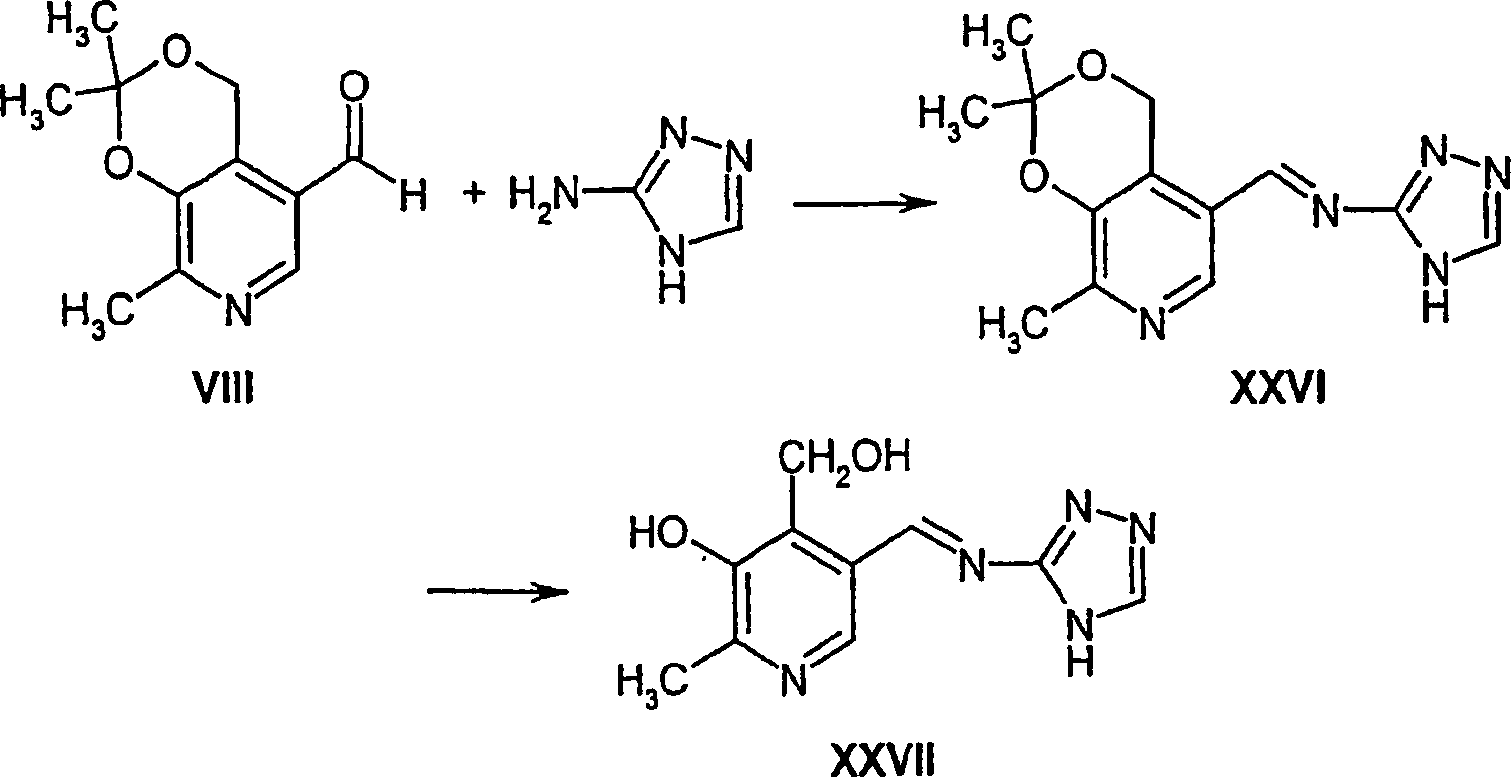
Das
Pyridoxalderivat VIII (r = 0) (400 mg, 1,91 mmol) und 3-Aminotriazol
(178 mg, 2,12 mmol) in wasserfreiem Toluol (20 ml) wurden in einem
dreihalsigen Kolben mit einem Kondensator und einer Dean-Stark-Falle
bei 100°C
24 Stunden lang erwärmt.
Die Routineaufarbeitung lieferte das Rohprodukt, das mittels Chromatographie
auf Silicagel gereinigt wurde, so dass das geschützte Triazolinderivat XVI in
mäßiger Ausbeute
entstand.
1H NMR (CD3OD,
TMS): δ 1,58
(6H, s), 2,46 (3H, s), 3,31 (1H, s), 5,31 (2H, s), 8,41 (1H, s),
9,23 (1H, s, Triazolin-CH).The pyridoxal derivative VIII (r = 0) (400 mg, 1.91 mmol) and 3-aminotriazole (178 mg, 2.12 mmol) in anhydrous toluene (20 mL) were placed in a three-necked flask with a condenser and a Dean-Stark Trap heated at 100 ° C for 24 hours. The routine workup provided the crude product, which was purified by chromatography on silica gel to give the protected triazoline derivative XVI in moderate yield.
1 H NMR (CD 3 OD, TMS): δ 1.58 (6H, s), 2.46 (3H, s), 3.31 (1H, s), 5.31 (2H, s), 8, 41 (1H, s), 9,23 (1H, s, triazoline-CH).
Das
vollständig
geschützte
Pyridoxinderivat XXVI (206 mg, 0,88 mmol) wurde in 80% wässriger
Essigsäure
(10 ml) gelöst
und bei 60°C
1 Stunde lang erwärmt.
Die Reinigung mittels Chromato-graphie auf Silicagel lieferte das
triazolin-substituierte Pyridoxin XXVII in guter Ausbeute.
1H NMR (CD3OD, TMS): δ 2,46 (3H,
s), 5,10 (2H, m), 6,78 (2H, s, Triazolin-CH), 7,92 (1H, s).The fully protected pyridoxine derivative XXVI (206 mg, 0.88 mmol) was dissolved in 80% aqueous acetic acid (10 ml) and heated at 60 ° C for 1 h. Chromatography on silica gel afforded the triazoline-substituted pyridoxine XXVII in good yield.
1 H NMR (CD 3 OD, TMS): δ 2.46 (3H, s), 5.10 (2H, m), 6.78 (2H, s, triazoline-CH), 7.92 (1H, s ).
Beispiel 15Example 15
Synthese
des imidazol-substituierten Pyridoxinanalogs der Formel XXIX 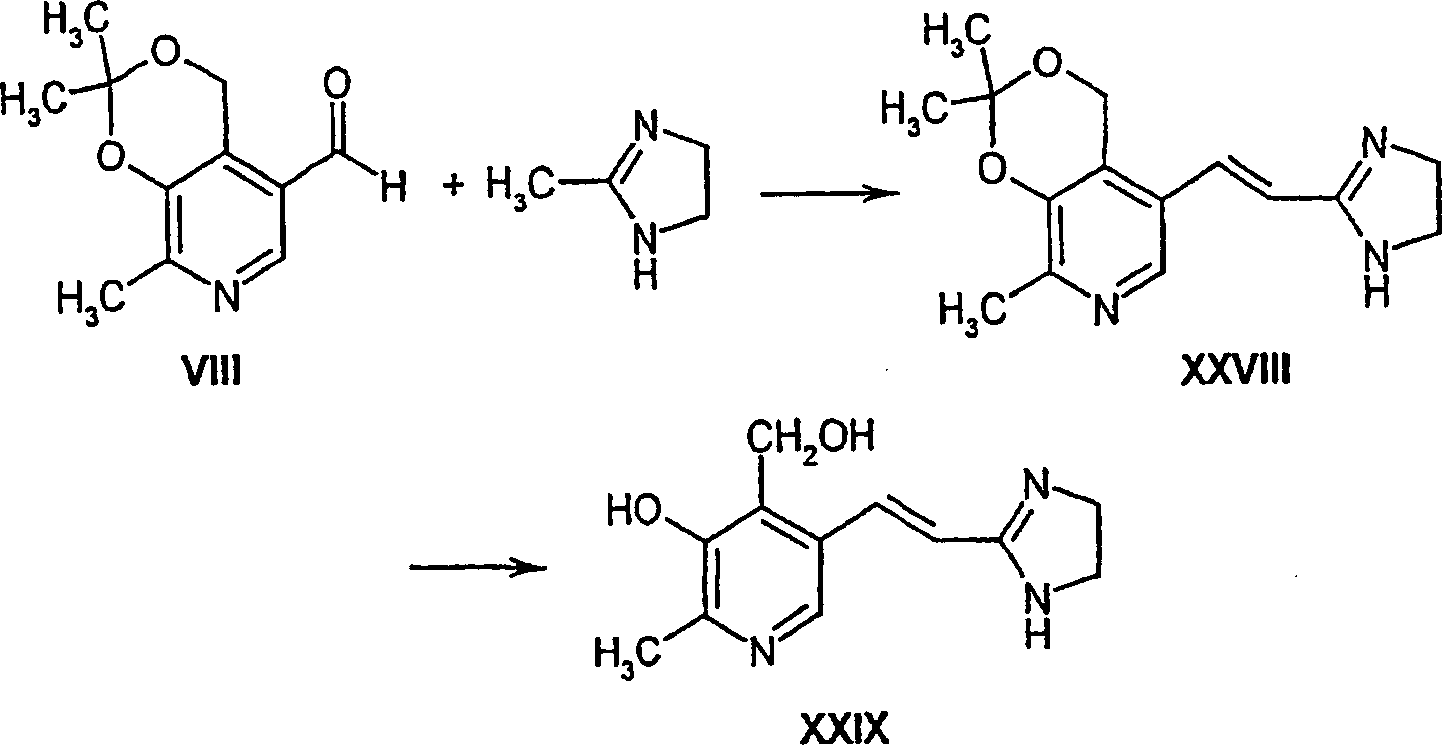
Das
Pyridoxalderivat VIII (r = 0) (2,07 g, 10,00 mmol) und 2-Methylimidazol
(1,68 g, 20,00 mmol) in wasserfreiem Toluol (50 ml) wurden in einem
dreihalsigen Kolben mit einem Kondensator und einer Dean-Stark-Falle
bei 100°C
24 Stunden lang erwärmt.
Die Routineaufarbeitung lieferte das Rohprodukt, das mittels Chromatographie
auf Silicagel gereinigt wurde, so dass das geschützte Imidazolinderivat XXVIII
in mäßiger Ausbeute
entstand.
1H NMR (CD3OD,
TMS): δ 1,56
(6H, s), 2,38 (3H, s), 3,76 (4H, s), 4,98 (2H, s), 6,63 (1H, s,
Vinyl-CH), 7,26 (1H, s, Vinyl-CH), 8,20 (1H, s).The pyridoxal derivative VIII (r = 0) (2.07 g, 10.00 mmol) and 2-methylimidazole (1.68 g, 20.00 mmol) in anhydrous toluene (50 mL) were charged in a three-necked flask with a condenser and of a Dean-Stark trap at 100 ° C for 24 hours. The routine workup provided the crude product, the was purified by chromatography on silica gel, so that the protected imidazoline derivative XXVIII was obtained in moderate yield.
1 H NMR (CD 3 OD, TMS): δ 1.56 (6H, s), 2.38 (3H, s), 3.76 (4H, s), 4.98 (2H, s), 6, 63 (1H, s, vinyl-CH), 7.26 (1H, s, vinyl-CH), 8.20 (1H, s).
Das
vollständig
geschützte
Pyridoxinderivat XXVIII (100 mg, 0,43 mmol) wurde in 80% wässriger
Essigsäure
(5 ml) gelöst
und bei 60°C
1 Stunde lang erwärmt.
Die Reinigung mittels Chromato-graphie auf Silicagel lieferte Imidazolin
XXIX in guter Ausbeute.
1H NMR (CD3OD, TMS): δ 2,14 (3H, s), 3,09 (2H, s),
3,56 (4H, s), 4,74 (1H, s, Vinyl-CH),
4,87 (1H, s, Vinyl-CH), 5,24 (1H, d, NH), 7,26 (1H, s).The fully protected pyridoxine derivative XXVIII (100 mg, 0.43 mmol) was dissolved in 80% aqueous acetic acid (5 mL) and heated at 60 ° C for 1 h. Chromatography on silica gel afforded imidazoline XXIX in good yield.
1 H NMR (CD 3 OD, TMS): δ 2.14 (3H, s), 3.09 (2H, s), 3.56 (4H, s), 4.74 (1H, s, vinyl-CH ), 4.87 (1H, s, vinyl CH), 5.24 (1H, d, NH), 7.26 (1H, s).
Beispiel 16Example 16
Synthese
des imidazol-substituierten Pyridoxinanalogs der Formel XXXI 
Das
Pyridoxalderivat VIII (r = 0) (800 mg, 3,82 mmol) und 2-Aminoimidazol
(346 mg, 4,2 mmol) in wasserfreiem Dimethylsulfoxid (75 ml) wurden
in einem dreihalsigen Kolben mit einem Kondensator und einer Dean-Stark-Falle
bei 100°C
3 Tage lang erwärmt.
Die Routineaufarbeitung lieferte das Rohprodukt, das mittels Chromatographie
auf Silicagel gereinigt wurde, so dass das geschützte zyklische Guanidinderivat
XXX in mäßiger Ausbeute
entstand.
1H NMR (MeOD, TMS): δ 1,58 (6H,
s), 2,49 (3H, s), 5,26 (2H, s), 7,07 (2H, s, Imidazol-H), 8,49 (1H, s),
9,27 (1H, s, Vinyl-H).The pyridoxal derivative VIII (r = 0) (800 mg, 3.82 mmol) and 2-aminoimidazole (346 mg, 4.2 mmol) in anhydrous dimethyl sulfoxide (75 mL) were charged in a three-necked flask with a condenser and a Dean-Stark Heated at 100 ° C for 3 days. The routine work-up provided the crude product, which was purified by chromatography on silica gel to give the protected cyclic guanidine derivative XXX in moderate yield.
1 H NMR (MeOD, TMS): δ 1.58 (6H, s), 2.49 (3H, s), 5.26 (2H, s), 7.07 (2H, s, imidazole-H), 8.49 (1H, s), 9.27 (1H, s, vinyl-H).
Das
geschützte
Pyridoxinderivat XXX (110 mg, 0,44 mmol) wurde in 80% wässriger
Essigsäure
(5 ml) gelöst
und bei 60°C
1 Stunde lang erwärmt.
Die Reinigung mittels Chromatographie auf Silicagel lieferte das zyklische
Guanidin XXXI in guter Ausbeute.
1H
NMR (MeOD, TMS): δ 2,45
(3H, s), 4,96 (2H, m), 5,12 (2H, dd), 6,43 (1H, d), 7,92 (1H, s).The protected pyridoxine derivative XXX (110 mg, 0.44 mmol) was dissolved in 80% aqueous acetic acid (5 mL) and heated at 60 ° C for 1 h. Purification by chromatography on silica gel provided the cyclic guanidine XXXI in good yield.
1 H NMR (MeOD, TMS): δ 2.45 (3H, s), 4.96 (2H, m), 5.12 (2H, dd), 6.43 (1H, d), 7.92 ( 1H, s).
Beispiel 17Example 17
Synthese
des aminophenylamidin-substituierten Pyridoxinanalogs der Formel
XXXV 
In
einen dreihalsigen 250 ml-Kolben mit einem Kondensator und einer
Dean-Stark-Falle wurden geschütztes
Pyridoxinaldehyd VIII (r = 0) (3,31 g, 16 mmol), 4-Cyanoanilin (1,89
g, 15,9 mmol), p-Toluolsulfonsäure
(0,3 g, 1,6 mmol) und trockenes Benzol (60 ml) gefüllt. Dann
wurde das Reaktionsgemisch 16 Stunden lang mittels Reflux erwärmt. Anschließend wurde
das Reaktionsgemisch mit 2N NaOH (5 ml) und danach mit Salzsole
(10 ml) gewaschen und die organische Schicht mit wasserfreiem Na2SO4 getrocknet.
Durch Entfernung des Lösungsmittels
entstand das Rohprodukt, das mittels Chromatographie auf einer Silicagelsäule unter Verwendung
von CH2Cl2:2M NH3-MeOH (100:1) als Eluierungsmittel gereinigt
wurde. XXXII wurde als reiner gelber Feststoff gewonnen (2,98 g,
61% Ausbeute).
1H NMR (CDCl3): δ 1,58
(s, 6H), 2,49 (s, 3H), 5,27 (s, 2H), 7,20 (d, 2H), 7,68 (d, 2H),
8,31 (s, 1H), 8,44 (s, 1H).Into a 250 ml three-necked flask with a condenser and a Dean-Stark trap were protected pyridoxaldehyde VIII (r = 0) (3.31 g, 16 mmol), 4-cyanoaniline (1.89 g, 15.9 mmol). , p-toluenesulfonic acid (0.3 g, 1.6 mmol) and dry benzene (60 ml). Then, the reaction mixture was refluxed for 16 hours. Subsequently, the reaction mixture was washed with 2N NaOH (5 ml) and then with brine (10 ml), and the organic layer was dried with anhydrous Na 2 SO 4 . Removal of the solvent gave the crude product, which was purified by chromatography on a silica gel column using CH 2 Cl 2 : 2M NH 3 -MeOH (100: 1) as eluent. XXXII was recovered as a pure yellow solid (2.98 g, 61% yield).
1 H NMR (CDCl 3 ): δ 1.58 (s, 6H), 2.49 (s, 3H), 5.27 (s, 2H), 7.20 (d, 2H), 7.68 (i.e. , 2H), 8.31 (s, 1H), 8.44 (s, 1H).
Die
Schiffsche Base XXXI (358 mg, 1,0 mmol) wurde in HOAc (5 ml) gelöst und die
Lösung
auf 0°C abgekühlt. Unter
Rühren
(10 Minuten bei 0°C
und anschließend
weitere 10 Minuten bei Raumtemperatur) wurde Natriumborhydrid (57
mg, 1,5 mmol) portionsweise zugesetzt. Die Reaktion wurde durch
Zugabe von 5N NaOH (1,8 ml) abgeschreckt, um den pH-Wert der Lösung auf
9 einzustellen. Dann wurde das Produkt mit Diethylether (2 × 10 ml)
extrahiert und über
wasserfreiem Na2SO4 getrocknet.
Das Verdampfen des Lösungsmittels
und die anschließende
Reinigung mittels Chromatographie auf einer Silicagelsäule in EtOAc:Hexan
(1:1) lieferte XXXIII als hellgelben Feststoff (300 mg, 90%).
1H NMR (CDCl3): δ 1,54 (s,
6H), 2,40 (s, 3H), 4,20 (s, 2H), 4,36 (br, 1H), 4,84 (s, 2H), 6,62
(d, 2H), 7,45 (d, 2H), 8,00 (s, 1H).The Schiff base XXXI (358 mg, 1.0 mmol) was dissolved in HOAc (5 mL) and the solution cooled to 0 ° C. While stirring (10 minutes at 0 ° C and then another 10 minutes at room temperature), sodium borohydride (57 mg, 1.5 mmol) was added portionwise. The reaction was quenched by the addition of 5N NaOH (1.8 ml) to adjust the pH of the solution to 9. Then the product was extracted with diethyl ether (2 x 10 ml) and dried over anhydrous Na 2 SO 4 . Evaporation of the solvent and subsequent purification by chromatography on a silica gel column in EtOAc: hexane (1: 1) afforded XXXIII as a light yellow solid (300 mg, 90%).
1 H NMR (CDCl3): δ 1.54 (s, 6H), 2.40 (s, 3H), 4.20 (s, 2H), 4.36 (br, 1H), 4.84 (s , 2H), 6.62 (d, 2H), 7.45 (d, 2H), 8.00 (s, 1H).
Durch
eine Lösung
des Amins XXXIII (81 mg, 0,3 mmol) in Ethanol (6 ml) ließ man bei
0°C 30 Minuten lang
Wasserstoffchloridgas (trocken) perlen. Das Reaktionsgemisch durfte
sich langsam auf Raumtemperatur erwärmen und wurde 16 Stunden lang
bei dieser Temperatur gerührt.
Die Lösung
wurde erneut auf 0°C
abgekühlt
und anschließend
entgast, indem man 2 Stunden lang N2 hindurchperlen
ließ.
Nach dem Verdampfen des Lösungsmittels
erhielt man XXXIV als hellgelben Feststoff.
1H
NMR (MeOD): δ 1,57
(t, 3H), 2,64 (s, 3H), 4,54 (q, 2H), 4,65 (s, 2H), 5,14 (s, 2H),
6,82 (d, 2H), 7,89 (d, 2H), 8,00 (s, 1H).Hydrogen chloride gas (dry) was bubbled through a solution of amine XXXIII (81 mg, 0.3 mmol) in ethanol (6 mL) at 0 ° C for 30 minutes. The reaction mixture was allowed to warm slowly to room temperature and stirred at this temperature for 16 hours. The solution was recooled to 0 ° C and then degassed by bubbling N 2 through for 2 hours. Evaporation of the solvent gave XXXIV as a light yellow solid.
1 H NMR (MeOD): δ 1.57 (t, 3H), 2.64 (s, 3H), 4.54 (q, 2H), 4.65 (s, 2H), 5.14 (s, 2H), 6.82 (d, 2H), 7.89 (d, 2H), 8.00 (s, 1H).
Die
Rohverbindung XXXIV (106 mg, 0,3 mmol) wurde in einem abgedichteten
Hochdruckkolben mit 2M NH3-MeOH (10 ml)
versetzt, das Gemisch auf –78°C abgekühlt und
15 Minuten lang bei dieser Temperatur gerührt. Das Reaktionsgemisch wurde
allmählich
auf Raumtemperatur und anschließend
2 Stunden lang auf 80°C
erwärmt.
Das Reaktionsgemisch wurde erneut auf –78°C abgekühlt und der abgedichtete Kolben
geöffnet.
Anschließend
wurde die Lösung
in einen Rundkolben überführt und
das Lösungsmittel
zur Trockne verdampft. Die Reinigung auf einer Silicagelsäule unter
Verwendung von CH2Cl2:MeOH:H2O (100:20:1) als Eluierungsmittel lieferte
XXXV als weißen
Feststoff (88 mg, 82%).
1H NMR (MeOD): δ 2,43 (s,
3H), 4,45 (s, 2H), 4,96 (s, 2H), 6,78 (d, 2H), 7,64 (d, 2H), 7,84
(s, 1H).Crude XXXIV (106 mg, 0.3 mmol) was added in a sealed high pressure flask with 2M NH 3 -MeOH (10 mL), the mixture cooled to -78 ° C and 15 minutes at this temperature touched. The reaction mixture was gradually warmed to room temperature and then to 80 ° C for 2 hours. The reaction mixture was recooled to -78 ° C and the sealed flask opened. Subsequently, the solution was transferred to a round bottom flask and the solvent was evaporated to dryness. Purification on a silica gel column using CH 2 Cl 2 : MeOH: H 2 O (100: 20: 1) as eluent afforded XXXV as a white solid (88 mg, 82%).
1 H NMR (MeOD): δ 2.43 (s, 3H), 4.45 (s, 2H), 4.96 (s, 2H), 6.78 (d, 2H), 7.64 (d, 2H), 7.84 (s, 1H).
Beispiel 18Example 18
Synthese
des aminophenylamidin-substituierten Pyridoxinanalogs der Formel
XL 
Das
Verfahren zur Herstellung von XXXVI ähnelte dem Verfahren, das zur
Synthese der Verbindung XXXIII eingesetzt wurde. Das Rohprodukt
XXXVI war ein rotbrauner Feststoff, der im nächsten Schritt ohne Reinigung
eingesetzt wurde.
1H NMR (CDCl3): δ 1,59
(s, 6H), 2,49 (s, 3H), 5,30 (s, 2H), 7,06 (d, 2H), 7,51 (d, 2H),
8,30 (s, 1H), 8,47 (s, 1H).The process for the preparation of XXXVI was similar to the process used to synthesize compound XXXIII. The crude XXXVI was a reddish brown solid which was used in the next step without purification.
1 H NMR (CDCl 3 ): δ 1.59 (s, 6H), 2.49 (s, 3H), 5.30 (s, 2H), 7.06 (d, 2H), 7.51 (i , 2H), 8.30 (s, 1H), 8.47 (s, 1H).
Das
Verfahren zur Herstellung von XXXVII ähnelte dem Verfahren, das zur
Synthese der Verbindung XXXIII eingesetzt wurde. Das Rohprodukt
XXXVII wurde auf einer Silicagelsäule unter Verwendung von CH2Cl2:MeOH:H2O (5:1:1,5) als Eluierungsmittel gereinigt
und lieferte einen weißen
Feststoff (66% Ausbeute).
1H NMR (CDCl3): δ 1,55
(s, 6H), 2,41 (s, 3H), 3,68 (br, 1H), 4,12 (d, 2H), 4,87 (s, 2H),
6,51 (d, 2H), 7,27 (d, 2H), 8,01 (s, 1H).The process for preparing XXXVII was similar to the process used to synthesize compound XXXIII. Crude XXXVII was purified on a silica gel column using CH 2 Cl 2 : MeOH: H 2 O (5: 1: 1.5) as eluent to give a white solid (66% yield).
1 H NMR (CDCl3): δ 1.55 (s, 6H), 2.41 (s, 3H), 3.68 (br, 1H), 4.12 (d, 2H), 4.87 (s , 2H), 6,51 (d, 2H), 7,27 (d, 2H), 8,01 (s, 1H).
Die
Verbindung XXXVII (665 mg, 1,83 mmol) wurde in Diglyme (15 ml) gelöst und anschließend mit Pd
(PPh3)4 (63 mg,
0,05 mmol) versetzt. Das Gemisch wurde 10 Minuten lang gerührt und
anschließend
zunächst
mit p-Cyanophenylborsäure
(269 mg, 2,01 mmol) und anschließend mit Natriumbicarbonat
(461 mg in 8 ml H2O, 5,49 mmol) versetzt.
Das Reaktionsgemisch wurde in einem Ölbad 5 Minuten lang auf 95°C erwärmt und
anschließend
1,5 Stunden lang bei Raumtemperatur gerührt. Nach dem Verdampfen des
Lösungsmittels erhielt
man das dunkelviolette Rohprodukt XXXVIII, das mittels Chromatographie
auf einer Silicagelsäule
unter Verwendung von EtOAc:Hexan (1:1) gereinigt wurde (32% Ausbeute).
1H NMR (CDCl3): δ 1,56 (s,
6H), 2,42 (s, 3H), 3,96 (br, 1H), 4,22 (d, 2H), 4,91 (s, 2H), 6,72
(d, 2H), 7,47 (d, 2H), 7,65 (q, 4H), 8,06 (s, 1H).Compound XXXVII (665 mg, 1.83 mmol) was dissolved in diglyme (15 mL) and then added with Pd (PPh 3 ) 4 (63 mg, 0.05 mmol). The mixture was stirred for 10 minutes followed by the addition of p-cyanophenylboronic acid (269 mg, 2.01 mmol) followed by sodium bicarbonate (461 mg in 8 mL H 2 O, 5.49 mmol). The reaction mixture was heated in an oil bath at 95 ° C for 5 minutes and then stirred for 1.5 hours at room temperature. Evaporation of the solvent gave the dark violet crude XXXVIII, which was purified by chromatography on a silica gel column using EtOAc: hexane (1: 1) (32% yield).
1 H NMR (CDCl 3 ): δ 1.56 (s, 6H), 2.42 (s, 3H), 3.96 (br, 1H), 4.22 (d, 2H), 4.91 (s , 2H), 6.72 (d, 2H), 7.47 (d, 2H), 7.65 (q, 4H), 8.06 (s, 1H).
Die
Synthese der Verbindungen XXXIX und XL erfolge nach den für die Verbindungen
XXXIV und XXXV dargelegten Verfahren. Die XL-Gesamtausbeute betrug
für beide
Schritte 63%.
1H NMR (XXXIX) (MeOD): δ 1,62 (t,
3H), 2,62 (s, 3H), 4,56 (s, 2H), 4,63 (q, 2H), 5,17 (s, 2H), 6,78
(d, 2H), 7,60 (d, 2H), 7,83 (d, 2H), 8,02 (s, 1H), 8,05 (d, 2H).
1H NMR (XL) (MeOD): δ 2,43 (s, 3H), 4,39 (s, 2H),
4,98 (s, 2H), 6,76 (d, 2H), 7,54 (d, 2H), 7,80 (m, 4H), 7,89 (s,
1H).The synthesis of compounds XXXIX and XL is carried out according to the procedures set forth for compounds XXXIV and XXXV. Overall XL yield was 63% for both steps.
1 H NMR (XXXIX) (MeOD): δ 1.62 (t, 3H), 2.62 (s, 3H), 4.56 (s, 2H), 4.63 (q, 2H), 5.17 (s, 2H), 6.78 (d, 2H), 7.60 (d, 2H), 7.83 (d, 2H), 8.02 (s, 1H), 8.05 (d, 2H) ,
1 H NMR (XL) (MeOD): δ 2.43 (s, 3H), 4.39 (s, 2H), 4.98 (s, 2H), 6.76 (d, 2H), 7.54 (d, 2H), 7.80 (m, 4H), 7.89 (s, 1H).
Beispiel 19Example 19
Synthese
der arylharnstoff- und arylthioharnstoff-substituierten Pyridoxinanaloge
der Formeln XLIII und XLIV 
Das
Azid IX (t = 1) (790 mg, 3,4 mmol) wurde in 80% wässriger
HOAc (40 ml) gelöst
und 16 Stunden lang bei 60°C
erwärmt,
um die Isopropylidengruppe zu hydrolysieren. Die gleichzeitige Destillation
mit Toluol zur Entfernung der Essigsäure lieferte das Rohprodukt,
das mittels Chromatographie auf einer Silicagelsäule unter Verwendung von EtOAc:Hexan
(1:1→4:1)
gereinigt wurde, so dass XLI als weißer Feststoff entstand (410 mg,
63% Ausbeute).
1H NMR (MeOD): δ 2,43 (s,
3H), 4,42 (s, 2H), 4,92 (s, 2H), 7,86 (s, 1H).The azide IX (t = 1) (790 mg, 3.4 mmol) was dissolved in 80% aqueous HOAc (40 mL) and heated at 60 ° C for 16 hours to hydrolyze the isopropylidene group. Concurrent distillation with toluene to remove the acetic acid yielded the crude product, which was purified by chromatography on a silica gel column using EtOAc: hexane (1: 1 → 4: 1) to give XLI as a white solid (410 mg, 63%). Yield).
1 H NMR (MeOD): δ 2.43 (s, 3H), 4.42 (s, 2H), 4.92 (s, 2H), 7.86 (s, 1H).
Das
deblockierte Azid XLI (388 mg, 2,0 mmol) in trockenem DMF (10 ml)
wurde mit Imidazol (545 mg, 8,8 mmol) und TBDPSiCl (1,2 ml, 4,4
mmol) versetzt. Anschließend
wurde das Reaktionsgemisch auf 50°C erwärmt und über Nacht
gerührt.
Dann wurde die Reaktion auf Raumtemperatur abgekühlt und mit Diethylether (2 × 25 ml)
extrahiert und der Etherextrakt mit Wasser (2 × 10 ml) und Salzsole (1 × 10 ml)
gewaschen. Die ätherische
Lösung
wurde über
MgSO4 getrocknet und das Lösungsmittel
bis zur Trockne verdampft, so dass XLII als weißer Feststoff entstand (1,3
g, 97% Ausbeute).
1H NMR (CDCl3): δ 0,87
(s, 9H), 0,96 (s, 9H), 2,15 (s, 3H), 4,49 (s, 2H), 4,52 (s, 2H),
7,38 (m, 2OH), 8,03 (s, 1H).The deblocked azide XLI (388 mg, 2.0 mmol) in dry DMF (10 mL) was added with imidazole (545 mg, 8.8 mmol) and TBDPSiCl (1.2 mL, 4.4 mmol). Subsequently, the reaction mixture was warmed to 50 ° C and stirred overnight. The reaction was cooled to room temperature and extracted with diethyl ether (2 x 25 mL) and the ether extract washed with water (2 x 10 mL) and brine (1 x 10 mL). The ethereal solution was dried over MgSO 4 and the solvent was evaporated to dryness to give XLII as a white solid (1.3 g, 97% yield).
1 H NMR (CDCl 3 ): δ 0.87 (s, 9H), 0.96 (s, 9H), 2.15 (s, 3H), 4.49 (s, 2H), 4.52 (s , 2H), 7.38 (m, 2OH), 8.03 (s, 1H).
Der
in Methanol (20 ml) gelösten
Verbindung XLII (1,3 g, 1,94 mmol) wurde Lindlar-Katalysator (600 mg) zugesetzt und das
Gemisch unter einem H2-Strom 1,5 Stunden
lang hydriert, um die Reaktion abzuschließen. Die Routineaufarbeitung
und Reinigung lieferten das Amin XLIII (0,95 g, 76%).
1H NMR (CDCl3): δ 0,83 (s,
9H), 0,96 (s, 9H), 1,51 (br, 2H), 2,11 (s, 3H), 3,89 (s, 2H), 4,57
(s, 2H), 7,33 (m, 20), 8,09 (s, 1H).The compound XLII (1.3 g, 1.94 mmol) dissolved in methanol (20 ml) was added to Lindlar catalyst (600 mg) and the mixture was hydrogenated under H 2 flow for 1.5 hours to complete the reaction , Routine work-up and purification provided the amine XLIII (0.95 g, 76%).
1 H NMR (CDCl 3 ): δ 0.83 (s, 9H), 0.96 (s, 9H), 1.51 (br, 2H), 2.11 (s, 3H), 3.89 (s , 2H), 4.57 (s, 2H), 7.33 (m, 20), 8.09 (s, 1H).
Ein
Gemisch aus XLIII (645 mg, 1,0 mmol) und 4-Fluorphenylisocyanat
(0,12 ml, 1,0 mmol) in trockenem Toluol (10 ml) wurde 16 Stunden
lang mittels Reflux erwärmt.
Nach der Entfernung des Lösungsmittels wurde
das Rohprodukt mittels Chromatographie auf einer Silicagelsäule unter
Verwendung von CH2Cl2:95% EtOH
(100:1→100:2)
als Eluierungsmittel gereinigt, so dass XLIV als weißer Feststoff
entstand (619 mg, 79%).
1H NMR (CDCl3): δ 0,87
(s, 9H), 0,97 (s, 9H), 2,13 (s, 3H), 4,87 (d, 2H), 4,62 (s, 2H);
5,05 (br, 1H), 6,15 (br, 1H), 7,33 (m, 20H), 8,19 (s, 1H). 19F NMR (CDCl3): δ –120,40
(s).A mixture of XLIII (645 mg, 1.0 mmol) and 4-fluorophenyl isocyanate (0.12 mL, 1.0 mmol) in dry The toluene (10 ml) was refluxed for 16 hours. After removal of the solvent, the crude product was purified by chromatography on a silica gel column using CH 2 Cl 2 : 95% EtOH (100: 1 → 100: 2) as eluent to give XLIV as a white solid (619 mg, 79%). ).
1 H NMR (CDCl 3 ): δ 0.87 (s, 9H), 0.97 (s, 9H), 2.13 (s, 3H), 4.87 (d, 2H), 4.62 (s , 2H); 5.05 (br, 1H), 6.15 (br, 1H), 7.33 (m, 20H), 8.19 (s, 1H). 19 F NMR (CDCl3): δ -120.40 (s).
Eine
Lösung
von XLIV (391 mg, 0,5 mmol) in trockenem THF (10 ml) wurde mit TRAF
(0,32 ml, 2,2 mmol) versetzt und 16 Stunden lang bei Raumtemperatur
gerührt.
Die Entfernung des Lösungsmittels
und die anschließende
Reinigung mittels Chromatographie auf einer Silicagelsäule unter
Verwendung von CH2Cl2:MeOH
(20:1→10:1)
als Eluierungsmittel lieferten XLV als weißen Feststoff (135 mg, 89%).
1H NMR (MeOD): δ 2,40 (s, 3H), 4,39 (s, 2H),
4,94 (s, 2H), 6,98 (m, 2H), 7,34 (m, 2H), 8,78 (s, 1H). 19F NMR (MeOD): δ –123,51 (m).To a solution of XLIV (391 mg, 0.5 mmol) in dry THF (10 mL) was added TRAF (0.32 mL, 2.2 mmol) and stirred at room temperature for 16 h. Solvent removal and subsequent purification by chromatography on a silica gel column using CH 2 Cl 2 : MeOH (20: 1 → 10: 1) as eluent afforded XLV as a white solid (135 mg, 89%).
1 H NMR (MeOD): δ 2.40 (s, 3H), 4.39 (s, 2H), 4.94 (s, 2H), 6.98 (m, 2H), 7.34 (m, 2H), 8.78 (s, 1H). 19 F NMR (MeOD): δ -123.51 (m).
Die
Synthese der Verbindungen XLVI und XLVII erfolge nach den für XLIV und
XLV dargelegten Verfahren unter Verwendung von 4-Fluorphenylthioisocyanat
anstelle von 4-Fluorphenylisocyanat.
Die Ausbeute betrug 65% für
XLVI und 60% für
XLVII.
1H NMR (XLVI) (CDCl3): δ 0,82 (s,
9H), 0,88 (s, 9H), 2,09 (s, 3H), 4,52 (s, 2H), 5,00 (d, 2H), 5,29
(s, 1H), 6,36 (t, 1H), 7,33 (m, 20H), 8,02 (s, 1H). 19F
NMR (CDCl3): δ –113,42 (s).
1H
NMR (XLVII) (MeOD): δ 2,41
(s, 3H), 3,07 (m, 1H), 3,54 (m, 1H), 4,91 (s, 2H), 7,09 (t, 2H),
7,32 (q, 2H), 7,89 (s, 1H). 19F NMR (MeOD): δ –118,80
(m).The synthesis of compounds XLVI and XLVII was carried out according to the procedures set forth for XLIV and XLV using 4-fluorophenyl thioisocyanate instead of 4-fluorophenyl isocyanate. The yield was 65% for XLVI and 60% for XLVII.
1 H NMR (XLVI) (CDCl3): δ 0.82 (s, 9H), 0.88 (s, 9H), 2.09 (s, 3H), 4.52 (s, 2H), 5, 00 (d, 2H), 5.29 (s, 1H), 6.36 (t, 1H), 7.33 (m, 20H), 8.02 (s, 1H). 19 F NMR (CDCl3): δ -113.42 (s).
1 H NMR (XLVII) (MeOD): δ 2.41 (s, 3H), 3.07 (m, 1H), 3.54 (m, 1H), 4.91 (s, 2H), 7.09 (t, 2H), 7.32 (q, 2H), 7.89 (s, 1H). 19 F NMR (MeOD): δ -118.80 (m).
Beispiel 20Example 20
Inhibition der PlättchenaggregationInhibition of platelet aggregation
Durch
Aufziehen von Vollblut in Natriumcitrat-Röhrchen (3,2%) und 10-minütiges Zentrifugieren
mit 700 UpM erhielt man plättchenreiches
Plasma (PRP). Durch Zentrifugieren der restlichen Probe bis zur
Entfernung der Plättchen
(10 Minuten mit 3200 UpM) erhielt man plättchenarmes Plasma (PPP). Das
PRP wurde durch Mischen von PRP und PPP auf eine Plättchenzahl
vom 280 × 109/l eingestellt. Das Inkubationsgemisch bestand
aus 200 μl
Plättchen
und 25 μl
der geeigneten Verbindung (18 mM-Stammlösung für eine Endkonzentration von
2 mM, 4,5 mM-Stammlösung
für eine
Endkonzentration von 500 μM),
was eine ungefähre
endgültige
Plättchenzahl
in dem Inkubationsgemisch von 250 × 109/l
ergab. Nach 30-minütiger
Inkubation bei Raumtemperatur wurden die Küvetten 3 Minuten lang bei 37°C inkubiert
und in die Vertiefungen zum Mischen überführt. Nach Messung der Baseline-Durchlässigkeit
mittels eines Aggregometers (Chrono-Log 4) wurden 25 μl des Agonisten
zugesetzt, so dass eine Endkonzentration von 4 μM ADP, 1 μg/ml Kollagen, 5 μg/ml Kollagen oder
12 μM TRAP
(Thrombinrezeptor aktivierendes Peptid) entstand. Anschließend wurde
die endgültige Durchlässigkeit
mittels Aggregometer gemessen (eine geringere prozentuale Durchlässigkeit
bedeutet eine höhere
Aggregation). Die Agonistenkonzentrationen wurden auf der Basis
früheren
Erfahrungen ausgewählt, die
zeigten, dass dies die kleinsten Konzentrationen sind, die den vollen
Aggregationsgrad in der normalen Population liefern. Tabelle V stellt
die Ergebnisse des Aggregationsgrades für verschiedene Verbindungen
als direkt vom Aggregometer abgelesene prozentuale Amplitude dar. Tabelle V – Aggregationsgrad als direkt
vom Aggregometer abgelesene prozentuale Amplitude
Es ist zu beachten, dass die Singularformen „ein, einer, eine" und „der, die das", wie sie in dieser Beschreibung und den beigefügten Ansprüchen verwendet werden, auch den Plural einschließen, sofern der Inhalt dem nicht eindeutig widerspricht. Daher schließt die Bezugnahme auf eine Zusammensetzung aus „einer Verbindung" auch eine Mischung aus zwei oder mehr Verbindungen ein.It Note that the singular forms "one, one, one" and "the one the "how they are in This description and the appended claims are also applicable include the plural, if the content does not contradict this clearly. Therefore, the reference concludes on a composition of "a compound" also a mixture of two or more compounds.
Zwar wurden zuvor Ausführungsformen der Erfindung beschrieben, doch ist diese nicht darauf beschränkt. Für den Fachmann ist offensichtlich, dass zahlreiche Modifikationen und Variationen Teil der vorliegenden Erfindung sind, sofern sie nicht vom Geist, der Beschaffenheit und dem Umfang der beanspruchten und beschriebenen Erfindung abweichen.Though were previously embodiments of the invention, but this is not limited thereto. For the expert is obvious that numerous modifications and variations Part of the present invention, as long as it is not of the spirit, the nature and scope of the claimed and described Deviate invention.
Claims (38)
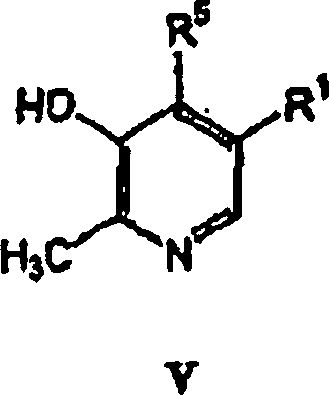
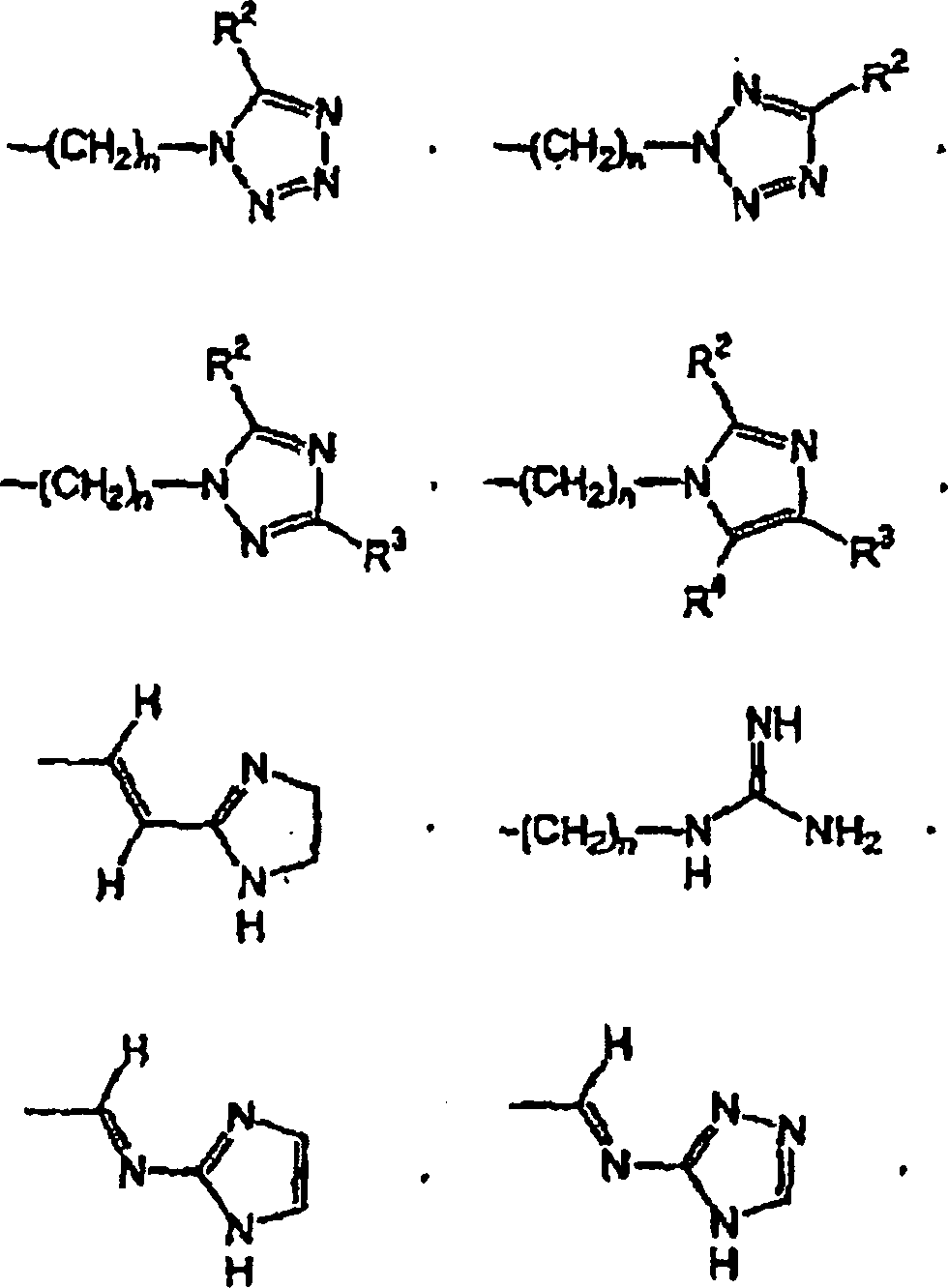
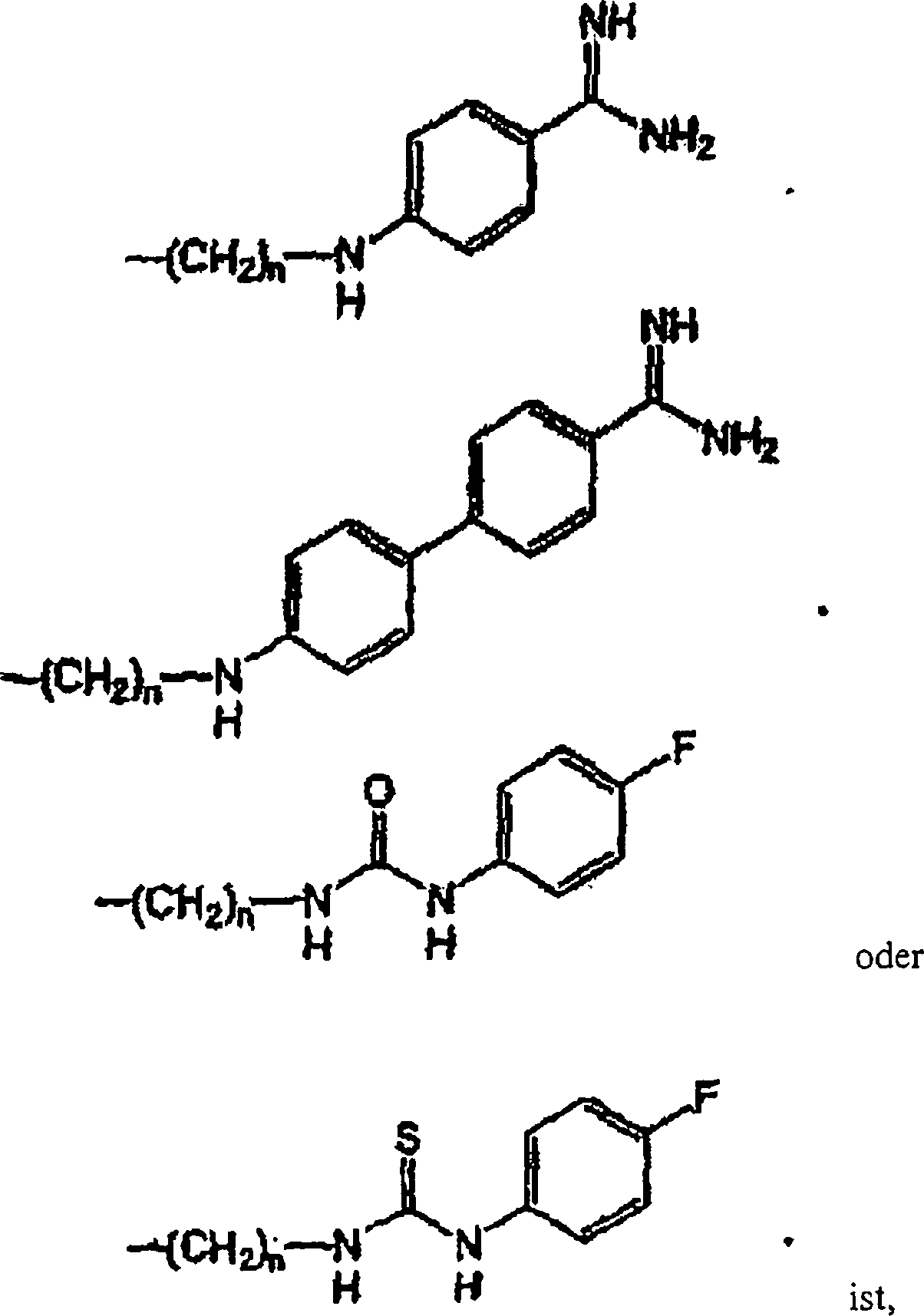

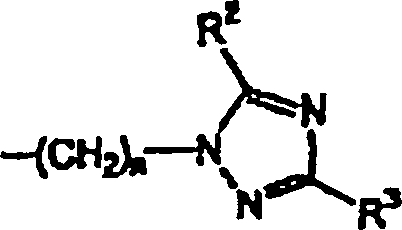
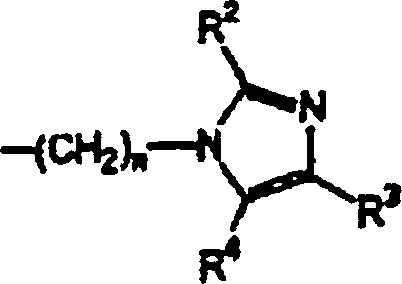
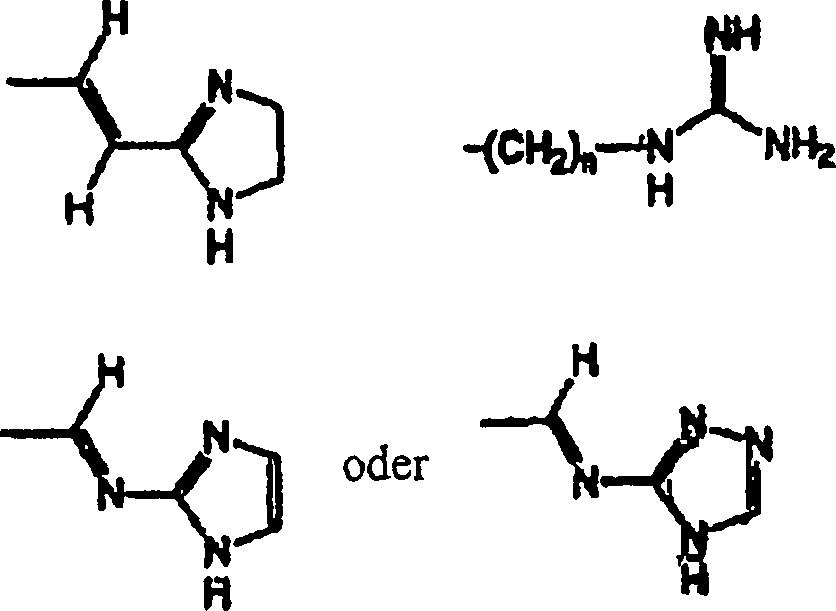


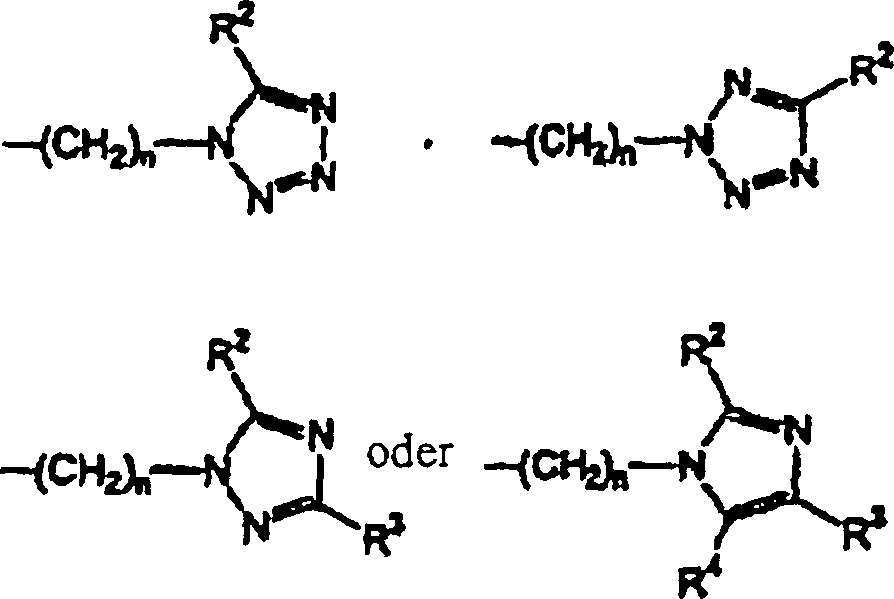
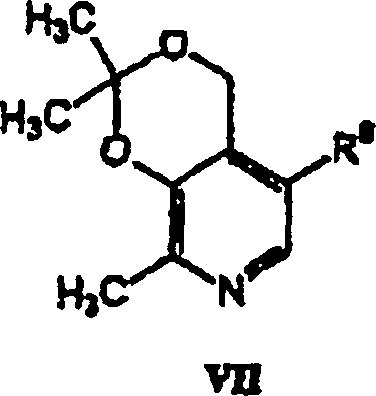
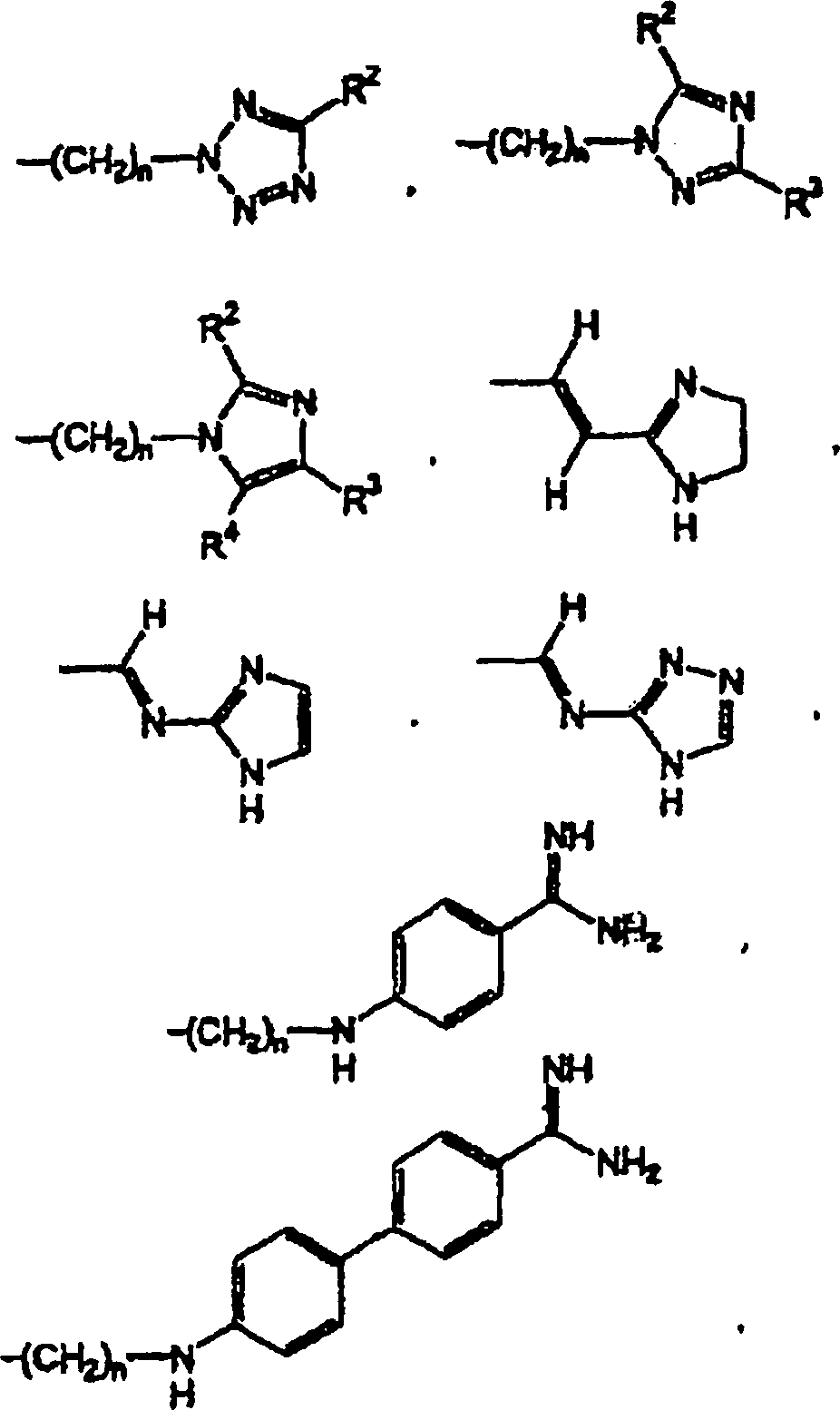
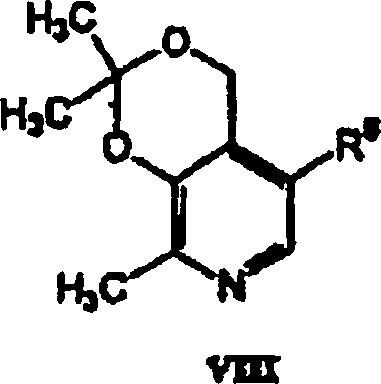
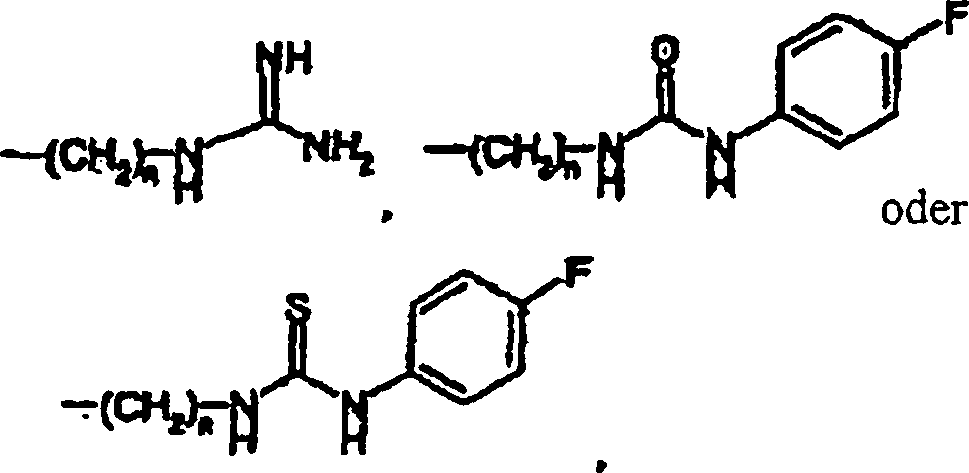
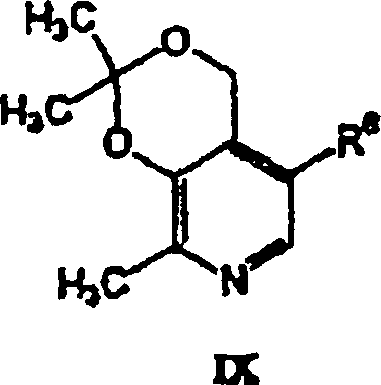

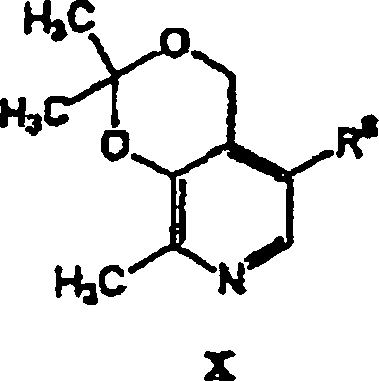
Applications Claiming Priority (3)
| Application Number | Priority Date | Filing Date | Title |
|---|---|---|---|
| US21690700P | 2000-07-07 | 2000-07-07 | |
| US216907P | 2000-07-07 | ||
| PCT/CA2001/000994 WO2002004421A2 (en) | 2000-07-07 | 2001-07-06 | Pyridoxine and pyridoxal analogues: cardiovascular therapeutics |
Publications (3)
| Publication Number | Publication Date |
|---|---|
| DE60128912D1 DE60128912D1 (en) | 2007-07-26 |
| DE60128912T2 true DE60128912T2 (en) | 2008-02-14 |
| DE60128912T9 DE60128912T9 (en) | 2008-06-26 |
Family
ID=22808954
Family Applications (1)
| Application Number | Title | Priority Date | Filing Date |
|---|---|---|---|
| DE60128912T Active DE60128912T9 (en) | 2000-07-07 | 2001-07-06 | PYRIDOXIN AND PYRIDOXAL ANALOGUES AS CARDIOVASCULAR THERAPEUTICS |
Country Status (9)
| Country | Link |
|---|---|
| US (1) | US6417204B1 (en) |
| EP (1) | EP1299358B1 (en) |
| JP (1) | JP2004502757A (en) |
| AT (1) | ATE364595T1 (en) |
| AU (2) | AU7226301A (en) |
| CA (1) | CA2414188A1 (en) |
| DE (1) | DE60128912T9 (en) |
| NZ (1) | NZ523815A (en) |
| WO (1) | WO2002004421A2 (en) |
Families Citing this family (25)
| Publication number | Priority date | Publication date | Assignee | Title |
|---|---|---|---|---|
| EP1196171A2 (en) * | 1999-07-13 | 2002-04-17 | Medicure Inc. | Use of pyridoxin derivatives for the treatment of diabetes and related complications |
| US6677356B1 (en) * | 1999-08-24 | 2004-01-13 | Medicure International Inc. | Treatment of cardiovascular and related pathologies |
| US7442689B2 (en) * | 2000-02-29 | 2008-10-28 | Medicure International Inc. | Cardioprotective phosphonates and malonates |
| US6897228B2 (en) * | 2000-07-07 | 2005-05-24 | Medicure International Inc. | Pyridoxine and pyridoxal analogues: new uses |
| US20040121988A1 (en) * | 2001-03-28 | 2004-06-24 | Medicure International Inc. | Treatment of cerebrovascular disease |
| US20040186077A1 (en) * | 2003-03-17 | 2004-09-23 | Medicure International Inc. | Novel heteroaryl phosphonates as cardioprotective agents |
| AU2004224566A1 (en) * | 2003-03-27 | 2004-10-07 | Medicure Inc. | Compositions for treating angina |
| EP1610783A2 (en) * | 2003-03-27 | 2006-01-04 | Medicure Inc. | Modulation of cell death |
| EP1750862B1 (en) | 2004-06-04 | 2011-01-05 | Teva Pharmaceutical Industries Ltd. | Pharmaceutical composition containing irbesartan |
| CN101014357A (en) * | 2004-07-07 | 2007-08-08 | 麦迪库瑞国际公司 | Combination therapies employing platelet aggregation drugs |
| US20070060549A1 (en) * | 2004-08-10 | 2007-03-15 | Friesen Albert D | Combination therapies employing ace inhibitors and uses thereof for the treatment of diabetic disorders |
| US7812037B2 (en) * | 2004-10-28 | 2010-10-12 | Medicure International, Inc. | Dual antiplatelet/anticoagulant pyridoxine analogs |
| US7459468B2 (en) * | 2004-10-28 | 2008-12-02 | Medicure International, Inc. | Aryl sulfonic pyridoxines as antiplatelet agents |
| US20060094749A1 (en) * | 2004-10-28 | 2006-05-04 | Medicure International Inc. | Substituted pyridoxines as anti-platelet agents |
| US20070243249A1 (en) * | 2004-11-26 | 2007-10-18 | Friesen Albert D | Novel formulation of pyridoxal-5'-phosphate and method of preparation |
| US20080213364A1 (en) * | 2004-11-26 | 2008-09-04 | Medicure International, Inc. | Formulations of Pyridoxal-5'-Phosphate and Methods of Preparation |
| CA2593793A1 (en) * | 2005-01-05 | 2006-07-13 | Medicure International Inc. | Compounds and methods for regulating triglyceride levels |
| CA2503087A1 (en) * | 2005-03-30 | 2006-09-30 | Medicure International Inc. | Intravenous formulations of pyridoxal 5'-phosphate and method of preparation |
| JP2009517411A (en) * | 2005-11-28 | 2009-04-30 | メディキュア インターナショナル インコーポレーテッド | Formulations for the treatment of cardiovascular and related medical conditions |
| WO2007121588A1 (en) * | 2006-04-25 | 2007-11-01 | Medicure International Inc. | Treatment of atrial fibrillation |
| WO2010080871A1 (en) | 2009-01-08 | 2010-07-15 | Univation Technologies, Llc | Additive for gas phase polymerization processes |
| JP5685203B2 (en) * | 2009-05-29 | 2015-03-18 | ラクオリア創薬株式会社 | Aryl-substituted carboxamide derivatives as calcium channel blockers or sodium channel blockers |
| WO2012052540A1 (en) * | 2010-10-21 | 2012-04-26 | Universitaet Des Saarlandes | Selective cyp11b1 inhibitors for the treatment of cortisol dependent diseases |
| CN102617455B (en) * | 2011-12-26 | 2014-06-04 | 浙江工业大学 | Preparation method of pyridoxal or pyridoxal hydrochloride |
| WO2018002673A1 (en) | 2016-07-01 | 2018-01-04 | N4 Pharma Uk Limited | Novel formulations of angiotensin ii receptor antagonists |
Family Cites Families (98)
| Publication number | Priority date | Publication date | Assignee | Title |
|---|---|---|---|---|
| US3206463A (en) | 1965-09-14 | Pyridoxine aspartate and its process of preparation | ||
| FR846376A (en) | 1938-08-23 | 1939-09-15 | Air navigation and aerial bombardment equipment | |
| GB966805A (en) | 1961-05-15 | 1964-08-19 | Merck & Co Inc | Process for the preparation of 2-methyl-3-hydroxypyridines |
| BE634408A (en) | 1962-07-05 | |||
| GB1228142A (en) | 1967-03-31 | 1971-04-15 | ||
| GB1172800A (en) | 1967-10-16 | 1969-12-03 | Tanabe Seiyaku Co | Novel N-Pyridylmethylidene-Homocysteine Thiolactone Compound and the preparation thereof |
| DE1767499A1 (en) | 1968-05-16 | 1971-09-09 | Merck Patent Gmbh | Process for the production of durable vitamin preparations |
| ES360566A1 (en) | 1968-11-22 | 1970-10-16 | Made Labor Sa | Pyridoxine alpha-ketoglutarate and derivatives thereof |
| GB1236531A (en) | 1969-02-12 | 1971-06-23 | Soc D Etudes Prod Chimique | Adenin derivative |
| US3910921A (en) | 1970-01-08 | 1975-10-07 | Soc D Etudes Prod Chimique | Papaverine monopyridoxal phosphate |
| GB1297080A (en) | 1970-04-17 | 1972-11-22 | ||
| FR2101010A1 (en) * | 1970-08-06 | 1972-03-31 | Lyocentre | Sparteine mono-and dipyridoxinates and prepn - as tonics for cardiova disorders |
| GB1493993A (en) | 1975-05-16 | 1977-12-07 | Howard A | Dietary supplement and dietary methods employing said supplement for the treatment of obesity |
| US4036844A (en) | 1972-04-04 | 1977-07-19 | Beecham Group Limited | Aryloxypyridines |
| US4053607A (en) | 1972-04-04 | 1977-10-11 | Beecham Group Limited | Aryloxypyridine for treating hyperglycaemia |
| GB1360536A (en) | 1972-04-25 | 1974-07-17 | Soc D Etudes Prod Chimique | Pyridoxyl-l-aspartic acid salt |
| BE790118A (en) | 1972-10-09 | 1973-02-01 | Made Labor Sa | PYRIDOXAL AND PYRIDOXAMINE ALPHA-CETOGLUTARATE DERIVATIVES, |
| US4032534A (en) | 1973-03-22 | 1977-06-28 | Ferlus-Chimie S.A. | Certain 2-(2-thioethyl)thiazolidine-4-carboxylic acids |
| FR2255883A1 (en) | 1973-12-28 | 1975-07-25 | Centre Etd Ind Pharma | Clofibric acid-vitamin B6 compsns. - with synergistic hypocholesterolaemic and normolipaemic activity |
| FR2275209A1 (en) | 1974-06-21 | 1976-01-16 | Synthelabo | Oxoalkyl esters of vincamine acids - and their pharm. acceptable salts for use in medicine |
| FR2276048A1 (en) | 1974-06-27 | 1976-01-23 | Synthelabo | NEW CYCLOHEXANOL ESTERS, THEIR SALTS, THEIR PREPARATION AND THE MEDICINAL PRODUCTS CONTAINING THEM |
| DE2461742C2 (en) | 1974-12-28 | 1983-01-27 | Steigerwald Arzneimittelwerk Gmbh, 6100 Darmstadt | Pyridoxine-5'-phosphoric acid ester derivatives and their preparation and pharmaceuticals containing these compounds |
| GB1525885A (en) | 1976-05-11 | 1978-09-20 | Soc D Etudes Prod Chimique | Vincamine salt of pyridoxal phosphate |
| DE2717478C2 (en) | 1977-04-20 | 1984-08-16 | Basf Ag, 6700 Ludwigshafen | Process for the preparation of pyridoxine |
| JPS5417130A (en) | 1977-07-08 | 1979-02-08 | Chugai Pharmaceut Co Ltd | Remedy for cardio-vasocular diseases |
| MTP837B (en) * | 1977-11-07 | 1979-10-22 | Hoffman La Roche And Co Aktien | Derivatives 2 finino-imidazolidire |
| BE863754A (en) | 1978-02-08 | 1978-05-29 | Dechamps Pierre | NEW VINCAMINE DERIVATIVES FOR USE AS BRAIN CIRCULATION REGULATORS |
| FR2428640A1 (en) | 1978-06-12 | 1980-01-11 | Parcor | 5-Piperazino:alkoxy:methyl-pyridine cpds. - with antiinflammatory, diuretic and vaso-protective properties |
| US4167562A (en) | 1978-08-28 | 1979-09-11 | Evers H Ray | Method and composition for treating arteriosclerosis |
| IL62602A (en) | 1980-05-19 | 1984-06-29 | Labaz Sanofi Nv | Pyridoxine derivatives,their preparation and pharmaceutical compositions containing them |
| IT1141070B (en) | 1980-09-22 | 1986-10-01 | Luso Farmaco Inst | USE OF ALPHA-KETOGLUTARATE OF PYRIDOXY IN THE PROPHYLAXIS OF HYPERLACTACIDEMIA |
| US4369172A (en) | 1981-12-18 | 1983-01-18 | Forest Laboratories Inc. | Prolonged release therapeutic compositions based on hydroxypropylmethylcellulose |
| US4528197A (en) | 1983-01-26 | 1985-07-09 | Kabivitrum Ab | Controlled triglyceride nutrition for hypercatabolic mammals |
| US4735950A (en) | 1983-04-05 | 1988-04-05 | Societe De Conseils De Recherches Et D'applications Scientifiques (S.C.R.A.S) | Furo-(3,4-C)-pyridine derivatives and therapeutic composition containing the same |
| IN160104B (en) | 1983-04-05 | 1987-06-27 | Scras | |
| US4515771A (en) | 1983-04-11 | 1985-05-07 | Fine Daniel H | Composition and method for the preventative treatment of dental disease and apparatus for dispensing said composition |
| JPS59199674A (en) * | 1983-04-26 | 1984-11-12 | Terumo Corp | Pyridoxine derivative and blood platelet coagulation inhibitor containing the same |
| GB8330517D0 (en) | 1983-11-16 | 1983-12-21 | Scras | 6-vinyl-furo-(3,4-c)pyridine derivatives |
| GB8330658D0 (en) | 1983-11-17 | 1983-12-29 | Scras | 7-carboxymethoxy-furo-(3,4-c)-pyridine derivatives |
| IT1212792B (en) | 1983-11-30 | 1989-11-30 | Egidio Aldo Moja | DIETARY SUPPLEMENT AND PRE-PACKED FOOD THAT CONTAINS IT PREPARATION PROCEDURE AND METHOD OF ADMINISTRATION |
| US5130324A (en) | 1984-03-19 | 1992-07-14 | The Rockefeller University | 2-alkylidene-aminoguanidines and methods of use therefor |
| US5272165A (en) | 1984-03-19 | 1993-12-21 | The Rockefeller University | 2-alkylidene-aminoguanidines and methods of use therefor |
| CH664158A5 (en) | 1984-07-18 | 1988-02-15 | Symphar Sa | DERIVATIVES PROPYLIDENEDIPHOSPHONATES-1,3 SUBSTITUTED IN POSITION 2, THEIR PREPARATION METHOD AND PHARMACEUTICAL COMPOSITIONS CONTAINING THEM. |
| US4567179A (en) | 1984-10-11 | 1986-01-28 | Pfizer, Inc. | Antiinflammatory salts of piroxicam |
| DE3519693A1 (en) | 1985-06-01 | 1987-01-02 | Basf Ag | PYRIDINE DERIVATIVES, THEIR PRODUCTION AND USE |
| US4837239A (en) | 1985-08-23 | 1989-06-06 | Syntex (U.S.A.) Inc. | Cardiotonic phosphodiesterase inhibitors complexed with water soluble vitamins |
| US5053396A (en) | 1985-08-27 | 1991-10-01 | Blass David H | Therapeutic composition |
| US4735956A (en) | 1985-09-13 | 1988-04-05 | Merck & Co., Inc. | Certain 1,4-dihydro-2,6-di-lower hydrocarbyl-4-heterocyclic-3,5-pyridine dicarboxylates which are useful as calcium channel blockers |
| US4605741A (en) | 1985-11-13 | 1986-08-12 | Lisapharma Spa | Pharmaceutically active salt derivative of 3-hydroxy-5-(hydroxymethyl)-2-methylisonicotinaldehyde phosphate |
| DE3634016A1 (en) | 1986-04-17 | 1987-10-29 | Lohmann Gmbh & Co Kg | AREA-BASED THERAPEUTIC SYSTEM, METHOD FOR THE PRODUCTION THEREOF AND ITS USE |
| US5210083A (en) | 1986-07-17 | 1993-05-11 | Ed. Geistlich Sohne A.G. Fur Chemische Industrie | Pharmaceutical compositions |
| US5563126A (en) | 1986-11-20 | 1996-10-08 | Metabolite Laboratories | Method for treatment and prevention of deficiencies of vitamins B12, folic acid, and B6 |
| NZ222664A (en) | 1986-11-29 | 1990-06-26 | Vesta Med Pty Ltd | Pharmaceutical compositions containing pyridoxal as a source of vitamin b6 |
| US5631271A (en) | 1986-11-29 | 1997-05-20 | Serfontein; Willem J. | Methods and preparations for the treatment and prophylaxis of metabolic disturbances |
| US5254572A (en) | 1987-11-27 | 1993-10-19 | Vesta Medicines (Pty) Ltd. | Method and composition for supplementing vitamin B6 where the PN-PLP pathway is disturbed |
| US4843071A (en) | 1986-12-05 | 1989-06-27 | Serotonin Industries Of Charleston | Method and composition for treating obesity, drug abuse, and narcolepsy |
| US5288716A (en) | 1987-02-18 | 1994-02-22 | Ulrich Speck | Use of pyridoxine derivatives in the prevention and treatment of hyperlipidaemia and atherosclerosis |
| DE3705549A1 (en) | 1987-02-18 | 1988-09-01 | Ulrich Speck | USE OF PYRIDOXINE DERIVATIVES IN THE PROPHYLAXIS AND THERAPY OF HYPERLIPIDAEMIA AND ATHEROSCLEROSIS |
| SE8701662L (en) | 1987-04-22 | 1988-10-23 | Gelder Nico M Van | SETTING AND AGENTS FOR TREATING NEUROLOGICAL DISEASES, EXAMPLE, MIGRAEN THROUGH THE OPERATION OF NERV CELLS |
| US4931002A (en) * | 1987-05-29 | 1990-06-05 | The University Of Vermont | Pyridoxal-5'-phosphate as an in vitro anticoagulant for whole blood |
| US5213813A (en) | 1987-05-29 | 1993-05-25 | The University Of Vermont | Pyridoxal-5'-phosphate as an in vitro blood platelet stabilizer |
| EP0326034B1 (en) | 1988-01-28 | 1992-08-26 | Peter Dr. Költringer | Combination for the treatment of nervous cells and fibers illnesses and disorders |
| NO179479C (en) | 1988-03-11 | 1996-10-16 | Teikoku Seiyaku Kk | Process for the preparation of an intravaginal pharmaceutical preparation |
| US5254557A (en) | 1988-05-09 | 1993-10-19 | Beecham Group P.L.C. | Compound and treatment |
| US5088977A (en) | 1988-12-21 | 1992-02-18 | Drug Delivery Systems Inc. | Electrical transdermal drug applicator with counteractor and method of drug delivery |
| US5001115A (en) | 1989-05-17 | 1991-03-19 | University Of Florida | Prodrugs of biologically active hydroxyaromatic compounds |
| GB8918368D0 (en) | 1989-08-11 | 1989-09-20 | Amco Chemie Gmbh | Compositions for treating obstructive airways disease |
| DE4016963A1 (en) | 1990-05-25 | 1991-11-28 | Steigerwald Arzneimittelwerk | USE OF MAGNESIUM PYRIDOXAL 5'-PHOSPHATE GLUTAMINATE TO PREVENT ILLNESSES ARISING AS A RESULT OF DISSOLUTION |
| US5385937A (en) | 1991-04-10 | 1995-01-31 | Brigham & Women's Hospital | Nitrosation of homocysteine as a method for treating homocysteinemia |
| GB2254556B (en) | 1991-04-11 | 1995-04-12 | Fisons Plc | Formulations containing linolenic acid |
| JPH06507902A (en) | 1991-05-15 | 1994-09-08 | エール・ユニバーシティ | Determination of drug precursors metabolized in the liver and their therapeutic use |
| FR2678622B1 (en) | 1991-07-03 | 1994-11-18 | Adir | NEW VANADIUM COMPLEXES, THEIR PREPARATION PROCESS AND THE PHARMACEUTICAL COMPOSITIONS CONTAINING THEM. |
| WO1993013660A1 (en) | 1992-01-06 | 1993-07-22 | Health Maintenance Programs, Inc. | Pharmaceutically active antioxydant containing composition and the method of its use to prevent and treat restenosis following angioplasty |
| ES2140463T3 (en) | 1992-06-12 | 2000-03-01 | Cephalon Inc | PREVENTION AND TREATMENT OF PERIPHERAL NEUROPATHY. |
| US5420112A (en) | 1992-06-12 | 1995-05-30 | Lewis; Michael E. | Prevention and treatment of peripheral neuropathy |
| US5330743A (en) | 1992-11-12 | 1994-07-19 | Magnetic Research, Inc. | Aminosaccharide contrast agents for magnetic resonance images |
| US5795873A (en) | 1992-12-29 | 1998-08-18 | Metabolite Laboratories, Inc. | Method for treatment and prevention of deficiencies of vitamins B12, folic acid and B6 |
| TW268948B (en) | 1993-04-02 | 1996-01-21 | Senju Pharma Co | |
| DE4344751A1 (en) | 1993-12-28 | 1995-06-29 | Carl Heinrich Dr Weischer | New vitamin=B6 ester cpds. of sulphur-contg. carboxylic acids |
| US5504090A (en) | 1994-03-30 | 1996-04-02 | Trustees Of The University Of Pennsylvania | Compositions and methods for the prevention and treatment of ischemia-reperfusion organ injury |
| MX9703988A (en) | 1994-12-12 | 1998-02-28 | Omeros Med Sys Inc | SOLUTION AND IRRIGATION METHOD FOR THE INHIBITION OF PAIN, INFLAMMATION AND IT IS SPASM. |
| US5569459A (en) | 1995-02-15 | 1996-10-29 | Bio-Virus Research Incorporated | Pharmaceutical compositions for the management of premenstrual syndrome and alleviation of menopausal disorders |
| US5733916A (en) | 1995-03-24 | 1998-03-31 | The Trustees Of The University Of Pennsylvania | Prevention and treatment of ischemia-reperfusion and endotoxin-related injury using adenosine and purino receptor antagonists |
| US5874443A (en) | 1995-10-19 | 1999-02-23 | Trega Biosciences, Inc. | Isoquinoline derivatives and isoquinoline combinatorial libraries |
| US5833998A (en) | 1995-11-06 | 1998-11-10 | The Procter & Gamble Company | Topical compositions for regulating the oily/shiny appearance of skin |
| US5733884A (en) | 1995-11-07 | 1998-03-31 | Nestec Ltd. | Enteral formulation designed for optimized wound healing |
| US5874420A (en) | 1995-12-26 | 1999-02-23 | Allegheny University Of The Health Sciences | Process for regulating vagal tone |
| US5859051A (en) | 1996-02-02 | 1999-01-12 | Merck & Co., Inc. | Antidiabetic agents |
| US5847008A (en) | 1996-02-02 | 1998-12-08 | Merck & Co., Inc. | Method of treating diabetes and related disease states |
| JPH09221425A (en) * | 1996-02-13 | 1997-08-26 | Taiho Yakuhin Kogyo Kk | Thiol protease inhibitor |
| US5834446A (en) | 1996-06-21 | 1998-11-10 | Queen's University At Kingston | Nerve process growth modulators |
| US5770215A (en) | 1997-01-06 | 1998-06-23 | Moshyedi; Emil Payman | Multivitamin/vascular occlusion inhibiting composition |
| US5804594A (en) | 1997-01-22 | 1998-09-08 | Murad; Howard | Pharmaceutical compositions and methods for improving wrinkles and other skin conditions |
| US5944020A (en) | 1997-02-25 | 1999-08-31 | Cypros Pharmaceutical Corp. | Use of fructose-1 6-diphosphate as an inotrope drug after cardiopulmonary bypass surgery |
| US5888514A (en) | 1997-05-23 | 1999-03-30 | Weisman; Bernard | Natural composition for treating bone or joint inflammation |
| EP0891719A1 (en) | 1997-07-14 | 1999-01-20 | N.V. Nutricia | Nutritional composition containing methionine |
| JPH11139969A (en) * | 1997-08-07 | 1999-05-25 | Tanabe Seiyaku Co Ltd | Pharmaceutical composition |
| US6043259A (en) * | 1998-07-09 | 2000-03-28 | Medicure Inc. | Treatment of cardiovascular and related pathologies |
-
2001
- 2001-07-06 AT AT01951279T patent/ATE364595T1/en not_active IP Right Cessation
- 2001-07-06 CA CA002414188A patent/CA2414188A1/en not_active Abandoned
- 2001-07-06 DE DE60128912T patent/DE60128912T9/en active Active
- 2001-07-06 NZ NZ523815A patent/NZ523815A/en unknown
- 2001-07-06 JP JP2002509088A patent/JP2004502757A/en active Pending
- 2001-07-06 AU AU7226301A patent/AU7226301A/en active Pending
- 2001-07-06 WO PCT/CA2001/000994 patent/WO2002004421A2/en not_active Ceased
- 2001-07-06 US US09/900,718 patent/US6417204B1/en not_active Expired - Fee Related
- 2001-07-06 AU AU2001272263A patent/AU2001272263B2/en not_active Ceased
- 2001-07-06 EP EP01951279A patent/EP1299358B1/en not_active Expired - Lifetime
Also Published As
| Publication number | Publication date |
|---|---|
| NZ523815A (en) | 2004-07-30 |
| AU7226301A (en) | 2002-01-21 |
| JP2004502757A (en) | 2004-01-29 |
| DE60128912T9 (en) | 2008-06-26 |
| DE60128912D1 (en) | 2007-07-26 |
| AU2001272263B2 (en) | 2005-12-15 |
| CA2414188A1 (en) | 2002-01-17 |
| US6417204B1 (en) | 2002-07-09 |
| WO2002004421A3 (en) | 2002-04-04 |
| EP1299358B1 (en) | 2007-06-13 |
| EP1299358A2 (en) | 2003-04-09 |
| WO2002004421A2 (en) | 2002-01-17 |
| ATE364595T1 (en) | 2007-07-15 |
Similar Documents
| Publication | Publication Date | Title |
|---|---|---|
| DE60128912T2 (en) | PYRIDOXIN AND PYRIDOXAL ANALOGUES AS CARDIOVASCULAR THERAPEUTICS | |
| DE60023125T2 (en) | PYRIDOXAL ANALOGUE FOR THE TREATMENT OF DISORDERS RELEASED BY A VITAMIN B6 LACK | |
| DE69628856T2 (en) | SUBSTITUTED N - [(AMINOIMINOMETHYL OR AMINOMETHYL) PHENYL] PROPYLAMIDES | |
| CH644116A5 (en) | IMIDAZOLE DERIVATIVES. | |
| AU2001272263A1 (en) | Pyridoxine and pyridoxal analogues: cardiovascular therapeutics | |
| DE68917556T2 (en) | Quinolyloxazol-2-one, useful as protein kinase C inhibitors. | |
| DE4321030A1 (en) | 4-bicyclically substituted dihydropyridines, process for their preparation and their use in medicinal products | |
| EP0325129B1 (en) | Disubstituted pyridines | |
| DE4215588A1 (en) | Biphenylmethyl-substituted pyridones | |
| DE69214113T2 (en) | New pyrrolidine derivatives, processes for their preparation and medicaments containing them | |
| DE4313693A1 (en) | 2-Amino-4-quinoline-dihydropyridines, process for their preparation and their use | |
| EP0546389A1 (en) | Piperidylmethyl substituted chroman derivatives as agents for the treatment of diseases of the central nervous system | |
| EP0770082B1 (en) | Dioxo-thiopyrano-pyridine carboxylic acid derivatives and their use as medicaments | |
| EP0315018A2 (en) | Fluoromethoxyphenyl-dihydropyridines, process for their preparation and their use in drugs | |
| EP0435153A2 (en) | R-(-)-1-(5-hydroxyhexyl)-3-methyl-7-propylxanthin, process for its preparation and medicines containing it | |
| EP0519291A1 (en) | Amino-methyl substituted 2,3-Dihydropyrano (2,3-b) pyridines, process for their preparation and their use in medicines | |
| EP0489327A1 (en) | Chroman derivatives | |
| EP0236838A2 (en) | Aminoester-dihydropyridines, process for their preparation and their use | |
| DE69529807T2 (en) | New parabanic acid derivatives as aldose reductase inhibitors | |
| DD281385A5 (en) | PROCESS FOR THE PREPARATION OF A 1,3-DIOXY NALKANSAEUREDERIVATE | |
| EP0214437B1 (en) | Preparation of 1,4-dihydropyridine derivatives using novel intermediates | |
| EP0180833B1 (en) | 4-Oxo-pyrido-[2,3-d]pyrimidine derivatives, process for their preparation and medicaments containing them | |
| EP0351720A2 (en) | Use of substituted 3,4-dihydro-2H-benzopyrans as medicaments against obstructive disorders of the lung | |
| DE3876859T2 (en) | CARDIOTONIC TRICYCLIC OXAZOLONES. | |
| DE60013607T2 (en) | BEMZIMIDAZOL COMPOUNDS AND MEDICAMENTS CONTAINING THEM |
Legal Events
| Date | Code | Title | Description |
|---|---|---|---|
| 8364 | No opposition during term of opposition |