WO2025115696A1 - ポリエーテルニトリルおよびポリエーテルニトリル含有炭素繊維複合材 - Google Patents
ポリエーテルニトリルおよびポリエーテルニトリル含有炭素繊維複合材 Download PDFInfo
- Publication number
- WO2025115696A1 WO2025115696A1 PCT/JP2024/040942 JP2024040942W WO2025115696A1 WO 2025115696 A1 WO2025115696 A1 WO 2025115696A1 JP 2024040942 W JP2024040942 W JP 2024040942W WO 2025115696 A1 WO2025115696 A1 WO 2025115696A1
- Authority
- WO
- WIPO (PCT)
- Prior art keywords
- polyethernitrile
- carbon fiber
- fiber composite
- containing carbon
- formula
- Prior art date
- Legal status (The legal status is an assumption and is not a legal conclusion. Google has not performed a legal analysis and makes no representation as to the accuracy of the status listed.)
- Pending
Links
Classifications
-
- C—CHEMISTRY; METALLURGY
- C08—ORGANIC MACROMOLECULAR COMPOUNDS; THEIR PREPARATION OR CHEMICAL WORKING-UP; COMPOSITIONS BASED THEREON
- C08G—MACROMOLECULAR COMPOUNDS OBTAINED OTHERWISE THAN BY REACTIONS ONLY INVOLVING UNSATURATED CARBON-TO-CARBON BONDS
- C08G65/00—Macromolecular compounds obtained by reactions forming an ether link in the main chain of the macromolecule
- C08G65/34—Macromolecular compounds obtained by reactions forming an ether link in the main chain of the macromolecule from hydroxy compounds or their metallic derivatives
- C08G65/38—Macromolecular compounds obtained by reactions forming an ether link in the main chain of the macromolecule from hydroxy compounds or their metallic derivatives derived from phenols
- C08G65/40—Macromolecular compounds obtained by reactions forming an ether link in the main chain of the macromolecule from hydroxy compounds or their metallic derivatives derived from phenols from phenols (I) and other compounds (II), e.g. OH-Ar-OH + X-Ar-X, where X is halogen atom, i.e. leaving group
-
- C—CHEMISTRY; METALLURGY
- C08—ORGANIC MACROMOLECULAR COMPOUNDS; THEIR PREPARATION OR CHEMICAL WORKING-UP; COMPOSITIONS BASED THEREON
- C08J—WORKING-UP; GENERAL PROCESSES OF COMPOUNDING; AFTER-TREATMENT NOT COVERED BY SUBCLASSES C08B, C08C, C08F, C08G or C08H
- C08J5/00—Manufacture of articles or shaped materials containing macromolecular substances
- C08J5/04—Reinforcing macromolecular compounds with loose or coherent fibrous material
-
- C—CHEMISTRY; METALLURGY
- C08—ORGANIC MACROMOLECULAR COMPOUNDS; THEIR PREPARATION OR CHEMICAL WORKING-UP; COMPOSITIONS BASED THEREON
- C08K—Use of inorganic or non-macromolecular organic substances as compounding ingredients
- C08K7/00—Use of ingredients characterised by shape
- C08K7/02—Fibres or whiskers
- C08K7/04—Fibres or whiskers inorganic
- C08K7/06—Elements
-
- C—CHEMISTRY; METALLURGY
- C08—ORGANIC MACROMOLECULAR COMPOUNDS; THEIR PREPARATION OR CHEMICAL WORKING-UP; COMPOSITIONS BASED THEREON
- C08L—COMPOSITIONS OF MACROMOLECULAR COMPOUNDS
- C08L71/00—Compositions of polyethers obtained by reactions forming an ether link in the main chain; Compositions of derivatives of such polymers
- C08L71/08—Polyethers derived from hydroxy compounds or from their metallic derivatives
- C08L71/10—Polyethers derived from hydroxy compounds or from their metallic derivatives from phenols
Definitions
- the present invention relates to polyethernitriles and polyethernitrile-containing carbon fiber composites.
- Polyethernitrile is a type of super engineering plastic with advanced properties, including excellent thermal stability, chemical resistance, and flame retardancy, as well as excellent mechanical properties such as wear resistance and friction resistance. To impart even higher mechanical properties to polyethernitrile, it can be used as a composite material with carbon fiber.
- Patent Document 1 discloses a polyethernitrile-containing carbon fiber composite material.
- the present invention aims to provide a polyethernitrile with excellent thermal stability.
- Another aim of the present invention is to provide a polyethernitrile-containing carbon fiber composite material suitable for mobility components, structural material components, and other industrial application components.
- the present invention has the following features.
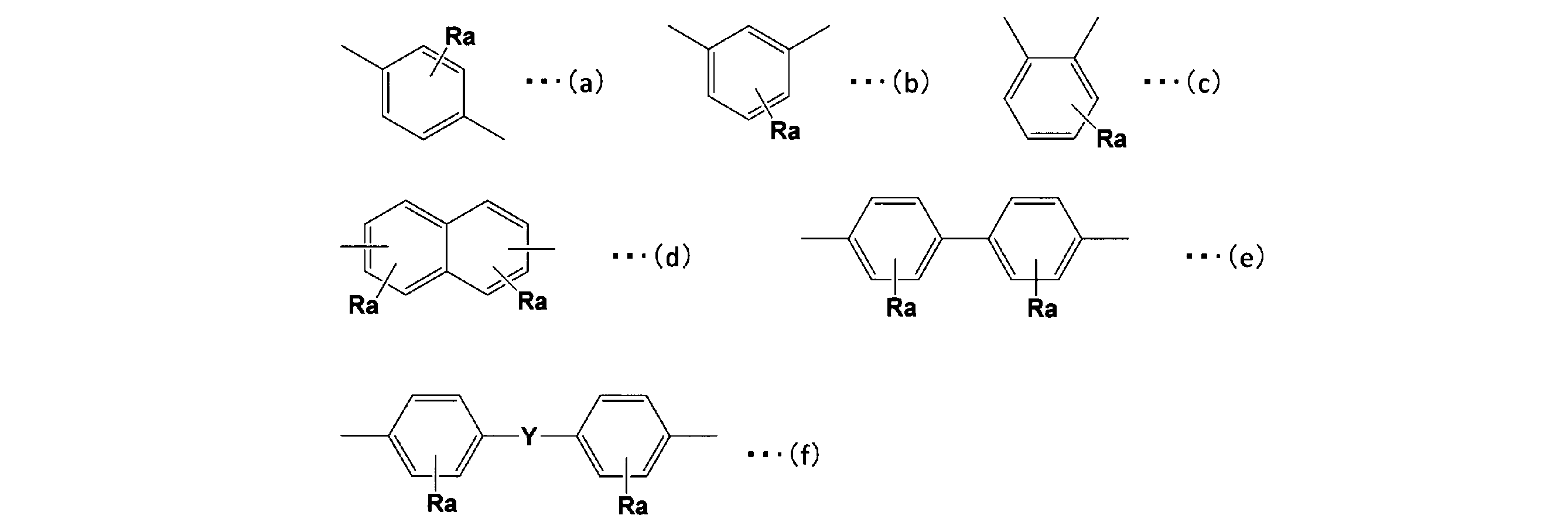
- Ar 1 and Ar 2 each have one different type of skeleton selected from units represented by the following formulae (a) to (f);
- R is any organic group selected from a linear organic group having 1 to 6 carbon atoms, a branched organic group having 3 to 6 carbon atoms, and a cyclic organic group having 3 to 6 carbon atoms;
- R may contain one or more atoms selected from an oxygen atom, a nitrogen atom, and a sulfur atom;
- a represents the number of substituents R;
- a in formulae (a), (b), (c), (e), and (f) is an integer of 0 to 4, and a in formulae (I), (II), and (d) is an integer of 0 to 3; when a plurality of Rs are present, Rs may be the same or different from each other;
- Y is a group selected from the following units;
- X is any one of a hydrogen atom, a methyl group, and a trifluoromethyl group.
- a polyethernitrile-containing carbon fiber composite material comprising the polyethernitrile according to (1) and carbon fiber, wherein the polyethernitrile-containing carbon fiber composite material has a weight loss rate of 5% or less when held in air at a temperature 30° C. above the melting point of the polyethernitrile for 30 minutes in thermogravimetric analysis (TG), and the polyethernitrile content is 20 to 85% by weight.
- TG thermogravimetric analysis
- the present invention provides polyethernitrile and polyethernitrile-containing carbon fiber composites with excellent thermal stability.
- the polyethernitrile-containing carbon fiber composite of the present invention comprises polyethernitrile and carbon fiber, the polyethernitrile having N repeating units represented by formula (I) and M repeating units represented by formula (II), N and M being integers satisfying the relationship 0 ⁇ [N/(N+M)] ⁇ 1.00, and in thermogravimetric analysis (TG), when held in air at a temperature of melting point+30° C. for 30 minutes, the weight loss rate based on the weight of the polyethernitrile contained in the polyethernitrile-containing carbon fiber composite is 5% or less, and the polyethernitrile content is 20 to 85% by weight.
- Ar 1 and Ar 2 each have one different type of skeleton selected from units represented by any one of formulas (a) to (f).
- Y is a group selected from the following units.
- X is a hydrogen atom, a methyl group, or a trifluoromethyl group.
- polyethernitrile of the present invention is a polyethernitrile having N repeating units represented by formula (I) and M repeating units represented by formula (II) in one molecule, where N and M are integers satisfying the relationship 0 ⁇ [N/(N+M)] ⁇ 1.00.
- Ar 1 and Ar 2 each have one different skeleton selected from the units represented by the following formulas (a) to (f).
- R is any organic group selected from a linear organic group having 1 to 6 carbon atoms, a branched organic group having 3 to 6 carbon atoms, and a cyclic organic group having 3 to 6 carbon atoms. R may contain one or more atoms selected from an oxygen atom, a nitrogen atom, and a sulfur atom.
- a indicates the number of substituents R.
- a in formulas (a), (b), (c), (e), and (f) is an integer of 0 to 4
- a in formulas (I), (II), and (d) is an integer of 0 to 3.
- a skeleton in which a is 0 is preferred in terms of industrial ease of use. When there are multiple Rs, Rs may be the same or different from each other.
- Y is a group selected from the following units.
- X is any one of a hydrogen atom, a methyl group, and a trifluoromethyl group.
- the content (molar ratio) of the repeating unit represented by Ar 1 in the polyethernitrile is represented by [N/(N+M)].
- the content (molar ratio) of the repeating unit represented by Ar 2 is represented by [M/(N+M)].
- the relationship between N and M is N ⁇ M.
- [N/(N+M)] is less than 1.00. Since the melting point becomes lower as [N/(N+M)] is farther from 1.00, it is more preferable that [N/(N+M)] is 0.99 or less, and even more preferable that it is 0.97 or less.
- [N/(N+M)] is 0.60 or less.
- [N/(N+M)] is more preferably 0.80 or more, and even more preferably 0.90 or more.
- N and M are preferably integers that satisfy the relationship 0.60 ⁇ [N/(N+M)] ⁇ 1.00, more preferably integers that satisfy the relationship 0.80 ⁇ [N/(N+M)] ⁇ 1.00, even more preferably integers that satisfy the relationship 0.80 ⁇ [N/(N+M)] ⁇ 0.99, and particularly preferably integers that satisfy the relationship 0.90 ⁇ [N/(N+M)] ⁇ 0.97.
- the range of the sum of N and M is not particularly limited, but examples include a range of 5 to 10,000, with a range of 5 to 5,000 being preferred, a range of 5 to 1,000 being even more preferred, and a range of 5 to 500 being even more preferred.
- the polyethernitrile of the present invention may contain a third repeating unit in addition to the repeating unit represented by formula (I) and the repeating unit represented by formula (II).
- the total molar ratio of the repeating unit represented by formula (I) and the repeating unit represented by formula (II) in all repeating units in the polyethernitrile is preferably 60 mol% or more and 100 mol% or less, more preferably 80 mol% or more and 100 mol% or less, and most preferably 90 mol% or more and 100 mol% or less.
- Ar 1 is a skeleton represented by the formula (a) or the formula (e)
- Ar 2 is one type of skeleton selected from the units represented by the formulas (a) to (f), and is a skeleton different from Ar 1.
- Ar 1 is a skeleton represented by the formula (a)
- Ar 2 is one type of skeleton selected from the units represented by the formulas (b) to (f).
- the repeating unit represented by formula (I) is a structural unit represented by formula (III) below, and the structural unit represented by formula (II) is a structural unit represented by formula (IV) below.
- Ar3 has one type of skeleton selected from units represented by any one of formulas (g) to (k).
- the repeating unit represented by formula (I) is a structural unit represented by the following formula (III)
- the obtained polyether nitrile has excellent thermal stability, which is preferable.
- Y is a group selected from the following units.
- X is any one of a hydrogen atom, a methyl group, and a trifluoromethyl group.
- the polyethernitrile of the present invention preferably has a melting point of 280 to 370°C.
- a melting point of the polyethernitrile 280°C or higher a polyethernitrile-containing carbon fiber composite material with excellent thermal stability can be obtained.
- the melting point of the polyethernitrile 370°C or lower the processability of the polyethernitrile is excellent.
- polyethernitrile is not particularly limited as long as it can synthesize polyethernitrile satisfying the requirement (1) above, and any method can be adopted.
- polyethernitrile can be produced by heating a mixture of an aromatic compound having two hydroxyl groups, an aromatic compound having a benzonitrile skeleton having two halogeno groups, and a base in an organic polar solvent.
- polyethernitrile one type or two or more types of aromatic compounds having two hydroxyl groups may be used.
- polyethernitrile which includes an aromatic compound having two hydroxyl groups, an aromatic compound having a benzonitrile skeleton having two halogeno groups, a base, an organic polar solvent, and reaction conditions.
- examples of aromatic compounds having two hydroxyl groups include compounds represented by the following general formulas (l) to (s).
- R is any organic group selected from a linear organic group having 1 to 6 carbon atoms, a branched organic group having 3 to 6 carbon atoms, and a cyclic organic group having 3 to 6 carbon atoms.
- R may contain one or more atoms selected from an oxygen atom, a nitrogen atom, and a sulfur atom.
- a represents the number of substituents R.
- a represents an integer of 0 to 4
- a represents an integer of 0 to 3.
- Y is a group selected from the following units: X is any one of a hydrogen atom, a methyl group, and a trifluoromethyl group.
- aromatic compounds having two hydroxyl groups include hydroquinone, methylhydroquinone, methoxyhydroquinone, 2,6-dimethylhydroquinone, 2,3-dimethylhydroquinone, trimethylhydroquinone, tetramethylhydroquinone, 2,5-di-tert-butylhydroquinone, 2,5-di-tert-amylhydroquinone, 2-acetylhydroquinone, resorcinol, 5-methoxyresorcinol, 2-methylresorcinol, 5-methylresorcinol, 2,4-dihydroxybenzaldehyde, 4-ethylresorcinol, 3,5-dihydroxyacetophenone, 4-butylresorcinol, 2 -Acetylresorcinol, 4-hexylresorcinol, 4-acetylresorcinol, 3,5-dihydroxybenzoic acid, 4-benzoylresorcino
- hydroquinone, resorcinol, or 4,4'-dihydroxybiphenyl is preferred, and hydroquinone is more preferred because the thermal stability of the resulting polyethernitrile-containing carbon fiber composite material is more likely to be improved.
- hydroquinone is more preferred because the thermal stability of the resulting polyethernitrile-containing carbon fiber composite material is more likely to be improved.
- one of the two types is hydroquinone, and that the amount of hydroquinone blended is greater than the amount of the other type of aromatic compound blended.
- the compound having a benzonitrile skeleton with two halogeno groups is preferably a compound represented by the following formula (t).
- X is a chlorine atom or a fluorine atom.
- compounds having a benzonitrile skeleton with two halogeno groups include 2,6-dichlorobenzonitrile, 2,6-difluorobenzonitrile, and 2-chloro-6-fluorobenzonitrile. Of these, 2,6-dichlorobenzonitrile is preferred.
- the amount of the compound having a benzonitrile skeleton with two halogeno groups is not particularly limited as long as it is in the range of 0.90 to 1.10 moles per 1.00 mole of an aromatic compound having two hydroxyl groups, but from the viewpoint of the physical properties of the resulting polymer, it is preferably in the range of 1.01 to 1.05 moles.
- the amount of the compound having a benzonitrile skeleton with two halogeno groups is 1.01 moles or more per 1.00 mole of an aromatic compound having two hydroxyl groups, a polyethernitrile with excellent heat resistance is obtained.
- the resulting polyethernitrile can have a high molecular weight.
- the base may be an organic base or an inorganic base.
- the type of base is not limited, but from the viewpoints of ease of handling and reactivity, carbonates such as sodium carbonate and potassium carbonate; and bicarbonates such as sodium hydrogen carbonate and potassium hydrogen carbonate are preferred, with sodium carbonate or potassium carbonate being more preferred.
- the organic polar solvent used in the method for producing polyethernitrile is not particularly limited as long as it does not inhibit the reaction, but N-methyl-2-pyrrolidone (NMP), dimethyl sulfoxide (DMSO), or sulfolane is preferred, and NMP is particularly preferred.
- water is produced as a by-product as the reaction proceeds.
- an organic compound that forms an azeotrope with water can be added as necessary.
- organic compounds There are no particular limitations on such organic compounds as long as they form an azeotrope with water, but non-polar organic solvents with a boiling point lower than that of the reaction solvent are preferred, and a specific example is toluene.
- the method for producing polyethernitrile is usually carried out under heating in a nitrogen atmosphere or under reduced pressure.
- the reaction temperature is preferably in the range of 150 to 200°C, and is carried out while gradually increasing the temperature. By gradually increasing the temperature, it is possible to suppress the volatilization of the compound having a benzonitrile skeleton with two halogeno groups during polymerization, and to obtain a polyethernitrile with excellent thermal stability in air.
- the reaction time in the process for producing polyethernitriles can vary to some extent depending on the reaction temperature, the nature of the reagents used and the presence of a solvent, but is preferably between 6 and 10 hours.
- the produced polyethernitrile can be obtained by separating and recovering it from the reaction mixture obtained by the above-mentioned method.
- the method for recovering the polyethernitrile from the reaction mixture includes a method of recovering the polyethernitrile by contacting the reaction mixture with a solvent that has a solubility for the by-product salt, if necessary, under heating, and a method of removing the by-product salt and oligomers from the reaction mixture under reduced pressure.
- a terminal blocking agent may be used.
- the terminal blocking agent is an aromatic compound having one hydroxyl group.
- Specific examples include 4-phenylphenol, 2-phenylphenol, 3-phenylphenol, 4-phenoxyphenol, 1-naphthol, and 2-naphthol.
- Compounds selected from 4-phenylphenol, 4-phenoxyphenol, 1-naphthol, and 2-naphthol are preferred, and compounds selected from 4-phenylphenol, 4-phenoxyphenol, 1-naphthol, and 2-naphthol are more preferred.
- the amount (moles) of the aromatic compound having one hydroxyl group is not particularly limited as long as it is in the range of 0.01 to 5.00 mol % relative to the total amount (moles) of the aromatic compound having two hydroxyl groups and the aromatic compound having a benzonitrile skeleton having two halogeno groups, but from the viewpoint of the physical properties of the resulting polymer, a range of 0.10 to 2.00 mol % is more preferable.
- the polyethernitrile-containing carbon fiber composite of the present invention contains the polyethernitrile of the present invention and carbon fibers.
- the polyethernitrile-containing carbon fiber composite of the present invention contains polyethernitrile and carbon fiber
- the polyethernitrile has N repeating units represented by formula (I) and M repeating units represented by formula (II)
- N and M are integers satisfying the relationship 0 ⁇ [N/(N+M)] ⁇ 1.00
- TG thermogravimetric analysis
- the weight loss rate based on the weight of the polyethernitrile contained in the polyethernitrile-containing carbon fiber composite is 5% or less
- the polyethernitrile content is 20-85% by weight.
- Ar 1 and Ar 2 each have one different skeleton selected from units represented by the following formulas (a) to (f).
- R is any organic group selected from a linear organic group having 1 to 6 carbon atoms, a branched organic group having 3 to 6 carbon atoms, and a cyclic organic group having 3 to 6 carbon atoms.
- R may contain one or more atoms selected from an oxygen atom, a nitrogen atom, and a sulfur atom.
- a indicates the number of substituents R.
- a in formulas (a), (b), (c), (e), and (f) is any integer of 0 to 4
- a in formulas (I), (II), and (d) is any integer of 0 to 3.
- Rs may be the same or different from each other.
- Y is a group selected from the following units.
- X is any one of a hydrogen atom, a methyl group, and a trifluoromethyl group.
- the carbon fibers may be either continuous or discontinuous.
- the carbon fibers are preferably continuous, and more preferably carbon fiber bundles.
- a carbon fiber bundle refers to a bundle of multiple continuous carbon fibers.
- the polyethernitrile-containing carbon fiber composite of the present invention may contain polymers other than polyethernitrile and various additives, if necessary.
- Additives that can be blended include plasticizers, crystal nucleating agents, metal soaps, mold release agents, coloring inhibitors, lubricants, UV inhibitors, antioxidants, flame retardants, colorants, and foaming agents.
- the polyethernitrile-containing carbon fiber composite of the present invention can be produced by impregnating carbon fibers with polyethernitrile.
- Methods for impregnating continuous carbon fibers with polyethernitrile include, for example, the film impregnation method, in which a film-like polyethernitrile is melted and pressurized to impregnate a carbon fiber bundle with polyethernitrile; the commingle impregnation method, in which continuous fibrous polyethernitrile is mixed with a carbon fiber bundle and then the polyethernitrile is melted to impregnate the carbon fiber bundle with polyethernitrile; the powder impregnation method, in which powdered polyethernitrile is dispersed in the gaps between the fibers in a continuous carbon fiber bundle and then the polyethernitrile is melted to impregnate the carbon fiber bundle with polyethernitrile; and the pull-out impregnation method, in which a continuous carbon fiber bundle is immersed in molten polyethernitrile to impregnate the carbon fiber bundle with polyethernitrile. Any of these methods may be used.
- Methods for impregnating a carbon fiber substrate made of discontinuous carbon fibers with polyethernitrile include, for example, a method in which polyethernitrile is supplied by an extruder and impregnated into the carbon fiber substrate, a method in which powdered polyethernitrile is dispersed in the fiber layer of a carbon fiber substrate made of discontinuous carbon fibers, and then the polyethernitrile is melted and impregnated, a method in which polyethernitrile is made into a film and laminated with a carbon fiber substrate made of discontinuous carbon fibers, and then the polyethernitrile is melted and impregnated, a method in which polyethernitrile is dissolved in a solvent and impregnated in the solution state into a carbon fiber substrate made of discontinuous carbon fibers, and then the solvent is volatilized, and a method in which polyethernitrile is fiberized to form a mixed yarn with discontinuous fibers.
- carbon fiber substrates include unidirectional fabrics in which the fibers are aligned in approximately the same direction and integrated with auxiliary weft threads or binders, bidirectional fabrics in which carbon fibers are interwoven in two directions, multiaxial fabrics in which carbon fibers are interwoven in multiple directions, multiaxial stitch substrates in which sheets of carbon fibers aligned in one direction are layered in multiple directions and integrated with stitch threads, braided cords, and nonwoven fabrics or mats using discontinuous fibers.
- the polyethernitrile content in the polyethernitrile-containing carbon fiber composite of the present invention is 20 to 85% by weight.
- the content is more preferably 30% by weight or more, and even more preferably 40% by weight or more.
- the content is more preferably 70% by weight or less, and even more preferably 60% by weight or less.
- the polyethernitrile content in the polyethernitrile-containing carbon fiber composite of the present invention can be calculated by measuring the weight of the polyethernitrile-containing carbon fiber composite, immersing it in N-methyl-2-pyrrolidone (NMP) at 200°C to elute the polyethernitrile, and measuring the weight of the carbon fiber remaining as a residue. If the polyethernitrile-containing carbon fiber composite contains other polymers or various additives, the content of only the polyethernitrile excluding the other polymers and various additives is calculated, and this is the polyethernitrile content in the polyethernitrile-containing carbon fiber composite.
- NMP N-methyl-2-pyrrolidone
- One or more sheets of polyethernitrile-containing carbon fiber composite material are laminated in any configuration, and then molded while applying heat and/or pressure as necessary to obtain a molded product.
- the weight loss rate based on the weight of the polyethernitrile contained in the polyethernitrile-containing carbon fiber composite when held in air at a melting point +30°C for 30 minutes in thermogravimetric analysis (TG) is 5% or less.
- TG thermogravimetric analysis
- the polyethernitrile-containing carbon fiber composite when a polyethernitrile-containing carbon fiber composite is produced from polyethernitrile and carbon fiber, the polyethernitrile is usually impregnated into the carbon fiber at a melting point +30°C of the polyethernitrile.
- the carbon fiber composite when used for the member described later, it may be melted and welded in air. Therefore, it is important to keep the weight loss rate at the melting point +30°C of the polyethernitrile to 5% or less.
- the weight loss rate is preferably 1% or less, and more preferably 0%.
- the weight of the polyethernitrile contained in the polyethernitrile-containing carbon fiber composite is determined, and using this as a standard, the weight loss rate is measured by the method described below in ⁇ Thermogravimetric analysis (TG) of polyethernitrile-containing carbon fiber composite>.
- the weight of polyethernitrile contained in a polyethernitrile-containing carbon fiber composite can be calculated by subtracting the weight of carbon fiber from the weight of the polyethernitrile-containing carbon fiber composite, if the amounts of polyethernitrile and carbon fiber are known. If the amounts of polyethernitrile and carbon fiber are unknown, the weight of the polyethernitrile-containing carbon fiber composite can be measured, and then the polyethernitrile is removed from the polyethernitrile-containing carbon fiber composite, and the weight is measured. The weight can be calculated from the difference in weight before and after polyethernitrile removal.
- One method for removing polyethernitrile from a polyethernitrile-containing carbon fiber composite is to immerse the composite in N-methyl-2-pyrrolidone (NMP) at 200°C to elute the polyethernitrile.
- NMP N-methyl-2-pyrrolidone
- a method for making the weight loss rate 5% or less based on the weight of the polyethernitrile contained in the polyethernitrile-containing carbon fiber composite for example, a method of adjusting the monomer composition constituting the polyethernitrile can be mentioned. More specifically, for example, a method of decreasing the weight loss rate by increasing the content of the skeleton shown in the formula (III) or the skeleton shown in the formula (a) in the constituent monomer composition can be mentioned.
- the polyethernitrile-containing carbon fiber composite of the present invention has excellent mechanical properties.
- the inventors have found that polyethernitriles that have excellent thermal stability (small weight loss rate in air) tend to have high interfacial shear strength between the polyethernitrile and the carbon fiber.
- the polyethernitrile-containing carbon fiber composite of the present invention has excellent interfacial shear strength between the polyethernitrile and the carbon fiber, and therefore the molded product has excellent tensile strength in particular.
- the polyethernitrile-containing carbon fiber composite of the present invention has excellent chemical resistance. Chemical resistance here refers to solvent resistance. Solvent resistance is evaluated by the method described below in Solvent Resistance Test for Polyethernitrile-containing Carbon Fiber Composite.
- the solvent resistance of the polyethernitrile-containing carbon fiber composite of the present invention is preferably B or higher, and more preferably A or higher, in the solvent resistance test.
- a method for obtaining a polyethernitrile-containing carbon fiber composite with excellent solvent resistance for example, as described above, a method using a polyethernitrile with a N/(N+M) of 0.60 or lower can be mentioned.
- the polyethernitrile-containing carbon fiber composite of the present invention has excellent thermal stability, mechanical properties, and chemical resistance, and can be used for mobility components, structural materials, and other industrial components.
- Examples of mobility components of the present invention include components for automobiles, aircraft, ships, motorcycles, drones, urban air mobility, and kick scooters.
- Examples of structural material components of the present invention include components for buildings, bridges, railways, roads, ports, etc.
- the polyethernitrile-containing carbon fiber composite material of the present invention is particularly suitable for mobility components or structural material components that require excellent characteristics such as thermal stability, mechanical properties, and chemical resistance.
- Mobility using mobility components containing the polyethernitrile-containing carbon fiber composite of the present invention exhibits excellent properties.
- Examples of the mobility of the present invention include automobiles, aircraft, ships, motorcycles, drones, urban air mobility, and kick scooters.
- Structural materials using structural components containing the polyethernitrile-containing carbon fiber composite of the present invention exhibit excellent properties.
- structural materials of the present invention include buildings, bridges, railways, roads, and ports.
- the melting point was determined by differential scanning calorimetry (DSC) using a Q20 made by TA Instruments.
- the sample was heated from 50°C to 400°C at a rate of 20°C/min, held at 400°C for 1 minute, then cooled from 400°C to 50°C at a rate of 20°C/min, heated again from 50°C to 400°C at a rate of 20°C/min, held at 400°C for 1 minute, and cooled from 400°C to 100°C at a rate of 20°C/min.
- the endothermic peak temperature observed during the second heating was taken as the melting point.
- TG Thermogravimetric analysis (TG) of polyether nitrile>
- the weight loss rate when polyethernitrile was held at melting point + 30°C for 30 minutes was measured using TGA7 manufactured by PerkinElmer Co., Ltd. Polyethernitrile was held at 50°C for 1 minute under air flow, heated to melting point + 30°C at a temperature increase rate of 20°C/min, and held at melting point + 30°C for 30 minutes.
- the weight loss rate from holding at 50°C for 1 minute to holding at melting point + 30°C for 30 minutes was calculated.
- TG Thermogravimetric analysis (TG) of polyethernitrile-containing carbon fiber composite>
- the weight loss rate when the polyethernitrile-containing carbon fiber composite material was held at melting point + 30°C for 30 minutes was measured using a TGA7 manufactured by PerkinElmer.
- the polyethernitrile-containing carbon fiber composite material was held at 50°C for 1 minute under air flow, heated to melting point + 30°C at a heating rate of 20°C/min, and held at melting point + 30°C for 30 minutes.
- the weight loss rate was calculated from the weight of polyethernitrile contained in the polyethernitrile-containing carbon fiber composite material after holding at 50°C for 1 minute to the weight of melting point + 30°C after holding for 30 minutes.
- Example 1 In a 3L separable flask equipped with a stirrer, a nitrogen inlet tube, and a Dean-Stark tube, 88.1 g (800 mmol) of hydroquinone, 140.4 g (816 mmol) of 2,6-dichlorobenzonitrile, and 101.8 g (960 mmol) of sodium carbonate were charged, and 800 mL of NMP and 30 mL of toluene were added under a nitrogen atmosphere, and the mixture was reacted at 160°C for 2 hours, at 180°C for 2 hours, and then at 200°C for 8 hours.
- the melting point of the obtained polyethernitrile particles was 388° C.
- the polyethernitrile particles obtained as described above were supplied in a fixed amount from the feeder to the impregnation die set at melting point +30°C (418°C).
- Sixteen bobbins wound with carbon fiber bundles (T700S-12K) were prepared, and the carbon fiber bundles were continuously sent out from each bobbin through a yarn guide.
- the 16 sent out carbon fiber bundles were set to a width of 50 mm and passed through the impregnation die. In this way, the carbon fiber bundles passing continuously through the impregnation die were impregnated with polyethernitrile.
- the carbon fiber impregnated with polyethernitrile was continuously pulled out from the nozzle of the impregnation die using a take-up roll at a speed of 1 m per minute.
- the pulled carbon fiber bundles were cooled with a cooling roll and then wound up with a winder to obtain a polyethernitrile-containing carbon fiber composite with a polyethernitrile content of 50% by weight.
- the obtained polyethernitrile and polyethernitrile-containing carbon fiber composite were analyzed using the above-mentioned methods.
- the weight loss rate in air, melting point, and solvent resistance were as shown in Table 1.
- Examples 2 to 8, Comparative Examples 1 to 2 The same procedure as in Example 1 was carried out, except that the type and amount of the aromatic compound having two hydroxyl groups were changed as shown in Tables 1 and 2.
- the resulting polyethernitrile-containing carbon fiber composite material was analyzed by the above-mentioned method. The weight loss rate in air, melting point and solvent resistance are shown in Tables 1 and 2.
- Example 9 Comparative Example 3
- the same operation as in Example 1 was performed to obtain polyethernitrile particles, except that the type and amount of the aromatic compound having two hydroxyl groups were changed as shown in Table 2.
- the obtained polyethernitrile particles and carbon fibers (T700S-12K) cut to a length of 1 cm were mixed in a weight ratio of 85:15, kneaded at a temperature of melting point + 30 ° C (418 ° C) using a small kneader (Hakke MIniLab2 manufactured by Thermo Scientific), and then pelletized.
- the obtained pellets were used to prepare dumbbell test pieces conforming to ISO527-2-1A at a temperature of melting point + 30 ° C (418 ° C) using a small molding machine (Hakke MIniJet pro manufactured by Thermo Scientific).
- a dumbbell test piece of the obtained polyethernitrile-containing carbon fiber composite material having a polyethernitrile content of 85% by weight the tensile strength and the interfacial shear strength between the polyethernitrile and the carbon fiber were measured. The results are shown in Table 2.
- Example 10 The same operations as in Example 1 were carried out, except that the type and amount of the aromatic compound having two hydroxyl groups was changed as shown in Table 2, and 4-phenoxyphenol was added as an end-capping agent in the amount shown in Table 2 at the timing of adding the aromatic compound having two hydroxyl groups.
- the obtained polyethernitrile-containing carbon fiber composite was analyzed by the above-mentioned method. The weight loss rate in air, melting point, and solvent resistance are shown in Table 2.
- Example 4 Comparing Example 4 and Example 5, it can be seen that when 0.80 ⁇ [N/(N+M)] is satisfied, the solvent resistance of the polyether nitrile composite is particularly excellent.
Landscapes
- Chemical & Material Sciences (AREA)
- Health & Medical Sciences (AREA)
- Chemical Kinetics & Catalysis (AREA)
- Medicinal Chemistry (AREA)
- Polymers & Plastics (AREA)
- Organic Chemistry (AREA)
- Materials Engineering (AREA)
- Engineering & Computer Science (AREA)
- Manufacturing & Machinery (AREA)
- Inorganic Chemistry (AREA)
- Treatments For Attaching Organic Compounds To Fibrous Goods (AREA)
- Reinforced Plastic Materials (AREA)
- Organic Low-Molecular-Weight Compounds And Preparation Thereof (AREA)
Abstract
式(I)で示される繰り返し単位をN個、および式(II)で示される繰り返し単位をM個有し、NとMは、0<[N/(N+M)]≦1.00の関係を満足する整数であり、熱重量分析(TG)において、空気下、融点+30℃で30分保持した時の重量減少率が5%以下であるポリエーテルニトリル、および該ポリエーテルニトリルと炭素繊維とを含むポリエーテルニトリル含有炭素繊維複合材。
Description
本発明はポリエーテルニトリルおよびポリエーテルニトリル含有炭素繊維複合材に関する。
ポリエーテルニトリルは、優れた熱安定性、耐薬品性および難燃性を有し、加えて耐摩耗性や耐摩擦性などの優れた機械特性を備えた、高度な性質を有するスーパーエンジニアリングプラスチックの1種である。ポリエーテルニトリルに、より高い機械特性を発現させるため、炭素繊維との複合材として用いることができる。特許文献1では、ポリエーテルニトリル含有炭素繊維複合材が開示されている。
炭素繊維複合材において、近年の素材への要求特性の高度化により、より高い熱安定性が求められている。
しかしながら、特許文献1に記載のポリエーテルニトリル含有炭素繊維複合材では、熱安定性が不十分であった。そこで、本発明は、これらの従来技術の課題に鑑み、熱安定性に優れるポリエーテルニトリルを提供することを課題とする。また、本発明はモビリティ用部材、構造材料用部材、その他産業用途用部材に好適なポリエーテルニトリル含有炭素繊維複合材を提供することを課題とする。
本発明の発明者らは、上記課題を解決するため鋭意検討を行い、特定の条件を満たすポリエーテルニトリルを用いたポリエーテルニトリル含有炭素繊維複合材を用いることにより、熱安定性、力学特性および耐薬品性に優れる成形品を得られることを見出すことにより本発明を完成させた。すなわち、本発明は以下の構成を有する。
(1)式(I)で示される繰り返し単位をN個、および式(II)で示される繰り返し単位をM個有し、NとMは、0<[N/(N+M)]≦1.00の関係を満足する整数であり、熱重量分析(TG)において、空気下、融点+30℃で30分保持した時の重量減少率が5%以下であるポリエーテルニトリル:
(1)式(I)で示される繰り返し単位をN個、および式(II)で示される繰り返し単位をM個有し、NとMは、0<[N/(N+M)]≦1.00の関係を満足する整数であり、熱重量分析(TG)において、空気下、融点+30℃で30分保持した時の重量減少率が5%以下であるポリエーテルニトリル:

式中、Ar1およびAr2は、それぞれ下記式(a)から式(f)で表される単位から選ばれる互いに異なる1種類の骨格を有している;Rは、炭素数1~6の直鎖状有機基、炭素数3~6の分岐状有機基、および炭素数3~6の環状有機基から選ばれるいずれかの有機基である;Rは酸素原子、窒素原子および硫黄原子から選ばれる原子を1つまたは複数含んでいてもよい;aは置換基Rの数を示す;式(a)、(b)、(c)、(e)、および(f)におけるaは、0~4のいずれかの整数であり、式(I)、式(II)、および式(d)におけるaは、0~3のいずれかの整数である;なお、Rが複数存在する場合、Rは、互いに等しくても異なってもよい;
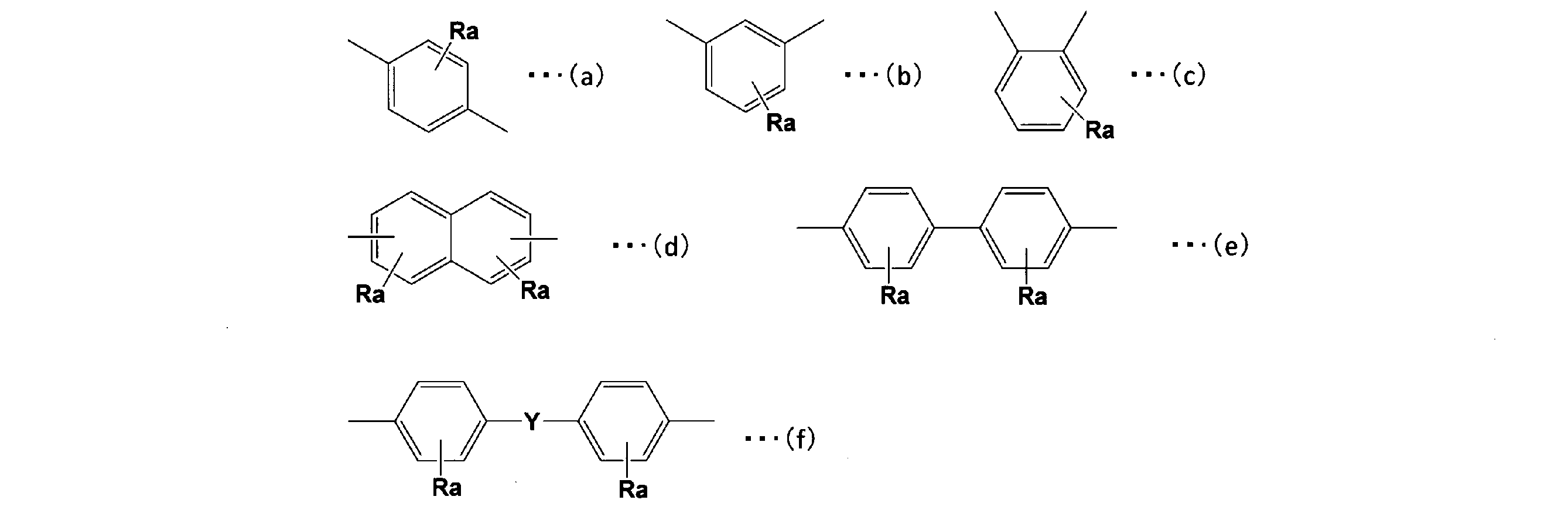
上記式(f)におけるYは、下記単位から選ばれる基である;Xは、水素原子、メチル基およびトリフルオロメチル基のいずれかである。

(2)(1)に記載のポリエーテルニトリルと炭素繊維とを含むポリエーテルニトリル含有炭素繊維複合材であって、該ポリエーテルニトリル含有炭素繊維複合材を熱重量分析(TG)において、空気下、前記ポリエーテルニトリルの融点+30℃で30分保持した時の重量減少率が5%以下であり、ポリエーテルニトリルの含有割合が20~85重量%であるポリエーテルニトリル含有炭素繊維複合材。
(3)Ar1は前記式(a)または前記式(e)で示す骨格であり、Ar2は前記式(a)から式(f)で表される単位から選ばれる1種類の骨格で、かつ、Ar1と異なる骨格である、(2)に記載のポリエーテルニトリル含有炭素繊維複合材。
(4)NとMは、0.80≦[N/(N+M)]<1.00の関係を満足する整数である、(2)または(3)に記載のポリエーテルニトリル含有炭素繊維複合材。
(5) ポリエーテルニトリルの融点が280~370℃である、(2)~(4)のいずれかに記載のポリエーテルニトリル含有炭素繊維複合材。
(6)(2)~(5)のいずれかに記載のポリエーテルニトリル含有炭素繊維複合材を含むモビリティ用部材。
(7)(2)~(5)のいずれかに記載のポリエーテルニトリル含有炭素繊維複合材を含む構造材料用部材。
(8)(6)に記載のモビリティ用部材を用いたモビリティ。
(9)(7)に記載の構造材料用部材を用いた構造材。
本発明によれば、熱安定性の優れたポリエーテルニトリルおよびポリエーテルニトリル含有炭素繊維複合材を提供できる。
以下、本発明について、実施形態とともに詳細に説明する。
本発明のポリエーテルニトリル含有炭素繊維複合材は、ポリエーテルニトリルと炭素繊維とを含み、ポリエーテルニトリルが式(I)で示される繰り返し単位をN個、および式(II)で示される繰り返し単位をM個有し、NとMは、0<[N/(N+M)]≦1.00の関係を満足する整数であり、熱重量分析(TG)において、空気下、融点+30℃で30分保持した時のポリエーテルニトリル含有炭素繊維複合材に含まれるポリエーテルニトリルの重量を基準とした重量減少率が5%以下であり、ポリエーテルニトリルの含有割合が20~85重量%である。
式中、Ar1、Ar2は、それぞれ式(a)から式(f)のいずれかで表される単位から選ばれる互いに異なる1種類の骨格を有している。
式中、Ar1、Ar2は、それぞれ式(a)から式(f)のいずれかで表される単位から選ばれる互いに異なる1種類の骨格を有している。

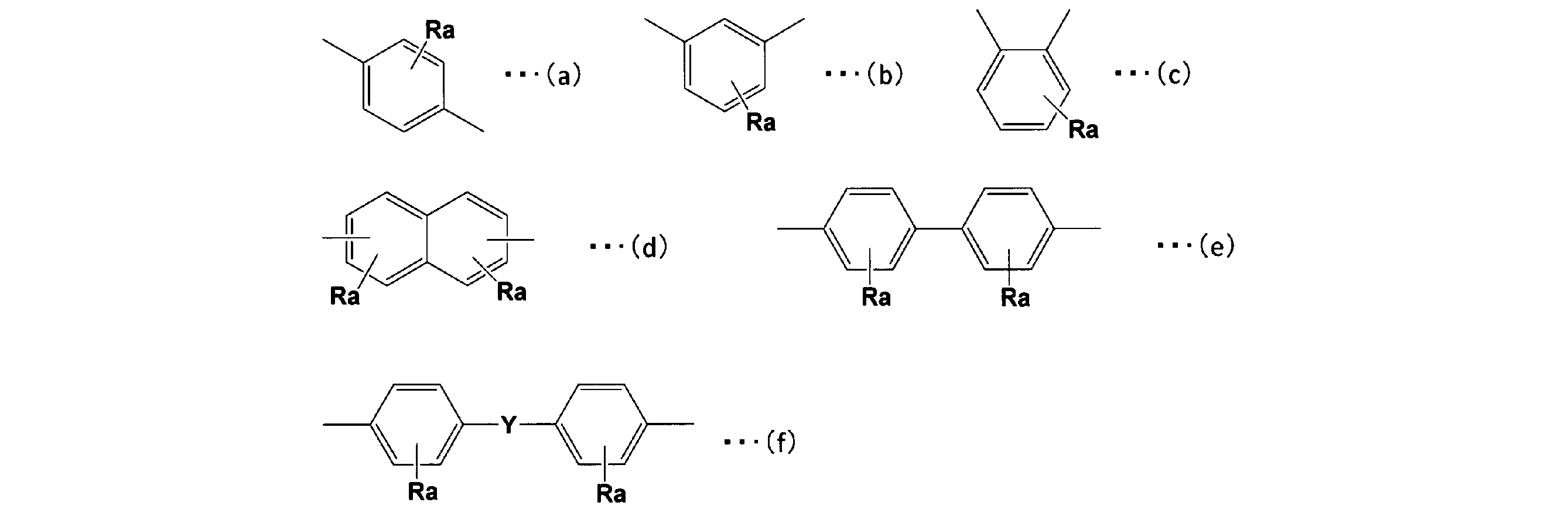
上記式(f)におけるYは、下記単位から選ばれる基である。Xは、水素原子、メチル基、トリフルオロメチル基のいずれかである。

(1)ポリエーテルニトリル
本発明のポリエーテルニトリルは、1分子中に式(I)で示される繰り返し単位をN個、および式(II)で示される繰り返し単位をM個有するポリエーテルニトリルである。ここで、NとMは、0<[N/(N+M)]≦1.00の関係を満足する整数である。
本発明のポリエーテルニトリルは、1分子中に式(I)で示される繰り返し単位をN個、および式(II)で示される繰り返し単位をM個有するポリエーテルニトリルである。ここで、NとMは、0<[N/(N+M)]≦1.00の関係を満足する整数である。

式中、Ar1およびAr2は、それぞれ下記式(a)から式(f)で表される単位から選ばれる互いに異なる1種類の骨格を有している。Rは、炭素数1~6の直鎖状有機基、炭素数3~6の分岐状有機基、および炭素数3~6の環状有機基から選ばれるいずれかの有機基である。Rは、酸素原子、窒素原子および硫黄原子から選ばれる原子を1つまたは複数含んでいてもよい。aは置換基Rの数を示す。式(a)、(b)、(c)、(e)、および(f)におけるaは、0~4のいずれかの整数であり、式(I)、式(II)、および式(d)におけるaは、0~3のいずれかの整数である。aが0である骨格が工業的に利用しやすい点で、好ましい。なお、Rが複数存在する場合、Rは、互いに等しくても異なってもよい。
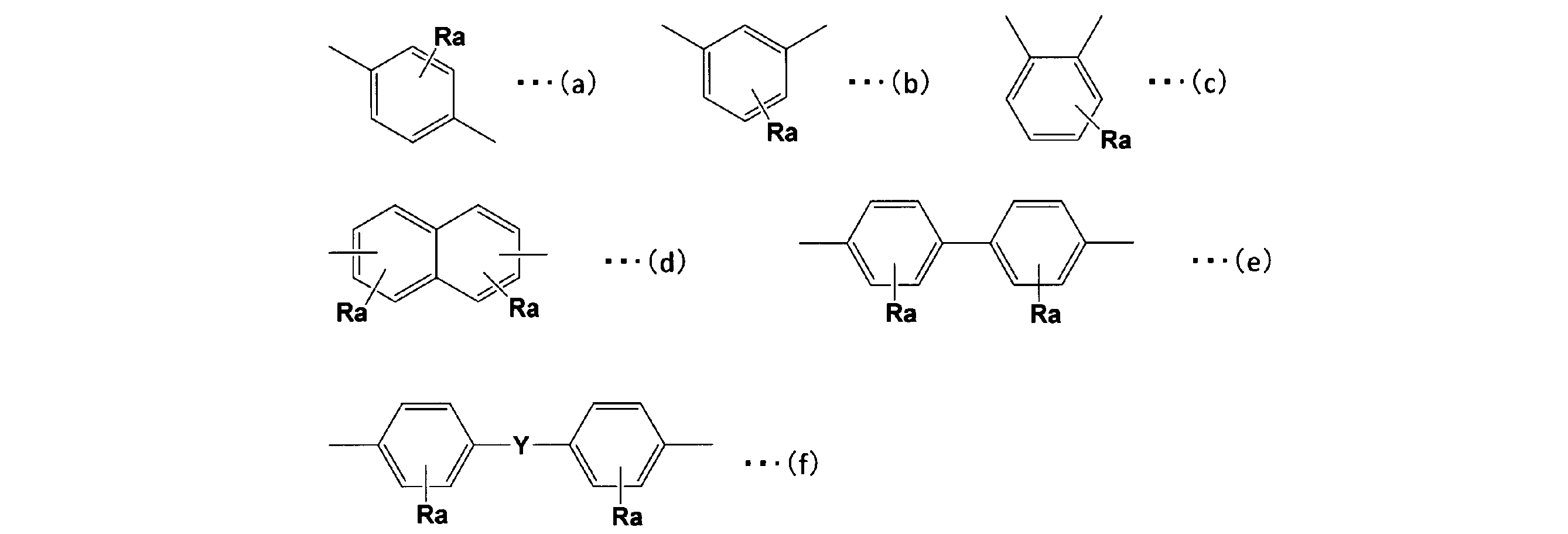
上記式(f)におけるYは、下記単位から選ばれる基である。Xは、水素原子、メチル基およびトリフルオロメチル基のいずれかである。

ポリエーテルニトリル中のAr1で示される繰返し単位の含有率(モル比)は[N/(N+M)]で示される。Ar2で示される繰返し単位の含有率(モル比)は[M/(N+M)]で示される。なお、NとMの関係はN≧Mとする。
融点を下げたポリエーテルニトリルが得られやすい点から、[N/(N+M)]<1.00であることが好ましい。[N/(N+M)]が1.00から遠ざかるほど低融点になるため、[N/(N+M)]は0.99以下がより好ましく、0.97以下がさらに好ましい。ポリエーテルニトリルの融点を下げることにより、加工性に優れたポリエーテルニトリルを得られやすくすることができる。
結晶性の高いポリエーテルニトリルが得られやすい点から、0.60≦[N/(N+M)]であることが好ましい。[N/(N+M)]は0.80以上がより好ましく、0.90以上がさらに好ましい。ポリエーテルニトリルを高結晶性とすることにより、耐溶剤性に優れたポリエーテルニトリルを得ることができる。
N、Mは、好ましくは、0.60≦[N/(N+M)]<1.00の関係を満足する整数であり、より好ましくは、0.80≦[N/(N+M)]<1.00の関係を満足する整数であり、さらに好ましくは、0.80≦[N/(N+M)]≦0.99の関係を満足する整数であり、特に好ましくは、0.90≦[N/(N+M)]≦0.97の関係を満足する整数である。
NとMの和の範囲としては、特に制限はないが、5~10000の範囲が例示でき、5~5000の範囲が好ましく、5~1000の範囲がさらに好ましく、5~500の範囲がより好ましい。
本発明のポリエーテルニトリルは、上記式(I)で示される繰り返し単位、および上記式(II)で示される繰り返し単位の他に、第三の繰り返し単位を含んでいてもよい。その場合、ポリエーテルニトリル中の全繰り返し単位中における式(I)で示される繰り返し単位、および式(II)で示される繰り返し単位の合計モル比が60モル%以上100モル%以下であることが好ましく、80モル%以上100モル%以下であることがより好ましく、90モル%以上100モル%以下であることが最も好ましい。
本発明のポリエーテルニトリルにおいて、Ar1は前記式(a)または前記式(e)で示す骨格であり、Ar2は前記式(a)から式(f)で表される単位から選ばれる1種類の骨格であって、かつ、Ar1と異なる骨格であることが好ましい。本発明のポリエーテルニトリルにおいて、Ar1が前記式(a)で示す骨格であり、Ar2が前記式(b)から式(f)で表される単位から選ばれる1種類の骨格であることがより好ましい。Ar1が前記式(a)または前記式(e)で示す骨格であること、より好ましくは前記式(a)で示す骨格であることにより、得られるポリエーテルニトリルの熱安定性がより向上しやすくなる。
本発明のポリエーテルニトリルにおいて、前記式(I)で示される繰り返し単位が下記式(III)で示される構造単位であり、前記式(II)で示される構造単位が下記式(IV)で示される構造単位であることがより好ましい。

式中、Ar3は、式(g)から式(k)のいずれかで表される単位から選ばれる1種類の骨格を有している。前記式(I)で示される繰り返し単位が下記式(III)で示される構造単位であることで、得られるポリエーテルニトリルの熱安定性が優れるため好ましい。

上記式(k)におけるYは、下記単位から選ばれる基である。Xは、水素原子、メチル基およびトリフルオロメチル基のいずれかである。

本発明のポリエーテルニトリルは融点が280~370℃であることが好ましい。ポリエーテルニトリルの融点を280℃以上とすることで熱安定性に優れるポリエーテルニトリル含有炭素繊維複合材を得ることができる。ポリエーテルニトリルの融点を370℃以下とすることで、ポリエーテルニトリルの加工性が優れる。
(2)ポリエーテルニトリルを製造する方法
ポリエーテルニトリルを製造する方法は、前記(1)の要件を満たすポリエーテルニトリルを合成できるものであれば特に限定はされず、いかなる製法も採用することが可能である。例えば、2個の水酸基を有する芳香族化合物と、2個のハロゲノ基を有するベンゾニトリル骨格をもつ芳香族化合物と、塩基との混合物を有機極性溶媒中で加熱することにより、ポリエーテルニトリルを製造することができる。ポリエーテルニトリルを製造する際に、2個の水酸基を有する芳香族化合物は、1種類あるいは2種類以上用いてもよい。
ポリエーテルニトリルを製造する方法は、前記(1)の要件を満たすポリエーテルニトリルを合成できるものであれば特に限定はされず、いかなる製法も採用することが可能である。例えば、2個の水酸基を有する芳香族化合物と、2個のハロゲノ基を有するベンゾニトリル骨格をもつ芳香族化合物と、塩基との混合物を有機極性溶媒中で加熱することにより、ポリエーテルニトリルを製造することができる。ポリエーテルニトリルを製造する際に、2個の水酸基を有する芳香族化合物は、1種類あるいは2種類以上用いてもよい。
以下、ポリエーテルニトリルを製造する方法の一例で使用される、2個の水酸基を有する芳香族化合物、2個のハロゲノ基を有するベンゾニトリル骨格をもつ芳香族化合物、塩基、有機極性溶媒、および反応条件について記載する。
ポリエーテルニトリルを製造する方法における、2個の水酸基を有する芳香族化合物としては、下記一般式(l)~(s)で表わされる化合物が例示できる。
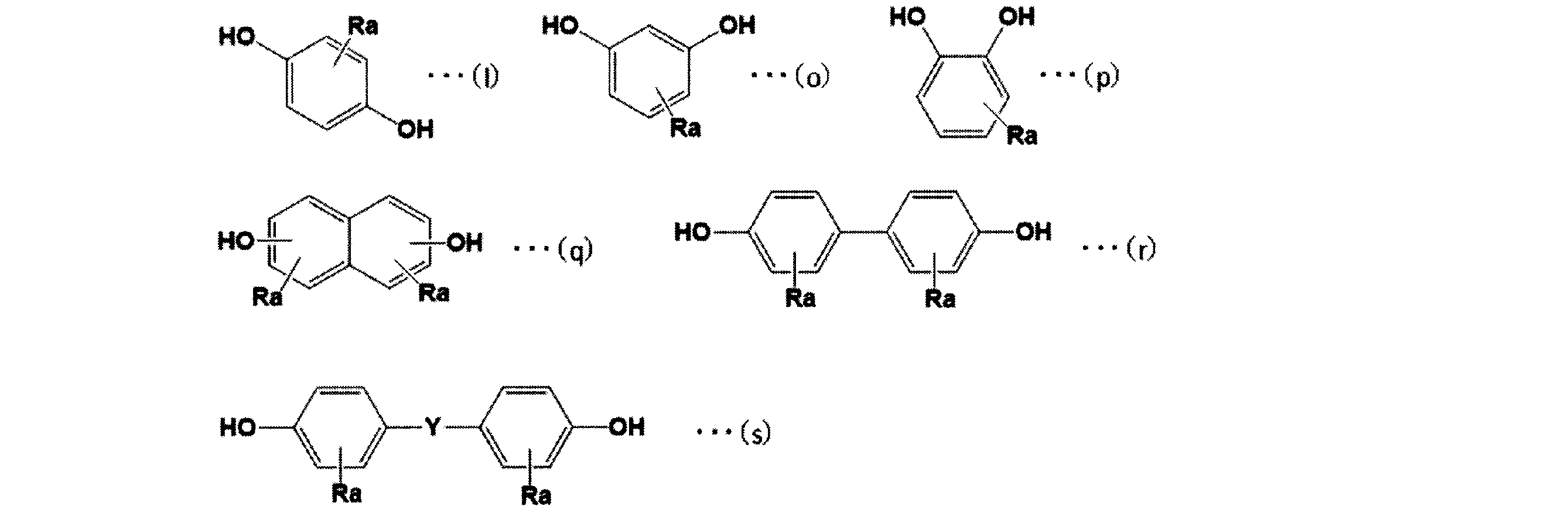
式中、Rは、炭素数1~6の直鎖状有機基、炭素数3~6の分岐状有機基、および炭素数3~6の環状有機基から選ばれるいずれかの有機基である。Rは、酸素原子、窒素原子および硫黄原子から選ばれる原子を1つまたは複数含んでいてもよい。式(l)から(s)におけるaは置換基Rの数を示す。式(l)、(o)、(p)、(r)、および(s)におけるaは、0~4の整数であり、式(q)のaは、0~3の整数である。なお、Rが複数存在する場合、Rは、互いに等しくても異なってもよい。
上記式(s)におけるYは、下記単位から選ばれる基である。Xは、水素原子、メチル基およびトリフルオロメチル基のいずれかである。
上記式(s)におけるYは、下記単位から選ばれる基である。Xは、水素原子、メチル基およびトリフルオロメチル基のいずれかである。

2個の水酸基を有する芳香族化合物としては、具体的には、ヒドロキノン、メチルヒドロキノン、メトキシヒドロキノン、2,6-ジメチルヒドロキノン、2,3-ジメチルヒドロキノン、トリメチルヒドロキノン、テトラメチルヒドロキノン、2,5-ジ-tert-ブチルヒドロキノン、2,5-ジ-tert-アミルヒドロキノン、2-アセチルヒドロキノン、レゾルシノール、5-メトキシレゾルシノール、2-メチルレゾルシノール、5-メチルレゾルシノール、2,4-ジヒドロキシベンズアルデヒド、4-エチルレゾルシノール、3,5-ジヒドロキシアセトフェノン、4-ブチルレゾルシノール、2-アセチルレゾルシノール、4-ヘキシルレゾルシノール、4-アセチルレゾルシノール、3,5-ジヒドロキシ安息香酸、4-ベンゾイルレゾルシノール、4,6-ジアセチルレゾルシノール、2,6-ジヒドロキシ安息香酸、2,4-ジヒドロキシ安息香酸、4-プロピオニルレゾルシノール、3,5-ジヒドロキシベンズアミド、3,5-ジヒドロキシ-4-メチル安息香酸、2-ニトロレゾルシノール、2,6-ジヒドロキシ-4-メチル安息香酸、2,4-ジヒドロキシベンズアミド、1,4-ジヒドロキシナフタレン、カテコール、4,4’-ジヒドロキシビフェニル、2,5-ジヒドロキシ安息香酸、フェニルヒドロキノン、2,5-ジヒドロキシテレフタル酸、1,4-ジヒドロキシ-2-ナフトエ酸、3,6-ジヒドロキシベンゾノルボルナン、2,3-ジヒドロキシナフタレン、1,2-ジヒドロキシナフタレン、4-メチルカテコール、3-メトキシカテコール、3-メチルカテコール、3,4-ジヒドロキシベンズアルデヒド、4-tert-ブチルカテコール、2,3-ジヒドロキシベンズアルデヒド、3,4-ジヒドロキシアセトフェノン、3,4-ジヒドロキシベンゾフェノン、3,5-ジ-tert-ブチルカテコール、3,4-ジヒドロキシ安息香酸、4-ニトロカテコール、2,3-ジヒドロキシ安息香酸、カテコール-4-酢酸、4,4’-ジヒドロキシ-3,3’,5,5’-テトラメチルビフェニル、3,3’-ジヒドロキシベンジジン、1,5-ジヒドロキシナフタレン、1,6-ジヒドロキシナフタレン、2,6-ジヒドロキシナフタレン、2,7-ジヒドロキシナフタレン、2,2’-ビス(4-ヒドロキシフェニル)プロパン、ビス(4-ヒドロキシフェニル)スルホン、1,1’-ビス(4-ヒドロキシフェニル)メタン、4,4’-ジヒドロキシベンゾフェノン、4,4’-ジヒドロキシジフェニルエーテル、2,2-ビス(4-ヒドロキシフェニル)ヘキサフルオロプロパンなどが例示できる。中でも、ヒドロキノン、レゾルシノールまたは4,4’-ジヒドロキシビフェニルが好ましく、得られるポリエーテルニトリル含有炭素繊維複合材の熱安定性がより向上しやすいことから、ヒドロキノンがより好ましい。また、2個の水酸基を有する芳香族化合物を2種類用いる場合には、当該2種類のうち1種類がヒドロキノンであり、かつ、ヒドロキノンの配合量の方がもう1種類の芳香族化合物の配合量より多いことが好ましい。
ポリエーテルニトリルを製造する方法における、2個のハロゲノ基を有するベンゾニトリル骨格をもつ化合物としては、下記式(t)で表わされる化合物が好ましく適用できる。

Xは、塩素原子またはフッ素原子である。2個のハロゲノ基を有するベンゾニトリル骨格をもつ化合物としては、2,6-ジクロロベンゾニトリル、2,6-ジフルオロベンゾニトリル、2-クロロ-6-フルオロベンゾニトリルなどが挙げられる。中でも、2,6-ジクロロベンゾニトリルが好ましい。
ポリエーテルニトリルを製造する方法における、2個のハロゲノ基を有するベンゾニトリル骨格をもつ化合物の配合量は、2個の水酸基を有する芳香族化合物1.00モルに対して、0.90~1.10モルの範囲であれば特に制限されないが、得られるポリマーの物性の観点から1.01~1.05モルの範囲が好ましい。2個のハロゲノ基を有するベンゾニトリル骨格をもつ化合物の配合量は、2個の水酸基を有する芳香族化合物1.00モルに対して、1.01モル以上であることで、耐熱性に優れるポリエーテルニトリルが得られる。2個のハロゲノ基を有するベンゾニトリル骨格をもつ化合物の配合量は、2個の水酸基を有する芳香族化合物1.00モルに対して、1.05モル以下であることで得られるポリエーテルニトリルを高分子量とすることができる。
ポリエーテルニトリルを製造する方法における、塩基としては、有機塩基および無機塩基が挙げられる。塩基の種類は限定されないが、取り扱いの容易さおよび反応性の観点から、炭酸ナトリウム、炭酸カリウムなどの炭酸塩;および炭酸水素ナトリウム、炭酸水素カリウムなどの重炭酸塩が好ましく、炭酸ナトリウムまたは炭酸カリウムがさらに好ましい。
ポリエーテルニトリルを製造する方法において用いる有機極性溶媒としては、反応が阻害されないものであれば特に制限はないが、N-メチル-2-ピロリドン(NMP)、ジメチルスルホキシド(DMSO)、またはスルホランが好ましく、NMPが特に好ましい。
ポリエーテルニトリルを製造する方法において、反応進行に伴い、水が副生する。副生した水を除去する目的で、必要に応じて、水と共沸混合物を形成する有機化合物を添加することができる。このような有機化合物としては、水と共沸混合物を形成するものであれば特に制限されないが、反応溶媒より沸点が低い非極性有機溶媒が好ましく、具体的には、トルエンが挙げられる。
ポリエーテルニトリルを製造する方法は、通常、窒素雰囲気下または減圧下で、加熱下で行われる。反応温度は、150~200℃の範囲で、段階的に昇温させながら実施されるのが好ましい。段階的に昇温することで、重合時に2個のハロゲノ基を有するベンゾニトリル骨格をもつ化合物の揮発を抑制し、空気下での熱安定性に優れたポリエーテルニトリルを得ることができる。
ポリエーテルニトリルを製造する方法における反応時間は、反応温度、使用される試薬の性質および溶媒の存在にある程度依存して変わり得るが、6~10時間であることが好ましい。
製造されたポリエーテルニトリルは、前述した方法により得られた反応混合物から分離回収することにより得ることが可能である。反応混合物からポリエーテルニトリルを回収する方法に特に制限はなく、例えば必要に応じて加熱下で、必要に応じて副生塩に対して溶解性を有する溶剤と反応混合物とを接触させて回収する方法や、反応混合物から副生塩やオリゴマーを減圧下除去する方法が例示できる。
本発明の共重合ポリエーテルニトリルの製造方法において、末端封鎖剤を用いてもよい。末端封鎖剤は1個の水酸基を有する芳香族化合物である。具体的には、4-フェニルフェノール、2-フェニルフェノール、3-フェニルフェノール、4-フェノキシフェノール、1-ナフトール、2-ナフトールが挙げられる。4-フェニルフェノール、4-フェノキシフェノール、1-ナフトール、2-ナフトールから選ばれた化合物が好ましく、4-フェニルフェノール、4-フェノキシフェノール、1-ナフトール、2-ナフトールから選ばれた化合物がより好ましい。末端封鎖剤として1個の水酸基を有する芳香族化合物を配合することにより、耐熱性に優れるポリエーテルニトリルおよびポリエーテルニトリル含有炭素繊維複合材を得ることができる。
1個の水酸基を有する芳香族化合物の配合量(モル)については、前記2個の水酸基を有する芳香族化合物と、前記2個のハロゲノ基を有するベンゾニトリル骨格をもつ芳香族化合物の総使用量(モル)に対して0.01~5.00モル%の範囲であれば特に制限されないが、得られるポリマーの物性の観点から、0.10~2.00モル%の範囲がより好ましい。
(3)ポリエーテルニトリル含有炭素繊維複合材
本発明のポリエーテルニトリル含有炭素繊維複合材は、本発明のポリエーテルニトリルと炭素繊維とを含む。
本発明のポリエーテルニトリル含有炭素繊維複合材は、本発明のポリエーテルニトリルと炭素繊維とを含む。
すなわち、本発明のポリエーテルニトリル含有炭素繊維複合材は、ポリエーテルニトリルと炭素繊維とを含み、ポリエーテルニトリルが式(I)で示される繰り返し単位をN個、および式(II)で示される繰り返し単位をM個有し、NとMは、0<[N/(N+M)]≦1.00の関係を満足する整数であり、熱重量分析(TG)において、空気下、融点+30℃で30分保持した時のポリエーテルニトリル含有炭素繊維複合材に含まれるポリエーテルニトリルの重量を基準とした重量減少率が5%以下であり、ポリエーテルニトリルの含有割合が20~85重量%である。

式中、Ar1およびAr2は、それぞれ下記式(a)から式(f)で表される単位から選ばれる互いに異なる1種類の骨格を有している。Rは、炭素数1~6の直鎖状有機基、炭素数3~6の分岐状有機基、および炭素数3~6の環状有機基から選ばれるいずれかの有機基である。Rは酸素原子、窒素原子および硫黄原子から選ばれる原子を1つまたは複数含んでいてもよい。aは置換基Rの数を示す。式(a)、(b)、(c)、(e)、および(f)におけるaは、0~4のいずれかの整数であり、式(I)、式(II)、および式(d)におけるaは、0~3のいずれかの整数である。なお、Rが複数存在する場合、Rは、互いに等しくても異なってもよい。
上記式(f)におけるYは、下記単位から選ばれる基である。Xは、水素原子、メチル基およびトリフルオロメチル基のいずれかである。

炭素繊維は、連続した炭素繊維および不連続炭素繊維のいずれであってもよい。力学特性に優れるポリエーテルニトリル含有炭素繊維複合材とするためには、炭素繊維が連続した炭素繊維であることが好ましく、炭素繊維束であることがより好ましい。なお、炭素繊維束とは、複数の連続した炭素繊維を束ねたものをいう。
本発明のポリエーテルニトリル含有炭素繊維複合材は、必要に応じて、ポリエーテルニトリル以外のポリマーや各種添加剤などを含有してもよい。添加剤として、可塑剤、結晶核剤、金属石鹸、離型剤、着色防止剤、滑剤、紫外線防止剤、酸化防止剤、難燃剤、着色剤、発泡剤などを配合することができる。
本発明のポリエーテルニトリル含有炭素繊維複合材は、炭素繊維にポリエーテルニトリルを含浸させることにより製造することができる。
連続した炭素繊維にポリエーテルニトリルを含浸させる方法としては、例えば、フィルム状のポリエーテルニトリルを溶融加圧することで炭素繊維束にポリエーテルニトリルを含浸させるフィルム含浸法、連続した繊維状のポリエーテルニトリルと炭素繊維束とを混紡した後、ポリエーテルニトリルを溶融することで炭素繊維束にポリエーテルニトリルを含浸させるコミングル含浸法、粉末状のポリエーテルニトリルを連続した炭素繊維束における繊維の隙間に分散させた後、ポリエーテルニトリルを溶融することで炭素繊維束にポリエーテルニトリルを含浸させる粉末含浸法、溶融したポリエーテルニトリル中に連続した炭素繊維束を浸すことで炭素繊維束にポリエーテルニトリルを含浸させる引き抜含浸法が挙げられ、いずれの方法を用いてもよい。引き抜含浸法が特に好ましい。
不連続炭素繊維からなる炭素繊維基材にポリエーテルニトリルを含浸させる方法としては、例えば、ポリエーテルニトリルを押出機により供給して炭素繊維基材に含浸させる方法、粉末のポリエーテルニトリルを不連続炭素繊維からなる炭素繊維基材の繊維層に分散した後、ポリエーテルニトリルを溶融して含浸させる方法、ポリエーテルニトリルをフィルム化して不連続炭素繊維からなる炭素繊維基材とラミネートした後、ポリエーテルニトリルを溶融して含浸させる方法、ポリエーテルニトリルを溶剤に溶かし溶液の状態で不連続炭素繊維からなる炭素繊維基材に含浸させた後に溶剤を揮発させる方法、ポリエーテルニトリルを繊維化して不連続繊維との混合糸にする方法などが挙げられる。いずれの方法を用いてもよい。炭素繊維基材としては、繊維方向をほぼ同方向に引き揃え、補助横糸やバインダーなどで一体化させた一方向織物、炭素繊維を二方向に交錯させた二方向織物、炭素繊維を多方向に交錯させた多軸織物、一方向に炭素繊維を引き揃えたシートを多方向に積層し、ステッチ糸で一体化した多軸ステッチ基材、組紐、不連続繊維を用いた不織布またはマット等を挙げることができる。
本発明のポリエーテルニトリル含有炭素繊維複合材におけるポリエーテルニトリルの含有割合は20~85重量%である。ポリエーテルニトリルの含有割合を20重量%以上とすることにより、ポリエーテルニトリル含有炭素繊維複合材を用いて得られる成形品の強度を向上させることができる。一方、ポリエーテルニトリルの含有割合を85重量%以下とすることにより、ポリエーテルニトリル含有炭素繊維複合材を用いて得られる成形品の強度を向上させることができる。前記含有割合は30重量%以上がより好ましく、40重量%以上がさらに好ましい。前記含有割合は70重量%以下がより好ましく、60重量%以下がさらに好ましい。含有割合を上記範囲とする方法としては、例えば、上記のような方法でポリエーテルニトリル含有炭素繊維複合材を製造する際に、炭素繊維とポリエーテルニトリルの投入量を調整する方法などが挙げられる。
本発明のポリエーテルニトリル含有炭素繊維複合材におけるポリエーテルニトリルの含有割合は、ポリエーテルニトリル含有炭素繊維複合材の重量を測定したのち、200℃のN-メチル-2-ピロリドン(NMP)に浸漬し、ポリエーテルニトリルを溶出させ、残渣として残った炭素繊維の重量を測定することで算出することができる。ポリエーテルニトリル含有炭素繊維複合材に他種ポリマーや各種添加剤を含有している場合は、他種ポリマーや各種添加剤を除いたポリエーテルニトリルのみの含有割合を算出し、ポリエーテルニトリル含有炭素繊維複合材におけるポリエーテルニトリルの含有割合とする。
ポリエーテルニトリル含有炭素繊維複合材を、任意の構成で1枚以上積層後、必要に応じて熱および/または圧力を付与しながら成形することにより成形品が得られる。
本発明のポリエーテルニトリル含有炭素繊維複合材は、熱重量分析(TG)において、空気下、融点+30℃で30分保持した時の、ポリエーテルニトリル含有炭素繊維複合材に含まれるポリエーテルニトリルの重量を基準とした重量減少率が5%以下である。重量減少率が5%以下であることにより、熱安定性に優れるポリエーテルニトリル含有炭素繊維複合材を得ることができる。ここでいう熱安定性に優れるとは、空気下、融点+30℃で30分保持した時の、ポリエーテルニトリルの重量減少率が小さいこと、すなわち空気下での熱安定性に優れることを意味する。より具体的に説明すると、通常、ポリエーテルニトリルおよび炭素繊維からポリエーテルニトリル含有炭素繊維複合材を製造する際に、ポリエーテルニトリルの融点+30℃で炭素繊維に含浸させる。また、炭素繊維複合材を後述の部材に用いる場合、空気下で溶融・溶着加工する場合がある。そのため、ポリエーテルニトリルの融点+30℃において重量減少率を5%以下とすることが重要である。重量減少率は、1%以下であることが好ましく、0%であることがより好ましい。
ポリエーテルニトリル含有炭素繊維複合材に含まれるポリエーテルニトリルの重量を求め、それを基準として、後述の<ポリエーテルニトリル含有炭素繊維複合材の熱重量分析(TG)>に記載の方法により重量減少率を測定する。
ポリエーテルニトリル含有炭素繊維複合材に含まれるポリエーテルニトリルの重量は、ポリエーテルニトリルと炭素繊維の配合量が分かっている場合は、ポリエーテルニトリル含有炭素繊維複合材から、炭素繊維の重量を差し引くことで求めることができる。ポリエーテルニトリルと炭素繊維の配合量が不明な場合は、ポリエーテルニトリル含有炭素繊維複合材の重量を測定した後、ポリエーテルニトリル含有炭素繊維複合材からポリエーテルニトリルを除去し、重量を測定することで、ポリエーテルニトリル除去前後の重量の差より求めることができる。ポリエーテルニトリル含有炭素繊維複合材からポリエーテルニトリルを除去する方法として、200℃のN-メチル-2-ピロリドン(NMP)に浸漬し、ポリエーテルニトリルを溶出する方法があげられる。
ポリエーテルニトリル含有炭素繊維複合材に含まれるポリエーテルニトリルの重量を基準とした重量減少率を5%以下とするための方法としては、例えば、ポリエーテルニトリルを構成するモノマー組成を調整する方法が挙げられる。より具体的には、例えば、構成するモノマー組成において前記式(III)で示す骨格、あるいは前記式(a)で示す骨格の含有量を増やすことにより重量減少率を小さくする方法が挙げられる。
本発明のポリエーテルニトリル含有炭素繊維複合材は、力学特性に優れる。発明者らは、熱安定性に優れる(空気下での重量減少率が小さい)ポリエーテルニトリルは、ポリエーテルニトリルと炭素繊維の界面せん断強度が高くなる傾向があることを見出した。本発明のポリエーテルニトリル含有炭素繊維複合材は、ポリエーテルニトリルと炭素繊維との界面せん断強度が優れるために、特に、成形品の引張強度に優れる。
本発明のポリエーテルニトリル含有炭素繊維複合材は、耐薬品性に優れる。ここでの耐薬品性は耐溶剤性のことを示す。耐溶剤性は、後述の<ポリエーテルニトリル含有炭素繊維複合材の耐溶剤性試験>に記載の方法により評価する。本発明のポリエーテルニトリル含有炭素繊維複合材の耐溶剤性は、耐溶剤性試験の評価においてB以上であることが好ましく、A以上であることがより好ましい。耐溶剤性の優れたポリエーテルニトリル含有炭素繊維複合材とする方法としては、例えば、上述のとおり、0.60≦[N/(N+M)]であるポリエーテルニトリルを使用する方法が挙げられる。
本発明のポリエーテルニトリル含有炭素繊維複合材は、熱安定性、力学特性および耐薬品性に優れることで、モビリティ用部材、構造材料用部材、その他産業用途用部材に用いることができる。
本発明のモビリティ用部材としては、自動車、航空機、船舶、オートバイ、ドローン、アーバンエアモビリティ、キックボード用の部材が例示できる。本発明の構造材料部材としては、建物、橋、鉄道、道路、港湾などの部材が例示できる。本発明のポリエーテルニトリル含有炭素繊維複合材は、特に熱安定性、機械特性および耐薬品性に優れる特徴が要求されるモビリティ用部材または構造材料用部材に好適である。
本発明のポリエーテルニトリル含有炭素繊維複合材を含むモビリティ用部材を用いたモビリティは優れた特性を示す。本発明のモビリティとしては、自動車、航空機、船舶、オートバイ、ドローン、アーバンエアモビリティ、キックボードが例示できる。
本発明のポリエーテルニトリル含有炭素繊維複合材を含む構造材料用部材を用いた構造材は優れた特性を示す。本発明の構造材としては、建物、橋、鉄道、道路、港湾などが例示できる。
以下に実施例を挙げて本発明を具体的に説明する。これら例は例示的なものであって限定的なものではない。
<ポリエーテルニトリルおよびポリエーテルニトリル含有炭素繊維複合材の融点>
ポリエーテルニトリルの融点は、ポリエーテルニトリルを測定することで求め、ポリエーテルニトリル含有炭素繊維複合材の融点は、ポリエーテルニトリル含有炭素繊維複合材を測定することで求めた。なお、示差走査熱量(DSC)測定で炭素繊維は融解しないため、ポリエーテルニトリル含有炭素繊維複合材の示す融点は、実質的に含有するポリエーテルニトリルの融点である。
ポリエーテルニトリルの融点は、ポリエーテルニトリルを測定することで求め、ポリエーテルニトリル含有炭素繊維複合材の融点は、ポリエーテルニトリル含有炭素繊維複合材を測定することで求めた。なお、示差走査熱量(DSC)測定で炭素繊維は融解しないため、ポリエーテルニトリル含有炭素繊維複合材の示す融点は、実質的に含有するポリエーテルニトリルの融点である。
融点は、ティー・エー・インスツルメント社製Q20を用いて、示差走査熱量(DSC)測定により求めた。50℃から400℃まで昇温速度20℃/分で昇温させ、そのまま400℃で1分間保持後、400℃から50℃まで昇温速度20℃/分で降温し、再度、50℃から400℃まで昇温速度20℃/分で昇温させ、400℃で1分間保持後、400℃から100℃まで昇温速度20℃/分で降温した。2度目の昇温時に観測された吸熱ピーク温度を融点とした。
<ポリエーテルニトリルの熱重量分析(TG)>
ポリエーテルニトリルを融点+30℃で30分保持した際の重量減少率は、パーキンエルマー社製 TGA7を用いて測定した。ポリエーテルニトリルを、空気気流下、50℃で1分保持後、昇温速度20℃/分で融点+30℃まで加熱し、融点+30℃で30分保持した。50℃で1分保持後から融点+30℃で30分保持後までの重量減少率を算出した。
ポリエーテルニトリルを融点+30℃で30分保持した際の重量減少率は、パーキンエルマー社製 TGA7を用いて測定した。ポリエーテルニトリルを、空気気流下、50℃で1分保持後、昇温速度20℃/分で融点+30℃まで加熱し、融点+30℃で30分保持した。50℃で1分保持後から融点+30℃で30分保持後までの重量減少率を算出した。
<ポリエーテルニトリル含有炭素繊維複合材の熱重量分析(TG)>
ポリエーテルニトリル含有炭素繊維複合材を融点+30℃で30分保持した際の重量減少率は、パーキンエルマー社製 TGA7を用いて測定した。ポリエーテルニトリル含有炭素繊維複合材を、空気気流下、50℃で1分保持後、昇温速度20℃/分で融点+30℃まで加熱し、融点+30℃で30分保持した。ポリエーテルニトリル含有炭素繊維複合材に含まれるポリエーテルニトリルの重量を基準とし、50℃で1分保持後から融点+30℃で30分保持後までの重量減少率を算出した。
ポリエーテルニトリル含有炭素繊維複合材を融点+30℃で30分保持した際の重量減少率は、パーキンエルマー社製 TGA7を用いて測定した。ポリエーテルニトリル含有炭素繊維複合材を、空気気流下、50℃で1分保持後、昇温速度20℃/分で融点+30℃まで加熱し、融点+30℃で30分保持した。ポリエーテルニトリル含有炭素繊維複合材に含まれるポリエーテルニトリルの重量を基準とし、50℃で1分保持後から融点+30℃で30分保持後までの重量減少率を算出した。
<ポリエーテルニトリル含有炭素繊維複合材の耐溶剤性試験>
ポリエーテルニトリル含有炭素繊維複合材を1cm角に切り出し、80℃のNMP中に浸漬した。20分間液温を80℃に保った後、処理後のポリエーテルニトリル含有炭素繊維複合材の状態を目視で確認し、以下の判定基準によって評価した。
ポリエーテルニトリル含有炭素繊維複合材を1cm角に切り出し、80℃のNMP中に浸漬した。20分間液温を80℃に保った後、処理後のポリエーテルニトリル含有炭素繊維複合材の状態を目視で確認し、以下の判定基準によって評価した。
A:形状に変化が認められない
B:膨潤している
C:ポリエーテルニトリルが溶解し、炭素繊維が開繊している。
B:膨潤している
C:ポリエーテルニトリルが溶解し、炭素繊維が開繊している。
<実施例に用いた原料>
・ヒドロキノン(富士フイルム和光純薬株式会社)
・レゾルシノール(富士フイルム和光純薬株式会社)
・4,4’-ジヒドロキシビフェニル(東京化成工業株式会社)
・2,6-ジクロロベンゾニトリル(東京化成工業株式会社)
・炭酸ナトリウム(関東化学株式会社)
・NMP(富士フイルム和光純薬株式会社)
・炭素繊維束(東レ株式会社製、T700S-12K)。
・4-フェノキシフェノール(関東化学株式会社)
<ポリエーテルニトリルと炭素繊維の界面せん断強度評価>
ポリエーテルニトリルと炭素繊維の界面せん断強度評価は、Hysitron社製ナノインデンターTI950を用いて測定した。実施例9に記載のようにして、ポリエーテルニトリルと1cm長に切断した炭素繊維を溶融混練した後、射出成形し、ISO527-2-1Aダンベル試験片を得た。ダンベル試験片から18μm厚の薄片を切り出し、試料とした。試料中の繊維一本を先端が平坦な圧子で押出すことでポリエーテルニトリル/炭素繊維間の界面せん断強度を計測した。5回測定した平均を測定値とした。
<力学特性>
上記と同様にして得られたISO527-2-1Aダンベル試験片を試料とし、島津製作所製AG-50kNx万能試験機を用い、ISO527-1に従って、引張強度を計測した。5回測定した平均を測定値とした。
上記と同様にして得られたISO527-2-1Aダンベル試験片を試料とし、島津製作所製AG-50kNx万能試験機を用い、ISO527-1に従って、引張強度を計測した。5回測定した平均を測定値とした。
[実施例1]
攪拌装置、窒素導入管、ディーンスターク管を備えた3Lセパラブルフラスコに、ヒドロキノン 88.1g(800mmol)、2,6-ジクロロベンゾニトリル 140.4g(816mmol)、および炭酸ナトリウム 101.8g(960mmol)を仕込み、窒素雰囲気下で、NMP 800mLおよびトルエン 30mLを加え、160℃で2時間、180℃で2時間、次いで、200℃で8時間反応させた。反応終了後、NMP:水=8:2(体積比)の混合溶媒3Lの入った受け容器に、反応溶液を吐出することでポリエーテルニトリルを析出させ、粒子を得た。得られた粒子をNMP:水=8:2(体積比)の混合溶媒(室温)3Lで3回、さらに温水(80℃)3Lで3回洗浄し、80℃で一晩真空乾燥することにより、ポリエーテルニトリル粒子を得た。得られたポリエーテルニトリル粒子の共重合比率は[N/(N+M)]=1.00である。得られたポリエーテルニトリル粒子の融点は388℃であった。
攪拌装置、窒素導入管、ディーンスターク管を備えた3Lセパラブルフラスコに、ヒドロキノン 88.1g(800mmol)、2,6-ジクロロベンゾニトリル 140.4g(816mmol)、および炭酸ナトリウム 101.8g(960mmol)を仕込み、窒素雰囲気下で、NMP 800mLおよびトルエン 30mLを加え、160℃で2時間、180℃で2時間、次いで、200℃で8時間反応させた。反応終了後、NMP:水=8:2(体積比)の混合溶媒3Lの入った受け容器に、反応溶液を吐出することでポリエーテルニトリルを析出させ、粒子を得た。得られた粒子をNMP:水=8:2(体積比)の混合溶媒(室温)3Lで3回、さらに温水(80℃)3Lで3回洗浄し、80℃で一晩真空乾燥することにより、ポリエーテルニトリル粒子を得た。得られたポリエーテルニトリル粒子の共重合比率は[N/(N+M)]=1.00である。得られたポリエーテルニトリル粒子の融点は388℃であった。
上記のようにして得られたポリエーテルニトリル粒子をフィーダーから融点+30℃(418℃)に設定した含侵ダイに定量供給した。炭素繊維束(T700S-12K)が巻かれたボビンを16本準備し、それぞれのボビンから糸道ガイドを通じて炭素繊維束を連続的に送り出した。送り出された16本の炭素繊維束を、幅50mmになるように設定し、前記含侵ダイを通過させた。このようにして、含侵ダイ内を連続的に通過する炭素繊維束にポリエーテルニトリルを含浸させた。ポリエーテルニトリルが含浸した炭素繊維を、引取りロールを用いて含浸ダイのノズルから毎分1mの速度で連続的に引き抜いた。引き抜かれた炭素繊維束は、冷却ロールで冷却した後、巻取り機で巻取り、ポリエーテルニトリルの含有割合50重量%のポリエーテルニトリル含有炭素繊維複合材を得た。
得られたポリエーテルニトリルおよびポリエーテルニトリル含有炭素繊維複合材を上記の方法により分析した。空気下での重量減少率、融点および耐溶剤性は、表1のとおりであった。
[実施例2~8、比較例1~2]
2個の水酸基を有する芳香族化合物の種類と配合量を表1および表2に示すように変更した以外は実施例1と同様の操作を行った。得られたポリエーテルニトリル含有炭素繊維複合材を上記の方法により分析した。空気下での重量減少率、融点および耐溶剤性を表1および表2に示す。
2個の水酸基を有する芳香族化合物の種類と配合量を表1および表2に示すように変更した以外は実施例1と同様の操作を行った。得られたポリエーテルニトリル含有炭素繊維複合材を上記の方法により分析した。空気下での重量減少率、融点および耐溶剤性を表1および表2に示す。
[実施例9、比較例3]
2個の水酸基を有する芳香族化合物の種類と配合量を表2に示すように変更した以外は実施例1と同様の操作を行いポリエーテルニトリル粒子を得た。得られたポリエーテルニトリル粒子と1cm長に切断した炭素繊維(T700S-12K)を、重量比85:15の比率で混合し、融点+30℃(418℃)の温度で小型混錬機(Thermo Scientific社製 HAKKE MInilLab2)を用いて混錬した後、ペレット化した。得られたペレットを小型成型機(Thermo Scientific社製 HAKKE MIniJet pro)を用いて、融点+30℃(418℃)の温度でISO527-2-1Aに準拠したダンベル試験片を作成した。得られたポリエーテルニトリルの含有割合85重量%のポリエーテルニトリル含有炭素繊維複合材のダンベル試験片を用いて、引張強度およびポリエーテルニトリルと炭素繊維の界面せん断強度を測定した。結果を表2に示す。
2個の水酸基を有する芳香族化合物の種類と配合量を表2に示すように変更した以外は実施例1と同様の操作を行いポリエーテルニトリル粒子を得た。得られたポリエーテルニトリル粒子と1cm長に切断した炭素繊維(T700S-12K)を、重量比85:15の比率で混合し、融点+30℃(418℃)の温度で小型混錬機(Thermo Scientific社製 HAKKE MInilLab2)を用いて混錬した後、ペレット化した。得られたペレットを小型成型機(Thermo Scientific社製 HAKKE MIniJet pro)を用いて、融点+30℃(418℃)の温度でISO527-2-1Aに準拠したダンベル試験片を作成した。得られたポリエーテルニトリルの含有割合85重量%のポリエーテルニトリル含有炭素繊維複合材のダンベル試験片を用いて、引張強度およびポリエーテルニトリルと炭素繊維の界面せん断強度を測定した。結果を表2に示す。
[実施例10]
2個の水酸基を有する芳香族化合物の種類と配合量を表2に示すように変更し、2個の水酸基を有する芳香族化合物を配合するタイミングで、末端封鎖剤として4-フェノキシフェノールを表2に示す配合量で配合した以外は実施例1と同様の操作を行った。得られたポリエーテルニトリル含有炭素繊維複合材を上記の方法により分析した。空気下での重量減少率、融点および耐溶剤性を表2に示す。
2個の水酸基を有する芳香族化合物の種類と配合量を表2に示すように変更し、2個の水酸基を有する芳香族化合物を配合するタイミングで、末端封鎖剤として4-フェノキシフェノールを表2に示す配合量で配合した以外は実施例1と同様の操作を行った。得られたポリエーテルニトリル含有炭素繊維複合材を上記の方法により分析した。空気下での重量減少率、融点および耐溶剤性を表2に示す。

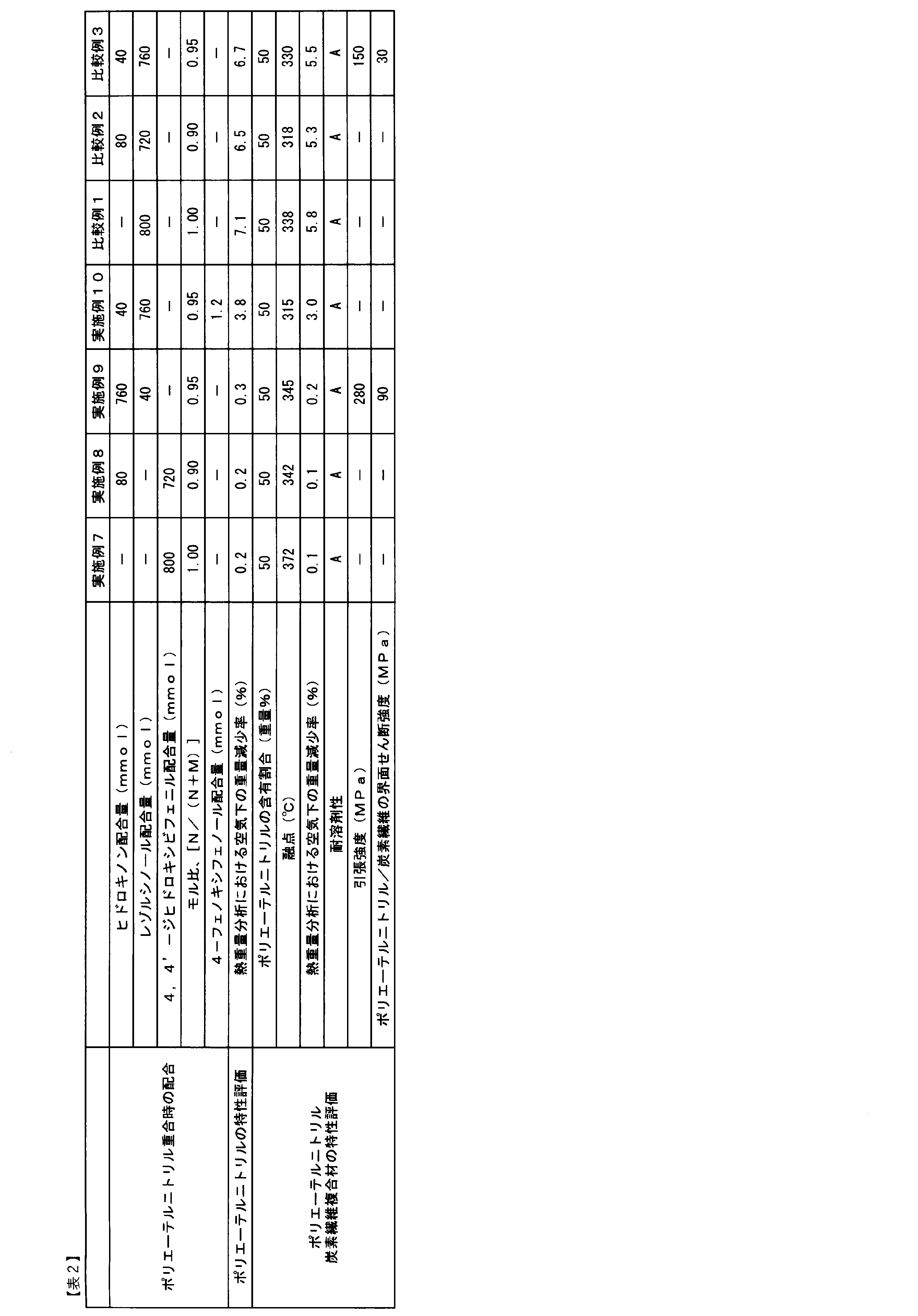
実施例1~8と比較例1~2の比較から、主となるモノマーがヒドロキノンの場合に、ポリエーテルニトリルおよびポリエーテルニトリル複合材の熱安定性(空気下での重量減少率)が優れることがわかる。
また、実施例1と実施例2との比較、実施例7との実施例8を比較から、[N/(N+M)]<1.00を満足する場合には、[N/(N+M)]=1.00である場合よりもポリエーテルニトリルの融点を低くすることができ、融点が370℃以下となることがわかる。
実施例4と実施例5の比較から、0.80≦[N/(N+M)]を満足する場合には、ポリエーテルニトリル複合材の耐溶剤性が特に優れることがわかる。
実施例6、実施例9と比較例3の比較より、ポリエーテルニトリル複合材の熱安定性が優れる(空気下での重量減少率が小さい)実施例6および実施例9のポリエーテルニトリル複合材は、ポリエーテルニトリル/炭素繊維の界面せん断強度が高く、かつ、引張強度が高いことがわかる。
実施例10と比較例3の比較より、末端封鎖を実施することによってポリエーテルニトリル複合材の熱安定性が向上する(空気下での重量減少率が減少する)ことが分かる。
Claims (9)
- 式(I)で示される繰り返し単位をN個、および式(II)で示される繰り返し単位をM個有し、NとMは、0<[N/(N+M)]≦1.00の関係を満足する整数であり、熱重量分析(TG)において、空気下、融点+30℃で30分保持した時の重量減少率が5%以下であるポリエーテルニトリル:



- 請求項1に記載のポリエーテルニトリルと炭素繊維とを含むポリエーテルニトリル含有炭素繊維複合材であって、該ポリエーテルニトリル含有炭素繊維複合材を熱重量分析(TG)において、空気下、前記ポリエーテルニトリルの融点+30℃で30分保持した時の重量減少率が5%以下であり、ポリエーテルニトリルの含有割合が20~85重量%であるポリエーテルニトリル含有炭素繊維複合材。
- Ar1は前記式(a)または前記式(e)で示す骨格であり、Ar2は前記式(a)から式(f)で表される単位から選ばれる1種類の骨格で、かつ、Ar1と異なる骨格である、請求項2に記載のポリエーテルニトリル含有炭素繊維複合材。
- NとMは、0.80≦[N/(N+M)]<1.00の関係を満足する整数である、請求項2または3に記載のポリエーテルニトリル含有炭素繊維複合材。
- ポリエーテルニトリルの融点が280~370℃である、請求項2または3のいずれかに記載のポリエーテルニトリル含有炭素繊維複合材。
- 請求項2または3に記載のポリエーテルニトリル含有炭素繊維複合材を含むモビリティ用部材。
- 請求項2または3に記載のポリエーテルニトリル含有炭素繊維複合材を含む構造材料用部材。
- 請求項6に記載のモビリティ用部材を用いたモビリティ。
- 請求項7に記載の構造材料用部材を用いた構造材。
Priority Applications (2)
| Application Number | Priority Date | Filing Date | Title |
|---|---|---|---|
| CN202480071624.4A CN122161871A (zh) | 2023-11-28 | 2024-11-19 | 聚醚腈及含有聚醚腈的碳纤维复合材料 |
| KR1020267012680A KR20260112999A (ko) | 2023-11-28 | 2024-11-19 | 폴리에테르니트릴 및 폴리에테르니트릴 함유 탄소 섬유 복합재 |
Applications Claiming Priority (2)
| Application Number | Priority Date | Filing Date | Title |
|---|---|---|---|
| JP2023-200637 | 2023-11-28 | ||
| JP2023200637 | 2023-11-28 |
Publications (1)
| Publication Number | Publication Date |
|---|---|
| WO2025115696A1 true WO2025115696A1 (ja) | 2025-06-05 |
Family
ID=95897731
Family Applications (1)
| Application Number | Title | Priority Date | Filing Date |
|---|---|---|---|
| PCT/JP2024/040942 Pending WO2025115696A1 (ja) | 2023-11-28 | 2024-11-19 | ポリエーテルニトリルおよびポリエーテルニトリル含有炭素繊維複合材 |
Country Status (3)
| Country | Link |
|---|---|
| KR (1) | KR20260112999A (ja) |
| CN (1) | CN122161871A (ja) |
| WO (1) | WO2025115696A1 (ja) |
Citations (15)
| Publication number | Priority date | Publication date | Assignee | Title |
|---|---|---|---|---|
| JPS60144328A (ja) * | 1984-01-09 | 1985-07-30 | Idemitsu Kosan Co Ltd | 新規重合体とその製造法 |
| JPS61192732A (ja) * | 1985-02-22 | 1986-08-27 | Idemitsu Kosan Co Ltd | 新規共重合体及びその製造法 |
| JPS63289022A (ja) * | 1987-05-21 | 1988-11-25 | Tosoh Corp | ポリシアノアリ−ルエ−テル共重合体およびその製造方法 |
| JPH0457973A (ja) | 1990-06-25 | 1992-02-25 | Idemitsu Kosan Co Ltd | 炭素繊維複合材料 |
| CN1124745A (zh) * | 1994-12-13 | 1996-06-19 | 四川联合大学 | 一种聚芳醚腈及其制造方法 |
| JPH08170012A (ja) * | 1994-12-19 | 1996-07-02 | Idemitsu Petrochem Co Ltd | 樹脂組成物 |
| CN101050277A (zh) * | 2006-06-30 | 2007-10-10 | 电子科技大学 | 一种含间苯链节的聚芳醚腈共聚物及其制备方法 |
| CN101838390A (zh) * | 2010-05-28 | 2010-09-22 | 电子科技大学 | 一种聚芳醚腈树脂的制备方法 |
| CN102516528A (zh) * | 2011-12-16 | 2012-06-27 | 四川飞亚新材料有限公司 | 一种聚芳醚腈树脂、聚芳醚腈纤维及其制备方法 |
| CN102766255A (zh) * | 2012-07-19 | 2012-11-07 | 电子科技大学 | 聚芳醚腈树脂及其工业化合成方法 |
| CN107286625A (zh) * | 2017-08-04 | 2017-10-24 | 太仓市晨洲塑业有限公司 | 一种复合型工业用塑料 |
| WO2021241492A1 (ja) * | 2020-05-28 | 2021-12-02 | 東レ株式会社 | 結晶性ポリエーテルニトリル |
| JP2022071959A (ja) * | 2020-10-29 | 2022-05-17 | 東レ株式会社 | ポリエーテルニトリル |
| JP2023062400A (ja) * | 2021-10-21 | 2023-05-08 | 東レ株式会社 | 共重合ポリエーテルニトリル |
| JP2023145849A (ja) * | 2022-03-29 | 2023-10-12 | 東レ株式会社 | ポリエーテルニトリル粒子 |
-
2024
- 2024-11-19 WO PCT/JP2024/040942 patent/WO2025115696A1/ja active Pending
- 2024-11-19 KR KR1020267012680A patent/KR20260112999A/ko active Pending
- 2024-11-19 CN CN202480071624.4A patent/CN122161871A/zh active Pending
Patent Citations (15)
| Publication number | Priority date | Publication date | Assignee | Title |
|---|---|---|---|---|
| JPS60144328A (ja) * | 1984-01-09 | 1985-07-30 | Idemitsu Kosan Co Ltd | 新規重合体とその製造法 |
| JPS61192732A (ja) * | 1985-02-22 | 1986-08-27 | Idemitsu Kosan Co Ltd | 新規共重合体及びその製造法 |
| JPS63289022A (ja) * | 1987-05-21 | 1988-11-25 | Tosoh Corp | ポリシアノアリ−ルエ−テル共重合体およびその製造方法 |
| JPH0457973A (ja) | 1990-06-25 | 1992-02-25 | Idemitsu Kosan Co Ltd | 炭素繊維複合材料 |
| CN1124745A (zh) * | 1994-12-13 | 1996-06-19 | 四川联合大学 | 一种聚芳醚腈及其制造方法 |
| JPH08170012A (ja) * | 1994-12-19 | 1996-07-02 | Idemitsu Petrochem Co Ltd | 樹脂組成物 |
| CN101050277A (zh) * | 2006-06-30 | 2007-10-10 | 电子科技大学 | 一种含间苯链节的聚芳醚腈共聚物及其制备方法 |
| CN101838390A (zh) * | 2010-05-28 | 2010-09-22 | 电子科技大学 | 一种聚芳醚腈树脂的制备方法 |
| CN102516528A (zh) * | 2011-12-16 | 2012-06-27 | 四川飞亚新材料有限公司 | 一种聚芳醚腈树脂、聚芳醚腈纤维及其制备方法 |
| CN102766255A (zh) * | 2012-07-19 | 2012-11-07 | 电子科技大学 | 聚芳醚腈树脂及其工业化合成方法 |
| CN107286625A (zh) * | 2017-08-04 | 2017-10-24 | 太仓市晨洲塑业有限公司 | 一种复合型工业用塑料 |
| WO2021241492A1 (ja) * | 2020-05-28 | 2021-12-02 | 東レ株式会社 | 結晶性ポリエーテルニトリル |
| JP2022071959A (ja) * | 2020-10-29 | 2022-05-17 | 東レ株式会社 | ポリエーテルニトリル |
| JP2023062400A (ja) * | 2021-10-21 | 2023-05-08 | 東レ株式会社 | 共重合ポリエーテルニトリル |
| JP2023145849A (ja) * | 2022-03-29 | 2023-10-12 | 東レ株式会社 | ポリエーテルニトリル粒子 |
Also Published As
| Publication number | Publication date |
|---|---|
| CN122161871A (zh) | 2026-06-05 |
| KR20260112999A (ko) | 2026-07-21 |
Similar Documents
| Publication | Publication Date | Title |
|---|---|---|
| CN104271674B (zh) | 苯并噁嗪树脂组合物、预浸料坯和纤维增强复合材料 | |
| JP5452810B2 (ja) | 難燃性エンジニアリングポリマー組成物 | |
| JP7160058B2 (ja) | エポキシ樹脂、エポキシ樹脂組成物、エポキシ樹脂硬化物及び複合材料 | |
| JP6342799B2 (ja) | ポリホスホネートおよびコポリホスホネートの加法混合物 | |
| KR101510085B1 (ko) | 불용성 분지형 폴리포스포네이트 및 이와 관련된 방법 | |
| CN109843967B (zh) | 环氧树脂、环氧树脂组合物、环氧树脂固化物和复合材料 | |
| US20240247118A1 (en) | Thermoplastic resin prepreg, production method thereof, and fiber-reinforced composite material | |
| WO2018175025A1 (en) | Resin blends containing a phthalonitrile reactive diluent and a diphthalonitrile resin, prepregs, and articles | |
| JP7666323B2 (ja) | 結晶性ポリエーテルニトリル | |
| CN102947261A (zh) | 聚环戊二烯多酚的聚(烯丙基醚) | |
| EP3877447B1 (en) | Composition of phthalonitrile resin matrix for polymer composite materials, method for fabrication thereof, method for manufacturing of polymer composite material, and material obtained by this method | |
| US20160083523A1 (en) | Polyarylene ether sulfone (PAES) compositions | |
| WO2022004872A1 (ja) | チョップド炭素繊維束及びチョップド炭素繊維束の製造方法 | |
| TW202219126A (zh) | 環氧樹脂組成物及硬化物 | |
| JP2003020410A (ja) | 繊維強化複合材料用樹脂組成物および繊維強化複合材料 | |
| JP2022071959A (ja) | ポリエーテルニトリル | |
| US5824402A (en) | Aromatic polyether | |
| JPS59164326A (ja) | 芳香族ポリエ−テルケトン系共重合体 | |
| JP2026067847A (ja) | 樹脂組成物、繊維強化樹脂組成物、及び成形体 | |
| WO2025047385A1 (ja) | ポリエーテルニトリル、およびポリエーテルニトリル粒子 | |
| KR20260018185A (ko) | 0.05 중량% 미만의 oh 말단기를 갖는 폴리아릴렌 에테르 설폰 중합체 및 10 마이크로미터 미만의 부피 평균 입자 크기를 갖는 활석을 포함하는 블렌드 | |
| JP2026067846A (ja) | 樹脂組成物、繊維強化樹脂組成物及び成形体 | |
| JP2023005442A (ja) | ポリアリーレンエーテルケトン樹脂及びその製造方法、並びに樹脂組成物及び成形体 | |
| CN119842078A (zh) | 聚砜树脂及其制备方法、聚合物制品 | |
| JP2023034420A (ja) | ポリアリールエーテルケトン樹脂組成物、および成形品 |
Legal Events
| Date | Code | Title | Description |
|---|---|---|---|
| ENP | Entry into the national phase |
Ref document number: 2024571320 Country of ref document: JP Kind code of ref document: A |
|
| WWE | Wipo information: entry into national phase |
Ref document number: 2024571320 Country of ref document: JP |
|
| 121 | Ep: the epo has been informed by wipo that ep was designated in this application |
Ref document number: 24897382 Country of ref document: EP Kind code of ref document: A1 |
|
| NENP | Non-entry into the national phase |
Ref country code: DE |