WO2025115648A1 - 固体吸収材ならびにそれを用いた酸性ガスの吸収および脱離方法 - Google Patents
固体吸収材ならびにそれを用いた酸性ガスの吸収および脱離方法 Download PDFInfo
- Publication number
- WO2025115648A1 WO2025115648A1 PCT/JP2024/040611 JP2024040611W WO2025115648A1 WO 2025115648 A1 WO2025115648 A1 WO 2025115648A1 JP 2024040611 W JP2024040611 W JP 2024040611W WO 2025115648 A1 WO2025115648 A1 WO 2025115648A1
- Authority
- WO
- WIPO (PCT)
- Prior art keywords
- solid absorbent
- amine
- solid
- represented
- carbon dioxide
- Prior art date
- Legal status (The legal status is an assumption and is not a legal conclusion. Google has not performed a legal analysis and makes no representation as to the accuracy of the status listed.)
- Pending
Links
Images


Classifications
-
- B—PERFORMING OPERATIONS; TRANSPORTING
- B01—PHYSICAL OR CHEMICAL PROCESSES OR APPARATUS IN GENERAL
- B01D—SEPARATION
- B01D53/00—Separation of gases or vapours; Recovering vapours of volatile solvents from gases; Chemical or biological purification of waste gases, e.g. engine exhaust gases, smoke, fumes, flue gases, aerosols
- B01D53/14—Separation of gases or vapours; Recovering vapours of volatile solvents from gases; Chemical or biological purification of waste gases, e.g. engine exhaust gases, smoke, fumes, flue gases, aerosols by absorption
-
- B—PERFORMING OPERATIONS; TRANSPORTING
- B01—PHYSICAL OR CHEMICAL PROCESSES OR APPARATUS IN GENERAL
- B01J—CHEMICAL OR PHYSICAL PROCESSES, e.g. CATALYSIS OR COLLOID CHEMISTRY; THEIR RELEVANT APPARATUS
- B01J20/00—Solid sorbent compositions or filter aid compositions; Sorbents for chromatography; Processes for preparing, regenerating or reactivating thereof
- B01J20/22—Solid sorbent compositions or filter aid compositions; Sorbents for chromatography; Processes for preparing, regenerating or reactivating thereof comprising organic material
-
- B—PERFORMING OPERATIONS; TRANSPORTING
- B01—PHYSICAL OR CHEMICAL PROCESSES OR APPARATUS IN GENERAL
- B01J—CHEMICAL OR PHYSICAL PROCESSES, e.g. CATALYSIS OR COLLOID CHEMISTRY; THEIR RELEVANT APPARATUS
- B01J20/00—Solid sorbent compositions or filter aid compositions; Sorbents for chromatography; Processes for preparing, regenerating or reactivating thereof
- B01J20/30—Processes for preparing, regenerating, or reactivating
- B01J20/34—Regenerating or reactivating
-
- C—CHEMISTRY; METALLURGY
- C01—INORGANIC CHEMISTRY
- C01B—NON-METALLIC ELEMENTS; COMPOUNDS THEREOF; METALLOIDS OR COMPOUNDS THEREOF NOT COVERED BY SUBCLASS C01C
- C01B32/00—Carbon; Compounds thereof
- C01B32/50—Carbon dioxide
-
- C—CHEMISTRY; METALLURGY
- C07—ORGANIC CHEMISTRY
- C07C—ACYCLIC OR CARBOCYCLIC COMPOUNDS
- C07C211/00—Compounds containing amino groups bound to a carbon skeleton
- C07C211/01—Compounds containing amino groups bound to a carbon skeleton having amino groups bound to acyclic carbon atoms
- C07C211/26—Compounds containing amino groups bound to a carbon skeleton having amino groups bound to acyclic carbon atoms of an unsaturated carbon skeleton containing at least one six-membered aromatic ring
- C07C211/27—Compounds containing amino groups bound to a carbon skeleton having amino groups bound to acyclic carbon atoms of an unsaturated carbon skeleton containing at least one six-membered aromatic ring having amino groups linked to the six-membered aromatic ring by saturated carbon chains
Definitions
- the present invention relates to a solid absorbent that reversibly absorbs acid gases, and a method for absorbing and desorbing acid gases using the same.
- Solid absorbents that reversibly absorb acidic gases such as carbon dioxide, NOx (nitrogen oxides), SOx (sulfur oxides), and HCl contained in the exhaust gases emitted from combustion equipment such as thermal power plants, steelworks blast furnaces, steelworks converters, and boilers have been known.
- Such solid absorbents generally consist of a porous substrate (e.g., porous particles) carrying amines, which are liquid chemicals that reversibly absorb acidic gases.
- Patent Document 1 describes a carbon dioxide separation material containing a polyamine carrier in which a polyamine having at least two isopropyl groups on the nitrogen atom is supported on a support.
- Patent Document 2 describes an acid gas absorbent consisting of porous particles and an acid gas absorbent (e.g., an amine) supported on the porous particles.
- the porous particles have dual pores including mesopores having a pore size in the nanometer range of 2 nm to 200 nm in diameter and macropores having a pore size in the micrometer range of more than 0.2 ⁇ m in diameter, the macropores are vacant, and the mesopores are filled with the acid gas absorbent.
- the present disclosure aims to provide a solid absorbent material that has low hygroscopicity and can efficiently and reversibly absorb acid gases, particularly carbon dioxide.
- a solid absorbent according to a first aspect of the present disclosure is a solid absorbent that reversibly absorbs acid gas, A porous substrate and an acid gas absorbing agent supported on the porous substrate,
- the acid gas absorbing agent contains at least one amine represented by any one of the following general formulas (1), (2) and (3).
- R 1 is represented by the group: -(CH 2 ) l -NH-[(CH 2 ) 2 NH] m -(CH 2 ) n -CH 3 , and in R 1 , l is 1 or 2, and m and n are each independently an integer of 0 to 2.
- another solid absorbent according to the first aspect of the present disclosure includes a porous substrate and an acid gas absorbing agent supported on the porous substrate,
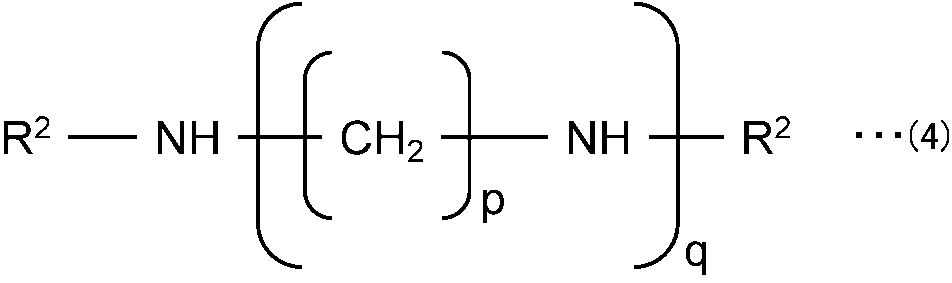
- the acid gas absorbing agent contains at least one amine represented by the following general formula (4):
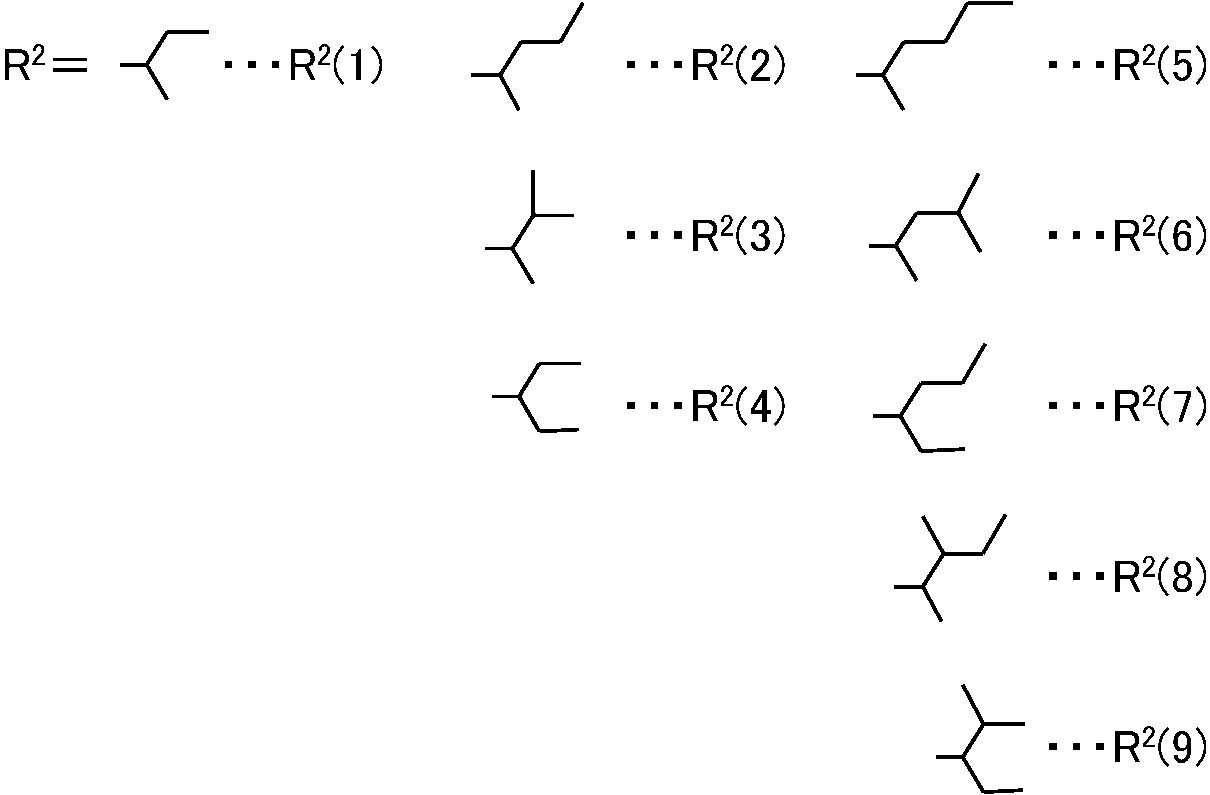
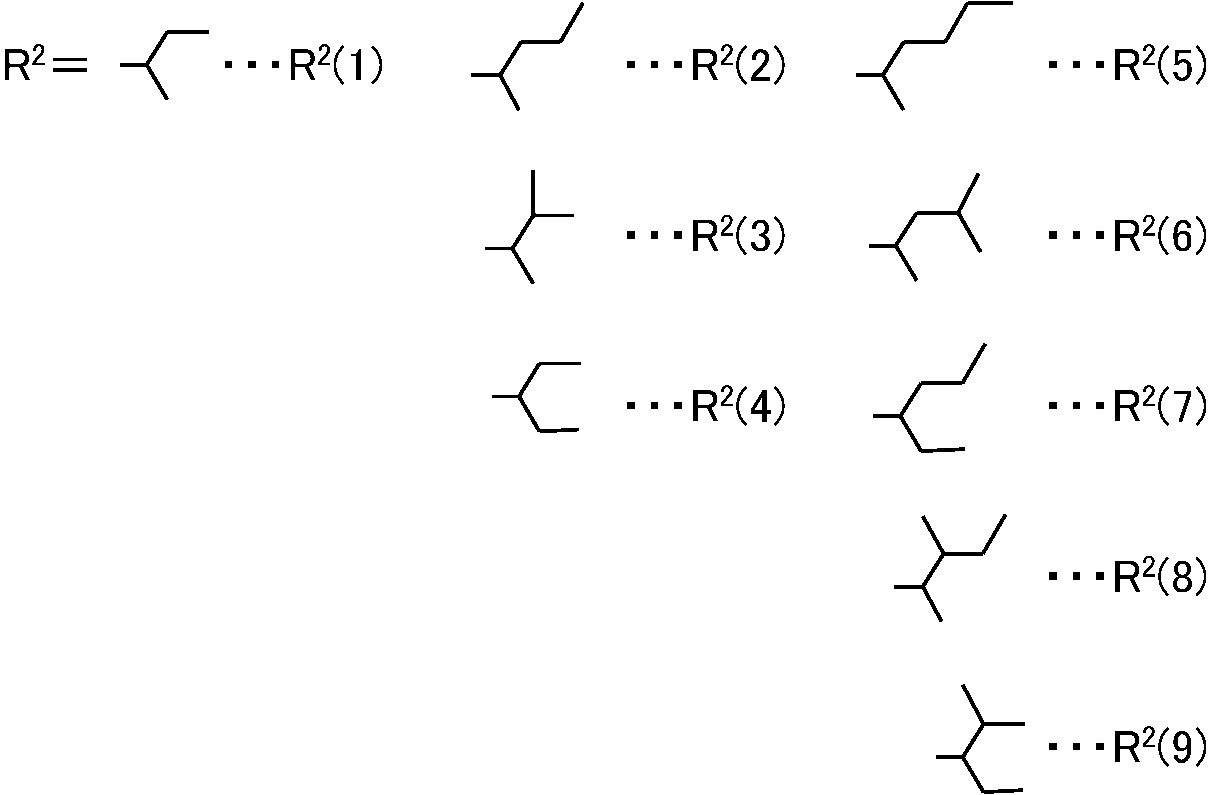
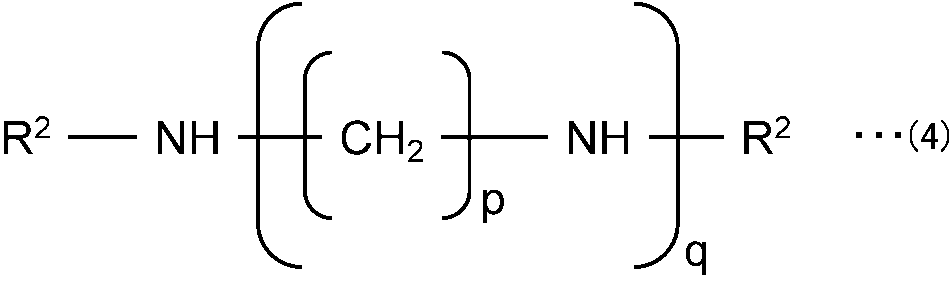
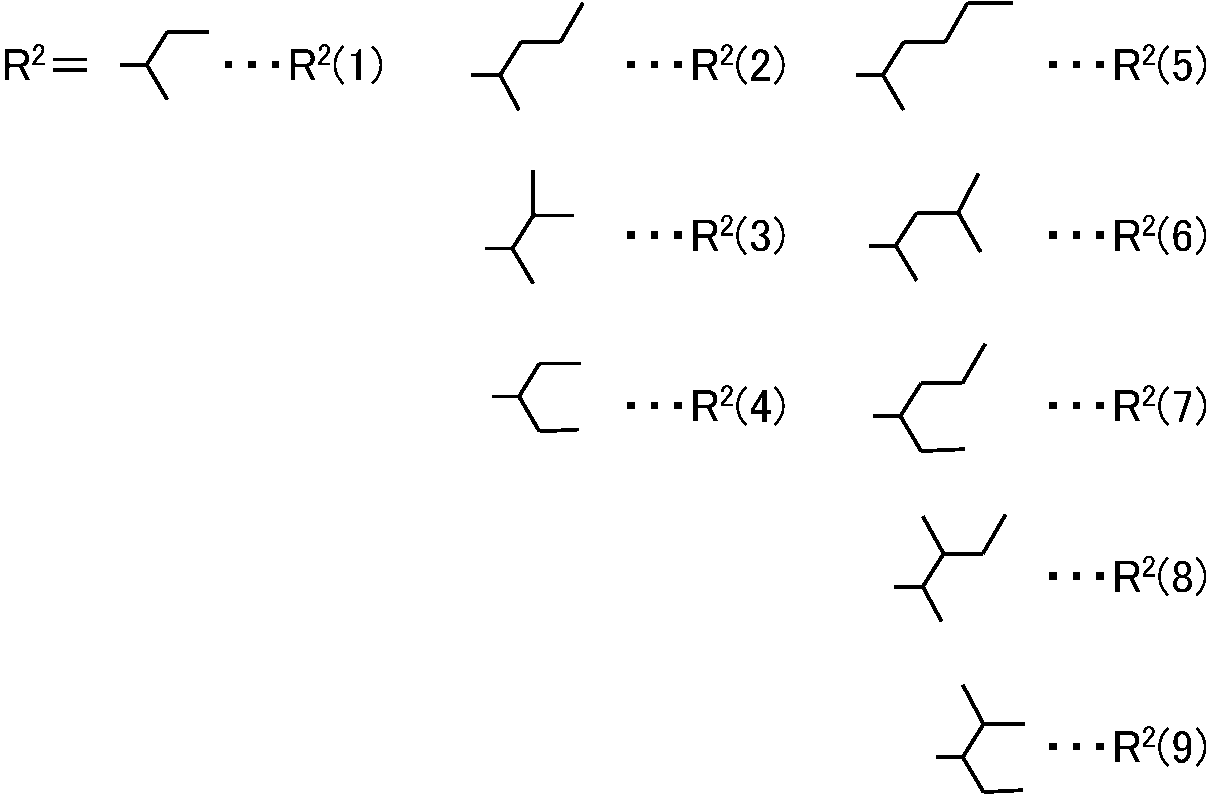
- the two R 2 groups may be the same or different structures, p represents 2 or 3, q represents an integer of 2 to 5, and R 2 represents any one of the following R 2 (1) to R 2 (9): is a group represented by any one of the following:
- a method for absorbing and desorbing acidic gas according to a second aspect of the present disclosure includes a step of contacting a gas to be treated with either one of the solid absorbent according to the first aspect and another solid absorbent according to the first aspect to absorb the acidic gas; and a step of contacting the solid absorbent material that has absorbed the acid gas with steam, thereby desorbing the acid gas from the solid absorbent material.
- the present disclosure provides a solid absorbent that has low moisture absorption and can efficiently and reversibly absorb acid gases, particularly carbon dioxide.
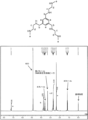
- FIG. 1 shows the positions a to e of hydrogen in the amine represented by (1-1), which is the target product of Example 1, and the measured 1H-NMR chart.
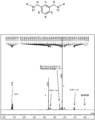
- FIG. 2 shows the positions a to e of hydrogen in the amine represented by (2-1), which is the target product of Example 2, and the measured 1H-NMR chart.
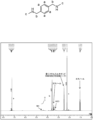
- FIG. 3 shows the positions a to c of hydrogen in the amine represented by (3-1), which is the target product of Example 3, and the measured 1H-NMR chart.
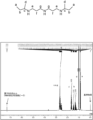
- FIG. 4 shows the positions a to g of hydrogen in the amine represented by (4-4), which is the target product of Example 4, and the measured 1H-NMR chart.
- FIG. 5 is a diagram showing a 1H-NMR chart measured in Example 5.
- FIG. 6 shows the positions a to i of hydrogen atoms in the amine represented by (4-3), which is the target compound of Example 6, and the measured 1H-NMR chart.
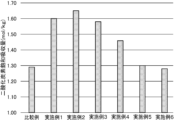
- FIG. 7 is a graph showing the measurement results of the saturated carbon dioxide absorption amount (mol/kg) per weight of the solid absorbent in the examples.
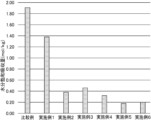
- FIG. 8 is a graph showing the measurement results of the saturated water absorption amount per weight (mol/kg) of the solid absorbent material in the examples.
- Solid absorbents that reversibly absorb acid gases as described above are generally used in acid gas separation systems (particularly carbon dioxide separation systems).
- acid gas separation systems include batch processing systems and moving bed systems (continuous processing systems).
- a process of absorbing acid gases into the solid absorbent and a process of desorbing acid gases from the solid absorbent using steam or the like i.e., a process of regenerating the solid absorbent
- the solid absorbent is required to efficiently absorb and desorb acid gases, particularly carbon dioxide.
- the solid absorbent absorbs excessive moisture, the solid absorbent becomes sticky and difficult to handle. If the solid absorbent is poorly handled, the acid gas absorption characteristics of the solid absorbent will be significantly reduced in a moving bed system that involves the movement of the solid absorbent. Even in a batch processing system, if the solid absorbent is poorly handled, replacing it will be difficult. For this reason, it is preferable for the solid absorbent to have low moisture absorption.
- the inventors have conducted extensive research into solid absorbents that are low in hygroscopicity and can efficiently and reversibly absorb acidic gases, particularly carbon dioxide. They have found that such effects can be achieved in a solid absorbent that includes a porous substrate and an acidic gas absorbing agent supported on the porous substrate, when the acidic gas absorbing agent includes at least one amine represented by a specific general formula. They have also found that the solid absorbent can desorb acidic gases using exhaust heat that cannot generally be effectively utilized.
- waste heat refers to low-temperature thermal energy between 40°C and 100°C that is unavoidably generated from various manufacturing industries, power plants, etc. and generally cannot be used effectively, and low-temperature thermal energy from sunlight that generally cannot be used effectively. Therefore, the solid absorbent material in this embodiment is also excellent from an environmental perspective.
- acid gas generally means acid gases such as carbon dioxide, NOx (nitrogen oxides such as NO, NO2 , N2O , N2O3 , etc. ), SOx (sulfur oxides), HCl, etc., contained in combustion exhaust gas, the atmosphere, closed space atmosphere, etc.
- NOx nitrogen oxides such as NO, NO2 , N2O , N2O3 , etc.
- SOx sulfur oxides
- HCl HCl
- the acid gas to be absorbed is carbon dioxide.
- Solid Absorbent refers to a solid absorbent capable of reversibly absorbing acidic gas.
- the term “capable of reversibly absorbing acidic gas (particularly carbon dioxide)” refers to the ability to absorb (or recover) and desorb (i.e., regenerate the solid absorbent) acidic gas (particularly carbon dioxide).
- the solid absorbent in this embodiment includes a first solid absorbent and a second solid absorbent.
- the first solid absorbent includes a porous substrate and an acidic gas absorbing agent supported on the porous substrate.
- an acidic gas absorbing agent in the first solid absorbent will be described in detail below.
- the acid gas absorbing agent in the first solid absorbent material contains at least one amine represented by any one of the following general formulas (1), (2) and (3) (hereinafter also referred to as the "amine of the first solid absorbent material").
- R 1 is represented by the group: -(CH 2 ) l -NH-[(CH 2 ) 2 NH] m -(CH 2 ) n -CH 3 , and in R 1 , l is 1 or 2, and m and n are each independently an integer of 0 to 2.
- l is preferably 1.
- the amine of the first solid absorbent having a significantly stable structure can be obtained in high yield, and ultimately the production efficiency of the solid absorbent can be improved.
- m preferably represents 0 or 1.
- m is 0 or 1
- n is preferably 0 or 1, and more preferably 0.
- n is 0, it is possible to produce a solid absorbent that can reversibly absorb acidic gases, particularly carbon dioxide, more efficiently.
- the acid gas absorbing agent in the first solid absorbent may be a mixture of two or more of the amines represented by any one of the above general formulas (1), (2) and (3), or may contain a single amine from these, or may be a single amine from these.
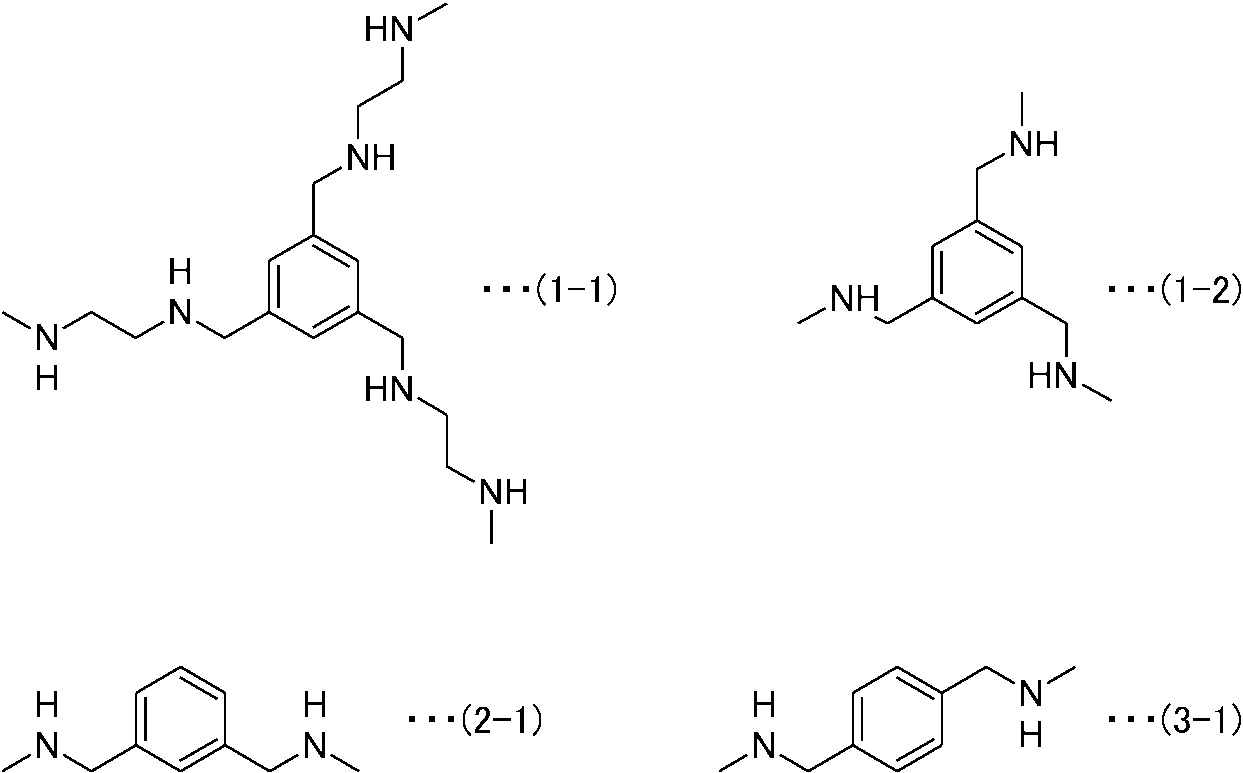
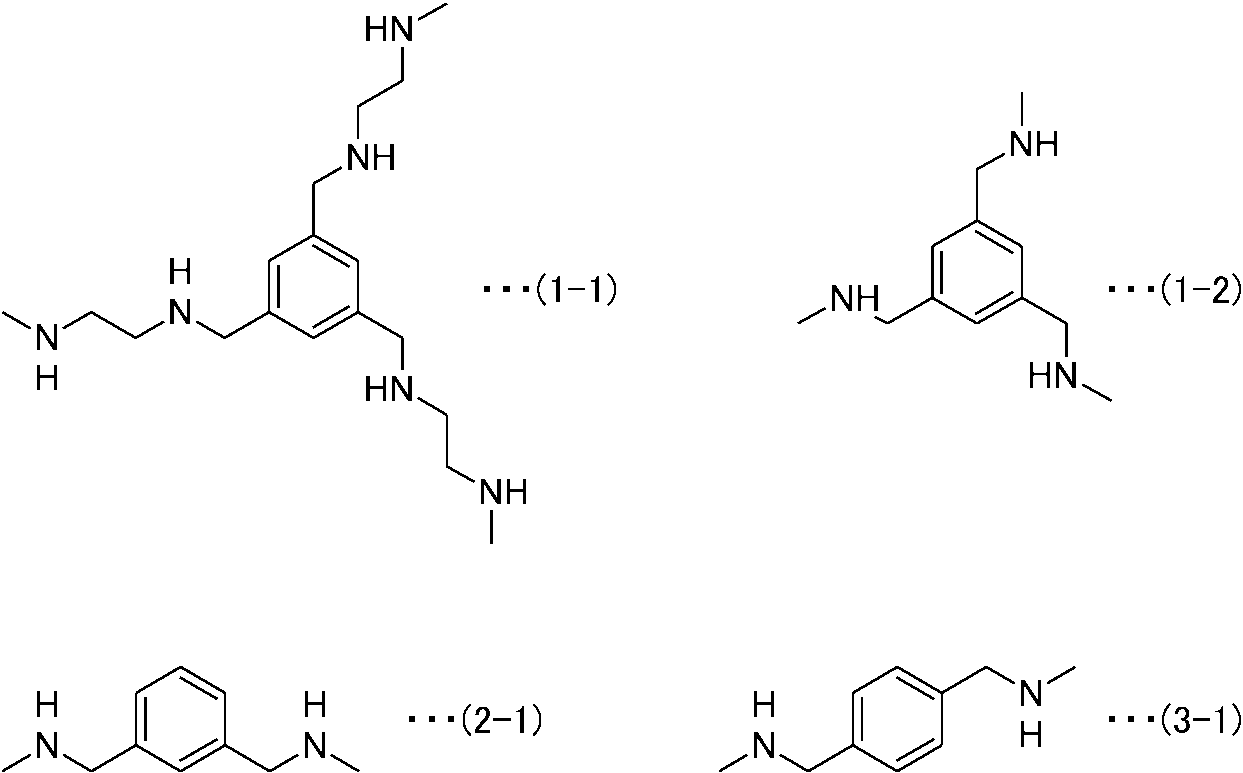
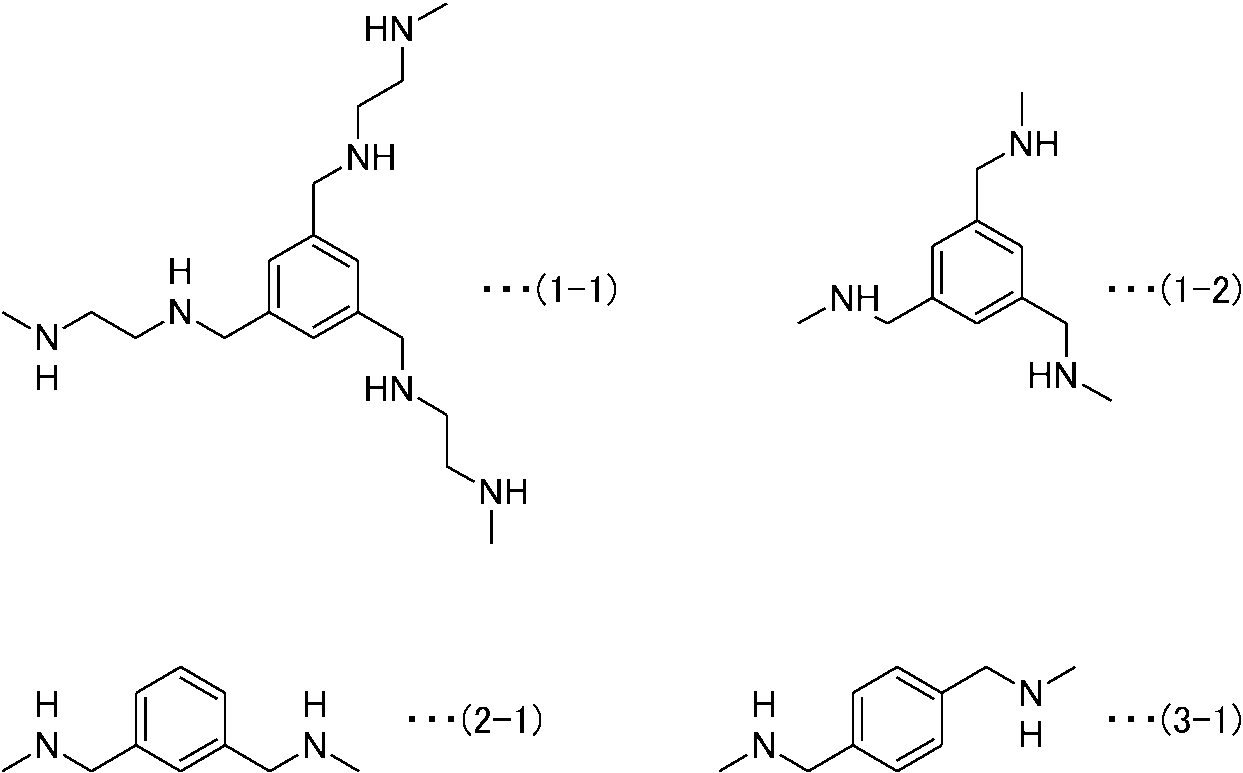
- the amine of the first solid absorbent preferably has a structure represented by any one of the following (1-1), (1-2), (2-1) and (3-1).
- the amine of the first solid absorbent has any of the structures described above, it is possible to produce a solid absorbent that has good low moisture absorption properties and can reversibly absorb acid gases, particularly carbon dioxide, more efficiently.
- the synthesis method of the amine of the first solid absorbent is not particularly limited, and may be any method known to those skilled in the art.
- the amine of the first solid absorbent may be synthesized by the following method. Specifically, benzaldehyde having multiple aldehyde groups may be used as a starting material, and a modified chain having an amine may be introduced by a reductive amination reaction.
- the amine of the first solid absorbent having a structure represented by any one of the above (1-1), (2-1), and (3-1) can be synthesized by a method described in detail in the examples below.
- the amine content of the first solid absorbent relative to the total mass of the first solid absorbent is not particularly limited, but is preferably 10 mass% or more. If the amine content of the first solid absorbent is 25 mass% or more, the solid absorbent finally produced can more efficiently absorb and desorb acidic gases, especially carbon dioxide.
- the amine content of the first solid absorbent is more preferably 10 mass% or more, and even more preferably 25 mass% or more.
- the upper limit of the amine content of the first solid absorbent is not particularly limited, but is, for example, 50 mass% or less.
- the acidic gas absorbing agent may be composed only of at least one of the amines of the first solid absorbent material described above, but may contain other compounds as long as the effect of the first solid absorbent material in this embodiment is achieved.
- the acidic gas absorbing agent may contain amine compounds other than the amines of the first solid absorbent material, polyethyleneimine, tetraethylenepentamine, amine-based or non-amine-based by-products that are (unavoidably) contained during amine synthesis, etc.
- porous substrate supports the acid gas absorbing agent described above.
- porous substrate is not particularly limited.
- the porous substrate can be made of any material known to those skilled in the art that can support the acid gas absorbing agent and has a large number of pores that can be used to reversibly absorb acid gases, particularly carbon dioxide.
- porous substrate examples include silica such as silica gel or mesoporous silica, alumina such as activated alumina, zeolite, titania, zirconia, magnesia, activated carbon, metal organic frameworks (MOFs), and the like.
- the porous substrate may be in the form of a powder.
- the porous substrate may also be formed using a powder and an appropriate binder, and may be granulated (typically 1 mm to 5 mm) at the time of production of the porous substrate.
- the first solid absorbent material includes a porous substrate and an acid gas absorbing agent supported on the porous substrate. A method for producing the first solid absorbent material will be described below.
- the temperature of the prepared amine-containing acidic gas absorbing agent solution of the first solid absorbent is not particularly limited, but is preferably 10°C or higher and 100°C or lower. It is known that the viscosity of a solution containing an amine decreases with increasing temperature, so when the temperature of the acidic gas absorbing agent solution is 10°C or higher, the amine can be uniformly supported on the porous substrate. Furthermore, when the temperature of the acidic gas absorbing agent solution is 100°C or lower, the oxidation and/or evaporation of the amine can be suppressed.
- the concentration of the amine of the first solid absorbent in the acidic gas absorption chemical solution is not particularly limited, but may be adjusted to an appropriate value in the range of 5% by mass to 70% by mass depending on the type of amine of the first solid absorbent. If the amine concentration of the first solid absorbent in the solution is too low, the amount of amine supported on the porous substrate may be insufficient. Also, if the amine concentration of the first solid absorbent in the solution is too high, the amine may clog the pores of the porous substrate, reducing the acidic gas absorption performance of the first solid absorbent.
- the porous substrate (for example, the above-mentioned porous particles) is put into the immersion container filled with the acidic gas absorbing agent solution, and the porous substrate is impregnated with the acidic gas absorbing agent solution.
- the immersion time of the porous substrate is not particularly limited as long as the inside of the pores is sufficiently degassed.
- the immersion time can be 24 hours.
- the acidic gas absorbing agent solution may be stirred or ultrasonic vibration may be applied to the immersion container.
- the second solid absorbent also includes a porous substrate and an acidic gas absorbing agent supported on the porous substrate.
- an acidic gas absorbing agent in the second solid absorbent will be described in detail below.
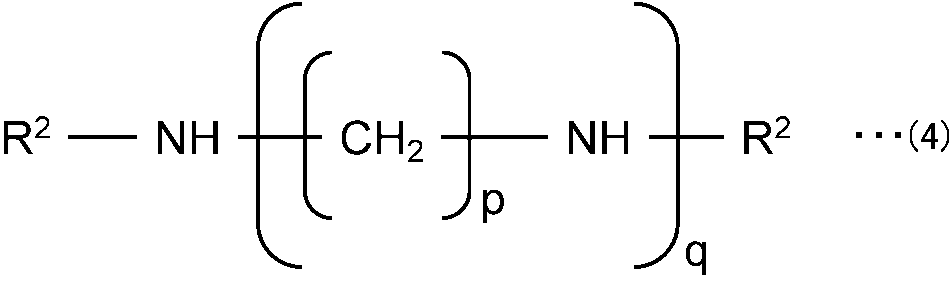
- the acid gas absorbing agent in the second solid absorbing material contains at least one amine represented by the following general formula (4) (hereinafter also referred to as the "amine of the second solid absorbing material").
- R 2 represents any one of the following R 2 (1) to R 2 (9): It is a group represented by any one of the following:
- the two R2 groups may be the same or different structures
- the two terminal R2 groups in the above general formula (4) may be the same group represented by any one of the above R2 (1) to R2 (9), or may be different groups represented by any one of the above R2 (1) to R2 (9).
- p is 3.
- p 3
- q preferably represents 2 or 3, and more preferably represents 2.
- a solid absorbent material can be produced that has good low moisture absorption and can reversibly absorb acid gases, particularly carbon dioxide, more efficiently.
- the acid gas absorbing agent in the second solid absorbent may be a mixture of two or more of the amines represented by the above general formula (4), may contain a single amine among these, or may be a single amine among these.
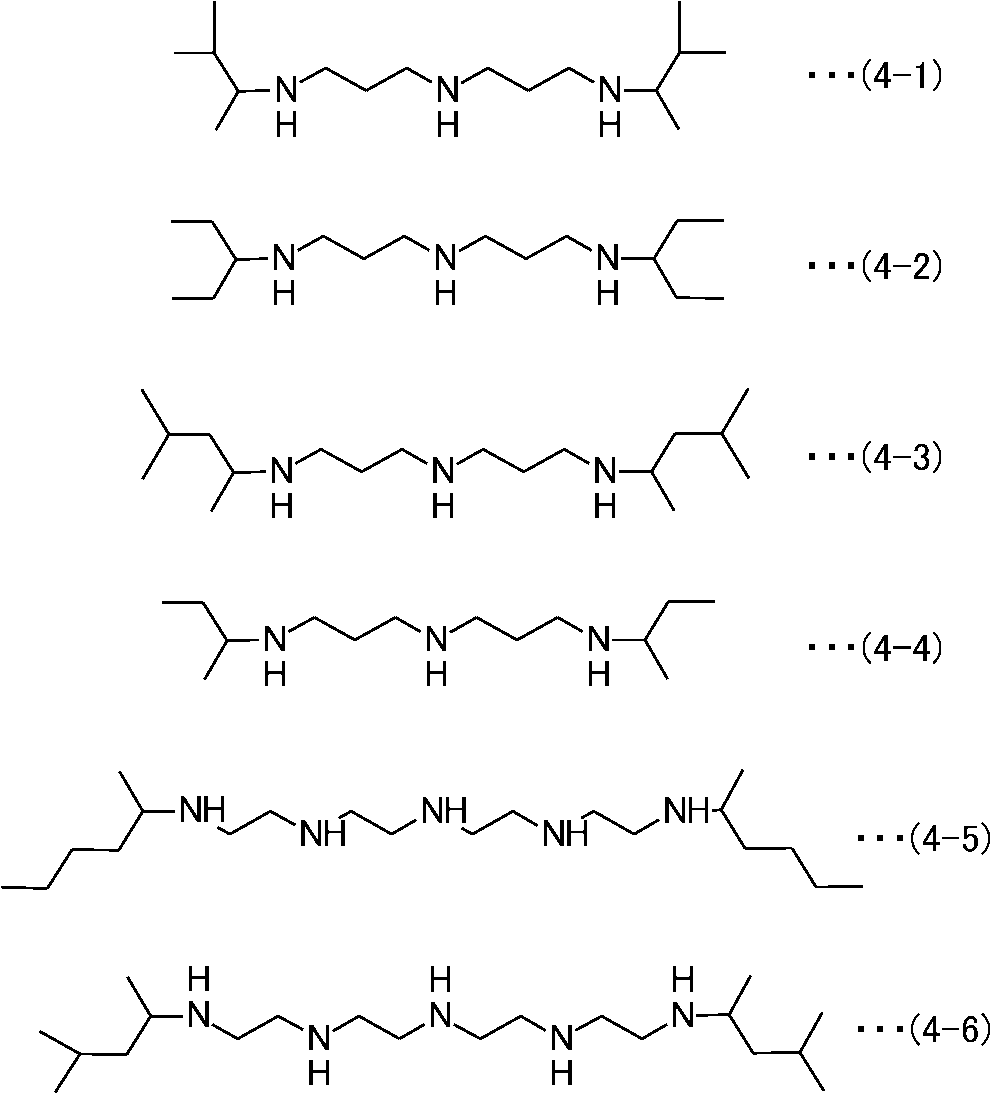
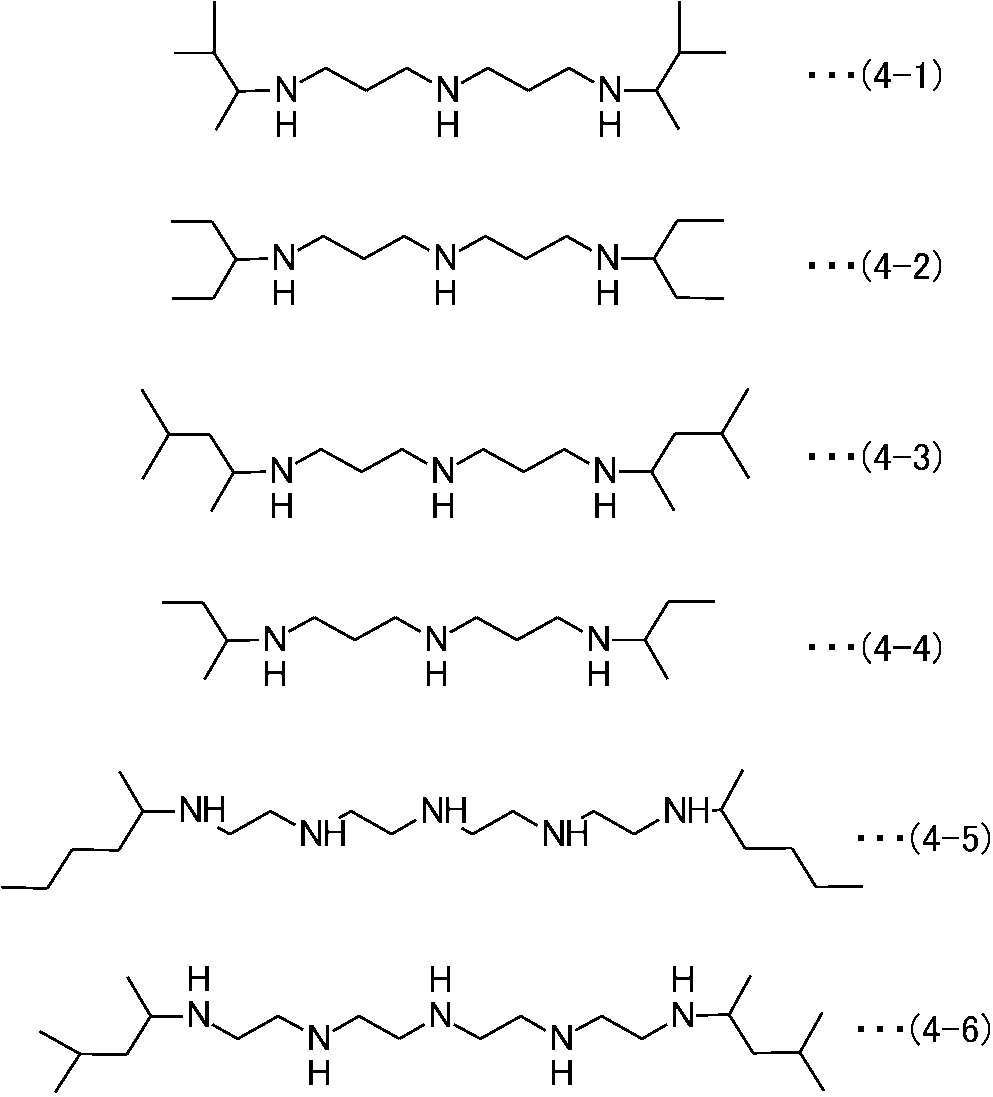
- the amine of the second solid absorbent preferably has any one of the structures represented by (4-1) to (4-6) below.
- the amine of the second solid absorbent has any of the structures described above, it is possible to produce a solid absorbent that has good low moisture absorption properties and can reversibly absorb acid gases, particularly carbon dioxide, more efficiently.
- the amine of the second solid absorbent has a structure represented by any one of the above (4-1) to (4-3).
- the amine of the second solid absorbent has a structure represented by any one of the above (4-1) to (4-3)
- the method for synthesizing the amine of the second solid absorbent is not particularly limited, and it may be synthesized by any method known to those skilled in the art.
- the amine of the second solid absorbent can be synthesized by the following method. First, a chain alkyl group is introduced into a commercially available polyamine having a group: -NH, or a polyamine having a group: -NH obtained by any method known to those skilled in the art, by a reaction known to those skilled in the art, such as an addition reaction of an alkyl halide or a reductive amination reaction of a ketone with a terminal amino group.
- the amine of the second solid absorbent having a structure represented by any one of the above (4-1), (4-2), and (4-3) can be synthesized by a method described in detail in the examples below.
- the preferred amount of amine content in the second solid absorbent relative to the total mass of the second solid absorbent is the same as the preferred amount of amine content in the first solid absorbent relative to the total mass of the first solid absorbent described above.
- the acid gas absorbing agent may be composed only of at least one of the amines of the second solid absorbent material described above, but may also contain other compounds, as in the case of the first solid absorbent material described above, as long as the effect of the second solid absorbent material in this embodiment is achieved.
- the first and second solid absorbents in this embodiment have low hygroscopic properties and can efficiently absorb acidic gases, particularly carbon dioxide, reversibly. Furthermore, the first and second solid absorbents in this embodiment are also excellent from an environmental perspective, since they can desorb acidic gases from the solid absorbents using exhaust heat that is generally not effectively utilized.
- the method for absorbing and desorbing acidic gas (particularly carbon dioxide) in this embodiment includes a step of contacting a gas to be treated with the first or second solid absorbent in the above-described embodiment to absorb the acidic gas, and a step of contacting steam with the solid absorbent that has absorbed the acidic gas, thereby desorbing the acidic gas from the solid absorbent.
- gas to be treated is not particularly limited as long as it is a gas containing acidic gas, particularly carbon dioxide, i.e., a gas.
- gases include combustion exhaust gases discharged from combustion equipment such as thermal power plants using coal, heavy oil, natural gas, etc. as fuel, blast furnaces in steelworks that reduce iron oxide with coke, converters in steelworks that burn carbon in pig iron to make steel, and boilers in various manufacturing plants, and gases discharged from transportation equipment such as automobiles, ships, and aircraft that use gasoline, heavy oil, light oil, etc. as fuel.
- gases to be treated include the atmosphere containing acidic gases, particularly carbon dioxide, human breathing in enclosed spaces such as submersible research vessels and space stations, and the surrounding atmosphere containing carbon dioxide discharged by energy conversion in equipment, etc.
- the acidic gas content and temperature in the gas to be treated are not particularly limited, so long as the conditions are such that the acidic gas can be absorbed when the first or second solid absorbent in the above-mentioned embodiment comes into contact with the gas.
- the acidic gas is carbon dioxide
- the carbon dioxide partial pressure may be 0.04 kPa to 50 kPa
- the temperature may be 20°C to 60°C.
- the carbon dioxide when the acidic gas is carbon dioxide, the carbon dioxide may be desorbed in the carbon dioxide desorption step by contacting the solid absorbent with steam at, for example, 50°C or higher, as in any method known to those skilled in the art. Furthermore, from the viewpoint of efficiently desorbing carbon dioxide, it is preferable to contact the solid absorbent with steam under reduced pressure conditions in the carbon dioxide desorption step.
- the reduced pressure conditions are preferably 5 kPa or more and 100 kPa or less, and more preferably 15 kPa or more and 30 kPa or less.
- the first and second solid absorbents that have absorbed acidic gas can desorb the acidic gas even using exhaust heat, which generally cannot be effectively utilized. Therefore, from the standpoint of being environmentally superior, in the process of desorbing the acidic gas, it is preferable to desorb the acidic gas from the solid absorbent by contacting it with low-temperature steam generated by exhaust heat.
- the temperature of the exhaust heat is preferably 40°C or higher and 100°C or lower, and more preferably 50°C or higher and 70°C or lower.
- the solid absorbent of the first aspect of the present disclosure is a solid absorbent that reversibly absorbs acid gas, comprising: A porous substrate and an acid gas absorbing agent supported on the porous substrate,
- the acid gas absorbing agent contains at least one amine represented by any one of the following general formulas (1), (2) and (3).
- R 1 is represented by the group: -(CH 2 ) l -NH-[(CH 2 ) 2 NH] m -(CH 2 ) n -CH 3 , and in R 1 , l is 1 or 2, and m and n are each independently an integer of 0 to 2.
- the solid absorbent material of the first embodiment has low moisture absorption and can efficiently absorb acid gases, particularly carbon dioxide, in a reversible manner.
- the solid absorbent of the second aspect of the present disclosure is the solid absorbent of the first aspect, wherein the amine has a structure represented by any one of the following (1-1), (1-2), (2-1) and (3-1).
- the solid absorbent material of the second embodiment has good low moisture absorption properties and can reversibly absorb acid gases, particularly carbon dioxide, more efficiently.
- a solid absorbent according to a third aspect of the present disclosure is a solid absorbent that reversibly absorbs acid gases, comprising: A porous substrate and an acid gas absorbing agent supported on the porous substrate,
- the acid gas absorbing agent contains at least one amine represented by the following general formula (4):
- the two R 2 groups may be the same or different structures, p represents 2 or 3, q represents an integer of 2 to 5, and R 2 represents any one of the following R 2 (1) to R 2 (9): is a group represented by any one of the following:
- the solid absorbent material of the third embodiment has low moisture absorption and can reversibly absorb acid gases, particularly carbon dioxide, efficiently.
- a solid absorbent material according to a fourth aspect of the present disclosure is the solid absorbent material according to the third aspect, wherein the amine has a structure represented by any one of the following (4-1) to (4-6).
- the solid absorbent material of the fourth embodiment has good low moisture absorption properties and can reversibly absorb acid gases, particularly carbon dioxide, more efficiently.
- a method for absorbing and desorbing acidic gases according to a fifth aspect of the present disclosure includes a step of contacting a gas to be treated with the solid absorbent material according to any one of the first to fourth aspects to absorb the acidic gas; and a step of contacting the solid absorbent material that has absorbed the acid gas with steam, thereby desorbing the acid gas from the solid absorbent material.
- the solid absorbent has low hygroscopicity, so that, for example, in moving bed and batch processing acidic gas separation systems, it is possible to prevent the handling performance of the solid absorbent from deteriorating.
- the first and second solid absorbents in this embodiment were actually manufactured, and the carbon dioxide saturated absorption amount (kg/m 3 ) and water saturated absorption amount (kg/m 3 ) of the manufactured solid absorbents were measured.
- a proton nuclear magnetic resonance (1H-NMR) device manufactured by JEOL Ltd., "AL-400, ECZ400S
- a gas chromatography (GC) analyzer manufactured by Shimadzu Corporation, "GC-2010 PlusAF”
- a gas chromatography mass spectrometry (GCMS) device manufactured by Shimadzu Corporation, "GC/MS QP-2010Plus" were used.
- Example 1 [Method of synthesis of amines of solid absorbent]
- Example 1 the amine having the structure represented by the above (1-1) was used as the first solid absorbent amine. The synthesis method will be described in detail below.
- 1,3,5-benzenetricarbaldehyde (reference substance) was added to an ethanol solution of N-Boc-methylethylenediamine, and the resulting solution was heated and stirred at 90°C for 1.5 hours. The reaction solution was then cooled to around 0°C, and a reducing agent was added to reduce the imine. Next, lipophilic components were recovered from the reaction product in which the imine had been reduced by liquid-liquid extraction and separation using chloroform and water. Trifluoroacetic acid was then added to remove the protecting group of the imine, and the target product, which is assumed to be an amine having the structure represented by (1-1) above, was obtained from the recovered lipophilic component as a yellow oily substance. The yield was 54.6%.
- Example 2 In Example 2, the amine having the structure represented by the above formula (2-1) was used as the first solid absorbent amine. The synthesis method will be described in detail below.
- isophthalaldehyde (reference substance) was dissolved in toluene, and an aqueous methylamine solution was added to the solution, followed by stirring at room temperature for 3 hours. After the reaction was completed, the toluene layer of the reaction solution was collected, and the solvent in the collected solution was removed by evaporation. The intermediate substance obtained was then dissolved in acetone, and the imine was reduced with a reducing agent while methanol was further added to the solution. Next, lipophilic components were collected from the reaction product by liquid-liquid extraction separation using chloroform and water, and the target product, assumed to be an amine having the structure represented by (2-1) above, was obtained from the collected lipophilic components as a brown oily substance. The yield was 83.3%.
- Example 3 In Example 3, an amine having the structure represented by (3-1) above was used as the amine of the first solid absorbent.
- the synthesis method was the same as that of Example 2 above, except that terephthaldicarboxaldehyde (reference material) was used instead of isophthalaldehyde as the starting material, and the target product assumed to be the amine having the structure represented by (3-1) above was obtained in a yield of 67.9%.
- Example 4 In Example 4, the amine having the structure represented by the above (4-4) was used as the second solid absorbent amine. The synthesis method is described in detail below.
- Example 5 In Example 5, an amine having the structure represented by the above (4-2) was used as the amine of the second solid absorbent.
- the synthesis method was the same as that of the amine having the structure represented by the above (4-4), and the target substance assumed to be the amine having the structure represented by the above (4-2) was obtained in the same procedure as in Example 4, except that diethyl ketone was used instead of methyl ethyl ketone at the beginning.
- the yield was 73.5%.
- Example 6 In Example 6, an amine having the structure represented by the above (4-3) was used as the amine of the second solid absorbent.
- the synthesis method was the same as that of the amine having the structure represented by the above (4-4), and the target substance assumed to be the amine having the structure represented by the above (4-3) was obtained in the same procedure as in Example 4, except that methyl isobutyl ketone was used instead of methyl ethyl ketone at the beginning.
- the yield was 97.9%.
- DEA diethanolamine
- DEA is a liquid chemical substance that is widely used as an amine to be supported on a substrate and to reversibly absorb carbon dioxide.
- porous substrate silica gel described in Japanese Patent No. 6055134 was used.
- the porous substrate was filled in another container, and drying gas (nitrogen gas at 40 ° C., 15 L / min) was flowed to aerate and dry the porous substrate carrying each of the amines or DEA of Examples 1 to 6. After 2 hours from the time when the gas temperature at the outlet of the drying tank for drying the porous substrate carrying each of the amines, etc. became stable, the drying was terminated and the solvent was completely removed. In this way, the porous substrate carrying each of the amines or DEA, that is, the solid absorbent in Examples 1 to 6 and Comparative Example, was obtained.
- drying gas nitrogen gas at 40 ° C., 15 L / min
- the saturated carbon dioxide absorption amount and saturated water absorption amount of the solid absorbents of each of the examples and comparative examples manufactured by the above method were measured by the following method.
- the initial weight of the container filled with the solid absorbent was measured, and gases containing carbon dioxide or water, each of which had been prepared to a predetermined composition, were supplied into the container at 50 L/min. Thereafter, the weight of the container was measured at regular intervals, and it was determined that the absorption of carbon dioxide or water had reached saturation when the weight change had almost ceased. Then, the carbon dioxide saturated absorption amount (mol/kg) per weight of the solid absorbent or the water saturated absorption amount (mol/kg) per weight of the solid absorbent was calculated from the change in weight of the container at the initial time and when saturated. Note that when measuring the carbon dioxide saturated absorption amount, a gas mixture of carbon dioxide and nitrogen gas was used. On the other hand, when measuring the saturated water absorption, a gas whose humidity had been adjusted by permeating nitrogen gas into water was used.
- the solid absorbents of Examples 1 to 6 which are the first and second solid absorbents in this embodiment, were able to absorb carbon dioxide to the same extent or more than the solid absorbent of the comparative example.
- the solid absorbents of Examples 1 to 6 had significantly lower hygroscopicity than the solid absorbent of the comparative example. That is, the solid absorbents of Examples 1 to 6 have better handling due to their lower hygroscopicity compared to the solid absorbent of the comparative example, and therefore can desorb carbon dioxide efficiently. From these results, it was found that the first and second solid absorbents in this embodiment have low hygroscopicity and can reversibly absorb carbon dioxide efficiently.
Landscapes
- Chemical & Material Sciences (AREA)
- Organic Chemistry (AREA)
- Chemical Kinetics & Catalysis (AREA)
- Analytical Chemistry (AREA)
- Oil, Petroleum & Natural Gas (AREA)
- General Chemical & Material Sciences (AREA)
- Engineering & Computer Science (AREA)
- Inorganic Chemistry (AREA)
- Gas Separation By Absorption (AREA)
- Treating Waste Gases (AREA)
- Solid-Sorbent Or Filter-Aiding Compositions (AREA)
- Carbon And Carbon Compounds (AREA)
- Organic Low-Molecular-Weight Compounds And Preparation Thereof (AREA)
Abstract
Description
多孔質基材と、前記多孔質基材に担持された酸性ガス吸収薬剤とを含み、
前記酸性ガス吸収薬剤は、下記一般式(1)、(2)および(3)のうちのいずれかで表される少なくとも1つのアミンを含む。

(式(1)、(2)および(3)中、R1は基:-(CH2)l-NH-[(CH2)2NH]m-(CH2)n-CH3で表され、かつ、R1において、lは1または2を示し、mおよびnはそれぞれ独立して0~2の整数を示す。)
前記酸性ガス吸収薬剤は、下記一般式(4)で表される少なくとも1つのアミンを含む。
酸性ガスを吸収した前記固体吸収材に、蒸気を接触させることによって、前記固体吸収材から酸性ガスを脱離させる工程と、を含む。
本実施形態における固体吸収材を、以下詳細に説明する。なお、本明細書において、「固体吸収材」とは、酸性ガスを可逆的に吸収することができる固体吸収材を意味する。また、本明細書において、「酸性ガス(特に二酸化炭素)を可逆的に吸収することができる」とは、酸性ガス(特に二酸化炭素)を吸収(または回収)および脱離(すなわち、固体吸収材の再生)することができることを意味する。本実施形態における固体吸収材は、第1の固体吸収材および第2の固体吸収材を包含する。
第1の固体吸収材は、多孔質基材と、当該多孔質基材に担持された酸性ガス吸収薬剤とを含む。まず、第1の固体吸収材における酸性ガス吸収薬剤を以下詳細に説明する。
第1の固体吸収材における酸性ガス吸収薬剤は、下記一般式(1)、(2)および(3)のうちのいずれかで表される少なくとも1つのアミン(以下、「第1の固体吸収材のアミン」とも称する)を含む。

多孔質基材は、前述した酸性ガス吸収薬剤を担持する。
第1の固体吸収材は、多孔質基材と、当該多孔質基材に担持された酸性ガス吸収薬剤とを含む。第1の固体吸収材の製造方法を以下説明する。
まず、酸性ガス吸収薬剤に含まれる前述した少なくとも1つの第1の固体吸収材のアミンを溶媒(水またはアルコール)に溶かし、酸性ガス吸収薬剤溶液を調製する。
次いで、酸性ガス吸収薬剤溶液を湛えた浸漬容器に多孔質基材(例えば前述の多孔質粒子)を投入し、多孔質基材に酸性ガス吸収薬剤溶液を含浸させる。多孔質基材の浸漬時間は、細孔内部が十分に脱気される時間であれば、特に限定されない。例えば、浸漬時間は、24時間とすることができる。この際、浸漬時間を短縮するために、酸性ガス吸収薬剤溶液を撹拌したり、または浸漬容器に超音波振動を与えてもよい。
その後、多孔質基材を酸性ガス吸収薬剤溶液から引き揚げて、付着している余分な液体を吸引濾過等の方法で除去する。さらに、その後、酸性ガス吸収薬剤溶液に含浸させた多孔質基材を、室温に近い温度下において、通気乾燥または減圧乾燥させる。乾燥後、第1の固体吸収材を得ることができる。
第2の固体吸収材も、多孔質基材と、当該多孔質基材に担持された酸性ガス吸収薬剤とを含む。まず、第2の固体吸収材における酸性ガス吸収薬剤を以下詳細に説明する。
第2の固体吸収材における酸性ガス吸収薬剤は、下記一般式(4)で表される少なくとも1つのアミン(以下、「第2の固体吸収材のアミン」とも称する)を含む。

本実施形態における酸性ガス(特に二酸化炭素)の吸収および脱離方法は、前述の実施形態における第1または第2の固体吸収材に処理対象のガスを接触させて酸性ガスを吸収させる工程と、酸性ガスを吸収した当該固体吸収材に、蒸気を接触させることによって、当該固体吸収材から酸性ガスを脱離させる工程とを含む。
以上に説明した具体的な実施形態には、以下の構成を有する開示が含まれている。
多孔質基材と、前記多孔質基材に担持された酸性ガス吸収薬剤とを含み、
前記酸性ガス吸収薬剤は、下記一般式(1)、(2)および(3)のうちのいずれかで表される少なくとも1つのアミンを含む。

多孔質基材と、前記多孔質基材に担持された酸性ガス吸収薬剤とを含み、
前記酸性ガス吸収薬剤は、下記一般式(4)で表される少なくとも1つのアミンを含む。


酸性ガスを吸収した前記固体吸収材に、蒸気を接触させることによって、前記固体吸収材から酸性ガスを脱離させる工程と、を含む。
(実施例1)
実施例1では、第1の固体吸収材のアミンである上記(1-1)で表される構造を有するアミンを用いた。合成方法を以下詳細に述べる。
1H-NMR:測定溶媒としては、重エタノールを用いた。図1に、実施例1の目的物である上記(1-1)で表されるアミンにおける水素の存在位置a~eおよび測定された1H-NMRチャートを示す。1H-NMRチャートには、各ピークがa~eのいずれに該当するか、およびその水素数はいくつかが示されている。図1に示すように、1H-NMRチャートから、上記(1-1)で表されるアミンが生成していることが確認できた。
GCおよびGCMS:GCによって生成物のピークを確認し、GCMSによって生成物の質量分析を行い、上記(1-1)で表されるアミンを確認した。
実施例2では、第1の固体吸収材のアミンである上記(2-1)で表される構造を有するアミンを用いた。合成方法を以下詳細に述べる。
1H-NMR:測定溶媒としては、重ジメチルスルホキシドを用いた。図2に、実施例2の目的物である上記(2-1)で表されるアミンにおける水素の存在位置a~eおよび測定された1H-NMRチャートを示す。1H-NMRチャートには、各ピークがa~eのいずれに該当するか、およびその水素数はいくつかが示されている。図2に示すように、1H-NMRチャートから、上記(2-1)で表されるアミンが生成していることが確認できた。
GCおよびGCMS:GCによって生成物のピークを確認し、GCMSによって生成物の質量分析を行い、上記(2-1)で表されるアミンを確認した。
実施例3では、第1の固体吸収材のアミンである上記(3-1)で表される構造を有するアミンを用いた。合成方法は、出発物質としてイソフタルアルデヒドではなくテレフタルジカルボキシアルデヒド(基準物質)を用いること以外は、上記実施例2と同様の手順で、上記(3-1)で表される構造を有するアミンと想定される目的物を得た。なお、収率は67.9%であった。
1H-NMR:測定溶媒としては、重ジメチルスルホキシドを用いた。図3に、実施例3の目的物である上記(3-1)で表されるアミンにおける水素の存在位置a~cおよび測定された1H-NMRチャートを示す。1H-NMRチャートには、各ピークがa~cのいずれに該当するか、およびその水素数はいくつかが示されている。図3に示すように、1H-NMRチャートから、上記(3-1)で表されるアミンが生成していることが確認できた。
GCおよびGCMS:GCによって生成物のピークを確認し、GCMSによって生成物の質量分析を行い、上記(3-1)で表されるアミンを確認した。
実施例4では、第2の固体吸収材のアミンである上記(4-4)で表される構造を有するアミンを用いた。合成方法を以下詳細に述べる。
1H-NMR:測定溶媒としては、重クロロホルムを用いた。図4に、実施例4の目的物である上記(4-4)で表されるアミンにおける水素の存在位置a~gおよび測定された1H-NMRチャートを示す。1H-NMRチャートには、各ピークがa~gのいずれに該当するか、およびその水素数はいくつかが示されている。図4に示すように、1H-NMRチャートから、上記(4-4)で表されるアミンが生成していることが確認できた。
GCおよびGCMS:GCによって生成物のピークを確認し、GCMSによって生成物の質量分析を行い、上記(4-4)で表されるアミンを確認した。
実施例5では、第2の固体吸収材のアミンである上記(4-2)で表される構造を有するアミンを用いた。合成方法は、上記(4-4)で表される構造を有するアミンと同様であり、最初にメチルエチルケトンに代えてジエチルケトンを用いること以外は、上記実施例4と同様の手順で、上記(4-2)で表される構造を有するアミンと想定される目的物を得た。なお、収率は、73.5%であった。
1H-NMR:核磁気共鳴装置(ブルカー製、「BRUKER NMR 400MHz」)を用いて、1H-NMRを実施した。溶媒としては、CDCl3(20~40mg/mL)を用いた。図5に、測定された1H-NMRチャートを示す。図5に示す1H-NMRチャートから、上記(4-2)で表されるアミンが生成していることが確認できた。
実施例6では、第2の固体吸収材のアミンである上記(4-3)で表される構造を有するアミンを用いた。合成方法は、上記(4-4)で表される構造を有するアミンと同様であり、最初にメチルエチルケトンに代えてメチルイソブチルケトンを用いること以外は、上記実施例4と同様の手順で、上記(4-3)で表される構造を有するアミンと想定される目的物を得た。なお、収率は97.9%であった。
1H-NMR:測定溶媒としては、重クロロホルムを用いた。図6に、実施例6の目的物である上記(4-3)で表されるアミンにおける水素の存在位置a~iおよび測定された1H-NMRチャートを示す。1H-NMRチャートには、各ピークがa~iのいずれに該当するか、およびその水素数はいくつかが示されている。図6に示すように、1H-NMRチャートから、上記(4-3)で表されるアミンが生成していることが確認できた。
GCおよびGCMS:GCによって生成物のピークを確認し、GCMSによって生成物の質量分析を行い、上記(4-3)で表されるアミンを確認した。
比較例では、多孔質基材に担持させるアミンとしてジエタノールアミン(DEA)を用いた(富士フイルム和光純薬(株)製、沸点:217℃/760mmHg)。DEAは、基材に担持させて、二酸化炭素を可逆的に吸収するための液状化学物質であるアミンとして広く使用されている。
多孔質基材としては、日本国特許第6055134号に記載のシリカゲルを用いた。
まず、上記の多孔質基材を約300mL程度採取し、その質量を測定しておいた。次いで、溶媒として水またはエタノールを用い、上記で合成した実施例1~実施例6の各アミンまたは比較例のDEAの濃度45質量%のアミン溶液を調製し、調製した溶液を瓶の中に入れた。ここに多孔質基材を投入し、すべての多孔質基材を液中に浸漬させつつ、室温で8時間以上放置した。その後、瓶から多孔質基材を取り出し、遠心分離(1100rpm、1分間)を行った。遠心分離後、別の容器に多孔質基材を充填し、乾燥ガス(40℃、15L/分における窒素ガス)を流して、実施例1~実施例6の各アミンまたはDEAを担持した多孔質基材を通気乾燥させた。各アミン等を担持した多孔質基材を乾燥する乾燥槽の出口のガス温度が安定した時点から2時間経過後、乾燥を終了させ、溶媒を完全に除去した。このようにして、各アミンまたはDEAを担持した多孔質基材、すなわち、実施例1~実施例6および比較例における固体吸収材を得た。
実施例1~実施例6および比較例における固体吸収材の重量当たりの二酸化炭素飽和吸収量および水分飽和吸収量は、次の方法によって測定した。まず、150mLの容積の円筒容器に、上記方法で製造した固体吸収材を充填した。次いで、円筒容器に40℃の窒素ガスを50L/minで供給することによって、事前に固体吸収材に吸収されていた二酸化炭素または水分(H2O)を脱離させた。その後、固体吸収材を充填した容器の初期重量を測定した後、二酸化炭素または水分を含む各々所定の組成に調製したガスを50L/minで容器内へ供給した。その後、一定時間毎に容器の重量を測定し、その変化がほとんどなくなった時点において、二酸化炭素の吸収または水分の吸収が飽和に達したと判断した。そして、初期と飽和時の容器の重量変化から、固体吸収材の重量当たりの二酸化炭素飽和吸収量(mol/kg)または固体吸収材の重量当たりの水分飽和吸収量(mol/kg)を算出した。なお、二酸化炭素飽和吸収量を測定する際は、二酸化炭素と窒素ガスを混合したガスを用いた。一方、水分飽和吸収量を測定する際は、窒素ガスを水に浸透させることにより湿度を調整したガスを用いた。
Claims (5)
- 酸性ガスを可逆的に吸収する固体吸収材であって、
多孔質基材と、前記多孔質基材に担持された酸性ガス吸収薬剤とを含み、
前記酸性ガス吸収薬剤は、下記一般式(1)、(2)および(3)のうちのいずれかで表される少なくとも1つのアミンを含む、固体吸収材。

- 前記アミンは、下記(1-1)、(1-2)、(2-1)および(3-1)のうちのいずれかで表される構造を有する、請求項1に記載の固体吸収材。
- 酸性ガスを可逆的に吸収する固体吸収材であって、
多孔質基材と、前記多孔質基材に担持された酸性ガス吸収薬剤とを含み、
前記酸性ガス吸収薬剤は、下記一般式(4)で表される少なくとも1つのアミンを含む、固体吸収材。
- 前記アミンは、下記(4-1)~(4-6)のうちのいずれかで表される構造を有する、請求項3に記載の固体吸収材。
- 請求項1~4のいずれか1項に記載の固体吸収材に処理対象のガスを接触させて酸性ガスを吸収させる工程と、
酸性ガスを吸収した前記固体吸収材に、蒸気を接触させることによって、前記固体吸収材から酸性ガスを脱離させる工程と、を含む、酸性ガスの吸収および脱離方法。
Priority Applications (1)
| Application Number | Priority Date | Filing Date | Title |
|---|---|---|---|
| AU2024391742A AU2024391742A1 (en) | 2023-11-28 | 2024-11-15 | Solid absorber, and method for absorbing and desorbing acidic gas by using same |
Applications Claiming Priority (2)
| Application Number | Priority Date | Filing Date | Title |
|---|---|---|---|
| JP2023-200852 | 2023-11-28 | ||
| JP2023200852A JP2025086680A (ja) | 2023-11-28 | 2023-11-28 | 固体吸収材ならびにそれを用いた酸性ガスの吸収および脱離方法 |
Publications (1)
| Publication Number | Publication Date |
|---|---|
| WO2025115648A1 true WO2025115648A1 (ja) | 2025-06-05 |
Family
ID=95896873
Family Applications (1)
| Application Number | Title | Priority Date | Filing Date |
|---|---|---|---|
| PCT/JP2024/040611 Pending WO2025115648A1 (ja) | 2023-11-28 | 2024-11-15 | 固体吸収材ならびにそれを用いた酸性ガスの吸収および脱離方法 |
Country Status (3)
| Country | Link |
|---|---|
| JP (1) | JP2025086680A (ja) |
| AU (1) | AU2024391742A1 (ja) |
| WO (1) | WO2025115648A1 (ja) |
Citations (10)
| Publication number | Priority date | Publication date | Assignee | Title |
|---|---|---|---|---|
| WO2011002767A2 (en) * | 2009-06-30 | 2011-01-06 | Nalco Company | Acid gas scrubbing composition |
| WO2012157656A1 (ja) * | 2011-05-18 | 2012-11-22 | 三菱瓦斯化学株式会社 | 酸素吸収剤 |
| JP2015009185A (ja) | 2013-06-28 | 2015-01-19 | 公益財団法人地球環境産業技術研究機構 | 二酸化炭素分離材及び二酸化炭素を分離又は回収する方法 |
| JP2015077537A (ja) * | 2013-10-15 | 2015-04-23 | 三菱重工業株式会社 | 複合アミン吸収液、co2又はh2s又はその双方の除去装置及び方法 |
| JP6055134B1 (ja) | 2016-03-14 | 2016-12-27 | 川崎重工業株式会社 | 二酸化炭素吸着剤及びその製造方法、並びに、二酸化炭素分離回収システム |
| JP2018519146A (ja) * | 2015-03-23 | 2018-07-19 | ビーエーエスエフ コーポレーション | 室内空気の品質制御のための二酸化炭素吸着剤 |
| JP2020075215A (ja) | 2018-11-07 | 2020-05-21 | 川崎重工業株式会社 | 酸性ガス吸収材及びその製造方法 |
| JP2022049431A (ja) * | 2020-09-16 | 2022-03-29 | 株式会社東芝 | 酸性ガス吸収剤、酸性ガス除去方法および酸性ガス除去装置 |
| JP2023033072A (ja) * | 2021-08-26 | 2023-03-09 | 株式会社東芝 | 二酸化炭素吸収放出デバイス |
| JP2023143289A (ja) * | 2022-03-25 | 2023-10-06 | 公益財団法人地球環境産業技術研究機構 | 二酸化炭素分離材、二酸化炭素を分離又は回収する方法、および、二酸化炭素分離材の製造方法 |
-
2023
- 2023-11-28 JP JP2023200852A patent/JP2025086680A/ja active Pending
-
2024
- 2024-11-15 WO PCT/JP2024/040611 patent/WO2025115648A1/ja active Pending
- 2024-11-15 AU AU2024391742A patent/AU2024391742A1/en active Pending
Patent Citations (10)
| Publication number | Priority date | Publication date | Assignee | Title |
|---|---|---|---|---|
| WO2011002767A2 (en) * | 2009-06-30 | 2011-01-06 | Nalco Company | Acid gas scrubbing composition |
| WO2012157656A1 (ja) * | 2011-05-18 | 2012-11-22 | 三菱瓦斯化学株式会社 | 酸素吸収剤 |
| JP2015009185A (ja) | 2013-06-28 | 2015-01-19 | 公益財団法人地球環境産業技術研究機構 | 二酸化炭素分離材及び二酸化炭素を分離又は回収する方法 |
| JP2015077537A (ja) * | 2013-10-15 | 2015-04-23 | 三菱重工業株式会社 | 複合アミン吸収液、co2又はh2s又はその双方の除去装置及び方法 |
| JP2018519146A (ja) * | 2015-03-23 | 2018-07-19 | ビーエーエスエフ コーポレーション | 室内空気の品質制御のための二酸化炭素吸着剤 |
| JP6055134B1 (ja) | 2016-03-14 | 2016-12-27 | 川崎重工業株式会社 | 二酸化炭素吸着剤及びその製造方法、並びに、二酸化炭素分離回収システム |
| JP2020075215A (ja) | 2018-11-07 | 2020-05-21 | 川崎重工業株式会社 | 酸性ガス吸収材及びその製造方法 |
| JP2022049431A (ja) * | 2020-09-16 | 2022-03-29 | 株式会社東芝 | 酸性ガス吸収剤、酸性ガス除去方法および酸性ガス除去装置 |
| JP2023033072A (ja) * | 2021-08-26 | 2023-03-09 | 株式会社東芝 | 二酸化炭素吸収放出デバイス |
| JP2023143289A (ja) * | 2022-03-25 | 2023-10-06 | 公益財団法人地球環境産業技術研究機構 | 二酸化炭素分離材、二酸化炭素を分離又は回収する方法、および、二酸化炭素分離材の製造方法 |
Also Published As
| Publication number | Publication date |
|---|---|
| JP2025086680A (ja) | 2025-06-09 |
| AU2024391742A1 (en) | 2026-06-11 |
Similar Documents
| Publication | Publication Date | Title |
|---|---|---|
| JP6300457B2 (ja) | 二酸化炭素分離材及び二酸化炭素を分離又は回収する方法 | |
| US20240009613A1 (en) | Co2 capture sorbents with low regeneration temperature and high desorption rates | |
| US8597411B2 (en) | Sorbents for the recovery and stripping of acid gases | |
| CN103097002B (zh) | 在升高的温度下用于改善吸收的混合胺和非亲核性碱co2的洗涤方法 | |
| CN102068967B (zh) | 一种负载化聚丙烯亚胺材料及其制备方法和用途 | |
| JP2015517897A (ja) | 選択的な酸性ガス分離のためのアミン処理プロセス | |
| EP4382200A1 (en) | Carbon dioxide absorbent, method for recovering carbon dioxide, and apparatus for separating and recovering carbon dioxide | |
| JP2017164696A (ja) | 炭酸ガス吸収材料、炭酸ガス回収システム及び炭酸ガス回収方法 | |
| US20230056553A1 (en) | Amidoxime Functionalized Polymers Loaded with Alkyl Amines, Methods of Making, And CO2 Capture Using Same | |
| JP7240633B2 (ja) | Co2吸脱着材 | |
| CN102671628A (zh) | 一种微孔分子筛-功能化离子液体复合材料及其制备方法 | |
| WO2023100986A1 (ja) | 二酸化炭素吸着剤 | |
| KR101394462B1 (ko) | 이산화탄소 흡수 및 탈착용 히드라진 및 히드라진 유도체 | |
| JP2025086680A (ja) | 固体吸収材ならびにそれを用いた酸性ガスの吸収および脱離方法 | |
| CN115445575A (zh) | 一种固体胺吸附剂及其制备方法和一种二氧化碳吸附和再生方法 | |
| KR101559563B1 (ko) | 구아니딘 유도체를 포함하는 이산화탄소 흡수제 용액과 이의 재생방법 | |
| JP2024059402A (ja) | 二酸化炭素を回収するためのアミン溶液、及びそれを用いた二酸化炭素を分離回収する方法 | |
| WO2023182173A1 (ja) | 二酸化炭素分離材、二酸化炭素を分離又は回収する方法、および、二酸化炭素分離材の製造方法 | |
| JP2024085801A (ja) | 二酸化炭素分離材、二酸化炭素を分離または回収する方法 | |
| KR101474506B1 (ko) | 포름아미딘기를 포함하는 이산화탄소 흡수제와 이의 제조방법 및 이를 포함하는 이산화탄소 흡수제 용액과 이를 이용한 이산화탄소 처리방법 및 이산화탄소 흡수제의 재생방법 | |
| CN121082093B (zh) | 一种联环多胺在二氧化碳捕集中的应用 | |
| EP4714936A1 (en) | Amine compound, amine composition, carbon dioxide absorbent, method for recovering carbon dioxide, and carbon dioxide separation and recovery device | |
| CN116116170B (zh) | 含有醇胺的具有酸性气体吸收功能的组合物和应用 | |
| CN116116171B (zh) | 具有酸性气体吸收功能的组合物和应用 | |
| EP4714539A1 (en) | Carbon dioxide absorbent, method for recovering carbon dioxide, and apparatus for separating and recovering carbon dioxide |
Legal Events
| Date | Code | Title | Description |
|---|---|---|---|
| 121 | Ep: the epo has been informed by wipo that ep was designated in this application |
Ref document number: 24897335 Country of ref document: EP Kind code of ref document: A1 |
|
| WWE | Wipo information: entry into national phase |
Ref document number: AU2024391742 Country of ref document: AU |
|
| WWE | Wipo information: entry into national phase |
Ref document number: 2024897335 Country of ref document: EP |
|
| ENP | Entry into the national phase |
Ref document number: 2024391742 Country of ref document: AU Date of ref document: 20241115 Kind code of ref document: A |
|
| ENP | Entry into the national phase |
Ref document number: 2024897335 Country of ref document: EP Effective date: 20260602 |
|
| NENP | Non-entry into the national phase |
Ref country code: DE |