WO2025115353A1 - 解重合性共重合ポリマー及び解重合性共重合ポリマー組成物 - Google Patents
解重合性共重合ポリマー及び解重合性共重合ポリマー組成物 Download PDFInfo
- Publication number
- WO2025115353A1 WO2025115353A1 PCT/JP2024/032857 JP2024032857W WO2025115353A1 WO 2025115353 A1 WO2025115353 A1 WO 2025115353A1 JP 2024032857 W JP2024032857 W JP 2024032857W WO 2025115353 A1 WO2025115353 A1 WO 2025115353A1
- Authority
- WO
- WIPO (PCT)
- Prior art keywords
- copolymer
- depolymerizable
- ams
- mma
- composition
- Prior art date
- Legal status (The legal status is an assumption and is not a legal conclusion. Google has not performed a legal analysis and makes no representation as to the accuracy of the status listed.)
- Pending
Links
Classifications
-
- C—CHEMISTRY; METALLURGY
- C08—ORGANIC MACROMOLECULAR COMPOUNDS; THEIR PREPARATION OR CHEMICAL WORKING-UP; COMPOSITIONS BASED THEREON
- C08F—MACROMOLECULAR COMPOUNDS OBTAINED BY REACTIONS ONLY INVOLVING CARBON-TO-CARBON UNSATURATED BONDS
- C08F212/00—Copolymers of compounds having one or more unsaturated aliphatic radicals, each having only one carbon-to-carbon double bond, and at least one being terminated by an aromatic carbocyclic ring
- C08F212/02—Monomers containing only one unsaturated aliphatic radical
- C08F212/04—Monomers containing only one unsaturated aliphatic radical containing one ring
- C08F212/06—Hydrocarbons
- C08F212/12—Monomers containing a branched unsaturated aliphatic radical or a ring substituted by an alkyl radical
-
- C—CHEMISTRY; METALLURGY
- C08—ORGANIC MACROMOLECULAR COMPOUNDS; THEIR PREPARATION OR CHEMICAL WORKING-UP; COMPOSITIONS BASED THEREON
- C08K—Use of inorganic or non-macromolecular organic substances as compounding ingredients
- C08K5/00—Use of organic ingredients
- C08K5/04—Oxygen-containing compounds
- C08K5/10—Esters; Ether-esters
- C08K5/12—Esters; Ether-esters of cyclic polycarboxylic acids
-
- C—CHEMISTRY; METALLURGY
- C08—ORGANIC MACROMOLECULAR COMPOUNDS; THEIR PREPARATION OR CHEMICAL WORKING-UP; COMPOSITIONS BASED THEREON
- C08L—COMPOSITIONS OF MACROMOLECULAR COMPOUNDS
- C08L25/00—Compositions of, homopolymers or copolymers of compounds having one or more unsaturated aliphatic radicals, each having only one carbon-to-carbon double bond, and at least one being terminated by an aromatic carbocyclic ring; Compositions of derivatives of such polymers
- C08L25/02—Homopolymers or copolymers of hydrocarbons
- C08L25/16—Homopolymers or copolymers of alkyl-substituted styrenes
-
- Y—GENERAL TAGGING OF NEW TECHNOLOGICAL DEVELOPMENTS; GENERAL TAGGING OF CROSS-SECTIONAL TECHNOLOGIES SPANNING OVER SEVERAL SECTIONS OF THE IPC; TECHNICAL SUBJECTS COVERED BY FORMER USPC CROSS-REFERENCE ART COLLECTIONS [XRACs] AND DIGESTS
- Y02—TECHNOLOGIES OR APPLICATIONS FOR MITIGATION OR ADAPTATION AGAINST CLIMATE CHANGE
- Y02W—CLIMATE CHANGE MITIGATION TECHNOLOGIES RELATED TO WASTEWATER TREATMENT OR WASTE MANAGEMENT
- Y02W30/00—Technologies for solid waste management
- Y02W30/50—Reuse, recycling or recovery technologies
- Y02W30/62—Plastics recycling; Rubber recycling
Definitions
- the present invention relates to a copolymer having depolymerizability, in which the polymer is decomposed into monomers by heat or light, and a composition containing this depolymerizable copolymer.
- the present invention relates to a copolymer having depolymerizability that is unlikely to leave a residue when depolymerized by heat and is easy to thermoform, and a composition containing this depolymerizable copolymer.
- Plastics have been developed as durable and heat-resistant materials, and a wide variety of them are used on the market. However, these plastic materials do not decompose naturally in the environment. For this reason, their impact on the environment has been pointed out. However, at present, sufficient recycling technology has not been established, and most of these materials are discarded. In particular, it is difficult to separate and recover the individual materials in composite materials that combine metal and plastic. For this reason, most of these materials are currently disposed of in landfills.
- biodegradable polymers are effective to a certain extent in reducing waste, there are problems with the issue of reuse, such as the poor physical properties of recycled products, and the fundamental problem has not yet been solved. Furthermore, from the perspective of waste reduction, biodegradable polymers also have the problem that they take a long time to decompose, and in severe cases can take more than several months.
- Plastic bottles and other items are recycled and reused.
- they become discolored with repeated use, so a certain amount of virgin polymer needs to be added.
- chemical recycling requires the use of special chemicals to break them down into monomers, which is problematic as it requires a great deal of effort and energy.
- Another problem is that the uses for recycled items are limited.
- the present invention aims to provide a depolymerizable copolymer and a depolymerizable copolymer composition that have the ability to decompose into monomers by heat or light and are easy to reuse, can be decomposed into monomers at a lower temperature with a recovery rate of 90% or more, and can be thermoformed at a temperature lower than the thermal decomposition temperature.
- the present inventors have found that the above-mentioned problems can be solved by a copolymer using specific monomers in a predetermined ratio and having a predetermined weight average molecular weight, and a composition thereof, which has predetermined melting properties. That is, the present invention relates to the following.
- a depolymerizable copolymer having a structural unit derived from ⁇ -methylstyrene and a structural unit derived from methyl methacrylate in which the molar ratio of the structural units derived from ⁇ -methylstyrene to the structural units derived from methyl methacrylate is 40-70:30-60, and the weight average molecular weight is 70,000-300,000, and the 1/2 method temperature measured according to the method specified in JIS K7210-1 is 230°C or less.
- a copolymer composition comprising a copolymer having a weight average molecular weight of 70,000 to 300,000, which has a constitutional unit derived from ⁇ -methylstyrene and a constitutional unit derived from methyl methacrylate, the molar ratio of the constitutional unit derived from ⁇ -methylstyrene to the constitutional unit derived from methyl methacrylate being 40 to 70:30 to 60, and a plasticizer, The content of the plasticizer is 10% by weight or less based on the copolymer,
- the copolymer composition has a 1/2 method temperature of 230° C. or lower as measured by the method specified in JIS K7210-1.
- the depolymerizable copolymer and the depolymerizable copolymer composition of the present invention are composed of a copolymer obtained by copolymerizing two or more monomers constituting poly- ⁇ -methylstyrene and polymethyl methacrylate, which are homopolymers with high depolymerizability, or contain this copolymer, and can be depolymerized by a simple method using heating to recover the monomers in high yield. Therefore, the depolymerizable copolymer of the present invention and the depolymerizable copolymer composition of the present invention can be easily recycled.
- the depolymerizable copolymer and the depolymerizable copolymer composition of the present invention leave little residue after thermal decomposition, even if a composite material is formed by combining the depolymerizable copolymer or the depolymerizable copolymer composition with a different material such as a metal, the polymer can be decomposed by simply heating to recover the monomer, which enables the separate recovery of materials.
- the depolymerizable copolymer and the depolymerizable copolymer composition of the present invention exhibit fluidity at temperatures equal to or lower than their thermal decomposition temperatures, they can be molded without causing decomposition of the polymer during thermoforming, and a good resin molded product can be obtained. Also, when they are made into a film, a good film can be obtained.
- the 1/2 method temperature in this invention is the temperature at which 1/2 (half) of the resin charged into the flow tester flows out, measured according to JIS K7210-1, and can be measured specifically by the method described in the Examples section below.
- the copolymer can be easily synthesized, and a copolymer exhibiting excellent fluidity can be easily produced.
- the copolymer of the present invention may contain structural units derived from other monomers other than ⁇ -methylstyrene units and methyl methacrylate units (hereinafter, sometimes referred to as "other monomer units"). However, if the copolymer of the present invention contains other monomer units, the depolymerization property tends to be poor. For this reason, the ratio of other monomer units contained in the copolymer of the present invention is 10 mol % or less, particularly 5 mol % or less, and 0 mol % (no other monomer units) is most preferable, based on 100 mol % of all monomer units constituting the copolymer of the present invention.
- monomer units that may be contained in the copolymer of the present invention include structural units derived from one or more of fluorine-based monomers such as tetrafluoroethylene, (meth)acrylic acid-based monomers other than methyl methacrylate such as methyl acrylate, ethyl acrylate, 2-ethylhexyl acrylate, ethyl methacrylate, and butyl methacrylate, and styrene.
- fluorine-based monomers such as tetrafluoroethylene
- (meth)acrylic acid-based monomers other than methyl methacrylate such as methyl acrylate, ethyl acrylate, 2-ethylhexyl acrylate, ethyl methacrylate, and butyl methacrylate
- styrene styrene
- the molar ratio of the monomer units that make up the copolymer can be determined by NMR analysis.
- the weight average molecular weight (Mw) of the copolymer of the present invention is within the range of 70,000 to 300,000. If Mw is less than the lower limit, the polymer tends to be poor in moldability, particularly in film moldability and molded resin strength, etc. If Mw is more than the upper limit, the depolymerization property tends to be poor. From this viewpoint, the Mw of the copolymer of the present invention is preferably from 80,000 to 270,000, and more preferably from 80,000 to 250,000.
- the weight average molecular weight (Mw) of the copolymer is the value calculated in terms of polystyrene by gel permeation chromatography (GPC method).
- a monomer mixture containing at least ⁇ -methylstyrene and methyl methacrylate may be copolymerized by a radical polymerization reaction.
- the raw monomer mixture is sealed under an inert gas atmosphere together with a solvent containing a radical polymerization initiator, a crosslinking agent, etc., and the mixture is copolymerized by continuing to stir for a predetermined period of time, and then precipitated in a poor solvent and recovered to obtain the copolymer of the present invention.
- the depolymerizable copolymer of the present invention is characterized in that it comprises the copolymer of the present invention described above and has a 1/2 process temperature of 230° C. or lower.
- the 1/2 process temperature is 230° C. or lower, the copolymer does not decompose at a temperature at which good fluidity is exhibited, and the moldability, particularly the film moldability, is excellent.
- the 1/2 process temperature of the depolymerizable copolymer of the present invention is preferably 210° C. or lower, and more preferably 200° C. or lower.
- the 1/2 process temperature of the depolymerizable copolymer of the present invention is preferably 100° C. or higher, and more preferably 150° C. or higher.
- a copolymer having such a 1/2 process temperature can be produced, for example, by changing the ratio of polymerization initiator to monomer in the above-mentioned method for producing a copolymer of the present invention.
- the depolymerizable copolymer composition of the present invention is characterized by comprising the above-mentioned copolymer of the present invention and 10% by weight or less of a plasticizer based on the copolymer, and having a 1/2 method temperature of 230° C. or less. That is, even in the case of a depolymerizable copolymer having a 1/2 process temperature exceeding 230° C., the 1/2 process temperature can be lowered to 230° C. or lower by adding a plasticizer.
- the depolymerizable copolymer composition of the present invention is a copolymer having a high 1/2 process temperature, the 1/2 process temperature of which is adjusted to 230° C. or less by adding a plasticizer to the copolymer having a high 1/2 process temperature.
- the 1/2 process temperature of the depolymerizable copolymer composition of the present invention is 230°C or less, preferably 210°C or less, more preferably 200°C or less, and preferably 100°C or more, more preferably 150°C or more, for the same reasons as the 1/2 process temperature of the depolymerizable copolymer of the present invention.
- Plasticizers to be added to the copolymer include trimellitic acid ester plasticizers and pyromellitic acid ester plasticizers. From the viewpoint of long-term durability under high temperature conditions, it is preferable to use tris-2-ethylhexyl trimellitate as the plasticizer to be added to the copolymer.
- a plasticizer such as tris-2-ethylhexyl trimellitate is blended in an amount of 10% by weight or less based on the copolymer of the present invention. If the blending amount of the plasticizer exceeds 10% by weight, the 1/2 process temperature decreases, but the moldability, particularly the film moldability, of the resulting depolymerizable copolymer composition is impaired.
- the amount of the plasticizer to be added varies depending on the 1/2 process temperature of the copolymer to which it is added, but is preferably about 5 to 10% by weight based on the copolymer.
- the depolymerizable copolymer composition of the present invention may contain any appropriate additive other than the plasticizer, if necessary.
- the additives include crosslinkers, tackifiers, pigments, dyes, fillers, antioxidants, conductive materials, antistatic agents, UV absorbers, light stabilizers, release regulators, softeners, surfactants, flame retardants, and antioxidants.
- the total amount of these additives other than the plasticizer is preferably 10% by weight or less, for example, 5 to 10% by weight, based on the copolymer of the present invention.
- the depolymerizable copolymer and the depolymerizable copolymer composition of the present invention can be molded into various resin molded articles and films in accordance with a conventional method.
- the depolymerizable copolymer and the depolymerizable copolymer composition of the present invention can be stably molded without decomposition even when thermoformed, and can be easily formed into a film.
- the depolymerizable copolymer and the depolymerizable copolymer composition of the present invention can easily recover the monomer by heating even when the polymerizable copolymer and the depolymerizable copolymer composition of the present invention are formed into a composite molded article with a different material such as a metal, which has been difficult to recycle in the past. Therefore, the depolymerizable copolymer and the depolymerizable copolymer composition of the present invention have excellent recyclability and are highly applicable in industry.
- Example 4 and Comparative Examples 1 and 2 The method for measuring the initial elastic modulus in Example 4 and Comparative Examples 1 and 2 is as follows. Test pieces were prepared from the depolymerizable copolymer compositions obtained in Example 4 and Comparative Examples 1 and 2 using a test piece punching machine, and tensile tests were carried out using the following apparatus and conditions. The measurement was carried out three times, and the variation in the measured values was also examined. Equipment: Minebia "LTS-1kNB-s50" Tensile speed: 5 mm/min. Chuck distance: 30 mm
- the obtained white solid was dried briefly, dissolved in tetrahydrofuran (THF), and the solution was added dropwise to methanol, and the precipitated solid was collected by filtration. The obtained white solid was dried under reduced pressure at 50° C. for 48 hours to obtain the final product.
- THF tetrahydrofuran
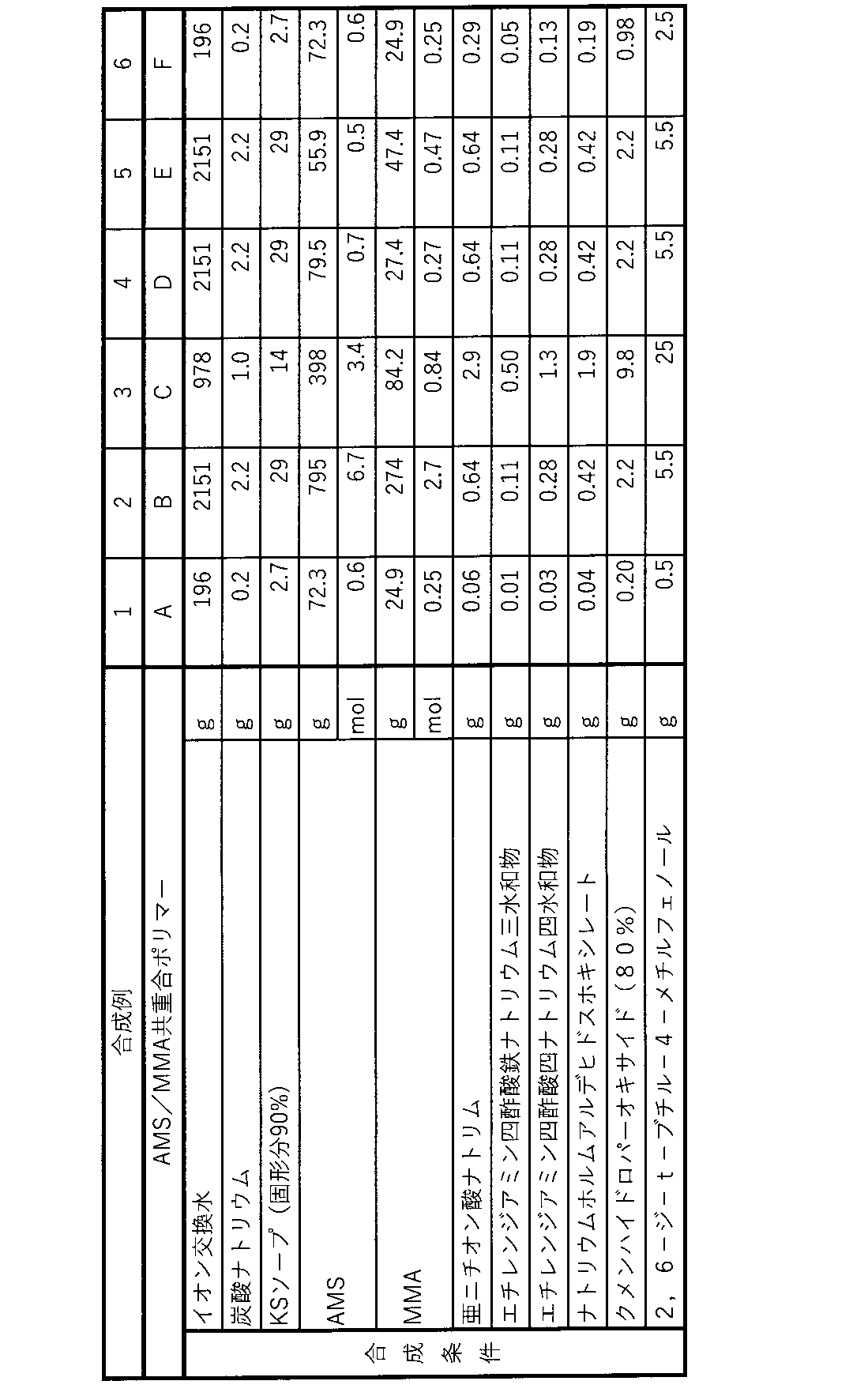
- Table 2 the synthesis conditions shown in Table 2 were employed to synthesize AMS/MMA copolymers A to F, respectively.
- TG-DTA thermogravimetric differential thermal analyzer
- thermogravimetric and differential thermal analyses of the AMS/MMA copolymers BF obtained in Synthesis Examples 2 to 6 also gave similar results.
- AMS/MMA copolymer does not discolor due to decomposition, and it was confirmed that it completely decomposes into monomers, demonstrating its high depolymerization ability.
- the 1/2 process temperature of AMS/MMA copolymer A was measured and found to be 221°C.
- AMS/MMA copolymer A was dissolved in tetrahydrofuran (THF), poured into a glass petri dish, and slowly dried. When the appearance was observed, it was confirmed that a film had been formed.
- Example 2 The AMS/MMA copolymer A obtained in Synthesis Example 1 was dissolved in tetrahydrofuran (THF), and tris-2-ethylhexyl trimellitate as a plasticizer was added in an amount of 5 wt % based on the AMS/MMA copolymer A to obtain an AMS/MMA copolymer A composition.
- This AMS/MMA copolymer A composition was poured into a glass petri dish and slowly dried. When the appearance was observed, it was confirmed that a film had been formed.
- the 1/2 process temperature of the AMS/MMA copolymer A composition after the addition of tris-2-ethylhexyl trimellitate was measured and found to be 198°C.
- Example 3 The AMS/MMA copolymer A obtained in Synthesis Example 1 was dissolved in tetrahydrofuran (THF), and tris-2-ethylhexyl trimellitate as a plasticizer was added thereto in an amount of 10% by weight based on the AMS/MMA copolymer A to obtain an AMS/MMA copolymer A composition.
- This AMS/MMA copolymer A composition was poured into a glass petri dish and slowly dried. When the appearance was observed, it was confirmed that a film had been formed.
- the 1/2 process temperature of the AMS/MMA copolymer A composition after the addition of tris-2-ethylhexyl trimellitate was measured and found to be 182°C.
- AMS/MMA copolymer B was dissolved in tetrahydrofuran (THF), poured into a glass petri dish, and slowly dried. When the appearance was observed, it was confirmed that a film had been formed.
- the initial elastic modulus of AMS/MMA copolymer B was measured three times, and the initial elastic modulus showed a stable value of 1700 to 2000 MPa.
- Example 4 The AMS/MMA copolymer B obtained in Synthesis Example 2 was dissolved in tetrahydrofuran (THF), and tris-2-ethylhexyl trimellitate as a plasticizer was added thereto in an amount of 10% by weight based on the AMS/MMA copolymer B to obtain an AMS/MMA copolymer B composition.
- This AMS/MMA copolymer B composition was poured into a glass petri dish and slowly dried. When the appearance was observed, it was confirmed that a film had been formed.
- the 1/2 method temperature of the AMS/MMA copolymer B composition after the addition of tris-2-ethylhexyl trimellitate was measured and found to be 195° C.
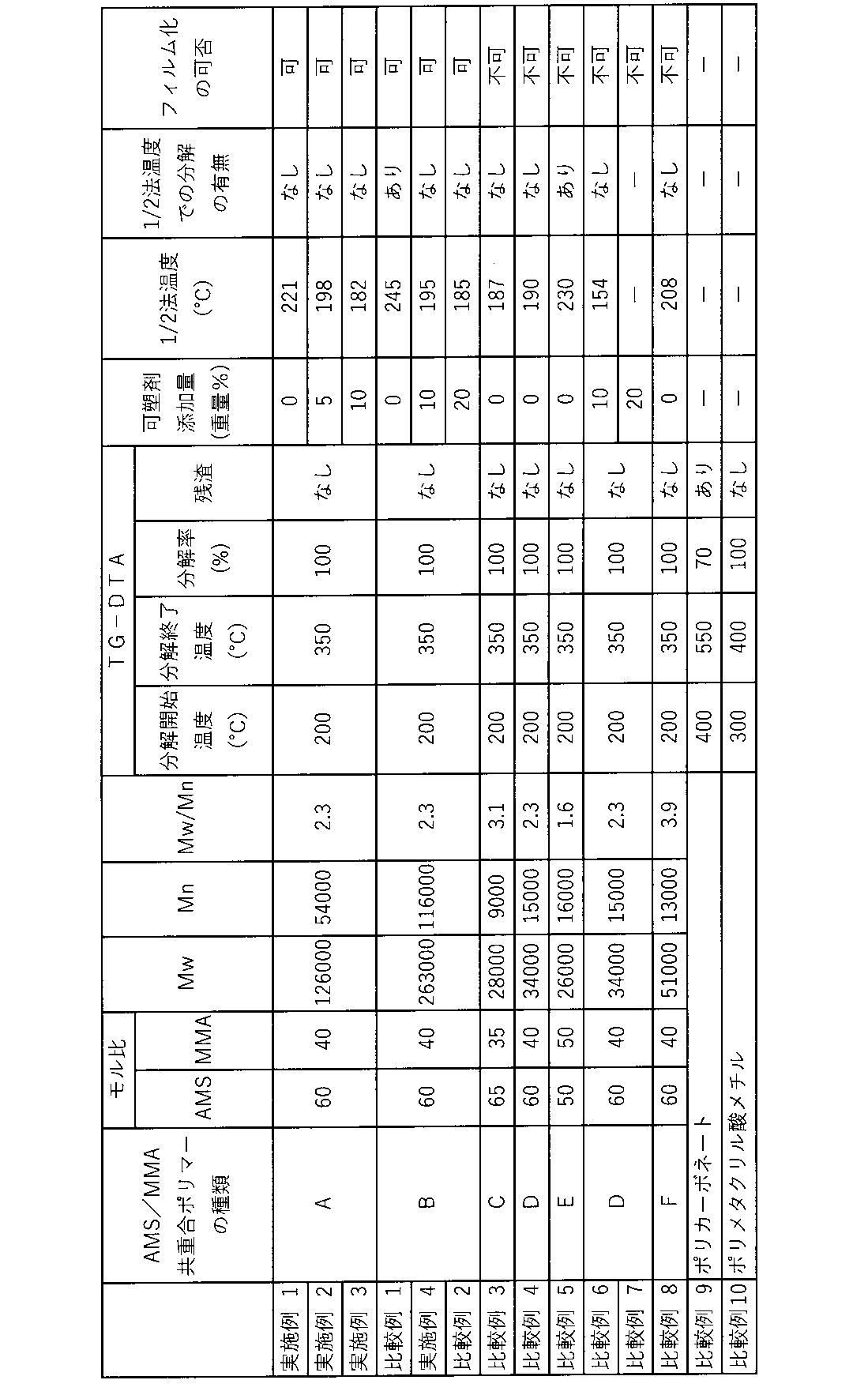
- Table 3 shows the number average molecular weight (Mn) and dispersity (Mw/Mn) obtained when measuring the weight average molecular weight (Mw) of each AMS/MMA copolymer.
- Mw weight average molecular weight
Landscapes
- Chemical & Material Sciences (AREA)
- Health & Medical Sciences (AREA)
- Chemical Kinetics & Catalysis (AREA)
- Medicinal Chemistry (AREA)
- Polymers & Plastics (AREA)
- Organic Chemistry (AREA)
- Addition Polymer Or Copolymer, Post-Treatments, Or Chemical Modifications (AREA)
- Compositions Of Macromolecular Compounds (AREA)
Abstract
α-メチルスチレンに由来する構成単位とメタクリル酸メチルに由来する構成単位とを有し、α-メチルスチレンに由来する構成単位とメタクリル酸メチルに由来する構成単位とのモル比が40~70:30~60であり、重量平均分子量が70,000~300,000の共重合ポリマーであって、前記共重合ポリマーが、JIS K7210-1で定められた方法で測定した1/2法温度が230℃以下である解重合性共重合ポリマー。
Description
本発明は、熱や光によって重合体(ポリマー)が単量体(モノマー)に分解する解重合性を有する共重合ポリマーと、この解重合性共重合ポリマーを含む組成物に関する。本発明は特に、熱により解重合した際に残渣が残りにくく、熱成形しやすい解重合性を有する共重合ポリマーと、この解重合性共重合ポリマーを含む組成物に関する。
プラスチック(ポリマー)は耐久性や耐熱性に優れる素材としての技術開発が進み、様々な素材が市場で使用されている。一方、これらプラスチック材料は環境では自然分解されない。このため、環境への影響が指摘されている。しかし、現状では、十分なリサイクル技術は確立されていないために、その多くが廃棄されている。特に、金属とプラスチックが複合化された複合材料にあっては、それぞれの材料を分離回収することが難しい。このために、これらは、その多くが埋め立て処分されているのが現状である。
近年、SDGsへの関心の高まりに応じて、生分解性ポリマーなどプラスチックを分解する技術や、プラスチックを回収して再利用する様々な取り組みが進められている。
しかしながら、生分解性ポリマーは、生分解途中の物質の環境における安全性や、分解途中の物質がマイクロプラスチックとなり、これらを環境生物・海洋生物が摂取した場合の影響などが明確になっていない。さらに、生分解性ポリマーは、廃棄物削減に対しては一定の効果があるものの、再利用という課題に関しては、リサイクル品の物性の低さなどの問題もあり、根本的な課題解決には至っていない。さらに、生分解性ポリマーは、廃棄物削減の観点においても、分解までの時間が長く、著しい場合は数カ月以上かかる場合もあるという問題点がある。
ペットボトルなどはリサイクルして再利用することが行われている。しかし、従来のメカニカルリサイクルでは、繰り返し使用すると着色するため、一定量のバージンポリマーを添加する必要がある。また、ケミカルリサイクルするためには特殊な化学薬品などを使用してモノマーにまで分解する必要があり、多大な手間とエネルギーを必要とするという問題点がある。さらにリサイクル品の用途も限定されるという問題点もある。
そこで、熱や光などの簡単な方法でプラスチックをモノマーに分解し、再利用できる素材や方法が求められている。例えば、ポリメタクリル酸メチル、ポリスチレンといったホモポリマーについて、熱や光などの簡単な方法でモノマーに分解する技術が検討されている(例えば、特許文献1,2、非特許文献1)。
しかし、この場合においても、より低温で熱分解できることが望まれている。また、ポリスチレンについては、モノマー回収率が60%と低いため、モノマー回収率を高めることが望まれている。
しかし、この場合においても、より低温で熱分解できることが望まれている。また、ポリスチレンについては、モノマー回収率が60%と低いため、モノマー回収率を高めることが望まれている。
大谷肇ら、「高分子の熱分解特性」高分子,高分子学会,46-6,394(1997)
本発明は、熱や光によって重合体(ポリマー)が単量体(モノマー)に分解する解重合性を有し、再利用することが容易な共重合ポリマーであって、より低い温度で90%以上の回収率でモノマーに分解することができ、熱分解温度よりも低い温度で熱成形が可能な解重合性共重合ポリマーと解重合性共重合ポリマー組成物を提供することを目的とする。
本発明者は、特定のモノマーを所定の割合で用い、かつ所定の重量平均分子量を有する共重合ポリマー、及びその組成物であって、所定の溶融特性を有する共重合ポリマー及び共重合ポリマー組成物が、上記課題を解決し得ることを見出した。
即ち、本発明は以下を要旨とする。
即ち、本発明は以下を要旨とする。
[1] α-メチルスチレンに由来する構成単位とメタクリル酸メチルに由来する構成単位とを有し、α-メチルスチレンに由来する構成単位とメタクリル酸メチルに由来する構成単位とのモル比が40~70:30~60であり、重量平均分子量が70,000~300,000の共重合ポリマーであって、前記共重合ポリマーが、JIS K7210-1で定められた方法で測定した1/2法温度が230℃以下である解重合性共重合ポリマー。
[2] α-メチルスチレンに由来する構成単位とメタクリル酸メチルに由来する構成単位とを有し、α-メチルスチレンに由来する構成単位とメタクリル酸メチルに由来する構成単位とのモル比が40~70:30~60であり、重量平均分子量が70,000~300,000の共重合ポリマーと可塑剤とを含む共重合ポリマー組成物であって、
前記可塑剤の含有量が前記共重合ポリマーに対して10重量%以下であり、
前記共重合ポリマー組成物が、JIS K7210-1で定められた方法で測定した1/2法温度が230℃以下である解重合性共重合ポリマー組成物。
前記可塑剤の含有量が前記共重合ポリマーに対して10重量%以下であり、
前記共重合ポリマー組成物が、JIS K7210-1で定められた方法で測定した1/2法温度が230℃以下である解重合性共重合ポリマー組成物。
[3] 前記可塑剤が、トリメリット酸トリス-2-エチルヘキシルである[2]に記載の解重合性共重合ポリマー組成物。
[4] [1]に記載の解重合性共重合ポリマー或いは[2]又は[3]に記載の解重合性共重合ポリマー組成物を用いた樹脂成形体。
[5] [1]に記載の解重合性共重合ポリマー或いは[2]又は[3]に記載の解重合性共重合ポリマー組成物を用いたフィルム。
本発明の解重合性共重合ポリマー及び解重合性共重合ポリマー組成物は、解重合性の高いホモポリマーであるポリα-メチルスチレン及びポリメタクリル酸メチルを構成するモノマー同士を2成分以上で共重合させた共重合ポリマーよりなる、あるいはこの共重合ポリマーを含み、加熱による簡易な方法で解重合させて高収率でモノマーを回収できる。
このため、本発明の解重合性共重合ポリマー及び本発明の解重合性共重合ポリマー組成物は、容易にリサイクルすることができる。
また、本発明の解重合性共重合ポリマー及び解重合性共重合ポリマー組成物は、加熱分解後の残渣が少ないため、金属などの異種材料とこの解重合性共重合ポリマー又は解重合性共重合ポリマー組成物とを組み合わせて複合材料としても、加熱するだけでポリマーを分解してモノマーを回収できる。このため、素材の分別回収が可能となる。
更に、本発明の解重合性共重合ポリマー及び解重合性共重合ポリマー組成物は、熱分解温度以下において流動性を示すため、熱成形する際に、ポリマーの分解を引き起こすことなく成形することが可能であり、良好な樹脂成形体を得ることができる。また、フィルム化した場合にも、良好なフィルムを得ることができる。
このため、本発明の解重合性共重合ポリマー及び本発明の解重合性共重合ポリマー組成物は、容易にリサイクルすることができる。
また、本発明の解重合性共重合ポリマー及び解重合性共重合ポリマー組成物は、加熱分解後の残渣が少ないため、金属などの異種材料とこの解重合性共重合ポリマー又は解重合性共重合ポリマー組成物とを組み合わせて複合材料としても、加熱するだけでポリマーを分解してモノマーを回収できる。このため、素材の分別回収が可能となる。
更に、本発明の解重合性共重合ポリマー及び解重合性共重合ポリマー組成物は、熱分解温度以下において流動性を示すため、熱成形する際に、ポリマーの分解を引き起こすことなく成形することが可能であり、良好な樹脂成形体を得ることができる。また、フィルム化した場合にも、良好なフィルムを得ることができる。
以下に本発明の実施の形態を詳細に説明する。
本発明の解重合性共重合ポリマーは、α-メチルスチレンに由来する構成単位(以下、「α-メチルスチレン単位」と称す場合がある。)とメタクリル酸メチルに由来する構成単位(以下、「メタクリル酸メチル単位」と称す場合がある。)とを有し、α-メチルスチレン単位とメタクリル酸メチル単位とのモル比が、α-メチルスチレン単位:メタクリル酸メチル単位=40~70:30~60であり、重量平均分子量が70,000~300,000の共重合ポリマー(以下、このモノマーモル比と重量平均分子量を満たす共重合ポリマーを「本発明の共重合ポリマー」と称す場合がある。)であって、前記共重合ポリマーが、JIS K7210-1で定められた方法で測定した1/2法温度(以下、単に「1/2法温度」と称す場合がある。)が230℃以下である解重合性共重合ポリマーである。
本発明の解重合性共重合ポリマー組成物は、上記本発明の共重合ポリマー、即ち、α-メチルスチレン単位とメタクリル酸メチル単位とを有し、α-メチルスチレン単位とメタクリル酸メチル単位とのモル比が、α-メチルスチレン単位:メタクリル酸メチル単位=40~70:30~60であり、重量平均分子量が70,000~300,000の共重合ポリマーと、可塑剤とを含む共重合ポリマー組成物であって、前記可塑剤の含有量が本発明の共重合ポリマーに対して10重量%以下であり、1/2法温度が230℃以下である解重合性共重合ポリマー組成物である。
本発明における1/2法温度は、JIS K7210-1に従って測定された、フローテスタに投入した樹脂の1/2(半分)が流出する温度であり、具体的には、後掲の実施例の項に記載の方法で測定することができる。
[共重合ポリマー]
まず、本発明の共重合ポリマーについて説明する。
まず、本発明の共重合ポリマーについて説明する。
本発明の共重合ポリマーを構成するα-メチルスチレン単位とメタクリル酸メチル単位のモル比は、α-メチルスチレン単位:メタクリル酸メチル単位=40~70:30~60である。
α-メチルスチレン単位とメタクリル酸メチル単位のモル比が上記範囲内であれば、共重合ポリマーの合成が容易であり、優れた流動性を示す共重合ポリマーを容易に製造することができる。
これらの観点から、本発明の共重合ポリマーのα-メチルスチレン単位とメタクリル酸メチル単位のモル比は、α-メチルスチレン単位:メタクリル酸メチル単位=45~65:35~55であることが好ましく、55~65:35~45であることがより好ましい。
α-メチルスチレン単位とメタクリル酸メチル単位のモル比が上記範囲内であれば、共重合ポリマーの合成が容易であり、優れた流動性を示す共重合ポリマーを容易に製造することができる。
これらの観点から、本発明の共重合ポリマーのα-メチルスチレン単位とメタクリル酸メチル単位のモル比は、α-メチルスチレン単位:メタクリル酸メチル単位=45~65:35~55であることが好ましく、55~65:35~45であることがより好ましい。
本発明の共重合ポリマーは、α-メチルスチレン単位及びメタクリル酸メチル単位以外の他のモノマーに由来する構成単位(以下、「他のモノマー単位」と称す場合がある。)を含有していてもよい。ただし、本発明の共重合ポリマーが他のモノマー単位を含有すると、解重合性が劣る傾向がある。このため、本発明の共重合ポリマーに含まれる他のモノマー単位の割合は、本発明の共重合ポリマーを構成する全モノマー単位100モル%中に10モル%以下、特に5モル%以下で、0モル%(他のモノマー単位を含まないこと)が最も好ましい。
本発明の共重合ポリマーが含有し得る他のモノマー単位としては、テトラフルオロエチレン等のフッ素系モノマー、アクリル酸メチル、アクリル酸エチル、アクリル酸2エチルヘキシル、メタクリル酸エチル、メタクリル酸ブチル等のメタクリル酸メチル以外の(メタ)アクリル酸系モノマー、スチレン等の1種又は2種以上に由来する構成単位が挙げられる。
共重合ポリマーを構成するモノマー単位のモル比は、NMR分析により求めることができる。
本発明の共重合ポリマーの重量平均分子量(Mw)は、70,000~300,000の範囲内である。
Mwが上記下限未満では、ポリマーとしての成形性、特にフィルム成形性や成形した樹脂強度等に劣る傾向がある。Mwが上記上限を超えると解重合性が劣る傾向がある。
このような観点から、本発明の共重合ポリマーのMwは80,000~270,000であることが好ましく、80,000~250,000であることがより好ましい。
Mwが上記下限未満では、ポリマーとしての成形性、特にフィルム成形性や成形した樹脂強度等に劣る傾向がある。Mwが上記上限を超えると解重合性が劣る傾向がある。
このような観点から、本発明の共重合ポリマーのMwは80,000~270,000であることが好ましく、80,000~250,000であることがより好ましい。
共重合ポリマーの重量平均分子量(Mw)は、ゲルパーミエイションクロマトグラフィー(GPC法)によるポリスチレン換算の値である。
本発明の共重合ポリマーの製造方法に特に制限はないが、例えば、少なくともα-メチルスチレンとメタクリル酸メチルを含有するモノマー混合物をラジカル重合反応により共重合させればよい。具体的には、原料となるモノマー混合物をラジカル重合開始剤、架橋剤などを混合した溶媒とともに不活性ガス雰囲気下に密封し、所定時間攪拌を継続して共重合させた後、貧溶媒中で析出させて回収することにより、本発明の共重合ポリマーを得ることができる。
[解重合性共重合ポリマーの1/2法温度]
本発明の解重合性共重合ポリマーは、前述の本発明の共重合ポリマーよりなり、1/2法温度が230℃以下であることを特徴とする。
1/2法温度が230℃以下であれば、良好な流動性を示す温度で共重合ポリマーが分解することなく、成形性、特にフィルム成形性に優れる。
熱成形時にポリマーが分解することを防ぐ観点から、本発明の解重合性共重合ポリマーの1/2法温度は210℃以下であることが好ましく、200℃以下であることがより好ましい。一方、成形した素材の熱安定性の観点から、本発明の解重合性共重合ポリマーの1/2法温度は100℃以上であることが好ましく、150℃以上であることがより好ましい。
本発明の解重合性共重合ポリマーは、前述の本発明の共重合ポリマーよりなり、1/2法温度が230℃以下であることを特徴とする。
1/2法温度が230℃以下であれば、良好な流動性を示す温度で共重合ポリマーが分解することなく、成形性、特にフィルム成形性に優れる。
熱成形時にポリマーが分解することを防ぐ観点から、本発明の解重合性共重合ポリマーの1/2法温度は210℃以下であることが好ましく、200℃以下であることがより好ましい。一方、成形した素材の熱安定性の観点から、本発明の解重合性共重合ポリマーの1/2法温度は100℃以上であることが好ましく、150℃以上であることがより好ましい。
このような1/2法温度を有する共重合ポリマーは、例えば前述の本発明の共重合ポリマーの製造方法において、モノマーに対する重合開始剤の割合を変化させることにより製造することができる。
[解重合性共重合ポリマー組成物]
本発明の解重合性共重合ポリマー組成物は、前述の本発明の共重合ポリマーと該共重合ポリマーに対して10重量%以下の可塑剤とを含み、1/2法温度が230℃以下であることを特徴とする。
即ち、1/2法温度が230℃を超える解重合性共重合ポリマーであっても、可塑剤を添加することで、1/2法温度を230℃以下に下げることができる。
本発明の解重合性共重合ポリマー組成物は、1/2法温度が高い共重合ポリマーに可塑剤を添加することで、1/2法温度を230℃以下に調整したものである。
本発明の解重合性共重合ポリマー組成物は、前述の本発明の共重合ポリマーと該共重合ポリマーに対して10重量%以下の可塑剤とを含み、1/2法温度が230℃以下であることを特徴とする。
即ち、1/2法温度が230℃を超える解重合性共重合ポリマーであっても、可塑剤を添加することで、1/2法温度を230℃以下に下げることができる。
本発明の解重合性共重合ポリマー組成物は、1/2法温度が高い共重合ポリマーに可塑剤を添加することで、1/2法温度を230℃以下に調整したものである。
本発明の解重合性共重合ポリマー組成物の1/2法温度は、本発明の解重合性共重合ポリマーの1/2法温度と同様の理由から、230℃以下であって、好ましくは210℃以下、より好ましくは200℃以下で、好ましくは100℃以上、より好ましくは150℃以上である。
共重合ポリマーに添加する可塑剤としては、トリメリット酸エステル系可塑剤、ピロメリット酸エステル系可塑剤等が挙げられる。共重合ポリマーに添加する可塑剤としては、高温条件下における長期耐久性の観点から、トリメリット酸トリス-2-エチルヘキシルを用いることが好ましい。
本発明の解重合性共重合ポリマー組成物において、トリメリット酸トリス-2-エチルヘキシル等の可塑剤は、本発明の共重合ポリマーに対して10重量%以下の割合で配合される。可塑剤の配合量が10重量%を超えると、1/2法温度は下がるが、得られる解重合性共重合ポリマー組成物の成形性、特にフィルム成形性が損なわれる。
可塑剤の配合量は、これを添加する共重合ポリマーの1/2法温度によっても異なるが、共重合ポリマーに対して5~10重量%程度とすることが好ましい。
可塑剤の配合量は、これを添加する共重合ポリマーの1/2法温度によっても異なるが、共重合ポリマーに対して5~10重量%程度とすることが好ましい。
本発明の解重合性共重合ポリマー組成物には、必要に応じて、可塑剤以外の任意の適切な添加剤を配合してもよい。
この添加剤としては、例えば、架橋剤、粘着付与剤、顔料、染料、充填剤、老化防止剤、導電材、帯電防止剤、紫外線吸収剤、光安定剤、剥離調整剤、軟化剤、界面活性剤、難燃剤、酸化防止剤等が挙げられる。
これらの可塑剤以外の添加剤の配合量は、その合計量として本発明の共重合ポリマーに対して10重量%以下、例えば5~10重量%とすることが好ましい。
この添加剤としては、例えば、架橋剤、粘着付与剤、顔料、染料、充填剤、老化防止剤、導電材、帯電防止剤、紫外線吸収剤、光安定剤、剥離調整剤、軟化剤、界面活性剤、難燃剤、酸化防止剤等が挙げられる。
これらの可塑剤以外の添加剤の配合量は、その合計量として本発明の共重合ポリマーに対して10重量%以下、例えば5~10重量%とすることが好ましい。
[樹脂成形体・フィルム]
本発明の解重合性共重合ポリマー及び解重合性共重合ポリマー組成物は、これを常法に従って、各種の樹脂成形体やフィルムに成形することができる。
特に本発明の解重合性共重合ポリマー及び解重合性共重合ポリマー組成物は、熱成形した場合にも、分解することなく安定して成形することができ、フィルム化も容易である。
また、本発明の解重合性共重合ポリマー及び解重合性共重合ポリマー組成物は、従来はリサイクルが困難であった金属などの異種材料との複合成形体としても加熱により容易にモノマーを回収することができる。このため、本発明の解重合性共重合ポリマー及び解重合性共重合ポリマー組成物は、リサイクル性に優れており、その産業上の利用性は極めて大きい。
本発明の解重合性共重合ポリマー及び解重合性共重合ポリマー組成物は、これを常法に従って、各種の樹脂成形体やフィルムに成形することができる。
特に本発明の解重合性共重合ポリマー及び解重合性共重合ポリマー組成物は、熱成形した場合にも、分解することなく安定して成形することができ、フィルム化も容易である。
また、本発明の解重合性共重合ポリマー及び解重合性共重合ポリマー組成物は、従来はリサイクルが困難であった金属などの異種材料との複合成形体としても加熱により容易にモノマーを回収することができる。このため、本発明の解重合性共重合ポリマー及び解重合性共重合ポリマー組成物は、リサイクル性に優れており、その産業上の利用性は極めて大きい。
以下に、実施例を挙げて本発明の効果をより具体的に示す。
[1/2法温度の測定方法]
実施例及び比較例における共重合ポリマー又は共重合ポリマー組成物の1/2法温度は、以下の表1に示す装置と条件で測定した。
実施例及び比較例における共重合ポリマー又は共重合ポリマー組成物の1/2法温度は、以下の表1に示す装置と条件で測定した。

[初期弾性率の測定]
実施例4、比較例1,2における初期弾性率の測定方法は以下の通りである。
実施例4、比較例1,2で得られた解重合性共重合ポリマー組成物から、試験片打抜機により試験片を作成し、以下の装置及び条件で引張試験を行った。
測定は3回行い、測定値のバラツキも調べた。
装置:ミネビア製「LTS-1kNB-s50」
引張速度:5mm/min.
チャック間距離:30mm
実施例4、比較例1,2における初期弾性率の測定方法は以下の通りである。
実施例4、比較例1,2で得られた解重合性共重合ポリマー組成物から、試験片打抜機により試験片を作成し、以下の装置及び条件で引張試験を行った。
測定は3回行い、測定値のバラツキも調べた。
装置:ミネビア製「LTS-1kNB-s50」
引張速度:5mm/min.
チャック間距離:30mm
[合成例1~6]
4つ口フラスコにイオン交換水、炭酸ナトリウム、花王(株)製「KSソープ(固形分90%)」を投入し、攪拌しながら溶解させた。溶解後、モノマー混合物(α-メチルスチレン(AMS)、メタクリル酸メチル(MMA))を加えて150rpmで攪拌しながら系内をアルゴンガスで置換した。
フラスコ内の温度が3~4℃になったことを確認したら、亜ニチオン酸ナトリウム、エチレンジアミン四酢酸鉄ナトリウム三水和物、エチレンジアミン四酢酸四ナトリウム四水和物、ナトリウムホルムアルデヒドスホキシレート、及びクメンハイドロパーオキサイド(純分80%)を順次添加して、3~4℃にフラスコ内の温度を保持しながら63時間攪拌を行った。
63時間の攪拌後、2,6-ジ-t-ブチル-4-メチルフェノールを添加し、反応を停止させた。
上記反応液をメタノールに滴下し、析出した白色固体をろ過により回収した。
得られた白色固体を簡易乾燥後、テトラヒドロフラン(THF)に溶解し、この溶液をメタノールに滴下し、析出した固体をろ過により回収した。得られた白色固体を50℃で48時間減圧乾燥し最終生成物とした。
上記の合成手順において、表2に示す合成条件を採用し、それぞれAMS/MMA共重合ポリマーA~Fを合成した。
4つ口フラスコにイオン交換水、炭酸ナトリウム、花王(株)製「KSソープ(固形分90%)」を投入し、攪拌しながら溶解させた。溶解後、モノマー混合物(α-メチルスチレン(AMS)、メタクリル酸メチル(MMA))を加えて150rpmで攪拌しながら系内をアルゴンガスで置換した。
フラスコ内の温度が3~4℃になったことを確認したら、亜ニチオン酸ナトリウム、エチレンジアミン四酢酸鉄ナトリウム三水和物、エチレンジアミン四酢酸四ナトリウム四水和物、ナトリウムホルムアルデヒドスホキシレート、及びクメンハイドロパーオキサイド(純分80%)を順次添加して、3~4℃にフラスコ内の温度を保持しながら63時間攪拌を行った。
63時間の攪拌後、2,6-ジ-t-ブチル-4-メチルフェノールを添加し、反応を停止させた。
上記反応液をメタノールに滴下し、析出した白色固体をろ過により回収した。
得られた白色固体を簡易乾燥後、テトラヒドロフラン(THF)に溶解し、この溶液をメタノールに滴下し、析出した固体をろ過により回収した。得られた白色固体を50℃で48時間減圧乾燥し最終生成物とした。
上記の合成手順において、表2に示す合成条件を採用し、それぞれAMS/MMA共重合ポリマーA~Fを合成した。
[実施例1]
合成例1で得られたAMS/MMA共重合ポリマーAのモノマー比をNMRにより分析したところ、AMS:MMA=60:40(モル比)であった。このAMS/MMA共重合ポリマーAの分子量をGPC分析したところ、重量平均分子量(Mw):約126,000であった。
得られたAMS/MMA共重合ポリマーを画像観察可能な熱重量示差熱分析装置(TG-DTA)で分析(N2環境、昇温速度10℃/分)したところ、分解開始温度は約200℃、分解終了温度は約350℃、分解率は100%で残渣は認められなかった。
合成例2~6で得られたAMS/MMA共重合ポリマーB~Fの熱重量示差熱分析においても同様の結果が得られた。
一般的なポリマーは継続的な加熱により、ポリマー分子の末端から徐々に分解していくために変色が起こり最終的には黒色の残渣が残るが、AMS/MMA共重合ポリマーはそのような分解に伴う変色がなく、モノマーに完全に分解していく様子が確認され、解重合性が高いことが確認された。
AMS/MMA共重合ポリマーAの1/2法温度を測定したところ、221℃であった。
AMS/MMA共重合ポリマーAをテトラヒドロフラン(THF)に溶解し、ガラスシャーレに流し、ゆっくりと乾燥させた後、外観を観察したところ、フィルムを形成していることを確認した。
合成例1で得られたAMS/MMA共重合ポリマーAのモノマー比をNMRにより分析したところ、AMS:MMA=60:40(モル比)であった。このAMS/MMA共重合ポリマーAの分子量をGPC分析したところ、重量平均分子量(Mw):約126,000であった。
得られたAMS/MMA共重合ポリマーを画像観察可能な熱重量示差熱分析装置(TG-DTA)で分析(N2環境、昇温速度10℃/分)したところ、分解開始温度は約200℃、分解終了温度は約350℃、分解率は100%で残渣は認められなかった。
合成例2~6で得られたAMS/MMA共重合ポリマーB~Fの熱重量示差熱分析においても同様の結果が得られた。
一般的なポリマーは継続的な加熱により、ポリマー分子の末端から徐々に分解していくために変色が起こり最終的には黒色の残渣が残るが、AMS/MMA共重合ポリマーはそのような分解に伴う変色がなく、モノマーに完全に分解していく様子が確認され、解重合性が高いことが確認された。
AMS/MMA共重合ポリマーAの1/2法温度を測定したところ、221℃であった。
AMS/MMA共重合ポリマーAをテトラヒドロフラン(THF)に溶解し、ガラスシャーレに流し、ゆっくりと乾燥させた後、外観を観察したところ、フィルムを形成していることを確認した。
[実施例2]
合成例1で得られたAMS/MMA共重合ポリマーAをテトラヒドロフラン(THF)に溶解し、可塑剤としてトリメリット酸トリス-2-エチルヘキシルをAMS/MMA共重合ポリマーAに対して5重量%となるように添加して、AMS/MMA共重合ポリマーA組成物とした。
このAMS/MMA共重合ポリマーA組成物をガラスシャーレに流し、ゆっくりと乾燥させた後、外観を観察したところ、フィルムを形成していることを確認した。
トリメリット酸トリス-2-エチルヘキシル添加後のAMS/MMA共重合ポリマーA組成物の1/2法温度を測定したところ、198℃であった。
合成例1で得られたAMS/MMA共重合ポリマーAをテトラヒドロフラン(THF)に溶解し、可塑剤としてトリメリット酸トリス-2-エチルヘキシルをAMS/MMA共重合ポリマーAに対して5重量%となるように添加して、AMS/MMA共重合ポリマーA組成物とした。
このAMS/MMA共重合ポリマーA組成物をガラスシャーレに流し、ゆっくりと乾燥させた後、外観を観察したところ、フィルムを形成していることを確認した。
トリメリット酸トリス-2-エチルヘキシル添加後のAMS/MMA共重合ポリマーA組成物の1/2法温度を測定したところ、198℃であった。
[実施例3]
合成例1で得られたAMS/MMA共重合ポリマーAをテトラヒドロフラン(THF)に溶解し、可塑剤としてトリメリット酸トリス-2-エチルヘキシルをAMS/MMA共重合ポリマーAに対して10重量%となるように添加して、AMS/MMA共重合ポリマーA組成物とした。
このAMS/MMA共重合ポリマーA組成物をガラスシャーレに流し、ゆっくりと乾燥させた後、外観を観察したところ、フィルムを形成していることを確認した。
トリメリット酸トリス-2-エチルヘキシル添加後のAMS/MMA共重合ポリマーA組成物の1/2法温度を測定したところ、182℃であった。
合成例1で得られたAMS/MMA共重合ポリマーAをテトラヒドロフラン(THF)に溶解し、可塑剤としてトリメリット酸トリス-2-エチルヘキシルをAMS/MMA共重合ポリマーAに対して10重量%となるように添加して、AMS/MMA共重合ポリマーA組成物とした。
このAMS/MMA共重合ポリマーA組成物をガラスシャーレに流し、ゆっくりと乾燥させた後、外観を観察したところ、フィルムを形成していることを確認した。
トリメリット酸トリス-2-エチルヘキシル添加後のAMS/MMA共重合ポリマーA組成物の1/2法温度を測定したところ、182℃であった。
[比較例1]
合成例2で得られたAMS/MMA共重合ポリマーBのモノマー比をNMRにより分析したところ、AMS:MMA=60:40(モル比)であった。このAMS/MMA共重合ポリマーBの分子量をGPC分析したところ、重量平均分子量(Mw):約263,000であった。
AMS/MMA共重合ポリマーBの1/2法温度を測定したところ、245℃であった。AMS/MMA共重合ポリマーBの245℃での流動性を評価したところ、樹脂の分解が認められた。
合成例2で得られたAMS/MMA共重合ポリマーBのモノマー比をNMRにより分析したところ、AMS:MMA=60:40(モル比)であった。このAMS/MMA共重合ポリマーBの分子量をGPC分析したところ、重量平均分子量(Mw):約263,000であった。
AMS/MMA共重合ポリマーBの1/2法温度を測定したところ、245℃であった。AMS/MMA共重合ポリマーBの245℃での流動性を評価したところ、樹脂の分解が認められた。
AMS/MMA共重合ポリマーBをテトラヒドロフラン(THF)に溶解し、ガラスシャーレに流し、ゆっくりと乾燥させた後、外観を観察したところ、フィルムを形成していることを確認した。
AMS/MMA共重合ポリマーBの初期弾性率を測定したところ、3回の測定で初期弾性率は、1700~2000MPaと安定した値を示した。
AMS/MMA共重合ポリマーBの初期弾性率を測定したところ、3回の測定で初期弾性率は、1700~2000MPaと安定した値を示した。
[実施例4]
合成例2で得られたAMS/MMA共重合ポリマーBをテトラヒドロフラン(THF)に溶解し、可塑剤としてトリメリット酸トリス-2-エチルヘキシルをAMS/MMA共重合ポリマーBに対して10重量%となるように添加してAMS/MMA共重合ポリマーB組成物とした。
このAMS/MMA共重合ポリマーB組成物をガラスシャーレに流し、ゆっくりと乾燥させた後、外観を観察したところ、フィルムを形成していることを確認した。
トリメリット酸トリス-2-エチルヘキシル添加後のAMS/MMA共重合ポリマーB組成物の1/2法温度を測定したところ、195℃であった。このAMS/MMA共重合ポリマーB組成物の195℃での流動性を評価したところ、樹脂の分解は認められなかった。
AMS/MMA共重合ポリマーB組成物の初期弾性率を測定したところ、3回の測定で、初期弾性率は1900~2000MPaと比較例1と同等の安定した値を示した。
合成例2で得られたAMS/MMA共重合ポリマーBをテトラヒドロフラン(THF)に溶解し、可塑剤としてトリメリット酸トリス-2-エチルヘキシルをAMS/MMA共重合ポリマーBに対して10重量%となるように添加してAMS/MMA共重合ポリマーB組成物とした。
このAMS/MMA共重合ポリマーB組成物をガラスシャーレに流し、ゆっくりと乾燥させた後、外観を観察したところ、フィルムを形成していることを確認した。
トリメリット酸トリス-2-エチルヘキシル添加後のAMS/MMA共重合ポリマーB組成物の1/2法温度を測定したところ、195℃であった。このAMS/MMA共重合ポリマーB組成物の195℃での流動性を評価したところ、樹脂の分解は認められなかった。
AMS/MMA共重合ポリマーB組成物の初期弾性率を測定したところ、3回の測定で、初期弾性率は1900~2000MPaと比較例1と同等の安定した値を示した。
[比較例2]
合成例2で得られたAMS/MMA共重合ポリマーBをテトラヒドロフラン(THF)に溶解し、可塑剤としてトリメリット酸トリス-2-エチルヘキシルをAMS/MMA共重合ポリマーBに対して20重量%となるように添加してAMS/MMA共重合ポリマーB組成物とした。
このAMS/MMA共重合ポリマーB組成物をガラスシャーレに流し、ゆっくりと乾燥させた後、外観を観察したところ、フィルムを形成していることを確認した。
トリメリット酸トリス-2-エチルヘキシル添加後のAMS/MMA共重合ポリマーB組成物の1/2法温度を測定したところ、185℃であった。このAMS/MMA共重合ポリマーB組成物の185℃での流動性を評価したところ、樹脂の分解は認められなかった。
AMS/MMA共重合ポリマーB組成物の初期弾性率を測定したところ、初期弾性率は、3回の測定で、1500~2000MPaとバラツキが大きく、均一な樹脂組成物が形成できていないことがわかった。
合成例2で得られたAMS/MMA共重合ポリマーBをテトラヒドロフラン(THF)に溶解し、可塑剤としてトリメリット酸トリス-2-エチルヘキシルをAMS/MMA共重合ポリマーBに対して20重量%となるように添加してAMS/MMA共重合ポリマーB組成物とした。
このAMS/MMA共重合ポリマーB組成物をガラスシャーレに流し、ゆっくりと乾燥させた後、外観を観察したところ、フィルムを形成していることを確認した。
トリメリット酸トリス-2-エチルヘキシル添加後のAMS/MMA共重合ポリマーB組成物の1/2法温度を測定したところ、185℃であった。このAMS/MMA共重合ポリマーB組成物の185℃での流動性を評価したところ、樹脂の分解は認められなかった。
AMS/MMA共重合ポリマーB組成物の初期弾性率を測定したところ、初期弾性率は、3回の測定で、1500~2000MPaとバラツキが大きく、均一な樹脂組成物が形成できていないことがわかった。
[比較例3]
合成例3で得られたAMS/MMA共重合ポリマーCのモノマー比をNMRにより分析したところ、AMS:MMA=65:35(モル比)であった。このAMS/MMA共重合ポリマーCの分子量をGPC分析したところ、重量平均分子量(Mw):約28,000であった。
AMS/MMA共重合ポリマーCの1/2法温度を測定したところ、187℃であった。
AMS/MMA共重合ポリマーCをテトラヒドロフラン(THF)に溶解し、ガラスシャーレに流し、ゆっくりと乾燥させた後、外観を観察したところ、ひび割れがあり、フィルムを形成できないことを確認した。
合成例3で得られたAMS/MMA共重合ポリマーCのモノマー比をNMRにより分析したところ、AMS:MMA=65:35(モル比)であった。このAMS/MMA共重合ポリマーCの分子量をGPC分析したところ、重量平均分子量(Mw):約28,000であった。
AMS/MMA共重合ポリマーCの1/2法温度を測定したところ、187℃であった。
AMS/MMA共重合ポリマーCをテトラヒドロフラン(THF)に溶解し、ガラスシャーレに流し、ゆっくりと乾燥させた後、外観を観察したところ、ひび割れがあり、フィルムを形成できないことを確認した。
[比較例4]
合成例4で得られたAMS/MMA共重合ポリマーDのモノマー比をNMRにより分析したところ、AMS:MMA=60:40(モル比)であった。このAMS/MMA共重合ポリマーDの分子量をGPC分析したところ、重量平均分子量(Mw):約34,000であった。
AMS/MMA共重合ポリマーDの1/2法温度を測定したところ、190℃であった。
AMS/MMA共重合ポリマーDをテトラヒドロフラン(THF)に溶解し、ガラスシャーレに流し、ゆっくりと乾燥させた後、外観を観察したところ、ひび割れがあり、フィルムを形成できないことを確認した。
合成例4で得られたAMS/MMA共重合ポリマーDのモノマー比をNMRにより分析したところ、AMS:MMA=60:40(モル比)であった。このAMS/MMA共重合ポリマーDの分子量をGPC分析したところ、重量平均分子量(Mw):約34,000であった。
AMS/MMA共重合ポリマーDの1/2法温度を測定したところ、190℃であった。
AMS/MMA共重合ポリマーDをテトラヒドロフラン(THF)に溶解し、ガラスシャーレに流し、ゆっくりと乾燥させた後、外観を観察したところ、ひび割れがあり、フィルムを形成できないことを確認した。
[比較例5]
合成例5で得られたAMS/MMA共重合ポリマーEのモノマー比をNMRにより分析したところ、AMS:MMA=50:50(モル比)であった。このAMS/MMA共重合ポリマーEの分子量をGPC分析したところ、重量平均分子量(Mw):約26,000であった。
AMS/MMA共重合ポリマーEの1/2法温度を測定したところ、230℃であった。
AMS/MMA共重合ポリマーEをテトラヒドロフラン(THF)に溶解し、ガラスシャーレに流し、ゆっくりと乾燥させた後、外観を観察したところ、ひび割れがあり、フィルムを形成できないことを確認した。
合成例5で得られたAMS/MMA共重合ポリマーEのモノマー比をNMRにより分析したところ、AMS:MMA=50:50(モル比)であった。このAMS/MMA共重合ポリマーEの分子量をGPC分析したところ、重量平均分子量(Mw):約26,000であった。
AMS/MMA共重合ポリマーEの1/2法温度を測定したところ、230℃であった。
AMS/MMA共重合ポリマーEをテトラヒドロフラン(THF)に溶解し、ガラスシャーレに流し、ゆっくりと乾燥させた後、外観を観察したところ、ひび割れがあり、フィルムを形成できないことを確認した。
[比較例6]
合成例4で得られたAMS/MMA共重合ポリマーDをテトラヒドロフラン(THF)に溶解し、可塑剤としてトリメリット酸トリス-2-エチルヘキシルをAMS/MMA共重合ポリマーDに対して10重量%となるように添加してAMS/MMA共重合ポリマーD組成物とした。
このAMS/MMA共重合ポリマーD組成物をガラスシャーレに流し、ゆっくりと乾燥させた後、外観を観察したところ、ひび割れが生じ、フィルムを形成できなかった。
トリメリット酸トリス-2-エチルヘキシル添加後のAMS/MMA共重合ポリマーD組成物の1/2法温度を測定したところ、154℃であった。
合成例4で得られたAMS/MMA共重合ポリマーDをテトラヒドロフラン(THF)に溶解し、可塑剤としてトリメリット酸トリス-2-エチルヘキシルをAMS/MMA共重合ポリマーDに対して10重量%となるように添加してAMS/MMA共重合ポリマーD組成物とした。
このAMS/MMA共重合ポリマーD組成物をガラスシャーレに流し、ゆっくりと乾燥させた後、外観を観察したところ、ひび割れが生じ、フィルムを形成できなかった。
トリメリット酸トリス-2-エチルヘキシル添加後のAMS/MMA共重合ポリマーD組成物の1/2法温度を測定したところ、154℃であった。
[比較例7]
合成例4で得られたAMS/MMA共重合ポリマーDをテトラヒドロフラン(THF)に溶解し、可塑剤としてトリメリット酸トリス-2-エチルヘキシルをAMS/MMA共重合ポリマーDに対して20重量%となるように添加してAMS/MMA共重合ポリマーD組成物とした。
このAMS/MMA共重合ポリマーD組成物をガラスシャーレに流し、ゆっくりと乾燥させた後、外観を観察したところ、ひび割れが生じ、フィルムを形成できなかった。
合成例4で得られたAMS/MMA共重合ポリマーDをテトラヒドロフラン(THF)に溶解し、可塑剤としてトリメリット酸トリス-2-エチルヘキシルをAMS/MMA共重合ポリマーDに対して20重量%となるように添加してAMS/MMA共重合ポリマーD組成物とした。
このAMS/MMA共重合ポリマーD組成物をガラスシャーレに流し、ゆっくりと乾燥させた後、外観を観察したところ、ひび割れが生じ、フィルムを形成できなかった。
[比較例8]
合成例6で得られたAMS/MMA共重合ポリマーFのモノマー比をNMRにより分析したところ、AMS:MMA=60:40(モル比)であった。このAMS/MMA共重合ポリマーFの分子量をGPC分析したところ、重量平均分子量(Mw):約51,000であった。
AMS/MMA共重合ポリマーFの1/2法温度を測定したところ、208℃であった。
AMS/MMA共重合ポリマーFをテトラヒドロフラン(THF)に溶解し、ガラスシャーレに流し、ゆっくりと乾燥させた後、外観を観察したところ、ひび割れがあり、フィルムを形成できないことを確認した。
合成例6で得られたAMS/MMA共重合ポリマーFのモノマー比をNMRにより分析したところ、AMS:MMA=60:40(モル比)であった。このAMS/MMA共重合ポリマーFの分子量をGPC分析したところ、重量平均分子量(Mw):約51,000であった。
AMS/MMA共重合ポリマーFの1/2法温度を測定したところ、208℃であった。
AMS/MMA共重合ポリマーFをテトラヒドロフラン(THF)に溶解し、ガラスシャーレに流し、ゆっくりと乾燥させた後、外観を観察したところ、ひび割れがあり、フィルムを形成できないことを確認した。
[比較例9]
解重合性が低いポリマーの一例として、ポリカーボネートのTG-DTA分析(N2環境、昇温速度10℃/分)を行った結果、分解開始温度は約400℃であり徐々に黒色に変化し、分解終了温度は約550℃で、分解は約70%まで進むが約30%は分解されずに残渣として残ることが観察された。
解重合性が低いポリマーの一例として、ポリカーボネートのTG-DTA分析(N2環境、昇温速度10℃/分)を行った結果、分解開始温度は約400℃であり徐々に黒色に変化し、分解終了温度は約550℃で、分解は約70%まで進むが約30%は分解されずに残渣として残ることが観察された。
[比較例10]
解重合性があることが既知のポリマーの一例として、ポリメタクリル酸メチルのTG-DTA分析(N2環境、昇温速度10℃/分)を行った結果、分解開始温度は約300℃であり、分解終了温度は約400℃であり、残渣は残らなかったことが観察された。
解重合性があることが既知のポリマーの一例として、ポリメタクリル酸メチルのTG-DTA分析(N2環境、昇温速度10℃/分)を行った結果、分解開始温度は約300℃であり、分解終了温度は約400℃であり、残渣は残らなかったことが観察された。
実施例1~4及び比較例1~10の結果を下記表3にまとめて示す。
なお、表3には、各AMS/MMA共重合ポリマーの重量平均分子量(Mw)の測定時に求めた数平均分子量(Mn)と分散度(Mw/Mn)も併記した。
なお、表3には、各AMS/MMA共重合ポリマーの重量平均分子量(Mw)の測定時に求めた数平均分子量(Mn)と分散度(Mw/Mn)も併記した。
[結果・考察]
比較例9と実施例1~4及び比較例1~8を比較すると、実施例1~4及び比較例1~8は、TG-DTA分析において、分解開始温度200℃、分解終了温度350℃と比較例9と比較して低温で分解し、残渣なく解重合性を有することが確認できた。
比較例10と実施例1~4及び比較例1~8を比較すると、実施例1~4及び比較例1~8は、TG-DTA分析において、分解開始温度200℃、分解終了温度350℃と比較例10と比較して低温で分解し、残渣なく解重合性を有することが確認できた。
比較例9と実施例1~4及び比較例1~8を比較すると、実施例1~4及び比較例1~8は、TG-DTA分析において、分解開始温度200℃、分解終了温度350℃と比較例9と比較して低温で分解し、残渣なく解重合性を有することが確認できた。
比較例10と実施例1~4及び比較例1~8を比較すると、実施例1~4及び比較例1~8は、TG-DTA分析において、分解開始温度200℃、分解終了温度350℃と比較例10と比較して低温で分解し、残渣なく解重合性を有することが確認できた。
実施例1と比較例1、4、8を比較すると重量平均分子量(Mw)70,000以上でフィルムを形成できることが分かる。しかしながら比較例1では、1/2法温度が245℃であり、良好な流動性を示す温度(=1/2法温度)では、樹脂が分解し、熱成形が難しいことが分かる。
実施例1、2、3、比較例1、2、実施例4を比較すると、可塑剤を添加することにより1/2法温度を低減できることを確認できた。しかし可塑剤を共重合ポリマーに対して20重量%添加すると形成したフィルムが安定した性能を示さない。このことから、最適な可塑剤添加量は共重合ポリマーに対して10重量%以下であることが分かる。
比較例3、4、5を比較すると、α-メチルスチレン(AMS)のモル比が高いほど、1/2法温度が低く、より低い温度で良好な流動性を示す共重合ポリマーが得られることが分かる。AMS:MMA=50:50では、1/2法温度が230℃と高く、良好な流動性を示す温度(=1/2法温度)では、樹脂が分解し、熱成形が難しいことが分かる。また、AMSは反応性が低いため、AMS比率を高めるには、仕込みAMS量を上げる必要があり、AMS:MMA=65:35では、合成時に反応しないAMSが多くなる。反応時の未反応AMSが少なく、良好な流動性を示すAMS比率の上限は、AMS:MMA比として60:40であることが分かる。
比較例7では、可塑剤を共重合ポリマーに対して20重量%添加しても、フィルム形成が難しいことから、分子量の低い共重合ポリマーに可塑剤を添加してもフィル形成が難しいことが分かる。
本発明を特定の態様を用いて詳細に説明したが、本発明の意図と範囲を離れることなく様々な変更が可能であることは当業者に明らかである。
本出願は、2023年11月30日付で出願された日本特許出願特願2023-202975に基づいており、その全体が引用により援用される。
本出願は、2023年11月30日付で出願された日本特許出願特願2023-202975に基づいており、その全体が引用により援用される。
Claims (5)
- α-メチルスチレンに由来する構成単位とメタクリル酸メチルに由来する構成単位とを有し、α-メチルスチレンに由来する構成単位とメタクリル酸メチルに由来する構成単位とのモル比が40~70:30~60であり、重量平均分子量が70,000~300,000の共重合ポリマーであって、前記共重合ポリマーが、JIS K7210-1で定められた方法で測定した1/2法温度が230℃以下である解重合性共重合ポリマー。
- α-メチルスチレンに由来する構成単位とメタクリル酸メチルに由来する構成単位とを有し、α-メチルスチレンに由来する構成単位とメタクリル酸メチルに由来する構成単位とのモル比が40~70:30~60であり、重量平均分子量が70,000~300,000の共重合ポリマーと可塑剤とを含む共重合ポリマー組成物であって、
前記可塑剤の含有量が前記共重合ポリマーに対して10重量%以下であり、
前記共重合ポリマー組成物が、JIS K7210-1で定められた方法で測定した1/2法温度が230℃以下である解重合性共重合ポリマー組成物。 - 前記可塑剤が、トリメリット酸トリス-2-エチルヘキシルである請求項2に記載の解重合性共重合ポリマー組成物。
- 請求項1に記載の解重合性共重合ポリマー或いは請求項2又は3に記載の解重合性共重合ポリマー組成物を用いた樹脂成形体。
- 請求項1に記載の解重合性共重合ポリマー或いは請求項2又は3に記載の解重合性共重合ポリマー組成物を用いたフィルム。
Applications Claiming Priority (2)
| Application Number | Priority Date | Filing Date | Title |
|---|---|---|---|
| JP2023202975A JP7700831B2 (ja) | 2023-11-30 | 2023-11-30 | 解重合性共重合ポリマー及び解重合性共重合ポリマー組成物 |
| JP2023-202975 | 2023-11-30 |
Publications (1)
| Publication Number | Publication Date |
|---|---|
| WO2025115353A1 true WO2025115353A1 (ja) | 2025-06-05 |
Family
ID=95897370
Family Applications (1)
| Application Number | Title | Priority Date | Filing Date |
|---|---|---|---|
| PCT/JP2024/032857 Pending WO2025115353A1 (ja) | 2023-11-30 | 2024-09-13 | 解重合性共重合ポリマー及び解重合性共重合ポリマー組成物 |
Country Status (2)
| Country | Link |
|---|---|
| JP (1) | JP7700831B2 (ja) |
| WO (1) | WO2025115353A1 (ja) |
Citations (5)
| Publication number | Priority date | Publication date | Assignee | Title |
|---|---|---|---|---|
| JPS6377908A (ja) * | 1986-09-22 | 1988-04-08 | Mitsui Toatsu Chem Inc | α−メチルスチレンの共重合体の製造方法 |
| JPS6468402A (en) * | 1987-09-10 | 1989-03-14 | Tokin Corp | Production of metal sintered compact |
| JP2004027313A (ja) * | 2002-06-27 | 2004-01-29 | Nec Tokin Corp | 粉末の造粒方法及び造粒装置 |
| JP2009293021A (ja) * | 2008-05-09 | 2009-12-17 | Sanyo Chem Ind Ltd | 光学材料用透明樹脂組成物 |
| JP2014038180A (ja) * | 2012-08-15 | 2014-02-27 | Konica Minolta Inc | 光学フィルム、光学フィルムの製造方法、偏光板及び液晶表示装置 |
-
2023
- 2023-11-30 JP JP2023202975A patent/JP7700831B2/ja active Active
-
2024
- 2024-09-13 WO PCT/JP2024/032857 patent/WO2025115353A1/ja active Pending
Patent Citations (5)
| Publication number | Priority date | Publication date | Assignee | Title |
|---|---|---|---|---|
| JPS6377908A (ja) * | 1986-09-22 | 1988-04-08 | Mitsui Toatsu Chem Inc | α−メチルスチレンの共重合体の製造方法 |
| JPS6468402A (en) * | 1987-09-10 | 1989-03-14 | Tokin Corp | Production of metal sintered compact |
| JP2004027313A (ja) * | 2002-06-27 | 2004-01-29 | Nec Tokin Corp | 粉末の造粒方法及び造粒装置 |
| JP2009293021A (ja) * | 2008-05-09 | 2009-12-17 | Sanyo Chem Ind Ltd | 光学材料用透明樹脂組成物 |
| JP2014038180A (ja) * | 2012-08-15 | 2014-02-27 | Konica Minolta Inc | 光学フィルム、光学フィルムの製造方法、偏光板及び液晶表示装置 |
Also Published As
| Publication number | Publication date |
|---|---|
| JP2025088331A (ja) | 2025-06-11 |
| JP7700831B2 (ja) | 2025-07-01 |
Similar Documents
| Publication | Publication Date | Title |
|---|---|---|
| KR101835246B1 (ko) | 미세 셀룰로오스 섬유 복합체 | |
| TWI283248B (en) | Improved mass polymerized rubber-modified monovinylidene aromatic copolymer compositions | |
| JP7700831B2 (ja) | 解重合性共重合ポリマー及び解重合性共重合ポリマー組成物 | |
| JPS5855183B2 (ja) | 樹脂組成物の製法 | |
| KR101627391B1 (ko) | 플라스틱 성형 조성물, 성형물 및 제조 방법 | |
| JPH0129217B2 (ja) | ||
| JPH061903A (ja) | 重合体組成物 | |
| JP7768280B2 (ja) | 解重合性共重合ポリマー | |
| JP7768211B2 (ja) | 解重合性共重合ポリマー | |
| JP7768210B2 (ja) | 解重合性共重合ポリマー | |
| JP2023179402A (ja) | 解重合性共重合ポリマーの再利用方法 | |
| JP2023172108A (ja) | Abs系樹脂組成物、及び成形体 | |
| JPS6020905A (ja) | 新規熱可塑性重合体 | |
| WO2025115349A1 (ja) | 解重合性共重合ポリマー | |
| JPH0460127B2 (ja) | ||
| JPH0481407A (ja) | ポリビニルアルコール系重合体の製造方法 | |
| JPH0425303B2 (ja) | ||
| CN114507410B (zh) | 改性聚甲基丙烯酸甲酯膜及其制备方法和应用、指示装置 | |
| JPWO2002100943A1 (ja) | 熱可塑性樹脂組成物 | |
| JP2003138140A (ja) | 軟質化剤 | |
| WO2024184294A1 (en) | Terpolymer of methyl methacrylate, styrene and alpha-methyl styrene | |
| JPH0158204B2 (ja) | ||
| JPH08134117A (ja) | スチレン系樹脂の製造方法 | |
| JP3280231B2 (ja) | ビニリデン末端のスチレンオリゴマーをモノマーとする新規重合体 | |
| JPS6081207A (ja) | 熱可塑性重合体の製造法 |
Legal Events
| Date | Code | Title | Description |
|---|---|---|---|
| 121 | Ep: the epo has been informed by wipo that ep was designated in this application |
Ref document number: 24897044 Country of ref document: EP Kind code of ref document: A1 |