WO2025099920A1 - 回転電機の制御装置 - Google Patents
回転電機の制御装置 Download PDFInfo
- Publication number
- WO2025099920A1 WO2025099920A1 PCT/JP2023/040519 JP2023040519W WO2025099920A1 WO 2025099920 A1 WO2025099920 A1 WO 2025099920A1 JP 2023040519 W JP2023040519 W JP 2023040519W WO 2025099920 A1 WO2025099920 A1 WO 2025099920A1
- Authority
- WO
- WIPO (PCT)
- Prior art keywords
- power generation
- rotation speed
- generation mode
- output
- electric machine
- Prior art date
- Legal status (The legal status is an assumption and is not a legal conclusion. Google has not performed a legal analysis and makes no representation as to the accuracy of the status listed.)
- Pending
Links
Images






Classifications
-
- H—ELECTRICITY
- H02—GENERATION; CONVERSION OR DISTRIBUTION OF ELECTRIC POWER
- H02P—CONTROL OR REGULATION OF ELECTRIC MOTORS, ELECTRIC GENERATORS OR DYNAMO-ELECTRIC CONVERTERS; CONTROLLING TRANSFORMERS, REACTORS OR CHOKE COILS
- H02P9/00—Arrangements for controlling electric generators for the purpose of obtaining a desired output
- H02P9/14—Arrangements for controlling electric generators for the purpose of obtaining a desired output by variation of field
- H02P9/26—Arrangements for controlling electric generators for the purpose of obtaining a desired output by variation of field using discharge tubes or semiconductor devices
- H02P9/30—Arrangements for controlling electric generators for the purpose of obtaining a desired output by variation of field using discharge tubes or semiconductor devices using semiconductor devices
Definitions
- This disclosure relates to a control device for a rotating electric machine.
- Inverter power generation can generate power at low rotation speeds using boost chopper control, but because the switching of the switching elements is controlled using PWM control, the switching frequency is higher than with alternator power generation, which uses synchronous rectification or diode rectification, and generally results in larger switching losses at the same operating point. Therefore, technology has been proposed that switches the power generation method depending on the maximum output and efficiency of the rotating electric machine (see, for example, Patent Document 1).
- the power generation method is switched using a first switching method that switches according to one of the efficiency of inverter power generation and alternator power generation, torque ripple, or noise, and a second switching method that switches to the power generation method with the higher maximum output when the difference in maximum output is equal to or greater than a certain level.
- the switching index is given a hysteresis width to suppress the frequency of power generation mode switching and stabilize operation.
- the second switching method realizes switching to the power generation mode with the higher maximum output. Furthermore, maximum output hysteresis is provided in the selection of these switching methods, suppressing frequent changes in the switching method.
- the more efficient power generation mode is selected by the first switching method.
- the efficiency varies depending on the output, rotation speed, and DC voltage of the rotating electric machine.
- a method can be considered that uses these as arguments and uses a three-dimensional map to output the efficiency, but depending on the increments of the map axis, the amount of data can become enormous, which puts a strain on the software capacity of the control device.
- a method can be considered that calculates the efficiency of the two types of power generation methods using a formula, etc., but this increases the processing load and requires more sophisticated components.
- the present disclosure therefore aims to provide a control device for a rotating electrical machine that can switch between inverter power generation and alternator power generation, taking into account the efficiency of each power generation mode, using a simple determination method.
- the control device for a rotating electric machine includes: A control device for a rotating electric machine that controls a rotating electric machine having an armature winding and a field winding via an inverter and a converter, a power generation switching determination unit that determines whether an inverter power generation mode or an alternator power generation mode should be executed when the rotating electric machine is operated as a generator; an inverter power generation control unit that, when it is determined that the inverter power generation mode is to be executed, controls on and off of a switching element of the inverter to apply an AC voltage to the armature winding to operate the rotating electric machine as a generator; an alternator power generation control unit that, when it is determined that the alternator power generation mode is to be executed, causes the inverter to function as a rectifier by an induced voltage generated in the armature winding due to rotation of the rotating electric machine, thereby operating the rotating electric machine as a generator; a field voltage application unit that applies a voltage to the field winding by controlling on/off of a switching
- the region within the feasible region of the alternator power generation mode where the efficiency of the alternator power generation mode is higher than the efficiency of the inverter power generation mode is related to the feasible region of the alternator power generation mode.
- a determination as to whether to switch power generation modes is made using a rotation speed-output curve for judgment that is set based on the rotation speed-maximum output curve of the alternator power generation mode that corresponds to the feasible region of the alternator power generation mode. Therefore, by making a determination using the rotation speed-output curve for judgment, a switching determination can be made that takes into account the efficiency of each power generation mode, and the determination process can be simplified.
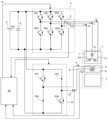
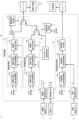
- FIG. 1 is a schematic configuration diagram of a rotating electric machine, an inverter, and a control device according to a first embodiment; 1 is a schematic block diagram of a control device according to a first embodiment.
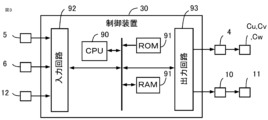
- FIG. 2 is a hardware configuration diagram of a control device according to the first embodiment.
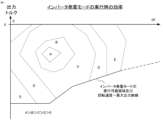
- 5A to 5C are diagrams illustrating efficiency during execution of an inverter power generation mode according to the first embodiment.
- 5 is a diagram illustrating efficiency during execution of an alternator power generation mode according to the first embodiment.
- FIG. 5 is a diagram illustrating an efficiency difference between an inverter power generation mode and an alternator power generation mode according to the first embodiment.
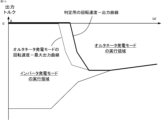
- FIG. 10 is a diagram illustrating first and second determination rotation speed-output curves according to the first embodiment.
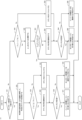
- FIG. 4 is a flowchart illustrating a power generation switching determination process according to the first embodiment.
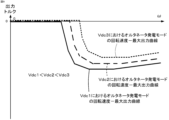
- 10 is a diagram illustrating a change in the rotation speed-maximum output curve in an alternator power generation mode due to a change in DC voltage according to the first embodiment.
- FIG. 5A to 5C are diagrams illustrating determination of a specific rotation speed range according to the first embodiment.
- 1 is a schematic diagram illustrating a generator motor for a vehicle according to a first embodiment of the present invention
- FIG. 11 is a diagram illustrating a rotation speed-output curve for judgment according to the second embodiment.
- FIG. 11 is a diagram illustrating a rotation speed-output curve for judgment according to the second embodiment.
- 11 is a flowchart illustrating a power generation switching determination process according to the second embodiment.
- 13 is a flowchart illustrating a power generation switching determination process according to the third embodiment.
- FIG. 1 is a schematic diagram of a rotating electric machine 1, an inverter 4, a converter 10, and the control device 30 according to the present embodiment.
- the rotating electric machine 1 has an armature winding and a field winding 11.
- the rotating electric machine 1 includes a stator 7 and a rotor 8 arranged radially inside the stator 7.
- the stator 7 is provided with armature windings Cu, Cv, and Cw of multiple phases (three phases in this example).
- the rotor 8 is provided with a field winding 11 that generates magnetic flux in the rotor 8.
- the rotor 8 is provided with a permanent magnet together with the field winding 11. It is noted that a permanent magnet need not be provided.
- the rotating electric machine 1 is a synchronous rotating electric machine of a field winding type.
- the rotor 8 is provided with a rotation sensor 6 for detecting the rotation angle of the rotor.
- the output signal of the rotation sensor 6 is input to the control device 30.
- the rotation sensor 6 may be any of a variety of sensors, such as a Hall element, resolver, or encoder. It may also be configured such that the rotation sensor 6 is not provided and the rotation angle (magnetic pole position) is estimated based on current information obtained by superimposing harmonic components on a current command value (described later) (so-called sensorless method).
- Inverter 4 The inverter 4 has three sets of series circuits (legs) corresponding to each of the three phases, each of which has a high-potential side switching element SP connected to the high-potential side of the DC power supply 2 and a low-potential side switching element SN connected to the low-potential side of the DC power supply 2.
- the connection point of the two switching elements in the series circuit for each phase is connected to the armature winding of the corresponding phase.
- a smoothing capacitor 3 is connected between the high-potential side and the low-potential side of the DC power supply 2.
- the switching elements may be IGBTs (Insulated Gate Bipolar Transistors) with diodes connected inversely in parallel, MOSFETs (Metal Oxide Semiconductor Field Effect Transistors), bipolar transistors with diodes connected inversely in parallel, etc.
- the gate terminals of each switching element are connected to the control device 30 via a gate drive circuit or the like. Each switching element is turned on or off by a switching signal output from the control device 30.
- the DC power supply 2 outputs a DC voltage Vdc to the inverter 4 and the converter 10.
- the DC power supply 2 may be any device that outputs a DC voltage Vdc, such as a battery, a DC-DC converter, a diode rectifier, a PWM rectifier, etc.
- a voltage sensor that detects the DC voltage Vdc may be provided.
- An armature current sensor 5 is provided to detect the current flowing through the armature winding of each phase.
- the armature current sensor 5 is a current sensor such as a shunt resistor or a Hall element.
- the output signal of the armature current sensor 5 is input to the control device 30.
- the armature current sensor 5 is provided on the wire connecting the series circuit of the switching elements of each phase and the armature winding of each phase.
- the current detection signal of each phase of the armature current sensor 5 is input to the control device 30.
- the armature current sensor 5 may be connected in series to the series circuit of the switching elements of each phase.
- the current sensor may be provided on the wire connecting the inverter 4 and the DC power source 2, and the current of the armature winding of each phase may be detected by the well-known "busbar 1 shunt method.”
- the converter 10 has a switching element and performs power conversion between the DC power source 2 and the field winding 11.
- the converter 10 includes a first series circuit in which a high-potential side switching element SP1 connected to the high-potential side of the DC power source 2 and a low-potential side diode DN1 connected to the low-potential side of the DC power source 2 are connected in series, and a second series circuit in which a high-potential side diode DP2 connected to the high-potential side of the DC power source 2 and a low-potential side switching element SN2 connected to the low-potential side of the DC power source 2 are connected in series.
- a connection point between the high-potential side switching element SP1 and the low-potential side diode DN1 in the first series circuit is connected to one end of the field winding 11, and a connection point between the high-potential side diode DP2 and the low-potential side switching element SN2 in the second series circuit is connected to the other end of the field winding 11.
- Each switching element is turned on or off by a switching signal output from the control device 30.
- the converter 10 may have other configurations, such as replacing the diode DN1 on the low potential side of the first series circuit with a switching element, or replacing the diode DP2 on the high potential side of the second series circuit with a switching element.
- the field current sensor 12 is a current detection circuit that detects the field current If, which is the current flowing through the field winding 11.
- the field current sensor 12 is provided on the wire connecting the converter 10 and the field winding 11.
- the field current sensor 12 may be provided at another location where the field current If can be detected.
- the output signal of the field current sensor 12 is input to the control device 30.
- the field current sensor 12 is a current sensor such as a Hall element or a shunt resistor.
- Control device 30 The control device 30 controls the rotating electric machine 1 via the inverter 4 and the converter 10. As shown in Fig. 2, the control device 30 includes a rotation detection unit 31, an armature current detection unit 32, a drive/power generation determination unit 33, a power generation switching determination unit 34, a drive control unit 35, an inverter power generation control unit 36, an alternator power generation control unit 37, a field current detection unit 38, and a field current control unit 39. Each function of the control device 30 is realized by a processing circuit included in the control device 30. Specifically, as shown in Fig.
- the control device 30 includes, as processing circuits, an arithmetic processing device 90 (computer) such as a CPU (Central Processing Unit), a storage device 91 that exchanges data with the arithmetic processing device 90, an input circuit 92 that inputs an external signal to the arithmetic processing device 90, and an output circuit 93 that outputs a signal from the arithmetic processing device 90 to the outside.
- an arithmetic processing device 90 such as a CPU (Central Processing Unit)
- storage device 91 that exchanges data with the arithmetic processing device 90
- an input circuit 92 that inputs an external signal to the arithmetic processing device 90
- an output circuit 93 that outputs a signal from the arithmetic processing device 90 to the outside.
- the arithmetic processing device 90 may be an ASIC (Application Specific Integrated Circuit), an IC (Integrated Circuit), a DSP (Digital Signal Processor), an FPGA (Field Programmable Gate Array), various logic circuits, and various signal processing circuits.
- the arithmetic processing device 90 may be a plurality of the same or different types, and each process may be shared and executed.
- the storage device 91 may be a RAM (Random Access Memory) configured to be able to read and write data from the arithmetic processing device 90, a ROM (Read Only Memory) configured to be able to read data from the arithmetic processing device 90, etc.
- the input circuit 92 is connected to various sensors such as an armature current sensor 5 and a rotation sensor 6, and is equipped with an A/D converter and the like that inputs the output signals of these sensors to the arithmetic processing device 90.
- the output circuit 93 is connected to electrical loads such as a gate drive circuit that drives the switching elements on and off, and is equipped with a drive circuit that outputs control signals from the arithmetic processing device 90 to these electrical loads.
- control units 31-39 of the control device 30 are realized by the calculation processing device 90 executing software (programs) stored in a storage device 91 such as a ROM, and working in cooperation with other hardware of the control device 30 such as the storage device 91, input circuit 92, and output circuit 93.
- a storage device 91 such as a ROM
- setting data such as the rotation speed-output curves for the first and second judgments used by the control units 31-39 are stored in the storage device 91 such as a ROM as part of the software (programs).
- Rotation detection unit 31 The rotation detection unit 31 detects the rotation angle ⁇ (magnetic pole position ⁇ of the rotor) and the rotation speed ⁇ of the rotor in electrical angles. In this embodiment, the rotation detection unit 31 detects the rotation angle ⁇ (magnetic pole position ⁇ ) and the rotation speed ⁇ in electrical angles based on the output signal of the rotation sensor 6.
- the rotation detection unit 31 may be configured to estimate the rotation angle (magnetic pole position) without using a rotation sensor, based on current information obtained by superimposing harmonic components on the current command value (so-called sensorless method).
- Armature current detection unit 32 Based on the output signal of the armature current sensor 5, the armature current detection unit 32 detects three-phase armature current detection values Iu, Iv, Iw flowing through the three-phase armature windings.
- Field current detection unit 38 The field current detection unit 38 detects the field current If flowing through the field winding 11 based on the output signal of the field current sensor 12 .
- Drive power generation determination unit 33 The drive/power generation determination unit 33 determines whether the drive mode or the power generation mode should be executed based on the output command value.
- the "drive mode” is a mode in which the electric energy obtained from the DC power supply 2 is converted into mechanical energy to rotate the rotating electric machine 1, and the rotating electric machine 1 is operated as an electric motor.
- the "power generation mode” is a mode in which the mechanical energy of the rotating electric machine 1 is converted into electric energy to supply to the DC power supply 2, and the rotating electric machine 1 is operated as a generator.
- the output command value may be an output torque command value, an output current command value, an output power command value, or the like, depending on the system in which the rotating electric machine 1 is used.
- the output command value may be calculated within the control device 30, or may be transmitted from an external control device.
- the drive/power generation determination unit 33 determines that the drive mode is to be executed if the output torque command value, the output current command value, or the output power command value is a positive value, and determines that the power generation mode is to be executed if the output torque command value, the output current command value, or the output power command value is a negative value.
- Drive control unit 35 The drive control unit 35 determines that the drive mode is to be executed, and when the rotating motor 1 is to operate as an electric motor, the drive control unit 35 controls the switching elements of the inverter 4 on and off to apply an AC voltage to the armature winding, thereby operating the rotating motor 1 as an electric motor.
- the drive control unit 35 includes an armature current command value calculation unit 35a, an armature voltage command value calculation unit 35b, and an armature voltage application unit 35c.
- the armature current command value calculation unit 35a calculates the armature current command value based on the output command value. In addition to the output command value, the rotation speed ⁇ and the DC voltage Vdc are also used. A known vector control is used to calculate the d-axis and q-axis current command values. The output torque command value, output current command value, or output power command value as the output command value is set to a positive value, and the rotating electric machine 1 operates as an electric motor.
- the armature voltage command value calculation unit 35b performs current feedback control to change the armature voltage command value so that the armature current detection value approaches the armature current command value.
- the current feedback control is performed on a rotating coordinate system of the d-axis and q-axis, the d-axis and q-axis voltage command values are calculated, and the d-axis and q-axis voltage command values are converted to three-phase armature voltage command values based on the rotation angle ⁇ .
- the armature voltage application unit 35c controls the on/off of multiple switching elements of the inverter 4 based on the three-phase armature voltage command value.
- Well-known carrier comparison PWM control or space vector PWM control is used.
- Power generation switching determination unit 34 determines whether the power generation mode is to be executed, and determines whether the inverter power generation mode or the alternator power generation mode is to be executed when the rotating electric machine 1 is operated as a generator. Details will be described later.
- Inverter power generation control unit 36 When it is determined that the power generation mode and the inverter power generation mode are to be executed, the inverter power generation control unit 36 performs inverter power generation control by controlling the switching elements of the inverter 4 on and off to apply an AC voltage to the armature winding and operate the rotating motor 1 as a generator.
- the inverter power generation control unit 36 is configured similarly to the drive control unit 35, and includes an armature current command value calculation unit 36a, an armature voltage command value calculation unit 36b, and an armature voltage application unit 36c.
- the armature current command value calculation unit 36a calculates the armature current command value based on the output command value. In this embodiment, the calculation is based on the rotational speed ⁇ and the DC voltage Vdc in addition to the output command value. A known vector control is used to calculate the d-axis and q-axis current command values. The output torque command value, output current command value, or output power command value as the output command value is set to a negative value, and the rotating electric machine 1 operates as a generator.
- the armature voltage command value calculation unit 36b performs current feedback control to change the armature voltage command value so that the armature current detection value approaches the armature current command value.
- the current feedback control is performed on a rotating coordinate system of the d-axis and q-axis, the d-axis and q-axis voltage command values are calculated, and the d-axis and q-axis voltage command values are converted to three-phase armature voltage command values based on the rotation angle ⁇ .
- the armature voltage application unit 36c controls the on/off of multiple switching elements of the inverter 4 based on the three-phase armature voltage command value.
- Well-known carrier comparison PWM control or space vector PWM control is used.
- Alternator power generation control unit 37 When it is determined that the power generation mode and the alternator power generation mode are to be executed, the alternator power generation control unit 37 executes alternator power generation control in which the inverter 4 functions as a rectifier by the induced voltage generated in the armature winding due to the rotation of the rotating motor 1, thereby operating the rotating motor 1 as a generator.
- the diode of the switching element on the high potential side or low potential side of the corresponding phase is energized, and the inverter 4 operates as a full-wave rectifier circuit. All switching elements of the inverter 4 are constantly off. Rectification in this case is called diode rectification.
- synchronous rectification may be performed. That is, when a current flows through a diode due to an induced voltage, the alternator power generation control unit 37 turns on the switching element of the diode. This causes current to flow through the switching element instead of the diode, thereby reducing power loss and the amount of heat generated.
- the alternator power generation control unit 37 determines the diode of the switching element on the high potential side or low potential side of each phase through which current is flowing based on the armature current detection value of each phase, and turns on the switching element corresponding to the diode through which current is flowing and turns off the switching element corresponding to the diode through which no current is flowing.
- Field current control unit 39 The field current control unit 39 controls the on/off of the switching elements of the converter 10 to apply a voltage to the field winding 11 .
- the field current control unit 39 includes a field current command value calculation unit 39a, a field voltage command value calculation unit 39b, and a field voltage application unit 39c.
- the field current command value calculation unit 39a calculates the field current command value based on the output command value for each of the drive mode, alternator power generation mode, and inverter power generation mode. In this embodiment, the calculation is based on the rotation speed ⁇ , DC voltage Vdc, etc. in addition to the output command value.
- the field voltage command value calculation unit 39b performs feedback control to change the voltage command value of the field winding so that the field current detection value approaches the field current command value.
- the field voltage application unit 39c controls the on/off of multiple switching elements of the converter 10 by PWM control based on the voltage command value of the field winding.
- Detailed configuration of the power generation switching determination unit 34 ⁇ Feasible range and efficiency of each power generation mode> 4 shows the feasible region of the inverter power generation mode when it is assumed that the inverter power generation mode is executed in the power generation mode, and the efficiency of each region within the feasible region.
- the horizontal axis is the rotation speed ⁇
- the vertical axis is the output torque.
- the curve where the absolute value of the output torque is maximum at each rotation speed is the rotation speed-maximum output curve, which is the curve where the absolute value of the output of the rotating electric machine is maximum at each rotation speed.
- the power generation efficiency is classified for each region defined by the rotation speed and the output torque.
- the power generation efficiency is classified in descending order into regions A, B, C, D, and E.
- the power generation efficiency decreases in the order of regions B, C, D, and E, with the highest efficiency region A at the center.
- Figure 5 shows the feasible region of the alternator power generation mode when the alternator power generation mode is executed in the power generation mode, and the efficiency of each region within the feasible region.
- the horizontal axis is the rotation speed ⁇
- the vertical axis is the output torque.
- the curve where the absolute value of the output torque is maximum at each rotation speed is the rotation speed-maximum output curve, which is the curve where the absolute value of the output of the rotating electric machine is maximum at each rotation speed.
- the induced voltage generated in the armature winding is low and does not exceed the DC voltage Vdc, so the alternator power generation mode cannot be executed.
- the output of the rotation speed-maximum output curve is 0. Note that as the absolute value of the output command value increases at each rotation speed, the field current command value is increased, and the output torque increases.
- the power generation efficiency is classified for each region defined by the rotation speed and output torque.
- the power generation efficiency is in order of decreasing, that is, region A, B, C, D, and E.
- the power generation efficiency decreases from the most efficient region A to regions B, C, D, and E in that order.
- the most efficient region A is located on the high rotation speed side, and the alternator power generation mode cannot be executed in the low rotation speed region.
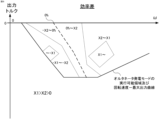
- Figure 6 shows the efficiency difference in the feasible range of the alternator power generation mode.
- the efficiency difference is the efficiency of the alternator power generation mode minus the efficiency of the inverter power generation mode. If the efficiency difference is negative, the efficiency of the inverter power generation mode is higher, and if the efficiency difference is positive, the efficiency of the alternator power generation mode is higher.
- the efficiency of the inverter power generation mode is higher on the low rotation speed side and the efficiency of the alternator power generation mode is higher on the high rotation speed side, with the line where the efficiency difference is 0% as the boundary.
- the efficiency of the inverter power generation mode is higher on the low rotation speed side and the efficiency of the inverter power generation mode is higher on the high rotation speed side, and the boundary where the efficiency difference is 0% is related to the feasible range of the alternator power generation mode. Therefore, the decision to switch the power generation mode to improve power generation efficiency can be made by taking into account the feasible range of the alternator power generation mode.
- the power generation switching determination unit 34 uses a determination rotational speed-output curve that is set based on a rotational speed-maximum output curve, which is a curve in which the absolute value of the output of the rotating motor is maximum at each rotational speed of the rotating motor when it is assumed that the alternator power generation mode is executed, to determine whether the inverter power generation mode or the alternator power generation mode is to be executed.
- the efficiency of the inverter power generation mode is higher on the low rotation speed side and the efficiency of the inverter power generation mode is higher on the high rotation speed side, and the boundary line where the efficiency difference is 0% is related to the feasible range of the alternator power generation mode.
- a power generation mode switching judgment is performed using a judgment rotation speed-output curve set based on the rotation speed-maximum output curve of the alternator power generation mode corresponding to the feasible range of the alternator power generation mode. Therefore, by making a judgment using the judgment rotation speed-output curve, it is possible to make a switching judgment that takes into account the efficiency of each power generation mode and to simplify the judgment process.
- the power generation switching determination unit 34 uses the first determination rotation speed-output curve to determine whether or not to switch from the alternator power generation mode to the inverter power generation mode, based on the current rotation speed and the current output command value.
- the power generation switching determination unit 34 uses the second determination rotation speed-output curve to determine whether or not to switch from the inverter power generation mode to the alternator power generation mode, based on the current rotation speed and the current output command value.
- an output torque and an output torque command value are used as the output and output command value.
- An output current and an output current command value may be used as the output and output command value, or an output power and an output power command value may be used. In either case, in the power generation mode, each value will be a negative value.
- the output current Idc is positive when it flows from the DC power supply 2 to the inverter 4 and converter 10, and negative when it flows from the inverter 4 and converter 10 to the DC power supply 2.
- the output power P is positive when it is supplied from the DC power supply 2 to the inverter 4 and converter 10, and negative when it is supplied from the inverter 4 and converter 10 to the DC power supply 2.
- the output torque T is given by equation (1) using the d-axis current Id, the q-axis current Iq, the d-axis magnetic flux ⁇ d, and the q-axis magnetic flux ⁇ q.
- the output current Idc is given by equation (2) using the d-axis voltage Vd, the q-axis voltage Vq, the field voltage Vf, and the rotation speed ⁇ of the rotating electric machine 1, and the output power P is given by equation (3).
- step S01 the power generation switching determination unit 34 determines whether the alternator power generation mode or the inverter power generation mode is currently being executed, and if the alternator power generation mode is being executed, the process proceeds to step S02, and if the inverter power generation mode is being executed, the process proceeds to step S06.
- step S02 the power generation switching determination unit 34 refers to the first determination rotation speed-output curve and calculates the output torque corresponding to the current rotation speed as the first determination output torque Tth1.
- the setting of the first determination rotation speed-output curve will be described later.
- step S03 the power generation switching determination unit 34 determines whether the absolute value
- step S04 the power generation switching determination unit 34 determines to switch to the inverter power generation mode.
- step S05 the power generation switching determination unit 34 determines to continue the alternator power generation mode without switching to the inverter power generation mode.
- step S06 the power generation switching determination unit 34 refers to the second determination rotation speed-output curve and calculates the output torque corresponding to the current rotation speed as the second determination output torque Tth2.
- the setting of the second determination rotation speed-output curve will be described later.
- step S07 the power generation switching determination unit 34 determines whether the absolute value
- step S08 the power generation switching determination unit 34 determines to switch to the alternator power generation mode.
- step S09 the power generation switching determination unit 34 determines to continue the inverter power generation mode without switching to the alternator power generation mode.
- the first rotation speed-output curve for judgment is set corresponding to the rotation speed-maximum output curve in the alternator power generation mode, as shown in Fig. 7.
- the rotation speed-output curve for judgment is set to be equivalent to the rotation speed-maximum output curve in the alternator power generation mode.
- the inverter power generation mode can be executed outside the feasible range of the alternator power generation mode.
- the second determination rotation speed-output curve is set on the higher rotation speed side with respect to the rotation speed-maximum output curve in the alternator power generation mode. More specifically, the boundary portion on the low rotation speed side in the portion where the absolute value of the output is greater than 0 in the second determination rotation speed-output curve is set on the higher rotation speed side than the boundary portion on the low rotation speed side in the portion where the absolute value of the output is greater than 0 in the first determination rotation speed-output curve.
- the first determination rotation speed-output curve is set corresponding to the feasible range of the alternator power generation mode.
- the efficiency of the inverter power generation mode is higher on the low rotation speed side, and the efficiency of the alternator power generation mode is higher on the high rotation speed side. Therefore, the boundary line where the efficiency difference becomes 0 is on the high rotation speed side of the boundary line on the low rotation speed side of the feasible range of the alternator power generation mode (the first determination rotation speed-output curve).
- the second determination rotation speed-output curve is set on the high rotation speed side of the rotation speed-maximum output curve of the alternator power generation mode, so it is set corresponding to the boundary line where the efficiency difference becomes 0.
- the alternator power generation mode can be executed to improve efficiency on the high rotation speed side where the efficiency of the alternator power generation mode is higher in the feasible range of the alternator power generation mode.
- the low rotation speed side of the feasible range of the alternator power generation mode, where the efficiency of the inverter power generation mode is higher, is the switching region between the alternator power generation mode and the inverter power generation mode, and the inverter power generation mode is executed halfway.
- the inverter power generation mode can be executed at a rotation speed lower than the feasible range of the alternator power generation mode to improve efficiency.
- the rotation speed-output curve for the second judgment may be set on the higher rotation speed side of the region of rotation speed and output where the efficiency during inverter power generation mode is higher than the efficiency during alternator power generation mode shown in Figure 6 (the boundary line of 0% efficiency difference).
- the second determination rotation speed-output curve is set on the side where the absolute value of the output is lower than the rotation speed-maximum output curve in the alternator power generation mode. More specifically, the boundary portion on the low output absolute value side in the portion where the absolute value of the output is greater than 0 in the second determination rotation speed-output curve is set on the side where the absolute value of the output is smaller than the boundary portion on the low output absolute value side in the portion where the absolute value of the output is greater than 0 in the first determination rotation speed-output curve.
- This configuration allows a hysteresis width to be set in the output direction, stabilizing judgment against output fluctuations.
- the output difference between the rotation speed-output curve for the first judgment and the rotation speed-output curve for the second judgment at each rotation speed is set to be greater than the output change caused by the maximum fluctuation of the DC voltage Vdc supplied to the inverter 4 and converter 10.
- This configuration makes it possible to suppress fluctuations in the switching determination results even when the output changes due to maximum fluctuations in the DC voltage Vdc.
- the maximum fluctuation of the DC voltage Vdc is the change in the DC voltage Vdc when a step change is made from a non-power generation state to a maximum power generation state while the alternator power generation mode is being executed.
- the absolute value of the output in the alternator power generation mode decreases. For example, as shown in FIG. 7, when the rotation speed and the output command value change from point C to point D, the output command value becomes smaller than the second judgment output torque Tth2, and the mode switches from the inverter power generation mode to the alternator power generation mode.
- the mode immediately switches from the alternator power generation mode to the inverter power generation mode.
- unnecessary switching of the power generation mode can be prevented by setting the hysteresis width in the output direction in consideration of the maximum fluctuation of the DC voltage Vdc.
- the output difference (hysteresis width in the output direction) between the rotation speed-output curve for the first judgment and the rotation speed-output curve for the second judgment may be changed according to the rotation speed.
- the output difference (hysteresis width in the output direction) between the rotation speed-output curve for the first judgment and the rotation speed-output curve for the second judgment may be set to a predetermined value. In this case, it is preferable to set the predetermined value taking into account the maximum value of the output change in the entire target range of rotation speeds.
- the power generation switching determination unit 34 may determine to execute the alternator power generation mode without performing a determination using the rotation speed-output curve for determination when the current rotation speed is within a specific rotation speed range set corresponding to a rotation speed range in which the efficiency in the alternator power generation mode is higher than the efficiency in the inverter power generation mode. In other words, when the current rotation speed is within the specific rotation speed range, switching between the inverter power generation mode and the alternator power generation mode is not performed, and the alternator power generation mode is always executed.
- the specific rotation speed range is set on the high rotation speed side of the feasible range of the alternator power generation mode. Note that, in the range of rotation speeds where the efficiency of the alternator power generation mode is high, if the rotation speed-maximum output curve of the alternator power generation mode and the rotation speed-maximum output curve of the inverter power generation mode roughly overlap, there is no need to switch power generation modes as is the case on the low rotation speed side of the rotation speed-maximum output curve of the alternator power generation mode.
- the power generation switching determination unit 34 may change the first determination rotation speed-output curve and the second determination rotation speed-output curve in accordance with the DC voltage Vdc. In this case, it is preferable to provide a voltage sensor that detects the DC voltage Vdc.
- the first and second determination rotation speed-power curves are stored in advance in a storage device such as a ROM, and the power generation switching determination unit 34 reads out and refers to the first and second determination rotation speed-power curves from the storage device.
- the first and second determination rotation speed-power curves are set in advance as described above.
- the power generation switching judgment unit 34 reads out the first and second judgment rotation speed-output curves for the two DC voltage increments close to the current DC voltage Vdc, refers to the first and second judgment rotation speed-output curves for each DC voltage increment, calculates the first and second judgment output torques Tth1, Tth2 corresponding to the current rotation speed and the current output command value, and linearly interpolates between the first and second judgment output torques Tth1, Tth2 for the two DC voltage increments using the current DC voltage Vdc to calculate the final first and second judgment output torques Tth1, Tth2.
- the rotation speed-output curve for the first judgment is stored in advance in a storage device such as a ROM, and the power generation switching judgment unit 34 reads out the rotation speed-output curve for the first judgment from the storage device. Then, as shown in FIG. 7, the rotation speed-output curve for the first judgment may be set by shifting the rotation speed-output curve for the first judgment in the rotation speed direction (toward higher rotation speed) by a hysteresis width A and in the output direction (toward the decrease in the absolute value of the output) by a hysteresis width B.
- the power generation switching judgment unit 34 sets the final rotation speed-output curve for the second judgment by limiting the output of the curve after the shift to 0.
- the hysteresis width in the rotational speed direction and the hysteresis width in the output direction are pre-stored in a storage device such as a ROM, and the power generation switching determination unit 34 reads each hysteresis width from the storage device.
- map data that sets the relationship between the rotational speed and the hysteresis width in the output direction is stored in the storage device, and the power generation switching determination unit 34 reads the map data from the storage device and calculates the hysteresis width in the output direction that corresponds to the current rotational speed.
- the first judgment rotation speed-output curve is changed according to the DC voltage Vdc
- the first judgment rotation speed-output curve is stored in advance in the storage device for each of a plurality of DC voltage increments, and the power generation switching judgment unit 34 reads out the first judgment rotation speed-output curves for two DC voltage increments close to the current DC voltage Vdc, and linearly interpolates between the first judgment rotation speed-output curves for the two DC voltage increments using the current DC voltage Vdc to calculate the final first judgment rotation speed-output curve.
- the rotation speed output of each of the first judgment rotation speed-output curves for the two DC voltage increments may be linearly interpolated using the current DC voltage Vdc.
- the rotating electric machine 1 may be used as a generator motor for a vehicle.
- a rotating shaft of a rotor of the rotating electric machine 1 is connected to a crankshaft of an internal combustion engine 100 via a pulley and belt mechanism 101.
- the rotating shaft of the rotating electric machine 1 is connected to wheels 103 via the internal combustion engine 100 and a transmission 102.
- the rotating electric machine 1 functions as a starting motor and a torque assist motor when the internal combustion engine 100 is started and when a torque assist is performed to supplement the output of the internal combustion engine 100, and also functions as a charging generator that charges the DC power source 2 after the internal combustion engine is started.
- the efficiency of regenerative power generation during idling and braking can be improved, so that the amount of charge on the DC power source 2 can be increased, and the frequency with which it can operate as a torque assist motor can be increased, and in the case of an idling stop vehicle, the frequency of idling stops can be increased, leading to improved fuel efficiency of the vehicle.
- the rotating electric machine 1 may also be used as a power source for various devices other than a generator motor for a vehicle.
- first and second judgment rotation speed-power curves were set as judgment rotation speed-power curves, but in the present embodiment, a single judgment rotation speed-power curve is set.
- the power generation switching determination unit 34 actually switches between the execution determination of the inverter power generation mode and the execution determination of the alternator power generation mode when a state in which the switching condition using the rotation speed-output curve for determination, which is set based on the rotation speed-maximum output curve of the alternator power generation mode, is satisfied continues for a determination period.
- the rotation speed-output curve for judgment is set to correspond to the rotation speed-maximum output curve in the alternator power generation mode.
- the rotation speed-output curve for judgment is set to be equivalent to the rotation speed-maximum output curve in the alternator power generation mode.
- the rotation speed-output curve for judgment may be set to correspond to a region within the range of the rotation speed-maximum output curve in the alternator power generation mode where the efficiency of the alternator power generation mode is higher than the efficiency of the inverter power generation mode.
- the rotational speed-output curve for judgment is stored in advance in a storage device such as a ROM, and the power generation switching judgment unit 34 reads out and refers to the rotational speed-output curve for judgment from the storage device.
- the rotational speed-output curve for judgment is changed according to the DC voltage Vdc
- the rotational speed-output curve for judgment is stored in advance in the storage device for each of a plurality of DC voltage increments
- the power generation switching judgment unit 34 reads out the rotational speed-output curve for judgment of two DC voltage increments close to the current DC voltage Vdc, refers to the rotational speed-output curve for judgment of each DC voltage increment, calculates the judgment output torque Tth corresponding to the current rotational speed and the current output command value, and linearly interpolates between the judgment output torques Tth of the two DC voltage increments using the current DC voltage Vdc to calculate the final judgment output torque Tth.
- step S11 the power generation switching determination unit 34 determines whether the alternator power generation mode or the inverter power generation mode is currently being executed, and if the alternator power generation mode is being executed, the process proceeds to step S12, and if the inverter power generation mode is being executed, the process proceeds to step S19.
- step S12 the power generation switching determination unit 34 refers to the rotation speed-output curve for determination and calculates the output torque corresponding to the current rotation speed as the determination output torque Tth.
- step S13 the power generation switching determination unit 34 determines whether the absolute value
- step S14 the power generation switching determination unit 34 increases the switching counter to the inverter power generation mode by a predetermined value.
- step S15 the power generation switching determination unit 34 resets the switching counter to the inverter power generation mode to 0.
- step S16 the power generation switching determination unit 34 determines whether the switching counter to the inverter power generation mode is equal to or greater than a determination value corresponding to the determination period. If it is equal to or greater than the determination value, the process proceeds to step S17. If it is less than the determination value, the process proceeds to step S18. In step S17, the power generation switching determination unit 34 determines to switch to the inverter power generation mode. In step S18, the power generation switching determination unit 34 determines to continue the alternator power generation mode without switching to the inverter power generation mode.
- step S19 the power generation switching determination unit 34 determines whether the absolute value
- step S20 the power generation switching determination unit 34 increases the counter for switching to the alternator power generation mode by a predetermined value.
- step S21 the power generation switching determination unit 34 resets the counter for switching to the alternator power generation mode to 0.
- step S22 the power generation switching determination unit 34 determines whether the counter for switching to the alternator power generation mode is equal to or greater than a judgment value corresponding to the judgment period, and if it is equal to or greater than the judgment value, proceeds to step S23, and if it is less than the judgment value, proceeds to step S24.
- step S23 the power generation switching determination unit 34 determines to switch to the alternator power generation mode.
- step S24 the power generation switching determination unit 34 determines to continue the inverter power generation mode without switching to the alternator power generation mode.
- the power generation switching determination unit 34 may determine that the alternator power generation mode is to be executed if the current rotation speed is within a specific rotation speed range set corresponding to a range of rotation speeds in which the efficiency when the alternator power generation mode is executed is higher than the efficiency when the inverter power generation mode is executed.
- first and second judgment rotation speed-power curves were set as judgment rotation speed-power curves, but in the present embodiment, a single judgment rotation speed-power curve is set.
- the power generation switching determination unit 34 actually switches from the inverter power generation mode to the alternator power generation mode when the rate of change of the rotation speed in the direction of switching from the inverter power generation mode to the alternator power generation mode and the rate of change of the output command value become equal to or greater than a determination value when the condition for switching from the inverter power generation mode to the alternator power generation mode is met using a rotation speed-output curve for determination that is set based on the rotation speed-maximum output curve of the alternator power generation mode.
- the mode is actually switched to the alternator power generation mode when it can be judged that there is little possibility that the rotation speed and output command value will change in the opposite direction and that the switching conditions will not be met, and the mode is switched to the alternator power generation mode immediately, thereby improving efficiency by executing the alternator power generation mode.
- the judgment of the second embodiment is further combined. That is, the power generation switching judgment unit 34 actually switches from the alternator power generation mode to the inverter power generation mode when the state in which the switching condition from the alternator power generation mode to the inverter power generation mode using the rotation speed-output curve for judgment is satisfied continues for a judgment period.
- the power generation switching judgment unit 34 actually switches from the inverter power generation mode to the alternator power generation mode when the state in which the switching condition from the inverter power generation mode to the alternator power generation mode using the rotation speed-output curve for judgment is satisfied continues for a judgment period, or when the rate of change of the rotation speed in the switching direction from the inverter power generation mode to the alternator power generation mode and the rate of change of the output command value become equal to or greater than a judgment value when the switching condition from the inverter power generation mode to the alternator power generation mode using the rotation speed-output curve for judgment is satisfied.
- the rotation speed-output curve for judgment is set to correspond to the rotation speed-maximum output curve in the alternator power generation mode.
- the rotation speed-output curve for judgment is set to be equivalent to the rotation speed-maximum output curve in the alternator power generation mode.
- the rotation speed-output curve for judgment may be set to correspond to a region within the range of the rotation speed-maximum output curve in the alternator power generation mode where the efficiency of the alternator power generation mode is higher than the efficiency of the inverter power generation mode.
- step S31 the power generation switching determination unit 34 determines whether the alternator power generation mode or the inverter power generation mode is currently being executed, and if the alternator power generation mode is being executed, the process proceeds to step S32, and if the inverter power generation mode is being executed, the process proceeds to step S39.
- step S32 the power generation switching determination unit 34 refers to the rotation speed-output curve for determination and calculates the output torque corresponding to the current rotation speed as the determination output torque Tth.
- step S33 the power generation switching determination unit 34 determines whether the absolute value
- step S34 the power generation switching determination unit 34 increases the switching counter to the inverter power generation mode by a predetermined value.
- step S35 the power generation switching determination unit 34 resets the switching counter to the inverter power generation mode to 0.
- step S36 the power generation switching determination unit 34 determines whether the switching counter to the inverter power generation mode is equal to or greater than a determination value corresponding to the determination period. If it is equal to or greater than the determination value, the process proceeds to step S37. If it is less than the determination value, the process proceeds to step S38. In step S37, the power generation switching determination unit 34 determines to switch to the inverter power generation mode. In step S38, the power generation switching determination unit 34 determines to continue the alternator power generation mode without switching to the inverter power generation mode.
- step S39 the power generation switching determination unit 34 determines whether the absolute value
- step S40 the power generation switching determination unit 34 calculates the rate of change ⁇ of the rotation speed by subtracting the rotation speed from the change rate calculation period ago from the current rotation speed, and calculates the rate of change ⁇ To of the output command value by subtracting the current output command value from the output command value from the change rate calculation period ago.
- step S41 the power generation switching determination unit 34 determines whether the rate of change ⁇ of the rotation speed is equal to or greater than the rotation speed determination value ⁇ th and the rate of change ⁇ To of the output command value is equal to or greater than the output command value determination value ⁇ Toth, and if it is equal to or greater than the determination value ⁇ th and equal to or greater than the output command value determination value ⁇ Toth, the power generation switching determination unit 34 proceeds to step S45, and otherwise proceeds to step S42.
- step S42 the power generation switching determination unit 34 increments the counter for switching to the alternator power generation mode by a predetermined value.
- step S43 the power generation switching determination unit 34 resets the counter for switching to the alternator power generation mode to 0.
- step S44 the power generation switching determination unit 34 determines whether the counter for switching to the alternator power generation mode is equal to or greater than a determination value corresponding to the determination period, and if it is equal to or greater than the determination value, proceeds to step S45, and if it is less than the determination value, proceeds to step S46.
- step S45 the power generation switching determination unit 34 determines to switch to the alternator power generation mode.
- step S46 the power generation switching determination unit 34 determines to continue the inverter power generation mode without switching to the alternator power generation mode.
- the power generation switching determination unit 34 may determine that the alternator power generation mode is to be executed if the current rotation speed is within a specific rotation speed range set corresponding to a range of rotation speeds in which the efficiency when the alternator power generation mode is executed is higher than the efficiency when the inverter power generation mode is executed.
- armature winding In each of the above embodiments, a three-phase armature winding is provided.
- the number of phases of the armature winding may be any number, such as two, four, or the like, as long as the number of phases is more than one.
Landscapes
- Engineering & Computer Science (AREA)
- Power Engineering (AREA)
- Control Of Eletrric Generators (AREA)
Priority Applications (2)
| Application Number | Priority Date | Filing Date | Title |
|---|---|---|---|
| JP2025556145A JPWO2025099920A1 (https=) | 2023-11-10 | 2023-11-10 | |
| PCT/JP2023/040519 WO2025099920A1 (ja) | 2023-11-10 | 2023-11-10 | 回転電機の制御装置 |
Applications Claiming Priority (1)
| Application Number | Priority Date | Filing Date | Title |
|---|---|---|---|
| PCT/JP2023/040519 WO2025099920A1 (ja) | 2023-11-10 | 2023-11-10 | 回転電機の制御装置 |
Publications (1)
| Publication Number | Publication Date |
|---|---|
| WO2025099920A1 true WO2025099920A1 (ja) | 2025-05-15 |
Family
ID=95695241
Family Applications (1)
| Application Number | Title | Priority Date | Filing Date |
|---|---|---|---|
| PCT/JP2023/040519 Pending WO2025099920A1 (ja) | 2023-11-10 | 2023-11-10 | 回転電機の制御装置 |
Country Status (2)
| Country | Link |
|---|---|
| JP (1) | JPWO2025099920A1 (https=) |
| WO (1) | WO2025099920A1 (https=) |
Citations (2)
| Publication number | Priority date | Publication date | Assignee | Title |
|---|---|---|---|---|
| JP2005137163A (ja) * | 2003-10-31 | 2005-05-26 | Kokusan Denki Co Ltd | 磁石発電機を備えた発電装置 |
| JP2016185026A (ja) * | 2015-03-26 | 2016-10-20 | 三菱電機株式会社 | 車両用発電電動機の制御装置 |
-
2023
- 2023-11-10 WO PCT/JP2023/040519 patent/WO2025099920A1/ja active Pending
- 2023-11-10 JP JP2025556145A patent/JPWO2025099920A1/ja active Pending
Patent Citations (2)
| Publication number | Priority date | Publication date | Assignee | Title |
|---|---|---|---|---|
| JP2005137163A (ja) * | 2003-10-31 | 2005-05-26 | Kokusan Denki Co Ltd | 磁石発電機を備えた発電装置 |
| JP2016185026A (ja) * | 2015-03-26 | 2016-10-20 | 三菱電機株式会社 | 車両用発電電動機の制御装置 |
Also Published As
| Publication number | Publication date |
|---|---|
| JPWO2025099920A1 (https=) | 2025-05-15 |
Similar Documents
| Publication | Publication Date | Title |
|---|---|---|
| US7701156B2 (en) | Electric motor drive control system and control method thereof | |
| JP4353304B2 (ja) | モータ駆動制御装置 | |
| US8269439B2 (en) | Drive controller and drive control method for electric motor | |
| JP7086505B1 (ja) | 交流回転電機の制御装置 | |
| JP7377083B2 (ja) | 制御装置、プログラム | |
| JP5803559B2 (ja) | 回転電機制御装置 | |
| JPH10327600A (ja) | 永久磁石型同期機の駆動システム及びそれを用いた電気車の駆動制御方法 | |
| US9935568B2 (en) | Control apparatus of rotary electric machine | |
| JP2013055817A (ja) | 電力変換装置の制御装置 | |
| WO2020054407A1 (ja) | モータ制御装置及びモータ制御方法 | |
| CN116472666B (zh) | 旋转电机的控制装置及电动助力转向装置 | |
| JP7262661B2 (ja) | 回転電機装置 | |
| CN116137943A (zh) | 旋转电机的控制装置及电动助力转向装置 | |
| JP6928149B1 (ja) | 交流回転電機の制御装置 | |
| JP5354269B2 (ja) | 交流機制御装置 | |
| JP7211242B2 (ja) | 変調方式切替装置 | |
| WO2025099920A1 (ja) | 回転電機の制御装置 | |
| JP6305603B1 (ja) | 回転電機の制御装置 | |
| JPH10117403A (ja) | 電気車用ハイブリッド駆動システム | |
| JP2023183491A (ja) | 交流回転機の制御装置、及び車両用発電電動機装置 | |
| JP7507985B2 (ja) | 交流回転機の制御装置、車両用駆動装置、及び電動パワーステアリング装置 | |
| JP6541844B1 (ja) | 回転電機の制御装置 | |
| JP2016086622A (ja) | 巻数切換型回転電機 | |
| JP7391271B2 (ja) | 回転電機の制御装置 | |
| JP7002625B1 (ja) | 交流回転機の制御装置 |
Legal Events
| Date | Code | Title | Description |
|---|---|---|---|
| 121 | Ep: the epo has been informed by wipo that ep was designated in this application |
Ref document number: 23958321 Country of ref document: EP Kind code of ref document: A1 |
|
| ENP | Entry into the national phase |
Ref document number: 2025556145 Country of ref document: JP Kind code of ref document: A |
|
| WWE | Wipo information: entry into national phase |
Ref document number: 2025556145 Country of ref document: JP |