WO2025057919A1 - 太陽電池の製造方法及び太陽電池 - Google Patents
太陽電池の製造方法及び太陽電池 Download PDFInfo
- Publication number
- WO2025057919A1 WO2025057919A1 PCT/JP2024/032300 JP2024032300W WO2025057919A1 WO 2025057919 A1 WO2025057919 A1 WO 2025057919A1 JP 2024032300 W JP2024032300 W JP 2024032300W WO 2025057919 A1 WO2025057919 A1 WO 2025057919A1
- Authority
- WO
- WIPO (PCT)
- Prior art keywords
- transport layer
- electron transport
- solar cell
- layer
- oxide semiconductor
- Prior art date
- Legal status (The legal status is an assumption and is not a legal conclusion. Google has not performed a legal analysis and makes no representation as to the accuracy of the status listed.)
- Pending
Links
Images


Classifications
-
- H—ELECTRICITY
- H10—SEMICONDUCTOR DEVICES; ELECTRIC SOLID-STATE DEVICES NOT OTHERWISE PROVIDED FOR
- H10F—INORGANIC SEMICONDUCTOR DEVICES SENSITIVE TO INFRARED RADIATION, LIGHT, ELECTROMAGNETIC RADIATION OF SHORTER WAVELENGTH OR CORPUSCULAR RADIATION
- H10F10/00—Individual photovoltaic cells, e.g. solar cells
-
- H—ELECTRICITY
- H10—SEMICONDUCTOR DEVICES; ELECTRIC SOLID-STATE DEVICES NOT OTHERWISE PROVIDED FOR
- H10F—INORGANIC SEMICONDUCTOR DEVICES SENSITIVE TO INFRARED RADIATION, LIGHT, ELECTROMAGNETIC RADIATION OF SHORTER WAVELENGTH OR CORPUSCULAR RADIATION
- H10F10/00—Individual photovoltaic cells, e.g. solar cells
- H10F10/10—Individual photovoltaic cells, e.g. solar cells having potential barriers
- H10F10/16—Photovoltaic cells having only PN heterojunction potential barriers
- H10F10/162—Photovoltaic cells having only PN heterojunction potential barriers comprising only Group II-VI materials, e.g. CdS/CdTe photovoltaic cells
-
- H—ELECTRICITY
- H10—SEMICONDUCTOR DEVICES; ELECTRIC SOLID-STATE DEVICES NOT OTHERWISE PROVIDED FOR
- H10F—INORGANIC SEMICONDUCTOR DEVICES SENSITIVE TO INFRARED RADIATION, LIGHT, ELECTROMAGNETIC RADIATION OF SHORTER WAVELENGTH OR CORPUSCULAR RADIATION
- H10F10/00—Individual photovoltaic cells, e.g. solar cells
- H10F10/10—Individual photovoltaic cells, e.g. solar cells having potential barriers
- H10F10/16—Photovoltaic cells having only PN heterojunction potential barriers
- H10F10/167—Photovoltaic cells having only PN heterojunction potential barriers comprising Group I-III-VI materials, e.g. CdS/CuInSe2 [CIS] heterojunction photovoltaic cells
-
- H—ELECTRICITY
- H10—SEMICONDUCTOR DEVICES; ELECTRIC SOLID-STATE DEVICES NOT OTHERWISE PROVIDED FOR
- H10K—ORGANIC ELECTRIC SOLID-STATE DEVICES
- H10K30/00—Organic devices sensitive to infrared radiation, light, electromagnetic radiation of shorter wavelength or corpuscular radiation
- H10K30/10—Organic devices sensitive to infrared radiation, light, electromagnetic radiation of shorter wavelength or corpuscular radiation comprising heterojunctions between organic semiconductors and inorganic semiconductors
-
- H—ELECTRICITY
- H10—SEMICONDUCTOR DEVICES; ELECTRIC SOLID-STATE DEVICES NOT OTHERWISE PROVIDED FOR
- H10K—ORGANIC ELECTRIC SOLID-STATE DEVICES
- H10K30/00—Organic devices sensitive to infrared radiation, light, electromagnetic radiation of shorter wavelength or corpuscular radiation
- H10K30/40—Organic devices sensitive to infrared radiation, light, electromagnetic radiation of shorter wavelength or corpuscular radiation comprising a p-i-n structure, e.g. having a perovskite absorber between p-type and n-type charge transport layers
-
- H—ELECTRICITY
- H10—SEMICONDUCTOR DEVICES; ELECTRIC SOLID-STATE DEVICES NOT OTHERWISE PROVIDED FOR
- H10K—ORGANIC ELECTRIC SOLID-STATE DEVICES
- H10K30/00—Organic devices sensitive to infrared radiation, light, electromagnetic radiation of shorter wavelength or corpuscular radiation
- H10K30/50—Photovoltaic [PV] devices
-
- H—ELECTRICITY
- H10—SEMICONDUCTOR DEVICES; ELECTRIC SOLID-STATE DEVICES NOT OTHERWISE PROVIDED FOR
- H10K—ORGANIC ELECTRIC SOLID-STATE DEVICES
- H10K30/00—Organic devices sensitive to infrared radiation, light, electromagnetic radiation of shorter wavelength or corpuscular radiation
- H10K30/80—Constructional details
- H10K30/84—Layers having high charge carrier mobility
- H10K30/85—Layers having high electron mobility, e.g. electron-transporting layers or hole-blocking layers
-
- H—ELECTRICITY
- H10—SEMICONDUCTOR DEVICES; ELECTRIC SOLID-STATE DEVICES NOT OTHERWISE PROVIDED FOR
- H10K—ORGANIC ELECTRIC SOLID-STATE DEVICES
- H10K71/00—Manufacture or treatment specially adapted for the organic devices covered by this subclass
- H10K71/10—Deposition of organic active material
- H10K71/16—Deposition of organic active material using physical vapour deposition [PVD], e.g. vacuum deposition or sputtering
-
- H—ELECTRICITY
- H10—SEMICONDUCTOR DEVICES; ELECTRIC SOLID-STATE DEVICES NOT OTHERWISE PROVIDED FOR
- H10K—ORGANIC ELECTRIC SOLID-STATE DEVICES
- H10K85/00—Organic materials used in the body or electrodes of devices covered by this subclass
- H10K85/50—Organic perovskites; Hybrid organic-inorganic perovskites [HOIP], e.g. CH3NH3PbI3
-
- Y—GENERAL TAGGING OF NEW TECHNOLOGICAL DEVELOPMENTS; GENERAL TAGGING OF CROSS-SECTIONAL TECHNOLOGIES SPANNING OVER SEVERAL SECTIONS OF THE IPC; TECHNICAL SUBJECTS COVERED BY FORMER USPC CROSS-REFERENCE ART COLLECTIONS [XRACs] AND DIGESTS
- Y02—TECHNOLOGIES OR APPLICATIONS FOR MITIGATION OR ADAPTATION AGAINST CLIMATE CHANGE
- Y02E—REDUCTION OF GREENHOUSE GAS [GHG] EMISSIONS, RELATED TO ENERGY GENERATION, TRANSMISSION OR DISTRIBUTION
- Y02E10/00—Energy generation through renewable energy sources
- Y02E10/50—Photovoltaic [PV] energy
- Y02E10/541—CuInSe2 material PV cells
-
- Y—GENERAL TAGGING OF NEW TECHNOLOGICAL DEVELOPMENTS; GENERAL TAGGING OF CROSS-SECTIONAL TECHNOLOGIES SPANNING OVER SEVERAL SECTIONS OF THE IPC; TECHNICAL SUBJECTS COVERED BY FORMER USPC CROSS-REFERENCE ART COLLECTIONS [XRACs] AND DIGESTS
- Y02—TECHNOLOGIES OR APPLICATIONS FOR MITIGATION OR ADAPTATION AGAINST CLIMATE CHANGE
- Y02P—CLIMATE CHANGE MITIGATION TECHNOLOGIES IN THE PRODUCTION OR PROCESSING OF GOODS
- Y02P70/00—Climate change mitigation technologies in the production process for final industrial or consumer products
- Y02P70/50—Manufacturing or production processes characterised by the final manufactured product
Definitions
- the present invention relates to a method for manufacturing a solar cell and a solar cell.
- One type of solar cell is a compound solar cell that uses a chalcopyrite compound, a kesterite compound, or a perovskite compound.
- Compound solar cells have a structure in which a p-type light absorbing layer is layered with an n-type heterogeneous material as an electron transport layer. Cadmium sulfide is generally used for the n-type layer.
- Non-Patent Documents 1 and 2 the use of n-type oxide semiconductors such as zinc oxide, tin oxide, titanium oxide, zinc oxide sulfide, magnesium zinc oxide, zinc tin oxide, and titanium zinc oxide instead of cadmium sulfide as the electron transport layer is considered.
- n-type oxide semiconductors such as zinc oxide, tin oxide, titanium oxide, zinc oxide sulfide, magnesium zinc oxide, zinc tin oxide, and titanium zinc oxide instead of cadmium sulfide as the electron transport layer is considered.
- n-type oxide semiconductor when used instead of cadmium sulfide as the electron transport layer, the resistance tends to be higher and the performance tends to be inferior compared to solar cells that use cadmium sulfide.
- n-type oxide semiconductor when forming an n-type oxide semiconductor as the electron transport layer, it is difficult to improve performance when using the sputtering method, which has excellent mass productivity, and it is difficult to improve productivity when using the atomic layer deposition method, which can produce high-performance solar cells.
- the present invention was made in consideration of the above problems, and aims to provide a solar cell manufacturing method and a solar cell that achieves both high performance and high productivity.
- the method for manufacturing a solar cell includes a step of forming an electron transport layer on a substrate including a light absorbing layer by depositing an n-type oxide semiconductor by a sputtering method while supplying a gas including an oxygen source and a hydrogen source.
- a method for producing a solar cell can reduce or suppress damage to the substrate caused by sputtering by depositing an n-type oxide semiconductor while supplying a gas containing not only an oxygen source but also a hydrogen source. As a result, solar cells with high performance can be produced with high productivity.
- a solar cell comprises at least a first electrode layer, a light absorbing layer, an electron transport layer that is an n-type oxide semiconductor to which hydrogen elements have been added, and a second electrode layer, in this order.
- the electron transport layer an n-type oxide semiconductor with added hydrogen elements, it is possible to form the electron transport layer by sputtering while reducing or suppressing film formation damage to the layers below the electron transport layer. As a result, such solar cells can achieve both high performance and high productivity.
- the present invention provides a solar cell manufacturing method and solar cell that achieve both high performance and high productivity.
- FIG. 1 is a schematic cross-sectional view of a solar cell according to one embodiment of the present invention.
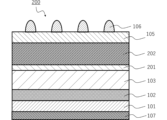
- FIG. 2 is a schematic cross-sectional view of a solar cell according to another embodiment of the present invention.
- FIG. 1 is a diagram showing the relationship between atmospheric conditions in a film formation process of an n-type oxide semiconductor and film formation damage caused by sputtering.
- the present embodiment an embodiment of the present invention (hereinafter referred to as "the present embodiment") will be described in detail with reference to the drawings as necessary, but the present invention is not limited to this, and various modifications are possible without departing from the gist of the invention.
- the same elements are given the same reference numerals, and duplicated explanations will be omitted.
- positional relationships such as up, down, left, and right will be based on the positional relationships shown in the drawings.
- the dimensional ratios of the drawings are not limited to those shown in the drawings.
- the solar cell according to this embodiment includes at least a first electrode layer, a light absorbing layer, an electron transport layer that is an n-type oxide semiconductor to which hydrogen elements are added, and a second electrode layer, in this order.
- the solar cell may include layers other than these layers, or may include a plurality of these layers.
- FIG. 1 shows a schematic cross-sectional view of a solar cell according to one embodiment.
- the solar cell 100 of the embodiment shown in FIG. 1 includes a substrate 107, a first electrode layer 101 provided on the substrate 107, a hole transport layer 102 provided on the first electrode layer 101, a light absorbing layer 103 provided on the hole transport layer 102, an electron transport layer 104 provided on the light absorbing layer 103, a second electrode layer 105 provided on the electron transport layer 104, and a grid electrode 106 provided on the second electrode layer 105.
- the solar cell 100 typically receives light from the second electrode layer 105 side to generate electricity.
- the electron transport layer 104 is an n-type oxide semiconductor doped with hydrogen elements. Therefore, as described in detail in [Method of manufacturing a solar cell], it is presumed that the electron transport layer 104 can be formed by sputtering while reducing or suppressing film formation damage that occurs on the light absorbing layer 103 when the electron transport layer 104 is formed on the light absorbing layer 103. As a result, such a solar cell can achieve both high performance and high productivity.
- the present invention is not limited to the above presumption.
- the thickness of the solar cell 100 excluding the substrate 107 is not particularly limited, but is, for example, 1.0 ⁇ m to 10.0 ⁇ m, 1.1 ⁇ m to 8.0 ⁇ m, or 1.2 ⁇ m to 6.0 ⁇ m.
- the solar cell 100 of this embodiment can be configured as a thin-film solar cell by forming each layer sufficiently thin.
- each layer or the semiconductor contained in each layer is expressed by the name of a certain compound, this includes not only the pure compound itself, but also the compound doped with trace amounts of elements, etc., to the extent that the properties of the compound are not lost.
- oxidation states are referred to by the name of the element unless expressly stated otherwise.
- “elemental hydrogen” can mean hydrogen atom, hydrogen ion, hydride ion, hydrogen in a compound, and hydrogen in an elemental state.
- the substrate 107 is not particularly limited, but may be, for example, a glass substrate such as blue plate glass or low alkali glass, a metal substrate such as a stainless steel plate or aluminum foil, or a resin substrate such as a polyimide resin substrate or an epoxy resin substrate.
- the thickness of the substrate 107 is not particularly limited, but may be, for example, 10 ⁇ m or more and 500 ⁇ m or less, 20 ⁇ m or more and 250 ⁇ m or less, or 30 ⁇ m or more and 100 ⁇ m or less. When the thickness of the substrate 107 is within the above range, the solar cell tends to become lighter and more flexible.
- the first electrode layer 101 is provided, for example, to extract a current caused by holes generated in the light absorbing layer 103 described later.
- the first electrode layer 101 is not particularly limited as long as it has electrical conductivity, and may be, for example, a metal conductive layer made of a metal such as Mo, Cr, or Ti; a conductive inorganic compound conductive layer made of a conductive inorganic compound other than metal; or a conductive organic compound conductive layer made of a conductive organic compound.
- the thickness of the first electrode layer 101 is not particularly limited, and may be, for example, 200 nm or more and 800 nm or less, or 300 nm or more and 700 nm or less. By having the thickness of the first electrode layer 101 within the above range, there is a tendency for the solar cell to be made lighter and more flexible while sufficiently extracting the current without loss.
- the solar cell 100 of this embodiment includes a hole transport layer 102, but may be omitted.
- the hole transport layer 102 has a function of, for example, efficiently extracting holes generated in the light absorbing layer 103 described below from the light absorbing layer 103, and preventing recombination of electrons and holes generated simultaneously with the holes in the light absorbing layer 103 described below.
- the hole transport layer 102 is preferably a p-type semiconductor.
- the substance contained in the p-type semiconductor is not particularly limited, but examples thereof include polythiophene derivatives such as poly(3,4-ethylene-dioxythiophene):polystyrene sulfonate (PEDOT:PSS), poly(3-hexylthiophene) (P3HT), and poly(3-octylthiophene) (P3OT); fluorene derivatives such as 2,2'-7,7'-tetrakis-(N,N-di-p-methoxyphenylamine)-9,9'-spirobifluorene (spiro-MeO-TAD); carbazole derivatives such as polyvinylcarbazole; triphenylamine derivatives; diphenylamine derivatives; polysilane derivatives; organic compounds such as polyaniline derivatives; and inorganic compounds such as nickel oxide, molybdenum oxide, copper gallium oxide, copper aluminum oxide, molybdenum selenide, and molyb
- the hole transport layer 102 is preferably substantially composed of the aforementioned organic compound or inorganic compound, and is preferably the aforementioned organic compound or inorganic compound.
- the content of the aforementioned organic compound or inorganic compound in the hole transport layer 102 is preferably 80% by mass or more and 100% by mass or less, 90% by mass or more and 100% by mass or less, 95% by mass or more and 100% by mass or less, or 99% by mass or more and 100% by mass or less, based on the total amount of the hole transport layer 102.
- the thickness of the hole transport layer 102 is preferably 10 nm or more and 100 nm or less, 15 nm or more and 80 nm or less, or 20 nm or more and 60 nm or less.
- the light absorbing layer 103 has a function of absorbing light such as near infrared light, visible light, ultraviolet light, etc., to generate electrons and holes. Examples of light such as near infrared light, visible light, ultraviolet light, etc. include sunlight.
- the light absorbing layer 103 preferably contains a perovskite compound, a chalcopyrite compound, or a kesterite compound.
- the perovskite compound may be used alone or in combination with two or more types.
- the chalcopyrite compound may be used alone or in combination with two or more types.
- the kesterite compound may be used alone or in combination with two or more types.
- perovskite compounds include those represented by the general formula AMX3 and those represented by the general formula A2MX4 , where M represents a divalent cation, A represents a monovalent cation, and X represents a monovalent anion.
- the monovalent cation A is not particularly limited, and examples thereof include cations of Group 1 elements of the periodic table and organic cations. Among these, cesium ion, rubidium ion, ammonium ion (including amidinium ion) which may have a substituent, phosphonium ion which may have a substituent, or amidinium ion which may have a substituent are preferred. Examples of ammonium ions which may have a substituent include primary ammonium ions and secondary ammonium ions. Specific examples of ammonium ions which may have a substituent include alkylammonium ions, arylammonium ions, amidinium ions, and guanidium ions.
- monoalkylammonium ions are preferred, and from the viewpoint of improving stability, it is preferred to use alkylammonium ions substituted with one or more fluorine atoms.
- alkylammonium ions substituted with one or more fluorine atoms it is preferred to use alkylammonium ions substituted with one or more fluorine atoms.
- a combination of two or more types of cations can be used as cation A.
- Examples of monovalent cation A include methylammonium ion, methylammonium monofluoride ion, methylammonium difluoride ion, methylammonium trifluoride ion, ethylammonium ion, isopropylammonium ion, n-propylammonium ion, isobutylammonium ion, n-butylammonium ion, t-butylammonium ion, dimethylammonium ion, diethylammonium ion, phenylammonium ion, benzylammonium ion, phenethylammonium ion, guanidinium ion, formamidinium ion, acetamidinium ion, and imidazolium ion.
- the divalent cation M is not particularly limited, and may be, for example, a divalent metal cation or a semimetal cation.
- Specific examples include cations of group 14 elements of the periodic table, and more specific examples include lead cation (Pb 2+ ), tin cation (Sn 2+ ), and germanium cation (Ge 2+ ).
- Pb 2+ lead cation
- Sn 2+ tin cation
- Ge 2+ germanium cation
- a combination of two or more cations may be used as the cation M.
- the monovalent anion X is not particularly limited, and examples thereof include halide ions, acetate ions, nitrate ions, sulfate ions, borate ions, acetylacetonate ions, carbonate ions, citrate ions, sulfur ions, tellurium ions, thiocyanate ions, titanate ions, zirconate ions, 2,4-pentanedionate ions, and silicofluoride ions.
- X may be one type of anion or a combination of two or more types of anions. It is preferable to use a halide ion or a combination of a halide ion and another anion as X.
- halide ions X include chloride ions, bromide ions, and iodide ions.
- Perovskite compounds include organic-inorganic perovskite compounds, particularly halide-based organic-inorganic perovskite compounds.
- Specific examples of perovskite compounds include CH 3 NH 3 PbI 3 , CH 3 NH 3 PbBr 3 , CH 3 NH 3 PbCl 3 , CH 3 NH 3 SnI 3 , CH 3 NH 3 SnBr 3 , CH 3 NH 3 SnCl 3 , CH 3 NH 3 PbI (3-x) Cl x , CH 3 NH 3 PbI (3-x) Br x , CH 3 NH 3 PbBr (3-x) Cl x , CH 3 NH 3 Pb (1-y) Sn y I 3 , CH 3 NH 3 Pb (1-y) Sn y Br 3 , and CH 3 NH 3Pb (1-y) Sn y Cl 3 , CH 3 NH 3Pb (1-y) Sn y I (3-x) Cl x ,
- the chalcopyrite compound is preferably a I-III-VI 2 group chalcopyrite compound.
- the I-III-VI 2 group chalcopyrite compound is not particularly limited, but may be, for example, CuAlS 2 , CuAlSe 2 , CuAlTe 2 , CuGaS 2 , CuGaSe 2 , CuGaTe 2 , CuInS 2 , CuInSe 2 , CuInTe 2 , AgAlS 2 , AgAlSe 2 , AgAlTe 2 , AgGaS 2 , AgGaSe 2 , AgGaTe 2 , AgInS 2 , AgInSe 2 , AgInTe 2 , and combinations thereof.
- the term "combination of these” is not particularly limited, but examples thereof include Cu(In x Ga 1- x )( Sey S 1- y ) 2 (0 ⁇ x ⁇ 1, 0 ⁇ y ⁇ 1) when CuGaS 2 and CuInSe 2 are combined.
- these chalcopyrite compounds CuGaS 2 , CuGaSe 2 , CuInS 2 , CuInSe 2 , and Cu(In x Ga 1-x )( Sey S 1-y ) 2 (0 ⁇ x ⁇ 1, 0 ⁇ y ⁇ 1) are preferred, and Cu(In x Ga 1-x )( Sey S 1-y ) 2 (0 ⁇ x ⁇ 1, 0 ⁇ y ⁇ 1) is more preferred.
- a CIS compound refers to a chalcopyrite compound containing Cu, In, and Se
- a CIGS compound refers to a chalcopyrite compound containing Cu, In, Ga, and Se
- a CIGSS compound refers to a chalcopyrite compound containing Cu, In, Ga, Se, and S.
- the kesterite compound is preferably a Group I 2 -II-IV-VI 4 kesterite compound.
- the I2 -II-IV- VI Group 4 kesterite compound is not particularly limited, but examples thereof include Cu2ZnSnS4 , Cu2ZnSnSe4 , Cu2ZnGeS4 , Cu2ZnGeSe4 , Cu2MnSnS4 , Cu2MnSnSe4 , Cu2MnGeS4 , Cu2MnGeSe4 , Ag2ZnSnS4 , Ag2ZnSnSe4 , Ag2ZnGeS4 , Ag2ZnGeSe4 , Ag2MnGeSe4 , Ag2MnSnS4 , Ag2MnSnSe4 , Ag2MnSnSe4 , Ag2MnSnSe4 , Ag2MnSnSe4 , Ag2MnS
- Cu2ZnSnS4 , Cu2ZnSnSe4 , Ag2ZnSnS4, Ag2ZnSnSe4 , (CuxAg1 - x) 2ZnSn ( SySe1 -y ) 4 (0 ⁇ x ⁇ 1 , 0 ⁇ y ⁇ 1) are preferred, and ( CuxAg1 -x ) 2ZnSn (SySe1 - y ) 4 ( 0 ⁇ x ⁇ 1, 0 ⁇ y ⁇ 1) is more preferred.
- a CZTS compound refers to a kesterite compound containing Cu, Zn, Sn, and S
- an ACZTS compound refers to a kesterite compound containing Ag, Cu, Zn, Sn, and S
- an ACZTSS compound refers to a kesterite compound containing Ag, Cu, Zn, Sn, S, and Se.
- the content of the perovskite compound, chalcopyrite compound, or kesterite compound in the light absorbing layer 103 is not particularly limited as long as the light absorbing layer 103 has the function of absorbing light such as visible light and ultraviolet light to generate electrons and holes. More specifically, although not particularly limited, the content is 50% by mass or more and 100% by mass or less, 60% by mass or more and 100% by mass or less, 70% by mass or more and 100% by mass or less, 80% by mass or more and 100% by mass or less, or 90% by mass or more and 100% by mass or less, relative to the total mass of the light absorbing layer 103.
- the light absorbing layer 103 may contain additives such as binders and surfactants.
- the content of the additives is not particularly limited, but is, for example, 0.1 to 10 mass% with respect to the total mass of the light absorbing layer 103.
- the light absorbing layer 103 does not have to contain the additives.
- the thickness of the light absorbing layer 103 is preferably 0.5 ⁇ m or more and 10.0 ⁇ m or less, 0.5 ⁇ m or more and 7.5 ⁇ m or less, 0.5 ⁇ m or more and 5.0 ⁇ m or less, or 0.5 ⁇ m or more and 3.0 ⁇ m or less.
- the solar cell 100 of this embodiment may have two light absorbing layers 103.
- the substance contained in the first light absorbing layer 103 and the substance contained in the second light absorbing layer 103 may be different or the same, but it is preferable that they are different.
- the solar cell 100 of this embodiment may have three or more light absorbing layers 103.
- the electron transport layer 104 is an n-type oxide semiconductor to which hydrogen elements have been added, and has a function of efficiently extracting electrons generated in the light absorbing layer 103 from the light absorbing layer 103 and preventing recombination of holes and electrons that are generated simultaneously with the electrons in the light absorbing layer 103.
- the band gap of the n-type oxide semiconductor to which hydrogen elements have been added is preferably 3.3 eV or more, 3.4 eV or more, 3.5 eV or more, or 3.6 eV or more.
- the band gap of the n-type oxide semiconductor to which hydrogen elements have been added is not particularly limited, but is, for example, 3.3 eV or more and 5.0 eV or less, 3.4 eV or more and 4.5 eV or less, or 3.5 eV or more and 4.0 eV or less.
- the band gap can be measured by a known method. More specifically, although not limited to, it can be measured, for example, by spectral transmittance measurement or spectral quantum efficiency measurement.
- the carrier concentration of the n-type oxide semiconductor doped with hydrogen elements is preferably 1.0 ⁇ 10 20 cm -3 or less, 5.0 ⁇ 10 19 cm -3 or less, or 2.5 ⁇ 10 19 cm -3 or less.
- the carrier concentration of the n-type oxide semiconductor doped with hydrogen elements is not particularly limited, and is, for example, 1.0 ⁇ 10 16 cm -3 or more and 1.0 ⁇ 10 20 cm -3 or less, 1.0 ⁇ 10 17 cm -3 or more and 5.0 ⁇ 10 19 cm -3 or less, or 1.0 ⁇ 10 18 cm -3 or more and 2.5 ⁇ 10 19 cm -3 or less.
- the carrier concentration is within the above numerical range, electrons generated in the light absorbing layer 103 can be efficiently extracted from the light absorbing layer 103, making it possible to prevent recombination of holes and electrons that are generated simultaneously with the electrons in the light absorbing layer 103, and as a result, the conversion efficiency of the solar cell tends to improve.
- the carrier concentration can be measured by a known method. More specifically, although not limited to, it can be measured, for example, by Hall measurement.
- the refractive index of the n-type oxide semiconductor doped with hydrogen elements is not particularly limited.
- the refractive index of the n-type oxide semiconductor is, for example, 1.8 or more, and preferably 2.1 or more.
- the refractive index is also not particularly limited, but is, for example, 1.8 to 3.0, 2.1 to 2.8, or 2.1 to 2.6. It is preferable to appropriately adjust the refractive index of the electron transport layer 104 so that the refractive index of the electron transport layer 104 and adjacent layers is not too large.
- the refractive index can be measured by a known method. More specifically, although not limited to, it can be measured by, for example, spectral transmittance measurement or spectroscopic ellipsometry measurement.
- the resistivity of the n-type oxide semiconductor doped with hydrogen elements is preferably 1.6 ⁇ 10 -2 ⁇ cm or more, 1.8 ⁇ 10 -2 ⁇ cm or more, or 2.0 ⁇ 10 -2 ⁇ cm or more.
- the resistivity of the n-type oxide semiconductor doped with hydrogen elements is not particularly limited, and is, for example, 1.6 ⁇ 10 -2 ⁇ cm or more and 1.0 ⁇ 10 2 ⁇ cm or less, 1.8 ⁇ 10 -2 ⁇ cm or more and 10.0 ⁇ cm or less, or 2.0 ⁇ 10 -2 ⁇ cm or more and 1.0 ⁇ cm or less.
- the resistivity is within the above numerical range, the conversion efficiency of the solar cell tends to be improved.
- the resistivity can be measured by a known method. More specifically, although not limited to, it can be measured, for example, by the four-probe method.
- the n-type oxide semiconductor doped with hydrogen elements preferably has a band gap of 3.3 eV or more and a carrier concentration of 1.0 ⁇ 10 20 cm -3 or less. Furthermore, the n-type oxide semiconductor doped with hydrogen elements preferably has a band gap of 3.3 eV or more, a carrier concentration of 1.0 ⁇ 10 20 cm -3 or less, and a resistivity of 1.6 ⁇ 10 -2 ⁇ cm or more.
- the substance contained in the n-type oxide semiconductor is preferably zinc oxide, tin oxide, titanium oxide, zinc sulfide oxide (zinc oxide doped with sulfur element), zinc magnesium oxide (zinc oxide doped with magnesium element), zinc tin oxide (zinc oxide doped with tin element), and zinc titanium oxide (zinc oxide doped with titanium element).
- zinc titanium oxide (zinc oxide doped with titanium element) is preferred.
- the n-type oxide semiconductor may be used alone or in combination of two or more kinds.
- the molar ratio of elemental sulfur to elemental oxygen is preferably 0 or more and 0.7 or less, or 0.1 or more and 0.4 or less.
- the molar ratio of magnesium element to zinc element is preferably 0 or more and 0.4 or less, and more preferably 0.1 or more and 0.3 or less.
- the molar ratio of tin element to zinc element is preferably 0 or more and 1.0 or less, and 0.2 or more and 0.4 or less.
- the molar ratio of titanium element to zinc element is preferably 0 or more and 0.3 or less, and more preferably 0.05 or more and 0.2 or less.
- the molar ratio of hydrogen elements to all metal elements is preferably 0.001 or more and 0.030 or less, 0.005 or more and 0.020 or less, 0.007 or more and 0.015 or less, or 0.009 or more and 0.013 or less.
- the electron transport layer 104 which is an n-type oxide semiconductor to which hydrogen elements have been added, may be an electron transport layer formed by the electron transport layer formation process described below.
- the electron transport layer 104 which is an n-type oxide semiconductor, is preferably substantially composed of zinc oxide, tin oxide, titanium oxide, zinc oxide sulfide, magnesium zinc oxide, zinc tin oxide, or zinc titanium oxide, and is preferably zinc oxide, tin oxide, titanium oxide, zinc oxide sulfide, magnesium zinc oxide, zinc tin oxide, or zinc titanium oxide.
- the content of zinc oxide, tin oxide, titanium oxide, zinc oxide sulfide, magnesium zinc oxide, zinc tin oxide, or zinc titanium oxide in the electron transport layer 104 which is an n-type oxide semiconductor, is preferably 80% by mass or more and 100% by mass or less, 90% by mass or more and 100% by mass or less, 95% by mass or more and 100% by mass or less, or 99% by mass or more and 100% by mass or less, based on the total amount of the electron transport layer 104.
- the thickness of the electron transport layer 104 is preferably 50 nm or more and 150 nm or less, 55 nm or more and 140 nm or less, 60 nm or more and 135 nm or less, or 65 nm or more and 130 nm or less.
- the second electrode layer 105 is provided, for example, to extract a current due to electrons generated in the light absorbing layer 103.
- the light absorbing layer 103 absorbs the light that has passed through the second electrode layer 105, so in order to increase the amount of light absorbed by the light absorbing layer 103, the second electrode layer 105 is preferably a transparent electrode layer.
- a transparent electrode is an electrode using a material that has both high electrical conductivity and high visible light transmittance.
- high electrical conductivity means, for example, a specific resistance of 5.0 ⁇ 10 ⁇ 3 ⁇ cm or less.
- high visible light transmittance means, for example, an average transmittance of 80% or more in the wavelength region of 400 to 1300 nm.
- a known material can be used, for example, indium tin oxide (ITO), hydrogen-containing indium oxide (IOH), fluorine-containing tin oxide (FTO), boron-containing zinc oxide (ZnO:B), aluminum-containing zinc oxide (ZnO:Al), etc.
- the content of the above material is not particularly limited as long as the second electrode layer 105 functions as a transparent electrode. More specifically, although not particularly limited, the content of the above material is, relative to the total mass of the second electrode layer 105, 50% by mass or more and 100% by mass or less, 60% by mass or more and 100% by mass or less, 70% by mass or more and 100% by mass or less, 80% by mass or more and 100% by mass or less, 90% by mass or more and 100% by mass or less, or 95% by mass or more and 100% by mass or less.
- the thickness of the second electrode layer 105 is not particularly limited, but is, for example, 100 nm to 1500 nm, or 200 nm to 1000 nm. By having the thickness of the second electrode layer 105 within the above range, it tends to be possible to make the solar cell lighter and more flexible while still extracting sufficient current without loss.
- the grid electrode 106 is provided, for example, to extract electricity from the second electrode layer 105, but may be omitted.
- the material of the grid electrode 106 is not particularly limited as long as it has conductivity, and examples of the material that can be used include metals such as Mo, Cr, Ag, Cu, Ni, Al, and Ti; conductive inorganic compounds other than metals; and conductive organic compounds.
- the content of the above-mentioned materials in the grid electrode 106 is not particularly limited as long as the grid electrode 106 functions as an electrode. More specifically, although not particularly limited, the content of the above-mentioned materials is, relative to the total mass of the grid electrode 106, 50% by mass or more and 100% by mass or less, 60% by mass or more and 100% by mass or less, 70% by mass or more and 100% by mass or less, 80% by mass or more and 100% by mass or less, or 90% by mass or more and 100% by mass or less.
- the thickness of the grid electrode 106 is not particularly limited, but is, for example, 5 ⁇ m or more and 50 ⁇ m or less. By having the thickness of the grid electrode 106 within the above range, it tends to be possible to make the solar cell lighter and more flexible while still being able to extract sufficient current without loss.
- the solar cell 100 shown in FIG. 1 above is an example for explaining the present invention, and is not intended to limit the present invention to only this embodiment.
- the present invention can be modified in various ways without departing from the gist of the invention.
- the solar cell 100 of this embodiment may have two or more sets of a hole transport layer 102, a light absorbing layer 103 provided on the hole transport layer 102, an electron transport layer 104 provided on the light absorbing layer 103, and a second electrode layer 105 provided on the electron transport layer 104, stacked on the first electrode layer 101.
- a grid electrode 106 may be provided on the uppermost second electrode layer 105.
- each light absorbing layer may contain a compound with a different absorption spectrum, and the electron transport layer and hole transport layer in contact with each light absorbing layer may be selected according to the properties of the light absorbing layer in contact with it.
- the solar cell 100 of this embodiment may also have other layers between the layers, on the grid electrode 106, or under the substrate 107, as necessary.
- the hole transport layer 102 may have two or more hole transport layers each containing a different material, and a contamination prevention layer for preventing contamination from the outside may be provided on the grid electrode 106.
- the electron transport layer 104 may also have two or more electron transport layers each containing a different material.
- at least one of the layers is an n-type oxide semiconductor to which hydrogen elements have been added.
- FIG. 2 shows a schematic cross-sectional view of a solar cell according to an embodiment having two electron transport layers.
- the solar cell 200 of the embodiment shown in FIG. 2 includes a substrate 107, a first electrode layer 101 provided on the substrate 107, a hole transport layer 102 provided on the first electrode layer 101, a light absorbing layer 103 provided on the hole transport layer 102, a first electron transport layer 201 provided on the light absorbing layer 103, a second electron transport layer 202 provided on the first electron transport layer 201, a second electrode layer 105 provided on the second electron transport layer 202, and a grid electrode 106 provided on the second electrode layer 105.
- the solar cell 200 typically receives light from the second electrode layer 105 side to generate electricity.
- the solar cell 200 includes a first electron transport layer 201 and a second electron transport layer 202. At least one of the first electron transport layer 201 and the second electron transport layer 202 is an n-type oxide semiconductor to which a hydrogen element has been added. Either the first electron transport layer 201 or the second electron transport layer 202 may be an n-type oxide semiconductor to which a hydrogen element has been added, or both of them may be n-type oxide semiconductors to which a hydrogen element has been added. When the first electron transport layer 201 or the second electron transport layer 202 is an n-type oxide semiconductor to which a hydrogen element has been added, examples and preferred aspects of the n-type oxide semiconductor are similar or the same as those of the electron transport layer 104.
- Either the first electron transport layer 201 or the second electron transport layer 202 may be an electron transport layer other than an n-type oxide semiconductor to which hydrogen elements have been added.
- Such an electron transport layer is preferably an n-type semiconductor.
- the substance contained in the n-type semiconductor is not particularly limited, but examples thereof include oxide semiconductors such as zinc oxide, tin oxide, titanium oxide, zinc oxide sulfide, magnesium zinc oxide, zinc tin oxide, and zinc titanium oxide; sulfide semiconductors such as cadmium sulfide, indium oxide sulfide, and indium sulfide; and organic compounds such as PEIE (ethoxylated polyethyleneimine) and PEI (polyethyleneimine).
- PEIE ethoxylated polyethyleneimine
- PEI polyethyleneimine
- the electron transport layer other than the n-type oxide semiconductor to which hydrogen elements have been added is preferably substantially composed of the oxide semiconductor, sulfide semiconductor, or organic compound described above, and is preferably the oxide semiconductor, sulfide semiconductor, or organic compound described above.
- the content of the oxide semiconductor, sulfide semiconductor, or organic compound in the electron transport layer other than the n-type oxide semiconductor to which hydrogen elements have been added is preferably 80% by mass or more and 100% by mass or less, 90% by mass or more and 100% by mass or less, 95% by mass or more and 100% by mass or less, or 99% by mass or more and 100% by mass or less, based on the total amount of the electron transport layer.
- n-type oxide semiconductor to which hydrogen elements are added is formed as an electron transport layer, it is presumed that film formation damage to the layer below the n-type oxide semiconductor can be reduced or suppressed.
- an n-type oxide semiconductor to which hydrogen elements are added is less likely to be damaged during film formation when another layer is formed thereon. Therefore, when the first electron transport layer 201 is an n-type oxide semiconductor to which hydrogen elements are added, film formation damage to the light absorption layer 103 can be reduced or suppressed, and the first electron transport layer 201 is resistant to film formation damage when the second electron transport layer 202 is formed.
- the second electron transport layer 202 is an n-type oxide semiconductor to which hydrogen elements are added, film formation damage to the first electron transport layer 201 can be reduced or suppressed, and the second electron transport layer 202 is resistant to film formation damage when the second electrode layer 105 is formed.
- the second electron transport layer 202 is an n-type oxide semiconductor doped with hydrogen elements.
- the first electron transport layer 201 is not an n-type oxide semiconductor doped with hydrogen elements
- an electron transport layer other than the n-type oxide semiconductor doped with hydrogen elements is provided between the light absorbing layer 103 and the second electron transport layer 202, which is an n-type oxide semiconductor doped with hydrogen elements.
- the thickness of the first electron transport layer 201 or the second electron transport layer 202 is preferably 40 nm or more and 140 nm or less, 50 nm or more and 130 nm or less, or 55 nm or more and 120 nm or less.
- the method for manufacturing a solar cell includes a step of forming an electron transport layer on a substrate including a light absorbing layer by depositing an n-type oxide semiconductor by a sputtering method while supplying a gas including an oxygen source and a hydrogen source (hereinafter referred to as an "electron transport layer forming step").
- the present inventors have found that one of the factors that causes the performance of a solar cell to decrease when an n-type oxide semiconductor is formed by sputtering is that the film formation by sputtering causes film damage to the target substrate on which the n-type oxide semiconductor is formed.
- the n-type oxide semiconductor is formed while supplying a gas containing not only an oxygen source but also a hydrogen source, thereby reducing or suppressing the film formation damage caused by sputtering on the substrate, and as a result, a solar cell with high productivity and high performance can be manufactured.
- a method for forming an n-type oxide semiconductor suitable as an electron transport layer while capturing the active species is to deposit an n-type oxide semiconductor by sputtering while supplying a gas containing a hydrogen source. Note that the above predictions and hypotheses are made for the purpose of explaining the present invention, and are not intended to limit the present invention.
- the solar cell manufacturing method according to this embodiment can form the electron transport layer by a dry process, so that the time required for manufacturing can be further shortened.
- a wet process means a process using a solution.
- a dry process means a process not using a solution.
- the electron transport layer of the solar cell (control example) in which an electron transport layer is formed by using a chemical solution deposition method may be a layer of an n-type oxide semiconductor containing cadmium sulfide having the same thickness as the electron transport layer of the solar cell to be compared.
- the open circuit voltage value of the solar cell manufactured by the manufacturing method according to this embodiment is preferably 60% or more, 70% or more, 75% or more, 80% or more, 85% or more, or 90% or more.
- the substrate on which the n-type oxide semiconductor film is formed may be a substrate containing a light absorbing layer, but a substrate containing a light absorbing layer and a first electrode is preferred, a substrate containing a layered structure in which a light absorbing layer, a hole transport layer, and a first electrode are layered in this order is more preferred, and a substrate containing a layered structure in which a light absorbing layer, a hole transport layer, a first electrode, and a substrate are layered in this order is even more preferred.
- the substrate may have a light absorbing layer on the surface, in which case the n-type oxide semiconductor is deposited on the light absorbing layer.
- the substrate may have an electron transport layer on the surface, in which case the n-type oxide semiconductor is deposited on the electron transport layer.
- the substrate may be, for example, a laminate in which a light absorbing layer, a hole transport layer, a first electrode, and a substrate are laminated in this order, a laminate in which an electron transport layer, a light absorbing layer, a hole transport layer, a first electrode, and a substrate are laminated in this order, or a laminate in which the hole transport layer is not included in these laminates.
- the electron transport layer may be an electron transport layer that is an n-type oxide semiconductor to which hydrogen elements have been added, or may be another electron transport layer. Specifically, it may be the first electron transport layer 201 in the solar cell 200.
- the electron transport layer, light absorption layer, hole transport layer, first electrode, and substrate that the substrate may include may be the same as or similar to the first electron transport layer 201, light absorption layer 103, hole transport layer 102, first electrode layer 101, and substrate 107, respectively.
- the sputtering target in the electron transport layer formation step may contain an element contained in the n-type oxide semiconductor to be formed, preferably a metal element contained in the n-type oxide semiconductor to be formed, and preferably an oxide of a metal contained in the n-type oxide semiconductor to be formed.
- an element contained in the n-type oxide semiconductor to be formed preferably a metal element contained in the n-type oxide semiconductor to be formed, and preferably an oxide of a metal contained in the n-type oxide semiconductor to be formed.
- titanium zinc oxide zinc oxide to which titanium element has been added
- an n-type oxide semiconductor containing sulfur element can be formed by using a sputtering target containing a sulfide of a metal contained in the n-type oxide semiconductor to be formed.
- the content of metal element, oxygen element, and other elements including sulfur element in the n-type oxide semiconductor to be formed can be controlled by adjusting the elements added to the sputtering target.
- the sputtering target is a mixture of titanium oxide and zinc oxide. This allows for the deposition of a film of titanium zinc oxide (zinc oxide with added titanium element).
- the titanium oxide content in the sputtering target is preferably 4.0% by mass or more and 20% by mass or less, 5.0% by mass or more and 19% by mass or less, or 6.0% by mass or more and 18% by mass or less, based on the total mass of the mixture. The remainder may be the zinc oxide content.
- the gas supplied in the electron transport layer forming step includes an oxygen source and a hydrogen source.
- the gas may be mainly composed of an inert gas, preferably argon gas.
- the oxygen source is not particularly limited as long as it is a gas containing an oxygen element, but for example, H2O vapor, O2 gas, and O3 gas are included, and O2 gas is preferred.
- the hydrogen source is not particularly limited as long as it is a gas containing a hydrogen element, but for example, H2O vapor and H2 gas are included, and H2 gas is preferred.
- the concentration of the oxygen source in the supply gas is preferably 0.12 vol% to 2.0 vol%, 0.40 vol% to 1.8 vol%, 0.70 vol% to 1.6 vol%, 0.80 vol% to 1.5 vol%, 0.90 vol% to 1.5 vol%, or 1.0 vol% to 1.5 vol%.
- the concentration of the oxygen source in terms of oxygen molecules is specifically calculated as follows.
- the oxygen source is H2O vapor
- the H2O vapor contains one oxygen element
- the concentration of the oxygen source in terms of oxygen molecules is 0.5 vol%, which is half of 1.0 vol%.
- O2 gas since O2 gas contains two oxygen elements, when the concentration of O2 gas in the above gas is 1.0% by volume, the concentration of the oxygen source in terms of oxygen molecules is 1.0% by volume.
- O2 gas is used as the oxygen source
- H2 gas is used as the hydrogen source
- the volume ratio of O2 gas to H2 gas corresponds to the molar ratio.
- the oxygen source and hydrogen source of the feed gas satisfy the following condition (1) or (2).
- the concentration of the oxygen source is 0.80 vol% or more and 1.6 vol% or less in terms of oxygen molecules, and the following formula is satisfied when the concentration of the oxygen source (oxygen molecule equivalent, volume %) is y and the molar ratio of hydrogen element to oxygen element (H/O) is x: 0.85y+0.1 ⁇ x ⁇ 3.0y-0.9
- the concentration of the oxygen source is, in terms of oxygen molecules, 0.12 vol% or more and less than 0.80 vol%, and when the concentration of the oxygen source (in terms of oxygen molecules, volume %) is y and the molar ratio of hydrogen element to oxygen element (H/O) is x, the following formula is satisfied: 0.78 ⁇ x ⁇ -2.2y+3.3
- the concentration of the inert gas (e.g., argon gas) in the supply gas is not particularly limited, but may be, for example, 90.0 vol.% or more and 99.0 vol.% or less, 91.0 vol.% or more and 98.5 vol.% or less, 92.0 vol.% or more and 98.0 vol.% or less, 93.0 vol.% or more and 97.5 vol.% or less, or 94.0 vol.% or more and 97.0 vol.% or less.
- the remainder excluding the oxygen source and the hydrogen source may be the inert gas.
- the heating temperature is not particularly limited, but may be, for example, 80°C or higher and 230°C or lower, and is preferably 100°C or higher and 200°C or lower, or 120°C or higher and 180°C or lower.
- the substrate temperature and the heating temperature are almost the same.
- film formation conditions of the sputtering method may be adjusted depending on the type of n-type oxide semiconductor to be formed and the type of sputtering target.
- the applied power may be 0.5 to 3.0 W/cm 2
- the film formation pressure may be 0.5 to 3.0 Pa.
- the temperature of the atmosphere during sputtering does not need to be controlled.
- the method for manufacturing a solar cell according to this embodiment may include a step of preparing a substrate including a light absorbing layer, followed by the above-mentioned step of forming an electron transport layer.
- the method for manufacturing a solar cell according to this embodiment may include a step of forming another layer on the electron transport layer, following the above-mentioned step of forming an electron transport layer.
- the step of preparing a substrate including a light absorbing layer may include at least one of the steps of forming a first electrode layer, forming a hole transport layer, forming a light absorbing layer, and forming an electron transport layer.
- the step of forming another layer on the electron transport layer may include at least one of the steps of forming a further electron transport layer, forming a second electrode layer, and forming a grid electrode.
- the method for manufacturing a solar cell according to this embodiment may include, in this order, at least a step of forming a first electrode layer, a step of forming a light absorbing layer, the above-mentioned step of forming an electron transport layer, and a step of forming a second electrode layer.
- the first electrode layer 101 may be formed on the substrate 107.
- the method of forming the first electrode layer 101 includes a dry process and a wet process, but the dry process is preferred.
- the dry process is not particularly limited, but for example, a method of forming the first electrode layer 101, which is a metal conductive layer, by a sputtering method.
- the film forming conditions of the sputtering method are not particularly limited, but for example, the applied power may be 1.0 to 3.0 W/cm 2 , the film forming atmosphere may be an argon atmosphere, and the film forming pressure may be 0.5 to 3.0 Pa.
- the temperature of the atmosphere and the temperature of the sputtered substrate may not be controlled during sputtering.
- the sputtered substrate is a substrate on a stage during sputtering, on which a compound derived from a sputtering target is laminated.
- the substrate 107 may be the sputtered substrate.
- the hole transport layer 102 may be formed on the first electrode layer 101.
- the method of forming the hole transport layer 102 includes a dry process and a wet process, but the dry process is preferable.
- the dry process is not particularly limited, but for example, a method of forming the hole transport layer 102, which is a p-type semiconductor containing an organic compound or an inorganic compound, by a sputtering method.
- the film formation conditions of the sputtering method are not particularly limited, but for example, the applied power: 0.5 to 3.0 W/cm 2 , the film formation atmosphere: argon atmosphere, and the film formation pressure: 0.5 to 3.0 Pa may be used.
- the temperature of the atmosphere and the temperature of the sputtered substrate may not be controlled during sputtering.
- a compound of an element of the first electrode layer 101 and an element contained in the light absorbing layer 103 may be formed, and the hole transport layer 102 may be formed between the first electrode layer 101 and the light absorbing layer 103.
- the light absorbing layer 103 may be formed on the hole transport layer 102.
- the light absorbing layer 103 may be formed on the first electrode layer 101.
- the method of forming the light absorbing layer 103 includes a dry process and a wet process, but the dry process is preferable.
- the dry process is not particularly limited, but for example, a method of forming the light absorbing layer 103 containing a perovskite compound, a chalcopyrite compound, or a kesterite compound by a sputtering method is exemplified.
- the film forming conditions of the sputtering method are not particularly limited, but may be, for example, an applied power of 0.5 to 3.0 W/cm 2 , a film forming atmosphere of an argon atmosphere, and a film forming pressure of 0.5 to 3.0 Pa.
- the temperature of the atmosphere and the temperature of the sputtered substrate may not be controlled during sputtering.
- annealing may be performed at 350° C. or more and 650° C. or less in a nitrogen or selenium and sulfur atmosphere.
- the light absorbing layer forming step preferably uses a sputtering target to which an alkali metal element has been added, and forms the light absorbing layer 103 containing a perovskite compound, a chalcopyrite compound, or a kesterite compound by a sputtering method.
- an alkali metal element may be added to the substrate 107 or the first electrode layer 101, and the alkali metal element may be thermally diffused into the light absorbing layer 103 when the light absorbing layer 103 is formed.
- the method for manufacturing a solar cell according to this embodiment may include an additional electron transport layer formation step in addition to the above-mentioned electron transport layer formation step.
- an additional electron transport layer formation step is included, a solar cell 200 including a first electron transport layer 201 and a second electron transport layer 202 as shown in FIG. 2 can be formed.
- the additional electron transport layer formation step may be a step of forming an electron transport layer on a substrate including a light absorbing layer by forming an n-type oxide semiconductor by a sputtering method while supplying a gas including an oxygen source and a hydrogen source, similar to the above-mentioned electron transport layer formation step, or may be a step of forming an electron transport layer by a method different from the above-mentioned electron transport layer formation step.
- a first electron transport layer 201 may be formed on the light absorbing layer 103, or a second electron transport layer 202 may be formed on the first electron transport layer 201 formed in the above electron transport layer formation process.
- Examples of processes for forming an electron transport layer using a method different from the above-mentioned electron transport layer formation process include a process for forming an n-type oxide semiconductor film by a sputtering method while supplying a gas that does not contain a hydrogen source, and a process for forming an n-type oxide semiconductor film by a method other than the sputtering method.
- the film formation conditions for the sputtering method are not particularly limited, but may be, for example, applied power: 0.5 to 3.0 W/cm 2 , film formation atmosphere: argon atmosphere that may contain oxygen, and film formation pressure: 0.5 to 3.0 Pa.
- the temperature of the atmosphere does not need to be controlled during sputtering. It is preferable to heat the sputtered substrate during sputtering.
- sputtering conditions refer to the above-mentioned electron transport layer formation process.
- Processes for forming an n-type oxide semiconductor film by methods other than sputtering include chemical solution deposition and atomic layer deposition. These methods are well known in the art.
- the second electrode layer 105 may be formed on the electron transport layer 104 or the second electron transport layer 202.
- Methods for forming the second electrode layer 105 include a dry process and a wet process, but a dry process is preferred.
- the dry process is not particularly limited, but for example, a method for forming the second electrode layer 105, which is a transparent electrode layer, by a sputtering method is exemplified.
- the film formation conditions of the sputtering method are not particularly limited, but may be, for example, an applied power of 0.5 to 3.0 W/cm 2 , a film formation atmosphere of argon atmosphere, and a film formation pressure of 0.5 to 3.0 Pa.
- the temperature of the atmosphere and the temperature of the sputtered substrate may not be controlled during sputtering.
- the grid electrode 106 may be formed on the second electrode layer 105.
- Methods for forming the grid electrode 106 include a dry process and a wet process. Specifically, for example, a sputtering method, a vapor deposition method, a method of printing a paste-like conductive material on the second electrode layer 105, or a method of crimping a conductive wire may be used.
- the solar cell of this embodiment can be used in normal temperature environments where the temperature of the solar cell is about 45 to 85° C. Moreover, unlike conventional solar cells, the solar cell of this embodiment can be suitably used in high temperature environments where the temperature of the solar cell exceeds 85° C. (for example, space, the stratosphere, the desert, the tropics, the rooftop of a building, the roof of a car, the exterior wall of an airplane, etc.).
- the solar cell of this embodiment can also be used as an independent power source device for street lights, sensors, digital signage, etc.
- the solar cell of this embodiment can also be used as a mobile energy device.
- Embodiments of the present disclosure include the following aspects.
- the open circuit voltage of the solar cell produced under standard test conditions is 70% or more, preferably 80% or more, compared to a solar cell in which an electron transport layer that is an n-type oxide semiconductor is formed by using a chemical solution deposition method instead of the step of forming the electron transport layer.
- the substrate has, as an outermost layer, a second electron transport layer made of a material different from the light absorbing layer or the n-type oxide semiconductor.
- the substrate has the light absorbing layer as an outermost layer, The light absorbing layer contains a chalcopyrite compound, a kesterite compound, or a perovskite compound.
- the concentration of the oxygen source in the gas supplied in the step is, in terms of oxygen molecules, 0.12 vol% or more and 2.0 vol% or less, preferably 0.8 vol% or more and 1.6 vol% or less.
Landscapes
- Chemical & Material Sciences (AREA)
- Engineering & Computer Science (AREA)
- Physics & Mathematics (AREA)
- Electromagnetism (AREA)
- Materials Engineering (AREA)
- Manufacturing & Machinery (AREA)
- Inorganic Chemistry (AREA)
- Photovoltaic Devices (AREA)
- Electroluminescent Light Sources (AREA)
Applications Claiming Priority (2)
| Application Number | Priority Date | Filing Date | Title |
|---|---|---|---|
| JP2023146957A JP7503777B1 (ja) | 2023-09-11 | 2023-09-11 | 太陽電池の製造方法及び太陽電池 |
| JP2023-146957 | 2023-09-11 |
Publications (1)
| Publication Number | Publication Date |
|---|---|
| WO2025057919A1 true WO2025057919A1 (ja) | 2025-03-20 |
Family
ID=91538820
Family Applications (1)
| Application Number | Title | Priority Date | Filing Date |
|---|---|---|---|
| PCT/JP2024/032300 Pending WO2025057919A1 (ja) | 2023-09-11 | 2024-09-10 | 太陽電池の製造方法及び太陽電池 |
Country Status (2)
| Country | Link |
|---|---|
| JP (2) | JP7503777B1 (https=) |
| WO (1) | WO2025057919A1 (https=) |
Families Citing this family (3)
| Publication number | Priority date | Publication date | Assignee | Title |
|---|---|---|---|---|
| KR102803342B1 (ko) * | 2023-10-11 | 2025-05-07 | 인천대학교 산학협력단 | 은 패시베이션 처리를 통한 태양전지 및 이의 제조방법 |
| KR102836042B1 (ko) | 2025-03-18 | 2025-07-17 | 국립군산대학교산학협력단 | 이차원 소재를 이용한 할라이드 페로브스카이트 박막 반도체 소자 및 그의 제조 방법 |
| KR102836034B1 (ko) | 2025-03-18 | 2025-07-17 | 국립군산대학교산학협력단 | 할라이드 페로브스카이트 박막을 이용한 상보성 반도체 소자 |
Citations (6)
| Publication number | Priority date | Publication date | Assignee | Title |
|---|---|---|---|---|
| JP2013229506A (ja) * | 2012-04-26 | 2013-11-07 | Sharp Corp | 太陽電池 |
| JP2015018959A (ja) * | 2013-07-11 | 2015-01-29 | 出光興産株式会社 | 酸化物半導体及び酸化物半導体膜の製造方法 |
| JP2017119805A (ja) * | 2015-12-28 | 2017-07-06 | オリヱント化学工業株式会社 | 特定のチエノチオフェン−ベンゾジチオフェンを単位セグメントとする共役系ポリマーの製造方法 |
| JP2017126731A (ja) * | 2015-06-04 | 2017-07-20 | パナソニック株式会社 | ペロブスカイト太陽電池 |
| JP2021057605A (ja) * | 2015-12-18 | 2021-04-08 | 株式会社半導体エネルギー研究所 | 半導体装置 |
| WO2021181842A1 (ja) * | 2020-03-12 | 2021-09-16 | パナソニックIpマネジメント株式会社 | 太陽電池 |
Family Cites Families (10)
| Publication number | Priority date | Publication date | Assignee | Title |
|---|---|---|---|---|
| JP2000285973A (ja) * | 1999-03-30 | 2000-10-13 | Toshiba Corp | 光電変換素子 |
| CN101258607B (zh) * | 2005-09-06 | 2011-01-05 | 佳能株式会社 | 使用非晶氧化物膜作为沟道层的场效应晶体管、使用非晶氧化物膜作为沟道层的场效应晶体管的制造方法、以及非晶氧化物膜的制造方法 |
| CN102270740B (zh) * | 2010-06-04 | 2015-02-11 | 成功大学 | 有机光电半导体元件及其制造方法 |
| TWI508294B (zh) * | 2010-08-19 | 2015-11-11 | 半導體能源研究所股份有限公司 | 半導體裝置 |
| JP2013236029A (ja) * | 2012-05-11 | 2013-11-21 | Fujifilm Corp | 半導体素子用基板及びその製造方法、並びに半導体素子、光電変換素子、発光素子及び電子回路 |
| CN104638108A (zh) * | 2015-01-23 | 2015-05-20 | 华东师范大学 | 一种修饰型电子传输层及钙钛矿太阳能电池 |
| CN106549107B (zh) * | 2016-12-08 | 2019-04-16 | 西安电子科技大学 | 基于CH3NH3PbI3材料的N型双向HEMT器件及其制备方法 |
| CN109346540A (zh) * | 2018-09-18 | 2019-02-15 | 浙江师范大学 | 氧化钼-氧化锌紫外光太阳能电池 |
| CN112599608B (zh) * | 2020-12-14 | 2022-12-20 | 昆山协鑫光电材料有限公司 | 全无机钙钛矿电池及其制作方法 |
| CN113314672B (zh) * | 2021-06-25 | 2025-01-24 | 江苏科技大学 | 一种钙钛矿太阳能电池及其制备方法 |
-
2023
- 2023-09-11 JP JP2023146957A patent/JP7503777B1/ja active Active
-
2024
- 2024-05-30 JP JP2024087710A patent/JP2025040385A/ja active Pending
- 2024-09-10 WO PCT/JP2024/032300 patent/WO2025057919A1/ja active Pending
Patent Citations (6)
| Publication number | Priority date | Publication date | Assignee | Title |
|---|---|---|---|---|
| JP2013229506A (ja) * | 2012-04-26 | 2013-11-07 | Sharp Corp | 太陽電池 |
| JP2015018959A (ja) * | 2013-07-11 | 2015-01-29 | 出光興産株式会社 | 酸化物半導体及び酸化物半導体膜の製造方法 |
| JP2017126731A (ja) * | 2015-06-04 | 2017-07-20 | パナソニック株式会社 | ペロブスカイト太陽電池 |
| JP2021057605A (ja) * | 2015-12-18 | 2021-04-08 | 株式会社半導体エネルギー研究所 | 半導体装置 |
| JP2017119805A (ja) * | 2015-12-28 | 2017-07-06 | オリヱント化学工業株式会社 | 特定のチエノチオフェン−ベンゾジチオフェンを単位セグメントとする共役系ポリマーの製造方法 |
| WO2021181842A1 (ja) * | 2020-03-12 | 2021-09-16 | パナソニックIpマネジメント株式会社 | 太陽電池 |
Also Published As
| Publication number | Publication date |
|---|---|
| JP2025040385A (ja) | 2025-03-24 |
| JP2025040192A (ja) | 2025-03-24 |
| JP7503777B1 (ja) | 2024-06-21 |
Similar Documents
| Publication | Publication Date | Title |
|---|---|---|
| KR101144807B1 (ko) | 태양전지 박막조성용 잉크와 그 제조방법, 이를 이용한cigs 박막형 태양전지, 및 그 제조 방법 | |
| JP7503777B1 (ja) | 太陽電池の製造方法及び太陽電池 | |
| US20110155226A1 (en) | Compound thin film solar cell, method of manufacturing a compound thin film solar cell, and a compound thin film solar cell module | |
| EP2309548A2 (en) | Photoelectric conversion device, method for producing the same and solar battery | |
| CN101589472A (zh) | 用于ibiiiavia族化合物层的掺杂技术 | |
| US20120180870A1 (en) | Photoelectric conversion device, method for producing the same, and solar battery | |
| CN106653898B (zh) | 一种czts太阳能电池 | |
| KR101067295B1 (ko) | 박막 태양전지 및 그의 제조방법 | |
| JP2014209586A (ja) | 薄膜太陽電池及びその製造方法 | |
| CN102473747A (zh) | 化合物薄膜太阳能电池 | |
| WO2012035833A1 (ja) | 半導体膜及び太陽電池 | |
| WO2025094603A1 (ja) | 太陽電池の製造方法及び太陽電池 | |
| JP6147926B2 (ja) | ナトリウムインジウム硫化物緩衝層を有する薄膜太陽電池のための層システム | |
| CN103348488B (zh) | 具有金属硫氧化物窗口层的光伏装置 | |
| JP7747360B1 (ja) | 太陽電池及び太陽電池の製造方法 | |
| KR20120074180A (ko) | 태양전지 | |
| JP7457311B1 (ja) | 太陽電池及び太陽電池の製造方法 | |
| KR101761565B1 (ko) | 태양 전지 및 이의 제조 방법 | |
| JP2025182293A (ja) | 太陽電池セル、太陽電池モジュール、及び太陽電池セルの製造方法 | |
| JP2018006558A (ja) | 光電変換モジュール | |
| WO2025158960A1 (ja) | 太陽電池の製造方法及び太陽電池 | |
| JP5665712B2 (ja) | 光電変換装置 | |
| US20150114455A1 (en) | Solar cell and a manufacturing method thereof | |
| JP2017092066A (ja) | 光電変換層の製造方法及び光電変換素子の製造方法 | |
| JP2018006543A (ja) | 光電変換モジュールの製造方法 |