WO2025028071A1 - 電解コンデンサおよび電解コンデンサの製造方法 - Google Patents
電解コンデンサおよび電解コンデンサの製造方法 Download PDFInfo
- Publication number
- WO2025028071A1 WO2025028071A1 PCT/JP2024/022731 JP2024022731W WO2025028071A1 WO 2025028071 A1 WO2025028071 A1 WO 2025028071A1 JP 2024022731 W JP2024022731 W JP 2024022731W WO 2025028071 A1 WO2025028071 A1 WO 2025028071A1
- Authority
- WO
- WIPO (PCT)
- Prior art keywords
- anode
- polymer layer
- conductive polymer
- anode foil
- foil
- Prior art date
- Legal status (The legal status is an assumption and is not a legal conclusion. Google has not performed a legal analysis and makes no representation as to the accuracy of the status listed.)
- Pending
Links
Images


Classifications
-
- H—ELECTRICITY
- H01—ELECTRIC ELEMENTS
- H01G—CAPACITORS; CAPACITORS, RECTIFIERS, DETECTORS, SWITCHING DEVICES, LIGHT-SENSITIVE OR TEMPERATURE-SENSITIVE DEVICES OF THE ELECTROLYTIC TYPE
- H01G9/00—Electrolytic capacitors, rectifiers, detectors, switching devices, light-sensitive or temperature-sensitive devices; Processes of their manufacture
-
- H—ELECTRICITY
- H01—ELECTRIC ELEMENTS
- H01G—CAPACITORS; CAPACITORS, RECTIFIERS, DETECTORS, SWITCHING DEVICES, LIGHT-SENSITIVE OR TEMPERATURE-SENSITIVE DEVICES OF THE ELECTROLYTIC TYPE
- H01G9/00—Electrolytic capacitors, rectifiers, detectors, switching devices, light-sensitive or temperature-sensitive devices; Processes of their manufacture
- H01G9/004—Details
- H01G9/008—Terminals
-
- H—ELECTRICITY
- H01—ELECTRIC ELEMENTS
- H01G—CAPACITORS; CAPACITORS, RECTIFIERS, DETECTORS, SWITCHING DEVICES, LIGHT-SENSITIVE OR TEMPERATURE-SENSITIVE DEVICES OF THE ELECTROLYTIC TYPE
- H01G9/00—Electrolytic capacitors, rectifiers, detectors, switching devices, light-sensitive or temperature-sensitive devices; Processes of their manufacture
- H01G9/004—Details
- H01G9/04—Electrodes or formation of dielectric layers thereon
- H01G9/048—Electrodes or formation of dielectric layers thereon characterised by their structure
-
- H—ELECTRICITY
- H01—ELECTRIC ELEMENTS
- H01G—CAPACITORS; CAPACITORS, RECTIFIERS, DETECTORS, SWITCHING DEVICES, LIGHT-SENSITIVE OR TEMPERATURE-SENSITIVE DEVICES OF THE ELECTROLYTIC TYPE
- H01G9/00—Electrolytic capacitors, rectifiers, detectors, switching devices, light-sensitive or temperature-sensitive devices; Processes of their manufacture
- H01G9/15—Solid electrolytic capacitors
Definitions
- This disclosure relates to electrolytic capacitors and methods for manufacturing electrolytic capacitors.
- electrolytic capacitors have been known that include an anode foil, a cathode foil, and a separator interposed between the two (for example, Patent Document 1).
- an anode foil In the electrolytic capacitor of Patent Document 1, a conductive polymer layer is formed on the surface of the anode foil, and an anode lead is connected to the anode foil. The anode lead is pulled out to the outside of the case that contains the anode foil, etc., and functions as one of the external terminals of the electrolytic capacitor.
- the electrolytic capacitor includes an anode foil having a metal portion and a dielectric layer formed on a surface of the metal portion, a cathode foil, a separator interposed between the anode foil and the cathode foil, a conductive polymer layer formed on the surface of the dielectric layer and containing a conductive polymer, and an anode lead connected to the anode foil.
- a portion of the anode foil has an exposed region exposed from the conductive polymer layer.
- the anode lead is electrically connected to the anode foil by direct contact with the metal portion in the exposed region.
- the manufacturing method includes a coating liquid application step of applying a coating liquid containing a conductive polymer and a liquid medium to the surface of the dielectric layer of the anode foil, a polymer layer formation step of forming a conductive polymer layer containing the conductive polymer on the surface of the dielectric layer by removing at least a part of the liquid medium from the coating liquid, a polymer layer removal step of forming an exposed region in which the part of the anode foil is exposed from the conductive polymer layer by removing a part of the conductive polymer layer in a part of the anode foil, and a lead connection step of electrically connecting the anode lead to the anode foil by directly contacting the metal portion in the exposed region with the anode lead.
- ESR equivalent series resistance
- FIG. 1 is a side view illustrating a schematic diagram of an example of an electrolytic capacitor according to the present disclosure.
- FIG. 2 is an exploded perspective view showing a typical capacitor element.
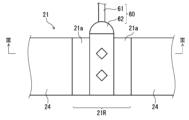
- FIG. 2 is a front view showing the area where the anode foil and the anode lead are connected.
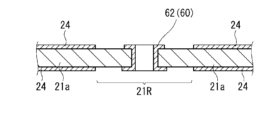
- FIG. 2 is a cross-sectional view showing the area where the anode foil and the anode lead are connected.
- the anode foil and anode lead are each made of metal, with a conductive polymer layer between them.
- the conductive polymer layer has a lower conductivity than metal, so the presence of the conductive polymer layer increases the connection resistance between the anode foil and anode lead, increasing the equivalent series resistance (ESR) of the electrolytic capacitor.
- This disclosure provides an electrolytic capacitor that can reduce ESR and a method for manufacturing an electrolytic capacitor.
- the method for producing an electrolytic capacitor according to the present disclosure is a method for producing an electrolytic capacitor including an anode foil having a metal portion and a dielectric layer formed on the surface of the metal portion, a cathode foil, and a separator, and includes a coating liquid application step, a polymer layer formation step, a polymer layer removal step, and a lead connection step.
- a coating liquid containing a conductive polymer and a liquid medium is applied (or coated) to the surface of the dielectric layer of the anode foil.
- the conductive polymer may be dispersed in the coating liquid in the form of particles.
- the liquid medium may include water and an organic compound.
- the organic compound may be one type of compound or may be composed of a plurality of types of compounds.
- the method of applying (or coating) the coating liquid is not particularly limited, and may be applied by a known method. For example, the coating liquid may be applied using a coater, the coating liquid may be sprayed, or the anode foil may be immersed in the coating liquid.
- Examples of the method using a coater include a gravure coating method and a die coating method.
- the coating liquid is applied to a transfer member such as a gravure roll, and the excess coating liquid is removed from the transfer member, and then the coating liquid applied to the transfer member is transferred to each of the anode foil, the cathode foil, and the separator, so that a layer of the coating liquid of a uniform thickness can be applied to each of the anode foil, the cathode foil, and the separator.
- the viscosity of the coating liquid may be, for example, 10 mPa ⁇ s or more (or 100 mPa ⁇ s or more) and 200 mPa ⁇ s or less.
- the coating liquid is easily applied to the anode foil, the cathode foil, and the separator, and is easily impregnated into the separator.
- the viscosity of the coating liquid is measured at room temperature (20° C.) using a vibration viscometer (for example, VM-100A, manufactured by Sekonic Corporation).
- Examples of the organic compound may include at least one selected from the group consisting of polyhydric alcohols, sulfolane, ⁇ -butyrolactone, and boric acid esters, or may be at least one of the above.
- the organic compound may include at least one selected from the group consisting of glycols, glycerins, sugar alcohols, sulfolane, ⁇ -butyrolactone, and boric acid esters, or may be at least one of the above.
- polyhydric alcohols examples include glycols, glycerins, and sugar alcohols.
- glycols include ethylene glycol, diethylene glycol, triethylene glycol, polyalkylene glycols (e.g., polyethylene glycol), polyoxyethylene polyoxypropylene glycol (ethylene oxide-propylene oxide copolymer), and the like.
- glycerins include glycerin and polyglycerin.
- sugar alcohols include mannitol, xylitol, sorbitol, erythritol, and pentaerythritol.
- Examples of conductive polymers include polypyrrole, polythiophene, polyfuran, polyaniline, polyacetylene, and derivatives thereof.
- the derivatives include polymers having polypyrrole, polythiophene, polyfuran, polyaniline, and polyacetylene as the basic skeleton.
- a derivative of polythiophene includes poly(3,4-ethylenedioxythiophene).
- These conductive polymers may be used alone or in combination.
- the conductive polymer may also be a copolymer of two or more monomers.
- the weight-average molecular weight of the conductive polymer is not particularly limited and may be in the range of 1,000 to 100,000, for example.
- a preferred example of a conductive polymer is poly(3,4-ethylenedioxythiophene) (PEDOT).
- the conductive polymer may be doped with a dopant. From the viewpoint of suppressing dedoping from the conductive polymer, it is preferable to use a polymer dopant as the dopant.
- polymer dopants include polyvinyl sulfonic acid, polystyrene sulfonic acid, polyallyl sulfonic acid, polyacryl sulfonic acid, polymethacryl sulfonic acid, poly(2-acrylamido-2-methylpropane sulfonic acid), polyisoprene sulfonic acid, polyacrylic acid, etc. These may be used alone or in combination of two or more. At least a part of these may be added in the form of a salt.
- a preferred example of the dopant is polystyrene sulfonic acid (PSS).
- PSS polystyrene sulfonic acid
- the weight average molecular weight of the dopant is not particularly limited. From the viewpoint of facilitating the formation of a homogeneous conductive polymer layer, the weight average molecular weight of the dopant may be in the range of 1,000 to 100,000.
- the liquid medium e.g., water
- the method for removing at least a part of the liquid medium from the coating liquid is not particularly limited.
- the removal may be performed by heating and/or decompression, and it is preferable that at least heating is involved.
- heating is performed, at least a part of the liquid medium may be removed by heating at a temperature of 100°C or higher. This allows the water in the liquid medium to be quickly removed.
- the heating temperature is preferably a temperature at which the organic compound does not boil or decompose. When the organic compound is a compound that does not show a clear boiling point, it is preferable to heat at a temperature at which the organic compound evaporates little and does not decompose.
- Polymer layer removal process In the polymer layer removal step, a part of the conductive polymer layer is removed from a part of the anode foil to form an exposed region in which the part of the anode foil is exposed from the conductive polymer layer.
- the conductive polymer layer may be removed and a part of the metal part of the anode foil and/or the dielectric layer may be removed.
- the method of removing the part of the conductive polymer layer and/or the part of the anode foil is not particularly limited. For example, removal by a router, removal by polishing, removal by irradiation with laser light, removal by application of ultrasonic waves, etc. may be used.
- the conductive polymer layer may be removed together with a part of the anode foil by drilling a hole. In that case, the area where the metal part is exposed on the inner surface of the hole becomes the exposed region.
- a part of the conductive polymer layer may be removed by removing a part of the anode foil by etching. In the exposed region, it is preferable that the metal part is exposed from the conductive polymer layer.
- the anode lead is electrically connected to the anode foil by directly contacting the metal part in the exposed region with the anode lead.
- the anode lead may be made of a metal (e.g., aluminum, an aluminum alloy, copper, or a copper alloy).
- the anode lead may be connected to the anode foil by needle crimping.
- a needle is pressed against the anode lead superimposed on the anode foil, and a through hole is formed in the anode foil and the anode lead, so that a part of the anode lead is penetrated into the hole in the anode foil, thereby mechanically and electrically connecting the anode foil and the anode lead.
- the polymer layer removal step an exposed region is formed in the anode foil in advance, so that the metal part and the anode lead can be directly contacted in the lead connection step. Since a conductive polymer layer with a large electrical resistance is not interposed between the metal part and the anode lead, the connection resistance between the metal part and the anode lead can be reduced, and the ESR of the electrolytic capacitor can be reduced.
- a portion of the conductive polymer layer may be removed from both sides of the anode foil.
- an exposed area is formed on both sides of the anode foil, and when the anode lead is connected so as to contact both sides of the anode foil, the connection resistance between the anode foil and the anode lead can be further reduced.
- a portion of the conductive polymer layer may be removed from only one side of the anode foil.
- a conductive polymer layer may be interposed between a part of the anode lead and the anode foil. Even if the entire anode lead is not in contact with the anode foil without the conductive polymer layer, there is a part where the metal part of the anode foil and the anode lead are in direct contact, so the connection resistance between the anode lead and the anode foil can be sufficiently reduced. In addition, the amount of conductive polymer layer to be removed can be reduced compared to when the conductive polymer layer is not interposed between the entire anode lead and the anode foil. Therefore, the load of the removal work can be reduced.
- the conductive polymer layer is also formed in the area of the anode foil near the anode lead, the adverse effects (reduction in electrostatic capacitance, increase in ESR) caused by the area of the anode foil where the conductive polymer layer is not formed can be suppressed. Note that the conductive polymer layer does not have to be interposed between the entire anode lead and the anode foil.
- the ratio of the area S2 to the area S1 may be, for example, 0.1 or more and 3.0 or less.
- the ratio (S2/S1) may be preferably 0.5 or more and 1.5 or less, and more preferably 0.9 or more and 1.1 or less. If the ratio (S2/S1) is less than 1.0, the conductive polymer layer is interposed between a part of the anode lead and the anode foil.
- the metal part may have a core and a porous part having a lower density than the core.
- at least a part of the porous part may be removed in a part of the anode foil, in addition to a part of the conductive polymer layer.
- the core and the porous part may be formed, for example, by etching the surface of the metal foil.
- the porous part may have a large number of micropores extending in the thickness direction of the anode foil, or may have a large number of micropores formed in a sponge-like shape. Since the porous part has a lower conductivity than the core, removing at least a part of such a porous part allows the anode lead and the core of the metal part to be in direct contact with each other, further reducing the connection resistance between the two.
- the electrolytic capacitor according to the present disclosure includes an anode foil, a cathode foil, a separator, a conductive polymer layer, and an anode lead.
- the anode foil has a metal portion and a dielectric layer formed on the surface of the metal portion.
- the anode foil include metal foils containing at least a portion of a valve metal such as titanium, tantalum, aluminum, and niobium, and may be a metal foil of a valve metal (e.g., aluminum foil).
- the anode foil may contain the valve metal in the form of an alloy containing the valve metal or a compound containing the valve metal.
- the thickness of the anode foil may be 15 ⁇ m or more and 300 ⁇ m or less.
- the dielectric layer may be formed by chemically treating the anode foil. In this case, the dielectric layer contains an oxide of the valve metal (e.g., aluminum oxide).
- the dielectric layer may be composed of a dielectric other than an oxide of the valve metal as long as it functions as a dielectric.
- the cathode foil is not particularly limited as long as it functions as a cathode.
- the cathode foil include metal foil (e.g., aluminum foil).
- the type of metal is not particularly limited, and may be a valve metal or an alloy or compound containing a valve metal.
- the thickness of the cathode foil may be 15 ⁇ m or more and 300 ⁇ m or less.
- the surface of the cathode foil may be roughened or chemically treated as necessary.
- the cathode foil may have a conductive polymer layer containing a conductive polymer, or may not have such a conductive polymer layer. Examples of the conductive polymer may be the same as those described above.
- the composition of the conductive polymer layer of the cathode foil may be the same as or different from the composition of the conductive polymer layer of the anode foil.
- the cathode foil may include a conductive coating layer.
- the coating layer may include carbon and at least one metal having a lower ionization tendency than the valve metal. This makes it easier to improve the acid resistance of the metal foil.
- the coating layer may include at least one selected from the group consisting of carbon, nickel, titanium, tantalum, and zirconium. In particular, the coating layer may include nickel and/or titanium, which are low in cost and resistance.
- the thickness of the coating layer may be 5 nm or more, or 10 nm or more, or may be 200 nm or less.
- the coating layer may be formed by vapor deposition or sputtering the metal on the metal foil.
- the coating layer may be formed by vapor deposition of a conductive carbon material on the metal foil or by applying a carbon paste containing a conductive carbon material. Examples of conductive carbon materials include graphite, hard carbon, soft carbon, carbon black, etc.
- the separator is interposed between the anode foil and the cathode foil.
- the separator may be a porous sheet. Examples of the porous sheet include woven fabric, nonwoven fabric, and microporous membrane.
- the thickness of the separator is not particularly limited and may be 10 ⁇ m or more and 300 ⁇ m or less. Examples of the material of the separator include cellulose, polyethylene terephthalate, polybutylene terephthalate, polyphenylene sulfide, vinylon, nylon, aromatic polyamide, polyimide, polyamideimide, polyetherimide, rayon, and glass.
- the separator may have a conductive polymer layer containing a conductive polymer, or may not have such a conductive polymer layer. Examples of the conductive polymer may be the same as those described above.
- the composition of the conductive polymer layer of the separator may be the same as or different from the composition of the conductive polymer layer of the anode foil.
- the conductive polymer layer is formed on the surface of the dielectric layer and contains a conductive polymer. Examples of the conductive polymer are as described above.
- the conductive polymer layer is not formed on a portion of the anode foil. In other words, the portion of the anode foil has an exposed area that is exposed from the conductive polymer layer. In the exposed area, it is preferable that a metal portion is exposed from the conductive polymer layer.
- the anode lead is connected to the anode foil. Specifically, the anode lead is connected to the anode foil by directly contacting the metal portion in the exposed area. This reduces the connection resistance between the metal portion and the anode lead, and thus the ESR of the electrolytic capacitor.
- the anode lead may be made of a metal (e.g., aluminum, an aluminum alloy, copper, or a copper alloy).
- the anode lead may be connected to the anode foil by needle crimping.
- the metal portion may be exposed from the conductive polymer layer on both sides of the anode foil.
- an exposed area is formed on both sides of the anode foil, and when the anode lead is connected so as to contact both sides of the anode foil, the connection resistance between the anode foil and the anode lead can be further reduced.
- the metal portion may be exposed from the conductive polymer layer on only one side of the anode foil.
- the metal portion may have a core portion and a porous portion having a lower density than the core portion.
- the thickness of the porous portion in a portion of the anode foil may be smaller than the thickness of the porous portion in the remaining portion of the anode foil. Since the conductivity of the porous portion is lower than the conductivity of the core portion, the smaller thickness of such a porous portion can reduce the connection resistance between that portion of the anode foil and the anode lead. Note that the configuration of this paragraph also includes cases where there is no porous portion in that portion of the anode foil.
- a conductive polymer layer may be interposed between a portion of the anode lead and the anode foil. Even with this configuration, the technology disclosed herein can sufficiently reduce the connection resistance between the anode lead and the anode foil, thereby reducing the ESR of the electrolytic capacitor.
- the ESR of the electrolytic capacitor can be reduced by directly contacting the metal part and the anode lead in the exposed area formed on a portion of the anode foil.
- an electrolytic capacitor 10 of this embodiment includes a capacitor element 20, a bottomed case 30 that houses the capacitor element 20, a sealing member 40 that closes the opening of the bottomed case 30, a seat plate 50 that covers the sealing member 40, lead wires 61, 71 that are led out from the sealing member 40 and pass through the seat plate, and lead tabs 62, 72 that connect the lead wires to electrodes of the capacitor element 20.
- the vicinity of the open end of the bottomed case 30 is drawn inward, and the open end is curled so as to crimp the sealing member 40.
- One lead wire 61 and one lead tab 62 form an anode lead 60
- the other lead wire 71 and the other lead tab 72 form a cathode lead 70.
- the capacitor element 20 is, for example, a wound body as shown in FIG. 2.
- the wound body includes an anode foil 21 connected to the lead tab 62 of the anode lead 60, a cathode foil 22 connected to the lead tab 72 of the cathode lead 70, and a separator 23 interposed between the anode foil 21 and the cathode foil 22.
- the anode foil 21 includes a metal portion 21a having a core portion and a porous portion (both not shown), and a dielectric layer (not shown) formed on the surface of the metal portion 21a.
- the density of the porous portion is lower than the density of the core portion.
- a conductive polymer layer 24 containing a conductive polymer is formed on the surface of the dielectric layer.
- the electrolytic capacitor 10 may include a liquid component (e.g., an electrolyte) impregnated in the capacitor element 20.
- the liquid component include a non-aqueous solvent and an electrolyte.
- the electrolyte may be a mixture of a non-aqueous solvent and an ionic substance (solute, e.g., an organic salt) dissolved therein.
- the non-aqueous solvent may be an organic solvent or an ionic liquid.
- non-aqueous solvents examples include polyhydric alcohols such as ethylene glycol and propylene glycol, cyclic sulfones such as sulfolane, lactones such as ⁇ -butyrolactone, amides such as N-methylacetamide, N,N-dimethylformamide, and N-methyl-2-pyrrolidone, esters such as methyl acetate, carbonate compounds such as propylene carbonate, ethers such as 1,4-dioxane, ketones such as methyl ethyl ketone, and formaldehyde.
- Polymer-based solvents may be used as the non-aqueous solvent.
- polymer-based solvents examples include polyalkylene glycols, derivatives of polyalkylene glycols, and compounds in which at least one hydroxyl group in a polyhydric alcohol is substituted with polyalkylene glycol (including derivatives).
- examples of polymer-based solvents include polyethylene glycol, polyethylene glycol glyceryl ether, polyethylene glycol diglyceryl ether, polyethylene glycol sorbitol ether, polypropylene glycol, polypropylene glycol glyceryl ether, polypropylene glycol diglyceryl ether, polypropylene glycol sorbitol ether, and polybutylene glycol.
- polymer-based solvents further include ethylene glycol-propylene glycol copolymers, ethylene glycol-butylene glycol copolymers, and propylene glycol-butylene glycol copolymers.
- the nonaqueous solvents may be used alone or in combination of two or more.
- organic salts include trimethylamine maleate, triethylamine borodisalicylate, ethyldimethylamine phthalate, mono 1,2,3,4-tetramethylimidazolinium phthalate, mono 1,3-dimethyl-2-ethylimidazolinium phthalate, etc.
- the liquid component may be a component that is liquid at room temperature (25°C) or a component that is liquid at the temperature at which the electrolytic capacitor is used.
- the anode foil 21 and the cathode foil 22 are wound with a separator 23 between them.
- the outermost circumference of the wound body is fixed with a stop tape 25. Note that Figure 2 shows the wound body in a partially unfolded state before the outermost circumference is fixed.
- a portion of the anode foil 21 has exposed regions 21R on both sides where the metal portion 21a (more specifically, the core of the metal portion 21a) is exposed from the conductive polymer layer 24.
- the lead tab 62 of the anode lead 60 is in direct contact with the metal portion 21a, so that the anode lead 60 is mechanically and electrically connected to the anode foil 21.
- the anode lead 60 is connected to the anode foil 21 by needle crimping. Therefore, a portion of the lead tab 62 penetrates the metal portion 21a and is in direct contact with both sides of the metal portion 21a.
- the thickness of the porous portion in the exposed region 21R is smaller than the thickness of the porous portion in the other parts of the anode foil 21 than the exposed region 21R.
- the conductive polymer layer 24 is not interposed between the lead tab 62 of the anode lead 60 and the anode foil 21, but the conductive polymer layer 24 may be interposed between a part of the anode lead 60 and the anode foil 21.
- the manufacturing method includes a coating liquid application step, a polymer layer formation step, a polymer layer removal step, and a lead connection step.
- a coating liquid containing a conductive polymer and a liquid medium is applied to the surface of the dielectric layer of the anode foil 21.
- the coating liquid is applied to the surface of the dielectric layer by a gravure coating method, but the present invention is not limited to this.
- the liquid medium is removed from the coating liquid to form a conductive polymer layer 24 containing a conductive polymer on the surface of the dielectric layer.
- the removal is performed by heating under a reduced pressure atmosphere, but is not limited to this.
- a portion of the conductive polymer layer 24 is removed from both sides of a portion of the anode foil 21 to form an exposed region 21R in which the portion of the anode foil 21 is exposed from the conductive polymer layer 24. More specifically, in the polymer layer removal step of this embodiment, in the portion of the anode foil 21, in addition to the portion of the conductive polymer layer 24, substantially the entire porous portion of the metal portion 21a is removed.
- substantially the entirety means that 90% or more, 95% or more, or 99% or more of the porous portion is removed.
- the metal portion 21a (specifically, the core portion of the metal portion 21a) in the exposed region 21R is brought into direct contact with the lead tab 62 of the anode lead 60, and the anode lead 60 is connected to the anode foil 21 by needle crimping.
- the conductive polymer layer 24 is removed in the polymer layer removal process so that the conductive polymer layer 24 is not interposed between the anode lead 60 and the anode foil 21, but the conductive polymer layer 24 may be interposed between a part of the anode lead 60 and the anode foil 21.
- an anode foil having a metal portion and a dielectric layer formed on a surface of the metal portion; A cathode foil; a separator interposed between the anode foil and the cathode foil; a conductive polymer layer formed on a surface of the dielectric layer and including a conductive polymer; an anode lead connected to the anode foil; Equipped with a portion of the anode foil having an exposed region exposed from the conductive polymer layer; the anode lead is electrically connected to the anode foil by direct contact with the metal portion in the exposed area.
- the metal portion has a core portion and a porous portion having a lower density than the core portion, 3.
- a method for manufacturing an electrolytic capacitor including an anode foil having a metal portion and a dielectric layer formed on a surface of the metal portion, a cathode foil, and a separator comprising the steps of: a coating liquid applying step of applying a coating liquid containing a conductive polymer and a liquid medium to a surface of the dielectric layer of the anode foil; a polymer layer forming step of forming a conductive polymer layer containing the conductive polymer on the surface of the dielectric layer by removing at least a part of the liquid medium from the coating liquid; a polymer layer removing step of removing a part of the conductive polymer layer in a part of the anode foil to form an exposed region in which the part of the anode foil is exposed from the conductive polymer layer; a lead connection step of electrically connecting the anode lead to the anode foil by directly contacting the metal portion in the exposed region with an anode lead; A method for manufacturing an electrolytic capacitor comprising
- the metal portion has a core portion and a porous portion having a lower density than the core portion, 8.
- anode foils with an anode lead connected hereinafter also referred to as anode foils with leads
- connection resistance between the anode foil and the anode lead was measured, and the ESR of the electrolytic capacitors made using each anode foil was also measured.
- Example An aluminum foil (thickness 100 ⁇ m) was subjected to an etching treatment to roughen the surface of the aluminum foil.
- the roughened surface of the aluminum foil was subjected to a chemical conversion treatment to form a dielectric layer.
- an anode foil having a dielectric layer formed on both sides was obtained.
- a dispersion (commercially available) was prepared in which particles of polyethylenedioxythiophene (PEDOT) doped with polystyrene sulfonic acid (PSS) were dispersed in water. Ethylene glycol and water were added to this dispersion to obtain a coating liquid.
- PEDOT polyethylenedioxythiophene
- PSS polystyrene sulfonic acid
- a gravure coater was used to apply the coating liquid to one side of the anode foil (surface of the dielectric layer).
- a drying process was then performed to form a conductive polymer layer on one side of the anode foil (surface of the dielectric layer).
- a conductive polymer layer was formed on the other side of the anode foil (surface of the dielectric layer) in the same manner.
- part of the conductive polymer layer and part of the anode foil were removed from a portion of the anode foil, and an exposed area was formed on the inner surface of the punch hole where the core of the metal portion was exposed.
- the lead tab of the anode lead was placed in the exposed area, and the lead tab was directly contacted to the core of the metal part of the anode foil by needle crimping, electrically connecting the anode lead to the anode foil.
- connection resistance between the anode lead and the anode foil was measured using the four-terminal measurement method.
- the connection resistance measured in this manner in the example was 0.55 m ⁇ .
- An electrolytic capacitor was also produced using the leaded anode foil of the example.
- the ESR of this electrolytic capacitor was 9.62 m ⁇ .
- the ESR was measured at a frequency of 100 kHz/ ⁇ using an LCR meter.
- Comparative Example Anode foils with leads were produced in the same manner as in the example, except that the step of forming a punch hole in the anode foil on which the conductive polymer layer was formed was not performed.
- the connection resistance between the anode lead and the anode foil in the comparative example with leads was 2.07 m ⁇ .
- the ESR of the electrolytic capacitor produced using the comparative example with leads was 11.31 m ⁇ .
- Reference Example 1 Anode foils with leads were produced in the same manner as in the examples, except that the step of forming a conductive polymer layer on the surface of the dielectric layer was not performed.
- the connection resistance between the anode lead and the anode foil in the anode foil with leads of Reference Example 1 was 0.52 m ⁇ .
- the ESR of the electrolytic capacitor produced using the anode foil with leads of Reference Example 1 was 200.5 m ⁇ .
- Reference Example 2 Anode foils with leads were produced in the same manner as in the examples, except that the step of forming a conductive polymer layer on the surface of the dielectric layer and the step of forming a punch hole were not performed.
- the connection resistance between the anode lead and the anode foil in the anode foil with leads of Reference Example 2 was 0.57 m ⁇ .
- the ESR of the electrolytic capacitor produced using the anode foil with leads of Reference Example 1 was 208.3 m ⁇ .
- connection resistance between the anode lead and the anode foil of the embodiment was significantly lower than that of the comparative example anode foil with leads. Accordingly, the ESR of the electrolytic capacitor of the embodiment was also significantly lower than that of the comparative example electrolytic capacitor. Therefore, it can be said that the superiority of the embodiment was demonstrated.
- This disclosure can be used in electrolytic capacitors and methods for manufacturing electrolytic capacitors.
- Electrolytic capacitor 20 Capacitor element 21: Anode foil 21a: Metal part 21R: Exposed area 22: Cathode foil 23: Separator 24: Conductive polymer layer 25: Stop tape 30: Bottomed case 40: Sealing member 50: Seat plate 60: Anode lead 61: Lead wire 62: Lead tab 70: Cathode lead 71: Lead wire 72: Lead tab
Landscapes
- Engineering & Computer Science (AREA)
- Power Engineering (AREA)
- Microelectronics & Electronic Packaging (AREA)
- Fixed Capacitors And Capacitor Manufacturing Machines (AREA)
Priority Applications (2)
| Application Number | Priority Date | Filing Date | Title |
|---|---|---|---|
| JP2025537732A JPWO2025028071A1 (https=) | 2023-07-28 | 2024-06-24 | |
| CN202480047593.9A CN121532843A (zh) | 2023-07-28 | 2024-06-24 | 电解电容器和电解电容器的制造方法 |
Applications Claiming Priority (2)
| Application Number | Priority Date | Filing Date | Title |
|---|---|---|---|
| JP2023123458 | 2023-07-28 | ||
| JP2023-123458 | 2023-07-28 |
Publications (1)
| Publication Number | Publication Date |
|---|---|
| WO2025028071A1 true WO2025028071A1 (ja) | 2025-02-06 |
Family
ID=94394470
Family Applications (1)
| Application Number | Title | Priority Date | Filing Date |
|---|---|---|---|
| PCT/JP2024/022731 Pending WO2025028071A1 (ja) | 2023-07-28 | 2024-06-24 | 電解コンデンサおよび電解コンデンサの製造方法 |
Country Status (3)
| Country | Link |
|---|---|
| JP (1) | JPWO2025028071A1 (https=) |
| CN (1) | CN121532843A (https=) |
| WO (1) | WO2025028071A1 (https=) |
Citations (5)
| Publication number | Priority date | Publication date | Assignee | Title |
|---|---|---|---|---|
| JP2000082640A (ja) * | 1998-09-07 | 2000-03-21 | Matsushita Electric Ind Co Ltd | アルミ電解コンデンサおよびその製造方法 |
| JP2009224555A (ja) * | 2008-03-17 | 2009-10-01 | Fujitsu Ltd | 電解キャパシタ及びその製造方法並びに配線基板 |
| WO2012111319A1 (ja) * | 2011-02-18 | 2012-08-23 | パナソニック株式会社 | 電解コンデンサ及びその製造方法 |
| JP2014007196A (ja) * | 2012-06-21 | 2014-01-16 | Jcc Engineering Co Ltd | 電子部品の製造方法、および電子部品の製造装置 |
| JP2021532576A (ja) * | 2018-07-18 | 2021-11-25 | ケメット エレクトロニクス コーポレーション | ハイブリッドコンデンサ及びコンデンサを製造する方法 |
-
2024
- 2024-06-24 JP JP2025537732A patent/JPWO2025028071A1/ja active Pending
- 2024-06-24 WO PCT/JP2024/022731 patent/WO2025028071A1/ja active Pending
- 2024-06-24 CN CN202480047593.9A patent/CN121532843A/zh active Pending
Patent Citations (5)
| Publication number | Priority date | Publication date | Assignee | Title |
|---|---|---|---|---|
| JP2000082640A (ja) * | 1998-09-07 | 2000-03-21 | Matsushita Electric Ind Co Ltd | アルミ電解コンデンサおよびその製造方法 |
| JP2009224555A (ja) * | 2008-03-17 | 2009-10-01 | Fujitsu Ltd | 電解キャパシタ及びその製造方法並びに配線基板 |
| WO2012111319A1 (ja) * | 2011-02-18 | 2012-08-23 | パナソニック株式会社 | 電解コンデンサ及びその製造方法 |
| JP2014007196A (ja) * | 2012-06-21 | 2014-01-16 | Jcc Engineering Co Ltd | 電子部品の製造方法、および電子部品の製造装置 |
| JP2021532576A (ja) * | 2018-07-18 | 2021-11-25 | ケメット エレクトロニクス コーポレーション | ハイブリッドコンデンサ及びコンデンサを製造する方法 |
Also Published As
| Publication number | Publication date |
|---|---|
| CN121532843A (zh) | 2026-02-13 |
| JPWO2025028071A1 (https=) | 2025-02-06 |
Similar Documents
| Publication | Publication Date | Title |
|---|---|---|
| JP7672061B2 (ja) | 電解コンデンサおよび電解コンデンサの製造方法 | |
| JP7611538B2 (ja) | 電解コンデンサ | |
| JP7607224B2 (ja) | 電解コンデンサ | |
| CN102646515B (zh) | 电解电容器及电解电容器的制造方法 | |
| JP6589142B2 (ja) | 電解コンデンサの製造方法 | |
| JP2024174141A (ja) | 電解コンデンサの製造方法 | |
| WO2015198547A1 (ja) | 電解コンデンサの製造方法 | |
| WO2016103617A1 (ja) | 電解コンデンサの製造方法 | |
| JP6735510B2 (ja) | 電解コンデンサ | |
| JP6655781B2 (ja) | 電解コンデンサの製造方法 | |
| JP7724421B2 (ja) | 電解コンデンサおよびその製造方法 | |
| WO2016002176A1 (ja) | 電解コンデンサの製造方法 | |
| JP2022117355A (ja) | 電解コンデンサおよびその製造方法 | |
| JP6726886B2 (ja) | 電解コンデンサおよびその製造方法 | |
| WO2016002175A1 (ja) | 電解コンデンサの製造方法 | |
| JP2015103743A (ja) | 固体電解コンデンサおよびその製造方法 | |
| JP6604497B2 (ja) | 電解コンデンサの製造方法 | |
| WO2025028071A1 (ja) | 電解コンデンサおよび電解コンデンサの製造方法 | |
| JP6326633B2 (ja) | 電解コンデンサの製造方法および電解コンデンサ | |
| WO2023079953A1 (ja) | 固体電解コンデンサ | |
| JP4909246B2 (ja) | 固体電解コンデンサの製造方法 | |
| JP7833680B2 (ja) | 電解コンデンサ | |
| WO2025164474A1 (ja) | 電解コンデンサおよび電解コンデンサの製造方法 | |
| JP2007180404A (ja) | 固体電解コンデンサ及びその製造方法 | |
| WO2022210513A1 (ja) | 電解コンデンサの製造方法 |
Legal Events
| Date | Code | Title | Description |
|---|---|---|---|
| 121 | Ep: the epo has been informed by wipo that ep was designated in this application |
Ref document number: 24848732 Country of ref document: EP Kind code of ref document: A1 |
|
| ENP | Entry into the national phase |
Ref document number: 2025537732 Country of ref document: JP Kind code of ref document: A |
|
| WWE | Wipo information: entry into national phase |
Ref document number: 2025537732 Country of ref document: JP |
|
| NENP | Non-entry into the national phase |
Ref country code: DE |