WO2025005144A1 - 二酸化チタン微粒子の有機溶媒分散体及びその製造方法並びにその用途 - Google Patents
二酸化チタン微粒子の有機溶媒分散体及びその製造方法並びにその用途 Download PDFInfo
- Publication number
- WO2025005144A1 WO2025005144A1 PCT/JP2024/023201 JP2024023201W WO2025005144A1 WO 2025005144 A1 WO2025005144 A1 WO 2025005144A1 JP 2024023201 W JP2024023201 W JP 2024023201W WO 2025005144 A1 WO2025005144 A1 WO 2025005144A1
- Authority
- WO
- WIPO (PCT)
- Prior art keywords
- titanium dioxide
- fine particles
- organic solvent
- dioxide fine
- components
- Prior art date
- Legal status (The legal status is an assumption and is not a legal conclusion. Google has not performed a legal analysis and makes no representation as to the accuracy of the status listed.)
- Ceased
Links
Images
Classifications
-
- C—CHEMISTRY; METALLURGY
- C01—INORGANIC CHEMISTRY
- C01G—COMPOUNDS CONTAINING METALS NOT COVERED BY SUBCLASSES C01D OR C01F
- C01G23/00—Compounds of titanium
- C01G23/04—Oxides; Hydroxides
- C01G23/047—Titanium dioxide
- C01G23/053—Producing by wet processes, e.g. hydrolysing titanium salts
-
- C—CHEMISTRY; METALLURGY
- C09—DYES; PAINTS; POLISHES; NATURAL RESINS; ADHESIVES; COMPOSITIONS NOT OTHERWISE PROVIDED FOR; APPLICATIONS OF MATERIALS NOT OTHERWISE PROVIDED FOR
- C09C—TREATMENT OF INORGANIC MATERIALS, OTHER THAN FIBROUS FILLERS, TO ENHANCE THEIR PIGMENTING OR FILLING PROPERTIES ; PREPARATION OF CARBON BLACK ; PREPARATION OF INORGANIC MATERIALS WHICH ARE NO SINGLE CHEMICAL COMPOUNDS AND WHICH ARE MAINLY USED AS PIGMENTS OR FILLERS
- C09C1/00—Treatment of specific inorganic materials other than fibrous fillers; Preparation of carbon black
- C09C1/36—Compounds of titanium
-
- C—CHEMISTRY; METALLURGY
- C09—DYES; PAINTS; POLISHES; NATURAL RESINS; ADHESIVES; COMPOSITIONS NOT OTHERWISE PROVIDED FOR; APPLICATIONS OF MATERIALS NOT OTHERWISE PROVIDED FOR
- C09C—TREATMENT OF INORGANIC MATERIALS, OTHER THAN FIBROUS FILLERS, TO ENHANCE THEIR PIGMENTING OR FILLING PROPERTIES ; PREPARATION OF CARBON BLACK ; PREPARATION OF INORGANIC MATERIALS WHICH ARE NO SINGLE CHEMICAL COMPOUNDS AND WHICH ARE MAINLY USED AS PIGMENTS OR FILLERS
- C09C1/00—Treatment of specific inorganic materials other than fibrous fillers; Preparation of carbon black
- C09C1/40—Compounds of aluminium
-
- C—CHEMISTRY; METALLURGY
- C09—DYES; PAINTS; POLISHES; NATURAL RESINS; ADHESIVES; COMPOSITIONS NOT OTHERWISE PROVIDED FOR; APPLICATIONS OF MATERIALS NOT OTHERWISE PROVIDED FOR
- C09D—COATING COMPOSITIONS, e.g. PAINTS, VARNISHES OR LACQUERS; FILLING PASTES; CHEMICAL PAINT OR INK REMOVERS; INKS; CORRECTING FLUIDS; WOODSTAINS; PASTES OR SOLIDS FOR COLOURING OR PRINTING; USE OF MATERIALS THEREFOR
- C09D17/00—Pigment pastes, e.g. for mixing in paints
-
- C—CHEMISTRY; METALLURGY
- C09—DYES; PAINTS; POLISHES; NATURAL RESINS; ADHESIVES; COMPOSITIONS NOT OTHERWISE PROVIDED FOR; APPLICATIONS OF MATERIALS NOT OTHERWISE PROVIDED FOR
- C09D—COATING COMPOSITIONS, e.g. PAINTS, VARNISHES OR LACQUERS; FILLING PASTES; CHEMICAL PAINT OR INK REMOVERS; INKS; CORRECTING FLUIDS; WOODSTAINS; PASTES OR SOLIDS FOR COLOURING OR PRINTING; USE OF MATERIALS THEREFOR
- C09D201/00—Coating compositions based on unspecified macromolecular compounds
-
- C—CHEMISTRY; METALLURGY
- C09—DYES; PAINTS; POLISHES; NATURAL RESINS; ADHESIVES; COMPOSITIONS NOT OTHERWISE PROVIDED FOR; APPLICATIONS OF MATERIALS NOT OTHERWISE PROVIDED FOR
- C09D—COATING COMPOSITIONS, e.g. PAINTS, VARNISHES OR LACQUERS; FILLING PASTES; CHEMICAL PAINT OR INK REMOVERS; INKS; CORRECTING FLUIDS; WOODSTAINS; PASTES OR SOLIDS FOR COLOURING OR PRINTING; USE OF MATERIALS THEREFOR
- C09D7/00—Features of coating compositions, not provided for in group C09D5/00; Processes for incorporating ingredients in coating compositions
- C09D7/40—Additives
- C09D7/60—Additives non-macromolecular
- C09D7/61—Additives non-macromolecular inorganic
Definitions
- the present invention relates to an organic solvent dispersion of titanium dioxide fine particles, a method for producing the same, and uses thereof.
- Titanium dioxide fine particles are a material that has excellent properties such as visible light transmittance (i.e., transparency), ultraviolet light blocking properties, and a high refractive index. To utilize these properties, it is usually necessary to disperse titanium dioxide fine particles in an organic solvent to prepare an organic solvent dispersion or coating composition, which is then applied or sprayed onto a substrate to form a coating film containing titanium dioxide fine particles.
- Organic solvent dispersions of titanium dioxide fine particles are used, for example, to form hard coats and UV-blocking coatings with high visible light transmittance (i.e., transparency) and high refractive index on the surfaces of substrates such as synthetic resin lenses and films.
- substrates such as synthetic resin lenses and films.
- the display surfaces of flat panel displays such as liquid crystal displays, plasma displays, and electroluminescence displays are provided with anti-reflection films that combine high and low refractive index layers to prevent light sources and faces from being reflected, and organic solvent dispersions of titanium dioxide fine particles are also used for these high refractive index layers.
- organic solvent dispersions of titanium dioxide fine particles have the problem that the titanium dioxide fine particles tend to aggregate in the organic solvent dispersion.
- Organic solvent dispersions containing aggregated titanium dioxide fine particles have low transparency, so coating films produced using such dispersions also have low transparency.
- organic solvent dispersions containing aggregated titanium dioxide fine particles have the problem that the titanium dioxide fine particles settle during the production process, reducing the yield of organic solvent dispersions that can be used in coating films.
- Patent Document 1 describes an organic solvent dispersion of titanium dioxide fine particles, which contains titanium dioxide fine particles, an organic solvent, a silane coupling agent, and a dispersant having a basic adsorption group, and the mass ratio of the dispersant to the silane coupling agent is 15% by mass to 75% by mass.
- Patent Document 2 describes a core-shell type tetragonal titanium oxide solid solution organic solvent dispersion in which a core-shell type tetragonal titanium oxide solid solution having a silicon oxide shell on the outside of the core is dispersed in an organic solvent, the core being made of tetragonal titanium oxide fine particles having one or more elements (M 0 ) selected from the group consisting of gallium, vanadium, niobium, tantalum, zirconium, aluminum, and indium as a solid solution.
- M 0 elements
- Example 6 describes that tin (IV) chloride pentahydrate and aluminum chloride (III) are added to a titanium chloride (IV) aqueous solution, neutralized with ammonia water, and hydrolyzed to obtain a precipitate of titanium hydroxide containing tin and aluminum, and 30% by mass hydrogen peroxide is added to obtain a translucent tin-containing peroxotitanic acid solution, and the solution is hydrothermally treated in an autoclave at 200° C. and 1.5 MPa for 120 minutes to obtain a titanium oxide dispersion.
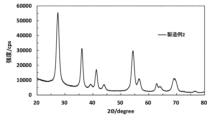
- the present invention provides (1) Titanium dioxide microparticles in which titanium components, tin components, and aluminum components are detected by X-ray fluorescence analysis, and in which X-ray diffraction peaks derived from rutile titanium dioxide are observed by powder X-ray diffraction measurement, but X-ray diffraction peaks derived from tin components and aluminum components are not observed;
- An organic solvent dispersion of titanium dioxide fine particles (2) Titanium dioxide microparticles in which titanium components, tin components, and aluminum components are detected by X-ray fluorescence analysis, and only X-ray diffraction peaks derived from rutile titanium dioxide are observed by powder X-ray diffraction measurement, and no X-ray diffraction peaks derived from tin components and aluminum components are observed;
- a coating composition comprising an organic solvent dispersion of titanium dioxide fine particles according to any one of (1) to (9) above and a binder resin.
- a coating film comprising an organic solvent dispersion of titanium dioxide fine particles according to any one of (1) to (9) above and a binder resin.
- a composition for nanoimprints comprising an organic solvent dispersion of titanium dioxide fine particles according to any one of (1) to (9) above, and a binder resin.
- a method for producing an organic solvent dispersion of titanium dioxide fine particles comprising the step of dispersing titanium dioxide fine particles in an organic solvent, the titanium dioxide fine particles in which titanium components, tin components and aluminum components are detected by X-ray fluorescence analysis and in which X-ray diffraction peaks derived from rutile titanium dioxide are observed by powder X-ray diffraction measurement, but X-ray diffraction peaks derived from tin components and aluminum components are not observed, a silane coupling agent and a dispersant having a basic adsorptive group.
- a method for producing an organic solvent dispersion of titanium dioxide fine particles comprising the step of dispersing titanium dioxide fine particles in an organic solvent, in which titanium components, tin components, and aluminum components are detected by X-ray fluorescence analysis, and in which only X-ray diffraction peaks derived from rutile titanium dioxide are observed by powder X-ray diffraction measurement, but no X-ray diffraction peaks derived from tin components and aluminum components are observed, a silane coupling agent, and a dispersant having a basic adsorptive group.
- Step (1) A step of hydrolyzing a mixture of titanium (oxy)chloride and a tin compound, or a step of hydrolyzing titanium (oxy)chloride in the presence of core particles obtained by hydrolyzing a tin compound; step (2): mixing the product after the hydrolysis with an aluminum compound; and step (3): firing the mixture of the product after the hydrolysis with the aluminum compound at a temperature of 250° C. or more and 1000° C. or less.
- step (1) is a step of hydrolyzing a mixture of titanium (oxy)chloride, a tin compound, and a carboxylic acid or a salt thereof, or a step of hydrolyzing titanium (oxy)chloride by adding titanium (oxy)chloride and a carboxylic acid or a salt thereof in the presence of core particles obtained by hydrolysis of a tin compound.
- the present invention is an organic solvent dispersion of titanium dioxide microparticles, comprising titanium dioxide microparticles in which titanium components, tin components, and aluminum components are detected by X-ray fluorescence analysis, and in which X-ray diffraction peaks derived from rutile titanium dioxide are observed by powder X-ray diffraction measurement, but X-ray diffraction peaks derived from tin components and aluminum components are not observed, an organic solvent, a silane coupling agent, and a dispersant having a basic adsorption group.
- the present invention is an organic solvent dispersion of titanium dioxide microparticles, comprising titanium dioxide microparticles in which titanium components, tin components, and aluminum components are detected by X-ray fluorescence analysis, and in which only X-ray diffraction peaks derived from rutile titanium dioxide, but no X-ray diffraction peaks derived from tin components and aluminum components, are observed by powder X-ray diffraction measurement, an organic solvent, a silane coupling agent, and a dispersant having a basic adsorptive group.
- the organic solvent dispersion of the present invention has excellent dispersion stability, which can be evaluated from the yield (also referred to as dispersion yield) and transparency of the organic solvent dispersion.
- the yield of the organic solvent dispersion is calculated by dividing the concentration of titanium dioxide fine particles remaining in the supernatant obtained when the organic solvent dispersion containing the titanium dioxide fine particles is centrifuged at 2400 G for 30 minutes by the concentration of titanium dioxide fine particles contained in the organic solvent dispersion before centrifugation.
- the dispersion yield is 50% or more, it can be judged to be an excellent yield. Furthermore, if the dispersion yield is 70% or more, it is more preferable, and if it is 80% or more, it is even more preferable.
- the transparency is evaluated based on the average spectral transmittance of the organic solvent dispersion in the visible light range of 380 nm to 780 nm.
- the average spectral transmittance is measured as follows.
- As a measurement sample an organic solvent dispersion with a titanium dioxide fine particle concentration of 12 g/L is prepared. The prepared measurement sample is placed in a 10 mm quartz cell, and the average spectral transmittance is measured in the wavelength range of 380 nm to 780 nm.
- an ultraviolet-visible-near infrared spectrophotometer V-770, manufactured by JASCO Corporation
- V-770 ultraviolet-visible-near infrared spectrophotometer
- the average spectral transmittance is 25% or more, it can be determined that the transparency is excellent. Furthermore, it is more preferable that the average spectral transmittance is 28% or more, and even more preferable that the average spectral transmittance is 30% or more.
- the organic solvent dispersion of the present invention can be judged to have excellent dispersion stability if the dispersion yield is 50% or more and the average spectral transmittance is 25% or more. It is more preferable that the yield is 70% or more and the average spectral transmittance is 28% or more, and it is even more preferable that the yield is 80% or more and the average spectral transmittance is 30% or more.
- the dispersed particle diameter in the organic solvent dispersion of the present invention is preferably a cumulative 50% diameter (D50) based on volume of 10 nm or more and 50 nm or less, more preferably 10 nm or more and 40 nm or less. Also, the cumulative 90% diameter (D90) based on volume is preferably 30 nm or more and 70 nm or less, more preferably 30 nm or more and 60 nm or less. If the dispersed particle diameter is within the above range, it is possible to obtain an organic solvent dispersion with high transparency.
- D50 cumulative 50% diameter
- D90 cumulative 90% diameter
- the dispersed particle size in the organic solvent dispersion can be measured using a dynamic light scattering particle size distribution measuring device (NANOTRAC (registered trademark) WAVE II EX150, manufactured by Microtrackbell Co., Ltd.) or the like, and the refractive index and viscosity of the solvent are set to the following values according to the solvent used.
- NANOTRAC registered trademark WAVE II EX150, manufactured by Microtrackbell Co., Ltd.
- the measurement conditions when the organic solvent in the organic solvent dispersion is propylene glycol monomethyl ether are as follows.
- the dispersed particle size in the organic solvent dispersion can be measured using a dynamic light scattering particle size distribution measuring device (NANOTRAC (registered trademark) WAVE II EX150, manufactured by Microtrackbell Co., Ltd.) etc.
- the measurement conditions when the organic solvent in the organic solvent dispersion is propylene glycol monomethyl ether acetate are as follows. Measurement conditions: (1) Refractive index of the solvent (propylene glycol monomethyl ether acetate, hereinafter also referred to as PGMEA): 1.4, viscosity: 1.098 (20° C.)-0.948 (30° C.); (2) Particle refractive index: 2.55; (3) particle density: 4.2 g/cm 3 ; and (4) loading index: 0.1-0.3.
- the ratio (D50/D90) of the dispersed particle diameter in the organic solvent dispersion of the present invention between D50 and D90 is preferably 0.3 or more and 1.0 or less, more preferably 0.5 or more and 1.0 or less.
- the lower limit is preferably 0.3 or more and more preferably 0.5 or more.
- the upper limit is preferably 1.0 or less and more preferably less than 1.0.
- D50/D90 indicates the ratio of coarse particles contained in the organic solvent dispersion, and the closer the value is to 1, the fewer the coarse particles. Since fewer coarse particles result in excellent dispersion stability, it is preferable that D50/D90 is in the above range.
- the organic solvent dispersion of the present invention contains titanium dioxide fine particles in which titanium components, tin components, and aluminum components are detected by X-ray fluorescence analysis, and X-ray diffraction peaks derived from rutile titanium dioxide are observed by powder X-ray diffraction measurement, but X-ray diffraction peaks derived from tin components and aluminum components are not observed.
- the organic solvent dispersion of the present invention contains titanium dioxide fine particles in which titanium components, tin components, and aluminum components are detected by X-ray fluorescence analysis, and only X-ray diffraction peaks derived from rutile titanium dioxide are observed by powder X-ray diffraction measurement, with no X-ray diffraction peaks derived from tin components and aluminum components being observed.
- the dispersion stability of the titanium dioxide microparticles in the organic solvent dispersion can be improved.
- gelation can be prevented when preparing the organic solvent dispersion.
- no X-ray diffraction peak is observed is defined as an X-ray diffraction peak whose intensity is 1/100 or less of the baseline subtracted from the (110) plane (approximately 27.5°), which is the main peak of rutile-type titanium dioxide fine particles.
- the X-ray diffraction peaks derived from the rutile titanium dioxide are identified from at least three or more diffraction peaks with the highest intensity, with reference to values described in the literature (RSC Adv., 2020, 10, 43592-43598.).
- an X-ray diffraction apparatus (Ultima IV, manufactured by Rigaku Corporation) can be used as an apparatus for obtaining the X-ray diffraction peaks. From the viewpoint of measurement accuracy, peaks that appear within a range of ⁇ 0.5° for each peak that appears are within the range of measurement error, and it is preferable that they are within a range of ⁇ 0.2°.
- the X-ray fluorescence analyzer used to detect titanium, tin, and aluminum components in the titanium dioxide microparticles used in the present invention may be, for example, the ZSX Primus IV manufactured by Rigaku Corporation.
- the amount of a component detected by X-ray fluorescence analysis is the total amount present in the titanium dioxide microparticles, and is, for example, the sum of the amount of the component dissolved in the titanium dioxide microparticles, the amount of the component present on the surface of the titanium dioxide microparticles, etc.
- the proportion of tin in the titanium dioxide fine particles used in the present invention is, when the amount of the tin component is converted into the amount of SnO2 and expressed as a mass ratio in oxide equivalent ( SnO2 amount/ TiO2 amount) relative to the amount of titanium component contained in the titanium dioxide fine particles (specifically, the amount of titanium dioxide ( TiO2 amount)), preferably 0.1 mass% or more and 20 mass% or less, and more preferably 2 mass% or more and 7 mass% or less.
- the proportion of the aluminum component in the titanium dioxide fine particles used in the present invention is preferably 0.5% by mass or more and 10 % by mass or less, and more preferably 2 % by mass or more and 8% by mass or less , when the amount of the aluminum component is converted into the amount of Al2O3 and expressed as a mass ratio in oxide equivalent (Al2O3 amount / TiO2 amount) relative to the amount of the titanium component contained in the titanium dioxide fine particles (specifically, the amount of titanium dioxide (TiO2 amount)).
- the ratio of the total amount of the tin component and the aluminum component in the titanium dioxide fine particles used in the present invention is preferably 0.6% by mass or more and 30 % by mass or less, and more preferably 4% by mass or more and 15 % by mass or less, when the amount of the tin component is converted into the amount of SnO2 and the amount of the aluminum component into the amount of Al2O3 and expressed as a mass ratio in oxide equivalent ((amount of SnO2 + amount of Al2O3 ) / amount of TiO2 ) to the amount of titanium dioxide contained in the titanium dioxide fine particles (amount of TiO2).
- the ratio of the tin component to the aluminum component in the titanium dioxide fine particles used in the present invention when the amount of the aluminum component is converted to the amount of Al2O3 and the amount of the tin component is converted to the amount of SnO2 and expressed as a mass ratio in terms of oxides ( SnO2 amount/ Al2O3 amount ), is preferably 0.01 mass% or more and 40 mass% or less, and more preferably 0.1 mass% or more and 4.0 mass% or less.
- one or more kinds of third components may be detected in addition to the titanium component, the tin component, and the aluminum component.
- the third component include silicon component, zirconium component, zinc component, cobalt component, niobium component, manganese component, etc.
- silicon component, cobalt component, and manganese component are particularly preferred.
- Specific examples of the compound include SiO 2 , ZrO 2 , ZnO, CoO, Nb 2 O 5 , Co 2 O 3 , MnO, etc., and SiO 2 , Co 2 O 3 , and MnO are preferred.
- the content of these third components is preferably 0.6% by mass or more and 30% by mass or less, and more preferably 4% by mass or more and 15% by mass or less , when the amount of tin component contained in the titanium dioxide fine particles is converted to the amount of SnO2 , the amount of aluminum component is converted to the amount of Al2O3 , and the amount of the third component is converted to the amount of oxide of the third component, relative to the amount of titanium dioxide contained in the titanium dioxide fine particles (amount of TiO2), and expressed as a mass ratio converted to oxide ((amount of SnO2 + amount of Al2O3 + amount of oxide of the third component)/amount of TiO2 ).
- the amount of this component is calculated as the amount of SiO2 , and the SiO2 content, expressed as a mass ratio ( SiO2 amount/ TiO2 amount) converted into oxide relative to the amount of titanium dioxide ( TiO2 amount) contained in the titanium dioxide fine particles, is preferably 0.5 mass% or more and 10 mass% or less, and more preferably 1 mass% or more and 5 mass% or less.
- the amount of this component is calculated as the amount of Co2O3 , and the content of Co2O3 , expressed as a mass ratio ( Co2O3 amount / TiO2 amount) converted into oxide relative to the amount of titanium dioxide ( TiO2 amount) contained in the titanium dioxide fine particles, is preferably 0.05 mass% or more and 5 mass% or less, and more preferably 0.07 mass% or more and 3 mass% or less.
- the amount of this component is calculated as the amount of MnO, and the content of MnO, expressed as a mass ratio (MnO amount/ TiO2 amount) converted into oxide relative to the amount of titanium dioxide ( TiO2 amount) contained in the titanium dioxide fine particles, is preferably 0.05% by mass or more and 5% by mass or less, and more preferably 0.07% by mass or more and 3% by mass or less.
- the organic solvent dispersion of the present invention preferably contains titanium dioxide fine particles in which tin and aluminum components are dissolved.
- the titanium dioxide fine particles constituting the organic solvent dispersion of the present invention in which titanium components, tin components, and aluminum components are detected by fluorescent X-ray analysis, and in which X-ray diffraction peaks derived from rutile titanium dioxide are observed by powder X-ray diffraction measurement, and in which X-ray diffraction peaks derived from tin and aluminum components are not observed, preferably contain titanium dioxide fine particles in which tin and aluminum components are dissolved.
- titanium dioxide fine particles in which titanium components, tin components, and aluminum components are detected by fluorescent X-ray analysis, and in which X-ray diffraction peaks derived from rutile titanium dioxide are observed by powder X-ray diffraction measurement, and in which X-ray diffraction peaks derived from tin and aluminum components are not observed may be titanium dioxide fine particles in which tin and aluminum components are dissolved, or only a portion of the fine particles may be titanium dioxide fine particles in which tin and aluminum components are dissolved.
- titanium dioxide microparticles in which titanium, tin, and aluminum components are detected by X-ray fluorescence analysis, and X-ray diffraction peaks derived from rutile titanium dioxide are observed by powder X-ray diffraction measurement, but X-ray diffraction peaks derived from tin and aluminum components are not observed it is preferable that the proportion of titanium dioxide microparticles in which the tin and aluminum components are dissolved is high, and it is particularly preferable that all the microparticles are titanium dioxide microparticles in which the tin and aluminum components are dissolved.
- solid solution refers to a phase in which an atom at a lattice point of a certain crystal phase is replaced with another atom, or another atom enters the lattice gap, that is, a state having a mixed phase in which another substance is considered to have dissolved in a certain crystal phase, and which is a homogeneous crystal phase.
- a state in which a solvent atom at a lattice point is replaced by a solute atom is called a substitutional type, and a state in which a solute atom enters a lattice gap is called an interstitial type.
- solid solution refers to either of these states.
- the solid solution state when the solid solution state is substitutional, the titanium sites in the crystal lattice of the titanium dioxide particles are replaced by tin atoms or aluminum atoms.
- the solid solution state is interstitial, tin atoms or aluminum atoms enter the lattice gaps in the crystals of the titanium dioxide particles.
- titanium dioxide microparticles containing a solid solution of tin and aluminum components can improve the dispersion stability of organic solvent dispersions compared to the use of titanium dioxide microparticles that do not contain these components as a solid solution.
- the titanium dioxide microparticles used in the present invention may contain one or more types of third components in solid solution in addition to the tin and aluminum components.
- the inclusion of the third component in solid solution improves light resistance (i.e., suppresses photocatalytic activity) and enables control of particle shape during firing.
- Specific examples of the third component in solid solution include silicon component (Si), zirconium component (Zr), zinc component (Zn), cobalt component (Co), niobium component (Nb), manganese component (Mn), etc.
- silicon component, cobalt component, and manganese component are particularly preferred.
- the organic solvent dispersion of the present invention may contain, as titanium dioxide fine particles in which titanium components, tin components, and aluminum components are detected by X-ray fluorescence analysis, and X-ray diffraction peaks derived from rutile titanium dioxide are observed by powder X-ray diffraction measurement, but X-ray diffraction peaks derived from tin components and aluminum components are not observed, a calcined product of titanium dioxide fine particles obtained by calcining titanium dioxide fine particles having a tin component dissolved therein with an aluminum compound.
- the organic solvent dispersion of the present invention may contain, as titanium dioxide fine particles in which titanium components, tin components, and aluminum components are detected by X-ray fluorescence analysis, and only X-ray diffraction peaks derived from rutile titanium dioxide are observed by powder X-ray diffraction measurement, with no X-ray diffraction peaks derived from tin components and aluminum components being observed, a calcined product of titanium dioxide fine particles obtained by calcining titanium dioxide fine particles having a tin component dissolved therein with an aluminum compound.
- the dispersion stability of titanium dioxide particles in an organic solvent dispersion can be improved by using titanium dioxide particles that are a calcined product obtained by calcining titanium dioxide particles containing a tin component dissolved therein with an aluminum compound as titanium dioxide particles in which titanium, tin, and aluminum components are detected by X-ray fluorescence analysis and in which X-ray diffraction peaks derived from rutile-type titanium dioxide (or only X-ray diffraction peaks derived from rutile-type titanium dioxide) are observed by powder X-ray diffraction measurement, but no X-ray diffraction peaks derived from tin and aluminum components are observed.
- the organic solvent dispersion of the present invention may also contain, as the titanium dioxide fine particles used in the organic solvent dispersion, a calcined product of titanium dioxide fine particles obtained by calcining titanium dioxide fine particles having a tin component dissolved therein, an aluminum compound, and one or more compounds selected from the group consisting of silicon compounds, cobalt compounds, and manganese compounds.
- titanium dioxide fine particles that are a calcined product of titanium dioxide fine particles having the tin component dissolved therein, an aluminum compound, and one or more compounds selected from the group consisting of silicon compounds, cobalt compounds, and manganese compounds, it is possible to improve light resistance (i.e., suppress photocatalytic activity) and control the particle shape during calcination.
- the aluminum compound may be present in any state.
- it may be dissolved as an aluminum component in the titanium dioxide fine particles together with a tin component, or it may be present as an aluminum compound on the surface of the titanium dioxide fine particles in which the tin component is dissolved.
- the type of aluminum compound in the titanium dioxide microparticles before calcination is not particularly limited, but is preferably an aluminum hydroxide.
- Examples of the crystal structure of aluminum hydroxide include boehmite, gypsum site, pseudoboehmite, and bayerite, which include aluminum hydrous oxides and hydrated oxides. There may be multiple types of aluminum hydroxides with different crystal structures.
- one or more compounds selected from the group consisting of silicon compounds, cobalt compounds, and manganese compounds may be present in any state.
- they may be dissolved in the titanium dioxide fine particles together with the tin component as one or more components selected from the group consisting of silicon compounds, cobalt compounds, and manganese compounds, or they may be present on the surface of the titanium dioxide fine particles in which the tin component is dissolved as one or more compounds selected from the group consisting of silicon compounds, cobalt compounds, and manganese compounds.
- Each component may be present in a different state from the others.
- the fired product of the titanium dioxide fine particles and the aluminum compound may be in a state where at least a portion of the aluminum component is in solid solution in the titanium dioxide fine particles, or the aluminum compound may be present on the surface of the titanium dioxide fine particles.
- the fired product of the titanium dioxide fine particles, the aluminum compound, and one or more compounds selected from the group consisting of silicon compounds, cobalt compounds, and manganese compounds may have at least a portion of one or more components selected from the group consisting of silicon components, cobalt components, and manganese components in a solid solution state in the titanium dioxide fine particles, or may be present on the surface of the titanium dioxide fine particles. Furthermore, each component may be present in a different state from each other.
- titanium dioxide fine particles may be entirely covered, or each compound (aluminum, silicon, cobalt, manganese) present on the surface of the titanium dioxide fine particles may form islands and cover only a portion of the surface.
- the shape of the titanium dioxide microparticles used in the present invention is not particularly limited, and any shape such as spherical, rod-like, needle-like, spindle-like, plate-like, etc. can be used.
- the above average primary particle diameter in the case of shapes other than spherical is defined as the average length of the minor axis side in the case of rod-like, needle-like, and spindle-like particles, and is defined as the average diagonal length of the face in the case of plate-like particles.
- the average primary particle size of the titanium dioxide fine particles used in the present invention is preferably 1 nm or more and 50 nm or less, more preferably 3 nm or more and 40 nm or less, and even more preferably 5 nm or more and 30 nm or less.
- the average primary particle diameter of the titanium dioxide fine particles used in the present invention is determined by measuring the primary particle diameter as a circle-equivalent diameter (Heywood diameter) of 200 or more particles randomly selected under an electron microscope, and calculating the median value in the number distribution of the particle diameters (this method is also referred to as the "electron microscopy method" in the present application).
- image analysis software such as Mac View Version 4.0 (Mountec Co., Ltd.), may be used.
- Titanium dioxide fine particles having such an average primary particle size have higher visible light transmittance than titanium dioxide particles having a larger average primary particle size (for example, titanium dioxide particles used for pigment applications having an average primary particle size of about 0.2 to 0.5 ⁇ m).
- titanium dioxide fine particles having the above average primary particle size it is possible to obtain an organic solvent dispersion with higher transparency.
- the aspect ratio of the titanium dioxide fine particles used in the present invention is preferably from 1.0 to 2.5, and more preferably from 1.0 to 2.0.
- the aspect ratio is calculated as follows. For 200 or more primary particles randomly selected under an electron microscope, the major axis (the length of the long side of the circumscribing rectangle with the smallest area) and minor axis (the length of the short side of the circumscribing rectangle with the smallest area) are measured using image analysis software Mac View Version 4.0 (Mountec Co., Ltd.), and the aspect ratio (for each of the 200 or more primary particles) is calculated by dividing the major axis by the minor axis. The average value of the aspect ratios is defined as the "aspect ratio of the titanium dioxide fine particles used in the present invention.”
- the titanium dioxide fine particles used in the present invention preferably have a specific surface area of 40 m2 /g or more and 300 m2 /g or less, more preferably 70 m2 /g or more and 200 m2 /g or less, and even more preferably 100 m2 /g or more and 180 m2 /g or less.
- a specific surface area 40 m2 /g or more and 300 m2 /g or less, more preferably 70 m2 /g or more and 200 m2 /g or less, and even more preferably 100 m2 /g or more and 180 m2 /g or less.
- the specific surface area of titanium dioxide microparticles can be determined by the nitrogen adsorption method (BET method) using an automatic flow type specific surface area measuring device (FlowSorb II 2300, manufactured by Shimadzu Corporation).
- the crystal structure of the titanium dioxide fine particles used in the present invention is not particularly limited, and anatase type, rutile type, brookite type, etc. can be used.
- the rutile type has a lower photocatalytic activity and a higher refractive index than the anatase type, it is preferable to use titanium dioxide fine particles having rutile crystals in order to more effectively impart high light resistance and a high refractive index to the coating film.
- the rutile content of the titanium dioxide fine particles is preferably 90% or more, and more preferably 95% or more.
- the rutile content of the titanium dioxide fine particles is calculated based on the following formula.
- Rutile rate (%) (Hr/(Hr+Ha)) x 100
- the titanium dioxide fine particles used in the present invention usually refer to those whose compound species is titanium dioxide (TiO 2 ), but may also contain, as part of their composition, compound species represented by metatitanic acid (TiO 2 .nH 2 O) or orthotitanic acid (Ti(OH) 4 ), in addition to titanium dioxide (TiO 2 ) .
- the titanium dioxide particles used in the present invention may further have an inorganic compound present on their surface.
- General inorganic compounds can be used as the inorganic compound present on the surface of the titanium dioxide microparticles.
- inorganic compounds having silicon components (Si), zirconium components (Zr), zinc components (Zn), cobalt components (Co), iron components (Fe), niobium components (Nb), titanium components (Ti), cerium components (Ce), aluminum components (Al), indium components (In), and/or manganese components (Mn) as components can be mentioned.
- the state of the inorganic compound can be metal, metal oxide, hydroxide, etc.
- the different inorganic compounds may be present alternately to form a layered structure, or may be present separately on the surface of the titanium dioxide microparticles.
- the inorganic compound present on the surface may be a surface-treated product obtained by a known method, and in the case of a calcined product of titanium dioxide fine particles, an aluminum compound or a third component may remain.
- the coating amount of the inorganic compound, calculated as an oxide is preferably 0.3% by mass or more and 15% by mass or less, more preferably 0.5% by mass or more and 10% by mass or less, and even more preferably 0.7% by mass or more and 5% by mass or less, based on the mass of TiO2.
- the organic solvent dispersion of the present invention contains an organic solvent.
- organic solvent used in the present invention, and any known organic solvent can be used.
- the organic solvent used in the present invention may be, for example, a ketone or a (poly)alkylene glycol monoalkyl ether.
- the organic solvent may be reactive, and an acrylate monomer may be used.
- Ketones include methyl ethyl ketone, methyl isobutyl ketone, cyclohexanone, 2-heptanone, 3-heptanone, diacetone alcohol (4-hydroxy-4-methylpentan-2-one), 4-hydroxy-4-methylhexan-2-one, etc.
- (Poly)alkylene glycol monoalkyl ethers include ethylene glycol monomethyl ether, ethylene glycol monoethyl ether, ethylene glycol mono-n-propyl ether, ethylene glycol mono-n-butyl ether, diethylene glycol monomethyl ether, diethylene glycol monoethyl ether, diethylene glycol mono-n-propyl ether, diethylene glycol mono-n-butyl ether, triethylene glycol monomethyl ether, triethylene glycol monoethyl ether, propylene glycol monomethyl ether, propylene glycol monomethyl ether acetate, propylene glycol monoethyl ether, propylene glycol monoethyl ether acetate, dipropylene glycol monomethyl ether, dipropylene glycol monoethyl ether, dipropylene glycol mono-n-propyl ether, dipropylene glycol mono-n-butyl ether, tripropylene glycol monomethyl
- Acrylate monomers include benzyl acrylate, 3-phenoxybenzyl acrylate, 4-phenylbenzyl acrylate, ethoxylated o-phenylphenol acrylate, 1,6-hexanediol diacrylate, trimethylolpropane acrylate, etc.
- the dispersibility of titanium dioxide fine particles in the organic solvent dispersion of the present invention is further improved. Furthermore, when the organic solvent is used, the compatibility between the organic solvent dispersion and the binder resin is improved when preparing a coating composition or a composition for nanoimprinting, and the coatability onto a substrate is improved.
- the organic solvent dispersion of the present invention contains a silane coupling agent.
- silane coupling agent refers to an organosilicon compound that has both an organic functional group X and a hydrolyzable group OR in one molecule.
- the organic functional group X is generally at least one selected from a methacryl group, an acrylic group, a vinyl group, an epoxy group, an amino group, a mercapto group, a sulfide group, an isocyanate group, etc.
- the X may be the same or different from each other.
- O is an oxygen atom
- R is a hydrogen atom or an alkyl group having 1 to 22 carbon atoms.
- the alkyl group may be linear, branched, or cyclic.
- the R may be the same or different from each other.
- Silane coupling agents used in the present invention include, for example, methacrylsilane, acrylic silane, vinyl silane, epoxy silane, amino silane, mercapto silane, isocyanate silane, etc.
- Methacrylsilanes include 3-methacryloxypropylmethyldimethoxysilane, 3-methacryloxypropyltrimethoxysilane, 3-methacryloxypropylmethyldiethoxysilane, 3-methacryloxypropyltriethoxysilane, and methacryloxyoctyltrimethoxysilane.
- An example of an acrylic silane is 3-acryloxypropyltrimethoxysilane.
- Vinyl silanes include vinyltrimethoxysilane, vinyltriethoxysilane, and octenyltrimethoxysilane.
- Epoxy silanes include glycidoxypropyltrimethoxysilane and glycidoxyoctyltrimethoxysilane.
- Aminosilanes include 3-aminopropyltriethoxysilane, N-phenyl-3-aminopropyltrimethoxysilane, N-2-(aminoethyl)-3-aminopropylmethyldimethoxysilane, N-2-(aminoethyl)-3-aminopropylmethyltrimethoxysilane, and 3-aminopropyltrimethoxysilane.
- mercaptosilanes examples include 3-mercaptopropylmethyldimethoxysilane and 3-mercaptopropylmethyltrimethoxysilane.
- An example of an isocyanate silane is 3-isocyanate propyl triethoxy silane.
- the organic solvent dispersion of the present invention contains a dispersant having a basic adsorption group.
- an amine-based dispersant having an amino group is preferable.
- Specific examples include primary amines, secondary amines, tertiary amines or their salts, and quaternary ammonium.
- These amine-based dispersants contain an amino group as a basic adsorption group, or a partial structure in which one or more hydrogen atoms of an amino group are replaced with an alkyl group, etc.
- the amine value of the dispersant having a basic adsorptive group can be measured by a known method specified in ASTM D2074, JIS K 7237, etc. A specific method for measuring the amine value is described below.
- the amine value is the amount of base per gram of solids excluding organic solvents in a dispersant sample, expressed as the mass of equivalent KOH (mgKOH/g).
- Method of measuring amine value 0.5 to 1.5 g of the dispersant sample is weighed out accurately into a 100 mL beaker and dissolved in 50 mL of acetic acid. Next, using an automatic titrator equipped with a pH electrode, this solution is neutralized by titrating with a 0.1 mol/L HClO 4 (perchloric acid) acetic acid solution. The inflection point of the titration pH curve is set as the titration end point, and the amine value is calculated using the following formula.
- Amine value [mg KOH / g] (561 ⁇ V) / (W ⁇ S) (wherein V represents the titration amount at the end point of titration [mL], W represents the weighed amount of the dispersant sample [g], and S represents the solids concentration of the dispersant sample [mass %].)
- dispersants having a basic adsorption group for use in the present invention for example, commercially available products such as DISPERBYK (registered trademark)-163 (manufactured by BYK-Chemie, amine value: 10 mg KOH/g), Solsperse (registered trademark) 20000 (amine value: 32 mg KOH/g), Solsperse (registered trademark) 39000 (amine value: 25.7 mg KOH/g), Solsperse (registered trademark) 56000 (amine value: 39 mg KOH/g) (all manufactured by Lubrizol), and 2-diethylaminoethyl methacrylate can be used.
- the dispersant having a basic adsorption group used in the present invention if the amine value is greater than 5 mg KOH/g, the dispersant can be determined to have a sufficiently high basicity, and the desired dispersion effect can be obtained in the organic solvent dispersion of the present invention.
- the mass ratio of the dispersant having a basic adsorptive group to the silane coupling agent is preferably 15% by mass or more and 75% by mass or less, more preferably 15% by mass or more and 70% by mass or less, and even more preferably 20% by mass or more and 70% by mass or less.
- the silane coupling agent is understood to function as a dispersion aid that facilitates deagglomeration of titanium dioxide particles that are in an aggregated state.
- dispersants having basic adsorption groups suppress reagglomeration of titanium dioxide particles in organic solvents after deagglomeration.
- the surface of the titanium dioxide particles can be reliably protected and the dispersion can be stabilized by using a dispersant having a basic adsorption group in combination with a silane coupling agent.
- the mass ratio of the dispersant having a basic adsorption group to the silane coupling agent is 15 or more and 75 or less.
- the mass ratio of the dispersant having a basic adsorption group to the silane coupling agent is 75 mass% or less.
- the mass ratio of the dispersant having a basic adsorption group it is preferable to set the mass ratio of the dispersant having a basic adsorption group to 15 mass% or more as described above, because it is possible to avoid the effect of reducing the content of the dispersant and not being able to fully exert its function.
- the organic solvent dispersion of the present invention can be produced by dispersing titanium dioxide fine particles in an organic solvent, in which titanium components, tin components, and aluminum components are detected by X-ray fluorescence analysis, and in which X-ray diffraction peaks derived from rutile titanium dioxide (or only X-ray diffraction peaks derived from rutile titanium dioxide) are observed by powder X-ray diffraction measurement, but no X-ray diffraction peaks derived from tin components and aluminum components are observed, a silane coupling agent, and a dispersant having a basic adsorption group.
- a dispersing aid in addition to the silane coupling agent and the dispersant having a basic adsorption group, a dispersing aid, a dispersion stabilizer, an antifoaming agent, a thickener, inorganic oxide fine particles other than titanium dioxide fine particles, etc. may be added.
- a known dispersing machine can be used, such as a paint shaker, a dissolver, a high-speed stirrer, a kneader, an ultrasonic dispersing machine, a high-pressure homogenizer, a ball mill, a bead mill, a sand mill, a horizontal media mill dispersing machine, a colloid mill, or the like.
- the dispersion time in the above dispersion may be appropriately adjusted depending on the type of dispersing machine and media used.
- the bead media preferably has a diameter of 1 mm or less, and more preferably has a diameter of 0.5 mm or less.
- the material of the bead media is preferably ceramic.
- ceramic coloring of the dispersion and contamination of impurities originating from the bead media can be prevented.
- the ceramic include zirconia, alumina, and zircon.
- the dispersion may be performed once or multiple times. When the dispersion is performed multiple times, it is preferable to perform the dispersion separately, for example, in a preliminary dispersion and a main dispersion.
- the surface of the titanium dioxide fine particles in the organic solvent dispersion can be wetted, and the air layer on the surface of the titanium dioxide fine particles is replaced with the organic solvent. Then, by carrying out main dispersion, the titanium dioxide fine particles in the organic solvent dispersion can be quickly dispersed. As a result, the dispersibility of the titanium dioxide fine particles in the organic solvent is effectively improved, and the dispersion processing time required to reach the desired dispersed particle size can be shortened.
- the same disperser and dispersion conditions may be used for the preliminary dispersion and the main dispersion, or different dispersers and dispersion conditions may be used. It is more preferable to use bead media with a smaller diameter for the main dispersion than for the preliminary dispersion. This can further increase the dispersibility of titanium dioxide microparticles in organic solvents.
- the conditions for the centrifugation are preferably 2400 G or more and 30 minutes or more. This allows the aggregated titanium dioxide particles contained in the organic solvent dispersion to be sufficiently removed, improving the transparency of the organic solvent dispersion.
- the method for producing the organic solvent dispersion of the present invention includes the steps of: step (1): hydrolyzing a mixture of titanium (oxy)chloride and a tin compound, or hydrolyzing titanium (oxy)chloride in the presence of core particles of a tin compound (e.g., core particles obtained by hydrolyzing a tin compound); step (2): mixing the product after the hydrolysis with an aluminum compound; and step (3): baking the mixture of the product after the hydrolysis and the aluminum compound at a temperature of 250°C or higher and 1000°C or lower.
- step (1) hydrolyzing a mixture of titanium (oxy)chloride and a tin compound, or hydrolyzing titanium (oxy)chloride in the presence of core particles of a tin compound (e.g., core particles obtained by hydrolyzing a tin compound)
- step (2) mixing the product after the hydrolysis with an aluminum compound
- step (3) baking the mixture of the product after the hydrolysis and the aluminum compound at a temperature of 250°C or higher and 1000°
- titanium dioxide microparticles can be obtained in which titanium components, tin components, and aluminum components are detected by X-ray fluorescence analysis, and X-ray diffraction peaks derived from rutile titanium dioxide (or only X-ray diffraction peaks derived from rutile titanium dioxide) are observed by powder X-ray diffraction measurement, but no X-ray diffraction peaks derived from tin components or aluminum components are observed.
- titanium dioxide fine particles that preferably contain a solid solution of tin and aluminum components.
- the method for dissolving the tin and aluminum components in the titanium dioxide microparticles is preferably the liquid phase method or solid phase method described below, and it is more preferable to use the co-precipitation method as the liquid phase method and the high-temperature calcination method as the solid phase method.
- a more preferred method is to dissolve the tin component in titanium dioxide fine particles by a liquid phase method, and dissolve the aluminum component by a solid phase method.
- the most preferred method is to dissolve the tin component in titanium dioxide fine particles by a coprecipitation method, and dissolve the aluminum component by a high-temperature firing method.
- a method for dissolving the tin component, the aluminum component, and the third component in the titanium dioxide microparticles may be, for example, a method in which the tin component is dissolved in the titanium dioxide microparticles by a liquid phase method, and the aluminum component and the third component are dissolved in the titanium dioxide microparticles by a solid phase method.
- a more preferred method is to dissolve the tin component in titanium dioxide fine particles by coprecipitation, and dissolve the aluminum component and the third component by a solid phase method.
- An even more preferred method is to dissolve the tin component in titanium dioxide fine particles by coprecipitation, and dissolve the aluminum component and the third component by a high-temperature firing method.
- Step (1) in the present application is a step of hydrolyzing a mixture of titanium (oxy)chloride and a tin compound, or a step of hydrolyzing titanium (oxy)chloride in the presence of core particles obtained by hydrolyzing a tin compound.
- This step produces a hydrolysis product containing a tin component and a titanium component. It is preferable to include a tin component during the production of titanium dioxide fine particles, since this makes it easier to produce rutile titanium dioxide.
- a method of hydrolyzing a mixture of titanium (oxy)chloride and a tin compound which is one method of step (1), will be described.
- titanium (oxy)chloride titanium tetrachloride, titanium trichloride, titanium oxychloride, etc.
- titanium tetrachloride is preferable.
- the titanium (oxy)chloride may be used as a solution dissolved in water, etc. Note that titanium (oxy)chloride means titanium chloride and/or titanium oxychloride.
- the concentration of the titanium (oxy)chloride is preferably 45 g/L or more and 250 g/L or less, more preferably 100 g/L or more and 250 g/L or less, and even more preferably 150 g/L or more and 250 g/L or less, calculated as TiO2.
- concentration preferably 45 g/L or more, a sufficient production amount of the titanium dioxide fine particles used in the present invention can be ensured.
- concentration at 250 g/L or less excessive hydrolysis of the titanium (oxy)chloride can be preferably suppressed, and the titanium dioxide fine particles used in the present invention can be preferably and safely produced.
- tin chloride (II), tin chloride (IV), tin sulfate, tin nitrate, tin acetate, tin oxychloride, etc. can be used.
- tin chloride (IV) is preferable.
- a solution in which a tin compound is dissolved in a solvent such as water can be used.
- tin chloride (IV) and tin tetrachloride i.e., SnCl 4 ) refer to the same compound.
- the tin compound a mixture of a tin compound and a known acid may be used.
- the acid for example, hydrochloric acid, sulfuric acid, or nitric acid may be used, and an aqueous solution of the acid may be used.
- the acid may be mixed with the tin compound, the acid may be mixed with the tin compound, or the acid and the tin compound may be mixed simultaneously.
- the concentration of the tin compound in the acid is not particularly limited, and is preferably 0.1 g/L to 15 g/L, more preferably 2 g/L to 7 g/L, calculated as an oxide (SnO 2 ).
- concentration of tin chloride in the hydrochloric acid aqueous solution described below is not particularly limited.
- the concentration of tin chloride is preferably 0.1 g/L to 15 g/L, more preferably 2 g/L to 7 g/L, calculated as an oxide (SnO 2 ). If the concentration of the tin compound (e.g., tin chloride) is within the above range, it is possible to prevent the tin compound (e.g., tin chloride) from being hydrolyzed alone and precipitating.
- the concentration of the acid is not particularly limited.
- the concentration of hydrochloric acid is preferably 1 g/L or more and 15 g/L or less, and more preferably 3 g/L or more and 10 g/L or less. If the concentration of the hydrochloric acid is within the above range, it is possible to prevent the tin compound (e.g., tin chloride) from hydrolyzing and precipitating on its own.
- tin compound e.g., tin chloride
- titanium (oxy)chloride By hydrolyzing the mixture of the tin compound (e.g., tin chloride) and titanium (oxy)chloride, a hydrolysis product containing tin and titanium components can be obtained.
- tin compound e.g., tin chloride
- titanium (oxy)chloride By hydrolyzing the mixture of the tin compound (e.g., tin chloride) and titanium (oxy)chloride, a hydrolysis product containing tin and titanium components can be obtained.
- the order of mixing them is not particularly limited.
- the titanium (oxy)chloride (or the aqueous solution of the titanium (oxy)chloride) may be mixed with the tin compound (or the aqueous solution of the tin compound), the titanium (oxy)chloride may be mixed with the tin compound, or the tin compound and the titanium (oxy)chloride may be mixed simultaneously.
- the tin compound (e.g., tin chloride) is preferably mixed so that the amount of the tin component converted into the oxide SnO2 ( SnO2 amount) relative to the amount of the titanium component of the titanium ( oxy )chloride converted into the oxide TiO2 ( TiO2 amount) is 0.1 mass % or more and 20 mass % or less, and more preferably 2 mass % or more and 7 mass % or less.
- the hydrolysis method preferably involves heating a mixture of a tin compound (e.g., tin chloride) and titanium (oxy)chloride to carry out hydrolysis.
- a tin compound e.g., tin chloride
- titanium (oxy)chloride e.g., titanium (oxy)chloride
- the temperature to which the mixture is heated is preferably from 40°C to 110°C, more preferably from 50°C to 110°C, and even more preferably from 60°C to 110°C.
- the tin compound (or titanium (oxy)chloride) may be heated to a predetermined temperature beforehand and then the titanium (oxy)chloride (or tin compound) may be mixed, or the two may be mixed and then heated to the predetermined temperature.
- the tin and titanium components hydrolyze and co-precipitate almost simultaneously.
- the hydrolysis time can be set appropriately.
- a hydrolysis product containing tin and titanium components can also be obtained by hydrolyzing titanium (oxy)chloride in the presence of core particles of a tin compound (e.g., core particles obtained by hydrolyzing the tin compound). It is preferable to include a tin component during the production of titanium dioxide fine particles, as this makes it easier to produce rutile titanium dioxide.
- the core particles may be commercially available products or may be self-synthesized.
- self-synthesizing methods include a method of heating an acidic aqueous solution of a tin compound.
- a hydrochloric acid aqueous solution of tin chloride e.g., SnCl 4
- tin chloride e.g., SnCl 4
- the tin compound and acid that can be used are those described above.
- the concentration of the tin compound (e.g., tin chloride) in the hydrochloric acid aqueous solution is not particularly limited.
- the concentration of the tin compound (e.g., tin chloride) is preferably 0.1 g/L or more and 15 g/L or less, and more preferably 2 g/L or more and 7 g/L or less, calculated as an oxide (SnO2).
- the concentration of hydrochloric acid is not particularly limited. For example, a concentration of 1 g/L or more and 15 g/L or less is preferable, and a concentration of 3 g/L or more and 10 g/L or less is more preferable.
- titanium (oxy)chloride By hydrolyzing titanium (oxy)chloride in the presence of core particles, a hydrolysis product containing tin and titanium components can be obtained.
- the titanium (oxy)chloride can be the one described above.
- concentration When using an aqueous titanium (oxy)chloride solution, its concentration is preferably in the range described above.
- the hydrolysis method preferably involves heating titanium (oxy)chloride in the presence of core particles to carry out hydrolysis.
- the mixture is preferably heated to a temperature of 40°C or higher and 110°C or lower, more preferably 50°C or higher and 110°C or lower.
- the titanium (oxy)chloride can be sufficiently hydrolyzed using the fine particles of the tin compound as nuclei.
- the hydrolysis time can be set appropriately.
- the above-mentioned steps of hydrolyzing the mixture of titanium (oxy)chloride and a tin compound, hydrolyzing the tin compound, and hydrolyzing titanium (oxy)chloride in the presence of core particles may be carried out while stirring using a known stirrer such as a blade stirrer, a disperser, or a homomixer.
- a known stirrer such as a blade stirrer, a disperser, or a homomixer.
- the hydrolysis product may be further aged.
- the conditions for the aging process are not particularly limited.
- the conditions for the aging process are not particularly limited. Specifically, it is preferable to maintain the temperature of the hydrolysis reaction (e.g., neutralization reaction) and perform aging for 1 minute to 48 hours. A more preferable aging time is 5 minutes to 24 hours, and even more preferably 10 minutes to 12 hours.
- a step of adjusting the pH may be carried out after the aging step.
- the pH is preferably 5 or more and 9 or less, and more preferably 6 or more and 8 or less. In this way, unexpected hydrolysis in the subsequent steps can be suppressed.
- an acid or an alkali may be used.
- acids include sulfuric acid, hydrochloric acid, and nitric acid.
- alkalis include sodium hydroxide, potassium hydroxide, and ammonia.
- a carboxylic acid or a salt thereof may be mixed when the titanium (oxy)chloride is hydrolyzed.
- Specific steps include hydrolyzing a mixture of the titanium (oxy)chloride, a tin compound, and a carboxylic acid or a salt thereof, or adding titanium (oxy)chloride and a carboxylic acid or a salt thereof in the presence of core particles of a tin compound (e.g., core particles obtained by hydrolyzing a tin compound) and hydrolyzing the mixture.
- a tin compound e.g., core particles obtained by hydrolyzing a tin compound
- the carboxylic acid or the salt thereof is mixed in an amount of preferably 0.3 mol % or more and 3 mol % or less, and more preferably 0.5 mol % or more and 2 mol % or less, relative to 1 mol of TiO2 when the titanium component of the titanium (oxy)chloride is converted into an oxide of TiO2 .
- the titanium dioxide fine particles obtained by the manufacturing method including the above-mentioned carboxylic acid or its salt can suppress the aggregation of the titanium dioxide fine particles during the subsequent drying process and the sintering of the titanium dioxide fine particles during the firing process. Therefore, the titanium dioxide fine particles can be dispersed in an organic solvent without being subjected to a grinding process, and a highly transparent organic solvent dispersion can be obtained.
- the order in which the titanium (oxy)chloride, tin compound, and carboxylic acid or its salt are mixed is not particularly limited.
- the titanium (oxy)chloride, carboxylic acid or its salt may be mixed first and then mixed with the tin compound, the titanium (oxy)chloride, tin compound, and carboxylic acid or its salt may be mixed simultaneously, or the tin compound, carboxylic acid or its salt may be mixed first and then mixed with titanium (oxy)chloride.
- titanium (oxy)chloride with the carboxylic acid or its salt in advance and then add it to the tin compound.
- the carboxylic acid or the salt thereof includes a monocarboxylic acid, a poly(polyvalent) carboxylic acid, or a salt thereof, and examples thereof include those described in the following (a) to (g):
- Carboxylic acids for example, formic acid, acetic acid, propionic acid
- poly(poly)carboxylic acids in particular dicarboxylic acids and tricarboxylic acids, such as oxalic acid and fumaric acid
- hydroxypoly(poly)carboxylic acids in particular hydroxycarboxylic acids, hydroxytricarboxylic acids, such as, for example, malic acid, citric acid or tartronic acid
- Polyhydroxymonocarboxylic acids for example, glucoheptonic acid, gluconic acid
- Poly(poly)-hydroxycarboxylic acids for example, tartaric acid
- dicarboxyl amino acids and their corresponding amides for example
- carboxylic acid hydroxypoly(poly)carboxylic acid is preferable, and citric acid is more preferable.
- any salt can be used without limitation, for example, an alkali metal salt such as sodium or potassium, or an ammonium salt can be used.
- step (2) is a step of mixing the hydrolysis product containing the tin and titanium components with an aluminum compound, whereby the aluminum component is diffused into the hydrolysis product by the subsequent firing step (3), and titanium dioxide fine particles can be obtained in which the titanium component, the tin component, and the aluminum component are detected by fluorescent X-ray analysis, and X-ray diffraction peaks derived from rutile titanium dioxide are observed by powder X-ray diffraction measurement, but no X-ray diffraction peaks derived from the tin and aluminum components are observed.
- the mixed state There is no particular limitation on the mixed state, and any state may be used by using a known mixing method.
- the hydrolysis product particles and the aluminum compound particles may be mixed uniformly, or the aluminum compound may be present on the surface of the hydrolysis product particles.
- the latter may be, for example, a state in which the aluminum compound particles are attached to the surface of the hydrolysis product particles, or a state in which the surface of the hydrolysis product particles is coated with an aluminum compound layer.
- the aluminum compound is present on the surface of the hydrolysis product particles, and more preferably, the surface of the hydrolysis product particles is coated with an aluminum compound layer.
- the order of the mixing step is not particularly limited.
- the aluminum compound may be added to the hydrolysis product and mixed, the aluminum compound may be added to the hydrolysis product and mixed, or the hydrolysis product and the aluminum compound may be mixed simultaneously. Of these, it is preferable to add the aluminum compound to the hydrolysis product and mix them. In this way, the aluminum compound can be present on the surface of the hydrolysis product.
- one or more compounds selected from the group consisting of silicon compounds, cobalt compounds, and manganese compounds may be further mixed.
- the mixing may be carried out in the same manner as in the mixing of the hydrolysis product with the aluminum compound.
- the phrase "present on the surface” may refer to covering the entire hydrolysis product, or may be in the form of islands covering only a portion of the surface of the hydrolysis product, but it is preferable for the hydrolysis product to be entirely covered.
- the aluminum compounds include aluminum halides such as aluminum chloride, compounds of aluminum with inorganic acids such as aluminum chloride, aluminum nitrate, and aluminum sulfate, and metal salts of aluminum oxoacids such as sodium aluminate. These aluminum compounds may be used alone or in combination of two or more kinds of aluminum compounds.
- the aluminum compounds may be used as powder or may be used as a solution by dissolving them in a solvent such as water.
- the silicon compound may be a silicate such as sodium silicate or potassium silicate.
- the silicon compound may be used as a powder or may be dissolved in a solvent such as water to form a solution.
- the cobalt compounds include cobalt(II) chloride, cobalt(III) chloride, cobalt(II) sulfide, cobalt(II) sulfate, cobalt(II) nitrate, cobalt(II) carbonate, and cobalt(II) acetate. Hydrates of the cobalt compounds may also be used. Furthermore, the cobalt compounds may be used as powder or may be dissolved in a solvent such as water to form a solution.
- the manganese compounds include manganese(II) chloride, manganese(II) sulfide, manganese(II) sulfate, manganese(II) nitrate, manganese(II) phosphate, manganese(II) carbonate, manganese(II) acetate, etc.
- the manganese compounds may be used in the form of hydrates.
- the cobalt compounds may be used as powders or may be dissolved in a solvent such as water to form a solution.
- the aluminum compound is preferably mixed so that the mass ratio (Al 2 O 3 amount/TiO 2 amount) calculated as oxide, expressed as the amount of titanium component in the hydrolysis product converted into oxide (TiO 2 ) (TiO 2 amount) converted into oxide (Al 2 O 3) (Al 2 O 3 amount ) , is 0.5 mass % or more and 10 mass % or less, and more preferably 2 mass % or more and 8 mass % or less.
- the silicon compound is preferably mixed so that the mass ratio (SiO2 amount/ TiO2 amount) calculated as oxide, expressed as the amount of titanium component in the hydrolysis product converted into oxide ( TiO2 ) ( TiO2 amount) to the amount converted into oxide ( SiO2 ) ( SiO2 amount), is 0.5 mass% or more and 10 mass% or less, and more preferably 1 mass% or more and 5 mass% or less.
- the cobalt compound is preferably mixed so that the mass ratio ( Co2O3 amount/ TiO2 amount) calculated as oxide, expressed as the amount of titanium component in the hydrolysis product converted into oxide (TiO2) (TiO2 amount ) converted into oxide ( Co2O3 ) ( Co2O3 amount), is 0.05 mass% or more and 5 mass % or less, and more preferably 0.07 mass% or more and 3 mass% or less .
- the manganese compound is preferably mixed so that the mass ratio (MnO amount/ TiO2 amount) calculated as oxide, expressed as the amount of titanium component in the hydrolysis product converted into oxide ( TiO2 ) ( TiO2 amount) converted into oxide (MnO) (MnO amount), is 0.05 mass% or more and 5 mass% or less, and more preferably 0.07 mass% or more and 3 mass% or less.
- the acid may be an inorganic acid such as sulfuric acid, hydrochloric acid, or nitric acid, and these acids may be used alone or in combination of two or more kinds.
- the alkali may be an inorganic base such as an alkali metal hydroxide such as sodium hydroxide or potassium hydroxide, an alkali metal carbonate such as sodium carbonate or potassium carbonate, or ammonia, and these alkalis may be used alone or in combination of two or more kinds.
- an acid or an alkali can be selected appropriately depending on the aluminum compound to be mixed. For example, if alkaline sodium aluminate is used as the aluminum compound, an acid should be used.
- the order in which the hydrolysis product, the aluminum compound, and the acid or alkali are mixed is not particularly limited.
- an aluminum compound may be added to the hydrolysis product, and then an acid or alkali may be added, an acid or alkali may be added to the hydrolysis product, and then an aluminum compound may be added, or an aluminum compound and an acid or alkali may be added to the hydrolysis product simultaneously.
- an aluminum compound to the hydrolysis product and then add an acid or alkali.
- the pH in the neutralization reaction is preferably 4 or more and 7 or less, and more preferably 5 or more and 6 or less.
- the pH in the neutralization reaction can be adjusted by the amount of acid or alkali added during the reaction.
- the reaction temperature in the neutralization reaction is preferably 40°C or higher and 90°C or lower, and more preferably 55°C or higher and 80°C or lower. By setting the reaction temperature in the neutralization reaction in this range, the surface of the hydrolysis product can be uniformly coated with aluminum hydroxide.
- the neutralization reaction may be carried out while stirring using a known stirrer such as a blade stirrer, disperser, or homomixer.
- the hydrolysis product coated with aluminum hydroxide may be further aged.
- the conditions for the aging process are not particularly limited. Specifically, it is preferable to maintain the temperature of the neutralization reaction and perform aging for 1 minute to 48 hours. A more preferable aging time is 5 minutes to 24 hours, and even more preferably 10 minutes to 12 hours.
- the hydrolysis product coated with aluminum hydroxide obtained by the neutralization reaction may be subjected to solid-liquid separation by a known method as necessary, and the solids may be dried to obtain a powder.
- the series of steps from the step of selecting the acid or alkali to be used to the step of performing solid-liquid separation and drying the solids may be carried out in the same manner as described above for the series of steps for the aluminum compounds.
- a known filtration method can be used for the solid-liquid separation.
- a pressure filtration device such as a rotary press or filter press that is typically used industrially, or a vacuum filtration device such as a Nutsche filter or Moore filter can be used.
- washing may be performed using pure water or various organic solvents, etc., if necessary.
- a filter press or Nutsche filter and wash with pure water aiming for a filtrate conductivity of 1500 ⁇ cm or more.
- the conditions for the drying are not particularly limited.
- the drying temperature is preferably from 100°C to 250°C, more preferably from 120°C to 220°C, and even more preferably from 140°C to 180°C.
- the drying time is preferably from 30 minutes to 72 hours, more preferably from 1 hour to 48 hours, and even more preferably from 6 hours to 24 hours.
- the step (3) in the present application is a step of calcining the mixture of the hydrolysis product and the aluminum compound at a temperature of 250° C. or higher and 1000° C. or lower.
- the temperature during the firing is preferably 300°C or higher and 800°C or lower, more preferably 350°C or higher and 750°C or lower, and most preferably 420°C or higher and 720°C or lower.
- the firing time and firing atmosphere can be set appropriately. Specifically, the firing time is preferably 30 minutes to 24 hours, and more preferably 1 hour to 18 hours.
- the firing atmosphere is preferably air.
- the calcination conditions may be the same as those described above.
- the sample obtained after the above-mentioned firing may be pulverized by a known method, not limited to dry pulverization or wet pulverization.
- pulverizers that can be used include paint shakers, dissolvers, high-speed agitators, ultrasonic dispersers, high-pressure homogenizers, bead mills, sand mills, horizontal media mill dispersers, colloid mills, crushers, hammer mills, jet mills, and attritor mills.
- the grinding process may be carried out, for example, by wet grinding as described below.
- the sample obtained after firing is mixed with pure water to prepare a slurry.
- the concentration of the slurry is not particularly limited, but is preferably 100 g/L or more and 300 g/L or less. A concentration of 100 g/L or more is preferable because it can increase the yield, and a concentration of 300 g/L or less is preferable because it can efficiently suppress thickening of the slurry.
- a known dispersant may be added, or a pH adjuster may be added to adjust the pH.
- the cumulative 90% diameter (Laser Diffraction: LD90) of the slurry on a volume basis measured by a laser diffraction/scattering method is 3.5 ⁇ m or less.
- the particle size distribution of the titanium dioxide fine particles in the organic solvent dispersion can be set within a preferred range.
- the pulverization step may be performed once or twice or more.
- the measurement conditions by the laser diffraction/scattering method are as follows. Measurement conditions: Equipment: Horiba LA-950, conditions: (1) Particle refractive index: 2.75; (2) Solvent refractive index: 1.333; (3) Circulation speed: 5; (4) Ultrasound intensity: 5; (5) Ultrasonic time: 3 minutes; (6) Stirring intensity: 5; and (7) Measurement solvent: 0.3% aqueous solution of sodium hexametaphosphate adjusted to pH 10 with NaOH.
- solid-liquid separation may be performed by a known method as necessary, and the solids may be dried to obtain a powder.
- a known filtration method may be used, for example, a pressure filtration device such as a rotary press or filter press that is normally used industrially, or a vacuum filtration device such as a Nutsche filter or Moore filter, etc. may be used.
- washing may be performed using pure water or various organic solvents, etc., if necessary.
- a filter press or Nutsche filter and wash with pure water aiming for a filtrate conductivity of 1500 ⁇ cm or more.
- the conditions for the drying are not particularly limited.
- the drying temperature is preferably 100°C or higher and 250°C or lower, more preferably 120°C or higher and 220°C or lower, and even more preferably 140°C or higher and 180°C or lower.
- the drying time is preferably from 30 minutes to 72 hours, more preferably from 1 hour to 48 hours, and even more preferably from 6 hours to 24 hours.
- the titanium dioxide fine particles preferably contain a tin component and an aluminum component in the form of a solid solution. There are no particular limitations on the method for dissolving the tin component and the aluminum component in the titanium dioxide fine particles.
- known methods can be used to dissolve tin and aluminum components in titanium dioxide fine particles, such as gas-phase methods (chemical vapor deposition (CVD) method, physical vapor deposition (PVD) method, etc.), liquid-phase methods (hydrothermal method, sol-gel method, co-precipitation method, etc.), and solid-phase methods (high-temperature baking method).
- gas-phase methods chemical vapor deposition (CVD) method, physical vapor deposition (PVD) method, etc.
- liquid-phase methods hydroothermal method, sol-gel method, co-precipitation method, etc.
- solid-phase methods high-temperature baking method
- liquid phase method or solid phase method as a method for dissolving the tin component and the aluminum component in the titanium dioxide fine particles, and it is more preferable to use the co-precipitation method as the liquid phase method and the high-temperature calcination method as the solid phase method.
- a more preferred method is to dissolve the tin component by a liquid phase method and the aluminum component by a solid phase method.
- the most preferred method is to dissolve the tin component by a co-precipitation method and the aluminum component by a high-temperature firing method.
- the obtained titanium dioxide fine particles may be further surface-coated with an inorganic compound.
- a known surface treatment method can be used as a method for coating the surface of the titanium dioxide fine particles that have been subjected to the calcination process with an inorganic compound. Specifically, it is preferable to prepare a slurry containing the calcined titanium dioxide fine particles, add an inorganic compound to this slurry, and coat the surface of the titanium dioxide fine particles, and it is more preferable to neutralize the inorganic compound in the slurry containing the calcined titanium dioxide fine particles and precipitate the inorganic compound on the surface of the titanium dioxide fine particles to coat them.
- the inorganic compound may be coated by dry mixing the powder of the titanium dioxide fine particles and the inorganic compound.
- the coating composition of the present invention contains the above-mentioned organic solvent dispersion of titanium dioxide fine particles and a binder resin.
- the organic solvent dispersion of the present invention has high transmittance, so by using a coating composition that uses this organic solvent dispersion, a coating film with high visible light transmittance (transparency) can be formed.
- a coating composition that uses this organic solvent dispersion because titanium dioxide fine particles have a high refractive index, by using a coating composition that contains them, a coating film with a high refractive index can also be formed.
- the binder resin used in the coating composition is not particularly limited, so long as the coating film obtained from the coating composition has stability, a high refractive index, and visible light transmittance (transparency).
- binder resins examples include alkyd resins, acrylic resins, melamine resins, urethane resins, epoxy resins, silicone resins, polyester resins, polyamic acid resins, polyimide resins, styrene-maleic acid resins, and styrene-maleic anhydride resins.
- Preferred resins include urethane resins, acrylic resins, polyamic acid resins, polyimide resins, styrene-maleic acid resins, and styrene-maleic anhydride resins.
- the binder resin may be used alone or in combination of two or more types.
- various acrylic acid monomers and acrylate monomers are also applicable.
- the coating composition of the present invention may contain various additives in addition to the organic solvent dispersion of titanium dioxide fine particles and the binder resin. Specifically, dispersants, pigments, fillers, aggregates, thickeners, flow control agents, leveling agents, curing agents, crosslinking agents, curing catalysts, curing polymerization initiators, etc. may be added.
- the coating composition of the present invention can be prepared by mixing the above-mentioned organic solvent dispersion of titanium dioxide fine particles, the binder resin, and, if necessary, the above-mentioned additives. In the mixing step, it is preferable to use, for example, the above-mentioned dissolver or high-speed stirrer.
- the organic solvent dispersion or coating composition of the present invention can form a coating film.
- the organic solvent dispersion or coating composition of the present invention can be applied to a substrate by any method, and then dried and/or baked as necessary to form a coating film on the substrate.
- the substrate is not particularly limited, and various materials such as glass, polymer, ceramic, and metal can be used.
- the coating method is not particularly limited, and known methods can be used. Examples include coating methods using a spin coater, dip coater, die coater, slit coater, bar coater, gravure coater, etc., the LB (Langmuir-Blodgett) film method, the self-organization method, spray coating, etc.
- drying method and the firing method there are no particular limitations on the drying method and the firing method, and known methods can be used. Examples include heating and drying under normal pressure or reduced pressure, and natural drying. There are also no particular limitations on the heating method used in heating and drying and firing, and examples include heating using a device such as a hot plate or oven.
- the drying temperature is preferably 80°C or higher and 150°C or lower, and the firing temperature is preferably 150°C or higher and 400°C or lower.
- the thickness of the coating can be set appropriately depending on the application, but for example, it is preferably 0.005 ⁇ m or more and 2 ⁇ m or less, and more preferably 0.01 ⁇ m or more and 1 ⁇ m or less.
- the haze value is also affected by the film thickness, but is preferably 5% or less, more preferably 2.5% or less, and even more preferably 1.5% or less.
- the haze of the coating film can be measured using a haze meter in accordance with JIS K 7136.
- the refractive index of the coating film is preferably 1.60 or more, and preferably 1.80 or more, in order to use the coating film as a high refractive index layer.
- the refractive index can be measured and calculated by ellipsometry.
- the coating film formed on the substrate may be laminated in multiple layers. In the case of multi-layer lamination, each layer may be a coating film of the same quality or a combination of different coating films.
- an anti-reflective film can be formed on the substrate by alternately laminating the high refractive index layers and low refractive index layers on the substrate.
- the anti-reflective film may have any configuration as long as it contains the high refractive index layer.
- it may be an anti-reflective film having a high refractive index layer and a low refractive index layer in that order on a substrate, or an anti-reflective film having a low refractive index layer, a high refractive index layer and a low refractive index layer in that order on a substrate.
- the desired anti-reflective film can be designed by adjusting the film thickness and refractive index of each layer.
- the nanoimprint composition of the present invention contains the above-mentioned organic solvent dispersion of titanium dioxide fine particles and a binder resin.
- various additives may be added as necessary.
- for nanoimprinting means that the material is used in nanoimprint lithography, a method for forming fine patterns, in which a mold having a predetermined pattern is pressed against a curable film formed on a substrate to transfer the pattern of the mold to the curable film.
- Nemprint refers to the transfer of patterns with sizes ranging from a few nm to a few ⁇ m, and is not limited to the nano order.
- the binder resin and various additives used in the nanoimprint composition of the present invention may be the same as those used in the coating composition.
- the method for preparing the nanoimprint composition may also be the same as the method for preparing the coating composition.
- the nanoimprint composition when applied to a substrate, it can be used in the same manner as a coating film using the above-mentioned coating composition.
- the nanoimprint composition of the present invention contains the above-mentioned organic solvent dispersion of titanium dioxide fine particles, and therefore has high transparency and a high refractive index. Therefore, it can be used in applications that require high transparency and low haze values, such as 3D sensors for autonomous driving and AR waveguides for AR (augmented reality) glasses.
- the hydrochloric acid-containing tin tetrachloride aqueous solution was heated to 60°C, and an aqueous titanium tetrachloride solution (50 g/L in terms of TiO2 , manufactured by Ishihara Sangyo Kaisha) was added over 15 minutes so that the SnO2 content was 3 parts by mass per 100 parts by mass of TiO2 .
- the mixture was then heated to 100°C and aged for 1 hour after the temperature reached 100°C. After aging, while allowing the liquid to cool, a 20% aqueous solution of sodium hydroxide was added until the pH of the liquid reached 7.0 ⁇ 0.2. The liquid temperature was 70° C.
- the mixture was filtered using a filter press and washed with pure water until the filtrate had a conductivity of 1500 ⁇ cm or more to recover the solid matter.
- the recovered solid matter was dried at 150°C for 8 hours, and the resulting dried matter was heated in an electric furnace in an air atmosphere from room temperature to 510-550°C over 7 hours, and then fired at 510-550°C for 2 hours to obtain a fired matter.
- the fired product was dispersed in pure water to a concentration of 150 g/L, and sodium pyrophosphate (manufactured by Mitsui Chemicals, Shimonoseki Co., Ltd.) was added to the dispersion to a concentration of 2 mass% as P2O5 .
- aqueous sodium hydroxide solution (manufactured by Takasugi Pharmaceutical Co., Ltd.) was then added to adjust the pH of the liquid to 10.5 to prepare a slurry.
- the slurry was dispersed in a wet mill (Star Mill LME20, manufactured by Ashizawa Finetech Co., Ltd.) filled with 0.5 mm zirconia beads (manufactured by Toray Industries, Inc.) until the cumulative 90% diameter (LD90) on a volume basis measured by a laser diffraction scattering method was 3 ⁇ m or less.
- the wet milling was carried out under the conditions of a feed rate of 3.2 L/min and a residence time of 2 minutes and 30 seconds.
- a 20% aqueous sulfuric acid solution was added to the slurry after dispersion, and the pH of the slurry was adjusted to 6.7 ⁇ 0.2.
- the slurry after the pH adjustment was filtered with a filter press and washed with pure water until the filtrate conductivity was 1500 ⁇ cm or more, and the solid content was recovered.
- the recovered solid content was dried in a dryer at 150 ° C. for 8 hours. After drying, the mixture was pulverized using a hammer mill (Micro Pulverizer AP-1SH, manufactured by Hosokawa Micron Corporation) to obtain Sample 1 of Production Example 1.
- the hammer mill was operated under the conditions of a feed rate of 500 g/min, a rotation speed of 9500 rpm, and a screen diameter of 1 mm ⁇ .
- the average primary particle diameter of Sample 1 was 18 nm.
- the measurement conditions for the laser diffraction/scattering method were as follows: Measurement conditions: Equipment: Horiba LA-950, (1) Particle refractive index: 2.75; (2) Solvent refractive index: 1.333; (3) Circulation speed: 5; (4) Ultrasound intensity: 5; (5) Ultrasonic time: 3 minutes; (6) Stirring intensity: 5; and (7) Measurement solvent: 0.3% aqueous solution of sodium hexametaphosphate adjusted to pH 10 with NaOH.
- a hydrochloric acid-containing tin tetrachloride aqueous solution was prepared by adding hydrochloric acid (Kanto Kagaku Co., Ltd.) to a tin tetrachloride aqueous solution (Nihon Kagaku Sangyo Co., Ltd.) so that the SnO2 equivalent was 3 g/L and the hydrochloric acid was 8 g/L, and stirring was performed.
- a titanium tetrachloride aqueous solution 200 g/L in terms of TiO2
- citric acid Showa Kako Co., Ltd.
- the hydrochloric acid-containing tin tetrachloride aqueous solution was heated to 60°C, and the titanium tetrachloride aqueous solution was added over 15 minutes so that SnO2 was 5 parts by mass per 100 parts by mass of TiO2 , and the solution was aged for 1 hour while maintaining the liquid temperature at 60°C.
- a 20% aqueous sodium hydroxide solution (manufactured by Takasugi Pharmaceutical Co., Ltd.) was added while increasing the temperature until the pH of the liquid reached 7.0 ⁇ 0.2.
- the liquid temperature after the addition of the aqueous sodium hydroxide solution was 70°C.
- an aqueous sodium aluminate solution was added over 20 minutes so that Al 2 O 3 was 4 parts by mass per 100 parts by mass of TiO 2 , and then the mixture was aged for 20 minutes.
- a 20% aqueous sulfuric acid solution (Ishihara Sangyo Kaisha, Ltd.) was added over 40 minutes to adjust the pH of the liquid to 5.5 ⁇ 0.2, and the liquid was then aged for 1 hour.
- the mixture was filtered through a Nutsche filter, washed with pure water until the filtrate conductivity was 1500 ⁇ cm or more, and the solid content was collected. The collected solid content was dried at 150°C for 8 hours.
- Production Example 3 Sample 3 of Production Example 3 was obtained in the same manner as Production Example 2, except that the amount of sodium aluminate aqueous solution added was changed to 2.3 parts by mass of Al2O3 per 100 parts by mass of TiO2 , and a sodium silicate aqueous solution was added over 20 minutes before adding the sodium aluminate aqueous solution so that 2.3 parts by mass of SiO2 per 100 parts by mass of TiO2 .
- An aqueous solution of titanium tetrachloride (200 g/L in terms of TiO2 , manufactured by Ishihara Sangyo Kaisha) was prepared by adding citric acid (manufactured by Showa Kako Co., Ltd.) so that the citric acid concentration was 1 mol% per 1 mol of TiO2.
- the titanium tetrachloride aqueous solution was heated to a temperature of 60° C. and aged for 1 hour while maintaining the temperature at 60° C. After aging, a 20% aqueous sodium hydroxide solution (manufactured by Takasugi Pharmaceutical Co., Ltd.) was added until the pH of the liquid reached 7.0 ⁇ 0.2.
- the liquid temperature during the addition of the aqueous sodium hydroxide solution was 70° C.
- a 20% aqueous sulfuric acid solution (manufactured by Ishihara Sangyo Kaisha, Ltd.) was added over 40 minutes to adjust the pH of the liquid to 5.5 ⁇ 0.2, and then aged for 1 hour.
- the mixture was filtered through a Nutsche filter, washed with pure water until the filtrate conductivity was 1500 ⁇ cm or more, and the solid content was collected. The collected solid content was dried at 150 ° C for 8 hours. 30 g of the obtained dried product was weighed out, placed in a 50 mL crucible, and fired in an electric furnace at 450 ° C for 2 hours under air atmosphere.
- the firing was performed by increasing the temperature from room temperature to 450 ° C at a rate of 10 ° C / min, and after firing at 450 ° C for 2 hours, it was cooled to room temperature by natural cooling. 10 g of the obtained fired product was weighed out and crushed for 10 minutes with a grinder (Ishikawa Factory Co., Ltd., Ishikawa type stirring grinder) to obtain sample 4 of Production Example 4.
- a grinder Ishikawa Factory Co., Ltd., Ishikawa type stirring grinder
- a hydrochloric acid-containing tin tetrachloride aqueous solution was prepared by adding hydrochloric acid (Kanto Kagaku Co., Ltd.) to a tin tetrachloride aqueous solution (Nihon Kagaku Sangyo Co., Ltd.) so that the concentration was 3 g/L in terms of SnO2 and 8 g/L in terms of hydrochloric acid.
- a titanium tetrachloride aqueous solution (200 g/L in terms of TiO2 , Ishihara Sangyo Co., Ltd.) was prepared by adding citric acid (Showa Kako Co., Ltd.) so that the concentration of citric acid was 1 mol% per 1 mol of TiO2.
- the hydrochloric acid-containing tin tetrachloride aqueous solution was heated to 60° C., and the titanium tetrachloride aqueous solution was added over 15 minutes so that SnO 2 was 5 parts by mass per 100 parts by mass of TiO 2 , and the solution was aged for 1 hour while maintaining the liquid temperature at 60° C.
- a 20% aqueous sodium hydroxide solution (manufactured by Takasugi Pharmaceutical Co., Ltd.) was added until the pH of the liquid reached 7.0 ⁇ 0.2.
- the liquid temperature when the aqueous sodium hydroxide solution was added was 70° C.
- a 20% aqueous sulfuric acid solution (Ishihara Sangyo Kaisha, Ltd.) was added over 40 minutes to adjust the pH of the liquid to 5.5 ⁇ 0.2, and then the liquid was aged for 1 hour. After aging, the mixture was filtered through a Nutsche filter, washed with pure water until the filtrate conductivity was 1500 ⁇ cm or more, and the solid content was collected. The collected solid content was dried at 150°C for 8 hours.
- An aqueous solution of titanium tetrachloride (200 g/L in terms of TiO2 , manufactured by Ishihara Sangyo Kaisha) was prepared by adding citric acid (manufactured by Showa Kako Co., Ltd.) so that the citric acid concentration was 1 mol% per 1 mol of TiO2.
- the titanium tetrachloride aqueous solution was heated to 60° C. and aged for 1 hour while maintaining the liquid temperature at 60° C. After aging, a 20% aqueous sodium hydroxide solution (manufactured by Takasugi Pharmaceutical Co., Ltd.) was added until the pH of the liquid reached 7.0 ⁇ 0.2. The liquid temperature was 70° C.
- the collected solid content was dried at 150°C for 8 hours.
- 30 g of the dried product was weighed out, placed in a 50 mL crucible, and fired in an electric furnace at 450°C for 2 hours under air atmosphere.
- the firing was performed by increasing the temperature from room temperature to 450°C at a rate of 10°C/min, and after firing at 450°C for 2 hours, the product was cooled to room temperature by natural cooling.
- 10 g of the fired product was weighed out and crushed for 10 minutes using a grinder (Ishikawa Factory Co., Ltd., Ishikawa type stirring grinder) to obtain sample 6 of Production Example 6.
- a hydrochloric acid-containing tin tetrachloride aqueous solution was prepared by adding hydrochloric acid (Kanto Kagaku Co., Ltd.) to a tin tetrachloride aqueous solution (Nihon Kagaku Sangyo Co., Ltd.) so that the SnO2 equivalent was 3 g/L and the hydrochloric acid was 8 g/L, and stirring was performed.
- a titanium tetrachloride aqueous solution 200 g/L in terms of TiO2
- citric acid Showa Kako Co., Ltd.
- the hydrochloric acid-containing tin tetrachloride aqueous solution was heated to 60°C, and the titanium tetrachloride aqueous solution was added over 15 minutes so that SnO2 was 5 parts by mass per 100 parts by mass of TiO2 , and the solution was aged for 1 hour while maintaining the liquid temperature at 60°C.
- a 20% aqueous sodium hydroxide solution (manufactured by Takasugi Pharmaceutical Co., Ltd.) was added while increasing the temperature until the pH of the liquid reached 7.0 ⁇ 0.2.
- the liquid temperature after the addition of the aqueous sodium hydroxide solution was 70°C.
- the mixture was filtered through a Nutsche filter, washed with pure water until the filtrate conductivity was 1500 ⁇ cm or more, and the solid content was collected.
- the collected solid content was dried at 150°C for 8 hours.
- 30 g of the dried product was weighed out, placed in a 50 mL crucible, and fired in an electric furnace (manufactured by Kyoei Electric Furnace Manufacturing Co., Ltd.) at 425°C for 2 hours under air atmosphere.
- the firing was performed by increasing the temperature from room temperature to 425°C at a rate of 10°C/min, and after firing at 425°C for 2 hours, the product was cooled to room temperature by natural cooling.
- Sample 8 of Production Example 8 was obtained in the same manner as in Production Example 7, except that "cobalt (II) sulfate heptahydrate (manufactured by Kanto Chemical Co., Ltd.) so that Co2O3 was 0.1 parts by mass" in Production Example 7 was changed to "manganese (II) sulfate pentahydrate (manufactured by Kanto Chemical Co., Ltd.) so that MnO was 0.1 parts by mass.”
- the average primary particle diameter of Sample 8 was 18 nm.
- Sample 9 of Production Example 9 was obtained in the same manner as in Production Example 2, except that the following step was added after the firing at 450° C. for 2 hours in Production Example 2.
- the average primary particle diameter of Sample 9 was 18 nm.
- the sample calcined at 450°C for 2 hours was ground by a grinder for 10 minutes (10 g). Then, pure water was added to the sample so that the sample was 50 g/L, and the mixture was stirred to prepare a slurry.
- the slurry was heated to 60°C. After reaching 60°C, 20% by weight of sodium hydroxide aqueous solution (manufactured by Takasugi Pharmaceutical Co., Ltd.) was added to the slurry until the pH reached 7.0 ⁇ 0.2.
- a zirconium sulfate aqueous solution (manufactured by Kanto Chemical Co., Ltd.) was added over 20 minutes so that the sample calcined at 450°C for 2 hours had 1 part by weight of ZrO2 per 100 parts by weight, and the liquid temperature was maintained at 60°C while the sample was aged for 20 minutes.
- a titanium tetrachloride aqueous solution was added over 20 minutes so that the sample calcined at 450°C for 2 hours had 1 part by weight of TiO2 per 100 parts by weight, and the liquid temperature was maintained at 60°C while the sample was aged for 20 minutes.
- BET specific surface area> For the titanium dioxide fine particle powders of Production Examples 1 to 9, the BET specific surface area (m 2 /g) was determined by the nitrogen adsorption method (BET method) using a flow type automatic specific surface area measuring device (Maxsorb HM model-1220, manufactured by Mountec). At this time, desorption was carried out under nitrogen gas flow at room temperature, and adsorption was carried out at 77 K. The measurement results are shown in Table 1.
- ⁇ Evaluation 4 Average particle size of primary particles> The average particle size of the primary particles of the titanium dioxide fine particles of Production Examples 1 to 3 and 7 to 9 was calculated as follows. The results are shown in Table 2. The titanium dioxide fine particles were photographed using a transmission electron microscope so that the number of primary particles per field of view was 300 to 700. The primary particle diameters of 300 or more primary particles in the image were measured as circle-equivalent diameters (Heywood diameters), and the median value in the number distribution of the particle diameters was calculated, which was taken as the average particle diameter of the primary particles. Note that image analysis software Macview Version 4.0 (manufactured by Mountec Co., Ltd.) was used to calculate the average particle diameter.
- ⁇ Evaluation 5 Average aspect ratio of primary particles>
- the aspect ratios of the titanium dioxide particles of Production Examples 1 to 3 and 7 to 9 were calculated as follows. The results are shown in Table 2.
- the titanium dioxide fine particles were photographed using a transmission electron microscope so that the number of primary particles per field of view was 300 to 700.
- the major axis (the length of the long side of the circumscribing rectangle with the smallest area) and minor axis (the length of the short side of the circumscribing rectangle with the smallest area) of each primary particle were measured using image analysis software Macview Version 4.0 (manufactured by Mountech Co., Ltd.).
- the major axis was divided by the minor axis to calculate the aspect ratio of each of the 300 or more primary particles.
- the average of the calculated aspect ratios was calculated.
- Example 1 In a 70 mL mayonnaise bottle, 12.8 g of sample 1, which is titanium dioxide fine particles, 1.92 g of 3-methacryloxypropyltriethoxysilane KBM-503 (manufactured by Shin-Etsu Silicone Co., Ltd.), which is a silane coupling agent, 0.384 g of Solsperse (registered trademark) 20000 (manufactured by Lubrizol Co., Ltd., amine value 32 mg KOH/g), which is an amino-based dispersant having a basic adsorption group, 24.896 g of propylene glycol monomethyl ether (PGME), which is an organic solvent, and 100 g of 0.05 mm zirconia beads were placed, and wet-dispersed for 4 hours using a paint shaker (Red Devil Co., Ltd., Model 5410).
- sample 1 is titanium dioxide fine particles
- 3-methacryloxypropyltriethoxysilane KBM-503 manufactured by Shin-Et
- the zirconia beads were removed from the obtained dispersion, and the mixture was centrifuged in a centrifuge at 2400 G for 30 minutes to recover the supernatant, thereby obtaining an organic solvent dispersion of Example 1.
- the mass ratio of the amine-based dispersant to the silane coupling agent in this organic solvent dispersion was 20 mass%.
- the silane coupling agent and the amine-based dispersant used relative to the titanium dioxide fine particles were 15 mass% and 3 mass%, respectively, and the total amount of the two was 18 mass%.
- Example 2 An organic solvent dispersion of Example 2 was obtained in the same manner as in Example 1, except that the titanium dioxide fine particles in Example 1 were changed to Sample 2.
- Example 3 An organic solvent dispersion of Example 3 was obtained in the same manner as in Example 1, except that the amount of Solsperse 20000 used was changed to 0.640 g and the amount of PGME used was changed to 24.640 g.
- the mass ratio of the amine-based dispersant to the silane coupling agent in this organic solvent dispersion was 33 mass%.
- the silane coupling agent and the amine-based dispersant used relative to the titanium dioxide fine particles were 15 mass% and 5 mass%, respectively, and the total amount of the two was 20 mass%.
- Example 4 An organic solvent dispersion of Example 4 was obtained in the same manner as in Example 1, except that the titanium dioxide fine particles in Example 1 were changed to Sample 3.
- Example 5 In a 70 mL mayonnaise bottle, 12.8 g of sample 2, which is titanium dioxide fine particles, 1.92 g of 3-methacryloxypropyltriethoxysilane KBM-503 (manufactured by Shin-Etsu Silicone Co., Ltd.), which is a silane coupling agent, 0.435 g of Solsperse (registered trademark) 20000 (manufactured by Lubrizol, amine value 32 mg KOH / g), which is an amine-based dispersant, 24.840 g of propylene glycol monomethyl ether acetate (PGMEA), which is an organic solvent, and 100 g of 0.05 mm zirconia beads were placed, and wet-dispersed for 4 hours using a paint shaker (Red Devil Co., Ltd.
- sample 2 which is titanium dioxide fine particles
- 3-methacryloxypropyltriethoxysilane KBM-503 manufactured by Shin-Etsu Silicone Co., Ltd.
- the zirconia beads were removed from the obtained dispersion, and the mixture was centrifuged in a centrifuge at 2400 G for 30 minutes, and the supernatant was collected to obtain an organic solvent dispersion of Example 5.
- the mass ratio of the amine-based dispersant to the silane coupling agent in this organic solvent dispersion was 22.6% by mass.
- the silane coupling agent and the amine-based dispersant used relative to the titanium dioxide fine particles were 15% by mass and 3.4% by mass, respectively, and the total amount of the two was 18.4% by mass.
- Example 6 An organic solvent dispersion of Example 6 was obtained in the same manner as in Example 5, except that the organic solvent was changed to PGME and the titanium dioxide fine particles were changed to Sample 7.
- Example 7 An organic solvent dispersion of Example 7 was obtained in the same manner as in Example 6, except that the titanium dioxide fine particles in Example 6 were changed to Sample 8.
- Example 8 An organic solvent dispersion of Example 8 was obtained in the same manner as in Example 6, except that the titanium dioxide fine particles in Example 6 were changed to Sample 9.
- Comparative Example 1 An organic solvent dispersion for Comparative Example 1 was obtained in the same manner as in Example 1, except that the titanium dioxide fine particles in Example 1 were changed to Sample 4.
- Comparative Example 2 An organic solvent dispersion for Comparative Example 2 was obtained in the same manner as in Example 1, except that the titanium dioxide fine particles in Example 1 were changed to Sample 5.
- Comparative Example 3 An organic solvent dispersion for Comparative Example 3 was obtained in the same manner as in Example 1, except that the titanium dioxide fine particles in Example 1 were changed to Sample 6.
- Comparative Example 4 An organic solvent dispersion of Comparative Example 4 was obtained in the same manner as in Example 2, except that the amine-based dispersant was not used and the amount of the silane coupling agent used was changed to 2.304 g. The mass ratio of the amine-based dispersant to the silane coupling agent in this organic solvent dispersion was 0 mass%. The silane coupling agent and the amine-based dispersant used relative to the titanium dioxide fine particles were 18 mass% and 0 mass%, respectively, and the total amount of the two was 18 mass%.
- Dispersion Yield> The organic solvent dispersions of Examples 1 to 8 and Comparative Examples 1 to 4 were each centrifuged at 2400G for 30 minutes to recover the supernatant. The supernatant was dried at 150°C for at least 1 hour until the weight loss from the supernatant was eliminated, and the solid content obtained was measured (specifically, the weight of the solid content obtained was measured, and the solid content concentration in the supernatant was calculated). The amount (specifically, the solid content concentration of the supernatant) was divided by the solid content concentration at the time of preparation of the organic solvent dispersions of Examples 1 to 8 and Comparative Examples 1 to 4 (i.e., before centrifugation) to calculate the dispersion yield.
- ⁇ Evaluation 7 Transmittance of Dispersion> The supernatant of the organic solvent dispersion after the above centrifugation was measured for average transmittance in the range of 380 nm to 780 nm using a spectrophotometer (V-770, manufactured by JASCO Corporation, quartz cell thickness 10 mm) with the titanium dioxide fine particle concentration of the dispersion adjusted to 12 g/L. The titanium dioxide fine particle concentration of the dispersion was determined from the heating residue at 800° C. The results are shown in Table 3.
- ⁇ Rating 8 D50, D90>
- the volumetric D50 and D90 of the supernatant of the organic solvent dispersion after the centrifugation were measured using a dynamic light scattering particle size distribution analyzer (NANOTRAC (registered trademark) WAVE II EX150, manufactured by Microtrack Bell) under the following conditions.
- NANOTRAC registered trademark
- WAVE II EX150 manufactured by Microtrack Bell
- the titanium dioxide microparticles contained in the organic solvent dispersions of Examples 1 to 3 and Example 5 all contain a tin component and an aluminum component, and the organic solvent dispersions contain a silane coupling agent and a dispersant having a basic adsorption group.
- the organic solvent dispersions of Examples 1 to 3 and Example 5 have a dispersion yield of 50% or more and a transmittance of 25% or more, and are found to have excellent dispersion stability.
- Example 4 which uses titanium dioxide microparticles containing silicon components in addition to tin and aluminum components, has a dispersion yield and transparency equivalent to those of Examples 1 to 3 and Example 5.
- Example 8 which uses titanium dioxide microparticles containing tin and aluminum components and having an inorganic compound coating on the surface, has a dispersion yield and transparency equivalent to those of Examples 1 to 3 and Example 5.
- the organic solvent dispersions of Comparative Examples 1 to 3 which use titanium dioxide microparticles that do not contain tin and/or aluminum components, have either a dispersion yield or a transmittance of less than 50% or less than 25%, or have gelled, and therefore do not have sufficient dispersion stability.
- the organic solvent dispersion of Comparative Example 4 which uses titanium dioxide fine particles containing tin and aluminum components but does not contain a dispersant having a basic adsorption group, has a transmittance of less than 25% and does not have sufficient dispersion stability.
- Example 9 [Preparation of Coating Composition]
- 3 of Light Acrylate (registered trademark) POB-A (manufactured by Kyoeisha Chemical Co., Ltd., acrylic monomer) and Aronix (registered trademark) M-309 (manufactured by Toa Gosei Co., Ltd., trimethylolpropane triacrylate) as an ultraviolet curing resin and 1.4 parts by mass of Omnirad (registered trademark)-907 (manufactured by IGM RESINS B.V.) as a curing polymerization initiator were mixed with respect to 70 parts by mass of solid content to obtain a coating composition.
- the solid content of the organic solvent dispersion was determined from the heating residue at 150°C.
- Example 10 A coating film of Example 10 was obtained in the same manner as in Example 9, except that the organic solvent dispersion described in Example 2 was used.
- Example 11 A coating film of Example 11 was obtained in the same manner as in Example 9, except that the organic solvent dispersion described in Example 4 was used.
- Example 12 A coating film of Example 12 was obtained in the same manner as in Example 9, except that the organic solvent dispersion described in Example 5 was used.
- Example 13 A coating film of Example 13 was obtained in the same manner as in Example 9, except that the organic solvent dispersion described in Example 6 was used.
- Example 14 A coating film of Example 14 was obtained in the same manner as in Example 9, except that the organic solvent dispersion described in Example 7 was used.
- Example 15 A coating film of Example 15 was obtained in the same manner as in Example 9, except that the organic solvent dispersion described in Example 8 was used.
- ⁇ Evaluation 7 Haze and refractive index of coating film>
- the haze of the coating films obtained in Examples 9 to 15 was measured in accordance with JIS K 7136 using a haze meter (COH-7700 (manufactured by Nippon Denshoku Industries Co., Ltd.)).
- the coating thickness and refractive index at a measurement wavelength of 589 nm were also measured using a visible spectroscopic ellipsometer (Smart SE, manufactured by Horiba, Ltd.). The results are shown in Table 4.
- the organic solvent dispersion containing titanium dioxide microparticles of the present invention has excellent dispersion stability.
- the organic solvent dispersion of the present invention has a high yield and is also highly transparent. Furthermore, by using the organic solvent dispersion of the present invention, a coating film that is highly transparent and has a high refractive index can be formed.
Landscapes
- Chemical & Material Sciences (AREA)
- Organic Chemistry (AREA)
- Life Sciences & Earth Sciences (AREA)
- Engineering & Computer Science (AREA)
- Materials Engineering (AREA)
- Wood Science & Technology (AREA)
- Inorganic Chemistry (AREA)
- Environmental & Geological Engineering (AREA)
- General Life Sciences & Earth Sciences (AREA)
- Geology (AREA)
- Inorganic Compounds Of Heavy Metals (AREA)
Abstract
Description
特許文献2には、ガリウム、バナジウム、ニオブ、タンタル、ジルコニウム、アルミニウム、インジウムからなる群から選ばれる元素(M0)の1種以上、及びスズを固溶した正方晶系酸化チタン微粒子を核とし、当該核の外側に酸化ケイ素の殻を有するコアシェル型正方晶系酸化チタン固溶体を有機溶剤中に分散したコアシェル型正方晶系酸化チタン固溶体有機溶剤分散液が記載されている。また、実施例6には、塩化チタン(IV)水溶液に塩化スズ(IV)五水和物と塩化アルミニウム(III)を添加し、アンモニア水で中和、そして加水分解することによりスズとアルミニウムを含有する水酸化チタンの沈殿物を得、30質量%過酸化水素水を添加し、半透明のスズ含有ペルオキソチタン酸溶液を得、当該溶液をオートクレーブで200℃、1.5MPaの条件下、120分間水熱処理することによって酸化チタン分散液を得たことが記載されている。
(1) 蛍光X線分析測定によってチタン成分、スズ成分及びアルミニウム成分が検出され、かつ、粉末X線回折測定によってルチル型二酸化チタンに由来するX線回折ピークが観測され、スズ成分及びアルミニウム成分に由来するX線回折ピークが観測されない二酸化チタン微粒子と、
有機溶剤と、
シランカップリング剤と、
塩基性吸着基を有する分散剤と、
を含む、二酸化チタン微粒子の有機溶媒分散体、
(2) 蛍光X線分析測定によってチタン成分、スズ成分及びアルミニウム成分が検出され、かつ、粉末X線回折測定によってルチル型二酸化チタンに由来するX線回折ピークのみが観測され、スズ成分及びアルミニウム成分に由来するX線回折ピークが観測されない二酸化チタン微粒子と、
有機溶剤と、
シランカップリング剤と、
塩基性吸着基を有する分散剤と、
を含む、二酸化チタン微粒子の有機溶媒分散体、
(3) 前記二酸化チタン微粒子が、スズ成分とアルミニウム成分とを固溶した二酸化チタン微粒子を含む、(1)又は(2)に記載の二酸化チタン微粒子の有機溶媒分散体、
(4) 前記二酸化チタン微粒子のチタン成分の量に対する前記スズ成分の量と前記アルミニウム成分の量との合計量が、前記チタン成分の量をTiO2量、前記スズ成分の量をSnO2量、そして前記アルミニウム成分の量をAl2O3量に換算して[(SnO2量+Al2O3量)/TiO2量]の質量比で表した場合に、0.6質量%以上30質量%以下である、(1)~(3)の何れかに記載の二酸化チタン微粒子の有機溶媒分散体、
(5) 前記アルミニウム成分の量に対する前記スズ成分の量が、前記アルミニウム成分の量をAl2O3量、そして前記スズ成分の量をSnO2量に換算して[SnO2量/Al2O3量]の質量比で表した場合に、0.01質量%以上40質量%以下である、(1)~(4)の何れかに記載の二酸化チタン微粒子の有機溶媒分散体、
(6) 前記シランカップリング剤に対する前記塩基性吸着基を有する分散剤の質量比が、15質量%以上75質量%以下である、(1)~(5)の何れかに記載の二酸化チタン微粒子の有機溶媒分散体、
(7) 前記二酸化チタン微粒子が、蛍光X線分析測定によって、さらにシリコン成分、コバルト成分およびマンガン成分からなる群より選ばれた1種以上の成分が検出され、かつ、粉末X線回折測定によってシリコン成分、コバルト成分およびマンガン成分からなる群より選ばれた1種以上の成分に由来するX線回折ピークが観察されない二酸化チタン微粒子を含む、(1)~(6)の何れかに記載の二酸化チタン微粒子の有機溶媒分散体、
(8) 前記二酸化チタン微粒子が、前記シリコン成分、コバルト成分およびマンガン成分からなる群より選ばれた1種以上の成分を固溶した二酸化チタン微粒子を含む、(1)~(7)の何れかに記載の二酸化チタン微粒子の有機溶媒分散体、
(9) 前記二酸化チタン微粒子の表面に無機化合物を被覆している、(1)~(8)の何れかに記載の二酸化チタン微粒子の有機溶媒分散体、
(10) (1)~(9)の何れかに記載の二酸化チタン微粒子の有機溶媒分散体と、バインダー樹脂とを含むコーティング組成物、
(11) (1)~(9)の何れかに記載の二酸化チタン微粒子の有機溶媒分散体と、バインダー樹脂とを含む塗膜、
(12) (1)~(9)の何れかに記載の二酸化チタン微粒子の有機溶媒分散体と、バインダー樹脂とを含むナノインプリント用組成物、
(13) 蛍光X線分析測定によってチタン成分、スズ成分及びアルミニウム成分が検出され、かつ、粉末X線回折測定によってルチル型二酸化チタンに由来するX線回折ピークが観測され、スズ成分及びアルミニウム成分に由来するX線回折ピークが観測されない二酸化チタン微粒子と、シランカップリング剤と、塩基性吸着基を有する分散剤とを、有機溶剤に分散させる工程を含む、二酸化チタン微粒子の有機溶媒分散体の製造方法、
(14) 蛍光X線分析測定によってチタン成分、スズ成分及びアルミニウム成分が検出され、かつ、粉末X線回折測定によってルチル型二酸化チタンに由来するX線回折ピークのみが観測され、スズ成分及びアルミニウム成分に由来するX線回折ピークが観測されない二酸化チタン微粒子と、シランカップリング剤と、塩基性吸着基を有する分散剤とを、有機溶剤に分散させる工程を含む、二酸化チタン微粒子の有機溶媒分散体の製造方法、
(15) 前記有機溶媒分散体を更に遠心分離する工程を含む、(13)又は(14)に記載の二酸化チタン微粒子の有機溶媒分散体の製造方法、
(16) 前記二酸化チタン微粒子が、以下の工程によって製造される、(13)~(15)の何れかに記載の二酸化チタン微粒子の有機溶媒分散体の製造方法:
工程(1):(オキシ)塩化チタンと、スズ化合物との混合物を加水分解する工程であるか、又は、スズ化合物を加水分解して得た核粒子の存在下で(オキシ)塩化チタンを加水分解する工程;
工程(2):前記加水分解後の生成物と、アルミニウム化合物とを混合する工程;および
工程(3):前記加水分解後の生成物と、アルミニウム化合物を混合したものを250℃以上1000℃以下の温度で焼成することを含む工程、
(17) 前記工程(1)が、(オキシ)塩化チタンと、スズ化合物と、カルボン酸又はその塩との混合物を加水分解する工程であるか、又は、スズ化合物を加水分解して得た核粒子の存在下で、(オキシ)塩化チタンと、カルボン酸又はその塩を添加して、前記(オキシ)塩化チタンを加水分解する工程である、(16)に記載の二酸化チタン微粒子の有機溶媒分散体の製造方法。
前記有機溶媒分散体の収率は、前記二酸化チタン微粒子を含む有機溶媒分散体を2400G、30分間の条件で遠心分離した際に得られる上澄み液中に残る二酸化チタン微粒子の濃度を、遠心分離前の前記有機溶媒分散体中に含まれる二酸化チタン微粒子の濃度で除することで算出する。
測定サンプルとして、二酸化チタン微粒子の濃度が12g/Lである有機溶媒分散体を調整する。調製した測定サンプルを10mmの石英セルに入れ、波長380nmから780nmの範囲における平均分光透過率を測定する。分光測定装置としては、例えば紫外・可視・近赤外分光光度計(日本分光製、V-770)を使用することができる。
〇測定条件:
(1)溶媒(プロピレングリコールモノメチルエーテル、以下、PGMEとも表記する)の屈折率:1.4、粘度:1.75(25℃)-1.55(30℃);
(2)粒子屈折率:2.55;
(3)粒子密度:4.2g/cm3;及び
(4)ローディングインデックス:0.1~0.3。
〇測定条件:
(1)溶媒(プロピレングリコールモノメチルエーテルアセテート、以下、PGMEAとも表記する)の屈折率:1.4、粘度:1.098(20℃)-0.948(30℃);
(2)粒子屈折率:2.55;
(3)粒子密度:4.2g/cm3;及び
(4)ローディングインデックス:0.1~0.3。
D50/D90は、有機溶媒分散体中に含まれる粗大粒子の割合を示し、その値が1に近いほど、粗大粒子が少ないことを意味する。粗大粒子が少ないと分散安定性が優れるため、D50/D90は前記の範囲とするのが好ましい。
格子点にある溶媒原子が溶質原子と置換したものを置換型といい、格子間隙に溶質原子が入ったものを侵入型という。本明細書における「固溶」はこれらの何れの状態をも指す。
上記二酸化チタン微粒子の平均一次粒子径を算出するにあたって、画像解析ソフトを使用してもよい。前記画像解析ソフトしては、例えばMac View Version4.0(株式会社マウンテック)を用いてもよい。
前記アスペクト比は、以下のように算出する。
電子顕微鏡下でランダムに選択した200個以上の一次粒子について、画像解析ソフトMac View Version4.0(株式会社マウンテック)を用いて、長径(面積が最小となる外接する四角形の長辺の長さ)と短径(面積が最小となる外接する四角形の短辺の長さ)とを測定し、前記長径を前記短径で除することで(前記200個以上の一次粒子それぞれにおける)アスペクト比を算出する。前記アスペクト比の平均値を「本発明に用いる二酸化チタン微粒子のアスペクト比」とする。
ルチル化率(%)=(Hr/(Hr+Ha))×100
Hr:X線回折スペクトルのルチル型結晶に対応する最大ピーク(2θ=27.5°±0.5°)の高さ
Ha:X線回折スペクトルのアナターゼ型結晶に対応する最大ピーク(2θ=25.2°±0.5°)の高さ
なお、アミン価とは、分散剤試料中の有機溶剤を除いた固形分1gあたりの塩基量を当量のKOHの質量(mgKOH/g)で表したものである。
100mLのビーカーに分散剤試料の0.5~1.5gを精秤し、50mLの酢酸で溶解する。次いで、pH電極を備えた自動滴定装置を使って、この溶液を0.1mol/LのHClO4(過塩素酸)酢酸溶液にて中和滴定する。滴定pH曲線の変曲点を滴定終点とし次式によりアミン価を求める。
アミン価[mgKOH/g]=(561×V)/(W×S)
〔但し、V:滴定終点での滴定量[mL]、W:分散剤試料秤取量[g]、S:分散剤試料の固形分濃度[質量%]を表す。〕
上記分散における分散時間は、使用する分散機やメディアの種類によって適宜調整すればよい。
本願における工程(1)は、(オキシ)塩化チタンと、スズ化合物との混合物を加水分解する工程であるか、又は、スズ化合物を加水分解して得た核粒子の存在下で(オキシ)塩化チタンを加水分解する工程である。この工程により、スズ成分とチタン成分を含む加水分解生成物が得られる。二酸化チタン微粒子の製造時にスズ成分を含有させると、ルチル型二酸化チタンが生成し易いため、好ましい。まずは工程(1)の一つの方法である、(オキシ)塩化チタンと、スズ化合物との混合物を加水分解する方法について説明する。
前記スズ化合物(例えば、塩化スズ)は、当該スズ成分を酸化物であるSnO2に換算した量(SnO2量)が、前記(オキシ)塩化チタンのチタン成分を酸化物であるTiO2に換算した量(TiO2量)に対して、酸化物換算の質量比(SnO2量/TiO2量)で、0.1質量%以上20質量%以下となるように混合するのが好ましく、2質量%以上7質量%以下となるのが好ましい。
(a)カルボン酸:例えば、ギ酸、酢酸、プロピオン酸;
(b)ポリ(多価)カルボン酸:特に、ジカルボン酸、トリカルボン酸、例えば、シュウ酸、フマル酸;
(c)ヒドロキシポリ(多価)カルボン酸:特に、ヒドロキシカルボン酸、ヒドロキシトリカルボン酸、例えば、リンゴ酸、クエン酸又はタルトロン酸;
(d)ポリヒドロキシモノカルボン酸:例えば、グルコヘプトン酸、グルコン酸;
(e)ポリ(多価)‐ヒドロキシカルボン酸:例えば、酒石酸;
(f)ジカルボキシルアミノ酸及びその対応するアミド:例えば、アスパラギン酸、アスパラギン(2-アミノ-3-カルバモイルプロピオン酸)、グルタミン酸;及び
(g)ヒドロキシル化され又はヒドロキシル化されていないモノカルボキシルアミノ酸:例えば、リジン、セリン、トレオニン。
本願における工程(2)は、前記スズ成分とチタン成分を含む加水分解生成物と、アルミニウム化合物とを混合する工程である。これにより、次の工程(3)の焼成により、アルミニウム成分が前記加水分解生成物中に拡散し、蛍光X線分析測定によってチタン成分、スズ成分及びアルミニウム成分が検出され、かつ、粉末X線回折測定によってルチル型二酸化チタンに由来するX線回折ピークが観測され、スズ成分及びアルミニウム成分に由来するX線回折ピークが観測されない二酸化チタン微粒子を得ることができる。
混合状態には特に制限は無く、公知の混合方法を用い、任意の状態としてよい。例えば、加水分解生成物粒子とアルミニウム化合物粒子が均一に混合している状態であってもよく、加水分解生成物粒子表面にアルミニウム化合物が存在した状態であってもよい。後者としては、例えば、加水分解生成物粒子表面にアルミニウム化合物粒子が付着した状態であってもよく、加水分解生成物粒子表面にアルミニウム化合物層が被覆された状態であってもよい。特に、加水分解生成物粒子表面にアルミニウム化合物が存在した状態であると好ましく、中でも、加水分解生成物粒子表面にアルミニウム化合物層が被覆された状態であるとより好ましい。
本願における工程(3)は、前記加水分解後の生成物とアルミニウム化合物の混合物を250℃以上1000℃以下の温度で焼成する工程である。
〇測定条件:
装置:堀場製作所社製 LA-950、
条件:
(1)粒子屈折率:2.75;
(2)溶媒屈折率:1.333;
(3)循環速度:5;
(4)超音波強度:5;
(5)超音波時間:3分;
(6)撹拌強度:5;及び
(7)測定溶媒:ヘキサメタリン酸ソーダ0.3%水溶液をNaOHでpH10に調整したもの。
SnO2に換算して3g/L、塩酸が5g/Lとなるように、四塩化スズ水溶液(日本化学産業社製)に塩酸(関東化学社製)を添加し、撹拌して、塩酸含有四塩化スズ水溶液を準備した。
前記塩酸含有四塩化スズ水溶液を60℃に加熱し、TiO2が100質量部に対してSnO2が3質量部となるように、四塩化チタン水溶液(TiO2に換算して50g/L、石原産業社製)を15分間かけて添加し、100℃に昇温し、100℃に到達してから1時間熟成した。
熟成後、放冷しながら液体のpHが7.0±0.2となるまで、20%の水酸化ナトリウム水溶液を添加した。尚、水酸化ナトリウム水溶液(高杉製薬社製)添加終了時の液温は70℃とした。
次に、液温を70℃維持にしたまま、TiO2が100質量部に対してAl2O3が6質量部となるようにアルミン酸ナトリウム水溶液を、20分間かけて添加し、その後20分間熟成した。
熟成後、20%硫酸水溶液(石原産業社製)を40分間かけて添加し、液体のpHを5.5±0.2に調整し、その後、1時間熟成した。
熟成後、フィルタープレスにて濾過を行い、純水にて濾液導電率が1500Ω・cm以上になるまで洗浄し、固形分を回収した。回収した固形分を150℃×8時間で乾燥させ、得られた乾燥物を電気炉にて大気雰囲気下、室温から510~550℃まで7時間かけて昇温し、510℃~550℃にて2時間焼成し、焼成物を得た。
純水に前記焼成物を150g/Lとなるよう分散させ、そこにP2O5として2質量%となるようにピロリン酸ナトリウム(三井化学下関社製)を添加し、さらに水酸化ナトリウム水溶液(高杉製薬社製)を添加して、液体のpHを10.5に調整し、スラリーを準備した。
前記スラリーを、0.5mmのジルコニアビーズ(東レ株式会社製)を充填した湿式粉砕機(アシザワファインテック社製、スターミル LME20)で、レーザー回折・散乱法により測定された体積基準における累積90%径(LD90)が3μm以下となるまで、分散した。尚、前記湿式粉砕は、フィード量3.2L/min、滞留時間2分30秒の条件で実施した。分散後のスラリーに、20%の硫酸水溶液を添加し、スラリーのpHを6.7±0.2に調整した。pH調整後のスラリーは、フィルタープレスにて濾過を行い、純水にて濾液導電率が1500Ω・cm以上になるまで洗浄し、固形分を回収した。回収した固形分を乾燥機にて、150℃×8時間乾燥させた。乾燥後、ハンマーミル(ホソカワミクロン社製、マイクロパルぺライザ AP-1SH)を用いて、粉砕して、製造例1の試料1を得た。尚、前記ハンマーミルは、フィード量500g/min、回転数9500rpm、スクリーン径1mmφの条件で実施した。試料1の平均一次粒子径は18nmであった。
尚、上記レーザー回折・散乱法による測定条件は下記の通りであった。
〇測定条件:
装置:堀場製作所社製 LA-950、
(1)粒子屈折率:2.75;
(2)溶媒屈折率:1.333;
(3)循環速度:5;
(4)超音波強度:5;
(5)超音波時間:3分;
(6)撹拌強度:5;及び
(7)測定溶媒:ヘキサメタリン酸ソーダ0.3%水溶液をNaOHでpH10に調整したもの。
SnO2に換算して3g/L、塩酸が8g/Lとなるように、四塩化スズ水溶液(日本化学産業製)に塩酸(関東化学社製)を添加し撹拌して、塩酸含有四塩化スズ水溶液を準備した。また、TiO2が1molに対して、クエン酸(昭和化工社製)1mol%となるようにクエン酸を添加した四塩化チタン(TiO2に換算して200g/L)水溶液を準備した。
前記塩酸含有四塩化スズ水溶液を60℃に加熱し、TiO2が100質量部に対してSnO2が5質量部となるように、前記四塩化チタン水溶液を15分間かけて添加し、液温を60℃に維持したまま、1時間熟成した。熟成後、昇温しながら液体のpHが7.0±0.2となるまで、20%の水酸化ナトリウム水溶液(高杉製薬社製)を添加した。尚、水酸化ナトリウム水溶液添加終了後の液温は70℃とした。
次に、液温を70℃維持にしたまま、TiO2が100質量部に対してAl2O3が4質量部となるようにアルミン酸ナトリウム水溶液を、20分間かけて添加し、その後20分間熟成した。
熟成後、20%硫酸水溶液(石原産業社製)を40分間かけて添加し、液体のpHを5.5±0.2に調整し、その後、1時間熟成した。
熟成後、ヌッチェフィルターにて濾過を行い、純水にて濾液導電率が1500Ω・cm以上になるまで洗浄し、固形分を回収した。回収した固形分を150℃×8時間で乾燥させた。得られた乾燥物を30g量り取り、それを50mLのるつぼに入れ、電気炉にて大気雰囲気下、450℃×2時間で焼成した。尚、前記焼成について、室温から450℃までは10℃/minの条件で昇温し、450℃×2時間焼成後は自然冷却にて室温まで冷却した。得られた焼成物を10g量り取り、擂潰機(石川工場社製、石川式攪拌擂潰機)にて10分間粉砕し、製造例2の試料2を得た。試料2の平均一次粒子径は17nmであった。
製造例2において、アルミン酸ナトリウム水溶液の添加量をTiO2が100質量部に対してAl2O3が2.3質量部となるように変更し、アルミン酸ナトリウム水溶液を添加する前に、TiO2が100質量部に対して、SiO2が2.3質量部となるようにケイ酸ナトリウム水溶液を20分間かけて添加した以外は、製造例2と同様にして製造例3の試料3を得た。
TiO2が1molに対して、クエン酸1mol%となるようにクエン酸(昭和化工社製)を添加した四塩化チタン(TiO2に換算して200g/L、石原産業社製)水溶液を準備した。
前記四塩化チタン水溶液の液温を60℃に加温し、60℃に維持したまま1時間熟成した。熟成後、液体のpHが7.0±0.2となるまで、20%の水酸化ナトリウム水溶液(高杉製薬社製)を添加した。尚、水酸化ナトリウム水溶液添加時の液温は70℃とした。熟成後、20%硫酸水溶液(石原産業社製)を40分間かけて添加し、液体のpHを5.5±0.2に調整し、その後、1時間熟成した。
熟成後、ヌッチェフィルターにて濾過を行い、純水にて濾液導電率が1500Ω・cm以上になるまで洗浄し、固形分を回収した。回収した固形分を150℃×8時間で乾燥させた。得られた乾燥物を30g量り取り、それを50mLのるつぼに入れ、電気炉にて大気雰囲気下、450℃×2時間で焼成した。尚、前記焼成について、室温から450℃までは10℃/minの条件で昇温し、450℃×2時間焼成後は自然冷却にて室温まで冷却した。得られた焼成物を10g量り取り、擂潰機(石川工場社製、石川式攪拌擂潰機)にて10分間粉砕し、製造例4の試料4を得た。
SnO2に換算して3g/L、塩酸が8g/Lとなるように、四塩化スズ水溶液(日本化学産業社製)に塩酸(関東化学社製)を添加し塩酸含有四塩化スズ水溶液を準備した。また、TiO2が1molに対して、クエン酸1mol%となるようにクエン酸(昭和化工社製)を添加した四塩化チタン(TiO2に換算して200g/L、石原産業社製)水溶液を準備した。
前記塩酸含有四塩化スズ水溶液を60℃に加熱し、TiO2が100質量部に対してSnO2が5質量部となるように、前記四塩化チタン水溶液を15分間かけて添加し、液温を60℃に維持したまま、1時間熟成した。熟成後、液体のpHが7.0±0.2となるまで、20%の水酸化ナトリウム水溶液(高杉製薬社製)を添加した。尚、水酸化ナトリウム水溶液添加時の液温は70℃とした。
熟成後、20%硫酸水溶液(石原産業社製)を40分間かけて添加し、液体のpHを5.5±0.2に調整し、その後、1時間熟成した。
熟成後、ヌッチェフィルターにて濾過を行い、純水にて濾液導電率が1500Ω・cm以上になるまで洗浄し、固形分を回収した。回収した固形分を150℃×8時間で乾燥させた。得られた乾燥物を30g量り取り、それを50mLのるつぼに入れ、電気炉にて大気雰囲気下、450℃×2時間で焼成した。尚、前記焼成について、室温から450℃までは10℃/minの条件で昇温し、450℃×2時間焼成後は自然冷却にて室温まで冷却した。得られた焼成物を10g量り取り、擂潰機(石川工場社製、石川式攪拌擂潰機)にて10分間粉砕し、製造例5の試料5を得た。
TiO2が1molに対して、クエン酸1mol%となるようにクエン酸(昭和化工社製)を添加した四塩化チタン(TiO2に換算して200g/L、石原産業社製)水溶液を準備した。
前記四塩化チタン水溶液を60℃に加温し、液温を60℃に維持したまま、1時間熟成した。熟成後、液体のpHが7.0±0.2となるまで、20%の水酸化ナトリウム水溶液(高杉製薬社製)を添加した。尚、水酸化ナトリウム水溶液添加時の液温は70℃とした。
次に、液温を70℃維持にしたまま、TiO2が100質量部に対してAl2O3が4質量部となるようにアルミン酸ナトリウム水溶液を、20分間かけて添加し、その後20分間熟成した。
熟成後、20%硫酸水溶液(石原産業社製)を40分間かけて添加し、液体のpHを5.5±0.2に調整し、その後、1時間熟成した。
熟成後、ヌッチェフィルターにて濾過を行い、純水にて濾液導電率が1500Ω・cm以上になるまで洗浄し、固形分を回収した。回収した固形分を150℃×8時間で乾燥させた。得られた乾燥物を30g量り取り、それを50mLのるつぼに入れ、電気炉にて大気雰囲気下、450℃×2時間で焼成した。尚、前記焼成について、室温から450℃までは10℃/minの条件で昇温し、450℃×2時間焼成後は自然冷却にて室温まで冷却した。得られた焼成物を10g量り取り、擂潰機(石川工場社製、石川式攪拌擂潰機)にて10分間粉砕し、製造例6の試料6を得た。
SnO2に換算して3g/L、塩酸が8g/Lとなるように、四塩化スズ水溶液(日本化学産業社製)に塩酸(関東化学社製)を添加し撹拌して、塩酸含有四塩化スズ水溶液を準備した。また、TiO2が1molに対して、クエン酸1mol%となるようにクエン酸(昭和化工社製)を添加した四塩化チタン(TiO2に換算して200g/L)水溶液を準備した。
前記塩酸含有四塩化スズ水溶液を60℃に加熱し、TiO2が100質量部に対してSnO2が5質量部となるように、前記四塩化チタン水溶液を15分間かけて添加し、液温を60℃に維持したまま、1時間熟成した。熟成後、昇温しながら液体のpHが7.0±0.2となるまで、20%の水酸化ナトリウム水溶液(高杉製薬社製)を添加した。尚、水酸化ナトリウム水溶液添加終了後の液温は70℃とした。
次に、液温を70℃に維持したまま、TiO2が100質量部に対してAl2O3が4質量部となるようにアルミン酸ナトリウム水溶液を、20分間かけて添加し、その後20分間熟成した。
熟成後、20%硫酸水溶液を40分間かけて添加し、液体のpHを5.5±0.2に調整し、その後、1時間熟成した。
その後、液温を70℃に維持したままTiO2が100質量部に対して、Co2O3が0.1質量部となるように硫酸コバルト(II)七水和物(関東化学社製)水溶液を一括で添加し、その後、20分間熟成した。
熟成後、ヌッチェフィルターにて濾過を行い、純水にて濾液導電率が1500Ω・cm以上になるまで洗浄し、固形分を回収した。回収した固形分を150℃×8時間で乾燥させた。得られた乾燥物を30g量り取り、それを50mLのるつぼに入れ、電気炉(共栄電気炉製作所社製)にて大気雰囲気下、425℃×2時間で焼成した。尚、前記焼成について、室温から425℃までは10℃/minの条件で昇温し、425℃×2時間焼成後は自然冷却にて室温まで冷却した。得られた焼成物を10g量り取り、擂潰機(石川工場社製、石川式攪拌擂潰機)にて10分間粉砕し、製造例7の試料7を得た。試料7の平均一次粒子径は19nmであった。
製造例7において、「Co2O3が0.1質量部となるように硫酸コバルト(II)七水和物(関東化学社製)」を「MnOが0.1質量部となるように硫酸マンガン(II)五水和物(関東化学社製)」に変更した以外は、製造例7と同様にして製造例8の試料8を得た。試料8の平均一次粒子径は18nmであった。
製造例2において、450℃×2時間焼成後に、以下の工程を追加した以外は、製造例2と同様にして、製造例9の試料9を得た。試料9の平均一次粒子径は18nmであった。
450℃×2時間焼成したサンプルを、粉砕機を用いて、サンプル10gを10分間粉砕した。その後、前記サンプルが50g/Lとなるように純水を加え、攪拌し、スラリーを作製した。前記スラリーを60℃に加熱した。60℃に到達後、pHが7.0±0.2となるまで、20質量%の水酸化ナトリウム水溶液(高杉製薬社製)を前記スラリーに添加した。その後、450℃×2時間焼成したサンプルが100質量部に対してZrO2が1質量部となるように硫酸ジルコニウム水溶液(関東化学社製)を20分かけて添加し、液温を60℃に保持したまま、20分間熟成した。熟成後、450℃×2時間焼成したサンプルが100質量部に対してTiO2が1質量部となるように四塩化チタン水溶液を20分かけて添加し、液温を60℃に保持したまま、20分間熟成した。熟成後、450℃×2時間焼成したサンプルが100質量部に対してAl2O3が1質量部となるようにアルミン酸ナトリウム水溶液(関東化学社製)を20分かけて添加し、液温を60℃に保持したまま、20分間熟成した。熟成後、ヌッチェフィルターにて濾過を行い、純水にて濾液導電率が1500Ω・cm以上になるまで洗浄し、固形分を回収した。回収した固形分を150℃×8時間で乾燥させた。得られた乾燥物を10g量り取り、擂潰機(石川工場社製、石川式攪拌擂潰機)にて10分間粉砕した。
製造例1~3および製造例7~9の二酸化チタン微粒子を試料として、X線回折装置(Ultima IV、リガク社製)を用いて、X線管球:CuKα、管電圧:40kV、管電流:40mA、発散スリット:1/2°、散乱スリット:8mm、受光スリット:開放、サンプリング幅:0.020度、走査速度:10.00度/分の条件でX線回折スペクトルを測定した。参考までに、製造例2のX線回折スペクトルを図1に示す。図1に示されているように、製造例2の二酸化チタン微粒子では、ルチル型二酸化チタンに対応するピークが検出された。一方で、酸化スズや酸化アルミニウムに対応するピークは検出されないことが分かった。このことは、製造例1、3、7~9の試料においても同様であった(図示は省略)。
ルチル化率(%)=(Hr/(Hr+Ha))×100
Hr:X線回折スペクトルのルチル型結晶に対応する最大ピーク(2θ=27.5°±0.5°)の高さ
Ha:X線回折スペクトルのアナターゼ型結晶に対応する最大ピーク(2θ=25.2°±0.5°)の高さ
製造例1~9の二酸化チタン微粒子の粉末を圧成型にてペレット状の測定試料とし、蛍光X線分析装置(ZSX Primus IV、リガク社製)にて全元素オーダー(半定量)分析を行い、含有成分の各質量比について、それぞれTiO2、SnO2、Al2O3、SiO2による換算値により求めた。評価2における各製造例の測定結果を表1に示す。
製造例1~9の二酸化チタン微粒子の粉末について、流動式比表面積自動測定装置(マックソーブHM model-1220、マウンテック製)を用いて、窒素吸着法(BET法)によりBET比表面積(m2/g)を求めた。このとき、脱離は窒素ガス流通下、室温の温度条件で行い、吸着は77Kの温度条件で行った。測定結果を表1に示す。
製造例1~3および7~9の二酸化チタン微粒子の粉末について、以下のようにして一次粒子の平均粒子径を算出した。結果を表2に示す。
上記二酸化チタン微粒子について、透過型電子顕微鏡を用いて1視野当たりの一次粒子数が300個~700個になるように画像を撮影する。前記画像上の一次粒子300個以上について、円相当径(Heywood径)としての一次粒子径を計測し、その粒子径の個数分布における中央値を算出し、これを一次粒子の平均粒子径とした。尚、前記平均粒子径を算出するにあたって、画像解析ソフトMacview Version4.0(マウンテック社製)を用いた。
製造例1~3および7~9の二酸化チタン微粒子について、以下のようにしてアスペクト比を算出した。結果を表2に示す。
上記二酸化チタン微粒子について、透過型電子顕微鏡を用いて1視野当たりの一次粒子数が300個~700個になるように画像を撮影した。前記画像上の一次粒子300個以上について、画像解析ソフトMacview Version4.0(マウンテック社製)を用いて、それぞれの一次粒子における長径(面積が最小となる外接する四角形の長辺の長さ)と短径(面積が最小となる外接する四角形の短辺の長さ)とを測定した。前記長径を前記短径で除して、前記300個以上の一次粒子それぞれにおけるアスペクト比を算出した。前記算出したアスペクト比の平均値を算出した。

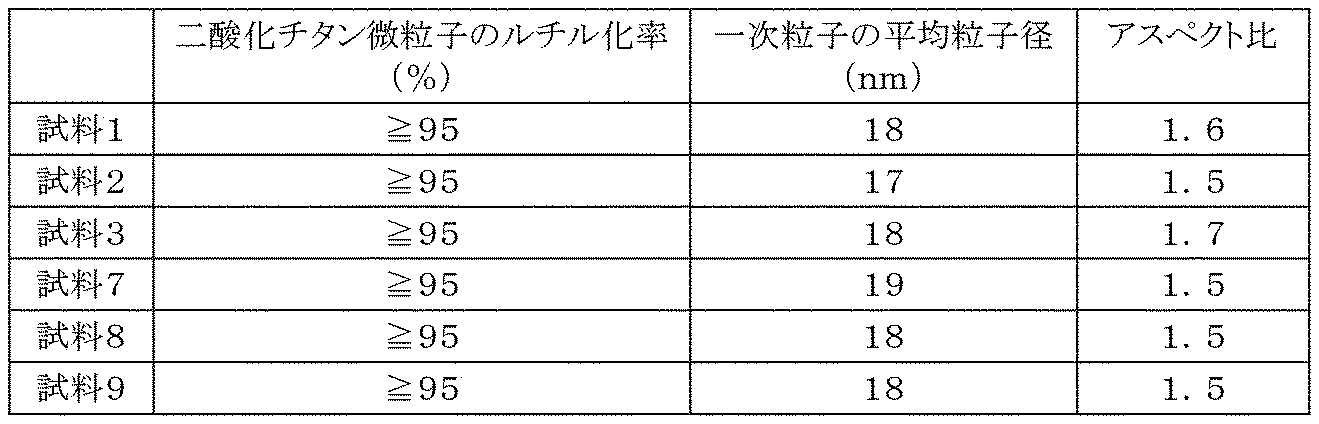
70mLのマヨネーズ瓶に二酸化チタン微粒子である試料1を12.8gと、シランカップリング剤である3-メタクリロキシプロピルトリエトキシシラン KBM-503(信越シリコーン社製)1.92gと、塩基性吸着基を有する分散剤であるアミノ系分散剤であるソルスパース(登録商標)20000(Lubrizol社製、アミン価32mgKOH/g)0.384gと、有機溶剤であるプロピレングリコールモノメチルエーテル(PGME)24.896gと、0.05mmのジルコニアビーズ100gを入れ、ペイントシェーカー(レッドデビル社製 5410型)にて、4時間湿式分散した。得られた分散体からジルコニアビーズを除去し、遠心分離機にて、2400G、30分間の条件にて遠心分離し、上澄み液を回収し、実施例1の有機溶媒分散体を得た。
この有機溶媒分散体中のアミン系分散剤の質量比はシランカップリング剤に対して20質量%であった。二酸化チタン微粒子に対して使用したシランカップリング剤は15質量%であり、アミン系分散剤は3質量%であり、その両者の総量は18質量%であった。
実施例1において、二酸化チタン微粒子を試料2に変更した以外は、実施例1と同様にして実施例2の有機溶媒分散体を得た。
実施例1において、ソルスパース20000の使用量を0.640gに、PGMEの使用量を24.640gに変更した以外は、実施例1と同様にして実施例3の有機溶媒分散体を得た。
この有機溶媒分散体中のアミン系分散剤の質量比はシランカップリング剤に対して33質量%であった。二酸化チタン微粒子に対して使用したシランカップリング剤は15質量%であり、アミン系分散剤は5質量%であり、その両者の総量は20質量%であった。
実施例1において、二酸化チタン微粒子を試料3に変更した以外は、実施例1と同様にして実施例4の有機溶媒分散体を得た。
70mLのマヨネーズ瓶に二酸化チタン微粒子である試料2を12.8gと、シランカップリング剤である3-メタクリロキシプロピルトリエトキシシラン KBM-503(信越シリコーン社製)1.92gと、アミン系分散剤であるソルスパース(登録商標)20000(Lubrizol社製、アミン価32mgKOH/g)0.435gと、有機溶剤であるプロピレングリコールモノメチルエーテルアセテート(PGMEA)24.840gと、0.05mmのジルコニアビーズ100gを入れ、ペイントシェーカー(レッドデビル社製 5410型)にて、4時間湿式分散した。得られた分散体からジルコニアビーズを除去し、遠心分離機にて、2400G、30分間の条件にて遠心分離し、上澄み液を回収し、実施例5の有機溶媒分散体を得た。
この有機溶媒分散体中のアミン系分散剤の質量比はシランカップリング剤に対して22.6質量%であった。二酸化チタン微粒子に対して使用したシランカップリング剤は15質量%であり、アミン系分散剤は3.4質量%であり、その両者の総量は18.4質量%であった。
実施例5において、有機溶剤をPGMEに変更し、二酸化チタン微粒子を試料7に変更した以外は、実施例5と同様にして実施例6の有機溶媒分散体を得た。
実施例6において、二酸化チタン微粒子を試料8に変更した以外は、実施例6と同様にして実施例7の有機溶媒分散体を得た。
実施例6において、二酸化チタン微粒子を試料9に変更した以外は、実施例6と同様にして実施例8の有機溶媒分散体を得た。
実施例1において、二酸化チタン微粒子を試料4に変更した以外は、実施例1と同様にして比較例1に有機溶媒分散体を得た。
実施例1において、二酸化チタン微粒子を試料5に変更した以外は、実施例1と同様にして比較例2に有機溶媒分散体を得た。
実施例1において、二酸化チタン微粒子を試料6に変更した以外は、実施例1と同様にして比較例3に有機溶媒分散体を得た。
実施例2において、アミン系分散剤を使用せず、シランカップリング剤の使用量を2.304gに変更した以外は、実施例2と同様にして比較例4の有機溶媒分散体を得た。
この有機溶媒分散体中のアミン系分散剤の質量比はシランカップリング剤に対して0質量%であった。二酸化チタン微粒子に対して使用したシランカップリング剤は18質量%であり、アミン系分散剤は0質量%であり、その両者の総量は18質量%であった。
実施例1~8、比較例1~4の有機溶媒分散体のそれぞれについて、2400G、30分間の条件で遠心分離を行い、上澄み液を回収した。前記上澄み液を150℃で、少なくとも1時間以上、上澄み液からの重量減少がなくなるまで乾燥を行い、得られる固形分量を測定した(具体的には、得られる固形分の重量を測定し、前記上澄み液中の固形分濃度を算出した)。前記分量(具体的には、上澄み液の固形分濃度)を、前記実施例1~8、比較例1~4の有機溶媒分散体を作製時(すなわち遠心分離前)の固形分濃度で除することで、分散収率を算出した。
上記、遠心分離後の有機溶媒分散体の上澄み液について、分光光度計(V―770、日本分光製、石英セル厚さ10mm)を用いて、分散体の二酸化チタン微粒子の濃度を12g/Lに調整して分散体の380nmから780nmの範囲における平均透過率を測定した。分散体の二酸化チタン微粒子の濃度は800℃での加熱残分より求めた。結果を表3に示す。
上記、遠心分離後の有機溶媒分散体の上澄み液について、動的光散乱式粒子径分布測定装置(NANOTRAC(登録商標) WAVE II EX150、マイクロトラックベル社製)等を用いて下記の条件により、体積基準におけるD50及びD90を測定した。
(1)溶媒(PGME)の屈折率:1.4、粘度1.75(25℃)-1.55(30℃);
(2)粒子屈折率:2.55;
(3)粒子密度:4.2g/cm3;及び
(4)ローディングインデックス:0.1~0.3。
(1)溶媒(PGMEA)の屈折率:1.4、粘度:1.098(20℃)-0.948(30℃);
(2)粒子屈折率:2.55;
(3)粒子密度:4.2g/cm3;
(4)ローディングインデックス:0.1~0.3。

[コーティング組成物の作製]
実施例1に記載の有機溶媒分散体において、固形分70質量部に対し、紫外線硬化樹脂としてライトアクリレート(登録商標)POB-A(共栄社化学社製、アクリルモノマー)とアロニックス(登録商標)M-309(東亜合成社製、トリメチロールプロパントリアクリレート)をそれぞれ14.3質量部、硬化重合開始剤として、Omnirad(登録商標)-907(IGM RESINS B.V.社製)1.4質量部を混合して、コーティング組成物を得た。なお、有機溶媒分散体の固形分は、150℃の加熱残分により求めた。
洗浄したガラス板に上記コーティング組成物をスピンコート(1000rpm×8秒)で塗布し、90℃にて3分乾燥した後、高圧水銀灯を3J/cm2の積算光量となるよう照射して実施例9の塗膜を得た。
実施例9において、実施例2に記載の有機溶媒分散体を使用した以外は、実施例9と同様にして実施例10の塗膜を得た。
実施例9において、実施例4に記載の有機溶媒分散体を使用した以外は、実施例9と同様にして実施例11の塗膜を得た。
実施例9において、実施例5に記載の有機溶媒分散体を使用した以外は、実施例9と同様にして実施例12の塗膜を得た。
実施例9において、実施例6に記載の有機溶媒分散体を使用した以外は、実施例9と同様にして実施例13の塗膜を得た。
実施例9において、実施例7に記載の有機溶媒分散体を使用した以外は、実施例9と同様にして実施例14の塗膜を得た。
実施例9において、実施例8に記載の有機溶媒分散体を使用した以外は、実施例9と同様にして実施例15の塗膜を得た。
実施例9~15で得た塗膜について、ヘーズメーター(COH-7700(日本電色工業社製))でJIS K 7136に則り塗膜のヘーズを測定した。

Claims (17)
- 蛍光X線分析測定によってチタン成分、スズ成分及びアルミニウム成分が検出され、かつ、粉末X線回折測定によってルチル型二酸化チタンに由来するX線回折ピークが観測され、スズ成分及びアルミニウム成分に由来するX線回折ピークが観測されない二酸化チタン微粒子と、
有機溶剤と、
シランカップリング剤と、
塩基性吸着基を有する分散剤と、
を含む、二酸化チタン微粒子の有機溶媒分散体。 - 蛍光X線分析測定によってチタン成分、スズ成分及びアルミニウム成分が検出され、かつ、粉末X線回折測定によってルチル型二酸化チタンに由来するX線回折ピークのみが観測され、スズ成分及びアルミニウム成分に由来するX線回折ピークが観測されない二酸化チタン微粒子と、
有機溶剤と、
シランカップリング剤と、
塩基性吸着基を有する分散剤と、
を含む、二酸化チタン微粒子の有機溶媒分散体。 - 前記二酸化チタン微粒子が、前記スズ成分と前記アルミニウム成分とを固溶した二酸化チタン微粒子を含む、請求項1又は2に記載の二酸化チタン微粒子の有機溶媒分散体。
- 前記二酸化チタン微粒子のチタン成分の量に対する前記スズ成分の量と前記アルミニウム成分の量との合計量が、前記チタン成分の量をTiO2量、前記スズ成分の量をSnO2量、そして前記アルミニウム成分の量をAl2O3量に換算して[(SnO2量+Al2O3量)/TiO2量]の質量比で表した場合に、0.6質量%以上30質量%以下である、請求項1又は2に記載の二酸化チタン微粒子の有機溶媒分散体。
- 前記アルミニウム成分の量に対する前記スズ成分の量が、前記アルミニウム成分の量をAl2O3量、そして前記スズ成分の量をSnO2量に換算して[SnO2量/Al2O3量]の質量比で表した場合に、0.01質量%以上40質量%以下である、請求項1又は2に記載の二酸化チタン微粒子の有機溶媒分散体。
- 前記シランカップリング剤に対する前記塩基性吸着基を有する分散剤の質量比が、15質量%以上75質量%以下である、請求項1又は2に記載の二酸化チタン微粒子の有機溶媒分散体。
- 前記二酸化チタン微粒子が、蛍光X線分析測定によって、さらにシリコン成分、コバルト成分およびマンガン成分からなる群より選ばれた1種以上の成分が検出され、かつ、粉末X線回折測定によってシリコン成分、コバルト成分およびマンガン成分からなる群より選ばれた1種以上の成分に由来するX線回折ピークが観察されない二酸化チタン微粒子を含む、請求項1又は2に記載の二酸化チタン微粒子の有機溶媒分散体。
- 前記二酸化チタン微粒子が、前記シリコン成分、コバルト成分およびマンガン成分からなる群より選ばれた1種以上の成分を固溶した二酸化チタン微粒子を含む、請求項1又は2に記載の二酸化チタン微粒子の有機溶媒分散体。
- 前記二酸化チタン微粒子の表面に無機化合物を被覆している、請求項1又は2に記載の二酸化チタン微粒子の有機溶媒分散体。
- 請求項1又は2に記載の二酸化チタン微粒子の有機溶媒分散体と、バインダー樹脂とを含むコーティング組成物。
- 請求項1又は2に記載の二酸化チタン微粒子の有機溶媒分散体と、バインダー樹脂とを含む塗膜。
- 請求項1又は2に記載の二酸化チタン微粒子の有機溶媒分散体と、バインダー樹脂とを含むナノインプリント用組成物。
- 蛍光X線分析測定によってチタン成分、スズ成分及びアルミニウム成分が検出され、かつ、粉末X線回折測定によってルチル型二酸化チタンに由来するX線回折ピークが観測され、スズ成分及びアルミニウム成分に由来するX線回折ピークが観測されない二酸化チタン微粒子と、シランカップリング剤と、塩基性吸着基を有する分散剤とを、有機溶剤に分散させる工程を含む、二酸化チタン微粒子の有機溶媒分散体の製造方法。
- 蛍光X線分析測定によってチタン成分、スズ成分及びアルミニウム成分が検出され、かつ、粉末X線回折測定によってルチル型二酸化チタンに由来するX線回折ピークのみが観測され、スズ成分及びアルミニウム成分に由来するX線回折ピークが観測されない二酸化チタン微粒子と、シランカップリング剤と、塩基性吸着基を有する分散剤とを、有機溶剤に分散させる工程を含む、二酸化チタン微粒子の有機溶媒分散体の製造方法。
- 前記有機溶媒分散体を更に遠心分離する工程を含む、請求項13又は14に記載の二酸化チタン微粒子の有機溶媒分散体の製造方法。
- 前記二酸化チタン微粒子が、以下の工程によって製造される、請求項13又は14に記載の二酸化チタン微粒子の有機溶媒分散体の製造方法:
工程(1):(オキシ)塩化チタンと、スズ化合物との混合物を加水分解する工程であるか、又は、スズ化合物を加水分解して得た核粒子の存在下で(オキシ)塩化チタンを加水分解する工程;
工程(2):前記加水分解後の生成物と、アルミニウム化合物とを混合する工程;および
工程(3):前記加水分解後の生成物と、アルミニウム化合物を混合したものを250℃以上1000℃以下の温度で焼成することを含む工程。 - 前記工程(1)が、(オキシ)塩化チタンと、スズ化合物と、カルボン酸又はその塩との混合物を加水分解する工程であるか、又は、スズ化合物を加水分解して得た核粒子の存在下で、(オキシ)塩化チタンと、カルボン酸又はその塩を添加して、前記(オキシ)塩化チタンを加水分解する工程である、請求項16に記載の二酸化チタン微粒子の有機溶媒分散体の製造方法。
Priority Applications (4)
| Application Number | Priority Date | Filing Date | Title |
|---|---|---|---|
| JP2025530172A JPWO2025005144A1 (ja) | 2023-06-28 | 2024-06-26 | |
| EP24832003.8A EP4737393A1 (en) | 2023-06-28 | 2024-06-26 | Dispersion of titanium dioxide fine particles in organic solvent, method for producing same, and use of same |
| KR1020257041194A KR20260030730A (ko) | 2023-06-28 | 2024-06-26 | 이산화티탄 미립자의 유기 용매 분산체 및 그 제조 방법 그리고 그 용도 |
| CN202480039658.5A CN121311445A (zh) | 2023-06-28 | 2024-06-26 | 二氧化钛微粒的有机溶剂分散体及其制造方法以及其用途 |
Applications Claiming Priority (2)
| Application Number | Priority Date | Filing Date | Title |
|---|---|---|---|
| JP2023106407 | 2023-06-28 | ||
| JP2023-106407 | 2023-06-28 |
Publications (1)
| Publication Number | Publication Date |
|---|---|
| WO2025005144A1 true WO2025005144A1 (ja) | 2025-01-02 |
Family
ID=93938655
Family Applications (1)
| Application Number | Title | Priority Date | Filing Date |
|---|---|---|---|
| PCT/JP2024/023201 Ceased WO2025005144A1 (ja) | 2023-06-28 | 2024-06-26 | 二酸化チタン微粒子の有機溶媒分散体及びその製造方法並びにその用途 |
Country Status (6)
| Country | Link |
|---|---|
| EP (1) | EP4737393A1 (ja) |
| JP (1) | JPWO2025005144A1 (ja) |
| KR (1) | KR20260030730A (ja) |
| CN (1) | CN121311445A (ja) |
| TW (1) | TW202515822A (ja) |
| WO (1) | WO2025005144A1 (ja) |
Citations (4)
| Publication number | Priority date | Publication date | Assignee | Title |
|---|---|---|---|---|
| JP2003327430A (ja) * | 2002-03-06 | 2003-11-19 | Ishihara Sangyo Kaisha Ltd | ルチル型二酸化チタン微粒子およびその製造方法 |
| JP2009227500A (ja) * | 2008-03-21 | 2009-10-08 | Tayca Corp | 透明酸化チタンオルガノゾルおよびそれを配合したコーティング組成物,光学基材 |
| JP2013203929A (ja) * | 2012-03-29 | 2013-10-07 | Ishihara Sangyo Kaisha Ltd | 無機物粒子分散体及びその製造方法 |
| WO2022239788A1 (ja) * | 2021-05-11 | 2022-11-17 | 日揮触媒化成株式会社 | ルチル型酸化チタン粒子、分散液、塗膜形成用塗布液、および塗膜付基材 |
-
2024
- 2024-06-26 CN CN202480039658.5A patent/CN121311445A/zh active Pending
- 2024-06-26 TW TW113123733A patent/TW202515822A/zh unknown
- 2024-06-26 KR KR1020257041194A patent/KR20260030730A/ko active Pending
- 2024-06-26 EP EP24832003.8A patent/EP4737393A1/en active Pending
- 2024-06-26 JP JP2025530172A patent/JPWO2025005144A1/ja active Pending
- 2024-06-26 WO PCT/JP2024/023201 patent/WO2025005144A1/ja not_active Ceased
Patent Citations (4)
| Publication number | Priority date | Publication date | Assignee | Title |
|---|---|---|---|---|
| JP2003327430A (ja) * | 2002-03-06 | 2003-11-19 | Ishihara Sangyo Kaisha Ltd | ルチル型二酸化チタン微粒子およびその製造方法 |
| JP2009227500A (ja) * | 2008-03-21 | 2009-10-08 | Tayca Corp | 透明酸化チタンオルガノゾルおよびそれを配合したコーティング組成物,光学基材 |
| JP2013203929A (ja) * | 2012-03-29 | 2013-10-07 | Ishihara Sangyo Kaisha Ltd | 無機物粒子分散体及びその製造方法 |
| WO2022239788A1 (ja) * | 2021-05-11 | 2022-11-17 | 日揮触媒化成株式会社 | ルチル型酸化チタン粒子、分散液、塗膜形成用塗布液、および塗膜付基材 |
Non-Patent Citations (1)
| Title |
|---|
| RSC ADV., vol. 10, 2020, pages 43592 - 43598 |
Also Published As
| Publication number | Publication date |
|---|---|
| EP4737393A1 (en) | 2026-05-06 |
| KR20260030730A (ko) | 2026-03-06 |
| JPWO2025005144A1 (ja) | 2025-01-02 |
| CN121311445A (zh) | 2026-01-09 |
| TW202515822A (zh) | 2025-04-16 |
Similar Documents
| Publication | Publication Date | Title |
|---|---|---|
| KR101309584B1 (ko) | 코어 쉘 형 무기 산화물 미립자 분산액 그의 제조방법 및 그 분산액을 포함하는 도료 조성물 | |
| CN109952348B (zh) | 复合颜料及其制备方法,含有复合颜料的涂料组合物,以及涂膜 | |
| US7276231B2 (en) | Lower-energy process for preparing passivated inorganic nanoparticles | |
| KR101437200B1 (ko) | 표면 피복된 이산화티탄졸, 그 제조법 및 그것을 포함한 코팅 조성물 | |
| JP5854584B2 (ja) | 高屈折率金属酸化物微粒子を含む水分散ゾルの調製方法、該方法から得られる水分散ゾルおよび前記微粒子を含む有機溶媒分散ゾル並びに塗料組成物 | |
| US8697757B2 (en) | Hydrophobic organic solvent-dispersed sol of anhydrous zinc antimonate colloidal particles and method for producing the same | |
| CN102770375B (zh) | 复合颗粒及其制造方法 | |
| WO2010001818A1 (ja) | 酸化スズ粒子及びその製造方法 | |
| JP2001026423A (ja) | ルチル型超微粒子二酸化チタンの製造方法 | |
| CN105143108A (zh) | 表面被覆粒子及其用途 | |
| JP5511368B2 (ja) | 高屈折率金属酸化物微粒子を含む有機溶媒分散ゾルの調製方法並びにその有機溶媒分散ゾル、および該有機溶媒分散ゾルを用いて得られる塗料組成物 | |
| JP5258447B2 (ja) | 酸化チタン系複合粒子の分散液および該分散液の製造方法 | |
| TW202306903A (zh) | 硫化鉍粒子及其製造方法以及其用途 | |
| WO2025005144A1 (ja) | 二酸化チタン微粒子の有機溶媒分散体及びその製造方法並びにその用途 | |
| JP3877235B2 (ja) | ルチル型二酸化チタン粒子およびその製造法 | |
| KR101763357B1 (ko) | 루타일 이산화티탄 분말의 제조방법 | |
| TWI879828B (zh) | 二氧化鈦微粒子之有機溶劑分散體及其製造方法,與其用途 | |
| JP2005008515A (ja) | 金属酸化物粒子及びその製造方法 | |
| JP4153329B2 (ja) | ルチル型棒状二酸化チタンの製造方法 | |
| JP3548199B2 (ja) | 二酸化チタン微粉末およびその製造方法 | |
| JP7650364B2 (ja) | 酸化アルミニウム系組成物含有窒化ジルコニウム粉末及びその製造方法 | |
| WO2024106401A1 (ja) | 酸化チタン粒子、分散液、塗膜形成用塗布液、塗膜および塗膜付基材 | |
| JP2025150472A (ja) | 酸化チタン粒子、分散液、塗料組成物、塗膜および塗膜付基材 | |
| EP4660141A1 (en) | Dispersion body including strontium titanate spherical fine particle powder and method for producing same | |
| EP4660142A1 (en) | Surface-treated spherical strontium titanate particulate powder, dispersion, and resin composition |
Legal Events
| Date | Code | Title | Description |
|---|---|---|---|
| 121 | Ep: the epo has been informed by wipo that ep was designated in this application |
Ref document number: 24832003 Country of ref document: EP Kind code of ref document: A1 |
|
| ENP | Entry into the national phase |
Ref document number: 2025530172 Country of ref document: JP Kind code of ref document: A |
|
| WWE | Wipo information: entry into national phase |
Ref document number: 2025530172 Country of ref document: JP |
|
| WWE | Wipo information: entry into national phase |
Ref document number: 2024832003 Country of ref document: EP |
|
| NENP | Non-entry into the national phase |
Ref country code: DE |
|
| ENP | Entry into the national phase |
Ref document number: 2024832003 Country of ref document: EP Effective date: 20260128 |
|
| ENP | Entry into the national phase |
Ref document number: 2024832003 Country of ref document: EP Effective date: 20260128 |