WO2024257726A1 - 硫酸マンガン溶液の製造方法 - Google Patents
硫酸マンガン溶液の製造方法 Download PDFInfo
- Publication number
- WO2024257726A1 WO2024257726A1 PCT/JP2024/021059 JP2024021059W WO2024257726A1 WO 2024257726 A1 WO2024257726 A1 WO 2024257726A1 JP 2024021059 W JP2024021059 W JP 2024021059W WO 2024257726 A1 WO2024257726 A1 WO 2024257726A1
- Authority
- WO
- WIPO (PCT)
- Prior art keywords
- type
- zeolite
- potassium
- less
- manganese sulfate
- Prior art date
- Legal status (The legal status is an assumption and is not a legal conclusion. Google has not performed a legal analysis and makes no representation as to the accuracy of the status listed.)
- Ceased
Links
Classifications
-
- B—PERFORMING OPERATIONS; TRANSPORTING
- B01—PHYSICAL OR CHEMICAL PROCESSES OR APPARATUS IN GENERAL
- B01D—SEPARATION
- B01D15/00—Separating processes involving the treatment of liquids with solid sorbents; Apparatus therefor
-
- B—PERFORMING OPERATIONS; TRANSPORTING
- B01—PHYSICAL OR CHEMICAL PROCESSES OR APPARATUS IN GENERAL
- B01J—CHEMICAL OR PHYSICAL PROCESSES, e.g. CATALYSIS OR COLLOID CHEMISTRY; THEIR RELEVANT APPARATUS
- B01J20/00—Solid sorbent compositions or filter aid compositions; Sorbents for chromatography; Processes for preparing, regenerating or reactivating thereof
- B01J20/02—Solid sorbent compositions or filter aid compositions; Sorbents for chromatography; Processes for preparing, regenerating or reactivating thereof comprising inorganic material
- B01J20/10—Solid sorbent compositions or filter aid compositions; Sorbents for chromatography; Processes for preparing, regenerating or reactivating thereof comprising inorganic material comprising silica or silicate
- B01J20/16—Alumino-silicates
- B01J20/18—Synthetic zeolitic molecular sieves
-
- C—CHEMISTRY; METALLURGY
- C01—INORGANIC CHEMISTRY
- C01G—COMPOUNDS CONTAINING METALS NOT COVERED BY SUBCLASSES C01D OR C01F
- C01G45/00—Compounds of manganese
- C01G45/02—Oxides
-
- C—CHEMISTRY; METALLURGY
- C01—INORGANIC CHEMISTRY
- C01G—COMPOUNDS CONTAINING METALS NOT COVERED BY SUBCLASSES C01D OR C01F
- C01G45/00—Compounds of manganese
- C01G45/10—Sulfates
-
- Y—GENERAL TAGGING OF NEW TECHNOLOGICAL DEVELOPMENTS; GENERAL TAGGING OF CROSS-SECTIONAL TECHNOLOGIES SPANNING OVER SEVERAL SECTIONS OF THE IPC; TECHNICAL SUBJECTS COVERED BY FORMER USPC CROSS-REFERENCE ART COLLECTIONS [XRACs] AND DIGESTS
- Y02—TECHNOLOGIES OR APPLICATIONS FOR MITIGATION OR ADAPTATION AGAINST CLIMATE CHANGE
- Y02P—CLIMATE CHANGE MITIGATION TECHNOLOGIES IN THE PRODUCTION OR PROCESSING OF GOODS
- Y02P10/00—Technologies related to metal processing
- Y02P10/20—Recycling
Definitions
- This disclosure examines an industrially applicable method for producing a manganese sulfate solution by selectively removing potassium from an acidic manganese sulfate solution.
- the XRD pattern can be measured using a general powder X-ray diffraction device (for example, device name: Ultima IV, manufactured by Rigaku Corporation).
- Zeolite is a compound in which the skeleton atoms (hereinafter also referred to as "T atoms”) have a regular structure with oxygen (O) interposed therebetween, and the T atoms are at least one of metal atoms and metalloid atoms.
- metal atoms include one or more selected from the group consisting of aluminum (Al), titanium (Ti), iron (Fe), zinc (Zn), gallium (Ga) and tin (Sn), with aluminum being preferred.
- metalloid atoms include one or more selected from the group consisting of boron (B), silicon (Si), germanium (Ge), arsenic (As), antimony (Sb) and tellurium (Te), with silicon being preferred.
- Zerolite-like substances are compounds in which the T atoms have a regular structure with oxygen mediated through them, and the T atoms contain at least an atom other than a metal or metalloid.
- Examples of zeolite-like substances include complex phosphorus compounds that contain phosphorus (P) as the T atom, such as aluminophosphate (AlPO) and silicoaluminophosphate (SAPO).
- [M] and [Al] can be determined by ICP atomic emission spectrometry using a general ICP-AES device (e.g., product name: OPTIMA3000DV, manufactured by PERKIN-ELMER).
- a general ICP-AES device e.g., product name: OPTIMA3000DV, manufactured by PERKIN-ELMER.
- the method for producing the manganese sulfate solution of this embodiment is a production method (hereinafter also referred to as the "production method of this embodiment") that includes a step of contacting a manganese sulfate solution containing potassium ions (hereinafter also referred to as the "pre-treatment solution") with a zeolite having a molar ratio of silica to alumina of 6 or more and containing an 8-membered oxygen ring in its framework structure (hereinafter also referred to as the "8-membered ring zeolite”), and adsorbing the potassium ions onto the zeolite (hereinafter also referred to as the "potassium removal step").
- a production method of this embodiment that includes a step of contacting a manganese sulfate solution containing potassium ions (hereinafter also referred to as the "pre-treatment solution”) with a zeolite having a molar ratio of silica to alumina of 6 or more
- the zeolite in the manufacturing method of this embodiment is a zeolite containing an 8-membered oxygen ring in the framework structure (hereinafter referred to as "8-membered ring zeolite").
- 8-membered ring zeolite Conventionally, A-type zeolite and X-type zeolite have been known as ion exchangers with high heat resistance and high selectivity.
- these zeolites cannot be used as ion exchangers in acidic solutions such as manganese sulfate solutions because their structure collapses in an acidic environment.
- 8-membered ring zeolites In contrast, in this embodiment, attention is focused on 8-membered ring zeolites, and an 8-membered ring zeolite having the above-mentioned molar ratio of silica to alumina is used, so that the pre-treatment solution can be treated without structural collapse even in an acidic environment.
- 8-membered ring zeolites can be used is that, in addition to the effect of suppressing the release of aluminum ions by the 8-membered oxygen ring, potassium easily enters the pores inside the zeolite of this embodiment, and potassium adsorbed on the zeolite is less likely to be released from the zeolite.
- the eight-membered ring zeolite used in the manufacturing method of this embodiment includes zeolites having one or more skeletal structures selected from the group consisting of AEI type, AFT type, AFX type, CHA type, EAB type, ERI type, ESV type, FER type, GME type, HEU type, KFI type, LEV type, LTA type, LTL type, MAZ type, MEL type, MER type, MFS type, MOR type, MOZ type, MRT type, MWF type, OFF type, PAU type, PTT type, PTY type, PWN type, PWW type, RHO type, RTH type, SFW type, STI type, SZR type, TUN type, UFI type, and YFI type, and preferably AEI type, AF Zeolites having one or more skeletal structures selected from the group consisting of X-type, CHA-type, ERI-type, FER-type, HEU-type, KFI-type, LEV-type, MEL
- the 8-membered ring zeolite is preferably at least one of a zeolite that contains a 5-membered oxygen ring in addition to an 8-membered oxygen ring in the framework structure, and a zeolite in which the largest pore contains an 8-membered oxygen ring. This makes the structure less likely to collapse in an acidic environment.
- Eight-membered ring zeolites in which the largest pore contains an eight-membered oxygen ring include zeolites having one or more skeletal structures selected from the group consisting of AEI type, AFT type, AFX type, CHA type, EAB type, ERI type, ESV type, KFI type, LEV type, LTA type, MER type, MRT type, MWF type, PAU type, PTT type, PWN type, RHO type, RTH type, SFW type, and UFI type, with zeolites having a CHA type skeletal structure being preferred.
- the eight-membered ring zeolite contains pores with two or more dimensions. This improves the diffusivity of ions, making them easier to adsorb.
- Eight-membered ring zeolites containing two-dimensional or higher pores include AEI type, AFT type, AFX type, CHA type, EAB type, ERI type, FER type, GME type, HEU type, KFI type, LEV type, LTA type, MAZ type, MEL type, MER type, MFS type, MOZ type, MRT type, MWF type, OFF type, PAU type, PTT type, PTY type, PWN type, PWW type, RHO type, RTH type, SFW type, STI type, and Examples of zeolites include those having one or more skeletal structures selected from the group consisting of ZR type, TUN type, UFI type, and YFI type.
- the molar ratio of silica to alumina in the 8-membered ring zeolite (hereinafter also referred to as "SiO 2 /Al 2 O 3 ratio") is 6 or more.
- SiO 2 /Al 2 O 3 ratio of the 8-membered ring zeolite is 6 or more, 8 or more, 10 or more, 13 or more, or 15 or more, and is preferably 100 or less, 80 or less, 50 or less, or 35 or less.
- the SiO 2 /Al 2 O 3 ratio of the 8-membered ring zeolite is preferably 6 or more and 100 or less, 8 or more and 80 or less, or 15 or more and 35 or less.
- the particle diameter D50 of the 8-membered ring zeolite is preferably 1 ⁇ m or more, 3 ⁇ m or more, 5 ⁇ m or more, or 7 ⁇ m or more, and 20 ⁇ m or less, 15 ⁇ m or less, or 12 ⁇ m or less, in that it tends to have high potassium ion adsorption performance, and examples of such diameters include 1 ⁇ m or more and 20 ⁇ m or less, 3 ⁇ m or more and 15 ⁇ m or less, 5 ⁇ m or more and 12 ⁇ m or less, or 7 ⁇ m or more and 12 ⁇ m or less.
- the particle diameter D50 of the 8-membered ring zeolite is a particle diameter corresponding to the D50 (median diameter) of the volume particle size distribution obtained by a laser diffraction/scattering method using a general particle size distribution measuring device (for example, device name: MT-3100II, manufactured by Microtrack Bell). Specific measurement conditions include the following. Measurement range: 0.02 to 2000 ⁇ m Particle refractive index: 1.66 Particle permeability: Permeable Particle shape: Aspheric Solvent refractive index: 1.333 Ultrasonic pretreatment: None
- the selectivity of the potassium (K) ion of the 8-membered ring zeolite can be 10% or more, 15% or more, or 20% or more. This allows the potassium ion to be adsorbed by efficiently utilizing the ion exchange capacity of the zeolite. It is preferable that the selectivity of the potassium ion is high, and examples of this include 95% or less, 50% or less, or 30% or less, and examples of this include 10% to 95%; 15% to 50%; or 20% to 30%.
- the selectivity of manganese (Mn) ions in the 8-membered ring zeolite is preferably 50% or less, 40% or less, or 30% or less. This allows the potassium ions to be adsorbed by efficiently utilizing the ion exchange capacity of the zeolite. It is preferable that the selectivity of manganese ions is low, and is preferably, for example, 0% or more and 50% or less, more than 0% and 50% or less, or even 5% or more and 40% or less.
- the manganese ion selectivity of the eight-membered ring zeolite can be calculated from the above formula (1) as follows.
- Manganese ion selectivity [%] ([Mn] x 2) / [Al] x 100 (However, all manganese ions adsorbed on the 8-membered ring zeolite are assumed to be divalent (Mn 2+ ).)
- the calcium (Ca) ion selectivity of the 8-membered ring zeolite is preferably less than 10%, 7% or less, or 5% or less. This allows the potassium ions to be adsorbed by efficiently utilizing the ion exchange capacity of the zeolite. It is preferable that the calcium ion selectivity is low, and is preferably, for example, 0% or more and less than 10%, more than 0% and less than 10%, or even 1% or more and 5% or less.
- the selectivity of magnesium (Mg) ions in the 8-membered ring zeolite is preferably less than 10%, 7% or less, or 5% or less. This allows the potassium ions to be adsorbed by efficiently utilizing the ion exchange capacity of the zeolite. It is preferable that the selectivity of magnesium ions is low, and is preferably, for example, 0% or more and less than 10%, more than 0% and less than 10%, or even 1% or more and 5% or less.
- the 8-membered ring zeolite subjected to the potassium removal step may be one exchanged with any cation, but is preferably one exchanged with protons or sodium ions (i.e., the cation type is proton type or sodium type). If potassium ions are partially contained, the ion exchange capacity of the zeolite is substantially reduced, so it is preferable that the amount of potassium ions in the zeolite is as small as possible.
- the exchange rate of potassium ions relative to the molar amount of ion-exchangeable ions in the 8-membered ring zeolite is preferably 0% or more and 5% or less, and more preferably 0% or more and 2% or less.
- the pre-treatment solution used in the manufacturing method of this embodiment is a manganese sulfate solution containing potassium, and in particular, a manganese sulfate solution obtained by dissolving manganese ore with sulfuric acid.
- the pre-treatment solution contains potassium, and the concentration of the potassium ions can be, for example, 40 ppm by mass or more, 60 ppm by mass or more, 80 ppm by mass or more, 100 ppm by mass or more, or 120 ppm by mass or more as the mass ratio of potassium ions to the pre-treatment solution, and can also be 10,000 ppm by mass or less, 5,000 ppm by mass or less, or 1,000 ppm by mass or less.
- potassium ion concentration range of the manganese sulfate solution obtained by dissolving manganese ore in sulfuric acid as the pre-treatment solution include 40 ppm by mass or more and 10,000 ppm by mass or less, 60 ppm by mass or more and 5,000 ppm by mass or less, and even 80 ppm by mass or more and 500 ppm by mass or less.
- the manganese sulfate in the pre-treatment solution may be contained as Mn 2+ ions and SO 4 2- ions, but the pre-treatment solution may also contain manganese ions having a different valence from the Mn 2+ ions.
- Such manganese ions include one or more selected from the group consisting of Mn 3+ ions, Mn 4+ ions, and MnO 4 2- ions.
- the manganese ion concentration of the pre-treatment solution may be any concentration that can be used as a raw material for manganese oxide, and may be 1% by mass or more, 2% by mass or more, 3% by mass or more, or 3.5% by mass or more, and 12% by mass or less, 10% by mass or less, or 8% by mass or less, with 1% by mass or more and 12% by mass or less, 2% by mass or more and 10% by mass or less, or 3% by mass or more and 8% by mass or less being preferred.
- Manganese ion concentration refers to the total concentration of manganese ions in a solution.
- Manganese ion concentration can be determined by ICP atomic emission spectrometry using a general ICP-AES device (for example, product name: OPTIMA3000DV, manufactured by PERKIN-ELMER).
- the molar ratio of manganese ions to potassium ions contained in the pre-treatment solution may be 10 or more, 50 or more, 100 or more, 150 or more, or 180 or more, and may be 3000 or less, 2500 or less, 1500 or less, 1000 or less, or 800 or less, with preferred ranges being 10 or more and 3000 or less, 50 or more and 2500 or less, 100 or more and 1500 or less, 150 or more and 1000 or less, and 180 or more and 800 or less.
- the potassium concentration of the manganese sulfate solution can be reduced without using excess zeolite while exhibiting high potassium selectivity.
- the pre-treatment solution may contain ions other than potassium ions and manganese ions.
- Such ions include at least one of sodium ions, cobalt ions, magnesium ions, and calcium ions, and at least one of magnesium ions and calcium ions.
- the selectivity of impurities other than potassium is preferably less than 20%, 10% or less, or 5% or less. The lower the selectivity of impurities other than potassium, the better, but it is preferably 0.1% or more, 0.2% or more, or 0.5% or more. Specific ranges of the selectivity of impurities other than potassium can be 0.1% or more and less than 20%, 0.2% or more and 10% or less, or 0.5% or more and 5% or less.
- the manufacturing method of this embodiment may include a step of removing ions other than the potassium ions and manganese ions from the pre-treatment solution (hereinafter, "impurity removal step") prior to the potassium removal step.
- impurity removal step a step of removing ions other than the potassium ions and manganese ions from the pre-treatment solution
- the method for removing ions other than the potassium ions and manganese ions from the pre-treatment solution is not particularly limited, and any known method can be used.
- the solvent for the pre-treatment solution may be at least one of water and alcohol, but it is preferable that it is water, i.e., the pre-treatment solution is an aqueous manganese sulfate solution.
- the pH of the pre-treatment solution is preferably 6 or less. This makes it difficult for manganese oxide to separate out and precipitate.
- the pH of the pre-treatment solution is preferably 3 to 6, more preferably 4 to 6.
- the pre-treatment solution can be produced by a known method, for example, a method for producing a manganese sulfate solution that includes a step of dissolving naturally occurring manganese ore with sulfuric acid or an aqueous solution of sulfuric acid.
- the method of contacting the 8-membered ring zeolite with the pre-treatment solution includes a method in which the two are uniformly contacted, and examples of the method include a batch method, a continuous method, or a combination of a batch method and a continuous method.
- An example of a batch method of contacting the zeolite powder with the pre-treatment solution is a method of stirring and mixing the zeolite powder with the pre-treatment solution and performing solid-liquid separation.
- An example of a continuous method of contacting the zeolite is a method of filling a column or the like with zeolite molded into an arbitrary shape and passing the pre-treatment solution through the column. The continuous method is preferred in terms of high production efficiency of the manganese sulfate solution.
- the contact conditions between the 8-membered ring zeolite and the pre-treatment solution can be set arbitrarily to obtain a manganese sulfate solution with an impurity concentration appropriate for the purpose.
- the temperature at which the 8-membered ring zeolite is contacted with the pre-treatment solution is not particularly limited, but may include room temperature (20 ⁇ 10°C), 40°C or higher, 60°C or higher, or 70°C or higher. It is sufficient if the temperature is 100°C or lower, 95°C or lower, or 90°C or lower, and is preferably 40°C to 100°C, 60°C to 95°C, or 70°C to 90°C.
- the ratio of the 8-membered ring zeolite and the pre-treatment solution when contacting them is not particularly limited, but for example, the ratio of the total ion exchange capacity (mol) of the 8-membered ring zeolite used to the potassium ion content of the pre-treatment solution (hereinafter also referred to as the "contact ratio”) can be set as an index.
- the obtained raw material composition was sealed in an 80 mL stainless steel autoclave and heated at 150°C for 48 hours while rotating at 55 rpm. After heating, the product was separated into solid and liquid, and the obtained solid was washed with 20 times the mass of pure water. After washing, the solid was dried in the air at 110°C for 20 hours to obtain a crystallized product.
- the resulting crystallized material was calcined in air at 600°C for 2 hours to obtain a calcined product.
- the obtained raw material composition was subjected to hydrothermal treatment in the same manner as in Example 2, except that it was heated at 180°C for 24 hours, to obtain a crystallized product.
- the zeolite in this example was a FER type zeolite ( SiO2 / Al2O3 molar ratio: 23.3, cation type: proton type, K2O content: less than 0.1 mass%, Na2O content: less than 0.1 mass%, potassium ion exchange rate: 0%, particle size D50: 9.9 ⁇ m).
- Example 4 An aqueous solution of (1-adamantyl)trimethylammonium (hereinafter also referred to as "ATMA") hydroxide, an aqueous solution of sodium hydroxide, pure water and amorphous aluminosilicate (SAR: 25.3) were mixed to obtain a raw material composition having the following molar composition.
- SiO 2 /Al 2 O 3 25.3
- the zeolite in this example was a CHA-type zeolite (SiO 2 /Al 2 O 3 ratio: 24.7, cation type: proton type, potassium ion exchange rate: 0%, Na 2 O: less than 0.1 mass %, K 2 O: less than 0.1 mass %, particle size D50: 5.2 ⁇ m).
- Example 5 The zeolite used in this example was MOR type zeolite (product name: HSZ (registered trademark)-640HOA: manufactured by Tosoh Corporation, SiO 2 /Al 2 O 3 molar ratio 18.6, cation type: proton type, K 2 O content: less than 0.1 mass %, Na 2 O content: less than 0.1 mass %).
- MOR type zeolite product name: HSZ (registered trademark)-640HOA: manufactured by Tosoh Corporation, SiO 2 /Al 2 O 3 molar ratio 18.6, cation type: proton type, K 2 O content: less than 0.1 mass %, Na 2 O content: less than 0.1 mass %).
- Comparative Example 1 A sodium hydroxide aqueous solution, a potassium hydroxide aqueous solution, pure water and amorphous aluminosilicate (SAR: 12.4) were mixed to obtain a raw material composition having the following molar composition.
- the obtained raw material composition was subjected to hydrothermal treatment and acid treatment in the same manner as in Example 3, except that it was heated at 180°C for 36 hours, to obtain the zeolite of this comparative example.
- the zeolite in this comparative example was a FER type zeolite ( SiO2 / Al2O3 molar ratio: 14.1, cation type: proton type, K2O content: 0.3 mass%, Na2O content: less than 0.1 mass%, potassium ion exchange rate: 0%, particle size D50: 53.8 ⁇ m).
- Comparative Example 2 FER type zeolite (product name: HSZ (registered trademark)-770HOA: manufactured by Tosoh Corporation, SiO 2 /Al 2 O 3 molar ratio: 97.3, cation type: proton type, K 2 O content: less than 0.1 mass%, Na 2 O content: less than 0.1 mass%, potassium ion exchange rate: 0%) was used as the zeolite of this comparative example.
- Comparative Example 3 FAU type zeolite (product name: HSZ (registered trademark)-350HUA: manufactured by Tosoh Corporation, SiO 2 /Al 2 O 3 molar ratio: 11.1, cation type: proton type, K 2 O content: less than 0.1 mass%, Na 2 O content: less than 0.1 mass%, potassium ion exchange rate: 0%) was used as the zeolite of this comparative example.
- Comparative Example 4 FAU type zeolite (product name: HSZ (registered trademark)-373HUA: manufactured by Tosoh Corporation, SiO 2 /Al 2 O 3 molar ratio: 30.0, cation type: proton type, K 2 O content: less than 0.1 mass%, Na 2 O content: less than 0.1 mass%, potassium ion exchange rate: 0%) was used as the zeolite of this comparative example.
- Comparative Example 5 MFI type zeolite (product name: HSZ (registered trademark)-822HOA: manufactured by Tosoh Corporation, SiO 2 /Al 2 O 3 molar ratio: 24.0, cation type: proton type, K 2 O content: less than 0.1 mass%, Na 2 O content: less than 0.1 mass%, potassium ion exchange rate: 0%) was used as the zeolite of this comparative example.
- Beta zeolite (product name: HSZ (registered trademark)-920NHA: manufactured by Tosoh Corporation, SiO 2 /Al 2 O 3 molar ratio: 17.7, cation type: ammonium type, K 2 O content: less than 0.1 mass%, Na 2 O content: less than 0.1 mass%) was calcined in air at 600°C for 2 hours to obtain the zeolite of this comparative example.
- the zeolite in this comparative example was beta zeolite (SiO 2 /Al 2 O 3 molar ratio: 17.7, cation type: proton type, K 2 O content: less than 0.1 mass %, Na 2 O content: less than 0.1 mass %, potassium ion exchange rate: 0%).
- the zeolite in this example was a CHA-type zeolite (SiO 2 /Al 2 O 3 ratio: 13.6, cation type: proton type, potassium ion exchange rate: 0%, Na 2 O: less than 0.1 mass %, K 2 O: less than 0.1 mass %).
- zeolite powder 752 mg was weighed out and added to 100 mL of the pre-treatment solution in a resin container to form a slurry.
- the slurry was kept at approximately 80°C and shaken at 200 rpm for 20 minutes, after which solid-liquid separation was performed and the filtrate was collected.
- the solids were washed by passing 10 times the mass of pure water through the mixture, and then dried in air at 110°C for 4 hours to prepare a measurement sample.
- the concentrations of aluminum, potassium, manganese, magnesium and calcium in the filtrate and the measurement sample were measured using ICP emission spectroscopy with an ICP-AES device (product name: OPTIMA3000DV, manufactured by PERKIN-ELMER), and the potassium concentration in the filtrate after adsorption evaluation (hereinafter also referred to as the "filtrate potassium concentration") and the selectivity of each element were determined. Furthermore, the solid-phase Mn/K molar ratio was determined from the concentration ratio of manganese and potassium, and the K enrichment rate was calculated.
- the zeolite of this embodiment is able to remove potassium from the manganese sulfate solution with a high K concentration rate.
- the filtrate potassium concentration was 30 mass ppm in Example 1 and 58 mass ppm in Example 2. From these results, it can be seen that the manufacturing method of this embodiment produced a manganese sulfate solution in which potassium was selectively removed from the pre-treatment solution.
- composition and XRD pattern of the measurement samples were measured using the same method as above.
- the potassium ions adsorbed by the 8-membered ring zeolite of the example are removed by the regeneration process. Furthermore, the composition of the 8-membered ring zeolite after the regeneration process remains unchanged, and its XRD pattern shows that it maintains its original framework structure.
- the concentrations of aluminum, potassium, manganese, magnesium, calcium, sodium and cobalt in the filtrate and the measurement sample were measured using ICP emission spectrometry with an ICP-AES device (product name: OPTIMA3000DV, manufactured by PERKIN-ELMER), and the filtrate potassium concentration and the selectivity of each element were determined. Furthermore, the solid phase Mn/K molar ratio was determined from the concentration ratio of manganese and potassium, and the K concentration rate was calculated.
- Table 3 shows that the zeolite of this example can remove potassium from manganese sulfate solution at a higher K concentration rate than the materials of Comparative Examples 3 to 7, and the filtrate potassium concentration is lower.
- [Adsorption evaluation after regeneration treatment] The evaluation was carried out in the same manner as in [Adsorption evaluation 2], except that 1,000 mg of the zeolite powder of each of the examples and comparative examples obtained in [Durability evaluation 2] was weighed out and added to 30 mL of the pre-treatment solution to form a slurry.
- Table 5 shows that the zeolite of the embodiment can selectively remove potassium ions repeatedly even after the adsorbed potassium ions have been removed by a regeneration process.
- the manufacturing method of this embodiment was a method for manufacturing a manganese sulfate solution that could selectively remove potassium ions from the manganese sulfate solution in an acidic environment, thereby suppressing the formation of jarosite.
- potassium ions could be repeatedly removed by subjecting the 8-membered ring zeolite to a regeneration process, making this an industrially applicable method for manufacturing a manganese sulfate solution that does not require frequent replacement.
- the disclosed method for producing a manganese sulfate solution can be useful in producing a manganese sulfate solution by selectively removing potassium from an acidic manganese sulfate solution using an industrially applicable adsorbent without producing jarosite.
- the manganese sulfate solution obtained by this manufacturing method can be used as a raw material for manganese oxide.
Landscapes
- Chemical & Material Sciences (AREA)
- Organic Chemistry (AREA)
- Inorganic Chemistry (AREA)
- Analytical Chemistry (AREA)
- Chemical Kinetics & Catalysis (AREA)
- Inorganic Compounds Of Heavy Metals (AREA)
- Solid-Sorbent Or Filter-Aiding Compositions (AREA)
- Silicates, Zeolites, And Molecular Sieves (AREA)
Abstract
ジャロサイトの生成なく、硫酸酸性マンガン溶液からカリウムを選択的に除去することによる工業的に適用可能な硫酸マンガン溶液の製造方法及び当該硫酸マンガン溶液を用いたマンガン酸化物の製造方法、の少なくともいずれかを提供する。 本発明は、カリウムイオンを含む硫酸マンガン溶液と、アルミナに対するシリカのモル比が6以上であり、かつ、骨格構造中に酸素8員環を含有するゼオライトと、を接触させ、カリウムイオンを前記ゼオライトに吸着させる工程を含む、硫酸マンガン溶液の製造方法、及び、当該製造方法によって得られた硫酸マンガン溶液を用いる、酸化マンガンの製造方法である。
Description
本開示は、硫酸酸性マンガン溶液からのカリウムの選択的除去に関する。
酸性マンガン溶液は二酸化マンガン等の原料として、広く用いられる。工業的に、酸性マンガン溶液は、天然に産出するマンガンの原料鉱石を還元ばい焼して還元鉱石とし、これを酸溶液で処理することによって製造されている。原料鉱石はカリウムを含むため、酸性マンガン溶液の製造においては、カリウムを除去する必要がある。
汎用的に製造される酸性マンガン溶液として、硫酸マンガン(MnSO4)が挙げられる。硫酸マンガンの工業的な製造におけるカリウムの除去方法として、還元鉱石を硫酸溶液に溶解後、鉄系薬剤を加えてカリウムをジャロサイト(KFe3(SO4)2(OH)6)として沈殿させ、固液分離により除去する方法(以下、「ジャロサイト法」ともいう。)が広く用いられている(例えば、特許文献1及び2)。
また、吸着剤によるカリウム除去として、硫酸マンガン溶液を二酸化マンガン系吸着剤に接触させ、硫酸マンガン溶液中のカリウムを除去する方法が開示されている(特許文献3)。
Chemistry of Materials、1995、7、148-153
ジャロサイト法では、ジャロサイト生成のための大量の鉄系薬剤を必須とし、なおかつ、設備及びその費用が大きくなりやすい。これに加え、ジャロサイトは多種の不純物元素を含有する鉱滓と混合された状態で排出されるため、再利用が困難である。そのため、ジャロサイトを含む鉱滓はそのまま埋立処理することになり、環境負荷が大きい。
これに対し、特許文献3で開示された二酸化マンガン系吸着剤によるカリウム除去方法は、ジャロサイトの生成を伴わない。しかしながら、二酸化マンガン系吸着剤は酸性環境下では不安定である(例えば、非特許文献1)。そのため、吸着剤の頻繁な交換が必要となり、特許文献3の方法は工業的な製造において用いることは困難であった。
本開示は、ジャロサイトの生成なく、硫酸酸性マンガン溶液からカリウムを選択的に除去することによる工業的に適用可能な硫酸マンガン溶液の製造方法及び当該硫酸マンガン溶液を用いたマンガン酸化物の製造方法、の少なくともいずれかを提供することを目的とする。
本開示は、硫酸酸性マンガン溶液からカリウムを選択的に除去することによる工業的に適用可能な硫酸マンガン溶液の製造方法について検討した。その結果、特定の構造のゼオライトによるカリウム吸着を適用することにより、ジャロサイトの生成なく、硫酸酸性マンガン溶液からカリウムの選択的除去が可能となることを見出した。また、酸性環境下で硫酸マンガン溶液からカリウムの選択的除去を安定的に行えることを見出した。
すなわち、本発明は特許請求の範囲の記載の通りであり、また、本開示の要旨は以下の通りである。
[1] カリウムイオンを含む硫酸マンガン溶液と、アルミナに対するシリカのモル比が6以上であり、かつ、骨格構造中に酸素8員環を含有するゼオライトと、を接触させ、カリウムイオンを前記ゼオライトに吸着させる工程を含む、硫酸マンガン溶液の製造方法。[2] 前記骨格構造中に酸素8員環を含有するゼオライトが、CHA型、FER型、HEU型、MOR型、SZR型及びYFI型の群から選ばれる1以上の骨格構造を有するゼオライトである、前記[1]に記載の硫酸マンガン溶液の製造方法。
[3] 前記カリウムを含む硫酸マンガン溶液のpHが6以下である、前記[1]又は[2]に記載の硫酸マンガン溶液の製造方法。
[4] 前記カリウムを含む硫酸マンガン溶液における、カリウムイオンに対するマンガンイオンのモル比が10以上2000以下である、前記[1]乃至[3]のいずれかひとつに記載の硫酸マンガン溶液の製造方法。
[5] 前記[1]乃至[4]のいずれかひとつに記載の硫酸マンガン溶液の製造方法によって得られた硫酸マンガン溶液を用いる、酸化マンガンの製造方法。
[6] カリウムイオンを含む硫酸マンガン溶液と、アルミナに対するシリカのモル比が6以上であり、かつ、骨格構造中に酸素8員環を含有するゼオライトと、を接触させ、カリウムイオンを前記ゼオライトに吸着させる工程を含む、硫酸マンガン溶液の処理方法。
[1] カリウムイオンを含む硫酸マンガン溶液と、アルミナに対するシリカのモル比が6以上であり、かつ、骨格構造中に酸素8員環を含有するゼオライトと、を接触させ、カリウムイオンを前記ゼオライトに吸着させる工程を含む、硫酸マンガン溶液の製造方法。[2] 前記骨格構造中に酸素8員環を含有するゼオライトが、CHA型、FER型、HEU型、MOR型、SZR型及びYFI型の群から選ばれる1以上の骨格構造を有するゼオライトである、前記[1]に記載の硫酸マンガン溶液の製造方法。
[3] 前記カリウムを含む硫酸マンガン溶液のpHが6以下である、前記[1]又は[2]に記載の硫酸マンガン溶液の製造方法。
[4] 前記カリウムを含む硫酸マンガン溶液における、カリウムイオンに対するマンガンイオンのモル比が10以上2000以下である、前記[1]乃至[3]のいずれかひとつに記載の硫酸マンガン溶液の製造方法。
[5] 前記[1]乃至[4]のいずれかひとつに記載の硫酸マンガン溶液の製造方法によって得られた硫酸マンガン溶液を用いる、酸化マンガンの製造方法。
[6] カリウムイオンを含む硫酸マンガン溶液と、アルミナに対するシリカのモル比が6以上であり、かつ、骨格構造中に酸素8員環を含有するゼオライトと、を接触させ、カリウムイオンを前記ゼオライトに吸着させる工程を含む、硫酸マンガン溶液の処理方法。
本開示により、ジャロサイトの生成なく、硫酸酸性マンガン溶液からカリウムを選択的に除去することによる工業的に適用可能な硫酸マンガン溶液の製造方法及び当該硫酸マンガン溶液を用いたマンガン酸化物の製造方法、の少なくともいずれかを提供することができる。
以下、本開示の硫酸マンガン溶液の製造方法について、実施形態の一例を示して説明する。本開示には、本明細書で開示した各構成及びパラメータは任意の組合せを含むものとし、また、本明細書で開示した値の上限及び下限は任意の組合せを含むものとする。
本実施形態における用語は以下の通りである。
「アルミノシリケート」は、アルミニウム(Al)とケイ素(Si)とが酸素(O)を介したネットワークの繰返しからなる構造を有する複合酸化物である。アルミノシリケートのうち、その粉末X線回折(以下、「XRD」ともいう。)パターンにおいて、結晶性のXRDピークを有するものが「結晶性アルミノシリケート」、及び、結晶性のXRDピークを有さないものが「非晶質アルミノシリケート」である。
本実施形態において、XRDパターンは以下の条件のXRD測定より得られるものが挙げられる。
加速電流・電圧 : 40mA・40kV
線源 : CuKα線(λ=1.5405Å)
測定モード : 連続スキャン
スキャン条件 : 10°/分
測定範囲 : 2θ=5°から40°
発散縦制限スリット: 10mm
発散/入射スリット: 1°
散乱スリット : 開放
受光スリット : 開放
検出器 : 半導体検出器(D/teX Ultra2)
フィルター : 不使用
線源 : CuKα線(λ=1.5405Å)
測定モード : 連続スキャン
スキャン条件 : 10°/分
測定範囲 : 2θ=5°から40°
発散縦制限スリット: 10mm
発散/入射スリット: 1°
散乱スリット : 開放
受光スリット : 開放
検出器 : 半導体検出器(D/teX Ultra2)
フィルター : 不使用
XRDパターンは一般的な粉末X線回折装置(例えば、装置名:UltimaIV、リガク社製)を使用して測定すればよい。また、結晶性のXRDピークは、一般的な解析ソフトを使用したXRDパターンの解析においてピークトップの2θが特定され検出されるピークであり、半値幅が2θ=0.10°以下のXRDピークである。
「ゼオライト」とは、骨格原子(以下、「T原子」ともいう。)が酸素(O)を介した規則的構造を有する化合物であり、T原子が金属原子及び半金属原子の少なくともいずれかからなる化合物である。金属原子としては、アルミニウム(Al)、チタン(Ti)、鉄(Fe)、亜鉛(Zn)、ガリウム(Ga)及びスズ(Sn)からなる群から選ばれる1以上が例示でき、アルミニウムが好ましい。半金属原子としては、ホウ素(B)、ケイ素(Si)、ゲルマニウム(Ge)、ヒ素(As)、アンチモン(Sb)及びテルル(Te)の群から選ばれる1以上が例示でき、ケイ素が好ましい。
「ゼオライト類似物質」とは、T原子が酸素を介した規則的構造を有する化合物であり、T原子に少なくとも金属及び半金属以外の原子を含む化合物である。ゼオライト類似物質として、アルミノフォスフェート(AlPO)やシリコアルミノフォスフェート(SAPO)など、T原子としてリン(P)を含む複合リン化合物が例示できる。
ゼオライトやゼオライト類似物質における「骨格構造(以下、「ゼオライト構造」ともいう。)」とは、国際ゼオライト学会(International Zeolite Association)のStructure Commissionが定めている骨格構造コード(以下、単に「骨格コード」ともいう。)で特定される骨格構造である。例えば、FER構造は構造コード「FER」として、特定される骨格構造である。FER構造は、IZAの構造委員会のホームページhttp://www.iza-structure.org/databases/のZeolite Framework TypesのFERに記載のXRDパターン(以下、「参照パターン」ともいう。)との対比によって、ゼオライト構造は同定できる。ゼオライト構造に関し、骨格構造、結晶構造又は結晶相はそれぞれ同義で使用される。
本実施形態において、「FER型ゼオライト」など、「~型ゼオライト」は、当該構造コードのゼオライト構造を有するゼオライトを意味し、特に当該構造コードのゼオライト構造を有する結晶性アルミノシリケートを意味する。また、2つ以上の骨格構造の連晶構造は、1つの骨格構造からなるゼオライトとは区別される。例えば、CHA型とAEI型の連晶構造を有するゼオライト(CHA/AEI型)は、CHA型の骨格構造を有するゼオライト及びAEI型の骨格構造を有するゼオライトとは、それぞれ区別される。
「酸素8員環」とは、8個の酸素原子とこれを介したT原子により構成される環状構造である。以下、構成される酸素数nに応じて「酸素n員環」と表記する。
「選択率」とは、次の式(1)で定義される割合であり、ゼオライトのイオン交換可能なイオンのモル量に対する、特定のイオン種(例えば、カリウム)のイオン交換率である。
選択率[%]=([M]×n)/[Al]×100 (1)
(1)式において、[M]はゼオライト中の特定のイオン種のモル濃度[mol/g]、nはその価数、及び[Al]はゼオライト中のアルミニウムイオンのモル濃度[mol/g]である。
(1)式において、[M]はゼオライト中の特定のイオン種のモル濃度[mol/g]、nはその価数、及び[Al]はゼオライト中のアルミニウムイオンのモル濃度[mol/g]である。
[M]及び[Al]は、一般的なICP-AES装置(例えば、製品名:OPTIMA3000DV、PERKIN-ELMER社製)を用いて、ICP発光分光分析法により求めることができる。
以下、本実施形態について説明する。
本実施形態の硫酸マンガン溶液の製造方法は、カリウムイオンを含む硫酸マンガン溶液(以下、「処理前溶液」ともいう。)と、アルミナに対するシリカのモル比が6以上であり、かつ、骨格構造中に酸素8員環を含有するゼオライト(以下、「8員環ゼオライト」ともいう。)と、を接触させ、カリウムイオンを前記ゼオライトに吸着させる工程(以下、「カリウム除去工程」ともいう。)を含む製造方法(以下、「本実施形態の製造方法」ともいう。)である。
<8員環ゼオライト>
本実施形態の製造方法におけるゼオライトは、骨格構造中に酸素8員環を含有するゼオライト(以下、「8員環ゼオライト」という。)である。従来から、A型ゼオライトやX型ゼオライトは高耐熱性や高選択性のイオン交換体として知られている。しかしながら、これらのゼオライトは酸性環境下では構造崩壊が起こるため、硫酸マンガン溶液等の酸性溶液におけるイオン交換体として使用することができない。これに対し、本実施形態においては、8員環ゼオライトに着目し、なおかつ、上述のアルミナに対するシリカのモル比を有する8員環ゼオライトを使用することで、酸性環境下であっても構造崩壊を起こすことなく、処理前溶液を処理することができる。8員環ゼオライトが使用できる理由のひとつとして、酸素8員環によるアルミニウムイオンの脱離抑制の効果に加え、カリウムが本実施形態のゼオライト内部の細孔内に入りやすくなり、ゼオライトに吸着されたカリウムがゼオライトから脱離しにくいことが考えられる。
本実施形態の製造方法におけるゼオライトは、骨格構造中に酸素8員環を含有するゼオライト(以下、「8員環ゼオライト」という。)である。従来から、A型ゼオライトやX型ゼオライトは高耐熱性や高選択性のイオン交換体として知られている。しかしながら、これらのゼオライトは酸性環境下では構造崩壊が起こるため、硫酸マンガン溶液等の酸性溶液におけるイオン交換体として使用することができない。これに対し、本実施形態においては、8員環ゼオライトに着目し、なおかつ、上述のアルミナに対するシリカのモル比を有する8員環ゼオライトを使用することで、酸性環境下であっても構造崩壊を起こすことなく、処理前溶液を処理することができる。8員環ゼオライトが使用できる理由のひとつとして、酸素8員環によるアルミニウムイオンの脱離抑制の効果に加え、カリウムが本実施形態のゼオライト内部の細孔内に入りやすくなり、ゼオライトに吸着されたカリウムがゼオライトから脱離しにくいことが考えられる。
本実施形態の製造方法に供する8員環ゼオライトとして、AEI型、AFT型、AFX型、CHA型、EAB型、ERI型、ESV型、FER型、GME型、HEU型、KFI型、LEV型、LTA型、LTL型、MAZ型、MEL型、MER型、MFS型、MOR型、MOZ型、MRT型、MWF型、OFF型、PAU型、PTT型、PTY型、PWN型、PWW型、RHO型、RTH型、SFW型、STI型、SZR型、TUN型、UFI型及びYFI型の群から選ばれる1以上の骨格構造を有するゼオライト、が挙げられ、好ましくはAEI型、AFX型、CHA型、ERI型、FER型、HEU型、KFI型、LEV型、MEL型、MER型、MFS型、MOR型、MRT型、MWF型、PAU型、PTT型、PTY型、PWN型、RHO型、SFW型、STI型、SZR型、TUN型、UFI型及びYFI型の群から選ばれる1以上の骨格構造を有するゼオライト、より好ましくはCHA型、FER型、HEU型、MOR型、SZR型及びYFI型の群から選ばれる1以上の骨格構造を有するゼオライト、更に好ましくはCHA型及びFER型の少なくともいずれかの骨格構造を有するゼオライトである。また、本実施形態の製造方法に供する8員環ゼオライトは、上記の骨格構造を少なくとも1以上含む連晶構造であってもよく、例えば、CHA/AEI型、CHA/AFX型又はCHA/GME型が挙げられる。
本実施形態の製造方法において、8員環ゼオライトは、骨格構造中に酸素8員環の他に酸素5員環を含有するゼオライト、及び含有する最大の細孔が酸素8員環であるゼオライトの少なくともいずれかが好ましい。これにより酸性環境下で構造崩壊がより起こりにくくなる。
酸素5員環を含有する8員環ゼオライトとしては、ESV型、FER型、HEU型、MAZ型、MEL型、MFS型、MOR型、PTY型、PWW型、STI型、SZR型、TUN型及びYFI型の群から選ばれる1以上の骨格構造を有するゼオライトが挙げられ、FER型、HEU型、MOR型、SZR型及びYFI型の群から選ばれる1以上の骨格構造を有するゼオライトが好ましい。
含有する最大の細孔が酸素8員環である8員環ゼオライトとしては、AEI型、AFT型、AFX型、CHA型、EAB型、ERI型、ESV型、KFI型、LEV型、LTA型、MER型、MRT型、MWF型、PAU型、PTT型、PWN型、RHO型、RTH型、SFW型及びUFI型の群から選ばれる1以上の骨格構造を有するゼオライトが挙げられ、CHA型の骨格構造を有するゼオライトが好ましい。
本実施形態の製造方法において、8員環ゼオライトは二次元以上の細孔を含有することが好ましい。これによりイオンの拡散性が向上し、より吸着しやすくなる。
二次元以上の細孔を含有する8員環ゼオライトとしては、AEI型、AFT型、AFX型、CHA型、EAB型、ERI型、FER型、GME型、HEU型、KFI型、LEV型、LTA型、MAZ型、MEL型、MER型、MFS型、MOZ型、MRT型、MWF型、OFF型、PAU型、PTT型、PTY型、PWN型、PWW型、RHO型、RTH型、SFW型、STI型、SZR型、TUN型、UFI型及びYFI型の群から選ばれる1以上の骨格構造を有するゼオライトが挙げられ、CHA型、FER型、HEU型、SZR型及びYFI型の群から選ばれる1以上の骨格構造を有するゼオライトが好ましく、CHA型及びFER型の少なくともいずれかの骨格構造を有するゼオライトがより好ましく、FER型の骨格構造を有するゼオライトが更に好ましい。
本実施形態において、8員環ゼオライトのアルミナに対するシリカのモル比(以下、「SiO2/Al2O3比」ともいう。)は6以上である。8員環ゼオライトのSiO2/Al2O3比が6未満の場合、構造崩壊が起こりやすく、酸性環境下で安定したカリウム吸着能を示さない。このため、8員環ゼオライトのSiO2/Al2O3比は6以上、8以上、10以上、13以上又は15以上であり、また、100以下、80以下、50以下又は35以下が好ましい。さらに、処理前溶液からのカリウム吸着性能がより高くなりやすい効果を奏する点で、8員環ゼオライトのSiO2/Al2O3比は、6以上100以下、8以上80以下、又は、15以上35以下が好ましい。
本実施形態において、8員環ゼオライトは上記のSiO2/Al2O3比を有するアルミノシリケートである。これにより、酸性環境下での高い耐久性とカリウム吸着性能が期待できる。8員環ゼオライトは結晶性アルミノシリケートであることが好ましい。
本実施形態において、8員環ゼオライトの粒子径D50は、カリウムイオンの吸着性能が高くなりやすい点で、1μm以上、3μm以上、5μm以上又は7μm以上、また20μm以下、15μm以下又は12μm以下であることが好ましく、1μm以上20μm以下、3μm以上15μm以下、5μm以上12μm以下又は7μm以上12μm以下であることが挙げられる。
8員環ゼオライトの粒子径D50は、一般的な粒子径分布測定装置(例えば、装置名:MT-3100II、マイクロトラック・ベル社製)を使用して、レーザー回折・散乱法により得られる体積粒度分布のD50(メジアン径)の相当する粒子径である。具体的な測定条件として以下の測定条件が挙げられる。
測定範囲 :0.02~2000μm
粒子屈折率 :1.66
粒子透過性 :透過
粒子形状 :非球形
溶媒屈折率 :1.333
超音波前処理 :なし
測定範囲 :0.02~2000μm
粒子屈折率 :1.66
粒子透過性 :透過
粒子形状 :非球形
溶媒屈折率 :1.333
超音波前処理 :なし
本実施形態において、8員環ゼオライトのカリウム(K)イオンの選択率は、10%以上、15%以上又は20%以上であることが挙げられる。これにより、ゼオライトのイオン交換容量を効率よく利用してカリウムイオンを吸着できる。カリウムイオンの選択率は高いことが好ましいが、例えば、95%以下、50%以下又は30%以下が挙げられ、10%以上95%以下、15%以上50%以下、又は、20%以上30%以下であることが例示できる。
8員環ゼオライトのカリウムイオンの選択率は、上記(1)式から、以下のように求められる。
カリウムイオンのイオン選択率[%]=([K]×1)/[Al]×100
カリウムイオンのイオン選択率[%]=([K]×1)/[Al]×100
本実施形態において、8員環ゼオライトのマンガン(Mn)イオンの選択率は、50%以下、40%以下又は30%以下が好ましい。これにより、ゼオライトのイオン交換容量を効率よく利用してカリウムイオンを吸着できる。マンガンイオンの選択率は低いことが好ましいが、例えば、0%以上50%以下、0%超50%以下、更には5%以上40%以下であることが好ましい。
8員環ゼオライトのマンガンイオンの選択率は、上記(1)式から、以下のように求められる。
マンガンイオンのイオン選択率[%]=([Mn]×2)/[Al]×100
(ただし、8員環ゼオライトに吸着したマンガンイオンは全て2価(Mn2+)とする。)
マンガンイオンのイオン選択率[%]=([Mn]×2)/[Al]×100
(ただし、8員環ゼオライトに吸着したマンガンイオンは全て2価(Mn2+)とする。)
本実施形態において、8員環ゼオライトのカルシウム(Ca)イオンの選択率は、10%未満、7%以下又は5%以下が好ましい。これにより、ゼオライトのイオン交換容量を効率よく利用してカリウムイオンを吸着できる。カルシウムイオンの選択率は低いことが好ましいが、例えば、0%以上10%未満、0%超10%未満、更には1%以上5%以下であることが好ましい。
8員環ゼオライトのカルシウムイオンの選択率は、上記(1)式から、以下のように求められる。
カルシウムイオンのイオン選択率[%]=([Ca]×2)/[Al]×100
カルシウムイオンのイオン選択率[%]=([Ca]×2)/[Al]×100
本実施形態において、8員環ゼオライトのマグネシウム(Mg)イオンの選択率は、10%未満、7%以下又は5%以下が好ましい。これにより、ゼオライトのイオン交換容量を効率よく利用してカリウムイオンを吸着できる。マグネシウムイオンの選択率は低いことが好ましいが、例えば、0%以上10%未満、0%超10%未満、更には1%以上5%以下であることが好ましい。
8員環ゼオライトのマグネシウムイオンの選択率は、上記(1)式から、以下のように求められる。
マグネシウムイオンのイオン選択率[%]=([Mg]×2)/[Al]×100
マグネシウムイオンのイオン選択率[%]=([Mg]×2)/[Al]×100
本実施形態において、カリウム除去工程に供する8員環ゼオライトは任意のカチオンで交換されたものであればよいが、プロトン又はナトリウムイオンで交換されたもの(すなわち、カチオンタイプがプロトン型又はナトリウム型)が好ましい。カリウムイオンが部分的に含まれると、ゼオライトのイオン交換容量が実質的に低下するため、ゼオライト中のカリウムイオンは可能な限り少ないことが好ましい。8員環ゼオライトのイオン交換可能なイオンのモル量に対する、カリウムイオンの交換率は0%以上5%以下、更には0%以上2%以下が好ましい。
8員環ゼオライトのカリウムイオンの交換率は、上記(1)式から、以下のように求められる。
カリウムイオンのイオン交換率[%]=([K]×1)/[Al]×100
カリウムイオンのイオン交換率[%]=([K]×1)/[Al]×100
本実施形態の製造方法に供する処理前溶液は、カリウムを含む硫酸マンガン溶液であり、特にマンガン鉱石を硫酸で溶解することで得られる硫酸マンガン溶液である。
処理前溶液はカリウムを含み、そのカリウムイオンの濃度として、例えば、処理前溶液に対するカリウムイオンの質量割合として40質量ppm以上、60質量ppm以上、80質量ppm以上、100質量ppm以上又は120質量ppm以上が挙げられ、また、10000質量ppm以下、5000質量ppm以下又は1000質量ppm以下が挙げられる。処理前溶液がマンガン鉱石を硫酸に溶解して得られる硫酸マンガン溶液のカリウムイオンの濃度の具体的な範囲としては、40質量ppm以上10000質量ppm以下、60質量ppm以上5000質量ppm以下、更には80質量ppm以上500質量ppm以下が例示できる。
<処理前溶液>
処理前溶液において硫酸マンガンはMn2+イオンとSO4 2-イオンとして含まれていればよいが、処理前溶液はMn2+イオンとは価数の異なるマンガンイオンを含んでいてもよい。このようなマンガンイオンとして、Mn3+イオン、Mn4+イオン及びMnO4 2-イオンの群から選ばれる1以上が挙げられる。
処理前溶液において硫酸マンガンはMn2+イオンとSO4 2-イオンとして含まれていればよいが、処理前溶液はMn2+イオンとは価数の異なるマンガンイオンを含んでいてもよい。このようなマンガンイオンとして、Mn3+イオン、Mn4+イオン及びMnO4 2-イオンの群から選ばれる1以上が挙げられる。
処理前溶液のマンガンイオン濃度は、マンガン酸化物の原料として使用できる濃度であれば任意であり、1質量%以上、2質量%以上、3質量%以上又は3.5質量%以上であり、また、12質量%以下、10質量%以下又は8質量%以下であればよく、1質量%以上12質量%以下、2質量%以上10質量%以下、又は、3質量%以上8質量%以下が好ましい。
「マンガンイオン濃度」とは、溶液に対する溶液中のマンガンイオンの総量の濃度である。マンガンイオン濃度は、一般的なICP-AES装置(例えば、製品名:OPTIMA3000DV、PERKIN-ELMER社製)を用いて、ICP発光分光分析法により求めることができる。
処理前溶液が含有するカリウムイオンに対するマンガンイオンのモル比(以下、「液相Mn/Kモル比」ともいう。)は10以上、50以上、100以上、150以上、180以上であればよく、3000以下、2500以下、1500以下、1000以下、800以下であればよく、その範囲としては10以上3000以下、50以上2500以下、100以上1500以下、150以上1000以下、180以上800以下が好ましい。この範囲であれば高いカリウム選択性を発揮しつつ、過剰なゼオライトを用いることなく硫酸マンガン溶液のカリウム濃度を低減することができる。
処理前溶液はカリウムイオン及びマンガンイオン以外のイオンを含んでいてもよい。この様なイオンとして、ナトリウムイオン、コバルトイオン、マグネシウムイオン及びカルシウムイオンの少なくともいずれか、更にはマグネシウムイオン及びカルシウムイオンの少なくともいずれか、が挙げられる。カリウムを選択的に吸着しやすくするため、カリウム以外の不純物の選択率は好ましくは20%未満、10%以下、5%以下である。カリウム以外の不純物の選択率は低ければ低いほど良いが、0.1%以上、0.2%以上、0.5%以上である。カリウム以外の不純物の選択率の具体的な範囲としては、0.1%以上20%未満、0.2%以上10%以下又は0.5%以上5%以下が例示できる。
本実施形態の製造方法は、カリウム除去工程の前に、処理前溶液から前記カリウムイオン及びマンガンイオン以外のイオンを除去する工程(以下、「不純物除去工程」)を含んでいてもよい。
処理前溶液から前記カリウムイオン及びマンガンイオン以外のイオンを除去する方法は、特に限定されず、公知の方法を用いることができる。
処理前溶液の溶媒は、水及びアルコールの少なくともいずれかであればよいが、水であること、すなわち処理前溶液が硫酸マンガン水溶液であること、が好ましい。
処理前溶液のpHは6以下が好ましい。これにより、マンガン酸化物が析出し沈殿を生じにくくなる。また、本実施形態の硫酸マンガン溶液の製造方法では、ジャロサイトを生成する必要がないため、pHが過度に低い必要がない。さらにゼオライトからの脱アルミニウムが生じにくくなるため処理前溶液のpHは、3以上6以下が好ましく、4以上6以下がより好ましい。
処理前溶液は公知の方法で製造することができ、例えば、天然に産出されるマンガン鉱石を硫酸又は硫酸水溶液で溶解する工程、を有する硫酸マンガン溶液の製造方法、により製造することが挙げられる。
<カリウム除去工程>
カリウム除去工程において、8員環ゼオライトと処理前溶液とを接触させる方法は、両者が均一に接触する方法が挙げられ、バッチ式、連続式、又はバッチ式及び連続式の組み合わせが例示できる。バッチ式の接触方法として、例えば、ゼオライト粉末と処理前溶液を撹拌混合し、固液分離する方法が挙げられる。また、連続式の接触方法としては、例えば、任意の形状に成形したゼオライトをカラム等に充填し処理前溶液を通液する方法、を挙げることができる。硫酸マンガン溶液の製造効率が高い点で、連続式が好ましい。
カリウム除去工程において、8員環ゼオライトと処理前溶液とを接触させる方法は、両者が均一に接触する方法が挙げられ、バッチ式、連続式、又はバッチ式及び連続式の組み合わせが例示できる。バッチ式の接触方法として、例えば、ゼオライト粉末と処理前溶液を撹拌混合し、固液分離する方法が挙げられる。また、連続式の接触方法としては、例えば、任意の形状に成形したゼオライトをカラム等に充填し処理前溶液を通液する方法、を挙げることができる。硫酸マンガン溶液の製造効率が高い点で、連続式が好ましい。
8員環ゼオライトと処理前溶液との接触条件は、目的に応じた不純物濃度の硫酸マンガン溶液を得るように、任意に設定することができる。
8員環ゼオライトと処理前溶液とを接触させる温度は特に限定されないが、室温(20±10℃)、40℃以上、60℃以上又は70℃以上を挙げることができ、100℃以下、95℃以下、90℃以下であればよく、40℃以上100℃以下、60℃以上95℃以下、70℃以上90℃以下が好ましい。
カリウム除去工程を経た8員環ゼオライトが含有するマンガンイオンとカリウムイオンのモル比(以下、「固相Mn/Kモル比」ともいう。)は、処理前溶液の液相Mn/Kモル比よりも低くなることが好ましい。これにより、8員環ゼオライトが処理前溶液から選択的にカリウムイオンを吸着したことが確認できる。処理前溶液の液相Mn/Kモル比の値を、8員環ゼオライトと処理前溶液とを接触させた後の固相Mn/Kモル比の値で除した値(以下、「K濃縮率」ともいう。)は1超であればよく、20以上、50以上、100以上、又は150以上が好ましく、また1000以下、500以下又は200以下であり、その範囲は20以上1000以下、50以上500以下、100以上200以下が好ましい。この範囲となることで、少ないゼオライトの使用量で硫酸マンガン溶液のカリウム濃度を低減することができる。
処理前溶液が含有するカリウムを目標とする濃度まで吸着可能な十分量のゼオライトと接触させることで、ジャロサイトの生成なく、硫酸酸性マンガン溶液からカリウムを選択的に除去することができる。8員環ゼオライトと処理前溶液とを接触させる際の、8員環ゼオライト及び処理前溶液の比率は特に限定されないが、例えば処理前溶液のカリウムイオンの含有量に対する、使用する8員環ゼオライトのイオン交換容量の総和(mol)の比(以下、「接触倍率」ともいう。)を指標に設定することができる。接触倍率は、1以上、1.5以上、2以上、3以上、4以上又は5以上、また20以下、15以下又は10以下であることが好ましく、その範囲は1以上20以下、1.5以上15以下、2以上10以下であることが好ましい。この範囲とすることで、8員環ゼオライトを効率よく利用してカリウムイオンを十分に吸着できる。
カリウム除去工程により得られる硫酸マンガン溶液(以下、「処理後溶液」ともいう。)中のカリウムイオンの濃度は、硫酸マンガン溶液の製造目的に応じて決定され、処理前溶液と比べてカリウムイオン濃度が低ければよい。処理後溶液のカリウムイオン濃度は、例えば80質量ppm以下、60質量ppm以下、40質量ppm以下、20質量ppm以下、10質量ppm以下であり、また、0.1質量ppm以上、0.3質量ppm以上、1質量ppm以上、3質量ppm以上又は5質量ppm以上であることが挙げられ、その範囲は0.1質量ppm以上80質量ppm以下、0.3質量ppm以上60質量ppm以下、1質量ppm以上40質量ppm以下、3質量ppm以上20質量ppm以下又は5質量ppm以上10質量ppm以下であることが例示できる。ただし、カリウムイオンはゼオライトに吸着されるため、処理後溶液の濃度は処理前溶液の濃度よりも必然的に低くなる。
カリウム除去工程に供した8員環ゼオライトは、吸着したカリウムイオンを除去することにより、繰り返し使用することができる。
カリウム除去工程に供した後のカリウムを含む8員環ゼオライトから、カリウムを除去する方法として、カリウム除去工程に供した8員環ゼオライトと処理剤とを接触させる工程(以下、「再生工程」ともいう。)を含むことが好ましい。
再生工程の処理剤としては、ゼオライトが含有するカリウムを始めとするカチオンをイオン交換し除去できるものであればよく、鉱酸類、有機酸、金属塩及びイオン交換樹脂を用いることができ、好ましくは鉱酸類が挙げられる。鉱酸類として、塩酸、硝酸及び硫酸の群から選ばれる1以上が好ましく、塩酸がより好ましい。
以下、実施例により本開示をさらに詳細に説明する。しかしながら、本開示はこれらの実施例に限定されるものではない。
<結晶相の同定>
粉末X線回折装置(装置名:UltimaIV、リガク社製)を使用し、以下の条件によりXRDパターンを得た。
加速電流・電圧 : 40mA・40kV
線源 : CuKα線(λ=1.5405Å)
測定モード : 連続スキャン
スキャン条件 : 10°/分
測定範囲 : 2θ=5°から40°
発散縦制限スリット: 10mm
発散/入射スリット: 1°
散乱スリット : 開放
受光スリット : 開放
検出器 : 半導体検出器(D/teX Ultra2)
フィルター : 不使用
粉末X線回折装置(装置名:UltimaIV、リガク社製)を使用し、以下の条件によりXRDパターンを得た。
加速電流・電圧 : 40mA・40kV
線源 : CuKα線(λ=1.5405Å)
測定モード : 連続スキャン
スキャン条件 : 10°/分
測定範囲 : 2θ=5°から40°
発散縦制限スリット: 10mm
発散/入射スリット: 1°
散乱スリット : 開放
受光スリット : 開放
検出器 : 半導体検出器(D/teX Ultra2)
フィルター : 不使用
得られたXRDパターンと、IZAの構造委員会のホームページhttp://www.iza-structure.org/databases/のZeolite Framework Typesに記載のXRDパターンとを比較することで、試料の結晶相を同定した。
<粒子径D50>
粒子径D50はレーザー回折・散乱式粒子径分布測定装置(装置名:マイクロトラックMT3300EXII、マイクロトラック・ベル株式会社製)を使用して積算体積粒度分布を測定することで求めた。測定条件は以下のとおりである。
測定範囲 :0.02~2000μm
粒子屈折率 :1.66
粒子透過性 :透過
粒子形状 :非球形
溶媒屈折率 :1.333
超音波前処理 :なし
得られた積算体積粒度分布から、粒子径D50[μm]を得た。
粒子径D50はレーザー回折・散乱式粒子径分布測定装置(装置名:マイクロトラックMT3300EXII、マイクロトラック・ベル株式会社製)を使用して積算体積粒度分布を測定することで求めた。測定条件は以下のとおりである。
測定範囲 :0.02~2000μm
粒子屈折率 :1.66
粒子透過性 :透過
粒子形状 :非球形
溶媒屈折率 :1.333
超音波前処理 :なし
得られた積算体積粒度分布から、粒子径D50[μm]を得た。
実施例1
FER型ゼオライト(製品名:HSZ(登録商標)-720KOA:東ソー社製、SiO2/Al2O3モル比:18.0、カチオンタイプ:カリウム型、K2O含有量:5.3質量%、Na2O含有量:1.4質量%)に対し、次のように酸処理を実施した。まず該ゼオライトを10倍質量の純水に分散させスラリーを得た。得られたスラリーをろ過し、得られたケークに対して該ゼオライトの20倍質量の2mol/L塩酸(キシダ化学社製)を流し込んだ。次いで、該ゼオライトに対して10倍質量の純水を該ケークに流し込んで洗浄した。洗浄後、110℃、15時間大気中で乾燥することで本実施例のゼオライトを得た。
FER型ゼオライト(製品名:HSZ(登録商標)-720KOA:東ソー社製、SiO2/Al2O3モル比:18.0、カチオンタイプ:カリウム型、K2O含有量:5.3質量%、Na2O含有量:1.4質量%)に対し、次のように酸処理を実施した。まず該ゼオライトを10倍質量の純水に分散させスラリーを得た。得られたスラリーをろ過し、得られたケークに対して該ゼオライトの20倍質量の2mol/L塩酸(キシダ化学社製)を流し込んだ。次いで、該ゼオライトに対して10倍質量の純水を該ケークに流し込んで洗浄した。洗浄後、110℃、15時間大気中で乾燥することで本実施例のゼオライトを得た。
本実施例のゼオライトはFER型ゼオライト(SiO2/Al2O3モル比:18.6、カチオンタイプ:プロトン型、K2O含有量:0.1質量%未満、Na2O含有量:0.1質量%未満、カリウムイオンの交換率:0%、粒子径D50:10.9μm)であった。
実施例2
シクロヘキシルジメチルエチルアンモニウム(以下、「CDMEA」ともいう。)水酸化物水溶液、CDMEA臭化物水溶液、水酸化ナトリウム水溶液、純水及び非晶質アルミノシリケート(SAR:18.3)を混合し、以下のモル組成を有する原料組成物を得た。
SiO2/Al2O3 = 18.3
CDMEA/Si = 0.08
Na/Si = 0.04
K/Si = 0.11
H2O/Si = 15
OH/Si = 0.160
シクロヘキシルジメチルエチルアンモニウム(以下、「CDMEA」ともいう。)水酸化物水溶液、CDMEA臭化物水溶液、水酸化ナトリウム水溶液、純水及び非晶質アルミノシリケート(SAR:18.3)を混合し、以下のモル組成を有する原料組成物を得た。
SiO2/Al2O3 = 18.3
CDMEA/Si = 0.08
Na/Si = 0.04
K/Si = 0.11
H2O/Si = 15
OH/Si = 0.160
得られた原料組成物を内容積80mLのステンレス製オートクレーブに密閉し、55rpmで回転させながら150℃で48時間加熱した。加熱後の生成物を固液分離し、得られた固形分を20倍質量の純水で洗浄した。洗浄後の固形分を大気中で110℃で20時間乾燥し、結晶化物を得た。
得られた結晶化物を大気中、600℃、2時間で焼成し、焼成物を得た。
ゼオライトとして該焼成物を用いたこと以外は実施例1と同様に酸処理を実施し、本実施例のゼオライトを得た。
本実施例のゼオライトはCHA型ゼオライト(SiO2/Al2O3モル比:19.7、カチオンタイプ:プロトン型、カリウムイオンの交換率:0%、Na2O:0.1質量%未満、K2O:0.1質量%未満)であった。
実施例3
水酸化ナトリウム水溶液、水酸化カリウム水溶液、純水及び非晶質アルミノシリケート(SAR:24.3)を混合し、以下のモル組成を有する原料組成物を得た。
SiO2/Al2O3 = 24.3
Na/Si = 0.13
K/Si = 0.08
H2O/Si = 16
OH/Si = 0.21
水酸化ナトリウム水溶液、水酸化カリウム水溶液、純水及び非晶質アルミノシリケート(SAR:24.3)を混合し、以下のモル組成を有する原料組成物を得た。
SiO2/Al2O3 = 24.3
Na/Si = 0.13
K/Si = 0.08
H2O/Si = 16
OH/Si = 0.21
得られた原料組成物を180℃で24時間加熱したこと以外は実施例2と同様の方法で水熱処理を実施し、結晶化物を得た。
該結晶化物を用いたこと以外は実施例1と同様の方法で酸処理を実施し、本実施例のゼオライトを得た。
本実施例のゼオライトはFER型ゼオライト(SiO2/Al2O3モル比:23.3、カチオンタイプ:プロトン型、K2O含有量:0.1質量%未満、Na2O含有量:0.1質量%未満、カリウムイオンの交換率:0%、粒子径D50:9.9μm)であった。
実施例4
(1-アダマンチル)トリメチルアンモニウム(以下、「ATMA」ともいう。)水酸化物水溶液、水酸化ナトリウム水溶液、純水及び非晶質アルミノシリケート(SAR:25.3)を混合し、以下のモル組成を有する原料組成物を得た。
SiO2/Al2O3 = 25.3
ATMA/Si = 0.08
Na/Si = 0.08
K/Si = 0.08
H2O/Si = 18
OH/Si = 0.24
(1-アダマンチル)トリメチルアンモニウム(以下、「ATMA」ともいう。)水酸化物水溶液、水酸化ナトリウム水溶液、純水及び非晶質アルミノシリケート(SAR:25.3)を混合し、以下のモル組成を有する原料組成物を得た。
SiO2/Al2O3 = 25.3
ATMA/Si = 0.08
Na/Si = 0.08
K/Si = 0.08
H2O/Si = 18
OH/Si = 0.24
得られた原料組成物を用いたこと以外は実施例2と同様の方法で水熱処理、焼成処理および酸処理を実施し、本実施例のゼオライトとした。
本実施例のゼオライトはCHA型ゼオライト(SiO2/Al2O3比:24.7、カチオンタイプ:プロトン型、カリウムイオンの交換率:0%、Na2O:0.1質量%未満、K2O:0.1質量%未満、粒子径D50:5.2μm)であった。
実施例5
MOR型ゼオライト(製品名:HSZ(登録商標)-640HOA:東ソー社製、SiO2/Al2O3モル比18.6、カチオンタイプ:プロトン型、K2O含有量:0.1質量%未満、Na2O含有量:0.1質量%未満)を本実施例のゼオライトとした。
MOR型ゼオライト(製品名:HSZ(登録商標)-640HOA:東ソー社製、SiO2/Al2O3モル比18.6、カチオンタイプ:プロトン型、K2O含有量:0.1質量%未満、Na2O含有量:0.1質量%未満)を本実施例のゼオライトとした。
比較例1
水酸化ナトリウム水溶液、水酸化カリウム水溶液、純水及び非晶質アルミノシリケート(SAR:12.4)を混合し、以下のモル組成を有する原料組成物を得た。
SiO2/Al2O3 = 12.4
Na/Si = 0.14
K/Si = 0.09
H2O/Si = 16
OH/Si = 0.23
水酸化ナトリウム水溶液、水酸化カリウム水溶液、純水及び非晶質アルミノシリケート(SAR:12.4)を混合し、以下のモル組成を有する原料組成物を得た。
SiO2/Al2O3 = 12.4
Na/Si = 0.14
K/Si = 0.09
H2O/Si = 16
OH/Si = 0.23
得られた原料組成物を180℃で36時間加熱したこと以外は実施例3と同様の方法で水熱処理、酸処理を実施し、本比較例のゼオライトを得た。
本比較例のゼオライトはFER型ゼオライト(SiO2/Al2O3モル比:14.1、カチオンタイプ:プロトン型、K2O含有量:0.3質量%、Na2O含有量:0.1質量%未満、カリウムイオンの交換率:0%、粒子径D50:53.8μm)であった。
比較例2
FER型ゼオライト(製品名:HSZ(登録商標)-770HOA:東ソー社製、SiO2/Al2O3モル比:97.3、カチオンタイプ:プロトン型、K2O含有量:0.1質量%未満、Na2O含有量:0.1質量%未満、カリウムイオンの交換率:0%)を本比較例のゼオライトとした。
FER型ゼオライト(製品名:HSZ(登録商標)-770HOA:東ソー社製、SiO2/Al2O3モル比:97.3、カチオンタイプ:プロトン型、K2O含有量:0.1質量%未満、Na2O含有量:0.1質量%未満、カリウムイオンの交換率:0%)を本比較例のゼオライトとした。
比較例3
FAU型ゼオライト(製品名:HSZ(登録商標)-350HUA:東ソー社製、SiO2/Al2O3モル比:11.1、カチオンタイプ:プロトン型、K2O含有量:0.1質量%未満、Na2O含有量:0.1質量%未満、カリウムイオンの交換率:0%)を本比較例のゼオライトとした。
FAU型ゼオライト(製品名:HSZ(登録商標)-350HUA:東ソー社製、SiO2/Al2O3モル比:11.1、カチオンタイプ:プロトン型、K2O含有量:0.1質量%未満、Na2O含有量:0.1質量%未満、カリウムイオンの交換率:0%)を本比較例のゼオライトとした。
比較例4
FAU型ゼオライト(製品名:HSZ(登録商標)-373HUA:東ソー社製、SiO2/Al2O3モル比:30.0、カチオンタイプ:プロトン型、K2O含有量:0.1質量%未満、Na2O含有量:0.1質量%未満、カリウムイオンの交換率:0%)を本比較例のゼオライトとした。
FAU型ゼオライト(製品名:HSZ(登録商標)-373HUA:東ソー社製、SiO2/Al2O3モル比:30.0、カチオンタイプ:プロトン型、K2O含有量:0.1質量%未満、Na2O含有量:0.1質量%未満、カリウムイオンの交換率:0%)を本比較例のゼオライトとした。
比較例5
MFI型ゼオライト(製品名:HSZ(登録商標)-822HOA:東ソー社製、SiO2/Al2O3モル比:24.0、カチオンタイプ:プロトン型、K2O含有量:0.1質量%未満、Na2O含有量:0.1質量%未満、カリウムイオンの交換率:0%)を本比較例のゼオライトとした。
MFI型ゼオライト(製品名:HSZ(登録商標)-822HOA:東ソー社製、SiO2/Al2O3モル比:24.0、カチオンタイプ:プロトン型、K2O含有量:0.1質量%未満、Na2O含有量:0.1質量%未満、カリウムイオンの交換率:0%)を本比較例のゼオライトとした。
比較例6
ベータゼオライト(製品名:HSZ(登録商標)-920NHA:東ソー社製、SiO2/Al2O3モル比:17.7、カチオンタイプ:アンモニウム型、K2O含有量:0.1質量%未満、Na2O含有量:0.1質量%未満)を大気中、600℃、2時間で焼成し、本比較例のゼオライトを得た。
ベータゼオライト(製品名:HSZ(登録商標)-920NHA:東ソー社製、SiO2/Al2O3モル比:17.7、カチオンタイプ:アンモニウム型、K2O含有量:0.1質量%未満、Na2O含有量:0.1質量%未満)を大気中、600℃、2時間で焼成し、本比較例のゼオライトを得た。
本比較例のゼオライトはベータゼオライト(SiO2/Al2O3モル比:17.7、カチオンタイプ:プロトン型、K2O含有量:0.1質量%未満、Na2O含有量:0.1質量%未満、カリウムイオンの交換率:0%)であった。
比較例7
ATMA水酸化物水溶液、水酸化ナトリウム水溶液、純水及び非晶質アルミノシリケート(SAR:13.1)を混合し、以下のモル組成を有する原料組成物を得た。
SiO2/Al2O3 = 13.1
ATMA/Si = 0.08
Na/Si = 0.08
K/Si = 0.08
H2O/Si = 18
OH/Si = 0.24
ATMA水酸化物水溶液、水酸化ナトリウム水溶液、純水及び非晶質アルミノシリケート(SAR:13.1)を混合し、以下のモル組成を有する原料組成物を得た。
SiO2/Al2O3 = 13.1
ATMA/Si = 0.08
Na/Si = 0.08
K/Si = 0.08
H2O/Si = 18
OH/Si = 0.24
得られた原料組成物を用いたこと以外は実施例2と同様の方法で水熱処理、焼成処理および酸処理を実施し、本実施例のゼオライトとした。
本実施例のゼオライトはCHA型ゼオライト(SiO2/Al2O3比:13.6、カチオンタイプ:プロトン型、カリウムイオンの交換率:0%、Na2O:0.1質量%未満、K2O:0.1質量%未満)であった。
[吸着評価1]
実施例1及び2のカリウムイオン吸着性能を評価した。
実施例1及び2のカリウムイオン吸着性能を評価した。
すなわち、カリウムを含む硫酸マンガン溶液として、K2SO4、MnSO4、MgSO4及びCaSO4を含む以下の組成の水溶液を調製し、処理前溶液1とした。
K : 0.0041mol/L (147質量ppm)
Mn: 0.79mol/L (40038質量ppm)
Mg: 0.043mol/L (970質量ppm)
Ca: 0.016mol/L (589質量ppm)
液相Mn/Kモル比: 194
pH: 4.5
K : 0.0041mol/L (147質量ppm)
Mn: 0.79mol/L (40038質量ppm)
Mg: 0.043mol/L (970質量ppm)
Ca: 0.016mol/L (589質量ppm)
液相Mn/Kモル比: 194
pH: 4.5
ゼオライト粉末752mg(接触倍率約3倍相当)を秤量し、樹脂製容器中の処理前溶液100mLに添加しスラリーとした。該スラリーを約80℃に保持し、20分間、200rpmで振盪した後、固液分離し、濾液を回収した。固形分は10質量倍の純水を通水して洗浄し、空気中、110℃で4時間乾燥し、測定試料とした。
ICP-AES装置(製品名:OPTIMA3000DV、PERKIN-ELMER社製)を用いたICP発光分光分析法により、濾液及び測定試料のアルミニウム、カリウム、マンガン、マグネシウム及びカルシウムの濃度をそれぞれ測定し、吸着評価後の濾液に含まれるカリウム濃度(以下、「濾液カリウム濃度」ともいう。)及び各元素の選択率をそれぞれ求めた。更にマンガンとカリウムの濃度比から固相Mn/Kモル比を求め、K濃縮率を算出した。
各測定試料の選択率、固相Mn/Kモル比、K濃縮率、及び濾液カリウム濃度を下表に示す。

表1より、本実施例のゼオライトが高いK濃縮率で硫酸マンガン溶液からカリウムを除去できていることが分かる。また、濾液カリウム濃度は、実施例1では30質量ppm及び実施例2では58質量ppmとなった。以上の結果から、本実施形態の製造方法により、処理前溶液からカリウムが選択的に除去された硫酸マンガン溶液が得られたことが分かる。
[耐久性評価1]
吸着評価1後の測定試料について、耐久性評価として以下の方法で耐久性評価(再生工程)を実施した。
吸着評価1後の測定試料について、耐久性評価として以下の方法で耐久性評価(再生工程)を実施した。
すなわち、吸着評価後の測定試料に対し、該測定試料の100質量倍の1N-硫酸溶液を常温で流通させ、測定試料に含有されるカリウムを除去したのち、水洗し、空気中、110℃で4時間乾燥させた。
乾燥後の測定試料について、上記と同様の方法で組成およびXRDパターンの測定を行った。
耐久性評価として再生工程を行った結果を下表に示す。

再生工程により、実施例の8員環ゼオライトが吸着したカリウムイオンは除去されていることが分かる。また再生工程後の8員環ゼオライトの組成は変化しておらず、そのXRDパターンから初期の骨格構造を維持していることが分かる。
[吸着評価2]
実施例及び比較例のカリウムイオン吸着性能を評価した。
実施例及び比較例のカリウムイオン吸着性能を評価した。
すなわち、カリウムを含む硫酸マンガン溶液として、K2SO4、MnSO4、MgSO4、CaSO4、Na2SO4及びCoSO4を含む以下の組成の水溶液を調製し、処理前溶液2とした。
K : 0.0053mol/L (209質量ppm)
Mn: 0.664mol/L (33800質量ppm)
Mg: 0.034mol/L (825質量ppm)
Ca: 0.016mol/L (642質量ppm)
Na: 0.038mol/L (897質量ppm)
Co: 0.0004mol/L (24質量ppm)
液相Mn/Kモル比: 124
pH: 4.5
K : 0.0053mol/L (209質量ppm)
Mn: 0.664mol/L (33800質量ppm)
Mg: 0.034mol/L (825質量ppm)
Ca: 0.016mol/L (642質量ppm)
Na: 0.038mol/L (897質量ppm)
Co: 0.0004mol/L (24質量ppm)
液相Mn/Kモル比: 124
pH: 4.5
実施例及び比較例のゼオライト粉末1500mgを秤量し、処理前溶液45mLに添加しスラリーとした。該スラリーを約80℃に保持し、1時間、500rpmで振盪した後、固液分離し、濾液を回収した。固形分は10質量倍の純水を通水して洗浄し、空気中、110℃で4時間乾燥し、測定試料とした。
ICP-AES装置(製品名:OPTIMA3000DV、PERKIN-ELMER社製)を用いたICP発光分光分析法により、濾液及び測定試料のアルミニウム、カリウム、マンガン、マグネシウム、カルシウム、ナトリウム及びコバルトの濃度をそれぞれ測定し、濾液カリウム濃度及び各元素の選択率をそれぞれ求めた。更にマンガンとカリウムの濃度比から固相Mn/Kモル比を求め、K濃縮率を算出した。
各試料の選択率、固相Mn/Kモル比、K濃縮率、及び濾液カリウム濃度を下表に示す。
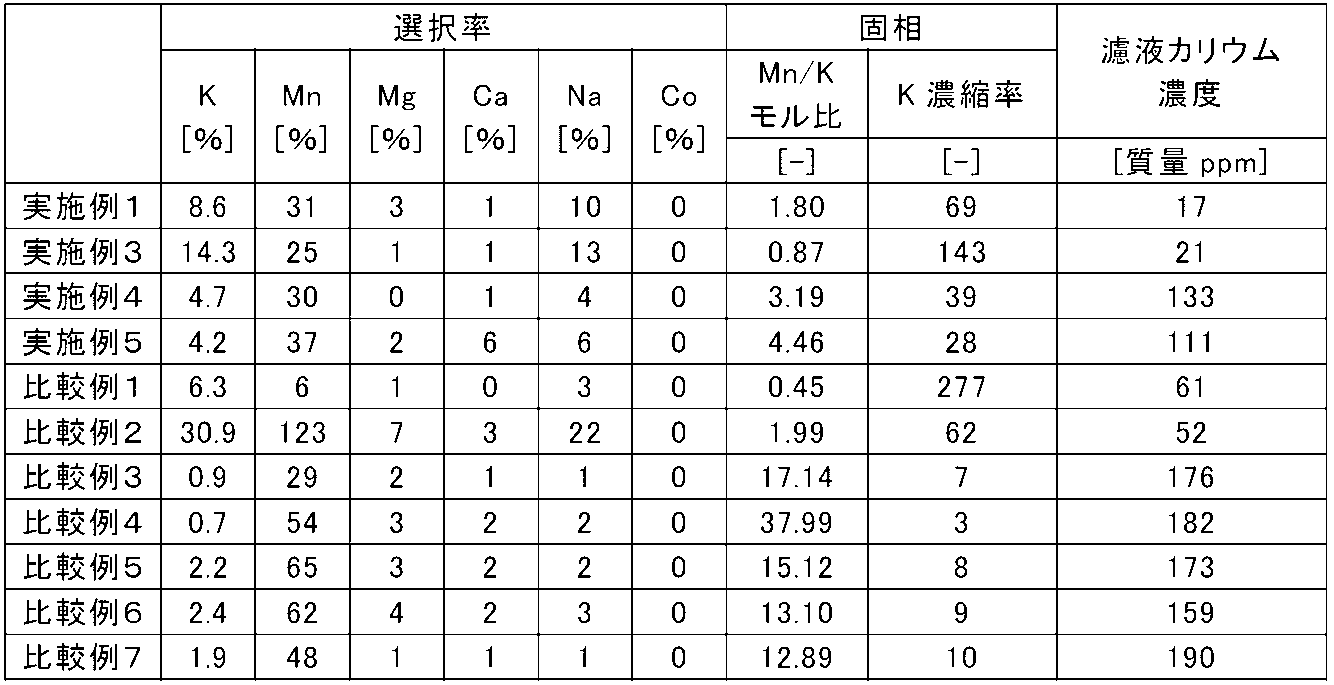
表3より、本実施例のゼオライトが比較例3乃至7の材に対して高いK濃縮率で硫酸マンガン溶液からカリウムを除去でき、かつ濾液カリウム濃度が低いことが分かる。
[耐久性評価2]
[吸着評価2]後の測定試料について、該測定試料の100質量倍の2N-塩酸溶液を常温で流通させたこと以外は[耐久性評価1]と同様の方法で耐久性評価2(再生工程)を実施した。耐久性評価2として再生工程を行った結果を下表に示す。
[吸着評価2]後の測定試料について、該測定試料の100質量倍の2N-塩酸溶液を常温で流通させたこと以外は[耐久性評価1]と同様の方法で耐久性評価2(再生工程)を実施した。耐久性評価2として再生工程を行った結果を下表に示す。
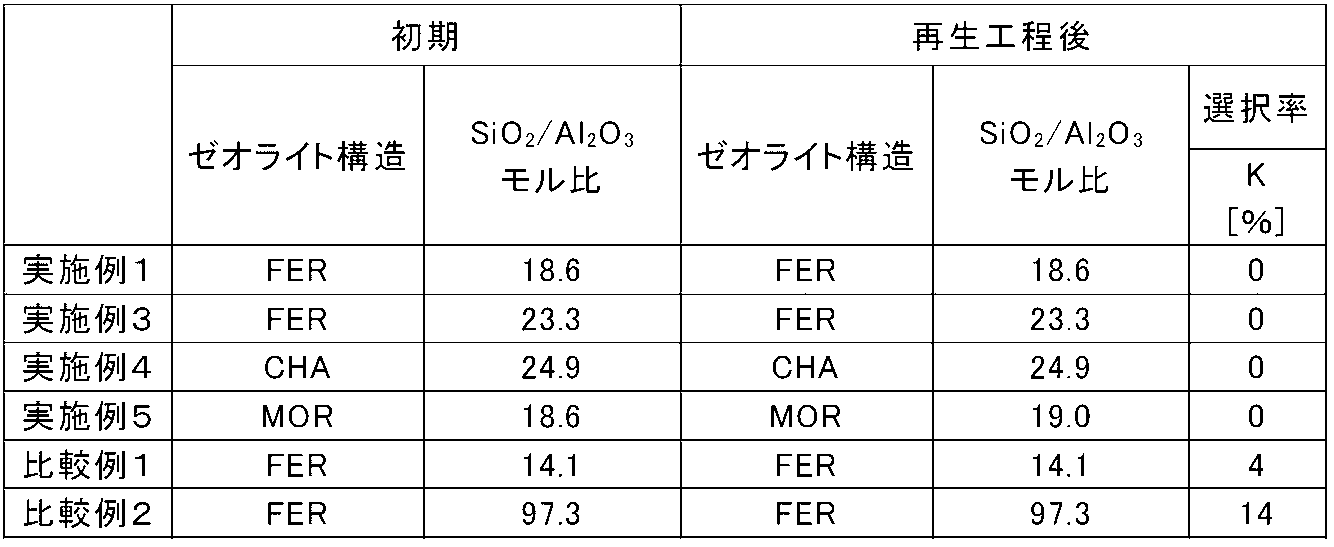
表4より、本実施例のゼオライトが吸着したカリウムイオンは再生工程により除去されていることが分かる。一方で、比較例のゼオライトは、吸着したカリウムイオンが再生工程に供しても除去されておらず、残存していることが分かる。また再生工程後の本実施例の組成は変化しておらず、そのXRDパターンから初期の骨格構造を維持していることが分かる。
以上の結果から、酸性環境下で硫酸マンガン溶液からカリウムの選択的除去を安定的に行えることが分かった。
[再生処理後吸着評価]
[耐久性評価2]で得られた実施例及び比較例のゼオライト粉末1000mgを秤量し、処理前溶液30mLに添加しスラリーとしたこと以外は[吸着評価2]と同様の方法で評価を実施した。
[耐久性評価2]で得られた実施例及び比較例のゼオライト粉末1000mgを秤量し、処理前溶液30mLに添加しスラリーとしたこと以外は[吸着評価2]と同様の方法で評価を実施した。
各試料の選択率、固相Mn/Kモル比、K濃縮率、及び濾液カリウム濃度を下表に示す。

表5より、実施例のゼオライトは、吸着したカリウムイオンを再生工程によって除去した後でも、繰り返しカリウムイオンを選択的に除去できることが分かった。
これらの結果から、本実施形態の製造方法は、酸性環境下で硫酸マンガン溶液からカリウムイオンを選択的に除去できるため、ジャロサイトの生成を抑えることができる硫酸マンガン溶液の製造方法であった。また、8員環ゼオライトを再生工程に供することで繰り返しカリウムイオンを除去できるため、頻繁な交換が不要な工業的に適用可能な硫酸マンガン溶液の製造方法であった。
令和5年6月12日に出願された日本国特許出願2023-96448号の明細書、特許請求の範囲及び要約書の全内容をここに引用し、本開示の明細書の開示として、取り入れる。
本開示の硫酸マンガン溶液の製造方法は、工業的に適用可能な吸着材を用い、ジャロサイトの生成なく、硫酸酸性マンガン溶液からカリウムを選択的に除去することで硫酸マンガン溶液を製造する用途で有用に使用することができる。
また、当該製造方法により得られた硫酸マンガン溶液は、酸化マンガンの原料として使用することができる。
Claims (6)
- カリウムイオンを含む硫酸マンガン溶液と、アルミナに対するシリカのモル比が6以上であり、かつ、骨格構造中に酸素8員環を含有するゼオライトと、を接触させ、カリウムイオンを前記ゼオライトに吸着させる工程を含む、硫酸マンガン溶液の製造方法。
- 前記骨格構造中に酸素8員環を含有するゼオライトが、CHA型、FER型、HEU型、MOR型、SZR型及びYFI型の群から選ばれる1以上の骨格構造を有するゼオライトである、請求項1に記載の硫酸マンガン溶液の製造方法。
- 前記カリウムを含む硫酸マンガン溶液のpHが6以下である、請求項1又は2に記載の硫酸マンガン溶液の製造方法。
- 前記カリウムを含む硫酸マンガン溶液における、カリウムイオンに対するマンガンイオンのモル比が10以上2000以下である、請求項1乃至3のいずれかひとつに記載の硫酸マンガン溶液の製造方法。
- 請求項1乃至4のいずれかひとつに記載の硫酸マンガン溶液の製造方法によって得られた硫酸マンガン溶液を用いる、酸化マンガンの製造方法。
- カリウムイオンを含む硫酸マンガン溶液と、アルミナに対するシリカのモル比が6以上であり、かつ、骨格構造中に酸素8員環を含有するゼオライトと、を接触させ、カリウムイオンを前記ゼオライトに吸着させる工程を含む、硫酸マンガン溶液の処理方法。
Applications Claiming Priority (2)
| Application Number | Priority Date | Filing Date | Title |
|---|---|---|---|
| JP2023096448 | 2023-06-12 | ||
| JP2023-096448 | 2023-06-12 |
Publications (1)
| Publication Number | Publication Date |
|---|---|
| WO2024257726A1 true WO2024257726A1 (ja) | 2024-12-19 |
Family
ID=93851995
Family Applications (1)
| Application Number | Title | Priority Date | Filing Date |
|---|---|---|---|
| PCT/JP2024/021059 Ceased WO2024257726A1 (ja) | 2023-06-12 | 2024-06-10 | 硫酸マンガン溶液の製造方法 |
Country Status (2)
| Country | Link |
|---|---|
| JP (2) | JP7626284B2 (ja) |
| WO (1) | WO2024257726A1 (ja) |
Citations (7)
| Publication number | Priority date | Publication date | Assignee | Title |
|---|---|---|---|---|
| US5980717A (en) * | 1997-01-03 | 1999-11-09 | Eka Chemical Ab | Recovery process in a pulp mill |
| JP2003313026A (ja) * | 2002-02-25 | 2003-11-06 | Tosoh Corp | 高シリカモルデナイトおよびその合成方法 |
| JP2011121859A (ja) * | 2009-11-10 | 2011-06-23 | Mitsubishi Chemicals Corp | アルミノシリケートの製造方法 |
| CN102502854A (zh) * | 2011-10-17 | 2012-06-20 | 四川大学 | 一种制取高纯硫酸锰溶液的方法 |
| CN115959686A (zh) * | 2022-10-13 | 2023-04-14 | 西安膜科巨力盐化工合伙企业(有限合伙) | 一种从盐湖卤水中提取制备硫酸钾的方法及应用 |
| JP2023125494A (ja) * | 2022-02-28 | 2023-09-07 | 東ソー株式会社 | 生体液用カリウム吸着剤及び透析液用カリウム吸着剤 |
| WO2024095914A1 (ja) * | 2022-11-02 | 2024-05-10 | 東ソー株式会社 | ゼオライト成形体 |
Family Cites Families (4)
| Publication number | Priority date | Publication date | Assignee | Title |
|---|---|---|---|---|
| JPS5460285A (en) * | 1977-10-21 | 1979-05-15 | Toray Ind Inc | Medical adsorbent |
| JPH1015401A (ja) * | 1996-07-03 | 1998-01-20 | Tosoh Corp | 無機イオン交換体、その製造方法および金属イオンの除去方法 |
| KR102404087B1 (ko) * | 2017-01-06 | 2022-05-31 | 토소가부시키가이샤 | 제논 흡착제 |
| US20240382928A1 (en) * | 2021-06-02 | 2024-11-21 | Tosoh Corporation | Yfi-type zeolite, method for producing the same, hydrocarbon adsorbent and hydrocarbon adsorption method |
-
2024
- 2024-06-10 JP JP2024093836A patent/JP7626284B2/ja active Active
- 2024-06-10 WO PCT/JP2024/021059 patent/WO2024257726A1/ja not_active Ceased
-
2025
- 2025-01-16 JP JP2025005910A patent/JP7803445B2/ja active Active
Patent Citations (7)
| Publication number | Priority date | Publication date | Assignee | Title |
|---|---|---|---|---|
| US5980717A (en) * | 1997-01-03 | 1999-11-09 | Eka Chemical Ab | Recovery process in a pulp mill |
| JP2003313026A (ja) * | 2002-02-25 | 2003-11-06 | Tosoh Corp | 高シリカモルデナイトおよびその合成方法 |
| JP2011121859A (ja) * | 2009-11-10 | 2011-06-23 | Mitsubishi Chemicals Corp | アルミノシリケートの製造方法 |
| CN102502854A (zh) * | 2011-10-17 | 2012-06-20 | 四川大学 | 一种制取高纯硫酸锰溶液的方法 |
| JP2023125494A (ja) * | 2022-02-28 | 2023-09-07 | 東ソー株式会社 | 生体液用カリウム吸着剤及び透析液用カリウム吸着剤 |
| CN115959686A (zh) * | 2022-10-13 | 2023-04-14 | 西安膜科巨力盐化工合伙企业(有限合伙) | 一种从盐湖卤水中提取制备硫酸钾的方法及应用 |
| WO2024095914A1 (ja) * | 2022-11-02 | 2024-05-10 | 東ソー株式会社 | ゼオライト成形体 |
Also Published As
| Publication number | Publication date |
|---|---|
| JP2024178135A (ja) | 2024-12-24 |
| JP2025065155A (ja) | 2025-04-17 |
| JP7803445B2 (ja) | 2026-01-21 |
| JP7626284B2 (ja) | 2025-02-04 |
Similar Documents
| Publication | Publication Date | Title |
|---|---|---|
| DE69715578T2 (de) | Verfahren zur Herstellung von Molekularsieben | |
| CA2521388C (en) | Aluminosilicates of zeolite n structure | |
| JP6380999B2 (ja) | イオン吸着材 | |
| Ugrina et al. | Characterization and environmental application of iron-modified zeolite from the Zlatokop deposit | |
| KR20200012772A (ko) | 방사성 핵종 흡착제, 이의 제조방법 및 이를 이용한 방사성 핵종의 제거 방법 | |
| KR20180093025A (ko) | 분자체 ssz-105의 합성 | |
| JP2023125494A (ja) | 生体液用カリウム吸着剤及び透析液用カリウム吸着剤 | |
| JP7626284B2 (ja) | 硫酸マンガン溶液の製造方法 | |
| KR101641136B1 (ko) | 방사성 핵종 제거용 제올라이트 Rho 흡착제 및 그 제조방법 | |
| Fahmy et al. | Adsorption of cadmium ions onto zeolite-A prepared from Egyptian kaolin using microwave | |
| DE2751443C3 (de) | Kristallines Siliciumdioxid | |
| JP2017218367A (ja) | 高耐水熱性チャバザイト型ゼオライトおよびその製造方法 | |
| JP2001240410A (ja) | イオン交換されたモレキュラーシーブの製造方法 | |
| JP7838605B2 (ja) | ゼオライト成形体 | |
| JP2020193135A (ja) | ゼオライトzts−6及びその製造方法 | |
| JP7794619B2 (ja) | Cha型ゼオライトの製造方法 | |
| SI24426A (sl) | Postopek priprave zeolitnih ZSM-5 granulatov brez anorganskega veziva | |
| JP7691037B1 (ja) | 鉄含有小細孔ゼオライト | |
| WO2017213022A1 (ja) | 高耐水熱性チャバザイト型ゼオライトおよびその製造方法 | |
| US20200030771A1 (en) | Radionuclide adsorbent, method for preparing the same and method for removing radionuclide using the same | |
| WO2023149439A1 (ja) | 新規yfi型ゼオライト | |
| JP2002160916A (ja) | 新規mor型メタロアルミノシリケート及びその製造方法 | |
| JP6779498B2 (ja) | スズを含有するゼオライトおよびその製造方法 | |
| Golbad | Synthesis and characterization of microporous and mesoporous zeolites from flyash for heavy metal removal from wastewater | |
| JP7753772B2 (ja) | ゼオライトzts-8及びその製造方法 |
Legal Events
| Date | Code | Title | Description |
|---|---|---|---|
| 121 | Ep: the epo has been informed by wipo that ep was designated in this application |
Ref document number: 24823342 Country of ref document: EP Kind code of ref document: A1 |
|
| NENP | Non-entry into the national phase |
Ref country code: DE |