WO2024225229A1 - オルガノポリシロキサン化合物、それを含む組成物、及びその硬化物 - Google Patents
オルガノポリシロキサン化合物、それを含む組成物、及びその硬化物 Download PDFInfo
- Publication number
- WO2024225229A1 WO2024225229A1 PCT/JP2024/015746 JP2024015746W WO2024225229A1 WO 2024225229 A1 WO2024225229 A1 WO 2024225229A1 JP 2024015746 W JP2024015746 W JP 2024015746W WO 2024225229 A1 WO2024225229 A1 WO 2024225229A1
- Authority
- WO
- WIPO (PCT)
- Prior art keywords
- group
- formula
- represented
- organopolysiloxane compound
- carbon atoms
- Prior art date
- Legal status (The legal status is an assumption and is not a legal conclusion. Google has not performed a legal analysis and makes no representation as to the accuracy of the status listed.)
- Ceased
Links
Images
Classifications
-
- C—CHEMISTRY; METALLURGY
- C08—ORGANIC MACROMOLECULAR COMPOUNDS; THEIR PREPARATION OR CHEMICAL WORKING-UP; COMPOSITIONS BASED THEREON
- C08F—MACROMOLECULAR COMPOUNDS OBTAINED BY REACTIONS ONLY INVOLVING CARBON-TO-CARBON UNSATURATED BONDS
- C08F299/00—Macromolecular compounds obtained by interreacting polymers involving only carbon-to-carbon unsaturated bond reactions, in the absence of non-macromolecular monomers
- C08F299/02—Macromolecular compounds obtained by interreacting polymers involving only carbon-to-carbon unsaturated bond reactions, in the absence of non-macromolecular monomers from unsaturated polycondensates
- C08F299/08—Macromolecular compounds obtained by interreacting polymers involving only carbon-to-carbon unsaturated bond reactions, in the absence of non-macromolecular monomers from unsaturated polycondensates from polysiloxanes
-
- C—CHEMISTRY; METALLURGY
- C07—ORGANIC CHEMISTRY
- C07F—ACYCLIC, CARBOCYCLIC OR HETEROCYCLIC COMPOUNDS CONTAINING ELEMENTS OTHER THAN CARBON, HYDROGEN, HALOGEN, OXYGEN, NITROGEN, SULFUR, SELENIUM OR TELLURIUM
- C07F7/00—Compounds containing elements of Groups 4 or 14 of the Periodic Table
- C07F7/02—Silicon compounds
- C07F7/08—Compounds having one or more C—Si linkages
- C07F7/10—Compounds having one or more C—Si linkages containing nitrogen having a Si-N linkage
-
- C—CHEMISTRY; METALLURGY
- C08—ORGANIC MACROMOLECULAR COMPOUNDS; THEIR PREPARATION OR CHEMICAL WORKING-UP; COMPOSITIONS BASED THEREON
- C08F—MACROMOLECULAR COMPOUNDS OBTAINED BY REACTIONS ONLY INVOLVING CARBON-TO-CARBON UNSATURATED BONDS
- C08F20/00—Homopolymers and copolymers of compounds having one or more unsaturated aliphatic radicals, each having only one carbon-to-carbon double bond, and only one being terminated by only one carboxyl radical or a salt, anhydride, ester, amide, imide or nitrile thereof
- C08F20/02—Monocarboxylic acids having less than ten carbon atoms, Derivatives thereof
- C08F20/10—Esters
- C08F20/12—Esters of monohydric alcohols or phenols
- C08F20/16—Esters of monohydric alcohols or phenols of phenols or of alcohols containing two or more carbon atoms
- C08F20/18—Esters of monohydric alcohols or phenols of phenols or of alcohols containing two or more carbon atoms with acrylic or methacrylic acids
-
- C—CHEMISTRY; METALLURGY
- C08—ORGANIC MACROMOLECULAR COMPOUNDS; THEIR PREPARATION OR CHEMICAL WORKING-UP; COMPOSITIONS BASED THEREON
- C08F—MACROMOLECULAR COMPOUNDS OBTAINED BY REACTIONS ONLY INVOLVING CARBON-TO-CARBON UNSATURATED BONDS
- C08F30/00—Homopolymers or copolymers of compounds having one or more unsaturated aliphatic radicals, each having only one carbon-to-carbon double bond, and containing phosphorus, selenium, tellurium or a metal
- C08F30/04—Homopolymers or copolymers of compounds having one or more unsaturated aliphatic radicals, each having only one carbon-to-carbon double bond, and containing phosphorus, selenium, tellurium or a metal containing a metal
- C08F30/08—Homopolymers or copolymers of compounds having one or more unsaturated aliphatic radicals, each having only one carbon-to-carbon double bond, and containing phosphorus, selenium, tellurium or a metal containing a metal containing silicon
-
- C—CHEMISTRY; METALLURGY
- C08—ORGANIC MACROMOLECULAR COMPOUNDS; THEIR PREPARATION OR CHEMICAL WORKING-UP; COMPOSITIONS BASED THEREON
- C08G—MACROMOLECULAR COMPOUNDS OBTAINED OTHERWISE THAN BY REACTIONS ONLY INVOLVING UNSATURATED CARBON-TO-CARBON BONDS
- C08G77/00—Macromolecular compounds obtained by reactions forming a linkage containing silicon with or without sulfur, nitrogen, oxygen or carbon in the main chain of the macromolecule
- C08G77/04—Polysiloxanes
- C08G77/38—Polysiloxanes modified by chemical after-treatment
- C08G77/382—Polysiloxanes modified by chemical after-treatment containing atoms other than carbon, hydrogen, oxygen or silicon
- C08G77/388—Polysiloxanes modified by chemical after-treatment containing atoms other than carbon, hydrogen, oxygen or silicon containing nitrogen
-
- C—CHEMISTRY; METALLURGY
- C08—ORGANIC MACROMOLECULAR COMPOUNDS; THEIR PREPARATION OR CHEMICAL WORKING-UP; COMPOSITIONS BASED THEREON
- C08G—MACROMOLECULAR COMPOUNDS OBTAINED OTHERWISE THAN BY REACTIONS ONLY INVOLVING UNSATURATED CARBON-TO-CARBON BONDS
- C08G77/00—Macromolecular compounds obtained by reactions forming a linkage containing silicon with or without sulfur, nitrogen, oxygen or carbon in the main chain of the macromolecule
- C08G77/42—Block-or graft-polymers containing polysiloxane sequences
- C08G77/452—Block-or graft-polymers containing polysiloxane sequences containing nitrogen-containing sequences
Definitions
- the present invention relates to an organopolysiloxane compound having an acryloyl group, which is a radically polymerizable functional group, a composition containing the same, and a cured product thereof.
- photocurable resins that can be cured in a short time at room temperature have been attracting attention, and radically polymerizable acrylic compounds are mainly used as raw materials.
- Such photocurable resins are used in paints, coating agents, inks, etc., and there are cases where properties such as high water repellency, antifouling properties, and lubricity are required.
- a method for imparting high water repellency, antifouling properties, lubricity, etc. to a photocurable resin a method of blending and copolymerizing an organopolysiloxane having a (meth)acryloyl group is known (Patent Document 1).
- organopolysiloxanes having (meth)acryloyl groups have low reactivity and are prone to problems such as the bleeding over time of unreacted organopolysiloxane from the cured resin (Patent Document 2). Therefore, there has been a strong desire for an organopolysiloxane compound that can solve this problem.
- the present invention therefore aims to provide a highly reactive radically polymerizable organopolysiloxane compound, a composition containing the same, and a cured product thereof.
- the present inventors have discovered that a specific organopolysiloxane compound having an acryloyl group can achieve the above object, and have thus completed the present invention. That is, the present invention is as follows.
- the organopolysiloxane compound of the present invention has two or more acryloyl groups in one molecule at positions sterically close to each other, and has high photocurability and reactivity, and is less likely to bleed when blended and copolymerized in a photocurable resin composition, etc. Furthermore, it cures with little energy, which allows for energy saving and process shortening when producing a cured product.
- the present invention is suitable for paints, coating agents, inks, and the like.
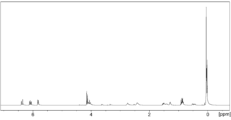
- Example 1 is a 1 H-NMR spectrum chart of the organopolysiloxane compound synthesized in Example 1.
- Organopolysiloxane compound The organopolysiloxane compound of the present invention is represented by the following formula (1) and has two or more acryloyl groups in one molecule, so that it is capable of reacting with a radically polymerizable compound.
- W is a group represented by the following formula (2) (a monovalent organopolysiloxane-containing group).
- R 1 is independently a group selected from an alkyl group having 1 to 18 carbon atoms and an aryl group having 6 to 18 carbon atoms, and is preferably a methyl group or a phenyl group.
- R 1 ' is independently a group selected from an alkyl group having 1 to 18 carbon atoms and an aryl group having 6 to 18 carbon atoms, and is preferably a methyl group, an n-butyl group, or a phenyl group, and more preferably a methyl group or an n-butyl group.
- n is a number from 0 to 500, preferably a number from 3 to 200, and more preferably a number from 8 to 60.
- Examples of the group represented by formula (2) above include groups represented by the following formulas (4) to (8), but are not limited to these.
- L is an alkylene group having 2 to 12 carbon atoms, preferably an alkylene group having 3 to 8 carbon atoms, and more preferably an alkylene group having 3 or 4 carbon atoms.
- each Z is independently an oxygen atom, a sulfur atom, or a group represented by NR2 , preferably an oxygen atom.
- R2 in NR2 is a hydrogen atom or an alkyl group having 1 to 12 carbon atoms, preferably a hydrogen atom.
- b is a number from 2 to 20, preferably a number from 2 to 10, and more preferably a number from 2 to 5.
- M is a (b+1)-valent polyvalent organic group (for example, a chain hydrocarbon group having 2 to 50 carbon atoms which may have an ether bond and an ester bond), preferably a trivalent to hexavalent polyvalent organic group, and more preferably a trivalent to hexavalent aliphatic hydrocarbon group which may have an ether bond, an ester bond, and a hydroxyl group.
- Examples of the polyvalent organic group M include groups represented by the following formulae, but are not limited to these.
- Xi is a group selected from a hydrogen atom, an alkyl group having 1 to 18 carbon atoms (wherein the alkyl group may have one or more selected from an ether bond, an ester bond, an amide bond, and a hydroxyl group), and a group represented by the following formula (3), preferably a group represented by the following formula (3):
- M, Z, L, W, b, and Xi are the same as those in formula (1).
- i is a number from 1 to 5, and preferably a number from 1 to 3, with the exception that i starts from 1.
- a i is a number from 0 to b, with the exception that a 5 is 0.
- Examples of Xi include groups represented by the following formulae, but are not limited to these.
- the organopolysiloxane compound of the present invention represented by the above formula (1) can be produced, for example, by the following method. That is, it can be produced by reacting an organopolysiloxane having a primary amino group or a secondary amino group at one end with an acrylic compound having three or more functionalities (b+1 valence) via a Michael addition reaction as shown in the following reaction formula (A).
- W, L, Xi , Z, b, and M can be the same as those in the above formula (1).
- X is a hydrogen atom or an alkyl group having 1 to 18 carbon atoms (wherein the alkyl group may have one or more selected from an ether bond, an ester bond, an amide bond, and a hydroxyl group), and when X is a hydrogen atom, that is, when the organopolysiloxane has a primary amino group, two equivalents of an acrylic group react with -NH2 , and Xi in the reaction product becomes a group represented by the above formula (3).
- tri- or higher functional acrylic compounds examples include trifunctional acrylic monomers such as trimethylolpropane triacrylate, ethoxylated trimethylolpropane triacrylate, glycerin triacrylate, and pentaerythritol triacrylate; tetrafunctional acrylic monomers such as pentaerythritol tetraacrylate, ethoxylated pentaerythritol tetraacrylate, and ditrimethylolpropane tetraacrylate; pentafunctional acrylic monomers such as dipentaerythritol pentaacrylate; hexafunctional acrylic monomers such as dipentaerythritol hexaacrylate; and oligomeric acrylic compounds such as urethane acrylate, polyester acrylate, and epoxy acrylate. From the viewpoint of Michael addition reactivity with organopolysiloxanes having amino groups, trifunctional to hexafunctional acrylic monomers are preferred.
- the above reaction is preferably carried out by adding at least one equivalent of a trifunctional or higher acrylic compound to the -NH- of the organopolysiloxane.
- the reaction product is an organopolysiloxane compound represented by the above formula (1) that has two or more acryloyl groups in one molecule at positions that are sterically close to each other and has excellent photocurability and reactivity.
- the organopolysiloxane compound represented by formula (1) can be produced simply by mixing and heating an organopolysiloxane having an amino group and an acrylic compound having three or more functional groups; however, an acid catalyst or a base catalyst may be added as necessary.
- the acid catalyst include AlCl 3 and MgCl 2 .
- base catalysts include non-nucleophilic tertiary amines (N,N,N',N'-tetramethyl-1,8-naphthalenediamine, 1,8-diazabicyclo[5.4.0]undec-7-ene, etc.). These catalysts may be used alone or in combination of two or more.
- the reaction temperature is not particularly limited, but is preferably 20 to 100°C, more preferably 50 to 80°C, for the purposes of preventing polymerization of the acrylic group and promoting the reaction.
- the reaction time is not particularly limited, but is preferably from 3 to 24 hours, and more preferably from 6 to 18 hours.
- the above reaction may be carried out by adding a solvent as necessary. Adding a solvent may facilitate compatibility between the organopolysiloxane having amino groups and the acrylic compound having three or more functional groups, allowing the Michael addition reaction to proceed efficiently.
- Solvents that do not have groups that can react with amino groups and acrylic groups are preferred, and examples of such solvents include hydrocarbons (toluene, xylene, n-hexane, cyclohexane, etc.) and ethers (diethyl ether, tetrahydrofuran, 1,4-dioxane, etc.). These solvents may be used alone or in combination of two or more.
- the reaction may be carried out by adding a polymerization inhibitor as necessary.
- the polymerization inhibitor may be any one that has been conventionally used for acrylic compounds.
- Examples of the polymerization inhibitor include phenol-based polymerization inhibitors such as hydroquinone, methylhydroquinone, hydroquinone monomethyl ether, 2-tert-butylhydroquinone, 4-methoxyphenol, and 2,6-di-tert-butyl-p-cresol. These polymerization inhibitors may be used alone or in combination of two or more.
- the amount of the polymerization inhibitor is not particularly limited, but is preferably 5 to 1,000 ppm, more preferably 20 to 500 ppm, based on the mass of the resulting compound.
- composition of the present invention contains the above-mentioned organopolysiloxane compound of the present invention.
- the composition of the present invention may contain one or more acrylic compounds other than the organopolysiloxane compound of the present invention.
- the reaction according to the above-mentioned method for producing an organopolysiloxane compound may leave unreacted trifunctional or higher (b+1) acrylic compounds (e.g., polyfunctional acrylic monomers) in the reaction product.
- the reaction may produce a mixture of the organopolysiloxane compound of the present invention represented by the above formula (1) and unreacted trifunctional or higher (b+1) acrylic compounds. Therefore, one example of a method for preparing the composition of the present invention is a method in which the reaction product obtained by the above reaction is obtained as the composition of the present invention containing the organopolysiloxane compound represented by the above formula (1) and a trifunctional or higher (b+1 valent) acrylic compound.
- the trifunctional or higher (b+1 valent) acrylic compound contained in the composition of the present invention can be exemplified by the various acrylic compounds exemplified as the trifunctional or higher (b+1 valent) acrylic compound represented by the above reaction formula (A), and trifunctional to hexafunctional acrylic monomers are preferred.
- the mixture of the organopolysiloxane compound represented by formula (1) obtained by the above reaction and the unreacted tri- or higher functional (b+1) acrylic compound may be used as is or after purification by a conventional method, and one or more acrylic compounds, preferably b+1 polyfunctional acrylic monomers, more preferably tri- to hexafunctional acrylic monomers, may be added separately to prepare the composition of the present invention.
- the cured product of the present invention can be obtained by curing the composition of the present invention. The curing proceeds by radically polymerizing the composition with heat or light in a conventional manner to obtain the cured product.
- the number average molecular weight and dispersity are polystyrene-equivalent values determined by GPC (gel permeation chromatography) measurement using tetrahydrofuran as a developing solvent under the following conditions.
- GPC gel permeation chromatography
- Developing solvent tetrahydrofuran Flow rate: 0.6 mL/min
- Detector Refractive index detector (RI)
- Column TSK Guard column Super H-H TSKgel SuperHM-N (6.0mm I.D.
- TSKgel SuperH2500 (6.0mm I.D. x 15cm x 1) (Both manufactured by Tosoh Corporation) Column temperature: 40°C Sample injection volume: 50 ⁇ L (0.3% by weight tetrahydrofuran solution)
- Example 1 In a reaction vessel, 5.93 g of trimethylolpropane triacrylate, 4.37 g of toluene, and 0.005 g of 2,6-di-tert-butyl-p-cresol were put and stirred, and a solution consisting of 8.57 g of an organopolysiloxane having an amino group at one end represented by the following formula (8-1) and 5.61 g of toluene was dropped over 1 hour at 60 ° C. to prepare a mixed solution. The obtained mixed solution was further stirred at 60 ° C. for 12 hours, and then toluene was distilled off from the mixed solution under reduced pressure to obtain a liquid.
- 8-1 an organopolysiloxane having an amino group at one end represented by the following formula (8-1) and 5.61 g of toluene
- the obtained liquid was a mixture of organopolysiloxanes represented by the following formulas (1-1), (1-2), and (1-3) and trimethylolpropane triacrylate.
- Example 2 In a reaction vessel, 5.93 g of trimethylolpropane triacrylate, 4.07 g of toluene, and 0.006 g of 2,6-di-tert-butyl-p-cresol were put and stirred, and a solution consisting of 12.4 g of an organopolysiloxane having an amino group at one end represented by the following formula (8-2) and 8.80 g of toluene was dropped at 60° C. over 1 hour to prepare a mixed solution. The obtained mixed solution was further stirred at 60° C. for 12 hours, and then toluene was distilled off from the mixed solution under reduced pressure to obtain a liquid.
- 8-2 an organopolysiloxane having an amino group at one end represented by the following formula (8-2) and 8.80 g of toluene
- the obtained liquid was a mixture of organopolysiloxanes represented by the following formulas (1-4), (1-5), and (1-6) and trimethylolpropane triacrylate.
- Example 3 A mixed solution was prepared by adding 11.6 g of dipentaerythritol hexaacrylate, 13.4 g of toluene, and 0.006 g of 2,6-di-tert-butyl-p-cresol to a reaction vessel and stirring the mixture, and then adding dropwise 8.57 g of organopolysiloxane having an amino group at one end and represented by the above formula (8-1) over 1 hour at 60° C. The resulting mixed solution was further stirred at 60° C. for 12 hours, after which the toluene was distilled off under reduced pressure from the mixed solution to obtain 14.3 g of a liquid product.
- the obtained liquid was a mixture of organopolysiloxanes represented by the following formulas (1-7), (1-8), (1-9), and (1-10) and dipentaerythritol hexaacrylate.
- a composition liquid was prepared by adding 0.020 g of Omnirad 1173, a photopolymerization initiator, manufactured by IGM Resins, to 10 g of each of the compositions of the above Examples or the compounds of the above Comparative Examples.
- DHR2 Discovery Hybrid Rheometer
- UV light source OmniCure SERIES 2000 (Excelitas Technologies)
- UV illuminance 10mW/ cm2
- Viscoelasticity measuring device DHR2 (Discovery Hybrid Rheometer) (TA Instruments) Measurement mode: Initial compression torque: 10.0 ⁇ N m Distortion: 10.0% Frequency: 25.0Hz Sample film thickness: 200 ⁇ m
- a composition solution was prepared by adding 10 g of trimethylolpropane triacrylate and 0.1 g of Omnirad 1173 (IGM Resins) as a photopolymerization initiator to each of 0.5 g of the composition of the above example or the organopolysiloxane compound of the above comparative example, and the composition was applied to a polycarbonate substrate using a bar coater No. 4.
- a UV curing device UUVBA from ITEC Systems
- the above coating film was irradiated with UV having a wavelength of 365 nm and an intensity of 140 mW/ cm2 for 2 seconds at room temperature in a nitrogen atmosphere to cure, and the presence or absence of bleeding was evaluated by touch.
- the results are shown in Table 8.
- the organopolysiloxane compound of the present invention has a faster gel point and higher UV curability than conventional acrylic modified organopolysiloxanes.Surprisingly, it was found that the organopolysiloxane compound of the present invention, which is obtained by Michael addition of an organopolysiloxane having a primary amino group to a polyfunctional acrylic compound, has higher UV curability than the polyfunctional acrylic compound used as the raw material.In addition, from the results in Table 8, it was found that the organopolysiloxane compound of the present invention has high UV curability, so it reacts even with a small amount of UV irradiation and is less likely to bleed.
- the organopolysiloxane compound of the present invention is useful as an ingredient for blending in UV-curable resin compositions, or as a UV-curable silicone elastomer.
Landscapes
- Chemical & Material Sciences (AREA)
- Organic Chemistry (AREA)
- Health & Medical Sciences (AREA)
- Chemical Kinetics & Catalysis (AREA)
- Medicinal Chemistry (AREA)
- Polymers & Plastics (AREA)
- General Chemical & Material Sciences (AREA)
- Silicon Polymers (AREA)
- Compositions Of Macromolecular Compounds (AREA)
Priority Applications (3)
| Application Number | Priority Date | Filing Date | Title |
|---|---|---|---|
| EP24796975.1A EP4703394A1 (en) | 2023-04-27 | 2024-04-22 | Organopolysiloxane compound, composition containing same, and cured product thereof |
| JP2025516797A JPWO2024225229A1 (https=) | 2023-04-27 | 2024-04-22 | |
| CN202480026307.0A CN120981494A (zh) | 2023-04-27 | 2024-04-22 | 有机聚硅氧烷化合物、含有其的组合物及其固化物 |
Applications Claiming Priority (2)
| Application Number | Priority Date | Filing Date | Title |
|---|---|---|---|
| JP2023073658 | 2023-04-27 | ||
| JP2023-073658 | 2023-04-27 |
Publications (1)
| Publication Number | Publication Date |
|---|---|
| WO2024225229A1 true WO2024225229A1 (ja) | 2024-10-31 |
Family
ID=93256587
Family Applications (1)
| Application Number | Title | Priority Date | Filing Date |
|---|---|---|---|
| PCT/JP2024/015746 Ceased WO2024225229A1 (ja) | 2023-04-27 | 2024-04-22 | オルガノポリシロキサン化合物、それを含む組成物、及びその硬化物 |
Country Status (4)
| Country | Link |
|---|---|
| EP (1) | EP4703394A1 (https=) |
| JP (1) | JPWO2024225229A1 (https=) |
| CN (1) | CN120981494A (https=) |
| WO (1) | WO2024225229A1 (https=) |
Citations (10)
| Publication number | Priority date | Publication date | Assignee | Title |
|---|---|---|---|---|
| JPH07316302A (ja) * | 1986-01-06 | 1995-12-05 | Dow Corning Corp | アクリル官能性シロキサン |
| JPH09169909A (ja) * | 1989-04-10 | 1997-06-30 | Dow Corning Corp | 未硬化組成物の粘度と硬化組成物の硬さの制御方法 |
| JP2005036018A (ja) | 2003-05-20 | 2005-02-10 | Jsr Corp | 硬化性組成物およびその硬化膜 |
| JP2013112776A (ja) * | 2011-11-30 | 2013-06-10 | Shin-Etsu Chemical Co Ltd | (メタ)アクリル基含オルガノポリシロキサン及びその製造方法、並びに重合物 |
| JP2017517583A (ja) * | 2014-03-17 | 2017-06-29 | ダウ コーニング コーポレーションDow Corning Corporation | 硬化性組成物、該硬化性組成物から形成される硬化物、及び該硬化物の形成方法 |
| JP2020176183A (ja) * | 2019-04-16 | 2020-10-29 | 信越化学工業株式会社 | 活性エネルギー線硬化性組成物 |
| JP2020186284A (ja) * | 2019-05-10 | 2020-11-19 | 信越化学工業株式会社 | 放射線硬化性オルガノポリシロキサン組成物並びに剥離シート |
| JP2022043002A (ja) * | 2020-09-03 | 2022-03-15 | 荒川化学工業株式会社 | 化合物、活性エネルギー線硬化型コーティング剤組成物、離型コーティング剤組成物、積層体、及び積層体の製造方法 |
| JP2022138932A (ja) | 2021-03-11 | 2022-09-26 | Dic株式会社 | アクリル樹脂、活性エネルギー線硬化性樹脂組成物、硬化物及び物品 |
| JP2022143180A (ja) * | 2021-03-17 | 2022-10-03 | 信越化学工業株式会社 | シロキサン化合物及びその製造方法 |
-
2024
- 2024-04-22 WO PCT/JP2024/015746 patent/WO2024225229A1/ja not_active Ceased
- 2024-04-22 EP EP24796975.1A patent/EP4703394A1/en active Pending
- 2024-04-22 JP JP2025516797A patent/JPWO2024225229A1/ja active Pending
- 2024-04-22 CN CN202480026307.0A patent/CN120981494A/zh active Pending
Patent Citations (10)
| Publication number | Priority date | Publication date | Assignee | Title |
|---|---|---|---|---|
| JPH07316302A (ja) * | 1986-01-06 | 1995-12-05 | Dow Corning Corp | アクリル官能性シロキサン |
| JPH09169909A (ja) * | 1989-04-10 | 1997-06-30 | Dow Corning Corp | 未硬化組成物の粘度と硬化組成物の硬さの制御方法 |
| JP2005036018A (ja) | 2003-05-20 | 2005-02-10 | Jsr Corp | 硬化性組成物およびその硬化膜 |
| JP2013112776A (ja) * | 2011-11-30 | 2013-06-10 | Shin-Etsu Chemical Co Ltd | (メタ)アクリル基含オルガノポリシロキサン及びその製造方法、並びに重合物 |
| JP2017517583A (ja) * | 2014-03-17 | 2017-06-29 | ダウ コーニング コーポレーションDow Corning Corporation | 硬化性組成物、該硬化性組成物から形成される硬化物、及び該硬化物の形成方法 |
| JP2020176183A (ja) * | 2019-04-16 | 2020-10-29 | 信越化学工業株式会社 | 活性エネルギー線硬化性組成物 |
| JP2020186284A (ja) * | 2019-05-10 | 2020-11-19 | 信越化学工業株式会社 | 放射線硬化性オルガノポリシロキサン組成物並びに剥離シート |
| JP2022043002A (ja) * | 2020-09-03 | 2022-03-15 | 荒川化学工業株式会社 | 化合物、活性エネルギー線硬化型コーティング剤組成物、離型コーティング剤組成物、積層体、及び積層体の製造方法 |
| JP2022138932A (ja) | 2021-03-11 | 2022-09-26 | Dic株式会社 | アクリル樹脂、活性エネルギー線硬化性樹脂組成物、硬化物及び物品 |
| JP2022143180A (ja) * | 2021-03-17 | 2022-10-03 | 信越化学工業株式会社 | シロキサン化合物及びその製造方法 |
Non-Patent Citations (1)
| Title |
|---|
| See also references of EP4703394A1 |
Also Published As
| Publication number | Publication date |
|---|---|
| EP4703394A1 (en) | 2026-03-04 |
| JPWO2024225229A1 (https=) | 2024-10-31 |
| CN120981494A (zh) | 2025-11-18 |
Similar Documents
| Publication | Publication Date | Title |
|---|---|---|
| US5650453A (en) | UV curable epoxysilicone blend compositions | |
| JP5187825B2 (ja) | ハイパーブランチポリマー及びその製造方法 | |
| CN1856518A (zh) | 自-光引发多官能丙烯酸酯和硫醇的双固化反应产物及合成方法 | |
| JP5495561B2 (ja) | ハイパーブランチポリマーおよびその製造方法 | |
| JP5268644B2 (ja) | ハイパーブランチポリマー及びその製造方法 | |
| CN1910234A (zh) | 自光引发多官能团丙烯酸酯与脂环族环氧化物的双重固化反应产物 | |
| WO2015022965A1 (ja) | 反応性シリコーン化合物を含む重合性組成物 | |
| WO2024225075A1 (ja) | (メタ)アクリロイル基含有オルガノポリシロキサンの製造方法 | |
| JP2009242470A (ja) | 硬化性組成物の保存方法 | |
| JP2015021045A (ja) | 環状エーテル基含有(メタ)アクリレートからなる光学的立体造形用樹脂組成物 | |
| WO2024225229A1 (ja) | オルガノポリシロキサン化合物、それを含む組成物、及びその硬化物 | |
| WO2024247572A1 (ja) | オルガノポリシロキサン化合物、それを含む組成物、及びその硬化物 | |
| JP5226373B2 (ja) | 硬化性樹脂組成物およびその硬化物 | |
| US20210147710A1 (en) | Coating resin composition and coating film comprising cured article thereof as coating layer | |
| JP7410539B2 (ja) | 重合体 | |
| JP7081486B2 (ja) | 光硬化性樹脂組成物、インキ及び塗料 | |
| WO2015146876A1 (ja) | グリシジル基含有(メタ)アクリルアミド | |
| WO2025134940A1 (ja) | オルガノポリシロキサン化合物、及びそれを含む光硬化性樹脂組成物 | |
| WO2024002742A1 (en) | Silicone urethane (meth)acrylates and their use in coating compositions | |
| US20130184371A1 (en) | Vinyl ether functional oligomers and methods for making and using same | |
| JP6069645B2 (ja) | チオカーボナートとスルフィド骨格をもつメタクリル酸エステルの櫛型共重合体およびその製造方法並びにそのuv硬化物 | |
| US20190062507A1 (en) | Organopolysiloxane and production method therefor, and curable composition | |
| Soykan et al. | A Yield Study on Self-Initiated Photopolymerization of Acrylate Monomers Bearing Benzophenone Pendant Unit | |
| JP7688900B2 (ja) | 光重合性組成物、重合体、及び重合体の製造方法 | |
| JP2001310916A (ja) | 重合性樹脂組成物、その製造方法及びその硬化物 |
Legal Events
| Date | Code | Title | Description |
|---|---|---|---|
| 121 | Ep: the epo has been informed by wipo that ep was designated in this application |
Ref document number: 24796975 Country of ref document: EP Kind code of ref document: A1 |
|
| ENP | Entry into the national phase |
Ref document number: 2025516797 Country of ref document: JP Kind code of ref document: A |
|
| WWE | Wipo information: entry into national phase |
Ref document number: 2025516797 Country of ref document: JP |
|
| WWE | Wipo information: entry into national phase |
Ref document number: 2024796975 Country of ref document: EP |
|
| NENP | Non-entry into the national phase |
Ref country code: DE |
|
| ENP | Entry into the national phase |
Ref document number: 2024796975 Country of ref document: EP Effective date: 20251127 |
|
| ENP | Entry into the national phase |
Ref document number: 2024796975 Country of ref document: EP Effective date: 20251127 |
|
| ENP | Entry into the national phase |
Ref document number: 2024796975 Country of ref document: EP Effective date: 20251127 |
|
| ENP | Entry into the national phase |
Ref document number: 2024796975 Country of ref document: EP Effective date: 20251127 |
|
| ENP | Entry into the national phase |
Ref document number: 2024796975 Country of ref document: EP Effective date: 20251127 |
|
| ENP | Entry into the national phase |
Ref document number: 2024796975 Country of ref document: EP Effective date: 20251127 |
|
| ENP | Entry into the national phase |
Ref document number: 2024796975 Country of ref document: EP Effective date: 20251127 |
|
| ENP | Entry into the national phase |
Ref document number: 2024796975 Country of ref document: EP Effective date: 20251127 |
|
| ENP | Entry into the national phase |
Ref document number: 2024796975 Country of ref document: EP Effective date: 20251127 |
|
| WWP | Wipo information: published in national office |
Ref document number: 2024796975 Country of ref document: EP |