WO2024224589A1 - アーム部材およびロボット - Google Patents
アーム部材およびロボット Download PDFInfo
- Publication number
- WO2024224589A1 WO2024224589A1 PCT/JP2023/016815 JP2023016815W WO2024224589A1 WO 2024224589 A1 WO2024224589 A1 WO 2024224589A1 JP 2023016815 W JP2023016815 W JP 2023016815W WO 2024224589 A1 WO2024224589 A1 WO 2024224589A1
- Authority
- WO
- WIPO (PCT)
- Prior art keywords
- arm
- reinforcing member
- arm member
- arm body
- peripheral surface
- Prior art date
- Legal status (The legal status is an assumption and is not a legal conclusion. Google has not performed a legal analysis and makes no representation as to the accuracy of the status listed.)
- Ceased
Links
Images



Classifications
-
- B—PERFORMING OPERATIONS; TRANSPORTING
- B25—HAND TOOLS; PORTABLE POWER-DRIVEN TOOLS; MANIPULATORS
- B25J—MANIPULATORS; CHAMBERS PROVIDED WITH MANIPULATION DEVICES
- B25J18/00—Arms
-
- B—PERFORMING OPERATIONS; TRANSPORTING
- B25—HAND TOOLS; PORTABLE POWER-DRIVEN TOOLS; MANIPULATORS
- B25J—MANIPULATORS; CHAMBERS PROVIDED WITH MANIPULATION DEVICES
- B25J18/00—Arms
- B25J18/005—Arms having a curved shape
-
- B—PERFORMING OPERATIONS; TRANSPORTING
- B25—HAND TOOLS; PORTABLE POWER-DRIVEN TOOLS; MANIPULATORS
- B25J—MANIPULATORS; CHAMBERS PROVIDED WITH MANIPULATION DEVICES
- B25J9/00—Program-controlled manipulators
- B25J9/0009—Constructional details, e.g. manipulator supports, bases
-
- B—PERFORMING OPERATIONS; TRANSPORTING
- B29—WORKING OF PLASTICS; WORKING OF SUBSTANCES IN A PLASTIC STATE IN GENERAL
- B29C—SHAPING OR JOINING OF PLASTICS; SHAPING OF MATERIAL IN A PLASTIC STATE, NOT OTHERWISE PROVIDED FOR; AFTER-TREATMENT OF THE SHAPED PRODUCTS, e.g. REPAIRING
- B29C70/00—Shaping composites, i.e. plastics material comprising reinforcements, fillers or preformed parts, e.g. inserts
- B29C70/68—Shaping composites, i.e. plastics material comprising reinforcements, fillers or preformed parts, e.g. inserts by incorporating or moulding on preformed parts, e.g. inserts or layers, e.g. foam blocks
- B29C70/681—Component parts, details or accessories; Auxiliary operations
- B29C70/682—Preformed parts characterised by their structure, e.g. form
-
- B—PERFORMING OPERATIONS; TRANSPORTING
- B29—WORKING OF PLASTICS; WORKING OF SUBSTANCES IN A PLASTIC STATE IN GENERAL
- B29C—SHAPING OR JOINING OF PLASTICS; SHAPING OF MATERIAL IN A PLASTIC STATE, NOT OTHERWISE PROVIDED FOR; AFTER-TREATMENT OF THE SHAPED PRODUCTS, e.g. REPAIRING
- B29C70/00—Shaping composites, i.e. plastics material comprising reinforcements, fillers or preformed parts, e.g. inserts
- B29C70/68—Shaping composites, i.e. plastics material comprising reinforcements, fillers or preformed parts, e.g. inserts by incorporating or moulding on preformed parts, e.g. inserts or layers, e.g. foam blocks
- B29C70/72—Encapsulating inserts having non-encapsulated projections, e.g. extremities or terminal portions of electrical components
Definitions
- This disclosure relates to arm members and robots.
- Arm members of articulated robots are known that are made of light alloys such as aluminum and are supported rotatably around joint axes (see, for example, Patent Document 1).
- a bush made of steel is embedded by casting as a reinforcing member.
- the bush is set to be relatively large in order to ensure sufficient strength against the large force received from the joint shaft. Therefore, it takes a long time to preheat the bush before casting it into the arm member, which reduces manufacturing efficiency. Therefore, it is desirable to improve the manufacturing efficiency of arm members having reinforcing members embedded therein by insert casting.
- an arm member that includes an arm body made of a metal or resin with a lower specific gravity than iron, and an iron reinforcing member formed into a ring plate shape, the arm body is cast with the reinforcing member exposed at least on its inner circumferential surface and one end face in the plate thickness direction, and the reinforcing member is fitted with a reducer on the inner circumferential surface and has a number of screw holes for fixing the reducer in close contact with the one end face.
- FIG. 1 is a perspective view showing a robot according to a first embodiment of the present disclosure.
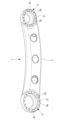
- FIG. 2 is a perspective view showing an arm member according to the first embodiment of the present disclosure.
- 3 is a cross-sectional view showing a configuration of one end of the arm member of FIG. 2.
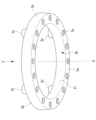
- FIG. 3 is a perspective view showing a reinforcing member of the arm member of FIG. 2 .
- 3 is a partial cross-sectional view of the arm member, showing a connection state between the arm member and the reducer in FIG. 2.
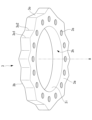
- FIG. 3 is a perspective view showing a modified example of the reinforcing member of the arm member of FIG. 2.
- a robot 100 equipped with an arm member 1 according to this embodiment is, for example, a vertical six-axis articulated robot as shown in FIG.
- the robot 100 comprises a base 10 that is placed on a mounting surface such as a horizontal floor surface, and a rotating body 20 that is supported rotatably relative to the base 10 around a vertical first axis A1.
- the robot 100 comprises an arm member (hereinafter also referred to as a first arm) 1 that is supported rotatably relative to the rotating body 20 around a horizontal second axis A2.
- the robot 100 also comprises a second arm 30 that is rotatable relative to the first arm 1 around a third axis A3 that is parallel to the second axis A2, and a three-axis wrist unit 40 attached to the tip of the second arm 30.
- the wrist unit 40 includes a first wrist element 41 rotatably supported relative to the second arm 30 about a fourth axis A4 that extends along a plane perpendicular to the third axis A3.
- the wrist unit 40 also includes a second wrist element 42 rotatably supported relative to the first wrist element 41 about a fifth axis A5 that is perpendicular to the fourth axis A4.
- the wrist unit 40 also includes a third wrist element 43 rotatably supported relative to the second wrist element 42 about a sixth axis A6 that is perpendicular to the fifth axis A5 and passes through the intersection of the fourth axis A4 and the fifth axis A5.
- the arm member 1 has a long arm body 2.
- the arm member 1 also has reinforcing members 3 at both ends of the arm body 2 in the longitudinal direction.
- Each reinforcing member 3 is fixed to a reducer 4a, 4b that is arranged between the revolving body 20 and the second arm 30.
- Each reducer 4a, 4b reduces the rotation of the shaft of the servo motor Ma, Mb.
- the arm body 2 is a hollow pipe-shaped cast part made of, for example, an aluminum alloy. As shown in FIG. 2, recesses 2h are provided at both ends of the arm body 2 in the longitudinal direction, which open in a direction perpendicular to the longitudinal direction and partially accommodate the reducers 4a and 4b. 3, the arm body 2 has the reinforcing members 3 cast around the periphery of each recess 2h, so that the arm body 2 and the reinforcing members 3 are integrally joined together.
- the reinforcing member 3 is an iron cast part formed into a ring plate shape with a central hole 3h extending along the axis A, and has an annular end face 3a and an annular end face 3b at both ends in the direction of the axis A.
- the reinforcing member 3 also has a cylindrical inner surface 3i with the axis A as its central axis, and a tapered outer surface 3o.
- the reinforcing member 3 when the reinforcing member 3 is cast into the peripheral portion of the recess 2h of the arm main body 2, the inner peripheral surface 3i and one end face 3a are exposed as shown in Fig. 3. That is, the aluminum alloy, which is the material of the arm main body 2, fills the irregularities on the outer surface of the reinforcing member 3 except for the inner peripheral surface 3i and one end face 3a, thereby bonding the two together as a single unit.
- the two reinforcing members 3 cast into both ends of the arm body 2 in the longitudinal direction have the same shape, although they are different in size.
- the reinforcing member 3 connected to the reducer 4a fixed to the rotating body 20 will be described as an example.
- the inner circumferential surface 3i has an inner diameter dimension that is approximately the same as the inner diameter dimension of the recess 2h of the arm body 2, for example, as shown in FIG. 5, and that allows the outer circumferential surface of the output shaft 4o of the reducer 4a to be fitted in the axial direction A.
- the outer peripheral surface 3o has a shape that tapers from the other end surface 3b side toward the one end surface 3a side. For example, as shown in FIG. 5, the outer diameter dimension of the one end surface 3a side of the outer peripheral surface 3o is approximately equal to the outer diameter dimension of a mounting flange 4f provided on the output shaft 4o of the reducer 4a.
- one end surface 3a has blind screw holes 3s at positions corresponding to the multiple through holes 4h provided in the mounting flange 4f of the reducer 4a.
- the mounting flange 4f of the reducer 4a is fixed in close contact with the one end surface 3a.
- the other end face 3b has four cylindrical protrusions 3c that protrude outward in the direction of axis A and are spaced equally apart in the circumferential direction.
- Each protrusion 3c is arranged coaxially with one of the multiple screw holes 3s provided on the one end face 3a.
- the screw hole 3s arranged coaxially with the protrusion 3c extends into the inside of the protrusion 3c, ensuring a longer effective thread than the screw holes 3s arranged in other positions.
- the recess 2h at one end of the arm body 2 in the longitudinal direction is brought close to the reducer 4a fixed to the rotating body 20, and the output shaft 4o of the reducer 4a is inserted into the recess 2h along the axis A.
- This causes the outer peripheral surface of the output shaft 4o of the reducer 4a to fit into the inner peripheral surface 3i of the reinforcing member 3.
- the mounting flange 4f of the reducer 4a is abutted against one end surface 3a of the reinforcing member 3 on the periphery of the recess 2h, and the bolts 5 that have passed through the multiple through holes 4h of the mounting flange 4f are fastened to the corresponding screw holes 3s.
- the arm member 1 is fixed in a state in which it is positioned relative to the reducer 4a in the radial and axial directions of the axis A.
- the arm member 1 fixes the reducer 4a to two surfaces, that is, one end surface 3a and an inner peripheral surface 3i of the reinforcing member 3.
- the proportion of the area used for fixing the reducer 4a out of the entire area of the reinforcing member 3 can be increased, and the size efficiency of the reinforcing member 3 can be improved. Therefore, the size of the reinforcing member 3 can be kept to a minimum, and the weight of the arm member 1 can be reduced.
- the reinforcing member 3 the minimum necessary size, it is also possible to shorten the time required for the preheating process of the reinforcing member 3, which is performed as a pre-process when the reinforcing member 3 is cast-in with the arm main body 2.
- This allows the reinforcing member 3 to be sufficiently preheated without deteriorating the manufacturing efficiency of the arm member 1, and improves the welding property of the cast-in between the arm main body 2 and the reinforcing member 3.
- the inner peripheral surface 3i and the outer peripheral surface 3o of the reinforcing member 3 both have a circular cross section with the axis A as the central axis, so that the radial thickness between the inner peripheral surface 3i and the outer peripheral surface 3o is uniform. This has the advantage that the reinforcing member 3 can be preheated uniformly.
- the outer peripheral surface 3o of the reinforcing member 3 is wider on the other end face 3b side embedded in the arm body 2 than on the one end face 3a side exposed to the outside. This makes it possible to prevent the reinforcing member 3 from coming out of the arm body 2 even if a large force acts on the reinforcing member 3 in the direction from the other end face 3b side toward the one end face 3a side, i.e., in the direction in which it is pulled out.
- the arm body 2 and the reinforcing member 3 can be more firmly integrated because the joining surfaces are joined by casting, and the shape of the reinforcing member 3 restricts the relative displacement between the arm body 2 and the reinforcing member 3. This has the advantage that the assembled state of the arm member 1 and the reducer 4a can be reliably maintained.
- a cylindrical protrusion 3c is provided on the other end surface 3b of the reinforcing member 3 as an example of a stopper that suppresses relative rotation around the axis A between the arm body 2 and the reinforcing member 3, but the cross-sectional shape of the protrusion 3c may be arbitrary. Also, the number of protrusions 3c may be one or more.
- a recessed portion recessed along the axis A may be provided on the other end face 3b.
- a part of the arm body 2 in which the metal constituting the arm body 2 has entered the recessed portion functions as a stopper, thereby restricting the relative rotation of the reinforcing member 3 with respect to the arm body 2 about the axis A, similar to the protrusion 3c.
- simply roughening the surface of the other end face 3b by blasting or the like can also increase the bonding strength between the arm body 2 and the other end face 3b, thereby making it possible to regulate the relative rotation of the two members.
- a protrusion protruding radially outward or a recessed portion recessed radially inward may be provided on the outer peripheral surface 3o.
- the outer peripheral surface 3o of the reinforcing member 3 may be formed in a gear shape in which a plurality of protruding portions 3o1 protruding radially outward and a plurality of recessed portions 3o2 recessed radially inward are alternately arranged in the circumferential direction.
- the outer circumferential surface 3o of the reinforcing member 3 and the arm body 2 are joined in a mutually meshed state. Therefore, even if a large torque about the axis A is input to the reinforcing member 3, the relative rotation of the reinforcing member 3 with respect to the arm body 2 about the axis A can be restricted.
- At least one protrusion protruding radially outward or one recessed portion recessed radially inward may be provided at a midpoint in the axial A direction on the outer circumferential surface 3o of the reinforcing member 3.
- the protrusion or recess provided on the outer peripheral surface 3o can regulate the relative rotation of the reinforcing member 3 around the axis A with respect to the arm main body 2, and can also regulate the reinforcing member 3 from slipping out in the direction of the axis A.
- the arm body 2 is formed from an aluminum alloy, but the material constituting the arm body 2 is not limited to this.
- the arm body 2 may be formed from a metal with a lower specific gravity than iron, such as a magnesium alloy, stainless steel, or titanium alloy.
- a resin material such as carbon fiber reinforced plastic (CFRP) may be used as the constituent material of the arm body 2.
- the reinforcing member 3 may be cast into only one end of the arm body 2.
- the case where the arm member 1 is the first arm 1 of the robot 100 has been exemplified, but the arm member 1 may be another arm constituting the robot 100 .
- An arm member comprising an arm body made of a metal or resin having a specific gravity smaller than that of iron, and an iron reinforcing member formed into a ring plate shape, wherein the arm body casts the reinforcing member into place with at least the inner circumferential surface and one end face in the plate thickness direction of the reinforcing member exposed, and the reinforcing member has a plurality of screw holes for fitting a reducer into the inner circumferential surface and for tightly fixing the reducer to the one end face.
- Appendix 2 2.
- (Appendix 3) 3.
- (Appendix 4) The arm member according to any one of appendices 1 to 3, wherein the reinforcing member has an outer peripheral surface having at least one protruding portion protruding radially outward or at least one recessed portion recessed radially inward on a cast-in surface that contacts the arm body. (Appendix 5) 4.
Landscapes
- Engineering & Computer Science (AREA)
- Mechanical Engineering (AREA)
- Robotics (AREA)
- Chemical & Material Sciences (AREA)
- Composite Materials (AREA)
- Manipulator (AREA)
Priority Applications (5)
| Application Number | Priority Date | Filing Date | Title |
|---|---|---|---|
| CN202380097384.0A CN121100046A (zh) | 2023-04-28 | 2023-04-28 | 臂部件以及机器人 |
| PCT/JP2023/016815 WO2024224589A1 (ja) | 2023-04-28 | 2023-04-28 | アーム部材およびロボット |
| DE112023005799.0T DE112023005799T5 (de) | 2023-04-28 | 2023-04-28 | Armelement und Roboter |
| JP2023541715A JP7339476B1 (ja) | 2023-04-28 | 2023-04-28 | アーム部材およびロボット |
| TW113114034A TW202442404A (zh) | 2023-04-28 | 2024-04-15 | 機械臂部件以及機器人 |
Applications Claiming Priority (1)
| Application Number | Priority Date | Filing Date | Title |
|---|---|---|---|
| PCT/JP2023/016815 WO2024224589A1 (ja) | 2023-04-28 | 2023-04-28 | アーム部材およびロボット |
Publications (1)
| Publication Number | Publication Date |
|---|---|
| WO2024224589A1 true WO2024224589A1 (ja) | 2024-10-31 |
Family
ID=87882244
Family Applications (1)
| Application Number | Title | Priority Date | Filing Date |
|---|---|---|---|
| PCT/JP2023/016815 Ceased WO2024224589A1 (ja) | 2023-04-28 | 2023-04-28 | アーム部材およびロボット |
Country Status (5)
| Country | Link |
|---|---|
| JP (1) | JP7339476B1 (https=) |
| CN (1) | CN121100046A (https=) |
| DE (1) | DE112023005799T5 (https=) |
| TW (1) | TW202442404A (https=) |
| WO (1) | WO2024224589A1 (https=) |
Families Citing this family (1)
| Publication number | Priority date | Publication date | Assignee | Title |
|---|---|---|---|---|
| JP2025085362A (ja) * | 2023-11-24 | 2025-06-05 | 株式会社安川電機 | ロボット |
Citations (7)
| Publication number | Priority date | Publication date | Assignee | Title |
|---|---|---|---|---|
| JPS606388A (ja) * | 1983-06-22 | 1985-01-14 | 株式会社日立製作所 | 関節形ロボツトの関節部の構造 |
| JP2018176337A (ja) * | 2017-04-10 | 2018-11-15 | ファナック株式会社 | ロボットアームおよびロボット |
| JP2020015127A (ja) * | 2018-07-25 | 2020-01-30 | ファナック株式会社 | ロボットアームとその製造方法およびロボット |
| JP2020082311A (ja) * | 2018-11-29 | 2020-06-04 | ファナック株式会社 | ロボットアームの製造装置 |
| JP2021079494A (ja) * | 2019-11-20 | 2021-05-27 | ファナック株式会社 | ロボット用ケーシングおよびロボット |
| WO2022210327A1 (ja) * | 2021-03-31 | 2022-10-06 | ファナック株式会社 | アーム状構造体およびロボット |
| WO2022210329A1 (ja) * | 2021-03-31 | 2022-10-06 | ファナック株式会社 | アーム状構造体およびロボット |
Family Cites Families (1)
| Publication number | Priority date | Publication date | Assignee | Title |
|---|---|---|---|---|
| JPS5665223U (https=) * | 1979-10-24 | 1981-06-01 |
-
2023
- 2023-04-28 DE DE112023005799.0T patent/DE112023005799T5/de active Pending
- 2023-04-28 CN CN202380097384.0A patent/CN121100046A/zh active Pending
- 2023-04-28 JP JP2023541715A patent/JP7339476B1/ja active Active
- 2023-04-28 WO PCT/JP2023/016815 patent/WO2024224589A1/ja not_active Ceased
-
2024
- 2024-04-15 TW TW113114034A patent/TW202442404A/zh unknown
Patent Citations (7)
| Publication number | Priority date | Publication date | Assignee | Title |
|---|---|---|---|---|
| JPS606388A (ja) * | 1983-06-22 | 1985-01-14 | 株式会社日立製作所 | 関節形ロボツトの関節部の構造 |
| JP2018176337A (ja) * | 2017-04-10 | 2018-11-15 | ファナック株式会社 | ロボットアームおよびロボット |
| JP2020015127A (ja) * | 2018-07-25 | 2020-01-30 | ファナック株式会社 | ロボットアームとその製造方法およびロボット |
| JP2020082311A (ja) * | 2018-11-29 | 2020-06-04 | ファナック株式会社 | ロボットアームの製造装置 |
| JP2021079494A (ja) * | 2019-11-20 | 2021-05-27 | ファナック株式会社 | ロボット用ケーシングおよびロボット |
| WO2022210327A1 (ja) * | 2021-03-31 | 2022-10-06 | ファナック株式会社 | アーム状構造体およびロボット |
| WO2022210329A1 (ja) * | 2021-03-31 | 2022-10-06 | ファナック株式会社 | アーム状構造体およびロボット |
Also Published As
| Publication number | Publication date |
|---|---|
| TW202442404A (zh) | 2024-11-01 |
| CN121100046A (zh) | 2025-12-09 |
| JP7339476B1 (ja) | 2023-09-05 |
| JPWO2024224589A1 (https=) | 2024-10-31 |
| DE112023005799T5 (de) | 2025-12-31 |
Similar Documents
| Publication | Publication Date | Title |
|---|---|---|
| JP6470342B2 (ja) | ロボットアームおよびロボット | |
| US7896748B2 (en) | Coupling apparatus | |
| WO2024224589A1 (ja) | アーム部材およびロボット | |
| JP2002089580A (ja) | 協働回転自在部材用の機械的継手 | |
| JP7343366B2 (ja) | ロボット用ケーシングおよびロボット | |
| TW202212712A (zh) | 減速機 | |
| JP7207974B2 (ja) | ロボットアームの製造装置 | |
| JP7450776B2 (ja) | 歯車装置 | |
| JP7365766B2 (ja) | 偏心揺動型減速装置 | |
| US20190101190A1 (en) | Double helical gear and method of welding double helical gear | |
| JPS60188624A (ja) | フランジ付きブシユ | |
| CN114251428B (zh) | 差速齿轮组件及其组装方法 | |
| JP2004533587A (ja) | ファスナの製造方法及びその用途 | |
| AU2009101343A4 (en) | Toothed wheel and drum drive | |
| US6703093B2 (en) | Friction welding | |
| JP7437225B2 (ja) | 減速機ケース、減速機、及び、減速機ケースの製造方法 | |
| JP2000249159A (ja) | たわみ軸継手 | |
| JP7170455B2 (ja) | 締結構造および産業機械 | |
| EP4265937A1 (en) | Method of manufacturing speed reducer, speed reducer, and rotating device | |
| WO2009144359A1 (en) | Flange joint | |
| JPH0320623B2 (https=) | ||
| JP2024071233A (ja) | 差動装置 | |
| JPS639955B2 (https=) | ||
| WO2023053292A1 (ja) | 芯出し構造、機械、及びロボット | |
| JP2020093376A (ja) | アームユニット及びロボット |
Legal Events
| Date | Code | Title | Description |
|---|---|---|---|
| WWE | Wipo information: entry into national phase |
Ref document number: 2023541715 Country of ref document: JP |
|
| 121 | Ep: the epo has been informed by wipo that ep was designated in this application |
Ref document number: 23935367 Country of ref document: EP Kind code of ref document: A1 |
|
| WWE | Wipo information: entry into national phase |
Ref document number: 112023005799 Country of ref document: DE |
|
| WWP | Wipo information: published in national office |
Ref document number: 112023005799 Country of ref document: DE |