WO2024224531A1 - ファスナーストリンガーを生地に対して縫着する方法、物品、及びスライドファスナー - Google Patents
ファスナーストリンガーを生地に対して縫着する方法、物品、及びスライドファスナー Download PDFInfo
- Publication number
- WO2024224531A1 WO2024224531A1 PCT/JP2023/016535 JP2023016535W WO2024224531A1 WO 2024224531 A1 WO2024224531 A1 WO 2024224531A1 JP 2023016535 W JP2023016535 W JP 2023016535W WO 2024224531 A1 WO2024224531 A1 WO 2024224531A1
- Authority
- WO
- WIPO (PCT)
- Prior art keywords
- fastener
- box
- line
- sewing machine
- tape
- Prior art date
- Legal status (The legal status is an assumption and is not a legal conclusion. Google has not performed a legal analysis and makes no representation as to the accuracy of the status listed.)
- Ceased
Links
Images









Classifications
-
- D—TEXTILES; PAPER
- D05—SEWING; EMBROIDERING; TUFTING
- D05B—SEWING
- D05B35/00—Work-feeding or -handling elements not otherwise provided for
- D05B35/06—Work-feeding or -handling elements not otherwise provided for for attaching bands, ribbons, strips, or tapes or for binding
- D05B35/064—Work-feeding or -handling elements not otherwise provided for for attaching bands, ribbons, strips, or tapes or for binding for attaching slide fasteners
-
- A—HUMAN NECESSITIES
- A41—WEARING APPAREL
- A41H—APPLIANCES OR METHODS FOR MAKING CLOTHES, e.g. FOR DRESS-MAKING OR FOR TAILORING, NOT OTHERWISE PROVIDED FOR
- A41H37/00—Machines, appliances or methods for setting fastener-elements on garments
- A41H37/06—Setting slide or glide fastener elements
-
- A—HUMAN NECESSITIES
- A44—HABERDASHERY; JEWELLERY
- A44B—BUTTONS, PINS, BUCKLES, SLIDE FASTENERS, OR THE LIKE
- A44B19/00—Slide fasteners
- A44B19/42—Making by processes not fully provided for in one other class, e.g. B21D53/50, B21F45/18, B22D17/16, B29D5/00
-
- D—TEXTILES; PAPER
- D05—SEWING; EMBROIDERING; TUFTING
- D05B—SEWING
- D05B1/00—General types of sewing apparatus or machines without mechanism for lateral movement of the needle or the work or both
- D05B1/08—General types of sewing apparatus or machines without mechanism for lateral movement of the needle or the work or both for making multi-thread seams
- D05B1/12—Lock-stitch seams
-
- D—TEXTILES; PAPER
- D05—SEWING; EMBROIDERING; TUFTING
- D05B—SEWING
- D05B29/00—Pressers; Presser feet
- D05B29/06—Presser feet
-
- D—TEXTILES; PAPER
- D05—SEWING; EMBROIDERING; TUFTING
- D05B—SEWING
- D05B35/00—Work-feeding or -handling elements not otherwise provided for
- D05B35/06—Work-feeding or -handling elements not otherwise provided for for attaching bands, ribbons, strips, or tapes or for binding
Definitions
- the present disclosure relates to a method for sewing a fastener stringer to a fabric, and in particular to a method for sewing a fastener stringer to a fabric using a sewing machine with a sewing foot. Further, the present disclosure also relates to an article and a slide fastener.
- Patent Document 1 discloses that a zipper chain and fabric are transported on a sewing machine so that the fastener element adjacent to the sewing machine foot is maintained in direct contact with the sewing machine foot, and that a zipper stringer is sewn to the fabric.
- Patent Document 2 raises the issue of interference between the presser foot of the sewing machine and the fastener of the slide fastener (see paragraph 0002). To solve this issue, Patent Document 2 discloses a fastener with a special structure that contributes to making it easier to sew the zipper stringer to the fabric.
- Patent Document 3 explains that the fastener is narrowed so that it does not interfere with the sewing machine foot (see abstract of the same document). Although it does not discuss sewing a zipper stringer to the fabric, the slide fasteners disclosed in Patent Documents 4 to 6 are also known.
- the fastener When the fastener is made of plastic, it is common to make the fastener wide so that it can be attached to the fastener tape (e.g., its core string) with sufficient strength.
- the fastener stringer when sewing the fastener tape of the fastener stringer to the fabric, the fastener stringer must be moved manually to avoid the fastener colliding with the sewing machine foot, which places a significant burden on the sewing work and may cause variations in the quality of the perforations due to differences in the skill levels of sewing workers (e.g., differences in the degree to which the perforations curve or meander in the area adjacent to the fastener).
- the inventors of the present application have discovered a new problem of reducing the workload of sewing a fastener stringer with a plastic member that prevents the slider from falling off to fabric, and further, promoting the assurance of quality of perforations regardless of the skill level of the sewing worker.
- a method relates to a method for sewing a fastener stringer, in which a plurality of fastener elements are provided individually or in a series on the longitudinal edge of the fastener tape in the longitudinal direction of the fastener tape, and a plastic member is provided adjacent to a fastener element located at the end of the plurality of fastener elements in the longitudinal direction of the fastener tape to prevent a slider from falling off, to a fabric using a sewing machine with a sewing machine foot.
- the method includes linearly conveying the fastener stringer based on direct contact between the sewing machine foot and two or more fastener elements included in the plurality of fastener elements and located adjacent to the sewing machine foot, sewing the fastener tape and the fabric along a second virtual line parallel to a first virtual line determined by the direct contact between the two or more fastener elements and the sewing machine foot, linearly conveying the fastener stringer based on direct contact between the plastic member and the sewing machine foot, and sewing the fastener tape and the fabric along a fourth virtual line parallel to a third virtual line determined by the direct contact between the plastic member and the sewing machine foot.
- the method includes, in this order or the reverse order, conveying the fastener stringer in a straight line based on direct contact between two or more fastener elements and the sewing machine foot, and conveying the fastener stringer in a straight line based on direct contact between the plastic member and the sewing machine foot.
- the plastic member has a guide surface with which the sewing machine foot comes into contact so that the first and third imaginary lines extend in the same straight line to form one guide line, and the second and fourth imaginary lines extend in the same straight line to form one planned sewing line.
- the slide fastener includes first and second fastener stringers and a slider that moves in the front-rear direction to connect and disconnect the first and second fastener stringers.
- the first fastener stringer includes a first fastener tape, a plurality of first fastener elements provided individually or in a series on the longitudinal side edge of the first fastener tape extending in the front-rear direction, and a plastic member located adjacent to the first fastener element located at the end of the plurality of first fastener elements in the front-rear direction to prevent the slider from falling off, and each of the first fastener elements included in the plurality of first fastener elements includes a surface that faces inward relative to the first fastener tape and is included in a first imaginary line extending in the front-rear direction.
- the plastic member is a box body of a separable fastener.
- the box body includes a box portion that is located adjacent to the fastener element located at the end and has a box pin that is inserted into the slider, and one or more stop surfaces to which the box pin is connected and that stop the slider.
- the article has perforations formed parallel to the first imaginary line, and the perforations are also formed parallel to the guide surface of the plastic member that is aligned in the same straight line as the first imaginary line.
- a slide fastener includes first and second fastener stringers, and a slider that moves in the front-rear direction to couple and uncouple the first and second fastener stringers.
- the first fastener stringer includes a first fastener tape, a plurality of first fastener elements that are individually or in a series provided on the longitudinal side edge of the first fastener tape extending in the front-rear direction, and a plastic member that is located adjacent to the first fastener element located at the end of the plurality of first fastener elements in the front-rear direction and prevents the slider from falling off, and each of the first fastener elements included in the plurality of first fastener elements includes a surface that faces inward with respect to the first fastener tape and is included in a first imaginary line extending in the front-rear direction.
- the plastic member is a box body of a separable fastener.
- the box body includes a box pin that is located adjacent to the fastener element located at the end and is inserted into the slider, and a box portion that has one or more restraining surfaces to which the box pin is coupled and that restrain the slider.
- the box body has a guide surface arranged in the same straight line as the first imaginary line.
- the plastic member is a separable fastener box, the box including a box pin located adjacent to the fastener element located at the end and inserted into the slider, and a box portion having one or more stop surfaces to which the box pin engages and which stop the slider, the guide surfaces including one or more first guide areas formed on the box pin and at least one second guide area formed on the box portion, the at least one second guide area being formed to be flush with the one or more first guide areas.
- the box pin has two flat surfaces aligned in the same line with the guide line and a concave surface formed between the flat surfaces.
- the length of the concave surface along the guide line is greater than the combined length of the two flat surfaces along the guide line.
- the opposing surfaces of the insert pin and the box pin that are inserted into the receiving space of the box portion are shaped to be at least partially complementary to each other.
- the side edge portion of the fastener tape includes at least one core cord to which each fastener element of the plurality of fastener elements is attached and to which a box pin and a box portion are attached, the box portion has a first side surface and a first inner surface between which the core cord is positioned, the first inner surface partially defines a receiving space for the butterfly pin, and in the width direction of the fastener tape, the minimum distance between the center of the core cord and the first side surface is smaller than the minimum distance between the center of the core cord and the first inner surface.
- 1.2 ⁇ (T/S) ⁇ 1.6 is satisfied, where S denotes the minimum distance between the center of the core string and the first side surface, and T denotes the minimum distance between the center of the core string and the first inner surface.
- the box has a first side and a second side opposite the first side, the width of the box is defined by the first side and the second side, (i) a centerline located at the center of the width of the box defined by the first side and the second side is located away from the fastener tape to a position where it does not intersect with the box pin, and/or is located away from the fastener tape further than the centerline of the slide fastener including the fastener stringer as the first fastener stringer; and/or (ii) the first side is located a first distance away from the centerline of the slide fastener including the fastener stringer as the first fastener stringer, and the second side is located a second distance away from the centerline of the slide fastener, the first distance being less than the second distance.
- (ii) is satisfied and 1.1 ⁇ (D2/D1) ⁇ 1.5 is satisfied, where D1 means the first distance and D2 means the second distance.
- the guide surface is included in a sloping surface that slopes outwardly relative to the fastener tape as it moves away from the tape surface of the fastener tape.
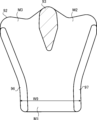
- the guide surface is substantially flush with the inner wall surfaces of the rear ends of the flanges of the upper and lower wing plates of the slider.
- the box portion is shaped so that it does not contact one of the left and right flanges of the upper and lower wings of the slider.
- the sewing machine foot is set in the sewing machine so that its underside contacts the tape surface of the fastener tape of the fastener stringer.
- the fastener stringer is sewn to the fabric while being connected to another fastener stringer.
- the workload of sewing a fastener stringer with a plastic member that prevents the slider from falling off to the fabric is reduced, and furthermore, the quality of the perforations is promoted regardless of the skill level of the sewing worker.
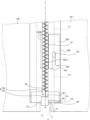
- FIG. 1 is a partial front schematic diagram of the inside of an article (e.g., a garment) according to one embodiment of the present disclosure, in which a slide fastener is sewn to an opening of the article so that it can be opened and closed.
- an arrow F indicates the front
- an arrow Re indicates the rear
- an arrow L indicates the left
- an arrow R indicates the right.
- Guide lines L1 and L2 are set on both the left and right sides of a center line CL of the slide fastener. The guide line L1 does not intersect the stopper, and the guide line L2 intersects the stopper.
- FIG. 2 is a schematic front view of a slider.
- 3 is a schematic cross-sectional view of the slider taken along dashed line III-III in FIG. 2.
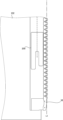
- FIG. 2 is a schematic side view of the right fastener stringer.
- 2 is a schematic cross-sectional view of the slide fastener taken along dashed line VV in FIG. 1.
- 6 is a schematic cross-sectional view of the slide fastener taken along dashed line VI-VI in FIG. 5.
- 13 is a schematic diagram showing the process in which the insert pin is inserted into the receiving space of the box part of the box body via a slider.
- FIG. 1 is a schematic diagram showing how the fabric and the fastener stringer are intermittently fed in the conveying direction by the operation of a sewing machine, and how the two are sewn together by sewing threads (upper thread and lower thread).
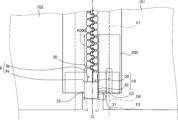
- FIG. 4 is a schematic diagram showing the positional relationship between a sewing machine foot, a fastener element, and a box body.
- FIG. 1 is a schematic diagram showing a fastener stringer and a fabric being sewn together based on the operation of a sewing machine.
- FIG. 1 is a schematic diagram showing a fastener stringer and a fabric being sewn together based on the operation of a sewing machine.
- FIG. 1 is a schematic diagram showing a fastener stringer and a fabric being sewn together based on the operation of a sewing machine.
- FIG. 13 is a schematic diagram showing the left zipper stringer being sewn to the fabric in a non-connected state to the right zipper stringer.
- FIG. 13 is a schematic diagram showing the right zipper stringer being sewn to the fabric in a single-stringer state in which the left zipper stringer is not connected.
- FIG. 13 is a schematic diagram showing that the left and right zipper stringers are sewn to the fabric in the same sewing process using the same sewing machine.
- 11A to 11C are schematic diagrams showing variations of fasteners.
- 5A to 5C are schematic diagrams showing variations of fastener elements.
- the front-to-rear direction corresponds to the direction of movement of the slider for opening and closing the slide fastener, and corresponds to the longitudinal direction of the slide fastener (or the fastener stringer or fastener tape).
- the left-to-right direction is a direction perpendicular to the front-to-rear direction, and corresponds to the width direction of the slide fastener (or the fastener stringer or fastener tape).
- the up-to-down direction is a direction perpendicular to the front-to-rear and left-to-right directions, and corresponds to the thickness direction of the fastener tape.
- the front-to-rear direction corresponds to the transport direction of the fastener stringer
- the up-to-down direction corresponds to the vertical direction (direction of gravity), but is not limited to this.
- the article 100 includes a fabric 101, a fabric 102, and a slide fastener 1, and an opening between the fabric 101 and the fabric 102 can be closed by the slide fastener 1.
- the left and right fastener stringers 2, 5 of the slide fastener 1 are sewn to the fabrics 101, 102.
- the slider 9 moves backward, the left and right fastener stringers 2, 5 are released from the connection, and an opening is formed between the fabric 101 and the fabric 102.
- the slider 9 moves forward, the left and right fastener stringers 2, 5 are connected, and the opening between the fabric 101 and the fabric 102 is closed.
- the fabrics 101, 102 are, for example, half of the front body of an article such as a jacket or a parka, but are not limited to this.
- the fabrics 101, 102 can be different parts of the same fabric or different fabrics.
- the left and right fastener stringers 2, 5 of the slide fastener 1 can be completely separated from each other, but are not limited to this.
- the slide fastener 1 has a pair of left and right fastener stringers 2, 5 and a slider 9 for connecting and disconnecting them.
- Each fastener stringer 2, 5 has a fastener tape 3, 6, a plurality of fastener elements 4, 7 provided individually or in a series on the longitudinal side edge of the fastener tape 3, 6, and a plastic member 8a, 8b located adjacent to the terminal fastener element 4, 7 included in the plurality of fastener elements 4, 7 and preventing the slider 9 from falling off the fastener stringer 2, 5.
- the fastener tapes 3, 6 are woven or knitted fabrics or a mixture of these.
- the fastener elements 4, 7 are made of plastic or metal.
- the fastener elements 4, 7 are provided as individual independent islands in the longitudinal direction of the fastener stringers 2, 5, but are not limited to this, and it is also possible to provide them in a series as individual spiral units of a spiral monofilament having engaging heads formed at a predetermined pitch (see FIG. 17).
- the plastic member 8a is a box body of the separable fastener 8
- the plastic member 8b is a separable insert pin of the separable fastener 8, but this is not limited thereto.
- the separable fastener 8 is used to completely separate a pair of left and right fastener stringers 2, 5 from each other, and refers to a case in which one fastener stringer 2 is provided with a plastic member 8a as a box body, and the other fastener stringer 5 is provided with a insert pin as a plastic member 8b, and the box body and the insert pin are separable.
- a fastener 8 is also called a separable pin stop or an opening tool.
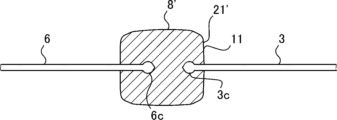
- a form in which the plastic members 8a and 8b are an integrated fastener 8' manufactured by a single injection molding process is also assumed (see FIG. 16). In this case, the plastic members 8a and 8b may be formed into an integrated box shape in which they cannot be distinguished.
- Such a fastener 8' is a fastener used in a product in which the pair of left and right fastener stringers 2, 5 are not completely separated from each other, and is not the above-mentioned separable pin stop or opening tool.
- the fastener tapes 3, 6 include a warp knitted structure, and a core string is provided on the side edge of the fastener tapes 3, 6.
- a core string is provided on the side edge of the fastener tapes 3, 6.
- a first virtual line G1 is determined by direct contact between two or more fastener elements 4 and the sewing machine foot 200.
- a third virtual line G3 is determined by direct contact between the plastic member 8a and the sewing machine foot 200.
- the first and third virtual lines G1 and G3 extend on the same straight line to form one (common) guide line L1 (see Figures 1 and 10).
- the fastener tape 3 and the fabric 101 are sewn together along a second virtual line G2 (see Figure 10) parallel to the first virtual line G1.
- the fastener tape 3 and the fabric 101 are sewn together along a fourth virtual line G4 (see Figure 10) parallel to the third virtual line G3.
- the second and fourth virtual lines G2, G4 extend in the same straight line to form a single (common) sewing line F2 (see FIG. 10), and after the sewing process, a perforation F1 is formed in the same straight line as the sewing line F2 (see FIG. 1 and FIG. 10).
- the plastic member 8a has a guide surface 11 with which the sewing machine foot 200 contacts so that the first and third virtual lines G1, G3 extend in the same straight line to form one (common) guide line L1, and the second and fourth virtual lines G2, G4 extend in the same straight line to form one (common) planned sewing line F2.
- a fifth imaginary line (not shown) is determined by direct contact between two or more fastener elements 7 and the sewing machine foot 200.
- a seventh imaginary line (not shown) is determined by direct contact between the plastic member 8b and the sewing machine foot 200.
- the fifth and seventh imaginary lines extend in the same straight line to form one (common) guide line L2 (see Figures 1 and 10).
- the fastener tape 6 and the fabric 102 are sewn together along a sixth imaginary line (not shown) that is parallel to the fifth imaginary line.
- the fastener tape 6 and the fabric 102 are sewn together along an eighth imaginary line (not shown) that is parallel to the seventh imaginary line (not shown).
- the sixth and eighth imaginary lines extend in the same straight line to form one (common) planned sewing line, and after the sewing process, perforations are formed in the same straight line as the planned sewing line.
- the first virtual line G1 can be understood to be on the same straight line in the front-rear direction as the side surface 44 of the fastener element 4 when the slide fastener 1 is viewed from the front (see FIG. 1).
- the exact position of the first virtual line G1 may vary slightly depending on the surface shape or inclination angle of the side surface of the sewing machine foot 200 that faces and contacts the fastener element 4, as well as the inclination angle of the side surface 44 of the fastener element 4, but this does not contradict the above point.
- the side surface 44 of the fastener element 4 has a surface or partial surface facing the inside of the fastener tape 3, and these are arranged on one (common) first virtual line G1 extending in the front-rear direction.
- each fastener tape 3 included in the first virtual line G1 may be at the same height from the placement surface (e.g., the upper surface) of the fastener tape 3 on which the sewing machine foot 200 is placed.
- the first virtual line G1 is also parallel to the center line CL of the slide fastener 1 and the longitudinal direction of the fastener stringer 2.
- the center line CL is a line that passes through the center of the width of the pair of left and right fastener stringers 2, 5 when the left and right fastener stringers 2, 5 are engaged.
- Each fastener element 4 extends outward relative to the fastener tape 3 beyond the side edge (which may be called the edge) of the fastener tape 3 that faces the fastener tape 6.
- Each fastener element 4 has a side surface 44 that faces the inside of the fastener tape 3, and these are included in a first imaginary line G1 that extends in the front-to-rear direction.
- the side surfaces 44 of the multiple fastener elements 4 are arranged on the same straight line.
- each fastener element 7 extends outward relative to the fastener tape 6 beyond the long edge (which may be called the edge) of the fastener tape 6 that faces the fastener tape 3.
- Each fastener element 7 has a side surface 74 that faces the inside of the fastener tape 6.
- the side surfaces 74 of the multiple fastener elements 7 are arranged on the same straight line.
- the fastener elements 4, 7 may be constricted plastic members including a base 41, 71 attached to the fastener tape 3, 6 (particularly its core cord), a neck 42, 72, and an engaging head 43, 73.
- the width direction of the fastener elements 4, 7 coincides with the longitudinal direction of the fastener stringer 2, 5.
- the neck 42, 72 has the smallest width in the fastener elements 4, 7.
- the base 41, 71 is located within the tape plane of the fastener tape 3, 6.
- the neck 42, 72 and the engaging head 43, 73 are located outside the tape plane of the fastener tape 3, 6.
- the tape surface of the fastener tape 3, 6 is the upper or lower tape surface that defines the thickness of the fastener tape 3, 6.
- Protrusions protruding from the bases 41, 71 can be formed on both sides of the necks 42, 72 of the fastener elements 4, 7.
- grooves extending in the longitudinal direction of the fastener stringers 2, 5 can be formed on the tip surfaces of the engaging heads 43, 73. The protrusions of the mating fastener element are received in the grooves, thereby restricting the vertical displacement of the left and right fastener elements 4, 7.
- the slider 9 moves on the center line CL of the slide fastener 1.
- the slider 9 typically includes an upper wing 91, a lower wing 92, and a connecting post 93 that connects the upper wing 91 and the lower wing 92 at their front ends, and a Y-shaped element passage is defined.
- the element passage has one rear opening M1 for an element combination in which the fastener elements 4 and fastener elements 7 are alternately connected, and two front openings M2, M3 provided on both sides of the connecting post 93 through which the fastener elements 4 and fastener elements 7 pass individually.
- the slider 9 can include upper flanges 94, 95 protruding downward from the left and right side edges of the upper wing 91, and/or lower flanges 96, 97 protruding upward from the left and right side edges of the lower wing 92, thereby restricting the left and right displacement of the fastener elements 4, 7 in the Y-shaped passage.
- the upper and lower flanges 95, 97 on the right side of the slider 9 define a slit through which the fastener tape 3 is inserted.
- the upper and lower flanges 94, 96 on the left side of the slider 9 define a slit through which the fastener tape 6 is inserted.
- the slider 9 can optionally include a pull tab attachment portion 98 and a pull tab 99 attached thereto.
- the plastic member 8a (for example, the box body 10 described later) has a guide surface 11 arranged in the same straight line as the above-mentioned guide line L1.
- the sewing machine foot can smoothly transition from a state in which it is in direct contact with the fastener element 4 to a state in which it is in direct contact with the guide surface 11 of the plastic member 8a, and vice versa.
- the burden of sewing work is reduced, and further, the quality of the perforation is promoted regardless of the skill level of the sewing worker.
- the fastener stringer 2 is properly aligned with the sewing machine foot due to the direct contact between the guide surface 11 of the plastic member 8a and the sewing machine foot, and as a result, the perforation is formed linearly over both the area adjacent to the fastener element 4 and the area adjacent to the plastic member 8a.
- the education and material burden required to improve the skill level of the sewing worker is also reduced.
- the guide surface 11 may include a flat or smooth surface that extends in the same line as the guide line L1.
- the guide surface 11 of the plastic member 8a defines an extension line that is an extension line of the above-mentioned first virtual line G1. Based on the contact between the guide surface 11 of the plastic member 8a and the sewing machine foot, a perforation F1 is formed parallel to the extension line.
- the guide surface 11 is included in an inclined surface that inclines outward relative to the fastener tape 3 as it moves upward away from the tape surface of the fastener tape 3.
- This inclined surface intersects, for example, a normal to the tape surface of the fastener tape 3 at an angle of 3° or less (see angle ⁇ in FIG. 5). This can reduce the effect of contact between the sewing machine foot and the guide surface 11 as a resistance to the transport of the fastener stringer 2.
- the first guide region and second guide region described below can also be included in the inclined surface.
- the plastic member 8a is the box body 10 of the separable fastener 8, and the plastic member 8b can be the insert pin 50 of the separable fastener 8.
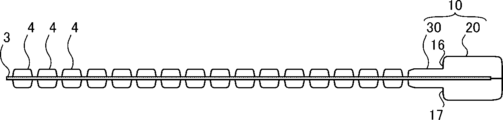
- the box body 10 includes a box pin 30 that is located adjacent to the fastener element 4 located at the end of the arrangement of the multiple fastener elements 4 and is inserted into the slider 9, and a box portion 20 having one or more restraining surfaces 16, 17 to which the box pin 30 is coupled and which restrain the slider 9.
- the thickness of the box pin 30 is equal to or less than the thickness of the box portion 20, for example, about half of it.
- the box portion 20 is shaped so as not to come into contact with one of the left and right flanges of the upper wing plate 91 and the lower wing plate 92 of the slider 9.
- the box section 20 has a first side surface 21 arranged on the same straight line as the above-mentioned guide line L1 (and/or first virtual line G1), and a second side surface 22 provided on the opposite side to the first side surface 21, which together define the width W20 of the box section 20.
- the first side surface 21 is a surface arranged on the same straight line as the above-mentioned guide line L1 (and/or first virtual line G1), and coincides with or includes the above-mentioned guide surface 11.
- the first side surface 21 is a flat or smooth surface, and does not have a convex portion that protrudes to the right so as to intersect with the guide line L1.
- the width dimension of the box portion 20 is set asymmetrically with respect to the center line CL of the slide fastener 1.
- the center line C1 which is located at the center of the width of the box portion 20 defined by the first side surface 21 and the second side surface 22, may be located away from the fastener tape 3 to a position where it does not intersect with the box pin 30, and/or may be located away from the fastener tape 3 further than the center line CL of the slide fastener 1.
- first side surface 21 may be located away from the center line CL of the slide fastener by a first distance D1
- second side surface 22 may be located away from the center line CL of the slide fastener by a second distance D2, the first distance D1 being smaller than the second distance D2, and preferably satisfying 1.1 ⁇ (D2/D1) ⁇ 1.5.
- the box section 20 is shaped to receive the insert pin 50, and typically includes an upper plate 25, a lower plate 26, and a connecting portion 27 connecting the upper plate 25 and the lower plate 26, as shown in FIG. 5.
- the upper plate 25 has a stopping surface 16 for stopping the slider 9, and the lower plate 26 has a stopping surface 17 for stopping the slider 9 (see FIG. 4).
- the upper plate 25 has a flange 28 protruding downward from a tip of the upper plate 25 located away from the connecting portion 27.
- the lower plate 26 has a flange 29 protruding upward from a tip of the lower plate 26 located away from the connecting portion 27.
- the upper plate 25, the lower plate 26, the connecting portion 27, and the flanges 28, 29 define a receiving space for the insert pin 50.
- a slit is formed between the upper and lower flanges 28, 29 to allow the fastener tape 6 to which the insert pin 50 is fixed to pass through.
- the box section 20 includes a first inner surface 23 and a second inner surface 24, each of which partially defines a space for receiving the insert pin 50.
- the core string 3c is located between the first inner surface 23 and the first side surface 21.
- the minimum distance S between the center of the core string 3c and the first side surface 21 is smaller than the minimum distance T between the center of the core string 3c and the first inner surface 23, and preferably satisfies 1.2 ⁇ (T/S) ⁇ 1.6. This ensures sufficient adhesion strength of the box section 20 to the core string 3c.
- the first inner surface 23 extends along the center line CL of the slide fastener 1.
- the second inner surface 24 extends along the above-mentioned guide line L2.
- the second side surface 22 is located outside the fastener tape 3 from the guide line L2. This ensures the appropriate dimensions of the insert pin 50 and the necessary mechanical strength of the box section 20. Since the second side surface 22 is located farther from the center line CL than the guide line L2 (in other words, the guide line L2 crosses the box section 20), the sewing machine foot may interfere with the left side portion of the box section 20. This problem can be dealt with by devising a way to sew the left fastener stringer 5 to the fabric 102 (for example, see FIG. 13).
- a reinforcing part can be provided on the second inner surface 24 side (receiving space side) of the flange 29 to supplement the necessary mechanical strength of the box section 20.
- the flanges 28, 29 may include a protrusion (see reference numeral 29a in FIG. 6) having a width that matches the distance between the second inner surface 24 and the second side surface 22, and a stop wall (see reference numeral 29b in FIG. 6) located behind the protrusion to prevent the insert pin 50 from moving backward.
- the insert pin 50 is inserted into the receiving space between the protrusion of the flanges 28, 29 and the connecting portion 27. Dust that has entered the receiving space can be discharged through the space between the stop wall of the flanges 28, 29 and the connecting portion 27.
- the box pin 30 has a first side 31 on the same side as the first side 21 of the box portion 20, and a second side 32 on the same side as the second side 22 of the box portion 20.
- the first side 31 extends along the above-mentioned guide line L1 and includes flat surfaces 31a and 31c arranged in the same straight line as the guide line L1.
- the entire first side 31 may extend in the same straight line as the above-mentioned guide line L1.
- a concave surface 31b is formed between the above-mentioned flat surfaces 31a and 31c, which allows the sewing machine foot to maintain a contact state close to the contact state with the side surfaces 44 of the preceding fastener element 4.
- the length of the concave surface 31b along the guide line L1 is longer than the total length of the flat surfaces 31a and 31c along the guide line L1, suppressing a sudden change in contact resistance.
- the flat surface 31a is shorter than the length of the side surface 44 of one fastener element 4 along the guide line L1.
- the contact resistance between the sewing machine foot 200 and the fastener stringer 2 increases in proportion to the length of the first side 21. Conversely, this can become a tactile signal that informs the sewing worker that they are approaching the sewing end position.
- the second side surface 32 is formed with a convex surface 32a where the center line CL of the slide fastener 1 intersects, and a concave surface 32b that is recessed relative to the center line CL of the slide fastener 1.
- the side surface of the insert pin 50 that faces the second side surface 32 of the box pin 30 is complementarily shaped to have a concave surface 51a and a convex surface 51b, promoting a more sufficient engagement between the box pin 30 and the insert pin 50, and, for example, restricting forward and backward displacement of the insert pin 50 relative to the box pin 30. In this way, it is advantageous to at least partially shape the opposing surfaces of the insert pin 50 and the box pin 30 complementarily.
- the box pin 30 can be formed into a complex or precise shape as described above.
- the box part 20 and the box pin 30 are manufactured by a single injection molding and/or are integrally bonded and cannot be separated unless destroyed.
- a single gate mark is formed on the surface of the box body 10. This single gate mark means that the box part 20 and the box pin 30 were molded by the same molding cavity during injection molding.
- the insert pin 50 is located adjacent to the fastener element 7 located at the end of the arrangement of the multiple fastener elements 7, and is fixed to the core string 6c of the fastener tape 6.
- the insert pin 50 extends long in the longitudinal direction of the fastener stringer 5, and is inserted into the receiving space of the box part 20 via the slider 9.
- the insert pin 50 has a first side 51 on the box part 20 side and a second side 52 on the opposite side.
- the first side 51 is formed with a concave surface 51a and a convex surface 51b as described above.
- the second side 22 is a flat or smooth surface extending in the same straight line as the above-mentioned guide line L2, but can optionally have a curved surface 52a curved on the opposite side of the convex surface 51b, which makes it easier for the insert pin 50 to move inside the slider 9.
- an engagement portion 55 that engages with the fastener element 4 located at the end of the arrangement of the multiple fastener elements 4 can be provided at the front end of the insert pin 50.
- the engagement portion 55 extends outward from the fastener tape 6 and includes a portion that is inserted into the gap between the head and base of the mating fastener element. If the insert pin 50 is made of resin, the insert pin 50 can be formed into a complex or precise shape as described above.
- the above-mentioned stopping surfaces 16, 17 of the box portion 20 are formed with a width less than the width W9 of the rear end portion of the slider 9.
- the box portion 20 contacts the upper wing plate 91 of the slider 9 with its stopping surface 16, and the front end surface of its flange 28 contacts the rear end surface of the left flange 94 of the slider 9, but does not contact the right flange 95 of the slider 9.
- the box portion 20 contacts the lower wing plate 92 of the slider 9 with its stopping surface 17, and the front end surface of its flange 29 contacts the rear end surface of the left flange 96 of the slider 9, but does not contact the right flange 97 of the slider 9.
- the length of the restraining surfaces 16, 17 in the width direction of the fastener tape 3 is less than or equal to the width W9 of the rear end of the slider 9 in the same direction, and is at least 0.8 times that width.
- the front end surfaces of the flanges 28, 29 do not contact the rear end surfaces of the flanges 94, 96 on the left side of the slider 9.
- the stopping surfaces 16, 17 contact the upper wing plate 91 and the lower wing plate 92 of the slider 9 to stop the box section 20 from passing through the rear opening M1 of the slider 9.
- the fastener stringers 2, 5 can be prevented from tilting due to the thickness of the box section 20 during sewing, which reduces the guide function.
- the slider 9 it is preferable for the slider 9 to contact the stop surfaces 16, 17 and the front end surfaces of the flanges 28, 29 in terms of providing a slim appearance, maintaining the guide function, and dispersing the force applied from the slider 9 to the box portion 20.
- the edges between the top surface of the box portion 20 and the second side surface 22 are chamfered, as are the edges between the bottom surface of the box portion 20 and the second side surface 22.
- the inclination angle of the chamfer between the top surface of the box portion 20 and the second side surface 22 increases the closer it is to the second side surface 22, that is, a gently sloping surface toward the second side surface 22 is formed on the top surface of the box portion 20.
- the flanges 28, 29 can maintain a width (thickness) that matches the distance between the second inner surface 24 and the second side surface 22 over the entire vertical height range.
- the formation of the gently sloping surface also contributes to the slim appearance of the box portion 20.
- the edges between the top and bottom surfaces of the box portion 20 and the first side surface 21 are also chamfered in the same manner.
- the above-mentioned guide surface 11 can include one or more first guide areas (e.g., the above-mentioned flat surfaces 31a, 31c) formed on the box pin 30 and at least one second guide area (e.g., the above-mentioned first side surface 21) formed on the box portion 20.
- the second guide area is formed to form the same plane as the first guide area.
- the guide surface 11 can be approximately flush with the inner wall surface S9 at the rear end of the flanges 94, 96 of the upper wing 91 and the lower wing 92 of the slider 9 when the slider 9 is stopped at its rearmost position by the box portion 20 (see FIG. 7).
- the inner wall surface S9 at the rear end of the flanges 94, 96 extends parallel to the center line CL of the slide fastener 1.
- a method of sewing the fastener stringer 2 and the fabric 101 based on the operation of the sewing machine 900 will be described with reference to Figures 8 to 12.
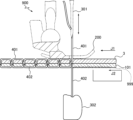
- a laminate in which the fastener tape 3 of the fastener stringer 2 is superimposed on the fabric 101 is placed on the needle plate 999 of the sewing machine 900.
- the sewing machine foot 200 applies an appropriate weight to the laminate to prevent it from shifting out of position.
- the sewing machine foot 200 is set so that its underside contacts the tape surface of the fastener tape of the fastener stringer (i.e., the sewing machine foot 200 does not contact the fabric to which the fastener stringer is sewn). This ensures that the sewing machine foot 200 and the fastener element 4 are in contact with each other even when the fastener element 4 is small in size.
- the laminate is intermittently transported downstream in the transport direction (see arrow J1) in response to the operation of the feed dog 901 (for example, a box-shaped movement indicated by the arrow J2).
- the upper needle 301 through whose needle hole the upper thread 401 is passed, descends and penetrates the laminate.
- the upper thread 401 and the lower thread 402 supplied from the lower thread supply unit 302 (for example, a horizontal or vertical rotary hook) are intertwined with each other.
- the lower thread 402 is drawn along with it, and tension is applied to both threads.
- the fabric 101 and the fastener tape 3 are sewn together with the sewing thread (upper thread 401 and lower thread 402).
- the transport period of the laminate and the operation period of the upper needle and lower thread supply unit are set to be complementary, but this is not limited thereto, and the two periods may partially overlap.
- the plastic member 8a has a guide surface 11 arranged on the same straight line as the first virtual line G1 described above.
- the sewing machine foot 200 can smoothly transition from a state in which it is in direct contact with the fastener element 4 to a state in which it is in direct contact with the guide surface 11 of the plastic member 8a, and vice versa.
- the workload of sewing the fastener stringer 2 to the fabric 101 is reduced, and further, the quality of the perforations is ensured regardless of the skill level of the sewing worker.
- a perforation F1 is formed along a second imaginary line G2 (sewn line F2) parallel to a first imaginary line G1 determined by the contact between the side surfaces 44 of two or more fastener elements 4 and the sewing machine foot 200.
- the sewing machine foot 200 includes two pressure plates 201, 202 extending parallel to the conveying direction and upstream in the conveying direction, and a connecting portion 203 connecting these pressure plates, and the up and down movement position of the upper needle 301 is set between the two pressure plates 201, 202.
- the sewing machine foot 200 contacts the side surface 44 of the fastener element 4 at one side surface 201a of the pressure plate 201.
- the one side surface 201a of the pressure plate 201 is a flat surface extending linearly parallel to the conveying direction, but this is not necessarily the case and may be, for example, a wavy surface. Even in this case, the technical effects of the present disclosure are not limited.
- the shape of the sewing machine foot 200 is not limited to that shown in the figure.
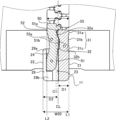
- the side surface 44 of the fastener element 4 and the flat surface 31a of the box pin 30 are in contact with the sewing machine foot 200.
- the first side surface 31 of the box pin 30 is formed in the same straight line as the guide line L1 without forming a convex portion with respect to it. Therefore, even if the box pin 30 enters an area adjacent to the sewing machine foot 200, the two do not interfere with each other. Therefore, the formation of the linear perforation F1 continues even in the area adjacent to the box pin 30.
- the sewing machine foot 200 is in contact with the side 44 of the fastener element 4, the flat surfaces 31a, 31c of the box pin 30 (i.e., part of the guide surface 11), and the first side 21 of the box portion 20 (i.e., the remaining part of the guide surface 11).
- the first side 21 of the box portion 20 is formed in the same straight line as the guide line L1 without forming a convex portion with respect to it. Therefore, even if the box portion 20 enters an area adjacent to the sewing machine foot 200, the two do not interfere with each other. Therefore, the formation of the linear perforation F1 continues even in the area adjacent to the box portion 20.
- the article 100 has perforations F1 formed parallel to the first imaginary line G1 based on direct contact between two or more fastener elements 4 included in the multiple fastener elements 4 and the sewing machine foot 200 of the sewing machine 900, and the perforations F1 are also formed parallel to the guide surface 11 of the plastic member 8a arranged on the same straight line as the first imaginary line G1.
- the article 100 has perforations F1 formed parallel to the guide line L1 that is on the same straight line in the front-rear direction as the side surface 44 of the multiple fastener elements 4 when the slide fastener is viewed from the front.
- the perforations F1 can be formed completely linearly without bending, curving, or meandering over the entire length of the slide fastener 1.
- the perforations have conventionally curved or meandered in the area adjacent to the stop to avoid the sewing machine foot colliding with the stop, but this has been improved.
- the left-side zipper stringer 5 can be sewn to the fabric 102 in advance using a sewing machine 900 as shown in FIG. 13.
- the insert pin 50 is not inserted into the box portion 20, so even if the second side surface 22 of the box portion 20 is positioned farther from the center line CL than the guide line L2, the sewing machine foot 200 will not interfere with the left side portion of the box portion 20.
- the insert pin 50 includes a flat or smooth surface that extends in the same straight line as the guide line L2, and optionally has a curved surface 52a. Therefore, the insert pin 50 does not interfere with the sewing machine foot 200, and even if it does, it is only slight.
- the right zipper stringer 2 can be sewn to the fabric 101 with the left zipper stringer 5 separated (see FIG. 14).
- the right zipper stringer 2 can be sewn to the fabric 101 and the left zipper stringer 5 can be sewn to the fabric 102 at the same time (see FIG. 15).
- the stopper (in short, the rear stopper) provided on the slide fastener 1 is not limited to the separable stopper 8 constructed by combining the plastic members 8a and 8b, but may be an inseparable stopper 8' as shown in FIG. 16.
- the inseparable stopper 8' includes the first side surface 21' as the above-mentioned guide surface 11, and therefore has the same effect as described above.
- the separable stopper 8 has a portion (e.g., flanges 28, 29) with a thinner wall thickness than the inseparable stopper 8', and there is a risk that the mechanical strength will be relatively low. To compensate for this, as can be seen from FIG.
- the insert pin 50 when the insert pin 50 is inserted into the box portion 20 and the slider 9 advances to a position away from the box body 10 and the insert pin 50, the insert pin 50 can contact both the flanges 28, 29 and the box pin 30 and be held between them. This allows the mechanical strength of the stopper 8 to be sufficiently ensured when the insert pin 50 and the box body 10 are joined.
- the insert pin 50 and the box body 10 can be precisely shaped for the above-mentioned purpose.
- the fastener elements 4, 7 provided on the fastener stringers 2, 5 can be provided as individual independent islands in the longitudinal direction of the fastener stringers 2, 5, or can be provided as a continuous series of fastener elements 4, 7 in the longitudinal direction of the fastener stringers 2, 5.
- the fastener elements are provided in a series as individual helical units 4' of a helical monofilament in which engaging heads 43' are formed at a predetermined pitch.
- the helical unit 4' has an upper leg 46 extending inward from the upper end of the engaging head 43' extending in the vertical direction, a lower leg (not shown) extending inward from the lower end of the engaging head 43', and an inverted portion 47 connecting the upper leg 46 and the lower leg between adjacent helical units 4'.
- a guide line L1' is defined based on the contact between the inverted portion 47 of the helical units 4' adjacent in the longitudinal direction of the fastener stringers 2', 5' and the sewing machine foot 200.
- the box body 10 of the fastener 8 includes a guide surface 11 as described above, and therefore provides the same effect as described above.
- the fastener stringer sewn to the fabric may be (i) sewn to the fabric in a state where another fastener stringer that forms a pair is connected, or (ii) sewn to the fabric in a single stringer state where another fastener stringer that forms a pair is separated.
- the linear transport of the fastener stringer 2 based on the direct contact between two or more fastener elements 4 and the sewing machine foot 200 and the linear transport of the fastener stringer 2 based on the direct contact between the plastic member 8a and the sewing machine foot 200 are performed in this order or in the reverse order.
Landscapes
- Engineering & Computer Science (AREA)
- Textile Engineering (AREA)
- Sewing Machines And Sewing (AREA)
- Slide Fasteners (AREA)
Priority Applications (6)
| Application Number | Priority Date | Filing Date | Title |
|---|---|---|---|
| DE112023006287.0T DE112023006287T5 (de) | 2023-04-26 | 2023-04-26 | Verfahren zum nähen eines reissverschluss-längsteils an stoff, gegenstand, und reissverschluss |
| PCT/JP2023/016535 WO2024224531A1 (ja) | 2023-04-26 | 2023-04-26 | ファスナーストリンガーを生地に対して縫着する方法、物品、及びスライドファスナー |
| JP2025516392A JPWO2024224531A1 (https=) | 2023-04-26 | 2023-04-26 | |
| CN202410148593.XA CN118854563A (zh) | 2023-04-26 | 2024-02-02 | 将拉链链带缝合于布料的方法、物品及拉链 |
| CN202420258709.0U CN221690274U (zh) | 2023-04-26 | 2024-02-02 | 缝合有拉链的物品及拉链 |
| TW113107356A TWI882706B (zh) | 2023-04-26 | 2024-03-01 | 將拉鏈鏈帶縫合於布料之方法、縫合有拉鏈之物品及拉鏈 |
Applications Claiming Priority (1)
| Application Number | Priority Date | Filing Date | Title |
|---|---|---|---|
| PCT/JP2023/016535 WO2024224531A1 (ja) | 2023-04-26 | 2023-04-26 | ファスナーストリンガーを生地に対して縫着する方法、物品、及びスライドファスナー |
Publications (1)
| Publication Number | Publication Date |
|---|---|
| WO2024224531A1 true WO2024224531A1 (ja) | 2024-10-31 |
Family
ID=92650679
Family Applications (1)
| Application Number | Title | Priority Date | Filing Date |
|---|---|---|---|
| PCT/JP2023/016535 Ceased WO2024224531A1 (ja) | 2023-04-26 | 2023-04-26 | ファスナーストリンガーを生地に対して縫着する方法、物品、及びスライドファスナー |
Country Status (5)
| Country | Link |
|---|---|
| JP (1) | JPWO2024224531A1 (https=) |
| CN (2) | CN118854563A (https=) |
| DE (1) | DE112023006287T5 (https=) |
| TW (1) | TWI882706B (https=) |
| WO (1) | WO2024224531A1 (https=) |
Citations (3)
| Publication number | Priority date | Publication date | Assignee | Title |
|---|---|---|---|---|
| JPS5195459U (https=) * | 1975-01-28 | 1976-07-31 | ||
| JPS6053276U (ja) * | 1983-09-21 | 1985-04-15 | 蛇の目ミシン工業株式会社 | ジグザグミシンのファスナ−押え |
| JP2003038214A (ja) * | 2001-07-13 | 2003-02-12 | Shih-Chang Wang | チャックの立体噛合わせ方法及びこの方法を用いた分離式チャック |
Family Cites Families (4)
| Publication number | Priority date | Publication date | Assignee | Title |
|---|---|---|---|---|
| JPH08173215A (ja) * | 1994-12-26 | 1996-07-09 | Ykk Kk | 開離嵌挿具付きのスライドファスナー |
| US20130305499A1 (en) * | 2011-01-26 | 2013-11-21 | Ykk Corporation | Fastener Chain with Separable Bottom End Stop and Method for Producing the Same |
| WO2015166536A1 (ja) * | 2014-04-28 | 2015-11-05 | Ykk株式会社 | ファスナーチェーン、及びその製造方法 |
| WO2021090494A1 (ja) * | 2019-11-08 | 2021-05-14 | Ykk株式会社 | スライドファスナー |
-
2023
- 2023-04-26 JP JP2025516392A patent/JPWO2024224531A1/ja active Pending
- 2023-04-26 DE DE112023006287.0T patent/DE112023006287T5/de active Pending
- 2023-04-26 WO PCT/JP2023/016535 patent/WO2024224531A1/ja not_active Ceased
-
2024
- 2024-02-02 CN CN202410148593.XA patent/CN118854563A/zh active Pending
- 2024-02-02 CN CN202420258709.0U patent/CN221690274U/zh active Active
- 2024-03-01 TW TW113107356A patent/TWI882706B/zh active
Patent Citations (3)
| Publication number | Priority date | Publication date | Assignee | Title |
|---|---|---|---|---|
| JPS5195459U (https=) * | 1975-01-28 | 1976-07-31 | ||
| JPS6053276U (ja) * | 1983-09-21 | 1985-04-15 | 蛇の目ミシン工業株式会社 | ジグザグミシンのファスナ−押え |
| JP2003038214A (ja) * | 2001-07-13 | 2003-02-12 | Shih-Chang Wang | チャックの立体噛合わせ方法及びこの方法を用いた分離式チャック |
Also Published As
| Publication number | Publication date |
|---|---|
| CN118854563A (zh) | 2024-10-29 |
| DE112023006287T5 (de) | 2026-02-19 |
| CN221690274U (zh) | 2024-09-13 |
| TWI882706B (zh) | 2025-05-01 |
| JPWO2024224531A1 (https=) | 2024-10-31 |
| TW202442150A (zh) | 2024-11-01 |
Similar Documents
| Publication | Publication Date | Title |
|---|---|---|
| US7694396B2 (en) | Reverse opening type separable end stop of slide fastener | |
| KR101332470B1 (ko) | 슬라이드 파스너용 슬라이더 및 퀵 오픈식 슬라이드 파스너 | |
| US20190380454A1 (en) | Slide Fastener-Attached Product, Element Member and Manufacturing Method of Slide Fastener-Attached Product | |
| TWI645799B (zh) | zipper | |
| TW200847958A (en) | Slide fastener top end stop | |
| WO2023058140A1 (ja) | 上止及びスライドファスナー付き製品 | |
| JP3214476U (ja) | スライドファスナー用スライダー、及びスライドファスナー | |
| JP7513469B2 (ja) | エレメント部材、チェーン部材、及びスライドファスナー付き製品 | |
| TW200422002A (en) | Slide fastener with separable bottom end stop | |
| WO2024224531A1 (ja) | ファスナーストリンガーを生地に対して縫着する方法、物品、及びスライドファスナー | |
| JP7190573B2 (ja) | エレメント部材及びスライドファスナー付き製品 | |
| TWI243035B (en) | Slide fastener with separable bottom end stop | |
| CN113795173A (zh) | 拉链 | |
| TWI727758B (zh) | 拉鏈 | |
| TWI851058B (zh) | 軌式拉鏈及其製造方法和雙重拉鏈 | |
| TWI817817B (zh) | 拉鏈用鏈牙構件及帶拉鏈的製品 | |
| US20260053236A1 (en) | Slide fastener, and opening assembly for slide fastener | |
| JPWO2024224531A5 (https=) | ||
| CN105592743A (zh) | 拉链用拉头以及拉链 | |
| TW201904466A (zh) | 拉鏈 | |
| TW201836509A (zh) | 拉鏈 |
Legal Events
| Date | Code | Title | Description |
|---|---|---|---|
| 121 | Ep: the epo has been informed by wipo that ep was designated in this application |
Ref document number: 23935311 Country of ref document: EP Kind code of ref document: A1 |
|
| WWE | Wipo information: entry into national phase |
Ref document number: 2025516392 Country of ref document: JP |
|
| WWE | Wipo information: entry into national phase |
Ref document number: 202517063670 Country of ref document: IN |
|
| WWP | Wipo information: published in national office |
Ref document number: 202517063670 Country of ref document: IN |
|
| WWE | Wipo information: entry into national phase |
Ref document number: 112023006287 Country of ref document: DE |
|
| WWP | Wipo information: published in national office |
Ref document number: 112023006287 Country of ref document: DE |
|
| 122 | Ep: pct application non-entry in european phase |
Ref document number: 23935311 Country of ref document: EP Kind code of ref document: A1 |