WO2024210209A1 - 海苔香付与剤及びこれを含有する容器詰め緑茶飲料 - Google Patents
海苔香付与剤及びこれを含有する容器詰め緑茶飲料 Download PDFInfo
- Publication number
- WO2024210209A1 WO2024210209A1 PCT/JP2024/014125 JP2024014125W WO2024210209A1 WO 2024210209 A1 WO2024210209 A1 WO 2024210209A1 JP 2024014125 W JP2024014125 W JP 2024014125W WO 2024210209 A1 WO2024210209 A1 WO 2024210209A1
- Authority
- WO
- WIPO (PCT)
- Prior art keywords
- green tea
- tea beverage
- copper
- ppm
- matcha
- Prior art date
- Legal status (The legal status is an assumption and is not a legal conclusion. Google has not performed a legal analysis and makes no representation as to the accuracy of the status listed.)
- Ceased
Links
Classifications
-
- A—HUMAN NECESSITIES
- A23—FOODS OR FOODSTUFFS; TREATMENT THEREOF, NOT COVERED BY OTHER CLASSES
- A23F—COFFEE; TEA; THEIR SUBSTITUTES; MANUFACTURE, PREPARATION, OR INFUSION THEREOF
- A23F3/00—Tea; Tea substitutes; Preparations thereof
- A23F3/16—Tea extraction; Tea extracts; Treating tea extract; Making instant tea
-
- A—HUMAN NECESSITIES
- A23—FOODS OR FOODSTUFFS; TREATMENT THEREOF, NOT COVERED BY OTHER CLASSES
- A23L—FOODS, FOODSTUFFS OR NON-ALCOHOLIC BEVERAGES, NOT OTHERWISE PROVIDED FOR; PREPARATION OR TREATMENT THEREOF
- A23L27/00—Spices; Flavouring agents or condiments; Artificial sweetening agents; Table salts; Dietetic salt substitutes; Preparation or treatment thereof
Definitions
- the present invention relates to a laver aroma imparting agent for use in green tea beverages.
- the present invention also relates to a bottled green tea beverage containing the laver aroma imparting agent.
- Patent Document 1 discloses a green tea beverage that contains a matcha flavoring agent to enhance the taste.
- the objective of the present invention is to provide a new, highly palatable, bottled green tea beverage that improves on the taste of conventional green tea beverages.
- a laver aroma imparting agent for use in green tea beverages containing copper as an active ingredient.
- the laver aroma imparting agent according to 1 which is used so as to contain 0.1 to 20 ppm of copper by mass relative to the matcha-containing green tea beverage.
- a packaged green tea beverage comprising: The green tea beverage contains 0.1 to 20 ppm of copper by mass.
- the matcha beverage according to 3 or 4 having an a value of ⁇ 5 or less in the L*a*b color system.
- the present invention makes it possible to provide a new, highly palatable, packaged green tea beverage that improves on the taste of conventional green tea beverages.
- FIG. 1 shows a photograph of the appearance of the matcha beverages obtained in Example 11 and Reference Example 11 poured into a transparent cup.
- FIG. 2 shows a photograph of the appearance of the matcha beverages obtained in Example 12 and Reference Example 12 poured into a transparent cup.
- FIG. 3 is a photograph showing the appearance of the matcha beverages obtained in Example 13 and Reference Example 13 poured into a transparent cup.
- FIG. 4 shows a photograph of the appearance of the matcha beverages obtained in Example 14 and Reference Example 14 poured into a transparent cup.
- One embodiment of the present invention is a laver aroma imparting agent for use in green tea beverages, and contains copper as an active ingredient.
- the laver aroma imparting agent of the present invention when used in a green tea beverage, can produce a laver aroma that evokes the image of a high-quality green tea beverage.
- the mechanism by which the laver aroma is produced is not clear, it is speculated that the active ingredient copper exists as ions in the green tea beverage and captures specific components contained in the green tea beverage, resulting in the expression of the laver aroma, and that as the copper content increases, the amount of copper captured also increases, resulting in a stronger laver aroma.
- Patent Document 1 discloses a matcha flavoring agent containing zinc as an active ingredient, but the laver aroma-imparting agent of the present invention has a different active ingredient and effect compared to this matcha flavor-imparting agent.
- the laver aroma is specifically and significantly expressed by the present invention, and it has been demonstrated in the examples described below that a similar effect cannot be achieved by zinc.
- the laver aroma imparting agent of the present invention is used so that the copper content is 0.1 to 20 ppm by mass based on the green tea beverage.
- the amount of copper used is preferably 0.1 to 15 ppm, more preferably 0.1 to 10 ppm, more preferably 0.2 to 10 ppm, more preferably 0.2 to 6 ppm, based on the mass of the green tea beverage.
- the lower limit of the amount of copper used may be, for example, 0.1 ppm, 0.2 ppm, 0.3 ppm, 0.4 ppm, 0.5 ppm, 0.6 ppm, 0.7 ppm, 0.8 ppm, 0.9 ppm, 1.0 ppm, 1.5 ppm, or 2.0 ppm, based on the mass of the green tea beverage
- the upper limit of the amount of copper used may be, for example, 20 ppm, 15 ppm, 10 ppm, 5.0 ppm, 3.0 ppm, 2.5 ppm, or 2.0 ppm, based on the mass of the green tea beverage.
- the lower and upper limits of the amount of copper used can be arbitrarily combined to form a numerical range.
- copper can be used in the form of copper yeast, copper gluconate, copper sulfate, etc., and is preferably copper yeast or copper gluconate. These can be used alone or in combination of two or more in any ratio.
- the laver aroma imparting agent of the present invention is used for a green tea beverage, and the green tea beverage may contain matcha (ground tea leaves).
- matcha ground tea leaves
- the flavor derived from matcha can be imparted to the green tea beverage, and in addition, by containing the laver aroma imparting agent of the present invention, a secondary effect of the green tea beverage having a vivid green color can be obtained.
- the content of matcha in the green tea beverage is, for example, 0.001 to 2.5% by mass, preferably 0.005 to 1.5% by mass, and more preferably 0.0075 to 1.5% by mass, based on the mass of the entire green tea beverage.
- the green tea beverage using the laver aroma imparting agent of the present invention may be a commercially available beverage or a prepared beverage. When prepared, the green tea beverage may be prepared by a conventional method known in the art using conventional materials known in the art.
- the packaged green tea beverage according to one embodiment of the present invention contains 0.1 to 20 ppm of copper by mass, which allows the packaged green tea beverage of the present invention to express a seaweed aroma that evokes the image of a high-quality green tea beverage.
- the copper content is preferably 0.1 to 15 ppm, more preferably 0.1 to 10 ppm, more preferably 0.2 to 10 ppm, more preferably 0.2 to 6 ppm, on a mass basis. In one embodiment of the present invention, the copper content is preferably 0.1 to 15 ppm, more preferably 0.1 to 10 ppm, more preferably 0.2 to 10 ppm, more preferably 0.2 to 6 ppm, based on mass.
- the lower limit of the copper content may be, for example, 0.1 ppm, 0.2 ppm, 0.3 ppm, 0.4 ppm, 0.5 ppm, 0.6 ppm, 0.7 ppm, 0.8 ppm, 0.9 ppm, 1.0 ppm, 1.5 ppm, or 2.0 ppm, based on mass
- the upper limit of the copper content may be, for example, 20 ppm, 15 ppm, 10 ppm, 5.0 ppm, 3.0 ppm, 2.5 ppm, or 2.0 ppm, based on mass.
- the lower limit and upper limit of the amount of copper used can be arbitrarily combined to form a numerical range.
- copper can be used in the form of copper yeast, copper gluconate, copper sulfate, etc., and is preferably copper yeast or copper gluconate. These can be used alone or in combination of two or more in any ratio.
- the copper content in the packaged green tea beverage of the present invention can be measured, for example, by atomic absorption spectrometry. Specifically, it can be measured using an atomic absorption spectrophotometer (for example, Atomic Absorption Spectrophotometer "AA-7800", Shimadzu Corporation) in accordance with AOAC 990.08-1993 (Metals in Solid Wastes by Inductively Coupled Plasma Atomic Emission Method).
- an atomic absorption spectrophotometer for example, Atomic Absorption Spectrophotometer "AA-7800", Shimadzu Corporation
- AOAC 990.08-1993 Metal in Solid Wastes by Inductively Coupled Plasma Atomic Emission Method.
- the copper content in the packaged green tea beverage of the present invention can be considered to be the same as the amount of copper added when producing the green tea beverage, assuming that no copper is entrained in the raw materials (excluding copper) of the green tea beverage.
- the packaged green tea beverage of the present invention may contain matcha (ground tea leaves).
- matcha ground tea leaves
- the inclusion of the laver aroma imparting agent of the present invention has the secondary effect of causing the green tea beverage to have a vivid green color.
- the content of matcha is, for example, 0.001 to 2.5% by mass, preferably 0.005 to 1.5% by mass, and more preferably 0.0075 to 1.5% by mass, based on the mass of the entire green tea beverage.
- the content of matcha in the packaged green tea beverage can be regarded as the amount (dry mass) of matcha added when producing the green tea beverage, or can be determined by measuring the dry mass of the solid matter obtained by centrifuging the green tea beverage.
- the particle size of the matcha is not particularly limited, and matcha having an appropriate particle size distribution can be used taking into consideration the flavor and throat feel of the green tea beverage to be prepared.
- the particle size of the matcha (D 90 : 90% cumulative particle size on a volume basis) is, for example, 0.1 to 200 ⁇ m, preferably 1 to 100 ⁇ m, more preferably 1 to 80 ⁇ m, more preferably 1 to 60 ⁇ m, and more preferably 10 to 50 ⁇ m.
- the particle size of the matcha can be determined by particle distribution measurement using a laser diffraction method.
- the a value in the L*a*b color system is -5 or less.
- a negative a value indicates green and a positive a value indicates red, and if the a value is -5 or less, it can be evaluated as exhibiting a bright green color suitable for a green tea beverage.
- a negative b value indicates blue and a positive b value indicates yellow. The closer the L value is to 0, the darker the beverage becomes, and the closer it is to 100, the whiter the beverage becomes.
- the L*a*b color system can be measured by the method described in the Examples.
- the green tea beverage may be a commercially available beverage or may be a prepared beverage. If prepared, the green tea beverage may be prepared by conventional methods known in the art using conventional ingredients known in the art.
- Ingredients for green tea beverages include matcha (ground tea leaves), sugar, salt, pH adjusters, antioxidants, dairy ingredients, etc., and green tea beverages can be prepared by dispersing these in water or tea leaf extract.
- the container used for the bottled green tea beverage of the present invention is not particularly limited, and any container that has sealability can be used, such as a PET bottle, a can, an aluminum pouch, a paper container, a plastic cup, or a bottle.
- the bottled green tea beverage of the present invention it is preferable to sterilize the beverage.
- the sterilization method is not particularly limited, and UHT sterilization, retort sterilization, etc. can be used.
- the sterilization strength may be set to a level that does not cause deterioration during distribution at room temperature.
- the copper ion content was measured using an atomic absorption spectrophotometer (Atomic Absorption Spectrophotometer "AA-7800", Shimadzu Corporation) in accordance with AOAC 990.08-1993 (Metals in Solid Wastes by Inductively Coupled Plasma Atomic Emission Method).
- Comparative Example 1 was a commercially available beverage to which no copper ions had been added, and the copper ion content was measured by the above-mentioned method and was below the detection limit. Therefore, in Examples 1 to 7 and Comparative Example 3, the amount of added copper ions was regarded as the content in the green tea beverage.
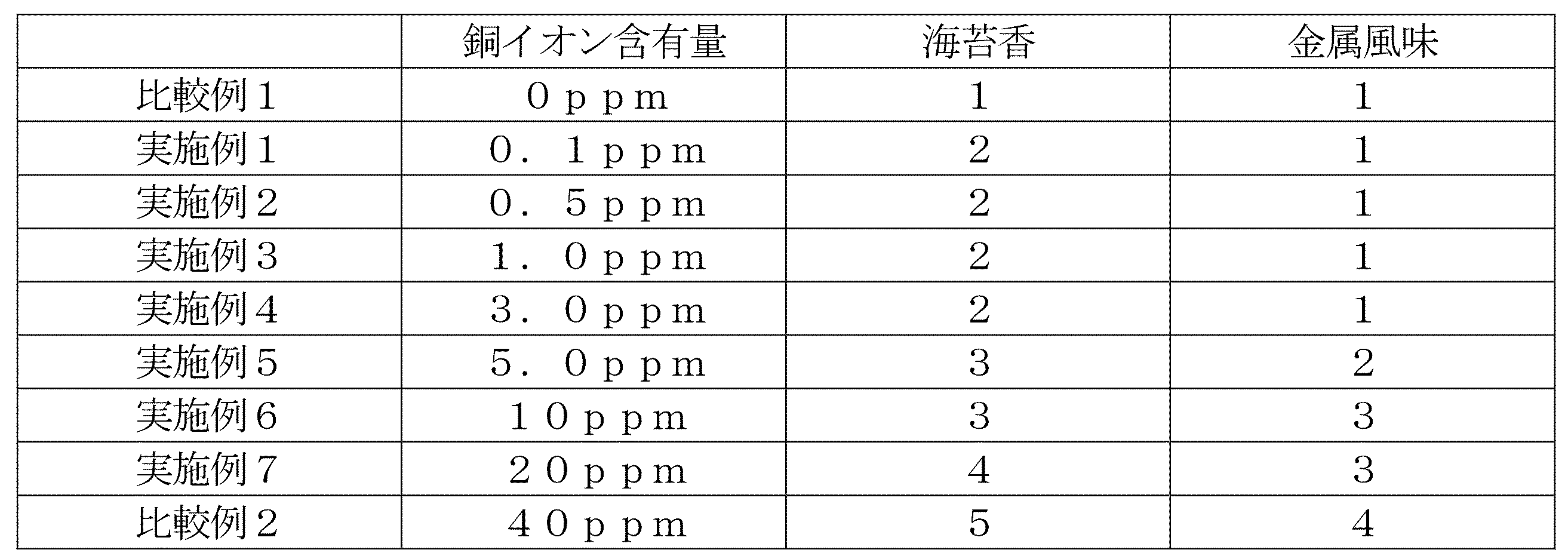
- Preparation Example 1 (Examples 1 to 7 and Comparative Examples 1 and 2) Copper ions were added in varying amounts to a commercially available bottled green tea beverage, "Ayataka Chaba no Amami” (Coca-Cola Japan Co., Ltd.). Copper ions were added by adding copper-containing yeast (mineral yeast copper 1.1%, manufactured by Oriental Yeast Co., Ltd.). The green tea beverage after addition was drunk and the flavor was evaluated. Comparative Example 1 was a commercially available beverage without the addition of copper ions. In the flavor evaluation, a metallic flavor score of 4 or more was determined to be unsuitable for consumption as a green tea beverage. The results are shown in Table 1.
- Preparation Example 1 showed that the addition of copper produces a seaweed aroma in green tea beverages, and that the seaweed aroma intensifies as the amount of copper added increases. It was also found that when 40 ppm of copper was added, the metallic flavor became too strong, making the beverage unsuitable for drinking.
- Preparation example 2 (reference examples 1 to 8)
- a green tea beverage was prepared by adding zinc ions instead of copper ions in Preparation Example 1.
- the zinc ions were obtained by adding zinc-containing yeast (mineral yeast zinc 5.75%, manufactured by Oriental Yeast Co., Ltd.).
- the flavor of the prepared green tea beverage was evaluated.
- the results are shown in Table 2.
- the zinc ion content was calculated based on the assumption that commercially available beverages do not contain zinc ions, and was calculated by multiplying the amount of zinc-containing yeast added by 5.75%.
- Preparation Example 3 (Examples 8 to 14 and Comparative Examples 3 and 4) Pure water was added to 15 g of matcha, 130 g of sugar, 1 g of sodium ascorbate, and 0.1 g of sodium bicarbonate to adjust the total to 2000 g, and mixed well to prepare a matcha beverage. Copper ions were added to the obtained matcha beverage in different amounts. Copper ions were added by adding copper-containing yeast (mineral yeast copper 1.1%, manufactured by Oriental Yeast Co., Ltd.). The matcha beverage after addition was filled into a can, sterilized by heating at 123°C for 15 minutes, and cooled to 20°C, and then used for evaluation. (Flavor evaluation) The matcha beverage obtained in Preparation Example 3 was drunk and evaluated for flavor. The results are shown in Table 3. Comparative Example 3 was a matcha beverage without the addition of copper ions.
- the flavor evaluation of Preparation Example 3 revealed that the addition of copper produced a seaweed aroma in the matcha beverage, and the seaweed aroma was enhanced with an increase in the copper content.
- the seaweed aroma and metallic flavor both tended to receive lower scores than the green tea beverage not containing matcha, due to the stronger flavor of matcha in the flavor evaluation. It was also found that when the copper content was 40 ppm, the metallic taste was too strong and the drink was unsuitable for drinking.
- Preparation Example 4 (Reference Examples 9 to 16) As a reference example, a matcha beverage was prepared by adding zinc ions instead of copper ions in Preparation Example 3. The zinc ions were obtained by adding zinc-containing yeast (mineral yeast zinc 5.75%, manufactured by Oriental Yeast Co., Ltd.). In the same manner as in Preparation Example 3, the mixture was filled into a can, heat sterilized, cooled, and then used for evaluation. In addition, the zinc ion content was assumed to be equal to the amount added, on the assumption that the ingredients of the matcha beverage do not contain zinc ions.
- the liquid color of the matcha beverages obtained in Preparation Examples 3 and 4 was evaluated.
- the liquid color was evaluated by visual inspection to determine whether or not the liquid color was favorable for matcha, and by measurement in the L*a*b color system (Hunter Lab, transmission method) using a spectrophotometer/colorimeter (SE7700, manufactured by Nippon Denshoku Industries Co., Ltd.).
- the L*a*b color system was measured by pouring the beverage to be measured into a square cell with a thickness of 10 mm.
- photographs of the appearance of the matcha beverages in transparent cups are shown in Figures 1 to 4.
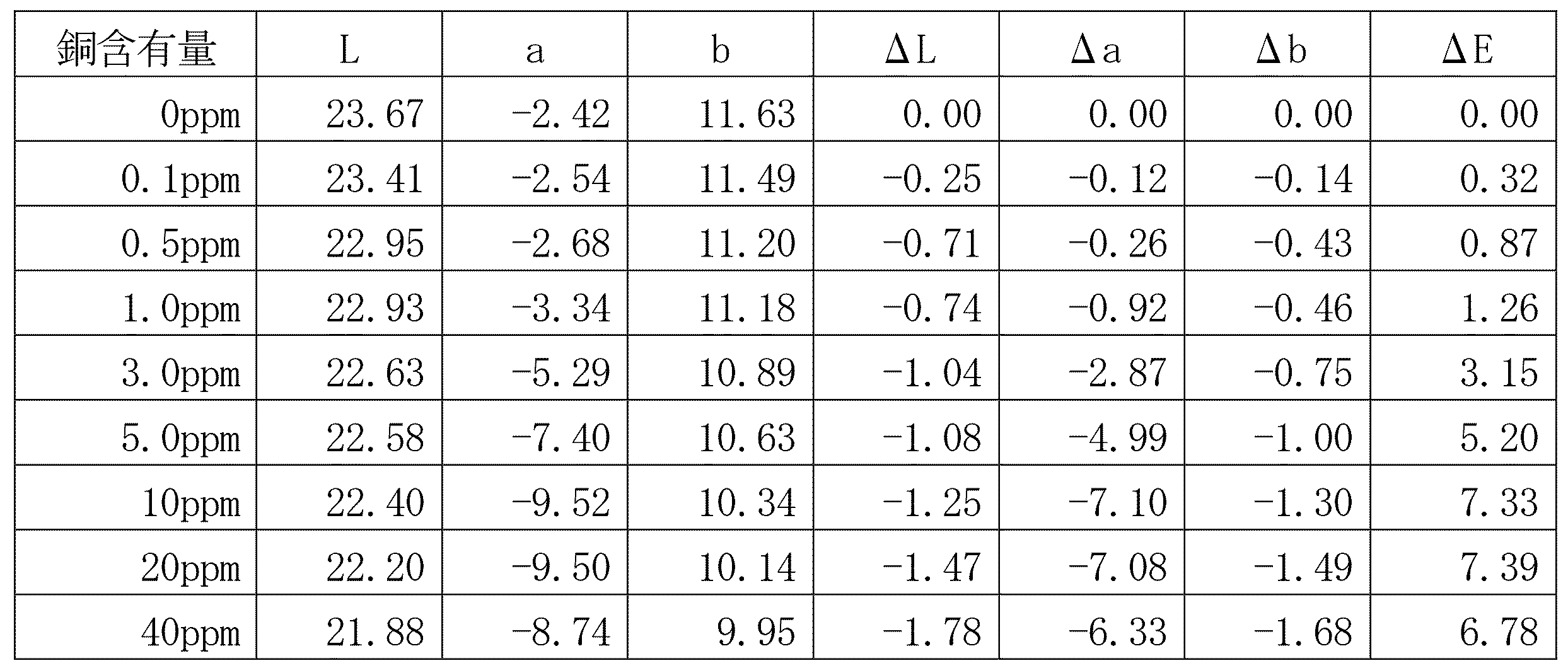
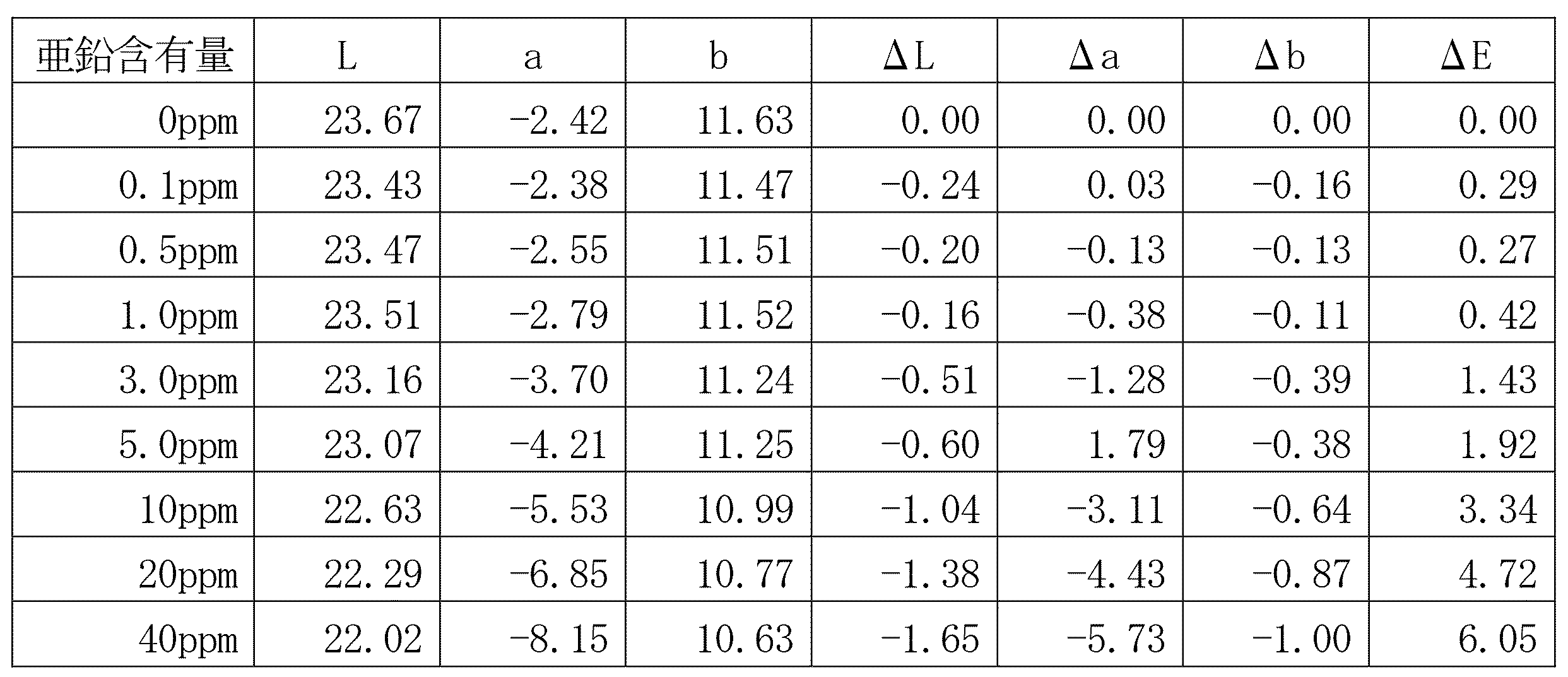
- the results of the L*a*b color system measurements are shown in Tables 3 and 4.
- the a-value becomes more negative, indicating a greener color, with the effect of the copper content, and especially when the content is 3.0 ppm, the a-value becomes -5 or less, resulting in a brighter and cleaner green color.
- a zinc-containing green tea beverage needs a zinc content of 10 ppm or more to have an a-value of -5 or less.
- copper has the advantage of being highly cost-effective, since it has a high green coloring effect with a smaller content.
- the seaweed flavor imparting agent of the present invention can improve the taste of green tea beverages and impart a sense of luxury, and therefore has high industrial applicability.
- the bottled green tea beverage of the present invention is highly palatable, satisfying the preferences of drinkers, and has high industrial applicability.
Landscapes
- Life Sciences & Earth Sciences (AREA)
- Chemical & Material Sciences (AREA)
- Engineering & Computer Science (AREA)
- Food Science & Technology (AREA)
- Polymers & Plastics (AREA)
- Health & Medical Sciences (AREA)
- Nutrition Science (AREA)
- Tea And Coffee (AREA)
- Seasonings (AREA)
Abstract
銅を有効成分として含有する、緑茶飲料に使用するための海苔香付与剤。
Description
本発明は、緑茶飲料に使用するための海苔香付与剤に関する。また、本発明は、海苔香付与剤を含有する容器詰め緑茶飲料に関する。
近年、携帯性や保存性の観点で、レディ・トゥ・ドリンク(Ready to drink)飲料である容器詰め飲料が広く流通している。そして、容器詰め飲料としては、日本の文化において長く親しまれてきた緑茶飲料が供給されている。
容器詰め緑茶飲料については、飲用者の嗜好性に訴求するために、呈味や風味を改善しようとする新たな商品開発ニーズが常に存在する。例えば、特許文献1には、呈味を強化するための抹茶風味付与剤を含有する緑茶飲料が開示されている。
本発明は、従来の緑茶飲料の呈味を向上させた嗜好性の高い新規な容器詰め緑茶飲料を提供することを課題とする。
本発明者らは、上記課題に鑑み、鋭意研究した結果、銅を有効成分として緑茶飲料に含有させることにより、高級茶をイメージさせる海苔香を発現させることができることを見出し、本発明を完成させた。
本発明によれば、以下の海苔香付与剤等を提供できる。
1.銅を有効成分として含有する、緑茶飲料に使用するための海苔香付与剤。
2.抹茶含有緑茶飲料に対して質量基準で銅を0.1~20ppm含有するように使用する、1に記載の海苔香付与剤。
3.容器詰めの緑茶飲料であって、
質量基準で銅を0.1~20ppm含有する前記緑茶飲料。
4.前記緑茶飲料全体の質量を基準として、0.001~2.5質量%の抹茶を含有する、3に記載の緑茶飲料。
5.L*a*b表色系においてa値が-5以下である、3又は4に記載の抹茶飲料。
本発明によれば、以下の海苔香付与剤等を提供できる。
1.銅を有効成分として含有する、緑茶飲料に使用するための海苔香付与剤。
2.抹茶含有緑茶飲料に対して質量基準で銅を0.1~20ppm含有するように使用する、1に記載の海苔香付与剤。
3.容器詰めの緑茶飲料であって、
質量基準で銅を0.1~20ppm含有する前記緑茶飲料。
4.前記緑茶飲料全体の質量を基準として、0.001~2.5質量%の抹茶を含有する、3に記載の緑茶飲料。
5.L*a*b表色系においてa値が-5以下である、3又は4に記載の抹茶飲料。
本発明によれば、従来の緑茶飲料の呈味を向上させた嗜好性の高い新規な容器詰め緑茶飲料を提供することができる。
以下、本発明の実施形態について説明する。
[海苔香付与剤]
本発明の一態様である海苔香付与剤は、緑茶飲料に使用するためのものであり、銅を有効成分として含有するものである。
本発明の海苔香付与剤は、緑茶飲料に使用することにより、高級な緑茶飲料をイメージさせる海苔香を発現させることができる。海苔香が発現されるメカニズムは明らかではないが、有効成分である銅が緑茶飲料中でイオンとして存在し、緑茶飲料に含有される特定の成分を捕捉することにより、結果として海苔香が発現され、さらに銅の含有量が増えるにつれて捕捉量も増加して、海苔香が強くなるものと推測される。
[海苔香付与剤]
本発明の一態様である海苔香付与剤は、緑茶飲料に使用するためのものであり、銅を有効成分として含有するものである。
本発明の海苔香付与剤は、緑茶飲料に使用することにより、高級な緑茶飲料をイメージさせる海苔香を発現させることができる。海苔香が発現されるメカニズムは明らかではないが、有効成分である銅が緑茶飲料中でイオンとして存在し、緑茶飲料に含有される特定の成分を捕捉することにより、結果として海苔香が発現され、さらに銅の含有量が増えるにつれて捕捉量も増加して、海苔香が強くなるものと推測される。
従来技術においては、例えば、上述の特許文献1に開示された、亜鉛を有効成分として含有する抹茶風味付与剤が知られているところ、本発明の海苔香付与剤は、この抹茶風味付与剤と比較して、有効成分が異なり、その効果も異なる。効果について、具体的には、海苔香は本発明により特異的かつ有意に発現するもので、亜鉛によっては同様の効果は達成できないことが後述する実施例により実証されている。
本発明の海苔香付与剤において、緑茶飲料に対して質量基準で銅を0.1~20ppm含有するように使用する。
本発明の一態様において、銅の使用量は、緑茶飲料に対して質量基準で、好ましくは0.1~15ppmであり、より好ましくは0.1~10ppm、より好ましくは0.2~10ppm、より好ましくは0.2~6ppmである。銅の使用量の下限は、緑茶飲料に対して質量基準で、例えば、0.1ppm、0.2ppm、0.3ppm、0.4ppm、0.5ppm、0.6ppm、0.7ppm、0.8ppm、0.9ppm、1.0ppm、1.5ppm、2.0ppmであってもよく、銅の使用量の上限は、緑茶飲料に対して質量基準で、例えば、20ppm、15ppm、10ppm、5.0ppm、3.0ppm、2.5ppm、2.0ppmであってもよい。銅の使用量の下限と上限は、それぞれを任意に組み合わせて数値範囲とすることができる。
本発明の一態様において、銅の使用量は、緑茶飲料に対して質量基準で、好ましくは0.1~15ppmであり、より好ましくは0.1~10ppm、より好ましくは0.2~10ppm、より好ましくは0.2~6ppmである。銅の使用量の下限は、緑茶飲料に対して質量基準で、例えば、0.1ppm、0.2ppm、0.3ppm、0.4ppm、0.5ppm、0.6ppm、0.7ppm、0.8ppm、0.9ppm、1.0ppm、1.5ppm、2.0ppmであってもよく、銅の使用量の上限は、緑茶飲料に対して質量基準で、例えば、20ppm、15ppm、10ppm、5.0ppm、3.0ppm、2.5ppm、2.0ppmであってもよい。銅の使用量の下限と上限は、それぞれを任意に組み合わせて数値範囲とすることができる。
本発明において、銅は、銅酵母、グルコン酸銅、硫酸銅、等を使用することができ、好ましくは、銅酵母、又はグルコン酸銅である。これらは、1種を単独で使用してもよく、又は、2種以上を任意の割合で組合わせて使用してもよい。
本発明の海苔香付与剤は、緑茶飲料に対して使用するものであるところ、緑茶飲料は抹茶(粉砕茶葉)を含有していてもよい。抹茶を含有する場合、抹茶に由来する風味を緑茶飲料に付与できることに加えて、本発明の海苔香付与剤を含有することにより、緑茶飲料が鮮やかな緑色を呈するという副次的な効果が得られる。緑茶飲料における抹茶の含有量は、緑茶飲料全体の質量を基準として、例えば0.001~2.5質量%であり、好ましくは0.005~1.5質量%であり、より好ましくは0.0075~1.5%である。
本発明の海苔香付与剤を使用する緑茶飲料は、市販の飲料でもよく、又は、調製した飲料であってもよい。調製する場合、緑茶飲料は、当技術分野において知られている通常の材料を用いて、当技術分野において知られている通常の方法で調製することができる。
本発明の海苔香付与剤を使用する緑茶飲料は、市販の飲料でもよく、又は、調製した飲料であってもよい。調製する場合、緑茶飲料は、当技術分野において知られている通常の材料を用いて、当技術分野において知られている通常の方法で調製することができる。
[容器詰め緑茶飲料]
本発明の一態様である容器詰め緑茶飲料は、質量基準で銅を0.1~20ppm含有するものである。これにより、本発明の容器詰め緑茶飲料は、高級な緑茶飲料をイメージさせる海苔香を発現させることができる。
本発明の一態様である容器詰め緑茶飲料は、質量基準で銅を0.1~20ppm含有するものである。これにより、本発明の容器詰め緑茶飲料は、高級な緑茶飲料をイメージさせる海苔香を発現させることができる。
本発明の一態様において、銅の含有量は、質量基準で、好ましくは0.1~15ppmであり、より好ましくは0.1~10ppm、より好ましくは0.2~10ppm、より好ましくは0.2~6ppmである。
本発明の一態様において、銅の含有量は、質量基準で、好ましくは0.1~15ppmであり、より好ましくは0.1~10ppm、より好ましくは0.2~10ppm、より好ましくは0.2~6ppmである。銅の含有量の下限は、質量基準で、例えば、0.1ppm、0.2ppm、0.3ppm、0.4ppm、0.5ppm、0.6ppm、0.7ppm、0.8ppm、0.9ppm、1.0ppm、1.5ppm、2.0ppmであってもよく、銅の含有量の上限は、質量基準で、例えば、20ppm、15ppm、10ppm、5.0ppm、3.0ppm、2.5ppm、2.0ppmであってもよい。銅の使用量の下限と上限は、それぞれを任意に組み合わせて数値範囲とすることができる。
本発明の一態様において、銅の含有量は、質量基準で、好ましくは0.1~15ppmであり、より好ましくは0.1~10ppm、より好ましくは0.2~10ppm、より好ましくは0.2~6ppmである。銅の含有量の下限は、質量基準で、例えば、0.1ppm、0.2ppm、0.3ppm、0.4ppm、0.5ppm、0.6ppm、0.7ppm、0.8ppm、0.9ppm、1.0ppm、1.5ppm、2.0ppmであってもよく、銅の含有量の上限は、質量基準で、例えば、20ppm、15ppm、10ppm、5.0ppm、3.0ppm、2.5ppm、2.0ppmであってもよい。銅の使用量の下限と上限は、それぞれを任意に組み合わせて数値範囲とすることができる。
本発明において、銅は、銅酵母、グルコン酸銅、硫酸銅、等を使用することができ、好ましくは、銅酵母、又はグルコン酸銅である。これらは、1種を単独で使用してもよく、又は、2種以上を任意の割合で組合わせて使用してもよい。
本発明の容器詰め緑茶飲料中の銅の含有量は、例えば、原子吸光光度法により測定することができる。具体的には、原子吸光光度計(例えば、原子吸光分光光度計「AA-7800」、株式会社島津製作所)を用いて、AOAC 990.08-1993(Metals in Solid Wastes by Inductively Coupled Plasma Atomic Emission Method)に従い、測定することができる。あるいは、本発明の容器詰め緑茶飲料中の銅の含有量は、緑茶飲料の原料(銅を除く)中に銅が同伴されていないことを前提として、緑茶飲料を製造する際に添加した銅の添加量と同視することができる。
本発明の容器詰め緑茶飲料は、抹茶(粉砕茶葉)を含有していてもよい。抹茶を含有する場合、抹茶に由来する風味を緑茶飲料に付与できることに加えて、本発明の海苔香付与剤を含有することにより、緑茶飲料が鮮やかな緑色を呈するという副次的な効果が得られる。本発明の一態様において、抹茶の含有量は、緑茶飲料全体の質量を基準として、例えば0.001~2.5質量%であり、好ましくは0.005~1.5質量%であり、より好ましくは0.0075~1.5%である。容器詰め緑茶飲料中の抹茶の含有量は、緑茶飲料を製造する際に添加した抹茶の添加量(乾燥質量)と同視することができ、あるいは、緑茶飲料を遠心分離して得た固形物の乾燥質量を測定することにより特定することができる。
本発明の一態様において、抹茶の粒径は特に限定されず、調製される緑茶飲料の風味や喉ごしなどを考慮して適切な粒度分布の抹茶を使用することができる。本発明の一態様において、抹茶の粒径(D90:体積基準の90%積算粒子径)は、例えば0.1~200μmであり、好ましくは1~100μmであり、より好ましくは1~80μm、より好ましくは1~60μm、より好ましくは10~50μmである。抹茶の粒径は、レーザー回折法による粒子分布測定により求めることができる。
本発明の容器詰め緑茶飲料の一態様において、L*a*b表色系(ハンターLab、透過法)においてa値が-5以下であることが好ましい。L*a*bのうち、a値は、マイナスが緑方向、プラスが赤方向を示し、-5以下であれば、緑茶飲料として好適な鮮やかな緑色を呈するものと評価できる。b値は、マイナスが青方向、プラスが黄方向を示す。L値は、0に近づけば黒くなり、100に近づけば白くなる。L*a*b表色系は、実施例に記載の方法により測定することができる。
本発明の一態様において、緑茶飲料は、市販の飲料でもよく、又は、調製した飲料であってもよい。調製する場合、緑茶飲料は、当技術分野において知られている通常の材料を用いて、当技術分野において知られている通常の方法で調製することができる。
緑茶飲料の材料としては、抹茶(粉砕茶葉)、砂糖、塩、pH調整剤、酸化防止剤、乳原料等を挙げることができ、これらを水又は茶葉抽出液に分散することにより、緑茶飲料を調製することができる。
本発明の容器詰め緑茶飲料において使用する容器は、特に限定されず、ペットボトル、缶、アルミパウチ、紙容器、プラスチックカップ、ビン等、シール性を有するものであれば使用できる。
本発明の容器詰め緑茶飲料において、飲料を殺菌することが好ましい。殺菌方法は、特に限定されず、UHT殺菌、レトルト殺菌等を採用することができる。殺菌強度は、常温流通において変敗のおそれがない条件で行えばよい。
本発明の容器詰め緑茶飲料において、飲料を殺菌することが好ましい。殺菌方法は、特に限定されず、UHT殺菌、レトルト殺菌等を採用することができる。殺菌強度は、常温流通において変敗のおそれがない条件で行えばよい。
次に、本発明の具体的実施例について説明する。
以下、実施例を示して本発明をさらに具体的に説明するが、本発明の範囲はこれら実施例の記載に何ら限定されるものではない。
以下、実施例を示して本発明をさらに具体的に説明するが、本発明の範囲はこれら実施例の記載に何ら限定されるものではない。
(銅イオン含有量の測定)
銅イオン含有量は、原子吸光光度計(原子吸光分光光度計「AA-7800」、株式会社島津製作所)を用いて、AOAC 990.08-1993(Metals in Solid Wastes by Inductively Coupled Plasma Atomic Emission Method)に準じて測定した。
比較例1は、銅イオンを添加していない市販飲料そのものであり、上記の方法により銅イオン含有量を測定したところ、検出限界以下であった。よって、実施例1~7及び比較例3は、銅イオンの添加量をそのまま緑茶飲料における含有量としてみなした。
銅イオン含有量は、原子吸光光度計(原子吸光分光光度計「AA-7800」、株式会社島津製作所)を用いて、AOAC 990.08-1993(Metals in Solid Wastes by Inductively Coupled Plasma Atomic Emission Method)に準じて測定した。
比較例1は、銅イオンを添加していない市販飲料そのものであり、上記の方法により銅イオン含有量を測定したところ、検出限界以下であった。よって、実施例1~7及び比較例3は、銅イオンの添加量をそのまま緑茶飲料における含有量としてみなした。
(風味の評価)
風味の評価は、3名の専門パネラーにて、海苔香と金属風味を評価した。比較例1を対照として、1~5点の範囲で、それぞれの風味について対照からの差が大きくなる方向に、以下の基準で5段階にて点数を付け、3名の平均点を整数になるように小数点以下第一位を四捨五入して算出した。
風味の評価に際しては、評点を1点あげるにはどの程度「海苔香」や「金属風味」が強くなればよいのかをパネラー間で共通になるようにした。
・1点:対照と比較して有意差なし。
・2点:対照と比較して、わずかに風味の差がみられる。
・3点:対照と比較して、風味の差がみられる。
・4点:対照と比較して、風味に大きな差がみられる。
・5点:対照と比較して、風味に著しい差がみられる。
調製例1(実施例1~7及び比較例1~2)
市販の容器詰め緑茶飲料である「綾鷹 茶葉のあまみ」(日本コカ・コーラ株式会社)に、添加量を変更して銅イオンを添加した。銅イオンは、銅含有酵母(ミネラル酵母銅1.1%、オリエンタル酵母工業株式会社製)を添加した。添加後の緑茶飲料を飲用して風味を評価した。
比較例1は、銅イオンを添加していない市販飲料そのものとした。
風味の評価において、金属風味が4点以上の場合は緑茶飲料として飲用するのに好ましくないものと判断した。結果を表1に示す。
市販の容器詰め緑茶飲料である「綾鷹 茶葉のあまみ」(日本コカ・コーラ株式会社)に、添加量を変更して銅イオンを添加した。銅イオンは、銅含有酵母(ミネラル酵母銅1.1%、オリエンタル酵母工業株式会社製)を添加した。添加後の緑茶飲料を飲用して風味を評価した。
比較例1は、銅イオンを添加していない市販飲料そのものとした。
風味の評価において、金属風味が4点以上の場合は緑茶飲料として飲用するのに好ましくないものと判断した。結果を表1に示す。

調製例1により、銅の添加により緑茶飲料において海苔香が発現し、銅の添加量の増加に伴い海苔香が増強されることが分かった。また、銅の添加量が40ppmの場合は、金属風味が強くなり、飲用に好ましくないことが分かった。
調製例2(参考例1~8)
参考例として、調製例1において、銅イオンの代わりに亜鉛イオンを添加して、緑茶飲料を調製した。亜鉛イオンは、亜鉛含有酵母(ミネラル酵母亜鉛5.75%、オリエンタル酵母工業株式会社製)を添加した。調製した緑茶飲料について風味を評価した。結果を表2に示す。
尚、亜鉛イオンの含有量は、市販飲料中には亜鉛イオンが含有されていないことを前提として、亜鉛含有酵母の添加量×5.75%を亜鉛イオンの含有量とした。
参考例として、調製例1において、銅イオンの代わりに亜鉛イオンを添加して、緑茶飲料を調製した。亜鉛イオンは、亜鉛含有酵母(ミネラル酵母亜鉛5.75%、オリエンタル酵母工業株式会社製)を添加した。調製した緑茶飲料について風味を評価した。結果を表2に示す。
尚、亜鉛イオンの含有量は、市販飲料中には亜鉛イオンが含有されていないことを前提として、亜鉛含有酵母の添加量×5.75%を亜鉛イオンの含有量とした。
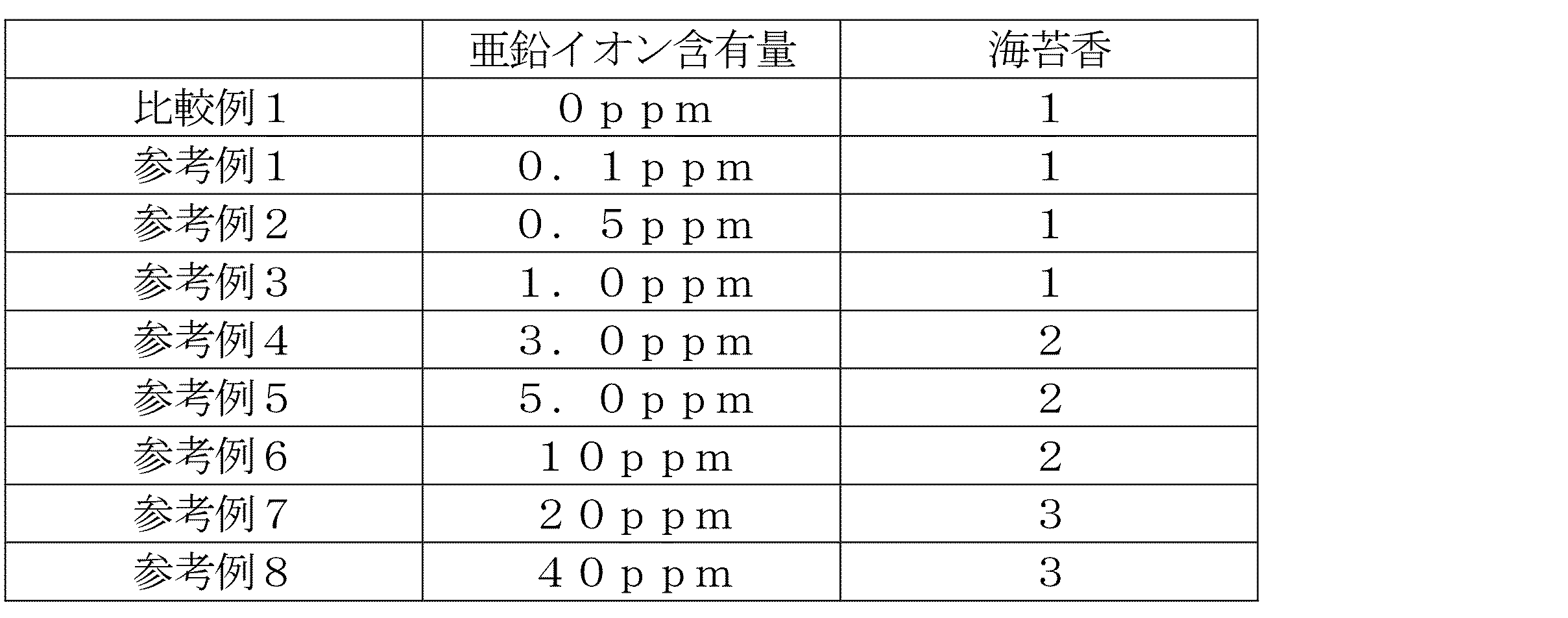
調製例1と調製例2との比較により、緑茶飲料における銅の添加による海苔香の発現・増強の効果は、亜鉛より銅が有意にすぐれていることが分かった。
調製例3(実施例8~14及び比較例3~4)
抹茶 15g、砂糖 130g、アスコルビン酸Na 1g、及び重曹 0.1gに純水を加えて、全体を2000gに調整し、よく混合して抹茶飲料を調製した。得られた抹茶飲料に対して、添加量を変更して銅イオンを添加した。銅イオンは、銅含有酵母(ミネラル酵母銅1.1%、オリエンタル酵母工業株式会社製)を添加した。添加後の抹茶飲料を缶に充填し、123℃にて15分間加熱して殺菌し、20℃まで冷却してから、評価対象とした。
(風味の評価)
調製例3で得られた抹茶飲料を飲用して風味を評価した。結果を表3に示す。
比較例3は、銅イオンを添加していない抹茶飲料そのものとした。
抹茶 15g、砂糖 130g、アスコルビン酸Na 1g、及び重曹 0.1gに純水を加えて、全体を2000gに調整し、よく混合して抹茶飲料を調製した。得られた抹茶飲料に対して、添加量を変更して銅イオンを添加した。銅イオンは、銅含有酵母(ミネラル酵母銅1.1%、オリエンタル酵母工業株式会社製)を添加した。添加後の抹茶飲料を缶に充填し、123℃にて15分間加熱して殺菌し、20℃まで冷却してから、評価対象とした。
(風味の評価)
調製例3で得られた抹茶飲料を飲用して風味を評価した。結果を表3に示す。
比較例3は、銅イオンを添加していない抹茶飲料そのものとした。
調製例3の風味評価により、銅の添加により抹茶飲料において海苔香が発現し、銅の含有量の増加に伴い海苔香が増強されることが分かった。抹茶を含有する緑茶飲料では、風味の評価において抹茶の風味を強く感じる影響により、海苔香と金属風味はともに、抹茶を含有しない緑茶飲料と比較して評点が低くなる傾向となった。
また、銅の含有量が40ppmの場合は、金属風味が強くなり、飲用に好ましくないことが分かった。
また、銅の含有量が40ppmの場合は、金属風味が強くなり、飲用に好ましくないことが分かった。
調製例4(参考例9~16)
参考例として、調製例3において、銅イオンの代わりに亜鉛イオンを添加して、抹茶飲料を調製した。亜鉛イオンは、亜鉛含有酵母(ミネラル酵母亜鉛5.75%、オリエンタル酵母工業株式会社製)を添加した。調製例3と同様に、缶に充填して加熱殺菌し、冷却してから、評価対象とした。
尚、亜鉛イオンの含有量は、抹茶飲料の材料には亜鉛イオンが含有されていないことを前提として、添加量が含有量に等しいものとした。
参考例として、調製例3において、銅イオンの代わりに亜鉛イオンを添加して、抹茶飲料を調製した。亜鉛イオンは、亜鉛含有酵母(ミネラル酵母亜鉛5.75%、オリエンタル酵母工業株式会社製)を添加した。調製例3と同様に、缶に充填して加熱殺菌し、冷却してから、評価対象とした。
尚、亜鉛イオンの含有量は、抹茶飲料の材料には亜鉛イオンが含有されていないことを前提として、添加量が含有量に等しいものとした。
(液色の評価)
調製例3と調製例4により得られた抹茶飲料について、液色を評価した。液色の評価は、抹茶として好ましい液色であるか否かについて目視による評価と、分光測色計・色彩計(SE7700、日本電色工業株式会社製)によるL*a*b表色系(ハンターLab、透過法)測定により行った。L*a*b表色系は、測定対象の飲料を厚さ10mmの角セルに注入して測定した。
目視評価の結果として、図1~図4に、抹茶飲料を透明のコップにいれた外観の写真を示す。また、L*a*b表色系測定の結果を表3及び表4に示す。
調製例3と調製例4により得られた抹茶飲料について、液色を評価した。液色の評価は、抹茶として好ましい液色であるか否かについて目視による評価と、分光測色計・色彩計(SE7700、日本電色工業株式会社製)によるL*a*b表色系(ハンターLab、透過法)測定により行った。L*a*b表色系は、測定対象の飲料を厚さ10mmの角セルに注入して測定した。
目視評価の結果として、図1~図4に、抹茶飲料を透明のコップにいれた外観の写真を示す。また、L*a*b表色系測定の結果を表3及び表4に示す。
抹茶飲料の液色について目視評価した場合、銅を添加すると緑色を強く呈するようになり、銅の含有量の増加に伴い、より明るくきれいな緑色を呈するようになった。同じ含有量において比較した場合、図1~図4に示すとおり、含有量が3ppm以上になると、銅を含有する抹茶飲料は、亜鉛を含有する抹茶飲料よりも緑色の発色効果が有意に高いことが観察された。特に含有量が5~20ppmである場合において、銅を含有する抹茶飲料は、非常に好ましい緑色を呈した。
L*a*b表色系について、銅の含有量の効果に伴い、a値は緑方向の色を示すマイナスの数値が大きくなり、特に含有量が3.0ppmになるとa値は-5以下となり、より明るくきれいな緑色を呈するようになった。比較として、亜鉛を含有する緑茶飲料は、a値が-5以下となるのは亜鉛の含有量が10ppm以上必要となった。亜鉛と比較して銅は、より少ない含有量で緑色の発色効果が高いことから、コスト効果が高い点で有利である。
L*a*b表色系について、銅の含有量の効果に伴い、a値は緑方向の色を示すマイナスの数値が大きくなり、特に含有量が3.0ppmになるとa値は-5以下となり、より明るくきれいな緑色を呈するようになった。比較として、亜鉛を含有する緑茶飲料は、a値が-5以下となるのは亜鉛の含有量が10ppm以上必要となった。亜鉛と比較して銅は、より少ない含有量で緑色の発色効果が高いことから、コスト効果が高い点で有利である。
本発明の海苔香付与剤は、緑茶飲料の呈味を向上させ、高級感を付与することができるため、産業上の利用可能性が高い。また、本発明の容器詰め緑茶飲料は、飲用者の嗜好性を満足する嗜好性の高いものであり、産業上の利用可能性が高い。
上記に本発明の実施形態及び/又は実施例を幾つか詳細に説明したが、当業者は、本発明の新規な教示及び効果から実質的に離れることなく、これら例示である実施形態及び/又は実施例に多くの変更を加えることが容易である。従って、これらの多くの変更は本発明の範囲に含まれる。
この明細書に記載の文献、及び本願のパリ条約による優先権の基礎となる出願の内容を全て援用する。
この明細書に記載の文献、及び本願のパリ条約による優先権の基礎となる出願の内容を全て援用する。
Claims (5)
- 銅を有効成分として含有する、緑茶飲料に使用するための海苔香付与剤。
- 抹茶含有緑茶飲料に対して質量基準で銅を0.1~20ppm含有するように使用する、請求項1に記載の海苔香付与剤。
- 容器詰めの緑茶飲料であって、
質量基準で銅を0.1~20ppm含有する前記緑茶飲料。 - 前記緑茶飲料全体の質量を基準として、0.001~2.5質量%の抹茶を含有する、請求項3に記載の緑茶飲料。
- L*a*b表色系においてa値が-5以下である、請求項3又は4に記載の抹茶飲料。
Priority Applications (1)
| Application Number | Priority Date | Filing Date | Title |
|---|---|---|---|
| CN202480035176.2A CN121194699A (zh) | 2023-04-07 | 2024-04-05 | 海苔风味赋予剂和含有其的包装绿茶饮料 |
Applications Claiming Priority (2)
| Application Number | Priority Date | Filing Date | Title |
|---|---|---|---|
| JP2023-063030 | 2023-04-07 | ||
| JP2023063030A JP2024149259A (ja) | 2023-04-07 | 2023-04-07 | 海苔香付与剤及びこれを含有する容器詰め緑茶飲料 |
Publications (1)
| Publication Number | Publication Date |
|---|---|
| WO2024210209A1 true WO2024210209A1 (ja) | 2024-10-10 |
Family
ID=92972165
Family Applications (1)
| Application Number | Title | Priority Date | Filing Date |
|---|---|---|---|
| PCT/JP2024/014125 Ceased WO2024210209A1 (ja) | 2023-04-07 | 2024-04-05 | 海苔香付与剤及びこれを含有する容器詰め緑茶飲料 |
Country Status (3)
| Country | Link |
|---|---|
| JP (1) | JP2024149259A (ja) |
| CN (1) | CN121194699A (ja) |
| WO (1) | WO2024210209A1 (ja) |
Citations (7)
| Publication number | Priority date | Publication date | Assignee | Title |
|---|---|---|---|---|
| JPH07112A (ja) * | 1993-05-20 | 1995-01-06 | Takarabune:Kk | 緑茶抽出物の緑色安定化方法 |
| JP2005333862A (ja) * | 2004-05-26 | 2005-12-08 | Meiji Milk Prod Co Ltd | 緑色度の高い不発酵茶および緑色度の高い不発酵茶の製造方法 |
| JP2008220226A (ja) * | 2007-03-10 | 2008-09-25 | Sato Unso:Kk | パウダー茶の製造方法 |
| WO2009136610A1 (ja) * | 2008-05-06 | 2009-11-12 | 株式会社サーマクリエィション | 緑色発色を維持した茶加工品並びにその製造方法 |
| KR20130039594A (ko) * | 2011-10-12 | 2013-04-22 | 주식회사 비케이바이오 | 녹차의 변색 방지방법 |
| JP2014014315A (ja) * | 2012-07-09 | 2014-01-30 | Nippon Sangaria Beverage Company:Kk | 飲料用組成物および容器詰飲料 |
| WO2020071106A1 (ja) * | 2018-10-05 | 2020-04-09 | 宝酒造株式会社 | 緑茶入り飲料、緑茶入り飲料の退色抑制方法、及び緑茶入り飲料の製造方法 |
-
2023
- 2023-04-07 JP JP2023063030A patent/JP2024149259A/ja active Pending
-
2024
- 2024-04-05 WO PCT/JP2024/014125 patent/WO2024210209A1/ja not_active Ceased
- 2024-04-05 CN CN202480035176.2A patent/CN121194699A/zh active Pending
Patent Citations (7)
| Publication number | Priority date | Publication date | Assignee | Title |
|---|---|---|---|---|
| JPH07112A (ja) * | 1993-05-20 | 1995-01-06 | Takarabune:Kk | 緑茶抽出物の緑色安定化方法 |
| JP2005333862A (ja) * | 2004-05-26 | 2005-12-08 | Meiji Milk Prod Co Ltd | 緑色度の高い不発酵茶および緑色度の高い不発酵茶の製造方法 |
| JP2008220226A (ja) * | 2007-03-10 | 2008-09-25 | Sato Unso:Kk | パウダー茶の製造方法 |
| WO2009136610A1 (ja) * | 2008-05-06 | 2009-11-12 | 株式会社サーマクリエィション | 緑色発色を維持した茶加工品並びにその製造方法 |
| KR20130039594A (ko) * | 2011-10-12 | 2013-04-22 | 주식회사 비케이바이오 | 녹차의 변색 방지방법 |
| JP2014014315A (ja) * | 2012-07-09 | 2014-01-30 | Nippon Sangaria Beverage Company:Kk | 飲料用組成物および容器詰飲料 |
| WO2020071106A1 (ja) * | 2018-10-05 | 2020-04-09 | 宝酒造株式会社 | 緑茶入り飲料、緑茶入り飲料の退色抑制方法、及び緑茶入り飲料の製造方法 |
Also Published As
| Publication number | Publication date |
|---|---|
| CN121194699A (zh) | 2025-12-23 |
| JP2024149259A (ja) | 2024-10-18 |
Similar Documents
| Publication | Publication Date | Title |
|---|---|---|
| JP4657308B2 (ja) | 容器詰青汁飲料を製造する方法 | |
| JP5748892B2 (ja) | 緑茶抽出組成物 | |
| JP6046336B2 (ja) | 固形分高含有ゼリー飲料 | |
| WO2018016111A1 (ja) | リナロールを含有する無色透明飲料 | |
| JP2024042118A (ja) | 緑茶入り飲料、緑茶入り飲料の退色抑制方法、及び緑茶入り飲料の製造方法 | |
| JP5439566B1 (ja) | 容器詰緑茶飲料及びその製造方法 | |
| JP6543009B2 (ja) | リナロール含有無色透明飲料 | |
| WO2019059391A1 (ja) | カリウム含有無色透明飲料 | |
| JP2017000135A (ja) | のどごし感に優れた高濃度茶由来粒子含有容器詰め茶飲料 | |
| JP2024149259A (ja) | 海苔香付与剤及びこれを含有する容器詰め緑茶飲料 | |
| JP2011147347A (ja) | 緑色発色を維持した茶加工品並びにその製造方法 | |
| WO2019049978A1 (ja) | マグネシウム含有無色透明飲料 | |
| JP2012060928A (ja) | 抹茶粉末および抹茶粉末の製造方法 | |
| JP2021180692A (ja) | 抹茶風味付与剤及びこれを含有する緑茶飲料 | |
| JP2004201639A (ja) | クロロフィル含有食品 | |
| TWI759546B (zh) | 含鈣之無色透明飲料 | |
| WO2019049976A1 (ja) | ナトリウム含有無色透明飲料 | |
| RU2255971C1 (ru) | Водка "иван премиум" | |
| JP2007244310A (ja) | 茶風味及び色調を有する容器詰アルコール飲料 | |
| JP7709301B2 (ja) | 容器詰め茶テイストアルコール飲料 | |
| JP2009254250A (ja) | 濃縮茶及びその製造方法 | |
| JP2022097645A (ja) | 抹茶風味付与剤及びこれを含有する緑茶飲料 | |
| US20210000142A1 (en) | Zinc enriched drinking water composition and related packaged drinking water composition | |
| WO2021131846A1 (ja) | 鉄含有飲料 | |
| WO2019049975A1 (ja) | ナトリウム含有無色透明飲料 |
Legal Events
| Date | Code | Title | Description |
|---|---|---|---|
| 121 | Ep: the epo has been informed by wipo that ep was designated in this application |
Ref document number: 24784991 Country of ref document: EP Kind code of ref document: A1 |
|
| NENP | Non-entry into the national phase |
Ref country code: DE |
|
| 122 | Ep: pct application non-entry in european phase |
Ref document number: 24784991 Country of ref document: EP Kind code of ref document: A1 |