WO2024204500A1 - 印刷配線板 - Google Patents
印刷配線板 Download PDFInfo
- Publication number
- WO2024204500A1 WO2024204500A1 PCT/JP2024/012576 JP2024012576W WO2024204500A1 WO 2024204500 A1 WO2024204500 A1 WO 2024204500A1 JP 2024012576 W JP2024012576 W JP 2024012576W WO 2024204500 A1 WO2024204500 A1 WO 2024204500A1
- Authority
- WO
- WIPO (PCT)
- Prior art keywords
- conductor
- region
- conductor connection
- connection portion
- wiring board
- Prior art date
- Legal status (The legal status is an assumption and is not a legal conclusion. Google has not performed a legal analysis and makes no representation as to the accuracy of the status listed.)
- Ceased
Links
Images











Classifications
-
- H—ELECTRICITY
- H05—ELECTRIC TECHNIQUES NOT OTHERWISE PROVIDED FOR
- H05K—PRINTED CIRCUITS; CASINGS OR CONSTRUCTIONAL DETAILS OF ELECTRIC APPARATUS; MANUFACTURE OF ASSEMBLAGES OF ELECTRICAL COMPONENTS
- H05K1/00—Printed circuits
- H05K1/02—Details
Definitions
- This disclosure relates to a printed wiring board.
- a technique for widening the wiring width between terminals in the power supply path that supplies power to ensure current capacity against voltage drops due to electrical resistance and load fluctuations.
- a power supply solid shape is used that surrounds the power supply end to reduce impedance.
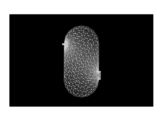
- One aspect of the present disclosure is a printed wiring board that includes a power supply layer having a conductor portion located on a power supply path and having a first end and a second end facing each other, a first conductor connection portion connected to the first end on the path and protruding from the first end in a direction opposite to the conductor portion, and a second conductor connection portion connected to the second end on the path and protruding from the second end in a direction opposite to the conductor portion, the conductor portion being composed of a first region sandwiched between the first end and the second end, and a second region and a third region located opposite each other and in contact with a portion of the first region that is not in contact with the first conductor connection portion and the second conductor connection portion, the second region and the third region each having the same shape obtained by dividing a regular polygon or a circle having an even number of angles (16 or more) into halves passing through the center of the regular polygon or the circle.
- FIG. 2 is a schematic diagram illustrating an embodiment of a power supply path.
- FIG. 13 is a schematic diagram showing another embodiment of a power supply path. 4 is an enlarged plan view showing a power supply path between a first conductor connection portion and a second conductor connection portion;
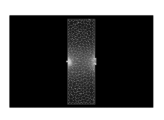
- 11A and 11B are diagrams showing the current direction and current density distribution of a conductor portion obtained by a numerical simulation. 11A and 11B are diagrams showing the current direction and current density distribution of a conductor portion obtained by a numerical simulation.
- FIG. 13 is a diagram showing another example of a power supply path.
- FIG. 11 is a diagram illustrating a power supply path according to a second embodiment.
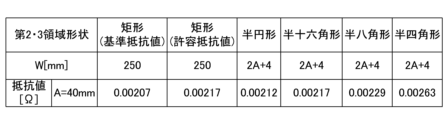
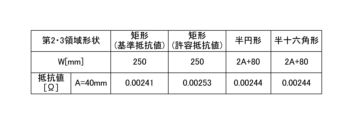
- 13 is a table showing a result of a numerical simulation of a power supply path according to the second embodiment.
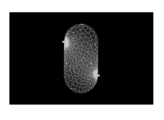
- 13A and 13B are diagrams illustrating the current direction and current density distribution of the conductor portion of the second embodiment obtained by a numerical simulation.
- 13A and 13B are diagrams illustrating the current direction and current density distribution of the conductor portion of the second embodiment obtained by a numerical simulation.
- 13A and 13B are diagrams illustrating the shape of a conductor portion in a comparative example of the second embodiment.
- FIG. 13 is a diagram showing a result of a numerical simulation of a current density distribution related to a conductor portion of a reference shape.
- 13A and 13B are diagrams showing the results of a numerical simulation of current density distribution relating to the shape of a conductor portion of a comparative example.
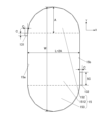
- 13A and 13B are diagrams illustrating a power supply path between a first conductor connecting portion and a second conductor connecting portion in a printed wiring board according to a third embodiment.
- 13 is a table showing the results of a numerical simulation relating to the resistance value of a conductor portion according to the shape between a first conductor connection portion and a second conductor connection portion in a printed wiring board according to a third embodiment.
- 13A and 13B are diagrams illustrating the current direction and current density distribution of the conductor portion of the third embodiment obtained by a numerical simulation.
- 13A and 13B are diagrams illustrating the current direction and current density distribution of the conductor portion of the third embodiment obtained by a numerical simulation.
- 13A to 13C are diagrams illustrating the current direction and current density distribution of a conductor part of a reference shape according to the third embodiment, obtained by a numerical simulation.
- 13A and 13B are diagrams illustrating a power supply path between a first conductor connecting portion and a second conductor connecting portion in a printed wiring board according to a fourth embodiment.
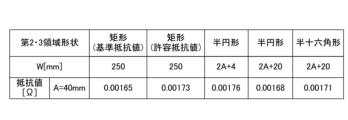
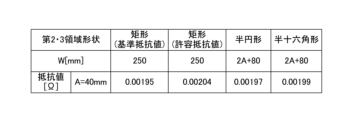
- 13 is a table showing a result of a numerical simulation of a power supply path between a first conductor connection portion and a second conductor connection portion in a printed wiring board according to a fourth embodiment.
- 13A and 13B are diagrams illustrating the current direction and current density distribution of the conductor portion of the fourth embodiment obtained by a numerical simulation.
- 13A and 13B are diagrams illustrating the current direction and current density distribution of the conductor portion of the fourth embodiment obtained by a numerical simulation.
- 13A to 13C are diagrams illustrating the current direction and current density distribution of a conductor part of a reference shape according to the fourth embodiment, obtained by a numerical simulation.
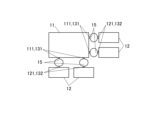
- Fig. 1A is a schematic plan view of a power supply path that connects a first IC 11, which is a power supply source, and a second IC 12, which receives the power supply, on the same layer as the ICs.
- Fig. 1B is a schematic cross-sectional view of a printed wiring board 1 that has the first IC 11 and the second IC 12 mounted thereon, and the power supply path is located on the same layer as the ICs.
- the printed wiring board 1 is provided with a first IC 11 that serves as a power supply source, and a second IC 12 that receives the power supply. There may be multiple second ICs 12. The voltages supplied to the multiple second ICs 12 may be different from each other.
- the first IC 11 can supply power to the second IC 12, supplying one or more voltages (constant voltages) or currents (constant currents) or other power.
- the first IC 11 has an output terminal 111, which is connected to a first conductor connection portion 131.
- the second IC 12 has an input terminal 121, which is connected to a second conductor connection portion 132.
- the first conductor connection portion 131 and the second conductor connection portion 132 are connected by a power supply solid that is a planar conductor portion 15.
- the power supply path runs from the output terminal 111 to the first conductor connection portion 131, the conductor portion 15, the second conductor connection portion 132, and the input terminal 121 in that order.
- the first IC 11 and/or the second IC 12 may be located in a conductor layer different from the power supply layer 10 including the conductor portion 15 in the printed wiring board 1.
- the output terminal 111 and the first conductor connection portion 131, and the input terminal 121 and the second conductor connection portion 132 may be connected via a through conductor penetrating the insulating layer between the conductor portion 15 and the first IC 11 and/or the second IC 12.
- the insulating layer 20 is, for example, a solder resist
- the first conductor connection portion 131 exposed in an opening of the solder resist and the output terminal 111 are connected by solder S.
- the power supply layer 10 may be located in an inner layer of the printed wiring board 1 having a multi-layer structure.
- the sizes of the first IC 11, the second IC 12, and the conductor portion 15 shown in FIGS. 1A and 1B are for illustrative purposes only and may not reflect the actual size ratios.
- FIG. 1 is an enlarged plan view showing the power supply layer 10 which is a power supply path between the first conductor connection portion 131 and the second conductor connection portion 132 in the first embodiment.
- the direction from the first conductor connection portion 131 to the second connection portion is the X direction, and the Y direction is defined perpendicular to the X direction.
- the first conductor connection part 131 and the second conductor connection part 132 may both be squares with sides of length C.
- At least a first end part 15a, which is a connection part between the first conductor connection part 131 and the conductor part 15, and a second end part 15b, which is a connection part between the second conductor connection part 132 and the conductor part 15, are parallel straight lines extending in the Y direction in a plan view and face each other.
- the first conductor connection part 131 protrudes from the first end part 15a in the opposite direction to the conductor part 15, i.e., in the ⁇ X direction.
- the second conductor connection part 132 protrudes from the second end part 15b in the opposite direction to the conductor part 15, i.e., in the +X direction.
- the conductor portion 15 includes a first region 151, which is a rectangle in plan view and extends in the X direction between the first end 15a and the second end 15b, and a second region 152 and a third region 153, which are connected to the first region 151.
- the second region 152 and the third region 153 are located on either side of the first region 151 in the ⁇ Y direction in the direction perpendicular to the extension direction of the first region 151. That is, the second region 152 and the third region 153 are located opposite each other, in contact with a portion of the first region 151 that is not in contact with either the first conductor connection portion 131 or the second conductor connection portion 132.
- the second region 152 and the third region 153 each have a shape obtained by dividing a regular hexagon into two halves of the same shape in plan view. This shape is hereinafter referred to as a semi-regular hexagon.
- the dividing line passes through the center of the regular hexagon and connects the two diagonal vertices.
- the second region 152 and the third region 153 are in contact with the first region 151 at the dividing lines of the regular hexagon.
- the length of the first region in the Y direction which is perpendicular to the extension direction of the first region 151, i.e., along the width direction, is equal to the length C of one side of the first conductor connection part 131 and the second conductor connection part 132.
- the length L of the first region 151 in the X direction i.e., the distance between the first end 15a and the second end 15b, is equal to the length of the dividing lines of the second region 152 and the third region 153. That is, the semiregular hexagon is inscribed in a circle of radius A, as shown by the dotted line. The radius A is equivalent to 1/2 of the length L of the first region 151.
- the conductor portion 15 needs to have a small electrical resistance in order to reduce the voltage drop and heat generation on the power supply path. Since the electrical resistance of the electrical wiring is proportional to its length and inversely proportional to its cross-sectional area, the cross-sectional area, particularly the width of the planar wiring, is set to be wider than the widths of the first conductor connection portion 131 and the second conductor connection portion 132.
- the printed wiring board 1 of this embodiment has a conductor portion 15 with a shape in which the portions that contribute little to the reduction in electrical resistance have been removed.
- the conductor portion 15 has a rectangular shape with the corners appropriately removed. This reduces the size of the conductor portion 15 while keeping the increase in electrical resistance to a non-problematic range.
- 3A and 3B are diagrams showing the results of a numerical simulation relating to the shape of the conductor portion.
- the electrical resistance value of the conductor 15 is calculated based on the voltage drop when a current of 1 A flows between the first conductor connection part 131 and the second conductor connection part 132, each of which is 4 mm x 4 mm x 0.03556 mm, with an input voltage of 1 V to the first conductor connection part 131.
- the insulating layer on which the conductor 15, which is a power supply solid, is formed has a thickness of 30 ⁇ m, a relative dielectric constant of 4.6, and a dielectric loss tangent of 0.014, corresponding to R-1766 manufactured by Panasonic (registered trademark).
- the upper surface of the conductor 15 is covered with a solder resist with a thickness of 30 ⁇ m (relative dielectric constant 4.2, dielectric loss tangent 0.021).
- the resistance value of the conductor portion 15 under the above conditions was calculated using Cadence Power DC ver. 17 from Cadence Design Systems, Inc. (Cadence; registered trademark).
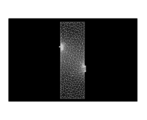
- the conductor portion 15 has a conventional rectangular shape, and the resistance value is calculated when the length L of the conductor portion 15 is 2A and the width W of the conductor portion 15 is 250 mm, and the resistance value is shown as the reference resistance value.
- the length L is the distance between the first conductor connection portion 131 and the second conductor connection portion 132.
- the width W is the length in the direction perpendicular to the length of the conductor portion 15.
- a value of 105% of the reference resistance value that is, a change rate of 5%, is set as the upper limit of the allowable resistance value.
- the change rate of 5% or less for the resistance value comes from the fact that in the connection reliability evaluation of a via conductor, it is common to judge a failure when the resistance value after an environmental reliability test such as a temperature cycle exceeds 10% of the initial value. In cases where the judgment is made more strictly, it may be set to more than 5%.
- This concept of connection reliability evaluation is brought into the consideration of electrical characteristics, and the judgment is made this time using the stricter standard, and the non-failure value, that is, 5% or less, is adopted as the amount of change allowed in the power supply path of this embodiment.
- the width of the first region 151 that is, the length in the direction perpendicular to the length of the conductor portion 15 , is 4 mm, the same as that of the output terminal 111 and the input terminal 121 .
- Each row shows the results when the distance between the first conductor connection part 131 and the second conductor connection part 132, in other words the length A, which is half the length L at which the first region 151, the second region 152, and the third region 153 contact each other, is changed in three ways: 40, 50, and 60 mm.
- the "Semicircular" column shows the resistance values obtained as a result of a numerical simulation when the second region 152 and the third region 153 are semicircular and divided so as to pass through the center of a circle with the radius of the length A.
- the "Semi-elliptical" column shows the resistance values obtained as a result of a numerical simulation when the second region 152 and the third region 153 are semicircular and divided so as to pass through the major axis of an ellipse with the major axis length being the length L and 2 times (1.5 times) 3/4 of the length A, i.e., 0.75 times the major axis length.
- FIG. 3B shows the results of a numerical simulation that calculates the resistance value when the second region 152 and the third region 153 have a shape that is a regular polygon inscribed in the semicircular shape and divided in half.
- the radius A is 40 mm is shown.
- Fig. 4A is a diagram showing the current direction and current density distribution of the conductor portion obtained by numerical simulation when the second region 152 and the third region 153 are semihexagonal
- Fig. 4B is a diagram showing the current direction and current density distribution of the conductor portion obtained by numerical simulation when the second region 152 and the third region 153 are semicircular.
- the current is shown to spread from the first conductor connection part 131 while drawing an arc, and to converge to the second conductor connection part 132.
- the current density as a whole tends to be high around the first region 151 that runs straight from the output terminal 111 to the input terminal 121, and relatively low near the periphery of the second region 152 and the third region 153. Therefore, if the second region 152 and the third region 153 are close to a circle, the conductor part 15 is less likely to obstruct the current, and therefore an increase in the resistance value is suppressed.
- the first conductor connection part 131 and the second conductor connection part 132 are positioned so as to contact the first end 15a and the second end 15b, which are the boundaries of the conductor part 15, respectively, and protrude outward. Therefore, the current flows out in a substantially constant direction from one side of the first conductor connection part 131 to the conductor part 15, and flows in a substantially constant direction to one side of the second conductor connection part 132. That is, the current does not flow out through the three sides of the first conductor connection part 131 other than the boundary of the conductor part 15, and the current does not flow in through the three sides of the second conductor connection part 132 other than the boundary of the conductor part 15. That is, the current density near the first region 151 can be increased, while the conductor area can be substantially reduced by controlling the current density locally to be small.
- Figure 5 shows another example of a power supply path.
- the first conductor connection portion 131a and the second conductor connection portion 132a are enlarged. Their shapes are changed from the square shape of the first conductor connection portion 131 and the second conductor connection portion 132 in plan view. Like the rectangular shape of the first conductor connection portion 131 and the second conductor connection portion 132, the connection portions of the first conductor connection portion 131a and the second conductor connection portion 132a with the first end 15a and the second end 15b of the first region 151 are straight lines of length C in plan view.
- the range of length C/2 from the above connection portions of the first conductor connection portion 131a and the second conductor connection portion 132a is a rectangular shape in plan view with a width maintained at length C.
- the first curved portion 131b which is a contour portion of a semicircular shape in plan view with a diameter of length C, is connected to the opposite side of the rectangular portion from the first region 151.
- the second curved portion 132b which is a semicircular contour portion in plan view with a diameter of length C relative to the rectangular portion in plan view, is connected to the side opposite the first region 151 of the rectangular portion.
- first conductor connection portion 131a and the second conductor connection portion 132a do not have to be rectangular, particularly square, as long as the connection portion with the first region 151 is a straight line in a plan view.
- the first conductor connection portion 131a and the second conductor connection portion 132a may have a shape corresponding to the shape of the output terminal 111 and the input terminal 121, etc.
- the printed wiring board 1 of the present embodiment includes a power supply layer 10 having a conductor portion 15, a first conductor connection portion 131, and a second conductor connection portion 132.
- the conductor portion 15 is located on a power supply path and has a first end portion 15a and a second end portion 15b that face each other.
- the first conductor connection portion 131 is connected to the first end portion 15a on the path and protrudes from the first end portion 15a in a direction opposite to the conductor portion 15.
- the second conductor connection portion 132 is connected to the second end portion 15b on the path and protrudes from the second end portion 15b in a direction opposite to the conductor portion 15.
- the conductor portion 15 includes a first region 151 sandwiched between the first end portion 15a and the second end portion 15b, and a second region 152 and a third region 153 that are located opposite each other and in contact with a portion of the first region 151 that is not in contact with the first conductor connection portion 131 and the second conductor connection portion 132.
- the second region 152 and the third region 153 each have the same shape obtained by dividing a regular polygon or a circle having an even number of angles of 16 or more into two halves through the center of the regular polygon or circle.
- the printed wiring board 1 can efficiently reduce the area of the conductor portion 15 from the conventional rectangular shape while maintaining the electrical resistance of the conductor portion 15 at the same level as that of the conventional rectangular shape.
- the area thus reduced in size of the conductor portion 15 can be used for other wiring, etc.
- first end 15a and the second end 15b are parallel to each other and have the same length. Therefore, in the printed wiring board 1, current can flow efficiently with uniform current distribution in a straight line from the first conductor connection part 131 to the second conductor connection part 132. Therefore, this printed wiring board 1 can effectively reduce an increase in resistance value.
- the length of the first end 15a can be defined as the length of the part where the first conductor connection part 131 is in contact with the conductor part 15.
- the length of the second end 15b can be defined as the length of the part where the second conductor connection part 132 is in contact with the conductor part 15.
- the second region 152 and the third region 153 each have a shape obtained by dividing a regular polygon, and the regular polygon is sized to be inscribed in a circle whose diameter is the distance between the first end 15a and the second end 15b. This shape allows the printed wiring board 1 to appropriately control the distribution of current density and maintain the electrical resistance of a conventional solid power supply shape.
- first conductor connection portion 131 has a first curved portion 131b located on the opposite side of the conductor portion 15 from the first end portion 15a.
- the second conductor connection portion 132 has a second curved portion 132b located on the opposite side of the conductor portion 15 from the second end portion 15b. This shape allows the printed wiring board 1 to be suitably connected according to the shapes of the output terminal 111 and the input terminal 121, and prevents unnecessary increases in area.
- first conductor connection portion 131 and the second conductor connection portion 132 may face each other in the X direction perpendicular to the Y direction along the first end portion 15a. This allows the first conductor connection portion 131 and the second conductor connection portion 132 to be connected by the conductor portion 15 at the shortest distance. Furthermore, the current distribution is roughly symmetrical between the second region 152 and the third region 153, and the conductor portion 15 can reduce the variation in current density.
- the printed wiring board 1 may have a length in the Y direction along the first end 15a of the first conductor connection part 131 and a length in the Y direction along the second end 15b of the second conductor connection part 132 that are equal.
- the length of the first conductor connection part 131 in the direction along the first end 15a may be equal to the length of the first conductor connection part 131 connected to the first end 15a.
- the length of the second conductor connection part 132 in the direction along the second end 15b may be equal to the length of the second conductor connection part 132 connected to the second end 15b.
- Such first conductor connection part 131 and second conductor connection part 132 tend to balance the inflow and outflow of current. Therefore, the printed wiring board 1 can reduce the increase in resistance value and also reduce the increase in the area of the conductor part 15.
- FIG. 6A is a diagram illustrating a power supply path according to the second embodiment.
- FIG. 6A is an enlarged plan view showing the power supply layer 10 which is a power supply path between the first conductor connection portion 131 and the second conductor connection portion 1321.
- the sizes of the first conductor connection part 131 and the second conductor connection part 1321 may be different from each other.
- the second conductor connection part 1321 may be a square with a side length longer than that of the first conductor connection part 131.
- the lengths of the first end part 15a and the second end part 15b are equal to the side length of the second conductor connection part 1321.
- the side on the -X side of the second conductor connection part 1321 may be connected to the entire second end part 15b.
- the side on the +X side of the first conductor connection part 131 is connected to a part of the first end part 15a.
- the first conductor connection part 131 and the second conductor connection part 1321 face each other in the X direction perpendicular to the Y direction along the first end part 15a.
- FIG. 6B is a diagram showing the results of a numerical simulation of the shape of the conductor portion shown in FIG. 6A and that is compared to FIG. 6A.
- the width in the Y direction of the first region 1511 is 20 mm
- the second conductor connection portion 1321 is a square with one side having a length of 20 mm.
- the first conductor connection portion 131 which is 4 mm wide, is connected to the center in the Y direction of the first end portion 15a. Parameters that are not explicitly shown are the same as those in the first embodiment.
- the two left columns show the reference resistance value when the second region 152 and the third region 153 have a reference rectangular shape with a side length of A extending from the first region 1511 in the ⁇ Y direction, and the allowable resistance value, which is 105% of the reference resistance value.
- the width W of the conductor portion 15 in the Y direction is 2A+20.
- the resistance value in this case is smaller than the allowable resistance value.
- the resistance value is also smaller than the allowable resistance value.
- FIG. 7A and 7B are diagrams showing the current direction and current density distribution of the conductor part of the second embodiment obtained by numerical simulation.
- FIG. 7A shows the case where the second region 152 and the third region 153 are semiregular hexagonal
- FIG. 7B shows the case where the second region 152 and the third region 153 are semicircular.
- the variation in the overall current density is smaller than in other parts.
- the increase in resistance value is small, so current flows efficiently in the second region 152 and the third region 153.
- the area of a semiregular polygon inscribed in a semicircle is smaller than that of a semicircle, the area of the second region 152 and the third region 153 can be reduced in a semiregular polygon of equal to or greater than a semicircle.
- FIG. 8 is a diagram showing the shape of a conductor portion 15r of a comparative example.
- the width W of the first region 151r is 4 mm in the left half of the conductor portion 15r, and expands radially to 20 mm in the right half.
- the second region 152r and the third region 153r, each having a sector shape with a radius A, are connected to the first region 151r.
- the second conductor connection portion 1321 is connected to the conductor portion 15r at a position where the vertical width of the conductor portion 15r is 20 mm. That is, the width W of the conductor portion 15r is 2A+4 mm, and the length L is shorter than the diameter 2A. In the example of FIG. 8, the resistance value becomes larger than the allowable resistance value as shown in FIG. 6B.
- FIG. 9A shows the results of a numerical simulation of the current density distribution for the conductor portion 15 of the reference shape.
- the conductor portion 15 corresponding to the reference resistance value shown in FIG. 9A has a rectangular shape as described above. In this case, most of the current flows from the first conductor connection portion 131 to the second conductor connection portion 1321 in a straight line or in an arc shape. As a result, the current density near the corner of the second region 152 and the third region 153 is smaller than the line connecting the first conductor connection portion 131 and the second conductor connection portion 1321 in an arc shape. While such a region has a large effect on increasing the area, it makes little contribution to reducing the resistance value.
- FIG. 9B is a diagram showing the results of a numerical simulation of the current density distribution according to the shape of the conductor portion 15.
- the current density distribution shown in Fig. 9B corresponds to the shape of the conductor portion 15r of the comparative example.
- the current density distribution in this case is similar to that in Fig. 9A. However, in this case, the current is concentrated near the corner where the second region 152r and the third region 153r meet the second conductor connection portion 1321. Such a current concentration portion leads to an increase in the resistance value.
- the conductor portion 15 may have a different length in the direction along the first end 15a of the first conductor connection portion 131 and a different length in the direction along the second end 15b of the second conductor connection portion 1321. Even if the sizes of the conductor connection portions connected by the conductor portion 15 are different, the shape disclosed herein can efficiently reduce the size while reducing the increase in resistance value, as necessary.
- first conductor connection portion 131 and the second conductor connection portion 1321 may be opposed to each other even if they are different in size. That is, in the Y direction along the first end portion 15a and the second end portion 15b, the first conductor connection portion 131 may be located within a range in the Y direction in which the longer second conductor connection portion 1321 is located. This makes the current density distribution roughly symmetrical in the second region 152 and the third region 153, and the conductor portion 15 can reduce bias in the current density and pass a current with low resistance.
- FIG. 10A is a diagram illustrating a power supply path between a first conductor connecting portion 131 and a second conductor connecting portion 132 in a printed wiring board 1 according to the third embodiment.
- the first conductor connection portion 131 and the second conductor connection portion 132 are at different positions in the Y direction along the first end portion 15a and the second end portion 15b. In other words, the first conductor connection portion 131 and the second conductor connection portion 132 do not have to face each other in the Y direction.
- the first conductor connection portion 131 may be located at the end on the +Y side where it contacts the second region 152 of the first end portion 15a
- the second conductor connection portion 132 may be located at the end on the -Y side where it contacts the third region 153 of the second end portion 15b.
- the width of the first end portion 15a and the second end portion 15b corresponds to the offset width between the first conductor connection portion 131 and the second conductor connection portion 132 in the Y direction.
- FIG. 10B is a table showing the results of a numerical simulation relating to the resistance value of the conductor portion 15 according to the shapes of the first conductor connection portion 131 and the second conductor connection portion 132.
- the two left columns show the reference resistance value and the allowable resistance value when the conductor portion 15 is a rectangular region with a width W in the Y direction of 250 mm.
- the two right columns show the resistance values when the width W of the first region 151 is 80 mm and the second region 152 and the third region 153 are semicircular with a radius A, and when they are semiregular hexagons inscribed in a semicircle with a radius A. These resistance values are almost the same and smaller than the allowable resistance value.
- FIG. 11A, 11B, and 12 are diagrams showing the current direction and current density distribution in the third embodiment obtained by numerical simulation.
- FIG. 11A shows the current density distribution when the second region 152 and the third region 153 are semihexagonal.
- FIG. 11B shows the current density distribution when the second region 152 and the third region 153 are semicircular.
- the bias in the current density distribution in the conductor portion 15 is small, that is, the increase in resistance value is reduced, and the increase in unnecessary area is also reduced.
- the semihexagonal second region 152 and the third region 153 have a smaller area than the semicircular second region 152 and the third region 153, while obtaining the same level of resistance value.
- the first conductor connection portion 131 and the second conductor connection portion 132 do not have to face each other in the X direction perpendicular to the Y direction along the first end 15a.
- the first conductor connection portion 131 and the second conductor connection portion 132 may not be able to face each other.
- the first region 1512 has the first end 15a and the second end 15b in a range including the first conductor connection portion 131 and the second conductor connection portion 132 in the Y direction.
- FIG. 13A is a diagram illustrating a power supply path between a first conductor connecting portion 131 and a second conductor connecting portion 1321 in a printed wiring board 1 according to the fourth embodiment.
- the first conductor connection portion 131 and the second conductor connection portion 1321 are different sizes, and the first conductor connection portion 131 and the second conductor connection portion 1321 do not face each other in the Y direction. That is, in the power supply path of this fourth embodiment, the pair of the first conductor connection portion and the second conductor connection portion 1321 in the second embodiment is in the positional relationship of the first conductor connection portion and the second conductor connection portion 132 in the third embodiment.
- the other shapes and positional relationships are the same as in the other embodiments.
- the case where the shapes of the second region 152 and the third region 153 are semicircular is shown by dotted lines.
- the case where the shapes of the second region 152 and the third region 153 are semiregular hexagons inscribed in the semicircles is shown by solid lines.
- FIG. 13B is a diagram showing the results of a numerical simulation of the power supply path between the first conductor connection portion 131 and the second conductor connection portion 1321 in the printed wiring board 1 of the fourth embodiment.
- the resistance value of the conductor portion 15 is smaller than the allowable resistance value when the second region 152 and the third region 153 are semicircular or semiregular hexagonal.
- the area can be reduced compared to a semicircular shape, while the resistance value can be made equal to or less than the allowable resistance value.
- FIG. 14A, 14B, and 15 are diagrams showing the current direction and current density distribution in the fourth embodiment obtained by numerical simulation. There is no significant bias in the current density distribution whether the second region 152 and the third region 153 shown in Fig. 14A are semiregular hexagonal or semicircular. Therefore, it can be seen that the semiregular hexagonal second region 152 and the third region 153 can reduce the increase in resistance value and reduce the increase in area more than the semicircular shape.
- the printed wiring board 1 in the printed wiring board 1, the Y-direction length of the first conductor connection portion 131 and the Y-direction length of the second conductor connection portion 1321 are different from each other, and the first conductor connection portion 131 and the second conductor connection portion 1321 do not have to face each other in the X-direction.
- the printed wiring board 1 can flexibly reduce the size of the conductor portion 15 and reduce an increase in the resistance value of the current path.
- the power supply layer 10 may be located in an inner layer of the printed wiring board 1 having a multi-layer structure.
- the first IC 11 connected to the power supply layer 10 may be built in or mounted on the wiring board 1.
- the first IC 11 may be connected to the first conductor connection portion 131 and the second conductor connection portion 132 by wiring through a through conductor of an insulating layer.
- power may be supplied from the outside without using a power supply IC.
- first end 15a and the second end 15b may have slightly different lengths.
- the first region 151 may be determined based on the longer of the first end 15a and the second end 15b.
- first conductor connection part 131 and the second conductor connection part 132 do not have to be the same.
- the first conductor connection part 131 and the second conductor connection part 132 may have different shapes depending on the shapes of the output terminal 111 and the input terminal 121, or regardless of these.
- the shapes of the first conductor connection part 131 and the second conductor connection part 132 are described as a combination of a rectangle and a semicircle in plan view, but this is not limited to this. As long as the parts that contact the first end 15a and the second end 15b are straight lines, these may be of any appropriate shape. Furthermore, the semicircular parts may instead be polygonal, etc. Furthermore, the polygonal shape in this case does not have to be a regular polygon.
- the power supply layer 10 is an inner layer of the multi-layered board, but this is not limiting.
- the power supply layer 10 may be an outer layer.
- the specific details such as the specific configurations, structures, and sizes shown in the above embodiments can be modified as appropriate without departing from the spirit of this disclosure.
- This disclosure can be used for printed wiring boards.
Landscapes
- Engineering & Computer Science (AREA)
- Microelectronics & Electronic Packaging (AREA)
- Structure Of Printed Boards (AREA)
Priority Applications (1)
| Application Number | Priority Date | Filing Date | Title |
|---|---|---|---|
| JP2025511121A JPWO2024204500A1 (https=) | 2023-03-31 | 2024-03-28 |
Applications Claiming Priority (4)
| Application Number | Priority Date | Filing Date | Title |
|---|---|---|---|
| JP2023-056882 | 2023-03-31 | ||
| JP2023056882 | 2023-03-31 | ||
| JP2023-185517 | 2023-10-30 | ||
| JP2023185517 | 2023-10-30 |
Publications (1)
| Publication Number | Publication Date |
|---|---|
| WO2024204500A1 true WO2024204500A1 (ja) | 2024-10-03 |
Family
ID=92906785
Family Applications (1)
| Application Number | Title | Priority Date | Filing Date |
|---|---|---|---|
| PCT/JP2024/012576 Ceased WO2024204500A1 (ja) | 2023-03-31 | 2024-03-28 | 印刷配線板 |
Country Status (2)
| Country | Link |
|---|---|
| JP (1) | JPWO2024204500A1 (https=) |
| WO (1) | WO2024204500A1 (https=) |
Citations (5)
| Publication number | Priority date | Publication date | Assignee | Title |
|---|---|---|---|---|
| JP2009032812A (ja) * | 2007-07-25 | 2009-02-12 | Toshiba Tec Corp | 多層プリント基板 |
| US20140118962A1 (en) * | 2012-10-29 | 2014-05-01 | Cisco Technology, Inc. | Current Redistribution in a Printed Circuit Board |
| JP2015146382A (ja) * | 2014-02-03 | 2015-08-13 | キヤノン株式会社 | プリント回路板 |
| JP2017126707A (ja) * | 2016-01-15 | 2017-07-20 | 日本電気株式会社 | 回路基板、それを備えた回路モジュールおよび回路基板の形成方法 |
| JP2019129240A (ja) * | 2018-01-25 | 2019-08-01 | 京セラ株式会社 | 印刷配線板 |
-
2024
- 2024-03-28 JP JP2025511121A patent/JPWO2024204500A1/ja active Pending
- 2024-03-28 WO PCT/JP2024/012576 patent/WO2024204500A1/ja not_active Ceased
Patent Citations (5)
| Publication number | Priority date | Publication date | Assignee | Title |
|---|---|---|---|---|
| JP2009032812A (ja) * | 2007-07-25 | 2009-02-12 | Toshiba Tec Corp | 多層プリント基板 |
| US20140118962A1 (en) * | 2012-10-29 | 2014-05-01 | Cisco Technology, Inc. | Current Redistribution in a Printed Circuit Board |
| JP2015146382A (ja) * | 2014-02-03 | 2015-08-13 | キヤノン株式会社 | プリント回路板 |
| JP2017126707A (ja) * | 2016-01-15 | 2017-07-20 | 日本電気株式会社 | 回路基板、それを備えた回路モジュールおよび回路基板の形成方法 |
| JP2019129240A (ja) * | 2018-01-25 | 2019-08-01 | 京セラ株式会社 | 印刷配線板 |
Also Published As
| Publication number | Publication date |
|---|---|
| JPWO2024204500A1 (https=) | 2024-10-03 |
Similar Documents
| Publication | Publication Date | Title |
|---|---|---|
| US7684204B2 (en) | Circuit board for mounting multilayer chip capacitor and circuit board apparatus including the multilayer chip capacitor | |
| US20120013431A1 (en) | Fuse element | |
| TWI690057B (zh) | 半導體記憶裝置 | |
| US20080164967A1 (en) | Inductance element | |
| JP6048215B2 (ja) | 電子部品及び電子制御装置 | |
| JPH07321463A (ja) | 薄膜多層配線基板 | |
| US9984798B2 (en) | Jumper or current detection resistor element | |
| JP2014165165A (ja) | 電子部品及び電子制御装置 | |
| JP2004311939A (ja) | 対称構造を持つサーミスタ | |
| CN205670879U (zh) | 电路板 | |
| WO2024204500A1 (ja) | 印刷配線板 | |
| CN107113962A (zh) | 电子控制装置 | |
| EP0702407A2 (en) | Wiring pattern of semiconductor integrated circuit device | |
| WO2020059041A1 (ja) | 電子装置、電子機器、及び電子装置の設計支援方法 | |
| JP2006128417A (ja) | バスバー構造の実装構造、電源装置、電源システム、電子回路基板、電子装置 | |
| US6484291B1 (en) | Library for storing pattern shape of connecting terminal and semiconductor circuit designed with different design rules | |
| CN104637906B (zh) | 用于电路基板和半导体封装的焊料桥接阻止结构 | |
| US11289982B2 (en) | Circuit board, motor, controller, and electric pump | |
| JP2009008548A (ja) | プリント回路基板および電子機器 | |
| JP4939795B2 (ja) | 半導体パッケージと共に使用するための基板層及びその形成方法 | |
| TWI776095B (zh) | 印刷基板 | |
| JP5885641B2 (ja) | 電流補助部材およびプリント基板 | |
| WO2026094672A1 (ja) | 印刷配線板 | |
| US20020144841A1 (en) | High current SMD jumper | |
| JP2002237401A (ja) | 抵抗器 |
Legal Events
| Date | Code | Title | Description |
|---|---|---|---|
| 121 | Ep: the epo has been informed by wipo that ep was designated in this application |
Ref document number: 24780601 Country of ref document: EP Kind code of ref document: A1 |
|
| ENP | Entry into the national phase |
Ref document number: 2025511121 Country of ref document: JP Kind code of ref document: A |
|
| WWE | Wipo information: entry into national phase |
Ref document number: 2025511121 Country of ref document: JP |
|
| NENP | Non-entry into the national phase |
Ref country code: DE |
|
| 122 | Ep: pct application non-entry in european phase |
Ref document number: 24780601 Country of ref document: EP Kind code of ref document: A1 |