WO2024201870A1 - 車両構造 - Google Patents
車両構造 Download PDFInfo
- Publication number
- WO2024201870A1 WO2024201870A1 PCT/JP2023/013092 JP2023013092W WO2024201870A1 WO 2024201870 A1 WO2024201870 A1 WO 2024201870A1 JP 2023013092 W JP2023013092 W JP 2023013092W WO 2024201870 A1 WO2024201870 A1 WO 2024201870A1
- Authority
- WO
- WIPO (PCT)
- Prior art keywords
- vehicle
- base
- fixing member
- bracket
- air cleaner
- Prior art date
- Legal status (The legal status is an assumption and is not a legal conclusion. Google has not performed a legal analysis and makes no representation as to the accuracy of the status listed.)
- Ceased
Links
Images











Classifications
-
- B—PERFORMING OPERATIONS; TRANSPORTING
- B62—LAND VEHICLES FOR TRAVELLING OTHERWISE THAN ON RAILS
- B62D—MOTOR VEHICLES; TRAILERS
- B62D25/00—Superstructure or monocoque structure sub-units; Parts or details thereof not otherwise provided for
- B62D25/08—Front or rear portions
-
- B—PERFORMING OPERATIONS; TRANSPORTING
- B62—LAND VEHICLES FOR TRAVELLING OTHERWISE THAN ON RAILS
- B62D—MOTOR VEHICLES; TRAILERS
- B62D25/00—Superstructure or monocoque structure sub-units; Parts or details thereof not otherwise provided for
- B62D25/20—Floors or bottom sub-units
Definitions
- the present invention relates to a vehicle structure.
- Patent Document 1 discloses a vehicle structure in which a first part is disposed in front of a master cylinder whose longitudinal axis is aligned along the vehicle front-rear direction, a second part is disposed on the vehicle front side of the first part, and a third part is disposed on the vehicle front side of the second part.
- the first to third parts are supported by brackets from below the vehicle.
- a bracket that supports multiple parts is supported on the motor frame, but simply attaching the bracket to the motor frame makes it impossible to support the load of each part supported by the bracket in a balanced manner, resulting in an unstable support state. Furthermore, when an impact or external force is applied to the rear of the vehicle, the parts on the bracket may move back and come into contact with the master cylinder at the rear.
- the present invention aims to provide a vehicle structure that can support multiple on-board devices in a well-balanced manner and also suppress movement of the on-board devices when an impact or external force is applied.
- the present invention comprises the following configurations.
- a first in-vehicle device A second in-vehicle device is disposed forward of the first in-vehicle device in a vehicle front-rear direction; a base that supports the first in-vehicle device and the second in-vehicle device from below; a first fixing member disposed directly below the first in-vehicle device and configured to attach the base to one of a pair of side frames extending in a front-rear direction of the vehicle; a second fixing member disposed directly below the second in-vehicle device and attaching the base to the one of the side frames; Equipped with Vehicle structure.
- the present invention provides a vehicle structure that can support multiple on-board devices in a well-balanced manner and also prevents the on-board devices from moving when an impact or external force is applied.
- FIG. 1 is a schematic plan view of the front part of a vehicle to which a vehicle structure according to an embodiment of the present invention is applied.
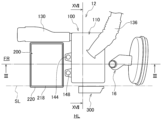
- FIG. 2 is a schematic plan view showing the positional relationship of on-vehicle components.
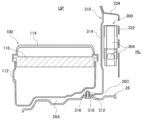
- FIG. 3 is a cross-sectional view taken along line III-III in FIG.
- FIG. 4 is a perspective view of the base.
- FIG. 5 is a perspective view of the air cleaner mounted on the base as viewed from the front side of the vehicle.
- FIG. 6 is a perspective view of the air cleaner mounted on the base as viewed from the rear side of the vehicle.
- FIG. 7 is a perspective view of the air cleaner.
- FIG. 8 is a perspective view of the air cleaner as viewed from below.
- FIG. 9 is a side view of the air cleaner.
- FIG. 1 is a schematic plan view of the front part of a vehicle to which a vehicle structure according to an embodiment of the present invention is applied.
- FIG. 2 is a schematic plan view showing the positional
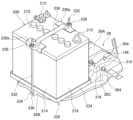
- FIG. 10 is a perspective view of the battery mounted on the base as viewed from the front side of the vehicle.
- FIG. 11 is a perspective view of the battery mounted on the base as viewed from the rear side of the vehicle.
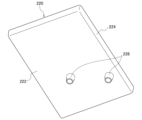
- FIG. 12 is a perspective view of the tray as seen from below.
- FIG. 13 is a perspective view of the electronic control unit mounted on the base.
- FIG. 14 is a perspective view of the electronic control unit mounted on the base as viewed from the outside in the vehicle width direction.
- FIG. 15 is a perspective view of the electronic control unit mounted on the mounting bracket.
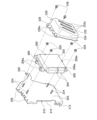
- FIG. 16 is an exploded perspective view illustrating the mounting structure of the electronic control unit to the mounting bracket.
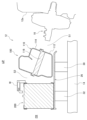
- FIG. 17 is a cross-sectional view taken along line XVII-XVII in FIG. FIG.
- FIG. 18 is a perspective view illustrating the mounting structure of the mounting bracket to the strut receiving portion.
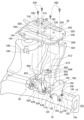
- FIG. 19 is a perspective view of the base attached to the side frame.
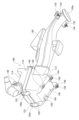
- FIG. 20 is an exploded perspective view showing the mounting structure of the base to the side frame.
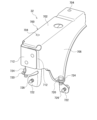
- FIG. 21 is a perspective view of a first fixing member and a second fixing member that support the base.
- FIG. 22 is a perspective view of a first fixing member and a second fixing member that support the base.
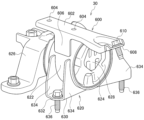
- FIG. 23 is a perspective view of the first fixing member as viewed from one side in the vehicle width direction.
- FIG. 24 is a perspective view of the first fixing member as viewed from the other side in the vehicle width direction.
- FIG. 25 is a perspective view of the second fixing member as viewed from one side in the vehicle width direction.
- FIG. 26 is a perspective view of the second fixing member as viewed from the other side in the vehicle width direction.
- Fig. 1 is a schematic plan view of the front of a vehicle 10 to which a vehicle structure according to an embodiment of the present invention is applied.
- Fig. 2 is a schematic plan view showing the positional relationship of on-vehicle components.
- Fig. 3 is a cross-sectional view taken along line III-III in Fig. 2.
- the vehicle structure according to this embodiment is applied to the internal structure of an engine room 12 provided at the front of a vehicle 10.
- an air cleaner (first vehicle-mounted device) 100, a battery (second vehicle-mounted device) 200, and an electronic control unit (ECU: Electronic Control Unit) 300 are arranged on one side in the vehicle width direction.
- the battery 200 is disposed forward of the air cleaner 100 in the vehicle's fore-and-aft direction.
- the electronic control unit 300 is disposed rearward of the battery 200 in the vehicle's fore-and-aft direction, and is further disposed at a position offset in the vehicle width direction from the battery 200. As a result, the electronic control unit 300 is disposed to the side of the air cleaner 100 in the vehicle width direction.
- the air cleaner 100, the battery 200, and the electronic control unit (ECU) 300 are disposed on top of a single base 26.
- the air cleaner 100, the battery 200, and the electronic control unit (ECU) 300 are mounted on a single base 26 and supported from below by this base 26.
- FIG. 4 is a perspective view of the base 26.
- the base 26 has an air cleaner mounting portion 26A, a battery mounting portion 26B, and an ECU mounting portion 26C.
- the air cleaner 100 is mounted in the air cleaner mounting portion 26A
- the battery 200 is mounted in the battery mounting portion 26B
- the electronic control unit 300 is mounted in the ECU mounting portion 26C.
- the base 26 is attached to a side frame 14 that constitutes the chassis frame (vehicle body) of the vehicle 10 (see Figure 3).
- the chassis frame has a pair of side frames 14 that extend in the fore-and-aft direction of the vehicle and are spaced apart in the vehicle width direction, and these side frames 14 are connected to each other at multiple points spaced apart in the vehicle fore-and-aft direction by multiple cross members (not shown) that extend in the vehicle width direction.
- the base 26 is attached to one of the pair of side frames 14 (the left side) in the vehicle width direction in the engine compartment 12 at the front of the vehicle.
- the base 26 is attached to one of the side frames 14 by a first fixing member 30 and a second fixing member 32.
- the first fixing member 30 is disposed directly below the air cleaner 100 mounted on the air cleaner mounting portion 26A of the base 26, and the second fixing member 32 is disposed directly below the battery 200 mounted on the battery mounting portion 26B of the base 26.
- a master cylinder 16 is provided on the wall surface 12a on the passenger compartment side that constitutes the engine room 12. This master cylinder 16 is disposed rearward of the air cleaner 100 in the vehicle longitudinal direction. In other words, the air cleaner 100 and the battery 200 mounted on a base 26 are disposed in this order forward of the master cylinder 16 in the vehicle longitudinal direction. This master cylinder 16 is disposed rearward of the lower part of the air cleaner 100 in the vehicle longitudinal direction.
- FIG. 5 is a perspective view of the air cleaner 100 mounted on the base 26 as viewed from the vehicle front side.
- Fig. 6 is a perspective view of the air cleaner 100 mounted on the base 26 as viewed from the vehicle rear side.
- Fig. 7 is a perspective view of the air cleaner 100.
- Fig. 8 is a perspective view of the air cleaner 100 as viewed from below.
- Fig. 9 is a side view of the air cleaner 100.
- the air cleaner 100 is attached to the air cleaner mounting portion 26A of the base 26.
- the air cleaner 100 has a resin case 110.
- This case 110 is box-shaped and made up of a lower case 112 and an upper case 114.
- the case 110 has a filter 116 in its internal space, which divides the internal space of the case 110 into upper and lower sections (see Figure 3).
- the lower case 112 is provided with locking pieces 120 having locking holes 120a at two locations on its rear surface.
- the upper case 114 is provided with locking protrusions 122 at two locations on its rear surface.
- the upper case 114 is attached to cover the upper part of the lower case 112 by inserting the locking protrusions 122 into the locking holes 120a of the locking pieces 120 of the lower case 112 and placing it over the lower case 112.
- the lower case 112 and the upper case 114 also have locking portions 124 at two locations on their front surfaces.
- One end of a clip 126 is connected to the locking portion 124 on the lower case 112 side.
- the clip 126 is formed from an elastic metal plate, and the other free end can be locked to the upper case 114 side. In other words, by rotating this clip 126 and engaging the free end with the upper case 114, the upper case 114 is maintained in an assembled state with the lower case 112.
- the air cleaner 100 is equipped with an intake duct 130.
- the intake duct 130 is connected to the front side of the lower case 112.
- the intake duct 130 is connected to the lower case 112 at a position closer to the inside in the vehicle width direction, that is, at a position closer to the engine side opposite the outside in the vehicle width direction.
- the intake duct 130 extends forward in the vehicle front-rear direction.
- the intake duct 130 has a connection part 132 at its tip, and this connection part 132 is fastened and fixed to the vehicle body by a bolt 134.
- the air cleaner 100 also includes a connecting duct (duct) 136.
- the connecting duct 136 is connected to an inner corner in the vehicle width direction on the rear surface of the upper case 114. This connecting duct 136 extends in the vehicle width direction and is connected to the engine (not shown).
- air is drawn in through the intake port 130a at the end of the intake duct 130.
- the air drawn into the intake duct 130 passes through a filter 116 provided in the internal space of the case 110, and is then sent to the engine via the connecting duct 136. Note that even if water is drawn into the intake duct 130 along with the air, this water collects at the bottom of the lower case 112 of the air cleaner 100 and is not sent to the engine.
- the underside of the air cleaner 100 is the mounting portion 140, which is attached to the air cleaner mounting portion 26A of the base 26.
- the mounting portion 140 has engagement portions 142, 144, an abutment portion 146, and a fastening portion 148.
- the engagement portions 142, 144 are disposed on the inside of the vehicle width direction, which is the engine side of the air cleaner 100, and the abutment portion 146 and the fastening portion 148 are disposed on the outside of the vehicle width direction, which is the opposite side of the air cleaner 100 from the engine side.
- the engagement parts 142, 144 are provided with bushings 150 made of, for example, rubber or plastic.
- a buffer plate 152 made of, for example, a rubber sheet is attached to the abutment part 146.
- a bolt 154 is provided to the fastening part 148.
- Pins 162, 164 are erected on the air cleaner mounting portion 26A of the base 26 at positions corresponding to the engagement portions 142, 144, a smooth abutment surface 166 is provided at a position corresponding to the abutment portion 146, and a bolt hole 168 is provided at a position corresponding to the fastening portion 148 (see Figure 4).
- the air cleaner 100 is placed from above on the air cleaner mounting portion 26A of the base 26.
- the pins 162, 164 are inserted into and engaged with the bushings 150 of the engagement portions 142, 144, and the buffer plate 152 of the abutment portion 146 abuts against the abutment surface 166.
- the bolts 154 of the fastening portions 148 are screwed into the bolt holes 168 of the base 26 and fastened, whereby the air cleaner 100 is attached to the air cleaner mounting portion 26A of the base 26.
- the air cleaner 100 is engaged with the base 26 by the pins 162, 164 and the bush 150 on the inside in the vehicle width direction, which is the engine side. Furthermore, on the outside in the vehicle width direction, which is the opposite side to the engine side, the abutment portion 146 of the air cleaner 100 is abutted against the abutment surface 166 of the base 26 on the rear side in the vehicle longitudinal direction, and the fastening portion 148 is fastened to the base 26 by the bolt 154 on the front side in the vehicle longitudinal direction, and is firmly fixed.
- the air cleaner 100 is attached to the base 26 at its mounting portion 140 so that the engine side in the vehicle width direction can displace in response to external forces from the engine. Therefore, the mounting portion 140 of the air cleaner 100 on the base 26 can absorb external forces associated with engine roll and the like that are transmitted to the air cleaner 100 through the connecting duct 136.
- the case 110 is inclined toward the rear in the vehicle's fore-and-aft direction toward the top of the vehicle, and the filter 116 is disposed inside the case 110 with the rear side in the vehicle's fore-and-aft direction inclined downward (see FIG. 3). Therefore, the direction of the air flow sucked in from the front side in the vehicle's fore-and-aft direction through the intake duct 130 is gently changed and passed through the filter 116. This reduces the loss of air pressure in the air cleaner 100.
- a large space S1 can be secured between the air cleaner 100 and the master cylinder 16 arranged at the rear of the lower part of the air cleaner 100 in the vehicle longitudinal direction. This makes it possible to more effectively prevent contact between the air cleaner 100 and the master cylinder 16 arranged at the rear side of the air cleaner 100 in the vehicle longitudinal direction.
- a large space S2 can be secured above the air cleaner 100 and the battery 200.
- the fastening portion 148 of the air cleaner 100 is positioned so that it overlaps with the space S2 between the air cleaner 100 and the battery 200 when viewed from the top-bottom direction of the vehicle, so that the fastening portion 148 of the air cleaner 100 can be easily fastened to the base 26 by passing a tool through the space S2 and using the bolt 154.
- the case 110 of the air cleaner 100 is inclined rearward in the vehicle front-rear direction toward the top of the vehicle, when an external force caused by engine roll is transmitted to the air cleaner 100 through the connecting duct 136, the external force can be applied evenly to the upper part of the case 110. This makes it possible to prevent the opening at the joint between the lower case 112 and the upper case 114.
- Fig. 10 is a perspective view of the battery 200 mounted on the base 26 as viewed from the front side of the vehicle.
- Fig. 11 is a perspective view of the battery 200 mounted on the base 26 as viewed from the rear side of the vehicle.
- Fig. 12 is a perspective view of the tray 220 as viewed from below.
- the battery 200 is attached to the battery mounting portion 26B of the base 26.
- the battery 200 has a rectangular parallelepiped shape and has negative and positive terminals 212 on its top surface 210.
- the battery 200 When attached to the battery mounting section 26B of the base 26, the battery 200 is arranged with its front surface 214 and rear surface 216 facing forward and backward in the vehicle longitudinal direction, and both side surfaces 218 facing in the vehicle width direction.
- the battery 200 is attached to the battery mounting section 26B of the base 26 while placed on a tray 220.
- the tray 220 has a rectangular bottom surface 222 and a peripheral wall 224 standing upward from the outer edge of the bottom surface 222.
- the bottom of the battery 200 is fitted into the tray 220 from above.
- the tray 220 has two positioning protrusions 226 on its bottom surface, which fit into positioning holes 228 formed in the battery mounting portion 26B of the base 26 (see FIG. 4). As a result, the battery 200 mounted on the tray 220 is positioned in the battery mounting portion 26B of the base 26.
- the battery 200 is fixed to the base 26 by a stay 230 and a rod 232.
- the stay 230 is provided with a pressure plate portion 230a having holes (not shown) at both ends.
- the rod 232 is a rod body with a male thread formed on one end, and a hook 234 formed by bending the rod body is provided at the other end of the rod 232.
- a locking hole 236 is formed in the battery mounting portion 26B of the base 26, and the hook 234 of the rod 232 can be locked into the locking hole 236.
- the battery 200 is placed on the tray 220, which is positioned and placed on the battery mounting section 26B of the base 26. With the battery 200 placed on the battery mounting section 26B, the hooks 234 of the rods 232 are engaged with the engagement holes 236 of the base 26. One end of each of these rods 232 is then passed through the hole in the pressure plate section 230a of the stay 230, and the nut 238 is screwed onto one end of the rod 232 to fasten them together. As a result, the battery 200 is attached to the battery mounting section 26B of the base 26 while being pressed against the base 26 by the stay 230 and the rod 232.
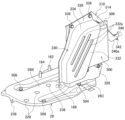
- FIG. 13 is a perspective view of the electronic control unit 300 mounted on the pedestal 26.
- Fig. 14 is a perspective view of the electronic control unit 300 mounted on the pedestal 26, as viewed from the outside in the vehicle width direction.
- Fig. 15 is a perspective view of the electronic control unit 300 mounted on the mounting bracket 310.
- Fig. 16 is an exploded perspective view illustrating the mounting structure of the electronic control unit 300 to the mounting bracket 310.
- Fig. 17 is a cross-sectional view taken along line XVII-XVII in Fig. 2.
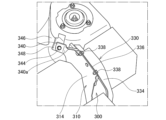
- Fig. 18 is a perspective view illustrating the mounting structure of the mounting bracket 310 to the strut housing portion 346.
- the electronic control unit 300 is mounted on the ECU mounting portion 26C of the base 26.
- the electronic control unit 300 is fixed to a mounting bracket 310, and is attached to the ECU mounting portion 26C of the base 26 by the mounting bracket 310.
- the mounting bracket 310 has a bottom portion 312 and a side portion 314, and the electronic control unit 300 is fixed to the side portion 314.
- the side portion 314 is bent upward from one side edge of the bottom portion 312 and stands upright, so that the mounting bracket 310 is formed into a roughly L-shape.
- the bottom portion 312 of the mounting bracket 310 is fixed to the base 26. Then, by fixing the bottom portion 312 to the base 26, the side portion 314 is positioned along the fore-and-aft direction of the vehicle.
- the mounting bracket 310 has a mounting surface 320 on the side 314 opposite the extension direction of the bottom 312, and the electronic control unit 300 is fixed to this mounting surface 320.
- a protective bracket 330 that protects the electronic control unit 300 is attached to the mounting surface 320 of this side 314.
- a number of stud bolts 324 are provided on the mounting surface 320 of the mounting bracket 310.
- a number of screw holes 326 are provided on the upper edge of the side portion 314 of the mounting bracket 310.
- the electronic control unit 300 has a unit body 302 and a connector portion 304.
- the connector portion 304 is provided on the front side of the unit body 302 in the vehicle front-rear direction.
- a connector (not shown) of a wire harness is connected to the connector portion 304.
- the unit body 302 is provided with a mounting flange 306 having multiple mounting holes 306a on its upper and lower edges.
- the electronic control unit 300 is placed on the mounting surface 320 of the side portion 314 by inserting the stud bolt 324 through the mounting hole 306a. In this state, the nut 328 is screwed onto the stud bolt 324 and tightened, thereby fixing the electronic control unit 300 to the side portion 314 of the mounting bracket 310.
- the protective bracket 330 is attached to the side portion 314 of the mounting bracket 310 so as to cover the electronic control unit 300 fixed to the side portion 314.
- This protective bracket 330 has a flat plate portion 332 and a side plate portion 334 that protrudes from the flat plate portion 332 towards the side portion 314.
- the side plate portion 334 is provided on the front side in the longitudinal direction of the vehicle and on the upper side of the vehicle.
- a flange portion 336 is formed on the edge of the side plate portion 334, and a plurality of holes 336a are formed on the upper side of the vehicle in this flange portion 336.
- This protective bracket 330 is placed against the side 314 of the mounting bracket 310 so as to cover the electronic control unit 300 fixed to the side 314. In this state, the protective bracket 330 is attached to the side 314 of the mounting bracket 310 by inserting the mounting screw 338 into the hole 336a and screwing it into the screw hole 326 and tightening it.
- the electronic control unit 300 fixed to the side 314 of the mounting bracket 310 is covered by the protective bracket 330 on the outer side in the vehicle width direction, the front side in the vehicle fore-and-aft direction, and the upper side of the vehicle.
- the protective bracket 330 may also be provided with side plate portions 334 on the rear side in the vehicle longitudinal direction and on the lower side of the vehicle. In this way, the entire periphery of the electronic control unit 300 fixed to the side portion 314 of the mounting bracket 310 can be covered and protected.
- the flat plate portion 332 of the protective bracket 330 has multiple ventilation holes 332a formed therein, ensuring good heat dissipation from the electronic control unit 300.
- the bottom 312 of the mounting bracket 310 has two mounting holes 312a aligned along the vehicle's fore-and-aft direction.
- Each of these mounting holes 312a is an elongated hole extending in the vehicle's fore-and-aft direction.
- Two stud bolts (bolts) 316 that can be inserted into the mounting holes 312a of the bottom 312 are arranged in the vehicle's fore-and-aft direction and stand upright on the ECU mounting portion 26C of the base 26 (see Figure 4).
- the mounting bracket 310 is fixed to the ECU mounting portion 26C of the base 26 by inserting the stud bolt 316 of the base 26 into the mounting hole 312a of the bottom 312 and then screwing and tightening the nut 318 onto the stud bolt 316.
- the mounting bracket 310 to which the electronic control unit 300 is fixed on the side portion 314, to the base 26, the electronic control unit 300 and the side portion 314 of the mounting bracket 310 are positioned along the vehicle front-rear direction on the outer side of the air cleaner 100 in the vehicle width direction.
- the electronic control unit 300 and the mounting bracket 310 are disposed rearward of the battery 200 in the vehicle longitudinal direction and outward in the vehicle width direction.
- the mounting bracket 310 and the electronic control unit 300 mounted on the mounting bracket 310 are disposed on the left side of the vehicle 10, which is outward in the vehicle width direction from a line SL that extends in the vehicle longitudinal direction along one side surface 218 of the battery 200 mounted on the base 26 in the vehicle width direction.
- the electronic control unit 300 may be disposed in a position where a part of it is shifted in the vehicle width direction relative to the battery 200. By adopting such a positional relationship, it is possible to prevent the battery 200 from coming into contact with the electronic control unit 300 even if the battery 200 is displaced rearward in the vehicle longitudinal direction during a vehicle collision or the like.
- the electronic control unit 300 mounted on the base 26 is positioned on the outer side (one end side) in the vehicle width direction, and is positioned adjacent to the air cleaner 100 in the vehicle width direction.
- the air cleaner 100 is positioned between the electronic control unit 300 and a power unit such as an engine or motor that is positioned in the center of the vehicle 10 in the vehicle width direction.
- the bottom 312 of the mounting bracket 310 is positioned between the base 26 and the air cleaner 100.
- the mounting bracket 310 has an extension 340 provided on its side 314.
- This extension 340 is provided on the rear edge of the side 314 in the vehicle longitudinal direction, and is formed integrally with the side 314.
- This extension 340 has a fastening hole 342 (see Figure 15).
- this extension 340 has a bent portion 340a formed midway in the extension direction. As a result, the extension direction of the extension 340 is changed at the bent portion 340a midway.
- This extension 340 is fixed to a fastening portion 348 provided in a strut housing portion 346 that covers the strut on the front wheel side of the body of the vehicle 10.
- the extension 340 is fixed to the strut housing portion 346 by fastening a bolt 344 passed through a fastening hole 342 to the fastening portion 348.
- FIG. 19 is a perspective view of the base 26 attached to the side frame 14.
- FIG. 20 is an exploded perspective view showing the mounting structure of the base 26 to the side frame 14.
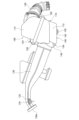
- FIG. 21 is a perspective view of the first fixing member 30 and the second fixing member 32 that support the base 26.
- FIG. 22 is a perspective view of the first fixing member 30 and the second fixing member 32 that support the base 26.
- FIG. 23 is a perspective view of the first fixing member 30 as viewed from one side in the vehicle width direction.
- FIG. 24 is a perspective view of the first fixing member 30 as viewed from the other side in the vehicle width direction.
- FIG. 25 is a perspective view of the second fixing member 32 as viewed from one side in the vehicle width direction.
- FIG. 26 is a perspective view of the second fixing member 32 as viewed from the other side in the vehicle width direction.
- the base 26 is disposed above the side frame 14 on the outer side (one end side) in the vehicle width direction, and is fixed to the side frame 14 by a first fixing member 30 and a second fixing member 32.
- first fixing member 30 and second fixing member 32 are fixed to the side frame 14.
- the first fixing member 30 is disposed directly below the air cleaner 100 mounted on the air cleaner mounting portion 26A of the base 26
- the second fixing member 32 is disposed directly below the battery 200 mounted on the battery mounting portion 26B of the base 26.
- the first fixing member 30 has higher rigidity than the second fixing member 32.
- the base 26 has a pair of insertion holes 500 on the rear side in the vehicle's fore-and-aft direction, and a pair of insertion holes 502 on the front side in the vehicle's fore-and-aft direction (see FIG. 20).
- a bolt 504 is inserted into the insertion holes 500 and fastened to the first fixing member 30. This fixes the rear side of the base 26 in the vehicle's fore-and-aft direction to the first fixing member 30.
- a bolt 506 is inserted into the insertion holes 502 and fastened to the second fixing member 32. This fixes the front side of the base 26 in the vehicle's fore-and-aft direction to the second fixing member 32.
- the first fixing member 30 has a first bracket 600.
- the first bracket 600 has a fixing plate portion 602 extending in the vehicle width direction.
- the fixing plate portion 602 has a bolt hole 604 into which the bolt 504 is screwed.
- the fixing plate portion 602 has both edges protruding downward to form a U-shape in cross section.
- a joint piece portion 606 extending downward is formed on one edge of the fixing plate portion 602.
- the first bracket 600 has a connection portion 608 at one end.
- the connection portion 608 is fastened and fixed to an inner portion of a fender panel 612 of the vehicle 10 by a bolt 610.
- the base 26 is connected to the fender panel 612 of the vehicle 10 by the first bracket 600 of the first fixing member 30.
- This first bracket 600 is located below the electronic control unit 300, which is mounted on the base 26 adjacent to the air cleaner 100.
- the first fixing member 30 also has a mount member 620 that supports the first bracket 600 from below.
- This mount member 620 is, for example, a mount that supports a power unit such as an engine or a motor on the side frame 14.
- the mount member 620 has a mount body 622.
- the mount body 622 is formed in a cylindrical shape, and an elastic body 624 is housed inside.
- a pin 628 extending from a fixing seat 626 that is fixed to the engine or motor is inserted into the center of the elastic body 624.
- the cylindrical mount body 622 is a highly rigid member, and the underside of the first bracket 600 and the joint piece 606 are welded and firmly fixed to the circumferential surface of this mount body 622.
- the mount member 620 also has a fixed bracket 630.
- the fixed bracket 630 has a bottom surface portion 632 extending in the front-rear direction of the vehicle, and a pair of side surfaces 634 that stand upright from both edges of the bottom surface portion 632 in the vehicle width direction and are fixed by welding to the peripheral surface of the mount body 622.
- the bottom surface portion 632 of the fixed bracket 630 of the mount member 620 is fastened to the upper surface 14a of the side frame 14 by bolts 636 on both sides of the mount body 622. This fixes the mount member 620 to the upper surface 14a of the side frame 14.
- the second fixing member 32 is composed of a second bracket 700.
- This second bracket 700 has an upper surface portion 702 that extends in the vehicle width direction.
- the upper surface portion 702 is provided with a bolt hole 704 into which the bolt 506 is screwed.
- the second bracket 700 has a pair of side portions 706 extending downward from both edges of the upper surface portion 702 in the vehicle front-rear direction, and these side portions 706 are fixed to the side frame 14. In this way, the second bracket 700 has a pair of side portions 706 extending downward from both edges of the upper surface portion 702 in the vehicle front-rear direction, and is thus U-shaped in cross section when viewed from the vehicle width direction. This allows the second bracket 700 to have appropriate rigidity. In addition, each side portion 706 of the second bracket 700 has folded pieces 710 at the inner end in the vehicle width direction that extend in a direction approaching each other and overlap.
- each side portion 706 of the second bracket 700 has folded pieces 712 at the outer end in the vehicle width direction that extend in a direction approaching each other and overlap. These folded pieces 712 are spot welded to each other and joined. In this way, by forming the folded pieces 710, 712 on the side surface portion 706, the support strength of the base 26 by the second bracket 700 is increased.
- the second bracket 700 has an upper surface fixing portion 720 and a side surface fixing portion 722 at the bottom of each side surface portion 706.
- the upper surface fixing portion 720 is disposed on the upper surface 14a of the side frame 14 and is fastened and fixed to the upper surface 14a of the side frame 14 by a bolt 724.
- the side surface fixing portion 722 is disposed on the side surface 14b of the side frame 14 and is fastened and fixed to the side surface 14b of the side frame 14 by a bolt 726.
- the base 26 that supports the air cleaner 100 and the battery 200 from below is attached to the side frame 14 by the first fixing member 30 directly below the air cleaner 100, and is attached to the side frame 14 by the second fixing member 32 directly below the battery 200 (see FIG. 3).
- the base 26 is supported by the first fixing member 30 and the second fixing member 32 that are aligned in the vehicle's fore-aft direction, the base 26 is prevented from moving backward in the event of a frontal collision, and contact with the master cylinder 16 that is located at the rear of the vehicle's fore-aft direction can be prevented.
- the first fixing member 30 on the rear side has higher rigidity than the second fixing member 32 on the front side.
- the second fixing member 32 in front of the first fixing member 30 can be efficiently deformed to absorb the impact from the front of the vehicle 10.
- the highly rigid first fixing member 30 can suppress deformation of the first fixing member 30 and the rear side thereof, effectively suppressing damage to the master cylinder 16 and other components arranged rearward of the first fixing member 30.
- first bracket 600 constituting the first fixing member 30 extends in the vehicle width direction to connect the base 26 and the fender panel 612.
- first fixing member 30 is connected to the side frame 14 and the fender panel 612 (see Figures 21 and 22). Therefore, the rigidity of the first fixing member 30 can be increased.
- the first fixing member 30 also has a mount member 620 that is attached to the side frame 14 and supports the first bracket 600 from below (see Figures 20 to 22). In this way, the first fixing member 30 supports the first bracket 600 from below by the highly rigid mount member 620 that supports a power unit such as an engine or motor on the side frame 14. This makes it possible to further increase the rigidity of the first fixing member 30.
- the bottom surface 632 of the fixed bracket 630 extending in the fore-and-aft direction of the vehicle is fixed to the upper surface 14a of the side frame 14, and further, a pair of side surfaces 634 erected from both edges of the bottom surface 632 of the fixed bracket 630 in the vehicle width direction are fixed to a mount body 622 arranged on the upper surface 14a of the side frame 14 (see Figures 23 and 24).
- the second bracket 700 constituting the second fixing member 32 has a pair of side portions 706 that extend downward from both edges of the upper surface portion 702 in the vehicle front-rear direction, so that the second bracket 700 has a U-shaped cross section when viewed from the vehicle width direction (see Figures 25 and 26).
- the second bracket 700 is also fixed to the top surface 14a and side surface 14b of the side frame 14 (see Figures 20 and 21). This increases the fixing strength of the second bracket 700 to the side frame 14.
- the air cleaner 100 which is soft and lightweight and therefore relatively susceptible to vibration
- the battery 200 which is hard and heavy and therefore relatively resistant to vibration
- the second fixing member 32 which has a lower rigidity than the first fixing member 30 (see Figure 3).
- the present invention is not limited to the above-described embodiment, and the invention also contemplates the mutual combination of the various components of the embodiment, as well as modifications and applications by those skilled in the art based on the descriptions in the specification and well-known technology, and these are included in the scope of the protection sought.
- a first in-vehicle device A second in-vehicle device is disposed forward of the first in-vehicle device in a vehicle front-rear direction; a base that supports the first in-vehicle device and the second in-vehicle device from below; a first fixing member disposed directly below the first in-vehicle device and configured to attach the base to one of a pair of side frames extending in a front-rear direction of the vehicle; a second fixing member disposed directly below the second in-vehicle device and attaching the base to the one of the side frames;
- a vehicle structure comprising: According to this vehicle structure, the base supporting the first and second in-vehicle devices from below is attached to one of the side frames by the first fixing member directly below the first in-vehicle device, and is attached to one of the side frames by the second fixing member directly below the second in-vehicle device.
- the base supporting the first and second in-vehicle devices to be stably attached to the side frame while the loads of the first and second in-vehicle devices are balanced between the first and second fixing members.
- the base since the base is supported by the first and second fixing members aligned in the vehicle front-to-rear direction, the base is prevented from moving backward in the event of a frontal collision of the vehicle, and contact with the in-vehicle devices arranged on the rear side in the vehicle front-to-rear direction can be suppressed.
- the first fixing member has a first bracket that extends in a vehicle width direction and connects the base and a fender panel of the vehicle.
- the first bracket that constitutes the first fixing member extends in the vehicle width direction and connects the base and the fender panel, so that the first fixing member is connected to the side frame and the fender panel, thereby increasing the rigidity of the first fixing member.
- the first fixing member has a mount member attached to the one of the side frames to support the first bracket from below.
- the first bracket is supported from below by a high-rigidity mount member that supports a power unit such as an engine or a motor on the side frame, which makes it possible to further increase the rigidity of the first fixing member.
- the mount member includes a mount body disposed on an upper surface of the one of the side frames, and a fixing bracket that fixes the mount body to the upper surface of the one of the side frames,
- the vehicle structure described in (4), wherein the fixing bracket has a bottom surface portion extending in the fore-and-aft direction of the vehicle and fixed to the upper surface of one of the side frames, and a pair of side surfaces portion each erected from both vehicle width directional edges of the bottom surface portion and fixed to the mount body.
- the bottom surface of the fixing bracket extending in the fore-and-aft direction of the vehicle is fixed to the upper surface of the side frame, and further, a pair of side surfaces erected from both edges of the bottom surface of the fixing bracket in the vehicle width direction are fixed to a mount body arranged on the upper surface of the side frame.
- the second fixing member is composed of a second bracket having an upper surface portion extending in a vehicle width direction and fixed to the base, and a pair of side surfaces extending downward from both edges of the upper surface portion in the vehicle front-rear direction and fixed to one of the side frames.
- the second fixing member is composed of a second bracket having an upper surface portion extending in the vehicle width direction and fixed to the base, and a pair of side surfaces extending downward from both vehicle front-rear direction edges of the upper surface portion and fixed to the side frame.
- the second fixing member has a U-shaped cross section when viewed from the vehicle width direction, so that the second fixing member has appropriate rigidity to sufficiently support the base, while being smoothly deformable when an impact is applied, and has good impact absorption properties.
- the vehicle structure according to any one of (1) to (7), wherein the first vehicle-mounted device is an air cleaner, and the second vehicle-mounted device is a battery.
- the air cleaner which is soft and lightweight and therefore relatively susceptible to vibration
- the battery which is hard and heavy and therefore relatively resistant to vibration
- the air cleaner has a duct connected to an engine on one side in a vehicle width direction,
- vehicle structure according to (8) wherein one side of the mounting portion of the base for the air cleaner in the vehicle width direction is displaceable in response to an external force from the engine. According to this vehicle structure, the external force caused by engine roll or the like, which is transmitted to the air cleaner through the duct, can be absorbed by the mounting portion of the air cleaner on the base.
Landscapes
- Engineering & Computer Science (AREA)
- Chemical & Material Sciences (AREA)
- Combustion & Propulsion (AREA)
- Transportation (AREA)
- Mechanical Engineering (AREA)
- Body Structure For Vehicles (AREA)
Priority Applications (2)
| Application Number | Priority Date | Filing Date | Title |
|---|---|---|---|
| JP2025509476A JPWO2024201870A1 (https=) | 2023-03-30 | 2023-03-30 | |
| PCT/JP2023/013092 WO2024201870A1 (ja) | 2023-03-30 | 2023-03-30 | 車両構造 |
Applications Claiming Priority (1)
| Application Number | Priority Date | Filing Date | Title |
|---|---|---|---|
| PCT/JP2023/013092 WO2024201870A1 (ja) | 2023-03-30 | 2023-03-30 | 車両構造 |
Publications (1)
| Publication Number | Publication Date |
|---|---|
| WO2024201870A1 true WO2024201870A1 (ja) | 2024-10-03 |
Family
ID=92903678
Family Applications (1)
| Application Number | Title | Priority Date | Filing Date |
|---|---|---|---|
| PCT/JP2023/013092 Ceased WO2024201870A1 (ja) | 2023-03-30 | 2023-03-30 | 車両構造 |
Country Status (2)
| Country | Link |
|---|---|
| JP (1) | JPWO2024201870A1 (https=) |
| WO (1) | WO2024201870A1 (https=) |
Citations (6)
| Publication number | Priority date | Publication date | Assignee | Title |
|---|---|---|---|---|
| JPH11294166A (ja) * | 1998-04-17 | 1999-10-26 | Mazda Motor Corp | 自動車の前部車体構造 |
| JPH11342809A (ja) * | 1998-06-03 | 1999-12-14 | Toyota Autom Loom Works Ltd | 産業車両のバッテリー取付構造 |
| JP2010116021A (ja) * | 2008-11-12 | 2010-05-27 | Mazda Motor Corp | 車両用バッテリの配置構造 |
| JP2016168910A (ja) * | 2015-03-12 | 2016-09-23 | 三菱自動車工業株式会社 | バッテリー取付構造 |
| JP2019059378A (ja) * | 2017-09-27 | 2019-04-18 | 三菱自動車工業株式会社 | 車両の前部構造 |
| JP2022090394A (ja) * | 2020-12-07 | 2022-06-17 | スズキ株式会社 | 車両用バッテリ固定構造 |
-
2023
- 2023-03-30 JP JP2025509476A patent/JPWO2024201870A1/ja active Pending
- 2023-03-30 WO PCT/JP2023/013092 patent/WO2024201870A1/ja not_active Ceased
Patent Citations (6)
| Publication number | Priority date | Publication date | Assignee | Title |
|---|---|---|---|---|
| JPH11294166A (ja) * | 1998-04-17 | 1999-10-26 | Mazda Motor Corp | 自動車の前部車体構造 |
| JPH11342809A (ja) * | 1998-06-03 | 1999-12-14 | Toyota Autom Loom Works Ltd | 産業車両のバッテリー取付構造 |
| JP2010116021A (ja) * | 2008-11-12 | 2010-05-27 | Mazda Motor Corp | 車両用バッテリの配置構造 |
| JP2016168910A (ja) * | 2015-03-12 | 2016-09-23 | 三菱自動車工業株式会社 | バッテリー取付構造 |
| JP2019059378A (ja) * | 2017-09-27 | 2019-04-18 | 三菱自動車工業株式会社 | 車両の前部構造 |
| JP2022090394A (ja) * | 2020-12-07 | 2022-06-17 | スズキ株式会社 | 車両用バッテリ固定構造 |
Also Published As
| Publication number | Publication date |
|---|---|
| JPWO2024201870A1 (https=) | 2024-10-03 |
Similar Documents
| Publication | Publication Date | Title |
|---|---|---|
| US8220576B2 (en) | Front end structure for automobile | |
| US7644966B2 (en) | Vehicle bumper fascia retainer | |
| JP3427188B2 (ja) | 自動車用エンジンマウント | |
| JP4292171B2 (ja) | 自動車の前部車体構造 | |
| CN107042805A (zh) | 电池固定结构 | |
| JP3812616B2 (ja) | ラジエータ及びエアコン用のコンデンサの取付構造 | |
| CN100450854C (zh) | 支承座装置的安装构造 | |
| JP4517812B2 (ja) | 車両の前部構造 | |
| WO2024201870A1 (ja) | 車両構造 | |
| CN100445113C (zh) | 车辆用后悬架的安装结构 | |
| US11066108B2 (en) | Damper housing for vehicle | |
| JP2008037301A (ja) | 自動車の車載部品取付構造 | |
| JP4785464B2 (ja) | 車両前部構造 | |
| WO2024201871A1 (ja) | 車両構造 | |
| JP6754006B2 (ja) | トルクロッド取付構造 | |
| US7458594B2 (en) | Lower arm mounting structure of vehicle suspension | |
| CN115431741B (zh) | 车辆的悬架支座结构 | |
| JP5640628B2 (ja) | フロントコンパートメント構造 | |
| JP4168826B2 (ja) | 自動車のエンジンマウント構造 | |
| JP2583344B2 (ja) | 自動車のエンジンマウント取付部構造 | |
| JP2003011680A (ja) | ラジエータの支持構造 | |
| JP5477680B2 (ja) | 車体の前部構造 | |
| JPS6340330Y2 (https=) | ||
| US7562733B2 (en) | Radiator core support | |
| JPH0580918U (ja) | 自動車用バンパにおけるワイヤハーネス配線構造 |
Legal Events
| Date | Code | Title | Description |
|---|---|---|---|
| 121 | Ep: the epo has been informed by wipo that ep was designated in this application |
Ref document number: 23930508 Country of ref document: EP Kind code of ref document: A1 |
|
| DPE1 | Request for preliminary examination filed after expiration of 19th month from priority date (pct application filed from 20040101) | ||
| WWE | Wipo information: entry into national phase |
Ref document number: 2025509476 Country of ref document: JP |
|
| NENP | Non-entry into the national phase |
Ref country code: DE |
|
| 122 | Ep: pct application non-entry in european phase |
Ref document number: 23930508 Country of ref document: EP Kind code of ref document: A1 |