WO2024185634A1 - フェニレンスルフィド-フェニレンオキシド共重合体 - Google Patents
フェニレンスルフィド-フェニレンオキシド共重合体 Download PDFInfo
- Publication number
- WO2024185634A1 WO2024185634A1 PCT/JP2024/007495 JP2024007495W WO2024185634A1 WO 2024185634 A1 WO2024185634 A1 WO 2024185634A1 JP 2024007495 W JP2024007495 W JP 2024007495W WO 2024185634 A1 WO2024185634 A1 WO 2024185634A1
- Authority
- WO
- WIPO (PCT)
- Prior art keywords
- group
- phenylene
- oxide copolymer
- formula
- phenylene sulfide
- Prior art date
- Legal status (The legal status is an assumption and is not a legal conclusion. Google has not performed a legal analysis and makes no representation as to the accuracy of the status listed.)
- Ceased
Links
Images

Classifications
-
- C—CHEMISTRY; METALLURGY
- C08—ORGANIC MACROMOLECULAR COMPOUNDS; THEIR PREPARATION OR CHEMICAL WORKING-UP; COMPOSITIONS BASED THEREON
- C08G—MACROMOLECULAR COMPOUNDS OBTAINED OTHERWISE THAN BY REACTIONS ONLY INVOLVING UNSATURATED CARBON-TO-CARBON BONDS
- C08G75/00—Macromolecular compounds obtained by reactions forming a linkage containing sulfur with or without nitrogen, oxygen, or carbon in the main chain of the macromolecule
- C08G75/02—Polythioethers
- C08G75/0204—Polyarylenethioethers
- C08G75/0236—Polyarylenethioethers containing atoms other than carbon or sulfur in a linkage between arylene groups
-
- H—ELECTRICITY
- H05—ELECTRIC TECHNIQUES NOT OTHERWISE PROVIDED FOR
- H05K—PRINTED CIRCUITS; CASINGS OR CONSTRUCTIONAL DETAILS OF ELECTRIC APPARATUS; MANUFACTURE OF ASSEMBLAGES OF ELECTRICAL COMPONENTS
- H05K1/00—Printed circuits
- H05K1/02—Details
- H05K1/03—Use of materials for the substrate
- H05K1/0313—Organic insulating material
- H05K1/032—Organic insulating material consisting of one material
- H05K1/0333—Organic insulating material consisting of one material containing S
-
- C—CHEMISTRY; METALLURGY
- C08—ORGANIC MACROMOLECULAR COMPOUNDS; THEIR PREPARATION OR CHEMICAL WORKING-UP; COMPOSITIONS BASED THEREON
- C08G—MACROMOLECULAR COMPOUNDS OBTAINED OTHERWISE THAN BY REACTIONS ONLY INVOLVING UNSATURATED CARBON-TO-CARBON BONDS
- C08G75/00—Macromolecular compounds obtained by reactions forming a linkage containing sulfur with or without nitrogen, oxygen, or carbon in the main chain of the macromolecule
- C08G75/02—Polythioethers
-
- C—CHEMISTRY; METALLURGY
- C08—ORGANIC MACROMOLECULAR COMPOUNDS; THEIR PREPARATION OR CHEMICAL WORKING-UP; COMPOSITIONS BASED THEREON
- C08G—MACROMOLECULAR COMPOUNDS OBTAINED OTHERWISE THAN BY REACTIONS ONLY INVOLVING UNSATURATED CARBON-TO-CARBON BONDS
- C08G75/00—Macromolecular compounds obtained by reactions forming a linkage containing sulfur with or without nitrogen, oxygen, or carbon in the main chain of the macromolecule
- C08G75/02—Polythioethers
- C08G75/0204—Polyarylenethioethers
-
- C—CHEMISTRY; METALLURGY
- C08—ORGANIC MACROMOLECULAR COMPOUNDS; THEIR PREPARATION OR CHEMICAL WORKING-UP; COMPOSITIONS BASED THEREON
- C08G—MACROMOLECULAR COMPOUNDS OBTAINED OTHERWISE THAN BY REACTIONS ONLY INVOLVING UNSATURATED CARBON-TO-CARBON BONDS
- C08G75/00—Macromolecular compounds obtained by reactions forming a linkage containing sulfur with or without nitrogen, oxygen, or carbon in the main chain of the macromolecule
- C08G75/02—Polythioethers
- C08G75/0204—Polyarylenethioethers
- C08G75/0209—Polyarylenethioethers derived from monomers containing one aromatic ring
-
- C—CHEMISTRY; METALLURGY
- C08—ORGANIC MACROMOLECULAR COMPOUNDS; THEIR PREPARATION OR CHEMICAL WORKING-UP; COMPOSITIONS BASED THEREON
- C08G—MACROMOLECULAR COMPOUNDS OBTAINED OTHERWISE THAN BY REACTIONS ONLY INVOLVING UNSATURATED CARBON-TO-CARBON BONDS
- C08G75/00—Macromolecular compounds obtained by reactions forming a linkage containing sulfur with or without nitrogen, oxygen, or carbon in the main chain of the macromolecule
- C08G75/02—Polythioethers
- C08G75/04—Polythioethers from mercapto compounds or metallic derivatives thereof
- C08G75/045—Polythioethers from mercapto compounds or metallic derivatives thereof from mercapto compounds and unsaturated compounds
-
- C—CHEMISTRY; METALLURGY
- C08—ORGANIC MACROMOLECULAR COMPOUNDS; THEIR PREPARATION OR CHEMICAL WORKING-UP; COMPOSITIONS BASED THEREON
- C08L—COMPOSITIONS OF MACROMOLECULAR COMPOUNDS
- C08L71/00—Compositions of polyethers obtained by reactions forming an ether link in the main chain; Compositions of derivatives of such polymers
- C08L71/08—Polyethers derived from hydroxy compounds or from their metallic derivatives
- C08L71/10—Polyethers derived from hydroxy compounds or from their metallic derivatives from phenols
- C08L71/12—Polyphenylene oxides
-
- C—CHEMISTRY; METALLURGY
- C08—ORGANIC MACROMOLECULAR COMPOUNDS; THEIR PREPARATION OR CHEMICAL WORKING-UP; COMPOSITIONS BASED THEREON
- C08L—COMPOSITIONS OF MACROMOLECULAR COMPOUNDS
- C08L71/00—Compositions of polyethers obtained by reactions forming an ether link in the main chain; Compositions of derivatives of such polymers
- C08L71/08—Polyethers derived from hydroxy compounds or from their metallic derivatives
- C08L71/10—Polyethers derived from hydroxy compounds or from their metallic derivatives from phenols
- C08L71/12—Polyphenylene oxides
- C08L71/126—Polyphenylene oxides modified by chemical after-treatment
-
- C—CHEMISTRY; METALLURGY
- C08—ORGANIC MACROMOLECULAR COMPOUNDS; THEIR PREPARATION OR CHEMICAL WORKING-UP; COMPOSITIONS BASED THEREON
- C08L—COMPOSITIONS OF MACROMOLECULAR COMPOUNDS
- C08L81/00—Compositions of macromolecular compounds obtained by reactions forming in the main chain of the macromolecule a linkage containing sulfur with or without nitrogen, oxygen or carbon only; Compositions of polysulfones; Compositions of derivatives of such polymers
- C08L81/02—Polythioethers; Polythioether-ethers
-
- C—CHEMISTRY; METALLURGY
- C09—DYES; PAINTS; POLISHES; NATURAL RESINS; ADHESIVES; COMPOSITIONS NOT OTHERWISE PROVIDED FOR; APPLICATIONS OF MATERIALS NOT OTHERWISE PROVIDED FOR
- C09J—ADHESIVES; NON-MECHANICAL ASPECTS OF ADHESIVE PROCESSES IN GENERAL; ADHESIVE PROCESSES NOT PROVIDED FOR ELSEWHERE; USE OF MATERIALS AS ADHESIVES
- C09J181/00—Adhesives based on macromolecular compounds obtained by reactions forming in the main chain of the macromolecule a linkage containing sulfur, with or without nitrogen, oxygen, or carbon only; Adhesives based on polysulfones; Adhesives based on derivatives of such polymers
- C09J181/02—Polythioethers; Polythioether-ethers
-
- H—ELECTRICITY
- H05—ELECTRIC TECHNIQUES NOT OTHERWISE PROVIDED FOR
- H05K—PRINTED CIRCUITS; CASINGS OR CONSTRUCTIONAL DETAILS OF ELECTRIC APPARATUS; MANUFACTURE OF ASSEMBLAGES OF ELECTRICAL COMPONENTS
- H05K1/00—Printed circuits
- H05K1/02—Details
- H05K1/03—Use of materials for the substrate
-
- C—CHEMISTRY; METALLURGY
- C08—ORGANIC MACROMOLECULAR COMPOUNDS; THEIR PREPARATION OR CHEMICAL WORKING-UP; COMPOSITIONS BASED THEREON
- C08L—COMPOSITIONS OF MACROMOLECULAR COMPOUNDS
- C08L2205/00—Polymer mixtures characterised by other features
- C08L2205/08—Polymer mixtures characterised by other features containing additives to improve the compatibility between two polymers
Definitions
- This disclosure relates to a phenylene sulfide-phenylene oxide copolymer.
- the fifth generation mobile communication system which has already been put into practical use, uses a higher frequency band than the fourth generation and earlier mobile communication systems.
- transmission loss In mobile communication system terminals, attenuation of electrical signals through the circuits of printed wiring boards, so-called transmission loss, occurs.
- the transmission loss depends on the dielectric properties of the substrate (dielectric) of the printed wiring board, and generally, the higher the frequency used, the greater the effect of the dielectric tangent and the greater the transmission loss.
- low transmission loss is also required for resins and resin compositions used as materials for printed wiring boards. To enable low transmission loss, resins and resin compositions with low dielectric loss tangent are required.
- Patent Document 1 polyphenylene ether (PPO) resin
- PPS polyphenylene sulfide
- PPO resin itself has low flame retardancy, there is a problem that it is necessary to mix it with a flame retardant material to impart flame retardancy to the resin composition in order to use it as a material for wiring boards.
- unsubstituted PPS resin has a high dielectric loss tangent, and therefore has a problem of high transmission loss in communication applications in the high frequency band.
- An object of the present disclosure is to provide a resin having a low dielectric tangent.
- the constitutional unit represented by formula (I) is a constitutional unit represented by formula (II): [In formula (II), R 1 , R 2 , R 3 , R 4 , R 5 , R 6 , R 7 , and R 8 are each independently H, an alkyl group, an alkoxy group, an alkenyl group, or an aryl group, and one or more of R 1 , R 2 , R 3 , and R 4 are an alkyl group, an alkoxy group, an alkenyl group, or an aryl group, and/or one or more of R 5 , R 6 , R 7 , and R 8 are an alkyl group, an alkoxy group, an alkenyl group, or an aryl group]
- [5] The phenylene sulfide-phenylene oxide copolymer according to any one of [1] to [3], wherein the content of the structural unit represented by formula (I) is 60 mol% or more based on all structural units.
- [6] The phenylene sulfide-phenylene oxide copolymer according to any one of [1] to [5], having a dielectric tangent at 10 GHz of less than 0.002.
- [7] The phenylene sulfide-phenylene oxide copolymer according to any one of [1] to [6], having a dielectric tangent at 80 GHz of less than 0.002.
- [8] The phenylene sulfide-phenylene oxide copolymer according to any one of [1] to [7], wherein the ratio tan ⁇ 80 /tan ⁇ 10 of the dielectric dissipation factor tan ⁇ 80 at 80 GHz to the dielectric dissipation factor tan ⁇ 10 at 10 GHz is 1.5 or less.
- a resin composition comprising the phenylene sulfide-phenylene oxide copolymer according to any one of [1] to [8].
- a wiring board comprising the phenylene sulfide-phenylene oxide copolymer according to any one of [1] to [8], or the resin composition according to [9].
- a printed wiring board comprising the wiring substrate according to [10] and an electronic component.
- a wiring board material comprising the phenylene sulfide-phenylene oxide copolymer according to any one of [1] to [8], or the resin composition according to [9].
- the wiring board material according to [12] which is a varnish, an interlayer insulating material, a prepreg, a metal-clad laminate, or a substrate.
- a compatibilizer comprising the phenylene sulfide-phenylene oxide copolymer according to any one of [1] to [8] or the resin composition according to [9].
- the compatibilizer according to [14] which is for a resin composition containing a polyarylene sulfide resin and a polyarylene ether resin.
- a resin composition comprising the phenylene sulfide-phenylene oxide copolymer according to any one of (10) to (14).
- a wiring board comprising the phenylene sulfide-phenylene oxide copolymer according to any one of (10) to (14) above, or the resin composition according to (15) above.
- a printed wiring board comprising the wiring substrate according to (16) and an electronic component.
- a wiring board material comprising the phenylene sulfide-phenylene oxide copolymer according to any one of (10) to (14) above or the resin composition according to (15) above.
- a compatibilizer comprising the phenylene sulfide-phenylene oxide copolymer according to any one of (10) to (14) or the resin composition according to (15).
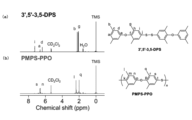
- 1A is a 1 H-NMR (CD 2 Cl 2 ) chart of the monomer (3',5'-3,5-DPS) obtained in Synthesis Example 1
- FIG. 1B is a 1 H-NMR (CD 2 Cl 2 ) chart of PMPS-PPO-1 obtained in Example 1.
- 1(a) is a 13 C-NMR (CDCl 3 ) chart of the monomer (3',5'-3,5-DPS) obtained in Synthesis Example 1
- FIG. 1(b) is a 13 C-NMR (CDCl 3 ) chart of PMPS-PPO-1 obtained in Example 1.
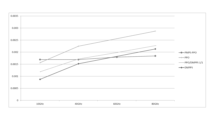
- 1 is a graph showing the dielectric loss tangent at each frequency.
- the phenylene sulfide-phenylene oxide copolymer (P1) for wiring boards is a phenylene sulfide-phenylene oxide copolymer for wiring boards, Formula (I): -Ph 1 -O-Ph 2 -S- (I) [In formula (I), Ph 1 and Ph 2 each independently represent a phenylene group which may have a substituent] In one embodiment, it is preferable that at least one of Ph 1 and Ph 2 has one or more substituents.
- phenylene sulfide-phenylene oxide copolymer means a polymer having a phenylene sulfide structure (-Ph-S-) and a phenylene oxide structure (-Ph-O-) in one constituent unit (Ph represents a phenylene group).
- a polymer having alternating phenylene sulfide and phenylene oxide structures in the molecule is sometimes called a "phenylene sulfide-phenylene oxide alternating copolymer.”
- a "phenylene sulfide-phenylene oxide copolymer” can be obtained, for example, by oxidative polymerization of a disulfide monomer having a phenylene oxide skeleton. The manufacturing method will be described later.
- the phenylene sulfide-phenylene oxide copolymer (P1) can achieve a low dielectric tangent. Furthermore, in formula (I), by having at least one phenylene group have one or more substituents, it is easier to achieve a low dielectric tangent. Although the mechanism behind these is not clear at this stage, it is believed that, as a non-limiting mechanism, by having a phenylene sulfide structure and a phenylene oxide structure, the face angle of the phenylene group is no longer constant, which suppresses dense packing and lowers the dielectric tangent.
- the torsion angle of the phenylene group becomes difficult to move, which in turn makes it difficult for the molecular chain to move, making it easier to lower the dielectric tangent.
- Phenylene sulfide-phenylene oxide copolymer (P1) has a low dielectric tangent and can therefore be suitably used as a material for wiring boards.
- the dielectric tangent of phenylene sulfide-phenylene oxide copolymer (P1) does not easily increase even when the frequency band becomes high. In this case, there is no need to change the design of the wiring board material for each frequency, and the high versatility of the material allows wiring boards to be manufactured more efficiently and economically.
- the "wiring board” in “for wiring board” includes all parts of a printed wiring board (also called a printed circuit board) other than electronic components such as semiconductor chips.
- a printed wiring board has a structure in which a semiconductor package, in which electronic components such as semiconductor chips are mounted on a base called a substrate, is mounted on a printed circuit board (PCB), but the "substrate” in “for wiring board” also includes the substrate. Therefore, “for wiring boards” means that the phenylene sulfide-phenylene oxide copolymer is used as a material for wiring boards used for mounting electronic components such as semiconductor chips and providing wiring.
- the phenylene sulfide-phenylene oxide copolymer (P1) for wiring boards contains the structural unit represented by formula (I) and has a low dielectric tangent, and therefore is suitable for use as a material for wiring boards. Various applications will be described later.
- the phenylene sulfide-phenylene oxide copolymer (P1) has the formula (I): -Ph 1 -O-Ph 2 -S- (I) [In formula (I), Ph 1 and Ph 2 each independently represent a phenylene group which may have a substituent] It contains a structural unit represented by:
- the term "optionally substituted phenylene group” means a substituted or unsubstituted phenylene group. In one embodiment, it is preferable that at least one of Ph 1 and Ph 2 has one or more substituents.
- the phrase "having one or more substituents” means that one or more hydrogen atoms constituting the phenylene group are replaced with an atom or atomic group other than hydrogen.
- Ph 1 and Ph 2 when both Ph 1 and Ph 2 have a substituent, the type of the substituent that Ph 1 and Ph 2 each have may be the same or different. In addition, the number and substitution position of the substituent in Ph 1 and Ph 2 may be the same or different. In one embodiment, at least one (preferably both) of Ph 1 and Ph 2 preferably has one or more substituents, more preferably has two or more substituents, and may have three or four substituents.
- Ph 1 can have one or more substituents, can have two or more substituents, can have three or four substituents. In one embodiment, Ph 1 can have two substituents. When Ph 1 has two or more substituents, the types of the substituents may be the same or different.
- Ph 2 can have one or more substituents, can have two or more substituents, can have three or four substituents. In one embodiment, Ph 2 can have two substituents. When Ph 2 has two or more substituents, the types of the substituents may be the same or different.
- both Ph 1 and Ph 2 preferably have one or more substituents, more preferably have two or more substituents, and may have three or four substituents. In one embodiment, both Ph 1 and Ph 2 may have one or two substituents.
- substituents examples include a hydroxy group (-OH), a carboxy group, an amino group, a cyano group (-CN), a nitro group (-NO 2 ), a thiol group, a sulfo group (-SO 3 H), an alkyl group, an alkenyl group, an acyl group, an alkynyl group, an alkoxy group, an aryl group, and a heteroaromatic group.
- the substituent is one or more selected from an alkyl group, an alkoxy group, an alkenyl group, and an aryl group.
- carboxy group examples include a C1-10 carboxy group.
- Examples of the amino group include a group represented by -NH 2 , -NHR 11 , or -NR 12 R 13 (R 11 , R 12 , and R 13 each independently represent a C1-10 alkyl group).
- Examples of the thiol group include a group represented by -R 14 -SH (R 14 represents a C1-10 alkyl group).
- Examples of the alkynyl group include a C2-10 alkynyl group (e.g., an ethynyl group, a propargyl group, etc.).
- Examples of the heteroaromatic group include a furan ring, a benzofuran ring, a dibenzofuran ring, a thiophene ring, a benzothiophene ring, etc.
- alkyl group examples include linear, branched, or cyclic C1-10 (preferably C1-5, more preferably C1-3, for example C1 or C2) alkyl groups.
- linear, branched, or cyclic C1-10 alkyl group examples include methyl, ethyl, n-propyl, isopropyl, n-butyl, tert-butyl, s-isobutyl, n-pentyl, isopentyl, neopentyl, n-hexyl, isohexyl, n-heptyl, n-octyl, isooctyl, n-nonyl, isononyl, n-decyl, isodecyl, cyclopropyl, cyclobutyl, cyclopentyl, cyclohexyl, cycloheptyl, and cyclooctyl groups.
- alkoxy group examples include linear, branched or cyclic C1-10 (preferably C1-5, more preferably C1-3, for example C1 or C2) alkoxy groups.
- C1-10 linear, branched, or cyclic alkoxy group include a methoxy group, an ethoxy group, an n-propoxy group, an isopropoxy group, an n-butoxy group, a tert-butoxy group, an s-butoxy group, an isobutoxy group, an n-pentyloxy group, an isopentyloxy group, a neopentyloxy group, an n-hexyloxy group, an isohexyloxy group, an s-hexyloxy group, a tert-hexyloxy group, a neohexyloxy group, an n-heptyloxy group, an n-octyloxy group, an isooctyloxy group, an n-
- alkenyl group examples include linear, branched, or cyclic alkenyl groups having 2 to 10 carbon atoms (preferably C2 to 5, more preferably C2 to 3).
- Examples of the linear, branched, or cyclic alkenyl group having 2 to 10 carbon atoms include a substituent having one or more carbon-carbon double bonds in the chain of an alkyl group having 2 or more carbon atoms, and specific examples thereof include vinyl, allyl, 1-propenyl, isopropenyl, 3-butenyl, 2-butenyl, 1-butenyl, 1,3-butadienyl, 4-pentenyl, 3-pentenyl, 2-pentenyl, 1-pentenyl, 1,3-pentadienyl, 2,4-pentadienyl, 1,1-dimethyl-2-propenyl, 1-ethyl-2-propenyl, and the like.
- Examples of such groups include an aryl group, a 1,2-dimethyl-1-propenyl group, a 1-methyl-1-butenyl group, a 5-hexenyl group, a 4-hexenyl group, a 2-hexenyl group, a 1-hexenyl group, a 1-methyl-1-hexenyl group, a 2-methyl-2-hexenyl group, a 3-methyl-1,3-hexadienyl group, a 1-heptenyl group, a 2-octenyl group, a 3-nonenyl group, a 4-decenyl group, a cyclopropenyl group, a cyclobutenyl group, a cyclopentenyl group, a cyclohexenyl group, a cycloheptenyl group, a cyclooctenyl group, a cyclononenyl group, and a cyclodecenyl group.
- aryl group examples include C6-12 aryl groups, specifically phenyl and naphthyl groups. In one embodiment, the aryl group is preferably a phenyl group.
- the one or more substituents which at least one of Ph 1 and Ph 2 in formula (I) may have are preferably selected from alkyl groups and alkenyl groups, preferably selected from C1-10 alkyl groups and C2-10 alkenyl groups, more preferably selected from C1-4 linear alkyl groups and C2-5 linear alkenyl groups, further preferably containing an ethyl group, a methyl group, a vinyl group and/or an allyl group, and further preferably containing a methyl group.
- the position of the substituent in Ph 1 may be any of the 2-position, 3-position, 5-position, or 6-position.
- the positions of the substituents in Ph 1 may be 2,3-position (or 5,6-position), 2,5-position (or 3,6-position), 2,6-position, or 3,5-position.
- the positions of the substituents in Ph 1 may be any of the 2,3,5-position (or 3,5,6-position), or 2,3,6-position (or 2,5,6-position).
- the position of the substituent in Ph 2 may be any of the 2-position, 3-position, 5-position, or 6-position.
- the positions of the substituents in Ph 2 may be 2,3-position (or 5,6-position), 2,5-position (or 3,6-position), 2,6-position, or 3,5-position.
- the positions of the substituents in Ph 2 may be any of the 2,3,5-position (or 3,5,6-position), or 2,3,6-position (or 2,5,6-position).
- substitution positions may be the same or different.
- Ph 1 and Ph 2 each have a total of two or more substituents, the combination of the substitution positions is not limited.
- both Ph 1 and Ph 2 when both Ph 1 and Ph 2 have two substituents, they may be located at the 3 and 5 positions. In one embodiment, when both Ph 1 and Ph 2 have two substituents, they may be located at the 3 and 5 positions, two of which are selected from an alkyl group, an alkoxy group, an alkenyl group, and an aryl group.
- the substitution positions in one of them may be 3,5 positions, and the substitution positions in the other (e.g. Ph 2 ) may be 2,6 positions.
- one (e.g. Ph 1 ) may have two selected from an alkyl group, an alkoxy group, an alkenyl group, and an aryl group at the 3,5 positions, and the other (e.g. Ph 2 ) may have two selected from an alkyl group, an alkoxy group, an alkenyl group, and an aryl group at the 2,6 positions.
- the constitutional unit represented by formula (I) is represented by formula (II): [In formula (II), R 1 , R 2 , R 3 , R 4 , R 5 , R 6 , R 7 , and R 8 are each independently H, an alkyl group, an alkoxy group, an alkenyl group, or an aryl group, and one or more of R 1 , R 2 , R 3 , and R 4 are an alkyl group, an alkoxy group, an alkenyl group, or an aryl group, and/or one or more of R 5 , R 6 , R 7 , and R 8 are an alkyl group, an alkoxy group, an alkenyl group, or an aryl group] It is preferable that the copolymer contains a structural unit represented by the following formula:
- alkyl group, alkoxy group, alkenyl group, and aryl group in formula (II) are the same as the alkyl group, alkoxy group, alkenyl group, and aryl group exemplified in the explanation of formula (I).
- the alkyl group, alkoxy group, alkenyl group or aryl group in formula (II) preferably contains an alkyl group and/or an alkenyl group, more preferably selected from a C1-10 alkyl group and a C2-10 alkenyl group, even more preferably contains a C1-4 linear alkyl group and/or a C2-5 linear alkenyl group, even more preferably contains an ethyl group, a methyl group, a vinyl group or an allyl group, and even more preferably contains a methyl group.
- substitution positions of the alkyl group, alkoxy group, alkenyl group, or aryl group in formula (II) are not limited, and may be one or more (preferably two or more, for example, two, three, or four) of R 1 , R 2 , R 3 , and R 4 , and/or one or more (preferably two or more, for example, two, three, or four) of R 5 , R 6 , R 7 , and R 8 .
- R 1a , R 2a , R 3a , and R 4a are an alkyl group, an alkoxy group, an alkenyl group, or an aryl group
- one or more (preferably two or more, for example, two, three or four) of R 5a , R 6a , R 7a , and R 8a are an alkyl group, an alkoxy group, an alkenyl group, or an aryl group.
- two of R 1 , R 2 , R 3 , and R 4 may be alkyl, alkoxy, alkenyl, or aryl groups
- two of R 5 , R 6 , R 7 , and R 8 may be alkyl, alkoxy, alkenyl, or aryl groups.
- the substitution position of the alkyl group, alkoxy group, alkenyl group, or aryl group may be R1 , R2 , R3, and/or R4 among R1 , R2 , R3 , and R4 , and may be R5 , R6 , R7 , and/or R8 among R5 , R6, R7 , and R8 .
- R 1 , R 2 , R 3 , and R 4 are alkyl groups, alkoxy groups, alkenyl groups, or aryl groups
- the combination of the substitution positions is not limited.
- the substitution positions may be any combination of R 1 and R 2 , R 1 and R 3 , R 1 and R 4 , R 2 and R 3 , R 2 and R 4 , and R 3 and R 4 .
- substitution positions may be any combination of R 1 and R 2 and R 3 , R 1 and R 2 and R 4 , R 1 and R 3 and R 4 , and R 2 and R 3 and R 4 .
- R 5 , R 6 , R 7 , and R 8 are alkyl groups, alkoxy groups, alkenyl groups, or aryl groups, the combination of the substitution positions is not limited.
- substitution positions may be any combination of R 5 and R 6 , R 5 and R 7 , R 5 and R 8 , R 6 and R 7 , R 6 and R 8 , and R 7 and R 8 .
- substitution positions may be any combination of R 5 , R 6 , and R 7 , R 5 , R 6 , and R 8 , R 5 , R 7 , and R 8 , and R 6 , R 7 , and R 8 .
- R 1 , R 2 , R 3 , and R 4 are H
- R 6 and R 7 are each independently an alkyl group, an alkoxy group, an alkenyl group, or an aryl group, a C1-10 alkyl group or a C2-10 alkenyl group, a C1-4 linear alkyl group or a C2-5 linear alkenyl group, an ethyl group, a methyl group, a vinyl group, or an allyl group, or a methyl group.
- R 2 and R 3 and R 6 and R 7 , or R 1 and R 4 and R 6 and R 7 are each preferably independently an alkyl group, an alkoxy group, an alkenyl group, or an aryl group, more preferably a C1-10 alkyl group or a C2-10 alkenyl group, even more preferably a C1-4 linear alkyl group or a C2-5 linear alkenyl group, still more preferably an ethyl group, a methyl group, a vinyl group, or an allyl group, and particularly preferably a methyl group.
- the constitutional unit represented by formula (I) is represented by formula (III): [In formula (III), R 1 , R 2 , R 3 , R 4 , R 5 , R 6 , R 7 , and R 8 are the same as those described in formula (II), and n is a number of 4 or more] It is preferable that the copolymer (P1) contains a structural unit represented by the formula (III). n is preferably 4 to 100, and more preferably 4.5 to 50.
- the phenylene sulfide-phenylene oxide copolymer (P1) containing a structural unit represented by the formula (III) is a phenylene sulfide-phenylene oxide alternating copolymer having phenylene sulfide structures and phenylene oxide structures alternately in the molecule.
- the explanations for R 1 , R 2 , R 3 , R 4 , R 5 , R 6 , R 7 , and R 8 are the same as those for formula (II).
- examples of the constitutional unit represented by formula (I) include, but are not limited to, the following constitutional units:
- the structural unit represented by formula (I) may include one or more structural units selected from formulas (a) to (q), may include one or more structural units selected from formulas (a) to (d), may include one or more structural units selected from formulas (e) to (k), and may include one or more structural units selected from formulas (m) to (q).
- the structural unit represented by formula (I) may include one or more structural units represented by formula (a) and/or formula (b), and may include one or more structural units represented by formula (e) and/or formula (f).
- the phenylene sulfide-phenylene oxide copolymer (P1) for wiring boards may be composed only of the structural unit represented by formula (I), or may contain structural units other than the structural unit represented by formula (I).
- the constituent unit represented by formula (I) may be one type of constituent unit, or may be two or more types of constituent units within the range represented by formula (I), and the constituent unit represented by formula (I) includes two or more types of constituent units having different combinations of substituents as exemplified in the explanation of formula (I).
- the constituent units other than the constituent units represented by formula (I) may include one or more of the following: a constituent unit having a phenylene sulfide structure and a phenylene oxide structure and having one or more substituents other than the phenylene sulfide-phenylene oxide copolymer (P1); a constituent unit having a phenylene sulfide structure and a phenylene oxide structure and having no substituents; a constituent unit having only a substituted or unsubstituted phenylene sulfide structure; a constituent unit having only a substituted or unsubstituted phenylene oxide structure; and/or a constituent unit having no phenylene sulfide structure or phenylene oxide structure.
- the content of the structural unit represented by formula (I) is preferably 60 mol% or more, more preferably 80 mol% or more, and even more preferably 90 mol% or more, based on all structural units.
- the dielectric tangent tends to be lower.
- the phenylene sulfide-phenylene oxide copolymer (P1) has a low dielectric loss tangent, and therefore can be preferably used for manufacturing wiring boards. The lower the dielectric loss tangent, the easier it is to suppress transmission loss. In one embodiment, the phenylene sulfide-phenylene oxide copolymer (P1) has a dielectric loss tangent at 10 GHz of a molded article of preferably less than 0.002, more preferably less than 0.0018, and even more preferably less than 0.0017.
- the phenylene sulfide-phenylene oxide copolymer (P1) has a dielectric loss tangent at 40 GHz of a molded article of preferably less than 0.002, more preferably less than 0.0018, and even more preferably less than 0.0017. In one embodiment, the phenylene sulfide-phenylene oxide copolymer (P1) has a dielectric loss tangent at 60 GHz of preferably less than 0.002, more preferably less than 0.0018, of a molded article. In one embodiment, the phenylene sulfide-phenylene oxide copolymer (P1) has a dielectric loss tangent at 80 GHz of a molded article of preferably less than 0.002, more preferably less than 0.0019.
- the phenylene sulfide-phenylene oxide copolymer (P1) according to this embodiment has an additional characteristic that the dielectric tangent does not easily increase even when the frequency increases.
- the phenylene sulfide-phenylene oxide copolymer (P1) has a ratio of the dielectric loss tangent tan ⁇ 80 at 80 GHz to the dielectric loss tangent tan ⁇ 10 at 10 GHz, ie, tan ⁇ 80 /tan ⁇ 10 , of a molded article of preferably 1.5 or less, more preferably 1.3 or less, even more preferably 1.2 or less, and particularly preferably 1.1 or less.
- Molded products having a ratio of the dielectric loss tangent tan ⁇ 80 at 80 GHz to the dielectric loss tangent tan ⁇ 10 at 10 GHz, ie, tan ⁇ 80 /tan ⁇ 10 , of 1.5 or less, have a low frequency dependency and a dielectric loss tangent that is unlikely to increase even when the frequency increases. Therefore, there is no need to change the design of the wiring board material for each frequency, and the material is highly versatile. As a result, wiring boards can be manufactured more efficiently and economically.
- the method for adjusting the dielectric loss tangent includes a method of adjusting the content of the structural unit represented by formula (I) in the phenylene sulfide-phenylene oxide copolymer (P1), or a method of adjusting the presence or absence of a substituent in the structural unit represented by formula (I), the number of the substituent, etc.
- the dielectric loss tangent can be adjusted to be lower, and the dielectric loss tangents at 10 GHz, 40 GHz, 60 GHz, and 80 GHz can each be adjusted to be less than 0.002.
- the ratio tan ⁇ 80 /tan ⁇ 10 of the dielectric loss tangent tan ⁇ 80 at 80 GHz to the dielectric loss tangent tan ⁇ 10 at 10 GHz can be set to 1.5 or less.
- Ph 1 and Ph 2 in formula (I) When at least one (preferably both) of Ph 1 and Ph 2 in formula (I) has one or more substituents, the dielectric tangent is likely to be lowered, and when both Ph 1 and Ph 2 have one or more substituents, tan ⁇ 80 /tan ⁇ 10 can be easily adjusted to 1.5 or less.
- the phenylene sulfide-phenylene oxide copolymer (P1) preferably has a dielectric constant at 10 GHz of less than 3.00, more preferably less than 2.90, and even more preferably less than 2.80. In one embodiment, the phenylene sulfide-phenylene oxide copolymer (P1) preferably has a dielectric constant at 40 GHz of less than 3.00, more preferably less than 2.90, even more preferably less than 2.80, and particularly preferably less than 2.60.
- the phenylene sulfide-phenylene oxide copolymer (P1) preferably has a dielectric constant at 60 GHz of less than 3.00, more preferably less than 2.90, even more preferably less than 2.80, and particularly preferably less than 2.65. In one embodiment, the phenylene sulfide-phenylene oxide copolymer (P1) preferably has a dielectric constant at 80 GHz of less than 3.00, more preferably less than 2.90, even more preferably less than 2.80, and particularly preferably less than 2.65.
- the method of adjusting the dielectric constant includes adjusting the content of the structural unit represented by formula (I) in the phenylene sulfide-phenylene oxide copolymer (P1), adjusting the presence or absence of a substituent in the structural unit represented by formula (I), adjusting the number of the substituents, etc.
- the dielectric constant can be adjusted to be lower, and the dielectric constant at 10 GHz, 40 GHz, 60 GHz, and 80 GHz can be adjusted to be less than 3.00.
- the higher the content of the structural unit represented by formula (I) in the phenylene sulfide-phenylene oxide copolymer (P1) the lower the dielectric constant tends to be.
- the dielectric constant tends to be lower when at least one (preferably both) of Ph 1 and Ph 2 in formula (I) has one or more substituents.
- a film of the resin or resin composition prepared to a thickness of 50 to 250 ⁇ m is heated at 200° C. to 250° C. for 120 minutes to prepare a sample piece of the resin or resin composition for measurement, which can be used.
- the dielectric loss tangent and dielectric constant can be measured, for example, at 10 GHz, 40 GHz, 60 GHz, or 80 GHz using a Keysight Technologies vector network analyzer (N5290A) and a split cylinder resonator under standard environmental conditions (23 ⁇ 2° C.) and relative humidity of 45 to 55%.
- the phenylene sulfide-phenylene oxide copolymer (P1) preferably has a glass transition temperature (Tg) exceeding 120° C., more preferably exceeding 140° C. When the glass transition temperature (Tg) exceeds 120° C., the phenylene sulfide-phenylene oxide copolymer (P1) can have high heat resistance.
- the upper limit of the glass transition temperature (Tg) may be, for example, 250° C. or less, or 200° C. or less.
- the glass transition temperature can be measured by differential scanning calorimetry (DSC) in accordance with the JIS standard (JIS K 7121: Method for measuring transition temperature of plastics) under a temperature increase condition of 20° C./min from room temperature.
- the method for producing the phenylene sulfide-phenylene oxide copolymer (P1) is not limited, but it can be produced, for example, by oxidative polymerization of a disulfide monomer having a phenylene oxide skeleton.
- a method for producing a phenylene sulfide-phenylene oxide copolymer (P1) in which Ph 1 and Ph 2 in formula (I) have methyl groups at the 3- and 5-positions, respectively, will be exemplified.
- a disulfide monomer having a phenylene oxide skeleton is prepared.
- 4-bromo-2,6-dimethylphenol and 5-iodo-m-xylene are reacted in the presence of copper ferrite, cesium carbonate, and 2,2,6,6-tetramethyl-3,5-heptanedione (THD) in an N-methylpyrrolidone (NMP) solvent under an inert gas (e.g., nitrogen) atmosphere at 120 to 150° C. for 18 to 30 hours to obtain a mixture of 5-bromo-2-(3,5-dimethylphenoxy)-1,3-dimethylbenzene and 5-iodo-2-(3,5-dimethylphenoxy)-1,3-dimethylbenzene.
- NMP N-methylpyrrolidone
- This mixture is reacted in the presence of copper sulfate pentahydrate, potassium hydroxide, and 1,2-ethanedithiol in a DMSO/H 2 O mixed solvent under an inert gas (e.g., nitrogen) atmosphere at 80 to 140° C. for 15 to 25 hours to obtain 4-(3,5-dimethylphenoxy)-3,5-dimethylbenzenethiol.
- an inert gas e.g., nitrogen
- 3',5'-3,5-DPS is added to a mixture of DDQ, dichloromethane, and TFA, and the mixture is reacted at room temperature (24 to 26°C) for 15 to 25 hours to carry out oxidative polymerization, thereby obtaining poly(3,5-dimethyl-4-(3',5'-dimethyl-1',4'-phenoxy)-1-phenylene sulfide) (hereinafter, also referred to as "PMPS-PPO”), which is a phenylene sulfide-phenylene oxide copolymer (P1).
- PMPS-PPO poly(3,5-dimethyl-4-(3',5'-dimethyl-1',4'-phenoxy)-1-phenylene sulfide)
- the resin composition (C1) contains the above-mentioned phenylene sulfide-phenylene oxide copolymer (P1) for wiring boards. Therefore, a low dielectric tangent can be realized, and the resin composition can be preferably used as a resin composition for wiring boards.
- the phenylene sulfide-phenylene oxide copolymer (P1) is as described above.
- the resin composition (C1) may be composed only of the above-mentioned phenylene sulfide-phenylene oxide copolymer (P1) for wiring boards, or may contain other components.
- the other components may include other resins other than the phenylene sulfide-phenylene oxide copolymer for wiring boards, curing catalysts, flame retardants, flame retardant synergists, fiber reinforcing agents, inorganic or organic fillers, thermosetting additives, and/or thermoplastic additives.
- the content of the phenylene sulfide-phenylene oxide copolymer (P1) in the resin components contained in the resin composition (C1) is preferably 50 mass% or more relative to the total amount of the resin components. When it is 50 mass% or more, it may be 60 mass% or more, 70 mass% or more, 80 mass% or more, 90 mass% or more, 95 mass% or more, 98 mass% or more, or 100 mass%.
- the content of the phenylene sulfide-phenylene oxide copolymer (P1) in the resin components is 50 mass% or more, the dielectric tangent of the resin composition (C1) tends to be low. Also, the dielectric constant tends to be low.
- the method for producing the resin composition (C1) is not limited, and can be carried out by equipment and methods generally used for preparing resin compositions.
- the resin composition (C1) is often prepared as a polymer solution (resin varnish) in which the phenylene sulfide-phenylene oxide copolymer is dissolved in an organic solvent.
- the phenylene sulfide-phenylene oxide copolymer (P1) and other components that are soluble in an organic solvent may be added to an organic solvent and mixed by stirring with a stirrer. At this time, heating may be performed as necessary.
- a component that is not soluble in an organic solvent e.g., inorganic filler, etc.
- an organic solvent e.g., inorganic filler, etc.
- examples of organic solvents are the same as those described in the "Varnish" section below.
- the article (A1) includes a phenylene sulfide-phenylene oxide copolymer (P1) and/or a resin composition (C1).
- the article (A1) can be used for various applications, and is preferably used as an insulating part in a terminal of a mobile communication system based on the property that it is likely to have a low dielectric tangent.
- the article (A1) can be used for various applications requiring high-speed communication, and may be mounted, for example, on network equipment/terminals, servers, AI processors, in-vehicle/aircraft equipment, home game consoles, etc.
- the article (A1) preferably has a dielectric loss tangent at 10 GHz of less than 0.002, more preferably less than 0.0018, and more preferably less than 0.0017. In one embodiment, the article (A1) preferably has a dielectric loss tangent at 40 GHz of less than 0.002, more preferably less than 0.0018, and more preferably less than 0.0017. In one embodiment, the article (A1) preferably has a dielectric loss tangent at 60 GHz of less than 0.002, more preferably less than 0.0018. In one embodiment, the article (A1) has a dielectric loss tangent at 80 GHz of preferably less than 0.002, more preferably less than 0.0019.
- the article (A1) has the additional effect that the dielectric tangent does not easily increase even when the frequency increases.
- the article (A1) has a ratio of the dielectric loss tangent tan ⁇ 80 at 80 GHz to the dielectric loss tangent tan ⁇ 10 at 10 GHz, ie, tan ⁇ 80 /tan ⁇ 10 , of preferably 1.5 or less, more preferably 1.3 or less, even more preferably 1.2 or less, and particularly preferably 1.1 or less.
- the dielectric loss tangent at 10 GHz is preferably less than 0.002, and more preferably less than 0.001.
- Examples of the article (A1) include a wiring board and a wiring board material.
- the wiring board contains the phenylene sulfide-phenylene oxide copolymer (P1) and/or the resin composition (C1). Since the wiring board contains the phenylene sulfide-phenylene oxide copolymer (P1) and/or the resin composition (C1), it can be made into a wiring board with a low dielectric tangent.
- a wiring board is a board on which electronic components such as semiconductors are attached and wired, and is not limited by its structure and/or use.
- the wiring board includes parts of a printed wiring board other than the semiconductor electronic components, and an example of a wiring board is the printed circuit board (PCB) of a printed wiring board.
- the printed board may be, for example, a multilayer printed board described in "Interlayer Insulation Material" below.
- Printed boards include rigid boards, flexible boards, rigid-flex boards, metal-base boards, etc., and electronic components can be mounted on these printed boards to form a printed wiring board.
- a printed wiring board includes the above wiring board and electronic components.
- the printed wiring board is not limited by its structure and/or use, as long as it includes the above-mentioned wiring board and electronic components.
- the printed wiring board may be a printed board, such as a rigid board, a flexible board, a rigid-flex board, or a metal-base board, on which electronic components are mounted.
- the electronic components are not limited, but examples include semiconductor chips, resistors, capacitors, etc.
- wiring and electronic components may be mounted on one or both sides of a wiring board (printed board), or wiring and electronic components may be mounted between layers of a multi-layer wiring board.
- rigid printed wiring boards in which electronic components are mounted on a rigid substrate can be used in mobile communication system terminals, base stations, servers, routers, millimeter wave radars, probe cards, etc.
- flexible printed wiring boards in which electronic components are mounted on a flexible substrate can be used in connection cables, antennas, antenna cables, etc.
- the wiring board material is a material for producing a wiring board, and contains the phenylene sulfide-phenylene oxide copolymer (P1) and/or the resin composition (C1). Since the wiring board material contains the phenylene sulfide-phenylene oxide copolymer (P1) or the resin composition (C1), a wiring board having a low dielectric tangent can be produced.
- the wiring board material may be a varnish, an interlayer insulating material, a prepreg, a metal-clad laminate, or a substrate. In one embodiment, the wiring board material may be a compatibilizer.
- the varnish contains the phenylene sulfide-phenylene oxide copolymer (P1) and/or the resin composition (C1) and an organic solvent.
- An example of the varnish is a polymer solution (resin varnish) in which the phenylene sulfide-phenylene oxide copolymer (P1) and/or the resin composition (C1) is dissolved in an organic solvent.
- this polymer solution it is sufficient that at least a part of the polymer is dissolved at a liquid temperature of 25° C., but it is preferable that all of the polymer is dissolved.
- the organic solvent used in this polymer solution is not limited, and can be selected by a person skilled in the art from organic solvents well known in the art, such as acetone, ethyl acetate, cyclohexane, heptane, tetrahydrofuran, dimethylformamide, dimethylacetamide, dimethylsulfoxide, ethylene glycol, cellosolve-based solvents, carbitol-based solvents, anisole, N-methylpyrrolidone, propylene glycol monomethyl ether, methyl ether acetate, toluene, cyclohexanone, methyl ethyl ketone, methyl isobutyl ketone, etc.
- organic solvents well known in the art such as acetone, ethyl acetate, cyclohexane, heptane, tetrahydrofuran, dimethylformamide, dimethylacetamide, dimethylsulfoxide, ethylene glycol, cell
- the organic solvent may be one type selected from these, or a mixture of two or more types may be used.
- the lower limit of the content of the phenylene sulfide-phenylene oxide copolymer (P1) in the polymer solution is not limited as long as a polymer solution that is handleable and sufficient for commercialization can be obtained, and may be, for example, 5% by mass or more, 7% by mass or more, 10% by mass or more, or 15% by mass or more relative to 100% by mass of the polymer solution.
- the upper limit of the content of the phenylene sulfide-phenylene oxide copolymer (P1) in the polymer solution may be, for example, 50% by mass or less, 45% by mass or less, 40% by mass or less, or 35% by mass or less relative to 100% by mass of the polymer solution.
- the interlayer insulating material contains a phenylene sulfide-phenylene oxide copolymer (P1) and/or a resin composition (C1).
- the interlayer insulating material include interlayer insulating materials used for printed wiring boards and the like.
- the interlayer insulating material can also be used as a material for multilayer printed wiring boards.
- a varnish containing the phenylene sulfide-phenylene oxide copolymer (P1) and/or the resin composition (C1) is an example of an interlayer insulating material, and the varnish can be applied to other materials and the solvent can be volatilized to form an insulating film layer, thereby preparing a laminate structure of a multilayer printed circuit board.
- the prepreg includes a phenylene sulfide-phenylene oxide copolymer (P1) and/or a resin composition (C1) and a substrate.
- An example of a prepreg is a prepreg obtained by impregnating a substrate with a varnish containing the phenylene sulfide-phenylene oxide copolymer (P1) and/or the resin composition (C1) and an organic solvent, and then drying the substrate.
- the substrate include a natural fiber substrate, an organic synthetic fiber substrate, and an inorganic fiber substrate.
- the metal-clad laminate contains a phenylene sulfide-phenylene oxide copolymer (P1) and/or a resin composition (C1) and a metal foil.
- An example of the metal-clad laminate is a metal-clad laminate containing the prepreg described above. Such a metal-clad laminate can be obtained, for example, by stacking multiple prepregs, stacking metal foil on one or both sides of the prepregs, and then performing hot and pressure press molding.
- the metal foil include copper foil, aluminum foil, tin foil, gold foil, silver foil, platinum foil, nickel foil, etc., and a person skilled in the art can select the metal foil according to the properties and applications required for the metal-clad laminate.
- the substrate contains a phenylene sulfide-phenylene oxide copolymer (P1) and/or a resin composition (C1).
- the substrate is a base used together with a semiconductor chip to protect the semiconductor chip, such as a CPU or memory, and to mount the semiconductor chip on a printed circuit board (PCB).
- the substrate may be the substrate part of an FC-BGA (Flip Chip-Ball Grid Array), FC-CSP (Flip Chip Chip Scale Package), etc.
- the compatibilizer includes a phenylene sulfide-phenylene oxide copolymer (P1) and/or a resin composition (C1).
- the phenylene sulfide-phenylene oxide copolymer (P1) has a phenylene sulfide structure and a phenylene oxide structure (phenylene ether structure), and therefore can be preferably used as a compatibilizer used when mixing, for example, a polyarylene sulfide resin and a polyarylene ether resin.
- the compatibilizer may be for a resin composition containing a polyarylene sulfide resin and a polyarylene ether resin.
- the polyarylene sulfide resin is preferably a substituted polyarylene sulfide resin having one or more substituents (e.g., a C1-10 alkyl group, a C1-10 alkoxy group, a C1-10 alkenyl group, an aryl group).
- substituents e.g., a C1-10 alkyl group, a C1-10 alkoxy group, a C1-10 alkenyl group, an aryl group.
- the phenylene sulfide-phenylene oxide copolymer (P2) has the formula (Ia): -Ph 1a -O-Ph 2a -S- (Ia) [In formula (Ia), Ph 1a and Ph 2a each independently represent a phenylene group which may have a substituent, and Ph 1a and Ph 2a each have one or more substituents] It contains a structural unit represented by:
- the phenylene sulfide-phenylene oxide copolymer (P2) can more easily achieve a low dielectric tangent.
- the dielectric tangent is less likely to become high even when the frequency band is high.
- the mechanism is not clear at this stage, but as a non-limiting mechanism, it is thought that the face angle of the phenylene group becomes non-constant due to the phenylene sulfide structure and the phenylene oxide structure, which suppresses dense packing and lowers the dielectric tangent.
- the torsion angle of the phenylene group becomes less likely to move by each of the two phenylene groups having one or more substituents, which makes it difficult for the molecular chain to move and makes it easier to lower the dielectric tangent.
- the phenylene sulfide-phenylene oxide copolymer (P2) has a low dielectric tangent, it can be used in various applications that require high-speed communication.
- Ph 1a and Ph 2a may be the same or different, and the numbers and substitution positions of the substituents in Ph 1a and Ph 2a may be the same or different.
- Ph 1a and Ph 2a each have one or more substituents, and may have two or more substituents, and may have two, three or four substituents.
- the types of the substituents may be the same or different.
- the types of the substituents may be the same or different.
- the substitution position of the substituent in Ph 1a may be any of 2-position, 3-position, 5-position, or 6-position.
- the positions of the substituents in Ph 1a may be 2,3-position (or 5,6-position), 2,5-position (or 3,6-position), 2,6-position, or 3,5-position.
- the positions of the substituents in Ph 1a may be any of 2,3,5-position (or 3,5,6-position), 2,3,6-position (or 2,5,6-position).
- the substitution position of the substituent in Ph 2a may be any of 2-position, 3-position, 5-position, or 6-position.
- the positions of the substituents in Ph 2a may be 2,3-position (or 5,6-position), 2,5-position (or 3,6-position), 2,6-position, or 3,5-position.
- the positions of the substituents in Ph 2a may be any of 2,3,5-position (or 3,5,6-position), 2,3,6-position (or 2,5,6-position).
- Ph 1a and Ph 2a The types and preferred types of the substituents possessed by Ph 1a and Ph 2a are exemplified by the same ones as the substituents that may be possessed by Ph 1 and Ph 2 in the formula (I) constituting the phenylene sulfide-phenylene oxide copolymer (P1) according to the first embodiment.
- both Ph 1a and Ph 2a preferably have one or more groups selected from an alkyl group, an alkoxy group, an alkenyl group, and an aryl group.
- one or more substituents possessed by Ph 1a and Ph 2a in formula (Ia) are preferably selected from an alkyl group and an alkenyl group, more preferably selected from a C1-10 alkyl group and a C2-10 alkenyl group, more preferably selected from a C1-4 linear alkyl group and a C2-5 linear alkenyl group, further preferably containing an ethyl group, a methyl group, a vinyl group and/or an allyl group, and further preferably containing a methyl group.
- the substitution positions may be the same or different.
- the combination of the substitution positions is not limited.
- both Ph 1a and Ph 2a when both Ph 1a and Ph 2a have two substituents, they may both be at the 3- and 5-positions. In one embodiment, when both Ph 1a and Ph 2a have two substituents, they may both have two selected from an alkyl group, an alkoxy group, an alkenyl group, and an aryl group at the 3- and 5-positions.
- the substitution positions in one of them may be 3,5 positions, and the substitution positions in the other (e.g. Ph 2a ) may be 2,6 positions.
- one (e.g. Ph 1a ) may have two selected from an alkyl group, an alkoxy group, an alkenyl group, and an aryl group at the 3,5 positions, and the other (e.g. Ph 2a ) may have two selected from an alkyl group, an alkoxy group, an alkenyl group, and an aryl group at the 2,6 positions.
- the constitutional unit represented by formula (Ia) is represented by formula (IIa): [In formula (IIa), R 1a , R 2a , R 3a , R 4a , R 5a , R 6a , R 7a , and R 8a are each independently H, an alkyl group, an alkoxy group, an alkenyl group, or an aryl group, one or more of R 1a , R 2a , R 3a , and R 4a are an alkyl group, an alkoxy group, an alkenyl group, or an aryl group, and one or more of R 5a , R 6a , R 7a , and R 8a are an alkyl group, an alkoxy group, an alkenyl group, or an aryl group]
- R 1a , R 2a , R 3a , R 4a , R 5a , R 6a , R 7a , and R 8a are each independently H, an alkyl group, an alk
- Examples and preferred examples of the alkyl group, alkoxy group, alkenyl group, and aryl group in formula (IIa) include the same alkyl group, alkoxy group, alkenyl group, and aryl group as exemplified in the explanation of formula (I) constituting the phenylene sulfide-phenylene oxide copolymer (P1) in the first embodiment.
- the alkyl group, alkoxy group, alkenyl group, or aryl group in formula (IIa) preferably contains an alkyl group and/or an alkenyl group, more preferably selected from a C1-10 alkyl group and a C2-10 alkenyl group, even more preferably containing a C1-4 linear alkyl group and/or a C2-5 linear alkenyl group, even more preferably containing an ethyl group, a methyl group, a vinyl group, and/or an allyl group, and even more preferably containing a methyl group.
- substitution positions of the alkyl group, alkoxy group, alkenyl group, or aryl group in formula (IIa) are not limited, and may be one or more (preferably two or more, for example, two, three, or four) of R 1a , R 2a , R 3a , and R 4a , and one or more (preferably two or more, for example, two, three, or four) of R 5a , R 6a , R 7a , and R 8a .
- two of R 1a , R 2a , R 3a , and R 4a may be an alkyl group, an alkoxy group, an alkenyl group, or an aryl group
- two of R 5a , R 6a , R 7a , and R 8a may be an alkyl group, an alkoxy group, an alkenyl group, or an aryl group.
- the substitution position of the alkyl group, alkoxy group, alkenyl group, or aryl group may be R 1a , R 2a , R 3a , and/or R 4a among R 1a , R 2a, R 3a , and R 4a , and may be R 5a , R 6a , R 7a , and/or R 8a among R 5a , R 6a , R 7a , and R 8a .
- R 1a , R 2a , R 3a , and R 4a are alkyl groups, alkoxy groups, alkenyl groups, or aryl groups
- the combination of the substitution positions is not limited.
- the substitution positions may be any combination of R 1a and R 2a , R 1a and R 3a , R 1a and R 4a , R 2a and R 3a , R 2a and R 4a , and R 3a and R 4a .
- substitution positions may be any combination of R 1a , R 2a , and R 3a , R 1a , R 2a , and R 4a , R 1a , R 3a , and R 4a , and R 2a , R 3a , and R 4a .
- R5a , R6a , R7a , and R8a are alkyl groups, alkoxy groups, alkenyl groups, or aryl groups
- the combination of the substitution positions is not limited.
- R5a , R6a , R7a , and R8a are alkyl groups, alkoxy groups, alkenyl groups, or aryl groups
- the substitution positions may be any combination of R5a and R6a , R5a and R7a , R5a and R8a , R6a and R7a , R6a and R8a , and R7a and R8a .
- R5a , R6a , R7a , and R8a are an alkyl group, an alkoxy group, an alkenyl group, or an aryl group
- the substitution positions may be any combination of R5a , R6a , and R7a , R5a , R6a , and R8a , R5a, R7a, and R8a , and R6a , R7a , and R8a .
- R 2a and R 3a and R 6a and R 7a , or R 1a and R 4a and R 6a and R 7a are each preferably independently an alkyl group, an alkoxy group, an alkenyl group, or an aryl group, more preferably a C1-10 alkyl group or a C2-10 alkenyl group, even more preferably a C1-4 linear alkyl group or a C2-5 linear alkenyl group, even more preferably an ethyl group, a methyl group, a vinyl group, or an allyl group, and particularly preferably a methyl group.
- the constitutional unit represented by formula (Ia) has formula (IIIa): [In formula (IIIa), R 1a , R 2a , R 3a , R 4a , R 5a , R 6a , R 7a , and R 8a are the same as those described in formula (IIa), and n is a number of 4 or more.] It is preferable that the copolymer (P2) contains a structural unit represented by the formula (IIIa). n is preferably 4 to 100, and more preferably 4.5 to 50.
- the phenylene sulfide-phenylene oxide copolymer (P2) containing a structural unit represented by the formula (IIIa) is a phenylene sulfide-phenylene oxide alternating copolymer having phenylene sulfide structures and phenylene oxide structures alternately in the molecule.
- the explanations for R 1a , R 2a , R 3a , R 4a , R 5a , R 6a , R 7a , and R 8a are the same as those for formula (IIa).
- examples of the constitutional unit represented by formula (Ia) include, but are not limited to, the following constitutional units:
- the structural unit represented by formula (Ia) may include one or more structural units selected from formulas (e) to (k) and formulas (m) to (q). In one embodiment, the structural unit represented by formula (Ia) may include structural units represented by formula (e) and/or formula (f).
- the phenylene sulfide-phenylene oxide copolymer (P2) may be composed only of the structural unit represented by formula (Ia), or may contain structural units other than the structural unit represented by formula (Ia).
- the structural unit represented by formula (Ia) may be one type of structural unit, or may be two or more types of structural units within the range represented by formula (Ia), and the structural unit represented by formula (Ia) includes two or more types of structural units having different combinations of substituents as exemplified in the explanation of formula (Ia).
- the constituent units other than the constituent unit represented by formula (Ia) may include one or more of the following: a constituent unit having a phenylene sulfide structure and a phenylene oxide structure and having one or more substituents other than the phenylene sulfide-phenylene oxide copolymer (P2); a constituent unit having a phenylene sulfide structure and a phenylene oxide structure and having no substituents; a constituent unit having only a substituted or unsubstituted phenylene sulfide structure; a constituent unit having only a substituted or unsubstituted phenylene oxide structure; and/or a constituent unit having no phenylene sulfide structure or phenylene oxide structure.
- the content of the structural unit represented by formula (Ia) is preferably 60 mol% or more, more preferably 80 mol% or more, and even more preferably 90 mol% or more, based on all structural units.
- the dielectric tangent tends to be lower.
- the phenylene sulfide-phenylene oxide copolymer (P2) has a low dielectric loss tangent, and therefore can be preferably used in the manufacture of wiring boards. The lower the dielectric loss tangent, the easier it is to suppress transmission loss. In one embodiment, the phenylene sulfide-phenylene oxide copolymer (P2) has a dielectric loss tangent at 10 GHz of a molded article of preferably less than 0.002, more preferably less than 0.0018, and even more preferably less than 0.0017.
- the phenylene sulfide-phenylene oxide copolymer (P2) has a dielectric loss tangent at 40 GHz of a molded article of preferably less than 0.002, more preferably less than 0.0018, and even more preferably less than 0.0017. In one embodiment, the phenylene sulfide-phenylene oxide copolymer (P2) has a dielectric loss tangent at 60 GHz of a molded article of preferably less than 0.002, more preferably less than 0.0018. In one embodiment, the phenylene sulfide-phenylene oxide copolymer (P2) has a dielectric loss tangent at 80 GHz of a molded article of preferably less than 0.002, more preferably less than 0.0019.
- the phenylene sulfide-phenylene oxide copolymer (P2) has an additional characteristic that the dielectric loss tangent does not easily increase even when the frequency increases.
- the phenylene sulfide-phenylene oxide copolymer (P2) has a ratio of the dielectric loss tangent tan ⁇ 80 at 80 GHz to the dielectric loss tangent tan ⁇ 10 at 10 GHz, ie, tan ⁇ 80 /tan ⁇ 10 , of a molded article of preferably 1.5 or less, more preferably 1.3 or less, even more preferably 1.2 or less, and particularly preferably 1.1 or less.
- Molded products having a ratio of the dielectric loss tangent tan ⁇ 80 at 80 GHz to the dielectric loss tangent tan ⁇ 10 at 10 GHz, ie, tan ⁇ 80 /tan ⁇ 10 , of 1.5 or less, have a low frequency dependency and a dielectric loss tangent that is unlikely to increase even when the frequency increases. Therefore, there is no need to change the design of the wiring board material for each frequency, and the material is highly versatile. As a result, wiring boards can be manufactured more efficiently and economically.
- the dielectric tangent can be adjusted in the same manner as described for the phenylene sulfide-phenylene oxide copolymer (P1).
- the dielectric constant, glass transition temperature, and weight average molecular weight (Mw) range, preparation method, and measurement method of the phenylene sulfide-phenylene oxide copolymer (P2) are the same as those described for the phenylene sulfide-phenylene oxide copolymer (P1) in the first embodiment.
- the method for producing the phenylene sulfide-phenylene oxide copolymer (P2) can be exemplified by the method described for the phenylene sulfide-phenylene oxide copolymer (P1) in the first embodiment.
- the resin composition (C2) contains the above-mentioned phenylene sulfide-phenylene oxide copolymer (P2). Since the resin composition (C2) contains the above-mentioned phenylene sulfide-phenylene oxide copolymer (P2), it has a low dielectric tangent. It is possible to realize the above. In addition, as an additional characteristic, the dielectric loss tangent is unlikely to increase even when the frequency band becomes high.
- the phenylene sulfide-phenylene oxide copolymer (P2) is as described above.
- the resin composition (C2) may be composed only of the phenylene sulfide-phenylene oxide copolymer (P2), or may contain other components. Examples of the other components that may be contained in the composition (C1) are the same as those mentioned above. Content of phenylene sulfide-phenylene oxide copolymer (P2) in resin composition (C2), and content of phenylene sulfide-phenylene oxide copolymer (P2) in resin components contained in resin composition (C2) The amount of the phenylene sulfide-phenylene oxide copolymer (P1) in the resin composition (C1) and the amount of the phenylene sulfide-phenylene oxide copolymer (P1) in the resin component contained in the resin composition (C1) are ) is exemplified.
- the method for producing the resin composition (C2) may be the same as the method for producing the resin composition (C1) in the first embodiment.
- the article (A2) includes a phenylene sulfide-phenylene oxide copolymer (P2) and/or a resin composition (C2).
- the article (A2) can be used for various applications, and is preferably used as an insulating part in a terminal of a mobile communication system based on the property that it is likely to have a low dielectric tangent.
- the article (A2) can be used for various applications requiring high-speed communication, and may be installed in, for example, network equipment/terminals, servers, AI processors, in-vehicle/aircraft equipment, home game consoles, etc.
- the ranges of the dielectric tangent and dielectric constant of the article (A2), as well as the adjustment and measurement methods, are the same as those described for the article (A1) in the first embodiment.
- Examples of the article (A2) include a wiring board, a wiring board material, a compatibilizer, and the like.
- the wiring board contains a phenylene sulfide-phenylene oxide copolymer (P2) and/or a resin composition (C2).
- the wiring board material includes a phenylene sulfide-phenylene oxide copolymer (P2) and/or a resin composition (C2).
- the wiring board material may be a varnish, an interlayer insulating material, a prepreg, a metal-clad laminate, or a substrate.
- the varnish contains a phenylene sulfide-phenylene oxide copolymer (P2) and/or a resin composition (C2), and an organic solvent.
- the interlayer insulating material contains a phenylene sulfide-phenylene oxide copolymer (P2) and/or a resin composition (C2).
- the prepreg contains a phenylene sulfide-phenylene oxide copolymer (P2) and/or a resin composition (C2), and a substrate.
- the metal-clad laminate contains a phenylene sulfide-phenylene oxide copolymer (P2) and/or a resin composition (C2), and a metal foil.
- the substrate contains a phenylene sulfide-phenylene oxide copolymer (P2) and/or a resin composition (C2).
- the compatibilizer includes a phenylene sulfide-phenylene oxide copolymer (P2) and/or a resin composition (C2).
- the compatibilizer may be for a resin composition including a polyarylene sulfide resin and a polyarylene ether resin.
- the polyarylene sulfide resin is preferably a substituted polyarylene sulfide resin having one or more substituents (e.g., C1-10 alkyl group, C1-10 alkoxy group, C1-10 alkenyl group, aryl group).
- substituents e.g., C1-10 alkyl group, C1-10 alkoxy group, C1-10 alkenyl group, aryl group.
- Ph 1 and Ph 2 each independently represent a phenylene group which may have a substituent
- the use of a phenylene sulfide-phenylene oxide copolymer containing a constitutional unit represented by the following formula (I) for producing a wiring board is provided.
- the explanation of P formula (I) is as described in the first embodiment.
- Ph 1 and Ph 2 each independently represent a phenylene group which may have a substituent
- the method for forming the phenylene sulfide-phenylene oxide copolymer is not limited, and examples of the method include hot pressing or thermocompression bonding using known equipment and methods.
- the explanation of formula (I) is as described in the first embodiment.
- the oxidative polymerization of various aromatic disulfides can produce the corresponding poly(phenylene sulfide) derivatives.
- the present inventors have succeeded in synthesizing a novel copolymer P1 of dimethyl-substituted PPS and poly(2,6-dimethyl-1,4-phenylene oxide) (PPO) by oxidative polymerization of a disulfide monomer M1 having a phenylene oxide backbone (see Scheme).
- P1 was obtained as a high molecular weight material (e.g., Mw of 2.3 ⁇ 10 4 ), was amorphous, soluble in common organic solvents, and showed high heat resistance (e.g., glass transition temperature Tg>120° C.). It was also found to have a low dielectric constant comparable to that of PPO. Examples are shown below.
- Example 1 PMPS-PPO-1 Using 3',5'-3,5-DPS as a monomer, the phenylene sulfide-phenylene oxide copolymer of Example 1 was prepared. The reaction scheme is shown below. [Scheme2]:
- the 1 H-NMR (CD 2 Cl 2 ) chart of the obtained PMPS-PPO-1 is shown in FIG. 1(b), and the 13 C-NMR (CDCl 3 ) chart is shown in FIG. 2(b).
- 1 H-NMR the peak integrals of the aromatic ring and methyl group were observed at a ratio of 1:3, and in 13 CNMR, 10 peaks were observed, supporting a structure in which the oxygen atom was selectively substituted at the p-position.
- Glass transition temperature Tg Glass transition temperature (Tg) The glass transition temperature (Tg) of each resin in Examples 1 and 2, Comparative Examples 1 and 2, and Reference Example was measured by differential scanning calorimetry (DSC) in accordance with JIS standard (JIS K 7121: Method for measuring transition temperature of plastics) at a temperature rise rate of 20° C./min from room temperature. The results are shown in Table 1.
- the dielectric loss tangent and dielectric constant were measured at 10 GHz using a Keysight Technologies vector network analyzer (N5290A) and a split cylinder resonator by the cavity resonator perturbation method under standard environmental conditions (23 ⁇ 2°C) and relative humidity of 45 to 55%. The results are shown in Table 1.
- the phenylene sulfide-phenylene oxide copolymers of Examples 1 and 2 each have a dielectric loss tangent of less than 0.002 at 10 GHz, and thus can realize a low dielectric loss tangent.
- the glass transition temperature Tg exceeds 140° C., and thus the copolymers have heat resistance.
- the phenylene sulfide-phenylene oxide copolymer of Example 1 has a ratio of the dielectric loss tangent tan ⁇ 80 at 80 GHz to the dielectric loss tangent tan ⁇ 10 at 10 GHz, ie, tan ⁇ 80 /tan ⁇ 10 , of 1.5 or less, and has an additional effect that the dielectric loss tangent is unlikely to increase even when the frequency is increased.
- the phenylene sulfide-phenylene oxide copolymer according to this embodiment can achieve a low dielectric tangent, making it suitable for use in a variety of applications that require high-speed communication, and thus has industrial applicability.
Landscapes
- Chemical & Material Sciences (AREA)
- Chemical Kinetics & Catalysis (AREA)
- Organic Chemistry (AREA)
- Health & Medical Sciences (AREA)
- Medicinal Chemistry (AREA)
- Polymers & Plastics (AREA)
- Engineering & Computer Science (AREA)
- Microelectronics & Electronic Packaging (AREA)
- General Chemical & Material Sciences (AREA)
- Compositions Of Macromolecular Compounds (AREA)
- Addition Polymer Or Copolymer, Post-Treatments, Or Chemical Modifications (AREA)
Priority Applications (4)
| Application Number | Priority Date | Filing Date | Title |
|---|---|---|---|
| EP24767004.5A EP4678682A1 (en) | 2023-03-07 | 2024-02-29 | Phenylene sulfide-phenylene oxide copolymer |
| CN202480016758.6A CN120752287A (zh) | 2023-03-07 | 2024-02-29 | 苯硫醚-苯醚共聚物 |
| KR1020257032192A KR20250158771A (ko) | 2023-03-07 | 2024-02-29 | 페닐렌술피드-페닐렌옥시드 공중합체 |
| JP2025505263A JPWO2024185634A1 (https=) | 2023-03-07 | 2024-02-29 |
Applications Claiming Priority (2)
| Application Number | Priority Date | Filing Date | Title |
|---|---|---|---|
| JP2023034440 | 2023-03-07 | ||
| JP2023-034440 | 2023-03-07 |
Publications (1)
| Publication Number | Publication Date |
|---|---|
| WO2024185634A1 true WO2024185634A1 (ja) | 2024-09-12 |
Family
ID=92675016
Family Applications (1)
| Application Number | Title | Priority Date | Filing Date |
|---|---|---|---|
| PCT/JP2024/007495 Ceased WO2024185634A1 (ja) | 2023-03-07 | 2024-02-29 | フェニレンスルフィド-フェニレンオキシド共重合体 |
Country Status (6)
| Country | Link |
|---|---|
| EP (1) | EP4678682A1 (https=) |
| JP (1) | JPWO2024185634A1 (https=) |
| KR (1) | KR20250158771A (https=) |
| CN (1) | CN120752287A (https=) |
| TW (1) | TW202446844A (https=) |
| WO (1) | WO2024185634A1 (https=) |
Citations (6)
| Publication number | Priority date | Publication date | Assignee | Title |
|---|---|---|---|---|
| JPS4627255B1 (https=) * | 1967-04-25 | 1971-08-07 | ||
| JPS6433128A (en) * | 1987-07-29 | 1989-02-03 | Seitetsu Kagaku Co Ltd | Production of poly (p-phenoxyphenyl sulfide) |
| JPH0598157A (ja) | 1991-10-03 | 1993-04-20 | Sumitomo Bakelite Co Ltd | 熱可塑性電気絶縁基板 |
| JP2001310911A (ja) * | 2000-04-28 | 2001-11-06 | Sumitomo Seika Chem Co Ltd | 誘電体形成物質及び誘電体フィルム |
| JP2002225029A (ja) | 2001-01-30 | 2002-08-14 | Toray Ind Inc | 熱可塑性樹脂含浸繊維シートおよび回路基板 |
| JP2005060635A (ja) | 2003-08-20 | 2005-03-10 | Mitsubishi Gas Chem Co Inc | 積層板用樹脂組成物およびプリプレグおよび金属張積層板 |
-
2024
- 2024-02-29 JP JP2025505263A patent/JPWO2024185634A1/ja active Pending
- 2024-02-29 CN CN202480016758.6A patent/CN120752287A/zh active Pending
- 2024-02-29 WO PCT/JP2024/007495 patent/WO2024185634A1/ja not_active Ceased
- 2024-02-29 EP EP24767004.5A patent/EP4678682A1/en active Pending
- 2024-02-29 KR KR1020257032192A patent/KR20250158771A/ko active Pending
- 2024-03-07 TW TW113108374A patent/TW202446844A/zh unknown
Patent Citations (6)
| Publication number | Priority date | Publication date | Assignee | Title |
|---|---|---|---|---|
| JPS4627255B1 (https=) * | 1967-04-25 | 1971-08-07 | ||
| JPS6433128A (en) * | 1987-07-29 | 1989-02-03 | Seitetsu Kagaku Co Ltd | Production of poly (p-phenoxyphenyl sulfide) |
| JPH0598157A (ja) | 1991-10-03 | 1993-04-20 | Sumitomo Bakelite Co Ltd | 熱可塑性電気絶縁基板 |
| JP2001310911A (ja) * | 2000-04-28 | 2001-11-06 | Sumitomo Seika Chem Co Ltd | 誘電体形成物質及び誘電体フィルム |
| JP2002225029A (ja) | 2001-01-30 | 2002-08-14 | Toray Ind Inc | 熱可塑性樹脂含浸繊維シートおよび回路基板 |
| JP2005060635A (ja) | 2003-08-20 | 2005-03-10 | Mitsubishi Gas Chem Co Inc | 積層板用樹脂組成物およびプリプレグおよび金属張積層板 |
Non-Patent Citations (2)
| Title |
|---|
| See also references of EP4678682A1 |
| SEO, K.H. ; KIM, W.S. ; KIM, M.S. ; WHANG, K.H. ; SON, T.W.: "Synthesis and thermal properties of copoly(phenylene sulfide/sulfide ether)s", POLYMER, ELSEVIER, AMSTERDAM, NL, vol. 38, no. 17, 1 August 1997 (1997-08-01), AMSTERDAM, NL, pages 4547 - 4550, XP027262580, ISSN: 0032-3861 * |
Also Published As
| Publication number | Publication date |
|---|---|
| CN120752287A (zh) | 2025-10-03 |
| KR20250158771A (ko) | 2025-11-06 |
| EP4678682A1 (en) | 2026-01-14 |
| TW202446844A (zh) | 2024-12-01 |
| JPWO2024185634A1 (https=) | 2024-09-12 |
Similar Documents
| Publication | Publication Date | Title |
|---|---|---|
| CN108473758B (zh) | 聚苯醚树脂组合物、预浸渍体、覆金属层叠板及印刷布线板 | |
| JP2021181531A (ja) | 熱硬化性マレイミド樹脂組成物並びにこれを用いた接着剤、基板材料、プライマー、コーティング材及び半導体装置 | |
| CN109749328B (zh) | 可逆交联反应组合物 | |
| JP7550381B2 (ja) | プリプレグ、金属張積層板、及び配線板 | |
| JP7552037B2 (ja) | 樹脂組成物、プリプレグ、積層板、樹脂フィルム、プリント配線板、半導体パッケージ及び樹脂組成物の製造方法 | |
| JP2017031276A (ja) | 熱硬化性樹脂組成物、並びに、それを用いた樹脂ワニス、樹脂付金属箔、樹脂フィルム、金属張積層板及びプリント配線板 | |
| TW201437247A (zh) | 一種無鹵難燃及高玻璃轉移溫度之酚醛樹脂硬化劑及其製法 | |
| TWI880524B (zh) | 取代型聚苯硫醚樹脂 | |
| JP7849888B2 (ja) | 低誘電材料用の樹脂組成物、積層基板用フィルム、積層基板、低誘電材料用の樹脂組成物の製造方法、積層基板用フィルムの製造方法及び積層基板の製造方法 | |
| KR20210033803A (ko) | 말단이 불포화기로 캡핑된 인 함유 수지, 이의 제조방법 및 상기 말단이 불포화기로 캡핑된 인 함유 수지를 포함하는 수지 조성물 | |
| WO2024185634A1 (ja) | フェニレンスルフィド-フェニレンオキシド共重合体 | |
| TWI841750B (zh) | 芳香族雙馬來醯亞胺化合物及其製造方法、以及含有該化合物的熱硬化性環狀醯亞胺樹脂組合物 | |
| JP2007211201A (ja) | 低誘電損失樹脂、樹脂組成物及び低誘電損失樹脂の製造方法 | |
| JP7527577B2 (ja) | 置換型ポリフェニレンサルファイド樹脂 | |
| KR20220141151A (ko) | 폴리 페닐렌 에테르계 수지 혼합물 | |
| KR102420710B1 (ko) | 저유전 수지 조성물 | |
| TWI775052B (zh) | 聚苯醚中間體、聚苯醚衍生物及其製備方法和應用 | |
| CN115637020A (zh) | 一种超支化环氧树脂热固性树脂组合物及其应用 | |
| US20220081514A1 (en) | Modified bismaleimide resin, method for preparing the same, prepreg, copper clad laminate and printed circuit board | |
| KR0122080B1 (ko) | 디히드로피리딘 환 또는 디히드로트리아진 환을 갖는 중합체, 그의 제조방법 및 그의 용도 | |
| KR20220141153A (ko) | 폴리 페닐렌 에테르계 수지 혼합물 제조 방법 | |
| KR102587585B1 (ko) | 인을 함유하는 폴리 페닐렌 에테르 수지 | |
| JP7549059B2 (ja) | 変性ビスマレイミド樹脂及びその作製方法 | |
| CN103665764A (zh) | 绝缘用环氧树脂组合物、绝缘薄膜、半固化片以及印刷电路基板 | |
| JP2026047174A (ja) | メソゲン骨格を有する化合物、硬化性組成物、封止材、プリント基板材料、及び電気電子部品 |
Legal Events
| Date | Code | Title | Description |
|---|---|---|---|
| 121 | Ep: the epo has been informed by wipo that ep was designated in this application |
Ref document number: 24767004 Country of ref document: EP Kind code of ref document: A1 |
|
| WWE | Wipo information: entry into national phase |
Ref document number: 2025505263 Country of ref document: JP |
|
| WWE | Wipo information: entry into national phase |
Ref document number: 202480016758.6 Country of ref document: CN |
|
| ENP | Entry into the national phase |
Ref document number: 1020257032192 Country of ref document: KR Free format text: ST27 STATUS EVENT CODE: A-0-1-A10-A15-NAP-PA0105 (AS PROVIDED BY THE NATIONAL OFFICE) |
|
| WWE | Wipo information: entry into national phase |
Ref document number: KR1020257032192 Country of ref document: KR |
|
| WWP | Wipo information: published in national office |
Ref document number: 202480016758.6 Country of ref document: CN |
|
| WWE | Wipo information: entry into national phase |
Ref document number: 2024767004 Country of ref document: EP |
|
| NENP | Non-entry into the national phase |
Ref country code: DE |
|
| ENP | Entry into the national phase |
Ref document number: 2024767004 Country of ref document: EP Effective date: 20251007 |
|
| ENP | Entry into the national phase |
Ref document number: 2024767004 Country of ref document: EP Effective date: 20251007 |
|
| ENP | Entry into the national phase |
Ref document number: 2024767004 Country of ref document: EP Effective date: 20251007 |
|
| ENP | Entry into the national phase |
Ref document number: 2024767004 Country of ref document: EP Effective date: 20251007 |