WO2024167026A1 - 架橋性高分子組成物、架橋高分子材料、絶縁電線ならびにワイヤーハーネス - Google Patents
架橋性高分子組成物、架橋高分子材料、絶縁電線ならびにワイヤーハーネス Download PDFInfo
- Publication number
- WO2024167026A1 WO2024167026A1 PCT/JP2024/004778 JP2024004778W WO2024167026A1 WO 2024167026 A1 WO2024167026 A1 WO 2024167026A1 JP 2024004778 W JP2024004778 W JP 2024004778W WO 2024167026 A1 WO2024167026 A1 WO 2024167026A1
- Authority
- WO
- WIPO (PCT)
- Prior art keywords
- component
- polymer composition
- crosslinkable polymer
- crosslinked
- crosslinking
- Prior art date
- Legal status (The legal status is an assumption and is not a legal conclusion. Google has not performed a legal analysis and makes no representation as to the accuracy of the status listed.)
- Ceased
Links
Images

Classifications
-
- C—CHEMISTRY; METALLURGY
- C08—ORGANIC MACROMOLECULAR COMPOUNDS; THEIR PREPARATION OR CHEMICAL WORKING-UP; COMPOSITIONS BASED THEREON
- C08K—Use of inorganic or non-macromolecular organic substances as compounding ingredients
- C08K5/00—Use of organic ingredients
- C08K5/16—Nitrogen-containing compounds
- C08K5/17—Amines; Quaternary ammonium compounds
-
- C—CHEMISTRY; METALLURGY
- C08—ORGANIC MACROMOLECULAR COMPOUNDS; THEIR PREPARATION OR CHEMICAL WORKING-UP; COMPOSITIONS BASED THEREON
- C08L—COMPOSITIONS OF MACROMOLECULAR COMPOUNDS
- C08L101/00—Compositions of unspecified macromolecular compounds
- C08L101/02—Compositions of unspecified macromolecular compounds characterised by the presence of specified groups, e.g. terminal or pendant functional groups
-
- H—ELECTRICITY
- H01—ELECTRIC ELEMENTS
- H01B—CABLES; CONDUCTORS; INSULATORS; SELECTION OF MATERIALS FOR THEIR CONDUCTIVE, INSULATING OR DIELECTRIC PROPERTIES
- H01B7/00—Insulated conductors or cables characterised by their form
-
- H—ELECTRICITY
- H01—ELECTRIC ELEMENTS
- H01B—CABLES; CONDUCTORS; INSULATORS; SELECTION OF MATERIALS FOR THEIR CONDUCTIVE, INSULATING OR DIELECTRIC PROPERTIES
- H01B7/00—Insulated conductors or cables characterised by their form
- H01B7/02—Disposition of insulation
Definitions
- This disclosure relates to a crosslinkable polymer composition, a crosslinked polymer material, an insulated wire, and a wire harness.
- thermoplastic polymer compositions are often used as insulating materials, such as insulating coatings that cover the outer periphery of wire conductors.
- insulating materials such as insulating coatings that cover the outer periphery of wire conductors.
- a molding method such as extrusion molding is applied.
- the polymer composition acquires fluidity without being heated to extremely high temperatures.
- the polymer composition is required to not undergo irreversible deformation due to heat generated when electricity is passed through it.
- electric wires for electric vehicles require the flow of large currents through the wire conductors, which generates a large amount of heat when electricity is passed through them, so the polymer composition that constitutes the insulating coating, etc., is required to have high heat resistance.
- polymer compositions used in insulated wires and wire harnesses are required to be relatively easily moldable by heating and to have high heat resistance after molding.
- One method to achieve both of these properties is to adjust the flow start temperature of the thermoplastic polymer material used, but polymer materials with high flow start temperatures need to be heated to high temperatures during molding, while polymer materials with low flow start temperatures are unlikely to have high heat resistance, so this method has its limitations. Therefore, a method that utilizes crosslinking of polymer materials has also been adopted. In other words, a method is adopted in which an uncrosslinked polymer composition is molded into a desired shape by extrusion molding or the like, and then the molecular chains are crosslinked to improve heat resistance.
- crosslinking methods include electron beam crosslinking (e.g., Patent Document 1), in which a material molded with polyolefin or the like is irradiated with an electron beam to crosslink the molecular chains of the polymer into a three-dimensional mesh, and silane crosslinking (e.g., Patent Document 2), in which a thermoplastic resin into which active silane groups have been introduced is molded and crosslinked by contact with moisture or the like.
- electron beam crosslinking e.g., Patent Document 1
- silane crosslinking e.g., Patent Document 2
- a thermoplastic resin into which active silane groups have been introduced is molded and crosslinked by contact with moisture or the like.
- crosslinking by vulcanization can be used.
- crosslinks can be formed by heating, and a polymer material with excellent heat resistance can be obtained.
- mechanical strength such as abrasion resistance is often required for polymer materials.
- the insulating coating when contact with other members such as between surrounding devices or between adjacent electric wires is expected, it is desirable for the insulating coating to have high abrasion resistance from the viewpoint of preventing damage to the insulating coating due to such contact.
- One method for increasing the abrasion resistance of crosslinked polymer materials is to increase the degree of crosslinking.
- the present invention aims to provide a crosslinkable polymer composition that can form crosslinks by heating and that gives a crosslinked body having high heat resistance and abrasion resistance, a crosslinked polymer material that can form crosslinks by heating and that has high heat resistance and abrasion resistance, and an insulated wire and a wire harness that include such a crosslinked polymer material.
- the crosslinkable polymer composition according to the present disclosure includes a component A from which a metal ion is liberated by heat, a component B composed of an organic polymer having a side chain and including an electron-withdrawing substituent in the side chain capable of forming an ionic bond with the metal ion liberated from the component A, and a component C composed of a secondary or tertiary amine represented by the following formula (1):
- R1 is a hydrogen atom or a hydrocarbon group having 30 or less carbon atoms
- R2 is a hydrocarbon group having 30 or less carbon atoms
- R3 is a hydrocarbon group having 13 to 30 carbon atoms.
- the crosslinked polymer material disclosed herein is composed of a material obtained by crosslinking the crosslinkable polymer composition, and includes a crosslinked body in which the B component is crosslinked by metal ions liberated from the A component, and the C component.
- the insulated wire disclosed herein has a wire conductor and an insulating coating made of the cross-linked polymer material and covering the outer periphery of the wire conductor.
- the wire harness disclosed herein includes the insulated wire.
- the crosslinkable polymer composition according to the present disclosure is a crosslinkable polymer composition that can form crosslinks by heating and gives a crosslinked body having high heat resistance and abrasion resistance.
- the crosslinkable polymer material according to the present disclosure is a crosslinkable polymer material that can form crosslinks by heating and has high heat resistance and abrasion resistance.
- the insulated wire and wire harness according to the present disclosure are equipped with such a crosslinkable polymer material.
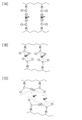
- FIGS. 1A to 1C are diagrams illustrating the behavior of a crosslinked body contained in a crosslinked polymer material according to an embodiment of the present disclosure when heated, and show states in which the temperature increases from Fig. 1A to Fig. 1B to Fig. 1C in that order.
- M 2+ represents a metal ion
- R represents a side chain.
- FIG. 2 is a cross-sectional view showing a structure of an insulated wire according to one embodiment of the present disclosure.
- the crosslinkable polymer composition, the crosslinked polymer material, the insulated wire, and the wire harness according to the present disclosure have the following configurations.
- the crosslinkable polymer composition according to the present disclosure includes a component A from which a metal ion is liberated by heat, a component B composed of an organic polymer having a side chain and including an electron-withdrawing substituent capable of forming an ionic bond with the metal ion liberated from the component A, and a component C composed of a secondary or tertiary amine represented by the following formula (1):
- R1 is a hydrogen atom or a hydrocarbon group having 30 or less carbon atoms
- R2 is a hydrocarbon group having 30 or less carbon atoms
- R3 is a hydrocarbon group having 13 to 30 carbon atoms.
- the crosslinkable polymer composition according to the present disclosure can crosslink component B via metal ions liberated from component A by heating. Therefore, while the composition has high processability in an uncrosslinked state, a polymer material with high heat resistance can be easily obtained by forming a crosslinked body through heating.
- the crosslinked structure is formed by ionic bonds, so that the flexibility is less likely to decrease due to crosslinking compared to when a crosslinked structure is formed by covalent bonds. Therefore, the polymer material is less likely to harden due to crosslinking, and even when forming an insulating coating for a large-diameter electric wire, for example, the flexibility of the insulating coating in bending is less likely to decrease.
- the reversibility of ionic bonds can be utilized by heating to reshape the polymer material after crosslinking. This is because reheating an already formed crosslinked body causes the crosslinking points to move due to ionic bonds, resulting in fluidization of the material.
- the crosslinkable polymer composition according to the present disclosure contains component C, which is a secondary or tertiary amine having the structure of formula (1) above, and thus has an improved degree of crosslinking and high abrasion resistance compared to a composition that does not contain component C. This is believed to be because the amine in component C is cationized and bonds to the electron-withdrawing substituent in the side chain of component B, thereby suppressing the rate at which crosslinking of component B by component A progresses, and crosslinking progresses with high uniformity throughout the material.
- the flow initiation temperature of the crosslinked body may be 190°C or higher and 300°C or lower.
- the crosslinked polymer material has particularly high heat resistance and does not flow at temperatures below 190°C.
- a highly heat-resistant material having a flow initiation temperature of 190°C or higher can be particularly suitably used to form an insulating coating for automotive electric wires.
- by suppressing the flow initiation temperature of the crosslinked body to 300°C or lower by suppressing the flow initiation temperature of the crosslinked body to 300°C or lower, remoldability by heating at temperatures of 300°C or lower is ensured.
- R 1 is a hydrocarbon group in the formula (1)
- the hydrocarbon group and the hydrocarbon groups of R 2 and R 3 may each be independently a straight-chain alkyl group or an aromatic ring group. This reduces the steric hindrance near the nitrogen atom of component C, and effectively inhibits the progress of crosslinking of component B caused by metal ions liberated from component A.
- the component B has a flow starting temperature in the range of 50°C to 190°C. This makes it easier to obtain a crosslinked product having a flow starting temperature of 190°C or more, or even 300°C or less, through crosslinking with metal ions derived from the component A.
- the uncrosslinked crosslinkable polymer composition is molded into a desired shape by extrusion molding or the like, high moldability is obtained.
- the A component may have a decomposition point or phase transition point between 50°C and 300°C. This suppresses the release of metal ions from the A component during preparation of the crosslinkable polymer composition or before use of the crosslinkable polymer composition, thereby suppressing the progress of crosslinking and providing high storage stability for the crosslinkable polymer composition, such as suppressing changes in the quality of the crosslinkable polymer composition at low temperatures such as room temperature.
- the crosslinking reaction can be carried out at a temperature at which the B component does not deteriorate.
- the A component may have a decomposition point or a phase transition point at a temperature equal to or higher than the flow initiation temperature of the B component. Then, while the B component has already acquired fluidity, the release of metal ions from the A component and the accompanying crosslinking of the B component occur. Therefore, by utilizing the flow of the B component, the dispersibility of the A component in the B component can be increased, and a crosslinked body in which the crosslinking points are formed with high spatial uniformity can be obtained. Then, in addition to the effect of the C component, a high effect is obtained in improving the abrasion resistance of the crosslinked polymer material. In addition, it is difficult for the release of metal ions from the A component and the accompanying crosslinking of the B component to proceed unintentionally during the preparation of the crosslinkable polymer composition, etc.
- the component A may be a metal complex containing a ligand having a structure of the following formula (2):
- R4 and R5 each independently represent a hydrocarbon group having 1 to 8 carbon atoms
- R6 represents a hydrogen atom or a hydrocarbon group having 1 to 8 carbon atoms. At least two of R4 , R5 , and R6 may be mutually linked by a ring structure.
- the ⁇ -diketonato ligand represented by formula (2) is a bidentate ligand, and is more effective at stabilizing metal ions than monodentate ligands or ligands that form a cross-linked coordination structure. This suppresses the release of metal ions from component A during the preparation of the cross-linkable polymer composition or before use of the cross-linkable polymer composition, resulting in particularly high storage stability.
- the metal ion liberated from the A component may be at least one of alkaline earth metal, aluminum, zinc, titanium, and zirconium ions.
- the ions of the above metals all have a valence of 2 or more, and tend to form a stable crosslinked structure between the polymer chains of the B component.
- the ions of the above metals belong to the hard acids in the HSAB rule and have a high ionization tendency, so they form stable bonds with the substituents of the B component. For this reason, they are suitable as metals for constituting a crosslinked body.
- the substituent of the B component may be at least one of a carboxylic acid group, an acid anhydride group, a phosphoric acid group, and an acrylic acid group. These substituents are likely to form ionic bonds with metal ions liberated from the A component. In addition, since these are acidic groups with relatively low polarity, they are less likely to cause phase separation in the main chain or side chain of the B component, and can form a crosslinked structure with high spatial uniformity. This, combined with the effect of the contribution of the C component, provides a high effect in improving the wear resistance of the crosslinked polymer material.
- the substituent of the B component may be bonded to the main chain via an alkyl or alkylene group having one or more carbon atoms. This increases the degree of freedom of thermal movement at the crosslinked sites, making it easier for the crosslinked points to move when heated, resulting in particularly high remoldability.
- the B component may have a glass transition temperature of 10°C or less. This makes it easier to obtain high flexibility in a crosslinked polymer material obtained through a crosslinking reaction while also achieving high mechanical strength such as high abrasion resistance.
- a polymer material with excellent mechanical strength and flexibility can be suitably used, for example, to form an insulating coating for an insulated electric wire. It is even more preferable that the glass transition temperature of the B component is 0°C or less.
- the B component does not contain an electron-withdrawing group in the main chain.
- a situation does not occur in which the substituents of the side chain are prevented from forming an ionic bond with the metal ion derived from the A component due to competition with the electron-withdrawing group in the main chain.
- the substituents in the main chain are unlikely to form a stable cross-linked structure with the metal ion due to steric hindrance, and even if a cross-linked structure is formed, the degree of freedom of movement of the cross-linked site is low, making it difficult to obtain high reformability in the cross-linked body.
- the main chain of the B component may be an olefin-based polymer or a styrene-based polymer.
- the high mechanical strength provided by the main chain is more likely to be exhibited as a property of the crosslinked body.
- the main chain is less likely to affect the formation of crosslinking points in the side chain of the B component and the movement of these crosslinking points, and the high heat resistance, abrasion resistance, and remoldability provided by these phenomena in the side chain portion are effectively exhibited as properties of the entire material.
- the crosslinkable polymer composition may contain 0.1 to 30 parts by mass of the A component, with the total of the A component, the B component, and the C component being 100 parts by mass. In this way, by containing a sufficient amount of the A component, the crosslink density becomes high and the crosslinkable polymer composition has excellent crosslinkability. On the other hand, it is easy to avoid the effects of containing a large amount of the A component in the material before and after crosslinking.
- the crosslinkable polymer composition may contain 0.5 to 20 parts by mass of the C component, with the total of the A component, the B component, and the C component being 100 parts by mass.
- the C component may contain 0.5 to 20 parts by mass of the C component, with the total of the A component, the B component, and the C component being 100 parts by mass.
- the crosslinked polymer material according to the present disclosure is composed of a material obtained by crosslinking any one of the crosslinkable polymer compositions described above in [1] to [15], and includes a crosslinked body obtained by crosslinking the B component with a metal ion liberated from the A component, and the C component.
- the crosslinked body formed by crosslinking the B component via the metal ion liberated from the A component has a crosslinking point at the position of the electron-withdrawing substituent introduced into the side chain of the B component, so that the crosslinked polymer material has both high heat resistance and reshapeability by heating. In addition, the flexibility is unlikely to decrease due to crosslinking.
- the crosslinked polymer material most of the C component is present without being incorporated into the crosslinked structure, but due to the contribution of the C component, the crosslinked structure is formed with high uniformity throughout the crosslinked polymer material, and the crosslinked polymer material has high wear resistance.
- the tensile modulus of the crosslinked polymer material is less than 20 MPa. This results in a crosslinked polymer with high flexibility.
- crosslinked polymer materials with a tensile modulus of more than 20 MPa are also preferable in that they are particularly excellent in mechanical strength, such as abrasion resistance.
- the insulated wire according to the present disclosure has a wire conductor and an insulating coating made of the crosslinked polymer material according to the above [16] or [17], which covers the outer periphery of the wire conductor.
- the insulating coating is made of the crosslinked polymer material according to the present disclosure, it exhibits high heat resistance and is unlikely to undergo irreversible deformation even if the wire conductor generates heat due to current flow.
- the insulating coating is heated to a sufficient temperature, it can be re-fluidized and reshaped, and the shape of the insulating coating can be changed.
- the insulating coating when the wire conductor is deformed, the insulating coating can be easily deformed by following the shape of the wire conductor. Furthermore, since the crosslinked polymer material contains the C component, the effect of improving the uniformity of the crosslinked points by the C component can be utilized to obtain high abrasion resistance in the insulating coating formed by hot molding such as extrusion molding and in the insulating coating in a state where it has been reshaped by heating. In addition, because the flexibility of the material is less likely to decrease due to cross-linking, the insulating coating can be made highly flexible, and even if the electric wire is made thick, wiring that involves bending can be easily carried out.
- the electric wire conductor may be formed by twisting together a plurality of strands, and the insulated electric wire may have a flattened section in which the cross section of the electric wire conductor perpendicular to the axial direction is flattened.
- An electric wire having a flattened section is required from the viewpoint of space saving and the like.
- the flattened section can be easily formed by applying a force to a normal insulated electric wire having a circular cross section while heating the insulating coating, taking advantage of the remoldability of the insulating coating.
- the insulated electric wire can be deformed to a state having a different cross section, such as a circular cross section.
- a state having a different cross section such as a circular cross section.
- an insulated electric wire having an electric wire conductor in which a plurality of strands are twisted together and which is easily deformed by the application of a force, and an insulating coating that can be reversibly transitioned to a remoldable state by heating it is possible to easily perform deformation between a state with low flatness, such as a circular cross section, and a flat state in both directions.
- a common insulated electric wire can be used to obtain a variety of insulated electric wires by deforming the necessary parts into the required shape, such as a flat shape, depending on the installation location and application.
- the wire harness according to the present disclosure includes the insulated wire according to the above [18] or [19].
- the insulated wire according to the present disclosure has an insulating coating that is excellent in heat resistance, formability during initial molding and remolding, and abrasion resistance, and therefore these properties can be utilized in the wire harness.
- crosslinkable polymer composition and crosslinked polymer material The crosslinkable polymer composition according to an embodiment of the present disclosure includes a component A from which a metal ion is liberated by heat, a component B having, at its side chain, an electron-withdrawing substituent capable of forming an ionic bond with the metal ion liberated from the component A, and a component C composed of a secondary or tertiary amine represented by the following formula (1).
- R1 is a hydrogen atom or a hydrocarbon group having 30 or less carbon atoms
- R2 is a hydrocarbon group having 30 or less carbon atoms
- R3 is a hydrocarbon group having 13 to 30 carbon atoms.
- the crosslinkable polymer composition according to this embodiment is heated to form a crosslinked body in which component B is crosslinked by metal ions liberated from component A, thereby constituting the crosslinked polymer material according to this embodiment of the disclosure.
- the crosslinked polymer material contains the crosslinked body and component C.
- the crosslinkable polymer composition basically refers to a state in which the formation of a crosslinked body has not progressed, but materials in which crosslinking has progressed to a certain extent when performing heat molding such as heat kneading or extrusion molding are also included in the crosslinkable polymer composition.
- the crosslinkable polymer composition according to this embodiment contains an A component from which a metal ion is liberated by heat, a B component having a substituent capable of forming an ionic bond with the metal ion, and a C component which is a secondary or tertiary amine having a structure of formula (1).
- a component from which a metal ion is liberated by heat contains an A component from which a metal ion is liberated by heat, a B component having a substituent capable of forming an ionic bond with the metal ion, and a C component which is a secondary or tertiary amine having a structure of formula (1).
- the liberated metal ion forms an ionic bond with the substituent of the B component, and the organic polymer chain of the B component is crosslinked through the ionic bond.
- the crosslinked polymer material most of the C component is not incorporated into the crosslinked body, and coexists with the crosslinked body while maintaining the molecular structure represented by formula (1).
- the crosslinkable polymer composition of this embodiment is in a relatively fluid state at low temperatures at which the liberation of metal ions from component A and the resulting crosslinking of component B do not occur, and can be easily molded into a desired shape by extrusion molding or the like.
- the metal ions are liberated from component A by heating and component B is crosslinked, forming a crosslinked body.
- the crosslinked body can be formed into a desired shape by extrusion molding or the like after or while forming the crosslinked body by heating.
- the crosslinked body has improved heat resistance compared to the state before crosslinking, due to adjacent polymer chains of component B being crosslinked.
- the organic polymer chains of component B are crosslinked via ionic bonds, the bonding force of which is stronger than van der Waals forces, effectively improving the heat resistance and mechanical toughness of the crosslinked body.
- flexibility is less likely to decrease due to crosslinking, compared to when a crosslinked structure is formed by covalent bonds.
- the polymer material after crosslinking also has high flexibility.
- the crosslinked structure between the polymer chains of component B is formed by ionic bonds with metal ions, which are reversible bonds, rather than irreversible covalent bonds as formed in the case of electron beam crosslinking or silane crosslinking, and therefore the crosslinked polymer material formed has reshapeability.
- the crosslinked polymer material becomes fluid again, and can be molded into a shape different from that before heating by applying an external force, etc.
- crosslinked polymer materials can be explained by the following mechanism.
- the crosslinked body in which the polymer chains of component B are crosslinked with metal ions is not heated and is at room temperature or close to room temperature, the crosslinking points of the metal ions are localized at certain positions in the chains of component B, as shown in Figure 1A.
- the crosslinked body is heated, the molecular motion of component B becomes active due to heat, and as shown in Figure 1B, active thermal motion occurs at the crosslinked sites where the substituents of component B and the metal ions form ionic bonds, and in the vicinity of those sites.
- the molecular motion of component B is further activated, and the crosslinking points via the metal ions can move to different nearby sites (the positions of other substituents), and the crosslinking points are delocalized.
- delocalizing the crosslinking points a state is formed in which multiple substituents in the same molecular chain of component B are simultaneously coordinated to one metal ion (multidentate), as shown in Figure 1C.
- This activation of thermal motion in component B and the subsequent movement of the crosslinking points allow the crosslinked body to flow.
- the crosslinked polymer material can be reshaped by applying an appropriate external force to the material.
- the activation of thermal motion at the crosslinking sites and the delocalization of the crosslinking points are reversible phenomena, and by cooling the reshaped crosslinked polymer material, the crosslinking points return to a localized state, returning to a thermally stable crosslinked state.
- the crosslinked polymer material can also be repeatedly reshaped by repeating heating and cooling. The activation of thermal motion at the crosslinking sites and the delocalization of the crosslinking points due to heating can be confirmed, for example, by infrared absorption spectroscopy.
- the activation of thermal motion at the crosslinking sites appears in the spectrum as a broadening of the absorption peak of the substituent that forms the crosslinked structure, and the delocalization of the crosslinking points appears in the spectrum as the growth of a new peak corresponding to multidentate formation.
- the substituents capable of forming ionic bonds with metal ions in component B are contained in the side chains rather than in the polymer main chain, which allows for high freedom of movement at the crosslinked sites when a crosslinked structure is formed via metal ions.
- thermal movement at the crosslinked sites and movement of the crosslinking points are particularly likely to occur actively. This makes the crosslinked polymer material highly remoldable when heated.
- the crosslinkable polymer composition according to this embodiment contains component A, which liberates metal ions by heat, and component B, which contains a substituent in its side chain capable of forming an ionic bond with the metal ion, and thus provides a crosslinked polymer material that has high heat resistance and further has remoldability after heating. Because the crosslinked polymer material according to this embodiment has such properties, it can be suitably used to form components that require high heat resistance and are advantageously remoldable, such as insulating coatings for insulated electric wires.
- the flow initiation temperature of the crosslinked polymer material is 5°C or more, and even 10°C or more higher than the flow initiation temperature of component B alone.
- components A and B form an ionic crosslinked structure, resulting in a crosslinked polymer material that has high heat resistance and remoldability, and is less susceptible to a decrease in flexibility due to crosslinking. Furthermore, since the crosslinkable polymer composition contains component C in addition to components A and B, the crosslinked polymer material obtained through crosslinking has even greater mechanical strength, such as abrasion resistance. The reasons for this are as follows.
- crosslinkable polymer composition does not contain component C
- a crosslinking reaction may occur at high speed due to the formation of ionic bonds between metal ions liberated from component A and the substituents of component B. This may cause the crosslinking reaction to proceed locally, resulting in the formation of aggregates. In this case, the crosslinking reaction does not occur uniformly throughout the material, and it becomes difficult to increase the degree of crosslinking throughout the material.
- the crosslinked structure between polymer chains acts to increase the mechanical strength of the polymer material, such as its abrasion resistance, but if the crosslinked structure is not formed uniformly throughout the material as described above and the degree of crosslinking throughout the material is low, the crosslinked polymer material will not be able to fully achieve the effect of improving mechanical strength due to the crosslinked structure, and the abrasion resistance will not be sufficiently improved.
- the crosslinkable polymer composition contains a C component consisting of a secondary or tertiary amine
- at least a part of the C component becomes a secondary or tertiary ammonium cation when heated.
- the generated ammonium cation forms an ionic bond with an electron-withdrawing substituent on the side chain of the B component.
- the formation of an ionic bond between this ammonium cation and the B component's substituent competes with the reaction in which a metal ion released from the A component forms an ionic bond with the B component's substituent to form a crosslink, and at least partially inhibits the crosslinking reaction between the B component's polymer chains via the metal ion.
- the rate of progress of the crosslinking reaction decreases.
- the decrease in the rate of progress of the crosslinking reaction can be confirmed, for example, by the fact that the exothermic peak corresponding to the progress of the crosslinking reaction becomes gentler with the addition of the C component in differential scanning calorimetry (DSC).
- the resulting crosslinked polymer material has a crosslinked structure that is spatially distributed with high uniformity and at a high density. This results in a crosslinked polymer material with excellent mechanical strength, including wear resistance.
- the increase in crosslink density can be evaluated as an increase in the gel fraction of the crosslinked polymer material.
- the gel fraction of the crosslinked polymer material should be 80% or more, and preferably 85% or more. There is no particular upper limit to the gel fraction, but it is generally 95% or less.
- the gel fraction can be evaluated by immersing the polymer material in a solvent such as xylene to extract the non-crosslinked components, and then expressing the gel fraction as the ratio of the mass after immersion to the mass before immersion.
- ammonium cations from the amine C component proceeds easily when the crosslinkable polymer composition is heated, as C component bonds with protons liberated from the substituents of B component and protons generated during decomposition of A component, and can occur at a lower temperature than the liberation of metal ions from A component.
- one metal ion needs to bond with two substituents, whereas the formation of a crosslinked structure is hindered by the formation of an ionic bond between the generated ammonium cation and only one substituent of B component.
- ammonium cations are softer bases than metal ions, and are less likely to form strong bonds with the substituents of component B, and are also less likely to bond with multiple substituents in component B to form a crosslinked structure.
- the ammonium cations are once ionically bonded with the substituents of component B, as heating and kneading continues, the ammonium cations are gradually replaced by metal ions derived from component A, and crosslinked structures are formed between the polymer chains of component B.
- the polymer chains of component B are crosslinked by the metal ions derived from component A, and a structure in which the polymer chains of component B are crosslinked via ammonium cations derived from component C is not easily formed. Except for a portion of component C remaining in the form of an ammonium cation ionically bonded to the substituents of component B, component C returns to an amine state and is not easily incorporated into the crosslinked structure.
- the crosslinked polymer material obtained by crosslinking the B component with the metal ions derived from the A component has excellent mechanical strength such as wear resistance.
- High mechanical strength is required for polymer materials for various applications.
- the crosslinked polymer material can be suitably used as a component constituting an insulating coating for an insulated electric wire. In an insulating coating, the high mechanical strength can suppress the influence of damage caused by contact with an external object.
- the crosslinked body formed from the A component and the B component is unlikely to suffer a decrease in flexibility due to crosslinking because the crosslinking is formed by ionic bonds, but the addition of the C component does not significantly impair the flexibility of the crosslinked body.
- the polymer material after crosslinking also has high flexibility.
- a crosslinked body using a polymer material with high flexibility as the B component is likely to have low wear resistance, but the addition of the C component improves the wear resistance of the crosslinked polymer material as a whole, and it achieves both high flexibility and high wear resistance.
- the crosslinked body formed from the A component and the B component has a flow start temperature in the range of 190°C or more and 300°C or less. If the flow start temperature of the crosslinked body is 190°C or more, the crosslinked polymer material is less likely to increase in fluidity and undergo irreversible deformation at temperatures lower than 190°C, and the crosslinked polymer material has high heat resistance.
- a heat resistance temperature of 190°C is generally desired for the insulating coating of an insulated electric wire for an automobile, and the crosslinked polymer material according to this embodiment can be suitably used to form an insulating coating of an insulated electric wire for an automobile, as will be described in detail later.
- the flow start temperature of the crosslinked body is 200°C or more, and further 220°C or more.
- the flow start temperature of the crosslinked body is suppressed to 300°C or less, the crosslinked polymer material can be remolded by heating it to 300°C, and remolding can be easily performed.
- the flow initiation temperature of the crosslinked body is preferably 280°C or less, and more preferably 250°C or less.
- the flow initiation temperature of the crosslinked body and component B described later refers to the temperature at which the material begins to exhibit fluidity when heated in a solid state, and can be measured as the temperature at which an indenter can penetrate a sheet-like material, as shown in the examples below.
- the melting point or flow point of the material (the lower one if both are present) can be regarded as the flow initiation temperature.
- the crosslinked polymer material according to this embodiment can have a wide range of tensile modulus depending on the tensile modulus of the polymer material used as component B, and the specific tensile modulus is not particularly limited. However, if particularly high flexibility is desired, the tensile modulus of the crosslinked polymer material is preferably 80 MPa or less. More preferably, the tensile modulus is 50 MPa or less, and even 20 MPa or less. The lower limit of the tensile modulus of the crosslinked polymer material is not particularly specified, but from the viewpoint of ensuring sufficient mechanical strength, it is preferably 5 MPa or more, and even 10 MPa or more.
- the tensile modulus may be higher than 80 MPa.
- the tensile modulus of the crosslinked polymer material is 200 MPa or more, and even 500 MPa or more, a particularly high mechanical strength can be obtained. Even in this case, from the viewpoint of ensuring flexibility, it is preferable to keep the tensile modulus at 1600 MPa or less.
- the tensile modulus can be measured, for example, by a tensile test in accordance with JIS K 7161.
- the crosslinkable polymer composition according to this embodiment becomes a crosslinked polymer material that has high heat resistance, remoldability, and high mechanical strength after crosslinking. In addition, flexibility is not likely to decrease even after crosslinking. From the viewpoint of particularly enhancing these properties, appropriate specific types and structures may be selected for each of the A, B, and C components. Furthermore, the mixing ratio of each component also affects these properties. The preferred structures and properties of each component are described below in order.
- Component A is a component that releases metal ions by heat. "By heat” refers to heating, and is assumed to be at a temperature higher than room temperature. "Metal ions are released” refers to the decomposition or phase transition of component A, which causes the metal ions to be released from component A. The metal ions released from component A cause crosslinking of component B.
- the A component preferably has a decomposition point or phase transition point of 50°C or higher. This makes it easier to suppress the release of metal ions from the A component during preparation of the crosslinkable polymer composition or before use (before crosslinking) of the crosslinkable polymer composition, and the progress of crosslinking of the B component is suppressed, resulting in a crosslinkable polymer composition with excellent storage stability.
- the quality deterioration of the crosslinkable polymer composition is unlikely to occur. If the A component has a decomposition point or phase transition point of 60°C or higher, or even 70°C or higher, the effect of improving storage stability is further enhanced.
- component A has a decomposition point or phase transition point of 300°C or less. This makes it difficult for component B to degrade at a temperature lower than the temperature at which metal ions are released from component A, and makes it easier to crosslink unaltered component B with metal ions. Furthermore, by decomposing or undergoing phase transition at a moderate temperature, metal ions are easily released from component A, and the crosslinkable polymer composition has an excellent crosslinking speed. From these perspectives, it is more preferable for component A to have a decomposition point or phase transition point of 200°C or less, or even 150°C or less, or 120°C or less.
- the A component has a decomposition point or a phase transition point at a temperature equal to or higher than the flow start temperature of the B component, which will be described later. Then, at the temperature at which the A component liberates the metal ions, the B component can proceed with crosslinking by the metal ions liberated from the A component, while the B component has already acquired fluidity. Therefore, by utilizing the flow of the B component, crosslinking can be proceeded in a state in which the metal ions are well dispersed in the B component, and it becomes easier to obtain a crosslinked polymer material with a highly uniform structure in which the crosslinking points by the metal ions are distributed with high spatial uniformity.
- the A component has a decomposition point or a phase transition point at a temperature higher than the flow start temperature of the B component, and further, it is preferable that the A component has a decomposition point or a phase transition point at a temperature 10°C or higher than the flow start temperature of the B component.
- the decomposition point or phase transition point of component A is represented by the baseline change onset temperature measured by DSC.
- phase transition point does not include the melting point, and the above phase transition does not include melting.
- component A has both a phase transition point and a decomposition point, or when it has multiple phase transition points, the lower of these (the lowest) is treated as the "decomposition point or phase transition point.”
- the metal species of the metal ion liberated from component A is not particularly limited, but alkaline earth metals, aluminum, zinc, titanium, zirconium, etc. can be suitably used.
- the metal ion liberated from component A should be at least one of these metal ions.
- the ions of these metals have a valence of two or more, and by forming an ionic bond with the substituent of component B, a stable crosslinked structure is easily formed between the polymer chains of component B.
- the ions of the metals listed above belong to hard acids according to the HSAB rule, and are metals with a relatively high ionization tendency, so they form stable bonds with the substituent of component B and are suitable as metals for constituting a crosslinked body.
- the metal species contained in the crosslinkable polymer composition is the same as the metal species that is the main component of the metal member, it is easy to minimize the effect of the presence of the metal member on the formation and stable maintenance of a crosslinked structure at the interface between the metal member and the polymer material.
- the metal ion liberated from component A can be aluminum.
- any metal ion can be used as the ion released from component A, as long as it forms an ionic bond with the substituent of component B to crosslink component B, and more preferably, can provide a crosslinked body with a flow start temperature of 190°C to 300°C.
- transition metals such as iron, nickel, and copper tend to provide crosslinked bodies with a flow start temperature higher than the above range. This is thought to be because when a crosslinked body is formed using ions of metals that have many possible oxidation numbers or low ionization tendency, such as transition metals, the crosslinking points tend not to move when heated (see Figure 1C).
- the metal ion released from component A may be not only a monoatomic ion of the metal, but also a polyatomic ion (metal-containing ion) formed by bonding a metal atom with another atom.
- a monoatomic ion of the metal it is preferable to use a monoatomic ion of the metal.
- Component A may be any chemical species that liberates metal ions by heat, but a suitable chemical species is a metal complex.
- a metal complex is composed of a central metal ion and a ligand with an unshared electron pair that is coordinately bonded to it.
- the ligand has an excellent effect of stabilizing the metal ion, and the liberation of metal ions from component A is suppressed during preparation of the crosslinkable polymer composition or before use of the crosslinkable polymer composition, while the metal ions are easily liberated from component A by heat when crosslinking the crosslinkable polymer composition.
- Ligands constituting metal complexes include monodentate ligands with one coordination site and polydentate ligands with two or more coordination sites. Metal complexes formed with polydentate ligands are more stable than metal complexes formed with monodentate ligands or metal complexes formed with ligands that have a cross-linked coordination structure, such as alkoxide ligands, due to the chelating effect. Therefore, it is preferable that component A is a metal complex containing a polydentate ligand.
- Coordination with a polydentate ligand is more effective at stabilizing metal ions than coordination with a monodentate ligand or coordination with a ligand that has a cross-linked coordination structure, and the release of metal ions from component A during preparation of the cross-linkable polymer composition or before use of the cross-linkable polymer composition is more effectively suppressed.
- the bidentate ⁇ -diketonato ligand (1,3-diketonato ligand) can be preferably used.
- ⁇ -diketonato ligands are particularly effective at stabilizing metal ions.
- metal complexes having ⁇ -diketonato ligands are easy to disperse in organic polymers, making them suitable for dispersing component A in component B and forming crosslinking points with high uniformity.
- ⁇ -diketonato ligands are represented by the following general formula (2).
- R 4 and R 5 each independently represent a hydrocarbon group
- R 6 represents a hydrogen atom or a hydrocarbon group. At least two of R 4 , R 5 , and R 6 may be linked to each other by a ring structure.
- the ligand may have a structure of formula (2) due to a resonance structure.
- R 4 , R 5 , and R 6 may be an aliphatic hydrocarbon group or a hydrocarbon group containing an aromatic ring. They may also contain a heteroatom such as an oxygen atom.
- Examples of the hydrocarbon groups constituting R 4 , R 5 , and R 6 include alkyl groups, alkoxy groups, aromatic groups, and condensed aromatic groups.
- the carbon numbers of R 4 , R 5 , and R 6 are not particularly limited, but are preferably 1 to 8, respectively.
- ⁇ -diketonato ligand examples include an acetylacetonato ligand (acac), a 2,2,6,6-tetramethyl-3,5-heptanedionato ligand (dpm), a 3-methyl-2,4-pentanedionato ligand, a 3-ethyl-2,4-pentanedionato ligand, a 3,5-heptanedionato ligand, a 2,6-dimethyl-3,5-heptanedionato ligand, a 1,3-diphenyl-1,3-propanedionato ligand, etc.
- an acetylacetonato ligand in which R 4 and R 5 are methyl groups and R 6 is a hydrogen atom in the above formula (2) is particularly preferred.
- the content of the A component is preferably 0.1 parts by mass or more, with the total of the A component, the B component, and the C component being 100 parts by mass.
- the content of the A component is sufficiently large relative to the B component, so that the crosslink density is high in the crosslinked body, and the crosslinking effect is highly improved in heat resistance and abrasion resistance.
- the content of the A component is more preferably 1.0 parts by mass or more, and even more preferably 2.0 parts by mass or more, relative to the above 100 parts by mass.
- the content of the A component is preferably 30 parts by mass or less, relative to the above 100 parts by mass.
- the content of component A is preferably 20 parts by mass or less, and more preferably 10 parts by mass or less, per 100 parts by mass.
- Component B is a component composed of an organic polymer having a side chain, and contains an electron-withdrawing substituent in the side chain capable of forming an ionic bond with a metal ion liberated from Component A.
- the substituent does not necessarily have to be electron-withdrawing to be able to form an ionic bond with a metal ion liberated from Component A, but being electron-withdrawing allows a stable ionic bond to be formed between the metal ion. Therefore, in the crosslinkable polymer composition, when Component B is crosslinked by a metal ion, a crosslinked structure is stably formed, and the crosslinked body is likely to exhibit high heat resistance.
- suitable examples include acidic groups other than hydroxyl groups, such as carboxylic acid groups, acid anhydride groups, phosphoric acid groups, and acrylic acid groups.
- the substituents may be one type or two or more types, but it is preferable that at least one of the substituents listed above is used.
- maleic acid groups and acrylic acid groups can be preferably used.
- Acid anhydride groups such as maleic anhydride groups can also be preferably used.
- the substituents listed above are excellent in that they easily form ionic bonds with metal ions liberated from component A.
- substituents listed above are acidic groups with relatively low polarity, they are less likely to cause phase separation in the main chain or side chain of component B, and therefore a crosslinked structure can be formed with high uniformity in the structure of component B, and as a result, the effect of improving mechanical strength such as wear resistance due to crosslinking can be obtained.
- a sulfonic acid group is an electron-withdrawing substituent that easily forms an ionic bond with a metal ion, but because it is highly polar, it is prone to phase separation, and therefore cannot be used as a substituent for component B as preferably as the substituents listed above.
- the substituent that forms an ionic bond with the metal ion is included in the side chain, not in the polymer main chain, so that when a crosslinked structure is formed, the crosslinked site maintains a high degree of freedom of movement. As a result, the crosslinked polymer material becomes a material with high reshapeability.
- the structure and length of the side chain are not particularly limited, but from the viewpoint of enhancing their effects, it is preferable that the substituent is bonded to the main chain via an alkyl group or alkylene group having one or more carbon atoms. Alternatively, the substituent may be bonded to the main chain via a heteroatom such as an oxygen atom.
- the substituent may be introduced to the end or the middle part of the side chain, but from the viewpoint of effectively increasing the degree of freedom of movement of the crosslinked site, it is preferable that it is introduced to the end.
- the substituent is a carboxylic acid group or a phosphate group
- particularly preferable structures of the side chain part are represented by the following formulas (3) and (4), respectively.
- R7 is a main chain
- R8 is an oxygen atom or an alkyl or alkylene group having 1 or more carbon atoms
- R9 is also an alkyl or alkylene group having 1 or more carbon atoms.
- a plurality of electron-withdrawing substituents may be bonded to the main chain via a common R8 or R9 .
- a plurality of electron-withdrawing substituents may form an anhydride together.
- the electron-withdrawing substituent may be either in the main chain or not in the main chain, as long as it is in the side chain. However, it is preferable that the main chain does not contain an electron-withdrawing group. If the main chain contains an electron-withdrawing group, it may prevent the electron-withdrawing group in the side chain from forming a crosslinked structure by ionic bonding with a metal ion. Since the electron-withdrawing group in the main chain is easily affected by large steric hindrance, it is difficult to effectively contribute to crosslinking by forming an ionic bond with a metal ion, and crosslinking is poor in improving heat resistance.
- component B Even if a crosslinked structure is formed at the site of the electron-withdrawing group in the main chain, the degree of freedom of movement at the crosslinked site is small, making it difficult to obtain high reshapeability. It is also difficult to obtain the effect of suppressing the progress of the crosslinking reaction by component C.
- electron-withdrawing groups that should not be contained in the main chain of component B include carboxy groups and halogen atoms when the main chain is composed of a copolymer of (meth)acrylic acid.
- component B does not contain atoms that can form coordinate bonds with metal ions, such as nitrogen atoms or sulfur atoms, in the side chain while leaving unshared electron pairs available for coordinate bonds. This is because if such atoms form coordinate bonds with metal ions released from component A, the ionic bond between the electron-withdrawing functional group and the metal ion may be reduced.
- the content of the substituents contained in the side chains is not particularly limited, but from the viewpoint of ensuring physical properties by crosslinking, it is preferably 0.01% by mass to 10% by mass relative to the total mass of component B. More preferably, it is 0.1% by mass to 5% by mass, and even more preferably, it is 0.2% by mass to 3% by mass.
- the content of the above-mentioned substituents in component B can be determined by comparing the magnitude of the substituent-specific peak in the infrared absorption spectrum with the magnitude of the spectral peak of a material with a known content.
- the organic polymer of component B is an organic polymer such as a resin, rubber, or elastomer.
- component B is made of a resin having thermoplasticity from the viewpoint of moldability during hot molding such as extrusion molding.
- an olefin-based polymer or a styrene-based polymer can be preferably used as the main chain constituting component B.
- an acrylic polymer may be used.
- polystyrene-based thermoplastic elastomers such as styrene-ethylene-butylene-styrene block copolymer (SEBS).
- SEBS styrene-ethylene-butylene-styrene block copolymer
- component B only one type may be used, or two or more types may be mixed and used.
- a high tensile modulus such as polypropylene
- a low tensile modulus such as ethylene-based copolymers such as ethylene-methyl acrylate copolymer (EMA) and ethylene-vinyl acetate copolymer (EVA), styrene-based thermoplastic elastomers, low-density polyethylene, among the above-listed materials.
- EMA ethylene-methyl acrylate copolymer
- EVA ethylene-vinyl acetate copolymer
- the polymer species constituting the main chain of component B are not limited to those listed above, but as mentioned above, it is preferable that the main chain does not contain electron-withdrawing groups. In addition, from the viewpoint of ensuring thermoplasticity, flexibility, and chemical resistance, it is preferable that component B does not contain ether bonds or cyclic structures in the main chain. In other words, it is preferable that the main chain of component B has a skeleton in which carbon atoms are continuous in a straight chain or a chain that includes branches.
- the B component is preferably composed of an organic polymer with a low glass transition temperature.
- the glass transition temperature is preferably 10°C or lower.
- the glass transition temperature is 0°C or lower, further -20°C or lower, and further -40°C or lower.
- the crosslinkable polymer composition contains C component, the polymer material after crosslinking has excellent mechanical strength such as abrasion resistance, so that it is not necessary to use a component B with a high glass transition temperature in order to increase the mechanical strength of the crosslinked polymer material.
- the glass transition temperature of B component it is preferable to set it to -90°C or higher, or even -70°C or higher, from the viewpoint of ensuring high mechanical strength in the crosslinked polymer material.
- the glass transition temperature of B component can be evaluated, for example, according to JIS K 7121. If it is desired to particularly increase the mechanical strength, including the abrasion resistance, of the crosslinked polymer material, it is also preferable to use as component B a material having a relatively high glass transition temperature, such as above 0°C, or even above 10°C, even if the glass transition temperature is within the range of 10°C or less. However, even in this case, it is advisable to keep the glass transition temperature of component B below 20°C in order to ensure the flexibility of the crosslinked polymer material.
- component B has a flow initiation temperature in the range of 50°C or higher and 190°C or lower. This makes it easier to obtain a crosslinked product that has a flow initiation temperature at a moderately high temperature, such as 190°C or higher and 300°C or lower, via crosslinking with metal ions released from component A. It is more preferable that component B has a flow initiation temperature of 80°C or higher and 160°C or lower.
- the hardness of component B is preferably 60 or less, more preferably 50 or less, and even more preferably 40 or less in Shore D hardness.
- the hardness of component B is preferably 10 or more in Shore D hardness.
- the Shore D hardness of component B may be measured in accordance with JIS K 6253.
- component B a component having a Shore D hardness of 60 or less, but relatively high, such as over 40, or even more than 60.
- Component C is composed of a secondary or tertiary amine represented by formula (1) shown below.
- R1 is a hydrogen atom or a hydrocarbon group having 30 or less carbon atoms
- R2 is a hydrocarbon group having 30 or less carbon atoms
- R3 is a hydrocarbon group having 13 to 30 carbon atoms.
- R1 is a hydrogen atom
- the C component is a secondary amine
- R1 is a hydrocarbon group
- the C component is a tertiary amine.
- the object when referring to the structure of a hydrocarbon group, the object is to use an embodiment in which R1 is a hydrocarbon group rather than a hydrogen atom, unless otherwise specified.
- the ammonium cation formed from the component C binds to the electron-withdrawing substituent of the component B, suppressing the rate of the crosslinking reaction in which the component B is crosslinked by the metal ion liberated from the component A, and improving the spatial uniformity and degree of crosslinking of the crosslinked structure.
- the component C is limited to a secondary or tertiary amine, it is possible to avoid the formation of an irreversible covalent bond with the substituent of the component B, which may occur when the component C is a primary amine.
- the component C can effectively contribute to suppressing the crosslinking rate by forming an ionic bond with the component B, and since the ionic bond can be reversibly dissolved, the substituent of the component B can be ionic-bonded with the metal ion liberated from the component A and maintained in a state available for forming a crosslinked structure.
- An example of the formation of a covalent bond that may occur when the component C is a primary amine is the formation of an imine structure when the substituent of the component B is a carboxylic acid group or a carboxylic anhydride group.
- Either secondary amines or tertiary amines may be used as component C, but secondary amines are often solid at room temperature and are easier to handle, so it is preferable to use secondary amines.
- At least one hydrocarbon group that is, at least R 3 , has a carbon number of 13 or more. This makes it difficult for the C component to volatilize during heating and kneading of the crosslinkable polymer composition.
- the polarity of the C component does not become excessively high, so that the compatibility with the B component is high. Since the C component is difficult to volatilize and exhibits high compatibility with the B component, the C component is distributed uniformly and stably in the B component, so that the progress of the crosslinking reaction between the B component and the A component is suppressed by the C component, and the effect of increasing the mechanical strength of the crosslinked polymer material is highly obtained.
- the lower limit of the carbon number of the other two hydrocarbon groups is not particularly limited, but it is preferable that the carbon number of these groups is also 13 or more. More preferably, the carbon number of R 3 (and R 1 and R 2 ) is 15 or more.
- the carbon number of the hydrocarbon group of R 1 , R 2 , and R 3 is 30 or less, the component C is easily ionically bonded to the electron-withdrawing substituent of the component B in the form of an ammonium cation during heating and kneading of the crosslinkable polymer composition.
- R 1 , R 2 , and R 3 may all be the same hydrocarbon group, or at least two of them may be different from each other. From the viewpoint of easy availability of amines, it is preferable that two or three of them are the same hydrocarbon group.
- the hydrocarbon groups constituting the amine of component C are preferably each independently an alkyl group or an aromatic ring group. This reduces the steric hindrance near the nitrogen atom of component C, and enhances the effect of suppressing the reaction rate of the crosslinking reaction between components A and B. From the viewpoint of further enhancing this effect, when the hydrocarbon group is an alkyl group, the alkyl group is preferably linear. Furthermore, as long as the aromatic ring group contains an aromatic ring, there are no particular limitations on the presence or absence of a hydrocarbon portion other than the aromatic ring, or on the number of aromatic rings, but from the same viewpoint, the number of aromatic rings in each hydrocarbon group is preferably two or less. Furthermore, it is preferable that the aromatic ring is directly bonded to the nitrogen atom.
- component C is a monoamine containing only one amine structure in the molecule. This makes it difficult for crosslinking between polymer chains of component B via component C, which can occur when there are multiple amine structures, to occur, and the crosslinked structure is mainly mediated by metal ions derived from component A.
- component C include the following: Secondary amines include N-methylmyristylamine, N-methylcetylamine, N-methylstearylamine, N-methylbehenylamine, N-methylmontanylamine, N,N-distearylamine, diphenylamine, 4-methyldiphenylamine, 3-methyldiphenylamine, ditolylamine, N-phenylnaphthylamine, N-tolylnaphthylamine, 4,4'-bis( ⁇ , ⁇ -dimethylbenzyl)diphenylamine, 6-ethoxy-2,2,4-trimethyl-1,2-dihydroquinoline, and bis(4-octylphenyl)amine.
- Secondary amines include N-methylmyristylamine, N-methylcetylamine, N-methylstearylamine, N-methylbehenylamine, N-methylmontanylamine, N,N-distearylamine, diphenylamine, 4-methyldiphenyl
- tertiary amines include N,N-dimethylmyristylamine, N,N-dimethylcetylamine, N,N-dimethylstearylamine, N,N-dimethylbehenylamine, N,N-dimethylmontanylamine, N,N-distearylmethylamine, N-methyldiphenylamine, triphenylamine, methyltriphenylamine, and N,N-diphenylnaphthylamine.
- N,N-dimethylstearylamine, N-methylstearylamine, 4,4'-bis( ⁇ , ⁇ -dimethylbenzyl)diphenylamine, and bis(4-octylphenyl)amine are particularly preferred.
- component C only one type may be used, or two or more types may be used in combination.
- the content of the C component is preferably 0.5 parts by mass or more, with the total of the A component, the B component, and the C component being 100 parts by mass. In this way, the effect of suppressing the reaction rate of the crosslinking reaction between the A component and the B component by the C component is highly obtained. More preferably, the content of the C component is preferably 0.8 parts by mass or more, or 1.0 parts by mass or more, with respect to the above 100 parts by mass. On the other hand, the content of the C component is preferably 20 parts by mass or less, with respect to the above 100 parts by mass. In this way, it is possible to avoid the formation of aggregates due to the C component.
- the B component is contained in a relatively sufficient amount, and the physical properties brought about by the B component, such as mechanical strength and low-temperature characteristics, are fully expressed in the crosslinked polymer material. More preferably, the content of the C component is preferably 10 parts by mass or less, or 5 parts by mass or less, with respect to the above 100 parts by mass.
- the crosslinkable polymer composition according to this embodiment may contain additives such as flame retardants, copper inhibitors, antioxidants, and colorants in addition to the above-mentioned A, B, and C components, as long as they do not impair the function of the material.
- additives include metal salts of long-chain carboxylic acids having a structure represented by the following formula (5) and a melting point of 190°C or higher.
- this compound plays a role in improving the thermal deformation property of the crosslinkable polymer composition by increasing the fluidity of the crosslinked body composed of A and B components, and when the crosslinkable polymer composition is subjected to heat molding such as extrusion molding, it becomes easier to perform heat molding into a desired shape.
- the amount of this compound to be added can be exemplified as a range of 1.0 parts by mass to 30 parts by mass, with the total of A and B components being 100 parts by mass.
- R represents a hydrogen atom or a hydroxyl group.
- m and n are each an integer of 1 or more, and m+n is 11 or more and 30 or less.
- the polymer component may contain an organic polymer other than component B, but the content of the polymer other than component B is preferably kept lower than the content of component B. More preferably, the crosslinkable polymer composition contains only component B as the polymer component. Furthermore, the following compounds in groups (a) to (f) can be listed as components that should not be included in the crosslinkable polymer composition. That is, (a) silane coupling agents, (b) epoxy compounds, (c) isocyanates and isothiocyanate compounds, (d) photoradical generators and thermal radical generators, (e) chlorine compounds and bromine compounds, and (f) volatile organic solvents can be listed.
- the crosslinkable polymer composition contains an organic low molecule (non-polymerized organic molecule), from the viewpoint of sufficiently ensuring the thermoplasticity, flexibility, and chemical resistance of the polymer material after crosslinking, it is preferable that the organic low molecule, like component B, does not contain an ether bond or a ring structure such as a steroid skeleton.
- the crosslinkable polymer composition can be prepared by mixing the A component, the B component, the C component, and the additional components added as necessary. The mixing can be performed by heat kneading. The obtained crosslinkable polymer composition can then be molded into any shape by heat molding such as extrusion molding. If the heat kneading and heat molding are performed at a temperature equal to or higher than the decomposition point or phase transition point of the A component, the crosslinkable polymer composition can be molded into a desired shape with the A component and the B component already forming a crosslinked body, or while the crosslinked body is being formed. In this case, it is not necessary to separately heat the material for crosslinking after molding.
- the temperature during the heat kneading and heat molding is set to be equal to or higher than the flow initiation temperature of the crosslinked body formed from the A component and the B component. Then, the heat kneading and heat molding can be performed smoothly while the material has fluidity. Even after the crosslinked polymer material has been molded into a desired shape, if the molded body is heated to a temperature equal to or higher than the flow initiation temperature of the crosslinked body, the crosslinked polymer material will acquire fluidity and can be remolded. Remolding can be repeated reversibly.
- the crosslinkable polymer composition according to the present embodiment can form a crosslinked structure without any operations other than heating, so the crosslinking process can be carried out with simple equipment compared to the case of using electron beam crosslinking or silane crosslinking.
- the remolding process can also be carried out by applying an appropriate external force while heating, so it can be carried out with similarly simple equipment.
- a crosslinked polymer material in which crosslinking of component B by metal ions derived from component A is completed most of component C returns to the amine state and coexists with the crosslinked product, so that even if the crosslinked polymer material is heated for remolding, it is unlikely that an ionic bond will be formed between the electron-withdrawing substituent of component B in the form of ammonium ions.
- the crosslinked polymer material formed from the crosslinkable polymer composition according to the present embodiment can be used for any purpose of constructing any member.
- the crosslinked polymer material according to the present embodiment can be suitably used as a constituent material of insulated wires and wire harnesses for automobiles and the like, taking advantage of its excellent abrasion resistance, high heat resistance and moldability, and its resistance to loss of flexibility due to crosslinking.
- Insulated wires and wire harnesses are prone to heat generation due to current flow through metal members such as electric wire conductors, and polymer materials arranged in the vicinity of these metal members are also required to have high heat resistance, such as resistance to irreversible deformation when heated.
- the crosslinkable polymer composition when the crosslinkable polymer composition is molded into a desired shape by heat molding such as extrusion molding, it is desired that the crosslinkable polymer composition has high fluidity and is in a state of excellent moldability.
- heat molding such as extrusion molding
- Specific locations in which the crosslinked polymer material according to the embodiment of the present disclosure is applied in insulated wires and wire harnesses are not particularly limited, and examples include an insulating coating that covers the outer periphery of the wire conductor of an insulated wire, an exterior material that bundles multiple insulated wires in a wire harness, a wire protection material, and a water stop valve for stopping water in a connector.
- an insulating coating that covers the outer periphery of the wire conductor of an insulated wire, an exterior material that bundles multiple insulated wires in a wire harness, a wire protection material, and a water stop valve for stopping water in a connector.
- a form in which the insulating coating of an insulated wire is made of the crosslinked polymer material according to the embodiment of the present disclosure is preferable. Insulating coatings are required to have high mechanical strength that is not easily damaged even when they come into contact with external objects such as other wires, and, as described below, their remoldability can be effectively utilized.
- FIG. 2 shows an example of an insulated wire according to an embodiment of the present disclosure in a cross section perpendicular to the axial direction.
- the insulated wire 1 shown in FIG. 2 has a wire conductor 2 and an insulating coating 3 that covers the outer circumference of the wire conductor 2.
- the configuration of the wire conductor 2 is not particularly limited, but is configured as a stranded conductor in which multiple wires 21 are twisted together.
- the insulated wire 1 is configured to have a flat portion, and the cross section of the wire conductor 2 has a flat shape (a shape that is long in the width direction).
- the insulating coating 3 is made of the cross-linked polymer material according to the embodiment of the present disclosure described above.
- the insulating coating 3 also has a flat cross-sectional outer shape that follows the shape of the wire conductor 2.
- the insulating coating 3 In the insulated wire 1, when electricity is passed through the wire conductor 2, heat is generated, and the insulating coating 3 also heats up.
- the insulating coating 3 is made of the cross-linked polymer material according to the embodiment of the present disclosure described above, and has high heat resistance. Therefore, even if the insulating coating 3 is heated, it is unlikely to be affected by heat, such as irreversible deformation.
- the insulated wire 1 has a flat portion, which reduces the space required for wiring and improves space saving.
- the cross-linked polymer material constituting the insulating coating 3 has remoldability, so that the insulated wire 1 having a flat portion can be easily formed using a conventional insulated wire (round wire) with a generally circular cross section.
- a round wire can be manufactured by extruding the cross-linked polymer composition according to the embodiment of the present disclosure, which has been heated and kneaded, onto the outer periphery of the wire conductor 2.
- the extrusion molding is performed at a temperature equal to or higher than the decomposition point or phase transition point of the A component, the insulating coating 3 can be obtained in a state in which a cross-linked body of the A component and the B component is formed through the extrusion molding. Furthermore, if the temperature during the extrusion molding is set to be equal to or higher than the flow start temperature of the cross-linked body formed from the A component and the B component, the extrusion molding can be smoothly performed. If the insulated wire is to be used without forming a flat portion, the round wire obtained by this extrusion molding can be used as it is.
- the flattened portion When forming a flattened portion in an insulated wire, the flattened portion can be easily formed by applying a compressive force in one direction to the round wire prepared above while heating it to a temperature equal to or higher than the flow temperature of the cross-linked body.
- the wire conductor 2 is easily deformed by the application of force because it is configured as a stranded conductor, and the insulating coating 3 is also in a fluid state when heated, so it can be easily deformed following the deformation of the wire conductor 2.
- the insulating coating 3 is then allowed to cool and returned to its original stable cross-linked body state.
- the insulating coating 3 can be heated to a temperature equal to or higher than the flow temperature of the cross-linked body and a force is applied to compress it from both sides in the width direction, so that the flattened portion can be returned to the shape of a round wire or a similar shape with low flatness. In this case, the insulating coating 3 will deform to a shape with low flatness following the deformation of the wire conductor 2.
- the insulating coating 3 is composed of a cross-linked polymer composition containing components A and B, the insulating coating 3 having excellent heat resistance and mechanical strength can be easily formed by extrusion molding on the outer circumference of the electric wire conductor 2.
- the insulating coating 3 is composed of a cross-linked body having reversible reshapeability, the deformation of the insulated electric wire 1 into any shape, such as deformation in both directions between a cross-sectional flat shape and a cross-sectional approximately circular shape, can be easily performed while deforming the insulating coating 3 in accordance with the electric wire conductor 2.
- the cross-sectional shape of the insulated electric wire can be changed with a high degree of freedom, such as forming a flat part on a round electric wire only at a place where space saving is required in the wiring route. Then, for example, it becomes possible to manufacture various insulated electric wires having flat parts at different places using a common electric wire as a raw material.
- the insulated electric wire may be used alone, or may be used in the form of a wire harness including the insulated electric wire by connecting a member such as a connection terminal or bundling it with another insulated electric wire.
- sample Preparation> In order to prepare samples A1 to A17 and samples B1 to B15, the A component, the B component, and the C component were kneaded in the composition (unit: parts by mass) shown in Tables 1 and 2. The kneading was performed for 5 minutes at 240°C and 50 rpm using a kneading and extrudability tester ("Labo Plastomill” manufactured by Toyo Seiki Seisakusho). Then, press molding was performed for 5 minutes at 240°C to prepare a sample sheet having a thickness of 2 mm. When used for each evaluation, the sample sheet was used after 24 hours or more had passed after the above-mentioned hot pressing.
- crosslinking of the B component by metal ions derived from the A component occurred by heating to 240°C during kneading and press molding.
- the progress of crosslinking was confirmed by infrared absorption spectroscopy. Specifically, it was confirmed that the absorption of the C ⁇ O stretching vibration of acid anhydride (around 1790 cm ⁇ 1 ) and the C ⁇ O stretching vibration of carboxylic acid (around 1720 cm ⁇ 1 ) present in the infrared absorption spectrum of component B before crosslinking disappeared or decreased with crosslinking.
- ⁇ Ca-AA Calcium (II) acetylacetonate (110°C)
- Zn-AA Zinc (II) acetylacetonate (105°C)
- Al-AA Aluminum (III) acetylacetonate (112°C)
- Zr-AA Zirconium (IV) acetylacetonate (180°C)
- ZnO Zinc oxide (II) (none (>300°C))
- ⁇ stCa calcium stearate (93°C)
- MAH-SEBS Maleic acid modified hydrogenated styrene-based thermoplastic elastomer, "M1911” manufactured by Asahi Kasei Corporation, flow start temperature 142°C, D hardness 36, glass transition temperature -51°C
- MAH-EO Maleic acid modified ethylene- ⁇ -olefin copolymer, Mitsui Chemicals "MH5020”, flow start temperature 132°C, D hardness 15, glass transition temperature -49°C
- MAH-EMA Maleic acid modified ethylene-methyl acrylate copolymer, SK Functional Polymers "OREVAC18603", flow start temperature 83°C, D hardness 29, glass transition temperature -52°C
- MAH-EVA Maleic acid modified ethylene-vinyl acetate copolymer, SK Functional Polymers "OREVAC18211”, flow start temperature 42°C, D hardness 10, glass transition temperature -42°C
- MAH-LLDPE Maleic acid modified low density polyethylene, SK Functional Polymers "OREVA
- DMBA was manufactured by Kao Chemical Co., Ltd., and the rest were manufactured by Tokyo Chemical Industry Co., Ltd.
- DMSA N,N-dimethylstearylamine
- DMBA N,N-dimethylbehenylamine
- TPA Triphenylamine
- MDPA N-methyldiphenylamine
- MSA N-methylstearylamine
- BDA 4,4'-bis( ⁇ , ⁇ -dimethylbenzyl)diphenylamine SA: Stearylamine DMDA: N,N-dimethyldecylamine
- Flow Start Temperature A test piece of 10 mm x 10 mm x 2 mmt was prepared using the above sample sheet. This test piece was placed on a temperature-variable hot plate, and a cylindrical indenter of 2 mm ⁇ with a dial gauge attached to the top was pressed against the center of the test piece with a force of 1 N. Thereafter, the temperature of the hot plate was increased at a rate of 5°C/min, and the distance the indenter penetrated into the sample sheet was recorded.
- the temperature at which the indenter penetrated 2.0 mm (when it penetrated the sample sheet) was taken as the flow initiation temperature.
- Samples with a flow initiation temperature 5°C or higher than that of component B, which does not contain components A and C, can be considered to have undergone cross-linking by metal ions, resulting in improved heat resistance.
- Abrasion resistance test was carried out for each sample.
- the above sample sheet was cut into a size of 50 mm long x 30 mm wide x 2 mm thick, and fixed on the table of a scratch strength tester (manufactured by Shinto Scientific Co., Ltd.).
- a sapphire scratch needle (R0.5 mm) with a load of 1 N applied in the direction perpendicular to the sample sheet surface was reciprocated 1000 times at a speed of 55 times/min over a length of 10 mm on the surface of the sample sheet.
- the depth of the center of the groove generated on the sample sheet surface due to abrasion was measured by a laser microscope. The smaller the depth of the groove, the higher the abrasion resistance of the sample is indicated, and if the depth of the groove is 250 ⁇ m or less, the abrasion resistance can be considered to be sufficiently high.
- samples A1 to A17 contain, as raw materials, component A, which releases metal ions when heated, component B, which is composed of an organic polymer containing electron-withdrawing substituents in the side chains capable of forming ionic bonds with metal ions, and component C, which is a secondary or tertiary amine having the structure of formula (1) above.
- the flow start temperature is 5°C or more higher than the flow start temperature of component B, and it can be said that high heat resistance is obtained by crosslinking.
- the fact that the flow start temperatures of all the sample sheets are 190°C or higher also indicates the high heat resistance of the crosslinked body.
- the molding temperature of general thermoplastic resins is around 300°C, and since the sample sheets of samples A1 to A15 have flow start temperatures of 300°C or less, it can be said that they have high remoldability.
- the groove depth in the abrasion test after crosslinking was 250 ⁇ m or less, providing high abrasion resistance.
- the gel fraction was 80% or more, providing a high crosslink density. It is interpreted that the crosslink density was increased due to the contribution of component C suppressing the reaction rate of the crosslinking reaction between components A and B, resulting in a crosslinked polymer material with high abrasion resistance.
- the appearance of each sample was good (A), and a uniform material was obtained without the formation of aggregates or separation of incompatible materials. This also indicates that the crosslinking reaction between components A and B proceeded too quickly, resulting in the formation of non-uniform structures such as aggregates.
- Samples A1 to A4 have different metals contained in the A component, but all of them have a high flow temperature, low elastic modulus, high abrasion resistance, and gel fraction.
- Samples A1, A5 to A10 have different B components, but all of them have a high flow temperature, abrasion resistance, and gel fraction.
- samples A1, A5 to A8, and samples A2 to A4 and A11 to A17, which use the same B component as sample A1 have an elastic modulus of 80 MPa or less after crosslinking, and combine high flexibility with high abrasion resistance.
- samples A9 and A10 use a hard B component with polypropylene as the main chain, so the elastic modulus after crosslinking is high, but on the other hand, the depth of the groove in the abrasion test was 25 ⁇ m or less, and they have particularly high abrasion resistance.
- Samples A1, A11 to A15 contain different types of C component, but all of them have a high flow onset temperature, low elastic modulus, high abrasion resistance and gel fraction.
- Samples A1, A16 and A17 also contain different amounts of C component, but sample A1, which has a medium amount of C component, has the highest flow onset temperature, high abrasion resistance and low gel fraction.
- Sample A1 contains a sufficient amount of C component, which is interpreted as having a significant effect of suppressing the reaction rate of the crosslinking reaction between components A and B, while suppressing the formation of aggregates due to the large amount of C component, and sufficiently increasing mechanical strength.
- samples B1, B2 to B7, and B8 differ from samples A1, A5 to A10, and A4 (hereinafter referred to as corresponding group A samples) in that they do not contain component C.
- samples B1 to B8 cross-linking of component B occurs due to metal ions liberated from component A, so like the corresponding group A samples, the flow start temperature increases due to cross-linking, and high heat resistance is obtained.
- the groove depth in the abrasion resistance test is significantly greater than that of the corresponding group A samples, and in particular, samples B1 to B5 and B8 exceed 250 ⁇ m. In other words, the abrasion resistance of all samples B1 to B8 is significantly lower than that of the corresponding group A samples.
- the gel fraction is also low, less than 80%.
- component C the crosslinking reaction between components A and B proceeds locally at a high rate, and the degree of crosslinking does not increase uniformly throughout the material. This is manifested as a low gel fraction and is thought to prevent sufficient improvement in the mechanical strength of the crosslinked polymer material.
- Sample B9 does not contain component A, and corresponding to the inability of cross-linking of component B by metal ions to proceed, the flow onset temperature is not elevated compared to that of component B, and is below 190°C. In addition, the abrasion resistance is low, with the groove depth in the test exceeding 500 ⁇ m. The gel fraction is also less than 5%. In other words, because cross-linking does not occur, there is no improvement in heat resistance or abrasion resistance at all.
- samples B10 and B11 zinc oxide and calcium stearate are used as component A rather than a metal complex. These compounds do not liberate metal ions even when heated, and therefore cannot crosslink component B.
- samples B10 and B11 like sample B9, the flow onset temperature does not increase significantly from the value of component B, and is well below 190°C.
- the abrasion resistance and gel fraction are also very low.
- samples B10 and B11 do not undergo crosslinking, and therefore do not achieve the improved heat resistance and abrasion resistance that would be achieved by crosslinking.
- component B does not have a substituent capable of forming an ionic bond with a metal ion, and therefore the metal ions derived from component A cannot form a crosslinked structure in component B.
- the flow initiation temperature does not increase from the value of component B and is well below 190°C.
- the abrasion resistance and gel fraction are also very low.
- no crosslinking occurs in sample B13, and therefore the effect of improving heat resistance and abrasion resistance due to crosslinking is not achieved.
- samples B9 to B11 and B13 contain component C, but unlike component A, which liberates metal ions, component C does not cross-link component B.
- component C does not cross-link component B.
- the effect of improving abrasion resistance by adding component C confirmed by comparing samples B1 to B8 above with the corresponding group A samples, is not due to the physical properties of component C itself, but is only achieved when component C coexists in a situation where metal ions liberated from component A cross-link component B.
- Sample B12 uses EMAA as component B, and has a carboxylic acid group, which is an electron-withdrawing group, in the polymer main chain, but does not have an electron-withdrawing substituent in the side chain.
- the carboxylic acid group in the main chain cannot effectively form a crosslinked structure via an ionic bond with a metal ion due to steric hindrance from the adjacent methacryloyl group.
- the flow initiation temperature is significantly lower than 190°C.
- the groove depth in the abrasion resistance test exceeds 250 ⁇ m and the gel fraction is less than 80%, indicating that the heat resistance and abrasion resistance are not effectively improved by crosslinking. Furthermore, this is thought to be due to the crosslinked structure being formed in the main chain of component B.
- SA stearylamine
- the flow initiation temperature remains lower than 190°C
- the groove depth in the abrasion resistance test exceeds 500 ⁇ m
- the gel fraction is well below 80%.
- the heat resistance, cross-linking degree, and abrasion resistance are all lower than those of sample B1, which does not contain an amine as component C.
- Sample B15 uses N,N-dimethyldecylamine (DMDA) as component C, which is a tertiary amine but in which all of the hydrocarbon groups are short chains with less than 13 carbon atoms.
- DMDA N,N-dimethyldecylamine
- component C is a tertiary amine but in which all of the hydrocarbon groups are short chains with less than 13 carbon atoms.
- the appearance of the sample sheet is poor (B). This is thought to be because the compatibility between components C and B is low, and component C that separates from component B forms granular matter.
- component C is not effectively used to suppress the reaction rate of the crosslinking reaction between components A and B and to increase the spatial uniformity of the crosslinked structure, which is thought to result in low abrasion resistance and a low gel fraction.
Landscapes
- Chemical & Material Sciences (AREA)
- Health & Medical Sciences (AREA)
- Chemical Kinetics & Catalysis (AREA)
- Medicinal Chemistry (AREA)
- Polymers & Plastics (AREA)
- Organic Chemistry (AREA)
- Compositions Of Macromolecular Compounds (AREA)
Priority Applications (2)
| Application Number | Priority Date | Filing Date | Title |
|---|---|---|---|
| JP2024576931A JPWO2024167026A1 (https=) | 2023-02-10 | 2024-02-13 | |
| CN202480010727.XA CN120641506A (zh) | 2023-02-10 | 2024-02-13 | 交联性高分子组合物、交联高分子材料、绝缘电线和线束 |
Applications Claiming Priority (2)
| Application Number | Priority Date | Filing Date | Title |
|---|---|---|---|
| JP2023-019216 | 2023-02-10 | ||
| JP2023019216 | 2023-02-10 |
Publications (1)
| Publication Number | Publication Date |
|---|---|
| WO2024167026A1 true WO2024167026A1 (ja) | 2024-08-15 |
Family
ID=92263007
Family Applications (1)
| Application Number | Title | Priority Date | Filing Date |
|---|---|---|---|
| PCT/JP2024/004778 Ceased WO2024167026A1 (ja) | 2023-02-10 | 2024-02-13 | 架橋性高分子組成物、架橋高分子材料、絶縁電線ならびにワイヤーハーネス |
Country Status (3)
| Country | Link |
|---|---|
| JP (1) | JPWO2024167026A1 (https=) |
| CN (1) | CN120641506A (https=) |
| WO (1) | WO2024167026A1 (https=) |
Citations (11)
| Publication number | Priority date | Publication date | Assignee | Title |
|---|---|---|---|---|
| JPH11310665A (ja) * | 1998-04-28 | 1999-11-09 | Yokohama Rubber Co Ltd:The | 熱可塑性エラストマーおよびその組成物 |
| JP2006083361A (ja) * | 2003-10-24 | 2006-03-30 | Jsr Corp | アイオノマー及びその製造方法並びに成形品 |
| JP2015086281A (ja) * | 2013-10-30 | 2015-05-07 | 株式会社クラレ | 粘着剤組成物 |
| JP2016050288A (ja) * | 2014-09-02 | 2016-04-11 | 株式会社オートネットワーク技術研究所 | 電線被覆材用組成物、絶縁電線およびワイヤーハーネス |
| WO2019163613A1 (ja) * | 2018-02-23 | 2019-08-29 | 日清紡ケミカル株式会社 | 樹脂組成物、樹脂材料及び樹脂架橋体 |
| WO2019189723A1 (ja) * | 2018-03-30 | 2019-10-03 | 味の素株式会社 | 封止用組成物 |
| WO2021193811A1 (ja) * | 2020-03-27 | 2021-09-30 | 株式会社オートネットワーク技術研究所 | 金属架橋性高分子組成物、金属架橋高分子材料、金属部材ならびにワイヤーハーネス |
| WO2022102423A1 (ja) * | 2020-11-16 | 2022-05-19 | 株式会社オートネットワーク技術研究所 | 架橋性高分子組成物、架橋高分子材料、金属部材ならびにワイヤーハーネス |
| WO2023032899A1 (ja) * | 2021-08-30 | 2023-03-09 | 株式会社オートネットワーク技術研究所 | 架橋性高分子組成物、架橋高分子材料、絶縁電線ならびにワイヤーハーネス |
| WO2023032900A1 (ja) * | 2021-08-30 | 2023-03-09 | 株式会社オートネットワーク技術研究所 | 架橋性高分子組成物、架橋高分子材料、絶縁電線ならびにワイヤーハーネス |
| WO2023053889A1 (ja) * | 2021-09-28 | 2023-04-06 | 株式会社オートネットワーク技術研究所 | 絶縁電線、ワイヤーハーネス、および絶縁電線の製造方法 |
-
2024
- 2024-02-13 WO PCT/JP2024/004778 patent/WO2024167026A1/ja not_active Ceased
- 2024-02-13 CN CN202480010727.XA patent/CN120641506A/zh active Pending
- 2024-02-13 JP JP2024576931A patent/JPWO2024167026A1/ja active Pending
Patent Citations (11)
| Publication number | Priority date | Publication date | Assignee | Title |
|---|---|---|---|---|
| JPH11310665A (ja) * | 1998-04-28 | 1999-11-09 | Yokohama Rubber Co Ltd:The | 熱可塑性エラストマーおよびその組成物 |
| JP2006083361A (ja) * | 2003-10-24 | 2006-03-30 | Jsr Corp | アイオノマー及びその製造方法並びに成形品 |
| JP2015086281A (ja) * | 2013-10-30 | 2015-05-07 | 株式会社クラレ | 粘着剤組成物 |
| JP2016050288A (ja) * | 2014-09-02 | 2016-04-11 | 株式会社オートネットワーク技術研究所 | 電線被覆材用組成物、絶縁電線およびワイヤーハーネス |
| WO2019163613A1 (ja) * | 2018-02-23 | 2019-08-29 | 日清紡ケミカル株式会社 | 樹脂組成物、樹脂材料及び樹脂架橋体 |
| WO2019189723A1 (ja) * | 2018-03-30 | 2019-10-03 | 味の素株式会社 | 封止用組成物 |
| WO2021193811A1 (ja) * | 2020-03-27 | 2021-09-30 | 株式会社オートネットワーク技術研究所 | 金属架橋性高分子組成物、金属架橋高分子材料、金属部材ならびにワイヤーハーネス |
| WO2022102423A1 (ja) * | 2020-11-16 | 2022-05-19 | 株式会社オートネットワーク技術研究所 | 架橋性高分子組成物、架橋高分子材料、金属部材ならびにワイヤーハーネス |
| WO2023032899A1 (ja) * | 2021-08-30 | 2023-03-09 | 株式会社オートネットワーク技術研究所 | 架橋性高分子組成物、架橋高分子材料、絶縁電線ならびにワイヤーハーネス |
| WO2023032900A1 (ja) * | 2021-08-30 | 2023-03-09 | 株式会社オートネットワーク技術研究所 | 架橋性高分子組成物、架橋高分子材料、絶縁電線ならびにワイヤーハーネス |
| WO2023053889A1 (ja) * | 2021-09-28 | 2023-04-06 | 株式会社オートネットワーク技術研究所 | 絶縁電線、ワイヤーハーネス、および絶縁電線の製造方法 |
Also Published As
| Publication number | Publication date |
|---|---|
| CN120641506A (zh) | 2025-09-12 |
| JPWO2024167026A1 (https=) | 2024-08-15 |
Similar Documents
| Publication | Publication Date | Title |
|---|---|---|
| JP7797516B2 (ja) | 架橋性高分子組成物、架橋高分子材料、絶縁電線ならびにワイヤーハーネス | |
| JP7706557B2 (ja) | 絶縁電線およびワイヤーハーネス | |
| JP6523405B2 (ja) | 耐熱性シラン架橋性樹脂組成物及びその製造方法、耐熱性シラン架橋樹脂成形体及びその製造方法、並びに、耐熱性シラン架橋樹脂成形体を用いた耐熱性製品 | |
| EP2720234A1 (en) | Method for manufacturing molded body for electrical wire | |
| JP2010097881A (ja) | 絶縁電線 | |
| CN107256730A (zh) | 含有环氧基团的半导电性聚烯烃组合物 | |
| CN1894330B (zh) | 交联型阻燃树脂组合物及使用该组合物的绝缘电线和线束 | |
| JP2006310093A (ja) | ノンハロゲン系絶縁電線およびワイヤーハーネス | |
| JP6284673B1 (ja) | 樹脂組成物、樹脂被覆材、自動車用ワイヤーハーネス及び自動車用ワイヤーハーネスの製造方法 | |
| WO2021193811A1 (ja) | 金属架橋性高分子組成物、金属架橋高分子材料、金属部材ならびにワイヤーハーネス | |
| JP5907015B2 (ja) | 鉄道車両用電線および鉄道車両用ケーブル | |
| WO2023053889A1 (ja) | 絶縁電線、ワイヤーハーネス、および絶縁電線の製造方法 | |
| WO2024167026A1 (ja) | 架橋性高分子組成物、架橋高分子材料、絶縁電線ならびにワイヤーハーネス | |
| TWI866988B (zh) | 含有三有機胺基膦的基於乙烯之聚合物組合物 | |
| JP2007211105A (ja) | 難燃性熱可塑性樹脂組成物及びその成形体 | |
| EP2927268A1 (en) | Production method for moulded body using heat-resistant silane-cross-linkable resin composition | |
| WO2024167025A1 (ja) | 架橋性高分子組成物、架橋高分子材料、絶縁電線ならびにワイヤーハーネス | |
| JP4994606B2 (ja) | ノンハロゲン系絶縁電線およびワイヤーハーネス | |
| JP2007211106A (ja) | 難燃性熱可塑性樹脂組成物及びその成形体 | |
| JP5287146B2 (ja) | 絶縁電線 | |
| JP2007063343A (ja) | 耐磨耗性難燃樹脂組成物及び絶縁電線 | |
| JP2000265011A (ja) | 難燃性樹脂組成物 | |
| JP7642677B2 (ja) | 金属部材およびワイヤーハーネス | |
| JP5753447B2 (ja) | シラン架橋ポリオレフィン組成物及びその成形物 | |
| WO2024202765A1 (ja) | 樹脂組成物、樹脂被覆材、絶縁電線、自動車用ワイヤーハーネス及び自動車用ワイヤーハーネスの製造方法 |
Legal Events
| Date | Code | Title | Description |
|---|---|---|---|
| 121 | Ep: the epo has been informed by wipo that ep was designated in this application |
Ref document number: 24753469 Country of ref document: EP Kind code of ref document: A1 |
|
| ENP | Entry into the national phase |
Ref document number: 2024576931 Country of ref document: JP Kind code of ref document: A |
|
| WWE | Wipo information: entry into national phase |
Ref document number: 2024576931 Country of ref document: JP |
|
| WWE | Wipo information: entry into national phase |
Ref document number: 202480010727.X Country of ref document: CN |
|
| NENP | Non-entry into the national phase |
Ref country code: DE |
|
| WWP | Wipo information: published in national office |
Ref document number: 202480010727.X Country of ref document: CN |
|
| 122 | Ep: pct application non-entry in european phase |
Ref document number: 24753469 Country of ref document: EP Kind code of ref document: A1 |