WO2024162016A1 - 二軸配向積層ポリエステルフィルム - Google Patents
二軸配向積層ポリエステルフィルム Download PDFInfo
- Publication number
- WO2024162016A1 WO2024162016A1 PCT/JP2024/001201 JP2024001201W WO2024162016A1 WO 2024162016 A1 WO2024162016 A1 WO 2024162016A1 JP 2024001201 W JP2024001201 W JP 2024001201W WO 2024162016 A1 WO2024162016 A1 WO 2024162016A1
- Authority
- WO
- WIPO (PCT)
- Prior art keywords
- film
- layer
- polyester film
- less
- biaxially oriented
- Prior art date
- Legal status (The legal status is an assumption and is not a legal conclusion. Google has not performed a legal analysis and makes no representation as to the accuracy of the status listed.)
- Ceased
Links
Classifications
-
- B—PERFORMING OPERATIONS; TRANSPORTING
- B32—LAYERED PRODUCTS
- B32B—LAYERED PRODUCTS, i.e. PRODUCTS BUILT-UP OF STRATA OF FLAT OR NON-FLAT, e.g. CELLULAR OR HONEYCOMB, FORM
- B32B27/00—Layered products comprising a layer of synthetic resin
- B32B27/36—Layered products comprising a layer of synthetic resin comprising polyesters
-
- C—CHEMISTRY; METALLURGY
- C08—ORGANIC MACROMOLECULAR COMPOUNDS; THEIR PREPARATION OR CHEMICAL WORKING-UP; COMPOSITIONS BASED THEREON
- C08J—WORKING-UP; GENERAL PROCESSES OF COMPOUNDING; AFTER-TREATMENT NOT COVERED BY SUBCLASSES C08B, C08C, C08F, C08G or C08H
- C08J7/00—Chemical treatment or coating of shaped articles made of macromolecular substances
- C08J7/04—Coating
-
- G—PHYSICS
- G03—PHOTOGRAPHY; CINEMATOGRAPHY; ANALOGOUS TECHNIQUES USING WAVES OTHER THAN OPTICAL WAVES; ELECTROGRAPHY; HOLOGRAPHY
- G03F—PHOTOMECHANICAL PRODUCTION OF TEXTURED OR PATTERNED SURFACES, e.g. FOR PRINTING, FOR PROCESSING OF SEMICONDUCTOR DEVICES; MATERIALS THEREFOR; ORIGINALS THEREFOR; APPARATUS SPECIALLY ADAPTED THEREFOR
- G03F7/00—Photomechanical, e.g. photolithographic, production of textured or patterned surfaces, e.g. printing surfaces; Materials therefor, e.g. comprising photoresists; Apparatus specially adapted therefor
- G03F7/004—Photosensitive materials
- G03F7/09—Photosensitive materials characterised by structural details, e.g. supports, auxiliary layers
Definitions
- the present invention relates to a biaxially oriented laminated polyester film.
- Biaxially oriented laminated polyester film is widely used as a transfer material for ceramic slurries in the manufacture of ceramic capacitors and dry film resists for forming printed wiring board circuits, due to its moderate toughness, thermal stability, smoothness, transparency, and economical efficiency.
- Dry film resists are used to form circuits for printed wiring boards, semiconductor packages, flexible boards, etc. Dry film resists are made by applying a photosensitive layer (photoresist layer) onto a polyester film support, which is then sandwiched between protective films (cover films) made of polyethylene film, polypropylene film, polyester film, etc.
- photosensitive layer photoresist layer
- protective films cover films
- the photomask onto which the conductor circuit pattern is baked is placed on a support made of polyester film, and the resist layer, which is mainly made of photosensitive resin, is exposed to ultraviolet light from above.
- the photomask and the polyester film are peeled off, and then the unreacted portion of the resist layer is dissolved and removed using a solvent.
- step 5 etching is performed with acid or the like to dissolve and remove the exposed portion of the conductive substrate layer.
- step 5 the photoreactive portions in the resist layer and the conductive base material layer portions corresponding to these photoreactive portions remain intact, and then, after a step of removing the remaining resist layer, a conductor circuit is formed on the substrate.
- the polyester film support must be transparent enough to transmit ultraviolet light efficiently, smooth enough to allow the resist to be applied in a uniform thickness, and slippery enough to facilitate handling when manufacturing the dry film resist.
- polyester film support has poor slipperiness, wrinkles and other defects will occur when the polyester film is wound into a roll, which can lead to reduced yields and make it difficult to apply the resist evenly.
- Patent Document 1 discloses a polyester film for photoresist that is easy to handle and has excellent transparency, slipperiness, side unevenness of the resist pattern, and resolution, with few defects, by laminating a slippery resin layer with a ten-point average roughness (SRz) of 100 to 700 nm that does not contain particles with an average particle size larger than 40 nm on the side opposite the resist coating side.
- SRz ten-point average roughness
- Patent Document 2 also proposes a polyester film for dry film resist, which contains particles with an average particle size of 0.03 to 0.200 ⁇ m at a mass ratio of 10 to 2900 ppm and has a particle-containing layer on its surface that does not contain particles with a particle size of 0.300 ⁇ m or more, and the particle-containing surface layer contains particles with an average particle size of 0.005 to 0.150 ⁇ m.
- the amount of particles added is reduced and the size is made smaller, resulting in lower yields in the film manufacturing process and the above-mentioned dry film resist manufacturing process.
- a polyester film that is continuous in the longitudinal direction such as when winding into a film roll
- even a small portion with poor slipperiness can cause noticeable problems with film winding, so the demand for improved productivity (film winding ability) must also be met.
- the object of the present invention is to address the problems associated with substrate films for high-resolution dry film resists as described above, and to provide a biaxially oriented laminated polyester film for use in dry film resists that has excellent resist coatability and slippage over a wide area, can suppress the occurrence of irregularities on the walls of fine resist patterns, has few defects in the polyester film manufacturing process, is easy to handle, and can produce high-resolution resist patterns with a high yield.
- a biaxially oriented laminated polyester film for use as a dry film resist support which satisfies the following (1) to (4): (1) It is a laminated polyester film having a lubricating resin layer (X) and a base layer composed of at least two layers, including a layer A having a film surface (A) and a layer B having a film surface (B). (2) Laminating a particle-free, easy-slip resin layer (X) on the film surface (A). (3) The arithmetic mean roughness SRa(B) of the film surface (B) opposite to the film surface (A) is less than 7 nm.
- the present invention provides a biaxially oriented laminated polyester film for use in dry film resist that has excellent resist coatability and slippage over a wide area, and can suppress the occurrence of unevenness on the wall surface of a fine resist pattern, resulting in fewer defects in the polyester film manufacturing process, easy handling, and the ability to produce highly reproducible, high-resolution resist patterns with a high yield.
- the biaxially oriented laminated polyester film of the present invention (hereinafter also referred to as polyester film) must have an arithmetic mean surface roughness SRa(B) of one side of the polyester film (this side is referred to as surface (B)) of less than 7 nm. More preferably, SRa(B) is less than 5 nm.
- SRa(B) is 7 nm or more, it is unsuitable because it may cause coating defects or transfer defects when used as a dry film resist.
- the surface roughness of layer B can be set within the above range by incorporating a specific amount of specific organic particles or inorganic particles, which will be described later, into the polyester resin constituting layer B.
- the ten-point average surface roughness SRz(X) of the slippery resin layer (X) of the polyester film and the SRz(B) of the other surface (B) are preferably 10 nm or more and 70 nm or less, more preferably 20 nm or more and 60 nm or less.
- the polyester film of the present invention can obtain slipperiness with appropriate smoothness when used as a dry film resist, and can form a uniform photoresist layer, and can continuously obtain a good friction coefficient over a wide area of the polyester film. If SRz(B) is greater than 70 nm, coating defects and transfer defects may occur when used as a dry film resist.
- SRz(X) or SRz(B) is greater than 70 nm, the film surface may get caught by protrusions, and an effect such as an anchor effect may act, resulting in parts that cause an increase in the friction coefficient, and it may not be possible to continuously obtain a good friction coefficient over a wide area of the polyester film.
- SRa(X) or SRa(B) is less than 10 nm, the air escape property becomes insufficient when the polyester film is wound into a film roll, and winding misalignment may occur.
- the surface roughness of layers A and B can be set within the above range by providing a slippery resin layer described later on side A, or by incorporating a specific amount of specific organic particles or inorganic particles described later in the polyester resin constituting the layer having side B (layer B).
- the biaxially oriented laminated polyester film of the present invention must have a static friction coefficient between the easy-slip resin layer (X) and the polyester film surface (B) of 0.4 or more and 0.8 or less, and a dynamic friction coefficient of 0.3 or more and 0.7 or less, measured at 10 points every 100 m in the longitudinal direction.
- the static friction coefficient between the easy-slip resin layer (X) and the polyester film surface (B) measured at 10 points every 100 m in the longitudinal direction exceeds 0.8, or if the dynamic friction coefficient exceeds 0.7, there will be areas where the handleability during coating or transfer is deteriorated, and therefore good handleability cannot be maintained over a wide area of the polyester film, which may cause a decrease in yield.
- the static friction coefficient between the easy-slip resin layer (X) and the polyester film surface (B) measured at 10 locations every 100 m in the longitudinal direction is less than 0.4, or if the dynamic friction coefficient is less than 0.3, the slipperiness is too good, and the polyester film may slip when wound into a film roll.
- the biaxially oriented laminated polyester film of the present invention uses a substrate layer having a laminated structure of two or more layers from the viewpoint of increasing the slipperiness of the film and improving its transparency.
- a two-kind two-layer structure of A layer/B layer is preferable.
- a two-kind two-layer structure of A layer/B layer is preferable because it is easy to impart suitable properties to the surface of the easy-slip resin layer (X) (and the film surface (A) of the A layer) and the film surface (B) of the B layer.
- a three-kind three-layer structure of A layer/C layer/B layer or other laminate configurations may be used.
- a three-kind three-layer structure of A layer/C layer/B layer can impart suitable properties to the surface of the easy-slip resin layer (X) (and the film surface (A) of the A layer) and the film surface (B) of the B layer.
- a resist layer is laminated on the film surface (B) side, it is used so that it is exposed to ultraviolet light from the surface side of the easy-slip resin layer (X).
- the surface (surface (A)) of the easy-slip resin layer (X) becomes the surface that comes into contact with the cover film.
- the film surface refers to the surface including the longitudinal and transverse directions of the film.
- the polyester resin constituting the polyester film of the present invention is preferably a polyester obtained by polymerization of monomers or oligomers whose main components are dicarboxylic acids, diols, and their ester-forming derivatives, in an amount of at least 70 mol % or more.
- aromatic dicarboxylic acids examples include terephthalic acid and 2,6-naphthalenedicarboxylic acid, with terephthalic acid being particularly preferred. These acid components may be used alone or in combination of two or more, and may be partially copolymerized with other aromatic dicarboxylic acids such as isophthalic acid or fatty acids.
- the diol component may, for example, be ethylene glycol, 1,2-propanediol, 1,3-propanediol, neopentyl glycol, etc. Of these, ethylene glycol is preferably used. These diol components may be used alone or in combination of two or more.
- Preferred polyesters used in the biaxially oriented laminated polyester film of the present invention include polyethylene terephthalate, polyethylene naphthalate and copolymers thereof, polybutylene terephthalate and copolymers thereof, polybutylene naphthalate and copolymers thereof, polyhexamethylene terephthalate and copolymers thereof, polyhexamethylene naphthalate and copolymers thereof, etc., with polyethylene terephthalate being particularly preferred from the standpoints of performance and economy.
- the polyester used in the biaxially oriented laminated polyester film of the present invention can be produced by a conventionally known method. For example, a method of directly esterifying an acid component with a diol component, and then heating the product of this reaction under reduced pressure to remove excess diol component while polycondensing, or a method of using a dialkyl ester as the acid component, and then esterifying it with the diol component, and then polycondensing it in the same manner as above, can be used.
- conventionally known alkali metals, alkaline earth metals, manganese, cobalt, zinc, antimony, germanium, titanium compounds, etc. can also be used as reaction catalysts as necessary.
- the intrinsic viscosity of the polyester used in the biaxially oriented laminated polyester film of the present invention is preferably 0.50 dl/g or more and less than 0.80 dl/g. More preferably, it is 0.55 dl/g or more and less than 0.70 dl/g.
- biaxial orientation refers to a state in which an unstretched (unoriented) film is stretched in two dimensions by a conventional method (showing a biaxially oriented pattern in wide-angle X-ray diffraction). Stretching can be performed by sequential biaxial stretching or simultaneous biaxial stretching. In sequential biaxial stretching, the process of stretching in the longitudinal direction (vertical) and the width direction (horizontal) can be performed once each, vertically and horizontally, or it can be performed twice each, such as vertical-horizontal-vertical-horizontal.
- the biaxially oriented laminated polyester film of the present invention preferably has a total film thickness of 10 ⁇ m or more and less than 50 ⁇ m. It is particularly preferably 12 ⁇ m or more and less than 40 ⁇ m. If the total thickness is less than 10 ⁇ m, handling during processing may be difficult due to insufficient strength, and if it is 50 ⁇ m or more, it may be difficult to prevent deterioration in light transmittance and haze value, and economic efficiency may also be reduced.
- the lamination thickness of layer B which constitutes the surface of the film, is preferably 0.1 ⁇ m or more and less than 2 ⁇ m, and more preferably 0.2 ⁇ m or more and less than 1.8 ⁇ m. If it is less than 0.1 ⁇ m, the particles added to the polyester layer will fall off significantly, and if it is 2 ⁇ m or more, it will be necessary to further reduce the average diameter and amount of the added particles in order to prevent the aforementioned deterioration of haze, which may make it difficult to achieve compatibility with processing characteristics.
- the biaxially oriented laminated polyester film of the present invention may contain particles to the extent that the effects of the present invention can be obtained.
- the particles contained may be organic or inorganic, for example, silicon oxide, calcium carbonate, agglomerated alumina, aluminum silicate, mica, clay, talc, barium sulfate, etc., and organic particles may be, for example, polyimide resins, olefin or modified olefin resins, crosslinked polystyrene resins, silicone resins, etc.
- particles in order to suppress the increase in light transmittance and haze value, it is preferable to use a method of surface-modifying the particle surface with a surfactant or the like to improve the affinity with polyester, in order to suppress the generation of voids around the added particles.
- particles with a nearly spherical shape and a small difference in refractive index with polyester are preferable in order to suppress scattered light when ultraviolet rays pass through the film layer, and colloidal silica and organic particles are particularly preferable, and silicone particles and crosslinked polystyrene particles are further preferable.
- cross-linked polystyrene particles made of styrene-divinylbenzene copolymer prepared by emulsion polymerization are preferred because they have a nearly spherical particle shape, a uniform particle size distribution, and can form uniform protrusions.
- agglomerated alumina can also be contained.
- agglomerated alumina refers to agglomeration of several to several hundred particles having an average primary particle diameter of 5 nm or more and less than 30 nm.
- the average primary particle diameter of agglomerated alumina is more preferably 8 nm or more and less than 15 nm.
- the agglomerated alumina can be manufactured by flame hydrolysis using anhydrous aluminum chloride as a raw material, or by hydrolysis of alkoxide alumina.
- ⁇ -type, ⁇ -type, ⁇ -type, and other crystal types are known, and ⁇ -type alumina is particularly suitable.
- agglomerated aluminas can be used by adding them during polyester polymerization.
- agglomerated alumina having an average secondary particle diameter of 0.01 ⁇ m or more and less than 0.2 ⁇ m can be obtained by crushing and dispersing the slurry of ethylene glycol, which is a part of the raw material during polyester polymerization, using a sand grinder or the like, and then performing precision filtration.
- the agglomerated alumina thus obtained is added to a film, it is arranged in the plane direction by biaxial stretching, so that it does not form substantial protrusions, has little effect on surface roughness, and has good transparency, so that an increase in the haze value can be suppressed.
- agglomerated alumina By incorporating agglomerated alumina, a significant effect of reinforcing the surface of the film can be obtained, abrasion resistance can be improved, and dent defects that occur when contacting with the roll during stretching can be suppressed.
- the agglomerated alumina is preferably contained in the polyester resin composition constituting the surface layer (B layer), and the content is preferably 0.1% by mass or more and less than 5% by mass with respect to the entire polyester resin composition.
- the particle size contained does not include particles with a volume average particle size of 0.150 ⁇ m or more. If particles with a volume average particle size of 0.150 ⁇ m or more are included, unevenness formed on the surface and particle aggregation can cause the angle of incidence of light in the exposure process to become non-uniform, making the light more likely to scatter, which can result in unevenness on the walls of the resist pattern.
- the particle diameter of the particles contained on the film surface is measured as follows.
- the polymer is removed from the film by plasma low-temperature ashing to expose the particles.
- the processing conditions are selected so that the polymer is ashed but the particles are not damaged as much as possible.
- the processed sample is observed with a scanning electron microscope (SEM; Hitachi, Ltd., S-4000 model), the particle images are imported into an image analyzer (Nireco Corporation, LUZEX_AP), the equivalent circle diameter is measured, and the volume average particle diameter of the particles is obtained.
- the magnification of the SEM is appropriately selected from 5,000 to 20,000 times depending on the particle diameter.
- the volume average particle diameter of at least 5,000 particles is measured by arbitrarily changing the observation points, and the average value is the volume average particle diameter of the particles.
- the particle diameters expressed in classes at 10 nm intervals starting from 0 nm are plotted on the horizontal axis and the number of particles having the particle diameters on the vertical axis to create a graph of the particle size distribution and obtain the particle diameter with the maximum value.
- a slippery resin layer is laminated on the film surface (A) opposite the resist coating layer.
- the base resin used for the slippery resin layer is not particularly limited, but examples include polyester, acrylic, and polyurethane resins, and mixtures or copolymers of these may also be used.
- water-dispersible polyester resins and water-dispersible acrylic resins are preferred from the viewpoints of application property and cost, and acrylic copolymers are particularly preferred in that they provide both slipperiness and transparency.
- water-dispersible acrylic resins include acrylic acid, methacrylic acid, acrylamide
- copolymer examples include copolymers of monomers such as methacrylamide, N-methylolacrylamide, N-butoxyacrylamide, 2-hydroxyethyl methacrylate, and 2-hydroxyethyl acrylate.
- the average emulsion particle size is preferably 50 nm to 200 nm, and more preferably in the range of 70 nm to 150 nm.
- the emulsion particle size refers to the major axis size of one colloidal dispersion particle dispersed in the emulsion.
- the midpoint glass transition temperature of the easy-slip resin layer is preferably 40°C or higher, and more preferably 60°C or higher. If the midpoint glass transition temperature is less than 40°C, the viscoelasticity of the surface of the easy-slip resin layer will be high, resulting in poor slipperiness and blocking. There is no particular upper limit to the midpoint glass transition temperature, but from the standpoint of coatability, etc., a resin of 150°C or lower is usually preferred.
- cellulose polymers such as methyl cellulose and ethyl cellulose may be added in an amount of preferably 4 to 30 wt %, more preferably 10 to 20 wt %, based on the solid content of the acrylic resin.
- a cross-linking agent may be added within a range that does not impair the effects of the present invention.
- the cross-linking agent is not particularly limited as long as it is a cross-linking agent that cross-links with functional groups present in the acrylic resin, such as hydroxyl groups, carboxyl groups, glycidyl groups, and amide groups.
- Representative examples include methylolated or alkylolated urea-based, melamine-based, acrylamide-based, and polyamide-based resins, epoxy compounds, isocyanate compounds, aziridine compounds, and oxazoline compounds.
- cross-linking agents may be used alone or in combination of two or more types in some cases.
- the amount of cross-linking agent to be added is appropriately selected depending on the type of cross-linking agent, but is usually preferably 0.01 to 50 parts by weight, and more preferably 0.1 to 20 parts by weight, per 100 parts by weight of resin solids. If the amount added is less than 0.01, the effect of cross-linking is low, and if it exceeds 50 parts by weight, the coating property deteriorates, which is not preferable.
- an antistatic agent may be added to the easy-slip resin layer as long as it does not impair the effects of the present invention, and the surface resistivity of the easy-slip resin laminated on the film surface (A) is preferably 1.0 ⁇ 10 12 ⁇ or less.
- the antistatic agent is not particularly limited as long as it is compatible with the resin constituting the resin layer, but examples of the antistatic agent that have excellent antistatic effects include compounds having a sulfonic acid metal base, specifically, those having a sulfonic acid group include polystyrene sulfonate, lauryl diphenyl ether disulfonate, and stearyl diphenyl ether sulfonate.
- examples of antistatic agents that are not humidity-dependent and can provide antistatic effects even under low humidity conditions such as winter include polythiophene and polyaniline.
- the slippery resin layer (X) of the biaxially oriented laminated polyester film of the present invention does not contain particles. If the slippery resin layer contains particles, the incident angle of light in the exposure process becomes non-uniform due to aggregation of the contained particles, which makes the light more likely to scatter, resulting in unevenness on the wall surface of the resist pattern and a decrease in yield when forming a high-resolution resist pattern. In addition, if the slippery resin layer contains particles, there is a risk that the particles will fall off from the slippery resin layer and contaminate the process during the manufacturing process of the film or dry film resist.
- the slippery resin layer of the biaxially oriented laminated polyester film of the present invention preferably has an average thickness of 3 to 80 nm.
- the intermediate layer (A layer) present between the easy-slip resin layer (X) and the B layer of the biaxially oriented laminated polyester film of the present invention preferably does not substantially contain particles. By not containing particles in the A layer, the transparency of the polyester film can be increased, and ultraviolet rays can be efficiently transmitted.
- the biaxially oriented laminated polyester film of the present invention has a base layer composed of two layers, namely, an A layer having a film surface (A) and a B layer having a film surface (B), it is preferable that the number of coarse objects having a major axis of 15.0 ⁇ m or more is 5 or less, the number of coarse objects having a major axis of 10.0 ⁇ m or more and less than 15.0 ⁇ m is 30 or less, and the number of coarse objects having a major axis of 1.0 ⁇ m or more and less than 10.0 ⁇ m is 1500 or less when an area of 0.88 cm in the longitudinal direction and 1.16 cm in the width direction is observed 100 times by a laser microscope in the A layer.
- the ultraviolet light irradiated in the exposure step may be scattered, causing a gap in the resist pattern.
- the coarse objects in the present invention refer to solid objects that are not compatible with the polyester film and voids with the solid objects as the central nucleus, and are considered to be coarse objects whether they are composed of a single particle or an aggregate of multiple particles.
- the long diameter of the coarse particles in the present invention refers to the longest length of the coarse particles detected by the measurement method described below.
- the method of making the number of coarse particles within the above range is not particularly limited, and includes a method of controlling the mesh size of the foreign matter collection filter used during melt film formation.
- the biaxially oriented laminated polyester film of the present invention has a base layer composed of at least three layers including an easy-slip resin layer (X) and an A layer having a film surface (A), a B layer having a film surface (B), and a C layer having no film surface
- X easy-slip resin
- A A layer having a film surface
- B B layer having a film surface
- C C layer having no film surface
- the C layer when an area of 0.88 cm in the longitudinal direction x 1.16 cm in the transverse direction is observed 100 times with a laser microscope, the number of coarse objects having a major axis of 15.0 ⁇ m or more is 5 or less, the number of coarse objects having a major axis of 10.0 ⁇ m or more and less than 15.0 ⁇ m is 30 or less, and the number of coarse objects having a major axis of 1.0 ⁇ m or more and less than 10.0 ⁇ m is 1500 or
- the film haze is preferably 0.4% or less, and more preferably 0.3% or less. If the film haze exceeds 0.4%, the polyester film, which is the support for the resist layer when the resist layer is laminated on the polyester film and then exposed to ultraviolet light, will cause significant scattering of ultraviolet light, which may result in distortion or loss of resist patterning after development, deterioration of the condition of the resist pattern walls, or impaired transmittance of the polyester film.
- the dimensional change rate is within the following range, since it can suppress the occurrence of distortion and wrinkles due to heat shrinkage in the DFR processing step.
- the dimensional change rate can be achieved by appropriately adjusting the conditions such as relaxation and heat treatment in the film formation conditions by a known method.
- the dimensional change rate at 150°C is preferably 3.0% or less in the longitudinal direction and 2.0% or less in the width direction, and more preferably 0.5% to 2.8% in the longitudinal direction and 0.8% to 1.8% in the width direction.
- the dimensional change rate at 100°C is preferably 1.0% or less in both the longitudinal and width directions, and more preferably 0.1% to 0.8%.
- the dimensional change rate is below the lower limit of the above range, poor flatness due to sagging occurs when applying the resist layer or during lamination processing, and if it exceeds the upper limit, shrinkage spots like galvanized iron occur due to shrinkage when applying the resist layer, resulting in poor flatness, and in either case, unevenness may occur in the coating thickness of the resist layer.
- the biaxially oriented laminated polyester film of the biaxially oriented laminated polyester film roll for transfer material of the present invention preferably has a strength (hereinafter referred to as the F-5 value) of 70 MPa or more and less than 150 MPa when the film is stretched by 5% in the longitudinal direction. If the F-5 value in the longitudinal direction is less than 70 MPa, the strength may be insufficient, resulting in scratches and other problems that may lead to poor processing characteristics. On the other hand, if the F-5 value in the longitudinal direction is 150 MPa or more, it may be difficult to achieve a good balance with the F-5 value in the width direction.
- the F-5 value in the longitudinal direction is preferably 80 MPa or more and less than 140 MPa, and more preferably 90 MPa or more and less than 130 MPa.
- the F-5 value in the width direction is 80 MPa or more and less than 160 MPa. If the F-5 value in the width direction is less than 80 MPa, the processing characteristics may deteriorate due to the occurrence of scratches caused by insufficient strength, and if it is 160 MPa or more, it may be difficult to achieve a good balance with the F-5 value in the longitudinal direction. It is preferably 90 MPa or more and less than 150 MPa, and more preferably 100 MPa or more and less than 140 MPa.
- the breaking strength in the longitudinal direction is preferably 200 MPa or more and less than 360 MPa, and more preferably 220 MPa or more and less than 340 MPa.
- the breaking strength in the transverse direction is preferably 260 MPa or more and less than 420 MPa, and particularly preferably 280 MPa or more and less than 400 MPa.
- the above F-5 value and breaking strength can be achieved by appropriately adjusting the stretching temperature and stretching ratio in the longitudinal and transverse directions.
- inactive particles are dispersed in a predetermined ratio in the form of a slurry in ethylene glycol, which is a diol component, and after performing high-precision filtration capable of capturing 95% or more of coarse particles with a major axis of 2 ⁇ m or more or 5 ⁇ m or more, this ethylene glycol slurry is added at any stage before the completion of polyester polymerization.
- ethylene glycol which is a diol component
- a method in which the water slurry of particles is directly mixed with a specified polyester pellet and fed to a vent-type twin-screw kneading extruder and kneaded into the polyester is also effective for the effects of the present invention.
- a method for adjusting the content of particles a method in which a master pellet of high concentration particles is prepared by the above method, and the master pellet is diluted with PET that does not substantially contain particles during film formation to adjust the content of particles is effective.
- the density of the particle-containing voids can be controlled by adjusting the intrinsic viscosity of the particle-free PET to be higher than that of the particle-containing pellets. Also, if the intrinsic viscosity of the particle-containing pellets is higher than or equal to that of the particle-free PET, the dispersibility of the particles decreases and the distance between the particles becomes closer, which tends to increase the density of the particle-containing voids.
- the particle-containing master pellets and pellets substantially free of particles prepared for each layer are mixed in a predetermined ratio, dried, and then fed to a known melt lamination extruder under a nitrogen stream or reduced pressure so as not to reduce the intrinsic viscosity.
- a single-screw or twin-screw extruder can be used as the extruder in the production of the biaxially oriented laminated polyester film of the present invention.
- a vented extruder equipped with a vacuum line can also be used.
- the extrusion amount is the largest, so a so-called tandem extruder can be used in which the function of melting the pellets and the function of keeping the molten pellets at a constant temperature are shared by each extruder. It is preferable to use a twin-screw vented extruder for extruding the layer that constitutes the surface of the biaxially oriented laminated polyester film of the present invention, because this maintains good particle dispersibility and suppresses particle aggregation.
- the polymer melted and extruded in the extruder is filtered through a filter. Even the smallest foreign matter can become a large protrusion defect if it gets into the film, so it is effective to use a high-precision filter that captures more than 95% of foreign matter with a long diameter of 2 ⁇ m or more or 5 ⁇ m or more.
- the material is extruded into a sheet from a slit die and cooled and solidified on a casting roll to create an unstretched film.
- the material is laminated using multiple extruders and multiple layer manifolds or merging blocks (for example, merging blocks with rectangular merging sections), and the sheet is extruded from the die and cooled on a casting roll to create an unstretched film.
- it is effective to install a static mixer and gear pump in the polymer flow path from the standpoint of stabilizing the back pressure and suppressing thickness fluctuations.
- the stretching method may be simultaneous biaxial stretching or sequential biaxial stretching.
- the stretching temperature in the longitudinal direction is preferably 95°C or higher and lower than 120°C, more preferably 100°C or higher and lower than 115°C.
- a stretching temperature below 95°C is not preferred because the film is prone to breakage, and a stretching temperature above 120°C is not preferred because the film surface is prone to thermal damage.
- the preheating temperature in the longitudinal direction is preferably 65°C to 130°C, more preferably 70°C to 110°C.
- the stretching ratio in the longitudinal direction is preferably 3 times or more and less than 4.5 times, and more preferably 3.5 times or more and less than 4.3 times.
- the obtained uniaxially stretched film is first cooled.
- the cooling temperature is preferably 18°C or higher and 40°C or lower, and more preferably 21°C or higher and 35°C or lower. Cooling stabilizes the width dimension, and prevents scratches and wrinkles caused by the film transport rolls, even if the film surface is smooth according to the present invention.
- the film is then stretched in the width direction in a known stenter oven to become a biaxially stretched film.
- the film is held by clips that run on rails inside the stenter oven and is again heated in the oven to above the midpoint glass transition temperature of the resin, and is stretched in the width direction as the rails along which the clips run expand.
- the stretching ratio in the width direction is preferably 3.2 times or more and less than 5 times, and more preferably 4.0 times or more and less than 4.6 times.
- the film Before stretching the uniaxially stretched film in the width direction, it is heated to 95°C or higher and 120°C or lower, and the film that has been sufficiently heated to above the midpoint glass transition temperature of the resin is stretched in the width direction at 105°C or higher and 115°C or lower, which makes it easier to stretch the film and suppresses minute unevenness in stretching caused by particles that form the film surface.
- the obtained biaxially stretched film can be heat-treated.
- the heat treatment can be carried out in the same stenter oven following the width-direction stretching, or in a different oven from the stenter oven used for the width-direction stretching.
- the heat treatment temperature is preferably 190°C or higher and 250°C or lower. Heat treatment is preferable because it improves dimensional stability when exposed to high temperatures in subsequent processing steps or when used as a final product. It is also preferable to relax the film in the width direction at a temperature greater than 0% and not exceeding 8% during heat treatment to further improve dimensional stability.
- the biaxially stretched film is preferably cooled when it leaves the oven.
- the cooling temperature is preferably 60°C or higher and 120°C or lower, and more preferably 70°C or higher and 110°C or lower. Cooling stabilizes the width dimension, and prevents scratches and wrinkles on the film transport rolls, even if the film surface is smooth according to the present invention.
- the edges are cut off and the film is wound up to obtain the intermediate product.
- the thickness of the film is measured, and this data is fed back and used to adjust the film thickness by adjusting the die thickness, etc., and a defect detector is used to detect foreign objects.
- the biaxially oriented laminated polyester film of the present invention it is preferable to suppress the generation of chips when cutting the edges.
- a round blade, a shear blade, or a straight blade can be used to cut the edges.
- the method for forming the easy-slip resin layer (X) of the biaxially oriented laminated polyester film is not particularly limited, but examples include co-extrusion and coating methods.
- the coating method is preferred as a method for uniformly laminating the easy-slip resin layer, and from the standpoint of cost, the in-line coating method in which the easy-slip resin layer is laminated before the transverse stretching process is also preferred.
- the method for providing the slippery resin layer is not particularly limited, and extrusion lamination or melt coating may be used, but it is preferable to use known methods such as gravure coating, die coating, or metalling bar coating of a water-dispersed coating agent, since this allows thin-film coating at high speed.
- known surface treatments such as corona discharge treatment or plasma discharge treatment in air or other various atmospheres can be performed on the film before coating, thereby improving the wettability of the polyester film and the coatability.
- the intermediate product is slit to the appropriate width and length in a slitting process and wound up to obtain a roll of the biaxially oriented laminated polyester film of the present invention.
- a cutting method similar to that for cutting the edges described above can be selected.
- the intermediate product is slit to the desired width to obtain the biaxially oriented laminated polyester film of the present invention.
- the biaxially oriented laminated polyester film of the present invention thus obtained has good permeability and slipperiness, and can therefore be suitably used as a dry film resist support.
- the biaxially oriented laminated polyester film of the present invention is preferably used so that it is exposed to ultraviolet light from the side of the easy-slip resin layer (X), since the easy-slip resin layer (X) can suppress the effects of light scattering during exposure to ultraviolet light.
- Measurement method (1) Measurement of the thickness of the laminated film and each layer The total thickness of the laminated film was measured at 10 random points with a micrometer and the average value was taken. The cross section of the laminated film was cut into ultra-thin sections, and observed at 10,000 to 1,000,000 times magnification with a TEM (transmission electron microscope) by the stained ultra-thin section method using RuO4 staining, OsO4 staining, or a double staining method using both, and photographed. The thicknesses of the easy-slip resin layer (X), the A layer of the polyester film, and the B layer were measured from the cross-sectional photographs.
- Friction coefficient According to JIS K7125-1987, two samples were prepared by cutting out from the biaxially oriented laminated polyester film, and after the surface of each sample was neutralized, the slippery resin layer (X) of one sample was superimposed on the surface (B) of the other sample, the film end was fixed, and a load of 200 g (normal force 1.96 N) was applied and the film was moved 10 mm at 150 mm/min to calculate the static friction coefficient and the dynamic friction coefficient from the tension. This measurement was performed at 10 points every 100 m in the longitudinal direction of the biaxially oriented laminated polyester film.
- Midpoint glass transition temperature of slippery resin layer In differential scanning calorimetry (DSC) according to the provisions of "JIS K7121:2012 Method for measuring transition temperature of plastics", a DSC Q100 manufactured by TA Instruments was used. The midpoint glass transition temperature was determined as the intersection point between a straight line extending from the baseline on the low temperature side during the second heating cycle after heating and cooling to the high temperature side and a tangent drawn at the point where the gradient of the curve of the stepwise change in the glass transition is maximum.
- a biaxially oriented laminated polyester film was cut into a size of 10 cm x 10 cm, and an image was captured in layer A using a laser microscope (Keyence VK-X250). The captured image was binarized, and the number of coarse objects present within a certain depth range from the film surface was counted using a particle analysis module (Keyence VKH1XG). Using a 50x objective lens, an image of 220 ⁇ m in the longitudinal direction x 290 ⁇ m in the transverse direction was captured in layer A for 0.88 cm in the longitudinal direction x 1.16 cm in the transverse direction, and the above measurement was repeated 10 times to determine the number of coarse objects with a major axis of 1.0 ⁇ m or more.
- the major axis of the coarse object in the present invention refers to the longest measured length of the coarse object detected by the above measurement method.
- Particle diameter The particle diameter of the particles contained on the film surface is measured as follows.
- the polymer is removed from the film by plasma low-temperature ashing to expose the particles.
- the processing conditions are selected such that the polymer is ashed but the particles are not damaged as much as possible.
- the processed sample is observed with a scanning electron microscope (SEM; Hitachi, Ltd., S-4000 model), the particle image is imported into an image analyzer (Nireco Corporation, LUZEX_AP), the equivalent circle diameter is measured, and the volume average particle diameter of the particles is obtained.
- the magnification of the SEM is appropriately selected from 5000 to 20000 times depending on the particle diameter.
- the observation points are arbitrarily changed, and the volume average particle diameter of at least 5000 particles is measured, and the average value is taken as the volume average particle diameter of the particles. From these results, the particle diameters expressed in classes at 10 nm intervals starting from 0 nm were plotted on the horizontal axis, and the number of particles having the particle diameters on the vertical axis to create a graph of particle size distribution, and the particle diameter having the maximum value was determined.
- Heat shrinkage rate (dimensional change rate)
- two lines were drawn with a width of 10 mm and a measurement length of about 100 mm, and the distance between the two lines was measured at 23°C and designated as L0.
- the laminated film sample was left in a hot air oven "HIGH-TEMP-OVEN PHH-200" manufactured by ESPEC Corp. set at 150°C (air volume gauge "7") for 30 minutes under a load of 3 g, and the distance between the two lines was measured again at 23°C and designated as L1, and the thermal shrinkage was calculated according to the following formula. Measurements were performed on five samples each in the longitudinal and transverse directions, and evaluation was performed using the average value.
- Heat shrinkage rate (%) (L0 - L1) / L0 x 100
- the direction in which the film has the maximum refractive index is regarded as the width direction, and the direction perpendicular thereto is regarded as the longitudinal direction.
- the direction in which the film has the maximum refractive index may be determined by measuring the refractive index in all directions of the film with an Abbe refractometer, or may be determined by determining the direction of the slow axis with, for example, a retardation measuring device (birefringence measuring device).
- Abrasion resistance A film 10 mm wide and 200 mm long was wrapped around a hard chrome-plated pin 2 mm in diameter with the lubricious resin layer side wrapped at a 30° wrap angle, and the film and the pin were rubbed together three times with a load of 50 g. The test was carried out five times, and the appearance of the film was judged as follows: S: Almost no scratches on the film A: The film is slightly scratched. B: The film is scratched, and the pin is chipped and has fallen off pieces.
- a negative resist "PMER N-HC600” manufactured by Tokyo Ohka Kogyo Co., Ltd. was applied to a 6-inch silicon wafer that had been mirror-polished on one side, and a resist layer with a thickness of 7 ⁇ m was created by spinning it with a large spinner.
- a pre-heat treatment was performed for approximately 20 minutes at a temperature of 70°C using a nitrogen circulating ventilated oven.
- the polyester film was placed so that the B layer surface was in contact with the resist layer, and the polyester film was laminated onto the resist layer using a rubber roller.
- the resist layer side of the dry film resist was then attached to the copper-clad laminate so that it was in contact with the copper-clad laminate.
- a photomask patterned with chromium metal was placed on the A layer surface, and exposure was performed from above the photomask using an I-line stepper.
- ⁇ sp (solution viscosity/solvent viscosity)-1
- C is the dissolved polymer weight per 100 ml of solvent (g/100 ml, usually 1.2)
- K is the Huggins constant (0.343).
- the solution viscosity and solvent viscosity were measured using an Ostwald viscometer.
- the polyester resin constituting the outermost polyester layer of the polyester film is scraped off and then measured.
- the layer thickness ratio of each layer of the polyester film is determined by the method (1), and then the intrinsic viscosity of the entire polyester film is measured in the same manner as described above, and the intrinsic viscosity of the polyester resin constituting the polyester layers excluding the outermost layer is determined in proportion by weight.
- the solution in which the measurement sample is dissolved contains insoluble matter such as inorganic particles, the solution is filtered and the weight is measured, and the weight of the filtered matter is subtracted from the weight of the measurement sample to obtain the measurement sample weight.
- polyester A (Raw materials) (Preparation of Polyester A) Esterification reaction was carried out with 86.5 parts by weight of terephthalic acid and 37.1 parts by weight of ethylene glycol at 255° C. while distilling off water. After the esterification reaction was completed, 0.02 parts by weight of trimethyl phosphate, 0.06 parts by weight of magnesium acetate, 0.01 parts by weight of lithium acetate, and 0.0085 parts by weight of antimony trioxide were added, and the mixture was heated to 290° C. under vacuum to carry out a polycondensation reaction, thereby obtaining polyester pellets with an intrinsic viscosity of 0.63 dl/g (polyester A).
- the spherical silica used was obtained by adding a mixed solution of ethanol and ethyl silicate while stirring the mixed solution, a mixed solution consisting of ethanol, pure water, and ammonia water as a basic catalyst to the mixed solution, stirring the resulting reaction solution to carry out hydrolysis reaction of ethyl silicate and polycondensation reaction of the hydrolysis product, and then stirring after the reaction to obtain monodispersed silica particles.
- the spherical silica used was obtained by adding a mixed solution of ethanol and ethyl silicate while stirring the mixed solution, a mixed solution consisting of ethanol, pure water, and ammonia water as a basic catalyst to the mixed solution, stirring the resulting reaction solution to carry out hydrolysis reaction of ethyl silicate and polycondensation reaction of the hydrolysis product, and then stirring after the reaction to obtain monodisperse silica particles.
- ⁇ -alumina was prepared as a 10% ethylene glycol slurry, which was then crushed and dispersed using a sand grinder, and further filtered through a 3 ⁇ m filter with a collection efficiency of 95% to prepare the slurry, which was then added to an ester exchange reaction product prepared in the same manner as in the preparation of the polyester A, followed by the addition of antimony trioxide to carry out a polycondensation reaction, thereby obtaining master pellets containing 1.5% by weight of agglomerated alumina and having an intrinsic viscosity of 0.62 dl/g (polyester D).
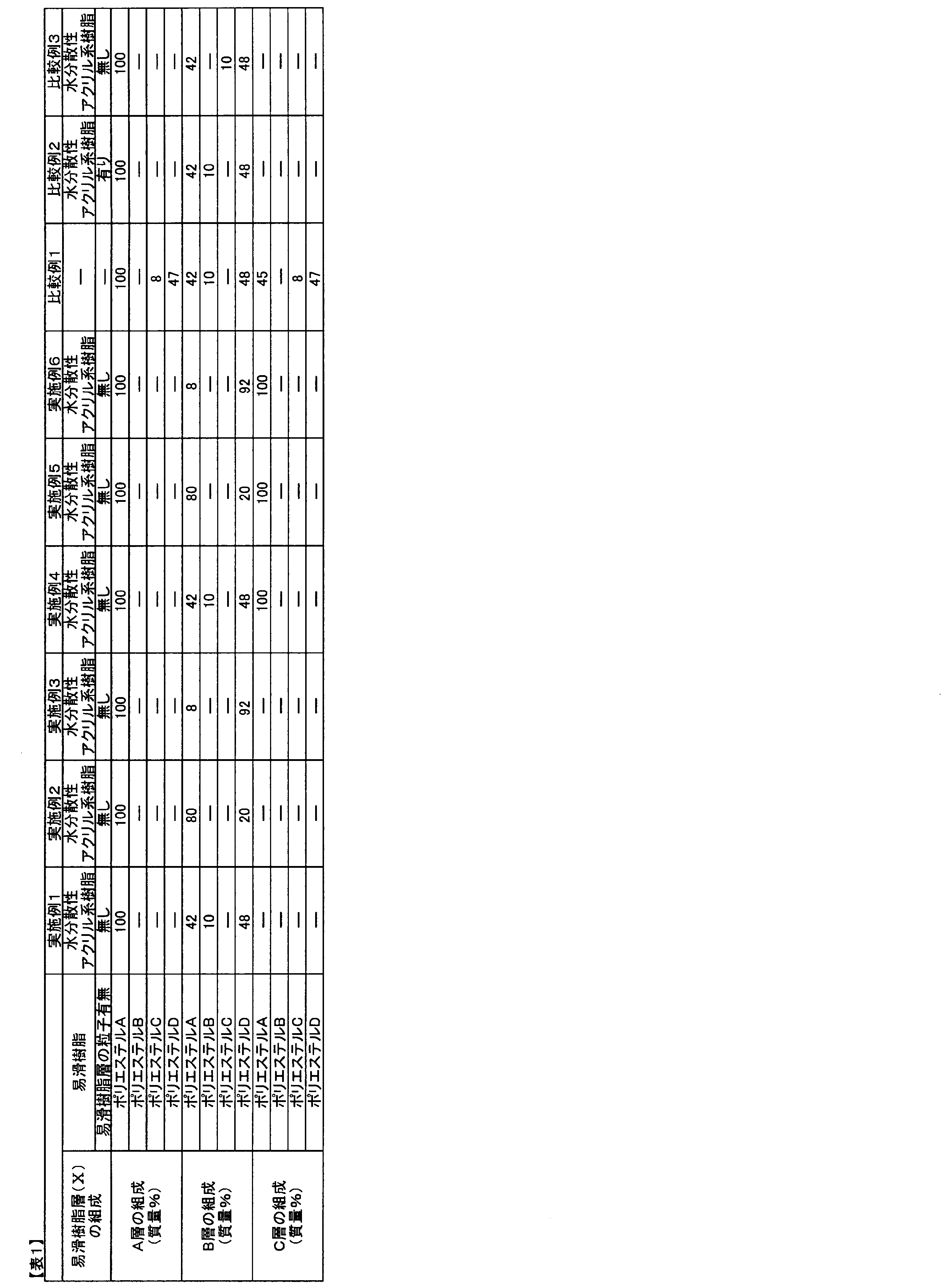
- Example 1 The mixture of raw materials prepared according to the composition shown in Table 1 for each layer was stirred in a blender, and the raw materials for layer B were fed to a vented twin-screw extruder for layer B, and the raw materials for layer A were dried under reduced pressure at 120 to 140°C for 1 hour or more, and fed to a single-screw extruder for layer A.
- the layers were melt-extruded at 275°C, filtered through a high-precision filter that captures 95% or more of foreign matter of 5 ⁇ m or more for layer A and a high-precision filter that captures 95% or more of foreign matter of 2 ⁇ m or more for layer B, and then joined and laminated in a rectangular two-layer joining block to form a two-layer laminate consisting of layers A and B.
- the layers were passed through a slit die maintained at 285°C and wound around a casting drum with a surface temperature of 23°C using an electrostatic casting method on a cooling roll, and cooled and solidified to obtain an unstretched laminate film.
- This unstretched film was preheated with a heating roll at 68-99°C, and then stretched 4 times in the longitudinal direction at 113-115°C using a stretching roll with a surface roughness Ra of 0.2 ⁇ m. The film was then cooled by lowering the temperature by 88-90°C from the stretching temperature to cool the uniaxially stretched film. A 0.4% solids solution of a water-dispersible acrylic copolymer (midpoint glass transition temperature 80°C, emulsion particle size 90-120nm) was then applied to the surface of layer A of the uniaxially stretched film by the metalling bar coating method.
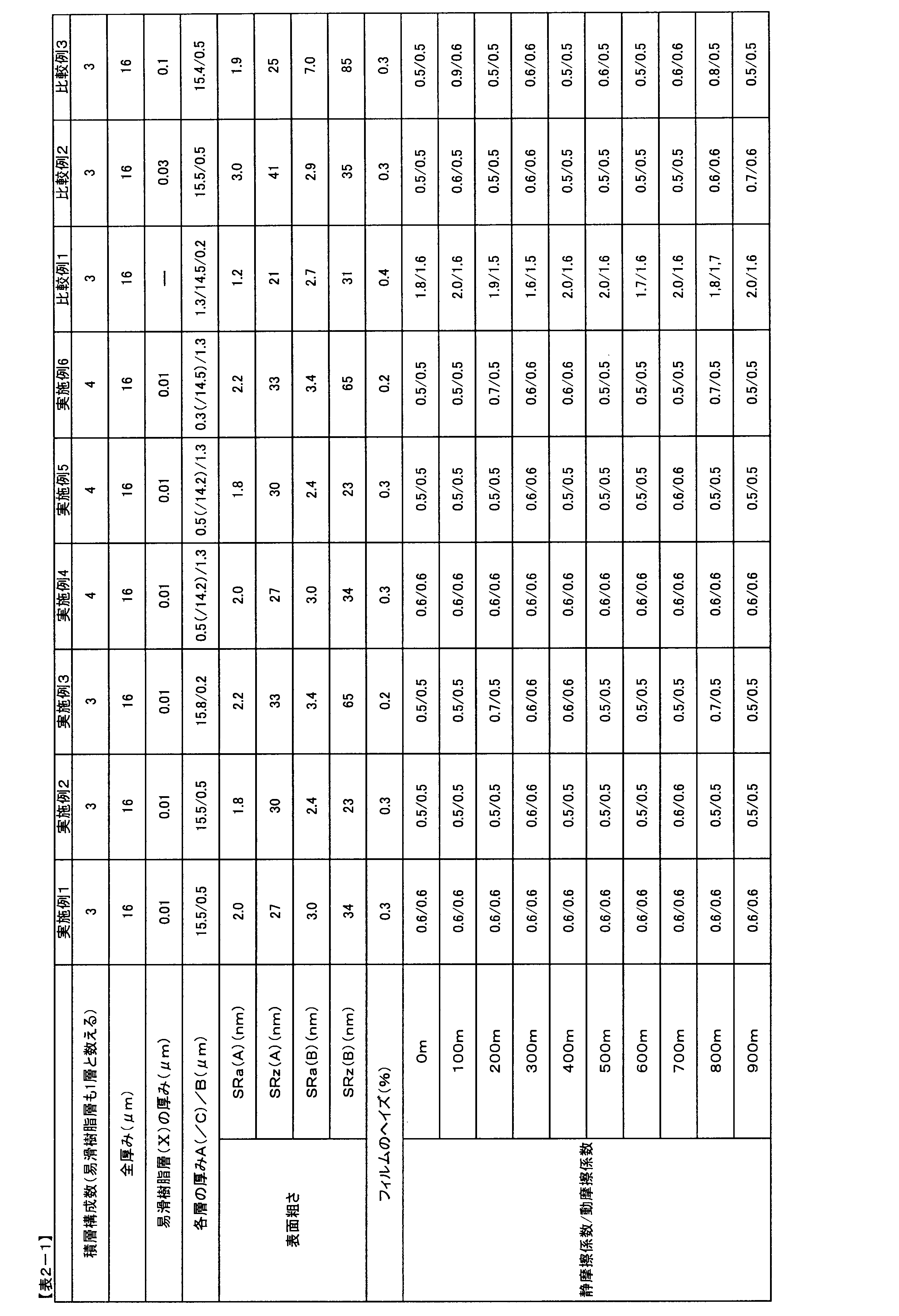
- the film was then stretched 4.3 times in the width direction under hot air at 103-112°C using a stenter, and then heat-treated at 222°C for 3 seconds under a constant tension. After that, a relaxation treatment of 0.1% in the longitudinal direction and 3.3% in the width direction was performed to obtain an intermediate product of a biaxially oriented laminated polyester film with a total thickness of 16 ⁇ m and a 10nm easy-slip resin layer laminated therein. This intermediate product was slit using a slitter to obtain a roll of biaxially oriented laminated polyester film with a thickness of 16 ⁇ m. The evaluation results of the obtained film are shown in Table 2. Thus, the biaxially oriented laminated polyester film of the present invention had excellent friction coefficient and resist resolution.
- Example 2 A biaxially oriented laminated polyester film was obtained in the same manner as in Example 1, except that the composition of Layer B was changed as shown in Table 1. The evaluation results of the obtained film are shown in Table 2. Thus, the biaxially oriented laminated polyester film of the present invention was excellent in slip property and resist resolution, similar to Example 1.
- Example 4 The mixture of raw materials prepared according to the composition shown in Table 1 for each layer was stirred in a blender, and the raw materials for layers A and B were fed to a vented twin-screw extruder for layers A and B, and the raw materials for layer C were dried under reduced pressure at 120 to 140°C for 1 hour or more, and fed to a single-screw extruder for layer C.
- the raw materials were then melt-extruded at 275°C, filtered through a high-precision filter that captures 95% or more of foreign matter of 5 ⁇ m or more for layers A and C, and a high-precision filter that captures 95% or more of foreign matter of 2 ⁇ m or more for layer B, and then joined and laminated in a rectangular three-layer joining block to form a three-layer laminate consisting of layers A, C, and B.
- the mixture was then passed through a slit die maintained at 285°C onto a cooling roll, wrapped around a casting drum with a surface temperature of 23°C using an electrostatic casting method, and cooled and solidified to obtain an unstretched laminate film.
- This unstretched film was preheated with a heating roll at 68-99°C, and then stretched 4 times in the longitudinal direction at 113-115°C using a stretching roll with a surface roughness Ra of 0.2 ⁇ m. The film was then cooled by lowering the temperature by 88-90°C from the stretching temperature to cool the uniaxially stretched film. A 0.4% solids solution of a water-dispersible acrylic copolymer (midpoint glass transition temperature 80°C, emulsion particle size 90-120nm) was then applied to the C layer surface of the uniaxially stretched film by a metalling bar coating method.
- the film was then stretched 4.3 times in the width direction under hot air at 103-112°C using a stenter, and then heat-treated at 222°C for 3 seconds under a constant tension. After that, a relaxation treatment of 0.1% in the longitudinal direction and 3.3% in the width direction was performed to obtain an intermediate product of a biaxially oriented laminated polyester film with a total thickness of 16 ⁇ m and a 10nm easy-slip resin layer laminated therein. This intermediate product was slit using a slitter to obtain a roll of biaxially oriented laminated polyester film with a thickness of 16 ⁇ m. The evaluation results of the obtained film are shown in Table 2. Thus, the biaxially oriented laminated polyester film of the present invention had excellent friction coefficient and resist resolution.
- Example 5 A biaxially oriented laminated polyester film was obtained in the same manner as in Example 4, except that the composition of Layer B was changed as shown in Table 1. The evaluation results of the obtained film are shown in Table 2. Thus, the biaxially oriented laminated polyester film of the present invention was excellent in slip property and resist resolution, similar to Example 4.
- the raw materials were then melt-extruded at 275°C, filtered through a high-precision filter that captures 95% or more of foreign matter of 5 ⁇ m or more for layers A and C, and a high-precision filter that captures 95% or more of foreign matter of 2 ⁇ m or more for layer B, and then joined and laminated in a rectangular three-layer joining block to form a three-layer laminate consisting of layers A, B, and C, with layers C and B on the surface.
- the laminate was then passed through a slit die kept at 285°C, wrapped around a casting drum with a surface temperature of 23°C using an electrostatic casting method on a cooling roll, and cooled and solidified to obtain an unstretched laminate film.
- the unstretched film was preheated with a heating roll at 68-99°C, and then stretched 4 times in the longitudinal direction at 113-115°C using a stretching roll with a surface roughness Ra of 0.2 ⁇ m.
- the film was then cooled by lowering the temperature by 88-90°C from the stretching temperature to allow the uniaxially stretched film to cool.
- the film was then stretched 4.3 times in the width direction using a stenter under hot air at 103-112°C, and then heat-treated at 222°C for 3 seconds under a constant tension. After that, the film was relaxed by 0.1% in the longitudinal direction and 3.3% in the width direction to obtain an intermediate product of biaxially oriented laminated polyester film with a total thickness of 16 ⁇ m.
- the intermediate product was slit with a slitter to obtain a roll of biaxially oriented laminated polyester film with a thickness of 16 ⁇ m.
- the evaluation results of the obtained film are shown in Table 2.
- Example 2 A biaxially oriented laminated polyester film was obtained in the same manner as in Example 1, except that the solution of the lubricating resin layer components was changed to a 0.5% solution containing a water-dispersible acrylic copolymer (midpoint glass transition temperature 80° C., emulsion particle size 90 to 120 nm) and colloidal silica particles with a volume average particle size of 30 nm in a solid content ratio of 9:1, and the average thickness of the lubricating resin layer was changed to 30 nm.
- the evaluation results of the obtained film are shown in Table 2.
- Example 3 A biaxially oriented laminated polyester film was obtained in the same manner as in Example 1, except that the composition of layer B was changed as shown in Table 1 and the average thickness of the easy-slip resin layer was changed to 100 nm. The evaluation results of the obtained film are shown in Table 2.
- the biaxially oriented laminated polyester film of the present invention has excellent resist coating properties and slip properties, and can be used as a dry film resist support that can produce high-resolution resist patterns with good reproducibility and high yield.
Landscapes
- Chemical & Material Sciences (AREA)
- Engineering & Computer Science (AREA)
- Chemical Kinetics & Catalysis (AREA)
- Medicinal Chemistry (AREA)
- Polymers & Plastics (AREA)
- Organic Chemistry (AREA)
- Health & Medical Sciences (AREA)
- Architecture (AREA)
- Structural Engineering (AREA)
- Physics & Mathematics (AREA)
- General Physics & Mathematics (AREA)
- Laminated Bodies (AREA)
- Materials For Photolithography (AREA)
Abstract
Description
1)ドライフィルムレジストから保護フィルムを剥離し、露出したレジスト層の表面と、基板上の銅箔などの導電性基材層の表面とが密着するように、基板・導電性基材層とラミネートする工程。
2)次に、導体回路パターンを焼き付けたフォトマスクを、ポリエステルフィルムからなる支持体上に置き、その上から、感光性樹脂を主体としたレジスト層に紫外線を照射して、露光させる工程。
3)その後、フォトマスクおよびポリエステルフィルムを剥離した後、溶剤によってレジスト層中の未反応分を溶解、除去する工程。
4)次いで、酸などでエッチングを行い、導電性基材層中の露出した部分を溶解、除去する工程。
5)の工程の後には、レジスト層中の光反応部分とこの光反応部分に対応する導電性基材層部分がそのまま残り、その後、残ったレジスト層を除去する工程を経て、基板上の導体回路が形成されることになる。
[I]下記(1)~(4)を満たすことを特徴とする、ドライフィルムレジスト支持体用途に用いる二軸配向積層ポリエステルフィルム。
(1)易滑樹脂層(X)と、フィルム表面(A)を有するA層及びフィルム表面(B)を有するB層とを有する少なくとも2層以上で構成される基材層、とを有する積層ポリエステルフィルムであること。
(2)フィルム表面(A)側に粒子を含有しない易滑樹脂層(X)を積層すること。
(3)フィルム表面(A)とは反対側のフィルム表面(B)の算術平均粗さSRa(B)が7nm未満であること。
(4)長手方向に100m毎に10箇所測定した易滑樹脂層(X)・フィルム表面(B)間の静摩擦係数の値がすべて0.4以上0.8以下であり、動摩擦係数の値がすべて0.3以上0.7以下であること。
[II]易滑樹脂層(X)の十点平均表面粗さSRz(X)とフィルム表面(B)の十点平均表面粗さSRz(B)がともに10nm以上70nm以下である[I]に記載の二軸配向積層ポリエステルフィルム。
[III]フィルム表面(A)に積層する易滑樹脂(X)の中間点ガラス転移温度が40℃以上である[I]または[II]に記載の二軸配向積層ポリエステルフィルム。
[IV]体積平均粒径0.150μm以上の粒子を含まない[I]に記載の二軸配向積層ポリエステルフィルム。
[V]前記A層において、長手方向0.88cm×幅方向1.16cmの領域をレーザー顕微鏡により10回観察したときに存在する長径15.0μm以上の粗大物の数が5個以下であり、長径10.0μm以上15.0μm未満の粗大物の数が30個以下であり、長径1.0μm以上10.0μm未満の粗大物の数が1500個以下である[I]に記載の二軸配向積層ポリエステルフィルム。
[VI]前記A層とB層の中間に設けたフィルム表面を有さないC層において、長手方向0.88cm×幅方向1.16cmの領域をレーザー顕微鏡により10回観察したときに存在する長径15.0μm以上の粗大物の数が5個以下であり、長径10.0μm以上15.0μm未満の粗大物の数が30個以下であり、長径1.0μm以上10.0μm未満の粗大物の数が1500個以下である[I]に記載の二軸配向積層ポリエステルフィルム。
[VII]フィルム表面(A)に積層する易滑樹脂の表面比抵抗値が1.0×10¹²Ω以下である[I]に記載の二軸配向積層ポリエステルフィルム。
メタクリルアミド、N-メチロールアクリルアミド、N-ブトシキアクリルアミド、2-ヒドロキシエチルメタクリレート、2-ヒドロキシエチルアクリレートなどのモノマーの
共重合体などが挙げられる。
本発明の二軸配向積層ポリエステルフィルムが、易滑樹脂層(X)と、フィルム表面(A)を有するA層及びフィルム表面(B)を有するB層及びフィルム表面を有さないC層とを有する少なくとも3層以上で構成される基材層、とを有する場合、C層において、長手方向0.88cm×幅方向1.16cmの領域をレーザー顕微鏡により100回観察したときに存在する長径15.0μm以上の粗大物の数が5個以下であり、長径10.0μm以上15.0μm未満の粗大物の数が30個以下であり、長径1.0μm以上10.0μm未満の粗大物の数が1500個以下であることが好ましい。前記A層に該粗大物が存在する場合、露光工程で照射された紫外線が散乱し、レジストパターンの抜けが生じることがある。
(測定方法)
(1)積層フィルムおよび各層の厚みの測定
積層フィルムの全厚みは、マイクロメーターにてランダムに10点測定し、その平均値とした。また、積層フィルムの断面を超薄切片に切り出し、RuO4染色、OsO4染色、あるいは両者の二重染色による染色超薄切片法により、TEM(透過型電子顕微鏡)で1万~100万倍で観察し、写真撮影を行った。その断面写真から易滑樹脂層(X)、ポリエステルフィルムのA層、B層の厚みをそれぞれ測定した。
三次元微細表面形状測定器(小坂製作所製ET-350K)を用いて易滑樹脂層(X)表面および表面(B)について測定し、得られた表面のプロファイル曲線より、JIS・B0601に準じ、算術平均表面粗さSRa値、十点平均表面粗さSRz値を求めた。測定条件は下記のとおり。測定は3回行い平均値をそれぞれSRa値、SRz値とした。
X方向測定長さ:0.5mm、X方向送り速度:0.1mm/秒。
Y方向送りピッチ:5μm、Y方向ライン数:40本。
カットオフ:0.25mm。
触針圧:0.02mN。
高さ(Z方向)拡大倍率:5万倍。
JIS K7105-1981に準じ、フィルム幅方向の中央部から、長手4.0×幅3.5cmの寸法に切り出したものをサンプルとし、ヘイズを、ヘイズメータ(スガ試験機製HGM-2DP(C光源用))を用いて測定した。測定は3回行い平均値をヘイズ値とした。
JIS K7125-1987に準じ、二軸配向積層ポリエステルフィルムから切り出したサンプルを2枚準備し、各サンプルの表面を除電後、一方のサンプルの易滑樹脂層(X)ともう一方のサンプルの表面(B)を重ね合わせ、フィルム端部を固定し、荷重200g(法線力1.96N)をかけて150mm/分で10mm移動させたときの張力から静止摩擦係数と動摩擦係数を算出した。この測定を、二軸配向積層ポリエステルフィルムの長手方向100m毎に10箇所測定した。
「JIS K7121:2012プラスチックの転移温度測定方法」の規定に準じた示差走査熱量測定(DSC)において、TAインスツルメント社製:DSC Q100を用いて、昇温、冷却した後の2回目の昇温時の低温側のベースラインを高温側に延長した直線と、ガラス転移の階段状変化部分の曲線のこう配が最大になるような点で引いた接線との交点を中間点ガラス転移温度とした。
二軸配向積層ポリエステルフィルムを10cm×10cmに切り出し、レーザー顕微鏡(キーエンス製VK-X250)にてA層中で画像を取り込み、取り込んだ画像を2値化処理し、粒子解析モジュール(キーエンス製VKH1XG)を用いて、フィルム表面から一定の深さ範囲内に存在する粗大物の数を計測した。50倍の対物レンズを用いて、長手方向220μm×幅方向290μmの画像をA層中で長手方向0.88cm×幅方向1.16cm分取り込み、上記の計測作業を10回繰り返すことで、長径1.0μm以上の粗大物の数を求めた。なお、本発明でいう粗大物の長径とは、前記測定方法により検出される粗大物が最も長く測定される長さを指す。
フィルム表面に含有される粒子の粒子径については次のように測定する。フィルムからポリマーをプラズマ低温灰化処理法で除去し、粒子を露出させる。処理条件は、ポリマーは灰化されるが粒子は極力ダメージを受けない条件を選択する。処理後の試料を走査型電子顕微鏡(SEM;株式会社日立製作所製 S-4000型)で観察し、粒子画像をイメージアナライザ(株式会社ニレコ製 LUZEX_AP)に取り込み、等価円相当径を測定し、粒子の体積平均粒子径を求める。SEMの倍率は粒子径により、5000~20000倍から適宜選択する。任意に観察箇所をかえて、少なくとも粒子数5000個の粒子の体積平均粒子径測定し、その平均値を粒子の体積平均粒径とした。また、この結果から0nmを初点として10nm間隔毎の階級で表した粒子径を横軸に、該粒子径を有する粒子の個数を縦軸にプロットし、粒度分布のグラフを作成し、極大値を有する粒子径を求めた。
積層フィルム表面に、幅10mm、測定長約100mmとなるように2本のラインを引き、この2本のライン間の距離を23℃で測定し、これをL0とする。この積層フィルムサンプルを150℃(風量ゲージ「7」)に設定したエスペック(株)製熱風オーブン「HIGH-TEMP-OVEN PHH-200」中に30分間、3gの荷重下で放置した後、再び2本のライン間の距離を23℃で測定し、これをL1とし、下式により熱収縮率を求めた。測定は、長手方向および幅方向に5サンプルずつ実施し、平均値で評価を行った。
熱収縮率(%)=(L0-L1)/L0×100
なお、フィルムを分析する際に、フィルムの長手方向や幅方向が分からない場合は、フィルムにおいて最大の屈折率を有する方向を幅方向、それに直行する方向を長手方向とみなす。フィルムにおける最大の屈折率の方向は、フィルムの全ての方向の屈折率をアッベ屈折率計で測定して求めてもよく、例えば、位相差測定装置(複屈折測定装置)などにより遅相軸方向を決定することで求めてもよい。
幅10mm長さ200mmのフィルムをハードクロムメッキした直径2mmのピンに、易滑樹脂層側を巻き付け角30°で巻き付け、荷重50gで3往復フィルムとピンを擦り合わせた。テストは5回行い、フィルムの外観により以下のように判定した。
S:フィルムにほとんどキズが付かない
A:フィルムにわずかにキズがついている
B:フィルムにキズがあり、ピンに削れおよび脱落物が見られる 。
本発明の二軸配向積層ポリエステルフィルムにおけるレジストの解像度の目視評価方法は、以下のような手順で行った。
S:L/S=5/5μmが明確に確認できる。
A:L/S=5/5μmは明確に確認できないが、L/S=8/8μmは明確に確認できる。
B:L/S=8/8μmは明確に確認できないが、L/S=10/10μmは明確に確認できる。
C:L/S=10/10μmが明確に確認できない。(生産適用不可)。
本発明の二軸配向積層ポリエステルフィルムを支持体として、B層側表面にネガ型感光性樹脂からなるレジスト層をコーティングにより形成し、レジストフィルムを作製した。レジストフィルム製造時のハンドリング性としてすべり性の評価は、以下の基準に従った。なお、A以上の評価が実用可能レベルとなる。
S:適正なすべり性を有し、ハンドリング性が良好。
A:すべり性が悪く、ハンドリング性に劣る。
B:適正なすべり性がないため、ハンドリング困難(生産適用不可)。
トレック・ジャパン株式会社製表面抵抗測定器(Model152-1)に付属のステンレスプレートの上に絶縁製のプラスチックプレートを置く。本発明の二軸配向積層ポリエステルフィルムのフィルム表面(B)と絶縁製プレートが接触するようサンプルを設置する。測定面である易滑樹脂層(X)とプローブの電極を接触させ、100Vの電圧をかけて、1分後の値を記録する。
本発明の二軸配向積層ポリエステルフィルムをドライフィルムレジストの支持体として用いた際の、導体回路の歩留まりに寄与する配線欠損評価方法は、以下のような手順で行った。
(i)片面鏡面研磨した6インチSiウエハー上に、東京応化(株)製のネガレジスト“PMER N-HC600”を塗布し、大型スピナーで回転させることによって厚み7μmのレジスト層を作製した。次いで、窒素循環の通風オーブンを用いて70℃の温度条件で、約20分間の前熱処理を行った。
作成した導体回路の状態について光学顕微鏡(NICON製 LV-100)を用いて8.25mm2の領域を500倍率で観察し、以下の基準に従って導体回路の配線欠損を評価した。なお、A以上の評価が実用可能レベルとなる。
S:配線欠損の最大長径サイズが2.4μm未満
A:配線欠損の最大長径サイズが3.2μm未満
B:配線欠損の最大長径サイズが4.0μm未満
(14)固有粘度(IV)
オルトクロロフェノール中、25℃で測定した溶液粘度より下記式から計算される値を用いた。すなわち
ηsp/C=[η]+K[η]2・C
ここで、ηsp=(溶液粘度/溶媒粘度)-1、Cは溶媒100mあたりの溶解ポリマー重量(g/100ml、通常は1.2)、Kはハギンス定数(0.343)とする。また、溶液粘度、溶媒粘度はオストワルド粘度計を用いて測定した。
なお、ポリエステルフィルムの最外層のポリエステル層を構成するポリエステル樹脂の固有粘度(IV)を測定する場合には、ポリエステルフィルムの最外層のポリエステル層を構成するポリエステル樹脂を削り出して測定する。
また、ポリエステルフィルムの最外層を除いたポリエステル層を構成するポリエステル樹脂の固有粘度を測定する場合は、(1)の方法でポリエステルフィルムの各層の層厚みの比率を求めた後、ポリエステルフィルム全体の固有粘度を上記と同様にして測定し、重量比例配分で最外層を除いたポリエステル層を構成するポリエステル樹脂の固有粘度を求める。
また、測定試料を溶解させた溶液に無機粒子などの不溶物がある場合は、溶液を濾過して重量測定を行い、濾物の重量を測定試料重量から差し引いた値を測定試料重量とする補正を行う。
(ポリエステルAの作成)
テレフタル酸86.5重量部とエチレングリコール37.1重量部を255℃で、水を留出しながらエステル化反応を行う。エステル化反応終了後、トリメチルリン酸0.02重量部、酢酸マグネシウム0.06重量部、酢酸リチウム0.01重量部、三酸化アンチモン0.0085重量部を添加し、引き続いて、真空下、290℃まで加熱、昇温して重縮合反応を行い、固有粘度0.63dl/gのポリエステルペレットを得た。(ポリエステルA)。
上記ポリエステルAの作成と同様にポリエステルを製造するにあたり、エステル交換後、体積平均粒子径0.06μm、体積形状係数f=0.51、モース硬度7の球状シリカをそれぞれ添加し、重縮合反応を行い、粒子をポリエステルに対し1.0重量%含有するシリカ含有マスターペレットを得た(ポリエステルB)。なお、用いる球状シリカは、エタノールとエチルシリケートとの混合溶液を攪拌しながら、この混合溶液に、エタノール、純水、および塩基性触媒としてアンモニア水からなる混合溶液を添加し、得られた反応液を攪拌して、エチルシリケートの加水分解反応およびこの加水分解生成物の重縮合反応を行なった後に、反応後の攪拌を行い、単分散シリカ粒子を得た。
上記ポリエステルAの作成と同様にポリエステルを製造するにあたり、エステル交換後、体積平均粒子径0.2μm、体積形状係数f=0.51、モース硬度7の球状シリカをそれぞれ添加し、重縮合反応を行い、粒子をポリエステルに対し2重量%含有するシリカ含有マスターペレットを得た(ポリエステルC)。なお、用いる球状シリカは、エタノールとエチルシリケートとの混合溶液を攪拌しながら、この混合溶液に、エタノール、純水、および塩基性触媒としてアンモニア水からなる混合溶液を添加し、得られた反応液を攪拌して、エチルシリケートの加水分解反応およびこの加水分解生成物の重縮合反応を行なった後に、反応後の攪拌を行い、単分散シリカ粒子を得た。
凝集アルミナとしてδ型-アルミナを10%のエチレングリコールスラリーとし、サンドグラインダーを用い、粉砕、分散処理を行い、さらに捕集効率95%の3μmフィルターを用いて濾過して調整し、これを前記ポリエステルAの作成と同様に調整したエステル交換反応物に添加し、引き続き三酸化アンチモンを加え、重縮合反応を行い、凝集アルミナを1.5重量%含有する、固有粘度0.62dl/gのマスターペレットを得た。(ポリエステルD)。
各層について表1に示した配合で調合した原料の混合物を、ブレンダー内で攪拌した後、B層の原料は攪拌後の原料を、B層用のベント付き二軸押出機に供給し、A層の原料は120~140℃で1時間以上減圧乾燥し、A層用の一軸押出機に供給した。続いて、275℃で溶融押出し、A層は5μm以上の異物を95%以上捕集する高精度なフィルター、B層は2μm以上の異物を95%以上捕集する高精度なフィルターにて濾過した後、矩形の2層用合流ブロックで合流積層し、A層とB層からなる2層積層とした。その後、285℃に保ったスリットダイを介し冷却ロール上に静電印可キャスト法を用いて表面温度23℃のキャスティングドラムに巻き付け冷却固化して未延伸積層フィルムを得た。
B層の組成を表1に記載のように変更する以外は実施例1と同様にして二軸配向積層ポリエステルフィルムを得た。得られたフィルムの評価結果を表2に示す。このように本発明の二軸配向積層ポリエステルフィルムは実施例1同様に、滑り性、レジスト解像度に優れるものであった。
(実施例4)
各層について表1に示した配合で調合した原料の混合物を、ブレンダー内で攪拌した後、A層、B層の原料は攪拌後の原料を、A層用、B層用のベント付き二軸押出機に供給し、C層の原料は120~140℃で1時間以上減圧乾燥し、C層用の一軸押出機に供給した。続いて、275℃で溶融押出し、A層、C層は5μm以上の異物を95%以上捕集する高精度なフィルター、B層は2μm以上の異物を95%以上捕集する高精度なフィルターにて濾過した後、矩形の3層用合流ブロックで合流積層し、A層、C層とB層からなる3層積層とした。その後、285℃に保ったスリットダイを介し冷却ロール上に静電印可キャスト法を用いて表面温度23℃のキャスティングドラムに巻き付け冷却固化して未延伸積層フィルムを得た。
B層の組成を表1に記載のように変更する以外は実施例4と同様にして二軸配向積層ポリエステルフィルムを得た。得られたフィルムの評価結果を表2に示す。このように本発明の二軸配向積層ポリエステルフィルムは実施例4同様に、滑り性、レジスト解像度に優れるものであった。
各層について表1に示した配合で調合した原料の混合物を、ブレンダー内で攪拌した後、B層、C層の原料は攪拌後の原料を、B層用、C層用のベント付き二軸押出機に供給し、A層の原料は120~140℃で1時間以上減圧乾燥し、A層用の一軸押出機に供給した。続いて、275℃で溶融押出し、A層、C層は5μm以上の異物を95%以上捕集する高精度なフィルター、B層は2μm以上の異物を95%以上捕集する高精度なフィルターにて濾過した後、矩形の3層用合流ブロックで合流積層し、A層、B層とC層からなる、C層とB層が表面を有する3層積層とした。その後、285℃に保ったスリットダイを介し冷却ロール上に静電印可キャスト法を用いて表面温度23℃のキャスティングドラムに巻き付け冷却固化して未延伸積層フィルムを得た。
易滑樹脂層成分の溶液を水分散性アクリル共重合体(中間点ガラス転移温度80℃、エマルジョン粒径90~120nm)、体積平均粒子径が30nmのコロイダルシリカ粒子を固形分濃度9:1で含有する濃度0.5%溶液に、易滑樹脂層の平均厚さを30nmに変更した以外は実施例1と同様にして二軸配向積層ポリエステルフィルムを得た。得られたフィルムの評価結果を表2に示す。
B層の組成を表1に記載のように変更して、易滑樹脂層の平均厚さを100nmに変更した以外は実施例1と同様にして二軸配向積層ポリエステルフィルムを得た。得られたフィルムの評価結果を表2に示す。

Claims (7)
- 下記(1)~(4)を満たすことを特徴とする、ドライフィルムレジスト支持体用途に用いる二軸配向積層ポリエステルフィルム。
・ 易滑樹脂層(X)と、フィルム表面(A)を有するA層及びフィルム表面(B)を有するB層とを有する少なくとも2層以上で構成される基材層、とを有する積層ポリエステルフィルムであること。
(2)フィルム表面(A)側に粒子を含有しない易滑樹脂層(X)を積層すること。
(3)フィルム表面(A)とは反対側のフィルム表面(B)の算術平均粗さSRa(B)が7nm未満であること。
(4)長手方向に100m毎に10箇所測定した易滑樹脂層(X)・フィルム表面(B)間の静摩擦係数の値がすべて0.4以上0.8以下であり、動摩擦係数の値がすべて0.3以上0.7以下であること。 - 易滑樹脂層(X)の十点平均表面粗さSRz(X)とフィルム表面(B)の十点平均表面粗さSRz(B)がともに10nm以上70nm以下である請求項1に記載の二軸配向積層ポリエステルフィルム。
- フィルム表面(A)に積層する易滑樹脂の中間点ガラス転移温度が40℃以上である請求項1または請求項2に記載の二軸配向積層ポリエステルフィルム。
- 体積平均粒径0.150μm以上の粒子を含まない請求項1に記載の二軸配向積層ポリエステルフィルム。
- 前記A層において、長手方向0.88cm×幅方向1.16cmの領域をレーザー顕微鏡により10回観察したときに存在する長径15.0μm以上の粗大物の数が5個以下であり、長径10.0μm以上15.0μm未満の粗大物の数が30個以下であり、長径1.0μm以上10.0μm未満の粗大物の数が1500個以下である請求項1に記載の二軸配向積層ポリエステルフィルム。
- 前記A層とB層の中間に設けたフィルム表面を有さないC層において、長手方向0.88cm×幅方向1.16cmの領域をレーザー顕微鏡により10回観察したときに存在する長径15.0μm以上の粗大物の数が5個以下であり、長径10.0μm以上15.0μm未満の粗大物の数が30個以下であり、長径1.0μm以上10.0μm未満の粗大物の数が1500個以下である請求項1に記載の二軸配向積層ポリエステルフィルム。
- フィルム表面(A)に積層する易滑樹脂の表面比抵抗値が1.0×10¹²Ω以下である請求項1に記載の二軸配向積層ポリエステルフィルム。
Priority Applications (2)
| Application Number | Priority Date | Filing Date | Title |
|---|---|---|---|
| JP2024504788A JPWO2024162016A1 (ja) | 2023-02-01 | 2024-01-18 | |
| CN202480009946.6A CN120659714A (zh) | 2023-02-01 | 2024-01-18 | 双轴取向叠层聚酯膜 |
Applications Claiming Priority (4)
| Application Number | Priority Date | Filing Date | Title |
|---|---|---|---|
| JP2023013849 | 2023-02-01 | ||
| JP2023-013849 | 2023-02-01 | ||
| JP2023022399 | 2023-02-16 | ||
| JP2023-022399 | 2023-02-16 |
Publications (1)
| Publication Number | Publication Date |
|---|---|
| WO2024162016A1 true WO2024162016A1 (ja) | 2024-08-08 |
Family
ID=92146487
Family Applications (1)
| Application Number | Title | Priority Date | Filing Date |
|---|---|---|---|
| PCT/JP2024/001201 Ceased WO2024162016A1 (ja) | 2023-02-01 | 2024-01-18 | 二軸配向積層ポリエステルフィルム |
Country Status (4)
| Country | Link |
|---|---|
| JP (1) | JPWO2024162016A1 (ja) |
| CN (1) | CN120659714A (ja) |
| TW (1) | TW202438310A (ja) |
| WO (1) | WO2024162016A1 (ja) |
Cited By (1)
| Publication number | Priority date | Publication date | Assignee | Title |
|---|---|---|---|---|
| WO2026054058A1 (ja) * | 2024-09-06 | 2026-03-12 | 旭化成株式会社 | 感光性エレメント |
Citations (9)
| Publication number | Priority date | Publication date | Assignee | Title |
|---|---|---|---|---|
| JP2003340953A (ja) * | 2002-05-27 | 2003-12-02 | Toray Ind Inc | ドライフィルムレジスト用支持体フィルムおよびそれを用いたドライフィルムレジスト |
| JP2008239743A (ja) * | 2007-03-27 | 2008-10-09 | Toray Ind Inc | ドライフィルムレジスト支持体用ポリエステルフィルム |
| JP2018063341A (ja) * | 2016-10-12 | 2018-04-19 | 三菱ケミカル株式会社 | ドライフィルムレジスト用ポリエステルフィルム |
| JP2018123318A (ja) * | 2017-01-31 | 2018-08-09 | 東レ株式会社 | 転写材用二軸配向ポリエステルフィルムロール |
| WO2019203175A1 (ja) * | 2018-04-18 | 2019-10-24 | 三菱ケミカル株式会社 | ドライフィルムレジスト用ポリエステルフィルム |
| JP2019188612A (ja) * | 2018-04-18 | 2019-10-31 | 三菱ケミカル株式会社 | ドライフィルムレジスト用ポリエステルフィルム |
| JP2021001284A (ja) * | 2019-06-24 | 2021-01-07 | 東レ株式会社 | 二軸配向ポリエステルフィルムおよびその製造方法 |
| JP2021055078A (ja) * | 2019-09-27 | 2021-04-08 | 東レ株式会社 | ポリエステルフィルム |
| JP2022064295A (ja) * | 2020-10-13 | 2022-04-25 | 東レ株式会社 | 二軸配向ポリエステルフィルムおよびその製造方法 |
-
2024
- 2024-01-18 JP JP2024504788A patent/JPWO2024162016A1/ja active Pending
- 2024-01-18 WO PCT/JP2024/001201 patent/WO2024162016A1/ja not_active Ceased
- 2024-01-18 CN CN202480009946.6A patent/CN120659714A/zh active Pending
- 2024-01-30 TW TW113103476A patent/TW202438310A/zh unknown
Patent Citations (9)
| Publication number | Priority date | Publication date | Assignee | Title |
|---|---|---|---|---|
| JP2003340953A (ja) * | 2002-05-27 | 2003-12-02 | Toray Ind Inc | ドライフィルムレジスト用支持体フィルムおよびそれを用いたドライフィルムレジスト |
| JP2008239743A (ja) * | 2007-03-27 | 2008-10-09 | Toray Ind Inc | ドライフィルムレジスト支持体用ポリエステルフィルム |
| JP2018063341A (ja) * | 2016-10-12 | 2018-04-19 | 三菱ケミカル株式会社 | ドライフィルムレジスト用ポリエステルフィルム |
| JP2018123318A (ja) * | 2017-01-31 | 2018-08-09 | 東レ株式会社 | 転写材用二軸配向ポリエステルフィルムロール |
| WO2019203175A1 (ja) * | 2018-04-18 | 2019-10-24 | 三菱ケミカル株式会社 | ドライフィルムレジスト用ポリエステルフィルム |
| JP2019188612A (ja) * | 2018-04-18 | 2019-10-31 | 三菱ケミカル株式会社 | ドライフィルムレジスト用ポリエステルフィルム |
| JP2021001284A (ja) * | 2019-06-24 | 2021-01-07 | 東レ株式会社 | 二軸配向ポリエステルフィルムおよびその製造方法 |
| JP2021055078A (ja) * | 2019-09-27 | 2021-04-08 | 東レ株式会社 | ポリエステルフィルム |
| JP2022064295A (ja) * | 2020-10-13 | 2022-04-25 | 東レ株式会社 | 二軸配向ポリエステルフィルムおよびその製造方法 |
Cited By (1)
| Publication number | Priority date | Publication date | Assignee | Title |
|---|---|---|---|---|
| WO2026054058A1 (ja) * | 2024-09-06 | 2026-03-12 | 旭化成株式会社 | 感光性エレメント |
Also Published As
| Publication number | Publication date |
|---|---|
| JPWO2024162016A1 (ja) | 2024-08-08 |
| TW202438310A (zh) | 2024-10-01 |
| CN120659714A (zh) | 2025-09-16 |
Similar Documents
| Publication | Publication Date | Title |
|---|---|---|
| JP6432283B2 (ja) | ドライフィルムレジスト支持体用二軸配向ポリエステルフィルム | |
| JP2008239743A (ja) | ドライフィルムレジスト支持体用ポリエステルフィルム | |
| JP7172045B2 (ja) | 転写材用二軸配向ポリエステルフィルムロール | |
| JP7463905B2 (ja) | ドライフィルムレジスト用二軸配向ポリエステルフィルム | |
| JP7000677B2 (ja) | ポリエステルフィルム | |
| JP2018065250A (ja) | ドライフィルムレジスト支持体用二軸配向ポリエステルフィルムおよびその製造方法 | |
| JP7753748B2 (ja) | 二軸配向ポリエステルフィルムおよびその製造方法 | |
| JP5527381B2 (ja) | 離型用ポリエステルフィルム | |
| JP2021001284A (ja) | 二軸配向ポリエステルフィルムおよびその製造方法 | |
| JP2001322218A (ja) | 共押出積層ポリエステルフィルム | |
| CN120659714A (zh) | 双轴取向叠层聚酯膜 | |
| JP2004174788A (ja) | 二軸配向積層ポリエステルフィルム | |
| JP2007210226A (ja) | 離型用ポリエステルフィルム | |
| JP2019152828A (ja) | ドライフィルムレジスト支持体用二軸配向ポリエステルフィルム | |
| JP2024047656A (ja) | 二軸配向ポリエステルフィルムおよびその製造方法 | |
| JP2002326330A (ja) | 積層ポリエステルフィルム | |
| JP2007211073A (ja) | 離型用ポリエステルフィルム | |
| JP4285089B2 (ja) | フォトレジスト用ポリエステルフィルム | |
| WO2019123979A1 (ja) | 二軸配向積層フィルム | |
| JP2023046291A (ja) | 二軸配向ポリエステルフィルムおよびその製造方法 | |
| JP2018100391A (ja) | 二軸配向ポリエステルフィルムおよびその製造方法 | |
| JP2004106322A (ja) | ドライフィルムフォトレジスト用積層ポリエステルフィルム | |
| JP2023102266A (ja) | ドライフィルムレジスト用ポリエステルフィルム | |
| JP2022079091A (ja) | ポリエステルフィルム | |
| JP2008239844A (ja) | 離型用ポリエステルフィルム |
Legal Events
| Date | Code | Title | Description |
|---|---|---|---|
| WWE | Wipo information: entry into national phase |
Ref document number: 2024504788 Country of ref document: JP |
|
| 121 | Ep: the epo has been informed by wipo that ep was designated in this application |
Ref document number: 24749970 Country of ref document: EP Kind code of ref document: A1 |
|
| WWE | Wipo information: entry into national phase |
Ref document number: 202480009946.6 Country of ref document: CN |
|
| NENP | Non-entry into the national phase |
Ref country code: DE |
|
| WWP | Wipo information: published in national office |
Ref document number: 202480009946.6 Country of ref document: CN |
|
| 122 | Ep: pct application non-entry in european phase |
Ref document number: 24749970 Country of ref document: EP Kind code of ref document: A1 |