WO2024161902A1 - ハンドルスイッチ - Google Patents
ハンドルスイッチ Download PDFInfo
- Publication number
- WO2024161902A1 WO2024161902A1 PCT/JP2023/047345 JP2023047345W WO2024161902A1 WO 2024161902 A1 WO2024161902 A1 WO 2024161902A1 JP 2023047345 W JP2023047345 W JP 2023047345W WO 2024161902 A1 WO2024161902 A1 WO 2024161902A1
- Authority
- WO
- WIPO (PCT)
- Prior art keywords
- switch
- handle
- case
- handlebar
- convex surface
- Prior art date
- Legal status (The legal status is an assumption and is not a legal conclusion. Google has not performed a legal analysis and makes no representation as to the accuracy of the status listed.)
- Ceased
Links
Images




Classifications
-
- B—PERFORMING OPERATIONS; TRANSPORTING
- B62—LAND VEHICLES FOR TRAVELLING OTHERWISE THAN ON RAILS
- B62K—CYCLES; CYCLE FRAMES; CYCLE STEERING DEVICES; RIDER-OPERATED TERMINAL CONTROLS SPECIALLY ADAPTED FOR CYCLES; CYCLE AXLE SUSPENSIONS; CYCLE SIDECARS, FORECARS, OR THE LIKE
- B62K23/00—Rider-operated controls specially adapted for cycles, i.e. means for initiating control operations, e.g. levers, grips
- B62K23/02—Rider-operated controls specially adapted for cycles, i.e. means for initiating control operations, e.g. levers, grips hand actuated
-
- B—PERFORMING OPERATIONS; TRANSPORTING
- B62—LAND VEHICLES FOR TRAVELLING OTHERWISE THAN ON RAILS
- B62K—CYCLES; CYCLE FRAMES; CYCLE STEERING DEVICES; RIDER-OPERATED TERMINAL CONTROLS SPECIALLY ADAPTED FOR CYCLES; CYCLE AXLE SUSPENSIONS; CYCLE SIDECARS, FORECARS, OR THE LIKE
- B62K11/00—Motorcycles, engine-assisted cycles or motor scooters with one or two wheels
- B62K11/14—Handlebar constructions, or arrangements of controls thereon, specially adapted thereto
-
- H—ELECTRICITY
- H01—ELECTRIC ELEMENTS
- H01H—ELECTRIC SWITCHES; RELAYS; SELECTORS; EMERGENCY PROTECTIVE DEVICES
- H01H9/00—Details of switching devices, not covered by groups H01H1/00 - H01H7/00
- H01H9/02—Bases, casings, or covers
- H01H9/06—Casing of switch constituted by a handle serving a purpose other than the actuation of the switch, e.g. by the handle of a vacuum cleaner
- H01H2009/068—Casing of switch constituted by a handle serving a purpose other than the actuation of the switch, e.g. by the handle of a vacuum cleaner with switches mounted on a handlebar, e.g. for motorcycles, fork lift trucks, etc.
Definitions
- the present invention relates to a handlebar switch.
- Patent Document 1 discloses a technique for miniaturizing the switch case of a handlebar switch while ensuring increased switch operability in the handlebar switch.
- the handlebar switch described in Patent Document 1 has room for improvement in terms of achieving both operability and compactness of the handlebar switch while maintaining the size of the switch button.
- the present invention has been made in consideration of the above-mentioned circumstances, and has an object to provide a handle switch that is easy to make compact while ensuring the operability of the switch.
- the handlebar switch comprises a switch case provided on a handlebar of a vehicle and a first switch supported by the switch case, wherein the switch case is provided with a convex portion, the first switch is a switch equipped with a hinge mechanism, and the hinge mechanism of the first switch overlaps with the convex portion when viewed in the operating direction of the first switch.
- FIG. 1 is a side view of a saddle-ride type vehicle according to an embodiment of the present invention.
- FIG. 2 is a rear view of the periphery of a handlebar of a saddle-ride type vehicle.
- FIG. 3 is an enlarged view of a main portion of FIG.
- FIG. 4 is a left side view of the left handlebar switch according to the first embodiment.
- FIG. 5 is a perspective view of the left handlebar switch according to the first embodiment as viewed from above and behind.
- FIG. 6 is a cross-sectional view taken along line VI-VI in FIG.
- FIG. 7 is a perspective view of the left handlebar switch according to the second embodiment as viewed from above and behind.
- FIG. 8 is a left side view of the left handlebar switch according to the second embodiment.
- FIG. 1 is a side view of a saddle-ride type vehicle 10 according to an embodiment of the present invention.
- the saddle-type vehicle 10 is a vehicle that includes a body frame 11, a power unit 12 supported by the body frame 11, a front fork 14 that supports a front wheel 13 so as to be freely steerable, a swing arm 16 that supports a rear wheel 15, and a seat 17 for a passenger.
- the saddle-ride type vehicle 10 is a vehicle in which a passenger sits astride a seat 17.
- the seat 17 is provided above the rear portion of the body frame 11.
- the body frame 11 includes a head pipe 18 provided at the front end of the body frame 11, a front frame 19 located rearward of the head pipe 18, and a rear frame 20 located rearward of the front frame 19.
- the front end of the front frame 19 is connected to the head pipe 18.
- the seat 17 is supported by a rear frame 20 .
- the front fork 14 is supported by a head pipe 18 so that it can be steered left and right.
- the front wheel 13 is supported by an axle 13a provided at the lower end of the front fork 14.
- a steering handle 21 that is held by the rider is attached to the upper end of the front fork 14.
- the swing arm 16 is supported by a pivot shaft 22 that is supported by the body frame 11.
- the pivot shaft 22 is a shaft that extends horizontally in the vehicle width direction.
- the pivot shaft 22 is inserted into the front end of the swing arm 16.
- the swing arm 16 swings up and down about the pivot shaft 22.
- the rear wheel 15 is supported by an axle 15 a provided at the rear end of a swing arm 16 .
- the power unit 12 is disposed between the front wheels 13 and the rear wheels 15 and is supported by the body frame 11 .
- the power unit 12 is an internal combustion engine.
- the power unit 12 includes a crankcase 23 and a cylinder portion 24 that houses a reciprocating piston.
- An exhaust device 25 is connected to an exhaust port of the cylinder portion 24.
- the output of the power unit 12 is transmitted to the rear wheel 15 by a driving force transmission member that connects the power unit 12 and the rear wheel 15 .
- the saddle-type vehicle 10 also includes a front fender 26 that covers the front wheel 13 from above, a rear fender 27 that covers the rear wheel 15 from above, a step 28 on which a rider places his or her feet, and a fuel tank 29 that stores fuel used by the power unit 12.
- the front fender 26 is attached to the front fork 14.
- the rear fender 27 and the step 28 are provided below the seat 17.
- the fuel tank 29 is supported by the body frame 11.
- a headlight unit 30 is supported on the front fork 14.
- a meter display device 31 is disposed above the headlight unit 30.
- the meter display device 31 is covered from the front by a meter visor 32.
- FIG. 2 is a rear view of the saddle type vehicle 10 around the handlebars 21.
- FIG. A top bridge 14a of the front fork 14 is located behind the meter display device 31.
- a pair of left and right handle posts 33 are provided on the top bridge 14a.
- a main switch into which a key 34 can be inserted is provided between the pair of left and right handle posts 33.
- the handlebars 21 are supported on the handlebar post 33.
- the handlebars 21 are cylindrical bar handles that extend in the left-right direction.
- the handlebars 21 have a central handlebar portion 21a fixed to the handlebar post 33, a right handlebar portion 21b that extends in a straight line to the right from the central handlebar portion 21a, and a left handlebar portion 21c that extends in a straight line to the left from the central handlebar portion 21a.
- a cylindrical right grip 41 extending in the left-right direction is attached to the right handle portion 21b.
- the right grip 41 is attached to the right handle portion 21b via a throttle pipe (not shown).
- the left end (inner end in the left-right direction) 41a of the right grip 41 has an expanded diameter.
- a right handle switch 42 that rotatably supports the throttle pipe is arranged on the left side (inner side in the left-right direction) of the right grip 41.
- the right handle switch 42 is arranged adjacent to the left end 41a of the right grip 41.
- the right handle switch 42 is fixed to the right handle portion 21b.
- the right handle switch 42 in this embodiment is provided with a starter switch 42a, an engine stop switch 42b, and a hazard switch 42c.
- a right lever holder 43 is arranged on the left side of the right handle switch 42.
- the right lever holder 43 is arranged adjacent to the left end of the right handle switch 42.
- the right lever holder 43 is fixed to the right handle portion 21b.
- the right lever holder 43 supports the master cylinder 45, the brake lever 46, and the right rearview mirror 47. In other words, the master cylinder 45, the brake lever 46, and the right rearview mirror 47 are supported on the right handle portion 21b via the right lever holder 43.
- a cylindrical left grip 51 extending in the left-right direction is attached to the left handle section 21c.
- the right end (inner end in the left-right direction) 51a of the left grip 51 has an expanded diameter.
- a left handle switch 52 is arranged on the right side (inner side in the left-right direction) of the left grip 51.
- the left handle switch 52 is arranged adjacent to the right end 51a of the left grip 51.
- the left handle switch 52 is fixed to the left handle section 21c.
- the left handle switch 52 in this embodiment is provided with a turn signal switch 110, a horn switch 100, a direction switch 80, etc.
- a left lever holder 53 is arranged on the right side of the left handle switch 52.
- the left lever holder 53 is arranged adjacent to the right end of the left handle switch 52.
- the left lever holder 53 is fixed to the left handle section 21c.
- a clutch lever 56 and a left rearview mirror 57 are supported by the left lever holder 53.
- the clutch lever 56 and the left rearview mirror 57 are supported on the left handle portion 21c via the left lever holder 53.
- the right grip 41 and the left grip 51 are configured to be heatable and are equipped with grip heaters. Accordingly, a grip heater switch 51b is provided on the right end portion 51a of the left grip 51 to switch the grip heaters of the right grip 41 and the left grip 51 on and off.
- Fig. 3 is an enlarged view of the main part of Fig. 2.
- Fig. 3 shows the periphery of the left handle switch 52.
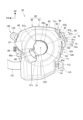
- Fig. 4 is a left side view of the left handle switch 52 according to the first embodiment.
- Fig. 4 shows an axial view as seen in the central axial direction of the handle 21, specifically, an axial view of the left handle portion 21c.
- the left handle switch (handle switch) 52 has a switch case 60 that supports the switches 80, 90, 100, 110, and 120.
- the switch case 60 is made of, for example, resin. As shown in FIG.
- the switch case 60 of this embodiment has a structure split into two halves, a rear case 61 recessed on the rear side (seat 17 side) and a front case 65 recessed on the front side (side away from the seat 17).
- the rear case 61 and the front case 65 are fastened to each other while sandwiching the left handle portion 21c from the front-rear direction, whereby the switch case 60 is fixed to the left handle portion 21c. That is, the left handle switch 52 is fixed to the left handle portion 21c of the handle 21.
- the rear case 61 has an outer peripheral wall 62 that curves in a generally semicircular arc along the circumferential direction of the left handle portion 21c, an outer side wall 63 formed at the outer left-right end of the outer peripheral wall 62, and an inner side wall 64 (see Figures 4 and 5) formed at the inner left-right end of the outer peripheral wall 62.
- the outer side wall 63 and the inner side wall 64 are formed with handle accommodating sections 63a, 64a that are cut out in a generally semicircular arc shape at the rear.
- the front case 65 has an outer peripheral wall 66 that curves in a generally semicircular arc along the circumferential direction of the left handle portion 21c, an outer side wall 67 formed at the outer left-right end of the outer peripheral wall 66, and an inner side wall 68 formed at the inner left-right end of the outer peripheral wall 66.
- the outer side wall 67 and the inner side wall 68 are formed with handle accommodating portions 67a, 68a that are cut out in a generally arc-shaped manner toward the front.
- the rear case 61 and the front case 65 are fastened together with bolts (not shown) extending in the front-rear direction. This keeps the left handle portion 21c sandwiched between the rear case 61 and the front case 65, and fixes the switch case 60 to the left handle portion 21c.
- the front case 65 is provided with a positioning pin 69 that protrudes toward the left handle portion 21c.
- the positioning pin 69 fits, for example, into a hole (not shown) formed in the left handle portion 21c to position the switch case 60 relative to the left handle portion 21c and prevent it from rotating.
- the fixation of the handle 21 and the left handle switch 52 is not limited to the above example.
- the radial direction is used to mean the radial direction of the handle 21. That is, because the handle 21 is a cylindrical bar handle, the center of the cylindrical shape in the cross section of the handle 21 is called the center O21 of the handle 21. Additionally, the radially inner side is used to mean the side toward the center O21 of the handle 21 in the cross section of the handle 21. Furthermore, the radially outer side is used to mean the side away from the center O21 of the handle 21 in the cross section of the handle 21.
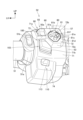
- FIG. 5 is a perspective view of the left handlebar switch 52 according to the first embodiment, as viewed from above and rearward.
- the left handlebar switch 52 corresponding to the rider's view is shown.
- a case body surface 71 that is curved in a substantially semicircular arc shape in a side view of the vehicle is formed on the outer peripheral wall 62 of the rear case 61.
- a raised surface 72 that is raised radially outward from the case body surface 71 is formed in the left-right central portion of the case body surface 71.
- the raised surface 72 has a left-right width and extends toward the upper side (front side).
- the raised surface 72 has a peripheral wall surface 72a that rises from the case body surface 71.
- the raised surface 72 forms a step shape with respect to the case body surface 71 due to the peripheral wall surface 72a.
- a roughly octagonal opening (third opening) 72b that penetrates the raised surface 72 in the radial direction is formed at the lower part (rear) of the raised surface 72.
- a directional switch 80 for inputting directions and the like is supported in the switch case 60 according to the position of the opening 72b.
- the directional switch 80 is an example of a third switch.
- the directional switch 80 has a switch body (not shown) supported within the switch case 60, and a plate-shaped cross key (directional key) 81 supported by the switch body as an operating part for switching the switch input of the switch body.
- the cross key 81 is disposed in the opening 72b.
- the cross key 81 has a key seat plate 81a that is substantially octagonal when viewed from the rider (see FIG. 5).
- the key seat plate 81a is disposed recessed toward the handlebar 21 from the outer surface of the raised surface 72 (see FIG. 3).
- An upper key portion 81b, a lower key portion 81c, a left key portion 81d, and a right key portion 81e are formed on the key seat plate 81a in correspondence with the top, bottom, left, and right directions.
- the key portions 81b to 81e protrude radially outward from the key seat plate 81a.
- the key portions 81b to 81e are inclined so that the amount of protrusion from the key seat plate 81a increases as the key portions 81b to 81e move in the direction of the respective key portions 81b to 81e.
- the upper key portion 81b is inclined so that the amount of protrusion from the key seat plate 81a increases as the key portions move upward. This makes it easier to press key sections 81b to 81e by moving your finger on the cross key 81 in the direction indicated by the key sections 81b to 81e.
- the upper key portion 81b and the lower key portion 81c protrude radially outward from the key seat plate 81a more than the left key portion 81d and the right key portion 81e (see FIG. 3).
- the upper key portion 81b and the lower key portion 81c protrude radially outward beyond the raised surface 72 (see FIG. 4).
- a central portion 81f extending in the vertical direction is formed between the upper key portion 81b and the lower key portion 81c.
- the central portion 81f protrudes radially outward from the key seat plate 81a by a greater amount (see FIG. 3).
- the central portion 81f protrudes radially outward from the key seat plate 81a by a smaller amount (see FIG. 4).
- the central portion 81f protrudes radially outward beyond the raised surface 72 (see FIG. 4).
- the central portion 81f connects the upper key portion 81b and the lower key portion 81c of the cross key 81.
- the central portion 81f separates the left key portion 81d and the right key portion 81e of the cross key 81. Therefore, by touching the central portion 81f that extends in the vertical direction, it is easy to recognize the relative positions of the keys 81b to 81e, which indicate the directions, from the feel of your fingers.
- the key seat plate 81a, the keys 81b-81e, and the central portion 81f are integrally formed.
- the key seat plate 81a, the keys 81b-81e, and the central portion 81f form an integral cross key 81.
- the entire cross key 81 tilts toward that key portion 81b-81e, causing a switch input on the switch body.
- the direction switch 80 of this embodiment has a light source housed in the switch case 60. This light source lights up the center portion 81f.
- the cross key 81 is manufactured from a transparent resin, which is an example of a transparent material. Paint is applied to the area other than the center portion 81f, and the area other than the center portion 81f is configured to be light-blocking. As a result, when the light source of the direction switch 80 is turned on, the light from the light source is directed toward the occupant in the cross key 81 through the transparent center portion 81f. On the other hand, the light from the light source is blocked in areas other than the center portion 81f. As a result, the center portion 81f of the cross key 81 appears to be lit.
- the light from the light source also leaks from the gap 82 (see FIG. 5) between the inner periphery of the upper opening 71a and the outer periphery of the cross key 81. This makes it easier to highlight the outline shape of the cross key 81 with the light from the light source.
- a convex surface (convex portion) 73 is formed on an imaginary line L1 connecting the left key portion 81d and the right key portion 81e.
- the convex surface 73 is formed to the left of the raised surface 72.
- the convex surface 73 protrudes radially outward from the case body surface 71.
- the convex surface 73 extends along the imaginary line L1 that extends in the left-right direction. Therefore, the convex surface 73 extends in the left-right direction, which is the operation direction of the cross key 81.
- the convex surface 73 also extends in the extension direction of the left handle portion 21c.
- the convex surface 73 does not protrude radially outward beyond the raised surface 72, and is connected to the radial midpoint of the surrounding wall surface 72a of the raised surface 72 (see FIG. 3).
- the convex surface 73 has a shape that is continuous with the surrounding wall surface 72a. As the convex surface 73 advances to the left, it bends toward the left handle portion 21c and is connected to the outer side wall 63 of the switch case 60. Therefore, when moving a finger from the left side to the right side of the outer side wall 63, it is easy to move the finger along the protruding shape of the convex surface 73 that is continuously connected to the outer side wall 63.
- FIG. 6 is a cross-sectional view taken along line VI-VI in FIG.
- An upper opening (first opening) 71a that penetrates the case main body surface 71 in the radial direction is formed above the convex surface 73.
- the upper opening 71a is formed to the left of the raised surface 72.
- a mode switch 90 that selects a driving mode of the saddle-ride type vehicle 10 is supported on the switch case 60 in correspondence with the upper opening 71a.
- the mode switch 90 is an example of a first switch.
- the mode switch 90 has a switch body 91 with an input element.
- the switch body 91 is supported within the switch case 60.
- the switch body 91 has a hinge shaft (hinge mechanism of the first switch) 92.
- the hinge shaft 92 extends in the left-right direction.
- a roughly plate-shaped switch operation part 93 is swingably connected to the switch body 91 by the hinge shaft 92.
- the switch operation part 93 is in the form of a plate extending in the vertical direction.
- the lower end of the switch operation part 93 is connected to the hinge shaft 92. Therefore, the lower end of the switch operation part 93 cannot be pushed in by the hinge shaft 92, and the upper end is pushed in.
- a protrusion 93a that protrudes radially outward is formed at the upper end of the switch operation part 93. When a finger is moved upward (forward) on the switch operation part 93, the finger catches on the protrusion 93a, making it easier to push the switch operation part 93 towards the switch body 91.
- the mode switch 90 of this embodiment has a waterproof structure.
- the hinge shaft 92 of the mode switch 90 is positioned radially inward of the convex surface 73.
- the hinge shaft 92 is positioned to overlap the convex surface 73 from the rider's perspective (from the perspective of the operation direction of the first switch).
- the rider's perspective is the line of sight of the driver (operator), who is a passenger sitting in the seat 17 and operating the handlebars 21, and is the line of sight of the driver sitting in the seat 17 looking at the left handlebar switch 52.
- the hinge shaft 92 can be said to overlap the convex surface 73.
- a lower opening (second opening) 71b is formed, which penetrates the case body surface 71 in the radial direction.
- the lower opening 71b is formed on the lower left of the raised surface 72.
- a horn switch 100 that activates the horn is supported on the switch case 60.
- the horn switch 100 is an example of a second switch.
- the horn switch 100 is disposed below the mode switch 90 (see FIG. 6).
- the horn switch 100 has a switch body 101 having an input element.
- the switch body 101 is supported within the switch case 60.
- the switch body 101 has a hinge shaft (hinge mechanism of the second switch) 102.
- the hinge shaft 102 extends in the left-right direction.
- the hinge shaft 102 of the horn switch 100 is closer to the center O21 of the handlebars 21 than the hinge shaft 92 of the mode switch 90.
- the hinge shaft 92 of the mode switch 90 is located outside the hinge shaft 102 of the horn switch 100 with respect to the center O21 of the handlebars 21, i.e., radially outside.
- a substantially plate-shaped operation button 103 is swingably connected to the switch body 101 by the hinge shaft 102.
- the operation button 103 swings around the hinge shaft 102 relative to the switch body 101, the input element of the switch body 101 is pressed or released, switching the switch input of the horn switch 100.
- the operation button 103 is exposed to the outside of the switch case 60 through the lower opening 71b.
- the operation button 103 of the horn switch 100 has a polygonal shape when viewed from the rider (see Figure 5).
- the operation button 103 has a base edge 103a extending in the left-right direction on the hinge shaft 102 side, an outer side edge 103b extending downward from the left end (outer end in the left-right direction) of the base edge 103a, an inner inclined edge 103c extending downward and to the right from the right end (inner end in the left-right direction) of the base edge 103a, an inner side edge 103d extending downward from the right end of the inner inclined edge 103c, and an edge 103e connecting the lower end of the outer side edge 103b and the lower end of the inner side edge 103d.
- the outer side edge 103b extends downward from the base edge 103a, while the inner inclined edge 103c extends at an angle to the lower right, making the left-right width of the end edge 103e larger than the left-right width of the base edge 103a.
- the inner inclined edge 103c extends along the peripheral wall surface 72a of the raised surface 72 when viewed by the rider.
- the operation button 103 of the horn switch 100 is exposed from the lower opening 71b.
- the lower opening 71b is shaped to open toward the rear, and has a convex surface 73 formed on the upper side (see FIG. 4). Therefore, water such as rainwater is unlikely to enter the switch case 60 from the lower opening 71b. Even if water does enter the switch case 60 from above through the upper opening 71a, the water from above is likely to be blocked by the mode switch 90 located above, and is unlikely to pass over the mode switch 90 and reach the horn switch 100 below. Therefore, the additional structure for waterproofing can be simplified for the lower horn switch 100, making it easier to make the overall structure of the left handlebar switch 52 more compact.
- the outer peripheral wall 62 is formed with an extension surface 74 that extends downward from the case body surface 71.
- the extension surface 74 is a flat surface shape that extends so as to bend downward relative to the curved case body surface 71 (see FIG. 4).
- a turn signal switch 110 is disposed on the extension surface 74.
- the turn signal switch 110 is an example of a fourth switch.
- the turn signal switch 110 has a switch body (not shown) supported within the switch case 60, a turn signal lever 112 supported on the switch body so as to be movable left and right, and an operating member 113 supported on the tip of the turn signal lever 112.
- the left turn signal blinks when the turn signal lever 122 is swung to the left
- the right turn signal blinks when the turn signal lever 122 is swung to the right.
- pushing the turn signal lever 122 towards the front of the vehicle will turn off either the left or right turn signal that is flashing.
- a torque switch 120 is provided on the front case 65 side of the left handle switch 52.
- the torque switch 120 is an example of a fifth switch.
- the torque switch 120 has a switch body (not shown) supported within the switch case 60, and an operating lever 123 supported so as to be swingable on the switch body.
- the operating lever 123 is connected to the switch body so as to be swingable around a hinge axis extending in the vertical direction. The operating lever 123 can be operated with the index finger of the left hand placed on the left grip 51.
- the switch bodies 91-101 of the switches 80-120 are electrically connected to an ECU (Electronic Control Unit) via a wiring cable 131.
- the ECU switches the display of the meter display device 31 and controls the turn signals and horn based on the input signals from the switches 80-120.
- the driver sitting on the seat 17 operates various switches 80-120 of the left handlebar switch 52.
- the mode switch 90 and the horn switch 100 are separated from each other by the convex surface 73 that protrudes toward the driver on the switch case 60, and the direction switch 80 can be easily reached by tracing the convex surface 73 in its longitudinal direction from the left grip 51 via the stepped shape of the surrounding wall surface 72a and the raised surface 72. Therefore, in the left handlebar switch 52, the positions of the various switches 80-100 can be easily recognized by the feel of the fingers, and the fingers can be easily moved to the positions of the switches 80-100.
- the radially inner side of the convex surface 73 tends to become dead space.
- the hinge shaft 92 of the switch operation portion 93 of the mode switch 90 is disposed radially inside the convex surface 73. Therefore, the radially inner side of the convex surface 73 is used as a space for arranging the hinge shaft 92, and it is easier to make the switch case 60 compact compared to a case in which the radially inner side of the convex surface 73 is not used as a space for arranging the hinge shaft 92.
- an operable area where the mode switch 90 can be moved by depressing it i.e., the area of the switch operation portion 93 as seen by the rider
- the switch case 60 is provided with a convex surface 73
- the mode switch 90 is a switch including a hinge shaft 92
- the hinge shaft 92 of the mode switch 90 overlaps with the convex surface 73 when viewed by the rider.
- the switch operation portion 93 of the mode switch 90 can be arranged while ensuring an operable area of the mode switch 90, as compared to when the mode switch 90 does not overlap with the convex surface 73.
- the left handlebar switch 52 can be made compact while ensuring the operability of the mode switch 90.
- the entire portion of the mode switch 90 visible from the rider's perspective can be pushed in, as compared to when the mode switch 90 does not overlap with the convex surface 73, so the operability of the mode switch 90 can be improved.
- the switch case 60 further includes a horn switch 100 , and the convex surface 73 is located between the mode switch 90 and the horn switch 100 .
- the convex surface 73 is positioned between the mode switch 90 and the horn switch 100, thereby separating these two switches 90, 100, thereby improving the operability of these two switches 90, 100.
- the horn switch 100 includes a hinge shaft 102, and the hinge shaft 92 of the mode switch 90 is positioned radially outward of the handlebar 21 relative to the hinge shaft 102 of the horn switch 100 in a side view of the vehicle.
- the hinge shaft 92 of the mode switch 90 which overlaps with the convex surface 73, is located radially outward of the switch case 60 than the hinge shaft 102 of the horn switch 100, making it easier to shift the position of the hinge shafts 92, 102 within the switch case 60 and position them on the occupant side, thereby making the left handlebar switch 52 more compact.
- the switch case 60 further includes a direction switch 80 , and the convex surface 73 is continuous with a surrounding wall surface 72 a provided on at least a part of the periphery of the direction switch 80 .
- the surrounding wall surface 72a of the raised surface 72 around the directional switch 80 is continuous with the convex surface 73, so that the convex surface 73 can serve as a guide for the directional switch 80, thereby further improving the operability of the switch in the left handlebar switch 52.
- the operation directions of the directional switch 80 include up, down, left and right, and the operation directions of the directional switch 80 include the left and right direction which is the longitudinal direction of the convex surface 73 when the switch case 60 is viewed from the front.
- the operation directions of the directional switch 80 include the left and right direction which is the longitudinal direction of the convex surface 73 when the switch case 60 is viewed from the front.
- the longitudinal direction of the convex surface 73 as seen by the rider is the same as the axial direction of the handlebar 21 . According to this configuration, by aligning the longitudinal direction of the convex surface 73 with the axial direction of the handle 21, the convex surface 73 can be positioned at a position where the operator's fingers can easily move, thereby improving the operability of the switch in the left handle switch 52.
- Fig. 7 is a perspective view of the left handlebar switch 252 according to the second embodiment as seen from above and rearward.
- Fig. 8 is a left side view of the left handlebar switch 252 according to the second embodiment.
- Figs. 7 and 8 correspond to Figs. 5 and 4 of the first embodiment, respectively.
- a left handlebar switch (handlebar switch) 252 according to the second embodiment has a horn switch 200 instead of the horn switch 100 according to the first embodiment.
- the horn switch 200 according to the second embodiment differs from the first embodiment in that the hinge shaft 202 is arranged to overlap the convex surface 73 as viewed by the rider.
- the hinge shaft 202 is arranged to overlap the hinge shaft 92 as viewed by the rider.
- the hinge shaft 202 of the horn switch 200 is closer to the center O21 of the handlebar 21 than the hinge shaft 92 of the mode switch 90.
- the convex surface 73, the hinge shaft 92 of the mode switch 90, and the hinge shaft 202 of the horn switch 200 are arranged in this order from the radial outside, and the convex surface 73, the hinge shaft 92 of the mode switch 90, and the hinge shaft 202 of the horn switch 200 overlap as viewed by the rider.
- the operation button 103 of the horn switch 200 extends inside the switch case 60 depending on the position of the hinge shaft 202, and the shape inside the switch case 60 is different from that of the operation button 103 in the first embodiment.
- the external shape of the operation button 103 exposed from the lower opening 71b is configured to be the same as in the first embodiment.
- the hinge shaft 92 of the mode switch 90 overlaps with the convex surface 73 when viewed from the rider, and similar to the first embodiment, the left handlebar switch 252 can be made compact while ensuring the operability of the mode switch 90.
- the convex surface 73, the hinge shaft 92 of the mode switch 90, and the hinge shaft 202 of the horn switch 200 overlap in this order when viewed from the rider.
- the two hinge shafts 92, 202 can be arranged alternately in the radial direction from the rider's perspective while overlapping the convex surface 73. This allows the left handlebar switch 252 to be made compact, and the hinge shafts 92, 202 can be protected by the convex surface 73 without the need for any additional parts.
- the hinge mechanisms of the switches 90, 100, and 200 are described as being configured with hinge shafts 92, 102, and 202, but the hinge mechanisms of these switches 90 to 200 are not limited to the configuration of hinge shafts 92 to 202.
- the hinge mechanism may be a hinge mechanism consisting of a hole penetrating in the left-right direction provided in the switch body 91 and a shaft provided in the switch operation unit 93 rotatably connected to the hole, as long as the switch operation unit 93 is configured to rotate around the hole.
- the hinge mechanisms of the switches 90 to 200 may be mechanisms that can rotate around a predetermined direction as the rotation center.
- the left handlebar switch 52 is described as being provided with a direction switch 80, a mode switch 90, a horn switch 100, a winker switch 110, and a torque switch 120, but the number of switches and the functions of the switches are arbitrary. Therefore, for example, the switch configuration described as the mode switch 90 may be configured to be assigned the functions of other switches.
- a saddle-ride type vehicle 10 having a front wheel 13 and a rear wheel 15 has been described as an example of a vehicle, but the present invention is not limited to this, and the present invention can also be applied to saddle-ride type vehicles with three or more wheels, such as two front wheels or two rear wheels, and vehicles other than saddle-ride type vehicles.
- a handlebar switch comprising a switch case provided on a handlebar of a vehicle and a first switch supported by the switch case, the switch case being provided with a convex portion, the first switch being a switch equipped with a hinge mechanism, and the hinge mechanism of the first switch overlapping with the convex portion when viewed in the operating direction of the first switch.
- Configuration 2 The handle switch described in configuration 1, characterized in that the switch case further includes a second switch, and the convex portion is located between the first switch and the second switch. According to this configuration, since the convex portion is positioned between the first switch and the second switch, these two switches are separated, thereby improving the operability of these two switches.
- the second switch is provided with a hinge mechanism, and when viewed from the side of the vehicle, the hinge mechanism of the first switch is located further outward from the center of the handlebar than the hinge mechanism of the second switch.
- the hinge mechanism of the first switch that overlaps with the convex portion is located further outside the switch case than the hinge mechanism of the second switch, making it easier to shift the hinge mechanism within the switch case and position it on the occupant side, making the handlebar switch more compact.
- Configuration 4 A handle switch as described in configuration 3, characterized in that, when viewed in the operating direction of the first switch, the convex portion, the hinge mechanism of the first switch, and the hinge mechanism of the second switch overlap in that order from the outside with the center of the handle as the reference.
- the two hinge mechanisms can be arranged alternately in a direction based on the center of the handle while overlapping the protrusions when viewed from the operating direction of the first switch. This allows the handle switch to be made compact, and the hinge mechanisms can be protected by the protrusions without the need for additional parts.
- the wall portion surrounding the third switch is continuous with the convex portion, so that the convex portion can act as a guide portion for the third switch, thereby further improving the operability of the handlebar switch.
- (Configuration 7) A handle switch as described in configuration 6, characterized in that the longitudinal direction of the convex portion when viewed in the operating direction of the first switch is the same as the axial direction of the handle. According to this configuration, by aligning the longitudinal direction of the convex portion with the axial direction of the handle, the convex portion can be positioned at a position where the operator's fingers can easily move, thereby improving the operability of the handle switch.
Landscapes
- Engineering & Computer Science (AREA)
- Mechanical Engineering (AREA)
- Rotary Switch, Piano Key Switch, And Lever Switch (AREA)
- Steering Devices For Bicycles And Motorcycles (AREA)
- Switch Cases, Indication, And Locking (AREA)
Priority Applications (3)
| Application Number | Priority Date | Filing Date | Title |
|---|---|---|---|
| DE112023005710.9T DE112023005710T5 (de) | 2023-01-31 | 2023-12-28 | Lenkerschalter |
| CN202390000713.0U CN224159380U (zh) | 2023-01-31 | 2023-12-28 | 把手开关 |
| JP2024574351A JPWO2024161902A1 (https=) | 2023-01-31 | 2023-12-28 |
Applications Claiming Priority (2)
| Application Number | Priority Date | Filing Date | Title |
|---|---|---|---|
| JP2023-013386 | 2023-01-31 | ||
| JP2023013386 | 2023-01-31 |
Publications (1)
| Publication Number | Publication Date |
|---|---|
| WO2024161902A1 true WO2024161902A1 (ja) | 2024-08-08 |
Family
ID=92146623
Family Applications (1)
| Application Number | Title | Priority Date | Filing Date |
|---|---|---|---|
| PCT/JP2023/047345 Ceased WO2024161902A1 (ja) | 2023-01-31 | 2023-12-28 | ハンドルスイッチ |
Country Status (4)
| Country | Link |
|---|---|
| JP (1) | JPWO2024161902A1 (https=) |
| CN (1) | CN224159380U (https=) |
| DE (1) | DE112023005710T5 (https=) |
| WO (1) | WO2024161902A1 (https=) |
Citations (5)
| Publication number | Priority date | Publication date | Assignee | Title |
|---|---|---|---|---|
| JP3487840B2 (ja) * | 2000-09-14 | 2004-01-19 | 株式会社シマノ | 自転車用コントロールパネル |
| JP2013189023A (ja) * | 2012-03-12 | 2013-09-26 | Honda Motor Co Ltd | 自動二輪車におけるハンドルスイッチ及び自動二輪車 |
| JP2015085854A (ja) * | 2013-10-31 | 2015-05-07 | ヤマハ発動機株式会社 | 鞍乗型車両 |
| JP2015085855A (ja) * | 2013-10-31 | 2015-05-07 | ヤマハ発動機株式会社 | 鞍乗型車両 |
| JP2017133449A (ja) * | 2016-01-29 | 2017-08-03 | 本田技研工業株式会社 | 鞍乗り型車両のスロットル開度検出装置 |
-
2023
- 2023-12-28 CN CN202390000713.0U patent/CN224159380U/zh active Active
- 2023-12-28 DE DE112023005710.9T patent/DE112023005710T5/de active Pending
- 2023-12-28 JP JP2024574351A patent/JPWO2024161902A1/ja active Pending
- 2023-12-28 WO PCT/JP2023/047345 patent/WO2024161902A1/ja not_active Ceased
Patent Citations (5)
| Publication number | Priority date | Publication date | Assignee | Title |
|---|---|---|---|---|
| JP3487840B2 (ja) * | 2000-09-14 | 2004-01-19 | 株式会社シマノ | 自転車用コントロールパネル |
| JP2013189023A (ja) * | 2012-03-12 | 2013-09-26 | Honda Motor Co Ltd | 自動二輪車におけるハンドルスイッチ及び自動二輪車 |
| JP2015085854A (ja) * | 2013-10-31 | 2015-05-07 | ヤマハ発動機株式会社 | 鞍乗型車両 |
| JP2015085855A (ja) * | 2013-10-31 | 2015-05-07 | ヤマハ発動機株式会社 | 鞍乗型車両 |
| JP2017133449A (ja) * | 2016-01-29 | 2017-08-03 | 本田技研工業株式会社 | 鞍乗り型車両のスロットル開度検出装置 |
Also Published As
| Publication number | Publication date |
|---|---|
| CN224159380U (zh) | 2026-04-24 |
| JPWO2024161902A1 (https=) | 2024-08-08 |
| DE112023005710T5 (de) | 2025-11-20 |
Similar Documents
| Publication | Publication Date | Title |
|---|---|---|
| CN102105346B (zh) | 车辆的操纵开关 | |
| EP2246246B1 (en) | Motorcycle | |
| JP7434731B2 (ja) | 運転補助装置 | |
| JP6864028B2 (ja) | ハンドルスイッチ | |
| JP6723295B2 (ja) | 鞍乗型車両の操作部構造、および鞍乗型車両 | |
| US10377440B2 (en) | Bicycle and stem assembly | |
| JP6655641B2 (ja) | 鞍乗り型車両のスロットル開度検出装置 | |
| JP6300743B2 (ja) | 鞍乗り型車両におけるスクリーン可動装置 | |
| US9018551B2 (en) | Handlebar switch for motorcycle | |
| JP2016192252A (ja) | 車両用のハンドルスイッチ | |
| WO2024161902A1 (ja) | ハンドルスイッチ | |
| JP5838139B2 (ja) | 鞍乗型車両の前部構造 | |
| JP7838979B2 (ja) | 車両 | |
| CN1944167B (zh) | 摩托车 | |
| EP3782886B9 (en) | Straddled vehicle | |
| JP6332809B2 (ja) | 鞍乗り型車両におけるスクリーン可動装置 | |
| JP2025059526A (ja) | ハンドルグリップ装置 | |
| JP2017206036A (ja) | 鞍乗り型車両におけるマスタシリンダ配設構造 | |
| JPH01115792A (ja) | 自動二輪車 | |
| JP2019181968A (ja) | 鞍乗り型車両のメーター周辺構造 | |
| JP4453963B2 (ja) | 車両用スイッチ構造 | |
| JP2008006902A (ja) | 操作リンク構造 | |
| JP5775917B2 (ja) | ディマースイッチ | |
| JP4673717B2 (ja) | 自動二輪車用表示装置 | |
| JP2017197067A (ja) | 鞍乗り型車両 |
Legal Events
| Date | Code | Title | Description |
|---|---|---|---|
| 121 | Ep: the epo has been informed by wipo that ep was designated in this application |
Ref document number: 23918909 Country of ref document: EP Kind code of ref document: A1 |
|
| WWE | Wipo information: entry into national phase |
Ref document number: 2024574351 Country of ref document: JP |
|
| WWE | Wipo information: entry into national phase |
Ref document number: 2501004771 Country of ref document: TH |
|
| WWE | Wipo information: entry into national phase |
Ref document number: 202547071415 Country of ref document: IN |
|
| WWP | Wipo information: published in national office |
Ref document number: 202547071415 Country of ref document: IN |
|
| WWE | Wipo information: entry into national phase |
Ref document number: 112023005710 Country of ref document: DE |
|
| 122 | Ep: pct application non-entry in european phase |
Ref document number: 23918909 Country of ref document: EP Kind code of ref document: A1 |