WO2024157803A1 - 複合材料及びその製造方法 - Google Patents
複合材料及びその製造方法 Download PDFInfo
- Publication number
- WO2024157803A1 WO2024157803A1 PCT/JP2024/000613 JP2024000613W WO2024157803A1 WO 2024157803 A1 WO2024157803 A1 WO 2024157803A1 JP 2024000613 W JP2024000613 W JP 2024000613W WO 2024157803 A1 WO2024157803 A1 WO 2024157803A1
- Authority
- WO
- WIPO (PCT)
- Prior art keywords
- particles
- composite material
- metal
- oxide particles
- metal oxide
- Prior art date
- Legal status (The legal status is an assumption and is not a legal conclusion. Google has not performed a legal analysis and makes no representation as to the accuracy of the status listed.)
- Ceased
Links
Images




Classifications
-
- C—CHEMISTRY; METALLURGY
- C22—METALLURGY; FERROUS OR NON-FERROUS ALLOYS; TREATMENT OF ALLOYS OR NON-FERROUS METALS
- C22C—ALLOYS
- C22C1/00—Making non-ferrous alloys
- C22C1/04—Making non-ferrous alloys by powder metallurgy
- C22C1/05—Mixtures of metal powder with non-metallic powder
-
- C—CHEMISTRY; METALLURGY
- C22—METALLURGY; FERROUS OR NON-FERROUS ALLOYS; TREATMENT OF ALLOYS OR NON-FERROUS METALS
- C22C—ALLOYS
- C22C1/00—Making non-ferrous alloys
- C22C1/04—Making non-ferrous alloys by powder metallurgy
- C22C1/0408—Light metal alloys
-
- C—CHEMISTRY; METALLURGY
- C22—METALLURGY; FERROUS OR NON-FERROUS ALLOYS; TREATMENT OF ALLOYS OR NON-FERROUS METALS
- C22C—ALLOYS
- C22C1/00—Making non-ferrous alloys
- C22C1/04—Making non-ferrous alloys by powder metallurgy
- C22C1/0408—Light metal alloys
- C22C1/0416—Aluminium-based alloys
-
- C—CHEMISTRY; METALLURGY
- C22—METALLURGY; FERROUS OR NON-FERROUS ALLOYS; TREATMENT OF ALLOYS OR NON-FERROUS METALS
- C22C—ALLOYS
- C22C1/00—Making non-ferrous alloys
- C22C1/04—Making non-ferrous alloys by powder metallurgy
- C22C1/0425—Copper-based alloys
-
- C—CHEMISTRY; METALLURGY
- C22—METALLURGY; FERROUS OR NON-FERROUS ALLOYS; TREATMENT OF ALLOYS OR NON-FERROUS METALS
- C22C—ALLOYS
- C22C1/00—Making non-ferrous alloys
- C22C1/10—Alloys containing non-metals
- C22C1/1036—Alloys containing non-metals starting from a melt
-
- C—CHEMISTRY; METALLURGY
- C22—METALLURGY; FERROUS OR NON-FERROUS ALLOYS; TREATMENT OF ALLOYS OR NON-FERROUS METALS
- C22C—ALLOYS
- C22C1/00—Making non-ferrous alloys
- C22C1/10—Alloys containing non-metals
- C22C1/1078—Alloys containing non-metals by internal oxidation of material in solid state
-
- C—CHEMISTRY; METALLURGY
- C22—METALLURGY; FERROUS OR NON-FERROUS ALLOYS; TREATMENT OF ALLOYS OR NON-FERROUS METALS
- C22C—ALLOYS
- C22C1/00—Making non-ferrous alloys
- C22C1/10—Alloys containing non-metals
- C22C1/1089—Alloys containing non-metals by partial reduction or decomposition of a solid metal compound
-
- C—CHEMISTRY; METALLURGY
- C22—METALLURGY; FERROUS OR NON-FERROUS ALLOYS; TREATMENT OF ALLOYS OR NON-FERROUS METALS
- C22C—ALLOYS
- C22C26/00—Alloys containing diamond or cubic or wurtzitic boron nitride, fullerenes or carbon nanotubes
- C22C2026/005—Alloys containing diamond or cubic or wurtzitic boron nitride, fullerenes or carbon nanotubes with additional metal compounds being borides
-
- C—CHEMISTRY; METALLURGY
- C22—METALLURGY; FERROUS OR NON-FERROUS ALLOYS; TREATMENT OF ALLOYS OR NON-FERROUS METALS
- C22C—ALLOYS
- C22C26/00—Alloys containing diamond or cubic or wurtzitic boron nitride, fullerenes or carbon nanotubes
- C22C2026/006—Alloys containing diamond or cubic or wurtzitic boron nitride, fullerenes or carbon nanotubes with additional metal compounds being carbides
-
- C—CHEMISTRY; METALLURGY
- C22—METALLURGY; FERROUS OR NON-FERROUS ALLOYS; TREATMENT OF ALLOYS OR NON-FERROUS METALS
- C22C—ALLOYS
- C22C26/00—Alloys containing diamond or cubic or wurtzitic boron nitride, fullerenes or carbon nanotubes
Definitions
- the present disclosure relates to a composite material and a method for producing the same, and more specifically to a composite material including inorganic particles and a matrix metal that bonds the inorganic particles, and a method for producing the same.
- Patent Document 1 discloses "a diamond composite material comprising diamond particles, coated diamond particles having a carbide layer that covers the surfaces of the diamond particles and contains an element of group 4 of the periodic table, and silver or a silver alloy that bonds the coated diamond particles together, and having an oxygen content of 0.1 mass % or less" (see claim 1 of Patent Document 1).
- Patent Document 1 by minimizing the oxygen content of the diamond composite material, a dense diamond composite material with excellent thermal conductivity can be obtained.
- paragraph [0118] of Patent Document 1 states that "By using a powder of a Group 4 compound containing an element of Group 4 of the periodic table as the raw material, it is possible to suppress the oxidation of the element of Group 4 of the periodic table during the manufacturing process, and the oxygen that may be present around the raw material can be reduced or removed by the action of a specific element produced by the chemical decomposition of the Group 4 compound, and further, the element of Group 4 of the periodic table produced by the chemical decomposition reacts with diamond to efficiently produce carbide, thereby improving wettability with molten metal.”
- the present disclosure has been made in consideration of the above problems, and provides a composite material and a method for producing the same that have excellent thermal conductivity even without using hydrides that can cause blowholes, or even when the amount of hydrides used is sufficiently reduced.
- a method for producing a composite material according to the present disclosure includes the following steps: (a) filling a mold with at least one type of inorganic particles made of a material selected from the group consisting of diamond, boron nitride (h-BN or c-BN), graphite, SiC, AlN, Si 3 N 4 , B 4 C, MgB 2 , Mg 3 N 2 , MgCl 2 , CaCl 2 , Mg 2 Si, carbon fiber, carbon nanotube, TiC, WC and TaC, metal particles and metal oxide particles; (b) heating the contents containing inorganic particles, metal particles, and metal oxide particles in a mold in a reducing atmosphere to a temperature lower than the melting point of the metal particles to release oxygen from the metal oxide particles; (c) discharging the oxygen released from the metal oxide particles to the outside of the mold; (d) melting the metal particles in the mold by heating the contents to a temperature above the melting point of the metal particles; (e) allowing the metal oxide particles to absorb the
- a method for producing a composite material according to the present disclosure includes the following steps: (x) a step of melting the metal particles in a mold filled with contents including at least one type of inorganic particles composed of a material selected from the group consisting of diamond, boron nitride (h-BN or c-BN), graphite, SiC, AlN, Si 3 N 4 , B 4 C, MgB 2 , Mg 3 N 2 , MgCl 2 , CaCl 2 , Mg 2 Si, carbon fiber, carbon nanotube, TiC, WC, and TaC, metal particles, and metal oxide particles having oxygen defects, by heating the contents to a temperature higher than the melting point of the metal particles; (y) allowing the metal oxide particles to absorb the oxygen released from the melt of the metal particles; and (z) recovering, after cooling of the mold, a composite material comprising the inorganic particles and a matrix metal binding the inorganic particles.
- a material selected from the group consisting of diamond, boron nitride
- the metal oxide particles can function as an oxygen absorbent.
- the metal oxide particles can exhibit a gettering effect of capturing oxygen.
- By capturing oxygen in the metal oxide particles it is possible to suppress the decrease in thermal conductivity of the matrix metal caused by oxygen.
- the metal oxide particles are thermally stable, it is possible to suppress the decrease in physical properties of the matrix metal caused by the metal oxide particles.
- the composite material disclosed herein contains at least one type of inorganic particle selected from the group consisting of diamond particles and boron nitride particles (e.g., h-BN particles or c-BN particles), a matrix metal that bonds the inorganic particles, and metal oxide particles, and has an oxygen content of more than 0.1 mass% and a thermal conductivity of 300 W/m ⁇ K or more at room temperature.
- inorganic particle selected from the group consisting of diamond particles and boron nitride particles (e.g., h-BN particles or c-BN particles), a matrix metal that bonds the inorganic particles, and metal oxide particles, and has an oxygen content of more than 0.1 mass% and a thermal conductivity of 300 W/m ⁇ K or more at room temperature.
- the composite material has an oxygen content of more than 0.1% by mass, the oxygen in the composite material is mainly derived from the metal oxide particles, so that the decrease in thermal conductivity of the matrix metal due to oxygen is suppressed, and a thermal conductivity of 300 W/m ⁇ K or more is achieved at room temperature. Because the metal oxide particles are thermally stable, the decrease in the physical properties of the matrix metal due to the metal oxide particles is also suppressed.
- the present disclosure provides a composite material and a method for producing the same that have excellent thermal conductivity even without using hydrides such as titanium hydride, which can cause blowholes, or even when the amount of hydride used is sufficiently reduced.
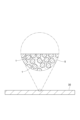
- FIG. 1 is a cross-sectional view illustrating a schematic diagram of one embodiment of a composite material according to the present disclosure.
- FIG. 2 is a cross-sectional view illustrating a schematic diagram of another embodiment of a composite material according to the present disclosure.
- FIG. 2 is a cross-sectional view illustrating a schematic diagram of another embodiment of a composite material according to the present disclosure.
- 2A to 2C are cross-sectional views that diagrammatically show a manufacturing process of the composite material shown in FIG. 1.
- 2A to 2C are cross-sectional views that diagrammatically show a manufacturing process of the composite material shown in FIG. 1.
- 4A to 4C are cross-sectional views each showing a schematic diagram of a manufacturing process of the composite material shown in FIGS. 2 and 3.
- FIG. FIG. 2 is a cross-sectional view that illustrates a state in which metal oxide particles having oxygen defects are filled in a mold.
- Fig. 1 is a cross-sectional view showing a schematic diagram of one embodiment of a composite material according to the present disclosure.
- the composite material 10 shown in the figure includes a plurality of inorganic particles 1, a plurality of metal oxide particles 3, and a matrix metal 5.
- the metal oxide particles 3 are dispersed, and the oxygen content of the composite material 10 may be more than 0.1 mass%, and may be 0.2 mass% or more, or 0.3 mass% or more.
- the upper limit of the oxygen content of the composite material 10 may be, for example, 1.0 mass%, 0.8 mass%, or 0.6 mass%, from the viewpoint of thermal conductivity.
- the composite material 10 has an oxygen content of more than 0.1% by mass, the composite material 10 has a thermal conductivity of 300 W/m ⁇ K or more.
- the composite material 10 may have a thermal conductivity of 500 W/m ⁇ K or more, or 600 W/m ⁇ K or more.
- the upper limit of the thermal conductivity of the composite material 10 is, for example, 700 W/m ⁇ K, and may be 800 W/m ⁇ K or 1000 W/m ⁇ K. Since the composite material 10 has excellent thermal conductivity, it can be used as a heat dissipation member.
- the composite material 10 may be in the form of a plate, or may be formed into a desired shape depending on the application.
- the material constituting the inorganic particle 1 is a material selected from the group consisting of diamond, boron nitride (h-BN or c-BN), graphite, SiC, AlN, Si 3 N 4 , B 4 C, MgB 2 , Mg 3 N 2 , MgCl 2 , CaCl 2 , Mg 2 Si, carbon fiber, carbon nanotube, TiC, WC and TaC.
- the thermal conductivity of diamond is about 1000 to 2000 W/m ⁇ K.
- the thermal conductivity of c-BN is about 1300 W/m ⁇ K.
- the thermal conductivity of SiC is about 150 to 500 W/m ⁇ K.
- the average particle size (median size D50) of the inorganic particles 1 is preferably 10 ⁇ m or more, more preferably 20 ⁇ m or more, and even more preferably 50 ⁇ m or more.
- the average particle size (median size D50) of the inorganic particles 1 is preferably 500 ⁇ m or less, more preferably 300 ⁇ m or less, and even more preferably 200 ⁇ m or less.
- the content of inorganic particles 1 in composite material 10 is preferably 35 vol% or more, more preferably 40 vol% or more, and even more preferably 45 vol% or more, based on the volume of composite material 10, from the viewpoint of thermal conductivity. From the viewpoint of moldability, this content is preferably 90 vol% or less, more preferably 85 vol% or less, and even more preferably 80 vol% or less.
- the metal oxide particles 3 include titanium oxide particles, cerium oxide particles, calcium titanate particles, and niobium oxide particles.
- the metal oxide particles 3 may be perovskite-type oxide particles.
- the thermal conductivity of titanium oxide is about 7 W/m ⁇ K.
- the thermal conductivity of cerium oxide is about 14 W/m ⁇ K.
- the thermal conductivity of calcium titanate is about 2 W/m ⁇ K.
- the thermal conductivity of niobium oxide is about 2 W/m ⁇ K.
- the average particle diameter (median diameter D50) of the metal oxide particles 3 is preferably 0.1 ⁇ m or more, more preferably 0.5 ⁇ m or more, and even more preferably 1 ⁇ m or more.
- the average particle diameter (median diameter D50) of the metal oxide particles 3 is preferably 200 ⁇ m or less, more preferably 100 ⁇ m or less, and even more preferably 50 ⁇ m or less.
- the content of the metal oxide particles 3 in the composite material 10 may be, for example, 0.01 vol.% or more, 0.05 vol.% or more, or 0.1 vol.% or more, based on the volume of the composite material 10. From the viewpoint of moldability, this content is preferably 5 vol.% or less, more preferably 2 vol.% or less, and even more preferably 1 vol.% or less.
- the matrix metal 5 is interposed between the inorganic particles 1 and the metal oxide particles 3, and bonds these particles.
- metals constituting the matrix metal include copper, silver, aluminum, magnesium, and alloys of two or more metals selected from these.
- the content of the matrix metal 5 in the composite material 10 is preferably 10 vol.% or more, more preferably 15 vol.% or more, and even more preferably 20 vol.% or more, based on the volume of the composite material 10, from the viewpoint of formability. From the viewpoint of thermal conductivity, this content is preferably 65 vol.% or less, more preferably 60 vol.% or less, and even more preferably 55 vol.% or less.
- FIG. 2 is a cross-sectional view showing a schematic diagram of another embodiment of the composite material according to the present disclosure.
- the composite material 20 shown in the figure has a region R3 where the metal oxide particles 3 are not dispersed within the composite material 20, but are present in a high concentration. Region R3 is formed on one surface 20a of the composite material 20.
- the composite material 30 shown in the figure is obtained by removing the region R3 of the composite material 20 shown in FIG. 2.
- the region R3 can be removed by polishing the surface 20a side of the composite material 20.
- the oxygen content of the composite material 30 is, for example, 0.10 mass% or less, and may be 0.07 mass% or less, or may be substantially zero.
- the lower limit of the oxygen content of the composite material 30 is, for example, 0.01 mass%.
- the composite material 30 may have a thermal conductivity of 600 W/m ⁇ K or more, or 700 W/m ⁇ K or more.
- the upper limit of the thermal conductivity of the composite material 30 is, for example, 800 W/m ⁇ K, and may be 900 W/m ⁇ K or 1000 W/m ⁇ K.
- the method includes the following steps: (a) a step of filling a mold 50 with a content 7 including at least inorganic particles 1, metal particles 5p, and metal oxide particles 3 (see FIG. 4A ); (b) A step of releasing oxygen from the metal oxide particles 3 by heating the contents 7 to a temperature lower than the melting point of the metal particles 5p in a mold 50 in a reducing atmosphere; (c) A step of discharging the oxygen released from the metal oxide particles 3 to the outside of the mold 50; (d) melting the metal particles 5p in the mold 50 by heating the contents 7 to a temperature higher than the melting point of the metal particles 5p (see FIG. 4B ); (e) allowing the metal oxide particles 3 to absorb the oxygen released from the melt of the metal particles; and (f) recovering the composite material 10 after cooling of the mold 50.
- the composite material 10 is obtained through the above steps.
- various additives may be placed in the mold 50 in the above step (a).
- additives include compounds such as (i) Ti, Cr, V, Mn, Nb, W, Mo, Fe, Co, Ni, Pd, Pt, Rh, Ta, Re, Zr, U, Ce, Si, B, Y, Mg, Zn, and/or rare earth elements (e.g., elements that are metals among these), and (ii) metal compounds containing specific elements (specifically, at least one element of sulfur, nitrogen, hydrogen, or boron).
- oxygen defects are formed in the metal oxide particles 3.
- the heating temperature in step (b) is, for example, a temperature that is 50 to 200° C. lower than the melting point of the metal particles 5p.
- the heating time is, for example, 5 to 60 minutes.
- the inside of the mold 50 may be depressurized with a vacuum pump.
- the heating temperature in the above step (d) is, for example, a temperature 5 to 200°C higher than the melting point of the metal particles 5p.
- the heating time is, for example, 5 to 60 minutes. After melting, the metal particles 5p solidify to become the matrix metal 5.
- a first layer L1 is formed in a mold 50, and then a second layer L2 is formed on the first layer L1.
- the first layer L1 is composed of inorganic particles 1.
- the second layer L2 is composed of metal particles 5p and metal oxide particles 3. At least one of the first layer L1 and the second layer L2 may be blended with the above additive as necessary.
- the metal oxide particles 3 contained in the second layer L2 have a larger average particle size than the inorganic particles 1 contained in the first layer L1.
- a composite material 20 having a region R3 is obtained.
- the average particle size of the metal oxide particles 3 does not necessarily have to be larger than the average particle size of the inorganic particles 1. That is, if the particle size of the metal oxide particle 3 is larger than the gap formed by the adjacent inorganic particles 1, at least a portion of the metal oxide particle 3 remains on the first layer L1.
- Composite material 30 is obtained by removing region R3 from composite material 20.
- the first layer L1 is formed of inorganic particles 1, and the second layer L2 is formed of metal particles 5p and metal oxide particles 3.
- the first layer L1 may be formed of inorganic particles 1 and metal oxide particles 3, and the second layer L2 may be formed of metal particles 5p.
- the first layer L1 contains metal oxide particles 3, the region containing a large amount of metal oxide particles 3 cannot be removed after the fact, as described above.
- the gettering effect of the metal oxide particles 3 can remove the oxygen contained in the matrix metal.
- the above-mentioned additive may be mixed into at least one of the first layer L1 and the second layer L2 as necessary.
- the present invention is not limited to the above-mentioned embodiments.
- a manufacturing method including a step of releasing oxygen from metal oxide particles 3 by heating metal oxide particles 3 in a mold 50 in a reducing atmosphere has been exemplified, but for example, metal oxide particles 3A having oxygen defects may be prepared in advance and filled into mold 50 (see FIG. 6).
- a manufacturing method including the following steps: (x) a step of melting the metal particles 5p by heating the contents 7A, which include at least the inorganic particles 1, the metal particles 5p, and the metal oxide particles 3A having oxygen defects, in a mold 50 filled with the contents 7A to a temperature higher than the melting point of the metal particles 5p;
- the composite material 10 may be produced through a process (y) of causing the metal oxide particles 3A to absorb the oxygen released from the melt of the metal particles 5p, and a process (z) of recovering the composite material 10 after cooling the mold 50.
- the metal oxide particles 3A can be obtained by subjecting the metal oxide particles 3 to a reduction treatment.
- the composite materials 20 and 30 may be produced using the metal oxide particles 3A.
- diamond particles are exemplified as a suitable example of the inorganic particles 1, but the diamond particles may have a coating layer (not shown) that constitutes the outermost layer of the diamond particles, or may be boron-doped diamond.
- coating layers include a titanium coating layer, a chromium coating layer, and a boron-doped layer (wherein only the surface layer of the diamond is boron-doped diamond).
- a titanium coating layer by providing the diamond particles with a titanium coating layer, the layer of titanium carbide that exists at the interface between the surface of the diamond particle body and the matrix metal can further improve the wettability of the diamond particles to the matrix metal.
- the present disclosure relates to the following: [1] A process of filling a mold with at least one inorganic particle made of a material selected from the group consisting of diamond, boron nitride, graphite, SiC, AlN, Si3N4 , B4C , MgB2 , Mg3N2 , MgCl2 , CaCl2 , Mg2Si , carbon fiber, carbon nanotube, TiC, WC and TaC, metal particles and metal oxide particles; a step of heating a content containing the inorganic particles, the metal particles, and the metal oxide particles in the mold in a reducing atmosphere to a temperature lower than the melting point of the metal particles to release oxygen from the metal oxide particles; Discharging oxygen released from the metal oxide particles to the outside of the mold; melting the metal particles in the mold by heating the contents to a temperature above a melting point of the metal particles; allowing the metal oxide particles to absorb oxygen released from the melt of the metal particles; recovering a composite material comprising the inorgan
- [4] The method for producing a composite material described in [3], wherein the diamond particles are provided with a coating layer that forms the outermost layer of the diamond particles.
- [5] The method for producing a composite material according to [4], wherein the coating layer is a titanium coating layer.
- the content filled in the mold includes a first layer and a second layer formed on the first layer, The method for producing a composite material according to any one of [1] to [5], wherein the first layer contains the inorganic particles, and the second layer contains the metal particles and the metal oxide particles.
- [7] The method for producing a composite material described in [6], wherein, in the step of melting the metal particles, when the molten metal particles penetrate into the first layer, at least a portion of the metal oxide particles remain on the first layer.
- a composite material comprising at least one type of inorganic particle selected from the group consisting of diamond particles and boron nitride particles, a matrix metal binding the inorganic particles, and metal oxide particles, A composite material having an oxygen content of more than 0.1 mass% and a thermal conductivity of 300 W/m ⁇ K or more at room temperature.
- metal oxide particles are at least one selected from the group consisting of titanium oxide particles, cerium oxide particles, calcium titanate particles, and niobium oxide particles.
- metal oxide particles are perovskite-type oxide particles.
- inorganic particles Diamond particles Average particle size: 50 ⁇ m
- Metal oxide particles Titanium oxide particles A (average particle size: 45 ⁇ m) Titanium oxide particles B (average particle size: 2 ⁇ m) Cerium oxide particles (average particle size: 1 ⁇ m) Calcium titanate particles (average particle size: 1 ⁇ m) Niobium oxide particles (average particle size: 1 ⁇ m)
- Additive Titanium hydride particles average particle size: 5 ⁇ m
- average particle size refers to the median size D50 determined from the particle size distribution of the particles
- median size D50 refers to the particle size at which the cumulative volume from the small particle size side in the particle size distribution obtained by the laser diffraction scattering method is 50%.
- Example 1 44 parts by volume of diamond particles and 2 parts by volume of titanium hydride particles were mixed to obtain a first mixed powder.
- 54 parts by volume of metal particles and 0.6 parts by volume of titanium oxide particles A were mixed to obtain a second mixed powder.
- the first mixed powder 46 parts by volume
- the second mixed powder 54 parts by volume
- the mold was heated to 600°C while evacuating the inside of the mold by operating a vacuum pump connected to the mold, and then held at 600°C for 10 minutes. This caused oxygen to be released from the titanium oxide particles, and the oxygen released from the titanium oxide particles was discharged to the outside of the mold.
- the mold was heated from 600°C to 780°C, and the mold was then sealed, and the contents were heated at 950°C for 10 minutes. This caused the metal particles to melt, and the oxygen released from the molten metal particles was absorbed by the titanium oxide particles.
- the composite material of this example was collected from the mold.
- the obtained composite material had a diameter of 30 mm and a thickness of approximately 0.4 mm.
- Example 2 The composite material of this example was prepared in the same manner as in Example 1, except that titanium oxide particles B were used instead of titanium oxide particles A, and 54 parts by volume of metal particles and 0.3 parts by volume of titanium oxide particles B were mixed to obtain a second mixed powder.
- Example 3 The composite material of this example was prepared in the same manner as in Example 1, except that 44 parts by volume of diamond particles and 0.6 parts by volume of titanium oxide particles A were mixed to obtain the first mixed powder, and 54 parts by volume of metal particles and 2 parts by volume of titanium hydride particles were mixed to obtain the second mixed powder.
- Example 4 Except for having previously subjected the titanium oxide particles A to a reduction treatment, the composite material according to this example was obtained in the same manner as in Example 3. The titanium oxide particles A were reduced by heating them at 1000° C. for 4 hours in a vacuum atmosphere.
- Example 5 The composite material according to this example was produced in the same manner as in Example 4, except that cerium oxide particles were used instead of titanium oxide particles A as the reduced metal oxide particles, and 44 parts by volume of diamond particles and 0.6 parts by volume of cerium oxide particles were mixed to obtain the first mixed powder.
- the cerium oxide particles were reduced by heating them at 1000° C. for 8 hours in a vacuum atmosphere.
- Example 6 The composite material according to this embodiment was produced in the same manner as in Example 4, except that calcium titanate particles were used as the reduced metal oxide particles instead of titanium oxide particles A, and 44 parts by volume of diamond particles and 0.5 parts by volume of calcium titanate particles were mixed to obtain a first mixed powder.
- the calcium titanate particles were reduced by heating them at 1200° C. for 8 hours in a vacuum atmosphere.
- Example 7 The composite material according to this embodiment was produced in the same manner as in Example 4, except that niobium oxide particles were used instead of titanium oxide particles A as the reduced metal oxide particles, and 44 parts by volume of diamond particles and 0.2 parts by volume of niobium oxide particles were mixed to obtain the first mixed powder.
- the niobium oxide particles were reduced by heating them at 1000° C. for 8 hours in a vacuum atmosphere.
- Example 1 A composite material according to this comparative example was obtained in the same manner as in Example 1, except that metal particles were used as they were instead of the second mixed powder. That is, the temperature inside the mold was raised to 600°C while evacuating the inside of the mold by operating a vacuum pump connected to the inside of the mold, and then the temperature was maintained at 600°C for 10 minutes. Next, the temperature inside the mold was raised from 600°C to 780°C, and the mold was sealed, and the contents were heated at 950°C for 10 minutes. After the temperature inside the mold was lowered, the composite material according to this comparative example was collected from the mold.
- Test pieces (size: diameter 30 mm ⁇ thickness 0.3 mm) were prepared from the composite materials according to the examples and comparative examples.
- the thermal diffusion coefficients of the test pieces were measured at room temperature (25°C) by a thermal wave method using a thermal diffusion coefficient measuring device (TA35 manufactured by Bethel Co., Ltd.), and the thermal conductivity of the test pieces was calculated.
- the average values of three test pieces for each of the examples and comparative examples are shown in Tables 1 and 2.
Landscapes
- Chemical & Material Sciences (AREA)
- Engineering & Computer Science (AREA)
- Materials Engineering (AREA)
- Mechanical Engineering (AREA)
- Metallurgy (AREA)
- Organic Chemistry (AREA)
- Manufacture Of Alloys Or Alloy Compounds (AREA)
Priority Applications (3)
| Application Number | Priority Date | Filing Date | Title |
|---|---|---|---|
| EP24747134.5A EP4656749A1 (en) | 2023-01-23 | 2024-01-12 | Composite material and method for producing same |
| CN202480006919.3A CN120569498A (zh) | 2023-01-23 | 2024-01-12 | 复合材料及其制造方法 |
| JP2024572967A JPWO2024157803A1 (https=) | 2023-01-23 | 2024-01-12 |
Applications Claiming Priority (2)
| Application Number | Priority Date | Filing Date | Title |
|---|---|---|---|
| JP2023-008351 | 2023-01-23 | ||
| JP2023008351 | 2023-01-23 |
Publications (1)
| Publication Number | Publication Date |
|---|---|
| WO2024157803A1 true WO2024157803A1 (ja) | 2024-08-02 |
Family
ID=91970439
Family Applications (1)
| Application Number | Title | Priority Date | Filing Date |
|---|---|---|---|
| PCT/JP2024/000613 Ceased WO2024157803A1 (ja) | 2023-01-23 | 2024-01-12 | 複合材料及びその製造方法 |
Country Status (4)
| Country | Link |
|---|---|
| EP (1) | EP4656749A1 (https=) |
| JP (1) | JPWO2024157803A1 (https=) |
| CN (1) | CN120569498A (https=) |
| WO (1) | WO2024157803A1 (https=) |
Citations (3)
| Publication number | Priority date | Publication date | Assignee | Title |
|---|---|---|---|---|
| JPH0987035A (ja) * | 1995-09-29 | 1997-03-31 | Chichibu Onoda Cement Corp | 硬質複合材料及びその製造方法 |
| WO2016035795A1 (ja) * | 2014-09-02 | 2016-03-10 | 株式会社アライドマテリアル | ダイヤモンド複合材料、及び放熱部材 |
| WO2020090213A1 (ja) * | 2018-10-31 | 2020-05-07 | 住友電気工業株式会社 | 放熱部材 |
-
2024
- 2024-01-12 JP JP2024572967A patent/JPWO2024157803A1/ja active Pending
- 2024-01-12 EP EP24747134.5A patent/EP4656749A1/en active Pending
- 2024-01-12 WO PCT/JP2024/000613 patent/WO2024157803A1/ja not_active Ceased
- 2024-01-12 CN CN202480006919.3A patent/CN120569498A/zh active Pending
Patent Citations (4)
| Publication number | Priority date | Publication date | Assignee | Title |
|---|---|---|---|---|
| JPH0987035A (ja) * | 1995-09-29 | 1997-03-31 | Chichibu Onoda Cement Corp | 硬質複合材料及びその製造方法 |
| WO2016035795A1 (ja) * | 2014-09-02 | 2016-03-10 | 株式会社アライドマテリアル | ダイヤモンド複合材料、及び放熱部材 |
| JP6292688B2 (ja) | 2014-09-02 | 2018-03-14 | 株式会社アライドマテリアル | ダイヤモンド複合材料、及び放熱部材 |
| WO2020090213A1 (ja) * | 2018-10-31 | 2020-05-07 | 住友電気工業株式会社 | 放熱部材 |
Non-Patent Citations (1)
| Title |
|---|
| See also references of EP4656749A1 |
Also Published As
| Publication number | Publication date |
|---|---|
| JPWO2024157803A1 (https=) | 2024-08-02 |
| EP4656749A1 (en) | 2025-12-03 |
| CN120569498A (zh) | 2025-08-29 |
Similar Documents
| Publication | Publication Date | Title |
|---|---|---|
| JP4862169B2 (ja) | 熱伝導性材料 | |
| KR101285561B1 (ko) | 미립자화된 피코 규모의 복합재 알루미늄 합금 및 그 제조 방법 | |
| JP5275625B2 (ja) | ホウ素を含むダイヤモンドと銅複合材料から成るヒートシンク | |
| JP2011524466A (ja) | 金属浸潤炭化ケイ素チタンおよび炭化アルミニウムチタン体 | |
| JP5051168B2 (ja) | 窒化物分散Ti−Al系ターゲット及びその製造方法 | |
| US8623510B2 (en) | Graphite material and method for manufacturing the same | |
| JP4989636B2 (ja) | 高強度極微細ナノ構造のアルミニウム及び窒化アルミニウム又はアルミニウム合金及び窒化アルミニウム複合材料の製造方法 | |
| JP2006519928A5 (https=) | ||
| JPWO2004102586A1 (ja) | アルミニウム系中性子吸収材及びその製造方法 | |
| JP5645048B2 (ja) | 放熱部材、半導体装置、及び複合材料の製造方法 | |
| JP2017039997A (ja) | アルミニウム合金−セラミックス複合材およびアルミニウム合金−セラミックス複合材の製造方法 | |
| WO2022085134A1 (ja) | ダイヤモンド基複合材料及びその製造方法、放熱部材及びエレクトロニクスデバイス | |
| CN111763842A (zh) | 低氧粉末冶金TiAl合金制件及其制备方法 | |
| JP2006316321A (ja) | 中性子吸収用アルミニウム粉末合金複合材及びその製造方法並びにそれで製造されたバスケット | |
| JP2023018507A (ja) | アルミニウム基複合材及びその製造方法 | |
| JP4720981B2 (ja) | マグネシウム基複合材料 | |
| JP2015140456A (ja) | 複合材料、半導体装置、及び複合材料の製造方法 | |
| WO2024157803A1 (ja) | 複合材料及びその製造方法 | |
| JP7350058B2 (ja) | 複合材料 | |
| JP2017150040A (ja) | アルミニウム合金−セラミックス複合材およびアルミニウム合金−セラミックス複合材の製造方法 | |
| JP4594433B1 (ja) | 放熱部材 | |
| JPH10231175A (ja) | 低熱膨張・高熱伝導熱放散材料とその製造方法 | |
| JPS62188738A (ja) | 燃結al合金製構造物用部材 | |
| JP5152682B2 (ja) | マグネシウム基複合材料の製造方法 | |
| JP4048581B2 (ja) | アルミニウムマトリックス複合材料の製造方法 |
Legal Events
| Date | Code | Title | Description |
|---|---|---|---|
| 121 | Ep: the epo has been informed by wipo that ep was designated in this application |
Ref document number: 24747134 Country of ref document: EP Kind code of ref document: A1 |
|
| WWE | Wipo information: entry into national phase |
Ref document number: 202480006919.3 Country of ref document: CN |
|
| ENP | Entry into the national phase |
Ref document number: 2024572967 Country of ref document: JP Kind code of ref document: A |
|
| WWE | Wipo information: entry into national phase |
Ref document number: 2024572967 Country of ref document: JP |
|
| NENP | Non-entry into the national phase |
Ref country code: DE |
|
| WWP | Wipo information: published in national office |
Ref document number: 202480006919.3 Country of ref document: CN |
|
| WWP | Wipo information: published in national office |
Ref document number: 2024747134 Country of ref document: EP |