WO2024150764A1 - 電気コネクタ - Google Patents
電気コネクタ Download PDFInfo
- Publication number
- WO2024150764A1 WO2024150764A1 PCT/JP2024/000304 JP2024000304W WO2024150764A1 WO 2024150764 A1 WO2024150764 A1 WO 2024150764A1 JP 2024000304 W JP2024000304 W JP 2024000304W WO 2024150764 A1 WO2024150764 A1 WO 2024150764A1
- Authority
- WO
- WIPO (PCT)
- Prior art keywords
- housing
- locking member
- electrical connector
- locking
- connector
- Prior art date
- Legal status (The legal status is an assumption and is not a legal conclusion. Google has not performed a legal analysis and makes no representation as to the accuracy of the status listed.)
- Ceased
Links
Images



Classifications
-
- H—ELECTRICITY
- H01—ELECTRIC ELEMENTS
- H01R—ELECTRICALLY-CONDUCTIVE CONNECTIONS; STRUCTURAL ASSOCIATIONS OF A PLURALITY OF MUTUALLY-INSULATED ELECTRICAL CONNECTING ELEMENTS; COUPLING DEVICES; CURRENT COLLECTORS
- H01R12/00—Structural associations of a plurality of mutually-insulated electrical connecting elements, specially adapted for printed circuits, e.g. printed circuit boards [PCB], flat or ribbon cables, or like generally planar structures, e.g. terminal strips, terminal blocks; Coupling devices specially adapted for printed circuits, flat or ribbon cables, or like generally planar structures; Terminals specially adapted for contact with, or insertion into, printed circuits, flat or ribbon cables, or like generally planar structures
- H01R12/70—Coupling devices
- H01R12/82—Coupling devices connected with low or zero insertion force
- H01R12/85—Coupling devices connected with low or zero insertion force contact pressure producing means, contacts activated after insertion of printed circuits or like structures
- H01R12/88—Coupling devices connected with low or zero insertion force contact pressure producing means, contacts activated after insertion of printed circuits or like structures acting manually by rotating or pivoting connector housing parts
-
- H—ELECTRICITY
- H01—ELECTRIC ELEMENTS
- H01R—ELECTRICALLY-CONDUCTIVE CONNECTIONS; STRUCTURAL ASSOCIATIONS OF A PLURALITY OF MUTUALLY-INSULATED ELECTRICAL CONNECTING ELEMENTS; COUPLING DEVICES; CURRENT COLLECTORS
- H01R12/00—Structural associations of a plurality of mutually-insulated electrical connecting elements, specially adapted for printed circuits, e.g. printed circuit boards [PCB], flat or ribbon cables, or like generally planar structures, e.g. terminal strips, terminal blocks; Coupling devices specially adapted for printed circuits, flat or ribbon cables, or like generally planar structures; Terminals specially adapted for contact with, or insertion into, printed circuits, flat or ribbon cables, or like generally planar structures
- H01R12/70—Coupling devices
- H01R12/77—Coupling devices for flexible printed circuits, flat or ribbon cables or like structures
- H01R12/771—Details
- H01R12/774—Retainers
Definitions
- the present invention relates to electrical connectors.
- the contents described in Patent Application No. 2023-004032 filed in Japan on January 13, 2023 are incorporated by reference into this specification and made a part of the description of this specification.
- a connector that includes an insulator with an insertion portion into which a cable can be inserted and removed, an actuator that is rotatably supported by the insulator and locks the cable, and a biasing member that biases the actuator toward a locked position (see, for example, Patent Document 1).
- the protrusion of the actuator which is pressed downward by the biasing member, engages with the cable, thereby locking the cable into the connector.
- the abutment portion of the biasing member is located above the actuator, while the locking portion of the biasing member is located below the actuator.
- An elastic portion is interposed between the abutment portion and the locking portion.
- the problem that this invention aims to solve is to provide an electrical connector that can improve the holding force for holding a signal transmission member.
- Aspect 1 of the present invention is an electrical connector comprising a terminal to which a signal transmission member is electrically connected, an insertion portion into which the signal transmission member is inserted, and a housing that holds the terminal, a locking member that has a hook that engages with the signal transmission member and is rotatably supported by the housing, a cover member that has a plate-shaped portion that covers the housing, and a biasing member that has a contact portion that contacts the locking member and biases the locking member toward a locked position in which the hook engages with the signal transmission member, the cover member is held by the housing so as to sandwich the locking member between the housing and the cover member, the biasing member is a first protruding piece that is located on the opposite side of the locking member from the signal transmission member and protrudes from the plate-shaped portion toward the housing, the locking member is rotatable between the locked position and an unlocked position in which the signal transmission member can be removed from the insertion portion, and the hook and the contact portion are located on the same imaginary plane that extends
- Aspect 2 of the present invention may be an electrical connector according to aspect 1, in which the biasing member is integrally formed with the plate-shaped portion.
- Aspect 3 of the present invention is an electrical connector according to aspect 1 or 2, in which the cover member is a shell made of a conductive material, and the shell is integrally formed with the plate-shaped portion and may be an electrical connector having a second protruding piece electrically connected to the signal transmission member.
- Aspect 4 of the present invention is an electrical connector according to any one of aspects 1 to 3, in which the locking member includes a pair of locking arms, each having the hook at its tip, and the contact portion may be an electrical connector that is in contact with the locking arms.
- Aspect 5 of the present invention is an electrical connector according to any one of aspects 1 to 4, in which the locking member includes a pair of locking arms, each having the hook at its tip, a connecting portion connecting the pair of arms, and an operating portion provided on the connecting portion, and the cover member may be an electrical connector having a notch or opening that exposes the operating portion.
- Aspect 6 of the present invention may be an electrical connector according to aspect 5, in which the cover member is integrally formed with the plate-like portion and includes a third protruding piece that contacts the connecting portion and biases the locking member toward the locking position.
- Aspect 7 of the present invention may be an electrical connector according to any one of aspects 1 to 6, in which the biasing member includes the contact portion which is a free end, a fixed end, and an extension portion which extends between the contact portion and the fixed end, and the contact portion, the extension portion, and the fixed end are located on the opposite side of the locking member from the signal transmission member.
- the hook of the locking member and the contact portion of the biasing member are located on the same imaginary plane extending in a direction substantially perpendicular to the rotation axis of the locking member.
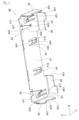
- FIG. 1 is a perspective view of a connector, a wiring board, and a flexible printed wiring board according to an embodiment of the present invention, as viewed from above.
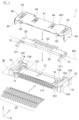
- FIG. 2 is an exploded perspective view showing a connector according to an embodiment of the present invention.
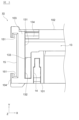
- FIG. 3 is a diagram showing a housing in the embodiment of the present invention, and is an enlarged plan view of part III in FIG.
- FIG. 4 is an end view taken along line IV-IV in FIG.
- FIG. 5 is a perspective view of the locking member according to the embodiment of the present invention, as viewed from below.
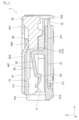
- FIG. 6 is a cross-sectional view taken along the line VI-VI in FIG.
- FIG. 7 is a perspective view of the shell according to the embodiment of the present invention, seen from below.
- FIG. 1 is a perspective view of a connector, a wiring board, and a flexible printed wiring board according to an embodiment of the present invention, as viewed from above.
- FIG. 2 is an exploded perspective view showing a connector according to an
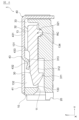
- FIG. 8 is a cross-sectional view taken along line VIII-VIII in FIG.
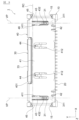
- FIG. 9 is a plan view of a connector according to an embodiment of the present invention.
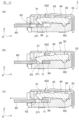
- 10(a) to 10(c) are cross-sectional views showing the operation of a connector in an embodiment of the present invention, where FIG. 10(a) is a diagram showing a state in which a flexible printed wiring board is in the middle of being inserted into the connector, FIG. 10(b) is a diagram showing a state in which the locking member has locked the flexible printed wiring board, and FIG. 10(c) is a diagram showing a state in which the locking member 30 has been released and the flexible printed wiring board 60 is in the middle of being extracted from the connector 1.
- FIG. 1 is a perspective view of a connector 1, a wiring board 50, and a flexible printed circuit board (FPC) 60 in an embodiment of the present invention, viewed from above.
- FPC flexible printed circuit board
- the connector 1 in this embodiment is an electrical connector mounted on a wiring board 50.
- This connector 1 electrically connects the wiring board 50 to a flexible printed wiring board 60 inserted into an insertion portion 11 (described below) of a housing 10.
- the wiring board 50 in this embodiment is a rigid board, but is not limited to this, and a board other than a rigid board may be used as the wiring board 50.
- the flexible printed circuit board 60 has multiple (20 in this example) signal patterns 61 and a pair of ground patterns 62.
- each signal pattern 61 comes into contact with a terminal 20 (described below) of the connector 1
- each ground pattern 62 comes into contact with a protruding piece 42 (described below) of the shell 40 of the connector 1.
- the flexible printed wiring board 60 has a pair of notches 63 near its tip.
- the pair of notches 63 are formed at both ends of the flexible printed wiring board 60 in the horizontal direction (X direction in the figure).
- the parts of the flexible printed wiring board 60 on the tip side (+Y direction in the figure) of the notches 63 form convex portions 64 that protrude in the horizontal direction (X direction in the figure).
- the number and shape of the wiring patterns of the flexible printed wiring board 60 are not particularly limited to those described above and can be set arbitrarily.
- the flexible printed wiring board 60 of this embodiment has wiring patterns on only one side thereof, but the flexible printed wiring board inserted into the insertion portion 11 of the connector 1 may have wiring patterns on both sides thereof.
- This flexible printed wiring board 60 corresponds to an example of a "signal transmission member" in this aspect of the present invention.
- the signal transmission member inserted into the insertion portion 11 of the connector 1 is not limited to the flexible printed wiring board 60 described above, and may be, for example, a flexible flat cable (FFC).
- the direction in which the flexible printed wiring board 60 is inserted into and removed from the connector 1 is substantially parallel to the extension direction of the main surface of the wiring board 50 (XY plane direction in the figure).
- the direction in which the flexible printed wiring board 60 is inserted into and removed from the connector 1 is not particularly limited to this.
- the direction in which the flexible printed wiring board 60 is inserted into and removed from the connector 1 may be substantially perpendicular to the extension direction of the main surface of the wiring board 50 (XY plane direction in the figure).
- FIG. 2 is an exploded perspective view showing a connector 1 according to an embodiment of the present invention.
- FIG. 3 is a view showing a housing 10 according to an embodiment of the present invention, and is an enlarged plan view of part III in FIG. 2.
- FIG. 4 is an end view taken along line IV-IV in FIG. 1.
- the connector 1 of this embodiment includes a housing 10, a plurality of terminals 20 (20 in this example), a locking member 30, and a shell 40.
- This connector 1 is assembled by placing the locking member 30 on the housing 10 that accommodates the terminals 20, and then covering the housing 10 with the shell 40 so as to sandwich the locking member 30.
- the number of terminals 20 included in the connector 1 is not particularly limited to the above, and can be set according to, for example, the number of signal patterns 61 included in the flexible printed wiring board 60.
- the housing 10 is made of an electrically insulating material. Although not limited thereto, for example, the housing 10 is a molded product made of a resin material. As shown in Figures 2 and 3, the housing 10 has an insertion portion 11, a recess 13, a pair of holes 14, and a pair of holding portions 15.
- the insertion portion 11 is a recess that opens into the front surface 101 of the housing 10. This insertion portion 11 extends along the width direction of the connector 1 (the X direction in the figure).
- This insertion portion 11 has multiple grooves 111 (20 in this example). Each groove 111 extends along the front-rear direction of the connector 1 (Y direction in the figure). The multiple grooves 111 are also disposed at equal intervals along the width direction of the connector 1 (X direction in the figure) and are aligned parallel to one another. Furthermore, as shown in FIG. 4, a through hole 12 is formed on the extension line of the groove 111. This through hole 12 penetrates the housing 10 and opens to the rear surface 102 of the housing 10. A terminal 20 is inserted into each groove 111 and through hole 12.
- the recess 13 is a generally U-shaped recess formed on the top surface 103 of the housing 10.
- the recess 13 has a shape corresponding to the locking member 30, and the locking member 30 is inserted into the recess 13 and held in the housing 10.
- the recess 13 includes a main body portion 131 and a pair of extension portions 132.
- the main body 131 extends in the width direction of the connector 1 (X direction in the figure).
- the connecting portion 32 and the operating portion 33 (described later) of the locking member 30 are inserted into this main body 131.
- a support surface 134 is formed on the bottom of this main body 131.
- This support surface 134 has a semicircular cross-sectional shape corresponding to the semicylindrical portion 321 (described later) of the locking member 30 (see FIG. 6 described later).
- the locking member 30 is rotatably held in the housing 10 with the center RC of this semicylindrical portion 321 as the center of rotation.
- the main body 131 also opens to the rear surface 102 of the housing 10 to allow the operating portion 33 (described later) of the locking member 30 to protrude rearward.
- a pair of extensions 132 extend from both ends of the main body 131 toward the front of the connector 1 (the -Y direction in the figure).
- a lock arm 31 (described below) of the locking member 30 is inserted into each of the extensions 132.
- a through hole 133 is formed in the bottom of each of the extensions 132 (see Figure 3 and Figure 6 described below).
- Each through hole 133 penetrates the housing 10 and opens into the insertion portion 11.
- a hook 311 (described below) of the locking member 30 is positioned within the insertion portion 11 of the housing 10 via this through hole 133.
- each hole 14 is disposed so as to be located between the outermost groove 111 in the insertion section 11 and the through hole 133 of the recess 13 in the width direction of the connector 1 (X direction in the figure).
- Each hole 14 opens to the upper surface 103 of the housing 10 and penetrates the housing 10 so as to open to the insertion section 11 of the housing 10 (see FIG. 8 described below).
- the protruding piece 42 (described below) of the shell 40 is inserted into the pair of holes 14.
- the number and positions of the holes 14 are not particularly limited to those described above, and can be set according to the number and positions of the ground patterns 62 of the flexible printed wiring board 60.
- a pair of retaining portions 15 are formed on both side surfaces 104 of the housing 10.
- Each retaining portion 15 is composed of a recess having two grooves 151 facing each other.
- Each groove 151 penetrates the housing 10 in the up-down direction of the connector 1 (Z direction in the figure).
- the side plate portion 45 of the shell 40 is pressed into this groove 151, thereby retaining (fixing) the shell 40 to the housing 10.
- Each terminal 20 is made of a conductive material. Although not limited thereto, the terminals 20 are made of, for example, a metal material. As shown in FIG. 4, the terminals 20 have a fixed portion 21, an elastic portion 22, and a contact portion 23. The terminals 20 are formed by processing a metal plate material, and the fixed portion 21, the elastic portion 22, and the contact portion 23 are integrally formed. The terminals 20 are each inserted into the grooves 111 of the insertion portion 11 of the housing 10 described above.
- the fixing portion 21 has a locking portion 211 on its rear side (the +Y direction side in the figure). This locking portion 211 is press-fitted into the through hole 12 of the housing 10 described above, thereby holding (fixing) the terminal 20 to the housing 10.
- the fixing portion 21 also has a board connection portion 212 on its front side (the -Y direction side in the figure). This board connection portion 212 is joined to the signal pattern (wiring pattern) of the wiring board 50 by soldering or the like, thereby electrically connecting the terminal 20 to the wiring board 50.
- the elastic portion 22 branches upward (in the +Z direction in the figure) from the center of the fixed portion 21 and extends in a generally L-shape.
- the contact portion 23 is connected to the other end of the elastic portion 22 so as to protrude from the groove 111 into the space of the insertion portion 11.
- the elastic portion 22 is interposed between the contact portion 23 and the fixed portion 21, and the contact portion 23 can move as the elastic portion 22 elastically deforms. Therefore, when the flexible printed wiring board 60 is inserted into the connector 1, the contact portion 23 of the terminal 20 comes into contact with the signal pattern 61 of the flexible printed wiring board 60, and the flexible printed wiring board 60 and the terminal 20 are electrically connected.
- FIG. 5 is a perspective view of the locking member 30 in this embodiment seen from below
- FIG. 6 is a cross-sectional view taken along line VI-VI in FIG. 1.
- the locking member 30 is made of an electrically insulating material. As shown in Figures 2 and 5, the locking member 30 has a pair of locking arms 31, a connecting portion 32, and an operating portion 33.
- the locking member 30 has a generally U-shape that corresponds to the shape of the recess 13 of the housing 10 described above.
- the locking member 30 is a molded product made of a resin material, and the locking arms 31, connecting portion 32, and operating portion 33 are integrally formed.
- the pair of locking arms 31 extend along the front-rear direction of the connector 1 (Y direction in the figure).
- Each locking arm 31 has a hook 311 at its tip.
- the hook 311 protrudes downward (-Z direction in the figure) from the main body 312 of the locking arm 31.
- the pair of locking arms 31 are each inserted into the extension portion 132 of the recess 13 of the housing 10 described above. As shown in FIG. 6, each hook 311 is inserted into the through hole 133 of the extension portion 132 described above.
- the hook 311 enters the notch 63 of the flexible printed wiring board 60 and engages with the protrusion 64 of the flexible printed wiring board 60.
- the rear ends of the pair of locking arms 31 are connected to a connecting portion 32. That is, the connecting portion 32 is interposed between the pair of locking arms 31, and the locking arms 31 are connected to both ends of the connecting portion 32, and the connecting portion 32 connects the locking arms 31 to each other.
- the connecting portion 32 is also provided with an operating portion 33 that enables an operator to operate the connector 1.
- the operating portion 33 protrudes from the center of the connecting portion 32 toward the rear (+Y direction in the figure) and upward (+Z direction in the figure).
- the connecting portion 32 and the operating portion 33 are inserted into the main body portion 131 of the recess 13 of the housing 10 described above.
- the connecting portion 32 has a semi-cylinder portion 321 on its bottom surface.
- This semi-cylinder portion 321 has a semi-circular cross-sectional shape that corresponds to the shape of the support surface 134 of the housing 10 described above. Therefore, the locking member 30 is rotatably held on the housing 10 with the center RC of this semi-cylinder portion 321 as the center of rotation.
- the locking member 30 can rotate between a locked position and an unlocked position.
- the locked position is a position where the connector 1 locks the flexible printed wiring board 60 and the flexible printed wiring board 60 cannot be pulled out from the connector 1 (see FIG. 6 and FIG. 10(b) described below).
- the hook 311 enters the notch 63 of the flexible printed wiring board 60 and engages with the protrusion 64.
- the unlocked position is a position where the lock by the connector 1 is released and the flexible printed wiring board 60 can be pulled out from the insertion portion 11 of the housing 10 (see FIG. 10(c) described below).
- the hook 311 leaves the notch 63 of the flexible printed wiring board 60 and the engagement between the hook 311 and the protrusion 64 is released.
- FIG. 7 is a perspective view of the shell 40 in an embodiment of the present invention, seen from below;
- FIG. 8 is a cross-sectional view taken along line VIII-VIII in FIG. 1; and
- FIG. 9 is a plan view of the connector 1 in an embodiment of the present invention.
- the shell 40 is made of a conductive material. Although not limited thereto, the shell 40 is made of, for example, a metal material. As shown in Figs. 2 and 7, the shell 40 has an upper plate portion 41, a pair of side plate portions 45, and a back plate portion 46.
- the upper plate portion 41 of the shell 40 corresponds to an example of a "plate-shaped portion" in an aspect of the present invention.
- the shell 40 is formed by processing a metal plate material, and the upper plate portion 41, the side plate portion 45, and the back plate portion 46 are integrally formed.
- the shell 40 functions as an electromagnetic shield because the shell 40 is conductive and covers the housing 10 that holds the terminals 20. As described above, when the locking member 30 is placed in the recess 13 of the housing 10, the shell 40 covers the upper surface 103 of the housing 10 and sandwiches the locking member 30 between the housing 10 and the shell 40, so the shell 40 also has the function of holding the locking member 30.
- the upper plate portion 41 is a plate-like portion that extends substantially parallel to the width direction of the connector 1 (X direction in the figure) and the front-rear direction of the connector 1 (Y direction in the figure). When the shell 40 is attached to the housing 10, this upper plate portion 41 covers the upper surface 103 of the housing 10.
- the pair of side plate portions 45 extend downward (-Z direction in the figure) from both edges of the upper plate portion 41 that are aligned along the width direction of the connector 1 (X direction in the figure).
- the back plate portion 46 also extends downward (-Z direction in the figure) from the edge at the rear of the connector 1 (+Y direction in the figure).
- the side plate portion 45 and the back plate portion 46 have protrusions 451, 461 at their tips, respectively.
- the shell 40 is electrically connected to the wiring board 50 by joining the protrusions 451, 461 to the ground pattern (wiring pattern) of the wiring board 50 by soldering or the like.
- the upper plate portion 41 and the back plate portion 46 are continuously formed with notches 401 for exposing the operating portion 33 of the locking member 30 from the shell 40.
- openings for exposing the operating portion 33 from the shell 40 may be continuously formed in the upper plate portion 41 and the back plate portion 46.
- the shell 40 of this embodiment has three types of protruding pieces 42 to 44 that protrude downward from the upper plate portion 41. All of the protruding pieces 42 to 44 are formed integrally with the upper plate portion 41. In other words, all of the protruding pieces 42 to 44 form part of the shell 40.
- Protruding piece 42 corresponds to an example of a "second protruding piece” in this embodiment of the present invention
- protruding piece 43 corresponds to an example of a "first protruding piece” in this embodiment of the present invention
- protruding piece 44 corresponds to an example of a "third protruding piece” in this embodiment of the present invention. Note that either one of protruding pieces 42, 44 may be omitted, or both protruding pieces 42, 44 may be omitted.
- the protruding piece 42 is a contact piece that comes into contact with the ground pattern 62 of the flexible printed wiring board 60 when the flexible printed wiring board 60 is inserted into the connector 1.
- This protruding piece 42 is disposed at a position on the upper plate portion 41 of the shell 40 that corresponds to the hole portion 14 of the housing 10 described above. As shown in Figures 7 and 8, this protruding piece 42 has a fixed end 421, a bent portion 422, a contact portion 423, and an extension portion 424.
- This protruding piece 42 is connected at its fixed end 421 to the front edge (-Y direction in the figure) of the upper plate portion 41.
- the protruding piece 42 is bent at a bent portion 422 and extends toward the rear (+Y direction in the figure) and downward (-Z direction in the figure) of the connector 1, allowing it to deform elastically.
- the protruding piece 42 also has a contact portion 423 at its tip.
- An extension portion 424 extends between the contact portion 423 and the bent portion 422, and this extension portion 424 connects the bent portion 422 and the contact portion 423.
- the protruding piece 42 is a spring piece with a cantilever support structure that is elastically deformable with the contact portion 423 as the free end.
- the protruding piece 42 When the shell 40 is attached to the housing 10, the protruding piece 42 is inserted into the hole 14 of the housing 10. Then, when the flexible printed wiring board 60 is inserted into the connector 1, the protruding piece 42 elastically deforms and the contact portion 423 of the protruding piece 42 comes into contact with the ground pattern 62 described above.
- both protrusions 43 and 44 are contact pieces that come into contact with the locking member 30 and urge the locking member 30 toward the above-mentioned locked position.
- These protrusions 43 and 44 are located on the opposite side of the locking member 30 from the flexible printed wiring board 60. In other words, the protrusions 43 and 44 are located above the locking member 30 (in the +Z direction in the figure).
- the protruding piece 43 is disposed at a position on the upper plate portion 41 of the shell 40 that corresponds to the locking arm 31 of the locking member 30. As shown in FIG. 7 and the above-mentioned FIG. 6, this protruding piece 43 has a fixed end 431, a contact portion 432, and an extension portion 433.
- the protruding piece 43 is connected to the edge of the opening 411 of the upper plate portion 41 at the fixed end 431.
- the protruding piece 43 extends from the fixed end 431 toward the front of the connector 1 (in the -Y direction in the figure).
- the protruding piece 43 has a contact portion 432 at its tip that protrudes downward (in the -Z direction in the figure).
- the contact portion 432 contacts the upper surface of the main body portion 312 of the locking arm 31 (the surface on the +Z direction side in the figure).
- An extension portion 433 extends between the fixed end 431 and the contact portion 432, and the fixed end 431 and the contact portion 432 are connected by the extension portion 433.
- the protruding piece 43 is a spring piece with a cantilever support structure that is elastically deformable with the contact portion 432 as the free end, and presses the locking member 30 downward (in the -Z direction in the figure), urging the locking member 30 toward the above-mentioned lock position.
- the hook 311 of the locking member 30 and the contact portion 432 of the protruding piece 43 of the shell 40 are located on the same imaginary plane VP.
- This imaginary plane VP is a plane that extends in a direction substantially perpendicular to the center of rotation RC of the rotational movement of the locking member 30 relative to the housing 10.
- the portion 313 (see FIG. 6) of the locking member 30 with which the contact portion 432 is in contact can be positioned near the hook 311.
- the protruding piece 44 is disposed at a position on the upper plate portion 41 of the shell 40 that corresponds to the connecting portion 32 of the locking member 30. In other words, this protruding piece 44 is disposed closer to the center of the upper plate portion 41 in the width direction of the shell 40 (X direction in the figure) than the protruding piece 43. As shown in Figure 7 and the above-mentioned Figure 4, this protruding piece 44 has a fixed end 441, a contact portion 442, and an extension portion 443.
- the protruding piece 44 is connected to the edge of the opening 412 of the upper plate portion 41 at the fixed end 441.
- the protruding piece 44 extends from the fixed end 441 toward the rear of the connector 1 (the +Y direction in the figure).
- the protruding piece 44 has a contact portion 442 at its tip that protrudes downward (the -Z direction in the figure).
- the contact portion 442 contacts the upper surface (the surface on the +Z direction side in the figure) of the connecting portion 32 of the lock arm 31.
- the portion of the connecting portion 32 with which the contact portion 442 contacts is a portion forward of the center of rotation RC in the front-rear direction of the connector 1 (the Y direction in the figure) (the -Y direction in the figure).
- An extension portion 443 extends between the fixed end 441 and the contact portion 442, and the fixed end 441 and the contact portion 442 are connected by the extension portion 443. That is, the protruding piece 44 is a spring piece with a cantilever support structure that is elastically deformable with the contact portion 442 as the free end, and presses the locking member 30 downward (in the -Z direction in the figure), urging the locking member 30 toward the above-mentioned locked position.
- Figures 10(a) to 10(c) are cross-sectional views showing the operation of connector 1 in an embodiment of the present invention. Specifically, Figure 10(a) is a diagram showing the state in which flexible printed wiring board 60 is being inserted into connector 1, Figure 10(b) is a diagram showing the state in which locking member 30 has locked flexible printed wiring board 60, and Figure 10(c) is a diagram showing the state in which flexible printed wiring board 60 is being removed from connector 1 after unlocking locking member 30. Note that Figures 10(a) to 10(c) are cross-sectional views corresponding to Figure 6 described above.
- the worker When inserting the flexible printed wiring board 60 into the connector 1, as shown in FIG. 10(a), the worker first inserts the flexible printed wiring board 60 into the insertion portion 11 of the housing 10 of the connector 1 and abuts the tip of the flexible printed wiring board 60 against the hook 311 of the locking member 30.
- the locking member 30 rotates clockwise in the figure against the biasing force of the protruding pieces 43, 44 of the shell 40, and the hook 311 of the locking member 30 is pushed up and rides onto the protruding portion 64 of the flexible printed wiring board 60.
- the hook 311 of the locking member 30 and the contact portion 432 of the protruding piece 43 are located on the same imaginary plane VP that extends in a direction substantially perpendicular to the rotation axis RC of the locking member 30. Therefore, the portion 313 of the locking member 30 with which the contact portion 432 is in contact can be positioned close to the hook 311, thereby improving the holding force that holds the flexible printed wiring board 60 of the connector 1.
- the protruding piece 43 is integrally formed with the shell 40, which also reduces the number of parts in the connector 1.
- the shell 40 functions as an electromagnetic shield, which further reduces the number of parts in the connector 1.
- the shell 40 is held in the housing 10 so that the locking member 30 is sandwiched between the housing 10 and the shell 40, so that the locking member 30 is sufficiently prevented from coming loose from the housing 10.
- the connector 1 in addition to the protruding piece 43, the connector 1 is provided with the protruding piece 44 as a member for biasing the locking member 30, so that the biasing force of the locking member 30 can be reinforced and stabilized.
- the protruding piece 43 is formed integrally with the shell 40, but if the protruding piece 43 is located on the opposite side of the locking member 30 from the flexible printed wiring board 60, the protruding piece 43 may be a separate member independent of the shell 40 and joined to the shell 40.
- the protruding piece 44 is formed integrally with the shell 40, but if the protruding piece 44 is located on the opposite side of the locking member 30 from the flexible printed wiring board 60, the protruding piece 44 may be a separate member independent of the shell 40 and joined to the shell 40.
- the housing 10 is covered with a shell 40 made of a conductive material to provide the connector 1 with an electromagnetic wave shielding function, but instead of the shell 40, the housing 10 may be covered with a cover member made of a non-conductive material such as a resin material.
- the protruding piece 43 may be formed integrally with the cover member, or the protruding piece 43 may be a separate member independent of the cover member, and the protruding piece 43 may be joined to the cover member.
- the protruding piece 44 may be formed integrally with the cover member, or the protruding piece 44 may be a separate member independent of the cover member, and the protruding piece 44 may be joined to the cover member.
Landscapes
- Coupling Device And Connection With Printed Circuit (AREA)
- Details Of Connecting Devices For Male And Female Coupling (AREA)
Priority Applications (3)
| Application Number | Priority Date | Filing Date | Title |
|---|---|---|---|
| EP24741536.7A EP4651310A1 (en) | 2023-01-13 | 2024-01-10 | Electrical connector |
| JP2024570198A JPWO2024150764A1 (https=) | 2023-01-13 | 2024-01-10 | |
| CN202480005251.0A CN120345135A (zh) | 2023-01-13 | 2024-01-10 | 电连接器 |
Applications Claiming Priority (2)
| Application Number | Priority Date | Filing Date | Title |
|---|---|---|---|
| JP2023004032 | 2023-01-13 | ||
| JP2023-004032 | 2023-01-13 |
Publications (1)
| Publication Number | Publication Date |
|---|---|
| WO2024150764A1 true WO2024150764A1 (ja) | 2024-07-18 |
Family
ID=91896960
Family Applications (1)
| Application Number | Title | Priority Date | Filing Date |
|---|---|---|---|
| PCT/JP2024/000304 Ceased WO2024150764A1 (ja) | 2023-01-13 | 2024-01-10 | 電気コネクタ |
Country Status (4)
| Country | Link |
|---|---|
| EP (1) | EP4651310A1 (https=) |
| JP (1) | JPWO2024150764A1 (https=) |
| CN (1) | CN120345135A (https=) |
| WO (1) | WO2024150764A1 (https=) |
Citations (8)
| Publication number | Priority date | Publication date | Assignee | Title |
|---|---|---|---|---|
| CN201528066U (zh) * | 2009-05-22 | 2010-07-14 | 庆盟工业股份有限公司 | 电子卡连接器 |
| JP2011014397A (ja) * | 2009-07-02 | 2011-01-20 | I-Pex Co Ltd | 電気コネクタ |
| US20110111606A1 (en) * | 2008-07-03 | 2011-05-12 | Jun-Ho Lee | Fpc connector for electrically connecting an fpc to pcb and fpc-connection method using the same |
| JP2013239410A (ja) * | 2012-05-17 | 2013-11-28 | Daiichi Seiko Co Ltd | コネクタ装置 |
| WO2016047251A1 (ja) * | 2014-09-22 | 2016-03-31 | 京セラコネクタプロダクツ株式会社 | ケーブル用コネクタ |
| JP2018060821A (ja) * | 2018-01-19 | 2018-04-12 | 京セラ株式会社 | ケーブル用コネクタ |
| CN113193431A (zh) * | 2021-04-30 | 2021-07-30 | 苏州祥龙嘉业电子科技股份有限公司 | 一种自锁功能的fpc连接器 |
| JP2023004032A (ja) | 2021-06-25 | 2023-01-17 | キヤノン株式会社 | 画像読取装置及び画像形成装置 |
-
2024
- 2024-01-10 JP JP2024570198A patent/JPWO2024150764A1/ja active Pending
- 2024-01-10 EP EP24741536.7A patent/EP4651310A1/en active Pending
- 2024-01-10 WO PCT/JP2024/000304 patent/WO2024150764A1/ja not_active Ceased
- 2024-01-10 CN CN202480005251.0A patent/CN120345135A/zh active Pending
Patent Citations (8)
| Publication number | Priority date | Publication date | Assignee | Title |
|---|---|---|---|---|
| US20110111606A1 (en) * | 2008-07-03 | 2011-05-12 | Jun-Ho Lee | Fpc connector for electrically connecting an fpc to pcb and fpc-connection method using the same |
| CN201528066U (zh) * | 2009-05-22 | 2010-07-14 | 庆盟工业股份有限公司 | 电子卡连接器 |
| JP2011014397A (ja) * | 2009-07-02 | 2011-01-20 | I-Pex Co Ltd | 電気コネクタ |
| JP2013239410A (ja) * | 2012-05-17 | 2013-11-28 | Daiichi Seiko Co Ltd | コネクタ装置 |
| WO2016047251A1 (ja) * | 2014-09-22 | 2016-03-31 | 京セラコネクタプロダクツ株式会社 | ケーブル用コネクタ |
| JP2018060821A (ja) * | 2018-01-19 | 2018-04-12 | 京セラ株式会社 | ケーブル用コネクタ |
| CN113193431A (zh) * | 2021-04-30 | 2021-07-30 | 苏州祥龙嘉业电子科技股份有限公司 | 一种自锁功能的fpc连接器 |
| JP2023004032A (ja) | 2021-06-25 | 2023-01-17 | キヤノン株式会社 | 画像読取装置及び画像形成装置 |
Non-Patent Citations (1)
| Title |
|---|
| See also references of EP4651310A1 |
Also Published As
| Publication number | Publication date |
|---|---|
| JPWO2024150764A1 (https=) | 2024-07-18 |
| CN120345135A (zh) | 2025-07-18 |
| EP4651310A1 (en) | 2025-11-19 |
Similar Documents
| Publication | Publication Date | Title |
|---|---|---|
| US6315616B1 (en) | Plug connector and socket connector | |
| CN102651519B (zh) | 连接器装置 | |
| CN101997198B (zh) | 连接装置 | |
| TWI446647B (zh) | 連接器裝置 | |
| EP1505695B1 (en) | Electrical connector improving both functions of magnetic shielding and ground connection | |
| JP5093340B2 (ja) | コネクタ装置 | |
| CN102637979B (zh) | 连接器装置 | |
| CN102210067B (zh) | 连接器装置 | |
| CN102570089B (zh) | 连接器装置 | |
| EP1235304B1 (en) | Connector for flat circuit member | |
| JP2011119162A (ja) | コネクタ装置 | |
| JP4152019B2 (ja) | 多極同軸コネクタ | |
| JP2012169243A (ja) | フレキシブルケーブルコネクタ | |
| JP2011086428A (ja) | コネクタ装置 | |
| KR20020068955A (ko) | 전기 커넥터 | |
| JP2012221859A (ja) | コネクタ装置 | |
| JP5303309B2 (ja) | フレキシブル基板用コネクタ | |
| JP3251046U (ja) | 扁平な接続対象物用のイージーロックコネクタ | |
| JP3249525U (ja) | 扁平な接続対象物用のコネクタ | |
| WO2024150764A1 (ja) | 電気コネクタ | |
| JP3251964U (ja) | 扁平な接続対象物用のイージーロックコネクタ | |
| JP2004063273A (ja) | シールドコネクタ | |
| JP6452751B2 (ja) | コネクタ | |
| CN223884725U (zh) | 易锁连接器、连接器壳体及易锁连接器总成 | |
| JP4270418B2 (ja) | フレキシブル印刷配線基板用コネクタ |
Legal Events
| Date | Code | Title | Description |
|---|---|---|---|
| 121 | Ep: the epo has been informed by wipo that ep was designated in this application |
Ref document number: 24741536 Country of ref document: EP Kind code of ref document: A1 |
|
| WWE | Wipo information: entry into national phase |
Ref document number: 2024570198 Country of ref document: JP |
|
| WWE | Wipo information: entry into national phase |
Ref document number: 202480005251.0 Country of ref document: CN |
|
| WWP | Wipo information: published in national office |
Ref document number: 202480005251.0 Country of ref document: CN |
|
| NENP | Non-entry into the national phase |
Ref country code: DE |
|
| WWP | Wipo information: published in national office |
Ref document number: 2024741536 Country of ref document: EP |