WO2024144331A1 - 자일렌 디이소시아네이트 조성물 및 이소시아누레이트의 제조 방법 - Google Patents
자일렌 디이소시아네이트 조성물 및 이소시아누레이트의 제조 방법 Download PDFInfo
- Publication number
- WO2024144331A1 WO2024144331A1 PCT/KR2023/021946 KR2023021946W WO2024144331A1 WO 2024144331 A1 WO2024144331 A1 WO 2024144331A1 KR 2023021946 W KR2023021946 W KR 2023021946W WO 2024144331 A1 WO2024144331 A1 WO 2024144331A1
- Authority
- WO
- WIPO (PCT)
- Prior art keywords
- xylene diisocyanate
- weight
- isocyanurate
- reaction
- composition
- Prior art date
- Legal status (The legal status is an assumption and is not a legal conclusion. Google has not performed a legal analysis and makes no representation as to the accuracy of the status listed.)
- Ceased
Links
Classifications
-
- C—CHEMISTRY; METALLURGY
- C07—ORGANIC CHEMISTRY
- C07C—ACYCLIC OR CARBOCYCLIC COMPOUNDS
- C07C263/00—Preparation of derivatives of isocyanic acid
- C07C263/18—Separation; Purification; Stabilisation; Use of additives
-
- C—CHEMISTRY; METALLURGY
- C07—ORGANIC CHEMISTRY
- C07C—ACYCLIC OR CARBOCYCLIC COMPOUNDS
- C07C265/00—Derivatives of isocyanic acid
- C07C265/14—Derivatives of isocyanic acid containing at least two isocyanate groups bound to the same carbon skeleton
-
- C—CHEMISTRY; METALLURGY
- C07—ORGANIC CHEMISTRY
- C07D—HETEROCYCLIC COMPOUNDS
- C07D251/00—Heterocyclic compounds containing 1,3,5-triazine rings
- C07D251/02—Heterocyclic compounds containing 1,3,5-triazine rings not condensed with other rings
- C07D251/12—Heterocyclic compounds containing 1,3,5-triazine rings not condensed with other rings having three double bonds between ring members or between ring members and non-ring members
- C07D251/26—Heterocyclic compounds containing 1,3,5-triazine rings not condensed with other rings having three double bonds between ring members or between ring members and non-ring members with only hetero atoms directly attached to ring carbon atoms
- C07D251/30—Only oxygen atoms
- C07D251/32—Cyanuric acid; Isocyanuric acid
Definitions
- Polyurethane resins are generally manufactured by reacting polyisocyanates with compounds containing active hydrogen groups, and are widely used in various industrial fields, such as paints, adhesives, and elastomers. It is also used in electronic products, automobile interior materials, and ink coating hardeners.
- a polyisocyanate used in the production of polyurethane resin for example, a polyisocyanate composition obtained by isocyanurating xylene diisocyanate in the presence of an isocyanurating catalyst has been proposed.
- BHT Butylated_Hydroxy_Toluene
- the present invention includes xylene diisocyanate and chloromethylbenzyl isocyanate, wherein the chloromethylbenzyl isocyanate is present in an amount ranging from more than 0.1% by weight to 0.3% by weight based on the total weight of xylene diisocyanate and chloromethylbenzyl isocyanate. Including the following,
- it includes the step of isocyanurating the above-described xylene diisocyanate composition in the presence of an isocyanurating catalyst,
- the present invention by optimizing the content of chloromethylbenzyl isocyanate in the xylene diisocyanate composition, it has excellent storage stability and at the same time has the excellent effect of being able to produce isocyanurate with high reaction efficiency.
- part by weight refers to a relative concept expressed as a ratio of the weight of the remaining material based on the weight of a certain material. For example, in a mixture containing 50 g of substance A, 20 g of substance B, and 30 g of substance C, the amounts of substance B and substance C would each be 40 parts by weight based on 100 parts by weight of substance A. parts by weight and 60 parts by weight.
- a xylene diisocyanate composition in which chloromethylbenzyl isocyanate and xylene diisocyanate are optimized at a predetermined ratio.
- chloromethylbenzyl isocyanate is characterized in that it ranges from more than 0.1% by weight to 0.3% by weight or less based on the total weight of xylene diisocyanate and chloromethylbenzyl isocyanate.
- the content of chloromethylbenzyl isocyanate may range from more than 0.1% by weight to 0.29% by weight or less.
- the amount of chloromethylbenzyl isocyanate is at least about 0.11% by weight, or at least about 0.12% by weight, at least about 0.13% by weight, or at least about 0.14% by weight, or at least about 0.15% by weight, and is about 0.29% by weight. or less than or equal to about 0.28 wt.%, or less than or equal to about 0.27 wt.%, or less than or equal to about 0.25 wt.%, or less than or equal to about 0.22 wt.%, or less than or equal to about 0.20 wt.%, or less than or equal to about 0.18 wt.%, or less than or equal to about 0.15 wt.%. You can.
- the content of chloromethylbenzyl isocyanate may be about 0.11% by weight or more to 0.27% by weight.
- CMBI chloromethylbenzyl isocyanate
- the content of chloromethylbenzyl isocyanate can be measured through analysis by gas chromatography (GC), and the specific measurement method is described in Test Example 1 described later. Same as described.
- GC gas chromatography
- the xylene diisocyanate composition was analyzed by gas chromatography (GC) under the following conditions, using chloromethylbenzyl isocyanate with a purity of 95 mol% as a standard material, and the following gas chromatography (GC) It can be measured by creating a calibration curve from the area value of a gas chromatograph (GC) obtained under analysis conditions.
- GC gas chromatography
- chloromethylbenzyl isocyanate may be produced together during the production or synthesis of xylene diisocyanate and included in the xylene diisocyanate composition.
- the content of chloromethylbenzyl isocyanate may be adjusted in the production or synthesis process of xylene diisocyanate, for example, in the purification process.
- chloromethylbenzyl isocyanate may include ortho-chloromethylbenzyl isocyanate, meta-chloromethylbenzyl isocyanate, and para-chloromethylbenzyl isocyanate. These may be included alone or in combination of two or more in the xylene diisocyanate composition.
- xylene diisocyanate examples include 1,3-XDI and 1,4-XDI, and more preferably 1,3-XDI.
- XDI can be synthesized from xylene diamine through the phosgene method.
- isocyanate can be prepared by directly reacting xylene diamine with phosgene in a solvent, or XDI can be synthesized by producing its carbonate or hydrochloride salt and then reacting the amine salt with phosgene (COCl 2 ).
- CMBI chloromethylbenzyl isocyanate
- the method for producing isocyanurate of the present invention includes the step of subjecting the above-described xylene diisocyanate composition to an isocyanurate reaction in the presence of an isocyanurate catalyst.
- the method for producing isocyanurate according to another embodiment of the present invention includes the step of isocyanurating a xylene diisocyanate composition in the presence of an isocyanurating catalyst,
- the xylene diisocyanate composition includes xylene diisocyanate and chloromethylbenzyl isocyanate, and the chloromethylbenzyl isocyanate is present in an amount ranging from more than 0.1% by weight to 0.3% by weight based on the total weight of xylene diisocyanate and chloromethylbenzyl isocyanate. Includes the following.
- the isocyanurate catalyst is not particularly limited as long as it is an effective catalyst for isocyanurate, for example, dimethylcyclohexylamine, tetramethylpropanediamine, tetramethylethanediamine, dimethylaminopropylamine, or 2 Tertiary amines such as 4,6-Tris(dimethylaminomethyl)phenol; Hydroxides of tetraalkyl ammonium, such as tetramethylammonium, tetraethylammonium, tetrabutyl ammonium, and trimethylbenzyl ammonium, or organic weak salts thereof, such as trimethylhydroxypropyl ammonium, trimethylhydroxyethylammonium, and triethyl hydroxypropyl ammonium.
- tetraalkyl ammonium such as tetramethylammonium, tetraethylammonium, tetrabutyl ammonium, and trimethylbenzyl ammoni
- examples include Zwitter ion type hydroxyalkyl quaternary ammonium compounds, and more specifically, examples include N-(2-hydroxypropyl)-N,N,N- Trimethylammonium-2-ethylhexanoate, N,N-dimethyl-N-hydroxyethyl-N-2-hydroxypropyl ammonium hexanoate, triethyl-N-2-hydroxypropyl ammonium hexadecanoate, Trimethyl-N-2-hydroxypropyl ammonium phenylcarbonate, trimethyl-N-2-hydroxypropyl ammonium formate, etc. are mentioned.
- the form of use of the isocyanurate catalyst is not particularly limited.
- the solid content of the isocyanurate catalyst may be used directly, or a catalyst solution obtained by dissolving the isocyanurate catalyst in an organic solvent may be used.
- organic solvents in the catalyst solution include alcohols (e.g. methanol, ethanol, propanol, butanol, etc.), ketones (e.g. acetone, methyl ethyl ketone, methyl isobutyl ketone, cyclohexanone, etc.), and nitriles. (e.g. acetonitrile, etc.), alkyl esters (e.g. methyl acetate, ethyl acetate, butyl acetate, isobutyl acetate, etc.), glycol ether esters (e.g.
- methyl cellosolve acetate, ethyl cellosolve acetate) methyl carbitol acetate, ethyl carbitol acetate, ethylene glycol ethyl ether acetate, propylene glycol methyl ether acetate, 3-methyl-3-methoxybutyl acetate, ethyl-3-ethoxypropionate, etc.), ethers (e.g.
- diethyl ether, tetrahydrofuran, dioxane, etc.), polar aprotons for example, N-methylpyrrolidone, dimethylformamide, N,N'-dimethylacetamide, dimethyl sulfoxide, hexamethylphosphide) ponyl amide, etc.
- Organic solvents can be used alone or in combination of two or more.
- glycol ether esters are preferred, and propylene glycol methyl ether acetate is also preferred.
- the solid content concentration (content ratio of the isocyanuration catalyst) of the catalyst solution may be, for example, 60.0% by weight or less, preferably 50.0% by weight or less.
- the isocyanurate catalyst is added to the xylene diisocyanate composition in batches or in portions, mixed and dispersed, and then the xylene diisocyanate (monomer) in the xylene diisocyanate composition is subjected to an isocyanurate reaction.
- the isocyanurate catalyst is used in an amount of 0.001 to 0.5 parts by weight, or 0.002 to 0.4 parts by weight, or 0.005 to 0.3 parts by weight, or 0.008 parts by weight, based on 100 parts by weight of the total weight of the xylene diisocyanate composition. It may be from 0.2 parts by weight to 0.2 parts by weight, or from 0.01 to 0.15 parts by weight, or from 0.02 to 0.12 parts by weight, or from 0.05 to 0.1 parts by weight.
- the addition ratio of the isocyanurate catalyst is more than the above lower limit, the xylene diisocyanate composition can be reliably subjected to the isocyanurate reaction. If the addition ratio of the isocyanurate catalyst is below the above upper limit, gel generation can be stably suppressed when the isocyanurate catalyst is added to the xylene diisocyanate composition.
- This isocyanuration reaction is carried out, for example, in an inert gas atmosphere such as nitrogen gas and under normal pressure (atmospheric pressure).
- the reaction temperature is, for example, room temperature (e.g., 25°C) or higher, preferably 40°C or higher, more preferably 60°C or higher, for example, 100°C or lower,
- the temperature is 90°C or lower and the reaction time is, for example, 30 minutes or longer, preferably 1 hour or longer, also preferably 2 hours or longer, for example 12 hours or shorter, preferably 10 hours or shorter, Also preferably, it is 8 hours or less.
- antioxidants e.g., organic phosphite ester, etc.
- cocatalysts e.g., organic phosphite ester, etc.
- Preferred additives include antioxidants.
- Antioxidants include, for example, phenol-based antioxidants and hindered phenol-based antioxidants, for example, pentaerythritol tetrakis[3-(3,5-di-tert-butyl-4-hydroxyphenyl) Propionate (Irganox 1010, manufactured by Chiba Japan, brand name), octadecyl 3-(3,5-di-tert-butyl-4-hydroxyphenyl) propionate (Irganox 1076, manufactured by Chiba Japan, brand name), 3-(4-hydroxy-3,5-diisopropylphenyl) propionic acid octyl ester (Irganox 1135, manufactured by Chiba Japan, brand name), bis[3-(3-methyl-4-hydroxy- 5-tert-butyl phenyl) propionic acid] ethylenebisoxybisethylene (Irganox 245, manufactured by Chiba Japan, brand name), etc.
- phenol-based antioxidants
- antioxidants can be used alone or two or more types can be used in combination.
- timing of adding the additive is not particularly limited, and may be added to the xylene diisocyanate composition before the isocyanurate reaction, or may be added to the isocyanurate reaction solution during the isocyanurate reaction. It may be added to the isocyanurate reaction solution after the rate conversion reaction. Preferably, it is added to the xylene diisocyanate composition before the isocyanuration reaction.
- the addition ratio of additives is appropriately set depending on the purpose and use.
- the viscosity of the product ingredients is adjusted, so alcohols can be added as needed.
- a xylene diisocyanate composition containing xylene diisocyanate and alcohol are mixed and subjected to a urethanization reaction.
- Alcohols include, for example, monohydric alcohols (e.g., linear monohydric alcohols with 1 to 20 carbon atoms, branched monohydric alcohols with 1 to 20 carbon atoms, etc.), dihydric alcohols (e.g., linear monohydric alcohols with 2 to 20 carbon atoms, etc.) dihydric alcohols, branched dihydric alcohols with 3-20 carbon atoms, alicyclic dihydric alcohols with 6-20 carbon atoms, etc.), trihydric alcohols (e.g. glycerin, trimethylolpropane, etc.), tetrahydric alcohols (e.g. Examples include tetramethylol methane, D-sorbitol, xylitol, D-mannitol, etc.).
- monohydric alcohols e.g., linear monohydric alcohols with 1 to 20 carbon atoms, branched monohydric alcohols with 1 to 20 carbon atoms, etc.
- dihydric alcohols are preferred, and branched dihydric alcohols having 3 to 20 carbon atoms are more preferred.
- Branched dihydric alcohols having 3 to 20 carbon atoms such as 1,2-propanediol, 1,3-butylene glycol (aka 1,3-butanediol), 1,2-butylene glycol, neopentyl glycol, Examples include 3-methyl-1,5-pentanediol, and preferably 1,3-butylene glycol (1,3-butanediol).
- the above-described isocyanurate catalyst is added to the obtained urethane reaction liquid in the above-mentioned mixing ratio, and the xylene diisocyanate composition (including reaction products with alcohols) is subjected to isocyanurate reaction. Additionally, the reaction conditions for the isocyanuration reaction are the same as above.
- the reaction termination agent is added after the conversion rate reaches the target value (e.g., 10% or more, preferably 30% or more, or 35% or more, or 40% or more, for example, 60% or less). By doing so, the isocyanuration reaction is stopped (post-reaction addition step, reaction stop step).
- the target value e.g., 10% or more, preferably 30% or more, or 35% or more, or 40% or more, for example, 60% or less.
- reaction terminating agents include phosphoric acid compounds, sulfonic acid compounds, sulfonamide compounds, and aromatic compounds having a halogen group.
- reaction terminating agents other than the above, for example, monochlor acetic acid, etc. are also included.
- reaction terminator also acts as a storage stabilizer for the isocyanurate reaction solution.
- the active ingredient concentration of the reaction terminator is, for example, 10% by weight or more, preferably 20% by weight or more, for example, 70% by weight or less, preferably 60% by weight or less. am.
- polystyrene standard specimens with a molecular weight of 104 g/mol to 24,600 g/mol can be used.
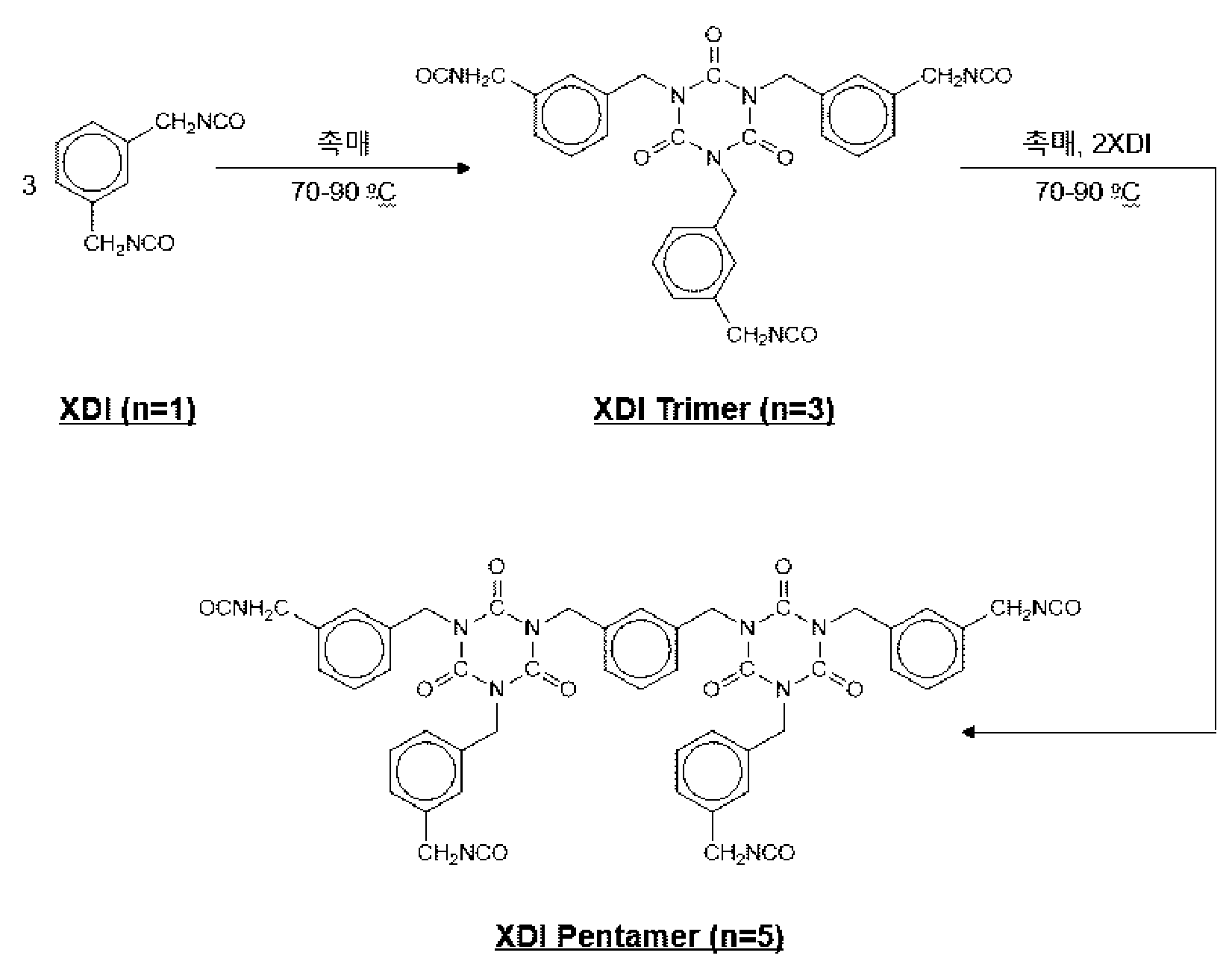
- the isocyanurate obtained after the isocyanuration reaction as a result of GPC (Gel Permeation Chromatography) analysis, excludes xylene diisocyanate (XDI) and has an XDI trimer content. It may be 40% by weight or more, and then the pentamer content and heptamer content may be 25% to 45% by weight, and the sum of these compounds may be 75% by weight or more, or 80% by weight. It may be more than 85% by weight, or more than 88% by weight.
- GPC Gel Permeation Chromatography
- trimer content, pentamer content, and heptamer content of the isocyanurate obtained after the isocyanuration reaction are determined through GPC analysis such as conversion rate measurement.
- the specific measurement method is as described in Test Example 2 and Test Example 3, which will be described later.
- the Trimer content (area%) in the isocyanate composition was determined by performing gel permeation chromatography (GPC) analysis on the isocyanate composition, and the molecular weight distribution curve (GPC curve) for the isocyanate composition (x-axis: weight average molecular weight (M ) of the logarithmic value (log M), Y-axis: molecular weight distribution (dwt/dlog M) for the logarithmic value) is obtained, and the area of the fraction corresponding to Trimer among the total area of the GPC curve is expressed as a percentage.
- trimer content (area%) can be calculated according to Equation 1 below.
- A is the area of the peak corresponding to Trimer in the molecular weight distribution curve for the isocyanate composition.
- the isocyanurate obtained after the isocyanuration reaction has an isocyanate group (NCO) content of 10% by weight or more, or 10% by weight to 25% by weight, or 12% by weight or more, or 12% by weight to 20% by weight. , or it may be 13% by weight or more or 13% by weight to 19% by weight.
- NCO isocyanate group
- the isocyanate group (NCO) content in the isocyanurate obtained after the isocyanuration reaction can be measured by a titration method using dibutylamine based on ASTM-D2572.
- the product component containing the isocyanurate of xylene diisocyanate and unreacted xylene are mixed in the isocyanurate reaction solution. It may further include a process of separating the recovered components containing diisocyanate.
- the recovered component containing unreacted xylene diisocyanate (monomer) is separated as a low boiling point component. More specifically, the recovered component to be separated may contain unreacted xylene diisocyanate (monomer) and an acid component (and an organic solvent mixed as necessary).
- the xylene diisocyanate composition contains chloromethylbenzyl isocyanate in a predetermined ratio
- isocyanurate has excellent film drying properties, good coating heat resistance, excellent weather resistance, and good compatibility with solvents. It has excellent effects in ensuring efficiency.
- CMBI chloromethylbenzyl isocyanate
- m-XDI meta-xylene diisocyanate
- CMBI chloromethylbenzyl isocyanate
- m-XDI meta-xylene diisocyanate
- CMBI chloromethylbenzyl isocyanate
- m-XDI meta-xylene diisocyanate
Landscapes
- Chemical & Material Sciences (AREA)
- Organic Chemistry (AREA)
- Polyurethanes Or Polyureas (AREA)
Abstract
Description
| CMBI 함량 (중량%) | |
| 제조예 1 | 0.12 |
| 제조예 2 | 0.11 |
| 제조예 3 | 0.2 |
| 제조예 4 | 0.15 |
| 제조예 5 | 0.27 |
| 비교 제조예 1 | 0.6 |
| 비교 제조예 2 | 0.01 |
| 비교 제조예 3 | 0.04 |
| 이소시아누레이트화 반응시 겔화 여부 | 5시간 반응후 전환율 40% 이상 여부 | 회수된 XDI 조성물 보관시 백탁 여부 | |
| 실시예 1 | X | O | X |
| 실시예 2 | X | O | X |
| 실시예 3 | X | O | X |
| 실시예 4 | X | O | X |
| 실시예 5 | X | O | X |
| 비교예 1 | X | X | X |
| 비교예 2 | O | - (겔화로 측정불가) |
- (겔화로 회수불가) |
| 비교예 3 | X | O | O |
| XDI Trimer 수준 분자량 함량 area % | NCO 함량 (%) | 이소시아누레이트 조성물 장시간 보관후 백탁 여부 | |
| 실시예 1 | 51.3 | 15.1 | X |
| 비교예 3 | 42.85 | 13.8 | O |
Claims (8)
- 자일렌 디이소시아네이트 및 클로로메틸벤질 이소시아네이트를 포함하며, 상기 클로로메틸벤질 이소시아네이트는, 자일렌 디이소시아네이트와 클로로메틸벤질 이소시아네이트의 총중량을 기준으로 0.1 중량% 초과부터 0.3 중량% 이하까지 포함하는,자일렌 디이소시아네이트 조성물.
- 제1항에 있어서,상기 클로로메틸벤질 이소시아네이트는, 자일렌 디이소시아네이트와 클로로메틸벤질 이소시아네이트의 총중량을 기준으로 0.11 중량% 이상 내지 0.27 중량% 이하인,자일렌 디이소시아네이트 조성물.
- 제1항에 있어서,상기 자일렌 디이소시아네이트는, 자일렌 디이소시아네이트와 클로로메틸벤질 이소시아네이트의 총중량을 기준으로 99.7 중량% 이상인,자일렌 디이소시아네이트 조성물.
- 제1항에 있어서,이소시아노메틸벤즈알데하이드 및 이소시아노메틸벤즈니트릴로 이루어지는 군에서 선택되는 1종 이상을 더 포함하는,자일렌 디이소시아네이트 조성물.
- 자일렌 디이소시아네이트 조성물을 이소시아누레이트화 촉매의 존재 하에서 이소시아누레이트화 반응시키는 단계를 포함하고,상기 자일렌 디이소시아네이트 조성물은, 자일렌 디이소시아네이트 및 클로로메틸벤질 이소시아네이트를 포함하며, 상기 클로로메틸벤질 이소시아네이트는, 자일렌 디이소시아네이트와 클로로메틸벤질 이소시아네이트의 총중량을 기준으로 0.1 중량% 초과부터 0.3 중량% 이하까지 포함하는 것인,이소시아누레이트의 제조 방법.
- 제5항에 있어서,상기 이소시아누레이트화 촉매는, 3차 아민계 화합물, 암모늄계 화합물, 트리아진계 화합물, 및 카르복실산의 금속염으로 이루어진 군에서 선택된 하나 또는 둘 이상인,이소시아누레이트의 제조 방법.
- 제5항에 있어서,상기 이소시아누레이트화 촉매는, 상기 상기 자일렌 디이소시아네이트 조성물의 총중량 100 중량부를 기준으로 0.001 중량부 내지 0.5 중량부인,이소시아누레이트의 제조 방법.
- 제5항에 있어서,상기 이소시아누레이트화 반응은, GPC 분석법으로 측정한 자일렌 디이소시아네이트의 전환율이 30 중량% 이상인,이소시아누레이트의 제조 방법.
Priority Applications (2)
| Application Number | Priority Date | Filing Date | Title |
|---|---|---|---|
| CN202380088806.8A CN120418230A (zh) | 2022-12-28 | 2023-12-28 | 二甲苯二异氰酸酯组合物及异氰脲酸酯的制备方法 |
| JP2025534266A JP2025538828A (ja) | 2022-12-28 | 2023-12-28 | キシレンジイソシアネート組成物およびイソシアヌレートの製造方法 |
Applications Claiming Priority (2)
| Application Number | Priority Date | Filing Date | Title |
|---|---|---|---|
| KR10-2022-0187696 | 2022-12-28 | ||
| KR20220187696 | 2022-12-28 |
Publications (1)
| Publication Number | Publication Date |
|---|---|
| WO2024144331A1 true WO2024144331A1 (ko) | 2024-07-04 |
Family
ID=91718671
Family Applications (1)
| Application Number | Title | Priority Date | Filing Date |
|---|---|---|---|
| PCT/KR2023/021946 Ceased WO2024144331A1 (ko) | 2022-12-28 | 2023-12-28 | 자일렌 디이소시아네이트 조성물 및 이소시아누레이트의 제조 방법 |
Country Status (4)
| Country | Link |
|---|---|
| JP (1) | JP2025538828A (ko) |
| KR (1) | KR20240105320A (ko) |
| CN (1) | CN120418230A (ko) |
| WO (1) | WO2024144331A1 (ko) |
Citations (5)
| Publication number | Priority date | Publication date | Assignee | Title |
|---|---|---|---|---|
| JP2014196470A (ja) * | 2013-03-05 | 2014-10-16 | 株式会社Adeka | 三官能型粘性調整剤 |
| KR20180018777A (ko) * | 2015-06-18 | 2018-02-21 | 에보닉 데구사 게엠베하 | 이소시아네이트 반응성기를 갖는 3차 아민과 입체 장애 염으로부터의 삼량체화 촉매 |
| KR20180133855A (ko) * | 2016-04-07 | 2018-12-17 | 벤코렉스 프랑스 | 크실릴렌 디이소시아네이트(xdi) 제조 공정 |
| JP2019059821A (ja) * | 2017-09-26 | 2019-04-18 | 三井化学株式会社 | イソシアヌレートの製造方法 |
| KR20220110738A (ko) * | 2021-01-28 | 2022-08-09 | 미쯔이가가꾸가부시끼가이샤 | 크실릴렌디이소시아네이트 조성물, 크실릴렌디이소시아네이트 변성체 조성물, 중합성 조성물, 수지, 성형체, 광학 소자 및 렌즈 |
Family Cites Families (4)
| Publication number | Priority date | Publication date | Assignee | Title |
|---|---|---|---|---|
| KR20020092704A (ko) | 2001-06-05 | 2002-12-12 | 닛폰 폴리우레탄 고교 가부시키가이샤 | 적층 접착제용 폴리이소시아네이트 경화제 및 그 제조방법 |
| JP6744147B2 (ja) | 2016-06-17 | 2020-08-19 | 旭化成株式会社 | ポリイソシアネート組成物及びその製造方法 |
| KR101854429B1 (ko) * | 2016-12-29 | 2018-05-03 | 한화케미칼 주식회사 | 지방족 이소시아네이트의 제조 방법 |
| WO2022162968A1 (ja) * | 2021-01-28 | 2022-08-04 | 三井化学株式会社 | キシリレンジイソシアネート組成物、キシリレンジイソシアネート変性体組成物、重合性組成物、樹脂、成形体、光学素子およびレンズ |
-
2023
- 2023-12-28 KR KR1020230195626A patent/KR20240105320A/ko active Pending
- 2023-12-28 JP JP2025534266A patent/JP2025538828A/ja active Pending
- 2023-12-28 WO PCT/KR2023/021946 patent/WO2024144331A1/ko not_active Ceased
- 2023-12-28 CN CN202380088806.8A patent/CN120418230A/zh active Pending
Patent Citations (5)
| Publication number | Priority date | Publication date | Assignee | Title |
|---|---|---|---|---|
| JP2014196470A (ja) * | 2013-03-05 | 2014-10-16 | 株式会社Adeka | 三官能型粘性調整剤 |
| KR20180018777A (ko) * | 2015-06-18 | 2018-02-21 | 에보닉 데구사 게엠베하 | 이소시아네이트 반응성기를 갖는 3차 아민과 입체 장애 염으로부터의 삼량체화 촉매 |
| KR20180133855A (ko) * | 2016-04-07 | 2018-12-17 | 벤코렉스 프랑스 | 크실릴렌 디이소시아네이트(xdi) 제조 공정 |
| JP2019059821A (ja) * | 2017-09-26 | 2019-04-18 | 三井化学株式会社 | イソシアヌレートの製造方法 |
| KR20220110738A (ko) * | 2021-01-28 | 2022-08-09 | 미쯔이가가꾸가부시끼가이샤 | 크실릴렌디이소시아네이트 조성물, 크실릴렌디이소시아네이트 변성체 조성물, 중합성 조성물, 수지, 성형체, 광학 소자 및 렌즈 |
Also Published As
| Publication number | Publication date |
|---|---|
| CN120418230A (zh) | 2025-08-01 |
| KR20240105320A (ko) | 2024-07-05 |
| JP2025538828A (ja) | 2025-11-28 |
Similar Documents
| Publication | Publication Date | Title |
|---|---|---|
| WO2017111300A1 (ko) | 신규 구조의 디아민 모노머를 적용한 폴리아믹산 용액 및 이를 포함하는 폴리이미드 필름 | |
| WO2021118247A1 (ko) | 점착제층 | |
| WO2018038436A1 (ko) | 디아민 화합물 및 이의 제조방법 | |
| WO2017160016A1 (ko) | 이중 경화가 가능한 저온가교형 블록이소시아네이트 및 이를 포함하는 조성물 | |
| WO2022265240A1 (ko) | 트리사이클로데칸 디메탄올 조성물 및 이의 제조방법 | |
| WO2019022404A1 (ko) | 바닥반사 방지막 형성용 중합체 및 이를 포함하는 바닥반사 방지막 형성용 조성물 | |
| WO2017086567A1 (ko) | 플렉서블 터치스크린 패널 모듈 및 이를 포함하는 플렉서블 디스플레이 장치 | |
| WO2017010768A1 (ko) | 가교성 조성물 | |
| WO2019235712A1 (ko) | 실록산 화합물 및 이를 포함하는 폴리이미드 전구체 조성물 | |
| WO2020242224A1 (ko) | 언하이드로헥시톨의 에테르 디올 유래 폴리카보네이트 디올 및 그 제조방법, 및 그로부터 제조된 폴리우레탄 및 이를 포함하는 접착제 | |
| WO2023277347A1 (ko) | 트리사이클로데칸 디메탄올 조성물 및 이의 제조방법 | |
| WO2024058583A1 (ko) | 경화성 조성물 | |
| WO2024058649A1 (ko) | 경화성 조성물 | |
| WO2021054771A1 (ko) | 말단이 불포화기로 캡핑된 인 함유 수지, 이의 제조방법 및 상기 말단이 불포화기로 캡핑된 인 함유 수지를 포함하는 수지 조성물 | |
| WO2025259073A1 (ko) | 이소시아네이트 조성물 및 이를 포함하는 중합성 조성물 | |
| WO2022045737A1 (ko) | 포지티브형 감광성 수지 조성물 | |
| WO2021066604A1 (ko) | 표면 보호 필름, 표면 보호 필름의 제조 방법 및 유기 발광 전자 장치의 제조 방법 | |
| WO2024049137A1 (ko) | 수소화 자일릴렌 디이소시아네이트 기반 가교제를 포함하는 감압성 점착제 및 이를 포함하는 감압성 점참제 필름 | |
| WO2024058581A1 (ko) | 경화성 조성물 | |
| WO2024010302A1 (ko) | 수지 및 이의 제조방법 | |
| WO2022080938A1 (ko) | 폴리카보네이트 및 이의 제조방법 | |
| WO2022071675A1 (ko) | 폴리아마이드계 필름, 이의 제조방법, 및 이를 포함하는 커버 윈도우 및 디스플레이 장치 | |
| WO2020060262A1 (ko) | 프탈로니트릴 올리고머를 포함하는 경화성 수지 조성물 및 이의 프리폴리머 | |
| WO2021034041A1 (ko) | 유기 보레이트계 촉매, 이를 이용한 이소부텐 올리고머의 제조방법 및 이로부터 제조된 이소부텐 올리고머 | |
| WO2021221374A1 (ko) | 폴리아마이드계 복합 필름 및 이를 포함한 디스플레이 장치 |
Legal Events
| Date | Code | Title | Description |
|---|---|---|---|
| 121 | Ep: the epo has been informed by wipo that ep was designated in this application |
Ref document number: 23913005 Country of ref document: EP Kind code of ref document: A1 |
|
| ENP | Entry into the national phase |
Ref document number: 2025534266 Country of ref document: JP Kind code of ref document: A |
|
| WWE | Wipo information: entry into national phase |
Ref document number: 2025534266 Country of ref document: JP |
|
| WWE | Wipo information: entry into national phase |
Ref document number: 202380088806.8 Country of ref document: CN |
|
| NENP | Non-entry into the national phase |
Ref country code: DE |
|
| WWP | Wipo information: published in national office |
Ref document number: 202380088806.8 Country of ref document: CN |
|
| 122 | Ep: pct application non-entry in european phase |
Ref document number: 23913005 Country of ref document: EP Kind code of ref document: A1 |