WO2024101059A1 - 物品取得ゲーム装置 - Google Patents
物品取得ゲーム装置 Download PDFInfo
- Publication number
- WO2024101059A1 WO2024101059A1 PCT/JP2023/036810 JP2023036810W WO2024101059A1 WO 2024101059 A1 WO2024101059 A1 WO 2024101059A1 JP 2023036810 W JP2023036810 W JP 2023036810W WO 2024101059 A1 WO2024101059 A1 WO 2024101059A1
- Authority
- WO
- WIPO (PCT)
- Prior art keywords
- article
- prize
- passing
- light
- acquisition
- Prior art date
- Legal status (The legal status is an assumption and is not a legal conclusion. Google has not performed a legal analysis and makes no representation as to the accuracy of the status listed.)
- Ceased
Links
Images







Classifications
-
- G—PHYSICS
- G07—CHECKING-DEVICES
- G07F—COIN-FREED OR LIKE APPARATUS
- G07F17/00—Coin-freed apparatus for hiring articles; Coin-freed facilities or services
- G07F17/32—Coin-freed apparatus for hiring articles; Coin-freed facilities or services for games, toys, sports, or amusements
- G07F17/3286—Type of games
- G07F17/3297—Fairground games, e.g. Tivoli, coin pusher machines, cranes
-
- A—HUMAN NECESSITIES
- A63—SPORTS; GAMES; AMUSEMENTS
- A63F—CARD, BOARD, OR ROULETTE GAMES; INDOOR GAMES USING SMALL MOVING PLAYING BODIES; VIDEO GAMES; GAMES NOT OTHERWISE PROVIDED FOR
- A63F9/00—Games not otherwise provided for
-
- A—HUMAN NECESSITIES
- A63—SPORTS; GAMES; AMUSEMENTS
- A63F—CARD, BOARD, OR ROULETTE GAMES; INDOOR GAMES USING SMALL MOVING PLAYING BODIES; VIDEO GAMES; GAMES NOT OTHERWISE PROVIDED FOR
- A63F9/00—Games not otherwise provided for
- A63F9/30—Capturing games for grabbing or trapping objects, e.g. fishing games
-
- G—PHYSICS
- G07—CHECKING-DEVICES
- G07F—COIN-FREED OR LIKE APPARATUS
- G07F17/00—Coin-freed apparatus for hiring articles; Coin-freed facilities or services
- G07F17/32—Coin-freed apparatus for hiring articles; Coin-freed facilities or services for games, toys, sports, or amusements
- G07F17/3202—Hardware aspects of a gaming system, e.g. components, construction, architecture thereof
- G07F17/3204—Player-machine interfaces
- G07F17/3209—Input means, e.g. buttons, touch screen
-
- G—PHYSICS
- G07—CHECKING-DEVICES
- G07F—COIN-FREED OR LIKE APPARATUS
- G07F17/00—Coin-freed apparatus for hiring articles; Coin-freed facilities or services
- G07F17/32—Coin-freed apparatus for hiring articles; Coin-freed facilities or services for games, toys, sports, or amusements
- G07F17/3202—Hardware aspects of a gaming system, e.g. components, construction, architecture thereof
- G07F17/3204—Player-machine interfaces
- G07F17/3211—Display means
-
- G—PHYSICS
- G07—CHECKING-DEVICES
- G07F—COIN-FREED OR LIKE APPARATUS
- G07F17/00—Coin-freed apparatus for hiring articles; Coin-freed facilities or services
- G07F17/32—Coin-freed apparatus for hiring articles; Coin-freed facilities or services for games, toys, sports, or amusements
- G07F17/3225—Data transfer within a gaming system, e.g. data sent between gaming machines and users
- G07F17/3227—Configuring a gaming machine, e.g. downloading personal settings, selecting working parameters
-
- G—PHYSICS
- G07—CHECKING-DEVICES
- G07F—COIN-FREED OR LIKE APPARATUS
- G07F17/00—Coin-freed apparatus for hiring articles; Coin-freed facilities or services
- G07F17/32—Coin-freed apparatus for hiring articles; Coin-freed facilities or services for games, toys, sports, or amusements
- G07F17/3225—Data transfer within a gaming system, e.g. data sent between gaming machines and users
- G07F17/3232—Data transfer within a gaming system, e.g. data sent between gaming machines and users wherein the operator is informed
-
- G—PHYSICS
- G07—CHECKING-DEVICES
- G07F—COIN-FREED OR LIKE APPARATUS
- G07F17/00—Coin-freed apparatus for hiring articles; Coin-freed facilities or services
- G07F17/32—Coin-freed apparatus for hiring articles; Coin-freed facilities or services for games, toys, sports, or amusements
- G07F17/3244—Payment aspects of a gaming system, e.g. payment schemes, setting payout ratio, bonus or consolation prizes
- G07F17/3253—Payment aspects of a gaming system, e.g. payment schemes, setting payout ratio, bonus or consolation prizes involving articles, e.g. paying in bottles, paying out toys
-
- G—PHYSICS
- G07—CHECKING-DEVICES
- G07F—COIN-FREED OR LIKE APPARATUS
- G07F17/00—Coin-freed apparatus for hiring articles; Coin-freed facilities or services
- G07F17/32—Coin-freed apparatus for hiring articles; Coin-freed facilities or services for games, toys, sports, or amusements
- G07F17/3286—Type of games
- G07F17/3295—Games involving skill, e.g. dexterity, memory, thinking
Definitions
- the present invention relates to an item acquisition game in which prizes or other items are acquired by moving them.
- a stage (game field) is provided inside the cabinet of the crane game machine, on which prizes (items) such as stuffed toys and sweets are placed.
- prizes such as stuffed toys and sweets are placed.
- a player operates the crane (acquisition mechanism) by using a joystick or various buttons. If the player can grab a prize with the crane and move it to the drop hole, he or she can acquire the prize (see Patent Document 1).
- balls or other gap-forming materials may be laid out on the stage beforehand to create a gap under the prize so that the tip of the crane's arm can fit in.
- the prize is then placed on top of the many balls laid out.
- the crane may grab and carry a ball instead of a prize, causing it to drop into the drop hole.
- the operator needs to be aware of the payout rate of the crane game machine, so it is desirable to be able to recognize whether a prize or an object other than a prize has fallen into the drop hole.
- the machine needs to be able to flexibly accommodate a variety of prizes.
- the present invention was completed based on the inventors' recognition of the above problems, and its main purpose is to provide a technology for easily detecting whether an object that has dropped into the drop hole of a crane game device is a prize or not.
- an object capture game device comprises a game field provided in a play space and including a placement area in which objects are placed and a drop opening through which the objects pass, a capture mechanism for capturing objects, an operation unit for receiving operation from a player, a movement control unit for driving the capture mechanism in accordance with the operation, a plurality of sensors arranged at the drop opening for detecting the passage of objects, a capture determination unit for determining whether an object passing through the drop opening is a first object to be captured, and a setting unit for setting the number of sensors that react when an object passes through the drop opening as a passing response number, and for setting a capture range indicating the range of passing response numbers corresponding to the first object in accordance with instructions from a user.
- the acquisition determination unit determines that the passing article is the first article when the number of passing reactions when the article passes through the drop opening is within the acquisition range.
- the present invention makes it easier to detect the falling of prizes in an item acquisition game device with a simple configuration.
- FIG. 2 is a perspective view of the crane game device.
- FIG. 2 is a functional block diagram of the crane game device.
- 13 is a schematic diagram showing the placement state of prizes in the placement area.
- FIG. FIG. FIG. FIG. 11 is a schematic diagram for explaining a method for detecting prizes and color balls.
- FIG. FIG. 13 is a flowchart showing a process when an object passes through a drop opening.
- FIG. 13 is a schematic diagram showing the relationship in size between unwanted objects and prizes in a modified example.
- FIG. 13 is a perspective view of a prize sensor in a modified example. 13 is a graph showing the change over time in the number of passing reactions in the modified example.
- FIG. 13 is a front view of a prize sensor in a modified example.
- a first top view of a prize placement stand composed of multiple panels.
- a second top view of the prize placement stand composed of multiple panels.
- FIG. 1 is a perspective view of a crane game machine 100.
- the crane game machine 100 is generally installed in amusement facilities such as amusement parks, game centers, etc.
- the left-right direction of the crane game machine 100 as seen by a player is defined as the X direction
- the front-rear direction is defined as the Y direction
- the up-down direction is defined as the Z direction.
- the crane game device 100 comprises a rectangular parallelepiped base 102 and a box-shaped prize storage section 104 provided on the base 102.
- a play space S is formed inside the prize storage section 104, and a prize mounting table 106 (game field) is provided therein. Prizes such as stuffed toys and miscellaneous goods are placed on the prize mounting table 106, as well as colored balls for decorating the prize mounting table 106 (described below).
- a crane 108 is provided above the prize mounting table 106. The crane 108 can move back and forth, left and right, and up and down in the play space S to grasp and release prizes.
- the front and left and right sides of the prize storage unit 104 are made of transparent glass. This is done to take into consideration the visibility of the prizes from outside.
- a camera may be installed on the ceiling surface of the prize storage unit 104 to capture images of the prize placement table 106 from above.
- a glass door 110 is provided on the front of the prize storage unit 104, and an operator (store clerk) can open the door 110 to place the prizes inside the prize storage unit 104.
- the prize placement platform 106 is divided into a placement area 112 (first area) and a drop hole 114 (second area).
- a prize is placed in the placement area 112, and if a player can carry the prize from the placement area 112 to the drop hole 114, the player can obtain the prize.
- a shielding plate 128 is installed between the placement area 112 and the drop hole 114. The shielding plate 128 prevents prizes or colored balls in the placement area 112 from rolling down into the drop hole 114.
- a prize outlet 116 is formed on the front of the base 102 for removing prizes that have fallen from the drop opening 114.
- An operation unit 118 and a setting display unit 120 are provided on the front side of the base 102.
- a player inserts a coin into the coin slot or touches an IC card with electronic money loaded onto the IC card reader.
- the surface on which the operation unit 118 etc. are installed in other words, the surface on which the player is positioned, will be referred to as the "front”, and the surface on the rear side as viewed from the player (positive Y-axis direction) will be referred to as the "rear”.
- the operation unit 118 includes a control stick 122 that allows the player to move the crane 108 back and forth and left and right to determine its landing point, and a grab button 124 that allows the player to lower the crane 108 and grab the prize.
- the setting display unit 120 is equipped with a touch panel.
- the setting display unit 120 functions as a "setting input unit” where the operator (store clerk) inputs game setting information, and also functions as a “display unit” that displays information related to the game, such as the operation method of the operation unit 118 and the game results.
- the crane game device 100 also has a speaker (not shown), an external connection terminal, etc.
- the crane 108 has three arms 126 capable of gripping and releasing prizes.
- the number of arms 126 may be two, or four or more.
- the crane 108 includes a motor that drives the arms 126 to open and close. The crane 108 grips and releases prizes by opening and closing the arms 126.
- the crane 108 can move along a guide rail (not shown) installed on the top of the prize storage section 104, and is driven by a crane driving section 130 (described below).
- the crane driving section 130 includes a movement mechanism that drives the crane 108 in the horizontal direction (X direction) and vertical direction (Y direction), and a lifting mechanism that drives it in the up and down direction (Z direction).
- the movement mechanism includes an X-direction motor and a Y-direction motor.
- the lifting mechanism includes a Z-direction motor.
- the crane driving section 130 can move the crane 108 to any position in the play space S.
- the crane 108 in this embodiment is a so-called "triple catcher type" with three arms 126.
- the player can freely move the crane 108 back and forth and left and right using the control stick 122 within the time limit.
- the player presses the grab button 124.
- the grab button 124 When the grab button 124 is pressed, the crane 108 descends.
- the crane 108 descends a predetermined distance, it automatically moves the arm 126 in the closing direction (hereinafter referred to as "grab” or “grab operation”).
- the crane 108 can grab a relatively large prize at the descent point with the arm 126. Note that if the grab button 124 is pressed again while the crane 108 is descending, the arm 126 can perform the grab operation at the time of pressing the grab button.
- the crane 108 While maintaining its gripping motion, the crane 108 rises and then automatically moves towards the drop opening 114. The crane 108 moves the arm 126 above the drop opening 114 in the release direction (hereinafter referred to as "release” or “release motion”). If the prize is firmly gripped, the crane 108 carries the prize to the drop opening 114 and drops it from above the drop opening 114 (successful crane game). On the other hand, if the arm 126 is not able to grip the prize firmly, the prize will fall from the crane 108 before it reaches directly above the drop opening 114 (unsuccessful crane game).
- the operator can also rotate the crane 108 horizontally (rotating around the Z-axis). As shown in FIG. 1, the home position is when one of the three arms 126 is on the player's side, but the operator can adjust the horizontal rotation angle of the crane 108 in consideration of the placement of the prizes.
- a design cover 132 is installed on the front of the crane 108. In this embodiment, a logo (advertising information) indicating the product name is printed on the design cover 132.
- optical sensors are installed inside the drop opening 114. These optical sensors detect the falling of the prize into the drop opening 114 (hereinafter simply referred to as "prize acquisition"). These optical sensors are also configured to be able to distinguish whether a colored ball or a prize has fallen, but details will be described later in connection with Figure 4 etc.
- One or more display bars 134 are installed on the back of the prize container 104.
- the display bars 134 are metal bars extending in the X direction, and prizes for display can be sandwiched between them.
- An operator opens the door 110, enters the drop opening 114, and installs the display bars 134 on the back.
- the number and height of the display bars 134 are arbitrary.
- a storage box is provided for storing equipment such as colored balls.
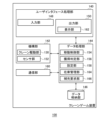
- FIG. 2 is a functional block diagram of the crane game device 100.
- Each component of the crane game device 100 is realized by hardware including computing units such as a CPU (Central Processing Unit) and various co-processors, storage devices such as memory and storage, and wired or wireless communication lines connecting them, and software stored in the storage devices and supplying processing instructions to the computing units.
- the computer program may be composed of a device driver, an operating system, various application programs located at higher layers thereof, and a library that provides common functions to these programs.
- Each block described below shows a functional block, not a hardware-based configuration.
- the crane game device 100 includes a user interface processing unit 140 , a mechanism unit 142 , a data processing unit 144 , a communication unit 160 , and a data storage unit 146 .
- the user interface processing unit 140 accepts operations from the player via various input devices, and is responsible for processing related to the user interface, such as image display and audio output.
- the mechanism unit 142 drives various acquisition mechanisms such as the crane 108.
- the data storage unit 146 stores various data.
- the data processing unit 144 executes various processes based on input from the user interface processing unit 140 and data stored in the data storage unit 146.
- the communication unit 160 is responsible for communication with external devices such as a store terminal used by an operator.
- the data processing unit 144 also functions as an interface between the mechanism unit 142, the user interface processing unit 140, the communication unit 160, and the data storage unit 146.
- the user interface processing unit 140 includes an input unit 148 and an output unit 150 that outputs various information.
- the output unit 150 includes a display unit 162 that outputs images.
- the display unit 162 displays various images on a display device such as the setting display unit 120.
- the input unit 148 accepts setting input from the operator (user) via the setting display unit 120.
- the input unit 148 also accepts operation input from the player via the operation unit 118.
- the crane game device 100 has a setting mode and a play mode. In the setting mode, the operator performs various settings, which will be described later. The loading of prizes and the installation of the display bar 134 are also performed in the setting mode. In the play mode, the player operates the operation unit 118 to play the crane game.
- the mechanism unit 142 includes the crane driving unit 130 and a sensor group 152. As described above, the crane driving unit 130 moves the crane 108 and grasps and releases the arm 126.
- the sensor group 152 corresponds to an optical sensor (described later) at the drop port 114, etc.
- the data processing unit 144 includes a movement control unit 154 , an acquisition determination unit 156 , a setting unit 158 , an inventory management unit 164 , and a replenishment request unit 166 .
- the movement control unit 154 instructs the crane 108 to move, grasp, and release according to the operation instruction from the operation unit 118.
- the acquisition determination unit 156 determines whether the prize has fallen into the drop port 114, in other words, whether the crane game has been successful.
- the acquisition determination unit 156 also determines whether the object that passed through the drop port 114 is a prize (first item) or a color ball (second item) (described later). The operator can set the size of the prize in the setting mode.
- the setting unit 158 sets the detection criteria for the prize or color ball according to the input from the operator (described later).
- the inventory management unit 164 manages the number of prizes remaining on the prize placement table 106 (hereinafter simply referred to as the "remaining number").
- the replenishment request unit 166 instructs the communication unit 160 to transmit a prize replenishment request to the store terminal.
- the operator can freely set the threshold value T in the setting mode.
- the data storage unit 146 stores information such as the game program for the crane game, the settings for the crane game, and the game play results (payout rate).
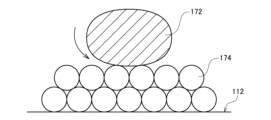
- FIG. 3 is a schematic diagram showing the placement state of the prize 172 in the placement area 112.
- a plurality of color balls 174 are spread out in the placement area 112.
- Various prizes 172 such as stuffed toys, are placed on the layer of color balls 174.
- the prizes 172 are assumed to be larger than the color balls 174 in terms of length, width, and depth.
- the color balls 174 are elastic balls made of vinyl.
- One of the purposes of spreading the color balls 174 out is to enhance the decorativeness of the play space S.
- the arm 126 directly touches the placement area 112, the arm 126 or the placement area 112 may be damaged, so forming a layer of color balls 174 prevents contact between the placement area 112 and the arm 126.
- the layer of colored balls 174 creates a gap under the prize 172, making it easier to insert the arm 126 under the prize 172. Therefore, by creating a layer of colored balls 174, it becomes easier for the arm 126 to firmly grasp the prize 172.
- the object of acquisition by the player is the prize 172, and the color ball 174 is not normally an object of acquisition. However, on rare occasions, the color ball 174 may be picked up by the arm 126 and fall into the drop hole 114.
- the operator needs to be aware of the payout rate of the crane game device 100, i.e., the difficulty of acquiring a prize. For this reason, the crane game device 100 is required to have a function for detecting the falling of the prize 172. When the color ball 174 falls into the drop hole 114, this may be mistakenly recognized as the acquisition of the prize 172.
- a configuration for easily distinguishing between the color ball 174 and the prize 172 when either one falls into the drop hole 114 will be described.
- Fig. 4 is a perspective view of the base 102.
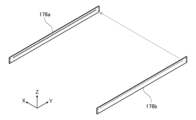
- Fig. 5 is a perspective view of the prize sensor 176.
- Fig. 6 is a front view of the prize sensor 176.
- a prize sensor 176 is disposed on the inner wall surface of the drop opening 114.
- the prize sensor 176 includes a first detection plate 176a (first detection portion) and a second detection plate 176b (second detection portion) that face each other.
- a total of 100 optical sensors 178 are disposed on the first detection plate 176a and the second detection plate 176b, with 50 sensors each.
- the optical sensor 178 may be attached directly to the inner wall surface of the drop inlet 114, so that a portion of the inner wall surface functions as a "detection portion.”
- the second detection plate 176b 50 light-emitting elements 178b (optical sensors 178) are arranged in a row with 7 millimeter intervals.
- 50 light-receiving elements 178a (optical sensors 178) are arranged in a row with 7 millimeter intervals.
- the light-receiving elements 178a and light-emitting elements 178b are paired, and light emitted from the nth light-emitting element 178b is received by the nth light-receiving element 178a, which is located opposite the light-emitting element 178b.
- the nth light-receiving element 178a will be written as "light-receiving element 178a(n)". The same applies to the light-emitting element 178b.
- the 50 light-emitting elements 178b arranged on the second detection plate 176b repeatedly emit light one by one, from light-emitting element 178b(1) at one end of the second detection plate 176b to light-emitting element 178b(60) at the other end. Therefore, the 50 light-receiving elements 178a arranged on the first detection plate 176a also receive light in sequence.
- the method in which light-emitting elements 178b(1) through 178b(60) emit light in sequence, and light-receiving elements 178a(1) through 178b(60) receive light in sequence, is called the "scan method.”
- the object blocks the light from the light-emitting element 178b, and some of the light-receiving elements 178a are unable to detect the light at the timing when they should.
- the light-receiving elements 178a being blocked by an object is called a "passing reaction.”
- the number of light-receiving elements 178a that detect a passing reaction is called the “number of passing reactions.”
- the scanning speed is sufficiently fast compared to the falling speed of the object, so passing reactions occur in multiple light-receiving elements 178a while the object is passing through.
- the acquisition determination unit 156 controls the emission of the light emitting element 178b by a scanning method.
- the acquisition determination unit 156 also detects the number of passing reactions from the light receiving element 178a, and determines whether "an object has passed through the drop hole 114" and "whether the object that passed through the drop hole 114 is a prize 172 or a colored ball 174" based on this number of passing reactions.
- the optical sensors 178 are arranged at intervals of 5 millimeters, so theoretically it is possible to detect the passage of any object with a width of 7 millimeters or more, but in this embodiment, it is assumed that the passage of an object with a width of 30 millimeters or more will be detected.
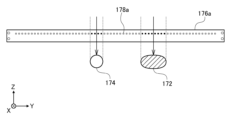
- FIG. 7 is a schematic diagram for explaining a method of detecting the prize 172 and the color ball 174.
- the diameter of the color ball 174 is 30 mm
- the width of the prize 172 is at least 80 mm.
- a passing reaction is detected by some of the multiple light receiving elements 178a.
- the winning determination unit 156 recognizes that the prize 172 or color ball 174 has passed in front of the optical sensor 178.
- the winning determination unit 156 determines that the colored balls 174 have fallen if the number of passing reactions is 5 or less, and that the prize 172 has fallen if the number of passing reactions is 11 or more.
- This control method makes it possible to easily determine whether the prize 172 or the colored ball 174 has fallen based on the number of passing reactions from the multiple optical sensors 178.
- the detection criteria based on the number of passing reactions must be set flexibly depending on the prize 172.
- the number of passing reactions also differs depending on the orientation of the prize 172 when it is dropped.
- items that are not eligible to be won hereinafter also referred to as "unwanted items” may also be dropped into the prize storage section 104. Therefore, the detection criteria for unwanted items must also be set according to the unwanted items.
- FIG. 8 is a diagram showing the setting screen 180.
- the display unit 162 displays a setting screen 180.
- the setting screen 180 is displayed on the setting display unit 120.
- the setting screen 180 includes a sensor on button 182 and a size setting area 184.
- the sensor on button 182 is set to on, the prize sensor 176 is enabled.
- the size setting area 184 is an area for setting the size of the prize 172.
- the operator sets the size of the prize 172 to be inserted into the crane game device 100 in the size setting area 184. Since the size of the prize 172, in other words the width, differs depending on the orientation of the prize 172, it is desirable to set the size based on the minimum width of the prize 172. In FIG. 8, it is set to "40 millimeters or more.”
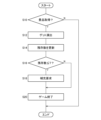
- FIG. 9 is a flow chart showing the process when an object passes through drop port 114.
- a passing reaction is detected by any of the light receiving elements 178a of the first detection plate 176a
- the process shown in Fig. 9 is started. If the number of passing reactions is within the winning range (Y in S10), the acquisition determination unit 156 determines that a prize has been acquired. If the number of passing reactions is outside the winning range (N in S10), the acquisition determination unit 156 determines that a color ball 174, not a prize 172, has fallen.
- the acquisition determination unit 156 instructs the output unit 150 to execute an effect corresponding to the acquisition of the prize (hereinafter referred to as a "get effect") (S12).
- a get effect for example, an image congratulating the acquisition of the prize may be displayed on a display such as the setting display unit 120, or a sound may be output.
- the acquisition determination unit 156 updates the so-called payout rate, that is, the ratio between the number of times a prize has been successfully acquired and the number of attempts at the crane game.
- the operator When the operator inserts the prizes 172 into the crane game device 100, the operator sets the number of prizes 172 in stock in advance.
- the acquisition determination unit 156 updates the remaining number of prizes 172 each time the acquisition of a prize is detected (S14).
- the replenishment request unit 166 instructs the communication unit 160 to send a replenishment request to the store terminal (S18).
- the replenishment request includes the ID of the crane game device 100 and the type of prize 172.
- the operator additionally replenishes the prizes 172.
- the replenishment request is automatically sent to the operator, thereby preventing the prizes 172 from running out in the crane game device 100.
- the remaining number is greater than the threshold T, that is, when a sufficient number of prizes 172 remain in the crane game device 100 (N in S16), the process of S18 is skipped.
- the game ends (S20) even if the time limit has not yet expired. If the player does not obtain the prize (N in S10), the game continues until the time limit has elapsed or the player succeeds in obtaining the prize.
- a prize sensor 176 formed on the inner wall of the drop hole 114 includes a plurality of optical sensors 178. Depending on the number of passing reactions of these optical sensors 178, the winning determination unit 156 can determine whether the prize 172 or the color balls 174 has fallen.
- the operator sets the size of the prize 172 on the setting screen 180, and the acquisition determination unit 156 sets the acquisition range according to the set size.
- the operator can flexibly set an appropriate acquisition range to suit a wide variety of prizes 172.
- the inventory management unit 164 updates the remaining number of prizes 172.
- the replenishment request unit 166 sends a replenishment request to the store terminal when the remaining number becomes low. Through this type of control, the operator can replenish the prizes 172 at the appropriate time so that the remaining number of prizes 172 in the crane game device 100 does not become too low.
- the present invention is not limited to the above-described embodiments and modifications, and can be embodied by modifying the components without departing from the spirit of the invention.
- Various inventions may be formed by appropriately combining multiple components disclosed in the above-described embodiments and modifications.
- some components may be deleted from all the components shown in the above-described embodiments and modifications.
- the prize 172 and the color ball 174 are described as being distinguished by the prize sensor 176.
- a plurality of types of prizes 172 having different sizes may be placed in the placement area 112.
- the winning determination unit 156 may determine which of the plurality of types of prizes 172 has fallen into the drop hole 114.
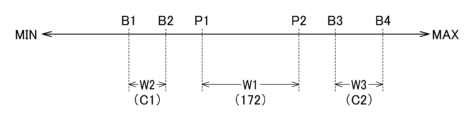
- FIG. 10 is a schematic diagram showing the relationship in size between unwanted objects and prizes 172 in a modified example.
- a plurality of types of unnecessary items may be placed in the crane game device 100.
- unnecessary items C1 and C2 of different sizes and a prize 172 are inserted into the crane game device 100.
- the horizontal axis in Fig. 10 indicates size, with the right side corresponding to the maximum and the left side corresponding to the minimum.
- the operator may set the size of the unwanted items as well as the prize 172.
- the setting unit 158 sets the range of the number of passing reactions (hereinafter referred to as the "unwanted range") that corresponds to the size range W2 of the unwanted item C1.
- the unwanted item C2 is larger than the unwanted item C1, and its width is greater than or equal to B3 and less than or equal to B4.
- the size range W3 of the unwanted item C2 is "B3 - B4".
- the setting unit 158 also sets the unwanted range for the unwanted item C2.
- the width of prize 172 is greater than or equal to P1 and less than or equal to P2, and its size range is W1.
- W1, W2, and W3 do not overlap with each other, so the acquisition determination unit 156 can distinguish between prize 172 and unwanted items C1 and C2.
- the acquisition determination unit 156 determines that an unwanted item C1 has fallen if the number of passing reactions is within the unwanted range (C1), and determines that an unwanted item C2 has fallen if the number of passing reactions is within the unwanted range (C2). In addition, the acquisition determination unit 156 determines that a prize 172 has fallen, i.e., the prize has been successfully acquired, if the number of passing reactions is within the acquisition range.
- the operator may have the crane game device 100 memorize the unnecessary range and the won range by actually dropping the prize 172 or the like into the drop hole 114 instead of using the setting screen 180.
- the operator inputs "unnecessary item C1".
- the display unit 162 displays "Please drop the unnecessary item C1 into the drop hole 114 ten times.”
- the operator drops the unnecessary item C1 into the drop hole 114, and the win determination unit 156 detects the number of passing reactions at this time.
- the setting unit 158 may set the range of the number of passing reactions when the unnecessary item C1 is dropped multiple times as the unnecessary range (C1).
- the unwanted range of unwanted item C2 and the acquisition range of prize 172 may be set in a similar manner.
- the operator can have the crane game device 100 memorize the appropriate unwanted range and acquisition range simply by dropping various items into the drop hole 114, without having to manually input the sizes on the setting screen 180.
- the setting unit 158 may set the minimum and maximum numbers of passing reactions when an item is dropped as the unnecessary range or the acquisition range, or may set a range with a predetermined width centered on the average number of passing reactions as the unnecessary range or the acquisition range.
- the unwanted objects and prizes 172 dropped into the crane game device 100 come in a variety of shapes. Also, as mentioned above, for objects that are not spherical, such as rectangular prism-shaped objects, the number of passing reactions changes depending on the drop angle. When the unwanted range and the winning range overlap, or when the boundary value of the unwanted range and the boundary value of the winning range are equal to or less than a predetermined number, the output unit 150 may warn the operator that "there is a possibility that the prize cannot be correctly recognized with this combination of objects.”
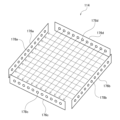
- FIG. 11 is a perspective view of a prize sensor 176 in a modified example.
- the first detection plate 176a and the second detection plate 176b are opposed to each other, and the light from the light-emitting element 178b is received by the light-receiving element 178a to detect the passage of an object through the drop inlet 114.
- prize sensors 176 may be disposed on all four sides of the drop inlet 114.
- the first detection plate 176a third side
- the third detection plate 176c fourth side
- the fourth detection plate 176d second side
- a plurality of light-emitting elements 178d are arranged on the fourth detection plate 176d
- a plurality of light-receiving elements 178c are arranged on the third detection plate 176c.
- the acquisition determination unit 156 determines whether or not a prize has been acquired based on whether the total number of passing reactions of the light receiving element 178a (first detection plate 176a) and the light receiving element 178c (third detection plate 176c) is within a predetermined acquisition range. Alternatively, the acquisition determination unit 156 may determine that a prize has been acquired when the number of passing reactions of the light receiving element 178a is within a first acquisition range and the number of passing reactions of the light receiving element 178c is within a second acquisition range.
- FIG. 12 is a graph showing the change over time in the number of passing reactions in the modified example.
- the light emitting element 178b scans the falling object multiple times. Therefore, the number of passing reactions also changes with the passage of time.
- Fig. 12 shows the change over time in the number of passing reactions when the prize 172 and the colored ball 174 pass through the drop opening 114.
- the horizontal axis shows time, and the vertical axis shows the number of passing reactions.
- Time t0 shows the time when the first passing reaction is detected due to the falling of the object
- time t4 shows the time when the last passing reaction is detected.
- the acquisition determination unit 156 determines whether the dropped object is a prize 172 or a colored ball 174 (unwanted item) from the pattern of change in the number of passing reactions when the object falls. For example, the acquisition determination unit 156 may determine whether or not the prize has been acquired based on whether or not the total number of passing reactions at each time point from time t0 when the first passing reaction occurs to time t4 when the last passing reaction is detected is within a predetermined acquisition range. The same applies to the colored ball 174. Alternatively, the acquisition determination unit 156 may determine whether or not the prize has been acquired based on the maximum or average number of passing reactions from time t0 to time t4.
- the acquisition determination unit 156 may use artificial intelligence (AI) to determine the type of object that has passed through the drop hole 114.
- AI artificial intelligence
- a learning model is created in advance in which the number of passing reactions K(0) at time t0, the number of passing reactions K(1) at time t1, etc. are set as input nodes, and a value that identifies the prize 172 or the colored ball 174 is set as the output node.
- the number of passing reactions from time t0 to time t4 is set as the input node of the learning model, so that the acquisition determination unit 156 can determine whether the passing object is a prize 172 or a colored ball 174.
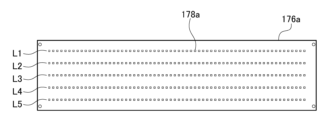
- FIG. 13 is a front view of a prize sensor 176 in a modified example.
- the light receiving elements 178a may be arranged in a plurality of rows L1 to L5 on the first detection plate 176a. The same applies to the second detection plate 176b.
- a passing reaction is detected in each of the light receiving elements 178a in the rows L1 to L5.
- the acquisition determination unit 156 may determine whether the dropped object is a prize 172 or a colored ball 174 (unwanted item) based on the number of passing reactions in each row when the object falls.
- the acquisition determination unit 156 may determine whether or not a prize has been acquired based on the number of passing reactions of all light receiving elements 178a when the object falls. Alternatively, the acquisition determination unit 156 may determine whether or not a prize has been acquired based on the number of passing reactions of light receiving elements 178a in each row. For example, the acquisition determination unit 156 may determine that a prize has been acquired when the following conditions are met: the maximum number of passing reactions in the first row L1 is 5 or more, the maximum number of passing reactions in the second row L2 is also 5 or more, etc.
- FIG. 14 is a first top view of the prize mounting stand 106 formed by a plurality of panels 188.
- the prize placing stand 106 may be configured by fitting a plurality of panels 188.
- the prize placing stand 106 shown in Fig. 14 is configured so that nine panels 188 (panels 188a to 188i) can be fitted into it. In this example, only the panel 188h is removed, and therefore the drop opening 114 is configured in the portion corresponding to the panel 188h. The operator can freely fit the panels 188 into place to configure various drop openings 114.
- the operator places a sensor unit 190 at the drop opening 114.
- the sensor unit 190 includes a first detection plate 176a and a second detection plate 176b.
- the sensor unit 190 is configured such that the light receiving elements 178a arranged on the first detection plate 176a receive the light from the light emitting elements 178b arranged on the second detection plate 176b.
- the first detection plate 176a and the second detection plate 176b are connected to a power source 186 possessed by the crane game device 100.
- the acquisition determination unit 156 also controls the light emission on the second detection plate 176b and detects the number of passing reactions on the first detection plate 176a.
- the acquisition determination unit 156 identifies the object that has passed through the drop hole 114 based on the number of passing reactions in the sensor unit 190.
- FIG. 15 is a second top view of the prize mounting stand 106 formed by a plurality of panels 188.
- Five panels 188 are removed from the prize placement platform 106 shown in Fig. 15 to form a comparatively large drop opening 114.
- the operator fits a sensor unit 190 that matches the shape of the drop opening 114 in place of the five panels 188.
- the light from the second detection plate 176b is received by the first detection plate 176a
- the light from the fourth detection plate 176d is received by the third detection plate 176c.
- the light from the sixth detection plate 176f is received by the fifth detection plate 176e.
- the acquisition determination unit 156 identifies the object that has passed through the drop hole 114 based on the number of passing reactions at the first detection plate 176a, the third detection plate 176c, and the fifth detection plate 176e.
- the acquisition range is set as a range of the number of passing reactions.
- the number of passing reactions corresponding to the acquisition range may be a single value such as "5", a multiple value including an upper limit and a lower limit such as "3 or more and 5 or less", or a setting that does not include an upper limit or a lower limit such as "3 or more" and "5 or less”.
- the setting screen 180 may be displayed by the store terminal instead of the crane game machine 100.
- the operator may set the acquisition range of the crane game machine 100 remotely by setting the acquisition range together with the ID of the crane game machine 100 on the setting screen 180 of the store terminal. The same applies to the unnecessary range.
- the inventory management unit 164 may count the number of unwanted items, such as colored balls 174, that fall. When the total number of unwanted items that fall reaches or exceeds a predetermined threshold, the replenishment request unit 166 may send a removal instruction to the store terminal to remove the unwanted items that have accumulated in the prize storage unit 104. According to this control method, when a large amount of unwanted items have accumulated in the storage box below the drop opening 114, the operator can remove the unwanted items from the storage box, thereby reducing the operator's workload.
- the "light" in the prize sensor 176 may be visible light or invisible light.
- the passage of an object may be detected by infrared light or laser light.
- the prize sensor 176 may detect the passage of an object by radio waves or ultrasonic waves.
- one type of prize size is set, but multiple sizes may be selected in the size setting area 184 so that multiple different prize sizes can be detected. For example, by setting the size of prize 172A and the size of prize 172B, it is possible to identify which of the two types of prize has passed through the drop hole 114.
- a crane game machine is assumed as an example of an item acquisition game device, but the prize detection method shown in this embodiment can also be implemented in an item acquisition game device that acquires items using a mechanism other than a crane.
- an item acquisition game device is assumed in which the prize placement platform 106 is provided in multiple stages on the back surface of the prize storage section 104 rather than on the floor surface, and the prizes 172 are placed or suspended thereon.
- This type of item acquisition game device is equipped with an "item acquisition section" that grabs the prize 172 or the hanging part of the prize 172, rather than the crane 108.
- the item acquisition section acquisition mechanism
- the item acquisition section acquisition mechanism is driven by the movement control section 154.
- the player moves the item acquisition section up, down, left, and right using the operation section 118 to determine the position, and further moves the item acquisition section in the depth direction to grab the prize 172 or the hanging part of the prize 172, and drops the prize 172 as it is, thereby acquiring the prize.
- almost the entire prize container 104 becomes the drop opening 114, but since the prizes 172 are on the rear side, prize sensors 176 may be provided only on the rear side of each of the left and right sides of the drop opening 114.
- the area through which the prizes 172 are expected to pass is limited, so fewer sensors are required, and the cost of the sensors can be reduced.
Landscapes
- Physics & Mathematics (AREA)
- General Physics & Mathematics (AREA)
- Engineering & Computer Science (AREA)
- Multimedia (AREA)
- Health & Medical Sciences (AREA)
- General Health & Medical Sciences (AREA)
- Social Psychology (AREA)
- Pinball Game Machines (AREA)
Abstract
Description
獲得判定部は、落下口を物品が通過したときの通過反応数が獲得範囲内にあるとき、通過した物品が第1物品であると判定する。
クレーンゲーム装置100は、一般的には、遊園地やゲームセンターなどの遊戯施設に設置される。図1に示すように、プレイヤから見たときのクレーンゲーム装置100の左右方向をX方向、前後方向をY方向、上下方向をZ方向として説明する。
落下口114の奥にはカラーボールなどの備品を収納するための収納ボックスが設けられる。
クレーンゲーム装置100の各構成要素は、CPU(Central Processing Unit)および各種コプロセッサ(Co-processor)などの演算器、メモリやストレージといった記憶装置、それらを連結する有線または無線の通信線を含むハードウェアと、記憶装置に格納され、演算器に処理命令を供給するソフトウェアによって実現される。コンピュータプログラムは、デバイスドライバ、オペレーティングシステム、それらの上位層に位置する各種アプリケーションプログラム、また、これらのプログラムに共通機能を提供するライブラリによって構成されてもよい。以下に説明する各ブロックは、ハードウェア単位の構成ではなく、機能単位のブロックを示している。
ユーザインタフェース処理部140は、各種の入力デバイスを介してプレイヤからの操作を受け付けるほか、画像表示や音声出力など、ユーザインタフェースに関する処理を担当する。機構部142は、クレーン108等の各種獲得機構を駆動する。データ格納部146は各種データを格納する。データ処理部144は、ユーザインタフェース処理部140からの入力およびデータ格納部146に格納されているデータに基づいて各種処理を実行する。通信部160は、オペレータが使用する店舗端末等、外部装置との通信を担当する。データ処理部144は、機構部142、ユーザインタフェース処理部140、通信部160およびデータ格納部146のインタフェースとしても機能する。
移動制御部154は、操作部118による操作指示にしたがって、クレーン108に移動・把持・解放を指示する。獲得判定部156は、景品が落下口114に落下したか、いいかえれば、クレーンゲームの成否を判定する。また、獲得判定部156は、落下口114を通過した物体が、景品(第1物品)またはカラーボール(第2物品)のいずれであるかも判定する(後述)。オペレータは設定モードにおいて、景品のサイズを設定できる。設定部158は、オペレータの入力にしたがって、景品あるいはカラーボールの検出基準を設定する(後述)。在庫管理部164は、景品載置台106に残る景品の数(以下、単に「残余数」とよぶ)を管理する。補充要求部166は、残余数が所定の閾値T以下となったとき、通信部160に指示して、店舗端末に景品の補充要求を送信させる。オペレータは、設定モードにおいて、閾値Tを自由に設定できる。
載置領域112には、複数のカラーボール174が敷き詰められる。ぬいぐるみなどの各種の景品172は、カラーボール174の層上に載置される。ここでは、景品172の縦・横・奥行のいずれの寸法もカラーボール174のそれらよりも大きいものとする。カラーボール174は、弾力性を有するビニール製のボールである。カラーボール174を敷き詰める目的の一つはプレイ空間Sの装飾性を高めることである。また、アーム126が載置領域112に直接触れてしまうと、アーム126あるいは載置領域112に傷がつく可能性もあるため、カラーボール174の層を形成することにより載置領域112とアーム126の接触を防ぐ。
落下口114の内壁面には、プライズセンサ176が配置される。プライズセンサ176は、互いに対向する第1検出板176a(第1検出部)および第2検出板176b(第2検出部)を含む。第1検出板176aおよび第2検出板176bには50個ずつ、合計100個の光センサ178が配置される。
なお、落下口114の内壁に第1検出板176aおよび第2検出板176bを取り付けるのではなく、落下口114の内壁面に光センサ178を直接取り付けることで、内壁面の一部を「検出部」として機能させてもよい。
本実施形態におけるカラーボール174の直径は30ミリメートルであるとする。また、景品172の横幅は最低でも80ミリメートル以上であるとする。
設定モードにおいて、表示部162は設定画面180を表示させる。設定画面180は設定表示部120に表示される。設定画面180は、センサーオンボタン182とサイズ設定領域184を含む。センサーオンボタン182がオン設定されるとプライズセンサ176が有効となる。サイズ設定領域184は、景品172のサイズを設定するための領域である。オペレータは、クレーンゲーム装置100に投入する景品172のサイズをサイズ設定領域184において設定する。景品172のサイズ、いいかえれば、横幅は、景品172の向きによって異なるため、景品172の横幅の最低値に基づいてサイズを設定することが望ましい。図8においては「40ミリメートル以上」に設定されている。
第1検出板176aのいずれかの受光素子178aにおいて通過反応が検出されたとき、図9に示す処理が開始される。獲得判定部156は、通過反応数が獲得範囲内であれば(S10のY)、景品取得と判定する。通過反応数が獲得範囲外であれば(S10のN)、獲得判定部156は景品172ではなくカラーボール174が落下したと判定する。
本実施形態においては、載置領域112には色とりどりのカラーボール174が敷き詰められ、カラーボール174の層に景品172が載置される。このため、景品172ではなくカラーボール174が落下口114に落下することも考えられる。落下口114の内壁に形成されるプライズセンサ176は、複数の光センサ178を備える。この光センサ178の通過反応数に応じて、獲得判定部156は、景品172またはカラーボール174のいずれが落下したかを判定できる。
本実施形態においては、景品172およびカラーボール174をプライズセンサ176において判別するとして説明した。変形例として、サイズの異なる複数種類の景品172を載置領域112に載置してもよい。プライズセンサ176における光センサ178の通過反応数に応じて、獲得判定部156は、複数種類の景品172のうちどの景品172が落下口114に落下したのかを判定してもよい。
クレーンゲーム装置100には、複数種類の不要物品が設置されることもある。たとえば、お互いにサイズの異なる不要物品C1,C2と、景品172がクレーンゲーム装置100に投入されると想定する。図10の横軸はサイズを示し、右側が最大、左側が最小に対応する。
本実施形態においては、第1検出板176aおよび第2検出板176bを対向させ、発光素子178bの光を受光素子178aにより受光することで、落下口114における物体通過を検出するとして説明した。変形例として、落下口114の4辺すべてにプライズセンサ176を配置してもよい。
高速なスキャン方式の場合、物体が落下口114を落下するとき、発光素子178bは複数回、落下中の物体をスキャンする。このため、時間経過にともなって通過反応数も変化する。図12は、景品172およびカラーボール174が落下口114を通過したときの通過反応数の時間変化を示している。横軸は時間、縦軸は通過反応数を示す。時刻t0は物体の落下により最初に通過反応が検出される時点を示し、時刻t4は最後の通過反応が検出される時点を示す。
変形例として、第1検出板176aには複数列L1~L5にて受光素子178aが配列されてもよい。第2検出板176bについても同様である。物体が落下口114を通過するとき、列L1~列L5のそれぞれの受光素子178aにおいて通過反応が検出される。獲得判定部156は、物体落下時における各列の通過反応数に基づいて、落下した物体が景品172またはカラーボール174(不要物品)のいずれであるかを判定してもよい。
変形例として、景品載置台106は複数のパネル188をはめ込むことで構成されてもよい。図14に示す景品載置台106は、9枚のパネル188(パネル188a~188i)を嵌め込み可能に構成される。ここでは、パネル188hだけが取り外されているため、パネル188hに対応する部分に落下口114が構成される。オペレータは、パネル188を自由に嵌め込むことで、さまざまな落下口114を構成できる。
図15に示す景品載置台106からは、5枚のパネル188が取り外されることで、比較的大きな落下口114が構成されている。オペレータは、5枚のパネル188の代わりに、落下口114の形状に合ったセンサユニット190を嵌め込む。図15に示すセンサユニット190においては、第2検出板176bの光を第1検出板176aで受光し、第4検出板176dの光を第3検出板176cで受光している。また、第6検出板176fの光を第5検出板176eで受光する。
獲得範囲は、通過反応数の範囲として設定される。獲得範囲に対応する通過反応数は「5個」のように単一値であってもよいし、「3以上5以下」のように上限と下限を含む複数値であってもよいし、「3以上」「5以下」のように上限または下限を含まない設定であってもよい。
センサ群、154 移動制御部、156 獲得判定部、158 設定部、160 通信部、162 表示部、164 在庫管理部、166 補充要求部、172 景品、174
カラーボール、176 プライズセンサ、176a 第1検出板、176b 第2検出板、176c 第3検出板、176d 第4検出板、176e 第5検出板、176f 第6検出板、178 光センサ、178a 受光素子、178b 発光素子、178c 受光素子、178d 発光素子、180 設定画面、182 センサーオンボタン、184 サイズ設定領域、186 電源、188 パネル、190 センサユニット
Claims (9)
- プレイ空間に設けられ、物品が配置される載置領域と、物品が通過する落下口とを含むゲームフィールドと、
前記物品を獲得する獲得機構と、
プレイヤからの操作を受け付ける操作部と、
前記操作にしたがって、前記獲得機構を駆動する移動制御部と、
前記落下口に配列され、物品の通過を検出する複数のセンサと、
前記落下口を通過する物品が、獲得対象となる第1物品であるか否かを判定する獲得判定部と、
前記落下口を物品が通過したときに反応するセンサの数を通過反応数として、ユーザからの指示にしたがって第1物品に対応する通過反応数の範囲を示す獲得範囲を設定する設定部と、を備え、
前記獲得判定部は、前記落下口を物品が通過したときの通過反応数が前記獲得範囲内にあるとき、前記通過した物品が第1物品であると判定する、物品取得ゲーム装置。 - 設定画面を表示させる表示部、を更に備え、
前記設定部は、前記設定画面においてユーザにより第1物品のサイズの入力を受け付け、前記入力されたサイズに応じて前記獲得範囲を設定する、請求項1に記載の物品取得ゲーム装置。 - 前記設定部は、更に、前記設定画面においてユーザにより、獲得対象外となる第2物品のサイズの入力を受け付け、前記入力されたサイズに応じて前記第2物品の通過反応数の範囲を示す不要範囲を設定し、
前記獲得判定部は、前記落下口を物品が通過したときの通過反応数が前記不要範囲内にあるとき、前記通過した物品が第2物品であると判定する、請求項2に記載の物品取得ゲーム装置。 - 前記ゲームフィールドの前記載置領域には、獲得対象となる第1物品と、獲得対象外となる第2物品が載置され、
前記獲得判定部は、前記落下口を物品が通過したときの通過反応数が前記獲得範囲外にあるとき、前記通過した物品が第2物品であると判定する、請求項1に記載の物品取得ゲーム装置。 - 前記設定部は、設定モードにおいて、ユーザが第1物品を前記落下口へ落下させたときの通過反応数に基づいて、前記獲得範囲を設定する、請求項1に記載の物品取得ゲーム装置。
- 前記落下口は、少なくとも対向する2辺を2組有する矩形形状にて構成され、
前記落下口の第1辺には複数の発光素子が配列され、前記第1辺に対向する第3辺には前記発光素子の光を検出する複数の受光素子が前記第1辺の複数の発光素子と対向する位置に配列され、
前記落下口の第2辺には複数の発光素子が配列され、前記第2辺に対向する第4辺には前記発光素子の光を検出する複数の受光素子が前記第2辺の複数の発光素子と対向する位置に配列され、
前記獲得判定部は、前記第3辺および前記第4辺に配列される受光素子のうち、前記落下口を通過する物品により遮光された受光素子の数を通過反応数として特定する請求項1に記載の物品取得ゲーム装置。 - 前記複数のセンサは、前記落下口を物品が通過するときに複数回の計測を実行し、
前記獲得判定部は、複数の時点それぞれにおける通過反応数に基づいて、前記落下口を通過した物品が第1物品であるか否かを判定する、請求項1に記載の物品取得ゲーム装置。 - 前記獲得判定部により第1物品の通過が検出されたとき、前記ゲームフィールドにおける第1物品の残存数を更新する在庫管理部と、
前記残存数が所定の閾値以下となったとき、第1物品の補充を要求する補充要求部と、を更に備える請求項1に記載の物品取得ゲーム装置。 - 前記ゲームフィールドの前記載置領域は1以上のパネルにより構成され、
前記落下口は前記ゲームフィールドのうちパネルに覆われない部分として構成され、
前記落下口には、センサユニットが設置され、
前記センサユニットは、複数の発光素子が配列される第1検出部と、複数の受光素子が前記複数の発光素子と対向するように配列される第2検出部を含み、
前記獲得判定部は、前記落下口を通過する物品により遮光された受光素子の数を通過反応数として特定する請求項1に記載の物品取得ゲーム装置。
Priority Applications (2)
| Application Number | Priority Date | Filing Date | Title |
|---|---|---|---|
| CN202380077706.5A CN120187497A (zh) | 2022-11-08 | 2023-10-10 | 物品赢取游戏设备 |
| US19/198,709 US20250265909A1 (en) | 2022-11-08 | 2025-05-05 | Article-winning game device |
Applications Claiming Priority (2)
| Application Number | Priority Date | Filing Date | Title |
|---|---|---|---|
| JP2022-178605 | 2022-11-08 | ||
| JP2022178605A JP2024068283A (ja) | 2022-11-08 | 2022-11-08 | 物品取得ゲーム装置 |
Related Child Applications (1)
| Application Number | Title | Priority Date | Filing Date |
|---|---|---|---|
| US19/198,709 Continuation US20250265909A1 (en) | 2022-11-08 | 2025-05-05 | Article-winning game device |
Publications (1)
| Publication Number | Publication Date |
|---|---|
| WO2024101059A1 true WO2024101059A1 (ja) | 2024-05-16 |
Family
ID=91032813
Family Applications (1)
| Application Number | Title | Priority Date | Filing Date |
|---|---|---|---|
| PCT/JP2023/036810 Ceased WO2024101059A1 (ja) | 2022-11-08 | 2023-10-10 | 物品取得ゲーム装置 |
Country Status (4)
| Country | Link |
|---|---|
| US (1) | US20250265909A1 (ja) |
| JP (1) | JP2024068283A (ja) |
| CN (1) | CN120187497A (ja) |
| WO (1) | WO2024101059A1 (ja) |
Citations (5)
| Publication number | Priority date | Publication date | Assignee | Title |
|---|---|---|---|---|
| JP2003093733A (ja) * | 2001-09-26 | 2003-04-02 | Namco Ltd | ゲーム装置 |
| US20110272887A1 (en) * | 2010-05-05 | 2011-11-10 | Lai Games Australia Pty Ltd. | Direct prize-dispensing game with crane dispenser |
| JP2017012236A (ja) * | 2015-06-26 | 2017-01-19 | 一平 鍵野 | ゲーム機保守支援装置 |
| JP2019042395A (ja) * | 2017-09-06 | 2019-03-22 | 株式会社タイトー | 通知制御装置、通知システム、ゲーム装置、及びプログラム |
| JP2021145937A (ja) * | 2020-03-19 | 2021-09-27 | 株式会社セガ | 物品取得ゲーム装置 |
-
2022
- 2022-11-08 JP JP2022178605A patent/JP2024068283A/ja active Pending
-
2023
- 2023-10-10 CN CN202380077706.5A patent/CN120187497A/zh active Pending
- 2023-10-10 WO PCT/JP2023/036810 patent/WO2024101059A1/ja not_active Ceased
-
2025
- 2025-05-05 US US19/198,709 patent/US20250265909A1/en active Pending
Patent Citations (5)
| Publication number | Priority date | Publication date | Assignee | Title |
|---|---|---|---|---|
| JP2003093733A (ja) * | 2001-09-26 | 2003-04-02 | Namco Ltd | ゲーム装置 |
| US20110272887A1 (en) * | 2010-05-05 | 2011-11-10 | Lai Games Australia Pty Ltd. | Direct prize-dispensing game with crane dispenser |
| JP2017012236A (ja) * | 2015-06-26 | 2017-01-19 | 一平 鍵野 | ゲーム機保守支援装置 |
| JP2019042395A (ja) * | 2017-09-06 | 2019-03-22 | 株式会社タイトー | 通知制御装置、通知システム、ゲーム装置、及びプログラム |
| JP2021145937A (ja) * | 2020-03-19 | 2021-09-27 | 株式会社セガ | 物品取得ゲーム装置 |
Also Published As
| Publication number | Publication date |
|---|---|
| CN120187497A (zh) | 2025-06-20 |
| US20250265909A1 (en) | 2025-08-21 |
| JP2024068283A (ja) | 2024-05-20 |
Similar Documents
| Publication | Publication Date | Title |
|---|---|---|
| JP6119943B1 (ja) | 物品取得ゲーム装置およびゲームサーバ | |
| JP7662012B2 (ja) | 物品取得ゲーム装置 | |
| US6770001B1 (en) | Vacuum crane game with beaded targets | |
| US20180330577A1 (en) | Vacuum crane game with perforated targets | |
| CN104274970A (zh) | 游戏机 | |
| US10957165B2 (en) | Crane game having internal housing unit | |
| JP2018110830A (ja) | 物品取得ゲーム装置およびゲームサーバ | |
| WO2024101059A1 (ja) | 物品取得ゲーム装置 | |
| TWI866475B (zh) | 取物遊戲機台 | |
| JP7509264B2 (ja) | 物品取得ゲーム装置 | |
| JP7260048B2 (ja) | 物品取得ゲーム装置 | |
| US20160375356A1 (en) | Vacuum crane arcade game | |
| JP4329154B2 (ja) | 遊技機 | |
| JP7158704B2 (ja) | ゲーム用商品補充装置 | |
| JP7503008B2 (ja) | 景品獲得装置及び景品復帰機構 | |
| TW202030005A (zh) | 抓物機及其控制方法 | |
| JP2008125970A (ja) | クレーン型ゲーム機 | |
| JP2024089710A (ja) | 物品取得ゲーム装置 | |
| JPH11319303A (ja) | ゲーム機及びゲーム方法 | |
| JP7272499B1 (ja) | ゲームシステムおよびサーバ | |
| JPH07246282A (ja) | プライズゲームマシン | |
| JP4360555B2 (ja) | クレーン式牌組合せゲーム装置 | |
| JP2007061584A (ja) | 遊戯状態表示装置 | |
| WO2022189768A1 (en) | Improvements in or relating to arcade games | |
| JP3975913B2 (ja) | 遊技機 |
Legal Events
| Date | Code | Title | Description |
|---|---|---|---|
| 121 | Ep: the epo has been informed by wipo that ep was designated in this application |
Ref document number: 23888412 Country of ref document: EP Kind code of ref document: A1 |
|
| WWE | Wipo information: entry into national phase |
Ref document number: 202380077706.5 Country of ref document: CN |
|
| NENP | Non-entry into the national phase |
Ref country code: DE |
|
| WWP | Wipo information: published in national office |
Ref document number: 202380077706.5 Country of ref document: CN |
|
| 122 | Ep: pct application non-entry in european phase |
Ref document number: 23888412 Country of ref document: EP Kind code of ref document: A1 |