WO2024090149A1 - オルガノポリシロキサン、密着性付与剤、水性塗料組成物およびプライマー組成物 - Google Patents
オルガノポリシロキサン、密着性付与剤、水性塗料組成物およびプライマー組成物 Download PDFInfo
- Publication number
- WO2024090149A1 WO2024090149A1 PCT/JP2023/036008 JP2023036008W WO2024090149A1 WO 2024090149 A1 WO2024090149 A1 WO 2024090149A1 JP 2023036008 W JP2023036008 W JP 2023036008W WO 2024090149 A1 WO2024090149 A1 WO 2024090149A1
- Authority
- WO
- WIPO (PCT)
- Prior art keywords
- organopolysiloxane
- group
- aqueous
- adhesion
- composition
- Prior art date
- Legal status (The legal status is an assumption and is not a legal conclusion. Google has not performed a legal analysis and makes no representation as to the accuracy of the status listed.)
- Ceased
Links
Images
Classifications
-
- C—CHEMISTRY; METALLURGY
- C07—ORGANIC CHEMISTRY
- C07F—ACYCLIC, CARBOCYCLIC OR HETEROCYCLIC COMPOUNDS CONTAINING ELEMENTS OTHER THAN CARBON, HYDROGEN, HALOGEN, OXYGEN, NITROGEN, SULFUR, SELENIUM OR TELLURIUM
- C07F7/00—Compounds containing elements of Groups 4 or 14 of the Periodic Table
- C07F7/02—Silicon compounds
- C07F7/08—Compounds having one or more C—Si linkages
- C07F7/0834—Compounds having one or more O-Si linkage
- C07F7/0838—Compounds with one or more Si-O-Si sequences
-
- C—CHEMISTRY; METALLURGY
- C09—DYES; PAINTS; POLISHES; NATURAL RESINS; ADHESIVES; COMPOSITIONS NOT OTHERWISE PROVIDED FOR; APPLICATIONS OF MATERIALS NOT OTHERWISE PROVIDED FOR
- C09D—COATING COMPOSITIONS, e.g. PAINTS, VARNISHES OR LACQUERS; FILLING PASTES; CHEMICAL PAINT OR INK REMOVERS; INKS; CORRECTING FLUIDS; WOODSTAINS; PASTES OR SOLIDS FOR COLOURING OR PRINTING; USE OF MATERIALS THEREFOR
- C09D183/00—Coating compositions based on macromolecular compounds obtained by reactions forming in the main chain of the macromolecule a linkage containing silicon, with or without sulfur, nitrogen, oxygen, or carbon only; Coating compositions based on derivatives of such polymers
- C09D183/04—Polysiloxanes
- C09D183/06—Polysiloxanes containing silicon bound to oxygen-containing groups
-
- C—CHEMISTRY; METALLURGY
- C09—DYES; PAINTS; POLISHES; NATURAL RESINS; ADHESIVES; COMPOSITIONS NOT OTHERWISE PROVIDED FOR; APPLICATIONS OF MATERIALS NOT OTHERWISE PROVIDED FOR
- C09D—COATING COMPOSITIONS, e.g. PAINTS, VARNISHES OR LACQUERS; FILLING PASTES; CHEMICAL PAINT OR INK REMOVERS; INKS; CORRECTING FLUIDS; WOODSTAINS; PASTES OR SOLIDS FOR COLOURING OR PRINTING; USE OF MATERIALS THEREFOR
- C09D5/00—Coating compositions, e.g. paints, varnishes or lacquers, characterised by their physical nature or the effects produced; Filling pastes
-
- C—CHEMISTRY; METALLURGY
- C09—DYES; PAINTS; POLISHES; NATURAL RESINS; ADHESIVES; COMPOSITIONS NOT OTHERWISE PROVIDED FOR; APPLICATIONS OF MATERIALS NOT OTHERWISE PROVIDED FOR
- C09D—COATING COMPOSITIONS, e.g. PAINTS, VARNISHES OR LACQUERS; FILLING PASTES; CHEMICAL PAINT OR INK REMOVERS; INKS; CORRECTING FLUIDS; WOODSTAINS; PASTES OR SOLIDS FOR COLOURING OR PRINTING; USE OF MATERIALS THEREFOR
- C09D5/00—Coating compositions, e.g. paints, varnishes or lacquers, characterised by their physical nature or the effects produced; Filling pastes
- C09D5/002—Priming paints
-
- C—CHEMISTRY; METALLURGY
- C08—ORGANIC MACROMOLECULAR COMPOUNDS; THEIR PREPARATION OR CHEMICAL WORKING-UP; COMPOSITIONS BASED THEREON
- C08G—MACROMOLECULAR COMPOUNDS OBTAINED OTHERWISE THAN BY REACTIONS ONLY INVOLVING UNSATURATED CARBON-TO-CARBON BONDS
- C08G77/00—Macromolecular compounds obtained by reactions forming a linkage containing silicon with or without sulfur, nitrogen, oxygen or carbon in the main chain of the macromolecule
- C08G77/04—Polysiloxanes
- C08G77/14—Polysiloxanes containing silicon bound to oxygen-containing groups
Definitions
- the present invention relates to an organopolysiloxane, an adhesion promoter, an aqueous paint composition, and a primer composition, and more specifically to an organopolysiloxane that contains 3-glycidyloxypropyl group-containing siloxane units and diorganosiloxane units as constituent units and has silanol groups, an adhesion promoter made of the organopolysiloxane, and an aqueous paint composition and a primer composition that contain the organopolysiloxane.
- silane coupling agents that have two or more different reactive functional groups in one molecule are known as coupling agents that bond different materials.
- silane coupling agents that have a hydrolyzable silyl group such as an alkoxysilyl group as one of the reactive groups, and further have various organic reactive groups such as a primary amino group, a secondary amino group, a glycidyl ether group, a methacryl group, a ureido group, a vinyl group, a mercapto group, and an isocyanate group, are known as primers that improve the adhesion of paints, and as adhesion promoters that are added to paint compositions.
- compositions have been reported in which a silane coupling agent is used as a monomer and a reactive organopolysiloxane obtained by hydrolyzing and condensing a hydrolyzable silyl group is added.
- Patent Document 1 proposes a coating material and adhesive sheet containing an organosilsesquioxane having an epoxy group
- Patent Documents 2 to 4 propose the use of a relatively low molecular weight oligomer obtained by partially hydrolyzing and condensing a silane coupling agent having an epoxy group as an adhesion improver.
- oligomers and/or polymers obtained by hydrolysis and condensation of silane coupling agents compared to silane coupling agents are that they have a high molecular weight and low volatility, which eliminates concerns about the reduction of active ingredients during processes such as drying.
- Another advantage is that it generates little volatile organic compounds (VOCs).
- VOCs volatile organic compounds
- Patent documents 5 to 7 propose aqueous silane compositions containing hydrolysis condensates containing functional groups such as amino groups, mercapto groups, and carboxy groups
- patent document 8 proposes an aqueous silane composition containing a hydrolysis condensate having an ethylene glycol group.
- aqueous silane compositions have a high activity due to the hydrolysis condensation product of the silane coupling agent, and from the viewpoint of handling and stability, they must be made into an aqueous solution, but their storage stability is insufficient.
- JP 2019-143161 A International Publication No. 2018/34232 JP 2018-127507 A JP 2022-27097 A European Patent No. 0675128 JP 2016-44278 A JP 2015-34097 A JP 2017-114852 A
- the present invention was made in consideration of the above circumstances, and aims to provide a water-soluble organopolysiloxane that has organic functional groups and has excellent storage stability.
- R 1 is a monovalent hydrocarbon group having 1 to 10 carbon atoms
- each R 2 is independently a monovalent hydrocarbon group having 1 to 10 carbon atoms which may be substituted with a glycidyloxy group
- R 3 is a methyl group or an ethyl group
- x and y are numbers which satisfy x ⁇ 1 and y ⁇ 0.5.
- An adhesion imparting agent comprising the organopolysiloxane according to 1 or 2.
- An aqueous coating composition containing the organopolysiloxane according to 1 or 2.
- a primer composition comprising the organopolysiloxane according to 1 or 2 is provided.
- the organopolysiloxane of the present invention has highly reactive epoxy groups, and is excellent in modifying organic resins and improving adhesion to resin substrates, and also has excellent stability, which allows for a long usable period.
- the organopolysiloxane of the present invention has silanol groups, which not only provides excellent reactivity with inorganic substrates, but also exhibits high water solubility, making it useful as an additive to aqueous coating compositions.
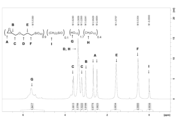
- FIG. 1 is a 1 H-NMR spectrum of organopolysiloxane Ep1 obtained in Example 1-1.
- Organopolysiloxane The organopolysiloxane according to the present invention is represented by the following general formula (1).
- R 1 is a monovalent hydrocarbon group having 1 to 10 carbon atoms, preferably 1 to 6 carbon atoms, which may be linear, branched, or cyclic, and specific examples thereof include alkyl groups such as methyl, ethyl, n-propyl, n-butyl, n-pentyl, n-hexyl, n-heptyl, n-octyl, and n-decyl groups; cycloalkyl groups such as cyclopentyl and cyclohexyl groups; alkenyl groups such as vinyl, allyl, butenyl, hexenyl, and octenyl groups; and aryl groups such as phenyl and naphthyl groups. Among these, methyl, ethyl, n-propyl, and phenyl groups are preferred, methyl and ethyl groups are more preferred, and methyl is even more preferred.
- Each R2 is independently a monovalent hydrocarbon group having 1 to 10 carbon atoms, preferably 1 to 6 carbon atoms, which may be substituted with a glycidyloxy group, and specific examples thereof include the same as those exemplified above for R1 , and glycidyloxy-substituted alkyl groups such as a glycidyloxypropyl group.
- R1 glycidyloxy-substituted alkyl groups
- methyl, ethyl, n-propyl, glycidyloxypropyl, and phenyl groups are preferred, methyl and ethyl groups are more preferred, and methyl is even more preferred.
- R3 is a methyl group or an ethyl group.
- the character a is a number equal to or greater than 0.5, and is preferably a number from 0.5 to 0.9. If a is less than 0.5, the amount of available epoxy groups will be so small that the effect of improving adhesion cannot be expected, and the organopolysiloxane represented by formula (1) will become highly viscous, gummy, or solid, resulting in poor handleability and reduced water solubility.
- the letter b is a number of 0 or more, but is preferably 0 from the standpoint of the amount of epoxy groups contained in the organopolysiloxane of the present invention.
- c is a number exceeding 0 and is preferably a number from 0.1 to 0.5.
- the organopolysiloxane has a structure composed only of trisiloxane units and tetrasiloxane units, and the silanol groups contained therein are highly reactive, resulting in insufficient storage stability and making the product unsuitable for practical use.
- the letter d is a number of 0 or more, but is preferably 0 from the standpoint of the reactivity of the silanol group.
- x and y respectively represent the number of moles of hydroxyl groups and alkoxy groups bonded to 1 mole of Si atoms.
- x is a number of 1 or more, and from the viewpoint of storage stability, is preferably a number from 1 to 2. If it is less than 1, the water solubility of the organopolysiloxane and its reactivity with inorganic substrates will be poor.
- y is a number of 0.5 or less, and is preferably a number of 0.4 or less from the viewpoint of reducing alcohol produced by hydrolysis.
- the organopolysiloxane of the present invention is preferably one represented by the following formula (1a):
- the weight average molecular weight of the organopolysiloxane of the present invention is preferably from 500 to 10,000, and more preferably from 500 to 1,000.
- the weight average molecular weight in the present invention is a value calculated in terms of standard polystyrene by gel permeation chromatography (GPC).
- the organopolysiloxane of the present invention preferably has a kinetic viscosity of 100 to 500 mm 2 /s, more preferably 200 to 450 mm 2 /s, the kinetic viscosity being a value measured at 25° C. using a Cannon-Fenske viscometer.
- the organopolysiloxane of the present invention preferably contains 1% by mass or less of water and free alcohol as impurities. Water does not fall under the category of VOCs, but if present in excess, it can react with epoxy groups, so if the organopolysiloxane of the present invention is to be stored for long periods of time, it is desirable that it be kept as free as possible.
- the method for producing the organopolysiloxane of the present invention is not particularly limited, but can be produced, for example, by cohydrolytic condensation under acidic conditions of alkoxysilanes containing one or more of 3-glycidyloxypropyltrimethoxysilane, 3-glycidyloxypropyltriethoxysilane, or a mixture thereof represented by the following formula (i), diorganodimethoxysilane, diorganodiethoxysilane, or a mixture thereof represented by the following formula (iii), and, if necessary, organotrimethoxysilane, organotriethoxysilane, or a mixture thereof represented by the following formula (ii), and tetramethoxysilane, tetraethoxysilane, or a mixture thereof represented by the following formula (iv).
- diorganodimethoxysilanes and diorganodiethoxysilanes represented by the above formula (iii) include dimethyldimethoxysilane, dimethyldiethoxysilane, diethyldimethoxysilane, diethyldiethoxysilane, methylethyldimethoxysilane, methylethyldiethoxysilane, methylpropyldimethoxysilane, methylpropyldiethoxysilane, 3-glycidyloxypropylmethyldimethoxysilane, 3-glycidyloxypropylmethyldiethoxysilane, cyclopentylmethyldimethoxysilane, cyclopentylmethyldiethoxysilane, cyclohexylmethyldimethoxysilane, cyclohexylmethyldiethoxysilane, methylphenyldimethoxysilane, methylphenyldiethoxysilane, dipheny
- organotrimethoxysilane and organotriethoxysilane represented by the above formula (ii) include trialkoxysilanes such as methyltrimethoxysilane, methyltriethoxysilane, ethyltrimethoxysilane, ethyltriethoxysilane, vinyltrimethoxysilane, vinyltriethoxysilane, propyltrimethoxysilane, propyltriethoxysilane, butyltrimethoxysilane, butyltriethoxysilane, hexyltrimethoxysilane, hexyltriethoxysilane, cyclohexyltrimethoxysilane, cyclohexyltriethoxysilane, phenyltrimethoxysilane, phenyltriethoxysilane, octyltrimethoxysilane, octyltrimethoxysilane,
- the amount of these silane monomers used is preferably adjusted according to the molar ratio of each siloxane unit constituting the desired organopolysiloxane (the values of a to d in formula (1)).
- the amount of water used for hydrolysis of the alkoxysilane monomer is preferably 0.8 to 1.1 times by mole, more preferably 1 to 1.1 times by mole, per mole of alkoxysilyl group, from the viewpoint of suppressing the reaction with the epoxy group and reducing the amount of remaining alkoxysilyl groups.
- the acid component used to adjust the acidic conditions during the hydrolysis reaction is not particularly limited as long as it is a commercially available Br ⁇ nsted acid, but from the viewpoint of ease of availability, formic acid, acetic acid, citric acid, hydrochloric acid, and nitric acid are preferred.
- the amount of acid used is preferably 0.0001 to 0.01 moles per mole of silane monomer, from the viewpoint of suppressing an increase in the molecular weight of the organopolysiloxane obtained by an excessive dehydration condensation reaction between silanols and a decrease in water solubility due to a decrease in the amount of silanol groups.
- an organic solvent may be used as necessary within a range that does not inhibit the reaction.
- the organic solvent used is preferably one that is compatible with water, which is the reaction raw material, and is preferably an alcohol, an ester, a ketone, an ether, or the like.
- the organic solvent preferably has a low boiling point, and is preferably a solvent having a boiling point of 150° C. or less under atmospheric pressure.
- specific examples of alcohols include methanol, ethanol, propanol, isopropanol, butanol, isobutanol, pentyl alcohol, neopentyl alcohol, hexyl alcohol, and cyclohexyl alcohol.
- esters include ethyl acetate and butyl acetate.
- ketones include acetone, methyl ethyl ketone, and cyclohexanone.
- ethers include tetrahydrofuran, tetrahydropyran, and dioxane.
- the temperature for the hydrolysis reaction is preferably 55 to 70° C., and the reaction time is preferably 1 to 5 hours.
- the organopolysiloxane of the present invention can be used as an adhesion imparting agent in curable compositions such as paints, and because of its excellent water solubility, it can also be made into an aqueous paint composition.
- the aqueous coating composition of the present invention contains the above-mentioned organopolysiloxane.
- the above-mentioned organopolysiloxane one type may be used alone, or two or more types may be used in combination.
- the aqueous coating composition of the present invention preferably contains water as a solvent, and is particularly preferably an aqueous solution containing only water as a solvent.
- the content of the organopolysiloxane in the composition is preferably 5 to 50 mass %, more preferably 10 to 40 mass %.
- aqueous coating compositions include compositions containing aqueous resins such as aqueous epoxy resin compositions and aqueous urethane resin compositions, and the organopolysiloxane of the present invention can be used as one component of these aqueous resin compositions.
- aqueous resin include aqueous epoxy resins, aqueous polyurethane resins, aqueous polyester resins, aqueous acrylic resins, and the like.
- the aqueous coating composition of the present invention may contain any additives such as organic solvents, antioxidants, ultraviolet absorbers, light stabilizers, thickeners, dispersants, and adhesion promoters, as long as the additives do not impair the effects of the present invention.
- additives such as organic solvents, antioxidants, ultraviolet absorbers, light stabilizers, thickeners, dispersants, and adhesion promoters, as long as the additives do not impair the effects of the present invention.
- the method for producing the aqueous coating composition of the present invention is not particularly limited, and examples include a method in which the organopolysiloxane, solvent, and optionally the aqueous resin and other additives are mixed in a conventional manner.
- the obtained aqueous coating composition is applied onto a specified substrate directly or via another layer such as a primer layer, and then dried for 1 to 60 minutes in an environment of 20 to 50°C and 30 to 60% RH to form a coating film.
- the substrate is not particularly limited, but examples thereof include plastic molded bodies, wood-based products, ceramics, glass, metals, and composites thereof.
- the method for applying the aqueous coating composition is not particularly limited and can be appropriately selected from conventionally known methods, for example, various application methods such as brush coating, wiping, spraying, immersion, bar coating, flow coating, roll coating, curtain coating, spin coating, and knife coating.
- the organopolysiloxane of the present invention can be suitably used as a coupling component or an aqueous reactive binder in an aqueous primer composition (paint).
- the primer composition of the present invention contains the above-mentioned organopolysiloxane, and as the above-mentioned organopolysiloxane, one type may be used alone, or two or more types may be used in combination.
- the primer composition of the present invention preferably contains water as a solvent, and is particularly preferably an aqueous solution containing only water as a solvent.
- the amount of the organopolysiloxane in the composition is preferably 5 to 50 mass %, and more preferably 10 to 40 mass %.
- the primer composition of the present invention may contain any additives within the scope of not impairing the effects of the present invention, and specific examples thereof include the same additives as those exemplified in the aqueous coating composition.
- the method for producing the primer composition of the present invention and the method for forming the primer layer are not particularly limited, and may be the same as those for the aqueous paint composition.
- other layers may be formed on the surface of the primer layer.
- examples of other layers include a coating layer made of a cured coating of an aqueous resin composition containing, for example, an aqueous acrylic resin, an aqueous polyester resin, an aqueous epoxy resin, an aqueous urethane resin, etc.
- a coating layer made of a cured coating of an aqueous urethane resin composition is preferred.
- the coating layer may be formed by the same method as for the aqueous paint composition.
- organopolysiloxane (Ep1) had a kinetic viscosity of 429 mm 2 /s at 25° C., an epoxy functional group amount of 202 g/mol, and a weight average molecular weight of 610.
- Analysis by 1 H-NMR and GPC measurements revealed that the organopolysiloxane (Ep1) had a structure represented by the following formula (2). The 1 H-NMR spectrum is shown in FIG.
- Example 1-2 A colorless, transparent liquid organopolysiloxane (Ep2) was obtained by carrying out the same operation as in Example 1-1, except that the amounts of 3-glycidyloxypropyltrimethoxysilane, dimethyldimethoxysilane, and 0.2% hydrochloric acid were changed to 236 g (1.0 mol), 120 g (1.0 mol), and 90 g (5.0 mol as water) of Example 1-1.
- the resulting organopolysiloxane had a kinetic viscosity of 218 mm2 /s at 25°C, an epoxy functional group amount of 258 g/mol, and a weight average molecular weight of 700.
- Analysis by 1H -NMR and GPC measurements revealed that the organopolysiloxane (Ep2) had a structure represented by the following formula (3).
- Examples 1-3 425 g (1.8 mol) of 3-glycidyloxypropyltrimethoxysilane and 44 g (0.2 mol) of 3-glycidyloxypropylmethyldimethoxysilane were placed in a 1 L three-neck flask equipped with a stirrer, a cooling tube, a dropping funnel, and a thermometer. 104.4 g (5.8 mol as the amount of water) of 0.2% hydrochloric acid was dropped into the flask (the internal temperature was controlled to 20 to 40°C during the dropping).
- organopolysiloxane (Ep3) had a kinetic viscosity of 361 mm2 /s at 25°C, an epoxy functional group amount of 200 g/mol, and a weight average molecular weight of 510.
- Analysis by 1H -NMR and GPC measurements revealed that the organopolysiloxane (Ep3) had a structure represented by the following formula (4):
- organopolysiloxane had a kinetic viscosity of 726 mm2 /s at 25°C, an epoxy functional group amount of 189 g/mol, and a weight average molecular weight of 830.
- Analysis by 1H -NMR and GPC measurements revealed that organopolysiloxane (Ep4) had a structure represented by the following formula (5):
- Example 1-2 A colorless, transparent liquid organopolysiloxane (Ep5) was obtained in the same manner as in Example 1-1, except that the amounts of 3-glycidyloxypropyltrimethoxysilane, dimethyldimethoxysilane, and 0.2% hydrochloric acid were changed to 141.6 g (0.6 mol), 168 g (1.4 mol), and 82.8 g (4.6 mol as water) of Example 1-1.
- the resulting organopolysiloxane had a kinetic viscosity of 181 mm2 /s at 25°C, an epoxy functional group amount of 288 g/mol, and a weight average molecular weight of 930.
- organopolysiloxane (Ep5) had a structure represented by the following formula (6). Incidentally, when organopolysiloxane (Ep5) was mixed with ion-exchanged water, it was incompatible, turned cloudy, and had poor water solubility.
- Comparative Example 2-1 which used organopolysiloxane Ep4 consisting only of trisiloxane units and no disiloxane units, was found to have high silanol activity and a significant increase in viscosity and decrease in water solubility over time due to the progression of the condensation reaction. Such a material can only be handled immediately after production, and can be said to be of a quality unsuitable for practical use.
- the organopolysiloxanes Ep1 to Ep3 obtained in Examples 1-1 to 1-3 show similar behavior of change over time at 25°C, but the extent of the change is small, and it is clear that almost no change is observed when stored at 5°C.
- primer compositions [Examples 3-1 to 3-3, Comparative Examples 3-1 to 3-5]
- the primer components shown in Table 2 below were diluted with ion-exchanged water to a solid content of 30%, and the resulting composition was wiped onto a polished steel plate and dried for 30 minutes in an environment of 25° C. and 50% RH. Thereafter, 100 parts of a water-based coating resin BURNOCK WD-551 (manufactured by DIC Corporation) and 30 parts of an isocyanate-based curing agent BURNOCK DNW-5500 (manufactured by DIC Corporation) were mixed and diluted with water to form a water-based urethane coating, which was then applied using a bar coater No. 14 and allowed to stand for 3 days in an environment of 25°C and 50% RH, after which it was cured under conditions of 80°C x 4 hours.
- BURNOCK WD-551 manufactured by DIC Corporation
- BURNOCK DNW-5500 manufactured by DIC Corporation
- the coating film obtained above was subjected to the following evaluations. The results are shown in Table 2.
- (1) Appearance of Coating Film The coating film was visually observed to judge whether there were any abnormalities. ⁇ : No abnormality ⁇ : Abnormalities such as foreign matter, unevenness, or cloudiness were observed
- (2) Initial adhesion according to JIS K5600 25 grids were made in the coating film using a razor blade at 2 mm intervals, six cuts vertically and six horizontally, and the grids were firmly adhered with cellophane tape (registered trademark, manufactured by Nichiban Co., Ltd.). The grids were then rapidly peeled off at an angle of 90° towards the user. The number of grids (X) that remained without the coating film peeling off was expressed as X/25.
- KBM403 3-glycidyloxypropyltrimethoxysilane (manufactured by Shin-Etsu Chemical Co., Ltd.)
- KBE903 3-aminopropyltriethoxysilane (manufactured by Shin-Etsu Chemical Co., Ltd.)
- MP200 Hydrolysis condensation product of 3-glycidyloxypropyltrimethoxysilane (CoatOSil MP200 silane, manufactured by Momentive Performance Materials)
- Eg-Pr [3-(2,3-dihydroxyprop-1-oxy)propyl]silanol oligomer-containing composition described in Example 4 of JP2017-114852A
- Comparative Example 3-2 was a primer component having an amino group that is highly reactive with urethane paint, and as a result, good adhesion improvement was shown, but the reactivity tended to be too high, resulting in a significant deterioration in the coatability of the urethane paint and a loss of the appearance of the coating film. Comparative Example 3-4 showed poor adhesion, possibly due to insufficient reactivity between the ethylene glycol structural group and the urethane coating material.
Landscapes
- Chemical & Material Sciences (AREA)
- Organic Chemistry (AREA)
- Life Sciences & Earth Sciences (AREA)
- Engineering & Computer Science (AREA)
- Materials Engineering (AREA)
- Wood Science & Technology (AREA)
- Chemical Kinetics & Catalysis (AREA)
- Health & Medical Sciences (AREA)
- Medicinal Chemistry (AREA)
- Polymers & Plastics (AREA)
- Silicon Polymers (AREA)
- Paints Or Removers (AREA)
Priority Applications (4)
| Application Number | Priority Date | Filing Date | Title |
|---|---|---|---|
| CN202380073832.3A CN120077052A (zh) | 2022-10-24 | 2023-10-03 | 有机聚硅氧烷、密合性赋予剂、水性涂料组合物和底漆组合物 |
| EP23882358.7A EP4610264A1 (en) | 2022-10-24 | 2023-10-03 | Organopolysiloxane, adhesion-imparting agent, aqueous coating material composition, and primer composition |
| KR1020257015763A KR20250096733A (ko) | 2022-10-24 | 2023-10-03 | 오가노폴리실록산, 밀착성 부여제, 수성 도료 조성물 및 프라이머 조성물 |
| JP2024552913A JP7761163B2 (ja) | 2022-10-24 | 2023-10-03 | オルガノポリシロキサン、密着性付与剤、水性塗料組成物およびプライマー組成物 |
Applications Claiming Priority (2)
| Application Number | Priority Date | Filing Date | Title |
|---|---|---|---|
| JP2022169656 | 2022-10-24 | ||
| JP2022-169656 | 2022-10-24 |
Publications (1)
| Publication Number | Publication Date |
|---|---|
| WO2024090149A1 true WO2024090149A1 (ja) | 2024-05-02 |
Family
ID=90830640
Family Applications (1)
| Application Number | Title | Priority Date | Filing Date |
|---|---|---|---|
| PCT/JP2023/036008 Ceased WO2024090149A1 (ja) | 2022-10-24 | 2023-10-03 | オルガノポリシロキサン、密着性付与剤、水性塗料組成物およびプライマー組成物 |
Country Status (6)
| Country | Link |
|---|---|
| EP (1) | EP4610264A1 (https=) |
| JP (1) | JP7761163B2 (https=) |
| KR (1) | KR20250096733A (https=) |
| CN (1) | CN120077052A (https=) |
| TW (1) | TW202434673A (https=) |
| WO (1) | WO2024090149A1 (https=) |
Citations (17)
| Publication number | Priority date | Publication date | Assignee | Title |
|---|---|---|---|---|
| EP0675128A1 (en) | 1994-03-31 | 1995-10-04 | Hüls America Inc. | Method for preparation of stable water-borne silane compositions |
| JPH10110101A (ja) * | 1996-09-27 | 1998-04-28 | Huels Ag | 水を基礎とするオルガノポリシロキサン含有組成物、その製造法、および該組成物からなる処理剤 |
| JP2005068361A (ja) * | 2003-08-27 | 2005-03-17 | Shin Etsu Chem Co Ltd | 水系被覆組成物及びその製造方法並びにその硬化被膜が形成された物品 |
| JP2005298561A (ja) * | 2004-04-07 | 2005-10-27 | Dainippon Toryo Co Ltd | 水性オルガノポリシロキサン溶液の製造方法及びコーティング組成物 |
| JP2008516019A (ja) * | 2004-10-08 | 2008-05-15 | エボニック デグサ ゲーエムベーハー | ポリエーテル官能性シロキサン、ポリエーテルシロキサン含有組成物、該シロキサンの製造法および該シロキサンの使用 |
| JP2015034097A (ja) | 2013-08-07 | 2015-02-19 | 信越化学工業株式会社 | 水性シランカップリング剤組成物及びその製造方法、表面処理剤並びに物品 |
| CN104892942A (zh) * | 2015-06-04 | 2015-09-09 | 成都拓利化工实业有限公司 | 一种加成型有机硅橡胶用增粘剂及制备方法 |
| JP2016044278A (ja) | 2014-08-26 | 2016-04-04 | 信越化学工業株式会社 | 水性シランカップリング剤組成物、その製造方法及び表面処理剤 |
| CN106146850A (zh) * | 2016-07-05 | 2016-11-23 | 山东省科学院新材料研究所 | 一种加成型有机硅浸渍树脂用增粘剂及其制备方法 |
| JP2017114852A (ja) | 2015-12-08 | 2017-06-29 | エボニック デグサ ゲーエムベーハーEvonik Degussa GmbH | 水性[3−(2,3−ジヒドロキシプロパ−1−オキシ)プロピル]シラノールオリゴマー含有組成物、その製造方法、及びその使用 |
| JP2017206673A (ja) * | 2016-02-04 | 2017-11-24 | エボニック デグサ ゲーエムベーハーEvonik Degussa GmbH | 改善された引裂伝播抵抗を有するアルコキシシリル含有接着シーラント剤 |
| WO2018034232A1 (ja) | 2016-08-17 | 2018-02-22 | 日本合成化学工業株式会社 | アクリル系粘着剤組成物、及びそれを用いてなる粘着剤、偏光板用粘着剤、ならびに画像表示装置 |
| JP2018127507A (ja) | 2017-02-06 | 2018-08-16 | アイカ工業株式会社 | 光学部品固定用接着剤 |
| CN109054022A (zh) * | 2018-07-19 | 2018-12-21 | 深圳市希顺有机硅科技有限公司 | 一种中低温快速固化加成型有机硅增粘剂及其制备方法 |
| JP2019143161A (ja) | 2013-12-13 | 2019-08-29 | 株式会社ダイセル | ポリオルガノシルセスキオキサン、ハードコートフィルム、接着シート、及び積層物 |
| JP2021176943A (ja) * | 2020-05-08 | 2021-11-11 | 日東紡績株式会社 | 紫外線遮蔽コーティング組成物、及びその用途 |
| JP2022027097A (ja) | 2020-07-31 | 2022-02-10 | 日東電工株式会社 | 粘着剤層付き偏光フィルム、画像表示パネル、画像表示パネルの製造方法及び粘着剤層 |
-
2023
- 2023-10-03 WO PCT/JP2023/036008 patent/WO2024090149A1/ja not_active Ceased
- 2023-10-03 CN CN202380073832.3A patent/CN120077052A/zh active Pending
- 2023-10-03 KR KR1020257015763A patent/KR20250096733A/ko active Pending
- 2023-10-03 JP JP2024552913A patent/JP7761163B2/ja active Active
- 2023-10-03 EP EP23882358.7A patent/EP4610264A1/en active Pending
- 2023-10-17 TW TW112139512A patent/TW202434673A/zh unknown
Patent Citations (17)
| Publication number | Priority date | Publication date | Assignee | Title |
|---|---|---|---|---|
| EP0675128A1 (en) | 1994-03-31 | 1995-10-04 | Hüls America Inc. | Method for preparation of stable water-borne silane compositions |
| JPH10110101A (ja) * | 1996-09-27 | 1998-04-28 | Huels Ag | 水を基礎とするオルガノポリシロキサン含有組成物、その製造法、および該組成物からなる処理剤 |
| JP2005068361A (ja) * | 2003-08-27 | 2005-03-17 | Shin Etsu Chem Co Ltd | 水系被覆組成物及びその製造方法並びにその硬化被膜が形成された物品 |
| JP2005298561A (ja) * | 2004-04-07 | 2005-10-27 | Dainippon Toryo Co Ltd | 水性オルガノポリシロキサン溶液の製造方法及びコーティング組成物 |
| JP2008516019A (ja) * | 2004-10-08 | 2008-05-15 | エボニック デグサ ゲーエムベーハー | ポリエーテル官能性シロキサン、ポリエーテルシロキサン含有組成物、該シロキサンの製造法および該シロキサンの使用 |
| JP2015034097A (ja) | 2013-08-07 | 2015-02-19 | 信越化学工業株式会社 | 水性シランカップリング剤組成物及びその製造方法、表面処理剤並びに物品 |
| JP2019143161A (ja) | 2013-12-13 | 2019-08-29 | 株式会社ダイセル | ポリオルガノシルセスキオキサン、ハードコートフィルム、接着シート、及び積層物 |
| JP2016044278A (ja) | 2014-08-26 | 2016-04-04 | 信越化学工業株式会社 | 水性シランカップリング剤組成物、その製造方法及び表面処理剤 |
| CN104892942A (zh) * | 2015-06-04 | 2015-09-09 | 成都拓利化工实业有限公司 | 一种加成型有机硅橡胶用增粘剂及制备方法 |
| JP2017114852A (ja) | 2015-12-08 | 2017-06-29 | エボニック デグサ ゲーエムベーハーEvonik Degussa GmbH | 水性[3−(2,3−ジヒドロキシプロパ−1−オキシ)プロピル]シラノールオリゴマー含有組成物、その製造方法、及びその使用 |
| JP2017206673A (ja) * | 2016-02-04 | 2017-11-24 | エボニック デグサ ゲーエムベーハーEvonik Degussa GmbH | 改善された引裂伝播抵抗を有するアルコキシシリル含有接着シーラント剤 |
| CN106146850A (zh) * | 2016-07-05 | 2016-11-23 | 山东省科学院新材料研究所 | 一种加成型有机硅浸渍树脂用增粘剂及其制备方法 |
| WO2018034232A1 (ja) | 2016-08-17 | 2018-02-22 | 日本合成化学工業株式会社 | アクリル系粘着剤組成物、及びそれを用いてなる粘着剤、偏光板用粘着剤、ならびに画像表示装置 |
| JP2018127507A (ja) | 2017-02-06 | 2018-08-16 | アイカ工業株式会社 | 光学部品固定用接着剤 |
| CN109054022A (zh) * | 2018-07-19 | 2018-12-21 | 深圳市希顺有机硅科技有限公司 | 一种中低温快速固化加成型有机硅增粘剂及其制备方法 |
| JP2021176943A (ja) * | 2020-05-08 | 2021-11-11 | 日東紡績株式会社 | 紫外線遮蔽コーティング組成物、及びその用途 |
| JP2022027097A (ja) | 2020-07-31 | 2022-02-10 | 日東電工株式会社 | 粘着剤層付き偏光フィルム、画像表示パネル、画像表示パネルの製造方法及び粘着剤層 |
Also Published As
| Publication number | Publication date |
|---|---|
| CN120077052A (zh) | 2025-05-30 |
| JPWO2024090149A1 (https=) | 2024-05-02 |
| JP7761163B2 (ja) | 2025-10-28 |
| EP4610264A1 (en) | 2025-09-03 |
| KR20250096733A (ko) | 2025-06-27 |
| TW202434673A (zh) | 2024-09-01 |
Similar Documents
| Publication | Publication Date | Title |
|---|---|---|
| JP3703116B2 (ja) | オルガノポリシロキサン樹脂の製造方法 | |
| US6348269B1 (en) | Composition for providing an abrasion resistant coating on a substrate having improved adhesion and improved resistance to crack formation | |
| US8153196B2 (en) | Coating compositions, articles, and methods of coating articles | |
| EP0759457B1 (en) | Weather and soiling-resistant silicone-containing coating composition | |
| US7928179B2 (en) | Photoreactive group-containing siloxane compound, making method, photo-curable resin composition, and article having coating thereof | |
| JP2016117829A (ja) | コーティング剤組成物 | |
| EP2607413B1 (en) | Plastic Substrate for Automotive Glazing and Its Repairing Method | |
| JP3232004B2 (ja) | コーティング材組成物 | |
| JP5471145B2 (ja) | コーティング用組成物及びその被覆物品 | |
| JP7239836B2 (ja) | 被膜形成組成物 | |
| JP2000080354A (ja) | 防錆・耐汚染性保護コーティング剤組成物 | |
| CN110079093B (zh) | 一种耐磨有机聚硅氧烷组合物及其制备方法 | |
| CN115038760B (zh) | 涂料组合物 | |
| TW202000791A (zh) | 可濕氣固化有機聚矽氧烷組成物及電氣/電子設備 | |
| CN116656240A (zh) | 一种基于环氧丙烯酸酯缩合烯基硅树脂所制备的光固化涂料及涂层 | |
| JP7761163B2 (ja) | オルガノポリシロキサン、密着性付与剤、水性塗料組成物およびプライマー組成物 | |
| JP7761164B2 (ja) | オルガノポリシロキサン、その製造方法、密着性付与剤、水性塗料組成物およびプライマー組成物 | |
| JP4883269B2 (ja) | 硬化性ポリメチルシロキサン樹脂の製造方法 | |
| JP7086894B2 (ja) | オルガノポリシロキサンおよびそれを含む活性エネルギー線硬化性組成物 | |
| TW202126724A (zh) | 含氟硬化性組成物及物品 | |
| JPH0786182B2 (ja) | コーティング樹脂組成物 | |
| JP2019178277A (ja) | 硬化性樹脂組成物、及びその製造方法 | |
| HK1037661B (en) | Composition for providing an abrasion resistant coating on a substrate having improved adhesion and improved resistance to crack formation |
Legal Events
| Date | Code | Title | Description |
|---|---|---|---|
| 121 | Ep: the epo has been informed by wipo that ep was designated in this application |
Ref document number: 23882358 Country of ref document: EP Kind code of ref document: A1 |
|
| WWE | Wipo information: entry into national phase |
Ref document number: 2024552913 Country of ref document: JP |
|
| WWE | Wipo information: entry into national phase |
Ref document number: 202380073832.3 Country of ref document: CN |
|
| ENP | Entry into the national phase |
Ref document number: 20257015763 Country of ref document: KR Kind code of ref document: A |
|
| WWE | Wipo information: entry into national phase |
Ref document number: 2023882358 Country of ref document: EP |
|
| NENP | Non-entry into the national phase |
Ref country code: DE |
|
| WWP | Wipo information: published in national office |
Ref document number: 202380073832.3 Country of ref document: CN |
|
| ENP | Entry into the national phase |
Ref document number: 2023882358 Country of ref document: EP Effective date: 20250526 |
|
| WWP | Wipo information: published in national office |
Ref document number: 1020257015763 Country of ref document: KR |
|
| WWP | Wipo information: published in national office |
Ref document number: 2023882358 Country of ref document: EP |