WO2024089797A1 - 空気調和装置 - Google Patents
空気調和装置 Download PDFInfo
- Publication number
- WO2024089797A1 WO2024089797A1 PCT/JP2022/039915 JP2022039915W WO2024089797A1 WO 2024089797 A1 WO2024089797 A1 WO 2024089797A1 JP 2022039915 W JP2022039915 W JP 2022039915W WO 2024089797 A1 WO2024089797 A1 WO 2024089797A1
- Authority
- WO
- WIPO (PCT)
- Prior art keywords
- valve
- heat exchanger
- header
- heat
- outdoor
- Prior art date
- Legal status (The legal status is an assumption and is not a legal conclusion. Google has not performed a legal analysis and makes no representation as to the accuracy of the status listed.)
- Ceased
Links
Images




Classifications
-
- F—MECHANICAL ENGINEERING; LIGHTING; HEATING; WEAPONS; BLASTING
- F24—HEATING; RANGES; VENTILATING
- F24F—AIR-CONDITIONING; AIR-HUMIDIFICATION; VENTILATION; USE OF AIR CURRENTS FOR SCREENING
- F24F1/00—Room units for air-conditioning, e.g. separate or self-contained units or units receiving primary air from a central station
-
- F—MECHANICAL ENGINEERING; LIGHTING; HEATING; WEAPONS; BLASTING
- F25—REFRIGERATION OR COOLING; COMBINED HEATING AND REFRIGERATION SYSTEMS; HEAT PUMP SYSTEMS; MANUFACTURE OR STORAGE OF ICE; LIQUEFACTION SOLIDIFICATION OF GASES
- F25B—REFRIGERATION MACHINES, PLANTS OR SYSTEMS; COMBINED HEATING AND REFRIGERATION SYSTEMS; HEAT PUMP SYSTEMS
- F25B25/00—Machines, plants or systems, using a combination of modes of operation covered by two or more of the groups F25B1/00 - F25B23/00
- F25B25/005—Machines, plants or systems, using a combination of modes of operation covered by two or more of the groups F25B1/00 - F25B23/00 using primary and secondary systems
-
- F—MECHANICAL ENGINEERING; LIGHTING; HEATING; WEAPONS; BLASTING
- F24—HEATING; RANGES; VENTILATING
- F24F—AIR-CONDITIONING; AIR-HUMIDIFICATION; VENTILATION; USE OF AIR CURRENTS FOR SCREENING
- F24F1/00—Room units for air-conditioning, e.g. separate or self-contained units or units receiving primary air from a central station
- F24F1/06—Separate outdoor units, e.g. outdoor unit to be linked to a separate room comprising a compressor and a heat exchanger
- F24F1/26—Refrigerant piping
-
- F—MECHANICAL ENGINEERING; LIGHTING; HEATING; WEAPONS; BLASTING
- F24—HEATING; RANGES; VENTILATING
- F24F—AIR-CONDITIONING; AIR-HUMIDIFICATION; VENTILATION; USE OF AIR CURRENTS FOR SCREENING
- F24F11/00—Control or safety arrangements
- F24F11/70—Control systems characterised by their outputs; Constructional details thereof
- F24F11/80—Control systems characterised by their outputs; Constructional details thereof for controlling the temperature of the supplied air
- F24F11/83—Control systems characterised by their outputs; Constructional details thereof for controlling the temperature of the supplied air by controlling the supply of heat-exchange fluids to heat-exchangers
- F24F11/84—Control systems characterised by their outputs; Constructional details thereof for controlling the temperature of the supplied air by controlling the supply of heat-exchange fluids to heat-exchangers using valves
-
- F—MECHANICAL ENGINEERING; LIGHTING; HEATING; WEAPONS; BLASTING
- F25—REFRIGERATION OR COOLING; COMBINED HEATING AND REFRIGERATION SYSTEMS; HEAT PUMP SYSTEMS; MANUFACTURE OR STORAGE OF ICE; LIQUEFACTION SOLIDIFICATION OF GASES
- F25B—REFRIGERATION MACHINES, PLANTS OR SYSTEMS; COMBINED HEATING AND REFRIGERATION SYSTEMS; HEAT PUMP SYSTEMS
- F25B29/00—Combined heating and refrigeration systems, e.g. operating alternately or simultaneously
- F25B29/003—Combined heating and refrigeration systems, e.g. operating alternately or simultaneously of the compression type system
-
- F—MECHANICAL ENGINEERING; LIGHTING; HEATING; WEAPONS; BLASTING
- F25—REFRIGERATION OR COOLING; COMBINED HEATING AND REFRIGERATION SYSTEMS; HEAT PUMP SYSTEMS; MANUFACTURE OR STORAGE OF ICE; LIQUEFACTION SOLIDIFICATION OF GASES
- F25B—REFRIGERATION MACHINES, PLANTS OR SYSTEMS; COMBINED HEATING AND REFRIGERATION SYSTEMS; HEAT PUMP SYSTEMS
- F25B41/00—Fluid-circulation arrangements
- F25B41/30—Expansion means; Dispositions thereof
-
- F—MECHANICAL ENGINEERING; LIGHTING; HEATING; WEAPONS; BLASTING
- F25—REFRIGERATION OR COOLING; COMBINED HEATING AND REFRIGERATION SYSTEMS; HEAT PUMP SYSTEMS; MANUFACTURE OR STORAGE OF ICE; LIQUEFACTION SOLIDIFICATION OF GASES
- F25B—REFRIGERATION MACHINES, PLANTS OR SYSTEMS; COMBINED HEATING AND REFRIGERATION SYSTEMS; HEAT PUMP SYSTEMS
- F25B5/00—Compression machines, plants or systems, with several evaporator circuits, e.g. for varying refrigerating capacity
-
- F—MECHANICAL ENGINEERING; LIGHTING; HEATING; WEAPONS; BLASTING
- F25—REFRIGERATION OR COOLING; COMBINED HEATING AND REFRIGERATION SYSTEMS; HEAT PUMP SYSTEMS; MANUFACTURE OR STORAGE OF ICE; LIQUEFACTION SOLIDIFICATION OF GASES
- F25B—REFRIGERATION MACHINES, PLANTS OR SYSTEMS; COMBINED HEATING AND REFRIGERATION SYSTEMS; HEAT PUMP SYSTEMS
- F25B2339/00—Details of evaporators; Details of condensers
- F25B2339/04—Details of condensers
- F25B2339/047—Water-cooled condensers
-
- F—MECHANICAL ENGINEERING; LIGHTING; HEATING; WEAPONS; BLASTING
- F25—REFRIGERATION OR COOLING; COMBINED HEATING AND REFRIGERATION SYSTEMS; HEAT PUMP SYSTEMS; MANUFACTURE OR STORAGE OF ICE; LIQUEFACTION SOLIDIFICATION OF GASES
- F25B—REFRIGERATION MACHINES, PLANTS OR SYSTEMS; COMBINED HEATING AND REFRIGERATION SYSTEMS; HEAT PUMP SYSTEMS
- F25B2500/00—Problems to be solved
- F25B2500/31—Low ambient temperatures
-
- F—MECHANICAL ENGINEERING; LIGHTING; HEATING; WEAPONS; BLASTING
- F25—REFRIGERATION OR COOLING; COMBINED HEATING AND REFRIGERATION SYSTEMS; HEAT PUMP SYSTEMS; MANUFACTURE OR STORAGE OF ICE; LIQUEFACTION SOLIDIFICATION OF GASES
- F25B—REFRIGERATION MACHINES, PLANTS OR SYSTEMS; COMBINED HEATING AND REFRIGERATION SYSTEMS; HEAT PUMP SYSTEMS
- F25B2600/00—Control issues
- F25B2600/02—Compressor control
- F25B2600/025—Compressor control by controlling speed
- F25B2600/0251—Compressor control by controlling speed with on-off operation
-
- F—MECHANICAL ENGINEERING; LIGHTING; HEATING; WEAPONS; BLASTING
- F25—REFRIGERATION OR COOLING; COMBINED HEATING AND REFRIGERATION SYSTEMS; HEAT PUMP SYSTEMS; MANUFACTURE OR STORAGE OF ICE; LIQUEFACTION SOLIDIFICATION OF GASES
- F25B—REFRIGERATION MACHINES, PLANTS OR SYSTEMS; COMBINED HEATING AND REFRIGERATION SYSTEMS; HEAT PUMP SYSTEMS
- F25B49/00—Arrangement or mounting of control or safety devices
- F25B49/02—Arrangement or mounting of control or safety devices for compression type machines, plants or systems
- F25B49/022—Compressor control arrangements
Definitions
- This disclosure relates to an air conditioning device, and in particular to an air conditioning device that includes an outdoor unit, multiple indoor units, and a relay unit.
- air conditioners are known that include an outdoor unit, multiple indoor units, and a repeater, with the outdoor unit and the multiple indoor units connected via the repeater.
- WO 2009/133640 discloses an air conditioning system as described above, in which the outdoor unit and the relay unit are connected via a first extension pipe and a second extension pipe, and the relay unit and the indoor unit are connected via a third extension pipe and a fourth extension pipe.
- the air conditioning system includes an intermediate heat exchanger disposed within the relay unit.
- heat is transported between the outdoor unit and the relay unit by circulating refrigerant through the first and second extension pipes, and between the relay unit and the indoor unit by circulating water or antifreeze through the third and fourth extension pipes.
- the intermediate heat exchanger provided in the relay unit exchanges heat between the refrigerant and the water or antifreeze, transporting heat from the indoor unit to the outdoor unit through the intermediate heat exchanger in the relay unit during cooling operation, and transporting heat from the outdoor unit to the indoor unit through the intermediate heat exchanger in the relay unit during heating operation.
- two pipes can be used to connect both the outdoor unit and the relay unit, and between the relay unit and the indoor unit, reducing the cost of piping materials and the number of construction steps.
- the air conditioner described above has an issue in that when the first and second extension pipes between the outdoor unit and the relay unit are installed over a long distance (e.g., 110 meters), the amount of refrigerant charged in the air conditioner increases. Because the global warming potential (GWP) of refrigerant is higher than that of heat media such as water and antifreeze, the greater the amount of refrigerant charged, the greater the impact of the air conditioner on global warming. In addition, refrigerant has the problem of being more expensive and having a higher risk of combustion in the event of leakage, compared to heat media such as water and antifreeze. For this reason, there is a demand from the market and society for air conditioners with a smaller total amount of refrigerant charged.
- GWP global warming potential
- the main object of the present invention is to provide an air conditioner that can reduce the amount of refrigerant required to be filled, compared to the conventional air conditioners described above.
- the air conditioning device comprises an outdoor unit, a plurality of indoor units, a relay unit, a refrigerant circuit in which a refrigerant circulates, and a heat medium circuit in which a heat medium having a lower global warming potential (GWP) than the refrigerant circulates.
- the refrigerant circuit is disposed within the relay unit and has a compressor, a first heat exchanger, an expansion valve, and a second heat exchanger, and is arranged so that the refrigerant circulates through the compressor, the first heat exchanger, the expansion valve, and the second heat exchanger in that order.
- the heat medium circuit includes a first pump, a second pump, a first heat exchanger, a second heat exchanger, a first branch header, a second branch header, a first junction header, a second junction header, a plurality of first on-off valves, a plurality of second on-off valves, a plurality of third on-off valves, a plurality of fourth on-off valves, a fifth on-off valve, a sixth on-off valve, a seventh on-off valve, an eighth on-off valve, a ninth on-off valve, and a tenth on-off valve, which are arranged in the relay unit, an outdoor heat exchanger arranged in the outdoor unit, an indoor heat exchanger arranged in each of the indoor units, a main outward pipe and a main return pipe connecting the relay unit and the outdoor unit, and a plurality of outward branch pipes and a plurality of return branch pipes connecting the relay unit and each of the indoor units.
- One end of each of the plurality of outward branch pipes is connected to the first branch header via each of the plurality of first on-off valves, and is connected to the second branch header via each of the plurality of second on-off valves.
- the other end of each of the plurality of outward branch pipes is connected to one end of the indoor heat exchanger of each of the indoor units.
- One end of each of the plurality of return branch pipes is connected to the first junction header via each of the plurality of third on-off valves, and is connected to the second junction header via each of the plurality of fourth on-off valves.
- the other end of each of the plurality of return branch pipes is connected to the other end of each of the indoor heat exchangers of the plurality of indoor units.
- the first branch header and the first junction header are connected via the fifth on-off valve.
- the second branch header and the second junction header are connected via the sixth on-off valve.
- the first junction header, the first pump, the first heat exchanger, and the first branch header are connected in this order.
- the second junction header, the second pump, the second heat exchanger, and the second branch header are connected in this order.
- One end of the outward main pipe is connected to the first junction header via the seventh on-off valve, and is connected to the second junction header via the eighth on-off valve.
- the other end of the outward main pipe is connected to one end of the outdoor heat exchanger of the outdoor unit.
- One end of the return main pipe is connected to the first pump via the ninth on-off valve and to the second pump via the tenth on-off valve.
- the other end of the return main pipe is connected to the other end of the outdoor heat exchanger of the outdoor unit.
- the present invention provides an air conditioner that can reduce the amount of refrigerant charged compared to the conventional air conditioners described above.
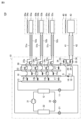
- FIG. 1 is a diagram showing an air conditioning apparatus according to a first embodiment.
- 2 is a diagram showing a refrigerant circuit and a heat medium circuit when the air conditioning apparatus shown in FIG. 1 is in a full cooling operation state.
- FIG. 2 is a diagram showing a refrigerant circuit and a heat medium circuit when the air conditioning apparatus shown in FIG. 1 is in a cooling-dominant operating state.
- FIG. 2 is a diagram showing a refrigerant circuit and a heat medium circuit when the air conditioning apparatus shown in FIG. 1 is in a full heating operation state.
- FIG. 2 is a diagram showing a refrigerant circuit and a heat medium circuit when the air conditioning apparatus shown in FIG. 1 is in a heating-dominant operating state.
- FIG. 2 is a diagram showing a refrigerant circuit and a heat medium circuit when the air conditioning apparatus shown in FIG. 1 is in a low outdoor air cooling operation state.
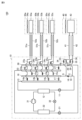
- FIG. FIG. 11 is a diagram showing an air conditioning apparatus according to a second embodiment.
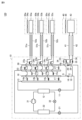
- FIG. 11 is a diagram showing an air conditioning apparatus according to a third embodiment.
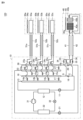
- FIG. 13 is a diagram showing an air conditioning apparatus according to a fourth embodiment.
- Embodiment 1 ⁇ Configuration of Air Conditioner> As shown in Fig. 1, the air conditioning apparatus 100 according to the first embodiment includes a relay unit 10, an outdoor unit 40, and a plurality of indoor units 50a, 50b, and 50c.
- the air conditioning apparatus 100 shown in Fig. 1 includes three indoor units 50a, 50b, and 50c, but the number of indoor units may be any number equal to or greater than two.
- the repeater 10 has a refrigerant circuit through which a refrigerant circulates.
- the repeater 10, the outdoor unit 40, and the multiple indoor units 50a, 50b, and 50c have a heat medium circuit through which a heat medium with a lower global warming potential (GWP) than the refrigerant circulates.
- the heat medium with a lower global warming potential (GWP) than the refrigerant is, for example, water or antifreeze.
- the refrigerant circuit is included only in the repeater 10.
- the refrigerant circuit is not included in the outdoor unit 40 and the multiple indoor units 50a, 50b, and 50c.
- the refrigerant circuit has a compressor 31, a first heat exchanger 12, an expansion valve, and a second heat exchanger 22.
- the compressor 31, the first heat exchanger 12, the expansion valve, and the second heat exchanger 22 are arranged inside the relay unit 10.
- the refrigerant circuit is set up so that the refrigerant circulates through the compressor 31, the first heat exchanger 12, the expansion valve, and the second heat exchanger 22 in that order.
- the refrigerant circulating through the refrigerant circuit condenses in the first heat exchanger 12 by exchanging heat with the heat medium circulating through the heat medium circuit, and evaporates in the second heat exchanger 22 by exchanging heat with the heat medium circulating through the heat medium circuit.
- the heat medium circuit includes, within the relay unit 10, a first pump 11, a first heat exchanger 12, a first branch header 13, a first merging header 16, a second pump 21, a second heat exchanger 22, a second branch header 23, a second merging header 26, a plurality of first on-off valves 14a, 14b, 14c, a plurality of second on-off valves 24a, 24b, 24c, a plurality of third on-off valves 15a, 15b, 15c, a plurality of fourth on-off valves 25a, 25b, 25c, a fifth on-off valve 17, a sixth on-off valve 27, a seventh on-off valve 33, an eighth on-off valve 34, a ninth on-off valve 35, and a tenth on-off valve 36.
- the heat medium circuit has an outdoor heat exchanger 43 in the outdoor unit 40.
- the heat medium circuit has indoor heat exchangers 53a, 53b, and 53c in each of the multiple indoor units 50a, 50b, and 50c.
- the heat medium circuit further includes an outward main pipe 41 and a return main pipe 42 that connect the relay unit 10 and the outdoor unit 40, and a plurality of outward branch pipes 51a, 51b, 51c and a plurality of return branch pipes 52a, 52b, 52c that connect the relay unit 10 and each of the plurality of indoor units 50a, 50b, 50c.
- the first junction header 16, the first pump 11, the first heat exchanger 12, and the first branch header 13 are connected in series via piping in the order listed.
- the second junction header 26, the second pump 21, the second heat exchanger 22, and the second branch header 23 are connected in series via piping in the order listed.
- the second junction header 26, the second pump 21, the second heat exchanger 22, the second branch header 23, and the multiple pipes connecting them in series constitute the second piping path.
- Each of the first piping path and the second piping path is connected to the outdoor heat exchanger 43 via the outward main piping 41 and the return main piping 42, and is also connected to each of the indoor heat exchangers 53a, 53b, 53c via each of the outward branch pipings 51a, 51b, 51c and the return branch pipings 52a, 52b, 52c.
- the outdoor heat exchanger 43 and each of the indoor heat exchangers 53a, 53b, 53c are connected in parallel to each other with respect to the first piping path, and are also connected in parallel to each other with respect to the second piping path.
- the heat medium circuit further includes, within the relay unit 10, a plurality of third piping paths connecting the first branch header 13 of the first piping path and each of the plurality of forward branch pipes 51a, 51b, 51c, a plurality of fourth piping paths connecting the second branch header 23 of the second piping path and each of the plurality of forward branch pipes 51a, 51b, 51c, a plurality of fifth piping paths connecting the first junction header 16 of the first piping path and each of the plurality of return branch pipes 52a, 52b, 52c, and a plurality of sixth piping paths connecting the second junction header 26 of the second piping path and each of the plurality of return branch pipes 52a, 52b, 52c.
- Each of the multiple first on-off valves 14a, 14b, 14c opens and closes the third piping path.
- Each of the multiple second on-off valves 24a, 24b, 24c opens and closes the fourth piping path.
- Each of the multiple third on-off valves 15a, 15b, 15c opens and closes the fifth piping path.
- Each of the multiple fourth on-off valves 25a, 25b, 25c opens and closes the sixth piping path.
- one end of each of the multiple outward branch pipes 51a, 51b, 51c is connected to the first branch header 13 via each of the multiple first on-off valves 14a, 14b, 14c, and is connected to the second branch header 23 via each of the multiple second on-off valves 24a, 24b, 24c.
- the other end of each of the multiple outward branch pipes 51a, 51b, 51c is connected to one end of each of the indoor heat exchangers 53a, 53b, 53c of the multiple indoor units 50a, 50b, 50c.
- each of the multiple return branch pipes 52a, 52b, 52c is connected to the first junction header 16 via each of the multiple third on-off valves 15a, 15b, 15c, and is connected to the second junction header 26 via each of the multiple fourth on-off valves 25a, 25b, 25c.
- the other ends of the return branch pipes 52a, 52b, and 52c are connected to the other ends of the indoor heat exchangers 53a, 53b, and 53c of the indoor units 50a, 50b, and 50c.
- a set of the third and fourth piping paths connected to one outward branch pipe 51 has, for example, a common portion and a non-common portion branching off from the common portion.
- a set of the fifth and sixth piping paths connected to one return branch pipe 52 has, for example, a common portion and a non-common portion branching off from the common portion.
- each of the first on-off valves 14a, 14b, 14c opens and closes the non-common portion of each third piping path
- each of the second on-off valves 24a, 24b, 24c opens and closes the non-common portion of each fourth piping path.
- Each of the third on-off valves 15a, 15b, 15c opens and closes the non-common portion of each fifth piping path
- each of the fourth on-off valves 25a, 25b, 25c opens and closes the non-common portion of each sixth piping path.
- the heat medium circuit further includes, within the relay unit 10, a first bypass path that connects the first branch header 13 of the first piping path to the first junction header 16, and a second bypass path that connects the second branch header 23 of the second piping path to the second junction header 26.
- the first bypass path connects the first branch header 13 to the first junction header 16, bypassing the multiple forward branch pipes 51a, 51b, 51c, the multiple indoor heat exchangers 53a, 53b, 53c, and the multiple return branch pipes 52a, 52b, 52c.
- the second bypass path connects the second branch header 23 to the second junction header 26, bypassing the multiple forward branch pipes 51a, 51b, 51c, the multiple indoor heat exchangers 53a, 53b, 53c, and the multiple return branch pipes 52a, 52b, 52c.
- the fifth on-off valve 17 opens and closes the first bypass path.
- the sixth on-off valve 27 opens and closes the second bypass path.
- the first branch header 13 and the first merging header 16 are connected via the fifth on-off valve 17.
- the second branch header 23 and the second merging header 26 are connected via the sixth on-off valve 27.
- the heat medium circuit further includes, within the relay unit 10, a seventh piping path that connects the first junction header 16 of the first piping path and the outward main piping 41, an eighth piping path that connects the second junction header 26 of the second piping path and the outward main piping 41, a ninth piping path that connects the return main piping 42 and the first pump 11 of the first piping path, and a tenth piping path that connects the return main piping 42 and the second pump 21 of the second piping path.
- the seventh on-off valve 33 opens and closes the seventh piping path.
- the eighth on-off valve 34 opens and closes the eighth piping path.
- the ninth on-off valve 35 opens and closes the ninth piping path.
- the tenth on-off valve 36 opens and closes the tenth piping path.
- the seventh piping path is connected to a portion of the first junction header 16 that is located downstream from the connection points between the first junction header 16 and the multiple fifth piping paths when viewed from the first pump 11.
- the eighth piping path is connected to a portion of the second junction header 26 that is located downstream from the connection points between the second junction header 26 and the multiple sixth piping paths when viewed from the second pump 21.
- the seventh and eighth piping paths have a common portion and a non-common portion branching off from the common portion.
- the ninth and tenth piping paths for example, have a common portion and a non-common portion branching off from the common portion.
- the seventh on-off valve 33 opens and closes the non-common portion of the seventh piping path
- the eighth on-off valve 34 opens and closes the non-common portion of each of the eighth piping paths.
- the ninth on-off valve 35 opens and closes the non-common portion of the ninth piping path
- the tenth on-off valve 36 opens and closes the non-common portion of the tenth piping path.
- one end of the outward main pipe 41 is connected to the first junction header 16 of the first piping path via the seventh on-off valve 33, and is connected to the second junction header 26 of the second piping path via the eighth on-off valve.
- the other end of the outward main pipe 41 is connected to one end of the outdoor heat exchanger 43 of the outdoor unit 40.
- One end of the return main pipe 42 is connected to the first pump 11 of the first piping path via the ninth on-off valve 35, and is connected to the second pump 21 of the second piping path via the tenth on-off valve 36.
- the other end of the return main pipe 42 is connected to the other end of the outdoor heat exchanger 43 of the outdoor unit 40.
- the heat medium circuit further includes, within the relay unit 10, a third bypass path that connects the seventh piping path and the ninth piping path, a fourth bypass path that connects the eighth piping path and the tenth piping path, an eleventh on-off valve 18 that opens and closes the third bypass path, and a twelfth on-off valve 28 that opens and closes the fourth bypass path.
- the first piping path has a pipe 19 that connects between the first junction header 16 and the first pump 11.
- a seventh piping path that connects between the first junction header 16 and the outward main pipe 41 and a ninth piping path that connects between the return main pipe 42 and the first pump 11 of the first piping path are each connected to the pipe 19.
- a connection point C between the pipe 19 and the ninth piping path is disposed downstream from a connection point A between the pipe 19 and the seventh piping path as viewed from the first pump 11.
- An eleventh opening/closing valve 18 opens and closes the pipe 19.
- the second piping path has a pipe 29 that connects between the second junction header 26 and the second pump 21.
- An eighth piping path that connects between the second junction header 26 and the outward main pipe 41 and a tenth piping path that connects between the return main pipe 42 and the second pump 21 of the second piping path are each connected to the pipe 29.
- a connection point D between the pipe 29 and the tenth piping path is disposed downstream from a connection point B between the pipe 29 and the eighth piping path as viewed from the second pump 21.
- a twelfth opening/closing valve 28 opens and closes the pipe 29.
- Each of the above-mentioned on-off valves is, for example, a solenoid valve.
- the relationship between the minimum value of the inner diameter of each of the outward main pipe 41 and the return main pipe 42 and the maximum value of the inner diameter of each of the plurality of outward branch pipes 51a, 51b, 51c and the plurality of return branch pipes 52a, 52b, 52c is not particularly limited.
- the minimum value of the inner diameter of each of the outward main pipe 41 and the return main pipe 42 may be equal to the maximum value of the inner diameter of each of the plurality of outward branch pipes 51a, 51b, 51c and the plurality of return branch pipes 52a, 52b, 52c.
- the air conditioning apparatus 100 performs full cooling operation shown in Fig. 2, cooling-dominated operation shown in Fig. 3, full heating operation shown in Fig. 4, heating-dominated operation shown in Fig. 5, or low outdoor air cooling operation shown in Fig. 6, depending on the operation mode of each of the multiple indoor units 50a, 50b, 50c and the outdoor air temperature taken in by the outdoor unit 40.
- the on-off valves painted in black indicate the on-off valves that are closed.
- the air conditioning device 100 When all indoor units in operation are in cooling operation mode, the air conditioning device 100 performs full cooling operation. When all indoor units in operation are in heating operation mode, the air conditioning device 100 performs full heating operation. When some indoor units in operation are in cooling operation mode and the remaining indoor units are in heating operation mode, if the total air conditioning load of the indoor units in cooling operation mode is greater than the total air conditioning load of the indoor units in heating operation mode, the air conditioning device 100 performs cooling-dominated operation, and if the total air conditioning load of the indoor units in heating operation mode is greater than the total air conditioning load of the indoor units in cooling operation mode, the air conditioning device 100 performs heating-dominated operation. When all indoor units in operation are in cooling operation mode and the outdoor temperature is sufficiently lower than the indoor temperature (for example, the outdoor temperature is 5 degrees or lower), the air conditioning device 100 performs low outdoor air cooling operation.
- At least one of a hot water circuit in which the heat medium heated by heat exchange with the refrigerant in the first heat exchanger 12 circulates, and a cold water circuit including the second piping path and in which the heat medium cooled by heat exchange with the refrigerant in the second heat exchanger 22 circulates is formed in the heat medium circuit.
- At least one of a hot water circuit including the first heat exchanger 12 and an indoor heat exchanger in one of the indoor units 50a, 50b, 50c that is in a heating operation mode, and a cold water circuit including the second heat exchanger 22 and an indoor heat exchanger in one of the indoor units 50a, 50b, 50c that is in a cooling operation mode is formed by each opening and closing valve included in the heat medium circuit.
- the refrigeration cycles realized in the refrigerant circuit when the air conditioning device 100 is in each of the cooling only operation, cooling-dominated operation, heating only operation, and heating-dominated operation are equivalent to each other.
- the first heat exchanger 12 acts as a condenser and the second heat exchanger 22 acts as an evaporator.
- the single-phase gas refrigerant discharged from the compressor 31 is condensed into a single-phase liquid refrigerant by heat exchange with the heat medium circulating in the hot water circuit in the first heat exchanger 12.
- the single-phase liquid refrigerant flowing out from the first heat exchanger 12 is decompressed and expanded in the expansion valve 32 to become a two-phase gas-liquid refrigerant.
- the two-phase gas-liquid refrigerant flowing out from the expansion valve 32 is evaporated into a single-phase gas refrigerant by heat exchange with the heat medium circulating in the cold water circuit in the second heat exchanger 22.
- the single-phase gas refrigerant that flows out of the second heat exchanger 22 is sucked back into the compressor 31 and circulates through the refrigerant circuit.
- ⁇ Full cooling operation> As shown in FIG. 2, when the air conditioning apparatus 100 is performing full cooling operation, the multiple second on-off valves 24a, 24b, 24c, the multiple fourth on-off valves 25a, 25b, 25c, the fifth on-off valve 17, the twelfth on-off valve 28, the seventh on-off valve 33, and the ninth on-off valve 35 are opened, and the first on-off valves 14a, 14b, 14c, the multiple third on-off valves 15a, 15b, 15c, the eleventh on-off valve 18, the sixth on-off valve 27, the eighth on-off valve 34, and the tenth on-off valve 36 are closed.
- a hot water circuit including the first pump 11, first heat exchanger 12, first branch header 13, first junction header 16, outbound main pipe 41, outdoor heat exchanger 43, and return main pipe 42 is simultaneously formed in the heat medium circuit, and a cold water circuit including the second pump 21, second heat exchanger 22, second branch header 23, multiple outbound branch pipes 51a, 51b, 51c, multiple indoor heat exchangers 53a, 53b, 53c, multiple return branch pipes 52a, 52b, 52c, and second junction header 26.
- the first pump 11, first heat exchanger 12, first branch header 13, first junction header 16, outbound main pipe 41, outdoor heat exchanger 43, and return main pipe 42 are connected in series in the order listed.
- the second pump 21, the second heat exchanger 22, the second branch header 23, each of the multiple forward branch pipes 51a, 51b, and 51c, each of the multiple indoor heat exchangers 53a, 53b, and 53c, each of the multiple return branch pipes 52a, 52b, and 52c, and the second merging header 26 are connected in series in the order listed.
- each of the multiple indoor heat exchangers 53a, 53b, and 53c is connected in parallel to each of the second branch header 23 and the second merging header 26.
- the heat medium flowing out from the first pump 11 is heated by heat exchange with single-phase gas refrigerant in the first heat exchanger 12.
- the heat medium heated in the first heat exchanger 12 flows into the outdoor heat exchanger 43 in the outdoor unit 40 via the first branch header 13, the fifth on-off valve 17, the first merging header 16, the seventh on-off valve 33, and the outward main pipe 41.
- the outdoor blower 44 is operating, and the heat medium dissipates heat by exchanging heat with the outside air blown by the outdoor blower 44 in the outdoor heat exchanger 43.
- the heat medium flowing out from the outdoor heat exchanger 43 flows into the first pump 11 via the return main pipe 42 and the ninth on-off valve 35, and circulates again in the hot water circuit.
- the heat medium flowing out of the second pump 21 is cooled by heat exchange with a gas-liquid two-phase refrigerant in the second heat exchanger 22.
- the heat medium cooled in the second heat exchanger 22 flows into each indoor heat exchanger 53a, 53b, 53c via the second branch header 23, each second on-off valve 24a, 24b, 24c, and each outward branch pipe 51a, 51b, 51c.
- each indoor blower 54a, 54b, 54c is operating, and the heat medium cools the indoor air blown by each indoor blower 54a, 54b, 54c in each indoor heat exchanger 53a, 53b, 53c.
- each indoor heat exchanger 53a, 53b, 53c flows through each return branch pipe 52a, 52b, 52c and each fourth on-off valve 25a, 25b, 25c into the second junction header 26, where it merges.
- the heat medium that merges in the second junction header 26 flows into the second pump 21 through the 12th on-off valve 28, and circulates again through the chilled water circuit.
- the indoor units 50a and 50b are in the cooling operation mode, and the indoor unit 50c is in the heating operation mode.
- the first on-off valve 14c, the third on-off valve 15c, the fifth on-off valve 17, the second on-off valves 24a and 24b, the fourth on-off valves 25a and 25b, the twelfth on-off valve 28, the seventh on-off valve 33, and the ninth on-off valve 35 are opened, and the first on-off valves 14a and 14b, the third on-off valves 15a and 15b, the eleventh on-off valve 18, the second on-off valve 24c, the fourth on-off valve 25c, the sixth on-off valve 27, the eighth on-off valve 34, and the tenth on-off valve 36 are closed.
- a hot water circuit including the first pump 11, the first heat exchanger 12, the first branch header 13, the first on-off valve 14c, the forward branch pipe 51c, the indoor heat exchanger 53c, the return branch pipe 52c, the third on-off valve 15c, the fifth on-off valve 17, the first merging header 16, the seventh on-off valve 33, the forward main pipe 41, the outdoor heat exchanger 43, the return main pipe 42, and the ninth on-off valve 35 is formed in the heat medium circuit, and a cold water circuit including the second pump 21, the second heat exchanger 22, the second branch header 23, the second on-off valves 24a, 24b, the forward branch pipes 51a, 51b, the indoor heat exchangers 53a, 53b, the return branch pipes 52a, 52b, the fourth on-off valves 25a, 25b, the second merging header 26, and the twelfth on-off valve 28 is formed at the same time.
- the first pump 11, the first heat exchanger 12, the first branch header 13, the forward branch pipe 51c, the indoor heat exchanger 53c, the return branch pipe 52c, and the first merging header 16 are connected in series in the order listed, while the first pump 11, the first heat exchanger 12, the first branch header 13, the first merging header 16, the forward main pipe 41, the outdoor heat exchanger 43, and the return main pipe 42 are connected in series in the order listed.
- the indoor heat exchanger 53c and the outdoor heat exchanger 43 are connected in parallel to each other with respect to the first branch header 13, but are also connected in series to each other via the first merging header 16.
- the outdoor heat exchanger 43 is located downstream of the indoor heat exchanger 53c when viewed from the first pump 11.
- the second pump 21, the second heat exchanger 22, the second branch header 23, the outward branch pipes 51a, 51b, the indoor heat exchangers 53a, 53b, the return branch pipes 52a, 52b, and the second merging header 26 are connected in series in the order listed.
- the heat medium flowing out from the first pump 11 is heated by heat exchange with single-phase gas refrigerant in the first heat exchanger 12.
- a part of the heat medium heated in the first heat exchanger 12 flows into the indoor heat exchanger 53c via the first branch header 13, the first on-off valve 14c, and the outward branch piping 51c, and heats the indoor air blown by the indoor blower 54c in the indoor heat exchanger 53c.
- the heat medium flowing out from the indoor heat exchanger 53c flows into the first junction header 16 via the return branch piping 52c and the third on-off valve 15c, and merges with the remainder of the heat medium heated in the first heat exchanger 12 in the first junction header 16.
- the heat medium that merges in the first merging header 16 flows into the outdoor heat exchanger 43 in the outdoor unit 40 via the seventh on-off valve 33 and the outward main pipe 41, where it dissipates heat by exchanging heat with the outside air blown by the outdoor blower 44.
- the heat medium that flows out of the outdoor heat exchanger 43 flows into the first pump 11 via the return main pipe 42 and the ninth on-off valve 35, and circulates again through the hot water circuit.
- the heat medium flowing out from the second pump 21 is cooled by heat exchange with the gas-liquid two-phase refrigerant in the second heat exchanger 22, and flows into each indoor heat exchanger 53a, 53b via the second branch header 23, each second on-off valve 24a, 24b, and each outward branch pipe 51a, 51b, and cools the indoor air blown by each indoor blower 54a, 54b in each indoor heat exchanger 53a, 53b.
- the heat medium flowing out from each indoor heat exchanger 53a, 53b flows into the second junction header 26 via each return branch pipe 52a, 52b and each fourth on-off valve 25a, 25b, and merges in the second junction header 26.
- the heat medium merged in the second junction header 26 flows into the second pump 21 via the twelfth on-off valve 28, and circulates again in the chilled water circuit.
- the cold heat required by each indoor unit 50a, 50b in cooling operation is generated in the refrigerant circuit
- the hot heat required by the indoor unit 50c in heating operation is generated in the refrigerant circuit.
- the cold heat is transferred to the heat medium in the cold water circuit in the second heat exchanger 22, and is carried by the heat medium to each indoor heat exchanger 53a, 53b, where it cools the indoor air.
- the hot heat is transferred to the heat medium in the hot water circuit in the first heat exchanger 12, and is carried by the heat medium to the indoor heat exchanger 53c, where it heats the indoor air.
- the hot exhaust heat generated in the refrigerant circuit and hot water circuit is carried by the heat medium in the hot water circuit to the outdoor heat exchanger 43, where it is released to the outside air.
- the fifth on-off valve 17 may be closed. If the amount of warm exhaust heat from the outdoor heat exchanger 43 is large, the fifth on-off valve 17 can be opened to reduce the flow rate of the heat medium flowing through the indoor heat exchanger 53c, preventing the heat medium flowing through the indoor heat exchanger 53c from excessively heating the indoor air.
- the first pump 11, the first heat exchanger 12, the first branch header 13, each of the multiple forward branch pipes 51a, 51b, 51c, each of the multiple indoor heat exchangers 53a, 53b, 53c, each of the multiple return branch pipes 52a, 52b, 52c, and the first merging header 16 are connected in series in the order listed.
- the second pump 21, the second heat exchanger 22, the second branch header 23, the second merging header 26, the forward main pipe 41, the outdoor heat exchanger 43, and the return main pipe 42 are connected in series in the order listed.
- each of the multiple indoor heat exchangers 53a, 53b, 53c is connected in parallel to each of the second branch header 23 and the second merging header 26.
- the heat medium flowing out of the first pump 11 is heated by heat exchange with single-phase gas refrigerant in the first heat exchanger 12.
- the heat medium heated in the first heat exchanger 12 flows into each indoor heat exchanger 53a, 53b, 53c via the first branch header 13, the first on-off valves 14a, 14b, 14c, and each outward branch pipe 51a, 51b, 51c.
- each indoor blower 54a, 54b, 54c is operating, and the heat medium heats the indoor air blown by each indoor blower 54a, 54b, 54c in each indoor heat exchanger 53a, 53b, 53c.
- each indoor heat exchanger 53a, 53b, 53c flows through each return branch pipe 52a, 52b, 52c and each fourth on-off valve 25a, 25b, 25c into the first junction header 16, where it merges.
- the heat medium that merges in the first junction header 16 flows into the first pump 11 through the eleventh on-off valve 18, and circulates again through the hot water circuit.
- the heat medium flowing out from the second pump 21 is cooled by heat exchange with a gas-liquid two-phase refrigerant in the second heat exchanger 22.
- the heat medium cooled in the second heat exchanger 22 flows into the outdoor heat exchanger 43 via the second branch header 23, the sixth on-off valve 27, the second merging header 26, the eighth on-off valve 34, and the outward main pipe 41.
- the heat medium absorbs heat from the outdoor air blown by the outdoor blower 44.
- the heat medium flowing out from the outdoor heat exchanger 43 flows into the second pump 21 via the return main pipe 42 and the tenth on-off valve 36, and circulates again in the chilled water circuit.
- the hot heat required by each indoor unit 50a, 50b, 50c during heating operation is generated in the refrigerant circuit.
- the hot heat is transferred to the heat medium in the hot water circuit in the first heat exchanger 12, and carried by the heat medium to each indoor heat exchanger 53a, 53b, 53c, where it heats the indoor air.
- the cold exhaust heat generated in the refrigerant circuit is transferred to the heat medium in the cold water circuit in the second heat exchanger 22, and carried by the heat medium to the outdoor heat exchanger 43, where it is released to the outside air.
- a hot water circuit including the first pump 11, the first heat exchanger 12, the first branch header 13, the first on-off valves 14a, 14b, the forward branch pipes 51a, 51b, the indoor heat exchangers 53a, 53b, the return branch pipes 52a, 52b, the third on-off valves 15a, 15b, the first merging header 16, and the eleventh on-off valve 18 is formed in the heat medium circuit, and a cold water circuit including the second pump 21, the second heat exchanger 22, the second branch header 23, the second on-off valve 24c, the forward branch pipe 51c, the indoor heat exchanger 53c, the return branch pipe 52c, the fourth on-off valve 25c, the second merging header 26, the sixth on-off valve 27, the eighth on-off valve 34, the forward main pipe 41, the outdoor heat exchanger 43, the return main pipe 42, and the tenth on-off valve 36 is formed at the same time.
- the first pump 11, the first heat exchanger 12, the first branch header 13, the outward branch pipes 51a, 51b, the indoor heat exchangers 53a, 53b, the return branch pipes 52a, 52b, and the first merging header 16 are connected in series.
- the second pump 21, the second heat exchanger 22, the second branch header 23, the forward branch pipe 51c, the indoor heat exchanger 53c, the return branch pipe 52c, and the second junction header 26 are connected in series in the order listed, while the second pump 21, the second heat exchanger 22, the second branch header 23, the second junction header 26, the forward main pipe 41, the outdoor heat exchanger 43, and the return main pipe 42 are connected in series in the order listed.
- the indoor heat exchanger 53c and the outdoor heat exchanger 43 are connected in parallel to each other with respect to the second branch header 23, but are also connected in series to each other via the second junction header 26.
- the outdoor heat exchanger 43 is located downstream of the indoor heat exchanger 53c when viewed from the second pump 21.
- the heat medium flowing out from the first pump 11 is heated by heat exchange with the single-phase gas refrigerant in the first heat exchanger 12, and flows into the indoor heat exchangers 53a, 53b via the first branch header 13, the first on-off valves 14a, 14b, and the outward branch pipes 51a, 51b, and heats the indoor air blown by the indoor blowers 54a, 54b in the indoor heat exchangers 53a, 53b.
- the heat medium flowing out from the indoor heat exchangers 53a, 53b flows into the first junction header 16 via the return branch pipes 52a, 52b and the third on-off valves 15a, 15b, and merges in the first junction header 16.
- the heat medium merged in the first junction header 16 flows into the first pump 11 via the eleventh on-off valve 18, and circulates again in the hot water circuit.
- the heat medium flowing out from the second pump 21 is cooled by heat exchange with a gas-liquid two-phase refrigerant in the second heat exchanger 22.
- a part of the heat medium cooled in the second heat exchanger 22 flows into the indoor heat exchanger 53c via the second branch header 23, the second on-off valve 24c, and the outward branch piping 51c, and cools the indoor air blown by the indoor blower 54c in the indoor heat exchanger 53c.
- the heat medium flowing out from the indoor heat exchanger 53c flows into the second junction header 26 via the return branch piping 52c and the fourth on-off valve 25c, and merges with the remainder of the heat medium cooled in the second heat exchanger 22 in the second junction header 26.
- the heat medium that merges in the second merging header 26 flows through the eighth on-off valve 34 and the outward main pipe 41 into the outdoor heat exchanger 43 in the outdoor unit 40, where it absorbs heat by exchanging heat with the outside air blown by the outdoor blower 44.
- the heat medium that flows out of the outdoor heat exchanger 43 flows through the return main pipe 42 and the tenth on-off valve 36 into the second pump 21, and circulates again through the cold water circuit.
- the hot heat required by each indoor unit 50a, 50b in heating operation is generated in the refrigerant circuit
- the cold heat required by the indoor unit 50c in cooling operation is generated in the refrigerant circuit.
- the hot heat is transferred to the heat medium in the hot water circuit in the first heat exchanger 12, and is carried by the heat medium to each indoor heat exchanger 53a, 53b, where it heats the indoor air.
- the cold heat is transferred to the heat medium in the cold water circuit in the second heat exchanger 22, and is carried by the heat medium to the indoor heat exchanger 53c, where it cools the indoor air.
- the cold exhaust heat generated in the refrigerant circuit and hot water circuit is carried by the heat medium in the cold water circuit to the outdoor heat exchanger 43, where it is released to the outside air.
- the sixth on-off valve 27 may be closed. If the amount of cold exhaust heat from the outdoor heat exchanger 43 is large, the sixth on-off valve 27 can be opened to reduce the flow rate of the heat medium flowing through the indoor heat exchanger 53c, thereby preventing the heat medium flowing through the indoor heat exchanger 53c from excessively cooling the indoor air.
- the compressor 31 of the refrigerant circuit is stopped and the refrigeration cycle is not realized. Therefore, the first heat exchanger 12 does not act as a hot heat source. Similarly, the second heat exchanger 22 does not act as a cold heat source.
- the cold water circuit includes the second pump 21, the second heat exchanger 22, the second branch header 23, each of the multiple forward branch pipes 51a, 51b, 51c, each of the multiple indoor heat exchangers 53a, 53b, 53c, each of the multiple return branch pipes 52a, 52b, 52c, the second merging header 26, the eighth opening/closing valve 34, the forward main pipe 41, the outdoor heat exchanger 43, the return main pipe 42, and the tenth opening/closing valve 36.
- the second pump 21, the second heat exchanger 22, the second branch header 23, each of the multiple forward branch pipes 51a, 51b, and 51c, each of the multiple indoor heat exchangers 53a, 53b, and 53c, each of the multiple return branch pipes 52a, 52b, and 52c, the second merging header 26, the forward main pipe 41, the outdoor heat exchanger 43, and the return main pipe 42 are connected in series in the order listed.
- each of the multiple indoor heat exchangers 53a, 53b, and 53c is connected in parallel to each of the second branch header 23 and the second merging header 26.
- the outdoor heat exchanger 43 is connected in series to each of the multiple indoor heat exchangers 53a, 53b, and 53c.
- the outdoor heat exchanger 43 is arranged downstream of the indoor heat exchanger 53c when viewed from the second pump 21.
- the heat medium flowing out of the second pump 21 passes through the second heat exchanger 22, and flows into each indoor heat exchanger 53a, 53b, 53c via the second branch header 23 and each second on-off valve 24a, 24b, 24c.
- the heat medium cools the indoor air blown by each indoor blower 54a, 54b, 54c in each indoor heat exchanger 53a, 53b, 53c.
- the heat medium flowing out of each indoor blower 54a, 54b, 54c flows into the outdoor heat exchanger 43 via the fourth on-off valve 25, the second merging header 26, and the eighth on-off valve 34.
- the heat medium is cooled in the outdoor heat exchanger 43 by the outdoor air blown by the outdoor blower 44.
- the heat medium flowing out of the outdoor heat exchanger 43 flows into the second pump 21 via the tenth on-off valve 36 and circulates in the cold water circuit.
- each indoor unit 50a, 50b, 50c during cooling operation is met entirely by absorbing heat from the outside air, which is colder than the indoor temperature, and transporting cold energy through the chilled water circuit.
- the compressor 31 of the refrigeration cycle is stopped, and the low-temperature outdoor air can be used directly as a cold energy source, so power consumption is reduced compared to full cooling operation.
- the first pump 11 when the flow rate (circulation flow rate) of the heat medium circulating through the heat medium circuit during operation of the second pump 21 is low, or when the power consumption during operation of the second pump 21 is high, the first pump 11 may be operated, the seventh on-off valve 33 and the ninth on-off valve 35 may be opened, the second on-off valve 24 and the fourth on-off valve 25 corresponding to some of the indoor units 50 in cooling operation may be closed, and the first on-off valve 14 and the third on-off valve 15 corresponding to the some of the indoor units 50 may be opened.
- a cold water circuit including the second pump 21 and a cold water circuit including the first pump 11 may be simultaneously formed in the heat medium circuit, so that the total value of the circulation flow rates of the second pump 21 and the first pump 11 may be maximized, or the total value of the power consumption of the second pump 21 and the first pump 11 may be minimized.
- the air conditioning apparatus 100 In the air conditioning apparatus 100, only the relay unit 10 has a refrigerant circuit, and heat transport between the relay unit 10 and the outdoor unit 40, and between the relay unit 10 and each of the indoor units 50a, 50b, 50c is performed by a heat medium. Therefore, in the air conditioning apparatus 100, regardless of the respective lengths of the outward main pipe 41 and the return main pipe 42 connecting the relay unit 10 and the outdoor unit 40, and the multiple outward branch pipes 51a, 51b, 51c and the multiple return branch pipes 52a, 52b, 52c connecting the relay unit 10 and each of the indoor units 50a, 50b, 50c, the amount of refrigerant charged in the air conditioning apparatus 100 can be reduced compared to the conventional air conditioning apparatus described above.
- the internal pressure of the pipes that make up the heat medium circuit is generally lower than the internal pressure of the refrigerant pipes that make up the refrigerant circuit.
- the internal pressure of the refrigerant pipes is high, at a maximum of approximately 4 MPa, whereas the internal pressure of the water pipes is at most less than 1 MPa. Therefore, the pipes that make up the heat medium circuit can be constructed more easily than the refrigerant pipes, and therefore the air conditioning device 100 can be constructed more easily than conventional air conditioning devices in which heat is transported between the relay unit and the outdoor units and each indoor unit by a refrigerant. Furthermore, the risk of refrigerant leakage is reduced in the air conditioning device 100 compared to the conventional air conditioning devices.
- the impact on global warming is smaller than in the case of a refrigerant leak in a conventional air conditioner, because the global warming potential (GWP) of the heat medium is lower than that of carbon dioxide.
- GWP global warming potential
- the repeater unit 10 and the outdoor unit 40, and the repeater unit 10 and each indoor unit are each connected by two pipes, so construction can be done more easily than when the repeater unit 10 and the outdoor unit 40, and the repeater unit 10 and each indoor unit are each connected by three pipes.
- the air conditioner 100 can switch between full cooling operation, cooling-dominated operation, full heating operation, and heating-dominated operation according to the operating mode of each of the multiple indoor units 50a, 50b, 50c, using hot and cold energy generated by a refrigeration cycle implemented in a refrigerant circuit included in the relay unit 10.
- the operating state of indoor units located in general living rooms may be set to heating
- the operating state of indoor units located in rooms that generate a large amount of heat, such as a computer room or kitchen may be set to cooling.
- the air conditioner 100 is ideal for such air conditioning systems.
- the air conditioning device 100 performs low outdoor air cooling operation when the outdoor air temperature is sufficiently lower than the room temperature where the indoor unit in cooling operation is installed.
- low outdoor air cooling operation the compressor 31 of the refrigeration cycle is stopped and the low temperature outdoor air is directly used as a cold heat source, resulting in less power consumption than in full cooling operation.
- the warm heat transferred to the heat medium in the first heat exchanger 12 can be supplied to the indoor unit 50c in heating operation, and then the warm exhaust heat can be supplied to the outdoor unit 40.
- the temperature drop of the heat medium in the indoor heat exchanger 53c can be suppressed, so the temperature difference between the heat medium in the indoor heat exchanger 53c and the indoor air can be maintained, and a decrease in the heating capacity of the indoor unit 50 in heating operation during cooling-dominant operation can be prevented.
- the cold heat transferred to the heat medium in the second heat exchanger 22 can be supplied to the indoor unit 50c in cooling operation, and then the cold exhaust heat can be supplied to the outdoor unit 40.
- the temperature rise of the heat medium in the indoor heat exchanger 53c can be suppressed, so that the temperature difference between the heat medium in the indoor heat exchanger 53c and the indoor air can be maintained, and a decrease in the cooling capacity of the indoor unit 50 in cooling operation during heating-dominated operation can be prevented.
- the air conditioning device 100 not only reduces the amount of refrigerant charged compared to the conventional refrigeration cycle devices described above, but also reduces the difficulty and cost of installation and the risk of refrigerant leakage, keeps power consumption low during low outdoor air cooling operation, prevents a decrease in the heating capacity of the indoor unit 50 during heating operation during cooling-dominated operation, and further prevents a decrease in the cooling capacity of the indoor unit 50 during cooling operation during heating-dominated operation.
- the air conditioning apparatus 101 according to the second embodiment has a configuration basically similar to that of the air conditioning apparatus 100 according to the first embodiment and achieves similar effects, but differs from the air conditioning apparatus 100 in that the heat medium circuit does not include the third bypass path connecting the seventh piping path and the ninth piping path and the eleventh on-off valve 18.
- the following mainly describes the differences between the air conditioning apparatus 101 and the air conditioning apparatus 100.
- the heat medium circuit does not have a third bypass path that connects the seventh piping path and the ninth piping path within the relay unit 10, nor an eleventh on-off valve 18 that opens and closes the third bypass path.
- the first piping path does not have a pipe 19 that connects between the first junction header 16 and the first pump 11.
- the heat medium circuit of the air conditioning device 101 is the same as the heat medium circuit of the air conditioning device 100, except that the state in which the seventh piping path and the ninth piping path are connected via the third bypass path cannot be realized.
- the air conditioning device 101 can at least perform full cooling operation, cooling-dominated operation, or low outdoor air cooling operation.
- the air conditioner 101 is suitable for air conditioning equipment in which the total air conditioning load of the indoor units in the cooling operation mode is always greater than the total air conditioning load of the indoor units in the heating operation mode.
- the air conditioning apparatus 102 according to the third embodiment has a basically similar configuration to the air conditioning apparatus 100 according to the first embodiment and achieves the same effects, but differs from the air conditioning apparatus 100 in that the minimum value of the flow path cross-sectional area of each of the outward main pipe 41 and the return main pipe 42 is greater than the maximum value of the flow path cross-sectional area of each of the multiple outward branch pipes 51a, 51b, 51c and the multiple return branch pipes 52a, 52b, 52c.
- the following mainly describes the differences between the air conditioning apparatus 102 and the air conditioning apparatus 100.
- each of the outward main pipe 41, the return main pipe 42, the multiple outward branch pipes 51a, 51b, 51c, and the multiple return branch pipes 52a, 52b, 52c are indicated by dashed lines.
- the minimum value of the flow path cross-sectional area of each of the outward main pipe 41 and the return main pipe 42 is greater than the maximum value of the flow path cross-sectional area of each of the outward branch pipes 51a, 51b, 51c and the return branch pipes 52a, 52b, 52c.
- Each of the outward main pipe 41, the return main pipe 42, the outward branch pipes 51a, 51b, 51c, and the return branch pipes 52a, 52b, 52c is, for example, a circular pipe.
- the minimum value of the inner diameter of each of the outward main pipe 41 and the return main pipe 42 is greater than the maximum value of the inner diameter of each of the outward branch pipes 51a, 51b, 51c and the return branch pipes 52a, 52b, 52c.
- the flow rate of the heat medium flowing through each of the outward main pipe 41 and the return main pipe 42 is maximum in the full cooling operation state or the full heating operation state among the various operating states that the air conditioning device 102 can perform.
- the minimum value of the flow path cross-sectional area of each of the outward main pipe 41 and the return main pipe 42 is greater than the maximum value of the flow path cross-sectional area of each of the multiple outward branch pipes 51a, 51b, 51c and the multiple return branch pipes 52a, 52b, 52c, so that the internal flow resistance of each of the outward main pipe 41 and the return main pipe 42 can be suppressed.
- the internal volumes of the multiple outward branch pipes 51a, 51b, 51c and the multiple return branch pipes 52a, 52b, 52c are not designed to be excessively large, so the total amount of heat medium filled in the heat medium circuit of the air conditioning device 102 (heat medium filling amount) can be reduced.
- the time required for the air conditioning capacity to be exerted at the start of full cooling operation, cooling-dominated operation, full heating operation, heating-dominated operation, or low outdoor air cooling operation can be shortened, and the ability of the air conditioning capacity to follow the air conditioning load can be improved.
- the air conditioning device 102 according to the third embodiment may have a similar configuration to the air conditioning device 101 according to the second embodiment, except that the minimum value of the flow path cross-sectional area of each of the outward main pipe 41 and the return main pipe 42 is greater than the maximum value of the flow path cross-sectional area of each of the multiple outward branch pipes 51a, 51b, 51c and the multiple return branch pipes 52a, 52b, 52c.
- the air conditioning apparatus 103 according to the fourth embodiment has a basically similar configuration to the air conditioning apparatus 100 according to the first embodiment and achieves the same effects, but differs from the air conditioning apparatus 100 in that the outdoor heat exchanger 43 has a first heat exchange section 43a and a second heat exchange section 43b whose internal volume is smaller than that of the first heat exchange section 43a, and the area expansion rate of the second heat exchange section 43b is smaller than that of the first heat exchange section 43a.
- the area expansion rate is defined as the value obtained by dividing the area of the outer surface of the outdoor heat exchanger that can come into contact with outdoor air by the area of the inner surface of the outdoor heat exchanger that can come into contact with the heat medium.
- the first heat exchange section 43a and the second heat exchange section 43b are connected in parallel to the outward main pipe 41 and the return main pipe 42.
- the heat medium circuit has an eleventh piping path that connects the other end of the outward main piping 41 and one end of the first heat exchange section 43a, and a twelfth piping path that connects the other end of the outward main piping 41 and one end of the second heat exchange section 43b.
- the eleventh piping path and the twelfth piping path have, for example, a common portion and a non-common portion that branches off from the common portion.
- the heat medium circuit further has, in the outdoor unit 40, a thirteenth opening/closing valve 45a that opens and closes the non-common portion of the eleventh piping path, and a fourteenth opening/closing valve 45b that opens and closes the non-common portion of the twelfth piping path.
- the heat medium circuit further has a thirteenth piping path that connects between the other end of the first heat exchange section 43a and the other end of the return main piping 42, and a fourteenth piping path that connects between the other end of the second heat exchange section 43b and the other end of the return main piping 42.
- the thirteenth piping path and the fourteenth piping path have, for example, a common portion and a non-common portion that branches off from the common portion.
- the relative positional relationship between the one end of the first heat exchanger 43a connected to the other end of the outward main pipe 41 and the other end of the first heat exchanger 43a connected to the other end of the return main pipe 42 is equivalent to the relative positional relationship between the one end of the second heat exchanger 43b connected to the other end of the outward main pipe 41 and the other end of the second heat exchanger 43b connected to the other end of the return main pipe 42.
- Each of the first heat exchange section 43a and the second heat exchange section 43b of the outdoor heat exchanger 43 is provided with, for example, one outdoor blower 44 to blow outdoor air. Note that each of the first heat exchange section 43a and the second heat exchange section 43b of the outdoor heat exchanger 43 may be provided with different outdoor blowers to blow outdoor air.
- the outdoor heat exchanger 43 has a first heat exchange section 43a and a second heat exchange section 43b that has a smaller internal volume than the first heat exchange section 43a, and the area expansion rate of the second heat exchange section 43b is smaller than the area expansion rate of the first heat exchange section 43a. Therefore, when the air conditioning device 103 is performing low outdoor air cooling operation, the amount of heat dissipated from the outdoor heat exchanger 43 to the outdoor air can be suppressed compared to the air conditioning device 100, and an excessive drop in the temperature of the heat medium in the outdoor heat exchanger 43 can be suppressed.
- the air conditioner 103 is particularly suitable for air conditioners that use antifreeze as the heat medium.
- the air conditioner 103 even when the heat medium is antifreeze, the temperature of the heat medium can be prevented from dropping excessively in the outdoor heat exchanger 43, so an increase in the flow resistance of the antifreeze is prevented, and as a result, an increase in the power consumption of the second pump 21 can be prevented.
- the thirteenth opening/closing valve 45a is closed and the fourteenth opening/closing valve 45b is opened.
- the heat medium flows only into the second heat exchange section 43b, which has a relatively small internal volume, of the outdoor heat exchanger 43.
- the thirteenth opening/closing valve 45a is closed and the fourteenth opening/closing valve 45b is open, thereby preventing the temperature of the antifreeze in the first heat exchange section 43a from dropping excessively, and preventing an increase in the power consumption of the pump.
- the air conditioning device 103 according to embodiment 4 may have a similar configuration to the air conditioning device 101 according to embodiment 2 or the air conditioning device 101 according to embodiment 3, except that the outdoor heat exchanger 43 has a first heat exchange section 43a and a second heat exchange section 43b having a smaller internal volume than the first heat exchange section 43a, and the area expansion rate of the second heat exchange section 43b is smaller than the area expansion rate of the first heat exchange section 43a.
Landscapes
- Engineering & Computer Science (AREA)
- Mechanical Engineering (AREA)
- General Engineering & Computer Science (AREA)
- Physics & Mathematics (AREA)
- Thermal Sciences (AREA)
- Chemical & Material Sciences (AREA)
- Combustion & Propulsion (AREA)
- Other Air-Conditioning Systems (AREA)
Priority Applications (4)
| Application Number | Priority Date | Filing Date | Title |
|---|---|---|---|
| GB2505484.2A GB2639354A (en) | 2022-10-26 | 2022-10-26 | Air-conditioning device |
| JP2024552578A JP7843854B2 (ja) | 2022-10-26 | 2022-10-26 | 空気調和装置 |
| PCT/JP2022/039915 WO2024089797A1 (ja) | 2022-10-26 | 2022-10-26 | 空気調和装置 |
| US19/118,818 US20260036347A1 (en) | 2022-10-26 | 2022-10-26 | Air conditioning apparatus |
Applications Claiming Priority (1)
| Application Number | Priority Date | Filing Date | Title |
|---|---|---|---|
| PCT/JP2022/039915 WO2024089797A1 (ja) | 2022-10-26 | 2022-10-26 | 空気調和装置 |
Publications (1)
| Publication Number | Publication Date |
|---|---|
| WO2024089797A1 true WO2024089797A1 (ja) | 2024-05-02 |
Family
ID=90830345
Family Applications (1)
| Application Number | Title | Priority Date | Filing Date |
|---|---|---|---|
| PCT/JP2022/039915 Ceased WO2024089797A1 (ja) | 2022-10-26 | 2022-10-26 | 空気調和装置 |
Country Status (4)
| Country | Link |
|---|---|
| US (1) | US20260036347A1 (https=) |
| JP (1) | JP7843854B2 (https=) |
| GB (1) | GB2639354A (https=) |
| WO (1) | WO2024089797A1 (https=) |
Families Citing this family (1)
| Publication number | Priority date | Publication date | Assignee | Title |
|---|---|---|---|---|
| US20250052458A1 (en) * | 2023-08-11 | 2025-02-13 | Haier Us Appliance Solutions, Inc. | Air conditioner with cross-over refrigerant flow |
Citations (2)
| Publication number | Priority date | Publication date | Assignee | Title |
|---|---|---|---|---|
| WO2011052031A1 (ja) * | 2009-10-27 | 2011-05-05 | 三菱電機株式会社 | ヒートポンプ |
| WO2014097869A1 (ja) * | 2012-12-20 | 2014-06-26 | 三菱電機株式会社 | 空気調和装置 |
-
2022
- 2022-10-26 JP JP2024552578A patent/JP7843854B2/ja active Active
- 2022-10-26 WO PCT/JP2022/039915 patent/WO2024089797A1/ja not_active Ceased
- 2022-10-26 GB GB2505484.2A patent/GB2639354A/en active Pending
- 2022-10-26 US US19/118,818 patent/US20260036347A1/en active Pending
Patent Citations (2)
| Publication number | Priority date | Publication date | Assignee | Title |
|---|---|---|---|---|
| WO2011052031A1 (ja) * | 2009-10-27 | 2011-05-05 | 三菱電機株式会社 | ヒートポンプ |
| WO2014097869A1 (ja) * | 2012-12-20 | 2014-06-26 | 三菱電機株式会社 | 空気調和装置 |
Also Published As
| Publication number | Publication date |
|---|---|
| GB202505484D0 (en) | 2025-05-28 |
| GB2639354A (en) | 2025-09-24 |
| JPWO2024089797A1 (https=) | 2024-05-02 |
| US20260036347A1 (en) | 2026-02-05 |
| JP7843854B2 (ja) | 2026-04-10 |
Similar Documents
| Publication | Publication Date | Title |
|---|---|---|
| US9593872B2 (en) | Heat pump | |
| US7124595B2 (en) | Multi-type air conditioner with plurality of distributor able to be shutoff | |
| CN102483273B (zh) | 空气调节装置 | |
| JP5183804B2 (ja) | 冷凍サイクル装置、空気調和装置 | |
| JP5490245B2 (ja) | 空気調和装置 | |
| JP3702855B2 (ja) | ヒートポンプ床暖房空調装置 | |
| WO2014128970A1 (ja) | 空気調和装置 | |
| JP6479181B2 (ja) | 空気調和装置 | |
| WO2011099074A1 (ja) | 冷凍サイクル装置 | |
| CN102753916B (zh) | 空气调节热水供给系统 | |
| JP6388559B2 (ja) | 空気調和装置 | |
| JP5373959B2 (ja) | 空気調和装置 | |
| KR102819485B1 (ko) | 차량용 히트펌프 시스템 및 이의 제어방법 | |
| WO2017119137A1 (ja) | 空気調和装置 | |
| JP3998024B2 (ja) | ヒートポンプ床暖房空調装置 | |
| WO2020174618A1 (ja) | 空気調和装置 | |
| JP7843854B2 (ja) | 空気調和装置 | |
| KR101173736B1 (ko) | 냉장 및 냉동 복합 공조시스템 | |
| JPWO2024089797A5 (https=) | ||
| WO2024241389A1 (ja) | 空気調和装置 | |
| WO2025041197A1 (ja) | 空気調和装置 | |
| JP5791717B2 (ja) | 空気調和装置 | |
| WO2025120701A1 (ja) | 空気調和装置 | |
| WO2025203468A1 (ja) | 空気調和装置 | |
| WO2025203424A1 (ja) | 空気調和装置 |
Legal Events
| Date | Code | Title | Description |
|---|---|---|---|
| 121 | Ep: the epo has been informed by wipo that ep was designated in this application |
Ref document number: 22963446 Country of ref document: EP Kind code of ref document: A1 |
|
| ENP | Entry into the national phase |
Ref document number: 202505484 Country of ref document: GB Kind code of ref document: A Free format text: PCT FILING DATE = 20221026 |
|
| WWE | Wipo information: entry into national phase |
Ref document number: 2505484.2 Country of ref document: GB |
|
| WWE | Wipo information: entry into national phase |
Ref document number: 2024552578 Country of ref document: JP |
|
| NENP | Non-entry into the national phase |
Ref country code: DE |
|
| WWP | Wipo information: published in national office |
Ref document number: 2505484.2 Country of ref document: GB |
|
| 122 | Ep: pct application non-entry in european phase |
Ref document number: 22963446 Country of ref document: EP Kind code of ref document: A1 |