WO2024070802A1 - 樹脂組成物、硬化物および有機el表示装置 - Google Patents
樹脂組成物、硬化物および有機el表示装置 Download PDFInfo
- Publication number
- WO2024070802A1 WO2024070802A1 PCT/JP2023/033868 JP2023033868W WO2024070802A1 WO 2024070802 A1 WO2024070802 A1 WO 2024070802A1 JP 2023033868 W JP2023033868 W JP 2023033868W WO 2024070802 A1 WO2024070802 A1 WO 2024070802A1
- Authority
- WO
- WIPO (PCT)
- Prior art keywords
- formula
- component
- resin composition
- mol
- group
- Prior art date
- Legal status (The legal status is an assumption and is not a legal conclusion. Google has not performed a legal analysis and makes no representation as to the accuracy of the status listed.)
- Ceased
Links
Classifications
-
- G—PHYSICS
- G03—PHOTOGRAPHY; CINEMATOGRAPHY; ANALOGOUS TECHNIQUES USING WAVES OTHER THAN OPTICAL WAVES; ELECTROGRAPHY; HOLOGRAPHY
- G03F—PHOTOMECHANICAL PRODUCTION OF TEXTURED OR PATTERNED SURFACES, e.g. FOR PRINTING, FOR PROCESSING OF SEMICONDUCTOR DEVICES; MATERIALS THEREFOR; ORIGINALS THEREFOR; APPARATUS SPECIALLY ADAPTED THEREFOR
- G03F7/00—Photomechanical, e.g. photolithographic, production of textured or patterned surfaces, e.g. printing surfaces; Materials therefor, e.g. comprising photoresists; Apparatus specially adapted therefor
- G03F7/004—Photosensitive materials
- G03F7/039—Macromolecular compounds which are photodegradable, e.g. positive electron resists
- G03F7/0392—Macromolecular compounds which are photodegradable, e.g. positive electron resists the macromolecular compound being present in a chemically amplified positive photoresist composition
- G03F7/0395—Macromolecular compounds which are photodegradable, e.g. positive electron resists the macromolecular compound being present in a chemically amplified positive photoresist composition the macromolecular compound having a backbone with alicyclic moieties
-
- C—CHEMISTRY; METALLURGY
- C08—ORGANIC MACROMOLECULAR COMPOUNDS; THEIR PREPARATION OR CHEMICAL WORKING-UP; COMPOSITIONS BASED THEREON
- C08G—MACROMOLECULAR COMPOUNDS OBTAINED OTHERWISE THAN BY REACTIONS ONLY INVOLVING UNSATURATED CARBON-TO-CARBON BONDS
- C08G73/00—Macromolecular compounds obtained by reactions forming a linkage containing nitrogen with or without oxygen or carbon in the main chain of the macromolecule, not provided for in groups C08G12/00 - C08G71/00
- C08G73/06—Polycondensates having nitrogen-containing heterocyclic rings in the main chain of the macromolecule
- C08G73/10—Polyimides; Polyester-imides; Polyamide-imides; Polyamide acids or similar polyimide precursors
-
- C—CHEMISTRY; METALLURGY
- C08—ORGANIC MACROMOLECULAR COMPOUNDS; THEIR PREPARATION OR CHEMICAL WORKING-UP; COMPOSITIONS BASED THEREON
- C08G—MACROMOLECULAR COMPOUNDS OBTAINED OTHERWISE THAN BY REACTIONS ONLY INVOLVING UNSATURATED CARBON-TO-CARBON BONDS
- C08G73/00—Macromolecular compounds obtained by reactions forming a linkage containing nitrogen with or without oxygen or carbon in the main chain of the macromolecule, not provided for in groups C08G12/00 - C08G71/00
- C08G73/06—Polycondensates having nitrogen-containing heterocyclic rings in the main chain of the macromolecule
- C08G73/22—Polybenzoxazoles
-
- C—CHEMISTRY; METALLURGY
- C08—ORGANIC MACROMOLECULAR COMPOUNDS; THEIR PREPARATION OR CHEMICAL WORKING-UP; COMPOSITIONS BASED THEREON
- C08K—Use of inorganic or non-macromolecular organic substances as compounding ingredients
- C08K5/00—Use of organic ingredients
- C08K5/16—Nitrogen-containing compounds
- C08K5/22—Compounds containing nitrogen bound to another nitrogen atom
- C08K5/23—Azo-compounds
-
- C—CHEMISTRY; METALLURGY
- C08—ORGANIC MACROMOLECULAR COMPOUNDS; THEIR PREPARATION OR CHEMICAL WORKING-UP; COMPOSITIONS BASED THEREON
- C08L—COMPOSITIONS OF MACROMOLECULAR COMPOUNDS
- C08L79/00—Compositions of macromolecular compounds obtained by reactions forming in the main chain of the macromolecule a linkage containing nitrogen with or without oxygen or carbon only, not provided for in groups C08L61/00 - C08L77/00
- C08L79/04—Polycondensates having nitrogen-containing heterocyclic rings in the main chain; Polyhydrazides; Polyamide acids or similar polyimide precursors
- C08L79/08—Polyimides; Polyester-imides; Polyamide-imides; Polyamide acids or similar polyimide precursors
-
- G—PHYSICS
- G03—PHOTOGRAPHY; CINEMATOGRAPHY; ANALOGOUS TECHNIQUES USING WAVES OTHER THAN OPTICAL WAVES; ELECTROGRAPHY; HOLOGRAPHY
- G03F—PHOTOMECHANICAL PRODUCTION OF TEXTURED OR PATTERNED SURFACES, e.g. FOR PRINTING, FOR PROCESSING OF SEMICONDUCTOR DEVICES; MATERIALS THEREFOR; ORIGINALS THEREFOR; APPARATUS SPECIALLY ADAPTED THEREFOR
- G03F7/00—Photomechanical, e.g. photolithographic, production of textured or patterned surfaces, e.g. printing surfaces; Materials therefor, e.g. comprising photoresists; Apparatus specially adapted therefor
- G03F7/004—Photosensitive materials
- G03F7/022—Quinonediazides
- G03F7/023—Macromolecular quinonediazides; Macromolecular additives, e.g. binders
- G03F7/0233—Macromolecular quinonediazides; Macromolecular additives, e.g. binders characterised by the polymeric binders or the macromolecular additives other than the macromolecular quinonediazides
-
- H—ELECTRICITY
- H05—ELECTRIC TECHNIQUES NOT OTHERWISE PROVIDED FOR
- H05B—ELECTRIC HEATING; ELECTRIC LIGHT SOURCES NOT OTHERWISE PROVIDED FOR; CIRCUIT ARRANGEMENTS FOR ELECTRIC LIGHT SOURCES, IN GENERAL
- H05B33/00—Electroluminescent light sources
- H05B33/12—Light sources with substantially two-dimensional [2D] radiating surfaces
- H05B33/22—Light sources with substantially two-dimensional [2D] radiating surfaces characterised by the chemical or physical composition or the arrangement of auxiliary dielectric or reflective layers
-
- H—ELECTRICITY
- H10—SEMICONDUCTOR DEVICES; ELECTRIC SOLID-STATE DEVICES NOT OTHERWISE PROVIDED FOR
- H10K—ORGANIC ELECTRIC SOLID-STATE DEVICES
- H10K50/00—Organic light-emitting devices
- H10K50/10—OLEDs or polymer light-emitting diodes [PLED]
-
- H—ELECTRICITY
- H10—SEMICONDUCTOR DEVICES; ELECTRIC SOLID-STATE DEVICES NOT OTHERWISE PROVIDED FOR
- H10K—ORGANIC ELECTRIC SOLID-STATE DEVICES
- H10K59/00—Integrated devices, or assemblies of multiple devices, comprising at least one organic light-emitting element covered by group H10K50/00
Definitions
- the present invention relates to a resin composition. More specifically, the present invention relates to a resin composition suitable for an insulating film of an organic electroluminescence (EL) display device, a planarizing film of a thin film transistor (TFT) substrate for driving an organic EL display device, and a cured product made of the composition.
- EL organic electroluminescence
- TFT thin film transistor
- Organoelectroluminescence (EL) display devices are attracting attention as the next generation of flat panel displays.
- Organoelectroluminescence (EL) display devices are self-luminous displays that utilize electroluminescence from organic compounds, and are capable of displaying images with a wide viewing angle, fast response, and high contrast.
- Organoelectroluminescence (EL) display devices also have the advantage of being able to be made thinner and lighter, and as such, research and development into them has been actively pursued in recent years.
- Organic EL display devices generally have a planarization layer for reducing unevenness in the circuit pattern of the thin-film transistor, and a bank layer for dividing each subpixel.
- photosensitive polyimides using polyimide precursors as resins see, for example, Patent Document 1
- photosensitive polybenzoxazoles using polybenzoxazole precursors as resins see, for example, Patent Document 2
- Organic EL elements are generally considered vulnerable to organic gases and moisture, and in order to obtain highly reliable organic EL display devices, it is necessary to reduce the organic gases and moisture generated by surrounding components as much as possible.
- the cured product of photosensitive polyimide which is widely used in the planarization layer and bank layer of an organic EL display device, has low outgassing, it absorbs moisture from the atmosphere, and therefore if the removal of moisture from the planarization layer and bank layer performed before forming the organic EL light-emitting material is insufficient, there is a problem that the long-term light emission reliability of the organic EL display device is impaired, such as a decrease in the area ratio of the light-emitting part to the area of the light-emitting pixel.
- a resin having a CF3 group is used in a conventional configuration in order to increase the low water absorption of the cured product, there is a problem that the sensitivity becomes insufficient due to insufficient affinity with an alkaline developer.
- a resin composition comprising: (a) at least one resin selected from the group consisting of polyimide, polyimide precursor, polybenzoxazole, polybenzoxazole precursor, and copolymers thereof; and (b) a photoacid generator, the component (a) contains at least a diamine residue of formula (1) and a diamine residue of formula (2), and also contains a tetracarboxylic acid residue of formula (3) and/or a dicarboxylic acid residue of formula (4);
- the component (a) contains 15 to 80 mol % of diamine residues of formula (1) and 20 to 85 mol % of diamine residues of formula (2) relative to 100 mol % of all diamine residues of the component (a),
- a resin composition in which the total of the diamine residues of formula (1) and the diamine residues of formula (2) is 50 to 100 mol % relative to 100 mol % of all diamine residues of the component (a).
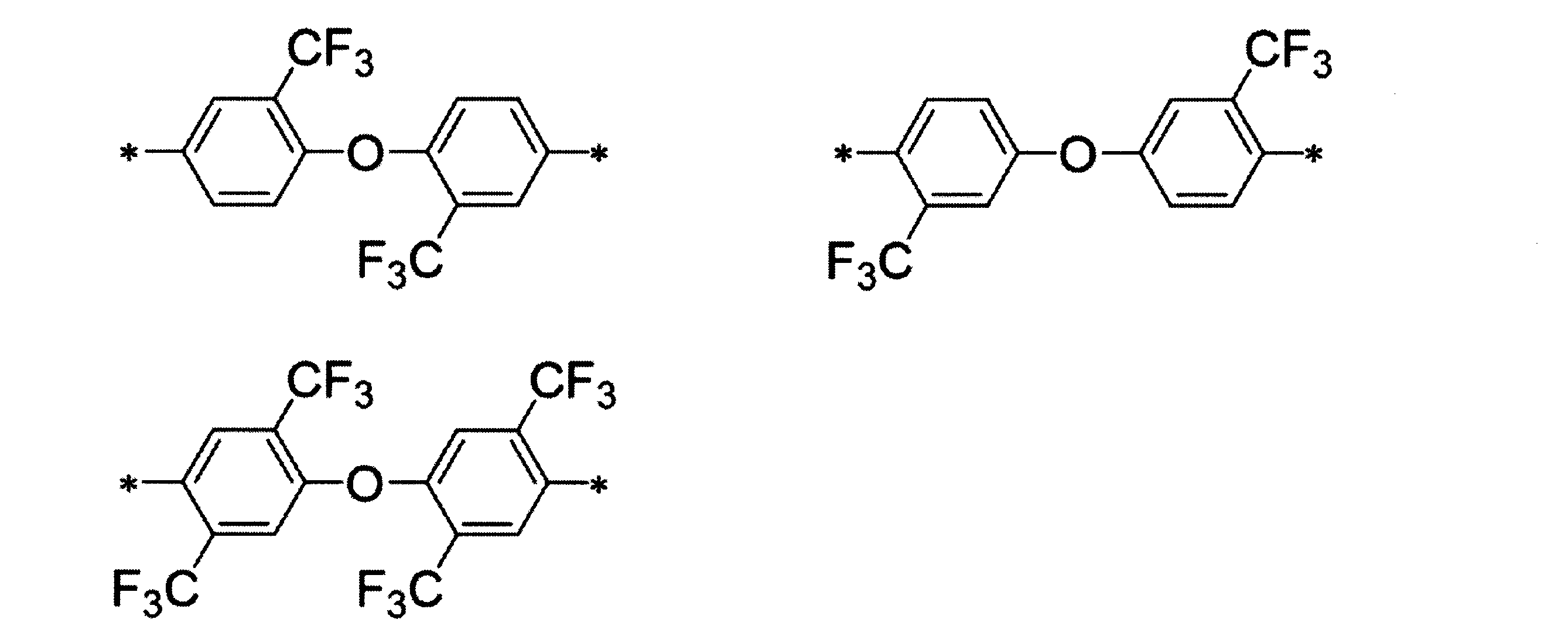
- X represents -C( CH3 ) 2- , -C( CF3 ) 2- , -O-, -S-, -SO2- , or a single bond. * represents a bonding site.
- Y 1 represents —C(CH 3 ) 2 —, —C(CF 3 ) 2 —, —O—, —S—, —SO 2 —, or a single bond. * represents a bonding site.
- Y 2 represents a group selected from —C(CH 3 ) 2 —, —C(CF 3 ) 2 —, —O—, —S—, and —SO 2 —, or a single bond. * represents a bonding site.
- Y 1 represents -C(CH 3 ) 2 -, -C(CF 3 ) 2 -, -O-, -S-, SO 2 -, or a single bond;
- R 1 and R 2 each independently represent an alkyl group having 1 to 4 carbon atoms or a hydrogen atom; at least a part of R 1 and R 2 is an alkyl group having 1 to 4 carbon atoms; * represents a bond.
- [8] Further comprising (c) a compound having one or more groups selected from the group consisting of a methylol group, an alkoxymethyl group, an epoxy group, an oxetanyl group, and an isocyanate group,
- a resin composition comprising: (a) at least one resin selected from the group consisting of polyimide, polyimide precursor, polybenzoxazole, polybenzoxazole precursor, and copolymers thereof; (d) a photopolymerization initiator; and (e) a compound having a polymerizable unsaturated bond group, the component (a) contains at least a diamine residue of formula (1) and a diamine residue of formula (2), and also contains a tetracarboxylic acid residue of formula (3) and/or a dicarboxylic acid residue of formula (4);
- the component (a) contains 15 to 80 mol % of diamine residues of formula (1) and 20 to 85 mol % of diamine residues of formula (2) relative to 100 mol % of all diamine residues of the component (a);
- a resin composition in which the total of the diamine residues of formula (1) and the diamine residues of formula (2) is 50 to 100 mol % relative to 100 mol % of all diamine residues of the component
- X represents -C( CH3 ) 2- , -C( CF3 ) 2- , -O-, -S-, -SO2- , or a single bond. * represents a bonding site.
- Y 1 represents —C(CH 3 ) 2 —, —C(CF 3 ) 2 —, —O—, —S—, —SO 2 —, or a single bond. * represents a bonding site.
- Y 2 represents a group selected from —C(CH 3 ) 2 —, —C(CF 3 ) 2 —, —O—, —S—, and —SO 2 —, or a single bond. * represents a bonding site.
- the resin composition of the present invention has excellent pattern processability and is capable of producing a cured product with low water absorption, and is suitable for use in the planarization layer and/or bank layer of an organic EL display device.
- FIG. 1 is a schematic diagram illustrating a procedure for producing an organic EL display device according to an embodiment of the present invention.
- a resin composition according to a first aspect of the present invention is a resin composition comprising: (a) at least one resin selected from the group consisting of polyimide, polyimide precursor, polybenzoxazole, polybenzoxazole precursor, and copolymers thereof (hereinafter, sometimes referred to as component (a)); and (b) a photoacid generator, the component (a) contains at least a diamine residue of formula (1) and a diamine residue of formula (2), and also contains a tetracarboxylic acid residue of formula (3) and/or a dicarboxylic acid residue of formula (4);
- the component (a) contains 15 to 80 mol % of diamine residues of formula (1) and 20 to 85 mol % of diamine residues of formula (2) relative to 100 mol % of all diamine residues of the component (a), This is a resin composition in which the total of the diamine residues of formula (1) and the diamine residues of formula (2) is 50 to 100 mol % relative to 100 mol % of
- X represents -C( CH3 ) 2- , -C( CF3 ) 2- , -O-, -S-, -SO2- , or a single bond. * represents a bonding site.
- Y 1 represents —C(CH 3 ) 2 —, —C(CF 3 ) 2 —, —O—, —S—, —SO 2 —, or a single bond. * represents a bonding site.
- a resin composition according to a second aspect of the present invention is a resin composition comprising: (a) at least one resin selected from the group consisting of polyimide, polyimide precursor, polybenzoxazole, polybenzoxazole precursor, and copolymers thereof; (d) a photopolymerization initiator; and (e) a compound having a polymerizable unsaturated bond group, the component (a) contains at least a diamine residue of formula (1) and a diamine residue of formula (2), and also contains a tetracarboxylic acid residue of formula (3) and/or a dicarboxylic acid residue of formula (4); The component (a) contains 15 to 80 mol % of diamine residues of formula (1) and 20
- the resin composition of the present invention has excellent pattern processability and can produce a cured product with low water absorption.
- the resin composition of the present invention contains (a) at least one resin selected from the group consisting of polyimide, polyimide precursor, polybenzoxazole, polybenzoxazole precursor, and copolymers thereof.
- polyimides, polyimide precursors, polybenzoxazoles, polybenzoxazole precursors, and copolymers thereof preferably used in the present invention can be synthesized by known methods.
- polyimide precursors include polyamic acids, polyamic acid esters, polyamic acid amides, and polyisoimides.
- polybenzoxazole precursor is polyhydroxyamide.
- a copolymer of at least two types of resins selected from the group consisting of polyimide, polyimide precursor, polybenzoxazole, and polybenzoxazole precursor can be synthesized by a known method.
- the component (a) of the present invention contains at least the diamine residues of formula (1) and formula (2), and also contains the tetracarboxylic acid residues of formula (3) and/or the dicarboxylic acid residues of formula (4), and is characterized in that, relative to 100 mol % of all diamine residues in the component (a), the component (a) contains 15 to 80 mol % of the diamine residues of formula (1) and 20 to 85 mol % of the diamine residues of formula (2), and the sum of the diamine residues of formula (1) and the diamine residues of formula (2) is 50 to 100 mol % relative to 100 mol % of all diamine residues in the component (a).
- the diamine residues of component (a) play an important role, and the diamine residues of formula (1) are 15-80 mol % and the diamine residues of formula (2) are 20-85 mol % relative to 100 mol % of the total diamine residues of component (a), and the sum of the diamine residues of formula (1) and the diamine residues of formula (2) is 50-100 mol % relative to 100 mol % of the total diamine residues of component (a), thereby enabling both pattern processability and low water absorption of the cured product to be achieved.
- the amount of diamine residues of formula (1) relative to 100 mol % of the total diamine residues of component (a) is 15 mol % or more, preferably 20 mol % or more, more preferably 25 mol % or more, even more preferably 30 mol % or more, and particularly preferably 40 mol % or more.
- the amount of diamine residues of formula (1) is 80 mol% or less, preferably 70 mol% or less, more preferably 60 mol% or less, and even more preferably 50 mol% or less, from the viewpoint of pattern processability, relative to 100 mol% of all diamine residues of component (a).
- the amount of diamine residues of formula (2) is 20 mol% or more, preferably 25 mol% or more, more preferably 30 mol% or more, even more preferably 35 mol% or more, and particularly preferably 40 mol% or more, relative to 100 mol% of all diamine residues of component (a).
- the amount of diamine residues of formula (2) is 85 mol% or less, preferably 80 mol% or less, more preferably 75 mol% or less, and even more preferably 70 mol% or less, from the viewpoint of low water absorption of the cured product, relative to 100 mol% of all diamine residues of component (a).
- the component (a) used in the present invention contains a tetracarboxylic acid residue of formula (3) and/or a dicarboxylic acid residue of formula (4).
- a polyimide and/or polyimide precursor having a tetracarboxylic acid residue of formula (3), and a polybenzoxazole precursor having a dicarboxylic acid residue of formula (4) are preferred because they are more likely to achieve both pattern processability and folding resistance.
- formula (3) is a polyamic acid ester structure of formula (5), since this makes it possible to obtain a resin composition with better pattern processability.
- Y 1 represents -C(CH 3 ) 2 -, -C(CF 3 ) 2 -, -O-, -S-, SO 2 -, or a single bond
- R 1 and R 2 each independently represent an alkyl group having 1 to 4 carbon atoms or a hydrogen atom; at least a part of R 1 and R 2 is an alkyl group having 1 to 4 carbon atoms; * represents a bond.
- the component (a) used in the present invention preferably has at least one of the structural units represented by formulas (7) to (9). Two or more resins having these structural units may be contained, or two or more structural units may be copolymerized.
- the component (a) in the present invention preferably has 3 to 1,000 of at least one of the structural units represented by formulas (7) to (9). Among these, it is more preferable to have the structural unit of formula (7) from the viewpoint of sensitivity.
- the structural unit represented by formula (7) is preferably contained in 30% or more of the total number of all structural units of the component (a), more preferably contained in 50% or more, even more preferably contained in 70% or more, and particularly preferably contained in 90% or more.
- R3 is a di- or tetravalent organic group having 4 to 40 carbon atoms
- R4 is a di- to hexavalent organic group having 4 to 40 carbon atoms
- R6 and R9 are each independently a tetravalent organic group having 4 to 40 carbon atoms
- R7 and R8 are each independently a divalent organic group having 4 to 40 carbon atoms
- p is an integer of 0 or 2
- q is an integer of 0 to 4
- p+q is 2 or more.
- 6 include a pyromellitic acid residue, a 3,3',4,4'-biphenyltetracarboxylic acid residue, a 2,3,3',4'-biphenyltetracarboxylic acid residue, a 2,2',3,3'-biphenyltetracarboxylic acid residue, a 3,3',4,4'-benzophenonetetracarboxylic acid residue, a 2,2',3,3'-benzophenonetetracarboxylic acid residue, a 2,2-bis(3,4-dicarboxyphenyl)hexafluoropropane residue, a 2,2-bis(2,3-dicarboxyphenyl)hexafluoropropane residue, a 1,1-bis(3,4-dicarboxyphenyl)ethane residue, a 1,1-bis(2,3 ...
- tetracarboxylic acid residue examples include aromatic tetracarboxylic acid residues such as a bis(3,4-dicarboxyphenyl)ethane residue, a bis(3,4-dicarboxyphenyl)methane residue, a bis(2,3-dicarboxyphenyl)methane residue, a bis(3,4-dicarboxyphenyl)sulfone residue, a bis(3,4-dicarboxyphenyl)ether residue, a 1,2,5,6-naphthalenetetracarboxylic acid residue, a 2,3,6,7-naphthalenetetracarboxylic acid residue, a 2,3,5,6-pyridinetetracarboxylic acid residue, and a 3,4,9,10-perylenetetracarboxylic acid residue, and an aliphatic tetracarboxylic acid residue such as a butanetetracarboxylic acid residue and a 1,2,3,4-cyclopentanete
- diamine residues of R 4 (OH) q , R 7 and R 9 include hydroxyl group-containing diamine residues such as bis(3-amino-4-hydroxyphenyl)hexafluoropropane residue, bis(3-amino-4-hydroxyphenyl)sulfone residue, bis(3-amino-4-hydroxyphenyl)propane residue, bis(3-amino-4-hydroxyphenyl)methylene residue, bis(3-amino-4-hydroxyphenyl)ether residue, bis(3-amino-4-hydroxy)biphenyl residue and bis(3-amino-4-hydroxyphenyl)fluorene residue; sulfonic acid-containing diamine residues such as 3-sulfonic acid-4,4′-diaminodiphenyl ether residue; thiol group-containing diamine residues such as dimercaptophenylenediamine residue; 3,4′-diaminodip
- the diamine residues of formula (1) 2,2'-bis(trifluoromethyl)-4,4'-diaminodiphenyl ether residue, 3,3'-bis(trifluoromethyl)-4,4'-diaminodiphenyl ether residue, and 2,2',5,5'-tetrakis(trifluoromethyl)-4,4'-diaminodiphenyl ether residue are preferably used, but are not limited to these.
- a cured product of a resin composition containing the polyimide or polyimide precursor having the above-mentioned 2,2'-bis(trifluoromethyl)-4,4'-diaminodiphenyl ether residue has an infrared absorption spectrum peak at about 1,490 cm -1 , and therefore infrared absorption spectrum measurement is useful for confirming whether or not the diamine residue is contained in the cured product.
- diamine residues of formula (2) such as bis(3-amino-4-hydroxyphenyl)hexafluoropropane residue, bis(3-amino-4-hydroxyphenyl)sulfone residue, bis(3-amino-4-hydroxyphenyl)propane residue, and bis(3-amino-4-hydroxyphenyl)ether residue, are preferably used, but are not limited to these.
- component (a) is alkali-soluble. By making component (a) alkali-soluble, it is possible to make an alkali-developable photosensitive resin composition.
- the (a) component preferably has a phenolic hydroxyl group in the structural unit in order to have alkali solubility.
- the amount of phenolic hydroxyl group introduced into the (a) component is preferably 1.0 mol/kg or more, more preferably 1.5 mol/kg or more, even more preferably 2.0 mol/kg or more, and particularly preferably 2.2 mol/kg or more, from the viewpoint of imparting alkali solubility, and is preferably 5.0 mol/kg or less, more preferably 4.0 mol/kg or less, even more preferably 3.5 mol/kg or less, and particularly preferably 3.2 mol/kg or less, from the viewpoint of the chemical resistance of the cured film.
- alkali solubility refers to a dissolution rate of 50 nm/min or more calculated from the reduction in film thickness when a solution of resin dissolved in ⁇ -butyrolactone is applied onto a silicon wafer and prebaked at 120°C for 4 minutes to form a prebaked film with a film thickness of 10 ⁇ m ⁇ 0.5 ⁇ m, the prebaked film is immersed in a 2.38 mass% aqueous solution of tetramethylammonium hydroxide at 23 ⁇ 1°C for 1 minute, and then rinsed with pure water.
- component (a) it is preferable to cap the main chain ends of component (a) with a known end-capping agent such as a monoamine, acid anhydride, monocarboxylic acid, monoacid chloride compound, or monoactive ester compound.
- a known end-capping agent such as a monoamine, acid anhydride, monocarboxylic acid, monoacid chloride compound, or monoactive ester compound.
- monoamines, acid anhydrides, monocarboxylic acids, monoacid chloride compounds, and monoactive ester compounds having at least one alkenyl or alkynyl group can also be used as these end-capping agents.
- the number of repeating structural units is preferably 10 or more and 1,000 or less.
- the number of repeating structural units is preferably 3 or more and 200 or less. Within this range, a thick film can be easily formed.
- the component (a) used in the present invention may consist solely of structural units represented by any one of formulas (7) to (9), or may be a copolymer with other structural units.
- the structural units represented by any one of formulas (7) to (9) account for 10 mol% or more of the total structural units, and more preferably 30 mol% or more. It is preferable to select the type and amount of the structural units used in the copolymerization within a range that does not impair the mechanical properties of the thin film obtained by heat curing.
- the molar ratio of imide ring-closed structural units to all imide and imide precursor structural units is defined as the imide ring closure rate (R IM (%)), and R IM can be used in the entire range of 0% or more and 100% or less, but from the viewpoint of controlling alkali solubility, it is preferably 3% or more, more preferably 5% or more, and even more preferably 7% or more, and from the viewpoint of sensitivity, it is preferably 50% or less, more preferably 40% or less, even more preferably 30% or less, and particularly preferably 20% or less.
- a polyimide or polyimide precursor with an R IM of 0% or more and less than 80% is defined as a polyimide precursor, and a polyimide with an R IM of 80% or more and 100% or less is defined as a polyimide.
- the imide ring closure rate (R IM (%)) can be determined, for example, by the following method. First, the infrared absorption spectrum of the polymer is measured to confirm the presence of absorption peaks (near 1,780 cm -1 and 1,377 cm -1 ) of the imide structure due to polyimide, and the peak intensity (Y) near 1,377 cm -1 is determined when the peak intensity of the absorption peak (near 1,470 cm -1 ) due to the aromatic ring is taken as 1. Next, the polymer is heat-treated at 350° C.
- the infrared absorption spectrum is measured to determine the peak intensity (Z) near 1,377 cm -1 when the peak intensity of the absorption peak (near 1,470 cm -1 ) due to the aromatic ring is taken as 1.
- the component (a) of the present invention preferably contains polyimide.
- polyimide By containing polyimide, it is possible to produce an organic EL display device that suppresses film shrinkage during curing and has excellent long-term light emission reliability.
- the content of polyimide is preferably 10 parts by mass or more, more preferably 30 parts by mass or more, even more preferably 50 parts by mass or more, even more preferably 80 parts by mass or more, and particularly preferably 100 parts by mass, per 100 parts by mass of the component (a), from the viewpoint of long-term light emission reliability, and is preferably 90 parts by mass or less, more preferably 70 parts by mass or less, and even more preferably 40 parts by mass or less, from the viewpoint of increasing the sensitivity of the resin composition.
- the molar ratio of oxazole ring-closed structural units to all oxazole and oxazole precursor structural units is defined as the oxazole ring closure rate ( ROX (%)), and ROX can be used in the entire range of 0% to 100%, but from the viewpoint of alkali solubility control, it is preferably 1% or more, more preferably 2% or more, and even more preferably 3% or more, and from the viewpoint of sensitivity, it is preferably 50% or less, more preferably 40% or less, even more preferably 30% or less, and particularly preferably 20% or less.
- ROX oxazole ring closure rate
- polybenzoxazole or polybenzoxazole precursor with ROX of 0% or more and less than 80% is defined as polybenzoxazole precursor, and ROX of 80% or more and 100% or less is defined as polybenzoxazole.
- the oxazole ring closure rate (R OX (%)) can be determined, for example, by the following method. First, the infrared absorption spectrum of the polymer is measured, and the peak intensity (V) of the absorption peak (near 1,050 cm -1) of the oxazole structure due to polybenzoxazole is determined when the peak intensity of the absorption peak (near 1,470 cm -1 ) due to the aromatic ring is taken as 1. Next, the polymer is heat-treated at 350° C.
- the infrared absorption spectrum is measured, and the peak intensity (W) of the absorption peak (near 1,050 cm -1 ) of the oxazole structure is determined when the peak intensity of the absorption peak (near 1,470 cm -1 ) due to the aromatic ring is taken as 1.
- the weight average molecular weight of component (a) can be determined in terms of polystyrene by gel permeation chromatography (GPC), and from the viewpoint of folding resistance of the cured film, it is preferably more than 20,000, more preferably more than 22,000, even more preferably more than 23,000, and particularly preferably more than 25,000, and from the viewpoint of alkali solubility, it is preferably 40,000 or less, more preferably 38,000 or less, even more preferably 35,000 or less, and particularly preferably 30,000 or less.
- GPC gel permeation chromatography
- component (a) is obtained by precipitating the polymer in a poor solvent for the polymer, such as methanol or water, after the polymerization is completed, and then washing and drying the precipitate. This allows the low molecular weight components of the polymer to be removed, greatly improving the folding resistance of the resin composition after it is heat-cured.
- a poor solvent for the polymer such as methanol or water
- the integral molecular weight distribution curve of component (a) can be analyzed using GPC analysis software, and from the viewpoint of the folding resistance of the cured film, the content of molecular weights of 1,000 or less determined from the integral molecular weight distribution curve is preferably 1.0% or less, more preferably 0.9% or less, even more preferably 0.8% or less, and particularly preferably 0.7% or less, assuming that the entire component (a) is 100%, and from the viewpoint of the storage stability of the resin composition, it is preferably 0.1% or more.
- component (a) does not contain a perfluoroalkyl group covalently bonded directly to the sp3 carbon.
- the driving voltage of the organic EL element can be kept low.
- perfluoroalkyl groups covalently bonded directly to sp2 carbon or sp carbon perfluoroalkyl groups covalently bonded directly to sp3 carbon are more likely to dissociate from the sp3 carbon during ashing treatment of the cured resin composition, and the dissociated perfluoroalkyl group accumulates on the surface of the metal electrode, increasing the contact resistance of the electrode.
- perfluoroalkyl groups include, but are not limited to, a trifluoromethyl group, a pentafluoroethyl group, and a perfluorooctyl group.
- the resin composition according to the first aspect of the present invention contains (b) a photoacid generator.
- the positive photosensitive resin composition can easily obtain a forward tapered pattern by obtaining a fine pattern through an exposure and development process, and then heating and curing the composition. This forward tapered pattern has excellent coverage for the upper electrode when used as an insulating film for an organic EL display device, preventing disconnections and improving the reliability of the device.
- the acid generated in the light-irradiated area promotes the crosslinking reaction of the epoxy compound or the thermal crosslinking agent, and a negative relief pattern can be obtained in which the light-irradiated area is insolubilized.
- (b) photoacid generator (b1) a quinone diazide compound or (b2) an onium salt compound is preferably used.
- the compounds having a phenolic hydroxyl group used here include Bis-Z, BisP-EZ, TekP-4HBPA, TrisP-HAP, TrisP-PA, TrisP-SA, TrisOCR-PA, BisOCHP-Z, BisP-MZ, BisP-PZ, BisP-IPZ, BisOCP-IPZ, BisP-CP, BisRS-2P, BisRS-3P, BisP-OCHP, methyl Lentoris-FR-CR, BisRS-26X, DML-MBPC, DML-MBOC, DML-OCHP, DML-PCHP, DML-PC, DML-PTBP, DML-34X, DML-EP, DML-POP, Dimethylol-BisOC-P, DML-PFP, DML-PSBP, DML-MTrisPC, TriML-P, TriML-35XL, TML-BP, TML-HQ, TML -pp-BPF, TML-BPA, TMOM-BP, HML
- Suitable examples of the quinone diazide compounds used in the present invention include those in which 4-naphthoquinone diazide sulfonic acid or 5-naphthoquinone diazide sulfonic acid is introduced into a compound having a phenolic hydroxyl group via an ester bond, but other compounds can also be used.
- 4-naphthoquinone diazide sulfonyl ester compounds have absorption in the i-line region of mercury lamps and are suitable for i-line exposure.
- 5-naphthoquinone diazide sulfonyl ester compounds have absorption extending to the g-line region of mercury lamps and are suitable for g-line exposure.
- both 4-naphthoquinone diazide sulfonyl ester compounds and 5-naphthoquinone diazide sulfonyl ester compounds can be preferably used, but it is preferable to select 4-naphthoquinone diazide sulfonyl ester compounds or 5-naphthoquinone diazide sulfonyl ester compounds depending on the wavelength of exposure.
- naphthoquinone diazide sulfonyl ester compounds that use both 4-naphthoquinone diazide sulfonyl groups and 5-naphthoquinone diazide sulfonyl groups in the same molecule, and 4-naphthoquinone diazide sulfonyl ester compounds and 5-naphthoquinone diazide sulfonyl ester compounds can be mixed and used.
- the naphthoquinone diazide sulfonyl ester compound can be synthesized by an esterification reaction between a compound having a phenolic hydroxyl group and a naphthoquinone diazide sulfonic acid compound, and can be synthesized by a known method.
- onium salt compounds examples include sulfonium salts, phosphonium salts, diazonium salts, and iodonium salts. Of these, sulfonium salts are preferred. These can be used alone or in combination. Furthermore, sensitizers and the like can be included as necessary.
- the content of the photoacid generator (b) is preferably 0.01 to 50 parts by mass per 100 parts by mass of the component (a).
- the content of the quinone diazide compound (b1) is preferably 1 part by mass or more, more preferably 3 parts by mass or more, and even more preferably 5 parts by mass or more, from the viewpoint of pattern formation, and is preferably 45 parts by mass or less, more preferably 40 parts by mass or less, and even more preferably 35 parts by mass or less, from the viewpoint of maintaining heat resistance.
- the content of the onium salt compound (b2) is preferably 0.1 parts by mass or more, more preferably 0.5 parts by mass or more, and even more preferably 1 part by mass or more, from the viewpoint of pattern formation, and is preferably 30 parts by mass or less, more preferably 25 parts by mass or less, and even more preferably 20 parts by mass or less, from the viewpoint of maintaining heat resistance.
- the resin composition of the present invention preferably contains (c) a compound having one or more groups selected from the group consisting of a methylol group, an alkoxymethyl group, an epoxy group, an oxetanyl group, and an isocyanate group (hereinafter, sometimes referred to as component (c)).
- component (c) is a compound that reacts with other molecules by heat to form chemical bonds, and can be used as a thermal crosslinking agent.
- Component (c) crosslinks component (a) or other additive components, and can increase the chemical resistance and hardness of the film after thermal curing.
- Preferred examples of compounds having a methylol group or an alkoxymethyl group include, for example, DML-PC, DML-PEP, DML-OC, DML-OEP, DML-34X, DML-PTBP, DML-PCHP, DML-OCHP, DML-PFP, DML-PSBP, DML-POP, DML-MBOC, DML-MBPC, DML-MTrisPC, DML-BisOC-Z, DML-BisOCHP-Z, DML-BPC, DML-BisOC-P, DMOM-PC, DMOM-PTBP, DMOM-MBPC, TriML-P, TriML-35XL, TML-HQ, TML-BP, TML-pp -BPF, TML-BPE, TML-BPA, TML-BPAF, TML-BPAP, TMOM-BP, TMOM-BPE, TMOM-BPA, TMOM-BPAF, TMOM-BPAP, HML
- Preferred examples of compounds having epoxy groups include, for example, "Epolight” (registered trademark) 40E, “Epolight” (registered trademark) 100E, “Epolight” (registered trademark) 200E, “Epolight” (registered trademark) 400E, “Epolight” (registered trademark) 70P, “Epolight” (registered trademark) 200P, “Epolight” (registered trademark) 400P, “Epolight” (registered trademark) 1500NP, "Epolight” (registered trademark) “Epolight” (registered trademark) 80MF, "Epolight” (registered trademark) 4000, “Epolight” (registered trademark) 3002 (all manufactured by Kyoeisha Chemical Co., Ltd.), “Shofree” (registered trademark) CDMDG, PETG, BATG (all manufactured by Showa Denko K.K.), “Denacol” (registered trademark) EX-212L, “Denacol” (registered
- Preferred examples of compounds having an oxetanyl group include, for example, "Ethanacol” (registered trademark) EHO, “Ethanacol” (registered trademark) OXBP, “Ethanacol” (registered trademark) OXTP, “Ethanacol” (registered trademark) OXMA (all manufactured by Ube Industries, Ltd.), oxetanyl phenol novolac, etc.
- Preferred examples of compounds having an isocyanate group include, for example, 2,4-tolylene diisocyanate, 2,6-tolylene diisocyanate, isophorone diisocyanate, 1,6-hexamethylene diisocyanate, 1,3-trimethylene diisocyanate, 1,4-tetramethylene diisocyanate, 2,2,4-trimethylhexamethylene diisocyanate, 2,4,4-trimethylhexamethylene diisocyanate, 1,9-nonamethylene diisocyanate, 1,10-decamethylene diisocyanate, 1,4-cyclohexane diisocyanate, 2,2'-diethyl ether diisocyanate, and diphenylmethane-4,4'-diisocyanate.
- o-xylylene diisocyanate m-xylylene diisocyanate, p-xylylene diisocyanate, methylene bis (cyclohexyl isocyanate), cyclohexane-1,3-dimethylene diisocyanate, cyclohexane-1,4-dimethylene diisocyanate, 1,5-naphthalene diisocyanate, p-phenylene diisocyanate, 3,3'-methylene d-tolylene-4,4'-diisocyanate, 4,4'-diphenyl ether diisocyanate, tetrachlorophenylene diisocyanate, norbornane diisocyanate, hydrogenated 1,3-xylylene diisocyanate, hydrogenated 1,4-xylylene diisocyanate, etc.
- the compound (c1) that is particularly preferably used as component (c) from the viewpoint of improving folding resistance is a compound having a hexafunctional alkoxymethyl group.
- Component (c1) refers to a compound having six alkoxymethyl groups.
- Preferred examples of component (c1) include HMOM-TPPHBA, HMOM-TPHAP, and NIKALAC MW-100LM.
- the content of the component (c) is preferably 10 parts by mass or more, more preferably 15 parts by mass or more, and even more preferably 20 parts by mass or more, based on 100 parts by mass of the component (a), from the viewpoint of the folding resistance of the cured film, and is preferably 50 parts by mass or less, more preferably 45 parts by mass or less, even more preferably 40 parts by mass or less, and particularly preferably 35 parts by mass or less, based on 100 parts by mass of the component (a), from the viewpoint of maintaining heat resistance.
- the (c1) component may be used in combination of two or more kinds.
- the content of the (c1) component is, relative to 100 parts by mass of the (a) component, preferably 10 parts by mass or more, more preferably 15 parts by mass or more, and even more preferably 20 parts by mass or more from the viewpoint of folding endurance of the cured film, and is preferably 50 parts by mass or less, more preferably 45 parts by mass or less, even more preferably 40 parts by mass or less, and particularly preferably 35 parts by mass or less from the viewpoint of maintaining heat resistance.
- the resin composition in the second aspect of the present invention contains (d) a photopolymerization initiator.
- a known photopolymerization initiator can be used.
- (d) may contain two or more types of photopolymerization initiators.
- the content of (d) photopolymerization initiator is preferably 0.1 parts by mass or more, more preferably 1 part by mass or more, and even more preferably 5 parts by mass or more, per 100 parts by mass of component (a), from the viewpoint of the folding resistance of the cured film, and is preferably 50 parts by mass or less, more preferably 45 parts by mass or less, and even more preferably 40 parts by mass or less, from the viewpoint of maintaining heat resistance.
- the resin composition according to the second aspect of the present invention contains (e) a compound having a polymerizable unsaturated bond group (hereinafter, sometimes referred to as component (e)).
- Examples of the polymerizable unsaturated bond group of component (e) include unsaturated double bond groups such as vinyl groups, allyl groups, acryloyl groups, and methacryloyl groups, and unsaturated triple bond groups such as propargyl groups. Two or more of these may be present. Among these, conjugated vinyl groups, acryloyl groups, and methacryloyl groups are preferred in terms of polymerizability. Also, from the standpoint of stability, it is preferable for one molecule to have one to four of these groups having unsaturated bonds.
- component (e) a compound having a known polymerizable unsaturated bond group can be used.
- two or more types of component (e) may be contained.
- the content of component (e) is preferably 5 parts by mass or more, more preferably 10 parts by mass or more, and even more preferably 20 parts by mass or more, per 100 parts by mass of component (a), from the viewpoint of the folding resistance of the cured film, and is preferably 150 parts by mass or less, more preferably 100 parts by mass or less, and even more preferably 50 parts by mass or less, from the viewpoint of maintaining heat resistance.
- the resin composition of the present invention may contain a solvent.
- the solvent include polar aprotic solvents such as N-methyl-2-pyrrolidone, ⁇ -butyrolactone, N,N-dimethylformamide, N,N-dimethylacetamide, and dimethylsulfoxide; ethers such as tetrahydrofuran, 1,4-dioxane, propylene glycol monomethyl ether, and propylene glycol monoethyl ether; ketones such as acetone, methyl ethyl ketone, and diisobutyl ketone; esters such as ethyl acetate, butyl acetate, isobutyl acetate, propyl acetate, propylene glycol monomethyl ether acetate, and 3-methyl-3-methoxybutyl acetate; alcohols such as ethyl lactate, methyl lactate, diacetone alcohol, and 3-methyl-3-methoxybutyl a
- the content of the solvent is preferably 70 parts by mass or more, more preferably 100 parts by mass or more, per 100 parts by mass of component (a), from the viewpoint of dissolving the resin, and is preferably 2,500 parts by mass or less, more preferably 2,000 parts by mass or less, from the viewpoint of obtaining an appropriate film thickness.
- the resin composition of the present invention may contain, in addition to components (a), (b), and (c), adhesion improvers, surfactants, compounds having phenolic hydroxyl groups, inorganic particles, and thermal acid generators, as necessary.
- the resin composition of the present invention preferably contains 0.0001 parts by mass or more and 0.1 parts by mass or less of the structure of formula (6) per 100 parts by mass of the resin composition.
- the structure of formula (6) contains Cl, and from the viewpoint of metal wiring corrosion inhibition, the content of the structure of formula (6) is ideally 0 parts by mass, but the structure of formula (6) may be included in component (a) as an impurity of the diamine raw material corresponding to the diamine residue of formula (1).
- the content of the structure of formula (6) is preferably 0.1 parts by mass or less, more preferably 0.01 parts by mass or less, more preferably 0.001 parts by mass or less, even more preferably 0.0001 parts by mass or less, particularly preferably 0 parts by mass, relative to 100 parts by mass of the resin composition, from the viewpoint of metal wiring corrosion inhibition, and is preferably 0 parts by mass or more, more preferably 0.0001 parts by mass or more, even more preferably 0.001 parts by mass or more, from the viewpoint of raw material purification.
- the resin composition can be obtained by dissolving the (a) and (b) components, and, if necessary, the (c) component, adhesion improver, surfactant, compound having a phenolic hydroxyl group, inorganic particles, thermal acid generator, etc., in an organic solvent.
- the resin composition can be obtained by dissolving the (a), (d), and (e) components, and, if necessary, the (c) component, adhesion improver, surfactant, compound having a phenolic hydroxyl group, inorganic particles, thermal acid generator, etc., in an organic solvent.
- Methods for dissolving include stirring and heating.
- the heating temperature is preferably set within a range that does not impair the performance of the resin composition, and is usually room temperature to 80°C.
- the order in which each component is dissolved is not particularly limited, and for example, a method in which the least soluble compound is dissolved in order can be used.
- the obtained resin composition is preferably filtered using a filter to remove dust and particles.
- the filter pore size may be, for example, but is not limited to, 0.5 ⁇ m, 0.2 ⁇ m, 0.1 ⁇ m, 0.07 ⁇ m, 0.05 ⁇ m, 0.02 ⁇ m, etc.
- the filter material may be polypropylene (PP), polyethylene (PE), nylon (NY), polytetrafluoroethylene (PTFE), etc., with polyethylene and nylon being preferred.
- the resin composition is applied onto a substrate to form a resin film, the resin film is dried, and if necessary, the resin film is exposed to light, and the resin film is heat-treated to produce a cured product.
- the resin composition is applied onto a substrate to form a resin film.
- application methods include spin coating, slit coating, dip coating, spray coating, and printing.
- the slit coating method is preferred because it can be applied with a small amount of coating liquid and is advantageous in reducing costs.
- the amount of coating liquid required for the slit coating method is about 1/5 to 1/10 compared to the spin coating method.
- slit coaters used for application include “Linear Coater” (registered trademark) manufactured by SCREEN Finetech Solutions Co., Ltd., “Spinless” (registered trademark) manufactured by Tokyo Ohka Kogyo Co., Ltd., “TS Coater” manufactured by Toray Engineering Co., Ltd., “Table Coater” (registered trademark) manufactured by Chugai Ro Kogyo Co., Ltd., “CS Series” and “CL Series” manufactured by Tokyo Electron Limited, "In-line Slit Coater” manufactured by Cermatronics Trading Co., Ltd., and “Head Coater HC Series” manufactured by Hirata Machinery Co., Ltd.
- the coating speed is preferably in the range of 10 mm/sec to 400 mm/sec.
- the coating thickness varies depending on the solids concentration and viscosity of the resin composition, but it is usually applied so that the coating thickness after drying is 0.1 to 10 ⁇ m, preferably 0.3 to 5 ⁇ m.
- Substrates that can be used include, but are not limited to, glass, silicon, ceramics, gallium arsenide, and other wafers, or substrates on which metal is formed as electrodes or wiring.
- the resin film is dried on the substrate.
- Any known drying method can be used, such as a method using a hot plate, an oven, or infrared rays.
- the substrate on which the coating film is formed may be dried under reduced pressure.
- the heating temperature and heating time vary depending on the type and purpose of the coating film, but a heating temperature of 50°C to 180°C and a heating time of 1 minute to several hours are preferred.
- the resin film is exposed to actinic rays.
- exposure is preferable for negative resin compositions, as this promotes a photocrosslinking reaction.
- Actinic rays used for exposure include ultraviolet rays, visible light, electron beams, and X-rays, but in the present invention, i-rays (365 nm), h-rays (405 nm), and g-rays (436 nm) from a mercury lamp are preferably used.
- a cured film can be obtained by heat-curing the resin film.
- Heat-curing can remove components with low heat resistance, thereby improving heat resistance and chemical resistance.
- the heat-curing temperature is preferably 150°C or higher, more preferably 200°C or higher, and even more preferably 230°C or higher from the viewpoint of improving the heat resistance of the cured film, and is preferably 400°C or lower, more preferably 350°C or lower, even more preferably 300°C or lower, and particularly preferably 280°C or lower from the viewpoint of improving the film toughness of the cured film. Within this temperature range, the temperature may be raised stepwise or continuously.
- the heat-curing time is preferably 30 minutes or more from the viewpoint of improving the heat resistance of the cured film.
- it is preferably 3 hours or less from the viewpoint of improving the film toughness of the cured film.
- a method of heat-treating at 150°C and 260°C for 60 minutes each, or a method of heat-treating while linearly increasing the temperature from room temperature to 270°C over 2 hours can be mentioned.
- the resin composition is applied to a substrate to form a resin film, the resin film is dried, the resin film is exposed to light, the exposed resin film is developed, and the developed resin film is heat-treated to produce a cured product.
- the application process, drying process, and heat treatment process are as described above, and the resin film exposure process and development process will be described below.
- the resin composition is applied onto a substrate to form a resin film, which is then dried and exposed to light.
- the desired pattern can be formed by exposing the film to actinic radiation through a mask having the desired pattern, and then developing the film.
- Actinic rays used for exposure include ultraviolet light, visible light, electron beams, and X-rays. In the present invention, it is preferable to use i-rays (365 nm), h-rays (405 nm), and g-rays (436 nm) from a mercury lamp. If the film has positive photosensitivity, the exposed area will dissolve in the developer. If the film has negative photosensitivity, the exposed area will harden and become insoluble in the developer.
- the exposed resin film is then developed.
- the exposed areas are removed with a developer to form the desired pattern.
- the unexposed areas are removed with a developer to form the desired pattern.
- the developer is preferably an aqueous solution of an alkaline compound such as tetramethylammonium hydroxide, diethanolamine, diethylaminoethanol, sodium hydroxide, potassium hydroxide, sodium carbonate, potassium carbonate, triethylamine, diethylamine, methylamine, dimethylamine, dimethylaminoethyl acetate, dimethylaminoethanol, dimethylaminoethyl methacrylate, cyclohexylamine, ethylenediamine, or hexamethylenediamine.
- an alkaline compound such as tetramethylammonium hydroxide, diethanolamine, diethylaminoethanol, sodium hydroxide, potassium hydroxide, sodium carbonate, potassium carbonate, triethylamine, diethylamine, methylamine
- one or more polar solvents such as N-methyl-2-pyrrolidone, N,N-dimethylformamide, N,N-dimethylacetamide, dimethylsulfoxide, ⁇ -butyrolactone, dimethylacrylamide, alcohols such as methanol, ethanol, isopropanol, esters such as ethyl lactate, propylene glycol monomethyl ether acetate, ketones such as cyclopentanone, cyclohexanone, isobutyl ketone, methyl isobutyl ketone, etc. may be added. Development methods include spray, paddle, immersion, ultrasonic, etc.
- the pattern formed by development with pure water.
- Alcohols such as ethanol and isopropyl alcohol, and esters such as ethyl lactate and propylene glycol monomethyl ether acetate may be added to the pure water for rinsing.
- the patterned cured product can then be produced by carrying out the heat treatment described above.
- the resin composition of the present invention is suitable for use in bank layers of organic EL display devices, planarizing layers for TFT substrates used to drive organic EL display devices, wiring protection insulating layers for circuit boards, surface protection layers and interlayer insulating layers for semiconductor elements, on-chip microlenses for solid-state imaging devices, and planarizing layers for various displays and solid-state imaging devices.
- the organic EL display device of the present invention has at least a planarization layer, a first electrode, a bank layer, a light-emitting layer, and a second electrode on a substrate, and the planarization layer and/or the bank layer are made of the cured product of the present invention.
- Organic EL light-emitting materials are susceptible to degradation due to moisture, which can have adverse effects such as a decrease in the area ratio of the light-emitting portion to the area of the light-emitting pixel, but the cured product of the present invention has low water absorption, and therefore stable driving and light-emitting characteristics can be obtained.
- the resin composition was applied onto an 8-inch silicon wafer by spin coating using a coating and developing apparatus (ACT-8 manufactured by Tokyo Electron Co., Ltd.), and baked at 120°C for 2 minutes to prepare a pre-baked film with a thickness of 6.0 ⁇ m. Thereafter, using the developing apparatus of the ACT-8, development was performed using a 2.38 mass% aqueous solution of tetramethylammonium hydroxide (hereinafter, TMAH) as a developing solution until the film loss was 0.5 ⁇ m, followed by rinsing with pure water and shaking off and drying.
- TMAH tetramethylammonium hydroxide
- the silicon wafer with the resin film after development was heated and cured for 1 hour at a predetermined temperature under a nitrogen stream (oxygen concentration 20 ppm or less) using a clean oven (CLH-21CD-S manufactured by Koyo Thermo Systems Co., Ltd.).
- the silicon wafer with the cured film was immersed in 45 mass% hydrofluoric acid for 5 minutes to peel off the cured film from the wafer, and the cured film was dried in a ventilated oven at 80°C, and the dry weight of the cured film was measured using a precision balance.
- the cured film was then immersed in pure water at 23°C for 24 hours, and after being taken out of the pure water, the moisture was immediately wiped off, and the water absorption weight of the cured film was measured using a precision balance 5 minutes later.
- the water absorption rate (wt%) in the cured film was calculated from the dry weight and water absorption weight of the cured film.
- Water absorption rates of 0.8 wt% or less were rated as very good (3 points), those with a water absorption rate of more than 0.8 wt% and less than 1.4 wt% were rated as good (2 points), and those with a water absorption rate of more than 1.4 wt% were rated as poor (1 point).
- the resin composition was applied onto an 8-inch silicon wafer by spin coating using a coating and developing apparatus ACT-8, and baked at 120°C for 2 minutes to prepare a pre-baked film with a film thickness of 3.0 ⁇ m. Thereafter, using an exposure machine i-line stepper (Nikon Corporation NSR-2005i9C), exposure was performed through a mask having a 10 ⁇ m contact hole pattern at an exposure dose of 50 to 300 mJ/ cm2 for every 5 mJ/ cm2 .
- the obtained pattern was observed at a magnification of 20 times using a microscope MX61 (Olympus Corporation), and the opening diameter of the contact hole was measured.
- the minimum exposure amount at which the opening diameter of the contact hole reached 10 ⁇ m was determined. The smaller the minimum exposure amount, the higher the sensitivity.
- a minimum exposure amount of 120 mJ/ cm2 or less was evaluated as having very good sensitivity (3 points), a minimum exposure amount of more than 120 mJ/ cm2 to 160 mJ/ cm2 or less was evaluated as having good sensitivity (2 points), and a minimum exposure amount of more than 160 mJ/ cm2 was evaluated as having poor sensitivity (1 point).
- a 25 ⁇ m “Kapton” (registered trademark) film cut to 10 cm ⁇ 10 cm was fixed with Kapton tape so as to cover one side of a 10 cm ⁇ 10 cm, 0.5 mm thick glass substrate.
- a resin composition was applied to the Kapton film of the glass substrate with the Kapton film by spin coating using a spinner (manufactured by Mikasa Co., Ltd.), and baked at 120 ° C. for 2 minutes to prepare a pre-baked film with a film thickness of 5 ⁇ m. Thereafter, development was performed under conditions in which the film loss amount was 0.5 ⁇ m using a 2.38 mass % TMAH aqueous solution as a developer, and then rinsing was performed with pure water.
- the developed substrate was heated and cured at a predetermined temperature for 1 hour under a nitrogen gas flow (oxygen concentration 20 volume ppm or less) using a clean oven CLH-21CD-S.
- the “Kapton” (registered trademark) film with a cured film of about 4 ⁇ m was removed from the glass substrate, and the two-layer film was shredded into 1 cm ⁇ 2 cm sizes.
- the chopped laminated film was folded in two so that the Kapton film surface was on the inside and the cured film surface was on the outside, and the long side was divided in half, placed in a jig with a groove of a specified depth, covered from above, left to stand for 1 minute, and then removed.
- the depth of the groove was equivalent to twice the bending radius.
- the groove depth was evaluated under two conditions, 0.4 mm and 0.2 mm.
- the laminated film removed from the jig was observed with a microscope MX61 (manufactured by Olympus Corporation), and the presence or absence of cracks at the folding position was observed.
- Three laminated films were evaluated under each condition, and those without cracks in all three were judged to be very good (3 points), those with cracks observed in one film were judged to be good (2 points), and those with cracks observed in two or three films were judged to be poor (1 point).
- FIG. 1 A schematic diagram of a fabrication procedure for an organic EL display device is shown in Fig. 1. Note that in the schematic diagram, the sizes of components are exaggerated or reduced for ease of explanation.
- ITO indium tin oxide, transparent conductive film
- a predetermined resin composition described later was applied to the entire surface of the substrate by spin coating, and the substrate was prebaked for 2 minutes on a hot plate at 120°C.
- the substrate was exposed to UV light at the openings and the periphery of the substrate through a photomask using an exposure device mask aligner PEM-6M (manufactured by Union Optical Co., Ltd.).
- the substrate was developed with a 2.38% by mass TMAH aqueous solution, the unnecessary parts were dissolved, and the substrate was rinsed with pure water.
- the substrate was heated and cured for 1 hour at a predetermined temperature under a nitrogen gas flow (oxygen concentration 20 volume ppm or less) using a clean oven CLH-21CD-S, and a bank layer (4) was formed in which rectangular openings of 70 ⁇ m in length and 70 ⁇ m in width were arranged at a pitch of 175 ⁇ m in the vertical direction and a pitch of 175 ⁇ m in the horizontal direction in four 2 mm square substrate effective areas (5) in the substrate, and each opening had a shape that exposed the first electrode.
- the thickness of the bank layer was adjusted to about 1.0 ⁇ m.
- an organic EL layer (6) including a light-emitting layer was formed by a vacuum deposition method.
- the degree of vacuum during deposition was 1 ⁇ 10 ⁇ 3 Pa or less, and the substrate was rotated relative to the deposition source during deposition.
- compound (HT-1) was deposited to a thickness of 10 nm as a hole injection layer, and compound (HT-2) was deposited to a thickness of 50 nm as a hole transport layer.
- compound (GH-1) as a host material and compound (GD-1) as a dopant material were deposited to a thickness of 40 nm on the light-emitting layer so that the doping concentration was 10%.
- compound (ET-1) and compound (LiQ) were laminated to a thickness of 40 nm at a volume ratio of 1:1 as electron transport materials.
- the structures of the compounds used in the organic EL layer (6) are shown below.
- a compound (LiQ) was evaporated to a thickness of 2 nm, and then Mg and Ag were evaporated to a thickness of 10 nm in a volume ratio of 10:1 to form a second electrode (transparent electrode) (7).
- a cap-shaped glass plate was attached using an epoxy resin adhesive in a low-humidity nitrogen atmosphere to seal the device, and an organic EL display device with multiple square pixels measuring 70 ⁇ m on a single substrate was produced and used for evaluation.
- Driving voltage is 3.5V or less
- Content of the structure of formula (6) After adding 10g of chloroform to 2g of the resin composition and stirring, the chloroform layer from which the soluble matter was extracted was removed, and the chloroform insoluble matter was separated. The weight of the chloroform insoluble matter was measured, and the weight ratio of the chloroform insoluble matter in the resin composition was determined. Next, a part of the chloroform insoluble matter was decomposed at 400 ° C.
- the reference peak it is preferable to use a peak of a tetracarboxylic acid tetramethyl ester structure corresponding to a decomposition product of a structure derived from a tetracarboxylic acid dianhydride in the polymer, or a peak of a dicarboxylic acid dimethyl ester structure corresponding to a decomposition product of a structure derived from a dicarboxylic acid dichloride, and in this embodiment, a peak of a tetracarboxylic acid tetramethyl ester structure was used as the reference peak.
- This substrate was heated and cured for 1 hour at a specific temperature under a nitrogen stream (oxygen concentration 20 volume ppm or less) using a clean oven CLH-21CD-S, and a cured film of the resin composition was produced with a film thickness of about 1.5 ⁇ m.
- a conductor was soldered to the measurement terminals with lines of 15 ⁇ m and spaces of 10 ⁇ m to produce an evaluation element.
- the insulation reliability of the prepared evaluation element under high temperature and high humidity was evaluated using an insulation deterioration characteristic evaluation system ETAC SIR13 (manufactured by Kusumoto Chemical Co., Ltd.).
- the evaluation element was placed in a high temperature and high humidity chamber with test conditions set to a temperature of 85° C. and a humidity of 85% RH, a voltage of 5.0 V was applied, and the change in resistance value over time was measured at 5-minute intervals. When the resistance value reached 1.0 ⁇ 10 6 ⁇ or less, it was determined that the insulation was defective, and the test time at that point was measured as an index of migration resistance.
- the evaluation was performed as follows, and A, B, and C, which were test times of 200 hours or more, were considered to be pass.
- C Test time is 200 hours or more and less than 400 hours.
- D Test time is 50 hours or more and less than 200 hours.
- Synthesis Example 1 Synthesis of polyamic acid ester resin (A-1) Under a dry nitrogen stream, 25.6 g (0.07 mol) of 2,2-bis(3-amino-4-hydroxyphenyl)hexafluoropropane (hereinafter, 6FAP), 5.0 g (0.015 mol) of 2,2'-bis(trifluoromethyl)-4,4'-diaminodiphenyl ether (hereinafter, 6FODA) (liquid chromatography purity: 99.8 area%), and 1.2 g (0.005 mol) of 1,3-bis(3-aminopropyl)tetramethyldisiloxane (hereinafter, SiDA) were dissolved in 300 g of NMP.
- 6FAP 2,2-bis(3-amino-4-hydroxyphenyl)hexafluoropropane
- 6FODA 2,2'-bis(trifluoromethyl)-4,4'-diaminodiphenyl ether
- SiDA 1,
- Synthesis Example 2 Synthesis of polyimide resin (A-2) Under a dry nitrogen stream, 22.0 g (0.06 mol) of 6FAP, 5.0 g (0.015 mol) of 6FODA, 1.2 g (0.005 mol) of SiDA, and 4.4 g (0.04 mol) of AP as a terminal blocking agent were dissolved in 300 g of NMP. 31.0 g (0.1 mol) of ODPA was added together with 20 g of NMP, and the mixture was reacted at 20 ° C. for 1 hour, and then at 50 ° C. for 4 hours. Thereafter, 10 g of xylene was added, and the mixture was stirred at 150 ° C. for 5 hours while azeotroping water with xylene.
- Synthesis Example 3 Synthesis of polybenzoxazole precursor resin (A-11) Under a dry nitrogen stream, 22.0 g (0.06 mol) of 6FAP, 8.4 g (0.025 mol) of 6FODA, 1.2 g (0.005 mol) of SiDA, and 2.2 g (0.02 mol) of AP as a terminal blocking agent were dissolved in 250 g of NMP.
- Synthesis Example 4 Synthesis of polyimide resin (A-19) Under a dry nitrogen stream, 32.2g (0.088 mol) of 6FAP, 3.4g (0.01 mol) of 6FODA, and 0.5g (0.002 mol) of SiDA were dissolved in 300g of ⁇ -butyrolactone (hereinafter, GBL) at 60°C. 22.3g (0.072 mol) of ODPA was added together with 20g of GBL, and reacted at 70°C for 4 hours, and then 9.5g (0.064 mol) of phthalic anhydride (hereinafter, PA) was added together with 20g of GBL as a terminal blocking agent, and reacted at 70°C for 2 hours.
- GBL ⁇ -butyrolactone
- PA phthalic anhydride
- Synthesis Examples 5 to 22 Synthesis of polyamic acid ester resins (A-3 to A-7, A-9 to A-10, A-12 to A-15, A-18, A-20 to A-25)
- the acid dianhydride, diamine, end-capping agent, and N,N-dimethylformamide dimethyl acetal used were replaced as shown in Table 1 to obtain powders of polyamic acid ester resins (A-3, A-5, A-9, A-10, A-12, A-13, A-14, A-15, A-18, A-20, A-21, A-22, A-23, A-24, and A-25).
- polyamic acid ester resin (A-4) polymerization was performed in the same manner as polyamic acid ester resin (A-3), and the reaction solution was poured into 5 L of water to obtain a precipitate. After that, without washing, the precipitate was dried in a vacuum dryer at 80° C. for 20 hours to obtain a powder.
- Polyamic acid ester resin (A-6) was synthesized using crude 6FODA in the same manner as polyamic acid ester resin (A-5).
- Polyamic acid ester resin (A-7) was polymerized in the same manner as polyamic acid ester resin (A-6), the reaction solution was poured into 5 L of water to obtain a precipitate, and then 5 L of water was added and filtered to collect the precipitate, followed by a washing operation once. The precipitate was then dried in a vacuum dryer at 80° C. for 20 hours to obtain a powder.
- Synthesis Examples 23 to 25 Synthesis of polyimide resins (A-8, A-16, A-17) Powders of polyimide resins (A-8, A-16, A-17) were obtained in the same manner as in Synthesis Example 2, except that the acid dianhydride, diamine, and end-capping agent used were replaced as shown in Table 1.
- 6FDA 2,2-bis(3,4-dicarboxyphenyl)hexafluoropropane dianhydride
- OBC 4,4'-diphenyl ether dicarboxylic acid dichloride
- 6FODA Crudely purified product of 2,2'-bis(trifluoromethyl)-4,4'-diaminodiphenyl ether (liquid chromatography purity: 97.1% by area)
- 6FAP 2,2-bis(3-amino-4-hydroxyphenyl)hexafluoropropane
- BAP 2,2-bis(3-amino-4-hydroxyphenyl)propane
- DABS bis(3-amino-4-hydroxyphenyl)sulfone
- TFMB 2,2'-bis(trifluoromethyl)benzidine
- ODA 4,4'-oxydianiline AP: 4-aminophenol
- PA phthalic anhydride
- onium salt compound (b2) of the photoacid generator (b) a sulfonium salt compound "Irgacure” (registered trademark) PAG290 (product name, manufactured by BASF Japan Ltd.) (B-2) was used in the examples.
- HMOM-TPHAP (trade name, manufactured by Honshu Chemical Industry Co., Ltd.) (C-1)
- TMOM-BP (trade name, manufactured by Honshu Chemical Industry Co., Ltd.)
- SH "Shofree” (registered trademark) BATG (trade name, manufactured by Showa Denko K.K.) (C-3).
- the water absorption rate of the cured film was 1.4 wt % or less, which was a good result, and the sensitivity was 160 mJ/cm 2 or less, which was also a good result.
- Comparative Examples 1 to 8 at least one of the water absorption rate or sensitivity of the cured film was poor. Comparative Examples 1 to 3, in which the amount of diamine residues of formula (1) was low at 0 to 11 mol % relative to 100 mol % of all diamine residues, had high water absorption rates. Conversely, Comparative Example 4, in which the amount of diamine residues of formula (1) was high at 81 mol %, had insufficient sensitivity.
- Examples 1, 3, 5, 9, and Comparative Examples 3 and 4 which use polyamic acid ester resins with different amounts of diamine residues of formula (1) and diamine residues of formula (2) relative to 100 mol% of all diamine residues, Examples 3 and 5 showed extremely good results in both the water absorption rate and sensitivity of the cured film.
- Examples 27 to 35, Comparative Example 9 The prepared resin compositions were used to evaluate folding endurance by the above-mentioned method, and the results are shown in Table 8. The heat curing temperature during the preparation of the cured film is also shown in the table.
- Examples 27 to 33 showed good or extremely good results in terms of folding resistance, with an overall rating of 2 or more.
- Examples 36 to 41 The prepared resin compositions were used to evaluate the driving voltage characteristics by the above-mentioned method, and the results are shown in Table 9. The heat curing temperature during the preparation of the cured film is also shown in the table.
- Examples 36 to 41 All of the examples shown in Examples 36 to 41 were given good results, with driving voltages rated as A, B, or C.
- Examples 38 to 41 which used resins A-14, A-15, A-16, and A-17 that do not contain a perfluoroalkyl group covalently bonded directly to the sp3 carbon, were given an extremely good result, with a driving voltage rated as A.
- Examples 42 to 48 The prepared resin compositions were used to evaluate the migration resistance by the above-mentioned method, and the results are shown in Table 10. The heat curing temperature during the preparation of the cured film is also shown in the table.
- Examples 42 to 46 and Example 48 were given good results in terms of migration resistance, with a rating of A, B, or C.
- Example 47 which used resin composition W-7, which has a high content of the structure of formula (6), received a failure rating of D in terms of migration resistance.
- the resin composition of the present invention is suitable for use in bank layers of organic EL display devices, planarizing layers for TFT substrates used to drive organic EL display devices, wiring protection insulating layers for circuit boards, surface protection layers and interlayer insulating layers for semiconductor elements, on-chip microlenses for solid-state imaging devices, and planarizing layers for various displays and solid-state imaging devices.
- the cured product of the present invention has low water absorption and low outgassing, and is therefore suitable for use in bank layers of organic EL display devices, planarizing layers for TFT substrates used to drive organic EL display devices, wiring protection insulating layers for circuit boards, surface protection layers and interlayer insulating layers for semiconductor elements, on-chip microlenses for solid-state imaging devices, and planarizing layers for various displays and solid-state imaging devices.
- the organic EL display device of the present invention is equipped with the cured product of the present invention, which has low water absorption, and therefore can prevent deterioration of the organic EL light-emitting material due to moisture and prevent a decrease in the area ratio of the light-emitting portion to the area of the light-emitting pixel, and is ideally used for organic EL display devices that can provide stable driving and light-emitting characteristics.
- Substrate 2 First electrode 3: Auxiliary electrode 4: Bank layer 5: Substrate effective area 6: Organic EL layer 7: Second electrode
Landscapes
- Chemical & Material Sciences (AREA)
- Physics & Mathematics (AREA)
- Health & Medical Sciences (AREA)
- Chemical Kinetics & Catalysis (AREA)
- Medicinal Chemistry (AREA)
- Polymers & Plastics (AREA)
- Organic Chemistry (AREA)
- Spectroscopy & Molecular Physics (AREA)
- General Physics & Mathematics (AREA)
- Optics & Photonics (AREA)
- Macromolecular Compounds Obtained By Forming Nitrogen-Containing Linkages In General (AREA)
Abstract
Description
[1](a)ポリイミド、ポリイミド前駆体、ポリベンゾオキサゾール、ポリベンゾオキサゾール前駆体およびそれらの共重合体からなる群より選択される少なくとも1種類の樹脂並びに(b)光酸発生剤を含有する樹脂組成物であって、
前記(a)成分が、少なくとも式(1)のジアミン残基および式(2)のジアミン残基を含有し、かつ、式(3)のテトラカルボン酸残基および/または式(4)のジカルボン酸残基を含有し、
前記(a)成分の全ジアミン残基100モル%に対し、式(1)のジアミン残基を15~80モル%有し、かつ、式(2)のジアミン残基を20~85モル%有し、
前記(a)成分の全ジアミン残基100モル%に対し、式(1)のジアミン残基と式(2)のジアミン残基の合計が50~100モル%である樹脂組成物。




[2]前記式(3)が式(5)である、[1]に記載の樹脂組成物。

[3]前記(a)成分が、ポリイミドを含む、[1]または[2]に記載の樹脂組成物。
[4]前記(a)成分の重量平均分子量が20,000超40,000以下である、[1]~[3]のいずれかに記載の樹脂組成物。
[5]前記(a)成分の積分分子量分布曲線から求めた分子量1,000以下の含有量が、(a)成分全体の0.1~1.0%である、[1]~[4]のいずれかに記載の樹脂組成物。
[6]前記(b)光酸発生剤が、(b1)キノンジアジド化合物を含む、[1]~[5]のいずれかに記載の樹脂組成物。
[7]前記(b)光酸発生剤が、(b2)オニウム塩化合物を含む、[1]~[5]のいずれかに記載の樹脂組成物。
[8]さらに(c)メチロール基、アルコキシメチル基、エポキシ基、オキセタニル基およびイソシアネート基からなる群より選択される1種類以上の基を有する化合物を含有し、
前記(a)成分100質量部に対し、前記(c)成分を10~50質量部含有する、[1]~[7]のいずれかに記載の樹脂組成物。
[9]前記(c)成分として(c1)6官能のアルコキシメチル基を有する化合物を含有し、(a)成分100質量部に対し、前記(c1)成分を10~50質量部含有する、[8]に記載の樹脂組成物。
[10](a)ポリイミド、ポリイミド前駆体、ポリベンゾオキサゾール、ポリベンゾオキサゾール前駆体およびそれらの共重合体からなる群より選択される少なくとも1種類の樹脂、(d)光重合開始剤、並びに(e)重合性不飽和結合基を有する化合物を含有する樹脂組成物であって、
前記(a)成分が、少なくとも式(1)のジアミン残基および式(2)のジアミン残基を含有し、かつ、式(3)のテトラカルボン酸残基および/または式(4)のジカルボン酸残基を含有し、
前記(a)成分の全ジアミン残基100モル%に対し、式(1)のジアミン残基を15~80モル%有し、式(2)のジアミン残基を20~85モル%有し、
前記(a)成分の全ジアミン残基100モル%に対し、式(1)のジアミン残基と式(2)のジアミン残基の合計が50~100モル%である樹脂組成物。




[11]前記(a)成分が、sp3炭素に直接共有結合するパーフルオロアルキル基を含まない、[1]~[10]のいずれかに記載の樹脂組成物。
[12]樹脂組成物100質量部に対し、式(6)の構造を0.0001質量部以上0.1質量部以下含有する、[1]~[11]のいずれかに記載の樹脂組成物。

[13][1]~[12]のいずれかに記載の樹脂組成物を硬化した硬化物。
[14][13]に記載の硬化物を具備する有機EL表示装置。
前記(a)成分が、少なくとも式(1)のジアミン残基および式(2)のジアミン残基を含有し、かつ、式(3)のテトラカルボン酸残基および/または式(4)のジカルボン酸残基を含有し、
前記(a)成分の全ジアミン残基100モル%に対し、式(1)のジアミン残基を15~80モル%有し、かつ、式(2)のジアミン残基を20~85モル%有し、
前記(a)成分の全ジアミン残基100モル%に対し、式(1)のジアミン残基と式(2)のジアミン残基の合計が50~100モル%である樹脂組成物である。




本発明の第2の態様における樹脂組成物は、(a)ポリイミド、ポリイミド前駆体、ポリベンゾオキサゾール、ポリベンゾオキサゾール前駆体およびそれらの共重合体からなる群より選択される少なくとも1種類の樹脂、(d)光重合開始剤、並びに(e)重合性不飽和結合基を有する化合物を含有する樹脂組成物であって、
前記(a)成分が、少なくとも式(1)のジアミン残基および式(2)のジアミン残基を含有し、かつ、式(3)のテトラカルボン酸残基および/または式(4)のジカルボン酸残基を含有し、
前記(a)成分の全ジアミン残基100モル%に対し、式(1)のジアミン残基を15~80モル%有し、かつ、式(2)のジアミン残基を20~85モル%有し、
前記(a)成分の全ジアミン残基100モル%に対し、式(1)のジアミン残基と式(2)のジアミン残基の合計が50~100モル%である樹脂組成物である。
本発明の樹脂組成物は、(a)ポリイミド、ポリイミド前駆体、ポリベンゾオキサゾール、ポリベンゾオキサゾール前駆体およびそれらの共重合体からなる群より選択される少なくとも1種類の樹脂を含有する。

本発明に用いられる(a)成分は、式(7)~(9)で表される構造単位の少なくともいずれかを有することが好ましい。これらの構造単位を有する2種以上の樹脂を含有してもよいし、2種以上の構造単位を共重合してもよい。本発明における(a)成分は、式(7)~(9)で表される構造単位の少なくともいずれかを3~1,000個有するものが好ましい。これらの中でも、感度の観点で式(7)の構造単位を有することがより好ましい。式(7)で表される構造単位を(a)成分の全構造単位総数の30%以上含むことが好ましく、50%以上含むことがより好ましく、70%以上含むことがさらに好ましく、90%以上含むことが特に好ましい。

式(7)において、p=0の場合、R3はジカルボン酸残基を表し、p=2の場合、R3はテトラカルボン酸残基を表す。
本発明の第1の態様における樹脂組成物は、(b)光酸発生剤を含有する。
本発明の樹脂組成物は、(c)メチロール基、アルコキシメチル基、エポキシ基、オキセタニル基およびイソシアネート基からなる群より選択される1種類以上の基を有する化合物(以下、(c)成分と記載することがある)を含有することが好ましい。(c)成分は、熱によって他の分子と反応して化学結合を生成する化合物であり、熱架橋剤として使用できる。(c)成分は、(a)成分またはその他添加成分を架橋し、熱硬化後の膜の耐薬品性および硬度を高めることができる。
(c1)成分は2種類以上を組み合わせて用いてもよい。(c1)成分の含有量は、(a)成分100質量部に対して、硬化膜の耐折性の観点で、好ましくは10質量部以上、より好ましくは15質量部以上、さらに好ましくは20質量部以上で、耐熱性維持の観点で、好ましくは50質量部以下、より好ましくは45質量部以下、さらに好ましくは40質量部以下、特に好ましくは35質量部以下である。
本発明の第2の態様における樹脂組成物は、(d)光重合開始剤を含有する。
本発明の第2の態様における樹脂組成物は、(e)重合性不飽和結合基を有する化合物(以下、(e)成分と記載することがある)を含有する。

式(6)の構造はClを含み、金属配線腐食抑制の観点から、理想的には式(6)の構造の含有量は0質量部が最も好ましいが、式(1)のジアミン残基に対応するジアミン原料の不純物として、式(6)の構造が(a)成分に含まれる場合がある。式(6)の構造の含有量は、樹脂組成物100質量部に対して、金属配線腐食抑制の観点で、好ましくは0.1質量部以下、より好ましくは0.01質量部以下、より好ましくは0.001質量部以下、さらに好ましくは0.0001質量部以下、特に好ましくは0質量部、原料精製の観点で、好ましくは0質量部以上、より好ましくは0.0001質量部以上、さらに好ましくは0.001質量部以上である。
(1)分子量
樹脂の分子量は、ゲルパーミエーションクロマトグラフィー(GPC)装置(日本ウォーターズ(株)製Waters2690-996)を用い、UV検出器の波長を260nmとし、展開溶媒をN-メチル-2-ピロリドン(以下、NMP)として測定し、ポリスチレン換算で重量平均分子量(Mw)を計算した。また、解析ソフトWaters2690-996システムを用いて解析した、積分分子量分布曲線から分子量1,000以下の含有量を求めた。
支持基板上の樹脂被膜の膜厚は光干渉式膜厚測定装置((株)SCREENホールディングス製ラムダエースVM-1030)を使用して測定した。なお、屈折率は、1.629として測定した。
樹脂組成物を、塗布現像装置(東京エレクトロン(株)製ACT-8)を用いて、8インチシリコンウエハ上にスピンコート法により塗布し、120℃で2分間ベークをして膜厚6.0μmのプリベーク膜を作製した。その後、前記ACT-8の現像装置を用いて、2.38質量%のテトラメチルアンモニウムヒドロキシド(以下、TMAH)水溶液を現像液として、膜減り量が0.5μmになるまで現像した後、純水でリンスを行い、振り切り乾燥した。現像後の樹脂膜付きシリコンウエハを、クリーンオーブン(光洋サーモシステム(株)製CLH-21CD-S)を用いて、窒素気流下(酸素濃度20ppm以下)において所定の温度で1時間加熱硬化した。硬化膜付きシリコンウエハを、45質量%のフッ化水素酸に5分間浸漬することで、ウエハより硬化膜を剥がし、80℃の通風オーブンで硬化膜を乾燥し、精密天秤で硬化膜の乾燥重量を測定した。その後、硬化膜を23℃で24時間、純水中に浸漬し、純水から取り出した後、直ちに水分を拭き取り、5分後に精密天秤で硬化膜の吸水重量を測定した。硬化膜の乾燥重量と吸水重量とから、硬化膜中の吸水率(wt%)を算出した。吸水率が、0.8wt%以下のものを極めて良好(3点)、0.8wt%を超えて1.4wt%以下のものを良好(2点)、1.4wt%を超えるものを不良(1点)とした。
樹脂組成物を、塗布現像装置ACT-8を用いて、8インチシリコンウエハ上にスピンコート法により塗布し、120℃で2分間ベークをして膜厚3.0μmのプリベーク膜を作製した。その後、露光機i線ステッパー((株)ニコン製NSR-2005i9C)を用いて、10μmのコンタクトホールのパターンを有するマスクを介して、露光量50~300mJ/cm2の範囲で5mJ/cm2毎に露光した。露光後、前記ACT-8の現像装置を用いて、2.38質量%のTMAH水溶液を現像液として、膜減り量が0.5μmになるまで現像した後、純水でリンスを行い、振り切り乾燥し、パターンを得た。
まず、10cm×10cm、厚さ0.5mmのガラス基板の片面を覆うように、10cm×10cmに切った25μmの“カプトン”(登録商標)フィルムをカプトンテープで固定した。カプトンフィルム付きガラス基板のカプトンフィルム上に、樹脂組成物をスピンナ(ミカサ(株)製)を用いてスピンコート法により塗布し、120℃で2分間ベークをして膜厚5μmのプリベーク膜を作製した。その後、2.38質量%のTMAH水溶液を現像液として、膜減り量が0.5μmになる条件で現像した後、純水でリンスを行った。現像後の基板を、クリーンオーブンCLH-21CD-Sを用いて、窒素気流下(酸素濃度20体積ppm以下)において所定の温度で1時間加熱硬化した。加熱硬化後、約4μmの硬化膜付き“カプトン”(登録商標)フィルムをガラス基板から取り外し、この2層膜を1cm×2cmサイズに細断した。細断した積層フィルムを、カプトンフィルム面が内側に、硬化膜面が外側になるように、また長辺を半分に分割するように2つに折り曲げ、所定の深さの溝を有する治具に納めて上から蓋をし、1分間静置後、取り出す操作をした。溝の深さは折り曲げ半径の2倍に相当する。溝の深さは0.4mmおよび0.2mmの2条件で評価した。治具から取り出した積層フィルムを顕微鏡MX61(オリンパス(株)製)で観察し、折り曲げ位置におけるクラックの有無を観察した。各条件で積層フィルム3枚ずつ評価を行い、3枚ともクラックのないものを極めて良好(3点)、1枚でクラックが観察されたものを良好(2点)、2枚または3枚でクラックが観察されたものを不良(1点)と判定した。さらに、耐折性の総合判定として、溝の深さ0.4mmおよび0.2mmのいずれも極めて良好のものを、耐折性が極めて良好(3点)、溝の深さ0.4mmおよび0.2mmのいずれも良好以上のものを、耐折性良好(2点)、溝の深さ0.4mmおよび0.2mmのいずれかが不良のものを、耐折性不良(1点)と判定した。
図1に有機EL表示装置の作製手順の概略図を示す。なお、概略図においては説明の便宜のために、構成要素の大きさが誇張されていたり縮小されていたりする。
次に、前処理として窒素プラズマ処理を行った後、真空蒸着法により発光層を含む有機EL層(6)を形成した。なお、蒸着時の真空度は1×10⁻³Pa以下であり、蒸着中は蒸着源に対して基板を回転させた。まず、正孔注入層として化合物(HT-1)を10nm、正孔輸送層として化合物(HT-2)を50nm蒸着した。次に発光層に、ホスト材料としての化合物(GH-1)とドーパント材料としての化合物(GD-1)を、ドープ濃度が10%になるようにして40nmの厚さに蒸着した。次に、電子輸送材料として化合物(ET-1)と化合物(LiQ)を体積比1:1で40nmの厚さに積層した。有機EL層(6)で用いた化合物の構造を以下に示す。
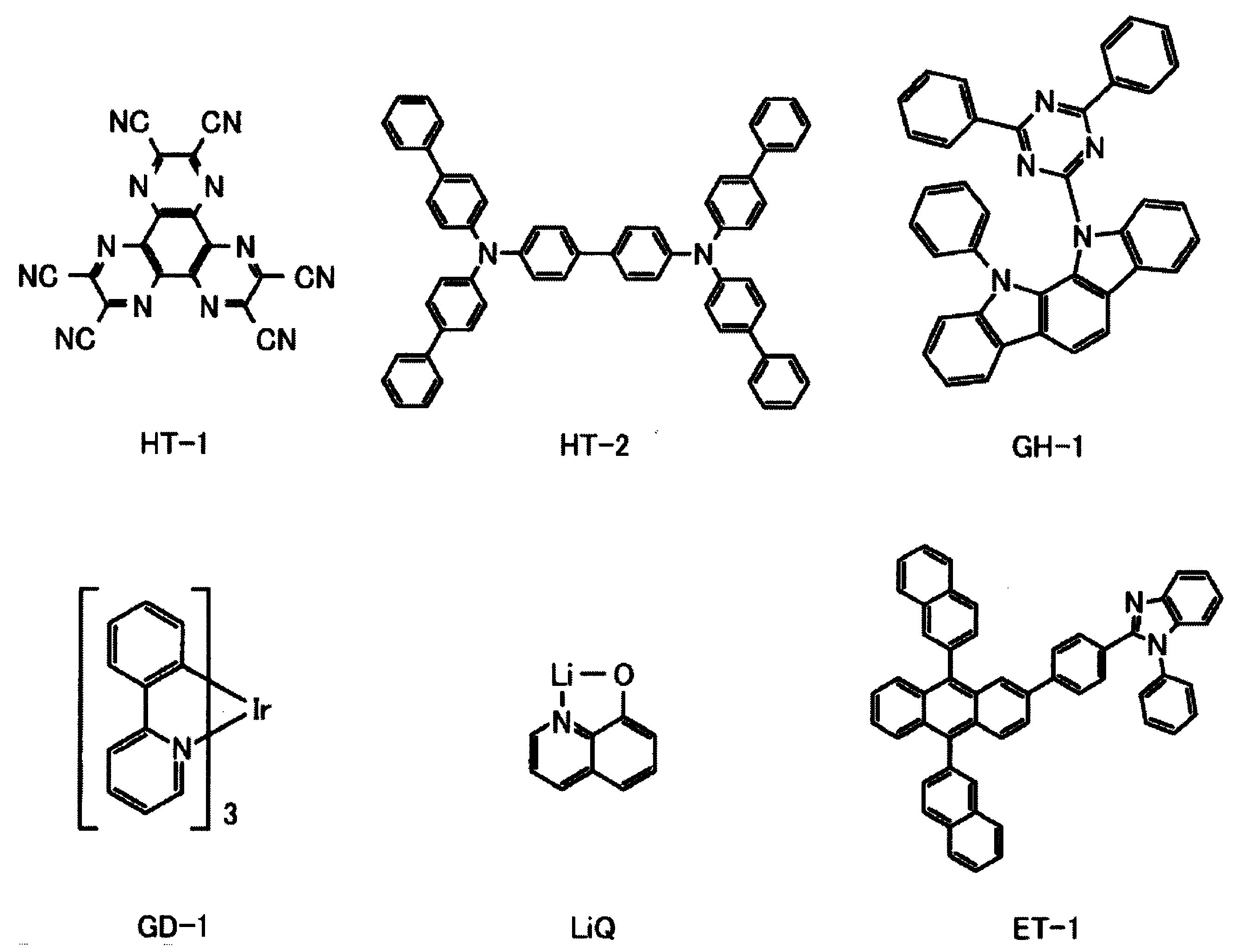
前記(6)の方法で作製した有機EL表示装置を低電圧側から順次電圧値を変え、電流密度が30mA/cm2となるまで直流駆動にて発光させた。低電圧側から順次電圧値を変えた場合における電圧値及び電流密度をプロットし、駆動電圧特性の指標として、電流密度が10mA/cm2となる駆動電圧を求めた。下記のように判定し、駆動電圧が4.5V以下となる、A、B、およびCを合格とした。
A:駆動電圧が3.5V以下
B:駆動電圧が3.5Vを超え、かつ4.0V以下
C:駆動電圧が4.0Vを超え、かつ4.5V以下
D:駆動電圧が4.5Vを超え、かつ5.5V以下
E:駆動電圧が5.5Vを超過、または測定不能
(8)式(6)の構造の含有量
樹脂組成物2gにクロロホルム10gを加えて撹拌した後、可溶分が抽出されたクロロホルム層を除去し、クロロホルム不溶分を分離した。クロロホルム不溶分の重量を測定し、樹脂組成物中のクロロホルム不溶分の重量比率を求めた。次に、クロロホルム不溶分の一部を、反応熱分解GCMS(ガスクロマトグラフ質量分析)測定により、TMAHを用いて400℃で分解反応させたガスを分析した。得られたクロマトグラムから式(6)の構造の分解物に対応する、式(10)の構造のピーク有無を確認し、基準となるピークとの面積比を求めた。基準となるピークの例としては、ポリマー中のテトラカルボン酸二無水物由来の構造の分解物に対応する、テトラカルボン酸テトラメチルエステルの構造のピーク、またはジカルボン酸ジクロリド由来の構造の分解物に対応する、ジカルボン酸ジメチルエステルの構造のピークを用いるのが好ましく、本実施例では、テトラカルボン酸テトラメチルエステルの構造のピークを基準ピークに用いた。また、クロロホルム不溶分の一部を、重ジメチルスルホキシドに溶解させ、1H NMR測定により、クロロホルム不溶分中の基準ピークと対応する構造の含有量を求めた。上記のクロロホルム抽出、反応熱分解GCMS測定、および1H NMR測定の結果から、樹脂組成物中の式(6)の構造の含有量を求めた。

マイグレーション評価用基板WALTS-TEG ME0102JY((株)ウォルツ製)上に、後述する所定の樹脂組成物をスピンコート法により塗布し、120℃のホットプレート上で2分間プリベークした。この基板をフォトマスクを介して露光装置マスクアライナーPEM-6Mで端子の箇所が開口部となるようにUV露光した。この基板を2.38質量%のTMAH水溶液で現像し、不要な部分を溶解させ、純水でリンスした。この基板をクリーンオーブンCLH-21CD-Sを用いて、窒素気流下(酸素濃度20体積ppm以下)において所定の温度で1時間加熱硬化し、樹脂組成物の硬化膜を膜厚約1.5μmで作製した。次いで、櫛歯の銅配線のライン・アンド・スペースパターンにおいて、ライン15μmとスペース10μmの測定用端子の箇所に導線をハンダ付けして評価用素子を作製した。作製した評価用素子を、絶縁劣化特性評価システムETAC SIR13(楠本化成(株)製)を用いて、高温高湿下での絶縁信頼性を評価した。試験条件を温度85℃、湿度85%RHに設定した高温高湿槽内に評価用素子を入れ、5.0Vの電圧を印加し、抵抗値の経時変化を5分間隔で測定した。抵抗値が1.0×10⁶Ω以下に達した場合に絶縁不良と判断し、マイグレーション耐性の指標として、その時点での試験時間を測定した。下記のように判定し、試験時間が200時間以上となる、A、B、およびCを合格とした。
A:試験時間が800時間以上
B:試験時間が400時間以上、かつ800時間未満
C:試験時間が200時間以上、かつ400時間未満
D:試験時間が50時間以上、かつ200時間未満
E:試験時間が50時間未満または測定不能
[合成例]
合成例1 ポリアミド酸エステル樹脂(A-1)の合成
乾燥窒素気流下、2,2-ビス(3-アミノ-4-ヒドロキシフェニル)ヘキサフルオロプロパン(以下、6FAP)25.6g(0.07モル)、2,2’-ビス(トリフルオロメチル)-4,4’-ジアミノジフェニルエーテル(以下、6FODA)(液体クロマトグラフィー純度:99.8面積%)5.0g(0.015モル)、1,3-ビス(3-アミノプロピル)テトラメチルジシロキサン(以下、SiDA)1.2g(0.005モル)をNMP300gに溶解させた。ここにビス(3,4-ジカルボキシフェニル)エーテル二無水物(以下、ODPA)31.0g(0.1モル)をNMP20gとともに加えて、20℃で1時間反応させ、次いで50℃で2時間反応させた。次に末端封止剤として4-アミノフェノール(以下、AP)2.2g(0.02モル)をNMP10gとともに加え、50℃で2時間反応させた。その後、N,N-ジメチルホルムアミドジメチルアセタール19.1g(0.16モル)を加え、50℃で3時間撹拌した。撹拌終了後、溶液を室温まで冷却した後、溶液を水5Lに投入して沈殿を得た。この沈殿を濾過で集めて、5Lの水を加えた上で濾過をして沈殿を集める洗浄操作を3回行った後、80℃の真空乾燥機で20時間乾燥し、ポリアミド酸エステル樹脂(A-1)の粉体を得た。
乾燥窒素気流下、6FAP22.0g(0.06モル)、6FODA5.0g(0.015モル)、SiDA1.2g(0.005モル)、末端封止剤として、AP4.4g(0.04モル)をNMP300gに溶解させた。ここにODPA31.0g(0.1モル)をNMP20gとともに加えて、20℃で1時間反応させ、次いで50℃で4時間反応させた。その後、キシレンを10g添加し、水をキシレンとともに共沸しながら、150℃で5時間撹拌した。撹拌終了後、溶液を室温まで冷却した後、溶液を水5Lに投入して沈殿を得た。この沈殿を濾過で集めて、5Lの水を加えた上で濾過をして沈殿を集める洗浄操作を3回行った後、80℃の真空乾燥機で20時間乾燥し、ポリイミド樹脂(A-2)の粉体を得た。
乾燥窒素気流下、6FAP22.0g(0.06モル)、6FODA8.4g(0.025モル)、SiDA1.2g(0.005モル)、末端封止剤として、AP2.2g(0.02モル)をNMP250gに溶解させた。この液を氷浴および撹拌しながら、4,4’-ジフェニルエーテルジカルボン酸ジクロリド(以下、OBCとも記載する)29.5g(0.1モル)をNMP60gに溶解させた液を、30分かけて滴下し、さらに1時間撹拌した後、氷浴から水浴に替え、50℃で2時間撹拌した。撹拌終了後、溶液を室温まで冷却した後、溶液を水5Lに投入して沈殿を得た。この沈殿を濾過で集めて、5Lの水を加えた上で濾過をして沈殿を集める洗浄操作を3回行った後、80℃の真空乾燥機で20時間乾燥し、ポリベンゾオキサゾール前駆体樹脂(A-11)の粉体を得た。
乾燥窒素気流下、6FAP32.2g(0.088モル)、6FODA3.4g(0.01モル)、SiDA0.5g(0.002モル)をγ-ブチロラクトン(以下、GBL)300gに60℃で溶解させた。ここにODPA22.3g(0.072モル)をGBL20gとともに加えて、70℃で4時間反応させ、次いで末端封止剤として、フタル酸無水物(以下、PA)9.5g(0.064モル)をGBL20gとともに加えて、70℃で2時間反応させた。その後、キシレンを10g添加し、水をキシレンとともに共沸しながら、150℃で2時間撹拌した。撹拌終了後、溶液を室温まで冷却した後、溶液を水5Lに投入して沈殿を得た。この沈殿を濾過で集めて、5Lの水を加えた上で濾過をして沈殿を集める洗浄操作を3回行った後、80℃の真空乾燥機で20時間乾燥し、ポリイミド樹脂(A-19)の粉体を得た。
合成例1と同様の方法で、使用する酸二無水物、ジアミン、末端封止剤、およびN,N-ジメチルホルムアミドジメチルアセタールを表1のように置き換えて、ポリアミド酸エステル樹脂(A-3、A-5、A-9、A-10、A-12、A-13、A-14、A-15、A-18、A-20、A-21、A-22、A-23、A-24、およびA-25)の粉体を得た。ポリアミド酸エステル樹脂(A-4)に関しては、ポリアミド酸エステル樹脂(A-3)と同様の方法で重合し、反応溶液を水5Lに投入して沈殿を得た後、洗浄操作を行わず、80℃の真空乾燥機で20時間乾燥して粉体を得た。ポリアミド酸エステル樹脂(A-6)に関しては、粗精製物の6FODAを用いて、ポリアミド酸エステル樹脂(A-5)と同様の方法で合成した。ポリアミド酸エステル樹脂(A-7)に関しては、ポリアミド酸エステル樹脂(A-6)と同様の方法で重合し、反応溶液を水5Lに投入して沈殿を得た後、5Lの水を加えた上で濾過をして沈殿を集める洗浄操作を1回行った後、80℃の真空乾燥機で20時間乾燥して粉体を得た。
合成例2と同様の方法で、使用する酸二無水物、ジアミン、および末端封止剤を表1のように置き換えて、ポリイミド樹脂(A-8、A-16、A-17)の粉体を得た。

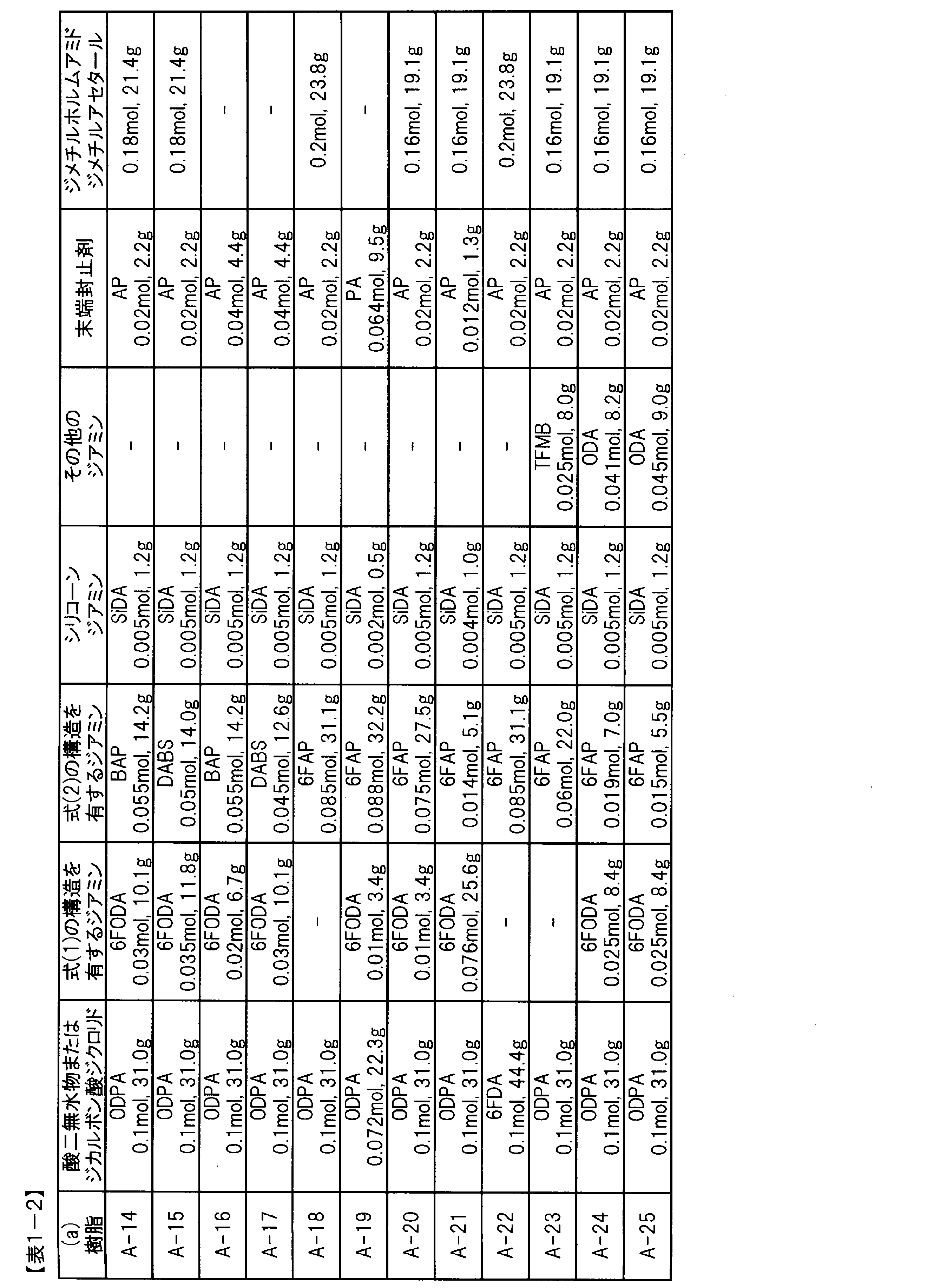
OBC:4,4’-ジフェニルエーテルジカルボン酸ジクロリド
6FODA(粗):2,2’-ビス(トリフルオロメチル)-4,4’-ジアミノジフェニルエーテルの粗精製物(液体クロマトグラフィー純度:97.1面積%)
6FAP:2,2-ビス(3-アミノ-4-ヒドロキシフェニル)ヘキサフルオロプロパン
BAP:2,2-ビス(3-アミノ-4-ヒドロキシフェニル)プロパン
DABS:ビス(3-アミノ-4-ヒドロキシフェニル)スルホン
TFMB:2,2’-ビス(トリフルオロメチル)ベンジジン
ODA:4,4’-オキシジアニリン
AP:4-アミノフェノール
PA:フタル酸無水物
上記合成例で得た(a)成分(A-1~A-25)について、種類、全ジアミン残基100モル%に対する、式(1)のジアミン残基の量(モル%)、式(2)のジアミン残基の量(モル%)、および、式(1)のジアミン残基と式(2)のジアミン残基の合計量(モル%)と、上記の方法で求めた重量平均分子量、および分子量1,000以下の成分量(%)を表2に示す。
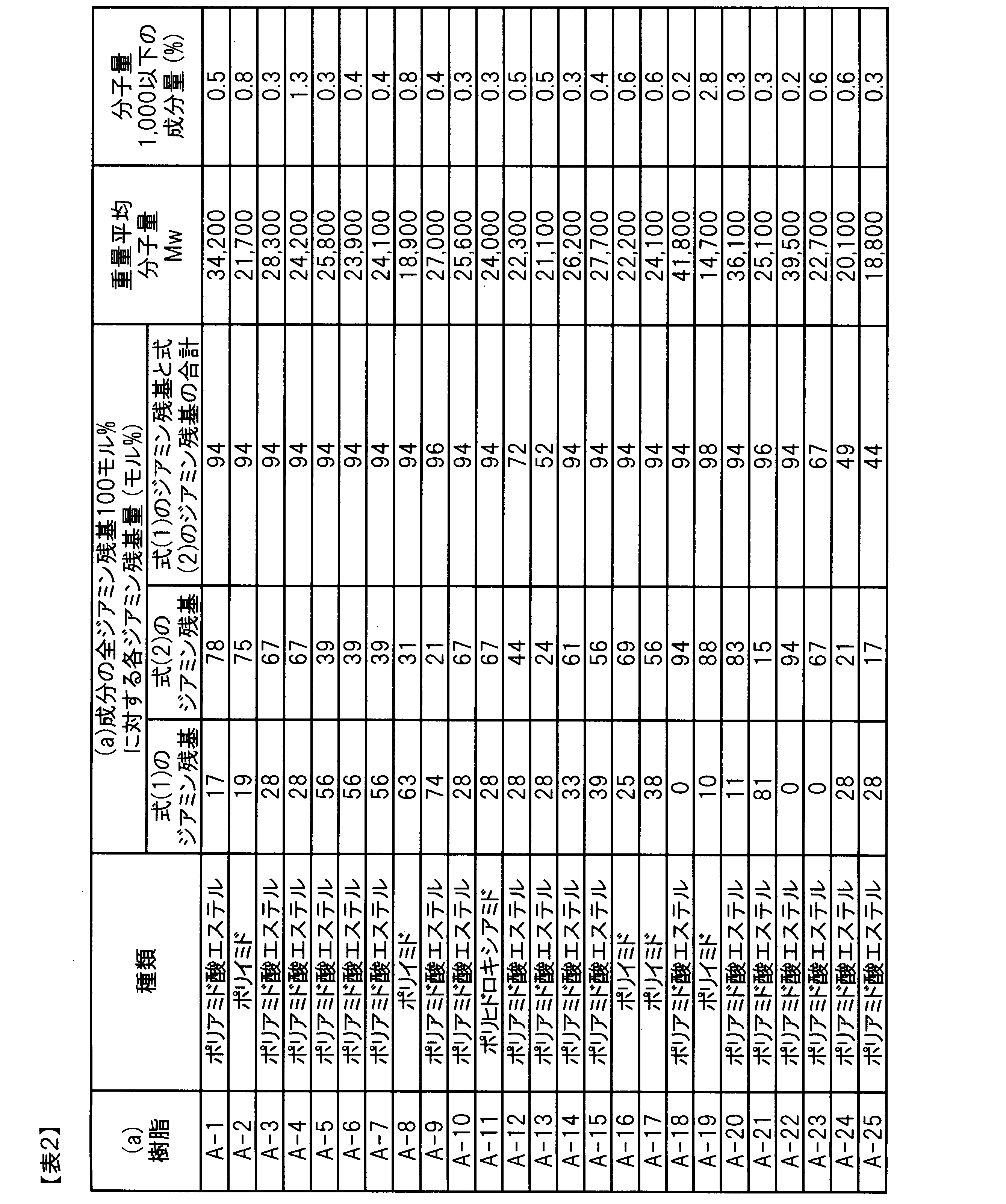
乾燥窒素気流下、4,4’-[1-[4-[1-(4-ヒドロキシフェニル)-1-メチルエチル]フェニル]エチリデン]ビスフェノール42.4g(0.1モル)と5-ナフトキノンジアジドスルホン酸クロリド72.3g(0.27モル)を1,4-ジオキサン450gに溶解させ、室温にした。ここに、1,4-ジオキサン100gと混合したトリエチルアミン25.0gを、系内が35℃以上にならないように滴下した。滴下後、40℃で2時間撹拌した。トリエチルアミン塩を濾過し、濾液を水に投入した。その後、析出した沈殿を濾過で集め、さらに1%塩酸水1Lで洗浄した。その後、さらに水2Lで2回洗浄した。この沈殿を真空乾燥機で乾燥し、下記式で表される(b)光酸発生剤である、キノンジアジド化合物(B-1)を得た。

(b)光酸発生剤の(b2)オニウム塩化合物として、スルホニウム塩化合物“Irgacure”(登録商標)PAG290(商品名、BASFジャパン(株)製)(B-2)を実施例に用いた。
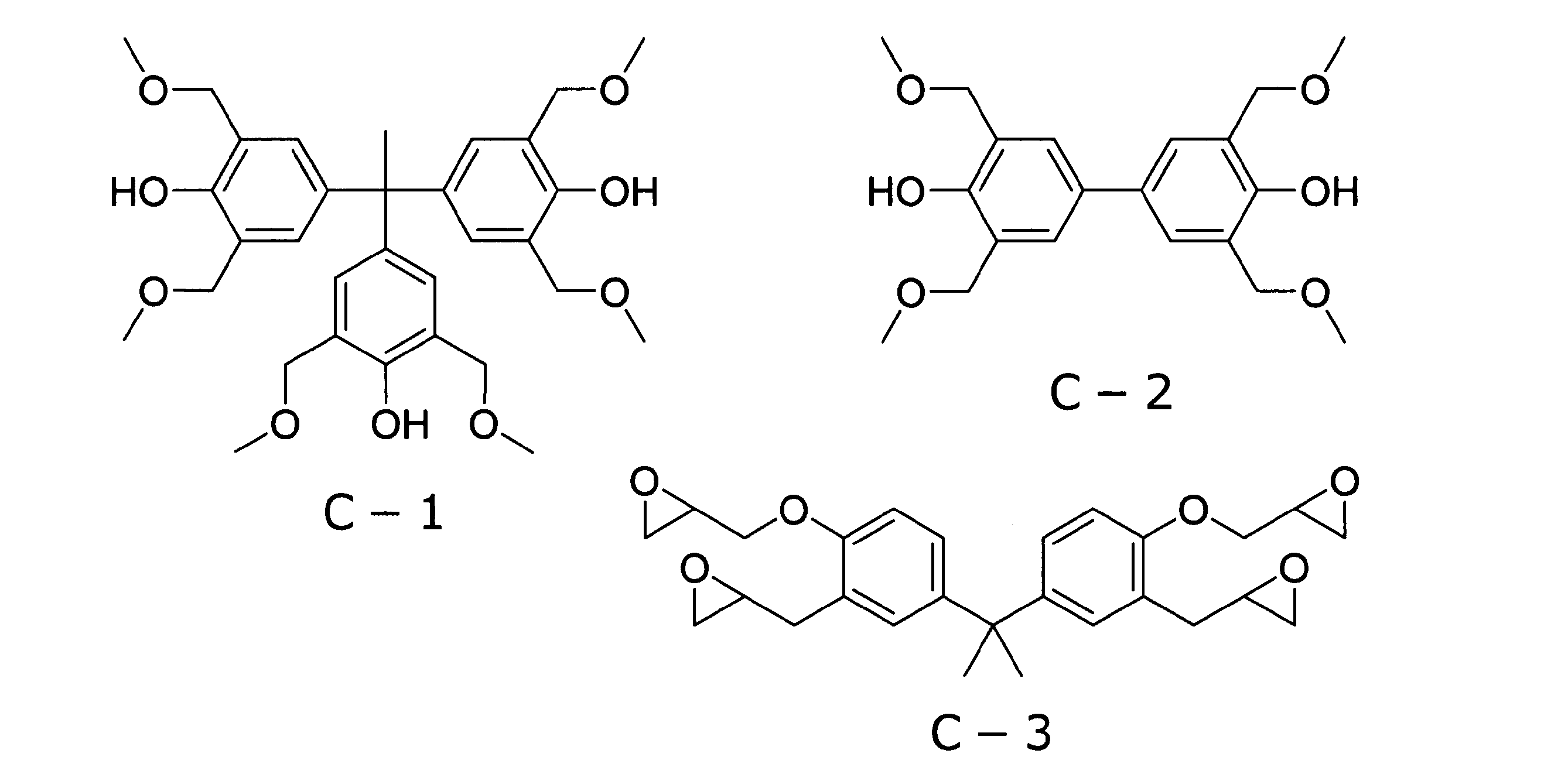
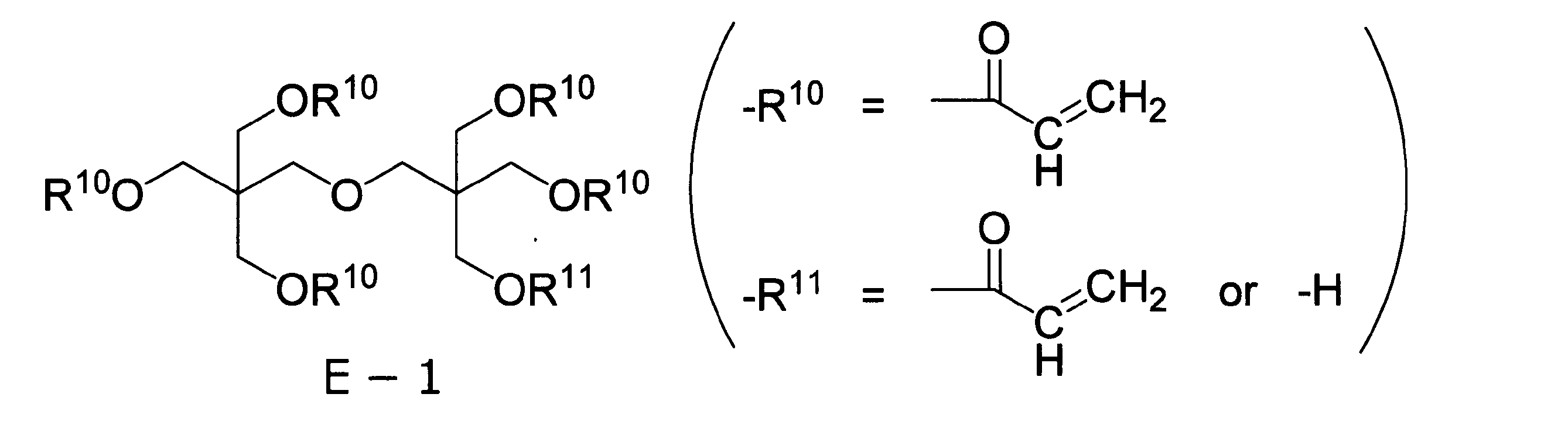
容量32mLのポリプロピレンバイアルに表3~6の組成で各成分を入れ、撹拌脱泡装置((株)シンキー製ARE-310)を用いて、撹拌10分、脱泡1分の条件で混合し、溶解した後、0.2μmのポリテトラフルオロエチレン製のフィルター(住友電気工業(株)製)で濾過して、樹脂組成物(W-1~34)を作製した。なお、表3~6中、「PGME」はプロピレングリコールモノメチルエーテル、「EL」は乳酸エチル、「GBL」はγ-ブチロラクトンを表す。
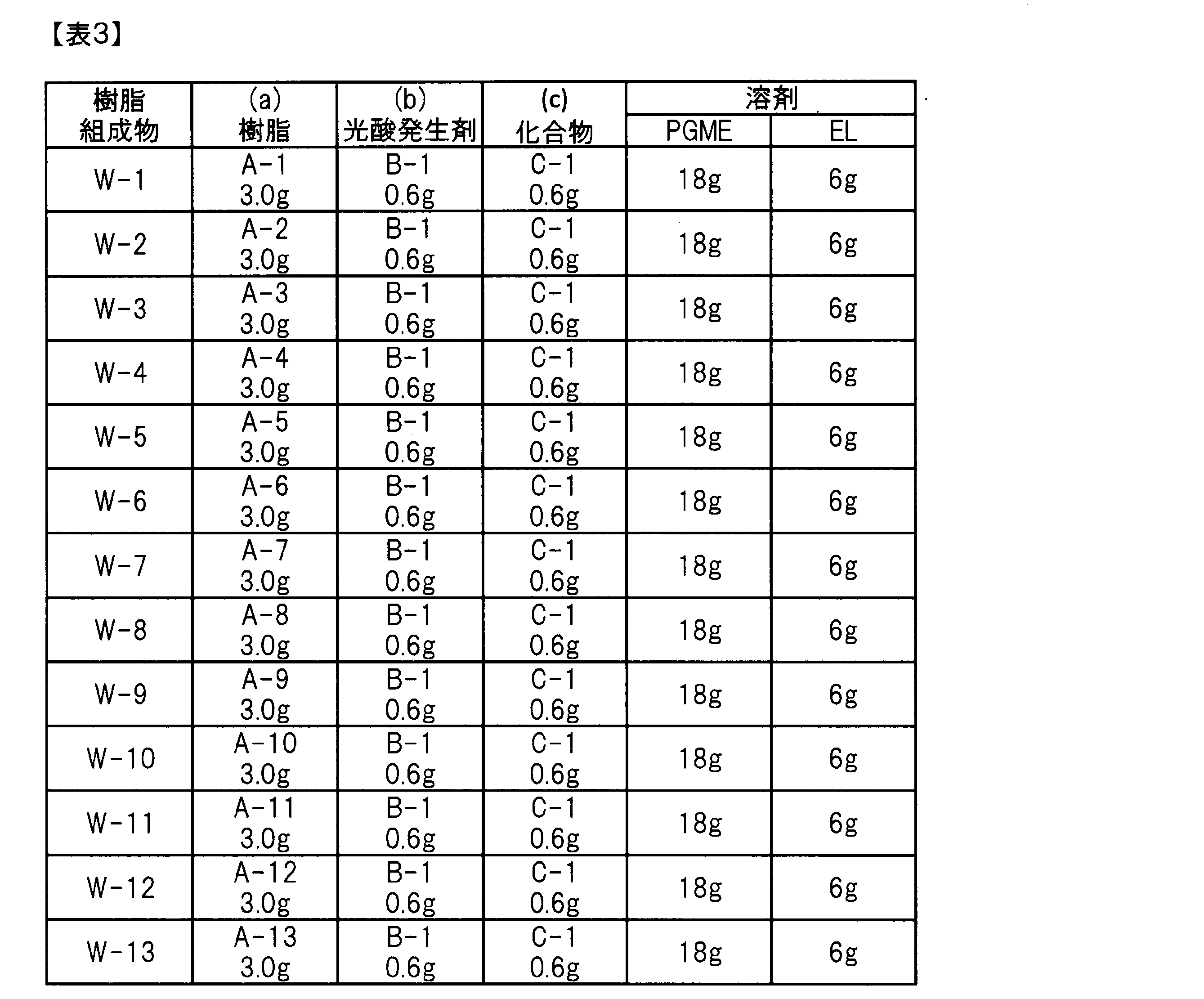
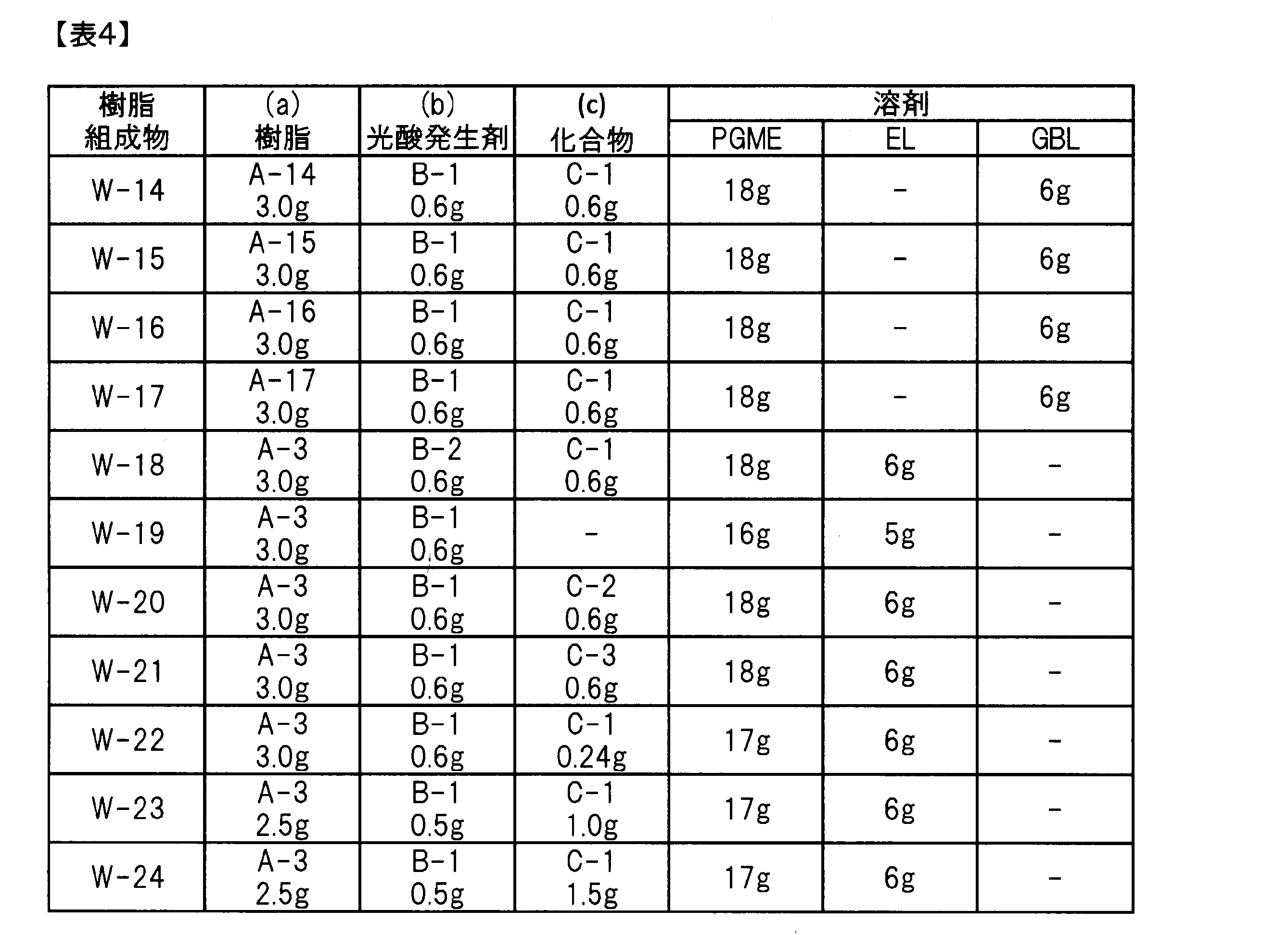

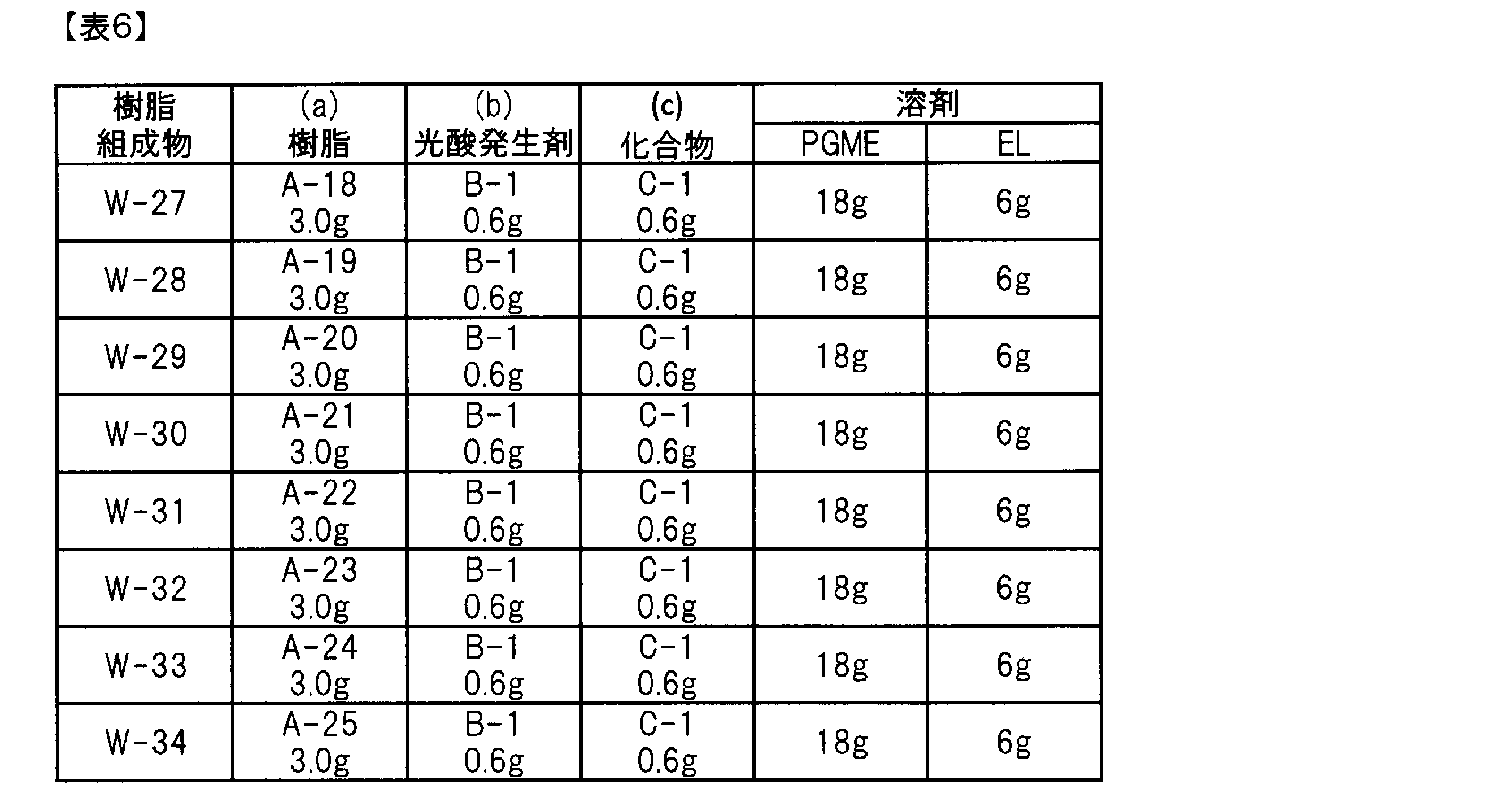
作製した樹脂組成物を用い、上記の方法で吸水率および感度を評価した結果を表7に示す。なお、吸水率測定用の硬化膜作製時の加熱硬化温度は表中に記載した。
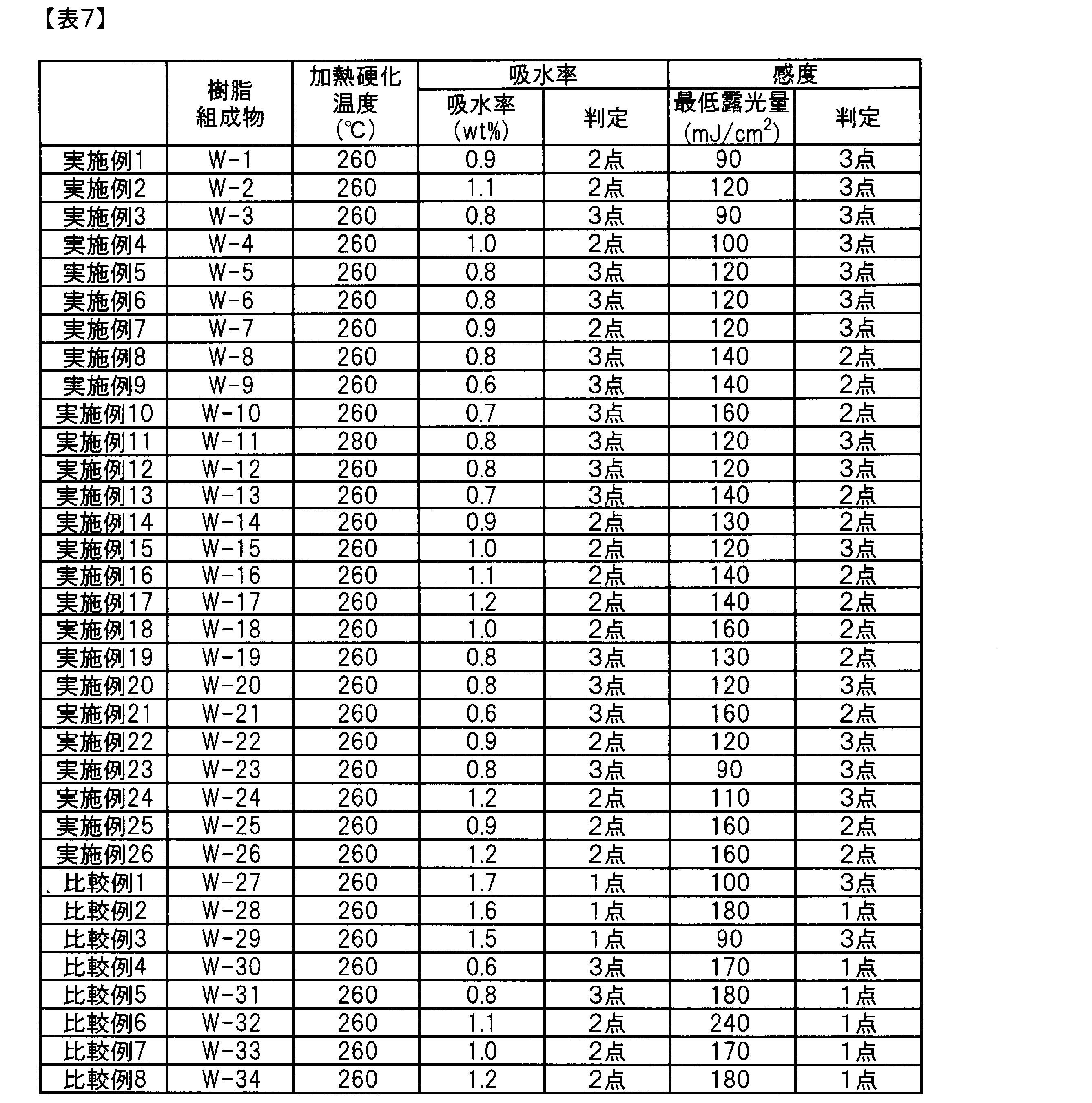
作製した樹脂組成物を用い、上記の方法で耐折性を評価した結果を表8に示す。なお、硬化膜作製時の加熱硬化温度は表中に記載した。
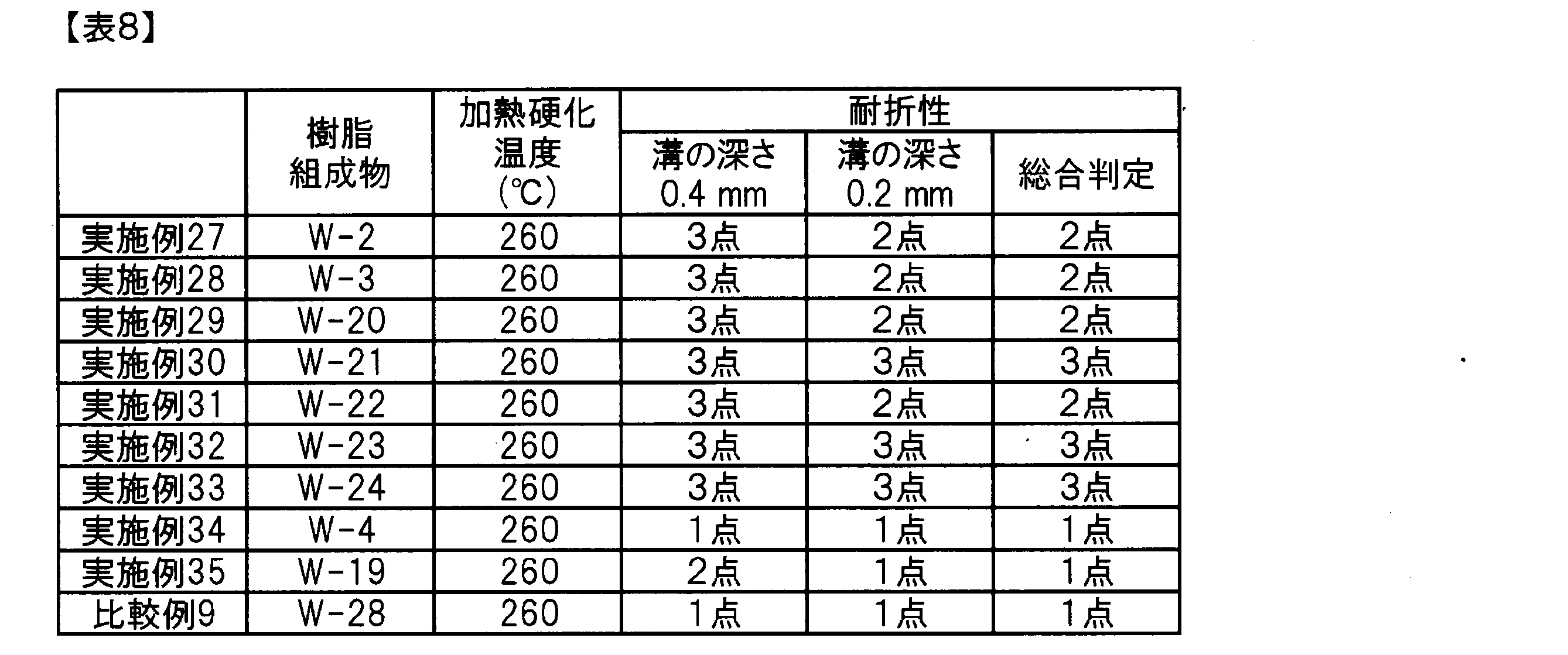
作製した樹脂組成物を用い、上記の方法で駆動電圧特性を評価した結果を表9に示す。なお、硬化膜作製時の加熱硬化温度は表中に記載した。
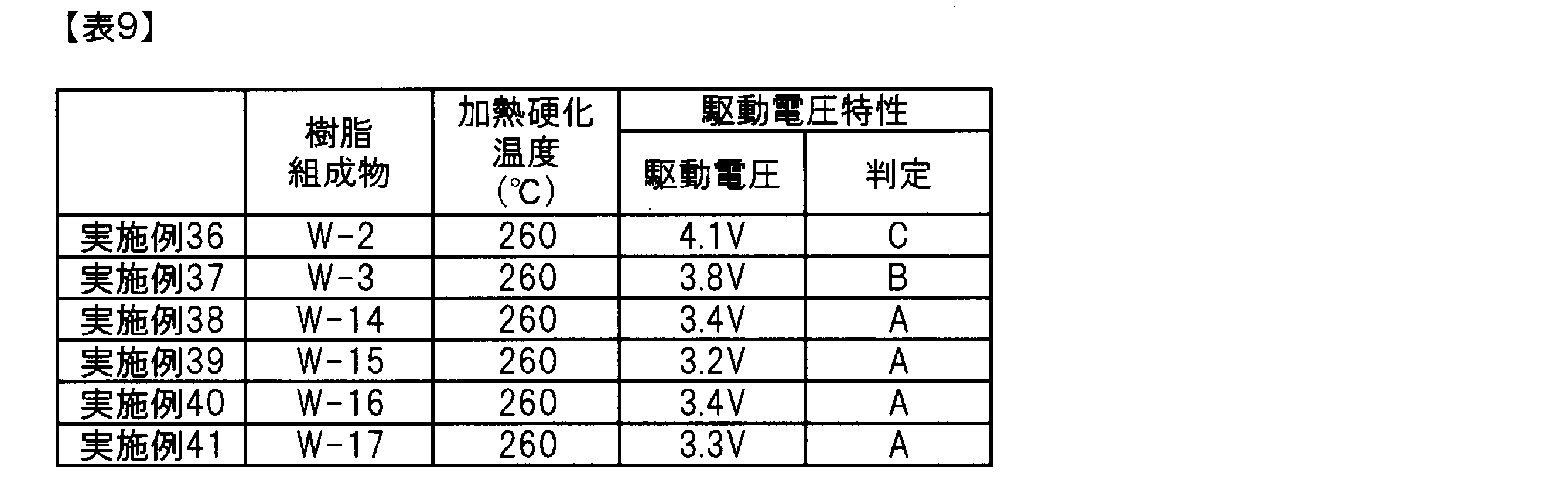
作製した樹脂組成物を用い、上記の方法でマイグレーション耐性を評価した結果を表10に示す。なお、硬化膜作製時の加熱硬化温度は表中に記載した。

2:第1電極
3:補助電極
4:バンク層
5:基板有効エリア
6:有機EL層
7:第2電極
Claims (14)
- (a)ポリイミド、ポリイミド前駆体、ポリベンゾオキサゾール、ポリベンゾオキサゾール前駆体およびそれらの共重合体からなる群より選択される少なくとも1種類の樹脂並びに(b)光酸発生剤を含有する樹脂組成物であって、
前記(a)成分が、少なくとも式(1)のジアミン残基および式(2)のジアミン残基を含有し、かつ、式(3)のテトラカルボン酸残基および/または式(4)のジカルボン酸残基を含有し、
前記(a)成分の全ジアミン残基100モル%に対し、式(1)のジアミン残基を15~80モル%有し、式(2)のジアミン残基を20~85モル%有し、
前記(a)成分の全ジアミン残基100モル%に対し、式(1)のジアミン残基と式(2)のジアミン残基の合計が50~100モル%である樹脂組成物。




- 前記式(3)が式(5)である、請求項1に記載の樹脂組成物。

- 前記(a)成分が、ポリイミドを含む、請求項1に記載の樹脂組成物。
- 前記(a)成分の重量平均分子量が20,000超40,000以下である、請求項1に記載の樹脂組成物。
- 前記(a)成分の積分分子量分布曲線から求めた分子量1,000以下の含有量が、(a)成分全体の0.1~1.0%である、請求項1に記載の樹脂組成物。
- 前記(b)光酸発生剤が、(b1)キノンジアジド化合物を含む、請求項1に記載の樹脂組成物。
- 前記(b)光酸発生剤が、(b2)オニウム塩化合物を含む、請求項1に記載の樹脂組成物。
- さらに(c)メチロール基、アルコキシメチル基、エポキシ基、オキセタニル基およびイソシアネート基からなる群より選択される1種類以上の基を有する化合物を含有し、
(a)成分100質量部に対し、(c)成分を10~50質量部含有する、請求項1に記載の樹脂組成物。 - 前記(c)成分として(c1)6官能のアルコキシメチル基を有する化合物を含有し、前記(a)成分100質量部に対し、前記(c1)成分を10~50質量部含有する、請求項8に記載の樹脂組成物。
- (a)ポリイミド、ポリイミド前駆体、ポリベンゾオキサゾール、ポリベンゾオキサゾール前駆体およびそれらの共重合体からなる群より選択される少なくとも1種類の樹脂、(d)光重合開始剤、並びに(e)重合性不飽和結合基を有する化合物を含有する樹脂組成物であって、
前記(a)成分が、少なくとも式(1)のジアミン残基および式(2)のジアミン残基を含有し、かつ、式(3)のテトラカルボン酸残基および/または式(4)のジカルボン酸残基を含有し、
前記(a)成分の全ジアミン残基100モル%に対し、式(1)のジアミン残基を15~80モル%有し、式(2)のジアミン残基を20~85モル%有し、
前記(a)成分の全ジアミン残基100モル%に対し、式(1)のジアミン残基と式(2)のジアミン残基の合計が50~100モル%である樹脂組成物。
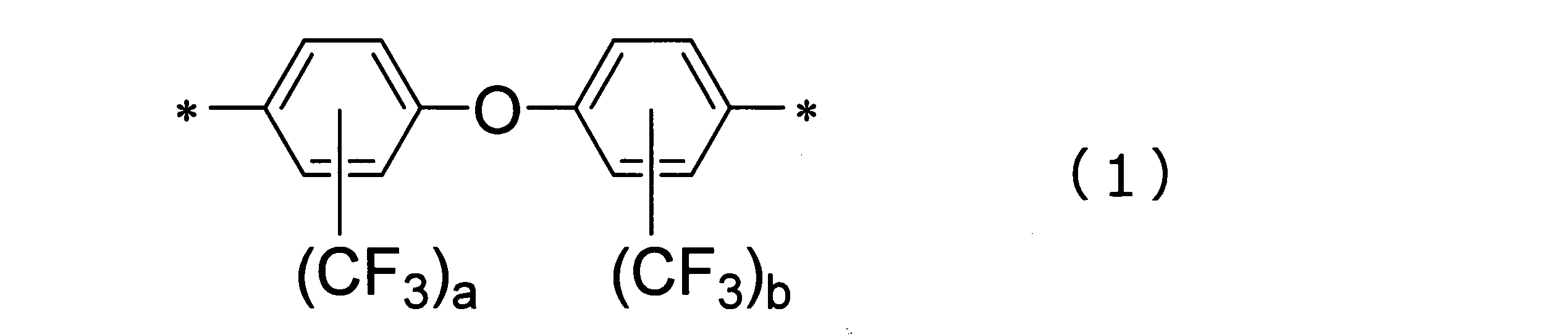



- 前記(a)成分が、sp3炭素に直接共有結合するパーフルオロアルキル基を含まない、請求項1または10に記載の樹脂組成物。
- 樹脂組成物100質量部に対し、式(6)の構造を0.0001質量部以上0.1質量部以下含有する、請求項1または10に記載の樹脂組成物。

- 請求項1~12のいずれかに記載の樹脂組成物を硬化した硬化物。
- 請求項13に記載の硬化物を具備する有機EL表示装置。
Priority Applications (3)
| Application Number | Priority Date | Filing Date | Title |
|---|---|---|---|
| JP2023560968A JPWO2024070802A1 (ja) | 2022-09-27 | 2023-09-19 | |
| CN202380061426.5A CN119768471A (zh) | 2022-09-27 | 2023-09-19 | 树脂组合物、固化物及有机el显示装置 |
| KR1020257008311A KR20250076526A (ko) | 2022-09-27 | 2023-09-19 | 수지 조성물, 경화물 및 유기 el 표시 장치 |
Applications Claiming Priority (2)
| Application Number | Priority Date | Filing Date | Title |
|---|---|---|---|
| JP2022-153266 | 2022-09-27 | ||
| JP2022153266 | 2022-09-27 |
Publications (1)
| Publication Number | Publication Date |
|---|---|
| WO2024070802A1 true WO2024070802A1 (ja) | 2024-04-04 |
Family
ID=90477550
Family Applications (1)
| Application Number | Title | Priority Date | Filing Date |
|---|---|---|---|
| PCT/JP2023/033868 Ceased WO2024070802A1 (ja) | 2022-09-27 | 2023-09-19 | 樹脂組成物、硬化物および有機el表示装置 |
Country Status (4)
| Country | Link |
|---|---|
| JP (1) | JPWO2024070802A1 (ja) |
| KR (1) | KR20250076526A (ja) |
| CN (1) | CN119768471A (ja) |
| WO (1) | WO2024070802A1 (ja) |
Citations (8)
| Publication number | Priority date | Publication date | Assignee | Title |
|---|---|---|---|---|
| WO2008059724A1 (en) * | 2006-11-13 | 2008-05-22 | Toray Fine Chemicals Co., Ltd. | Process for production of 2,2'-bis(trifluoromethyl)- 4,4'-diaminobiphenyl |
| JP2009506349A (ja) * | 2005-07-18 | 2009-02-12 | アクロン ポリマー システムズ | Lcdの負複屈折フィルムのためのポリ(アリールエーテルイミド) |
| JP2011042701A (ja) * | 2009-08-19 | 2011-03-03 | Toray Ind Inc | 樹脂およびポジ型感光性樹脂組成物 |
| JP2011202059A (ja) * | 2010-03-26 | 2011-10-13 | Toray Ind Inc | 樹脂およびポジ型感光性樹脂組成物 |
| KR20160004468A (ko) * | 2014-07-02 | 2016-01-13 | 주식회사 이녹스 | 에스테르기를 포함하는 폴리아믹산, 이의 제조방법 및 이를 포함하여 경화된 폴리이미드를 포함하는 폴리이미드 필름 |
| CN106515130A (zh) * | 2016-12-27 | 2017-03-22 | 广东生益科技股份有限公司 | 一种低吸水率的聚酰亚胺及其制备的无胶板材,以及该无胶板材的制备方法 |
| CN112940316A (zh) * | 2021-02-19 | 2021-06-11 | 北京八亿时空液晶科技股份有限公司 | 一种聚酰亚胺薄膜及其制备方法与应用 |
| WO2022045737A1 (ko) * | 2020-08-24 | 2022-03-03 | 주식회사 동진쎄미켐 | 포지티브형 감광성 수지 조성물 |
Family Cites Families (5)
| Publication number | Priority date | Publication date | Assignee | Title |
|---|---|---|---|---|
| JP2001089658A (ja) | 1999-09-21 | 2001-04-03 | Toray Ind Inc | 感光性ポリイミド前駆体組成物 |
| JP4982928B2 (ja) | 2000-06-28 | 2012-07-25 | 東レ株式会社 | 表示装置 |
| JP4982927B2 (ja) | 2000-06-28 | 2012-07-25 | 東レ株式会社 | 表示装置 |
| JP7384037B2 (ja) | 2018-11-09 | 2023-11-21 | 東レ株式会社 | ポリイミド前駆体、ポリイミド、ポリイミド樹脂膜、およびフレキシブルデバイス |
| WO2020121949A1 (ja) | 2018-12-13 | 2020-06-18 | 三菱瓦斯化学株式会社 | ポリイミド樹脂組成物及びポリイミドフィルム |
-
2023
- 2023-09-19 JP JP2023560968A patent/JPWO2024070802A1/ja active Pending
- 2023-09-19 CN CN202380061426.5A patent/CN119768471A/zh active Pending
- 2023-09-19 WO PCT/JP2023/033868 patent/WO2024070802A1/ja not_active Ceased
- 2023-09-19 KR KR1020257008311A patent/KR20250076526A/ko active Pending
Patent Citations (8)
| Publication number | Priority date | Publication date | Assignee | Title |
|---|---|---|---|---|
| JP2009506349A (ja) * | 2005-07-18 | 2009-02-12 | アクロン ポリマー システムズ | Lcdの負複屈折フィルムのためのポリ(アリールエーテルイミド) |
| WO2008059724A1 (en) * | 2006-11-13 | 2008-05-22 | Toray Fine Chemicals Co., Ltd. | Process for production of 2,2'-bis(trifluoromethyl)- 4,4'-diaminobiphenyl |
| JP2011042701A (ja) * | 2009-08-19 | 2011-03-03 | Toray Ind Inc | 樹脂およびポジ型感光性樹脂組成物 |
| JP2011202059A (ja) * | 2010-03-26 | 2011-10-13 | Toray Ind Inc | 樹脂およびポジ型感光性樹脂組成物 |
| KR20160004468A (ko) * | 2014-07-02 | 2016-01-13 | 주식회사 이녹스 | 에스테르기를 포함하는 폴리아믹산, 이의 제조방법 및 이를 포함하여 경화된 폴리이미드를 포함하는 폴리이미드 필름 |
| CN106515130A (zh) * | 2016-12-27 | 2017-03-22 | 广东生益科技股份有限公司 | 一种低吸水率的聚酰亚胺及其制备的无胶板材,以及该无胶板材的制备方法 |
| WO2022045737A1 (ko) * | 2020-08-24 | 2022-03-03 | 주식회사 동진쎄미켐 | 포지티브형 감광성 수지 조성물 |
| CN112940316A (zh) * | 2021-02-19 | 2021-06-11 | 北京八亿时空液晶科技股份有限公司 | 一种聚酰亚胺薄膜及其制备方法与应用 |
Also Published As
| Publication number | Publication date |
|---|---|
| JPWO2024070802A1 (ja) | 2024-04-04 |
| CN119768471A (zh) | 2025-04-04 |
| KR20250076526A (ko) | 2025-05-29 |
Similar Documents
| Publication | Publication Date | Title |
|---|---|---|
| JP7263925B2 (ja) | 樹脂組成物、硬化膜、硬化膜の製造方法、層間絶縁膜または半導体保護膜、薄膜トランジスタ、および液晶表示装置または有機el表示装置 | |
| KR102373030B1 (ko) | 감광성 수지 조성물 | |
| TWI430024B (zh) | A photosensitive resin composition, a method for manufacturing a hardened bump pattern, and a semiconductor device | |
| JP6724363B2 (ja) | 樹脂および感光性樹脂組成物 | |
| KR100743338B1 (ko) | 표시 장치 | |
| TWI770283B (zh) | 感光性樹脂組成物、硬化膜、具備硬化膜之元件、具備硬化膜之有機el顯示裝置、硬化膜之製造方法及有機el顯示裝置之製造方法 | |
| EP2902846B1 (en) | Positive photosensitive resin composition | |
| KR20170125842A (ko) | 감광성 수지 조성물, 수지 경화막의 제조 방법 및 반도체 장치 | |
| JP2023153197A (ja) | 樹脂組成物、樹脂シート、硬化膜 | |
| WO2018159384A1 (ja) | 樹脂組成物、樹脂シート、硬化パターンおよび半導体電子部品または半導体装置 | |
| JP2004133435A (ja) | ネガ型感光性樹脂前駆体組成物およびそれを用いた電子部品ならびに表示装置 | |
| JP2022034533A (ja) | 感光性樹脂組成物、硬化膜および有機el表示装置 | |
| WO2015137281A1 (ja) | 感光性樹脂組成物 | |
| JP2012159601A (ja) | 感光性樹脂組成物 | |
| TW202309657A (zh) | 感光性聚醯亞胺樹脂組成物 | |
| WO2022102345A1 (ja) | 樹脂組成物、硬化膜、絶縁膜または保護膜、アンテナ素子、並びに電子部品、表示装置または半導体装置及びその製造方法 | |
| EP4660705A1 (en) | Negative photosensitive resin composition, method for producing relief pattern using same, cured article and electronic component | |
| WO2025047698A1 (ja) | 感光性組成物、硬化物及びその製造方法、液晶装置、半導体装置、重合体並びに化合物 | |
| CN121399186A (zh) | 树脂组合物、硬化物、有机电致发光显示装置、及半导体装置 | |
| TW202026758A (zh) | 感光性樹脂組成物、樹脂片材、硬化膜、有機el顯示裝置、半導體電子零件、半導體裝置及有機el顯示裝置之製造方法 | |
| WO2023032803A1 (ja) | 樹脂組成物、硬化物、有機el表示装置および硬化物の製造方法 | |
| KR20250076526A (ko) | 수지 조성물, 경화물 및 유기 el 표시 장치 | |
| WO2025100308A1 (ja) | 樹脂組成物、硬化物および表示装置または半導体装置 | |
| JP2005309215A (ja) | 感光性重合体組成物及びそれを用いたレリ−フパターンの製造法、電子部品。 | |
| WO2026088942A1 (ja) | 樹脂組成物、硬化物および有機el表示装置 |
Legal Events
| Date | Code | Title | Description |
|---|---|---|---|
| ENP | Entry into the national phase |
Ref document number: 2023560968 Country of ref document: JP Kind code of ref document: A |
|
| 121 | Ep: the epo has been informed by wipo that ep was designated in this application |
Ref document number: 23872030 Country of ref document: EP Kind code of ref document: A1 |
|
| WWE | Wipo information: entry into national phase |
Ref document number: 202380061426.5 Country of ref document: CN |
|
| WWP | Wipo information: published in national office |
Ref document number: 202380061426.5 Country of ref document: CN |
|
| NENP | Non-entry into the national phase |
Ref country code: DE |
|
| 122 | Ep: pct application non-entry in european phase |
Ref document number: 23872030 Country of ref document: EP Kind code of ref document: A1 |