WO2024070573A1 - 浸透気化膜 - Google Patents
浸透気化膜 Download PDFInfo
- Publication number
- WO2024070573A1 WO2024070573A1 PCT/JP2023/032764 JP2023032764W WO2024070573A1 WO 2024070573 A1 WO2024070573 A1 WO 2024070573A1 JP 2023032764 W JP2023032764 W JP 2023032764W WO 2024070573 A1 WO2024070573 A1 WO 2024070573A1
- Authority
- WO
- WIPO (PCT)
- Prior art keywords
- pervaporation membrane
- functional layer
- silicone resin
- group
- separation functional
- Prior art date
- Legal status (The legal status is an assumption and is not a legal conclusion. Google has not performed a legal analysis and makes no representation as to the accuracy of the status listed.)
- Ceased
Links
Images



Classifications
-
- B—PERFORMING OPERATIONS; TRANSPORTING
- B01—PHYSICAL OR CHEMICAL PROCESSES OR APPARATUS IN GENERAL
- B01D—SEPARATION
- B01D69/00—Semi-permeable membranes for separation processes or apparatus characterised by their form, structure or properties; Manufacturing processes specially adapted therefor
- B01D69/02—Semi-permeable membranes for separation processes or apparatus characterised by their form, structure or properties; Manufacturing processes specially adapted therefor characterised by their properties
-
- B—PERFORMING OPERATIONS; TRANSPORTING
- B01—PHYSICAL OR CHEMICAL PROCESSES OR APPARATUS IN GENERAL
- B01D—SEPARATION
- B01D63/00—Apparatus in general for separation processes using semi-permeable membranes
- B01D63/08—Flat membrane modules
-
- B—PERFORMING OPERATIONS; TRANSPORTING
- B01—PHYSICAL OR CHEMICAL PROCESSES OR APPARATUS IN GENERAL
- B01D—SEPARATION
- B01D67/00—Processes specially adapted for manufacturing semi-permeable membranes for separation processes or apparatus
- B01D67/0079—Manufacture of membranes comprising organic and inorganic components
- B01D67/00793—Dispersing a component, e.g. as particles or powder, in another component
-
- B—PERFORMING OPERATIONS; TRANSPORTING
- B01—PHYSICAL OR CHEMICAL PROCESSES OR APPARATUS IN GENERAL
- B01D—SEPARATION
- B01D69/00—Semi-permeable membranes for separation processes or apparatus characterised by their form, structure or properties; Manufacturing processes specially adapted therefor
- B01D69/10—Supported membranes; Membrane supports
- B01D69/107—Organic support material
-
- B—PERFORMING OPERATIONS; TRANSPORTING
- B01—PHYSICAL OR CHEMICAL PROCESSES OR APPARATUS IN GENERAL
- B01D—SEPARATION
- B01D69/00—Semi-permeable membranes for separation processes or apparatus characterised by their form, structure or properties; Manufacturing processes specially adapted therefor
- B01D69/14—Dynamic membranes
- B01D69/141—Heterogeneous membranes, e.g. containing dispersed material; Mixed matrix membranes
- B01D69/145—Heterogeneous membranes, e.g. containing dispersed material; Mixed matrix membranes containing embedded catalysts
-
- B—PERFORMING OPERATIONS; TRANSPORTING
- B01—PHYSICAL OR CHEMICAL PROCESSES OR APPARATUS IN GENERAL
- B01D—SEPARATION
- B01D69/00—Semi-permeable membranes for separation processes or apparatus characterised by their form, structure or properties; Manufacturing processes specially adapted therefor
- B01D69/14—Dynamic membranes
- B01D69/141—Heterogeneous membranes, e.g. containing dispersed material; Mixed matrix membranes
- B01D69/148—Organic/inorganic mixed matrix membranes
-
- B—PERFORMING OPERATIONS; TRANSPORTING
- B01—PHYSICAL OR CHEMICAL PROCESSES OR APPARATUS IN GENERAL
- B01D—SEPARATION
- B01D71/00—Semi-permeable membranes for separation processes or apparatus characterised by the material; Manufacturing processes specially adapted therefor
- B01D71/02—Inorganic material
- B01D71/028—Molecular sieves
- B01D71/0281—Zeolites
-
- B—PERFORMING OPERATIONS; TRANSPORTING
- B01—PHYSICAL OR CHEMICAL PROCESSES OR APPARATUS IN GENERAL
- B01D—SEPARATION
- B01D71/00—Semi-permeable membranes for separation processes or apparatus characterised by the material; Manufacturing processes specially adapted therefor
- B01D71/06—Organic material
- B01D71/70—Polymers having silicon in the main chain, with or without sulfur, nitrogen, oxygen or carbon only
-
- B—PERFORMING OPERATIONS; TRANSPORTING
- B01—PHYSICAL OR CHEMICAL PROCESSES OR APPARATUS IN GENERAL
- B01D—SEPARATION
- B01D71/00—Semi-permeable membranes for separation processes or apparatus characterised by the material; Manufacturing processes specially adapted therefor
- B01D71/06—Organic material
- B01D71/70—Polymers having silicon in the main chain, with or without sulfur, nitrogen, oxygen or carbon only
- B01D71/701—Polydimethylsiloxane
-
- C—CHEMISTRY; METALLURGY
- C02—TREATMENT OF WATER, WASTE WATER, SEWAGE, OR SLUDGE
- C02F—TREATMENT OF WATER, WASTE WATER, SEWAGE, OR SLUDGE
- C02F1/00—Treatment of water, waste water, or sewage
- C02F1/44—Treatment of water, waste water, or sewage by dialysis, osmosis or reverse osmosis
- C02F1/448—Treatment of water, waste water, or sewage by dialysis, osmosis or reverse osmosis by pervaporation
-
- B—PERFORMING OPERATIONS; TRANSPORTING
- B01—PHYSICAL OR CHEMICAL PROCESSES OR APPARATUS IN GENERAL
- B01D—SEPARATION
- B01D2323/00—Details relating to membrane preparation
- B01D2323/15—Use of additives
- B01D2323/21—Fillers
-
- B—PERFORMING OPERATIONS; TRANSPORTING
- B01—PHYSICAL OR CHEMICAL PROCESSES OR APPARATUS IN GENERAL
- B01D—SEPARATION
- B01D2323/00—Details relating to membrane preparation
- B01D2323/15—Use of additives
- B01D2323/218—Additive materials
- B01D2323/2181—Inorganic additives
- B01D2323/21811—Metals
-
- B—PERFORMING OPERATIONS; TRANSPORTING
- B01—PHYSICAL OR CHEMICAL PROCESSES OR APPARATUS IN GENERAL
- B01D—SEPARATION
- B01D2323/00—Details relating to membrane preparation
- B01D2323/15—Use of additives
- B01D2323/218—Additive materials
- B01D2323/2181—Inorganic additives
- B01D2323/21813—Metal oxides
-
- B—PERFORMING OPERATIONS; TRANSPORTING
- B01—PHYSICAL OR CHEMICAL PROCESSES OR APPARATUS IN GENERAL
- B01D—SEPARATION
- B01D2325/00—Details relating to properties of membranes
- B01D2325/24—Mechanical properties, e.g. strength
-
- B—PERFORMING OPERATIONS; TRANSPORTING
- B01—PHYSICAL OR CHEMICAL PROCESSES OR APPARATUS IN GENERAL
- B01D—SEPARATION
- B01D61/00—Processes of separation using semi-permeable membranes, e.g. dialysis, osmosis or ultrafiltration; Apparatus, accessories or auxiliary operations specially adapted therefor
- B01D61/36—Pervaporation; Membrane distillation; Liquid permeation
- B01D61/362—Pervaporation
-
- C—CHEMISTRY; METALLURGY
- C02—TREATMENT OF WATER, WASTE WATER, SEWAGE, OR SLUDGE
- C02F—TREATMENT OF WATER, WASTE WATER, SEWAGE, OR SLUDGE
- C02F2101/00—Nature of the contaminant
- C02F2101/30—Organic compounds
- C02F2101/32—Hydrocarbons, e.g. oil
- C02F2101/322—Volatile compounds, e.g. benzene
Definitions
- the present invention relates to a pervaporation membrane.
- a method that utilizes microbial fermentation is known as a method for obtaining valuable non-petroleum-derived materials.
- a method has been developed in which volatile organic compounds (fermented products) such as alcohol are produced by using microorganisms to ferment a carbon source such as glucose.
- the fermentation of the carbon source is carried out, for example, in an aqueous solution.
- the microbial fermentation may stop.
- it is necessary to separate the fermented product from the aqueous solution.
- One example of a method for separating volatile organic compounds from an aqueous solution containing the compounds is the pervaporation method using a pervaporation membrane.
- the pervaporation method is suitable for separating volatile organic compounds from an aqueous solution containing various substances. Compared to distillation, the pervaporation method also tends to reduce energy consumption and carbon dioxide emissions.
- a specific example of the material of the pervaporation membrane used in the pervaporation method is silicone resin (for example, Patent Document 1).
- the present invention aims to provide a pervaporation membrane that is suitable for long-term operations to separate volatile organic compounds from an aqueous solution that contains the organic compounds.
- the inventors discovered that the Young's modulus of the separation functional layer of a pervaporation membrane can be used as an indicator of deterioration, leading to the completion of the present invention.
- the present invention relates to A pervaporation membrane having a separation functional layer containing a silicone resin
- the present invention provides a pervaporation membrane in which a ratio R of a value obtained by subtracting a Young's modulus A1 (MPa) of the separation functional layer after the following test is performed from a Young's modulus A2 (MPa) of the separation functional layer before the test is performed is -30% or more.
- the content of n-butanol in the mixed liquid is 1.0 wt %
- the temperature of the mixed liquid is 80° C.
- the present invention relates to A pervaporation membrane having a separation functional layer containing a silicone resin
- the present invention provides a pervaporation membrane, wherein the tin content in the separation functional layer is 1100 wtppm or less.
- the present invention provides a pervaporation membrane suitable for long-term separation of volatile organic compounds from an aqueous solution containing the organic compounds.
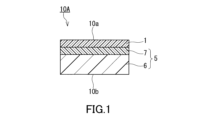
- FIG. 1 is a cross-sectional view showing a schematic diagram of a pervaporation membrane according to one embodiment of the present invention.
- FIG. 13 is a cross-sectional view showing a schematic diagram of a modified example of the pervaporation membrane.
- FIG. 1 is a schematic cross-sectional view of a membrane separation device equipped with a pervaporation membrane.
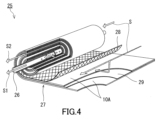
- FIG. 11 is a perspective view showing a schematic diagram of a modified example of a membrane separation device.
- FIG. 1 is a schematic diagram showing an example of a membrane separation system.
- the pervaporation membrane according to the first aspect of the present invention comprises: A pervaporation membrane having a separation functional layer containing a silicone resin,
- the ratio R of the Young's modulus A1 (MPa) of the separation functional layer before the test below to the Young's modulus A1 (MPa) of the separation functional layer after the test is performed is -30% or more.
- the content of n-butanol in the mixed liquid is 1.0 wt %, and the temperature of the mixed liquid is 80° C.
- the ratio R is 30% or less.
- the Young's modulus A1 is 0.1 MPa or more.
- the tin content in the separation functional layer is 1100 wtppm or less.
- the pervaporation membrane according to the fifth aspect of the present invention comprises: A pervaporation membrane having a separation functional layer containing a silicone resin, The tin content in the separation functional layer is 1100 wtppm or less.
- the silicone resin is formed from an addition type silicone resin composition.
- the addition type silicone resin composition contains polyorganosiloxane P1 having an alkenyl group and polyorganosiloxane P2 having a hydrosilyl group.
- the addition type silicone resin composition contains a curing catalyst having platinum.
- the separation functional layer further contains a filler.
- the filler includes at least one selected from the group consisting of zeolite and silica.
- the filler has a surface modified with a modifying group that includes a hydrocarbon group.
- the modifying group includes at least one selected from the group consisting of an organosilyl group and a polyorganosiloxane group.
- a pervaporation membrane according to any one of the first to twelfth aspects is used to separate volatile organic compounds from an aqueous solution containing the organic compounds.
- the organic compound is a fermentation product produced by a microorganism.
- the pervaporation membrane 10A of this embodiment includes a separation functional layer 1 containing a silicone resin.
- the pervaporation membrane 10A is typically a membrane (separation membrane) that preferentially transmits an organic compound C from an aqueous solution S containing a volatile organic compound C.
- the pervaporation membrane 10A may further include a porous support 5 that supports the separation functional layer 1.
- the separation functional layer 1 has, for example, a surface that is in direct contact with the porous support 5 and a surface that is exposed to the outside of the pervaporation membrane 10.
- the pervaporation membrane 10 is, for example, composed of only the separation functional layer 1 and the porous support 5.
- the separation functional layer 1 is, for example, a layer that allows the organic compound C to preferentially permeate from the above-mentioned aqueous solution S, and is typically a dense layer (non-porous layer) in which no pores can be identified when observed at a magnification of 5000 times using a scanning electron microscope (SEM).
- SEM scanning electron microscope
- the ratio R of the Young's modulus A1 (MPa) of the separation functional layer 1 before performing the following test 1 to the Young's modulus A1 (MPa) of the separation functional layer 1 after performing the test 1 minus the Young's modulus A1 is -30% or more.
- Test 1 The separation functional layer 1 is immersed in a mixed liquid L consisting of n-butanol and water for three weeks. The separation functional layer 1 is removed from the mixed liquid L and dried.
- the content of n-butanol in the mixed liquid L is 1.0 wt %, and the temperature of the mixed liquid L is 80° C.
- ratio R can be calculated by the following formula (1).
- Ratio R (%) 100 ⁇ (A2 - A1) / A1 (1)
- a separation functional layer 1 with a ratio R of -30% or more tends to be less susceptible to deterioration even when in contact with an aqueous solution S containing a volatile organic compound C for a long period of time. This tendency is due to, for example, the suppression of hydrolysis of the silicone resin contained in the separation functional layer 1. Since the pervaporation membrane 10A of this embodiment suppresses deterioration of the separation functional layer 1, it can be said that the membrane is suitable for performing the operation of separating an organic compound C from an aqueous solution S for a long period of time.
- the ratio R is preferably -25% or more, and may be -20% or more, -15% or more, -10% or more, or even -5% or more. If the silicone resin curing reaction progresses in the separation functional layer 1 during the above test 1, the ratio R may exceed 0%.
- the upper limit of the ratio R is, for example, 50% or less, and preferably 40% or less, 30% or less, 20% or less, or even 10% or less. In particular, when the ratio R is 30% or less, peeling due to curing shrinkage of the separation functional layer 1 tends to be sufficiently suppressed during long-term use of the pervaporation membrane 10A.
- Young's modulus A1 can be measured by the following method.
- the method of preparing the free-standing membrane of the separation functional layer 1 is not limited to the above method.
- the free-standing membrane of the separation functional layer 1 may be prepared by preparing a layer having the same composition and thickness as the separation functional layer 1 of the pervaporation membrane 10A on a release liner, and removing the release liner.
- the free-standing membrane of the separation functional layer 1 is dried as necessary to make it in a dry state. Note that "dry state” means that the content of liquid such as water in the separation functional layer 1 is 0.5 wt % or less.
- the free-standing film of the separation functional layer 1 is cut into a rectangular shape of 10 mm ⁇ 60 mm to prepare a test piece.
- the test piece is set in a commercially available tensile tester, and a tensile test is performed under the following measurement conditions. Measurement conditions Temperature: 25°C Tensile direction: longitudinal direction of test piece Initial chuck distance: 20 mm Tensile speed: 300 mm/min
- S-S curve a stress-strain curve
- a tangent line is drawn at the origin of the S-S curve, and Young's modulus A1 can be calculated from the slope of the tangent line.
- Young's modulus A1 is not particularly limited and may be, for example, 0.1 MPa or more, 0.3 MPa or more, 0.5 MPa or more, 1.0 MPa or more, 3.0 MPa or more, 5.0 MPa or more, 8.0 MPa or more, or even 10.0 MPa or more.
- the upper limit of Young's modulus A1 is not particularly limited and is, for example, 50 MPa.
- Young's modulus A2 can be measured by the following method.
- a free-standing film of the separation functional layer 1 is prepared by the above-mentioned method.
- the above-mentioned test 1 is carried out on the free-standing film of the separation functional layer 1.
- the separation functional layer 1 is immersed in the mixed liquid L at 80°C for three weeks.
- the separation functional layer 1 is removed from the mixed liquid L and dried.
- the drying conditions of the separation functional layer 1 are not particularly limited, and for example, the drying temperature is 20°C to 60°C and the drying time is 18 hours to 1 day. In this way, a dry separation functional layer 1 is obtained.
- the free-standing film of the separation functional layer 1 is cut into a strip of 10 mm x 60 mm to prepare a test piece.
- the test piece is set in a commercially available tensile tester and a tensile test is performed, and Young's modulus A2 can be calculated based on the results obtained.
- the conditions for the tensile test and the method for calculating Young's modulus A2 are the same as those described above for Young's modulus A1.
- Young's modulus A2 is not particularly limited and may be, for example, 0.1 MPa or more, 0.3 MPa or more, 0.5 MPa or more, 1.0 MPa or more, 3.0 MPa or more, 5.0 MPa or more, 8.0 MPa or more, or even 10.0 MPa or more.
- the upper limit of Young's modulus A2 is not particularly limited and is, for example, 50 MPa.
- the separation functional layer 1 contains a silicone resin.
- the silicone resin is formed, for example, from a silicone resin composition.
- the silicone resin may be formed from a condensation type silicone resin composition or a UV-curable silicone resin composition, but is preferably formed from an addition type silicone resin composition.
- the separation functional layer 1 is preferably formed from an addition type silicone resin composition.
- the addition type silicone resin composition can be cured using almost no metal species (especially tin) that can promote hydrolysis of the silicone resin. Therefore, the separation functional layer 1 containing a silicone resin formed from an addition type silicone resin composition contains almost no metal species that can promote hydrolysis of the silicone resin, and is suitable for adjusting the above ratio R to a small value.
- the addition type silicone resin composition is a type of silicone resin composition that cures by addition reaction.
- the addition type silicone resin composition contains, for example, polyorganosiloxane P1 having an alkenyl group and polyorganosiloxane P2 having a hydrosilyl (SiH) group.
- the addition type silicone resin composition preferably further contains a curing catalyst (hydrosilylation catalyst).
- the addition type silicone resin composition may be a commercially available silicone resin composition to which a curing catalyst has been added. However, the addition type silicone resin composition may not contain a curing catalyst.
- a reaction between the alkenyl group of polyorganosiloxane P1 and the hydrosilyl group of polyorganosiloxane P2 can proceed by heat treatment to form a silicone resin.
- polyorganosiloxane P2 functions as a crosslinking agent.
- alkenyl group in polyorganosiloxane P1 examples include vinyl groups and hexenyl groups.
- the number of alkenyl groups in polyorganosiloxane P1 is, for example, 2 or more.
- the alkenyl groups are located, for example, at the terminals of polyorganosiloxane P1.
- Polyorganosiloxane P1 is, for example, a polyalkylalkylsiloxane such as polydimethylsiloxane, polydiethylsiloxane, or polymethylethylsiloxane; a polyalkylarylsiloxane; or a polyorganosiloxane such as poly(dimethylsiloxane-diethylsiloxane) to which an alkenyl group has been introduced.
- a polyalkylalkylsiloxane such as polydimethylsiloxane, polydiethylsiloxane, or polymethylethylsiloxane
- a polyalkylarylsiloxane such as poly(dimethylsiloxane-diethylsiloxane) to which an alkenyl group has been introduced.
- the weight average molecular weight of polyorganosiloxane P1 is, for example, 1,000 or more, and may be 10,000 or more, 100,000 or more, 200,000 or more, 300,000 or more, or even 400,000 or more.
- the upper limit of the weight average molecular weight of polyorganosiloxane P1 is not particularly limited, and is, for example, 1,000,000.
- the number of hydrosilyl groups in polyorganosiloxane P2 is, for example, 2 or more.
- the hydrosilyl groups may be located at the terminals of polyorganosiloxane P2 or may be included in the main chain of polyorganosiloxane P2.
- polyorganosiloxane P2 examples include polymethylhydrogensiloxane, poly(dimethylsiloxane-methylhydrogensiloxane), and hydrosilyl-terminated polydimethylsiloxane.
- the weight average molecular weight of polyorganosiloxane P2 is, for example, 100 or more, and may be 10,000 or more.
- the upper limit of the weight average molecular weight of polyorganosiloxane P2 is not particularly limited, and is, for example, 1,000,000.
- the weight ratio P2/P1 of polyorganosiloxane P2 to polyorganosiloxane P1 is, for example, 500 wt% or less, and may be 100 wt% or less, 50 wt% or less, 20 wt% or less, 10 wt% or less, or even 5 wt% or less.
- the lower limit of the weight ratio P2/P1 is, for example, 0.01 wt% or more.
- the curing catalyst examples include platinum-based catalysts.
- the addition type silicone resin composition may contain a curing catalyst having platinum.
- platinum-based catalysts include chloroplatinic acid, platinum olefin complexes, and chloroplatinic acid olefin complexes.
- the addition type silicone resin composition may not contain a curing catalyst.
- the addition type silicone resin composition may contain a compound that generates catalytically active species that catalyze the addition reaction when irradiated with active energy rays such as ultraviolet (UV) rays.
- active energy rays such as ultraviolet (UV) rays.
- UV ultraviolet
- the addition type silicone resin composition may further contain an organic solvent in addition to the above-mentioned components.
- organic solvents include hydrocarbon solvents such as cyclohexane, n-hexane, and n-heptane; aromatic solvents such as toluene and xylene; ester solvents such as ethyl acetate and methyl acetate; ketone solvents such as acetone and methyl ethyl ketone; and alcohol solvents such as methanol, ethanol, and butanol.
- the organic solvent may be used alone or in combination of two or more.
- the addition type silicone resin composition may be a solvent-free type that does not substantially contain any solvent such as an organic solvent.
- the condensation type silicone resin composition is a type of silicone resin composition that cures by a condensation reaction.
- the condensation type silicone resin composition includes, for example, a polyorganosiloxane P3 having a silanol (SiOH) group, and a silane compound P4 having a functional group such as an alkoxy group, an alkenyloxy group, an acyloxy group, an amino group, a ketoxime group, or an amide group.
- the condensation type silicone resin composition may further include a curing catalyst.
- the curing catalyst used in the condensation type silicone resin composition usually includes a metal species (especially tin) that can promote hydrolysis of the silicone resin. Therefore, in this embodiment, it is preferable that the condensation type silicone resin composition does not include a curing catalyst.
- condensation type silicone resin composition for example, a reaction (condensation reaction) between the silanol groups of the polyorganosiloxane P3 and the above-mentioned functional groups of the silane compound P4 proceeds by heat treatment, and a silicone resin can be formed.
- the silane compound P4 functions as a crosslinking agent.
- the number of silanol groups in polyorganosiloxane P3 is, for example, 2 or more.
- the silanol groups are located, for example, at the terminals of polyorganosiloxane P3.
- Polyorganosiloxane P3 may have alkyl groups such as methyl groups and ethyl groups, or phenyl groups introduced as side chain substituents.
- Polyorganosiloxane P3 is, for example, the polyorganosiloxane described above for polyorganosiloxane P1 to which silanol groups have been introduced.
- the weight average molecular weight of polyorganosiloxane P3 is, for example, 1,000 or more, and may be 10,000 or more, 100,000 or more, 200,000 or more, 300,000 or more, or even 400,000 or more.
- the upper limit of the weight average molecular weight of polyorganosiloxane P3 is not particularly limited, and is, for example, 1,000,000.
- the silane compound P4 has functional groups such as an alkoxy group, an alkenyloxy group, an acyloxy group, an amino group, a ketoxime group, and an amide group.
- the alkoxy group include a methoxy group and an ethoxy group.
- the alkenyloxy group include an isopropenyloxy group.
- the acyloxy group include an acetoxy group.
- the amino group include a dimethylamino group, a diethylamino group, and an ethylmethylamino group.
- the ketoxime group include an acetoxime group and a methylethylketoxime group.
- amide group examples include an acetamide group, an N-methylacetamide group, and an N-ethylacetamide group.
- the number of functional groups in the silane compound P4 is, for example, 2 or more. In particular, it is preferable that the silane compound P4 contains an alkoxysilyl group as the alkoxy group.
- the silane compound P4 may be a low molecular weight compound having a molecular weight of about 1000 or less, or a high molecular weight compound having a polysiloxane skeleton.
- the condensation type silicone resin composition may further contain an organic solvent in addition to the above-mentioned components.
- the organic solvent include those described above for the addition type silicone resin composition.
- the condensation type silicone resin composition may be a solventless type that does not contain a solvent such as an organic solvent.
- the UV-curable silicone resin composition is a type of silicone resin composition that cures by ultraviolet (UV) irradiation.
- the curing reaction proceeds by, for example, radical polymerization, radical addition, ionic polymerization, etc.
- the UV-curable silicone resin composition in which the curing reaction proceeds by radical polymerization includes, for example, polyorganosiloxane P5 having a double bond (specifically, a carbon-carbon double bond) derived from an alkenyl group or an acryloyl group.
- the UV-curable silicone resin composition in which the curing reaction proceeds by radical addition includes, for example, polyorganosiloxane P5 having a double bond (specifically, a carbon-carbon double bond) derived from an alkenyl group or an acryloyl group, etc., and compound P6 having a functional group capable of radical addition such as a thiol group.
- the UV-curable silicone resin composition in which the curing reaction proceeds by ionic polymerization includes, for example, polyorganosiloxane P7 having a functional group capable of ionic polymerization such as an epoxy group, and a compound that generates a catalytically active species that catalyzes ionic polymerization by UV irradiation.
- UV irradiation causes a radical polymerization reaction between double bonds contained in the alkenyl groups and acryloyl groups of polyorganosiloxane P5, thereby forming a silicone resin.
- alkenyl group in polyorganosiloxane P5 examples include vinyl and hexenyl groups.
- the number of alkenyl groups in polyorganosiloxane P5 is, for example, 2 or more.
- the alkenyl groups are located, for example, at the ends of polyorganosiloxane P5.
- Polyorganosiloxane P5 may have alkyl groups such as methyl and ethyl groups, or phenyl groups introduced as side chain substituents.
- Polyorganosiloxane P5 is, for example, a polyorganosiloxane in which a substituent having a double bond, such as an alkenyl group or an acryloyl group, has been introduced into the polyorganosiloxane described above for polyorganosiloxane P1.
- a substituent having a double bond such as an alkenyl group or an acryloyl group
- the weight average molecular weight of polyorganosiloxane P5 is, for example, 1,000 or more, and may be 10,000 or more, 100,000 or more, 200,000 or more, 300,000 or more, or even 400,000 or more.
- the upper limit of the weight average molecular weight of polyorganosiloxane P5 is not particularly limited, and is, for example, 1,000,000.
- a functional group capable of radical addition contained in compound P6 undergoes radical addition to a double bond contained in an alkenyl group or acryloyl group of polyorganosiloxane P5. This causes a radical addition reaction to proceed, forming a silicone resin.
- the functional groups capable of radical addition are, for example, thiol groups and alkylthiol groups.
- alkylthiol groups include mercaptomethyl groups and mercaptoethyl groups.
- the number of functional groups capable of radical addition in compound P6 is, for example, 2 or more.
- Compound P6 may be a polyorganosiloxane containing a functional group capable of radical addition.
- the functional group is, for example, located at the end of the polyorganosiloxane.
- the polyorganosiloxane may have alkyl groups, such as methyl groups or ethyl groups, or phenyl groups, introduced as side chain substituents.
- Compound P6 is, for example, the polyorganosiloxane P1 described above to which a functional group capable of radical addition, such as a thiol group, has been introduced.
- the weight-average molecular weight of compound P6 is, for example, 1,000 or more, and may be 10,000 or more, 100,000 or more, 200,000 or more, 300,000 or more, or even 400,000 or more.
- the upper limit of the weight-average molecular weight of compound P6 is not particularly limited, and is, for example, 1,000,000.
- a UV-curable silicone resin composition in which the curing reaction proceeds through ionic polymerization, for example, catalytically active species that catalyze ionic polymerization are generated by UV irradiation, and an ionic polymerization reaction proceeds between functional groups capable of ionic polymerization contained in polyorganosiloxane P7. This allows the formation of a silicone resin.
- the functional group capable of ionically polymerizing is, for example, an epoxy group.
- substituents containing an epoxy group include the epoxy group itself, a glycidyl group, and a glycidyloxypropyl group.
- the number of functional groups capable of ionically polymerizing in polyorganosiloxane P7 is, for example, 2 or more.
- the functional group capable of ionically polymerizing is, for example, located at the end of polyorganosiloxane P7.
- Polyorganosiloxane P7 may have alkyl groups such as methyl groups and ethyl groups, or phenyl groups introduced as substituents in the side chains.
- Polyorganosiloxane P7 is, for example, the polyorganosiloxane described above for polyorganosiloxane P1 to which functional groups capable of ionic polymerization, such as epoxy groups, have been introduced.
- the weight average molecular weight of polyorganosiloxane P7 is, for example, 1,000 or more, and may be 10,000 or more, 100,000 or more, 200,000 or more, 300,000 or more, or even 400,000 or more.
- the upper limit of the weight average molecular weight of polyorganosiloxane P7 is not particularly limited, and is, for example, 1,000,000.
- the UV-curable silicone resin composition may further contain an organic solvent in addition to the above-mentioned components.
- organic solvent include hydrocarbon solvents such as cyclohexane, n-hexane, and n-heptane; aromatic solvents such as toluene and xylene; ester solvents such as ethyl acetate and methyl acetate; ketone solvents such as acetone and methyl ethyl ketone; and alcohol solvents such as methanol, ethanol, and butanol.
- the organic solvent may be used alone or in combination of two or more.
- the UV-curable silicone resin composition may be a solvent-free type that does not substantially contain any solvent such as an organic solvent.
- the separation functional layer 1 may contain silicone resin as a main component, or may be composed essentially of silicone resin alone. "Main component” refers to the component that is contained in the largest amount by weight in the separation functional layer 1.
- the separation functional layer 1 preferably has a low content of metal species that can promote hydrolysis of the silicone resin.
- the tin content in the separation functional layer 1 is 1100 wtppm or less, hydrolysis of the silicone resin hardly progresses even when the separation functional layer 1 comes into contact with water, and it is easy to adjust the above ratio R to a high value.
- the present invention provides A pervaporation membrane 10A having a separation functional layer 1 containing a silicone resin, A pervaporation membrane 10A is provided in which the tin content in the separation functional layer 1 is 1100 wtppm or less.
- the tin content in the separation functional layer 1 is preferably 1000 wtppm or less, and may be 800 wtppm or less, 500 wtppm or less, 300 wtppm or less, 100 wtppm or less, 80 wtppm or less, 50 wtppm or less, 30 wtppm or less, 10 wtppm or less, 5 wtppm or less, or even 1 wtppm or less.
- the separation functional layer 1 may be substantially free of tin.
- the content of each metal species, such as tin can be measured, for example, by atomic absorption spectrometry.
- the content of each metal species in the separation functional layer 1 can also be calculated from the content of each metal species in the material used to produce the separation functional layer 1.
- the thickness of the separation functional layer 1 is, for example, 200 ⁇ m or less, and may be 100 ⁇ m or less, or even 80 ⁇ m or less.
- the thickness of the separation functional layer 1 may be 1.0 ⁇ m or more, 10 ⁇ m or more, or even 30 ⁇ m or more.
- the porous support 5 includes, for example, a main body portion 6 and a microporous layer 7 disposed on the main body portion 6.
- the microporous layer 7 is located between the main body portion 6 and the separation functional layer 1, and is in direct contact with both the main body portion 6 and the separation functional layer 1.
- the porous support 5 is typically an ultrafiltration membrane.
- the main body 6 is, for example, a fiber structure such as a woven fabric or a nonwoven fabric, and is typically a nonwoven fabric.
- fibers contained in the fiber structure include natural fibers such as wood pulp, cotton, and hemp (e.g., Manila hemp); and chemical fibers (synthetic fibers) such as polyester fibers, rayon, vinylon, acetate fibers, polyvinyl alcohol (PVA) fibers, polyamide fibers, polyolefin fibers, and polyurethane fibers.
- the main body 6 is, for example, a nonwoven fabric made of polyester fibers.
- the main body 6 has an average pore size of, for example, 1 ⁇ m to 50 ⁇ m.
- microporous layer 7 examples include fluororesins such as polyvinylidene fluoride and polytetrafluoroethylene; polyarylethersulfones such as polysulfone and polyethersulfone; and polyimides.
- the microporous layer 7 has an average pore size of, for example, 0.01 ⁇ m to 0.4 ⁇ m.
- the thickness of the porous support 5 is not particularly limited, and may be, for example, 10 ⁇ m or more, 50 ⁇ m or more, or even 100 ⁇ m or more.
- the thickness of the porous support 5 may be, for example, 300 ⁇ m or less, or 200 ⁇ m or less.
- the pervaporation membrane 10A can be produced, for example, by forming a separation functional layer 1 on the microporous layer 7 of the porous support 5.
- a coating liquid containing a material of the separation functional layer 1 is prepared.
- the coating liquid is, for example, a silicone resin composition (an addition type silicone resin composition, a condensation type silicone resin composition, or a UV-curable silicone resin composition).
- a coating film is obtained by applying the coating liquid onto the porous support 5.
- the separation functional layer 1 is formed by curing the coating film.
- the coating film can be cured at room temperature or in a heated environment.
- the coating film can also be cured by irradiation with active energy rays such as UV.
- the heating conditions of the coating film are not particularly limited.
- the heating temperature of the coating film may be 80°C or higher, 90°C or higher, 100°C or higher, or even 120°C or higher.
- the higher the heating temperature of the coating film the more sufficiently the curing reaction of the components in the silicone resin composition proceeds. In this case, when the above test 1 is performed, there is a tendency that the ratio R can be prevented from significantly exceeding 0%.
- the upper limit of the heating temperature of the coating film is not particularly limited, and is, for example, 200°C.
- the heating time of the coating film can be appropriately adjusted depending on the composition of the silicone resin composition used.
- the pervaporation membrane 10A of the present embodiment is suitable for use in separating an organic compound C from an aqueous solution S containing a volatile organic compound C.
- the organic compound C is not particularly limited as long as it is volatile.
- the term "volatile organic compound” refers to, for example, an organic compound having a boiling point of 20°C to 260°C under atmospheric pressure (101.325 kPa). Note that, when the organic compound C has a high concentration in an aqueous solution, for example, it generates an aqueous phase containing water as a main component and an organic phase having a higher content of the organic compound C than the aqueous phase. However, the organic compound C may not generate an aqueous phase and an organic phase.
- the number of carbon atoms in the organic compound C is not particularly limited, and may be, for example, 10 or less, 8 or less, 6 or less, or even 4 or less.
- the lower limit of the number of carbon atoms in the organic compound C may be 1 or 2.
- the organic compound C has a functional group containing an oxygen atom, such as, for example, a hydroxyl group, a carbonyl group, an ether group, or an ester group. In the organic compound C, the number of functional groups containing an oxygen atom is typically one.
- the organic compound C may be, for example, an alcohol, a ketone, an ester, etc., and is typically an alcohol.
- the alcohol may be an alkyl alcohol composed only of an alkyl group and a hydroxyl group, or an aryl alcohol containing an aryl group and a hydroxyl group.
- the alkyl alcohol may be linear, branched, or cyclic. Examples of the alkyl alcohol include methanol, ethanol, n-propanol, isopropanol, n-butanol, 2-butanol, isobutanol, t-butanol, and n-pentanol. Examples of the aryl alcohol include phenol.
- the ketone may be a dialkyl ketone consisting of only alkyl and carbonyl groups.
- dialkyl ketones include methyl ethyl ketone (MEK) and acetone.
- the ester may be a fatty acid alkyl ester composed only of alkyl groups and ester groups.
- fatty acid alkyl esters include ethyl acetate.
- the organic compound C is not limited to those mentioned above.
- the organic compound C may be an aromatic hydrocarbon such as benzene, toluene, or xylene.
- the aqueous solution S may contain one type of organic compound C, or may contain two or more types of organic compounds C.
- the content of organic compound C in the aqueous solution S is, for example, 0.5 wt% or more, and may be 1 wt% or more, 2 wt% or more, or even 5 wt% or more.
- the upper limit of the content of organic compound C is not particularly limited, and is, for example, 50 wt%.
- the organic compound C may be a fermentation product produced by a microorganism fermenting a carbon source, or may be alcohol (bioalcohol) produced by a microorganism.
- the aqueous solution S may be a fermentation liquid containing the organic compound C as a fermentation product.
- the aqueous solution S is not limited to a fermentation liquid, and may be waste liquid or wastewater discharged from a chemical plant, etc.
- the aqueous solution S may further contain other components such as a microorganism that produces a fermentation product, a carbon source, a nitrogen source, and inorganic ions in addition to water and the organic compound C.
- a microorganism that produces the fermentation product is typically a fungus.
- carbon sources include polysaccharides such as starch and monosaccharides such as glucose.
- the separation factor of the organic compound C relative to water is not particularly limited.
- the separation factor ⁇ 1 BuOH of n-butanol (BuOH) relative to water in the pervaporation membrane 10A is, for example, 10 or more, and may be 15 or more, 20 or more, 25 or more, 30 or more, or even 40 or more.
- the upper limit of the separation factor ⁇ 1 BuOH is, for example, 100.
- the separation factor ⁇ 1 BuOH can be measured by the following method.
- a mixed liquid consisting of BuOH and water is in contact with one side of the pervaporation membrane 10A (for example, the main surface 10a on the separation function layer side of the pervaporation membrane 10A)
- the space adjacent to the other side of the pervaporation membrane 10A is depressurized to 15 hPa.
- a permeated fluid that has permeated the pervaporation membrane 10A is obtained.
- the weight ratio of water and the weight ratio of BuOH in the permeated fluid are measured.
- the content of BuOH in the mixed liquid is 1.0 wt%.
- the mixed liquid that is brought into contact with the pervaporation membrane 10A has a temperature of 30° C.
- the space adjacent to the other side of the pervaporation membrane 10A is depressurized to 15 hPa.
- the flux of BuOH permeating through pervaporation membrane 10A is not particularly limited and is, for example, 0.01 (g/min/m 2 ) to 10.0 (g/min/m 2 ).
- the separation functional layer 1 tends to be inhibited from deteriorating even when in contact with the aqueous solution S containing the volatile organic compound C for a long period of time. Therefore, the pervaporation membrane 10A tends not to deteriorate in separation performance even when in contact with the aqueous solution S for a long period of time.
- the ratio R1 of the value obtained by subtracting the separation factor ⁇ 1 BuOH from the separation factor ⁇ 2 BuOH of BuOH in water of the pervaporation membrane 10A after the following test 2 is performed to the separation factor ⁇ 1 BuOH of BuOH in water of the pervaporation membrane 10A before the test 2 is performed is -30% or more.
- Test 2 The pervaporation membrane 10A is immersed in a mixed liquid L containing n-butanol and water for three weeks. The pervaporation membrane 10A is removed from the mixed liquid L and dried.
- the content of n-butanol in the mixed liquid L is 1.0 wt %, and the temperature of the mixed liquid L is 80° C.
- ratio R1 can be calculated by the following formula (2).
- Ratio R1 (%) 100 ⁇ ( ⁇ 2 BuOH ⁇ 1 BuOH ) / ⁇ 1 BuOH (2)
- the ratio R1 is preferably -25% or more, and may be -20% or more, -15% or more, -10% or more, or even -5% or more.
- the upper limit of the ratio R1 is, for example, 50% or less, and may be 40% or less, 30% or less, 20% or less, or even 10% or less.
- the separation factor ⁇ 2 BuOH can be measured in the same manner as the separation factor ⁇ 1 BuOH , except that the pervaporation membrane 10A after test 2 is used.
- the separation factor ⁇ 2 BuOH is, for example, 10 or more, and may be 15 or more, 20 or more, 25 or more, 30 or more, or even 40 or more.
- the upper limit of the separation factor ⁇ 2 BuOH is, for example, 100.
- the separation factor ⁇ 1 IPA of isopropanol (IPA) with respect to water of the pervaporation membrane 10A is, for example, 5 or more, 10 or more, or may be even 15 or more.
- the upper limit of the separation factor ⁇ 1 IPA is, for example, 100.
- the separation factor ⁇ 1 IPA can be measured in the same manner as the separation factor ⁇ 1 BuOH , except that a mixed liquid having an IPA content of 5 wt % is used.
- the ratio R2 of the value obtained by subtracting the separation factor ⁇ 1 IPA from the separation factor ⁇ 2 IPA of IPA from water of the pervaporation membrane 10A after performing the above-mentioned test 2 to the separation factor ⁇ 1 IPA of IPA from water of the pervaporation membrane 10A before performing the above-mentioned test 2 is -30% or more.
- ratio R2 can be calculated by the following formula (3).
- Ratio R2 (%) 100 ⁇ ( ⁇ 2 IPA - ⁇ 1 IPA ) / ⁇ 1 IPA (3)
- the ratio R2 is preferably -25% or more, and may be -20% or more, -15% or more, -10% or more, or even -5% or more.
- the upper limit of the ratio R2 is, for example, 50% or less, and may be 40% or less, 30% or less, 20% or less, or even 10% or less.
- the separation factor ⁇ 2 IPA can be measured in the same manner as the separation factor ⁇ 1 IPA , except that the pervaporation membrane 10A after test 2 is used.
- the separation factor ⁇ 2 IPA is, for example, 5 or more, 10 or more, or may be 15 or more.
- the upper limit of the separation factor ⁇ 2 IPA is, for example, 100.
- FIG. 2 is a cross-sectional view showing a modified example of the pervaporation membrane.
- the separation functional layer 1 has a matrix 2 containing a silicone resin and a filler 3 dispersed in the matrix 2.
- the structure of the pervaporation membrane 10B is the same as that of the pervaporation membrane 10A. Therefore, the same reference symbols are given to elements common to the above-mentioned pervaporation membrane 10A and the modified pervaporation membrane 10B, and their description may be omitted. That is, the description of each embodiment can be applied to each other as long as there is no technical contradiction. Furthermore, each embodiment may be combined with each other as long as there is no technical contradiction.
- the separation functional layer 1 further includes filler 3. All or a part of the filler 3 is embedded in the matrix 2. Within the matrix 2, all of the filler 3 may be spaced apart from one another, or may be partially aggregated.
- the silicone resin contained in the matrix 2 can be the same as that described above for the pervaporation membrane 10A.
- the filler 3 includes an inorganic material such as zeolite, silica, or bentonite.
- the filler 3 includes at least one selected from the group consisting of zeolite and silica, and preferably includes silica.
- the filler 3 including silica tends to have better hydrolysis resistance than the filler 3 including zeolite.
- the filler 3 including silica tends to increase the free volume of the silicone resin included in the matrix 2. When the free volume of the silicone resin increases, the separation characteristics of the pervaporation membrane 10B, in particular the separation coefficient ⁇ of BuOH relative to water, tends to improve.
- Silica usually means silicon dioxide.
- Filler 3 may be a silica filler containing silicon dioxide as a main component. Silica filler does not have a crystalline structure, for example. Silica filler can be produced, for example, by reacting metal silicon with oxygen. Silica filler can also be produced by the sol-gel method, the precipitation method, the aqueous solution wet method, or the like. Filler 3 may be substantially composed of silicon dioxide only.
- the filler 3 may contain zeolite.
- zeolites contained in the filler 3 include high-silica zeolites with a high ratio of silica to alumina, and silicalites that do not contain alumina.
- examples of fillers 3 that contain high-silica zeolites include HSZ (registered trademark) manufactured by Tosoh Corporation, HiSiv (registered trademark) manufactured by Union Showa Corporation, USKY manufactured by Union Showa Corporation, and Zeoal (registered trademark) manufactured by Nakamura Choukou Co., Ltd.
- the filler 3, particularly the silica filler does not have micropores with a diameter of, for example, 2 nm or less.
- the filler 3 may have mesopores with a diameter of 2 nm to 50 nm and macropores with a diameter of 50 nm or more.
- the filler 3, particularly the silica filler preferably has a surface modified with a modifying group that includes a hydrocarbon group.
- the filler 3 is preferably surface-modified with a modifying group.
- the surface-modified filler 3 has high dispersibility in the silicone resin and is suitable for suppressing the occurrence of cracks during the preparation of the separation functional layer 1, etc.
- the number of carbon atoms in the hydrocarbon group contained in the modifying group is not particularly limited, and may be, for example, 1 to 25.
- the number of carbon atoms in the hydrocarbon group may be 5 or less.
- the hydrocarbon group may be linear, branched, or cyclic. Examples of the hydrocarbon group include alkyl groups such as methyl and ethyl groups.
- the modifying group may further contain a silicon atom, and a hydrocarbon group may be bonded to the silicon atom.
- the modifying group may contain at least one selected from the group consisting of an organosilyl group and a polyorganosiloxane group.
- organosilyl group include triorganosilyl groups such as a trimethylsilyl group; and diorganosilyl groups such as a dimethylsilyl group.
- the polyorganosiloxane group include a dimethylpolysiloxane group.
- Surface modification with a modifying group can be carried out, for example, by reacting the hydroxyl groups present on the surface of the filler 3 with a known silane coupling agent.
- surface-modified silica fillers include the product names "AEROSIL (registered trademark) RX series” (RX50, RX200, RX300, etc.), “AEROSIL (registered trademark) RY series” (RY50, RY200, RY200S, etc.), “AEROSIL (registered trademark) NY series” (NY50, NY50L, etc.), “AEROSIL (registered trademark) NAX series” (NAX50, etc.), and “AEROSIL (registered trademark) R series” (R972, R974, R976, etc.), all manufactured by Nippon Aerosil Co., Ltd.
- the filler 3 is sufficiently surface-modified with a modifying group. In other words, it is preferable that the number of hydroxyl groups present on the surface of the filler 3 is small. Whether the filler 3 is sufficiently surface-modified with a modifying group can be determined, for example, from the pH of the dispersion liquid of the filler 3 or the Hansen solubility parameter (HSP value) of the filler 3.
- the Hansen solubility parameter is a solubility parameter introduced by Hildebrand divided into three components: a dispersion term ⁇ D, a polarization term ⁇ P, and a hydrogen bond term ⁇ H. Details of the Hansen solubility parameter are disclosed in "Hansen Solubility Parameters; A Users Handbook (CRC Press, 2007)" and the like.
- the pH of the dispersion of the filler 3 measured by the following test 3 is, for example, 4.0 to 9.0, and may be 6.0 to 8.0.
- the pH of the dispersion is preferably neutral (about pH 7.0).
- the pH of the dispersion is neutral, it can be said that the filler 3 is sufficiently surface-modified with the modifying group, and the number of hydroxyl groups present on the surface is small.
- Test 3 Water, methanol, and Filler 3 are mixed to prepare a dispersion, and the pH of the dispersion is measured.
- the content of Filler 3 is 4 wt %
- the weight ratio of water to methanol is 1:1
- the temperature of the dispersion is 25° C.
- the shape of the filler 3 is, for example, particulate.
- "particulate” includes spherical, ellipsoidal, scaly, and fibrous.
- the filler 3 may be powdered.
- the average particle size of the filler 3 is not particularly limited and may be, for example, 50 ⁇ m or less, 20 ⁇ m or less, 10 ⁇ m or less, 1 ⁇ m or less, 500 nm or less, 100 nm or less, 50 nm or less, 30 nm or less, or even 20 nm or less.
- a separation functional layer 1 containing filler 3 with a small average particle size tends to disperse stress applied to the separation functional layer 1 and has a tendency to have high adhesion to the porous support 5.
- the lower limit of the average particle size of the separation functional layer 1 and the filler 3 is not particularly limited and may be, for example, 1 nm or 5 nm.
- the average particle size of filler 3 can be determined, for example, by the following method. First, a cross section of separation functional layer 1 is observed with a transmission electron microscope. In the obtained electron microscope image, the area of a specific filler 3 is calculated by image processing. The diameter of a circle having the same area as the calculated area is regarded as the particle size (particle diameter) of that specific filler 3. The particle size of an arbitrary number of fillers 3 (at least 50 particles) is calculated, and the average of the calculated values is regarded as the average particle size of filler 3.
- the content of the filler 3 in the separation functional layer 1 is, for example, 1 wt% or more, and may be 5 wt% or more, 10 wt% or more, 20 wt% or more, 30 wt% or more, or even 40 wt% or more.
- the upper limit of the content of the filler 3 in the separation functional layer 1 is not particularly limited, and may be, for example, 70 wt% or less, and may be less than 50 wt%. When the content of the filler 3 is less than 50 wt%, there is a tendency that the occurrence of defects such as cracks can be sufficiently suppressed during the production of the separation functional layer 1.
- the content of the matrix 2 in the separation functional layer 1 is not particularly limited, and may be, for example, 30 wt% to 99 wt%, and may be 30 wt% to 90 wt%.
- the surface area D1 of the filler 3 per weight of the matrix 2 is not particularly limited, and may be, for example, 5 m 2 /g or more, 10 m 2 /g or more, 20 m 2 /g or more, 30 m 2 /g or more, 40 m 2 /g or more, or even 50 m 2 /g or more.
- the upper limit of the surface area D1 is not particularly limited, and may be, for example, 100 m 2 /g or less.
- the surface area D1 can be calculated by the following formula based on the BET specific surface area D2 (m 2 /g) of the filler 3 by nitrogen gas adsorption, the weight W1 (g) of the matrix 2 contained in the separation functional layer 1, and the weight W2 (g) of the filler 3 contained in the separation functional layer 1.
- D1( m2 /g) D2( m2 /g) ⁇ W2(g)/W1(g)
- the membrane separation device 20 of this embodiment includes a pervaporation membrane 10A and a tank 22.
- the membrane separation device 20 may include the pervaporation membrane 10B described in Fig. 2 instead of the pervaporation membrane 10A.
- the tank 22 has a first chamber 23 and a second chamber 24.
- the first chamber 23 functions as a supply space to which a supply fluid (specifically, the above-mentioned aqueous solution S) is supplied.
- the second chamber 24 functions as a permeation space to which a permeation fluid S1 is supplied.
- the permeation fluid S1 is obtained by the aqueous solution S permeating through the pervaporation membrane 10A.
- the pervaporation membrane 10A is disposed inside the tank 22. Inside the tank 22, the pervaporation membrane 10A separates the first chamber 23 from the second chamber 24. The pervaporation membrane 10A extends from one of the pair of walls of the tank 22 to the other.
- the first chamber 23 has an inlet 23a and an outlet 23b.
- the second chamber 24 has an outlet 24a.
- the inlet 23a is an opening for supplying the aqueous solution S to the supply space (first chamber 23).
- the outlet 24a is an opening for discharging the permeated fluid S1 from the permeated space (second chamber 24).
- the outlet 23b is an opening for discharging the aqueous solution S that has not permeated the pervaporation membrane 10A (non-permeated fluid S2) from the supply space (first chamber 23).
- Each of the inlet 23a, outlet 23b, and outlet 24a is formed, for example, on the wall surface of the tank 22.
- the membrane separation device 20 is suitable for a flow-through (continuous) membrane separation method. However, the membrane separation device 20 may also be used for a batch-type membrane separation method.
- the membrane separation device 20 is operated, for example, as follows: First, the aqueous solution S is supplied to the first chamber 23 of the membrane separation device 20 through the inlet 23a. This allows the aqueous solution S to come into contact with one surface (e.g., the main surface 10a) of the pervaporation membrane 10A.
- one surface e.g., the main surface 10a
- the space adjacent to the other surface (e.g., main surface 10b) of the pervaporation membrane 10A is depressurized.
- the pressure inside the second chamber 24 is depressurized through the outlet 24a.
- the pressure inside the second chamber 24 can be depressurized, for example, by a depressurization device such as a vacuum pump.
- the pressure in the second chamber 24 is, for example, 50 kPa or less, and may be 20 kPa or less, 10 kPa or less, 5 kPa or less, 3 kPa or less, or even 2 kPa or less.
- pressure means absolute pressure.
- a permeated fluid S1 having a high content of organic compound C can be obtained on the other side of the pervaporation membrane 10A.
- the permeated fluid S1 is supplied to the second chamber 24.
- the permeated fluid S1 is typically a gas.
- the permeated fluid S1 is discharged to the outside of the membrane separation device 20 through the outlet 24a.
- the content of organic compounds C in the aqueous solution S gradually decreases from the inlet 23a to the outlet 23b of the first chamber 23.
- the aqueous solution S (non-permeated fluid S2) treated in the first chamber 23 is discharged to the outside of the membrane separation device 20 through the outlet 23b.
- the non-permeated fluid S2 is typically a liquid.
- the pervaporation membrane 10A allows preferential permeation of the organic compound C contained in the aqueous solution S. Therefore, the permeated fluid S1 obtained by operating the membrane separation device 20 has a higher content of organic compound C than the aqueous solution S supplied to the membrane separation device 20.
- the membrane separation device 20 may be a spiral membrane element, a hollow fiber membrane element, a disk tube type membrane element in which a plurality of pervaporation membranes are stacked, a plate-and-frame type membrane element, or the like.
- Fig. 4 shows a spiral membrane element.
- the membrane separation device 25 in Fig. 4 includes a central tube 26 and a stack 27.
- the stack 27 includes a pervaporation membrane 10A (or a pervaporation membrane 10B).
- the central tube 26 has a cylindrical shape. A plurality of holes or slits are formed on the surface of the central tube 26 to allow the permeation fluid S1 to flow into the interior of the central tube 26.
- materials for the central tube 26 include resins such as acrylonitrile butadiene styrene copolymer resin (ABS resin), polyphenylene ether resin (PPE resin), and polysulfone resin (PSF resin); and metals such as stainless steel and titanium.
- the inner diameter of the central tube 26 is, for example, in the range of 20 to 100 mm.
- the laminate 27 further includes a supply-side flow path material 28 and a permeation-side flow path material 29.
- the laminate 27 is wound around the central tube 26.
- the membrane separation device 25 may further include an exterior material (not shown).
- the supply-side flow passage material 28 and the permeate-side flow passage material 29 can be, for example, a resin net, woven fabric, or knitted fabric made of polyethylene, polypropylene, polyethylene terephthalate (PET), polyphenylene sulfide (PPS), or ethylene-chlorotrifluoroethylene copolymer (ECTFE).
- PET polyethylene terephthalate
- PPS polyphenylene sulfide
- ECTFE ethylene-chlorotrifluoroethylene copolymer
- the membrane separation device 25 can be operated, for example, in the following manner. First, the aqueous solution S is supplied to one end of the wound stack 27. The space inside the central tube 26 is depressurized. This causes the permeated fluid S1 that has permeated the pervaporation membrane 10A of the stack 27 to move into the central tube 26. The permeated fluid S1 is discharged to the outside through the central tube 26. The aqueous solution S (non-permeated fluid S2) that has been treated in the membrane separation device 25 is discharged to the outside from the other end of the wound stack 27.
- the membrane separation system 100 of the present embodiment includes the above-mentioned membrane separation device 20.
- the membrane separation system 100 may include the membrane separation device 25 described in Fig. 4 instead of the membrane separation device 20.
- the membrane separation system 100 further includes a tank 30 in addition to the membrane separation device 20.
- the tank 30 stores the aqueous solution S to be supplied to the membrane separation device 20.
- the tank 30 may be a fermenter for producing an organic compound C by fermentation of a carbon source by microorganisms.
- the membrane separation system 100 further includes an aqueous solution supply path 70, a non-permeated fluid discharge path 71, and a permeated fluid discharge path 72.
- the aqueous solution supply path 70 is a path for supplying the aqueous solution S from the tank 30 to the membrane separation device 20 during operation, and is connected to the outlet 31 of the tank 30 and the inlet 23a of the membrane separation device 20.
- a pump 50 for controlling the flow rate of the aqueous solution S is disposed in the aqueous solution supply path 70.
- the non-permeated fluid discharge path 71 is a path for discharging the non-permeated fluid S2 from the membrane separation device 20 during operation, and is connected to the outlet 23b of the membrane separation device 20.
- a pump 51 for controlling the flow rate of the non-permeated fluid S2 is disposed in the non-permeated fluid discharge path 71.
- the pump 51 may not be disposed in the non-permeated fluid discharge path 71.
- the non-permeated fluid discharge path 71 may be connected to the inlet 32 of the tank 30 and configured to send the non-permeated fluid S2 to the tank 30 during operation.
- the non-permeated fluid S2 may be mixed with the aqueous solution S in the tank 30 and circulated through the aqueous solution supply path 70 and the non-permeated fluid discharge path 71.
- the non-permeated fluid S2 is sent to the tank 30, the aqueous solution S and the non-permeated fluid S2 are mixed in the tank 30, and the content of the organic compound C in the aqueous solution S decreases.
- the tank 30 is a fermentation tank, the decrease in the content of the organic compound C in the aqueous solution S can prevent the fermentation by the microorganisms from stopping, thereby allowing the production of the fermented product to be carried out continuously.
- the permeate fluid discharge path 72 is a path for discharging the permeate fluid S1 from the membrane separation device 20 during operation, and is connected to the outlet 24a of the membrane separation device 20.
- a pressure reducing device 52 is arranged in the permeate fluid discharge path 72.
- the pressure reducing device 52 can reduce the pressure inside the permeation space of the membrane separation device 20.
- the pressure reducing device 52 is preferably a vacuum device such as a vacuum pump.
- the vacuum pump is typically a gas transport type vacuum pump, and examples of the vacuum pump include a reciprocating vacuum pump and a rotary vacuum pump. Examples of the reciprocating vacuum pump include a diaphragm type and a rocking piston type vacuum pump.
- the rotary vacuum pump examples include a liquid ring pump; an oil rotary pump (rotary pump); a mechanical booster pump; and various dry pumps such as a roots type, a claw type, a screw type, a turbo type, and a scroll type.
- the pump as the pressure reducing device 52 may be equipped with a variable speed mechanism for changing the rotation speed, etc.
- An example of the variable speed mechanism is an inverter that drives the motor of the pump. By controlling the pump speed and other parameters with the variable speed mechanism, the pressure in the permeation space of the membrane separation device 20 can be appropriately adjusted.
- the permeated fluid discharge path 72 may further include a heat exchanger for cooling the permeated fluid S1.
- the heat exchanger can condense the gaseous permeated fluid S1.
- the heat exchanger is, for example, a gas-liquid heat exchanger that causes heat exchange between a cooling medium such as antifreeze and the gaseous permeated fluid S1.
- the heat exchanger may be located between the membrane separation device 20 and the pressure reducing device 52 (upstream of the pressure reducing device 52), or between the pressure reducing device 52 and the recovery section 40 (downstream of the pressure reducing device 52), which will be described later.
- the membrane separation system 100 further includes a recovery section 40.
- the recovery section 40 recovers the permeated fluid S1 sent from the membrane separation device 20, and can store the permeated fluid S1, for example.
- the recovery section 40 is, for example, a tank that stores the permeated fluid S1.
- a permeated fluid discharge path 72 is connected to an inlet 41 of the recovery section 40.
- the membrane separation system 100 may further include a controller 60 that controls each component of the membrane separation system 100.
- the controller 60 is, for example, a DSP (Digital Signal Processor) that includes an A/D conversion circuit, an input/output circuit, an arithmetic circuit, a memory device, etc.
- the controller 60 stores a program for appropriately operating the membrane separation system 100.
- each of the paths in the membrane separation system 100 is composed of, for example, metal or plastic piping.
- Example 1 First, 54 g of toluene (Fujifilm Wako Pure Chemical Industries, special grade) as a dilution solvent and 1 g of platinum-based catalyst (Shin-Etsu Chemical Industry, CAT-PL-50T) as a curing catalyst were added to 100 g of a silicone resin composition (KS-847T, manufactured by Shin-Etsu Chemical Co., Ltd.) to prepare a coating liquid (addition type silicone resin composition). This coating liquid was applied onto a porous support to obtain a coating film (thickness 500 ⁇ m). As the porous support, RS-50 (a laminate of a PVDF microporous layer and a PET nonwoven fabric) manufactured by Nitto Denko Corporation was used. The coating film was formed on the PVDF microporous layer of RS-50.
- the coating film was heated at 90°C for 20 minutes to harden it, producing a separation functional layer with a thickness of 50 ⁇ m. This resulted in the pervaporation membrane of Example 1.
- Example 2 to 4 The pervaporation membranes of Examples 2 to 4 were obtained in the same manner as in Example 1, except that the silicone resin compositions shown in Table 1 below were used.
- Example 5 The pervaporation membrane of Example 5 was obtained in the same manner as in Example 1, except that 50 g of a silicone resin composition (KE-1935B, manufactured by Shin-Etsu Chemical Co., Ltd.) was added to 50 g of a silicone resin composition (KE-1935A, manufactured by Shin-Etsu Chemical Co., Ltd.) to prepare a coating liquid (addition type silicone resin composition), the thickness of the coating film was changed to 70 ⁇ m, and the curing temperature of the coating film was changed to 150° C.
- a silicone resin composition KE-1935B, manufactured by Shin-Etsu Chemical Co., Ltd.
- a silicone resin composition KE-1935A, manufactured by Shin-Etsu Chemical Co., Ltd.
- Example 6 The pervaporation membrane of Example 6 was obtained by the same method as in Example 1, except that 62 g of toluene (special grade, manufactured by FUJIFILM Wako Pure Chemical Industries, Ltd.) as a dilution solvent and 3 g of a tin-based catalyst (YC6831, manufactured by Momentive Performance Materials Japan, Ltd.) as a curing catalyst were added to 100 g of a silicone resin composition (YSR3022, manufactured by Momentive Performance Materials Japan, Ltd.) to prepare a coating liquid (condensation type silicone resin composition).
- toluene special grade, manufactured by FUJIFILM Wako Pure Chemical Industries, Ltd.
- a tin-based catalyst YC6831, manufactured by Momentive Performance Materials Japan, Ltd.
- Example 7 First, 46.5 g of toluene (special grade, manufactured by Fujifilm Wako Pure Chemical Industries, Ltd.) as a dilution solvent and 1.5 g of a curing agent (SILPOT 184, manufactured by Dow Corning Toray Co., Ltd.) were added to 15 g of a silicone resin composition (SILPOT 184, manufactured by Dow Corning Toray Co., Ltd.) to prepare a coating liquid (addition type silicone resin composition). This coating liquid was applied onto a porous support (RS-50, manufactured by Nitto Denko Corporation), but since the coating liquid soaked into the porous support, a pervaporation membrane could not be prepared.
- a porous support RS-50, manufactured by Nitto Denko Corporation
- Example 8 First, 46 g of toluene (Fujifilm Wako Pure Chemical Industries, special grade) as a dilution solvent, 0.73 g of a curing agent (Dow Corning Toray, SILPOT 184), and 8 g of a zeolite filler (Tosoh Corporation, HSZ-890) were added to 7.27 g of a silicone resin composition (Dow Corning Toray Co., Ltd.) to prepare a coating liquid (addition type silicone resin composition). This coating liquid was applied onto a porous support (Nitto Denko Corporation, RS-50), but since the coating liquid soaked into the porous support, a pervaporation membrane could not be prepared.
- a porous support Nito Denko Corporation, RS-50
- Example 9 First, 8 g of zeolite filler (HSZ-890, Tosoh Corporation) and 10 g of toluene (special grade, Fujifilm Wako Pure Chemical Industries, Ltd.) were added to 2.4 g of silicone rubber macromer (DMS-S12, Gelest Corporation) and stirred. 36 g of toluene (special grade, Fujifilm Wako Pure Chemical Industries, Ltd.), 5.09 g of silicone resin composition (SILPOT184, Toray Dow Corning Corporation), and 0.51 g of curing agent (SILPOT184, Toray Dow Corning Corporation) were added to this solution to prepare a coating liquid (addition type silicone resin composition). This coating liquid was applied onto a porous support (RS-50, Nitto Denko Corporation), but since the coating liquid permeated into the porous support, it was not possible to prepare a pervaporation membrane.
- a porous support RS-50, Nitto Denko Corporation
- Example 10 A pervaporation membrane of Example 10 was obtained by the same method as in Example 1, except that a coating liquid (addition type silicone resin composition) was prepared by adding 15 g of silica filler (AEROSIL RX50, manufactured by Nippon Aerosil Co., Ltd.), 87 g of toluene (special grade, manufactured by Fujifilm Wako Pure Chemical Industries, Ltd.) as a dilution solvent, and 0.5 g of a platinum-based catalyst (CAT-PL-50T, manufactured by Shin-Etsu Chemical Co., Ltd.) as a curing catalyst to 50 g of a silicone resin composition (KS-847T, manufactured by Shin-Etsu Chemical Co., Ltd., toluene solution, solid content 30 wt%).
- silica filler AEROSIL RX50, manufactured by Nippon Aerosil Co., Ltd.
- 87 g of toluene special grade, manufactured by Fujifilm Wako Pure Chemical Industries, Ltd.
- Example 11 The pervaporation membrane of Example 11 was obtained by the same method as in Example 1, except that a tin-based catalyst (YC6831, manufactured by Momentive Performance Materials Japan) was added to the coating solution so that the tin content in the separation functional layer was 500 wtppm.
- a tin-based catalyst YC6831, manufactured by Momentive Performance Materials Japan
- Example 12 to 13 The pervaporation membranes of Examples 12 and 13 were obtained in the same manner as in Example 11, except that the amount of tin-based catalyst added was adjusted so that the tin content in the separation functional layer was the value shown in Table 1.
- the weight of tin contained in the separation functional layer was calculated from the tin content in the material for producing the separation functional layer, and the tin content in the separation functional layer was calculated from the calculated value. Note that the weight of tin is the weight excluding water and organic solvents that volatilize during curing, etc. from the material for producing the separation functional layer.
- KS847T Silicone resin composition (manufactured by Shin-Etsu Chemical Co., Ltd., KS-847T)
- KS847 Silicone resin composition (manufactured by Shin-Etsu Chemical Co., Ltd., KS-847)
- KS3601 Silicone resin composition (manufactured by Shin-Etsu Chemical Co., Ltd., KS-3601)
- KS3650 Silicone resin composition (manufactured by Shin-Etsu Chemical Co., Ltd., KS-3650)
- KE1935 Silicone resin composition (manufactured by Shin-Etsu Chemical Co., Ltd., KE-1935)
- YSR3022 Silicone resin composition (YSR3022, manufactured by Momentive Performance Materials Japan, Inc.)
- SILPOT 184 Silicone resin composition (manufactured by Dow Corning Toray Co., Ltd., SILPOT 184)
- CAT-PL-50T Platinum catalyst
- the pervaporation membranes (Examples 1 to 5 and 10 to 12) with a separation functional layer having a ratio R of -30% or more showed good results in the tack and crack evaluations, and no deterioration of the separation functional layer was observed, even when immersed in mixed liquid L at 80°C for three weeks. In particular, there was almost no deterioration in the PV characteristics in Examples 1, 2, 4 and 10 to 12.
- the pervaporation membranes (Examples 6 and 13) with a separation functional layer having a ratio R of less than -30% showed tack and cracks when immersed in mixed liquid L at 80°C for three weeks, and deterioration of the separation functional layer was confirmed. Furthermore, the PV characteristics of Examples 6 and 13 were significantly reduced.
- the pervaporation membrane of the present embodiment is suitable for separating volatile organic compounds from an aqueous solution containing the organic compounds.
Landscapes
- Chemical & Material Sciences (AREA)
- Chemical Kinetics & Catalysis (AREA)
- Engineering & Computer Science (AREA)
- Inorganic Chemistry (AREA)
- Dispersion Chemistry (AREA)
- Water Supply & Treatment (AREA)
- Life Sciences & Earth Sciences (AREA)
- Materials Engineering (AREA)
- Hydrology & Water Resources (AREA)
- Environmental & Geological Engineering (AREA)
- Organic Chemistry (AREA)
- Manufacturing & Machinery (AREA)
- Geology (AREA)
- Separation Using Semi-Permeable Membranes (AREA)
Priority Applications (4)
| Application Number | Priority Date | Filing Date | Title |
|---|---|---|---|
| JP2024549968A JPWO2024070573A1 (https=) | 2022-09-26 | 2023-09-07 | |
| CN202380068339.2A CN119947822A (zh) | 2022-09-26 | 2023-09-07 | 渗透气化膜 |
| US19/115,130 US20260021456A1 (en) | 2022-09-26 | 2023-09-07 | Pervaporation membrane |
| EP23871810.0A EP4596093A1 (en) | 2022-09-26 | 2023-09-07 | Pervaporation membrane |
Applications Claiming Priority (4)
| Application Number | Priority Date | Filing Date | Title |
|---|---|---|---|
| JP2022-153130 | 2022-09-26 | ||
| JP2022153130 | 2022-09-26 | ||
| JP2023035969 | 2023-03-08 | ||
| JP2023-035969 | 2023-03-08 |
Publications (1)
| Publication Number | Publication Date |
|---|---|
| WO2024070573A1 true WO2024070573A1 (ja) | 2024-04-04 |
Family
ID=90477389
Family Applications (1)
| Application Number | Title | Priority Date | Filing Date |
|---|---|---|---|
| PCT/JP2023/032764 Ceased WO2024070573A1 (ja) | 2022-09-26 | 2023-09-07 | 浸透気化膜 |
Country Status (6)
| Country | Link |
|---|---|
| US (1) | US20260021456A1 (https=) |
| EP (1) | EP4596093A1 (https=) |
| JP (1) | JPWO2024070573A1 (https=) |
| CN (1) | CN119947822A (https=) |
| TW (1) | TW202428345A (https=) |
| WO (1) | WO2024070573A1 (https=) |
Citations (7)
| Publication number | Priority date | Publication date | Assignee | Title |
|---|---|---|---|---|
| JPS57136905A (en) * | 1981-02-18 | 1982-08-24 | Kuraray Co Ltd | Separation of mixed liquid |
| JPS63116705A (ja) * | 1986-07-29 | 1988-05-21 | ゲ−エフテ− ゲゼルシヤフト フユア トレンテヒニク ミツト ベシユレンクテル ハフツング | パ−ベ−パレ−ション法及びそれに用いる膜 |
| JPH0445829A (ja) * | 1990-06-11 | 1992-02-14 | Shin Etsu Polymer Co Ltd | 浸透気化分離膜、浸透気化分離装置および浸透気化分離方法 |
| JP2006291078A (ja) * | 2005-04-13 | 2006-10-26 | Konoshima Chemical Co Ltd | フィラー及びその製造方法、合成樹脂組成物及び合成ゴム組成物 |
| JP2011183378A (ja) * | 2010-02-09 | 2011-09-22 | Research Institute Of Innovative Technology For The Earth | 新規アルコール分離膜及びその製造方法並びにそれを用いるアルコール処理方法 |
| JP4899122B2 (ja) | 2006-08-31 | 2012-03-21 | 独立行政法人産業技術総合研究所 | 有機化合物分離膜及び有機化合物分離方法 |
| JP2018053229A (ja) * | 2016-09-21 | 2018-04-05 | 住友化学株式会社 | シリコーン樹脂組成物、シリコーン樹脂組成物の製造方法および硬化物 |
-
2023
- 2023-09-07 JP JP2024549968A patent/JPWO2024070573A1/ja active Pending
- 2023-09-07 CN CN202380068339.2A patent/CN119947822A/zh active Pending
- 2023-09-07 EP EP23871810.0A patent/EP4596093A1/en active Pending
- 2023-09-07 US US19/115,130 patent/US20260021456A1/en active Pending
- 2023-09-07 WO PCT/JP2023/032764 patent/WO2024070573A1/ja not_active Ceased
- 2023-09-19 TW TW112135661A patent/TW202428345A/zh unknown
Patent Citations (7)
| Publication number | Priority date | Publication date | Assignee | Title |
|---|---|---|---|---|
| JPS57136905A (en) * | 1981-02-18 | 1982-08-24 | Kuraray Co Ltd | Separation of mixed liquid |
| JPS63116705A (ja) * | 1986-07-29 | 1988-05-21 | ゲ−エフテ− ゲゼルシヤフト フユア トレンテヒニク ミツト ベシユレンクテル ハフツング | パ−ベ−パレ−ション法及びそれに用いる膜 |
| JPH0445829A (ja) * | 1990-06-11 | 1992-02-14 | Shin Etsu Polymer Co Ltd | 浸透気化分離膜、浸透気化分離装置および浸透気化分離方法 |
| JP2006291078A (ja) * | 2005-04-13 | 2006-10-26 | Konoshima Chemical Co Ltd | フィラー及びその製造方法、合成樹脂組成物及び合成ゴム組成物 |
| JP4899122B2 (ja) | 2006-08-31 | 2012-03-21 | 独立行政法人産業技術総合研究所 | 有機化合物分離膜及び有機化合物分離方法 |
| JP2011183378A (ja) * | 2010-02-09 | 2011-09-22 | Research Institute Of Innovative Technology For The Earth | 新規アルコール分離膜及びその製造方法並びにそれを用いるアルコール処理方法 |
| JP2018053229A (ja) * | 2016-09-21 | 2018-04-05 | 住友化学株式会社 | シリコーン樹脂組成物、シリコーン樹脂組成物の製造方法および硬化物 |
Non-Patent Citations (1)
| Title |
|---|
| "Hansen Solubility Parameters; A Users Handbook", 2007, CRC PRESS |
Also Published As
| Publication number | Publication date |
|---|---|
| TW202428345A (zh) | 2024-07-16 |
| US20260021456A1 (en) | 2026-01-22 |
| JPWO2024070573A1 (https=) | 2024-04-04 |
| EP4596093A1 (en) | 2025-08-06 |
| CN119947822A (zh) | 2025-05-06 |
Similar Documents
| Publication | Publication Date | Title |
|---|---|---|
| CN100569350C (zh) | 分离有机蒸汽的pdms/pvdf复合膜及其制备方法 | |
| CN106807258B (zh) | 一种硅橡胶复合膜及其制备方法和应用 | |
| EP3778498A1 (en) | Sheet laminate, method for manufacturing gas supply body, gas supply body, supply body unit, and wastewater treatment device | |
| CN107737535A (zh) | 一种混合基质膜及其制备方法 | |
| WO2024070573A1 (ja) | 浸透気化膜 | |
| CN108554203B (zh) | Hdtms改性二氧化硅填充pim-1复合膜及其制备方法 | |
| WO2024070575A1 (ja) | 浸透気化膜 | |
| JP2011183378A (ja) | 新規アルコール分離膜及びその製造方法並びにそれを用いるアルコール処理方法 | |
| JP2023137101A (ja) | 膜分離装置の保管方法、及び膜分離システム | |
| WO2025205392A1 (ja) | 浸透気化膜 | |
| CN113509845A (zh) | 一种用于优先透醇的氧化石墨烯-笼型低聚倍半硅氧烷杂化膜的制备方法 | |
| CN118843506A (zh) | 膜分离系统及膜分离装置的运转方法 | |
| WO2025204947A1 (ja) | 浸透気化膜 | |
| CN104258746B (zh) | 一种改性有机硅脱酚膜的制备方法 | |
| WO2024070574A1 (ja) | 浸透気化膜 | |
| WO2025205855A1 (ja) | 浸透気化膜 | |
| TW202608543A (zh) | 滲透氣化膜 | |
| WO2026083812A1 (ja) | 浸透気化膜 | |
| WO2024070355A1 (ja) | 浸透気化膜 | |
| Sabetghadam et al. | PVA–APTEOS/TEOS hybrid sol–gel pervaporation membrane for dehydration of ethanol | |
| EP4549004A1 (en) | Membrane separation system and method for operating membrane separation device | |
| JP2021154227A (ja) | 防水透気膜とその製造方法、気体供給体、供給体ユニット、及び廃水処理装置 | |
| US20250312741A1 (en) | Membrane separation device, membrane separation system, and method for operating membrane separation device | |
| JPH0716590B2 (ja) | 酸素ガス分離膜及びその製造方法 | |
| CN118562388A (zh) | 用于超高阻隔膜的有机无机杂化聚合物、超高阻隔膜及制备方法 |
Legal Events
| Date | Code | Title | Description |
|---|---|---|---|
| 121 | Ep: the epo has been informed by wipo that ep was designated in this application |
Ref document number: 23871810 Country of ref document: EP Kind code of ref document: A1 |
|
| WWE | Wipo information: entry into national phase |
Ref document number: 2024549968 Country of ref document: JP |
|
| WWE | Wipo information: entry into national phase |
Ref document number: 202380068339.2 Country of ref document: CN |
|
| REG | Reference to national code |
Ref country code: BR Ref legal event code: B01A Ref document number: 112025005733 Country of ref document: BR |
|
| WWE | Wipo information: entry into national phase |
Ref document number: 202517036353 Country of ref document: IN |
|
| WWE | Wipo information: entry into national phase |
Ref document number: 2023871810 Country of ref document: EP |
|
| NENP | Non-entry into the national phase |
Ref country code: DE |
|
| WWP | Wipo information: published in national office |
Ref document number: 202517036353 Country of ref document: IN |
|
| ENP | Entry into the national phase |
Ref document number: 2023871810 Country of ref document: EP Effective date: 20250428 |
|
| WWP | Wipo information: published in national office |
Ref document number: 202380068339.2 Country of ref document: CN |
|
| WWP | Wipo information: published in national office |
Ref document number: 2023871810 Country of ref document: EP |
|
| ENP | Entry into the national phase |
Ref document number: 112025005733 Country of ref document: BR Kind code of ref document: A2 Effective date: 20250325 |