WO2024034330A1 - かつら用装着部材及びかつら - Google Patents
かつら用装着部材及びかつら Download PDFInfo
- Publication number
- WO2024034330A1 WO2024034330A1 PCT/JP2023/026061 JP2023026061W WO2024034330A1 WO 2024034330 A1 WO2024034330 A1 WO 2024034330A1 JP 2023026061 W JP2023026061 W JP 2023026061W WO 2024034330 A1 WO2024034330 A1 WO 2024034330A1
- Authority
- WO
- WIPO (PCT)
- Prior art keywords
- wig
- hair
- curved
- leg
- mounting member
- Prior art date
- Legal status (The legal status is an assumption and is not a legal conclusion. Google has not performed a legal analysis and makes no representation as to the accuracy of the status listed.)
- Ceased
Links
Images





Classifications
-
- A—HUMAN NECESSITIES
- A41—WEARING APPAREL
- A41G—ARTIFICIAL FLOWERS; WIGS; MASKS; FEATHERS
- A41G3/00—Wigs
Definitions
- the present invention relates to a wig attachment member and a wig, and more particularly, a wig attachment member for attaching the wig to the head by locking the wig to one's own hair, and a wig equipped with the wig attachment member. Regarding.
- a metal reversing clamp has often been used as a mounting member for mounting a wig on the head.
- the wig is attached to the head by bending the comb teeth of the reversing clamp and clamping the hair.
- the reversing clamps are made of hard metal, and the hair held by the comb teeth of the reversing clamps may be pulled, causing pain.
- Patent Document 1 An example of a wig mounting tool for mounting a wig without using a metal reversing clamp is described in Patent Document 1.
- the wig fitting described in Patent Document 1 includes a large number of monofilaments protruding from one side of a base sheet. When the wig is being worn, the monofilament comes into contact with the scalp of the wearer's head and bends in a U-shape so as to return toward the base sheet while intertwining with the wearer's own hair and other monofilaments. As a result, the monofilaments randomly intertwine with each other's own hair, thereby fixing the wig to the head.
- An object of the present invention is to provide a novel wig attachment member that allows the wig to be worn safely, comfortably, and easily, and that can effectively maintain the locked state of captured hair, and to provide a wig equipped with the attachment member. With the goal.
- the wig attachment member of the present invention includes a band-shaped fixing part that is fixed to a wig base or constitutes a part of the wig base, and extends from both sides along the longitudinal direction of the fixing part, and extends from a lower surface of the fixing part.
- a plurality of locking protrusions that are shorter than the length of the legs and that protrude from the lower surface and lock the hair when the lower surface side of the fixing part is pressed against the hair.
- the wig of the present invention is characterized by comprising a wig base and the above-mentioned wig mounting member.
- a novel wig attachment member that allows a wig to be worn safely, comfortably, and easily, and that can effectively maintain the locked state of captured hair, and a wig equipped with the wig attachment member. can be provided.
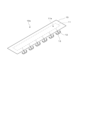
- FIG. 1 is a perspective view of a wig mounting member according to a first embodiment of the present invention. It is a schematic diagram of a wig provided with the wig attachment member of a 1st embodiment, and shows the attachment position of the wig attachment member in a wig base.
- FIG. 2 is a front view of the wig mounting member shown in FIG. 1.
- FIG. FIG. 2 is an enlarged view of a leg portion and a capture portion of the wig attachment member shown in FIG. 1.
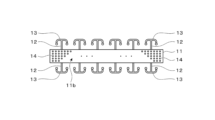
- FIG. FIG. 2 is a bottom view of the wig mounting member shown in FIG. 1;
- FIG. 2 is a side view of the wig mounting member shown in FIG. 1.
- FIG. 1 is a perspective view of a wig mounting member according to a first embodiment of the present invention. It is a schematic diagram of a wig provided with the wig attachment member of a 1st embodiment, and shows the attachment position of the wig attachment member in a wig base.
- FIG. 2 is a front view of the
- the wig attachment member 10 of the first embodiment is fixed to a wig base (see FIG. 2) 100, or partially attached to the wig base 100.
- a plurality of locking protrusions 14 are provided.
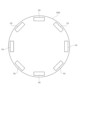
- FIG. 2 shows the mounting position of the wig mounting member 10 on the wig base 100 that constitutes a wig including the wig mounting member 10 of the first embodiment.
- the wig base 100 is formed by weaving a thread member in which a plurality of filaments are twisted together into a net shape.
- synthetic resin such as polyester, nylon, or polyurethane (spandex) may be used for the filament.
- the wig attachment member 10 which is schematically shown as a rectangle, is arranged along the periphery of the surface of the wig base 100 that is attached to the head.
- the mounting member 10 is oriented such that the longitudinal direction of the mounting member 10 crosses the direction in which hair flows. Note that the arrangement and orientation direction of the wig mounting member 10 on the wig base 100 are not limited to this.
- the fixing part 11 of the wig mounting member 10 shown in FIG. 1 has a band-like shape and has an upper surface 11a and a lower surface 11b on the opposite side of the upper surface 11a.
- the upper surface 11a of the fixing part 11 is fixed to the wig base 100 by, for example, thermocompression bonding, adhesive bonding, sewing, or the like.
- a part of the wig base 100 may be used as the fixing part 11 as it is.
- the wig base 100 and the fixing part 11 may be integrally knitted together so that the fixing part 11 constitutes a part of the wig base 100.
- the leg portion 12 is formed of an elastically deformable linear member made of synthetic resin, extends from both sides along the longitudinal direction of the fixed portion 11, and is lower than the plane including the upper surface 11a. It is inclined toward the lower surface 11b.
- the pair of leg parts 12 on both sides of the fixing part 11 are connected to each other via a connecting part 12a fixed to the upper surface 11a of the fixing part 11.
- the leg portions 12 extend in pairs in opposite directions from the fixed portion 11 on both sides when viewed from the lower surface 11b side of the fixed portion 11, and as shown in FIG. 4(B). As shown in FIG. 1, when the longitudinal direction of the fixing part 11 is viewed from the side, the legs 12 are arranged and extend substantially parallel to each other.
- the catching part 13 includes an extending part 131 extending from the tip of the leg part 12 to both sides in a direction L along the longitudinal direction of the fixing part 11, and a part extending from the extending part 131. It has a pair of curved portions 132 that are extended and curved so that the leg portion 12 side is inward, and a rounded tip expansion portion 133 that is provided at the tip of the pair of curved portions 132 as the tip of the capture portion 13. are doing.
- the extending portion 131, the curved portion 132, and the distal end expansion portion 133 are integrally formed. With these structures, the capturing section 13 captures and locks the hair when the lower surface 11b side of the fixing section 11 is pressed against the hair.
- the extending portion 131 is integrally formed with the leg portion 12, and forms a T-shape together with the leg portion 12. Further, as shown in the figure, the pair of curved parts 132 are curved within a plane including the leg parts 12 and the extension part 131, and as shown in FIG. is facing the fixed part 11.
- the distal end expansion portion 133 is rounded and has a diameter larger than the diameter of the linear member of the curved portion 132.
- the distal end expansion part 133 protrudes on the hair-trapping side of the trapping part 13, that is, on the inside facing the curved leg part 12 of the curved part 132, but on the hair-trapping side of the trapping part 13, that is, on the inside facing the curved leg part 12. , does not protrude outside the curved portion 132.
- the locking protrusion 14 protrudes from almost the entire surface of the lower surface 11b of the fixing part 11, and locks the hair when the lower surface 11b side of the fixing part 11 is pressed against the hair.
- the locking protrusion 14 preferably has a shape that catches on hair like a male hook and loop fastener, for example, a hook-like shape or a shape with an expanded portion formed at the tip.
- the height of the locking protrusion 14 is shorter than the length of the leg portion 12.
- the hair is retained by the trapping part 13. Hair is captured in a space surrounded by the extending section 131 and the curved section 132 of the capturing section 13 and the leg section 12 . Furthermore, when the lower surface 11b side of the fixing part 11 of the mounting member 10 is pressed against the hair, the hair is also locked by the locking protrusion 14 which is shorter than the length of the leg part 12. As a result, the wig is fixed to the head with the mounting member 10 substantially pressed against it, so that the fit of the wig can be improved.
- the hair pinched by the comb teeth of the inversion clamps may be pulled and cause pain, and because the inversion clamps are hard, you may feel uncomfortable when wearing them. there were.
- the mounting member 10 is made of elastically deformable resin, it can be mounted more safely and comfortably than the hard metal reversing clamp.
- the extension part 131 of the catching part 13 is T-shaped and extends in the direction L along the longitudinal direction of the fixing part 11, the fixing part 11 is pressed against the head when wearing the wig. Even when the T-shaped extension part 131 has a flat upper side, it comes into contact with the scalp. Therefore, the catching part 13 does not come into strong contact with the scalp, which prevents the wearer from feeling pain when wearing the wig.
- the hair captured by the capturing portion 13 is particularly held by the extension portion 131 on the upper side of the T-shape.
- the direction L in which the extension part 131 extends is a direction that crosses (for example, a direction substantially perpendicular to) the direction of the force that tries to peel off the wig (the direction of the upper surface 11a of the fixing part 11). 131 securely locks the hair.
- the hair captured by the catching part 13 is Even if it deviates from the direction L (lateral direction), it has a structure that prevents it from coming off from the capture part 13.
- the wig when putting on a wig, while pushing the wig mounting member 10, the wig is swung from side to side along the longitudinal direction of the band-shaped fixing part 11, so that the wig gets between the adjacent catching parts 13. The hair easily goes around the tip of the curved part 132 of the trapping part 13 and is effectively captured inside the curved part 132.
- the distal end expansion part 133 protrudes on the inside of the curve, even if the hair that is once captured goes around the distal end of the curved part 132 and tries to go outside, it gets caught in the distal end expansion part 133 and the hair ends up in the curved part. remains effectively trapped inside 132.
- the hair can easily move around the tip of the curved part 132 of the capture part 13 without being obstructed by the tip expansion part 133 because the tip expansion part 133 does not protrude on the outside of the curve. and is effectively captured inside the catching portion 13, particularly inside the curved portion 132.
- the trapping section 13 has a structure that prevents the trapped hair from coming off the trapping section 13, so when you try to peel off the wig, the trapping section 13 moves to comb the tips of the trapped hair. During this time, the locked state with the captured hair is effectively maintained. On the other hand, when wearing a wig, hair can be easily captured.
- the mounting member 10 it is possible to not only safely and easily wear a wig without feeling uncomfortable, but also to firmly and reliably wear the wig despite its simple structure.
- the attachment member 10 moves to comb the ends of the captured hair, the locked state between the capture portion 13 and the captured hair is effectively maintained. It is suitable for application to wigs that are worn on the head and have relatively long hair, such as commercial wigs.
- the length of the leg H and the height of the capturing section that is, from the extending section 131 to the tip of the curved section 132.
- the ratio to the height is preferably about 2:1 to 3:1; for example, the length of the leg is 3 to 6 mm, while the height of the trap is 1 to 3 mm.
- the lower the height of the trapping part 13 the more hair will be captured by going around the tip of the curved part 132 of the trapping part 13 when putting on the wig, but the trapped hair will be more likely to come off from the trapping part. turn into.
- the ratio between the width W of the capturing section 13 and the distance D between adjacent capturing sections 13 should be 1.5:1 to 1. It is preferable that the ratio is about 3:1 (for example, 2:1), and for example, the width W is 5 to 9 mm, and the distance D is 2 to 6 mm.
- the attachment member 10 can achieve both ease of capturing hair and difficulty in detaching from the capturing portion.
- FIG. 5(A) A wig mounting member according to a second embodiment will be described with reference to FIG. 5(A).
- parts having common functions are given the same reference numerals at the end, and the description thereof will be omitted as appropriate.
- the shape of the curved portion 232 of the capture portion 23 is different from that of the first embodiment.
- the catching part 23 includes an extending part 231 extending from the tip of the leg part 22 to both sides in a direction L along the longitudinal direction of the fixing part 11, and It has a pair of curved portions 232 that are extended and curved so that the leg portion 22 side is inward, and a rounded tip expansion portion 233 that is provided at the tip of the pair of curved portions 232 as the tip of the capture portion 23. are doing.
- the pair of curved portions 232 are curved within a plane that includes the leg portions 22 and the extension portion 231, and the tips of the pair of curved portions 232 are opposed to each other.
- the locking protrusion 14 locks the hair
- the catching part 23 locks the hair as well.
- Hair is captured in the space between the curved part 232 and the leg part 22 of the capture part 23, and furthermore, the hair is effectively captured inside the curved part 232 because the tip expansion part 233 protrudes.
- the pair of curved portions 232 are further curved than those of the first embodiment, and the tips thereof face each other, so that hair can be captured more effectively.
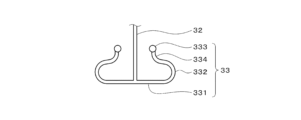
- a wig mounting member according to a second embodiment will be described with reference to FIG. 5(B).
- the wig attachment member of this embodiment differs from that of the first embodiment in that the catching section 33 further includes an extension section 334 at the tip of the curved section 332.
- the catching part 33 includes an extending part 331 extending from the tip of the leg part 32 to both sides in a direction L along the longitudinal direction of the fixing part 11, and a part extending from the extending part 331.
- a pair of curved parts 332 that extend and are curved so that the leg 32 side is on the inside; a pair of extension parts 334 that extend from the pair of curved parts 332 and are curved so that the leg 32 side is on the outside;
- the portion 33 has a rounded tip expansion portion 333 provided at the tip of the pair of extension portions 334 as the tips.
- the pair of extension parts 334 are curved within a plane that includes the leg parts 32, the extension part 331, and the curved part 332, and the tips of the pair of extension parts 334 are directed toward the fixed part 11.
- the locking protrusion 14 locks the hair
- the catching part 33 locks the hair as well.
- Hair is captured in the space between the curved part 332 and the leg part 32 of the capture part 33, and furthermore, because the distal end expansion part 333 protrudes, the hair is effectively captured inside the curved part 332.
- the pair of curved portions 332 have more extended portions 334 than those of the first embodiment, so hair can be captured more effectively.
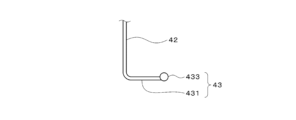
- a wig mounting member according to a fourth embodiment will be described with reference to FIG. 5(C).
- the wig mounting member of this embodiment differs from that of the first embodiment in that the extension part 431 extends only on one side and the catching part 43 does not have a curved part.
- the catching part 43 includes an extending part 431 that extends only on one side from the tip of the leg part 42 in the direction L along the longitudinal direction of the fixing part 11, and the catching part 23.
- the extension portion 431 is provided at the tip of the extension portion 431 and has a rounded tip expansion portion 433.
- the locking protrusion 14 locks the hair
- the catching part 43 locks the hair as well. Since the distal end expansion portion 433 protrudes at the distal end of the extension portion 431 of the capturing portion 43, hair can be captured and locked with a simple configuration.
- an additional sheet 15 is provided on the upper surface 11a of the fixing portion 11.
- the additional sheet 15 extends beyond the contour of the fixed portion 11.
- the wig mounting member of the present invention is not limited to the above-described embodiments, and various modifications may be made within the scope of the present invention. is possible.
- the leg portions were provided in pairs on both sides of the fixed portion, but in the present invention, the leg portions may be provided alternately on both sides of the fixed portion.
- each trapping part has the same shape, but in the present invention, the shapes of each trapping part may be different from each other.
- the shape of the trapping portion is axisymmetric with respect to the leg portion, but in the present invention, the shape of the trapping portion may be asymmetrical. Further, in the above-described embodiment, an example was described in which the curved portion was curved within a plane including the leg portions and the extension portion, but in the present invention, the curved portion may be curved outside this plane. The contents of the documents mentioned in this specification and the specification of the Japanese application on which the Paris priority of this application is based are all incorporated herein by reference.
Landscapes
- Engineering & Computer Science (AREA)
- Textile Engineering (AREA)
- Clamps And Clips (AREA)
Priority Applications (2)
| Application Number | Priority Date | Filing Date | Title |
|---|---|---|---|
| JP2024540330A JPWO2024034330A1 (https=) | 2022-08-09 | 2023-07-14 | |
| CN202380058476.8A CN119698245A (zh) | 2022-08-09 | 2023-07-14 | 假发用佩戴构件和假发 |
Applications Claiming Priority (2)
| Application Number | Priority Date | Filing Date | Title |
|---|---|---|---|
| JP2022-127373 | 2022-08-09 | ||
| JP2022127373 | 2022-08-09 |
Publications (1)
| Publication Number | Publication Date |
|---|---|
| WO2024034330A1 true WO2024034330A1 (ja) | 2024-02-15 |
Family
ID=89851455
Family Applications (1)
| Application Number | Title | Priority Date | Filing Date |
|---|---|---|---|
| PCT/JP2023/026061 Ceased WO2024034330A1 (ja) | 2022-08-09 | 2023-07-14 | かつら用装着部材及びかつら |
Country Status (3)
| Country | Link |
|---|---|
| JP (1) | JPWO2024034330A1 (https=) |
| CN (1) | CN119698245A (https=) |
| WO (1) | WO2024034330A1 (https=) |
Citations (3)
| Publication number | Priority date | Publication date | Assignee | Title |
|---|---|---|---|---|
| JP3134280U (ja) * | 2007-05-29 | 2007-08-09 | 株式会社アデランス | かつら用装着具 |
| JP3169344U (ja) * | 2011-05-13 | 2011-07-28 | 株式会社中川 | 頭髪整形補助具 |
| JP2014189939A (ja) * | 2013-03-28 | 2014-10-06 | Artnature Co Ltd | かつら取付具、及び、かつら |
-
2023
- 2023-07-14 WO PCT/JP2023/026061 patent/WO2024034330A1/ja not_active Ceased
- 2023-07-14 JP JP2024540330A patent/JPWO2024034330A1/ja active Pending
- 2023-07-14 CN CN202380058476.8A patent/CN119698245A/zh active Pending
Patent Citations (3)
| Publication number | Priority date | Publication date | Assignee | Title |
|---|---|---|---|---|
| JP3134280U (ja) * | 2007-05-29 | 2007-08-09 | 株式会社アデランス | かつら用装着具 |
| JP3169344U (ja) * | 2011-05-13 | 2011-07-28 | 株式会社中川 | 頭髪整形補助具 |
| JP2014189939A (ja) * | 2013-03-28 | 2014-10-06 | Artnature Co Ltd | かつら取付具、及び、かつら |
Also Published As
| Publication number | Publication date |
|---|---|
| CN119698245A (zh) | 2025-03-25 |
| JPWO2024034330A1 (https=) | 2024-02-15 |
Similar Documents
| Publication | Publication Date | Title |
|---|---|---|
| CN100558271C (zh) | 隐藏式拉链的拉链带条 | |
| CN100551291C (zh) | 针织、机织的隐形拉链 | |
| JPH11187909A (ja) | 編込みスライドファスナー | |
| JP2004201821A (ja) | 繊維製面ファスナー | |
| JP4046699B2 (ja) | 編込みスライドファスナー | |
| JPH0588309U (ja) | 面ファスナー | |
| KR20140066197A (ko) | 면 파스너 및 면 파스너용 걸어맞춤 소자의 조합 | |
| JP2000303298A (ja) | 帯 体 | |
| JP2002360316A (ja) | 編込みスライドファスナー | |
| TWI620528B (zh) | 織入鏈帶及縫製品 | |
| TWI482601B (zh) | Woven into the chain | |
| WO2024034330A1 (ja) | かつら用装着部材及びかつら | |
| JP2002360315A (ja) | 編込みスライドファスナー | |
| JPH0652521U (ja) | 高密度のフック片をもつ面ファスナーの雄係着材 | |
| JP2024120780A (ja) | かつら用装着部材のユニット、かつら用装着部材及びかつら | |
| JPH105011A (ja) | 編込みスライドファスナー | |
| JP2005126863A (ja) | エラスティックウェビング及びその製造方法 | |
| TW201225875A (en) | Incorporated slide fastener | |
| JP2023025698A (ja) | かつら用装着部材及びかつら | |
| JP2005187962A (ja) | エラスティックウェビング、エラスティックウェビングの使用方法、及びエラスティックウェビングの製造方法 | |
| JP3670991B2 (ja) | 伸縮性織物 | |
| HK40086073A (zh) | 假发用佩戴构件以及假发 | |
| JP2024030183A (ja) | かつらベース | |
| JPH08314A (ja) | 編込みスライドファスナー | |
| JP3053831U (ja) | フリルスカーフ |
Legal Events
| Date | Code | Title | Description |
|---|---|---|---|
| 121 | Ep: the epo has been informed by wipo that ep was designated in this application |
Ref document number: 23852311 Country of ref document: EP Kind code of ref document: A1 |
|
| WWE | Wipo information: entry into national phase |
Ref document number: 2024540330 Country of ref document: JP |
|
| WWE | Wipo information: entry into national phase |
Ref document number: 202380058476.8 Country of ref document: CN |
|
| NENP | Non-entry into the national phase |
Ref country code: DE |
|
| WWP | Wipo information: published in national office |
Ref document number: 202380058476.8 Country of ref document: CN |
|
| 122 | Ep: pct application non-entry in european phase |
Ref document number: 23852311 Country of ref document: EP Kind code of ref document: A1 |