WO2024018629A1 - 連結構造およびパラレルリンクロボット - Google Patents
連結構造およびパラレルリンクロボット Download PDFInfo
- Publication number
- WO2024018629A1 WO2024018629A1 PCT/JP2022/028515 JP2022028515W WO2024018629A1 WO 2024018629 A1 WO2024018629 A1 WO 2024018629A1 JP 2022028515 W JP2022028515 W JP 2022028515W WO 2024018629 A1 WO2024018629 A1 WO 2024018629A1
- Authority
- WO
- WIPO (PCT)
- Prior art keywords
- male
- links
- connection structure
- threads
- pair
- Prior art date
- Legal status (The legal status is an assumption and is not a legal conclusion. Google has not performed a legal analysis and makes no representation as to the accuracy of the status listed.)
- Ceased
Links
Images







Classifications
-
- B—PERFORMING OPERATIONS; TRANSPORTING
- B25—HAND TOOLS; PORTABLE POWER-DRIVEN TOOLS; MANIPULATORS
- B25J—MANIPULATORS; CHAMBERS PROVIDED WITH MANIPULATION DEVICES
- B25J9/00—Program-controlled manipulators
- B25J9/003—Program-controlled manipulators having parallel kinematics
- B25J9/0045—Program-controlled manipulators having parallel kinematics with kinematics chains having a rotary joint at the base
- B25J9/0051—Program-controlled manipulators having parallel kinematics with kinematics chains having a rotary joint at the base with kinematics chains of the type rotary-universal-universal or rotary-spherical-spherical, e.g. Delta type manipulators
-
- B—PERFORMING OPERATIONS; TRANSPORTING
- B25—HAND TOOLS; PORTABLE POWER-DRIVEN TOOLS; MANIPULATORS
- B25J—MANIPULATORS; CHAMBERS PROVIDED WITH MANIPULATION DEVICES
- B25J19/00—Accessories fitted to manipulators, e.g. for monitoring, for viewing; Safety devices combined with or specially adapted for use in connection with manipulators
- B25J19/007—Means or methods for designing or fabricating manipulators
-
- F—MECHANICAL ENGINEERING; LIGHTING; HEATING; WEAPONS; BLASTING
- F16—ENGINEERING ELEMENTS AND UNITS; GENERAL MEASURES FOR PRODUCING AND MAINTAINING EFFECTIVE FUNCTIONING OF MACHINES OR INSTALLATIONS; THERMAL INSULATION IN GENERAL
- F16B—DEVICES FOR FASTENING OR SECURING CONSTRUCTIONAL ELEMENTS OR MACHINE PARTS TOGETHER, e.g. NAILS, BOLTS, CIRCLIPS, CLAMPS, CLIPS OR WEDGES; JOINTS OR JOINTING
- F16B7/00—Connections of rods or tubes, e.g. of non-circular section, mutually, including resilient connections
- F16B7/06—Turnbuckles
Definitions
- the present disclosure relates to a connection structure and a parallel link robot.
- connection structure in which two parallel links (connection links) of a parallel link robot are connected with an elastic member interposed (for example, see Patent Document 1).
- This connection structure uses the elastic force of the elastic member to draw both links toward each other.
- the two links are each rotatably supported by a drive link (base link) by a ball joint. Even if the ball joint wears out over time, the elastic force of the elastic member is used to pull both links toward each other, thereby preventing play from occurring in the ball joint.
- One aspect of the present disclosure provides two links having longitudinal axes and operating in parallel with each other at intervals, each rotatable about a rotation axis perpendicular to a plane including the longitudinal axes of both links.
- This is a connection structure that includes a pair of supported attachment members and a connection mechanism that adjustably fixes the distance between the pair of attachment members.
- FIG. 1 is a front view schematically showing a parallel link robot according to an embodiment of the present disclosure.
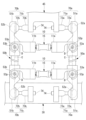
- FIG. 2 is a front view schematically showing an attached state of a connecting structure in a pair of passive links of the parallel link robot shown in FIG. 1;
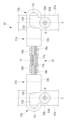
- 3 is a partial cross-sectional view schematically showing one connection structure shown in FIG. 2.
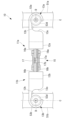
- FIG. 3 is a perspective view showing the shape of one attachment member in one connection structure shown in FIG. 2.
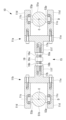
- FIG. FIG. 3 is a partial cross-sectional view showing an exploded state of one of the connection structures shown in FIG. 2;
- 3 is a partial cross-sectional view illustrating a method of attaching one connection structure shown in FIG. 2.
- FIG. 3 is a partial cross-sectional view illustrating a method of attaching one connection structure shown in FIG. 2.
- FIG. FIG. 3 is a partial cross-sectional view showing an attached state of one connection structure shown in FIG. 2;
- FIG. 3 is a partial cross-sectional view showing a first modification of one connection structure shown in FIG. 2;
- FIG. 3 is a partial cross-sectional view showing a second modification of the one connection structure shown in FIG. 2;
- FIG. 3 is a partial cross-sectional view showing a third modification of one connection structure shown in FIG. 2;
- FIG. 3 is a partial cross-sectional view showing a fourth modification of the one connection structure shown in FIG. 2;
- connection structure 10 and a parallel link robot 100 will be described below with reference to the drawings.
- the parallel link robot 100 includes a base part 20 that is suspended and fixed to a ceiling or the like, and a movable part 30 that is arranged at a distance below the base part 20. Equipped with. Further, the parallel link robot 100 includes three arms 40 that connect the base portion 20 and the movable portion 30.
- Each arm 40 includes three drive links (arms) 45 each rotatably supported around three horizontal axes A with respect to the base portion 20 . Furthermore, each arm 40 includes a pair of mutually parallel passive links 50a and 50b that connect each drive link 45 and the movable part 30. Further, the parallel link robot 100 includes a connection structure 10 according to an embodiment of the present disclosure that spans the upper and lower ends of each pair of passive links 50a and 50b.
- the base section 20 includes three servo motors 60 for driving the three drive links 45, respectively.
- the servo motors 60 are arranged at equal intervals in the circumferential direction around an axis B that passes through the center of the base part 20 and extends in the vertical direction, and each has a rotary drive shaft (not shown) that is rotated around a horizontal axis A. has. Furthermore, each servo motor 60 is equipped with a reducer 61 that reduces the rotation of the rotary drive shaft.
- Each drive link 45 has its base end connected to the rotational drive shaft of the corresponding servo motor 60, and is rotatable around the axis A with respect to the base portion 20. Further, as shown in FIGS. 1 and 2, the tip of each drive link 45 and the passive links 50a, 50b are connected by ball joints 70a, 70b, respectively.
- Each ball joint 70a, 70b includes a ball stud 71a, 71b attached to the tip of each drive link 45, and a socket 51a, 51b connected to the ball stud 71a, 71b.
- the ball studs 71a, 71b each include balls 72a, 72b, and columnar studs 73a, 73b extending radially outward from the outer spherical surfaces of the balls 72a, 72b.
- the end faces of the studs 73a and 73b are fixed by bolts 74 to both sides of the drive link 45 in the direction of the axis A (see FIG. 1), respectively.
- the sockets 51a and 51b constitute one end portion of the passive links 50a and 50b in the longitudinal axis C direction, respectively.
- the sockets 51a, 51b each have inner spherical surfaces 52a, 52b that cover approximately half of the outer spherical surfaces of the balls 72a, 72b.
- a thin resin layer (not shown) made of a resin material such as silicone is disposed inside the inner spherical surfaces 52a and 52b, and balls 72a and 72b are fitted inside the layer and are supported rotatably around their respective centers. ing.
- connection structure 10 includes a pair of attachment members 11a and 11b that are attached to pins 53p provided in sockets 51a and 51b, respectively, and a connection mechanism 15 that connects the attachment members 11a and 11b to each other.
- connection structure 10 that connects the upper and lower ends of each pair of passive links 50a, 50b have the same configuration. Therefore, below, the configuration of the connection structure 10 that connects one ends of a pair of passive links 50a and 50b will be described as an example.
- the pins 53p protrude from the sockets 51a and 51b on both sides of a plane containing the two longitudinal axes C along an axis (rotation axis) D perpendicular to the plane. It is installed like this.
- the pin 53p is provided with a brim-like flange, is fitted from one direction into a hole passing through the sockets 51a, 51b in the radial direction, and is positioned by abutting the flange against the outer surface of the sockets 51a, 51b. There is.
- bushes 53a and 53b are attached to the portions of the pin 53p that protrude from the sockets 51a and 51b, respectively.
- the bushes 53a and 53b each have a cylindrical shape with a hollow hole 53h formed therein.
- a groove 53d that is recessed radially inward over the entire circumference is formed at the axial center of the outer peripheral surface of the bushes 53a, 53b.
- the bushes 53a and 53b are rotatably supported by the pin 53p around the axis D by fitting the pin 53p into the hollow hole 53h.
- bushes 53a and 53b having the same shape are used.
- the bushes 53a, 53b are provided with a notch to avoid interference with the flange of the pin 53p, the flange is accommodated in the notch of one of the bushes 53a, 53b, and the flange is accommodated in the notch of the other bush 53a, 53b. is hollow. Note that when the pin 53p is integrally fixed to the sockets 51a, 51b by welding or the like, the flange of the pin 53p and the notch in the bushes 53a, 53b may not be provided.
- the other ends of the passive links 50a, 50b in the longitudinal axis C direction also have the same configuration as the one end. That is, sockets 51a and 51b are also attached to the other ends of the passive links 50a and 50b.
- the sockets 51a and 51b are connected to each other by sandwiching ball studs 71a and 71b attached to the outer peripheral surface of the movable portion 30 from both outer sides in the direction of the axis A.
- the mounting member 11a includes a hook portion 12a and a male screw 16a fixed to the hook portion 12a.
- the hook portion 12a is constructed by curving an elongated strip-shaped flat metal plate having a thickness equivalent to the width of the groove 53d of the bush 53a into a substantially U-shape.
- the two metal flat plates of the substantially U-shaped hook portion 12a extending substantially in parallel have the same size as the distance W between the grooves 53d of the pair of bushes 53a attached to both sides of the socket 51a in the direction of the axis D. are placed at intervals of .
- two hooks 13a are provided on the two substantially parallel metal flat plates of the hook portion 12a, respectively, to be hooked into grooves 53d of a pair of bushes 53a attached to the socket 51a.
- the two hooks 13a are constructed by cutting out two substantially parallel metal flat plates of the hook portion 12a in the thickness direction.
- both hooks 13a are each provided with a long hole 13h extending in the length direction of the hook portion 12a.
- An inner circumferential surface 13i having the same inner diameter as the outer diameter of the groove bottom of the groove 53d of the bush 53a is formed at one end of the elongated hole 13h in the longitudinal direction.
- an opening 13o is provided at the other end of the elongated hole 13h in the longitudinal direction to open the elongated hole 13h to one side in the width direction of the hook portion 12a.
- the opening 13o is formed larger than the outer diameter of the groove bottom of the groove 53d of the bush 53a.
- the male thread 16a is formed as a right-handed thread, and extends parallel to the hook 13a toward the opposite side of the hook 13a at a position between the hooks 13a on both sides of the hook portion 12a.
- the attachment member 11b includes a hook portion 12b having the same shape as the hook portion 12a of the attachment member 11a. Further, at a position between the hooks 13b provided on both sides of the hook portion 12b, there is provided a male thread 16b having the same outer diameter (nominal diameter) and pitch as the male thread 16a, and having a configuration that differs only in the circumferential direction of the threaded portion. is fixed. That is, the male threads 16a and 16b have a reverse thread relationship with each other.
- the coupling mechanism 15 includes male threads 16a, 16b provided on the mounting members 11a, 11b, and a nut member 17 fastened to the male threads 16a, 16b.
- the nut member 17 is a cylindrical member having a through hole 17h along the central axis.
- a female thread 17a that engages with the male thread 16a and a female thread 17b that engages with the male thread 16b are formed side by side in the central axis direction.
- the right-handed female thread 17a is formed from the center of the nut member 17 in the central axis direction to one end side
- the left-handed female thread 17b is formed from the center of the nut member 17 in the central axis direction to the other end side. That is, the female threads 17a and 17b are arranged side by side on the same axis, and are reverse threads opening in opposite directions. Further, on both sides of the outer circumferential surface of the nut member 17 across the central axis line, a pair of mutually parallel plane parts are provided for engagement with a tool such as a spanner.
- fixing nuts 18a and 18b are engaged with the male screws 16a and 16b, respectively.
- the fixing nuts 18a and 18b have the same shape except that they have opposite threads, and may be general nuts available on the market.
- connection structure 10 and the parallel link robot 100 configured in this way will be described below.
- connection structure 10 that spans one end of the pair of links 50a, 50b will be described as an example, as in the above description.
- the sockets 51a, 51b at one end of the pair of passive links 50a, 50b are brought close to the ball studs 71a, 71b at the tips of the drive link 45 from the outside in the direction of the axis A.
- the inner spherical surfaces 52a and 52b of the sockets 51a and 51b are fitted into the balls 72a and 72b of the ball studs 71a and 71b, respectively.
- the balls 72a, 72b of the ball studs 71a, 71b attached to the movable part 30 are fitted with the inner spherical surfaces 52a, 52b of the sockets 51a, 51b at the other ends of the pair of passive links 50a, 50b.
- fixing nuts 18a and 18b are engaged with male screws 16a and 16b fixed to mounting members 11a and 11b, respectively.
- the male threads 16a, 16b are engaged with the female threads 17a, 17b of the nut member 17, respectively, and the two mounting members 11a, 11b are connected by the nut member 17.
- the length of engagement between the male screws 16a, 16b and the female screws 17a, 17b is adjusted so that the distance between the openings 13o of the mounting members 11a, 11b is approximately the same as the distance between the two axes D. .
- the flat portion of the outer peripheral surface of the nut member 17 is held between tools or the like, and the nut member 17 is rotated in one direction around the central axis.
- the length of engagement between the male threads 16a, 16b and the female threads 17a, 17b increases at the same time.
- the distance between the mounting members 11a, 11b is shortened, and as shown in FIG. 8, the inner peripheral surfaces 13i of the mounting members 11a, 11b are in close contact with the grooves 53d of the bushes 53a, 53b, respectively.
- the pair of passive links 50a, 50b can be drawn together, and pressure can be applied to the ball joints 70a, 70b between the passive links 50a, 50b and the drive link 45.
- connection structure 10 the two passive links 50a and 50b can be connected with the distance between them adjusted to an appropriate distance.
- the distance between the passive links 50a and 50b can be prevented from increasing.
- the resin layer of the ball joints 70a, 70b may become worn out and thin.
- the fixing nuts 18a, 18b are loosened, the nut member 17 is rotated around the central axis, and the length of engagement between the male threads 16a, 16b and the female threads 17a, 17b is increased.
- the attachment members 11a and 11b can be brought closer to each other by the amount by which the resin layer is worn away. Therefore, even if the distance between the two passive links 50a, 50b changes, the distance connecting the two passive links 50a, 50b is readjusted according to the change, and play is generated in the ball joints 70a, 70b. This can be prevented.
- the occurrence of backlash in the ball joints 70a, 70b can be suppressed without interposing a coil spring between the pair of passive links 50a, 50b as in the conventional case. Further, since a coil spring is not used, work efficiency when cleaning the parallel link robot 100 or drying it afterwards can be improved.
- the lengths of engagement between the male threads 16a, 16b and the female threads 17a, 17b can be adjusted at the same time. That is, there is an advantage that the distance between the passive links 50a and 50b can be easily adjusted by operating the nut member 17 once.
- the fixing nuts 18a and 18b are nuts having a general shape as shown in FIG. 2.
- the fixing nuts 18a, 18b may include an outer peripheral wall 18c whose outer peripheral edge portion protrudes in the axial direction over the entire circumference.
- a groove (not shown) may be provided along the entire circumference of the outer circumferential surface of the root portion of the male screws 16a, 16b at a midway position in the axial direction, and the O-ring 18o may be fitted into the groove.
- the outer diameter of the O-ring 18o is set to be slightly larger than the inner diameter of the outer peripheral wall 18c.
- the O-ring 18o is slightly crushed over its entire circumference and is brought into close contact with the inner circumferential surface of the outer circumferential wall 18c that covers the root portions of the male screws 16a, 16b.
- the mounting members 11a and 11b were attached to the sockets 51a and 51b by a pair of bushes 53a and 53b, respectively.
- the mounting members 11a, 11b may be attached to the sockets 51a, 51b by bearings 11c fixed to the mounting members 11a, 11b.
- the mounting members 11a and 11b each include a pair of parallel plate-shaped first portions 11d each having a thickness sufficient to fit the bearing 11c. Furthermore, the mounting members 11a and 11b each include a second portion 11e that connects one end of each pair of the first portions 11d. Pins 53p protruding from the outer surfaces of the sockets 51a and 51b on both sides in the direction of the axis D are fitted into the bearings 11c fitted to the other ends of the first portions 11d of the mounting members 11a and 11b, respectively. . With such a configuration as well, the mounting members 11a and 11b that connect the passive links 50a and 50b can be rotatably mounted around the axis D to the sockets 51a and 51b.
- the coupling mechanism 15 includes a nut member 17 having male threads 16a, 16b fixed to the mounting members 11a, 11b, and female threads 17a, 17b corresponding to the male threads 16a, 16b.
- female threads 17a and 17b may be formed on the mounting members 11a and 11b, respectively.
- the second portions 11e of the mounting members 11a and 11b which are rotatably connected to the sockets 51a and 51b around the axis D, each have a shaft portion 11f that projects toward the other side.
- a right-handed female thread 17a may be formed in the shaft portion 11f of the mounting member 11a
- a left-handed female thread 17b may be formed in the shaft portion 11f of the mounting member 11b.
- a screw member 19 having a right-handed male thread 16a and a left-handed male thread 16b arranged side by side on the same axis may be used.
- the screw member 19 may include, for example, a hexagonal columnar main body portion 19c, and male threads 16a and 16b may extend outward from both ends along the central axis of the main body portion 19c.
- one attachment member 11a, 11b was attached to both sides of the sockets 51a, 51b in the direction of the axis D, respectively.
- the two mounting members 11a and 11b may be mounted on both sides of the sockets 51a and 51b in the direction of the axis D, respectively.
- one plate-shaped mounting member 11a, 11b may be connected to each side of the sockets 51a, 51b in the direction of the axis D so as to be rotatable about the axis D.
- a right-handed female thread 17a is formed at the tip of each mounting member 11a
- a left-handed female thread 17b is formed at the tip of each mounting member 11b.
- Each pair of attachment members 11a, 11b is connected by a screw member 19 similar to the embodiment shown in FIG. 10.
- the mounting members 11a and the mounting members 11b that sandwich the sockets 51a and 51b in the direction of the axis D may be integrally coupled by the coupling member 11j, respectively.
- the mounting members 11a and 11b are connected with the nut member 17 interposed therebetween, but instead of this, the nut member 17 may be omitted and the mounting members 11a and 11b may be connected directly.
- the mounting member 11a may include a male thread 16c extending toward the mounting member 11b, and the mounting member 11b may include a through hole 17c through which the male thread 16c passes.
- the coupling mechanism 15 in this case is composed of a male thread 16c of the mounting member 11a, a through hole 17c formed in the mounting member 11b, and two coupling nuts (nut members) 18 that are engaged with the male thread 16c. .
- the two connecting nuts 18 are respectively tightened from both sides in the axial direction of the through hole 17c.
- the two connecting nuts 18 sandwich the peripheral edges of the through hole 17c on both sides in the axial direction, and the mounting members 11a and 11b are connected to each other.
- the length of the male thread 16c inserted into the through hole 17c can be changed.
- the passive links 50a and 50b can be connected while adjusting the distance between them.
- Connection structure 11a, 11b Mounting member 15 Connection mechanism 16a, 16b, 16c Male thread 17 Nut member 17a, 17b Female thread 17c Through hole 18 Connection nut (nut member) 18a, 18b Fixing nut 18c Outer peripheral wall 19 Screw member 20 Foundation part 30 Movable part 45 Drive link (arm) 50a, 50b Passive link (link) 100 Parallel link robot C Longitudinal axis D Axis (rotation axis)
Landscapes
- Engineering & Computer Science (AREA)
- Robotics (AREA)
- Mechanical Engineering (AREA)
- Transmission Devices (AREA)
- Manipulator (AREA)
Priority Applications (6)
| Application Number | Priority Date | Filing Date | Title |
|---|---|---|---|
| DE112022007158.3T DE112022007158T5 (de) | 2022-07-22 | 2022-07-22 | Kopplungsstruktur und parallelroboter |
| JP2024534897A JPWO2024018629A1 (https=) | 2022-07-22 | 2022-07-22 | |
| CN202280097109.4A CN119365307A (zh) | 2022-07-22 | 2022-07-22 | 连接结构以及并联连杆机器人 |
| PCT/JP2022/028515 WO2024018629A1 (ja) | 2022-07-22 | 2022-07-22 | 連結構造およびパラレルリンクロボット |
| US18/853,186 US12576509B2 (en) | 2022-07-22 | 2022-07-22 | Coupling structure and parallel link robot |
| TW112125740A TW202404758A (zh) | 2022-07-22 | 2023-07-10 | 連結結構以及平行連桿機器人 |
Applications Claiming Priority (1)
| Application Number | Priority Date | Filing Date | Title |
|---|---|---|---|
| PCT/JP2022/028515 WO2024018629A1 (ja) | 2022-07-22 | 2022-07-22 | 連結構造およびパラレルリンクロボット |
Publications (1)
| Publication Number | Publication Date |
|---|---|
| WO2024018629A1 true WO2024018629A1 (ja) | 2024-01-25 |
Family
ID=89617311
Family Applications (1)
| Application Number | Title | Priority Date | Filing Date |
|---|---|---|---|
| PCT/JP2022/028515 Ceased WO2024018629A1 (ja) | 2022-07-22 | 2022-07-22 | 連結構造およびパラレルリンクロボット |
Country Status (6)
| Country | Link |
|---|---|
| US (1) | US12576509B2 (https=) |
| JP (1) | JPWO2024018629A1 (https=) |
| CN (1) | CN119365307A (https=) |
| DE (1) | DE112022007158T5 (https=) |
| TW (1) | TW202404758A (https=) |
| WO (1) | WO2024018629A1 (https=) |
Citations (4)
| Publication number | Priority date | Publication date | Assignee | Title |
|---|---|---|---|---|
| JPS63173513U (https=) * | 1987-04-30 | 1988-11-10 | ||
| JP2009097571A (ja) * | 2007-10-15 | 2009-05-07 | Murata Mach Ltd | バネ装置およびリンク機構 |
| DE102008062958A1 (de) * | 2008-12-23 | 2010-07-01 | Multivac Sepp Haggenmüller Gmbh & Co. Kg | Roboter, insbesondere einer Verpackungsmaschine zugeordneter Roboter |
| JP2014046406A (ja) * | 2012-08-31 | 2014-03-17 | Fanuc Ltd | ボールジョイントにより接続されたパラレルリンクロボット |
Family Cites Families (17)
| Publication number | Priority date | Publication date | Assignee | Title |
|---|---|---|---|---|
| US4489826A (en) * | 1982-02-05 | 1984-12-25 | Philip Dubson | Adjustable apparatus |
| JP2570687Y2 (ja) * | 1993-04-07 | 1998-05-06 | 株式会社豊田自動織機製作所 | ロールクランプ装置のアーム取付角調整機構 |
| JP2000228839A (ja) * | 1999-02-04 | 2000-08-15 | Mitsubishi Electric Corp | 電気機械 |
| JP2004358119A (ja) * | 2003-06-09 | 2004-12-24 | Taiyo Seiki Kogyo Kk | 親綱張設用係止具 |
| JP4653848B1 (ja) | 2009-10-26 | 2011-03-16 | ファナック株式会社 | パラレルリンクロボット |
| JP5471482B2 (ja) | 2010-01-18 | 2014-04-16 | トヨタ自動車株式会社 | パラレルリンク型ロボット及びその異常検知方法 |
| US20120171383A1 (en) * | 2010-12-30 | 2012-07-05 | Specialty Coating Systems, Inc. | Conformal coating apparatus and related method |
| JP5516615B2 (ja) * | 2012-02-03 | 2014-06-11 | 株式会社安川電機 | パラレルリンクロボット |
| JP5973261B2 (ja) | 2012-07-06 | 2016-08-23 | 矢崎総業株式会社 | カバー |
| TWI508831B (zh) * | 2013-01-28 | 2015-11-21 | Prec Machinery Res & Dev Ct | A joint device for a parallel robot |
| JP5682642B2 (ja) | 2013-03-05 | 2015-03-11 | 株式会社安川電機 | パラレルリンクロボット |
| JP2017052040A (ja) | 2015-09-08 | 2017-03-16 | 川崎重工業株式会社 | ロボット |
| JP6558850B2 (ja) * | 2015-10-13 | 2019-08-14 | 株式会社ミツバ | ロボット装置およびパラレルロボット |
| TWI590566B (zh) | 2016-03-17 | 2017-07-01 | 勝利工業股份有限公司 | 車用交流發電機之輸出端構件、絕緣套與保護蓋總成 |
| KR102503934B1 (ko) * | 2017-11-21 | 2023-02-27 | 삼성전자주식회사 | 운동 보조 장치 |
| US20200240560A1 (en) * | 2019-01-30 | 2020-07-30 | Beijing Apollo Ding Rong Solar Technology Co., Ltd. | Vacuum bellows thrust inhibitor for claw clamped flanges |
| CN113059553A (zh) | 2021-04-20 | 2021-07-02 | 曜石机器人(上海)有限公司 | 一种智能高速四轴并联机器人 |
-
2022
- 2022-07-22 JP JP2024534897A patent/JPWO2024018629A1/ja active Pending
- 2022-07-22 US US18/853,186 patent/US12576509B2/en active Active
- 2022-07-22 DE DE112022007158.3T patent/DE112022007158T5/de active Pending
- 2022-07-22 WO PCT/JP2022/028515 patent/WO2024018629A1/ja not_active Ceased
- 2022-07-22 CN CN202280097109.4A patent/CN119365307A/zh active Pending
-
2023
- 2023-07-10 TW TW112125740A patent/TW202404758A/zh unknown
Patent Citations (4)
| Publication number | Priority date | Publication date | Assignee | Title |
|---|---|---|---|---|
| JPS63173513U (https=) * | 1987-04-30 | 1988-11-10 | ||
| JP2009097571A (ja) * | 2007-10-15 | 2009-05-07 | Murata Mach Ltd | バネ装置およびリンク機構 |
| DE102008062958A1 (de) * | 2008-12-23 | 2010-07-01 | Multivac Sepp Haggenmüller Gmbh & Co. Kg | Roboter, insbesondere einer Verpackungsmaschine zugeordneter Roboter |
| JP2014046406A (ja) * | 2012-08-31 | 2014-03-17 | Fanuc Ltd | ボールジョイントにより接続されたパラレルリンクロボット |
Also Published As
| Publication number | Publication date |
|---|---|
| US12576509B2 (en) | 2026-03-17 |
| TW202404758A (zh) | 2024-02-01 |
| JPWO2024018629A1 (https=) | 2024-01-25 |
| DE112022007158T5 (de) | 2025-06-05 |
| US20250214228A1 (en) | 2025-07-03 |
| CN119365307A (zh) | 2025-01-24 |
Similar Documents
| Publication | Publication Date | Title |
|---|---|---|
| WO2012075737A1 (zh) | 蜗杆减速器、机器人关节及机器人 | |
| JPH04343662A (ja) | 回転工具における回転刃具の固止装置 | |
| JP2021079494A (ja) | ロボット用ケーシングおよびロボット | |
| JP4809389B2 (ja) | パラレルメカニズム | |
| JP4095911B2 (ja) | 工具保持装置 | |
| WO2024018629A1 (ja) | 連結構造およびパラレルリンクロボット | |
| JP4841493B2 (ja) | ねじ類の締付工具 | |
| JP5293529B2 (ja) | 減速機の取付け構造、及び減速機の製造方法 | |
| EP2150733B1 (en) | Outer pin seal | |
| WO2012075736A1 (zh) | 蜗杆减速器、机器人关节及机器人 | |
| JP6657824B2 (ja) | ロボットのハンド接続構造 | |
| CN216913372U (zh) | 一种角度硬限位组件 | |
| JP6610188B2 (ja) | ロボットの関節装置 | |
| CN215719689U (zh) | 风扇 | |
| TWI728683B (zh) | 潤滑裝置及具有該潤滑裝置的機械手臂 | |
| TWI426011B (zh) | 機器人臂部件 | |
| CN113910293A (zh) | 一种机械臂连接组件及机器人 | |
| JP2681876B2 (ja) | ユニバーサルジョイントの製造方法 | |
| CN223676989U (zh) | 减速器 | |
| JP2019113192A (ja) | 軸継手 | |
| JP4916273B2 (ja) | スプライン結合構造及びスプライン装置 | |
| WO2006101014A1 (ja) | 作業工具 | |
| TWI846604B (zh) | 軸承拆卸工具 | |
| JP2026060016A (ja) | 垂直多関節ロボット、及び垂直多関節ロボットの組み立て方法 | |
| CN110822026A (zh) | 防松件、防松机构、固定装置、紧固构造以及产业机械 |
Legal Events
| Date | Code | Title | Description |
|---|---|---|---|
| 121 | Ep: the epo has been informed by wipo that ep was designated in this application |
Ref document number: 22952013 Country of ref document: EP Kind code of ref document: A1 |
|
| WWE | Wipo information: entry into national phase |
Ref document number: 18853186 Country of ref document: US |
|
| WWE | Wipo information: entry into national phase |
Ref document number: 2024534897 Country of ref document: JP |
|
| WWE | Wipo information: entry into national phase |
Ref document number: 202280097109.4 Country of ref document: CN |
|
| WWE | Wipo information: entry into national phase |
Ref document number: 112022007158 Country of ref document: DE |
|
| WWP | Wipo information: published in national office |
Ref document number: 202280097109.4 Country of ref document: CN |
|
| WWP | Wipo information: published in national office |
Ref document number: 112022007158 Country of ref document: DE |
|
| WWP | Wipo information: published in national office |
Ref document number: 18853186 Country of ref document: US |
|
| 122 | Ep: pct application non-entry in european phase |
Ref document number: 22952013 Country of ref document: EP Kind code of ref document: A1 |
|
| WWG | Wipo information: grant in national office |
Ref document number: 18853186 Country of ref document: US |