WO2024014394A1 - 粘着剤層付偏光フィルムおよび画像表示装置 - Google Patents
粘着剤層付偏光フィルムおよび画像表示装置 Download PDFInfo
- Publication number
- WO2024014394A1 WO2024014394A1 PCT/JP2023/025132 JP2023025132W WO2024014394A1 WO 2024014394 A1 WO2024014394 A1 WO 2024014394A1 JP 2023025132 W JP2023025132 W JP 2023025132W WO 2024014394 A1 WO2024014394 A1 WO 2024014394A1
- Authority
- WO
- WIPO (PCT)
- Prior art keywords
- adhesive layer
- meth
- polarizing film
- acrylate
- protective layer
- Prior art date
- Legal status (The legal status is an assumption and is not a legal conclusion. Google has not performed a legal analysis and makes no representation as to the accuracy of the status listed.)
- Ceased
Links
Classifications
-
- C—CHEMISTRY; METALLURGY
- C09—DYES; PAINTS; POLISHES; NATURAL RESINS; ADHESIVES; COMPOSITIONS NOT OTHERWISE PROVIDED FOR; APPLICATIONS OF MATERIALS NOT OTHERWISE PROVIDED FOR
- C09J—ADHESIVES; NON-MECHANICAL ASPECTS OF ADHESIVE PROCESSES IN GENERAL; ADHESIVE PROCESSES NOT PROVIDED FOR ELSEWHERE; USE OF MATERIALS AS ADHESIVES
- C09J133/00—Adhesives based on homopolymers or copolymers of compounds having one or more unsaturated aliphatic radicals, each having only one carbon-to-carbon double bond, and at least one being terminated by only one carboxyl radical, or of salts, anhydrides, esters, amides, imides, or nitriles thereof; Adhesives based on derivatives of such polymers
- C09J133/04—Homopolymers or copolymers of esters
-
- C—CHEMISTRY; METALLURGY
- C09—DYES; PAINTS; POLISHES; NATURAL RESINS; ADHESIVES; COMPOSITIONS NOT OTHERWISE PROVIDED FOR; APPLICATIONS OF MATERIALS NOT OTHERWISE PROVIDED FOR
- C09J—ADHESIVES; NON-MECHANICAL ASPECTS OF ADHESIVE PROCESSES IN GENERAL; ADHESIVE PROCESSES NOT PROVIDED FOR ELSEWHERE; USE OF MATERIALS AS ADHESIVES
- C09J7/00—Adhesives in the form of films or foils
- C09J7/30—Adhesives in the form of films or foils characterised by the adhesive composition
- C09J7/38—Pressure-sensitive adhesives [PSA]
-
- G—PHYSICS
- G02—OPTICS
- G02B—OPTICAL ELEMENTS, SYSTEMS OR APPARATUS
- G02B5/00—Optical elements other than lenses
- G02B5/30—Polarising elements
-
- G—PHYSICS
- G02—OPTICS
- G02F—OPTICAL DEVICES OR ARRANGEMENTS FOR THE CONTROL OF LIGHT BY MODIFICATION OF THE OPTICAL PROPERTIES OF THE MEDIA OF THE ELEMENTS INVOLVED THEREIN; NON-LINEAR OPTICS; FREQUENCY-CHANGING OF LIGHT; OPTICAL LOGIC ELEMENTS; OPTICAL ANALOGUE/DIGITAL CONVERTERS
- G02F1/00—Devices or arrangements for the control of the intensity, colour, phase, polarisation or direction of light arriving from an independent light source, e.g. switching, gating or modulating; Non-linear optics
- G02F1/01—Devices or arrangements for the control of the intensity, colour, phase, polarisation or direction of light arriving from an independent light source, e.g. switching, gating or modulating; Non-linear optics for the control of the intensity, phase, polarisation or colour
- G02F1/13—Devices or arrangements for the control of the intensity, colour, phase, polarisation or direction of light arriving from an independent light source, e.g. switching, gating or modulating; Non-linear optics for the control of the intensity, phase, polarisation or colour based on liquid crystals, e.g. single liquid crystal display cells
- G02F1/133—Constructional arrangements; Operation of liquid crystal cells; Circuit arrangements
- G02F1/1333—Constructional arrangements; Manufacturing methods
- G02F1/1335—Structural association of cells with optical devices, e.g. polarisers or reflectors
-
- G—PHYSICS
- G09—EDUCATION; CRYPTOGRAPHY; DISPLAY; ADVERTISING; SEALS
- G09F—DISPLAYING; ADVERTISING; SIGNS; LABELS OR NAME-PLATES; SEALS
- G09F9/00—Indicating arrangements for variable information in which the information is built-up on a support by selection or combination of individual elements
-
- H—ELECTRICITY
- H10—SEMICONDUCTOR DEVICES; ELECTRIC SOLID-STATE DEVICES NOT OTHERWISE PROVIDED FOR
- H10K—ORGANIC ELECTRIC SOLID-STATE DEVICES
- H10K50/00—Organic light-emitting devices
- H10K50/80—Constructional details
- H10K50/86—Arrangements for improving contrast, e.g. preventing reflection of ambient light
-
- H—ELECTRICITY
- H10—SEMICONDUCTOR DEVICES; ELECTRIC SOLID-STATE DEVICES NOT OTHERWISE PROVIDED FOR
- H10K—ORGANIC ELECTRIC SOLID-STATE DEVICES
- H10K59/00—Integrated devices, or assemblies of multiple devices, comprising at least one organic light-emitting element covered by group H10K50/00
- H10K59/10—OLED displays
Definitions
- One embodiment of the present invention relates to a polarizing film with an adhesive layer or an image display device.
- a polarizing film that is a component of an image display device is usually used by being bonded to an image display element via an adhesive layer. For this reason, the polarizing film is sometimes traded as a polarizing film with an adhesive layer provided with an adhesive layer in advance.
- Patent Document 1 discloses a polarizing film in which one of the protective layers provided on both sides of a polarizer is thinned.
- thin polarizing films tend to shrink or warp as the polarizer shrinks due to heat or humidity.
- adhesion defects such as foaming and peeling are likely to occur between the adherend (for example, an image display element) and the adhesive layer.
- the adhesion failure is one of the causes of deterioration in display performance of the image display device.
- the polarizer shrinks significantly and becomes particularly susceptible to warping. Durability under high temperatures is required.
- the adhesive layer when used by adhering to an adherend, it will not peel off or float from the adherend, and when it is desired to be peeled off from the adherend, it will stick to the adherend without leaving any adhesive residue. It may be required to have appropriate adhesive strength that can be peeled off from the surface (excellent reworkability).
- One embodiment of the present invention provides a polarizing film with an adhesive layer that has appropriate adhesive strength and is less prone to problems such as foaming and peeling due to warping of the polarizing film even in high-temperature environments.
- a polarizing film in which a first protective layer is provided on one side of a polarizer, and a second protective layer is provided on the other side of the polarizer;
- a polarizing film with an adhesive layer comprising an adhesive layer in contact with the second protective layer, The ratio of the thicknesses of the first protective layer and the second protective layer (thickness of the second protective layer/thickness of the first protective layer) is 0.1 to 0.7,
- the adhesive layer is a layer formed from an adhesive composition containing a (meth)acrylic copolymer,
- the (meth)acrylic copolymer is a copolymer of a monomer mixture containing 10 to 50% by mass of an alkyl (meth)acrylate whose homopolymer glass transition temperature (Tg) is 0 ° C. or higher, the adhesive layer has a gel fraction greater than 80%; Polarizing film with adhesive layer.
- the first protective layer and the second protective layer contain at least one resin selected from (meth)acrylic resin, cellulose resin, cycloolefin polymer resin, and polyvinyl alcohol resin, [1 ] - [4]
- the polarizing film with an adhesive layer according to any one of [4].
- an adhesive layer has an appropriate adhesive force and has excellent high-temperature durability, and is less prone to problems such as foaming and peeling caused by shrinkage and warping of the polarizing film even in high-temperature environments.
- a polarizing film can be provided.
- the polarizing film with an adhesive layer according to one embodiment of the present invention when used in an image display device, even if the image display device is exposed to high temperatures, the polarizing film may shrink or warp. It is possible to suppress deterioration in display performance etc. due to adhesion defects caused by. Therefore, the polarizing film with an adhesive layer according to one embodiment of the present invention can be suitably used in a thin image display device with a narrow bezel, and can be suitably used in an image display device that can be exposed to high temperatures such as in a car. Can be used.
- a polarizing film with an adhesive layer according to one aspect of the present invention (hereinafter also referred to as “polarizing film with an adhesive layer”) has a first protective layer provided on one side of a polarizer, and a first protective layer on one side of the polarizer.
- the adhesive layer is a layer formed from an adhesive composition containing a (meth)acrylic copolymer, and the (meth)acrylic copolymer has a homopolymer glass transition temperature (Tg ) is a copolymer of a monomer mixture containing 10 to 50% by mass of an alkyl (meth)acrylate having a temperature of 0° C. or higher, and is characterized in that the adhesive layer has a gel fraction of more than 80%.
- Tg homopolymer glass transition temperature
- This polarizing film with an adhesive layer is a polarizing film with an adhesive layer, in which one side of the protective layer that protects the polarizer is thin, and the adhesive layer is provided on the thin protective layer (second protective layer) side. .
- Such a polarizing film with an adhesive layer is usually used by bringing the adhesive layer into contact with an adherend (the object to which the polarizing film with an adhesive layer is attached (e.g., an image display element)). Even if stress that causes warping of the polarizing film occurs at high temperatures, the direction of the stress will be from the polarizing film to the adherend (from the thick protective layer to the thin protective layer).
- the adhesive layer used in the present adhesive layer-attached polarizing film has a high degree of crosslinking and can be a layer having appropriate viscoelasticity at high temperatures. It is possible to disperse the stress concentrated particularly at the edge portion of the polarizing film, and to suppress shrinkage of the polarizing film.
- the adhesive layer suppresses shrinkage of the polarizing film itself, and has an adhesive layer on the side of the thin second protective layer, and the adhesive layer
- the adhesive layer By dispersing the warping stress that tends to occur at the edges of the polarizing film, foaming and peeling at the adhesive interface between the adherend and the adhesive layer are suppressed, and sufficient adhesive performance is achieved even in high-temperature environments. It is presumed that this can be achieved.
- This polarizing film with an adhesive layer includes a polarizing film and an adhesive layer laminated thereon.
- the polarizing film includes a polarizer, a first protective layer provided on one side of the polarizer, and a second protective layer provided on the other side of the polarizer.
- the adhesive layer laminated on the polarizing film is in contact with the second protective layer. That is, one example of the layer structure of the present adhesive layer-attached polarizing film is the structure [first protective layer/polarizer/second protective layer/adhesive layer].
- the adhesive strength of the polarizing film with an adhesive layer is preferably 1 to 10 N/25 mm, more preferably 2 to 9 N/25 mm, and still more preferably 3 to 8 N/25 mm.
- the polarizing film with an adhesive layer has excellent workability, reworkability, and adhesiveness.
- the first protective layer is provided on one side of the polarizer, and the second protective layer is provided on the other side of the polarizer.
- the first protective layer and the second protective layer may be collectively referred to as simply "protective layer.”
- the polarizing film also includes a retardation film, an anti-glare layer, a viewing angle improving layer, a hard coat layer, an antireflection layer, a light diffusion layer, an antistatic layer, an antifouling layer, and a conductive layer. It may have a conventionally known film or layer such as a layer. However, as described above, the adhesive layer laminated on the polarizing film is in contact with the second protective layer in the polarizing film.
- the thickness of the polarizing film is not particularly limited, but is preferably 10 ⁇ m or more, more preferably 15 ⁇ m or more, and preferably 150 ⁇ m or less, more preferably 100 ⁇ m or less.
- a polarizing film having a thickness within the above range can be said to be a thin polarizing film, and is particularly susceptible to shrinkage and warping. Therefore, by using such a polarizing film and the adhesive layer, The effect will be more effective.
- a film a sheet, etc.
- a membrane (plate) shaped molded product is collectively referred to as a film.
- the ratio of the thicknesses of the first protective layer and the second protective layer is preferably 0.1 to 0.7. is from 0.1 to 0.6, more preferably from 0.2 to 0.5.
- the thickness ratio of the protective layer When the thickness ratio of the protective layer is within the above range, the protective layer in contact with the adhesive layer becomes thin, so if stress that causes warping of the polarizing film occurs at high temperatures, etc.
- the direction of the stress is from the polarizing film to the adherend, that is, the direction in which the adhesive layer is rolled inward. Therefore, even if the polarizing film warps, the adhesive layer tends to be difficult to peel off from the adherend.
- the ratio of the thicknesses of the protective layers is closer to 1 than the above range, that is, there is no large difference between the thickness of the second protective layer and the thickness of the first protective layer, the adhesive layer has polarized light.
- the adhesive layer tends to peel off from the adherend easily. Furthermore, if the ratio of the thicknesses of the protective layer exceeds 1, the polarizing film tends to warp as if it is peeled off from the adherend, and the adhesive layer tends to peel off from the adherend even more easily.
- the thickness of the first protective layer and the second protective layer is not particularly limited as long as the ratio of the thicknesses of these protective layers falls within the above range.
- the thickness is preferably 5 ⁇ m or more, more preferably 10 ⁇ m or more, and preferably 100 ⁇ m or less, more preferably 80 ⁇ m or less, and the thickness of the second protective layer is preferably 3 ⁇ m or more, more preferably 7 ⁇ m. or more, preferably 60 ⁇ m or less, more preferably 50 ⁇ m or less.
- the components of the protective layer include, for example, cellulose-based materials such as triacetyl cellulose (TAC), polyester-based, polyvinyl alcohol-based, polycarbonate-based, polyamide-based, polyimide-based, polyethersulfone-based, polysulfone-based, polystyrene-based, and polystyrene.
- cellulose-based materials such as triacetyl cellulose (TAC), polyester-based, polyvinyl alcohol-based, polycarbonate-based, polyamide-based, polyimide-based, polyethersulfone-based, polysulfone-based, polystyrene-based, and polystyrene.
- TAC triacetyl cellulose
- polyester-based polyvinyl alcohol-based
- polycarbonate-based polyamide-based
- polyimide-based polyethersulfone-based
- polysulfone-based polysulfone-based
- polystyrene-based polysty
- cellulose-based, polyvinyl alcohol-based, polyester-based, polyethersulfone-based, polycarbonate-based, cycloolefin polymer-based, and (meth)acrylic-based resins are preferred; cellulose-based, polyvinyl alcohol-based, cycloolefin polymer-based, and (meth)acrylic resins are more preferred.
- the protective layer that is, the first protective layer and the second protective layer, is a layer containing at least one resin selected from (meth)acrylic resin, cellulose resin, cycloolefin polymer resin, and polyvinyl alcohol resin. It is preferable that the layer is one resin selected from (meth)acrylic resin, cellulose resin, cycloolefin polymer resin, and polyvinyl alcohol resin as a main component.
- layer consisting of a main component refers to a layer containing 50% by mass or more of a resin as a main component based on 100% by mass of the resin component constituting the protective layer.
- the first protective layer and the second protective layer may have the same composition or different compositions.
- the protective layer may be a protective layer having a function such as a retardation film.
- a film made of the resin uniaxial stretching or biaxial stretching, etc.
- a liquid crystal layer or the like on the stretched film, the function of a retardation film given an arbitrary retardation value can be improved. It can be a protective layer with
- the protective layer may be surface-treated if necessary.
- Examples of the surface treatment include hard coat treatment, antireflection treatment, antisticking treatment, and antiglare treatment, and can be selected as appropriate.
- a polarizer is a film that has the function of selectively transmitting linearly polarized light in one direction from natural light.
- the polarizer include a stretched film obtained by adding a polarizing component to a film made of polyvinyl alcohol resin and stretching the film.
- the polyvinyl alcohol resin include polyvinyl alcohol, polyvinyl formal, polyvinyl acetal, and saponified products of ethylene-vinyl acetate copolymer.
- polarizing components include iodine and/or dichroic dyes.
- the thickness of the polarizer is not particularly limited, but is usually 0.1 ⁇ m or more, preferably 1 ⁇ m or more, and usually 100 ⁇ m or less, preferably 50 ⁇ m or less.
- the adhesive layer (hereinafter also referred to as “this adhesive layer”) used in the present adhesive layer-attached polarizing film is made of a (meth)acrylic copolymer (hereinafter also referred to as “copolymer (a)”). It is formed from a pressure-sensitive adhesive composition (hereinafter also referred to as "this composition") containing.
- the copolymer (a) is a copolymer of a monomer mixture containing 10 to 50% by mass of an alkyl (meth)acrylate whose homopolymer glass transition temperature (Tg) is 0° C. or higher.
- this adhesive layer has a high degree of crosslinking and can be a layer that has appropriate viscoelasticity at high temperatures.
- the present adhesive layer having these characteristics in combination with the polarizing film having the above-mentioned characteristics, the resulting polarizing film with adhesive layer suppresses foaming and peeling at the adhesive interface with the adherend. It can exhibit sufficient adhesive performance even in high-temperature environments.
- This adhesive layer is characterized by a gel fraction of greater than 80%.
- the gel fraction is preferably 81% or more, more preferably 82% or more, and preferably 95% or less, more preferably 90% or less.
- the gel fraction can be measured by the method described in Examples below.
- the thickness of the present adhesive layer may be appropriately set depending on the use of the present adhesive layer, and is not particularly limited, but is preferably 5 to 100 ⁇ m, more preferably 10 to 50 ⁇ m.
- a "(meth)acrylic (co)polymer” is a (co)polymer obtained using a polymerizable monomer containing at least a (meth)acrylic acid ester.
- (meth)acrylic is used as a general term for acrylic and methacryl, and may be either acrylic or methacrylic.
- (meth)acrylate is used as a general term for acrylate and methacrylate, and may be either acrylate or methacrylate.
- (meth)acryloyl is used as a general term for acryloyl and methacryloyl, and may be either acryloyl or methacryloyl.
- the copolymer (a) contains 10 to 50 mass of alkyl (meth)acrylate (hereinafter also referred to as "alkyl (meth)acrylate (A)”) whose homopolymer glass transition temperature (Tg) is 0° C. or higher. It is a copolymer of a monomer mixture containing %.
- the number of copolymers (a) contained in this composition may be one or two or more.
- Alkyl (meth)acrylate (A) The monomer mixture that is the raw material for the copolymer (a) contains 10 to 50% by mass of alkyl (meth)acrylate (A). That is, the copolymer (a) contains 10 to 50% by mass of structural units derived from alkyl (meth)acrylate (A).
- the adhesive layer can have appropriate viscoelasticity at high temperatures, suppressing shrinkage of the polarizing film. At the same time, it tends to be possible to disperse stress concentrated at the edge portions of the polarizing film.
- alkyl (meth)acrylate (A) examples include (meth)acrylic acid alkyl esters in which the alkyl group has 1 to 12 carbon atoms.
- the number of carbon atoms in the alkyl group is preferably 1 to 8, more preferably 1 to 4.
- the alkyl group may be a linear alkyl group or a branched alkyl group, but a linear alkyl group is preferable.
- alkyl (meth)acrylate (A) examples include methyl acrylate (Tg: 8°C), methyl methacrylate (Tg: 105°C), ethyl methacrylate (Tg: 65°C), and n-propyl acrylate (Tg: 3°C).
- n-propyl methacrylate (Tg: 35°C), iso-propyl methacrylate (Tg: 81°C), n-butyl methacrylate (Tg: 20°C), iso-butyl methacrylate (Tg: 48°C), tert-butyl acrylate (Tg: 43°C), tert-butyl methacrylate (Tg: 118°C), and pentyl acrylate (Tg: 22°C).
- Tg in this paragraph is the Tg of the homopolymer of each (meth)acrylate.
- alkyl (meth)acrylate (A) methyl acrylate and methyl methacrylate are preferable, and methyl acrylate is more preferable, from the viewpoint of better exhibiting the above effects.
- the alkyl (meth)acrylate (A) may be used alone or in combination of two or more.
- the glass transition temperature (Tg) of the homopolymer of alkyl (meth)acrylate (A) is 0°C or higher, preferably 0 to 120°C, more preferably 0 to 100°C.
- the adhesive layer can have appropriate viscoelasticity at high temperatures, and the durability of the resulting adhesive layer can be increased.
- glass transition temperature of homopolymers prepared from typical monomers is described, for example, in Polymer Handbook Fourth Edition, Wiley-Interscience, 2003.
- the content of alkyl (meth)acrylate (A) in the monomer mixture is 10 to 50% by mass, preferably 10 to 40% by mass, more preferably 10 to 50% by mass, in order to better exhibit the above effects. ⁇ 30% by mass.
- the monomer mixture that is the raw material for the copolymer (a) contains 50 to 90% by mass of monomers other than the alkyl (meth)acrylate (A). That is, the copolymer (a) contains 50 to 90% by mass of structural units derived from monomers other than the alkyl (meth)acrylate (A).
- the content of monomers other than the alkyl (meth)acrylate (A) in the monomer mixture is from 50 to 90% by mass, preferably from 60 to 90% by mass, more preferably from 60 to 90% by mass, in order to better exhibit the effects. Preferably it is 70 to 90% by mass.
- Monomers other than the alkyl (meth)acrylate (A) include alkyl (meth)acrylates other than the alkyl (meth)acrylate (A) (hereinafter also referred to as "alkyl (meth)acrylate (B)"), alkoxyalkyl Examples include (meth)acrylate, alicyclic hydrocarbon group-containing (meth)acrylate, aromatic hydrocarbon group-containing (meth)acrylate, styrene monomer, vinyl ester compound, crosslinkable functional group-containing monomer, and the like.
- Monomers other than alkyl (meth)acrylate (A) may be used alone or in combination of two or more.
- the alkyl (meth)acrylate (B) is an alkyl (meth)acrylate whose homopolymer glass transition temperature (Tg) is less than 0°C, and the Tg is preferably -80 to -10°C, more preferably - The temperature is 60 to -10°C.
- Tg homopolymer glass transition temperature
- alkyl (meth)acrylate (B) having a Tg within the above range because the resulting adhesive layer tends to have appropriate stress relaxation properties.
- the number of carbon atoms in the alkyl group in the alkyl (meth)acrylate (B) is preferably 2 to 20, more preferably 2 to 12, and still more preferably 4 to 10. Note that the alkyl group may be a linear alkyl group or a branched alkyl group.
- alkyl (meth)acrylate (B) examples include ethyl acrylate, iso-propyl acrylate, n-butyl acrylate, iso-butyl acrylate, pentyl methacrylate, hexyl (meth)acrylate, heptyl (meth)acrylate, and 2-ethylhexyl.
- the alkyl (meth)acrylate (B) may be used alone or in combination of two or more.
- the copolymer (a) contains a structural unit derived from the alkyl (meth)acrylate (B), it tends to be possible to easily adjust the cohesive force and stress relaxation properties of the resulting pressure-sensitive adhesive layer.
- the content of alkyl (meth)acrylate (B) in the monomer mixture is preferably 50 to 90% by mass, in order to better exhibit the above effects. More preferably, it is 50 to 89% by mass.
- alkoxyalkyl (meth)acrylate The alkoxyalkyl (meth)acrylates include methoxymethyl (meth)acrylate, 2-methoxyethyl (meth)acrylate, 2-ethoxyethyl (meth)acrylate, 3-methoxypropyl (meth)acrylate, and 3-ethoxypropyl (meth)acrylate.
- alkoxyalkyl (meth)acrylate may be used alone, or two or more types may be used.
- the copolymer (a) contains a structural unit derived from alkoxyalkyl (meth)acrylate
- the time required for the resulting adhesive layer to stop changing its physical properties becomes shorter (due to aging properties). ), it is possible to form an adhesive layer with excellent quality stability with high productivity.
- the content of alkoxyalkyl (meth)acrylate in the monomer mixture is preferably 50 to 90% by mass, more preferably 50% by mass, in order to better exhibit the above effects. ⁇ 89% by mass.
- alpha-1 hydrocarbon group-containing (meth)acrylate examples include cyclohexyl (meth)acrylate, 4-tert-butylcyclohexyl (meth)acrylate, isobornyl (meth)acrylate, and adamantyl (meth)acrylate.
- One type of alicyclic hydrocarbon group-containing (meth)acrylate may be used alone, or two or more types may be used.
- the copolymer (a) contains a structural unit derived from an alicyclic hydrocarbon group-containing (meth)acrylate, it tends to be possible to easily adjust the cohesive force and stress relaxation properties of the resulting adhesive layer. be.
- the content of the alicyclic hydrocarbon group-containing (meth)acrylate in the monomer mixture is preferably as follows: It is less than 30% by mass, more preferably 20% by mass or less.
- aromatic hydrocarbon group-containing (meth)acrylate examples include benzyl (meth)acrylate, phenyl (meth)acrylate, and phenoxyethyl (meth)acrylate.
- aromatic hydrocarbon group-containing (meth)acrylates may be used alone or in combination of two or more.
- the copolymer (a) contains a structural unit derived from an aromatic hydrocarbon group-containing (meth)acrylate, birefringence can be suppressed, and an adhesive layer with excellent optical properties tends to be easily formed. Therefore, when an aromatic hydrocarbon group-containing (meth)acrylate is used in the monomer mixture, it is preferably used within the following content range.
- the content of the aromatic hydrocarbon group-containing (meth)acrylate in the monomer mixture is preferably 30% by mass in order to better exhibit the above effects. %, more preferably 20% by mass or less.
- styrene monomer examples include styrene, ⁇ -methylstyrene, p-methylstyrene, p-chlorostyrene, p-chloromethylstyrene, p-methoxystyrene, p-tert-butoxystyrene, divinylbenzene, indene, etc. .
- the styrenic monomers may be used alone or in combination of two or more.
- vinyl ester compound examples include vinyl acetate, vinyl propionate, vinyl butyrate, vinyl caproate, vinyl benzoate, vinyl cinnamate, and the like.
- the vinyl ester compounds may be used alone or in combination of two or more.
- the content of these monomers in the monomer mixture is not particularly limited, but is preferably 10% by mass or less, more preferably 5% by mass or less.
- crosslinkable functional group-containing monomer refers to a functional group that can react with a crosslinking agent to form a crosslink.
- the crosslinkable functional group-containing monomer is preferably a (meth)acrylic acid-based compound having a crosslinkable functional group.
- crosslinkable functional groups examples include acidic groups such as carboxyl groups and carbonyl groups, hydroxyl groups, amino groups, amide groups, epoxy groups, and cyano groups. Among these, hydroxyl groups, amino groups, and carboxyl groups are preferred. .
- the content of the crosslinkable functional group-containing monomer in the monomer mixture is such that the crosslinked structure of the copolymer (a) is appropriately formed and the adhesive has appropriate flexibility.
- the amount is preferably 0.01 to 10% by weight, more preferably 0.01 to 7% by weight, and still more preferably 0.01 to 4% by weight.
- a copolymer of a monomer mixture in which the content of the crosslinkable functional group-containing monomer is within the above range can be said to be a copolymer in which the content of the structural units derived from the crosslinkable functional group-containing monomer is within the above range.
- the crosslinkable functional group-containing monomers may be used alone or in combination of two or more.
- Examples of the hydroxyl group-containing monomer include 2-hydroxyethyl (meth)acrylate, 2-hydroxypropyl (meth)acrylate, 3-hydroxypropyl (meth)acrylate, 4-hydroxybutyl (meth)acrylate, and 6-hydroxyhexyl ( Examples include meth)acrylate, 8-hydroxyoctyl(meth)acrylate, 10-hydroxydecyl(meth)acrylate, 12-hydroxylauryl(meth)acrylate, and (4-hydroxymethylcyclohexyl)methyl(meth)acrylate.
- the hydroxyl group-containing monomers may be used alone or in combination of two or more.
- the content of the hydroxyl group-containing monomer in the monomer mixture is such that the resulting adhesive layer tends to have an appropriate crosslinking density, has excellent stress relaxation properties, and does not peel off from the adherend.
- the content is preferably from 0.01 to 7% by mass, more preferably from 0.01 to 4% by mass, since it tends to be possible to easily form a difficult adhesive layer.
- amino group-containing monomer examples include dialkylaminoalkyl (meth)acrylates such as dimethylaminoethyl (meth)acrylate and diethylaminoethyl (meth)acrylate.
- the amino group-containing monomers may be used alone or in combination of two or more.
- amide groups and imide groups are not usually included in amino groups, so in the present invention, monomers that have an amide group or imide group and have no amino group other than the amide group or imide group are referred to as amino group-containing monomers. Not a monomer.
- the content of the amino group-containing monomer in the monomer mixture is such that the resulting adhesive layer has an appropriate crosslinking density, has excellent stress relaxation properties, and is resistant to peeling from the adherend.
- the content is preferably 0.01 to 7% by mass, more preferably 0.01 to 4% by mass, since it tends to easily form an adhesive layer that is difficult to form.
- Examples of the acidic group-containing monomer include acrylic acid, methacrylic acid, ⁇ -carboxyethyl (meth)acrylate, 5-carboxypentyl (meth)acrylate, succinic acid mono(meth)acryloyloxyethyl ester, and ⁇ -carboxypolycaprolactone.
- Examples include carboxyl group-containing monomers such as mono(meth)acrylate, crotonic acid, maleic acid, fumaric acid, itaconic acid, and citraconic acid.
- the acidic group-containing monomers may be used alone or in combination of two or more.
- the content of the acidic group-containing monomer in the monomer mixture is such that the resulting pressure-sensitive adhesive layer tends to have an appropriate crosslinking density, has excellent stress relaxation properties, and is resistant to peeling from the adherend.
- the content is preferably from 0.01 to 7% by mass, more preferably from 0.01 to 4% by mass, since it tends to be possible to easily form an adhesive layer that is less likely to cause.
- the adhesive layer formed from the present composition may be made of ITO (indium tin).
- ITO indium tin
- the content of the acidic group-containing monomer is preferably 0.4% by mass or less, more preferably 0.3% by mass or less.
- crosslinkable functional group-containing monomers other than the above monomers include, for example, (meth)acrylamide; N-methyl (meth)acrylamide, N-ethyl (meth)acrylamide, N-propyl (meth)acrylamide, N-hexyl ( N-alkyl (meth)acrylamide such as meth)acrylamide; N,N-dialkyl (meth)acrylamide such as N,N-dimethyl (meth)acrylamide, N,N-diethyl (meth)acrylamide; N-vinylpyrrolidone, N - Amide group-containing monomers such as cyclic amide group-containing monomers such as vinylcaprolactam and (meth)acryloylmorpholine; Nitrogen-based heterocycle-containing monomers such as N-cyclohexylmaleimide, N-phenylmaleimide, N-laurylmaleimide, and N-benzylmaleimide ; Examples include cyano group-containing monomers such as acrylonit
- the other crosslinkable functional group-containing monomers may be used alone or in combination of two or more.
- the content of the other crosslinkable functional group-containing monomer in the monomer mixture is preferably 0.01 to 7% by mass, more preferably 0.01 to 4% by mass. %.
- the copolymer (a) can be synthesized by polymerizing the monomer mixture described above, and may be a random polymer, a block polymer, or a graft polymer, and can be synthesized by various polymerization methods. can.
- the polymerization method is not particularly limited, and examples thereof include solution polymerization, bulk polymerization, emulsion polymerization, and suspension polymerization. Among these, when producing the present composition using a copolymer obtained by polymerization, solution polymerization is preferred because the treatment steps are relatively simple and can be carried out in a short time.
- a monomer mixture, a polymerization initiator, and other components such as a chain transfer agent and a polymerization solvent are charged into a reaction vessel, and the reaction initiation temperature is set to usually 40 to 100°C, preferably 40 to 100°C. is set at 50 to 80°C, the reaction system is usually maintained at a temperature of 50 to 90°C, preferably 60 to 90°C, and the reaction is carried out for 2 to 20 hours.
- the reaction is performed, for example, under an inert gas atmosphere such as nitrogen gas.
- at least one selected from a monomer mixture, a polymerization initiator, a chain transfer agent, and a polymerization solvent may be additionally added during the polymerization reaction.
- polymerization initiator examples include azo-based initiators and peroxide-based polymerization initiators.
- azo initiators examples include 2,2'-azobisisobutyronitrile, 2,2'-azobis(4-methoxy-2,4-dimethylvaleronitrile), 2,2'-azobis(2- cyclopropylpropionitrile), 2,2'-azobis(2,4-dimethylvaleronitrile), 2,2'-azobis(2-methylbutyronitrile), 1,1'-azobis(cyclohexane-1-carboxylic acid), nitrile), 2-(carbamoylazo)isobutyronitrile, 2-phenylazo-4-methoxy-2,4-dimethylvaleronitrile, 2,2'-azobis(2-amidinopropane) dihydrochloride, 2,2'- Azobis(N,N'-dimethyleneisobutyramidine), 2,2'-azobis[2-methyl-N-(2-hydroxyethyl)-propionamide], 2,2'-azobis(isobutyramide) dihydrate, 4 ,
- peroxide-based polymerization initiators examples include tert-butyl hydroperoxide, cumene hydroperoxide, dicumyl peroxide, benzoyl peroxide, lauroyl peroxide, caproyl peroxide, and di-i-propyl peroxide.
- the polymerization initiators may be used alone or in combination of two or more. Moreover, a polymerization initiator may be added multiple times during polymerization.
- the amount of the polymerization initiator used is preferably 0.001 to 5 parts by weight, more preferably 0.005 to 3 parts by weight, based on 100 parts by weight of the monomer mixture.
- polymerization solvent used in solution polymerization examples include aromatic hydrocarbons such as benzene, toluene, and xylene; aliphatic hydrocarbons such as n-pentane, n-hexane, n-heptane, and n-octane; cyclopentane, Alicyclic hydrocarbons such as cyclohexane, cycloheptane, and cyclooctane; Ethers such as diethyl ether, diisopropyl ether, 1,2-dimethoxyethane, dibutyl ether, tetrahydrofuran, dioxane, anisole, phenylethyl ether, and diphenyl ether; chloroform, Halogenated hydrocarbons such as carbon tetrachloride, 1,2-dichloroethane, chlorobenzene; Esters such as ethyl acetate, propyl acetate, butyl
- ketones examples include ketones; amides such as N,N-dimethylformamide, N,N-dimethylacetamide and N-methylpyrrolidone; nitrites such as acetonitrile and benzonitrile; and sulfoxides such as dimethylsulfoxide and sulfolane.
- the polymerization solvent may be used alone or in combination of two or more.
- the weight average molecular weight (Mw) of the copolymer (a) measured by gel permeation chromatography (GPC) is preferably 800,000 to 2,000,000, more preferably 1,200,000 to 2,000,000, and Preferably it is 1.5 million to 2 million.
- the molecular weight distribution (Mw/Mn) of the copolymer (a) is preferably 4 to 12, more preferably 5 to 12, even more preferably 5 to 10, particularly preferably 5 to 8. .
- the Mw and Mw/Mn can be measured by the method described in the Examples below.
- the glass transition temperature (Tg) of copolymer (a) calculated by Fox's formula shows that it has appropriate adhesive strength, and does not easily cause crack-like adhesion defects or peeling from the adherend even at high temperatures.
- Tg glass transition temperature
- -65 to 0°C more preferably -55 to 0°C, still more preferably -45 to 0°C, because it tends to easily form an adhesive layer with excellent high-temperature durability. be.
- Tg is the glass transition temperature (unit K) of the copolymer (a)
- Tg 1 , Tg 2 , ..., Tg m are the glass transition temperature (unit K) of the homopolymer formed from each monomer.
- W 1 , W 2 , . . . , W m are the mass fractions of the constituent units derived from each monomer in the copolymer (a).
- the charging ratio of each monomer to the total monomers at the time of synthesis of copolymer (a) can be used.
- glass transition temperature of homopolymers prepared from typical monomers is described, for example, in Polymer Handbook Fourth Edition, Wiley-Interscience, 2003.
- the content of copolymer (a) is preferably 50 to 99.98% by mass, more preferably 70 to 99.95% by mass, based on 100% by mass of the nonvolatile content of the present composition.
- copolymer (a) When the content of copolymer (a) is within the above range, it will have appropriate adhesive strength, have excellent cohesive force and stress relaxation properties in a well-balanced manner even under high temperature and high humidity, and will not cause foaming or peeling from the adherend. There is a tendency that it is possible to easily form an adhesive layer that does not easily cause such problems.
- the present composition may contain other components other than the copolymer (a), such as a crosslinking agent, a silane coupling agent, a polymer other than the copolymer (a), to the extent that the effects of the present invention are not impaired. It may contain an antistatic agent, a tackifying resin, an antioxidant, a light stabilizer, a metal corrosion inhibitor, a plasticizer, a crosslinking promoter, a reworking agent, and an organic solvent.
- Each of these other components may be used alone or in combination of two or more.
- the crosslinking agent is not particularly limited as long as it can crosslink the copolymer (a).
- examples of the crosslinking agent include isocyanate compounds, epoxy compounds, and metal chelate compounds.
- the crosslinking agents may be used alone or in combination of two or more.
- the present composition contains a crosslinking agent, a crosslinked product (network polymer) is formed by crosslinking the copolymer (a), and an adhesive layer with excellent adhesive strength and heat resistance can be easily formed. There is a tendency.
- isocyanate compound As the isocyanate compound, for example, an isocyanate compound having two or more isocyanate groups in one molecule is usually used, and the number of isocyanate groups in one molecule is preferably 2 to 8, more preferably 3 to 6. It is preferable that the number of isocyanate groups is within the above range from the viewpoint of crosslinking reaction efficiency between the copolymer (a) and the isocyanate compound and the flexibility of the resulting adhesive layer.
- diisocyanate compound having two isocyanate groups in one molecule examples include aliphatic diisocyanates, alicyclic diisocyanates, and aromatic diisocyanates.
- aliphatic diisocyanate examples include ethylene diisocyanate, tetramethylene diisocyanate, pentamethylene diisocyanate, hexamethylene diisocyanate, 2-methyl-1,5-pentane diisocyanate, 3-methyl-1,5-pentane diisocyanate, 2,2,4 Examples include aliphatic diisocyanates having 4 to 30 carbon atoms such as -trimethyl-1,6-hexamethylene diisocyanate.
- alicyclic diisocyanates include resins having 7 to 30 carbon atoms, such as isophorone diisocyanate, cyclopentyl diisocyanate, cyclohexyl diisocyanate, hydrogenated xylylene diisocyanate, hydrogenated tolylene diisocyanate, hydrogenated diphenylmethane diisocyanate, and hydrogenated tetramethylxylene diisocyanate.
- resins having 7 to 30 carbon atoms such as isophorone diisocyanate, cyclopentyl diisocyanate, cyclohexyl diisocyanate, hydrogenated xylylene diisocyanate, hydrogenated tolylene diisocyanate, hydrogenated diphenylmethane diisocyanate, and hydrogenated tetramethylxylene diisocyanate.
- isophorone diisocyanate such as isophorone diisocyanate, cyclopentyl diisocyanate,
- aromatic diisocyanate examples include aromatic diisocyanates having 8 to 30 carbon atoms, such as phenylene diisocyanate, tolylene diisocyanate, xylylene diisocyanate, naphthalene diisocyanate, diphenyl ether diisocyanate, diphenylmethane diisocyanate, and diphenylpropane diisocyanate.
- isocyanate compounds having three or more isocyanate groups in one molecule include aromatic polyisocyanates, aliphatic polyisocyanates, and alicyclic polyisocyanates. Specific examples include 2,4,6-triisocyanatetoluene, 1,3,5-triisocyanatebenzene, and 4,4',4"-triphenylmethane triisocyanate.
- isocyanate compound for example, a multimer (e.g. dimer or trimer, biuret form, isocyanurate form), derivative (e.g. polyhydric alcohol) of the isocyanate compound having 2 or 3 or more isocyanate groups, and two or more molecules of a diisocyanate compound), and polymers.
- a multimer e.g. dimer or trimer, biuret form, isocyanurate form
- derivative e.g. polyhydric alcohol
- polyhydric alcohol in the derivative examples include low molecular weight polyhydric alcohols such as trihydric or higher alcohols such as trimethylolpropane, glycerin, and pentaerythritol, and high molecular weight polyhydric alcohols such as polyether polyol, Examples include polyester polyol, acrylic polyol, polybutadiene polyol, and polyisoprene polyol.
- Such isocyanate compounds include, for example, trimer of diphenylmethane diisocyanate, polymethylene polyphenyl polyisocyanate, biuret or isocyanurate of hexamethylene diisocyanate or tolylene diisocyanate, trimethylolpropane and tolylene diisocyanate or xylylene diisocyanate.
- trimer of diphenylmethane diisocyanate polymethylene polyphenyl polyisocyanate
- biuret or isocyanurate of hexamethylene diisocyanate or tolylene diisocyanate trimethylolpropane and tolylene diisocyanate or xylylene diisocyanate.
- trimolecular adduct of tolylene diisocyanate or xylylene diisocyanate reaction product of trimethylolpropane with hexamethylene diisocyanate
- polyether poly Examples include isocyanate and polyester polyisocyan
- xylylene diisocyanate-based and hexamethylene diisocyanate-based crosslinking agents are preferred from the viewpoint of yellowing resistance, and tolylene diisocyanate-based crosslinking agents are preferred from the viewpoint of stress relaxation properties.
- the xylylene diisocyanate-based crosslinking agent include xylylene diisocyanate, polymers, derivatives, and polymers thereof.
- hexamethylene diisocyanate-based crosslinking agents include hexamethylene diisocyanate, polymers, derivatives, and polymers thereof.
- tolylene diisocyanate-based crosslinking agents include tolylene diisocyanate, polymers, derivatives, and polymers thereof.
- epoxy compound examples include compounds having two or more epoxy groups in one molecule, such as ethylene glycol diglycidyl ether, polyethylene glycol diglycidyl ether, glycerin diglycidyl ether, glycerin triglycidyl ether, , 6-hexanediol diglycidyl ether, trimethylolpropane triglycidyl ether, diglycidyl aniline, diamine glycidyl amine, N, N, N', N'-tetraglycidyl-m-xylylene diamine, N, N, N', N'-tetraglycidylaminophenylmethane, 1,3-bis(N,N'-diamine glycidylaminomethyl), 1,3-bis(N,N-diglycidylaminomethyl)cyclohexane, triglycidyl isocyanurate, m- Examples include N,N,N, N'-d
- Metal chelate compound examples include a polyvalent metal such as aluminum, iron, copper, zinc, tin, titanium, nickel, antimony, magnesium, vanadium, chromium, and zirconium, coordinated with an alkoxide, acetylacetone, ethyl acetoacetate, etc.
- a polyvalent metal such as aluminum, iron, copper, zinc, tin, titanium, nickel, antimony, magnesium, vanadium, chromium, and zirconium, coordinated with an alkoxide, acetylacetone, ethyl acetoacetate, etc.
- examples include compounds that Specific examples of these include aluminum isopropylate, aluminum secondary butyrate, aluminum ethyl acetoacetate diisopropylate, aluminum tris ethyl acetoacetate, and aluminum tris acetylacetonate.
- the content of the crosslinking agent is determined from the viewpoint that it tends to be possible to easily form an adhesive layer having better adhesive strength and heat resistance. It is preferably 0.01 to 30 parts by weight, more preferably 0.05 to 25 parts by weight, per 100 parts by weight of (a).
- the silane coupling agents may be used alone or in combination of two or more.
- silane coupling agent examples include silane coupling agents containing polymerizable unsaturated groups such as vinyltrimethoxysilane, vinyltriethoxysilane, and methacryloxypropyltrimethoxysilane; 3-glycidoxypropyltrimethoxysilane, 3-glycidoxypropyltrimethoxysilane, and the like; Epoxy group-containing silane cups such as glycidoxypropyltriethoxysilane, 3-glycidoxypropylmethyldimethoxysilane, 3-glycidoxypropylmethyldiethoxysilane, 2-(3,4-epoxycyclohexyl)ethyltrimethoxysilane, etc.
- silane coupling agents containing polymerizable unsaturated groups such as vinyltrimethoxysilane, vinyltriethoxysilane, and methacryloxypropyltrimethoxysilane
- 3-glycidoxypropyltrimethoxysilane 3-gly
- Ring agent silane containing amino groups such as 3-aminopropyltrimethoxysilane, N-(2-aminoethyl)-3-aminopropyltrimethoxysilane, N-(2-aminoethyl)-3-aminopropylmethyldimethoxysilane Coupling agent; halogen-containing silane coupling agents such as 3-chloropropyltrimethoxysilane may be mentioned.
- epoxy group-containing silane coupling agents are preferred because they tend to easily form adhesive layers with excellent stress relaxation properties.
- the content of the silane coupling agent is usually 1 part by mass or less, preferably 0.01 to 1 part by mass, based on 100 parts by mass of copolymer (a). , more preferably 0.05 to 0.5 parts by mass.
- the total content of the silane coupling agents used may be within the above range.
- polymer other than copolymer (a) The polymer other than the copolymer (a) (hereinafter also referred to as "polymer (b)”) is not particularly limited, but is preferably a (meth)acrylic (co)polymer.
- the polymer (b) may be a homopolymer or a copolymer.
- the polymer (b) may be used alone or in combination of two or more.
- the (meth)acrylic (co)polymer as the polymer (b) has an alkyl (meth)acrylate (A) content of less than 10% by mass or 50% by mass in the monomer component that is its raw material.
- the upper limit of the content is usually 90% by mass or less.
- the Mw of the (meth)acrylic (co)polymer as the polymer (b) is not particularly limited, but is preferably 5,000 to 2,000,000, more preferably 10,000 to 2,000,000, and still more preferably 10,000,000 to 2,000,000. ⁇ 1.5 million.
- Examples of monomers that are raw materials for the (meth)acrylic (co)polymer as the polymer (b) include the same monomers as those described in the column for the copolymer (a). Examples of the method for synthesizing the (meth)acrylic (co)polymer (b) include the same method as the method for synthesizing the copolymer (a).
- the content of the polymer (b) is preferably 2 to 100 parts by mass, more preferably 5 parts by mass, based on 100 parts by mass of the copolymer (a). ⁇ 80 parts by mass.
- Antistatic agent examples of the antistatic agent include surfactants, ionic compounds, and conductive polymers.
- the antistatic agent may be used alone or in combination of two or more.
- surfactants include quaternary ammonium salts, amide quaternary ammonium salts, pyridinium salts, cationic surfactants having cationic groups such as primary to tertiary amino groups; sulfonic acid bases, sulfuric acid esters.
- Anionic surfactants having anionic groups such as bases and phosphate ester bases;
- Ampholytic surfactants such as alkyl betaines, alkylimidazolinium betaines, alkyl amine oxides, and amino acid sulfate esters;
- Glycerin fatty acid esters sorbitan fatty acid esters, polyoxyethylene alkylamines, polyoxyethylene alkylamine fatty acid esters, N-hydroxyethyl-N-2-hydroxyalkylamines, and alkyl diethanolamides. It will be done.
- the surfactant examples include reactive emulsifiers having a polymerizable group, and polymer surfactants obtained by increasing the molecular weight of monomer components containing the surfactant or reactive emulsifier can also be used.
- the ionic compound is composed of a cation part and an anion part, and may be a solid compound or a liquid compound at room temperature (23° C.) and 50% RH.
- the cation part constituting the ionic compound may be either an inorganic cation or an organic cation, or both.
- the inorganic cation alkali metal ions and alkaline earth metal ions are preferable, and Li + , Na + and K + are more preferable because they have excellent antistatic properties.
- organic cations include pyridinium cations, piperidinium cations, pyrrolidinium cations, pyrroline cations, pyrrole cations, imidazolium cations, tetrahydropyrimidinium cations, dihydropyrimidinium cations, pyrazolium cations, and pyrazolium cations. cations, tetraalkylammonium cations, trialkylalkoxyammonium cations, trialkylsulfonium cations, tetraalkylphosphonium cations, and derivatives thereof.
- the anion moiety constituting the ionic compound is not particularly limited as long as it can form an ionic compound by ionically bonding with the cation moiety.
- ionic compounds include lithium bis(trifluoromethanesulfonyl)imide, lithium bis(fluorosulfonyl)imide, lithium tris(trifluoromethanesulfonyl)methane, potassium bis(trifluoromethanesulfonyl)imide, potassium bis(fluorosulfonyl)imide , 1-ethylpyridinium hexafluorophosphate, 1-butylpyridinium hexafluorophosphate, 1-hexyl-4-methylpyridinium hexafluorophosphate, 1-octyl-4-methylpyridinium hexafluorophosphate, 1-octyl-4-methylpyridinium bis (fluorosulfonyl)imide, 1-octyl-4-methylpyridinium bis(trifluoromethanesulfonyl)imide, N,N-diethyl-N-methyl-N-(2-me
- Examples of the conductive polymer include polythiophene, polyaniline, polypyrrole, and derivatives thereof.
- the content of the antistatic agent is preferably 5 parts by mass or less, more preferably 0.1 to 5 parts by mass, based on 100 parts by mass of the copolymer (a). parts, more preferably 1 to 5 parts by weight.
- the present composition may contain an organic solvent to the extent that the effects of the present invention are not impaired.
- the organic solvents may be used alone or in combination of two or more.
- organic solvent examples include the same solvents as the polymerization solvents described in the section for the synthesis method of copolymer (a).
- an organic solvent may be used, or a polymer solution containing the copolymer (a) and a polymerization solvent may be used. .
- the content of the organic solvent in the present composition is, for example, 0 to 90% by mass, preferably 10 to 90% by mass.
- the present composition can be produced, for example, by mixing the copolymer (a) and, if necessary, the other components described above using a stirring device or the like by a known method.
- each component may be mixed and stirred all at once, or may be mixed and stirred sequentially.
- stirring conditions are not particularly limited, but from the viewpoint of workability and productivity, stirring conditions may be about 10 to 120 minutes at room temperature.
- the adhesive layer is formed on the polarizing film or support by, for example, applying the composition to the polarizing film or support and subjecting the applied composition to a crosslinking reaction. be able to. After the present composition is applied onto the polarizing film or support, the support or the polarizing film may be further placed on the coated surface to cause a crosslinking reaction of the present composition, if necessary.
- the polarizing film may be placed on the coated surface to form the present adhesive layer.
- examples of preferred embodiments of the pressure-sensitive adhesive layer obtained by crosslinking the composition include embodiments including a crosslinked product of copolymer (a) using an isocyanate crosslinking agent; , an embodiment in which a self-condensate of the excess isocyanate-based crosslinking agent that did not contribute to the crosslinking reaction is entangled with at least one selected from copolymer (a) and a crosslinked product of copolymer (a).
- Examples of the support include a release-treated base material.
- the base material is not particularly limited, but includes resin plates, glass plates, woven fabrics, nonwoven fabrics, paper, and the like.
- the resin is preferably a transparent resin, and examples of the transparent resin include polycarbonate (PC), polymethyl methacrylate (PMMA), polyethylene terephthalate (PET), polypropylene (PP), acrylonitrile-butadiene-styrene copolymer ( ABS), polyamide (nylon), etc.
- PC polycarbonate
- PMMA polymethyl methacrylate
- PET polyethylene terephthalate
- PP polypropylene
- ABS acrylonitrile-butadiene-styrene copolymer
- ABS polyamide
- the present composition can be applied by known methods such as spin coating, knife coating, roll coating, bar coating, blade coating, die coating, and gravure coating, so that the resulting adhesive layer is coated in a predetermined manner.
- An example of this method is to apply the film to a thickness of .
- the composition can be placed on the polarizing film or support by immersing the polarizing film or support in the composition.
- the applied present composition may be dried, if necessary.
- the drying conditions vary depending on the type of solvent, but include drying conditions usually at 50 to 150°C, preferably 60 to 100°C, and usually for 1 to 10 minutes, preferably 2 to 7 minutes.
- the curing conditions are usually 5 to 60°C, preferably 15 to 40°C, usually 5 to 70% RH, preferably 5 to 50% RH for usually 3 days or more, preferably 7 to 10 days.
- Conditions for curing include. When cured under such conditions, crosslinking progresses sufficiently, and a pressure-sensitive adhesive layer with stable physical properties tends to be easily formed.
- the method for producing the polarizing film with an adhesive layer is not particularly limited, and examples thereof include the following method.
- An example of this method is to peel off the material and attach a polarizing film to the exposed adhesive layer.
- the laminate When storing or transporting a laminate having a release-treated base material, the laminate is stored or moved together with the release-treated base material, and when used, the release-treated base material is peeled off and the original material is removed.
- This polarizing film with an adhesive layer is suitably used in an image display device, and the polarizing film with an adhesive layer is usually attached to an image display element of an image display device.
- Examples of the image display device include a liquid crystal display and an organic EL display, and examples of the image display element include a liquid crystal element and an organic EL display element.
- Examples of the member to which the present adhesive layer-attached polarizing film is attached include the glass or resin base material that constitutes the image display element.
- the image display device obtained using the polarizing film with an adhesive layer is unlikely to suffer from poor adhesion between the polarizing film with an adhesive layer and the image display element even in a high-temperature environment, so the display performance due to this is less likely to occur. etc. can be suppressed. Therefore, the present polarizing film with an adhesive layer can be suitably used in image display devices that can be exposed to high temperatures, such as those used in cars.
- the present polarizing film with an adhesive layer, it is possible to disperse the stress that concentrates particularly on the edge portion of the polarizing film, so it can be suitably used in a thin image display device with a narrow bezel.
- the reaction solution was diluted with ethyl acetate so that the polymer concentration was 15% by mass to prepare a polymer solution of polymer A.
- the Mw of the obtained polymer A was 1.6 million, and the Mw/Mn was 8.0.
- Synthesis Example 3 Polymer C was synthesized and a polymer solution of Polymer C was prepared in the same manner as Synthesis Example 2, except that the types of monomers used and the amounts used were changed as shown in Table 1. The Mw and Mw/Mn of the obtained polymer C are as shown in Table 1.
- Synthesis Example 4 Polymer D was synthesized and a polymer solution of Polymer D was prepared in the same manner as Synthesis Example 2 except that the amount of AIBN used was changed to 0.03 parts by mass.
- the Mw and Mw/Mn of the obtained polymer D are as shown in Table 1.
- the amount of TD-75 is such that the solid content of TD-75 is 0.6 parts by mass per 100 parts by mass of the solid content of Polymer A, and the amount of A-50 is the amount of solid content of Polymer A.
- the amount is such that the solid content of A-50 is 0.2 parts by mass per 100 parts by mass.
- the adhesive composition after removing the bubbles was applied onto a release-treated polyethylene terephthalate film (PET film) using a doctor blade, and then heated at 90°C for 30 minutes. After drying for minutes, a sheet having a coating film with a dry film thickness of 20 ⁇ m was obtained.
- PET film polyethylene terephthalate film
- first protective layer triacetyl cellulose (thickness 46 ⁇ m) / polarizer: polyvinyl alcohol (thickness 28 ⁇ m) / second protective layer: triacetyl cellulose (thickness 20 ⁇ m) )
- first protective layer triacetyl cellulose (thickness 46 ⁇ m) / polarizer: polyvinyl alcohol (thickness 28 ⁇ m) / second protective layer: triacetyl cellulose (thickness 20 ⁇ m)
- Example 1 the adhesive composition and the adhesive were prepared in the same manner as in Example 1, except that the composition and the thickness of the protective layer and polarizer of the polarizing film used were changed as shown in Table 2. A polarizing film with an agent layer was obtained.
- the adhesive composition after removing the bubbles was applied onto the release-treated PET film using a doctor blade, and dried at 90 ° C. for 3 minutes. A coating film with a dry film thickness of 20 ⁇ m was formed. A release-treated PET film was further attached to the opposite side of the coating film to the PET film attachment side, and left to mature for 7 days in a 23°C/50% RH environment to form two PET films. An adhesive layer with a thickness of 20 ⁇ m sandwiched between the two was prepared.
- the polarizing film with an adhesive layer having a PET film obtained in Examples and Comparative Examples was cut into 150 mm x 250 mm, the PET film was peeled off and attached to a glass plate with a thickness of 1.1 mm, and a 2 kg roller was used to cut the polarizing film with an adhesive layer. It was crimped.
- the glass plate to which the obtained polarizing film with adhesive layer was applied was autoclaved for 20 minutes at 50°C and 5 ATM, and then left for 24 hours at 23°C/50% RH. A sample for high-temperature durability evaluation was prepared.
- the produced sample for high temperature durability evaluation was left standing in an environment of 115°C for 750 hours. Thereafter, it was taken out in an environment of 23° C./50% RH and allowed to stand for 24 hours, and the adhesiveness and foaming resistance of the pressure-sensitive adhesive layer were visually evaluated according to the following criteria.
- Adhesiveness Adhesion failure is not observed.
- a sample for shrinkage distance measurement was prepared in the same manner as in the preparation of the sample for high temperature durability evaluation, except that the polarizing film with an adhesive layer having a PET film obtained in Examples and Comparative Examples was cut into 115 mm x 230 mm. Created.
- the shrinkage distance measurement sample prepared as described above was left standing in an environment of 115°C for 250 hours. Thereafter, it was taken out in an environment of 23° C./50% RH and left to stand for 24 hours, and the shrinkage distance of the polarizing film was measured using a microscope.
- the shrinkage distance is the shrinkage distance (mm) in the long side direction at three points each at both ends and the center of the short side of the sample for measuring the shrinkage distance (length in the long side direction (mm) before standing at 115°C for 250 hours - This is the average value of the length in the long side direction (mm) after standing at 115° C. for 250 hours.
- shrinkage distance 800 ⁇ m or less
- shrinkage of the polarizing film is suppressed and can be said to be good. If the contraction distance exceeds 800 ⁇ m, practical problems may occur, for example, in image display devices with narrow bezels.
- ⁇ TD-75 Trimethylolpropane adduct of xylylene diisocyanate (manufactured by Soken Chemical Co., Ltd.)
- ⁇ A-50 Silane coupling agent (manufactured by Soken Chemical Co., Ltd.)
- TAC triacetylcellulose
- the adhesive layer-attached polarizing film in Comparative Examples 1, 2, 4, 7, and 8 in which the thickness ratio of the first protective layer and the second protective layer is not in the range of 0.1 to 0.7.
- the high temperature durability and suppression of shrinkage of the polarizing film were insufficient.
- the polarizing films with adhesive layers in Comparative Examples 3, 5, and 9 in which the gel fraction of the adhesive layer was 80% or less also had insufficient high-temperature durability and suppression of shrinkage of the polarizing film.
Landscapes
- Physics & Mathematics (AREA)
- Optics & Photonics (AREA)
- General Physics & Mathematics (AREA)
- Chemical & Material Sciences (AREA)
- Nonlinear Science (AREA)
- Organic Chemistry (AREA)
- Engineering & Computer Science (AREA)
- Theoretical Computer Science (AREA)
- Mathematical Physics (AREA)
- Crystallography & Structural Chemistry (AREA)
- Adhesives Or Adhesive Processes (AREA)
- Polarising Elements (AREA)
Abstract
Description
前記第二の保護層に接した粘着剤層と
を有する粘着剤層付偏光フィルムであって、
前記第一の保護層および前記第二の保護層の厚さの比(第二の保護層の厚さ/第一の保護層の厚さ)が0.1~0.7であり、
前記粘着剤層が、(メタ)アクリル系共重合体を含有する粘着剤組成物から形成された層であり、
前記(メタ)アクリル系共重合体が、ホモポリマーのガラス転移温度(Tg)が0℃以上であるアルキル(メタ)アクリレートを10~50質量%含むモノマー混合物の共重合体であり、
前記粘着剤層のゲル分率が80%より大きい、
粘着剤層付偏光フィルム。
本発明の一態様に係る粘着剤層付偏光フィルム(以下「本粘着剤層付偏光フィルム」ともいう。)は、偏光子の片面に第一の保護層が設けられ、前記偏光子の他方の面に第二の保護層が設けられた偏光フィルムと、前記第二の保護層に接した粘着剤層とを有し、前記第一の保護層および前記第二の保護層の厚さの比(第二の保護層の厚さ/第一の保護層の厚さ)が0.1~0.7の範囲にある。
前記偏光フィルムは、前述した通り偏光子の片面に第一の保護層が設けられ、前記偏光子の他方の面に第二の保護層が設けられる。本明細書では、前記第一の保護層および第二の保護層を総称して、単に「保護層」ということもある。
前記第一の保護層および前記第二の保護層の厚さの比(第二の保護層の厚さ/第一の保護層の厚さ)は、0.1~0.7であり、好ましくは0.1~0.6であり、より好ましくは0.2~0.5である。
偏光子は、自然光からある一方向の直線偏光を選択的に透過する機能を有するフィルムである。前記偏光子としては、例えば、ポリビニルアルコール系樹脂からなるフィルムに偏光成分を含有させて、延伸することにより得られる延伸フィルムが挙げられる。ポリビニルアルコール系樹脂としては、例えば、ポリビニルアルコール、ポリビニルホルマール、ポリビニルアセタール、エチレン-酢酸ビニル共重合体の鹸化物が挙げられる。偏光成分としては、例えば、ヨウ素および/または二色性染料が挙げられる。
本粘着剤層付偏光フィルムに用いられる粘着剤層(以下「本粘着剤層」ともいう。)は、(メタ)アクリル系共重合体(以下「共重合体(a)」ともいう。)を含有する粘着剤組成物(以下「本組成物」ともいう。)から形成される。前記共重合体(a)は、ホモポリマーのガラス転移温度(Tg)が0℃以上であるアルキル(メタ)アクリレートを10~50質量%含むモノマー混合物の共重合体である。
前記共重合体(a)は、ホモポリマーのガラス転移温度(Tg)が0℃以上であるアルキル(メタ)アクリレート(以下「アルキル(メタ)アクリレート(A)」ともいう。)を10~50質量%含むモノマー混合物の共重合体である。
前記共重合体(a)の原料であるモノマー混合物は、アルキル(メタ)アクリレート(A)を10~50質量%含む。つまり、前記共重合体(a)は、アルキル(メタ)アクリレート(A)由来の構成単位を10~50質量%含む。
前記共重合体(a)の原料であるモノマー混合物は、前記アルキル(メタ)アクリレート(A)以外のモノマーを50~90質量%含む。つまり、前記共重合体(a)は、アルキル(メタ)アクリレート(A)以外のモノマー由来の構成単位を50~90質量%含む。前記モノマー混合物中のアルキル(メタ)アクリレート(A)以外のモノマーの含有量は、前記効果がより発揮される等の点から、50~90質量%であり、好ましくは60~90質量%、より好ましくは70~90質量%である。
前記アルキル(メタ)アクリレート(B)は、ホモポリマーのガラス転移温度(Tg)が0℃未満のアルキル(メタ)アクリレートであり、該Tgは、好ましくは-80~-10℃、より好ましくは-60~-10℃である。
前記アルコキシアルキル(メタ)アクリレートとしては、メトキシメチル(メタ)アクリレート、2-メトキシエチル(メタ)アクリレート、2-エトキシエチル(メタ)アクリレート、3-メトキシプロピル(メタ)アクリレート、3-エトキシプロピル(メタ)アクリレート、4-メトキシブチル(メタ)アクリレート、4-エトキシブチル(メタ)アクリレート等が挙げられる。
前記脂環式炭化水素基含有(メタ)アクリレートとしては、シクロヘキシル(メタ)アクリレート、4-tert-ブチルシクロヘキシル(メタ)アクリレート、イソボルニル(メタ)アクリレート、アダマンチル(メタ)アクリレート等が挙げられる。
前記芳香族炭化水素基含有(メタ)アクリレートとしては、ベンジル(メタ)アクリレート、フェニル(メタ)アクリレート、フェノキシエチル(メタ)アクリレート等が挙げられる。
前記スチレン系モノマーとしては、スチレン、α-メチルスチレン、p-メチルスチレン、p-クロロスチレン、p-クロロメチルスチレン、p-メトキシスチレン、p-tert-ブトキシスチレン、ジビニルベンゼン、インデン等が挙げられる。
前記架橋性官能基含有モノマーにおける「架橋性官能基」とは、架橋剤と反応して架橋し得る官能基のことをいう。
共重合体(a)は、前述のモノマー混合物を重合することにより合成することができ、例えば、ランダム重合体、ブロック重合体またはグラフト重合体のいずれでもよく、種々の重合法により合成することができる。その重合法は特に限定されないが、例えば、溶液重合、塊状重合、乳化重合、懸濁重合が挙げられる。これらの中でも、重合により得られた共重合体を用いて、本組成物を製造するにあたり、処理工程が比較的簡単でかつ短時間で行える等の点から、溶液重合により重合することが好ましい。
ゲルパーミエーションクロマトグラフィー(GPC)法により測定される共重合体(a)の重量平均分子量(Mw)は、好ましくは80万~200万であり、より好ましくは120万~200万であり、さらに好ましくは150万~200万である。
W1+W2+…+Wm=1
前記式中、Tgは共重合体(a)のガラス転移温度(単位K)であり、Tg1,Tg2,…,Tgmは各モノマーから形成されたホモポリマーのガラス転移温度(単位K)であり、W1,W2,…,Wmは各モノマー由来の構成単位の、共重合体(a)における質量分率である。各モノマー由来の構成単位の質量分率としては、共重合体(a)合成時の各モノマーの全モノマーに対する仕込み割合を用いることができる。
共重合体(a)の含有量は、本組成物の不揮発分100質量%に対し、好ましくは50~99.98質量%、より好ましくは70~99.95質量%である。
本組成物は、本発明の効果を損なわない範囲で、前記共重合体(a)以外のその他の成分、例えば、架橋剤、シランカップリング剤、前記共重合体(a)以外の重合体、帯電防止剤、粘着付与樹脂、酸化防止剤、光安定剤、金属腐食防止剤、可塑剤、架橋促進剤、リワーク剤、有機溶媒を含有してもよい。
前記架橋剤としては、共重合体(a)を架橋することができればよく、特に制限はない。架橋剤としては、例えば、イソシアネート化合物、エポキシ化合物、金属キレート化合物が挙げられる。
前記イソシアネート化合物としては、例えば、1分子中のイソシアネート基数が2以上のイソシアネート化合物が通常用いられ、1分子中のイソシアネート基数は、好ましくは2~8であり、より好ましくは3~6である。イソシアネート基数が前記範囲にあると、共重合体(a)とイソシアネート化合物との架橋反応効率の点、および得られる粘着剤層の柔軟性を保つ点で好ましい。
前記エポキシ化合物としては、例えば、1分子中に2個以上のエポキシ基を有する化合物が挙げられ、例えば、エチレングリコールジグリシジルエーテル、ポリエチレングリコールジグリシジルエーテル、グリセリンジグリシジルエーテル、グリセリントリグリシジルエーテル、1,6-ヘキサンジオールジグリシジルエーテル、トリメチロールプロパントリグリシジルエーテル、ジグリシジルアニリン、ジアミングリシジルアミン、N,N,N',N'-テトラグリシジル-m-キシリレンジアミン、N,N,N',N'-テトラグリシジルアミノフェニルメタン、1,3-ビス(N,N'-ジアミングリシジルアミノメチル)、1,3-ビス(N,N-ジグリシジルアミノメチル)シクロヘキサン、トリグリシジルイソシアヌレート、m-N,N-ジグリシジルアミノフェニルグリシジルエーテル、N,N-ジグリシジルトルイジン、ペンタエリスリトールポリグリシジルエーテルが挙げられる。
前記金属キレート化合物としては、例えば、アルミニウム、鉄、銅、亜鉛、スズ、チタン、ニッケル、アンチモン、マグネシウム、バナジウム、クロム、ジルコニウム等の多価金属に、アルコキシド、アセチルアセトン、アセト酢酸エチル等が配位した化合物が挙げられる。これらの具体例としては、アルミニウムイソプロピレート、アルミニウムセカンダリーブチレート、アルミニウムエチルアセトアセテート・ジイソプロピレート、アルミニウムトリスエチルアセトアセテート、アルミニウムトリスアセチルアセトネートが挙げられる。
本組成物がシランカップリング剤を含むことにより、被着体に対する粘着力の高い粘着剤層を容易に形成することができる傾向にある。
前記共重合体(a)以外の重合体(以下「重合体(b)」ともいう。)としては特に制限されないが、(メタ)アクリル系(共)重合体であることが好ましい。重合体(b)は、単独重合体であっても、共重合体であってもよい。
前記帯電防止剤としては、例えば、界面活性剤、イオン性化合物、および導電性ポリマーが挙げられる。
本組成物は、本発明の効果を損なわない範囲で、有機溶媒を含有してもよい。
本組成物は、例えば、共重合体(a)と、必要に応じて前記その他の成分とを、撹拌装置等を用いて公知の方法で混合することにより製造することができる。
本粘着剤層は、例えば、本組成物を前記偏光フィルムや支持体に塗布し、塗布された本組成物を架橋反応させることにより、前記偏光フィルムや支持体上に本粘着剤層を形成することができる。本組成物を前記偏光フィルムや支持体上に塗布した後、必要に応じて、さらに該塗布面上に支持体や前記偏光フィルムを配置して、本組成物を架橋反応させてもよい。
本粘着剤層付偏光フィルムの製造方法は特に制限されないが、例えば以下の方法が挙げられる。
本粘着剤層付偏光フィルムは、画像表示装置に好適に用いられ、通常、画像表示装置の画像表示素子に、本粘着剤層付偏光フィルムが貼着される。
各ポリマーの重量平均分子量(Mw)および数平均分子量(Mn)は、下記条件でゲルパーミエーションクロマトグラフィー(GPC)法による分析を行い、ポリスチレン換算により算出した。算出したMwおよびMnから分子量分布(Mw/Mn)を算出した。
・カラム:TSKgel G7000HXL/7.8mmID×1本+TSKgel GMHXL/7.8mmID×2本+TSKgel G2500HXL/7.8mmID×1本(いずれも東ソー(株)製)
・媒体:テトラヒドロフラン
・流速:1.0mL/min
・濃度:1.5mg/mL
・注入量:300μL
・カラム温度:40℃
[合成例1]
撹拌機、還流冷却器、温度計および窒素導入管を備えた反応装置に、n-ブチルアクリレート(BA)59.9質量部、メチルアクリレート(MA)20質量部、ベンジルアクリレート(BzA)18質量部、2-ヒドロキシエチルアクリレート(2-HEA)1.9質量部、アクリル酸(AA)0.2質量部、および酢酸エチル100質量部を仕込み、窒素ガスを導入しながら70℃に昇温した。次いで、2,2'-アゾビスイソブチロニトリル(以下「AIBN」ともいう。)0.05質量部を加え、窒素雰囲気下、72~73℃で一段階目の重合反応を3時間行い、その後、AIBNを0.02質量部追加し、二段階目の重合反応を2時間行うことで、ポリマーAを合成した。反応終了後、反応液を、ポリマー濃度が15質量%となるように酢酸エチルで希釈し、ポリマーAのポリマー溶液を調製した。得られたポリマーAのMwは160万、Mw/Mnは8.0であった。
合成例1において、一段階目の重合反応の時間を4時間に変更し、二段階目の重合反応を行わなかったこと以外は合成例1と同様にして、ポリマーBを合成し、ポリマーBのポリマー溶液を調製した。得られたポリマーBのMwおよびMw/Mnは表1に記載の通りである。
合成例2において、使用したモノマーの種類とその使用量を表1に記載した通りに変更したこと以外は合成例2と同様にして、ポリマーCを合成し、ポリマーCのポリマー溶液を調製した。得られたポリマーCのMwおよびMw/Mnは表1に記載の通りである。
合成例2において、AIBNの使用量を0.03質量部に変更したこと以外は合成例2と同様にして、ポリマーDを合成し、ポリマーDのポリマー溶液を調製した。得られたポリマーDのMwおよびMw/Mnは表1に記載の通りである。
合成例1において、使用したモノマーの種類とその使用量を表1に記載した通りに変更し、一段階目の重合反応のAIBNの使用量を0.04質量部に変更したこと以外は合成例1と同様にして、ポリマーEを合成し、ポリマーEのポリマー溶液を調製した。得られたポリマーEのMwおよびMw/Mnは表1に記載の通りである。
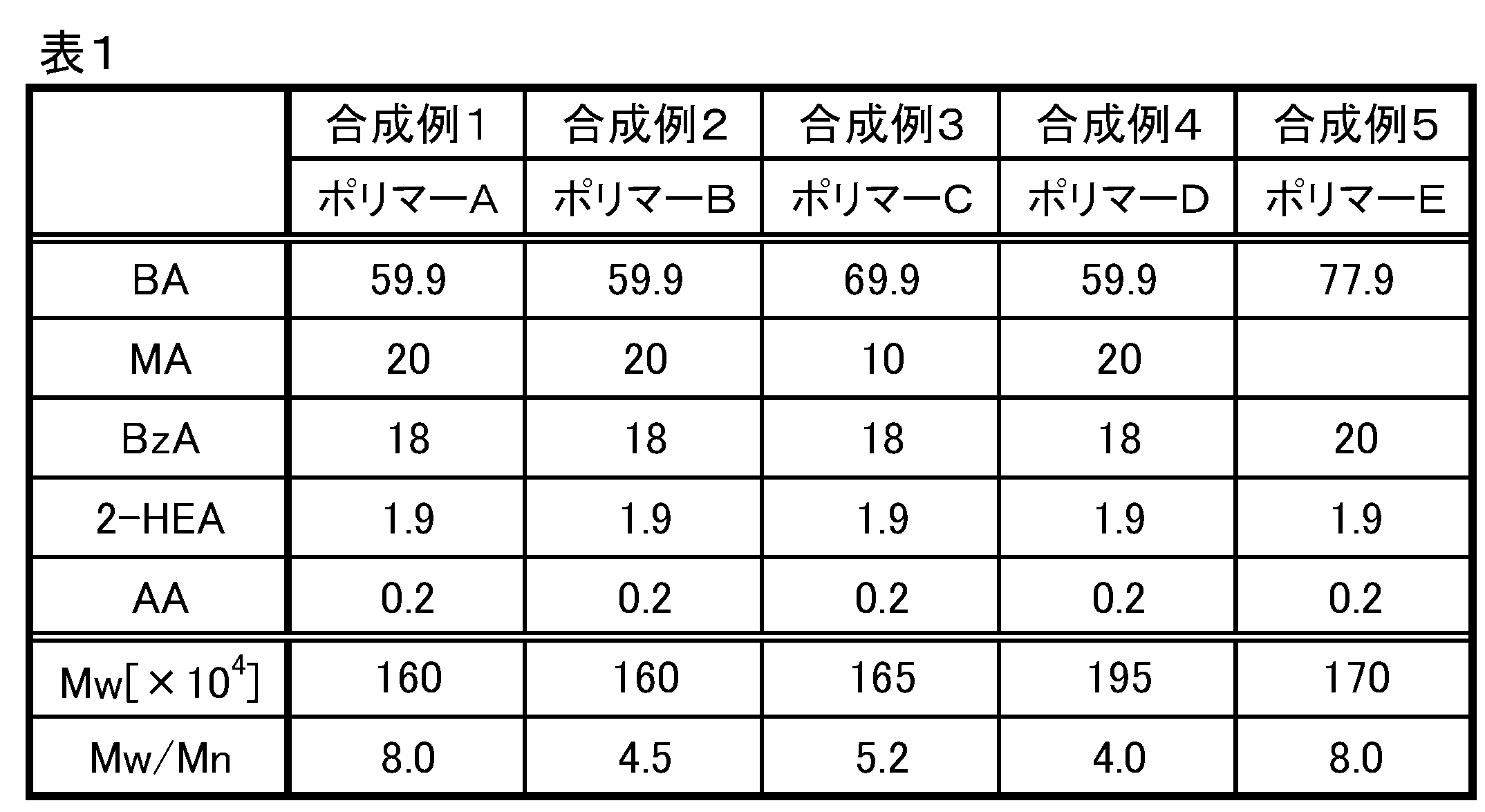
・MA:メチルアクリレート(ホモポリマーのTg:8℃)
・BzA:ベンジルアクリレート
・2-HEA:2-ヒドロキシエチルアクリレート
・AA:アクリル酸
[実施例1]
合成例1で得られたポリマーAのポリマー溶液に、イソシアネート系架橋剤 TD-75(綜研化学(株)製)およびシランカップリング剤 A-50(綜研化学(株)製)を添加して混合し、粘着剤組成物を得た。TD-75の配合量は、ポリマーAの固形分100質量部に対してTD-75の固形分が0.6質量部となる量であり、A-50の配合量は、ポリマーAの固形分100質量部に対してA-50の固形分が0.2質量部となる量である。
実施例1において、配合組成、ならびに使用した偏光フィルムの保護層および偏光子の各厚さを表2に記載した通りに変更したこと以外は実施例1と同様にして、粘着剤組成物および粘着剤層付偏光フィルムを得た。
得られた粘着剤組成物から気泡を除いた後、剥離処理されたPETフィルム上に、泡抜け後の粘着剤組成物を、ドクターブレードを用いて塗布し、90℃で3分間乾燥して、乾燥膜厚20μmの塗膜を形成した。前記塗膜のPETフィルム貼付面とは反対の面に、剥離処理されたPETフィルムをさらに貼り合わせ、23℃/50%RH環境下で7日間静置して熟成させて、2枚のPETフィルムに挟まれた厚さ20μmの粘着剤層を作製した。
<粘着力>
実施例および比較例で得られたPETフィルムを有する粘着剤層付偏光フィルムを25mm幅の帯状に裁断して、試験片を作製した。作製した試験片からPETフィルムを剥離し、露出した粘着剤層をガラス板に貼着し、2kgのローラーを用いて圧着した。得られた粘着剤層付偏光フィルムを貼付したガラス板を、50℃、5atmの条件で20分間オートクレーブ処理をした後、23℃/50%RH環境下に1時間静置した。その後、貼着面に対して180°方向に300mm/minの引張速度で偏光フィルムの一端を引っ張り、剥離にかかる粘着力(剥離強度)を測定した。
実施例および比較例で得られたPETフィルムを有する粘着剤層付偏光フィルムを150mm×250mmに裁断し、PETフィルムを剥がして厚さ1.1mmのガラス板に貼付し、2kgのローラーを用いて圧着した。得られた粘着剤層付偏光フィルムを貼付したガラス板を、50℃、5atmの環境下で、20分間オートクレーブ処理をし、その後、23℃/50%RHの環境下で24時間放置することで、高温耐久性評価用サンプルを作製した。
○:接着不良は認められない。
○:発泡は認められない。
実施例および比較例で得られたPETフィルムを有する粘着剤層付偏光フィルムを115mm×230mmに裁断したこと以外は、前記高温耐久性評価用サンプルの作製と同様にして、収縮距離測定用サンプルを作製した。
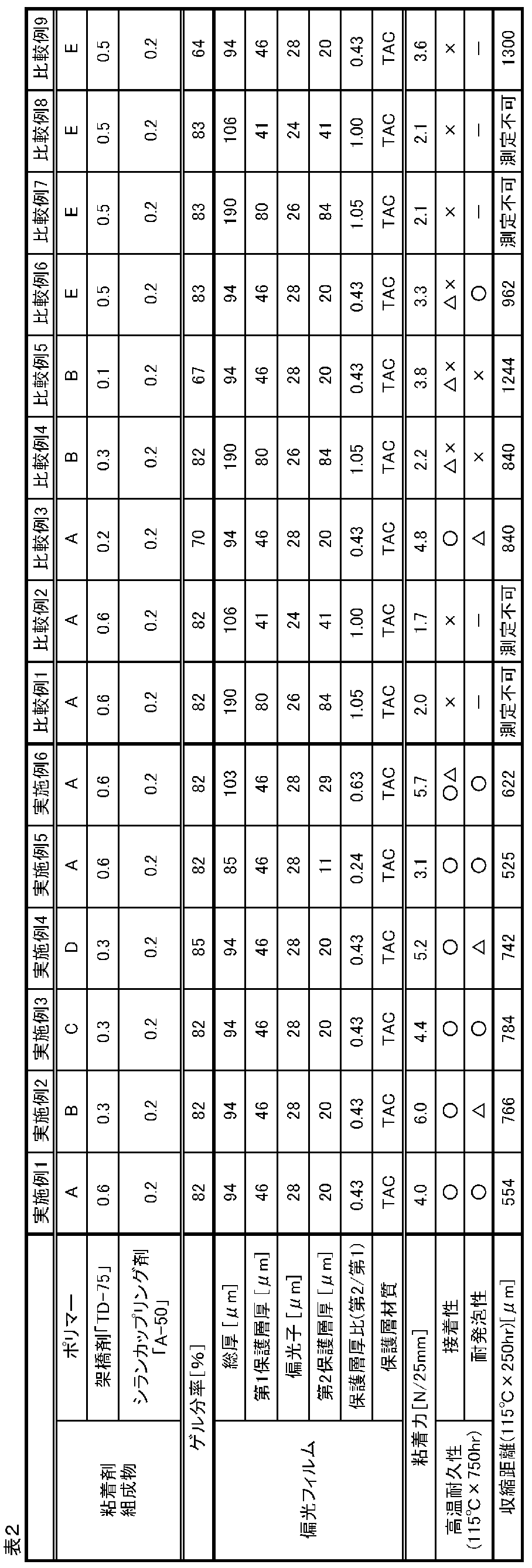
・A-50:シランカップリング剤(綜研化学(株)製)
・TAC:トリアセチルセルロース
表2に示す通り、各実施例における粘着剤層付偏光フィルムは、適度な粘着力を有し、高温環境下での耐久性に優れ、偏光フィルムの収縮が抑制され、良好な結果となった。
Claims (6)
- 偏光子の片面に第一の保護層が設けられ、前記偏光子の他方の面に第二の保護層が設けられた偏光フィルムと、
前記第二の保護層に接した粘着剤層と
を有する粘着剤層付偏光フィルムであって、
前記第一の保護層および前記第二の保護層の厚さの比である第二の保護層の厚さ/第一の保護層の厚さが0.1~0.7であり、
前記粘着剤層が、(メタ)アクリル系共重合体を含有する粘着剤組成物から形成された層であり、
前記(メタ)アクリル系共重合体が、ホモポリマーのガラス転移温度が0℃以上であるアルキル(メタ)アクリレートを10~50質量%含むモノマー混合物の共重合体であり、
前記粘着剤層のゲル分率が80%より大きい、
粘着剤層付偏光フィルム。 - 前記(メタ)アクリル系共重合体の重量平均分子量が80万~200万である、請求項1に記載された粘着剤層付偏光フィルム。
- 前記(メタ)アクリル系共重合体の分子量分布が5~12である、請求項1に記載された粘着剤層付偏光フィルム。
- 前記偏光フィルムの厚さが10~150μmである、請求項1に記載された粘着剤層付偏光フィルム。
- 前記第一の保護層および第二の保護層が、(メタ)アクリル系樹脂、セルロース系樹脂、シクロオレフィンポリマー系樹脂およびポリビニルアルコール系樹脂から選ばれる少なくとも1つの樹脂を含む、請求項1に記載された粘着剤層付偏光フィルム。
- 画像表示素子に、請求項1~5のいずれか1項に記載された粘着剤層付偏光フィルムが貼着された、画像表示装置。
Priority Applications (2)
| Application Number | Priority Date | Filing Date | Title |
|---|---|---|---|
| CN202380051610.1A CN119487428A (zh) | 2022-07-11 | 2023-07-06 | 带粘接剂层偏振膜及图像显示装置 |
| JP2024533683A JPWO2024014394A1 (ja) | 2022-07-11 | 2023-07-06 |
Applications Claiming Priority (2)
| Application Number | Priority Date | Filing Date | Title |
|---|---|---|---|
| JP2022-111412 | 2022-07-11 | ||
| JP2022111412 | 2022-07-11 |
Publications (1)
| Publication Number | Publication Date |
|---|---|
| WO2024014394A1 true WO2024014394A1 (ja) | 2024-01-18 |
Family
ID=89536628
Family Applications (1)
| Application Number | Title | Priority Date | Filing Date |
|---|---|---|---|
| PCT/JP2023/025132 Ceased WO2024014394A1 (ja) | 2022-07-11 | 2023-07-06 | 粘着剤層付偏光フィルムおよび画像表示装置 |
Country Status (4)
| Country | Link |
|---|---|
| JP (1) | JPWO2024014394A1 (ja) |
| CN (1) | CN119487428A (ja) |
| TW (1) | TW202413566A (ja) |
| WO (1) | WO2024014394A1 (ja) |
Citations (6)
| Publication number | Priority date | Publication date | Assignee | Title |
|---|---|---|---|---|
| JP2016094592A (ja) * | 2014-11-10 | 2016-05-26 | 住友化学株式会社 | 粘着剤組成物、粘着剤層、及び粘着剤層付光学部材 |
| WO2017104350A1 (ja) * | 2015-12-15 | 2017-06-22 | 住友化学株式会社 | 粘着剤組成物 |
| JP2018123262A (ja) * | 2017-02-02 | 2018-08-09 | 住友化学株式会社 | 粘着剤組成物 |
| JP2020002225A (ja) * | 2018-06-27 | 2020-01-09 | サイデン化学株式会社 | 粘着剤シート |
| JP2022039980A (ja) * | 2020-08-28 | 2022-03-10 | 住友化学株式会社 | 粘着剤組成物及び粘着剤層付き光学フィルム |
| JP2022039981A (ja) * | 2020-08-28 | 2022-03-10 | 住友化学株式会社 | 粘着剤組成物及び粘着剤層付き光学フィルム |
-
2023
- 2023-07-06 WO PCT/JP2023/025132 patent/WO2024014394A1/ja not_active Ceased
- 2023-07-06 JP JP2024533683A patent/JPWO2024014394A1/ja active Pending
- 2023-07-06 CN CN202380051610.1A patent/CN119487428A/zh active Pending
- 2023-07-07 TW TW112125520A patent/TW202413566A/zh unknown
Patent Citations (6)
| Publication number | Priority date | Publication date | Assignee | Title |
|---|---|---|---|---|
| JP2016094592A (ja) * | 2014-11-10 | 2016-05-26 | 住友化学株式会社 | 粘着剤組成物、粘着剤層、及び粘着剤層付光学部材 |
| WO2017104350A1 (ja) * | 2015-12-15 | 2017-06-22 | 住友化学株式会社 | 粘着剤組成物 |
| JP2018123262A (ja) * | 2017-02-02 | 2018-08-09 | 住友化学株式会社 | 粘着剤組成物 |
| JP2020002225A (ja) * | 2018-06-27 | 2020-01-09 | サイデン化学株式会社 | 粘着剤シート |
| JP2022039980A (ja) * | 2020-08-28 | 2022-03-10 | 住友化学株式会社 | 粘着剤組成物及び粘着剤層付き光学フィルム |
| JP2022039981A (ja) * | 2020-08-28 | 2022-03-10 | 住友化学株式会社 | 粘着剤組成物及び粘着剤層付き光学フィルム |
Also Published As
| Publication number | Publication date |
|---|---|
| CN119487428A (zh) | 2025-02-18 |
| TW202413566A (zh) | 2024-04-01 |
| JPWO2024014394A1 (ja) | 2024-01-18 |
Similar Documents
| Publication | Publication Date | Title |
|---|---|---|
| JP6570280B2 (ja) | 光学部材用粘着剤および光学積層体 | |
| CN107209316B (zh) | 带粘合剂层的偏振膜、其制造方法、以及图像显示装置及其连续制造方法 | |
| JP6570266B2 (ja) | 光学積層体 | |
| WO2015141382A1 (ja) | 偏光板用粘着剤組成物、粘着剤層、粘着シートおよび粘着剤層付き偏光板 | |
| WO2018062288A1 (ja) | 光学用粘着剤層、光学用粘着剤層の製造方法、粘着剤層付光学フィルム、及び、画像表示装置 | |
| WO2018062289A1 (ja) | 光学用粘着剤層、光学用粘着剤層の製造方法、粘着剤層付光学フィルム、及び、画像表示装置 | |
| WO2015141383A1 (ja) | 偏光板用粘着剤組成物、粘着剤層、粘着シートおよび粘着剤層付き偏光板 | |
| JP6886401B2 (ja) | 偏光板用の粘着剤層および粘着剤組成物 | |
| JP6822813B2 (ja) | 有機導電層用粘着剤層、粘着剤組成物、粘着剤層付偏光フィルム、及び画像表示装置 | |
| JP6644698B2 (ja) | 偏光板用粘着剤組成物および粘着剤層付き偏光板 | |
| JP2018135438A (ja) | 粘着剤組成物、粘着剤層、及び、粘着剤層付光学フィルム | |
| JP2018127504A (ja) | 偏光板用粘着剤組成物および粘着剤層付き偏光板 | |
| WO2021075188A1 (ja) | 粘着剤組成物および粘着シート | |
| WO2018062280A1 (ja) | 偏光フィルム用粘着剤組成物、偏光フィルム用粘着剤層の製造方法、粘着剤層付偏光フィルム、及び、画像表示装置 | |
| WO2016129353A1 (ja) | 偏光板用粘着剤組成物およびその用途 | |
| WO2016072199A1 (ja) | 偏光板用粘着剤組成物および粘着剤層付き偏光板 | |
| WO2024014394A1 (ja) | 粘着剤層付偏光フィルムおよび画像表示装置 | |
| TW202302796A (zh) | 黏著劑組成物、黏著片及光學構材 | |
| JP7842878B2 (ja) | 粘着剤組成物および粘着剤層付光学用積層体 | |
| JPWO2016152275A1 (ja) | 粘着剤層付偏光板およびその製造方法 | |
| WO2023136052A1 (ja) | 偏光板用粘着剤組成物および粘着剤層付き偏光板 | |
| JPWO2017018125A1 (ja) | 偏光板用粘着剤組成物、粘着剤層および粘着剤層付偏光板 | |
| JP2017025128A (ja) | 偏光板用粘着剤組成物および粘着剤層付き偏光板 | |
| WO2023224004A1 (ja) | インセル型液晶パネル | |
| WO2016072200A1 (ja) | 偏光板用粘着剤組成物および粘着剤層付き偏光板 |
Legal Events
| Date | Code | Title | Description |
|---|---|---|---|
| 121 | Ep: the epo has been informed by wipo that ep was designated in this application |
Ref document number: 23839566 Country of ref document: EP Kind code of ref document: A1 |
|
| WWE | Wipo information: entry into national phase |
Ref document number: 2024533683 Country of ref document: JP |
|
| WWE | Wipo information: entry into national phase |
Ref document number: 202380051610.1 Country of ref document: CN |
|
| NENP | Non-entry into the national phase |
Ref country code: DE |
|
| WWP | Wipo information: published in national office |
Ref document number: 202380051610.1 Country of ref document: CN |
|
| 122 | Ep: pct application non-entry in european phase |
Ref document number: 23839566 Country of ref document: EP Kind code of ref document: A1 |