WO2023286240A1 - 被膜及び部材 - Google Patents
被膜及び部材 Download PDFInfo
- Publication number
- WO2023286240A1 WO2023286240A1 PCT/JP2021/026605 JP2021026605W WO2023286240A1 WO 2023286240 A1 WO2023286240 A1 WO 2023286240A1 JP 2021026605 W JP2021026605 W JP 2021026605W WO 2023286240 A1 WO2023286240 A1 WO 2023286240A1
- Authority
- WO
- WIPO (PCT)
- Prior art keywords
- water
- coating
- repellent resin
- less
- spherical particles
- Prior art date
- Legal status (The legal status is an assumption and is not a legal conclusion. Google has not performed a legal analysis and makes no representation as to the accuracy of the status listed.)
- Ceased
Links
Images


Classifications
-
- C—CHEMISTRY; METALLURGY
- C09—DYES; PAINTS; POLISHES; NATURAL RESINS; ADHESIVES; COMPOSITIONS NOT OTHERWISE PROVIDED FOR; APPLICATIONS OF MATERIALS NOT OTHERWISE PROVIDED FOR
- C09D—COATING COMPOSITIONS, e.g. PAINTS, VARNISHES OR LACQUERS; FILLING PASTES; CHEMICAL PAINT OR INK REMOVERS; INKS; CORRECTING FLUIDS; WOODSTAINS; PASTES OR SOLIDS FOR COLOURING OR PRINTING; USE OF MATERIALS THEREFOR
- C09D5/00—Coating compositions, e.g. paints, varnishes or lacquers, characterised by their physical nature or the effects produced; Filling pastes
- C09D5/16—Antifouling paints; Underwater paints
- C09D5/1656—Antifouling paints; Underwater paints characterised by the film-forming substance
- C09D5/1662—Synthetic film-forming substance
- C09D5/1668—Vinyl-type polymers
-
- C—CHEMISTRY; METALLURGY
- C09—DYES; PAINTS; POLISHES; NATURAL RESINS; ADHESIVES; COMPOSITIONS NOT OTHERWISE PROVIDED FOR; APPLICATIONS OF MATERIALS NOT OTHERWISE PROVIDED FOR
- C09D—COATING COMPOSITIONS, e.g. PAINTS, VARNISHES OR LACQUERS; FILLING PASTES; CHEMICAL PAINT OR INK REMOVERS; INKS; CORRECTING FLUIDS; WOODSTAINS; PASTES OR SOLIDS FOR COLOURING OR PRINTING; USE OF MATERIALS THEREFOR
- C09D5/00—Coating compositions, e.g. paints, varnishes or lacquers, characterised by their physical nature or the effects produced; Filling pastes
- C09D5/16—Antifouling paints; Underwater paints
- C09D5/1681—Antifouling coatings characterised by surface structure, e.g. for roughness effect giving superhydrophobic coatings or Lotus effect
-
- C—CHEMISTRY; METALLURGY
- C09—DYES; PAINTS; POLISHES; NATURAL RESINS; ADHESIVES; COMPOSITIONS NOT OTHERWISE PROVIDED FOR; APPLICATIONS OF MATERIALS NOT OTHERWISE PROVIDED FOR
- C09D—COATING COMPOSITIONS, e.g. PAINTS, VARNISHES OR LACQUERS; FILLING PASTES; CHEMICAL PAINT OR INK REMOVERS; INKS; CORRECTING FLUIDS; WOODSTAINS; PASTES OR SOLIDS FOR COLOURING OR PRINTING; USE OF MATERIALS THEREFOR
- C09D127/00—Coating compositions based on homopolymers or copolymers of compounds having one or more unsaturated aliphatic radicals, each having only one carbon-to-carbon double bond, and at least one being terminated by a halogen; Coating compositions based on derivatives of such polymers
- C09D127/02—Coating compositions based on homopolymers or copolymers of compounds having one or more unsaturated aliphatic radicals, each having only one carbon-to-carbon double bond, and at least one being terminated by a halogen; Coating compositions based on derivatives of such polymers not modified by chemical after-treatment
- C09D127/12—Coating compositions based on homopolymers or copolymers of compounds having one or more unsaturated aliphatic radicals, each having only one carbon-to-carbon double bond, and at least one being terminated by a halogen; Coating compositions based on derivatives of such polymers not modified by chemical after-treatment containing fluorine atoms
-
- C—CHEMISTRY; METALLURGY
- C09—DYES; PAINTS; POLISHES; NATURAL RESINS; ADHESIVES; COMPOSITIONS NOT OTHERWISE PROVIDED FOR; APPLICATIONS OF MATERIALS NOT OTHERWISE PROVIDED FOR
- C09D—COATING COMPOSITIONS, e.g. PAINTS, VARNISHES OR LACQUERS; FILLING PASTES; CHEMICAL PAINT OR INK REMOVERS; INKS; CORRECTING FLUIDS; WOODSTAINS; PASTES OR SOLIDS FOR COLOURING OR PRINTING; USE OF MATERIALS THEREFOR
- C09D7/00—Features of coating compositions, not provided for in group C09D5/00; Processes for incorporating ingredients in coating compositions
- C09D7/40—Additives
- C09D7/60—Additives non-macromolecular
- C09D7/61—Additives non-macromolecular inorganic
-
- C—CHEMISTRY; METALLURGY
- C09—DYES; PAINTS; POLISHES; NATURAL RESINS; ADHESIVES; COMPOSITIONS NOT OTHERWISE PROVIDED FOR; APPLICATIONS OF MATERIALS NOT OTHERWISE PROVIDED FOR
- C09D—COATING COMPOSITIONS, e.g. PAINTS, VARNISHES OR LACQUERS; FILLING PASTES; CHEMICAL PAINT OR INK REMOVERS; INKS; CORRECTING FLUIDS; WOODSTAINS; PASTES OR SOLIDS FOR COLOURING OR PRINTING; USE OF MATERIALS THEREFOR
- C09D7/00—Features of coating compositions, not provided for in group C09D5/00; Processes for incorporating ingredients in coating compositions
- C09D7/40—Additives
- C09D7/65—Additives macromolecular
-
- C—CHEMISTRY; METALLURGY
- C09—DYES; PAINTS; POLISHES; NATURAL RESINS; ADHESIVES; COMPOSITIONS NOT OTHERWISE PROVIDED FOR; APPLICATIONS OF MATERIALS NOT OTHERWISE PROVIDED FOR
- C09D—COATING COMPOSITIONS, e.g. PAINTS, VARNISHES OR LACQUERS; FILLING PASTES; CHEMICAL PAINT OR INK REMOVERS; INKS; CORRECTING FLUIDS; WOODSTAINS; PASTES OR SOLIDS FOR COLOURING OR PRINTING; USE OF MATERIALS THEREFOR
- C09D7/00—Features of coating compositions, not provided for in group C09D5/00; Processes for incorporating ingredients in coating compositions
- C09D7/40—Additives
- C09D7/66—Additives characterised by particle size
- C09D7/67—Particle size smaller than 100 nm
-
- C—CHEMISTRY; METALLURGY
- C09—DYES; PAINTS; POLISHES; NATURAL RESINS; ADHESIVES; COMPOSITIONS NOT OTHERWISE PROVIDED FOR; APPLICATIONS OF MATERIALS NOT OTHERWISE PROVIDED FOR
- C09D—COATING COMPOSITIONS, e.g. PAINTS, VARNISHES OR LACQUERS; FILLING PASTES; CHEMICAL PAINT OR INK REMOVERS; INKS; CORRECTING FLUIDS; WOODSTAINS; PASTES OR SOLIDS FOR COLOURING OR PRINTING; USE OF MATERIALS THEREFOR
- C09D7/00—Features of coating compositions, not provided for in group C09D5/00; Processes for incorporating ingredients in coating compositions
- C09D7/40—Additives
- C09D7/66—Additives characterised by particle size
- C09D7/68—Particle size between 100-1000 nm
-
- C—CHEMISTRY; METALLURGY
- C09—DYES; PAINTS; POLISHES; NATURAL RESINS; ADHESIVES; COMPOSITIONS NOT OTHERWISE PROVIDED FOR; APPLICATIONS OF MATERIALS NOT OTHERWISE PROVIDED FOR
- C09D—COATING COMPOSITIONS, e.g. PAINTS, VARNISHES OR LACQUERS; FILLING PASTES; CHEMICAL PAINT OR INK REMOVERS; INKS; CORRECTING FLUIDS; WOODSTAINS; PASTES OR SOLIDS FOR COLOURING OR PRINTING; USE OF MATERIALS THEREFOR
- C09D7/00—Features of coating compositions, not provided for in group C09D5/00; Processes for incorporating ingredients in coating compositions
- C09D7/40—Additives
- C09D7/66—Additives characterised by particle size
- C09D7/69—Particle size larger than 1000 nm
-
- C—CHEMISTRY; METALLURGY
- C09—DYES; PAINTS; POLISHES; NATURAL RESINS; ADHESIVES; COMPOSITIONS NOT OTHERWISE PROVIDED FOR; APPLICATIONS OF MATERIALS NOT OTHERWISE PROVIDED FOR
- C09D—COATING COMPOSITIONS, e.g. PAINTS, VARNISHES OR LACQUERS; FILLING PASTES; CHEMICAL PAINT OR INK REMOVERS; INKS; CORRECTING FLUIDS; WOODSTAINS; PASTES OR SOLIDS FOR COLOURING OR PRINTING; USE OF MATERIALS THEREFOR
- C09D7/00—Features of coating compositions, not provided for in group C09D5/00; Processes for incorporating ingredients in coating compositions
- C09D7/40—Additives
- C09D7/70—Additives characterised by shape, e.g. fibres, flakes or microspheres
-
- C—CHEMISTRY; METALLURGY
- C08—ORGANIC MACROMOLECULAR COMPOUNDS; THEIR PREPARATION OR CHEMICAL WORKING-UP; COMPOSITIONS BASED THEREON
- C08K—Use of inorganic or non-macromolecular organic substances as compounding ingredients
- C08K2201/00—Specific properties of additives
- C08K2201/002—Physical properties
- C08K2201/005—Additives being defined by their particle size in general
-
- C—CHEMISTRY; METALLURGY
- C08—ORGANIC MACROMOLECULAR COMPOUNDS; THEIR PREPARATION OR CHEMICAL WORKING-UP; COMPOSITIONS BASED THEREON
- C08K—Use of inorganic or non-macromolecular organic substances as compounding ingredients
- C08K2201/00—Specific properties of additives
- C08K2201/011—Nanostructured additives
-
- C—CHEMISTRY; METALLURGY
- C08—ORGANIC MACROMOLECULAR COMPOUNDS; THEIR PREPARATION OR CHEMICAL WORKING-UP; COMPOSITIONS BASED THEREON
- C08K—Use of inorganic or non-macromolecular organic substances as compounding ingredients
- C08K7/00—Use of ingredients characterised by shape
- C08K7/16—Solid spheres
-
- C—CHEMISTRY; METALLURGY
- C08—ORGANIC MACROMOLECULAR COMPOUNDS; THEIR PREPARATION OR CHEMICAL WORKING-UP; COMPOSITIONS BASED THEREON
- C08K—Use of inorganic or non-macromolecular organic substances as compounding ingredients
- C08K7/00—Use of ingredients characterised by shape
- C08K7/16—Solid spheres
- C08K7/18—Solid spheres inorganic
Definitions
- the present disclosure relates to a coating that imparts water repellency and a member provided with the coating.
- Super water repellency is the property of water droplets that roll off even when water is splashed on them, as is known from the water droplets that adhere to the lotus leaves.
- many materials having super water repellency have been developed for the purpose of antifouling and suppression of adhesion of ice and snow.
- a water-repellent substance having a fine uneven surface is used as a material exhibiting super water-repellency.
- a material exhibiting super water repellency can prevent water stains such as mud from adhering to the material, and the attached dust can be easily removed by washing with water.
- a material exhibiting superhydrophobicity is not effective for adhesion of dust or adsorption of vapor that is smaller than the unevenness of the surface.
- Patent Document 1 discloses a superhydrophobic coating that includes a polymer binder layer and a plurality of porous protrusions protruding from the surface of the polymer binder layer. Patent document 1 intends to maintain high self-cleaning property even when immersed in water.
- the present disclosure has been made to solve the problems described above, and aims to provide a film and a member that are easy to clean and impart water repellency.
- the coating according to the present disclosure is a film formed of a water-repellent resin having a smooth surface and a contact angle of 70 ° or more.
- the spherical surface has an average radius of curvature of 16 ⁇ m or less, and an average distance between adjacent protrusions is 30 times or less than the radius of curvature.
- the surface of the water-repellent resin is smooth, it is easy to wash off dirt adhering to this portion. In this way, coatings and members that impart water repellency that are easy to clean are obtained.
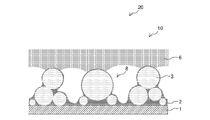
- FIG. 2 shows a coating according to Embodiment 1;
- FIG. 2 is a diagram showing a state in which the coating film according to Embodiment 1 develops superhydrophobicity;
- FIG. 4 is a diagram showing a state in which the coating film according to Embodiment 1 develops hydrophilicity;
- FIG. 2 is a diagram showing one form of a coating according to Embodiment 1;
- FIG. 2 is a diagram showing one form of a coating according to Embodiment 1;
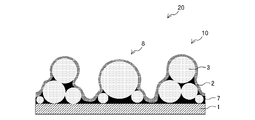
- FIG. 10 is a diagram showing a coating according to Embodiment 2;
- FIG. 1 shows a coating 10 according to Embodiment 1.
- the coating 10 comprises a water-repellent resin 2 with protrusions 8 formed thereon.
- a member 20 is composed of the substrate 1 and the coating 10 .
- the coating 10 is formed on the surface of the substrate 1, and the water-repellent resin 2 is exposed on the opposite surface of the substrate 1.
- FIG. 1 illustrates the case where the coating 10 contains the spherical particles 3, the spherical particles 3 may be absent.
- a large number of protrusions 8 are formed on the facing surface of the substrate 1, and the water-repellent resin 2 having a smooth surface is exposed.
- the tip portion of the protrusion 8 is spherical.
- a convex surface formed by cutting out a continuous area of 50% or more of the spherical surface that is, a convex surface formed by cutting out a portion of the spherical surface having an area larger than a hemisphere, is connected to the base end side of the protrusion 8.
- the film 10 is formed by a method of laminating spherical particles of the water-repellent resin 2 or a method of applying a coating liquid containing the water-repellent resin 2 and the spherical particles 3 .
- the film 10 is composed almost exclusively of the water-repellent resin 2 .
- spherical particles 3 form a skeleton, and the skeleton is covered with water-repellent resin 2.
- dispersion liquid is applied or powder coating is performed.
- the film 10 is formed by bonding the particles together by fusion with a dispersion medium, bonding with a binder, or heat fusion.
- the spherical particles of the water-repellent resin 2 may contain other substances, a super-water-repellent film 10 composed of the water-repellent resin 2 having a smooth surface is obtained.
- the method of applying the coating liquid containing the water-repellent resin 2 and the spherical particles 3 can treat various articles only by applying and drying the coating liquid.
- the shape and surface water repellency of the protrusions 8 can be arbitrarily adjusted.
- the ratio of the spherical particles 3 and the water-repellent resin 2 that form the preferable film 10 is preferably 50% or more and 500% or less, more preferably 80% or more and 400% or less, of the water-repellent resin 2 by volume. preferable.
- the structure is such that the spherical particles 3 are buried in the water-repellent resin 2, and projections of good shape are often not formed. If the spherical particles 3 account for more than 500% of the water-repellent resin 2, it is difficult to form a clear protrusion 8, and the tip of the protrusion 8 tends to be closer than 30 times the radius of curvature, which is not preferable.
- the total content of the water-repellent resin 2 and the spherical particles 3 is preferably 5% by mass or more and 40% by mass or less, more preferably 8% by mass or more and 25% by mass or less. . If the content is less than 5% by mass, the liquid film before drying tends to flow and it is difficult to form the protrusions 8 uniformly dispersed, which is not preferable. If the content exceeds 40% by mass, the fluidity of the applied liquid is low, and it is difficult to form a preferable coating 10 .
- Various solvents can be used as the solvent of the coating liquid as long as the solvent dissolves the water-repellent resin 2 .
- solvents examples include aromatic hydrocarbon solvents, ketones such as acetone or methyl ethyl ketone and MIBK, ethers such as tetrahydrofuran, esters such as ethyl lactate, ethyl acetate and butyl acetate, N-methylpyrrolidone, naphthene, Paraffin-based hydrocarbon-based solvents, alcohol-based solvents such as ethanol and 2-propanol, ether-based solvents such as dimethyl ether and diethyl ether, and various fluororesin solvents can be used.
- aromatic hydrocarbon solvents ketones such as acetone or methyl ethyl ketone and MIBK
- ethers such as tetrahydrofuran
- esters such as ethyl lactate, ethyl acetate and butyl acetate
- N-methylpyrrolidone naphthene
- Paraffin-based hydrocarbon-based solvents alcohol-based solvents
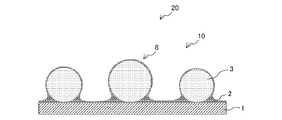
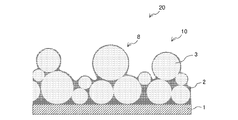
- FIG. 4 and 5 are diagrams showing one form of the coating 10 according to Embodiment 1, respectively.
- Application methods include brush coating, roller coating, dip coating, screen printing, spray coating, and the like.
- the film 10 is formed by drying.
- Various curing agents may be added, and treatment such as heat curing or ultraviolet curing may be added.
- the thickness and morphology of the coating 10 can be adjusted by the coating amount.
- FIG. 4 shows an example with a small coating amount
- FIG. 5 shows an example with a large coating amount. In either state, the properties of the coating 10 of the first embodiment are obtained.
- the thin film 10 shown in FIG. 4 is a highly transparent film 10 that has little effect on the color of the base.
- the thick coating 10 shown in FIG. 5 not only has high durability against wear and the like, but also provides a substrate protection effect such as corrosion resistance and weather resistance.
- the water repellent resin 2 for realizing super water repellency preferably has a contact angle of 70° or more, more preferably 80° or more, with respect to the water 6 when the surface is flat. If the contact angle of water 6 is less than 70°, superhydrophobicity cannot be obtained, or even if superhydrophobicity is obtained, it becomes hydrophilic with a slight stimulus such as water pressure, so the superhydrophobic film Practicality as 10 cannot be obtained.
- the contact angle of water 6 on a flat surface is preferably 70 ° or more and 110 ° or less, and 80 ° or more and 100 ° More preferably: If the contact angle of the water 6 is less than 70°, superhydrophobicity cannot be obtained, or even if superhydrophobicity is obtained, it becomes hydrophilic with a slight stimulus such as water pressure. Practicality as is not obtained. If the contact angle of water 6 exceeds 110°, it cannot be made hydrophilic even by spraying water 6 or injecting water 6 at high pressure.
- the water repellent resin 2 satisfies the above water repellency, and may be alkyd resin, epoxy ester resin, urethane resin, acrylic resin, acrylic silicone resin, polyolefin resin, polyvinyl chloride resin, fluorine resin, silicone resin, or any of these resins. Mixtures can be used.
- fluororesin or silicone resin the contact angle is sufficiently high even when used alone. If you want to increase the contact angle of water 6 with other water-repellent resin 2, or if you want to have water repellency such that the contact angle exceeds 90°, a fluorine-based, hydrocarbon-based, or silicone-based resin for improving water repellency is used. Additives may be added. A method of adding a small amount of fine particles is also possible. By adding the fine particles, slight unevenness is formed on the surface of the water-repellent resin 2, and the water repellency can be enhanced.
- the fine particles can be used regardless of their composition as long as they are uniformly mixed with the water-repellent resin 2 .
- fine particles inorganic fine particles such as silica, alumina, and titania, or fluororesin fine particles such as PTFE can be used.
- the water repellency of the resin can be efficiently improved by adding a small amount thereof by using those whose surfaces have been subjected to a water repellent treatment.
- the weight average particle size measured by laser diffraction particle size distribution measurement is preferably 10 nm or more and 200 nm or less.
- the particles are sufficiently dispersed by treatment with a homogenizer or the like. If the average particle diameter exceeds 200 nm, or if the added amount exceeds 50% by weight, the smoothness of the water-repellent resin 2 decreases, and the resistance to friction or staining decreases. I don't like it because I can't put it away. In addition, from the viewpoint of imparting hydrophilicity, the water repellency of the resin becomes too high, or the smoothness of the resin surface becomes too low. A problem arises in that sufficient hydrophilicity cannot be obtained.
- the smoothness of the surface of the water-repellent resin 2 can be confirmed by the glossiness as an index. It is preferable that the glossiness of the resin applied on the flat surface is 70 or more when measured at an incident angle of 60°. As described above, a resin surface with a glossiness of less than 70 has too many fine irregularities, so that even if the surface is treated with water 6 sprayed or high-pressure water 6, stable hydrophilicity cannot be obtained in many cases.
- a preferable super water-repellent film 10 is a state in which a small amount of water-repellent resin 2 covers the surface of spherical particles 3 .
- the coating liquid can be made to easily obtain the desired superhydrophobic film 10 .
- the solution of the water-repellent resin 2 flows over the surfaces of the spherical particles 3 and dries during the drying process.
- the thickness of the water-repellent resin 2 covering the spherical particles 3 at the apexes of the protrusions 8 may become too thin.
- the spherical particles 3 may not be covered with the water-repellent resin 2, or the water-repellent resin 2 may easily peel off, making it impossible to obtain excellent super water repellency.
- the solution of the water-repellent resin 2 flowing on the surface of the spherical particles 3 becomes a pseudoplastic fluid, and the surface of the spherical particles 3 is covered with the water-repellent resin 2 having a sufficient thickness. can.
- the same fine particles as those for adjusting water repellency can be used.
- the amount added may be large, but due to restrictions on water repellency and surface smoothness, it is necessary to limit the amount to 50% or less by weight.
- the preferred concentration also changes slightly.
- the total content of the water-repellent resin 2 and the spherical particles 3 is preferably 1.5% by mass or more and 30% by mass or less, more preferably 3% by mass or more and 25% by mass or less.
- the total content of the water-repellent resin 2 and the spherical particles 3 is less than 1.5% by mass, the liquid film before drying tends to flow, making it difficult to form the protrusions 8 in a uniformly dispersed manner. , unfavorable. If the combined content of the water-repellent resin 2 and the spherical particles 3 exceeds 30% by mass, the fluidity of the applied liquid is low, and it is difficult to form a desirable coating 10 .
- the spherical particles 3 used for realizing superhydrophobicity preferably have an average particle diameter of 0.5 ⁇ m or more and 30 ⁇ m or less, more preferably 0.5 ⁇ m or more and 15 ⁇ m or less.
- the average particle size indicates the weight average particle size. If the average particle size is less than 0.5 ⁇ m, the protrusions 8 will not have a good shape when coated with the water-repellent resin 2 with a sufficient thickness. When particles having an average particle diameter exceeding 30 ⁇ m are used, superhydrophobicity cannot be obtained.
- the spherical particles 3 used for achieving superhydrophobicity and hydrophilicity preferably have an average particle size of 1 ⁇ m or more and 30 ⁇ m or less, more preferably 1.8 ⁇ m or more and 15 ⁇ m or less.
- the average particle diameter indicates the weight average particle diameter. If the average particle size is less than 1 ⁇ m, the gaps between the formed protrusions 8 are narrow and the depth is shallow, making it difficult to obtain stable hydrophilicity. When particles having an average particle diameter exceeding 30 ⁇ m are used, superhydrophobicity cannot be obtained.
- Spherical inorganic particles can be used for the spherical particles 3 .
- Inorganic particles have the advantage of increasing the strength of the film.
- Spherical resin particles can also be used as the spherical particles 3 .
- Various resins such as methacrylic resin, polystyrene, silicone, and phenolic resin can be used. When resin particles are used, the flexibility of the film is increased, defects such as peeling are less likely to occur, and the spherical particles 3 are less likely to sediment as a coating composition, which is advantageous in that it is easy to use. If the spherical particles 3 have corners and protrusions, the protrusions 8 often do not form a good spherical surface, which is not preferable.
- FIG. 2 is a diagram showing a state in which the coating 10 according to Embodiment 1 exhibits superhydrophobicity.
- FIG. 2 shows a state in which the surface of superhydrophobic coating 10 and water 6 come into contact with each other when coating 10 is immersed in water 6 or exposed to running water or water droplets.
- the water 6 is in contact only with the spherical surfaces located at the apexes of the protrusions 8 and does not enter between the protrusions 8 .
- This state occurs because the contact portion is a spherical convex surface and the surface is made of the water-repellent resin 2 having water repellency.
- the film 10 has a property that the adhering water 6 is very easily peeled off because the apex of the protrusion 8 is a spherical convex surface. This is because when the water 6 coming into contact with the spherical convex surface is peeled off, the contact state between the water 6 and the water-repellent resin 2 is not greatly changed, and the water 6 and the water-repellent resin 2 are smoothly peeled off. This is because it becomes detached. If the apex of the protrusion 8 is not a spherical convex surface but has an uneven or flat surface, the separation of the water 6 does not progress smoothly, and water droplets or water films tend to remain.
- the spherical convex surface has a large convex surface area formed by cutting out a continuous area of 50% or more of the spherical surface, good removability of the water 6 can be achieved. If the area of the spherical convex surface is less than 50% of the continuous spherical surface, more water 6 will come into contact with the flat portion or the concave portion, and the removability of the water 6 will be poor. Therefore, the continuous area of the truncated spherical surface preferably includes a hemispherical surface. In addition, it is more preferable that the spherical convex surface is a convex surface formed by cutting out a continuous area of 70% or more of the spherical surface.
- horizontal means a plane parallel to the surface of the substrate 1 . It is preferable that the horizontal cross-sectional area of the tip of the protrusion 8 has a maximum value. In FIG. 1, there are maximum horizontal cross-sectional areas 4a and 4b at the tip of the protrusion 8. In FIG. At the intermediate portion of the protrusion 8, there are minimum portions 5a and 5b with horizontal cross-sectional areas corresponding to the maximum portions 4a and 4b.
- the shape of the tip portion having the maximum horizontal cross-sectional areas 4a and 4b that is, the shape having a constriction, makes it difficult for the water 6 to enter the gaps between the protrusions 8 even when water pressure is applied. can. As a result, it is possible to maintain good releasability of water 6, that is, to achieve super water repellency.
- a general super water-repellent material achieves a high contact angle of water 6 exceeding 150° by forming fine unevenness of less than 1 ⁇ m on the surface by mixing fine particles or making it porous.
- the film 10 of Embodiment 1 achieves super water repellency based on a concept that is completely different from super water repellency due to conventional fine unevenness.
- the super water repellency of the super water repellent surface due to fine unevenness is easily lost due to stimulation such as friction, adhesion of fine dust, oily substances, surfactants, etc., but the coating 10 of the first embodiment is Since it is made of smooth water-repellent resin 2, it does not have such drawbacks.
- the superhydrophobicity of the film 10 is achieved by having the tip of the protrusion 8 have a spherical convex surface.
- the average radius of curvature of the spherical surface of the tip of the protrusion 8 is preferably 16 ⁇ m or less, more preferably 8 ⁇ m or less. If the average radius of curvature exceeds 16 ⁇ m, the super water-repellency is easily lost by six streams of water, etc., resulting in poor practicability.
- the average interval between the adjacent protrusions 8 is preferably 30 times or less, more preferably 20 times or less, the radius of curvature.
- the average distance between the protrusions 8 is the average distance between the apexes of the protrusions 8 at the closest positions. If the average interval exceeds 30 times the radius of curvature, the superhydrophobicity is easily lost by water flow or the like, resulting in poor practicality.
- the coating 10 achieves superhydrophobicity on a smooth surface that does not have fine irregularities. Furthermore, by devising the shape of the protrusions 8 and the water repellency of the water-repellent resin 2, the coating 10 is imparted with the property of changing to hydrophilic under specific conditions while maintaining super water repellency. By controlling the amount of water 6 that penetrates into the gaps between the protrusions 8, conversion between superhydrophobicity and hydrophilicity or compatibility between superhydrophobicity and hydrophilicity is realized.
- the coating 10 is designed so that normal water droplets or running water cannot enter, but fine water droplets or high-pressure water 6 can enter. It exhibits superhydrophobicity when water 6 does not enter the gaps between the protrusions 8 , and exhibits hydrophilicity when water 6 enters the gaps between the protrusions 8 .
- FIG. 3 is a diagram showing a state in which the coating 10 according to Embodiment 1 develops hydrophilicity.
- the film 10 exhibits hydrophilicity.
- the gap between the protrusions 8 By setting the gap between the protrusions 8 to an appropriate size, the structure is such that large water droplets cannot enter, and fine water droplets or high-pressure water 6 can enter.
- the water 6 that has once entered the gaps of the protrusions 8 and filled the gaps is stabilized by coming into contact with the concave surface of the water-repellent resin 2, and becomes difficult to escape. Since the water 6 fixed in the gaps of the projecting parts 8 has the effect of retaining the water 6 in contact with the film 10, the film 10 becomes a stable wet film in spite of being composed of the water-repellent resin 2. ⁇
- the gap of the protrusion 8 has a shape that expands inward from the upper layer portion of the coating 10, and in the case of a simple depression or hole. In comparison, the water 6 filled in the gap is stable and difficult to escape.
- horizontal means a plane parallel to the surface of the substrate 1 . It is preferable that the horizontal cross-sectional area of the tip of the protrusion 8 has a maximum value.
- FIG. 1 there are maximum horizontal cross-sectional areas 4a and 4b at the tip of the projection 8.
- the film 10 is composed of the water-repellent resin 2 having a smooth surface even in the gaps between the protrusions 8 .
- a general super water-repellent material achieves a high contact angle of water 6 exceeding 150° by forming fine irregularities of less than 1 ⁇ m on the surface of the water-repellent material. Even if such a material has a structure having protrusions 8 like the coating 10 of the first embodiment, it does not become hydrophilic. Since the surface is super water-repellent, even if water 6 is pushed into the gaps between the protrusions 8, the water 6 does not adhere to the inside, and the surface tension of the water 6 naturally discharges the water 6 to the outside. Another reason is that the superhydrophobic surface and the water 6 do not adhere to each other, and the air layer formed at the interface serves as a path for the air when the water 6 is discharged. Since the film 10 of Embodiment 1 has a smooth surface of the water-repellent resin 2, it is possible to exhibit hydrophilicity.
- the spherical surface of the tip of the protrusion 8 preferably has an average radius of curvature of 0.6 ⁇ m or more and 16 ⁇ m or less, more preferably 1 ⁇ m or more and 8 ⁇ m or less. If the thickness exceeds 16 ⁇ m, it is difficult to maintain superhydrophobicity, resulting in poor practicality. If the average radius of curvature is less than 0.6 ⁇ m, the gap is too small, and it is difficult to obtain stable hydrophilicity even if the water 6 is sprayed or treated with high-pressure water 6 , which is not preferable.
- the average interval between adjacent protrusions 8 is preferably 4 times or more and 30 times or less, more preferably 6 times or more and 20 times or less, the radius of curvature.
- the average distance between the protrusions 8 is the average distance between the apexes of the protrusions 8 at the closest positions. If the average interval exceeds 30 times the radius of curvature, the superhydrophobicity is easily lost by water flow or the like, resulting in poor practicability. If the average interval is less than four times the radius of curvature, the gap between the projections 8 becomes small, and it is difficult to become hydrophilic even if the surface is treated with sprayed water 6 or high-pressure water 6, which is not preferable.
- the method of using air blowing not only blows off the water 6, but also accelerates the evaporation of the water 6 in the gaps, so that the superhydrophobicity can be recovered quickly.
- the water 6 that forms the wet film contains hydrophilic impurities, it may remain in the superhydrophobic film 10 upon drying, impairing the superhydrophobicity.
- the coating 10 of Embodiment 1 has good washability.
- the super water-repellent film 10 of the first embodiment hydrophilic, it is also possible to obtain the effect that the contained drug can be released in a controlled manner. Since the superhydrophobic surface repels the water 6, it is used for the purpose of suppressing adhesion of microorganisms and maintaining sanitary conditions. Furthermore, in order to realize a high level of hygiene, when it is attempted to release an antibacterial agent or an antiviral agent in a controlled manner, the water 6 hardly comes into contact with the superhydrophobic surface. The problem is that it is difficult. In general super water-repellent materials, there is also the problem that the super water repellency itself deteriorates when other agents such as antibacterial agents or antiviral agents are mixed.
- the water 6 can be brought into close contact with the surface, so that the drug can be released in a controlled manner. Since the water repellent resin 2 used here does not exhibit super water repellency, it is possible to mix various hydrophilic or water repellent agents.
- FIG. 6 shows a coating 10 according to Embodiment 2.
- FIG. Embodiment 2 differs from Embodiment 1 in that binder 7 is provided.
- the same reference numerals are assigned to the same parts as in the first embodiment, and the description thereof is omitted.
- the spherical particles 3 are bonded to each other by a binder 7, and the spherical particles 3 and the substrate 1 are bonded together. That is, the film 10 has a structure in which the surfaces of the binder 7 and the spherical particles 3 are coated with the water-repellent resin 2 .
- the spherical particles 3 may be bound by a water-repellent resin 2, as shown in FIG. There is a limit to improving the strength of the coating 10 .
- the binder 7 needs to adhere to the spherical particles 3 and the base material 1, have strength, and can be applied as a coating agent.
- alkyd resins, epoxy ester resins, urethane resins, acrylic resins, acrylic silicone resins, polyolefin resins, polyvinyl chloride resins, fluorine resins, and silicone resins can be used regardless of whether they are water repellent or hydrophilic, and are easy to handle as coating agents and are preferred. .
- Resins such as polycarbonate, nylon, polyethylene terephthalate, polybutylene terephthalate, polyphenylsulfone, polysulfone, polyarylate, polyetherimide, polyethersulfone, polysulfone, and polyvinylidene fluoride are preferable because they are easy to obtain strength and heat resistance. It is also preferable to add a cross-linking agent for improving strength and a coupling agent for improving adhesion. Curable resins such as phenol resins, urea resins, melamine resins, epoxy resins, unsaturated polyester resins, polyurethane resins, diallyl phthalate resins, and silicone resins can also be used, and are preferred because they are easy to obtain strength.
- An inorganic binder 7 such as silica or titania is preferable because of its high film strength and heat resistance.
- a metal alkoxide, polysilazane, or the like can be used.
- the sol-gel method using a silicon or titanium alkoxide is preferable because it is easy to handle and easily obtains adhesion and strength.
- the film 10 of Embodiment 2 is formed by a step of forming an undercoat layer composed of the spherical particles 3 and the binder 7 and a step of coating the water-repellent resin 2 .
- Formation of the undercoat layer is performed by applying a coating liquid containing the spherical particles 3 and the binder 7 .
- the binder 7 may be dissolved in the coating liquid or dispersed as fine droplets or solid particles.
- the volume ratio of the spherical particles 3 to the binder 7 is preferably 80% or more and 600% or less, more preferably 100% or more and 500% or less, of the binder 7. .
- the volume of the binder 7 is the volume after being cured by drying or heating.
- the spherical particles 3 are applied at a ratio of less than 80% of the binder 7, after the water-repellent resin 2 is further overcoated, the spherical particles 3 are embedded in the water-repellent resin 2, resulting in good-shaped protrusions. It is not preferable because there are many cases where the product is not formed. If the proportion of the spherical particles 3 to the binder 7 exceeds 600%, sufficient strength of the coating 10 cannot be obtained.
- the total content of the water-repellent resin 2 and binder 7 is preferably 30% by mass or less, more preferably 15% by mass or less.
- the mass of the binder 7 is the mass after curing by drying and heating. If the content exceeds 30% by mass, the fluidity of the applied liquid is low, making it difficult to form a desirable coating 10 .
- the binder 7 if the binder 7 is dissolved in the coating liquid, it will form a meniscus between the spherical particles 3 only by drying, resulting in a good form of bonding. However, if it contains solid particles or fine particles, it is necessary to densify the binder 7 and form a meniscus by heating after application.
- the coating of the water-repellent resin 2 is performed by applying a coating liquid containing the water-repellent resin 2.
- the water-repellent resin 2 used here can be the same as the water-repellent resin 2 of Embodiment 1, and fine particles can be added.
- a solvent that does not dissolve or deteriorate the binder 7 is selected and used from those shown in the first embodiment.
- the concentration of the water-repellent resin 2 in the coating liquid is preferably 0.1% by mass or more and 20% by mass or less, more preferably 0.5% by mass or more and 10% by mass or less.
- the concentration is less than 0.1% by mass, a sufficient amount of the film 10 of the water-repellent resin 2 is not formed on the apex portions of the protrusions 8, and super water-repellency cannot be obtained. It is not preferable because it deteriorates to If the concentration exceeds 20% by mass, the gaps between the protrusions 8 are filled with the water-repellent resin 2, and super water-repellency cannot be obtained, or hydrophilization cannot be performed by spraying water 6 or high-pressure water 6, which is not preferable. .
- the undercoat layer can be applied by brush coating, roller coating, dip coating, screen printing, spray coating, or the like. Thereby, the coating 10 as illustrated in FIGS. 4 and 5 is formed. In this case, the surfaces of the spherical particles 3 need not be covered with resin.
- the coating of the water-repellent resin 2 is performed only by forming a thin film with a low-concentration coating liquid, the effect of coating unevenness due to variations in the coating thickness is less of a problem, and the process can be performed with simple work. .
- the second embodiment has the advantage that the water-repellent resin 2 can be easily applied, so that it can be used for repair work when the coating 10 is deteriorated.
- the coating 10 of Embodiment 2 has the effect of suppressing contamination or cleaning, it is conceivable that the surface deteriorates in the long term. In this case, the performance can be restored by reapplying the water-repellent resin 2 .
- the method of repairing coating 10 by applying water-repellent resin 2 can also be used for coating 10 of the first embodiment. In this case, it is necessary to select a solvent for curing and repairing the coating 10 so that the coating 10 is not deteriorated by the solvent when the water-repellent resin 2 is applied.
- Embodiment 3 describes a case where the coating 10 of Embodiment 1 or 2 is applied to an article having a heating mechanism. In this case, both the effect of suppressing adhesion of ice, snow or frost and the effect of melting by heating can be achieved.
- the heated super water-repellent film 10 exerts a high effect of suppressing the adhesion of water 6 or ice and snow impinged by rainfall, snowfall or the like.
- the superhydrophobic film 10 becomes hydrophilic and can efficiently melt ice and snow.
- the temperature of the water 6 in contact with the heated film 10 rises, and the surface tension and viscosity of the water 6 decrease.
- the film 10 of Embodiment 3 has a function of becoming hydrophilic when water 6 enters the gaps between the projections. Sprayed water 6 or high-pressure water 6 enters the gap, but the water 6 whose surface tension or viscosity has decreased due to temperature rise enters and becomes hydrophilic only by contact. When exposed to rain or snow, the temperature of the water 6 rises and does not enter the gaps, so the super water-repellent high anti-adhesion effect is maintained. Then, when it comes into contact with snow or ice, heated water 6 is generated on the surface of the superhydrophobic film 10, and the surface becomes hydrophilic.
- the temperature of the super water-repellent film 10 for obtaining this effect is 30°C or higher and 100°C or lower, more preferably 60°C or higher and 90°C or lower. If the temperature is less than 30°C, hydrophilization may not occur. If the temperature exceeds 100° C., it becomes hydrophilic rather than superhydrophobic, and the effect of suppressing adhesion of ice and snow cannot be obtained. In addition, it is considered that the effect of suppressing adhesion to ice, snow or frost and promoting peeling can be obtained even on a general super water-repellent surface.
- the super water-repellent surface does not adhere ice, snow or frost and is easy to peel off, but it does not have the function of melting ice, snow or frost after peeling, and even if it is heated with a heater or the like, it is not in close contact, so heat transfer is difficult. Does not melt efficiently.
- a surface layer containing silicone and a water-repellent fluororesin is known to be highly washable with running water.
- the superhydrophobic surface can suppress the adhesion of ice and snow, it does not dissolve the ice and snow, so it is necessary to remove the ice and snow.
- a method of heating the surface with a heater to melt the ice and snow is used.
- a heater for example, there is an air layer between the ice and the surface on the superhydrophobic surface, which acts as a heat insulating layer, resulting in a problem of poor melting efficiency.
- the coating 10 of Embodiment 3 solves this problem.
- Embodiments 1 to 3 will be specifically described by showing examples, but Embodiments 1 to 3 are not limited to the following examples.
- Examples 1-2 and Comparative Examples 1-5 Lumiflon LF800 (manufactured by AGC Co., Ltd.) was used as the water-repellent resin 2, and QSG-170 (manufactured by Shin-Etsu Chemical Co., Ltd.), FB5D, FB15D, and FB40R (manufactured by Denka Co., Ltd.) were used as the spherical particles 3.
- a coating liquid of mineral spirit solvent containing water-repellent resin 2 and spherical particles 3 at a concentration of 20% by mass was prepared, sprayed onto a glass plate, and dried for about 1 hour. Then, the dried coating film was observed with an optical microscope and the contact angle was measured. After that, water 6 was sprayed for about 15 seconds by an accumulator type sprayer, and then the adhesion state of water 6 was checked.
- the contact angle of the film 10 made only of the water-repellent resin 2 was 82°.
- the shape of the tip portion of the protrusion 8 has a convex surface formed by cutting out a continuous area of 50% or more of the spherical surface.
- the average radius of curvature of the spherical surface is 16 ⁇ m or less
- the average distance between adjacent protrusions 8 is 30 times or less than the radius of curvature
- the surface of the coating 10 is made of a water-repellent resin 2 having a smooth contact angle of 70° or more. It is a superhydrophobic coating 10 . It can be confirmed with an optical microscope that the spherical particles 3 are laminated to form the protrusions 8 .
- the spherical particles 3 are small, and the projections 8 are also small and close to each other. That is, it does not satisfy the requirement that the average radius of curvature of the spherical surface is 16 ⁇ m or less. Although superhydrophobicity was obtained, after spraying water 6 with a sprayer or a high-pressure washer, although water droplets adhered, it did not become hydrophilic. In Comparative Examples 2 and 4, the amount of spherical particles 3 added is too small. That is, it does not meet the requirement that the shape of the tip portion of the projection 8 has a convex surface formed by cutting out a continuous area of 50% or more of the spherical surface. Although the spherical particles 3 form projections on the film surface, the projections are not sufficient. For this reason, superhydrophobicity cannot be obtained, and the spraying of water 6 does not make it hydrophilic.
- Comparative Example 3 the amount of spherical particles 3 added is too large.
- the film 10 is formed by laminating the spherical particles 3, and the independent protrusions 8 are not formed. That is, it does not meet the requirement that the shape of the tip portion of the projection 8 has a convex surface formed by cutting out a continuous area of 50% or more of the spherical surface.
- the protrusions 8 are formed, the spherical particles 3 are not sufficiently coated with the water-repellent resin 2, so that excellent super-water repellency is not obtained. Since there are no gaps formed by the projections 8, even the spray of water 6 does not wet the surface.
- Comparative Example 5 spherical particles 3 are too large. That is, since the requirement that the average radius of curvature of the spherical surface is 16 ⁇ m or less is not satisfied, superhydrophobicity cannot be obtained, and hydrophilicity cannot be obtained with 6 sprays of water.
- Examples 3 and 4 and Comparative Examples 6 to 8 Using the same water-repellent resin 2 and spherical particles 3 as in Example 1, the concentration of the coating liquid was changed, and fine particles were added, and the same test was performed. Aerosil 200 (Nippon Aerosil Co., Ltd.) was used as the fine particles. The average particle size after dispersion of the fine particles was 80 nm.
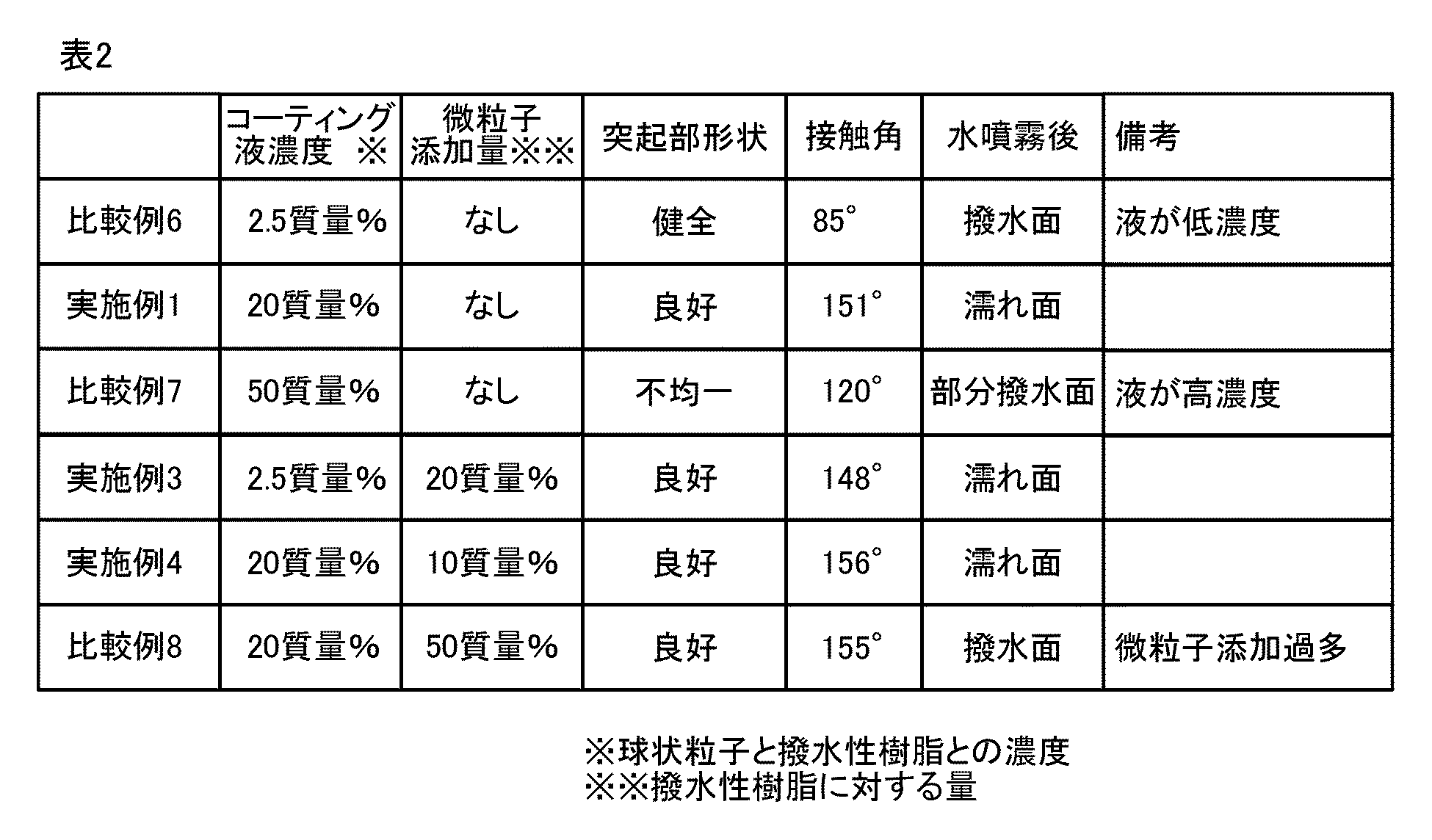
- Examples 3 and 4 are membranes to which fine particles are added. In Example 3, good characteristics were obtained in spite of using a low-concentration coating liquid similar to Comparative Example 6. In Example 4, good superhydrophobicity and hydrophilicity are compatible.
- Comparative Examples 6 and 7 differ in the concentration of the coating liquid of Example 1. Spray application was performed so as to form a uniformly wetted surface. In Comparative Example 6, superhydrophobicity is not obtained, and spraying of water 6 does not make hydrophilic. This is because the coating liquid is too thin, causing the liquid to flow before it dries, and the projections 8 are not formed uniformly. In Comparative Example 7, the coating liquid concentration is too high. The surface unevenness of the coating 10 was large, no clear projections 8 were formed, and the coating exhibited nonuniformity in both superhydrophobicity and hydrophilicity after spraying with water 6 . In Comparative Example 8, the amount of fine particles added is too large, the contact angle of the water-repellent resin 2 itself is 135°, and even 6 sprays of water do not make it hydrophilic.
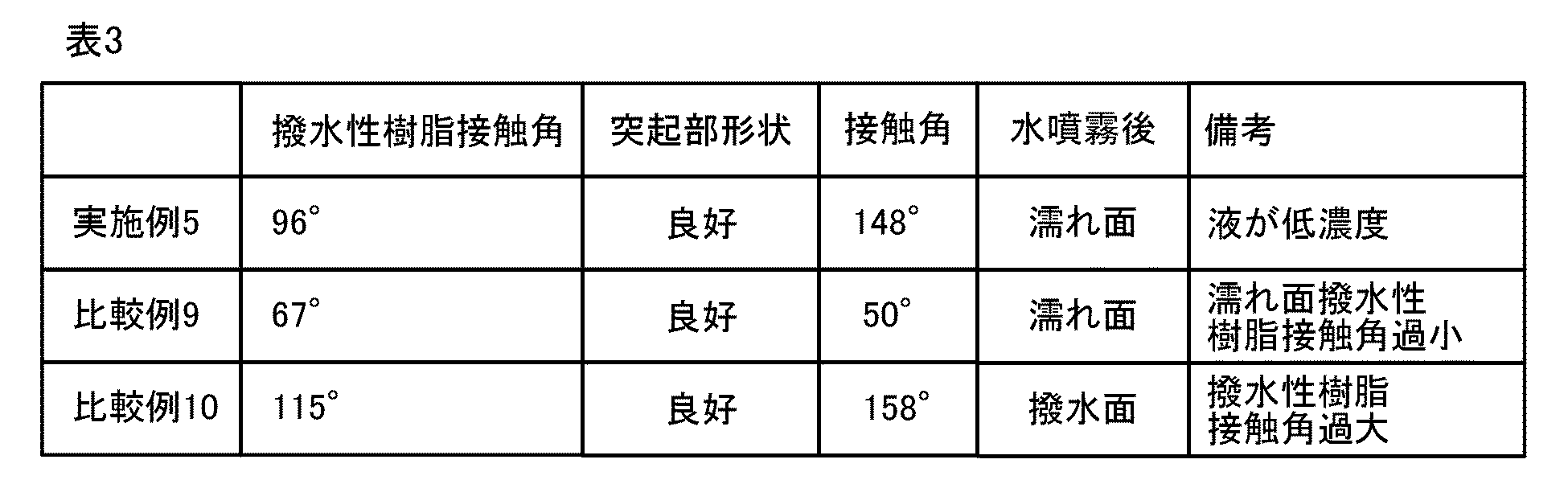
- Example 5 the water-repellent resin 2 and fused silica FB5D (average particle size 5 ⁇ m, manufactured by Denka Co., Ltd.) were used as the spherical particles 3, and the coating liquid was prepared at the same concentration as in Example 1, and the test was performed.
- a fluororesin Obrigato SS0054, AGC Coatec Co., Ltd.
- urethane dispersion HUX-840, ADEKA Corporation
- a fluorine resin coating agent NOXBARRIER ST-462, Unimatic Co., Ltd.
- Example 5 as in Example 1, the water-repellent resin 2 has moderate water repellency, so the result is that both super water repellency and hydrophilicity are achieved.
- Comparative Example 9 super water repellency cannot be obtained because the water repellency of the water repellent resin 2 was insufficient.
- Comparative Example 10 since the water repellency of the water repellent resin 2 is too high, it does not become hydrophilic by spraying water 6 .
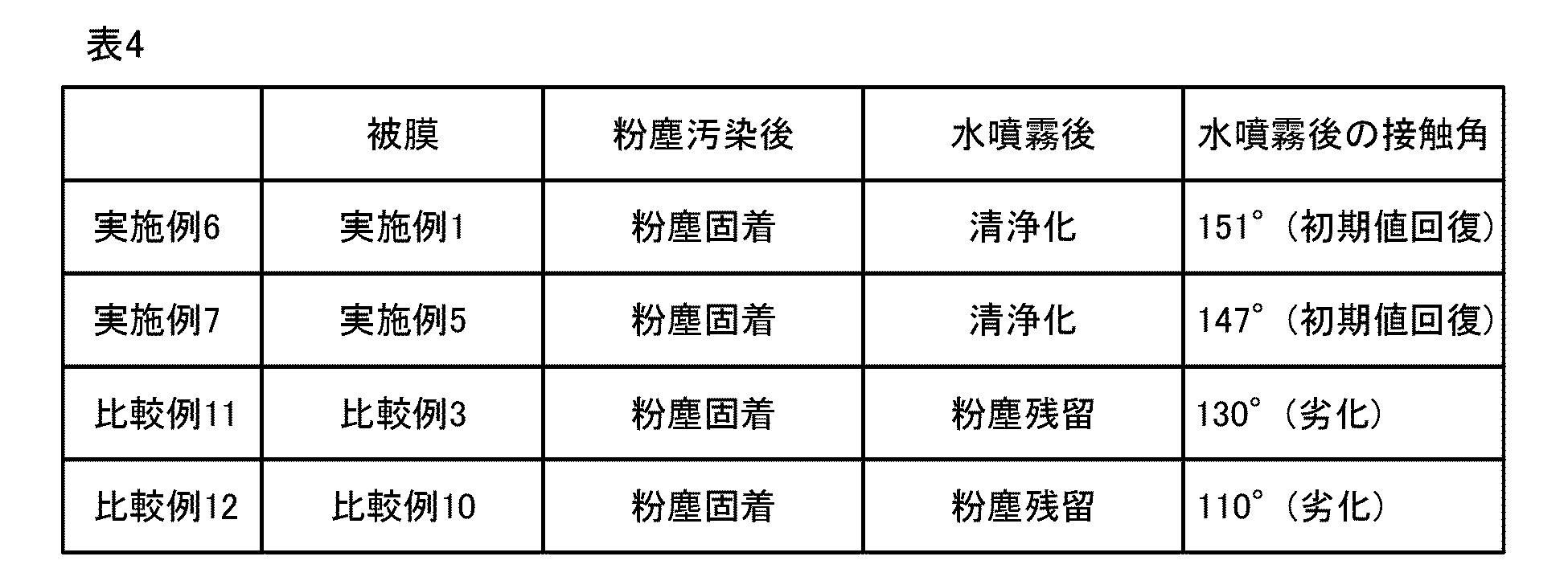
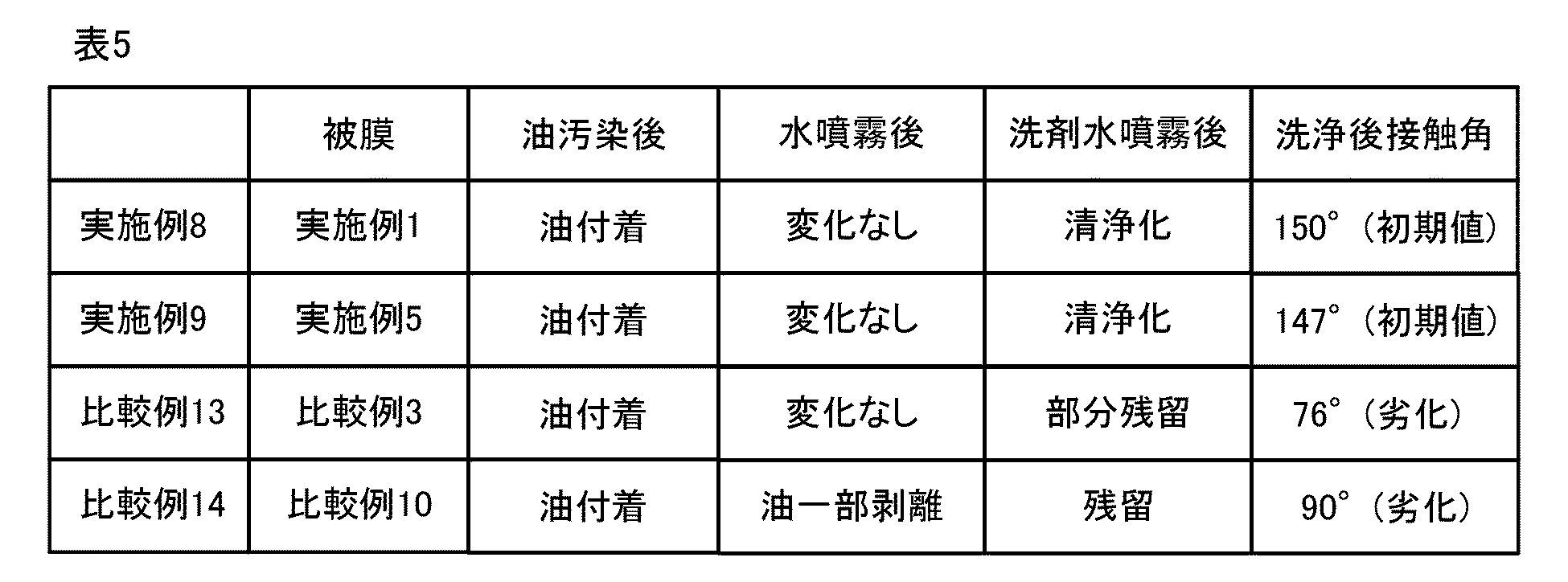
- Examples 6 to 9 and Comparative Examples 11 to 14 A washing test was performed after the films 10 formed in Examples 1 and 5 and Comparative Examples 3 and 10 were contaminated with dust and oil.
- the state of dust contamination was prepared by sprinkling Kanto loam powder (JIS test powder type 1-11) and lightly wiping with a nonwoven fabric.
- the oil contamination state was prepared by exposing to oil smoke generated by heating salad oil. Washing was carried out by spraying water 6 with an accumulator type spray device.
- Table 4 shows the results of dust contamination and subsequent cleaning. Both coatings 10 were contaminated with fine dust by rubbing. In Examples 6 and 7, dust was removed by 6 sprays of water, and by drying after removal, the initial super water repellency was restored. I understand. In Comparative Examples 11 and 12, after spraying with water 6, dust remained, and the initial superhydrophobicity was lost after drying.
- Table 5 shows the results of oil contamination and subsequent cleaning. Any of the coatings 10 will be in a state where oil adhesion can be visually confirmed. This is difficult to remove even by spraying water 6 . Oil was removed in Examples 8 and 9 as a result of spraying water 6 mixed with dish soap. Further, by washing with water 6 containing no detergent and drying, the initial superhydrophobicity is restored, and it is found that the oil stain has a high detergency. In Comparative Examples 13 and 14, even after spraying with water 6 mixed with a detergent, the oil remained, and even after washing with water 6, the initial superhydrophobicity was not recovered.
- Example 10 and 11 and Comparative Examples 15 to 17 The snow-melting effect of the films 10 formed in Examples 1 and 5 and Comparative Examples 3 and 10 was evaluated.
- the film 10 was formed on an aluminum plate with a thickness of 1 mm, and placed horizontally on a hot plate to heat it.
- 10 g of ice milled with a shaved ice machine was molded into a cylindrical shape with a diameter of 3 cm, and used as simulated snow for evaluation of snow melting. Simulated snow was placed on the coating 10, and the time until it completely melted was compared.
- Table 6 shows a comparison of snow melting times. In Examples 10 and 11, the values are almost the same, and the effect of the water 6 coming into contact with the surface of the film 10 as the temperature rises is obtained. It is shown that the coating 10 suppresses the adhesion of snow due to its superhydrophobicity at low temperatures, and that a snow-melting effect can be obtained when the temperature is raised. At 60° C. and 80° C., Comparative Examples 15 and 16 have a longer snow melting time than the aluminum plate. Comparative Example 17 is an aluminum plate without coating 10 .
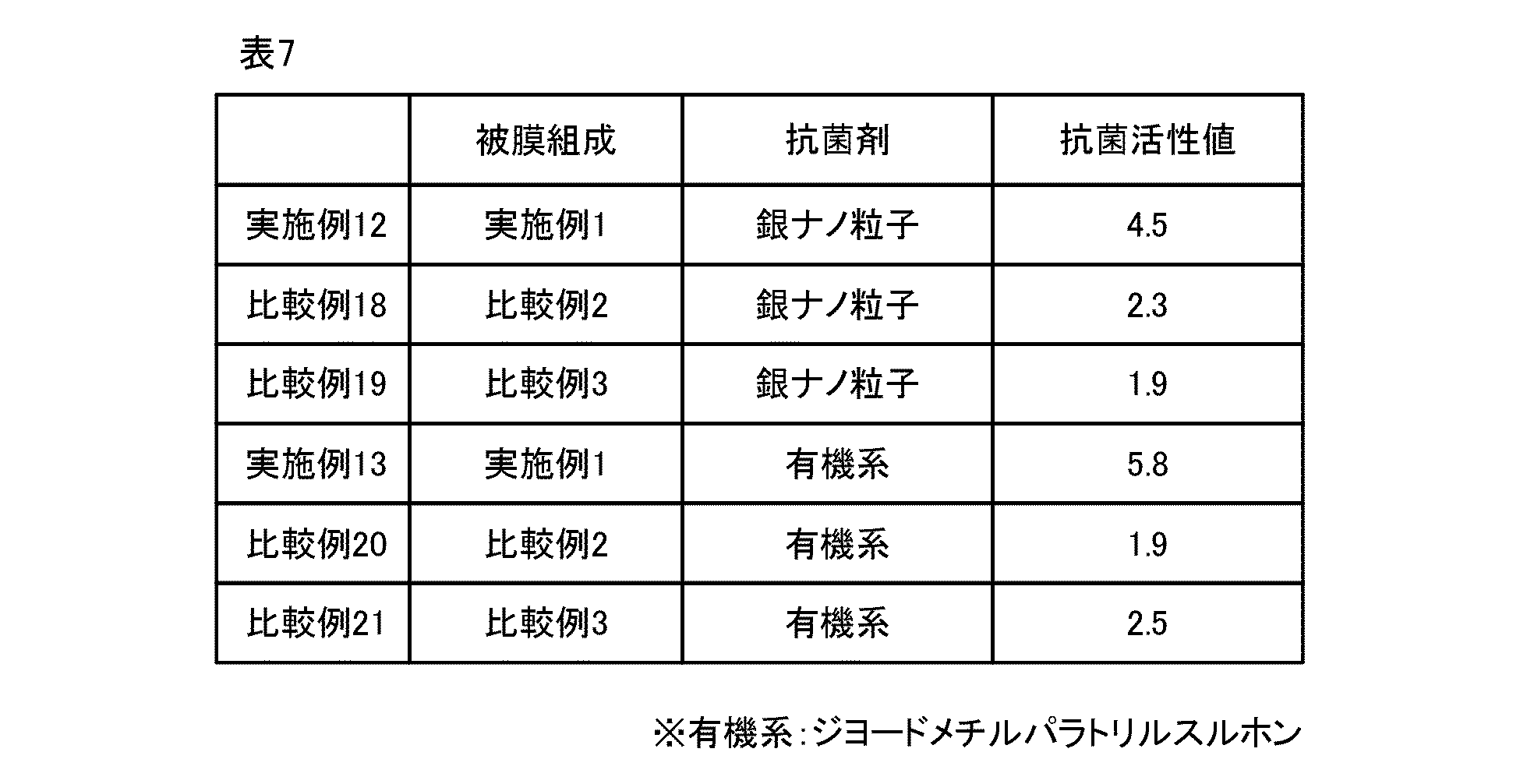
- Examples 12 and 13 and Comparative Examples 18 to 21 To the composition of Example 1 and Comparative Examples 2 and 3, an antibacterial agent corresponding to 0.1% by mass of the water-repellent resin 2 was added. An antibacterial agent was mixed with the coating liquid, applied and dried to form the film 10 . Since the amount of antibacterial agent added is very small, there is no effect on water repellency and hydrophilicity. Silver nanoparticles were used as an inorganic antibacterial agent, and diiodomethyl paratolyl sulfone was used as an organic antibacterial agent. Antibacterial properties were evaluated for effects against Staphylococcus aureus in Z2801:2010. For the evaluation, samples sprayed with water 6 were used, and the samples to be hydrophilized were carried out in the hydrophilized state, and the samples which were not to be hydrophilized were carried out in the water-repellent state.
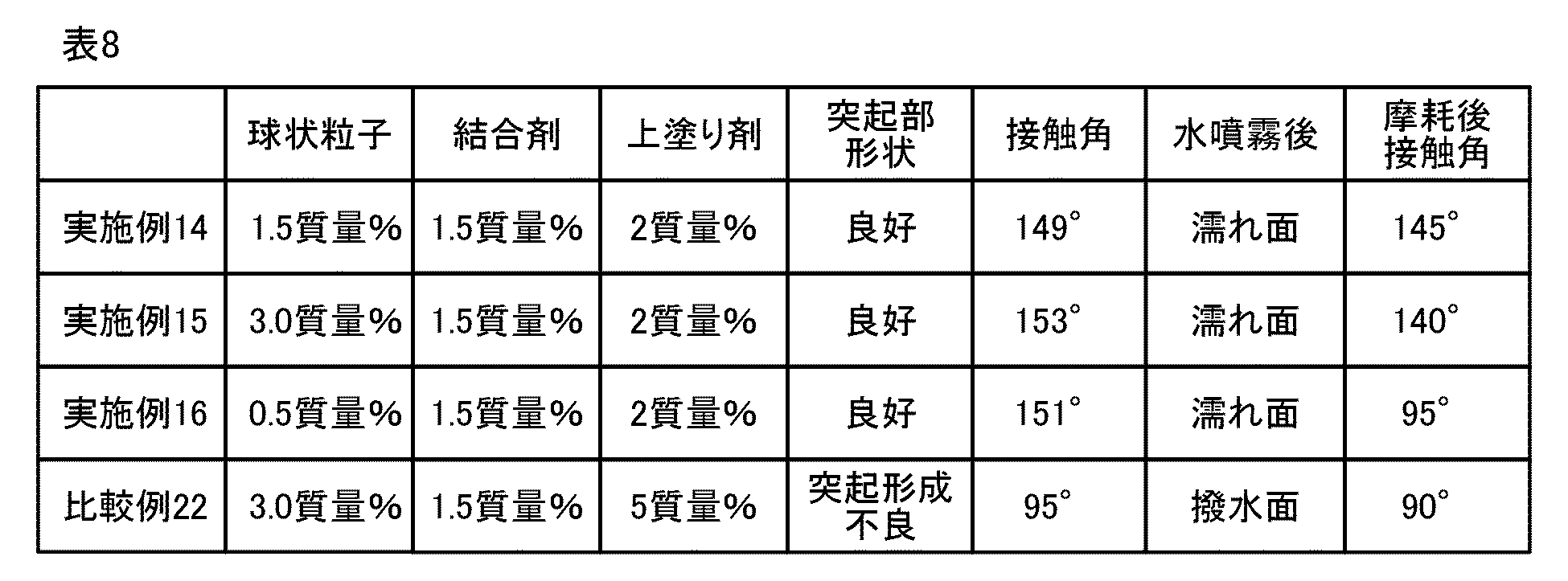
- Examples 14 to 16 and Comparative Example 22 An undercoat layer was formed with a coating agent using FB15D (average particle diameter 15 ⁇ m, manufactured by Denka Co., Ltd.) as the spherical particles 3 and silicate (N-103X, Colcoat Co., Ltd.) as the binder 7 .
- a mineral spirit solution of Lumiflon LF800 manufactured by AGC Co., Ltd. was applied as a top coating agent.
- the contact angle was measured after 10 reciprocating rubbings with a rayon nonwoven fabric with a pressure of 80 g/cm 2 .
- Example 14 to 16 super water repellency and hydrophilicity after spraying 6 water are obtained.
- Example 14 and 15 high superhydrophobicity was maintained even after the abrasion test, and it can be seen that the strength of the coating 10 is improved by the binder 7.
- Example 16 is deteriorated by friction and does not have enough binder 7 to obtain sufficient film strength.
- Comparative Example 22 the concentration of the overcoat agent was too high, and the projections 8 formed by the undercoat layer were filled with the overcoat agent.
- 1 Base material 2 Water-repellent resin, 3 Spherical particles, 4a, 4b Maximum portion, 5a, 5b Minimum portion, 6 Water, 7 Binder, 8 Protruding portion, 10 Coating, 20 Member.
Landscapes
- Chemical & Material Sciences (AREA)
- Engineering & Computer Science (AREA)
- Life Sciences & Earth Sciences (AREA)
- Materials Engineering (AREA)
- Wood Science & Technology (AREA)
- Organic Chemistry (AREA)
- Nanotechnology (AREA)
- Inorganic Chemistry (AREA)
- Crystallography & Structural Chemistry (AREA)
- Materials Applied To Surfaces To Minimize Adherence Of Mist Or Water (AREA)
- Laminated Bodies (AREA)
- Paints Or Removers (AREA)
- Application Of Or Painting With Fluid Materials (AREA)
Abstract
Description
図1は、実施の形態1に係る被膜10を示す図である。図1に示すように、被膜10は、突起部8が形成された撥水性樹脂2を備えている。そして、基材1と被膜10とによって、部材20が構成されている。被膜10は、基材1の表面に形成され、基材1の対向面には撥水性樹脂2が露出している。図1では、被膜10が球状粒子3を含有している場合について例示しているが、球状粒子3がなくてもよい。基材1の対向面には、多数の突起部8が形成され、表面の全面が平滑である撥水性樹脂2が露出した構造となっている。ここで、突起部8の先端部分は球状となっている。具体的には、球面における連続する50%以上の領域を切り取って成る凸面、即ち、球面における半球より広い面積の部分を切り取って成る凸面が、突起部8の基端側に接続された状態となっている。
被膜10は、球状の撥水性樹脂2の粒子を積層する方法又は撥水性樹脂2と球状粒子3とを含むコーティング液を塗布する方法等で形成される。球状の撥水性樹脂2の粒子を積層する方法では、ほぼ撥水性樹脂2のみで構成される被膜10となる。撥水性樹脂2と球状粒子3とを含むコーティング液を塗布する方法では、図1に示すように、球状粒子3が骨格を形成し、骨格を撥水性樹脂2が被覆する構成となる。
被膜10において、超撥水性を実現するための撥水性樹脂2は、平坦面とした場合の水6の接触角が70°以上であることが好ましく、80°以上であることが更に好ましい。水6の接触角が70°未満の場合、超撥水性が得られないか、又は仮に超撥水性が得られたとしても水圧等の僅かな刺激で親水化してしまうため、超撥水性の被膜10としての実用性が得られない。超撥水性に加え、親水性に変化する特性を付与する場合には、平坦面とした場合の水6の接触角が70°以上、110°以下であることが好ましく、80°以上、100°以下であることが更に好ましい。水6の接触角が70°未満の場合、超撥水性が得られないか、仮に超撥水性が得られたとしても水圧等の僅かな刺激で親水化してしまうため、超撥水性の被膜10としての実用性が得られない。水6の接触角が110°を超える場合には、水6の噴霧又は高圧の水6の圧入によっても親水化することができない。
被膜10において、超撥水性を実現するために用いる球状粒子3は、平均粒径0.5μm以上、30μm以下であることが好ましく、0.5μm以上、15μm以下が更に好ましい。ここで、平均粒径は重量平均粒子径を示す。平均粒径が0.5μm未満では、十分な厚さの撥水性樹脂2で被覆すると良好な突起部8の形状とならない。平均粒径が30μmを超える粒子を用いた場合には、超撥水性が得られない。超撥水性に加えて親水性を実現するために用いる球状粒子3は、平均粒径1μm以上、30μm以下であることが好ましく、1.8μm上、15μm以下が更に好ましい。ここで、平均粒径は重量平均粒子径を示す。平均粒径が1μm未満では、形成される突起部8の隙間が狭く、奥行きも浅くなるため、安定した親水性が得られ難い。平均粒径が30μmを超える粒子を用いた場合には、超撥水性が得られない。
図2は、実施の形態1に係る被膜10が超撥水性を発現する状態を示す図である。図2は、被膜10を、水6に浸漬したり、流水又は水滴に曝したりした場合に、超撥水性の被膜10の表面と水6とが接する状態を示している。図2に示すように、水6は突起部8頂点に位置する球状面のみに接しており、突起部8同士の間には浸入しない。接触部が球状の凸面であり、撥水性を有する撥水性樹脂2からなる表面であるため、この状態となる。突起部8に接触していない水6と空気との界面は、水側が凹んだ凹面となる。水6は表面自由エネルギーが低いため、安定な状態となっている。突起部8同士の隙間を水6で満たすためには、水6と空気との界面が空気側からみて凸面となるように水圧を掛ける必要がある。このため、被膜10が水6と接しても、ごく僅かな接触面積で安定することになる。突起部8の頂点が球状の凸面でなく、角又は平坦面が存在するものであれば、水6は突起部8同士の隙間に浸入し易くなり、超撥水性を示さなくなる。
被膜10は、微細凹凸を有しない平滑面において超撥水性を実現している。更に被膜10は、突起部8の形状及び撥水性樹脂2の撥水性を工夫することによって、超撥水性を維持したまま、特定条件下において親水性に変化する特性が付与される。突起部8の隙間への水6の侵入量を制御することによって、超撥水性と親水性との変換、又は、超撥水性と親水性との両立を実現している。被膜10は、通常の水滴又は流水は入り込むことができず、微細な水滴又は高圧の水6が入り込むことができるように設定されている。突起部8の隙間に水6が入り込まない状態において超撥水性を示し、突起部8の隙間に水6が入り込んだ状態において親水性を示すことになる。
親水性となった状態において、撥水性樹脂2の表面には水6が密着する。撥水性樹脂2の表面に付着した汚れは水6で洗浄することが可能である。水6に溶解しない付着物の場合には、溶剤又は界面活性剤を含んだ水6を用いて洗浄することも可能である。一般的な超撥水性材料は微細な凹凸表面を有しているため、溶剤又は界面活性剤に曝されると、微細構造が破壊されたり、微細凹凸の凹部に入り込んで除去困難となったりして、超撥水性が失われてしまう。本実施の形態1の被膜10は、平滑な撥水性樹脂2の表面によって構成されるものであるため、一般の超撥水性材料では困難な洗浄が可能である。
本実施の形態1の超撥水性の被膜10が親水性となることによって、含有させた薬剤の徐放が可能になるという効果も得られる。超撥水性の表面は水6を弾くため、微生物の付着を抑制し衛生状態を保持するという目的で利用される。更に、高度な衛生状態を実現するために、抗菌剤又は抗ウイルス剤等の徐放をしようとした場合、超撥水性の表面に対して、水6がほぼ接することがないため、徐放が困難であるという問題がある。一般的な超撥水性材料においては、抗菌剤又は抗ウイルス剤等の他の薬剤を混合することによって、超撥水性自体が劣化するという問題もある。本実施の形態1の被膜10では、表面に水6を密着させた状態とすることができるため、薬剤の徐放が可能になる。ここで用いる撥水性樹脂2は超撥水性を示すものではないため、親水性又は撥水性の多様な薬剤の混合が可能である。
図6は、実施の形態2に係る被膜10を示す図である。本実施の形態2は、結合剤7を備える点で、実施の形態1と相違する。本実施の形態2では、実施の形態1と共通する部分は同一の符号を付して説明を省略し、実施の形態1との相違点を中心に説明する。
結合剤7としては、球状粒子3及び基材1と密着して強度を有するものであり、コーティング剤として塗布できるものである必要がある。例えば、アルキド樹脂、エポキシエステル樹脂、ウレタン樹脂、アクリル樹脂、アクリルシリコーン樹脂、ポリオレフィン樹脂、ポリ塩化ビニル樹脂、フッ素樹脂、シリコーン樹脂は撥水性、親水性にかかわらず利用でき、コーティング剤として扱い易く好ましい。
本実施の形態3は、実施の形態1又は2の被膜10を、加熱機構を有する物品に適用する場合について説明する。この場合、氷雪又は霜の付着抑制効果と加熱による融解効果とを両立することができる。昇温した超撥水性の被膜10は、降雨又は降雪等によって衝突する水6又は氷雪に対しては高い付着抑制効果を発揮する。一方、被膜10に水6又は氷雪が接した状態に置かれると、超撥水性の被膜10は親水化した状態となり氷雪の融解を効率的に行うことができるようになる。
撥水性樹脂2として、ルミフロンLF800(AGC株式会社製)、球状粒子3は、QSG-170(信越化学工業株式会社製)、FB5D、FB15D、FB40R(デンカ株式会社製)を用いた。撥水性樹脂2と球状粒子3との濃度が20質量%のミネラルスピリット溶剤のコーティング液を調整して、ガラス板上にスプレー塗布し、約1時間乾燥した。そして、乾燥後の塗膜の光学顕微鏡観察及び接触角測定を行った。その後、蓄圧式の噴霧器によって約15秒間、水6を噴きかけた後、水6の付着状態を確認した。なお、撥水性樹脂2のみの被膜10の接触角は82°であった。

実施例1と同じ撥水性樹脂2及び球状粒子3を用いて、コーティング液濃度を変化させて、微粒子を添加したものについて、同様の試験を行った。微粒子としては、アエロジル200(日本アエロジル株式会社)を用いた。微粒子の分散後の平均粒径は80nmであった。
実施例5は、撥水性樹脂2と、球状粒子3として、溶融シリカFB5D(平均粒径5μm、デンカ株式会社製)を用いて、実施例1と同様の濃度でコーティング液を調整して、試験を行った。実施例5の撥水性樹脂2として、フッ素樹脂(オブリガートSS0054、AGCコーテック株式会社)が用いられる。比較例9の撥水性樹脂2として、ウレタンディスパージョン(HUX-840、株式会社ADEKA)が用いられる。比較例10の撥水性樹脂2として、フッ素樹脂コーティング剤(NOXBARRIER ST-462、ユニマティック株式会社)が用いられる。
実施例1、5及び比較例3、10で形成された被膜10に対し、粉塵及び油で汚染した後、洗浄試験を実施した。粉塵汚染状態は、関東ローム粉体(JIS試験用粉体1-11種)をふりかけ、不織布で軽く拭いて作製した。油汚染状態は、サラダ油を加熱して発生した油煙に曝して作製した。洗浄は、蓄圧式のスプレー装置による水6の噴霧で行った。
実施例1、5及び比較例3、10で形成した被膜10に対し、融雪効果を評価した。被膜10は厚さ1mmのアルミニウム板に形成し、ホットプレート上に水平に設置して加温した。かき氷機でフライスした氷10gを、直径3cmの円筒形に成型し、融雪評価用の模擬雪とした。模擬雪を被膜10に載せ、完全に融解するまでの時間を比較した。

実施例1及び比較例2、3の組成に、撥水性樹脂2の0.1質量%に相当する抗菌剤を添加した。コーティング液に抗菌剤を混合し、塗布乾燥して被膜10を形成した。抗菌剤添加量が微量であるため、撥水性及び親水性には影響はない。抗菌剤は、無機系として銀ナノ粒子、有機系としてジヨードメチルパラトリルスルホンを用いた。抗菌性は、Z2801:2010で黄色ブドウ球菌に対する効果を評価した。評価には、水6を噴霧したサンプルを用いており、親水化するものは親水化した状態で、親水化しないものは撥水性のままで実施した。
球状粒子3としてFB15D(平均粒径15μm、デンカ株式会社製)、結合剤7としてシリケート(N-103X、コルコート株式会社)を用いたコーティング剤によって下塗り層を形成した。上塗り剤として、ルミフロンLF800(AGC株式会社製)のミネラルスピリット溶液を塗布した。膜強度の評価として、レーヨン不織布で80g/cm2の押圧で10往復摩擦した後の接触角を測定した。
Claims (9)
- 表面が平滑な接触角70°以上の特性を有する撥水性樹脂によって形成された膜であり、
前記撥水性樹脂によって形成され、先端が、球面における連続する50%以上の領域を切り取って成る凸面を有する複数の突起部が点在し、
前記球面の平均曲率半径が16μm以下であり、
隣接する前記突起部の平均間隔が曲率半径の30倍以下である
被膜。 - 前記球面の平均曲率半径が0.6μm以上であり、
隣接する前記突起部の平均間隔が曲率半径の4倍以上であり、
前記撥水性樹脂は、表面が平滑な接触角110°以下である
請求項1記載の被膜。 - 前記突起部の水平断面積は、前記球面の一部からなる先端において極大値を有する
請求項1又は2記載の被膜。 - 前記突起部は、前記撥水性樹脂の内部に設けられ、平均粒径が1μm以上30μm以下の球状粒子によって形成されるものであり、
前記球状粒子の体積比は、前記撥水性樹脂の50%以上、500%以下である
請求項1~3のいずれか1項に記載の被膜。 - 前記球状粒子及び前記撥水性樹脂の含有量が5質量%以上、40質量%以下であるコーティング液が塗布された
請求項4記載の被膜。 - 前記突起部は、前記撥水性樹脂の内部に設けられ、平均粒径が10nm以上200nm以下の微粒子によって形成されるものであり、
前記球状粒子及び前記撥水性樹脂の含有量が1.5質量%以上、30質量%以下であるコーティング液が塗布された
請求項4記載の被膜。 - 前記球状粒子は、結合剤によって固着されており、
前記球状粒子の体積比は、前記結合剤の80%以上、600%以下である
請求項4~6のいずれか1項に記載の被膜。 - 前記撥水性樹脂は、表面が平滑な接触角80°以上である
請求項1~7のいずれか1項に記載の被膜。 - 基材と、
前記基材に設けられ、請求項1~8のいずれか1項に記載の被膜と、
を備える部材。
Priority Applications (5)
| Application Number | Priority Date | Filing Date | Title |
|---|---|---|---|
| US18/574,333 US20240294778A1 (en) | 2021-07-15 | 2021-07-15 | Coating film and component part |
| PCT/JP2021/026605 WO2023286240A1 (ja) | 2021-07-15 | 2021-07-15 | 被膜及び部材 |
| JP2021573150A JP7069438B1 (ja) | 2021-07-15 | 2021-07-15 | 被膜及び部材 |
| CN202180100352.2A CN117693562A (zh) | 2021-07-15 | 2021-07-15 | 被膜及构件 |
| DE112021007972.7T DE112021007972T5 (de) | 2021-07-15 | 2021-07-15 | Deckschicht und Bauteil |
Applications Claiming Priority (1)
| Application Number | Priority Date | Filing Date | Title |
|---|---|---|---|
| PCT/JP2021/026605 WO2023286240A1 (ja) | 2021-07-15 | 2021-07-15 | 被膜及び部材 |
Publications (1)
| Publication Number | Publication Date |
|---|---|
| WO2023286240A1 true WO2023286240A1 (ja) | 2023-01-19 |
Family
ID=81607998
Family Applications (1)
| Application Number | Title | Priority Date | Filing Date |
|---|---|---|---|
| PCT/JP2021/026605 Ceased WO2023286240A1 (ja) | 2021-07-15 | 2021-07-15 | 被膜及び部材 |
Country Status (5)
| Country | Link |
|---|---|
| US (1) | US20240294778A1 (ja) |
| JP (1) | JP7069438B1 (ja) |
| CN (1) | CN117693562A (ja) |
| DE (1) | DE112021007972T5 (ja) |
| WO (1) | WO2023286240A1 (ja) |
Citations (8)
| Publication number | Priority date | Publication date | Assignee | Title |
|---|---|---|---|---|
| JPH07268245A (ja) * | 1994-03-30 | 1995-10-17 | Nippon Paint Co Ltd | 超撥水性被覆組成物 |
| JPH10140044A (ja) * | 1996-11-12 | 1998-05-26 | Mitsubishi Motors Corp | 車両用部材の表面塗料 |
| JPH10273617A (ja) * | 1997-03-31 | 1998-10-13 | Toray Ind Inc | 撥水性コーティング膜 |
| JP2007144916A (ja) * | 2005-11-30 | 2007-06-14 | Asahi Glass Co Ltd | 超撥水性基体 |
| JP2015147863A (ja) * | 2014-02-06 | 2015-08-20 | 三菱電機株式会社 | コーティング組成物及びその製造方法、コーティング物品、並びにコーティング膜の回復方法 |
| JP2015209493A (ja) * | 2014-04-25 | 2015-11-24 | 三菱電機株式会社 | 撥水性部材及びその製造方法、空気調和機の室外機、並びに換気扇 |
| WO2018150455A1 (ja) * | 2017-02-14 | 2018-08-23 | 三菱電機株式会社 | 撥水性被膜及びそれが形成された製品 |
| JP2021513914A (ja) * | 2018-02-27 | 2021-06-03 | ウェイモ エルエルシー | 光透過性超疎水性薄膜 |
Family Cites Families (1)
| Publication number | Priority date | Publication date | Assignee | Title |
|---|---|---|---|---|
| US20070141305A1 (en) | 2005-12-21 | 2007-06-21 | Toshihiro Kasai | Superhydrophobic coating |
-
2021
- 2021-07-15 WO PCT/JP2021/026605 patent/WO2023286240A1/ja not_active Ceased
- 2021-07-15 JP JP2021573150A patent/JP7069438B1/ja active Active
- 2021-07-15 DE DE112021007972.7T patent/DE112021007972T5/de not_active Withdrawn
- 2021-07-15 CN CN202180100352.2A patent/CN117693562A/zh active Pending
- 2021-07-15 US US18/574,333 patent/US20240294778A1/en not_active Abandoned
Patent Citations (8)
| Publication number | Priority date | Publication date | Assignee | Title |
|---|---|---|---|---|
| JPH07268245A (ja) * | 1994-03-30 | 1995-10-17 | Nippon Paint Co Ltd | 超撥水性被覆組成物 |
| JPH10140044A (ja) * | 1996-11-12 | 1998-05-26 | Mitsubishi Motors Corp | 車両用部材の表面塗料 |
| JPH10273617A (ja) * | 1997-03-31 | 1998-10-13 | Toray Ind Inc | 撥水性コーティング膜 |
| JP2007144916A (ja) * | 2005-11-30 | 2007-06-14 | Asahi Glass Co Ltd | 超撥水性基体 |
| JP2015147863A (ja) * | 2014-02-06 | 2015-08-20 | 三菱電機株式会社 | コーティング組成物及びその製造方法、コーティング物品、並びにコーティング膜の回復方法 |
| JP2015209493A (ja) * | 2014-04-25 | 2015-11-24 | 三菱電機株式会社 | 撥水性部材及びその製造方法、空気調和機の室外機、並びに換気扇 |
| WO2018150455A1 (ja) * | 2017-02-14 | 2018-08-23 | 三菱電機株式会社 | 撥水性被膜及びそれが形成された製品 |
| JP2021513914A (ja) * | 2018-02-27 | 2021-06-03 | ウェイモ エルエルシー | 光透過性超疎水性薄膜 |
Also Published As
| Publication number | Publication date |
|---|---|
| US20240294778A1 (en) | 2024-09-05 |
| DE112021007972T5 (de) | 2024-04-25 |
| JPWO2023286240A1 (ja) | 2023-01-19 |
| CN117693562A (zh) | 2024-03-12 |
| JP7069438B1 (ja) | 2022-05-17 |
Similar Documents
| Publication | Publication Date | Title |
|---|---|---|
| Huang et al. | Solvent-free fabrication of robust superhydrophobic powder coatings | |
| ES2292653T3 (es) | Superficies autolimpiadoras por sus estructuras hidrofobas y proceso para su preparacion. | |
| US7211313B2 (en) | Surfaces rendered self-cleaning by hydrophobic structures and a process for their production | |
| Luo et al. | Transparent super-repellent surfaces with low haze and high jet impact resistance | |
| TW517082B (en) | A process for pre-treating the surface of a substrate before the formation of a photocatalytically hydrophilifiable coating, the cleaning agent used therein and the undercoating composition. | |
| KR101485719B1 (ko) | 방오성 물품 및 그의 제조방법, 및 방오층 형성용 도포제 | |
| JP2002038102A (ja) | 難湿性表面を形成するための組成物 | |
| CN101583676A (zh) | 涂料组合物、涂覆方法、热交换器及空调器 | |
| KR20120097517A (ko) | 보호 코팅 및 이의 제조 및 이용 방법 | |
| JPWO2018150455A1 (ja) | 撥水性被膜及びそれが形成された製品 | |
| CN101857773B (zh) | 用于抛光并用于涂布表面防护材料的软性可塑组合物 | |
| JP7275376B2 (ja) | 撥水性被膜及びこれが形成された製品、並びにこの撥水性被膜の修復方法及びこの撥水性被膜の劣化検知方法 | |
| JP2012020248A (ja) | 撥水性コーティング膜、その製造方法及びそれを備えた機能性材料 | |
| JP7069438B1 (ja) | 被膜及び部材 | |
| JP5065236B2 (ja) | 防汚コーティング液、防汚コーティング層形成方法、および防汚コーティング層を有する窯業建材 | |
| Zhou et al. | Multilevel nanoparticles coatings with excellent liquid repellency | |
| JP2010138358A5 (ja) | ||
| JP5665720B2 (ja) | 熱交換体の塗装方法、及び熱交換体 | |
| JPH09227169A (ja) | 転写シート、及び光触媒性親水性薄膜の転写方法 | |
| JP2002167571A (ja) | 防汚処理剤、防汚処理方法及び防汚処理物品 | |
| Yamasaki et al. | Development of the organic-inorganic hybrid super-hydrophilic layer | |
| JP6347638B2 (ja) | 防汚防曇性部材の製造方法 | |
| JP7224209B2 (ja) | 積層体 | |
| JPH10180948A (ja) | 転写シ−ト、及び光触媒性親水性薄膜の転写方法 | |
| CN109306233A (zh) | 防指纹涂布液、家用电器以及表面处理方法 |
Legal Events
| Date | Code | Title | Description |
|---|---|---|---|
| ENP | Entry into the national phase |
Ref document number: 2021573150 Country of ref document: JP Kind code of ref document: A |
|
| 121 | Ep: the epo has been informed by wipo that ep was designated in this application |
Ref document number: 21950179 Country of ref document: EP Kind code of ref document: A1 |
|
| WWE | Wipo information: entry into national phase |
Ref document number: 202180100352.2 Country of ref document: CN |
|
| WWE | Wipo information: entry into national phase |
Ref document number: 112021007972 Country of ref document: DE |
|
| 122 | Ep: pct application non-entry in european phase |
Ref document number: 21950179 Country of ref document: EP Kind code of ref document: A1 |