WO2023210154A1 - 厚み分布計測装置および厚み分布計測方法 - Google Patents
厚み分布計測装置および厚み分布計測方法 Download PDFInfo
- Publication number
- WO2023210154A1 WO2023210154A1 PCT/JP2023/007633 JP2023007633W WO2023210154A1 WO 2023210154 A1 WO2023210154 A1 WO 2023210154A1 JP 2023007633 W JP2023007633 W JP 2023007633W WO 2023210154 A1 WO2023210154 A1 WO 2023210154A1
- Authority
- WO
- WIPO (PCT)
- Prior art keywords
- light
- thickness
- section
- image sensor
- thickness distribution
- Prior art date
- Legal status (The legal status is an assumption and is not a legal conclusion. Google has not performed a legal analysis and makes no representation as to the accuracy of the status listed.)
- Ceased
Links
Images












Classifications
-
- G—PHYSICS
- G01—MEASURING; TESTING
- G01B—MEASURING LENGTH, THICKNESS OR SIMILAR LINEAR DIMENSIONS; MEASURING ANGLES; MEASURING AREAS; MEASURING IRREGULARITIES OF SURFACES OR CONTOURS
- G01B11/00—Measuring arrangements characterised by the use of optical techniques
- G01B11/02—Measuring arrangements characterised by the use of optical techniques for measuring length, width or thickness
- G01B11/06—Measuring arrangements characterised by the use of optical techniques for measuring length, width or thickness for measuring thickness ; e.g. of sheet material
- G01B11/0616—Measuring arrangements characterised by the use of optical techniques for measuring length, width or thickness for measuring thickness ; e.g. of sheet material of coating
- G01B11/0625—Measuring arrangements characterised by the use of optical techniques for measuring length, width or thickness for measuring thickness ; e.g. of sheet material of coating with measurement of absorption or reflection
-
- G—PHYSICS
- G01—MEASURING; TESTING
- G01B—MEASURING LENGTH, THICKNESS OR SIMILAR LINEAR DIMENSIONS; MEASURING ANGLES; MEASURING AREAS; MEASURING IRREGULARITIES OF SURFACES OR CONTOURS
- G01B11/00—Measuring arrangements characterised by the use of optical techniques
- G01B11/02—Measuring arrangements characterised by the use of optical techniques for measuring length, width or thickness
- G01B11/06—Measuring arrangements characterised by the use of optical techniques for measuring length, width or thickness for measuring thickness ; e.g. of sheet material
- G01B11/0691—Measuring arrangements characterised by the use of optical techniques for measuring length, width or thickness for measuring thickness ; e.g. of sheet material of objects while moving
-
- G—PHYSICS
- G01—MEASURING; TESTING
- G01B—MEASURING LENGTH, THICKNESS OR SIMILAR LINEAR DIMENSIONS; MEASURING ANGLES; MEASURING AREAS; MEASURING IRREGULARITIES OF SURFACES OR CONTOURS
- G01B11/00—Measuring arrangements characterised by the use of optical techniques
- G01B11/30—Measuring arrangements characterised by the use of optical techniques for measuring roughness or irregularity of surfaces
-
- G—PHYSICS
- G01—MEASURING; TESTING
- G01B—MEASURING LENGTH, THICKNESS OR SIMILAR LINEAR DIMENSIONS; MEASURING ANGLES; MEASURING AREAS; MEASURING IRREGULARITIES OF SURFACES OR CONTOURS
- G01B21/00—Measuring arrangements or details thereof, where the measuring technique is not covered by the other groups of this subclass, unspecified or not relevant
- G01B21/02—Measuring arrangements or details thereof, where the measuring technique is not covered by the other groups of this subclass, unspecified or not relevant for measuring length, width, or thickness
- G01B21/04—Measuring arrangements or details thereof, where the measuring technique is not covered by the other groups of this subclass, unspecified or not relevant for measuring length, width, or thickness by measuring coordinates of points
- G01B21/045—Correction of measurements
-
- G—PHYSICS
- G01—MEASURING; TESTING
- G01B—MEASURING LENGTH, THICKNESS OR SIMILAR LINEAR DIMENSIONS; MEASURING ANGLES; MEASURING AREAS; MEASURING IRREGULARITIES OF SURFACES OR CONTOURS
- G01B5/00—Measuring arrangements characterised by the use of mechanical techniques
- G01B5/0002—Arrangements for supporting, fixing or guiding the measuring instrument or the object to be measured
-
- G—PHYSICS
- G01—MEASURING; TESTING
- G01N—INVESTIGATING OR ANALYSING MATERIALS BY DETERMINING THEIR CHEMICAL OR PHYSICAL PROPERTIES
- G01N21/00—Investigating or analysing materials by the use of optical means, i.e. using sub-millimetre waves, infrared, visible or ultraviolet light
- G01N21/84—Systems specially adapted for particular applications
- G01N21/88—Investigating the presence of flaws or contamination
- G01N21/89—Investigating the presence of flaws or contamination in moving material, e.g. running paper or textiles
- G01N21/8901—Optical details; Scanning details
-
- G—PHYSICS
- G01—MEASURING; TESTING
- G01B—MEASURING LENGTH, THICKNESS OR SIMILAR LINEAR DIMENSIONS; MEASURING ANGLES; MEASURING AREAS; MEASURING IRREGULARITIES OF SURFACES OR CONTOURS
- G01B2210/00—Aspects not specifically covered by any group under G01B, e.g. of wheel alignment, caliper-like sensors
- G01B2210/40—Caliper-like sensors
- G01B2210/46—Caliper-like sensors with one or more detectors on a single side of the object to be measured and with a transmitter on the other side
-
- G—PHYSICS
- G01—MEASURING; TESTING
- G01B—MEASURING LENGTH, THICKNESS OR SIMILAR LINEAR DIMENSIONS; MEASURING ANGLES; MEASURING AREAS; MEASURING IRREGULARITIES OF SURFACES OR CONTOURS
- G01B2210/00—Aspects not specifically covered by any group under G01B, e.g. of wheel alignment, caliper-like sensors
- G01B2210/50—Using chromatic effects to achieve wavelength-dependent depth resolution
Definitions
- the present disclosure relates to a thickness distribution measuring device and a thickness distribution measuring method.
- Patent Document 1 discloses a film thickness measuring device.
- the film thickness measuring device is a device that measures the film thickness of a measurement target.
- the measurement object includes a base material having a front surface and a back surface, a first film formed on the front surface, and a second film formed on the back surface.
- the film thickness measurement device includes a light irradiation section, a light detection section, and a film thickness calculation section.
- the light irradiation unit irradiates light onto the surface side of the measurement target object.
- the light detection unit detects the intensity of each wavelength of reflected light on the surface side of the object to be measured.
- the film thickness calculating unit determines the film thickness of the first film by comparing the reflectance for each wavelength obtained based on the detection result in the photodetector with the theoretical reflectance for each wavelength.
- the theoretical reflectance for each wavelength takes into account the reflectance and transmittance on the front side and the reflectance on the back side.
- Patent Document 2 and Patent Document 3 disclose sensor units of image reading devices.
- a spectral interference method as a method for measuring the thickness of an object.
- a target object is irradiated with light, and the intensity of interference light between the reflected light on the light irradiated surface of the target object and the reflected light on the opposite surface of the target object from the light irradiated surface is measured.
- the thickness of the object can be determined based on the change in interference light intensity depending on the wavelength.
- this method locally measures the thickness of the object. Therefore, if you want to check the thickness distribution of an object while it is being transported, it is necessary to arrange multiple measurement units side by side, each having an irradiation section that irradiates the object with light and a measurement section that measures interference light. be. In that case, the larger the width of the object, the more measurement units it is necessary to have, and the more complicated the configuration becomes.
- the present disclosure aims to provide a thickness distribution measuring device and a thickness distribution measuring method that can check the relative thickness distribution of an object to be transported with a simple configuration while the object is being transported. purpose.
- a thickness distribution measuring device includes a transport section, a light source section, a light detection section, and a calculation section.
- the conveyance unit conveys an object having a first surface and a second surface facing opposite to the first surface in a conveyance direction along the first surface and the second surface.
- the light source section is disposed at a position facing the second surface of the object, and irradiates light onto a region of the object being transported in a width direction that intersects with the transport direction.
- the light detection unit is arranged at a position facing the first surface of the object, and detects the emitted light that has passed through the object irradiated with light.
- the arithmetic unit obtains information regarding the distribution of the relative thickness of the area of the object in the width direction based on the detection result of the photodetector.
- the light detection section includes an image sensor and a lens section.
- the image sensor has a pixel section including at least a plurality of pixels arranged in the width direction, detects the intensity of emitted light for each pixel, and outputs image data.
- the lens section has a plurality of lenses arranged along the width direction and has a same magnification, and focuses the emitted light on the pixel section of the image sensor and forms an image.
- a thickness distribution measuring method includes a method for measuring thickness distribution in a conveyance direction along the first surface and the second surface of an object having a first surface and a second surface facing opposite to the first surface. a step of starting conveyance of the object being conveyed, a step of starting irradiation of light to an area extending in the width direction intersecting the conveyance direction of the object being conveyed, and a step of starting the irradiation of light to an area extending in the width direction intersecting the conveyance direction; and obtaining information regarding the relative thickness distribution in the width direction of the region of the object based on the detection result in the detecting step.
- the detecting step includes an image sensor having a pixel section including at least a plurality of pixels arranged in the width direction and outputting image data by detecting the intensity of emitted light for each pixel, and an image sensor having a same magnification.
- a lens section having a plurality of lenses arranged along the width direction and condensing emitted light and forming an image on a pixel section of an image sensor is used.
- the light transmittance of the object is uniform, the amount of light absorbed inside the object depends on the thickness of the object. Therefore, by irradiating light onto a region extending in the width direction of the object and detecting the light intensity of the emitted light from the region, it is possible to measure the relative thickness distribution of the object in the width direction. can.
- the light intensity of the emitted light is detected using an image sensor having a plurality of pixels arranged in the width direction. The configuration can be simplified compared to the spectral interference method in which the devices are arranged side by side in the same direction.
- the lens section can be brought close to the object. It is possible to increase the collection efficiency of the emitted light by arranging it and increase the detection sensitivity. Therefore, even with a simple configuration, the relative thickness distribution can be measured with practical accuracy.
- the light source section is arranged to face the second surface, and the light detection section is arranged to face the first surface.
- the light emitted from the object is light that has passed through the object.
- the light intensity of the emitted light can be adjusted. depends largely on the thickness of the object. Therefore, the measurement accuracy of relative thickness distribution can be further improved.
- the optical axis of the lens portion may be along the normal line of the first surface. In this case, since the light emitted perpendicularly from the surface of the object is detected, the influence of the polarization state on the light intensity of the emitted light can be avoided, further improving the measurement accuracy of relative thickness distribution. .
- the optical axis of the lens portion may be inclined with respect to the normal to the first surface. In this case, it is possible to easily detect flaws existing on the surface of the object at the same time as measuring the relative thickness distribution.
- the angle of inclination of the optical axis of the lens portion with respect to the normal line may be 5° or more and 80° or less.
- the image sensor has an output from a plurality of pixels.
- the gain value for amplifying the signal may be switchable. In this case, even if the light intensity of the emitted light changes, the relative thickness distribution can be measured without replacing the image sensor.
- the thickness distribution measuring device may further include another light source section.
- Another light source section is disposed at a position facing the first surface, and irradiates the above region or another region extending in the width direction of the object being transported with light.
- the light detection unit may detect light emitted from an object irradiated with light by another light source unit.
- the gain value of the image sensor when light is irradiated from another light source may be different from the gain value of the image sensor when light is irradiated from the light source.
- one device can be used to detect the light emitted from the surface irradiated with light and the light emitted from the surface opposite to the surface irradiated with light. Therefore, since information regarding the relative thickness distribution can be obtained based on the detection results of these emitted lights, it is possible to further improve the measurement accuracy of the relative thickness distribution.
- the thickness distribution measuring device may further include a thickness measuring section that locally measures the absolute thickness of the object. Then, the calculation section may correct the relative thickness measurement value based on the absolute thickness measured by the thickness measurement section.
- the thickness distribution measuring method according to any one of [2] to [5] and [7] above further includes a step of locally measuring the absolute thickness of the object, and in the step of obtaining information, The measured value of the relative thickness may be corrected based on the absolute thickness measured in the step.
- the intensity of the light output from the light source section changes over time
- the intensity of the output light to be measured also changes over time.
- the thickness measuring section may have a spectral interference method. In the step of measuring, a spectral interference method may be used.
- the image sensor may be a line scan sensor.
- the photodetecting section may further include a first optical filter and a second optical filter.
- the first optical filter is provided on some of the pixels of the image sensor, and has a transmission wavelength band centered on the first wavelength.
- the second optical filter is provided on at least some other pixels among the plurality of pixels of the image sensor, and has a transmission wavelength band centered on a second wavelength different from the first wavelength.
- the present disclosure it is possible to provide a thickness distribution measuring device and a thickness distribution measuring method that can check the thickness distribution of a transported object with a simple configuration.
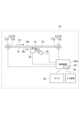
- FIG. 1 is a diagram schematically showing the configuration of a thickness distribution measuring device according to an embodiment.
- FIG. 2 is a perspective view showing a light source section and a light detection section.
- FIG. 3 is a cutaway perspective view showing the internal structure of the photodetector.
- FIG. 4 is a plan view of the image sensor.
- FIG. 5 is an example of image data obtained by the image sensor.
- FIG. 6 is a diagram showing the configuration of the internal circuit of the image sensor.
- FIG. 7 is a diagram showing an example of the configuration of each pixel.
- FIG. 8 is a perspective view schematically showing the lens array.
- FIG. 9 is a perspective view schematically showing the lens array.
- FIG. 10 is a diagram schematically showing the configuration of the control device.
- FIG. 1 is a diagram schematically showing the configuration of a thickness distribution measuring device according to an embodiment.
- FIG. 2 is a perspective view showing a light source section and a light detection section.
- FIG. 3 is a
- FIG. 11 is a diagram schematically showing an example of the hardware configuration of the control device.
- FIG. 12 is a diagram schematically showing how light is attenuated when passing through an object.
- FIG. 13 is a graph showing the relationship shown in equation (1).
- FIG. 14 is a flowchart illustrating a thickness distribution measurement method according to one embodiment.
- FIG. 15 is a perspective view showing, as a comparative example, a plurality of reduction optical type measurement units arranged side by side in the width direction of the object.
- Part (a) of FIG. 16 shows an example of an image acquired through a high-magnification lens.
- Part (b) of FIG. 16 shows an example of an image acquired through a 1-magnification lens.
- FIG. 17 is a cutaway perspective view showing the internal structure of the photodetector as a first modification.
- FIG. 18 is a diagram schematically showing how light emitted from an object passes through an optical filter group. Parts (a) and (b) of FIG. 19 are graphs representing the relationship shown in equation (1) for each wavelength.
- FIG. 20 is a diagram schematically showing the configuration of a thickness distribution measuring device according to a second modification.
- FIG. 21 is a diagram showing an example of the configuration of each pixel of the image sensor of the second modification.
- FIG. 22 is a diagram schematically showing the configuration of a thickness distribution measuring device according to a third modification.
- FIG. 23 is an example of image data obtained by the image sensor.
- FIG. 20 is a diagram schematically showing the configuration of a thickness distribution measuring device according to a second modification.
- FIG. 21 is a diagram showing an example of the configuration of each pixel of the image sensor of the second modification.
- FIG. 22 is a diagram schematically showing the configuration of
- FIG. 24 is a diagram schematically showing the configuration of a thickness distribution measuring device according to a fourth modification.
- FIG. 25 is a diagram schematically showing the configuration of a thickness distribution measuring device according to a fifth modification.
- FIG. 26 is a perspective view showing a part of the configuration of the thickness distribution measuring device.
- FIG. 27 is a diagram showing a specific configuration of the thickness measuring section.
- FIG. 28 is a diagram for explaining the principle of thickness measurement, and schematically shows a cross section of the object. Parts (a), (b), and (c) of FIG. 29 are graphs showing the relationship between the intensity and wavelength of reflected light after interference.
- FIG. 30 is a plan view showing measurement lines by the thickness measurement section.
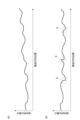
- Part (a) of FIG. 31 is a graph showing an example of the thickness measurement result when the calculation unit does not correct the relative thickness measurement value.
- Part (b) of FIG. 31 is a graph showing an example of the thickness measurement result when the calculation unit corrects the relative thickness measurement value.
- FIG. 1 is a diagram schematically showing the configuration of a thickness distribution measuring device 1A according to an embodiment of the present disclosure.
- the thickness distribution measuring device 1A is a device that obtains information regarding the relative thickness distribution of the object B.
- the relative thickness distribution here refers to the relative thickness distribution of the object B in the width direction of the object B.
- the object B is a plate-like object or a sheet-like object having a first surface Ba and a second surface Bb facing opposite to the first surface Ba.
- the object B is a polymer film being transported, cloth such as fabric or nonwoven fabric, paper, a substrate, or the like.
- the object B of this embodiment is made of a single layer (single material) and does not have a structure in which a plurality of layers are laminated.
- the width direction of the object B means a direction that intersects both the conveyance direction D1 and the thickness direction D3.
- the width direction of the object B is orthogonal to both the conveyance direction D1 and the thickness direction D3.
- the thickness direction D3 is, for example, along the vertical direction.
- the thickness distribution measuring device 1A of the present embodiment includes a transport section 10, a light source section 20, a light detection section 30, a control device 40, an input device 54, and a monitor 55. Be prepared.
- the transport unit 10 transports the object B in a transport direction D1 along the first surface Ba and the second surface Bb.
- the conveyance section 10 is, for example, a roller conveyor, and includes a plurality of roller pairs 11 and a drive section (not shown) such as a motor that rotationally drives the plurality of roller pairs 11.
- Each of the plurality of roller pairs 11 includes a pair of rollers 11a and 11b having a rotation axis extending in the width direction of the object B.
- the object B is conveyed while being sandwiched between the rollers 11a and 11b as the rollers 11a and 11b rotate in opposite directions.
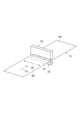
- FIG. 2 is a perspective view showing the light source section 20 and the light detection section 30.
- the light source unit 20 is arranged at a position facing one of the first surface Ba and the second surface Bb of the object B.
- the light source section 20 is arranged at a position facing the second surface Bb.
- the light source unit 20 irradiates a region R1 extending in the width direction D2 of the object B being transported with light La (see FIG. 1).
- the region R1 extends from one end edge of the object B in the width direction D2 to the other end edge.
- the light source section 20 has, for example, a configuration in which a plurality of light emitting elements are arranged along the width direction D2.
- the light emitting element is exemplified by a light emitting diode (LED), but is not limited thereto.
- the light emission wavelength and the light emission intensity of the plurality of light emitting elements are the same among the plurality of light emitting elements.
- the light La output from the light source section 20 is temporally continuous light.
- the wavelength of the light La may be included in the visible range or may be included in the near-infrared range.
- the light detection unit 30 is arranged at a position facing the other of the first surface Ba and the second surface Bb of the object B.
- the photodetector 30 is arranged at a position facing the first surface Ba.
- the light detection section 30 faces the light source section 20 with the object B in between.
- the light detection unit 30 detects the emitted light Lb from the object B irradiated with the light La.
- the light Lb emitted from the object B is the light La that has passed through the object B.
- FIG. 3 is a cutaway perspective view showing the internal structure of the photodetector 30.
- the photodetector 30 includes a housing 31, an image sensor 32, a lens array 33, a circuit board 34, and holding members 318 and 319.
- the housing 31 is a hollow container that has a rectangular parallelepiped appearance and extends along the width direction D2.
- the housing 31 includes a top plate 311, a bottom plate 312, and side plates 313 and 314.
- the top plate 311 and the bottom plate 312 face each other in the thickness direction D3.
- the side plate 313 extends along the thickness direction D3 and connects one edge of the top plate 311 in the conveyance direction D1 and one edge of the bottom plate 312 in the conveyance direction D1.
- the side plate 314 extends along the thickness direction D3 and connects the other edge of the top plate 311 in the conveyance direction D1 and the other edge of the bottom plate 312 in the conveyance direction D1.
- the housing 31 houses the image sensor 32, the lens array 33, the circuit board 34, and the holding members 318 and 319.
- a slit 315 extending along the width direction D2 is formed in the bottom plate 312 of the housing 31. The emitted light Lb from the object B passes through the slit 315 and reaches the inside of the housing 31 .
- FIG. 4 is a plan view of the image sensor 32.
- the image sensor 32 is, for example, a line scan sensor, and includes a pixel portion 321 whose longitudinal direction is the width direction D2.
- the pixel section 321 includes a plurality of pixels 322 arranged at least along the width direction D2.
- Each pixel 322 includes a photodiode.
- the image sensor 32 detects the intensity of the emitted light Lb for each pixel 322 and generates image data.
- the image sensor 32 repeatedly generates such image data at a predetermined time period.
- FIG. 5 is an example of image data obtained by the image sensor 32.
- the image sensor 32 outputs the generated image data to the control device 40.
- the image sensor 32 is mounted on a circuit board 34.
- the circuit board 34 is attached and fixed to the top plate 311 such that the mounting surface 34a on which the image sensor 32 is mounted faces the bottom plate 312, and the surface opposite to the mounting surface 34a faces the top board 311. There is.
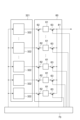
- FIG. 6 is a diagram showing the configuration of the internal circuit of the image sensor 32.
- the image sensor 32 includes a pixel section 321 in which a plurality of pixels 322 are arranged along the width direction D2.
- the plurality of pixels 322 have a common configuration.
- the image sensor 32 further includes a readout circuit 60 and a sensor control section 70.
- the readout circuit 60 and pixel section 321 of the image sensor 32 are controlled by the control device 40 and the sensor control section 70.
- the image sensor 32 sequentially outputs voltage values corresponding to the amount of light incident on each pixel 322 from the readout circuit 60 to the control device 40 via the video line 81.
- the readout circuit 60 includes a plurality of hold circuits 61, a plurality of switches 62, and a plurality of switches 63 that correspond one-to-one with each pixel 322.
- Each hold circuit 61 is connected to the output end of the pixel 322 via a corresponding switch 62.
- Each hold circuit 61 holds the voltage value that was output from the pixel 322 immediately before the corresponding switch 62 changed from the on state to the off state.
- Each hold circuit 61 is connected to a video line 81 via a corresponding switch 63.
- Each hold circuit 61 outputs the held voltage value to the video line 81 when the corresponding switch 63 is in the on state.
- the plurality of switches 62 are controlled by control signals given from the sensor control unit 70, and are turned on and off at the same timing.
- the plurality of switches 63 are controlled by another control signal given from the sensor control unit 70 and are sequentially turned on for a certain period of time.
- the sensor control unit 70 not only controls on/off of each of the plurality of switches 62 and the plurality of switches 63 of the readout circuit 60, but also controls the operation of each of the plurality of pixels 322.
- FIG. 7 is a diagram showing an example of the configuration of each pixel 322.
- Each pixel 322 includes a photodiode 64, a MOS transistor 65, a MOS transistor 66, and a source follower amplifier 67.
- Source follower amplifier 67 includes a MOS transistor 671, an operation control switch 672, and a current source 673.
- the photodiode 64 generates charges in response to incident light.
- the anode of the photodiode 64 is connected to a second reference potential input terminal 92 into which a second reference potential (eg, ground potential) is input.
- the gate of the MOS transistor 671 is connected to the cathode of the photodiode 64 via the MOS transistor 65, and serves as a first reference potential input terminal to which a first reference potential (for example, power supply potential) is input via the MOS transistor 66.
- the drain of the MOS transistor 671 is connected to the first reference potential input terminal 91.
- the operation control switch 672 is provided between the source of the MOS transistor 671 and the connection node 674. Operation control switch 672 may be configured with a MOS transistor. Current source 673 is provided between connection node 674 and second reference potential input terminal 92. Current source 673 may include a MOS transistor. Current source 673 may be configured with a resistor.
- each of the MOS transistors 65 and 66 is controlled by a control signal given from the sensor control section 70.
- MOS transistor 66 When MOS transistor 66 is on, the gate potential of MOS transistor 671 is initialized.
- MOS transistors 65 and 66 are in the on state, charge accumulation in the junction capacitance of photodiode 64 is initialized.
- the MOS transistor 65 is on and the MOS transistor 66 is off, the gate potential of the MOS transistor 671 corresponds to the amount of light incident on the photodiode 64.
- On/off of the operation control switch 672 is also controlled by a control signal given from the sensor control section 70. While the operation control switch 672 is in the on state, a current flows from the first reference potential input terminal 91 to the second reference potential input terminal 92 via the MOS transistor 671, the operation control switch 672, and the current source 673. As a result, a voltage value corresponding to the gate potential of MOS transistor 671 is output from connection node 674. On the other hand, during the period when the operation control switch 672 is in the off state, no current flows through the source follower amplifier 67, and the source follower amplifier 67 is in a power down state.
- Each pixel 322 further includes a capacitive element 68 and a charge amplifier 69.
- Charge amplifier 69 includes an amplifier 691, a capacitor section 692, and a reset switch 693.
- the amplifier 691 has an inverting input terminal, a non-inverting input terminal, and an output terminal. A fixed bias potential is input to the non-inverting input terminal of the amplifier 691.
- the inverting input terminal of amplifier 691 is connected to connection node 674 of source follower amplifier 67 via capacitive element 68 .
- the capacitor section 692 is provided between the inverting input terminal and the output terminal of the amplifier 691.
- the capacitor section 692 accumulates an amount of charge corresponding to the voltage value output from the source follower amplifier 67.
- the capacitive section 692 includes a capacitive element 694.
- the reset switch 693 is provided in parallel to the capacitor section 692 between the inverting input terminal and the output terminal of the amplifier 691.
- the reset switch 693 When the reset switch 693 is in the on state, charge accumulation in the capacitor section 692 is reset.
- the reset switch 693 is in the off state, a voltage value corresponding to the amount of charge accumulated in the capacitor section 692 and the capacitance value of the capacitor section 692 is output from the output terminal of the amplifier 691.
- On/off of the reset switch 693 is controlled by a control signal given from the sensor control section 70.
- the holding members 318 and 319 are fixed to the housing 31 inside the housing 31.
- the holding members 318 and 319 are arranged on both sides of the lens array 33 in the transport direction D1, and hold the lens array 33 on both sides.
- the lens array 33 is an example of a lens section in this embodiment.
- FIG. 8 is a perspective view schematically showing the lens array 33.
- the lens array 33 has a plurality of lenses 331 arranged along the width direction D2.
- the magnification of each of the plurality of lenses 331 is equal to the magnification, and in one example, the magnification is 1.
- the magnification of each of the plurality of lenses 331 is equal to the same magnification, it is not strictly necessary to be equal to one, and for example, if it is 0.9 times or more and 1.1 times or less, it is acceptable as the same magnification.
- Each of the plurality of lenses 331 is, for example, a glass rod lens.
- the light incident end surface 332 of each lens 331 faces the first surface Ba of the object B (see FIG.
- each lens 331 faces the pixel section 321 (see FIG. 4) of the image sensor 32.
- Each lens 331 does not necessarily have to correspond one-to-one with each pixel 322 of the pixel section 321.
- the lens array 33 focuses and images the emitted light Lb on the pixel portion 321 of the image sensor 32.
- the magnification of the image captured on the image sensor 32 is the same as or smaller than the magnification of the object B, which is the subject.
- a lens array 33 with multiple rows (for example, two rows or three rows) as shown in FIG. 9 is better than a lens array 33 with a single row as shown in FIG. Collection efficiency can be further improved.
- the optical axis of the lens array 33 is along the normal line of the surface facing the photodetector 30 of the first surface Ba and the second surface Bb of the object B. In the illustrated example, the optical axis of the lens array 33 is along the normal to the first surface Ba. In other words, the optical axis of the lens array 33 is perpendicular to the surface of the first surface Ba and second surface Bb of the object B that faces the photodetector 30.
- the control device 40 is electrically connected to the transport section 10, the light source section 20, and the light detection section 30.
- FIG. 10 is a diagram schematically showing the configuration of the control device 40.
- the control device 40 includes a conveyance control section 41 that controls the operation of the conveyance section 10 such as the conveyance speed, a light source control section 42 that controls the operation of the light source section 20, and a detection control section 43 that controls the operation of the light detection section 30. and an arithmetic unit 44.
- the calculation unit 44 receives image data as a result of detecting the emitted light Lb from the light detection unit 30.
- the calculation unit 44 obtains information regarding the distribution of the relative thickness of the region R1 of the object B in the width direction D2 based on the image data.
- the control device 40 may be, for example, a personal computer; a smart device such as a smartphone or a tablet terminal; or a computer having a processor such as a cloud server. At least one of the transport control section 41, the light source control section 42, and the detection control section 43 may be configured by a computer separate from the calculation section 44.
- FIG. 11 is a diagram schematically showing an example of the hardware configuration of the control device 40.
- the control device 40 is physically configured as a normal computer including a processor (CPU) 401, main storage devices such as ROM 402 and RAM 403, and auxiliary storage device 404 such as a hard disk. obtain.
- the processor 401 of the computer can realize each function of the control device 40 described above by reading the program stored in the ROM 402 or the auxiliary storage device 404. Therefore, the program causes the processor 401 of the computer to operate as the transport control section 41, the light source control section 42, the detection control section 43, and the calculation section 44 in the control device 40.
- the storage device that stores the program may be a non-temporary recording medium. Examples of the recording medium include a recording medium such as a flexible disk, CD, or DVD, a recording medium such as a ROM, a semiconductor memory, or a cloud server.
- the input device 54 is electrically connected to the control device 40.
- the operator inputs various settings regarding the conveyance control section 41, light source control section 42, detection control section 43, and calculation section 44 through the input device 54.
- the input device 54 can be, for example, a keyboard, a mouse, or a touch panel.
- Monitor 55 is electrically connected to control device 40 .
- the monitor 55 displays information regarding the relative thickness distribution determined by the calculation unit 44.
- the monitor 55 may be a touch screen including the input device 54 which is a touch panel.
- the calculation unit 44 shown in FIG. 10 obtains information regarding the distribution of the relative thickness of the region R1 of the object B in the width direction D2 based on the image data.
- the information regarding the relative thickness distribution may be a relative thickness distribution, or may be some numerical group related to the relative thickness distribution.
- the information regarding the relative thickness distribution may be the image data itself. This is because the light intensity of the emitted light Lb appearing in the image data has a correlation with the thickness of the object B.
- the relative thickness refers to a relative value at another position with respect to the value at a certain position in the width direction D2. Therefore, the calculation unit 44 does not necessarily need to accurately calculate the absolute thickness at each position in the width direction D2.
- FIG. 12 is a diagram schematically showing how the light La is attenuated when passing through the object B.
- the thickness of the arrow in the figure represents the light intensity.
- the light La emitted from the light source section 20 passes through the object B and becomes the emitted light Lb.
- the emitted light Lb is detected by the image sensor 32.
- the absorption coefficient of the object B is ⁇
- the thickness of the object B is x
- the vertical axis represents the ratio (I/I 0 ) of the light intensity I of the emitted light Lb to the light intensity I 0 of the light La
- the horizontal axis represents the thickness x of the object B. From this relationship, for example, when the value of the ratio (I/I 0 ) is P 1 , the thickness x of the object B is x 1 , and when the value of the ratio (I/I 0 ) is P 2 , the thickness x of the object B is The thickness x is uniquely determined based on the magnitude of the ratio (I/I 0 ), such as the thickness x is x 2 .
- the thickness x is determined based on the light intensity I of the emitted light Lb. Even if the light intensity I0 of the light La is unknown, if the irradiation intensity from the plurality of light emitting elements of the light source section 20 is uniform, the relative thickness distribution in the width direction D2 can be determined.
- FIG. 14 is a flowchart showing the thickness distribution measurement method according to this embodiment.
- This thickness distribution measuring method can be implemented using the above-mentioned thickness distribution measuring device 1A.
- step ST1 the conveyance direction along the first surface Ba and the second surface Bb of the object B having the first surface Ba and the second surface Bb facing opposite to the first surface Ba. Start transport to D1.
- step ST2 irradiation of light La to a region R1 of the object B being transported, which extends in the width direction D2 intersecting the transport direction D1, is started.
- detection of the emitted light Lb from the object B irradiated with the light La is started.
- step ST3 the image sensor 32 and the lens array 33 are used.
- the image sensor 32 has the pixel section 321 including at least a plurality of pixels 322 arranged in the width direction D2, detects the intensity of the emitted light Lb for each pixel 322, and outputs image data.
- the lens array 33 has a plurality of lenses 331 arranged in the width direction D2, and focuses and images the emitted light Lb on the pixel portion 321 of the image sensor 32.
- step ST4 information regarding the distribution of the relative thickness of region R1 of object B in width direction D2 is obtained based on the detection result in step ST3.
- the thickness distribution measuring device 1A and the thickness distribution measuring method of this embodiment described above will be explained.
- the light transmittance of the object B is uniform, the amount of light absorbed inside the object B depends on the thickness of the object B. Therefore, by irradiating the region R1 extending in the width direction D2 of the object B with the light La and detecting the light intensity I of the emitted light Lb from the region R1, the relative thickness of the object B can be measured. The distribution of the object B in the width direction D2 can be measured.
- the thickness distribution measuring device 1A and the thickness distribution measuring method of the present embodiment the light intensity I of the emitted light Lb is detected using the image sensor 32 having a plurality of pixels 322 arranged in the width direction D2. Therefore, compared to the spectral interference method in which a plurality of measurement units are arranged side by side in the width direction D2 of the object B, the configuration can be simplified.
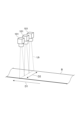
- FIG. 15 is a perspective view showing a configuration in which a plurality of reduction optical type measurement units 101 are arranged side by side in the width direction D2 of the object B, as a comparative example.
- the reduction optical type measurement unit 101 has a lens with high magnification (that is, with a magnification greater than the same magnification).
- the collection efficiency of the emitted light Lb is kept low.
- Part (a) of FIG. 16 shows an example of an image obtained through a high-magnification lens and in which the collection efficiency of the emitted light Lb is low.
- the emitted light Lb is focused and imaged on the image sensor 32 using a lens array 33 having a plurality of equal-magnification lenses 331 arranged in the width direction D2.
- the lens array 33 close to the object B, thereby increasing the collection efficiency of the emitted light Lb and increasing the detection sensitivity.
- Part (b) of FIG. 16 shows an example of an image that is acquired through a 1-magnification lens and has a high collection efficiency of the emitted light Lb.
- the light source section 20 is arranged to face one of the first surface Ba and the second surface Bb
- the light detection section 30 is arranged to face the other of the first surface Ba and the second surface Bb. may be placed facing the surface of the
- the emitted light Lb from the object B may be light that has passed through the object B.
- the light source section 20 and the light detection section 30 are arranged so that the object B is sandwiched between the light source section 20 and the light detection section 30, and the light that has passed through the object B is emitted from the object B.
- the light intensity I of the emitted light Lb largely depends on the thickness of the object B. Therefore, the measurement accuracy of relative thickness distribution can be further improved.
- the optical axis of the lens array 33 may be along the normal line of the surface facing the photodetector 30 of the first surface Ba and the second surface Bb.
- the emitted light Lb emitted perpendicularly from the surface of the object B is detected. Therefore, the influence of the polarization state on the light intensity I of the emitted light Lb can be avoided, and the measurement accuracy of the relative thickness distribution can be further improved.
- the plurality of light emitting elements included in the light source section 20 it is preferable to use ones with high directivity so that the light La is incident perpendicularly to the surface of the object B as much as possible.
- FIG. 17 is a cutaway perspective view showing the internal structure of the photodetector 30A as a first modification.
- the photodetection section 30A of this modification further includes an optical filter section 35 in addition to the configuration of the photodetection section 30 of the above embodiment.
- the optical filter section 35 is provided on the pixel section 321 of the image sensor 32. The emitted light Lb from the object B passes through the optical filter section 35 and then enters the pixel section 321 of the image sensor 32.
- FIG. 18 is a diagram schematically showing how the emitted light Lb from the object B passes through the optical filter section 35.
- the optical filter section 35 has a plurality of optical filter groups 36 arranged along the width direction D2.
- Each optical filter group 36 includes a plurality of optical filters 37-39.
- One of the optical filters 37 to 39 is an example of the first optical filter in this modification, and the other one of the optical filters 37 to 39 is an example of the second optical filter in this modification.
- the optical filter 37 is provided on some of the pixels 322 of the image sensor 32 .
- the optical filter 38 is provided on some of the pixels 322 of the image sensor 32 .
- the optical filter 39 is provided on the remaining pixels 322 among the plurality of pixels 322 of the image sensor 32.
- the optical filter 37 has a transmission wavelength band centered on wavelength ⁇ 1 .
- Optical filter 38 has a transmission wavelength band centered at wavelength ⁇ 2 which is greater than wavelength ⁇ 1 .
- the optical filter 39 has a transmission wavelength band centered on wavelength ⁇ 1 and wavelength ⁇ 3 which is larger than wavelength ⁇ 2 .
- the wavelength ⁇ 1 is not included in the transmission wavelength band of the optical filters 38 and 39.
- the wavelength ⁇ 2 is not included in the transmission wavelength band of the optical filters 37 and 39.
- the wavelength ⁇ 3 is not included in the transmission wavelength band of the optical filters 37 and 38.
- a wavelength component centered around the wavelength ⁇ 1 passes through the optical filter 37 and enters the pixel 322 .
- a wavelength component centered at wavelength ⁇ 2 passes through optical filter 38 and enters another pixel 322 .
- the wavelength component centered at wavelength ⁇ 3 passes through the optical filter 39 and enters another pixel 322 . In this way, the light intensity I of the emitted light Lb is detected for each wavelength.
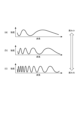
- Parts (a) and (b) of FIG. 19 are graphs representing the relationship shown in equation (1) for each wavelength.
- curve G1 corresponds to wavelength ⁇ 1
- curve G2 corresponds to wavelength ⁇ 2
- curve G3 corresponds to wavelength ⁇ 3 .
- Curves G1 to G3 in part (b) of FIG. 19 are the same as curves G1 to G3 in part (a) of FIG. Since the absorption coefficient ⁇ depends on the wavelength, the curves differ depending on the wavelength. In this example, it is assumed that the larger the wavelength, the smaller the absorption coefficient ⁇ , that is, the larger the light transmittance. Assume now that the light intensity of the light La is a predetermined magnitude I0 and is known.
- the value of the ratio (I/I 0 ) is P 11 at the wavelength ⁇ 1 ; P 12 at wavelength ⁇ 2 and P 13 at wavelength ⁇ 3 .
- the calculation unit 44 calculates the calculated thickness of the object B to be x 1 no matter which value of the ratio (I/I 0 ) is used at any wavelength. It is assumed that after that, the light intensity of the light La fluctuates from a predetermined magnitude I0 . At this time, the light intensity I of the emitted light Lb changes, so as shown in part (b) of FIG.
- the value of the ratio (I/I 0 ) changes from P 11 to P 21 at the wavelength ⁇ 1 . , changes from P 12 to P 22 at wavelength ⁇ 2 , and changes from P 13 to P 23 at wavelength ⁇ 3 .
- the calculation result of the thickness of the object B by the calculation unit 44 is different for each wavelength: x 11 at the wavelength ⁇ 1 , x 12 at the wavelength ⁇ 2 , and x 13 at the wavelength ⁇ 3 . From this, the operator can know that the light intensity of the light La output from the light source section 20 has changed over time, and can know the timing to adjust the light intensity of the light La or the parameters of the formula. can.
- each optical filter group 36 includes three optical filters 37 to 39, but the number of optical filters in each optical filter group 36 may be two, four or more. It's okay.
- each optical filter group 36 includes only two optical filters 37 and 38, the optical filter 37 is provided on some of the pixels 322 of the image sensor 32, and the optical filter 38 is provided on some of the pixels 322 of the image sensor 32. It is provided on the remaining pixels 322 among the plurality of pixels 322 of the sensor 32 .
- FIG. 20 is a diagram schematically showing the configuration of a thickness distribution measuring device 1B according to a second modification.
- the thickness distribution measuring device 1B of this modification further includes a light source section 21 different from the light source section 20 in addition to the configuration of the thickness distribution measuring device 1A of the above embodiment.
- the light source section 21 is arranged at a position facing a surface (in the illustrated example, the first surface Ba) opposite to the surface facing the light source section 20 among the first surface Ba and the second surface Bb of the object B. There is.
- the light source unit 21 irradiates the region R1 or another region extending in the width direction D2 (see FIG. 2) of the object B being transported with light Lc.
- the light source section 21 has, for example, a configuration in which a plurality of light emitting elements are arranged along the width direction D2.
- the light emitting element is exemplified by a light emitting diode (LED), but is not limited thereto.
- the light emission wavelength and the light emission intensity of the plurality of light emitting elements are the same among the plurality of light emitting elements.
- the light source section 21 outputs light Lc that is continuous light.
- the wavelength of the light Lc may be included in the visible range or may be included in the near-infrared range.
- the light intensity of the light Lc may be equal to or different from the light intensity of the light La.
- the wavelength of the light Lc may be equal to or different from the wavelength of the light La.
- the thickness distribution measuring device 1B of this modification includes a photodetector 30B instead of the photodetector 30 of the above embodiment.
- the photodetector 30B is different from the photodetector 30 of the above embodiment in that the image sensor 32 is configured to be able to switch gain values for amplifying signals output from a plurality of pixels; This point coincides with the photodetector 30 of the above embodiment.
- the light detection section 30B detects the emitted light Lb from the object B irradiated with the light La by the light source section 20, and additionally detects the emitted light Lb from the object B irradiated with the light Lc by the light source section 21. To detect.
- the irradiation timing of the light La and the irradiation timing of the light Lc are controlled by the light source control unit 42 (see FIG. 10) of the control device 40 and are different from each other.
- the gain value of the image sensor 32 is controlled to be different when the light La is irradiated from the light source section 20 and when the light Lc is irradiated from the light source section 21. That is, if the light intensity I of the emitted light Lb when the light La is irradiated is larger than the light intensity I of the emitted light Lb when the light Lc is irradiated, the light La is emitted from the light source section 20.
- the gain value of the image sensor 32 when being irradiated with the light Lc is controlled to be smaller than the gain value of the image sensor 32 when being irradiated with the light Lc.
- the light intensity I of the emitted light Lb when the light La is irradiated is smaller than the light intensity I of the emitted light Lb when the light Lc is emitted, the light La is not emitted from the light source section 20.
- the gain value of the image sensor 32 when the light Lc is being irradiated is controlled so as to be larger than the gain value of the image sensor 32 when the light Lc is being irradiated. Thereby, the fluctuation width of the signal output from the image sensor 32 can be reduced.
- FIG. 21 is a diagram showing a configuration example of each pixel 322A of the image sensor 32 of this modification.
- the pixel 322A has the same configuration and function as the pixel 322 of the above embodiment except for the following points. That is, the pixel 322A of this modification has a capacitor section 692A instead of the capacitor section 692 (see FIG. 7) of the above embodiment.
- Capacitor section 692A is provided between the inverting input terminal and output terminal of amplifier 691.
- the capacitor section 692A stores an amount of charge corresponding to the voltage value output from the source follower amplifier 67.
- the capacitance value of the capacitor section 692A is variable.
- the capacitor section 692A is configured to include a capacitor element 694, a capacitor element 695, and a switch 696, so that the capacitance value can be made variable. Capacitive element 695 and switch 696 are connected in series with each other. The series circuit consisting of the capacitive element 695 and the switch 696 and the capacitive element 694 are provided in parallel with each other. Depending on whether the switch 696 is on or off, the capacitance value of the capacitor section 692A differs, and the gain (gain value) of the charge amplifier 69 differs. On/off of the switch 696 is controlled by a control signal given from the sensor control section 70.
- the image sensor 32 may be configured to be able to switch the gain value for amplifying the signals output from the plurality of pixels 322A.
- the gain value By setting the gain value to an appropriate value, the S/N ratio is improved and the measurement accuracy of the relative thickness distribution is improved.
- a light source section 21 separate from the light source section 20 is provided, and the light source section 21 is connected to the surface facing the light source section 20 of the first surface Ba and second surface Bb of the object B. may be arranged at a position facing the opposite surface, and may irradiate a region of the object B being transported along the width direction D2 with the light Lc.
- the photodetector 30B further detects the light Lb emitted from the object B irradiated with the light Lc by the light source 21. May be detected.
- FIG. 22 is a diagram schematically showing the configuration of a thickness distribution measuring device 1C according to a third modification.
- the thickness distribution measuring device 1C of this modification differs from the thickness distribution measuring device 1A of the above embodiment in that the optical axis of the lens array 33 of the photodetector 30 is inclined.
- the thickness distribution measuring device 1C of this modification includes a control device 40A instead of the control device 40 of the above embodiment.
- the control device 40A includes a flaw detection unit that detects flaws that occur on the surface of the object B. It further has a section 45.
- the optical axis of the lens array 33 in this modification is the one of the first surface Ba and the second surface Bb of the object B that faces the photodetector 30 (the first surface Ba in the illustrated example). Tilt to the normal.
- the angle of inclination of the optical axis of the lens array 33 with respect to the normal line is, for example, 5° or more, and may be 45° or more. The angle of inclination may be 80° or less. The larger the inclination angle of the optical axis of the lens array 33 with respect to the normal line, the easier it becomes to detect a flaw, which will be described later.
- the light detection unit 30 detects the emitted light Lb from the object B irradiated with the light La.
- the calculation unit 44 obtains information regarding the distribution of the relative thickness of the object B in the width direction D2 based on the image data obtained by the image sensor 32, as in the above embodiment.
- the flaw detection unit 45 detects flaws that occur on the surface of the object B based on the image data obtained by the image sensor 32.
- FIG. 23 is an example of image data obtained by the image sensor 32.
- This image data includes an image of a flaw E generated on the surface of the object B.
- the scratches E generated on the surface of the object B can be made more clearly by detecting the scattered light by tilting the optical axis of the lens array 33 with respect to the normal to the surface of the object B facing the light detection unit 30. appears in the image data. Therefore, according to this modification, it is possible to detect flaws present on the surface of the object B at the same time as measuring the relative thickness distribution.
- the thickness distribution measuring device 1C may include a control device 40 without the flaw detection section 45 instead of the control device 40A having the flaw detection section 45. That is, the optical axis of the lens array 33 may be tilted even if the purpose is only to obtain information regarding the distribution of the relative thickness of the object B in the width direction D2 without detecting the flaw E.
- one photodetector 30 is used to acquire information regarding the relative thickness distribution and to detect flaws E generated on the surface of the object B, but separate photodetectors are used for each. 30 may be used.
- the optical axis of the lens array 33 of the photodetector 30 for acquiring information regarding the relative thickness distribution is made parallel to the normal to the surface of the object B, and the optical axis for detecting the flaw E is The optical axis of the lens array 33 of the section 30 may be inclined with respect to the normal to the surface of the object B.
- FIG. 24 is a diagram schematically showing the configuration of a thickness distribution measuring device 1D according to a fourth modification.
- the thickness distribution measuring device 1D of this modification has the point that the light detection section 30 is arranged facing the same surface (second surface Bb in the illustrated example) as the surface of the object B that faces the light source section 20.
- This embodiment differs from the embodiment described above, and is identical to the embodiment described above in other respects.
- the light Lb emitted from the object B detected by the photodetector 30 is light emitted from the same surface as the surface into which the light La is incident.
- This emitted light Lb includes light reflected on a surface opposite to the surface on which the light La is incident, that is, light that passes through the inside of the object B. Therefore, the light intensity of the emitted light Lb changes depending on the thickness of the object B.
- the light detection section 30 is disposed facing the same surface as the surface of the object B that faces the light source section 20 as in this modification, the light detection section 30 is based on the image data obtained by the image sensor 32. Thus, information regarding the distribution of the relative thickness of the object B in the width direction D2 can be obtained. Also in this modification, the optical axis of the lens array 33 may be inclined with respect to the normal to the surface of the object B facing the photodetector 30, as in the third modification. [Fifth modification]
- FIG. 25 is a diagram schematically showing the configuration of a thickness distribution measuring device 1E according to a fifth modification.
- FIG. 26 is a perspective view showing a part of the configuration of the thickness distribution measuring device 1E.
- the thickness distribution measuring device 1E of this modification further includes a thickness measuring section 50 in addition to the configuration of the thickness distribution measuring device 1A of the above embodiment.
- the thickness measurement unit 50 locally measures the absolute thickness of the object B.
- the thickness measurement unit 50 measures the absolute thickness of the object B using, for example, a spectral interference method.
- the thickness measurement section 50 includes a measurement unit 56 and a control section 57.
- the measurement unit 56 is arranged to face the first surface Ba, the second surface Bb, or both of the first surface Ba and the second surface Bb of the object B.
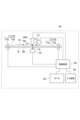
- FIG. 27 is a diagram showing a specific configuration of the thickness measuring section 50.
- the thickness measurement section 50 includes a light irradiation section 51, a light detection section 52, and a calculation section 53.
- the light irradiation unit 51 irradiates the first surface Ba or the second surface Bb of the object B with light.
- the light irradiation section 51 includes a light source 511, a light guiding member 512, and a light emitting section 513.
- the light source 511 generates incoherent light L1.
- the wavelength band of the light L1 may be in the visible wavelength range, and in that case, the light source 511 may be a lamp-based light source that emits white light, a white LED, or the like.
- the wavelength band of the light L1 may be a wavelength band ranging from a visible wavelength range to a near-infrared wavelength range.
- the wavelength band of the light L1 may have a substantially flat (broad) spectrum in the infrared wavelength range.
- the light L1 can be transmitted even if the object B has a tint, so the influence of the tint of the object B on the measurement results can be reduced. can be reduced.
- various light emitting elements such as an ASE (Amplified Spontaneous Emission) light source, an LED, and an SLD (Super Luminescent Diode) may be used as the light source 511.
- a white light source and an optical component such as an optical film may be combined with each other.
- the light guide member 512 has one end optically coupled to the light source 511 and guides the light L1 emitted from the light source 511.
- a light guide, an optical fiber, or the like is suitably used as the light guide member 512.
- the light emitting section 513 is optically coupled to the other end of the light guide member 512, and irradiates the object B with the light L1 guided by the light guide member 512.
- the light emitting section 513 is housed in the measurement unit 56 and is arranged at a position facing the first surface Ba or the second surface Bb of the object B.
- the light detection unit 52 detects the intensity (spectrum) of each wavelength of the emitted light L2 from the object B.
- the light detection section 52 includes a light incidence section 521, a light guide member 522, and a spectral detection section 523.
- the light L2 emitted from the object B enters the light incidence section 521.
- the light incidence section 521 is housed in the measurement unit 56 and is arranged to face the same surface of the object B that faces the light emission section 513 .
- the light entrance section 521 may be arranged to face a surface of the object B that is opposite to the surface of the object B that faces the light output section 513.
- the optical axis of the light output section 513 and the optical axis of the light input section 521 may be parallel to each other, or may intersect with each other at the object B. Alternatively, the optical axis of the light emitting section 513 and the optical axis of the light incident section 521 may coincide with each other.
- the light guide member 522 has one end optically coupled to the light incidence section 521 and guides the output light L2 that has entered the light incidence section 521.
- a light guide, an optical fiber, or the like is used as the light guide member 522.
- the spectral detection unit 523 is optically coupled to the other end of the light guide member 522, and spectrally spectra the output light L2 guided by the light guide member 522 into wavelengths, and detects the intensity of the light for each wavelength. .
- the spectral detection unit 523 is preferably configured by, for example, a combination of a spectral optical element and an image sensor.
- the spectral detection unit 523 outputs the detected light intensity as an electrical signal.
- the spectroscopic optical element is, for example, a prism or a grating element.
- the image sensor is, for example, a line sensor, an area image sensor, a photomultiplier tube, or a photodiode.
- the calculation unit 53 calculates the absolute thickness of the object B based on the detection result of the light detection unit 52. That is, the calculation unit 53 compares the measured spectral reflectance, which is the reflectance for each wavelength obtained based on the detection result in the photodetector 52, and the theoretical spectral reflectance, which is the theoretical reflectance for each wavelength. , and by fitting these to each other, the absolute thickness of the object B is determined. The data regarding the absolute thickness of the object B thus determined is provided to the calculation unit 44.
- the light source 511, the spectral detection section 523, and the calculation section 53 are included in the control section 57.
- FIG. 28 is a diagram for explaining the principle of thickness measurement, and schematically shows a cross section of the object B.
- the incoherent light L1 is incident on the object B
- the light reflected from the first surface Ba of the object B and the light reflected from the second surface Bb of the object B interfere with each other.
- the first surface Ba is a light entrance surface
- the optical path length of the reflected light on the second surface Bb is longer than the optical path length of the reflected light on the first surface Ba by the amount of the optical path inside the object B. . Therefore, a phase difference depending on the thickness of the object B occurs between these reflected lights.
- Parts (a), (b), and (c) of FIG. 29 are graphs showing the relationship between the intensity and wavelength of reflected light after interference.
- Part (a) of FIG. 29 shows a case where the thickness of the object B is thinner than parts (b) and (c).
- Part (c) of FIG. 29 shows a case where the object B is thicker than parts (a) and (b).
- the spectrum of reflected light after interference (reflection spectrum) is wavy due to interference. The interval, or period, of the waves becomes smaller as the thickness of the object B becomes thicker.
- the absolute thickness of the object B can be determined by using the relationship between the reflection spectrum and the thickness of the object B as described above.
- Specific methods include a fast Fourier transform method and a curve fitting method.
- the fast Fourier transform method the reflection spectrum is subjected to fast Fourier transform, and the film thickness is determined from the peak frequency.
- the curve fitting method is a method in which the spectral reflectance determined from the measured reflection spectrum, that is, the measured spectral reflectance, is fitted to the theoretical spectral reflectance calculated from a theoretical formula, and the film thickness is determined from the fitted theoretical spectral reflectance. It is. According to the curve fitting method, even if the thickness of the object B is 1 ⁇ m or less, it can be measured with high accuracy.
- the information regarding the relative thickness distribution of the object B calculated by the calculation unit 44 is influenced by temporal fluctuations in the light intensity of the light La irradiated onto the object B, and the like.
- the calculation unit 44 of this modification corrects the measured value of the relative thickness distribution based on the absolute thickness measured by the thickness measurement unit 50. Specifically, at the point where the absolute thickness is measured by the thickness measurement unit 50, a mathematical formula such as light intensity I 0 is used so that the relative thickness x determined by formula (1) matches the absolute thickness. Correct the size of the parameter in (1).
- the measurement unit 56 may emit the light L1 and detect the emitted light L2 while moving along the width direction D2 of the object B.
- FIG. 30 is a plan view showing the measurement line Q1 by the thickness measurement section 50 in that case.
- the object B is being transported at a constant speed along the transport direction D1. Therefore, when the measurement unit 56 reciprocates at a constant speed along the width direction D2, the trajectory of the measurement points by the thickness measurement section 50 forms a zigzag measurement line Q1, as shown in FIG. Then, the absolute thickness of the object B is measured only on the measurement line Q1.
- the position of the measurement point where the relative thickness of the object B is measured based on the detection result of a certain pixel 322 of the image sensor 32 remains unchanged in the width direction D2. Therefore, the locus of the measurement point where the relative thickness is measured by a certain pixel 322 forms a measurement line Q2 extending along the conveyance direction D1.
- the calculation unit 44 can correct the relative thickness measurement value obtained from the detection result at the one pixel 322 at the point S where the measurement line Q1 and the measurement line Q2 intersect.
- Part (a) of FIG. 31 is a graph showing an example of the measurement result of the thickness x when the calculation unit 44 does not correct the relative thickness measurement value.
- Part (b) of FIG. 31 is a graph showing an example of the measurement result of the thickness x when the calculation unit 44 corrects the relative thickness measurement value.
- the vertical axis represents the relative thickness of the object B at the measurement line Q2
- the horizontal axis represents the position of the object B in the transport direction D1.
- the relative thickness measurement value becomes It gradually increases or decreases due to changes in the characteristics of the light source section 20 over time.
- the parameter for calculating the relative thickness measurement value is Fixed. Therefore, regardless of temporal fluctuations in the light intensity of the light La, it is possible to suppress an increase or decrease in the measured value of the relative thickness.
- each of the plurality of lenses 331 is a rod lens, but each of the plurality of lenses 331 may be a lens of another type, for example, a convex lens.
- 1A, 1B, 1C, 1D, 1E... Thickness distribution measuring device 10... Conveyance section, 11... Roller pair, 11a, 11b... Roller, 20, 21... Light source section, 30, 30A, 30B... Light detection section, 31... Housing, 32... Image sensor, 33... Lens array (lens section), 34... Circuit board, 34a... Mounting surface, 35... Optical filter section, 36... Optical filter group, 37-39... Optical filter, 40, 40A... Control device, 41...Transportation control unit, 42...Light source control unit, 43...Detection control unit, 44...Calculation unit, 45...Flaw detection unit, 50...Thickness measurement unit, 51...Light irradiation unit, 52...Light detection unit, 53...
- Arithmetic unit 54... Input device, 55... Monitor, 56... Measurement unit, 57... Control unit, 60... Readout circuit, 61... Hold circuit, 62, 63... Switch, 64... Photodiode, 65, 66... MOS Transistor, 67... Source follower amplifier, 68... Capacitive element, 69... Charge amplifier, 70... Sensor control section, 81... Video line, 101... Measurement unit, 311... Top plate, 312... Bottom plate, 313, 314...
- Capacitive element 696... Switch, B... Object, Ba... First surface, Bb... Second surface, D1...Conveyance direction, D2...Width direction, D3...Direction, E...Flaw, F...Double-headed arrow, G1-G3...Curve, L1, La, Lc...Light, L2, Lb...Output light, Q1, Q2...Measurement line , R1...area, S...point.
Landscapes
- Physics & Mathematics (AREA)
- General Physics & Mathematics (AREA)
- Health & Medical Sciences (AREA)
- Engineering & Computer Science (AREA)
- Life Sciences & Earth Sciences (AREA)
- Chemical & Material Sciences (AREA)
- Analytical Chemistry (AREA)
- Biochemistry (AREA)
- General Health & Medical Sciences (AREA)
- Textile Engineering (AREA)
- Immunology (AREA)
- Pathology (AREA)
- Length Measuring Devices By Optical Means (AREA)
Priority Applications (5)
| Application Number | Priority Date | Filing Date | Title |
|---|---|---|---|
| EP23795902.8A EP4477990A4 (en) | 2022-04-27 | 2023-03-01 | Thickness distribution measurement device and thickness distribution measurement method |
| JP2024517871A JP7849465B2 (ja) | 2022-04-27 | 2023-03-01 | 厚み分布計測装置および厚み分布計測方法 |
| US18/854,197 US20250244123A1 (en) | 2022-04-27 | 2023-03-01 | Thickness-distribution measurement device and thickness-distribution measurement metho |
| CN202380036244.2A CN119156517A (zh) | 2022-04-27 | 2023-03-01 | 厚度分布测量装置及厚度分布测量方法 |
| KR1020247038019A KR20250006133A (ko) | 2022-04-27 | 2023-03-01 | 두께 분포 계측 장치 및 두께 분포 계측 방법 |
Applications Claiming Priority (2)
| Application Number | Priority Date | Filing Date | Title |
|---|---|---|---|
| JP2022-073083 | 2022-04-27 | ||
| JP2022073083 | 2022-04-27 |
Publications (1)
| Publication Number | Publication Date |
|---|---|
| WO2023210154A1 true WO2023210154A1 (ja) | 2023-11-02 |
Family
ID=88518443
Family Applications (1)
| Application Number | Title | Priority Date | Filing Date |
|---|---|---|---|
| PCT/JP2023/007633 Ceased WO2023210154A1 (ja) | 2022-04-27 | 2023-03-01 | 厚み分布計測装置および厚み分布計測方法 |
Country Status (7)
| Country | Link |
|---|---|
| US (1) | US20250244123A1 (https=) |
| EP (1) | EP4477990A4 (https=) |
| JP (1) | JP7849465B2 (https=) |
| KR (1) | KR20250006133A (https=) |
| CN (1) | CN119156517A (https=) |
| TW (1) | TW202409513A (https=) |
| WO (1) | WO2023210154A1 (https=) |
Families Citing this family (1)
| Publication number | Priority date | Publication date | Assignee | Title |
|---|---|---|---|---|
| CN119915190B (zh) * | 2025-04-02 | 2025-07-29 | 成都沃特塞恩电子技术有限公司 | 晶体生长厚度实时在线测量方法、装置、设备及介质 |
Citations (8)
| Publication number | Priority date | Publication date | Assignee | Title |
|---|---|---|---|---|
| JP2000241125A (ja) * | 1999-02-19 | 2000-09-08 | Nippon Electro Sensari Device Kk | 寸法測定装置 |
| JP2004219108A (ja) * | 2003-01-09 | 2004-08-05 | Dainippon Printing Co Ltd | 着色膜の膜厚ムラ検査方法及び装置 |
| WO2009090871A1 (ja) * | 2008-01-15 | 2009-07-23 | Saki Corporation | 被検査体の検査装置 |
| JP2013190224A (ja) * | 2012-03-12 | 2013-09-26 | Konica Minolta Inc | 厚さ測定装置及び厚さ測定方法 |
| JP2015141176A (ja) | 2014-01-30 | 2015-08-03 | 浜松ホトニクス株式会社 | 膜厚計測方法及び膜厚計測装置 |
| WO2016199683A1 (ja) * | 2015-06-11 | 2016-12-15 | 住友化学株式会社 | 目付量測定方法、積層フィルム製造方法、及び目付量測定装置 |
| JP2017046241A (ja) | 2015-08-27 | 2017-03-02 | キヤノン・コンポーネンツ株式会社 | 画像読取装置 |
| JP2020170973A (ja) | 2019-04-04 | 2020-10-15 | キヤノン・コンポーネンツ株式会社 | センサユニット、読取装置、画像形成装置及び判定装置 |
-
2023
- 2023-03-01 KR KR1020247038019A patent/KR20250006133A/ko active Pending
- 2023-03-01 US US18/854,197 patent/US20250244123A1/en active Pending
- 2023-03-01 WO PCT/JP2023/007633 patent/WO2023210154A1/ja not_active Ceased
- 2023-03-01 CN CN202380036244.2A patent/CN119156517A/zh active Pending
- 2023-03-01 JP JP2024517871A patent/JP7849465B2/ja active Active
- 2023-03-01 EP EP23795902.8A patent/EP4477990A4/en active Pending
- 2023-03-13 TW TW112109122A patent/TW202409513A/zh unknown
Patent Citations (8)
| Publication number | Priority date | Publication date | Assignee | Title |
|---|---|---|---|---|
| JP2000241125A (ja) * | 1999-02-19 | 2000-09-08 | Nippon Electro Sensari Device Kk | 寸法測定装置 |
| JP2004219108A (ja) * | 2003-01-09 | 2004-08-05 | Dainippon Printing Co Ltd | 着色膜の膜厚ムラ検査方法及び装置 |
| WO2009090871A1 (ja) * | 2008-01-15 | 2009-07-23 | Saki Corporation | 被検査体の検査装置 |
| JP2013190224A (ja) * | 2012-03-12 | 2013-09-26 | Konica Minolta Inc | 厚さ測定装置及び厚さ測定方法 |
| JP2015141176A (ja) | 2014-01-30 | 2015-08-03 | 浜松ホトニクス株式会社 | 膜厚計測方法及び膜厚計測装置 |
| WO2016199683A1 (ja) * | 2015-06-11 | 2016-12-15 | 住友化学株式会社 | 目付量測定方法、積層フィルム製造方法、及び目付量測定装置 |
| JP2017046241A (ja) | 2015-08-27 | 2017-03-02 | キヤノン・コンポーネンツ株式会社 | 画像読取装置 |
| JP2020170973A (ja) | 2019-04-04 | 2020-10-15 | キヤノン・コンポーネンツ株式会社 | センサユニット、読取装置、画像形成装置及び判定装置 |
Non-Patent Citations (1)
| Title |
|---|
| See also references of EP4477990A4 |
Also Published As
| Publication number | Publication date |
|---|---|
| JPWO2023210154A1 (https=) | 2023-11-02 |
| EP4477990A1 (en) | 2024-12-18 |
| JP7849465B2 (ja) | 2026-04-21 |
| TW202409513A (zh) | 2024-03-01 |
| CN119156517A (zh) | 2024-12-17 |
| EP4477990A4 (en) | 2026-02-11 |
| US20250244123A1 (en) | 2025-07-31 |
| KR20250006133A (ko) | 2025-01-10 |
Similar Documents
| Publication | Publication Date | Title |
|---|---|---|
| CN112985603B (zh) | 用于非接触式感测物质的基准开关架构 | |
| US11138722B2 (en) | Differential imaging for single-path optical wafer inspection | |
| JP6502230B2 (ja) | 検査装置および検査方法 | |
| CN114127520A (zh) | 光谱仪装置 | |
| JP7325500B2 (ja) | 分光計装置 | |
| US11156566B2 (en) | High sensitivity image-based reflectometry | |
| TWI873342B (zh) | 基於圖像的表面變形計量 | |
| JP2012164801A (ja) | 検査装置及び検査方法 | |
| WO2023210154A1 (ja) | 厚み分布計測装置および厚み分布計測方法 | |
| CN109346492A (zh) | 线阵图像传感器像素阵列及物体表面缺陷检测方法 | |
| JPH09120445A (ja) | 複数の光検出素子の出力信号を補正する方法及び装置 | |
| US11908716B2 (en) | Image-based in-situ process monitoring | |
| CN106323477A (zh) | 具有自动基准化的红外成像系统 | |
| WO2017048497A1 (en) | Measurement time distribution in referencing schemes | |
| US8681247B1 (en) | Field flattening correction method for fluorescence imaging system | |
| WO2023210153A1 (ja) | 屈折率分布計測装置、膜厚分布計測装置、屈折率分布計測方法、および膜厚分布計測方法 | |
| US20250052562A1 (en) | Solid-state imaging device, shape-measuring device, and shape-measuring method | |
| JP7199945B2 (ja) | 光学的測定装置 | |
| JP7497544B1 (ja) | 膜厚計測装置及び膜厚計測方法 | |
| CN118376606A (zh) | 一种半导体材料掺杂浓度与电阻率的测量方法及装置 | |
| CN109791074B (zh) | 光学传感器设备、用于调节光学传感器设备的光谱分辨率的方法和光谱测量方法 | |
| JP2007127443A (ja) | 光検出装置及び光検出方法 | |
| JPH06265308A (ja) | 位置検出用光学装置 | |
| JP2006254373A (ja) | 画像入力装置および画像評価装置 |
Legal Events
| Date | Code | Title | Description |
|---|---|---|---|
| 121 | Ep: the epo has been informed by wipo that ep was designated in this application |
Ref document number: 23795902 Country of ref document: EP Kind code of ref document: A1 |
|
| ENP | Entry into the national phase |
Ref document number: 2024517871 Country of ref document: JP Kind code of ref document: A |
|
| WWE | Wipo information: entry into national phase |
Ref document number: 2023795902 Country of ref document: EP |
|
| ENP | Entry into the national phase |
Ref document number: 2023795902 Country of ref document: EP Effective date: 20240912 |
|
| WWE | Wipo information: entry into national phase |
Ref document number: 18854197 Country of ref document: US |
|
| WWE | Wipo information: entry into national phase |
Ref document number: 202380036244.2 Country of ref document: CN |
|
| ENP | Entry into the national phase |
Ref document number: 20247038019 Country of ref document: KR Kind code of ref document: A |
|
| WWE | Wipo information: entry into national phase |
Ref document number: 1020247038019 Country of ref document: KR |
|
| NENP | Non-entry into the national phase |
Ref country code: DE |
|
| WWP | Wipo information: published in national office |
Ref document number: 18854197 Country of ref document: US |