WO2023199750A1 - 印刷物並びにラミネート積層体 - Google Patents
印刷物並びにラミネート積層体 Download PDFInfo
- Publication number
- WO2023199750A1 WO2023199750A1 PCT/JP2023/013051 JP2023013051W WO2023199750A1 WO 2023199750 A1 WO2023199750 A1 WO 2023199750A1 JP 2023013051 W JP2023013051 W JP 2023013051W WO 2023199750 A1 WO2023199750 A1 WO 2023199750A1
- Authority
- WO
- WIPO (PCT)
- Prior art keywords
- resin
- pigment
- pigment red
- film
- ink
- Prior art date
- Legal status (The legal status is an assumption and is not a legal conclusion. Google has not performed a legal analysis and makes no representation as to the accuracy of the status listed.)
- Ceased
Links
Classifications
-
- B—PERFORMING OPERATIONS; TRANSPORTING
- B32—LAYERED PRODUCTS
- B32B—LAYERED PRODUCTS, i.e. PRODUCTS BUILT-UP OF STRATA OF FLAT OR NON-FLAT, e.g. CELLULAR OR HONEYCOMB, FORM
- B32B27/00—Layered products comprising a layer of synthetic resin
-
- B—PERFORMING OPERATIONS; TRANSPORTING
- B32—LAYERED PRODUCTS
- B32B—LAYERED PRODUCTS, i.e. PRODUCTS BUILT-UP OF STRATA OF FLAT OR NON-FLAT, e.g. CELLULAR OR HONEYCOMB, FORM
- B32B27/00—Layered products comprising a layer of synthetic resin
- B32B27/30—Layered products comprising a layer of synthetic resin comprising vinyl (co)polymers; comprising acrylic (co)polymers
-
- B—PERFORMING OPERATIONS; TRANSPORTING
- B41—PRINTING; LINING MACHINES; TYPEWRITERS; STAMPS
- B41M—PRINTING, DUPLICATING, MARKING, OR COPYING PROCESSES; COLOUR PRINTING
- B41M1/00—Inking and printing with a printer's forme
- B41M1/26—Printing on other surfaces than ordinary paper
- B41M1/30—Printing on other surfaces than ordinary paper on organic plastics, horn or similar materials
-
- C—CHEMISTRY; METALLURGY
- C09—DYES; PAINTS; POLISHES; NATURAL RESINS; ADHESIVES; COMPOSITIONS NOT OTHERWISE PROVIDED FOR; APPLICATIONS OF MATERIALS NOT OTHERWISE PROVIDED FOR
- C09D—COATING COMPOSITIONS, e.g. PAINTS, VARNISHES OR LACQUERS; FILLING PASTES; CHEMICAL PAINT OR INK REMOVERS; INKS; CORRECTING FLUIDS; WOODSTAINS; PASTES OR SOLIDS FOR COLOURING OR PRINTING; USE OF MATERIALS THEREFOR
- C09D11/00—Inks
- C09D11/02—Printing inks
- C09D11/10—Printing inks based on artificial resins
- C09D11/102—Printing inks based on artificial resins containing macromolecular compounds obtained by reactions other than those only involving unsaturated carbon-to-carbon bonds
Definitions
- the present invention relates to printed matter and laminate laminates using a liquid ink composition that can be used as laminating gravure ink or flexographic ink for flexible packaging.
- Gravure ink and flexographic ink are widely used for the purpose of imparting cosmetic properties and functionality to printed materials.
- a printing material subjected to gravure printing or flexography is used as a packaging material, particularly as a food packaging material, it is generally laminated.
- various printing materials and lamination processes are used depending on the type of content and purpose of use.
- PVC vinyl chloride-vinyl acetate copolymer resins
- binders Conventionally, printing inks containing polyurethane resins and vinyl chloride-vinyl acetate copolymer resins (hereinafter referred to as "PVC") as binders have been widely used for such laminated products.
- PVC vinyl chloride-vinyl acetate copolymer resins
- These resins are a combination of binders that can achieve both excellent dispersibility and high film properties, and have good printability and the properties required for laminating inks, such as adhesion to substrates, laminating strength, and boiling retortability. It is an essential ink raw material to achieve various physical properties.
- Patent Document 1 describes a non-tole laminating ink composition for flexible packaging that contains a polypropylene glycol-containing polyurethane resin and a vinyl chloride vinyl acetate copolymer resin having a hydroxyl group as essential components.
- Plastic waste discharged as general waste includes various plastics, including chlorinated resins such as polyvinyl chloride and polyvinylidene chloride. Hydrogen chloride is released from these chlorinated resins during the thermal decomposition process during recycling, generating hydrochloric acid, which causes corrosion of equipment and piping.
- the second issue is thermal recycling. In the method of reusing the energy generated when waste is incinerated, if the incineration contains chlorine-based resins, a problem arises in that endocrine disruptors such as dioxins are emitted.
- Patent Document 2 describes an ink composition that combines a specific polyurethane resin and polyvinyl butyral resin (PVB) as a printing ink that does not use chlorine-based materials.
- printing inks used for decoration or surface protection are required to have high performance and adaptability to various types of films.
- a packaging material particularly as a flexible packaging material for food products or sanitary products
- lamination processing is generally added.
- various printing materials and lamination processes are used depending on the type of content and purpose of use.
- printed matter used for flexible packaging materials generally has multiple printed layers, and a printed layer containing a white pigment as a background and a printed layer containing colored pigments that form a pattern are laminated on the film. The compatibility of the film and each printed layer is also important.
- an ink such as dispersibility, fluidity, and printability
- it also has improved adhesion to various substrates, lamination strength, and retortability, and is free of chlorine resin as a binder. It is by no means easy to improve environmental responsiveness by realizing the following.
- Patent Document 2 discloses the development of an ink composition for improving various physical properties required for laminating inks without using chlorine-based materials, but there is no study on multiple printing layers. do not have. Therefore, in order to further improve various physical properties such as lamination characteristics, there is a need for development as a printed matter.
- the problem to be solved by the present invention is to create a printed material that has excellent lamination strength and is environmentally safe without impairing the basic properties of an ink such as dispersibility, fluidity, and stability.
- the purpose is to provide
- the present invention relates to a printed matter having a first printed layer not containing polyvinyl butyral resin and a second printed layer containing polyvinyl butyral resin on a film base material.
- the present invention relates to a laminate having the printed matter.
- printed matter can be obtained that has the basic properties of an ink such as dispersibility, fluidity, and stability, and has excellent leveling properties and lamination strength.
- the printed matter of the present invention has excellent ink properties such as dispersibility, fluidity, and stability even without containing chlorine-based resin as the resin used in the printing ink, so it has excellent environmental safety. You can get printed matter.
- the liquid ink composition refers to a liquid printing ink such as gravure ink or flexo ink that is applied to a printing method using a printing plate, and preferably gravure ink or flexo ink.
- the liquid ink of the present invention does not contain active energy curable components, that is, it is a liquid ink that is non-reactive with active energy rays.
- total amount of ink refers to the total amount of ink that includes all volatile components such as organic solvents
- total amount of ink solids refers to volatile components. Shows the total amount of non-volatile components only, excluding.
- the printed matter of the present invention is a multilayer printed matter in which a first printed layer and a second printed layer are laminated on a base material.
- the first printed layer is a white printed layer with a white pigment
- the second printed layer is a colored printed layer with at least one colorant other than the white pigment, or a colorless layer containing no colorant. It is preferable that the printed layer is .
- the first printed layer is formed from a first liquid ink composition and the second printed layer is formed from a second liquid ink composition.
- the second liquid ink composition contains a binder resin, an organic solvent, and if necessary, water and various additives. Moreover, it is preferable that the second liquid ink composition contains a coloring agent other than a white pigment so that the second printing layer forms a color printing layer.
- the second liquid ink composition may not contain a colorant, and the second printed layer may be a colorless layer.
- the binder resin contained in the second liquid ink composition contains at least polyvinyl butyral resin.
- Polyvinyl butyral resin As the polyvinyl butyral resin contained in the second liquid ink composition, any known resin can be used without particular limitation. Generally, a reaction product obtained by acetalizing polyvinyl alcohol with butyraldehyde by a known reaction can be used.
- the weight average molecular weight of the polyvinyl butyral resin is preferably 5,000 to 60,000, more preferably 6,000 to 50,000, and even more preferably 7,000 to 40,000.
- the glass transition temperature (hereinafter sometimes referred to as Tg) of the polyvinyl butyral resin is preferably in the range of 50°C to 120°C, particularly preferably in the range of 55°C to 115°C, and more preferably in the range of 60 to 110°C. preferable.
- the glass transition temperature is obtained by measurement using a differential scanning calorimeter.
- the amount of hydroxyl groups in the polyvinyl butyral resin is preferably in the range of 10 to 30% by mass, more preferably 15 to 25% by mass.
- the amount of acetyl groups in the polyvinyl butyral resin is preferably 10% by mass or less, and more preferably 8% by mass.
- the polyvinyl butyral resin content (solid content of polyvinyl butyral resin) is preferably 0.1 to 5% by mass, more preferably 0.1 to 4.0% by mass based on 100% by mass of the ink.
- the content is most preferably 0.2 to 3.0% by mass. Adding a total amount of polyvinyl butyral resin of 0.1% by mass or more tends to maintain the adhesion and transferability of the ink film, and reducing the total amount to 5% by mass or less improves the ink's lamination strength and boil/retort resistance. can be held.
- the lower limit of the solid content weight ratio in the ink is preferably 0.1% by mass, more preferably 0.2% by mass, and most preferably 0.3% by mass.
- the upper limit of the solid content weight ratio in the ink is preferably 45% by mass, preferably 40% by mass, preferably 30% by mass, preferably 20% by mass, and 15% by mass. More preferably, it is 10% by mass, and most preferably 10% by mass.
- the second liquid ink composition can improve dispersibility by containing polyvinyl butyral resin. Since the constituent elements of polyvinyl butyral resin are only carbon atoms, hydrogen atoms, and oxygen atoms, the risk of environmental pollution can be reduced during the life cycle of products such as packages using vinyl butyral resin.
- the total mass of the polyvinyl butyral resin should be 5 to 100% by mass or more based on the total mass of the resin contained in the second liquid ink composition (second printing layer). It is preferably 10 to 75% by mass or more, and even more preferably 15 to 50% by mass or more.
- the second liquid ink composition of the present invention can contain a binder resin that can be used in combination in the liquid ink technical field.
- the binder resin that can be used in combination is preferably a resin that does not contain chlorine components from the viewpoint of reducing environmental impact, such as polyurethane resin, ethylene-vinyl acetate copolymer resin, vinyl acetate resin, polyamide resin, acrylic resin, etc.
- a resin that does not contain chlorine components from the viewpoint of reducing environmental impact such as polyurethane resin, ethylene-vinyl acetate copolymer resin, vinyl acetate resin, polyamide resin, acrylic resin, etc.
- examples include resins, polyester resins, alkyd resins, rosin resins, rosin-modified maleic acid resins, ketone resins, cyclized rubbers, petroleum resins, cellulose resins, and the like.
- Polyurethane resin By using the other binder resin in combination with a urethane resin, adhesion, lamination strength, and retort resistance can be further improved.
- the polyurethane resin is not particularly limited as long as it is a polyurethane resin obtained by reacting a polyol and a polyisocyanate.
- the polyol it is preferable to use polyester polyol and/or polyether polyol.
- the polyester polyol is preferably a polyester polyol obtained by dehydration condensation or polymerization of a low molecular weight polyol and a polyhydric carboxylic acid or an anhydride thereof. By introducing ester groups into polyester polyols to increase cohesive energy, the laminate strength can be further increased.
- the low-molecular polyol various known compounds having two or more hydroxyl groups that are commonly used in the production of polyester polyols can be used, and one type or two or more types may be used in combination. Specifically, for example, ethylene glycol, propylene glycol, 1,3-propanediol, 1,4-butanediol, 1,5-pentanediol, 1,6-hexanediol, diethylene glycol, triethylene glycol, tetraethylene glycol , dipropylene glycol, tripropylene glycol, 1,4-cyclohexanediol, 1,4-cyclohexanedimethanol, and other glycols; 2-methyl-1,5-pentanediol, 3-methyl-1,5-pentanediol, 1 , 2-butanediol, 1,3-butanediol, 2-butyl-2-ethyl-1,3-propanediol
- polyesters having 6 or less carbon atoms and 2 or more carboxyl groups such as oxalic acid, malonic acid, succinic acid, glutaric acid, adipic acid, fumaric acid, maleic acid, and anhydrides of these acids, etc.
- Aromatic dicarboxylic acids such as carboxylic acid, phthalic acid, isophthalic acid, terephthalic acid and anhydrides of these acids, aliphatic dicarboxylic acids such as pimelic acid, suberic acid, azelaic acid, sebacic acid, dimer acid, trimellitic acid and Tricarboxylic acid, benzenetetracarboxylic acid, benzenepentacarboxylic acid, benzenehexacarboxylic acid, anhydrides of these acids, etc. can be used.
- Polyester polyols are polyurethane resins such as polyester polyols obtained by ring-opening polymerization of lactones such as cyclic ester compounds, polycaprolactone, polyvalerolactone, and poly( ⁇ -methyl- ⁇ -valerolactone).
- lactones such as cyclic ester compounds, polycaprolactone, polyvalerolactone, and poly( ⁇ -methyl- ⁇ -valerolactone).
- Various known polyester polyols commonly used in the production of polyester polyols may be used, or one type or two or more types may be used in combination.
- the number average molecular weight of the polyester polyol is preferably in the range of 500 to 8,000, more preferably in the range of 800 to 7,000, and even more preferably in the range of 900 to 6,000. .
- the number average and weight average molecular weights indicate values measured by gel permeation chromatography (GPC) under the following conditions.
- Measuring device High-speed GPC device (“HLC-8220GPC” manufactured by Tosoh Corporation) Column: The following columns manufactured by Tosoh Corporation were used by connecting them in series.
- TKgel G5000 (7.8mm I.D. x 30cm) x 1 "TSKgel G4000” (7.8mm I.D. x 30cm) x 1 "TSKgel G3000” (7.8mm I.D. x 30cm) x 1 Book “TSKgel G2000” (7.8mm I.D. x 30cm) x 1
- Detector RI (differential refractometer) Column temperature: 40°C Eluent: Tetrahydrofuran (THF) Flow rate: 1.0 mL/min Injection volume: 100 ⁇ L (Tetrahydrofuran solution with sample concentration 0.4% by mass) Standard sample: A calibration curve was created using the following standard polystyrene.
- Examples include polyether polyols of polymers or copolymers such as methylene oxide, ethylene oxide, propylene oxide, and tetrahydrofuran. Specifically, known and commonly used ones such as polyethylene glycol, polypropylene glycol, and polytetramethylene glycol may be used.
- polyether polyol By containing a polyether polyol, the adhesion, especially on a high-performance barrier film, is significantly improved, resulting in excellent blocking resistance and lamination strength.
- the polyether polyol preferably has a number average molecular weight of 100 to 3,500.
- the number average molecular weight of the polyether polyol is less than 100, the polyurethane resin film tends to become hard and its adhesion to the polyester film decreases.
- the number average molecular weight is greater than 3,500, the polyurethane resin film tends to become brittle and the blocking resistance of the ink film decreases.
- a polyurethane resin that uses a polyester polyol and a polyether polyol as reaction raw materials and has a large mass proportion of the polyester polyol in the total mass of the polyester polyol and polyether polyol. That is, in the polyol structure of the polyurethane resin, by adjusting the mass proportion of the polyester polyol so that the polyester polyol increases, boil resistance, retort resistance, and laminate strength can be further improved. Furthermore, by containing polyether polyol, the dispersibility and fluidity of the ink can be improved, and the effect of improving adhesion can also be obtained.
- the mass ratio of polyester polyol and polyether polyol in the polyol structure is preferably in the range of 55:45 to 99:1, more preferably in the range of 60:40 to 98:2, and more preferably 70:45 to 99:1. More preferably, the ratio is from 30 to 97:3.
- polyols commonly used in the production of polyurethane resins can be used as the polyol used in combination with the polyurethane resin as necessary, and one type or two or more types may be used in combination.
- diisocyanate compound used in the polyurethane resin examples include various known aromatic diisocyanates, aliphatic diisocyanates, alicyclic diisocyanates, etc. that are commonly used in the production of polyurethane resins.
- Chain extenders used in polyurethane resins include ethylene diamine, propylene diamine, hexamethylene diamine, diethylene triamine, triethylene tetramine, isophorone diamine, dicyclohexylmethane-4,4'-diamine, and 2-hydroxyethylethylene diamine.
- a monovalent active hydrogen compound can also be used as a terminal capping agent for the purpose of stopping the reaction.
- examples of such compounds include dialkylamines such as di-n-butylamine, and alcohols such as ethanol and isopropyl alcohol.
- amino acids such as glycine and L-alanine can be used as a reaction terminator.
- the polyurethane resin can be produced, for example, by reacting polypropylene glycol and a concomitant polyol with a diisocyanate compound in a proportion in which isocyanate groups are in excess to obtain a prepolymer with terminal isocyanate groups, and then dissolving the obtained prepolymer in an appropriate solvent, that is, a non-containing solvent.
- Ester solvents such as ethyl acetate, propyl acetate, and butyl acetate, which are commonly used as solvents for toluene-based gravure inks; Ketone solvents such as acetone, methyl ethyl ketone, and methyl isobutyl ketone; methanol, ethanol, isopropyl alcohol, n-butanol, etc.
- alcoholic solvent such as methylcyclohexane, ethylcyclohexane
- hydrocarbon solvent such as methylcyclohexane, ethylcyclohexane
- the two-step method is preferred in order to obtain a uniform polyurethane resin.
- the reaction is carried out so that the total (equivalence ratio) of the amino groups of the chain extender and/or end-blocking agent is 1/0.9 to 1.3. It is preferable.
- the equivalent ratio of isocyanate groups to amino groups is less than 1/1.3, the chain extender and/or end-blocking agent remain unreacted, causing yellowing of the polyurethane resin and odor after printing. It may occur.
- aromatic solvents such as toluene and xylene or ketone solvents.
- the weight average molecular weight of the polyurethane resin thus obtained is preferably within the range of 15,000 to 100,000, more preferably within the range of 15,000 to 80,000.
- the weight average molecular weight of the polyurethane resin is less than 15,000, the blocking resistance of the resulting ink composition, the strength and oil resistance of the printed film tend to be low, and when it exceeds 100,000, , the viscosity of the resulting ink composition tends to be high, and the gloss of the printed film tends to be low.
- the content of the polyurethane resin in the ink (solid content of the polyurethane resin) used in the liquid ink composition is determined from the viewpoint of ensuring sufficient adhesion of the ink to the printing substrate. It is preferably 1% by mass or more, 3% by mass or more, and 5% by mass or more based on the total mass of the ink. On the other hand, from the viewpoint of appropriate ink viscosity and work efficiency during ink production and printing, the content is preferably 25% by mass or less, preferably 20% by mass or less, and preferably 15% by mass or less.
- the lower limit of the solid content mass ratio of the polyurethane resin in the ink is preferably 1% by mass, more preferably 5% by mass, more preferably 10% by mass, and 15% by mass. It is more preferable that the amount is 20% by mass.
- the upper limit of the solid content weight ratio in the ink is preferably 95% by mass, more preferably 90% by mass, more preferably 80% by mass, and most preferably 75% by mass. It is preferably 70% by mass, and more preferably 70% by mass.
- cellulose resin examples include cellulose acetate propionate, cellulose acetate butyrate and other cellulose ester resins, nitrocellulose (also referred to as nitrified cotton), hydroxyalkylcellulose, and carboxyalkylcellulose.
- the cellulose ester resin preferably has an alkyl group, and examples of the alkyl group include a methyl group, an ethyl group, a propyl group, an isopropyl group, a butyl group, an isobutyl group, a pentyl group, and a hexyl group. may have a substituent.
- cellulose resins cellulose acetate propionate, cellulose acetate butyrate, and nitrocellulose are preferred.
- the weight average molecular weight is preferably 5,000 to 200,000, more preferably 10,000 to 50,000. Further, those having a glass transition temperature of 120°C to 180°C are preferable.
- Nitrocellulose is a nitric acid ester obtained by reacting natural cellulose with nitric acid and replacing three hydroxyl groups in the six-membered ring of the anhydrous glucopyranose group in natural cellulose with nitric acid groups. preferable.
- the second liquid ink composition contains at least a polyvinyl butyral resin and a polyurethane resin as binder resins.
- the total mass of polyvinyl butyral resin and polyurethane resin with respect to the total mass of binder resin is preferably 80% by mass or more, more preferably 85% by mass or more, and 90% by mass. % or more, and even more preferably 95% by mass or more.
- the colorant used in the second liquid ink composition preferably contains at least a colorant other than white pigment.
- Examples of the colorant include organic and inorganic pigments and dyes used in general inks, paints, recording materials, and the like.
- organic pigments include soluble azo, insoluble azo, azo, phthalocyanine, halogenated phthalocyanine, anthraquinone, anthanthrone, dianthraquinonyl, anthrapyrimidine, perylene, perinone, quinacridone,
- Examples include lon blue, pyrimidine yellow, thioindigo bordeaux, thioindigo magenta, perylene red, perinone orange, isoindolinone yellow, aniline black, diketopyrrolopyrrole red, and daylight fluorescent pigments.
- non-acid-treated pigments and acid-treated pigments can be used. Specific examples of preferred organic pigments are listed below.
- black pigments examples include C.I. I. Pigment Black 1, C. I. Pigment Black 6, C. I. Pigment Black 7, C. I. Pigment Black 9, C. I. Pigment Black 20 and the like.
- blue pigment for example, C.I. I. Pigment Blue 15, C. I. Pigment Blue 15:1, C. I. Pigment Blue 15:2, C. I. Pigment Blue 15:3, C. I. Pigment Blue 15:4, C. I. Pigment Blue 15:5, C. I. Pigment Blue 15:6, C. I. Pigment Blue 16, C. I. Pigment Blue 17:1, C. I. Pigment Blue 22, C. I. Pigment Blue 24:1, C. I. Pigment Blue 25, C. I. Pigment Blue 26, C. I. Pigment Blue 60, C. I. Pigment Blue 61, C. I. Pigment Blue 62, C. I. Pigment Blue 63, C. I. Pigment Blue 64, C. I. Pigment Blue 75, C. I. Pigment Blue 79, C. I. Pigment Blue 80 and the like.
- green pigments examples include C.I. I. Pigment Green 1, C. I. Pigment Green 4, C. I. Pigment Green 7, C. I. Pigment Green 8, C. I. Pigment Green 10, C. I. Pigment Green 36 and the like.
- red pigments examples include C.I. I. Pigment Red 1, C. I. Pigment Red 2, C. I. Pigment Red 3, C. I. Pigment Red 4, C. I. Pigment Red 5, C. I. Pigment Red 6, C. I. Pigment Red 7, C. I. Pigment Red 8, C. I. Pigment Red 9, C. I. Pigment Red 10, C. I. Pigment Red 11, C. I. Pigment Red 12, C. I. Pigment Red 15, C. I. Pigment Red 16, C. I. Pigment Red 17, C. I. Pigment Red 18, C. I. Pigment Red 19, C. I. Pigment Red 20, C. I. Pigment Red 21, C. I. Pigment Red 22, C. I. Pigment Red 23, C. I. Pigment Red 31, C. I.
- Pigment Red 149 C. I. Pigment Red 150, C. I. Pigment Red 164, C. I. Pigment Red 166, C. I. Pigment Red 168, C. I. Pigment Red 169, C. I. Pigment Red 170, C. I. Pigment Red 171, C. I. Pigment Red 172, C. I. Pigment Red 175, C. I. Pigment Red 176, C. I. Pigment Red 177, C. I. Pigment Red 178, C. I. Pigment Red 179, C. I. Pigment Red 180, C. I. Pigment Red 181, C. I. Pigment Red 182, C. I. Pigment Red 183, C. I. Pigment Red 184, C. I. Pigment Red 185, C.
- Pigment Red 220 C. I. Pigment Red 221, C. I. Pigment Red 223, C. I. Pigment Red 224, C. I. Pigment Red 226, C. I. Pigment Red 237, C. I. Pigment Red 238, C. I. Pigment Red 239, C. I. Pigment Red 240, C. I. Pigment Red 242, C. I. Pigment Red 245, C. I. Pigment Red 247, C. I. Pigment Red 248, C. I. Pigment Red 251, C. I. Pigment Red 253, C. I. Pigment Red 254, C. I. Pigment Red 255, C. I. Pigment Red 256, C. I. Pigment Red 257, C. I. Pigment Red 258, C. I.
- Pigment Red 260 C. I. Pigment Red 262, C. I. Pigment Red 263, C. I. Pigment Red 264, C. I. Pigment Red 266, C. I. Pigment Red 268, C. I. Pigment Red 269, C. I. Pigment Red 270, C. I. Pigment Red 271, C. I. Pigment Red 272, C. I. Pigment Red 279, etc.
- C.I. I. Pigment Violet 1 C. I. Pigment Violet 2, C. I. Pigment Violet 3, C. I. Pigment Violet 3:1, C.I. I. Pigment Violet 3:3, C.I. I. Pigment Violet 5:1, C.I. I. Pigment Violet 13, C. I. Pigment Violet 19 ( ⁇ type, ⁇ type), C.I. I. Pigment Violet 23, C. I. Pigment Violet 25, C. I. Pigment Violet 27, C. I. Pigment Violet 29, C.I. I. Pigment Violet 31, C. I. Pigment Violet 32, C. I. Pigment Violet 36, C. I. Pigment Violet 37, C. I. Pigment Violet 38, C. I. Pigment Violet 42, C. I. Pigment Violet 50, etc.
- yellow pigments examples include C.I. I. Pigment Yellow 1, C. I. Pigment Yellow 3, C. I. Pigment Yellow 12, C. I. Pigment Yellow 13, C. I. Pigment Yellow 14, Pigment Yellow 17, C. I. Pigment Yellow 24, C. I. Pigment Yellow 42, C. I. Pigment Yellow 55, C. I. Pigment Yellow 62, C. I. Pigment Yellow 65, C. I. Pigment Yellow 74, C. I. Pigment Yellow 83, C. I. Pigment Yellow 86, C. I. Pigment Yellow 93, C. I. Pigment Yellow 94, C. I. Pigment Yellow 95, C. I. Pigment Yellow 109, C. I. Pigment Yellow 110, C. I. Pigment Yellow 117, C. I.
- orange pigments examples include C.I. I. Pigment Orange 5, C. I. Pigment Orange 13, C. I. Pigment Orange 16, C. I. Pigment Orange 34, C. I. Pigment Orange 36, C. I. Pigment Orange 37, C. I. Pigment O Orange 38, C. I. Pigment Orange 43, C. I. Pigment Orange 51, C. I. Pigment Range 55, C. I. Pigment Orange 59, C. I. Pigment Orange 61, C. I. Pigment Orange 64, C. I. Pigment Orange 71 or C.I. I. Pigment Orange 74 and the like.
- brown pigments examples include C.I. I. Pigment Brown 23, C. I. Pigment Brown 25 or C.I. I. Pigment Brown 26 and the like.
- preferred pigments include C.I. I. Pigment Black 7, C.I. as an indigo pigment.
- Inorganic pigments other than white include, for example, carbon black, aluminum particles, mica, bronze powder, chrome vermilion, yellow lead, cadmium yellow, cadmium red, ultramarine blue, deep blue, red iron oxide, yellow iron oxide, iron black, Zircon is an example, and aluminum is in the form of powder or paste, but it is preferable to use it in paste form from the viewpoint of handling and safety, and whether to use leafing or non-leafing is selected as appropriate from the viewpoint of brightness and density. be done.
- the colorant is used in an amount sufficient to ensure the concentration and coloring power of the second liquid ink composition, that is, 1 to 60% by mass based on the total mass of the ink, and 10 to 90% by weight of solid content in the ink. It is preferably contained in a proportion of % by mass.
- the coloring agent can be used alone or in combination of two or more types.
- the second liquid ink composition may be a colorless liquid ink composition that does not contain a colorant.
- the second liquid ink composition further includes a concomitant resin, an extender pigment, a pigment dispersant, a leveling agent, an antifoaming agent, a wax, a plasticizer, an infrared absorber, an ultraviolet absorber, a fragrance, and a flame retardant, as necessary. It can also include.
- organic solvent As the organic solvent used in the second liquid ink composition, various organic solvents can be used, such as aromatic organic solvents such as toluene and xylene, ketone solvents such as acetone, methyl ethyl ketone, and methyl isobutyl ketone; Examples include ester solvents such as ethyl acetate, n-propyl acetate, butyl acetate, and propylene glycol monomethyl ether acetate, and alcohol solvents such as n-propanol, inopropanol, n-butanol, and propylene glycol monomethyl ether. A mixture of two or more types can be used. In recent years, from the viewpoint of the working environment, it is more preferable not to use aromatic solvents such as toluene and xylene or ketone solvents.
- aromatic organic solvents such as toluene and xylene or ketone solvents.
- the second liquid ink composition may contain water as a volatile component together with the organic solvent.
- the content of water is preferably less than 10% by mass of the total amount of the ink composition.
- Water may be added to the organic solvent in advance to form a water-containing organic solvent, or a specific amount of water may be added separately.
- the second liquid ink composition is a liquid ink composition that has excellent ink dispersibility and fluidity, whether it is a one-component type that does not use a curing agent such as an isocyanate curing agent or a two-component type that uses a curing agent. can get.
- the particle size distribution of the pigment in the pigment dispersion is adjusted by appropriately adjusting the size of the crushing media of the dispersion machine, the filling rate of the crushing media, the dispersion processing time, the discharge speed of the pigment dispersion, the viscosity of the pigment dispersion, etc. be able to.
- the dispersing machine commonly used ones such as a roller mill, ball mill, pebble mill, attritor, and sand mill can be used.
- the viscosity of the ink produced by the above method is preferably in the range of 10 mPa s or more from the viewpoint of preventing sedimentation of the pigment and dispersing it appropriately, and 1000 mPa s or less from the viewpoint of workability efficiency during ink production and printing. preferable.
- the above viscosity is a viscosity measured at 25° C. using a B-type viscometer manufactured by Tokimec.
- the viscosity of the ink can be adjusted by appropriately selecting the types and amounts of raw materials used, such as polyurethane resins, colorants, organic solvents, etc.
- the viscosity of the ink can also be adjusted by adjusting the particle size and particle size distribution of the pigment in the ink.
- the hue of the liquid ink composition used in the second printing layer includes five basic process colors: yellow, red, indigo, ink, and white, and external colors in the process gamut. There are three colors: red (orange), grass (green), and purple. Further, base colors such as transparent yellow, peony, vermilion, brown, gold, silver, pearl, and a nearly transparent medium for adjusting color density (including an extender pigment if necessary) are prepared.
- the ink for boiling retorts is appropriately selected in consideration of pigment migration properties and heat resistance.
- the base ink of each hue is diluted with a diluting solvent to a viscosity and concentration suitable for gravure printing or flexographic printing, and is supplied to each printing unit either alone or in a mixture.
- the first liquid ink composition forms a first printing layer (white printing layer) and contains a binder resin, a white pigment, an organic solvent, water as necessary, various additives, and the like.
- the binder resin contained in the first liquid ink composition does not contain polyvinyl butyral resin.
- the binder resin is usually used in liquid ink such as gravure ink or flexographic ink that is applied to printing methods using printing plates, and is not particularly limited as long as it is other than polyvinyl butyral resin.
- the resin include polyurethane resin, vinyl chloride-vinyl acetate copolymer resin, chlorinated polypropylene resin, ethylene-vinyl acetate copolymer resin, vinyl acetate resin, polyamide resin, acrylic resin, polyester resin, alkyd resin, Examples include polyvinyl chloride resin, rosin-based resin, rosin-modified maleic acid resin, ketone resin, cyclized rubber, chlorinated rubber, polyvinyl butyral resin, and petroleum resin.
- polyurethane resin As the main binder resin, it is preferable to use polyurethane resin as the main binder resin because it has excellent adhesion to film base materials, blocking resistance, lamination suitability, highlight transferability, etc.
- urethane resin As the main binder, The ratio of the urethane resin to the total amount of resin in the ink is preferably 50% by mass or more, and preferably 60% by mass or more.
- the polyurethane resin used for the first printing layer is not particularly limited as long as it is a polyurethane resin obtained by reacting a polyol and a polyisocyanate.
- a polyol it is preferable to use a polyester polyol and/or a polyether polyol. things are used.
- the type of polyol is not particularly limited, but from the viewpoints of boil resistance, retort resistance, and lamination strength, it is preferable that the proportion of polyester polyol is large. It is more preferable to use a polyol consisting of only Specifically, the mass ratio of polyester polyol and polyether polyol in the polyol structure is preferably in the range of 55:45 to 100:0, and preferably in the range of 60:40 to 100:0. is more preferable, and even more preferably in the range of 70:30 to 100:0.
- diisocyanate compound used in the polyurethane resin various known diisocyanate compounds commonly used in the production of polyurethane resin, such as those used in the first printing layer (first liquid ink composition) described above, can be used. Can be used.
- the weight average molecular weight of the polyurethane resin is preferably in the range of 15,000 to 100,000, more preferably in the range of 15,000 to 80,000, similar to the polyurethane resin used for the second printing layer. .
- the weight average molecular weight of the polyurethane resin is less than 15,000, the blocking resistance of the resulting ink composition, the strength and oil resistance of the printed film tend to be low, and when it exceeds 100,000, , the viscosity of the resulting ink composition tends to be high, and the gloss of the printed film tends to be low.
- the first printing layer preferably uses a polyurethane resin as the main binder, and further uses a cellulose resin and/or a maleic acid resin in combination.
- a polyurethane resin as the main binder, and further uses a cellulose resin and/or a maleic acid resin in combination.
- the cellulose resin the same cellulose resin as used for the second printing layer described above can be used.
- the white pigment examples include titanium oxide, zinc sulfide, lead white, zinc white, lithobon, antimony white, basic lead sulfate, basic lead silicate, barium sulfate, calcium carbonate, gypsum, silica, and the like.
- titanium oxide is preferred from the viewpoint of coloring power, hiding power, chemical resistance, and weather resistance, and from the viewpoint of printing performance, the titanium oxide may be treated with silica and/or alumina.
- the content of white pigment depends on the desired ink performance, but for white inks that require standard hiding properties and high plate fogging properties, the content is usually about 20 to 40% by mass based on the total ink mass. On the other hand, if the white ink is intended to have extremely high hiding power as a required performance, it may be designed with a content of about 40 to 60% by mass.
- the same components as in the above-mentioned liquid ink composition (I) can be used as the components other than the white pigment, such as an organic solvent and other additives.
- Both the second liquid ink composition and the first liquid ink composition preferably do not contain a chlorine-based resin such as vinyl chloride vinyl acetate copolymer. According to the present invention, excellent dispersibility and lamination strength can be obtained with a composition that has less environmental impact.
- the printed matter of the present invention is a multilayer printed matter in which a first printed layer and a second printed layer are laminated on a film base material.
- the first printing layer and the second printing layer can be formed by printing on various film base materials using the above-mentioned liquid ink compositions, respectively, and can be formed by gravure printing using electronic engraving intaglio, corrosion type intaglio, etc. While it is useful as an ink for gravure printing using a plate or flexo printing using a flexo printing plate made of a resin plate, it excludes ink for inkjet methods that eject ink from an inkjet nozzle without using a plate. It is something.
- ink droplets ejected from a nozzle directly adhere to the substrate and form printed matter
- the printing ink is once adhered to and transferred to the printing plate or printing pattern. After that, only the ink is brought into close contact with the base material again and, if necessary, dried to form a printed matter.
- the film base material is, for example, a polyester resin such as polyethylene terephthalate (hereinafter sometimes referred to as PET), polyethylene naphthalate, polytrimethylene terephthalate, polytrimethylene naphthalate, polybutylene terephthalate, polybutylene naphthalate, or nylon 6.
- PET polyethylene terephthalate
- polyethylene naphthalate polytrimethylene terephthalate
- polytrimethylene naphthalate polytrimethylene naphthalate
- polybutylene terephthalate polybutylene naphthalate
- nylon 6 polybutylene naphthalate
- polyamides such as nylon 66 and nylon 46
- polyhydroxycarboxylic acids such as polylactic acid
- biodegradable resins such as aliphatic polyester resins such as poly(ethylene succinate) and poly(butylene succinate)
- polypropylene CPP: Polyolefins such as unoriented polypropylene film, OPP: biaxially oriented polypropylene film
- polyethylene LLDPE: low density polyethylene film, HDPE: high density polyethylene film
- polyimide polyarylate, polystyrene, polyacrylonitrile
- polyvinyl alcohol ethylene-vinyl
- films made of thermoplastic resins such as alcohol copolymers or mixtures thereof, and laminates thereof. Among them, films made of polyester, polyamide, polyethylene, and polypropylene can be suitably used.
- Biomass films are sold by various companies, and for example, sheets such as those listed in the list of biomass certified products listed by the Japan Organic Resources Association can be used.
- a specifically well-known film is one made from biomass-derived ethylene glycol.
- Biomass-derived ethylene glycol is made from ethanol produced from biomass (biomass ethanol).
- biomass-derived ethylene glycol can be obtained by converting biomass ethanol into ethylene glycol via ethylene oxide using a conventionally known method.
- commercially available biomass ethylene glycol may be used, and for example, biomass ethylene glycol commercially available from India Glycol Corporation can be suitably used.
- plant-derived low-density polyethylene that is a biomass plastic with a biomass plastic content defined by ISO16620 or ASTM D6866 of 80% or more, preferably 90% or more
- plant-derived low-density polyethylene that is a biomass plastic with a biomass plastic content defined by ISO16620 or ASTM D6866 of 80% or more, preferably 90% or more
- examples of plant-derived low-density polyethylene that is a biomass plastic with a biomass plastic content defined by ISO16620 or ASTM D6866 of 80% or more, preferably 90% or more include the brand names "SBC818" and "SPB608" manufactured by Braskem. Examples include “SBF0323HC”, “STN7006”, “SEB853", “SPB681", etc., and films using these as raw materials can be suitably used.
- films containing biomass polyester, biomass polyethylene terephthalate, etc. whose diol units are biomass-derived ethylene glycol and dicarboxylic acid units from fossil fuel-derived dicarboxylic acids. It has been known.
- the dicarboxylic acid unit of the biomass polyester uses dicarboxylic acid derived from fossil fuels.
- aromatic dicarboxylic acids, aliphatic dicarboxylic acids, and derivatives thereof can be used without limitation.
- bifunctional oxycarboxylic acids trifunctional or more polyhydric alcohols, trifunctional or more polycarboxylic acids and/or their anhydrides can be used to form a crosslinked structure. It may also be a copolymerized polyester in which a copolymerized component is added as a third component such as at least one type of polyfunctional compound selected from the group consisting of trifunctional and trifunctional or more functional oxycarboxylic acids.
- biomass polyolefin films such as biomass polyethylene films containing polyethylene resins made from biomass-derived ethylene glycol, biomass polyethylene-polypropylene films, etc. Film is also known.
- Polyethylene resins are not particularly limited other than using ethylene glycol derived from biomass as a part of the raw material, and can be made of ethylene homopolymers, copolymers of ethylene and ⁇ -olefin with ethylene as the main component (ethylene Examples include ethylene- ⁇ -olefin copolymers containing 90% by mass or more of units, and these can be used alone or in combination of two or more.
- the ⁇ -olefin constituting the copolymer of ethylene and ⁇ -olefin is not particularly limited, and may include those having 4 or more carbon atoms, such as 1-butene, 4-methyl-1-pentene, 1-hexene, and 1-octene. 8 ⁇ -olefins are mentioned.
- Known polyethylene resins such as low-density polyethylene resin, medium-density polyethylene resin, and linear low-density polyethylene resin can be used.
- linear low-density polyethylene resin (a copolymer of ethylene and 1-hexene, or a copolymer of ethylene and 1-hexene, or ethylene and A copolymer with 1-octene) is preferred, and a linear low-density polyethylene resin having a density of 0.910 to 0.925 g/cm3 is more preferred.
- Films and sheets containing biomass raw materials such as starch and polylactic acid are also known. These can be appropriately selected and used depending on the purpose.
- the biomass film may be a laminate of multiple biomass films, or a laminate of a conventional petroleum-based film and a biomass film.
- These petroleum-based films and biomass films are made by laminating vapor-deposited layers of metals such as aluminum, metal oxides such as silica and alumina, using metal foils, etc., or by using polyvinyl alcohol, ethylene-vinyl alcohol copolymers, A barrier film containing a gas barrier layer such as vinylidene chloride may be used in combination, or a coating treatment such as polyvinyl alcohol may be applied.
- metals such as aluminum, metal oxides such as silica and alumina
- metal foils such as aluminum, metal oxides such as silica and alumina
- polyvinyl alcohol ethylene-vinyl alcohol copolymers
- a barrier film containing a gas barrier layer such as vinylidene chloride may be used in combination, or a coating treatment such as polyvinyl alcohol may be applied.
- these films may be unstretched films or films that have been subjected to a stretching process, and the manufacturing method thereof is not limited.
- a stretching treatment method it is common to melt and extrude a resin to form a sheet using an extrusion film forming method or the like, and then perform simultaneous biaxial stretching or sequential biaxial stretching.
- sequential biaxial stretching it is common to perform longitudinal stretching first and then perform transverse stretching. Specifically, a method that combines longitudinal stretching using a speed difference between rolls and transverse stretching using a tenter is often used.
- the thickness of the base film is not particularly limited, but it is usually in the range of 1 to 500 ⁇ m.
- the surface of the film may be subjected to various surface treatments such as flame treatment and corona discharge treatment, if necessary, so that an adhesive layer free from defects such as film breakage and repellency is formed.
- printing can be performed by a known printing method such as gravure printing or flexographic printing, but it is particularly preferable to print by a gravure printing method.
- the film thickness of the printing ink formed by the gravure printing method or the flexographic printing method using the liquid printing ink of the present invention is, for example, 10 ⁇ m or less, preferably 5 ⁇ m or less.
- the above-mentioned liquid ink composition can be preferably used as a front printing ink, a back printing ink, or a laminating ink on a film base material.
- a separate overprint varnish layer can be provided.
- an anchor coat varnish layer can be provided separately.
- the order in which the first printed layer and the second printed layer are provided is not particularly limited.
- the first printing layer may be a color printing layer and the second printing layer may be a white printing layer, and the layers may be laminated in the order of film base material/color printing layer/white printing layer, or film base material/white printing layer.
- the layer/color printing layer may be laminated in this order.
- the second printing layer (color printing layer) can form a pattern using a coloring agent, and the first printing layer formed with a liquid printing ink containing a white pigment can be used as the background of the pattern. .
- a third printing layer may be included as another printing layer, and the other printing layer may include, for example, a white pigment, and in the case of an overprint varnish, a coloring agent (white pigment and Color pigments) may not be included.
- the laminate of the present invention is obtained by bonding a plurality of base materials together, and has a printed layer of the liquid printing ink of the present invention on at least one of the base materials.
- the substrates can be bonded together with an adhesive or laminated by extrusion lamination.
- a more specific structure of the laminate is: (1) Base film 1/Print layer/Adhesive layer 1/Sealant film (2) Base film 1/Print layer/Adhesive layer 1/Metalized unstretched film (3) Base film 1/Print layer/Adhesive layer 1/Metal-deposited stretched film (4) Transparent vapor-deposited stretched film/Printed layer/Adhesive layer 1/Sealant film (5) Base film 1/Printed layer/Adhesive layer 1/Base film 2/Adhesive layer 2/Sealant film ( 6) Base film 1/Printing layer/Adhesive layer 1/Metal-deposited stretched film/Adhesive layer 2/Sealant film (7) Base film 1/Printing layer/Adhesive layer 1/Transparent vapor-deposited stretched film/Adhesive layer 2/Sealant Film (8) Base film 1/Printing layer/Adhesive layer 1/Metal layer/Adhesive layer 2/Sealant film (9)
- the above-mentioned “base film 1/and printing layer” corresponds to the above-mentioned printed matter having a white printing layer and a color printing layer on the film substrate.
- the above configurations (1) to (10) a configuration in which a printed layer is provided on the surface of the base film 1 on the adhesive layer 1 side is described, but the surface (surface) on the opposite side to the adhesive layer 1 of the base film 1 A printed layer may be provided on the base film 2, or a printed layer may be provided on the base film 2.
- Examples of the base film 1 used in configuration (1) include OPP film, PET film, and nylon film (hereinafter also referred to as Ny film). Furthermore, the base film 1 may be coated with a coating for the purpose of improving gas barrier properties and ink receptivity when providing a printing layer, which will be described later.
- Commercially available coated base films 1 include K-OPP films and K-PET films.
- Examples of the sealant film include CPP film and LLDPE film.
- Examples of the base film 1 used in configurations (2) and (3) include OPP films and PET films.
- As the metal vapor-deposited unstretched film use a VM-CPP film, which is a CPP film on which a metal such as aluminum is vapor-deposited, and as a metal-vapor-deposited stretched film, use a VM-OPP film, which is an OPP film on which a metal such as aluminum is vapor-deposited. I can do it.
- Examples of the transparent vapor-deposited stretched film used in configuration (4) include OPP films, PET films, nylon films, etc., on which silica or alumina is vapor-deposited.
- a film coated on the vapor-deposited layer may be used.
- Examples of the sealant film include those similar to configuration (1).
- Examples of the base film 1 used in configuration (5) include PET film and the like. Examples of the base film 2 include nylon film and the like. Examples of the sealant film include those similar to configuration (1).
- Examples of the base film 1 of configuration (6) include those similar to configurations (2) and (3).
- Examples of the metal vapor-deposited stretched film include VM-OPP film and VM-PET film, which are OPP films and PET films on which a metal such as aluminum is vapor-deposited.
- Examples of the sealant film include those similar to configuration (1).
- Examples of the base film 1 of configuration (7) include PET film and the like. Examples of the transparent vapor-deposited stretched film include those similar to configuration (4). Examples of the sealant film include those similar to configuration (1).
- Examples of the base film 1 of configuration (8) include PET film and the like.
- Examples of the metal layer include aluminum foil and the like.
- Examples of the sealant film include those similar to configuration (1).
- Examples of the base film 1 of configurations (9) and (10) include PET film and the like.
- Examples of the base film 2 include nylon film and the like.
- Examples of the metal layer include aluminum foil and the like.
- Examples of the sealant film include those similar to configuration (1).
- Adhesive layer For the adhesive layer, a known adhesive for film lamination can be appropriately used. Moreover, when laminating by extrusion lamination, a known anchor coating agent for extrusion lamination can be appropriately used as an adhesion auxiliary agent. When a material having gas barrier properties is used as these adhesives or anchor coating agents, a laminate having particularly excellent barrier properties can be obtained.
- Particularly preferable adhesives with excellent gas barrier properties are those in which the cured coating film of the adhesive applied at 3 g/m 2 (solid content) has an oxygen barrier property of 300 cc/m 2 /day/atm or less, or a water vapor barrier property of 120 g/m 2 /day/atm or less. m 2 /day or less, which satisfies at least one of the conditions.
- Commercially available products include the "PASLIM” series such as PASLIM VM001 and PASLIM J350X manufactured by DIC Corporation, and "Maxive" manufactured by Mitsubishi Gas Chemical Company.
- the adhesive layer it is preferable to include a cured product of a polyol and an isocyanate compound.
- these polyols and/or isocyanate compounds contain biomass-derived components, a laminate with a high degree of biomass can be obtained and the environmental load can be reduced.
- adhesion promoters In addition, adhesion promoters, acid anhydrides, compounds with oxygen scavenging functions, tackifiers, gas barrier adhesives, stabilizers (antioxidants, heat stabilizers, ultraviolet absorbers, etc.), plasticizers, antistatic agents, It may contain a lubricant, an antiblocking agent, a coloring agent, a crystal nucleating agent, etc.
- These various additives may be added in advance to either or both of the polyol composition (A) and the polyisocyanate composition (B), or they may be added to the polyol composition (A) and the polyisocyanate composition (B) in advance. It may be added when mixing with B).
- the gas barrier adhesive used may be either a solvent type or a solvent-free type.
- the adhesive of the present invention is applied onto the printed layer surface printed on the first base material using a roll such as a gravure roll, and then heated in an oven etc. After volatilizing the organic solvent, the other base material is bonded to obtain the laminate of the present invention. It is preferable to perform an aging treatment after lamination.
- the aging temperature is preferably room temperature to 80°C, and the aging time is preferably 12 to 240 hours.
- the adhesive of the present invention which has been preheated to about 40°C to 100°C, is applied to the surface of the printed layer printed on the first base material using a gravure roll, etc. After coating using a roll, the other base material is immediately bonded to obtain the laminate of the present invention. It is preferable to perform an aging treatment after lamination.
- the aging temperature is preferably room temperature to 70°C, and the aging time is preferably 6 to 240 hours.
- the adhesion auxiliary agent of the present invention is applied onto the printed layer surface printed on the first base material using a roll such as a gravure roll, and then heated in an oven or the like. After the organic solvent is volatilized by heating, the laminate of the present invention is obtained by laminating the melted polymer material using an extruder.
- the polymer material to be melted is preferably a polyolefin resin such as a low density polyethylene resin, a linear low density polyethylene resin, or an ethylene-vinyl acetate copolymer resin.
- the aging temperature is preferably room temperature to 70°C, and the aging time is preferably 6 to 240 hours.
- the amount of gas barrier adhesive to be applied is adjusted as appropriate.
- the solid content is adjusted to be 1 g/m 2 or more and 10 g/m 2 or less, preferably 2 g/m 2 or more and 5 g/m 2 or less.
- the amount of adhesive applied is, for example, 1 g/m 2 or more and 5 g/m 2 or less, preferably 1 g/m 2 or more and 3 g/m 2 or less.
- the amount of application is appropriately adjusted, but as an example, it is 0.03 g/m 2 or more and 2 g/m 2 or less (solid content).
- the laminate of the present invention may be used alone or may further contain other films or base materials.
- porous base materials such as paper, wood, and leather can also be used as other base materials.
- the adhesive used when bonding other base materials may or may not be a gas barrier adhesive as described above.
- the printed matter or laminate of the present invention can be used as a multilayer packaging material for the purpose of protecting foods, medicines, and the like.
- the layer structure may change depending on the contents, usage environment, and usage form.
- the packaging material of the present invention can be obtained, for example, by using the laminate of the present invention, stacking the sealant film surfaces of the laminate facing each other, and then heat-sealing the peripheral edges thereof.
- the laminate of the present invention is folded or stacked so that the surfaces of the inner layers (the surfaces of the sealant film) are facing each other, and the peripheral edges are sealed, for example, by a side seal type, two-way seal type, Heat-sealing methods include three-sided sealing type, four-sided sealing type, envelope-sticking sealing type, gassho-sticking sealing type, pleated sealing type, flat-bottom sealing type, square-bottom sealing type, gusset type, and other heat-sealing types. It will be done.
- the packaging material of the present invention can take various forms depending on the contents, usage environment, and usage form. Freestanding packaging materials (standing pouches), etc. are also possible. Heat sealing can be performed by any known method such as bar sealing, rotary roll sealing, belt sealing, impulse sealing, high frequency sealing, ultrasonic sealing, or the like.
- the opening is heat-sealed to produce a product using the packaging material of the present invention.
- the use of the packaging material is not particularly limited, but it can be suitably used for food packaging, pharmaceuticals, sanitary products, cosmetics, electronic materials, building materials, industrial materials, and the like.
- the contents to be filled include rice crackers, bean sweets, nuts, biscuits/cookies, wafer sweets, marshmallows, pies, half-baked cakes, candy, snack foods such as bread, snack noodles, instant noodles, dry noodles, and pasta.
- aseptically packaged cooked rice, porridge, rice porridge, wrapped mochi, staples such as cereal foods, pickles, boiled beans, natto, miso, frozen tofu, tofu, name mushrooms, konjac, processed wild vegetables, jams, peanut cream, salads, frozen
- Processed agricultural products such as vegetables and potato products, processed meat products such as hams, bacon, sausages, processed chicken products, corned beef products, fish meat hams and sausages, fish paste products, kamaboko, seaweed, tsukudani, bonito flakes, salted fish, Processed seafood products such as smoked salmon and mustard cod roe; pulp such as peaches, mandarin oranges, pineapples, apples, pears, and cherries; vegetables such as corn, asparagus, mushrooms, onions, carrots, daikon radish, and potatoes; hamburgers and meat.
- Prepared foods such as frozen and chilled side dishes such as balls, fried seafood, gyoza, and croquettes, dairy products such as butter, margarine, cheese, cream, instant creamy powder, infant formula powder, liquid seasonings, and retort pouches.
- dairy products such as butter, margarine, cheese, cream, instant creamy powder, infant formula powder, liquid seasonings, and retort pouches.
- foods such as curry and pet food. It can also be used as a packaging material for cigarettes, disposable body warmers, medicines, supplements, infusion packs, vacuum insulation materials, and the like.
- the present invention will be explained in more detail with reference to Examples. Hereinafter, both “parts” and “%” are based on mass.
- the weight average molecular weight in terms of polystyrene was measured by GPC (gel permeation chromatography) using an HLC8220 system manufactured by Tosoh Corporation under the following conditions. Separation columns: Four TSKgelGMHHR-N manufactured by Tosoh Corporation were used. Column temperature: 40°C. Mobile layer: Tetrahydrofuran manufactured by Wako Pure Chemical Industries, Ltd. Flow rate: 1.0ml/min. Sample concentration: 1.0% by weight. Sample injection volume: 100 microliters. Detector: Differential refractometer. The viscosity was measured at 25° C. using a B-type viscometer manufactured by Tokimec.
- polyvinyl butyral resin solution B1 A polyvinyl butyral resin (weight average molecular weight 10,000, hydroxyl group content 15% by mass, glass transition point 60°C, acetyl group content 8% by mass) obtained by reacting polyvinyl alcohol with butyraldehyde was made into a 10% solution in isopropyl alcohol. This was designated as polyvinyl butyral resin solution B1.
- polyvinyl butyral resin solution B2 A polyvinyl butyral resin obtained by reacting polyvinyl alcohol with butyraldehyde (weight average molecular weight 20,000, hydroxyl group content 20% by mass, glass transition point 70°C, acetyl group content 4% by mass) was made into a 10% solution in isopropyl alcohol. This was designated as polyvinyl butyral resin B2.
- urethane prepolymer solution P1 128.15 parts of ethyl acetate was added to form a homogeneous solution of urethane prepolymer.
- the urethane prepolymer solution was added to a mixture consisting of 23.87 parts of isophoronediamine, 0.30 parts of cyclohexylamine, 750.3 parts of ethyl acetate, and 376.6 parts of isopropyl alcohol, and the reaction was stirred at 45°C for 5 hours. In this way, a polyurethane resin solution P1 was obtained.
- the obtained polyurethane resin solution P1 had a resin solid content concentration of 30.3% by mass and a resin solid content Mw of 54,000.
- urethane prepolymer solution P4 83.7 parts was added to form a homogeneous solution of urethane prepolymer.
- the urethane prepolymer solution was added to a mixture consisting of 15.99 parts of isophoronediamine, 0.32 parts of cyclohexylamine, 489.7 parts of ethyl acetate, and 245.7 parts of isopropyl alcohol, and the reaction was stirred at 45°C for 5 hours. In this way, a polyurethane resin solution P4 was obtained.
- the obtained polyurethane resin solution P4 had a resin solid content concentration of 30.3% by mass and a resin solid content Mw of 60,000.
- the urethane prepolymer solution was added to a mixture consisting of 10.65 parts of isophoronediamine, 0.22 parts of cyclohexylamine, 406.1 parts of ethyl acetate, and 204.1 parts of isopropyl alcohol, and the reaction was stirred at 45°C for 5 hours. In this way, a polyurethane resin solution P3 was obtained.
- the obtained polyurethane resin solution P3 had a resin solid content concentration of 30.2% by mass and a resin solid content Mw of 65,000.
- the urethane prepolymer solution was added to a mixture consisting of 10.87 parts of isophoronediamine, 0.22 parts of cyclohexylamine, 406.4 parts of ethyl acetate, and 204.3 parts of isopropyl alcohol, and the reaction was stirred at 45°C for 5 hours. In this way, a polyurethane resin solution P6 was obtained.
- the obtained polyurethane resin solution P6 had a resin solid content concentration of 30.1% by mass and a resin solid content Mw of 58,000.
- Adjustment example I-1 30 parts of polyurethane resin solution P1, 25 parts of polyvinyl butyral resin B1 (solid content 10%), 1 part of maleic acid resin solution M, 3 parts of cellulose acetate propionate resin solution Ca, phthalocyanine blue pigment (FASTGEN Blue).
- Adjustment example II-1 30 parts of polyurethane resin solution P1, 1 part of maleic acid resin solution M, 3 parts of cellulose acetate propionate resin solution Ca, 36 parts of titanium oxide JR-780 (manufactured by Teika Co., Ltd.), and 30 parts of ethyl acetate.
- a mixture consisting of 100 parts in total was kneaded using a Dyno Mill (manufactured by Willy & Buccophenon) to prepare a liquid ink.
- Example 1 The viscosity of the liquid ink of Adjustment Example II-1 was adjusted to 16 seconds (25°C) with ethyl acetate using Zahn Cup #3 (manufactured by Rigosha), and coated onto a film using a gravure proofing machine equipped with a gravure plate with a plate depth of 35 ⁇ m. A white printed layer was formed.
- the viscosity of the liquid ink of Adjustment Example I-1 was adjusted to 16 seconds (25°C) with ethyl acetate using Zahn cup #3 (manufactured by Rigosha), and the viscosity was adjusted to 16 seconds (25°C) using ethyl acetate, and the viscosity was adjusted to 16 seconds (25°C) using ethyl acetate.
- a color printing layer was formed on the produced white printing layer to produce a multilayer printed matter.
- Examples 2 to 11, Comparative Examples 1 to 4 For Examples 2 to 11 and Comparative Examples 1 to 4, printed matter was produced in the same manner as in Example 1 using the liquid inks shown in Table 3.
- TI value is less than 1.5 ⁇ : TI value is 1.5 or more and less than 3.0 ⁇ : TI value is 3.0 or more (viscosity)
- the viscosity of the first liquid ink and the second liquid ink described in Preparation Example I-1 to Preparation Example II-1 was measured using Zahn Cup #4 (manufactured by Rigosha). If the viscosity is 30 seconds or less, it can be used practically.
- the obtained laminate was made into a pouch with a size of 120 mm x 120 mm, and the pouch was filled with 70 g of a pseudo food containing vinegar, salad oil, and meat sauce in a weight ratio of 1:1:1 and sealed. After boiling the created pouch at 98° C. for 60 minutes, the contents were taken out and the pouch was washed with water. The bag was cut into a width of 15 mm and a T-peel test was conducted at a pulling speed of 300 mm/min.
- the produced printed matter has the following order from the Ny film side of the base material: Ny base material (F)/printing ink layer/adhesive layer (Ad)/LLDPE film.
- ⁇ 3.5N/15mm or more
- sufficient strength ⁇ : 3.0N/15mm or more - less than 3.5N/15mm
- practical range ⁇ : 2.0N/15mm or more - less than 3.0N/15mm
- Slightly insufficient strength ⁇ : Less than 2.0N/15mm, insufficient strength
- R-CPP unstretched polypropylene film
- R-CPP unstretched polypropylene film
- the obtained laminate was made into a pouch with a size of 120 mm x 120 mm, and the pouch was filled with 70 g of a pseudo food containing vinegar, salad oil, and meat sauce in a weight ratio of 1:1:1 and sealed.
- the created pouch was sterilized in a steam retort at 135° C. for 30 minutes, the contents were taken out and the pouch was washed with water.
- the bag was cut into a 15 mm width and a T-peel test was conducted at a pulling speed of 300 mm/min.
- PET film biaxially stretched polyester film
- the produced printed matter has the following order from the PET film side of the base material: PET base material (F)/printing ink layer/adhesive layer (Ad1)/aluminum foil (AL)/adhesive (Ad2)/R-CPP film.
- PET base material F
- Ad1 adhesive layer
- Ad2 aluminum foil
- Ad2 adhesive
- R-CPP film A biaxially stretched polyester film (PET film: E-5100 manufactured by Toyobo Co., Ltd., thickness 12 ⁇ m) was used.
- PET film E-5100 manufactured by Toyobo Co., Ltd., thickness 12 ⁇ m
- Leveling property In the printed matter, the densities of 100% and 50% halftone dots of the color printing layer were measured using a reflection densitometer. The leveling property was evaluated based on the concentration ratio obtained by dividing the 50% concentration by the 100% concentration using the following criteria.
- the first printed layer containing white pigment does not contain polyvinyl butyral resin
- the second printed layer not containing white pigment uses polyvinyl butyral resin to form a laminate, which improves dispersibility. It has been found that a laminate having excellent laminate strength can be obtained without impairing the basic properties of an ink such as fluidity and stability.
- the laminates of Examples 1 to 11 are superior in environmental safety because they do not contain chlorine-based resins like Comparative Example 4, and are also superior in leveling properties compared to Comparative Example 4. I understand. It is not clear why Examples 1 to 11 have better leveling properties than Comparative Example 4, but the ink containing butyral has better contact with the film than the ink containing vinyl chloride vinyl acetate copolymer resin. This is thought to be due to the fact that the corners are small and easily wet and spread.
Landscapes
- Chemical & Material Sciences (AREA)
- Chemical Kinetics & Catalysis (AREA)
- Life Sciences & Earth Sciences (AREA)
- Engineering & Computer Science (AREA)
- Materials Engineering (AREA)
- Wood Science & Technology (AREA)
- Organic Chemistry (AREA)
- Inks, Pencil-Leads, Or Crayons (AREA)
- Laminated Bodies (AREA)
- Printing Methods (AREA)
Abstract
フィルム基材上に、ポリビニルブチラール樹脂を含有しない白色印刷層と、ポリビニルブチラール樹脂を含有するカラー印刷層を有することを特徴とする印刷物、及び該印刷物を用いたラミネート積層体を提供する。当該印刷物、又は該印刷物を用いた積層体により、分散性、流動性、安定性等のインキとしての基本的な特性を損なうことなく、優れたラミネート強度を有し、且つ環境安全性に優れた印刷物、又は該印刷物を用いた積層体を得られる。
Description
本発明は、軟包装用ラミネートグラビアインキやフレキソインキとして使用可能なリキッドインキ組成物を用いた印刷物並びにラミネート積層体に関する。
グラビアインキ、フレキソインキは、被印刷体に美粧性、機能性を付与させる目的で広く用いられている。グラビア、フレキソ印刷された被印刷体が、包装材料の中でも特に食品包材として用いられる場合、ラミネート加工が施されるのが一般的である。この場合、内容物の種類や使用目的に応じて様々な被印刷体やラミネート加工が利用される。
従来、この様なラミネート加工物には、ポリウレタン樹脂及び塩化ビニル-酢酸ビニル共重合体樹脂(以下、「PVC」という)をバインダーとした印刷インキが広く用いられてきた。これらの樹脂は、優れた分散性と高い皮膜物性を両立しうるバインダーの組み合わせであり、良好な印刷適性と、ラミネート用インキに求められる基材への接着性、ラミネート強度及びボイルレトルト性等の諸物性を達成するために必要不可欠なインキ原料である。
近年では、印刷時の作業衛生性と包装材料の有害性の両面から、トルエン等の芳香族溶剤やメチルエチルケトン等のケトン系溶剤の使用が制限されつつある。例えば、特許文献1には、ポリプロピレングリコール含有ポリウレタン樹脂及び水酸基を有する塩化ビニル酢酸ビニル共重合樹脂を必須成分として含有する軟包装用ノントルラミネートインキ組成物が記載されている。
更に、特に食品包材を取り巻く法規制は世界的に厳しくなってきており、近年パッケージに使用される成分及びその食品へのマイグレーションの規制等の厳格化が進みつつある。また、近年脱プラスチックの動きも加速しており、パッケージのリサイクル性の需要が高まっている。パッケージ用等のインキ製品開発においては、今後、人体および環境への安全性が担保された材料を用いてインキ及びパッケージ構成材料を設計する必要がある。
このような動向の中、PVCが以下の課題を有することから、パッケージのリサイクルを阻害する物質として懸念されている。第一として、ケミカルリサイクルに係る課題である。一般廃棄物として排出されるプラスチックごみには様々なプラスチック類が含まれポリ塩化ビニルやポリ塩化ビニリデン等の塩素系樹脂も含まれる。これらの塩素系樹脂はリサイクルの熱分解工程で塩化水素が脱離し塩酸が発生することにより、機器や配管の腐食原因となる。第二として、サーマルリサイクルに係る課題である。廃棄物を焼却した際に生じるエネルギーを再利用する手法において、焼却する際に塩素系樹脂を含んでいるとダイオキシン等の環境ホルモンが排出されることが問題となる。そのため、PVCを始めとする塩素系材料を使用せずに、ラミネート用インキに求められる諸物性を有するインキの開発が望まれている。例えば、特許文献2には、塩素系材料を使用しない印刷インキとして、特定のポリウレタン樹脂とポリビニルブチラール樹脂(PVB)を組み合わせたインキ組成物が記載されている。
しかし、近年の包装基材の多様化に伴い、装飾あるいは表面保護の為に用いられる印刷インキは、高度な性能と各種フィルムに対する適応性が要求されるようになっている。例えば、包装材料の中でも特に食品向けや衛生用品向け軟包材として用いられる場合、ラミネート加工が加えられるのが一般的である。この場合、内容物の種類や使用目的に応じて様々な被印刷体やラミネート加工が利用される。また、軟包材に用いられる印刷物は一般に複数の印刷層を有しており、フィルム上に、背景としての白色顔料を含有する印刷層と、絵柄を形成する着色顔料による印刷層とが積層されて構成されており、フィルム及び各印刷層の相性も重要となる。従って、分散性、流動性、印刷適性等のインキとしての基本的な特性に加えて、各種基材への密着性、ラミネート強度、及びレトルト適性の向上を兼備しつつ、バインダーとして塩素系樹脂フリーを実現することによる環境対応力の向上を実現することは決して容易でない。
特許文献2には、塩素系材料を使用せずにラミネート用インキに求められる諸物性を向上させるためのインキ組成物事態の開発が開示されているが、複数の印刷層についての検討はなされていない。そのため、ラミネート特性等の諸物性をより向上させるため、印刷物としての開発が求められている。
そこで、本発明が解決しようとする課題は、分散性、流動性、安定性等のインキとしての基本的な特性を損なうことなく、優れたラミネート強度を有し、且つ環境安全性に優れた印刷物を提供することを目的とする。
本発明者らは、複数の印刷層を有する印刷物やラミネート積層体への適用を種々検討した結果、印刷層に用いられる樹脂及び各印刷層の組み合わせを特定の構成とすることが課題解決に有効であることを見出した。
すなわち、本発明は、フィルム基材上に、ポリビニルブチラール樹脂を含有しない第一の印刷層と、ポリビニルブチラール樹脂を含有する第二の印刷層を有する印刷物に関する。
更に、本発明は、該印刷物を有するラミネート積層体に関する。
本発明により、分散性、流動性、安定性等のインキとしての基本的な特性を有しつつ、優れたレベリング性及びラミネート強度を有する印刷物を得られる。また、本発明の印刷物は、印刷インキに使用される樹脂として塩素系樹脂を含有しなくても分散性、流動性、安定性等に優れたインキ特性を有することから、環境安全性に優れた印刷物を得られる。
本発明について詳細に説明する。
(言葉の定義)
本発明においてリキッドインキ組成物とは、グラビアインキまたはフレキソインキ等の、印刷版を使用する印刷方法に適用されるリキッド状の印刷用インキを指し、好ましくはグラビアインキまたはフレキソインキである。また本発明のリキッドインキは活性エネルギー硬化性の成分を含んでおらず、即ち活性エネルギー線非反応性のリキッドインキである。
本発明においてリキッドインキ組成物とは、グラビアインキまたはフレキソインキ等の、印刷版を使用する印刷方法に適用されるリキッド状の印刷用インキを指し、好ましくはグラビアインキまたはフレキソインキである。また本発明のリキッドインキは活性エネルギー硬化性の成分を含んでおらず、即ち活性エネルギー線非反応性のリキッドインキである。
なお以下の説明で用いる「インキ」とは全て「印刷インキ」を示す。また「部」とは全て「質量部」を示し、「インキ全量」とは、有機溶剤等の揮発性成分をすべて含んだインキの全量を示し、「インキ固形分全量」とは、揮発性成分を含まない、不揮発性成分のみの全量を示す。
本発明の印刷物は、基材上に第一の印刷層及び第二の印刷層が積層された多層印刷物である。第一の印刷層は白色顔料を有する白色印刷層であることが好ましく、第二の印刷層は少なくとも一つの白色顔料以外の着色剤を有するカラー印刷層であるか、又は着色剤を含有しない無色の印刷層であることが好ましい。第一の印刷層は第一のリキッドインキ組成物から形成され、第二の印刷層は第二のリキッドインキ組成物から形成される。
<第二の印刷層を形成する第二のリキッドインキ組成物>
まず、第二の印刷層を構成する第二のリキッドインキ組成物について説明する。第二のリキッドインキ組成物は、バインダー樹脂、有機溶剤、必用に応じて水及び各種添加剤等を含有する。また、第二のリキッドインキ組成物は、白色顔料以外の着色剤を含有して第二の印刷層がカラー印刷層を形成することが好ましい。第二のリキッドインキ組成物は着色剤を含有せず、第二の印刷層が無色の層であってもよい。第二のリキッドインキ組成物に含まれるバインダー樹脂は、少なくともポリビニルブチラール樹脂を含有する。
まず、第二の印刷層を構成する第二のリキッドインキ組成物について説明する。第二のリキッドインキ組成物は、バインダー樹脂、有機溶剤、必用に応じて水及び各種添加剤等を含有する。また、第二のリキッドインキ組成物は、白色顔料以外の着色剤を含有して第二の印刷層がカラー印刷層を形成することが好ましい。第二のリキッドインキ組成物は着色剤を含有せず、第二の印刷層が無色の層であってもよい。第二のリキッドインキ組成物に含まれるバインダー樹脂は、少なくともポリビニルブチラール樹脂を含有する。
(ポリビニルブチラール樹脂)
第二のリキッドインキ組成物に含まれるポリビニルブチラール樹脂としては、特に限定なく公知のものを使用することができる。一般的には、ポリビニルアルコールにブチルアルデヒドを公知の反応によりアセタール化することにより得られた反応物を使用することができる。
第二のリキッドインキ組成物に含まれるポリビニルブチラール樹脂としては、特に限定なく公知のものを使用することができる。一般的には、ポリビニルアルコールにブチルアルデヒドを公知の反応によりアセタール化することにより得られた反応物を使用することができる。
ポリビニルブチラール樹脂の重量平均分子量は、5000~60000であることが好ましく、6000~50000であることがより好ましく、7000~40000であることが更に好ましい。ポリビニルブチラール樹脂の重量平均分子量を上記範囲にすることにより、流動性と分散性のバランスに優れたインキを得ることができる。
ポリビニルブチラール樹脂のガラス転移温度(以下Tgと称する場合がある)は、50℃~120℃の範囲であることが好ましく、中でも55℃~115℃の範囲が好ましく、60~110℃の範囲がより好ましい。本発明においてガラス転移温度は、示差走査熱量計による測定により得られるものである。
ポリビニルブチラール樹脂の水酸基量は10~30質量%の範囲にあることが好ましく、15~25質量%であることがより好ましい。ポリビニルブチラール樹脂の水酸基量を上記範囲にすることにより、流動性と分散性のバランスに優れたインキを得ることができる。
また、ポリビニルブチラール樹脂のアセチル基量は10質量%以下であることが好ましく、8質量%であることがより好ましい。ポリビニルブチラール樹脂のアセチル基量を上記範囲にすることにより、流動性と分散性のバランスに優れたインキを得ることができる。
ポリビニルブチラール樹脂含有量(ポリビニルブチラール樹脂の固形分含有量)は、インキ100質量%に対して0.1~5質量%含有することが好ましく、より好ましくは0.1~4.0質量%であり、最も好ましくは0.2~3.0質量%である。ポリビニルブチラール樹脂の総計を0.1質量%以上添加する事でインキ皮膜の密着性、転移性を保持する傾向にあり、総計を5質量%以下とする事でインキのラミネート強度、ボイル・レトルト耐性を保持する事ができる。また、インキ中の固形分重量比では、下限値が0.1質量%であることが好ましく、より好ましくは0.2質量%であり、最も好ましくは0.3質量%である。また、インキ中の固形分重量比の上限値は45質量%であることが好ましく、40質量%であることが好ましく、30質量%であることが好ましく、20質量%であることが好ましく、15質量%であることがより好ましく、10質量%であることが最も好ましい。
第二のリキッドインキ組成物は、ポリビニルブチラール樹脂を含有することにより、分散性を向上させることができる。ポリビニルブチラール樹脂は、構成元素が炭素原子、水素原子、酸素原子のみであるため、ビニルブチラール樹脂を用いたパッケージ等の製品のライフサイクルにおいて環境汚染のリスクを低減できる。
本発明の効果を得るために、第二のリキッドインキ組成物(第二の印刷層)に含まれる樹脂の総質量に対してポリビニルブチラール樹脂の総質量は5~100質量%以上であることが好ましく、より好ましくは10~75質量%以上であり、更に好ましくは15~50質量%以上である。
(その他のバインダー樹脂)
本発明の第二のリキッドインキ組成物は、バインダー樹脂として、ポリビニルブチラール樹脂を使用する以外に、リキッドインキ技術分野において併用可能なバインダー樹脂を含有することができる。併用可能なバインダー樹脂としては、環境負荷低減の観点から塩素系の成分を含有しない樹脂であることが好ましく、例えば、ポリウレタン樹脂、エチレン-酢酸ビニル共重合体樹脂、酢酸ビニル樹脂、ポリアミド樹脂、アクリル樹脂、ポリエステル樹脂、アルキッド樹脂、ロジン系樹脂、ロジン変性マレイン酸樹脂、ケトン樹脂、環化ゴム、石油樹脂、繊維素系樹脂などを挙げることができる。中でも、ポリウレタン樹脂、ロジン変性マレイン酸樹脂、繊維素系樹脂、ポリエステル樹脂又はアクリル樹脂を含有することが好ましい。
(その他のバインダー樹脂)
本発明の第二のリキッドインキ組成物は、バインダー樹脂として、ポリビニルブチラール樹脂を使用する以外に、リキッドインキ技術分野において併用可能なバインダー樹脂を含有することができる。併用可能なバインダー樹脂としては、環境負荷低減の観点から塩素系の成分を含有しない樹脂であることが好ましく、例えば、ポリウレタン樹脂、エチレン-酢酸ビニル共重合体樹脂、酢酸ビニル樹脂、ポリアミド樹脂、アクリル樹脂、ポリエステル樹脂、アルキッド樹脂、ロジン系樹脂、ロジン変性マレイン酸樹脂、ケトン樹脂、環化ゴム、石油樹脂、繊維素系樹脂などを挙げることができる。中でも、ポリウレタン樹脂、ロジン変性マレイン酸樹脂、繊維素系樹脂、ポリエステル樹脂又はアクリル樹脂を含有することが好ましい。
(ポリウレタン樹脂)
その他のバインダー樹脂として、ウレタン樹脂と組み合わせて用いることにより、密着性、ラミネート強度、及び耐レトルト性をより向上させることができる。
その他のバインダー樹脂として、ウレタン樹脂と組み合わせて用いることにより、密着性、ラミネート強度、及び耐レトルト性をより向上させることができる。
ポリウレタン樹脂としては、ポリオールとポリイソシアネートを反応させて得たポリウレタン樹脂であれば特に限定されない。ポリオールとしては、ポリエステルポリオール及び/又はポリエーテルポリオールを用いる事が好ましい。
ポリエステルポリオールは、低分子ポリオールと多価カルボン酸あるいはこれらの無水物とを脱水縮合または重合させて得られるポリエステルポリオールであることが好ましい。ポリエステルポリオールは、エステル基を導入して凝集エネルギーを高める事で、ラミネート強度をより一層高めることができる。
低分子ポリオールとしては、ポリエステルポリオールの製造に一般的に用いられる各種公知の水酸基を2個以上有する化合物を用いることができ、1種または2種以上を併用してもよい。具体的には、例えば、エチレングリコール、プロピレングリコール、1,3-プロパンジオール、1,4-ブタンジオール、1,5-ペンタンジオール、1,6-ヘキサンジオール、ジエチレングリコール、トリエチレングリコール、テトラエチレングリコール、ジプロピレングリコール、トリプロピレングリコール、1,4-シクロヘキサンジオール、1,4-シクロヘキサンジメタノール等のグリコール;2-メチル-1,5-ペンタンジオール、3-メチル-1,5-ペンタンジオール、1,2-ブタンジオール、1,3-ブタンジオール、2-ブチル-2-エチル-1,3-プロパンジオール、1,2-プロパンジオール、2-メチル-1,3-プロパンジオール、ネオペンチルグリコール、2-イソプロピル-1,4-ブタンジオール、2,4-ジメチル-1,5-ペンタンジオール、2,4-ジエチル-1,5-ペンタンジオール、2-エチル-1,3-ヘキサンジオール、2-エチル-1,6-ヘキサンジオール、3,5-ヘプタンジオール、2-メチル-1,8-オクタンジオール等の分岐構造を有するグリコール;グリセリン、トリメチロールプロパン、トリメチロールエタン、ペンタエリスリトール、ソルビトールなどを用いることができる。
多価カルボン酸あるいはこれらの無水物としては、ポリエステルポリオールの製造に一般的に用いられる各種公知の多価カルボン酸を用いることができ、1種または2種以上を併用してもよい。具体的には、例えば、シュウ酸、マロン酸、コハク酸、グルタル酸、アジピン酸、フマル酸、マレイン酸及びこれらの酸の無水物等の炭素数が6以下かつカルボキシル基を2つ以上有するポリカルボン酸、フタル酸、イソフタル酸、テレフタル酸及びこれらの酸の無水物等の芳香族ジカルボン酸、ピメリン酸、スベリン酸、アゼライン酸、セバシン酸、ダイマー酸等の脂肪族ジカルボン酸、トリメリット酸及びその無水物等のトリカルボン酸、ベンゼンテトラカルボン酸、ベンゼンペンタカルボン酸、ベンゼンヘキサカルボン酸及びこれらの酸の無水物等を用いることができる。
また、ポリエステルポリオールは、環状エステル化合物、例えばポリカプロラクトン、ポリバレロラクトン、ポリ(β-メチル-γ-バレロラクトン)等のラクトン類を開環重合して得られるポリエステルポリオール類のような、ポリウレタン樹脂の製造に一般的に用いられる各種公知のポリエステルポリオールを用いてもよく、1種または2種以上を併用してもよい。
前記ポリエステルポリオールの数平均分子量としては、500~8,000の範囲であることが好ましく、800~7,000の範囲であることがより好ましく、900~6,000の範囲であることが更に好ましい。
尚、本発明において、数平均及び重量平均分子量は、ゲル・パーミエーション・クロマトグラフィー(GPC)法により、下記の条件で測定した値を示す。
測定装置:高速GPC装置(東ソー株式会社製「HLC-8220GPC」)
カラム:東ソー株式会社製の下記のカラムを直列に接続して使用した。
カラム:東ソー株式会社製の下記のカラムを直列に接続して使用した。
「TSKgel G5000」(7.8mmI.D.×30cm)×1本
「TSKgel G4000」(7.8mmI.D.×30cm)×1本
「TSKgel G3000」(7.8mmI.D.×30cm)×1本
「TSKgel G2000」(7.8mmI.D.×30cm)×1本
検出器:RI(示差屈折計)
カラム温度:40℃
溶離液:テトラヒドロフラン(THF)
流速:1.0mL/分
注入量:100μL(試料濃度0.4質量%のテトラヒドロフラン溶液)
標準試料:下記の標準ポリスチレンを用いて検量線を作成した。
「TSKgel G4000」(7.8mmI.D.×30cm)×1本
「TSKgel G3000」(7.8mmI.D.×30cm)×1本
「TSKgel G2000」(7.8mmI.D.×30cm)×1本
検出器:RI(示差屈折計)
カラム温度:40℃
溶離液:テトラヒドロフラン(THF)
流速:1.0mL/分
注入量:100μL(試料濃度0.4質量%のテトラヒドロフラン溶液)
標準試料:下記の標準ポリスチレンを用いて検量線を作成した。
〔標準ポリスチレン〕
東ソー株式会社製「TSKgel 標準ポリスチレン A-500」
東ソー株式会社製「TSKgel 標準ポリスチレン A-1000」
東ソー株式会社製「TSKgel 標準ポリスチレン A-2500」
東ソー株式会社製「TSKgel 標準ポリスチレン A-5000」
東ソー株式会社製「TSKgel 標準ポリスチレン F-1」
東ソー株式会社製「TSKgel 標準ポリスチレン F-2」
東ソー株式会社製「TSKgel 標準ポリスチレン F-4」
東ソー株式会社製「TSKgel 標準ポリスチレン F-10」
東ソー株式会社製「TSKgel 標準ポリスチレン F-20」
東ソー株式会社製「TSKgel 標準ポリスチレン F-40」
東ソー株式会社製「TSKgel 標準ポリスチレン F-80」
東ソー株式会社製「TSKgel 標準ポリスチレン F-128」
東ソー株式会社製「TSKgel 標準ポリスチレン F-288」
東ソー株式会社製「TSKgel 標準ポリスチレン F-550」
ポリエーテルポリオールとしては、ポリウレタン樹脂の製造に一般的に用いられる各種公知のポリエーテルポリオールを用いることができ、1種または2種以上を併用してもよい。例えば、酸化メチレン、酸化エチレン、酸化プロピレン、テトラヒドロフランなどの重合体または共重合体のポリエーテルポリオール類が挙げられる。具体的には、ポリエチレングリコール、ポリプロピレングリコール、ポリテトラメチレングリコールなど公知汎用のものでよい。ポリエーテルポリオールを含有することにより、特に高機能バリアーフィルム上での密着性が大幅に向上し、結果として耐ブロッキング性、ラミネート強度が優れるようになる。
東ソー株式会社製「TSKgel 標準ポリスチレン A-500」
東ソー株式会社製「TSKgel 標準ポリスチレン A-1000」
東ソー株式会社製「TSKgel 標準ポリスチレン A-2500」
東ソー株式会社製「TSKgel 標準ポリスチレン A-5000」
東ソー株式会社製「TSKgel 標準ポリスチレン F-1」
東ソー株式会社製「TSKgel 標準ポリスチレン F-2」
東ソー株式会社製「TSKgel 標準ポリスチレン F-4」
東ソー株式会社製「TSKgel 標準ポリスチレン F-10」
東ソー株式会社製「TSKgel 標準ポリスチレン F-20」
東ソー株式会社製「TSKgel 標準ポリスチレン F-40」
東ソー株式会社製「TSKgel 標準ポリスチレン F-80」
東ソー株式会社製「TSKgel 標準ポリスチレン F-128」
東ソー株式会社製「TSKgel 標準ポリスチレン F-288」
東ソー株式会社製「TSKgel 標準ポリスチレン F-550」
ポリエーテルポリオールとしては、ポリウレタン樹脂の製造に一般的に用いられる各種公知のポリエーテルポリオールを用いることができ、1種または2種以上を併用してもよい。例えば、酸化メチレン、酸化エチレン、酸化プロピレン、テトラヒドロフランなどの重合体または共重合体のポリエーテルポリオール類が挙げられる。具体的には、ポリエチレングリコール、ポリプロピレングリコール、ポリテトラメチレングリコールなど公知汎用のものでよい。ポリエーテルポリオールを含有することにより、特に高機能バリアーフィルム上での密着性が大幅に向上し、結果として耐ブロッキング性、ラミネート強度が優れるようになる。
ポリエーテルポリオールは、数平均分子量が100~3500ものであることが好ましい。前記ポリエーテルポリオールの数平均分子量が100より小さいと、ポリウレタン樹脂の皮膜が硬くなる傾向にありポリエステルフィルムへの接着性が低下する。数平均分子量が3500より大きい場合、ポリウレタン樹脂の皮膜が脆弱になる傾向にありインキ皮膜の耐ブロッキング性が低下する。
ポリウレタン樹脂として、ポリエステルポリオール及びポリエーテルポリオールを反応原料とし、前記ポリエステルポリオール及びポリエーテルポリオールの総質量においてポリエステルポリオールの質量割合が多いものを用いることが好ましい。すなわち、ポリウレタン樹脂のポリオール構造において、ポリエステルポリオールの質量割合をポリエステルポリオールが多くなるように調整することにより、耐ボイル性、耐レトルト性、ラミネート強度をより向上させることができる。また、ポリエーテルポリオールを含有することによりインキの分散性や流動性を向上させることができ、また、密着性向上の効果も得られる。
ポリオール構造におけるポリエステルポリオール及びポリエーテルポリオールの質量割合は、具体的には55:45~99:1の範囲であることが好ましく、60:40~98:2の範囲であることがより好ましく、70:30~97:3の範囲であることが更に好ましい。
その他、ポリウレタン樹脂に必要に応じて使用される併用ポリオールとしては、ポリウレタン樹脂の製造に一般的に用いられる各種公知のポリオールを用いることができ、1種または2種以上を併用してもよい。例えば、エチレングリコール、1,2―プロパンジオール、1,3―プロパンジオール、2メチル-1,3プロパンジオール、2エチル-2ブチル-1,3プロパンジオール、1,3―ブタンジオール、1,4―ブタンジオール、ネオペンチルグリコール、ペンタンジオール、3-メチル-1,5ペンタンジオール、ヘキサンジオール、オクタンジオール、1,4-ブチンジオール、1,4―ブチレンジオール、ジエチレングリコール、トリエチレングリコール、ジプロピレングリコール、グリセリン、トリメチロールプロパン、トリメチロールエタン、1,2,6-ヘキサントリオール、1,2,4-ブタントリオール、ソルビトール、ペンタエスリトールなどの飽和または不飽和の低分子ポリオール類(1);前記低分子ポリオール類などと、例えばジメチルカーボネート、ジフェニルカーボネート、エチレンカーボネート、ホスゲン等との反応によって得られるポリカーボネートポリオール類(2);ポリブタジエングリコール類(3);ビスフェノールAに酸化エチレンまたは酸化プロピレンを付加して得られるグリコール類(4);1分子中に1個以上のヒドロキシエチル、アクリル酸ヒドロキシプロプル、アクリルヒドロキシブチル等、或いはこれらの対応するメタクリル酸誘導体等と、例えばアクリル酸、メタクリル酸又はそのエステルとを共重合することによって得られるアクリルポリオール(4)などが挙げられる。
ポリウレタン樹脂に使用されるジイソシアネート化合物としては、ポリウレタン樹脂の製造に一般的に用いられる各種公知の芳香族ジイソシアネート、脂肪族ジイソシアネート、脂環族ジイソシアネートなどが挙げられる。例えば、1,5―ナフチレンジイソシアネート、4,4’―ジフェニルメタンジイソシアネート、4,4’―ジフェニルジメチルメタンジイソシアネート、4,4’―ジベンジルイソシアネート、ジアルキルジフェニルメタンジイソシアネート、テトラアルキルジフェニルメタンジイソシアネート、1,3―フェニレンジイソシアネート、1,4―フェニレンジイソシアネート、トリレンジイソシアネート、ブタン―1,4―ジイソシアネート、ヘキサメチレンジイソシアネート、イソプロピレンジイソシアネート、メチレンジイソシアネート、2,2,4―トリメチルヘキサメチレンジイソシアネート、リジンジイソシアネート、シクロヘキサン―1,4―ジイソシアネート、キシリレンジイソシアネート、イソホロンジイソシアネート、ジメリールジイソシアネート、ジシクロヘキシルメタン―4,4’―ジイソシアネート、1,3―ビス(イソシアネートメチル)シクロヘキサン、メチルシクロヘキサンジイソシアネート、ノルボルナンジイソシアネート、mーテトラメチルキシリレンジイソシアネート、4,4-ジフェニルメタンジイソシアネート、トリレンジイソシアネート、ビス-クロロメチル-ジフェニルメタン-ジイソシアネート、2,6-ジイソシアネート-ベンジルクロライドやダイマー酸のカルボキシル基をイソシアネート基に転化したダイマージイソシアネート等があげられる。これらのジイソシアネート化合物は単独で、または2種以上を混合して用いることができる。
ポリウレタン樹脂に使用される鎖伸長剤としては、エチレンジアミン、プロピレンジアミン、ヘキサメチレンジアミン、ジエチレントリアミン、トリエチレンテトラミン、イソホロンジアミン、ジシクロヘキシルメタン―4,4’―ジアミンなどの他、2―ヒドロキシエチルエチレンジアミン、2―ヒドロキシエチルプロピルジアミン、2―ヒドロキシエチルプロピレンジアミン、ジ―2―ヒドロキシエチルエチレンジアミン、ジ―2―ヒドロキシエチレンジアミン、ジ―2―ヒドロキシエチルプロピレンジアミン、2―ヒドロキシピロピルエチレンジアミン、ジ―2―ヒドロキシピロピルエチレンジアミン、ジ―2―ヒドロキシプロピルエチレンジアミンなど分子内に水酸基を有するアミン類も用いることが出来る。これらの鎖伸長剤は単独で、または2種以上を混合して用いることができる。
また、反応停止を目的とした末端封鎖剤として、一価の活性水素化合物を用いることもできる。かかる化合物としてはたとえば、ジーnーブチルアミン等のジアルキルアミン類やエタノール、イソプロピルアルコール等のアルコール類があげられる。更に、特にポリウレタン樹脂中にカルボキシル基を導入したいときには、グリシン、L-アラニン等のアミノ酸を反応停止剤として用いることができる。これらの末端封鎖剤は単独で、または2種以上を混合して用いることができる。
ポリウレタン樹脂は、例えば、ポリプロピレングリコールおよび併用ポリオールとジイソシアネート化合物とをイソシアネート基が過剰となる割合で反応させ、末端イソシアネート基のプレポリマーを得、得られるプレポリマーを、適当な溶剤中、すなわち、ノントルエン系グラビアインキ用の溶剤として通常用いられる、酢酸エチル、酢酸プロピル、酢酸ブチルなどのエステル系溶剤;アセトン、メチルエチルケトン、メチルイソブチルケトンなどのケトン系溶剤;メタノール、エタノール、イソプロピルアルコール、n-ブタノールなどのアルコール系溶剤;メチルシクロヘキサン、エチルシクロヘキサンなどの炭化水素系溶剤;あるいはこれらの混合溶剤の中で、鎖伸長剤および(または)末端封鎖剤と反応させる二段法、あるいはポリプロピレングリコールおよび併用ポリオール、ジイソシアネート化合物、鎖伸長剤および(または)末端封鎖剤を上記のうち適切な溶剤中で一度に反応させる一段法により製造される。これらの方法のなかでも、均一なポリウレタン樹脂を得るには、二段法によることが好ましい。また、ポリウレタン樹脂を二段法で製造する場合、鎖伸長剤および(または)末端封鎖剤のアミノ基の合計(当量比)が1/0.9~1.3の割合になるように反応させることが好ましい。イソシアネート基とアミノ基との当量比が1/1.3より小さいときは、鎖伸長剤および(または)末端封鎖剤が未反応のまま残存し、ポリウレタン樹脂が黄変したり、印刷後臭気が発生したりする場合がある。さらに近年、作業環境の観点から、トルエン、キシレンといった芳香族系溶剤やケトン系溶剤を用いないことがより好ましい。
このようにして得られるポリウレタン樹脂の重量平均分子量は、15,000~100,000の範囲内とすることが好ましく、より好ましくは15,000~80,000の範囲である。ポリウレタン樹脂の重量平均分子量が15,000未満の場合には、得られるインキの組成物の耐ブロッキング性、印刷被膜の強度や耐油性などが低くなる傾向があり、100,000を超える場合には、得られるインキ組成物の粘度が高くなり、印刷被膜の光沢が低くなる傾向がある。
併用樹脂としてポリウレタン樹脂を使用する場合、リキッドインキ組成物で使用するポリウレタン樹脂のインキにおける含有量(ポリウレタン樹脂の固形分含有量)は、インキの被印刷体への接着性を十分にする観点からインキの総質量に対して1質量%以上、3質量%以上、5質量%以上が好ましい。一方、適度なインキ粘度やインキ製造時・印刷時の作業効率の観点から25質量%以下が好ましく、20質量%以下が好ましく、15質量%以下が好ましい。
また、ポリウレタン樹脂のインキ中の固形分質量比では、下限値が1質量%であることが好ましく、5質量%であることがより好ましく、10質量%であることがより好ましく、15質量%であることがより好ましく、20質量%であることが更に好ましい。また、インキ中の固形分重量比の上限値は95質量%であることが好ましく、90質量%であることがより好ましく、80質量%であることがより好ましく、75質量%であることがより好ましく、70質量%であることが更に好ましい。
(繊維素系樹脂)
繊維素系樹脂としては、例えばセルロースアセテートプロピオネート、セルロースアセテートブチレートその他のセルロースエステル樹脂、ニトロセルロース(硝化綿ともいう)、ヒドロキシアルキルセルロース、およびカルボキシアルキルセルロース等が挙げられる。セルロースエステル樹脂はアルキル基を有することが好ましく、当該アルキル基は、例えば、メチル基、エチル基、プロピル基、イソプロピル基、ブチル基、イソブチル基、ペンチル基、ヘキシル基等が挙げられ、更にアルキル基が置換基を有していてもよい。
繊維素系樹脂としては、例えばセルロースアセテートプロピオネート、セルロースアセテートブチレートその他のセルロースエステル樹脂、ニトロセルロース(硝化綿ともいう)、ヒドロキシアルキルセルロース、およびカルボキシアルキルセルロース等が挙げられる。セルロースエステル樹脂はアルキル基を有することが好ましく、当該アルキル基は、例えば、メチル基、エチル基、プロピル基、イソプロピル基、ブチル基、イソブチル基、ペンチル基、ヘキシル基等が挙げられ、更にアルキル基が置換基を有していてもよい。
セルロース系樹脂としては、上記のうちセルロースアセテートプロピオネート、セルロースアセテートブチレート、およびニトロセルロースが好ましい。分子量としては重量平均分子量で5,000~200,000のものが好ましく、10,000~50,000が更に好ましい。また、ガラス転移温度が120℃~180℃であるものが好ましい。本発明のポリウレタン樹脂(A)の併用では、耐ブロッキング性、耐擦傷性その他のインキ被膜物性が向上することが期待できる。
ニトロセルロース(硝化綿)は、天然セルロースと硝酸とを反応させて、天然セルロース中の無水グルコピラノース基の6員環中の3個の水酸基を、硝酸基に置換した硝酸エステルとして得られるものが好ましい。
中でも、第二のリキッドインキ組成物はバインダー樹脂として少なくともポリビニルブチラール樹脂とポリウレタン樹脂を含有することが好ましい。バインダー樹脂の総質量に対してポリビニルブチラール樹脂とポリウレタン樹脂の総質量は、本発明の効果を得るために80質量%以上であることが好ましく、85質量%以上であることがより好ましく、90質量%以上であることがより好ましく、95質量%以上であることが更に好ましい。
(着色剤)
第二のリキッドインキ組成物で使用する着色剤は、白色顔料以外の着色剤を少なくとも含有することが好ましい。
第二のリキッドインキ組成物で使用する着色剤は、白色顔料以外の着色剤を少なくとも含有することが好ましい。
着色剤としては、一般のインキ、塗料、および記録剤などに使用されている有機、無機顔料や染料を挙げることができる。有機顔料としては、溶性アゾ系、不溶性アゾ系、アゾ系、フタロシアニン系、ハロゲン化フタロシアニン系、アントラキノン系、アンサンスロン系、ジアンスラキノニル系、アンスラピリミジン系、ペリレン系、ペリノン系、キナクリドン系、チオインジゴ系、ジオキサジン系、イソインドリノン系、キノフタロン系、アゾメチンアゾ系、フラバンスロン系、ジケトピロロピロール系、イソインドリン系、インダンスロン系、カーボンブラック系などの顔料が挙げられる。
また、例えば、カーミン6B、レーキレッドC、パーマネントレッド2B、ジスアゾイエロー、ピラゾロンオレンジ、カーミンFB、クロモフタルイエロー、クロモフタルレッド、フタロシアニンブルー、フタロシアニングリーン、ジオキサジンバイオレット、キナクリドンマゼンタ、キナクリドンレッド、インダンスロンブルー、ピリミジンイエロー、チオインジゴボルドー、チオインジゴマゼンタ、ペリレンレッド、ペリノンオレンジ、イソインドリノンイエロー、アニリンブラック、ジケトピロロピロールレッド、昼光蛍光顔料等が挙げられる。また未酸性処理顔料、酸性処理顔料のいずれも使用す
ることができる。以下に有機顔料として好ましいものの具体的な例を挙げる。
また、例えば、カーミン6B、レーキレッドC、パーマネントレッド2B、ジスアゾイエロー、ピラゾロンオレンジ、カーミンFB、クロモフタルイエロー、クロモフタルレッド、フタロシアニンブルー、フタロシアニングリーン、ジオキサジンバイオレット、キナクリドンマゼンタ、キナクリドンレッド、インダンスロンブルー、ピリミジンイエロー、チオインジゴボルドー、チオインジゴマゼンタ、ペリレンレッド、ペリノンオレンジ、イソインドリノンイエロー、アニリンブラック、ジケトピロロピロールレッド、昼光蛍光顔料等が挙げられる。また未酸性処理顔料、酸性処理顔料のいずれも使用す
ることができる。以下に有機顔料として好ましいものの具体的な例を挙げる。
黒色顔料としては、例えばC.I.ピグメントブラック1、C.I.ピグメントブラック6、C.I.ピグメントブラック7、C.I.ピグメントブラック9、C.I.ピグメントブラック20等が挙げられる。
藍色顔料としては、例えばC.I.ピグメントブルー15、C.I.ピグメントブルー15:1、C.I.ピグメントブルー15:2、C.I.ピグメントブルー15:3、C.I.ピグメントブルー15:4、C.I.ピグメントブルー15:5、C.I.ピグメントブルー15:6、C.I.ピグメントブルー16、C.I.ピグメントブルー17:1、C.I.ピグメントブルー22、C.I.ピグメントブルー24:1、C.I.ピグメントブルー25、C.I.ピグメントブルー26、C.I.ピグメントブルー60、C.I.ピグメントブルー61、C.I.ピグメントブルー62、C.I.ピグメントブルー63、C.I.ピグメントブルー64、C.I.ピグメントブルー75、C.I.ピグメントブルー79、C.I.ピグメントブルー80などが挙げられる。
緑色顔料としては、例えばC.I.ピグメントグリーン1、C.I.ピグメントグリーン4、C.I.ピグメントグリーン7、C.I.ピグメントグリーン8、C.I.ピグメントグリーン10、C.I.ピグメントグリーン36などが挙げられる。
赤色顔料としては、例えばC.I.ピグメントレッド1、C.I.ピグメントレッド2、C.I.ピグメントレッド3、C.I.ピグメントレッド4、C.I.ピグメントレッド5、C.I.ピグメントレッド6、C.I.ピグメントレッド7、C.I.ピグメントレッド8、C.I.ピグメントレッド9、C.I.ピグメントレッド10、C.I.ピグメントレッド11、C.I.ピグメントレッド12、C.I.ピグメントレッド15、C.I.ピグメントレッド16、C.I.ピグメントレッド17、C.I.ピグメントレッド18、C.I.ピグメントレッド19、C.I.ピグメントレッド20、C.I.ピグメントレッド21、C.I.ピグメントレッド22、C.I.ピグメントレッド23、C.I.ピグメントレッド31、C.I.ピグメントレッド32、C.I.ピグメントレッド38、C.I.ピグメントレッド41、C.I.ピグメントレッド43、C.I.ピグメントレッド46、C.I.ピグメントレッド48、C.I.ピグメントレッド48:1、C.I.ピグメントレッド48:2、C.I.ピグメントレッド48:3、C.I.ピグメントレッド48:4、C.I.ピグメントレッド48:5、C.I.ピグメントレッド48:6、C.I.ピグメントレッド49、C.I.ピグメントレッド49:1、C.I.ピグメントレッド49:2、C.I.ピグメントレッド49:3、C.I.ピグメントレッド52、C.I.ピグメントレッド52:1、C.I.ピグメントレッド52:2、C.I.ピグメントレッド53、C.I.ピグメントレッド53:1、C.I.ピグメントレッド53:2、C.I.ピグメントレッド53:3、C.I.ピグメントレッド54、C.I.ピグメントレッド57、C.I.ピグメントレッド57:1、C.I.ピグメントレッド58、C.I.ピグメントレッド58:1、C.I.ピグメントレッド58:2、C.I.ピグメントレッド58:3、C.I.ピグメントレッド58:4、C.I.ピグメントレッド60:1、C.I.ピグメントレッド63、C.I.ピグメントレッド63:1、C.I.ピグメントレッド63:2、C.I.ピグメントレッド63:3、C.I.ピグメントレッド64:1、C.I.ピグメントレッド68、C.I.ピグメントレッド68、C.I.ピグメントレッド81:1、C.I.ピグメントレッド83、C.I.ピグメントレッド88、C.I.ピグメントレッド89、C.I.ピグメントレッド95、C.I.ピグメントレッド112、C.I.ピグメントレッド114、C.I.ピグメントレッド119、C.I.ピグメントレッド122、C.I.ピグメントレッド123、C.I.ピグメントレッド136、C.I.ピグメントレッド144、C.I.ピグメントレッド146、C.I.ピグメントレッド147、C.I.ピグメントレッド149、C.I.ピグメントレッド150、C.I.ピグメントレッド164、C.I.ピグメントレッド166、C.I.ピグメントレッド168、C.I.ピグメントレッド169、C.I.ピグメントレッド170、C.I.ピグメントレッド171、C.I.ピグメントレッド172、C.I.ピグメントレッド175、C.I.ピグメントレッド176、C.I.ピグメントレッド177、C.I.ピグメントレッド178、C.I.ピグメントレッド179、C.I.ピグメントレッド180、C.I.ピグメントレッド181、C.I.ピグメントレッド182、C.I.ピグメントレッド183、C.I.ピグメントレッド184、C.I.ピグメントレッド185、C.I.ピグメントレッド187、C.I.ピグメントレッド188、C.I.ピグメントレッド190、C.I.ピグメントレッド192、C.I.ピグメントレッド193、C.I.ピグメントレッド194、C.I.ピグメントレッド200、C.I.ピグメントレッド202、C.I.ピグメントレッド206、C.I.ピグメントレッド207、C.I.ピグメントレッド208、C.I.ピグメントレッド209、C.I.ピグメントレッド210、C.I.ピグメントレッド211、C.I.ピグメントレッド213、C.I.ピグメントレッド214、C.I.ピグメントレッド216、C.I.ピグメントレッド215、C.I.ピグメントレッド216、C.I.ピグメントレッド220、C.I.ピグメントレッド221、C.I.ピグメントレッド223、C.I.ピグメントレッド224、C.I.ピグメントレッド226、C.I.ピグメントレッド237、C.I.ピグメントレッド238、C.I.ピグメントレッド239、C.I.ピグメントレッド240、C.I.ピグメントレッド242、C.I.ピグメントレッド245、C.I.ピグメントレッド247、C.I.ピグメントレッド248、C.I.ピグメントレッド251、C.I.ピグメントレッド253、C.I.ピグメントレッド254、C.I.ピグメントレッド255、C.I.ピグメントレッド256、C.I.ピグメントレッド257、C.I.ピグメントレッド258、C.I.ピグメントレッド260、C.I.ピグメントレッド262、C.I.ピグメントレッド263、C.I.ピグメントレッド264、C.I.ピグメントレッド266、C.I.ピグメントレッド268、C.I.ピグメントレッド269、C.I.ピグメントレッド270、C.I.ピグメントレッド271、C.I.ピグメントレッド272、C.I.ピグメントレッド279、などが挙げられる。
紫色顔料としては、例えばC.I.ピグメントバイオレット1、C.I.ピグメントバイオレット2、C.I.ピグメントバイオレット3、C.I.ピグメントバイオレット3:1、C.I.ピグメントバイオレット3:3、C.I.ピグメントバイオレット5:1、C.I.ピグメントバイオレット13、C.I.ピグメントバイオレット19(γ型、β型)、C.I.ピグメントバイオレット23、C.I.ピグメントバイオレット25、C.I.ピグメントバイオレット27、C.I.ピグメントバイオレット29、C.I.ピグメントバイオレット31、C.I.ピグメントバイオレット32、C.I.ピグメントバイオレット36、C.I.ピグメントバイオレット37、C.I.ピグメントバイオレット38、C.I.ピグメントバイオレット42、C.I.ピグメントバイオレット50、などが挙げられる。
黄色顔料としては、例えばC.I.ピグメントイエロー1、C.I.ピグメントイエロー3、C.I.ピグメントイエロー12、C.I.ピグメントイエロー13、C.I.ピグメントイエロー14、ピグメントイエロー17、C.I.ピグメントイエロー24、C.I.ピグメントイエロー42、C.I.ピグメントイエロー55、C.I.ピグメントイエロー62、C.I.ピグメントイエロー65、C.I.ピグメントイエロー74、C.I.ピグメントイエロー83、C.I.ピグメントイエロー86、C.I.ピグメントイエロー93、C.I.ピグメントイエロー94、C.I.ピグメントイエロー95、C.I.ピグメントイエロー109、C.I.ピグメントイエロー110、C.I.ピグメントイエロー117、C.I.ピグメントイエロー120、ピグメントイエロー125、C.I.ピグメントイエロー128、C.I.ピグメントイエロー129、C.I.ピグメントイエロー137、C.I.ピグメント、イエロー138、C.I.ピグメントイエロー139、C.I.ピグメントイエロー147、C.I.ピグメントイエロー148、C.I.ピグメントイエロー150、C.I.ピグメントイエロー151、C.I.ピグメントイエロー153、C.I.ピグメントイエロー154、C.I.ピグメントイエロー155、C.I.ピグメントイエロー166、C.I.ピグメントイエロー168、C.I.ピグメントイエロー174、C.I.ピグメントイエロー180、C.I.ピグメントイエロー185およびC.I.ピグメントイエロー213等が挙げられる。
橙色顔料としては、例えばC.I.ピグメントオレンジ5、C.I.ピグメントオレンジ13、C.I.ピグメントオレンジ16、C.I.ピグメントオレンジ34、C.I.ピグメントオレンジ36、C.I.ピグメントオレンジ37、C.I.ピグメントオオレンジ38、C.I.ピグメントオレンジ43、C.I.ピグメントオレンジ51、C.I.ピグメントレンジ55、C.I.ピグメントオレンジ59、C.I.ピグメントオレンジ61、C.I.ピグメントオレンジ64、C.I.ピグメントオレンジ71、又はC.I.ピグメントオレンジ74などが挙げられる。
茶色顔料としては、例えばC.I.ピグメントブラウン23、C.I.ピグメントブラウン25、又はC.I.ピグメントブラウン26などが挙げられる。
中でも、好ましい顔料として、黒色顔料としてC.I.ピグメントブラック7、藍色顔料としてC.I.ピグメントブルー15、C.I.ピグメントブルー15:1、C.I.ピグメントブルー15:2、C.I.ピグメントブルー15:3、C.I.ピグメントブルー15:4、C.I.ピグメントブルー15:6、緑色顔料としてC.I.ピグメントグリーン7、赤色顔料としてC.I.ピグメントレッド57:1、C.I.ピグメントレッド48:1、C.I.ピグメントレッド48:2、C.I.ピグメントレッド48:3、C.I.ピグメントレッド146、C.I.ピグメントレッド242、C.I.ピグメントレッド185、C.I.ピグメントレッド122、C.I.ピグメントレッド178、C.I.ピグメントレッド149、C.I.ピグメントレッド144、C.I.ピグメントレッド166、紫色顔料としてC.I.ピグメントバイオレット23、C.I.ピグメントバイオレット37、黄色顔料としてC.I.ピグメントイエロー83、C.I.ピグメントイエロー14、C.I.ピグメントイエロー180、C.I.ピグメントイエロー139、橙色顔料としてC.I.ピグメントオレンジ38、C.I.ピグメントオレンジ13、C.I.ピグメントオレンジ34、C.I.ピグメントオレンジ64、等が挙げられ、これらの群から選ばれる少なくとも一種または二種以上を使用することが好ましい。
白色以外の無機顔料としては、例えば、カーボンブラック、アルミニウム粒子、マイカ(雲母)、ブロンズ粉、クロムバーミリオン、黄鉛、カドミウムイエロー、カドミウムレッド、群青、紺青、ベンガラ、黄色酸化鉄、鉄黒、ジルコンが挙げられ、アルミニウムは粉末またはペースト状であるが、取扱い性および安全性の面からペースト状で使用するのが好ましく、リーフィングまたはノンリーフィングを使用するかは輝度感および濃度の点から適宜選択される。
前記着色剤は、第二のリキッドインキ組成物の濃度・着色力を確保するのに充分な量、すなわちインキ総質量に対して1~60質量%、インキ中の固形分重量比では10~90質量%の割合で含まれることが好ましい。また、着色剤は単独で、または2種以上を併用して用いることができる。なお、第二のリキッドインキ組成物は、着色剤を含有しない無色のリキッドインキ組成物としてもよい。
第二のリキッドインキ組成物は、更に必要に応じて、併用樹脂、体質顔料、顔料分散剤、レベリング剤、消泡剤、ワックス、可塑剤、赤外線吸収剤、紫外線吸収剤、芳香剤、難燃剤なども含むこともできる。
(有機溶剤)
第二のリキッドインキ組成物で使用する有機溶剤としては、各種有機溶剤を使用することができ、例えば、トルエン、キシレン等の芳香族有機溶剤、アセトン、メチルエチルケトン、メチルイソブチルケトン等のケトン系溶剤、酢酸エチル、酢酸n-プロピル、酢酸ブチル、プロピレングリコールモノメチルエーテルアセテート等のエステル系溶剤、n-プロパノール、イノプロパノール、n-ブタノール、プロピレングリコールモノメチルエーテル等のアルコール系溶剤があげられ、これらを単独または2種以上の混合物で用いることができる。近年、作業環境の観点から、トルエン、キシレンといった芳香族系溶剤やケトン系溶剤を用いないことがより好ましい。
第二のリキッドインキ組成物で使用する有機溶剤としては、各種有機溶剤を使用することができ、例えば、トルエン、キシレン等の芳香族有機溶剤、アセトン、メチルエチルケトン、メチルイソブチルケトン等のケトン系溶剤、酢酸エチル、酢酸n-プロピル、酢酸ブチル、プロピレングリコールモノメチルエーテルアセテート等のエステル系溶剤、n-プロパノール、イノプロパノール、n-ブタノール、プロピレングリコールモノメチルエーテル等のアルコール系溶剤があげられ、これらを単独または2種以上の混合物で用いることができる。近年、作業環境の観点から、トルエン、キシレンといった芳香族系溶剤やケトン系溶剤を用いないことがより好ましい。
第二のリキッドインキ組成物には、揮発性成分として前記有機溶剤と共に、水を含有させてもよい。水の含有量はインキ組成物全量の10質量%未満であることが好ましい。水の添加により、インキの乾燥性を制御する事ができ、特にグラビア印刷では、その特徴であるインキ転移量の少ないグラデーション部をきれいに再現することができる。更に、インキ組成物全量の1~5質量%の範囲であることが、印刷適性が良好となることから、特に好ましい。
また、このような水の添加により、使用有機溶剤成分を低減させることも可能である。水は有機溶剤に予め添加して含水の有機溶媒としてもよいし、別途特定量の水を添加してもよい。
第二のリキッドインキ組成物は、イソシアネート硬化剤等の硬化剤を使用しない1液タイプ、硬化剤を使用する2液タイプのいずれにおいても、インキの分散性、流動性に優れるリキッドインキ組成物を得られる。
顔料分散体における顔料の粒度分布は、分散機の粉砕メディアのサイズ、粉砕メディアの充填率、分散処理時間、顔料分散体の吐出速度、顔料分散体の粘度などを適宜調節することにより、調整することができる。分散機としては、一般に使用される、例えば、ローラーミル、ボールミル、ペブルミル、アトライター、サンドミルなどを用いることができる。
インキ中に気泡や予期せずに粗大粒子などが含まれる場合は、印刷物品質を低下させるため、濾過などにより取り除くことが好ましい。濾過器は従来公知のものを使用することができる。
前記方法で製造されたインキ粘度は、顔料の沈降を防ぎ、適度に分散させる観点から10mPa・s以上、インキ製造時や印刷時の作業性効率の観点から1000mPa・s以下の範囲であることが好ましい。尚、上記粘度はトキメック社製B型粘度計で25℃において測定された粘度である。
インキの粘度は、使用される原材料の種類や量、例えばポリウレタン樹脂、着色剤、有機溶剤などを適宜選択することにより調整することができる。また、インキ中の顔料の粒度および粒度分布を調節することによりインキの粘度を調整することもできる。
第二の印刷層に用いられるリキッドインキ組成物の色相としては、使用する顔料の種類に応じて、プロセス基本色として黄、紅、藍、墨、白の5色があり、プロセスガマット外色として赤(橙)、草(緑)、紫の3色がある。更に透明黄、牡丹、朱、茶、金、銀、パール、色濃度調整用のほぼ透明なメジウム(必要に応じて体質顔料を含む)などがベース色として準備される。ボイルレトルト用インキには顔料のマイグレーション性、耐熱性を考慮して適宜選定される。各色相のベースインキは、グラビア印刷、又はフレキソ印刷に適した粘度及び濃度にまで希釈溶剤で希釈され、単独でまたは混合されて各印刷ユニットに供給される。
<第一の印刷層を形成する第一のリキッドインキ組成物>
第一のリキッドインキ組成物は、第一の印刷層(白色印刷層)を形成し、バインダー樹脂、白色顔料、有機溶剤、必用に応じて水及び各種添加剤等を含有する。第一のリキッドインキ組成物に含まれるバインダー樹脂は、ポリビニルブチラール樹脂を含有しない。
第一のリキッドインキ組成物は、第一の印刷層(白色印刷層)を形成し、バインダー樹脂、白色顔料、有機溶剤、必用に応じて水及び各種添加剤等を含有する。第一のリキッドインキ組成物に含まれるバインダー樹脂は、ポリビニルブチラール樹脂を含有しない。
(バインダー樹脂)
バインダー樹脂は、通常グラビアインキまたはフレキソインキ等の、印刷版を使用する印刷方法に適用されるリキッド状のインキに使用されるバインダー樹脂で、ポリビニルブチラール樹脂以外のものあれば特に限定されない。樹脂の例としては、例えば、ポリウレタン樹脂、塩化ビニル-酢酸ビニル共重合樹脂、塩素化ポリプロピレン樹脂、エチレン-酢酸ビニル共重合体樹脂、酢酸ビニル樹脂、ポリアミド樹脂、アクリル樹脂、ポリエステル樹脂、アルキッド樹脂、ポリ塩化ビニル樹脂、ロジン系樹脂、ロジン変性マレイン酸樹脂、ケトン樹脂、環化ゴム、塩化ゴム、ポリビニルブチラール樹脂、石油樹脂などを挙げることができる。これらの樹脂は、単独で、または2種以上を混合して用いることができる。中でも、フィルム基材に対する接着性、耐ブロッキング性、ラミネート適性、及びハイライト転移性等に優れることから、ポリウレタン樹脂を主バインダー樹脂として使用することが好ましく、ウレタン樹脂を主バインダーとする場合は、インキ中の樹脂総量に対してウレタン樹脂の割合を50質量%以上にすることが好ましく、60質量%以上とすることが好ましい。
バインダー樹脂は、通常グラビアインキまたはフレキソインキ等の、印刷版を使用する印刷方法に適用されるリキッド状のインキに使用されるバインダー樹脂で、ポリビニルブチラール樹脂以外のものあれば特に限定されない。樹脂の例としては、例えば、ポリウレタン樹脂、塩化ビニル-酢酸ビニル共重合樹脂、塩素化ポリプロピレン樹脂、エチレン-酢酸ビニル共重合体樹脂、酢酸ビニル樹脂、ポリアミド樹脂、アクリル樹脂、ポリエステル樹脂、アルキッド樹脂、ポリ塩化ビニル樹脂、ロジン系樹脂、ロジン変性マレイン酸樹脂、ケトン樹脂、環化ゴム、塩化ゴム、ポリビニルブチラール樹脂、石油樹脂などを挙げることができる。これらの樹脂は、単独で、または2種以上を混合して用いることができる。中でも、フィルム基材に対する接着性、耐ブロッキング性、ラミネート適性、及びハイライト転移性等に優れることから、ポリウレタン樹脂を主バインダー樹脂として使用することが好ましく、ウレタン樹脂を主バインダーとする場合は、インキ中の樹脂総量に対してウレタン樹脂の割合を50質量%以上にすることが好ましく、60質量%以上とすることが好ましい。
(ポリウレタン樹脂)
第一の印刷層に用いるポリウレタン樹脂としては、ポリオールとポリイソシアネートを反応させて得たポリウレタン樹脂であれば特に限定されない。ポリオールとしては、ポリエステルポリオール及び/又はポリエーテルポリオールを用いる事が好ましく、これらは、前述した第一の印刷層(第一のリキッドインキ組成物)に用いるポリエステルポリオール及び/又はポリエーテルポリオールと同様のものが用いられる。
第一の印刷層に用いるポリウレタン樹脂としては、ポリオールとポリイソシアネートを反応させて得たポリウレタン樹脂であれば特に限定されない。ポリオールとしては、ポリエステルポリオール及び/又はポリエーテルポリオールを用いる事が好ましく、これらは、前述した第一の印刷層(第一のリキッドインキ組成物)に用いるポリエステルポリオール及び/又はポリエーテルポリオールと同様のものが用いられる。
第一の印刷層に用いるポリウレタン樹脂において、ポリオールの種類は特に限定されるものではないが、耐ボイル性、耐レトルト性及びラミネート強度の観点から、ポリエステルポリオールの割合が多いことが好ましく、ポリエステルポリオールのみからなるポリオールを用いることがより好ましい。具体的には、ポリオール構造におけるポリエステルポリオール及びポリエーテルポリオールの質量割合は、具体的には55:45~100:0の範囲であることが好ましく、60:40~100:0の範囲であることがより好ましく、70:30~100:0の範囲であることが更に好ましい。
ポリウレタン樹脂に使用されるジイソシアネート化合物としては、前述した第一の印刷層(第一のリキッドインキ組成物)に用いるものと同様の、ポリウレタン樹脂の製造に一般的に用いられる各種公知のジイソシアネート化合物を用いることができる。
ポリウレタン樹脂の重量平均分子量は、第二の印刷層に用いるポリウレタン樹脂と同様に15,000~100,000の範囲内とすることが好ましく、より好ましくは15,000~80,000の範囲である。ポリウレタン樹脂の重量平均分子量が15,000未満の場合には、得られるインキの組成物の耐ブロッキング性、印刷被膜の強度や耐油性などが低くなる傾向があり、100,000を超える場合には、得られるインキ組成物の粘度が高くなり、印刷被膜の光沢が低くなる傾向がある。
第一の印刷層は、ポリウレタン樹脂を主バインダーとし、更に繊維素系樹脂及び/又はマレイン酸樹脂を組み合わせて用いることが好ましい。繊維素系樹脂は前述した第二の印刷層に用いる繊維素系樹脂と同様のものを用いることができる。
白色顔料としては、例えば、酸化チタン、硫化亜鉛、鉛白、亜鉛華、リトボン、アンチモンホワイト、塩基性硫酸鉛、塩基性ケイ酸鉛、硫酸バリウム、炭酸カルシウム、石膏、シリカ、等があげられる。中でも、酸化チタンは、着色力、隠ぺい力、耐薬品性、耐候性の点から好ましく、印刷性能の観点から該酸化チタンはシリカおよび/またはアルミナ処理を施されていてもよい。
白色顔料の含有量は、所望するインキ性能にもよるが、標準的な隠ぺい性と高い版かぶり性を必要とする白インキであれば通常インキ総質量に対し20~40質量%程度の含有量で設計し、一方、要求性能として非常に高い隠ぺい性を目的とする白インキであれば40~60質量%程度の含有量で設計してもよい。
第一のリキッドインキ組成物において、有機溶剤、その他添加剤等の白色顔料以外の含有成分は、上述したリキッドインキ組成物(I)と同様のものを用いることができる。第二のリキッドインキ組成物及び第一のリキッドインキ組成物は、共に、塩化ビニル酢酸ビニル共重合体のような塩素系樹脂を含有しないことが好ましい。本発明によると、環境負荷の少ない組成により、優れた分散性やラミネート強度を得られる。
(印刷物)
本発明の印刷物は、フィルム基材上に、第一の印刷層及び第二の印刷層が積層された多層印刷物である。第一の印刷層及び第二の印刷層は、上述のリキッドインキ組成物をそれぞれ用いて各種フィルム基材への印刷により形成することができ、電子彫刻凹版、又は腐食タイプの凹版等によるグラビア印刷版を用いたグラビア印刷用、又は樹脂版等によるフレキソ印刷版を用いたフレキソ印刷用のインキとして有用である一方で、版を使用せずインクジェットノズルからインキを吐出するインクジェット方式向けのインキを除くものである。
本発明の印刷物は、フィルム基材上に、第一の印刷層及び第二の印刷層が積層された多層印刷物である。第一の印刷層及び第二の印刷層は、上述のリキッドインキ組成物をそれぞれ用いて各種フィルム基材への印刷により形成することができ、電子彫刻凹版、又は腐食タイプの凹版等によるグラビア印刷版を用いたグラビア印刷用、又は樹脂版等によるフレキソ印刷版を用いたフレキソ印刷用のインキとして有用である一方で、版を使用せずインクジェットノズルからインキを吐出するインクジェット方式向けのインキを除くものである。
即ち、インクジェットインキの場合、ノズルから吐出したインク滴が、直接基材に密着し印刷物を形成するのに対し、本発明のリキッド印刷インキは、印刷インキを一旦印刷版又は印刷パターンに密着・転写した後、インキのみを再度基材に密着させ、必要に応じて乾燥させ印刷物とするものである。
フィルム基材は、例えば、ポリエチレンテレフタレート(以下PETと称する場合がある)、ポリエチレンナフタレート、ポリトリメチレンテレフタレート、ポリトリメチレンナフタレート、ポリブチレンテレフタレート、ポリブチレンナフタレート等のポリエステル系樹脂、ナイロン6、ナイロン66、ナイロン46等のポリアミド、ポリ乳酸等のポリヒドロキシカルボン酸、ポリ(エチレンサクシネート)、ポリ(ブチレンサクシネート)等の脂肪族ポリエステル系樹脂などの生分解性樹脂、ポリプロピレン(CPP:無延伸ポリプロピレンフィルム、OPP:二軸延伸ポリプロピレンフィルム)、ポリエチレン(LLDPE:低密度ポリエチレンフィルム、HDPE:高密度ポリエチレンフィルム)等のポリオレフィン、ポリイミド、ポリアリレート、ポリスチレン、ポリアクリロニトリル、ポリビニルアルコール、エチレン-ビニルアルコール共重合体等又はこれらの混合物等の熱可塑性樹脂よりなるフィルムやこれらの積層体が挙げられる。中でも、ポリエステル、ポリアミド、ポリエチレン、ポリプロピレンからなるフィルムが好適に使用できる。
また、フィルム基材として、バイオマス由来成分を含有する材料で形成させたフィルムを使用するのも好ましい。バイオマスフィルムは各社から販売されているほか、例えば、一般財団法人日本有機資源協会に記載のバイオマス認定商品一覧に挙げられるようなシートを使用することができる。
具体的によく知られているフィルムは、バイオマス由来のエチレングリコールを原料としたものである。バイオマス由来のエチレングリコールは、バイオマスを原料として製造されたエタノール(バイオマスエタノール)を原料としたものである。例えば、バイオマスエタノールを、従来公知の方法により、エチレンオキサイドを経由してエチレングリコールを生成する方法等により、バイオマス由来のエチレングリコールを得ることができる。また、市販のバイオマスエチレングリコールを使用してもよく、例えば、インディアグライコール社から市販されているバイオマスエチレングリコールを好適に使用することができる。
あるいは、ISO16620またはASTMD6866で規定されたバイオマスプラスチック度で区別されたバイオマス原料を使用したものも流通している。大気中では1012個に1個の割合で放射性炭素14Cが存在し、この割合は大気中の二酸化炭素でも変わらないので、この二酸化炭素を光合成で固定化した植物の中でも、この割合は変わらない。このため、植物由来樹脂の炭素には放射性炭素14Cが含まれる。これに対し、化石燃料由来樹脂の炭素には放射性炭素14Cがほとんど含まれない。そこで、加速器質量分析器で樹脂中の放射性炭素14Cの濃度を測定することにより、樹脂中の植物由来樹脂の含有割合、すなわちバイオマスプラスチック度を求めることができる。ISO16620またはASTM D6866で規定されたバイオマスプラスチック度が80%以上、好ましくは90%以上であるバイオマスプラスチックである植物由来の低密度ポリエチレンとしては、例えば、Braskem社製の商品名「SBC818」「SPB608」「SBF0323HC」「STN7006」「SEB853」「SPB681」等が挙げられ、これらを原料として使用したフィルムを好適に使用することができる。
例えば、従来の石油系原料を使用したポリエチレンテレフタレートフィルムの代替として、バイオマス由来のエチレングリコールをジオール単位とし、化石燃料由来のジカルボン酸をジカルボン酸単位とするバイオマスポリエステル、バイオマスポリエチレンテレフタレート等を含有するフィルムが知られている。
バイオマスポリエステルのジカルボン酸単位は、化石燃料由来のジカルボン酸を使用する。ジカルボン酸としては、芳香族ジカルボン酸、脂肪族ジカルボン酸、およびそれらの誘導体を制限なく使用することができる。
バイオマスポリエステルのジカルボン酸単位は、化石燃料由来のジカルボン酸を使用する。ジカルボン酸としては、芳香族ジカルボン酸、脂肪族ジカルボン酸、およびそれらの誘導体を制限なく使用することができる。
また、上記のジオール成分とジカルボン酸成分に加えて、2官能のオキシカルボン酸や、架橋構造を形成するために3官能以上の多価アルコール、3官能以上の多価カルボン酸及び/又はその無水物並びに3官能以上のオキシカルボン酸からなる群から選ばれる少なくとも1種の多官能化合物等の第3成分として共重合成分を加えた共重合ポリエステルであっても良い。
また、例えば、従来の石油系原料を使用したポリオレフィン系フィルムの代替として、バイオマス由来のエチレングリコールを原料とするポリエチレン系樹脂を含有するバイオマスポリエチレン系フィルム、バイオマスポリエチレン-ポリプロピレン系フィルム等のバイオマスポリオレフィン系フィルムも知られている。
ポリエチレン系樹脂は、原料の一部に前記バイオマス由来のエチレングリコールを使用する以外は特に限定されず、エチレンの単独重合体、エチレンを主成分とするエチレンとα-オレフィンとの共重合体(エチレン単位を90質量%以上含有するエチレン-α-オレフィン共重合体)などが挙げられ、これらを1種単独で、又は2種以上を組み合わせて使用することができる。
なお、エチレンとα-オレフィンとの共重合体を構成するα-オレフィンは特に限定されず、1-ブテン、4-メチル-1-ペンテン、1-ヘキセン及び1-オクテンなどの炭素原子数4乃至8のα-オレフィンが挙げられる。低密度ポリエチレン樹脂、中密度ポリエチレン樹脂及び直鎖状低密度ポリエチレン樹脂などの公知のポリエチレン樹脂を用いることができる。
その中でも、フィルム同士が擦れても、穴開きや破けなどの損傷を一段と生じにくくする観点から、直鎖状低密度ポリエチレン樹脂(LLDPE)(エチレンと1-ヘキセンとの共重合体、又はエチレンと1-オクテンとの共重合体)が好ましく、密度が0.910乃至0.925g/cm3である直鎖状低密度ポリエチレン樹脂がより好ましい。
また、バイオマス原料であるデンプンや、ポリ乳酸を配合したフィルムやシートも知られている。これらは用途に応じて適宜選択し使用することができる。
バイオマスフィルムは、複数のバイオマスフィルムを積層させた積層体であってもよいし、従来の石油系フィルムとバイオマスフィルムとの積層体であってもよい。
これらの石油系フィルムやバイオマスフィルムは、アルミニウム等の金属、シリカやアルミナ等の金属酸化物の蒸着層を積層したり、金属箔等を使用したり、ポリビニルアルコールやエチレン・ビニルアルコール共重合体、塩化ビニリデン等のガスバリア層を含有するバリア性フィルムを併用したり、ポリビニルアルコールなどコート処理が施されていてもよい。このようなフィルムを用いることで、より、水蒸気、酸素、アルコール、不活性ガス、揮発性有機物(香り)等に対する高いバリア性を備えた積層体とすることができる。
また、これらのフィルムは未延伸フィルムであっても延伸処理を施されたものであってもよく、その製法も限定されるものではない。延伸処理方法としては、押出製膜法等で樹脂を溶融押出してシート状にした後、同時二軸延伸あるいは逐次二軸延伸を行うことが一般的である。また逐次二軸延伸の場合は、はじめに縦延伸処理を行い、次に横延伸を行うことが一般的である。具体的には、ロール間の速度差を利用した縦延伸とテンターを用いた横延伸を組み合わせる方法が多く用いられる。
また、基材フィルムの厚さも特に限定されるものではないが、通常は1~500μmの範囲であればよい。フィルム表面には、膜切れやはじき等の欠陥のない接着層が形成されるように、必要に応じて火炎処理やコロナ放電処理等の各種表面処理を施してもよい。
印刷方法としては、グラビア印刷、フレキソ印刷などの既知の印刷方式で印刷できるが、特にグラビア印刷方式で印刷することが好ましい。
上記の印刷方式、すなわち、印刷インキを一旦印刷版又は印刷パターンに密着・転写した後、インキのみを再度基材に密着させ、必要に応じてオーブンによる乾燥あるいは硬化させて定着させることにより印刷物を得ることができる。本発明のリキッド印刷インキを用いてグラビア印刷方式やフレキソ印刷方式から形成される印刷インキの膜厚は、例えば10μm以下、好ましくは5μm以下である。
本発明の印刷物は、フィルム基材上に、上述したリキッドインキ組成物を表刷り用インキ、裏刷り用インキ、あるいはラミネート用インキとして好ましく使用することができる。表刷り用インキとして使用する場合は、別途オーバープリントワニス層を設けることもできる。一方裏刷り用インキとして使用する場合は、別途アンカーコートワニス層を設けることもできる。
印刷物において、第一の印刷層と第二の印刷層を設ける順序は特に限定されない。例えば、第一の印刷層をカラー印刷層、第二の印刷層を白色印刷層として、フィルム基材/カラー印刷層/白色印刷層の順に積層されていてもよいし、フィルム基材/白色印刷層/カラー印刷層の順に積層されていてもよい。例えば第二の印刷層(カラー印刷層)は着色剤による絵柄を形成させる事ができ、白色顔料を含有するリキッド印刷インキにより形成された第一の印刷層を絵柄の背景として使用することができる。
更に他の印刷層として第三の印刷層を有していてもよく、他の印刷層は例えば白色顔料を有していてもよいし、オーバープリントニスとする場合は、着色剤(白色顔料及び着色顔料)を含まなくてもよい。
(積層体)
本発明の積層体は、複数の基材を貼り合せて得られ、基材の少なくとも一つに本発明のリキッド印刷インキの印刷層を有する積層体である。基材は、接着剤により貼り合わせたり、押出しラミネーションにより積層することができる。
本発明の積層体は、複数の基材を貼り合せて得られ、基材の少なくとも一つに本発明のリキッド印刷インキの印刷層を有する積層体である。基材は、接着剤により貼り合わせたり、押出しラミネーションにより積層することができる。
より具体的な積層体の構成としては、
(1)基材フィルム1/印刷層/接着層1/シーラントフィルム
(2)基材フィルム1/印刷層/接着層1/金属蒸着未延伸フィルム
(3)基材フィルム1/印刷層/接着層1/金属蒸着延伸フィルム
(4)透明蒸着延伸フィルム/印刷層/接着層1/シーラントフィルム
(5)基材フィルム1/印刷層/接着層1/基材フィルム2/接着層2/シーラントフィルム
(6)基材フィルム1/印刷層/接着層1/金属蒸着延伸フィルム/接着層2/シーラントフィルム
(7)基材フィルム1/印刷層/接着層1/透明蒸着延伸フィルム/接着層2/シーラントフィルム
(8)基材フィルム1/印刷層/接着層1/金属層/接着層2/シーラントフィルム
(9)基材フィルム1/印刷層/接着層1/基材フィルム2/接着層2/金属層/接着層3/シーラントフィルム
(10)基材フィルム1/印刷層/接着層1/金属層/接着層2/基材フィルム2/接着層3/シーラントフィルム
等が挙げられるがこれに限定されない。なお、上記の「基材フィルム1/と印刷層」が、フィルム基材上に白色印刷層とカラー印刷層を有する上記の印刷物に該当する。また、上記構成(1)~(10)では基材フィルム1の接着層1側の面に印刷層を設ける構成を記載したが、基材フィルム1の接着層1と反対側の面(表面)に印刷層を設けてもよいし、基材フィルム2に印刷層を設ける構成としてもよい。
(1)基材フィルム1/印刷層/接着層1/シーラントフィルム
(2)基材フィルム1/印刷層/接着層1/金属蒸着未延伸フィルム
(3)基材フィルム1/印刷層/接着層1/金属蒸着延伸フィルム
(4)透明蒸着延伸フィルム/印刷層/接着層1/シーラントフィルム
(5)基材フィルム1/印刷層/接着層1/基材フィルム2/接着層2/シーラントフィルム
(6)基材フィルム1/印刷層/接着層1/金属蒸着延伸フィルム/接着層2/シーラントフィルム
(7)基材フィルム1/印刷層/接着層1/透明蒸着延伸フィルム/接着層2/シーラントフィルム
(8)基材フィルム1/印刷層/接着層1/金属層/接着層2/シーラントフィルム
(9)基材フィルム1/印刷層/接着層1/基材フィルム2/接着層2/金属層/接着層3/シーラントフィルム
(10)基材フィルム1/印刷層/接着層1/金属層/接着層2/基材フィルム2/接着層3/シーラントフィルム
等が挙げられるがこれに限定されない。なお、上記の「基材フィルム1/と印刷層」が、フィルム基材上に白色印刷層とカラー印刷層を有する上記の印刷物に該当する。また、上記構成(1)~(10)では基材フィルム1の接着層1側の面に印刷層を設ける構成を記載したが、基材フィルム1の接着層1と反対側の面(表面)に印刷層を設けてもよいし、基材フィルム2に印刷層を設ける構成としてもよい。
構成(1)に用いられる基材フィルム1としては、OPPフィルム、PETフィルム、ナイロンフィルム(以後Nyフィルムともいう)等が挙げられる。また、基材フィルム1としてガスバリア性や、後述する印刷層を設ける際のインキ受容性の向上等を目的としたコーティングが施されたものを用いてもよい。コーティングが施された基材フィルム1の市販品としては、K-OPPフィルムやK-PETフィルム等が挙げられる。シーラントフィルムとしては、CPPフィルム、LLDPEフィルム等が挙げられる。
構成(2)、(3)に用いられる基材フィルム1としては、OPPフィルムやPETフィルム等が挙げられる。金属蒸着未延伸フィルムとしては、CPPフィルムにアルミニウム等の金属蒸着を施したVM-CPPフィルムを、金属蒸着延伸フィルムとしては、OPPフィルムにアルミニウム等の金属蒸着を施したVM-OPPフィルムを用いることができる。
構成(4)に用いられる透明蒸着延伸フィルムとしては、OPPフィルム、PETフィルム、ナイロンフィルム等にシリカやアルミナ蒸着を施したフィルムが挙げられる。シリカやアルミナの無機蒸着層の保護等を目的として、蒸着層上にコーティングが施されたフィルムを用いてもよい。シーラントフィルムは構成(1)と同様のものが挙げられる。
構成(5)に用いられる基材フィルム1としては、PETフィルム等が挙げられる。基材フィルム2としては、ナイロンフィルム等が挙げられる。シーラントフィルムは構成(1)と同様のものが挙げられる。
構成(6)の基材フィルム1としては、構成(2)、(3)と同様のものが挙げられる。金属蒸着延伸フィルムとしては、OPPフィルムやPETフィルムにアルミニウム等の金属蒸着を施したVM-OPPフィルムやVM-PETフィルムが挙げられる。シーラントフィルムは構成(1)と同様のものが挙げられる。
構成(7)の基材フィルム1としては、PETフィルム等が挙げられる。透明蒸着延伸フィルムとしては、構成(4)と同様のものが挙げられる。シーラントフィルムは構成(1)と同様のものが挙げられる。
構成(8)の基材フィルム1としては、PETフィルム等が挙げられる。金属層としては、アルミニウム箔等が挙げられる。シーラントフィルムは構成(1)と同様のものが挙げられる。
構成(9)、(10)の基材フィルム1としては、PETフィルム等が挙げられる。基材フィルム2としては、ナイロンフィルム等が挙げられる。金属層としては、アルミニウム箔等が挙げられる。シーラントフィルムは構成(1)と同様のものが挙げられる。
(接着層)
接着層は、公知のフィルムラミネート用の接着剤を適宜使用することができる。また、押出しラミネーションにより積層する場合は、公知の押出しラミネーション用のアンカーコート剤を接着補助剤として適宜使用することができる。これらの接着剤やアンカーコート剤としてガスバリア性を有する材料を使用すると、特にバリア性に優れる積層体を得ることができる。
(接着層)
接着層は、公知のフィルムラミネート用の接着剤を適宜使用することができる。また、押出しラミネーションにより積層する場合は、公知の押出しラミネーション用のアンカーコート剤を接着補助剤として適宜使用することができる。これらの接着剤やアンカーコート剤としてガスバリア性を有する材料を使用すると、特にバリア性に優れる積層体を得ることができる。
ガスバリア性に優れる接着剤として特に好ましくは、3g/m2(固形分)で塗布した接着剤の硬化塗膜の酸素バリア性が300cc/m2/day/atm以下、または水蒸気バリア性が120g/m2/day以下の、少なくとも一方の条件を満足するものをいう。市販品としてはDIC株式会社製のPASLIM VM001やPASLIM J350X等の「PASLIM」シリーズや、三菱ガス化学社製の「マクシーブ」が挙げられる。
接着剤層は特に限定なく公知の材料を用いることができるが、ポリオールとイソシアネート化合物との硬化物を含むことが好ましい。これらのポリオール及び又はイソシアネート化合物は、バイオマス由来成分を含むものを用いた場合には、バイオマス度の高い積層体とすることができ環境負荷を低減することができる。
その他、接着促進剤、酸無水物、酸素捕捉機能を有する化合物、粘着付与剤、ガスバリア性接着剤が安定剤(酸化防止剤、熱安定剤、紫外線吸収剤等)、可塑剤、帯電防止剤、滑剤、ブロッキング防止剤、着色剤、結晶核剤等を含んでいてもよい。これらの各種添加剤は予めポリオール組成物(A)およびポリイソシアネート組成物(B)のいずれか一方、または両方に添加しておいてもよいし、ポリオール組成物(A)とポリイソシアネート組成物(B)とを混合する際に添加してもよい。
また使用するガスバリア性接着剤は、溶剤型、無溶剤型いずれの形態であってもよい。使用するガスバリア性接着剤が溶剤型である場合、第一の基材上に印刷された印刷層面上に本発明の接着剤をグラビアロール等のロールを用いて塗布し、オーブン等での加熱により有機溶剤を揮発させた後、他方の基材を貼り合せて本発明の積層体を得る。ラミネート後に、エージング処理を行うことが好ましい。エージング温度は室温~80℃、エージング時間は12~240時間が好ましい。
使用するガスバリア性接着剤が無溶剤型である場合、第一の基材上に印刷された印刷層面上に予め40℃~100℃程度に加熱しておいた本発明の接着剤をグラビアロール等のロールを用いて塗布した後、直ちに他方の基材を貼り合せて本発明の積層体を得る。ラミネート後に、エージング処理を行うことが好ましい。エージング温度は室温~70℃、エージング時間は6~240時間が好ましい。
使用するガスバリア性接着剤を接着補助剤として用いる場合、第一の基材上に印刷された印刷層面上に本発明の接着補助剤をグラビアロール等のロールを用いて塗布し、オーブン等での加熱により有機溶剤を揮発させた後、押出し機により溶融させたポリマー材料をラミネートすることにより本発明の積層体を得る。溶融させるポリマー材料としては、低密度ポリエチレン樹脂や直線状低密度ポリエチレン樹脂、エチレン-酢酸ビニル共重合体樹脂等のポリオレフィン系樹脂が好ましい。エージング温度は室温~70℃、エージング時間は6~240時間が好ましい。
使用するガスバリア性接着剤の塗布量は、適宜調整する。溶剤型接着剤の場合、一例として固形分量が1g/m2以上10g/m2以下、好ましくは2g/m2以上5g/m2以下となるよう調整する。無溶剤型接着剤の場合、接着剤の塗布量が一例として1g/m2以上5g/m2以下、好ましくは1g/m2以上3g/m2以下である。
接着剤を接着補助剤として用いる場合、塗布量は適宜調整されるが、一例として0.03g/m2以上2g/m2以下(固形分)である。
(積層体 他の層)
本発明の積層体は、は単独で用いてもよいし、更に他のフィルムや基材を含んでいてもよい。他の基材としては、上述した延伸フィルム、未延伸フィルム、透明蒸着フィルムに加え、紙、木材、皮革等の多孔質の基材を使用することもできる。他の基材を貼り合せる際に用いる接着剤は、上述したようなガスバリア性の接着剤を用いてもよいし、そうでなくてもよい。
本発明の積層体は、は単独で用いてもよいし、更に他のフィルムや基材を含んでいてもよい。他の基材としては、上述した延伸フィルム、未延伸フィルム、透明蒸着フィルムに加え、紙、木材、皮革等の多孔質の基材を使用することもできる。他の基材を貼り合せる際に用いる接着剤は、上述したようなガスバリア性の接着剤を用いてもよいし、そうでなくてもよい。
<包装材>
本発明の印刷物や積層体は、食品や医薬品などの保護を目的とする多層包装材料として使用することができる。多層包装材料として使用する場合には、内容物や使用環境、使用形態に応じてその層構成は変化し得る。
本発明の印刷物や積層体は、食品や医薬品などの保護を目的とする多層包装材料として使用することができる。多層包装材料として使用する場合には、内容物や使用環境、使用形態に応じてその層構成は変化し得る。
本発明の包装材は、例えば、本発明の積層体を使用し、積層体のシーラントフィルムの面を対向して重ね合わせた後、その周辺端部をヒートシールして得られる。製袋方法としては、本発明の積層体を折り曲げるか、あるいは重ねあわせてその内層の面(シーラントフィルムの面)を対向させ、その周辺端部を、例えば、側面シール型、二方シール型、三方シール型、四方シール型、封筒貼りシール型、合掌貼りシール型、ひだ付シール型、平底シール型、角底シール型、ガゼット型、その他のヒートシール型等の形態によりヒートシールする方法が挙げられる。本発明の包装材は内容物や使用環境、使用形態に応じて種々の形態をとり得る。自立性包装材(スタンディングパウチ)等も可能である。ヒートシールの方法としては、バーシール、回転ロールシール、ベルトシール、インパルスシール、高周波シール、超音波シール等の公知の方法で行うことができる。
本発明の包装材に、その開口部から内容物を充填した後、開口部をヒートシールして本発明の包装材を使用した製品が製造される。包装材の用途は特に限定されないが、食品包材、医薬品、サニタリー、コスメ、電子材料用、建築材料用、工業材料用等に好適に使用できる。充填される内容物としては、米菓、豆菓子、ナッツ類、ビスケット・クッキー、ウェハース菓子、マシュマロ、パイ、半生ケーキ、キャンディ、スナック菓子などの菓子類、パン、スナックめん、即席めん、乾めん、パスタ、無菌包装米飯、ぞうすい、おかゆ、包装もち、シリアルフーズなどのステープル類、漬物、煮豆、納豆、味噌、凍豆腐、豆腐、なめ茸、こんにゃく、山菜加工品、ジャム類、ピーナッツクリーム、サラダ類、冷凍野菜、ポテト加工品などの農産加工品、ハム類、ベーコン、ソーセージ類、チキン加工品、コンビーフ類などの畜産加工品、魚肉ハム・ソーセージ、水産練製品、かまぼこ、のり、佃煮、かつおぶし、塩辛、スモークサーモン、辛子明太子などの水産加工品、桃、みかん、パイナップル、りんご、洋ナシ、さくらんぼなどの果肉類、コーン、アスパラガス、マッシュルーム、玉ねぎ、人参、大根、じゃがいもなどの野菜類、ハンバーグ、ミートボール、水産フライ、ギョーザ、コロッケなどを代表とする冷凍惣菜、チルド惣菜などの調理済食品、バター、マーガリン、チーズ、クリーム、インスタントクリーミーパウダー、育児用調整粉乳などの乳製品、液体調味料、レトルトカレー、ペットフードなどの食品類が挙げられる。また、タバコ、使い捨てカイロ、薬、サプリメント、輸液パック、真空断熱材などの包装材料としても使用され得る。
本発明を実施例によりさらに具体的に説明する。以下、「部」及び「%」は、いずれも質量基準によるものとする。
なお、本発明におけるGPC(ゲルパーミエーションクロマトグラフィー)による重量平均分子量(ポリスチレン換算)の測定は東ソー(株)社製HLC8220システムを用い以下の条件で行った。
分離カラム:東ソー(株)製TSKgelGMHHR-Nを4本使用。カラム温度:40℃。移動層:和光純薬工業(株)製テトラヒドロフラン。流速:1.0ml/分。
試料濃度:1.0重量%。試料注入量:100マイクロリットル。検出器:示差屈折計。
粘度はトキメック社製B型粘度計で25℃において測定した。
なお、本発明におけるGPC(ゲルパーミエーションクロマトグラフィー)による重量平均分子量(ポリスチレン換算)の測定は東ソー(株)社製HLC8220システムを用い以下の条件で行った。
分離カラム:東ソー(株)製TSKgelGMHHR-Nを4本使用。カラム温度:40℃。移動層:和光純薬工業(株)製テトラヒドロフラン。流速:1.0ml/分。
試料濃度:1.0重量%。試料注入量:100マイクロリットル。検出器:示差屈折計。
粘度はトキメック社製B型粘度計で25℃において測定した。
(ポリビニルブチラール樹脂溶液B1の調整)
ポリビニルアルコールにブチルアルデヒドを反応させることにより得られたポリビニルブチラール樹脂(重量平均分子量10000、水酸基量15質量%、ガラス転移点60℃、アセチル基量8質量%)を、イソプロピルアルコールで10%溶液とし、これをポリビニルブチラール樹脂溶液B1とした。
ポリビニルアルコールにブチルアルデヒドを反応させることにより得られたポリビニルブチラール樹脂(重量平均分子量10000、水酸基量15質量%、ガラス転移点60℃、アセチル基量8質量%)を、イソプロピルアルコールで10%溶液とし、これをポリビニルブチラール樹脂溶液B1とした。
(ポリビニルブチラール樹脂溶液B2の調整)
ポリビニルアルコールにブチルアルデヒドを反応させることにより得られたポリビニルブチラール樹脂(重量平均分子量20000、水酸基量20質量%、ガラス転移点70℃、アセチル基量4質量%)を、イソプロピルアルコールで10%溶液とし、これをポリビニルブチラール樹脂B2とした。
ポリビニルアルコールにブチルアルデヒドを反応させることにより得られたポリビニルブチラール樹脂(重量平均分子量20000、水酸基量20質量%、ガラス転移点70℃、アセチル基量4質量%)を、イソプロピルアルコールで10%溶液とし、これをポリビニルブチラール樹脂B2とした。
(合成例1:ポリウレタン樹脂溶液P1)
攪拌機、温度計、環流冷却器および窒素ガス導入管を備えた4つ口フラスコに、ネオペンチルグリコールアジペートジオール233.38部(水酸基価:37.4mgKOH/g)とポリエチレングリコール190.95部(水酸基価:112.2mgKOH/g)およびイソホロンジイソシアネート89.49部を仕込み、窒素気流下に90℃で10時間反応させ、イソシアネート基含有率2.09質量%のウレタンプレポリマーを製造した後、これに酢酸エチル128.15部を加えてウレタンプレポリマーの均一溶液とした。次いで、イソホロンジアミン23.87部、シクロヘキシルアミン0.30部、酢酸エチル750.3部およびイソプロピルアルコール376.6部からなる混合物に、前記ウレタンプレポリマー溶液を添加し、45℃で5時間攪拌反応させて、ポリウレタン樹脂溶液P1を得た。得られたポリウレタン樹脂溶液P1は、樹脂固形分濃度30.3質量%、樹脂固形分のMwは54,000であった。
攪拌機、温度計、環流冷却器および窒素ガス導入管を備えた4つ口フラスコに、ネオペンチルグリコールアジペートジオール233.38部(水酸基価:37.4mgKOH/g)とポリエチレングリコール190.95部(水酸基価:112.2mgKOH/g)およびイソホロンジイソシアネート89.49部を仕込み、窒素気流下に90℃で10時間反応させ、イソシアネート基含有率2.09質量%のウレタンプレポリマーを製造した後、これに酢酸エチル128.15部を加えてウレタンプレポリマーの均一溶液とした。次いで、イソホロンジアミン23.87部、シクロヘキシルアミン0.30部、酢酸エチル750.3部およびイソプロピルアルコール376.6部からなる混合物に、前記ウレタンプレポリマー溶液を添加し、45℃で5時間攪拌反応させて、ポリウレタン樹脂溶液P1を得た。得られたポリウレタン樹脂溶液P1は、樹脂固形分濃度30.3質量%、樹脂固形分のMwは54,000であった。
(合成例2:ポリウレタン樹脂溶液P2)
攪拌機、温度計、環流冷却器および窒素ガス導入管を備えた4つ口フラスコに、ネオペンチルグリコールアジペートジオール233.38部(水酸基価:37.4mgKOH/g)とポリエチレングリコール41.18部(水酸基価:280.5mgKOH/g)およびイソホロンジイソシアネート60.19部を仕込み、窒素気流下に90℃で10時間反応させ、イソシアネート基含有率2.17質量%のウレタンプレポリマーを製造した後、これに酢酸エチル83.7部を加えてウレタンプレポリマーの均一溶液とした。次いで、イソホロンジアミン15.99部、シクロヘキシルアミン0.32部、酢酸エチル489.7部およびイソプロピルアルコール245.7部からなる混合物に、前記ウレタンプレポリマー溶液を添加し、45℃で5時間攪拌反応させて、ポリウレタン樹脂溶液P4を得た。得られたポリウレタン樹脂溶液P4は、樹脂固形分濃度30.3質量%、樹脂固形分のMwは60,000であった。
攪拌機、温度計、環流冷却器および窒素ガス導入管を備えた4つ口フラスコに、ネオペンチルグリコールアジペートジオール233.38部(水酸基価:37.4mgKOH/g)とポリエチレングリコール41.18部(水酸基価:280.5mgKOH/g)およびイソホロンジイソシアネート60.19部を仕込み、窒素気流下に90℃で10時間反応させ、イソシアネート基含有率2.17質量%のウレタンプレポリマーを製造した後、これに酢酸エチル83.7部を加えてウレタンプレポリマーの均一溶液とした。次いで、イソホロンジアミン15.99部、シクロヘキシルアミン0.32部、酢酸エチル489.7部およびイソプロピルアルコール245.7部からなる混合物に、前記ウレタンプレポリマー溶液を添加し、45℃で5時間攪拌反応させて、ポリウレタン樹脂溶液P4を得た。得られたポリウレタン樹脂溶液P4は、樹脂固形分濃度30.3質量%、樹脂固形分のMwは60,000であった。
(合成例3:ポリウレタン樹脂溶液P3)
攪拌機、温度計、環流冷却器および窒素ガス導入管を備えた4つ口フラスコに、ポリエチレングリコール240.65部(水酸基価:56.1mgKOH/g)およびイソホロンジイソシアネート40.07部を仕込み、窒素気流下に90℃で10時間反応させ、イソシアネート基含有率1.72質量%のウレタンプレポリマーを製造した後、これに酢酸エチル70.2部を加えてウレタンプレポリマーの均一溶液とした。次いで、イソホロンジアミン10.65部、シクロヘキシルアミン0.22部、酢酸エチル406.1部およびイソプロピルアルコール204.1部からなる混合物に、前記ウレタンプレポリマー溶液を添加し、45℃で5時間攪拌反応させて、ポリウレタン樹脂溶液P3を得た。得られたポリウレタン樹脂溶液P3は、樹脂固形分濃度30.2質量%、樹脂固形分のMwは65,000であった。
攪拌機、温度計、環流冷却器および窒素ガス導入管を備えた4つ口フラスコに、ポリエチレングリコール240.65部(水酸基価:56.1mgKOH/g)およびイソホロンジイソシアネート40.07部を仕込み、窒素気流下に90℃で10時間反応させ、イソシアネート基含有率1.72質量%のウレタンプレポリマーを製造した後、これに酢酸エチル70.2部を加えてウレタンプレポリマーの均一溶液とした。次いで、イソホロンジアミン10.65部、シクロヘキシルアミン0.22部、酢酸エチル406.1部およびイソプロピルアルコール204.1部からなる混合物に、前記ウレタンプレポリマー溶液を添加し、45℃で5時間攪拌反応させて、ポリウレタン樹脂溶液P3を得た。得られたポリウレタン樹脂溶液P3は、樹脂固形分濃度30.2質量%、樹脂固形分のMwは65,000であった。
(合成例4:ポリウレタン樹脂溶液P4)
攪拌機、温度計、環流冷却器および窒素ガス導入管を備えた4つ口フラスコに、ネオペンチルグリコールアジペートジオール240.65部(水酸基価:36.1mgKOH/g)およびイソホロンジイソシアネート40.07部を仕込み、窒素気流下に90℃で10時間反応させ、イソシアネート基含有率1.72質量%のウレタンプレポリマーを製造した後、これに酢酸エチル70.2部を加えてウレタンプレポリマーの均一溶液とした。次いで、イソホロンジアミン10.87部、シクロヘキシルアミン0.22部、酢酸エチル406.4部およびイソプロピルアルコール204.3部からなる混合物に、前記ウレタンプレポリマー溶液を添加し、45℃で5時間攪拌反応させて、ポリウレタン樹脂溶液P6を得た。得られたポリウレタン樹脂溶液P6は、樹脂固形分濃度30.1質量%、樹脂固形分のMwは58,000であった。
攪拌機、温度計、環流冷却器および窒素ガス導入管を備えた4つ口フラスコに、ネオペンチルグリコールアジペートジオール240.65部(水酸基価:36.1mgKOH/g)およびイソホロンジイソシアネート40.07部を仕込み、窒素気流下に90℃で10時間反応させ、イソシアネート基含有率1.72質量%のウレタンプレポリマーを製造した後、これに酢酸エチル70.2部を加えてウレタンプレポリマーの均一溶液とした。次いで、イソホロンジアミン10.87部、シクロヘキシルアミン0.22部、酢酸エチル406.4部およびイソプロピルアルコール204.3部からなる混合物に、前記ウレタンプレポリマー溶液を添加し、45℃で5時間攪拌反応させて、ポリウレタン樹脂溶液P6を得た。得られたポリウレタン樹脂溶液P6は、樹脂固形分濃度30.1質量%、樹脂固形分のMwは58,000であった。
(セルロースアセテートプロピオネート樹脂溶液Caの調整)
セルロースアセテートプロピオネートCAP482-0.5(Eastman Chemical社製)20部に、イソプロピルアルコール/酢酸エチル/酢酸ノルマルプロピル/メチルシクロヘキサン(重量比で25/25/13/10の比率)の混合液を80部加え、充分混合して樹脂固形分濃度20質量%のセルロースエステル樹脂溶液Caを作製した。
セルロースアセテートプロピオネートCAP482-0.5(Eastman Chemical社製)20部に、イソプロピルアルコール/酢酸エチル/酢酸ノルマルプロピル/メチルシクロヘキサン(重量比で25/25/13/10の比率)の混合液を80部加え、充分混合して樹脂固形分濃度20質量%のセルロースエステル樹脂溶液Caを作製した。
(マレイン酸樹脂溶液Mの調整)
巴工業株式会社製の「SMA 3000P」を、IPA 25%、酢酸エチル 25%、SMA 3000P 50%の配合で固形分50%溶液として十分撹拌し、マレイン酸樹脂溶液Mを作成した。
(塩化ビニル酢酸ビニル共重合樹脂溶液の調整)
水酸基を有する塩化ビニル酢酸ビニル共重合樹脂(樹脂モノマー組成が重量%で塩化ビニル/酢酸ビニル/ビニルアルコール=92/3/5、水酸基価(mgKOH)=64)を酢酸エチルで10%溶液とし、これを塩酢ビ樹脂溶液Vとした。
巴工業株式会社製の「SMA 3000P」を、IPA 25%、酢酸エチル 25%、SMA 3000P 50%の配合で固形分50%溶液として十分撹拌し、マレイン酸樹脂溶液Mを作成した。
(塩化ビニル酢酸ビニル共重合樹脂溶液の調整)
水酸基を有する塩化ビニル酢酸ビニル共重合樹脂(樹脂モノマー組成が重量%で塩化ビニル/酢酸ビニル/ビニルアルコール=92/3/5、水酸基価(mgKOH)=64)を酢酸エチルで10%溶液とし、これを塩酢ビ樹脂溶液Vとした。
<第二のリキッドインキ組成物の調整>
(調整例I-1)
ポリウレタン樹脂溶液P1を30部、ポリビニルブチラール樹脂B1(固形分10%)を25部、マレイン酸樹脂溶液Mを1部、セルロースアセテートプロピオネート樹脂溶液Caを3部、フタロシアニン系青色顔料(FASTGEN Blue LA5380:DIC(株)社製)を10部、酢酸エチル31部の計100部からなる混合物をダイノーミル(ウィリー・エ・バッコーフェノン社製)を用いて混練し、本発明のリキッドインキを作製した。
(調整例I-1)
ポリウレタン樹脂溶液P1を30部、ポリビニルブチラール樹脂B1(固形分10%)を25部、マレイン酸樹脂溶液Mを1部、セルロースアセテートプロピオネート樹脂溶液Caを3部、フタロシアニン系青色顔料(FASTGEN Blue LA5380:DIC(株)社製)を10部、酢酸エチル31部の計100部からなる混合物をダイノーミル(ウィリー・エ・バッコーフェノン社製)を用いて混練し、本発明のリキッドインキを作製した。
(調整例I-2~I-9、及び比較調整例I-11~I-12)
調整例I2~I-9、比較調整例I-11~I-12についても表1及び表2に示す配合にて、調整例I-1と同様の手順にて第二のリキッドインキを製造した。
調整例I2~I-9、比較調整例I-11~I-12についても表1及び表2に示す配合にて、調整例I-1と同様の手順にて第二のリキッドインキを製造した。


<第一のリキッドインキ組成物の調整>
(調整例II-1)
ポリウレタン樹脂溶液P1を30部、マレイン酸樹脂溶液Mを1部、セルロースアセテートプロピオネート樹脂溶液Caを3部、酸化チタンJR-780(テイカ(株)社製)を36部、酢酸エチル30部の計100部からなる混合物をダイノーミル(ウィリー・エ・バッコーフェノン社製)を用いて混練し、リキッドインキを作製した。
(調整例II-1)
ポリウレタン樹脂溶液P1を30部、マレイン酸樹脂溶液Mを1部、セルロースアセテートプロピオネート樹脂溶液Caを3部、酸化チタンJR-780(テイカ(株)社製)を36部、酢酸エチル30部の計100部からなる混合物をダイノーミル(ウィリー・エ・バッコーフェノン社製)を用いて混練し、リキッドインキを作製した。
(調整例II-2~II-3、及び比較調整例II-11~II-12)
調整例II-2~3、比較調整例II-11~II-12についても表3に示す配合にて、調整例II-1と同様の手順にて第一のリキッドインキを製造した。
調整例II-2~3、比較調整例II-11~II-12についても表3に示す配合にて、調整例II-1と同様の手順にて第一のリキッドインキを製造した。
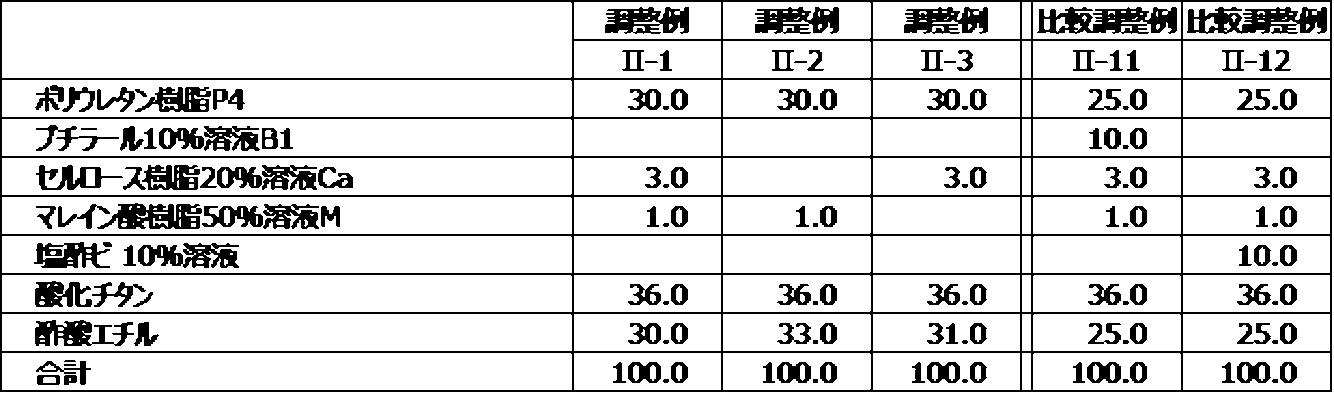
<印刷物の作製>
(実施例1)
調整例II-1のリキッドインキの粘度を酢酸エチルでザーンカップ#3(離合社製)で16秒(25℃)に調整し、版深35μmグラビア版を備えたグラビア校正機によりフィルムに塗工して白色印刷層を形成した。
(実施例1)
調整例II-1のリキッドインキの粘度を酢酸エチルでザーンカップ#3(離合社製)で16秒(25℃)に調整し、版深35μmグラビア版を備えたグラビア校正機によりフィルムに塗工して白色印刷層を形成した。
次に、調整例I-1のリキッドインキの粘度を酢酸エチルでザーンカップ#3(離合社製)で16秒(25℃)に調整し、版深35μmグラビア版を備えたグラビア校正機により、作製した白色印刷層の上にカラー印刷層を形成し、多層印刷物を作製した。
(実施例2~11、比較例1~4)
実施例2~11、比較例1~4についても表3に示すリキッドインキを用いて、実施例1と同様の手順にて印刷物を作製した。
実施例2~11、比較例1~4についても表3に示すリキッドインキを用いて、実施例1と同様の手順にて印刷物を作製した。
<評価>
作製したリキッドインキ及び印刷物について、以下の評価を行った。
(ベース流動性)
調整例I-1~調整例II-1に記載の第一のリキッドインキ及び第二のリキッドインキの粘度をB型粘度計にて6rpmと60rpmの回転数で測定した。6rpmで測定した粘度を60rpmで測定した粘度で割り、TI値を求めた。TI値が3.0未満であれば実用上使用可能である。
作製したリキッドインキ及び印刷物について、以下の評価を行った。
(ベース流動性)
調整例I-1~調整例II-1に記載の第一のリキッドインキ及び第二のリキッドインキの粘度をB型粘度計にて6rpmと60rpmの回転数で測定した。6rpmで測定した粘度を60rpmで測定した粘度で割り、TI値を求めた。TI値が3.0未満であれば実用上使用可能である。
○:TI値が1.5未満
△:TI値が1.5以上~3.0未満
×:TI値が3.0以上
(粘度)
調整例I-1~調整例II-1に記載の第一のリキッドインキ及び第二のリキッドインキの粘度をザーンカップ#4(離合社製)で測定した。粘度が30秒以下であれば実用上使用可能である。
△:TI値が1.5以上~3.0未満
×:TI値が3.0以上
(粘度)
調整例I-1~調整例II-1に記載の第一のリキッドインキ及び第二のリキッドインキの粘度をザーンカップ#4(離合社製)で測定した。粘度が30秒以下であれば実用上使用可能である。
(保存安定性)
調整例I-1~調整例II-1に記載の第一のリキッドインキ及び第二のリキッドインキのインキを25℃で1週間静置したのち、分離と沈殿の具合を評価した。
<分離>外観評価
〇:まったく分離がみられない。
△:やや上層に分離がみられる。目安としては分離層の厚さが5mm以下。
×:上層に明らかな分離がみられる。目安としては分離層の厚さが5mm以上。
<沈殿>スパチュラでインキを保存した容器の底をゆっくりと掻く。
〇:まったく沈殿がみられない。
△:底に僅かに沈殿がみられる。(スパチュラの先端に沈殿物が僅かに確認される)
×:底に多くの沈殿がみられる。(スパチュラで沈殿物が多くかきとれる)
調整例I-1~調整例II-1に記載の第一のリキッドインキ及び第二のリキッドインキのインキを25℃で1週間静置したのち、分離と沈殿の具合を評価した。
<分離>外観評価
〇:まったく分離がみられない。
△:やや上層に分離がみられる。目安としては分離層の厚さが5mm以下。
×:上層に明らかな分離がみられる。目安としては分離層の厚さが5mm以上。
<沈殿>スパチュラでインキを保存した容器の底をゆっくりと掻く。
〇:まったく沈殿がみられない。
△:底に僅かに沈殿がみられる。(スパチュラの先端に沈殿物が僅かに確認される)
×:底に多くの沈殿がみられる。(スパチュラで沈殿物が多くかきとれる)
(耐ボイル性)
実施例1~11、比較例1~4の印刷物に、ウレタン系のドライラミネート接着剤ディックドライLX-500/KW-75(DIC製)にてドライラミネート機(DICエンジニアリング製)によって、直鎖状低密度ポリエチレンフィルム(LLDPEフィルム:三井化学東セロ社製 TUX-HC 厚さ60μm)を積層し、40℃で3日間エージング施し、ラミネート物を得た。得られたラミネート物を120mm×120mmの大きさのパウチに製袋し、内容物として、食酢、サラダ油、ミートソースを重量比で1:1:1に配合した疑似食品70gを充填密封した。作成したパウチを98℃、60分間のボイル処理をした後、内容物を取り出してパウチを水洗した後、袋を15mm幅に切り出し、引っ張り速度300mm/分でT型剥離試験を行った。
実施例1~11、比較例1~4の印刷物に、ウレタン系のドライラミネート接着剤ディックドライLX-500/KW-75(DIC製)にてドライラミネート機(DICエンジニアリング製)によって、直鎖状低密度ポリエチレンフィルム(LLDPEフィルム:三井化学東セロ社製 TUX-HC 厚さ60μm)を積層し、40℃で3日間エージング施し、ラミネート物を得た。得られたラミネート物を120mm×120mmの大きさのパウチに製袋し、内容物として、食酢、サラダ油、ミートソースを重量比で1:1:1に配合した疑似食品70gを充填密封した。作成したパウチを98℃、60分間のボイル処理をした後、内容物を取り出してパウチを水洗した後、袋を15mm幅に切り出し、引っ張り速度300mm/分でT型剥離試験を行った。
尚、耐ボイル性試験において、印刷物のフィルムとして片面にコロナ処理を施したNyフィルムを用い、該コロナ処理面に印刷を行うことにより印刷物を作製した。
作製した印刷物は基材のNyフィルム側から、Ny基材(F)/印刷インキ層/接着層(Ad)/LLDPEフィルムの順となる。
◎:3.5N/15mm以上であり、強度十分
〇:3.0N/15mm以上~3.5N/15mm未満であり、実用範囲
△:2.0N/15mm以上~3.0N/15mm未満であり、やや強度不足
×:2.0N/15mm未満であり、強度不十分
◎:3.5N/15mm以上であり、強度十分
〇:3.0N/15mm以上~3.5N/15mm未満であり、実用範囲
△:2.0N/15mm以上~3.0N/15mm未満であり、やや強度不足
×:2.0N/15mm未満であり、強度不十分
また、得られたボイル処理後のパウチの外観を評価した。
〇: デラミネーションやブリスターが全くみられない。
△: パウチの一部に、僅かなデラミネーションやブリスターがみられる。
×: パウチの全体に、明らかなデラミネーションやブリスターがみられる。
〇: デラミネーションやブリスターが全くみられない。
△: パウチの一部に、僅かなデラミネーションやブリスターがみられる。
×: パウチの全体に、明らかなデラミネーションやブリスターがみられる。
(耐レトルト性)
実施例1~11、比較例1~4の印刷物に、ウレタン系のドライラミネート接着剤ディックドライLX-703VL/KR-90(DIC製)にてドライラミネート機(DICエンジニアリング製)によって、アルミ箔、及び無延伸ポリプロピレンフィルム(以下、R-CPP:東レ合成フィルム社製 ZK-75 50μm)を積層し、40℃で3日間エージング施し、ラミネート物を得た。得られたラミネート物を120mm×120mmの大きさのパウチに製袋し、内容物として、食酢、サラダ油、ミートソースを重量比で1:1:1に配合した疑似食品70gを充填密封した。作成したパウチを135℃、30分間の蒸気レトルト殺菌処理をした後、内容物を取り出してパウチを水洗した後、袋を15mm幅に切り出し、引っ張り速度300mm/分でT型剥離試験を行った。
実施例1~11、比較例1~4の印刷物に、ウレタン系のドライラミネート接着剤ディックドライLX-703VL/KR-90(DIC製)にてドライラミネート機(DICエンジニアリング製)によって、アルミ箔、及び無延伸ポリプロピレンフィルム(以下、R-CPP:東レ合成フィルム社製 ZK-75 50μm)を積層し、40℃で3日間エージング施し、ラミネート物を得た。得られたラミネート物を120mm×120mmの大きさのパウチに製袋し、内容物として、食酢、サラダ油、ミートソースを重量比で1:1:1に配合した疑似食品70gを充填密封した。作成したパウチを135℃、30分間の蒸気レトルト殺菌処理をした後、内容物を取り出してパウチを水洗した後、袋を15mm幅に切り出し、引っ張り速度300mm/分でT型剥離試験を行った。
尚、耐レトルト性試験において、印刷物のフィルムとして片面にコロナ処理を施した二軸延伸ポリエステルフィルム(PETフィルム)を用い、該コロナ処理面に印刷を行うことにより印刷物を作製した。
作製した印刷物は基材のPETフィルム側から、PET基材(F)/印刷インキ層/接着層(Ad1)/アルミ箔(AL)/接着剤(Ad2)/R-CPPフィルムの順となる。二軸延伸ポリエステルフィルム(PETフィルム:東洋紡績株式会社製 E-5100 厚さ12μm)を使用した。
尚、表中の評価結果は次の通りである。
尚、表中の評価結果は次の通りである。
◎:3.5N/15mm以上であり、強度十分
〇:3.0N/15mm以上~3.5N/15mm未満であり、実用範囲
△:2.0N/15mm以上~3.0N/15mm未満であり、やや強度不足
×:2.0N/15mm未満であり、強度不十分
〇:3.0N/15mm以上~3.5N/15mm未満であり、実用範囲
△:2.0N/15mm以上~3.0N/15mm未満であり、やや強度不足
×:2.0N/15mm未満であり、強度不十分
また、得られたレトルト処理後のパウチの外観を評価した。
〇: デラミネーションやブリスターが全くみられない。
△: パウチの一部に、僅かなデラミネーションやブリスターがみられる。
×: パウチの全体に、明らかなデラミネーションやブリスターがみられる。
〇: デラミネーションやブリスターが全くみられない。
△: パウチの一部に、僅かなデラミネーションやブリスターがみられる。
×: パウチの全体に、明らかなデラミネーションやブリスターがみられる。
(レベリング性)
印刷物においてカラー印刷層の網点100%と50%の濃度を反射濃度計を用いて測定した。50%の濃度を100%の濃度で割った濃度比から、以下の判断基準でレベリング性を評価した。
印刷物においてカラー印刷層の網点100%と50%の濃度を反射濃度計を用いて測定した。50%の濃度を100%の濃度で割った濃度比から、以下の判断基準でレベリング性を評価した。
〇:濃度比が0.36以上
△:濃度比が0.3以上0.36未満
×:濃度比が0.3未満
結果を以下の表に示す。なお、比較例1、3は粘度、保存安定性が実用範囲外であり、耐ボイル性、耐レトルト性、レベリング性は評価不可であった。
△:濃度比が0.3以上0.36未満
×:濃度比が0.3未満
結果を以下の表に示す。なお、比較例1、3は粘度、保存安定性が実用範囲外であり、耐ボイル性、耐レトルト性、レベリング性は評価不可であった。
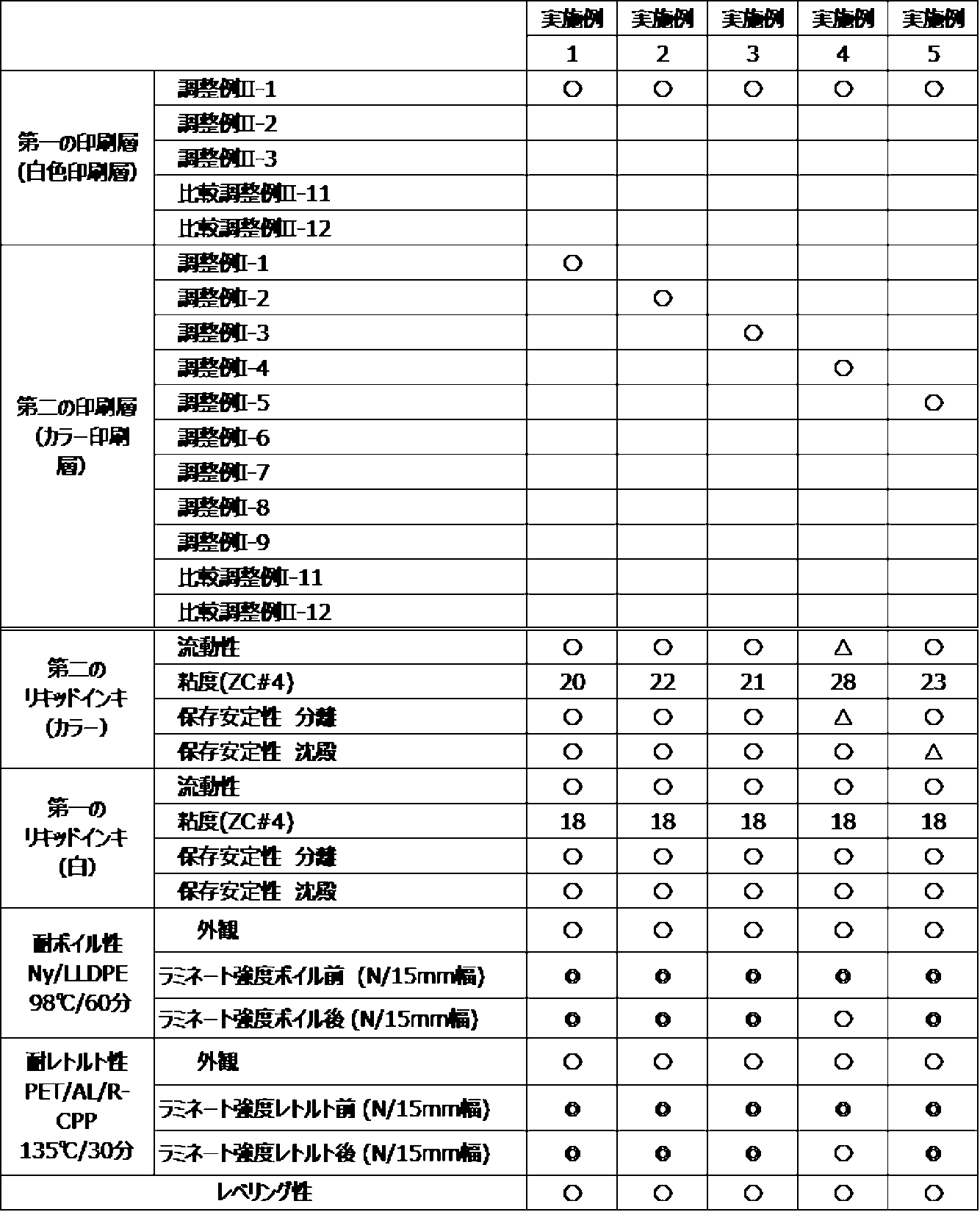
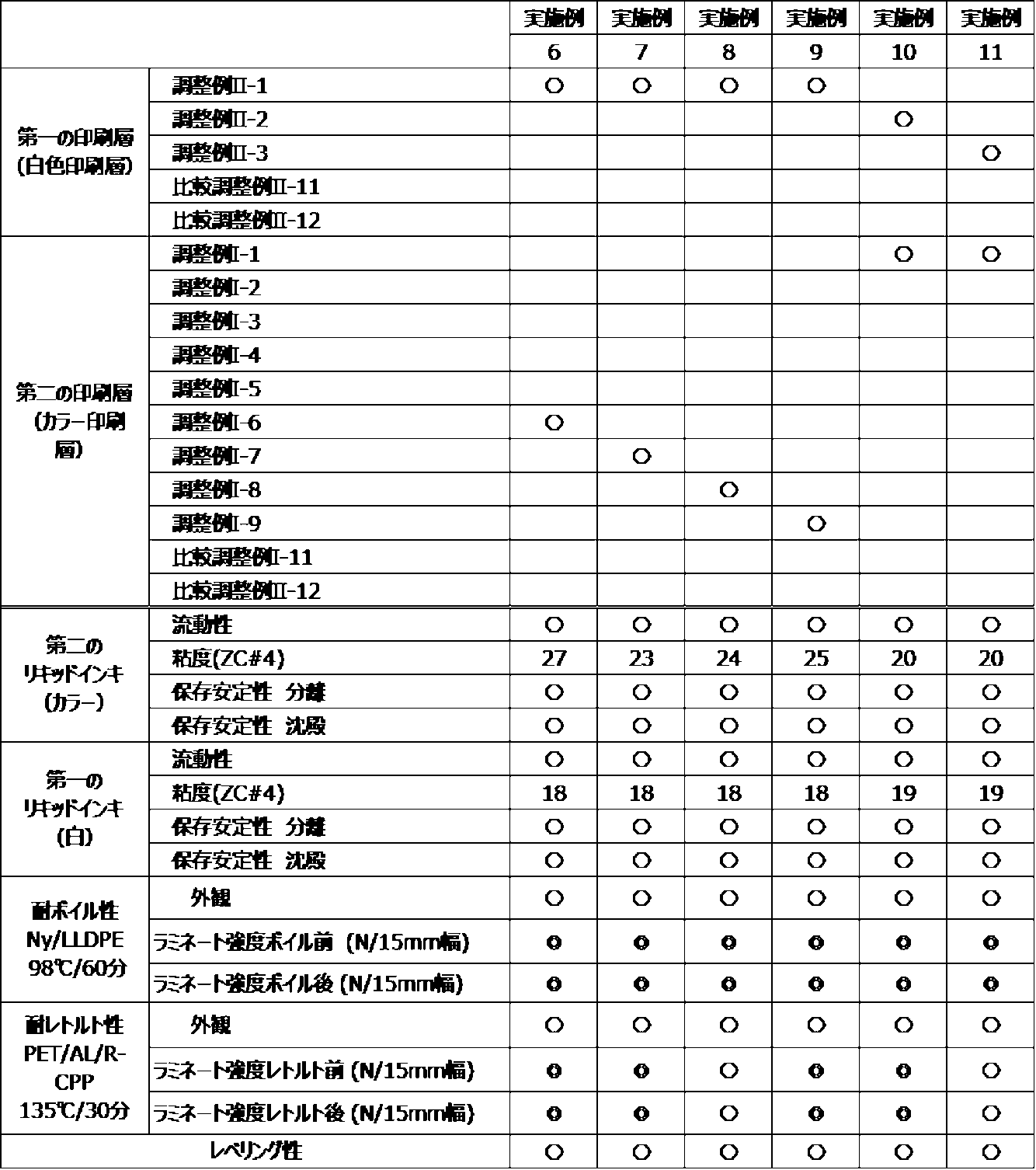
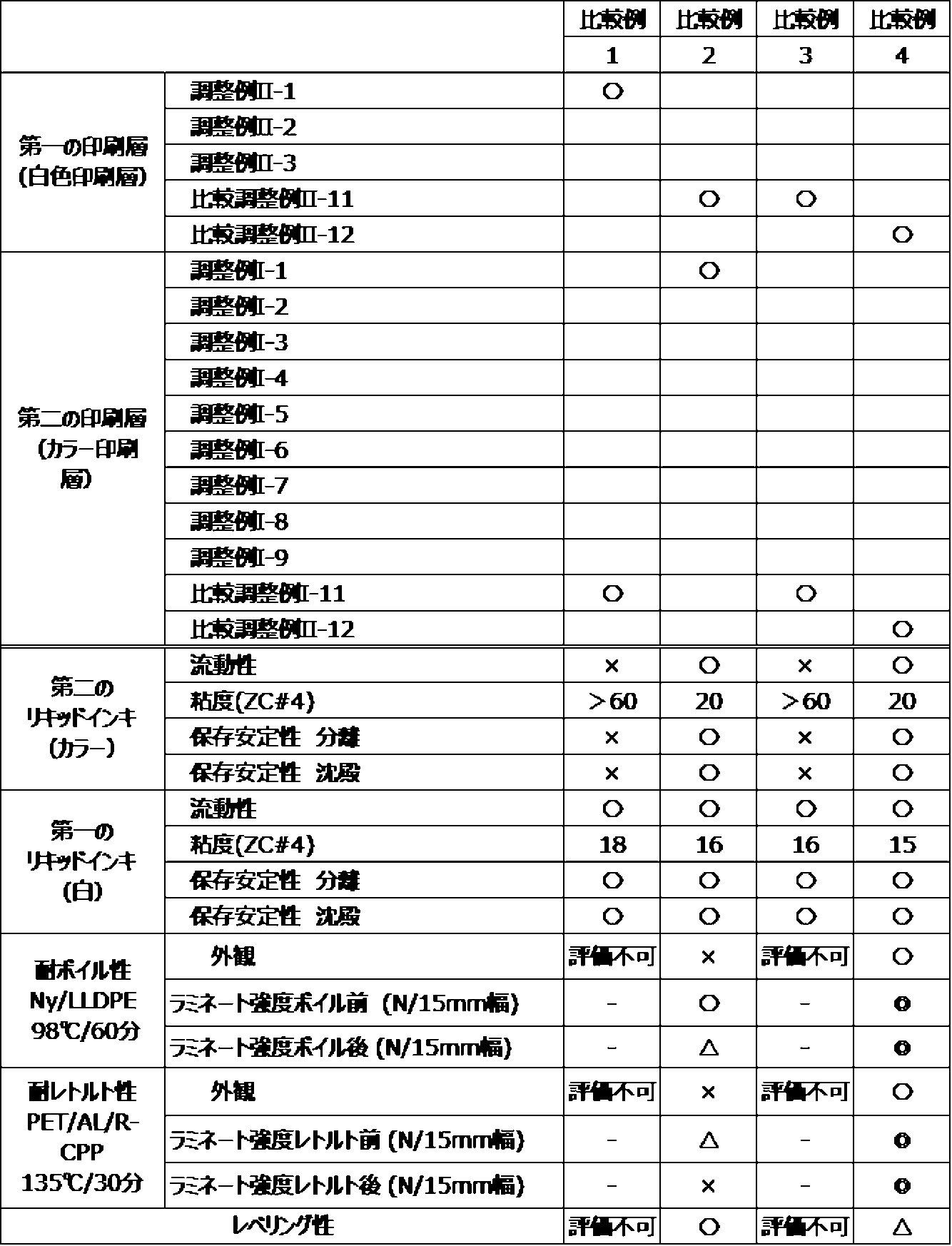
以上の結果より、白色顔料を有する第一の印刷層はポリビニルブチラール樹脂を含有せず、白色顔料を用いない第二の印刷層はポリビニルブチラール樹脂を用いて積層体を構成することにより、分散性、流動性、安定性等のインキとしての基本的な特性を損なうことなく、優れたラミネート強度を有する積層体が得られることがわかった。実施例1~11の積層体は、比較例4のように塩素系樹脂を含有していないことから環境安全性にも優れており、更に、比較例4に比べてレベリング性に優れていることがわかった。実施例1~11は比較例4に比べてレベリング性に優れている理由は定かではないが、ブチラールを含有するインキの方が塩化ビニル酢酸ビニル共重合樹脂を含有するインキよりもフィルムとの接触角が小さく、濡れ広がりやすいことが一因であると考えられる。
Claims (8)
- フィルム基材上に、ポリビニルブチラール樹脂を含有しない第一の印刷層と、ポリビニルブチラール樹脂を含有する第二の印刷層を有することを特徴とする印刷物。
- 前記第一の印刷層と前記第二の印刷層が共に塩素系樹脂を含有しない請求項1に記載の印刷物。
- 前記ポリビニルブチラール樹脂が、数平均分子量5000~60000であり、ガラス転移点が50~120℃であり、水酸基量が10~30質量%の範囲にある請求項1又は2に記載の印刷物。
- 前記第二の印刷層が、更に、ウレタン樹脂、マレイン酸樹脂、繊維素系樹脂、ポリエステル樹脂、アクリル樹脂、ポリアミド樹脂から選ばれる少なくとも1つ以上の樹脂を含有する請求項1又は2に記載の印刷物。
- 前記第二の印刷層が、前記ポリビニルブチラール樹脂を、第二の印刷層に含まれる樹脂の総量に対して5~100質量%含有する、請求項1又は2に記載の印刷物。
- 前記第一の印刷層が、ウレタン樹脂、マレイン酸樹脂、繊維素系樹脂、ポリエステル樹脂、アクリル樹脂、ポリアミド樹脂から選ばれる少なくとも1つ以上の樹脂を含有する請求項1又は2に記載の印刷物。
- 前記第一の印刷層が、白色顔料として酸化チタンを含有する請求項6に記載の印刷物。
- 請求項1に記載の印刷物を有するラミネート積層体。
Priority Applications (1)
| Application Number | Priority Date | Filing Date | Title |
|---|---|---|---|
| JP2023562743A JP7537632B2 (ja) | 2022-04-12 | 2023-03-30 | 印刷物並びにラミネート積層体 |
Applications Claiming Priority (2)
| Application Number | Priority Date | Filing Date | Title |
|---|---|---|---|
| JP2022-065648 | 2022-04-12 | ||
| JP2022065648 | 2022-04-12 |
Publications (1)
| Publication Number | Publication Date |
|---|---|
| WO2023199750A1 true WO2023199750A1 (ja) | 2023-10-19 |
Family
ID=88329522
Family Applications (1)
| Application Number | Title | Priority Date | Filing Date |
|---|---|---|---|
| PCT/JP2023/013051 Ceased WO2023199750A1 (ja) | 2022-04-12 | 2023-03-30 | 印刷物並びにラミネート積層体 |
Country Status (2)
| Country | Link |
|---|---|
| JP (1) | JP7537632B2 (ja) |
| WO (1) | WO2023199750A1 (ja) |
Cited By (1)
| Publication number | Priority date | Publication date | Assignee | Title |
|---|---|---|---|---|
| WO2025239168A1 (ja) * | 2024-05-16 | 2025-11-20 | Dic株式会社 | リキッドインキ組成物、及び該リキッドインキ組成物を用いた印刷物並びに積層体 |
Citations (6)
| Publication number | Priority date | Publication date | Assignee | Title |
|---|---|---|---|---|
| JP2005298618A (ja) * | 2004-04-09 | 2005-10-27 | Toyo Ink Mfg Co Ltd | 軟包装用ノントルラミネートインキ組成物 |
| JP2014062138A (ja) * | 2009-03-25 | 2014-04-10 | Toyo Ink Sc Holdings Co Ltd | ラミネート用印刷インキ組成物 |
| JP2019173037A (ja) * | 2017-11-28 | 2019-10-10 | Dic株式会社 | ジオキサジン顔料の製造方法 |
| JP2020084026A (ja) * | 2018-11-26 | 2020-06-04 | Dic株式会社 | 縮合多環系有機顔料及び着色剤 |
| US20210079237A1 (en) * | 2017-12-19 | 2021-03-18 | Sun Chemical Corporation | High opacity white ink |
| JP2021080402A (ja) * | 2019-11-21 | 2021-05-27 | Dicグラフィックス株式会社 | リキッド印刷インキ、及び積層体 |
Family Cites Families (1)
| Publication number | Priority date | Publication date | Assignee | Title |
|---|---|---|---|---|
| JP2007144692A (ja) | 2005-11-25 | 2007-06-14 | Toppan Printing Co Ltd | スクラッチ隠蔽層付印刷物およびその製造方法 |
-
2023
- 2023-03-30 WO PCT/JP2023/013051 patent/WO2023199750A1/ja not_active Ceased
- 2023-03-30 JP JP2023562743A patent/JP7537632B2/ja active Active
Patent Citations (6)
| Publication number | Priority date | Publication date | Assignee | Title |
|---|---|---|---|---|
| JP2005298618A (ja) * | 2004-04-09 | 2005-10-27 | Toyo Ink Mfg Co Ltd | 軟包装用ノントルラミネートインキ組成物 |
| JP2014062138A (ja) * | 2009-03-25 | 2014-04-10 | Toyo Ink Sc Holdings Co Ltd | ラミネート用印刷インキ組成物 |
| JP2019173037A (ja) * | 2017-11-28 | 2019-10-10 | Dic株式会社 | ジオキサジン顔料の製造方法 |
| US20210079237A1 (en) * | 2017-12-19 | 2021-03-18 | Sun Chemical Corporation | High opacity white ink |
| JP2020084026A (ja) * | 2018-11-26 | 2020-06-04 | Dic株式会社 | 縮合多環系有機顔料及び着色剤 |
| JP2021080402A (ja) * | 2019-11-21 | 2021-05-27 | Dicグラフィックス株式会社 | リキッド印刷インキ、及び積層体 |
Cited By (1)
| Publication number | Priority date | Publication date | Assignee | Title |
|---|---|---|---|---|
| WO2025239168A1 (ja) * | 2024-05-16 | 2025-11-20 | Dic株式会社 | リキッドインキ組成物、及び該リキッドインキ組成物を用いた印刷物並びに積層体 |
Also Published As
| Publication number | Publication date |
|---|---|
| JPWO2023199750A1 (ja) | 2023-10-19 |
| JP7537632B2 (ja) | 2024-08-21 |
Similar Documents
| Publication | Publication Date | Title |
|---|---|---|
| JP6458089B2 (ja) | 裏刷り用溶剤型グラビア印刷インキ組成物の製造方法および積層体の製造方法 | |
| JP7148457B2 (ja) | 積層体及びそれを用いる包装容器 | |
| JP6973690B2 (ja) | ガスバリア性積層体、包装材 | |
| JP2018177854A (ja) | リキッドインキ組成物、印刷物及びラミネート積層体 | |
| JP7405308B2 (ja) | 印刷物並びにラミネート積層体 | |
| JP2019038897A (ja) | リキッドインキ組成物 | |
| JP2019001932A (ja) | リキッドインキ組成物 | |
| JP7537632B2 (ja) | 印刷物並びにラミネート積層体 | |
| JP6514835B2 (ja) | リキッドインキ組成物、印刷物及びラミネート積層体 | |
| JP7543890B2 (ja) | リキッドインキ組成物、及び該リキッドインキ組成物を用いた印刷物並びに積層体 | |
| WO2023120203A1 (ja) | 積層体、包装材 | |
| JP2019094407A (ja) | リキッドインキ組成物 | |
| JP7073696B2 (ja) | リキッドインキ組成物 | |
| JP2021181529A (ja) | リキッド印刷インキ、及び印刷物 | |
| JP2022021338A (ja) | リキッド印刷インキ、印刷物、及びラミネート積層体 | |
| JP2025042270A (ja) | リキッドインキ組成物、及びそれを用いた印刷物並びにラミネート積層体 | |
| JP2019112489A (ja) | リキッドインキ組成物 | |
| JP2023169575A (ja) | リキッドインキ組成物、及びそれを用いた印刷物並びにラミネート積層体 | |
| JP2024071914A (ja) | リキッドインキ組成物、及びそれを用いた印刷物並びにラミネート積層体 | |
| JP7184181B2 (ja) | 接着剤組成物、積層体、及び包装体 | |
| WO2024029099A1 (ja) | 軟包装用ラミネートインキ組成物 | |
| JP7648850B2 (ja) | リキッド印刷インキ組成物、及びそれを用いた印刷物並びに積層体 | |
| JP7608674B2 (ja) | リキッド印刷インキ組成物、及びそれを用いた印刷物並びに積層体 | |
| JP2019006910A (ja) | リキッドインキ組成物 | |
| JP2023077667A (ja) | リキッド印刷インキ、印刷物、及び包装材料 |
Legal Events
| Date | Code | Title | Description |
|---|---|---|---|
| WWE | Wipo information: entry into national phase |
Ref document number: 2023562743 Country of ref document: JP |
|
| 121 | Ep: the epo has been informed by wipo that ep was designated in this application |
Ref document number: 23788170 Country of ref document: EP Kind code of ref document: A1 |
|
| NENP | Non-entry into the national phase |
Ref country code: DE |
|
| 122 | Ep: pct application non-entry in european phase |
Ref document number: 23788170 Country of ref document: EP Kind code of ref document: A1 |