WO2023190253A1 - 回路基板及びその製造方法、並びにパワーモジュール - Google Patents
回路基板及びその製造方法、並びにパワーモジュール Download PDFInfo
- Publication number
- WO2023190253A1 WO2023190253A1 PCT/JP2023/012009 JP2023012009W WO2023190253A1 WO 2023190253 A1 WO2023190253 A1 WO 2023190253A1 JP 2023012009 W JP2023012009 W JP 2023012009W WO 2023190253 A1 WO2023190253 A1 WO 2023190253A1
- Authority
- WO
- WIPO (PCT)
- Prior art keywords
- circuit board
- main surface
- metal
- plate
- ceramic plate
- Prior art date
- Legal status (The legal status is an assumption and is not a legal conclusion. Google has not performed a legal analysis and makes no representation as to the accuracy of the status listed.)
- Ceased
Links
Images



Classifications
-
- H—ELECTRICITY
- H05—ELECTRIC TECHNIQUES NOT OTHERWISE PROVIDED FOR
- H05K—PRINTED CIRCUITS; CASINGS OR CONSTRUCTIONAL DETAILS OF ELECTRIC APPARATUS; MANUFACTURE OF ASSEMBLAGES OF ELECTRICAL COMPONENTS
- H05K1/00—Printed circuits
- H05K1/02—Details
-
- H—ELECTRICITY
- H05—ELECTRIC TECHNIQUES NOT OTHERWISE PROVIDED FOR
- H05K—PRINTED CIRCUITS; CASINGS OR CONSTRUCTIONAL DETAILS OF ELECTRIC APPARATUS; MANUFACTURE OF ASSEMBLAGES OF ELECTRICAL COMPONENTS
- H05K1/00—Printed circuits
- H05K1/02—Details
- H05K1/03—Use of materials for the substrate
-
- H—ELECTRICITY
- H10—SEMICONDUCTOR DEVICES; ELECTRIC SOLID-STATE DEVICES NOT OTHERWISE PROVIDED FOR
- H10W—GENERIC PACKAGES, INTERCONNECTIONS, CONNECTORS OR OTHER CONSTRUCTIONAL DETAILS OF DEVICES COVERED BY CLASS H10
- H10W70/00—Package substrates; Interposers; Redistribution layers [RDL]
- H10W70/60—Insulating or insulated package substrates; Interposers; Redistribution layers
-
- H—ELECTRICITY
- H10—SEMICONDUCTOR DEVICES; ELECTRIC SOLID-STATE DEVICES NOT OTHERWISE PROVIDED FOR
- H10W—GENERIC PACKAGES, INTERCONNECTIONS, CONNECTORS OR OTHER CONSTRUCTIONAL DETAILS OF DEVICES COVERED BY CLASS H10
- H10W70/00—Package substrates; Interposers; Redistribution layers [RDL]
- H10W70/60—Insulating or insulated package substrates; Interposers; Redistribution layers
- H10W70/67—Insulating or insulated package substrates; Interposers; Redistribution layers characterised by their insulating layers or insulating parts
- H10W70/68—Shapes or dispositions thereof
-
- H—ELECTRICITY
- H10—SEMICONDUCTOR DEVICES; ELECTRIC SOLID-STATE DEVICES NOT OTHERWISE PROVIDED FOR
- H10W—GENERIC PACKAGES, INTERCONNECTIONS, CONNECTORS OR OTHER CONSTRUCTIONAL DETAILS OF DEVICES COVERED BY CLASS H10
- H10W90/00—Package configurations
Definitions
- the present disclosure relates to a circuit board, a method for manufacturing the same, and a power module.
- a circuit board included in such a power module includes a ceramic substrate and a copper plate, which are joined via a brazing material containing an active metal.
- a phenomenon occurs in which the brazing material seeps onto the surface of the copper plate and creeps up along the side surface of the copper plate. If such a phenomenon occurs, it is feared that it will not only impair the appearance, but also lead to deterioration in the wettability of the solder material used, for example, when bonding semiconductor elements.
- Patent Document 1 proposes providing a rough portion with a large surface roughness on the side surface of a metal plate in order to suppress creeping up of the brazing material.
- Patent Document 2 proposes a technique in which a rib is provided in a circuit layer so as to surround a mounting surface on which a semiconductor element is to be mounted, in order to suppress the occurrence of stains due to the creeping phenomenon.
- Patent Document 3 proposes laminating and brazing the metal plates so that the surface on the side where burrs are formed overlaps one surface of the ceramic plate. Using such techniques, attempts have been made to solve the problem of stains caused by creeping up of the brazing filler metal.
- An etching method is known as a method for manufacturing multi-chip circuit boards.
- the etching method requires resist printing and etching steps to process the metal plate into a predetermined size.
- a mounting method is used in which metal plates that have been pre-processed to a predetermined size are joined together, such a process is not necessary, and production efficiency can be improved.
- the amount of brazing filler metal applied is large, there is a concern that the brazing filler metal may creep up.
- the present disclosure provides a circuit board and a method for manufacturing the same that can sufficiently suppress creeping up of the brazing material. Furthermore, the present disclosure provides a power module with excellent reliability by including such a circuit board.
- a circuit board is a circuit board that includes a ceramic plate, a metal plate, and a brazing material layer that joins the ceramic plate and the metal plate, the metal plate being joined to the ceramic plate.
- a recess is formed in the main surface, and the recess is provided inside the outer edge of the main surface.
- a recess is formed inside the outer edge of the main surface of the metal plate.
- the recesses are filled with a brazing material during bonding. Therefore, it is possible to sufficiently suppress the brazing filler metal from creeping up onto the side surface of the metal plate and the main surface on the side opposite to the ceramic plate side.
- a circuit board in which creeping up of the brazing material is suppressed in this manner has excellent appearance and connection reliability with external circuits such as semiconductor elements.
- the recess may be closer to the outer edge of the main surface of the metal plate than to the center. Thereby, it is possible to further suppress the brazing material from creeping up onto the side surface of the metal plate and the main surface on the opposite side to the ceramic plate side.
- the recess may be provided along the outer edge of the main surface of the metal plate so as to revolve around the center of the main surface of the metal plate. Thereby, creeping up of the brazing material can be sufficiently suppressed on the entire side surface of the metal plate.
- the recessed portion may have an expanded portion whose width increases as it approaches the ceramic plate from the inside of the metal plate. Having such an expanded portion makes it easier to fill the recess with the brazing material. This makes it possible to sufficiently increase the bonding reliability.
- the entire recess may be filled with a component constituting the brazing material layer. Thereby, bonding reliability can be further improved.
- the width X of the recessed portion of the metal plate may be 0.1 to 1 mm.
- the depth Z of the recessed portion of the metal plate may be 0.05 to 0.6 mm.
- the circuit board includes a ceramic plate, a plurality of metal plates, and a plurality of brazing metal layers bonding the main surface of the ceramic plate and each of the main surfaces of the plurality of metal plates, and the plurality of metal plates , the metal plate may include the metal plate in which a recess is formed.
- the recess is formed on the main surface of at least one metal plate. Therefore, it is possible to sufficiently prevent the brazing material from creeping up the side surface of the metal plate and reaching the main surface of the metal plate on the side opposite to the ceramic plate side.
- each of the plurality of metal plates may be provided independently for each partition area defined by a partition line on the main surface of the ceramic plate.
- Such a circuit board may be a multi-chip circuit board. By dividing such a multi-chip circuit board, a plurality of individualized boards (divided boards) can be manufactured at once. Such a circuit board has excellent production efficiency.
- a method for manufacturing a circuit board includes a preparation step of preparing one or more metal plates in which a recess is formed in the main surface and the recess is provided inside the outer edge of the main surface. a coating and drying step of applying and drying a brazing filler metal to the main surface of the ceramic plate to form one or more coated layers; and a coating and drying step of forming one or more coated layers between the ceramic plate and one or more metal plates. a lamination process in which a laminate is produced by laminating the laminate, and a bonding process in which the laminate is heated to obtain a joined body in which a ceramic plate and one or more metal plates are joined by one or more brazing metal layers. In the lamination step, the ceramic plate and the one or more metal plates are laminated so that the main surface of the one or more metal plates and the main surface of the ceramic plate face each other.
- the ceramic plate and the one or more metal plates are stacked together so that the main surface of the one or more metal plates on which the recess is formed faces the ceramic plate. are laminated.
- the circuit board obtained by performing the bonding process using the laminate obtained in this way can sufficiently suppress the brazing material from creeping up the side surface of the metal plate and the main surface on the opposite side to the ceramic plate side. .
- a circuit board obtained by such a manufacturing method has excellent appearance and connection reliability of semiconductor elements.
- a plurality of metal plates in which recesses are formed are prepared, and in the lamination step, each of the plurality of metal plates is divided into separate areas defined by partition lines on the main surface of the ceramic plate.
- a plurality of metal plates may be laminated to produce a laminate, and after the bonding step, a dividing step may be included in which the ceramic plates in the bonded body are divided along division lines.
- the bonded body obtained by such a bonding process can also be called a multi-chip circuit board.
- a multi-chip circuit board by dividing such a multi-chip circuit board, a plurality of individualized boards (divided boards) can be manufactured all at once.
- Such a manufacturing method can manufacture circuit boards (singulated boards) with high production efficiency.
- a power module includes any of the circuit boards described above and a semiconductor element electrically connected to the metal plate of the circuit board. Such a power module has excellent reliability because it includes any of the above-mentioned circuit boards.
- circuit board and a method for manufacturing the same that can sufficiently suppress creeping up of the brazing material. Furthermore, by including such a circuit board, a highly reliable power module can be provided.
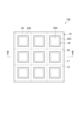
- FIG. 1 is a perspective view of a circuit board.
- FIG. 2 is a plan view of the circuit board.
- FIG. 3 is a cross-sectional view taken along the line III--III of the circuit board of FIG.
- FIG. 4 is an enlarged cross-sectional view of a part of the cross-section of FIG. 3.
- FIG. 5 is a cross-sectional view of the power module.
- FIG. 6 is a scanning electron microscope (SEM) photograph showing a cross section along the thickness direction of the circuit board of Example 1.
- the numerical range indicated by "x to y” means greater than or equal to x and less than or equal to y.
- Numerical ranges in which the upper limit or lower limit of each numerical range in each embodiment is replaced with the numerical value of any example are also included in the present disclosure.
- a circuit board includes a ceramic plate, a metal plate, and a brazing material layer that joins the main surface of the ceramic plate and the main surface of the metal plate.
- the number of metal plates joined to one main surface of one ceramic plate may be one or multiple.
- the material of the ceramic plate is not particularly limited, and may be made of, for example, a nitride sintered body, a carbide sintered body, or an oxide sintered body. Specific examples include silicon nitride sintered bodies, aluminum nitride sintered bodies, aluminum oxide sintered bodies, and silicon carbide sintered bodies. There is no particular restriction as long as it is in the shape of a ceramic plate.
- the thickness of the ceramic plate may be, for example, 0.2 to 2 mm, or 0.32 to 1.1 mm.
- the metal plate may include Cu or an alloy of Cu and another metal, and may be a copper plate, for example.
- the metal plate has a recess formed in its main surface opposite to the main surface of the ceramic plate.
- the recess is provided inside the outer edge of the main surface of the metal plate. Therefore, the recess does not appear on the external appearance of the circuit board.
- the thickness of the metal plate (distance between main surfaces) may be, for example, 0.1 to 1.2 mm, or 0.2 to 1 mm.
- the metal plate may have a plating film on its surface.
- the recess When viewed in a cross section along the thickness direction of the circuit board, the recess may have a V-shape such that the width thereof increases toward the ceramic plate. Since such a recess is easily filled with components constituting the brazing material layer, the reliability of joining between the metal plate and the ceramic plate can be sufficiently increased.
- the brazing material layer may contain Ag, and may also contain Ag and Cu. Furthermore, it may contain one or more metals selected from the group consisting of Sn and active metals. Two or more metals may be an alloy.
- the active metal may include one or more selected from the group consisting of Ti, Hf, Zr, and Nb.
- Ag and Cu contained in the brazing material layer may be contained in the brazing material layer as an alloy such as an Ag--Cu eutectic alloy. Components constituting the brazing material layer include those described above.
- the content of Ag in the brazing material layer may be 45 to 95% by mass, or 50 to 95% by mass.
- the total content of Ag and Cu in the brazing material layer may be 65 to 100% by weight, 70 to 99% by weight, or 90 to 98% by weight. Thereby, the denseness of the brazing material layer can be improved while sufficiently reducing the voids in the recesses.
- the content of the active metal in the brazing material layer may be 0.5 to 8 parts by mass based on 100 parts by mass of Ag and Cu in total.
- the content of the active metal may be 0.5 to 8 parts by mass based on 100 parts by mass of Ag and Cu in total.
- the metal contained in the brazing material layer may be contained as a nitride, oxide, carbide, or hydride.
- the braze layer may include titanium nitride and/or titanium hydride ( TiH2 ). This makes it possible to sufficiently increase the bonding strength between the ceramic plate and the metal plate.
- TiH 2 titanium nitride and/or titanium hydride
- the content of TiH 2 may be, for example, 1 to 8 parts by weight based on 100 parts by weight of Ag and Cu in total.
- FIG. 1 is a perspective view showing an example of a circuit board according to the present embodiment.
- 2 is a plan view of the circuit board of FIG. 1
- FIG. 3 is a sectional view taken along the line III--III of FIG.
- the circuit board 100 includes a ceramic plate 10 and a plurality of metal plates 20 on the main surface 10A and the main surface 10B of the ceramic board 10.
- the ceramic plate 10 has a flat plate shape.
- the ceramic plate 10 is divided into a plurality of sections by dividing lines on the main surface 10A.
- the principal surface 10A includes a plurality of partition lines L1 extending along a first direction and lined up at equal intervals, and a plurality of partition lines L1 extending along a second direction orthogonal to the first direction, as partition lines.
- a plurality of partition lines L2 arranged at equal intervals are provided.
- the partition line L1 and the partition line L2 are orthogonal to each other.
- the partition lines L1 and L2 may be composed of a plurality of recesses arranged in a straight line, or may be composed of linear grooves. Specifically, it may be a scribe line formed with laser light.
- the laser source include a carbon dioxide laser and a YAG laser.
- a scribe line can be formed by intermittently irradiating laser light from such a laser source.
- the partition lines L1 and L2 do not have to be arranged at equal intervals, and are not limited to being perpendicular to each other. Further, the partition lines L1 and L2 may not be straight, but may be curved or bent.
- the ceramic plate 10 has a plurality of partition areas 50 defined by partition lines L1 and L2.
- a metal plate 20 is provided in each of the plurality of divided areas 50.
- the plurality of metal plates 20 are independent from each other.
- the circuit board 100 is also called a collective board, and can be divided along partition lines L1 and L2. By dividing, a plurality of circuit boards (singulated boards) can be obtained. The individualized board obtained by dividing in this way is also an example of the circuit board of this embodiment.
- One main surface 20A of the metal plate 20 is exposed to the outside.
- the other main surface 20B of the metal plate 20 and the main surface 10A (main surface 10B) of the ceramic plate 10 are joined by a brazing material layer 30.
- a recess 22 is formed inside the outer edge 20b of the main surface 20B (joint surface with the brazing material layer 30) of the metal plate 20.
- Such a recess 22 may be formed by cutting a part of the main surface 20B of the metal plate 20.
- the recess 22 is provided along the outer edge 20b of the main surface 20B of the metal plate 20 so as to go around the center of the main surface 20B.
- the recess 22 may be provided only in the vicinity of the portion where the semiconductor element is soldered when the semiconductor element is mounted on the metal plate 20. Further, the recesses 22 may be provided only in some of the plurality of metal plates 20. For example, it is not necessary to provide the recess 22 in the metal plate 20 that serves as a heat sink of the power module.
- the entire recess 22 is filled with a portion of the brazing material layer 30. That is, the entire concave portion 22 is filled with the component constituting the brazing material layer 30. As a result, the metal plate 20 and the ceramic plate 10 are firmly joined by the brazing material layer 30. Therefore, the reliability of bonding between the metal plate 20 and the ceramic plate 10 can be sufficiently improved. Note that it is not essential that the entire recess 22 be filled with the component constituting the brazing material layer 30. In a modified example, only a portion of the recess 22 may be filled with the component constituting the brazing material layer 30.
- FIG. 4 shows a partially enlarged cross-section of the circuit board 100 shown in FIG. 3.
- 3 and 4 both show a cross section perpendicular to the longitudinal direction of the recess 22 and along the thickness direction of the metal plate 20.
- the width X of the recess 22 may be 0.1 to 1 mm.
- the lower limit of the width X may be 0.2 mm or 0.3 mm.
- the upper limit of the width X may be 0.9 mm or 0.8 mm.
- the width X of the recess 22 is the distance between the outer edge 22b and the inner edge 22c of the recess 22.
- the depth Z of the recess 22 may be 0.05 to 0.6 mm.
- the lower limit of the depth Z may be 0.15 mm or 0.2 mm.
- the upper limit of the depth Z may be 0.4 mm or 0.3 mm. This makes it easier to fill the entire recess 22 with the components constituting the brazing material layer 30. Thereby, the reliability of bonding between the metal plate 20 and the ceramic plate 10 can be made sufficiently high.
- the ratio of the depth Z to the thickness of the metal plate 20 may be from 0.05 to 0.5, or from 0.15 to 0.4. Thereby, the creeping up of the brazing filler metal can be sufficiently suppressed while maintaining the conductivity of the metal plate 20 sufficiently.
- the length Y between the outer edge 22b of the recess 22 and the side surface 20C may be 0.1 to 5 mm.
- the lower limit of the length Y may be 0.15 mm or 0.2 mm.
- the upper limit of the length Y may be 4 mm, 3 mm, or 1 mm.
- the recess 22 has an expanded portion 22A whose width increases as it approaches the ceramic plate 10 from inside the metal plate 20.
- the "width" here is the length of the recess 22 measured parallel to the main surface 20B in a cross section as shown in FIG.
- the concave portion 22 having such an expanded portion 22A is easily filled with the component constituting the brazing material layer 30. Thereby, the reliability of bonding between the metal plate 20 and the ceramic plate 10 can be made sufficiently high.
- the entire recess 22 is made up of the extended portion 22A, but the shape is not limited to this. Only a part of the recess 22 may be formed by the extended portion 22A. For example, only a portion of the recessed portion closer to the ceramic plate 10 may be configured as an expanded portion. In this case, the recess may be trapezoidal.
- the ratio of the width X to the length of the main surface 20A of the metal plate 20 measured along the same direction as the width X is 0. It may be from .001 to 0.3, from 0.001 to 0.2, from 0.002 to 0.2.
- the length of the main surface 20A may be, for example, 5 to 100 mm, or 15 to 50 mm.
- the projected area of the recess 22 may be 0.0025 to 0.3 mm2 , and may be 0.01 to 0.3mm2. It may be.
- the projected area of the recess 22 is calculated by the formula: width X x depth Z/2.
- the recess 22 is rectangular, it can be calculated by width X x depth Z.
- the metal plate 20 may function as a circuit board that has the function of transmitting electrical signals or a heat sink that has the function of transmitting heat. Further, the metal plate 20 may have both a function of transmitting heat and a function of transmitting an electric signal.
- the circuit board 100 and the individualized boards (circuit boards) obtained by dividing the same include brazing filler metal on the side surface 20C of the metal plate 20 and the main surface 20A of the metal plate 20 on the side opposite to the ceramic plate 10 side. The rise is sufficiently suppressed. Thereby, the step of removing the brazing material from the side surface 20C and the main surface 20A can be omitted.
- the circuit board 100 has excellent bonding reliability between the metal plate 20 and the ceramic plate 10. Therefore, it has excellent appearance and connection reliability with external circuits such as semiconductor elements. Therefore, it is suitable as a component mounted on a power module that requires high reliability.
- a power module includes a circuit board and a semiconductor element electrically connected to a metal plate of the circuit board.
- the circuit board may be the above-described circuit board 100 or a modification thereof, or may be another circuit board. The description regarding the circuit board 100 and its modifications is applied to the power module of this embodiment. Such a power module has excellent reliability.
- the circuit board and the semiconductor element may be sealed with resin.
- FIG. 5 is a sectional view showing an example of the power module according to the present embodiment.
- the power module 300 includes a base plate 70 and a circuit board 101 joined to one side of the base plate 70 via solder 62.
- the metal plate 21 on one side of the circuit board 101 is joined to the base plate 70 via solder 62.
- a semiconductor element 60 is attached to at least one of the metal plates 20 on the other side of the circuit board 101 via solder 61.
- the semiconductor element 60 is connected to a predetermined location on the metal plate 20 with a metal wire 64 such as an aluminum wire. In this way, the semiconductor element 60 and the metal plate 20 are electrically connected.
- the metal plate 20a which is one of the metal plates 20, is connected to an electrode 63 provided through the casing 66 via a solder 65. ing.
- a housing 66 is disposed on one main surface of the base plate 70 and is integrated with the main surface to accommodate the circuit board 101.
- a housing space formed by one main surface of the base plate 70 and the housing 66 is filled with resin 80 so as to cover the circuit board 101 and the semiconductor element 60 .
- the resin 80 seals the circuit board 101 and the semiconductor element 60.
- the resin may be, for example, a thermosetting resin or a photocuring resin.
- Cooling fins 72 forming a heat radiating section are joined to the other main surface of the base plate 70 via grease 74. Screws 73 are attached to the ends of the base plate 70 to fix the cooling fins 72 to the base plate 70.
- the base plate 70 and the cooling fins 72 may be made of aluminum.
- the base plate 70 and the cooling fins 72 have high thermal conductivity and function well as a heat dissipation section.
- the metal plate 20 and the metal plate 21 are electrically insulated by the ceramic plate 10.
- the metal plate 20 (20a) may form an electric circuit.
- the metal plate 20 and the metal plate 21 are respectively joined to the main surface 10A and the main surface 10B of the ceramic plate 10 by a brazing material layer (not shown).
- a recessed portion as shown in FIGS. 3 and 4 is formed on the main surface of the metal plate 20 to be joined to the ceramic plate 10.
- This recess has the same size as the recess 22, and the entire recess may be filled with a component constituting the brazing material layer.
- the reliability of the bond between the metal plate 20 and the ceramic plate 10 can be made sufficiently high. Therefore, the power module 300 has excellent electrical connection reliability between the semiconductor element 60 and the metal plate 20.
- a recess 22 may be formed on the main surface of the metal plate 21 to be joined to the ceramic plate 10.
- a method for manufacturing a circuit board includes a preparation step of preparing one or more metal plates each having a recess formed in its main surface and the recess provided inside the outer edge of the main surface; A coating and drying step in which a brazing material is applied and dried on the main surface of a ceramic plate to form one or more coating layers, and a ceramic plate and one or more metal plates are sandwiched between the one or more coating layers.
- the metal plate may be a copper plate, for example.
- the recessed portion can be formed, for example, by machining using a machining center.
- the shape, position (for example, length Y), size (for example, width X and depth Z), and projected area of the recess may be as described above.
- the size of the recess can be adjusted by changing the amount of cutting.
- the recess may be formed along a part of the outer edge of the main surface of the metal plate, or may be formed so as to go around the center of the main surface of the metal plate.
- the ceramic plate used in the coating and drying process can be produced, for example, by the following procedure.
- a green sheet is produced by molding a slurry containing an inorganic compound powder, a binder resin, a sintering aid, a plasticizer, a dispersant, a solvent, and the like.
- inorganic compounds include aluminum nitride (AlN), silicon nitride (Si 3 N 4 ), silicon carbide, and aluminum oxide.
- Sintering aids include rare earth metals, alkaline earth metals, metal oxides, fluorides, chlorides, nitrates, sulfates, and the like. These may be used alone or in combination of two or more.
- binder resins include methyl cellulose, ethyl cellulose, polyvinyl alcohol, polyvinyl butyral, and (meth)acrylic resins.
- plasticizers include purified glycerin, glycerin triolate, diethylene glycol, phthalic acid plasticizers such as di-n-butyl phthalate, and dibasic acid plasticizers such as di-2-ethylhexyl sebacate.
- dispersants include poly(meth)acrylates and (meth)acrylic acid-maleate copolymers.
- solvents include organic solvents such as ethanol and toluene.
- Examples of methods for forming green sheets from slurry include a doctor blade method and an extrusion method.
- the green sheet obtained by molding is degreased and fired.
- Degreasing may be performed, for example, by heating at 400 to 800°C for 0.5 to 20 hours. Thereby, the amount of residual organic matter (carbon) can be reduced while suppressing oxidation and deterioration of inorganic compounds.
- Sintering is performed, for example, by heating to 1700 to 1900° C. in a non-oxidizing gas atmosphere such as nitrogen, argon, ammonia, or hydrogen.
- a ceramic plate 10 can be obtained. If necessary, the ceramic plate may be laser-processed to cut the edges or provide scribe lines.
- the above-mentioned degreasing and sintering may be performed, for example, with a plurality of green sheets laminated.
- a release layer made of a release agent may be provided between the green sheets in order to facilitate separation of the base materials after firing.
- the mold release agent for example, boron nitride (BN) can be used.
- the release layer may be formed, for example, by applying a slurry of boron nitride powder by spraying, brushing, roll coating, screen printing, or the like.
- the number of green sheets to be laminated may be, for example, 8 to 100, or 30 to 70, from the viewpoint of efficient mass production of ceramic plates and sufficient degreasing.
- a partition line may be formed on the one main surface.
- a scribe line may be provided as a partition line by irradiating the main surface of the ceramic plate with a laser beam.
- the laser beam irradiated onto the main surface of the ceramic include a carbon dioxide laser and a YAG laser.
- scribe lines that become the division lines L1 and L2 as shown in FIGS. 1 and 2 are formed.
- Such partition lines L1 and L2 can be used as cutting lines when dividing the circuit board in a subsequent process.
- the brazing material applied to the main surface of the ceramic plate contains, for example, silver, copper, tin, active metals, metal compounds containing these as constituent elements, organic solvents, binders, and the like.
- the viscosity of the brazing filler metal may be, for example, 5 to 20 Pa ⁇ s.
- the organic solvent content in the brazing filler metal may be, for example, 5 to 25% by mass, and the binder content may be, for example, 2 to 15% by mass.
- the brazing filler metal may contain Ag in the form of a single metal or a metal compound (alloy), and in addition to Ag, it may contain one or more metals selected from the group consisting of Cu, Sn, and active metals. It's fine. Two or more metals may be an alloy.
- the active metal may include one or more selected from the group consisting of Ti, Hf, Zr, and Nb.
- the content of Ag in the brazing filler metal may be 93 parts by mass or more, 95 parts by mass or more, 97 parts by mass or more, and 100 parts by mass based on a total of 100 parts by mass of Ag and Cu. It may be.
- the molten brazing filler metal smoothly reacts with Cu contained in the metal plate to form a eutectic alloy. Therefore, the brazing material layer is smoothly formed even within the recessed portion of the metal plate.
- the brazing filler metal does not need to contain Cu.
- the content of active metal in the brazing material may be 0.5 to 8 parts by mass based on 100 parts by mass of Ag and Cu in total.
- the content of the active metal may be 0.5 to 8 parts by mass based on 100 parts by mass of Ag and Cu in total.
- the metal contained in the brazing filler metal may be contained as a nitride, oxide, carbide, or hydride.
- the brazing material may include titanium nitride and/or titanium hydride ( TiH2 ). This makes it possible to sufficiently increase the bonding strength between the ceramic plate and the metal plate.
- TiH 2 titanium nitride and/or titanium hydride
- the content of TiH 2 may be, for example, 1 to 8 parts by weight based on 100 parts by weight of Ag and Cu in total.
- the content of tin in the brazing filler metal may be 0.5 to 5 parts by mass based on 100 parts by mass of Ag and Cu in total.
- the tin content may be 0.5 to 5 parts by mass based on 100 parts by mass of Ag and Cu in total.
- One or more coating layers are provided on the main surface of the ceramic plate by applying and drying a brazing material by a method such as a roll coater method, screen printing method, or transfer method.
- the coating layer may be provided at a position where the metal plates are to be joined. Therefore, the number of coated layers may be the same as the number of metal plates bonded to the ceramic plate.
- a ceramic plate and a metal plate are laminated with the coating layer sandwiched between them to produce a laminate.
- the main surface on which the recess is formed and the main surface of the ceramic plate are stacked so that they face each other.
- the metal plate may be pressed in the direction toward the ceramic plate. With the pressing, the coating layer spreads and the recesses are filled with the brazing material, resulting in a laminate in which the ceramic plate and the metal plate are well bonded by the coating layer.
- each of the plurality of metal plates 20 is arranged independently for each partition area 50 defined by partition lines L1 and L2 on the main surface 10A of the ceramic plate 10.
- a plurality of metal plates 20 are laminated to produce a laminate.
- the obtained laminate is heated in a heating furnace to obtain a joined body in which the ceramic plate and the metal plate are joined with a brazing material layer.
- the heating temperature may be, for example, 700 to 900°C.
- the atmosphere in the furnace may be an inert gas such as nitrogen, and the reaction may be performed under reduced pressure below atmospheric pressure or under vacuum.
- the heating furnace may be of a continuous type that continuously manufactures a plurality of joined bodies, or may be one that manufactures one or more joined bodies in a batch manner. Heating may be performed while pressing the joined body in the stacking direction of the laminate.
- the brazing material contained in the coating layer flows and reacts with the metal plate, forming a brazing material layer.
- the brazing material layer may include a reaction product between the brazing material and a metal component contained in the metal plate.
- the brazing material filled in the recess may also react and become part of the brazing material layer.
- surface treatment such as forming a plating film on the metal plate is performed.
- cutting or the like may be performed to adjust the shape of the brazing material layer. In this way, a circuit board can be manufactured.
- a dividing step may be performed in which the aggregate substrate is divided into individual pieces. .
- the collective board can be divided along the division lines L1 and L2 to obtain a plurality of circuit boards.
- a joined body can be obtained by joining a plurality of metal plates that have been previously processed to a predetermined size.
- this manufacturing method mounting method
- the circuit board obtained by such a manufacturing method can reduce manufacturing costs and has excellent appearance and connection reliability with external circuits such as semiconductor elements.
- the step of removing the brazing filler metal that has climbed up can be omitted, production efficiency is also excellent.
- the manufacturing method of the circuit boards 100, 101 and their modifications described above is not limited to the manufacturing method described above.
- a power module may be manufactured using the circuit board obtained in this way.
- a power module can be manufactured by mounting a semiconductor element on a circuit board using solder and wire bonding, etc., housing the circuit board and semiconductor element in a housing space of a housing, and then sealing it with resin. .
- a plurality of metal plates are provided on each of the pair of main surfaces of the ceramic plate, but the present invention is not limited thereto.
- one or more metal plates may be provided on only one main surface of the ceramic plate.
- the structure and shape of the brazing material layer and the metal plate (recess) provided on each of the pair of main surfaces of the ceramic plate may be different from each other.
- one metal plate may be provided on each of the pair of main surfaces of the ceramic plate.
- a circuit board comprising a ceramic plate, a metal plate, and a brazing material layer that joins the ceramic plate and the metal plate, A recess is formed on the main surface of the metal plate to be joined to the ceramic plate, The circuit board, wherein the recess is provided inside an outer edge of the main surface.
- the recess according to [1] or [2], wherein the recess is provided along the outer edge of the main surface of the metal plate so as to go around the center of the main surface of the metal plate. circuit board.
- a plurality of metal plates in which the recesses are formed are prepared,
- the laminated body is produced by laminating the plurality of metal plates such that each of the plurality of metal plates is independent for each partition area defined by a partition line on the main surface of the ceramic plate.
- a power module comprising: a semiconductor element electrically connected to the semiconductor element;
- the recesses When viewed in cross section in the thickness direction of the copper plate, the recesses were processed to have a V-shape as shown in FIGS. 3 and 4. As a result, a copper plate having a shape similar to that of the metal plate 20 shown in FIGS. 1 to 4 was obtained.
- a brazing filler metal containing Ag, Sn, and TiH 2 was prepared.
- This brazing filler metal contained 100 parts by mass of Ag based on a total of 100 parts by mass of Ag and Cu. That is, a brazing filler metal that does not contain Cu was used.
- This brazing filler metal contained 3 parts by mass of Sn and 3.5 parts by mass of TiH 2 based on 100 parts by mass of Ag.
- the main surface of the ceramic plate was divided into 24 divided areas by scribe lines.
- a brazing material was applied to each divided area by screen printing to form a coating layer.
- the coating area of the coating layer was the same as the area of the main surface of the copper plate to be bonded to the ceramic plate.
- a copper plate was laminated on the ceramic plate so that the coating layer and the main surface of the copper plate were in contact with each other. In this way, a total of 24 copper plates were laminated on one main surface of the ceramic plate so as to be independent for each divided area.
- FIG. 6 is a SEM photograph of the cross section.
- the measurement results of width X, depth Z, and length Y, and the projected area of the recess (X ⁇ Z/2) were as shown in Table 1. The measurements were performed on only one circuit board. Note that all 24 copper plates were processed under the same machining conditions. Therefore, the values of the width X, depth Z, and length Y of the recess can be considered to be the same.
- Example 2 A brazing filler metal containing Ag, Cu, Sn, and TiH2 was prepared. The mass ratio of Ag to Cu in the brazing filler metal was 69:31. This brazing filler metal contained 3 parts by mass of Sn and 3.5 parts by mass of TiH 2 based on 100 parts by mass of Ag and Cu in total. A circuit board was produced and evaluated in the same manner as in Example 1 except that such a brazing material was used. The results were as shown in Table 1. Also in the circuit board of Example 2, no creeping up of the brazing material was detected on the surface of the copper plate.
- Example 1 A circuit board was produced and evaluated in the same manner as in Example 1, except that no recess was formed on one main surface (main surface 20B) of each copper plate. The results were as shown in Table 1.
- Example 2 A circuit board was produced and evaluated in the same manner as in Example 2, except that no recess was formed on one main surface (main surface 20B) of each copper plate. The results were as shown in Table 1.
- circuit board and a method for manufacturing the same that can sufficiently suppress creeping up of the brazing material. Furthermore, a power module including such a circuit board can be provided.
- SYMBOLS 10 Ceramic plate, 10A, 10B... Main surface, 20, 20a, 21... Metal plate, 20A, 20B... Main surface, 20b, 22b... Outer edge, 20C... Side surface, 22... Recessed part, 22A... Extension part, 22c... Inner edge , 30... Brazing material layer, 50... Division area, 60... Semiconductor element, 61, 62, 65... Solder, 63... Electrode, 64... Metal wire, 66... Housing, 70... Base plate, 72... Cooling fin, 73 ...screw, 74...grease, 80...resin, 100, 101...circuit board, 300...power module, L1, L2...compartment line.
Landscapes
- Engineering & Computer Science (AREA)
- Microelectronics & Electronic Packaging (AREA)
- Structure Of Printed Boards (AREA)
Priority Applications (1)
| Application Number | Priority Date | Filing Date | Title |
|---|---|---|---|
| JP2023550662A JPWO2023190253A1 (https=) | 2022-03-31 | 2023-03-24 |
Applications Claiming Priority (2)
| Application Number | Priority Date | Filing Date | Title |
|---|---|---|---|
| JP2022060123 | 2022-03-31 | ||
| JP2022-060123 | 2022-03-31 |
Publications (1)
| Publication Number | Publication Date |
|---|---|
| WO2023190253A1 true WO2023190253A1 (ja) | 2023-10-05 |
Family
ID=88201652
Family Applications (1)
| Application Number | Title | Priority Date | Filing Date |
|---|---|---|---|
| PCT/JP2023/012009 Ceased WO2023190253A1 (ja) | 2022-03-31 | 2023-03-24 | 回路基板及びその製造方法、並びにパワーモジュール |
Country Status (2)
| Country | Link |
|---|---|
| JP (1) | JPWO2023190253A1 (https=) |
| WO (1) | WO2023190253A1 (https=) |
Citations (4)
| Publication number | Priority date | Publication date | Assignee | Title |
|---|---|---|---|---|
| JPH05136290A (ja) * | 1991-11-11 | 1993-06-01 | Toshiba Corp | セラミツクス回路基板 |
| JP2007311527A (ja) * | 2006-05-18 | 2007-11-29 | Mitsubishi Materials Corp | パワーモジュール用基板およびパワーモジュール用基板の製造方法並びにパワーモジュール |
| JP2021150455A (ja) * | 2020-03-18 | 2021-09-27 | 三菱マテリアル株式会社 | 金属部材の仮止め方法、接合体の製造方法、及び、絶縁回路基板の製造方法 |
| JP2022000871A (ja) * | 2018-07-31 | 2022-01-04 | 京セラ株式会社 | 電気回路基板及びパワーモジュール |
-
2023
- 2023-03-24 JP JP2023550662A patent/JPWO2023190253A1/ja active Pending
- 2023-03-24 WO PCT/JP2023/012009 patent/WO2023190253A1/ja not_active Ceased
Patent Citations (4)
| Publication number | Priority date | Publication date | Assignee | Title |
|---|---|---|---|---|
| JPH05136290A (ja) * | 1991-11-11 | 1993-06-01 | Toshiba Corp | セラミツクス回路基板 |
| JP2007311527A (ja) * | 2006-05-18 | 2007-11-29 | Mitsubishi Materials Corp | パワーモジュール用基板およびパワーモジュール用基板の製造方法並びにパワーモジュール |
| JP2022000871A (ja) * | 2018-07-31 | 2022-01-04 | 京セラ株式会社 | 電気回路基板及びパワーモジュール |
| JP2021150455A (ja) * | 2020-03-18 | 2021-09-27 | 三菱マテリアル株式会社 | 金属部材の仮止め方法、接合体の製造方法、及び、絶縁回路基板の製造方法 |
Also Published As
| Publication number | Publication date |
|---|---|
| JPWO2023190253A1 (https=) | 2023-10-05 |
Similar Documents
| Publication | Publication Date | Title |
|---|---|---|
| KR102422607B1 (ko) | 접합체, 히트 싱크가 부착된 파워 모듈용 기판, 히트 싱크, 및 접합체의 제조 방법, 히트 싱크가 부착된 파워 모듈용 기판의 제조 방법, 히트 싱크의 제조 방법 | |
| KR101709370B1 (ko) | 파워 모듈용 기판, 히트싱크가 부착된 파워 모듈용 기판, 파워 모듈, 파워 모듈용 기판의 제조 방법 및 히트싱크가 부착된 파워 모듈용 기판의 제조 방법 | |
| JP7555397B2 (ja) | 回路基板、接合体、及びこれらの製造方法 | |
| JP2003055058A (ja) | セラミック体と銅板の接合方法 | |
| WO2011065457A1 (ja) | 積層材およびその製造方法 | |
| JP6182903B2 (ja) | セラミック回路基板の製造方法 | |
| JP7666202B2 (ja) | 銅/セラミックス接合体、および、絶縁回路基板 | |
| JP7535198B2 (ja) | 回路基板及びその製造方法、並びにパワーモジュール | |
| WO2023190253A1 (ja) | 回路基板及びその製造方法、並びにパワーモジュール | |
| WO2023190246A1 (ja) | 回路基板及びその製造方法、並びにパワーモジュール | |
| JP5828391B2 (ja) | 接合冶具およびそれを用いた接合冶具ユニット | |
| WO2023190255A1 (ja) | 回路基板及びその製造方法、並びにパワーモジュール | |
| JP7441234B2 (ja) | 回路基板及びこれを備えるモジュール | |
| JP7555493B2 (ja) | 回路基板及びその製造方法 | |
| JP3447043B2 (ja) | 電子部品用パッケージ | |
| WO2025169687A1 (ja) | 回路基板及びその製造方法、回路基板群、並びにパワーモジュール | |
| KR20220005497A (ko) | 전자 부품 모듈, 및 질화규소 회로 기판 | |
| JP7431388B1 (ja) | セラミック複合基板、及びセラミック複合基板の製造方法 | |
| JP7431387B1 (ja) | セラミック複合基板、及びセラミック複合基板の製造方法 | |
| JP7708622B2 (ja) | セラミック複合基板 | |
| JP2026006113A (ja) | 接合体及びその製造方法、並びにパワーモジュール | |
| JP7680252B2 (ja) | 回路基板の製造方法、および、半導体モジュールの製造方法 | |
| JP2025053936A (ja) | 回路基板及びその製造方法 | |
| WO2021200801A1 (ja) | セラミックス回路基板、電子デバイス、金属部材、及びセラミックス回路基板の製造方法 | |
| KR102363709B1 (ko) | 구리/티탄/알루미늄 접합체, 절연 회로 기판, 히트싱크가 부착된 절연 회로 기판, 파워 모듈, led 모듈, 열전 모듈 |
Legal Events
| Date | Code | Title | Description |
|---|---|---|---|
| WWE | Wipo information: entry into national phase |
Ref document number: 2023550662 Country of ref document: JP |
|
| 121 | Ep: the epo has been informed by wipo that ep was designated in this application |
Ref document number: 23780263 Country of ref document: EP Kind code of ref document: A1 |
|
| NENP | Non-entry into the national phase |
Ref country code: DE |
|
| 122 | Ep: pct application non-entry in european phase |
Ref document number: 23780263 Country of ref document: EP Kind code of ref document: A1 |