WO2023153513A1 - 積層体及び電子機器 - Google Patents
積層体及び電子機器 Download PDFInfo
- Publication number
- WO2023153513A1 WO2023153513A1 PCT/JP2023/004812 JP2023004812W WO2023153513A1 WO 2023153513 A1 WO2023153513 A1 WO 2023153513A1 JP 2023004812 W JP2023004812 W JP 2023004812W WO 2023153513 A1 WO2023153513 A1 WO 2023153513A1
- Authority
- WO
- WIPO (PCT)
- Prior art keywords
- resin layer
- resin
- less
- mpa
- laminate
- Prior art date
- Legal status (The legal status is an assumption and is not a legal conclusion. Google has not performed a legal analysis and makes no representation as to the accuracy of the status listed.)
- Ceased
Links
Images
Classifications
-
- C—CHEMISTRY; METALLURGY
- C03—GLASS; MINERAL OR SLAG WOOL
- C03C—CHEMICAL COMPOSITION OF GLASSES, GLAZES OR VITREOUS ENAMELS; SURFACE TREATMENT OF GLASS; SURFACE TREATMENT OF FIBRES OR FILAMENTS MADE FROM GLASS, MINERALS OR SLAGS; JOINING GLASS TO GLASS OR OTHER MATERIALS
- C03C17/00—Surface treatment of glass, not in the form of fibres or filaments, by coating
- C03C17/34—Surface treatment of glass, not in the form of fibres or filaments, by coating with at least two coatings having different compositions
- C03C17/3405—Surface treatment of glass, not in the form of fibres or filaments, by coating with at least two coatings having different compositions with at least two coatings of organic materials
-
- B—PERFORMING OPERATIONS; TRANSPORTING
- B32—LAYERED PRODUCTS
- B32B—LAYERED PRODUCTS, i.e. PRODUCTS BUILT-UP OF STRATA OF FLAT OR NON-FLAT, e.g. CELLULAR OR HONEYCOMB, FORM
- B32B17/00—Layered products essentially comprising sheet glass, or glass, slag, or like fibres
- B32B17/06—Layered products essentially comprising sheet glass, or glass, slag, or like fibres comprising glass as the main or only constituent of a layer, next to another layer of a specific material
- B32B17/10—Layered products essentially comprising sheet glass, or glass, slag, or like fibres comprising glass as the main or only constituent of a layer, next to another layer of a specific material of synthetic resin
-
- B—PERFORMING OPERATIONS; TRANSPORTING
- B32—LAYERED PRODUCTS
- B32B—LAYERED PRODUCTS, i.e. PRODUCTS BUILT-UP OF STRATA OF FLAT OR NON-FLAT, e.g. CELLULAR OR HONEYCOMB, FORM
- B32B17/00—Layered products essentially comprising sheet glass, or glass, slag, or like fibres
- B32B17/06—Layered products essentially comprising sheet glass, or glass, slag, or like fibres comprising glass as the main or only constituent of a layer, next to another layer of a specific material
- B32B17/10—Layered products essentially comprising sheet glass, or glass, slag, or like fibres comprising glass as the main or only constituent of a layer, next to another layer of a specific material of synthetic resin
- B32B17/10005—Layered products essentially comprising sheet glass, or glass, slag, or like fibres comprising glass as the main or only constituent of a layer, next to another layer of a specific material of synthetic resin laminated safety glass or glazing
- B32B17/1055—Layered products essentially comprising sheet glass, or glass, slag, or like fibres comprising glass as the main or only constituent of a layer, next to another layer of a specific material of synthetic resin laminated safety glass or glazing characterized by the resin layer, i.e. interlayer
-
- B—PERFORMING OPERATIONS; TRANSPORTING
- B32—LAYERED PRODUCTS
- B32B—LAYERED PRODUCTS, i.e. PRODUCTS BUILT-UP OF STRATA OF FLAT OR NON-FLAT, e.g. CELLULAR OR HONEYCOMB, FORM
- B32B17/00—Layered products essentially comprising sheet glass, or glass, slag, or like fibres
- B32B17/06—Layered products essentially comprising sheet glass, or glass, slag, or like fibres comprising glass as the main or only constituent of a layer, next to another layer of a specific material
- B32B17/10—Layered products essentially comprising sheet glass, or glass, slag, or like fibres comprising glass as the main or only constituent of a layer, next to another layer of a specific material of synthetic resin
- B32B17/10005—Layered products essentially comprising sheet glass, or glass, slag, or like fibres comprising glass as the main or only constituent of a layer, next to another layer of a specific material of synthetic resin laminated safety glass or glazing
- B32B17/1055—Layered products essentially comprising sheet glass, or glass, slag, or like fibres comprising glass as the main or only constituent of a layer, next to another layer of a specific material of synthetic resin laminated safety glass or glazing characterized by the resin layer, i.e. interlayer
- B32B17/10733—Layered products essentially comprising sheet glass, or glass, slag, or like fibres comprising glass as the main or only constituent of a layer, next to another layer of a specific material of synthetic resin laminated safety glass or glazing characterized by the resin layer, i.e. interlayer containing epoxy
-
- C—CHEMISTRY; METALLURGY
- C09—DYES; PAINTS; POLISHES; NATURAL RESINS; ADHESIVES; COMPOSITIONS NOT OTHERWISE PROVIDED FOR; APPLICATIONS OF MATERIALS NOT OTHERWISE PROVIDED FOR
- C09D—COATING COMPOSITIONS, e.g. PAINTS, VARNISHES OR LACQUERS; FILLING PASTES; CHEMICAL PAINT OR INK REMOVERS; INKS; CORRECTING FLUIDS; WOODSTAINS; PASTES OR SOLIDS FOR COLOURING OR PRINTING; USE OF MATERIALS THEREFOR
- C09D163/00—Coating compositions based on epoxy resins; Coating compositions based on derivatives of epoxy resins
Definitions
- the present invention relates to a laminate having excellent impact resistance and surface scratch resistance.
- the present invention also relates to an electronic device using the laminate.
- Patent Document 1 discloses a protective substrate for a display device comprising glass and a resin layer on one side of the glass, wherein the thickness of the glass is 20 ⁇ m to 200 ⁇ m, and the specific gravity of the resin layer is 0.9 g/ cm 3 to 1.5 g/cm 3 and the bending elastic modulus of the resin layer at 25° C. is 1000 MPa to 8000 MPa.
- Patent Document 2 discloses a thin glass having a thickness of 120 ⁇ m or less and an impact absorption layer having a thickness of 5 ⁇ m or more disposed on one side of the thin glass, and the impact absorption layer has a thickness of 5 ⁇ m or more at 25° C.
- Optical laminates with tan ⁇ maxima in the range of 10 1 to 10 15 Hz are described.
- the impact resistance is insufficient.
- An object of the present invention is to provide a laminate having excellent impact resistance and surface scratch resistance, and an electronic device using the laminate.
- the present disclosure 1 is a thin plate glass having a thickness of 200 ⁇ m or less, a first resin layer having a thickness of 5 ⁇ m or more arranged on one side of the thin plate glass, and the first resin layer side of the thin plate glass. and a second resin layer having a thickness of 5 ⁇ m or more disposed on the opposite side of the second resin layer, the first resin layer having a storage elastic modulus at 25 ° C. of greater than 2500 MPa, and the second resin
- the layer is a laminate (first laminate of the present invention) having a breaking energy of 1 mJ/mm 3 or more and a storage elastic modulus of 2500 MPa or less at 25°C.
- the present disclosure 2 is the laminate according to the present disclosure 1, wherein the second resin layer has a Young's modulus of 50 MPa or more and 1500 MPa or less.
- the present disclosure 3 is a thin glass having a thickness of 200 ⁇ m or less, a first resin layer having a thickness of 5 ⁇ m or more disposed on one side of the thin glass, and the first resin layer side of the thin glass. and a second resin layer having a thickness of 5 ⁇ m or more disposed on the opposite side of the second resin layer, the first resin layer having a storage elastic modulus at 25 ° C. of greater than 2500 MPa, and the second resin
- the layer is a laminate having a Young's modulus of 50 MPa or more and 1500 MPa or less (second laminate of the present invention).
- the present disclosure 4 is the laminate according to the present disclosure 3, wherein the second resin layer has a storage elastic modulus at 25° C. of 3000 MPa or less.
- Present Disclosure 5 is the laminate according to Present Disclosure 1, 2, 3, or 4, wherein at least one of the first resin layer and the second resin layer has a thickness of 25 ⁇ m or less.
- Present Disclosure 6 is the laminate according to Present Disclosure 1, 2, 3, 4, or 5, wherein the second resin layer has a glass transition temperature of 100° C. or lower.
- Present Disclosure 7 is the laminate according to Present Disclosure 1, 2, 3, 4, 5, or 6, wherein the second resin layer contains a cationic curable resin polymer.
- Present Disclosure 8 is the laminate according to Present Disclosure 7, wherein the cationic curable resin contains an epoxy group-containing compound and an oxetanyl group-containing compound.
- Present Disclosure 9 is the laminate according to Present Disclosure 8, wherein the epoxy group-containing compound includes a hydrogenated bisphenol type epoxy resin.
- the present disclosure 10 is the laminate according to the present disclosure 9, wherein the hydrogenated bisphenol type epoxy resin contains a hydrogenated bisphenol A skeleton.
- Present Disclosure 11 is the laminate according to Present Disclosure 9 or 10, wherein the hydrogenated bisphenol type epoxy resin has an epoxy equivalent of 100 or more and 2000 or less.
- the present disclosure 12 is the laminate according to the present disclosure 7, wherein the epoxy group-containing compound contains an epoxy resin having a polyether skeleton.
- the present disclosure 13 is the laminate according to the present disclosure 12, wherein the epoxy resin having a polyether skeleton is liquid at 23°C.
- the present disclosure 14 is the laminate of the present disclosure 8, wherein the oxetanyl group-containing compound is monofunctional.
- Present Disclosure 15 is the laminate according to Present Disclosure 7, wherein the cationic curable resin includes a hydrogenated bisphenol type epoxy resin, an epoxy resin having a polyether skeleton, and an oxetanyl group-containing compound.
- the content of the hydrogenated bisphenol type epoxy resin in the second resin layer is 20% by weight or more and 60% by weight or less
- the content of the epoxy resin having a polyether skeleton is 10% by weight or more. 20% by weight or less
- the laminate of the present disclosure 15 wherein the content of the oxetanyl group-containing compound is 20% by weight or more and 60% by weight or less.
- the present disclosure 17 is an electronic device comprising the laminate of the present disclosure 1, 2, 3, 4, 5, 6, 7, 8, 9, 10, 11, 12, 13, 14, 15 or 16. The present invention will be described in detail below.
- the inventors of the present invention have studied how to improve impact resistance by laminating a resin layer on the surface of a thin glass plate that is placed on the display surface of an electronic device.
- the first resin layer a hard coat layer with a large storage elastic modulus
- the protective performance of the glass surface can be improved, and the breaking energy of the second resin layer can be effectively prevented.
- storage elastic modulus or by adjusting the Young's modulus within a specific range it was found that the impact resistance can be enhanced, and the present invention was completed.
- the first laminate and the second laminate comprise a thin glass sheet having a thickness of 200 ⁇ m or less, a first resin layer having a thickness of 5 ⁇ m or more disposed on one side of the thin glass sheet, and the and a second resin layer having a thickness of 5 ⁇ m or more, which is arranged on the opposite side of the thin plate glass from the first resin layer side. At least one layer of the first resin layer and the second resin layer may be provided in the first laminate and the second laminate. In addition, the first laminate and the second laminate may have layers other than the thin plate glass, the first resin layer, and the second resin layer.
- the first resin layer and the second resin layer may be laminated on the thin plate glass via an adhesive layer, but it is preferable that they are in direct contact with the thin plate glass without an adhesive layer.
- a resin composition as a material for the first resin layer and the second resin layer is placed on the surface of the thin plate glass.
- a method of forming a resin layer by applying and curing a substance is preferably used.
- the first resin layer and the second resin layer preferably cover an area of 80% or more of the thin glass plate in plan view, and more preferably cover the entire surface of the thin glass plate.
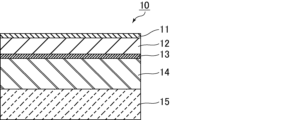
- FIG. 1 is a schematic cross-sectional view showing an example of the structure of the laminate of the present invention.
- the laminated body 10 includes a first resin layer 11 on one side (visible side) of the thin glass plate 12, and the side opposite to the first resin layer 11 side of the thin glass plate 12 (display device side). , and may be integrated with the polarizing plate 15 with an optical transparent adhesive (OCA) 14 .
- OCA optical transparent adhesive
- the thin plate glass is not particularly limited as long as it is plate-shaped and has a thickness of 200 ⁇ m or less.
- the composition of the thin plate glass include soda-lime glass, boric acid glass, aluminosilicate glass, and quartz glass.
- the thin sheet glass is preferably chemically strengthened glass that has undergone chemical strengthening treatment.
- the chemically strengthened glass preferably has a compressive stress layer formed on its surface by chemical strengthening treatment (ion exchange treatment).
- the shape of the thin plate glass is not limited to a flat plate shape, and may be, for example, a curved plate shape.
- the thickness of the thin plate glass is 200 ⁇ m or less. When the thickness of the thin plate glass is 200 ⁇ m or less, flexibility required for foldable electronic devices can be obtained. In addition, the thinner the thickness of the sheet glass, the more remarkable the improvement in impact resistance due to the resin layer.
- the thickness of the thin plate glass is preferably 150 ⁇ m or less, more preferably 100 ⁇ m or less. Further, the thickness of the thin plate glass is preferably 5 ⁇ m or more, more preferably 10 ⁇ m or more, still more preferably 20 ⁇ m or more, and particularly preferably 30 ⁇ m or more. When the thin plate glass has a certain thickness or more, both flexibility and impact resistance can be achieved.
- the light transmittance of the thin plate glass at a wavelength of 550 nm is preferably 85% or more.
- the refractive index of the thin plate glass at a wavelength of 550 nm is preferably 1.4 to 1.65.
- the density of the thin plate glass is preferably 2.3 g/cm 3 to 3.0 g/cm 3 , more preferably 2.3 g/cm 3 to 2.7 g/cm 3 .
- the method for producing the glass used for the above-mentioned thin glass is not particularly limited. It is produced by melting at a temperature of 1600° C. to 1600° C., molding it into a thin plate, and then cooling it.
- Examples of the method for forming a thin sheet of glass include a slot down draw method, a fusion method, a float method, and the like.
- the glass formed into a plate shape by these methods may be chemically polished with a solvent such as hydrofluoric acid, if necessary, in order to thin the plate or improve smoothness.
- chemical strengthening treatment is performed.
- ion exchange is performed on the glass surface to form a surface layer (compressive stress layer) in which compressive stress remains.
- alkali metal ions with a small ionic radius typically Li ions or Na ions
- alkali ions with a larger ionic radius typically, Li ions are replaced by Na ions or K ions, and Na ions are replaced by K ions.
- compressive stress remains on the surface of the glass, improving the strength of the glass.
- the thin plate glass a commercially available one may be used as it is, or a commercially available glass may be used after being subjected to additional treatment such as polishing and etching so as to have a desired thickness.
- the first resin layer has a storage elastic modulus at 25° C. greater than 2500 MPa.
- the storage modulus is preferably 3000 MPa or more.
- the upper limit of the storage modulus is not particularly limited, it is preferably 10000 MPa or less, more preferably 5000 MPa or less, from the viewpoint of ensuring the flexibility of the laminate.
- the second resin layer has a breaking energy of 1 mJ/mm 3 or more and a storage elastic modulus at 25° C. of 2500 MPa or less.
- the breaking energy is preferably 1.5 mJ/mm 3 or more, more preferably 2 mJ/mm 3 or more.
- the upper limit of the breaking energy is not particularly limited, it is, for example, 50 mJ/mm 3 or less from the viewpoint of ensuring other properties of the laminate.
- the storage elastic modulus is 2500 MPa or less.
- the laminate can have the flexibility required for realizing a foldable electronic device.
- the storage modulus is preferably 2000 MPa or less, more preferably 1800 MPa or less.
- the lower limit of the storage elastic modulus is not particularly limited, it is, for example, 100 MPa or more from the viewpoint of ensuring the impact resistance of the laminate.
- the breaking energy can be measured according to JIS K7113 "Plastic tensile test method" using a test piece prepared according to the following procedure.
- a release-treated polyethylene terephthalate resin film was placed on a glass plate with a thickness of 0.7 mm, with the release surface facing upward, and a silicon with a thickness of 0.5 mm was punched into a dumbbell shape (SDK-400).
- the resin composition used for forming the resin layer was poured into a dumbbell mold, and the resin liquid was covered with the release surface of the release-treated polyethylene terephthalate resin film so as not to entrain air bubbles. Stack the glass plates.
- an ultraviolet LED with a wavelength of 365 nm and an illuminance of 100 mW/cm 2 is used as a light source, and exposed through the glass plate for 15 seconds to irradiate with ultraviolet rays of 1500 mJ/cm 2 . Furthermore, while being sandwiched between the glass plates, it is turned over, and the same ultraviolet rays are applied again from the back side. Thereafter, the resin is cured by heating in an oven at 80° C. for 30 minutes, and the cured resin is removed from the silicon sheet mold to obtain a test piece. This test piece is subjected to a tensile test using a tensile tester.
- the tensile test is performed at a distance between chucks of 25 mm, a tensile speed of 50 mm/min, and a sampling interval of 20 ⁇ m until the test piece breaks. From the obtained measurement results, stress (unit: MPa) is taken on the vertical axis and strain (unit: %) is taken on the horizontal axis - Create a strain curve, this stress - surrounded by the strain curve and the horizontal axis
- the breaking energy can be calculated by determining the area of the portion where the fracture occurs.
- the resin layer When the breaking energy of the resin layer is directly measured from the laminate, the resin layer is punched into a dumbbell shape (SDK-400), and this is used as the test piece.
- the resin liquid is poured into the dumbbell mold, and the solvent is completely dried to obtain a test piece.
- the storage elastic modulus was measured by punching out a rectangular shape with a width of 5 mm and a length of 50 mm instead of a silicon sheet mold with a thickness of 0.5 mm punched into a dumbbell shape (SDK-400). Except for using a 0.5 mm silicon sheet mold, a measurement sample is prepared in the same manner as in the measurement of the breaking energy. For the prepared measurement sample, using a viscoelastic spectrometer (for example, DVA-200 manufactured by IT Instrument Control Co., Ltd.), under the conditions of 5 ° C./min and 1 Hz in the slow heating shear deformation mode, -50 ° C. to 200 ° C. It can be obtained as a storage modulus at 25° C. when the dynamic viscoelasticity spectrum of is measured.
- a viscoelastic spectrometer for example, DVA-200 manufactured by IT Instrument Control Co., Ltd.
- the second resin layer preferably has a Young's modulus of 1500 MPa or less.
- the Young's modulus is 1500 MPa or less, the second resin layer can have appropriate flexibility.
- the resin layer is hard to be broken at the same time, and a scattering prevention effect can be obtained.
- the Young's modulus is more preferably 1400 MPa or less, still more preferably 1300 MPa or less.
- the lower limit of the Young's modulus is not particularly limited, it is preferably 50 MPa or more, more preferably 80 MPa or more, from the viewpoint of ensuring the impact resistance of the laminate.
- the Young's modulus can be calculated by creating a stress-strain curve in the same manner as in the measurement of the breaking energy, and determining the slope of the stress-strain curve at a strain of 0 to 10%.
- the second resin layer has a Young's modulus of 50 MPa or more and 1500 MPa or less.
- the Young's modulus is preferably 1400 MPa or less, more preferably 1300 MPa or less, and preferably 80 MPa or more.
- the second resin layer preferably has a breaking energy of 1 mJ/mm 3 or more.
- the breaking energy is preferably 1.5 mJ/mm 3 or more, more preferably 2 mJ/mm 3 or more.
- the upper limit of the breaking energy is not particularly limited, it is, for example, 50 mJ/mm 3 or less from the viewpoint of ensuring other properties of the laminate.
- the second resin layer preferably has a storage modulus at 25° C. of 3000 MPa or less, more preferably 2500 MPa or less, even more preferably 2000 MPa or less, and particularly preferably 1800 MPa or less, 1500 MPa or less is particularly preferred.
- the storage elastic modulus is not particularly limited, but from the viewpoint of ensuring the impact resistance of the laminate, it is preferably 10 MPa or more, more preferably 100 MPa or more, and further preferably 500 MPa or more. preferable.
- the second resin layer preferably has an elongation at break of 5% or more.
- the elongation at break is 5% or more, cracks and whitening are less likely to occur in a bending endurance test. More preferably, the elongation at break is 7% or more.
- the elongation at break is preferably 1000% or less.
- a tensile test is performed in the same manner as in the measurement of the breaking energy, and the value of the strain when the test piece breaks can be used.
- each of the first resin layer and the second resin layer has a breaking strength of 5 MPa or more and 50 MPa or less.
- the breaking strength is within the range of 5 MPa or more and 50 MPa or less, it becomes easy to impart sufficient impact resistance to the thin glass. More preferably, the breaking strength is 10 MPa or more and 40 MPa or less.
- a tensile test is performed in the same manner as in the measurement of the breaking energy, and the value of the stress when the test piece breaks can be used.
- the second resin layer preferably has a glass transition temperature of 100° C. or lower.
- the glass transition temperature is more preferably 80° C. or lower, still more preferably 60° C. or lower.
- the lower limit of the glass transition temperature is not particularly limited, but is, for example, 0° C. or higher from the viewpoint of ensuring other properties of the laminate.
- a dynamic viscoelastic spectrum is prepared in the same manner as in the measurement of the storage elastic modulus, and the temperature at which the loss tangent has a maximum value can be used.
- Each of the first resin layer and the second resin layer preferably has a total light transmittance of 80% or more.
- the total light transmittance of the resin layer is 80% or more, the transparency of the resin layer can be ensured. It is preferable to form a laminate.
- the total light transmittance is more preferably 90% or more.
- the total light transmittance can be measured using, for example, HazeMeter NDH2000 (manufactured by Nippon Denshoku Industries Co., Ltd.). The above total light transmittance is measured by a method conforming to JIS K 7361-1.
- Each of the first resin layer and the second resin layer has a thickness of 5 ⁇ m or more.
- the thickness of the first resin layer is 5 ⁇ m or more, the protective performance of the glass surface can be effectively improved, and when the thickness of the second resin layer is 5 ⁇ m or more, the flexible resin layer It is possible to exhibit the function of absorbing impact by the above, and to impart sufficient impact resistance to the thin glass that is thinned in order to realize a foldable electronic device.
- the thickness of the first resin layer and the second resin layer is preferably 10 ⁇ m or more.
- the upper limit of the thickness of the first resin layer and the second resin layer is not particularly limited, but from the viewpoint of ensuring the bendability of the laminate, it is preferable that they are thinner than the thin plate glass.
- the first resin layer and the second resin layer has a thickness of 25 ⁇ m or less.
- the resin composition used to form the first resin layer and the second resin layer is not particularly limited as long as the properties of the resin layer obtained after curing can be adjusted within a desired range.
- one containing a cationic curable resin is preferably used because of its excellent adhesion to glass. That is, each of the first resin layer and the second resin layer preferably contains a cationic curable resin polymer, and in particular, the second resin layer preferably contains a cationic curable resin polymer. is preferred.
- the cationic curable resin is not particularly limited as long as it has at least one cationic polymerizable functional group in the molecule and is highly cationic polymerizable.
- the cationic polymerizable functional group include epoxy group, oxetanyl group, vinyl ether group, episulfide group, and ethyleneimine group.
- the cationic curable resin preferably contains at least one resin selected from epoxy resins (epoxy group-containing compounds), oxetane resins (oxetanyl group-containing compounds), and vinyl ether resins (vinyl ether group-containing compounds).
- epoxy group-containing compound epoxy group-containing compound
- oxetane resin oxetanyl group-containing compound
- the epoxy resin is not particularly limited. Novolac type epoxy resin; resorcinol type epoxy resin, and aromatic epoxy resin such as trisphenol methane triglycidyl ether; alicyclic epoxy resin; naphthalene type epoxy resin; fluorene type epoxy resin; dicyclopentadiene type epoxy resin; polyether-modified epoxy resins such as epoxy resins; NBR-modified epoxy resins; CTBN-modified epoxy resins; and hydrogenated products thereof.
- hydrogenated bisphenol type epoxy resins and epoxy resins having a polyether skeleton are preferably used as the cationic curable resin contained in the resin composition used to form the second resin layer.
- These epoxy resins may be used alone or in combination of two or more.
- the hydrogenated bisphenol type epoxy resin is preferably a hydrogenated bisphenol A type epoxy resin containing a hydrogenated bisphenol A skeleton.
- the hydrogenated bisphenol type epoxy resin may be a polymer such as a dimer.
- the epoxy equivalent of the hydrogenated bisphenol type epoxy resin is preferably 100 or more and 2000 or less. When the epoxy equivalent is 100 or more and 2000 or less, the crosslink density of the epoxy resin can be controlled within a preferable range, and the impact resistance can be further improved.
- the epoxy equivalent is defined as "mass of resin containing one equivalent of epoxy group" and is measured by a method according to JIS K7236.
- alicyclic epoxy resin examples include 3′,4′-epoxycyclohexylmethyl 3,4-epoxycyclohexanecarboxylate, ⁇ -caprolactone-modified 3′,4′-epoxycyclohexylmethyl 3,4-epoxycyclohexanecarboxylate , bis(3,4-epoxycyclohexyl) adipate, 1,2-epoxy-4-vinylcyclohexane, 1,4-cyclohexanedimethanol diglycidyl ether, epoxyethyldivinylcyclohexane, diepoxyvinylcyclohexane, 1,2,4- Examples include triepoxyethylcyclohexane, limonene dioxide, and alicyclic epoxy group-containing silicone oligomers. These alicyclic epoxy resins may be used alone or in combination of two or more.
- the epoxy resin may be a liquid epoxy resin at room temperature (23° C.) or a solid epoxy resin at room temperature, or an appropriate combination of these may be used.
- the epoxy resin preferably contains at least one epoxy resin that is liquid at room temperature.
- a hydrogenated bisphenol epoxy resin that is liquid at room temperature and an epoxy resin that is liquid at room temperature and has a polyether skeleton are preferably used.
- epoxy resins that are solid at room temperature include bisphenol A type epoxy resins such as “EPICLON 860”, “EPICLON 10550”, and “EPICLON 1055" (manufactured by DIC Corporation); ); Bisphenol S type epoxy resins such as “EPICLON EXA-1514" (manufactured by DIC); “EPICLON HP-4700", “EPICLON HP-4710", “EPICLON HP-4770” (above Naphthalene type epoxy resins such as “EPICLON HP-7200 series” (manufactured by DIC); dicyclopentadiene type epoxy resins such as "EPICLON HP-5000" and "EPICLON EXA-9900" available as commercial products.
- the oxetane resin (oxetanyl group-containing compound) which is the cationic curable resin is not particularly limited, and examples thereof include 3-ethyl-3-[(2-ethylhexyloxy)methyl]oxetane, 3-ethyl-3-hydroxy Methyloxetane, 1,4-bis([(3-ethyl-3-oxetanyl)methoxy]methyl)benzene, 3-ethyl-3-(phenoxymethyl)oxetane, bis[(3-ethyloxetan-3-yl)methyl ] ether, 3-ethyl-3-([3-(triethoxysilyl)propoxy]methyl)oxetane, oxetanylsilsesquioxane and the like.
- oxetane resin a monofunctional one is preferably used.
- examples of the oxetane resin include "ETRENACOLL EHO” (manufactured by Ube Industries, Ltd.), "Aron oxetane OXT-101", “Aron oxetane OXT-121", “Aron oxetane OXT-211", and “Aron oxetane OXT-221".
- “Aron Oxetane OXT-610” manufactured by Toagosei Co., Ltd.
- These can be used individually by 1 type or in combination of 2 or more types.
- the vinyl ether resin (vinyl ether group-containing compound) which is the cationic curable resin is not particularly limited, and examples thereof include methyl vinyl ether, ethyl vinyl ether, n-propyl vinyl ether, allyl vinyl ether, isopropyl vinyl ether, n-butyl vinyl ether, and isobutyl vinyl ether.
- the cationic curable resin preferably contains a hydrogenated bisphenol type epoxy resin, an epoxy resin having a polyether skeleton, and an oxetanyl group-containing compound. Since such a cationically curable resin can provide particularly excellent impact resistance, good results can be obtained in the evaluation of anti-scattering properties by a pen drop test.
- the content of the hydrogenated bisphenol type epoxy resin is not particularly limited, it is preferably 20% by weight or more, and 40% by weight or more, based on the total amount of the resin layer containing the polymer of the cationic curable resin. is more preferably 70% by weight or less, and more preferably 50% by weight or less.
- the content of the epoxy resin having a polyether skeleton is not particularly limited, but it is preferably 10% by weight or more, and 12% by weight or more, based on the total amount of the resin layer containing the polymer of the cationic curable resin. It is more preferably 40% by weight or less, more preferably 30% by weight or less, and even more preferably 20% by weight or less.
- the content of the oxetanyl group-containing compound is not particularly limited, it is preferably 10% by weight or more, preferably 20% by weight or more, relative to the total amount of the resin layer containing the cationic curable resin polymer. More preferably, it is 70% by weight or less, more preferably 60% by weight or less, and even more preferably 50% by weight or less.
- the content of the hydrogenated bisphenol type epoxy resin in the second resin layer containing the polymer of the cationic curable resin is 20% by weight or more and 60% by weight or less, and the epoxy resin having a polyether skeleton is contained. It is preferable that the amount is 10% by weight or more and 20% by weight or less, and the content of the oxetanyl group-containing compound is 20% by weight or more and 60% by weight or less.
- a resin composition containing an epoxy resin (an epoxy group-containing compound) as a main component is preferably used as the resin composition used for forming the first resin layer.
- the content of the epoxy resin in the resin layer is preferably 60% by weight or more, more preferably 80% by weight or more, and even more preferably 85% by weight or more.
- Examples of the epoxy resin used for the first resin layer include bifunctional alicyclic epoxy resins such as “Celoxide 2021P” and “Celoxide 8010” (manufactured by Daicel Corporation); “TEPIC-VL” ( Nissan Chemical Co., Ltd.), “EPICLON HP-4710” (DIC), “GTR-1800” (Nippon Kayaku), etc.; DIC Corporation), “OGSOL PG-100", “OGSOL CG-500” (both of which are manufactured by Osaka Gas Chemicals Co., Ltd.) and the like having a rigid skeleton are preferably used.
- bifunctional alicyclic epoxy resins such as “Celoxide 2021P” and “Celoxide 8010” (manufactured by Daicel Corporation); “TEPIC-VL” ( Nissan Chemical Co., Ltd.), “EPICLON HP-4710” (DIC), “GTR-1800” (Nippon Kayaku), etc.; DIC Corporation), “OG
- Epoxy resins having a rigid skeleton include epoxy resins having an aromatic ring, and examples thereof include epoxy resins having a biphenyl skeleton, epoxy resins having a naphthalene skeleton, and epoxy resins having a bisphenol skeleton.
- Examples of epoxy resins having a bisphenol skeleton include bisphenol F type epoxy resins.
- the resin composition preferably contains a polymerization initiator.
- the polymerization initiator may be a photopolymerization initiator or a thermal polymerization initiator.
- photopolymerization initiators include diphenyliodonium, 4-methoxydiphenyliodonium, bis(4-methylphenyl)iodonium, bis(4-tert-butylphenyl)iodonium, bis(dodecylphenyl)iodonium, diphenyl-4-thio phenoxyphenylsulfonium, bis[4-(diphenylsulfonio)-phenyl]sulfide, bis[4-(di(4-(2-hydroxyethyl)phenyl)sulfonio)-phenyl]sulfide, ⁇ 5-2,4-( cations such as cyclopentagenyl)[1,2,3,4,5,6- ⁇ -(methylethyl)benzene]-iron(1
- Thermal polymerization initiators include, for example, imidazoles, quaternary ammonium salts, phosphorus compounds, amines, phosphines, phosphonium salts, bicyclic amidines and their salts, acid anhydrides, phenol, cresol, xylenol, Novolac type phenol resins obtained by condensation reaction of resorcinol and the like with formaldehyde, polymercapto resins such as liquid polymercaptan and polysulfide, and amides can be mentioned. These polymerization initiators may be used alone or in combination of two or more.
- the content of the polymerization initiator has a preferable lower limit of 0.1 parts by weight and a preferable upper limit of 10 parts by weight with respect to 100 parts by weight of the cationic curable resin. If the content of the polymerization initiator is less than 0.1 parts by weight, the cationic polymerization may not proceed sufficiently or the curing reaction may become too slow. If the content of the polymerization initiator exceeds 10 parts by weight, the curing reaction of the resin composition may become too fast, resulting in reduced workability and uneven composition of the resulting resin layer. .
- a more preferable lower limit to the content of the polymerization initiator is 0.5 parts by weight, and a more preferable upper limit is 5 parts by weight.
- the resin composition further contains a solvent, a viscosity modifier, a surface modifier (surfactant, leveling agent), a plasticizer, a silane coupling agent, a tackifier, a sensitizer, as long as the object of the present invention is not impaired. It may contain various known additives such as curing agents, thermosetting agents, cross-linking agents, curing retarders, antioxidants, storage stabilizers, dispersants and fillers.
- the method for preparing the resin composition is not particularly limited, and examples thereof include a method of mixing a curable resin, a polymerization initiator, and additives to be added as necessary using a mixer. be done.
- the mixer include a homodisper, a homomixer, a universal mixer, a planetary mixer, a kneader, and three rolls.
- the method of forming the first resin layer and the second resin layer is not particularly limited. can be formed.
- the method of applying the resin composition is not particularly limited, and for example, a screen printing method, a die coat printing method, an offset printing method, a gravure printing method, an inkjet printing method, or the like may be used.
- the resin composition may contain a solvent from the viewpoint of coatability and the like.
- a solvent a nonpolar solvent having a boiling point of 200° C. or lower or an aprotic polar solvent having a boiling point of 200° C. or lower is preferable from the viewpoint of coatability, storage stability, and the like.
- the nonpolar solvent having a boiling point of 200° C. or lower or the aprotic polar solvent having a boiling point of 200° C. or lower include ketone solvents, ester solvents, hydrocarbon solvents, halogen solvents, ether solvents, and nitrogen-containing solvents. system solvents and the like.
- the boiling point of the nonpolar solvent or aprotic polar solvent is more preferably in the range of 80°C to 180°C from the viewpoints of stability of the coating liquid, uniformity of the coating film, drying efficiency, and the like.
- the resin composition preferably has a viscosity of 1 to 1000 mPa ⁇ s at 25° C. using an E-type viscometer.
- a more preferable range of the above viscosity is adjusted by the coating method. For example, a range of 5 to 50 mPa s is preferable for coating by an inkjet method, a range of 10 to 100 mPa s is preferable for coating by a slit coating method, and a range of 100 to 1000 mPa s is preferable for coating by a roll coating method or an offset printing method. is preferred.
- the viscosity exceeds 1000 mPa ⁇ s, the leveling property of the coating liquid tends to deteriorate, and the uniformity of the thickness of the coating film tends to deteriorate.
- the above viscosity is determined, for example, by using VISCOMETER TV-22 (manufactured by Toki Sangyo Co., Ltd.) as an E-type viscometer, and using a cone plate of CP1 at a rotation speed of 1 to 100 rpm as appropriate from the optimum torque number in each viscosity region. can be measured by selecting VISCOMETER TV-22 (manufactured by Toki Sangyo Co., Ltd.) as an E-type viscometer, and using a cone plate of CP1 at a rotation speed of 1 to 100 rpm as appropriate from the optimum torque number in each viscosity region. can be measured by selecting
- An electronic device including the first laminate or the second laminate is also one aspect of the present invention.
- a foldable electronic device foldable electronic device
- a foldable display device foldable display
- mobile display terminals such as smartphones, electronic books, and tablet PCs are included.
- the first resin layer is arranged on the viewing side
- the second resin layer is arranged on the viewing side.
- a configuration arranged on the display device side is preferable. According to this configuration, the first resin layer functioning as a hard coat layer is positioned on the surface side of the display device.
- the laminated body excellent in impact resistance and surface damage prevention property, and the electronic device which uses this laminated body can be provided.
- Examples 1 to 11, Comparative Examples 2 to 5 The curable resin shown in (1) below, the initiator shown in (2) below, and the surface modifier shown in (3) below are stirred and mixed according to the compounding ratio shown in Table 1 below to obtain a resin composition.
- Ta The obtained resin composition was diluted with propylene glycol monomethyl ether acetate as a solvent to adjust the viscosity, and coated on a thin plate glass having a thickness of 50 ⁇ m so as to have a thickness after drying as shown in Table 1 below.
- the obtained coating film was dried at a temperature of 100° C.
- Initiator CPI-210S triarylsulfonium salt type photocationic polymerization initiator, San-Apro Co., Ltd.
- DTS-200 aromatic sulfonium salt type photocationic polymerization initiator, manufactured by Midori Chemical Co., Ltd.
- Surface modifier BYK-340 manufactured by Big Chemie
- JAR-33 Organic modified polysiloxane, manufactured by Jujo Chemical Co., Ltd.
- Comparative example 1 The thin glass sheet of Comparative Example 1 was a thin glass sheet having a thickness of 50 ⁇ m, which was the same as that of Examples 1 to 11 and Comparative Examples 2 to 5, on which no resin layer was formed.
- a test piece of a cured resin having a thickness of 0.5 mm, a width of 5 mm, and a length of 50 mm was prepared, and a viscoelastic spectrometer (DVA-200, manufactured by IT Keisoku Co., Ltd.) was used at a tensile mode of 10 ° C./min.
- a dynamic viscoelastic spectrum was measured from -50°C to 150°C under the condition of 10Hz.
- the storage modulus at 25°C was determined from the obtained dynamic viscoelasticity spectrum.
- the temperature at which the loss tangent has a maximum value was taken as the glass transition temperature Tg (°C).
- the value of the strain when the test piece broke was defined as the elongation at break, and the value of the maximum stress when the test piece was broken was defined as the breaking strength.
- Young's modulus was calculated by determining the slope of the stress-strain curve at strains between 0 and 10%.
- the breaking energy was calculated by finding the area enclosed by the stress-strain curve and the horizontal axis.
- the laminated body excellent in impact resistance and surface damage prevention property, and the electronic device which uses this laminated body can be provided.
Landscapes
- Chemical & Material Sciences (AREA)
- Life Sciences & Earth Sciences (AREA)
- Engineering & Computer Science (AREA)
- Materials Engineering (AREA)
- Organic Chemistry (AREA)
- Wood Science & Technology (AREA)
- Chemical Kinetics & Catalysis (AREA)
- General Chemical & Material Sciences (AREA)
- Geochemistry & Mineralogy (AREA)
- Laminated Bodies (AREA)
Priority Applications (3)
| Application Number | Priority Date | Filing Date | Title |
|---|---|---|---|
| CN202380014635.4A CN118284511A (zh) | 2022-02-14 | 2023-02-13 | 层叠体和电子设备 |
| JP2023523119A JPWO2023153513A1 (https=) | 2022-02-14 | 2023-02-13 | |
| KR1020247015545A KR20240151722A (ko) | 2022-02-14 | 2023-02-13 | 적층체 및 전자 기기 |
Applications Claiming Priority (2)
| Application Number | Priority Date | Filing Date | Title |
|---|---|---|---|
| JP2022-020333 | 2022-02-14 | ||
| JP2022020333 | 2022-02-14 |
Publications (1)
| Publication Number | Publication Date |
|---|---|
| WO2023153513A1 true WO2023153513A1 (ja) | 2023-08-17 |
Family
ID=87564614
Family Applications (1)
| Application Number | Title | Priority Date | Filing Date |
|---|---|---|---|
| PCT/JP2023/004812 Ceased WO2023153513A1 (ja) | 2022-02-14 | 2023-02-13 | 積層体及び電子機器 |
Country Status (5)
| Country | Link |
|---|---|
| JP (1) | JPWO2023153513A1 (https=) |
| KR (1) | KR20240151722A (https=) |
| CN (1) | CN118284511A (https=) |
| TW (1) | TW202344384A (https=) |
| WO (1) | WO2023153513A1 (https=) |
Cited By (1)
| Publication number | Priority date | Publication date | Assignee | Title |
|---|---|---|---|---|
| WO2024143461A1 (ja) * | 2022-12-28 | 2024-07-04 | 積水化学工業株式会社 | 積層体、電子機器、カバーガラス及び樹脂組成物 |
Citations (5)
| Publication number | Priority date | Publication date | Assignee | Title |
|---|---|---|---|---|
| WO2008050547A1 (en) * | 2006-10-25 | 2008-05-02 | Nitto Denko Corporation | Substrate for display device and method for producing the same |
| JP2014523352A (ja) * | 2011-05-27 | 2014-09-11 | コーニング インコーポレイテッド | ガラス−プラスチック積層デバイス、そのための処理ライン及び方法 |
| WO2019066078A1 (ja) * | 2017-09-29 | 2019-04-04 | 大日本印刷株式会社 | 光学フィルムおよび画像表示装置 |
| JP2020152050A (ja) * | 2019-03-22 | 2020-09-24 | 三菱ケミカル株式会社 | 積層シート |
| WO2023277060A1 (ja) * | 2021-06-30 | 2023-01-05 | 積水化学工業株式会社 | 積層体、電子機器、樹脂組成物及びカバーガラス |
Family Cites Families (8)
| Publication number | Priority date | Publication date | Assignee | Title |
|---|---|---|---|---|
| WO2010053092A1 (ja) * | 2008-11-07 | 2010-05-14 | 日東電工株式会社 | 透明基板およびその製造方法 |
| JP5416546B2 (ja) * | 2009-10-23 | 2014-02-12 | 日東電工株式会社 | 透明基板 |
| JP2013037207A (ja) | 2011-08-09 | 2013-02-21 | Nitto Denko Corp | 表示装置用保護基板 |
| JP2015182293A (ja) * | 2014-03-24 | 2015-10-22 | 日東電工株式会社 | 積層体 |
| WO2016143360A1 (ja) * | 2015-03-12 | 2016-09-15 | パナソニックIpマネジメント株式会社 | 光カチオン重合組成物、接着方法、電子機器及びその製造方法、ディスプレイ装置及びその製造方法 |
| JP6550892B2 (ja) * | 2015-04-23 | 2019-07-31 | 三菱ケミカル株式会社 | ガラス積層体 |
| CN110494282B (zh) | 2017-04-11 | 2022-02-22 | 富士胶片株式会社 | 光学层叠体及具有光学层叠体的图像显示装置的前面板、图像显示装置、电阻膜式触摸面板及静电电容式触摸面板 |
| KR102724532B1 (ko) * | 2018-01-31 | 2024-10-30 | 니폰 제온 가부시키가이샤 | 적층체 및 그 제조 방법 그리고 터치 패널 |
-
2023
- 2023-02-13 CN CN202380014635.4A patent/CN118284511A/zh active Pending
- 2023-02-13 KR KR1020247015545A patent/KR20240151722A/ko active Pending
- 2023-02-13 JP JP2023523119A patent/JPWO2023153513A1/ja active Pending
- 2023-02-13 WO PCT/JP2023/004812 patent/WO2023153513A1/ja not_active Ceased
- 2023-02-14 TW TW112105142A patent/TW202344384A/zh unknown
Patent Citations (5)
| Publication number | Priority date | Publication date | Assignee | Title |
|---|---|---|---|---|
| WO2008050547A1 (en) * | 2006-10-25 | 2008-05-02 | Nitto Denko Corporation | Substrate for display device and method for producing the same |
| JP2014523352A (ja) * | 2011-05-27 | 2014-09-11 | コーニング インコーポレイテッド | ガラス−プラスチック積層デバイス、そのための処理ライン及び方法 |
| WO2019066078A1 (ja) * | 2017-09-29 | 2019-04-04 | 大日本印刷株式会社 | 光学フィルムおよび画像表示装置 |
| JP2020152050A (ja) * | 2019-03-22 | 2020-09-24 | 三菱ケミカル株式会社 | 積層シート |
| WO2023277060A1 (ja) * | 2021-06-30 | 2023-01-05 | 積水化学工業株式会社 | 積層体、電子機器、樹脂組成物及びカバーガラス |
Cited By (3)
| Publication number | Priority date | Publication date | Assignee | Title |
|---|---|---|---|---|
| WO2024143461A1 (ja) * | 2022-12-28 | 2024-07-04 | 積水化学工業株式会社 | 積層体、電子機器、カバーガラス及び樹脂組成物 |
| JPWO2024143461A1 (https=) * | 2022-12-28 | 2024-07-04 | ||
| JP7628658B2 (ja) | 2022-12-28 | 2025-02-10 | 積水化学工業株式会社 | 積層体、電子機器、カバーガラス及び樹脂組成物 |
Also Published As
| Publication number | Publication date |
|---|---|
| KR20240151722A (ko) | 2024-10-18 |
| TW202344384A (zh) | 2023-11-16 |
| JPWO2023153513A1 (https=) | 2023-08-17 |
| CN118284511A (zh) | 2024-07-02 |
Similar Documents
| Publication | Publication Date | Title |
|---|---|---|
| KR101702707B1 (ko) | 편광판용 접착필름, 이를 위한 편광판용 접착제 조성물, 이를 포함하는 편광판 및 이를 포함하는 광학표시장치 | |
| WO2023277060A1 (ja) | 積層体、電子機器、樹脂組成物及びカバーガラス | |
| KR20190107710A (ko) | 편광판 및 화상 표시 장치 | |
| US11726244B2 (en) | Polarizing plate for light emitting displays and light emitting display comprising the same | |
| KR102496513B1 (ko) | 활성 에너지선 경화성 접착제 조성물, 편광판용 접착제 조성물, 편광판용 접착제, 및 이를 사용한 편광판 | |
| JP7241741B2 (ja) | 偏光板およびそれを含む画像表示装置 | |
| JP7398960B2 (ja) | ハードコート層形成用樹脂組成物 | |
| WO2017094584A1 (ja) | カチオン硬化性樹脂組成物 | |
| TWI481686B (zh) | Excellent fast hardening of the energy line hardening type epoxy resin composition | |
| CN103403120B (zh) | 阳离子聚合性胶粘剂及使用它得到的偏振板 | |
| WO2023153513A1 (ja) | 積層体及び電子機器 | |
| JP7628658B2 (ja) | 積層体、電子機器、カバーガラス及び樹脂組成物 | |
| WO2011001912A1 (ja) | 深部硬化性に優れたエネルギー線硬化型エポキシ樹脂組成物 | |
| KR102157920B1 (ko) | 접착제 조성물, 이를 이용하여 형성된 접착제층을 포함하는 편광판 | |
| JP6986616B2 (ja) | 積層体及び光学積層体 | |
| JP7196596B2 (ja) | 活性エネルギー線硬化性接着剤組成物、偏光板用接着剤組成物、偏光板用接着剤、及びそれを用いた偏光板 | |
| JP5716221B2 (ja) | カチオン硬化型樹脂組成物 | |
| KR20160084094A (ko) | 활성에너지선 경화성 수지 조성물, 이를 포함하는 편광판 및 액정표시장치 | |
| JP6688063B2 (ja) | 光硬化性樹脂組成物および積層体 | |
| KR20180013442A (ko) | 접착제 조성물, 이를 이용하여 형성된 접착제층을 포함하는 보호필름 및 편광판, 및 이를 포함하는 화상표시장치 | |
| KR20160085585A (ko) | 활성에너지선 경화성 수지 조성물, 이를 포함하는 편광판 및 액정표시장치 | |
| KR20230000059A (ko) | 편광판용 접착제 조성물, 이를 이용한 편광판 및 이를 포함하는 광학표시장치 | |
| KR20160085583A (ko) | 활성에너지선 경화성 수지 조성물, 이를 포함하는 편광판 및 액정표시장치 | |
| KR20160085584A (ko) | 활성에너지선 경화성 수지 조성물, 이를 포함하는 편광판 및 액정표시장치 | |
| KR20190085723A (ko) | 코팅 조성물, 편광자 보호 필름, 편광자 보호 필름의 제조 방법, 이를 포함하는 편광판 및 이를 포함하는 액정표시장치 |
Legal Events
| Date | Code | Title | Description |
|---|---|---|---|
| WWE | Wipo information: entry into national phase |
Ref document number: 2023523119 Country of ref document: JP |
|
| 121 | Ep: the epo has been informed by wipo that ep was designated in this application |
Ref document number: 23752975 Country of ref document: EP Kind code of ref document: A1 |
|
| WWE | Wipo information: entry into national phase |
Ref document number: 202380014635.4 Country of ref document: CN |
|
| NENP | Non-entry into the national phase |
Ref country code: DE |
|
| 122 | Ep: pct application non-entry in european phase |
Ref document number: 23752975 Country of ref document: EP Kind code of ref document: A1 |