WO2023127017A1 - 検査装置、検査方法、及び検査プログラム - Google Patents
検査装置、検査方法、及び検査プログラム Download PDFInfo
- Publication number
- WO2023127017A1 WO2023127017A1 PCT/JP2021/048568 JP2021048568W WO2023127017A1 WO 2023127017 A1 WO2023127017 A1 WO 2023127017A1 JP 2021048568 W JP2021048568 W JP 2021048568W WO 2023127017 A1 WO2023127017 A1 WO 2023127017A1
- Authority
- WO
- WIPO (PCT)
- Prior art keywords
- pressure
- state
- pressure sensor
- electrical signal
- sensitive surface
- Prior art date
- Legal status (The legal status is an assumption and is not a legal conclusion. Google has not performed a legal analysis and makes no representation as to the accuracy of the status listed.)
- Ceased
Links
Images








Classifications
-
- G—PHYSICS
- G01—MEASURING; TESTING
- G01L—MEASURING FORCE, STRESS, TORQUE, WORK, MECHANICAL POWER, MECHANICAL EFFICIENCY, OR FLUID PRESSURE
- G01L5/00—Apparatus for, or methods of, measuring force, work, mechanical power, or torque, specially adapted for specific purposes
-
- G—PHYSICS
- G01—MEASURING; TESTING
- G01L—MEASURING FORCE, STRESS, TORQUE, WORK, MECHANICAL POWER, MECHANICAL EFFICIENCY, OR FLUID PRESSURE
- G01L5/00—Apparatus for, or methods of, measuring force, work, mechanical power, or torque, specially adapted for specific purposes
- G01L5/22—Apparatus for, or methods of, measuring force, work, mechanical power, or torque, specially adapted for specific purposes for measuring the force applied to control members, e.g. control members of vehicles, triggers
Definitions
- the present disclosure relates to an inspection device, an inspection method, and an inspection program for inspecting the state of an object.
- Patent Document 1 discloses a motion verification unit that collates a combination of information output from a plurality of sensors provided in a glove-type wearable sensor to recognize a body motion, and based on the body motion recognized by the motion verification unit.
- a work determination system is disclosed that includes a signal determination unit that determines whether the work content of the worker is normally performed by the signal determination unit, and a notification unit that reports the determination result of the signal determination unit.
- An object of the present disclosure is to provide an inspection device, an inspection method, and an inspection program that make it possible to determine whether an object is being gripped and shaken.
- An inspection apparatus of the present disclosure is an apparatus for inspecting the state of an object, having a first pressure-sensitive surface, and generating a first electrical signal corresponding to a first pressure applied to the first pressure-sensitive surface. and a second pressure sensor having a second pressure-sensitive surface and outputting a second electrical signal corresponding to a second pressure applied to the second pressure-sensitive surface.
- the state of the object is determined as the object is sandwiched between the first pressure-sensitive surface and the second pressure-sensitive surface.
- Either the first pressure sensor and the second pressure sensor are gripped and are in a gripping excitation state in which they are shaken, or the pressure sensor is in the state between the first pressure sensing surface and the second pressure sensing surface.
- a vibration state determination unit that determines whether or not the object is gripped by being sandwiched and the first pressure sensor and the second pressure sensor are not shaken and is in a gripping stationary state. characterized by
- An inspection method of the present disclosure includes: a first pressure sensor having a first pressure-sensitive surface and outputting a first electrical signal corresponding to a first pressure applied from an object to the first pressure-sensitive surface; and a second pressure sensor having a second pressure sensitive surface and outputting a second electrical signal corresponding to a second pressure applied from the object to the second pressure sensitive surface.
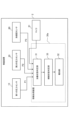
- FIG. 1 is a functional block diagram schematically showing the configuration of an inspection apparatus according to Embodiment 1;
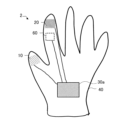
- FIG. FIG. 3 is a plan view schematically showing an example in which the first pressure sensor and the second pressure sensor of the inspection device according to Embodiment 1 are provided in a glove that is a glove-shaped holding member;
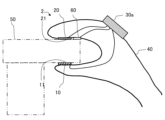
- 1 is a side view schematically showing an inspection device according to Embodiment 1;
- FIG. 1 is a diagram showing an example of hardware configuration of an inspection apparatus according to Embodiment 1;
- FIG. FIG. 4 is a side view showing a non-grasping state in which an object is not gripped;
- FIG. 4 is a side view showing a stationary gripping state in which an object is gripped;
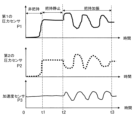
- FIG. 4 is a side view showing a gripping vibration state in which an object is gripped and shaken; 4 is a waveform diagram showing an example of detection signals output from the first pressure sensor and the second pressure sensor of the inspection device according to Embodiment 1.
- FIG. 4 is a flow chart showing the operation of the inspection apparatus according to Embodiment 1;
- FIG. 7 is a functional block diagram schematically showing the configuration of an inspection apparatus according to Embodiment 2;
- FIG. 11 is a plan view schematically showing an example in which a glove is provided with a first pressure sensor, a second pressure sensor, and an acceleration sensor of the inspection device according to the second embodiment;
- FIG. 11 is a side view schematically showing an inspection device according to Embodiment 2;
- FIG. 10 is a diagram illustrating an example of a hardware configuration of an inspection apparatus according to Embodiment 2;
- FIG. FIG. 10 is a waveform diagram showing an example of detection signals output from the first pressure sensor, the second pressure sensor, and the acceleration sensor of the inspection device according to Embodiment 2 (when there is “rattling”);
- FIG. 10 is a waveform diagram showing an example of detection signals output from the first pressure sensor, the second pressure sensor, and the acceleration sensor of the inspection device according to Embodiment 2 (when there is no “rattling”);
- 9 is a flow chart showing the operation of the inspection apparatus according to Embodiment 2;
- FIG. 1 is a functional block diagram schematically showing the configuration of inspection apparatus 1 according to Embodiment 1.
- the inspection device 1 includes a first pressure sensor 10 , a second pressure sensor 20 , a vibration state determination section 31 and a notification section 32 .
- the vibration state determination unit 31 and the notification unit 32 are part of the information processing device 30 .
- the inspection apparatus 1 is an apparatus capable of implementing the inspection method according to the first embodiment.
- the inspection device 1 is a device that inspects the state of an object to be inspected.
- An object is, for example, a device that has two or more structures and connecting parts such as bolts or screws that connect them.
- "inspection of the state of the object” means that the first pressure sensor 10 and the second pressure sensor 20 are interposed between the first pressure sensor 10 and the second pressure sensor 20 while the object is held. 10 and the second pressure sensor 20 are shaken (that is, vibrated), or the first pressure sensor 10 and the second pressure The first pressure sensor 10 and the second pressure sensor 20 are not shaken (i.e., not vibrated) in a state in which an object is sandwiched between the sensor 20 and gripped. It is a judgment of whether it is in the stationary state C1.
- the vibration at this time may be shaken by the operator's hand or shaked by the tip of an arm of a machine such as a robot (a portion corresponding to a human hand).
- the first pressure sensor 10 and the second pressure sensor 20 are arranged, for example, on the ventral surface of the fingertip of a glove, which is a glove-shaped holding member worn on the operator's hand.
- the holding member holds a first pressure sensor 10 and a second pressure sensor 20 .
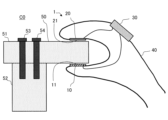
- the holding member is a deformable member, and when the holding member is worn on a human body part (for example, a hand) and an object is to be grasped, the first pressure sensing surface 11 of the first pressure sensor 10 is pressed. and the second pressure sensitive surface 21 of the second pressure sensor 20 face each other.
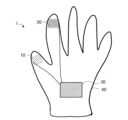
- the first pressure sensor 10 and the second pressure sensor 20 are arranged at the position of the thumb of the glove 40 and the position of the fingers other than the thumb of the glove 40, respectively.
- the first pressure sensor 10 is placed on the ventral surface of the thumb tip of the glove 40 and the second pressure sensor 20 is placed on the ventral surface of the index finger tip of the glove 40 .
- the structure of the holding member is not limited to this.
- the first pressure sensor 10 and the second pressure sensor 20 known ones can be used. For example, using a sensor element and a resistance element whose resistance value changes according to the pressure (or force) applied to the sensor surface, the voltage generated by the resistance voltage division is measured, and the measured voltage and the applied voltage are measured. A configuration is known in which the applied pressure is calculated based on the relationship between the pressures applied.
- the sensor element may also be, for example, a capacitive sensor.
- the vibration state determination unit 31 detects the first electrical signal (ie, output signal) P1 output from the first pressure sensor 10 and the second electrical signal (ie, output signal) P1 output from the second pressure sensor 20 . Based on the signal) P2, the state of the object 50 changes to a non-grasping state C0, which is a state in which the object is not grasped, or a state in which the operator is holding the object 50 with the hand wearing the glove 40 and is stationary. It is determined whether it is a gripping stationary state C1 or a gripping excitation state C2 in which the object 50 is gripped and vibrated. The notification unit 32 notifies the determination result of the vibration state determination unit 31 .
- the notification unit 32 transmits the determination result of the vibration state determination unit 31, that is, the information indicating the inspection result of the state of the object 50 as, for example, a notification signal to a data management device that manages the inspection result.
- the notification unit 32 may also include a speaker and a display screen for providing the operator with a sound (for example, an electronic sound such as a buzzer) or display indicating the result of the inspection.
- FIG. 2 is a plan view schematically showing an example in which the first pressure sensor 10 and the second pressure sensor 20 are provided in a glove 40, which is a glove-shaped holding member.
- FIG. 3 is a side view schematically showing the inspection device 1.
- the glove 40 is worn on a hand, which is a part of the operator's body.
- the inspection device 1 is a wearable inspection device.
- the shape of the globe 40 is not limited to the illustrated one.
- the number of pressure sensors may be three or more.
- the first pressure sensor 10 and the second pressure sensor 20 are preferably of the same standard, but may be sensors of different standards or different types.
- the first pressure sensor 10 has a first pressure sensing surface 11 and outputs a first electrical signal P1 corresponding to a first pressure F1 applied to the first pressure sensing surface 11.
- the second pressure sensor 20 has a second pressure sensitive surface 21 and outputs a second electrical signal P2 corresponding to a second pressure F2 applied to the second pressure sensitive surface 21 .
- the vibration state determination unit 31 determines whether the state of the object 50 is the non-grasped state C0, which is the state in which the object is not grasped, or the second electric signal P2.
- a gripping excitation state in which an object 50 is sandwiched and gripped between the first pressure sensing surface 11 and the second pressure sensing surface 21, and the first pressure sensor 10 and the second pressure sensor 20 are shaken.
- C2 or the object 50 is sandwiched and gripped between the first pressure sensing surface 11 and the second pressure sensing surface 21, and the first pressure sensor 10 and the second pressure sensor 20 are shaken. It is determined whether the gripping stationary state C1 is not held.
- FIG. 4 is a diagram showing an example of the hardware configuration of the inspection device 1 according to Embodiment 1.
- the information processing device 30 of the inspection apparatus 1 has a processor 101 such as a CPU (Central Processing Unit), a memory 102 as a storage device, a communication device 103, and an interface 104.
- the memory 102 is, for example, a semiconductor memory such as a RAM (Random Access Memory).
- Each function of the information processing device 30 shown in FIG. 1 is implemented by, for example, a processing circuit.
- the processing circuit may be dedicated hardware, or may be the processor 101 that executes programs (including the inspection program according to the embodiment) stored in the memory 102 .
- the processing circuit is configured using a microcomputer or a single board computer including an analog/digital (AD) converter that acquires and converts voltages output from the first pressure sensor 10 and the second pressure sensor 20. be able to.
- the information processing device 30 may be partly implemented by dedicated hardware and partly implemented by software or firmware.
- the processing circuitry may implement each of the functions described above in hardware, software, firmware, or any combination thereof.
- the information processing device 30 including the vibration state determination unit 31 and the notification unit 32 is arranged on the glove 40, but the information processing device 30 is arranged at a position away from the glove 40.
- the information processing device 30 may be configured to be distributed among a plurality of computers that can communicate with each other.
- FIG. 5 is a side view showing the non-grasped state C0 in which the object 50 is not grasped.
- FIG. 5 shows a non-grasping state C0 in which the first pressure sensing surface 11 of the first pressure sensor 10 and the second pressure sensing surface 21 of the second pressure sensor 20 are not in contact with the object 50.
- FIG. The object 50 has a structure in which members 51 and 52 are connected by connecting parts 53 and 54 .
- the connecting parts 53, 54 are, for example, screws or bolts.
- FIG. 6 is a side view showing a stationary gripping state C1 in which the object 50 is gripped.
- FIG. 6 shows a gripping stationary state C1 in which the first pressure sensitive surface 11 of the first pressure sensor 10 and the second pressure sensitive surface 21 of the second pressure sensor 20 are in contact with the object 50.
- FIG. 6 since the glove 40 is in a stationary state without being shaken, the first pressure F1 applied from the operator's thumb to the lower surface of the object 50 via the first pressure sensor 10 and the pressure from the operator's forefinger
- the second pressure F2 applied to the upper surface of the object 50 via the second pressure sensor 20 has a substantially constant value and is balanced with each other.
- FIG. 7 is a side view showing a gripping excitation state C2 in which the object 50 is gripped and shaken. 7 shows that the first pressure sensing surface 11 of the first pressure sensor 10 and the second pressure sensing surface 21 of the second pressure sensor 20 are in contact with the object 50, and the first pressure sensor 10 and the second pressure sensing surface 21 are in contact with the object 50.
- 2 shows a gripping excitation state C2 in which the pressure sensor 20 of No. 2 is swayed in the D direction (upward and downward directions in the figure). Since the globe 40 is being shaken, the first pressure F1 applied to the lower surface of the object 50 and the second pressure F2 applied to the upper surface of the object 50 change according to the shaking. , the changes of the first pressure F1 and the second pressure F2 are in opposite phase to each other.
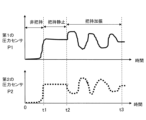
- FIG. 8 shows first and second electrical signals (also referred to as “detection signals”) P1 and P2 output from the first pressure sensor 10 and the second pressure sensor 20 of the inspection apparatus according to the first embodiment. It is a waveform diagram showing an example of .
- the inspection apparatus 1 is in the state shown in FIG. No pressure is applied to either 10 or the second pressure sensor 20 .
- the inspection apparatus 1 is in the state shown in FIG. 6 during the period from time t1 to time t2. It is a gripping stationary state C1 in which 50 is sandwiched and gripped. At this time, force is applied to both the first pressure sensor 10 and the second pressure sensor 20, so that the pressure synchronously indicates a high value.
- the inspection apparatus 1 grips the object 50 with the first pressure sensor 10 and the second pressure sensor 20 provided in the glove 40, and The first pressure sensor 10 and the second pressure sensor 20 sandwiching 50 are in a gripping vibration state C2 in which the first pressure sensor 10 and the second pressure sensor 20 are shaken in the D direction. Similar to the gripped state, pressure is applied to show a high value. Furthermore, in the vibrating action, the intensity of the applied force alternates, so the pressure waveform oscillates in synchronization with the vibrating action. When the first pressure sensor 10 and the second pressure sensor 20 are opposed to each other, the vibrations of the first pressure sensor 10 and the second pressure sensor 20 show changes with opposite polarities. For the sake of convenience, it is said that the outputs of the first pressure sensor 10 and the second pressure sensor 20 are out of phase.
- FIG. 9 is a flowchart showing the operation of the inspection device 1.
- FIG. FIG. 9 shows the processing of the vibration state determination unit 31.
- the vibration state determination unit 31 determines whether or not both the values of the output signals of the first pressure sensor 10 and the second pressure sensor 20 are equal to or greater than a predetermined threshold value Th1. If the value of the output signal is equal to or greater than the threshold Th1, the vibration state determination unit 31 advances the process to step S12. It is determined that the grasping state is C0.
- step S12 the vibration state determination unit 31 determines whether the first pressure sensor 10 and the second pressure sensor 20 are vibrating in opposite phases.
- the inspection apparatus 1 determines that it is in the gripping vibration state C2.
- the inspection apparatus 1 is determined to be in the gripping stationary state C1.
- the notification unit 32 notifies the determination result according to the flowchart in FIG.
- the notification unit 32 may, for example, display the determination result in characters, or may light a lamp according to the determination result. Also, the notification unit 32 may transmit the result to an external computer.
- the threshold value Th1 in step S11 is set in advance so that the stationary gripping state C1 and the non-gripping state C0 can be distinguished from each other.
- a large amount of pressure sensor output data in each state can be collected and identifiable boundaries can be set statistically.
- a boundary surface calculated using a support vector machine known in the field of machine learning can be set as the threshold Th1.
- data collected by changing the worker, parts to be worked on, working posture, etc. can be used as an example of a large amount of data.
- the determination of whether or not the vibration is in the opposite phase in step S12 can be performed by a plurality of methods. For example, it can be done as follows.
- P1(t) be the output of the first pressure sensor 10 and P2(t) be the output of the second pressure sensor 20 at time t.
- the offset amount is calculated based on each pressure value in the gripping stationary state C1 corresponding to the period from time t1 to time t2 in FIG. 8, and corrected by subtraction.
- the pressure value P1ac(t) obtained by subtracting the offset amount from the output value P1(t) of the first pressure sensor 10 and the pressure value obtained by subtracting the offset amount from the output value P2(t) of the second pressure sensor 20 P2ac(t) is calculated by equations (1) and (2).
- Vibration state determination is made when the absolute value of the difference between P1ac(t) and P2ac(t) is greater than a predetermined threshold value Thd in the grip excitation state C2, that is, in the period from time t2 to time t3.
- the unit 31 determines that the outputs of the first pressure sensor 10 and the second pressure sensor 20 are in opposite phase.
- the vibration state determination unit 31 determines that the outputs of the first pressure sensor 10 and the second pressure sensor 20 are not out of phase.
- the determination may be made based on instantaneous values, or may be made based on statistics such as standard deviation or variance.
- P1ac(t) can also be obtained by applying a pre-designed high-pass filter to remove an offset amount from P1(t).
- the vibration state determination unit 31 may obtain a determination result for each section of a predetermined length, and use the majority decision as the final determination result.
- the threshold Thd is set in advance to a value that allows discrimination between the vibrating gripping state C2 and the stationary gripping state C1. For example, a large amount of pressure sensor output data in each state can be collected and identifiable boundaries can be set statistically. As a statistical method, for example, a boundary surface calculated using a support vector machine known in the field of machine learning can be set as the threshold Thd. In addition, as an example of a large amount of data, data collected by changing the worker, parts to be worked on, working posture, etc. can be used.
- determination may be made based on the cross-correlation value C as in Equation (3).
- Equation (3) calculates the cross-correlation value C by inverting the sign of one of the output values of the first pressure sensor 10 and the second pressure sensor 20 after offset correction. That is, when the outputs of the first pressure sensor 10 and the second pressure sensor 20 after inverting the sign of one of the pressure values oscillate and are similar, the cross-correlation value indicates a large value.
- the cross-correlation value calculated in this way is equal to or greater than a predetermined threshold (first threshold) Thc, the excitation state determination section 31 can determine that the phases are opposite.
- the time-series data of the output values of the first and second pressure sensors 10 and 20 are regarded as primary sine waves, and the phases are changed. It may be calculated and determined based on the phase difference.
- the vibration state determination unit 31 determines that the phase difference is opposite when the phase difference is equal to or greater than a predetermined threshold (second threshold) Thp, and not when the difference is smaller than the threshold Thp.
- second threshold predetermined threshold
- a plurality of methods are known for calculating the phase of the time-series data. For example, there is a method of performing Fourier transformation on the waveform of the gripping excitation state C2 and referring to the phase of the frequency component with the largest amplitude. Common. Another common method is to assume the time-series data to be a primary sine wave and calculate the amplitude, frequency, and phase using an autoregressive model.
- Patent Document 1 describes a configuration for detecting a gripping state, but does not describe a configuration for detecting a gripping excitation state. According to the inspection apparatus 1, the inspection method, and the inspection program according to the first embodiment, it is possible to determine the gripped state and the vibrated state, which is an effect that has not existed in the past.
- FIG. 10 is a functional block diagram schematically showing the configuration of inspection apparatus 2 according to Embodiment 2.
- the inspection apparatus 2 is an apparatus capable of implementing the inspection method according to the second embodiment.
- the same reference numerals as those shown in FIG. 1 are attached to the same or corresponding configurations as those shown in FIG.
- the inspection apparatus 2 according to the second embodiment includes an acceleration sensor 60 that outputs a third electric signal (output signal) P3 corresponding to the acceleration generated in the object 50, and between fastened members. It differs from the inspection device 1 according to the first embodiment in that it includes a fastening state determination unit 33 that determines the fastening state.
- the inspection device 2 may include a microphone 61 that picks up sound instead of or in addition to the acceleration sensor 60 .
- the fastening state determination unit 33 determines that the object 50 has an insufficiently fastened portion, i.e., , it is determined that there is "rattling". Specifically, the fastening state determination unit 33 determines that the amplitude of the third electrical signal (output signal) P3 output from the acceleration sensor 60 is equal to or greater than a predetermined threshold value Tha in the gripping excitation state C2. Sometimes, it is determined that the object 50 has insufficient fastening portions.
- the fastening state determination unit 33 determines that the object 50 has insufficient fastening portions based on the amplitude of the fourth electric signal (output signal) P4 output from the microphone 61 in the gripping excitation state C2. You can judge. Specifically, when the amplitude of the fourth electrical signal (output signal) P4 output from the microphone 61 is equal to or greater than a predetermined threshold Thm in the gripping excitation state C2, the fastening state determination unit 33 Alternatively, it may be determined that the object 50 has an insufficient fastening portion.
- the fastening state determination unit 33 determines the amplitude of the third electrical signal P3 output from the acceleration sensor 60 and the amplitude of the fourth electrical signal P4 output from the microphone 61 in the gripping vibration state C2. Based on, it may be determined that the target object 50 has an insufficient fastening portion. Specifically, the fastening state determination unit 33 determines that the amplitude of the third electrical signal P3 output from the acceleration sensor 60 is equal to or greater than a predetermined threshold value Tha and that the microphone 61 is in the grip excitation state C2. When the amplitude of the fourth electrical signal P4 output from is greater than or equal to a predetermined threshold value Thm, it may be determined that the target object 50 has an insufficient fastening portion.
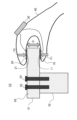
- FIG. 11 is a plan view schematically showing an example in which the first pressure sensor 10, the second pressure sensor 20, and the acceleration sensor 60 of the inspection device 2 are provided on the glove 40.
- FIG. FIG. 12 is a side view schematically showing the inspection device 2 when the object 50 is gripped. Since the object 50 is not sufficiently fastened, the object 50 vibrates due to "shattering" when the object 50 is vibrated by shaking the hand.
- the second embodiment in addition to the first pressure sensor 10 as a thumb pressure sensor and the second pressure sensor 20 as a forefinger pressure sensor, when the object 50 is shaken to bring it into the gripping excitation state C2, It is configured to include an acceleration sensor 60 that measures fingertip vibration.
- FIG. 13 is a diagram showing an example of the hardware configuration of the inspection device 2. As shown in FIG. In FIG. 13, the same reference numerals as those shown in FIG. 4 are attached to the same or corresponding configurations as those shown in FIG.
- the hardware configuration of the inspection device 2 is different from that of the first embodiment in that an acceleration sensor 60 is provided. Also, the inspection device 2 may include a microphone 61 that picks up sound instead of or in addition to the acceleration sensor 60 .
- FIG. 14 shows examples of the first to third electrical signals (detection signals) P1, P2, and P3 output from the first pressure sensor 10, the second pressure sensor, and the acceleration sensor 60 of the inspection device 2
- FIG. 10 is a waveform diagram showing a case where there is "rattling”.
- FIG. 15 shows examples of the first to third electrical signals P1, P2, and P3 output from the first pressure sensor 10, the second pressure sensor, and the acceleration sensor 60 of the inspection apparatus of the second embodiment
- FIG. 10 is a waveform diagram showing a case where there is no “rattling”.
- FIG. 14 and 15 show the response of the acceleration sensor 60 when the object 50 is being vibrated during the period from time t2 to time t3.
- the responses of the first pressure sensor 10 and the second pressure sensor 20 are similar to those of the first and second pressure sensors of the first embodiment shown in FIG.
- FIG. 14 shows an example of the response when the object 50 is not sufficiently fastened and "rattling" occurs.
- FIG. 15 shows an example of the response when the object 50 is sufficiently fastened. Since the "rattling" that occurs when the glove 40 is worn and the vibration is applied is very small, no vibration occurs and the acceleration sensor 60 does not observe any change.
- FIG. 16 is a flow chart showing the operation of the inspection device 2.
- FIG. 16 the same steps as those shown in FIG. 9 are given the same reference numerals as those shown in FIG. Step S ⁇ b>13 is a step corresponding to the processing of the fastening state determination section 33 .
- the presence or absence of "rattling", that is, whether the device is sufficiently fastened determine whether or not
- the amplitude of the third electrical signal output from the acceleration sensor 60 (the amplitude of the acceleration detection signal is used as a feature value) is determined to be “rattling” (insufficient fastening) when it is equal to or greater than the threshold value Tha, and when it is smaller than the threshold value Tha is judged to be free from “rattling" (sufficiently fastened).
- the threshold value Tha is set in advance to a value that can distinguish between insufficiently fastened states and sufficiently fastened states. For example, a large amount of data from the acceleration sensor 60 in a sufficiently fastened state can be collected and an identifiable boundary can be set statistically. As a statistical method, for example, using a one-class support vector machine (OCSVM) known in the field of machine learning, a space in a sufficiently fastened state and a corresponding boundary surface are calculated and set as a threshold value Tha. can be done. That is, it is synonymous with detecting a state of insufficient fastening as an outlier.
- OCSVM one-class support vector machine
- the feature amount may be determined based on an instantaneous value, or may be determined based on a statistic such as standard deviation or variance.
- the determination result may be output for each section of a predetermined length, and the majority decision may be used as the final determination result.
- Embodiment 1 the effect of Embodiment 1 is that, when inspecting an object using the glove 40, it is possible to determine whether the object is gripped or vibrated while being gripped. In addition to this, it is possible to determine whether or not the device is sufficiently fastened when vibration is applied.
- the velocity and the amount of displacement are calculated by time-integrating the measured acceleration. You may make it judge. A method of calculating velocity and displacement by integrating acceleration over time is widely known. This is a factor that lowers the accuracy of the velocity and displacement calculated by time integration.
- the output value of the acceleration sensor 60 (that is, the value of the third electrical signal) in the stationary state after detecting the stationary gripping state C1 is considered to correspond to the DC component. That is, after calculating the DC component based on the output value of the acceleration sensor 60 in the gripping stationary state C1, the DC component is subtracted from the value of the acceleration sensor 60 in the gripping excitation state C2, time integration is performed, and the velocity and displacement are calculated. The amount (corresponding to the magnitude of "rattling”) can be calculated with high accuracy.
- a uniaxial acceleration sensor that detects only one axis may be used to calculate the amount of displacement that coincides with the axial direction of the sensor.
- a two-axis acceleration sensor or a three-axis acceleration sensor may be used as the acceleration sensor 60 to calculate the amount of displacement based on the combined vector of displacements.
- the result of determining whether or not the members constituting the device are sufficiently fastened may be associated with the fastening conditions of the object 50 (bolt tightening force, bolt material, etc.).
- the determination result and fastening conditions are sent to a computer that communicates with the outside, and the computer analyzes under what fastening conditions the equipment is sufficiently fastened. Then, the computer periodically inspects the fastening state of the object and repeats the analysis. From these analysis results, it can be investigated that the device is fastened with a fastening force more than necessary. The fastening may become loose over time, and if the device is fastened with a fastening force more than necessary, the deterioration of the device may progress at the boundary between the device and the bolt. Therefore, from this analysis result, it is possible to diagnose the progress of deterioration of the fastening portion.
Landscapes
- Physics & Mathematics (AREA)
- General Physics & Mathematics (AREA)
- Measurement Of Mechanical Vibrations Or Ultrasonic Waves (AREA)
- Measuring Fluid Pressure (AREA)
Priority Applications (2)
| Application Number | Priority Date | Filing Date | Title |
|---|---|---|---|
| JP2023570514A JP7603850B2 (ja) | 2021-12-27 | 2021-12-27 | 検査装置、検査方法、及び検査プログラム |
| PCT/JP2021/048568 WO2023127017A1 (ja) | 2021-12-27 | 2021-12-27 | 検査装置、検査方法、及び検査プログラム |
Applications Claiming Priority (1)
| Application Number | Priority Date | Filing Date | Title |
|---|---|---|---|
| PCT/JP2021/048568 WO2023127017A1 (ja) | 2021-12-27 | 2021-12-27 | 検査装置、検査方法、及び検査プログラム |
Publications (1)
| Publication Number | Publication Date |
|---|---|
| WO2023127017A1 true WO2023127017A1 (ja) | 2023-07-06 |
Family
ID=86998326
Family Applications (1)
| Application Number | Title | Priority Date | Filing Date |
|---|---|---|---|
| PCT/JP2021/048568 Ceased WO2023127017A1 (ja) | 2021-12-27 | 2021-12-27 | 検査装置、検査方法、及び検査プログラム |
Country Status (2)
| Country | Link |
|---|---|
| JP (1) | JP7603850B2 (https=) |
| WO (1) | WO2023127017A1 (https=) |
Cited By (1)
| Publication number | Priority date | Publication date | Assignee | Title |
|---|---|---|---|---|
| JP2025034919A (ja) * | 2023-08-31 | 2025-03-13 | トヨタ自動車株式会社 | 作業種別決定システム |
Citations (5)
| Publication number | Priority date | Publication date | Assignee | Title |
|---|---|---|---|---|
| JPH01316194A (ja) * | 1988-06-16 | 1989-12-21 | Yamatake Honeywell Co Ltd | 滑り検出装置及びロボットハンドの滑り検出装置 |
| US20040265110A1 (en) * | 2002-05-28 | 2004-12-30 | Bernd Schnoor | Method and apparatus for moving a handling system |
| JP2020064429A (ja) * | 2018-10-17 | 2020-04-23 | 株式会社日立製作所 | 作業情報管理システム及びウェアラブルセンサ |
| JP2020189389A (ja) * | 2019-05-23 | 2020-11-26 | トヨタ自動車株式会社 | 演算装置、制御プログラム、機械学習器及び把持装置 |
| JP2021094639A (ja) * | 2019-12-16 | 2021-06-24 | 太陽誘電株式会社 | ロボットハンド、内容検知システム及び内容検知方法 |
Family Cites Families (8)
| Publication number | Priority date | Publication date | Assignee | Title |
|---|---|---|---|---|
| JP3448856B2 (ja) * | 1993-12-28 | 2003-09-22 | マツダ株式会社 | ロボットハンドの制御装置 |
| JP2002166383A (ja) | 2000-11-29 | 2002-06-11 | Mitsubishi Heavy Ind Ltd | ロボットアーム機構の触覚システム |
| JP2006321015A (ja) | 2005-05-19 | 2006-11-30 | Toyota Motor Corp | ロボットハンド装置 |
| EP2031517A1 (en) | 2007-08-28 | 2009-03-04 | Toyota Motor Europe NV | Methods and systems for data processing and their applications |
| JP2015223418A (ja) | 2014-05-29 | 2015-12-14 | セイコーエプソン株式会社 | 駆動装置及びその駆動方法 |
| JP6946057B2 (ja) | 2017-05-30 | 2021-10-06 | キヤノン株式会社 | ロボットハンド、ロボットハンドの制御方法、ロボット装置 |
| JP2018203480A (ja) | 2017-06-07 | 2018-12-27 | 株式会社東芝 | 仕分装置および仕分システム |
| JP2019188561A (ja) | 2018-04-27 | 2019-10-31 | 株式会社東芝 | 物品把持装置及び物品把持装置の制御装置 |
-
2021
- 2021-12-27 JP JP2023570514A patent/JP7603850B2/ja active Active
- 2021-12-27 WO PCT/JP2021/048568 patent/WO2023127017A1/ja not_active Ceased
Patent Citations (5)
| Publication number | Priority date | Publication date | Assignee | Title |
|---|---|---|---|---|
| JPH01316194A (ja) * | 1988-06-16 | 1989-12-21 | Yamatake Honeywell Co Ltd | 滑り検出装置及びロボットハンドの滑り検出装置 |
| US20040265110A1 (en) * | 2002-05-28 | 2004-12-30 | Bernd Schnoor | Method and apparatus for moving a handling system |
| JP2020064429A (ja) * | 2018-10-17 | 2020-04-23 | 株式会社日立製作所 | 作業情報管理システム及びウェアラブルセンサ |
| JP2020189389A (ja) * | 2019-05-23 | 2020-11-26 | トヨタ自動車株式会社 | 演算装置、制御プログラム、機械学習器及び把持装置 |
| JP2021094639A (ja) * | 2019-12-16 | 2021-06-24 | 太陽誘電株式会社 | ロボットハンド、内容検知システム及び内容検知方法 |
Cited By (1)
| Publication number | Priority date | Publication date | Assignee | Title |
|---|---|---|---|---|
| JP2025034919A (ja) * | 2023-08-31 | 2025-03-13 | トヨタ自動車株式会社 | 作業種別決定システム |
Also Published As
| Publication number | Publication date |
|---|---|
| JP7603850B2 (ja) | 2024-12-20 |
| JPWO2023127017A1 (https=) | 2023-07-06 |
Similar Documents
| Publication | Publication Date | Title |
|---|---|---|
| CN113631901B (zh) | 作业内容检测判定装置以及作业内容检测判定系统 | |
| KR102330889B1 (ko) | 제스처-기반 제어를 위해 근활성도 센서 신호와 관성 센서 신호를 결합하는 방법 및 기기 | |
| JP3409160B2 (ja) | 把握データ入力装置 | |
| JP2017138999A5 (https=) | ||
| JP2001021427A (ja) | 指装着型6軸力覚センサ | |
| EP3781915B1 (en) | Vibration dose measurement apparatus | |
| JP2006275979A (ja) | センサ素子、センサ装置、対象物移動制御装置、対象物判別装置 | |
| JPWO2020026299A1 (ja) | 作業情報管理システム、および作業情報管理方法 | |
| CN106037648A (zh) | 一种穿戴式推拿手法测定仪 | |
| WO2023127017A1 (ja) | 検査装置、検査方法、及び検査プログラム | |
| US20180348877A1 (en) | Gesture recognition apparatus and components thereof | |
| Denei et al. | On the development of a tactile sensor for fabric manipulation and classification for industrial applications | |
| CN107877501B (zh) | 机械手臂 | |
| CN1822791A (zh) | 活动监视 | |
| JP7136882B2 (ja) | 動作検出センサ及び動作検出方法 | |
| TWI603085B (zh) | 動作判定裝置及動作感測器 | |
| JP6303825B2 (ja) | 入力装置 | |
| Kon et al. | Bare finger tactile sensing for edge orientation and contact position using excitation from fingernail | |
| JPWO2023127017A5 (https=) | ||
| JP2022167148A (ja) | 圧力センサデバイス、圧力センサデバイスの製造方法および作業管理システム | |
| Rana et al. | Motion artifact sensor using strain gauges | |
| Austad et al. | Hand-arm vibration exposure monitoring with wearable sensor module | |
| JP7722692B2 (ja) | 触覚計測装置 | |
| JP7630750B1 (ja) | 検査支援装置、検査支援システム、検査支援方法、及びプログラム | |
| US10912497B2 (en) | Detection and evaluation of movements of a user |
Legal Events
| Date | Code | Title | Description |
|---|---|---|---|
| 121 | Ep: the epo has been informed by wipo that ep was designated in this application |
Ref document number: 21969901 Country of ref document: EP Kind code of ref document: A1 |
|
| WWE | Wipo information: entry into national phase |
Ref document number: 2023570514 Country of ref document: JP |
|
| NENP | Non-entry into the national phase |
Ref country code: DE |
|
| 122 | Ep: pct application non-entry in european phase |
Ref document number: 21969901 Country of ref document: EP Kind code of ref document: A1 |